Friday, January 13, 2012

Next Week in Tickets: Films playing Boston 13 January 2012 - 19 January 2012

Ah, January. A month of dumping stuff that may be junk, expanding platform releases, and other curiosities.

  • Let's be optimistic and start with the expanding awards hopefuls. I'm surprised that The Weinstein Company's PR firm hasn't been added to my spam filter for all the crap they've been sending me about The Iron Lady over the past few weeks. Meryl Streep plays Margaret Thatcher (and Jim Broadbent her husband Denis); word has it that it's an impressive imitation but not a great movie, but a lot of the disdain I've seen has been of the "why are you making a movie about Thatcher? She's eeevil!" variety. It opens in Coolidge Corner, Fenway, Boston Common, and Kendall Square. Strangely, TWC hasn't been pestering me about The Artist the way they have their other films, but that expands to Fenway alongside Kendall Square and Boston Common.

    The other expanding platformer is Carnage, with Roman Polanski teaming with Yasmina Reza to adapt her play about two yuppie couple who meet to discuss trouble between their respective sons and wind up spending an hour or so sparring verbally. Jodie Foster, Kate Winslet, Christoph Waltz, and John C. Reilly star for the fugitive rapist; the movie plays in Kendall Square and Boston Common.


  • Contraband looks like the sort of action movie that gets pushed to January to avoid stronger competition. It's got Mark Wahlberg as a former master thief pulled back into the life, Kate Beckinsale as his wife, and Ben Foster and Giovanni Ribisi, as members of his crew and targets. It plays Somerville, Harvard Square, Boston Common, Fenway, and Fresh Pond.

    The other thing studios do to fill screens during these quiet months is re-releases; this week, after last fall's success with The Lion King, Disney brings back Beauty and the Beast in 3D. On the one hand, it's an all-time classic and has a new short with the characters from Tangled in front; on the other, the "dimensionalization" of The Lion King looked terrible and this one was done earlier and not considered good enough to release until The Lion King made a bunch of money. The closest place to see a 2D show is Showcase Cinemas in Revere, and that's only for the 11:20AM show. Closer to Boston, it plays in 3D only at the Capitol Theatre in Arlington, Boston Common, Fenway, and Fresh Pond.

    Where's that leave Joyful Noise, a comedy with Dolly Parton and Queen Latifah as rivals within their church choir whose grandson and daughter are naturally drawn to each other. You know, as much as this looks like a by-the-numbers thing, I kind of like the trailer and dig the idea of Parton and Latifah doing a movie together. It plays Fenway, Boston Common, and Fresh Pond.


  • The Brattle sticks with a single really cool series this week, Dead of Winter. That's seven days of haunted house films, kicking off in style on Friday with a preview of The Innkeepers and a rare 35mm print of locally-shot Fulci flick House by the Cemetery. Saturday features Robert Wise's original The Haunting and a late show of Japan's wonderfully insane Hausu. Double features start on Sunday with The Shining and Burnt Offerings, with 13 Ghosts and Beetlejuice on Monday, Ju-On: The Grudge and The Orphanage on Tuesday, and v1.0 of The Amityville Horror and Poltergeist on Wednesday and Thursday. As near as I can tell, all are in 35mm, although that may change depending on print availability and quality.


  • The big opening at the Coolidge is The Iron Lady, but they've got some nice special screenings planned this week as well. The biggest is probably the midnight shows of The Divide on Friday and Saturday; it's a pretty darn brutal post-apocalyptic horror movie from Xavier Gens with an against-type Michael Biehn as one of a group of survivors at each other's throats in a bomb shelter. In a twisted but cool thing to do, the filmmakers are tying its release to a canned food drive, and the first 50 people to bring a donation to Feeding America to the Friday show will get a spiffy limited-edition movie poster by comic artist Jock.

    There's also the monthly screening of The Room at midnight on Saturday, while the roughly-monthly Talk Cinema preview screening on Sunday morning is Declaration of War, an apt description for how a young French couple deal with their newborn child falling very ill.


  • The Museum of Fine Arts has a their last couple screenings of The Klezmatics: On Holy Ground on Friday and Saturday, and will also be running My Reincarnation, a documentary about a Tibetan Buddhist Monk and his western-born son, said to be a reincarnation of a great man but who opts to live a modern lfie. That's got single screenings on the 13th, 14th, 15th, 18th, and 19th (Friday/Saturday/Sunday/Wednesday/Thursday). They'll also be running a Film Shorts Showcase with work from young local filmmakers as part of their Martin Luther King Jr. Day Open House on Monday the 16th, once at 11am and once at 1pm, with the latter including Q&A with some of the filmmakers.


  • The Harvard Film Archive re-opens to the public this weekend with Dreileben, in which three German filmmakers have each created a film set against the backdrop of the hunt for an escaped murderer. Christian Petzold's Beats Being Dead plays Friday the 13th at 7pm and Saturday the 14th at 9pm, and focuses on the attraction between a hospital intern and an immigrant maid; Dominik Graf's Don't Follow Me Around plays Friday at 9pm and Saturday at 7pm and has a criminal psychiatrist discovering an unknown connection to the town; and Christoph Hochhäusler's One Minute of Darkness plays at 7pm on both Sunday the 15th and Monday the 16th, featuring the cat-and-mouse game between detective and killer. All three are on digital video and are only loosely connected, so they can be watched in any order.


  • The Regent Theatre in Arlington has a pair of specialty documentaries playing one night each. On Tuesday the 17th, Ayn Rand and the Prophecy of Atlas Shrugged is an examination of the author and her best-known work; I'm guessing a sympathetic one or else it wouldn't use the word "prophecy". On Thursday the 19th, they play Splinters, which chronicles how surfing became popular and prestigious in Papua New Guinea in the past thirty years. As a bonus, "Tsunami of Sound" will perform some surf-inspired music.


  • Tamil and Telegu films take the Indian screen at Fresh Pond, and the iMovie Cafe site doesn't indicate any English subtitles. And while My Week with Marilyn has completed its run in Kendall Square, it opens for a second run at the Arlington Capitol.


My plans? As much as I'd love to stand on principle and avoid doing sot, I'll probably wind up seeing Beauty and the Beast in 3D because it is one of my all-time favorite movies. I've already got a ticket for Declaration of War as part of my subscription to Talk Cinema, so I'm there for that, and while I have every intention of doing some catch-up and Kendall Square before Chlotrudis nominations are due, the haunted house stuff at the Brattle is awesome. I also re-start Japanese classes on Saturday afternoon, so that's a big chunk of time taken out of my schedule for the next six weeks.

Wednesday, January 11, 2012

Those Weeks In Tickets: 12 December 2011 to 25 December 2011

A busy couple of weeks, getting ready for Christmas. Not that I put up lights or anything, but the niece population has doubled, and while they don't necessarily have a lot in common, it turns out that they all like presents.

Also, cold makes it hard to get up in the morning.

Table of contents:
12 December 2011 - 18 December 2011
19 December 2011 - 25 December 2011

This Week In Tickets!

Stubless: Saint, seen 18 December in the living room

Shame and Long Day's Journey Into Night are, quite frankly, terrible movies to see during the season when you get together with your families to exchange gifts and cheer. Terrible.

Shame

* * ¾ (out of four)
Seen 12 December 2011 in Landmark Kendall Square #1 (first-run)

Shame is an example of how a film can seemingly do everything right and yet fail to be compelling. Maybe that's because it is so careful about every detail; writer/director Steve McQueen is as precise in his filmmaking as lead character Brandon Sullivan is in arranging his solitary life to facilitate his urges, and it's easy to admire the craft without ever feeling anything strongly about it.

That may not even be a particular failing of the movie; if the idea is to make the audience understand the feeling of how something that normally brings joy (in this case, sex) can become an obligation which only provides a shadow of its former release, McQueen and star Michael Fassbender have done a good job. Fassbender hits every note flawlessly, and does manage to give Brandon a personality instead of just making him an exemplar of addictive behavior. The personality is that of a jerk, but a believable one; his scenes with Carey Mulligan and Nicole Beharie (great as, respectively, Brandon's sister and co-worker/potential next lover) make him at least an interesting mess.

And yet, like a blockbuster movie with little story to frame its big special effects scenes, Shame allows its fine acting to exist in something of a vacuum. It's not quite such a grievous sin - McQueen services those centerpiece performances in every scene, rather than making the audience wait like a bad action movie does, but there's still the frequent feeling that the movie has made its point and can move on to the part where something happens now. And when you get right down to it, the ending is just as desperate a grab for sentiment that it hasn't quite earned as you'll see in any more mainstream movie.

That doesn't make Shame a bad movie; in fact, there's really not a thing wrong with it. There's just also not much compelling about it; it executes well, but makes one wonder if what it's executing is worthwhile.

This Week In Tickets!

The theme for this week was "going to the IMAX theater when I really should have been finishing up my Christmas stuff". I actually took Monday off for it, what with having vacation time that wouldn't roll over and the trip out to Reading being something that eats a good chunk of the day. Well worth it, though - not only did this get me the Dark Night Rises prologue, but even though IMAX's digital sharpening work is pretty good, the parts of Mission: Impossible that were genuinely shot in genuine IMAX is pretty gorgeous on the giant screen.

It's kind of a shame that Mission: Impossible and Tintin came out so close together, as it relegated the latter to just a couple matinee showings a day on the Imax-branded screen at Boston Common. It's also a beautiful film, but M:I was a beast that would not be denied - perhaps ironic, as I'm pretty sure M;I's "five days early in IMAX" opening was to originally meant to give it a little more time on the digital screens before Tintin took over, but instead Tintin got bulldozed.

Interesting coincidence of the two coming out back-to-back like that, though, is that it has two very good directors trading roles: Brad Bird is directing the live-action film, while Steven Spielberg is directing the animated feature. As fun a novelty as it is, I hope this reversal doesn't persist too much: Bird has directed some fantastic animated films, and while I get that directing animation in the CGI age is often managing an office full of people working at computer terminals (and who gets into show business to do that) while this let him fly around the world and blow stuff up, there aren't a lot of people who can do what he does. Spielberg got to be halfway there by doing motion capture, but so much of Spielberg's best work has been instinctive; I don't know if the meticulous nature of animation would suit him long-term.

Mission: Impossible - Ghost Protocol

* * * ½ (out of four)
Seen 19 December 2011 in Jordan's Furniture Reading (first-run, genuine IMAX)

Mission: Impossible - Ghost Protocol is a heck of a ride, filled with one incredible set piece after another, and as a bonus many of the big scenees are filmed in eye-popping genuine IMAX. It's got a few moments when its execution doesn't quite match its ambition, but what works is pretty terrific.

What's missing, in this case, is a villain. Oh, Michael Nyqvist is there, but considering his grandiose plan, he needs to be bigger. His Kurt Hendricks is never established as a strong personality when he needs to be sneering and really just bug-nuts. Instead, he doesn't make the same impression that Lea Seydoux does as the mercenary who he hires. Sure, part of that's Ms. Seydoux being a knockout, but as Sabine Moreau, she's got an oddball hook (gets paid in diamonds), an early set piece showing her as a threat, and a big fight scene with her opposite number. That's how you establish a villain, not by telling us how smart/dangerous he is.

(Aside: In four movies, how come none of the people involved have decided to send Ethan Hunt and company up against an evil IMF? Granted, the team angle has only really been a big factor in the Bad Robot entries, but this seems like a natural thing!)

Fortunately, the good guys are enjoyable enough to watch without perfectly matched adversaries. Everyone knows their roles - being more experienced doesn't make Tom Cruise much less cocky and Simon Pegg is still the eager nerd next door as the returnees, while Paula Patton and Jeremy Renner both do well as very capable people with nagging doubts. They all handle the physical aspects of the job quite well, and there's a fun back-and-forth that develops between Pegg's Benji Dunn and Renner's William Brandt.

But, let's face it, we're here for the action, and it turns out that Brad Bird blows stuff up real good. I'm actually kind of curious to see how this plays on a 2.35:1-proportioned screen, because Bird frames a fair amount of the action vertically, using the 1.44:1 aspect ratio of the IMAX screen to indicate either great height or action happening on multiple levels. His animation background serves him very well, not just because he's a natural where CGI is concerned, but because he's used to paying attention to every quadrant of every frame.

The Adventures of Tintin

* * * ¾ (out of four)
Seen 24 December 2011 in AMC Boston Common #2 (first-run, Imax-branded digital 3D)

When I was a kid, the Tintin albums were the only comic book-type things in Cumberland, Maine's Prince Memorial Library, and I read them all (heck, they may even have had a copy of Tintin in the Congo). They're great all-ages adventure stories, and it's no wonder that Steven Spielberg has been trying to make this movie for roughly thirty years (or that original comic creator Hergé considered him the perfect man for the job before his death).

They probably couldn't have seen this Tintin movie back then, a three-dimensional, motion-captured piece of animation that captures the way Eurocomics like Tintin are full of incredible detail while being whimsical and cartoony. It's a funny thing - even as motion-capture animation is being phased out and 3D is being scaled back, Spielberg and a few others are doing a great job of showing that the technology itself isn't to blame, but just needs people figuring out how to use it.

And he uses it pretty darn well. There are many flat-out amazing big action scenes in this movie, but three stand out: A battle with pirates that takes on some bizarre angles, a cut-free chase through a Morocco-inspired city, and a swordfight with... No, that would be telling. All three, though, are further evidence that nobody does big action better than Steven Spielberg; that chase, while it only lasts three or four minutes, has a ton of moving pieces to keep track of, and it winds up being not just exciting but so clear that most people will never realize what a frustrating thing it could have been.

The movie is a lot of fun when things aren't being thrown around and shot up as well; Spielberg, the screenwriters, and the cast find an excellent balance of light-hearted whimsy and genuine thrills; while the actual jokes may not always come off, there's a comfortable familiarity to the characters, even the ones just meeting for the first time.

It's a shame Mission: Impossible has gulped up all the IMAX screens during its run; this is a big adventure that deserves the biggest screens, and a fine addition to the exceptional run of kid-friendly movies to come out this fall.

ShameSherlock Holmes: A Game of ShadowsLong Day's Journey Into Night
Mission: Impossible - Ghost ProtocolSedonaThe Adventures of Tintin

Tuesday, January 10, 2012

Katharine Hepburn, Stage III: Long Day's Journey Into Night

And so we come to the end of ArtsEmerson's Katharine Hepburn series (see previous entries here, here, and here). It's been a fun ride, seeing these movies in 35mm with pretty deent crowds, and I kind of wish I'd had time to see The African Queen, but December can be madness, and I do have Blu-ray on my shelf...

Anyway, I half-jokingly referred to the December leg of this program as "the spinster years" (it also included David Lean's Summertime), though the only one I made it to has Hepburn's character married. In a lot of ways, these are the movies that let Hepburn be interesting again; she's never being restrained by playing opposite Spencer Tracy or pressured into being less than she is. She's able to age remarkably gracefully; even the naive missionary's sister in The African Queen, intelligence and steel comes through; the same with the midwestern librarian of Summertime. In a way, those performances make her turn in Long Day's Journey Into Night even more devastating; we know what Katharine Hepburn is supposed to be and it is definitely not this.

One final aside which has little to do with Kate - seeing young Dean Stockwell and Jason Robards in this movie is weird. Robards less so, because he seams like a completely different person from the aged elder statesman he tended to play in the movies I've seen. But Dean Stockwell freaks me out because he seemed old in Quantum Leap and other late-1980s work, and didn't really change straight through Battlestar Galactica. In this movie, he's pretty much got the same voice, and looks like an airbrushed version of the actor I know. That he actually started out as a child actor makes me a little terrified to finally watch Song of the Thin Man sometime.

Long Day's Journey Into Night

* * * ¼ (out of four)
Seen 17 December 2011 in the Paramount Theater Bright Screening Room (Kate the Icon, Katharine the Iconoclast)

There's no screenplay credit on Long Day's Journey Into Night, not out of shame, but because director Sidney Lumet and his small cast basically shot Eugene O'Neill's play in its entirety, and apparently nobody felt that the details of staging it and adding what movements couldn't be done on stage merited being labeled a co-writer. Despite that, it doesn't feel like an early precursor to the stage productions digitally broadcast to theaters today. It's a genuine movie; just one that doesn't hide its origins.

It chronicles a day in the life of the Tyrone family, their first together at the beach house one summer, which is fraught with more danger than such things typically are. Mother Mary (Katharine Hepburn), you see, is just back from another stay at the clinic to try and kick her morphine addiction, which has her husband James (Ralph Richardson) keeping watch to make sure she doesn't backslide. Their older son Jamie (Jason Robards) is a layabout, occasionally making half-hearted attempts to follow his father onto the stage, while younger son Edmund (Dean Stockwell) has health problems of his own. News on those will come from a doctor's appointment scheduled for later in the afternoon, but nobody wants to talk about it, keeping the whole family on edge.

Film and theater are quite different things, even if they are often made by the same people from the same material. The scale of theater is fixed and the boundaries on its reality are clearly visible enough that other forms of artifice are not just forgiven but natural. Cameras and cuts, with their ability to instantly change locations and perspectives, mean that film directors don't have to compensate the way stage directors and actors do. For most plays, the filmmaker faces either the prospect of losing someone's favorite part or building something that just doesn't work as a movie.

Full review at EFC.

Monday, January 09, 2012

Because it's expected of me: Sherlock Holmes: A Game of Shadows and The Girl with the Dragon Tattoo (USA)

These two movies have probably been reviewed to death, and there's other stuff to get to if I ever want this blog to be close to caught up, but having reviewed all three Swedish Millennium movies, as well as a metric ton of Sherlock Holmes flicks, well, it would be silly not to give these more than just TWIT capsule treatment.

(Note: Seeing that Scott Weinberg is going to be writing Asylum's next Megashark movie, maybe I should have pushed the "let me write your next Sherlock Holmes knockoff flick" angle much harder. I can't say I'm as good at it as Weinberg or even that I like Sherlock as much as he loves killer sharks, but I'm pretty damn sure I'd put more effort into it than the guy who wrote their first Sherlock Holmes movie!)

It's a bit of a weird circumstance that the Hollywood takes on both these franchises are coming out nearly simultaneously with other versions from across the Atlantic: In Sweden, all three of the books Stieg Larsson finished before his death were made into movies in rapid succession, all coming out during 2009 and making their way to the United States a year later with unusually high-profile bookings for subtitled R-rated movies. Meanwhile, the BBC has Sherlock on the air right now, making it a minor form of torture to read the Twitter feeds of people in the UK, as PBS won't be airing it as part of Masterpiece Mystery until May.

Thus far, both are better than the Hollywood versions, and it's interesting that both take liberties: Sherlock places Holmes in the present day, while the Swedish version of The Girl with the Dragon Tattoo (or Men Who Hate Women) supposedly doesn't hew as close to its source material as the new version does. Funny thing, that, in that taking those sorts of liberties is usually something that Hollywood gets raked over the coals for.

It's also sort of funny to note that the American Girl with the Dragon Tattoo is opening against movies that feature the stars of the Swedish version: Noomi Rapace is featured in Sherlock Holmes: A Game of Shadows, while Michael Nyqvist is the villain in Mission: Impossible - Ghost Protocol. I remember being amused that Rapace was treating the US publicity work for her Lisbeth Salander as a sort of extended audition for Hollywood work, with the media cheering her on - nearly every interview seemed to contain some variation on not only was her English flawless and barely accented at all, but she was so cheerful and friendly as well! I hadn't realized Nyqvist was doing the same thing.

Speaking of accents, Rooney Mara's Swedish accent is weird. Not so much because she uses one or because it's inauthentic, but because practically the entire rest of the cast opts to go with a more neutral way of speaking, including (and maybe especially) native Swedes like Stellan Skarsgard. I actually prefer it that way - I figure that the characters are speaking their native language in a manner that suits that language, and if you're going to translate that into English, it should be presented in a way that suits that language. Consider another BBC mystery series, Wallander - it's also set in Sweden, but I don't think anybody from Kenneth Branagh as the title character on down affects an accent. That doesn't make it feel inauthentic, at least not nearly so much as making articulate people sound less so does.

One more point, but it's sort of a spoiler, so it goes after the EFC review links.

Sherlock Holmes: A Game of Shadows

* * ¾ (out of four)
Seen 17 December 2011 in AMC Boston Common #17 (first-run, digital)

Part of the reason that Sherlock Holmes has persisted as a character for over a century is that he is much more flexible than he may first appear - get the basics right and Sir Arthur Conan Doyle's character is a good fit for just about any time period, style, and genre. The trouble with A Game of Shadows isn't so much that it's a buddy action/adventure with director Guy Ritchie's fingerprints all over it, or that liberties are taken with the canonical stories, but that the characters are a bit off, more clearly than in the same crew's 2009 film.

As was discovered at the end of that movie, there's an intelligence behind the crime in England, one Professor James Moriarty (James Harris). Consulting Detective Sherlock Holmes (Robert Downey Jr.) is trying to find evidence via con artist Irene Adler (Rachel McAdams), eventually hijacking the bachelor party of best friend John Watson (Jude Law) to follow up a lead with gypsy fortune-teller Simza Heron (Noomi Rapace). This sets them off on a chase through Europe as it becomes clear that Moriarty's plans are much greater than simply controlling crime in the London underworld.

Fans of Sherlock Holmes will recognize some of the things married writing team Michele & Kieran Mulroney throw into the script, picking up characters and elements from various Holmes stories and combining them to good effect. It's a fun story, growing from street crime to international conspiracies without the scale getting away from the film. There's a few fun action scenes, and the film actually outdoes the source material in one or two places, particularly in the scene many will know is coming when a certain Swiss village's name gets dropped early on.

Full review at EFC.

The Girl with the Dragon Tattoo '11

* * ¾ (out of four)
Seen 27 December 2012 in Somerville Theater #1 (first-run, 35mm)

Let's read significance into something tiny; after all, what else are you supposed to do when trying to review the second adaptation of the same novel to hit theaters in a two-year period? So, let's ponder that, while the Swedish film used the source novel's original title, "Men Who Hate Women", this one was going to use the name of the English translation, "The Girl with the Dragon Tattoo" from the start, and that does (for better or worse) indicate a shift in the focus.

As before, we start not with the title character, but with Mikael Blomkvist (Daniel Craig), a Stockholm investigative reporter who has just been convicted of libel. The fine he will pay empties his life savings and he steps down as publisher of the magazine Millennium, but he's offered another opportunity: Octogenarian billionaire Henrik Vanger (Christopher Plummer) would like him to find out who killed his niece Harriet in 1966; the evidence suggests that it must have been some member of his family, a greedy and disreputable bunch even if you ignored the Nazi past of brother Frode (Steven Berkoff). Eventually, he gets a lead, and hires some help: Lisbeth Salander (Rooney Mara), a "researcher" for the security company that vetted Mikael for Henrik, an expert hacker for all that she's a troubled young woman.

Let's get back to that title thing again. It's a silly thing, but Men Who Hate Women puts the focus on the crime while The Girl with the Dragon Tattoo is about the people solving the crime. To a great extent, this is a distinction without a difference; the very best murder mysteries and crime thrillers, director David Fincher's Seven and Zodiac among them, are about both at once. Still, it's a shift in focus - both from the Swedish movie directed by Niels Arden Oplev and within this one - that hurts the film a bit. The middle section, where Blomkvist and Salander are investigating the disappearance of Harriet Salander and what turn out to be a slew of related crimes, is a snappy mystery story where we learn about our sleuths by how they attack their job and interact with each other. That kind of storytelling is, in a way, great slight of hand - the audience thinks it's getting obligatory plot mechanics but the cast and crew is doing their best work, getting characterization and mood across without being showy about it.

Full review at EFC.

SPOILERS! I should probably read the copy of the book I've got sitting on my shelf to see if it's just the American version of the movie being more faithful, but even if it is - the ending of the new movie seems really off to me, with Lisbeth envious and angry over Michael reuniting with his girlfriend. It's not so much that Lisbeth is getting upset over a man (though her bisexuality is basically "mostly gay, but can't resist Stieg Larsson Mikael Blomqvist") as it is that her story is not about romance or even attraction so much as trust: Blomqvist is the first person to treat her with respect and not hide her away. Romance, it seems, is decidedly beside the point.

Is it this way in the book? I suppose it explains why they're not closer in The Girl Who Played with Fire, but it seems to miss the point - what makes Lisbeth Salander such a great character is her competence and independence, and having our last image be of her getting all heartbroken over a guy is just wrong. !SRELIOPS

Friday, January 06, 2012

Next Week in Tickets: Films playing Boston 6 January 2012- 12 January 2012

A little bit of motion this week than last. Not much, though.

  • The main opening at the multi/megaplexes this week is The Devil Inside, which has a cast of unknowns doing exorcisms. It very nearly slipped in under the radar almost completely, given the near-complete lack of trailers and reviews I've seen for it. It plays in Somerville, Fresh Pond, Fenway, and Boston Common.


  • Two more interesting films open in Kendall Square. Pariah is an interesting-looking independent film, featuring Adepero Oduye as a black teenager who is starting to realize that she's attracted to other women. It appears to be an expansion of director Dee Rees's short film, and is interesting at least in part because Rees is relatively close in age to her characters, not being long out of college herself.

    The other movie opening is In the Land of Blood and Honey, the feature writing/directing debut of actress Angelina Jolie. It chronicles a Serb and a Bosnian who reunite under the worst circumstances (a prison camp during the war), and with any luck isn't too tacky. Jolie's worked with some talented people; here's hoping she's learned from them, too.


  • On the other side of Cambridge, the Brattle Theatre continues showing The Wages of Fear through Sunday. After the weekend ends, they've got a miniature retrospective on Terrence Malick, showing his four pre-Tree of Life films over four days: A double feature of Days of Heaven and Badlands on Monday the 9th and Tuesday the 10th (and if you're not up for a double feature, they swap screening times, so you can see Badlands at 7:30pm on Monday and Days of Heaven at the same time on Tuesday; invert that for 5:30pm and 9:30pm); The Thin Red Line on Wednesday the 11th, and The New World on Thursday the 12th..


  • Just one night of film at the Regent Theatre this week; Everyday Sunshine: The Story of Fishbone plays Wednesday the 11th at 7:30pm as part of their "Sound Cinema" series.


  • The Harvard Film Archive is having its "Members' Weekend", but if you're a member, you probably already know that, and ArtsEmerson doesn't start showing film again for another couple of weeks. Over at the Museum of Fine Arts, it's all about documentaries: Screenings of Paul Goodman Changed My Life continue through Sunday the 8th, while last year's Sundance Grand Jury Prize winner Hell and Back Againstarts on Friday, with screenings on the 6th, 7th, 8th, 11th, and 12th. A somewhat lighter feature, The Klezmatics: On Holy Ground, screens with the support of the Boston Jewish Film Festival on the 11th and 12th, continuing into the next week.


  • The Hindi film opening at Fresh Pond on the 6th is Players, a Hindi action/adventure movie that is apparently a remake of The Italian Job. It's got the Indian-film screen pretty much to itself from Friday to Wednesday, with an unsubtitled Tamil-language film bumping it then.


  • The Coolidge Corner Theatre picks up A Dangerous Method to play in the screening room, with midnight showings of the original Terminator playing on Friday and Saturday on the big screen. The only other notable screen-shifting is War Horse arriving at the Arlington Capitol.


My plans? Well, I haven't seen Young Adult, A Dangerous Method, or We Bought a Zoo yet, so I might go for them. Yikes, it's quiet enough that I may go for Bollywood this week.

Thursday, January 05, 2012

Last movie seen in 2011, first seen in 2012: My Week With Marilyn and War Horse

If I were really clever, I would likely have made The Adventures of Tintin my last movie of the year for 2011, just to say I finished one year and started the next with new Spielberg films. Looking at previous TWIT posts, this pairing is a step up from last year's Phantom of the Paradise and True Grit '10, well ahead of the 2009/2010 pairing of A Single Man and Broken Embraces, and even further away from 2008/2009's Frost/Nixon and The Spirit. So, a solid end and beginning to the movie-watching year.

Part of the fun with these two movies, though, is the flood of fun character actors to be found. I do suspect that relatively few in the theater were quite so excited about seeing Michael Kitchen of Foyle's War show up in My Week with Marilyn as I was, and I found myself racking my brain over who one guy was in War Horse before recognizing Eddie Marsan.

Not that I was planning on any kind of theme to unite the two; they just had the neat coincidence of having the whole "movies filled with great British actors" thing in common. Of course, now I'll be trying to replicate this next year!

My Week with Marilyn

* * * (out of four)
Seen 31 December 2011 in Landmark Kendall Square #9 (first-run)

Though My Week with Marilyn chronicles one star on one specific movie set, I suspect that a number of people in the movie business who never had any interaction at all with Marilyn Monroe or Sir Laurence Olivier watched it and nodded their heads in understanding. The former Norma Jean Baker is, as an individual perhaps as inscrutable as ever when it's done, but we do get a look at the subspecies she represents so perfectly, the movie star.

Colin Clark (Eddie Redmayne), the younger scion of a country squire, loves the movies, and uses connections and sheer stubbornness to get an (unpaid) position on the staff of Laurence Olivier's production company. Sir Laurence (Kenneth Branagh) has cast Marilyn Monroe (Michelle Williams) as his female lead in his new movie, the lightest of light comedies about a European prince who falls for an American dancer, but it turns out to be far from smooth sailing: Monroe is thoroughly intimidated by Olivier and England in general, eventually only trusting the rather smitten Colin.

We see this mainly from Colin's point of view - screenwriter Adrian Hodges adapts the real-life Colin Clark's two memoirs - and it's perhaps worth asking if maybe his story of his involvement grew in the telling. Who wouldn't, in the decades that followed, exaggerate how close he got to the sexiest star of the era? There are occasional points where the words of a more experienced, insightful man come out of the mouth of the 23-year-old Colin's mouth, which can be a bit odd, considering that he will soon revert to his previous, naive state. This isn't a bad thing by any means - as a narrator, he seems more reliable than not, and he isn't nearly superfluous as the typical "relatively-ordinary guy meant to be the audience's proxy" character.


Full review at EFC.

War Horse

* * * (out of four)
Seen 1 January 2012 in Regal Fenway #8 (first-run)

War Horse is a film about a horse, told from its point of view and those of the people who encounter the animal before and during the First World War. This is both a blessing and a curse, in that it allows director Stephen Spielberg and the other filmmakers to look at war as a phenomenon almost divorced from human goals and motivations, but that distance may not work for everyone.

The horse is a beautiful, fast thoroughbred that captures the imagination of Devon farmer Ted Narracott (Peter Mullan), who buys it at auction even though what his family really needs is a strong workhorse. Ted's son Albert (Jeremy Irvine) names it Joey and manages to train it to pull a plow, but a disastrous rain and the looming war finds Joey pressed into army service, though Captain Nicholls (Tom Hiddleston) promises Albert that he will make Joey his personal steed and return him safely. It's to a long war, though, which will see Joey encounter German brothers (David Kross and Leonhard Carow), an ailing French girl (Celine Buckens) and her grandfather (Niels Arestrup), and others.

There's something very old-fashioned about War Horse at times; the last scene, for instance, could be tacked on to a John Ford western and not seem out of place other than being in color. And while Spielberg established a standard for realistic portrayals of the battlefield in Saving Private Ryan, he pulls back a little here, often obscuring the actual moment a bullet hits. Though it initially seems like a move meant to preserve a PG-13 rating and make a family-friendly war movie, it soon becomes clear that Spielberg is not presenting a bloodless child's fantasy of war. He's presenting the horse's view, and Joey doesn't really conceive of combat or death here - he's thrust into new situations with new masters without necessarily developing a great deal of understanding or attachment.

Full review at EFC.

Monday, January 02, 2012

This Week Month "Has It Really Been That Long?" In Tickets: 24 October 2011 to 11 December 2011

A week or two seeing a lot of movies here, a foreign-language class there, and suddenly I find myself ridiculously far behind on the blog. Let's see how quickly it's possible to catch up!

Table of contents:
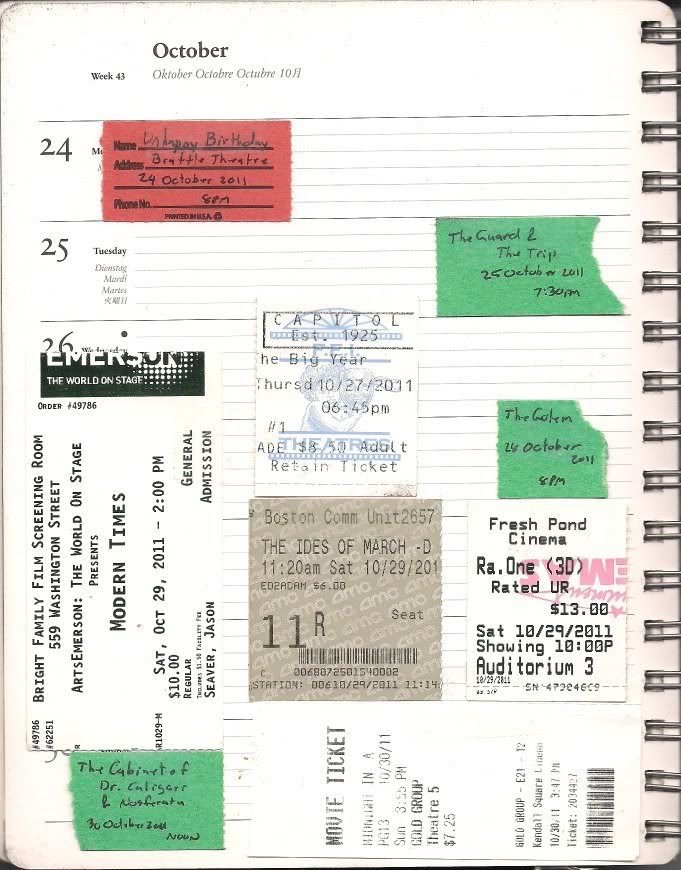
24 October 2011 - 30 October 2011
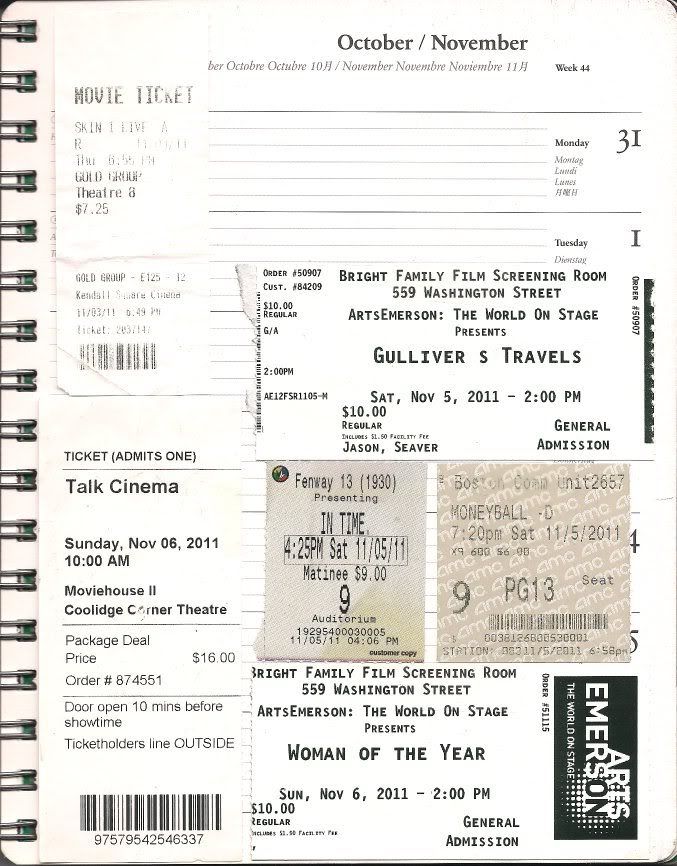
31 October 2011 - 6 November 2011
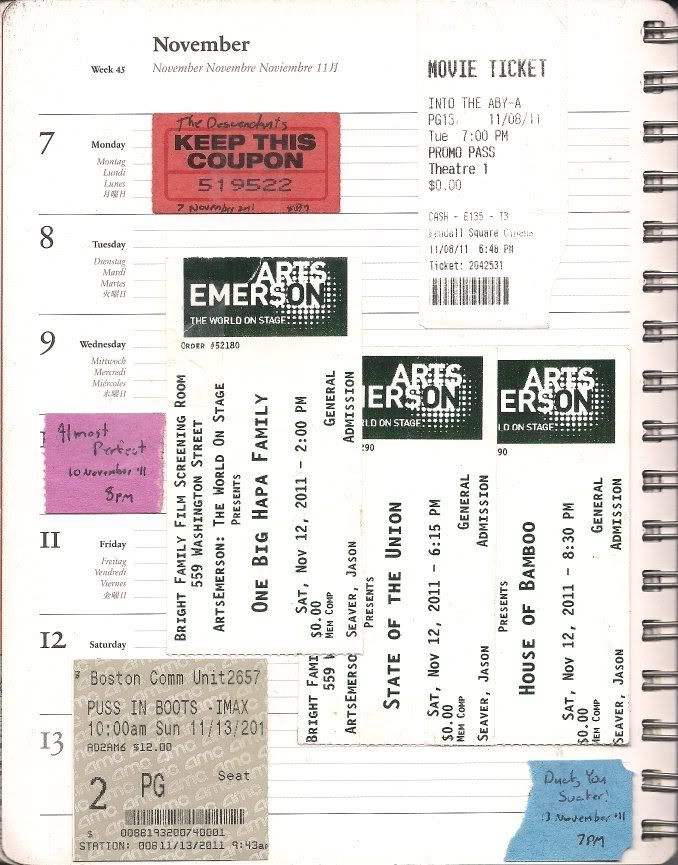
7 November 2011 - 13 November 2011
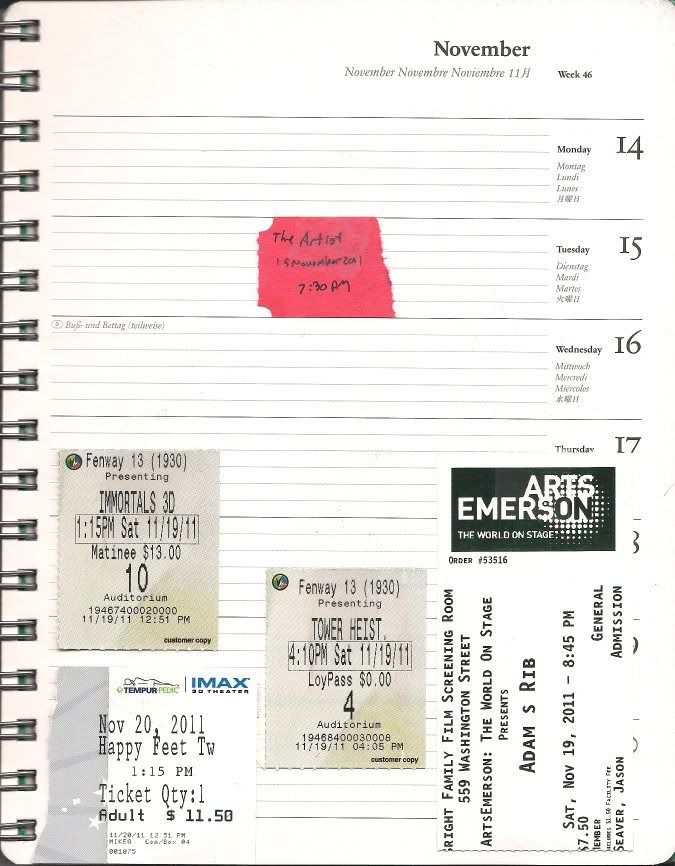
14 November 2011 - 20 November 2011
21 November 2011 - 27 November 2011
28 November 2011 - 4 December 2011
5 December 2011 - 11 December 2011

This Week In Tickets!

I was hoping to do a bunch of reviews on the Brattle's "Silent Screams" series, but not only did other things fill my time afterward, but I felt unusually knocked out that weekend, really dragging during a few movies . I wound up spending a lot of time at the Brattle that week, between CineCaché and the double feature and the silents, to the extent where the soda they serve there is actually starting to grow on me.

Of course, sometimes falling behind isn't really heartbreaking.

Unhappy Birthday

* ½ (out of four)
Seen 24 October 2011 in the Brattle Theatre (CineCaché)

Giving negative reviews to independent movies sucks, especially when the director notices you mentioning their movie on Twitter and asks you directly what you thought. That happened here, and there's really not a whole lot good to say about Unhappy Birthday. It's got an impressive opening sequence, a clever setting, and filmmakers who certainly seem to want to use the form to say something clever, but just don't have anything close to the skill to put it together.

The opening is connected to the setting; the town of Amen is perched on the end of a piece of coastal land so flat that it only acts as a peninsula at low tide' the rest of the time it is an island. Rick (David Paisley), his friend Sadie (Christina De Vallee), and his boyfriend Jonny (Jonathan Keane) are going there to give Sadie a very special birthday surprise - a reunion with her long-lost sister Corinne (Jill Riddiford). Actually, given that Sadie was a foundling, she's probably the long-lost one. Naturally, of course, the island turns out to be sinister.

I got to the theater just a bit after the start time, but didn't miss any of the movie because there were a couple of folks from the Boston LGBT Film Festival up front doing the intro, talking about "queer cinema" and "queer horror", which was nice in that it gave me a chance to get my coat off and sit down without messing with anybody watching the movie, and I get that the movie was made with a certain point of view, but it made me a bit worried, because they didn't really seem to be saying anything - there were words about how some movies scanned as straight or queer, but they weren't actually talking about whether or not the movie was scary.

And ultimately, that's what really sinks Unhappy Birthday - filmmakers Mark Harriott and Mike Matthews just don't tell a good scary story. It doesn't help at all that the movie is a mess on a technical level, with terrible sound mixing and photography that looked cheap and low-rez even from the back row. Yeah, it's independent, but there are a lot of good, cheap, consumer tools these days. That could be forgiven if the movie was well-told, but that was painfully amateurish, too. The filmmakers seem to be trying to replicate things that they have seen work in better horror movies without understanding what makes them effective or integrating them into the story (voyeuristic shots work much better with a voyeur, handheld cameras aren't automatically scary, etc.), creating a patchwork feeling that just never comes together. Characters change behavior drastically between scenes without explanation. Things get campy without the movie either fully committing to it or using it to make the horror aspects more shocking. And while individual scenes make sense, the totality doesn't. I'm cool with gay main characters and having sexuality be a big part of the story, but just because these things are relatively rare in the genre doesn't mean they're free passes.

There's actually some good work on the cast's part - Paisely, Keane, and De Vallee could make these characters the center of a genuinely good movie - but they're too thin as written and given too many dumb things to do. I'd certainly like to enjoy this movie, and maybe it works for those who think the "queer" part of "queer horror" is more important than the "horror" part (though I wouldn't presume to say), but it's just not scary, and not clever or even funny enough to make up for that.

The Trip

* * ¾ (out of four)
Seen 25 October 2011 in the Brattle Theatre (Recent Raves)

If you clicked the ticket looking for The Guard, head over here; I don't usually split a double feature, but this didn't fit in the "no reviews on EFC" theme of that post and I didn't really have a lot to say about it even right after I saw it (and I may have dozed off at some point, too).

It's an entertaining enough movie, at least, with UK personality Steve Coogan inviting his friend and frequent collaborator Rob Brydon along with him on a restaurant tour he'd originally planned to do with his much younger girlfriend (Brydon is a cheerfully domestic family man to Coogan's fame-loving sophisticate, at least in this fictionalized version of the pair). Conversation and mishaps ensue, with Coogan pondering whether he wants to move to Hollywood to star in a new CSI-type program. The famous dueling Michael Caines and the like are just as funny as billed, and the pair do have fine chemistry.

Interesting thing about the series - there was no writer listed on the print or IMDB, and checking the latter doesn't yield any writers' credits on the TV series that it was edited together from. A great deal of it is likely real and improvised, but there are some parts that are obviously scripted; I imagine those come from Coogan and Brydon as well. It's an odd set-up all around, really, and compacting the series to about half its length while keeping all the stops does lead to the film falling into a bit of a rut toward the end. The Trip is a well-improvised portrait of two middle-aged men with opposite perspectives, but it wasn't originally built as a movie, and sometimes that shows.

Der Golem, wie er in die Welt kam (The Golem)

* * ¾ (out of four)
Seen 28 October 2011 in the Brattle Theatre (Silent Screams)

I am pretty sure that even with a more appropriate soundtrack, The Golem would have its problems. When shown at the Brattle with a pre-recorded soundtrack by Frank Black (aka "Black Francis"), though, it was an object lesson in how precisely these things must be matched: The mood of the music seldom matched the picture, and brought something previously unseen out even less often, and that tended to highlight the flaws that were already present.

Because, let's face it, there's a big one here, which is that the plot is spurred into action by the emperor declaring that the Jews must be moved from the ghetto on account of their use of black magic, and Rabbi Loew (Albert Steinruck) deciding to fight this edict by... well, summoning a demon so that he might learn the magic words necessary in order to animate the soulless brute of the title. That is kind of ceding the high ground, there. Naturally, the golem (co-writer/director Paul Wegener) eventually goes out of control, endangering the whole community, most notably the Rabbi's daughter Miriam (Lyda Salmonova), who will likely need rescuing by her new secret Christian knight boyfriend Florian (Lothar Muthel).

The Golem is by no means whatsoever a bad movie; indeed, directors Carl Boese and Wegener put together a story that is often pretty thrilling, and looks very nice indeed for being made in 1920. It's got an appealing cast, too, particularly Wegener. His role, more that in many silents, involves a great deal of mime; even in motion, he looks like hard clay, and he's entirely convincing when going from impassivity to an almost-feral state. This movie was said to be a large influence on the James Whale Frankenstein, and that's in large part because Wegener and company give us a monster who, though in some ways a man, is in other ways decidedly less.

Still, it's hard to get over just how much of a mess parts are, especially the finale that sort of invites the jaw to drop - that's how you finish this? Ah, well - the movies still had some growing up to do when The Golem was made, and it manages to be a good yarn even if it has troubles as a story.

The Ides of March

* * * (out of four)
Seen 29 October 2011 in AMC Boston Common #11 (first-run)

Going into this, I had completely forgotten that George Clooney directed and co-wrote the movie as well as co-starring and producing. That's almost not fair; sure, it's not surprising that he might wind up following the same career path as Clint Eastwood and Robert Redford, but I don't recall either of them being much in the way of writers. It's almost unseemly for one guy to be publicly good at so many things.

But, let's back the praise up a little. The Ides of March isn't exactly a masterpiece, just an above-average movie, which is certainly nothing to sneer at. It's based on Beau Willimon's play "Farragut North" (changing the title from a bit of political nerdery to a Shakespeare reference makes it a little more inviting, I guess), and features Ryan Gosling as one of the chief lieutenants in the Presidential campaign of Governor Mike Morris (Clooney), with Philip Seymour Hoffman as the campaign manager, Paul Giamatti as the main primary opponent's campaign manager, and Evan Rachel Wood as a lovely young intern. Gosling's Stephen Meyers knows that he's in a ruthless business, but Morris has him just starry-eyed enough that he's still caught unexpected when little things become power struggles.

It's probably an artifact of having two movies where a certain limited affect is called for come out in such rapid succession, but Ryan Gosling is sort of a paradox as a lead actor: He always gives a good performance, but even when his characters get angry, there's something very distant and vague about him. Now, maybe I'm wrong about this - I've seen a few Facebook updates from younger cousins that certainly seem to indicate that girls go for him, and maybe his blankness is part of the appeal, a medium to project fantasies on. Compare him to his co-stars - Clooney, especially, is engaging and charismatic even though he's mean to be just as much of a cipher. Hoffman, Giamatti, Wood, Marisa Tomei, Jeffrey Wright, they all have something too.

Of course, having no easy hook into Gosling's character means that there are a great many directions the movie can go at any time, although there is something oddly muted about the whole thing - it's never quite as intense as it perhaps should be. A good story well-told, at the very least.

Das Cabinet des Dr. Caligari (The Cabinet of Dr. Caligari)

N/A (out of four)
Seen 30 October 2011 in the Brattle Theatre (Silent Screams)

So, the night before this screening, I went to see RA. One at Fresh Pond. It got out at around 12:30am, after the T had stopped running, so it was a half-hour or so walk back home in the snow (yeah, early snowstorm this year). It's almost impossible for me to fall asleep after that without reading for a bit, so I was pretty fuzzy the next morning, and I nodded off at some point during this, and I apparently completely missed the big twist that makes the movie famous.

I'll certainly re-watch it another time, because I love silents. They take a certain amount of concentration, though, which I just didn't have to give that day.

Nosferatu, eine Symphonie des Grauens (Nosferatu, a Symphony of Terror)

* * * * (out of four)
Seen 30 October 2011 in the Brattle Theatre (Silent Screams)

I've mentioned that this is my favorite vampire movie ever before, right? Yes, I have.

My opinion is more or less unchanged, although on the fourth or fifth viewing it does start to seem a little less perfect and a little more rickety. I hadn't seen a lot of silent movies when I first saw this one, so I was a bit bowled over by what a new experience this type of storytelling was. Still, I think it makes all the right decisions in adapting Dracula that other movies avoid in the name of humanizing the inhuman title character.

Midnight in Paris

* * * ½ (out of four)
Seen 30 October 2011 in Landmark Kendall Square #5 (first-run, amazingly)

I'm not quite the last person to see Midnight in Paris theatrically, but I certainly waited long enough: The movie was in its twentieth week or so at the Kendall, with a mere eleven days left to go there before heading over to Arlington for its second run. Forget being Woody Allen's biggest hit in a long time, that sort of longevity is almost unheard of anywhere.

Perhaps surprisingly, it's mostly deserved. Though there's still a bit of bitter old man to Midnight - the inevitable Allen-surrogate, Owen Wilson's Gil, can't mention his work in Hollywood without also mentioning that what comes out of there is crap - it's well ameliorated by the themes of the rest of the movie: The desire to live in the past, Gil learns, is seductive but there's no growth to come from it. It's not so much the present that's flawed but how one lives there.

Allen isn't close to subtle in getting this message across, but there's a sense of whimsy here that has seldom been present in his recent works, including the comedies. Part of it's the fantasy conceit of having Gil regularly catch a cab to the 1920s - even if Allen has something sincere and emotional to say, he's got to have a light touch or fall down the hole of making what the sci-fi/fantasy fans call "the mythology" make some sort of sense, and he's too smart to do that - but part of it seems to be just not being afraid to have some fun. There's a gag toward the end ("what happened to the detective") that shocked and delighted me because it was quick, funny, and kind of anarchic. It's the sort of thing that recent, serious-even-during-the-comedies Woody Allen just doesn't do.

I really hope he decides to do it more; I miss that Woody Allen, even if that's the sort of thing he tended to do before I was watching his movies.
This Week In Tickets!

I started taking a Saturday-morning Japanese class at the Boston Language Institute this weekend, with the stated goal of being able to enjoy Toshiro Mifume performances in their entirety. Thus far, it has had the principle effects of (1) making me tremendously glad that English has an alphabet rather than two syllabaries and a gigantic collection of pictographs; (2) demonstrating that my study habits and general work ethic have sadly not improved noticeably since college; and (3) rearranging my Saturday moviegoing habits, as the cheap "AM Cinema" shows are out and I'm just a block away from Fenway when class lets out at 12:30pm. Also, lolling around the house all weekend has suddenly stopped being an option.

Gulliver's Travels (1939)

* * ¾ (out of four)
Seen 5 November 2011 in the Paramount Theatre Bright Screening Room (ArtsEmerson family shows)

Worth mentioning: The program started off with a pair of Fleischer brothers shorts, both fascinating/delightful in their own way: "Cobweb Hotel" (1936) is one I'm sure I've seen before, pretty typical of the period - rounded character designs and a musical framework that not only has the short structured around a song but has all the characters swaying to the beat. Still funny and kind of macabre, though, full of whimsy. The other was one of their Superman cartoons, "Billion Dollar Limited" (1942), in which Lois Lane is covering a shipment of gold that gets hijacked by some fast-driving gangsters, leading Superman to come to the rescue. It's an almost completely different style from "Cobweb Hotel", with realistic figures and less idiosyncratic voice work, along with serious thrills. I love their Lois, by the way, who gets in a fight with gangsters and winds up picking up their Tommy gun and opening fire.

It's worth mentioning these shorts because Gulliver's Travels falls in between them not just chronologically but stylistically; cartooning collides with realism, and the result is sometimes both interesting and a bit pretentious because of it. The Fleischers (as many adaptations do) focus on the Lilliput section of Jonathan Swift's book, and their depictions of the characters are interesting: The Lilliputians (as well as their rivals) are depicted as rounded cartoons drawn freehand, while Gulliver is rotoscoped. It's a bit of symbolism I'm not totally comfortable with - it depicts the Lilliputians as sub-human while Gulliver comes off too perfect, and too idealized. It seems like Gulliver should be seeing them reflecting human foibles, as opposed to coming across like a benevolent god amused by the antics of children.

Of course, it's been a while since I've read the source material in any form (I remember it mainly from what was certainly a simplified version read in elementary school), so director Dave Fleischer, producer Max Fleischer, and the five credited screenwriters may be closer to the mark than I think. It's not a bad movie - the cartooning is decent and the songs passable - but not quite up to the brothers' short work, either.

In Time

* * (out of four)
Seen 5 November 2011 in Regal Fenway #9 (first-run)

Part of what makes In Time so disappointing is that it seems to have arrived at exactly the right moment; on the face, it seems to be a fine allegory for the 1% manipulating the system so that they can thrive at the cost of the 99%'s very lives. It's got an author in Andrew Niccol who has proven himself quite skilled at telling stories in this sort of world, so long as you don't look too hard at the underpinnings (I buy that Gattaca could evolve, and to a lesser extent that The Truman Show could happen, though In Time seems like it would have to take place much further into the future than the tech on display implies - heck, it sometimes feels like a script from 1987 which doesn't take cell phones into consideration).

And yet, while it shares a whole bunch of Gattaca's DNA (it even illustrates its central point by having characters swim in the ocean!), it's also missing much of that movie's heart. The main characters are portrayed by an appealing young pair - I like Amanda Seyfriend and Justin Timberlake a lot, although both seem to be more suited for comedy - but they seldom seem to be much more than ciphers. I don't quite buy them as being more than class envy and liberal guilt, and that the movie doesn't have much more to say about societal inequity other than offering violence and theft as a solution makes things ring hollow. This could work if Niccol weren't so intent on the characters being considered heroic or pleasant, but he doesn't seem willing to go that dark.

Somewhere in the concept for In Time, there's a bit of sharp, uncompromising satire waiting to come out: At its core, it's about the deepening inequities in modern America, and how nobody questions the system because they believe that they can eventually work their way to the top even if the system is stacked against them. Niccol just doesn't go for the throat, though, and he's not good enough with the big sci-fi action to deliver great sizzle when the steak is absent.

Moneyball

* * * (out of four)
Seen 5 November 2011 in AMC Boston Common #9 (first-run)

Speaking of inequities between the rich and the poor, it says something that the happy ending to this movie about Oakland Athletics GM Billy Beane (Brad Pitt) trying to figure out how to make his team win with limited resources is that the much wealthier Boston Red Sox win the World Series. This Boston-based blogger is obviously completely okay with that, but I wonder what folks from Oakland think of that as the ending.

It's at least an entertaining, genial couple of hours, with the central message - that when you've got fewer resources to play with, you've got to figure out what your competitors are under-valuing and buy low - coming through strong. Pitt and Jonah Hill are an entertaining odd couple, and the script by Aaron Sorkin and Steven Zallian does a nice job of fleshing the business-centric plot out on a personal level.
This Week In Tickets!

Busy, busy week, with two previews, two from the Boston Asian American Film Festival, a double feature at the Paramount, and then the two I'm just going to capsulize here because they're starting to fall out the back of my brain:

Puss in Boots

* * ½ (out of four)
Seen 13 November 2011 in AMC Boston Common #2 (first-run, digital IMAX 3D)

In theory, Puss in Boots should be the best spin-off movie imaginable: It's got a character who regularly stole scenes from the main characters of the movies he was in but was still a relatively blank slate, played by a star who can carry his own movie. By the end of the Shrek movies' run, who didn't enjoy Antonio Banderas's swashbuckling kitty more than Mike Myers's Ogre with a heart of gold? DreamWorks also wasn't shuttling the production off to some B-team, so this had a chance to be pretty good.

And the movie is handled ably enough - probably better than the last couple Shrek sequels - but Puss doesn't quite make the transition to leading character that well. "He's distracted by reflected dot of light, just like a real cat!" gags are no longer throwaways, but undercut the main character. The fairy tale supporting characters feel like they were designed to fit into Shrek's milieu, not Puss's. The movie never really feels like it's about Puss more than it is, say, Humpty Dumpty.

It's not bad, but in a year that is giving us some exceptional kid's/animated movies, the bar is a lot higher than "better than Shrek the Third"

Giù la testa (Duck, You Sucker!)

* * * ¼ (out of four)
Seen 13 November 2011 at the Harvard Film Archive (Sergio Leone)

I've not seen enough Sergio Leone, and the retrospective at the Harvard Film Archive sadly did not do enough to remedy that. Well, that's obviously placing the blame in the wrong place; me not heading to the HFA at every opportunity is to blame. A shame, especially since screenings there often come with informative mini-lectures; this one in particular had a lot of interesting detail, such as how Leone was not planning to do any more westerns, creating this one for a protege, but studio and stars continued to demand more personal involvement until he was directing the thing.

Leone's cynicism is much more prevalent - even more than in the "Man with No Name" trilogy, the action in Duck, You Sucker! takes place in a grimy world where nobody has enough money aside from the arrogant upper-class jerks Juan Miranda (Rod Steiger) and his family rob. Though flashbacks show Irishman John Mallory (James Coburn) as having once been a gentleman, he's fully assimilated into this world, although he has retained both a sort of idealism and a certain amount of disdain for the lower-class likes of Juan.

Of course, they eventually develop something resembling affection, even if they do continue to rub each other the wrong way more often than not. Leone comes up with a number of nifty missions for them, always with a dollop of tragedy and black humor to finish it off. It's not his greatest spaghetti western, but a good one, fueled by strong feelings and occasionally as incisive as it is action-filled.
This Week In Tickets!

Another great preview, a lot of work, and then sticking around the Kenmore area after class on Saturday. I wasn't going there an awful lot before, but my Saturday morning language class has me in the area, so it's easier than taking the Red Line to the usual spots.

The restrictions on the free ticket you get at one of their loyalty program's checkpoints are nuts, though - no 3D, RPX, or anything still in "special engagement" territory (or roughly the first week and a half of its run). When I got one for seeing Immortals, I basically figured that Tower Heist couldn't be that bad, and, hey, who knew if there'd be something else I wanted to see with those restrictions before the coupon expired.

Immortals

* * ¾ (out of four)
Seen 19 November 2011 in Regal Fenway #10 (first-run, digital 3D)

I haven't seen either version of Clash of the Titans, and the last movie I saw before Immortals was The Artist, so maybe that's why the comparison that leaped to my head when I saw Immortals was not the movie with basically the same plot, but various German Impressionist silent fantasies like Fritz Lang's Die Niebelung. I don't know if that's a huge reach, considering that director Tarsem Singh Dhandwar's previous film was the silent-era/referencing The Fall; the point is that the ornamental costumes, the geometrical set design that seemed rather like something from the stage, and declamatory dialog felt like something out of that era.

And I kind of dig the movie for going that route. A lot of digital-backlot stuff is going to have that look anyway, and Tarsem made it work for him. He also merrily gives the audience what it wants on a very basic level: Everyone's armor has a form-fitting breastplate whether male or female, the fighting is creative (gods move at super-speed, but once a limb gets hacked off or blood spurts, it obeys normal laws of physics) and gory (lots of limbs get hacked off or mashed), and he understands and embraces the nutso aspect of adapting mythology for a modern audience. Gods arriving on Earth like they've been beamed down from the Enterprise? Why the hell not?

The trouble is, there's a lot of material between the crazy fighting scenes and the awe-inspiring images, and they are often dull at best, outright stupid at worst. The trouble with having gods in a story is that you have to come up with really arbitrary reasons for them not to interfere, which are just as arbitrarily discarded as soon as the writers hit a wall. Writers Charley & Vlas Parlapanides never really have a character do something for interesting reasons, and the cast doesn't invest them with enough for us to get involved beyond the cool imagery that Tarsem throws at us.

There's a lot of eye candy, don't get me wrong. It just has to do a lot of work to counteract the dumb around it, and considering that these are stories that have endured for millennia and were foundational to great civilizations, looking awesome should just be a bonus.

Tower Heist

* * ¼ (out of four)
Seen 19 November 2011 in Regal Fenway #4 (first-run, digital?)

I didn't really get the hate that the movie-lover circle has for Brett Ratner (and to a certain extent I still don't; being a crude jackass doesn't have much bearing on the quality of his movies and I don't recall reading much about that facet of his personality before). He's by no means an excellent filmmaker, but he's a capable-enough one who seems to be akin to the manager of a similarly-budgeted baseball team: His strategy isn't great but he manages personalities well and lets the stars do good work.

The trouble with a director like that, though, is that he's not going to help a film with real problems. Tower Heist has a nice cast, mostly in good roles for them, and they execute their bits pretty well. It's got a couple nice set pieces, especially once the big heist begins, and while Ratner doesn't turn in the most jaw-dropping action scenes of the year, he doesn't screw things up, and there's something to be said for that; it's a lot better than most directors do. This is at times a very fun, very capable movie.

What Ratner can't do, though, is take the flaws and do the things to make them work. He can't see that Eddie Murphy's character is usually on the wrong side of the line between "jackass" and "charming rogue". He and the four writers also make a few miscalculations where the caper material is concerned, not always adept at balancing the joys of a good plan executed well with those of a crew thinking on its feet.

None of these missteps exactly make Tower Heist into a bad film, even in aggregate. They're each opportunities to make it better than the raw materials, and that's something Ratner just can't do.
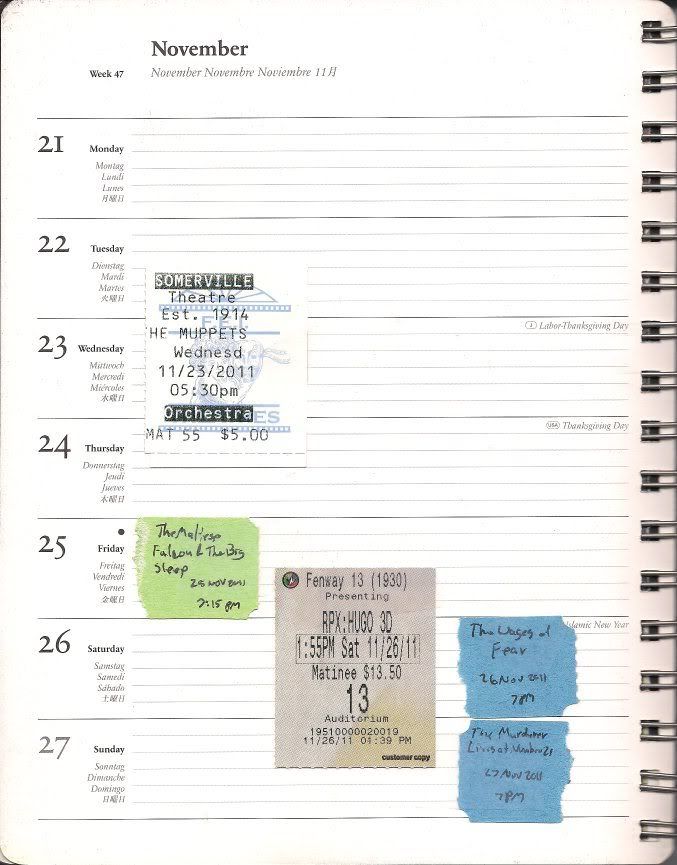
This Week In Tickets!

The rare skipped CineCaché screening this week, as I had seen Green at IFFBoston, director Sophia Takal was a last-minute cancellation, and I recall being dead tired when I got off the subway. It's a shame, as I really would have liked to have seen how a few months and a different context changed the Q&A. Back in April, Takal had done the Q&A with co-stars Kate Lyn Sheil and Lawrence Michael Levine, and as much as she struck me as quite nice, friendly, and instinctive, she was very deferential, giving a lot of credit to her boyfriend Lawrence and often passing him the microphone. I wondered if, on stage by herself, we might have heard much more about what she thinks.

Also, I'm not saying that I worked from home on Wednesday with the specific thought of getting to The Muppets on opening night, but I also didn't feel disappointed upon missing the bus.

The Maltese Falcon

* * * ¾ (out of four)
Seen 25 November 2011 in the Brattle Theatre (Giving Thanks for Bogie)

I've written this one up before, five and a half years ago, for a similarly titled series at the Brattle, and my opinion of it hasn't changed much. It's pretty brilliant, a great combination between pulp and noir, and Bogie's late speech about how it's useful to seem corrupt, but he just might be more honest than he appears is one of the great bits of tough-guy dialogue that goes against type.

I may have read the original novel at some point - I remember checking a volume with both The Maltese Falcon and The Thin Man out of the library sometime in high school - but I read a bunch of Dashiell Hammett's short stories just before this, including all of the other Sam Spade stories, and it's always fun to compare the way a character appears on page and on screen. In a lot of ways, Spade isn't that much different from "The Continental Op", Hammett's earlier protagonist (of Red Harvest and a great many short stories) on the page, especially when read far from the time the movie was created. In the books, Spade could almost be Philip Marlowe to a modern reader, but Bogart makes him a shark.

Previous review at eFilmCritic.

The Big Sleep

* * * ¾ (out of four)
Seen 25 November 2011 in the Brattle Theatre (Giving Thanks for Bogie)

As I mentioned last year, I love Philip Marlowe. I actually have a bunch of Raymond Chandler on my shelf now, and having worked by way through the books which have not been adapted into films, I will soon be reading the ones which I have seen on the big screen.

This is relevant because, after coming home from this double feature, I immediately opened my copy of The Big Sleep and flipped to the beginning to see just how much of it came directly from Chandler and how much came from the screenwriters (William Faulkner, Leigh Brackett, and Jules Furthman). It turns out that the scene of Marlowe entering the Sternwood mansion and speaking to the general is very close to verbatim, which doesn't surprise me: You don't mess with Chandler's dialogue. You just don't. I suspect that the process of adapting one of his books is seeing how much dialogue you can fit in, crying over having to cut the narration, and trying to streamline the plot in a way that you get to keep the best lines without becoming as confusing as this one can be.

Of course, I must confess, I wasn't really confused the first time I saw this movie. It wasn't until hearing about how the filmmakers would actually call Chandler to find out what happened that I started to notice how strung together the plot is. I'm looking forward to reading the book, both to see whether it's a mess from the source material and how much of Martha Vickers's character was cut, supposedly to appease Lauren Bacall and otherwise focus the movie on the suddenly-popular pairing of her and Bogart. There's the remnants of a great, potentially iconic performance in the movie, and though it appears to be mostly lost, I can at least read the lines with Vickers in my head, wondering what her career (and too-short life) would have been like had this not been cut.

Previous review at eFilmCritic.
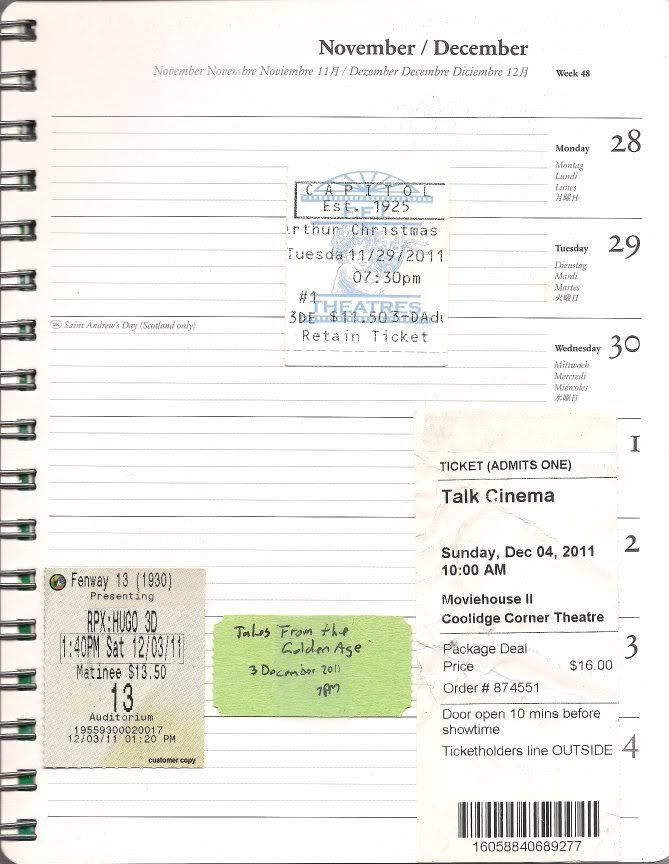
This Week In Tickets!

See those tickets in the lower left hand corner and the lower right hand corner? Those are the extremely rare repeat viewings of movies recently seen. The one on the right is The Artist, and I already had the ticket from having pre-paid for the Talk Cinema series; I'll probably buy another ticket to see it again at some point in January. Probably at the Coolidge again, because seeing it digitally at Boston Common would just be wrong.

As for Hugo... Yeah, I liked that a lot, and wanted to see it again while it was still playing in 3D on the very nice RPX screen (which, do to a quirk of pricing, isn't that much more expensive than a regular 3D screen). And, honestly, I'm tempted to do it again; it's one of the relatively few live-action 3D movies that uses the medium well, and I notice that in some cases, it appears to be playing in 2D even at venues that have 3D screens to spare. It's a bit of an ironic shame that theaters seem to be cutting down on 3D showings just as filmmakers and studios are finally figuring out how to use it.
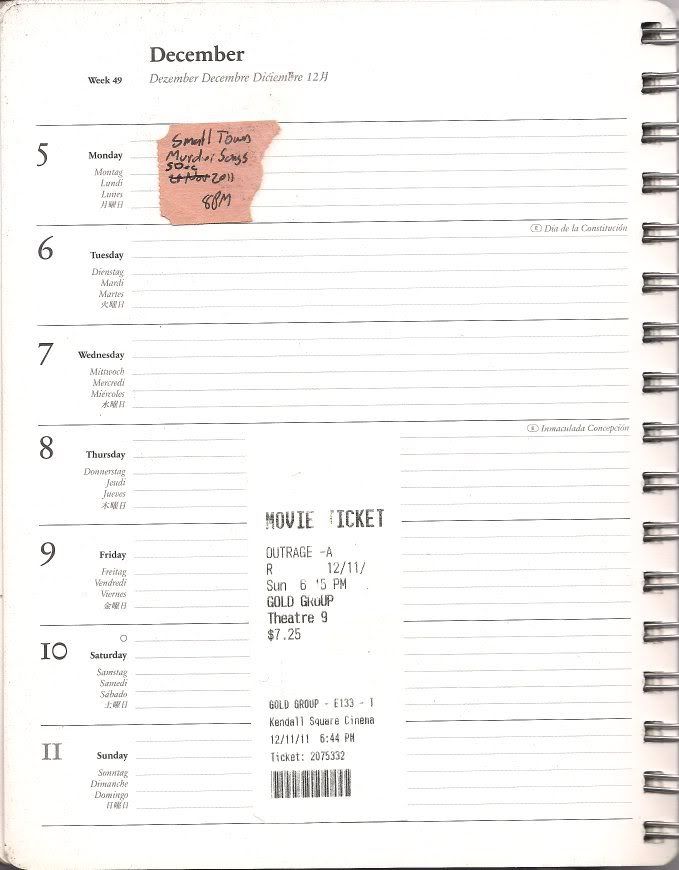
This Week In Tickets!

Stubless: Victim, in the living room on 10 December.

Man, I just didn't get to the movies much at all this week. I wonder if it was busy at work.

... So, that leaves me just a month behind, and a binge over the last week or two means getting caught up is going to be tricky. One of my resolutions for the new year is to make this actually timely and weekly, which I will certainly attempt to do.

At least, starting with the first full week of the new year (2 January - 8 January). In the meantime, there's a lot of writing to do.

Unhappy BirthdayThe Guard & The TripThe Big YearThe GolemThe Ides of MarchModern TimesRA. OneThe Cabinet of Dr. Caligari & NosferatuMidnight in ParisThe Skin I Live InGulliver's TravelsIn TimeMoneyballMelancholiaWoman of the Year
The DescendantsInto the AbyssAlmost PerfectOne Big Hapa FamilyState of the UnionHouse of BambooPuss in Boots
Duck, You Sucker!
The ArtistImmortalsTower HeistAdam's RibHappy Feet TwoThe MuppetsThe Maltese Falcon & The Big SleepHugoThe Wages of FearThe Murderer Lives at Number 21Arthur ChristmasHugoTales from the Golden AgeThe ArtistArthur ChristmasHugoTales from the Golden AgeThe ArtistSmall Town Murder SongsOutrage

Sense of Place: Tales from the Golden Age, Small Town Murder Songs, and Sedona

There's a good entry to be written about the three very specific places where these films take place, but it's been the better part of a month since I saw some of them and would like to get to plowing through a few other things. So let's pretend I did before I start binging on TWIT stuff, okay?

Amintiri din epoca de aur (Tales from the Golden Age)

* * * (out of four)
Seen 3 December 2011 at the Brattle Theatre (Special Engagement)

When Cristian Mungiu last took audiences to Romania before the fall of communism, he gave us the tense, oppressive 4 Months, 3 Weeks and 2 Days; it seldom referenced the Ceaușescu regime directly, but still managed to perfectly evoke what a terrifying prospect having the government poking into every aspect of one's life must be. A single challenge can, perhaps, be met with pluck and determination, but Tales from the Golden Age suggests, in witty fashion, that getting through it on a daily basis requires a healthy sense of the absurd, and retells (with the help of several other Romanian directors) six urban legends that, back in the day, were only whispered.

In the first, "The Legend of the Official Visit", a small village spends days preparing for a motorcade with an important Party official to pass through town, changing plans based on what they hear from previous stops and the whims of a pair of advance scouts. It's a fun little character piece, with Alexandru Potocean making a fine straight man as Gheorghita, the mayor's aide tasked with actually pulling everything together. By the time this section reaches its conclusion, it has jumped onto a metaphor that doesn't quite match its story, but still delivers a fitting punchline before the screen of text explaining how legend has the story ending.

That's somewhat the pattern with the next segment, "The Legend of the Party Photographer", in which the nervous title character (Avram Birau) and his assistant (Paul Dunca) are charged with snapping a picture of Ceaușescu meeting with a French diplomat - and perhaps more importantly, retouching it so that it sends the proper message to the workers who will be seeing it in the paper. Of all the segments, it's perhaps the easiest for outsiders to digest - it attacks an easy target, and does so like a well-oiled machine, with an especially good contrast between its two leads, who (along with Mungiu) don't just make them stock characters, but inject a serious darkness into their contrasting personalities. I suspect the reasons for that contrast are what help "Party Photographer" resonate later; of all the stories, it probably maps to other times and places best.

Full review at EFC.

Small Town Murder Songs

* * ¾ (out of four)
Seen 5 December 2011 at the Brattle Theatre (CineCaché)

A body is found at the beginning of Small Town Murder Songs, but the identity of the dead girl isn't that important. This, after all, is the sort of movie that is less about the victim or perpetrator of a crime than the man notionally charged with solving it. Peter Stormare can handle that sort of focus, but it might perhaps have been nice for there to be a little more to the film.

Stormare plays Walter, the Mennonites chief of police in an Ontario farming town. A girl's body has been found up by the lake, and there are few enough leads that Walter starts to focus on Steve (Eric McIntyre), a shady character he saw in the area the night of the murder. But is this because Steve is a genuinely viable suspect, or because he's shacked up with Walter's ex Rita (Jill Hennessy)? Walter may be a pious man now, but his anger has certainly gotten the better of him in the past.

Though it's an invstigation that moves things forward; Small Town Murder Songs isn't really a mystery; it moves in a pretty straight line and there aren't nearly enough suspects or twists to make it a game worth playing along with. Instead, the investigation is an engine that pushes Walter to the next place we need to see him, with scattered flashbacks and asides doing more to explain the path that led him to this particular point in his life rather than the crime he's trying to figure out. Those are only doled out in piecemeal fashion, of course; writer-director Ed Gass-Donnelly probably figures that too many specific, clear bits of cause-and-effect would make Walter seem less human and more like just a purpose-built character.

Full review at EFC.

Sedona

* ¾ (out of four)
Seen 19 December 2011 at the Brattle Theatre (CineCaché)

Since it has already screened, the description for Sedona is no longer on the Brattle Theatre's website for reference, but it included the words "quirky", "spiritual", "magical", and "miracles". Well, at least three of the four. Now, there's nothing wrong with any of those, but line enough of them up - and use them as selling points, as opposed to things for the audience to discover - and there's a good chance that the movie is trying way too hard.

Sedona, Arizona, certainly is a pretty town, set amid some awe-inspiring scenery, which is why Scott (Seth Peterson), his partner Eddie (Matthew J. Williamson), and sons Denny (Trevor Sterling Stovall) and Jeremy (Rand Schwenke) are there on vacation, even if Scott is the sort who tends to bring his work and Blackberry along with him. Tammy (Frances Fisher), on the other hand, aims to just pass through on her way to an important sales presentation in Phoenix. However, when Denny wanders away from his family and Tammy gets involved in a truly bizarre automobile accident, they wind up dealing with more of the town and its residents than they'd planned.

Sedona is the sort of movie that is built on coincidence that occasionally works as serendipity, which is okay to a certain extent. The trouble is, writer/director/producer/editor Tommy Stovall seems to think that it rises to the level of destiny or magic, something that happens because Sedona is so very special, and that's not something it earns by a long shot. The natives talk a lot about "the vortexes" in a way that makes one wonder if they know the meaning of the word.as well as a fair amount of other mystical mumbo-jumbo that maybe resonates with the residents but ends up just piling contrivance on top of bad decision. Oh, Stovall and his movie have a sense of humor about it at times - some of the goofier residents come in for a ribbing - but lots of characters, like the astrologist/pedicurist played by Beth Grant, are apparently meant to be taken seriously.

Full review at EFC.