The best way to describe the Sunday I spent in Somerville Theatre's screen 2 - or at least, the kindest - is to say that the future is unpredictable. With the previous two days of programming wiped out by the most serious pure snowstorm to hit the Northeast in years (Sandy being something else again), and Sunday initially looking like it might be canceled as the Boston area continued to dig out, the festival organizers scrambled to try and get things on the schedule. Technically, I don't think anything played according to the original schedule; even Found in Time, one of the two screenings that matched the scheudle posted online, was in a slot originally slated for Escape from Tomorrow, which disappeared from the festival without any sort of notice or explanation.
That lack of notice/explanation was a constant part of the day; the schedule on Sunday morning read The Final Shift, Mars et Avril, Found in Time, Eternity, and Shorts Program #2. I was the only person to make it in for The Final Shift at 1:15pm, as the MBTA didn't start running the subway until 2pm and fairly few of us were in a position to make the hike (and, since it took me about an hour to get there from my house, I probably shouldn't have!). I could still hear Dave Kornfeld laying down the law for someone in the projection booth as he tried to get it framed right and looking good, because Dave is a friggin' professional.
Others joined me at 3pm, and we were all kind of surprised and a little disappointed to see War of the Worlds: The Untold Story start instead of Mars et Avril, the one that at least three of us were most looking forward to, without any sort of notice or update on the website, Facebook page, etc. With no way to know what was going to play next beyond the quick tests Dave ran between movies, we joked about holding up signs to request one thing or another next. Fortunately, we did get that movie as the last show.
We didn't get Eternity, which might not be a great movie, but the revised schedule had it only playing a mid-week 5pm show, which meant I wasn't getting to see it. In its place, we got Earthbound, only it played from a screener disc rather than the DCP they had sent (the keycodes were wrong, in another example of copy protection doing more to annoy legitimate users rather than deter unauthorized ones). That meant not just lower resolution, but "Property of Ripple World / Paper Dreams" showing up right in the middle of the screen every ten minutes or so, in a screening people paid for. Not cool.
I'm not hugely upset, because Earthbound was pretty entertaining and that made for one of the more pleasant things that can happen at a festival, a day of movies which get better as the day went along. It meant starting fairly low (The Final Shift was awful), but by the time we left at 10:30pm, the T was running, the snow was looking pretty well under-control, and my mood had been getting better all day. All in all, not a bad way to finish up a mess of a weekend.
The Final Shift
* (out of four)
Seen 10 February 2013 in Somerville Theatre #2 (Boston Sci-Fi Fest, video)
The Final Shift is one of those movies that it's almost unsporting to review; it doesn't do anything well and likely only got a spot on this festival's schedule because it was made locally, but by the same token, nobody else is going to see it, so what's the point of thrashing it publicly? In an earlier age, the people involved would have been able to pretend it didn't exist after doing three or four better movies, but now IMDB and sites like this will unfortunately connect them to this thing forever. Sorry about that.
The plot is standard D-movie stuff - there's a secret army program to make physically enhanced soldiers, but so far the only successes, if you can call them that, are with the daughters of program head Col. Maslow (Robert Miano), half-sisters code-named Delta (Vanessa Leigh) and Alpha (Diana Porter). When a hitman (John Depew) makes his way in to steal the formula, he also winds up taking Delta with him. Six years later, they're working as a team (with Delta now going by "Margot"), and when they're latest job gives them a lead on the spoils of a bank robbery, they wind up in the middle of a standoff in a diner.
That's all very unimaginative and all, but it's served as the skeleton for a good action movie before, but when the action is lousy, what's the point? And the action here is pretty bad; there's not a punch or other blow that actually seems to connect, and writer/director Depew tends to crank the score up during fight scenes so that the audience can't even be fooled by a well mixed/edited sound of impact. Gunplay is accomplished with cheap-looking CGI. It's all so fake-looking that it's hard for audiences to get caught up in the excitement of the action; it just becomes a clockwork removal of characters from the scene.
Full review on eFilmCritic.
The War of the Worlds: The Untold Story
* ¾ (out of four)
Seen 10 February 2013 in Somerville Theatre #2 (Boston Sci-Fi Fest, video)
Around the time Stephen Spielberg's version of The War of the Worlds came out, Timothy Hines and Pendragon Pictures did their own, a three-hour period piece (which David Cornelius gives a thorough evisceration/appreciation on EFC. I haven't seen it, so I can't say whether "The Untold Story" is that footage thoroughly recut, the same cast and crew giving themselves a do-over, or some combination of the two. It doesn't really matter, though, because the end result is not very good.
The story is a classic of science fiction from before the genre had the name, with Martians leaving their dying planet to invade Earth. This version takes place at around the turn of the twentieth century, with canisters falling to Earth in England and disgorging steam-era tripods with heat rays, and Bertie Wells (Anthony Piana), who was among the first on the scene at the initial crash, going on an Odyssey across the ruined landscape during the very one-sided war.
The hook to this version is that it is presented as a 1964 interview with Wells (now played by Floyd Reichman), the last survivor of the invasion, which also incorporates previously unseen footage from 1900, kept classified by the British government for decades. The cynical among you might argue that, as the previous version was an attempt to cash in on a big-budget studio tentpole, this one aims to simultaneously cash in on found-footage horror and renewed interest in this period (Sherlock Holmes, Downton Abbey, Pride & Prejudice & Zombies, etc.). And, to be honest, that's not the most horrible idea in the world, especially since Hines is loyal to the source material to a fault (I suspect all that of the elder Bertie's lines are narration from H.G. Wells's original novel).
Full review on eFilmCritic.
Found in Time
* * ½ (out of four)
Seen 10 February 2013 in Somerville Theatre #2 (Boston Sci-Fi Fest, video)
A tricky thing for a science fiction story to do is to build its world and story without spending any time explaining it to the characters who, living in it, don't need the explanation. Add a changing timeline to the mix, and you're really asking for trouble. As a result, it's very impressive that Found in Time works as well as it does, though it's still often on the confusing side.
Things start out with Chris (MacLeod Andrews), a "collector" whose psi abilities generally allow him to find things that people he meets later will want. His consciousness jumping forward and backward in time is a side-effect, and his meds are starting to be ineffective. His girlfriend Jina (Kelly Sullivan) recommends he see one of her therapist colleagues (Eric Martin Brown), while one of her patients, a "weaver" named Ayana (Mina Vesper Gokal) winds up working the same corner when Chris sells the things he finds and his friend RJ (Derek Morgan) sells unusually-infused coffee.
Writer/director Arthur Vincie has created an interesting alternate or near-future world without tarting it up in a lot of obvious trappings; it mostly seems different from ours at the edges, where abilities like Chris, Ayana, and RJ have are known but not mainstream. None of these abilities are the sort you need to spend any money to depict most of the time, and that works for this movie; while "The Mine" that the psi-cops threaten the vendors with looks slapped together, it looks like the alternate world's government went cheap, not the filmmakers.
Full review on eFilmCritic.
Earthbound
* * * (out of four)
Seen 10 February 2013 in Somerville Theatre #2 (Boston Sci-Fi Fest, screener)
You wouldn't think a genre as hyphenated as the indie-sci-fi-romantic-comedy would have enough entries to have staples, but "boy thinks he's alien/time traveler/robot, making the girl who thinks he's otherwise sweet uncomfortable" pops up a fair amount. It lives and dies by the performances, which means that writer/director Alan Brennan is pretty fortunate to have Rafe Spall and Jenn Murray in his movie.
Joe Norman (Spall) thinks he's an alien, since that's what his father (David Morrissey) told him when he died: That they had escaped a coup by a vicious cult on their homeworld, and a beacon would be lit in the middle of a certain constellation when it was safe to return. That was fifteen years ago, and now Joe's in his mid-twenties, working in a comic shop when Maria (Murray) comes in to sell some of her childhood toys so she can make rent. Joe's scanner (or watch) says she's 94% biologically compatible, and they turn out to be a good match beyond that - at least, until Joe feels like he should tell her the truth about himself.
There's been a fair amount of talk over the last few years about how geek culture has become mainstream culture, and Earthbound embraces that in a way that a lot of similar movies don't. Joe and Maria are a good-looking pair who like sci-fi, and roughly three seconds is spent on a pretty girl liking Battlestar Galactica being considered odd - and speaking of Galactica, Brennan figures the audience has probably watched enough of that show and the other science fiction works he references to see what he's building without spelling things out or pandering. And while Joe is an oddball who makes a fair amount of social missteps, he's not a stunted weirdo.
Full review on eFilmCritic.
Mars et Avril
* * * ½ (out of four)
Seen 10 February 2013 in Somerville Theatre #2 (Boston Sci-Fi Fest, Blu-ray)
As much as I'm glad the Boston Sci-Fi Film Festival is getting a better class of movies, I kind of wish that the timing of Mars et Avril hitting the festival circuit and then having its regular release in Quebec was such that I could have seen it at Montreal's Fantasia Festival, because that would have been a hoot. It's elaborately oddball, and its quirk is distinctly French-Canadian, so while it's generally fun, I have to imagine that crowd would be especially into it.
Jacob Obus (Jacques Languirand) is the toast of late-twenty-first-century Montreal, a 75-year-old jazz musician famous for the instruments he plays inspired by the female form. Those instruments are designed by Arthur Spaak (Paul Ahmarani) and built by Arthur's father Eugene (Robert Lepagee), and Jacob makes it a rule never to speak to the models. Avril (Caroline Dhavernas) has different ideas; the beautiful young photographer seduces both Jacob and Arthur. Not Eugene, though - he's gone virtual and spends his spare time trying to convince scientists that Mars is imaginary, willed into existence by the collective consciousness, which may present issues for the three "marsonautes" en route.
If nothing else, Mars et Avril is a blast to look at - co-writer/director Martin Villeneuve adapts his own graphic novel (which I believe is more fumetti than hand-drawn), and seems determined to fit every entertaining visual in that he can, no matter how absurd or unnecessary it is. So Eugene's head is a hologram, Jacob has amazing facial hair, and the club where he plays is made of glass and underwater. The setting is full of transformed and exaggerated landmarks, such as the pile of blocks built to house athletes during the 1976 Olympics now approaching skyscraper dimensions. The instruments seem like something out of a Jodorowsky/Moebius graphic novel. It's gaudy, bright eye candy more akin to The Fifth Element than any other sci-fi film.
Full review on eFilmCritic.
Thursday, February 14, 2013


Sunday, February 10, 2013
Short Stuff: The Oscar-Nominated Animated and Live-Action Films
I joke about this every year, but if you get into an Oscar prediction contest (like the eFilmCritic Oscar Pick' Em), especially one that weights every category evenly, a little knowledge of the more obscure categories - documentaries, shorts, and sound - can make a big difference between runner up and having someone ship a ridiculously large box of DVDs to your door.
Happily, the short films are one of the easier categories to bone upon - the various groups are put together into feature-length packages which can be seen at theaters, online, or on demand via one's cable/satellite system (as of this writing, they are already playing selected theaters, with the other distribution methods coming on the 19th of February - check ShortsHD's website for more information on the easiest way for you to see them in your area; in Boston, that's the Coolidge and the Kendall, as of right now). So far, I've seen the animated and live action shorts; both are well worth checking out not just because they might give one a leg up in predictions, but because they are filled with solid, entertaining movies.
And isn't that what awards are for - giving folks a reminder that good stuff is out there?
The 2013 Oscar Nominated Shorts: Animation
Seen 5 February 2013 in Landmark Kendall Square #1 (first-run, digital)
Animated shorts tend to take the "short" part seriously, and as a result, the "Animation" package is seriously filled out - not just by segments with "hosts" William Joyce and Brandon Oldenburg, who won last year's Oscar in the category for "The Fantastic Flying Books of Mr. Morris Lessmore" (and which seems more like a repurposed interview than hosting, as it never actually references any of the included movies), but with three "Highly Commended" honorable mentions, one of which takes up roughly a third of the package's run time. Fortunately, there is truth in the idea that good things come in small packages; although some of these move very quickly, those tend to pack a lot of wit and invention into their short length - especially considering that none of the nominees feature dialogue!
For example, "The Longest Daycare", a Simpsons short starring baby Maggie, is only five minutes long, but generally doesn't go more than a few seconds before a new gag comes along, and once things get going, it's probably pretty exciting for the youngsters who were half its target audience when it played in front of the latest Ice Age movie last summer, with the jokes related to how Maggie gets the short end of the stick at the "Ayn Rand School for Tots" aimed at the adults in the audience.
A Hans Zimmer score helps with that, and it's just one example of how director David Silverman, who previously directed The Simpsons Movie and many episodes of the series, has some nice studio resources at his disposal. The picture is bright and colorful with smooth motion, and the credits indicate it was originally produced in 3D. It's a very capable short, generally pretty funny; exactly the sort of thing one would want to attach to the front of a celebrity-voiced franchise movie.
"Adam and Dog", meanwhile, is the opposite in many ways: Relative newcomer Minkyu Lee's colors may be lush where the detailed backgrounds are concerned, but the title characters are simple browns and fleshtones, making them a bit smaller than the world they inhabit. Writer/director Minkyu Lee also doesn't mind letting scenes stretch out for a bit to give a setting a certain feel - this pre-historic forest is idyllic, but also features just enough danger for the dog and the human he meets to come together so that the former becomes the latter's Best Friend.
Given the title, it's not hard to figure out where Lee is going with this; an Eve does eventually show up and complicate things, with Genesis eventually being more directly referenced as opposed to alluded to. Lee makes the transition there nicely, maintaining the dog's point of view throughout but changing the color palette and atmosphere enough that the attentive viewer can see what happens. It's a nifty trick, one which makes up for how the pacing can sometimes be a little too relaxed.
Where Lee may not have a long filmography, PES (the nom de film of Adam Pesapane) certainly does; anyone who has seen an animation program at a film festival or a touring show like "Spike & Mike" or "The Animation Show" has likely seen one or more of his quick stop-motion bits which recast familiar objects in new contexts. That's what "Fresh Guacamole" offers, starting with avocados in the shape of hand grenades and going on from there. Fans have seen similar things before - it's a follow-up to "Western Spaghetti" - but the fact that PES has been nominated for an Oscar will surely make them smile.
There are actually voices credited for Timothy Rechart's "Head Over Heels", but I don't believe they say anything particularly articulate. That's sort of the point, after all - that after decades of marriage, Walter and Madge may live in the same house but don't communicate much, living separate lives to the extent that each seems to live on the ceiling relative to the other. It's an arresting visual that I suspect works better here than in upcoming feature Upside Down, as it's allowed to be almost purely metaphorical rather than something that has to make sense physically.
It makes for a fun little movie, too, as Walter attempts to win her back and both must figure out what to do when their house that was spinning in space makes landfall. The stop-motion animation is very well-done indeed, and Reckart and cinematographer Chloe Thomson make good use of their ability to shift perspectives - I'll bet a lot of live-action filmmakers must envy their ability to literally turn their set upside down, although the limited space to work with these miniatures in an environment that frequently needs a full complement of walls and floors/ceilings must make up for it. They certainly come up with a cleverly-constructed world that they use for humor and pathos; it's one of the strongest from a strong field.
But is it strong enough to overcome "Paperman"? John Kahrs's seven-minute short got a lot of attention when it was released to theaters attached to Wreck-It Ralph; I'm sure a few people said it was worth the price of a ticket on its own (though I imagine most eventually said staying for the feature was far from a hardship). The funny thing is, it really is that good, and I actually found myself enjoying it more on a second viewing.
Maybe it's because I wasn't seeing it in 3D this time (along with the different context), because where I marveled at some of the technical feats before - it really is an amazing example of computer-rendered imagery managing the expressiveness of hand-drawn while still retaining its solidity and working in the third dimension - this time had me amazed by just how well everything worked together: The style, the simple storytelling, the Christope Beck score, the almost purely visual bits. Indeed, some of the things I found a bit of a weakness the first time are among my favorites now - the way the paper airplanes dance when they first start moving with a will of their own just strikes me as so early Disney, like they wouldn't be out of place in Fantasia or a Silly Symphonies short. That encapsulation of the company's entire history is kind of wonderful, and part of the reason I wouldn't bet against Kahrs coming home with a statuette in a few weeks.
All five of the nominees are quite worthy, although it's a little bit easier this year to see why the three "Highly Commended" shorts also included with the program don't quite make the cut. "Abiogenesis" by Richard Mans, for instance, is gorgeous - its visuals of a robot terraforming ship arriving on a barren planet and kickstarting the processes of life are beautifully rendered and frequently very creative - but it's undeniably chilly; the robots are such pure automatons that the audience can't help but feel the lack of humanity, especially after all the expressive characters in the previous shorts. As awe-inspiring a sequence as the five-minute short is, it feels like it should be part of a longer piece so that it can have some context within a story. Somebody get Mans signed to do an animated sci-fi feature so that can happen.
The next honorable mention, Leo Verrier's "Dripped", also suffers a bit in context; it looks like it was created to primarily be viewed on computer screens; blown up to be shown on the multiplex's main screen, the visuals seem kind of low-res. It's also weird, featuring an art thief who steals paintings to eat them, taking on their traits as he does so, and not knowing what to do when the manhunt makes it hard to replenish his supply. I think Verrier's onto a clever idea here - literalizing the idea of consuming art, letting it change you and influence your own process of creation without necessarily reproducing it - but it's not communicated very clearly, and his own cartoony style does not always mesh well with the artists he references.
The finale short in the program - and by far the longest, at 27 minutes - is "The Gruffalo's Child", a sequel to a nominee from two years ago, "The Gruffalo" (reviewed here, as part of the 2011 package), and like its predecessor, it is a solid piece of work with a very nice voice cast (Helena Bonham-Carter, Robbie Coltrane, Rob Brydon, John Hurt, Tom Wilkinson, and James Corden all resume their roles, with Shirley Henderson joining as the title character). It's even got a clever idea for a twist, with the Mouse being described as a terrifying creature of legend to the young Gruffalo, rather than the other way around as in the first short. The air is let out a little, though, as the audience members already know what a mouse is (heck, they likely know this mouse), so it's a bit difficult to build up the same kind of danger and surprise.
The three honorable mentions are all still worth seeing, though, and in their being very good but not quite brilliant manage to emphasize what a strong group the nominees are. If I were voting for the award, the part of me that wants to recognize impressive young new artists would be pulled toward "Adam and Dog" or "Head Over Heels", but "Paperman" is probably too good to deny, and I would not be surprised at all if the Academy went the same way.
One more thing worth noting: While the package is rated PG-13 and I would generally have little problem recommending it for all-ages (and kids will really enjoy several of the shorts), there is nudity in both "Adam and Dog" and "Dripped". It's not meant to be titillating and seems harmless to me (said the guy with no kids), but don't come crying to me if you freak out when watching with the little ones.
Also posted to eFilmCritic in a slightly modified form.
The 2013 Oscar Nominated Shorts: Live-Action
Seen 5 February 2013 in Landmark Kendall Square #1 (first-run, digital)
As much as we've all seen movies that don't really justify the eighty minutes, minimum, that a film has to run to make the ticket price charged if it's to be released in theaters seem reasonable, the cold fact of the matter is that there's very little place for live-action shorts in America today. Animated shorts can be done as a calling card or with a small enough crew that a director can count on a dedicated fanbase for money (or can do these labors of love around commercial work), documentary shorts can sell to PBS or cable stations, but where do live-action short films fit in today's market?
Not very many places, which is why when one goes to the short programs at American film festivals, most of the things on display are likely student films, or from a foreign country where arts funding helps with this sort of thing. Still, enough get made that the Academy Award nominees are often an impressive-enough slate, and the brief clips seen during the ceremony are often some of the most intriguing parts of the program, representing as they do ideas too peculiar and non-commercial to be financed by a Hollywood studio.
Take "Death of a Shadow"; it hails from Belgium and even features Matthias Schoenaerts, star of last year's foreign-language nominee Bullhead and recent boutique-house release Rust and Bone. It's got an offbeat premise, with Shoenaerts playing a photographer of sorts, who captures a person's shadow at the moment of his or her death for his mysterious master (Peter Van Den Eede) so that after 10,000 he can be returned to life with the woman he loves (Laura Verlinden). The visuals and the steampunkish design are certainly memorable.
I must admit, though, that it sort of rubbed me the wrong way. Like a lot of steampunk or contemporary dark fantasy, its world seems too obviously set up to tell this particular story. The character arcs follow a well-worn and predictable path of romantic tragedy, and while Schoenaerts, Verlinden, and filmmaker Tom Van Avermaet make them work surprisingly well, it's never quite fantastical or romantic enough to make up for the film's artifice.
"Henry", meanwhile, comes from Quebec's Yan England and follows its title character - an elderly pianist played by Gérard Poirier - as he starts what seems like a typical day only to have things thrown into turmoil as it becomes clear that things aren't what they seem. Over the next twenty minutes, the audience follows him into his youth and his rather uncertain present.
It's another theme that has been milked pretty thoroughly, but there's a reason for that: It provides a great showcase for older actors who can bring plenty of experience to bear with every line on their faces, and Poirer certainly does not disappoint (neither do Louisa Laprade as his wife Maria or Mari Tifo as the woman trying to keep him in the present as his mind drifts back to when he first met Maria). An elderly relative or friend's disintegration is a heartbreaking story that almost everybody can relate to, and England and Poirer hit their targets a lot more often than not.
Writer/director/star Shawn Christensen also starts out in a fairly dark place in "Curfew", but it soon gets into much funnier territory, as Christensen's suicidal character Richie gets a call from his sister asking him to babysit his nine-year-old niece Sophia (Fatima Ptacek) for the night. Neither mother or daughter consider Richie particularly trustworthy, with a demanding Sophia tending to look down at her uncle.
Naturally, of course, Richie will seem to grow and Sophia will soften, and the way that happens is actually really impressive, as Christensen is able to frame it as being the result of changing perspectives as personal growth. He does a nice job of injecting humor, dark and offbeat as well as conventional, into the story without ever actually pushing the darkness back - indeed, making things funnier and Sophia more kid-like makes everything feel more well-rounded and real. "Curfew" may be the lightest film of the group, but that doesn't make it any less sophisticated than the others.
Kids also figure prominently in the stories of the last two films of the program, which both take place in foreign lands. In "Buzkashi Boys", the setting is Kabul, Afghanistan, with beggar-boy Ahmad (Jawanmard Paiz) convincing his friend Rafi (Fawad Mohammadi) to leave his father's blacksmith shop to go watch Buzkashi, a polo-like game where men on horseback compete to drag a goat carcass across the field. As we watch the kids, it's apparent that Ahmad seems more optimistic about his future than Rafi, despite having much less.
We hear a lot about Afghanistan in the news, but this view of it is fascinating; director Sam French and cinematographer Duraid Munajim do an exceptional job of capturing the stark beauty of the Afghani landscape and even making Kabul look appealing from certain angles and distances, only to pull in or shift position and suddenly see just how much damage an inhospitable environment and endless series of wars has done to the place. There's a sort of solidarity with the people there, though - the film never asks for the audience's pity, even as it acknowledges the utterly random danger of life there and the very limited options that the people there may have. French also gets great work out of youngsters Paiz and Mohammadi; though both were more or less recruited off the streets, they are excellent and form the movie's heart and soul.
The title character of Bryan Buckley's "Asad" (played by Harun Mohammed), on the other hand, lives in a coastal Somali village where the pirates do a better job of providing for the people than fishermen like old Erasto (Ibrahim Moallim Hussein), and this barely-teenager thinks he may make a better captain than some of the others. He may not be wrong; he thinks on his feet quickly to help an injured friend when rebels come to town and Erasto, at least, recognizes that he has great instincts as a navigator.
Shot in South Africa with a cast consisting almost entirely of Somali refugees (and there's an argument to be made that the one exception doesn't count), "Asad" has an almost indisputable authenticity to it, and in a way that seems to justify an ending that feels less conclusive than that of the other shorts: Life in this place means being at the whim of randomness and chaos, and the combination of horror and humor that makes up the end of the story almost feels like a survival mechanism, where one has to look at the bright side to avoid despair. Longtime commercial director Buckley puts his experience in shooting quick and professionally to work; he and his crew make a sharp-looking picture and get good work out of their amateur cast, with Harun Mohammed proving surprisingly capable of carrying the movie.
It's an enjoyably strong and varied line-up, one which I think any could win without much in the way of complaint (even the weakest, "Death of a Shadow", can at least capture the imagination). If I were trying to predict a winner, it would likely be between "Henry" (the majority of Academy members are actors and this is the nominee that most showcases acting) and "Curfew" (the most balanced entry; it's mainstream and quirky, featuring good performances and direction). Still, it's never a good idea to underestimate the importance of importance to voters in these categories, which could give "Asad" and "Buzkashi Boys" legs up.
Also posted to eFilmCritic in a slightly modified form.
Happily, the short films are one of the easier categories to bone upon - the various groups are put together into feature-length packages which can be seen at theaters, online, or on demand via one's cable/satellite system (as of this writing, they are already playing selected theaters, with the other distribution methods coming on the 19th of February - check ShortsHD's website for more information on the easiest way for you to see them in your area; in Boston, that's the Coolidge and the Kendall, as of right now). So far, I've seen the animated and live action shorts; both are well worth checking out not just because they might give one a leg up in predictions, but because they are filled with solid, entertaining movies.
And isn't that what awards are for - giving folks a reminder that good stuff is out there?
The 2013 Oscar Nominated Shorts: Animation
Seen 5 February 2013 in Landmark Kendall Square #1 (first-run, digital)
Animated shorts tend to take the "short" part seriously, and as a result, the "Animation" package is seriously filled out - not just by segments with "hosts" William Joyce and Brandon Oldenburg, who won last year's Oscar in the category for "The Fantastic Flying Books of Mr. Morris Lessmore" (and which seems more like a repurposed interview than hosting, as it never actually references any of the included movies), but with three "Highly Commended" honorable mentions, one of which takes up roughly a third of the package's run time. Fortunately, there is truth in the idea that good things come in small packages; although some of these move very quickly, those tend to pack a lot of wit and invention into their short length - especially considering that none of the nominees feature dialogue!
For example, "The Longest Daycare", a Simpsons short starring baby Maggie, is only five minutes long, but generally doesn't go more than a few seconds before a new gag comes along, and once things get going, it's probably pretty exciting for the youngsters who were half its target audience when it played in front of the latest Ice Age movie last summer, with the jokes related to how Maggie gets the short end of the stick at the "Ayn Rand School for Tots" aimed at the adults in the audience.
A Hans Zimmer score helps with that, and it's just one example of how director David Silverman, who previously directed The Simpsons Movie and many episodes of the series, has some nice studio resources at his disposal. The picture is bright and colorful with smooth motion, and the credits indicate it was originally produced in 3D. It's a very capable short, generally pretty funny; exactly the sort of thing one would want to attach to the front of a celebrity-voiced franchise movie.
"Adam and Dog", meanwhile, is the opposite in many ways: Relative newcomer Minkyu Lee's colors may be lush where the detailed backgrounds are concerned, but the title characters are simple browns and fleshtones, making them a bit smaller than the world they inhabit. Writer/director Minkyu Lee also doesn't mind letting scenes stretch out for a bit to give a setting a certain feel - this pre-historic forest is idyllic, but also features just enough danger for the dog and the human he meets to come together so that the former becomes the latter's Best Friend.
Given the title, it's not hard to figure out where Lee is going with this; an Eve does eventually show up and complicate things, with Genesis eventually being more directly referenced as opposed to alluded to. Lee makes the transition there nicely, maintaining the dog's point of view throughout but changing the color palette and atmosphere enough that the attentive viewer can see what happens. It's a nifty trick, one which makes up for how the pacing can sometimes be a little too relaxed.
Where Lee may not have a long filmography, PES (the nom de film of Adam Pesapane) certainly does; anyone who has seen an animation program at a film festival or a touring show like "Spike & Mike" or "The Animation Show" has likely seen one or more of his quick stop-motion bits which recast familiar objects in new contexts. That's what "Fresh Guacamole" offers, starting with avocados in the shape of hand grenades and going on from there. Fans have seen similar things before - it's a follow-up to "Western Spaghetti" - but the fact that PES has been nominated for an Oscar will surely make them smile.
There are actually voices credited for Timothy Rechart's "Head Over Heels", but I don't believe they say anything particularly articulate. That's sort of the point, after all - that after decades of marriage, Walter and Madge may live in the same house but don't communicate much, living separate lives to the extent that each seems to live on the ceiling relative to the other. It's an arresting visual that I suspect works better here than in upcoming feature Upside Down, as it's allowed to be almost purely metaphorical rather than something that has to make sense physically.
It makes for a fun little movie, too, as Walter attempts to win her back and both must figure out what to do when their house that was spinning in space makes landfall. The stop-motion animation is very well-done indeed, and Reckart and cinematographer Chloe Thomson make good use of their ability to shift perspectives - I'll bet a lot of live-action filmmakers must envy their ability to literally turn their set upside down, although the limited space to work with these miniatures in an environment that frequently needs a full complement of walls and floors/ceilings must make up for it. They certainly come up with a cleverly-constructed world that they use for humor and pathos; it's one of the strongest from a strong field.
But is it strong enough to overcome "Paperman"? John Kahrs's seven-minute short got a lot of attention when it was released to theaters attached to Wreck-It Ralph; I'm sure a few people said it was worth the price of a ticket on its own (though I imagine most eventually said staying for the feature was far from a hardship). The funny thing is, it really is that good, and I actually found myself enjoying it more on a second viewing.
Maybe it's because I wasn't seeing it in 3D this time (along with the different context), because where I marveled at some of the technical feats before - it really is an amazing example of computer-rendered imagery managing the expressiveness of hand-drawn while still retaining its solidity and working in the third dimension - this time had me amazed by just how well everything worked together: The style, the simple storytelling, the Christope Beck score, the almost purely visual bits. Indeed, some of the things I found a bit of a weakness the first time are among my favorites now - the way the paper airplanes dance when they first start moving with a will of their own just strikes me as so early Disney, like they wouldn't be out of place in Fantasia or a Silly Symphonies short. That encapsulation of the company's entire history is kind of wonderful, and part of the reason I wouldn't bet against Kahrs coming home with a statuette in a few weeks.
All five of the nominees are quite worthy, although it's a little bit easier this year to see why the three "Highly Commended" shorts also included with the program don't quite make the cut. "Abiogenesis" by Richard Mans, for instance, is gorgeous - its visuals of a robot terraforming ship arriving on a barren planet and kickstarting the processes of life are beautifully rendered and frequently very creative - but it's undeniably chilly; the robots are such pure automatons that the audience can't help but feel the lack of humanity, especially after all the expressive characters in the previous shorts. As awe-inspiring a sequence as the five-minute short is, it feels like it should be part of a longer piece so that it can have some context within a story. Somebody get Mans signed to do an animated sci-fi feature so that can happen.
The next honorable mention, Leo Verrier's "Dripped", also suffers a bit in context; it looks like it was created to primarily be viewed on computer screens; blown up to be shown on the multiplex's main screen, the visuals seem kind of low-res. It's also weird, featuring an art thief who steals paintings to eat them, taking on their traits as he does so, and not knowing what to do when the manhunt makes it hard to replenish his supply. I think Verrier's onto a clever idea here - literalizing the idea of consuming art, letting it change you and influence your own process of creation without necessarily reproducing it - but it's not communicated very clearly, and his own cartoony style does not always mesh well with the artists he references.
The finale short in the program - and by far the longest, at 27 minutes - is "The Gruffalo's Child", a sequel to a nominee from two years ago, "The Gruffalo" (reviewed here, as part of the 2011 package), and like its predecessor, it is a solid piece of work with a very nice voice cast (Helena Bonham-Carter, Robbie Coltrane, Rob Brydon, John Hurt, Tom Wilkinson, and James Corden all resume their roles, with Shirley Henderson joining as the title character). It's even got a clever idea for a twist, with the Mouse being described as a terrifying creature of legend to the young Gruffalo, rather than the other way around as in the first short. The air is let out a little, though, as the audience members already know what a mouse is (heck, they likely know this mouse), so it's a bit difficult to build up the same kind of danger and surprise.
The three honorable mentions are all still worth seeing, though, and in their being very good but not quite brilliant manage to emphasize what a strong group the nominees are. If I were voting for the award, the part of me that wants to recognize impressive young new artists would be pulled toward "Adam and Dog" or "Head Over Heels", but "Paperman" is probably too good to deny, and I would not be surprised at all if the Academy went the same way.
One more thing worth noting: While the package is rated PG-13 and I would generally have little problem recommending it for all-ages (and kids will really enjoy several of the shorts), there is nudity in both "Adam and Dog" and "Dripped". It's not meant to be titillating and seems harmless to me (said the guy with no kids), but don't come crying to me if you freak out when watching with the little ones.
Also posted to eFilmCritic in a slightly modified form.
The 2013 Oscar Nominated Shorts: Live-Action
Seen 5 February 2013 in Landmark Kendall Square #1 (first-run, digital)
As much as we've all seen movies that don't really justify the eighty minutes, minimum, that a film has to run to make the ticket price charged if it's to be released in theaters seem reasonable, the cold fact of the matter is that there's very little place for live-action shorts in America today. Animated shorts can be done as a calling card or with a small enough crew that a director can count on a dedicated fanbase for money (or can do these labors of love around commercial work), documentary shorts can sell to PBS or cable stations, but where do live-action short films fit in today's market?
Not very many places, which is why when one goes to the short programs at American film festivals, most of the things on display are likely student films, or from a foreign country where arts funding helps with this sort of thing. Still, enough get made that the Academy Award nominees are often an impressive-enough slate, and the brief clips seen during the ceremony are often some of the most intriguing parts of the program, representing as they do ideas too peculiar and non-commercial to be financed by a Hollywood studio.
Take "Death of a Shadow"; it hails from Belgium and even features Matthias Schoenaerts, star of last year's foreign-language nominee Bullhead and recent boutique-house release Rust and Bone. It's got an offbeat premise, with Shoenaerts playing a photographer of sorts, who captures a person's shadow at the moment of his or her death for his mysterious master (Peter Van Den Eede) so that after 10,000 he can be returned to life with the woman he loves (Laura Verlinden). The visuals and the steampunkish design are certainly memorable.
I must admit, though, that it sort of rubbed me the wrong way. Like a lot of steampunk or contemporary dark fantasy, its world seems too obviously set up to tell this particular story. The character arcs follow a well-worn and predictable path of romantic tragedy, and while Schoenaerts, Verlinden, and filmmaker Tom Van Avermaet make them work surprisingly well, it's never quite fantastical or romantic enough to make up for the film's artifice.
"Henry", meanwhile, comes from Quebec's Yan England and follows its title character - an elderly pianist played by Gérard Poirier - as he starts what seems like a typical day only to have things thrown into turmoil as it becomes clear that things aren't what they seem. Over the next twenty minutes, the audience follows him into his youth and his rather uncertain present.
It's another theme that has been milked pretty thoroughly, but there's a reason for that: It provides a great showcase for older actors who can bring plenty of experience to bear with every line on their faces, and Poirer certainly does not disappoint (neither do Louisa Laprade as his wife Maria or Mari Tifo as the woman trying to keep him in the present as his mind drifts back to when he first met Maria). An elderly relative or friend's disintegration is a heartbreaking story that almost everybody can relate to, and England and Poirer hit their targets a lot more often than not.
Writer/director/star Shawn Christensen also starts out in a fairly dark place in "Curfew", but it soon gets into much funnier territory, as Christensen's suicidal character Richie gets a call from his sister asking him to babysit his nine-year-old niece Sophia (Fatima Ptacek) for the night. Neither mother or daughter consider Richie particularly trustworthy, with a demanding Sophia tending to look down at her uncle.
Naturally, of course, Richie will seem to grow and Sophia will soften, and the way that happens is actually really impressive, as Christensen is able to frame it as being the result of changing perspectives as personal growth. He does a nice job of injecting humor, dark and offbeat as well as conventional, into the story without ever actually pushing the darkness back - indeed, making things funnier and Sophia more kid-like makes everything feel more well-rounded and real. "Curfew" may be the lightest film of the group, but that doesn't make it any less sophisticated than the others.
Kids also figure prominently in the stories of the last two films of the program, which both take place in foreign lands. In "Buzkashi Boys", the setting is Kabul, Afghanistan, with beggar-boy Ahmad (Jawanmard Paiz) convincing his friend Rafi (Fawad Mohammadi) to leave his father's blacksmith shop to go watch Buzkashi, a polo-like game where men on horseback compete to drag a goat carcass across the field. As we watch the kids, it's apparent that Ahmad seems more optimistic about his future than Rafi, despite having much less.
We hear a lot about Afghanistan in the news, but this view of it is fascinating; director Sam French and cinematographer Duraid Munajim do an exceptional job of capturing the stark beauty of the Afghani landscape and even making Kabul look appealing from certain angles and distances, only to pull in or shift position and suddenly see just how much damage an inhospitable environment and endless series of wars has done to the place. There's a sort of solidarity with the people there, though - the film never asks for the audience's pity, even as it acknowledges the utterly random danger of life there and the very limited options that the people there may have. French also gets great work out of youngsters Paiz and Mohammadi; though both were more or less recruited off the streets, they are excellent and form the movie's heart and soul.
The title character of Bryan Buckley's "Asad" (played by Harun Mohammed), on the other hand, lives in a coastal Somali village where the pirates do a better job of providing for the people than fishermen like old Erasto (Ibrahim Moallim Hussein), and this barely-teenager thinks he may make a better captain than some of the others. He may not be wrong; he thinks on his feet quickly to help an injured friend when rebels come to town and Erasto, at least, recognizes that he has great instincts as a navigator.
Shot in South Africa with a cast consisting almost entirely of Somali refugees (and there's an argument to be made that the one exception doesn't count), "Asad" has an almost indisputable authenticity to it, and in a way that seems to justify an ending that feels less conclusive than that of the other shorts: Life in this place means being at the whim of randomness and chaos, and the combination of horror and humor that makes up the end of the story almost feels like a survival mechanism, where one has to look at the bright side to avoid despair. Longtime commercial director Buckley puts his experience in shooting quick and professionally to work; he and his crew make a sharp-looking picture and get good work out of their amateur cast, with Harun Mohammed proving surprisingly capable of carrying the movie.
It's an enjoyably strong and varied line-up, one which I think any could win without much in the way of complaint (even the weakest, "Death of a Shadow", can at least capture the imagination). If I were trying to predict a winner, it would likely be between "Henry" (the majority of Academy members are actors and this is the nominee that most showcases acting) and "Curfew" (the most balanced entry; it's mainstream and quirky, featuring good performances and direction). Still, it's never a good idea to underestimate the importance of importance to voters in these categories, which could give "Asad" and "Buzkashi Boys" legs up.
Also posted to eFilmCritic in a slightly modified form.
Saturday, February 09, 2013
Potential Buried Treasure: Oslo, August 31st
It probably marks me as a bad member of the organization, but I almost never vote for the Chlotrudis Awards' Buried Treasure award. You have to see all five of the nominated movies (or, in years with six, five of six), and ever since seeing Chicago solely because it was nominated for a bunch of Oscars, I've tried to avoid seeing movies as a matter of obligation. That movie was probably not as terrible as it seemed to me, but laying out money when you're not really enthused about that thing specifically certainly makes it seem worse.
I've been able to justify it to myself somewhat because I honestly don't care who wins awards. I tend to think that the value of awards is less in actually naming one movie or performance or book or song or whatever the best of the year than in creating a reason to shine a bright light on the nominees. A list of several noteworthy things is useful, but can quickly be forgotten. Make it a competition, though, and people start talking, and there's also a window during which people will make an extra effort to check the nominees out, and that's good for everything.
So, I don't really care who wins other than being disgusted when it's something that clearly didn't belong on the list of nominations in the first place. But, this year, one of the nominees for Buried Treasure is my suggestion, getting on there despite my being the only one to see it, and it's the most difficult for the voters to see. It probably won't get close to winning - I can very easily see it being the sixth for people seeing five out of six - but I'd rather not seem a complete hypocrite later on when folks say they went out of their way or spent some money to see it and I say, yeah, I didn't bother with the award after that.
So, now I'm up to 2/6, and kind of wondering if others whose horses are in this race (so to speak) find themselves approaching it the same way I am - basically, the other nominees have to knock the one I already decided should win off. The other categories work that way too, though not as starkly, and I find that it certainly feels less fair than choosing one after having seen them all, even if I generally trust my judgement well enough to think I'll choose the right thing for the right reason.
Anyway, that's enough of that. One thing I noticed that wasn't really germane to the review was that it seemed to stay light out pretty late during this movie - the characters didn't seem to be under artificial lights when they noted it had passed midnight. I didn't think Oslo was far north enough to have midnight sun in any case, and August 31st is much closer to an equinox than a solstice anyway, so that shouldn't be a big deal in any case. That's a minor thing, though; I've got another, rather spoilery question about the end and structure of the movie that I've put after the review link.
Oslo, August 31st
* * * ¾ (out of four)
Seen 6 February 2013 in the Brattle Theatre (Some of the Best of 2012, 35mm)
Oslo, October 31st starts out with various off-screen voices describing their memories of the city in question, and even when the imagery that goes with those memories is of something like a building being brought down, it's vibrant and alive. When it's first seen in the present, through the eyes of the main character, though, it's all motionless construction equipment. It's time to rebuild after the implosion, but how to do that may take some consideration.
The man who needs to rebuild is Anders (Anders Danielsen Lie), who has spent a fair amount of time in a rehabilitation facility for his drug addiction; he's been given a pass to go into the city for a job interview. That's not until later in the day, though, so in the mean time, he might as well visit some people - an old friend, his sister, maybe a few others as one name leads to another - and the family home. Of course, it's impossible to forget that this is where Anders lived as he succumbed to his demons the first time.
The very name of this movie gives it bounds; it's not going to move far from that time and that place. What's interesting, though, is that co-writer/director Joachim Trier never makes those implied limits feel close or to give them undue importance to the characters within the movie. The extent to which there is not a ticking clock is almost shocking; Trier spends most of the first third of the movie on a conversation between two characters that kicks themes around but doesn't really push Anders through the story, and the time of day or how long it is until Anders is expected back is almost irrelevant in each particular scene. If Trier is making points via where in Oslo each segment takes place, it's not immediately obvious to this non-Norwegian. And yet, as much as the story seems to be contained by its title, there's also a sense that the environment and the passage of time is affecting Anders; it's important without being overtly so.
Full review on eFilmCritic.
OK, you were warned up top, but SPOILERS!
I feel stupid even asking this question, but the opening scenes of the movie (after all the Anders-less memories of Oslo) actually come last chronologically, right? I base this mainly off the idea that when Anders tries to commit suicide by walking into the pond with rocks in his pockets, he backs out by shedding his coat and leaving it at the bottom of the pond, which means he either has multiple similar coats or that this takes place after he wears that coat throughout the rest of the movie.
I want it to be that way, because I'm basically an optimist, and that means that after he relapses, he despairingly tries to kill himself, but ultimately decides he wants to live, and maybe that's the decision that will stick going forward. If the whole movie is chronological, then it's just an industrial-powered downer - the suicide attempt is followed by him going out into a situation he's clearly not prepared to handle, and the trip to his dealer and eventual fall off the wagon are inevitable. And since one of the later revelations in the movie is that most of the action actually takes place on the 30th, that makes what happens in the wee hours and morning of the 31st more important and definitive, whether it be backsliding for good or bottoming out and finally starting the real climb out of the pit.
I think the repeated shots at the end tend to support the idea that those first scenes come last, although the girl in his bed at the start suggests otherwise. I also think that Trier created this ambiguity very carefully and deliberately, and not just because ambiguity and downer endings are often considered sophisticated. Structuring the movie that way emphasizes how this sort of addiction is a repeating cycle, almost a loop that someone gets stuck in. That the movie ends on a series of shots very close to those at the beginning suggests such a thing, but introducing what looked like inconsistencies so that that scene can be approached in both directions - well, that almost makes the whole movie into a moebius strip, with an almost science-fictional time loop that is going to take some extra effort to break out of.
Or, I'm looking so closely at it that I'm missing something really obvious that says I'm full of crap. Can't dismiss that as a possibility.
!SRELIOPS
I've been able to justify it to myself somewhat because I honestly don't care who wins awards. I tend to think that the value of awards is less in actually naming one movie or performance or book or song or whatever the best of the year than in creating a reason to shine a bright light on the nominees. A list of several noteworthy things is useful, but can quickly be forgotten. Make it a competition, though, and people start talking, and there's also a window during which people will make an extra effort to check the nominees out, and that's good for everything.
So, I don't really care who wins other than being disgusted when it's something that clearly didn't belong on the list of nominations in the first place. But, this year, one of the nominees for Buried Treasure is my suggestion, getting on there despite my being the only one to see it, and it's the most difficult for the voters to see. It probably won't get close to winning - I can very easily see it being the sixth for people seeing five out of six - but I'd rather not seem a complete hypocrite later on when folks say they went out of their way or spent some money to see it and I say, yeah, I didn't bother with the award after that.
So, now I'm up to 2/6, and kind of wondering if others whose horses are in this race (so to speak) find themselves approaching it the same way I am - basically, the other nominees have to knock the one I already decided should win off. The other categories work that way too, though not as starkly, and I find that it certainly feels less fair than choosing one after having seen them all, even if I generally trust my judgement well enough to think I'll choose the right thing for the right reason.
Anyway, that's enough of that. One thing I noticed that wasn't really germane to the review was that it seemed to stay light out pretty late during this movie - the characters didn't seem to be under artificial lights when they noted it had passed midnight. I didn't think Oslo was far north enough to have midnight sun in any case, and August 31st is much closer to an equinox than a solstice anyway, so that shouldn't be a big deal in any case. That's a minor thing, though; I've got another, rather spoilery question about the end and structure of the movie that I've put after the review link.
Oslo, August 31st
* * * ¾ (out of four)
Seen 6 February 2013 in the Brattle Theatre (Some of the Best of 2012, 35mm)
Oslo, October 31st starts out with various off-screen voices describing their memories of the city in question, and even when the imagery that goes with those memories is of something like a building being brought down, it's vibrant and alive. When it's first seen in the present, through the eyes of the main character, though, it's all motionless construction equipment. It's time to rebuild after the implosion, but how to do that may take some consideration.
The man who needs to rebuild is Anders (Anders Danielsen Lie), who has spent a fair amount of time in a rehabilitation facility for his drug addiction; he's been given a pass to go into the city for a job interview. That's not until later in the day, though, so in the mean time, he might as well visit some people - an old friend, his sister, maybe a few others as one name leads to another - and the family home. Of course, it's impossible to forget that this is where Anders lived as he succumbed to his demons the first time.
The very name of this movie gives it bounds; it's not going to move far from that time and that place. What's interesting, though, is that co-writer/director Joachim Trier never makes those implied limits feel close or to give them undue importance to the characters within the movie. The extent to which there is not a ticking clock is almost shocking; Trier spends most of the first third of the movie on a conversation between two characters that kicks themes around but doesn't really push Anders through the story, and the time of day or how long it is until Anders is expected back is almost irrelevant in each particular scene. If Trier is making points via where in Oslo each segment takes place, it's not immediately obvious to this non-Norwegian. And yet, as much as the story seems to be contained by its title, there's also a sense that the environment and the passage of time is affecting Anders; it's important without being overtly so.
Full review on eFilmCritic.
OK, you were warned up top, but SPOILERS!
I feel stupid even asking this question, but the opening scenes of the movie (after all the Anders-less memories of Oslo) actually come last chronologically, right? I base this mainly off the idea that when Anders tries to commit suicide by walking into the pond with rocks in his pockets, he backs out by shedding his coat and leaving it at the bottom of the pond, which means he either has multiple similar coats or that this takes place after he wears that coat throughout the rest of the movie.
I want it to be that way, because I'm basically an optimist, and that means that after he relapses, he despairingly tries to kill himself, but ultimately decides he wants to live, and maybe that's the decision that will stick going forward. If the whole movie is chronological, then it's just an industrial-powered downer - the suicide attempt is followed by him going out into a situation he's clearly not prepared to handle, and the trip to his dealer and eventual fall off the wagon are inevitable. And since one of the later revelations in the movie is that most of the action actually takes place on the 30th, that makes what happens in the wee hours and morning of the 31st more important and definitive, whether it be backsliding for good or bottoming out and finally starting the real climb out of the pit.
I think the repeated shots at the end tend to support the idea that those first scenes come last, although the girl in his bed at the start suggests otherwise. I also think that Trier created this ambiguity very carefully and deliberately, and not just because ambiguity and downer endings are often considered sophisticated. Structuring the movie that way emphasizes how this sort of addiction is a repeating cycle, almost a loop that someone gets stuck in. That the movie ends on a series of shots very close to those at the beginning suggests such a thing, but introducing what looked like inconsistencies so that that scene can be approached in both directions - well, that almost makes the whole movie into a moebius strip, with an almost science-fictional time loop that is going to take some extra effort to break out of.
Or, I'm looking so closely at it that I'm missing something really obvious that says I'm full of crap. Can't dismiss that as a possibility.
!SRELIOPS
Friday, February 08, 2013
Next Week in Tickets: Films playing Boston 8 February - 14 February 2013
Well, in practical terms, this actually covers a shorter period, as there will effectively be no movies today (8 February) because of the blizzard and some studio movies will be opening next Thursday for Valentine's day. That just means we've got to do more in less time!
(Note: I haven't been calling theaters, so even if there's no notes on them being closed don't just assume that they're open and show up. Seriously, don't go outside if you don't have to; it may not look like much now, but everyone swears this blizzard will be an actual blizzard!)
My plans? Mostly living at the Sci-Fi Festival, though I willlikely hit Lore and try for Lost in Thailand as well.
(Note: I haven't been calling theaters, so even if there's no notes on them being closed don't just assume that they're open and show up. Seriously, don't go outside if you don't have to; it may not look like much now, but everyone swears this blizzard will be an actual blizzard!)
- The Boston Sci-Fi Film Fest is at the Somerville Theatre this week, a run-up to next weekend's marathon. It looks even more uneven than most specialty festivals, with a pretty well-received French-Canadian film (Mars et Avril) opening the fest but some rough selections later and one notable movie dropped at the last minute. Still, there is often a gem or two hidden amid the rest. Note that the blizzard will see the theater close at 6pm on Friday, so the opening night screenings will be rescheduled (the Somerville Theatre website says Saturday, but the festival site has no details).
It's a busy week for the Somerville; they'll be presenting two performances of The Vagina Monologues on Saturday, and on Valentine's Day there are two special screenings beyond the festival: Girl Shy, a pretty darn funny Harold Lloyd silent in 35mm on the big screen with Jeff Rapsis on the organ. There's a short, too, and it should look pretty good, between Dave Kornfeld likely digging the super-bright lamps out and Lloyd having taken good care of his films. Those looking for something a little more daring may want to head upstairs where Faith Soloway's Lesbian Cinema Schlock Treatment has its first(?) monthly show with Claire of the Moon getting what looks like a highly specialized live MST3K-ing from the local musician. - In first-run presentations, Somerville opens Identity Thief, as does Boston Common, Fenway, and Fresh Pond. It features a couple reliably funny people (Jason Bateman and Melissa McCarthy) as a victim and perpetrator of credit card fraud, with the former trying to bring the latter to the police and both running from even worse folks.
Looking more promising is Side Effects, the latest - and possibly last - film from Steven Soderbergh, with Rooney Mara as a woman put on an experimental new drug by her psychiatrist (Jude Law) only to find the cure may be worse than the disease. It plays the Capitol, Fresh Pond, Fenway, and Boston Common. Personally, I think Soderbergh will do another movie in a few years (not counting the Liberace biography he's doing for HBO), but he's earned a rest if he wants it.
With a little more in the way of screens to fill, Boston Common also opens Lost In Thailand, a hit comedy from China starring and directed by Xu Zheng (whom Chinese film fans may remember from Crazy Stone, Crazy Racer, and Love in the Buff). He plays a businessman trying to meet up with a stockholder in Thailand before a rival despite one of those laid-back traveling companions who make everything go wrong. - Kendall Square is closed on Friday and wn't open until 6pm on Saturday. It mostly keeps the same line-up. The new addition is pretty noteworthy, though: 56 Up, the latest installment of a series of documentaries made for British television starting in 1964, when a group of seven-year-olds were interviewed. Director Michael Apted has been revisiting those that still wish to participate every seven years since, so this is the eighth check-in with the group. Kind of an astonishing accomplishment, really.
- That movie will open at the Coolidge Corner Theatre in two weeks; this week, they pick up Quartet and the Oscar-Nominated Live Action & Animated Shorts (joining the documentary shorts that are already playing. Those don't start until Saturday, as the Coolidge is closed on Friday in anticipation of the blizzard.
Its Saturday screening is also canceled, but Mary Poppins will still play as a Sunday morning kids' show.Sunday morning has a second movie featuring kids, but Lore is likely not for them, as the Talk Cinema presentation is about five children of Nazi SS officers making their way across Germany in the wake of World War II to join their grandmother and facing their parents' legacy.(Note: Lore has been postponed until the 17th)
For the Saturday midnight screening (the Friday one is canceled), they continue Blaxploitation History Month with Sugar Hill, with Marki Bey seeking revenge on the gangsters that killed her boyfriend with voodoo - specifically, bringing forth zombies (in the original meaning of the word) to do her bidding! There's also a special "Deconstructing Sgt. Pepper" lecture by Scott Freiman on Monday night, which would normally be when "Big Screen Classics" is presented, but that series return will instead be on Thursday, so that Rebecca, the gothic romance that was Alfred Hitchcock's first American film, can run on Valentine's Day. - The Brattle is also closed on Friday, meaning that the "(Some of) The Best of 2012" series loses How to Survive a Plague and The Raid. It has a busy Saturday, though, with two double features: Animated monster movies Paranorman and Frankenweenie in the afternoon and noteworthy directors sending limousines across a city (Leos Carax's Holy Motors and David Cronenberg's Cosmopolis) in the evening. Those will be introduced by members of the Boston Society of Film Critics, who will have their awards ceremony and a screening of How to Survive a Plague on Sunday evening, with director David France joining them. Another director, Carlo Guillermo Proto, will be on-site Monday to screen and discuss his documentary El Huaso as part of the DocYard series. That one follows a retiree who takes up competing in rodeos in case his short-term memory problems are a harbinger of full-blown Alzheimer's, which he has decided he would not live with.
For Tuesday through Thursday - well, it's Valentine's Day, which means Casablanca on 35mm! The actual Valentine's Day shows will probably sell out, so buy tickets in advance; there are also Premium Tickets available for couples that include special gifts. - The Arlington Capitol will be closing at 6pm Friday and opening late at 4pm Saturday, and will have another week of Capitol Classics double features mid-week, this set valentine-themed: Mystic Pizza & Four Weddings and a Funeral on Tuesday the 12th, Untamed Heart & The Apartment on Wednesday the 13th, and Moonstruck & A Fish Called Wanda on Thursday the 15th.
- The Harvard Film Archive will be closed on both Friday and Saturday, but will continue their mini-run of Bruno Dumont's Hors Satan on Sunday afternoon and Monday evening. The snow wipes out two screenings in the Raoul Walsh retrospective, but the one that remains, High Sierra on Sunday night, is a pretty good one, with a script by John Huston and Humphrey Bogart as a thief on the run with Ida Lupino. There's also a free VES screening of I Don't Want to Sleep Alone on Tuesday night.
- ArtsEmerson has a film, stage, and music program called The Next Thing Festival (TNT for short) over the next few weeks, and the film programming this weekend is a preview, with this weekend focused on "lighting the dynamite". Films scheduled include Brazil (35mm) Friday evening, Zabriskie Point (DVD) Friday night, Far From Heaven (DVD) Saturday afternoon, Swimming to Cambodia (DVD) Saturday evening, The Bride of Frankenstein (35mm?) Saturday night, and Month Python and the Holy Grail (Blu-ray) Sunday afternoon.
- The MFA has cancelled film programming on Friday and Saturday (sorry, Tiny Furniture fans), but The FIlms of Stanley Kubrick continues once the snow stops falling, with Lolita and Spartacus on Sunday and Dr. Strangelove or: How I Learned to Stop Worrying and Love the Bomb on Thursday. If you've seen the trailer, the way that subtitle is pronounced probably makes it seem even less apt for the 14th.
- iMovieCafe opens Special 26 (Special Chabbis on IMDB), which features Akshay Kumar as a thief who masterminds a jewel heist involving a gang of 26 who posed as tax collectors based on a real life incident. It also features Manoj Bajpai, Jimmy Shergill, Anupam Kher, and Kajal Aggarwal, and is written and directed by Neeraj Pandey. That's in Hindi with English subtitles, and shares the screen with Telugu film Mirchi and Tamil film Viswaroopam, neither of which appear to be subtitled.
My plans? Mostly living at the Sci-Fi Festival, though I will
This Week In Tickets: 28 January 2013 - 3 February 2013
Folks, I have been watching movies and writing about them:
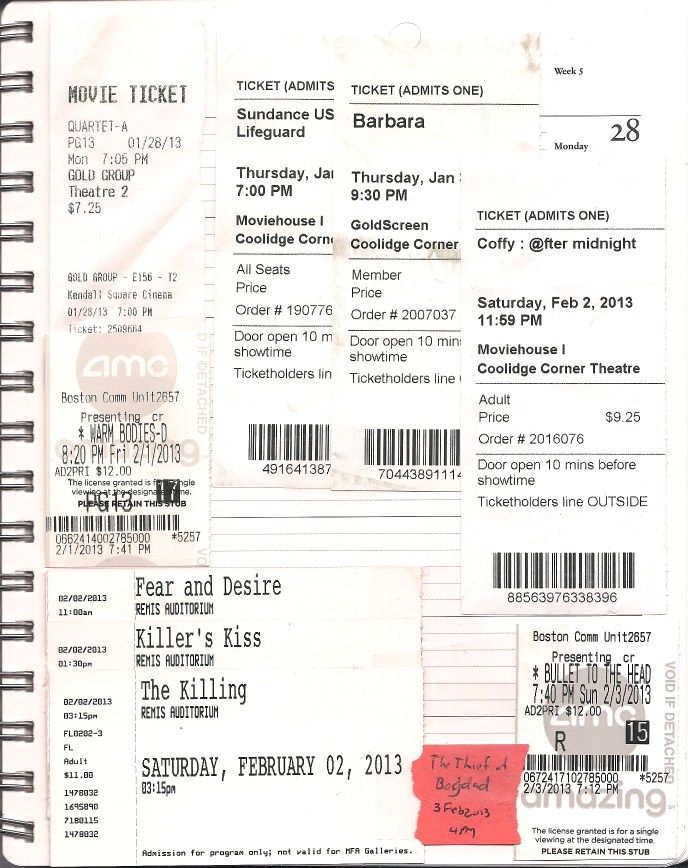
Kind of an eventful week, even aside from watching movies: Tuesday and Wednesday were company meeting days, which means everybody flew in from various parts of the country for a couple of all-day updates and workshops followed by dinner and sleeping fast to leave early the next morning. Fortunately, there wasn't a whole lot I wanted to see aside from Quartet, at least until Thursday.
That's when I scooted out of work a little early so that I could make it to the Coolidge in time for the Sundance USA screening, The Lifeguard. Not so hot, unfortunately, but at least it and the Q&A were short enough that I could turn around once I left and come back for Barbara. Good little movie, which I'm glad I saw on its very last show before leaving town (I'd been meaning to, but...).
I'd been surprisingly drawn by the Warm Bodies previews I'd seen, so that was the Friday night choice. I liked it enough to consider writing a full "rebuttal review" to the negative one on eFilmCritic, but someone else saved me from that. I'd initially meant to hit Stand Up Guys, which still hasn't been reviewed on the site, but the times didn't quite line up.
Saturday afternoon was spent watching Fear and Desire, Killer's Kiss, and The Killing at the MFA; slightly more Kubrick than I'd intended, but what the heck? I screwed up seeing a movie in the evening because I thought I'd forgotten my phone (needed for MoviePass activation). I didn't, but didn't find it in one of the thirteen pockets I had until I got home. I was going to call it a night, but that big bus accident was more or less just across the river from me, and have you ever tried to get to sleep with a helicopter hovering over your house trying to light a busy accident scene? No sleep means Coffy, evidently.
Sunday was a lay-around-reading-comics day, finishing up with a screening of The Thief of Bagdad at the HFA as part of a Raoul Walsh retrospective. From there, rather than support the life-shortening violence on display in the Super Bowl, I opted to watch Bullet to the Head (I'm pretty cool with pretend violence, obviously). The folks down in New Orleans were even considerate enough to delay the game for a half-hour with some power outage or something so that I could do some grocery shopping and still be home in time for Elementary. Thanks, guys!
So, busy week. And the next couple aren't going to be less so, but I'll worry about Next Week in Tickets when I've heard more in terms of cancellations and such. In the meantime...
Warm Bodies
* * * ½ (out of four)
Seen 1 February 2013 in AMC Boston Common #17 (first-run, 4K digital)
Funny thing: The posters had a logo for the Quebec film comission on them, which seemed unusual - that's a thing that usually shows up at the end of the credits, rather than with the vanity cards up front or on the posters. That alerted me to where it was filmed, and it became a fun game to spot how they tried to make Montreal into "generic North American city". I suspect half the movie's CGI budget was removing French-language signage, and I also wondered if this was the first time Stade Olympique had been set up for baseball since Les Expos left town. It was fun recognizing the spot where R and Julia sat in the last scene, though!
Also fun: The rest of the movie. It undeniably has some problems with tone in terms of genre - R's narration is pretty chatty and articulate for a zombie speaking in the present tense, although I think that's kind of difficult to avoid if you want a decent amount of zombie POV - and rules, but benefits tremendously from staying on-message. That message isn't terribly complicated - love and connection with other people is what you need to jolt you out of that state where time passes without meaning or joy - but there's not a moment in the movie that doesn't serve it, and so long as the filmmakers don't focus on the mechanics of things too much, that gets the audience through.
Plus, the thing is filled with great moments. Every time I thought the narration was undercutting the fact that zombies should be scary, Nicholas Hoult delivers a quip that justifies it. The entire cast - Hoult, Teresa Palmer, John Malkovich, even the usually tiresome Rob Corddry - is pretty great, and director Jonathan Levine (who found a different way to put genre conventions on unstable ground in All the Boys Love Mandy Lane) delivers honest quirk, charm, and some very amusing soundtrack choices. The climactic battle is pretty great, without throwing the rest of the movie away as often happens.
When I first saw the trailer, Warm Bodies struck me as the movie Zombieland wanted to be (if you liked that movie more than me, read "an even better version of Zombieland"), and the end results confirm that. It's one of late January/early February's several nice surprises.
Coffy
* * * (out of four)
Seen 2 February 2013 in Coolidge Corner #1 (@fter midnite, 35mm)
It's a funny thing about exploitation pictures, whatever the flavor - somewhere underneath, all the good ones (or at least the enjoyable ones) have aspirations of at least a little more than being low-budget delivery vehicles for sex and violence. They want to be that, no question, but there's at least a sort of ambiguity being poked at here, as Pam Grier's nurse-turned-vigilante title character does at least find herself concerned with the ethics of her actions. Maybe, if there was a little more time and talent and resources involved, they could have made a great movie about that.
Of course, Coffy doesn't have those things; what it has is Grier and a perfect understanding of what the audience is looking for: Righteous bloodshed and skin. That's why there's reason for everybody to become a target as the movie goes on; extra characters still standing at the end do the filmmakers no good. And it's kind of hilarious just how inevitable the many busty ladies' shirts getting ripped clean down the front is in any melee, for that matter. Writer/director Jack Hill believes in giving the people what they want, and for some reason - whether it be the funky soundtrack or the pure uninhibitedness of the time and place - allows blaxploitation to score points for its exuberance rather than lose them.
Is Coffy a great movie? Nah. It's fun, though, with its tongue moving just slightly toward its cheek - after all, a movie where the heroine stuffs razor blades in her afro because she understands the inevitability of a hair-pulling catfight has to be winking at the audience a little!
The Thief of Bagdad
* * * ¼ (out of four)
Seen 3 February 2013 in the Harvard Film Archive (Action! Action! Action! The Cinema of Raoul Walsh, digital)
There are a number of enjoyable things in The Thief of Bagdad, but two and a half hours is a lot of silent movie, especially since a lot of the good stuff is loaded into the last hour (which I half-suspect played after an intermission in its original release). That's when all the crazy fantasy stuff with pretty darn good effects for 1924 starts in earnest.
The first hour and a half is still pretty good, though - the bit with the magic rope is fun and establishes what sort of rogue the Thief (Douglas Fairbanks) is before he becomes smitten with the Princess (Julanne Johnston). It's got the sort of grand scale that these epics did so well, along with plenty of amusing bits and Fairbanks's trademark athletic action. It's also noteworthy for two of the folks in the supporting cast: Sojin, a Japanese immigrant who would return home once silents gave way to talkies (and finished his career with a part in The Seven Samurai) plays the villainous Mongol Prince, with Anna May Wong as his spy within the Princess's chambers. Anna May Wong, as you may know, was awesome, especially when one considers that she was about 18 when she made this movie, and already stealing every scene she was in whether or not she was shot from an angle that showed just how deceptively skimpy her costume was.
It's a big, fun adventure that isn't quite so overstuffed with awesomeness as it may appear, but it ramps up the spectacle when it needs to. Holds up pretty well after almost eighty years.
Bullet to the Head
* * ¾ (out of four)
Seen 4 February 2013 in AMC Boston Common #15 (first-run, 4K digital)
You know, Sylvester Stallone has kind of earned the purgatory he's been in for roughly the past fifteen years; he's made some pretty bad movies since Copland, only really getting noticed and into theaters when he's got a franchise to work with. And so, as Schwarzeneggar's The Last Stand did, Bullet to the Head sort of tanked at the box office.
It deserves a bit better; it's good pulp, and Walter Hill knows what the audience is looking for just as much Coffy's Jack Hill. As a result, the violence is big and lurid and when he can't blow something up or punctuate a sentence with a bullet, there's thoroughly gratuitous nudity. The poor by-the-book cop played by Sung Kang just doesn't stand a chance in this environment.
And that's kind of the movie's problem at times; it's so busy convincing us that Stallone's hitman character is the cool one that it tends to make Kang's Taylor Kwon look like a fool in a way that it seems like the same kind of puffing up the star's ego as Jack Reacher - it would actually be better if Kwon didn't look so helpless even in banter. There are times when it doesn't know what to do other than make Stallone look cool, especially as the various villains' alliances implode to the point where things can be settled by Stallone and Jason Momoa swinging axes at each other.
Let it be said: Sylvester Stallone and Jason Momoa swinging axes at each other is probably the best thing in the movie. Moma actually comes across as a guy who could be the next Stallone/Schwarzenegger-type star if that sort of physically imposing but charismatic type still became stars today, and it's an action scene that goes on long enough to express the characters' personalities, with Stallone's Jimmy Bobo being no-nonsense and Momoa's Keegan being energetic and kind of nuts. It's a great climax, and the route to it isn't bad either.
Kind of an eventful week, even aside from watching movies: Tuesday and Wednesday were company meeting days, which means everybody flew in from various parts of the country for a couple of all-day updates and workshops followed by dinner and sleeping fast to leave early the next morning. Fortunately, there wasn't a whole lot I wanted to see aside from Quartet, at least until Thursday.
That's when I scooted out of work a little early so that I could make it to the Coolidge in time for the Sundance USA screening, The Lifeguard. Not so hot, unfortunately, but at least it and the Q&A were short enough that I could turn around once I left and come back for Barbara. Good little movie, which I'm glad I saw on its very last show before leaving town (I'd been meaning to, but...).
I'd been surprisingly drawn by the Warm Bodies previews I'd seen, so that was the Friday night choice. I liked it enough to consider writing a full "rebuttal review" to the negative one on eFilmCritic, but someone else saved me from that. I'd initially meant to hit Stand Up Guys, which still hasn't been reviewed on the site, but the times didn't quite line up.
Saturday afternoon was spent watching Fear and Desire, Killer's Kiss, and The Killing at the MFA; slightly more Kubrick than I'd intended, but what the heck? I screwed up seeing a movie in the evening because I thought I'd forgotten my phone (needed for MoviePass activation). I didn't, but didn't find it in one of the thirteen pockets I had until I got home. I was going to call it a night, but that big bus accident was more or less just across the river from me, and have you ever tried to get to sleep with a helicopter hovering over your house trying to light a busy accident scene? No sleep means Coffy, evidently.
Sunday was a lay-around-reading-comics day, finishing up with a screening of The Thief of Bagdad at the HFA as part of a Raoul Walsh retrospective. From there, rather than support the life-shortening violence on display in the Super Bowl, I opted to watch Bullet to the Head (I'm pretty cool with pretend violence, obviously). The folks down in New Orleans were even considerate enough to delay the game for a half-hour with some power outage or something so that I could do some grocery shopping and still be home in time for Elementary. Thanks, guys!
So, busy week. And the next couple aren't going to be less so, but I'll worry about Next Week in Tickets when I've heard more in terms of cancellations and such. In the meantime...
Warm Bodies
* * * ½ (out of four)
Seen 1 February 2013 in AMC Boston Common #17 (first-run, 4K digital)
Funny thing: The posters had a logo for the Quebec film comission on them, which seemed unusual - that's a thing that usually shows up at the end of the credits, rather than with the vanity cards up front or on the posters. That alerted me to where it was filmed, and it became a fun game to spot how they tried to make Montreal into "generic North American city". I suspect half the movie's CGI budget was removing French-language signage, and I also wondered if this was the first time Stade Olympique had been set up for baseball since Les Expos left town. It was fun recognizing the spot where R and Julia sat in the last scene, though!
Also fun: The rest of the movie. It undeniably has some problems with tone in terms of genre - R's narration is pretty chatty and articulate for a zombie speaking in the present tense, although I think that's kind of difficult to avoid if you want a decent amount of zombie POV - and rules, but benefits tremendously from staying on-message. That message isn't terribly complicated - love and connection with other people is what you need to jolt you out of that state where time passes without meaning or joy - but there's not a moment in the movie that doesn't serve it, and so long as the filmmakers don't focus on the mechanics of things too much, that gets the audience through.
Plus, the thing is filled with great moments. Every time I thought the narration was undercutting the fact that zombies should be scary, Nicholas Hoult delivers a quip that justifies it. The entire cast - Hoult, Teresa Palmer, John Malkovich, even the usually tiresome Rob Corddry - is pretty great, and director Jonathan Levine (who found a different way to put genre conventions on unstable ground in All the Boys Love Mandy Lane) delivers honest quirk, charm, and some very amusing soundtrack choices. The climactic battle is pretty great, without throwing the rest of the movie away as often happens.
When I first saw the trailer, Warm Bodies struck me as the movie Zombieland wanted to be (if you liked that movie more than me, read "an even better version of Zombieland"), and the end results confirm that. It's one of late January/early February's several nice surprises.
Coffy
* * * (out of four)
Seen 2 February 2013 in Coolidge Corner #1 (@fter midnite, 35mm)
It's a funny thing about exploitation pictures, whatever the flavor - somewhere underneath, all the good ones (or at least the enjoyable ones) have aspirations of at least a little more than being low-budget delivery vehicles for sex and violence. They want to be that, no question, but there's at least a sort of ambiguity being poked at here, as Pam Grier's nurse-turned-vigilante title character does at least find herself concerned with the ethics of her actions. Maybe, if there was a little more time and talent and resources involved, they could have made a great movie about that.
Of course, Coffy doesn't have those things; what it has is Grier and a perfect understanding of what the audience is looking for: Righteous bloodshed and skin. That's why there's reason for everybody to become a target as the movie goes on; extra characters still standing at the end do the filmmakers no good. And it's kind of hilarious just how inevitable the many busty ladies' shirts getting ripped clean down the front is in any melee, for that matter. Writer/director Jack Hill believes in giving the people what they want, and for some reason - whether it be the funky soundtrack or the pure uninhibitedness of the time and place - allows blaxploitation to score points for its exuberance rather than lose them.
Is Coffy a great movie? Nah. It's fun, though, with its tongue moving just slightly toward its cheek - after all, a movie where the heroine stuffs razor blades in her afro because she understands the inevitability of a hair-pulling catfight has to be winking at the audience a little!
The Thief of Bagdad
* * * ¼ (out of four)
Seen 3 February 2013 in the Harvard Film Archive (Action! Action! Action! The Cinema of Raoul Walsh, digital)
There are a number of enjoyable things in The Thief of Bagdad, but two and a half hours is a lot of silent movie, especially since a lot of the good stuff is loaded into the last hour (which I half-suspect played after an intermission in its original release). That's when all the crazy fantasy stuff with pretty darn good effects for 1924 starts in earnest.
The first hour and a half is still pretty good, though - the bit with the magic rope is fun and establishes what sort of rogue the Thief (Douglas Fairbanks) is before he becomes smitten with the Princess (Julanne Johnston). It's got the sort of grand scale that these epics did so well, along with plenty of amusing bits and Fairbanks's trademark athletic action. It's also noteworthy for two of the folks in the supporting cast: Sojin, a Japanese immigrant who would return home once silents gave way to talkies (and finished his career with a part in The Seven Samurai) plays the villainous Mongol Prince, with Anna May Wong as his spy within the Princess's chambers. Anna May Wong, as you may know, was awesome, especially when one considers that she was about 18 when she made this movie, and already stealing every scene she was in whether or not she was shot from an angle that showed just how deceptively skimpy her costume was.
It's a big, fun adventure that isn't quite so overstuffed with awesomeness as it may appear, but it ramps up the spectacle when it needs to. Holds up pretty well after almost eighty years.
Bullet to the Head
* * ¾ (out of four)
Seen 4 February 2013 in AMC Boston Common #15 (first-run, 4K digital)
You know, Sylvester Stallone has kind of earned the purgatory he's been in for roughly the past fifteen years; he's made some pretty bad movies since Copland, only really getting noticed and into theaters when he's got a franchise to work with. And so, as Schwarzeneggar's The Last Stand did, Bullet to the Head sort of tanked at the box office.
It deserves a bit better; it's good pulp, and Walter Hill knows what the audience is looking for just as much Coffy's Jack Hill. As a result, the violence is big and lurid and when he can't blow something up or punctuate a sentence with a bullet, there's thoroughly gratuitous nudity. The poor by-the-book cop played by Sung Kang just doesn't stand a chance in this environment.
And that's kind of the movie's problem at times; it's so busy convincing us that Stallone's hitman character is the cool one that it tends to make Kang's Taylor Kwon look like a fool in a way that it seems like the same kind of puffing up the star's ego as Jack Reacher - it would actually be better if Kwon didn't look so helpless even in banter. There are times when it doesn't know what to do other than make Stallone look cool, especially as the various villains' alliances implode to the point where things can be settled by Stallone and Jason Momoa swinging axes at each other.
Let it be said: Sylvester Stallone and Jason Momoa swinging axes at each other is probably the best thing in the movie. Moma actually comes across as a guy who could be the next Stallone/Schwarzenegger-type star if that sort of physically imposing but charismatic type still became stars today, and it's an action scene that goes on long enough to express the characters' personalities, with Stallone's Jimmy Bobo being no-nonsense and Momoa's Keegan being energetic and kind of nuts. It's a great climax, and the route to it isn't bad either.
Thursday, February 07, 2013
Early Kubrick at the MFA: Fear and Desire, Killer's Kiss, The Killing
I didn't really plan to spend the entire day at the Museum of Fine Arts watching Kubrick's movies. Originally it was going to be Fear and Desire, most likely Killer's Kiss - though I wasn't sure, what with there being a roughly 80-minute gap between the screenings - with The Killing a "what the heck, I haven't seen it in a while" last minute addition. Though that's only a bit north of three hours of movie, it's almost six hours of a Saturday and time on the T, which is not ideal.
(Oh, sure, I could have gone and looked around the museum, but that's not a great thing to do in one-hour chunks, especially since I tend to get lost when the movie there is in the Alfond Auditorium rather than the Remis. Or at least, that's what I told myself.)
It made for a pretty strong triple-feature, though - it shows just how strong Kubrick was technically from the very start, as well as how he learned to reconcile the weird, experimental things that grew in his mind for Fear and Desire with the commercial simplicity of Killer's Kiss to eventually come up with The Killing: Something that you can sell to a mainstream audience that will nevertheless burrow into their brains and stir something unexpected. I can't say I've always been a particular fan of Kubrick's - to be totally honest, I'd seen just five out of his thirteen films before adding two more on Saturday - but looking at how The Killing coalesces, it's not a particular surprise that he's the filmmaker that mass audiences grew to appreciate.
I kind of wonder if the fact that he was not terribly prolific helped his perception there. Although these early films came out in relatively rapid succession, it was twelve years between his last two, and half-decade gaps were not uncommon. Like Terrence Malick, his films became events, and both the perception and reality of all the time in-between being spent to get every little detail right doesn't hurt. It just means that we never got the Napoleon movie that Kubrick supposedly researched for decades, or his version of A.I. (though I'm quite fond of Spielberg's; not his fault that his real movie can never be as good as a hypothetical Kubrick masterpiece).
Ideally, I'd be reviewing the whole series, but the combination of the Boston Sci-Fi Film festival and a threatened snowstorm makes getting there, let alone having time to write, unlikely. I still highly recommend getting to the rest of the MFA's series, which runs through the last weekend of the month and covers his entire career. Many (Killer's Kiss, The Killing, Paths of Glory, Spartacus, Dr. Strangelove, Barry Lyndon, The Shining, Full Metal Jacket, and Eyes Wide Shut) will be showing in beautiful 35mm; Fear and Desire, Killer's Kiss, Lolita, 2001, A Clockwork Orange are projected digitally.
Yeah, 2001 will likely be off a Blu-ray. Just not right, I know.
Fear and Desire
* * ¾ (out of four)
Seen 2 February 2013 in the Boston Museum of Fine Arts Remis Auditorium (Films of Stanley Kubrick, digital)
Fear and Desire would have enough of a place in history for being Stanley Kubrick's first film; that he found it embarrassing and thus did all he can to keep it out of circulation probably made film fans more curious about it. Over a decade after his death, it's easily available, and there's no reason not to satisfy one's curiosity.
Four soldiers have survived a plan crash behind enemy lines: Lieutenant Corby (Kenneth Harp), a well-educated officer; Sergeant "Mac" (Frank Silvera), a grizzled veteran; Private Fletcher (Stephen Coit), quiet and laid-back; and Private Sidney (Paul Mazursky), a nervous new recruit. The lieutenant thinks they can build a raft and float down the river to the other side of enemy lines under the cover of darkness, while Mac has spotted a plane and a general, and thinks they should strike a blow against the enemy even if they only have the lieutenant's pistol for weaponry.
The nationality of the soldiers is not merely kept vague, but entirely hypothetical, as an opening bit of narration states that this forest and this war exists entirely in the mind, and things like language and names have been presented as they are for nothing but convenience. It's a bit of a pretentious affectation, Kubrick wouldn't so much grow out of such things as stop announcing them in such a clumsy manner. He's still got a bit of growing to do as a filmmaker in other areas, too - for a movie that's just over an hour long, Fear and Desire can bog down at times, as abstraction doesn't involve the audience quite so much as detail.
Still, even if Kubrick-the-legend isn't immediately evident here, he's still obviously a guy who knows what he's doing. Serving as director, producer, photographer, and editor, he handles his tiny budget well, building a world that may be non-specific and sparsely populated by still feels solid enough. There's much less arguing of positions than one might expect from a movie this conceptual and a lot more doing, and while the depiction of violence can be kind of artsy, the aftermath can be surprisingly grisly for a film made in the early 1950s.
The script by Howard Sackler isn't necessarily the strongest, but it does give Kubrick four of the basic soldier archetypes to work with, and the cast does well by them. Kenneth Harp's lieutenant has a bit of upper-class detachment to him, but isn't cowardly or stupid; similarly, Frank Silvera plays every sergeant who's ever known what it's really like on the ground, and they naturally clash. It's dramatic and a bit familiar, but well-done without too much exaggeration. Paul Mazursky does well enough as the sweet-seeming kid who cracks, though he seems to be playing a type versus an individual more than the rest of the cast. Steve Coit is in the background for much of the film, but makes a nice impression when he is called upon later.
Fear and Desire is an odd little thing, which probably would have been a film school project if Kubrick had come to cinema via a different route in a different time. Despite its obscurity (both deliberate and natural), it's still worth seeing just to watch, as opposed to only being studied in terms of what it says about the director's evolution.
(Formerly at EFC)
Killer's Kiss
* * * ¼ (out of four)
Seen 2 February 2013 in the Boston Museum of Fine Arts Remis Auditorium (Films of Stanley Kubrick, 35mm)
Killer's Kiss is the sort of crime flick that filled out the back end of a double feature, a true B-movie just long enough to satisfy the "feature" part of the term. It's notable because it was written, produced, photographed, directed, and edited by Stanley Kubrick, who would go on to make movies that didn't just fill out a program. And while it doesn't have the grand sweep of his later films, it's got the interesting choices and attention to detail that make it stand out among its peers.
Its story is told by Davey Gordon (Jamie Smith), a prizefighter of some one-time potential about to hop a train from Grand Central Station back to his family farm in Idaho, but waiting until the last minute. There's a girl, of course, Gloria Price (Irene Kane), who lives in the apartment facing his, works in a dance hall, and is one of the favorites of proprietor (and gangster) Vincent Rapallo (Frank Silvera). One night, Davey sees a fight start to get ugly and rushes to break it up, and while it might be nice to be on Gloria's radar, being on Vinny's more than makes up for that.
Aside from the peculiar Fear and Desire, most of Kubrick's work up until this point had been as a photographer for the magazine Look, and that part of his career isn't far behind him here. Killer's Kiss is just a wonderful movie to look at, whether it's the nighttime photography of a busy New York City where the grain makes the scene feel even more alive, sharp black-and-white images like the tiled entryway to Rapallo's club, or rooftop chases and boxing matches that are shot in long takes from a camera giving a God's-eye-view. Kubrick knows exactly what to do with a movie camera, and the beauty of his work certainly enhances what could otherwise be a standard bit of pulp.
Full review on eFilmCritic.
The Killing
* * * ½ (out of four)
Seen 2 February 2013 in the Boston Museum of Fine Arts Remis Auditorium (Films of Stanley Kubrick, 35mm)
The plan in The Killing isn't a great one, but it looks like one that a group of crooks looking for a big score might think has potential. The real prize is in the telling, which doesn't so much tweak its genre trappings as much as find the most entertaining version of them.
As laid out by professional crook Johnny Clay (Sterling Hayden), the plan is reasonably straightforward despite featuring a large number of moving parts: He's going to rob the racetrack during a big race, with the help of a couple of major drawing the guards away from the vault and a little help from inside man George Peatty (Eisha Cook Jr.). There's space for things to go wrong even if Peatty didn't tell his wife Sherry (Marie Windsor) what he was in on, so there's a good chance that things will go wrong at some point.
Crime stories like The Killing, especially while the Hays Code was in effect, were sometimes clumsy affairs, reconciling the excitement of breaking the law with the mandatory admonition that the culprits will not get away with it. Screenwriter/director Stanley Kubrick plays with that somewhat here, peppering the story with narration that sounds like a police report whose author wants to be a pulp novelist, or the true-crime magazines popular at the time. The narration may have come as the result of the studio fearing the audience wouldn't keep up with Kubrick's jumping back and forth in time, and some say that he made them sarcastically obvious as a way to get the studio to reconsider, but that seems unlikely - not so much because Kubrick wouldn't antagonize the studio on his first major feature, but because it works, camouflaging the movie's wit on the first viewing and providing amusing contrast afterward.
Full review on eFilmCritic.
(Oh, sure, I could have gone and looked around the museum, but that's not a great thing to do in one-hour chunks, especially since I tend to get lost when the movie there is in the Alfond Auditorium rather than the Remis. Or at least, that's what I told myself.)
It made for a pretty strong triple-feature, though - it shows just how strong Kubrick was technically from the very start, as well as how he learned to reconcile the weird, experimental things that grew in his mind for Fear and Desire with the commercial simplicity of Killer's Kiss to eventually come up with The Killing: Something that you can sell to a mainstream audience that will nevertheless burrow into their brains and stir something unexpected. I can't say I've always been a particular fan of Kubrick's - to be totally honest, I'd seen just five out of his thirteen films before adding two more on Saturday - but looking at how The Killing coalesces, it's not a particular surprise that he's the filmmaker that mass audiences grew to appreciate.
I kind of wonder if the fact that he was not terribly prolific helped his perception there. Although these early films came out in relatively rapid succession, it was twelve years between his last two, and half-decade gaps were not uncommon. Like Terrence Malick, his films became events, and both the perception and reality of all the time in-between being spent to get every little detail right doesn't hurt. It just means that we never got the Napoleon movie that Kubrick supposedly researched for decades, or his version of A.I. (though I'm quite fond of Spielberg's; not his fault that his real movie can never be as good as a hypothetical Kubrick masterpiece).
Ideally, I'd be reviewing the whole series, but the combination of the Boston Sci-Fi Film festival and a threatened snowstorm makes getting there, let alone having time to write, unlikely. I still highly recommend getting to the rest of the MFA's series, which runs through the last weekend of the month and covers his entire career. Many (Killer's Kiss, The Killing, Paths of Glory, Spartacus, Dr. Strangelove, Barry Lyndon, The Shining, Full Metal Jacket, and Eyes Wide Shut) will be showing in beautiful 35mm; Fear and Desire, Killer's Kiss, Lolita, 2001, A Clockwork Orange are projected digitally.
Yeah, 2001 will likely be off a Blu-ray. Just not right, I know.
Fear and Desire
* * ¾ (out of four)
Seen 2 February 2013 in the Boston Museum of Fine Arts Remis Auditorium (Films of Stanley Kubrick, digital)
Fear and Desire would have enough of a place in history for being Stanley Kubrick's first film; that he found it embarrassing and thus did all he can to keep it out of circulation probably made film fans more curious about it. Over a decade after his death, it's easily available, and there's no reason not to satisfy one's curiosity.
Four soldiers have survived a plan crash behind enemy lines: Lieutenant Corby (Kenneth Harp), a well-educated officer; Sergeant "Mac" (Frank Silvera), a grizzled veteran; Private Fletcher (Stephen Coit), quiet and laid-back; and Private Sidney (Paul Mazursky), a nervous new recruit. The lieutenant thinks they can build a raft and float down the river to the other side of enemy lines under the cover of darkness, while Mac has spotted a plane and a general, and thinks they should strike a blow against the enemy even if they only have the lieutenant's pistol for weaponry.
The nationality of the soldiers is not merely kept vague, but entirely hypothetical, as an opening bit of narration states that this forest and this war exists entirely in the mind, and things like language and names have been presented as they are for nothing but convenience. It's a bit of a pretentious affectation, Kubrick wouldn't so much grow out of such things as stop announcing them in such a clumsy manner. He's still got a bit of growing to do as a filmmaker in other areas, too - for a movie that's just over an hour long, Fear and Desire can bog down at times, as abstraction doesn't involve the audience quite so much as detail.
Still, even if Kubrick-the-legend isn't immediately evident here, he's still obviously a guy who knows what he's doing. Serving as director, producer, photographer, and editor, he handles his tiny budget well, building a world that may be non-specific and sparsely populated by still feels solid enough. There's much less arguing of positions than one might expect from a movie this conceptual and a lot more doing, and while the depiction of violence can be kind of artsy, the aftermath can be surprisingly grisly for a film made in the early 1950s.
The script by Howard Sackler isn't necessarily the strongest, but it does give Kubrick four of the basic soldier archetypes to work with, and the cast does well by them. Kenneth Harp's lieutenant has a bit of upper-class detachment to him, but isn't cowardly or stupid; similarly, Frank Silvera plays every sergeant who's ever known what it's really like on the ground, and they naturally clash. It's dramatic and a bit familiar, but well-done without too much exaggeration. Paul Mazursky does well enough as the sweet-seeming kid who cracks, though he seems to be playing a type versus an individual more than the rest of the cast. Steve Coit is in the background for much of the film, but makes a nice impression when he is called upon later.
Fear and Desire is an odd little thing, which probably would have been a film school project if Kubrick had come to cinema via a different route in a different time. Despite its obscurity (both deliberate and natural), it's still worth seeing just to watch, as opposed to only being studied in terms of what it says about the director's evolution.
(Formerly at EFC)
Killer's Kiss
* * * ¼ (out of four)
Seen 2 February 2013 in the Boston Museum of Fine Arts Remis Auditorium (Films of Stanley Kubrick, 35mm)
Killer's Kiss is the sort of crime flick that filled out the back end of a double feature, a true B-movie just long enough to satisfy the "feature" part of the term. It's notable because it was written, produced, photographed, directed, and edited by Stanley Kubrick, who would go on to make movies that didn't just fill out a program. And while it doesn't have the grand sweep of his later films, it's got the interesting choices and attention to detail that make it stand out among its peers.
Its story is told by Davey Gordon (Jamie Smith), a prizefighter of some one-time potential about to hop a train from Grand Central Station back to his family farm in Idaho, but waiting until the last minute. There's a girl, of course, Gloria Price (Irene Kane), who lives in the apartment facing his, works in a dance hall, and is one of the favorites of proprietor (and gangster) Vincent Rapallo (Frank Silvera). One night, Davey sees a fight start to get ugly and rushes to break it up, and while it might be nice to be on Gloria's radar, being on Vinny's more than makes up for that.
Aside from the peculiar Fear and Desire, most of Kubrick's work up until this point had been as a photographer for the magazine Look, and that part of his career isn't far behind him here. Killer's Kiss is just a wonderful movie to look at, whether it's the nighttime photography of a busy New York City where the grain makes the scene feel even more alive, sharp black-and-white images like the tiled entryway to Rapallo's club, or rooftop chases and boxing matches that are shot in long takes from a camera giving a God's-eye-view. Kubrick knows exactly what to do with a movie camera, and the beauty of his work certainly enhances what could otherwise be a standard bit of pulp.
Full review on eFilmCritic.
The Killing
* * * ½ (out of four)
Seen 2 February 2013 in the Boston Museum of Fine Arts Remis Auditorium (Films of Stanley Kubrick, 35mm)
The plan in The Killing isn't a great one, but it looks like one that a group of crooks looking for a big score might think has potential. The real prize is in the telling, which doesn't so much tweak its genre trappings as much as find the most entertaining version of them.
As laid out by professional crook Johnny Clay (Sterling Hayden), the plan is reasonably straightforward despite featuring a large number of moving parts: He's going to rob the racetrack during a big race, with the help of a couple of major drawing the guards away from the vault and a little help from inside man George Peatty (Eisha Cook Jr.). There's space for things to go wrong even if Peatty didn't tell his wife Sherry (Marie Windsor) what he was in on, so there's a good chance that things will go wrong at some point.
Crime stories like The Killing, especially while the Hays Code was in effect, were sometimes clumsy affairs, reconciling the excitement of breaking the law with the mandatory admonition that the culprits will not get away with it. Screenwriter/director Stanley Kubrick plays with that somewhat here, peppering the story with narration that sounds like a police report whose author wants to be a pulp novelist, or the true-crime magazines popular at the time. The narration may have come as the result of the studio fearing the audience wouldn't keep up with Kubrick's jumping back and forth in time, and some say that he made them sarcastically obvious as a way to get the studio to reconsider, but that seems unlikely - not so much because Kubrick wouldn't antagonize the studio on his first major feature, but because it works, camouflaging the movie's wit on the first viewing and providing amusing contrast afterward.
Full review on eFilmCritic.
Monday, February 04, 2013
Barbara
This thought didn't really strike me until I was standing in line to buy a ticket for the last local screening of Barbara, but this very serious, Germany's-Oscar-Submission film sort of has the same plot as Doc Hollywood. Granted, the addition of secret police makes the movies not at all alike
The funny thing is that as silly a comparison as Barbara and Doc Hollywood are, seeing the parallels between them (hotshot doctor winds up in small town, meets nice person of opposite sex, eventually... well, spoilers) gave me a way to think and write about the movie. Maybe not the one that the person who responded to a few posts here recommending it was thinking of, but seeing it as a twist on something familiar did make things a little more interesting.
Plus, we get to imagine David Ogden Stiers siccing a goon squad on Michael J. Fox, so that's fun.
Believe it or not, this was the first time I've been in the Coolidge's GoldScreen room that I still think of by its original "MiniMax" name. Nice enough room with comfortable seats, although at that size and with the projection either coming from a Blu-ray or being roughly that quality, it does feel a lot like watching something at home. Still, I'm glad I saw this right before it left, especially after the letdown that was The Lifeguard. The mid-week double feature can make for a long day, but I've got a ton of those coming up, so I might as well get used to it!
Barbara
* * * ¼ (out of four)
Seen 31 January 2013 in Coolidge Corner Theatre's GoldScreen (first-run, digital)
Barbara starts at an interesting place; others with its basic template will set things up, give the audience a sense of who its characters are before putting them in a new situation. Writer/director Christian Petzold goes a different way, and it makes for a frequently compelling bit of drama.
As Barbara (Nina Hoss) starts her first day working in a rural East German clinic, her supervisor André (Ronald Zehrfeld) is being told she's a difficult clock-watcher. To be fair; she's got more reason than most to not want to be there; she was until recently in Berlin, but transferred to the country when she applied for an exit visa to leave with her West German boyfriend (Mark Waschke), with regular inspections by Klaus Schütz (Rainer Bock) and his Stasi team to make sure she's not trying to escape. Still, she's a good doctor, and smart enough to wait for her opportunity.
In other hands, Barbara could have wound up a very self-aware black comedy; it's got the structure of a movie where a big-city hotshot learns to stop, smell the roses, and connect with people in a small town, but the Hollywood version of those stories seldom has the secret police barging into the heroine's apartment, slicing open her mattress, and having a matron perform a much closer search. That Petzold instead plays things straight is somewhat interesting and disturbing; the justification that the workers and farmers paid for Barbara's education is, as the characters point out, not wrong. All the familiar motivators in this story - the nice new man who likes her, the patients who need her - become twisted when played against the traditional Western/post-Cold War ideals of individual freedom and the forceful measures used to keep her in place.
Full review on eFilmCritic.
The funny thing is that as silly a comparison as Barbara and Doc Hollywood are, seeing the parallels between them (hotshot doctor winds up in small town, meets nice person of opposite sex, eventually... well, spoilers) gave me a way to think and write about the movie. Maybe not the one that the person who responded to a few posts here recommending it was thinking of, but seeing it as a twist on something familiar did make things a little more interesting.
Plus, we get to imagine David Ogden Stiers siccing a goon squad on Michael J. Fox, so that's fun.
Believe it or not, this was the first time I've been in the Coolidge's GoldScreen room that I still think of by its original "MiniMax" name. Nice enough room with comfortable seats, although at that size and with the projection either coming from a Blu-ray or being roughly that quality, it does feel a lot like watching something at home. Still, I'm glad I saw this right before it left, especially after the letdown that was The Lifeguard. The mid-week double feature can make for a long day, but I've got a ton of those coming up, so I might as well get used to it!
Barbara
* * * ¼ (out of four)
Seen 31 January 2013 in Coolidge Corner Theatre's GoldScreen (first-run, digital)
Barbara starts at an interesting place; others with its basic template will set things up, give the audience a sense of who its characters are before putting them in a new situation. Writer/director Christian Petzold goes a different way, and it makes for a frequently compelling bit of drama.
As Barbara (Nina Hoss) starts her first day working in a rural East German clinic, her supervisor André (Ronald Zehrfeld) is being told she's a difficult clock-watcher. To be fair; she's got more reason than most to not want to be there; she was until recently in Berlin, but transferred to the country when she applied for an exit visa to leave with her West German boyfriend (Mark Waschke), with regular inspections by Klaus Schütz (Rainer Bock) and his Stasi team to make sure she's not trying to escape. Still, she's a good doctor, and smart enough to wait for her opportunity.
In other hands, Barbara could have wound up a very self-aware black comedy; it's got the structure of a movie where a big-city hotshot learns to stop, smell the roses, and connect with people in a small town, but the Hollywood version of those stories seldom has the secret police barging into the heroine's apartment, slicing open her mattress, and having a matron perform a much closer search. That Petzold instead plays things straight is somewhat interesting and disturbing; the justification that the workers and farmers paid for Barbara's education is, as the characters point out, not wrong. All the familiar motivators in this story - the nice new man who likes her, the patients who need her - become twisted when played against the traditional Western/post-Cold War ideals of individual freedom and the forceful measures used to keep her in place.
Full review on eFilmCritic.
Saturday, February 02, 2013
Sundance USA: The Lifeguard
Two years in a row that the Coolidge gets disappointing movies for Sundance USA. Part of me wonders if a Robert Redford retrospective sometime this summer would help.
I must admit, this was a little more of a bummer because I really like Kristen Bell; she was fantastic on Veronica Mars and has had the occasional noteworthy movie role since, but I suspect that there's a reason why she says a movie that follows up on that series is still a possibility whenever someone asks: She's probably not going to get another role that good again, and just like Arnold Schwarzenegger never shut the door on Conan the King and Vin Diesel worked hard to make a third Riddick movie happen, that part can't help have a draw on her.
But, Ms. Bell wasn't there - director Liz W. Garcia was:
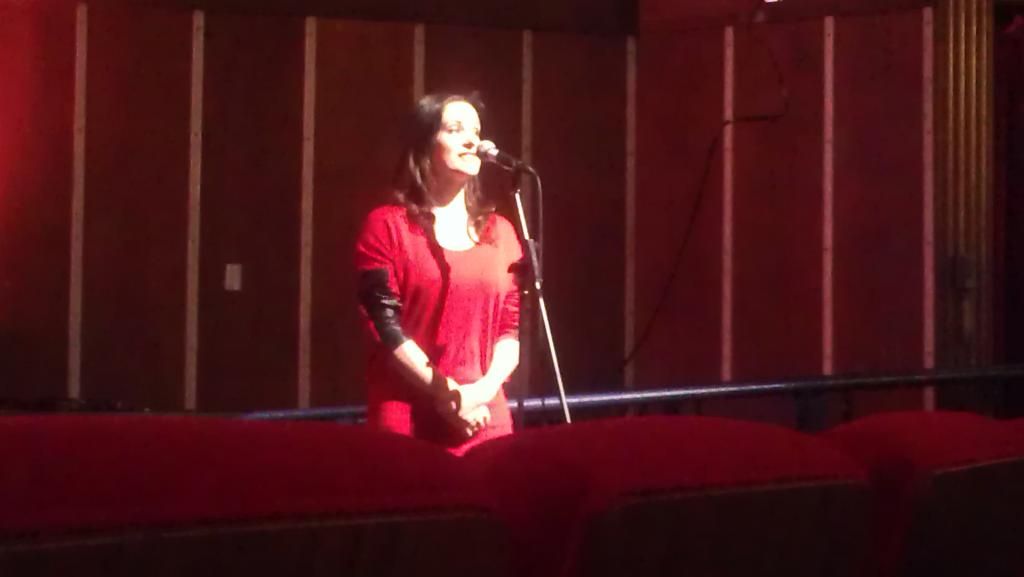
I really should have brought my real camera, shouldn't I? And maybe find a better vantage point where the microphone doesn't blot out the face of a petite guest in 90% of my shots. Ah, well.
Ms. Garcia seemed like a nice-enough person and mentioned that, yes, certain bits of this movie are autobiographical - she worked as a lifeguard when she was younger, lived in a small town in Connecticut, and felt a bit of malaise at times - although that's about as far as it goes. She also called another guest up, co-star/producer/husband Joshua Harto:
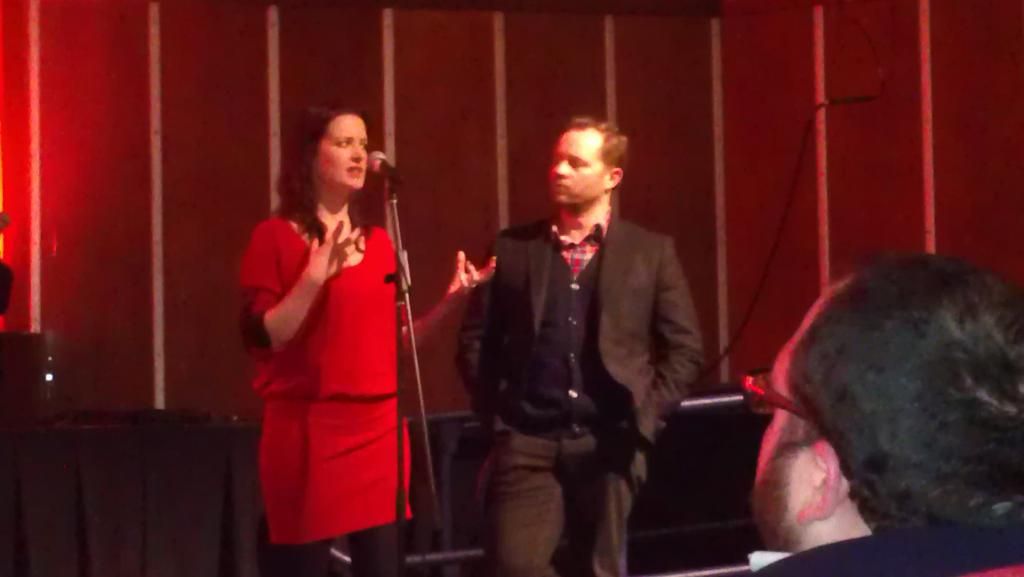
Thankfully, nobody asked for a repeat of Harto's most memorable moment in the movie (which I wouldn't be shocked to see cut, even though this is getting an R regardless; it's a weirdly crude moment that, like so much of the rest of it, goes nowhere).
The Q&A session was pretty standard, though happily lacking the "what did this cost" question and non-answer. They did get asked how long it took, and 21 days is a pretty respectable answer for a movie like this, especially since they only had one day in New York for a fair number of scenes. That brought up one of the more amusingly specific "people notice everything" questions, that an early scene showed Leigh on a southbound train when she should have been heading north, with the answer being that they were shooting that semi-guerrilla style (the transit agency would have charged a fair amount of money) on their way into the city for the day of shooting.
Another question, about how Garcia would often leave things out of focus at unusual times, led to a lot of praise of the focus puller, and how lucky they were to get this guy. It was kind of cool, actually - it's really easy to forget just how many different jobs there are on a movie set, and just how many things have to be done right for each scene to be usable, or even great. I will, maybe, have some small opinion of a movie's cinematography when I see a movie, but seldom really have any conception of what each person's job in that part of the crew was, and that this particular effect needed a crack focus puller.
Being reminded of that mountain of effort makes saying "it's not very good at all" feel even more lousy, but what can you do, other than hope they get the chance to do something better soon.
The Lifeguard
* ¾ (out of four)
Seen 31 January 2013 in Coolidge Corner Theatre #1 (Sundance USA, digital)
It is, almost undoubtedly, a sign of encroaching middle-age that the first thing that annoyed me about The Lifeguard was the way that the characters not even a full generation younger than me acted. But I figured, hey, I watch movies about different cultures all the time; just treat them like they're from some weird European country that has "Connecticut" and "Vermont" as place names. Do that, and, well, it's still not a very good movie, but at least it got a fair shot.
29-year-old Leigh London (Kristen Bell) has always been a smart and capable young woman, and she's slowly working her way up to better assignments for a New York newspaper, but this June has been rough - a story that shook her badly was treated as something lightweight, and the editor she'd been seeing has gotten engaged to someone else. So, she packs up her things (and her cat) and heads back home to Connecticut, where she moves back into her old bedroom, reconnects with friends Todd (Martin Starr) and Mel (Mamie Gummer), and returns to her old summer job as a lifeguard at the community pool. She also starts hanging out with the son of the maintenance man, Jason (David Lambert), and his friends who want drop out of high school and move to Vermont - which doesn't impress her mother Justine (Amy Madigan) or Mel's husband John (Joshua Harto) much at all.
Writer/director Liz W. Garcia doesn't necessarily have a bad set-up here, even if a viewer doesn't particularly have to strain to see how what sort of parallels she's making between characters running away from their fears and other problems. The trouble is, a lot of the pieces don't seem to fit together: We're told that Leigh has always excelled, for instance, and part of the conclusion depends on her being pretty good at the job she walked away from, but we never see that. Coming from the other direction, she's almost thirty; is this particular set of disappointments really the first or worst she's encountered? Plus, there's a sequence that doesn't make a lot of sense unless she hasn't had this job before, since Garcia doesn't seem to be trying to point out that she's over-romanticized that time in her life. There's similar issues with Jason, although they can be chalked up to differing perspectives.
Full review on eFilmCritic.
I must admit, this was a little more of a bummer because I really like Kristen Bell; she was fantastic on Veronica Mars and has had the occasional noteworthy movie role since, but I suspect that there's a reason why she says a movie that follows up on that series is still a possibility whenever someone asks: She's probably not going to get another role that good again, and just like Arnold Schwarzenegger never shut the door on Conan the King and Vin Diesel worked hard to make a third Riddick movie happen, that part can't help have a draw on her.
But, Ms. Bell wasn't there - director Liz W. Garcia was:

I really should have brought my real camera, shouldn't I? And maybe find a better vantage point where the microphone doesn't blot out the face of a petite guest in 90% of my shots. Ah, well.
Ms. Garcia seemed like a nice-enough person and mentioned that, yes, certain bits of this movie are autobiographical - she worked as a lifeguard when she was younger, lived in a small town in Connecticut, and felt a bit of malaise at times - although that's about as far as it goes. She also called another guest up, co-star/producer/husband Joshua Harto:

Thankfully, nobody asked for a repeat of Harto's most memorable moment in the movie (which I wouldn't be shocked to see cut, even though this is getting an R regardless; it's a weirdly crude moment that, like so much of the rest of it, goes nowhere).
The Q&A session was pretty standard, though happily lacking the "what did this cost" question and non-answer. They did get asked how long it took, and 21 days is a pretty respectable answer for a movie like this, especially since they only had one day in New York for a fair number of scenes. That brought up one of the more amusingly specific "people notice everything" questions, that an early scene showed Leigh on a southbound train when she should have been heading north, with the answer being that they were shooting that semi-guerrilla style (the transit agency would have charged a fair amount of money) on their way into the city for the day of shooting.
Another question, about how Garcia would often leave things out of focus at unusual times, led to a lot of praise of the focus puller, and how lucky they were to get this guy. It was kind of cool, actually - it's really easy to forget just how many different jobs there are on a movie set, and just how many things have to be done right for each scene to be usable, or even great. I will, maybe, have some small opinion of a movie's cinematography when I see a movie, but seldom really have any conception of what each person's job in that part of the crew was, and that this particular effect needed a crack focus puller.
Being reminded of that mountain of effort makes saying "it's not very good at all" feel even more lousy, but what can you do, other than hope they get the chance to do something better soon.
The Lifeguard
* ¾ (out of four)
Seen 31 January 2013 in Coolidge Corner Theatre #1 (Sundance USA, digital)
It is, almost undoubtedly, a sign of encroaching middle-age that the first thing that annoyed me about The Lifeguard was the way that the characters not even a full generation younger than me acted. But I figured, hey, I watch movies about different cultures all the time; just treat them like they're from some weird European country that has "Connecticut" and "Vermont" as place names. Do that, and, well, it's still not a very good movie, but at least it got a fair shot.
29-year-old Leigh London (Kristen Bell) has always been a smart and capable young woman, and she's slowly working her way up to better assignments for a New York newspaper, but this June has been rough - a story that shook her badly was treated as something lightweight, and the editor she'd been seeing has gotten engaged to someone else. So, she packs up her things (and her cat) and heads back home to Connecticut, where she moves back into her old bedroom, reconnects with friends Todd (Martin Starr) and Mel (Mamie Gummer), and returns to her old summer job as a lifeguard at the community pool. She also starts hanging out with the son of the maintenance man, Jason (David Lambert), and his friends who want drop out of high school and move to Vermont - which doesn't impress her mother Justine (Amy Madigan) or Mel's husband John (Joshua Harto) much at all.
Writer/director Liz W. Garcia doesn't necessarily have a bad set-up here, even if a viewer doesn't particularly have to strain to see how what sort of parallels she's making between characters running away from their fears and other problems. The trouble is, a lot of the pieces don't seem to fit together: We're told that Leigh has always excelled, for instance, and part of the conclusion depends on her being pretty good at the job she walked away from, but we never see that. Coming from the other direction, she's almost thirty; is this particular set of disappointments really the first or worst she's encountered? Plus, there's a sequence that doesn't make a lot of sense unless she hasn't had this job before, since Garcia doesn't seem to be trying to point out that she's over-romanticized that time in her life. There's similar issues with Jason, although they can be chalked up to differing perspectives.
Full review on eFilmCritic.
Friday, February 01, 2013
Next Week in Tickets: Films playing Boston 1 February - 8 February 2013
There are angles aplenty for this weekend's releases: Oscar-nominees, those who had hoped for that status, and other best-ofs; an early and unconventional Valentine's Day movie; another 1980s star trying to reclaim his former juice.
My plans? Geez, I'm going to have to play it by ear; I'm basically starting with the new releases, maybe the rare Kubricks, Coffy, Oslo, and whatever is easiest to get to on any given night.
- The weird love story is Warm Bodies, in which Nicholas Hoult plays a zombie whose heart starts beating again once he meets but does not eat a girl (Teresa Palmer). It's also got John Malkovich, Rob Corddry, and Lizzy Caplan, with Jonathan Levine (who has done a few odd youth-oriented movies) behind the camera. It's going for something obvious, sure, but still looks like a better use of its premise than Zombieland. It plays the Capitol, Fresh Pond, Fenway (including the RPX screen), and Boston Common.
Meanwhile, Sylvester Stallone hopes his 80s-throwback action flick does better than Arnold's sadly-underseen The Last Stand. Sly's Bullet to the Head has also got a guy who is really good at this sort of action directing in Walter Hill; the story involves a hitman teaming up with a detective (Sung Kang) to rescue his daughter and get revenge. Bloody violence ensues at Boston Common, Fenway, and Fresh Pond. - Speaking of old criminals, Stand Up Guys opens at Kendall Square, Boston Common, and Fenway, with Al Pacino as a con released from prison after 28 years and Christopher Walken as the old friend come to pick him up (and represent organized crime in less amiable ways), with Alan Arkin as an old partner in crime because he makes this sort of movie better. It apparentlly had an awards-qualifying run in December but not the kind that gets the ensemble recognition.
Kendall Square also lets you check out the 2013 Oscar-Nominated Short Films, with programs for both live-action and animated shorts. Each program has five films , though they're splitting a theater, so check when they're playing (they will also play at Coolidge Corner and the ICA later). There's also a one-night screening of Please Subscribe, a documentary about YouTube artists, on Tuesday the 5th at 7:30pm. - The Coolidge Corner Theatre doesn't have those programs this week, but they have the 2013 Oscar Nominated Documentary Shorts programs - two of them, since those tend to bump much closer to the 40-minute maximum than the fictional films. Program "A" is two hours long and features three shorts; program "B" is an hourt wenty and features two. They'll be moving between the Screening Room and GoldScreen depending on the day, splitting the screen between them. The other video screen will feature Rust and Bone.
In perhaps less highbrow fashion, February's midnight movie schedule honors Black History Month with Blaxploitation. This Friday & Saturday nights' selection is Coffy, with Pam Grier as a nurse looking for revenge on the dealers who put her sister in the hospital. - The Brattle runs their (Some of) The Best of 2012 series this week, with many films featuring introductions by members of the Boston Society for Film Critics. Most are double features, and all (as of right now) are playing in 35mm: Friday is kids on their own with Beasts of the Southern Wild and Moonrise Kingdom; Saturday is superheros with The Avengers and The Dark Knight Rises; Sunday is rediscoveries with Wake in Fright and Daisies; Monday is imprisoned-artist docs with This Is Not a Film and Ai Weiwei: Never Sorry; Tuesday is just Seven Psychopaths; Wednesday is people wandering in what initially appears to be an aimless fashion with The Day He Arrives and Oslo, August 31st; and Thursday is Joseph Gordon-Levitt night with Looper and Premium Rush. There's also a special Sunday show of Franklin Wunder at noon; director Chris Lang will be there to introduce the locally-produced film.
- The Harvard Film Archive begins a month-long retrospective of one of Hollywood's most reliable (and underrated) workhorses: Action! Action! Action! A Raoul Walsh Retrospective. This weekend's selections include They Drive by Night & Manpower on Friday and The Thief of Bagdad & Objective, Burma! on Sunday. Drive and Burma! are 35mm, Manpower is 16mm, Thief is a new digital restoration.
On Saturday, they have two screenings of Bruno Dumont's Hors Satan, in which a mysterious stranger with apparently supernatural powers arrives in a desert town; it will also have a mini-run there next weekend. And on Monday, Romuald Karmakar and Professor Eric Rentschler will be on-hand for screening of Karmakar's The Deathmaker, which depicts the interrogation of the serial killer who was the inspiration for Peter Lorre in M. There's also a Tuesday-night VES screening of Wong Kar-wai's In the Mood for Love (a regular part of the curriculum, though it's open to the public). - That film also plays ArtsEmerson's Bright Screening Room this weekend (Saturday evening in 35mm). There doesn't seem to be an overarching theme to this weekend's programming aside from noteworthy directors. There's Luis Buñuel (Los Olvidados, Friday evening, DVD); Satyajit Ray (The Music Room, Friday night, Blu-ray); Ingmar Bergman (Fanny and Alexander, Saturday afternoon, 35mm); David Lynch (Blue Velvet, Saturday night, Blu-ray), and Apichatpong Weerasethakul (Syndromes and a Century, Sunday afternoon, 35mm)
- The MFA will be spending much of February screening The Films of Stanley Kubrick, starting with the disowned but newly-restored Fear and Desire (Friday,Saturday, Sunday, Wednesday, and Thursday). This week's screenings also include Killer's Kiss and The Killing (both Saturday and Sunday). Saturday and Sunday both also feature screenings from The 2nd Annual ReelAbilities Boston Disabilities Film Festival - The Straight Line, Body and Soul, and Me, Too. All are open-captioned, with The Straight Line also audio-described for the visually impaired. Lena Dunham will be in town Thursday afternoon for a screening of Tiny Furniture, although since that is listed as sold out, this just serves as a heads-up for those who already have tickets.
- The Regent Theatre has one film screening this weekend, a bicycle-oriented exploration film called Reveal the Path on Thursday evening.
- The Arlington Capitol picks up Rust and Bone and Hyde Park on Hudson this weekend, although Rust and Bone and Parental Guidance are only playing Friday through Sunday; they will be screening Capitol Classics Double Features in their (pretty darn nice) main auditorium once the work week begins. Those double features include Pulp Fiction & Reservoir Dogs (Monday), Kill Bill I & II (Tuesday), Robocop & The Terminator (Wednesday), and A Fistful of Dollars & For a Few Dollars More (Thursday). Screenings are probably digital, with more planned for next week.
- iMovieCafe has five different movies splitting what looks like two screens at Fresh Pond - David, Kadal, Ongole Githa, Race 2, and Viswaroopam - but off all those, I think only Race 2 has subtitles.
My plans? Geez, I'm going to have to play it by ear; I'm basically starting with the new releases, maybe the rare Kubricks, Coffy, Oslo, and whatever is easiest to get to on any given night.
Subscribe to:
Posts (Atom)

