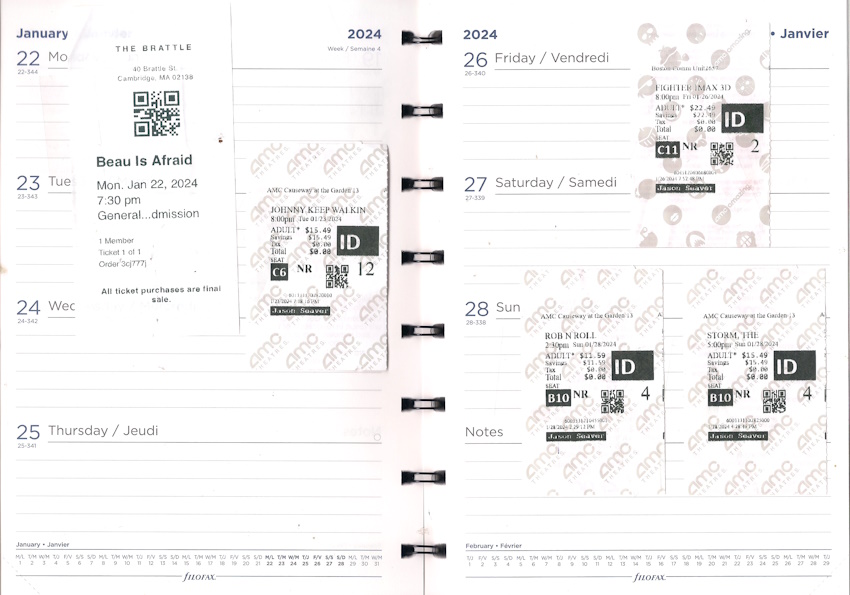
Pardon if today seems a little more scattered than usual; I left the apartment without my little five-inch square notebook and so wasn't making notes through most of the day, and that's not great when the first couple films of the day are Japanese shorts and new releases; Japanese studios just do not update English-friendly movie databases and there's a lag on the crowd-sourcing as well. I eventually wound up hitting Pharmaprix to grab pen and paper for the last show, but wasn't quick-thinking enough to record or photograph the English credits of Break Free.
Anyway, late start because the early afternoon was filled with panels and such more than screenings, so we kick off at the Museum with the Anime no Bento package:
Five filmmakers for seven films from Japan is a pretty decent turnout, although the scheduling meant there wouldn't be time for a Q&A - these packages are soon after the "My First Fantasia" shows, and genre festival staff in a museum cinema might not exactly specialize in getting families with kids in and out - so there was little time to do more than introduce director Taka Yuki from "Don't Dodge Life", "20001 An Earth Odyssey" creator Taiki Sakurai, "Echo" filmmaker Asuka Dokai, "Foxing" director Takeru Shinokuza, and Eit Mitsufuchi, who did basically everything on "Dust of the Simulacrum".
It didn't quite run late enough to bump into Break Free, with producer Yusuke Suzuki (CHECK), star Akito Fujii, and writer/ director Yu Nakamoto on hand. It was a fun Q&A, even if it was one where you get the sense of how bizarre it must be to fly halfway around the world to show your movie to a huge room of people who speak two different languages from what you understand, standing in front of them while they chatter and a translator occasionally decides a question is for you. Fujii, in particular, often seems to be listening intently for something he could respond to and then giving a very amusing answer when he got the chance.
It was interesting, though, as I gather the film kind of grew from Fujii starting a TikTok where he did dances in character as a yakuza (his character's cover story in the movie), with the studio boys eventually calling Nakamoto in saying they wanted him to write and direct a movie about a dancing gangster, which sounds pretty old Hollywood for a movie built around social media! Fujii, though he's got the look of a gangster, has been dancing since he was young, and said it was a bit of a challenge to dance crappy in earlier scenes. Nakamoto, meanwhile, answered a question about directing action versus dance by noting that sometimes the work of choreography is similar, but with action you are often doing pieces at a time, often with doubles, and camera work very much plotted alongside motion, while dance is often longer shots, no doubles, and the camera reacting to something more spontaneous.
After that there was an hour and a half or so until Unidentified Murder back at the Museum, time to do a little shopping and grab a slice of pizza. I think it might be the only new Hong Kong film at the festival - Blades of the Guardians probably belongs more to the mainland and there are three archive prints/restorations - which seems kind of crazy.
Next up, another couple big gaps on Sunday with Niko, the International Science-Fiction Short Film Showcase, You Are the Film, and Attack on Paradise. Tuesday looks to be Big Break, Levitating, Hayop Ka!, Someone's Daughter, and either Los Vampires or Solo, depending what the release plans for the former look like.
(And here's a look at how the sausage gets made if you're without a notebook or a pen but know you're not going to remember who is who the next day!)
"Echo"
☆ ☆ ☆ (out of four)
Seen 18 July 2026 in Cinema du Musée (Fantasia: Anime no Bento, DCP)
One from the "cute fantastical representation" school of animated shorts, "Echo" has a pair of twin children traversing a strange landscape, having crashed there in unusual escape pods of sorts, eager to meet their mother, with one more daring and apparently boasting greater stamina than the other. The twist is that they are as yet unborn, and in the outside world, their mother is not doing well, having lost her husband not long after discovering she was pregnant.
It's a lovely movie to look at, with cute designs that walk up to the border of perhaps overly whimsical without quite crossing it. I'm kind of torn on how directly I'd like weekdays happening with the twins to represent what's going on with the mother - they feel very disconnected here, but link them closer and suddenly there are implications best not examined!
"Future Kid Takara Episode 1: The Child From the Future"
☆ ☆ ☆ (out of four)
Seen 18 July 2026 in Cinema du Musée (Fantasia: Anime no Bento, DCP)
This is very clearly built for children, which is no bad thing, but it can be kind of hard to parse as an adult as a result. It's bright and earnest and full of entertaining designs and transformations, but is it too simplistic? Tough to judge, as an adult, especially without seeing more of the series. Little kids do need introductions to the idea of climate change, though, and they might as well be plain-spoken.
This one looks pretty cute, like it will combine fun adventure with good information, and I kind of love that the girl Takara meets in the past/our present looks like she might be an over-enthusiastic chaos source. The opening has a really nice vibe that feels a bit like it's trying be a bit of a spoof of the sort of thing parents thought was fun as a kid while also trying to be that thing for a new generation.
"20001 An Earth Odyssey"
☆ ☆ ☆ ¼ (out of four)
Seen 18 July 2026 in Cinema du Musée (Fantasia: Anime no Bento, DCP)
I am here for the joke about "it must have been used for religious rituals" in any form, which is good, because it basically does three of them as a family of alien archeologists examine a playground on an earth where humans have died out. It's a very fine example of how, if a joke is solid enough and you can tweak the execution just enough, there's a lot to work with.
The style of it is admittedly a bit after my time; in American terms it looks like NickToons from the 1990s or so. I suspect that it hits a sweet spot for kids and adults younger than me, even if the main 2001 reference is kind of corny.
"Don't Dodge Life"
☆ ☆ ¾ (out of four)
Seen 18 July 2026 in Cinema du Musée (Fantasia: Anime no Bento, DCP)
This one's a visually interesting bit of animation, although it probably makes a bit more effort reaching for profundity than it can really manage. Making the abstract concept of life a character can't help but oversimplify something that the other protagonist and potentially the viewer is really struggling with, and filmmaker Taka Yuki seems to struggle with what to do with the idea to make this a story.
"Ambivalent Garden"
Seen 18 July 2026 in Cinema du Musée (Fantasia: Anime no Bento, DCP)
Two days later, I don't recall anything about this one at all, despite the description and images on the site's pages being striking! Did I nap?
"Foxing: Kitsuné-tsuki"
☆ ☆ ☆ (out of four)
Seen 18 July 2026 in Cinema du Musée (Fantasia: Anime no Bento, DCP)
Write-what-you-know shorts can be dangerous, because they often reveal just how much young artists are pouring into their art to the exclusion of everything else. That's a bit of a weight on "Foxing" for a while, as filmmaker Takeru Shinozuka's avatar Shinano mopes about her work as an animator and how she feels unworthy in a way that's both familiar and also kind of tough to swallow for animation-lovers. We've seen young artists work themselves into and out of funks before, especially with some well-placed encouragement.
Still, the execution is really nice, especially once we meet her kitsune doodle come to life, Koyami. The expected metaphor reveal doesn't have quite so much pressure on it because Shinano has already commented on how much she's like a kitsune in some ways, but I really like the way Koyami is both pure ego and merciless criticism; She's obviously going to be an aspect of Shinano when the mask comes off, but I really like how Shinozuka doesn't separate these traits out into dueling avatars, because not only are both necessary for creating art, but they are more intertwined than usually presented.
"Dust of the Simulacrum"
☆ ☆ ¾ (out of four)
Seen 18 July 2026 in Cinema du Musée (Fantasia: Anime no Bento, DCP)
Filmmaker Eit Mitsufuchi pitched "Dust of the Simulacrum" as, among other things, an argument for working in the 3D CGI medium when the animation industry in Japan is still very much focused on a traditional style, but kind of seems a little too meta about it at times? It's not ReBoot or anything, but it's a lost video game character trying to dodge "bugs" that are overrunning a blank landscape, and I don't know if it ever gets beyond being too on-the-nose.
Oddly enough, it's a case where the human characters look nice enough but the bugs look like they could use a little refinement (although, potentially, to look jankier rather than more realistic), and it's another one where what's going on doesn't quite carry the ambition the filmmakers are trying to project.
Odore! Yakuza (Break Free)
☆ ☆ ¾ (out of four)
Seen 18 July 2026 in Théátre Hall (Fantasia Festival, laser DCP)
Break Free opens with text about how Japan's crackdown on organized crime has more or less crippled the yakuza as a force in Japanese life, and if it goes further, one wonders what the effect will be on pop culture. There will be movies like this, chronicling the fall in ways both serious and comic, but will there eventually be nostalgia for it? As much as filmmaker Yu Nakamoto has a great deal of sympathy for his characters, that doesn't extend to bolstering the institution, which is probably a part of what makes it work.
In it, Kunio (Akito Fujii) is 38 and has been a yakuza for twenty years, but the business of organized crime is not great - he's working as a food delivery driver and longtime comrades are struggling as mascots and trying to catfish - beyond how everybody is filming everything these days and it's very easy to get caught doing violence in public. Insulted by a lack of respect by a civilian, he improvises a sort of dance thing where he doesn't quite hit the guy, and it racks up millions of views. The gang decides to monetize this - an odd scheme where Kunio will present himself online as an influencer who is just cosplaying as a gangster, though the intimidation going on in the background is real - but he'll need some better moves, which means taking classes with former background dancer Marie. She, of course, is very cute, and Kunio starts to wonder if he wants more than a life of crime, even as a less organized but more vicious gang makes a play for their territory.
There's a song and dance man inside every tough guy actor - they weren't doing film noir and kung fu in high school drama class - but I don't know that anyone since James Cagney has really had the chance to be both, no matter how much Hugh Jackman wants to. It's treated as a bit of a joke when they do, and both Break Free and the TikTok channel of star Akito Fujii which inspired the film are playing on the incongruity of a guy who looks like Fujii dancing, but the joke hits so well at its best. Fujii's muscles are not quite bulky but he's not exactly wiry, and even when Kunio cleans up, he kind of looks and sounds like a schlub, so it's genuinely entertaining to see him suddenly move with seeming abandon (though I'm not sure he ever becomes quite so competitive in the dance battles as the plot requires him to be), or have the film suddenly double back and remind you of the gangster life he's trying to hide.
Not that I'd dream of spoiling those moments, especially when the best are a couple layers of absurdity deep, but they bring forth an explosion of laughter, enough to get past how a lot of the movie around them isn't quite so brilliant, coasting a lot on how good the high concept is rather than how any of the details fit together. At their best, though, the filmmakers are great at sending up how goofy something is and then doing a quick pivot to this other very silly thing, catching someone who is just making fun of the one element off guard as the thing they like better isn't spared.
And, underneath it all, this all works because it feels true that the violence of the yakuza is a dead end, even without the steps that the government is taking so that gangsters can't participate in legitimate society. The organization is dying and success requires one to either be completely monstrous (true or not, the yakuza often tried to present themselves as a useful part of society) or otherwise make oneself miserable. Being the kind of gangster Kunio and his friends see themselves as is not manly in the way it once was. Dance isn't either, but there's joy in it if not money or glory, and that's got more value than posturing like a gangster.
The movie fizzles a bit at times, Nakamoto may show violence as ultimately ineffective and obsolete, but he can't quite create the triumphant dance moment that the film needs at or near its climax. It's great fun to watch Fujii play against apparent type, though, enough for the best moments to carry the rest.
Unidentified Murder
☆ ☆ ☆ ¼ (out of four)
Seen 18 July 2026 in Cinema du Musée (Fantasia: Anime no Bento, DCP)
There's a fun bit at the end of Unidentified Murder where a newscaster is trying to recap what has come before and seems to feel that relating this idiocy is below her dignity, and she's kind of right, but the trick of the film is that, for all we the audience knows what was going on is screwy, it's not quite something that can be dismissed until the movie has finished walking right up to the line.
25 years ago, three kids went out to play and only two came back, saying their friend had been abducted by a UFO. 25 years ago Mark (Ling Man-Lung) and Kit (Ronald Lam) are going on some internet UFO programs to talk about how their friend Ho vanished, laughing dismissively at a host (Kenny Wong) bringing up how it was rumored they killed him. Mark's girlfriend Lau Man (Renci Yeung), who does YouTube pranks on Mark regularly, decides to hire an actor, Kim Chi-Fei, (Peter Chan) to pretend to be Ho and meet them at the site of the disappearance on the 25th anniversary, but, uh, why did Mark and Kit bring shovels - were they going to dig something up?
Suffice it to say, the film has a few more chances to bounce back in time to show what was really going on, adding more layers to its deceptions as it goes. The key, though, is that while Kim is in the middle of all this an explicitly hired to fake something, he is absolutely the most open and earnest character in the group, trying to come up with motivations for his character with three lines as he invested himself completely into something that Man has apparently put about seven seconds of thought into. He's a simple character but never really dumb; Peter Chan does an exceptional job of giving this oddball the right human frustrations.
The whole cast is like that, and it's impressive how, even as the film gleefully reveals how the audience doesn't have the whole story and things aren't as they seem, nobody in the cast has to completely switch things up and say that you were lied to. These folks are, by and large, pretty simple young folks and content creators who haven't grown into something more substantial, but even Renci Yeung's shallow YouTuber makes sense as a person and garners affection beyond not deserving to be murdered.
By the time it's finished, the screenplay has piled a lot of "here's something I didn't tell you before but which changes everything!" on, with some chips investigating the scene besides, but it remains clear and surprisingly linear, dishing out the new information at just the right time to not have to do a lot of sleight-of-hand to keep things out of the audience's sight. The chases and reveals go quick enough to keep things moving without there ever being much risk of missing anything, whether joke or information.
Filmmakers Kwok Ka-Hei and Jack Lee Chun-Kit have a good handle on how to thrive at this scale; the film sort of feels knowingly small, with roughly three or four locations, and doesn't try to trick the audience into it feeling bigger. The movie seems to speak the language of both classic farce and modern media-savvy internet video well, and gets good laughs from each of its about faces.
Showing posts with label family. Show all posts
Tuesday, July 21, 2026
Wednesday, October 23, 2024
This Week in Tickets: 14 October 2024 - 20 October 2024 (China, Hitch, oddities)
So, I gather nobody's been seeing these, even though I've definitely been posting them!
(You're not buying it, are you?)
I've got several things I want to catch up with on this blog, from T.W.I.T. to FIlm Rolls to Fantasia to the festivals in between, and they feel nested in a way that I wasn't ever getting out of, so now I'm going to try to rotate and keep current and say "you know what, if this isn't done by bedtime it gets a really quick finish tomorrow morning before work because it is cutting into 'watching more movies' time".
Anyway, it was a fairly fun and busy week, starting off with a Chinese double feature - Tiger Wolf Rabbit being a fairly serviceable thriller from the mainland and Stuntman is a more ambivalent ode to Hong Kong movies than is typical. I must admit, I can't help but wonder what moving the Chinese and Korean films from Boston Common to Causeway Street is doing to their audience; even if it is leading to theater splits that make double features easier.
The middle of the week (around watching some baseball) was given to watching some Hitchcock at the Somerville. Marnie on Tuesday was a nice 35mm print, and Frenzy on Thursday in a new-ish 4K remaster. They're both what I call "post-peak Hitchcock" in the reviews, made after the late-1950s masterpieces and perhaps in some ways more interesting compared to what other folks were doing in the 1960s and early 1970s than the rest of Hitch's career, because other genre filmmakers had started internalizing his lessons.
Friday evening was a trip to Kendall Square for Rumours, the new Guy Maddin that I wish I liked a bit more, then Saturday morning I headed out to the Seaport for the re-release of Tarsem Singh's restored The Fall, two filmmakers who can be niche but also have incredible style.
Then I wrapped the weekend with a couple of movies that AMC basically scheduled against each other and made difficult to see during the week, more or less carving out the weekend's late afternoons: Kensuke's Kingdom on Saturday was a nice little animated film from the UK, and Panda Plan on Sunday was the latest Jackie Chan film. The most amusing thing about it, perhaps, was that I skipped a film of his at Fantasia figuring Well Go or someone would release it in the USA, but apparently not before his next one.
Anyway - my Letterboxd account is genuinely more reliable than this, although full of spelling errors and hastily composed thoughts that get sorted out here.
Yu Huo zhi Lu (Tiger Wolf Rabbit)
* * ½ (out of four)
Seen 14 October 2024 in AMC Causeway Street #4 (first-run, laser DCP)
Not yet streaming in the USA, but listings for when it is
There are a couple moments in Tiger Wolf Rabbit when the filmmakers try to pull back from what has become a movie perhaps too dour and grim to get audiences to the finish, and the result is just mild disbelief. It's better than outright whiplash of going from talking about child abduction to romantic comedy material and back again, but the filmmakers don't quite have the knack for taking a little step away from the abyss or occasionally touching solid ground that keeps the audience from drifting away.
It's a movie that really doesn't come together until the second half, like the filmmakers know the three characters they need for later but can't really get them to work together before the main story kicks in. It opens with some striking scenes, but kind of drags between introducing the oddly mismatched trio - Cui Dalu (Yang Xiao), a just-released convict whose child was abducted; Li Hongyng (Zhao Zanilla), the woman he hooked up while searching for his son and wound up running scams with; and Zhao Zishan (Liu Ye), a mysterious figure who wants to hire Dalu to find a worse criminal - and giving them a big mission. That mission, it turns out, is pretty good. It's fragmented, sure, but you can see them building a movie to get there.
I don't know that the full story of the film really holds up; it often feels like the screenwriters came up with its two halves separately and stitched them together the best they could; the screenplay gets the story through but every previously-unrevealed thing about the characters feels more useful for explaining their next steps than making any sense of their previous ones. The cast is good, and vibe well when they're allowed to, but there's a segment in the middle where the characters are literally lost and pulled out via a weird deux ex machina, like the writers had no idea to how to get things to come together naturally.
There's style to the film, too; it feels like the folks involved sought out parts of China that seldom show up on screen and made the most of striking landscapes and village architecture. The big visual swings and plot twists are probably more memorable than things in many more sensibly constructed movies, to the point where it impresses more than it disappoints, even if the result isn't quite the sum of the parts.
Stuntman
* * ½ (out of four)
Seen 14 October 2024 in AMC Causeway Street #4 (first-run, laser DCP)
Not yet streaming in the USA, but listings for when it is
Stuntman starts out with what feels like a really good Police Story pastiche and gets interesting when that not only goes awry but the film fast-forwards to the present day and tempers its nostalgia for old-school Hong Kong action.
After the energetic stunt show, and the horrible accident at the end, it has once-famed action director Sam Lee (Stephen Tung Wai) running a little first aid clinic, catering mostly to former stuntmen who are now taking shifts as security guards and the like. At a martial-arts society reunion, he meets old friend Cho (To Yin-Gor), a director who wants him to handle the action on a movie he's putting together with action superstar Wai (Philip Ng Wan-Lung), who had been a suntman in Sam's crew but now has his own. Sam hires Lee Sam-Lung (Terrence Lau Chun-Him), who is just about ready to give up stunts to work at his brother's logistics business as the stunt co-ordinator, all while trying to prepare for the wedding of daughter Cherry (Cecliia Choi Si-Wan), though most of the father-of-the-birde work is going to her stepfather.
DIrectors Herbert Leung Kun-Seun and Albert Leung Koon-Yiu - I think they're brothers - have stuntwork bona fides and I wouldn't be terribly shocked if every piece of this movie was based on a real anecdote or experience. What's notable is that they present both the bits about making a movie and what comes after with remarkable clarity; where some may have blind spots about their life's work, the Leungs show what an action director does compared to a stunt co-ordinator, for instance, and what working-class jobs these actually are. Most importantly, while many fans of Hong Kong film and bigger names like Sammo Hung will often look back at the industry's heyday and talk about how a month would be spent on a single fight despite the guerilla filmmaking, they recognize that it was tremendously dangerous, and folks like "Heartless Sam" were a big part of the reason why. Perhaps the key thing they capture is that someone like Sam can be very good at his job and also extremely dangerous; the film's centerpiece is one that many films would play as a thrilling caper but which instead feels like Sam is going to get someone killed.
Hong Kong action is a complicated legacy and the film isn't completely successful at grappling with it; it's too fascinated by Sam to really give sufficient space to the younger characters who maybe want to be smarter about things even when he proves to be a terrible role model. It doesn't exactly help that Stephen Tung Wai has a wonderfully weathered face but never feels as natural as nearly everyone else in the cast as an actor, especially during the scenes with Cecilia Choi, where his smiling too wide and trying too hard only start to feel like something the character does rather than the actor in retrospect. The film is also big on "Hong Kong Spirit", not so much in a way that feels like it's meant to contrast with anywhere else, but also not in a way that examines it. Is it just doing more than such a tiny place should, stretching yourself past the breaking point no matter what, or...?
The stonework is legit, at least - Tung and the directors have extensive stunt backgrounds and know their stuff - and while I suspect the filmmaking is simplified, it's nicely grounded and doesn't seem interested in romanticizing the process too much.
Marnie
* * * (out of four)
Seen 15 October 2024 in Somerville Theatre #1 (A Bit of Hitch, 35mm)
Available to rent/purchase digitally on Prime or elsewhere; 4K and DVD available on Amazon
Perhaps the most entertaining thing about Marnie is that you can see Hitchcock trying to coax a James Stewart or Cary Grant performance out of his lead, who absolutely cannot be anything but Sean Connery. He knew the power of movie stars, but Connery was just starting to be James Bond and broaden his own screen persona beyond that as the film was shooting, so maybe Hitch wasn't fully familiar with his new tool yet.
Connery plays the wealthy head of a publishing company who recognizes the title character (Tippi Hedren) as the woman who robbed her previous job when she applies for work as a secretary but is nonetheless fascinated by her, covering up her crimes and blackmailing her into marriage. There's the makings of an intense thriller there, but Hitchcock, perhaps, is not the man to make it; his world view seems locked into seeing Marnie as the broken women driven to crime by previous psychological trauma and Connery's Mark Rutland mostly holding her tight so that he can see how to fix her. There's a moment - perhaps the film's best - when Hitchcock or screenwriter Jay Presson Allen seem quite happy to undermine the idea, as Marnie mocks Rutland's psychological approach, saying she's seen all the same movies, but hanging a lantern on those issues isn't exactly rising above it. The whole thing might be better off acknowledging Rutland as kind of a bastard and letting Marnie own her choices move, even if they don't wind up together.
Heck, you can see how that works in the second best thing about the movie, watching Diane Baker's Lil mature from bratty to bitchy before the audience's eyes; she's never a conventional good girl but it's tough to really dislike her as she's doing interesting things around the edges, even if it she is working at cross-purposes to the film's central romance. There are also a couple other impressive scenes - the bit where Marnie steals from the safe is a clinic in presenting such a basic bit of crime as genuinely tense, and the way Hitchcock and Hedren present Marnie's panic during the hunt (where she should feel safe and assured) is great as well - but they're often exceptions, the parts the filmmakers can make singe even if what's around them aren't as great.
The movie is very much post-peak Hitchcock: Elaborate psychological constructs, a script stuck between explicit and euphemistic, and an underlying meanness where a younger Hitch would have found chemistry and affection.
Frenzy
* * * ¼ (out of four)
Seen 17 October 2024 in Somerville Theatre #1 (A Bit of Hitch, 4K laser DCP)
Available to rent/purchase digitally on Prime or elsewhere; 4K and DVD available on Amazon
Fifty years later, Frenzy feels like it's in a weird, in-between spot, where a casual viewer might not be able to tell where Alfred Hitchcock is ahead of the times, where he's catching up, and where his experiments are having mixed results. It's good, but there are moments when I'd wonder what he's getting at; it can feel like a Monty Python sketch, and Hitchcock's dark sense of humor means it could be a joke or the sort of thing the Pythons were spoofing.
(And that's setting aside stuff like the joke about how exotic and terrible a "Margarita" is, which has aged about as well as James Bond scoffing at the Beatles)
Some of those bits are obvious bad ideas, like a long recap of what has already happened that exists to beat the joke about the detective's wife's cooking into the ground. Sometimes I wondered whether stuff like using a freeze-frame instead of holding a shot was meant to be unnerving or not. Other times, Hitchcock seems to be trying to get every morbid gag he's ever thought of in during what he probably figures will be one of his last few films.
But, on the other hand, some pieces are legitimately great. The armchair psychoanalysis might be terrible, but the way the killer slides from affable to vicious is genuinely terrific, and a scene where the camera seems to nervously back away from a murder and then wait for the body to be found feels about three layers deep. The film tortures by waiting just a little too long, but not so much that giggling breaks out. It's mean, and the results of murder are undignified in a way that makes the whole idea even more awful.
At times, it feels like Hitchcock wants to scratch the same itch as Psycho but knows folks will compare the two films and maybe tries too hard to differentiate between them (and his other "wrong man" stories). But it works more often than not, and looks gorgeous to boot.
Previous review (2013)
Rumours
* * ¾ (out of four)
Seen 18 October 2024 in Landmark Kendall Square #9 (first-run, DCP)
Available to pre-order digitally on Prime; not yet streaming in the USA, but listings for when it is
Everything about Rumours feels like it should not just be a lot of fun, but work well together: Guy Maddin (And his frequent collaborators)! Bog body zombies! At the G7 summit! With a giant brain! And a fun cast, including an increasingly game-for-anything Cate Blanchett! And yet, it resolutely fails to come together. One of cinema's greatest weirdos seems too timid to be absurd or satiric.
You can tell early on, too, when the leaders are chummy but won't say what sort of crisis they are meeting to discuss, and then seem like they're being taxed to write out platitudes. In 2024, it seems like the weakest jokes you can make about politicians, even if the G7 feels like a lot of empty hype (has anything concrete actually emerged from one?); if you're making them, put some tension in it. Make them seem paralyzed into politeness rather than empty. Or maybe go all in on absurdity, which is often this group's specialty, but they seldom push a joke past odd into weird or unnerving territory. Rumours is all the little bits a movie puts in between the big gags that you might miss, elevated to the foreground.
When the jokes land and linger, the film can be pretty fun - a late gag with the Canadian Prime Minister going for the land acknowledgment in an emergency feels downright clever for instance. The cast is admittedly terrific: Everybody seems to at least be digging into the various bits of pompous dignity of their characters, with Roy Dupuis (as Canada's virile, scandal-plagued PM) and Denis Ménochet (as France's intellectual President) in particular making off with any scene that's not tied down. It's also very fun to see Maddin's silent-influenced style emerge from a movie that initially looks downright normal, especially once one learns that they have taken an actual forest and used lighting and smoke to make it look like a set. The melodramatic score is fun.
The filmmakers just don't seem to know how to connect all those ideas that probably seemed like they would write themselves once that failed to happen.
The Fall
* * * ½ (out of four)
Seen 19 October 2024 in Alamo Boston #4 (re-release, laser DCP)
Available to rent/purchase digitally on Prime or elsewhere; original DVD available on Amazon (new one likely on the way)
The Fall is arguably one of the great cinematic follies of our time, and that's no insult: It's just acknowledging that there's clearly a lot of time, money, and effort poured into a film that was probably never going to connect with a mainstream audience unless it got very lucky. It's a folly, but one that's worth being in the world. The world is richer for having such things in it.
And it's worth checking out during this re-release, even if it hadn't been cleaned up and presented as the finest digital file possible. The film is more eye-poppingly gorgeous than one likely remembers, for a start, even if you remember it looking pretty good; 15 years of movies being increasingly built inside machines rather than from figuring out how to populate a grand landscape or striving for consistency rather than this movie's glorious contradictions makes something like this harder to conceive even in memory, as we often remember things in relation to other things, and that can cause something as singular as this to fade precisely because there's nothing like it. Watching it for the first time in years allows it to stun anew because there is very little like, say, a scene where an elaborately-costumed army makes their way down an almost Escher-like series of stairs in sync.
The script often seems shaggier than the precisely-planned visuals, and the fact that it's a bit of meta-commentary - Roy's story shifts and expands and contracts to capture his young visitor's attention to a purpose - the viewer can perhaps see that a bit too plainly. It stays to grind at a certain point, but then, the movie is about to change, and perhaps wearing out its welcome keeps the audience from rejecting the shift, and Tarsem's choice to plunge what had spent a lot of time as a children's story with dark undertones into not just darkness but despair can feels audacious: There's no winking or quipping, but the sincerity is powerful, and Tarsem isn't trying to impress us so much as be honest about how hard crawling out can be.
The filmmaker never got to make this sort of big swing again, but what a thing to spend your credit on.
Kensuke's Kingdom
* * ¾ (out of four)
Seen 19 October 2024 in AMC Boston Common #6 (first-run, laser DCP)
Not yet streaming in the USA, but listings for when it is
Kensuke's Kingdom certainly starts out in that easily-maligned category of "British animated films that look kind of cheap but somehow have an amazing voice cast", but happily grows into something better. The language barrier that never really gets bridged forces it to be more visual, and the filmmakers are wise to keep the scale manageable.
And it could be easy for it to seem too big, opening with Michael (voice of Aaron MacGregor) sailing around the world at some point in the 1990s, presumably, with his parents (voices of Cillian Murphy & Sally Hawkins) and older sister (voice of Raffey Cassidy), none too pleased about supposedly leaving his dog stella behind, though he's somehow managed to smuggle the pup on board and keep him hidden for days despite being not that great a sailor otherwise. It all leads to him being swept off the deck during a storm, landing on a seemingly deserted island, although eventually he'll meet Kensuke (voice of Ken Watanabe), who appears to have been there since World War II.
It's kind of wobbly at times, but the filmmakers are wise to lavish attention on what will get the most benefit: They quietly show how ow great it is to have a dog in this situation, lovingly render tropical animals, and make sure Kensuke's those doesn't look like a CGI effect on the middle of a hand-drawn film, as can happen. Heck, it happens here, as a choppy sea and the boat upon it are clearly created using different methods. The style switch to show his origins is very nice, and the animators give him a lot of dignity without making him stiff.
The filmmakers do sometimes seem to have a bit of trouble with how to tell the best part of the story; one suspects that the heart of the original book is Michael and Kensuke somehow getting to know each other without being able to speak, but that's probably more internal and time-consuming than the film can likely manage, while Michael remains a rather passive part of the story. The introduction of an external danger sometimes feels like something needs to be going on, but feels like an interruption more than a climax.
Still, as these small family movies which are fortunate to get one show a day for a week go, it's pretty decent.
Xiong Mao Ji Hua (Panda Plan)
* * (out of four)
Seen 20 October 2024 in AMC Causeway Street #3 (first-run, laser DCP)
Not yet streaming in the USA, but listings for when it is
You don't have to do this, Jackie Chan. You're a seventy-year-old legend who has recently expressed a fair amount of interest in being seen as a serious filmmaker rather than a clown. You don't have to sign up for the movie with the CGI panda cub, ego-puffing self-referentiality, and action scenes where everyone can see you've lost a step. You can just do one movie a year, play mentor on and off the screen, and just enjoy the fruits of an incredibly successful career.
Maybe someone gave Jackie that advice before Panda Plan, which takes what must have at one point seemed like a clever idea for a movie - action movie star gets caught up in the middle of a plan to steal baby pandas while at a symbolic "adoption ceremony" - and just sucks the life out of it. Part of it is probably Chan's ego - when going meta, he's willing to have people joke about his nose and make himself look like a goofball, but he's not going to let folks take out the knives like Andy Lau did in The Movie Emperor - which means that a lot of this movie is heroes and villains alike fawning over Jackie-the-character and he never quite plays himself as an older man who needs choreography in a way that would add tension. The filmmakers don't spend much of their Dairy Queen product placement money on actors who can play English-speaking mercenaries like people who actually speak English. The effects work isn't great and the last stretch is a cringe-worthy attempt to give the heartstrings an unwarrented tug.
(It's interesting that Jackie has a line about receiving an Oscar, though; it's clearly what he says, rather than subtitles, and while he did receive an honorary award in 2015, I wonder if this takes place in an alternate universe where The Diary got made out he didn't pass on Everything Everywhere All at Once. Plus you kind of expect him to go with the Mainland China equivalent these days)
Of course, Jackie Chan can star in a movie like this and get a National Week release because he knows the ropes as well as anybody ever has, and it's not just habit to smile as he slips through gaps in leaders or dodges punches. He may not be as spry as he was, but the choreography is still pretty good, inventive and funny, and there's a moment when things slow down enough to let Jackie talk about why he loves making movies where we're reminded of his genuine charisma and how good he can be given a chance to play it straight.
Sometimes you can say that the rest of the movie is worth it for those good bits, but this isn't one of them; it's a bit that could fit in many other movies and have the whole thing be much better.
(You're not buying it, are you?)
I've got several things I want to catch up with on this blog, from T.W.I.T. to FIlm Rolls to Fantasia to the festivals in between, and they feel nested in a way that I wasn't ever getting out of, so now I'm going to try to rotate and keep current and say "you know what, if this isn't done by bedtime it gets a really quick finish tomorrow morning before work because it is cutting into 'watching more movies' time".
Anyway, it was a fairly fun and busy week, starting off with a Chinese double feature - Tiger Wolf Rabbit being a fairly serviceable thriller from the mainland and Stuntman is a more ambivalent ode to Hong Kong movies than is typical. I must admit, I can't help but wonder what moving the Chinese and Korean films from Boston Common to Causeway Street is doing to their audience; even if it is leading to theater splits that make double features easier.
The middle of the week (around watching some baseball) was given to watching some Hitchcock at the Somerville. Marnie on Tuesday was a nice 35mm print, and Frenzy on Thursday in a new-ish 4K remaster. They're both what I call "post-peak Hitchcock" in the reviews, made after the late-1950s masterpieces and perhaps in some ways more interesting compared to what other folks were doing in the 1960s and early 1970s than the rest of Hitch's career, because other genre filmmakers had started internalizing his lessons.
Friday evening was a trip to Kendall Square for Rumours, the new Guy Maddin that I wish I liked a bit more, then Saturday morning I headed out to the Seaport for the re-release of Tarsem Singh's restored The Fall, two filmmakers who can be niche but also have incredible style.
Then I wrapped the weekend with a couple of movies that AMC basically scheduled against each other and made difficult to see during the week, more or less carving out the weekend's late afternoons: Kensuke's Kingdom on Saturday was a nice little animated film from the UK, and Panda Plan on Sunday was the latest Jackie Chan film. The most amusing thing about it, perhaps, was that I skipped a film of his at Fantasia figuring Well Go or someone would release it in the USA, but apparently not before his next one.
Anyway - my Letterboxd account is genuinely more reliable than this, although full of spelling errors and hastily composed thoughts that get sorted out here.
Yu Huo zhi Lu (Tiger Wolf Rabbit)
* * ½ (out of four)
Seen 14 October 2024 in AMC Causeway Street #4 (first-run, laser DCP)
Not yet streaming in the USA, but listings for when it is
There are a couple moments in Tiger Wolf Rabbit when the filmmakers try to pull back from what has become a movie perhaps too dour and grim to get audiences to the finish, and the result is just mild disbelief. It's better than outright whiplash of going from talking about child abduction to romantic comedy material and back again, but the filmmakers don't quite have the knack for taking a little step away from the abyss or occasionally touching solid ground that keeps the audience from drifting away.
It's a movie that really doesn't come together until the second half, like the filmmakers know the three characters they need for later but can't really get them to work together before the main story kicks in. It opens with some striking scenes, but kind of drags between introducing the oddly mismatched trio - Cui Dalu (Yang Xiao), a just-released convict whose child was abducted; Li Hongyng (Zhao Zanilla), the woman he hooked up while searching for his son and wound up running scams with; and Zhao Zishan (Liu Ye), a mysterious figure who wants to hire Dalu to find a worse criminal - and giving them a big mission. That mission, it turns out, is pretty good. It's fragmented, sure, but you can see them building a movie to get there.
I don't know that the full story of the film really holds up; it often feels like the screenwriters came up with its two halves separately and stitched them together the best they could; the screenplay gets the story through but every previously-unrevealed thing about the characters feels more useful for explaining their next steps than making any sense of their previous ones. The cast is good, and vibe well when they're allowed to, but there's a segment in the middle where the characters are literally lost and pulled out via a weird deux ex machina, like the writers had no idea to how to get things to come together naturally.
There's style to the film, too; it feels like the folks involved sought out parts of China that seldom show up on screen and made the most of striking landscapes and village architecture. The big visual swings and plot twists are probably more memorable than things in many more sensibly constructed movies, to the point where it impresses more than it disappoints, even if the result isn't quite the sum of the parts.
Stuntman
* * ½ (out of four)
Seen 14 October 2024 in AMC Causeway Street #4 (first-run, laser DCP)
Not yet streaming in the USA, but listings for when it is
Stuntman starts out with what feels like a really good Police Story pastiche and gets interesting when that not only goes awry but the film fast-forwards to the present day and tempers its nostalgia for old-school Hong Kong action.
After the energetic stunt show, and the horrible accident at the end, it has once-famed action director Sam Lee (Stephen Tung Wai) running a little first aid clinic, catering mostly to former stuntmen who are now taking shifts as security guards and the like. At a martial-arts society reunion, he meets old friend Cho (To Yin-Gor), a director who wants him to handle the action on a movie he's putting together with action superstar Wai (Philip Ng Wan-Lung), who had been a suntman in Sam's crew but now has his own. Sam hires Lee Sam-Lung (Terrence Lau Chun-Him), who is just about ready to give up stunts to work at his brother's logistics business as the stunt co-ordinator, all while trying to prepare for the wedding of daughter Cherry (Cecliia Choi Si-Wan), though most of the father-of-the-birde work is going to her stepfather.
DIrectors Herbert Leung Kun-Seun and Albert Leung Koon-Yiu - I think they're brothers - have stuntwork bona fides and I wouldn't be terribly shocked if every piece of this movie was based on a real anecdote or experience. What's notable is that they present both the bits about making a movie and what comes after with remarkable clarity; where some may have blind spots about their life's work, the Leungs show what an action director does compared to a stunt co-ordinator, for instance, and what working-class jobs these actually are. Most importantly, while many fans of Hong Kong film and bigger names like Sammo Hung will often look back at the industry's heyday and talk about how a month would be spent on a single fight despite the guerilla filmmaking, they recognize that it was tremendously dangerous, and folks like "Heartless Sam" were a big part of the reason why. Perhaps the key thing they capture is that someone like Sam can be very good at his job and also extremely dangerous; the film's centerpiece is one that many films would play as a thrilling caper but which instead feels like Sam is going to get someone killed.
Hong Kong action is a complicated legacy and the film isn't completely successful at grappling with it; it's too fascinated by Sam to really give sufficient space to the younger characters who maybe want to be smarter about things even when he proves to be a terrible role model. It doesn't exactly help that Stephen Tung Wai has a wonderfully weathered face but never feels as natural as nearly everyone else in the cast as an actor, especially during the scenes with Cecilia Choi, where his smiling too wide and trying too hard only start to feel like something the character does rather than the actor in retrospect. The film is also big on "Hong Kong Spirit", not so much in a way that feels like it's meant to contrast with anywhere else, but also not in a way that examines it. Is it just doing more than such a tiny place should, stretching yourself past the breaking point no matter what, or...?
The stonework is legit, at least - Tung and the directors have extensive stunt backgrounds and know their stuff - and while I suspect the filmmaking is simplified, it's nicely grounded and doesn't seem interested in romanticizing the process too much.
Marnie
* * * (out of four)
Seen 15 October 2024 in Somerville Theatre #1 (A Bit of Hitch, 35mm)
Available to rent/purchase digitally on Prime or elsewhere; 4K and DVD available on Amazon
Perhaps the most entertaining thing about Marnie is that you can see Hitchcock trying to coax a James Stewart or Cary Grant performance out of his lead, who absolutely cannot be anything but Sean Connery. He knew the power of movie stars, but Connery was just starting to be James Bond and broaden his own screen persona beyond that as the film was shooting, so maybe Hitch wasn't fully familiar with his new tool yet.
Connery plays the wealthy head of a publishing company who recognizes the title character (Tippi Hedren) as the woman who robbed her previous job when she applies for work as a secretary but is nonetheless fascinated by her, covering up her crimes and blackmailing her into marriage. There's the makings of an intense thriller there, but Hitchcock, perhaps, is not the man to make it; his world view seems locked into seeing Marnie as the broken women driven to crime by previous psychological trauma and Connery's Mark Rutland mostly holding her tight so that he can see how to fix her. There's a moment - perhaps the film's best - when Hitchcock or screenwriter Jay Presson Allen seem quite happy to undermine the idea, as Marnie mocks Rutland's psychological approach, saying she's seen all the same movies, but hanging a lantern on those issues isn't exactly rising above it. The whole thing might be better off acknowledging Rutland as kind of a bastard and letting Marnie own her choices move, even if they don't wind up together.
Heck, you can see how that works in the second best thing about the movie, watching Diane Baker's Lil mature from bratty to bitchy before the audience's eyes; she's never a conventional good girl but it's tough to really dislike her as she's doing interesting things around the edges, even if it she is working at cross-purposes to the film's central romance. There are also a couple other impressive scenes - the bit where Marnie steals from the safe is a clinic in presenting such a basic bit of crime as genuinely tense, and the way Hitchcock and Hedren present Marnie's panic during the hunt (where she should feel safe and assured) is great as well - but they're often exceptions, the parts the filmmakers can make singe even if what's around them aren't as great.
The movie is very much post-peak Hitchcock: Elaborate psychological constructs, a script stuck between explicit and euphemistic, and an underlying meanness where a younger Hitch would have found chemistry and affection.
Frenzy
* * * ¼ (out of four)
Seen 17 October 2024 in Somerville Theatre #1 (A Bit of Hitch, 4K laser DCP)
Available to rent/purchase digitally on Prime or elsewhere; 4K and DVD available on Amazon
Fifty years later, Frenzy feels like it's in a weird, in-between spot, where a casual viewer might not be able to tell where Alfred Hitchcock is ahead of the times, where he's catching up, and where his experiments are having mixed results. It's good, but there are moments when I'd wonder what he's getting at; it can feel like a Monty Python sketch, and Hitchcock's dark sense of humor means it could be a joke or the sort of thing the Pythons were spoofing.
(And that's setting aside stuff like the joke about how exotic and terrible a "Margarita" is, which has aged about as well as James Bond scoffing at the Beatles)
Some of those bits are obvious bad ideas, like a long recap of what has already happened that exists to beat the joke about the detective's wife's cooking into the ground. Sometimes I wondered whether stuff like using a freeze-frame instead of holding a shot was meant to be unnerving or not. Other times, Hitchcock seems to be trying to get every morbid gag he's ever thought of in during what he probably figures will be one of his last few films.
But, on the other hand, some pieces are legitimately great. The armchair psychoanalysis might be terrible, but the way the killer slides from affable to vicious is genuinely terrific, and a scene where the camera seems to nervously back away from a murder and then wait for the body to be found feels about three layers deep. The film tortures by waiting just a little too long, but not so much that giggling breaks out. It's mean, and the results of murder are undignified in a way that makes the whole idea even more awful.
At times, it feels like Hitchcock wants to scratch the same itch as Psycho but knows folks will compare the two films and maybe tries too hard to differentiate between them (and his other "wrong man" stories). But it works more often than not, and looks gorgeous to boot.
Previous review (2013)
Rumours
* * ¾ (out of four)
Seen 18 October 2024 in Landmark Kendall Square #9 (first-run, DCP)
Available to pre-order digitally on Prime; not yet streaming in the USA, but listings for when it is
Everything about Rumours feels like it should not just be a lot of fun, but work well together: Guy Maddin (And his frequent collaborators)! Bog body zombies! At the G7 summit! With a giant brain! And a fun cast, including an increasingly game-for-anything Cate Blanchett! And yet, it resolutely fails to come together. One of cinema's greatest weirdos seems too timid to be absurd or satiric.
You can tell early on, too, when the leaders are chummy but won't say what sort of crisis they are meeting to discuss, and then seem like they're being taxed to write out platitudes. In 2024, it seems like the weakest jokes you can make about politicians, even if the G7 feels like a lot of empty hype (has anything concrete actually emerged from one?); if you're making them, put some tension in it. Make them seem paralyzed into politeness rather than empty. Or maybe go all in on absurdity, which is often this group's specialty, but they seldom push a joke past odd into weird or unnerving territory. Rumours is all the little bits a movie puts in between the big gags that you might miss, elevated to the foreground.
When the jokes land and linger, the film can be pretty fun - a late gag with the Canadian Prime Minister going for the land acknowledgment in an emergency feels downright clever for instance. The cast is admittedly terrific: Everybody seems to at least be digging into the various bits of pompous dignity of their characters, with Roy Dupuis (as Canada's virile, scandal-plagued PM) and Denis Ménochet (as France's intellectual President) in particular making off with any scene that's not tied down. It's also very fun to see Maddin's silent-influenced style emerge from a movie that initially looks downright normal, especially once one learns that they have taken an actual forest and used lighting and smoke to make it look like a set. The melodramatic score is fun.
The filmmakers just don't seem to know how to connect all those ideas that probably seemed like they would write themselves once that failed to happen.
The Fall
* * * ½ (out of four)
Seen 19 October 2024 in Alamo Boston #4 (re-release, laser DCP)
Available to rent/purchase digitally on Prime or elsewhere; original DVD available on Amazon (new one likely on the way)
The Fall is arguably one of the great cinematic follies of our time, and that's no insult: It's just acknowledging that there's clearly a lot of time, money, and effort poured into a film that was probably never going to connect with a mainstream audience unless it got very lucky. It's a folly, but one that's worth being in the world. The world is richer for having such things in it.
And it's worth checking out during this re-release, even if it hadn't been cleaned up and presented as the finest digital file possible. The film is more eye-poppingly gorgeous than one likely remembers, for a start, even if you remember it looking pretty good; 15 years of movies being increasingly built inside machines rather than from figuring out how to populate a grand landscape or striving for consistency rather than this movie's glorious contradictions makes something like this harder to conceive even in memory, as we often remember things in relation to other things, and that can cause something as singular as this to fade precisely because there's nothing like it. Watching it for the first time in years allows it to stun anew because there is very little like, say, a scene where an elaborately-costumed army makes their way down an almost Escher-like series of stairs in sync.
The script often seems shaggier than the precisely-planned visuals, and the fact that it's a bit of meta-commentary - Roy's story shifts and expands and contracts to capture his young visitor's attention to a purpose - the viewer can perhaps see that a bit too plainly. It stays to grind at a certain point, but then, the movie is about to change, and perhaps wearing out its welcome keeps the audience from rejecting the shift, and Tarsem's choice to plunge what had spent a lot of time as a children's story with dark undertones into not just darkness but despair can feels audacious: There's no winking or quipping, but the sincerity is powerful, and Tarsem isn't trying to impress us so much as be honest about how hard crawling out can be.
The filmmaker never got to make this sort of big swing again, but what a thing to spend your credit on.
Kensuke's Kingdom
* * ¾ (out of four)
Seen 19 October 2024 in AMC Boston Common #6 (first-run, laser DCP)
Not yet streaming in the USA, but listings for when it is
Kensuke's Kingdom certainly starts out in that easily-maligned category of "British animated films that look kind of cheap but somehow have an amazing voice cast", but happily grows into something better. The language barrier that never really gets bridged forces it to be more visual, and the filmmakers are wise to keep the scale manageable.
And it could be easy for it to seem too big, opening with Michael (voice of Aaron MacGregor) sailing around the world at some point in the 1990s, presumably, with his parents (voices of Cillian Murphy & Sally Hawkins) and older sister (voice of Raffey Cassidy), none too pleased about supposedly leaving his dog stella behind, though he's somehow managed to smuggle the pup on board and keep him hidden for days despite being not that great a sailor otherwise. It all leads to him being swept off the deck during a storm, landing on a seemingly deserted island, although eventually he'll meet Kensuke (voice of Ken Watanabe), who appears to have been there since World War II.
It's kind of wobbly at times, but the filmmakers are wise to lavish attention on what will get the most benefit: They quietly show how ow great it is to have a dog in this situation, lovingly render tropical animals, and make sure Kensuke's those doesn't look like a CGI effect on the middle of a hand-drawn film, as can happen. Heck, it happens here, as a choppy sea and the boat upon it are clearly created using different methods. The style switch to show his origins is very nice, and the animators give him a lot of dignity without making him stiff.
The filmmakers do sometimes seem to have a bit of trouble with how to tell the best part of the story; one suspects that the heart of the original book is Michael and Kensuke somehow getting to know each other without being able to speak, but that's probably more internal and time-consuming than the film can likely manage, while Michael remains a rather passive part of the story. The introduction of an external danger sometimes feels like something needs to be going on, but feels like an interruption more than a climax.
Still, as these small family movies which are fortunate to get one show a day for a week go, it's pretty decent.
Xiong Mao Ji Hua (Panda Plan)
* * (out of four)
Seen 20 October 2024 in AMC Causeway Street #3 (first-run, laser DCP)
Not yet streaming in the USA, but listings for when it is
You don't have to do this, Jackie Chan. You're a seventy-year-old legend who has recently expressed a fair amount of interest in being seen as a serious filmmaker rather than a clown. You don't have to sign up for the movie with the CGI panda cub, ego-puffing self-referentiality, and action scenes where everyone can see you've lost a step. You can just do one movie a year, play mentor on and off the screen, and just enjoy the fruits of an incredibly successful career.
Maybe someone gave Jackie that advice before Panda Plan, which takes what must have at one point seemed like a clever idea for a movie - action movie star gets caught up in the middle of a plan to steal baby pandas while at a symbolic "adoption ceremony" - and just sucks the life out of it. Part of it is probably Chan's ego - when going meta, he's willing to have people joke about his nose and make himself look like a goofball, but he's not going to let folks take out the knives like Andy Lau did in The Movie Emperor - which means that a lot of this movie is heroes and villains alike fawning over Jackie-the-character and he never quite plays himself as an older man who needs choreography in a way that would add tension. The filmmakers don't spend much of their Dairy Queen product placement money on actors who can play English-speaking mercenaries like people who actually speak English. The effects work isn't great and the last stretch is a cringe-worthy attempt to give the heartstrings an unwarrented tug.
(It's interesting that Jackie has a line about receiving an Oscar, though; it's clearly what he says, rather than subtitles, and while he did receive an honorary award in 2015, I wonder if this takes place in an alternate universe where The Diary got made out he didn't pass on Everything Everywhere All at Once. Plus you kind of expect him to go with the Mainland China equivalent these days)
Of course, Jackie Chan can star in a movie like this and get a National Week release because he knows the ropes as well as anybody ever has, and it's not just habit to smile as he slips through gaps in leaders or dodges punches. He may not be as spry as he was, but the choreography is still pretty good, inventive and funny, and there's a moment when things slow down enough to let Jackie talk about why he loves making movies where we're reminded of his genuine charisma and how good he can be given a chance to play it straight.
Sometimes you can say that the rest of the movie is worth it for those good bits, but this isn't one of them; it's a bit that could fit in many other movies and have the whole thing be much better.
Labels:
35mm,
action,
animation,
Canada,
China,
comedy,
drama,
family,
fantasy,
Hong Kong,
independent,
Somerville,
This Week In Tickets,
thriller,
TWIT 2024,
UK,
USA
Monday, August 26, 2024
Some Odd Casting: Decoded & My Penguin Friend
I don't want to sound entitled or anything, but the Detective Chinatown movies have been operating on a three-year schedule and that's with a pandemic to deal with, so I'm a little disappointed this isn't DC4. I want to know what's going on in London, darn it!
Anyway, this wound up an odd sort of themed weekend because of some casting I didn't necessarily expect. Decoded is one I didn't realize existed until listings started showing up on Monday and I saw John Cusack's name and pulled up short, not necessarily assuming that it was that John Cusack, although also musing that he wasn't as big a get for a Chinese movie as one might have thought; though he never stopped working, the last time I saw him in a new big-screen feature was 2015's Chi-Raq, and he already wasn't really a leading man at that point any more; his last big starring role was probably 2010's Hot Tub Time Machine. There's stuff in between that played theaters which I liked, but that's kind of when he stopped being a star who could open movies, although there weren't really any flops after that. I wonder what changed; did writers stop coming up with scripts that played to his strengths, is he kind of a pain in the neck on set; was there something that made him a bad risk? I dunno. I do know that a friend was surprised that it had been nearly a decade since something he was in played the Boston area.
(Well, maybe Cell did and I missed it. Also, a trailer for Pursuit played in front of the first thing I saw at the Somerville when it reopened in 2022, but it never played there.)
The same friend, when I mentioned Jean Reno starring in My Penguin Friend, asked if Reno was going to eat the penguin. And the thing is, I don't know if Reno has really done a part like that in 15 years - like Ronin co-star Robert De Niro, he's probably done more comic subversions of those parts or just generally more genial roles as he's aged - but, no, he's not exactly the first guy you'd expect for the lead in a family-oriented film. That he's also a French actor playing a Brazilian fisherman in an English-language film makes it a bit more odd.
They're fun to see on the big screen again, though, even if (or perhaps because) it's in unexpected places. And it's kind of a shame that I didn't have time to get to Blink Twice this weekend, which in Geena Davis, Christian Slater, Simon Rex, Kyle MacLachlan, and Haley Joel Osment just has a murderer's row of "I didn't realize it had been so long" casting in the supporting roles.
Jie Mi (Decoded)
* * ½ (out of four)
Seen 22 August 2024 in AMC Causeway Street #4 (first-run, laser DCP)
I came into Decoded expecting a thriller only to quickly realize I was getting a life story instead, which isn't necessarily bad - I try not to be as dismissive of biopics as some, especially for figures who are new to me anyway - but wasn't what I was looking for. It turns out that this is an adaptation of a spy novel rather than a biography, which makes the way filmmaker Chen Sicheng presents it weirdly frustrating: Maybe he can't quite make the Christopher Nolan movie he's seemingly shooting for, but it's odd that he often falls back to one of the blandest ways to tell a movie, considering how the film is at its best when it's the most weird.
It introduces audiences to mathematical prodigy Rong Jinzhen as a child whose mother, arriving at her husband's family home for the first time alone and pregnant, died during childbirth, leaving Jinzhen to be raised by the household staff and a German friend of that wandering father who taught dream interpretation. He is taken in at age twelve by distant cousin Rong "Lili" Xiaolai (Daneil Wu), principal at a college in Nanjing that accepts Jinzhen early, where he becomes the protege of mathematician Jan Liseiwicz (John Cusack), who became a man without a country when the Nazis invaded Poland. Liseiwicz will lose his adopted nation when he refuses to decode Nationalist telegrams for spymaster Zheng (Chen Daoming), fleeing to America, though Jinzhen (Liu Haoran) does so - and does so well enough that Zheng brings him to "701", an enclave dedicated to codebreaking. Though he meets future wife Mei (Ran Luyao) there, Zheng keeps his mathematicians isolated from the isolated world, particularly by intercepting letters to Jinzhen from Liseiwicz, who develops the two NSA ciphers used to communicate with Taiwan that will occupy Jinzhen's next ten years.
There's the material for a terrific spy epic here, especially when you step back and lay the pieces out: Both Jinzhen and Liseiwicz are taken from their home and imprisoned in some manner, forced into a duel by their respective governments, and while Liseiwicz's dreams of building computers sophisticated enough to house a human mind seem at odds with Jinzhen's more intuitive methods, perhaps the Pole's greatest insight is that his student can be rattled. Original novelist Mai Jia, adapted by Chen and American screenwriter Christopher MacBride, has come up with a story that makes this sort of codebreaking work, at its heart multilayered mechanisms and mathematics, a personal story despite the rivals being at a far remove without diminishing how complex the work is. It should be great!
There's a gulf between what can be and what is, though, and Cheng shows how it's happening in real time, where a nifty dream sequence will be followed by Jinzhen walking up and scribbling in a notebook; the visuals are cool, the trying to get them to serve the narrative is immediately boring. There's a connection to interpreting dreams and cracking codes to be found, but it just doesn't work on-screen, and a big sequence toward the end winds up feeling more silly than anything, in part because it's taken a step too far when the inevitable result of Jinzhen spiraling is played as a specific American plot. It also doesn't help that Chen adds a meta level with him interviewing older versions of the characters as research; it takes what makes a genre movie clever (there's a story about how this sort of work hollows a person out inside the thrilling spy yarn) and makes it the surface text.
Liu Haoran winds up giving his all to what feels like a stock part, the vaguely autistic math prodigy who defies authority out of annoyance but is dedicated in his own way. It often doesn't quite connect with the rest of the cast - it's notable that Liseiwicz and Lili talk a fair amount about what a country and as a result patriotism mean to them but Jinzhen can only parrot it rather than make his own formulation. The supporting cast around him is quite good - Daniel Wu, Yu Feiong, and Chen Yusi are interesting as the foster family, and Chen Daoming's spymaster seems both fond of Jinzhen and aware that he gains little by being a martinet even as he is ruthless in his actions - but Liu gets little chance to show a sharp mind rather than being buffeted.
John Cusack, meanwhile, is mostly called upon to be John Cusack, especially in the first half, sad and hangdog about the state of the world but capable of motormouth enthusiasm when it comes to math and computing, and the ruthlessness in the second half is familiar, too; being able to surface that harsh edge is what made the likes of Grosse Pointe Blank and War Inc. work. I'm not sure I entirely buy the heel turn, and wonder if the novel spent more time on his side of the story, but the film wasn't going to be able to put together an English-speaking cast to make that viable: Scenes with other English speakers are telling, in that Cusack maybe playing a familiar persona, but the other guy is bad in the way Western actors in Asian movies are always bad, minor talents who either can't quite communicate the right mood or can't convince their director that this sounds off.
It's subversive in a certain way - Chinese filmmakers seem to have figured out that there's no end to how much they can have people suffer and die for the good of the nation and the censor board will pass it so long as there's a victory over Nationalists or the West in there, not realizing the message is "what a cruel waste!' - but that's kind of a feature of Chinese bios now too. The movie is pretty good when Chen gets to play with dreams - there are two or three sequences in here where the dream-staging is terrific (the Beatles can be downright terrifying for someone not equipped to approach their psychedelic imagery), and it might have been a stronger movie if Chen were able to represent the math in a similarly flashy way to invite connections. That's a thing Christopher Nolan does well that doesn't get a lot of comment, and Chen is clearly trying to work in the same mold.
The film fell somewhat flat for me on this first viewing, but I must admit that I'm curious how it will play on a second watch, now that what Chen is going for is a bit more clear. I also suspect that, like a lot of big-budget Chinese films, it's making an effort to target an international audience with its American co-writer and co-star (plural, though Daniel Wu is likely a bigger star in China than his native U.S.), but has a hard time threading the needle between what can play at home and what will work abroad.
My Penguin Friend
* * ¾ (out of four)
Seen 24 August 2024 in AMC Boston Common #12 (first-run, laser DCP)
Here's the thing about Jean Reno: Even if you've only seen him as the cool guy in hard-edged thrillers, it's absolutely no surprise to discover he's got a family movie about a kind but sad man rescuing a lost penguin in him. There are some guys a viewer is happy to see when they show up in a movie even if their characters aren't likable, because they've formed a connection with the audience. You know he's got the range even if you haven't seen it.
Reno is not in the film's opening, which has a young Brazilian boy named Miguel (Juan José Garnica) excited about his upcoming birthday and hoping his fisherman father João (Pedro Urizzi) will take him out on the sea rather than make him go to school, which João does, though rightfully nervous about the gathering storm clouds. Twenty-five or thirty years later, João (now played by Reno) is withdrawn; he and wife Maria (Adriana Barraza) don't fight, but they aren't like they were. Meanwhile, five thousand miles away in the Patagonia region of Argentina, a curious penguin begins his annual migration, only to be thrown off course by a storm and covered with oil from a leaking tanker. He's in bad shape when he washes up on the beach, and João takes him in, planning to put him back out to sea when his feathers have regrown. But the day that happens, a local girl gives him the name "Dindin" and the little guy decides to stay.
Though seemingly cast against type, Reno is great, exactly what you want out of this character in this movie, a rumpled good heart and embarrassed dignity in situations other films might play for slapstick. It's nothing surprising, really, but he can certainly set a mood with just his body language, from the old-man waddle that suggests he and the little guy will be great friends to his first hesitant time going to town with Dindin. He and Adriana Barraza are old pros in how they navigate the path back to the pair being a couple rather than little more than housemates, such that they can put across the way that Dindin is filling a whole in their lives without writers Kristen Lazarian & Paulina Lagudi Ulrich or director David Schurmann having to either position the penguin as a replacement for their son or backing off the idea. And while Reno and Pedro Urizzi don't particularly resemble each other, they capture the essence of this man at different points in their lives that repeated lines and actions connect.
Around Reno, it's a charmingly old-fashioned family film, with relatively few scenes using digital penguins compared to documentary and stock footage or just having a bird on set, and I suspect that even a small separation between what a penguin does and what filmmakers imagine penguins doing can be a big deal. It's not afraid of having a protagonist in his 60s despite kids being a great deal of the audience, and isn't shy about folks learning a few things. The script is wobbly at points, but generally in a way that falls forward rather than back, and does well to switch from João's perspective to that of Dindin or a trio of Argentine scientists to balance the mood.
It's a bit surprising that the scientists played by Alexia Moyano, Nicolás Francella, and Rocío Hernández never seem to make any direct contact with João, especially toward the end when it would seem to make sense even if it would reduce the suspense. They're a good enough trio to always be welcome even if they're pulling away from the main story and shouldering the educational duties; it's not hard to imagine the movie made primarily from their point of view. There's some care put into making their dynamic interesting rather than just obligatory.
If the film has an issue, it's that the opening is a bit long and heavy-handed; older folks in the audience can see exactly what's being set up (and might find the young Brazilian actors being obviously dubbed into English distracting), but might play well with the younger folks. That's the sort of thing that puts this movie right on the line between a movie that a person might say is surprisingly good and one which that person actively recommends, although it's easy to push it into the latter category with the cute penguin and a famous tough guy playing effortlessly against type.
Anyway, this wound up an odd sort of themed weekend because of some casting I didn't necessarily expect. Decoded is one I didn't realize existed until listings started showing up on Monday and I saw John Cusack's name and pulled up short, not necessarily assuming that it was that John Cusack, although also musing that he wasn't as big a get for a Chinese movie as one might have thought; though he never stopped working, the last time I saw him in a new big-screen feature was 2015's Chi-Raq, and he already wasn't really a leading man at that point any more; his last big starring role was probably 2010's Hot Tub Time Machine. There's stuff in between that played theaters which I liked, but that's kind of when he stopped being a star who could open movies, although there weren't really any flops after that. I wonder what changed; did writers stop coming up with scripts that played to his strengths, is he kind of a pain in the neck on set; was there something that made him a bad risk? I dunno. I do know that a friend was surprised that it had been nearly a decade since something he was in played the Boston area.
(Well, maybe Cell did and I missed it. Also, a trailer for Pursuit played in front of the first thing I saw at the Somerville when it reopened in 2022, but it never played there.)
The same friend, when I mentioned Jean Reno starring in My Penguin Friend, asked if Reno was going to eat the penguin. And the thing is, I don't know if Reno has really done a part like that in 15 years - like Ronin co-star Robert De Niro, he's probably done more comic subversions of those parts or just generally more genial roles as he's aged - but, no, he's not exactly the first guy you'd expect for the lead in a family-oriented film. That he's also a French actor playing a Brazilian fisherman in an English-language film makes it a bit more odd.
They're fun to see on the big screen again, though, even if (or perhaps because) it's in unexpected places. And it's kind of a shame that I didn't have time to get to Blink Twice this weekend, which in Geena Davis, Christian Slater, Simon Rex, Kyle MacLachlan, and Haley Joel Osment just has a murderer's row of "I didn't realize it had been so long" casting in the supporting roles.
Jie Mi (Decoded)
* * ½ (out of four)
Seen 22 August 2024 in AMC Causeway Street #4 (first-run, laser DCP)
I came into Decoded expecting a thriller only to quickly realize I was getting a life story instead, which isn't necessarily bad - I try not to be as dismissive of biopics as some, especially for figures who are new to me anyway - but wasn't what I was looking for. It turns out that this is an adaptation of a spy novel rather than a biography, which makes the way filmmaker Chen Sicheng presents it weirdly frustrating: Maybe he can't quite make the Christopher Nolan movie he's seemingly shooting for, but it's odd that he often falls back to one of the blandest ways to tell a movie, considering how the film is at its best when it's the most weird.
It introduces audiences to mathematical prodigy Rong Jinzhen as a child whose mother, arriving at her husband's family home for the first time alone and pregnant, died during childbirth, leaving Jinzhen to be raised by the household staff and a German friend of that wandering father who taught dream interpretation. He is taken in at age twelve by distant cousin Rong "Lili" Xiaolai (Daneil Wu), principal at a college in Nanjing that accepts Jinzhen early, where he becomes the protege of mathematician Jan Liseiwicz (John Cusack), who became a man without a country when the Nazis invaded Poland. Liseiwicz will lose his adopted nation when he refuses to decode Nationalist telegrams for spymaster Zheng (Chen Daoming), fleeing to America, though Jinzhen (Liu Haoran) does so - and does so well enough that Zheng brings him to "701", an enclave dedicated to codebreaking. Though he meets future wife Mei (Ran Luyao) there, Zheng keeps his mathematicians isolated from the isolated world, particularly by intercepting letters to Jinzhen from Liseiwicz, who develops the two NSA ciphers used to communicate with Taiwan that will occupy Jinzhen's next ten years.
There's the material for a terrific spy epic here, especially when you step back and lay the pieces out: Both Jinzhen and Liseiwicz are taken from their home and imprisoned in some manner, forced into a duel by their respective governments, and while Liseiwicz's dreams of building computers sophisticated enough to house a human mind seem at odds with Jinzhen's more intuitive methods, perhaps the Pole's greatest insight is that his student can be rattled. Original novelist Mai Jia, adapted by Chen and American screenwriter Christopher MacBride, has come up with a story that makes this sort of codebreaking work, at its heart multilayered mechanisms and mathematics, a personal story despite the rivals being at a far remove without diminishing how complex the work is. It should be great!
There's a gulf between what can be and what is, though, and Cheng shows how it's happening in real time, where a nifty dream sequence will be followed by Jinzhen walking up and scribbling in a notebook; the visuals are cool, the trying to get them to serve the narrative is immediately boring. There's a connection to interpreting dreams and cracking codes to be found, but it just doesn't work on-screen, and a big sequence toward the end winds up feeling more silly than anything, in part because it's taken a step too far when the inevitable result of Jinzhen spiraling is played as a specific American plot. It also doesn't help that Chen adds a meta level with him interviewing older versions of the characters as research; it takes what makes a genre movie clever (there's a story about how this sort of work hollows a person out inside the thrilling spy yarn) and makes it the surface text.
Liu Haoran winds up giving his all to what feels like a stock part, the vaguely autistic math prodigy who defies authority out of annoyance but is dedicated in his own way. It often doesn't quite connect with the rest of the cast - it's notable that Liseiwicz and Lili talk a fair amount about what a country and as a result patriotism mean to them but Jinzhen can only parrot it rather than make his own formulation. The supporting cast around him is quite good - Daniel Wu, Yu Feiong, and Chen Yusi are interesting as the foster family, and Chen Daoming's spymaster seems both fond of Jinzhen and aware that he gains little by being a martinet even as he is ruthless in his actions - but Liu gets little chance to show a sharp mind rather than being buffeted.
John Cusack, meanwhile, is mostly called upon to be John Cusack, especially in the first half, sad and hangdog about the state of the world but capable of motormouth enthusiasm when it comes to math and computing, and the ruthlessness in the second half is familiar, too; being able to surface that harsh edge is what made the likes of Grosse Pointe Blank and War Inc. work. I'm not sure I entirely buy the heel turn, and wonder if the novel spent more time on his side of the story, but the film wasn't going to be able to put together an English-speaking cast to make that viable: Scenes with other English speakers are telling, in that Cusack maybe playing a familiar persona, but the other guy is bad in the way Western actors in Asian movies are always bad, minor talents who either can't quite communicate the right mood or can't convince their director that this sounds off.
It's subversive in a certain way - Chinese filmmakers seem to have figured out that there's no end to how much they can have people suffer and die for the good of the nation and the censor board will pass it so long as there's a victory over Nationalists or the West in there, not realizing the message is "what a cruel waste!' - but that's kind of a feature of Chinese bios now too. The movie is pretty good when Chen gets to play with dreams - there are two or three sequences in here where the dream-staging is terrific (the Beatles can be downright terrifying for someone not equipped to approach their psychedelic imagery), and it might have been a stronger movie if Chen were able to represent the math in a similarly flashy way to invite connections. That's a thing Christopher Nolan does well that doesn't get a lot of comment, and Chen is clearly trying to work in the same mold.
The film fell somewhat flat for me on this first viewing, but I must admit that I'm curious how it will play on a second watch, now that what Chen is going for is a bit more clear. I also suspect that, like a lot of big-budget Chinese films, it's making an effort to target an international audience with its American co-writer and co-star (plural, though Daniel Wu is likely a bigger star in China than his native U.S.), but has a hard time threading the needle between what can play at home and what will work abroad.
My Penguin Friend
* * ¾ (out of four)
Seen 24 August 2024 in AMC Boston Common #12 (first-run, laser DCP)
Here's the thing about Jean Reno: Even if you've only seen him as the cool guy in hard-edged thrillers, it's absolutely no surprise to discover he's got a family movie about a kind but sad man rescuing a lost penguin in him. There are some guys a viewer is happy to see when they show up in a movie even if their characters aren't likable, because they've formed a connection with the audience. You know he's got the range even if you haven't seen it.
Reno is not in the film's opening, which has a young Brazilian boy named Miguel (Juan José Garnica) excited about his upcoming birthday and hoping his fisherman father João (Pedro Urizzi) will take him out on the sea rather than make him go to school, which João does, though rightfully nervous about the gathering storm clouds. Twenty-five or thirty years later, João (now played by Reno) is withdrawn; he and wife Maria (Adriana Barraza) don't fight, but they aren't like they were. Meanwhile, five thousand miles away in the Patagonia region of Argentina, a curious penguin begins his annual migration, only to be thrown off course by a storm and covered with oil from a leaking tanker. He's in bad shape when he washes up on the beach, and João takes him in, planning to put him back out to sea when his feathers have regrown. But the day that happens, a local girl gives him the name "Dindin" and the little guy decides to stay.
Though seemingly cast against type, Reno is great, exactly what you want out of this character in this movie, a rumpled good heart and embarrassed dignity in situations other films might play for slapstick. It's nothing surprising, really, but he can certainly set a mood with just his body language, from the old-man waddle that suggests he and the little guy will be great friends to his first hesitant time going to town with Dindin. He and Adriana Barraza are old pros in how they navigate the path back to the pair being a couple rather than little more than housemates, such that they can put across the way that Dindin is filling a whole in their lives without writers Kristen Lazarian & Paulina Lagudi Ulrich or director David Schurmann having to either position the penguin as a replacement for their son or backing off the idea. And while Reno and Pedro Urizzi don't particularly resemble each other, they capture the essence of this man at different points in their lives that repeated lines and actions connect.
Around Reno, it's a charmingly old-fashioned family film, with relatively few scenes using digital penguins compared to documentary and stock footage or just having a bird on set, and I suspect that even a small separation between what a penguin does and what filmmakers imagine penguins doing can be a big deal. It's not afraid of having a protagonist in his 60s despite kids being a great deal of the audience, and isn't shy about folks learning a few things. The script is wobbly at points, but generally in a way that falls forward rather than back, and does well to switch from João's perspective to that of Dindin or a trio of Argentine scientists to balance the mood.
It's a bit surprising that the scientists played by Alexia Moyano, Nicolás Francella, and Rocío Hernández never seem to make any direct contact with João, especially toward the end when it would seem to make sense even if it would reduce the suspense. They're a good enough trio to always be welcome even if they're pulling away from the main story and shouldering the educational duties; it's not hard to imagine the movie made primarily from their point of view. There's some care put into making their dynamic interesting rather than just obligatory.
If the film has an issue, it's that the opening is a bit long and heavy-handed; older folks in the audience can see exactly what's being set up (and might find the young Brazilian actors being obviously dubbed into English distracting), but might play well with the younger folks. That's the sort of thing that puts this movie right on the line between a movie that a person might say is surprisingly good and one which that person actively recommends, although it's easy to push it into the latter category with the cute penguin and a famous tough guy playing effortlessly against type.
Friday, June 14, 2024
Young Woman and the Sea
Apparently, this was originally slated to go straight to Disney+, but someone at Disney either figured "we spent some money on this and maybe it would be a good idea to build Daisy Ridley up before New Jedi Order" or, as I've read, they figured it would be a good tie-in for the Olympics, but in either case, it's not like they did much to promote it or release it wide. Which is a shame, because it's pretty darn good, although I suppose it's also the sort of thing people have been trained to wait for streaming on.
Apparently, it was set up at Paramount for a while before moving to Disney, and I'm kind of surprised that Universal didn't pick it up. It fits Disney's brand better, I suppose, but Universal and NBC are sister companies, and not only has NBC/Peacock had a stranglehold on the Olympics for decades, but all the radio news in the movie is from the National Broadcasting System. The cross-promotion seems natural!
(Aside - how excited do people get about the Olympics these days? It was a big deal when I was a kid, but now I regularly ignore it and hear little but how NBC smothers any actual sports under human-interest stories and ignores everyone but Americans.)
I'm guessing it won't hang around much longer than this coming coming week (and that seems like of lucky), but it's worth recommending. I bet my sporty tween nieces would like it.
Young Woman and the Sea
* * * ¼ (out of four)
Seen 9 June 2024 in AMC Boston Common #6 (first-run, DCP)
Movies like this used to be Disney's bread and butter: Earnest tales of adventure and overcoming obstacles with young heroes and little material that might give parents pause. Young Woman and the Sea may be longer and more elaborate than many of its forebears, but it's got the same quality of nobody seeming embarrassed to be making family fare,and winds up surprisingly rousing and entertaining without having to give the audience a wink to show how clever they are.
It introduces young Trudy (Olive Abercrombie) and Meg Ederle (Lilly Aspell) in 1914 New York, a freighter burning in the distance as their immigrant parents (Kim Bodnia & Jeanette Hain) fear Trudy will die of the measles. She proves too stubborn for that, and she doesn't stop being stubborn when mother Gertrud insists on Meg and their younger brother Henry receiving swimming lessons but attempts to exclude her because measles survivors risk losing their hearing from the activity. The sisters take to it with a passion, and by the time they are older, Gertrud signs them up for a team coached by Lotte Epstein (Sian Clifford). Meg (Tilda Cobham-Hervey) is initially seen as the team's strongest member, but soon Trudy (Daisy Ridley) is setting records, eventually recruited for the 1924 Olympics in Paris. Neither the sponsor (Glenn Fleshler) nor the coach (Christopher Eccleston) actually believes in women's athletics, but Trudy nevertheless sets her sights on swimming the English Channel, an oft-deadly pursuit that only a handful of men have managed in 1926.
It's odd to say, perhaps, but the way that the film handles the sexism at the heart of its story is kind of impressive; it could often be presented as so overwhelming that Trudy and Meg would have to do something that seems truly impossible to chip away at it, or seem like they're undoing sexism all by themselves. Instead, though, they show the 1920s as a sort of inflection point, where there are a lot of silly assumptions and attitudes persisting but not only can one see a space for someone like Trudy, but where her love for swimming can exist as its own thing rather than as a response to the nonsense: She swims because she loves it and is naturally competitive, as opposed to as an escape from what she deals with on land.
That's all important because it gives writer Jeff Nathanson (adapting Glenn Stout's book) and director Joachim Rønning more room to make a good sports movie. Swimming isn't necessarily the easiest activity to make exciting, since there's limits on where you can put the camera without the shot feeling contrived when someone is doing laps - I imagine that it's a bit of a filmmaking challenge to get across the emotional intensity of a bunch of people face down in the water - and so rely on live commentary and montage a lot until it becomes a distance event, when they can open the image up, center the seemingly tiny Trudy against the vast ocean, and face her with a variety of challenges, from boats coming too close to how one can get completely turned around in the dark to jellyfish. They also give the audience a fair amount of credit for connecting necessary dots, from how Trudy's works stoking the boiler where the women practice is probably building a fair amount of strength to how the line between being very good and great can be a heck of a thing for two people to find between them.
In the middle, there's Daisy Ridley, the only person in the film you'd potentially call a star, and it's been kind of interesting to see her carve out this niche of women who are wired differently since Star Wars. Trudy doesn't seem quite so peculiar as her characters from Sometimes I Think About Dying and The Marsh King's Daughter, but she probably was relative to her time, and neither she nor Rønning seems worried about making Trudy's focus something that other people will have to work around if they want to be close to her. Indeed, it often seems that the only person she is consistently playing off comfortably is Tilda Cobham-Hervey as the teen/adult Meg, who clearly understands Trudy's passions and can serve as a sort of bridge to those who don't. One can see some of where Trudy comes from in the parents played by Kim Bodnia and Jeanette Hain, but there's always a bit of distance between them - they love Trudy but can't fully enter her world. The coaches played by Sian Clifford, Christopher Eccleston, and Stephen Graham can, perhaps, but they're different sorts of extreme personalities.
It's a terrific looking picture for something with just the one major star and originally destined for a streamer (and likely not one of Disney+'s tentpole releases); you can never really know these days how much was shot in a big green room and how much is finding spots in Bulgaria that can pass of the New York City of a century ago with some clever redressing, but it's a convincing-enough world, and the aquatic scenes are equally great. It's perhaps longer than this sort of film traditionally would be, but seldom feels flabby or drawn out or flabby.
Young Woman and the Sea is kind of a modest movie, but it does what it's supposed to do and does it well. We could probably use this sort of kid-friendly adventure which doesn't rely on visual effects and fantasy being in theaters from major studios a little more often.
Apparently, it was set up at Paramount for a while before moving to Disney, and I'm kind of surprised that Universal didn't pick it up. It fits Disney's brand better, I suppose, but Universal and NBC are sister companies, and not only has NBC/Peacock had a stranglehold on the Olympics for decades, but all the radio news in the movie is from the National Broadcasting System. The cross-promotion seems natural!
(Aside - how excited do people get about the Olympics these days? It was a big deal when I was a kid, but now I regularly ignore it and hear little but how NBC smothers any actual sports under human-interest stories and ignores everyone but Americans.)
I'm guessing it won't hang around much longer than this coming coming week (and that seems like of lucky), but it's worth recommending. I bet my sporty tween nieces would like it.
Young Woman and the Sea
* * * ¼ (out of four)
Seen 9 June 2024 in AMC Boston Common #6 (first-run, DCP)
Movies like this used to be Disney's bread and butter: Earnest tales of adventure and overcoming obstacles with young heroes and little material that might give parents pause. Young Woman and the Sea may be longer and more elaborate than many of its forebears, but it's got the same quality of nobody seeming embarrassed to be making family fare,and winds up surprisingly rousing and entertaining without having to give the audience a wink to show how clever they are.
It introduces young Trudy (Olive Abercrombie) and Meg Ederle (Lilly Aspell) in 1914 New York, a freighter burning in the distance as their immigrant parents (Kim Bodnia & Jeanette Hain) fear Trudy will die of the measles. She proves too stubborn for that, and she doesn't stop being stubborn when mother Gertrud insists on Meg and their younger brother Henry receiving swimming lessons but attempts to exclude her because measles survivors risk losing their hearing from the activity. The sisters take to it with a passion, and by the time they are older, Gertrud signs them up for a team coached by Lotte Epstein (Sian Clifford). Meg (Tilda Cobham-Hervey) is initially seen as the team's strongest member, but soon Trudy (Daisy Ridley) is setting records, eventually recruited for the 1924 Olympics in Paris. Neither the sponsor (Glenn Fleshler) nor the coach (Christopher Eccleston) actually believes in women's athletics, but Trudy nevertheless sets her sights on swimming the English Channel, an oft-deadly pursuit that only a handful of men have managed in 1926.
It's odd to say, perhaps, but the way that the film handles the sexism at the heart of its story is kind of impressive; it could often be presented as so overwhelming that Trudy and Meg would have to do something that seems truly impossible to chip away at it, or seem like they're undoing sexism all by themselves. Instead, though, they show the 1920s as a sort of inflection point, where there are a lot of silly assumptions and attitudes persisting but not only can one see a space for someone like Trudy, but where her love for swimming can exist as its own thing rather than as a response to the nonsense: She swims because she loves it and is naturally competitive, as opposed to as an escape from what she deals with on land.
That's all important because it gives writer Jeff Nathanson (adapting Glenn Stout's book) and director Joachim Rønning more room to make a good sports movie. Swimming isn't necessarily the easiest activity to make exciting, since there's limits on where you can put the camera without the shot feeling contrived when someone is doing laps - I imagine that it's a bit of a filmmaking challenge to get across the emotional intensity of a bunch of people face down in the water - and so rely on live commentary and montage a lot until it becomes a distance event, when they can open the image up, center the seemingly tiny Trudy against the vast ocean, and face her with a variety of challenges, from boats coming too close to how one can get completely turned around in the dark to jellyfish. They also give the audience a fair amount of credit for connecting necessary dots, from how Trudy's works stoking the boiler where the women practice is probably building a fair amount of strength to how the line between being very good and great can be a heck of a thing for two people to find between them.
In the middle, there's Daisy Ridley, the only person in the film you'd potentially call a star, and it's been kind of interesting to see her carve out this niche of women who are wired differently since Star Wars. Trudy doesn't seem quite so peculiar as her characters from Sometimes I Think About Dying and The Marsh King's Daughter, but she probably was relative to her time, and neither she nor Rønning seems worried about making Trudy's focus something that other people will have to work around if they want to be close to her. Indeed, it often seems that the only person she is consistently playing off comfortably is Tilda Cobham-Hervey as the teen/adult Meg, who clearly understands Trudy's passions and can serve as a sort of bridge to those who don't. One can see some of where Trudy comes from in the parents played by Kim Bodnia and Jeanette Hain, but there's always a bit of distance between them - they love Trudy but can't fully enter her world. The coaches played by Sian Clifford, Christopher Eccleston, and Stephen Graham can, perhaps, but they're different sorts of extreme personalities.
It's a terrific looking picture for something with just the one major star and originally destined for a streamer (and likely not one of Disney+'s tentpole releases); you can never really know these days how much was shot in a big green room and how much is finding spots in Bulgaria that can pass of the New York City of a century ago with some clever redressing, but it's a convincing-enough world, and the aquatic scenes are equally great. It's perhaps longer than this sort of film traditionally would be, but seldom feels flabby or drawn out or flabby.
Young Woman and the Sea is kind of a modest movie, but it does what it's supposed to do and does it well. We could probably use this sort of kid-friendly adventure which doesn't rely on visual effects and fantasy being in theaters from major studios a little more often.
Saturday, February 17, 2024
This Week in Tickets: 5 February 2024 - 11 February 2024 (Jean Arthur Week, Part II)
What a "living at the Brattle" week looks like, if you don't remember.
So, yes, as was the plan last week, I did that whole Jean Arthur series, and was kind of amused when I saw a review on Letterboxd for More Than a Secretary that read "Jean Arthur was gay, PERIODT!" because one looks at her biography and wonders if she wasn't somehow queer: One annulled marriage, one that produced no children, intensely private, died in the care of a female longtime friend/companion. More or less finished in Hollywood after her Columbia contract ended, though she'd work on the stage and teach.
And then there are the movies, where The Talk of the Town wasn't the only one that seemed to like a happy polycule was closer to the ideal conclusion than a couple. Obviously, you can't really tell much about an studio-period actor from the movies they're in, because they can't really choose projects, but sometimes it seems like the queer-coding and apparent comfort with it piles up - the best takes with her roommate being better than the best ones with her boyfriend, her biggest movies being the ones with unconventional chemistry.
No way to know, obviously, since if this was the case, she maintained her privacy very well during her life. More likely than not, she just lived a private life, wasn't nearly as romance-focused as the characters she played, and had a roommate when she was older. She definitely made some good movies during her time at Columbia, though, and the post-weekend portion of the Brattle's program got to some of the more offbeat ones: If You Could Only Cook, The Whole Town's Talking, More Than a Secretary, Too Many Husbands, You Can't Take It with You, The More the Merrier, and Adventure in Manhattan.
(Somewhere in there, there was a re-watch of Piranha for Film Rolls, but we'll just maybe link to that when that post is ready actually.)
After that came the Lunar New Year weekend, which is kind of a weird one here because it's big mainstream movies, but few have ever had a trailer, some of them come out day-of and some get picked up by North American distributors and wind up coming out months later, and some just disappear because the Chinese distributor doesn't figure there's enough audience in the USA to care. This year, it's backed up right up against Valentine's Day, too. Some years they take over the Imax screen with something huge like The Wandering Earth, other years, not so much I liked both Table for Six 2 (Friday) and The Movie Emperor (Sunday), but they're not "hey, they've got blockbusters in China too!" things.
(It looks we're missing two big ones - YOLO, from the director of Hi, Mom, and Zhang Yimou's Article 20, which will probably show up later.)
Also on Sunday: The first "Silents, Please!" of the year, the 1924 Peter Pan, which was quite fun. Given the mention of the next one tying to MGM's and Columbia's 100th anniversaries, I wonder if 1924 is going to be the theme for the year. The pandemic really screwed over what could potentially have been a good long celebration of silent centennials!
Sorry this showed up kind of late, but it's kind of a beast, and the next Film Rolls is looking like a beast too. My Letterboxd account continues to update if this is too long between missives.
If You Could Only Cook
* * * (out of four)
Seen 5 February 2024 in the Brattle Theatre (Jean Arthur, 35mm)
Available to purchase on DVD on Amazon; not steaming elsewhere at this moment
So here's the thing about If You Could Only Cook, in which a self-made millionaire (Herbert Marshall), having given an unemployed woman he meets (Jean Arthur) the impression that he, too, is out of work (rather than taking a week off before his wedding to a woman from a respected family he doesn't particularly love), agrees to pose as her husband so that they can take jobs as a butler & cook, only to discover that they were hired by a gangster: It seldom has the absolute best joke possible in a given situation, and it's got a bunch of set-ups it barely mines, but it rarely stumbles, while also packing everything into 74 minutes and fading to black at the very moment its business is done. This is how comedy B-movies are done. Solid as heck work all around.
Indeed, the filmmakers are often content to run off little more than the chemistry between Jean Arthur and Herbert Marshall for long stretches, letting them be pleasant company so that you needn't have reservations about pairing them up despite the deception at the center, while a bunch of nutty folks around them escalate things. Arthur and Marshall play off each other so well that it's pretty easy to believe that Jim and Joan go out on limbs for each other. Meanwhile, we see just enough of Jim's best man cuddling with the bride-to-be to casually dispose of that as an issue, while Leo Carrillo and Lionel Stander are mobsters divorced enough from violent crime to be entertaining goofs.
There's a kind of temptation to let things get completely crazy, as they do during an entertaining final chase, but it's not that movie; as frantic and full of screwball misunderstandings as it is, it's pretty gentle. In some ways, it means that this is a comedy B movie that maybe could have been an A picture with 10 more minutes spent running down all the other things going on, and I'd kind of like to see the movie where they knock down everything they set up.
On the other hand, it works pretty darn well at this scale, and can you imagine remaking it? So much is positively quaint today that you'd have to spend time explaining couples' jobs and the like.
(Fun if surprising fact: F. Hugh Herbert, credited with the story, was not a one-off alias that one might use during the Great Depression! His career spanned 30-plus years!)
The Whole Town's Talking
* * * ½ (out of four)
Seen 5 February 2024 in the Brattle Theatre (Jean Arthur, DCP)
Available to stream/purchase digitally on Prime or elsewhere, and to purchase on Blu-ray at Amazon
The first character we meet in this movie is named Seaver, and he survives to the end despite being kidnapped. Five stars.
Well, not quite, but it is tremendous fun to watch Edward G. Robinson not only spend a lot of the movie playing a sweet little nebbish but, as the word gets out that there is an escaped convict who looks just like him, seemingly have difficulty contorting his face into that of the gangster he sees in the paper. I'm not sure of the extent to which he'd really established his gangster persona at this early point, but it's a kick when the Robinson we know and love does show up. Joan Arthur is a fun foil, giving Miss Clark aggressive but honest-seeming charm that quickly wipes away how she initially comes off as a bullying opportunist.
John Ford directs, and it makes for a snappier movie than the ones with Frank Capra that started this Jean Arthur series, even as he's marshaling scenes that play big or tossing both the gags and the bits that move the story ahead around quickly. The parts with Robinson playing off himself work well, too, especially a couple that must be done with rear protection or quality matte work because the smoke from Killer Mannion's cigar wafts behind Arthur Jones rather than disappearing as it passes a central line.
i do, eventually, get a sense of what's kind of too much at points; the chaotic first half doesn't make a whole lot more sense than the second, when Mannion is setting things in motion, but it's quick and lots of fun.
More Than a Secretary
* * ¾ (out of four)
Seen 6 February 2024 in the Brattle Theatre (Jean Arthur, 35mm)
Not currently streaming; available to purchase on DVD at Amazon.
It's the old, old story - the co-owner of a secretarial school (Jean Arthur) tries to give the demanding client (George Brent) who has fired a number of girls placed at his magazine a piece of her mind, but is mistaken mistaken for the new hire. He's handsome and charismatic, though, so she takes the job, even as she and her partner have lamented the extent to which their students see their training as a path to matrimony rather than independence.
There is some darn good screwball in here, especially as Arthur's Carol is initially thrown by just how peculiar Fred's healthy lifestyle and the workings of the magazine he uses to spread the gospel thereof are, with Lionel Stander especially fun as Fred's trainer and best buddy (he was also a scene-stealer in If You Could Only Cook and Mr. Deeds Goes to Town, just a terrific character actor). The film loses a bit of momentum when the health-magazine goofiness starts to fall by the wayside, because Carol finding the whole thing weird is generally more entertaining than her being part of it. I do want to know what percentage of Dorothea Kent's lines as Maizie are double entendres that just aren't so well known 90 years later; she's a hussy and given that so many of her lines are clear come-ons or ones where you can see where she's going, I suspect the rest are just the same.
It's a slight movie, for sure, and at times feels like it's been cut to the bone to get down to its trim 77-minute running time: If the fact that Jean Arthur's character was actually the owner of the school was supposed to be something she was hiding, it's never brought up, and if the best friends are pairing off, it's just out of sight, a fuzzy piece of the background. But it's cute.
Too Many Husbands
* * * ¼ (out of four)
Seen 6 February 2024 in the Brattle Theatre (Jean Arthur, 35mm)
Not currently streaming; available to purchase on DVD at Amazon.
I wonder what the original stage play of this is like, because it certainly feels like the filmmakers took a look at the premise, saw the jokes, and decided that any attempt to make it go anywhere or say anything with even the slightest bit of weight would be working against their purposes, so they tossed it out. This is actually more than fine; it's 80 minutes of flustered absurdity as Jean Arthur's Vicky tries to figure out what to do now that her missing-presumed-dead first husband Bill (Fred MacMurray) has been rescued from a deserted island and found her married to his best friend and business partner Henry (Melvyn Douglas).
There's maybe the hint of something weightier here in Bill's realization that he took Vicky for granted or Henry's inferiority complex, but then something clicks with Vicky, and the look on Jean Arthur's face she realizes that she can make this work for her is delightful. Her glee at realizing that these two men will fight over her, and not because they see her as a prize but because she's obviously the best thing in their lives - kind of important, that! - seems like a chance for the movie to go in on how these two men have neglected her in different ways, but it's having way too much fun with the banter and bouncing around the apartment to slow down and talk about that.
Screenwriter Claude Binyon could maybe do with making a stronger argument for Melvyn Douglas's Henry; the film is almost all ping-ponging and banter, and while Douglas fills this sort of slot quite well, Fred MacMurray is really good at that sort of comedy, and I suspect that the guy who is quick on the draw is going to do better with audiences on top of the girl. MacMurray seems a lot like Arthur in that he was in a classic or two but didn't have iconic pairings or a body of work that became where he was the best thing in legendary pictures. But even if they didn't achieve places in the canon of their own, you can see why they're stars in movies like this as MacMurray in particular is giving you reason to enjoy it at even the silliest moments.
You Can't Take It with You
* * ¾ (out of four)
Seen 7 February 2024 in the Brattle Theatre (Jean Artthur, DCP)
Available to rent/purchase digitally on Prime and elsewhere, or to purchase on Blu-ray at Amazon
Can you imagine if the internet had been around in Frank Capra's day? The level of snark at his seemingly facile earnestness, the immediate "let people like things" backlash, the attempt to parse whether he was actually kind of great at directing actors or if he was lucky to have James Stewart in parts calibrated to his strengths? The truth of it is probably somewhere in the middle, but you can picture the shouting over it, right, especially in a movie like this which doesn't always hit.
In it, banker Anthony P. Kirby (Edward Arnold) is trying to acquire a group of properties in New York on which he'll build a factory that corners the munitions business; the holdout, "Grandpa" Martin Vanderhof (Lionel Barrymore) barely recognizes the attempt; he and his family and other oddballs he's collected have a sort of creative commune. Unbeknownst to either, Kirby's idler son Tony (Stewart), a do-nothing Vice President has Grandpa's granddaughter Alice Sycamore (Jean Arthur) for a secretary and girlfriend, and she would like their families to meet.
There was a time, when I was younger, when I would have described the clan of eccentrics in this movie as worse than the banking family, although these days I'd mark the former as just annoying and inconsiderate while the bankers looking to build a monopoly on munitions manufacture are closer to evil. Progress, but, man, do I still get annoyed by all these guys working so hard to be zany. Capra fetishizes his misfits as much as he loves them, so the avalanche of screwiness seems a bit forced.
Some of the situations are pretty entertaining, at least, well-executed free-floating gags. Alice is a perfect fit for Jean Arthur, who throughout this series has been shown as good at being charming and elegant and then peeling that back to show something more brash and playful not far underneath, and that's often the center of her character here. Jimmy Stewart's do-nothing rich kind doesn't deserve her, really, and Stewart is at his best when he's letting the audience see how empty his rebellion is for most of the movie. There's a lot of charm to most of the cast, though, especially Lionel Barrymore and Edward Arnold: Barrymore runs a sort of brute-force assault to get the audience to see him as sincere, while Arnold convincingly lets his decency get dragged out.
85 years later, I must admit that a big part of what sours it for me is Grandpa's little rant against paying his taxes and how ready he is to abandon the neighborhood he'd told not to worry about selling as soon as things get a bit uncomfortable for him. You don't have to make these movies "balanced", but you should perhaps reckon with Grandpa's happy life coming from a place of privilege, even before getting to the Black servants who keep this little commune fed!
The More the Merrier
* * * (out of four)
Seen 8 February 2024 in the Brattle Theatre (Jean Arthur, DCP)
Available to rent/purchase digitally on Prime and elsewhere, or to purchase on DVD at Amazon
I wonder how many more movies like The More the Merrier got made quickly at some point and then sank into relative obscurity because they were so of the moment or local that their inspiration would seem alien just a few years later. Here, that's Washington DC as America enters World War II, beset by a housing crunch where Connie Milligan (Jean Arthur) opts to rent out her spare bedroom out of patriotism, not planning on winding up with Benjamin Dingle (Charles Coburn), who arrived a couple days before his hotel room was free, and who subsequently sub-sublets half of his bedroom to Joe Carter (Joel McCrea), with the intention of playing matchmaker.
It's a kind of unnerving little premise that requires one find Dingle whimsical and charming rather than, say, dangerously presumptuous about invading a young woman's space, and it's on Arthur and Coburn, and later McCrea, to sell that they can size one another up quickly and see more than irritants, enough so that they can go through bunch of clockwork physical comedy and being flustered because of how they've defaulted to farce rules where something is a secret to be kept rather than something to broach right away, with director George Stevens orchestrating things nicely.
Things really come alive when, after a few tossed-off comments about DC having eight women for every man, what with the draft and all the clerical work, the movie makes a sharp shift from cute to horny, like they shot the scene of everybody sunbathing on the roof and decided that was what the film was missing up to that point. The film is certainly at its most fun during that period, with Connie suddenly tiring of the milquetoast fiancé that one might be forgiven for thinking was a lie and rooms full of women eying JOe appreciatively. Admittedly, Joe needs to be pushed out of the way to really let the movie achieve its ready-to-go potential, but it doesn't really need him at that point any more.
It's kind of screwy for the rest of the time, but cute, with Jean Arthur and Joel McCrea a very nice potential pair. They're something of an "inevitable, because they're the young and single characters we see the most" match, but filled with enough charm to make one believe it. Throw in Coburn, and the group has nice screwball energy even as they stop just short of frantic.
The whole thing can make you scratch your head a bit - I'm not sure I've seen this sort of movie so specifically built around so narrow a certain time and place before - but it's certainly genial enough for most of the time to be a charmer.
Adventure in Manhattan
* * ¾ (out of four)
Seen 8 February 2024 in the Brattle Theatre (Jean Arthur, 35mm)
Available to purchase on DVD at Amazon
Adventure in Manhattan is just about complete nonsense as a mystery, really, the sort that either completely misses that a big part of what makes master detectives and criminals fun is the audience getting to see how the machinery in their brains works or realizes that there is absolutely no way for it to make sense and just pushes through anyway. The film all too often just asserts that these guys are brilliant and has them make random leaps, which keeps the movie moving but doesn't make the hero and villain much more than insufferable.
(The story involves a paper hiring "criminologist" writer George Melville (Joel McCrea) to investigate a series of daring robberies which he believes are the work of a presumed-dead European thief (Reginald Owen), while at the same time he crosses paths with unemployed waif Claire Peyton (Jean Arthur), who turns out to be an actress his fellow reporters have hired to prank him because he's obnoxious as hell and needs to be taken down a peg)
Of course, you don't necessarily need much more than that in a 72-minute movie, especially with Joel McCrea as the too-brilliant sleuth and Jean Arthur as the smitten sidekick. They bring sheer movie-star power to the very silly script and make the time passing pleasant. You might like and want more - a really clever heist, or brilliant detective work that falls into place as Melville explains it - but for movies as disposable as this was intended to be, sometimes you've just got to be satisfied with the vibe, and the vibe from McCrea and Arthur is pretty good.
Peter Pan (1924)
* * * (out of four)
Seen 11 February 2024 in Somerville Theatre #1 (Silents Please!, 35mm with accompaniment)
Available to stream/rent digitally, or to purchase on Blu-ray at Amazon
This is the first official/authorized/known film version (although I wouldn't be shocked if someone had made one earlier), made with the direct input/control from J.M. Barrie, and it turns out to be really darn solid. Betty Bronsan & Mary Brian make a genuinely appealing Peter & Wendy, with Bronsan giving Peter the right sort of chaotic energy and Brian capturing Wendy being on the verge of growing up in a way that makes the end, where Peter can't join her, just the right amount of sad. Ernest Torrence really seems to set the standard for Captain Hook over the next century. Anna May Wong shows up, but, um, let's not get into that too much.
The set designers, art directors, and the like (or whatever they were called in those days) seem to have a field day as well, creating a great-looking Never Never Land that sometimes plays like a really spiffy stage production but also never feels bound by that medium; there's room to do special effects or zoom in to show Virginia Browne Faire's Tinker Bell interacting with oversized props. The pantomime animals have a perfect level of unreality considering this, too, in that their acknowledged artifice allows the audience to accept them rather than look for the flaws, with George Ali performing Nana the dog (and possibly the Croc). It's his only film credit, per IMDB, but he's listed first, making me wonder if he was a well-known specialist in this sort of role.
If it trips up at all, it's near the end, although (given Barrie's insistence that few liberties be taken), maybe that's inherent to the material, with things moving fast enough that you wonder how the implication that it's been some time works. It's also a bit of a shame that the only surviving print was a localized-to-America one, but all in all, this is a whole lot better than one might have expected.
So, yes, as was the plan last week, I did that whole Jean Arthur series, and was kind of amused when I saw a review on Letterboxd for More Than a Secretary that read "Jean Arthur was gay, PERIODT!" because one looks at her biography and wonders if she wasn't somehow queer: One annulled marriage, one that produced no children, intensely private, died in the care of a female longtime friend/companion. More or less finished in Hollywood after her Columbia contract ended, though she'd work on the stage and teach.
And then there are the movies, where The Talk of the Town wasn't the only one that seemed to like a happy polycule was closer to the ideal conclusion than a couple. Obviously, you can't really tell much about an studio-period actor from the movies they're in, because they can't really choose projects, but sometimes it seems like the queer-coding and apparent comfort with it piles up - the best takes with her roommate being better than the best ones with her boyfriend, her biggest movies being the ones with unconventional chemistry.
No way to know, obviously, since if this was the case, she maintained her privacy very well during her life. More likely than not, she just lived a private life, wasn't nearly as romance-focused as the characters she played, and had a roommate when she was older. She definitely made some good movies during her time at Columbia, though, and the post-weekend portion of the Brattle's program got to some of the more offbeat ones: If You Could Only Cook, The Whole Town's Talking, More Than a Secretary, Too Many Husbands, You Can't Take It with You, The More the Merrier, and Adventure in Manhattan.
(Somewhere in there, there was a re-watch of Piranha for Film Rolls, but we'll just maybe link to that when that post is ready actually.)
After that came the Lunar New Year weekend, which is kind of a weird one here because it's big mainstream movies, but few have ever had a trailer, some of them come out day-of and some get picked up by North American distributors and wind up coming out months later, and some just disappear because the Chinese distributor doesn't figure there's enough audience in the USA to care. This year, it's backed up right up against Valentine's Day, too. Some years they take over the Imax screen with something huge like The Wandering Earth, other years, not so much I liked both Table for Six 2 (Friday) and The Movie Emperor (Sunday), but they're not "hey, they've got blockbusters in China too!" things.
(It looks we're missing two big ones - YOLO, from the director of Hi, Mom, and Zhang Yimou's Article 20, which will probably show up later.)
Also on Sunday: The first "Silents, Please!" of the year, the 1924 Peter Pan, which was quite fun. Given the mention of the next one tying to MGM's and Columbia's 100th anniversaries, I wonder if 1924 is going to be the theme for the year. The pandemic really screwed over what could potentially have been a good long celebration of silent centennials!
Sorry this showed up kind of late, but it's kind of a beast, and the next Film Rolls is looking like a beast too. My Letterboxd account continues to update if this is too long between missives.
If You Could Only Cook
* * * (out of four)
Seen 5 February 2024 in the Brattle Theatre (Jean Arthur, 35mm)
Available to purchase on DVD on Amazon; not steaming elsewhere at this moment
So here's the thing about If You Could Only Cook, in which a self-made millionaire (Herbert Marshall), having given an unemployed woman he meets (Jean Arthur) the impression that he, too, is out of work (rather than taking a week off before his wedding to a woman from a respected family he doesn't particularly love), agrees to pose as her husband so that they can take jobs as a butler & cook, only to discover that they were hired by a gangster: It seldom has the absolute best joke possible in a given situation, and it's got a bunch of set-ups it barely mines, but it rarely stumbles, while also packing everything into 74 minutes and fading to black at the very moment its business is done. This is how comedy B-movies are done. Solid as heck work all around.
Indeed, the filmmakers are often content to run off little more than the chemistry between Jean Arthur and Herbert Marshall for long stretches, letting them be pleasant company so that you needn't have reservations about pairing them up despite the deception at the center, while a bunch of nutty folks around them escalate things. Arthur and Marshall play off each other so well that it's pretty easy to believe that Jim and Joan go out on limbs for each other. Meanwhile, we see just enough of Jim's best man cuddling with the bride-to-be to casually dispose of that as an issue, while Leo Carrillo and Lionel Stander are mobsters divorced enough from violent crime to be entertaining goofs.
There's a kind of temptation to let things get completely crazy, as they do during an entertaining final chase, but it's not that movie; as frantic and full of screwball misunderstandings as it is, it's pretty gentle. In some ways, it means that this is a comedy B movie that maybe could have been an A picture with 10 more minutes spent running down all the other things going on, and I'd kind of like to see the movie where they knock down everything they set up.
On the other hand, it works pretty darn well at this scale, and can you imagine remaking it? So much is positively quaint today that you'd have to spend time explaining couples' jobs and the like.
(Fun if surprising fact: F. Hugh Herbert, credited with the story, was not a one-off alias that one might use during the Great Depression! His career spanned 30-plus years!)
The Whole Town's Talking
* * * ½ (out of four)
Seen 5 February 2024 in the Brattle Theatre (Jean Arthur, DCP)
Available to stream/purchase digitally on Prime or elsewhere, and to purchase on Blu-ray at Amazon
The first character we meet in this movie is named Seaver, and he survives to the end despite being kidnapped. Five stars.
Well, not quite, but it is tremendous fun to watch Edward G. Robinson not only spend a lot of the movie playing a sweet little nebbish but, as the word gets out that there is an escaped convict who looks just like him, seemingly have difficulty contorting his face into that of the gangster he sees in the paper. I'm not sure of the extent to which he'd really established his gangster persona at this early point, but it's a kick when the Robinson we know and love does show up. Joan Arthur is a fun foil, giving Miss Clark aggressive but honest-seeming charm that quickly wipes away how she initially comes off as a bullying opportunist.
John Ford directs, and it makes for a snappier movie than the ones with Frank Capra that started this Jean Arthur series, even as he's marshaling scenes that play big or tossing both the gags and the bits that move the story ahead around quickly. The parts with Robinson playing off himself work well, too, especially a couple that must be done with rear protection or quality matte work because the smoke from Killer Mannion's cigar wafts behind Arthur Jones rather than disappearing as it passes a central line.
i do, eventually, get a sense of what's kind of too much at points; the chaotic first half doesn't make a whole lot more sense than the second, when Mannion is setting things in motion, but it's quick and lots of fun.
More Than a Secretary
* * ¾ (out of four)
Seen 6 February 2024 in the Brattle Theatre (Jean Arthur, 35mm)
Not currently streaming; available to purchase on DVD at Amazon.
It's the old, old story - the co-owner of a secretarial school (Jean Arthur) tries to give the demanding client (George Brent) who has fired a number of girls placed at his magazine a piece of her mind, but is mistaken mistaken for the new hire. He's handsome and charismatic, though, so she takes the job, even as she and her partner have lamented the extent to which their students see their training as a path to matrimony rather than independence.
There is some darn good screwball in here, especially as Arthur's Carol is initially thrown by just how peculiar Fred's healthy lifestyle and the workings of the magazine he uses to spread the gospel thereof are, with Lionel Stander especially fun as Fred's trainer and best buddy (he was also a scene-stealer in If You Could Only Cook and Mr. Deeds Goes to Town, just a terrific character actor). The film loses a bit of momentum when the health-magazine goofiness starts to fall by the wayside, because Carol finding the whole thing weird is generally more entertaining than her being part of it. I do want to know what percentage of Dorothea Kent's lines as Maizie are double entendres that just aren't so well known 90 years later; she's a hussy and given that so many of her lines are clear come-ons or ones where you can see where she's going, I suspect the rest are just the same.
It's a slight movie, for sure, and at times feels like it's been cut to the bone to get down to its trim 77-minute running time: If the fact that Jean Arthur's character was actually the owner of the school was supposed to be something she was hiding, it's never brought up, and if the best friends are pairing off, it's just out of sight, a fuzzy piece of the background. But it's cute.
Too Many Husbands
* * * ¼ (out of four)
Seen 6 February 2024 in the Brattle Theatre (Jean Arthur, 35mm)
Not currently streaming; available to purchase on DVD at Amazon.
I wonder what the original stage play of this is like, because it certainly feels like the filmmakers took a look at the premise, saw the jokes, and decided that any attempt to make it go anywhere or say anything with even the slightest bit of weight would be working against their purposes, so they tossed it out. This is actually more than fine; it's 80 minutes of flustered absurdity as Jean Arthur's Vicky tries to figure out what to do now that her missing-presumed-dead first husband Bill (Fred MacMurray) has been rescued from a deserted island and found her married to his best friend and business partner Henry (Melvyn Douglas).
There's maybe the hint of something weightier here in Bill's realization that he took Vicky for granted or Henry's inferiority complex, but then something clicks with Vicky, and the look on Jean Arthur's face she realizes that she can make this work for her is delightful. Her glee at realizing that these two men will fight over her, and not because they see her as a prize but because she's obviously the best thing in their lives - kind of important, that! - seems like a chance for the movie to go in on how these two men have neglected her in different ways, but it's having way too much fun with the banter and bouncing around the apartment to slow down and talk about that.
Screenwriter Claude Binyon could maybe do with making a stronger argument for Melvyn Douglas's Henry; the film is almost all ping-ponging and banter, and while Douglas fills this sort of slot quite well, Fred MacMurray is really good at that sort of comedy, and I suspect that the guy who is quick on the draw is going to do better with audiences on top of the girl. MacMurray seems a lot like Arthur in that he was in a classic or two but didn't have iconic pairings or a body of work that became where he was the best thing in legendary pictures. But even if they didn't achieve places in the canon of their own, you can see why they're stars in movies like this as MacMurray in particular is giving you reason to enjoy it at even the silliest moments.
You Can't Take It with You
* * ¾ (out of four)
Seen 7 February 2024 in the Brattle Theatre (Jean Artthur, DCP)
Available to rent/purchase digitally on Prime and elsewhere, or to purchase on Blu-ray at Amazon
Can you imagine if the internet had been around in Frank Capra's day? The level of snark at his seemingly facile earnestness, the immediate "let people like things" backlash, the attempt to parse whether he was actually kind of great at directing actors or if he was lucky to have James Stewart in parts calibrated to his strengths? The truth of it is probably somewhere in the middle, but you can picture the shouting over it, right, especially in a movie like this which doesn't always hit.
In it, banker Anthony P. Kirby (Edward Arnold) is trying to acquire a group of properties in New York on which he'll build a factory that corners the munitions business; the holdout, "Grandpa" Martin Vanderhof (Lionel Barrymore) barely recognizes the attempt; he and his family and other oddballs he's collected have a sort of creative commune. Unbeknownst to either, Kirby's idler son Tony (Stewart), a do-nothing Vice President has Grandpa's granddaughter Alice Sycamore (Jean Arthur) for a secretary and girlfriend, and she would like their families to meet.
There was a time, when I was younger, when I would have described the clan of eccentrics in this movie as worse than the banking family, although these days I'd mark the former as just annoying and inconsiderate while the bankers looking to build a monopoly on munitions manufacture are closer to evil. Progress, but, man, do I still get annoyed by all these guys working so hard to be zany. Capra fetishizes his misfits as much as he loves them, so the avalanche of screwiness seems a bit forced.
Some of the situations are pretty entertaining, at least, well-executed free-floating gags. Alice is a perfect fit for Jean Arthur, who throughout this series has been shown as good at being charming and elegant and then peeling that back to show something more brash and playful not far underneath, and that's often the center of her character here. Jimmy Stewart's do-nothing rich kind doesn't deserve her, really, and Stewart is at his best when he's letting the audience see how empty his rebellion is for most of the movie. There's a lot of charm to most of the cast, though, especially Lionel Barrymore and Edward Arnold: Barrymore runs a sort of brute-force assault to get the audience to see him as sincere, while Arnold convincingly lets his decency get dragged out.
85 years later, I must admit that a big part of what sours it for me is Grandpa's little rant against paying his taxes and how ready he is to abandon the neighborhood he'd told not to worry about selling as soon as things get a bit uncomfortable for him. You don't have to make these movies "balanced", but you should perhaps reckon with Grandpa's happy life coming from a place of privilege, even before getting to the Black servants who keep this little commune fed!
The More the Merrier
* * * (out of four)
Seen 8 February 2024 in the Brattle Theatre (Jean Arthur, DCP)
Available to rent/purchase digitally on Prime and elsewhere, or to purchase on DVD at Amazon
I wonder how many more movies like The More the Merrier got made quickly at some point and then sank into relative obscurity because they were so of the moment or local that their inspiration would seem alien just a few years later. Here, that's Washington DC as America enters World War II, beset by a housing crunch where Connie Milligan (Jean Arthur) opts to rent out her spare bedroom out of patriotism, not planning on winding up with Benjamin Dingle (Charles Coburn), who arrived a couple days before his hotel room was free, and who subsequently sub-sublets half of his bedroom to Joe Carter (Joel McCrea), with the intention of playing matchmaker.
It's a kind of unnerving little premise that requires one find Dingle whimsical and charming rather than, say, dangerously presumptuous about invading a young woman's space, and it's on Arthur and Coburn, and later McCrea, to sell that they can size one another up quickly and see more than irritants, enough so that they can go through bunch of clockwork physical comedy and being flustered because of how they've defaulted to farce rules where something is a secret to be kept rather than something to broach right away, with director George Stevens orchestrating things nicely.
Things really come alive when, after a few tossed-off comments about DC having eight women for every man, what with the draft and all the clerical work, the movie makes a sharp shift from cute to horny, like they shot the scene of everybody sunbathing on the roof and decided that was what the film was missing up to that point. The film is certainly at its most fun during that period, with Connie suddenly tiring of the milquetoast fiancé that one might be forgiven for thinking was a lie and rooms full of women eying JOe appreciatively. Admittedly, Joe needs to be pushed out of the way to really let the movie achieve its ready-to-go potential, but it doesn't really need him at that point any more.
It's kind of screwy for the rest of the time, but cute, with Jean Arthur and Joel McCrea a very nice potential pair. They're something of an "inevitable, because they're the young and single characters we see the most" match, but filled with enough charm to make one believe it. Throw in Coburn, and the group has nice screwball energy even as they stop just short of frantic.
The whole thing can make you scratch your head a bit - I'm not sure I've seen this sort of movie so specifically built around so narrow a certain time and place before - but it's certainly genial enough for most of the time to be a charmer.
Adventure in Manhattan
* * ¾ (out of four)
Seen 8 February 2024 in the Brattle Theatre (Jean Arthur, 35mm)
Available to purchase on DVD at Amazon
Adventure in Manhattan is just about complete nonsense as a mystery, really, the sort that either completely misses that a big part of what makes master detectives and criminals fun is the audience getting to see how the machinery in their brains works or realizes that there is absolutely no way for it to make sense and just pushes through anyway. The film all too often just asserts that these guys are brilliant and has them make random leaps, which keeps the movie moving but doesn't make the hero and villain much more than insufferable.
(The story involves a paper hiring "criminologist" writer George Melville (Joel McCrea) to investigate a series of daring robberies which he believes are the work of a presumed-dead European thief (Reginald Owen), while at the same time he crosses paths with unemployed waif Claire Peyton (Jean Arthur), who turns out to be an actress his fellow reporters have hired to prank him because he's obnoxious as hell and needs to be taken down a peg)
Of course, you don't necessarily need much more than that in a 72-minute movie, especially with Joel McCrea as the too-brilliant sleuth and Jean Arthur as the smitten sidekick. They bring sheer movie-star power to the very silly script and make the time passing pleasant. You might like and want more - a really clever heist, or brilliant detective work that falls into place as Melville explains it - but for movies as disposable as this was intended to be, sometimes you've just got to be satisfied with the vibe, and the vibe from McCrea and Arthur is pretty good.
Peter Pan (1924)
* * * (out of four)
Seen 11 February 2024 in Somerville Theatre #1 (Silents Please!, 35mm with accompaniment)
Available to stream/rent digitally, or to purchase on Blu-ray at Amazon
This is the first official/authorized/known film version (although I wouldn't be shocked if someone had made one earlier), made with the direct input/control from J.M. Barrie, and it turns out to be really darn solid. Betty Bronsan & Mary Brian make a genuinely appealing Peter & Wendy, with Bronsan giving Peter the right sort of chaotic energy and Brian capturing Wendy being on the verge of growing up in a way that makes the end, where Peter can't join her, just the right amount of sad. Ernest Torrence really seems to set the standard for Captain Hook over the next century. Anna May Wong shows up, but, um, let's not get into that too much.
The set designers, art directors, and the like (or whatever they were called in those days) seem to have a field day as well, creating a great-looking Never Never Land that sometimes plays like a really spiffy stage production but also never feels bound by that medium; there's room to do special effects or zoom in to show Virginia Browne Faire's Tinker Bell interacting with oversized props. The pantomime animals have a perfect level of unreality considering this, too, in that their acknowledged artifice allows the audience to accept them rather than look for the flaws, with George Ali performing Nana the dog (and possibly the Croc). It's his only film credit, per IMDB, but he's listed first, making me wonder if he was a well-known specialist in this sort of role.
If it trips up at all, it's near the end, although (given Barrie's insistence that few liberties be taken), maybe that's inherent to the material, with things moving fast enough that you wonder how the implication that it's been some time works. It's also a bit of a shame that the only surviving print was a localized-to-America one, but all in all, this is a whole lot better than one might have expected.
Labels:
35mm,
black-and-white,
Brattle,
comedy,
family,
fantasy,
romance,
silent,
This Week In Tickets,
TWIT 2024,
USA
Tuesday, January 30, 2024
This Week in Tickets: 22 January 2024 - 28 January 2024 (Ow, My Back)
Heh, fun thing below: You can pretty clearly tell that the AMC in Boston Common is still using rolls of printer paper from a marketing campaign that's at least five years old (may be closer to ten), with all the morphing little balls, while the new-to-them place in Causeway Street has newer ones that just use the logo.
(Note: Both places have just started their fifth year of celebrating 100 years of AMC. I know 2020 got wiped out, but it's starting to look kind of weird!)
One of the fun parts of turning 50 is when your back just suddenly starts hurting for no apparent reason and it lasts a week. The best part of that is when the ibuprofen you take before going to bed wears off before you wake up and you wonder if getting up is even possible before you start keeping a bill bottle and some water on the nightstand.
Anyway, that made for a weird week, the oddest part of which is that, somehow, my back actually felt pretty good after sitting in the Brattle's seats for Beau Is Afraid for three hours! Which is funny, because there weren't quite points where I was looking for an excuse to bail, but might have taken one.
Same the next day for the more the more obviously-comfortable seats in Causeway where I caught Johnny Keep Walking!, a fun little Chinese comedy that seems to be doing surprisingly well here - though it opened effectively splitting a screen's showtimes with Time Still Turns the Pages, it had a full slate by Monday, and got picked up for second and third weeks. It'll probably go to make room for Lunar New Year releases sometime next weekend, but it's done pretty well in China and it's not like the themes don't work everywhere, although the upbeat ending which flies in the face of capitalism probably seems much more possible there than here.
The next couple days, I wasn't even walking to the T station after work, so I stayed home and watched Extraordinary Birder with Christian Cooper, which was a tiny bit surreal because he's a friend of a friend, though definitely an arm's-length acquaintance. He's delightfully excited at discovering new birds in six corners of the United States. My late grandfather would have loved it.
Friday night, I headed downtown to catch the big Bollywood action movie, Fighter, in Imax 3D; it's pretty decent, though I was hoping for a bit better. Slick-looking, though; I sometimes wonder if all those FX and 3D conversion companies you see at the end of the credits where 75% of the names are South Asian naturally work a tiny bit harder for the local stuff.
The continuing "let's just not run the Green Line north of Kenmore at all" situation messed up my plans for Saturday, so they got pushed to Sunday, when I took in Rob N Roll & The Storm, and AMC didn't even try to make it difficult as a double feature! Not a bad afternoon, and I wonder if someone like GKids might pick up The Storm for video or the like; it's too nifty to vanish almost completely into some hole as often seems to be the case.
As always, watch my Letterboxd account for first drafts! Maybe follow me. Or just stick around here, because it's a little better than what I do on the subway ride home.
Beau is Afraid
* * ¼ (out of four)
Seen 22 January 2024 in the Brattle Theatre ((Some of) The Best of 2023, DCP)
Available to stream/purchase digitally on Prime and to purchase on Blu-ray on Amazon
While trying to decide what to catch on what seemed like a Monday night unusually stacked with good rep-cinema options (Forbidden Planet at the Coolidge, Miike's Audition in the Seaport), I figured on seeing this because it wasn't out of the question that Joaquin Phoenix would have an Oscar nomination announced the next morning, but paused when I saw the runtime on the Brattle's website. Oh, that's right - I didn't see in last spring because 179 minutes seemed like an awful lot of any movie that had its trailer.
And it is. Writer/director Ari Aster is a guy who, over his first few features, has not exactly been worried about efficiency, and has also been fortunate enough that he could indulge himself, just really getting into whatever particular part of the story drew his attention and being able to make sharp turns into different territory if that's what he figured would be the most interesting way to go about a segment. And, truth be told, he is better at that than a lot of people, and you can see it in Beau Is Afraid. At its most heightened and absurd, it's brilliantly funny, and in the moments where you can see the kernel of something genuine underneath the seemingly impossible surface, it's plain brilliant. The opening segment, where we're not quite sure whether Beau's perception of New York City outside his window as a warzone is meant to be literal or not, is electric.
It just keeps going, though, and once Beau is stumbling through other off-kilter stories, it gets too unbalanced. There's maybe an idea there about how the world in general is full of people who can't quite see the world as it is in different ways but everybody treats everyone else like they've got a common point of reference, but that concept is inherently slippery, and Aster can't quite get a grip on it if that's what he's going for. It means much of the movie ends up ping-ponging almost randomly, and never feels like it's getting closer to anything particularly interesting. Aster has all these ideas for weird, darkly comic bits and an order to place them in, but each individual one plays out a little longer than need be until it's three hours.
There are worse movies that seem like the same kind of personal indulgence, of course, and given the state of the industry, filmmakers should do these things whenever an opportunity presents itself, because they might not get another. The cast is actually kind of incredible at finding the spot where they're playing cartoon characters but have to an individual zeroed in on what makes each one of them tick. I laughed more than a few times. But, man, I never felt what he was trying to get out there, and was just glad to be done at the end.
(Note: Both places have just started their fifth year of celebrating 100 years of AMC. I know 2020 got wiped out, but it's starting to look kind of weird!)
One of the fun parts of turning 50 is when your back just suddenly starts hurting for no apparent reason and it lasts a week. The best part of that is when the ibuprofen you take before going to bed wears off before you wake up and you wonder if getting up is even possible before you start keeping a bill bottle and some water on the nightstand.
Anyway, that made for a weird week, the oddest part of which is that, somehow, my back actually felt pretty good after sitting in the Brattle's seats for Beau Is Afraid for three hours! Which is funny, because there weren't quite points where I was looking for an excuse to bail, but might have taken one.
Same the next day for the more the more obviously-comfortable seats in Causeway where I caught Johnny Keep Walking!, a fun little Chinese comedy that seems to be doing surprisingly well here - though it opened effectively splitting a screen's showtimes with Time Still Turns the Pages, it had a full slate by Monday, and got picked up for second and third weeks. It'll probably go to make room for Lunar New Year releases sometime next weekend, but it's done pretty well in China and it's not like the themes don't work everywhere, although the upbeat ending which flies in the face of capitalism probably seems much more possible there than here.
The next couple days, I wasn't even walking to the T station after work, so I stayed home and watched Extraordinary Birder with Christian Cooper, which was a tiny bit surreal because he's a friend of a friend, though definitely an arm's-length acquaintance. He's delightfully excited at discovering new birds in six corners of the United States. My late grandfather would have loved it.
Friday night, I headed downtown to catch the big Bollywood action movie, Fighter, in Imax 3D; it's pretty decent, though I was hoping for a bit better. Slick-looking, though; I sometimes wonder if all those FX and 3D conversion companies you see at the end of the credits where 75% of the names are South Asian naturally work a tiny bit harder for the local stuff.
The continuing "let's just not run the Green Line north of Kenmore at all" situation messed up my plans for Saturday, so they got pushed to Sunday, when I took in Rob N Roll & The Storm, and AMC didn't even try to make it difficult as a double feature! Not a bad afternoon, and I wonder if someone like GKids might pick up The Storm for video or the like; it's too nifty to vanish almost completely into some hole as often seems to be the case.
As always, watch my Letterboxd account for first drafts! Maybe follow me. Or just stick around here, because it's a little better than what I do on the subway ride home.
Beau is Afraid
* * ¼ (out of four)
Seen 22 January 2024 in the Brattle Theatre ((Some of) The Best of 2023, DCP)
Available to stream/purchase digitally on Prime and to purchase on Blu-ray on Amazon
While trying to decide what to catch on what seemed like a Monday night unusually stacked with good rep-cinema options (Forbidden Planet at the Coolidge, Miike's Audition in the Seaport), I figured on seeing this because it wasn't out of the question that Joaquin Phoenix would have an Oscar nomination announced the next morning, but paused when I saw the runtime on the Brattle's website. Oh, that's right - I didn't see in last spring because 179 minutes seemed like an awful lot of any movie that had its trailer.
And it is. Writer/director Ari Aster is a guy who, over his first few features, has not exactly been worried about efficiency, and has also been fortunate enough that he could indulge himself, just really getting into whatever particular part of the story drew his attention and being able to make sharp turns into different territory if that's what he figured would be the most interesting way to go about a segment. And, truth be told, he is better at that than a lot of people, and you can see it in Beau Is Afraid. At its most heightened and absurd, it's brilliantly funny, and in the moments where you can see the kernel of something genuine underneath the seemingly impossible surface, it's plain brilliant. The opening segment, where we're not quite sure whether Beau's perception of New York City outside his window as a warzone is meant to be literal or not, is electric.
It just keeps going, though, and once Beau is stumbling through other off-kilter stories, it gets too unbalanced. There's maybe an idea there about how the world in general is full of people who can't quite see the world as it is in different ways but everybody treats everyone else like they've got a common point of reference, but that concept is inherently slippery, and Aster can't quite get a grip on it if that's what he's going for. It means much of the movie ends up ping-ponging almost randomly, and never feels like it's getting closer to anything particularly interesting. Aster has all these ideas for weird, darkly comic bits and an order to place them in, but each individual one plays out a little longer than need be until it's three hours.
There are worse movies that seem like the same kind of personal indulgence, of course, and given the state of the industry, filmmakers should do these things whenever an opportunity presents itself, because they might not get another. The cast is actually kind of incredible at finding the spot where they're playing cartoon characters but have to an individual zeroed in on what makes each one of them tick. I laughed more than a few times. But, man, I never felt what he was trying to get out there, and was just glad to be done at the end.
Subscribe to:
Posts (Atom)