Wednesday, October 10, 2012

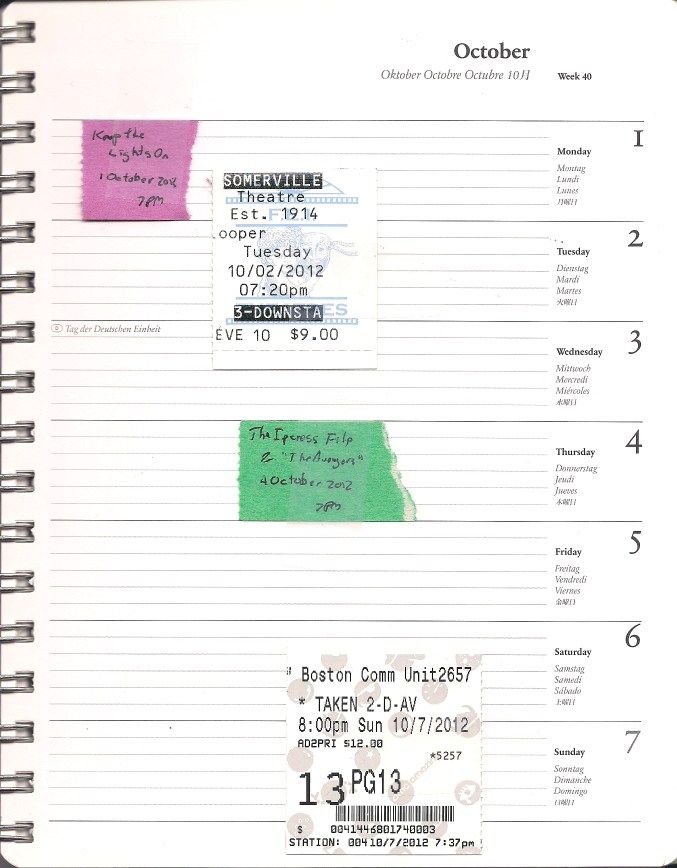
This Week In Tickets: 1 October 2012 - 7 October 2012

In a bit of irony, my birthday was when MoviePass launched their latest incarnation (which, I think, would be MP 3.0), making it much easier to use on the go and at more theaters. But I wound up seeing fewer movies, because I kept waiting for the card to show up in my mail, figuring "why pay for it today when I can see it for free tomorrow"? But a week later, the card still hasn't come, so I've been putting stuff off, meaning there's a lot of blank space on this page:

This Week in Tickets

Plus, the first round of baseball playoffs makes it easy to slip into a hardball trance in front of TBS. I've got to admit, I'm pretty fond of the wild card play-in game; it had more teamsd playing for keeps in September. Of course, I'm also hoping that the nightmare tie scenario comes up, too. I must admit, though, that I'm not having quite so much fun rooting for "not the Yankees" as opposed to the Red Sox.

I also headed up to Maine on Sunday; a niece had a birthday, and thus it was necessary to shower her with gifts and eat cake. The amusing bit is that, apparently once a girl turns six, everybody feels the need to get her Legos. Including myself, naturally, although there were conflicted feelings about the Lego Friends sets, which maybe try too hard to appeal to little girls - kind of cute, and still Legos, but verging pretty close to Playmobil territory. Anyway, I lolled around for a bit afterward, long enough to wind up seeing Taken 2 at Boston Common rather than the Capitol.

Dagny and I have the same birthday, so I made sure to treat myself as well - the birthday movie was Looper, following dinner at Boston Burger Company. Both, as expected, very good! It's very nice to see that BBC has finally completed the inevitable and needed expansion into the empty space next door, and still makes a darn good burger. I finished just in time to grab a seat for Looper, and I dug it as much as expected.

On either side of that, there were shows at the Brattle. The CineCaché program this week was Keep the Lights On, which was a perfectly acceptable indie relationship drama though not really a noteworthy one. It's not a great feeling to say that, because the director was there and it was based on his actual life, but sometimes "based on a true story" just means it's not exceptional.

Thursday, meanwhile, was my first sample of their "Cloak & Dagger" program. I loved the main feature of The Ipcress File, and dug the two episodes of The Avengers that they showed, even if the second was a little Steed-heavy (about halfway through the riff on "And Then There Were None", I was grumbling to myself about having been told there would be Diana Rigg).

Looper

* * * ¾ (out of four)
Seen 2 October 2012 in Somer Theatre #3 (first-run, 2K digital)

Even with a week to recognize that certain paradoxes keep the plot from having the tight effect-and-cause timeline you might really like to see from a time-travel movie , I still like Looper a whole lot; I'm pretty sure that when all is said and done, it will be one of my favorite movies of the year. Even when it doesn't get its story completely straight, it does well in using time travel to represent cycles that it can be very difficult to escape from.

What's perhaps most impressive is the trick it performs with Joseph Gordon-Levitt and Bruce Willis playing the same character separated by thirty years of subjective time. Exaclty what happens is too good to lay out, but what's mos impressive is the way the actors and writer/director Rian Johnson choose to make the character(s) work: Rather than keying on obvious shared mannerisms, scars, and the like, they use just enough makeup to elicit a reaction of "yeah, I can see that" and then make the story run on a much more basic connection, that despite his protestations to the contrary, old Joe is just as selfish as the younger version.

There's also a number of other terrific things going on - a future that seems, while not outright dystopian, to be the result of 30+ years of plausible decay, with some cool science-fictional niftiness but not enough to make it really desirable; Jeff Daniels pretty much note-perfect as the guy from the future who probably drew the short straw to be handed this assignment (and maybe being another character's future self, or maybe not); Paul Dano exiting the movie in a pleasantly quick fashion. And while I can't claim to be the hugest fan of any specific thing Emily Blunt does in this movie, it somehow works in the aggregate.

It doesn't hurt that she gets a lot of scenes with Pierce Gagnon, who is really a certain kind of terrific as her son, a damaged kid who is remarkably individual in his dysfunction, and somehow sympathetic enough that the audience is able to ignore the implications of everything else that is happening until it slaps the audience in the face in the last act, or, heck, the last minutes.

SPOILERS! SERIOUSLY, I'M BREAKING DOWN HOW THE VERY END OF THE MOVIE AFFECTS EVERYTHING ELSE HERE! LOOK AWAY IF YOU HAVE NOT YET SEEN IT!

It strikes me, writing this, that what Gagnon and Johnson do is likely close to exactly what we as fans wanted from Jake Lloyd and George Lucas fifteen years ago: He's a figure whose potential to become a monster is unmistakable, even obvious, but makes us wish things could end differently. I think that just how singular this part of the movie turns out to be demonstrates that it's really, really hard.

Of course, I'm not sure the existence of the Rainmaker really makes sense; it's maybe the wibbly-wobbliest part of the time travel plot: He seems to arise in a timeline where Old Joe is killed as soon as he arrives in 2044, and thus doesn't kill Sara while trying to kill Cid. Sure, it's quite possible that Sara fails as a parent and Cid is destined to become the Rainmaker no matter what, but I don't think the movie is meant to be taken in quite so cynical a fashion. There are a couple of escape hatches, I suppose, but they're dramatically soft - maybe if it wasn't Joe, some other looper would have killed Sara and set Cid on the bad path, in which case this is only a temporary victory; or perhaps that it wasn't just a matter of saving Sara's life but making her realize exactly what the stakes are, which makes means the whole thing was about moving the needle just a little bit. The whole thing does make me wonder whether Sara's name is a deliberate Terminator homage, though.

Most of my other nitpicks are small ones - if the problem in the future is disposing of bodies, why don't the gangs of 2074 just send bodies back in time as opposed to people who could potentially run away? And why do loopers kill themselves? It strikes me that if Old Joe and Old Seth were sent back not to their younger selves, but each other, a lot of headaches could have been avoided. The answer, of course, is "drama", but drama's a pretty terrible way to run an illegal enterprise. I also tend to hate suicide as a resolution - I remember a story from Analog where a situation like the one in the final minutes basically ended with the main character making a decision, although that's not exactly visually exciting. Maybe he could have just blown off his gun hand, though?

!SRELIOPS

As you can tell, I liked the heck out of it, and reiterate that it would be listed as one of my favorites of the year if I didn't have the "Making Lists Is Stupid" policy.

I do, admittedly, have a "Making Pointless Comparisons Is Stupid But I'll Do It Anyway" policy, and I did find myself kind of wondering why Rian Johnson doesn't get the same amount of love/critical fawning that, say, Wes Anderson does. The likes of Looper and The Brothers Bloom are as visually quirky and weird as anything others do, but it almost seems like he gets penalized, relatively speaking, for first and foremost telling a story and building the off-beat stuff around it.


Keep the Lights On
Looper
The Ipcress File
Taken 2

Tuesday, October 09, 2012

Special Operatives: The Ipcress File and Taken 2

Alternate unifying theme: Those Damn Albanians - they may come from a tiny country, but they're vicious enough to confound highly capable agents in both London and Istanbul!

(Not the opinion of the author. I don't know if I've ever met an Albanian, seeing as it is a small country, but I'm sure that the vast majority are lovely people!)

Both of these were pleasantly crowded screenings for Thursday and Sunday nights. Heck, after The Ipcress File, a bunch of us stuck around for a couple episodes of The Avengers, and while I'm not saying that I would be all over it if it were suddenly available on Region A Blu-ray (hey, the DVDs are out of print and it's old enough to be shot on film, so why not wish for BD?), I'd be sorely tempted if only for 1960s Diana Rigg. The Avengers had flaws aplenty, but Ms. Rigg had the sort of charm that could certainly make an hour per week pass quite pleasantly.

I wound up seeing Taken 2 at Boston Common despite knowing better on a couple of levels - I was sick of the trailer, had heard a lot of bad reviews, and also knew it would set me back less if I went to the Arlington Capitol. But, I didn't catch the bus in time and didn't feel like going home, so...

As kind of expected, not good, and I'm trying to remember whether or not I liked Olivier Megaton's Transporter 3. Columbiana was a disappointment, and T3 never made it to my shelf, so I'm guessing that Olivier Megaton, despite the most fantastic pseudonym for making action movies out there, really should find another vocation (or Luc Besson should ditch him for hurting the Europa brand). He really does make a hash out of what seems like it should be pretty straightforward, in that Taken is a franchise built on fights being over before the audience knows it because the main character is just that good, and you've got Liam Neeson and Famke Janssen in the cast to boot. I'm not saying making action movies is easy, but you've got the tools and a template for success, so just don't mess it up.

But Megaton did. Hopefully France will have produced another up-and-comer for Taken 3.

Two other things that didn't help on Sunday:

(1) The trailer for Parker. I can't say I'm the hugest fan of Donald Westlake/Richard Stark's master thief, but my reaction was somewhere between "well, maybe this would look like fun if it wasn't a 'Parker' movie" and "kill it with fire".

(2) I sat in the third row, and could still see three separate people occasionally turning on their smartphones. What the heck, people; it's not like you can miss the admonitions to not do the exact thing you're doing.

Ah, well. There's a couple more days of spy movies in 35mm at the Brattle; do yourself a favor and take some of them in.

The Ipcress File

* * * ¾ (out of four)
Seen 4 October 2012 in the Brattle Theatre (Cloak & Dagger, 35mm)

It's a bit surprising that nobody has remade The Ipcress File or launched a new Harry Palmer film franchise. After all, James Bond is still a license to print money, author Len Deighton's name isn't completely forgotten and Jude Law could go for a hat trick of being cast in iconic Michael Caine roles (Caine, of course, would play a small part). Not that there's much room for improvement here; the version we've got is a great little thriller, all the more so because of how well it nails down its sixties spy-fi paranoia.

Harry Palmer (Michael Caine) may be sarcastic and insubordinate, with an eye for the ladies, but he's good at his job in the Ministry of Defense - good enough for Col. Ross (Guy Doleman) to promote him out of surveillance when another agent is killed in action. His new supervisor, Maj. Dalby (Nigel Green), assigns him to the team investigating a sort of "brain drain" of government scientists quitting for unknown reasons. It's not so much a glamorous assignment filled with chases, though - there's legwork, paperwork, and politics as treacherous as anything else Palmer might uncover.

The Ipcress File is sort of what you would get if you split the difference between Ian Fleming and John LeCarré - a nefarious plot with larger than life elements combined with dangers that spring more from human pride and greed than any sort of mad science or world-conquering ambitions. The story is, in fact, an unusually well-balanced fusion of Cold War fears: The enemy within, the enemy without, a change in the world order that those in power still aren't used to even almost twenty years after the end of the War, and the threat of all this new science advancing at a frightening rate. Even a scene of Palmer and Dalby talking in a supermarket does a nice job of pointing out both how unglamorous intelligence work can be and how frightening the new world is for the old guard.
Full review at EFC.

Taken 2

* ¾ (out of four)
Seen 7 October 2012 in AMC Boston Common #13 (first-run, Sony Digital 4K)

It's almost silly to wonder if Luc Besson and company had any sort of ambitions along the lines of showing the aftermath of a big action story after the adrenaline runs out. After all, Besson's main skill as a writer is tailoring a straightforward action movie to the strengths of its stars; continuity and complexity are not so much his thing. Even with that in mind, Taken 2 is a disappointment; hacking what simple pleasures it contains to ribbons.

As one may recall, former CIA agent Bryan Mills (Liam Neeson) cut a bloody swath through the Parisian underworld when his daughter Kim (Maggie Grace) was kidnapped; now, many of the bodies he left in his wake have been returned to their families in Albania, with the father of one, Murad Krasniqi (Rade Serbedzija) vowing revenge. That opportunity comes when Mills finishes a bit of personal security work in Istanbul, intending to spend the remainder of the week on vacation with Kim and his ex-wife Lenore (Famke Janssen) - at least, until Murad kidnaps them, intending to kill Bryan's family in front of him.

This is obviously a bad idea. I'm no criminal mastermind, but the last time somebody abducted a member of Mills's family, he straight-up murdered everybody connected with the crime despite spotting the kidnappers enough time for him to fly from Los Angeles to Paris. I get that the desire to make things personal must be strong, but given Mills's history, this really seems like the sort of revenge best accomplished with a sniper rifle from a kilometer or so away. Sure, you can argue that the filmmakers were boxed in by their title (can you call it "Taken 2" without a kidnapping?), but that doesn't make the problem less obvious. Especially since Besson and co-writer Robert Mark Kamen drop hints that they may have been thinking of more than just repeating the first movie in a new city - Kim mentions that the ordeal of the first movie has left her a bit messed up, and Lenore's marriage has fallen apart since then; combine that with Murad and you've got everybody haunted to some extent. That's kind of a neat story, and an angle that few action sequels ever explore. Unfortunately, it's just given the barest of lip service rather than actually used.

Full review at EFC.

Friday, October 05, 2012

Coming Soon (or Now Playing): Preview screenings of The Oranges and Keep the Lights On

Ah, fall, when the film preview programs start. Both Talk Cinema and CineCaché (in its previous incarnation as the "Sunday Eye-Opener") used to run at the same time, and they operate in a similar manner - introduction, movie that will open soon in the boutique houses, discussion. Talk Cinema goes with higher-profile films and the discussion tends to be more moderated (depending on which local critic is on stage, it can be more about his/her opinions than the audience going back and forth); CineCaché often digs a little deeper and has a much more informal interaction.

The first Talk Cinema and second CineCaché of the season (I missed the first a couple weeks ago) were both kind of middling experiences. The movies themselves were both pretty close to average in one direction or another, where you can't exactly call them bad or point out crippling mistakes, but which are fairly forgettable. Believe it or not, boutique films can be mediocrities despite the cultivated image as something the smart folks appreciate and the masses hate, and that's the case with both The Oranges and Keep the Lights On; some good work but little spark.

The post-film discussions were a little muted, too. I didn't get any Horrible Photography, but director Ira Sachs was present, and I don't know about you, but that makes me a bit uncomfortable when the movie isn't well-above average. The director who realizes and admits that his movie isn't all he wants it to be is rare (for instance, Michael Biehn admitting The Victim's failings at Fantasia this year), so while you can get some insight into the inspiration and process, it puts a real chill on "I kind of thought the movie was boring".

In some ways, the Talk Cinema discussion was just as weird; the guy leading the discussion spent a lot of time talking about how he spent a lot of the movie's first half confused and weirded out over who was which character's kid, and a few members of the audience agreed. The argument appeared to be that Alia Shawkat is more likely to be the daughter of Oliver Platt and Alison Janney than Hugh Laurie and Catherine Keener, and I'm not sure I buy that - I think if Shawkat was placed next to Keener as much as Laurie, it's not such a big deal - but even aside from that, this is a movie with the most definitive narration you can imagine at the beginning. Were you guys just not paying attention or what?

Anyway, kind of a weird couple of screenings. The Oranges opened at Kendall Square today, and Keep the Lights On opens there next week; the next CineCaché is Headshot on the 15th (I'm excited and hoping for 35mm because I missed it at Fantasia and Thai films always look fantastic), and the next Talk Cinema on the 21st has not yet been named.

The Oranges

* * ¼ (out of four)
Seen 30 September 2012 in Coolidge Corner #2 (Talk Cinema, 35mm)

The Oranges isn't bad as "stripping the sheen from suburbia" movies go. It's just kind of lazy, apparently satisfied enough with the number of jokes that get a chuckle to let a talented cast coast as things amble on toward a soft ending. Those who dislike it will probably disdain it for its premise, while most will likely just forget it quickly enough.

After all, the characters at the center seem standard enough in two families that live across the street from each other in West Orange, New Jersey (or is it East Orange? doesn't matter). David Walling (Hugh Laurie) and Terry Ostroff (Oliver Platt) are best friends, and have been for a long time; David's wife Paige (Catherine Keener) and Terry's wife Carol (Alison Janney) are close as well. Daughters Vanessa (Alia Shawkat) and Nine (Leighton Meester) were too, until high school. Nina has been living on the west coast for a while, but a bad breakup sends her home for Thanksgiving, and her mother Carol is eager to set her up with Toby Walling (Adam Brody). And while Toby's nice and all, it's his father that winds up connecting with Nina.

Give a lot of credit to Hugh Laurie and Leighton Meester - this is a particularly discomfiting May-December romance, and it would be easy for these two characters to come off as nothing but selfish or oblivious to others' feelings. They are, of course, but Laurie and Meester also play the characters with enough overlapping areas of charm and self-awareness that the audience can believe that this guy and that girl are going to see something in each other rather than it being a cynical matter of the universe throwing a pretty blonde half his age at a guy whose marriage is on the rocks. Hugh Laurie, especially, manages to takes the moments meant to show that David is old and smart enough to know better and still come out not looking like an ogre.

Full review at EFC.

Keep the Lights On

* * ¾ (out of four)
Seen 1 October 2012 in the Brattle Theatre (CineCaché, video)

Keep the Lights On is the sort of semi-autobiographical movie that just goes to show that one's real-life drama, even if translated to the screen without a hitch, is not necessarily compelling for others. Director Ira Sachs goes for honesty here, and does well by it, but perhaps could have added something else to the mix.

The Sachs surrogate is Erik Rothman (Thure Lindhardt), a documentary filmmaker originally from Denmark but living and working in Manhattan. As the film starts, it's 1998, and a lonely Erik meets Paul Lucy (Zachary Booth) on a phone sex line. Erik is lonely despite being close with his sister Karen (Paprika Steen) and collaborator Claire (Julianne Nicholsonn), so he and Paul are soon together, but Paul's issues with secrecy and addiction will put a strain on the relationship.

Not enough of a strain to actually end it, though, though so Erik and the audience are in for ten years of ups and downs, and if you've ever had a friend who was in an extended bad relationship, this is kind of like that. It's not always in a crisis, but the problems aren't improving, so it just runs in a loop that may be a sort of agony for the ones involved but is mostly frustrating for those on the outside looking in. That's where Keep the Lights On spends most of its time - Paul's an addict, Erik's immature, and periodic two year jumps don't show much in the way of change.

Full review at EFC.

Next Week in Tickets: Films playing Boston 5 October 2012 - 11 October 2012

I made this point in the "digital-is-evil" post on Wednesday, but it bears repeating: Being able to just drag and drop copies of trailers onto the front of a movie's playlist rather than having to decide which print you're going to physically attach one of your limited copies to can lead to serious overkill for people who go to the movies often. But at last, two of the more ubiquitous previews in recent months are going away! Hurrah!

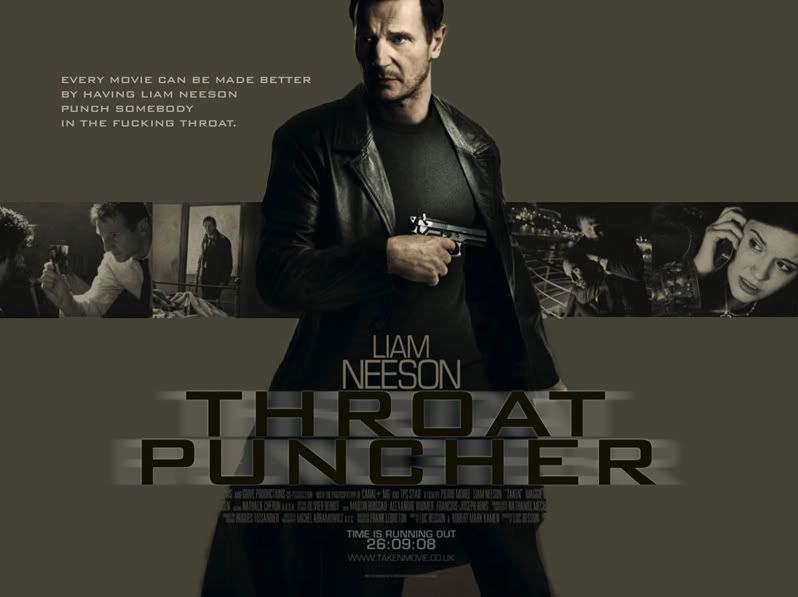
  • The first flick pushing its preview off the screen is Taken 2, which should have taken a hint from David Cornelius's awesome photoshopped poster and called itself Throat Puncher Two, if only because that means they wouldn't necessarily feel the need to repeat the plot of the first so closely, because that's stupid: When kidnapping a man's daughter leads a man to efficiently murder every criminal in a city, you as a criminal may want to get your revenge in a way that doesn't involve kidnapping his family, because there'd be no need for revenge if that sort of thing ended well. Still, despite the early warnings that new director Olivier Megaton presents action poorly despite having a cool pseudonym, I'm looking forward to more of Liam Neeson, Maggie Grace, and Famke Janssen. Especially Famke Janssen. Every movie needs more Famke Janssen. Anyway, it plays the Arlington Capitol, Fenway (including the RPX screen), Boston Common, and Fresh Pond.

    The preview for Frankenweenie hasn't quite reached aggravating levels for me, but I don't see that many kid movies. It's being called a return to form for the lately-disappointing Tim Burton, who expands his short film about about a family dog being brought back to life to an animated 3D (black-and-white) feature. For those who track the change in exhibition technologies, it appears to be the first digital-Imax flick at Jordan's Furniture and the first digital 3D movie at the Somerville Theatre (2pm and 9:15pm shows only), as well as playing in both 2D and 3D at Boston Common (including the Imax-branded screen), Fenway, and Fresh Pond.

    Boston Common also keeps Vulgaria around for one afternoon show per day and opens Head Games, the new documentary by the directors of Hoop Dreams which spins out of former football player and WWE wrestler Christopher Nowinski's book about the rising incidence of concussions and traumatic brain injuries in sports. The Somerville Theatre also picks up Pitch Perfect on its originally-planned release date.
  • The Brattle Theatre has switched their Watch-a-Thon fund-raiser up this year; instead of a month of counting up movies, it's two twelve-hour marathons, and you can help support the Brattle by either buying an all-day pass, hitting single screenings, or sponsoring participants. Saturday is cult movies - Down By Law, Tokyo Drifter, Harold and Maude, Brazil, a secret screening, and Miami Connection - and Sunday is classics: Modern Times, Cocteau's Beauty and the Beast, a different secret screening, The 39 Steps, Night of the Hunter, and Yojimbo.

    On either side, there's the rest of the Cloak & Dagger: Spies on Screen series. A double feature of The Bourne Identity and Hanna plays Friday; Hitchcock's North by Northwest and Fritz Lang's Ministry of Fear on Monday; Three Days of the Condor and The Mackintosh Man on Tuesday; Our Man in Havana (rescheduled from last week, with The Silencers cancelled) and OSS 117: Lost in Rio on Wednesday; and a single feature of Cloak & Dagger wraps it up on Thursday.
  • Two movies open at Kendall Square, both kind of shaky. The Oranges is a comedy-slash-drama starring Hugh Laurie as a man who falls for his best friend's daughter (Leighton Meester), thus throwing this tight pair of families into chaos. It's good in spots, shaky in others. The same can be said for horror anthology film V/H/S, which has several different takes on found-footage horror; I found that doing several short stories worked against the found footage conceit and don't recall ever actually being scared. It's got a one-week booking.
  • V/H/S will have midnight bookings at Coolidge Corner next weekend; this weekend is too packed with other midnights for it to fit. Both Friday and Saturday feature screenings of The Funhouse, which kicks off a month-long celebration of Tobe Hooper's films, and features a bunch of kids sneaking into a carnival after hours, which is probably a bad idea. Friday night offers the monthly screening of The Room, while Saturday is J. Cannibal's Feast of Flesh XII; this year's Halloween extravaganza features local metal group Black Thai, a zombie costume contest, the costume-shedding of Black Cat Burlesque, and a screening of Stuart Gordon's Re-Animator.

    Other special screenings include a "Stage & Screen" showing of Gore Vidal's The Best Man on Monday evening, which will feature the writer and director of the new play Now and Later (Christopher Shinn and Michael Wilson, respectively), discussing how Vidal's work influenced theirs. The screening of Escape Fire: The Fight to Rescue Health Care on Friday at 7pm will have Dr. Donald Berwick present to discuss the documentary afterward; the film plays in the video screening room all week. Samsara, on the other hand, will be playing on 35mm film as it moves over from the Kendall, while The Master continues in 70mm.
  • The Harvard Film Archive begins a month-and-a-half long retrospective, The Mysteries of Michelangelo Antonioni, on Friday; it will continue until 18 November. This week's selections of L'avventura (Friday 7pm & Sunday 4pm), La Notte (Saturday 7pm), Story of a Love Affair (Saturday 9:30pm), Blow-Up (Sunday 7pm), and The Mystery of Oberwald (Monday 7pm); La Notte and Blow-Up will be repeated later in the program. There are also a pair of free VES screenings (meant for students but open to the public) during the week - The Rules of the Game on Tuesday and October on Wednesday.
  • ArtsEmerson continues their Shakespeare on Film series, with Shakespeare in Love (Friday 6pm); My Own Private Idaho, which apparently is based upon Henry IV andHenry V (Friday 9pm); The Lion King (Saturday 1pm); Olivier's Hamlet (Saturday 6pm); and Rosencrantz & Guildenstern Are Dead (Saturday 9pm). All are on DVD aside from Shakespeare in Love, which is 35mm, and lead up to the opening of a new production of Hamlet from the Shakespeare's Globe Theatre in London. Of course, once that starts, the film program shifts, with the Sunday 1pm screening being Alexander Payne's Election.
  • The MFA holds David Redmon's and Ashley Sabin's Downeast over for another week or so, though screenings are scattered - 5pm Friday, 5:40pm Wednesday (the 10th) and 3:15pm Thursday (the 11th). Those are scheduled around a number of programs, most notably The 6th Annual Boston Palestine Film Festival, which has screenings Friday, Saturday, Sunday, and Thursday. There's also a Hispanic Heritage Month Short Film Festival program as part of their Fall Open House on Monday the 8th, and the first screening of Alps on Thursday the 11th at 5pm. That's Greek filmmaker Yorgos Lanthimos' new film following Dogtooth, a dark comedy about people who impersonate the deceased for grieving families. It will have screenings through the 21st.
  • The Regent Theatre in Arlington has a couple of "Sound Cinema" presentations, both encores of sorts. Pat Metheny: The Orchestration Project played there a week or two ago, and was apparently popular enough to be brought back for two screenings on Friday the 5th. Marley played at Kendall Square during the summer, but will play the Regent on Wednesday the 10th.


My plans? Well, I'm heading north for a niece's birthday party on Sunday (since we share the same birthday, I really can't overlook this), and will probably catch Taken 2, Frankenweekie and Head Games at various points. Aside from that, there's an awful lot of good stuff in the Brattle's spy series, so I may just live there.

Wednesday, October 03, 2012

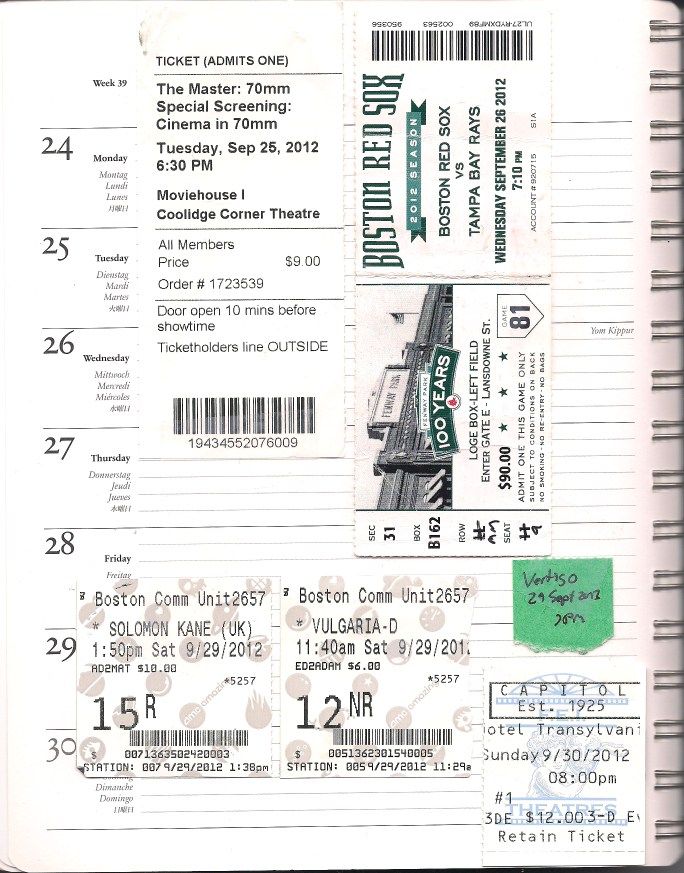
This Week In Tickets: 24 September 2012 - 30 September 2012

The writing, it was slow this week, in part due to actually seeing movies and in part because TV started up again, and while it's not a packed schedule, it's not the same sort of background noise as baseball. Attention is sort of demanded.

This Week in Tickets
Stubless: The Oranges, 10am Sunday at Coolidge Corner

Red Sox baseball is more or less done for the year, and after the poor showing Wednesday, it's kind of a relief. That was the last home game of the season, and kind of summed things up: Great pre-game ceremonies with the all-Fenway team announced - you can tell this is a team with a long, great history when Manny Ramirez can't even crack the top three left fielders - followed by a game where the Red Sox are in it until a crushing end. This was a sort of last-minute decision on my part - I remembered I had a coupon at an onlne ticket reseller that had to be used right away, so why not see the last game of the season? Obviously, the answer is "beccause they're the 2012 Red Sox".

I'd considered Tuesday, but I wound up seeing The Master with the Chlotrudis crowd then. Saturday was a double feature at Boston Common - Vulgaria and Solomon Kane - and Vertigo at the Brattle that evening. Sunday was stuff at the ends - a Talk Cinema preview of The Oranges in the morning and Hotel Transylvania in Arlington in the evening.

I was sort of wiped out on Sunday because my DVR suddenly started mostly working on Saturday after not doing so all summer, so the trick I used to record Doctor Who at 9pm failed, and I stayed up watching the midnight rerun. I've got to admit, as much fun as it was, I was a bit disappointed.

SPOILERS!

That was kind of a rubbish way to send the Ponds off, wasn't it? I'm on record as not being a big fan of the "one last scare"/"you're suddenly screwed" ending, and that's what this was - the paradox wiped out the Angels, except, apparently, this one, which pops up to toss Rory back. Then Amy follows him, and because 1938 New York is now apparently a mess of paradoxes, the Doctor can't get there in the TARDIS. Of course, there's 1939 New York and 1938 Connecticut, and River can visit, but...

Well, but nothing, and I'm kind of hoping that this set-up is hole-filled so that there's an easy way to bring them back as part of the inevitable big 50th anniversary special next year (The Four Doctors, with McGann, Eccleston, Tennant, and Smith?). But even besides the poor time-travel logic, it was a frustrating ending because it was a bit of last-minute forced dramatics that wasn't necessary, in large part because there was a more logical end being seeded - that Amy had outgrown her imaginary friend, and she and Rory were ready to settle down, raise a family, and only have the occasional adventure. It would be a neat metaphor from both perspectives - Amy and Rory growing up, the Doctor as the last single member of a group feeling the loss of his friends to predictable convention.

Plus, this would make Amy and/or Rory the logical folks to move into Sarah Jane Smith's old neighborhood and have adventures with those kids. But, no, instead, the dramatic Weeping Angels thing that makes no sense, probably Moffat's biggest misstep on the series.

!SRELIOPS

Ah, well. And now - movies!

The Master

* * * (out of four)
Seen 25 September 2012 in Coolidge Corner Theatre #1 (first-run, 70mm)

I've said it a few times since seeing it, but The Master is so beautifully shot and forcefully acted that afterward, I've been trying to talk myself into liking it more. It's got the feel of an epic, classic more, with its gorgeous 65mm photography, great performances by Philip Seymour Hoffman, Amy Adams, and Joaquin Phoenix, bold editing that gives it sweep. And yet, it's just good.

Which is not to disparage good. At all. I heartily recommend seeing this in 70mm at the Coolidge while you can, because it is quite often a breathtaking experience. It just really could use a stronger story. As impressive as Phoenix's asymmetrical grimaces are, he's still more or less just playing a drunk who repeatedly screws up. The story of Hoffman's Lancaster Dodd, a thinly-veiled riff on L. Ron Hubbard, is potentially more interesting - how does a cult like "The Cause" get started, sustain itself, and grow? - but it's often aggravatingly secondary. Dodd's son, for instance, wavers in his commitment, and the group seems to paradoxically grow stronger even as it is chased from place to place. What's up with that?

To a certain extent, I think this would have been a much more interesting movie if it had been about Hubbard and Scientology rather than a proxy. This way gives writer/director P.T. Anderson and Hoffman a chance to create a character, true, but Scientology has the urban legend of Hubbard making a bet with Arthur C. Clarke and the calculated attempt to court celebrities. Also, I sort of think the relationship between Dodd and Phoenix's Quell makes a lot more sense if you know a little about Hubbard, a pulp writer and self-styled soldier of fortune who came back from WWII disappointed that nobody asked him to be a military government. I can see someone like that who has found a gig all about purging negativity and quasi-spirituality drawn to the angry and violent masculinity that Quell represents, but since Dodd is not Hubbard, you're either constructing that backstory or character yourself or just seeing them as a sort of opposites attract thing.

Vulgaria

* * * ¾ (out of four)
Seen 29 September 2012 in AMC Boston Common #12 (first-run, Sony Digital 4K)

I saw this during Fantasia and loved it, and as a general rule I try to find a way to give the best things I see at festivals my money (sure, maybe this writing thing drives people to see it, but I'm sure theaters and studios appreciate a certain ten bucks too). Sometimes the second time around is a bit of a disappointment, and occasionally it reveals new depths.

Vulgaria is still a very funny movie, one of the most gleefully crude I've seen this year, even if having read the press notes in the last couple of months does make me realize that there is a great big cheat in the middle of the third act (the filmmakers basically hitting the fast-forward button once they've exhausted most of their on-set jokes). I don't know if I laughed out loud quite as much - I'm apparently not nearly as demonstrative when it's ten people in a room in my hometown as in a packed house of 500 north of the border - but I did laugh, quite a bit. It's a comedy funny enough to work a second time on the anticipation of jokes instead of surprise.

And, hey, those ten folks hung around except for the one guy who took a bathroom break; it's the fewest walkouts I can remember seeing at a China Lion presentation. You can't argue with that as a sign of quality!

Solomon Kane

* * ¾ (out of four)
Seen 29 September 2012 in AMC Boston Common #15 (first-run, Sony Digital 4K)

One thing I'll have to ask my friends at the Picnic who dig Robert E. Howard is whether Solomon Kane ever had a specific origin story, and how close this movie is to it. For many franchises, I get leaning on the origin, because that's the one that has the most character growth and says the things about the character that resonate the most, but I don't know if Kane is one of those characters/properties. He's pretty simple - a seventeenth century Pilgrim who fights monsters and demons - so put the hat on and let him go!

Instead, though, it's about halfway through the movie before the hat is on, as we need to learn about his background as a noble, a pirate captain, and a monk, and each bit of information makes what is going to happen in the third act obvious even to a Howard neophyte like myself. It's not bad material, don't get me wrong - it gives us a lot of scenes with Pete Postlethwaite, and they're not making any more of those. James Purefoy handles the role well; penitent and powerful is tough to reconcile. And the action's pretty good.

The effects aren't bad, either, although neither they nor the story ever has the big "awesome, give me more" moment that a movie hoping to be both a hit and a franchise kind of needs. It is unabashedly R-rated, and I suspect that if this exact movie had come out in the 1980s, it would have been a big deal. Now, yeah, it's pretty good and I'm pleasantly surprised that it got a theatrical release - most movies which sit on the shelf for three years tend to go straight to video or SyFy and deserve to - but it's not exactly the epic/event that the people who made it and the fans likely were hoping for.

Side: I know video releases are coming fast these days, but this needs to be on Blu-ray with a tongue-in-cheek ad campaign by Thanksgiving, because when else are you going to want to see a movie about an ass-kicking pilgrim?

Vertigo

* * * * (out of four)
Seen 29 September 2012 in the Brattle Theatre (Special Engagement, 35mm)

I'm pretty sure that I've seen Vertigo before, likely on film and at the Brattle. And as much as I get a little nervous when people start throwing around "best of all time" comments, as happened this summer when Vertigo landed ahead of Citizen Kane in the results of the decennial Sight & Sound poll, there's no denying, this is really good.

If you've seen it, you know why, and if you haven't seen it, I can't really tell you, because the good stuff is packed into the third act. And while it's easy to say "55-year-old movie, go nuts", a guy a few rows in front of me gasped a few times. Even if Hitchcock and company do rather neatly dispose of the thriller elements and refocus the movie, part of the fun of Vertigo is that it does play as a mystery for a good chunk of its running time before it goes all-in with the twisted story of obsession it's known for, including some of the best work of James Stewart's career and the reason why we know Kim Novak's name.

This 35mm print looked gorgeous, of course; it's a new copy based on the restoration from a few years back, and while it's probably been inside a computer at some point, it doesn't look it. The VistaVision photography is beautiful, and it's not just about pointing large-format cameras at various points in San Francisco, though - watch how a certain scene gets darker as the conversation goes on, or the nifty effects used for Scotty's dreams and dizziness.

The Oranges

* * ½ (out of four)
Seen 30 September 2012 in Coolidge Corner #2 (Talk Cinema, 35mm)

The Oranges isn't bad as "stripping the sheen from suburbia" movies go. It's got Hugh Laurie in a nice turn as a disaffected suburban husband and father and Leighton Meester as the neighbor's daughter with whom he falls in love (and vice versa), and they're pretty darn good. They have to be; if they weren't, then the audience would likely hate the characters involved in most of the movie's scenes, and watching it would be a miserable experience.

Instead, things just feel kind of lazy. There's plenty of what seems like an attempt at anti-consumer commentary, not because director Julian Farino and/or writers Ian Hefler & Jay Reiss have anything in particular to say about it, but almost because it's expected. Alia Shawkat plays the Laurie character's daughter who serves as the narrator, but for someone who should be right in the middle of it, she is terribly underused. The story also sees unnaturally packed in between Thanksgiving and Christmas, with events that seem like they should be spread out more instead happening within days of each other.

It's not a bad movie. It's just a well-worn subject, and good performances/jokes aren't quite enough there.


The MasterGame 81Solomon KaneVulgariaVertigoHotel Transylvania

Tuesday, October 02, 2012

Two (incorrect) reasons why the switch to digital projection is evil

EDIT: As you can see from David's comment below, these suppositions are almost totally wrong.

Well, except that I the repetition of the Taken 2 trailer utterly sapped my excitement for the movie.

I saw Looper tonight (or last night, since this will probably post after midnight). Loved it, especially after a nice, juicy "The King" burger at the newly-expanded Boston Burger Company across the street from the Somerville Theatre. I was hoping it would be 35mm, the stated preference of both the manager and projectionist there, and what it was filmed on, but, nope, digital. Sigh.

One of the reasons I didn't go to this movie I'd been anticipating opening night was that there was a concert in the theater's main auditorium that night, but I figured they'd reshuffle things during the weekend so that the biggest movie got the big screen. Nope. Screen #3 is pretty good (rule of thumb for Somerville, worth remembering around IFFBoston time: odd-numbered screens are good-sized and have aisles down the sides; even-numbered screens should be avoided when possible), so it wasn't a bad experience. But why the heck was the biggest movie booked there this weekend in there while boring second-run movie friggin' Celeste and bloody Jesse Forever in the big house?

My best guess: Copy protection. While, logically, you would think that having everything digital would make moving things between screens easier - it's just data, so theaters can read everything off a central server or the hard drives the movies are shipped on can just be popped out and moved to the projector on the other end of the building without the same sort of effort film takes - the studios, as always, are paranoid about piracy, so theaters are given encryption codes keyed to specific copies of files and projectors during specific time frames. And since the hardware/software platforms for digital projection are frequently shaky, once they've got things working, projectionists are loath to mess with it. This is the same reason why 3D lenses are often left on the projectors during 2D showings - connecting and disconnecting them is apparently a digital rights management nightmare, and with just half an hour or so between shows, there is very little chance to correct things that go wrong.

Maybe I'm mis-remembering, but when 35mm was the rule of the day here, prints moved around during the week to accommodate concerts and special events. Now they don't, and so when the theater has a concert scheduled during the week, it means they are putting the movie that they expect will draw the smallest audience in the room with the most seats for six out of seven days, because the system people have used which was supposed to make things easier has actually made moving a movie that is nothing but ones and zeroes in a package the approximate size of a paperback book more of a pain in the ass than moving bulky, heavy, easily-damaged film stock.


Oh, the second reason? Apparently this copy protection does not apply to trailers, which means that it has been very easy for every theater in the Boston area to play the preview for Taken 2 in front of every damn movie have seen for the past month and a half. When these were physical pieces of film that had to be taped to the ends of prints, and a 12-screen venue might only get four copies, there was a bit more variety, but now... Argo and Taken 2, every night.

Guys, I was looking forward to Taken 2, but now I just want it to come so you can stop blasting me with the trailer.

Monday, October 01, 2012

Hotel Transylvania

Would I have seen Hotel Transylvania if I hadn't looked it up on IMDB for a "Next Week" entry and seen that Genndy Tartatovsky was directing? Probably not. Heck, Sunday evening, I hemmed and hawed about heading out to Arlington even after I'd printed the MoviePass voucher out.

Kind of glad I did, although I kind of suspect it will be the least of the three monster-oriented animated features coming out - ParaNorman is really good, and word on Frankenweenie is that it's the best thing Tim Burton has done in some time. It's also kind of amusing that both this and Burton's movie do a fair amount of Universal Monsters riffing while the one distributed by a Universal label (Focus) doesn't, despite coming out when they're celebrating their 100th anniversary.

Funny thing about writing this review: It probably comes across that I'm a much bigger fan of Genndy Tartakovsky than I am. Fact of the matter is, I've never seen Sym-bionic Titan or much of his Samurai Jack or Clone Wars work, and really only a little Dexter's Laboratory. I basically know that his reputation is very, very good. Still, it does fit a nice narrative about how, every once in a while, Adam Sandler will occasionally do something with a real director and remind you that there's some actual potential there. And then, when Punch Drunk Love or Spanglish doesn't exactly light the world on fire, he'll go back and do another round of comedies for people with low standards.

Hotel Transylvania

* * * (out of four)
Seen 30 September 2012 in Arlington Capitol #1 (first-run, Real-D 3D)

Rule of thumb: A good Adam Sandler movie means that Sandler has opted to step away from the assembly line and work with a noteworthy director. This year, it's Genndy Tartakovsky of Samurai Jack and Dexter's Laboratory fame making his feature debut with a zippy but fun animated feature.

"Hotel Transylvania" is no ordinary hotel; built in 1895 by Count Dracula (voice of Adam Sandler), it is meant to serve as a refuge from the human world for monsters of all kinds. Every year, it's host to a lavish birthday party for Dracula's daughter Mavis (voice of Selena Gomez) - Frankenstein (voice of Kevin James), Wayne the Wolfman (voice of Steve Buscemi), Murray the Mummy (voice of CeeLo Green), the Invisible Man (voice of David Spade), and more come. This year, though, there's an uninvited guest - Jonathan (voice of Andy Samberg), a human backpacker who stumbles onto the hotel just as Dracula is trying to find a way around his promise that Mavis could leave to see the world when she turned 118.

It's not hard to imagine Hotel Transylvania as an animated television series along the lines of Tartataovsky's Dexter's Laboratory; it's got a big, genial cast of broad characters, tells simple jokes, many visual, and doesn't care too much about how well its world fits together. Those aren't faults, though - it's a movie made for kids, who will likely seldom find themselves bored as the story bounces from one gag to the next without ever getting too complicated that they lose track of the basic things it's trying to say ("monsters" are just different sorts of people who are as scared of you as you are of them, and while parents sometimes try too hard to keep you safe, they will eventually learn to trust).

And the simple jokes are, by and large, pretty funny. There's a fair amount of banter between the celebrity voices, sure, and the eary fart and pee jokes are not encouraging, but Tartakovsky and the five credited writers deliver a steady stream of quality visual gags. This really is a feature-length cartoon that goes for visual punchlines over verbal ones; one of the funniest gags, for instance, has Dracula pulling the giant rubber stopper from the bottom of the hotel's swimming pool and then silently, begrudgingly, making sure Jonathan doesn't splat from his impossibly-exaggerated high dive. It's Chuck Jones-style stuff, and while this doesn't ever manage to reach the sublime levels of slapstick that Jones at his best managed, it is an impressively steady stream of chuckles.

Part of the reason for that is just good comic timing - both Tartatovsky and co-writer Robert Smigel know how those beats work - but an appealing cast of characters helps. The main ones are fairly well-designed and voiced, especially the kids: Samberg gives Jonathan an unbridled curiosity and delight at discovering new things that's a perfect match for the wide eyes and soft, rounded form the animators give his character. Selena Gomez's voice is charmingly innocent but never close to stupid, while Mavis's character design has a goth color scheme but a cute girl-next-door look (she's probably exactly the sort of girl someone backpacking across Europe would want to meet). Drac, it must be said, can't escape looking like Count Chocula - there's only so many ways to start from Bela Lugosi and get to something huggable - but the details are handled well - the animators make sure his skinny-legged cartoon character gait looks like gliding from certain angles, and Sandler actually goes kind of easy on the accent, allowing him to give this character a personality rather than just be a funny voice. It's worth noting that there's really not an unpleasant, "villainous" character in the movie until a Jon Lovitz-voiced Chef Quasimodo is pushed into that role toward the end (and even then, he's not particularly malicious); the plot runs on the monsters' imagined fears more than an external threat.

It's also a pretty well-polished production, too, although it doesn't go for the same sort of slick, detailed aesthetic Pixar and Dreamwork films do. The animation style is the CGI equivalent of the thick black lines and jumps between minimal and extreme emoting of Dexter's Laboratory, and the story and gags are not exactly multi-layered or subtle. Still, the animation is smooth and Tartatovsky and company use 3D space well, both during the obvious scenes (the inevitable mid-air chase) and the less flashy ones (Drac and Jonathan walking through the tunnels below the hotel).

Hotel Transylvania isn't sophisticated or ambitious, but it's funny throughout and pretty kid-friendly. It's happy to be a feature-length cartoon as opposed to trying to be all things to all people, and since that what Tartakovsky and Sandler's crew are good at, it may be better than one expects.

(Formerly at EFC)

Thursday, September 27, 2012

Next Week in Tickets: Films playing Boston 28 September 2012 - 4 October 2012

Hey, it's my birthday next week! Well, it would be if my awesome niece hadn't stolen it six years ago. The actual day will apparently involve hunting down some Bond Blu-rays at various retailers (how fortunate that the nearest Target and Best Buy are in the same plaza!), but there's really a ton of good stuff coming out this weekend, too.

Although, is it selfish of me to want The Hole to open here, too? Sure, I don't have the time to see everything I want to this weekend, but I would make time for Joe Dante in three dimensions.

  • The big priority is Looper, in which Joseph Gordon-Levitt plays a hitman who targets people sent back in time from thirty years in the future - and his latest target is his older self (Bruce Willis). It's directed by Rian Johnson of Brick and Brothers Bloom fame, with the maker of Primer helping out on the time-travel logic. That is what you call a good pedigree, and it's been getting a ton of festival praise. It opens at Somerville, Boston Common, Fenway, and Fresh Pond.

    There's other stuff that is not so obviously great opening, but which has potential. Pitch Perfect, for instance, looks like a standard take on the competitive-performance moive, this one with singing, but it's got Anna Kendrick in the lead role and Rebel Wilson looks downright hilarious in the trailer. It's at Fenway and Boston Common. Hotel Transylvania is Adam Sandler and friends doing the voices of Universal Monsters knock-offs in an animated kids' comedy, but it's directed by Genndy Tartakovsky, and he's done great stuff. It plays the Arlington Capitol, Boston Common, Fenway, and Fresh Pond, by and large alternating 2D and 3D showings at each. Those screens also play Won't Back Down, with Maggie Gyllenhaal and Viola Davis playing mothers pushing to improve their kids' school. Again, looks pretty standard, but a nice cast.
  • Meanwhile, AMC is opening a lot of smaller stuff at Boston Common: Not only do they keep 10 Years stick around on a split screen for a week and open The Perks of Being a Wallflower, but they are where China Lion opens Vulgaria, a Hong Kong comedy by Pang Ho-Cheung that is as crude as its title implies and funny as hell. I laughed hard when I saw it at Fantasia and eagerly await the chance to help it earn some money this weekend. Go see it.

    Speaking of festival films, Solomon Kane has been kicking around the festival circuit for roughly three years and just got distribution now. It stars James Purefoy as a 16th-century Puritan monster-hunter, a character created by Robert E. Howard of Conan fame. The long-delayed release may mean that either the movie or distributor is a bit of a mess, or both. Backwards, meanwhile, features Sarah Megan Thomas (who also writes) as a competitive rower who takes a coaching job as the window closes on her racing career, which is likely what leads to the romance with James Van Der Beek's character.
  • Of course, one can argue that the best movie opening this weekend is at the Brattle, which has a new and beautiful 35mm print of Vertigo. Widely considered Alfred HItchcock's greatest film (and pushing past Citizen Kane to be listed as the best of all time in the latest Sight & Sound poll), it stars James Stewart and Kim Novak in a bizarre tale of obsession. Only runs Friday to Sunday, and Friday's shows are pushed late by the closing-day slate of The Massachusetts Independent Film Festival from 2:30pm to 7:30pm, so don't waste any time getting to it.

    Monday and Tuesday are special events and part of regular series: Keep the Lights On, on Monday, is the second CineCache film of the fall, and has director Ira Sachs on-hand to introduce and discuss what is apparently an intense romance between two men over the course of a decade; it's co-presented by the Boston LGBT Film Festival. Tuesday, meanwhile, is a Balagan presentation, "Germany Year 1962", curated by Dagmar Kmalah and featuring short films from German from that year, plus or minus five. At least five will be seen on 35mm, with a different program playing the Coolidge (off DVD) on Sunday.

    The next day kicks off the Cloak & Dagger: Spies on Screen repertory series with a pair of nifty double features. Wednesday's includes the quite nice (and quite serious) recent version of John Le Carré's Tinker Tailor Soldier Spy alongside Carol Reed's witty adaptation of Graham Greene's Our Man in Havana (featuring Alec Guinness). The different approaches are even more clear on Thursday, when The Ipcress File (featuring Michael Caine as tough, no-nonsense agent Harry Palmer) is paired with two of the more fantastical episodes of The Avengers with Patrick Macnee and Diana Rigg.
  • Kendall Square puts The Perks of Being a Wallflower on two screens (in addition to the one it's getting at Boston Common). It's got a great cast of young actors (Logan Lerman, Emma Watson, Ezra Miller) in an adaptation of a much-loved book, although I must admit that the trailer screams "generic coming-of-age movie" at me. They've also got a one-week booking of "Stars in Shorts", which is what it sounds like - a package of short films featuring fairly recognizable actors.

    They also open two documentaries. How to Survive a Plague chronicles how activists in the 1980s and 1990s pushed to get HIV treatments approved in record rime and transformed the disease from an automatic death sentence to something merely very dangerous. It played IFFBoston this spring and I seem to recall it being well-liked. The other one is Diana Vreeland: The Eye Has to Travel, a biography of the longtime fashion editor that is put together by the wife of her grandson.
  • With The Master firmly ensconced in the main theater in 70mm, the Coolidge will play this year's edition of The Manhattan Short Film Festival in the small GoldScreen room, where audiences can not only watch two hours of new shorts, but vote on their favorites. Sunday also has another selection of short films - "Provoking Reality", a Ralph Eue-curated collection of films that compliments the Brattle's "Germany Year 1962" program, and two preview screenings that render last week's Boston Film Festival even more moot than before: The Oranges, a Talk Cinema presentation which features Hugh Laurie as a father whose black-sheep daughter returns home for Thanksgiving and wreaks havoc on the family and neighborhood, and The Sessions, a members-first free screening with star John Hawkes, director Ben Lewin, and producer Judi Levine stopping by to talk about their movie about bedridden-but-upbeat writer Mark O'Brien.

    The Midnight Movie on Friday and Saturday is Sleepaway Camp, a cult-favorite slasher from 1983 which, IIRC, was planned for the summer but was delayed due to print-wrangling issues. Supposedly, it's got one of the most bizarre endings of the genre, which is saying something.
  • ArtsEmerson continues their Shakespeare on Screen series this weekend: Stage Beauty and Shakespeare in Love (35mm) on Friday, Rosencrantz & Guildenstern Are Dead and the Zefferelli Romeo & Juliet (35mm) on Saturday, and 10 Things I Hate About You on Sunday afternoon. All are DVD unless otherwise indicated.

    Similarly, the Harvard Film Archive continues The Passions of Werner Schroeter: The Rose King (35mm) and The Smiling Star (digital) on Friday, Malina (35mm) and Willow Springs (digital) on Saturday, Dress Rehearsal (digital) and Flocons d'or (digital) on Sunday, and a digital double feature of theatrical adaptations ("Salome" and "Macbeth") on Monday. Silent film fans can drop by on Wednesday for a free VES screening of Man with a Movie Camera.
  • The MFA finishes up the September calendar with more screenings of Detropia and You've Been Trumped, along with a special screening of Jake Mahaffy's War on Saturday the 29th. The latter is shot on a silent, hand-cranked camera, and the screening will also features several of Mahaffy's short films. They've also got a screening of the Manhattan Short Film Festival on Sunday the 30th, and come October, they trade one IFFBoston documentary for another, showing screenings of David Redmon's and Ashley Sabin's Downeast on Wednesday and Thursday. I missed that one at the festival (though I did like their Girl Model); it covers an attempt to keep a Maine cannery in business by switching its specialty to lobster.
  • That Manhattan Short Film Festival sure gets around - it also plays the Regent Theatre in Arlington on Friday and Sunday evenings. They've also got Backwards booked from Tuesday to Thursday, probably not expecting that AMC would pick it up too.

    Speaking of getting around, Detropia may finish at the MFA on Sunday, but director Heidi Ewing will be in town on Thursday to screen the film with a Q&A at the UMass Boston Film Series on Thursday, October 4th at 7pm. Admission is free, although I don't know how many seats there are in the venue where the film will screen (the UMass Boston Campus Center 3rd Floor Ballroom).
  • FEI brings Arbitrage to the Somerville Theatre after it closes in Kendall Square.
My plans? Looper, Vertigo, probably The Oranges, The Ipcress File, and Keep the Lights On. I'd like to see Solomon Kane, "Stars in Shorts", and re-catch Vulgaria too. Too many of these really aren't sticking around very long at all; I foresee a very busy weekend.

Tuesday, September 25, 2012

This Week In Tickets: 17 September 2012 - 23 September 2012

Hey, I went to a Red Sox game and they won! I'm sure it's happened at some other point this season, but I can't recall it. Plus, movies!

This Week In Tickets!

Stubless: Young Gun in the Time, in my living room on Saturday night via a Fantasia Festival screener.

I've generally been terrible about watching screeners that I'm given to review, but there's something nicely focusing about another festival with the same movie coming up that gets the thing put in the DVD player. It's not like EFC is going to get other coverage of Fantastic Fest, after all (as much as I like Jay Whyte's enthusiasm, I am much less interested in hearing about the people who go than the movies they show).

Anyway, the week started with Blackmail with the Alloy Orchestra. It could have started with the first CineCaché screening of the fall, but, yeah, silent Hitchcock with live music wins. Of course, there were points on Monday when this didn't seem like a particularly great idea; getting from work in Burlington to the Coolidge for a 7pm show via public transportation is a near thing in the best of conditions and, man, was the 17th not the best of days. I thought things were going well when there was little wait between the 350 bus and the Red Line at Alewife and a C Line train showed up right away at Park, but it was slow in the tunnels and once we were out, it seemed like we were advancing meters at a time (you can feel the whole train wanting to yell "come on, you can do it!" to the engine until the mood inevitably turns angry). By the time I realized it would be faster to get out and walk, they wouldn't open the door even when stopped in a place where doing so would be perfectly safe. I arrived at the 7pm show at 7:20, and it's a good thing I didn't mind sitting on the end of the front row, right next to the band, which was just starting to accompany the "Filmstudie" short. I think it's one of the ones I saw this March; especially since another short started as soon as it finished, causing the guys in the band to ask if someone could tell the projectionist to go to the main film, because while "The Life of a Film Extra" is a fun film, they weren't going to do that one. Screwy night all around.

As for the rest, I hit the RPX screen for Dredd in 3D and went to Somerville for End of Watch. I'd heard good things about Dredd's use of 3D and the RPX screen is the best for that in the area, non-actual-IMAX category, while at Somerville, sometimes you get lucky and wind up with film on the big screen, but not today. An interesting pairing, just because they both wind up being "two cops in an ambush" movies, but good ones that take things in entirely different directions.

Blackmail (silent version)

* * * (out of four)
Seen 17 September 2012 in Coolidge Corner Theatre #1 (Sounds of Silents, 35mm w/ live accompaniment)

I've reviewed this one before, and pretty much stand by that assessment: Good movie, Hitchcock was great from the start... You know the drill. It does, admittedly, lose a little something the second time through; there's a bit less delight in the perversity of the situation and the actions of the characters seem less motivated, while the finale is kind of a cheat. It's not enough to spoil the movie, but does lead to those weird moments when you remember something being great, but the reality is not quite there.

Still, it's a fun movie with some nifty work for a silent; the rig they must have built for a scene where the characters climb a staircase must have been pretty elaborate. It's a reminder that I really should get back on that "all Hitchcock in order" project, maybe working my way up to Universal by the time their massive Blu-ray box arrives in a month.

BlackmailSox Win!DreddEnd of Watch

Cops on patrol: End of Watch and Dredd (and the Stallone version, too)

So, apparently, Dredd kind of got creamed in the USA this weekend, having the lousy luck to open opposite End of Watch (which hits a lot of the same sort of "lone cops against the cartel" buttons, especially in the last act, without requiring the audience to hear the phrase "Mega-City One") and Trouble with the Curve, starring Clint Eastwood, whose Dirty Harry contributed a lot of DNA to the original Dredd character. I don't necessarily know that a different weekend might have worked better, but I'm hoping that what I've heard about the film basically being profitable even before US rights were sold is true and it does well enough internationally to merit a sequel. I liked it.

It was somewhat weird to see it on back-to-back days with End of Watch, though. Seeing the two movies that are pretty similar in certain ways - the "ambush" section of End of Watch feels a lot like Dredd at certain points, right down to its atrium staging, and there's a thread through both about how even honest cops can be frightening when left unchecked - but which have markedly different feels created a strange feeling of déjà vu as well as serving as a reminder that it's not the material, but what you do with it, that's important.

Take, for instance, Dredd and the previous attempt to make that material into a movie, 1995's Judge Dredd. At nearly every chance it has, the makers of the new movie makes the opposite decision than was made seventeen years ago, and the interesting thing to realize is that while they've made a much better movie, that doesn't necessarily mean that the old decisions were wrong. Judge Dredd, in a lot of ways, pulled a lot more of the comic's imagery, backstory and mythology in, while Dredd dug pretty deep for the conceptual underpinnings but put an entirely new surface on it. The first movie tried to make Joe Dredd a main character with a typical arc, while the new one in many ways makes Cassandra Anderson the protagonist, while what Dredd goes through is much more subtle.

The thing is, give the first movie a better script, and those aren't bad choices. The gaudy set design, operatic scale of the story, and occasional bits of dark humor could have been pushed in a more satirical direction, and as much as co-creator John Wagner felt that this movie missed the point of the character by focusing on the dynastic ideas as opposed to how Dredd is, at heart, a beat cop, he wrote a lot of the stories that the movie pulls from. And fans love the Dredd epics which ofen leave satire in second position for an adventure that gets bigger with each new six-page chapter. Some of them, like the one that took center stage when I started getting 2000 AD at The Million Year Picnic a few years ago, actually take advantage of how Dredd has been aging in real time for the past thirty-five years and slowly growing as a character to the point where he can advocate for changes to the law rather than follow it blindly.

As I mention in the review, the new Dredd goes more for the character as a personification of The Law and a way to bring us into stories of "The Meg". I do think that it gets pretty smart about that as it goes on, though. The fascism that is inherent in the concept isn't really hidden - Cassandra's arc is basically that she has to toughen up, follow the rules even when she finds things like summary executions distasteful, because that's what stands between the city and chaos. Still, as Dredd confronts the corrupt judges, the comparison between them and Anderson becomes meaningful to Dredd: As much as Anderson is less qualified to be a judge in most ways that can be measured, the fact that she cares about people individually may be more valuable than the competence that the corrupt judges who show up at Ma-Ma's call show. They're capable and pragmatic, but too much so. Not having Dredd's true-believer devotion to The Law as an absolute part of their make-up, they can be bought. Anderson, for all her initial flaws as a street judge, is going to do the right thing, and at the end of the movie, Dredd can make allowances for that.

Maybe that's not deep, but it's in there solidly enough that it gets through, while Judge Dredd had to state its values rather bluntly and it still doesn't resonate the way Dredd does.

Or End of Watch, for that matter. Its message is even simpler - cops are human and can get in over their heads - but both let their ideas permeate the story rather than get called out, making for quite satisfying experiences.

End of Watch

* * * ¾ (out of four)
Seen 23 September 2012 in Somerville Theatre #5 (first-run, DCP)

At the start, the main character of End of Watch expresses a very black-and-white opinion of the police and their role in society, and the way that the filmmakers acknowledge law enforcement officers toward the end of the credit roll certainly suggests that they share this view of cops as heroes. And yet, it never feels dishonest or like propaganda, but plays as a strong character piece that makes its simplicity a strength.

The uniformed police officer who makes the speech at the start is Brian Taylor (Jake Gyllenhaal), an ex-marine whose ambition has him taking a filmmaking class as a humanities elective as he studies pre-law during his off-hours. It also has him and his partner Mike Zavala (Michael Peña) very aggressive on patrol, pushing into situations that other officers would avoid or engage with more caution. But while Zavala and his wife Gabby (Natalie Martinez) await the birth of their first child and Taylor starts to get serious with his new girlfriend Janet (Anna Kendrick), their actions start to attract attention of malefactors well above local gangster "Big Evil" (Maurice Compte).

Though there's no question that Taylor is the film's viewpoint character - early on, the whole thing is implied to be his classroom project, and while there are scenes without him, they are dropped in from elsewhere rather than the picture leaving him behind - it's impressive how well-defined the other characters are with just a few relatively broad strokes. Take America Ferrera and Cody Horn, for instance, as the team that frequently serves as their backup; we get how much a pair of female partners maybe has to act tougher than the men to thrive in this job. Or David Harbour as a cop turned defensive and cynical (but also able to make a surprising second side to his character completely believable later on). Or Frank Grillo as their sergeant, who can officially push toward the straight-and-narrow while unofficially seeming to encourage the sorts of excess that give cops a bad name. Or Cle Sloan as a prideful banger, or Diamonique as a vicious but cunning lady gangster, or... Well, it's a strong, deep ensemble where almost every character feels like a complete creation, even if he or she only appears for a couple of minutes. Nobody is slacking off.

Full review at EFC.

Dredd

* * * ½ (out of four)
Seen 22 September 2012 in Regal Fenway #13 (first-run, 3D RPX)

While a fair amount of time has been spent assuring fans that Dredd is a more faithful adaptation of the strip appearing in 2000 AD than another movie from almost twenty years ago, that understates the case a bit: This movie is actually closer to the ideas behind the franchise than the strip itself, with some actual thought beneath its plentiful violence.

Near the turn of the twenty-second century, much of America is a barren wasteland, and Mega-City One stretches down the east coast from Boston to Washington. It's too small a place for eight hundred million people, so crime is rampant, and the justice system has been streamlined to fit on a motorcycle, so that the arresting officer is also a judge and, as need be, executioner. Judge Joe Dredd (Karl Urban) is one of the city's best,and today he's been assigned to evaluate rookie Cassandra Anderson (Olivia Thirlby), a borderline graduate from the Academy with psychic abilities that the Chief Judge hopes will make her a valuable asset. Their first call takes them to a triple homicide in the Peach Trees city-block (an entire blighted city packed into one skyscraper), which is controlled by Ma-Ma (Lena Headey) and the distribution center for all the Slo-Mo (a drug which causes people to experience time at 1% of normal speed) in the sector - and when Dredd and Anderson arrest one of her lieutenants (Warrick Grier), she seals the block and orders the judges killed.

Budget probably played a large role in how the producers chose to adapt Dredd this time around; too expensive, and you need an American studio behind it, and they'll demand it be watered down to a PG-13 and softening the characterization , asking to make Dredd less fascist and more heroic and missing the point. So instead of presenting Mega-City One as it is in the comics, with bright colors, gaudy designs, and a different future-shocking oddity around every corner, the filmmakers go for a gritty, impoverished realism that makes the judges a natural response to the world in a way that does not always come across in six-page bursts of sci-fi action and broad satire. Every element looks like an extrapolation of the present, from the city's brutalist geometry to the SWAT-inspired uniform and Dredd's dinged-up helmet. As much as Mega-City One has always been a world built to supply Dredd with challenges, it's more of a nightmare here, without the fanciful touches that make the comic as much cheeky black comedy as gritty action.

Full review at EFC.

Judge Dredd

* * (out of four)
Seen 24 September 2012 in Jay's Living Room (why not?, Blu-ray)

So, understand this: Judge Dredd isn't a very good movie. Sylvester Stallone, who seemed like obvious casting at the time, is pretty awful, not helped at all by a script that has him spouting a lame catchphrase and attached to an annoying sidekick. There's a lot of Rob Schneider as that sidekick, while Armand Assante chows down on every bit of scenery he can find as the villain. The script by William Wisher and Steven E. de Souza pretty much defangs the satirical elements of the property, replacing them with easily digestible comedy.

And yet, I've got to admit, there are times when I would kind of like the lift Karl Urban's Dredd and Olivia Thirlby's Cassandra Anderson out of the newer movie and place them in this one's world. From the very start, it's pretty clearly the Mega-City One I know from 2000 AD made real, and there's something very cool about how the artifice comes across when translating the comic book imagery directly to screen. Heck, I love the clunky-but-tactile Hammerstein that shows up even though I'm not a particular fan of the ABC Warriors. It's a gaudy, very 1990s feel, with the filmmakers trying to bring the comic directly to the screen and often looking silly but also feeling like they're doing very well with limited materials.

Sunday, September 23, 2012

Fantasia Catch-up: Young Gun in the Time and more

If you're in Austin for Fantastic Fest this week, you could do a bit worse than to check out Young Gun in the Time today or Thursday (eFilmCritic has a rundown of the other films playing that festival that I and the site's other writers have seen here, though I was rather more fond of Graceland than Peter). It's a fun little movie, but don't forget the emphasis on "little"; though more ambitious than Invasion of Alien Bikini, it's still kind of makeshift. It's actually kind of interesting to see Oh Young-doo and company improving over the course of several movies, even if you are used to seeing movies where they are already "there", so to speak.

Some year or other, I'll probably go to Fantastic Fest, but it's tough for me to jump in - though it might have saved me from watching a fair amount of aggravation the past two years, there's usually exciting Red Sox baseball this week, and as you can see, if I want to review every movie I see in Montreal, it takes me right up to the start of the Austin-based festival, and I kind of like the idea of flushing the system a bit. Also, I'm a boring, uptight New Englander who would probably bristle at the circus aspect of FF, and I've only got so much vacation to use.

I'm not quite done with Fantasia, of course - Young Gun in the Time was a DVD screener (with an obnoxious little watermark to prevent it from just being slipped into one's collection afterward), and I've got three more of those to get through (Ronal the Barbarian, Sleep Tight, and Revenge: A Love Story, which knocked me out at midnight). Still, it is quite a relief to get to the end of the ones I saw a month and a half ago before I wind up looking at the capsules I wrote at the time and not recognizing them at all: Love Fiction, Hidden in the Woods, The Fourth Dimension, and Sunflower Hour.

Now to finish those last three. Does anybody know where you can find Oh Henry bars in the Boston area? I think I had about twenty of those during Fantasia screenings this year (the selection at the snack bar was somewhat limited and Kit Kats got awful melty) ad would like to make watching these last few screeners as authentic an experience.as possible without having someone introduce them in French.

Young Gun in the Time

* * ¾ (out of four)
Seen 22 September 2012 in Jay's Living Room (Fantasia 2012, DVD screener)

I must admit that I wasn't a fan of Oh Young-doo's first feature, Invasion of Alien Bikini, but it showed enough promise to make me curious about what he came up with next; it also won a bit of prize money and got the attention of investors that he had a somewhat larger shoestring budget for this follow-up. It's a lot better, though still pretty small-scale and rough.

Young-gun (Hong Young-geun) is a small-time private detective in Seoul, and business is not great; landlord/secretary Ha Sa-jang (Ha Eun-jeong) is threatening to kick him out when Choi Song-hyun (Choi Song-hyeon) shows up, asking him to kill someone for her. Well, that's not what he does, but as soon as she leaves the office, she's kidnapped. Tracking down the photo she gave him puts Young-gun on the radar of assassin Tik Taek-to (Bae Yong-geun), and leads him to... Song-hyun? Who doesn't know him, but says her recently-murdered boss was researching some sort of ancient time machine - that either makes things much more or much less confusing.

Really good time travel stories are tough nuts to crack, and when Oh's screenplay gets right down to it toward the end, it's kind of a sloppy mess, switching from paradoxes to predestination almost randomly depending on what would be most dramatic or cool at a given moment. It's not especially lazy, just rushed and ad-hoc - this movie was made fast and cheap, maybe not to the extent of its predecessor, but without much opportunity for polish. Oh mostly knows his limitations and how to work around them, and has a good core team both in front of and behind the camera that he can count on.

Full review at EFC.

Leobeu Pikseon (Love Fiction)

* * (out of four)
Seen 6 August 2012 in Concordia University Theatre Hall (Fantasia 2012, HD)

Love Fiction is a romantic comedy that never quite gels, despite a pair of fairly likable leads and Jeon Kye-soo's script having a quirky, individual voice. The trouble is that said voice is often using unusual words to say the same old thing: Guy meets girl, they fall in love despite their own baggage, guy selfishly does something she has specifically asked him not to do, and then must try to pick up the pieces.

The couple in question is Joo-wol (Ha Jung-woo), a writer racking his brain over his second novel who also tends bar and plays bass for a band called "Romantic Chimpanzee", and Hee-jin (Kong Hyo-jin), a film buyer who grew up in Alaska. They actually meet in Berlin, where Joo-wol's publisher (Jo Hie-bong) has dragged the German-speaking Joo-wol along to translate, and reconnect in Seoul. They've both got their share of quirks, but some of Hee-jin's make it into Joo-wol's pulp serial.

Ha Jung-woo and Kong Hyo-jin give Love Fiction what should be a fairly solid base; they're attractive folks with good chemistry on-screen and they are both able to take the eccentric characters that writer/director Jeon Kye-soo gives them and show quirk without making them the sort of weird or off-putting that makes the audience wonder how they function in society (at least, not for their basic personalities as opposed to some of their later actions). Especially early on, Ha does a nice job of communicating just how frustrating it is to not be making any progress on something you need and want to do, and how that connects with and reinforces every other bit of self-doubt in one's life.

Full review at EFC.

En las afueras de la ciudad (Hidden in the Woods)

* * ¾ (out of four)
Seen 6 August 2012 in Concordia University Cinema de Seve (Fantasia 2012, HD)

The original Chilean version of Hidden in the Woods (an English-language remake featuring Michael Biehn from the same director is already in pre-production) certainly lives up to its introduction as a nasty, violent piece of work, and filmmaker Patricio Valladares often does an impressive job of making it into more than just sleazy exploitation. Not always, though, and while the film is very impressive at its best, it's often enough less than that as to leave me relatively cold.

The movie doesn't waste much time making the audience uncomfortable - it opens on a woman dying in childbirth in 1987, bearing a second daughter to Felipe (Daniel Antivilio), a backwoods hermit whose primary source of income seems to be watching over the drug stash of "Uncle" Costelo (Serge François). Not much to do out in the woods, so it's not surprising when older sister Anny gives birth to her own half-brother in 1998. It's in 2010 that everything comes to a head, and Anny (Carolina Escobar), sister Ana (Siboney Lo), and sister/brother Manuel (José Hernandez) wind up fleeing to an outside world they've had little if any contact with while Felipe and Costelo both wind up seeking their "property".

Valladares does not mess around with establishing this as a bad situation, spending the opening act going through every ugly image that comes to mind when you say "backwoods hermit" just rapidly enough for the audience to understand that this is just the set-up while lingering for enough time for the nastiness to sink in. There's a genuine sense of panicked desperation as things go from known hell to unpredictable hell. And while Daniel Antivilio is a big, imposing guy to start with, he becomes absolutely monstrous when one thinks back on his performance as the father.

Full review at EFC.

The Fourth Dimension

* * * (out of four)
Seen 7 August 2012 in Concordia University Cinema de Seve (Fantasia 2012, HD)

The makers of this anthology were given dozens of instructions that ranged from restrictive to twee, or so the legend goes, although ultimately they had a fair amount of leeway so long as they made a movie on the subject of "the fourth dimension". And while Harmony Korine's piece with Val Kilmer is likely the one that will jump out to English-speaking audiences in most listings, it's the other two pieces, by Silent Souls director Aleksei Fedorchenko and Polish newcomer Jan Kwiecinski, that take simple sci-fi-ish concepts and turning them into stories which resonate surprisingly well.

Things do start off with Korine and Kilmer, though, and "The Lotus Community Workshop" is kind of amusing. In large part, that's because Kilmer has reached the point of his career where there are no expectations but he still has just enough big-movie-star residue left on him to make presenting himself as very silly seem doubly amusing. He's clearly having a blast as "Val Kilmer", an inspirational speaker who mentions that you might remember him from the movies but is here to tell "awesome secrets" about the fourth dimension, although it mostly amounts to singing a goofy little song before roller-skating home to play video games with his girl Rachel (Rachel Korine).

It's all very silly, and director Korine pushes everything to within sight of being just obnoxious: The image is matted down to a ridiculously wide aspect ratio (three or four times as wide as it is tall), Kilmer babbles the sort of incoherent nonsense that makes one wonder if he's confused stoner philosophy with alien abductions, and there's certainly a hint of disdain for everyone playing along with this silliness under the surface. If Kilmer didn't play his avatar as so cheery and sincere, it could get really annoying (and likely will for many, anyway), but somehow, actor-Kilmer's awareness of character-Kilmer's childlike innocence twists the short into something featherweight but amusing.

Full review at EFC.

Sunflower Hour

* * * ½ (out of four)
Seen 7 August 2012 in Concordia University Cinema de Seve (Fantasia 2012, HD)

Even as mock-documentary movies go, Sunflower Hour looks kind of bare-bones, but partly by design. Of course, even when cheapness is part of the aesthetic, that doesn't mean a filmmaker knows how to use it - despite the number of people who say limited resources make one more creative, that's definitely not always the case! Writer/director Aaron Houston has a good handle on it that even when it doesn't work for him, it doesn't take much away from the times when things are utterly hilarious.

Sunflower Hour is a children's puppet show in Vancouver produced on the cheap by Donald Dirk (Peter New), whose background is mostly in porn, though his wife Melissa (Johannah Newmarch) is handling the initial stages of the search. They've announced that they want to add a new character and will document the process. The documentary follows four hopefuls: Leslie Handover (Patrick Gilmore), who sees the show as a great platform to preach against the evils of homosexuality; Satan's Spawn (Kacey Rohl), a goth teenage girl; Shamus O'Reilly (Ben Cotton), who speaks with a thick Irish accent despite his family not having been near the Emerald Isle in generations; and David Spencer (Amatai Marmorstein), a fan of the show and puppetry in general who gets bullied by his older brothers.

Melissa may have chosen this group just to torment her husband.

There are two important things to remember about puppets: First, everything is funnier when done by a puppet. Everything. Second, they can provide an intriguing glimpse into their makers' and performers' psyches - the puppets tend to be half who the puppeteer is and who the puppeteer wants to be. That's not particularly deep, but a broad, raunchy comedy doesn't have to be - it just has to be enough to make the characters feel a little more well-rounded without having to get overly confessional in between the jokes.
Full review at EFC.