Watching the selection of short documentaries nominated for this year's Academy Awards, one gets a sense of how much work goes into getting them into shape, considering how most are independently produced. There's not a mask to be seen and only a brief mention of Covid-19, a reminder that for the most part, these shorts were shot before 2020, and between the time necessary to edit, do other post-production, and then travel the festival circuit before being picked up and nominated, films often meant to be relatively immediate can look like time capsules.
Not that all of them are necessarily built around looking at the world right now; two of the five are more personal looks into the past. It's an interestingly varied slate, at least.
"Audible"
* * ¾ (out of four)
Seen 6 March 2022 in the Institute of Contemporary Art Boston Barbara Lee Family Foundation Theater (Oscar Shorts, digital)
It's not uncommon to watch an Oscar-nominated piece that is pushing right up against the definition of a short subject and wonder if the original or ultimate intention is a feature, especially when the movie is something like "Audible". Filmmaker Matthew Ogens has a subject in Amaree McKenstry-Hall who has the sort of "ordinary life in unusual circumstances" situation that lets one connect and learn - Amaree plays on the top-tier football team of Maryland's School for the Deaf - and his film is put together well enough, but it could perhaps benefit from greater focus or room to get into more depth across the board.
Part of the issue is that most viewers have likely seen the broad strokes of Amaree's story plenty of times before, minus the "...and they're Deaf!", and the specifics of it never manage to take it to the next level. A coach gives out some sports-movie platitudes about them being underestimated; Amaree's father follows the familiar arc of walking out on his family, doing some time, finding God and preaching at a storefront church; Amaree and his girlfriend apparently had a fight and don't know what the future holds. It's material that has inherent power, and which could be even more intriguing if Ogens dug into what this means for these kids specifically. And I don't necessarily mean doing a touristy "how do Deaf kids handle this?" thing, but consider how an early scene is a montage of Amaree clearly being too rough on the field, but Ogens doesn't use this as a starting or ending point. It's seemingly not connected to the loss of a friend, and it's not something the viewer sees him grow out of despite his apparently being more centered later on. It's one moment relatively unconnected to others in the film.
It's also odd that one can't exactly tell what position Amaree plays, or even particularly suss out whether his team is really good or if their good record and long winning streak against other Deaf schools is because they're elite or because they're the best in a lower division. A documentary short isn't going to have the same sort of coverage that a big-budget feature or top-level sporting event does, but if the game is going to be central, it should help tell the story more. Meanwhile, there are other scenes that are too dramatically staged or cut between angles too much like a fiction film. It doesn't make one question the authenticity of this movie, but it does create a movie that doesn't quite become engrossing the way a documentary short can.
"When We Were Bullies"
* * (out of four)
Seen 6 March 2022 in the Institute of Contemporary Art Boston Barbara Lee Family Foundation Theater (Oscar Shorts, digital)
It would be nice if Jay Rosenblatt's "When We Were Bullies" also tried to extract something universal from its specific group of (former) kids, but it instead winds up embracing its navel-gazing to the point of near-insufferability. There's an interesting idea or two at the center, but the main takeaway often seems to be that these Boomers really need to get over themselves.
Rosenblatt opens by mentioning that he has used the incident that inspired the film, a reaction to a stern teacher that turned into a pile-on against an introverted student, in a previous short ("The Smell of Burning Ants"), but that it still stuck with him 50 years later, and apparently did so for other classmates as well. So he begins a quest to speak to them, work out what it all means, and eventually speak to his fifth-grade teacher who is still alive and once again living in New York City.
There are questions to be answered here, about how these kids were primed to turn on "Dick" (as the fourth "Richard" in his class, he got the worst nickname) and how it apparently haunts them later, but it's a narcissistic sort of self-examination, rather than a systemic interrogation, with a great deal of talk about how making this film was something Rosenblatt had to do and asides of how he was going through something awful at the time, and little grappling with how Dick apparently decided he'd finished with this thing twenty-odd years ago. There's some cut-out animation and public-domain clips to cover the narration and phone interviews. Ultimately, though, Rosenblatt never seems to reach any conclusion beyond "I still feel bad and don't like it", and makes little case for this mattering beyond PS 194.
"Three Songs for Benazir"
* * * ½ (out of four)
Seen 6 March 2022 in the Institute of Contemporary Art Boston Barbara Lee Family Foundation Theater (Oscar Shorts, digital)
For Elizabeth & Gulistan Mirzaei's "Three Songs for Benazir", the history that has outpaced it is not (just) Covid, but the American retreat from Afghanistan and fall of the country to the Taliban. In a movie that already features one cut to how things changed while the filmmakers were away, it's hard not to wonder what the next jump would reveal, although that hardly makes this film feel incomplete.
Indeed, the Mirzaeis seem less interested in the way the world around young couple Shaista & Benazir is changing and how the present moment is frustrating. They're a delightful pair - Shaista is clearly besotted with his wife and the way she laughs at the songs he improvises for her shows that the feeling is reciprocated (as an aside, Pashto as a language seems impressively able to turn simple statements into beautiful music). But they're in a refugee camp, and options are limited: Shiasta has a third-grade education and hates making bricks, so the army seems to be the best way out, but joining is not so simple.
There is tremendous power in the setting - the clay buildings of the camp seem simultaneously temporary and ancient, a place likely meant to be transient but becoming a community of its own as the endless war continues. The surveillance balloon above them has an unnervingly bomb-like shape. It's a specific-seeming mire, but even if one doesn't really know what a regular life is for a young Afghan couple, it's easy to grasp this pair wanting and trying to live one despite everything. That's why "Three Songs" becomes an impressive example of what film can do, sketching out what's necessary to create empathy in a short burst.
"Lead Me Home"
* * * ¼ (out of four)
Seen 6 March 2022 in the Institute of Contemporary Art Boston Barbara Lee Family Foundation Theater (Oscar Shorts, digital)
Directors Pedro Kos & Jon Shenk don't have solutions to offer to the situation outlined in the opening text of "Lead Me Home" - that Los Angeles, San Francisco, and Seattle have all declared states of emergency related to homelessness in recent years - but if they've got rage, it's been buried under the same weight one sees affecting its subjects, whether they are the ones living rough or trying to help that group survive. There may be plenty of reason for anger, but it can't interfere with the work.
Though the unhoused people in the movie do speak their names and occasionally give their backstories, Kos & Shenk are careful with their narratives - the purpose here isn't to show how the system can be navigated, to celebrate success stories or highlight how any specific situation can put a person on the streets. Kos (credited as editor as well as director) and his team make sure that the viewer can follow these people but tend to only show middles of stories, giving a sense of how there's no single story but also showing the commonality of the experience. Homelessness makes people uncomfortable enough that they will often try to find a justification or (like the NIMBYs shown at a city council meeting toward the end) a reason not to engage, and the filmmakers do their best to make the situation clear without providing folks that escape route.
If Kos is in charge of framing in that way, cinematographer Shenk is the one who gives scale. He's fond of the shot that starts from a prosperous-looking neighborhood and pans slightly to show not just one, but several shelters huddled together. It repeats often enough to become a bit played out by a certain point, but it's a good illustration. The scale of these encampments seems to grow larger as the film goes on, and the film is impressively disciplined with how it uses scale: Tight, staring-into-a-camera framing as people tell their stories; something a little more broad as the unhoused go about their days and others try to help, and broad widescreen shots that show that this isn't just a couple of people here and there, but a large-scale problem. Without narration or talking heads, they make the clear point that the size of the problem as a whole is much larger than the people trying to fight it can handle, and the causes are too individual for a one-size-fits-all solution. As a result, the film can't help be a bit despairing, but also doesn't quite give into pessimism - these folks have to keep trying, after all.
"The Queen of Basketball"
* * * ¼ (out of four)
Seen 6 March 2022 in the Institute of Contemporary Art Boston Barbara Lee Family Foundation Theater (Oscar Shorts, digital)
After four shorts like that, the people packaging the nominees must be extremely grateful to have Ben Proudfoot's "The Queen of Basketball" to end on. It's a upbeat movie whose subject is the sort producers must dream about - accomplished, charismatic, and apparently just waiting 40 years to tell her story.
Luisa Harris's story is pretty straightforward - born in Mississippi in 1955, she grew to 6'2" in high school and was the potential superstar women's basketball needed when Title IX opened the doors for more women in college sports, the only Black woman on her school's team. She was on Team USA when women's basketball was added to the Olympics in 1976, was drafted by the NBA's New Orleans Jazz, and then… Well, there was no WNBA back then. What's important is not so much the recitation of these facts but seeing how Harris carries this with her. She knows just how good she was, what she owes to her coaches, and what her place in history is, and she relates it in a way that suggests she remembers the joy of those days but isn't stuck there. Throw in enough quick bits of material backing up her words, and Proudfoot can build a nice rapport between her and the viewer.
He's conscientious with what he does and doesn't include, too - it's eventually clear that Harris is in a wheelchair now, but as this fact likely has little relevance to the story he's telling, he doesn't make a thread out of it, or dig too deeply into Harris not trying out for the Jazz, as the change in Harris's tone indicates that she maybe wonders what-if a little more than she says. The basketball footage is revealing; one can see that Harris was in fact very good while also showing that the women in today's WNBA are clearly next-level without diminishing her importance as a pioneer.
It's interesting to look at "Audible" and "Queen" as bookends to the presentation; much as the latter could easily be dismissed as a feel-good puff piece, it's got its eye on a message it communicates smoothly, while the former can't quite make its scattered nature a virtue. If I had a vote, I'd probably give it to "Three Songs" or "Lead Me Home", though I'm loath to handicap what a group that collectively decided "Bullies" was one of the year's five best in this category will say.
Showing posts with label ICA. Show all posts
Showing posts with label ICA. Show all posts
Tuesday, March 08, 2022


Monday, May 27, 2013
From Morn to Midnight with the Alloy Orchestra
Pretty simple rule of thumb: If the Alloy Orchestra is in town, you go see them. Not just because they are, as Roger Ebert once said, the best in the world at accompanying silent film, but because it's often a way to find interesting films. It's often something that tracks the venue that they're playing - when they're booked in the big rooms at the Somerville or Coolidge Corner Theatres, that generally means fairly well-known movies (not always; you sometimes get a wild-and-weird show), but when a museum books them, well, then it's time for something a little less common.
And, as mentioned in the review, it's hard to get much more obscure than From Morn to Midnight (the program and titles had "morning" instead of "morn", but every reference I found says otherwise). Apparently, despite being based on a relatively well-known play, it never opened in Germany after an initial press screening. I'm not sure how that happens - booking was very different back then, obviously, and maybe it played in some markets but it's just hard to find evidence of it, but it wound up down to one nitrate print at one point. Yikes.
That it was mostly championed in Japan made me wonder if it had managed to hook up with a really good benshi. As much as I think the movie itself is pretty good, their performance really underlined how much a quality soundtrack can add to it. This is a movie with a lot of abstractions, and their score managed the neat trick of being something familiar to hold on to and enhancing the oddness. Roger Miller's work on the keyboards, emphasizing how badly the cashier's daughter likely plays her piano, was the most obvious reminder of it. Similarly, I wonder if a benshi's acting, setting up context, and giving asides might have given the picture a boost in Japan that it didn't have elsewhere.
Anyway, if was a fun experience, so take a bow, guys:

Terry Donahue and Ken Winokur did a quick Q&A after the show. There wasn't a whole lot to say - the audience didn't have a lot of questions about the music specifically and they didn't have much more to say about the movie's odd provenance than what was explained in the opening titles.

Meanwhile, Roger Miller sold stuff. I kind of wish I'd stopped to look closer, because I see on their website that they've got an MP3 CD of their score to the complete Metropolis that can be synced with the Blu-ray. That's something I need.
Cropped out/unreadable: One of the greatest signs in a public performance area you'll ever see; someday I'm going to get a really good shot of it and make it my Twitter avatar or something. Also, it was kind of a bummer to see that the curtains were closed throughout, even before and after the show. The ICA's theater is one of the coolest places to see a movie in part because it can actually be opened up to let in natural light on three sides, while the screen has a lot of space behind it. It's a weird, cool, "suspended in space effect when they do some of that. Still, not as impressive when it's as damp and rainy a day as Saturday was.
Von morgens bis Mitternacht (From Morn to Midnight)
* * * ½ (out of four)
Seen 25 May 2013 at the Institute of Contemporary Art/Boston (Alloy Orchestra, video)
To say that From Morn to Midnight (Von morgens bis Mitternacht, in the original German) was not appreciated in its time is to understate the case rather severely: After a 1922 press screening, it never actually opened in Germany, though it was championed by critics in Japan, where a sole nitrate print survived long enough to be copied into a more stable format. It would likely have become obscure eventually, being a silent Expressionist film that it isn't quite in the top rank, but its unusual style and oddly compelling story makes it an interesting discovery.
A woman (Erna Morena) goes to the bank in a small German town looking for 10,000 marks in credit, the sum that her son (Hans Heinrich von Twardowski) needs to purchase a painting from a second-hand shop. The bank's director (Eberhard Wrede) refuses; he has received no communication about her bona fides. The cashier (Ernst Deutsch), struck by her beauty, opts to take the money and go to her himself, with the idea of leaving his dreary home life behind - though no matter where he goes, there is always a girl (Roma Bahn) in one form or another haunting him.
The film is divided into five acts, as was often the case for feature-length silent dramas, especially those based on stage plays. which is noteworthy on the one hand because it corresponds with Roma Bahn appearing in five different roles and on the other because Georg Kaiser's original work is described as "a play in seven scenes". I wonder if the story of the Dame, her son, and the scandalous painting is finished on the stage, and whether the poor old shopkeeper with the massive beard ever got paid for his troubles. Here, they seem to vanish once they've provided a reason for the cashier to steal and go on the run, setting up a somewhat familiar arc of dissatisfaction, greed, discovering riches aren't all they're cracked up to be, and eventually pining for one's "Sweet Home" and repentance.
Full review on eFilmCritic.
And, as mentioned in the review, it's hard to get much more obscure than From Morn to Midnight (the program and titles had "morning" instead of "morn", but every reference I found says otherwise). Apparently, despite being based on a relatively well-known play, it never opened in Germany after an initial press screening. I'm not sure how that happens - booking was very different back then, obviously, and maybe it played in some markets but it's just hard to find evidence of it, but it wound up down to one nitrate print at one point. Yikes.
That it was mostly championed in Japan made me wonder if it had managed to hook up with a really good benshi. As much as I think the movie itself is pretty good, their performance really underlined how much a quality soundtrack can add to it. This is a movie with a lot of abstractions, and their score managed the neat trick of being something familiar to hold on to and enhancing the oddness. Roger Miller's work on the keyboards, emphasizing how badly the cashier's daughter likely plays her piano, was the most obvious reminder of it. Similarly, I wonder if a benshi's acting, setting up context, and giving asides might have given the picture a boost in Japan that it didn't have elsewhere.
Anyway, if was a fun experience, so take a bow, guys:
Terry Donahue and Ken Winokur did a quick Q&A after the show. There wasn't a whole lot to say - the audience didn't have a lot of questions about the music specifically and they didn't have much more to say about the movie's odd provenance than what was explained in the opening titles.
Meanwhile, Roger Miller sold stuff. I kind of wish I'd stopped to look closer, because I see on their website that they've got an MP3 CD of their score to the complete Metropolis that can be synced with the Blu-ray. That's something I need.
Cropped out/unreadable: One of the greatest signs in a public performance area you'll ever see; someday I'm going to get a really good shot of it and make it my Twitter avatar or something. Also, it was kind of a bummer to see that the curtains were closed throughout, even before and after the show. The ICA's theater is one of the coolest places to see a movie in part because it can actually be opened up to let in natural light on three sides, while the screen has a lot of space behind it. It's a weird, cool, "suspended in space effect when they do some of that. Still, not as impressive when it's as damp and rainy a day as Saturday was.
Von morgens bis Mitternacht (From Morn to Midnight)
* * * ½ (out of four)
Seen 25 May 2013 at the Institute of Contemporary Art/Boston (Alloy Orchestra, video)
To say that From Morn to Midnight (Von morgens bis Mitternacht, in the original German) was not appreciated in its time is to understate the case rather severely: After a 1922 press screening, it never actually opened in Germany, though it was championed by critics in Japan, where a sole nitrate print survived long enough to be copied into a more stable format. It would likely have become obscure eventually, being a silent Expressionist film that it isn't quite in the top rank, but its unusual style and oddly compelling story makes it an interesting discovery.
A woman (Erna Morena) goes to the bank in a small German town looking for 10,000 marks in credit, the sum that her son (Hans Heinrich von Twardowski) needs to purchase a painting from a second-hand shop. The bank's director (Eberhard Wrede) refuses; he has received no communication about her bona fides. The cashier (Ernst Deutsch), struck by her beauty, opts to take the money and go to her himself, with the idea of leaving his dreary home life behind - though no matter where he goes, there is always a girl (Roma Bahn) in one form or another haunting him.
The film is divided into five acts, as was often the case for feature-length silent dramas, especially those based on stage plays. which is noteworthy on the one hand because it corresponds with Roma Bahn appearing in five different roles and on the other because Georg Kaiser's original work is described as "a play in seven scenes". I wonder if the story of the Dame, her son, and the scandalous painting is finished on the stage, and whether the poor old shopkeeper with the massive beard ever got paid for his troubles. Here, they seem to vanish once they've provided a reason for the cashier to steal and go on the run, setting up a somewhat familiar arc of dissatisfaction, greed, discovering riches aren't all they're cracked up to be, and eventually pining for one's "Sweet Home" and repentance.
Full review on eFilmCritic.
Monday, March 15, 2010
This Week In Tickets: 8 March 2010 to 14 March 2010
Plenty of good stuff coming up this week, well worth spanning eight days to mention:
* My friends would likely give me a hard time if I didn't start with The Chlotrudis Awards on Sunday night at The Brattle Theatre. It's a fun evening, honoring quality independent films, and Society President Michael Colford is probably going nuts even as we speak to meet the person who spoke the Donnie Darko line that has been in his email signature for years, special guest Beth Grant.
But, hey, that's just an awards ceremony, one I'm almost willing to punt if I can't find time to get to the ridiculous amount of other stuff playing in (potentially) short runs this week:
* Before the awards, the second half of the one-two punch Werner Herzog brought to last year's Toronto Film Festival opens at the Boston Museum of Fine Arts on Thursday. If My Son, My Son, What Have You Done? is even half as good as Bad Lieutenant: Port of Call New Orleans, it will be well worth figuring out the MFA's schedule to catch.
If you haven't gone to movies at the MFA before, I'm only half-joking about the "figuring out" bit. Even when a movie like My Son is having a "run", that means it's booked for 4-6 dates which are not necessarily in a row or at the same time. This one is playing five times, around The Films of Kim Longinotto and the start of The Boston Turkish Film Festival.
* Hubble 3-D opens at the Aquarium on Friday, playing 3 matinees daily while Avatar has the night shift. The Ultimate Wave: Tahiti 3D is also playing there, and that looks pretty cool. But gorgeous photography of Tahiti and James Cameron's cool sci-fi flick aside, is there anything cooler than documentary footage of spaceflight and crystal-clear images from the Hubble in genuine reels-of-film-that-require-a-forklift-to-move-with-single-frames-the-size-of-your-fist-projected-with-a-bulb-that-doubles-as-a-death-ray-onto-a-screen-the-size-of-a-medium-sized-office-building IMAX 3-D? Not for $12, there isn't.
* Circus Films at the Brattle! It's a small, weekend series, but there's some neat stuff, including an outfit called Cirkestra providing live accompaniment to a silent, The Unknown. That always gets me to the theaters.
* Kendall Square opens a few new movies, including The Secret of Kells, which looks like it thoroughly deserved its Oscar nomination from the gorgeous clips and previews. Also opening are The Girl with the Dragon Tattoo and Mother; the one-week-wonder is Neil Young: Trunk Show.
* The Coolidge has a 25th Anniversaryspecial screening run of Ran on Monday beginning Friday to celebrate the Kurosawa Centennial. They'll be running Rashomon later and the Brattle will be running a three week series.
* And, finally, even though I'll probably get another chance to remind the half-dozen or so people who read this blog about it next week, The Boston Underground Film Festival kicks of next Thursday, the 25th, with the local premiere of Sion Sono's Love Exposure, an amazing film that has too much awesome packed into its four hours to classify. It's funny, heartbreaking, and utterly bizarre by turns; I loved it when I saw it at Fantasia last summer.
Yes, I said four hours, which is one of the reasons I highly recommend seeing it at the Kendall on the 25th. If it played a regular run, or came out on video, it would be easy to say "four hours? not tonight!" at any given time; at a one-time festival screening, though, you make the time, because there aren't other alternatives. And you should, because in addition to being as long as two movies stuck together, it's got as much good stuff as two individual movies, maybe three.
Stubless: Wonder Woman (2009), 13 March 2010.
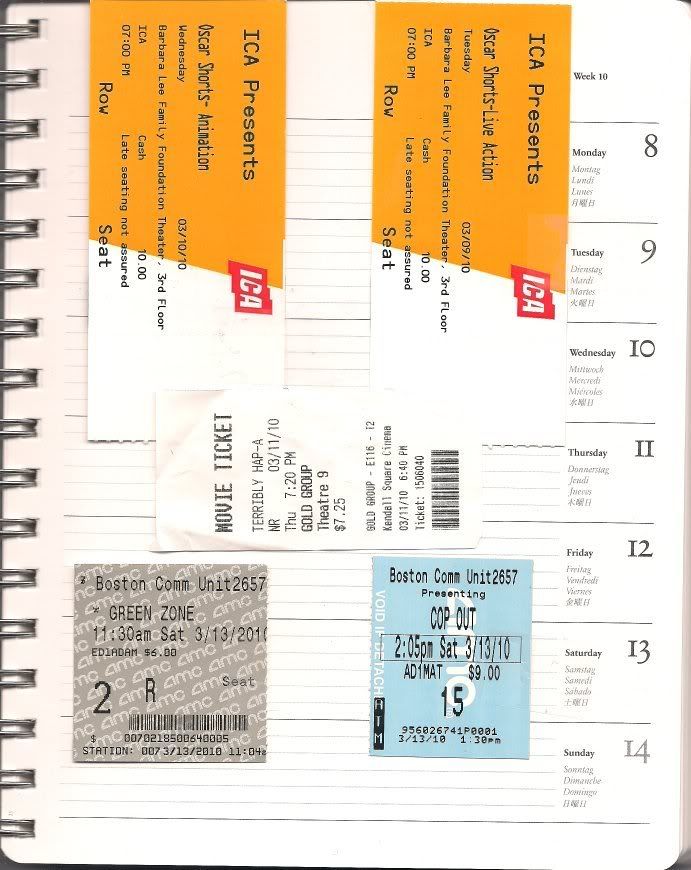
It rained in the Boston area this weekend: An annoying drizzle when I left in the morning to catch Green Zone, and just enough to keep me in the theater for Cop Out when that ended. Looking at those ticket prices, I kind of wish I'd seen them in reverse order; Green Zone was easily worth more than Cop Out.
Then, Sunday... I was intending to go out and see something else, but a couple minutes buying a paper a block away convinced me that I didn't even want to walk as far as Central Square to catch the T. I spent the day bagging and tagging over a year's worth of comics that had piled up in the attic. Still a few left, and then there's the putting them into long boxes in the other corner of the attic (where another six to eight months's worth are also waiting. Curse my mania for alphabetical order.
I'm also beginning to strongly suspect that screener DVDs degrade over time. Every time I try to start going through my Fantasia/Fantastic Fest screeners to try and catch up, just starting gets more and more frustrating - the Blu-ray and HD DVD players won't touch them, then the laptop pops up a "No Disc in drive" message when I try to watch Spare, wouldn't send sound out to the SlingCatcher when I tried to watch The Chaser and its enormous watermark, and now doesn't even react to the presence of The Chaser in the DVD drive at all.
All that really means is I can maybe skip over some of my backlog stuff, and get started on the next phase that was to come after screeners: All the HD DVD/Blu-ray stuff I've purchased but never watched in any format (discs I have never watched despite having seen the movie are exempt). I opted to start from the end of the alphabet rather than the beginning for a simple reason: It was 10pm and Wonder Woman runs 74 minutes, while Alexander Revisited is three hours plus. Potentially unfortunately, that means that the next disc up is White Noise 2, purchased because I was assured it had nothing to do with White Noise and I like the cast. Still, you could clear the bar of that first movie by a lot and still be utter crap.
Oscar Shorts - Live Action
Seen 9 March 2010 at the ICA (Oscar Shorts)
The winner, which we knew going in, was "The New Tenants", a fairly deserving choice, although I do wonder about the politics: As much as it's officially from Denmark, it's in English and has appearances by familiar faces like Vincent d'Onofrio. To balance, thought, the film from Ireland is not in English, but Russian.
"Kavi" - * * * - Pretty good short about a kid in India whose entire family is enslaved. It kind of goes on for a bit, and kind of peters out, but it's well-done.
"The New Tenants" - * * * ¼ - The winner is quite funny, darkly so. Excellent deadpan sense of humor.
"Miracle Fish" - * * * - Nifty little story that goes into odd places. It ends kind of abruptly, but is intriguing throughout.
"The Door" - * * * ¼ - Neck and neck for the award with "The New Tenants", at least in my mind. It's a crushing story that follows Chernobyl villagers in the aftermath of the meltdown, brutal to watch at times.
"Instead of Abracadabra" - * * ¾ - Cute story with some funny bits, although it's not as good as it could be at points. The main character's a bit too dim to make it really work perfectly, though.
Oscar Shorts - Animated
Seen 10 March 2010 at the ICA (Oscar Shorts)
"Logorama" won the Oscar and it was my favorite of the program. As I mentioned last week, it's a pretty good year when a new Wallace & Gromit short is perhaps among the weakest entries.
"French Roast" - * * * - Funny little short, although it's a little strange visually; it takes a while to get used to how much of the action is rendered in a mirror that looks a lot like a window. That's a pretty impressive trick from a technical perspective, though.
"The Lady and the Reaper" - * * * ½ - I swear I saw something very similar to this a couple years ago, although I think that was much more somber and maybe hand-drawn. This is CGI and madcap, full of cartoonish slapstick about death fighting a heroic surgeon for the soul of an old woman who is at peace and ready to see her late husband again.
"A Matter of Loaf and Death" - * * * ½ - Yep, still funny.
"Granny O'Grimm's Sleeping Beauty" - * * * ¼ - The initial idea isn't quite so fantastic (a granny telling a disturbing and self-serving fairy tale to her grandchild, with a different form of animation within the story), but the punchline is perfect.
"Partly Cloudy" - * * * - I can't remember whether this was 3-D or not when I saw it with Up, but it's still a cute, very enjoyable little short. Pixar does great work.
"Runaway" - * * * - Nice-looking short out of Canada with kind of a nasty sense of humor despite its smoothness.
"The Kinematograph" - * * * - I dig the "early history of film" part, but there's something about the emotion of this one that leaves me kind of cold, like we're supposed to look down on the inventor even though the wife is concealing her illness. The implication is that he traded his love for his invention, and knowledge comes with a price that is often not worth it, and you're going to have to try a whole lot harder to convince me of that.
"Logorama" - * * * ¾ - You know what's cruel about this short? That a whole bunch of lawyers will keep it from ever being issued on video (although if it's available on iTunes (ptui!), I'd imagine at least some of that's been worked out), but it's the one you will most want to have available for freeze-framing to catch all the clever little bits of things that directors "H5" put in every corner of their world made up of corporate logos.
Green Zone
* * * (out of four)
Seen 13 March 2010 at AMC Boston Common #2 (first-run)
A lot of folks have been making the obvious comparison to the Bourne movies (Damon! Greengrass!), mainly because it is the easy comparison. I think that, in a lot of ways, Green Zone is better than his work on those, because while I found that globe-trotting action/adventure isn't really Greengrass's forte (my impression of those films will always be him taking what was clearly an impressively staged and executed car chase in The Bourne Supremacy and cutting it into incomprehensibility), he does damn good "you are here". There's a great boots-on-the-ground feeling to the movie, not just in how tense the action can get, but in how we instinctively understand an NCO like Miller's place in the world: He's the glue that holds the army together, although the likes of Miller are so well-trained that the likes of him actuallly questioning his orders is unheard of.
Cop Out
* * (out of four)
Seen 13 March 2010 at AMC Boston Common #15 (first-run)
So, let me understand this, MPAA (or Warner, or whoever is responsible) - it's okay to have the line "a couple of dicks" front and center in the movie, but having it as the title is crossing a line? How's that work?
That aside, Cop Out is interesting in what it says about Kevin Smith as a filmmaker. Not the moral judgment of "how can you stand having your name on this?" or the political implications of whether this is a gesture to make him seem more studio-friendly to people other than the Weinsteins, but how it lets us examine specific talents. All his previous films were as a writer/director, with the general impression being that he can write well enough to cover his weakness behind the camera. He didn't write Cop Out, though, and it indicates that while he can't spin gold from straw, he's built up enough skills to maybe make a mattress. It is a pretty dumb script, after all, but in many ways the execution isn't bad. The scenes and bits that don't work - and there are many don't call attention to themselves; they move smoothly on to the next bit.
Bruce Willis helps. You can't blame the guy for all the big-money action roles he's taken - if someone waved a check for twenty million dollars in my face, I'd have a hard time saying no, even if it wasn't the first time - but it is a crying shame that he doesn't do more comedy, because he's both a good straight man and wiseass. I'm not quite so sold on Tracy Morgan; I kind of get what he's going for here, and he's saddled with a particularly dumb subplot, but he kind of reminded me of the Nigel Bruce-model Watson here: Eccentric, kind of clueless, etc., is funny, but when a character comes off as so rock-stupid that it's impossible to picture his as a homicide cop with ten years on the job, that's a problem.
Wonder Woman (2009)
* * ¾ (out of four)
Seen 13 March 2010 in Jay's Living Room (Blu-ray)
A few idle questions to ponder when trying to evaluate the merits of last year's direct-to-video animated Wonder Woman:
* Would I enjoy it more if it were done in Japan, at roughly this level of quality? I've watched a fair bit of animated action/adventure out of Japan, and not always the big-budget theatrical releases, and liked much of it. The question is, does the language barrier help (making it harder to notice bad dialogue/voice acting), as well as the lack of familiarity with the source material? Through a lot of Wonder Woman's first half, I was thinking that this was rather flat, not really up to the standards one would hope for.
* Would this be acceptable story if this were a live action film? Probably not. It shows how unwieldy the character's origins are, especially how long it takes to get Diana born and off her island. It really locks things into the character's mythological origins, and a characterization that is much more simplistic and aggressive than the well-developed Diana we know from the comics.
* How involved was Gail Simone? She's the current writer of the Wonder Woman comic (at least through June), and though her run hasn't been as good as Greg Rucka's, she has emphasized the mythological warrior elements of the character. She's got a "screen story" credit on this, although I wonder if she contributed more directly to the second half. Certain bits, like "They're messing with Lincoln! No-one messes with Lincoln!", have her stamp on them.
I wish more did. There's potential here, and a really nice voice cast (Keri Russell as the title character; Nathan Fillion as Steve Trevor, the guy with the line about Lincoln; Rosario Dawson as Artemis). It's got pretty serious action for an American animated film. I just wish it had more of Rucka's ability to make all the elements of the character or Simone's wit and inventiveness.
* My friends would likely give me a hard time if I didn't start with The Chlotrudis Awards on Sunday night at The Brattle Theatre. It's a fun evening, honoring quality independent films, and Society President Michael Colford is probably going nuts even as we speak to meet the person who spoke the Donnie Darko line that has been in his email signature for years, special guest Beth Grant.
But, hey, that's just an awards ceremony, one I'm almost willing to punt if I can't find time to get to the ridiculous amount of other stuff playing in (potentially) short runs this week:
* Before the awards, the second half of the one-two punch Werner Herzog brought to last year's Toronto Film Festival opens at the Boston Museum of Fine Arts on Thursday. If My Son, My Son, What Have You Done? is even half as good as Bad Lieutenant: Port of Call New Orleans, it will be well worth figuring out the MFA's schedule to catch.
If you haven't gone to movies at the MFA before, I'm only half-joking about the "figuring out" bit. Even when a movie like My Son is having a "run", that means it's booked for 4-6 dates which are not necessarily in a row or at the same time. This one is playing five times, around The Films of Kim Longinotto and the start of The Boston Turkish Film Festival.
* Hubble 3-D opens at the Aquarium on Friday, playing 3 matinees daily while Avatar has the night shift. The Ultimate Wave: Tahiti 3D is also playing there, and that looks pretty cool. But gorgeous photography of Tahiti and James Cameron's cool sci-fi flick aside, is there anything cooler than documentary footage of spaceflight and crystal-clear images from the Hubble in genuine reels-of-film-that-require-a-forklift-to-move-with-single-frames-the-size-of-your-fist-projected-with-a-bulb-that-doubles-as-a-death-ray-onto-a-screen-the-size-of-a-medium-sized-office-building IMAX 3-D? Not for $12, there isn't.
* Circus Films at the Brattle! It's a small, weekend series, but there's some neat stuff, including an outfit called Cirkestra providing live accompaniment to a silent, The Unknown. That always gets me to the theaters.
* Kendall Square opens a few new movies, including The Secret of Kells, which looks like it thoroughly deserved its Oscar nomination from the gorgeous clips and previews. Also opening are The Girl with the Dragon Tattoo and Mother; the one-week-wonder is Neil Young: Trunk Show.
* The Coolidge has a 25th Anniversary
* And, finally, even though I'll probably get another chance to remind the half-dozen or so people who read this blog about it next week, The Boston Underground Film Festival kicks of next Thursday, the 25th, with the local premiere of Sion Sono's Love Exposure, an amazing film that has too much awesome packed into its four hours to classify. It's funny, heartbreaking, and utterly bizarre by turns; I loved it when I saw it at Fantasia last summer.
Yes, I said four hours, which is one of the reasons I highly recommend seeing it at the Kendall on the 25th. If it played a regular run, or came out on video, it would be easy to say "four hours? not tonight!" at any given time; at a one-time festival screening, though, you make the time, because there aren't other alternatives. And you should, because in addition to being as long as two movies stuck together, it's got as much good stuff as two individual movies, maybe three.

Stubless: Wonder Woman (2009), 13 March 2010.
It rained in the Boston area this weekend: An annoying drizzle when I left in the morning to catch Green Zone, and just enough to keep me in the theater for Cop Out when that ended. Looking at those ticket prices, I kind of wish I'd seen them in reverse order; Green Zone was easily worth more than Cop Out.
Then, Sunday... I was intending to go out and see something else, but a couple minutes buying a paper a block away convinced me that I didn't even want to walk as far as Central Square to catch the T. I spent the day bagging and tagging over a year's worth of comics that had piled up in the attic. Still a few left, and then there's the putting them into long boxes in the other corner of the attic (where another six to eight months's worth are also waiting. Curse my mania for alphabetical order.
I'm also beginning to strongly suspect that screener DVDs degrade over time. Every time I try to start going through my Fantasia/Fantastic Fest screeners to try and catch up, just starting gets more and more frustrating - the Blu-ray and HD DVD players won't touch them, then the laptop pops up a "No Disc in drive" message when I try to watch Spare, wouldn't send sound out to the SlingCatcher when I tried to watch The Chaser and its enormous watermark, and now doesn't even react to the presence of The Chaser in the DVD drive at all.
All that really means is I can maybe skip over some of my backlog stuff, and get started on the next phase that was to come after screeners: All the HD DVD/Blu-ray stuff I've purchased but never watched in any format (discs I have never watched despite having seen the movie are exempt). I opted to start from the end of the alphabet rather than the beginning for a simple reason: It was 10pm and Wonder Woman runs 74 minutes, while Alexander Revisited is three hours plus. Potentially unfortunately, that means that the next disc up is White Noise 2, purchased because I was assured it had nothing to do with White Noise and I like the cast. Still, you could clear the bar of that first movie by a lot and still be utter crap.
Oscar Shorts - Live Action
Seen 9 March 2010 at the ICA (Oscar Shorts)
The winner, which we knew going in, was "The New Tenants", a fairly deserving choice, although I do wonder about the politics: As much as it's officially from Denmark, it's in English and has appearances by familiar faces like Vincent d'Onofrio. To balance, thought, the film from Ireland is not in English, but Russian.
"Kavi" - * * * - Pretty good short about a kid in India whose entire family is enslaved. It kind of goes on for a bit, and kind of peters out, but it's well-done.
"The New Tenants" - * * * ¼ - The winner is quite funny, darkly so. Excellent deadpan sense of humor.
"Miracle Fish" - * * * - Nifty little story that goes into odd places. It ends kind of abruptly, but is intriguing throughout.
"The Door" - * * * ¼ - Neck and neck for the award with "The New Tenants", at least in my mind. It's a crushing story that follows Chernobyl villagers in the aftermath of the meltdown, brutal to watch at times.
"Instead of Abracadabra" - * * ¾ - Cute story with some funny bits, although it's not as good as it could be at points. The main character's a bit too dim to make it really work perfectly, though.
Oscar Shorts - Animated
Seen 10 March 2010 at the ICA (Oscar Shorts)
"Logorama" won the Oscar and it was my favorite of the program. As I mentioned last week, it's a pretty good year when a new Wallace & Gromit short is perhaps among the weakest entries.
"French Roast" - * * * - Funny little short, although it's a little strange visually; it takes a while to get used to how much of the action is rendered in a mirror that looks a lot like a window. That's a pretty impressive trick from a technical perspective, though.
"The Lady and the Reaper" - * * * ½ - I swear I saw something very similar to this a couple years ago, although I think that was much more somber and maybe hand-drawn. This is CGI and madcap, full of cartoonish slapstick about death fighting a heroic surgeon for the soul of an old woman who is at peace and ready to see her late husband again.
"A Matter of Loaf and Death" - * * * ½ - Yep, still funny.
"Granny O'Grimm's Sleeping Beauty" - * * * ¼ - The initial idea isn't quite so fantastic (a granny telling a disturbing and self-serving fairy tale to her grandchild, with a different form of animation within the story), but the punchline is perfect.
"Partly Cloudy" - * * * - I can't remember whether this was 3-D or not when I saw it with Up, but it's still a cute, very enjoyable little short. Pixar does great work.
"Runaway" - * * * - Nice-looking short out of Canada with kind of a nasty sense of humor despite its smoothness.
"The Kinematograph" - * * * - I dig the "early history of film" part, but there's something about the emotion of this one that leaves me kind of cold, like we're supposed to look down on the inventor even though the wife is concealing her illness. The implication is that he traded his love for his invention, and knowledge comes with a price that is often not worth it, and you're going to have to try a whole lot harder to convince me of that.
"Logorama" - * * * ¾ - You know what's cruel about this short? That a whole bunch of lawyers will keep it from ever being issued on video (although if it's available on iTunes (ptui!), I'd imagine at least some of that's been worked out), but it's the one you will most want to have available for freeze-framing to catch all the clever little bits of things that directors "H5" put in every corner of their world made up of corporate logos.
Green Zone
* * * (out of four)
Seen 13 March 2010 at AMC Boston Common #2 (first-run)
A lot of folks have been making the obvious comparison to the Bourne movies (Damon! Greengrass!), mainly because it is the easy comparison. I think that, in a lot of ways, Green Zone is better than his work on those, because while I found that globe-trotting action/adventure isn't really Greengrass's forte (my impression of those films will always be him taking what was clearly an impressively staged and executed car chase in The Bourne Supremacy and cutting it into incomprehensibility), he does damn good "you are here". There's a great boots-on-the-ground feeling to the movie, not just in how tense the action can get, but in how we instinctively understand an NCO like Miller's place in the world: He's the glue that holds the army together, although the likes of Miller are so well-trained that the likes of him actuallly questioning his orders is unheard of.
Cop Out
* * (out of four)
Seen 13 March 2010 at AMC Boston Common #15 (first-run)
So, let me understand this, MPAA (or Warner, or whoever is responsible) - it's okay to have the line "a couple of dicks" front and center in the movie, but having it as the title is crossing a line? How's that work?
That aside, Cop Out is interesting in what it says about Kevin Smith as a filmmaker. Not the moral judgment of "how can you stand having your name on this?" or the political implications of whether this is a gesture to make him seem more studio-friendly to people other than the Weinsteins, but how it lets us examine specific talents. All his previous films were as a writer/director, with the general impression being that he can write well enough to cover his weakness behind the camera. He didn't write Cop Out, though, and it indicates that while he can't spin gold from straw, he's built up enough skills to maybe make a mattress. It is a pretty dumb script, after all, but in many ways the execution isn't bad. The scenes and bits that don't work - and there are many don't call attention to themselves; they move smoothly on to the next bit.
Bruce Willis helps. You can't blame the guy for all the big-money action roles he's taken - if someone waved a check for twenty million dollars in my face, I'd have a hard time saying no, even if it wasn't the first time - but it is a crying shame that he doesn't do more comedy, because he's both a good straight man and wiseass. I'm not quite so sold on Tracy Morgan; I kind of get what he's going for here, and he's saddled with a particularly dumb subplot, but he kind of reminded me of the Nigel Bruce-model Watson here: Eccentric, kind of clueless, etc., is funny, but when a character comes off as so rock-stupid that it's impossible to picture his as a homicide cop with ten years on the job, that's a problem.
Wonder Woman (2009)
* * ¾ (out of four)
Seen 13 March 2010 in Jay's Living Room (Blu-ray)
A few idle questions to ponder when trying to evaluate the merits of last year's direct-to-video animated Wonder Woman:
* Would I enjoy it more if it were done in Japan, at roughly this level of quality? I've watched a fair bit of animated action/adventure out of Japan, and not always the big-budget theatrical releases, and liked much of it. The question is, does the language barrier help (making it harder to notice bad dialogue/voice acting), as well as the lack of familiarity with the source material? Through a lot of Wonder Woman's first half, I was thinking that this was rather flat, not really up to the standards one would hope for.
* Would this be acceptable story if this were a live action film? Probably not. It shows how unwieldy the character's origins are, especially how long it takes to get Diana born and off her island. It really locks things into the character's mythological origins, and a characterization that is much more simplistic and aggressive than the well-developed Diana we know from the comics.
* How involved was Gail Simone? She's the current writer of the Wonder Woman comic (at least through June), and though her run hasn't been as good as Greg Rucka's, she has emphasized the mythological warrior elements of the character. She's got a "screen story" credit on this, although I wonder if she contributed more directly to the second half. Certain bits, like "They're messing with Lincoln! No-one messes with Lincoln!", have her stamp on them.
I wish more did. There's potential here, and a really nice voice cast (Keri Russell as the title character; Nathan Fillion as Steve Trevor, the guy with the line about Lincoln; Rosario Dawson as Artemis). It's got pretty serious action for an American animated film. I just wish it had more of Rucka's ability to make all the elements of the character or Simone's wit and inventiveness.
Monday, May 18, 2009
IFFB 2009 Day Six: For Love of the Movies and Art & Copy
Monday was the second-to-last day of the festival, and took place at the ICA. In previous years, the festival would show a full slate of films on this day, but the organizers felt that this was spreading everything too thin - both the staff and the attendees. I admit, I've run myself ragged going between Somerville, Cambridge, and Brookline in previous years, but I also would have liked some other choices on Monday night, even if it was just repeats from earlier in the festival.
The two movies I did see weren't bad, and they made for an interesting double feature: Both film criticism and advertising are about an attempt to be creative and memorable with a specific purpose in mind. Both had a good number of clips, a history lesson, and plentiful interviews with the folks who do it for a living. I think Art & Copy winds up the better movie, as it doesn't have so many obvious biases and doesn't seem like quite so obvious a lecture.
An entertaining part of Doug Pray's Q&A after Art & Copy (the one for Peary's For the Love of Movies was mostly his friends telling him how wonderful he/his film was) was Pray getting excited about the theater he was showing it in, and I have to agree - the ICA theater is a pretty amazing space. The screen is lowered into the middle of a stage area, and the stage not only has curtains at the front, but at the back; when opened, they give a fantastic view of the harbor. Even if you take it as a multi-purpose room, I'm not sure exactly what purpose it serves.
But I love it. Aside from just being a beautiful space, there's something delightful about the way that the thin screen which you can see behind from certain angles reminds the audience of the projection mechanism. In most theaters, your mind can process the screen as a window; a television is a box that has things in it. At the ICA, your movie is just hanging in mid-air, like a special effect, a spell that a wizard has cast to see something far away. Some may take seeing the edges of the illusion so clearly as spoiling the magic of the movies, but I must admit, I kind of like it.
For Love of the Movies
* * ½ (out of four)
Seen 27 April 2009 at the Institute of Contemporary Art (Independent Film Festival of Boston)
For the Love of Movies: The Story of American Film Criticism takes on a century of its subject in less than ninety minutes, and as is almost inevitable, feels a little uneven. There are places where seems to do little more than scratch the surface, and even when filmmaker Geary Peary does dig a little deeper, it often doesn't seem deep enough. Whether this means the movie should have had a tighter focus on some specific thread or been expanded (and then, perhaps, broken into six half-hour chunks, as a PBS series), I'm not sure.
Aside from being a film critic for the Boston Phoenix, Peary is also a college professor, and he structures his film like a college course. "Dawn (1907-1929)" focuses on the early days of cinema, with particular attention paid to Frank E. Woods, the first critic of note who went on to co-write Birth of a Nation. "Cult Critics and Crowther (1930-1953)" shows film reviewing evolving into the form we recognize today, with star ratings and the championing of worthy independent and foreign films. "Auteurism and After (1954-1967)" introduces us to the rivalry between Andrew Sarris and Pauline Kael, which carries over into "When Criticism Mattered (1968-1980). That time period overlaps with "TV, Fans, and Videotape (1975-1995)", which covers the rise of the fanzine. Finally, the film finishes up with "Digital Rebellion (1996+)".
With a scant ten or fifteen minutes with which to cover each of these segments, there's some limitations on what Peary can include. Some are right up there in the title - this is the story of American film criticism, so the groundbreaking work being done in France is mostly excluded, except in terms of how it pitted Sarris and Kael against each other. Perhaps a more subtle selection bias is how much time is how focused the film is on newspapers' reviews of new releases. Criticism that emerges from academia gets very short shrift, and while "TV, Fans, and Videotape" mentions Siskel & Ebert and how video led to the revisiting of older films by enthusiasts as much as professionals, it doesn't do much more than that, even though these are factors which would have a major influence on the film's concluding chapter.
Complete review at eFilmCritic.
Art & Copy
* * * (out of four)
Seen 27 April 2009 at the Institute of Contemporary Art (Independent Film Festival of Boston)
If there's high art and low art, advertising must be considered the lowest of them, with perhaps only grudging admission that any part of it can be considered art at all. Advertising is creative work, though, and for better or worse, a good ad probably has a much larger impact than a good piece of non-commercial artwork.
Director Doug Pray's Art & Copy focuses on the good ads, whether you measure that by artistic merit or commercial success. Those looking for an examination of the rightness and wrongness of pervasive advertising as a phenomenon should look elsewhere; this is an overview of how the medium works combined with a look at some of its more noteworthy practitioners. A key example of both comes early, as we're told about Bill Bernbach, who changed the face of advertising by putting the art director and copywriter in the same room. Before this, ads were very text-heavy, a far cry form the punchy, slickly-designed ads of today.
We get insight on some of the simpler, and most pervasive, advertising campaigns of recent years. Jeff Goodby and Rich Silverstein, who describe their job as "entertaining society using clients' products" talk about their "got milk?" campaign, pointing out how the much-imitated catchphrase was originally the punchline to a very elaborate commercial, while also breaking down how it evolved from the client's specific needs. Pray also talks to Dan Wieden, who came up with "Just Do It". His stories are less about how they built the campaign (although the inspiration for the phrase is amusing), and more about how it took on a life of its own.
Complete review at eFilmCritic.
The two movies I did see weren't bad, and they made for an interesting double feature: Both film criticism and advertising are about an attempt to be creative and memorable with a specific purpose in mind. Both had a good number of clips, a history lesson, and plentiful interviews with the folks who do it for a living. I think Art & Copy winds up the better movie, as it doesn't have so many obvious biases and doesn't seem like quite so obvious a lecture.
An entertaining part of Doug Pray's Q&A after Art & Copy (the one for Peary's For the Love of Movies was mostly his friends telling him how wonderful he/his film was) was Pray getting excited about the theater he was showing it in, and I have to agree - the ICA theater is a pretty amazing space. The screen is lowered into the middle of a stage area, and the stage not only has curtains at the front, but at the back; when opened, they give a fantastic view of the harbor. Even if you take it as a multi-purpose room, I'm not sure exactly what purpose it serves.
But I love it. Aside from just being a beautiful space, there's something delightful about the way that the thin screen which you can see behind from certain angles reminds the audience of the projection mechanism. In most theaters, your mind can process the screen as a window; a television is a box that has things in it. At the ICA, your movie is just hanging in mid-air, like a special effect, a spell that a wizard has cast to see something far away. Some may take seeing the edges of the illusion so clearly as spoiling the magic of the movies, but I must admit, I kind of like it.
For Love of the Movies
* * ½ (out of four)
Seen 27 April 2009 at the Institute of Contemporary Art (Independent Film Festival of Boston)
For the Love of Movies: The Story of American Film Criticism takes on a century of its subject in less than ninety minutes, and as is almost inevitable, feels a little uneven. There are places where seems to do little more than scratch the surface, and even when filmmaker Geary Peary does dig a little deeper, it often doesn't seem deep enough. Whether this means the movie should have had a tighter focus on some specific thread or been expanded (and then, perhaps, broken into six half-hour chunks, as a PBS series), I'm not sure.
Aside from being a film critic for the Boston Phoenix, Peary is also a college professor, and he structures his film like a college course. "Dawn (1907-1929)" focuses on the early days of cinema, with particular attention paid to Frank E. Woods, the first critic of note who went on to co-write Birth of a Nation. "Cult Critics and Crowther (1930-1953)" shows film reviewing evolving into the form we recognize today, with star ratings and the championing of worthy independent and foreign films. "Auteurism and After (1954-1967)" introduces us to the rivalry between Andrew Sarris and Pauline Kael, which carries over into "When Criticism Mattered (1968-1980). That time period overlaps with "TV, Fans, and Videotape (1975-1995)", which covers the rise of the fanzine. Finally, the film finishes up with "Digital Rebellion (1996+)".
With a scant ten or fifteen minutes with which to cover each of these segments, there's some limitations on what Peary can include. Some are right up there in the title - this is the story of American film criticism, so the groundbreaking work being done in France is mostly excluded, except in terms of how it pitted Sarris and Kael against each other. Perhaps a more subtle selection bias is how much time is how focused the film is on newspapers' reviews of new releases. Criticism that emerges from academia gets very short shrift, and while "TV, Fans, and Videotape" mentions Siskel & Ebert and how video led to the revisiting of older films by enthusiasts as much as professionals, it doesn't do much more than that, even though these are factors which would have a major influence on the film's concluding chapter.
Complete review at eFilmCritic.
Art & Copy
* * * (out of four)
Seen 27 April 2009 at the Institute of Contemporary Art (Independent Film Festival of Boston)
If there's high art and low art, advertising must be considered the lowest of them, with perhaps only grudging admission that any part of it can be considered art at all. Advertising is creative work, though, and for better or worse, a good ad probably has a much larger impact than a good piece of non-commercial artwork.
Director Doug Pray's Art & Copy focuses on the good ads, whether you measure that by artistic merit or commercial success. Those looking for an examination of the rightness and wrongness of pervasive advertising as a phenomenon should look elsewhere; this is an overview of how the medium works combined with a look at some of its more noteworthy practitioners. A key example of both comes early, as we're told about Bill Bernbach, who changed the face of advertising by putting the art director and copywriter in the same room. Before this, ads were very text-heavy, a far cry form the punchy, slickly-designed ads of today.
We get insight on some of the simpler, and most pervasive, advertising campaigns of recent years. Jeff Goodby and Rich Silverstein, who describe their job as "entertaining society using clients' products" talk about their "got milk?" campaign, pointing out how the much-imitated catchphrase was originally the punchline to a very elaborate commercial, while also breaking down how it evolved from the client's specific needs. Pray also talks to Dan Wieden, who came up with "Just Do It". His stories are less about how they built the campaign (although the inspiration for the phrase is amusing), and more about how it took on a life of its own.
Complete review at eFilmCritic.
Subscribe to:
Posts (Atom)

