The news hit Twitter on Monday - Saturday Night would not be the closing night film; for whatever reason, it wasn't available. Fortunately, they had lined up a replacement: Jean-Pierre Jeunet's new comedy, Micmacs. The news was incredibly well received - my favorite response was "Verdict: Upgrade!" - and I suspect that very few people who had purchased tickets for Saturday Night opted for a refund.
It's an example of just how completely crazy running a festival must be - you lock up your closing night film, use it in advertising, etc., and you must be pretty darn certain that it will play, only to have the rug ripped out from under you mid-festival, while you're busy trying to make sure that guests are happy, the hundreds of people in line outside the Somerville Theatre know which auditorium they're supposed to go into, and now you've got to get on the phone with studios and distributors and try to book a new movie on two days' notice - and not just any movie, but one impressive enough to be the closing night film for a pretty decent festival. That's crazy, and it impresses the heck out of me that they managed to pull it off.
(Also, nice job on throwing only the softest of back-handed disses to Saturday Night. I think that the festival staff maybe once said "it's better" rather than "it's even better.)
Makes my grumbling about having to take a taxi because my errands in Harvard Square took just long enough for me to see the 66 bus I needed to take pull away look pretty pathetic, so I will save my rants about how taking cabs drives me insane beyond all reason for another time.
And now, three weeks after this eight-day festival, it is good to be done with the reviews... Wait, what's this? Three or four screeners that I specifically asked for and that the producers paid postage on on...? Well, at least their details won't be falling out the back of my head as I try to get to reviewing them.
Micmacs à tire-larigot (Micmacs)
* * * * (out of four)
Seen 28 April 2010 at the Coolidge Corner Theatre #1 (Independent Film Festival of Boston)
Jean-Pierre Jeunet's newest film took a few days to grow on me, but that's the nature of Jeunet: The years between new films and intricate detail are often associated with weighty, "important" films, but Jeunet has a light touch at his best; his biggest mis-steps have come when trying to tell bigger stories. Here, he's mostly just having fun, and while that doesn't seem like much, it makes Micmacs a joy to watch.
Fun movies don't usually start with someone getting shot in the head, but that's what happens to Bazil (Dany Boon), a video store clerk who chooses the wrong moment to step outside. The doctors decide that the immediate risk of removing the bullet outweighs the fact that it could kill him at any time, so he's let go, but once he comes out of his coma, his job and apartment are gone. A group of misfits living in a nearby garbage dump take him in, though, and soon go along with his scheme to strike back at the munitions manufacturers who made both the bullet in his head and the land mine that killed his father.
Yes, the lovable misfits really do live in a garbage dump, albeit an unusually tidy one; Jeunet and co-writer Guillaume Laurant are not exactly hiding a metaphor there. They don't feel the need to shout it at the audience, though there are moments when the whimsy is pushed back. The extended flashback to Bazil's father, for instance, has a veneer of childish sentimentality to it, but is serious enough to give Bazil a layer of melancholy even though you could otherwise argue that getting shot in the head was a good thing for him (it led him to wonderful friends). And while there is a serious idea or two underneath the whimsy - merchants of death too concerned with one-upsmanship to care about the effects of their business - Jeunet never loses sight of his primary goal being to entertain an audience.
Full review at EFC.
Showing posts with label Independent Film Festival of Boston. Show all posts
Showing posts with label Independent Film Festival of Boston. Show all posts
Tuesday, May 18, 2010


Friday, May 14, 2010
IFFB 2010 Night Seven: Marwencol and Jean-Michel Basquiat: The Radiant Child
To say I have a love-hate relationship with the second-to-last night of IFFBoston is to overstate things; it has, after all, only been a distinct entity for two years now, it's a clever idea, and I really like the ICA as a movie venue. I think I'd be a poor movie fan if I only went see movies that I knew I would like, and a poor human being if I only went to documentaries on subjects which I had existing interest in. I genuinely like knowing new things, so I like to combine that with my love of film by seeing documentaries whenever I can. And having a night of films on artists and the creative process at the ICA is a clever idea on IFFBoston's part (last year's here).
But, man, when I got the schedule and saw that, once again, the ICA was the only option on its night, I found it kind of annoying, especially since I had to make hard decisions on other parts of the festival. After all, if you've shelled out near two hundred bucks or inflated your websites hit count (kidding!) to get a pass, and want to use it as much as possible, it's not unreasonable to wish that some of the stuff that played once while there were six screens running over the weekend had encore showings during the same time period as, say, Jean-Michel Basquiat: The Radiant Child.
But... This evening did give me a chance to see Marwencol, which is excellent. I don't know what the distribution situation is, but here are a couple of noteworthy sites if you'd like to see the art featured in the movie: "Marwencol on My Mind" in Esopus Magazine, and the official site, which is mainly a blog featuring Mark Hogancamp's action-figure fumetti.
Marwencol
* * * * (out of four)
Seen 27 April 2010 at the Institute for Contemporary Art (Independent Film Festival of Boston)
Documentaries about artists and art are frequently disappointing. Filmmakers try their best, but as artists themselves they can make intuitive leaps between their subject and his or her work that is not obvious to a general audience, who hear vague words and see abstractions. That's not the case with Marwencol; the artist and artwork are not just inseparable, but unusually accessible.
On 18 April 2010, Mark Hogancamp was attacked outside a bar in his hometown of Kingston, New York by five young men, and sustained tremendous brain damage - he had to relearn how to walk, talk, and even feed himself; he not only lost his memory, but a great deal of control over his anger and ability to concentrate. Naturally, he had a wholly inadequate rehabilitation program, and when released from the hospital, was more or less left ot his own devices. What he came up with was "Marwencol", a 1:6-scale Belgian village, circa World War II, that he built in his back yard and populated with army and fashion dolls. One was named after himself; others after friends and family. He would build an intricate narrative around these characters, and photograph them. Eventually, a professional photographer, David Naugle, would see his work, and forward it to Esopus magazine editor Tod Lippy, leading to a gallery show in Soho.
Even without context, Hogancamp's work is striking; he has a natural eye for composition (although, before he had a digital camera, it took long rounds of trial and error to learn the craft of photography), he can use a still photograph to tell a story, and an eye for detail. His photographs flit across the uncanny valley without being trapped in the middle; though clearly made of toys and sometimes out of scale to the environment, the scenes often seem real. I would (and will) happily purchase a book featuring Mark's photos.
Full review at EFC.
Jean-Michel Basquiat: The Radiant Child
* * (out of four)
Seen 27 April 2010 at the Institute for Contemporary Art (Independent Film Festival of Boston)
In the last review I wrote (for the delightful "Marwencol"), I said that documentaries about art and artists were frequently disappointing, in part because filmmakers have a hard time translating the brilliance they see into something a non-artist can appreciate. Jean-Michel Basquiat: The Radiant Child is an example of that, a loving tribute that probably tells his existing fans very little new but fails to paint a compelling enough picture to create new ones.
"In 1986," director Tamra Davis opens, "I filmed an interview with my friend Jean-Michel Basquiat." He died soon after, and Davis put the footage away, rediscovering it a decade later. It forms the spine of her documentary, although it is greatly augmented by stock footage, some imagery of his work, and contemporary interviews with Basquiat's friends and acquaintances. A familiar picture emerges - the talented youth who gains fame and success, gets into bad patterns, including substance abuse, and either emerges stronger or, like Basquiat, dies young.
You've seen this movie, both as a documentary and as a feature, if not necessarily about Basquiat specifically (in 1996's Basquiat), though it's the ones about musicians that generally get more play. And though it's a cruel thing to say, Basquiat's story as told by Davis isn't a particularly interesting variation on the theme. It's by turns inspiring and sad in all the usual ways, and his personal and professional life's intersections with the likes of Andy Warhol and the rest of the New York art scene of the late 1970s and early 1980s means that there's no shortage of colorful characters, but when looking at this film afterward, what stands out, makes it a particularly fascinating example of the genre? Very little.
Full review at EFC.
But, man, when I got the schedule and saw that, once again, the ICA was the only option on its night, I found it kind of annoying, especially since I had to make hard decisions on other parts of the festival. After all, if you've shelled out near two hundred bucks or inflated your websites hit count (kidding!) to get a pass, and want to use it as much as possible, it's not unreasonable to wish that some of the stuff that played once while there were six screens running over the weekend had encore showings during the same time period as, say, Jean-Michel Basquiat: The Radiant Child.
But... This evening did give me a chance to see Marwencol, which is excellent. I don't know what the distribution situation is, but here are a couple of noteworthy sites if you'd like to see the art featured in the movie: "Marwencol on My Mind" in Esopus Magazine, and the official site, which is mainly a blog featuring Mark Hogancamp's action-figure fumetti.
Marwencol
* * * * (out of four)
Seen 27 April 2010 at the Institute for Contemporary Art (Independent Film Festival of Boston)
Documentaries about artists and art are frequently disappointing. Filmmakers try their best, but as artists themselves they can make intuitive leaps between their subject and his or her work that is not obvious to a general audience, who hear vague words and see abstractions. That's not the case with Marwencol; the artist and artwork are not just inseparable, but unusually accessible.
On 18 April 2010, Mark Hogancamp was attacked outside a bar in his hometown of Kingston, New York by five young men, and sustained tremendous brain damage - he had to relearn how to walk, talk, and even feed himself; he not only lost his memory, but a great deal of control over his anger and ability to concentrate. Naturally, he had a wholly inadequate rehabilitation program, and when released from the hospital, was more or less left ot his own devices. What he came up with was "Marwencol", a 1:6-scale Belgian village, circa World War II, that he built in his back yard and populated with army and fashion dolls. One was named after himself; others after friends and family. He would build an intricate narrative around these characters, and photograph them. Eventually, a professional photographer, David Naugle, would see his work, and forward it to Esopus magazine editor Tod Lippy, leading to a gallery show in Soho.
Even without context, Hogancamp's work is striking; he has a natural eye for composition (although, before he had a digital camera, it took long rounds of trial and error to learn the craft of photography), he can use a still photograph to tell a story, and an eye for detail. His photographs flit across the uncanny valley without being trapped in the middle; though clearly made of toys and sometimes out of scale to the environment, the scenes often seem real. I would (and will) happily purchase a book featuring Mark's photos.
Full review at EFC.
Jean-Michel Basquiat: The Radiant Child
* * (out of four)
Seen 27 April 2010 at the Institute for Contemporary Art (Independent Film Festival of Boston)
In the last review I wrote (for the delightful "Marwencol"), I said that documentaries about art and artists were frequently disappointing, in part because filmmakers have a hard time translating the brilliance they see into something a non-artist can appreciate. Jean-Michel Basquiat: The Radiant Child is an example of that, a loving tribute that probably tells his existing fans very little new but fails to paint a compelling enough picture to create new ones.
"In 1986," director Tamra Davis opens, "I filmed an interview with my friend Jean-Michel Basquiat." He died soon after, and Davis put the footage away, rediscovering it a decade later. It forms the spine of her documentary, although it is greatly augmented by stock footage, some imagery of his work, and contemporary interviews with Basquiat's friends and acquaintances. A familiar picture emerges - the talented youth who gains fame and success, gets into bad patterns, including substance abuse, and either emerges stronger or, like Basquiat, dies young.
You've seen this movie, both as a documentary and as a feature, if not necessarily about Basquiat specifically (in 1996's Basquiat), though it's the ones about musicians that generally get more play. And though it's a cruel thing to say, Basquiat's story as told by Davis isn't a particularly interesting variation on the theme. It's by turns inspiring and sad in all the usual ways, and his personal and professional life's intersections with the likes of Andy Warhol and the rest of the New York art scene of the late 1970s and early 1980s means that there's no shortage of colorful characters, but when looking at this film afterward, what stands out, makes it a particularly fascinating example of the genre? Very little.
Full review at EFC.
Wednesday, May 12, 2010
IFFB 2010 Night Six: Tiny Furniture and Animated Shorts
Monday night is, effectively, the extra day added to the festival's schedule this year - the ICA day and Coolidge Corner closing film got pushed back a day, and this one was a little sparse - nine shows, two of them encores of features, three encores of short packages, nothing at the Brattle.
It was also a kind of drizzly, gloomy day, and that's part of why I went for Tiny Furniture instead of Cairo Time - the staff were letting folks into that first, if only by a few minutes. It had nothing to do with the other film presented by Chlotrudis being I Am Love on Saturday (I'm not that fickle) or having read the day before that star Patricia Clarkson was being a real source of aggravation for an art-house theater in Manhattan. The other factor was that Cairo Time had an August theatrical release date scheduled, and Tiny Furniture didn't. This may have been a mistake - I can't say I was a big fan of Tiny Furniture - but I doubt it will get much of a release, so this is a way to see two on the big screen rather than one.
The goal was to be able to work Shorts Package 3 in, anyway - that's the one that contained the new Don Hertzfeldt short in, and while it may seem silly to build a festival schedule around a crudely-animated (or apparently so) five-minute short, Hertzfeldt has yet to do something I don't find really impressive, and "Wisdom Teeth" is no exception.
Tiny Furniture
* * ¼ (out of four)
Seen 26 April 2010 at the Somerville Theater #4 (Independent Film Festival of Boston)
I'm often not quite sure where I land on movies like Tiny Furniture. They spend a lot of their time annoying me, quite honestly, with their characters' awkward quirks and selfishness, and I'm never quite able to figure out whether I've just watched a filmmaker do a terrible job of presenting sympathetic characters or a note-perfect depiction of flawed human beings. And then I decide that the filmmaker's intentions don't matter; I was only mildly entertained and not particularly enriched by the experience, so that makes it a mediocre movie in my book.
We start with Aura (writer/director Lena Dunham) returning home to New York from college out in Ohio. Her mother Siri (Laurie Simmons) and sister Nadine (Grace Dunham) barely look up as she arrives, and on her first night back, she's at a party held where she meets her best friend from high school, Charlotte (Jemima Kirke), and is introduced to Jed (Alex Karpovsky), a YouTube performer in New York to discuss projects who is soon crashing on the sofa when Nadine and Siri go visit colleges. Charlotte gets her a job as a day hostess at a nearby restaurant, where she meets handsome chef Keith (David Call).
That doesn't sound so bad, right? And it's not, except we're seeing this through Aura's eyes. The film spends a fair amount of time as portraying her as being unappreciated and crapped on, and based on what we see, that's not inaccurate. It would be a lot easier to sympathize with her, though, if she at any point made some sort of positive contribution to the world around her. She's not uniquely selfish, but in a lot of ways she's the worst of a petty lot: Nadine's a bratty teenager, so it works as sibling rivalry, and Jed is hissably dickish, but Aura? She just acts entitled and inconsiderate, and doesn't mature much over the course of the movie.
Full review at EFC.
Shorts Package 3: Animation
Seen 26 April 2010 at the Somerville Theater #3 (Independent Film Festival of Boston)
All of the shorts were collected into six packages this year, while previously some would play alongside features. I suspect that this makes things easier all around - you don't wind up confusing audiences with two ballots for the audience award, if filmmakers are in town, there's no awkwardness of when to have the Q&A, just one disc to keep track of in the booth. There were two for documentaries, two for drama, one for comedy, and one for animation, which is the one which fit my plans (and desires) best.
"One Square Mile of Earth" - * * ¾ - Fairly amusing with anthropomorphic animals meeting in a bar and lounge, talking about the things that people who meet up in bars do. It's frequently funny, although the art style isn't a particular favorite of mine; it's distorted and flattened in a way that distracts.
"Invisible Loneliness" - * * * * - Very cool little stop-motion bit where a little girl, given a key by her father, must go on a quest in her imagination to re-acquire it when it's lost. Director Lin Jung-hsien has a great design sense, has her characters communicate well without words, and the finale is very grand indeed, the sort of spectacle that I wish could have been shot in 3-D, as it uses depth so well.
"Sebastian's Voodoo" - * * * ¾ - Another great little short with a simple premise - that voodoo dolls are alive and suffer the same consequences of being stuck with those pins as the people they're tied to. In this adventure on a table-top, one tries to save his friends. It's a clever concept, the digital animation is very nice, and the film earns an emotional conclusion in very few minutes.
"Junko's Shamisen" - * * * - An interesting mesh of live action and various animation techniques, dressing up a familiar tale of murder and vengeance with plenty of style. Not bad, but not lodging in my memory like the others.
"Varmints" - * * * ½ - At 24 minutes, this one is just the right length to be a TV special, and I hope someone picks it up. It's obviously a story with a message - a forest is razed in order to erect a city that seems run-down almost immediately - but it's a beautifully told one, with whimsically designed creatures, a sweet little love story, and an impressively rendered finale.
"Wisdom Teeth" - * * * * - Don Hertzfeldt takes a break from his frequently dark "Everything Will Be OK" trilogy for his first flat-out crazy comedy since 2003's Animation Show bumpers. It's as simple as Hertzfeldt's stick figures - guy allows friend to pull the stitches from his dental surgery out, only to have one be much longer than it should, and connected to something so that pulling it out causes massive pain. It's viciously funny, with excellent comic timing and gags which get stranger and funnier as the film goes on.
It was also a kind of drizzly, gloomy day, and that's part of why I went for Tiny Furniture instead of Cairo Time - the staff were letting folks into that first, if only by a few minutes. It had nothing to do with the other film presented by Chlotrudis being I Am Love on Saturday (I'm not that fickle) or having read the day before that star Patricia Clarkson was being a real source of aggravation for an art-house theater in Manhattan. The other factor was that Cairo Time had an August theatrical release date scheduled, and Tiny Furniture didn't. This may have been a mistake - I can't say I was a big fan of Tiny Furniture - but I doubt it will get much of a release, so this is a way to see two on the big screen rather than one.
The goal was to be able to work Shorts Package 3 in, anyway - that's the one that contained the new Don Hertzfeldt short in, and while it may seem silly to build a festival schedule around a crudely-animated (or apparently so) five-minute short, Hertzfeldt has yet to do something I don't find really impressive, and "Wisdom Teeth" is no exception.
Tiny Furniture
* * ¼ (out of four)
Seen 26 April 2010 at the Somerville Theater #4 (Independent Film Festival of Boston)
I'm often not quite sure where I land on movies like Tiny Furniture. They spend a lot of their time annoying me, quite honestly, with their characters' awkward quirks and selfishness, and I'm never quite able to figure out whether I've just watched a filmmaker do a terrible job of presenting sympathetic characters or a note-perfect depiction of flawed human beings. And then I decide that the filmmaker's intentions don't matter; I was only mildly entertained and not particularly enriched by the experience, so that makes it a mediocre movie in my book.
We start with Aura (writer/director Lena Dunham) returning home to New York from college out in Ohio. Her mother Siri (Laurie Simmons) and sister Nadine (Grace Dunham) barely look up as she arrives, and on her first night back, she's at a party held where she meets her best friend from high school, Charlotte (Jemima Kirke), and is introduced to Jed (Alex Karpovsky), a YouTube performer in New York to discuss projects who is soon crashing on the sofa when Nadine and Siri go visit colleges. Charlotte gets her a job as a day hostess at a nearby restaurant, where she meets handsome chef Keith (David Call).
That doesn't sound so bad, right? And it's not, except we're seeing this through Aura's eyes. The film spends a fair amount of time as portraying her as being unappreciated and crapped on, and based on what we see, that's not inaccurate. It would be a lot easier to sympathize with her, though, if she at any point made some sort of positive contribution to the world around her. She's not uniquely selfish, but in a lot of ways she's the worst of a petty lot: Nadine's a bratty teenager, so it works as sibling rivalry, and Jed is hissably dickish, but Aura? She just acts entitled and inconsiderate, and doesn't mature much over the course of the movie.
Full review at EFC.
Shorts Package 3: Animation
Seen 26 April 2010 at the Somerville Theater #3 (Independent Film Festival of Boston)
All of the shorts were collected into six packages this year, while previously some would play alongside features. I suspect that this makes things easier all around - you don't wind up confusing audiences with two ballots for the audience award, if filmmakers are in town, there's no awkwardness of when to have the Q&A, just one disc to keep track of in the booth. There were two for documentaries, two for drama, one for comedy, and one for animation, which is the one which fit my plans (and desires) best.
"One Square Mile of Earth" - * * ¾ - Fairly amusing with anthropomorphic animals meeting in a bar and lounge, talking about the things that people who meet up in bars do. It's frequently funny, although the art style isn't a particular favorite of mine; it's distorted and flattened in a way that distracts.
"Invisible Loneliness" - * * * * - Very cool little stop-motion bit where a little girl, given a key by her father, must go on a quest in her imagination to re-acquire it when it's lost. Director Lin Jung-hsien has a great design sense, has her characters communicate well without words, and the finale is very grand indeed, the sort of spectacle that I wish could have been shot in 3-D, as it uses depth so well.
"Sebastian's Voodoo" - * * * ¾ - Another great little short with a simple premise - that voodoo dolls are alive and suffer the same consequences of being stuck with those pins as the people they're tied to. In this adventure on a table-top, one tries to save his friends. It's a clever concept, the digital animation is very nice, and the film earns an emotional conclusion in very few minutes.
"Junko's Shamisen" - * * * - An interesting mesh of live action and various animation techniques, dressing up a familiar tale of murder and vengeance with plenty of style. Not bad, but not lodging in my memory like the others.
"Varmints" - * * * ½ - At 24 minutes, this one is just the right length to be a TV special, and I hope someone picks it up. It's obviously a story with a message - a forest is razed in order to erect a city that seems run-down almost immediately - but it's a beautifully told one, with whimsically designed creatures, a sweet little love story, and an impressively rendered finale.
"Wisdom Teeth" - * * * * - Don Hertzfeldt takes a break from his frequently dark "Everything Will Be OK" trilogy for his first flat-out crazy comedy since 2003's Animation Show bumpers. It's as simple as Hertzfeldt's stick figures - guy allows friend to pull the stitches from his dental surgery out, only to have one be much longer than it should, and connected to something so that pulling it out causes massive pain. It's viciously funny, with excellent comic timing and gags which get stranger and funnier as the film goes on.
Tuesday, May 11, 2010
IFFB 2010 Day Five: The Parking Lot Movie, NY Export: Opus Jazz, Hipsters, and The Killer Inside Me
I'm now at the two week mark, so it's getting hard to remember the specifics of this Sunday. The main thing to remember is that it was a pretty upbeat afternoon - start off with the thoroughly entertaining Parking Lot Movie, a little down-time before the ballet, exit straight from that and into Hipsters (cutting it closer than I would usually advise when making a schedule)... And then you get out of the Russian musical and get hit with the pitch-black The Killer Inside Me.
The Parking Lot Movie
* * * ¾ (out of four)
Seen 25 April 2010 at the Somerville Theater #4 (Independent Film Festival of Boston)
Most documentary features that get any sort of play beyond local public television do because not only are they generally well-made, but they have important subject matter; someone programming a film festival or a boutique movie house decides you need to see this. That's fine, although if you haven't cursed out a programmer for an unwatchable movie about a worthy topic, it's just a matter of time. So The Parking Lot Movie is worth a shot if it shows up in a theater near you. I mean, do the math; how entertaining must it be to get booked when it is so aggressively, delightfully trivial?
It is not, after all, a look at parking lots as a phenomenon. You won't hear commentary on how parking lots are asphalt hot spots that create strange weather on a micro scale, or how the demand for parking has pushed white collar jobs out of the inner city and into the suburbs. No, this is a film about a specific parking lot, the Corner Parking Lot in Charlottesville, Virginia, a triangular piece of land tucked between a few bars and railroad tracks. A likable fellow by the name of Chris Farina has owned and operated it for the past twenty-odd years, with the staff mostly coming from the nearby university. At the time of filming, it mostly seemed to be faculty and grad students from the philosophy department, as employees tend to bring their friends in as soon as a spot opens up.
They do this because the Corner Parking Lot appears to be one of those spots that is a delight to work at so long as you accept it for what it is: A parking lot. The hours are flexible, the pay is enough for a student to scrape by on, and there are long periods that can either be used for studying or goofing around with friends, so long as the work gets done. From what we see in the film, the Lot has a history of hiring folks who are clever and witty.
Full review at EFC.
NY Export: Opus Jazz
* * * (out of four)
Seen 25 April 2010 at the Somerville Theater #3 (Independent Film Festival of Boston)
Is ballet the least-appreciated major art form in America? To perform it demands the physical fitness and training of a professional athlete and the skills a professional actor. The music is often lively, and the choreography is intricate, able to communicate emotion without language. And for this, it is widely derided. Part of the reason for this is that the stories told in the medium are often presented as fantasies, period pieces, or artsy abstractions; something as contemporary as NY Export: Opus Jazz is a rarity.
Though a product of the 1950s, with a score by Robert Prince and choreography by Jerome Robbins (perhaps best known for the choreography of West Side Story), this film version is done in modern street clothes. It has five movements, shot on location around New York City, with teenage characters romancing, fighting, and challenging each other. Those five segments are connected with brief narrative snippets tying them together (though not using dialogue to do it).
I cannot comment on the ballet aspects of NY Export: Opus Jazz in much detail or really with any expertise; I'm as guilty of ignorance where dance is concerned as anyone. I can say that I came to regret that while watching this movie; I was thoroughly drawn in by the recreated choreography of Robbins and the energetic performances of the New York City Ballet. The cinematography is excellent; a scene featuring two dancers overlooking the city is one of the most beautiful of the year. The locations are well-chosen; empty and sometimes a little run-down, suggesting that the characters are at best on the lower side of middle-class, but giving the characters plenty of room to move and jump.
Full review at EFC.
Stilyagi (Hipsters)
* * * ½ (out of four)
Seen 25 April 2010 at the Somerville Theater #1 (Independent Film Festival of Boston)
It seems like every time I've seen western culture sneaking behind the iron curtain, it's been about The Beatles. Of course, youth chafing at authority existed well before the Fab Four, and represents more than mere fandom. So let's take a look at 1950s Moscow, where despite the monolithic image presented to the west, a subculture of youngsters goes against the gray orthodoxy of the Soviet Union. They're called stilyagi, or "hipsters".
(Doesn't that sound like great fodder for a musical? Good, because that's what director Valeriy Todorovskiy has for us.)
We see the garishly-dressed hipsters at a party, but it's not going to last long - a group of young Communist Party members led by the severe Katya (Evgeniya Khirivskaya) are coming to break it up, forcibly giving haircuts to the long-hairs. Some bolt over a wall, and star athlete Mels (Anton Shagin) gives chase - but when he finally catches up to one, it's Polza (Oksana Akinshina), and he's instantly smitten. He not only lets her get away, but asks Boris (Igor Voynarovskiy), a former classmate who goes by "Bob" when hanging out with other hipsters, how to get in the group and get close to her. But can he compete with "Fred" (Maksim Matveev), a handsome hipster whose well-connected father brings him a lot of privileges?
I don't know whether any of the architects of glasnost and perestroika were hipsters in their youth. It doesn't matter as far as the movie is concerned; in fact, it makes things a little more poignant - we know that the place they live in will either punish them or force them to conform, just as we know that the West that they are trying to emulate in many ways only exists in their heads. The Soviet Union is a gray, paranoid, joyless place, and just wearing bright colors or playing the saxophone is seen as a challenge to the the State, even if the people doing so are good Communists otherwise. Hipsters is a coming-of-age story, but that can be a grimmer thing than American audiences are used to; adulthood does not offer autonomy to balance responsibility; the fathers who smile at their sons' indulgences know this.
Full review at EFC.
The Killer Inside Me
* * * ¾ (out of four)
Seen 25 April 2010 at the Somerville Theater #1 (Independent Film Festival of Boston)
The Killer Inside Me is getting a certain amount of notice for its violence, which is a little surprising to me, in a strict "well, I've seen worse" sense. But I suspect the filmmakers will be fine with that. It gets people talking about thei rmovie and maybe buying a ticket. It's a little unfortunate that saying Casey Affleck, Jessica Alba, and Kate Hudson turn in better work than many think them capable of won't get people into theaters, but that one beats the crap out of the others will, but it's also nice to know that cinematic violence can still shock people.
Affleck plays Lou Ford, a county sheriff's deputy whose office covers a lot of ground in west Texas. He's seeing a sweet young waitress, Amy (Kate Hudson), people seem fond of him despite that trouble with his foster brother, and both the local labor union's lawyer, Joe Rothman (Elias Koteas), and the area's most prominent businessman, Chester Conway (Ned Beatty), can count on him to bend the law so that everything runs smoothly. The sheriff has had him scope out Joyce Lakeland (Jessica Alba), a single young woman supporting herself well with no source of income but her body, and then Conway engages him to be the go-between between him and her. It seems that Joyce is blackmailing Conway's son Elmer (Jay R. Ferguson), and what the Conways don't know is that Lou and Joyce have started a twisted relationship of their own. When things go wrong, Lou's attempts to remove himself from suspicion threaten to bring his violent nature into public view.
Lou is our narrator, and both in voice-over and on-camera, Affleck nails a sort of casual monstrousness. His voice breaks in a certain way that makes him sound almost frail, a humble country boy respecting his neighbors and betters, at least without context. Once one gets a peek at what he's capable of, it's something different, flat, without empathy, good manners covering for his sociopathy. There's a cunning intelligence to Lou Ford, but not quite so much as he thinks, and Affleck gives us just the right impression of him - mostly dead inside, but with just the right amount of contempt for his pursuers and arrogance that it will take the rest of the characters a little while to see his true nature.
Full review at EFC.
The Parking Lot Movie
* * * ¾ (out of four)
Seen 25 April 2010 at the Somerville Theater #4 (Independent Film Festival of Boston)
Most documentary features that get any sort of play beyond local public television do because not only are they generally well-made, but they have important subject matter; someone programming a film festival or a boutique movie house decides you need to see this. That's fine, although if you haven't cursed out a programmer for an unwatchable movie about a worthy topic, it's just a matter of time. So The Parking Lot Movie is worth a shot if it shows up in a theater near you. I mean, do the math; how entertaining must it be to get booked when it is so aggressively, delightfully trivial?
It is not, after all, a look at parking lots as a phenomenon. You won't hear commentary on how parking lots are asphalt hot spots that create strange weather on a micro scale, or how the demand for parking has pushed white collar jobs out of the inner city and into the suburbs. No, this is a film about a specific parking lot, the Corner Parking Lot in Charlottesville, Virginia, a triangular piece of land tucked between a few bars and railroad tracks. A likable fellow by the name of Chris Farina has owned and operated it for the past twenty-odd years, with the staff mostly coming from the nearby university. At the time of filming, it mostly seemed to be faculty and grad students from the philosophy department, as employees tend to bring their friends in as soon as a spot opens up.
They do this because the Corner Parking Lot appears to be one of those spots that is a delight to work at so long as you accept it for what it is: A parking lot. The hours are flexible, the pay is enough for a student to scrape by on, and there are long periods that can either be used for studying or goofing around with friends, so long as the work gets done. From what we see in the film, the Lot has a history of hiring folks who are clever and witty.
Full review at EFC.
NY Export: Opus Jazz
* * * (out of four)
Seen 25 April 2010 at the Somerville Theater #3 (Independent Film Festival of Boston)
Is ballet the least-appreciated major art form in America? To perform it demands the physical fitness and training of a professional athlete and the skills a professional actor. The music is often lively, and the choreography is intricate, able to communicate emotion without language. And for this, it is widely derided. Part of the reason for this is that the stories told in the medium are often presented as fantasies, period pieces, or artsy abstractions; something as contemporary as NY Export: Opus Jazz is a rarity.
Though a product of the 1950s, with a score by Robert Prince and choreography by Jerome Robbins (perhaps best known for the choreography of West Side Story), this film version is done in modern street clothes. It has five movements, shot on location around New York City, with teenage characters romancing, fighting, and challenging each other. Those five segments are connected with brief narrative snippets tying them together (though not using dialogue to do it).
I cannot comment on the ballet aspects of NY Export: Opus Jazz in much detail or really with any expertise; I'm as guilty of ignorance where dance is concerned as anyone. I can say that I came to regret that while watching this movie; I was thoroughly drawn in by the recreated choreography of Robbins and the energetic performances of the New York City Ballet. The cinematography is excellent; a scene featuring two dancers overlooking the city is one of the most beautiful of the year. The locations are well-chosen; empty and sometimes a little run-down, suggesting that the characters are at best on the lower side of middle-class, but giving the characters plenty of room to move and jump.
Full review at EFC.
Stilyagi (Hipsters)
* * * ½ (out of four)
Seen 25 April 2010 at the Somerville Theater #1 (Independent Film Festival of Boston)
It seems like every time I've seen western culture sneaking behind the iron curtain, it's been about The Beatles. Of course, youth chafing at authority existed well before the Fab Four, and represents more than mere fandom. So let's take a look at 1950s Moscow, where despite the monolithic image presented to the west, a subculture of youngsters goes against the gray orthodoxy of the Soviet Union. They're called stilyagi, or "hipsters".
(Doesn't that sound like great fodder for a musical? Good, because that's what director Valeriy Todorovskiy has for us.)
We see the garishly-dressed hipsters at a party, but it's not going to last long - a group of young Communist Party members led by the severe Katya (Evgeniya Khirivskaya) are coming to break it up, forcibly giving haircuts to the long-hairs. Some bolt over a wall, and star athlete Mels (Anton Shagin) gives chase - but when he finally catches up to one, it's Polza (Oksana Akinshina), and he's instantly smitten. He not only lets her get away, but asks Boris (Igor Voynarovskiy), a former classmate who goes by "Bob" when hanging out with other hipsters, how to get in the group and get close to her. But can he compete with "Fred" (Maksim Matveev), a handsome hipster whose well-connected father brings him a lot of privileges?
I don't know whether any of the architects of glasnost and perestroika were hipsters in their youth. It doesn't matter as far as the movie is concerned; in fact, it makes things a little more poignant - we know that the place they live in will either punish them or force them to conform, just as we know that the West that they are trying to emulate in many ways only exists in their heads. The Soviet Union is a gray, paranoid, joyless place, and just wearing bright colors or playing the saxophone is seen as a challenge to the the State, even if the people doing so are good Communists otherwise. Hipsters is a coming-of-age story, but that can be a grimmer thing than American audiences are used to; adulthood does not offer autonomy to balance responsibility; the fathers who smile at their sons' indulgences know this.
Full review at EFC.
The Killer Inside Me
* * * ¾ (out of four)
Seen 25 April 2010 at the Somerville Theater #1 (Independent Film Festival of Boston)
The Killer Inside Me is getting a certain amount of notice for its violence, which is a little surprising to me, in a strict "well, I've seen worse" sense. But I suspect the filmmakers will be fine with that. It gets people talking about thei rmovie and maybe buying a ticket. It's a little unfortunate that saying Casey Affleck, Jessica Alba, and Kate Hudson turn in better work than many think them capable of won't get people into theaters, but that one beats the crap out of the others will, but it's also nice to know that cinematic violence can still shock people.
Affleck plays Lou Ford, a county sheriff's deputy whose office covers a lot of ground in west Texas. He's seeing a sweet young waitress, Amy (Kate Hudson), people seem fond of him despite that trouble with his foster brother, and both the local labor union's lawyer, Joe Rothman (Elias Koteas), and the area's most prominent businessman, Chester Conway (Ned Beatty), can count on him to bend the law so that everything runs smoothly. The sheriff has had him scope out Joyce Lakeland (Jessica Alba), a single young woman supporting herself well with no source of income but her body, and then Conway engages him to be the go-between between him and her. It seems that Joyce is blackmailing Conway's son Elmer (Jay R. Ferguson), and what the Conways don't know is that Lou and Joyce have started a twisted relationship of their own. When things go wrong, Lou's attempts to remove himself from suspicion threaten to bring his violent nature into public view.
Lou is our narrator, and both in voice-over and on-camera, Affleck nails a sort of casual monstrousness. His voice breaks in a certain way that makes him sound almost frail, a humble country boy respecting his neighbors and betters, at least without context. Once one gets a peek at what he's capable of, it's something different, flat, without empathy, good manners covering for his sociopathy. There's a cunning intelligence to Lou Ford, but not quite so much as he thinks, and Affleck gives us just the right impression of him - mostly dead inside, but with just the right amount of contempt for his pursuers and arrogance that it will take the rest of the characters a little while to see his true nature.
Full review at EFC.
Thursday, May 06, 2010
This Week In Tickets: 26 April 2010 to 2 May 2010
Mostly previews this week, since I needed a bit of time away from theaters after IFFBoston. And it was a fantastic weekend, weather-wise, with Free Comic Book Day and the park that has been under construction near my house ever since I moved here finally opened to the public, so it was a good weekend to sit by the park, read comics, and watch baseball in the evening.
* Summer movie season kicks off Friday with Iron Man 2, which not only opens on a bazillion screens, but actually opens the long-awaited "Imax" screen at AMC Boston Common. It's not a real IMAX screen, but one of the digital screens that is branded such, and as yet, I'm not sure what the premium they'll be charging for Imax-branded shows will be. The movie is also opening in an IMAX blow-up at the furniture stores for a couple of weeks.
I saw a 35mm preview on Tuesday (minus the super-secret trailer); expect a review later today. It's a fun movie, not quite as great or surprising as the first, but still a nice way to kick off the summer. And, just as with the first, stay through the end credits; Marvel continues to expand their movie universe, and by gum, it actually got me excited about a character that never really interested me in the comics.
* The Boston LGBT Film Festival kicks off tonight (6 May 2010) at the Museum of Fine Arts, adds The Brattle as a venue tomorrow, and takes up residence at both venues for the next week and a half.
* The Coolidge moves The Square and The Secret in Their Eyes to digital screening rooms and opens Please Give and Babies on the larger screens. They will also be showing up on other screens around town.
* Late night: The Human Centipede (First Sequence) plays Friday and Saturday at the Coolidge. I think I can go without. The Brattle has digital presentations of House, and if you haven't seen it... Well, do so.
* The Harvard Film Archive has a series called The Poetic Realism and Casual Expressionism of Victor Gaviria; Mr. Gavaria will be on hand to introduce and take questions.
* The one-week wonder at Kendall square is The Exploding Girl; they're holding over The Good, the Bad, the Weird.
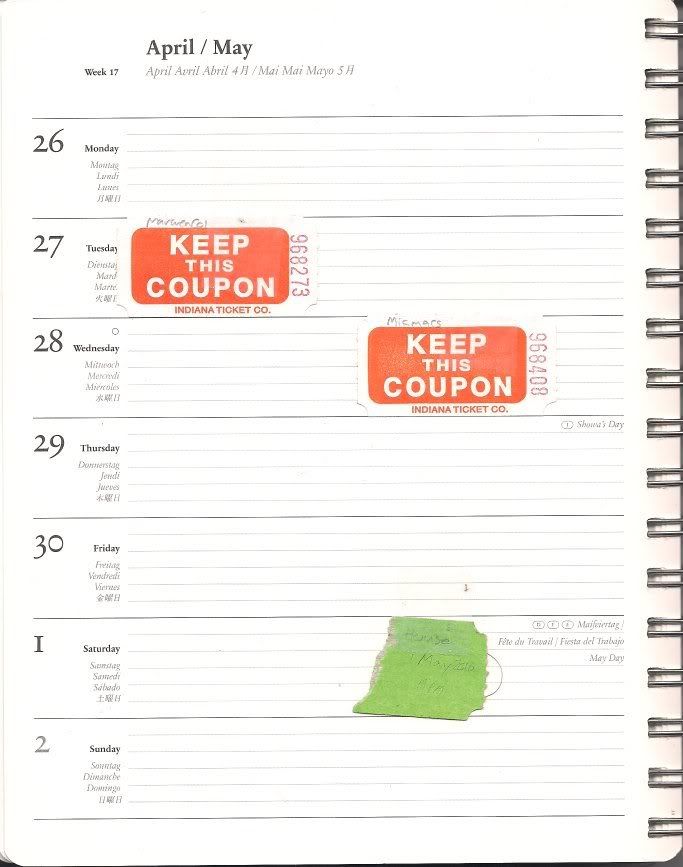
Since you can see both tickets up there, I didn't win anything in the raffles IFFBoston had for Marwencol and Micmacs attendees. Which is probably right - the guy with a press pass shouldn't be winning something.
The nice weather over the weekend got me lazy about writing reviews, although getting through Saturday takes some doing. Here's the updated IFFBoston 2010 index:
21 April 2010: The Extra Man
22 April 2010: Taqwacore: The Birth of Punk Islam, Cracks
23 April 2010: Winter's Bone, Down Terrace, Machotaildrop
24 April 2010: Pelada, War Don Don, The Freebie, I Am Love, The Good, The Bad, the Weird
25 April 2010: The Parking Lot Movie, NY Export: Opus Jazz, Hipsters, The Killer Inside Me
26 April 2010: Tiny Furniture, Shorts 3: Animation
27 April 2010: Marwencol, Jean-Michel Basquiat: The Radiant Child
28 April 2010: Micmacs
House (Hausu)
* * * ½ (out of four)
Seen 1 May 2010 at the Brattle Theatre (Special Engagement)
The only other movie I saw last week was House (or Hausu), which I had seen a hear ago at BUFF '09, though only in digital projection. As you might expect, it looks really good in 35mm, and I suspect that Criterion or some related label will be putting it out on DVD and Blu-ray later this year, once these bookings die down a bit - for a movie released thirty-odd years ago, it's having a nice second life, first playing on the festival circuit in 2009 (it was at BUFF, NYAFF, and Fantasia last year, and that's just where it intersected my path), then having solid midnight bookings. In fact, I suspect that the only reason it had to wait until last weekend to play the Brattle was that it took nearly that long to pry the print out of New York City's IFC Center.
However, I suspect that when it does finally come out on video, I may wind up giving it a pass. Not because I don't love it - I do, in all its insanity - but because it's the sort of movie that needs an audience. At BUFF, the room was nearly full, and we fed off each other; for the 11pm show I saw, it wasn't crowded, and that didn't work quite as well. It's as though a certain percentage of the seats need to be filled for a cult movie to attain critical mass, and that screening fell just short of it.
Then again, in my living room, having a couple friends who have never seen it over would probably do it.
* Summer movie season kicks off Friday with Iron Man 2, which not only opens on a bazillion screens, but actually opens the long-awaited "Imax" screen at AMC Boston Common. It's not a real IMAX screen, but one of the digital screens that is branded such, and as yet, I'm not sure what the premium they'll be charging for Imax-branded shows will be. The movie is also opening in an IMAX blow-up at the furniture stores for a couple of weeks.
I saw a 35mm preview on Tuesday (minus the super-secret trailer); expect a review later today. It's a fun movie, not quite as great or surprising as the first, but still a nice way to kick off the summer. And, just as with the first, stay through the end credits; Marvel continues to expand their movie universe, and by gum, it actually got me excited about a character that never really interested me in the comics.
* The Boston LGBT Film Festival kicks off tonight (6 May 2010) at the Museum of Fine Arts, adds The Brattle as a venue tomorrow, and takes up residence at both venues for the next week and a half.
* The Coolidge moves The Square and The Secret in Their Eyes to digital screening rooms and opens Please Give and Babies on the larger screens. They will also be showing up on other screens around town.
* Late night: The Human Centipede (First Sequence) plays Friday and Saturday at the Coolidge. I think I can go without. The Brattle has digital presentations of House, and if you haven't seen it... Well, do so.
* The Harvard Film Archive has a series called The Poetic Realism and Casual Expressionism of Victor Gaviria; Mr. Gavaria will be on hand to introduce and take questions.
* The one-week wonder at Kendall square is The Exploding Girl; they're holding over The Good, the Bad, the Weird.

Since you can see both tickets up there, I didn't win anything in the raffles IFFBoston had for Marwencol and Micmacs attendees. Which is probably right - the guy with a press pass shouldn't be winning something.
The nice weather over the weekend got me lazy about writing reviews, although getting through Saturday takes some doing. Here's the updated IFFBoston 2010 index:
21 April 2010: The Extra Man
22 April 2010: Taqwacore: The Birth of Punk Islam, Cracks
23 April 2010: Winter's Bone, Down Terrace, Machotaildrop
24 April 2010: Pelada, War Don Don, The Freebie, I Am Love, The Good, The Bad, the Weird
25 April 2010: The Parking Lot Movie, NY Export: Opus Jazz, Hipsters, The Killer Inside Me
26 April 2010: Tiny Furniture, Shorts 3: Animation
27 April 2010: Marwencol, Jean-Michel Basquiat: The Radiant Child
28 April 2010: Micmacs
House (Hausu)
* * * ½ (out of four)
Seen 1 May 2010 at the Brattle Theatre (Special Engagement)
The only other movie I saw last week was House (or Hausu), which I had seen a hear ago at BUFF '09, though only in digital projection. As you might expect, it looks really good in 35mm, and I suspect that Criterion or some related label will be putting it out on DVD and Blu-ray later this year, once these bookings die down a bit - for a movie released thirty-odd years ago, it's having a nice second life, first playing on the festival circuit in 2009 (it was at BUFF, NYAFF, and Fantasia last year, and that's just where it intersected my path), then having solid midnight bookings. In fact, I suspect that the only reason it had to wait until last weekend to play the Brattle was that it took nearly that long to pry the print out of New York City's IFC Center.
However, I suspect that when it does finally come out on video, I may wind up giving it a pass. Not because I don't love it - I do, in all its insanity - but because it's the sort of movie that needs an audience. At BUFF, the room was nearly full, and we fed off each other; for the 11pm show I saw, it wasn't crowded, and that didn't work quite as well. It's as though a certain percentage of the seats need to be filled for a cult movie to attain critical mass, and that screening fell just short of it.
Then again, in my living room, having a couple friends who have never seen it over would probably do it.
Wednesday, May 05, 2010
IFFB 2010 Day Four: Pelada, War Don Don, The Freebie, I Am Love, and The Good, The Bad, The Weird
Graphing the number of films one does/can see at a film festival generally reveals Saturday as the most potentially exhausting day; you can start early and end well after midnight. Everyone I talked to who was maxing out a pass saw five movies on the 24th, but a brief look at the festival's schedule indicates that six may have been possible: Start the day in Somerville, but after War Don Don, do Putty Hill instead of The Freebie, then head to the Brattle for Dirty Pictures and Philip the Fossil. It's a much riskier plan, one that sort of depends on the T being prompt and Dirty Pictures maybe starting a bit late, but it gets you away from The Freebie and I Am Love, although for all I know, Saturday afternoon/evening was going to be a disappointment no matter what.
The Freebie wasn't actually bad; for a lot of its time it's actually pretty good. For most of the movie, the central premise being kind of dumb doesn't really bother me, but I suspect that I'm immune to the screenwriting technique of "hanging a lantern on it" - having the characters acknowledge something is unlikely or unexplained doesn't make me excuse its improbability, it just makes the shortcoming fester. So when Annie's sister tells her that trying to add spice to her marriage by taking a night to sleep with other people is a bad idea, it simply becomes impossible to think anything other than "come on, you know this is foolish" for the rest of the movie.
Director/star Katie Aselton was there for a Q&A afterward, and she once again proved that, should I ever be involved in making a movie that goes on the festival circuit, I should be kept far away from any microphones. I, myself, would be unable to keep from yelling "of course the end is meant to be ambiguous, and, no, I'm not going to clarify anything or offer any hints, because if I wanted you to know, I'd have made it definitive in the film!" Fortunately, Ms. Aselton is far nicer than me.
I Am Love, though, was just miserable. It was co-presented by Chlotrudis, so the host pointed us out while thanking sponsors and such, meaning that everybody in the audience knew who was to to blame. To them, I just want to say: I was not consulted. I started wanting out in the middle of the interminable arty sex scene with cutaways to insects and flowers, and actually muttered "you've got to be ----ing kidding me" when the climactic moment turned out to be a main character slipping and banging his head. Sadly, I was surrounded, and escape was impossible.
My immediate response was that I had to get to the Brattle to see The Good, the Bad, the Weird right away, because after I Am Love I had a tremendous need to see some shit blow up. Kim Ji-woon did not disappoint, and I highly recommend anybody in the Boston area reading this within a week of it being posted get themselves down to Kendall Square and enjoy this "kimchee western", because it is almost pure fun.
The only minor disappointment I have from seeing that is that seeing it involved skipping Drones and Cell 211 at the Somerville, which do not have scheduled openings in the Boston area. It comes down to a matter of how I've got no problem walking home from the Brattle at 1:30am, but getting home from the Somerville Theatre involves a much longer late-night walk or a cab, and that just wasn't happening.
Pelada
* * * (out of four)
Seen 24 April 2010 at the Somerville Theater #5 (Independent Film Festival of Boston)
"Pelada" means "naked" in Portuguese, but this is not that kind of movie. Instead, the title refers to a slang term for pick-up soccer, fitting because when played that way, it's often the game stripped down to its essentials: Kicking a ball around whatever open space is available, improvising goal markers. Because of the game's fervent and worldwide popularity, there are peladas going on all the time - and the filmmakers were looking to get into as many of them as they could.
(Yes, I'll be using "soccer" despite the fact that the game is called "football", "futbol", or some variation wherever they go. I'm American, and so are they. Laugh at us now, everyone else, and get it over with.)
As the film opens, Luke Boughen and Gwendolyn Oxenham are self-described has-beens despite only being in their mid-twenties. They were star athletes in college, but injuries and the end of the WUSA kept the pros from calling their names. Gwendolyn is pursuing writing and Luke is hanging billboards while contemplating law school, until discussions with filmmaker friends hatch the idea of a world tour, seeing how soccer is played by people around the world. The project comes together, and they're off, first heading to South America, then Europe, Africa, East Asia, and finally Iran.
This is an awesome thing to do, and the only people who don't wish that they'd done something like it when they were younger are the ones who were who actually did or don't have very much "when they were younger" to look back on. They've done their research, so they know about some games that they can't miss, such as a regular Sunday afternoon game in Rio played mainly by folks old enough to be their fathers. Other times, though, they'll be caught by surprise, such as when they find a bunch of folks capable of some fancy footwork in Shanghai (China does not have a very distinguished history in the international game).
Full review at EFC.
War Don Don
* * * ¼ (out of four)
Seen 24 April 2010 at the Somerville Theater #2 (Independent Film Festival of Boston)
"War Don Don" was what they shouted about ten years ago in Sierra Leone to announce that a vicious civil war (one barely reported abroad) was over. The end of a war, however, is seldom accompanied by an outpouring of magnanimity by the victors. Someone is going to pay for all the blood spilled, and whether that blame and punishment is meted out fairly is very difficult to determine, even when a great deal of effort is being made to do it right.
In Sierra Leone's case, the first person in line was Issa Sesay, a battlefield commander of the Revolutionary United Front. The RUF waged a bloody campaign against the government for roughly a decade, and their list of crimes is all-too-familiar for those familiar with recent African history: rape, murder, use of child soldiers, cutting off the limbs of civilians. The RUF's primary leader was Foday Sankoh; Sesay's brief command was marked by surrendering and dismantling the group. Since Sankoh died in prison, Sesay was the highest-ranked RUF leader to be tried for war crimes in the new courthouse built in the capital of Freetown at great expense.
Chief Prosecutor David Crane describes Sesay by recounting how he looked into the accused's eyes and saw a man with no soul; his defense attorney Wayne Jordash finds him personable and intelligent. But Rebecca Richman Cohen's documentary is only tangentially about Issa Sesay; it is, rather, about the process of prosecuting war crimes. It is, according to the defense, an unfair process, concerned more with politics than actual guilt and innocence: The (primarily) American and British donors who spent hundreds of millions of dollars on building the court did not do so to see acquittals, and it is very much in the country's interest to project stability by convicting the leadership. The prosecution also has much more funding, and can take extraordinary measures to protect its witnesses' anonymity.
Full review at EFC.
The Freebie
* * ¾ (out of four)
Seen 24 April 2010 at the Somerville Theater #3 (Independent Film Festival of Boston)
The Freebie is one of those DIY-style movies (it's too well-spoken and clean-looking to be referred to as "mumblecore") where no writing credits appears; the cast is working from producer/director/star Katie Aselton's outline. Everyone's got their own process, I guess, but a screenplay might have avoided the awkward situation where an improvised scene has a supporting character saying "this is a stupid idea" and the film having no actual response for that.
The stupid idea in question is married couple Annie (Aselton) and Darren (Dax Shepard) deciding to give each other one night to go out and have sex with another man/woman. They are, you see, generally happy, love spending time together, and still find each other attractive; they just haven't made love in months. This, they figure, will put some spark and excitement back into their marriage.
It is obviously a stupid idea. The ways in which it can go wrong are numerous and immediately obvious to anyone with half a brain, and even if you buy that these characters have to do something to spice things up, one would think that they'd try things that involve them actually sleeping with each other first. But, no, the outline apparently runs (1) awkward dinner conversation (2) talk about having one night with other people (3) the big night (4) afterward, and the parts of the story that would really tie things together were never really puzzled out.
Full review at EFC.
Io sono l'amore (I Am Love)
* * (out of four)
Seen 24 April 2010 at the Somerville Theater #3 (Independent Film Festival of Boston)
Star ratings are an arguably necessary evil, but should be the last thing on a critic's mind as he or she writes a review, let alone watching a film. So I'm not just chagrined, but kind of ashamed, that while I was watching I Am Love, I was thinking something like "four... three... two (three... two and a half... two)... and only because it looks so nice." Still, being aware of a film becoming a crushing disappointment isn't nearly as bad as actually being a crushing disappointment.
It starts off well enough. Emma Recchi (Tilda Swinton) is overseeing a Milano dinner party being held in honor of her father-in-law. There is much preparation downstairs in the servant's quarters, and some upstairs, as Emma's husband Tancredi (Pippo Delbono) teases their son Edoardo (Flavio Parenti) about losing some sort of athletic competition to a chef. The chef, Antonio (Edoardo Gabbriellini) stops by later, making an impression on Edo - who wants to open a restaurant with him - and Emma, who is emboldened when she learns that her daughter Elisabetta (Alba Rohrwacher) is finding herself attracted to women... Especially since Tancredi and Edo find themselves busy after their grandfather steps down from the family business.
I Am Love starts out strong, with luxuriously extended and stylized opening credits that evoke a different era, right down to how the serifed "MILANO" fills the entire screen. There's a beautiful contrast between the busy preparation of the servants and the regal, almost decadent leisure of the wealthy hosts and guests - so wealthy that Edo's new girlfriend, Eva (Diane Fleri) is looked upon with some disapproval because her family is merely rich. There's a certain fascination in seeing how these two worlds interface, with Emma managing the household staff and trusted, longtime maid Ida (Maria Paiato) serving as a confidante for the entire Recchi family.
Full review at EFC.
Joheunnom nabbeunnom isanghannom (The Good, The Bad, The Weird)
* * * ¾ (out of four)
Seen 24 April 2010 at the Brattle Theater (Independent Film Festival of Boston: IFFBoston After Dark)
A few years ago, I saw a movie called A Bittersweet Life at Fantasia and loved it, saying it was the sort of action movie John Woo and Chow Yun-fat used to make before they came to Hollywood and got all neutered - and that was without realizing that it was from the same filmmaker who made the excellent A Tale of Two Sisters, Kim Ji-woon. It didn't even show up on US home video, but I figured that maybe that would be rectified when his big-budget, smash-hit follow-up, The Good, the Bad, and the Weird, got its theatrical and Blu-ray release. I was offered a screener in September '08, but said, no, let someone else have it, I'll see it when it hits the big screen in a few months.
Then MGM's lawyers got involved, saying it was too obvious an homage to The Good, the Bad, and the Ugly.
Still, the story has a happy ending: A year and a half, a dropped conjunction, and who knows what other concessions later, Kim's "kimchee western" is finally hitting U.S. theaters, and it is well worth the wait.
The story starts off sounding complicated, but it's really not. It's the 1930s, and a Chinese bank has promised to turn a map to Manchuria's greatest treasure over to the occupying Japanese forces. Of course, the bank is run by weasels, so they hire a nasty Korean bandit, Park Chan-yi (Lee Buyng-hun), to rob the train transporting it and steal it back. What they don't figure on is another bandit, the eccentric Yoon Tae-goo (Song Kang-ho), robbing the same train. Though, to be fair, they should have expected bounty hunter Park Do-won (Jung Woo-sung), who has pursued Chan-yi all the way from Korea, to interrupt. Now, there's treasure to be found, uneasy alliances to be made and broken, and a whole lot of bullets to be shot.
And good lord, is there a lot of amazing action along the way. Let's start with the train robbery. Some filmmakers will quietly give us the lay of the land before launching into the action; others will present us with a disjointed mess. Kim Ji-Woon frog-walks us through the train, jumping right into the action while giving us just enough time to know what's where. Then things start happening at a frantic pace; you've got two bandits, a bounty hunter, the folks transporting the map, and a Mongol horde in, on top of, and around the train, which is moving, then not, then moving again. Things are happening fast, but the action is always clear. That's no small feat, considering just how much Kim is throwing at us.
Full review at EFC.
The Freebie wasn't actually bad; for a lot of its time it's actually pretty good. For most of the movie, the central premise being kind of dumb doesn't really bother me, but I suspect that I'm immune to the screenwriting technique of "hanging a lantern on it" - having the characters acknowledge something is unlikely or unexplained doesn't make me excuse its improbability, it just makes the shortcoming fester. So when Annie's sister tells her that trying to add spice to her marriage by taking a night to sleep with other people is a bad idea, it simply becomes impossible to think anything other than "come on, you know this is foolish" for the rest of the movie.
Director/star Katie Aselton was there for a Q&A afterward, and she once again proved that, should I ever be involved in making a movie that goes on the festival circuit, I should be kept far away from any microphones. I, myself, would be unable to keep from yelling "of course the end is meant to be ambiguous, and, no, I'm not going to clarify anything or offer any hints, because if I wanted you to know, I'd have made it definitive in the film!" Fortunately, Ms. Aselton is far nicer than me.
I Am Love, though, was just miserable. It was co-presented by Chlotrudis, so the host pointed us out while thanking sponsors and such, meaning that everybody in the audience knew who was to to blame. To them, I just want to say: I was not consulted. I started wanting out in the middle of the interminable arty sex scene with cutaways to insects and flowers, and actually muttered "you've got to be ----ing kidding me" when the climactic moment turned out to be a main character slipping and banging his head. Sadly, I was surrounded, and escape was impossible.
My immediate response was that I had to get to the Brattle to see The Good, the Bad, the Weird right away, because after I Am Love I had a tremendous need to see some shit blow up. Kim Ji-woon did not disappoint, and I highly recommend anybody in the Boston area reading this within a week of it being posted get themselves down to Kendall Square and enjoy this "kimchee western", because it is almost pure fun.
The only minor disappointment I have from seeing that is that seeing it involved skipping Drones and Cell 211 at the Somerville, which do not have scheduled openings in the Boston area. It comes down to a matter of how I've got no problem walking home from the Brattle at 1:30am, but getting home from the Somerville Theatre involves a much longer late-night walk or a cab, and that just wasn't happening.
Pelada
* * * (out of four)
Seen 24 April 2010 at the Somerville Theater #5 (Independent Film Festival of Boston)
"Pelada" means "naked" in Portuguese, but this is not that kind of movie. Instead, the title refers to a slang term for pick-up soccer, fitting because when played that way, it's often the game stripped down to its essentials: Kicking a ball around whatever open space is available, improvising goal markers. Because of the game's fervent and worldwide popularity, there are peladas going on all the time - and the filmmakers were looking to get into as many of them as they could.
(Yes, I'll be using "soccer" despite the fact that the game is called "football", "futbol", or some variation wherever they go. I'm American, and so are they. Laugh at us now, everyone else, and get it over with.)
As the film opens, Luke Boughen and Gwendolyn Oxenham are self-described has-beens despite only being in their mid-twenties. They were star athletes in college, but injuries and the end of the WUSA kept the pros from calling their names. Gwendolyn is pursuing writing and Luke is hanging billboards while contemplating law school, until discussions with filmmaker friends hatch the idea of a world tour, seeing how soccer is played by people around the world. The project comes together, and they're off, first heading to South America, then Europe, Africa, East Asia, and finally Iran.
This is an awesome thing to do, and the only people who don't wish that they'd done something like it when they were younger are the ones who were who actually did or don't have very much "when they were younger" to look back on. They've done their research, so they know about some games that they can't miss, such as a regular Sunday afternoon game in Rio played mainly by folks old enough to be their fathers. Other times, though, they'll be caught by surprise, such as when they find a bunch of folks capable of some fancy footwork in Shanghai (China does not have a very distinguished history in the international game).
Full review at EFC.
War Don Don
* * * ¼ (out of four)
Seen 24 April 2010 at the Somerville Theater #2 (Independent Film Festival of Boston)
"War Don Don" was what they shouted about ten years ago in Sierra Leone to announce that a vicious civil war (one barely reported abroad) was over. The end of a war, however, is seldom accompanied by an outpouring of magnanimity by the victors. Someone is going to pay for all the blood spilled, and whether that blame and punishment is meted out fairly is very difficult to determine, even when a great deal of effort is being made to do it right.
In Sierra Leone's case, the first person in line was Issa Sesay, a battlefield commander of the Revolutionary United Front. The RUF waged a bloody campaign against the government for roughly a decade, and their list of crimes is all-too-familiar for those familiar with recent African history: rape, murder, use of child soldiers, cutting off the limbs of civilians. The RUF's primary leader was Foday Sankoh; Sesay's brief command was marked by surrendering and dismantling the group. Since Sankoh died in prison, Sesay was the highest-ranked RUF leader to be tried for war crimes in the new courthouse built in the capital of Freetown at great expense.
Chief Prosecutor David Crane describes Sesay by recounting how he looked into the accused's eyes and saw a man with no soul; his defense attorney Wayne Jordash finds him personable and intelligent. But Rebecca Richman Cohen's documentary is only tangentially about Issa Sesay; it is, rather, about the process of prosecuting war crimes. It is, according to the defense, an unfair process, concerned more with politics than actual guilt and innocence: The (primarily) American and British donors who spent hundreds of millions of dollars on building the court did not do so to see acquittals, and it is very much in the country's interest to project stability by convicting the leadership. The prosecution also has much more funding, and can take extraordinary measures to protect its witnesses' anonymity.
Full review at EFC.
The Freebie
* * ¾ (out of four)
Seen 24 April 2010 at the Somerville Theater #3 (Independent Film Festival of Boston)
The Freebie is one of those DIY-style movies (it's too well-spoken and clean-looking to be referred to as "mumblecore") where no writing credits appears; the cast is working from producer/director/star Katie Aselton's outline. Everyone's got their own process, I guess, but a screenplay might have avoided the awkward situation where an improvised scene has a supporting character saying "this is a stupid idea" and the film having no actual response for that.
The stupid idea in question is married couple Annie (Aselton) and Darren (Dax Shepard) deciding to give each other one night to go out and have sex with another man/woman. They are, you see, generally happy, love spending time together, and still find each other attractive; they just haven't made love in months. This, they figure, will put some spark and excitement back into their marriage.
It is obviously a stupid idea. The ways in which it can go wrong are numerous and immediately obvious to anyone with half a brain, and even if you buy that these characters have to do something to spice things up, one would think that they'd try things that involve them actually sleeping with each other first. But, no, the outline apparently runs (1) awkward dinner conversation (2) talk about having one night with other people (3) the big night (4) afterward, and the parts of the story that would really tie things together were never really puzzled out.
Full review at EFC.
Io sono l'amore (I Am Love)
* * (out of four)
Seen 24 April 2010 at the Somerville Theater #3 (Independent Film Festival of Boston)
Star ratings are an arguably necessary evil, but should be the last thing on a critic's mind as he or she writes a review, let alone watching a film. So I'm not just chagrined, but kind of ashamed, that while I was watching I Am Love, I was thinking something like "four... three... two (three... two and a half... two)... and only because it looks so nice." Still, being aware of a film becoming a crushing disappointment isn't nearly as bad as actually being a crushing disappointment.
It starts off well enough. Emma Recchi (Tilda Swinton) is overseeing a Milano dinner party being held in honor of her father-in-law. There is much preparation downstairs in the servant's quarters, and some upstairs, as Emma's husband Tancredi (Pippo Delbono) teases their son Edoardo (Flavio Parenti) about losing some sort of athletic competition to a chef. The chef, Antonio (Edoardo Gabbriellini) stops by later, making an impression on Edo - who wants to open a restaurant with him - and Emma, who is emboldened when she learns that her daughter Elisabetta (Alba Rohrwacher) is finding herself attracted to women... Especially since Tancredi and Edo find themselves busy after their grandfather steps down from the family business.
I Am Love starts out strong, with luxuriously extended and stylized opening credits that evoke a different era, right down to how the serifed "MILANO" fills the entire screen. There's a beautiful contrast between the busy preparation of the servants and the regal, almost decadent leisure of the wealthy hosts and guests - so wealthy that Edo's new girlfriend, Eva (Diane Fleri) is looked upon with some disapproval because her family is merely rich. There's a certain fascination in seeing how these two worlds interface, with Emma managing the household staff and trusted, longtime maid Ida (Maria Paiato) serving as a confidante for the entire Recchi family.
Full review at EFC.
Joheunnom nabbeunnom isanghannom (The Good, The Bad, The Weird)
* * * ¾ (out of four)
Seen 24 April 2010 at the Brattle Theater (Independent Film Festival of Boston: IFFBoston After Dark)
A few years ago, I saw a movie called A Bittersweet Life at Fantasia and loved it, saying it was the sort of action movie John Woo and Chow Yun-fat used to make before they came to Hollywood and got all neutered - and that was without realizing that it was from the same filmmaker who made the excellent A Tale of Two Sisters, Kim Ji-woon. It didn't even show up on US home video, but I figured that maybe that would be rectified when his big-budget, smash-hit follow-up, The Good, the Bad, and the Weird, got its theatrical and Blu-ray release. I was offered a screener in September '08, but said, no, let someone else have it, I'll see it when it hits the big screen in a few months.
Then MGM's lawyers got involved, saying it was too obvious an homage to The Good, the Bad, and the Ugly.
Still, the story has a happy ending: A year and a half, a dropped conjunction, and who knows what other concessions later, Kim's "kimchee western" is finally hitting U.S. theaters, and it is well worth the wait.
The story starts off sounding complicated, but it's really not. It's the 1930s, and a Chinese bank has promised to turn a map to Manchuria's greatest treasure over to the occupying Japanese forces. Of course, the bank is run by weasels, so they hire a nasty Korean bandit, Park Chan-yi (Lee Buyng-hun), to rob the train transporting it and steal it back. What they don't figure on is another bandit, the eccentric Yoon Tae-goo (Song Kang-ho), robbing the same train. Though, to be fair, they should have expected bounty hunter Park Do-won (Jung Woo-sung), who has pursued Chan-yi all the way from Korea, to interrupt. Now, there's treasure to be found, uneasy alliances to be made and broken, and a whole lot of bullets to be shot.
And good lord, is there a lot of amazing action along the way. Let's start with the train robbery. Some filmmakers will quietly give us the lay of the land before launching into the action; others will present us with a disjointed mess. Kim Ji-Woon frog-walks us through the train, jumping right into the action while giving us just enough time to know what's where. Then things start happening at a frantic pace; you've got two bandits, a bounty hunter, the folks transporting the map, and a Mongol horde in, on top of, and around the train, which is moving, then not, then moving again. Things are happening fast, but the action is always clear. That's no small feat, considering just how much Kim is throwing at us.
Full review at EFC.
Wednesday, April 28, 2010
This Week In Tickets: 19 April 2010 to 25 April 2010
Well, with the festival done and reviews trickling in, it's time to take a break from moviegoing, right? Wrong! Indeed, the weekend's two must-sees from the other side of the Pacific are getting second viewings because of how awesome they were at various festivals; I recommend them both highly.
* Hausu is properly named House - it's even in English on the prints - but we wouldn't want to confuse it with a sequel-spawing 1980s American haunted house movie, would we? No! For this is an absolutely insane bit of trippiness from Japan, which I saw on video at last year's BUFF, and loved. It's beautiful, and beautifully insane. It's running for a measly three days at the Brattle (Friday 30 April 2010, Saturday 1 May 2010, and Monday 3 May 2010, no shows on Sunday), and they will sell out. Midnights were selling the IFC Center in New York out for months after what was expected to be a two-week run, so see it in beautiful 35mm while you can, and hope that the Brattle or Coolidge bring it back for midnights later.
* The Good, The Bad, The Weird has been held in distribution limbo because of MGM complaining about the title, although IFC dropping a single conjunction seems to have done it. I saw it at the Brattle on Saturday night as part of "IFFBoston After Dark", and it is awesome. The opening train robbery is a funny, action-packed set piece that is best in class, there is near-constant action throughout, and the final chase scene could easily have been lifted out of an Indiana Jones movie, just in terms of it being one crazy thing on top of another. The thing is just a giddy delight of an action movie. It's the one-week wonder at Landmark Kendall Square, but hopefully it will stick around for a while longer once people see it and get the word out that it's a blast.
(Those are what pass for marching orders around here, people!)
* Also opening at Kendall Square are The Cartel and The Girl on the Train. The former is a documentary on the troubles with the American educational system which apparently places the blame squarely on teacher's unions, which I'm sure will play extremely well in the People's Republic of Cambridge. The latter caught my eye for featuring Emilie Duquennes, who was one of the many things I absolutely loved about Brotherhood of the Wolf and whose appearances on American screens have been rare to nonexistent since.
* Leaving the Kendall but heading to the Coolidge is The Square, which to my mild surprise will be mostly playing on film in the larger theaters (though there will be some showings off Blu-ray; make sure before you go). Also opening there are BUFF's It Came from Kuchar and foreign-language Oscar-winner The Secret in Their Eyes. Still, I think it's clear that the most important thing going on there this weekend is Tremors on the big screen at midnight.
* The Harvard Film Archive is closed Friday and Saturday night, but offers more John Ford on Sunday and Monday. The MFA has Mississippi Mermaid, The Headless Woman, and October Country
* Major openings are Furry Vengeance and the remake of A Nightmare on Elm Street, so it's a great time to catch up on the major releases missed during the festival.
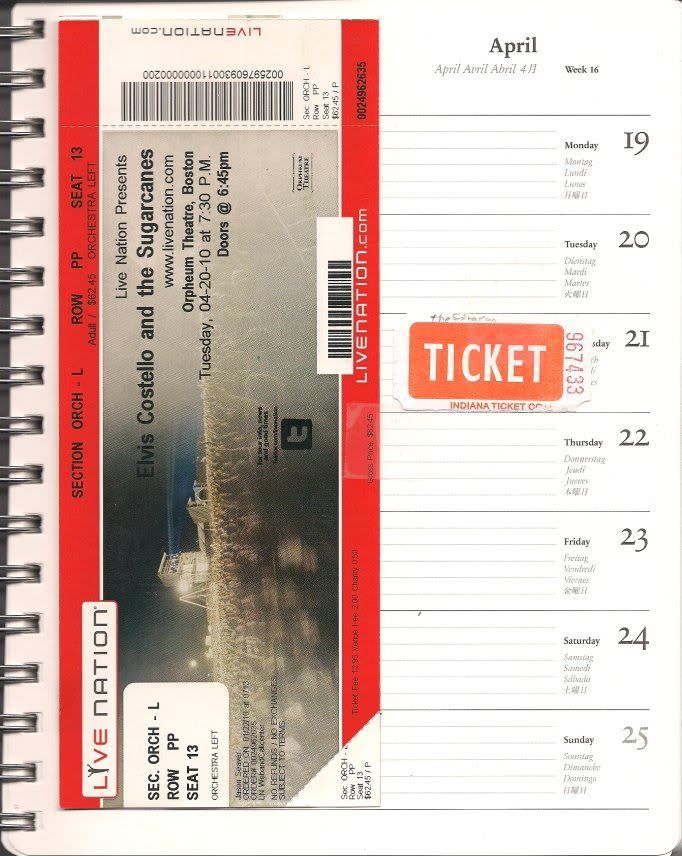
For that price, that had better be a pretty nice seat at the Elvis Costello concert, and it was. I presume this tour - of which Boston was apparently the first show - is in support of a new album with this Sugarcanes band, which I haven't yet picked up. It was a pretty fun time, and a mostly acoustic set, and a good demonstration of one of the reasons I like Elvis: His catalog is large and varied enough that there are only a few specific songs that you have to expect no matter what. This tour is obviously going to be slanted toward country/roots/folk stuff, and he's got enough of that that there's no need to force it on songs where it doesn't work.
Anyway, here's a rundown of the festival stuff for the week, with links to what's already been reviewed. It's going to take some time to get through this, I can see.
21 April 2010: The Extra Man
22 April 2010: Taqwacore: The Birth of Punk Islam, Cracks
23 April 2010: Winter's Bone, Down Terrace, Machotaildrop
24 April 2010: Pelada, War Don Don, The Freebie, I Am Love, The Good, The Bad, the Weird
25 April 2010: The Parking Lot Movie, NY Export: Opus Jazz, Hipsters, The Killer Inside Me
26 April 2010: Tiny Furniture, Shorts 3: Animation
27 April 2010: Marwencol, Jean-Michel Basquiat: The Radiant Child
28 April 2010: Micmacs
* Hausu is properly named House - it's even in English on the prints - but we wouldn't want to confuse it with a sequel-spawing 1980s American haunted house movie, would we? No! For this is an absolutely insane bit of trippiness from Japan, which I saw on video at last year's BUFF, and loved. It's beautiful, and beautifully insane. It's running for a measly three days at the Brattle (Friday 30 April 2010, Saturday 1 May 2010, and Monday 3 May 2010, no shows on Sunday), and they will sell out. Midnights were selling the IFC Center in New York out for months after what was expected to be a two-week run, so see it in beautiful 35mm while you can, and hope that the Brattle or Coolidge bring it back for midnights later.
* The Good, The Bad, The Weird has been held in distribution limbo because of MGM complaining about the title, although IFC dropping a single conjunction seems to have done it. I saw it at the Brattle on Saturday night as part of "IFFBoston After Dark", and it is awesome. The opening train robbery is a funny, action-packed set piece that is best in class, there is near-constant action throughout, and the final chase scene could easily have been lifted out of an Indiana Jones movie, just in terms of it being one crazy thing on top of another. The thing is just a giddy delight of an action movie. It's the one-week wonder at Landmark Kendall Square, but hopefully it will stick around for a while longer once people see it and get the word out that it's a blast.
(Those are what pass for marching orders around here, people!)
* Also opening at Kendall Square are The Cartel and The Girl on the Train. The former is a documentary on the troubles with the American educational system which apparently places the blame squarely on teacher's unions, which I'm sure will play extremely well in the People's Republic of Cambridge. The latter caught my eye for featuring Emilie Duquennes, who was one of the many things I absolutely loved about Brotherhood of the Wolf and whose appearances on American screens have been rare to nonexistent since.
* Leaving the Kendall but heading to the Coolidge is The Square, which to my mild surprise will be mostly playing on film in the larger theaters (though there will be some showings off Blu-ray; make sure before you go). Also opening there are BUFF's It Came from Kuchar and foreign-language Oscar-winner The Secret in Their Eyes. Still, I think it's clear that the most important thing going on there this weekend is Tremors on the big screen at midnight.
* The Harvard Film Archive is closed Friday and Saturday night, but offers more John Ford on Sunday and Monday. The MFA has Mississippi Mermaid, The Headless Woman, and October Country
* Major openings are Furry Vengeance and the remake of A Nightmare on Elm Street, so it's a great time to catch up on the major releases missed during the festival.

For that price, that had better be a pretty nice seat at the Elvis Costello concert, and it was. I presume this tour - of which Boston was apparently the first show - is in support of a new album with this Sugarcanes band, which I haven't yet picked up. It was a pretty fun time, and a mostly acoustic set, and a good demonstration of one of the reasons I like Elvis: His catalog is large and varied enough that there are only a few specific songs that you have to expect no matter what. This tour is obviously going to be slanted toward country/roots/folk stuff, and he's got enough of that that there's no need to force it on songs where it doesn't work.
Anyway, here's a rundown of the festival stuff for the week, with links to what's already been reviewed. It's going to take some time to get through this, I can see.
21 April 2010: The Extra Man
22 April 2010: Taqwacore: The Birth of Punk Islam, Cracks
23 April 2010: Winter's Bone, Down Terrace, Machotaildrop
24 April 2010: Pelada, War Don Don, The Freebie, I Am Love, The Good, The Bad, the Weird
25 April 2010: The Parking Lot Movie, NY Export: Opus Jazz, Hipsters, The Killer Inside Me
26 April 2010: Tiny Furniture, Shorts 3: Animation
27 April 2010: Marwencol, Jean-Michel Basquiat: The Radiant Child
28 April 2010: Micmacs
IFFB 2010 Night Three: Winter's Bone, Down Terrace, and Machotaildrop
An amusing note: I made my screening plans for Friday night with the idea of grabbing two shows at the Somerville that were on the same screen, operating on the premise that there was no chance of one running too late to get to the other. However, demand for tickets to Winter's Bone was high enough that it got moved to the Somerville Theatre's large main room, while Joan Rivers: A Piece of Work got moved to the not tiny but not expansive screen #5, where I would later be seeing Down Terrace. Now, I wasn't going to switch movies, because keeping a schedule wasn't the primary reason I chose them, but I did find it amusing. And kind of reassuring, actually - it's good to see that at an independent film festival, there is much more demand to see a drama starring unknown actors than a documentary on someone who is famous for being famous (these days, at least; she became famous by being very funny, but that was literally decades ago).
Anyway, a picture of director Debra Granik and co-star John Hawkes can be found on my Facebook page, and from experience, I can say it looks much better than it would have if they were in theater #5.
After that, came Winter's Bone, where the end of the work week started to catch up with me, and I found myself jolted out of a micro-nap by someone getting run down by a car. Fear not, I literally only missed seconds, but they were just enough that I didn't see who it was, and I spent the rest of the movie trying to figure out which character was missing before deciding that it must have just been someone who was just in that scene, which kind of makes it funnier. I think I'm still able to review it fairly.
Then it was back to the Brattle for the late movie, Machotaildrop, and I kind of hope to get letters about my review saying that I don't know what I was talking about and the skateboarding was awesome. Because, quite honestly, I don't know what I'm talking about in regard to skateboarding; I just know that I never really went "wow, that's impressive" when the kids were doing their shredding(*). Kind of a shame, because I think that a stunt show interspersed with the movie's strangeness would have been a lot of fun.
(*) I half-suspect that no actual skateboarding teen/twentysomething actually says "shredding", with it being just a term that relatively old/ignorant people like myself use when trying to sound like they know what we're talking about, only to instead have it serve as a clear indication we should be mocked.
Winter's Bone
* * * * (out of four)
Seen 23 April 2010 at the Somerville Theater #1 (Independent Film Festival of Boston)
The music on the soundtrack specifies Missouri, but that's not what's important; it's the mournful single female voice and barely-there accompaniment that tells us what we need to know about the setting for Winter's Bone: It's chilly, there's nothing fancy to be found, but there's love and loyalty there too.
Maybe not right on the surface; getting mushy is a luxury that 17-year-old Ree Dolly (Jennifer Lawrence) doesn't have. Her brother Sonny (Isaiah Stone) and sister Ashlee (Ashlee Thompson) need looking after, and their mother is practically catatonic. Their father is missing, and even though he's a no-account meth cooker, his absence a big problem: He's out of jail on bond, the family home will be forfeit if he doesn't make his court date, and nobody knows where he is. Ree's got to find him, even though everyone - neighbor Sonya (Shelley Waggener), best friend Gail (Lauren Sweetser), and uncle Teardrop (John Hawkes) - advises her to mind her own business.
The Ozarks are an unusual location for a film noir, and Ree isn't the typical hero, but Winter's Bone feels like something from that genre anyway, with plenty of hints given in the form of "you should leave it alone and definitely not look here", as well as a situation that exposes more and more rot the further Ree digs. For all that she's aware of the amoral, outside-the-law code her family lives by, there's an impulse other than self-preservation at work. She's got to be her own knight-errant, and there are few shadows to disappear into (instead, the roadless woods become a sort of no-man's land), but it's a classic noir story.
Full review at EFC.
Down Terrace
* * * (out of four)
Seen 23 April 2010 at the Somerville Theater #5 (Independent Film Festival of Boston)
A lot of gangster movies want you to know that they aren't just about crime, but about family. You can't miss it, they're so formal and insistent that it becomes overbearing. Down Terrace, while it has other flaws, manages to present us with a family that are also a group of criminals, and makes the situation work.
Bill (Robert Hill) sells drugs in a mid-sized English city; he's been doing so for over forty years now and doesn't appreciate that he's just had to spend a few days in court because of it. He figures it was probably Garvey (Tony Way), the manager of his club, who sold him out, so he and his son Karl (Robin Hill) are going to take care of it. The thing is, Bill is really much more interested in drugs than enforcement, and the muscle he brings in, Pringle (Michael Smiley), is distracted by his kid. Speaking of kids, Karl's ex-girlfriend Valda (Kerry Peacock) has just shown up and announced she's pregnant. Bill's wife Maggie (Julia Deakin) just wants all this drama out of her house.
There have been a ton of crime-family comedies, but I have a hard time recalling any that reflect the very ordinariness of family relationships as well as Down Terrace. Nobody lectures each other on what a family does; they just do it, for better or worse. Bill could run a brewery, and it wouldn't change the characters' relationships a great deal, other than the product they enjoy as they kick back in the evening. Every bit of the relationships between Bill, Karl, and Maggie rings true, from Karl's combination of comfort and boredom as Bill repeats a story about the old days, to how Maggie has learned through long experience what her husband needs to do but can't, to how Valda is just not going to ingratiate herself quickly at all (which naturally leads to some nasty arguments).
Full review at EFC.
Machotaildrop
* * ¾ (out of four)
Seen 23 April 2010 at the Brattle Theater (Independent Film Festival of Boston - IFFBoston After Dark)
It seems like a ridiculous thing to say, after having seen the movie, but I initially thought Machotaildrop was a documentary. Skim the description, and the bits about a company with a colorful head recruiting skateboarders looking to go pro to train together doesn't seem out of the realm of the possible, especially if one is relatively ignorant of X-Game sports. Even given how little I know about that world, though, I strongly suspect that a reality show starting from the same premise wouldn't be quite this weird.
There real world likely has teens who love skateboarding as much as Walter Rhum (Anthony Amedori), who practices non-stop so that he'll be good enough to submit a video to the Machotaildrop skateboard company; few hang out at a skateboard-themed bakery. When he finally does make the grade, he's bought to Machotaildrop's headquarters, where he meets the company's eccentric founder, The Baron (James Faulkner), and is able to live and train with other boarders on the rise, including his hero, Blair Stanley (Rick McCrank). He also meets Sophie (Vanessa Guide), a girl who works in the company's archives, and knows some of its secrets. But will that be enough when the Manwolves attack?
Well, not actual Manwolves; a gang that goes by that name which skates in an abandoned amusement park which the Baron intends to level and rebuild as the greatest skateboarding-based activity center ever. It's that kind of movie, the sort where you can replace "headquarters" in the preceding paragraph with "secret underground lair" and perhaps be a little more accurate. Co-writers and directors Corey Adams and Alex Craig have built a world full of low-budget quirk; the ubiquitous cassettes, 8-bit video games, and fashions probably place it somewhere in the late 1980s or early 1990s, although they avoid any references that could specifically date the movie. Besides, it's not the real world at all - I don't remember TV series where skateboarders would host expeditions to find lost skate parks, for instance.
Full review at EFC.
Anyway, a picture of director Debra Granik and co-star John Hawkes can be found on my Facebook page, and from experience, I can say it looks much better than it would have if they were in theater #5.
After that, came Winter's Bone, where the end of the work week started to catch up with me, and I found myself jolted out of a micro-nap by someone getting run down by a car. Fear not, I literally only missed seconds, but they were just enough that I didn't see who it was, and I spent the rest of the movie trying to figure out which character was missing before deciding that it must have just been someone who was just in that scene, which kind of makes it funnier. I think I'm still able to review it fairly.
Then it was back to the Brattle for the late movie, Machotaildrop, and I kind of hope to get letters about my review saying that I don't know what I was talking about and the skateboarding was awesome. Because, quite honestly, I don't know what I'm talking about in regard to skateboarding; I just know that I never really went "wow, that's impressive" when the kids were doing their shredding(*). Kind of a shame, because I think that a stunt show interspersed with the movie's strangeness would have been a lot of fun.
(*) I half-suspect that no actual skateboarding teen/twentysomething actually says "shredding", with it being just a term that relatively old/ignorant people like myself use when trying to sound like they know what we're talking about, only to instead have it serve as a clear indication we should be mocked.
Winter's Bone
* * * * (out of four)
Seen 23 April 2010 at the Somerville Theater #1 (Independent Film Festival of Boston)
The music on the soundtrack specifies Missouri, but that's not what's important; it's the mournful single female voice and barely-there accompaniment that tells us what we need to know about the setting for Winter's Bone: It's chilly, there's nothing fancy to be found, but there's love and loyalty there too.
Maybe not right on the surface; getting mushy is a luxury that 17-year-old Ree Dolly (Jennifer Lawrence) doesn't have. Her brother Sonny (Isaiah Stone) and sister Ashlee (Ashlee Thompson) need looking after, and their mother is practically catatonic. Their father is missing, and even though he's a no-account meth cooker, his absence a big problem: He's out of jail on bond, the family home will be forfeit if he doesn't make his court date, and nobody knows where he is. Ree's got to find him, even though everyone - neighbor Sonya (Shelley Waggener), best friend Gail (Lauren Sweetser), and uncle Teardrop (John Hawkes) - advises her to mind her own business.
The Ozarks are an unusual location for a film noir, and Ree isn't the typical hero, but Winter's Bone feels like something from that genre anyway, with plenty of hints given in the form of "you should leave it alone and definitely not look here", as well as a situation that exposes more and more rot the further Ree digs. For all that she's aware of the amoral, outside-the-law code her family lives by, there's an impulse other than self-preservation at work. She's got to be her own knight-errant, and there are few shadows to disappear into (instead, the roadless woods become a sort of no-man's land), but it's a classic noir story.
Full review at EFC.
Down Terrace
* * * (out of four)
Seen 23 April 2010 at the Somerville Theater #5 (Independent Film Festival of Boston)
A lot of gangster movies want you to know that they aren't just about crime, but about family. You can't miss it, they're so formal and insistent that it becomes overbearing. Down Terrace, while it has other flaws, manages to present us with a family that are also a group of criminals, and makes the situation work.
Bill (Robert Hill) sells drugs in a mid-sized English city; he's been doing so for over forty years now and doesn't appreciate that he's just had to spend a few days in court because of it. He figures it was probably Garvey (Tony Way), the manager of his club, who sold him out, so he and his son Karl (Robin Hill) are going to take care of it. The thing is, Bill is really much more interested in drugs than enforcement, and the muscle he brings in, Pringle (Michael Smiley), is distracted by his kid. Speaking of kids, Karl's ex-girlfriend Valda (Kerry Peacock) has just shown up and announced she's pregnant. Bill's wife Maggie (Julia Deakin) just wants all this drama out of her house.
There have been a ton of crime-family comedies, but I have a hard time recalling any that reflect the very ordinariness of family relationships as well as Down Terrace. Nobody lectures each other on what a family does; they just do it, for better or worse. Bill could run a brewery, and it wouldn't change the characters' relationships a great deal, other than the product they enjoy as they kick back in the evening. Every bit of the relationships between Bill, Karl, and Maggie rings true, from Karl's combination of comfort and boredom as Bill repeats a story about the old days, to how Maggie has learned through long experience what her husband needs to do but can't, to how Valda is just not going to ingratiate herself quickly at all (which naturally leads to some nasty arguments).
Full review at EFC.
Machotaildrop
* * ¾ (out of four)
Seen 23 April 2010 at the Brattle Theater (Independent Film Festival of Boston - IFFBoston After Dark)
It seems like a ridiculous thing to say, after having seen the movie, but I initially thought Machotaildrop was a documentary. Skim the description, and the bits about a company with a colorful head recruiting skateboarders looking to go pro to train together doesn't seem out of the realm of the possible, especially if one is relatively ignorant of X-Game sports. Even given how little I know about that world, though, I strongly suspect that a reality show starting from the same premise wouldn't be quite this weird.
There real world likely has teens who love skateboarding as much as Walter Rhum (Anthony Amedori), who practices non-stop so that he'll be good enough to submit a video to the Machotaildrop skateboard company; few hang out at a skateboard-themed bakery. When he finally does make the grade, he's bought to Machotaildrop's headquarters, where he meets the company's eccentric founder, The Baron (James Faulkner), and is able to live and train with other boarders on the rise, including his hero, Blair Stanley (Rick McCrank). He also meets Sophie (Vanessa Guide), a girl who works in the company's archives, and knows some of its secrets. But will that be enough when the Manwolves attack?
Well, not actual Manwolves; a gang that goes by that name which skates in an abandoned amusement park which the Baron intends to level and rebuild as the greatest skateboarding-based activity center ever. It's that kind of movie, the sort where you can replace "headquarters" in the preceding paragraph with "secret underground lair" and perhaps be a little more accurate. Co-writers and directors Corey Adams and Alex Craig have built a world full of low-budget quirk; the ubiquitous cassettes, 8-bit video games, and fashions probably place it somewhere in the late 1980s or early 1990s, although they avoid any references that could specifically date the movie. Besides, it's not the real world at all - I don't remember TV series where skateboarders would host expeditions to find lost skate parks, for instance.
Full review at EFC.
Monday, April 26, 2010
IFFB 2010 Night Two: Taqwacore and Cracks
I've got to write something about Thursday night? Gads, that was four days and twelve movies ago! Sure, I wanted to say more, but this has been one of those festival weekends where I have no ambition for doing more than watching the new episode of Doctor Who when I get home (or Saturday/Sunday morning).
Anyway, rather than inflict my terrible picture from the Taqwacore screening on anyone without warning (It's here, on Facebook), I'll just zip this off during my lunch hour.
Well, one thing to mention - oddly enough, the first four movies I saw at IFFBoston were based on a novel in one way or another (yes, even the documentary). It was interesting to see, looking at Cracks, just how much that one seems to have changed - relocated from South Africa to an island in Britain, Fiamma becoming Spanish rather than Italian, an apparently tighter focus on her and Di, removing the author's self-insertion... Interestingly, director/co-writer Jordan Scott was on the original list of guests, but fell off later. I can't help but wonder if there were any fans of the book in the audience, because that might have made for an unusually interesting Q&A.
Taqwacore: The Birth of Punk Islam
* * * (out of four)
Seen 22 April 2010 at the Somerville Theater #4 (Independent Film Festival of Boston)
So, if you're making a movie about the birth of Muslim punk rock, who do you put at the center? Even if you know the players, that might not be as obvious as it seems: The word "taqwacore" (taqwa meaning "religious consciousness") first appeared in the title of a novel which inspired a number of musicians to pick up their guitars. Fortunately, writer Michael Muhammad Knight is as drawn to the real-life taqwacores as they were to his book, and director Omar Majeed is able to give us both at once.
So on the one hand, we start with Michael, whose life with a racial separatist father and abused mother eventually led him to seek enlightenment in a mosque in Pakistan. He wrote The Taqwacores later, and the novel would gain a following among young North American Muslims who felt stifled by their religion and their country. Among them were the teenagers in the Boston suburbs who formed a band, The Kominas; in 2007 they (and others) hopped aboard a green bus and road tripped across the country to Chicago, where the Islamic Society of North Ameica. Six months later, several would be in Pakistan, looking to spread the punk message to a different group.
Knight is also on the bus for much of the tour, and also returns to Pakistan for the movie's second half. Although he's not a great deal older than the musicians, he does clearly speak from a different perspective. While everyone in the film is outspoken and political, it's most often with a blunt, punk sensibility, while Knight's words - especially during readings or interviews supporting his novel - are much more considered and studied. He's no droning academic, and indeed throws himself into certain experiences with more abandon than anyone else, but he is definitely the one more likely to step back and take the long view.
Full review at EFC.
Cracks
* * * ¾ (out of four)
Seen 22 April 2010 at the Somerville Theater #5 (Independent Film Festival of Boston)
Cracks looks like a tonier, period version of Mean Girls or Heathers, and that's not a bad way to describe it in one sentence. It's a bit more clever than that, though, with a different force driving it in addition to mere adolescent jealousy.
At first, there is a sort of order; Di (June Temple) sets the standard for this girls' boarding school's diving team, and is as such the favorite of coach Miss G (Eva Green), who appears to be the school's youngest and most glamorous instructor. She is told that their team (which also bunks and eats together) will be getting a new member, a Spanish aristocrat's daughter. Naturally, Fiamma (Maria Valverde) is everything that could threaten her - exotically beautiful, a gymnast who immediately becomes the new star of the team, intelligent, and well-traveled. And what's worse, although somewhat aloof, she's not conceited, and the inhaler she wears around her neck for her asthma keeps her humble. Di can't help but hate her.
It's a familiar set-up, and probably was back in 1934, when the film is set. The script (by director Jordan Scott, Ben Court, and Caroline Ip, from a novel by Sheila Kohler), however, does an excellent job of telling us just enough. We actually don't learn that much about the characters, and the really crucial bit is slipped in without much fanfare. Unlike many films about teenagers, Scott and company place a great deal of focus on how they are still children as opposed to small adults, with Di in particular seeking something akin to a parent's approval and attention from Miss G. Fiamma isn't quite the child that Di is, but she still isn't quite so mature as she seems.
Full review at EFC.
Anyway, rather than inflict my terrible picture from the Taqwacore screening on anyone without warning (It's here, on Facebook), I'll just zip this off during my lunch hour.
Well, one thing to mention - oddly enough, the first four movies I saw at IFFBoston were based on a novel in one way or another (yes, even the documentary). It was interesting to see, looking at Cracks, just how much that one seems to have changed - relocated from South Africa to an island in Britain, Fiamma becoming Spanish rather than Italian, an apparently tighter focus on her and Di, removing the author's self-insertion... Interestingly, director/co-writer Jordan Scott was on the original list of guests, but fell off later. I can't help but wonder if there were any fans of the book in the audience, because that might have made for an unusually interesting Q&A.
Taqwacore: The Birth of Punk Islam
* * * (out of four)
Seen 22 April 2010 at the Somerville Theater #4 (Independent Film Festival of Boston)
So, if you're making a movie about the birth of Muslim punk rock, who do you put at the center? Even if you know the players, that might not be as obvious as it seems: The word "taqwacore" (taqwa meaning "religious consciousness") first appeared in the title of a novel which inspired a number of musicians to pick up their guitars. Fortunately, writer Michael Muhammad Knight is as drawn to the real-life taqwacores as they were to his book, and director Omar Majeed is able to give us both at once.
So on the one hand, we start with Michael, whose life with a racial separatist father and abused mother eventually led him to seek enlightenment in a mosque in Pakistan. He wrote The Taqwacores later, and the novel would gain a following among young North American Muslims who felt stifled by their religion and their country. Among them were the teenagers in the Boston suburbs who formed a band, The Kominas; in 2007 they (and others) hopped aboard a green bus and road tripped across the country to Chicago, where the Islamic Society of North Ameica. Six months later, several would be in Pakistan, looking to spread the punk message to a different group.
Knight is also on the bus for much of the tour, and also returns to Pakistan for the movie's second half. Although he's not a great deal older than the musicians, he does clearly speak from a different perspective. While everyone in the film is outspoken and political, it's most often with a blunt, punk sensibility, while Knight's words - especially during readings or interviews supporting his novel - are much more considered and studied. He's no droning academic, and indeed throws himself into certain experiences with more abandon than anyone else, but he is definitely the one more likely to step back and take the long view.
Full review at EFC.
Cracks
* * * ¾ (out of four)
Seen 22 April 2010 at the Somerville Theater #5 (Independent Film Festival of Boston)
Cracks looks like a tonier, period version of Mean Girls or Heathers, and that's not a bad way to describe it in one sentence. It's a bit more clever than that, though, with a different force driving it in addition to mere adolescent jealousy.
At first, there is a sort of order; Di (June Temple) sets the standard for this girls' boarding school's diving team, and is as such the favorite of coach Miss G (Eva Green), who appears to be the school's youngest and most glamorous instructor. She is told that their team (which also bunks and eats together) will be getting a new member, a Spanish aristocrat's daughter. Naturally, Fiamma (Maria Valverde) is everything that could threaten her - exotically beautiful, a gymnast who immediately becomes the new star of the team, intelligent, and well-traveled. And what's worse, although somewhat aloof, she's not conceited, and the inhaler she wears around her neck for her asthma keeps her humble. Di can't help but hate her.
It's a familiar set-up, and probably was back in 1934, when the film is set. The script (by director Jordan Scott, Ben Court, and Caroline Ip, from a novel by Sheila Kohler), however, does an excellent job of telling us just enough. We actually don't learn that much about the characters, and the really crucial bit is slipped in without much fanfare. Unlike many films about teenagers, Scott and company place a great deal of focus on how they are still children as opposed to small adults, with Di in particular seeking something akin to a parent's approval and attention from Miss G. Fiamma isn't quite the child that Di is, but she still isn't quite so mature as she seems.
Full review at EFC.
Thursday, April 22, 2010
IFFB 2010 Opening Night: The Extra Man
Remember, kids - as I mentioned in my eFilmCritic preview/tutorial, nothing at a film festival starts on time. It's kind of crazy from the outside, but it's a huge endeavor for the people putting the show on. At least for the opening night film this year, we had some spiffy entertainment between the 7:30 time listed in the program and the start of the actual film:
That's Jon Bernhardt and his theremin, hopefully not butchered too badly by my Droid's decent-for-a-phone camera. (It's only a matter of time before I get a real camera with decent optical zoom, no matter how little I think I'd use it) That proved to be pretty cool music to come in and get seated by, with a lot of movie themes and pop. It never hurts to see a demonstration of just what a cool thing a theremin is, too.
After that, Dan introduced the Tufts Beelzebubs, a college a capella club that puts on a pretty entertaining show.
Then, the IFFBoston crew came out to throw last year's shirts to the audience raffle off the traditional bag-of-merch, Rock Band package, MP3 player, and JetBlue round trip tickets. Then the film, and then the presentation of the award and the Q&A with Kevin Kline (joined by one of the directors of The Extra Man.
The festival did something that was pure brilliance, giving Kline a one-of-a-kind statuette by a local sculptor "Skunk"; it's probably not clear in the picture, but the thing is a rocketship made out of recycled bits of stuff, and the look on Kline's face when he received it was priceless - he's probably got a mantel (or closet) full of very nicely designed pieces of glass and bronze, but likely nothing like this.
The double take he gave Adam on seeing the thing was priceless (as is imperfectly captured here. As you might expect, Kevin Kline is an extremely funny guy, really just a joy to listen to, gracious and patient with every question. I don't do interviews for a number of reasons, but Kline is one of the times I regret not taking an opportunity, even if we likely would have had to talk about The Extra Man, which, well, wasn't great.
But that's just one film at the festival, and I have little doubt that the rest will be more along these lines:
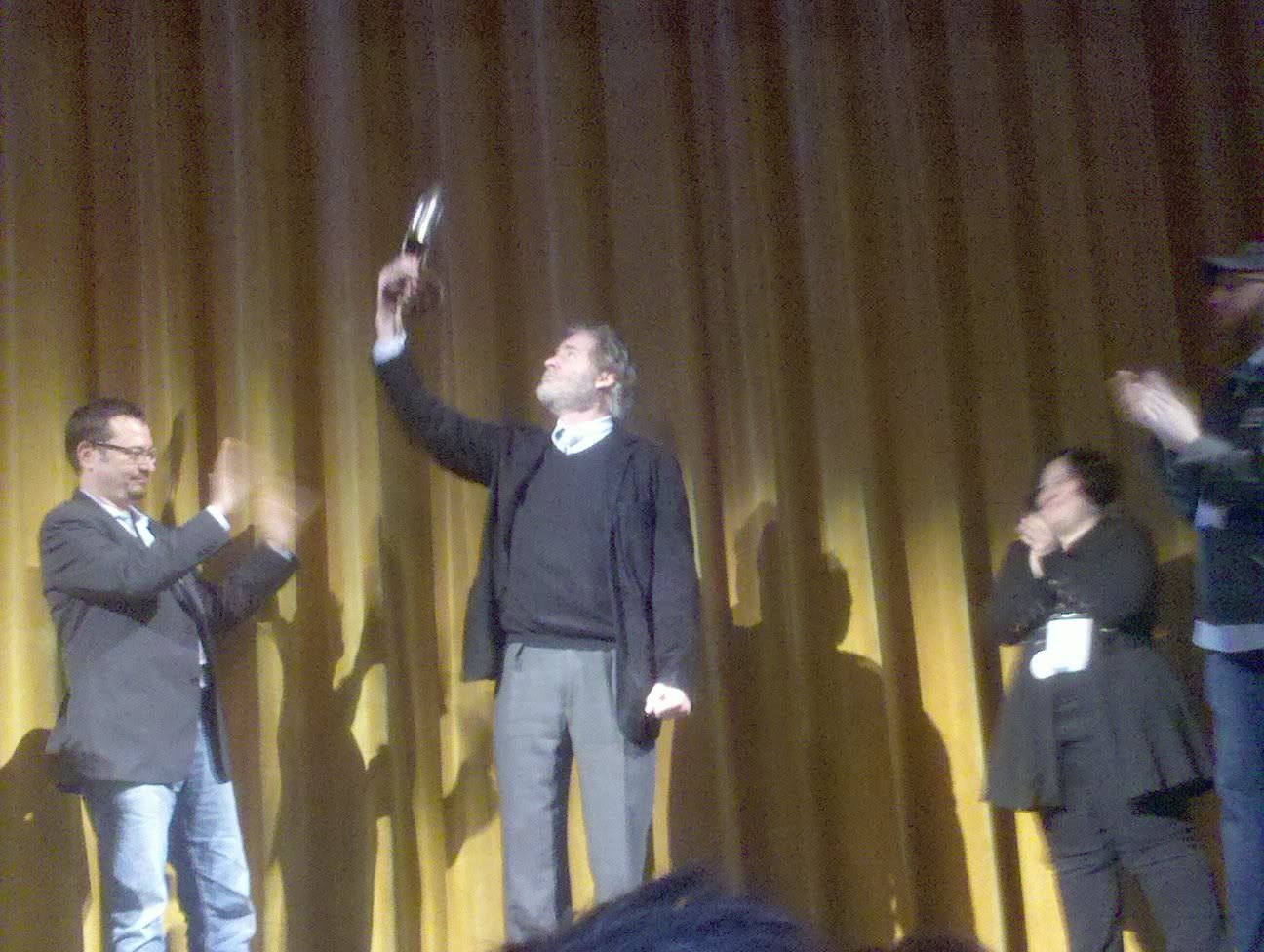
And now, to catch the bus to Somerville, Taqwacore, and Cracks.
The Extra Man
* * ¾ (out of four)
Seen 21 April 2010 at the Somerville Theater #1 (Independent Film Festival of Boston)
In general, it's a bad sign when the main character of a movie isn't the first name you see in the credits. That's not a rule you can really rely on, since that sort of thing is often negotiated by agents and studio people, but it is worth noting here: This movie is about Paul Dano's character, but it's Kevin Kline's name we see first.
Kline's Henry Harrison is the "extra man" of the title, a playwright who escorts elderly widows to social occasions. His new flatmate and protege is Louis Ives (Dano), a would-be writer come to Manhattan to "find himself" after being let go from his job teaching English Literature at a Princeton boarding school (there was an incident involving ladies' underwear). Ives soon finds a new job at an environmental journal, where he's soon smitten with co-worker Mary (Katie Holmes), but the combination of her boyfriend and his awkwardness keeps her out of reach.
Characters like Louis Ives are often hard to connect to, and this one is not exception. The things that make him wierd are too big to be quirks, but aren't big enough to make him a full, interesting character. The dream sequence that opens the film, a sort of Great Gatsby pastiche, is probably meant to give us some idea of Ives's self-image and the life he would like to lead, but it comes across as hollow, not even an appealing or well-constructed fantasy. Louis himself comes across as little more that a construct for the movie - a half-baked fantasy with a little cross-dressing and attachment to an old car thrown in.
Full review at EFC.

That's Jon Bernhardt and his theremin, hopefully not butchered too badly by my Droid's decent-for-a-phone camera. (It's only a matter of time before I get a real camera with decent optical zoom, no matter how little I think I'd use it) That proved to be pretty cool music to come in and get seated by, with a lot of movie themes and pop. It never hurts to see a demonstration of just what a cool thing a theremin is, too.

After that, Dan introduced the Tufts Beelzebubs, a college a capella club that puts on a pretty entertaining show.
Then, the IFFBoston crew came out to throw last year's shirts to the audience raffle off the traditional bag-of-merch, Rock Band package, MP3 player, and JetBlue round trip tickets. Then the film, and then the presentation of the award and the Q&A with Kevin Kline (joined by one of the directors of The Extra Man.
The festival did something that was pure brilliance, giving Kline a one-of-a-kind statuette by a local sculptor "Skunk"; it's probably not clear in the picture, but the thing is a rocketship made out of recycled bits of stuff, and the look on Kline's face when he received it was priceless - he's probably got a mantel (or closet) full of very nicely designed pieces of glass and bronze, but likely nothing like this.
The double take he gave Adam on seeing the thing was priceless (as is imperfectly captured here. As you might expect, Kevin Kline is an extremely funny guy, really just a joy to listen to, gracious and patient with every question. I don't do interviews for a number of reasons, but Kline is one of the times I regret not taking an opportunity, even if we likely would have had to talk about The Extra Man, which, well, wasn't great.
But that's just one film at the festival, and I have little doubt that the rest will be more along these lines:

And now, to catch the bus to Somerville, Taqwacore, and Cracks.
The Extra Man
* * ¾ (out of four)
Seen 21 April 2010 at the Somerville Theater #1 (Independent Film Festival of Boston)
In general, it's a bad sign when the main character of a movie isn't the first name you see in the credits. That's not a rule you can really rely on, since that sort of thing is often negotiated by agents and studio people, but it is worth noting here: This movie is about Paul Dano's character, but it's Kevin Kline's name we see first.
Kline's Henry Harrison is the "extra man" of the title, a playwright who escorts elderly widows to social occasions. His new flatmate and protege is Louis Ives (Dano), a would-be writer come to Manhattan to "find himself" after being let go from his job teaching English Literature at a Princeton boarding school (there was an incident involving ladies' underwear). Ives soon finds a new job at an environmental journal, where he's soon smitten with co-worker Mary (Katie Holmes), but the combination of her boyfriend and his awkwardness keeps her out of reach.
Characters like Louis Ives are often hard to connect to, and this one is not exception. The things that make him wierd are too big to be quirks, but aren't big enough to make him a full, interesting character. The dream sequence that opens the film, a sort of Great Gatsby pastiche, is probably meant to give us some idea of Ives's self-image and the life he would like to lead, but it comes across as hollow, not even an appealing or well-constructed fantasy. Louis himself comes across as little more that a construct for the movie - a half-baked fantasy with a little cross-dressing and attachment to an old car thrown in.
Full review at EFC.
Tuesday, April 20, 2010
This Week In Tickets: 12 April 2010 to 18 April 2010
Wow, this is early! You know why? Because the page right below this is sparse. But don't worry, next week will be crazy:
* The Independent Film Festival Boston 2010 starts this Wednesday (21 April 2010), continues through the weekend, and wraps up next Wednesday (28 April 2010). I wrote an article at eFilmCritic that is half preview, half "how to see a lot of films at a film festival" tutorial. It's mostly common sense, but you know what they say about that.
* Wondering what the Somerville and Brattle Theatres have lined up for between the IFFBoston heading for the ICA and Coolidge and when new movies open up on Friday? A lot of speaking engagements at the Brattle, but Somerville kicks off a Jeff Bridges retrospective - which will run weekdays through May - with a double feature of The Last Picture Show and Fat City. Even if you're committed to IFFB, you can still get to the showings on Thursday (29 April 2010). They promise all features in this series will play on their big screen (which got a nice upgrade recently and looks fantastic) on 35mm film.
* Kendall Square isn't one of the venues for IFFBoston, but they do have three films opening: Exit Through the Gift Shop, In Search of Memory, and one-week-wonder Dancing Across Borders. They're kind of in the festival spirit, though, as the filmmaker and subject of Dancing Across Borders will be at the Friday night screenings to introduce the movie and answer questions. It also looks like The Square is still going to be kicking around, meaning I can get to it after IFFBoston (lucky me).
* The Harvard Film Archive presents movies by pioneering Iranian director Rakhshan Bani-Etemad Friday, Sunday, and Monday; Ms. Bani-Etemad will be appearing in person on Sunday and Monday. On Saturday, Emerson College Professor John Gianvito introduces his sprawling documentary Vapor Trail, about the devastating effect a U.S. Air Force base had on a Filipino community. The MFA appears to be taking the weekend off.
* The Coolidge continues to celebrate the Kurosawa Centennial with a new 35mm print of Rashomon. They also pick up BUFF's It Came From Kuchar and The Square for the digital screening rooms.
* Oh, The Boston International Film Festival is still going on, and still has a terrible website.
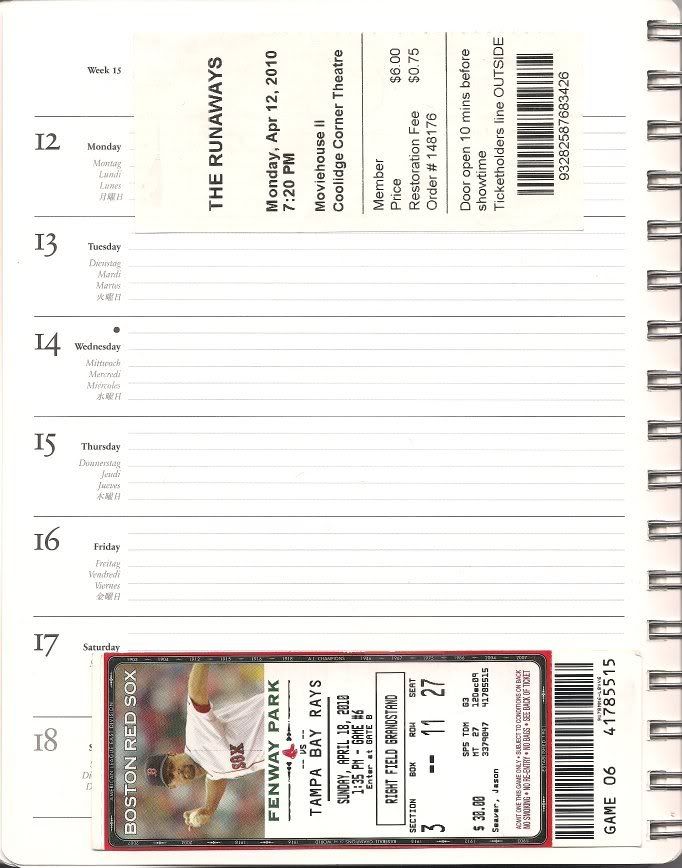
No, not a lot of moviegoing this past week; it was a draining week at work and then, when I got home, the charming discovery that my gas payments weren't being deducted from my checking account like I'd thought and thus my gas had been shut off for non-payment. When I did pay, the website said it would be turned back on within 24-48 hours, but it's pushing 108 now. Anyway, that meant cooking was a matter of either the microwave or the grill, and once you're done screwing around with the grill, it's a little late for hitting the early-evening show.
The weekend wound up being excellent, which is pretty amazing considering it was cold and rainy without heat or hot water in my house, ad the Red Sox got the crap kicked out of them by the Rays for four games. My friend Laurel was down for the weekend, and we hung out on Saturday, having a long and late lunch at Todd English's Kingfish Hall, walking through a historical graveyard, and then hanging out with her friend Jeff until nine or so.
It was also kind of cool to find out that the documentary she mentioned working on a couple years ago was Racing Dreams, which was easily the highlight of the two days I spent doing the Boston Film Festival (not to be confused with IFFBoston) last September. I wish I'd known so that I could spot her name in the credits; it's a pretty good movie, apparently due for limited release in mid-May, so there's some extra reason to check it out.
The next day was baseball with my brother, sister-in-law, and niece. Dagny has been to games before, but she wasn't talking or even clapping much for the "Mother's Day Miracle" game. Everyone was kind of worried about how much she'd be up for nine innings of baseball, especially once the game started with a rain delay, but she was excited from the time she got out of the car, only had to go exploring once, and had a great time cheering for the team. Her "go Red Sox, pleeeease!" probably sums up the mood of the fans pretty well.
So, I ate well and hung out with cool people, keeping me out of the cold house. But if you could turn my gas back on, NStar, that would be much appreciated. Sure, it has warmed up and I'll be at the film festival all week, so I won't need to heat the house and cook, but I suspect the other people in those packed theaters would appreciate it if I could take a hot shower.
The Runaways
* ¼ (out of four)
Seen 11 April 2010 at Entertainment Cinemas Fresh Pond #8 (first-run)
I had heard bad things about The Runaways before plunking down my cash to see it, and the path of its release pattern was both unusual and damning - it was met with such indifference from audiences that it shed screens and bookings between its limited release and "national expansion", resulting in an actual net loss of 40 screens over that period. The preview was the type that sold the idea of a movie about Joan Jett's first band much better than this particular movie. So I was kind of prepared for it to be bad. What I wasn't prepared for was for it to be boring.
I don't just mean "boring" as in it being a rote, paint-by-numbers musical biography where young musicians get too famous too fast, succumb to the lure of drugs and ignore the people who got them there. That's "uninspired"; you can still make something out of that. This is boring, where the characters we're ostensibly supposed to connect with fail to do anything interesting for long stretches of time. And that's the last thing rock and roll should ever be.
And there's no reason to expect this movie to be dull. After all, you'd think that a group of girls who wanted to rock bad enough to defy convention, form a band, record great songs, and make a name for themselves would be full of strong personalities, right? But that's shockingly not the case; Cherie Currie (Dakota Fanning), whose memoir forms the basis for the movie and who is thus at the center of most of the action, almost never initiates any sort of activity. Things just happen to her, and we don't even see her react in an interesting way. Joan Jett (Kristen Stewart) has a little more to her, but she still gets bulldozed by Michael Shannon as manager Kim Fowley. While I gather that Fowley being that sort of overpowering presence in real life, all he does here is out-shout the other characters.
It takes a lot of work to take the events of this film and make the end result so uninvolving, but writer/director Floria Sigismondi is up to it. She makes the movie a bunch of scenes presented without much to connect them into a story, gives us a tight focus on Cherie and Joan despite Sandy West and Lita Ford arguably having stories that are just as compelling... And what the heck is Alia Shawkat even doing in this movie as a placeholder for the band's various bassists? Despite being third-billed, I don't think she actually has a line (you can't even call her a composite character). Casting her in the part implies that the filmmakers at some point intended to do something with her, and that there might be more on the cutting room floor. It just confounds me that they possibly wound up leaving the interesting stuff out.
* The Independent Film Festival Boston 2010 starts this Wednesday (21 April 2010), continues through the weekend, and wraps up next Wednesday (28 April 2010). I wrote an article at eFilmCritic that is half preview, half "how to see a lot of films at a film festival" tutorial. It's mostly common sense, but you know what they say about that.
* Wondering what the Somerville and Brattle Theatres have lined up for between the IFFBoston heading for the ICA and Coolidge and when new movies open up on Friday? A lot of speaking engagements at the Brattle, but Somerville kicks off a Jeff Bridges retrospective - which will run weekdays through May - with a double feature of The Last Picture Show and Fat City. Even if you're committed to IFFB, you can still get to the showings on Thursday (29 April 2010). They promise all features in this series will play on their big screen (which got a nice upgrade recently and looks fantastic) on 35mm film.
* Kendall Square isn't one of the venues for IFFBoston, but they do have three films opening: Exit Through the Gift Shop, In Search of Memory, and one-week-wonder Dancing Across Borders. They're kind of in the festival spirit, though, as the filmmaker and subject of Dancing Across Borders will be at the Friday night screenings to introduce the movie and answer questions. It also looks like The Square is still going to be kicking around, meaning I can get to it after IFFBoston (lucky me).
* The Harvard Film Archive presents movies by pioneering Iranian director Rakhshan Bani-Etemad Friday, Sunday, and Monday; Ms. Bani-Etemad will be appearing in person on Sunday and Monday. On Saturday, Emerson College Professor John Gianvito introduces his sprawling documentary Vapor Trail, about the devastating effect a U.S. Air Force base had on a Filipino community. The MFA appears to be taking the weekend off.
* The Coolidge continues to celebrate the Kurosawa Centennial with a new 35mm print of Rashomon. They also pick up BUFF's It Came From Kuchar and The Square for the digital screening rooms.
* Oh, The Boston International Film Festival is still going on, and still has a terrible website.

No, not a lot of moviegoing this past week; it was a draining week at work and then, when I got home, the charming discovery that my gas payments weren't being deducted from my checking account like I'd thought and thus my gas had been shut off for non-payment. When I did pay, the website said it would be turned back on within 24-48 hours, but it's pushing 108 now. Anyway, that meant cooking was a matter of either the microwave or the grill, and once you're done screwing around with the grill, it's a little late for hitting the early-evening show.
The weekend wound up being excellent, which is pretty amazing considering it was cold and rainy without heat or hot water in my house, ad the Red Sox got the crap kicked out of them by the Rays for four games. My friend Laurel was down for the weekend, and we hung out on Saturday, having a long and late lunch at Todd English's Kingfish Hall, walking through a historical graveyard, and then hanging out with her friend Jeff until nine or so.
It was also kind of cool to find out that the documentary she mentioned working on a couple years ago was Racing Dreams, which was easily the highlight of the two days I spent doing the Boston Film Festival (not to be confused with IFFBoston) last September. I wish I'd known so that I could spot her name in the credits; it's a pretty good movie, apparently due for limited release in mid-May, so there's some extra reason to check it out.
The next day was baseball with my brother, sister-in-law, and niece. Dagny has been to games before, but she wasn't talking or even clapping much for the "Mother's Day Miracle" game. Everyone was kind of worried about how much she'd be up for nine innings of baseball, especially once the game started with a rain delay, but she was excited from the time she got out of the car, only had to go exploring once, and had a great time cheering for the team. Her "go Red Sox, pleeeease!" probably sums up the mood of the fans pretty well.
So, I ate well and hung out with cool people, keeping me out of the cold house. But if you could turn my gas back on, NStar, that would be much appreciated. Sure, it has warmed up and I'll be at the film festival all week, so I won't need to heat the house and cook, but I suspect the other people in those packed theaters would appreciate it if I could take a hot shower.
The Runaways
* ¼ (out of four)
Seen 11 April 2010 at Entertainment Cinemas Fresh Pond #8 (first-run)
I had heard bad things about The Runaways before plunking down my cash to see it, and the path of its release pattern was both unusual and damning - it was met with such indifference from audiences that it shed screens and bookings between its limited release and "national expansion", resulting in an actual net loss of 40 screens over that period. The preview was the type that sold the idea of a movie about Joan Jett's first band much better than this particular movie. So I was kind of prepared for it to be bad. What I wasn't prepared for was for it to be boring.
I don't just mean "boring" as in it being a rote, paint-by-numbers musical biography where young musicians get too famous too fast, succumb to the lure of drugs and ignore the people who got them there. That's "uninspired"; you can still make something out of that. This is boring, where the characters we're ostensibly supposed to connect with fail to do anything interesting for long stretches of time. And that's the last thing rock and roll should ever be.
And there's no reason to expect this movie to be dull. After all, you'd think that a group of girls who wanted to rock bad enough to defy convention, form a band, record great songs, and make a name for themselves would be full of strong personalities, right? But that's shockingly not the case; Cherie Currie (Dakota Fanning), whose memoir forms the basis for the movie and who is thus at the center of most of the action, almost never initiates any sort of activity. Things just happen to her, and we don't even see her react in an interesting way. Joan Jett (Kristen Stewart) has a little more to her, but she still gets bulldozed by Michael Shannon as manager Kim Fowley. While I gather that Fowley being that sort of overpowering presence in real life, all he does here is out-shout the other characters.
It takes a lot of work to take the events of this film and make the end result so uninvolving, but writer/director Floria Sigismondi is up to it. She makes the movie a bunch of scenes presented without much to connect them into a story, gives us a tight focus on Cherie and Joan despite Sandy West and Lita Ford arguably having stories that are just as compelling... And what the heck is Alia Shawkat even doing in this movie as a placeholder for the band's various bassists? Despite being third-billed, I don't think she actually has a line (you can't even call her a composite character). Casting her in the part implies that the filmmakers at some point intended to do something with her, and that there might be more on the cutting room floor. It just confounds me that they possibly wound up leaving the interesting stuff out.
Thursday, February 25, 2010
This Week In Tickets: 15 February 2010 to 21 February 2010
I may just make Thursday the standard TWIT day, if only because it gives me a chance to mention interesting stuff worth seeing in and around Boston (and elsewhere) without giving them a blog post of their own. And there is a bunch of it this time!
* I'm delighted to see that the Red Riding trilogy is getting a second week at Kendall Square. Hoping for a third would probably be pushing your/my luck, so if you'd like to see a set of three connected English crime movies that are quite good, carve some time out, whether it be a Sunday marathon or mixing and matching showtimes.
* I missed it last week, but the Spike & Mike "Sick and Twisted" and "New Generation" animation shows are running 25-26 February at the Regent Theater in Arlington ("New Generation" 7:30 on Thursday and 9:30 on Friday, vice versa for "Sick and Twisted"). It kind of took me surprise, both because it's very easy to forget that the Regent occasionally runs film programs and because I had sort of figured that Spike & Mike was more or less defunct, selling off their inventory of VHS tapes but not doing much else. Indeed, I figured that the Judge/Herzfeldt "Animation Show" was created in large part because Spike & Mike had closed up shop. Good to see that's not the case.
* Summer Wars will be playing the New York International Children's Film Festival on Friday (26 February 2010), with the director in attendance. I was pretty excited to see it in the New York/Tokyo mailing, since I loved The Girl Who Leapt Through Time, but it's only playing once and a Friday trip to NYC is tough enough in most situations, and just would not have flied with this week at work.
* Chidren of Invention opens at the Brattle, sharing a screen with Antichrist's 10pm shows. I liked Children quite a bit when it played IFFB last year, and have no interest in seeing Antichrist whatsoever.
* The Alloy Orchestra will accompany Man with a Movie Camera Saturday at the Somerville Theater. It's a very cool silent movie, and Alloy tends to get nice restored prints as well as create great scores.
* Bong Joon-ho will be at the Harvard Film Archive to introduce a preview of his new film, Mother, on Sunday (28 February 2010) and his excellent Memories of Murder on Monday (1 March 2010). After that, I presume he heads back to Korea or France or somewhere, although the HFA will be playing The Host and Barking Dogs Seldom Bite on Saturday (6 March 2010).
So now that you've got some idea of where I'll be next week, here's the crowded tally from this week:
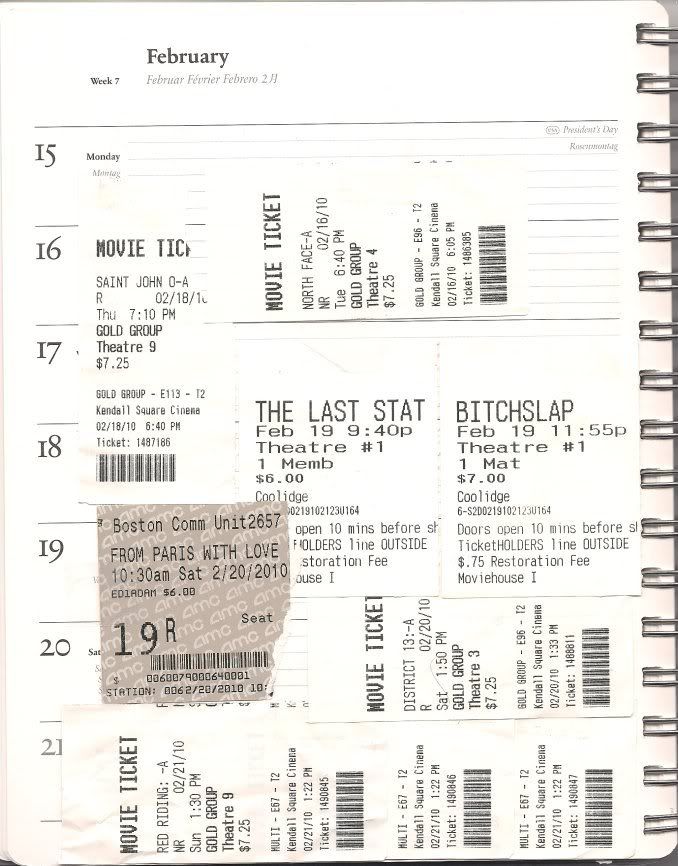
I'm not sure it's a matter of my being too thrifty, technology generally hating me, or what, but I saw my third USB memory card reader in approximately two years crap out this week. Now, the first admittedly died an impact-related death, but the last couple just stopped working. That's three different brands that have given up the ghost on me, mainly related by the fact that I probably maxed out at $15 on them. We'll see if the Sony I picked up at Staples tonight does better by me - or works with my old 1997-era tower.
And, yeah, you can bet that my new computer will have one of those suckers built-in.
Saint John of Las Vegas
* * ¾ (out of four)
Seen 18 February 2010 at Landmark Kendall Square #9 (first-run)
This one had a short run on the plex's smallest screen, and it's not hard to see why. It's a pretty decent movie, with a good cast, but it's also a weird one, with gambling addict John encountering a variety of bizarre characters both in Albequerque and the outskirts of Las Vegas. in what I'm told is a loose retelling of Dante's Inferno.
It's not a bad hour and a half if you've got patience for the quirky. Steve Buscemi plays John, and he turns in another excellent performance. John's as off-center as any of the characters played by Buscemi's co-stars, but there's a desperation to his eccentricity. His gambling addiction is obviously self-destructive, and John knows this even as he seems incapable of fighting it. We sometimes wince watching him, but he also works as the sane man in a crazy world. It strikes me that it's been a while since we've seen Buscemi as the quirky supporting character in a mainstream movie, and I kind of wonder whether it's a case of him banking the money he made on those to do things like this, or he's been relegated to them because people are casting John C. Reilly in those roles. Whichever the reason is, it's great to see him doing good work.
The Last Station
* * ½ (out of four)
Seen 19 February 2010 at the Coolidge Corner Theatre #1 (first-run)
The Last Station is a perfectly adequate sort of historical drama. Nice cast in Christopher Plummer, Paul Giamatti, and Helen Mirren. Nice production values. Interesting subjects. You may learn something while watching it, whether in terms of history, literature, or philosophy, and it's fairly entertaining.
The thing is, it's got James McAvoy in one of those parts he seems to specialize in: The "viewpoint character", whom the audience is meant to identify with, but whose storyline just winds up taking up space that could be much better spent on the actual interesting characters he interacts with. Here, the extent of his personality is that his character sneezes when he gets nervous. Yeah. That's totally a reason to spend time on him rather than, say, Leo Tolstoy and his wife. Certainly, he learns from watching the Tolstoys' loving but complicated relationship, but there's very little we can get from him that we couldn't get from the source.
Bitch Slap
* * ½ (out of four)
Seen 19 February 2010 at the Coolidge Corner Theatre #1 (IFFBoston Presents)
Bitch Slap is energetic, I'll give it that. It piles one fight scene on top of another, tying them together with flashbacks that contain even more action and chaos, jumping from a nice-looking desert to locations that were pretty obviously added by computer. It's also buxom, introducing its three main characters with shots that linger on their breasts and then making sure that, no matter what costume they're wearing, there's plenty of pushed-out cleavage to stare at.
I like both those things, so I'm not complaining. I do wish director Rick Jacobson had just a little bit more craft in tying it together, and maybe a little more talent from his good-looking cast. Julia Voth is the best of the bunch, having a grand time playing the stripper who really isn't into the same sort of physical stuff as her badass companions as the funniest of the bunch, and Erin Cummings might be a pretty good action heroine with a little more practice. America Olivio gets a little tiresome as the bad girl among bad girls; she just seems to be trying too hard.
The action isn't bad at all, though, especially when stunt co-ordinator Zoe Bell gets to take charge of the hand-to-hand stuff. And sure, I really like Ms. Bell (what person who has watched Double Dare and Death Proof couldn't?), but I don't think I'm cutting her any slack; when characters get into it and stunts are done in-camera, the movie's a lot of fun, much more so than during the crazy, over-the-top gunfights or the convoluted story that tries to hide how simple (and kind of dumb) it is by telling things out of order.
From Paris with Love
* * (out of four)
Seen 20 February 2010 at AMC Boston Common #19 (first-run)
And, hey, Bitch Slap is at least better than From Paris with Love, an movie out of Luc Besson's Europacorp action factory that suffers more obviously in comparison to the other Europacorp movie I saw that day, District 13: Ultimatum. That's not to say that Paris is no fun at all, just that for all its rushing from one action bit to the next, it's never a grabber, never really obscuring where its story is kind of dumb and, if not actually racist, uncomfortably close.
The big, obvious fault with it is that one thing Besson and company do really well is to tailor their action movies to their stars' strengths. He does a movie with Jet Li, expect some brutal fights; David Belle, some crazy acrobatics. He figured out that Jason Statham looks good behind the wheel of a car and that Liam Neeson should be intimidating and efficient. What particular strengths do John Travolta and Jonathan Rhys Myers have? Crazy for Travolta, I guess, and good-looking for Myers, and those just don't seem to be enough.
The Red Riding Trilogy
* * * + (out of four)
Seen 21 February 2010 at Landmark Kendall Square #9 (first-run)
I will (hopefully) be getting full reviews of these up over the next couple days, so let's just lightning-round them and get this posted:
1974: My favorite of the bunch, laser-focused on one flawed, but interesting and redeemable, character who is in way over his head.
1980: Perhaps suffers a little bit by the non-inclusion of 1977, but it's kind of intriguing to see what has happened with minor characters a few years down the road.
1983: Spends a lot of time flashing back to 1974, to the point where the story in the present suffers a little. But, when the end is approaching and it's time to wrap up five hours of movie, it does deliver an exciting climax.
* I'm delighted to see that the Red Riding trilogy is getting a second week at Kendall Square. Hoping for a third would probably be pushing your/my luck, so if you'd like to see a set of three connected English crime movies that are quite good, carve some time out, whether it be a Sunday marathon or mixing and matching showtimes.
* I missed it last week, but the Spike & Mike "Sick and Twisted" and "New Generation" animation shows are running 25-26 February at the Regent Theater in Arlington ("New Generation" 7:30 on Thursday and 9:30 on Friday, vice versa for "Sick and Twisted"). It kind of took me surprise, both because it's very easy to forget that the Regent occasionally runs film programs and because I had sort of figured that Spike & Mike was more or less defunct, selling off their inventory of VHS tapes but not doing much else. Indeed, I figured that the Judge/Herzfeldt "Animation Show" was created in large part because Spike & Mike had closed up shop. Good to see that's not the case.
* Summer Wars will be playing the New York International Children's Film Festival on Friday (26 February 2010), with the director in attendance. I was pretty excited to see it in the New York/Tokyo mailing, since I loved The Girl Who Leapt Through Time, but it's only playing once and a Friday trip to NYC is tough enough in most situations, and just would not have flied with this week at work.
* Chidren of Invention opens at the Brattle, sharing a screen with Antichrist's 10pm shows. I liked Children quite a bit when it played IFFB last year, and have no interest in seeing Antichrist whatsoever.
* The Alloy Orchestra will accompany Man with a Movie Camera Saturday at the Somerville Theater. It's a very cool silent movie, and Alloy tends to get nice restored prints as well as create great scores.
* Bong Joon-ho will be at the Harvard Film Archive to introduce a preview of his new film, Mother, on Sunday (28 February 2010) and his excellent Memories of Murder on Monday (1 March 2010). After that, I presume he heads back to Korea or France or somewhere, although the HFA will be playing The Host and Barking Dogs Seldom Bite on Saturday (6 March 2010).
So now that you've got some idea of where I'll be next week, here's the crowded tally from this week:

I'm not sure it's a matter of my being too thrifty, technology generally hating me, or what, but I saw my third USB memory card reader in approximately two years crap out this week. Now, the first admittedly died an impact-related death, but the last couple just stopped working. That's three different brands that have given up the ghost on me, mainly related by the fact that I probably maxed out at $15 on them. We'll see if the Sony I picked up at Staples tonight does better by me - or works with my old 1997-era tower.
And, yeah, you can bet that my new computer will have one of those suckers built-in.
Saint John of Las Vegas
* * ¾ (out of four)
Seen 18 February 2010 at Landmark Kendall Square #9 (first-run)
This one had a short run on the plex's smallest screen, and it's not hard to see why. It's a pretty decent movie, with a good cast, but it's also a weird one, with gambling addict John encountering a variety of bizarre characters both in Albequerque and the outskirts of Las Vegas. in what I'm told is a loose retelling of Dante's Inferno.
It's not a bad hour and a half if you've got patience for the quirky. Steve Buscemi plays John, and he turns in another excellent performance. John's as off-center as any of the characters played by Buscemi's co-stars, but there's a desperation to his eccentricity. His gambling addiction is obviously self-destructive, and John knows this even as he seems incapable of fighting it. We sometimes wince watching him, but he also works as the sane man in a crazy world. It strikes me that it's been a while since we've seen Buscemi as the quirky supporting character in a mainstream movie, and I kind of wonder whether it's a case of him banking the money he made on those to do things like this, or he's been relegated to them because people are casting John C. Reilly in those roles. Whichever the reason is, it's great to see him doing good work.
The Last Station
* * ½ (out of four)
Seen 19 February 2010 at the Coolidge Corner Theatre #1 (first-run)
The Last Station is a perfectly adequate sort of historical drama. Nice cast in Christopher Plummer, Paul Giamatti, and Helen Mirren. Nice production values. Interesting subjects. You may learn something while watching it, whether in terms of history, literature, or philosophy, and it's fairly entertaining.
The thing is, it's got James McAvoy in one of those parts he seems to specialize in: The "viewpoint character", whom the audience is meant to identify with, but whose storyline just winds up taking up space that could be much better spent on the actual interesting characters he interacts with. Here, the extent of his personality is that his character sneezes when he gets nervous. Yeah. That's totally a reason to spend time on him rather than, say, Leo Tolstoy and his wife. Certainly, he learns from watching the Tolstoys' loving but complicated relationship, but there's very little we can get from him that we couldn't get from the source.
Bitch Slap
* * ½ (out of four)
Seen 19 February 2010 at the Coolidge Corner Theatre #1 (IFFBoston Presents)
Bitch Slap is energetic, I'll give it that. It piles one fight scene on top of another, tying them together with flashbacks that contain even more action and chaos, jumping from a nice-looking desert to locations that were pretty obviously added by computer. It's also buxom, introducing its three main characters with shots that linger on their breasts and then making sure that, no matter what costume they're wearing, there's plenty of pushed-out cleavage to stare at.
I like both those things, so I'm not complaining. I do wish director Rick Jacobson had just a little bit more craft in tying it together, and maybe a little more talent from his good-looking cast. Julia Voth is the best of the bunch, having a grand time playing the stripper who really isn't into the same sort of physical stuff as her badass companions as the funniest of the bunch, and Erin Cummings might be a pretty good action heroine with a little more practice. America Olivio gets a little tiresome as the bad girl among bad girls; she just seems to be trying too hard.
The action isn't bad at all, though, especially when stunt co-ordinator Zoe Bell gets to take charge of the hand-to-hand stuff. And sure, I really like Ms. Bell (what person who has watched Double Dare and Death Proof couldn't?), but I don't think I'm cutting her any slack; when characters get into it and stunts are done in-camera, the movie's a lot of fun, much more so than during the crazy, over-the-top gunfights or the convoluted story that tries to hide how simple (and kind of dumb) it is by telling things out of order.
From Paris with Love
* * (out of four)
Seen 20 February 2010 at AMC Boston Common #19 (first-run)
And, hey, Bitch Slap is at least better than From Paris with Love, an movie out of Luc Besson's Europacorp action factory that suffers more obviously in comparison to the other Europacorp movie I saw that day, District 13: Ultimatum. That's not to say that Paris is no fun at all, just that for all its rushing from one action bit to the next, it's never a grabber, never really obscuring where its story is kind of dumb and, if not actually racist, uncomfortably close.
The big, obvious fault with it is that one thing Besson and company do really well is to tailor their action movies to their stars' strengths. He does a movie with Jet Li, expect some brutal fights; David Belle, some crazy acrobatics. He figured out that Jason Statham looks good behind the wheel of a car and that Liam Neeson should be intimidating and efficient. What particular strengths do John Travolta and Jonathan Rhys Myers have? Crazy for Travolta, I guess, and good-looking for Myers, and those just don't seem to be enough.
The Red Riding Trilogy
* * * + (out of four)
Seen 21 February 2010 at Landmark Kendall Square #9 (first-run)
I will (hopefully) be getting full reviews of these up over the next couple days, so let's just lightning-round them and get this posted:
1974: My favorite of the bunch, laser-focused on one flawed, but interesting and redeemable, character who is in way over his head.
1980: Perhaps suffers a little bit by the non-inclusion of 1977, but it's kind of intriguing to see what has happened with minor characters a few years down the road.
1983: Spends a lot of time flashing back to 1974, to the point where the story in the present suffers a little. But, when the end is approaching and it's time to wrap up five hours of movie, it does deliver an exciting climax.
Subscribe to:
Posts (Atom)

