Today's tenuous connection between a current movie's review and Fantasia catch-up: I was really hoping to have made it far enough along in my review queue to be presenting my review of Robo-G alongside this one. They've got fun surface similarities - both feature old guys and robotics, although their stories are pretty far off once you get past that. Still, they've both got stars with the same sort of appeal in the title roles - Frank Langella and Shinjiro Igarashi/"Mickey Curtis" both have reached the thin, bald, but still physically active stage of their careers - and have robots that aren't all people want to believe they are.
Anyway, Robot & Frank is currently playing the big screen at the Coolidge as well as Kendall Square, and is worth checking out. It's smaller and sweater than a lot of its indie-film brethren, but that's a large part of its charm.
Of course, now that I look, I see that there is another robot-related movie in this set of catch-up reviews, Kim Jee-woon's segment of Doomsday Book. Similar designs, but ultimately opposite approaches. Anyway, this batch's catch-up for those who are just following new blog entries also includes Hard Romanticker, Nameless Gangster, Graceland, Quick, and The Human Race.
Robot & Frank
* * * ¾ (out of four)
Seen 26 August 2012 in Coolidge Corner Theatre #1 (first-run, 35mm)
People often ask writers of offbeat or science-fictional stories where they get their ideas, but that's often the wrong question, since ideas are everywhere and one has to but pick up a paper or click on a website to trip over three or four. It's putting them together to make a good story that's tricky. For instance, the idea of using robots in elder care has been floating around for a while, though not nearly as long as the bored, retired criminal. The combination is what gets filmmakers on the road to Robot & Frank, but it takes Frank Langella and some other collaborators to make it kind of wonderful.
And some details, of course. Frank (Langella) is not just starting to slow down, but his memory is going. With his daughter Madison (Liv Tyler) doing charity work on the other side of the globe and his son Hunter (James Marsden) five hours away, he's only getting worse. Thus the robot Hunter delivers one weekend, and though Frank wants no part of it, especially when he's talking to the town librarian (Susan Sarandon), he re-evaluates that when he discovers that its programming does not actually prevent it from breaking the law, and the robot could be a potential partner-in-crime.
It says a lot about Robot & Frank that I wonder if the main character was given his name because writer Christopher D. Ford and director Jake Schreier saw Langella in the role from the very beginning. The part fits him like a glove, after all, even though it's often much more low-key than the intense performances he's best known for. There's bits that suit his theatrical background as he occasionally tells stories or exaggerates lies just enough for the audience to feel like a part of his schemes, and he's just crotchety and defiant enough to show how he can inspire both fondness and annoyance. It's the way he handles the character's memory lapses that are most impressive, though - rather than the befuddled stumbling some actors will do, making "good days and bad days" completely binary, Frank will slip into the past but still stay somewhat tethered to the present. It lets us empathize with his conviction that he can look after himself rather than just see him as someone who doesn't realize he's a problem to be solved.
Full review at EFC.
Doomsday Book
* * * ½ (out of four)
Seen 27 July 2012 in Concordia University Theatre Hall (Fantasia 2012, HD)
Anthology film Doomsday Book does not quite end the world in three ways, as one might expect it to do. Even more interesting is that the contemplative middle segment comes from noted action director Kim Jee-woon, whose unusual restraint provides a nice breather between Yim Pil-Sung's two tales of apocalyptic mayhem.
The package starts with "A Wonderful New World", in which lab technician Yoon Seok-woo (Ryoo Seung-bum) is left behind when his family goes on vacation because he technically has a month left to his military service - and they stick him with the job of cleaning their filthy apartment, too. It could be worse, though; he's got a date with beautiful Kim Yoo-min (Koh Joon-hee), and things go pretty well! At least, that is, until something in the rotten apple he threw into the compost bin mutates (in a zippy montage) and makes its way back through the food chain in the form of a zombie virus.
It has to be an apple, didn't it, which knocks humanity another level down from paradise? As symbols go, it's oddly ambivalent: Maybe the residents of Seoul are returning to the savage state of grace that existed before the knowledge of good and evil, and does the crisis come from allowing the apartment to get so disgusting or by returning its products to the environment? That's for the audience to decide; in the meantime, Yim delivers a fun but somewhat scattershot piece. It starts out as a fun romantic comedy, with Ryoo making likably nerdy, put-upon lead who matches up surprisingly well with Koh Joon-hee's Yoo-min, and they keep that up once the horror elements start to pop up. Eventually, though, their story gets subsumed in the larger disaster, and their return isn't quite as satisfying as their introduction, though it does have a few nice moments.
Full review at EFC.
Hâdo romanchikkâ (Hard Romanticker)
* * ¾ (out of four)
Seen 27 July 2012 in Concordia University Theatre Hall (Fantasia 2012, HD)
Su-yeon Gu's Hard Romanticker is one of those movies that feels like it was cobbled together from a bunch of anecdotes that don't necessarily add up to a story, but is able to more or less able to get by on those tall tales being entertaining and the guy at the center having some charisma. It seems a bit like a patchwork, but works a lot more than it doesn't.
The center of most of these events is Gu (Sota Matsuda), a hood in Shimonoseki, Japan of Koeran descent with a blond dye-job. He's not actually involved in the opening break-in, where teenage punks Masaru (Tokio Emoto) and Tatsu (Kento Nagayama) accidentally kill the grandmother of North Korean gangster Kim Chon-gi (Yuya Endo), but he knows them and is thus a convenient scapegoat when Kim starts asking questions. In the meantime, he's got Detective Fujita (Atsuro Watabe) asking him for intel, a schoolgirl (Ayaka Tomoda) with a crush on him, and older gangster Shoji (Claude Maki) asking him to guard a coin-locker key. He also gets an offer from yakuza-connected Takagi (Shido Nakamura) to help manage a club in Kobura, where he winds up crashing with hostess Natsuko (Sei Ashina).
With its detached, youthful protagonists, pervasive criminality, and emphasis on atmosphere as much as plot, it's easy to see a kinship between Hard Romanticker and the French New Wave, or to stay in Japan, Nikkatsu's "New Action" cinema of the 1960s. The jazzy soundtrack and somewhat grainy cinematography help set the atmosphere, but it's the attitude that matches it the most; characters may get violent at the drop of a hat, but there's a sort of passive, observational feel even then. People don't start fights; fights happen as these guys move through their lives.
Full review at EFC.
Bumchoiwaui Junjaeng: Nabbeunnomdeul Jeonsungshidae (Nameless Gangster: Rules of the Time)
* * ¾ (out of four)
Seen 28 July 2012 in Concordia University Theatre Hall (Fantasia 2012, DCP)
Nameless Gangster: Rules of the Time (Bumchoiwaui Junjaeng: Nabbeunnomdeul Jeonsungshidae) opens, at least in this English-subtitled version, with a definition of the word "daebu", which means "man of one's grandfather's generation" - or "Godfather". Give writer/director Yung Jong-bin credit for giving his mob drama lofty ambitions, even if its actual achievements aren't quite on that level.
Though the movie somewhat closer to the present day, the story starts in the 1980s, when Choi Ik-hyun (Choi Min-sik) is a Busan customs official of only moderate corruption, though that's landed him with some merchandise he doesn't know how to sell and an internal investigation. This leads him to gangster Choi Hyung-bae (Ha Jung-woo), who it turns out is a distant relative, both being part of the Gyeong-ju clan. Hyung-bae does not initially appreciate this connection, having henchman Park Chang-woo (Kim Sung-kyun) deliver Ik-hyun a beating, but his father demands he show respect. So Ik-hyun is brought into the business, where his connections prove useful - especially once young prosecutor Jo Bum-suk (Kwak Do-wan) starts sniffing around.
There's a potentially interesting idea being played with here - that any enterprise with a certain level of ambition needs both doers like Hyung-bae and facilitators like Ik-hyun, criminal ones most of all. When things are going well for the Chois, this is actually pretty fascinating to watch, especially since it is all but inevitable that neither will truly appreciate the other's contribution. 1980s Korea makes for a good background, as well - it seems as though a capitalist economy under a military dictatorship gives the mob plenty of business opportunities and keeps overhead low with the necessary corruption nicely centralized, letting the Chois at times appear legitimate. It's good empire-building even for those who don't particularly like mafia movies.
Full review at EFC.
Graceland
* * * ½ (out of four)
Seen 28 July 2012 in Concordia University Cinema J.A. de Seve (Fantasia 2012 Spotlight: Filipino Cinema, HD)
The easiest way to describe Graceland - a twistier, less philosophical take on Akira Kurosawa High and Low - maybe does it a disservice by making it sound like it is less than its potential. That's not particularly true; it's actually a pretty great thriller that makes its examination of larger issues so integrated that they don't need to be talked about; they inform every moment.
Marlon Villar (Arnold Reyes) has been the chauffeur for Filipino Congressman Manuel Chango (Menggie Cobarrubias) for years, including taking him and the odd young lady to hush-hush assignations, like the one going on at the start. For all that loyalty, he gets no respect; Chango's wife Marcy (Marife Necesito) is frosty when Marlon's daughter Elive (Ella Guevara) is with him when he comes to pick up their girl Sophia (Patricia Ona Gayod) for school (the girls, of course, are delighted to see each other). He's facing a pink slip as rumors of scandal start to get out, but much worse is coming: A kidnapper (Leon Miguel) pulls the car over and demands Marlon act as a go-between if either father wants to see his daughter again, which naturally makes the driver the prime suspect in the eyes of Detective Ramos (Dido De La Paz).
It's tough to blame him; looked at from the outside, Marlon's got a whole lot of motive, and it's not long before he's on even more shaky ground. Just in terms of making a thriller, writer/director Ron Morales is really not messing around: Graceland has a brutal and efficient setup that puts a noose around its hero's neck early, and then relentlessly finds ways the make the situation worse without ever resorting out-of-nowhere events.
Full review at EFC.
Kwik (Quick)
* * ¾ (out of four)
Seen 29 July 2012 in Concordia University Theatre Hall (Fantasia 2012 Action!, DCP)
Quick is, when you get down to it, a pretty stupid action movie that tries to camouflage this fact with raw speed. The filmmakers would likely have no argument with that assessment if given it directly, just asking how well they pull the action off. And they actually do all right. Very few things that can explode last the movie without blowing up, and practically no piece of glass remains unbroken. It knows what its audience wants and panders away.
Han Gi-soo (Lee Min-ki) is a wizard with a motorcycle, although after he and his pack caused a massive accident six years ago, he now works as a courier, dispatched to get things across Seoul faster than anyone else can. This day, his cargo includes a person - Ji Chun-sim (Kang Ye-won), his girlfriend back then who is now best known as "A-Rom" of OK Girls. But there's also a twist - a bomb in her helmet that will explode if it gets too far from the headset in Gi-soo's ear or if he doesn't make certain deliveries on-time. Of course, when those deliveries turn out to be bombs, Detective Seo (Ko Chang-seok) and the rest of the police force are after them, including Kim Myeong-sik (Kim In-kwon), who used to hang out on the fringes of Gi-soo's gang and still has a massive crush on Chun-sim.
Is sending a dupe on a motorcycle around town to deliver bombs under threat of blowing up himself a convoluted plan, even before the coincidental involvement of an ex-girlfriend? Oh, yeah, especially since they are special miniaturized super-bombs, which means there are secret government, corporate, and mob angles. Honestly, the chart that the police work up for who may be targets and potential masterminds is more complicated than the ones you see in thrillers where the identity of the killer is the point, rather than a reason for chase scenes and massive explosions. To their credit, the filmmakers handle it pretty well; the solution to the mystery doesn't really matter, so director/co-writer Cho Beom-gu moves through them as quickly and smoothly as he can without them getting confusing.
Full review at EFC.
The Human Race
* * * ¾ (out of four)
Seen 28 July 2012 in Concordia University Theatre Hall (Fantasia 2012, HD)
It's an obvious thing to say in a review, and probably everyone who writes a review of this movie will say some variation, but what the heck: The Human Race kicks a fair amount of ass even though its star only has the one leg. As almost obligatory as that comment is, at least it gets a low-budget independent movie into someone's head. Then they can watch it and discover that it's actually better than just a novelty piece.
Eighty people have been snatched up from a Los Angeles street corner in a flash of white light and placed on a path... somewhere. They include Veronica (Brianna Lauren Jackson), who has just learned that her cancer is in remission; amputee and veteran Eddie (Eddie McGee), who was giving an inspirational speech at the special-needs school where his friend Justin (Paul McCarthy-Boyington) teaches; immigrants like Gabriel (Fred Coury), Ting (Celine Tien), and her brother Shio Lau (Ian Tien), and more. Eddie's not the only one with a disability; two (Trista Robinson & T. Arthur Cottam) are deaf and an older vet (J. Louis Reid) moves even slower than he does. Their instructions are simple: Follow the path. Stray from it, and you die, with only certain buildings designated as safe zones. Get lapped twice, and you will die. Do this until there's only one of you left.
It's a viciously straightforward plot, but it's what writer/director Paul Hough does with it that makes it worth the audience's attention. Hough uses the high stakes to get at just what the people in this group are capable of, getting a broad enough cross-section that they can represent the larger audience fairly well. It runs the gamut between the expected cynicism and optimism with plenty of different gradations in between, and opportunities for characters to move back and forth along the scale. Even the disabled characters and others that would often be played reflexively sympathetic or as victims get to occasionally show their less altruistic sides.
Full review at EFC.
Showing posts with label Phillipenes. Show all posts
Showing posts with label Phillipenes. Show all posts
Monday, August 27, 2012


Thursday, August 09, 2012
The Fantasia Daily, 2012.21 (8 August 2012): The Woman in the Septic Tank
I didn't necessarily mean to make my last day at Fantasia a short one, movie-wise; the last couple of days just tend to be tacked on late in the process and filled with repeat showings - in fact, the schedule for those last couple of days were often filled with TBAs in previous years. Another time, things got shuffled because a guest's travel plans changed quickly just before the schedule was finalized . This year, there were actually a few movies I was interested in seeing during the last days - Inseparable, Sleep Tight, and Septic Tank, so I was glad I'd added at least one day to the schedule originally announced. Some of the other stuff playinig today is stuff I'd already seen, so it wasn't too disappointing to miss the last day.
So, what did I do instead?

I thought this might be a good time to hit the Stewart Museum, which I'd visited a few years ago and found really nifty. Luckily, I opted to do it today rather than yesterday (they're closed Monday and Tuesday) or in the last couple of years (they were closed for renovations for quite some time). A lot of work still seems to be going on; areas that were open the last time I went are locked up tight. I figured that there might be a lot of War of 1812 stuff for the 200th anniversery, considering how much they had last time I was there. Maybe they're saving it for a couple years from now, to celebrate the bicentennial of Canada's supposed victory.
(Seriously, I love comparing how the War of 1812 is taught on various sides of the border. For this New Englander, it was a second war of independence to stop the British from blocking American trade and impressing American sailors into the Royal Navy; in Canada, America was harboring British deserters, invaded their territory, but the provincial militias turned the American Army back, marched south, burned Washington, DC, and America hasn't screwed with them again.)
Anyway, I took that picture because I thought it looked like the guys who shoot a cannon off every few hours were sick of the noise coming from the "La Ronde" amusement park next door and decided to do something about it.
Anyway, after walking around Parc Drapeau for a while, I went back Concordia-way to have a burger and see my last movie of the festival, and a guy at the next table took issue to me scribbling in the notebook I carry around that is full of notes from screenings and half-finished movie reviews. He was taking issue with a lot of things, but his friend came over to ask if I was writing about him. Especially weird because it was the second time during the festival that it had happened; some girls had done the same at Smoke's Poutinerie about a week before.
Is this a thing people get nervous about? I mean, I can't remember anyone ever asking me to stop fiddling with my phone (which has a freakin' camera) or asking someone at the next table to put their iPad away, but a 4-inch-square notebook is threatening? Weird.
So, that happened, I saw my movie, spent what was left of my Canadian currency at Paris Crepes on St. Catherine (and getting some snacks for the ride home), and then got back to the apartment to pack and rush to the bus station. Fun fact: It's now a much longer run from the Berri-UQAM metro stop to the gare des autocars, with a segment where you have to go up and then down, which is awesome if you're dragging a wheeled suitcase. Made it just in time... And then the bus left 25 minutes late and got stuck in traffic. I thought I got lucky when the guy in the seat next to me got off at the Burlington, VT airport, but I got a new seatmate who really did not have the instinctive recognition that the middle armrest was where my personal space began, especially when sleeping. It was a fun ride.
Anyway, last day of Fantasia up north. My plans? Well, I got a screener for Sleep Tight, so I'm tempted to cue that up at 7:30pm in sync with the folks in Montreal, but I will probably crash/watch my first baseball in three weeks.
Ang babae sa septic tank (The Woman in the Septic Tank)
* * * (out of four)
Seen 8 August 2012 in Concordia University Cinema de Seve (Fantasia 2012 Spotlight: Filipino Film, HD)
I see what you did, Fantasia Festival programmers, scheduling a series of FIlipino films that wallow in the poverty of the slums and then finishing it with a movie that takes the piss out of the rest. Or, alternately, scheduling the parody for one of the "extra" days after the closing film when many festival-goers have returned home. Either way, it would have been even more clever if The Woman in the Septic Tank was as consistently sharp in its satire as it is in its best moments.
In a dirt-poor Manila slum, Mila prepares dinner for her seven children from one package of instant ramen, bathes the oldest, dresses her in a nice dress, and delivers her to an elderly caucasian man. That, at least, is the movie that young Filipino writer/director Rainier (Kean Cipriano) wants to make - Walang-wala ("With Nothing"). Producer Bingbong (JM de Guzman) and production assistant Jocelyn (Cai Cortez) are equally enthusiastic. It's everything that the foreign film festivals that love the likes of Brillante Mendoza go for, and they've got a meeting with one of the country's biggest stars, Eugene Domingo, for the part of Mila.
The main gag here, of course, is that the filmmakers are middle-class, running through script sequences on their iPads while driving to Starbucks in their late-model car and then complaining about the wi-fi. They've got far more in common with the foreigners who are their true target audience than with the destitute people that they would cynically offer up for their audience's pity. And it's a good gag, especially when writer Chris Martinez and and director Marlon N. Rivera are really on their game. They open the movie with narration describing whats happening on-screen with "Sequence 34", which while being how a script reads also highlights just how generic and codified this stuff has become, while the camerawork is subtly obsessive, needing to capture every repeated detail of hardship.
Full review at EFC.
So, what did I do instead?

I thought this might be a good time to hit the Stewart Museum, which I'd visited a few years ago and found really nifty. Luckily, I opted to do it today rather than yesterday (they're closed Monday and Tuesday) or in the last couple of years (they were closed for renovations for quite some time). A lot of work still seems to be going on; areas that were open the last time I went are locked up tight. I figured that there might be a lot of War of 1812 stuff for the 200th anniversery, considering how much they had last time I was there. Maybe they're saving it for a couple years from now, to celebrate the bicentennial of Canada's supposed victory.
(Seriously, I love comparing how the War of 1812 is taught on various sides of the border. For this New Englander, it was a second war of independence to stop the British from blocking American trade and impressing American sailors into the Royal Navy; in Canada, America was harboring British deserters, invaded their territory, but the provincial militias turned the American Army back, marched south, burned Washington, DC, and America hasn't screwed with them again.)
Anyway, I took that picture because I thought it looked like the guys who shoot a cannon off every few hours were sick of the noise coming from the "La Ronde" amusement park next door and decided to do something about it.
Anyway, after walking around Parc Drapeau for a while, I went back Concordia-way to have a burger and see my last movie of the festival, and a guy at the next table took issue to me scribbling in the notebook I carry around that is full of notes from screenings and half-finished movie reviews. He was taking issue with a lot of things, but his friend came over to ask if I was writing about him. Especially weird because it was the second time during the festival that it had happened; some girls had done the same at Smoke's Poutinerie about a week before.
Is this a thing people get nervous about? I mean, I can't remember anyone ever asking me to stop fiddling with my phone (which has a freakin' camera) or asking someone at the next table to put their iPad away, but a 4-inch-square notebook is threatening? Weird.
So, that happened, I saw my movie, spent what was left of my Canadian currency at Paris Crepes on St. Catherine (and getting some snacks for the ride home), and then got back to the apartment to pack and rush to the bus station. Fun fact: It's now a much longer run from the Berri-UQAM metro stop to the gare des autocars, with a segment where you have to go up and then down, which is awesome if you're dragging a wheeled suitcase. Made it just in time... And then the bus left 25 minutes late and got stuck in traffic. I thought I got lucky when the guy in the seat next to me got off at the Burlington, VT airport, but I got a new seatmate who really did not have the instinctive recognition that the middle armrest was where my personal space began, especially when sleeping. It was a fun ride.
Anyway, last day of Fantasia up north. My plans? Well, I got a screener for Sleep Tight, so I'm tempted to cue that up at 7:30pm in sync with the folks in Montreal, but I will probably crash/watch my first baseball in three weeks.
Ang babae sa septic tank (The Woman in the Septic Tank)
* * * (out of four)
Seen 8 August 2012 in Concordia University Cinema de Seve (Fantasia 2012 Spotlight: Filipino Film, HD)
I see what you did, Fantasia Festival programmers, scheduling a series of FIlipino films that wallow in the poverty of the slums and then finishing it with a movie that takes the piss out of the rest. Or, alternately, scheduling the parody for one of the "extra" days after the closing film when many festival-goers have returned home. Either way, it would have been even more clever if The Woman in the Septic Tank was as consistently sharp in its satire as it is in its best moments.
In a dirt-poor Manila slum, Mila prepares dinner for her seven children from one package of instant ramen, bathes the oldest, dresses her in a nice dress, and delivers her to an elderly caucasian man. That, at least, is the movie that young Filipino writer/director Rainier (Kean Cipriano) wants to make - Walang-wala ("With Nothing"). Producer Bingbong (JM de Guzman) and production assistant Jocelyn (Cai Cortez) are equally enthusiastic. It's everything that the foreign film festivals that love the likes of Brillante Mendoza go for, and they've got a meeting with one of the country's biggest stars, Eugene Domingo, for the part of Mila.
The main gag here, of course, is that the filmmakers are middle-class, running through script sequences on their iPads while driving to Starbucks in their late-model car and then complaining about the wi-fi. They've got far more in common with the foreigners who are their true target audience than with the destitute people that they would cynically offer up for their audience's pity. And it's a good gag, especially when writer Chris Martinez and and director Marlon N. Rivera are really on their game. They open the movie with narration describing whats happening on-screen with "Sequence 34", which while being how a script reads also highlights just how generic and codified this stuff has become, while the camerawork is subtly obsessive, needing to capture every repeated detail of hardship.
Full review at EFC.
Thursday, August 02, 2012
The Fantasia Daily, 2012.14 (1 August 2012): The Tall Man, Mondomanila, White, Asura, and Black's Game
Is it still called sneaking out of work early when the "office" is your apartment and all you're doing is closing a laptop? Because that's what I did yesterday, looking to catch The Tall Man. As you can see, not the most profitable of decisions.
I arrived a bit late, but it was OK because there was a short before the movie. I didn't see it all, but it (Nickolas Lacelle's "Cure") turned out to be one of those post-apocalyptic things which basically gives the director a chance to say that humanity is lousy and life sucks and it has always been this way, really pounding it home to an absurd extent with narration. Mondomanila had a short as well, "The Breathing Birth" from France's Tom Bouchet, which was kind of peculiar with the gas masks and baby that didn't need one and all.
Maybe if things had worked out differently, I wouldn't have conked out during Mondomanila, but nap I did. There doesn't seem to be a lot of logic behind the 3pm nap; festivals never really make me feel physically exhausted and it's too early for the "mentally exhausted by using the same small sector of my brain for the whole day" reason. I did wind up walking from the McGill ghetto to Concordia rather than using the metro at all, but that sort of seems insufficient.
Sorry, Khavn de la Cruz. Liked Son of God, but this knocked me out. It's not just your movie; as much as I liked it, Black's Game started to have the same effect on me at points. I was just tired.
In between those movies, my only Q&A of the day:
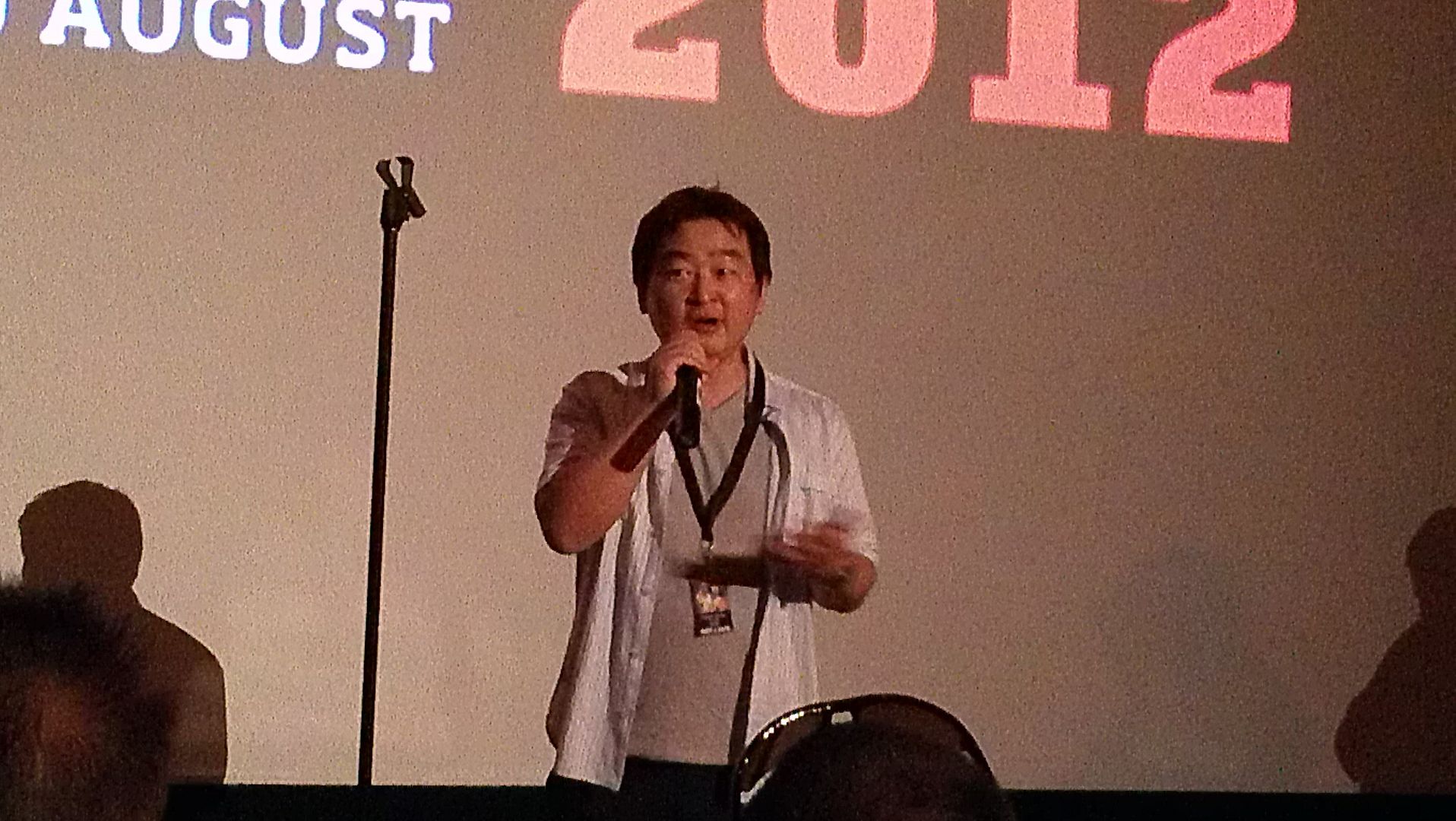
Producer Yoshi Ikezawa talked about Asura before and after the film, and while I wouldn't necessarily describe it as "hugely candid", it was interesting to hear him say forthrightly that there were three composers credited because getting the soundtrack right was very difficult. He also mentioned that the company he works for, Toei's animation division was mostly known for cute, very commercial works, as indicated by the cheerful "Toei Animation" logo that came after the studio's breaking waves snip.
He also touched on the interesting differences in how the shift between cel-based and CGI-based animation is happening in the US and Japan. In the US, Pixar's early success and our general desire for things to look "real" has us liking CGI that more or less looks like CGI, while Japan seems to prefer that it still look hand-drawn. It was pretty surprising to hear that the characters were CGI here while the backgrounds tended to be hand-drawn; it generally works the opposite way in the US and many other Japanese productions. I suspect that manga being more central to Japanese pop-culture than comics are to that in America (as well as manga's production staying more or less the same to make their intense schedules possible, while American comics have traded a lot for more detail) has kept the standards the same.
Today's plan: Citadel, You Are the Apple of My Eye, Replicas, and Ace Attorney.
And remember, fellow Fantasians (and theater-goers everywhere), yelling or fooling around from your seats when something is wonky with projection and sound, as happened with White, is not helpful - if they're not already trying to fix it in the booth, they don't hear you. You're just making sure that everyone around you notes your displeasure, but they're already feeling the same thing, you know?
(Same goes for the meowing. It was cute and spontaneous the first time it happened a few years ago, when there was an unexpected delay between the room going dark and the picture coming up, but now it seems like people are just doing it because they think they're the entertainment.)
The Tall Man
* * (out of four)
Seen 1 August 2012 in Concordia University Cinema de Seve (Fantasia 2012, 35mm)
The Tall Man tries to do something worthy and interesting, at least at points, and those intentions certainly seem praiseworthy, but it just doesn't work. the whole thing simply isn't very well-constructed, to the extent that whether one admires its unconventional decisions or not, the net result is fairly negative.
Cold Rock, Washington, was never a well-to-do town, but it has spiraled into poverty since its mine closed, and in recent months it has become downright nightmarish. There's a plague of missing children, you see, around which an urban legend - the Tall Man of the title - has already sprung up. The latest child to be taken is David (Jakob Davies), the son of Julia Denning (Jessica Biel), the nurse who has run the town's free clinic since her husband's death. In this case, though, she's able to give chase to the abductors, and her pursuit may provide Lt. Dodd (Stephen McHattie) of the state police and County Sheriff Chestnutt (William B. Davis) the leads they need.
Much of this happens in an extended "36 hours earlier" flashback, and to writer/director Patrick Laugier's credit, getting caught back up isn't just a matter of playing an inevitable sequence out; by the time the movie has returned to its starting point, it has had a potentially interesting twist. However, it has also made a strong argument that it needs to commit to that twist fully or serve something else up in short order. Instead, it gets stuck in the mud, with the action slowed to a crawl and characters being vague and/or cryptic because Laugier is not yet ready for the (distasteful) finale.
Full review at EFC.
MondoManila
N/A (out of four)
Seen 1 August 2012 in Concordia University Cinema de Seve (Fantasia 2012 Camera Lucida/Spotlight: Filipino Cinema, HD)
Mid-afternoon nap. I'm not proud of this at all, and having myself get knocked-out mid-day in a festival is always weird. If only I'd bought the Pepsi instead of the 7up for caffeine.
Odd little movie; I somehow had it in my head that it was a documentary, and it kind of has the same feel - very hand-held and not hiding that it's video at all, less in the way of plot than random observation. Pretty crude and ugly at times, but I'm not sure it's that interesting. I did like Khavn de la Cruz's Son of God, so maybe if I hit this under other circumstances, it would do better for me.
Hwa-i-teu: Jeo-woo-eui Mel-lo-di (White: The Melody of the Curse)
* * (out of four)
Seen 1 August 2012 in Concordia University Theatre Hall (Fantasia 2012, DCP)
A girl-group horror movie isn't really a bad idea at all: You've got pretty girls, who are highly competitive by nature to fuel any issues between them, and a bunch of settings and situations where people could be killed or maimed that haven't really been mined that much. The cyclical nature of the business makes something coming from the past a potentially nifty hook.
At times, White manages this pretty well, and might work a little better for audiences that are familiar with pop music in general and K-pop in specific (I am never more middle-aged, white, and uncool than I am when the subject of music comes up). Filmmaker brothers Kim Sun and Kim Gok have a hard time really putting together a good horror movie - there's a rhythm to these things, popping jump scenes in at the right moment and building up people losing their minds and setting stuff up and showing it on screen that the Kims really seem to struggle with. It's got moments - the gal behind me did, in fact, jump - but White is often an argument that this isn't as easy as it looks.
Asura
* * * ½ (out of four)
Seen 1 August 2012 in Concordia University Theatre Hall (Fantasia 2012: AXIS, HD)
Asura is a fairly stunning movie visually, combining CGI and hand-drawn animation in surprising ways and getting a unique, clean result. I'm not familiar with original creator George Akiyama's work, but it's pretty amazing how the visuals look like they could have jumped right off the page but still feel unquestionably like a movie.
What's being depicted is pretty stunning, too; it's as unflinching and horrific a depiction of massive poverty, starvation, and desperation as you'll see, although director Kei'ichi Sato manages to straddle the line between to terrible to watch and interesting enough to keep the audience's attention very well. Asura himself (a feral, cannibalistic boy of about nine whom a number of good people try to humanize) is a fascinating character, tormented in his transformation from a perfect and somehow innocent monster to a human being capable of feeling guilt for the horrible things he does. Masako Nozawa does some legitimately great voice acting as Asura, too - it's not subtle work, but it gets the character's strong emotions across.
The only issue I really have is that it gets awfully abrupt toward the end - what the heck is up with the guy taking his arm off like that, and a lot of Asura's growth seems to be elided to get to the last scene. With the movie only 75 minutes long as it is, it seems like the filmmakers could have filled those holes in somewhat.
Svartur á leik (Black's Game)
* * * ¼ (out of four)
Seen 1 August 2012 in Concordia University Theatre Hall (Fantasia 2012, HD)
Though I'm not a particular fan of this sort of gang movie, I found Black's Game pretty darn entertaining. There have been a lot of attempts to do movies about young, relatable criminals, and I'm not exactly sure why this one worked for me. Perhaps its the casual dark comedy throughout, or how the pieces of a love triangle show up among the central character but the movie never gets close to being about that.
It seems kind of peculiar to praise a movie like this one for having appealling characters, but that's a large part of why I found watching it enjoyable when so many other movies about people getting sucked into the drug trade seem kind of like a chore. I wouldn't go so far as to call Black's Game "fun", but it's slick and smooth in how it adds gangland action to its coming-of-age story.
I arrived a bit late, but it was OK because there was a short before the movie. I didn't see it all, but it (Nickolas Lacelle's "Cure") turned out to be one of those post-apocalyptic things which basically gives the director a chance to say that humanity is lousy and life sucks and it has always been this way, really pounding it home to an absurd extent with narration. Mondomanila had a short as well, "The Breathing Birth" from France's Tom Bouchet, which was kind of peculiar with the gas masks and baby that didn't need one and all.
Maybe if things had worked out differently, I wouldn't have conked out during Mondomanila, but nap I did. There doesn't seem to be a lot of logic behind the 3pm nap; festivals never really make me feel physically exhausted and it's too early for the "mentally exhausted by using the same small sector of my brain for the whole day" reason. I did wind up walking from the McGill ghetto to Concordia rather than using the metro at all, but that sort of seems insufficient.
Sorry, Khavn de la Cruz. Liked Son of God, but this knocked me out. It's not just your movie; as much as I liked it, Black's Game started to have the same effect on me at points. I was just tired.
In between those movies, my only Q&A of the day:

Producer Yoshi Ikezawa talked about Asura before and after the film, and while I wouldn't necessarily describe it as "hugely candid", it was interesting to hear him say forthrightly that there were three composers credited because getting the soundtrack right was very difficult. He also mentioned that the company he works for, Toei's animation division was mostly known for cute, very commercial works, as indicated by the cheerful "Toei Animation" logo that came after the studio's breaking waves snip.
He also touched on the interesting differences in how the shift between cel-based and CGI-based animation is happening in the US and Japan. In the US, Pixar's early success and our general desire for things to look "real" has us liking CGI that more or less looks like CGI, while Japan seems to prefer that it still look hand-drawn. It was pretty surprising to hear that the characters were CGI here while the backgrounds tended to be hand-drawn; it generally works the opposite way in the US and many other Japanese productions. I suspect that manga being more central to Japanese pop-culture than comics are to that in America (as well as manga's production staying more or less the same to make their intense schedules possible, while American comics have traded a lot for more detail) has kept the standards the same.
Today's plan: Citadel, You Are the Apple of My Eye, Replicas, and Ace Attorney.
And remember, fellow Fantasians (and theater-goers everywhere), yelling or fooling around from your seats when something is wonky with projection and sound, as happened with White, is not helpful - if they're not already trying to fix it in the booth, they don't hear you. You're just making sure that everyone around you notes your displeasure, but they're already feeling the same thing, you know?
(Same goes for the meowing. It was cute and spontaneous the first time it happened a few years ago, when there was an unexpected delay between the room going dark and the picture coming up, but now it seems like people are just doing it because they think they're the entertainment.)
The Tall Man
* * (out of four)
Seen 1 August 2012 in Concordia University Cinema de Seve (Fantasia 2012, 35mm)
The Tall Man tries to do something worthy and interesting, at least at points, and those intentions certainly seem praiseworthy, but it just doesn't work. the whole thing simply isn't very well-constructed, to the extent that whether one admires its unconventional decisions or not, the net result is fairly negative.
Cold Rock, Washington, was never a well-to-do town, but it has spiraled into poverty since its mine closed, and in recent months it has become downright nightmarish. There's a plague of missing children, you see, around which an urban legend - the Tall Man of the title - has already sprung up. The latest child to be taken is David (Jakob Davies), the son of Julia Denning (Jessica Biel), the nurse who has run the town's free clinic since her husband's death. In this case, though, she's able to give chase to the abductors, and her pursuit may provide Lt. Dodd (Stephen McHattie) of the state police and County Sheriff Chestnutt (William B. Davis) the leads they need.
Much of this happens in an extended "36 hours earlier" flashback, and to writer/director Patrick Laugier's credit, getting caught back up isn't just a matter of playing an inevitable sequence out; by the time the movie has returned to its starting point, it has had a potentially interesting twist. However, it has also made a strong argument that it needs to commit to that twist fully or serve something else up in short order. Instead, it gets stuck in the mud, with the action slowed to a crawl and characters being vague and/or cryptic because Laugier is not yet ready for the (distasteful) finale.
Full review at EFC.
MondoManila
N/A (out of four)
Seen 1 August 2012 in Concordia University Cinema de Seve (Fantasia 2012 Camera Lucida/Spotlight: Filipino Cinema, HD)
Mid-afternoon nap. I'm not proud of this at all, and having myself get knocked-out mid-day in a festival is always weird. If only I'd bought the Pepsi instead of the 7up for caffeine.
Odd little movie; I somehow had it in my head that it was a documentary, and it kind of has the same feel - very hand-held and not hiding that it's video at all, less in the way of plot than random observation. Pretty crude and ugly at times, but I'm not sure it's that interesting. I did like Khavn de la Cruz's Son of God, so maybe if I hit this under other circumstances, it would do better for me.
Hwa-i-teu: Jeo-woo-eui Mel-lo-di (White: The Melody of the Curse)
* * (out of four)
Seen 1 August 2012 in Concordia University Theatre Hall (Fantasia 2012, DCP)
A girl-group horror movie isn't really a bad idea at all: You've got pretty girls, who are highly competitive by nature to fuel any issues between them, and a bunch of settings and situations where people could be killed or maimed that haven't really been mined that much. The cyclical nature of the business makes something coming from the past a potentially nifty hook.
At times, White manages this pretty well, and might work a little better for audiences that are familiar with pop music in general and K-pop in specific (I am never more middle-aged, white, and uncool than I am when the subject of music comes up). Filmmaker brothers Kim Sun and Kim Gok have a hard time really putting together a good horror movie - there's a rhythm to these things, popping jump scenes in at the right moment and building up people losing their minds and setting stuff up and showing it on screen that the Kims really seem to struggle with. It's got moments - the gal behind me did, in fact, jump - but White is often an argument that this isn't as easy as it looks.
Asura
* * * ½ (out of four)
Seen 1 August 2012 in Concordia University Theatre Hall (Fantasia 2012: AXIS, HD)
Asura is a fairly stunning movie visually, combining CGI and hand-drawn animation in surprising ways and getting a unique, clean result. I'm not familiar with original creator George Akiyama's work, but it's pretty amazing how the visuals look like they could have jumped right off the page but still feel unquestionably like a movie.
What's being depicted is pretty stunning, too; it's as unflinching and horrific a depiction of massive poverty, starvation, and desperation as you'll see, although director Kei'ichi Sato manages to straddle the line between to terrible to watch and interesting enough to keep the audience's attention very well. Asura himself (a feral, cannibalistic boy of about nine whom a number of good people try to humanize) is a fascinating character, tormented in his transformation from a perfect and somehow innocent monster to a human being capable of feeling guilt for the horrible things he does. Masako Nozawa does some legitimately great voice acting as Asura, too - it's not subtle work, but it gets the character's strong emotions across.
The only issue I really have is that it gets awfully abrupt toward the end - what the heck is up with the guy taking his arm off like that, and a lot of Asura's growth seems to be elided to get to the last scene. With the movie only 75 minutes long as it is, it seems like the filmmakers could have filled those holes in somewhat.
Svartur á leik (Black's Game)
* * * ¼ (out of four)
Seen 1 August 2012 in Concordia University Theatre Hall (Fantasia 2012, HD)
Though I'm not a particular fan of this sort of gang movie, I found Black's Game pretty darn entertaining. There have been a lot of attempts to do movies about young, relatable criminals, and I'm not exactly sure why this one worked for me. Perhaps its the casual dark comedy throughout, or how the pieces of a love triangle show up among the central character but the movie never gets close to being about that.
It seems kind of peculiar to praise a movie like this one for having appealling characters, but that's a large part of why I found watching it enjoyable when so many other movies about people getting sucked into the drug trade seem kind of like a chore. I wouldn't go so far as to call Black's Game "fun", but it's slick and smooth in how it adds gangland action to its coming-of-age story.
Sunday, July 29, 2012
The Fantasia Daily, 2012.10 (28 July 2012): A Letter to Momo, Mon Ami, Nameless Gangster, Graceland, and Z-108
Q&A's can get weird, folks.
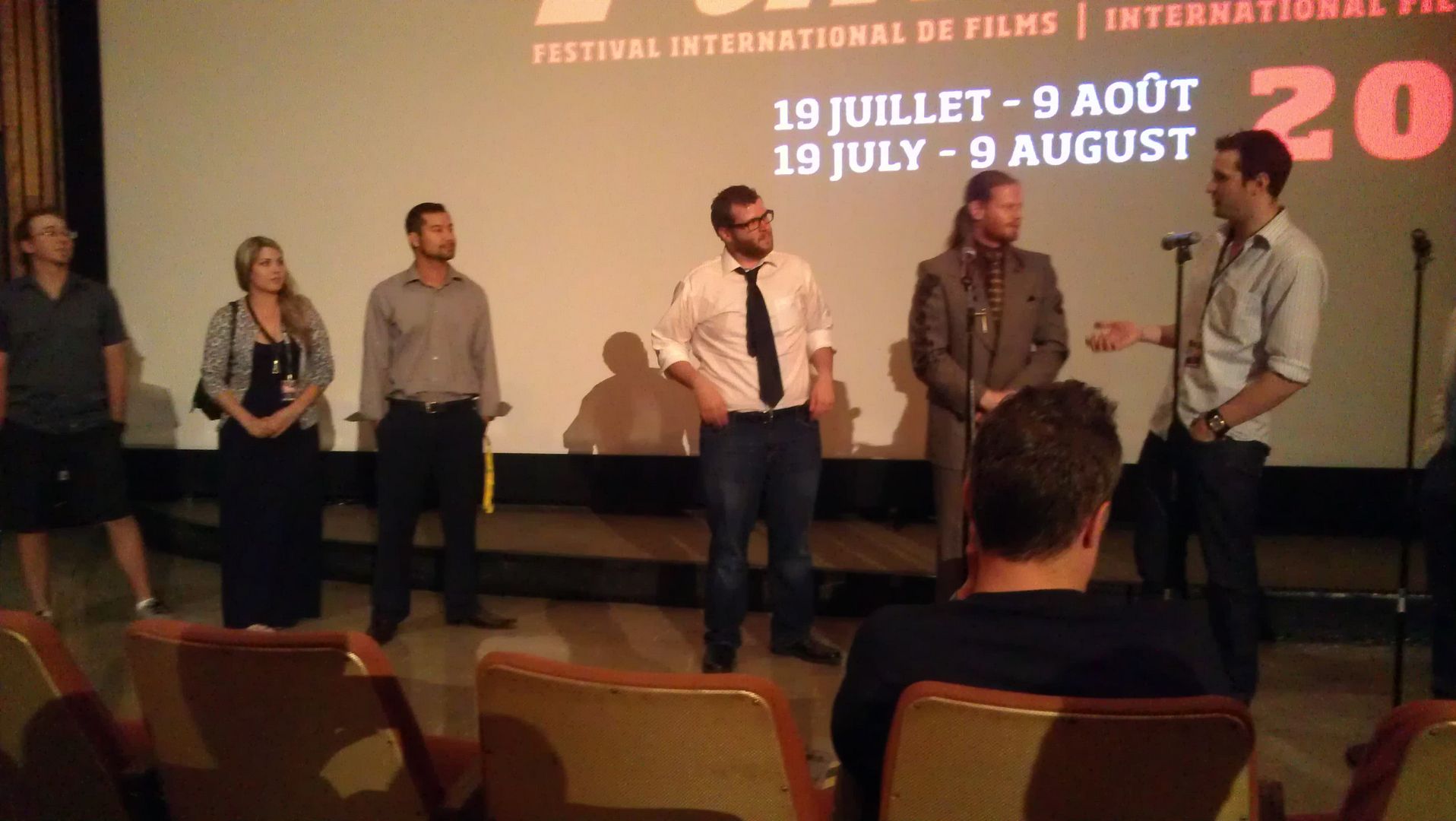
Cast & crew of Mon Ami: Sound designer Ian Robinson, costume designer Ellie Schultz, producer Joe (last name not legible), stars Scott Wallis & Mike Kovac, and writer/director Rob Grant
The makers of Mon Ami were pretty great, joking with the audience and generally showing the same kind of charm that's one of their movie's assets. One thing that struck me weird, though, is how Grant mentioned that some of the choices made were meant to reflect what sort of choices the characters would have made if they were making the movie, such as using all the slow-motion and classical music for the underscore, because they thought they were a lot more sophisticated and suave than they actually are. I don't know if I really see that - I think part of what makes it work is that Cal & Teddy don't really think they're criminal masterminds, but are in over their head anyway. What works is that these guys are sort of average, know it, and still find their plan falling apart.
Seriously, it's okay to just admit that you used that music because it was free.
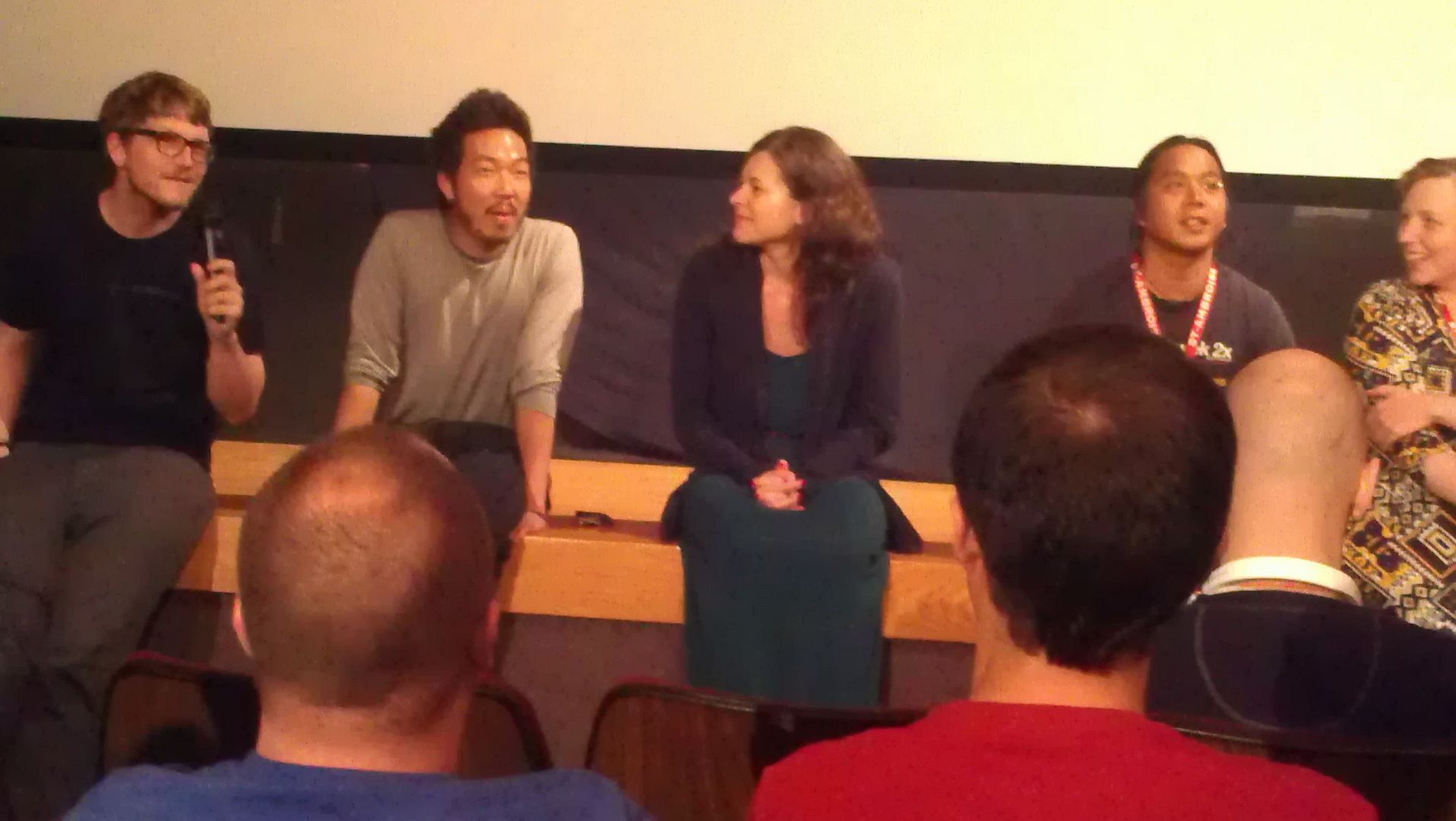
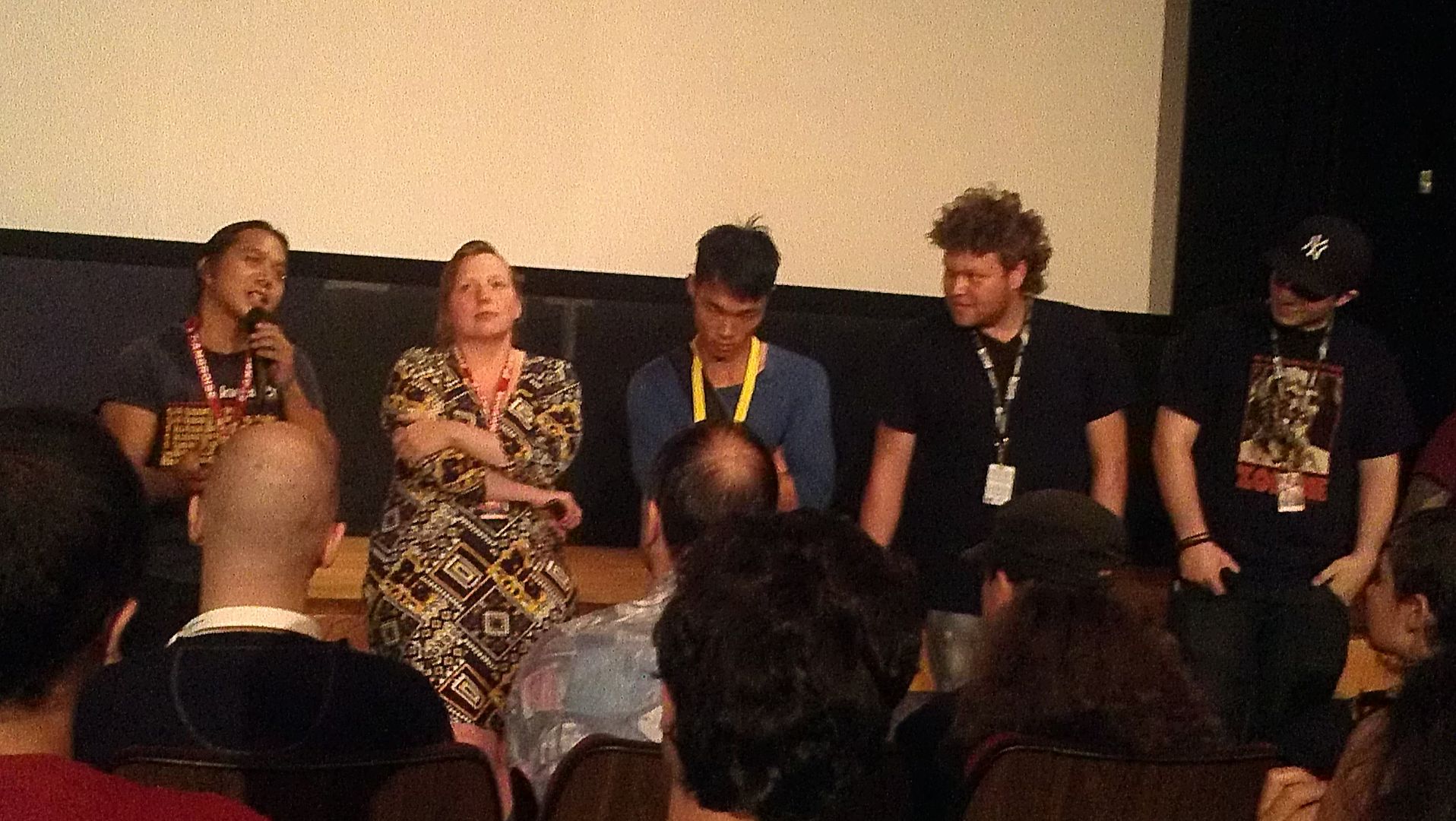
Graceland had a lot of folks in town, so much that I should have tried to figure out the panoramic features of the camera-phone. Writer/directer Ron Morales is in both shots, with producers to his left and the festival's Stephanie Treppanier and the musicians to his right. Not pictured: The guys from Resolution doing a great introduction since Ms. T had lost her voice.
The Q&A got kind of weird in the way they do for movies set and shot in a poor country with an audience that wants to be empathetic but sort of verges on the edge of being patronizing. Plus, it got into a real "issue" groove when the producer on the far right said he got involved because he felt it had a lot to say about the exploitation of women and girls. I guess that's sort of true, but I kind of thought that if you wanted to make a movie about that, you might choose one which has women in a substantive role or two. Graceland is a lot of things (I kind of wish I'd been sure enough about the plot of Kurosawa's High and Low to ask about that), but its main characters are men and the conflict driving the plot is class and corruption, not really mysogyny and pedophilia. Those are there, but not really central.
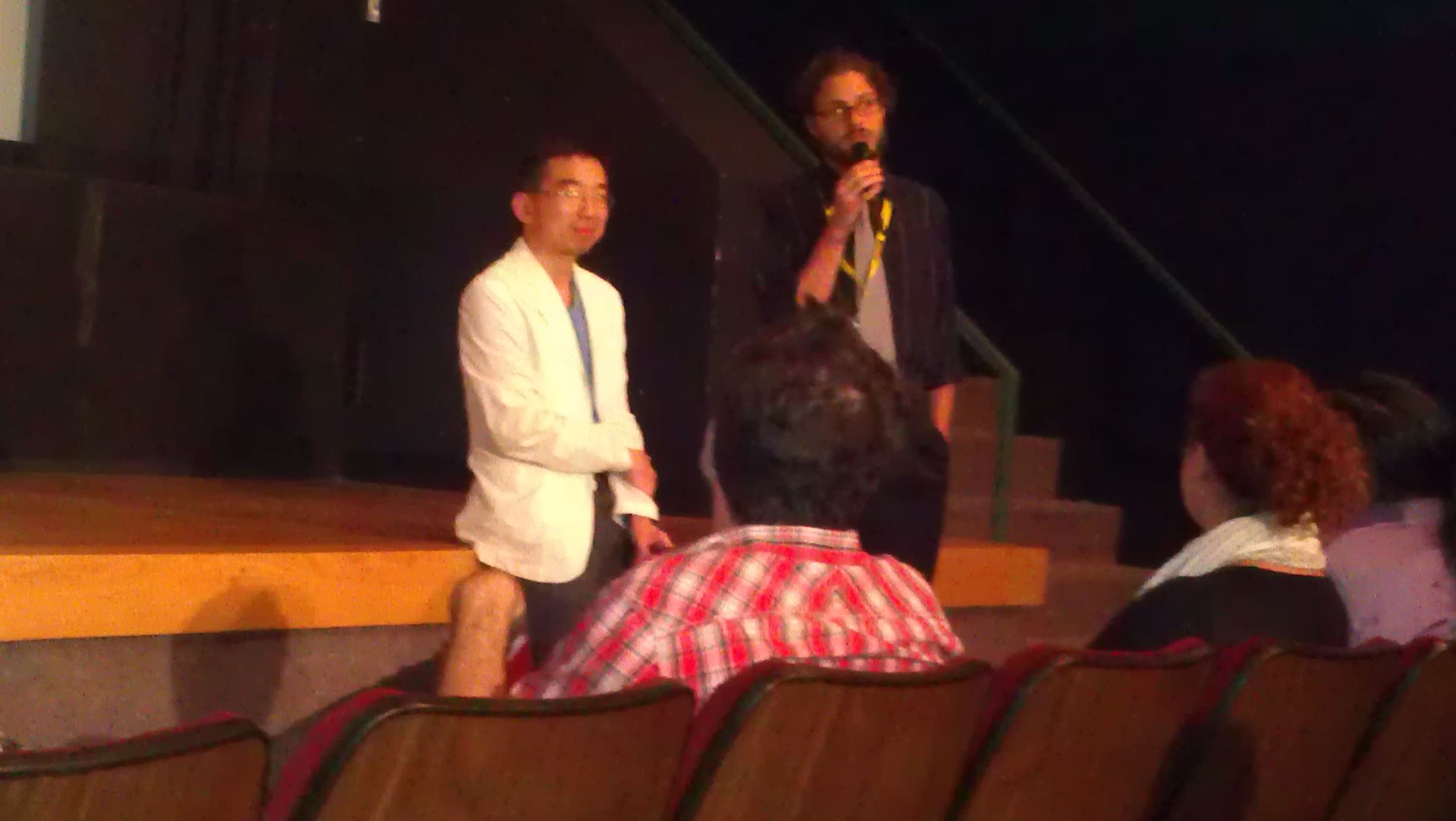
King-wei Chu and director Lonnie Martin introducing his short film "Cougars".
Zombie 108 had a short film before it, and, man, did that ever not need to start later. "Cougars" was cute and clever enough, although the twist cold be seen coming a mile away, but could use a lot of refinement before going to the feature-length version.
Today's plan: The Kick, Quick, Roller Town, The Warped Forest and The Human Race. So, basically just living in Hall all day.
Momo e no Tegami
* * * ½ (out of four)
Seen 28 July 2012 in Concordia University Theatre Hall (Fantasia 2012 AXIS, HD)
You can do a movie like A Letter to Momo with live-action nowadays, and it's increasingly common, but animation of the traditional variety still seems the best medium for this sort of fantastical but relaxed family entertainment: It makes everything part of the same world and allows for things to slow down a bit, and is especially fitting here, were drawings literally come to life, in a fashion.
After the death of her father, 12-ish Momo Miyaura (voice of Karen Miyama) and her mother Ikoku (voice of Yuka) move from Tokyo to Shio Island on Japan's Inland Sea, where Ikoku grew up. Momo, who carries a note her father started to write her (without getting beyond "Dear Momo"), is not especially thrilled with her new home, and that's before discovering that they are not the only new arrivals - although nobody else can see or hear goblins Iwa, Kawa, and Mamé (voices of Toshiyuki Nishida, Koichi Yamadera, and Cho).
Parents shouldn't worry, though - A Letter to Momo is never in any particular danger of turning into a particularly scary movie. The goblins are more pests and comic relief than any kind of real threat, although it's understandable if Momo initially thinks otherwise. The design and animation of the trio is particularly clever in this regard - despite the resemblance to the Edo-era drawings that inspired them being absolutely unmistakable, the filmmakers manage to twist them into something friendlier. For example, the way Iwa's massive mouth is always open to display his pointed teeth comes across as sort of dumb and vacant rather than intimidating.
Full review at EFC.
Mon Ami
* * ¼ (out of four)
Seen 28 July 2012 in Concordia University Theatre Hall (Fantasia 2012, HD)
Mon Ami, despite its title, is in English, so its audience needn't fret about having to deal with subtitles. It's still rather off the beaten path, a buddy black comedy, with as much enthusiasm as gags involving grievous injury; maybe enough to win audiences over.
Teddy (Mike Kovac) and Cal (Scott Wallis) have known each other since they were six, though their lives are in a bit of a rut - they've been working in the same hardware store for a years, with Cal actually crashing in the back room when not in his parents' house and Teddy married to a very demanding wife (Teagan Vincze). When the store's owner Hank (John Fitzgerald) opts to put his sons in charge rather than promote Teddy after retiring, he and Cal decide to take control of the situation: Telling everyone that they're going on a fishing trip, they kidnap Hank's pretty nineteen-year-old daughter Crystal (Chelsey Reist) with the intent of holding her for ransom. They've got a plan, but it's not nearly as foolproof a plan as they think, especially given the fools involved.
Give this movie one thing; the energy level is very high indeed. The characters often talk fast, gags come at a quick pace, and nasty physical comedy produces plenty of blood. There's quick cuts and slow motion, and rather than get bogged down, things accelerate toward the end. The movie relies on this energy, both in terms of keeping the audience with the characters as things get further out of hand and having the characters continually make things worse for themselves when stopping to think might solve a lot of problems.
Full review at EFC.
Bumchoiwaui Junjaeng (Nameless Gangster: Rules of the Time)
* * ¾ (out of four)
Seen 28 July 2012 in Concordia University Theatre Hall (Fantasia 2012, DCP)
Can I be honest? I don't really like gangster movies that much. Crime movies, yes, but movies about the mob tend to leave me cold. For me, "the outfit" in Richard Westlake's "Parker" novels is close to ideal - vaguely corporate and threatening, but off to the side of the action.
So I suppose it's both a bit of an achievement that I liked Nameless Gangster but inevitable that I didn't love it. The conflict between distant relatives played by Choi Min-sik and Ha Jung-woo never quite becomes operatic enough to really fascinate, and Choi's character just seems put together wrong: On the one hand, he's a fat stumbler without a subtle bone in his body, but on the other, his apparent strength is that he knows everybody and can network and call in favors like a pro. It's possible to be both, but the movie never really makes a case for it.
Full review at EFC.
Graceland
* * * ½ (out of four)
Seen 28 July 2012 in Concordia University Cinema J.A. de Seve (Fantasia 2012 Spotlight: Filipino Cinema, HD)
Though a low-fi picture that appears to have scraped every penny together to get made, Graceland has a pretty darn excellent hook - a twistier, more noirish take on High and Low with the chauffeur keeping things from his employer to save his kidnapped daughter - which it plays out just excellently. There are a few gaps in the plot at points, but calling most out would be called quibbling.
What's really excellent is the way it goes from an efficient and brutal setup - it makes you really like certain characters before doing something awful - to a noose that starts out pretty darn tight and only gets worse from there. Things can only end badly in this movie; the question just being how badly things will end.
Very much recommended.
Full review at EFC.
Zombie 108
N/A (but likely low)
Seen 28 July 2012 in Concordia University Cinema J.A. de Seve (Fantasia 2012, DCP)
I can't legitimately grade this, since about half an hour in, the need to get some sleep started acting upon me like a force that could not be denied and I was in and out, doing that head-jerk thing every few minutes. This, despite the iced tea I'd purchased at the concession stands - which, naturally, kicked in after the movie.
Pretty sure I still wouldn't like it, though - the story was choppy and all over the place, and frequently just ugly in ways that tended to push it past my threshhold for such things. The washed-out color palette just made it drearier and harder to keep attention.

Cast & crew of Mon Ami: Sound designer Ian Robinson, costume designer Ellie Schultz, producer Joe (last name not legible), stars Scott Wallis & Mike Kovac, and writer/director Rob Grant
The makers of Mon Ami were pretty great, joking with the audience and generally showing the same kind of charm that's one of their movie's assets. One thing that struck me weird, though, is how Grant mentioned that some of the choices made were meant to reflect what sort of choices the characters would have made if they were making the movie, such as using all the slow-motion and classical music for the underscore, because they thought they were a lot more sophisticated and suave than they actually are. I don't know if I really see that - I think part of what makes it work is that Cal & Teddy don't really think they're criminal masterminds, but are in over their head anyway. What works is that these guys are sort of average, know it, and still find their plan falling apart.
Seriously, it's okay to just admit that you used that music because it was free.


Graceland had a lot of folks in town, so much that I should have tried to figure out the panoramic features of the camera-phone. Writer/directer Ron Morales is in both shots, with producers to his left and the festival's Stephanie Treppanier and the musicians to his right. Not pictured: The guys from Resolution doing a great introduction since Ms. T had lost her voice.
The Q&A got kind of weird in the way they do for movies set and shot in a poor country with an audience that wants to be empathetic but sort of verges on the edge of being patronizing. Plus, it got into a real "issue" groove when the producer on the far right said he got involved because he felt it had a lot to say about the exploitation of women and girls. I guess that's sort of true, but I kind of thought that if you wanted to make a movie about that, you might choose one which has women in a substantive role or two. Graceland is a lot of things (I kind of wish I'd been sure enough about the plot of Kurosawa's High and Low to ask about that), but its main characters are men and the conflict driving the plot is class and corruption, not really mysogyny and pedophilia. Those are there, but not really central.

King-wei Chu and director Lonnie Martin introducing his short film "Cougars".
Zombie 108 had a short film before it, and, man, did that ever not need to start later. "Cougars" was cute and clever enough, although the twist cold be seen coming a mile away, but could use a lot of refinement before going to the feature-length version.
Today's plan: The Kick, Quick, Roller Town, The Warped Forest and The Human Race. So, basically just living in Hall all day.
Momo e no Tegami
* * * ½ (out of four)
Seen 28 July 2012 in Concordia University Theatre Hall (Fantasia 2012 AXIS, HD)
You can do a movie like A Letter to Momo with live-action nowadays, and it's increasingly common, but animation of the traditional variety still seems the best medium for this sort of fantastical but relaxed family entertainment: It makes everything part of the same world and allows for things to slow down a bit, and is especially fitting here, were drawings literally come to life, in a fashion.
After the death of her father, 12-ish Momo Miyaura (voice of Karen Miyama) and her mother Ikoku (voice of Yuka) move from Tokyo to Shio Island on Japan's Inland Sea, where Ikoku grew up. Momo, who carries a note her father started to write her (without getting beyond "Dear Momo"), is not especially thrilled with her new home, and that's before discovering that they are not the only new arrivals - although nobody else can see or hear goblins Iwa, Kawa, and Mamé (voices of Toshiyuki Nishida, Koichi Yamadera, and Cho).
Parents shouldn't worry, though - A Letter to Momo is never in any particular danger of turning into a particularly scary movie. The goblins are more pests and comic relief than any kind of real threat, although it's understandable if Momo initially thinks otherwise. The design and animation of the trio is particularly clever in this regard - despite the resemblance to the Edo-era drawings that inspired them being absolutely unmistakable, the filmmakers manage to twist them into something friendlier. For example, the way Iwa's massive mouth is always open to display his pointed teeth comes across as sort of dumb and vacant rather than intimidating.
Full review at EFC.
Mon Ami
* * ¼ (out of four)
Seen 28 July 2012 in Concordia University Theatre Hall (Fantasia 2012, HD)
Mon Ami, despite its title, is in English, so its audience needn't fret about having to deal with subtitles. It's still rather off the beaten path, a buddy black comedy, with as much enthusiasm as gags involving grievous injury; maybe enough to win audiences over.
Teddy (Mike Kovac) and Cal (Scott Wallis) have known each other since they were six, though their lives are in a bit of a rut - they've been working in the same hardware store for a years, with Cal actually crashing in the back room when not in his parents' house and Teddy married to a very demanding wife (Teagan Vincze). When the store's owner Hank (John Fitzgerald) opts to put his sons in charge rather than promote Teddy after retiring, he and Cal decide to take control of the situation: Telling everyone that they're going on a fishing trip, they kidnap Hank's pretty nineteen-year-old daughter Crystal (Chelsey Reist) with the intent of holding her for ransom. They've got a plan, but it's not nearly as foolproof a plan as they think, especially given the fools involved.
Give this movie one thing; the energy level is very high indeed. The characters often talk fast, gags come at a quick pace, and nasty physical comedy produces plenty of blood. There's quick cuts and slow motion, and rather than get bogged down, things accelerate toward the end. The movie relies on this energy, both in terms of keeping the audience with the characters as things get further out of hand and having the characters continually make things worse for themselves when stopping to think might solve a lot of problems.
Full review at EFC.
Bumchoiwaui Junjaeng (Nameless Gangster: Rules of the Time)
* * ¾ (out of four)
Seen 28 July 2012 in Concordia University Theatre Hall (Fantasia 2012, DCP)
Can I be honest? I don't really like gangster movies that much. Crime movies, yes, but movies about the mob tend to leave me cold. For me, "the outfit" in Richard Westlake's "Parker" novels is close to ideal - vaguely corporate and threatening, but off to the side of the action.
So I suppose it's both a bit of an achievement that I liked Nameless Gangster but inevitable that I didn't love it. The conflict between distant relatives played by Choi Min-sik and Ha Jung-woo never quite becomes operatic enough to really fascinate, and Choi's character just seems put together wrong: On the one hand, he's a fat stumbler without a subtle bone in his body, but on the other, his apparent strength is that he knows everybody and can network and call in favors like a pro. It's possible to be both, but the movie never really makes a case for it.
Full review at EFC.
Graceland
* * * ½ (out of four)
Seen 28 July 2012 in Concordia University Cinema J.A. de Seve (Fantasia 2012 Spotlight: Filipino Cinema, HD)
Though a low-fi picture that appears to have scraped every penny together to get made, Graceland has a pretty darn excellent hook - a twistier, more noirish take on High and Low with the chauffeur keeping things from his employer to save his kidnapped daughter - which it plays out just excellently. There are a few gaps in the plot at points, but calling most out would be called quibbling.
What's really excellent is the way it goes from an efficient and brutal setup - it makes you really like certain characters before doing something awful - to a noose that starts out pretty darn tight and only gets worse from there. Things can only end badly in this movie; the question just being how badly things will end.
Very much recommended.
Full review at EFC.
Zombie 108
N/A (but likely low)
Seen 28 July 2012 in Concordia University Cinema J.A. de Seve (Fantasia 2012, DCP)
I can't legitimately grade this, since about half an hour in, the need to get some sleep started acting upon me like a force that could not be denied and I was in and out, doing that head-jerk thing every few minutes. This, despite the iced tea I'd purchased at the concession stands - which, naturally, kicked in after the movie.
Pretty sure I still wouldn't like it, though - the story was choppy and all over the place, and frequently just ugly in ways that tended to push it past my threshhold for such things. The washed-out color palette just made it drearier and harder to keep attention.
Sunday, July 10, 2011
New York Asian Film Festival Day 02: Punished, 13 Assassins (Original Japanese Cut), Shaolin, and Raw Force
Though I had been planning to go to NYAFF this year anyway, the how and when turned out to be a little different than expected. My original plan had been to ride up to Maine with my brother Matt on the 2nd/3rd of July, spend some time visiting family from grandparents who are seldom seen since their move to Florida to my very newborn nieces, get back in time for 4th of July fireworks in Boston, and then head to New York on the 9th, see a full day of movies, and then head back for the Somerville Silents on the 10th.
Fortunately, my brother's availability was different, so my trip south got pushed up a week and north pushed back, which meant I got two days in New York instead of one, and since I'd already seen Machete Maidens Unleashed!, five shows a day would just fit one of their $99 ten-show. Unfortunately, getting there took a bit longer than expected - bus left a little late, driver took a pit-stop in Connecticut, #1 line took a bit longer than I'd hoped, had to find my way around Lincoln Center... By the time that was done, it was fifteen minutes too late for Bangkok Knockout - which, ironically, would have been my midnight movie the next week, but it's also playing Fantasia, so it's all good.
That did give me time for lunch, which I had at Lansky's. Great big pastrami sandwich and a white chocolate/raspberry shake. And you know how most places will give you a roll of some sort before the meal? Lansky's put a whole warm mini loaf of banana bread on the table. I approve of that, and wound up eating it through the next two movies.
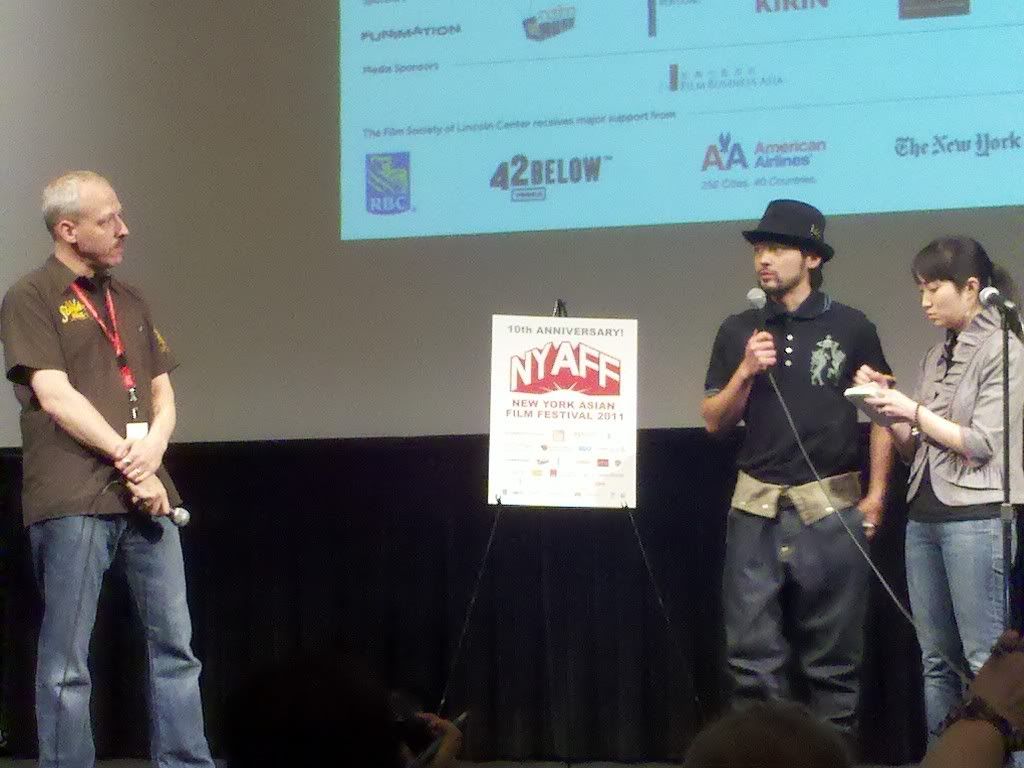
And there's the one guest who was in town - Takayuki Yamada - who was mostly there to talk about Milocrorze: A Love Story - but was good enough to come talk to us about 13 Assassins as well. As you might expect, Miike is like a lot of people who create anarchic, seemingly made-up-as-they-went-along movies - a guy who puts a lot of thought into every small detail and expects them to be executed exactly. He's a very demanding, pushy guy from the sounds of it, which makes me wonder how well that adapted to something like Ninja Kids!!!, which had a lot of very young children in the cast.
But Ninja Kids!!! is the next day's movies. For now, the four I saw on Saturday:
Bou Ying (Punished)
* * * ¼ (out of four)
Seen 2 July 2011 at Lincoln Center's Walter Reade Theater (New York Asian Film Festival 2011)
Punished levels with the audience pretty quickly, opening with two scenes that don't say everything but make it clear that this movie is less about resolutions than the process of getting there. Later on, it spells out just what the English-language title is really referring to. It can afford to tip its hand, though, because it's made by guys who know their crime and holds a couple of key bits in reserve.
The two flash-forwards that open the film are the aftermath of a kidnapping - Hong Kong property developer Wong Ho-Chin (Anthony Wong Chau-sang) and his driver/bodyguard Yao Kai-chor (Richie Ren) have caught up with the people who kidnapped Wong's daughter Daisy (Janice Man) and the results are ugly. From there we jump back, getting a look at the events that bring Wong and "Chor" to this point and following them afterward, and that's going to go some dark places: Chor was once a criminal himself before Wong took him in, and still has contacts he can call on. Wong, meanwhile, got to the top of the heap by being ruthless and uncompromising, and while he is far from the world's warmest parent, nobody attacks his family without paying a steep price.
Anthony Wong is a familiar face from a huge number of supporting roles - I've seen the hard-working actor in three films this year alone, and that's just what what has made it to theaters in the United States. He takes the lead here, and it's a terrifically forceful performance. Wong Ho-chin is a demanding man, the sort whose more benevolent emotions seem to have been burned away over the years, and there is a certain amount of this personality that suggests there's not much left to Ho-chin but residual ambition, but it's finely observed: There is a difference in the way a petty tyrant carries himself and the manner of a man who loves his daughter but can't think of any way to handle her self-destruction other than to be an autocrat. Wong dives into the worst case scenario of "father knows best"and emerges fascinatingly broken and confused on the other side, aware of his faults and struggling to understand why he commands such loyalty.
Full review at EFC.
Jûsan-nin no shikaku (13 Assassins) (original Japanese cut)
* * * ¾ (out of four)
Seen 2 July 2011 at Lincoln Center's Walter Reade Theater (New York Asian Film Festival 2011)
Director Takashi Miike's career has often been defined by the bizarre; even his recent run of PG-rated blockbusters for the whole family have frequently been weird. Watching his last movie to make a little noise in North America (Sukiyaki Western Django), I was struck by how the strange elements masked a guy who could deliver some excellent straight-up action and adventure, and found myself wondering if his skill would be appreciated as much as his vision if he played it straight for once. 13 Assassins answers that question with a resounding "yes", although it's still got its odd moments, especially in its original Japanese cut.
Lord Naritsugu (Goro Inagaki) is a monster, the sociopath half-brother of a shogun who rapes, kills, and mutilates as he pleases, and to make matters worse, he's about to be appointed to the council. After a retainer uses his hara-kiri to deliver attention to this problem, samurai lord Doi (Mikijiro Hira) is given a vague directive to make the problem go away. To this end, Sir Doi retains Shinzaemon Shimada (Koji Yakusho), a righteous samurai who has had little reason to spill blood in this time of peace. Shimada, knowing that Naritsugu has an army at his disposal - commanded, naturally, by Shimada's old classmate Habei (Masachika Ichimura) - gathers a force of his own: There will be a dozen of them, from old friends to ronin swordsman Hirayama (Tsuyoshi Ihara) to Shimada's untested nephew Shinrouko (Takayuki Yamada), with the number climbing to thirteen when Koyata (Yusuke Iseya), the lowly bandit who guides them through the woods, opts to join their party.
It all builds, of course, to a spectacular final confrontation, where the 13 would-be assassins must confront not the fifty soldiers they were expecting, but over two hundred, and while the righteousness of their cause doesn't count for much, the ability to choose and prepare the battlefield will prove crucial. That makes for an amazingly balanced battle, even if it does give Koyata reason to actually state a variation of the Inverse Ninja Rule out loud ("you samurai are useless, and even more useless in great numbers!"). Still, it's the kind of set piece whose individual pieces could each be the climax of an impressive movie, effortlessly moving between large-scale action with surprises around every corner and one-on-one sword fights, with plenty of room to sneak character bits in.
Full review at EFC.
Xin Shao Lin S (Shaolin)
* * ¾ (out of four)
Seen 2 July 2011 at Lincoln Center's Walter Reade Theater (New York Asian Film Festival 2011)
Benny Chan's Shaolin is not a remake of any of the Shaw Brothers films that focused on that legendary temple and its monks (though only fifty-odd years gone at the time, Gordon Liu-starring movies like The 36th Chamber of Shaolin helped to cement its myth). It touches on the same sort of themes - finding inner peace through martial prowess and ultimately standing up against a vicious warlord - but is its own sort of epic.
In this one, the Shaolin temple does not stand aloof from the needs of the nearby people, but opens its doors to aid the refugees left homeless and injured by the war constantly waging around them. As one battle ends, they are confronted by General Hou Chieh (Andy Lau) and his second-in-command Tsau Man (Nicholas Tse), and Hou, shall we say, does not acquit himself admirably. Hou's scheming will soon find itself repaid in kind, though, as he and his wife (Fan Bingbing) find themselves targets at a dinner where he'd planned to eliminate a fellow general. Injured and broken, he is forced to seek sanctuary in the temple, where only Wudao (Jackie Chan), the cook, will have anything to do with him. Meanwhile, a group of younger monks sneak out of the temple to steal food and medicine, and Tsau starts conducting business with western arms dealers.
Benny Chan has been a prolific director in Hong Kong for a long time, although he never gained the same fame outside the area as John Woo, Tsui Hark, or even Corey Yuen. Here, though, he presides over a grand spectacle with elaborate action sequences and an operatic plot. and in some ways he seems a curious choice: Many of the big-budget historical action epics that make their way to the US from China are made by respected directors like Zhang Yimou taking a stab at making a blockbuster, rather than genre workhorses like Chan being given a chance to "elevate" their work. This, perhaps, gives Shaolin a slightly different feel from many of its brethren; an unabashedly pulpy atmosphere amid the theatrics. Chan's characters harness or plow through their suffering rather than relish it, and fights are exciting rather than beautiful.
Full review at EFC.
Raw Force (aka Kung Fu Cannibals)
* * ½ (out of four)
Seen 2 July 2011 at Lincoln Center's Walter Reade Theater (New York Asian Film Festival 2011)
Though Machete Maidens Unleashed! is not a great documentary, I support it playing as many festivals and repatory theaters as possible, because it gives the programmers an opportunity to pull something nutty out of the archives to play afterward. The nutty thing they pull out likely also won't be any good, but it will be made with an infectuous enthusiasm. Thus, a 35mm print of Raw Force is pulled out from some archive, and it's not well-made at all, but it's a lot of fun at midnight in a crowded theater.
There's an island somewhere in the Pacific where, legend has it, old martial-arts experts would go to live out their life in exile. A group of martial-arts enthusiasts from California aims to explore it, booking passage on a cruise ship that will also stop in the Philippines. This proves to be a doubly bad idea - a group of expatriate crooks regularly bring nubile young girls there in exchange for their weight in jade, because the monks living on the island believe that consuming human flesh will allow them to live forever and raise the dead.
The movie has a little bit of everything from the major exploitation-flick food groups: Kung fu, zombies, gratuitous nudity, weird comedy... The basics. The execution often varies as widely as the genre does at times - within a single fight scene, the audience will see some good choreography and several cast members (most notably, Jillian Kesner as a bikini-clad beauty on vacation from the LAPD SWAT team) selling the action extremely well alongside bits where people go down from blows that whiffed by a good six inches or so. An action scene where pirates attack the ship is actually fairly well-done (happily interrupting some fitfully amusing comedy), until the fire starts, at which point the low-budget effects work rears its ugly head. It's a weird but not unpleasant mix - the sort of B-movie where the audience can laugh at the low production values but which does several things just well enough for a good deal to be enjoyed without irony.
Full review at EFC.
Fortunately, my brother's availability was different, so my trip south got pushed up a week and north pushed back, which meant I got two days in New York instead of one, and since I'd already seen Machete Maidens Unleashed!, five shows a day would just fit one of their $99 ten-show. Unfortunately, getting there took a bit longer than expected - bus left a little late, driver took a pit-stop in Connecticut, #1 line took a bit longer than I'd hoped, had to find my way around Lincoln Center... By the time that was done, it was fifteen minutes too late for Bangkok Knockout - which, ironically, would have been my midnight movie the next week, but it's also playing Fantasia, so it's all good.
That did give me time for lunch, which I had at Lansky's. Great big pastrami sandwich and a white chocolate/raspberry shake. And you know how most places will give you a roll of some sort before the meal? Lansky's put a whole warm mini loaf of banana bread on the table. I approve of that, and wound up eating it through the next two movies.

And there's the one guest who was in town - Takayuki Yamada - who was mostly there to talk about Milocrorze: A Love Story - but was good enough to come talk to us about 13 Assassins as well. As you might expect, Miike is like a lot of people who create anarchic, seemingly made-up-as-they-went-along movies - a guy who puts a lot of thought into every small detail and expects them to be executed exactly. He's a very demanding, pushy guy from the sounds of it, which makes me wonder how well that adapted to something like Ninja Kids!!!, which had a lot of very young children in the cast.
But Ninja Kids!!! is the next day's movies. For now, the four I saw on Saturday:
Bou Ying (Punished)
* * * ¼ (out of four)
Seen 2 July 2011 at Lincoln Center's Walter Reade Theater (New York Asian Film Festival 2011)
Punished levels with the audience pretty quickly, opening with two scenes that don't say everything but make it clear that this movie is less about resolutions than the process of getting there. Later on, it spells out just what the English-language title is really referring to. It can afford to tip its hand, though, because it's made by guys who know their crime and holds a couple of key bits in reserve.
The two flash-forwards that open the film are the aftermath of a kidnapping - Hong Kong property developer Wong Ho-Chin (Anthony Wong Chau-sang) and his driver/bodyguard Yao Kai-chor (Richie Ren) have caught up with the people who kidnapped Wong's daughter Daisy (Janice Man) and the results are ugly. From there we jump back, getting a look at the events that bring Wong and "Chor" to this point and following them afterward, and that's going to go some dark places: Chor was once a criminal himself before Wong took him in, and still has contacts he can call on. Wong, meanwhile, got to the top of the heap by being ruthless and uncompromising, and while he is far from the world's warmest parent, nobody attacks his family without paying a steep price.
Anthony Wong is a familiar face from a huge number of supporting roles - I've seen the hard-working actor in three films this year alone, and that's just what what has made it to theaters in the United States. He takes the lead here, and it's a terrifically forceful performance. Wong Ho-chin is a demanding man, the sort whose more benevolent emotions seem to have been burned away over the years, and there is a certain amount of this personality that suggests there's not much left to Ho-chin but residual ambition, but it's finely observed: There is a difference in the way a petty tyrant carries himself and the manner of a man who loves his daughter but can't think of any way to handle her self-destruction other than to be an autocrat. Wong dives into the worst case scenario of "father knows best"and emerges fascinatingly broken and confused on the other side, aware of his faults and struggling to understand why he commands such loyalty.
Full review at EFC.
Jûsan-nin no shikaku (13 Assassins) (original Japanese cut)
* * * ¾ (out of four)
Seen 2 July 2011 at Lincoln Center's Walter Reade Theater (New York Asian Film Festival 2011)
Director Takashi Miike's career has often been defined by the bizarre; even his recent run of PG-rated blockbusters for the whole family have frequently been weird. Watching his last movie to make a little noise in North America (Sukiyaki Western Django), I was struck by how the strange elements masked a guy who could deliver some excellent straight-up action and adventure, and found myself wondering if his skill would be appreciated as much as his vision if he played it straight for once. 13 Assassins answers that question with a resounding "yes", although it's still got its odd moments, especially in its original Japanese cut.
Lord Naritsugu (Goro Inagaki) is a monster, the sociopath half-brother of a shogun who rapes, kills, and mutilates as he pleases, and to make matters worse, he's about to be appointed to the council. After a retainer uses his hara-kiri to deliver attention to this problem, samurai lord Doi (Mikijiro Hira) is given a vague directive to make the problem go away. To this end, Sir Doi retains Shinzaemon Shimada (Koji Yakusho), a righteous samurai who has had little reason to spill blood in this time of peace. Shimada, knowing that Naritsugu has an army at his disposal - commanded, naturally, by Shimada's old classmate Habei (Masachika Ichimura) - gathers a force of his own: There will be a dozen of them, from old friends to ronin swordsman Hirayama (Tsuyoshi Ihara) to Shimada's untested nephew Shinrouko (Takayuki Yamada), with the number climbing to thirteen when Koyata (Yusuke Iseya), the lowly bandit who guides them through the woods, opts to join their party.
It all builds, of course, to a spectacular final confrontation, where the 13 would-be assassins must confront not the fifty soldiers they were expecting, but over two hundred, and while the righteousness of their cause doesn't count for much, the ability to choose and prepare the battlefield will prove crucial. That makes for an amazingly balanced battle, even if it does give Koyata reason to actually state a variation of the Inverse Ninja Rule out loud ("you samurai are useless, and even more useless in great numbers!"). Still, it's the kind of set piece whose individual pieces could each be the climax of an impressive movie, effortlessly moving between large-scale action with surprises around every corner and one-on-one sword fights, with plenty of room to sneak character bits in.
Full review at EFC.
Xin Shao Lin S (Shaolin)
* * ¾ (out of four)
Seen 2 July 2011 at Lincoln Center's Walter Reade Theater (New York Asian Film Festival 2011)
Benny Chan's Shaolin is not a remake of any of the Shaw Brothers films that focused on that legendary temple and its monks (though only fifty-odd years gone at the time, Gordon Liu-starring movies like The 36th Chamber of Shaolin helped to cement its myth). It touches on the same sort of themes - finding inner peace through martial prowess and ultimately standing up against a vicious warlord - but is its own sort of epic.
In this one, the Shaolin temple does not stand aloof from the needs of the nearby people, but opens its doors to aid the refugees left homeless and injured by the war constantly waging around them. As one battle ends, they are confronted by General Hou Chieh (Andy Lau) and his second-in-command Tsau Man (Nicholas Tse), and Hou, shall we say, does not acquit himself admirably. Hou's scheming will soon find itself repaid in kind, though, as he and his wife (Fan Bingbing) find themselves targets at a dinner where he'd planned to eliminate a fellow general. Injured and broken, he is forced to seek sanctuary in the temple, where only Wudao (Jackie Chan), the cook, will have anything to do with him. Meanwhile, a group of younger monks sneak out of the temple to steal food and medicine, and Tsau starts conducting business with western arms dealers.
Benny Chan has been a prolific director in Hong Kong for a long time, although he never gained the same fame outside the area as John Woo, Tsui Hark, or even Corey Yuen. Here, though, he presides over a grand spectacle with elaborate action sequences and an operatic plot. and in some ways he seems a curious choice: Many of the big-budget historical action epics that make their way to the US from China are made by respected directors like Zhang Yimou taking a stab at making a blockbuster, rather than genre workhorses like Chan being given a chance to "elevate" their work. This, perhaps, gives Shaolin a slightly different feel from many of its brethren; an unabashedly pulpy atmosphere amid the theatrics. Chan's characters harness or plow through their suffering rather than relish it, and fights are exciting rather than beautiful.
Full review at EFC.
Raw Force (aka Kung Fu Cannibals)
* * ½ (out of four)
Seen 2 July 2011 at Lincoln Center's Walter Reade Theater (New York Asian Film Festival 2011)
Though Machete Maidens Unleashed! is not a great documentary, I support it playing as many festivals and repatory theaters as possible, because it gives the programmers an opportunity to pull something nutty out of the archives to play afterward. The nutty thing they pull out likely also won't be any good, but it will be made with an infectuous enthusiasm. Thus, a 35mm print of Raw Force is pulled out from some archive, and it's not well-made at all, but it's a lot of fun at midnight in a crowded theater.
There's an island somewhere in the Pacific where, legend has it, old martial-arts experts would go to live out their life in exile. A group of martial-arts enthusiasts from California aims to explore it, booking passage on a cruise ship that will also stop in the Philippines. This proves to be a doubly bad idea - a group of expatriate crooks regularly bring nubile young girls there in exchange for their weight in jade, because the monks living on the island believe that consuming human flesh will allow them to live forever and raise the dead.
The movie has a little bit of everything from the major exploitation-flick food groups: Kung fu, zombies, gratuitous nudity, weird comedy... The basics. The execution often varies as widely as the genre does at times - within a single fight scene, the audience will see some good choreography and several cast members (most notably, Jillian Kesner as a bikini-clad beauty on vacation from the LAPD SWAT team) selling the action extremely well alongside bits where people go down from blows that whiffed by a good six inches or so. An action scene where pirates attack the ship is actually fairly well-done (happily interrupting some fitfully amusing comedy), until the fire starts, at which point the low-budget effects work rears its ugly head. It's a weird but not unpleasant mix - the sort of B-movie where the audience can laugh at the low production values but which does several things just well enough for a good deal to be enjoyed without irony.
Full review at EFC.
Wednesday, April 13, 2011
Boston Underground FF 2011 Day 4: Son of God, "Future Imperfect", Atomic Brain Invasion, The Dead Inside, and Phase 7
And here's Sunday. It turned out to be a pretty good day, all told - it included my favorite film of the festival (The Dead Inside), an interesting documentary (Son of God), and a really good thriller (Phase 7). Even the throwback sci-fi movie (Atomic Brain Invasion) was enjoyable enough, although the shorts were a pretty mixed bag. Some just annoyed the heck out of me, but others had some good imagination.
It wound up being a bit of a long day - even with the inevitable delays at the starts of movies that tightened time between screenings, it was still a half hour between them toward the end, which is a bit of a bummer when you're hungry: There's not a lot of fast food around Kendall Square, and the two nearby restaurants that sponsored the fest - The Friendly Toast and Tommy Doyle's - are not quite places you can run into, order, and finish a meal between shows. I'm just glad that the hot dogs at the theater are edible - even though they're microwaved and, you know, hot dogs, it makes the day feel less like one where I'm subsisting entirely on junk food. This is also the only situation where the free refills on those jumbo sodas actually makes sense.
It was cool to see Phase 7 on film, at least - after the previous day's issues, there was something reassuring about seeing the specks and lines that indicate 35mm appear on the screen. You'd think digital would be more reliable without the moving parts, but the simplicity and standardization of film certainly translates into reliability.
This was also the official "closing night" of the festival; it continued through Thursday, but that was repeat showings, and as they were evening-only, much less exhausting. Awards were given out at a party that overlapped with Phase 7, and they make me scratch my head a little, but I'll get to that when I get to those movies over the next few days.
Son of God
* * * (out of four)
Seen 27 March 2011 in Landmark Kendall Square #3 (Boston Underground Film Festival 2011)
Did Khavn de la Cruz and Michael Noer stumble upon a potentially fascinating movie by pure chance while walking around the streets of Manila? Or did they know about the subject and gracefully insinuate themselves? Or were things somewhat more scripted? On the one hand, it doesn't really matter; the ideas and events of the film are the same either way. And yet, it's worth asking the question, given that this is a movie about taking advantage of faith, whether or not our faith in the film is justified.
As the movie starts, experimental filmmaker Khavn (he's often credited without his surname) and Danish documentarian Noer are shooting in Quiapo, a poor Manila neighborhood, when their path intersects a marching crowd. They're members of the Church of the Black Nazarene. It's a noisy, flamboyant sect, and that seems harmless enough. Then Khavn and Noer find a group claiming that Christ will soon be resurrected, in the Philippines. Not unusual. Then we meet "Son-of-God" (Ali Doron), a diminutive guy with curly white hair who claims to be that resurrection, and who surprisingly lets the filmmakers tag along as he spreads the word.
Is Son-of-God a fraud? Almost certainly. Certain elements come from a standard playbook, and aren't necessarily executed all that well - watch how Doron pulls tumors out of a man during a faith-healing exercise; though it's easy to see those who want to believe falling for it, a closer look makes his hand seem a much more likely source. And yet, it's not all that hard to sympathize with those who believe in Son-of-God; these are people who need to believe in something, after all. And Doron comes across as quite sincere; a confrontation with a believer who lost someone close after having been "cured" by Son-of-God does not play out cynically. Instead, there are moments of guilt and moments that suggest something more like a crisis of faith. Even the skeptical might find themselves very curious about what's going on in Doron's mind here; the pilgrimage that follows certainly seems genuine, rather than something done for show.
Full review at EFC.
Future Imperfect
Seen 27 March 2011 in Landmark Kendall Square #3 (Boston Underground Film Festival 2011)
I'll punt this one a little, rather than running down every short, mostly because it's been a couple of weeks and thus many of the details have fallen out the back of my head. Also, a number were very short, and not clever enough to make an impresion in their brief running time.
Still, there were some memorable entries - "Apocalypse Story", for instance, in which a boy and a girl come across each other in a post-apocalyptic landscape. It's interesting for being almost entirely dialogue-free, possibly because language has fallen into disuse when other people are so few and far between. "Spark" is another one featuring a young cast, with a clever conceit - that genetically engineered plants have increaded the amount of oxygen in the atmosphere to the extent where people are legitimately terrified of fire. A lot more, though, were like "Robotic Panic", a low-budget but somewhat amusing bit where a robot's requests become increasingly uncomfortable.
Atomic Brain Invasion
* * ½ (out of four)
Seen 27 March 2011 in Landmark Kendall Square #3 (Boston Underground Film Festival 2011)
It's fair to look at a movie like Atomic Brain Invasion and sigh. Another one of these things? After all, to put it bluntly, the people with legitimate first-hand nostalgia for 1950s sci-fi flicks are dying off, and going the spoof route just seems unsporting. Writer/director Richard Griffin splits the difference, making a throwback sci-fi flick that's kind of funny, but occasionally seems to miss opportunities.
It's the 1950s, and this small New England town seems typical. Sure, the occasional mushroom cloud on the horizon probably should make the residents wonder just exactly what sort of velocipedes the army is working on at the Bicycle Testing Ground. That's not the only strange thing going on, though - something has crashed in the woods where the local high school has a field trip. Among those teenagers are misfits Sherman (David Lavallee Jr.), Kevin (Daniel Lee White), and Jim (Colin Carlton); academically inclined cutie Betty (Sarah Nicklin); and Lukas (Michael Reed), son of the general in charge of the army base (David Erin Wilson), who is having a hard time dealing with the fact that Betty doesn't like him nearly as much as Sherman. As slimy aliens infiltrate, another group of aliens lands - good-looking teenage ones (Alexander Lewis, Alexandra Cipolla, and Ruth Sullivan), asking to be taken to the king. They can't mean Elvis (Brandon Luis Aponte), can they?
Look at the credits of Richard Griffin and his cast, and you'll see a lot of overlap. This is a group that has been cranking out horror movies on a fairly regular schedule, and this time around they wanted to make something less R-rated. On that count, they succeed; it's a pretty mild movie, with no swearing, not much even the easily-horrified fifties moms in the cast would find terribly suggestive, and what violence there is more likely to involve puppets and glowing green goo than graphic blood and guts. In that way, Atomic Brain Invasion is a tends more to the pastiche than the parody; it respects the 50s monster-movie conventions much more than it mocks them.
Of course, it can't help but make fun much of the time, and sometimes they could have done with pushing it a little harder. While the kids are often played as kind of broad and maybe oblivious, the characters are at their best when they poke each other with something a little sharp. For instance, Lukas isn't nearly as funny as a dim-bulb bully as he is when he's playing weird, eccentric, and perhaps in a deep, dark closet. A conversation by the ladies horrified that kids might be going to that rock & roll concert rather than their pie-baking contest is a little obvious, but General Bedfellow commenting during a lecture that "we don't know a lot about radiation, and most of what we do know is wrong" is funny because it jabs at present-day scientific ignorance on film and in life as much as it does the past. Heck, Elvis is funnier the nuttier he seems. Basically, every time Griffin, co-writer Guy Benoit, and company go for the screwy, bizarre joke, it works a lot better than just repeating formula.
Full review at EFC.
The Dead Inside
* * * * (out of four)
Seen 27 March 2011 in Landmark Kendall Square #4 (Boston Underground Film Festival 2011)
Films like Travis Betz's The Dead Inside are some of my favorites to write about. Not so much the genre - although, let's face it, you don't pass up a chance to write up singing zombies - but because it's a well-made movie that goes in clever, often funny (but often not), directions. Plus, the surprises start coming early, so there's the challenge of saying just why it's so cool without giving the game away.
We start with the zombies, Harper (Sarah Lassez) and Max (Dustin Fasching), who know that there is a delicious young woman on the other side of a door. However, while they are able to converse well enough with each other, that locked door is too much of a challenge for their zombie brains. And they are not in line for a whole lot of help, as the tiny room beyond contains Fiona (also Lassez). Fiona's a writer of a series of books starring Harper and Max, and the locked door has her stuck. And as her boyfriend Wes (also Fasching) - a wedding photographer growing sick of weddings - soon discovers, it's rather worse than a simple case of writer's block; Fi seems to be having a full-fledged breakdown. Or, as the surprising direction Harper's and Max's story takes indicates, something stranger may be afoot.
Many independent movies confine themselves to a small cast and a single location out of necessity; many horror movies do so to keep the tension up. Few make such a virtue of it as The Dead Inside, where people other than Fi, Wes, and their alter egos are glanced (or heard) only briefly, and the decision not to redress the sets between the Fi/Wes and Harper/Max sequences reinforces both just how similar the couples are and what sort of turmoil Fi is undergoing. Betz moves between the scenarios smoothly, sometimes during songs, sometimes with shots of Fi at the computer, but never with the intent to confuse.
Full review at EFC.
Fase 7 (Phase 7)
* * * ½ (out of four)
Seen 27 March 2011 in Landmark Kendall Square #4 (Boston Underground Film Festival 2011)
In most zombie/contagion movies, the point where the tension really cranks up is when, after braving the various horrors to get to what should be a safe place, the characters discover that the greatest danger isn't out there; but in here. Phase 7 cuts out a lot of the time used in getting to that point, making for a thrilling siege picture.
Coco (Daniel Hendler) and his pregnant wife Pipi (Jazmin Stuart) don't know anything is up as they're doing the grocery shopping, just buying the usual while the people around them are stocking up. It's not until they get home that they find out that there have been outbreaks of a nasty disease around the world. When one of their neighbors is taken away for displaying symptoms, the Argentine equivalent of the CDC places the entire building under quarantine. As time passes with no news of the restrictions being lifted, tensions begin to form - Coco's neighbor Horacio (Yayo Guridi) seems disturbingly prepared for this situation, and a number of others are already making plans on how to consolidate and distribute assets, starting with elderly neighbor Zanutto (Federico Luppi).
Phase 7 is being presented in some circles as more black comedy than thriller, and I think that characterization does the movie a bit of a disservice. That's not to say that it's not frequently funny - it is - just that its sense of humor is often bone-dry, to the point where it can easily be confused with bad plotting. For instance, the opening scene, where Coco and Pipi are too wrapped up in their own minor concerns to notice that everybody around them is hurriedly buying in bulk - that's smart, satiric, and just gets funnier as the scene continues to play out. As things play out, though, with indications that a fair amount of time is passing, Pipi's continuing obliviousness and Coco's often head-scratching behavior become less amusing than frustrating to watch.
Full review at EFC.
It wound up being a bit of a long day - even with the inevitable delays at the starts of movies that tightened time between screenings, it was still a half hour between them toward the end, which is a bit of a bummer when you're hungry: There's not a lot of fast food around Kendall Square, and the two nearby restaurants that sponsored the fest - The Friendly Toast and Tommy Doyle's - are not quite places you can run into, order, and finish a meal between shows. I'm just glad that the hot dogs at the theater are edible - even though they're microwaved and, you know, hot dogs, it makes the day feel less like one where I'm subsisting entirely on junk food. This is also the only situation where the free refills on those jumbo sodas actually makes sense.
It was cool to see Phase 7 on film, at least - after the previous day's issues, there was something reassuring about seeing the specks and lines that indicate 35mm appear on the screen. You'd think digital would be more reliable without the moving parts, but the simplicity and standardization of film certainly translates into reliability.
This was also the official "closing night" of the festival; it continued through Thursday, but that was repeat showings, and as they were evening-only, much less exhausting. Awards were given out at a party that overlapped with Phase 7, and they make me scratch my head a little, but I'll get to that when I get to those movies over the next few days.
Son of God
* * * (out of four)
Seen 27 March 2011 in Landmark Kendall Square #3 (Boston Underground Film Festival 2011)
Did Khavn de la Cruz and Michael Noer stumble upon a potentially fascinating movie by pure chance while walking around the streets of Manila? Or did they know about the subject and gracefully insinuate themselves? Or were things somewhat more scripted? On the one hand, it doesn't really matter; the ideas and events of the film are the same either way. And yet, it's worth asking the question, given that this is a movie about taking advantage of faith, whether or not our faith in the film is justified.
As the movie starts, experimental filmmaker Khavn (he's often credited without his surname) and Danish documentarian Noer are shooting in Quiapo, a poor Manila neighborhood, when their path intersects a marching crowd. They're members of the Church of the Black Nazarene. It's a noisy, flamboyant sect, and that seems harmless enough. Then Khavn and Noer find a group claiming that Christ will soon be resurrected, in the Philippines. Not unusual. Then we meet "Son-of-God" (Ali Doron), a diminutive guy with curly white hair who claims to be that resurrection, and who surprisingly lets the filmmakers tag along as he spreads the word.
Is Son-of-God a fraud? Almost certainly. Certain elements come from a standard playbook, and aren't necessarily executed all that well - watch how Doron pulls tumors out of a man during a faith-healing exercise; though it's easy to see those who want to believe falling for it, a closer look makes his hand seem a much more likely source. And yet, it's not all that hard to sympathize with those who believe in Son-of-God; these are people who need to believe in something, after all. And Doron comes across as quite sincere; a confrontation with a believer who lost someone close after having been "cured" by Son-of-God does not play out cynically. Instead, there are moments of guilt and moments that suggest something more like a crisis of faith. Even the skeptical might find themselves very curious about what's going on in Doron's mind here; the pilgrimage that follows certainly seems genuine, rather than something done for show.
Full review at EFC.
Future Imperfect
Seen 27 March 2011 in Landmark Kendall Square #3 (Boston Underground Film Festival 2011)
I'll punt this one a little, rather than running down every short, mostly because it's been a couple of weeks and thus many of the details have fallen out the back of my head. Also, a number were very short, and not clever enough to make an impresion in their brief running time.
Still, there were some memorable entries - "Apocalypse Story", for instance, in which a boy and a girl come across each other in a post-apocalyptic landscape. It's interesting for being almost entirely dialogue-free, possibly because language has fallen into disuse when other people are so few and far between. "Spark" is another one featuring a young cast, with a clever conceit - that genetically engineered plants have increaded the amount of oxygen in the atmosphere to the extent where people are legitimately terrified of fire. A lot more, though, were like "Robotic Panic", a low-budget but somewhat amusing bit where a robot's requests become increasingly uncomfortable.
Atomic Brain Invasion
* * ½ (out of four)
Seen 27 March 2011 in Landmark Kendall Square #3 (Boston Underground Film Festival 2011)
It's fair to look at a movie like Atomic Brain Invasion and sigh. Another one of these things? After all, to put it bluntly, the people with legitimate first-hand nostalgia for 1950s sci-fi flicks are dying off, and going the spoof route just seems unsporting. Writer/director Richard Griffin splits the difference, making a throwback sci-fi flick that's kind of funny, but occasionally seems to miss opportunities.
It's the 1950s, and this small New England town seems typical. Sure, the occasional mushroom cloud on the horizon probably should make the residents wonder just exactly what sort of velocipedes the army is working on at the Bicycle Testing Ground. That's not the only strange thing going on, though - something has crashed in the woods where the local high school has a field trip. Among those teenagers are misfits Sherman (David Lavallee Jr.), Kevin (Daniel Lee White), and Jim (Colin Carlton); academically inclined cutie Betty (Sarah Nicklin); and Lukas (Michael Reed), son of the general in charge of the army base (David Erin Wilson), who is having a hard time dealing with the fact that Betty doesn't like him nearly as much as Sherman. As slimy aliens infiltrate, another group of aliens lands - good-looking teenage ones (Alexander Lewis, Alexandra Cipolla, and Ruth Sullivan), asking to be taken to the king. They can't mean Elvis (Brandon Luis Aponte), can they?
Look at the credits of Richard Griffin and his cast, and you'll see a lot of overlap. This is a group that has been cranking out horror movies on a fairly regular schedule, and this time around they wanted to make something less R-rated. On that count, they succeed; it's a pretty mild movie, with no swearing, not much even the easily-horrified fifties moms in the cast would find terribly suggestive, and what violence there is more likely to involve puppets and glowing green goo than graphic blood and guts. In that way, Atomic Brain Invasion is a tends more to the pastiche than the parody; it respects the 50s monster-movie conventions much more than it mocks them.
Of course, it can't help but make fun much of the time, and sometimes they could have done with pushing it a little harder. While the kids are often played as kind of broad and maybe oblivious, the characters are at their best when they poke each other with something a little sharp. For instance, Lukas isn't nearly as funny as a dim-bulb bully as he is when he's playing weird, eccentric, and perhaps in a deep, dark closet. A conversation by the ladies horrified that kids might be going to that rock & roll concert rather than their pie-baking contest is a little obvious, but General Bedfellow commenting during a lecture that "we don't know a lot about radiation, and most of what we do know is wrong" is funny because it jabs at present-day scientific ignorance on film and in life as much as it does the past. Heck, Elvis is funnier the nuttier he seems. Basically, every time Griffin, co-writer Guy Benoit, and company go for the screwy, bizarre joke, it works a lot better than just repeating formula.
Full review at EFC.
The Dead Inside
* * * * (out of four)
Seen 27 March 2011 in Landmark Kendall Square #4 (Boston Underground Film Festival 2011)
Films like Travis Betz's The Dead Inside are some of my favorites to write about. Not so much the genre - although, let's face it, you don't pass up a chance to write up singing zombies - but because it's a well-made movie that goes in clever, often funny (but often not), directions. Plus, the surprises start coming early, so there's the challenge of saying just why it's so cool without giving the game away.
We start with the zombies, Harper (Sarah Lassez) and Max (Dustin Fasching), who know that there is a delicious young woman on the other side of a door. However, while they are able to converse well enough with each other, that locked door is too much of a challenge for their zombie brains. And they are not in line for a whole lot of help, as the tiny room beyond contains Fiona (also Lassez). Fiona's a writer of a series of books starring Harper and Max, and the locked door has her stuck. And as her boyfriend Wes (also Fasching) - a wedding photographer growing sick of weddings - soon discovers, it's rather worse than a simple case of writer's block; Fi seems to be having a full-fledged breakdown. Or, as the surprising direction Harper's and Max's story takes indicates, something stranger may be afoot.
Many independent movies confine themselves to a small cast and a single location out of necessity; many horror movies do so to keep the tension up. Few make such a virtue of it as The Dead Inside, where people other than Fi, Wes, and their alter egos are glanced (or heard) only briefly, and the decision not to redress the sets between the Fi/Wes and Harper/Max sequences reinforces both just how similar the couples are and what sort of turmoil Fi is undergoing. Betz moves between the scenarios smoothly, sometimes during songs, sometimes with shots of Fi at the computer, but never with the intent to confuse.
Full review at EFC.
Fase 7 (Phase 7)
* * * ½ (out of four)
Seen 27 March 2011 in Landmark Kendall Square #4 (Boston Underground Film Festival 2011)
In most zombie/contagion movies, the point where the tension really cranks up is when, after braving the various horrors to get to what should be a safe place, the characters discover that the greatest danger isn't out there; but in here. Phase 7 cuts out a lot of the time used in getting to that point, making for a thrilling siege picture.
Coco (Daniel Hendler) and his pregnant wife Pipi (Jazmin Stuart) don't know anything is up as they're doing the grocery shopping, just buying the usual while the people around them are stocking up. It's not until they get home that they find out that there have been outbreaks of a nasty disease around the world. When one of their neighbors is taken away for displaying symptoms, the Argentine equivalent of the CDC places the entire building under quarantine. As time passes with no news of the restrictions being lifted, tensions begin to form - Coco's neighbor Horacio (Yayo Guridi) seems disturbingly prepared for this situation, and a number of others are already making plans on how to consolidate and distribute assets, starting with elderly neighbor Zanutto (Federico Luppi).
Phase 7 is being presented in some circles as more black comedy than thriller, and I think that characterization does the movie a bit of a disservice. That's not to say that it's not frequently funny - it is - just that its sense of humor is often bone-dry, to the point where it can easily be confused with bad plotting. For instance, the opening scene, where Coco and Pipi are too wrapped up in their own minor concerns to notice that everybody around them is hurriedly buying in bulk - that's smart, satiric, and just gets funnier as the scene continues to play out. As things play out, though, with indications that a fair amount of time is passing, Pipi's continuing obliviousness and Coco's often head-scratching behavior become less amusing than frustrating to watch.
Full review at EFC.
Monday, March 09, 2009
This Week In Tickets: 2 March 2009 to 8 March 2009
I'm getting ready for my first trip out to the South by Southwest festival this Friday, so TWIT will be up Friday morning as there's no way I'm lugging my scanner to Texas or constructing pages while I'm out there. But for now...
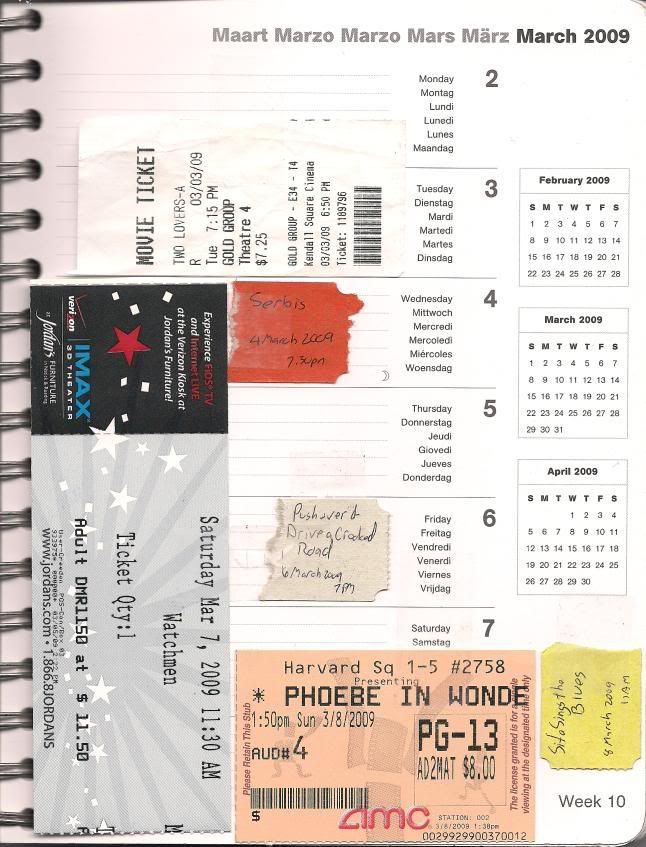
You know, that's a pretty darn solid week. Two Lovers wasn't very good, but everything else had something to recommend it. My only real complaint was that the 104 bus took forever to arrive on the way back from the furniture store; one of those situations where if you knew two just weren't going to show up, you'd take the subway. But once it's late, it must be just around the corner, right?
Also, I wish I'd been able to get to more of the "9 x Quine" series at the Harvard Film Archive, but Watchmen ate Saturday and I opted for Phoebe on Sunday. I'm definitely going to have to become a member of the HFA, since the price is pretty good (you save money if you go to three special events and eight films a year); I've been going there a lot more, lately.
Pushover
* * * (out of four)
Seen 6 March 2009 at the Harvard Film Archive (9 x Quine)
I wrote a review of this three years ago. I liked it then and maybe don't like it quite as much now, but I'm still fond of it. Kim Novak is delicious in the role that introduced her, although Fred MacMurray's businesslike, barking fall from grace doesn't quite hold up as well. What I do still love is the meticulous way it sets up its action; not many movies these days would spell everything out with floorplans that the viewer is encouraged to memorize and follow along with for the rest of the movie. Nobody ever turns right when they should turn left; which is great attention to detail.
Drive a Crooked Road
* * ¼ (out of four)
Seen 6 March 2009 at the Harvard Film Archive (9 x Quine)
Eddie Shannon (Mickey Rooney) knows cars - how to fix them, build them, and drive them. Girls, that's another story - his short stature, nasty scar, and shy demeanor has served to keep him away. So the poor guy doesn't stand a chance when Barbara Mathews (Dianne Foster) and her roughly eleven feet of legs comes into the garage where he works and asks for him by name...
... Actually, I just wanted to write that line about Ms. Foster's long, long legs. If I wind up writing a full review of this, it's going in there, and may work its way into another one. They certainly make an impression, although the rest of the movie isn't bad, exactly, just a little ham-handed. It's interesting for being a film noir with a script by Blake Edwards, who would become known for much lighter fare.
I also think that this would be prime remake material - the plot, which involves a group of bank robbers recruiting Shannon because their bank robbery requires getting through a remarkably twisty road at an impossible rate of speed, is a good one. And the automotive action isn't bad for 1954, but a twenty-first century viewer can't help but wonder how much more they could have done even ten years later.
Watchmen
* * * (out of four)
Seen 7 March 2009 at Jordan's Furniture Reading (first-run)
What do you MEAN, no Star Trek trailer? Do I look like I care about Harry Potter?
</NERD RAGE>
And, you know, if nerd rage over the Watchmen movie ends there, they've done all right. I've got no complaints about the new ending, which is a logical enough way to do it, since it allows a time-consuming subplot to be excised and does wind up saying something interesting about Dr. Manhattan.
As well as the movie does a lot of things, there are a couple of faults to it as an adaptation: The first is that it seems to miss one of Moore's points from the book, that there are no superheroes, just flawed and oftentimes perverse men and women. The one true superbeing becomes inhuman, and the closest thing to it comes awful close. Here, though, we see the characters engage in enhanced fisticuffs, destroying the rooms they fight in, rather than seeming terriby human and vulnerable as they do in the book. Excising certain scenes means we miss a big part of Rorschach's personality.
The other thing is that, as much as Watchmen is deservedly called a graphic novel in terms of scope and structure, it's also a comic book. One thing I was struck by when reading it for the first time last fall is how much each issue is very self-contained. Watchmen #4, which tells Dr. Manhattan's story, is perhaps the best single issue of any comic ever written, and even as a chapter in a book, it's haunting and tragic and whole. In the film, there's no pause of any kind between it and what happens before and after, and while director Zack Snyder and screenwriters David Hayter and Alex Tse put it on-screen more or less unmolested, the sudden shift in narration and style makes it seem like an odd section of the movie, not the grand thing it was before.
Of course, those are things coming from someone who is familiar with the book through recent experience. I'll be interested in hearing what my brother Matt thinks, as he intends to swipe my copy of the book after seeing the movie. It's still a good story told pretty well, and that's before getting to the soft spot I have for any movie that gives Matt Frewer a part well suited to him.

You know, that's a pretty darn solid week. Two Lovers wasn't very good, but everything else had something to recommend it. My only real complaint was that the 104 bus took forever to arrive on the way back from the furniture store; one of those situations where if you knew two just weren't going to show up, you'd take the subway. But once it's late, it must be just around the corner, right?
Also, I wish I'd been able to get to more of the "9 x Quine" series at the Harvard Film Archive, but Watchmen ate Saturday and I opted for Phoebe on Sunday. I'm definitely going to have to become a member of the HFA, since the price is pretty good (you save money if you go to three special events and eight films a year); I've been going there a lot more, lately.
Pushover
* * * (out of four)
Seen 6 March 2009 at the Harvard Film Archive (9 x Quine)
I wrote a review of this three years ago. I liked it then and maybe don't like it quite as much now, but I'm still fond of it. Kim Novak is delicious in the role that introduced her, although Fred MacMurray's businesslike, barking fall from grace doesn't quite hold up as well. What I do still love is the meticulous way it sets up its action; not many movies these days would spell everything out with floorplans that the viewer is encouraged to memorize and follow along with for the rest of the movie. Nobody ever turns right when they should turn left; which is great attention to detail.
Drive a Crooked Road
* * ¼ (out of four)
Seen 6 March 2009 at the Harvard Film Archive (9 x Quine)
Eddie Shannon (Mickey Rooney) knows cars - how to fix them, build them, and drive them. Girls, that's another story - his short stature, nasty scar, and shy demeanor has served to keep him away. So the poor guy doesn't stand a chance when Barbara Mathews (Dianne Foster) and her roughly eleven feet of legs comes into the garage where he works and asks for him by name...
... Actually, I just wanted to write that line about Ms. Foster's long, long legs. If I wind up writing a full review of this, it's going in there, and may work its way into another one. They certainly make an impression, although the rest of the movie isn't bad, exactly, just a little ham-handed. It's interesting for being a film noir with a script by Blake Edwards, who would become known for much lighter fare.
I also think that this would be prime remake material - the plot, which involves a group of bank robbers recruiting Shannon because their bank robbery requires getting through a remarkably twisty road at an impossible rate of speed, is a good one. And the automotive action isn't bad for 1954, but a twenty-first century viewer can't help but wonder how much more they could have done even ten years later.
Watchmen
* * * (out of four)
Seen 7 March 2009 at Jordan's Furniture Reading (first-run)
What do you MEAN, no Star Trek trailer? Do I look like I care about Harry Potter?
</NERD RAGE>
And, you know, if nerd rage over the Watchmen movie ends there, they've done all right. I've got no complaints about the new ending, which is a logical enough way to do it, since it allows a time-consuming subplot to be excised and does wind up saying something interesting about Dr. Manhattan.
As well as the movie does a lot of things, there are a couple of faults to it as an adaptation: The first is that it seems to miss one of Moore's points from the book, that there are no superheroes, just flawed and oftentimes perverse men and women. The one true superbeing becomes inhuman, and the closest thing to it comes awful close. Here, though, we see the characters engage in enhanced fisticuffs, destroying the rooms they fight in, rather than seeming terriby human and vulnerable as they do in the book. Excising certain scenes means we miss a big part of Rorschach's personality.
The other thing is that, as much as Watchmen is deservedly called a graphic novel in terms of scope and structure, it's also a comic book. One thing I was struck by when reading it for the first time last fall is how much each issue is very self-contained. Watchmen #4, which tells Dr. Manhattan's story, is perhaps the best single issue of any comic ever written, and even as a chapter in a book, it's haunting and tragic and whole. In the film, there's no pause of any kind between it and what happens before and after, and while director Zack Snyder and screenwriters David Hayter and Alex Tse put it on-screen more or less unmolested, the sudden shift in narration and style makes it seem like an odd section of the movie, not the grand thing it was before.
Of course, those are things coming from someone who is familiar with the book through recent experience. I'll be interested in hearing what my brother Matt thinks, as he intends to swipe my copy of the book after seeing the movie. It's still a good story told pretty well, and that's before getting to the soft spot I have for any movie that gives Matt Frewer a part well suited to him.
Thursday, March 05, 2009
Serbis
Writing this review, I found myself wondering how the people who don't write reviews decide what they think about movies. That bit in the fourth paragraph isn't just me trying to give my writing some sort of flair or break up a bunch of analytical text with a personal touch; I honestly didn't get what the thrust of the movie was until halfway through the review.
The answer, I guess, is that people don't, whether you want to take that to mean that most people don't really decide what they think about a movie beyond first impressions, or just don't think about them at all. There's noting wrong with that, but a movie like Serbis can't just be ingested and then not considered; do that and it's just an annoying art-house movie with more sex than usual and no real story to connect its random scenes. It grows in stature as one ponders.
(Although, yeah, to a certain extent it is kind of an art-house movie with extra sex and minimal plot, but thinking about it made me realize that the various bits tie together much better than I initially thought.)
Serbis (Service)
* * * ½ (out of four)
Seen 4 March 2009 at the Brattle Theater (Special Engagements)
Serbis takes its name from the code word which the gay hustlers who populate the film's setting use to signify their availability. After watching it, I wonder why director Brillante Mendoza decided why he wanted this to be the word representing his film, especially when "Family" was sitting right there, admittedly obvious but also fitting and ironic. The "servicing" seems to mostly be going on at the periphery, and it makes me wonder whether I'm missing some greater metaphor.
The setting is the Family Theater, aptly named in that it is owned, operated, and inhabited by three generations of the Pineda family; it's certainly not a place for the whole family, as it shows adult films and serves as a rendezvous and place of business for the local hustlers, prostitutes, and johns. Middle-aged Nayda (Jacklyn Jose) is handling most of the day-to-day operations, especially since her mother Flor (Gina Pareño) has recently been preoccupied by the legal proceedings against her husband (she's very worried that one son's testimony will allow him to go free). Nayda's husband Lando (Julio Diaz) mans the lunch counter between ferrying their son to and from school. Her cousin Alan (Coco Martin) paints murals and does odd jobs; in-law Ronald (Kristoffer King) handles projection. Every day is busy, but today is noteworthy; it's the day of the trial and also the day Alan's girlfriend Merly (Mercedes Cabral) shows up to put the extra pressure on him to share some information with Flor.
Both the family Pineda and Family Theater are sprawling and somewhat run-down. Although Nayda is a rock at the center of the family, most of the rest show some sign of physical or mental infirmity: Alan has a revolting boil on his bottom, Ronald limps, Lando forgets things. And while the Family looks like it might have been an impressive place once - it has a balcony, and a large sign in good repair - there are tiles missing from the floor, though, and early on we see the men's room fill with filthy water as the floor drain gets plugged up. The Pinedas have more or less let the sex trade take over the theater, which is not only their place of business but their home, and though there's not much hand-wringing about it, there's obviously some concern about how the environment is affecting the two youngest members of the family.
Ah, there it is; there's how the title reflects the heart of the film. Mendoza and writer Armando Lao do a good job of hiding it within a few lines of Flor's that don't overtly connect to everything else, but demonstrate just how warped priorities have become. I blame the sex for distracting me from this. Though IMDB shows the film as being R-rated, I'm surprised at that; the sex is quite explicit, and a throwaway line late in the movie makes the fairly innocent-seeming bit that opens the into something very uncomfortably voyeuristic. It's both more than I expected and more than I personally favor, and I'm not really sure it's the best way to tell the story, but it certainly does capture and focus the attention.
The way Mendoza and cinematographer Odyssey Flores shoot the theater also gets some notice. Like the sex, I sometimes get the feeling that the filmmakers are doing attention-grabbing things to give the audience something to talk up. There are a pair of chases through the theater that are kind of showy, for instance. They do help give audience members who haven't thought much about what happens behind the scenes at the theater an impression of how the wide-open public spaces can give way to cramped, labyrinthine work spaces and corridors (including the inevitable need to go up and down stairs to move between two rooms on the same level). There's some fine handheld camera work, and while we see a great deal of decay and squalor, especially within the theater, the Angeles neighborhood outside does show sparks of vitality to hint that there is hope to be found. The camera often seems reluctant to leave the theater; early on it seems to wait on the porch as Flor goes off to court, and it twists around to look straight up at the theater's sign rather than pulling back across the street for a wide shot.
As this sort of ensemble piece must, Serbis has a very nice cast, starting with the two women at the center. Jacklyn Jose and Gina Pareño play mother and daughter, but they are at the core two versions of the same character, at different points in their lives. Both Nadya and Flor are strong, uncompromising women, maybe beautiful in their youth but practical now, facing the life they find themselves in with resignation, anger, and desperation, depending on the circumstances. There's not a man in the movie quite so captivating as them; Coco Martin's Alan is interesting, but he's defined by his weakness, rather than his strength.
By the end, we may not have gotten a complete story, but the cast and crew have come together to give us an intriguing day in the life of the Family Theater. Not always a pleasant one, but one with turning points and one which will probably linger in the mind.
Also at EFC.
The answer, I guess, is that people don't, whether you want to take that to mean that most people don't really decide what they think about a movie beyond first impressions, or just don't think about them at all. There's noting wrong with that, but a movie like Serbis can't just be ingested and then not considered; do that and it's just an annoying art-house movie with more sex than usual and no real story to connect its random scenes. It grows in stature as one ponders.
(Although, yeah, to a certain extent it is kind of an art-house movie with extra sex and minimal plot, but thinking about it made me realize that the various bits tie together much better than I initially thought.)
Serbis (Service)
* * * ½ (out of four)
Seen 4 March 2009 at the Brattle Theater (Special Engagements)
Serbis takes its name from the code word which the gay hustlers who populate the film's setting use to signify their availability. After watching it, I wonder why director Brillante Mendoza decided why he wanted this to be the word representing his film, especially when "Family" was sitting right there, admittedly obvious but also fitting and ironic. The "servicing" seems to mostly be going on at the periphery, and it makes me wonder whether I'm missing some greater metaphor.
The setting is the Family Theater, aptly named in that it is owned, operated, and inhabited by three generations of the Pineda family; it's certainly not a place for the whole family, as it shows adult films and serves as a rendezvous and place of business for the local hustlers, prostitutes, and johns. Middle-aged Nayda (Jacklyn Jose) is handling most of the day-to-day operations, especially since her mother Flor (Gina Pareño) has recently been preoccupied by the legal proceedings against her husband (she's very worried that one son's testimony will allow him to go free). Nayda's husband Lando (Julio Diaz) mans the lunch counter between ferrying their son to and from school. Her cousin Alan (Coco Martin) paints murals and does odd jobs; in-law Ronald (Kristoffer King) handles projection. Every day is busy, but today is noteworthy; it's the day of the trial and also the day Alan's girlfriend Merly (Mercedes Cabral) shows up to put the extra pressure on him to share some information with Flor.
Both the family Pineda and Family Theater are sprawling and somewhat run-down. Although Nayda is a rock at the center of the family, most of the rest show some sign of physical or mental infirmity: Alan has a revolting boil on his bottom, Ronald limps, Lando forgets things. And while the Family looks like it might have been an impressive place once - it has a balcony, and a large sign in good repair - there are tiles missing from the floor, though, and early on we see the men's room fill with filthy water as the floor drain gets plugged up. The Pinedas have more or less let the sex trade take over the theater, which is not only their place of business but their home, and though there's not much hand-wringing about it, there's obviously some concern about how the environment is affecting the two youngest members of the family.
Ah, there it is; there's how the title reflects the heart of the film. Mendoza and writer Armando Lao do a good job of hiding it within a few lines of Flor's that don't overtly connect to everything else, but demonstrate just how warped priorities have become. I blame the sex for distracting me from this. Though IMDB shows the film as being R-rated, I'm surprised at that; the sex is quite explicit, and a throwaway line late in the movie makes the fairly innocent-seeming bit that opens the into something very uncomfortably voyeuristic. It's both more than I expected and more than I personally favor, and I'm not really sure it's the best way to tell the story, but it certainly does capture and focus the attention.
The way Mendoza and cinematographer Odyssey Flores shoot the theater also gets some notice. Like the sex, I sometimes get the feeling that the filmmakers are doing attention-grabbing things to give the audience something to talk up. There are a pair of chases through the theater that are kind of showy, for instance. They do help give audience members who haven't thought much about what happens behind the scenes at the theater an impression of how the wide-open public spaces can give way to cramped, labyrinthine work spaces and corridors (including the inevitable need to go up and down stairs to move between two rooms on the same level). There's some fine handheld camera work, and while we see a great deal of decay and squalor, especially within the theater, the Angeles neighborhood outside does show sparks of vitality to hint that there is hope to be found. The camera often seems reluctant to leave the theater; early on it seems to wait on the porch as Flor goes off to court, and it twists around to look straight up at the theater's sign rather than pulling back across the street for a wide shot.
As this sort of ensemble piece must, Serbis has a very nice cast, starting with the two women at the center. Jacklyn Jose and Gina Pareño play mother and daughter, but they are at the core two versions of the same character, at different points in their lives. Both Nadya and Flor are strong, uncompromising women, maybe beautiful in their youth but practical now, facing the life they find themselves in with resignation, anger, and desperation, depending on the circumstances. There's not a man in the movie quite so captivating as them; Coco Martin's Alan is interesting, but he's defined by his weakness, rather than his strength.
By the end, we may not have gotten a complete story, but the cast and crew have come together to give us an intriguing day in the life of the Family Theater. Not always a pleasant one, but one with turning points and one which will probably linger in the mind.
Also at EFC.
Subscribe to:
Posts (Atom)

