Showing posts with label Portugal. Show all posts

Friday, July 18, 2025

Fantasia 2025.02: "Atom & Void", Reflet Dans un Diamant Mort, "Skulk", The Wailing '24, "Floor", and Noise

Are there very affordable flights between Montreal and Seoul right now? All the guests at my screenings have been from South Korea and that's a hike!
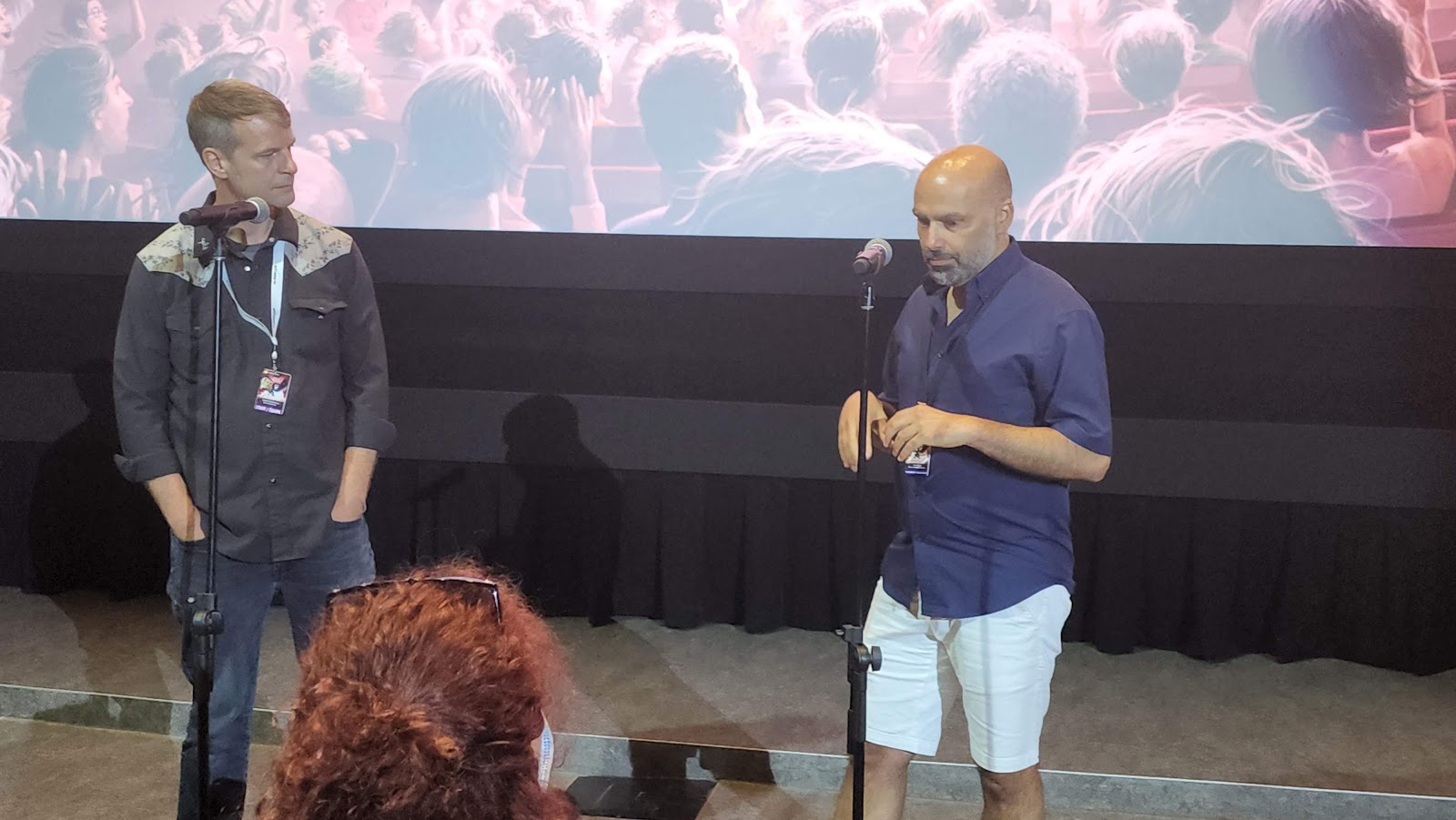
First up, producer Huh Youngjin and actors Park Tae-San & Lee Jong Eun from "Floor", an extraordinarily natural pairing with Noise and maybe a better riff on it for how its particular nuttiness spins out of something very relatable before escalating in crazy fashion. Very fun, since I didn't really know which direction it would be going from having only skimmed the description, and I like that Lee introduced himself as the "fighter", though maybe my messy French/nonexistent Korean messed this up.
Also here is Kim Soo-jin, director of Noise, a pretty darn fair first effort. One thing he mentioned is that he had the same sound crew as The Wailing (not the one from earlier in the evening, but the Korean horror masterpiece), and, yes, you can tell that those folks were at the top of their game.

With any luck, I've finished this by the time I'm off to Friday's films (The Bearded Girl, Nyaight of the Living Cat, and Find Your Friends) with enough time to spare for a late lunch because I had no time to eat between shows on Thursday and was hungry by the time I got back to the apartment. At least the front door was unlocked!


"Atom & Void"

* * * * (out of four)
Seen 17 July 2025 in Salle J.A. De Sève (Fantasia Festival, laser DCP)

A downright terrific short film where the beginning - a spider emerging from its cave lair and exploring its spooky environment - does not quite prepare one for all the twists and turns it will make in the next ten minutes. As near as I can tell, it's mostly an actual spider poking around a meticulously crafted environment, highlighting that these arachnids are odd creatures, visually; a clever filmmaker can make them seem monstrous or adorable with the cinematography and editing. Writer/director Gonçalo Almeida and his team are very clever indeed, with André Carvalho's score helping him play with scale - it encourages you to think big even though you know spiders are small.

I don't want to say too much - it's a delight to discover - but I will say that just as I was writing "getting some Alien vibes here" in my notebook, it took a nifty turn and became even more my thing. This feels like the sort of short that a producer sees and immediately signs the director up for a feature, or at least I hope it is.


Reflet dans un diamant mort (Reflection in a Dead Diamond)

* * * ¼ (out of four)
Seen 17 July 2025 in Salle J.A. De Sève (Fantasia Festival, laser DCP)
Where to stream it (when available

If you know the work of Hélène Cattet & Bruno Forzani, you know the general shape of what's coming here: An ultra-stylish riff on favorite genres, in this case James Bond and all the European spy-fi that came with him, deliriously diving into meta territory as the film goes on. It's not going to take a straight line, but the look will be impeccable, and they will take great pleasure in using a few words as possible when they can.

It opens with elderly John Diman (Fabio Testi) sitting on the beach behind an old fashioned hotel, watching the surf and not exactly objecting to having a pretty girl come into view. She reminds him of his younger days, when he was a secret agent (Yannick Renier) tasked with protecting and investigating oil magnate Markus Strand (Koen De Bouw). But if it was difficult to discern what is real in a world where a latex mask can transform deadly assassin Serpentik (Thi Mai Nguyen) into seemingly anyone, it's even more difficult when your memory is failing and that pretty girl in the next room goes missing. Is it old enemies returned, or just a strange coincidence?

There's a part of me that kind of wants this to be "retired secret agent getting lost in his past" and nothing more, or having one last adventure as his mind starts to fail him, but that's not all Cattet & Forzani have in store. Reflections is a catalog of the idea of the super-spy that likely never existed outside of fiction, where reboots, loose continuity, and trend-chasing rendered every aspect of a story as malleable even as some remains stubbornly, frustratingly fixed, and the moral underpinnings are even worse than one might think. They draw from Bond, Diabolik, and many others - fans of Euro-genre pictures will likely have great fun combing through the picture for influences - with great affection, but they're also mindful of the cruelty underpinning the genre: Ian Fleming's literary Bond could come off as a sadist or a psychopath, and the genre often reflected the desire to do monstrous violence justified by the other side being worse, although what they were fighting for was less freedom than oligarchy at times.

The acting is not usually a huge factor in this team's movies, aside from the ability to play it very straight or imitate vibe of 1960s Euro productions, but I do like the vibe that the two men playing John have: Yannick Renier gives the younger version this sort of sexy square-jawed righteousness that is so charmingly certain of itself that it can justify anything, and Fabio Testi often seems to be assuming the mantle of the man John imagine he'd be when retired, a silver fox with an air of sophistication and mystery, but you can see why none of the people around him actually seem to respect him much (aside from one woman who will soon discover it's a bad idea). The pair don't quite echo each other's performances as their worlds collapse, but they push the audience in the same direction, flailing in a way that makes them foolish and dangerous as they discover their world isn't what it seems.

The filmmakers cram a tremendous amount of deconstruction into 85 minutes; by the end one starts to wonder how they keep having another angle or example they want to play with. It's almost exhausting. You can't argue against wanting to see all of them, though; by the time they've fully levitated above their original story and jumped into every form of media that the genre thrived in, all captured in a way that calls lovingly back to the faded film look of memory, there's not really, and they're filmed to be just explicit enough in their violence to thrill but also strongly representing a broader concept. Cattet & Forzani (with cinematographer Manuel Dacosse, production designer Laurie Colson and everyone else in their meticulous crew) will make one gasp at how perfectly constructed and artistic every single shot is, throwbacks that seem like far more than mere quotations.

It's beautiful enough to suggest that rewatching to catch every reference, develop one's theories, or to just try to figure out what's going on will be a great pleasure indeed.


"Skulk"

* * * (out of four)
Seen 17 July 2025 in Auditorium des diplômés de la SGWU (Fantasia Festival, laser DCP)

Director Max Ward and co-writer Carmen Fortea offer up an initial warning in the titles, that foxes walk the streets and howl to warn of certain creatures getting close, and at the start of the film, one wonders if that lore has been lost or if the young woman alone in her house (Elina Gavare) feels it in her bones, not sure if the fox or something else should make her nervous. She gives a nice, nervy little performance as irritation becomes shivers, while Ward and his crew do neat things with how the dark transforms the city. After all, what's eerie in an urban environment is the closeness of other people and the accumulated/buried history of the space, but get it dark and quiet enough, and the primal fears start to reappear, but can urbanites recognize the warnings that nature has for us?


El Llanto (The Wailing '24)

* * ¼ (out of four)
Seen 17 July 2025 in Auditorium des diplômés de la SGWU (Fantasia Festival, laser DCP)
Where to stream it (when available)

The Wailing is one of those horror movies that I feel bad about shrugging off with "wasn't scary", but that's kind of where I wound up - there's a lot of things done well in it, and it doesn't take a lot of work to see what it's trying to do and even argue that all the pieces are in the right places, but ultimately, I wound up sitting through it mostly unshaken. All the good work and all the less-good but maybe unnervingly-incongruous material just didn't combine in such a way as to create a visceral reaction.

After a prologue, it introduces the audience to Andrea (Ester Expósito), a student in Madrid with a boyfriend (Àlex Monner) studying in Sydney who has recently learned that she was adopted, from a hospital in Buenos Aires. Except that when she receives her original birth certificate and adoption information, it says she was born in Spain, and that her birth mother recently died - after serving twenty years for murder, and right around the time shadowy figures started appearing in the background of Andrea's video calls. Perhaps the answers to her questions lie twenty-three years in the past, when film student Camila (Malena Villa) finds herself drawn to Marie Montand (Mathilde Ollivier), initially as a subject but soon as a friend and perhaps more, with the same mysterious old man appearing in Camila's Digicam footage.

You can see the pieces here, and what director Pedro Martin-Calero & co-writer Isabel Peña are maybe looking to have them add up to: Not just a family curse, but one visited upon the women of the family by an abusive and envious old man, something people dutifully ignore until they're looking at pictures and video and what's there can't be denied. It seems like rich thematic material, and I wouldn't be shocked if people closer to it than I am personally tell me it hits home. It's the stuff of horrors and Martin-Calero seems to have a nifty, underused angle from which to attack it.

I don't know that the story he built around it is ever more than an inch deep, or specific enough to really gel into a terrifying whole. Like, what's the deal with the sometime-empty, sometimes-not phallic building that appears in Madrid, La Plata, and maybe Buenos Aires? Why the adoption out of Argentina at all, especially since the reason given makes little sense with or without considering that geography is clearly not a limitation for this phantom? How far back can this be traced? Is the old man someone important enough to manifest this common evil supernaturally? Martin-Calero stages his jump scares all right - although there's some girls-lifted-by-an-invisible-assailant that looks wrong even if you don't expect the ghost to be as frail as he looks - but all the other good stuff about a horror movie, the pieces between the shocks and the underlying idea that let it all really sink in, just feels slapdash.

(It doesn't help that the filmmakers never quite figure out how to make present the idea that this old ghost is sexually molesting these women in a visually striking way beyond some clothing seeming to shift on its own as the women sleep; it maybe needs to be more lurid than something one squints at and says "I guess he's feeling her up, maybe?")

Kind of a shame, because Ester Expósito is impressive as Andrea, navigating this likable zoomer who spends a large chunk of her life online (and I like the bold, screen-filling letters past messages fading but not disappearing which highlight this text-speak as important and persistent to her rather than transitory like traditional subtitling) into anger, fear, and despair; she's also surrounded by a supporting cast that fleshes their characters out without a whole lot of exposition or distraction from Andrea. I'm a bit less enamored of Camila and Marie, especially since Malena Villa gives the more interesting performance as the former despite the story never really seeming to be enough about her before Mathilde Ollivier has a great run at the end.

Still, ultimately - The Wailing is just not scary for me, and no amount of breaking it down to its good pieces seems likely to make it so.


"Floor"

* * * ¼ (out of four)
Seen 17 July 2025 in Auditorium des diplômés de la SGWU (Fantasia Festival, laser DCP)

"Floor" plays as a few odd ideas not exactly sewn together by arch, English-language narration (for a Korean film that doesn't seem to be any sort of co-production), but ultimately sort of held together by a frantic devotion to one idea and playing it out in as extreme a manner as possible: A married couple has just moved into a new place, which they mostly like despite it being kind of a dump, but the folks upstairs make too much noise, probably because they're violent gangsters. The husband (Park Tae-san) is sent upstairs three times by his wife (Jo Yura) - the first time he's ignored, the second time he's punched out, but the third…

Well, let's just say that there's something really delightful for action fans when a fight in a relatively low-budget short becomes a crazy freaking melee, smashing its way through multiple rooms featuring multiple combatants, shots held long enough for a whole exchange of blows and fewer chances to think they swapped a double in there, and just enough quick pauses for little jokes to keep the energy up as things escalate to absurd degrees. This movie is very silly, but it's very silly in a way that's consistent even while the action sometimes seems random.


Noijeu (Noise)

* * ¾ (out of four)
Seen 17 July 2025 in Auditorium des diplômés de la SGWU (Fantasia Festival, laser DCP)

Noise feels like something that's right on the cusp of being a terrific little horror story if only its pieces fit together a little better. The filmmakers are building it out of bits that seem Lovecraftian on the one hand and Backrooms-inspired on the other, and that can work pretty well, but they often seem to be grasping at everything in such a way that the audience can feel like they're making obvious connections before them.

The film opens with Seo Ju-hee (Han Su-a) maniacally covering the ceiling of her apartment with sound-deadening foam to no avail, screaming that she's trying to find a way to make it stop. Some time later, after she's failed to show up to work for a week, her hearing-impaired sister Ju-young (Lee Sun-bin) is asked to check in, only to find Ju-hee has vanished without a trace, not even taking her phone. Ju-young move in to investigate - she and Ju-hee had meant to live there together, but the factory where Ju-young works has a dorm - but some of the building's other residents are at best unhelpful: The building supervisor (Baek Ju-hee) is worried that this talk of people going missing or dying in the building could imperil an upcoming reconstruction, while the man in the apartment below (Ryu Kyung-su) appears to be hearing the noise too, but assumes it is coming from the Seos' apartment and has started threatening violence. The single mom above on the 8th floor (Jeon Ik-ryung) seems nice, though, and Ki-hoon (Kim Min-suk), the boyfriend Ju-hee hadn't mentioned, is eager to help find her.

A day later, I can't say I recall what the noise in question was supposed to sound like - a rasp? my tinnitus? a low rumble? - but I can say that it's effective enough because I genuinely believe that it was driving Ju-hee and her downstairs neighbor to madness, although not just raging mania: Ryu Kyung-su gets to start an angry clenched fist and pull tighter as the film goes on, selling that he may once have been something like a reasonable person before he started hearing it, and for all that the main impression we get of Ju-hee is her wailing in torment, it's kind of fun that Ju-young keeps finding evidence that her sister was trying to attack the problem scientifically. It's probably the right choice - how do you make a film watchable with sound that will either drive a viewer to turn it off/walk out or not bad enough to be taken seriously - and he builds the reactions to it well enough to make it stand up.

There are a lot of other things that could maybe hold up better, though. There's not exactly a hole in the middle of the movie where the relationship between Ju-young and Ju-hee should be, but given what we see obliquely, it should be the beating heart of the movie. It seems so rich and fraught - we see that the car accident that orphaned them also disabled them in different ways, and that Ju-hee feels Ju-young abandoned her - but it seems to take forever to actually see the two actresses together, and the apartment never feels staged or shot like a place that is supposed to have two people in it instead of one. We also never see Ki-hoon and Ju-hee together, for that matter. It seemingly never occurs to the two people hearing the weird noise to say "hey, I'm hearing a weird noise too, let's figure this out", the audience waits too long for Chekhov's Basement Full of Garbage to come into play after the first mention that folks were not seen leaving the building, and after establishing Ju-young's hearing loss early, it seldom comes into play once she gets an upgraded hearing aid (though the sound design is excellent when it does).

(I also really want to know what the room full of weird equipment seen toward the end is about - it looks like fun lore!)

Director Kim Su-jin does decent work pushing through all this, though. It helps that he's got a star in Lee Sun-bin who has Ju-young come across as likably determined but also shows a fair amount of edge as she loses patience. He's good at cranking things up to the next notch several times as the movie goes on - you can feel the click as he moves the dial - and the script keeps the cast manageable rather than overstuffing so that they can drop bodies on the regular. Even if I'm not sure the whole thing adds up to something coherent, there's something really enjoyable about how Ju-young, Ki-hoon, and Ju-hee seem to take a smart approach to their problems rather than flailing or waiting for answers to fall into their laps.

It's just scary enough to work, especially since it doesn't have a lot of dead space to get a viewer annoyed at why they're not doing this smart thing instead of that dumb thing, but also just good enough to see that it could have been great.

Friday, July 26, 2024

Fantasia 2024.04: The Avenging Eagle, International Science-Fiction Short Films, Not Friends, The Old Man and the Demon Sword, and Mash Ville

Falling a day behind here, because Sunday was a full day and Monday an early start, and the breathing room I'd hoped for didn't materialize. There's also no desk in this hotel room, so it's a little slow going.

Apologies for the terrible panorama from the Sci-Fi Shorts; some weird fisheye stuff going on. Anyway, my notes also stink, but from the left, there three folks from "Headache", with director Björn Schagerström in the center; two from "ZZZ", with director Philipe Vargas on the left; director Connor Kujawinski of "A Little Longer"; directors Daniel Shapiro & Alex Topaller of "Escape Attempt"; and Eddy Martin & Elena Rojas, two of the cast members of "ZZZ".

It was, as usual, an enjoyable Q&A, with the "Headache" folks talking about how it's kind of easy to find brutalist architecture that give you massive concrete slabs for exteriors, it's not so easy when you want that inside, and they wound up shooting in an art museum space that was between expositions, and seemed to be relatively welcoming of folks making a short film. They also talked about how using that space was tricky at times, since they didn't want visible light sources, in one case creating a weird spot where light was coming out of a shute that illuminated the head of a bed. They mentioned that it was a proof of concept for a feature, and that unlike a lot of shorts, they actually found themselves adding stuff into the initial cut, because the timing just wasn't right.

The "Escape Attempt" team had the opposite problem; their initial cut was almost an hour, too long for the shorts section of most festivals (the Oscars define one as 40 minutes or less and most festivals are similar). They initially cut it down to half that, but at times wondered if they should try to boost it to a feature. I'm not sure there's really enough in the story for that, and I imagine that at that length they'd be spending a lot on the FX budget. That said, they did mention that a lot more was practical than you might think, especially with the spaceship interiors; the production design team was eager to build rather than just send things along to the effects house.

I'd hoped to head across the street for Ghost Cat Anzu after that, but it would have been a tight fit and a shorts package with a lot of filmmakers to wrangle and have Q&A with always runs long, so I stayed in De Sève for Not Friends, which turned out fine schedule-wise, chipping away at Tuesday so I'd be able to see Customs Frontline outside the festival but part of it in spirit.

I stayed in De Sève for The Old Man and the Demon Sword, with the festival's Jusine Smith hosting writer/director Fábio Powers, producer Christiano Guerreiro, and visual effects artist Jules Spaniard. It's the sort of Q&A where, even if you didn't love the movie, makes one say "good for you!", as Powers talked about his love for B movies, having the idea for the movie in his head for a long time, and wanting to make something with António da Luz, a non-professional actor and the uncle of a cousin who had a distinctive vibe and energy, and how he started from the going-meta finale because he figured he'd need to explain a lot of slip-ups only to find the movie mostly went fine. He also brought in a couple of folks he remembered from television when he was a child, one of whom had surprisingly retired to his town, and contacting Spaniard on Facebook to get some pointers on how to do effects and winding up with a collaborator.

It's also apparently very specifically Portuguese in a lot of ways, including how the village where they filmed has a population of 14: Apparently a lot of those mountain towns are hollowed out in that way, which gives you a lot of freedom to make a movie but has its issues, like how there is obviously no coffee shop or grocery store in a place of that size.

So, very much an "Underground" entry, though not exactly full-on Outsider Art. I'm glad there's a place for that, beyond just "folks not interested in the wrestling horror movie on the bigger screen".

The day ended across the street in Hall with the World Premiere of Mash Ville, with host/programmer Steven Lee, director Hwang Wook, the translator whose name I missed, producer Lim Dong-min, and actors Kim Hee-sang & Chun Sin-hwan. They talked about wanting to do genres you don't see very often in Korean movies, specifically name-checking westerns and John Ford, and it's kind of funny, because if this is a Western, it feels more Sam Peckinpah than Ford to me. I don't really know that it's actually a Western; it feels more like the Coen Brothers doing small-town crime with a heart of pitch-black darkness.

Anyway, I was kind of wiped out at that point, maybe not properly appreciating it and retaining it well. I'll probably give it a look if it pops up somewhere else.

Long day! And a couple more since; if you're reading this on Saturday the 27th (Day 10), the plan is trying for Killer Constable, crossing the street for Capsules 2024 if I'm not far enough up the pass-holder line, HEAVENS: The Boy and His Robot, Kizumonogatari, and Infinite Summer.


Leng xue shi san ying (The Avenging Eagle)

* * * ¼ (out of four)
Seen 21 July 2024 in Salle J.A. De Sève (Fantasia 2024: Fantasia Retro, laser DCP)

I haven't seen nearly enough Shaw Brothers material to know where this stands in the pantheon - they made so much and I've mostly watched it hit-and-miss as it plays various repo programs! I'm guessing this is close to top-tier, with a hook that makes it stick out enough to be worthy of the spiffy new restoration and forthcoming release on disc.

It opens with a man who calls himself "Vagrant" (Ti Lung) falling from his horse as he desperately rides across the desert; a passing rider who calls himself "Homeless" (Alexander Fu Sheng) stops to assist him, only to have Vagrant run off with his horse. Homeless eventually catches up to Vagrant, who reveals that he is a former member of the Boat Clan, a group of vicious marauders commanded by Yoh Xi-hung (Ku Feng), and Vagrant was one of the notorious Eagle Warriors. He has attempted to turn over a new leaf, for reasons he chooses not to share, but Yoh has sent his comrades to bring him in dead or alive, and ultimately it appears that the only chance at survival is to go on the offensive. Homeless chooses to help his new friend, although he remains cagey about his own past.

The restoration/scan of The Avenging Eagle that played Fantasia's Retro series is good enough that you can see the glue holding the wigs on, one of those things that makes you wonder if maybe movies were made with the expectation that a little projector motion and the like was expected to smooth such things out. Honestly, it can be shocking how good movies you associate with beat-up grindhouse prints and bargain-bin VHS look given a chance. And this one looks fantastic, full of bright colors and garish costumes and a world created on soundstages that feels both mythic and squalid, terrifically and clearly shot.

It's just generally a very fun movie, as well. A lot of Shaw Brothers martial-arts flicks have tended to feel like arcane and arbitrary reasons to fight, and this has a stretch like that, but eventually it has things click into place and push forward for the rest of the movie. Ti Lung and Fu Sheng nail the sort of reluctant brotherhood that is in many ways the mainstay of Hong Kong action cinema, with Fu especially giving a performance that initially feels fake but is revealed as fake with a purpose, eventually becoming something unexpected, while Ti Lung makes his Black Eagle someone with a heavy emotional burden who is nevertheless a man of action even when confronting it. Ku Feng, meanwhile, is the sort of larger-than-life monster who convinces audiences that the other two will have to fight together even before they throw the first punches.

The fighting itself is terrific in a way that's not necessarily a given, sometimes a little heavy on slow motion that becomes freeze frames but giving the feel of something spontaneous rather than overly choreographed. Director Sun Chung, writer Ni Kuang, and fight choreographers Tong Kai & Huang Pei-Chih have an excuse to throw waves of enemies at Ti Lung and Fu Sheng, all with distinctive weapons and styles which have the heroes having to adapt their own tools. It's never just "more", and the filmmakers make the mind games that are part of the finale just effective enough to make things nicely wobbly.

Also, I chose to believe that several scenes with sleeve knives were meant to look like the guy was flipping his enemies the bird. It's that kind of movie, straightforward in its serious, deadly intentions but well aware that the object is to have fun<.BR />

"ZZZ"

* * * (out of four)
Seen 21 July 2024 in Salle J.A. De Sève (Fantasia 2024: International Science-Fiction Short Film Showcase, laser DCP)

A woman (Julieta Ortiz) comes to what appears to be a closed-down mattress store, but the inside is revealed as a place where one can enter and choose their dreams. She chooses to see her husband Sebastian (Eddy Martin), a truck driver who died in an accident twenty years ago, but even a dream of being your younger self (Elena Rojas) and reuniting with the love of one's life will be tinged with the memories of the real world.

Writer/director Felipe Vargas leans hard on some familiar tropes here, but combines them in interesting ways. The flophouse explicitly recalls images of opium dens but the actual injection is laced with Sandman imagery that carries through to a desert landscape that helps make it clear that Marcella is less injecting herself into a memory as building a desired environment; it's also kind of amusing that this is all located in a storefront that used to be a mattress shop, things that were briefly and unsustainably ubiquitous in recent years. It's occasionally somewhat short of brilliant; the finale with a police raid and "will she choose to extricate herself" feels kind of old-hat, and the film could maybe use one or two more explicit reminders that, ultimately, Marcella is talking to herself.

Vargas and Eddy Martin do seem to get that, though; even if they don't say it out loud, Martin has Sebas vacillate being Marcella's idealized memory and also her own guilt and need to be forgiven. Julieta Ortiz and Elena Rojas do very nice work of making Marcella and "Ella" the same person, even if they aren't entirely cast for being dead ringers for one another; they capture a lot of the same body language and way of speaking, and Vargas often shows that the older Marcella is not a solid block of guilt, but someone who still has a lot of what made Ella vivacious.


"Headache"

* * * (out of four)
Seen 21 July 2024 in Salle J.A. De Sève (Fantasia 2024: International Science-Fiction Short Film Showcase, laser DCP)

"Headache" opens with the appearance of taking place in a prison, but that's maybe not quite it - at least, there's no mention of there being an outside world that put the people in there with their flatly colored jumpsuits and rigid hierarchy. Frank (Torkel Petersson) starts out wearing blue and in Production, moving pills from one bin to another, but he is told that he has been one of the least efficient workers there and is moved to Consumption, where he is given a gray uniform and tasked with popping the pills Production is creating. To make sure, they are regularly given regular bonks on the head. It finally strikes him as so absurd that he tries to escape.

Director Björn Schagerström and co-writer Agnes Jeppsson have a number of satirical targets, with a bit of Stanford Prison Experiment thrown in as well. The sharpest barbs seem to be aimed at late capitalism, where businesses are completely focused on growth at the expense of what people actually want and need; the broadest ones which maybe get the biggest laughs target bureaucracy and a sort of algorithmic obedience that cannot handle unexpected actions. They are all, by and large, good jokes, but kind of at right angles to each other, so that what's going on at the end had kind of drifted from what was really working at the start.

I do like how Torkel Petersson sells it all. He's got the job of being the audience surrogate who sees this society as nuts but also being of it, and he really nails that deadpan alarm. There's a nice cast around him; I believe Jenny Elisabeth Gustavsson plays the member of management who is either cheerfully evil herself or an effective enough mouthpiece that she might as well be, and really nails that quietly predatory vibe to stand out. Even folks who show up late for a gag or two really fit into this odd situation without issue.


"The Move"

* * * ½ (out of four)
Seen 21 July 2024 in Salle J.A. De Sève (Fantasia 2024: International Science-Fiction Short Film Showcase, laser DCP)

I really like the structure Eric Kissack does with this short film: Establish things in relatable, entertaining fashion, throw some fantastic wrench into it, and then double down in a way that hits a nerve and pushes to a dramatic climax without sacrificing what's been making the whole thing work. Eliminate "fantastic", and that's probably the way most comedies are supposed to work, especially at this length, but a lot of people forget that or get the proportions off.

Here, we meet Kate (Amanda Crew) and Todd (Dustin Milligan), a young couple whose relationship had recently hit a few bumps but are now moving into a new apartment, getting ready before the movers show up. Initially, Todd is complaining that the previous tenants left an armoire behind, but they soon find it's not the weirdest feature: There's an itty-bitty invisible wormhole that zips things over to the other side of the living room, and it probably says something about their relationship that Todd is terrified and panicky while Kate sees it as the coolest thing that she's ever seen.

It's really fun to watch Dustin Milligan and Amanda Crew work here. They give Todd and Kate great opposites-attract energy, trading rapid-fire barbs in a way that's genuinely funny but also shows the strain relationships built around such different temperaments can have, and kick it up a notch when the portal makes things weird. They are both genuinely funny and go big in a way that complements each other: Milligan's whiny neuroticism might be a lot except that Crew's rapid acceptance and excitement creates a middle they can orbit around without ever getting too far apart. And when things get weirder, the energy level is such that it's not even really a pivot to making a choice that may be entirely against one's nature for the one one loves.

Pretty darn good in under ten minutes.


"Escape Attempt"

* * ¾ (out of four)
Seen 21 July 2024 in Salle J.A. De Sève (Fantasia 2024: International Science-Fiction Short Film Showcase, laser DCP)

During the Q&A, the filmmakers mentioned problems with the runtime, in that the initial cut was almost feature-length but they probably couldn't stretch it further without killing the pacing, so they cut it down to something which qualified as a short. The pacing is good now but the storytelling has some big gaps. It's listed on IMDB as a TV series, but I kind of can't see it working better in that configuration. It kind of feels like the crew made something they couldn't complete but the material was too good to waste, so they put it together as best they could - which isn't bad.

It opens introducing us to Saul (Andrzej Chyra), who describes himself as a professor with particular knowledge of Twentieth Century conflicts, and who is looking to leave the Earth and get away from humanity. Most jaunts are to Pandora, but that planet is nearly as crowded. Emma (Anna Burnett), the pilot of a private spacecraft also on her way to that planet, offers to drop him off at one of many uninhabited worlds, a detour her linguist husband Vadim (Ieuan Coombs) is less excited for. They warn somewhat over the trip, but when they make landing on this supposedly empty world, they find that people are already there, villains Saul recognizes all too well working a slave labor population to death.

There's backstory or lore here, more than a half-hour short winds up having time to explore and which might have been slated for future episodes if this did indeed start life as a TV series. You can probably do without to a certain extent - you don't really need to explain Nazis - but there are some very odd jumps in its story, especially as Emma and Vadim never seem to be more than wealthy vacationers before encountering this huge and horrifying mystery, and while they seem a little too well-equipped to handle it. It is really stopped down to just Saul reckoning with a long-ago decision to run.

Looks really nice, though, if very much in the Apple Store vibe with white jumpsuits seemingly the only fashion in the future. There's a stark contrast between the 2020s Star Trek look and what they find on the planet, and even though the effects are likely mostly CGI, there's a satisfyingly model-like feel to how the ships move.


"Sincopat"

* * * ½ (out of four)
Seen 21 July 2024 in Salle J.A. De Sève (Fantasia 2024: International Science-Fiction Short Film Showcase, laser DCP)

Another short with a devilishly simple idea played out well, "Sincopat" introduces Ona (Núria Florensa), an executive and designer who has taken her company's newest device out for a spin: The "Narval", a fashionable smartwatch which synchronizes with injectable nanotechnology that takes up residence in the audio processing center of one's brain, beaming music directly into your head. It will make the company a fortune, and Ona loves it. At least until a malfunction has the nanos stop receiving and just repeating what's in the buffer, meaning the same two seconds of music are playing in her brain on a loop, and there's no way to stop it.

I've kind of got my doubts about the whole "no way to stop it" thing - it initially seems like a problem that can be solved with a hammer if you don't want to wait for the transmitter's battery to die - but the basic idea is good enough to let it slide for ten minutes of jokes about how having this in your head on a loop will drive you absolutely mad and how, obviously, a big tech company is going to consider this a one-time fluke or an acceptable risk with the launch so close. Co-writer/director Pol Diggler gives the short a "stages of grief" structure, which proves a good fit and allows the film to jump forward to the next gag rather than feel trapped by the implications of any one idea. The punchlines for the short as a whole are a bit obvious, but they work.

Núria Florensa sells the whole thing well, too - there's a likable sort of fecklessness to Ona at the start, capturing the intersection of "this is so cool" and "this is going to make us so rich" tech executives, while later projecting the horror that comes with each stage of this torment. This could have just been a fable about a tech person hoisted on her own petard, but it plays more darkly comic when you realize the company will treat this all as collateral damage.


"Katele (Mudskipper)"

* * * (out of four)
Seen 21 July 2024 in Salle J.A. De Sève (Fantasia 2024: International Science-Fiction Short Film Showcase, laser DCP)

I must admit, I was more often interested in "Katele" as an idea than drawn into its particular story. "Modern fantasy rooted in Australian aboriginal culture" is something I hadn't seen, and it feels like you could do a lot more with that than what we see here. Which isn't much of an outline: Martha (Elmi Kris), an indigenous woman working the late shift in a laundrette, sees one of the machines go haywire and pulls a man (Waangenga Blanco) out. She hides him, argues with the white guy making deliveries to various institutional clients (Tony Nixon), and when the man vanishes, ruminates on what her life should be like.

It may just be that this short is a bit miscast as part of a science-fiction block, especially for someone like myself who tends to gravitate toward the nuts-and-bolts end of the genre; in that context, one may tend to fill in a fantastical narrative that's not exactly there. I, for example, read the ending as Martha following Katele back through the portal to a world where Australia had never been colonized, but there's not exactly anything in the text that says so. Indeed, not a lot really happens.

Still, Elmi Kris has a face, and she projects the frustration and sadness of her current situation well, and even for those not in her particular circumstances, the feeling that one's life shouldn't be like this and maybe there is someplace where it isn't is powerful. She's terrific at communicating this mood.


Phuean (mai) sanit (Not Friends)

* * ½ (out of four)
Seen 21 July 2024 in Salle J.A. De Sève (Fantasia 2024, laser DCP)

My first reaction to seeing the description for Not Friends was "Dear Evan Hansen, but Thai", which is probably unfair, in that I haven't seen that film or the play that spawned it and they could be completely different in their details (though Not Friends at least has a cast full of folks believable as teenagers). It's not a bad take on the basic theme, but doesn't quite have the confidence to remain darkly comic or the agility to pivot to something heartwarming.

The film centers on Pae (Anthony Buisseret), who has transferred to a new school for his senior year after an incident at his previous one, where he was often treated as an outcast because the smell of the family flour-mill business seemed to stick to him, and which his father (Pramote Sangsorn) expects him to join because he's on his own for university. He's assigned to sit next to the gregarious Joe (Pisitpol Ekaphongpisit), who says Pae is his 150th friend and a person only has that many in his life. That will be true for Joe, who is hit by a truck and killed crossing the street. It's an opportunity for Pae, though, as a fine-arts school is having a short-film contest which can deliver a full-ride scholarship without having to worry about entrance exams, looking for tearjerkers, so Pae opts to make a film about his best friend Joe, using the story that won Joe a writing contest. The snag is Bokeh (Thitiya Jirapornsilp), who was Joe's actual best friend in junior high, but winds up reluctantly offering her services as cinematographer despite her initial plan being to expose Pae as a fraud.

It feels like this was the most fun version of the story for about five or ten minutes, right around the school assembly, when Pae shifts into full huckster mode, the other students falling for it and Bokeh joining up to make sure he doesn't screw it up. The cynicism of the premise is on full display, but writer/director Atta Hemwadee can't really sustain it; the movie shifts into "let's put on a show!" mode and a later twist just never sits right. It also doesn't help that Joe's award-winning story, while being useful in offering a lot of ways for Pae, Bokeh, and the AV club to shoot wacky things, feels mawkish and simplistic, something that may win an elementary school contest but not one for high-school seniors and not something that will make adults cry. People in the film keep saying it's great but it doesn't hold up when the audience hears it.

The heck of it is, the film clearly has the right folks in the leads. Anthony Buisseret is genuinely funny when playing Pae as a dumbass with an instinct for scheming and faking it until he makes it, giving the impression of someone less a monster than desperate enough to grab onto anything and figure out how to make it work later. Thitiya Jirapornsilp is a good foil for him as Bokeh, making her smart enough to realize her own faults as well as Pae's and both relishing the chance to sabotage him and to make a movie about her friend. Pisitpol Ekaphongpisit pops in and out of flashbacks as Joe, and does a good job of riding the line between being the pest Pae often saw him as an the earnest good friend of Bokeh.

Gags about amateur filmmaking dominate the middle section, and there's a fun sense of absurdity on the one hand and fondness for the scrappy improvisation. There's a certain stabbing at us older folks when Bokeh suggests doing an homage to the most famous scene in the first Mission: Impossible film and her classmate points out that the movie is old, from before they were born, but I guess it's fair (and I wouldn't exactly mind if Tenet becomes the zoomer equivalent). There's a stab at the characters of similar quality when it's revealed that they didn't know everything about Joe, but Hemwadee kind of gets into a mire playing it out.

Eventually, he's seemingly working hard to make everything retroactively a lot nicer, and while maybe that's the emotions he wanted to evoke, it's less entertaining to be assured that folks weren't that bad than to see them work to overcome their worst impulses. As a result, Not Friends has its moments, but can't quite lean into how it's often at its best when the characters are at their worst.


"Space Dumbs: The Fly"

* * (out of four)
Seen 21 July 2024 in Salle J.A. De Sève (Fantasia 2024: Fantasia Underground, laser DCP)

Man, we're going on 60 years of people making the same jokes about Star Trek and 40 making the same jokes about The Next Generation, aren't we? It's kind of amazing that some folks are still howling when they get the reference.

But, hey, more power to the fact that people are still having fun with Star Trek decades later in Kazakhstan. We've seen these jokes before, but everybody's got to start making movies somewhere, and writer/director/co-star Alan Talkenov is a disconcertingly good match for Brent Spiner as Data.


O Velho e a Espada (The Old Man and the Demon Sword)

* * ¼ (out of four)
Seen 21 July 2024 in Salle J.A. De Sève (Fantasia 2024: Fantasia Underground, laser DCP)

There's kind of a weird tension to watching something like The Old Man and the Demon Sword because half its charm and reason for existence are the way it is a DIY labor of love, while in the other, some of the material is good enough that one might want to see it a bit more refined. If this were a professional production, you'd call it a bad movie, but if it had to make money, it would not exist, and the world might be a bit poorer for that.

It opens with a warrior monk wandering central Portugal with a sword in which a loquacious demon is trapped, discovering a town shielded by a force field that is overrun with demons, which apparently only the town drunk António (António da Luz) can see. The sword, of course, will end up in the hands of "Tohno", and there's a seemingly never-ending supply of monsters which only he can see that need to be dispatched before the sword is recharged enough to cut their way to the outside.

A lot of this is actually kind of cool if you like the stuff filmmaker Fabio Powers is drawing from. The monsters are often rendered with effects straight out of the video games of some prior decade, but some of the designs aren't bad at all; I particularly like the guys who are like a vantablack hole in the image but still give off an impression of unkempt furriness. The design of the sword is straight out of a baller anime, and there's some fun in how the filmmakers have clearly figured out how to get the eyeball in it to turn and blink and are going to do this in every damn shot, and voice actor Paulo Espirito Santo is great even if you don't speak a word of Portuguese. They love and own the cheese.

On what you may consider to be the other hand, though, António da Luz was not an actor, but a guy the director liked and wanted to put in a movie, more or less telling him to be himself and maybe improvise a little. This sometimes works, especially at the start - he's got this sensation of sadness and whimsy filtered through what seems to be a genuine bone tiredness that professionals don't always capture - he often feels undirected and like he's got the same few ideas to spew, and Powers never manages to turn conversations between his alcoholic screwup and the demon sword into something one can really build a film around.

Perhaps anticipating this, the film also ends on something that is weirdly meta and maybe too clever by half, winking so hard at the audience as to sprain something but doing it in such a way that it's not particularly satisfying no matter how you look at it. It can be seen as throwing away some of the fun fantasy, or raising the question about whether this sort of DIY film can be exploitative but not actually engaging with it. It doesn't quite play as cynical, but it also feels like walking away, not actually doing anything with what got the audience's interest.

It's a handmade underground thing, so it's going to be kind of rough. I'm glad I've seen it, and I'm glad Powers has this odd artifact that he made with a friend. It's a pure curiosity, but there's room for that.


Mash Ville

* * ½ (out of four)
Seen 21 July 2024 in Auditorium des diplômés de la SGWU (Fantasia 2024, laser DCP)

The listings for Mash Ville describe it as a Korean Western, but I don't really know if it scans as part of that genre, aside from there being a sense of rural isolation; it's too frantic and the themes don't exactly line up. It feels more like some of the meaner Coen Brothers movies, full of small-town nastiness and weird nihilistic violence, but only sporadically managing that sort of compulsive watchability.

It starts with two people in traditional dress murdering some farmers in what one would initially assume to be some sort of gangland assassination; the only survivor in the town, it seems, is Kong Hyun-man, and him quite by accident. In a nearby city, movie propmaster Jeong Yo-ji is drinking her breakfast, arguing with a producer about delivering a corpse dummy, unaware that another drunk woman, Moon Seo-in, has selected her trunk for a nice comfy place to lie down. Yo-ji rebuffs a waiter's attempts to sell her on a local moonshine, which liquor executive Park Won-jeon is seeking out to explain why his company's sales are so low in this specific area. He happens upon Joo Seo-jeong (Jeon Sin-hwan), not realizing that he's the distiller in question, working with his perpetually out-of-it half, impressively bearded-brothers (Park Jong-hwan & Park Sung-il). The bad news from them is that someone just died after drinking the latest batch, so they start heading to the next town over before the local law enforcement finds out. Because the brother accidentally buried his car keys with the body, they wind up carjacking Yo-ji, and those cult killers from the start are heading in the same direction.

This seems like it should be a lot of violent fun, and it often is: There's an art to the punctuation headfirst that filmmaker Hwang Wook seems to have mastered, the film by and large looks great, and there's a fun soundtrack. Each of the three main threads is a good candidate to be part of a movie like this, off-kilter enough to feel new but also not quite big enough to be the sole support for a feature on its own.

The trick is how you play the threads out and, more crucially, crash them together, and that's often just not very good. For every inspired idea like the screw-up brothers winding up in the middle of a weird death cult, there's two cases of really not having any idea of what to do with Seo-in after her unique introduction, or even Yo-ji. There should be some sort of surprising alchemy in play, but too often, these elements pass our bounce off each other. Even within a thread, there's seldom the sense that a couple characters bouncing of each other is particularly interesting or something you'd like to see more of. The best moment is probably Won-jeon waxing rhapsodic about his knowledge of spirits to Seo-jeong, who claims he just likes a bourbon with a cigar. It's good "we're in a movie and here to entertain you while increasing tension" talk that the film otherwise lacks.

Much of the cast is underused like that, but they handle their assignments well. Jeon Sin-hwan is the closest the ensemble has to a lead, giving the sense of someone with potential beyond small-time moonshining but never quite able to push himself in that direction. Park Jong-hwan anf Park Sung-il make a fun comic team. The folks playing Yo-ji, Won-jeon, and Hyun-man squeeze what they can from their scenes, and the killers feel both deeply weird and dangerous.

(If anybody wants to hook me up with a press kit or update some websites so I can credit people peppery, it would be appreciated!)

On top of never feeling like a Western, Mash Ville too often feels like a lesser version of the genres it's closer to: There's a good Coen-inspired movie or Pulp Fiction knockoff to be made with this material, but this all too often isn't it.

Wednesday, October 19, 2022

Fantasia 2022.21: Ring Wandering, Next Sohee, "They Call It… Red Cemetery", and Frágil

Well, this is it, and while I haven't been taking a while to get this last one posted on purpose, it's a bit of a bummer to be done with this festival again until 2023. I mean, obviously I have to come back home at some point, and I'm sure everyone involved with the festival can use the rest.

Nice day, though, starting with the observation that Ring Wandering could also have been the title of Sadako DX, through an impressive closing night film, to finally hitting the wall for real during the last feature.

So, one last guest:

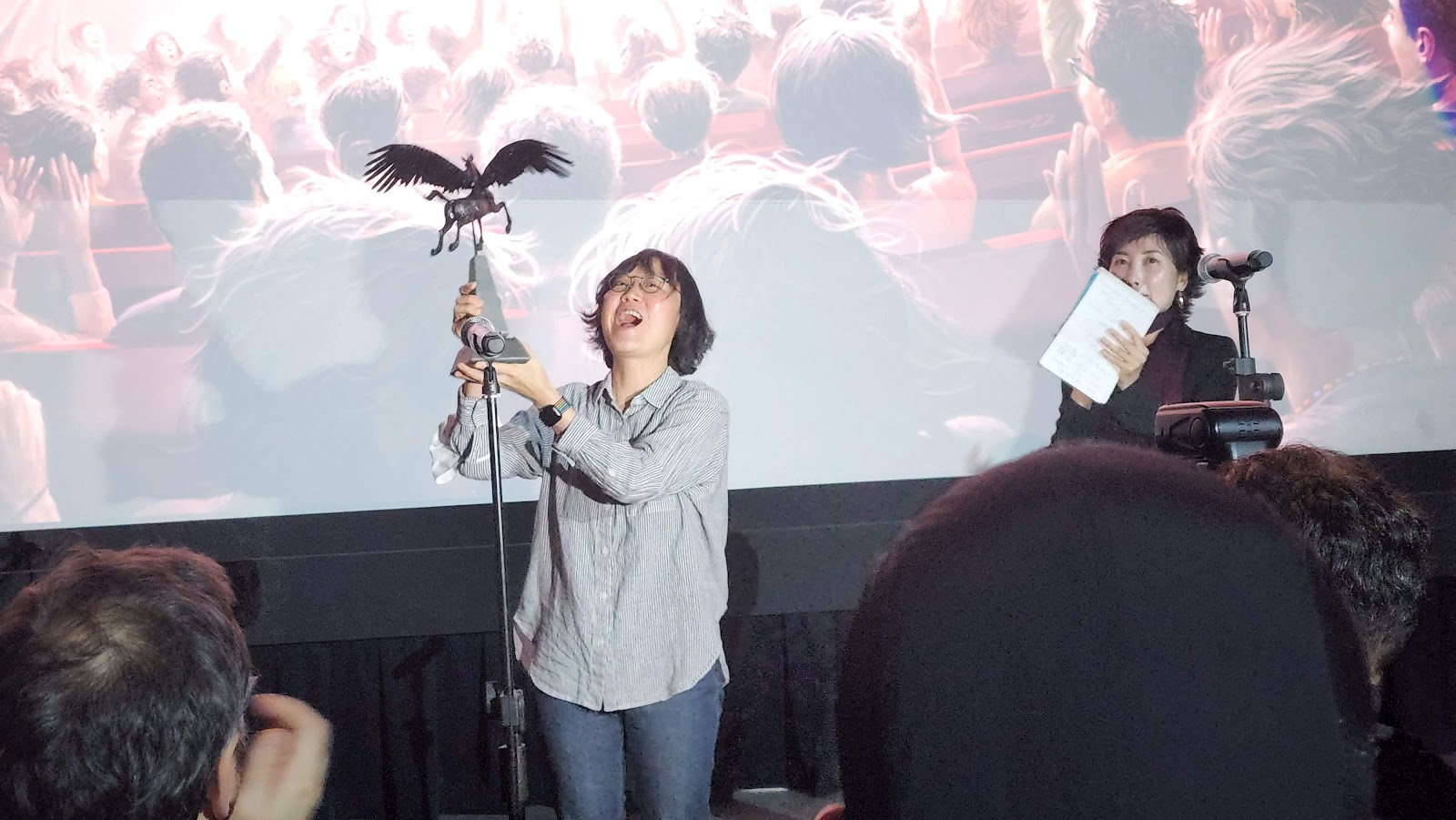
July Jung here with her film Next Sohee, and as you can see, she won the Cheval Noir, which continues to surprise and please filmmakers with how terrific a trophy it is. She talked some about how the film was inspired by a true story that got under her skin. I haven't seen her first film, A Girl at My Door, but it almost looks like Bae Doo-na could be playing the same character in both, disgruntled police detectives, with her character in this one apparently just back from an assignment in the country, which was apparently what Bae played in that last one. Different names, though.

Amusingly-to-me, I took a note during the film and later tweeted afterward that it's crazy to see time march on and now Bae Doo-na is in the "world-weary police detective" stage of her career, which is in part because of how filtered her career has often been as it gets in front of my eyes: I see the early art-house oddities she did in Japan, The Host with Bong Joon-ho, the stuff she did with the Wachoskis, and that gets screens and festival slots on this side of the Pacific because it's unusual and noteworthy, but the steady work is TV and smaller moves built around a crime, and it just doesn't surface until one of them (like this) is unusually good. But it means you might see someone aging into that all at once rather than over time.

Once that Q&A was over, I headed out and saw that the passholder line for Bodies Bodies Bodies was already stretching out of its corral. Well, I figured, it was opening in Boston that weekend, so I might as well head across the street and see the underground queer Portuguese comedy, which probably wouldn't be.playing anywhere and might be very difficult to find on streaming. It was, to put it mildly, not really my thing, and I wound up kind of frantically taking notes to try and stay engaged but it was still a struggle.

Maybe I would have been better off back in Hall sending the festival off with a bang, but you should only go so far trying to script your festival experience. That I finished stretching a bit too far out of my comfort zone may not finish the story of this return to Montreal being delightful and reinvigorating quite the way one might hope, but it's still pretty thrilling.

Next up… Well, we're done! Although I may have a very niche sort of bonus post coming up if I can get some stuff to work.

Ring Wandering

* * * ½ (out of four)
Seen 3 August 2022 in Salle J.A. De Sève (Fantasia Festival, DCP)

As it goes on, Ring Wandering does an odd sort of metamorphosis in how it changes from one sort of film to another without necessarily putting a distinctive twist on either, but impressing for how artfully filmmaker Maakazu Kaneko and his team navigate these paths. The film is quiet, charming, and built out of canny misdirections that coalesce into a different final picture than the obvious without being self-consciously outrageous.

Sosuke (Sho Kasamatsu) has a manga he wants to create, a tale of a hunter obsessively chasing a Japanese wolf, and while he is carefully scouting and sketching the setting, there's no way to capture the animal, which has been extinct for over a century, though a kid he meets thinks he can find one. Back in Tokyo, he works in a crew digging a foundation for a new high-rise, discovering animal bones a couple meters down but keeping it quiet, both because that's the sort of thing that can get a job shut down and because they may be the reference he needs. Returning to the site after hours, he meets Midori (Junko Abe), out looking for her brother's dog. She sprains her ankle, so he helps her get home, to a neighborhood that is strangely quiet, her parents waiting with a late dinner.

I find myself fascinated with what this is ultimately trying to say because it is easy to construct a plot which would have Sosuke actively accomplishing something, but instead the film reaches its end without moving in the direction of what the plot seemingly should be. There is something beautiful in the way that it does come together, that this is ultimately a story of finding self-confidence as opposed to figuring a mechanism out in order to defy fate. There are not clear parallels between the various threads, despite several characters pursuing a canid of some sort. The ultimate smallness of the story, and the ones not told, describe a small, personal lesson that applies to Sosuke but not necessarily anybody else. The world may not owe or provide explanations, and time down that rabbit hole is time wasted.

The film also handles its different environments and the transitions between in striking fashion, maybe not exactly letting the audience feel unsure about the transit between Sosuke's world and Midori's for far longer than might seem logical, but giving its characters reasons not to assume something extraordinary is afoot as one time becomes another in the dark. It's laid bare in the modern daylight, which is not exactly harsh, but revealing and unmysterious. The extended sequences inside the manga are kind of fascinating as well - the first, toward the beginning, seems a little off, amateurish, a good idea not quite executed right. The second, inked with a makeshift but meaningful tool, is filled with lush, beautiful compositions. Something clicked there.


Kaneko keeps things fairly quiet in between, but he and his cast have a good grasp of the way that this sort of low intensity can be used, establishing Sosuke's self-doubt but not exactly playing him as introverted otherwise: There's a pleasant sort of back-and-forth with a co-worker about various types of manga (it's neat to see working-class people talking about art seriously), and a genuine spark between Sosuke and Midori; Sho Kasamatsu and Junko Abe quickly home in on how these two are fundamentally similar but also very different, with Abe and the actors playing Midori's parents doing well playing just off enough that the audience notices it but still concentrates on how they have more in common with Sosuke than not. Kasamatsu does well to play Sosuke as a step behind many viewers without seeming slow, because he doesn't realize he's in a movie that's at least partly a fantasy.

That's important, because there are days when I watch a movie such as this and get frustrated at missed opportunities, and how the pieces laid out in front of the viewers don't quite fit together the way they seemingly should. I'm not sure whether it's the day or the film in this case, but I like how this all connects just fine.

Da-eum So-hee (Next Sohee)

* * * ½ (out of four)
Seen 3 August 2022 in Auditorium des Diplõmés de la SGWU (Fantasia Festival, DCP)

Movies are not necessarily the best way to depict the interconnected ways in which the world is seemingly rigged to make good people miserable; they're designed to mimic being there, and the issues July Jung looks at in Next Sohee are built to be things people experience obliquely, a little bit at a time. It means that she's got to stop and explain on occasion, but she's still got a fine knack for putting her characters through the wringer in between.

When the audience first sees Kim Sohee (Kim Si-eun-I), she's doggedly practicing dance moves, stumbling frequently but not without ability. She's not going to make a career out of it - she is a pet care major at a minor vocational school rather than a student at a performing arts academy - so the externship she is placed in is presented as a real opportunity. It's a call center job for a company that contracts with a cable & internet service (pointedly not part of that corporation), and it's miserable, reciting scripts seemingly designed to anger customers, with co-workers competing for bonuses that somehow never seem to come through. If it's already wearing manager Lee Jun-ho down, to the point where his replacement is making everyone sign NDAs, what chance does Sohee have?

The film has two clear acts, each designed to enrage the audience in a different way. The first half is told from Sohee's perspective, and that opening bit does a great job of setting the tone, highlighting her exuberance and willingness to get back up, with Jung getting a lot of mileage from how she serves as a sort of audience surrogate in that phone bank, rolling her eyes, questioning why they can't just cancel the service of callers looking to do that rather than trying to upsell them. Kim Si-eun-I's performance is winning and has bits that bring a smile even as the film turns more grim, and the tone-deaf nature of this semi-automated method of continuing to extract money from customers is recognizable as the sort of thing that gets on one's nerves but maybe just short of evil. The audience is going to pull for Sohee as long as they can, and they'll be able to.

Still, she's going to break down, and it seems to happen quickly. Kim Si-eun-I and Jung don't actually have Sohee change overnight - the audience has been watching the light go out of her eyes bit by bit - but they stress that losing Manager Lee is a breaking point, and that she has trouble reconciling what she's part of. They change the way she interacts with the other characters here, and for all that the film is still from Sohee's point of view, the view gets a little wider; and the audience gets the sense of how she is perhaps not the only one being broken here - dance partners are being bullied, co-workers are cracking, she's arguing with longtime friends. This may be a coming-of-age story, but there's no wisdom to be found in its lessons, and Sohee appears to be unusually capable of seeing that.

The aftermath of that realization shifts the point of view, with Bae Doona taking center stage as Oh Yoo-jin, the detective called in when everything goes to hell. World-weary and returning to the city after a sort of exile, Yoo-jin has seemingly been where Sohee wound up for a while, but maybe it's crushed her a little less - the other cops seem to resent her continued pulling at the threads of a case that won't lead to anything, but her resigned anger only looks like numbness. If Bae's performance looks muted, even when she's about to erupt, the audience can still appreciate her doggedness, even if it may not ultimately lead anywhere useful.

Bae and Jung manage an odd sort of alchemy during this back half of the movie, because by all rights it should become a crushing bore: Yoo-jin isn't discovering anything the audience doesn't know, either from watching the rest of the movie or from living in South Korea (or other capitalist economies where the structures are similar); spending a lot of her time following a trail from one institution to another and having someone explain that the systems she's encountering are either carefully designed to be technically legal or such that enforcement would cause a collapse with a lot of collateral damage. It's a lot of detail on how the system fails people and is seemingly designed to be too dreary and convoluted to keep one's attention, but actor and filmmaker are good at presenting how it's numbing but also managing to stoke anger despite that - Yoo-jin might not wind up radicalized by this, but she's at least guided the audience to what they should be angry at.

That isn't necessarily exciting - Jung knows these women are in a hole that is currently too deep for most people to climb out of on their own, and she's not going to make it appear otherwise in order to give her movie a thrilling climax. Still, there's value in pointing out the way that the mess is big and interrelated. Next Sohee isn't going to leave anyone feeling that a problem has been solved, but it maybe can point a viewer to thinking about them differently.

"Cemitério Vermelho" ("They Call It… Red Cemetary")

* * ¾ (out of four)
Seen 3 August 2022 in Salle J.A. De Sève (Fantasia Festival: Fantasia Underground, digital)

The great spaghetti westerns are so iconic that they can fool fans into not so much thinking that they're easy but that there's a schematic: Amorality plus widescreen framing plus a distinctive musical riff yields a moment indelible enough that it doesn't seem to need the rest of the movie around it. You see a lot more short pieces like "Cemitério Vermelho" trying to get those moments on their own than features that build up the whole world surrounding those moments, both because westerns can be a tough sell and because that steady approach is awfully fine work.

That's the sort of short this is, which isn't a complaint. Filmmaker Francisco Lacerda and his crew have found a terrific location in the Azores, and they've built a last confrontation that's good enough to skip to, packing in enough double-crosses and confrontation into its ten minutes that the audience can dive right in, not necessarily needing the two-hour simmer that would get them to the point where they're ready for the slightest twitch to lead to an explosion. Thomas Aske Berg and Francisco Afonso Lopes recall Eastwood and Wallach in The Good, the Bad, and the Ugly without quite seeming to imitate them. It's the sort of spaghetti western pastiche that works even does seem as much a declaration of love for the genre as a great example of it.

Can the likes of this rise above being that sort of pastiche? Probably, although it doesn't necessarily happen very often. As much as it generally works, it's still one that feels like it's imitating a style and peeling up the edges as much as coming by it naturally.

Frágil

Seen 3 August 2022 in Salle J.A. De Sève (Fantasia Festival: Fantasia Underground, digital)

Maybe I've always been an old man, but I've got the feeling that I wouldn't have like the characters of Frágil even if we were the same age; they are, almost to a one, obnoxious, juvenile supposed-adults who have more personality than drama and not necessarily a lot of that. By the end of the movie, one gets a sort of sense of how central character Miguel is maybe more fragile than his bluster, but there's not a lot to it. You can sort of infer a generic story about him being directionless and on his own because of his queerness, trying to find his tribe (despite his mother's frequent phone calls), but it's so formless that it has to rely on style to get there.

And for all that filmmaker Pedro Henrique hits the audience with a lo-fi fire hose - stylized color choices, square low-res/grainy images for that home-movie feel, animation, inventive cutting - most of the many chapters come and go without a good sting, characters popping in and out without the dynamics being that interesting. The characters are high half the time but that seldom leads to them doing anything interesting. It wants to be a hangout movie with style, but never quite finds a vibe that works.

Or at least, not for me; I readily admit that I was both a little too wiped for this sort of film at the end of a 21-day festival and this group, with their focus on drugs, booze, and "the club", just didn't seem to care about anything that interested me. I nodded off a lot, enough that I can't really say whether the movie was good or bad at being what it was going for but that it most certainly wasn't my thing.

Tuesday, August 02, 2022

Fantasia 2022.10: Anime no Bento, Demigod: The Legend Begins, "Aurora", My Grandfather's Demons, "Hairsucker", Deadstream, and Kappei

A very animated Saturday, as my "grew up in the 1980s and that's when you watched cartoons" brain says should be the case. Sure, Demigod is technically puppetry, but you get the idea.

Just the one guest, My Grandfather's Demons director Nuno Beato, who made a nifty stop-motion film that was still in progress right down to the wire - they finished just in time to premiere at the Annecy Festival in June, which is still not a whole lot of buffer to be ready for this festival a month later! Stop-motion is meticulous work, and I imagine that there's really no way to get ahead but many to fall behind, especially when you're occasionally merging with CGI. One thing that I found amusing at a couple shows this year is how animators tend to call digital animation "3D", even when they're not rendering for two eyes and the film won't be exhibited that way. It's especially odd when they talk about mixing "3D" with stop-motion, as it's the latter that has real, three-dimensional physical objects involved.

Not that I can criticize; we certainly use some dumb nomenclature in my day job, and I certainly got Agile twitches from some early scenes of this movie.

Beato also did a little setup on the red carpet area with Rosa afterward, which seemed like an obvious thing to get a picture of with the new digital 3D camera:

Not sure exactly how great that looks - I don't think it's really built for up-close, and this isn't really the sport where I screw around with cropping it to make it look better yet. It looks good on the camera/viewer (and presumably will when I get it onto the 3D TV), but the anaglyph has a bit of a ghost and the attempt at a wigglegram was a disaster. Still - 3D picture of a 3D model!

After that, there was a strange miracle - films at all three venues all starting at 7pm! I'd initially penciled in Punta Sinistra, but didn't really know what was going on when I got to the Museum. It was a "Fantastique Week-end" show highlighting local works, and aside from the set-up at this venue being sort of non-intuitive (it's a space the festival really has to adapt to), everyone was naturally speaking French, so I got intimidated, especially as I've wound up in shows like that which looked anglophone-friendly but weren't. I turned around, walked back to Hall, and got in line for Deadstream.

Which was surprisingly good - it's got the look and feel of something that will be awful but winds up working better than it has any right to. Maybe not quite one of my favorites, but a pleasant surprise the way One Cut of the Dead wound up being, although I wonder some of the same things I did for that one - it's a movie that is arguably more at home on a TV or streaming site than theaters, but which has a deliberately rough beginning, the sort of thing where you may jump to something else if it's easy, you haven't got the cost of a ticket to justify, and you're not worried about the awkwardness of climbing over other people to leave.

So that was Saturday. Sunday the 24th will include Opal, Tang and Me, Anime Supremacy!, Vesper, and Legions.

"Deiji Meets Girl"

* * * ¼ (out of four)
Seen 23 July 2022 in Auditorium des Diplõmés de la SGWU (Fantasia Festival: Axis: Anime no Bento, digital)

Though presented as a short, its original format as 90-second minisodes (do folks still say "minisodes", or did that never take off?) is clear from the way breaks are preserved and there's the occasional rewind. It also places art from what I presume is the original manga at the breaks, highlighting how the animation doesn't quite look the same; it's a thicker line with the coloring making up for some of the detail.

It's also a fun little show, sort of boiling a lot of manga/young-adult stuff down to its essentials, with Maise Higa (voice of Kiyono Yasuno) bored at having to work in the family hotel during her summer vacation, alternately annoyed by and intrigued by the crush-worthy guy her own age staying there alone, and navigating a series of supernatural transformations to the hotel and community that only the two of them seem to be aware of. Director Ushio Tazawa does nice work, capturing people and personalities with good cartooning and smartly compressing the story so that the tropes of the genre can serve as a bit of a shortcut but not so much to make it otherwise impenetrable, and also tending to start episodes in media res to both get to the good stuff in a short time and save the big animation moments for the climaxes, both for the mini-arc and the series as a whole. The characters are likable, and the show is peppered with little jokes and bits of oddness that doesn't make each bit reliant on a big swing connecting.

It might be fun to see this built out a bit, maybe connecting the pieces more smoothly, but it's about the right length, even if that length is a single standard TV episode. It's a small story with big images.

"A Girl Meets a Boy and a Robot"

* * * (out of four)
Seen 23 July 2022 in Auditorium des Diplõmés de la SGWU (Fantasia Festival: Axis: Anime no Bento, digital)

This one, on the other hand, feels like it could do with being fleshed out a little bit - it's down at about 20 minutes on the basis of a couple of "oh, now I remember everything" moments, and has the simple focus it has at the start because two characters have amnesia. It's a bit like a video game - the girl wants to collect rocks, proceed to a goal, and avoid automated war machines, and the motivation doesn't matter. It's all you need for a game, but a little why feels nice when you don't need to worry about the player clashing with the motivation.

It looks terrific, though, with Shin'ichiro Watanabe building a post-apocalyptic world that feels right - automated things still being kept up automatically but primarily-human spaces falling into ruin. The middle-eastern character design of the girl is a good fit for the desert wasteland, and the robot is a Swiss Army Knife with a fun personality that doesn't ever become too much of a deus ex machina. The Crystal of Time thing is kind of a messy thing to include in what otherwise plays as post-apocalyptic science fiction, and makes the later bits a little fuzzy, but it gives Watanabe a chance to create some scope.

"Summer Ghost"

* * * ½ (out of four)
Seen 23 July 2022 in Auditorium des Diplõmés de la SGWU (Fantasia Festival: Axis: Anime no Bento, digital)

I don't know if this clocks in at 40 minutes with the express idea of being as fleshed-out as it can be but still eligible for awards as a short, but it could deserve some consideration for that; it's a nifty inversion of the "kids hubristically summon a ghost and suffer the consequences" story where the ghost is friendly and the kids are mostly humble and trying to help. It's a casual one, though, not winking at the audience or faking out that Ayane may be a more malevolent force.

Director Loundraw and screenwriter Hirotaka Adachi do good work keeping four characters' individual stories going and feeling consequential in that length, intertwining them but also emphasizing that they are each kid's individual challenges to face, while also sort of musing on what it means to be a ghost. The filmmakers have a good grasp of how the mundane interfaces with the fantastic, making them feel like part of the same world but also noting that the jump from one to the other is still exhilarating.

Mostly, it winds up being a nice tale of friendship, how it's worth it even if it will necessarily be temporary or requires effort to maintain. Most of us won't be piercing the veil of death in order to meet new people or keep up with those who have left, even if it can take a lot of effort.

Demigod: The Legend Begins

* * * (out of four)
Seen 23 July 2022 in Auditorium des Diplõmés de la SGWU (Fantasia Festival, DCP)

Like a lot of grand martial-arts fantasies, Demigod can be kind of tough sledding at points as it dumps a whole bunch of exposition and mythology on its audience, seeing up a whole world for its wuxia masters to battle over. The difference, of course, is that this particular movie is staged with puppets - the chosen medium of the Huang clan for generations - making the whole thing even more surreal.

It opens with Su Hua-Jen (voice of Huang Wen-Tze) scaling one of five impossibly vertical peaks, getting in the middle of a battle between gigantic elemental creatures, and being scolded by his Master, before returning to Earth. There, he reconnects with friend Yu Huan, a monk like him but the son of a noble house. Jen is also a physician who uses his acupuncture skill to pay his tab at the bookstore, and he is recruited by Huan's father for a tricky cure. It gets him pulled in the middle of a long-time power struggle with Yu senior's cousin Chang-Bo, framed for murder and broken out by warrior princess Yu Xin, discovering both a massive earthly conspiracy and a grand destiny while on the run.

You can, I suppose, talk about the story separate from the medium, which is just going to make it sound kind of tiresome at first, with reluctant hero Jen vague almost to the point of being undefined plus the sort of castle intrigue where so much information is pushed on the viewer that they may never quite know the players well enough to sort the plots out, especially as outsiders. There's some nifty action in between, but it's kind of killing time. The puppets' static faces and sometimes delicate motions limit what writer/director Chris Huang Wen-Chang and his family/collaborators can do to liven up the exposition.

Eventually everything is set up and then the big, crazy, operatic stuff starts in earnest, and it's an insane delight. These puppets that look like porcelain dolls are fighting with mad slashes of swords and powerful magic, with heads and limbs cut off and blood flying everywhere, and the Huangs have been at this long enough to have a sense of the line where it would start to look like a joke that they can avoid crossing it. There are creatures and intricately crafted environments that are all solid and at the same scale when they interact, impossible magical fighting techniques executed by filmmakers taking this as seriously as any blockbuster, and, yes, battles where both hero and villain are into it, playing for the balconies even though their lips don't move.

It's glorious madness that seemingly promises eight sequels in the end credits with a completely straight face, and why not? They're an institution in Taiwan, and aside from Pili's own catalog, there's nothing like it except maybe The Dark Crystal and the likes of Thunderbirds. Enjoy it if you can find it, as Taiwanese films don't seem to cross the Pacific as often as those from the other Chinas, let alone crazy puppet martial arts epics.

"Aurora - A rua que queria ser rio" ("Aurora - The Street That Wanted to Be a River")

* * * (out of four)
Seen 23 July 2022 in Auditorium des Diplõmés de la SGWU (Fantasia Festival: Axis, digital)

Radhi Meron switches up her animation style with each new era chronicled in "Aurora", and while that's not an uncommon practice, it's not one that always works here; some are just too crude in comparison to others to reflect what she's getting at with the narration and the general idea behind it, or at least to take it seriously.

Which is a shame, because, in telling the history of this particular street, Meron points out that it preceded the city and even humanity being there, that the river performed the same purpose of being both a way to move and a place together for as long as it existed, and the street built over and around it is the city. The narration by Priscila Paes in character as the river/street, is wonderful, even if one is reading the subtitles because of not understanding Portuguese. It's ecstatic even when sad or angry, the voice of something that is defined by its connections and cannot help but delight in everything it is part of and linked to, claiming it as her own even when pining for simpler times or to have a main street's class and cachet.

I admit that, as a committed city-dweller, there's a part of me that loves this for positioning the city as something natural and fundamental to how humanity is part of the world. But I also love the way Meron tells it, from the lush visuals and the infectiousness of the voice.

My Grandfather's Demons

* * * ¼ (out of four)
Seen 22 July 2022 in Auditorium des Diplõmés de la SGWU (Fantasia Festival: Axis, DCP)

The festival showed My Grandfather's Demons with a short before it, and the viewer who hasn't read up on it or (presumably) seen a preview will be forgiven for thinking that there may be one attached during its theatrical run or a second during the festival; the style it opens with is far from the one that's going to sell a ticket. Once the digital animation that opens the movie is done, the movie gets to the pretty-darn-good stop-motion and a second track which is perhaps more interesting than the one it starts on.

It starts in an office in the near future, with Rosa (voice of Victoria Guerra) being awarded for her hard work and success with meaningless icons next to her name and even more work to do. News of the death of the grandfather Marcelino (voice of António Durães) who raised her is what causes her to snap, quitting her job and driving out to the country to spend a few weeks getting the old place - which now sits on more land, as her grandfather has bought out many neighbors - in order. She soon discovers that while she remembered that time with just the two of them as idyllic, the locals hated him, and by extension her, claiming he diverted all the water for himself. An eager-to-please neighbor boy, Chico (voice of Martim Carvalho Balsa), and his kind mother Laura (Ana Sofia Martins) are at least nice to her, the the baker's nephew Hugo (João Tempera) remember her fondly from their childhood, but his uncle is particularly sore. Rosa resolves to fix things by locating the missing water, but the only clues seem to be hidden among the various masks and statues the old man carved representing the townsfolk as demons.

As much as the audience sympathizes with Rosa, it's clear early on that she has inherited at least a bad temper from her grandfather, who is himself arguably the story's offscreen villain, even if it's hard for Rosa to see him that way. Victoria Guerra's vocal performance is quite nice, carrying a touch of self-pity and a fair chunk of anger at points but she connects that to the stress she came in with, managing to let some of that go without losing too much edge, while António Durães puts regret into Marcelino's voice-overs while also making him sound too proud and mean to have acted on it. Chico and Laura provide nice optimistic balance, with round shapes and upbeat voice work that gives Rosa something to aspire to, although not overdone. The film has to have the subtlety to let Rosa and Marcelino be hard to like at times, even though working with these figurines limits certain sorts of acting.

It's interesting that My Grandfather's Demons sort of avoids big wow moments with its animation, right from the moment when it switches from the digital animation of the city -, but show some fine design work in the way that it illustrates and heightens white-collar burnout - to the country's stop-motion; it's a simple switch rather than a dramatic, self-aware moment. It's all very nice-looking, with fine cartooning, but never really overpowers. For all that the film has strong fantasy elements, it's very important to ground what's going on in something real, even when that's not always easy to watch.

It's still wonderful animation, though, contrasting the colorful city (which is bright and poppy in the way that TV ads are) with the more tactile stop-motion of the country as much as possible without really clubbing the audience too much with "city bad!", particularly in how director Nuno Beato and company sometimes seem to lean into how the audience knows this is all miniatures, making the place look smaller and quainter, with the movements of the people who live there having resistance and friction. It's clever in how this allows the demon sculptures to come to life but also really gives something solid to the hands-on, tactile problems Rosa must solve in order to make amends.

So don't be too fooled by its opening sleekness - My Grandfather's Demons is a worthy addition to the ranks of stop-motion features, a charmer that benefits from feeling like a thing you can pick up and touch.

"Hairsucker"

* * * (out of four)
Seen 23 July 2022 in Auditorium des Diplõmés de la SGWU (Fantasia Festival, digital)

I've got to admit, that as gross as the spectacle of a nasty little thing sneaking into the bathroom to eat hair out of the shower drain is, it's got to kind of sound kind of great to someone with long hair who occasionally has issues with the plumbing so long as it only goes that far. It doesn't of course, and the results are able to make the audience feel enjoyably squeamish but stop just short of complete revulsion.

It's four minutes of pretty much perfectly measured horror-comedy. Not a lot of analysis you can do on that, but that's some impressive setting of a target and hitting it.

Deadstream

* * * ¼ (out of four)
Seen 22 July 2022 in Auditorium des Diplõmés de la SGWU (Fantasia Festival, digital)

You'd never guess from how obnoxious its protagonist comes off and how overly familiar its premise is, especially at the start, but Deadstream is a hoot, delivering more than a few decent scares while still getting laughs as a horror comedy. It's fast-moving and smarter than it looks, genuinely satisfying by the time it's done.

It's presented as the livestream of Shawn Ruddy (Joseph Winter), who had been making a fair living out of streams where he confronts his fears, often to disastrous results, but is just coming off a stretch of being demonetized after an episode that was considered wildly insensitive. For his first show back, he intends to spend a night in "Death Manor", built by a Mormon pioneer as a home for his spinster poet daughter Mildred, who committed suicide and whose curse has apparently claimed many other lives in the century or so since. Shawn is scared very easily, but his audience notes that not a lot seems to be happening, at least not until superfan Chrissy (Melanie Stone) shows up wanting to join him.

The opening is wince-inducing and obnoxious enough that I was reminded, a bit, how badly I was cringing during the first stretch of One Cut of the Dead a few Fantasias ago, and how that did some drastic expectation-lowering before the second and third acts turned its gimmicks on its head. Similarly, this movie really flounders for a while, as Joseph Winter's Shawn is a very broadly-sketched and played twerp, the sort that us folks who don't particularly pay attention to streams and YouTube as a medium will either presume to be perfectly representative of idiot millennials/zoomers or will find too ridiculous to be real. He doesn't really get much smarter or more likable as the film goes on, maybe dialing it back a little as the character starts reacting more than performing, but mostly the movie adapts to the character, making it work better as a whole.

Filmmakers Vanessa & Joseph Winter lean a bit too hard on too-easy jokes and kind of rote jumps until Chrissy shows up and changes the dynamic, injecting a more likable dorkiness without completely changing the vibe. Melanie Stone isn't quite a secret weapon here but she brings a bunch of energy and charm while still working as a sidekick initially. Once she's there, the movie's got specific places to go and chemistry to exploit, and that makes a huge difference.

It's still going for easy social media jokes and jump scares at that point, but there's some enjoyably gross effects and all the gags (however you choose to use the term) start feeling like a quality relay, one leading to another rather than just setting something well worn out and waiting for applause. The handoff between comedy and horror works a lot better at that speed, maybe in part because it's all been set up well and everyone is ready for the payoff. Indeed, they do the set-up stuff smartly; this may be the first livestreamed haunted house of several I've seen where the use of multiple cameras and information from the internet feels like a logical setup. And when they get to the climactic revelation, it not only snaps the plot together, but gives the movie something of a funny theme instead of "just" a bunch of jokes strung together.

As with One Cut, I do wonder a bit if the deliberately-off-putting start will make people navigate away at home even though it may be more suited for that environment that a theater where a viewer is more committed (Shawn is annoying enough that I was with the on-screen commentators posting #TeamChrissy to the end). Nevertheless, folks that stick it out will probably be pleasantly surprised how well the choice turns out for them.

Kappei

* * ½ (out of four)
Seen 22 July 2022 in Auditorium des Diplõmés de la SGWU (Fantasia Festival, ProRes)

I've got four or five volumes of the recent English-language editions of First of the North Star on my shelf that I haven't gotten around to reading, and I suspect that I'd like Kappei more if I had read them as they came out. The film (itself a manga adaptation) is a Japanese spoof of a specific strain of weird Japanese pop culture, and while chunks of it work well enough without the background, I suspect it plays a lot better when the targets are clearer and the subversions more obvious.

Back before the turn of the millennium, the predictions of French cleric Nostradamus were a big fad, especially the claims of the impending end of the world in a grand disaster. As 1999 approached, martial arts master Shihan (Arata Furuta) trained a group of children on an island off the coast of Japan to be "Doomsday Warriors" who would protect the helpless people left standing in a post-apocalyptic hellscape afterward. This never comes to pass, so in 2022 he disbands the gang, and Kappei (Hideaki Ito) makes his way to modern Tokyo, his head still full of desires to protect the innocent and fears that his classmates may have turned to evil. When he rescues college student Keita Iruma (Daigo Nishihata) from a group of bullies, Keita helps him get settled, but there are many things about the outside world Shihan-sensei hasn't prepared him for. Most notable: Women, especially college girls as cute as Keita's classmate Haru Yamase (Moka Kamishiraishi), who still pines for her high-school senpai and also attracts the attention of a number of other Doomsday Warriors.

Give screenwriter Yuichi Tokunaga and director Takashi Hirano credit: They've got a sense of how creepy these guys' presumptuous competition for Haru is and how it's enabled by the likes of Keita, who does not have the excuse of growing up brainwashed on an all-male island for some incel-adjacent attitudes (though I suppose some Japanese women might raise an eyebrow and say "oh really?" to that), and this would be a much less enjoyable movie if they didn't. They often don't appear quite sure how hard they want to go in on this as the core of the film, though - it takes up a lot of screen time and a late sequence brings it into some relief, but there's a sense that this should be just one facet of Kappei being a big-hearted, naive hunk of beefcake in a world he's unprepared for.

The trouble is, the film doesn't necessarily have much else in the way of story. The original manga doesn't seem too long to compress into a feature, but it maybe has too many characters - does the movie really need four Doomsday Warriors running around? - and that leaves relatively little room for the odd-couple bits with Kappei and Keita that initially look like they could form the movie's spine, or jokes about Kappei adapting to the outside world. It's kind of a fun subversion that the initial obvious action-comedy plot of Kappei having to fight his misguided brothers never actually appears, but a crush that audiences may have misgivings about doesn't exactly fill the hole.

On the other hand, there's no arguing that Hideaki Ito gives less than his all as the title character, bulking up so he can cram himself into a costume that amounts to a denim vest and matching booty shorts, deploying his best blank stare at Tokyo's insanities, and delivering his lines in what could be described as a deadpan roar. Kappei is ridiculous, but Ito plays him as serious and sometimes incongruously intimidated by the world around him. It's a big, delicious comic performance that could seem an ill match for Moka Kamishiraishi's sweet, somewhat unlucky-in-love Haru, but she does a nice job of not being made small by the larger-than-life men around her, whie Daigo Nishihata does a good straight man and mostly downplays things that could make Keita less likable. Arata Furuta makes Shihan a delightfully absurd sort of cult leader, domineering and brash but making the shifts that come from his knowing things his students don't right every time, while Yusuke Onuki, Koji Yamamoto, and Yukiyoshi Ozawa all have amusing takes on different sorts of Doomsday Warrior that spring from the same soil as Kappei.

It's an amusing premise with a great central performance, enough to get a bunch of laughs even among those not terribly familiar with this breed of stoic manga muscle man with inner turmoil, although I suspect it plays even better for those more in on the joke.