Showing posts with label Italy. Show all posts

Saturday, August 02, 2025

Fantasia 2025.08: "Methuselah", A Grand Mockery, Every Heavy Thing, The House with Laughing Windows, "Things That Go Bump in the East", and I Fell in Love with a Z-Grade Director in Brooklyn

This day started early:

3:30am, to be precise, with the alarm right in the room, rather than just the hallway. I don't know what it was about - I just headed out and tried not to bother the firefighters who showed up impressively quickly - but I'm glad it wasn't serious. This is a twelve-story building with 10 rooms on my floor, and there were not 100 people milling about afterward. Maybe it's just usually filled with college students and mostly-empty for the summer (there are about a dozen keyboxes for AirBNB rentals and brokers showing it to prospective tenants locked to the front steps, and that doesn't even include me), but I have a hard time imagining the folks who sleep through that din or say, man, that's a lot of stairs, maybe I'll evacuate when I smell smoke or firefighters pull me out.

So, it was almost 4am by the time I got to bed, which is just shy of the line where I usually say it's not worth going back to sleep. My body was going to wake me up at 8am or so anyway, though, and I wound up dragging something fierce for most of the day. It didn't help that most of the afternoon programming was from the Underground section and I'm not really a giallo guy, so I wound up dozing off or zoning out until the shorts package in the evening.

I mean, after "Methuselah" by Nathan Sellers; his short was 4 minutes long and pretty darn strong. Obviously, Justine was not really looking at my giant lens-covering finger in disdain (why Samsung designed this phone so that ones finger naturally rests there whne using the buttons to snap a picture is beyond me).

On the other hand, Adam C. Briggs and Sam Dixon made a movie that was often dark and grainy and very easy to zone out to, so I missed some the film, their Q&A gave the impression that Brisbane is not exactly an Australian hive of creative expression, but it was a scene where everybody sort of knows each other, and they wound up working together, if in unfamiliar roles at times.

Mickey Reese and Josh Fadem were really "on" in their intro and Q&A for Every Heavy Thing. I dig the energy which I didn't have, and that Reese wrote it for Fadem, who had played over a hundred supporting roles but never had a lead, so this was made with him in mind, and pretty much the entire cast. I suppose, as with Brisbane, when you're making movies in Oklahoma City, you know who you're working with.

After that, it was The House with Laughing Windows, and, as I say below, I am just not a giallo guy.

At some point after that, though, the caffeine kicked in or something, or maybe the "Things That Go Bump in the East" selections were just more my speed. Here we've got our moderator (Xige Li?), "Mom, Stay Dead" director Lee Na-hee, programmer/translator Steven Lee, "Dhet!" composer Dameer Khan, and "Red Spider Lilies: The Ascension" co-star/producer Eriko Nakamura & director Koji Shiraishi. As you can see, it was a pretty fun session, with Lee talking about how her short was inspired by how her mother actually blossomed once she finally moved out of the house, gaining a bunch of new hobbies and creating art, which got her thinking about how there are a lot of movies about how children grow at times like this but not necessarily parents.

Khan, meanwhile, is local to Montreal, representing "Dhet!" since director Ummid Ashraf had visa issues. There seemed to be more trouble with visas this year then I remember being a case before, although that could just be random variation. It does demonstrate how even relatively small-scale shorts like this have international collaborators, and Khan talked about how the giant highways the protagonist is traveling make Dhaka a very loud city, so the music had to be layered and a bit discordant, enough so that when it is suddenly quiet, the eeriness of it really hits.

If you look at IMDB, "Red Spider Lilies" is listed as "Pilot Version", and Eriko Nakamura said that, yes, they were very much looking do something more with it. I hope they do; it's a fun premise! She also mentioned that she was in another film at Fantasia this year, Dollhouse, but also not to go see it on her account because it wasn't really one of her great acting roles.

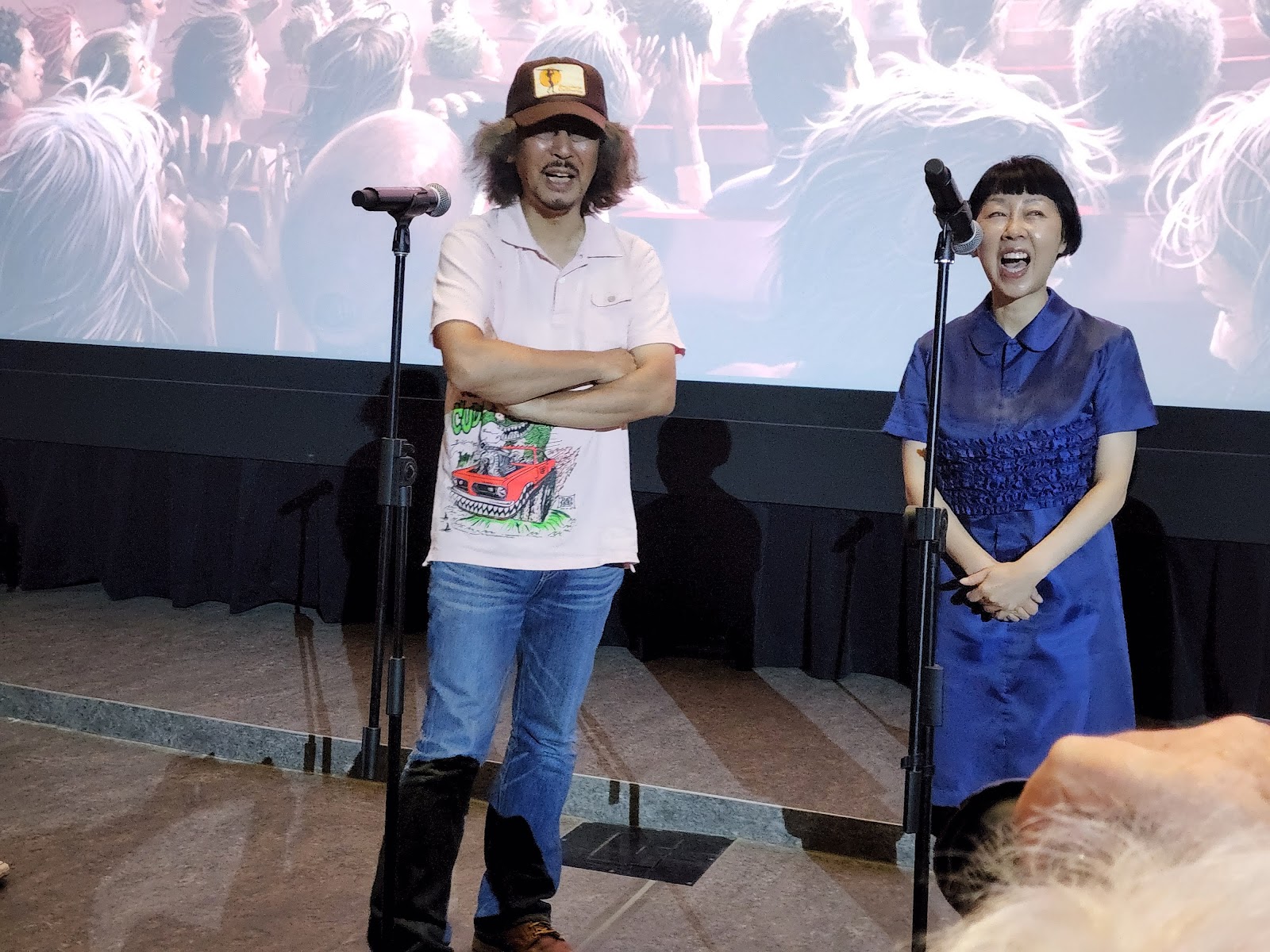
Finally, I made it across the street to Hall, where this is sort of the best picture I got of the surprisingly big contingent for I Fell in Love with a Z-Grade Director in Brooklyn: Writer/director Kenichi Ugana plus actors Lissa Cranadang-Sweeney, Rocko Zevenbergen, Madeline Barbush, Estevan Muñoz, Ui Mihara, and Katsunari Nakagawa. One thing Mihara mentioned is that she felt a lot like her character going into the movie: If you look at her IMDB page, she seems to be have done an episode of TV every week or so for the past couple years, and felt pretty darn burnt out before doing this one. Though she maybe could have done without the amount of gross things she had to put in her mouth to spit out.


That's the start of Week Two on Wednesday the 23rd; Thursday would be Redux Redux, The Virgin of the Quarry Lake, Anna Kiri, and my first go at Transcending Dimensions. Today (Saturday the 2nd), my plans are Foreigner, Circo Animato, Mononoke II, and Queens of the Dead. The School Duel and The Virgin of the Quarry Lake are pretty good.


"Methuselah"

* * * (out of four)
Seen 23 July 2025 in Salle J.A. De Sève (Fantasia Festival: Fantasia Underground, laser DCP):
:
A poem of a short film, using striking words and imagery to how trees are both dynamic and static features of nature - always growing but persisting for centuries in some cases - and how too many have been used by humans as sites for hangings and lynchings, tainting them forever. The narration by Jordan Mullins walks a line between reverence and rage, and the images from filmmaker Nathan Sellers manage to emphasize the evil men do with these marvelous things.


A Grand Mockery

* * ½-ish (out of four)
Seen 23 July 2025 in Salle J.A. De Sève (Fantasia Festival: Fantasia Underground, laser DCP)

A Grand Mockery is engrossing for as long as it feels like an 8mm pseudo-documentary, but as soon as it tries to consciously be transgressive or experimental, it starts to get a bit tiresome. The filmmakers have vision, but it's not necessarily clear.

It follows "Josie" (Sam Dixon), initially seen walking through a Brisbane cemetery, seemingly one of the few green spots in the city and a sort of postal network where folks leave messages and meet up. There's not much going in the city - things are cool with his girlfriend, the father he tends to is mostly non-responsive, and his job at a cinema involves either cleaning up the disgusting messes customers leave behind or trying to handle their obstinacy. It wears on him, both physically and in the increasingly unhinged notes from possibly-imaginary correspondents.

The wear doesn't really kick in for audiences until the film's final scenes; up until then, even the moments when it approaches the grotesque and despairing feel immediate and earnest, the portrait of a man in a place where his artistic instincts seemingly can't take him anywhere, the cemetery seemingly the only source of tranquility. There are drugs and drink accelerating it, but one mostly sees a situation where folks get ground down because there's no seeming mobility. Josie doesn't necessarily seem inclined to make a living out of his drawings and the like, but they go unshared and he seems to have no other avenue to express himself to others.

The finale, though, is just endless. The filmmakers are good at sneaking up on the audience for a while, Josie's increasingly scraggly hair hiding how some health issue is distorting his face until he winds up in a strange bar that may only bear a passing connection with reality. At that point the movie starts banging on past any point it could be making, drawing out its grotesquerie until Josie is a drunken, distorted mess. Fair enough, I guess - that's arguably where lives of quiet desperation wind up - but after a while the filmmakers have eroded a lot of the goodwill the film had earned.

It goes on a bit as he gets outside the city, and the green of the woods and swamp seems like a bookend to the cemetery at the start (8mm green seems like a very specific color), and for a bit I wondered if it was intentional, starting in a city graveyard and ending outside the city in a place dense with life, but, apparently, the decay is too strong at this point, and the film trundles on until it ends in a whimper.


Every Heavy Thing

* * ¼-ish (out of four)
Seen 23 July 2025 in Salle J.A. De Sève (Fantasia Festival: Fantasia Underground, laser DCP)
Where to stream it (when available)

I'm mostly giving this a pass, because even though I didn't doze off much, I feel like I missed a lot of pieces that were important to the story.

It starts out conventionally enough, with a Scream-style pre-credits murder before introducing the audience to Joe (Josh Fadem), who sells ads for the local alt-weekly, one of the last in the country, reluctantly accompanying a friend to a show - he and wife Lux (Tipper Newton) seem to have separate social lives - only to enjoy it more than expected, and see the singer get murdered. Killer William Shaffer (James Urbaniak) says he's going to let Joe live because it amuses him, but it will amuse him much less if Joe does anything stupid. Like helping the paper's new writer (Kaylene Snarsky) when she has leads on the disappearance William is responsible for.

The problem in a nutshell is that the story really doesn't have any place to go after William reveals himself, about ten ten minutes into the movie; Joe winds up in this holding pattern but it plays more like awkward social situations rather than walls closing in or real danger. Writer/director Mickey Reese puts in other threads - Shaffer as the vanguard of various tech companies moving their operations to the city, an old friend (Vera Drew) returning to town after her transition, various family concerns - but none of them seem ironically more urgent than the man who is murdering women and apparently disposing of the bodies very well, which isn't presented as a big deal itself versus how it puts a man in an uncomfortable situation.

Plus, the jokes are only about half as funny as the writers seem to think. It gets by on volume for a while, and Tipper Newton is maybe the film's most valuable asset as Lux, seeming to put a weird and amusing spin on just about everything. After a while, though, things just aren't that funny, and the film made in part to give Josh Fadem a lead role after a lot of character work winds up showing why he hasn't been cast in one before: He's affable and has pleasant chemistry with almost everyone else, but it highlights him as a glue guy in a cast the way Joe is in his community, but maybe not with the sort of charisma that puts him at the center of a story.

One admires the attempt that this sort of outside-of-Hollywood indie is making. Unfortunately, it seems too committed to a twist that seems inspired at first but goes nowhere.


La casa dalle finestre che ridono (The House with Laughing Windows)

* * ½-ish (out of four)
Seen 23 July 2025 in Salle J.A. De Sève (Fantasia Festival: Fantasia Retro, laser DCP)
Order the old DVD at Amazon

I've probably posted some variation of this before, but I think I'm just not a giallo person. No matter the extent to which the director is regarded as a master, or how sexy the cast is, or how shocking or lurid the twists are, I just don't get drawn in, and The House with the Laughing Walls was not an exception to this rule. Like so many things in the genre, it falls in that gap between intriguing mysteries and unnerving horror for me.

(In fairness, all the films this afternoon suffered from my sleep being interrupted the night before, so I wasn't absorbing as much as I'd like.)

It feels like it should be a little more intriguing than it is, with an art expert (Lino Capolicchio) arriving to restore a church's peculiar painting, mysterious disappearances, and secretive villagers, but the film is too arch for much of its running time. Stefano doesn't really feel like anything, drifting through the story as strange things happen around him, not particularly defining himself as an academic or artist, and there seems to be an opportunity missed in using the restoration as a thing to hand the story and investigation on, where immersing himself in this artist's life and techniques draws him closer to the man's demons. Even with a new restoration, everything feels pre-faded, like there's never been any life to the story to start with. The mystery feels too distant.

It gets crazy toward the end, even audaciously so, but maybe it's a problem of genre-awareness, where knowing something is a giallo means that one is awaiting rather than dreading the inevitable, and the finale is surprising just because it's random rather than lying in wait to blindside a viewer. Sure, okay, the sisters are messed up, but not in a way that has anything to do with what Stefano has experienced, so it's not resonating.


"Magai-Gami"

* * * ¼ (out of four)
Seen 23 July 2025 in Salle J.A. De Sève (Fantasia Festival: Things That Go Bump in the East, laser DCP)

"Magai-Gami" has a pretty darn basic premise - folks in a scary place investigating an urban legend come face to face with monsters that will kill them if they look away - but it executes exceptionally well: Leads Ion Obata and Nagisa Toriumi are a fun pairing even as most of their banter is done over the phone, and the audience picks upon their dynamic very quickly even as the movie starts with them already on the ground. Mostly, the monsters are kind of great, feeling like a mix of visual effects and practical work that capture the freaky images of old illustrations while not looking more out of place next to a girl in a puffer jacket talking on a cell phone than a more modern design would.

Filmmaker Norihiro Niwatsukino doesn't have a particularly long résumé, but he seems very assured here, keeping the film moving even when it involves standing still, displaying a good handle on using what his effects team gives him, and setting up a supernatural-containment mythology in the closing minute or two that doesn't feel too much like it's trying to impress with how clever it is. The program guide describe the short as a proof-of-concept, and, yes, I'd like to see more.


"Ba Dong Yao" ("Hungry")

* * * ¼ (out of four)
Seen 23 July 2025 in Salle J.A. De Sève (Fantasia Festival: Things That Go Bump in the East, laser DCP)

Taiwanese puppet fantasy adventure is one of the best bits of any Fantasia Festival that contains it - I've rearranged schedules to make it work - and it was a really delightful surprise to see it show up in the middle of what initially looked like an animated short. It's a good animated short - it's got a strong style and a story about an ailing kid and his busy father in the middle of a festival that spans the traditional and the modern - but the live-action puppets means this film zigs where one expects it to zag, making his fever dreams feel a bit more real in the moment than his actual world even as they're clearly mythic.

Oh, and bonkers, as these goddesses fight to become his mother and the puppet combat is a kick to watch, fully embracing the capabilities and limitations of what these things can do, especially with a little FX work to eliminate rods and strings. It's great fun that leads into neat music and a satisfying finale.


"Mati Adat" ("Kill Tradition")

* * * (out of four)
Seen 23 July 2025 in Salle J.A. De Sève (Fantasia Festival: Things That Go Bump in the East, laser DCP)

Compared to the others, "Kill Tradition" is a nifty slow-burner of a short, keeping just what the stakes are on the horizon as it builds the relationship between Idah (Nik Waheeda), the sort of precocious kid that gets into trouble, and her recently-widowed mother Iman (Ezzar Nurzhaffira) as they prepare a meal for an upcoming ritual. Waheeda is charming, and Nurzhaffira really nails this vibe of how having this girl is wonderful yet tiring. They're highly watchable, especially Nurzhaffira, once the inevitable reveals itself.

That's when the audience sees where the title is going, in a couple of ways, and while Nurzhaffira plays up how this is more than she can take and the devastation of it, writer/director Juliana Reza and the rest of the team emphasize what sort of inertia tradition and ritual have. It's evil tradition - even with what appear to be actual supernatural entities, there's no strong justification that this is effective or necessary - and Reza highlights the callousness of it as much as the grace of those consumed by it.


"Mom, Stay Dead"

* * * (out of four)
Seen 23 July 2025 in Salle J.A. De Sève (Fantasia Festival: Things That Go Bump in the East, laser DCP)

Filmmaker Lee Na-hee kicks off her short with a fun image - grieving daughter Sora (Oh Sohyeon) working her way through a book with "101 Ways to Summon the Dead", with #44 being the Ghost Summoning Dance - before coming up with a neat twist: The ghost she summons (Cho Ahra) seems to be roughly her age, having moved on from Earthly concerns, including the daughter she left behind, into her idealized form. There's maybe a fun sitcom premise in here, something about how family members would really relate if you removed the societal obligations and expectations from them.

It's maybe not far from the likes of Back to the Future or Chinese hit Hi, Mom - though I can't think of any that pull someone into the future rather than having their kids in the past - but aside from what Lee discussed in her Q&A about discovering what her mother could become once she was no longer worried about taking care of her daughter on a day-to-day basis, there's something intriguingly weighty here about spirituality. Sora has been using religion and magic as a way to fulfil her desires rather than really contemplating what all this implies, even as the mother recognizes innately that this girl needs something from her.

A very nifty twist on the idea of moving on that feels all the more honest because of how absurd and thought-provoking it can be simultaneously.


"Dhet!"

* * ¾ (out of four)
Seen 23 July 2025 in Salle J.A. De Sève (Fantasia Festival: Things That Go Bump in the East, laser DCP)

There's a really strong theme across short films and anthologies this year of how gig work like rideshares and delivery is a sort of hell designed to be inescapable until it finally crushes a person, and I kind of worry that it will wind up staying in shorts and their equivalents in other media, because if you've got the money to make a feature, the business model behind this is kind of an abstract thing and you mostly see the convenience. It's a longer distance between classes than it used to be.

"Khet!", from Bangladesh, is a pretty decent example. The story itself is pretty basic - motorcycle-taxi guy (Ahsabul Yamin Riad) ignores a homeless man (Fozie Rabby) telling him not to take a certain turn and winds up unable to leave one of Dhaka's highways - and is perhaps ultimately more about the maddening geography of the city than the rider's circumstances. It's not a bad idea, since cities built around such highways are a topic of conversation in themselves, but it leaves writer/director Ummid Ashraf without a metaphorical offramp on top of the literal lack of one; the story kind of runs in circles without much chance of an ending that truly satisfies.


"Red Spider Lilies: The Ascension"

* * * ½ (out of four)
Seen 23 July 2025 in Salle J.A. De Sève (Fantasia Festival: Things That Go Bump in the East, laser DCP)

"Red Spider Lilies" isn't quite made just for me, but it does take a genre I tend to really like - the haunted family calling the sort of professional exorcist who carries themselves more like an exterminator than a religious fanatic - and eventually twists it into one I like even more (which would be telling). Here, that's the Aoi sisters, living in an old family house, where one night something possesses Kotoko (Tomomi Kono), leaving Nana (Tomona Hirota) to call the famed Teshigawara (Hirotaro Honda), whom younger sister Ami (Eriko Nakamura) has seen a lot on television. Once there, though, Teshigawara finds this to be much more serious than his usual situation.

It's not a new observation that exorcism stories arguably work better in East Asian environs than elsewhere is that there is a sort of formal place for ghosts and demons in local mythologies with the opposing forces less formalized (in the West, there's the rigid hierarchy of the Catholic Church and the likes of snake-handlers but not a lot in between). So there's room for Teshigawara to be a professional and a celebrity and a lot of entertainment as the Aois interact with him like that, but also to be able to go in another direction when a twist comes without a whole lot of effort. Honda sells it well and injects dry humor into the film that doesn't undercut what else is going on, but the three sisters are great fun as well: Eriko Nakamura gets attention as the very funny Ami, but Tomona Hirota and Tomomi Kono solidify their older siblings as the short goes on.

Like "Magai-Gami", this is pretty explicitly a pilot/proof of concept, and I would quite like to see more.


I Fell in Love with a Z-Grade Director in Brooklyn)

* * * ¼ (out of four)
Seen 23 July 2025 in Auditorium des diplômés de la SGWU (Fantasia Festiva, laser DCP)

Watching this film, I chuckled at a low-budget horror-film producer being named "Rusty Festerson", and the actor playing him. Are they going to get that this Larry Fessenden cameo is a joke in Japan, or is this a film made for an extremely specific audience? If it is, that niche definitely includes me, and I'm glad to see it.

It opens by introducing two folks from different worlds. Shina (Ui Mihara) grew up in Japan with things coming relatively easy: Naturally pretty and doing okay in school and sports despite not really having to work very hard at them, show business was the first time she really had to apply herself, and really take pride in succeeding. Jack grew up in Eugene, Oregon, without anything ever coming easy, diving into horror movies and heavy metal, and eventually moving to New York City to work for Festerson's company and getting frustrated when it's just a job. Shina is frustrated too, showing disdain for her work, and taking a trip to New York with boyfriend Ren (Katsunari Nakagawa) to escape the limelight. Once there, though, English-speaking Ren finds himself frustrated by her nonsense and she feels disrespected, and an argument winds up with Shina, with no money or ID, outside a bar where Jack and his friends are commiserating over the star of their movie dropping out at the last minute. When Shina has nowhere to go at closing time, Jack lets her sleep on his couch, and manages to communicate that he'll pay for a flight back home if she acts in his movie, not knowing she's a big star rather than just a pretty face.

All in all, it's a fun little movie, charming as all get-out with the filmmakers keenly aware that a romantic comedy must be that, with everything else a secondary concern. And it works; even if I don't entirely buy that this pair falls in love with each other, I do believe that they fall in love with making movies with each other, and that's nearly as good for the movie's purposes. If that's something writer/director Kenichi Ugana planned for, that's smart, giving him a fallback position in case the romance doesn't quite get over, as the "making movies with friends" energy is solid enough to believe in Shina's half of the story.

That's sort of the film's biggest issue - Shina is a lot funnier and sympathetic, with a stronger arc than Jack, and I don't think it's necessarily a matter of assuming a foreign-language preform meets a certain standard even when you'll notice the flaws in one's native tongue. Ui Mihara is given a lot of assignments and mostly pulls them off, from the celebrity who is shallow enough that one can laugh at her arrogance to the professional kind of appalled by the mess she's found herself in to smitten to hurt; all kind of tying back to her opening mission statement. Estevan Muñoz isn't quite just given one note as Jack, but he's always playing it at full volume, and I don't know that it's a matter of Ugana being more comfortable in his native language and culture. The English-speaking supporting characters are by and large fun, but Jack is not a complementary half of the movie.

Fortunately, the rest of the movie is a good time, full of deadpan humor, missed translation jokes, and the ability to walk the line between getting laughs from what a sketchy production this is for what will almost certainly be a terrible movie and earnest respect for them making it. Ugana seem genuinely fond enough of its scrappers and has the knack for getting the audience to smile at them, which not all movies rooting for underdogs manage. He and the cast make the tricky transition from Jack and company clearly exploiting Shina in an uncomfortable way to her being part of the gang, and if you can feel an ending being jammed into place, it is at least jammed solidly into place.

I do kind of wonder how well this plays at places other than Fantasia, which is in large part about this sort of love affair between Eastern and Western pop culture, as well as mixing the global mainstream and the lowbrow. Still, even it's obviously going to play like gangbusters in that specific room, I suspect it's going to really amuse the folks who would enjoy being in that room if they could.

Friday, July 18, 2025

Fantasia 2025.02: "Atom & Void", Reflet Dans un Diamant Mort, "Skulk", The Wailing '24, "Floor", and Noise

Are there very affordable flights between Montreal and Seoul right now? All the guests at my screenings have been from South Korea and that's a hike!
First up, producer Huh Youngjin and actors Park Tae-San & Lee Jong Eun from "Floor", an extraordinarily natural pairing with Noise and maybe a better riff on it for how its particular nuttiness spins out of something very relatable before escalating in crazy fashion. Very fun, since I didn't really know which direction it would be going from having only skimmed the description, and I like that Lee introduced himself as the "fighter", though maybe my messy French/nonexistent Korean messed this up.
Also here is Kim Soo-jin, director of Noise, a pretty darn fair first effort. One thing he mentioned is that he had the same sound crew as The Wailing (not the one from earlier in the evening, but the Korean horror masterpiece), and, yes, you can tell that those folks were at the top of their game.

With any luck, I've finished this by the time I'm off to Friday's films (The Bearded Girl, Nyaight of the Living Cat, and Find Your Friends) with enough time to spare for a late lunch because I had no time to eat between shows on Thursday and was hungry by the time I got back to the apartment. At least the front door was unlocked!


"Atom & Void"

* * * * (out of four)
Seen 17 July 2025 in Salle J.A. De Sève (Fantasia Festival, laser DCP)

A downright terrific short film where the beginning - a spider emerging from its cave lair and exploring its spooky environment - does not quite prepare one for all the twists and turns it will make in the next ten minutes. As near as I can tell, it's mostly an actual spider poking around a meticulously crafted environment, highlighting that these arachnids are odd creatures, visually; a clever filmmaker can make them seem monstrous or adorable with the cinematography and editing. Writer/director Gonçalo Almeida and his team are very clever indeed, with André Carvalho's score helping him play with scale - it encourages you to think big even though you know spiders are small.

I don't want to say too much - it's a delight to discover - but I will say that just as I was writing "getting some Alien vibes here" in my notebook, it took a nifty turn and became even more my thing. This feels like the sort of short that a producer sees and immediately signs the director up for a feature, or at least I hope it is.


Reflet dans un diamant mort (Reflection in a Dead Diamond)

* * * ¼ (out of four)
Seen 17 July 2025 in Salle J.A. De Sève (Fantasia Festival, laser DCP)
Where to stream it (when available

If you know the work of Hélène Cattet & Bruno Forzani, you know the general shape of what's coming here: An ultra-stylish riff on favorite genres, in this case James Bond and all the European spy-fi that came with him, deliriously diving into meta territory as the film goes on. It's not going to take a straight line, but the look will be impeccable, and they will take great pleasure in using a few words as possible when they can.

It opens with elderly John Diman (Fabio Testi) sitting on the beach behind an old fashioned hotel, watching the surf and not exactly objecting to having a pretty girl come into view. She reminds him of his younger days, when he was a secret agent (Yannick Renier) tasked with protecting and investigating oil magnate Markus Strand (Koen De Bouw). But if it was difficult to discern what is real in a world where a latex mask can transform deadly assassin Serpentik (Thi Mai Nguyen) into seemingly anyone, it's even more difficult when your memory is failing and that pretty girl in the next room goes missing. Is it old enemies returned, or just a strange coincidence?

There's a part of me that kind of wants this to be "retired secret agent getting lost in his past" and nothing more, or having one last adventure as his mind starts to fail him, but that's not all Cattet & Forzani have in store. Reflections is a catalog of the idea of the super-spy that likely never existed outside of fiction, where reboots, loose continuity, and trend-chasing rendered every aspect of a story as malleable even as some remains stubbornly, frustratingly fixed, and the moral underpinnings are even worse than one might think. They draw from Bond, Diabolik, and many others - fans of Euro-genre pictures will likely have great fun combing through the picture for influences - with great affection, but they're also mindful of the cruelty underpinning the genre: Ian Fleming's literary Bond could come off as a sadist or a psychopath, and the genre often reflected the desire to do monstrous violence justified by the other side being worse, although what they were fighting for was less freedom than oligarchy at times.

The acting is not usually a huge factor in this team's movies, aside from the ability to play it very straight or imitate vibe of 1960s Euro productions, but I do like the vibe that the two men playing John have: Yannick Renier gives the younger version this sort of sexy square-jawed righteousness that is so charmingly certain of itself that it can justify anything, and Fabio Testi often seems to be assuming the mantle of the man John imagine he'd be when retired, a silver fox with an air of sophistication and mystery, but you can see why none of the people around him actually seem to respect him much (aside from one woman who will soon discover it's a bad idea). The pair don't quite echo each other's performances as their worlds collapse, but they push the audience in the same direction, flailing in a way that makes them foolish and dangerous as they discover their world isn't what it seems.

The filmmakers cram a tremendous amount of deconstruction into 85 minutes; by the end one starts to wonder how they keep having another angle or example they want to play with. It's almost exhausting. You can't argue against wanting to see all of them, though; by the time they've fully levitated above their original story and jumped into every form of media that the genre thrived in, all captured in a way that calls lovingly back to the faded film look of memory, there's not really, and they're filmed to be just explicit enough in their violence to thrill but also strongly representing a broader concept. Cattet & Forzani (with cinematographer Manuel Dacosse, production designer Laurie Colson and everyone else in their meticulous crew) will make one gasp at how perfectly constructed and artistic every single shot is, throwbacks that seem like far more than mere quotations.

It's beautiful enough to suggest that rewatching to catch every reference, develop one's theories, or to just try to figure out what's going on will be a great pleasure indeed.


"Skulk"

* * * (out of four)
Seen 17 July 2025 in Auditorium des diplômés de la SGWU (Fantasia Festival, laser DCP)

Director Max Ward and co-writer Carmen Fortea offer up an initial warning in the titles, that foxes walk the streets and howl to warn of certain creatures getting close, and at the start of the film, one wonders if that lore has been lost or if the young woman alone in her house (Elina Gavare) feels it in her bones, not sure if the fox or something else should make her nervous. She gives a nice, nervy little performance as irritation becomes shivers, while Ward and his crew do neat things with how the dark transforms the city. After all, what's eerie in an urban environment is the closeness of other people and the accumulated/buried history of the space, but get it dark and quiet enough, and the primal fears start to reappear, but can urbanites recognize the warnings that nature has for us?


El Llanto (The Wailing '24)

* * ¼ (out of four)
Seen 17 July 2025 in Auditorium des diplômés de la SGWU (Fantasia Festival, laser DCP)
Where to stream it (when available)

The Wailing is one of those horror movies that I feel bad about shrugging off with "wasn't scary", but that's kind of where I wound up - there's a lot of things done well in it, and it doesn't take a lot of work to see what it's trying to do and even argue that all the pieces are in the right places, but ultimately, I wound up sitting through it mostly unshaken. All the good work and all the less-good but maybe unnervingly-incongruous material just didn't combine in such a way as to create a visceral reaction.

After a prologue, it introduces the audience to Andrea (Ester Expósito), a student in Madrid with a boyfriend (Àlex Monner) studying in Sydney who has recently learned that she was adopted, from a hospital in Buenos Aires. Except that when she receives her original birth certificate and adoption information, it says she was born in Spain, and that her birth mother recently died - after serving twenty years for murder, and right around the time shadowy figures started appearing in the background of Andrea's video calls. Perhaps the answers to her questions lie twenty-three years in the past, when film student Camila (Malena Villa) finds herself drawn to Marie Montand (Mathilde Ollivier), initially as a subject but soon as a friend and perhaps more, with the same mysterious old man appearing in Camila's Digicam footage.

You can see the pieces here, and what director Pedro Martin-Calero & co-writer Isabel Peña are maybe looking to have them add up to: Not just a family curse, but one visited upon the women of the family by an abusive and envious old man, something people dutifully ignore until they're looking at pictures and video and what's there can't be denied. It seems like rich thematic material, and I wouldn't be shocked if people closer to it than I am personally tell me it hits home. It's the stuff of horrors and Martin-Calero seems to have a nifty, underused angle from which to attack it.

I don't know that the story he built around it is ever more than an inch deep, or specific enough to really gel into a terrifying whole. Like, what's the deal with the sometime-empty, sometimes-not phallic building that appears in Madrid, La Plata, and maybe Buenos Aires? Why the adoption out of Argentina at all, especially since the reason given makes little sense with or without considering that geography is clearly not a limitation for this phantom? How far back can this be traced? Is the old man someone important enough to manifest this common evil supernaturally? Martin-Calero stages his jump scares all right - although there's some girls-lifted-by-an-invisible-assailant that looks wrong even if you don't expect the ghost to be as frail as he looks - but all the other good stuff about a horror movie, the pieces between the shocks and the underlying idea that let it all really sink in, just feels slapdash.

(It doesn't help that the filmmakers never quite figure out how to make present the idea that this old ghost is sexually molesting these women in a visually striking way beyond some clothing seeming to shift on its own as the women sleep; it maybe needs to be more lurid than something one squints at and says "I guess he's feeling her up, maybe?")

Kind of a shame, because Ester Expósito is impressive as Andrea, navigating this likable zoomer who spends a large chunk of her life online (and I like the bold, screen-filling letters past messages fading but not disappearing which highlight this text-speak as important and persistent to her rather than transitory like traditional subtitling) into anger, fear, and despair; she's also surrounded by a supporting cast that fleshes their characters out without a whole lot of exposition or distraction from Andrea. I'm a bit less enamored of Camila and Marie, especially since Malena Villa gives the more interesting performance as the former despite the story never really seeming to be enough about her before Mathilde Ollivier has a great run at the end.

Still, ultimately - The Wailing is just not scary for me, and no amount of breaking it down to its good pieces seems likely to make it so.


"Floor"

* * * ¼ (out of four)
Seen 17 July 2025 in Auditorium des diplômés de la SGWU (Fantasia Festival, laser DCP)

"Floor" plays as a few odd ideas not exactly sewn together by arch, English-language narration (for a Korean film that doesn't seem to be any sort of co-production), but ultimately sort of held together by a frantic devotion to one idea and playing it out in as extreme a manner as possible: A married couple has just moved into a new place, which they mostly like despite it being kind of a dump, but the folks upstairs make too much noise, probably because they're violent gangsters. The husband (Park Tae-san) is sent upstairs three times by his wife (Jo Yura) - the first time he's ignored, the second time he's punched out, but the third…

Well, let's just say that there's something really delightful for action fans when a fight in a relatively low-budget short becomes a crazy freaking melee, smashing its way through multiple rooms featuring multiple combatants, shots held long enough for a whole exchange of blows and fewer chances to think they swapped a double in there, and just enough quick pauses for little jokes to keep the energy up as things escalate to absurd degrees. This movie is very silly, but it's very silly in a way that's consistent even while the action sometimes seems random.


Noijeu (Noise)

* * ¾ (out of four)
Seen 17 July 2025 in Auditorium des diplômés de la SGWU (Fantasia Festival, laser DCP)

Noise feels like something that's right on the cusp of being a terrific little horror story if only its pieces fit together a little better. The filmmakers are building it out of bits that seem Lovecraftian on the one hand and Backrooms-inspired on the other, and that can work pretty well, but they often seem to be grasping at everything in such a way that the audience can feel like they're making obvious connections before them.

The film opens with Seo Ju-hee (Han Su-a) maniacally covering the ceiling of her apartment with sound-deadening foam to no avail, screaming that she's trying to find a way to make it stop. Some time later, after she's failed to show up to work for a week, her hearing-impaired sister Ju-young (Lee Sun-bin) is asked to check in, only to find Ju-hee has vanished without a trace, not even taking her phone. Ju-young move in to investigate - she and Ju-hee had meant to live there together, but the factory where Ju-young works has a dorm - but some of the building's other residents are at best unhelpful: The building supervisor (Baek Ju-hee) is worried that this talk of people going missing or dying in the building could imperil an upcoming reconstruction, while the man in the apartment below (Ryu Kyung-su) appears to be hearing the noise too, but assumes it is coming from the Seos' apartment and has started threatening violence. The single mom above on the 8th floor (Jeon Ik-ryung) seems nice, though, and Ki-hoon (Kim Min-suk), the boyfriend Ju-hee hadn't mentioned, is eager to help find her.

A day later, I can't say I recall what the noise in question was supposed to sound like - a rasp? my tinnitus? a low rumble? - but I can say that it's effective enough because I genuinely believe that it was driving Ju-hee and her downstairs neighbor to madness, although not just raging mania: Ryu Kyung-su gets to start an angry clenched fist and pull tighter as the film goes on, selling that he may once have been something like a reasonable person before he started hearing it, and for all that the main impression we get of Ju-hee is her wailing in torment, it's kind of fun that Ju-young keeps finding evidence that her sister was trying to attack the problem scientifically. It's probably the right choice - how do you make a film watchable with sound that will either drive a viewer to turn it off/walk out or not bad enough to be taken seriously - and he builds the reactions to it well enough to make it stand up.

There are a lot of other things that could maybe hold up better, though. There's not exactly a hole in the middle of the movie where the relationship between Ju-young and Ju-hee should be, but given what we see obliquely, it should be the beating heart of the movie. It seems so rich and fraught - we see that the car accident that orphaned them also disabled them in different ways, and that Ju-hee feels Ju-young abandoned her - but it seems to take forever to actually see the two actresses together, and the apartment never feels staged or shot like a place that is supposed to have two people in it instead of one. We also never see Ki-hoon and Ju-hee together, for that matter. It seemingly never occurs to the two people hearing the weird noise to say "hey, I'm hearing a weird noise too, let's figure this out", the audience waits too long for Chekhov's Basement Full of Garbage to come into play after the first mention that folks were not seen leaving the building, and after establishing Ju-young's hearing loss early, it seldom comes into play once she gets an upgraded hearing aid (though the sound design is excellent when it does).

(I also really want to know what the room full of weird equipment seen toward the end is about - it looks like fun lore!)

Director Kim Su-jin does decent work pushing through all this, though. It helps that he's got a star in Lee Sun-bin who has Ju-young come across as likably determined but also shows a fair amount of edge as she loses patience. He's good at cranking things up to the next notch several times as the movie goes on - you can feel the click as he moves the dial - and the script keeps the cast manageable rather than overstuffing so that they can drop bodies on the regular. Even if I'm not sure the whole thing adds up to something coherent, there's something really enjoyable about how Ju-young, Ki-hoon, and Ju-hee seem to take a smart approach to their problems rather than flailing or waiting for answers to fall into their laps.

It's just scary enough to work, especially since it doesn't have a lot of dead space to get a viewer annoyed at why they're not doing this smart thing instead of that dumb thing, but also just good enough to see that it could have been great.

Sunday, January 07, 2024

This Week in Tickets: 1 January 2024 - 7 January 2024 (Happy New Year!)

I do like a nice clean break between years on a thing like this. Figuring in the leap years, I think the next should be 2029!
This Week in Tickets
(At some point I'm going to have to replace my printer/scanner, because the A Town Called Panic stub isn't real, though I'd like to be able to copy them from my phone, print them, and tape them in.)

Starting the new year on a high note, and also making sure I got to see the big guy at actual size again, I hit Godzilla Minus One a second time, kind of surprised just how well it drew on a New Year's Day matinee. It also felt like there were a lot more folks of Japanese descent than I usually see for something otaku-adjacent, which is kind of interesting, since this is the first time I can recall something from Japan really getting a quick release the way Chinese, Indian, and some Korean movies do rather than having a distributor sit on it and calculate empty weeks and mid-week showcases. It certainly makes G-1 one of the year's most interesting box office stories.

(Of course, there was, also, one guy who was maybe hung over from New Year's Eve or something and was cheering like a sports fan at the start and finish and snoring during the middle.)

This interfered with my plan to be kind of cute with Letterboxd by starting the new year with A Fistful of Dollars after ending with For a Few Dollars More, but, oh well. Also, I thought I had accidentally moved backward with these over about a year but it turns out I watched the Kino Lorber 4K for The Good, the Bad, and the Ugly back in 2001. Yikes!

Tuesday, I headed down to the Seaport for the A Town Called Panic twin bill, which was a ton of fun, but, man, that place is weird right now. They're not sufficiently staffed or licensed or whatever for a full house, which means I'm always sitting further back than I want and the "sold-out" show has us all crammed into an area comprising a third of the theater. And, I suspect, there's a vicious circle where because this led to things selling out when the place first opened, people with the season pass plan are booking a lot of stuff they may or may not see early to avoid missing out, knowing they can cancel if they're not feeling it without penalty, but leading to a really-not-sold out show.

Wednesday was a night I couldn't get out of the apartment early enough for what I wanted to see, but somehow managed for 6pm shows the next couple of days: Thursday was a Scorsese double feature of GoodFellas and After Hours at the Brattle, filling in a blind spot and a half. I'm mildly amused that back when it came out, GoodFellas was considered a pretty expansive movie, but people don't notice 145 minutes that much these days. Friday was Noryang: Deadly Sea, the latest Korean blockbuster about Admiral Yi Sun-sin, with plenty of fine naval action.

Saturday was meant to be Anselm day, but my bus to Kendall Square just didn't come, so I put it off a day, catching it Sunday afternoon.

And that's the week! As usual, the plan is to update my Letterboxd account as I see more, but since I'm on a work trip through Thursday morning, who knows how well that will work out?


Gojira -1.0 (Godzilla Minus One)

* * * ¾ (out of four)
Seen 1 January 2024 in AMC Boston Common #4 (first-run, laser DCP)

Godzilla Minus One is a downright terrific Godzilla movie - you can split hairs over it being a remake, a prequel, or something else to the point where "Godzilla movie" is the best description - which finds a new angle on what to do with the material and creates what may be the most intense film of the series on a human level, making each appearance of its title monster a powerful punch in the gut apart from its great kaiju action. It may only touch on the atomic fears of the original and Shin Gojira, but the shell shock angle works terrifically. It is, in fact, a really fantastic way to use a kaiju in a movie, having him represent the overwhelming, towering guilt Koichi Shikishima (a terrific Ryunosuke Kamiki) feels; even if it's never stated, one easily comprehends the idea that Godzilla is following Koichi around, punishing him for his survival, daring him to die, or at least that this is the way it feels to him.

Some folks would have made that literal, but writer/director/effects head Takashi Yamazaki seems to respect both Koichi and Godzilla enough to reduce the giant monster to serving narrative needs for one character whose demons are not fundamentally different than those of nearly everyone around him. Godzilla resonates best when he represents something humanity must grapple with, yes, but he also must be Godzilla, a challenge that lifts the story out of the conventional.

On top of that, the film is also a lovingly-made period piece that does impressive work in recalling the image of mid-century Japan without making it seem ostentatious in either its detail or squalor, even as it does good work blending in modern effects. There are moments as people go about their lives in the devastated and rebuilding Tokyo that the movie feels like it could have been made in the fifties, maybe sharing sets and props with something by Ozu shooting next door, capturing the cultural memory of this time and place if nothing else. The filmmakers show restraint throughout that they cash in when it's time for grand spectacle or an emotional wallop.

The closest thing I've got to a complaint is that this isn't exactly my favorite Godzilla design; he's all armor plating on top of a beefy torso but not much personality (there's often a moment in these movies when he'll pause and create tension as to where he goes next, hinting at some sort of malice or connection with the Japanese people, but he's too much a force of nature for that here, aside from how it would tie him too closely to Koichi when the point is that Koichi isn't responsible for Godzilla). The action built around him is fantastic, though, highlighting the scale but giving humanity some agency. It's fitted into the story insmart ways, and Yamazaki does an especially nice job of building to the finale in a way that not-quite-quietly says "let's go". The filmmakers are also extremely well aware of the response certain music cues will get and deploy them at the exact right time.

It's just downright terrific, worth multiple trips to the theater and hopefully a spiffy 4k disc in a few months.


Per un pugno di dollari (A Fistful of Dollars)

* * ¾ (out of four)
Seen 1 January 2024 in Jay's Living Room (off the shelf, 4K Blu-ray)

Heh, I had forgotten this was Yojimbo/Red Harvest at first. That's kind of the movie's issue - one doesn't necessarily make direct comparisons, but Clint Eastwood doesn't quite bring anything to match the mischievous cunning of Toshiro Mifune to this role yet (to the extent that The Man with No Name is truly a single role). He's good, of course, and it may just be that the film around him is a little unbalanced, focusing more on one of the two bosses than the other and making the gangs so big that there's not a whole lot of individual animus as they get gunned down. It doesn't quite feel like "Joe" is playing two gangs against each other, so much as deciding he wants to free the pretty girl from the Rojos and finding the Baxters kind of useful in doing so.

Still, one can easily see how it propelled Eastwood to stardom and shifted the style of the genre. The idea of his character isn't exactly fully formed in this first appearance, but Eastwood and director Sergio Leone know they want him to be kind of amoral but also quietly charismatic, likely to do the right thing when there's a right thing to do and people who deserve better. One can also see Leone injecting Italian pulp and style into this naturally American genre- there's a lot of blood shared between spaghetti westerns and gialli - with an eye that turns the dirty border town into something grandiose and mythic, though not the myths America tells about itself.

Leone and Eastwood, of course, would refine all of this to an incredible extent over the next two years - an amazingly rapid evolution when you look at it that way - but there's just enough here of what is to come to make a western that still holds up pretty well sixty years (and even more evolution) later.


"La bûche de Noël" ("The Christmas Log" aka "A Town Called Panic: Christmas Panic")

* * * (out of four)
Seen 2 January 2024 in the Alamo Drafthouse Seaport #3 (special presentation, DCP)

As per usual, an enjoyably absurd vignette, even if it feels a little bit off from the last one of these I remember seeing: Horse seems unusually testy and the misbehavior of Cowboy & Indian a bit more malicious than usual, I think (it's been a while). It's still a fun, fast-moving cartoon that gets delightfully intricate during a daffy plan to heist a yule log and is just anarchic enough to avoid the obvious ironic ending.

One thing I did kind of like is just how self-explanatory and built-out the whole thing is. It has, as mentioned, been a while since I saw the feature (or even the latest special, "Summer Holidays"), and while some of the characters were old friends, some had been completely forgotten, but the filmmakers are absolutely able to acquaint (or reacquaint) a viewer with their world and all the folks in the orbit of Horse, Indian, and Cowboy, almost instantly so that one can roll along and let it get silly.


"La rentrée des classes" ("A Town Called Panic: Back to School Panic")

* * * ½ (out of four)
Seen 2 January 2024 in the Alamo Drafthouse Seaport #3 (special presentation, DCP)

"A Town Called Panic" is at its best when the creators max out the absurd impossibility of its slapstick, and this is some of their most genuinely peculiar work, climaxing in a surreal trip inside a classmate's brain to try and steal the answer to a test that packs enough weirdness and invention for a feature into, what, five minutes? It's even better because it follows up on some minimal bit perfectly precise animation as Pig studiously works a problem out.

Part of what's delightfully on display here is how they embrace the weird style they've established over the series's first 15 years and get weird or smash through it when it doesn't work. I don't think I'd noticed how the bases of the Cowboy and Indian figures kind of hang around near their feet when they sit or otherwise don't quite touch the ground before, for instance, and the school bus is very much retrofitted to work with the animation style. And while I suspect these have always had some CGI enhancement on top of compositing, it's generally seamless, and the growing/shrinking potions here really have to rely on that even more, even though it's just as invisible as ever.


GoodFellas

* * * (out of four)
Seen 4 January 2024 in the Brattle Theatre (Warner Brothers in the 1980s: Enter the Blockbuster, 35mm)

Man, but does mafia stuff just bounce right off me, in a way that yakuza movies and British gangsters and a lot of triad movies generally don't. I'm not sure why that is, beyond the yakuza and triads being intriguingly foreign while the mafia seems establishment in some ways. It's so eager to present itself as respectable that even when Martin Scorsese is tearing that down - and this movie is all about screaming that these guys are amoral jackasses - it's drenched in nostalgia.

I can appreciate the craft here, don't get me wrong, and I suspect that I'd see it in a bit of a new light if I made myself sit through The Godfather and its first sequel without a heck of a cold battering my brain, because it almost seems like a response to those films, a reminder that the ugliness of the mob wasn't buried particularly deep. There's a story of someone maybe (or maybe not) realizing that the life he dreamed about as a kid was ultimately hollow, eventually, but the material itself, the stuff that gets Ray Liotta's Henry Hill to realize that the organization he loves will never love him back in the same way? Not interesting.

The execution, however, is legitimately terrific - it's a gorgeous-looking movie with a number of performances that rightly became iconic, and Scorsese and Thelma Schoonmaker are probably the best ever at making shocking, game-changing acts of violence feel repugnant rather than thrilling. It's talky to the point of just telling you what is about at points, though, and its great moments only scan as "pretty good" when you've absorbed them through the test of pop culture already, which I haven't found the case with other classics. Joe Pesci's character can't quite remain as far above being lampooned by a cartoon pigeon in the way that Casablanca still completely delivers even if one absorbs thirty different homages before seeing it.

This does have one of the all-time great "man, the casting director has a good eye" line-ups, though - check out early roles from Debi Mazar, Kevin Corrigan, Michael Imperioli, Illeana Douglas, and Samuel L. Jackson! Well, maybe not early-early for Jackson, as Spike Lee was already using him and he had more than a handful of other credits, but he hadn't really come up with the Sam Jackson delivery yet, either.


After Hours

* * * ¼ (out of four)
Seen 4 January 2024 in the Brattle Theatre (Warner Brothers in the 1980s: Enter the Blockbuster, 35mm)

I don't know that I was expecting a whole lot from After Hours, especially not as part of a double feature with the much more heralded GoodFellas, but I wound up loving it for what it is: A fantastically weird odyssey that kind of doesn't hold together, but is a mess in the way that works, like narrative rules don't matter after 1am either. Or, maybe, its cockeyed script reflects how the city kind of shrinks then - with only so many people up, coincidences happen and the eccentrics are a bigger part of the population.

Whatever the case, this is an impressively funny movie whose shifts straddle the line between the filmmakers warning the audience what they're in for and going off in completely unexpected directions. There's something about Griffin Dunne's lead that seems even more fitting years later, like he doesn't quite have what it takes to be a leading man even though he superficially has all the traits, and as such sort of wanders this place in between days, never able to bend it to his will or stake out a space the way that, say, Tom Hanks or Michael Keaton might have been able to. He's relatable, but we kind of don't want him to be.

The itinerant nature of the story means we wind up getting a lot less Rosanna Arquette as the girl he meets in a coffee shop and can't initially resist than one might hope, which is really a shame because she's got terrific screwball chops: More than anyone else here, she absolutely nails the overlap between conventionally charismatic and downright peculiar. There's a shot of her winking at Dunne that says she'll be more trouble than her weird roommate, but you're hooked anyway. Director Martin Scorsese and writer Joseph Minion set up what feels like it should be a great hangout flick/romantic comedy, but these two screw it up. There's just an inch too much distance between her seeming cool and him being square, and the city will eat you up.

I don't make lists, but I'd be tempted to put this in my top 5 Scorsese movies if I did (though there are plenty of large gaps in what I've seen). I genuinely love how all the dark, mean humor that gives his dramas a sting is out front and ready to play here, and kind of wish he'd do straight comedy more often.


Anselm

* * * ½ (out of four)
Seen 7 January 2024 in Landmark Kendall Square #3 (first-run, RealD 3D DCP)

I don't usually react to a film with envy; I know full well on what side of the creator/audience divide on which I sit and I know just enough about the sort of work that goes into them and how it's not my thing that I don't identify enough with that sort of emotion. And yet, I've spent enough vacations over the last few years toting 3D cameras around, trying to capture sculpture gardens, statues, and other solid artifacts in such a way that I can revisit them as something closer to objects rather than just images but seldom quite feeling like I've succeeded that from the first few moments of the film, I found myself wishing I could do that. I spent a lot of time reminding myself that director Wim Wenders, cinematographer Franz Lustig, and stereographer Sebastian Cramer were using an enormously sophisticated camera rig and actually had the ability to put it where they wanted.

So, yes, if you are considering attending this movie as a fan of stereo photography, do so; it's really fantastic work as Wenders finds ways to keep the composition interesting despite how this medium works best on the thing right in front of you, moves about without making the audience nauseous, and doesn't just capture the obvious relation of things in space, but does so while also allowing the audience to focus on the texture of works, maybe enhancing it a bit so that even subtle ones are noticeable.

Of course, it does not hurt that Wenders is capturing the art of Anselm Kiefer, a German artist who moved from painting into sculpture and installations in the 1980s. Kiefer has spent much of the past thirty-odd years working at scale, often wrestling with what it means to be a German artist when the culture's folkloric language was so thoroughly tainted by association with the Nazis, knowing that he will never be able to completely reclaim it because he will always have to confront that use. There is violence in many of his works, both from the twisted, peculiar imagery itself and as an acknowledgment that even works inspired by the natural world must be created in the sort of former factories and facilities used for industry, including weapons production.

Which is not to say that the film is dour. There is, often, a sense of play as he walks around his massive atelier outside Paris, a warehouse where massive canvases sti on dollies that are pushed around and allowed to drift to their eventual place. Kiefer uses a bicycle to traverse from one end to another, and creates pocket worlds that are sometimes dark, but always grand, and occasionally whimsical. The viewer may not realize that he or she has wanted to see how one creates art using a flamethrower before, but will likely be glad that they have; it is unique.

One thing Wenders and Kiefer do not do to any great extent is to make the audience feel they know or understand the artist. There are recreations of moments in his youth and childhood, but the young Kiefer is mostly shown creating his art; the child is shown absorbing art, working in a sketchbook, and seeming confused by a world that contains the potential for beauty alongside actual cruelty, but not things like hanging out with friends or the ordinary times with family. There are recordings of interviews where a younger Kiefer defends his more provocative creations in the way artists often do, with arch words that don't necessarily connect with people who haven't studied the discipline. What commentary comes from the present-day Kiefer refuses to reconsider his youth and perhaps suggests that he cannot. If one wants to understand how much of the artist is in the art, this is not the film to lay it bare. Fortunately, what Wenders has done is so meticulously abstracted that it feels like a bargain that has been struck between him, Kiefer, and the audience, trading the ability to examine the work and the process closely enough that one can perhaps infer something about the artist's mind without necessarily entering his personal existence as a man.

It's a very specific way to approach this sort of film, and one that perhaps wouldn't satisfy if the high-resolution 3D images did not feel like more than what this sort of film generally offers. It's a detailed, close-up look, but also reminds one that all art, from the sculpture to the film about the sculpture, is made with intent and direction, omitting as much as it includes. Godzilla Minus One A Fistful of Dollars A Town Called Panic x2 GoodFellas After Hours Noryang: Deadly Sea Anselm

Wednesday, January 03, 2024

This Week in Tickets: 25 December 2023 - 31 December 2023 (Holiday Week!)

Merry Christmas, Happy New Year, and can you believe it, I got one of these written and posted every week, give or take a few trips out of town where I wasn't lugging the scanner or the big laptop!

(Note: The reader's checking the veracity of this statement would be personally hurtful to me.)

This Week in Tickets
I kid, but, once again, the state of the blog is sort of a slow acknowledgment that my Letterboxd account does a lot of what I started this blog to do, and it sometimes feels like it does so better, as my phone will buzz with a like a couple times a day, there are stats, and the indexing and searching is better.

But, as I said last year, I like revising what I put down on the ride home a bit, especially if more comes to mind, and I'm ever more cognizant of how what you put on someone else's site can go away in an instant. The visual is fun. Occasionally I'll apparently be the only person writing about an Asian movie in English and get hundreds rather than dozens of views.

So the plan next year is to accept that more people are going to read what I put down on Letterboxd than will here, not worry so much about expanding things into full 6-or-7-paragraph reviews (even for festival films), and use couple hours I might use on expanding a review to see more movies, making for more "Film Rolls" entries. Maybe start a "This Week" entry on Monday and update it as the week goes by, popping stuff out when I'm going long.

But that's the future! For the recent past, we start on Christmas, as I came back home from Maine early, since most of my gift-exchanging and such happened on Christmas Eve to accommodate my nieces' schedules. Not as early as I might have liked, since I failed to not that there would be no 11:45am train and wound up hanging around the station for a couple hours with all the other folks who didn't find out how reduced service would be. Still, got home in time to head down to the Somerville for Ferrari on screen #1.

The next day, I was surprised to see that, much as I'd been expecting Aquaman and the Lost Kingdom to sort of tank, I was surprised to see it losing showtimes already, including the Imax 3D one I'd planned on seeing at Boston Common, so I headed down to Assembly Row to see it there, and be kind of shocked that it's actually kind of good. Then I got home and decided to make some progress on unwatched discs, giving Who Framed Roger Rabbit? a rewatch.

Having taken the week off with the idea of watching a lot of movies, I wound up staying in on Wednesday because it was rainy and I didn't even want to walk to the subway station and then, well, there's an email list that sends you enough crosswords to wreck a whole day, every day. Thursday, I headed to Causeway Street for a double feature of Saltburn and Endless Journey, although the area was swarmed enough with Celtics fans that I couldn't find a place to sit down for dinner. And while I had waited a bit to see that Chinese movie, I grabbed a ticket for The Goldfinger right quick.

Saturday and Sunday were other dreary days, so I wrapped the year watching For a Few Dollars More, again on 4K.

So there's the last week of 2023. I'm anticipating a busy-ish start to 2024, but with something posted very-late-Sunday/very-early-Monday. And now, the actual reviews…


Ferrari

* * ½ (out of four)
Seen 25 December 2023 in Somerville Theatre #1 (first-run, laser DCP)

It's a sign of just how good Michael Mann and company are at the nuts & bolts of making a movie that even though Ferrari really kicks into high gear with the big race, it never actually feels like it's killing time or anything until then. Instead, it feels like a solid movie filling in all the various stakes up until the Big Race, when the FX and editing challenges seem to grab the filmmakers in a way that the biographical material maybe didn't, as they on the one hand are really into depicting how all this auto racing stuff works, especially after Enzo has had a big speech about what being an aggressive racer means, while also using it to heighten what's going on off the road, with dramatic turning points all over.

The whole thing moves well enough that there seems to be plenty of time for a third act that the movie just doesn't have.

I suppose that if we're going to have a movie that, as I like to say, doesn't so much end as stop, there are worse places to do that, and real life doesn't necessarily match the shape of a movie. That's not so much a problem - one can get too invested in recalling high school English class and saying "what was the theme of this story? how did Enzo Ferrari change over the course of the film?" and act like it's bad for not following instructions rather than seeing what sort of reaction it evokes - but it can make the movie and a viewer's reaction to it a bit harder to shape. The script by the late Troy Kennedy Martin (with Mann and others credited as contributing "additional screenplay material") can be quite scattered, spending a lot of time walking through details and subplots that ultimately don't matter a lot and hitting the audience with a deus ex machina toward the end that on the one hand is executed well but on the other feels like it should be in flux with what else is going on; had Fiat been mentioned before, to give us a sense of whether the phone call was a hole card Enzo was waiting to play or if working with them was eating crow? It certainly seems like this might have been a more formative experience to include than the silent-movie-era race that starts the film (though the style on that is delightful). Nobody ever seems to crack what's going to hook the audience, and a feature film doesn't have the room to examine everything.

Maybe the cast does, a little; Penélope Cruz suggests this whole offscreen life story for Laura as the woman who was passionate and fun until she had to continue being the responsible one even through devastating grief, while Adam Driver's Enzo is always more interesting than what he's doing on screen, possessed of a self-awareness that doesn't mitigate his ego and selfishness. You can see that there's a great movie about these two here - their scenes together crackle even beyond the melodrama - and even apart, Enzo and Laura are both at their most interesting when the absent other is seemingly looming over them, but it's almost like Mann couldn't stretch the story in such a way as to keep them at the center, or make Shailene Woodley's mistress interesting enough to cheat on Penélope Cruz with her. There's probably a neat movie about the daredevil racers to be unlocked as well.


Aquaman and the Lost Kingdom

* * * (out of four)
Seen 26 February 2023 in AMC Assembly Row #1 (first-run, 3D Imax Laser)

Ain't it always the way - Warner Brothers decides to scrap the generally-lackluster DC movie universe and start over, but they wind up sending it off with what may be the best flick in the franchise. Aquaman and the Lost Kingdom may not be for everyone, perhaps, but it's a big adventure where everyone knows what they're supposed to do and does it pretty competently.

Granted, you've got to love a fairly specific sort of big, pulpy adventure that can have freer reign in comics where the threshold for success is lower and the context is different than it would be for a mainstream movie that needs multiple millions for its audience. Going for the sort of hybrid adventure James Wan and company do means that there is something to make you grin in most frames, especially once they get to the villains' super-submarine that mashes up Captain Nemo, Fritz Lang's Metropolis, and Planet of the Vampires. Wan may tend to gravitate toward horror in most of his work, but he's in pure Saturday Serial mode here, keeping things grand but simple, throwing everything he can at the audience, but mostly keeping action clear (and fun in 3D), even during the inevitable CGI-overload finale.

It isn't deep, granted, by design; Jason Momoa plays Arthur as a straightforward scrapper and the movie doesn't aim to push him out of that comfort zone. The basic bits of the story reinforce each other nicely, at least, decent futility of vengeance/sibling rivalry/environmental/anti-xenophobic themes, and they smartly avoid mentioning other characters so one doesn't give much thought to how having the phone number of a guy who could fly over an island and find the secret base with his x-ray vision would be helpful. There are some snags - the King of Atlantis is shown spending a lot of time on dry land early on and comments about it don't go anywhere, they don't really sell the need to bring back Patrick Wilson's King Orm that well, and everybody involved works really hard to minimize Amber Heard's presence in the movie for off-the-screen reasons. It works okay for something intentionally simplified and reliant on tropes, but that sets a ceiling.

Still, in the end, this is a lot more fun than I remember the first Aquaman movie being. Wan et al really hit the sweet spot between superhero action and fantasy adventure where this particular character works best, even if Momoa's semi-comic performance can feel like they're sending up two genres which don't always mix or work in a world that's recognizably close to our own. Still, if you do look at colorfully-costumed men punching pirates before raiding a mad scientist's lair inside a volcano before fighting zombies in a lost Antarctic city and go "heck yeah comics!", this does a pretty good job of throwing all those types of pulp fiction together.


Who Framed Roger Rabbit?

* * * ¾ (out of four)
Seen 26 December 2023 in Jay's Living Room (off the shelf, 4K Blu-ray)

It's apparently been ten years since I last saw this - too long! - and while part of the intent was to check out how the new 4K disc looks (pretty good if not the sort of disc that hits you upside the head with how great it is), my main reaction this time is to note just what a solidly-constructed movie it is: It does exactly what it sets out to do at every step, somehow managing to obey the rules of cartoons and film noir simultaneously without giving itself the out of winking at the audience. Funny as heck and made with love for every genre involved.

And, boy, do the effects hold up - there are blessed few moments when the combination of practical work, traditional animation, and digital coloring doesn't look completely believable. There is something to the way Zemeckis puts it together that works wonders not so much because it's analog but because it's crafted. Zemeckis shoots with intention in a way that I feel that a lot of today's filmmakers who are less fascinated by the nuts and bolts of it don't, like he wants to build a perfect thing rather than subcontract it out.

What I wrote in 2013.


Saltburn

* * (out of four)
Seen 28 December 2023 in the AMC Causeway #10 (first-run, laser DCP)

There's a credit for a "maze designer" on this, which almost makes me wonder if the shape of the labyrinth in the titular estate has meaning, although I'm not watching it again to see if that's the case. For a movie with all this excess, it's quite dull, after all, like Emerald Fennell couldn't be bothered to make her characters interesting on top of grotesque.

(Which means there was probably not much thought given to the maze's significance, just that it looked properly like the sort of thing an aristocratic family would have.)

I can't even really say the movie's badness is all that frustrating, because you'd have to see a glimmer of something interesting to be frustrated. Apart from some tacky bits, this is a movie that never deviates from expectations, with the most half-hearted twists one can imagine, and no apparent desire on the part of the filmmakers to do something interesting with the situations it creates. Fennell's previous film, Promising Young Woman, at least seemed like it had an interesting idea, even if it wound up silly, but this is a filmmaker deciding to make a movie that started from a generic plot of someone insinuating himself into a rich family and trusting she could shock with the details, but they're never twisted enough. They're occasionally icky and gross, but seldom surprising or revealing.

Oh, and it actually shows people wearing masks when it would be appropriate, probably its most genuinely unusual choice.


Per qualche dollaro in più (For a Few Dollars More)

* * * ½ (out of four)
Seen 31 December 2023 in Jay's Living Room (off the shelf, 4K Blu-ray)

Considering that the plot is B-movie simple despite the film being half-again as long as that sort of thing traditionally runs, the pacing of For a Few Dollars More is really exquisite. Sergio Leone often goes quite a while without doing much more than demonstrating that Eastwood's Man With No Name and Van Cleef's Mortimer are exceptionally competent bounty killers, too good to ever be in any real peril, and that lack of risk could kill the movie. Instead, there's a genuinely fantastic combination of relaxed and efficient storytelling, with just enough gunfighting and surprisingly funny moments to keep things going. In terms of craft, the whole thing is gorgeously shot and features an unmistakable Ennio Morricone score that alternates between playfulness and high drama.

It is, perhaps, so simple that it starts to falter a bit toward the end, when we are reminded that there are like a dozen people in the gang, but none stand out once you get past Klaus Kinski's hunchback, and it would b e one thing if they were just cannon fodder, but Leone goes for a little intrigue at this point and the viewer is expected to have some interest in how they turn on each other, and are maybe wise to their hunters after all, and hasn't necessarily laid the groundwork. It's like Leone felt like he needed a big gang for the primary heist (or needed it to seem like he did) and to establish his villain as an alpha, but then has to clean house to get to that nice, clean, three person confrontation at the end.

It lands, though, a spaghetti western that gets the job done with a minimum of fuss.

Ferrari Aquaman and the Lost Kingdom Who Framed Roger Rabbit? Saltburn Endless Journey The Goldfinger For a Few Dollars More

Sunday, September 11, 2022

Fantasia 2022.20: "Boa", Yaya e Lennie - The Walking Liberty, What to Do with the Dead Kaiju?, and The Killer.

Hey, look who's back!

Writer/director Satoshi Miki cast his wife Eri Fuse in a much larger role for this than Convenience Story, and as a result she was a bigger participant in the Q&A, a reminder that she is also very funny and seems to be just as fond of kaiju movies as her husband, though they also seemed to greatly enjoy having a laugh at the genre's expense.

Which, surprisingly enough, was apparently not the case generally in Japan; he says they took a lot of flack from kaiju fans who apparently felt very strongly that you just don't do this with kaiju, and also hated the ending, as if they haven't loved movies that pulled something ridiculous out of their butts just a little earlier (and, though he didn't mention it in the Q&A, it's not like he didn't have the Prime Minister looking at a sticky note with "deus ex machina" on it at early on)!

I don't recall whether Shin Godzilla came up in the Q&A, but this movie plays as a more explicitly comedic take on some of the same things, although Miki talked about how apparently Japan is not exempt from the situation where satirists are having trouble keeping up with how feckless and absurd politicians can be. Mostly, though, everybody seemed to have a lot of fun with the movie and the Q&A, from promising that the next time he did something with kaiju, he would destroy Stade Olympique to talking about how this movie was done for Toei, but they would occasionally run their monster design past Toho to make sure they weren't infringing on Godzilla. Toho seemed surprisingly chill about it; I gather there's a lot more room for homage and fan fiction in Japanese culture, but also that it's probably good for Toho if general kaiju spoofs remind people of the King of the Monsters.

After that, it was time for The Killer, which sadly did not mean John Woo was back, but it did mean I got to see the Korean movie that opened in Boston the day I left for Montreal and would be gone by the time I got home.

And we're almost there - one last update, featuring Ring Wandering, Next Sohee, and Fragil.

"BOA"

* * * ¾ (out of four)
Seen 2 August 2022 in Salle J.A. De Sève (Fantasia Festival: Axis, digital)

This is a terrific little animated film from Colombia, which posits the boa as the king of the Amazonian jungle the way lions are often placed in that position in Africa - a fierce predator that makes all of the other animals quake as it slithers past, but when humans and their mechanized brand of violence arrive, it becomes the spirit of the place, seemingly having the strength of the whole valley - but will it be enough?

Filmmaker Nicolas Parra and his crew start from a recognition that their rain forest is beautiful in its way but it is also dangerous; every creature, human, and machine is all sharp angles that look like they can hurt you in some way, simple enough that they can stretch and twitch without any bits getting into the way. Bright colors make every frame striking, and Parra does a great job of raising the stakes continually without having to anthropomorphize the film with too-cute animals or abstracting humans as a force of nature. People are people and nature is nature, and the potential horror of the situation comes from that, not something else.

Yaya e Lennie: The Walking Liberty

* * ½ (out of four)
Seen 2 August 2022 in Salle J.A. De Sève (Fantasia Festival: Axis, ProRes)

Yaya e Lennie has a lot of impressive animation, but also so much yelling, just a constant stream of disagreeable dialogue delivered at high volume without saying much of anything. I guess I could probably shrug and just say "it's Italian and the stereotype has to come from somewhere", but there's a stretch or three where the title characters are so busy yelling that you can't really concentrate on what they're doing, especially if you're reading subtitles.

The two title characters are a saucy teenage girl (voice of Fabiola Balestriere) and a simple-minded mountain of a man (voice of Ciro Priello) traversing a river, presumably somewhere in Europe, back from a scavenging run and looking to stay in the overgrown home where Aunt Claire (voice of Lina Sastri) raised them for a bit. But while civilization has apparently fallen, it's trying to get back up again, with well-armed agents of "The Institution" collecting children like Yaya, hoping to indoctrinate the next generation. These two want no part of that, so they retreat further into the bush than they've been before, where they encounter people who have returned to life as nomadic hunters, absurd revolutionaries, and a pleasant-looking village whose people claim that the Institution generally leaves them be, though the son of the couple that takes them in has joined the Institution willingly. But what to do when a potentially-lethal injury requires treatment only the Institution can provide?

Though not apparently based upon one, Yaya e Lennie feels like the sort of European comic album where the characters and caption boxes keep a constant stream of narrative chatter up whether the story really needs it or not, and it's not hard to see the story playing it in that format, alternating between short episodes where the pair just short of hang out and the artists enjoy cartooning them in one of the more gorgeous post-apocalyptic environments one can exist in, sometimes stopping in settlements, sometimes staying ahead of the Institute, occasionally flashing back to their Aunt Claire, and occasionally showing something bigger even if these two have little actual effect on the story themselves. The film does all of them at one point or another, but it doesn't quite cohere. The pair are the main characters of Yaya's story, perhaps, but not any larger one, and the grander-scale stories they intersect with are often frustratingly undercooked, and not just because that's all these guys can see.

That sort of film can rise based on having a group of characters that the audience enjoys hanging out with, but as mentioned, it is very easy to so the main impression is just that Yaya doesn't think much of Lennie. The latter is too dim for banter, so even if this is a pair that loves each other, it always feels one-sided, the sort of thing that is kind of fun from side characters but gets tiresome in the center. On top of that, the filmmakers often find themselves recognizing that their wishes to just be free of the rest of the world are unsustainable but not really wrestling with it: It's nice until someone gets hurt, but they're still dependent on what civilization created, even if any organization bigger than their family either demands too much (like the Institution), is utterly ridiculous (the revolutionaries), or ultimately hypocritical (the village). There's apparently respect for the hunter-gatherer tribes, but it's the sort of respect that comes from not looking at them too closely.

On the other hand, there's the look of this movie; digital animation that feels painterly in its color and details rather than plastic. It allows the filmmakers to present a much lusher and greener end of the world than usual, a testament to the Earth eventually recovering from whatever damage humanity does to it if given a little time to breathe. The character designs have some cartoon to them even as they exist in a realistic world, often staged to downplay how Lennie is a giant until that's important so that he and Yaya can be presented as equal. There are very distinguishable differences between the different types of folks wandering this forest, and an ugliness to the "Institute" repaying humanity's mistakes that could look like grandeur from the right angle, at least to the characters in the movie.

The film is all over the map stitching this together, and I don't know that the high ideas it espouses or mocks actually apply to the given story. It's pretty enough to be interesting, but that may not be enough for a second look.

Daikaijû no atoshimatsu (What to Do With the Dead Kaiju?

* * * ¼ (out of four)
Seen 2 August 2022 in Auditorium des Diplõmés de la SGWU (Fantasia Festival, DCP)

What to Do With the Dead Kaiju? is the comedy sequel that most giant monster movies arguably need, in this case watching as the Japanese government flails at just how you dispose of a Godzilla-sized carcass. Everyone who has watched one of these movies has asked the questions, and the answers Satoshi Miki offers are entertainingly goofy.

More than a few giant monster movies have ended in the way this one begins, with news stories detailing how a blast of energy that apparently came together after all government efforts failed stopped the threat before it caused incalculable loss of life; Prime Minister Kan Nishiotachime (Toshiyuki Nishida) has even written "deus ex machina" as part of his notes. But that means that they now have an enormous corpse in the middle of a river. Thankfully, it's not radioactive, but the question is, do they try to haul it out to sea, build a tourist operation around it, or what? At first, it seems like a turf war between the Joint Security Force and the Environmental Ministry, and wouldn't you know, Arata Obinata (Ryosuke Yamada), the JSF officer running point on the ground, and Yukino Amane (Tao Tsuchiya), assistant to Minister Sayuri Renbutsu (Eri Fuse) are old friends, and more than that one. Yukino is now married to Masahiko Ame (Gaku Hamada), the PM's chief of staff. It looks like there's plenty of time to work this out, at least until one of those things nerds nitpick about rears its ugly head - the kaiju is decomposing, which generates heat, but its impenetrable skin is keeping that mostly inside, building up pressure that is starting to show on the surface as blisters. One of these things popping could be devastating to the surrounding countryside, but if the whole body explodes…

Miki has built a perfect sort of premise for this movie, right at the intersection of the things that are ridiculous to think about when watching a broad sci-fi fantasy and things that could be a real problem; you can't help but giggle at the idea even if it quickly becomes a fun mental exercise. It squeezes into the space between parody and action-comedy; there are moments when Miki is clearly spoofing specific shots and tropes, aiming at a hole in the genre, but for much of the movie, he's sort of playing it along the lines of Guardians of the Galaxy and other action-adventures with a sense of their own absurdity. There's a joke in almost every scene, but the characters are also solving fun problems that are crazy in the way real jobs are crazy. Around all that, there's a shift to political blame shifting and petty intrigue that probably feels familiar everywhere; he's probably exaggerated it some but maybe not as much as he could have.

There are moments when one might kind of wonder if the filmmakers are having a laugh at the coincidental personal drama that invests these movies (even the original Godzilla had a crucial scientist just happen to be the ex of another character's daughter), or if they're doing it because they do need an engine to run on. It's maybe the weakest part of the film, even though the cast is a bunch of entertaining good sports: Tao Tsuchiya and Ryosuke Yamada have immediate chemistry as Yukino and Arata, and are just as easy to like in their roles of "smart and capable aide who keeps the agency running" and "soldier who plugs away at a problem". Gaku Hamada makes for a fine weasel as Ame, even beyond growing the perfect mustache for the role, and if one is inclined to wonder how Yukino would up with him beyond looking for the exact opposite of Arata after he broke her heart, he at least gent to take a turn where he becomes sympathetically ridiculous.

That youthful core isn't given a lot that's particularly funny or interesting to do, just soap intrigue that never actually turns into much but keeps the film going despite it not having the budget to be two full hours of visual effects shots. One suspects that Miki is spoofing that part of the genre as well, seeing as he holds off on showing the monster just long enough for the audience to seriously consider that never showing the creature is part of the gag. Their mostly grounded performances mean that the older character actors get to have a ball as exaggeratedly petty politicians who almost all find themselves quickly embarrassed in the moments after they're supposed to look triumphant. He also builds room for a number of fun cameos for the likes of Joe Odagiri, Rinko Kikuchi, and more, with those pros taking broad characters and playing them for all they're worth, knowing that it won't start to grate before they exit the movie five or ten minutes later.

This sort of spoof isn't for everyone; according to Miki's Q&A, Japanese kaiju fans hated it. That's maybe not surprising; as even the movies and manga that laugh at genre tropes often play as more respectful and genial than Miki's tugging on loose ends (that's not entirely a Japanese thing, but it seems even more the case there), and you kind of either roll with the finale or you don't. Still, for those of us that enjoy extrapolating an absurd premise out to its even more ridiculous end, What to Do with The Dead Kaiju? answers its own question in very amusing form.

Jugeodo Doeneun Ai (The Killer '22, aka The Killer: A Girl Who Deserves to Die)

* * ¾ (out of four)
Seen 2 August 2022 in Auditorium des Diplõmés de la SGWU (Fantasia Festival, DCP)

There's a scene early on in The Man From Nowhere, another Korean movie about a man with a certain set of skills rescuing a girl from the people who have kidnapped her, where the title character disarms a knife-wielding gangster by using his wallet to grab the blade and the gangster's older, wiser partner has a look on his face that reads as "you know, we don't have to collect protection money from every shop on the street" and communicates as much to the others, who do not listen and pay the price for it. The Killer is the same basic plot but doesn't have the same sort of humanizing moments that would make it entertaining for more than the sheer violence of the impressively-staged action.

Bang Eui-kang (Jang Hyuk) lives a quiet, comfortable life these days, married to a good woman and looking after his real-estate holdings. When wife Hyeon-soo (Lee Chae-young) goes on vacation with a friend (Yoo Seo-jin), they ask him to look after the latter's stepdaughter Yoon-ji ("Anne" Lee Seo-young). Eui-kang would really rather not, but on the other hand, she's 17 rather than an elementary school kid, so he figures he'll more or less let her be - call me if you need anything and we'll tell them it went great when they get home. Of course, Yoon-ji and a friend get into trouble on the very first night, and that is when the underworld should get the hint that they'd be better off not upsetting her temporary guardian (the audience already knows as much from an opening flash-forward). They do not, of course, meaning Eui-kang has to kill his way up the food chain before she's trafficked out of Korea, with Detective Lee (Lee Seung-Joon) following the trail of bodies.

Well, one supposes that there are less violent ways of going about it, but the title of the film is "The Killer", and he's going to go with what he knows (at least it is in North America; in some markets it has "A Girl Who Deserves to Die" as a subtitle, which suggests that the original novel by that name is something a little less straightforward). Unlike a lot of films with this set-up, Eui-kang isn't particularly world-weary or beholden to a particular code; one gets the impression that he retired right at the moment when he had saved up enough to invest while he still had no record because it was good business more than anything else. As such, and with him being as good at his old job as he is, he spends most of his quest more irritated than anything else, a quiet week broken up by having to deal with first a kid and then these quite honestly tacky criminals. There's something darkly funny about it from a certain angle, but the punchline to a bunch of goons discovering what they're up against in the ten seconds before they die is more often cruel without being particularly satisfying. Director Choi Jae-hoon and screenwriter Nam Ji-woong seldom take a moment to step back and let the characters consider the absurdity of the situation or how obviously-not-worth-it this is for the boots on the ground.

On the other hand, this does let them build up wall-to-wall action, from the opening shots that tell the audience to stick around through the opening exposition because there will eventually be an ax fight to a pretty excellent oner of a hallway brawl, and more on either side. Choi and cinematographer Lee Yong-gab have a tendency to plunge the audience right in the middle of a fight or a seedy locale, making everything very much up-close-and-personal, while still getting enough on-screen to make it clear that Jang Hyuk can move a little bit, backing up Eui-kang's annoyed lack of bluster with action. He's good enough that it's believable that the bad guys need to swarm him with sheer numbers until he gets to some boss-level folks, adding maybe a bit of danger to the fights being technically impressive.

Even with all that, the film's got to eventually get to a stopping point, something that suggests Eui-kang will actually be done after he dispatches this underboss or a reason for these guys to keep at it after it's become clear that this guy will eventually put a bullet or something less refined through your skull, and that's where a lot of other decisions come to a head; the relentless action hasn't given Eui-kang and Yoon-ji much time to bond, nor has it instilled some sort of moral code in the assassin, or revealed the one that was there all along. The movie should have been building to a climax but only has the material for a final kill.

Which will probably be fine as it settles into its home on VOD and streaming menus, where a movie just needs to be something that the person choosing it wants at the moment done well - say, impressively-staged action - than work for an audience that has a broader range of desires to be satiated at once. The Killer delivers what its makers were going for, if not a whole lot else.