Continuing my plans not to get worked up too much about this event from the festival half, I didn't buy a ticket until a fair chunk of the lineup had been announced (and announced as playing on film), and on top of that, the cold I was nursing for the previous days worked into it. I'd pondered just eating the ticket the night before, and when I walked to the theater, I was basically thinking that if I fell asleep at any point, it didn't matter. If the worst parts of the audience started acting like they were the entertainment, I'd try not to stress.
Mostly, though, people were a lot better this year about not trying to improve genuinely good movies by yelling out "door!" or "Mark!" or whatever other silly thing popped into their heads or served as a ritual. I do wonder how much the programmers took it into account this year (I must admit, I'd run a potential movie through IMDB and just not include it if any character was named "Mark").
Anyway, I think this was the first time I've actually put the atomic fireball handed out at the start into my mouth in a long time (the cinnamon helped my sinuses), felt no shame about sleeping through what needed sleeping through, and then didn't do a darn thing when I got home despite the errands I had intended to run.
Innerspace
* * * (out of four)
Seen 17 February 2019 in Somerville Theatre #1 (SF/44, 35mm)
I'm not sure that Innerspace is the most 1980s movie ever made, but it is simultaneously a Joe Dante pulp adventure, a Martin Short comedy, and a Meg Ryan/Dennis Quaid vehicle, all of which were things in the 1980s and into the 1990s but which have rather faded away since, despite never really having had a memorable bomb. It's surprisingly good at all of them, and that's actually kind of a crazy sort of synthesis: Short's band of goofy physical comedy was kind of unmistakable, and it's a bit odd to see it showing up in the middle of this other sort of movie.
Dante and the writers make it work together (it doesn't escape my attention that one is Jeffrey Boam, who would later co-create The Adventures of Brisco County Junior). Even for something with a strange high concept, it's kind of elevated, with genuinely weird villains where it could have gotten away with standard thugs, and deadpan peculiar supporting characters. It's funny in a way that's kid-friendly and eccentric, in some ways a lot more willing to be openly comic-book-y than a lot of the comics that came later.
I also like the way the design and effects teams play with biology without things getting gross or having a rubbery, too-polished look that would come with later CGI technology. ILM does a really neat job on what is billed as "Martin Short's Interiors" even before getting to the funny, surprisingly believable half-sized goofiness in the last act.
Dr. Cyclops
* * ¾ (out of four)
Seen 17 February 2019 in Somerville Theatre #1 (SF/44, 35mm)
I suspect I liked this a little more than the last time I saw it at a genre marathon in the Somerville Theatre. It's utterly earnest and straight-faced, never really trying to be as clever in how it plays with its shrinking technology or character motivations as, say, Innerspace, but it doesn't have to be. As a 77-minute B movie, it doesn't need twists or to do a whole lot more than what it says it will. The cast might be kind of flat at times, but they're effective, and the special effects (mostly scaled-up set decoration and decent matte work) certainly get the job done.
What I thought back in 2013
Rollerball (1975)
* * ½ (out of four)
Seen 17 February 2019 in Somerville Theatre #1 (SF/44, 35mm)
Rollerball was far too ambitious for its own good, although maybe it just seems that way from forty-odd years later. Its strongly felt anti-corporate message feels kind of half-baked when we have actual capitalist dystopias to which it can be compared, and the screenwriters can't really do much with it for all that they talk about this being dangerous and dehumanizing. Points for wanting to have a strong humanist message, but the filmmakers too often make the subtext text but without a lot to say.
It doesn't help that James Caan is James Caan, a mumbler where the dialogue is concerned and just not charismatic enough to seem like this sort of threat to the world order. Caan may be a nice enough guy, but he's always been at his best when there's a layer of slime on him, and his rollerball star doesn't stand out for his general decency or feel like he's the cunning sort of celebrity that can beat the system at its own game. He could still pursue a lost love while being cunning, but what killer instinct he's got is limited to the rink here.
That said, the actual sport of rollerball is presented fairly well here; the movie doesn't have the budget to make it seem like a global obsession of the future (CGI crowds often look fake, but they make a point), but the harsh action and the design that you can see is supposed to preclude long-running superstars makes a kind of cynical sense, and Jewison shoots the film in a way that lets the audience get caught up while occasionally slapping them with how awful it actually is. It sometimes seems like the folks involved have the right idea, but haven't really thought out how sports and capitalism collide in a way that makes the cynicism feel earned, especially from today's perspective.
"Live"
* * * (out of four)
Seen 17 February 2019 in Somerville Theatre #1 (SF/44, digital)
One of the award-winning short films from the festival part of the festivities, "Live" is kind of on-the-nose about the topics it's addressing, the kind, and that they're the sort of things that are specifically of more interest to a young actress than her audience. It's very much got a "write/direct/act in what you know" vibe to it, although filmmaker Taryn O'Neill never winds up so far into inside baseball for it to be a problem.
Mostly, she makes a confident movie that knows of what it speaks in terms of the pressure to maintain a persona and constantly produce content, the more lurid the better. The whole thing is quick and idea-focused - it doesn't particularly have a twist or an arc to play out - but it's by and large a good use of that idea, and a fair calling card for an actress not looking to get caught in the future it imagines.
Frau im Mond (Woman in the Moon)
* * * ½ (out of four)
Seen 17 February 2019 in Somerville Theatre #1 (SF/44, digital)
Fritz Lang's Frau im Mond is a trailblazer in science fiction, not just for the things it anticipates - it is credited with introducing the countdown to the world, among other things - but because it is perhaps the first time that a major milestone in science and discovery is, as far as the writers and directors are concerned, second fiddle to the individual struggles of the human heart, in this case a girl figuring out which boy she likes better, or at least the one that is willing to sacrifice for her.
Not that this Friede is not worth sacrificing for; Gerda Maurus plays her as whip-smart and always carrying herself with the casual assurance of a woman is confident despite knowing what pressures are on her compared to the guys. She's almost certainly worth more than either Wolf (Willy Fritsch), who would run away from the whole planet out of self-pity, or his friend Hans (Gustav von Wangenheim), who is more than a smidge self-centered, although the three have enjoyable chemistry together. Meanwhile, Fritz Rasp is giving the kind of enjoyably slimy performance where one can hear the sneering superiority despite it being a silent.
In some ways, it's kind of a shame that Rasp's character is kind of unnecessary; he's the lingering remnant of how at least the restored version of this film certainly does take its time getting started, with a ton of conspiracy material that ultimately doesn't matter - although, I suppose, this sort of shadowy cabal is another sort of science-fiction trope that the movie anticipates. When Fritz Lang does get to the big set pieces, though, it's impressive as heck, anticipating more of the realities of space travel than one might expect and inventing a lot of the language of event-movie cinema. Frau im Mond is more exciting and modern than one would expect from a 90-year-old movie, even one which could certainly be expected to age badly.
It certainly doesn't hurt that this presentation was accompanied by organist Jeff Rapsis, who always adds something to a silent film but who was clearly working from a place of special excitement here, never flagging despite this movie being nearly three hours long without an intermission. It was an energetic score that kept things moving during the long opening and kicked it up a notch or two when things got igger.
Star Trek VI: The Undiscovered Country
* * * ½ (out of four)
Seen 17 February 2019 in Somerville Theatre #1 (SF/44, 70mm)
Nicholas Meyer's Star Trek VI came out at the height of the franchise being willing to pat itself on the back for being the cerebral science-fiction franchise, and truth be told it could probably use a lot less trying to show how smart it is by quoting classics, and a lot more by way of avoiding the dumb plotting that often has heroes and villains alike looking like fools. He's a strong enough director to get away with it, especially the first time through - he has a knack for mixing the familiar and the exotic to best effect, stages nifty action and shoots around a tight budget without drawing attention to the fact, and juggles the large cast well. He and that cast know what all of these characters mean to the audience, and do a fine job playing on that.
And even with the pretentiousness and flaws more evident than when I first saw this in the theater (and when I cringed seeing the dumb material added for home video), it's probably the sharpest of the films in the series and the one that most directly serves as the heir to the show that had Vietnam War stories in the middle of its big sci-fi adventures. For all that it was timely in 1991 for how it was clearly using the collapse of the Klingon Empire as a metaphor for the end of the Cold War, it doesn't feel handcuffed by the metaphor - it still feels current and I suspect it always will for as long as there will be people who have trouble with history moving on past the conflict that defined their lives.
Annihilation
* * * ¾ (out of four)
Seen 17-18 February 2019 in Somerville Theatre #1 (SF/44, DCP)
The middle of the night is a pretty good time to see Annihilation - not only is your brain starting to accept strangeness even as it registers shock, but the parts of the marathon audience that might be tempted to be a pain in the ass are starting to sleep a bit. I don't know if it's quite so thoroughly unsettling the second time around - the bear mess me up the way it did when I first saw it - but it's still pretty darn brain-melting when you get to the end. Alex Garland is looking to make the audience feel the absolutely unmoored nature these characters feel as they confront the unknowable, and I'm not sure I've ever seen a movie do that better.
Maybe 2001, but that's a different sort of unknowable.
What I thought the first time
The Andromeda Strain
N/A (out of four)
Seen 18 February 2019 in Somerville Theatre #1 (SF/44, 35mm)
Remember what I said about not being ashamed of when I nodded off because I was fighting a pretty strong cold and didn't have anything to prove? This is where it starts coming into play. I don't know when I'll ever get another chance to see this methodical thriller on 35mm film, which is a darn shame; I liked the businesslike-but-intense start and remember once being genuinely freaked out when I caught a bit of it on TV and saw someone not bleeding from a cut, and wanted to see what it all added up to.
Another time.
Destination Moon
N/A (out of four)
Seen 18 February 2019 in Somerville Theatre #1 (SF/44, digital)
Same here - I was tired and full of snot, I'd gotten about as far as caffeine was going to take me, and it was something like three in the morning. Older-movie pacing and the clipped delivery of serious mid-twentieth-century men wasn't going to do it.
Not helping the impression was that this was a situation where there were two of a few things in this marathon, and a second "first trip to the moon that features drawing matchsticks to see who stays behind" was one more than I needed, especially since this wasn't as good a movie as Frau im Mond. But, they wanted to program something to go with the Chesley Bonestell documentary, and this fit that the best.
Source Code
* * * (out of four)
Seen 18 February 2019 in Somerville Theatre #1 (SF/44, 35mm)
Speaking of doubling up, the festival had a print of Duncan Jones's Moon earlier in the week, and I kind of wish I'd made time for it; Source Code is a reminder that he's closer to the top tier of science fiction/fantasy filmmakers than you might recall. He's able to dig into a strange situation and make the audience feel at home as well as anybody, even if it's meant to be unnerving, on the way to a pretty darn good thriller.
Also: Michelle Monaghan needs to be in more things. Maybe she is and they're just winding up on streaming services, but it kind of boggles my mind that she never became a big star after Kiss Kiss Bang Bang. There's a certain amount of missed-star potential to Jake Gyllenhaal as well, but this movie kind of shows him as maybe being too naturally eccentric to really be a leading man.
What I thought back in '11
Sunshine
* * * ½ (out of four)
Seen 18 February 2019 in Somerville Theatre #1 (SF/44, DCP)
This may have been my first time seeing this since its theatrical release, which is weird, because I loved it more the first time through than I had loved another movie for a while, and given how I got a similar vibe off Annihilation last year, it might have been due for a revisit.
On a second viewing, yeah, I absolutely find the slasher ending a bit messy, especially when compared to how arty Boyle makes the execution at spots. Much like Annihilation, I think that's at least part of the point - coming this close to the sun, all too well aware of their mission's impossible stakes, the filmmakers are trying to show the audience that all sorts of madness are not just likely but inevitable here, but a guy just going nuts and killing people seems almost prosaic next to the overwhelming power of the sun.
Still, heck of a cast, memorable sights, and a genuine feeling of desperation to the all-life-on-Earth stakes. That last bit doesn't come across as well as it could sometimes - it's just too big and the monomania Chris Evans's Mace displays of monomania are usually reserved for smaller things, so it's almost surprising that they actually work at an appropriate scale.
My 2007 review at EFilmCritic
Escape From New York
* * * (out of four)
Seen 18 February 2019 in Somerville Theatre #1 (SF/44, DCP)
I must admit, there's a level on which I like this movie's sequel more than the original; Escape from L.A. is up front about its satirical intent, and if this one is playing the same sort of game, it's bone-dry parody that can easily be mistaken for the real thing. Escape From New York feels serious despite playing on thin stereotypes, not quite getting the vibe where the lawless prison of Manhattan is vibrant and free compared to the outside. Heck, Snake Plissken is a stereotype himself, a bad-ass action caricature that we'd snicker at a filmmaker trying to present as a worthy protagonist otherwise. Even when you can see them playing it broad, it doesn't feel like jokes.
On the other hand, this group is just so darn good; John Carpenter, Debra Hill, Nick Castle, and Kurt Russell have made plenty of great movies in various combinations, and they've got a good cast with them. This film may not completely deserve its reputation as a classic - or maybe it's just more a relic of its time than it initially appeared to be - but it's still a solid B movie: A clever idea that combines capable execution with moments when it at least touches what it's capable of.
Showing posts with label Star Trek. Show all posts
Showing posts with label Star Trek. Show all posts
Thursday, February 28, 2019


Friday, July 29, 2016
Star Trek Beyond
Another quick break from posting Fantasia reviews (and, sort of, seeing Fantasia movies) because nobody else at EFC gave the new Star Trek a full review and I've got strong opinions about the reboot series (see 2009 and 2013) that I can't be expected to hold back.
(The timing of this being released mid-Fantasia isn't great for me, and I know that there are one or two programmers on the festival staff that probably shook their fist when Paramount not only moved this from the May releases the first two movies had to July, but then bumped it a couple of weeks later. When announcing the 2016 festival's date last year, King-wei Chu mentioned it as "the week after the new Star Trek comes out", and I wouldn't be shocked if he tried to finagle a special Canadian premiere.)
Anyway, I liked it, enough that I'm looking forward to seeing it in 2D at my local theater when I get back home (though new director Justin Lin mostly keeps it looking like part of the same series as J.J. Abrams's first two films, this is the first time in a while that I've had issues with 3D making things too dark to see well). I'm a bit worried that my opinions on it were a bit colored by things I read beforehand, even if they have been things that led me to appreciate what the folks involved were doing. It's fast, good-natured, and generally upbeat and exciting even as it throws a lot of destruction around. It does a bit of fiftieth-anniversary fanservice (how many remember that the Enterprise was named the Yorktown in Gene Roddenberry's early drafts of "The Cage"?), but does so fairly organically rather than stopping to point out that thing you might remember from the original series and movies.
One thing that I couldn't help but notice is that a cast of characters that works very well for a television show where not everybody needs to be inovolved in the plot every week winds up a bit unweildy in movies where, because they only come about every three years or so, nobody should be sidelined. There are moments in this where you wonder why the doctor and xenolinguist are being pushed into action beats beyond wanting to use those characters/actors, and it doesn't quite fit.
The other thing about the cast that you can't help but notice is that Zoe Saldana is the only recurring woman. Though a fourth movie is by no means a sure thing, I'm kind of curious how the cast will evolve in it. Given that on the one hand producer J.J. Abrams has said that they don't intend to recast Chekov after Anton Yelchin's tragic, far-too-early death, and on the other he has talked a fair amount about increasing representation in Star Wars and other Bad Robot projects, I really hope that he will seize the opportunity to make the series reflect the 1960s mindset that wound up with a 6:1 male:female ratio. Further, I hope that involves bringing back Rachel Nichols (whose character has semi-canonically been established as alive in the comics), Alice Eve, and/or Sofia Boutella, so that these character(s) feel like legit, regular parts of the crew rather than just rotating guest stars. It's akin to why the writers opted to give Sulu a husband rather than adding a new gay character, much to George Takei's understandable chagrin - it would be really easy for these additions to something that's been around for a long time to be swept aside if you don't dig them in deep.
Still, that's a thing to watch out for as the next movie hopefully comes together, and as the cast of next year's Star Trek Discovery TV series starts forming. As much as I love the reboot series when it's hewing closest to the spirit of the original show, there's no need to be stuck in the 1960s when it comes to representation, and I think the folks involved realize this. Yelchin's death a terrible reason to have an opportunity like this (and from a logistical standpoint, I wouldn't blame the filmmakers if they just took the opportunity to breathe easier with a smaller cast), but it is in some ways a thing they should have been looking at anyway.
Star Trek Beyond
* * * (out of four)
Seen 27 July 2016 in Scotiabank Theatre Montreal #13 (first-run, Imax 3D)
2016 marks the fiftieth anniversary of Star Trek's first broadcast, an occasion that would normally be the time for retrospectives and a special event that brings back old favorites. The thing is, the incarnation of Trek that has been running for the past seven years has been built on so many of these callbacks that more would not be special. As a result, the 2016 film is forced to go the other direction, doing a stand-alone adventure that looks to recall the unshackled nature of the original series even as it maintains the relentless action of the current film incarnation. It's not always a perfect fit, but that's okay - New Trek is better when it's being a bit reckless.
Things pick up midway through a five-year mission to explore uncharted space, and U.S.S. Enterprise Captain James T. Kirk (Chris Pine) finds that it is starting to wear on him even before a diplomatic mission goes bad, though in a mostly harmless manner. He and the crew can use some downtime at Federation Starbase Yorktown, but they have barely left the ship when an escape pod arrives, with its alien survivor Kalara (Lydia Wilson) whose ship disappeared deep inside a nebula. When the Enterprise is attacked by a swarm of small fighters, they're forced to abandon ship, with the bridge crew sent in different directions: Kirk, Kalara, and navigator Pavel Chekov (Anton Yelchin) trying to recover the artifact Krall is searching for; Doctor Leonard McCoy (Karl Urban) tending to a wounded science officer Spock (Zachary Quinto); chief engineer Montgomery Scott (Simon Pegg) meeting former prisoner Jaylah (Sofia Boutella); while helmsman Hikaru Sulu (John Cho) and communications officer Nyota Uhura (Zoe Saldana) and the rest of the crew are held prisoner at the camp of protean warlord Krall (Idris Elba).
Justin Lin takes over in the director's chair from J.J. Abrams, who shepherded the first two films of the new series and is still on board as a producer, while Doug Jung and cast member Simon Pegg take over writing duties from Roberto Orci & Alex Kurtzman, and while the film looks the same at first glance, it is clearly playing to the new team's strengths. Lin, the veteran of the Fast & Furious series, gets a lot of slam-bang action to work with; this movie is full of things smashing into other things or chasing each other down, and that's probably the thing that will rankle the long-time fans the most; Star Trek evolved from an action-packed show that nevertheless couldn't afford truly massive battles to something more overtly utopian and pacifist over time, and while I'd argue that Lin's fast-paced, large-scale action would fit the original series just fine if that show had had a couple hundred million dollars to play with, and maybe fifty years of people growing used to faster pacing. He mostly retains Abrams's "bright future" aesthetic, although he'll play with it - you can see the corridors of the Enterprise grow darker as Krall's boarding parties make their way through. He doesn't have quite the natural comfort with 3D that Abrams does, though; see this one in 2D.
Full review on EFC.
(The timing of this being released mid-Fantasia isn't great for me, and I know that there are one or two programmers on the festival staff that probably shook their fist when Paramount not only moved this from the May releases the first two movies had to July, but then bumped it a couple of weeks later. When announcing the 2016 festival's date last year, King-wei Chu mentioned it as "the week after the new Star Trek comes out", and I wouldn't be shocked if he tried to finagle a special Canadian premiere.)
Anyway, I liked it, enough that I'm looking forward to seeing it in 2D at my local theater when I get back home (though new director Justin Lin mostly keeps it looking like part of the same series as J.J. Abrams's first two films, this is the first time in a while that I've had issues with 3D making things too dark to see well). I'm a bit worried that my opinions on it were a bit colored by things I read beforehand, even if they have been things that led me to appreciate what the folks involved were doing. It's fast, good-natured, and generally upbeat and exciting even as it throws a lot of destruction around. It does a bit of fiftieth-anniversary fanservice (how many remember that the Enterprise was named the Yorktown in Gene Roddenberry's early drafts of "The Cage"?), but does so fairly organically rather than stopping to point out that thing you might remember from the original series and movies.
One thing that I couldn't help but notice is that a cast of characters that works very well for a television show where not everybody needs to be inovolved in the plot every week winds up a bit unweildy in movies where, because they only come about every three years or so, nobody should be sidelined. There are moments in this where you wonder why the doctor and xenolinguist are being pushed into action beats beyond wanting to use those characters/actors, and it doesn't quite fit.
The other thing about the cast that you can't help but notice is that Zoe Saldana is the only recurring woman. Though a fourth movie is by no means a sure thing, I'm kind of curious how the cast will evolve in it. Given that on the one hand producer J.J. Abrams has said that they don't intend to recast Chekov after Anton Yelchin's tragic, far-too-early death, and on the other he has talked a fair amount about increasing representation in Star Wars and other Bad Robot projects, I really hope that he will seize the opportunity to make the series reflect the 1960s mindset that wound up with a 6:1 male:female ratio. Further, I hope that involves bringing back Rachel Nichols (whose character has semi-canonically been established as alive in the comics), Alice Eve, and/or Sofia Boutella, so that these character(s) feel like legit, regular parts of the crew rather than just rotating guest stars. It's akin to why the writers opted to give Sulu a husband rather than adding a new gay character, much to George Takei's understandable chagrin - it would be really easy for these additions to something that's been around for a long time to be swept aside if you don't dig them in deep.
Still, that's a thing to watch out for as the next movie hopefully comes together, and as the cast of next year's Star Trek Discovery TV series starts forming. As much as I love the reboot series when it's hewing closest to the spirit of the original show, there's no need to be stuck in the 1960s when it comes to representation, and I think the folks involved realize this. Yelchin's death a terrible reason to have an opportunity like this (and from a logistical standpoint, I wouldn't blame the filmmakers if they just took the opportunity to breathe easier with a smaller cast), but it is in some ways a thing they should have been looking at anyway.
Star Trek Beyond
* * * (out of four)
Seen 27 July 2016 in Scotiabank Theatre Montreal #13 (first-run, Imax 3D)
2016 marks the fiftieth anniversary of Star Trek's first broadcast, an occasion that would normally be the time for retrospectives and a special event that brings back old favorites. The thing is, the incarnation of Trek that has been running for the past seven years has been built on so many of these callbacks that more would not be special. As a result, the 2016 film is forced to go the other direction, doing a stand-alone adventure that looks to recall the unshackled nature of the original series even as it maintains the relentless action of the current film incarnation. It's not always a perfect fit, but that's okay - New Trek is better when it's being a bit reckless.
Things pick up midway through a five-year mission to explore uncharted space, and U.S.S. Enterprise Captain James T. Kirk (Chris Pine) finds that it is starting to wear on him even before a diplomatic mission goes bad, though in a mostly harmless manner. He and the crew can use some downtime at Federation Starbase Yorktown, but they have barely left the ship when an escape pod arrives, with its alien survivor Kalara (Lydia Wilson) whose ship disappeared deep inside a nebula. When the Enterprise is attacked by a swarm of small fighters, they're forced to abandon ship, with the bridge crew sent in different directions: Kirk, Kalara, and navigator Pavel Chekov (Anton Yelchin) trying to recover the artifact Krall is searching for; Doctor Leonard McCoy (Karl Urban) tending to a wounded science officer Spock (Zachary Quinto); chief engineer Montgomery Scott (Simon Pegg) meeting former prisoner Jaylah (Sofia Boutella); while helmsman Hikaru Sulu (John Cho) and communications officer Nyota Uhura (Zoe Saldana) and the rest of the crew are held prisoner at the camp of protean warlord Krall (Idris Elba).
Justin Lin takes over in the director's chair from J.J. Abrams, who shepherded the first two films of the new series and is still on board as a producer, while Doug Jung and cast member Simon Pegg take over writing duties from Roberto Orci & Alex Kurtzman, and while the film looks the same at first glance, it is clearly playing to the new team's strengths. Lin, the veteran of the Fast & Furious series, gets a lot of slam-bang action to work with; this movie is full of things smashing into other things or chasing each other down, and that's probably the thing that will rankle the long-time fans the most; Star Trek evolved from an action-packed show that nevertheless couldn't afford truly massive battles to something more overtly utopian and pacifist over time, and while I'd argue that Lin's fast-paced, large-scale action would fit the original series just fine if that show had had a couple hundred million dollars to play with, and maybe fifty years of people growing used to faster pacing. He mostly retains Abrams's "bright future" aesthetic, although he'll play with it - you can see the corridors of the Enterprise grow darker as Krall's boarding parties make their way through. He doesn't have quite the natural comfort with 3D that Abrams does, though; see this one in 2D.
Full review on EFC.
Wednesday, July 30, 2014
The Fantasia Daily 2014.13: To Be Takei, At the Devil's Door, The Search for Weng Weng, The Snow White Murder Case
Not going to lie: Most days in the office I'm barely getting up to speed by 1pm or so, when I knock off during these half-days. It also doesn't help that I never found the time to make a supermarket run so that I've got pop-tarts or something in my room for the mornings.
But, hey, got my tablet back yesterday! Paid $120 (Canadian) to fix something I bought as a refurb for $180 or so, which means I've pretty much paid retail for it by now, but it's surprising how much I've missed the thing I didn't have a whole lot of use for when I first got it. Knocked most of the To Be Takei review out on it, for instance.
After that, the day was spent in de Seve; predictions of not being able to get to the Cinematheque proved to be the case, but I liked The Search for Weng Weng well enough anyway. A bought a "Mighty Protein Poutine" across the street from the Hall building between Weng Weng and The Snow White Murder Case, and, yikes, the "small" was like a pie made out of french fries, cheese curds, gravy, hot dog slices, bacon, and grilled chicken. Actually one of the better poutines I've had - didn't have the squeaking on my teeth - but, yikes.
Snow White was great, probably my favorite of the festival thus far. It did mean keeping my ears shut to all the raving from the people coming out of Guardians of the Galaxy, which everybody seems to really enjoy. Looking forward to it either after I get home or maybe next Friday night.
So, off to The One I Love, "Slipstreams and Eclectic Sheep", Ju-on: The Beginning of the End, and Four Corners
To Be Takei
* * ¾ (out of four)
Seen 29 July 2014 in Salle J.A. de Sève (Fantasia Festival: Documentaries from the Edge, DCP)
For a while, I found George Takei's twenty-first century career little more than tacky, an old man who was one a minor part of a pop culture phenomenon becoming a parody of himself in an effort to hang on to what fan he had. I'm still probably going to think that when I see him doing some of his broader bits, but this documentary should at least give some perspective of why being able to be that larger-than-life figure must be wonderful for him.
Takei has lived an eventful life. He's best known for playing Lieutenant Sulu on Star Trek, at least to a certain generation; for others, that role is mainly the hook that led to him being a frequent guest on Howard Stern's radio program and then a cheerful advocate for gay rights and integration after coming out of the closet. Perhaps less well-known is how his family was placed in an internment camp during World War II (as were most Japanese-Americans in California), or his career in politics and public service during the 1970s and 1980s.
Or maybe those parts of his life are better-known than one might think. He's been a regular public speaker on certain subjects, enough so that there are a couple of points in the film when director Jennifer M. Kroot can stitch together a scene of Takei telling the same story at different speaking engagements without missing a beat. That does not lessen their effect; Takei is a fine speaker and you can't really blame an actor for honing his performance over time. Still, this works best when Kroot finds other material to drop in, such as some stock photos of mid-Century Americans proudly displaying their racism for all to see.
Full review at EFC
"The Gas Man"
* * * (out of four)
Seen 29 July 2014 in Salle J.A. de Sève (Fantasia Festival, HD)
"The Gas Man" feels like the opening act to another horror movie - the "someone's in the house" bit that emotionally scars the heroine, sends the villain off to lick his wounds, or establishes his lethality (possibly in combination) before the main story kicks in and and a few more girls get menaced by the meter-reader. I don't know if writer/director Matt Palmer ever thought of it that way - especially since this doesn't really seem like a premise that expands much further than a fifteen-minute short - but that is the bounds and general pace of it.
It's pretty good, though! It's got an attractive heroine in Birgitte Hjort Sørensen (also attention-grabbing in her small In Order of Disappearance role) who makes Mia just the right combination of assertive and rightly frightened, a premise that is simple and scary in how it zeroes in on a ubiquitous sort of trust that can easily be taken advantage of, and a nicely paced and shot struggle in an average home. Its ending is a bit "okay, then what?", but otherwise it's a nice warm-up, either for more with the Gas Man or whatever feature work Palmer can get.
At the Devil's Door (aka Home)
* * * ½ (out of four)
Seen 29 July 2014 in Salle J.A. de Sève (Fantasia Festival, DCP)
A common issue I have with horror movies is that their scary events seldom seem to be parts of the same story, but just a collection of things that the filmmakers will get a jump. That is not an issue with At the Devil's Door, which is impressively focused on connecting its supernatural and human stories, although it could do with playing them out a little more.
After we see a girl (Ashley Rickards) go with her boyfriend to see a strange "uncle" for a "game", we're introduced to Leigh Montero (Catalina Sandino Moreno), a hardworking 29-year-old realtor whose business is picking up in an unfortunate way, with wave upon wave of foreclosures. She dotes on her younger sister Vera (Naya Rivera), all the family she has left. The latest house Leigh has for sale should look familiar, with owners who want it on the market right away and some rather unnerving fire damage and disclosure notices.
This film played other festivals earlier this year under the name of "Home", and that may be a better title for it in some ways. Writer/director Nicholas McCarthy doesn't have his characters talk about what the concept means to them very often, but it's interesting that while there is a voice-over about the number of the beast in the beginning, the greater atmosphere of impending doom comes from the talk of people losing those homes, whether or the radio or in Leigh's office (Dan Roebuck is perfectly defensive and embarrassed about being behind on the mortgage in one scene before it moves in another direction). Leigh has a family home but no family, and it plays into the tension between her and Vera.
Full review at EFC
The Search for Weng Weng
* * * (out of four)
Seen 29 July 2014 in Salle J.A. de Sève (Fantasia Festival: Documentaries from the Edge, DCP)
Going in, I felt like I had seen The Search for Weng Weng before, what with IMDB showing a date of 2007 on it and there being at least some time spent on the 2'9" Filipino action hero in Machete Maidens Unleashed, another Aussie doc about the Philippine movie industry. If there was a 2007 version, though, director Andrew Leavold has added a great deal to it to make something quite memorable on its own.
It's not without bumps, as Leavold, something of an underground filmmaker, is filming his own quest and finds himself going around in circles a bit, often returning to the same point, letting information that will be contradicted stand, and ultimately allowing a lot of the uncertainty of making the film overshadow what he's learning during the making of it. Not that I'd want much of this material removed - the side trip to see Imelda Marcos goes on a bit long and doesn't come across as quite so surreal as his narration builds it up to be, but it is still just kind of eye-popping; there is probably another great documentary to be made about the apparent affection many Filipinos seem to still have for their long-time first lady even though westerners probably assumed that she and her husband were strung up decades ago.
He also makes great use of his documentary's subject. Out of the public eye since the early 1980s, the archive material Leavold has is striking, both for how great a physical actor he was and how his always-looking-up eyes in the middle of a Peter Lorre face just grab a viewer. Leavold is also pretty good at using film clips meant to indicate something else entirely to illustrate his story.
Full review on EFC
Shiro Yuki Hime Satsujin Jiken (The Snow White Murder Case)
* * * * (out of four)
Seen 29 July 2014 in Théâtre Hall (Fantasia Festival: Antisocial Media, DCP)
Some of the best murder mysteries aren't really about figuring out who did it, or even about the reason; they're about stirring things up and seeing what happens. That's the deal with The Snow White Murder Case, a movie whose use of multiple perspectives means that can't avoid comparisons to Rashomon even though it is very much a thing of its era. It's a slick, Twitter-era mystery with a satirical kick from one of the best filmmakers working in Japan today.
"Snow White" refers to both a brand of soap and the victim, Noriko Miki (Nanao), a tall, beautiful employee of the cosmetics company that makes the soap who was stabbed rather a lot and then burned in a national park. When she's questioned by the police, Noriko's teammate Risako Kano (Misako Renbutsu) excitedly calls her ex-boyfriend Yuji Akahoshi (Go Ayano), who works for a TV news station and takes a break from blogging about local noodle shops to live-tweet their conversation, although he mostly leaves out the names of office gossip Mi-chan (Erena Ono), manager and possible boyfriend Satoshi Shinoyama (Nobuaki Kaneko), and his ex-girlfriend Miki Shirono (Mao Inoue), last seen fleeing to Tokyo the night of the murder. It doesn't take long for both online speculation and television news reports to annoint "Ms. S" the prime suspect - or for people who know her like neighbor Yuko Tanimura (Shihori Kanjiya) and college classmate Minori Maetani (Mitsuki Tanimura) to leap to her defense - especially as Akahoshi heads to the scene to interview everyone who knew Noriko and Shirono.
Yoshihiro Nakamura directs with screenwriter Tamio Hayashi adapting Kanae Minato's novel, and I'm actually somewhat surprised this started out as a book. One of the things Nakamura and company are doing (and doing well) here is looking at the modern media landscape, which means that parts of the movie will feature a scrolling Twitter feed, while others will run through things the audience has just seen through the filter of a television news report that obscures faces and disguises voices but also strips context and goes in for sensational headlines; yet others will pop up helpful captions to describe the latest narrator. The intention isn't to overwhelm - although adding subtitles to the Twitter feed does push it close - so much as to show what's going on in a way that the audience recognizes as modern while commenting on the distortion that such an approach offers. There's some sting to it, and some moments when the repetition seems a bit unnecessary, but it's also good storytelling, keeping details from being buried in an otherwise quick-paced story.
Full review at EFC
But, hey, got my tablet back yesterday! Paid $120 (Canadian) to fix something I bought as a refurb for $180 or so, which means I've pretty much paid retail for it by now, but it's surprising how much I've missed the thing I didn't have a whole lot of use for when I first got it. Knocked most of the To Be Takei review out on it, for instance.
After that, the day was spent in de Seve; predictions of not being able to get to the Cinematheque proved to be the case, but I liked The Search for Weng Weng well enough anyway. A bought a "Mighty Protein Poutine" across the street from the Hall building between Weng Weng and The Snow White Murder Case, and, yikes, the "small" was like a pie made out of french fries, cheese curds, gravy, hot dog slices, bacon, and grilled chicken. Actually one of the better poutines I've had - didn't have the squeaking on my teeth - but, yikes.
Snow White was great, probably my favorite of the festival thus far. It did mean keeping my ears shut to all the raving from the people coming out of Guardians of the Galaxy, which everybody seems to really enjoy. Looking forward to it either after I get home or maybe next Friday night.
So, off to The One I Love, "Slipstreams and Eclectic Sheep", Ju-on: The Beginning of the End, and Four Corners
To Be Takei
* * ¾ (out of four)
Seen 29 July 2014 in Salle J.A. de Sève (Fantasia Festival: Documentaries from the Edge, DCP)
For a while, I found George Takei's twenty-first century career little more than tacky, an old man who was one a minor part of a pop culture phenomenon becoming a parody of himself in an effort to hang on to what fan he had. I'm still probably going to think that when I see him doing some of his broader bits, but this documentary should at least give some perspective of why being able to be that larger-than-life figure must be wonderful for him.
Takei has lived an eventful life. He's best known for playing Lieutenant Sulu on Star Trek, at least to a certain generation; for others, that role is mainly the hook that led to him being a frequent guest on Howard Stern's radio program and then a cheerful advocate for gay rights and integration after coming out of the closet. Perhaps less well-known is how his family was placed in an internment camp during World War II (as were most Japanese-Americans in California), or his career in politics and public service during the 1970s and 1980s.
Or maybe those parts of his life are better-known than one might think. He's been a regular public speaker on certain subjects, enough so that there are a couple of points in the film when director Jennifer M. Kroot can stitch together a scene of Takei telling the same story at different speaking engagements without missing a beat. That does not lessen their effect; Takei is a fine speaker and you can't really blame an actor for honing his performance over time. Still, this works best when Kroot finds other material to drop in, such as some stock photos of mid-Century Americans proudly displaying their racism for all to see.
Full review at EFC
"The Gas Man"
* * * (out of four)
Seen 29 July 2014 in Salle J.A. de Sève (Fantasia Festival, HD)
"The Gas Man" feels like the opening act to another horror movie - the "someone's in the house" bit that emotionally scars the heroine, sends the villain off to lick his wounds, or establishes his lethality (possibly in combination) before the main story kicks in and and a few more girls get menaced by the meter-reader. I don't know if writer/director Matt Palmer ever thought of it that way - especially since this doesn't really seem like a premise that expands much further than a fifteen-minute short - but that is the bounds and general pace of it.
It's pretty good, though! It's got an attractive heroine in Birgitte Hjort Sørensen (also attention-grabbing in her small In Order of Disappearance role) who makes Mia just the right combination of assertive and rightly frightened, a premise that is simple and scary in how it zeroes in on a ubiquitous sort of trust that can easily be taken advantage of, and a nicely paced and shot struggle in an average home. Its ending is a bit "okay, then what?", but otherwise it's a nice warm-up, either for more with the Gas Man or whatever feature work Palmer can get.
At the Devil's Door (aka Home)
* * * ½ (out of four)
Seen 29 July 2014 in Salle J.A. de Sève (Fantasia Festival, DCP)
A common issue I have with horror movies is that their scary events seldom seem to be parts of the same story, but just a collection of things that the filmmakers will get a jump. That is not an issue with At the Devil's Door, which is impressively focused on connecting its supernatural and human stories, although it could do with playing them out a little more.
After we see a girl (Ashley Rickards) go with her boyfriend to see a strange "uncle" for a "game", we're introduced to Leigh Montero (Catalina Sandino Moreno), a hardworking 29-year-old realtor whose business is picking up in an unfortunate way, with wave upon wave of foreclosures. She dotes on her younger sister Vera (Naya Rivera), all the family she has left. The latest house Leigh has for sale should look familiar, with owners who want it on the market right away and some rather unnerving fire damage and disclosure notices.
This film played other festivals earlier this year under the name of "Home", and that may be a better title for it in some ways. Writer/director Nicholas McCarthy doesn't have his characters talk about what the concept means to them very often, but it's interesting that while there is a voice-over about the number of the beast in the beginning, the greater atmosphere of impending doom comes from the talk of people losing those homes, whether or the radio or in Leigh's office (Dan Roebuck is perfectly defensive and embarrassed about being behind on the mortgage in one scene before it moves in another direction). Leigh has a family home but no family, and it plays into the tension between her and Vera.
Full review at EFC
The Search for Weng Weng
* * * (out of four)
Seen 29 July 2014 in Salle J.A. de Sève (Fantasia Festival: Documentaries from the Edge, DCP)
Going in, I felt like I had seen The Search for Weng Weng before, what with IMDB showing a date of 2007 on it and there being at least some time spent on the 2'9" Filipino action hero in Machete Maidens Unleashed, another Aussie doc about the Philippine movie industry. If there was a 2007 version, though, director Andrew Leavold has added a great deal to it to make something quite memorable on its own.
It's not without bumps, as Leavold, something of an underground filmmaker, is filming his own quest and finds himself going around in circles a bit, often returning to the same point, letting information that will be contradicted stand, and ultimately allowing a lot of the uncertainty of making the film overshadow what he's learning during the making of it. Not that I'd want much of this material removed - the side trip to see Imelda Marcos goes on a bit long and doesn't come across as quite so surreal as his narration builds it up to be, but it is still just kind of eye-popping; there is probably another great documentary to be made about the apparent affection many Filipinos seem to still have for their long-time first lady even though westerners probably assumed that she and her husband were strung up decades ago.
He also makes great use of his documentary's subject. Out of the public eye since the early 1980s, the archive material Leavold has is striking, both for how great a physical actor he was and how his always-looking-up eyes in the middle of a Peter Lorre face just grab a viewer. Leavold is also pretty good at using film clips meant to indicate something else entirely to illustrate his story.
Full review on EFC
Shiro Yuki Hime Satsujin Jiken (The Snow White Murder Case)
* * * * (out of four)
Seen 29 July 2014 in Théâtre Hall (Fantasia Festival: Antisocial Media, DCP)
Some of the best murder mysteries aren't really about figuring out who did it, or even about the reason; they're about stirring things up and seeing what happens. That's the deal with The Snow White Murder Case, a movie whose use of multiple perspectives means that can't avoid comparisons to Rashomon even though it is very much a thing of its era. It's a slick, Twitter-era mystery with a satirical kick from one of the best filmmakers working in Japan today.
"Snow White" refers to both a brand of soap and the victim, Noriko Miki (Nanao), a tall, beautiful employee of the cosmetics company that makes the soap who was stabbed rather a lot and then burned in a national park. When she's questioned by the police, Noriko's teammate Risako Kano (Misako Renbutsu) excitedly calls her ex-boyfriend Yuji Akahoshi (Go Ayano), who works for a TV news station and takes a break from blogging about local noodle shops to live-tweet their conversation, although he mostly leaves out the names of office gossip Mi-chan (Erena Ono), manager and possible boyfriend Satoshi Shinoyama (Nobuaki Kaneko), and his ex-girlfriend Miki Shirono (Mao Inoue), last seen fleeing to Tokyo the night of the murder. It doesn't take long for both online speculation and television news reports to annoint "Ms. S" the prime suspect - or for people who know her like neighbor Yuko Tanimura (Shihori Kanjiya) and college classmate Minori Maetani (Mitsuki Tanimura) to leap to her defense - especially as Akahoshi heads to the scene to interview everyone who knew Noriko and Shirono.
Yoshihiro Nakamura directs with screenwriter Tamio Hayashi adapting Kanae Minato's novel, and I'm actually somewhat surprised this started out as a book. One of the things Nakamura and company are doing (and doing well) here is looking at the modern media landscape, which means that parts of the movie will feature a scrolling Twitter feed, while others will run through things the audience has just seen through the filter of a television news report that obscures faces and disguises voices but also strips context and goes in for sensational headlines; yet others will pop up helpful captions to describe the latest narrator. The intention isn't to overwhelm - although adding subtitles to the Twitter feed does push it close - so much as to show what's going on in a way that the audience recognizes as modern while commenting on the distortion that such an approach offers. There's some sting to it, and some moments when the repetition seems a bit unnecessary, but it's also good storytelling, keeping details from being buried in an otherwise quick-paced story.
Full review at EFC
Sunday, May 19, 2013
Star Trek Into Darkness (w/optional spoilery stuff)
This is the second time in as many weeks I've decided to go see a movie out in the suburbs, spent too long writing something for EFC and this blog, and was unable to catch the train fast enough to get me to Malden Station by the time the bus that would take me the final few miles arrived. Last week, it was not getting to Revere in time to see No One Lives, but at least I could fit Peeples in in between. This time, I found myself kind of gambling that the bus would be as late as usual, and of course it wasn't. The bummer is that I bought my ticket online rather than get to Jordan's Furniture in Reading and find them sold out, so I basically ate $14 once I saw that the bus had passed my stop. Got off the train, walked across a subway platform, and headed back to Boston.
I opted to see it on Boston Common's Imax-branded screen, which should amuse my brother Matt, as the same sort of thing happened four years ago. It wasn't horribly expensive, at least - I had $10 on my Stubs card, so even seeing an Imax-branded show, it was just another $6.75 out of pocket. Twenty bucks and more time on the train than I would have liked; could be worse.
Speaking of four years ago, when I saw Star Trek then, I mentioned that it had a lot of flaws that I might have had more of an issue with if the movie hadn't hit my personal sweet spots so well. This time around, well... I'll talk about the end and stuff after the EFC review link.
Star Trek Into Darkness
* * * (out of four)
Seen 18 May 2013 in AMC Boston Common #2 (first-run, Imax-branded digital 3D)
The opening of Star Trek Into Darkness is everything I want from this new incarnation of the franchise: An adventure on a faraway planet that could happily be dropped into the original series except for the big, movie-scale stunts and effects. And while the filmmakers eventually pile on too much of what the series doesn't need, it remains fairly exciting for a good while.
The way that opening plays out leaves Captain James Kirk (Chris Pine) in hot water with Starfleet Command, but an attack on a Starfleet facility in London has Kirk, Spock (Zachary Quinto), McCoy (Karl Urban), Uhura (Zoe Saldana) and the rest of the crew headed into Klingon space to track down John Harrison (Benedict Cumberbatch), the man responsible for the attack. Well, most of the crew - Scotty (Simon Pegg) was relieved after refusing to sign off on the new-model torpedoes that came on board with the new science officer (Alice Eve), and he's not the only one worried about just how far the mission Admiral Marcus (Peter Weller) has sent them on appears to be from the Federation's principles.
An act of terrorism spurring a government into dangerous military action that may run counter to its laws and values, huh? Well, Star Trek did always pride itself on its stories holding a sci-fi mirror up to the real world back in the day, and it's nice to see Into Darkness giving some attention to that part of the legacy after its predecessor was so much about rebuilding the universe respectfully (important and fun in its way, but undeniably inward-looking). Into Darkness has a fair amount of that continuity maintenance stuff, but it's at least got a foundation of a story that could be interesting beyond what it says about the series itself.
Full review on eFilmCritic.
SPOILERS! ALSO: EXTREME NERDERY
As I left the movie, a question crossed my mind: Does the highly-secretive J.J. Abrams realize that he's made a movie where thousands of people die because someone is worried about spoilers?
It's maybe not as direct a connection as I thought it was when old-Spock popped up and told new-Spock that he had avoided sharing details of the future because he didn't want to change the latter's destiny, only to soon see the ship Khan had stolen, the U.S.S. Vengeance (yeah, that's a little on-the-nose) plow through San Francisco, toppling buildings, crushing Alcatraz (a bit bitter about a certain show's failure, J.J.?), etc. I didn't like the latter part anyway - beyond seeming as crass and poorly-placed as the destruction of London in G.I. Joe 2, the big action scene continued with the city looking like this massive disaster wasn't taking place, with none of the CGI people and extras appearing to break stride despite the fact that a starship just fell out of the sky and wiped out a huge chunk of the city- but it's the other half that really bugged me.
It bugged me in part because I hate "destiny". Aside from how invoking it is a cheap way for writers to give something more import than it rightly deserves, it's un-American; we're supposed to earn our positions through the strength of our labor and the sweat on our brows, right? And if it's un-American, it's most certainly un-Vulcan; can't you practically hear Spock dismissing it as a romantic, illogical notion that prevents people from seeking real solutions because they are too focused on a silly superstition?
But in this more specific case, I wonder just what Spock has kept mum about. Is the Doomsday Machine going to consume entire Federation worlds because old-Spock is worried about "destiny", just to name one threat the Enterprise faced during the five-year mission? Is he not going to give Earth warning about V'ger, or let them know that finding some humpback whales might be a good idea? It appears Kronos's moon has already exploded in this timeline (perhaps as a result of the Klingons trying to reverse-engineer Nero's 24th-century Romulan mining ship), but there's still the Borg, the Cardassian Wars, and so much more he could prevent.
And by the movie's logic, he absolutely should be trying to. That is, after all, the theme of the entire movie: When you see a chance to do good, save lives, and help people, you take it. The movie starts with new-Spock lowering himself into an exploding volcano to save the residents of a planet they were surveying, and then Kirk ignoring the Prime Directive to save his friend. Scotty won't back down from his concerns about the torpedoes and later undertakes a clandestine mission off the books, Carol Marcus hacks her way into the Enterprise crew, and pretty much the entire bridge crew pressures Kirk into doing the right thing rather than blindly following orders. Old-Spock holding back is completely counter to its philosophy, and it's a shame he's not called on it.
Of course, he could have been sharing information with Starfleet and just not telling his younger self and friends about it; that would certainly explain why Starfleet had found the Botany Bay and had Khan defrosted long enough to work on stuff for them well before the time when the Enterprise discovered it in the original timeline's "Space Seed". Then, he could have presented that as a counter-argument in favor of the Prime Directive and the like, that by altering the natural order of events, he had helped precipitate this crisis. The movie doesn't get into this, though, even though it's potentially the most interesting question in the movie, science-fictionally.
And wondering how Khan Noonian Singh is running around sort of ignores the question of just how much he's Khan in name only. Overlook the lack of any sort of resemblance between Ricardo Montalban and Benedict Cumberbatch (although the guy the producers originally wanted, Benicio Del Toro, would have been much closer), this Khan is just kind of boring. He's intense and angry and not much else. Where's the charm of Montalban's Khan that seduced this ship's historian, and the grandiosity? He was brought back for the movies because he was fun to watch, which isn't really the case here. Now, sure, circumstances are different - this is a laser-focused Khan putting the fate of his genetically-engineered peers first, executing a plan that doesn't seem to make sense at all (he'd have to predict a lot to figure on Kirk bringing his people to him, and I don't think anyone's that smart) rather than using what resources he has to improvise, but even if that makes sense, it's still a mistake: The fun of both "Space Seed" and The Wrath of Khan is that both Khan and Kirk are smart, cunning warriors both on a battlefield and in sizing opponents up personally. Those things are what made him the closest thing James T. Kirk has to a nemesis, and they're sorely missing.
Instead - and this may be the film's biggest sin - Abrams and company just rely on name recognition. Khan is an alpha villain because we know Khan is an alpha villain. Similarly, two of the biggest moments in the finale - the admittedly clever role-reversal of Kirk being temporarily killed as he tries to stabilize the warp core (in a Kirkishly physical manner, as opposed to Spock's methodical work in Star Trek II) and Spock screaming Khan's name - rely on the audience knowing the previous material, and I kind of think they shouldn't. 2009's Star Trek took great pains to rebuild the franchise as something that could be approached fresh because the fifty years of accumulated history no longer mattered, and suddenly going back to the "prior experience required" mode is, I think, a real mistake.
!SRELIOPS
Now, I admit, these are things that basically are only going to really jump out at someone who has followed the franchise for thirty years and also has a tendency to pull stories apart to see how they work - so, basically, me. But I do think that people notice these things, and that's why I hope that when the next Star Trek movie is done for the fiftieth anniversary, they take it as a chance to truly get back to basics: Adventure in deep space with great effects and a smile, no continuity necessary.
I opted to see it on Boston Common's Imax-branded screen, which should amuse my brother Matt, as the same sort of thing happened four years ago. It wasn't horribly expensive, at least - I had $10 on my Stubs card, so even seeing an Imax-branded show, it was just another $6.75 out of pocket. Twenty bucks and more time on the train than I would have liked; could be worse.
Speaking of four years ago, when I saw Star Trek then, I mentioned that it had a lot of flaws that I might have had more of an issue with if the movie hadn't hit my personal sweet spots so well. This time around, well... I'll talk about the end and stuff after the EFC review link.
Star Trek Into Darkness
* * * (out of four)
Seen 18 May 2013 in AMC Boston Common #2 (first-run, Imax-branded digital 3D)
The opening of Star Trek Into Darkness is everything I want from this new incarnation of the franchise: An adventure on a faraway planet that could happily be dropped into the original series except for the big, movie-scale stunts and effects. And while the filmmakers eventually pile on too much of what the series doesn't need, it remains fairly exciting for a good while.
The way that opening plays out leaves Captain James Kirk (Chris Pine) in hot water with Starfleet Command, but an attack on a Starfleet facility in London has Kirk, Spock (Zachary Quinto), McCoy (Karl Urban), Uhura (Zoe Saldana) and the rest of the crew headed into Klingon space to track down John Harrison (Benedict Cumberbatch), the man responsible for the attack. Well, most of the crew - Scotty (Simon Pegg) was relieved after refusing to sign off on the new-model torpedoes that came on board with the new science officer (Alice Eve), and he's not the only one worried about just how far the mission Admiral Marcus (Peter Weller) has sent them on appears to be from the Federation's principles.
An act of terrorism spurring a government into dangerous military action that may run counter to its laws and values, huh? Well, Star Trek did always pride itself on its stories holding a sci-fi mirror up to the real world back in the day, and it's nice to see Into Darkness giving some attention to that part of the legacy after its predecessor was so much about rebuilding the universe respectfully (important and fun in its way, but undeniably inward-looking). Into Darkness has a fair amount of that continuity maintenance stuff, but it's at least got a foundation of a story that could be interesting beyond what it says about the series itself.
Full review on eFilmCritic.
SPOILERS! ALSO: EXTREME NERDERY
As I left the movie, a question crossed my mind: Does the highly-secretive J.J. Abrams realize that he's made a movie where thousands of people die because someone is worried about spoilers?
It's maybe not as direct a connection as I thought it was when old-Spock popped up and told new-Spock that he had avoided sharing details of the future because he didn't want to change the latter's destiny, only to soon see the ship Khan had stolen, the U.S.S. Vengeance (yeah, that's a little on-the-nose) plow through San Francisco, toppling buildings, crushing Alcatraz (a bit bitter about a certain show's failure, J.J.?), etc. I didn't like the latter part anyway - beyond seeming as crass and poorly-placed as the destruction of London in G.I. Joe 2, the big action scene continued with the city looking like this massive disaster wasn't taking place, with none of the CGI people and extras appearing to break stride despite the fact that a starship just fell out of the sky and wiped out a huge chunk of the city- but it's the other half that really bugged me.
It bugged me in part because I hate "destiny". Aside from how invoking it is a cheap way for writers to give something more import than it rightly deserves, it's un-American; we're supposed to earn our positions through the strength of our labor and the sweat on our brows, right? And if it's un-American, it's most certainly un-Vulcan; can't you practically hear Spock dismissing it as a romantic, illogical notion that prevents people from seeking real solutions because they are too focused on a silly superstition?
But in this more specific case, I wonder just what Spock has kept mum about. Is the Doomsday Machine going to consume entire Federation worlds because old-Spock is worried about "destiny", just to name one threat the Enterprise faced during the five-year mission? Is he not going to give Earth warning about V'ger, or let them know that finding some humpback whales might be a good idea? It appears Kronos's moon has already exploded in this timeline (perhaps as a result of the Klingons trying to reverse-engineer Nero's 24th-century Romulan mining ship), but there's still the Borg, the Cardassian Wars, and so much more he could prevent.
And by the movie's logic, he absolutely should be trying to. That is, after all, the theme of the entire movie: When you see a chance to do good, save lives, and help people, you take it. The movie starts with new-Spock lowering himself into an exploding volcano to save the residents of a planet they were surveying, and then Kirk ignoring the Prime Directive to save his friend. Scotty won't back down from his concerns about the torpedoes and later undertakes a clandestine mission off the books, Carol Marcus hacks her way into the Enterprise crew, and pretty much the entire bridge crew pressures Kirk into doing the right thing rather than blindly following orders. Old-Spock holding back is completely counter to its philosophy, and it's a shame he's not called on it.
Of course, he could have been sharing information with Starfleet and just not telling his younger self and friends about it; that would certainly explain why Starfleet had found the Botany Bay and had Khan defrosted long enough to work on stuff for them well before the time when the Enterprise discovered it in the original timeline's "Space Seed". Then, he could have presented that as a counter-argument in favor of the Prime Directive and the like, that by altering the natural order of events, he had helped precipitate this crisis. The movie doesn't get into this, though, even though it's potentially the most interesting question in the movie, science-fictionally.
And wondering how Khan Noonian Singh is running around sort of ignores the question of just how much he's Khan in name only. Overlook the lack of any sort of resemblance between Ricardo Montalban and Benedict Cumberbatch (although the guy the producers originally wanted, Benicio Del Toro, would have been much closer), this Khan is just kind of boring. He's intense and angry and not much else. Where's the charm of Montalban's Khan that seduced this ship's historian, and the grandiosity? He was brought back for the movies because he was fun to watch, which isn't really the case here. Now, sure, circumstances are different - this is a laser-focused Khan putting the fate of his genetically-engineered peers first, executing a plan that doesn't seem to make sense at all (he'd have to predict a lot to figure on Kirk bringing his people to him, and I don't think anyone's that smart) rather than using what resources he has to improvise, but even if that makes sense, it's still a mistake: The fun of both "Space Seed" and The Wrath of Khan is that both Khan and Kirk are smart, cunning warriors both on a battlefield and in sizing opponents up personally. Those things are what made him the closest thing James T. Kirk has to a nemesis, and they're sorely missing.
Instead - and this may be the film's biggest sin - Abrams and company just rely on name recognition. Khan is an alpha villain because we know Khan is an alpha villain. Similarly, two of the biggest moments in the finale - the admittedly clever role-reversal of Kirk being temporarily killed as he tries to stabilize the warp core (in a Kirkishly physical manner, as opposed to Spock's methodical work in Star Trek II) and Spock screaming Khan's name - rely on the audience knowing the previous material, and I kind of think they shouldn't. 2009's Star Trek took great pains to rebuild the franchise as something that could be approached fresh because the fifty years of accumulated history no longer mattered, and suddenly going back to the "prior experience required" mode is, I think, a real mistake.
!SRELIOPS
Now, I admit, these are things that basically are only going to really jump out at someone who has followed the franchise for thirty years and also has a tendency to pull stories apart to see how they work - so, basically, me. But I do think that people notice these things, and that's why I hope that when the next Star Trek movie is done for the fiftieth anniversary, they take it as a chance to truly get back to basics: Adventure in deep space with great effects and a smile, no continuity necessary.
Thursday, May 14, 2009
Star Trek
It's true - I've wanted something like this for something like fifteen years. There's likely no way to prove it, unless Google has archived message board archives from the early nineties from Portland, Maine area BBSes on whatever pre-dated newsgroups. Please don't go look for them - I was a teenager typing on a 64K Atari 800XL with a 1200-baud modem. My argument at the time was that it would have been a crying shame if Hamlet had died with Richard Burbage, but apparently the franchise had to go dormant before Paramount would consider giving it the fresh coat of paint.
I have to admit, I was kind of surprised to show up at the comic shop on Wednesday and find that the other folks there who had seen it over the weekend were disappointed, especially after hearing how stoked my brother and his girlfriend had been (they saw it at a regular cineplex after missing the train to the furniture store). The easy response is that this is to be expected and maybe a good thing - if the mainstream audience digs it, it doesn't matter what a bunch of bitter nerds think. The Picnic's clientele isn't all bitter nerds, though, and I'll readily admit - their complaints about the script were things I would normally rip into and then get pissed when someone told me to just turn my brain off and enjoy the ride.
Why does Star Trek get a pass from me on this in a way that, say, Transformers 2 likely won't? Beats me. I'm not a blind fanboy on the subject of Star Trek - I bailed on both Voyager and Enterprise, although the latter lured me back when it started openly pandering to long-time fans - but this really is the first time Star Trek has felt right in years, if not decades.
Star Trek
* * * ¾ (out of four)
Seen 10 May 2009 at Jordan's Furniture Reading (The IMAX Experience)
Back in high school or college, talking with fellow fans, I tossed out the idea that a fun thing for Paramount to do for Star Trek's upcoming thirtieth anniversary would be to make a new movie, set during the original five-year mission, with new people playing the familiar characters but modern production values. While it made for a fun fantasy casting game (I think I wanted Keifer Sutherland to play Kirk), most claimed that it shouldn't be any more than that, because The Original Series was untouchable. So, if any of you are reading this, 15-odd years later, it is a great pleasure to say I told you so.
Happily, the pleasure comes less from personal validation than the fact that I got to watch the 2009 edition of Star Trek in a packed theater with a giant screen and a bunch of people who seemed to be having nearly as much fun as I was. Like others have done with Batman Begins and Casino Royale before them, the makers of Star Trek have gone back to the beginning to tell a first chapter which had never appeared on film, jettisoned all the bits that made for easy parody, and refocused on the things that made these worlds appealing in the first place. And as good as those other two movies are, the process is especially revelatory for Star Trek: Batman and James Bond have either had various soft resets or been kept in a sort of enforced stasis, but Star Trek had not only allowed forty years (or three times as much, depending how you want to reckon these things) of restrictive details to accumulate, but it achieved a crushing level of solemnity that was not in the original playbook. Even leaving aside how the sequel series converted ideals into dogma, there is, in retrospect, something very wrong about how the features made a show about boldly going forward into meditations on aging, death, and obsolescence.
To hell with that, say director J.J. Abrams and writers Roberto Orci and Alex Kurtzman. They open with the moments leading to James T. Kirk's birth as a Romulan mining ship emerges from a strange anomaly with its captain, Nero (Eric Bana), demanding to speak to "Ambassador Spock". The U.S.S. Kelvin and its first officer, George Kirk, hold Nero back at great cost. We're then treated to scenes of Kirk's son James and the half-human, half-Vulcan Spock as children and young adults, following their paths to Starfleet Academy, where Kirk makes friends with the recently-divorced, space-phobic Dr. Leonard McCoy (Karl Urban). Word of a crisis on Spock's home planet forces Captain Christopher Pike (Bruce Greenwood) and Commander Spock to crew the just-completed starship Enterprise with junior officers and cadets, including Kirk, McCoy, Helmsman Sulu (John Cho), 17-year-old whiz kid Pavel Chekov (Anton Yelchin), and xenolinguist Uhura (Zoe Saldana). When they get there, they discover that Nero is back, and the stakes are higher than they could have imagined.
They're also higher than the fans could have imagined, because it's at this point that the movie announces loud and clear that the familiar future history of Star Trek is no longer set in stone. This will greatly annoy a certain variety of fan, but it gets the franchise back to where it started in the sixties, when Gene Roddenberry and his crew were making it up as they went along and could do anything that crossed their minds. Abrams and crew restore that sense of seeming recklessness, and it's a good match to their main character.
Chris Pine nails that part of Kirk, too. His Kirk isn't the same as William Shatner's - he's still young and headstrong, overestimating himself, a cocky son of a gun not yet matured into the sly fellow we know. What comes across is that, whether he's being cunning, foolhardy, a horndog or a fighter, Kirk is decisive, but can afford to be because he's got the brains and charisma to back it up. Zachary Quinto's Spock is the same way, although there tends to be more overt self-examination to him. He does the expected thing of holding his emotions in check, as the Vulcans prize logic above all, but he also gets Spock's dry sarcasm right (others playing Vulcans in the franchise have had a hard time stopping short of smug).
The rest of the cast does a similarly good job of recreating the characters without doing simple impersonations. Karl Urban's McCoy is the closest to his predecessor visually, although he turns the crotchetiness down: For all Urban's McCoy complains, he's also excited about his fresh start and the potential for adventure. Yelchin and Saldana perhaps make characters who mainly warmed seats in the sixties more memorable this time around, although John Cho has a hard time emerging from the background. Simon Pegg provides a late energy boost as Scotty, and Bruce Greenwood a nice mentor figure as Pike. Unfortunately, Eric Bana is sort of all over the map as Nero; it's not just that much of his backstory has been off-loaded into a comic book tie-in, but Bana sometimes doesn't seem sure whether he wants Nero fierce or laid-back, a working-class guy goaded into supervillainy by circumstance.
Original series star Leonard Nimoy is here, too, as an aged Spock, lending a little more legitimacy to an idea that, at times, met with a lot of resistance. It's clear that, as much as they are attempting to create something new and modern, the filmmakers are being careful not to mess with the formula too much, not just to avoid alienating the built-in audience, but because it has worked for forty-plus years. They load the movie up with easter eggs that fans will enjoy, and keep things moving along at a brisk enough pace that some of the holes in the script won't be noticed until after the closing credits. I won't lie - there are more than a few moments when one has to wonder if that's really what someone as intelligent as the characters are supposed to be would do. Hopefully they'll do better next time, because I suspect that my fellow fans and I might not be quite so forgiving.
I am inclined to be forgiving this time, though, because this is the first bit of Star Trek filmed in my lifetime that feels like the original. It's fast-paced, sexy, funny, and takes place in a galaxy filled with danger, but also excitement and adventure. The various incarnations of Star Trek have been a number of good things (and some bad things), but it's been a while since they've felt this wide-open and unpredictable.
Also at HBS, along with seven other reviews.
I have to admit, I was kind of surprised to show up at the comic shop on Wednesday and find that the other folks there who had seen it over the weekend were disappointed, especially after hearing how stoked my brother and his girlfriend had been (they saw it at a regular cineplex after missing the train to the furniture store). The easy response is that this is to be expected and maybe a good thing - if the mainstream audience digs it, it doesn't matter what a bunch of bitter nerds think. The Picnic's clientele isn't all bitter nerds, though, and I'll readily admit - their complaints about the script were things I would normally rip into and then get pissed when someone told me to just turn my brain off and enjoy the ride.
Why does Star Trek get a pass from me on this in a way that, say, Transformers 2 likely won't? Beats me. I'm not a blind fanboy on the subject of Star Trek - I bailed on both Voyager and Enterprise, although the latter lured me back when it started openly pandering to long-time fans - but this really is the first time Star Trek has felt right in years, if not decades.
Star Trek
* * * ¾ (out of four)
Seen 10 May 2009 at Jordan's Furniture Reading (The IMAX Experience)
Back in high school or college, talking with fellow fans, I tossed out the idea that a fun thing for Paramount to do for Star Trek's upcoming thirtieth anniversary would be to make a new movie, set during the original five-year mission, with new people playing the familiar characters but modern production values. While it made for a fun fantasy casting game (I think I wanted Keifer Sutherland to play Kirk), most claimed that it shouldn't be any more than that, because The Original Series was untouchable. So, if any of you are reading this, 15-odd years later, it is a great pleasure to say I told you so.
Happily, the pleasure comes less from personal validation than the fact that I got to watch the 2009 edition of Star Trek in a packed theater with a giant screen and a bunch of people who seemed to be having nearly as much fun as I was. Like others have done with Batman Begins and Casino Royale before them, the makers of Star Trek have gone back to the beginning to tell a first chapter which had never appeared on film, jettisoned all the bits that made for easy parody, and refocused on the things that made these worlds appealing in the first place. And as good as those other two movies are, the process is especially revelatory for Star Trek: Batman and James Bond have either had various soft resets or been kept in a sort of enforced stasis, but Star Trek had not only allowed forty years (or three times as much, depending how you want to reckon these things) of restrictive details to accumulate, but it achieved a crushing level of solemnity that was not in the original playbook. Even leaving aside how the sequel series converted ideals into dogma, there is, in retrospect, something very wrong about how the features made a show about boldly going forward into meditations on aging, death, and obsolescence.
To hell with that, say director J.J. Abrams and writers Roberto Orci and Alex Kurtzman. They open with the moments leading to James T. Kirk's birth as a Romulan mining ship emerges from a strange anomaly with its captain, Nero (Eric Bana), demanding to speak to "Ambassador Spock". The U.S.S. Kelvin and its first officer, George Kirk, hold Nero back at great cost. We're then treated to scenes of Kirk's son James and the half-human, half-Vulcan Spock as children and young adults, following their paths to Starfleet Academy, where Kirk makes friends with the recently-divorced, space-phobic Dr. Leonard McCoy (Karl Urban). Word of a crisis on Spock's home planet forces Captain Christopher Pike (Bruce Greenwood) and Commander Spock to crew the just-completed starship Enterprise with junior officers and cadets, including Kirk, McCoy, Helmsman Sulu (John Cho), 17-year-old whiz kid Pavel Chekov (Anton Yelchin), and xenolinguist Uhura (Zoe Saldana). When they get there, they discover that Nero is back, and the stakes are higher than they could have imagined.
They're also higher than the fans could have imagined, because it's at this point that the movie announces loud and clear that the familiar future history of Star Trek is no longer set in stone. This will greatly annoy a certain variety of fan, but it gets the franchise back to where it started in the sixties, when Gene Roddenberry and his crew were making it up as they went along and could do anything that crossed their minds. Abrams and crew restore that sense of seeming recklessness, and it's a good match to their main character.
Chris Pine nails that part of Kirk, too. His Kirk isn't the same as William Shatner's - he's still young and headstrong, overestimating himself, a cocky son of a gun not yet matured into the sly fellow we know. What comes across is that, whether he's being cunning, foolhardy, a horndog or a fighter, Kirk is decisive, but can afford to be because he's got the brains and charisma to back it up. Zachary Quinto's Spock is the same way, although there tends to be more overt self-examination to him. He does the expected thing of holding his emotions in check, as the Vulcans prize logic above all, but he also gets Spock's dry sarcasm right (others playing Vulcans in the franchise have had a hard time stopping short of smug).
The rest of the cast does a similarly good job of recreating the characters without doing simple impersonations. Karl Urban's McCoy is the closest to his predecessor visually, although he turns the crotchetiness down: For all Urban's McCoy complains, he's also excited about his fresh start and the potential for adventure. Yelchin and Saldana perhaps make characters who mainly warmed seats in the sixties more memorable this time around, although John Cho has a hard time emerging from the background. Simon Pegg provides a late energy boost as Scotty, and Bruce Greenwood a nice mentor figure as Pike. Unfortunately, Eric Bana is sort of all over the map as Nero; it's not just that much of his backstory has been off-loaded into a comic book tie-in, but Bana sometimes doesn't seem sure whether he wants Nero fierce or laid-back, a working-class guy goaded into supervillainy by circumstance.
Original series star Leonard Nimoy is here, too, as an aged Spock, lending a little more legitimacy to an idea that, at times, met with a lot of resistance. It's clear that, as much as they are attempting to create something new and modern, the filmmakers are being careful not to mess with the formula too much, not just to avoid alienating the built-in audience, but because it has worked for forty-plus years. They load the movie up with easter eggs that fans will enjoy, and keep things moving along at a brisk enough pace that some of the holes in the script won't be noticed until after the closing credits. I won't lie - there are more than a few moments when one has to wonder if that's really what someone as intelligent as the characters are supposed to be would do. Hopefully they'll do better next time, because I suspect that my fellow fans and I might not be quite so forgiving.
I am inclined to be forgiving this time, though, because this is the first bit of Star Trek filmed in my lifetime that feels like the original. It's fast-paced, sexy, funny, and takes place in a galaxy filled with danger, but also excitement and adventure. The various incarnations of Star Trek have been a number of good things (and some bad things), but it's been a while since they've felt this wide-open and unpredictable.
Also at HBS, along with seven other reviews.
Monday, May 11, 2009
This Week In Tickets: 4 May 2009 to 10 May 2009
Not much in the way of movies this week. I am actually at a loss as to why not. Mainly, I wasn't interested in any of the mainstream stuff coming out aside from Star Trek, and the other days... Huh. Don't know.
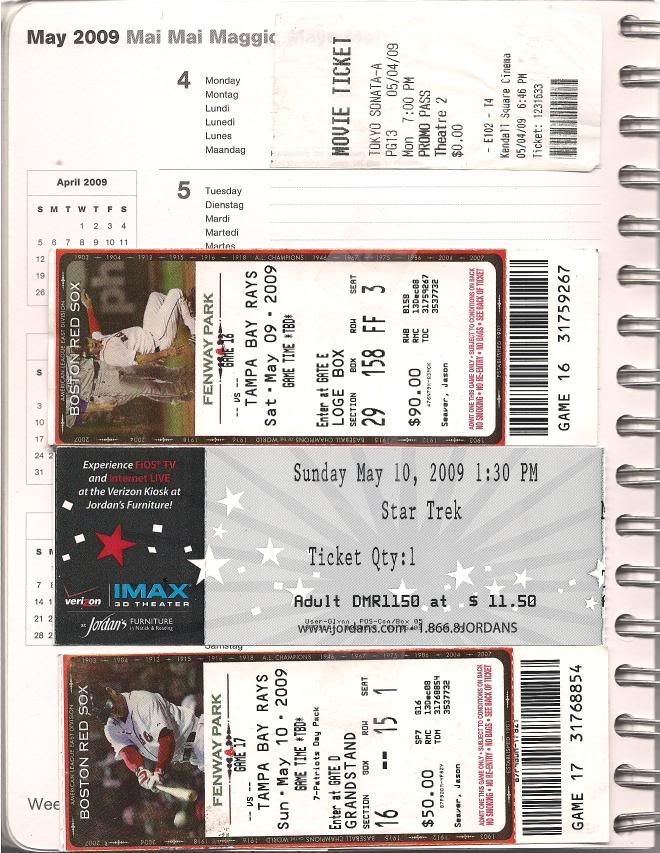
It was an eventful weekend. First, an ugly baseball game. Sometime during the fifth inning I sent my brother a text message saying that the crowd was likely to kill Julio Lugo. Roughly forty balls seemed to go through the hole in the left side, and although my seat wasn't really lined up well, I did spend a little time pondering whether or not I, if I worked up a sufficient berzerker rage, I could dash from my seat, leap onto the field, and injure him enough to get him back on the DL before security stopped me. I'm still not sure it was actually a bad idea.
Sunday afternoon, Matt wound up paying $35 for me to see Star Trek in IMAX. The plan was he pays for tickets, I get the food, but he had a nightmarish morning with the T and didn't have the backup plans worked out to get to Reading. He and Morgan wound up seeing it in 35mm, and I gather he enjoyed it nearly as much as I did.
I did meet him for the Sunday night game; unfortunately, I was in and out of the house to fast to grab something useful like a coat or sweatshirt. It was really cold, although the game itself was pretty exciting.
This weeks SXSW update:
22 April 2009 (Wednesday): The Brothers Bloom
23 April 2009 (Thursday): Children of Invention, The Missing Person
24 April 2009 (Friday): Johnny Cash at Folsom Prison, In The Loop, Pontypool
25 April 2009 (Saturday): Still Walking, Nollywood Babylon, Lost Son of Havana, Grace
26 April 2009 (Sunday): Herb and Dorothy, Helen, Unmistaken Child, The Escapist
27 April 2009 (Monday): For the Love of Movies, Art & Copy
28 April 2009 (Tuesday): World's Greatest Dad
Ah, I'll be glad to finish writing these things up. With something like a month before the New York Asian Film Festival, if I opt to do anything there.
Star Trek
* * * ¾ (out of four)
Seen 10 May 2009 at Jordan's Furniture Reading (The IMAX Experience)
I had a big, happy, I feel like I'm ten years old again smile on my face throughout this entire movie. I'm going to spend tomorrow's bus ride writing up why, but I've been spending the last day or so figuring out where they could go next with the series and how much I loved everything about it.

It was an eventful weekend. First, an ugly baseball game. Sometime during the fifth inning I sent my brother a text message saying that the crowd was likely to kill Julio Lugo. Roughly forty balls seemed to go through the hole in the left side, and although my seat wasn't really lined up well, I did spend a little time pondering whether or not I, if I worked up a sufficient berzerker rage, I could dash from my seat, leap onto the field, and injure him enough to get him back on the DL before security stopped me. I'm still not sure it was actually a bad idea.
Sunday afternoon, Matt wound up paying $35 for me to see Star Trek in IMAX. The plan was he pays for tickets, I get the food, but he had a nightmarish morning with the T and didn't have the backup plans worked out to get to Reading. He and Morgan wound up seeing it in 35mm, and I gather he enjoyed it nearly as much as I did.
I did meet him for the Sunday night game; unfortunately, I was in and out of the house to fast to grab something useful like a coat or sweatshirt. It was really cold, although the game itself was pretty exciting.
This weeks SXSW update:
22 April 2009 (Wednesday): The Brothers Bloom
23 April 2009 (Thursday): Children of Invention, The Missing Person
24 April 2009 (Friday): Johnny Cash at Folsom Prison, In The Loop, Pontypool
25 April 2009 (Saturday): Still Walking, Nollywood Babylon, Lost Son of Havana, Grace
26 April 2009 (Sunday): Herb and Dorothy, Helen, Unmistaken Child, The Escapist
27 April 2009 (Monday): For the Love of Movies, Art & Copy
28 April 2009 (Tuesday): World's Greatest Dad
Ah, I'll be glad to finish writing these things up. With something like a month before the New York Asian Film Festival, if I opt to do anything there.
Star Trek
* * * ¾ (out of four)
Seen 10 May 2009 at Jordan's Furniture Reading (The IMAX Experience)
I had a big, happy, I feel like I'm ten years old again smile on my face throughout this entire movie. I'm going to spend tomorrow's bus ride writing up why, but I've been spending the last day or so figuring out where they could go next with the series and how much I loved everything about it.
Subscribe to:
Posts (Atom)

