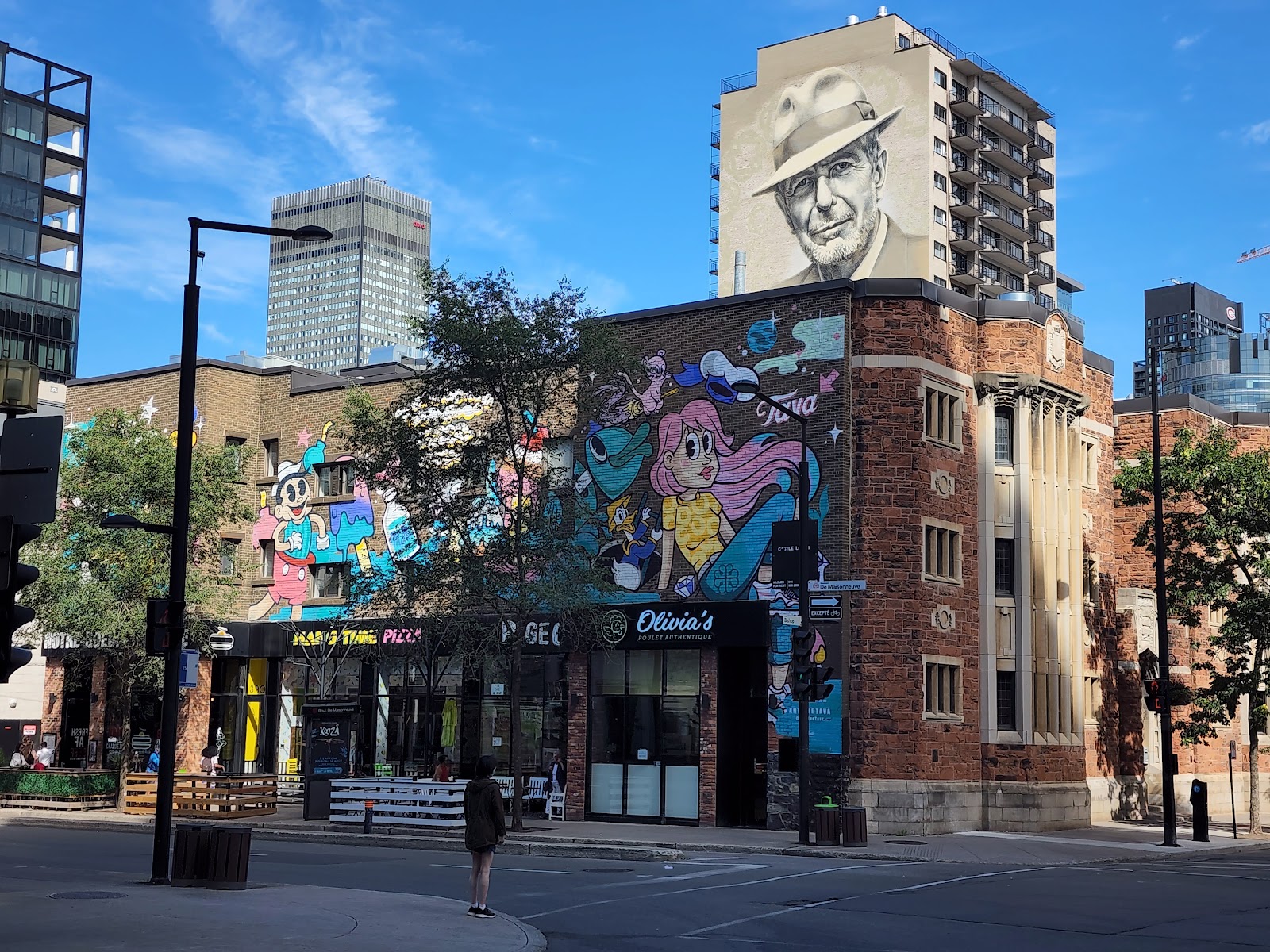
No guest at the shows I saw that day - just no way I was logging out of work on time for Topology of Sirens and I didn't get to The Diabetic (my story is that I was eating and lost track of time and in sticking to it) - so here's a photo of a spot a block away from where the festival takes place:
That Leonard Cohen mural pops even when you're looking down from Mount Royal, and the one mural above another feels like an abundance of riches to those of us from a city where there's not really much public art. Like, we got very excited about Elfland because a few eight-year-olds screwing around in a vacant lot was a lot for us. The MLK sculpture is going to just break Bostonians' brains.
I will say that Brit & Chips no longer being in that building made me sad, as it was my go-to if I had time between films for the past few years before the pandemic. I went to the original location by the Vieux-Porte after the festival was over, but it wasn't the same - mostly just beery breading, as opposed to the Orange Crush and sour cream & onion flavors I remember. I wound up hitting the fried chicken place instead, which is pretty good. Heck, it even had the Cotts Black Cherry soda that I didn't realize you could get without also buying a smoked-meat sandwich at Schwartz's.
(Shockingly low poutine and smoked-meat consumption this year - I think I had a poutine the day I arrived, and my stomach tightened up the next day, so I kind of avoided it afterward, and no smoked meat until I had some as part of a locally-inspired eggs benedict after the festival. No excuse there, other than the fancy/creative places for that seemed to have vanished from the Concordia area.)
Okay, that's probably enough of that. Another short-ish entry coming up, with Out in the Ring, Freaks Out, and the final DJ XL5 Zappin Party.
Happer's Comet
* * ¾ (out of four)
Seen 27 July 2022 in Salle J.A. De Sève (Fantasia Festival: Camera Lucida, ProRes)
The thing about a festival structured like Fantasia is that if it's all you're not going to be doing anything else while there, you can build your schedule without knowing that much about what you're seeing, and wind up at a movie that's basically ambient noises, more or less by accident. Happer's Comet is the sort of film where it's no surprise that director Tyler Taormina was also the sound designer, and while that's an intriguing thing to watch at times, it's not even as linear or conventional as the filmmaker's previous film Ham on Rye.
It is, as such things go, not bad. Taomina spends much of the early going jumping between tiny vignettes at seeming random, showing folks mostly alone in their homes and cars and occasionally on the streets walking their dog or the like. Later on, a number of people come out to roller skate through empty streets at night, so even though there isn't any dialogue, things start to feel tied together, or at least have the potential to be. In the meantime, moving lights intersect with sound in interesting ways (lots of trains in this town), small noises take on heightened importance, and people look to fill time . Nobody seems to go out of their way to not talk, in large part because they are often on their own.
Taormina occasionally feints in the direction of a couple incidents colliding, and at other points the film is built in such a way that a savvy viewer wonders if one shot is meant to be a reaction to another, or if they're unrelated and they should wonder if the juxtaposition is a comment on the brain looking for connections in an isolated time: The film was shot when people were the most hunkered down because of covid, and plays as a snapshot of that moment in a way that a film with more of a plot likely can't. It was a period of inaction, stress, and isolation, and a movie that spurs its characters to accomplish tasks during that time is chronicling the exception rather than the rule.
Even though it's a piece of barely-narrative art, one can't help but watch it as a movie, and with the story so minimal, one's eyes go to how it's presented, and it's good-looking for what it is with a cast made up of Taormina's family, friends, and neighbors, but I don't know that the craft is that exciting. Done well, sure, and sustaining it for an hour is something, but not exactly engrossing - a well-sustained chain of not-bad moments that eventually feel like they should be leading to something a bit more climactic than they do.
That sort of film leaves plenty of mental capacity free to wander, and maybe this one isn't quite so enrapturing that it can afford to do so in any case but a theater where one is afraid of disturbing others by leaving.
Hansan: Yongui Chulhyeon (Hansan: Rising Dragon)
* * * (out of four)
Seen 27 July 2022 in Auditorium des Diplõmés de la SGWU (Fantasia Festival, DCP)
This prequel to The Admiral: Roaring Currents (why it's not titled "The Admiral: Rising Dragon", since folks do recall and enjoy that movie, I can't guess) follows roughly the same pattern as its predecessor: A lot of names thrown up on screen, intrigue in the Japanese camp and strife in the Korean, and a fair amount of killing time before its time for the big naval battle in the end. The good news is that Kim Han-min and his collaborators have not lost many steps in the interim, and pay off the audience's patience with a rousing finale.
The film opens in 1592, five years or so before Roaring Currents. The Japanese military led by Wakizaka Yasuharu (Byun Yo-han) is advancing across the peninsula, catching Josean units by surprise and driving the king back to the fort at Pyongyang, though their eyes are on the larger prize of China. Their best hope is Admiral Yi Sun-shin (Park Hae-il), a tactical genius with ships fearsome enough that they are seen as dragons by the more superstitious of his foes, although in examining a ship heavily damaged in battle, Wakizaka believes he has spotted a weakness that can be exploited. One of the highest-ranking generals, Won Gyu (Son Hyeon-ju) advises retreat and concentration on defense, which means that Yi must be subtle with his plan to lure Wakizaka's ships through various straits to the waters near Hansan Island, where his mentor Eo Yeong-dam (Ahn Sung-ki), who has extensive knowledge of the terrain, might just be able to spring a trap, if all goes right.
The general outline of the film is so similar to its predecessor that arguably the main difference is the casting and circumstances of the main character. Where Roaring Currents had Song Kang-ho as an older Yi Sun-shin who had been imprisoned for a previous failure and was eager to prove his worth (or at least to die at sea rather than in jail); Park Hae-il plays Admiral Yi here, and while the situation is undeniably dire, desire to do one's duty is only so exciting. Park portrays Yi as poker-faced, undoubtedly on top of things but never tipping his hand to either his colleagues or the audience, to the point where it can be difficult to tell if his victories are brilliance or being in good position to take advantage of things breaking right. He only has a right hand who can get him to open up on occasion, so there's not much chance to find a fascinating personality at the center of the strategy.
It makes the Japanese side of the movie more fun to watch, oddly enough - Byun Yo-han's Wakizaka is theoretically running a parallel story, maneuvering to get his peers and subordinates in position to back his play while outfoxing Yi, but backstabbing and treachery is more dynamic on-screen than quiet politicking. On top of that, Byun gets to give a showier performance, and as the film marches toward the endgame, there are spies and double-agents, and even if you haven't seen Roaring Currents since its initial release, it's likely that the origin stories of a couple characters from that movie will click regardless.
Still, the movie does eventually reach the battle to which it has title cards counting down throughout, a ploy to lure the Japanese navy into open waters where Yi's "crane wing formation" can work, and that's fun stuff, from the tense fog-shrouded start to the coup de grace that had been foreshadowed throughout the film. In between, there's heavily armored ships just smashing through each other, soldiers shooting arrows at each other from the decks of moving ships, and, of course, the best thing an action movie can have: Wooden ships with cannons blowing the living hell out of each other at close range. Though done with few or no practical work compared to the previous movie, it still looks great - knowing how to stage something is arguably more important than the exact methods used to achieve it these days.
Like Roaring Currents before it, Rising Dragon is a slow build, but the release is a heck of a blast. Filmmaker KimHan-min is apparently already hard at work on a third movie to round out the trilogy. If it's got set-up to match its naval action; it will really be something, but even if it follows the pattern of the first two films, the series will end with a bang.
Inu-Oh
* * * ¾ (out of four)
Seen 26 July 2022 in Auditorium des Diplõmés de la SGWU (Fantasia Festival, DCP)
Seen 14 August 2022 in AMC Boston Common #18 (first-run, DCP)
When people talk about the new generation of anime filmmakers who could be seen as the heirs to the likes of Miyazaki, Otomo, and Takahata - folks whose works and names could become known beyond that intense fans of the medium and associated genres - the name of Masaaki Yuasa doesn't come up nearly as often as Makoto Shinkai or Mamoru Hosoda, though it probably should. It's understandable, in a strange sort of way: Not only are his films idiosyncratic cartoons compared to the others' more restrained styles, perhaps why they haven't often been given the sort of multiplex presentations in North America, but he's been so mind-bogglingly productive - four features and three television series released in the past five years - that it's harder to present the new Yuasa as an event. The thing is, though, the features in that run have been phenomenal, and Inu-Oh might just be his masterpiece. If it's not (it does perhaps try to do too much), it's at least got enough of a supply of jaw-dropping creativity to start a conversation.
It starts with a street musician beginning a tale in present-day Tokyo, but is soon jumping back 600 years, to when Noh Theater was just beginning to define itself as an art form, two shoguns were vying to be recognized as the true claimant to the throne, and the lost Imperial Regalia (aka the Heike Treasure) were said to be the key. Young Tomona, whose family has been diving for treasure in the local waters for generations, may have located the sword, but its magical powers cause a disaster when it breaks the surface, killing his father and blinding him. Elsewhere, a child is born into a family of sarugaka dancers with seemingly every deformity possible, apparently linked to his father (voice of Kenjiro Tsuda) donning another piece of the Regalia. Years later, Tomona (voice of Mirai Moriyama) has joined the biwa priests, nomadic musicians who recount the legends of Heike while playing the biwa, though someone has been killing priests singing new songs. The deformed child (voice of Avu-chan) has become a surprisingly agile dancer, given the differing lengths of his arms and legs, and the mask that covers his face. They encounter each other by chance and soon realize they have a mutual ability to communicate with spirits and begin a partnership to help them find peace by having their tales told.
Doing that means breaking free of the carefully delineated orthodoxy of their art forms, and when they do that, everything changes, suddenly becoming a rock opera as Tomona serves as the hype man for Inu-Oh (the name the other has chosen, as Tomona becomes Tomoichi when accepted into the biwa troupe and Tomoari when striking out on his own). The soundtrack suddenly becomes electric rather than strictly traditional, and the performances become a fifteenth-century pastiche of a modern arena rock show. It's the sort of thing that many animated features play as a joke or with a wink, an anachronistic take on something familiar (it's more or less a foundational part of the DreamWorks formula), but Yuasa plays it straight - it might not have literally been rock & roll, but the effect was the same: It's something disreputable compared to what's played for the shogun, with a direct connection to the audience who find themselves getting up and dancing along while also in awe at the pair's showmanship. The songs themselves are bangers, which may be a surprise considering that the subject matter is the people who fell in a twelfth-century battle, but there's also a thrill to it as their personae evolve, with Tomoari taking on a more feminine/nonbinary appearance while freeing these spirits changes Inu-Oh physically, evolving him from a beast that sleeps and eats with the dogs to something far more conventional, although his face remains twisted and covered - but even then, in a sign of what Noh will become, he is wearing different masks for different performances and different images.
The film gives itself so much over to performance in the center that it crowds the rest of the film out - the serial killer from the start is given little more thought, for instance, until it gets explained and tied in with the larger story later on. There are subplots and interesting bits of characterization that feel like they could have had more time, from the differences of opinion within the biwa troupe about whether Tomoari's new songs and styles are horrifying or exciting, and the hint of treachery in the court of Shogun Ashikaga (voice of Tasuku Emoto) that seems like there's a whole lot more going on, although, arguably, that's just Yuasa and screenwriter Akiko Nogi remaining focused on Tomona and Inu-Oh. The same could be said for how the film finishes after their climactic concert for the shogun and his wife, that the film is properly focused on the story of their rise, but it feels like there is a whole film's worth of stuff to do afterwards, about censorship and how the powerful enforce orthodoxy in both history and the performing arts and selling out and, in the final moments, how stories come full circle and are retold. It's not this film's story, but the viewer can feel the importance of the topics even as the film zooms through them at absurd speed.
It's a justifiable choice, though, and not one which sours how tremendously exhilarating the previous hour and a half has been. Yuasa's animation has always been full of caricature and distortion - the Science Saru house style is much looser than that of many animation studios - and though that's the case here, and as such it's impressive to see how convincing the early iterations of Inu-Oh are, because they're anatomically ridiculous but still need to come off as somehow real, a different sort of exaggeration than the rest of the stylized characters. The dancing is amazing, smooth and fluid even when it's built around Inu-oh's impossible proportions while feeling natural but not rotoscoped when he's more properly humanoid. The stylized depictions of how Tomona perceives the world are clever and immediately recognizable as a way to depict blindness in a visual medium, but Yuasa and company are able to dip in and out of them easily rather than setting up something pointed; on the other side, Shogun Ashikaga often seems to be drawn in a slightly different style, closer to traditional Japanese fine art than the cartooning, a more interesting choice than simply portraying him as rigid. Perhaps the only place where the animation falls a bit is a flying first-person shot, the sort of thing that requires a lot of digital assistance and doesn't quite match the traditional-style visuals it's flying through.
That's about a minute out of a 95-minute movie, though, with the other 98% thrilling, creative, and impeccably executed, with a second viewing during its theatrical run confirming that it's not just festival excitement about seeing the latest from a favorite creator. Inu-Oh is a terrific film - like few others most audiences have seen, but also seeming like it couldn't be made any other way.
Showing posts with label experimental. Show all posts
Sunday, August 14, 2022
Fantasia 2022.14: Happer's Comet, Hansan: Rising Dragon, and Inu-Oh
Labels:
action,
animation,
anime,
experimental,
Fantasia,
Fantasia 2022,
fantasy,
history,
independent,
Japan,
Korea,
music,
musical,
USA,
war
Sunday, November 29, 2015
A Visit from Nobuhiko Obayashi: "Complexe", Bound for the Fields, the Mountains, and the Seacoast, "Emotion", and Hausu
Today in "projection": During the Q&A for Sunday night's film, I looked over my shoulder a couple of times to see Saturday night's guest, Guy Maddin, getting up, walking around, and sitting back down. I wondered if he was anywhere close to as impatient as I was, because my bladder was ready to explode but I was blocked in by people on both sides, including my least favorite Harvard Film Archive regulars

I didn't get many good photos, because you're not supposed to be taking any, but I needed to get this one - Obayashi-sama (I believe that was the honorific used) in the center, the translator on the right, and the director's daughter Chigumi Obayashi on the left. She, famously, supplied the original story, which was basically a list of things that freaked her out, at the age of 11, and would become an experimental filmmaker in her teens based upon her father's encouragement.
The projector obscuring Mr. Obayashi was either a toy he received when he was three or a replica thereof - which, being three, he saw as a choo-choo train, causing a bit of damage. At the time, I found this story of this confusion an extended metaphor for how he just wouldn't answer the question someone asked, although I was a bit more charitable once I got home. The man clearly loves to talk about movies and his work, saying many times that his heart was 8mm even if his more commercial work was 35mm. He also mentioned that, for both of the features, he was trying to evoke silent cinema in the framing and presentation.
This was just a short visit to Boston before heading to New York for a much larger retrospective, which has one more weekend to go. If you're in that area, it's worth checking out. I'd advise the small soda, though, because that guy can talk.
"Complexe"
* * * (out of four)
Seen 15 November 2015 at the Harvard Film Archive (Almost Like a Horror Film: The Cinema of Nobuhiko Obayashi, 16mm)
One of Nobuhiko Obayashi's earliest creations as a cinema artist, "Complexe" feels like a young man having fun with the camera more than anything else, and is kind of a shame that more directors don't have things like this that are easily retrieved and examined. Abstract as it is you can see his joy at creating something very odd, even if you may have to split your own meaning.
If I was going to graft a narrative onto it, I'd say it's the filmmaker poking around a housing complex in a modern urban area and finding something missing - not necessarily objects, but slices of time. Much of the film is a sort of live-action stop-motion animation, time-lapse photography where each frame chosen creates the illusion of people moving while standing still or vice versa, creating some super-cool effects, as when a man seems to just flat through a row of trees like a ghost.
Aside from that, it's also very self-aware; Obayashi addresses the audience directly in voice-over, and the film opens and closes with various stills of the crew working (and the directorxs infant daughter, tangled in 8mm film). It feels almost like we watch them striking a set, and yet that still doesn't make the film feel completely unreal, despite the impossibility of what we've seen. It's almost as though Obayashi puts the audience directly on the boundary of an impossible documentary and an obvious construction, a nifty place to be.
Noyuki yamayuki umibe yuki (Bound for the Fields, the Mountains, and the Seacoast)
* * * ¾ (out of four)
Seen 15 November 2015 at the Harvard Film Archive (Almost Like a Horror Film: The Cinema of Nobuhiko Obayashi, 35mm)
Like many in the audience for Nobuhiko Obayashi's Noyuki yamayuki umibe yuki (the English title of "Bound for the Fields, the Mountains, and the Seacoast" was not on the print projected), all I had seen of the director's work was House, which re-emerged as a cult favorite a few years back, and as a result I spent some time watching it through that prism - how is it like House, how is it different? That's perhaps inevitable but unfair, as there is a fair chunk of time and work between the two, and this is in many ways a far more impressive work, less randomly strange but still eccentric, with a different sort of sting to its jokes.
This one is set during the Second World War, although the most obvious indicator of that in this particular town is that there aren't a whole lot of teenagers or young men around. Instead, kids like Sutaro Sudo (Yasufumi Hayashi), dressed in sailor's hat and always carrying binoculars and a book on monkey behavior, run around more or less unsupervised after school. His class has a new student, Sakae Ohsugi (Jun'ichiro Katagiri), a couple years older than the other kids and thus drawing the ire of the class's established bully Bon, the barber's son, leading Sudo to devise elaborate war games to prevent real violence from breaking out. The other boys also rapidly develop a crush on Sakae's pretty older half-sister O-Shouchan (Isako Washio), although she has an eye for raft-rider Yuta Hayami (Toshinori Omi). That pacifist may wind up in the Army anyway, even though O-Shouchan will soon have another reason for the pair to run away.
Those of us who primarily know Obayashi from House would not be surprised to connect the two films just by looking at them; though Bound for the Fields takes place in a less fanatical space and its color scheme is a bit more muted, it's still a vibrant world, more so than one might expect from a war-depleted time. It's a kid's-eye-view of things, though, and Sudo in particular still finds the world to be full of adventure and ready to be discovered. So the kids in his class wear distinctive outfits rather than uniforms, his parents are all wide, reassuring smiles - the father is even a doctor who can fix the sort of damage an active kids sustains right up - and his teacher is a goofball who is always running kind of funny. The last is probably because of an erection from the porn he keeps in his desk, but Sudo isn't thinking like that yet.
Full review on EFC.
"Émotion"
* * * (out of four)
Seen 16 November 2015 at the Harvard Film Archive (Almost Like a Horror Film: The Cinema of Nobuhiko Obayashi, 16mm)
"That Dracula that we once knew" is a fun way to start off a short film, albeit one with relatively little Dracula-based content. Instead, it tells the story of Emi (Emi Tabata), a girl from the seashore who goes to the city and meets Sari (Sari Akasaka), a girl "just like her". They quickly become extremely close, with eyes on the same man while Sari's parents "out of a fairy tale" get interested in Emi. Of course, this being an Obayashi film which started with name-dropping Dracula, things will get odd at several points.
It's downright eccentric, with stop-motion/live-action bits and a duel that happily makes a point of leaving the cameramen in the shot because Obayashi's experimental films are as much about making movies as their subjects. This one strikes an unusually good balance there, making both its wispy story and unusual flourishes memorable in equal measure. It's genuinely funny and sweet, but shows Obayashi havinng fun with the form.
House (Hausu)
* * * ½ (out of four)
Seen 16 November 2015 at the Harvard Film Archive (Almost Like a Horror Film: The Cinema of Nobuhiko Obayashi, 35mm)
Was House the first modern cult movie rediscovery, rolled out with a concerted effort and branded as such, or the last to pop up in various places, acquire good word of mouth, and spread that way? Not that it really matters; it's not important that people enjoy something for the proper, authentic reasons, although there's no denying that the thrill of discovering something insane back in 1989 is no longer there, and to a certain extent, watching it now is kind of waiting for this or that weird thing to happen, checking it off a list.
It's still fun, though - Obayashi is doing crazy, vibrant things that are still highly amusing even on the third or fourth run-through. Having now been through repeated viewings, I find more moments where Gorgeous's jealousy of her step-mother hints at a certain instability that makes her merge with her mad, ghostly aunt, athough the randomness is just as visible.
Is it still fun? Sure, and there are lots of ways that it holds up. It's just never going to be the sort of cult film that gets better with repetition.
Full review (from 2009) on EFC.

I didn't get many good photos, because you're not supposed to be taking any, but I needed to get this one - Obayashi-sama (I believe that was the honorific used) in the center, the translator on the right, and the director's daughter Chigumi Obayashi on the left. She, famously, supplied the original story, which was basically a list of things that freaked her out, at the age of 11, and would become an experimental filmmaker in her teens based upon her father's encouragement.
The projector obscuring Mr. Obayashi was either a toy he received when he was three or a replica thereof - which, being three, he saw as a choo-choo train, causing a bit of damage. At the time, I found this story of this confusion an extended metaphor for how he just wouldn't answer the question someone asked, although I was a bit more charitable once I got home. The man clearly loves to talk about movies and his work, saying many times that his heart was 8mm even if his more commercial work was 35mm. He also mentioned that, for both of the features, he was trying to evoke silent cinema in the framing and presentation.
This was just a short visit to Boston before heading to New York for a much larger retrospective, which has one more weekend to go. If you're in that area, it's worth checking out. I'd advise the small soda, though, because that guy can talk.
"Complexe"
* * * (out of four)
Seen 15 November 2015 at the Harvard Film Archive (Almost Like a Horror Film: The Cinema of Nobuhiko Obayashi, 16mm)
One of Nobuhiko Obayashi's earliest creations as a cinema artist, "Complexe" feels like a young man having fun with the camera more than anything else, and is kind of a shame that more directors don't have things like this that are easily retrieved and examined. Abstract as it is you can see his joy at creating something very odd, even if you may have to split your own meaning.
If I was going to graft a narrative onto it, I'd say it's the filmmaker poking around a housing complex in a modern urban area and finding something missing - not necessarily objects, but slices of time. Much of the film is a sort of live-action stop-motion animation, time-lapse photography where each frame chosen creates the illusion of people moving while standing still or vice versa, creating some super-cool effects, as when a man seems to just flat through a row of trees like a ghost.
Aside from that, it's also very self-aware; Obayashi addresses the audience directly in voice-over, and the film opens and closes with various stills of the crew working (and the directorxs infant daughter, tangled in 8mm film). It feels almost like we watch them striking a set, and yet that still doesn't make the film feel completely unreal, despite the impossibility of what we've seen. It's almost as though Obayashi puts the audience directly on the boundary of an impossible documentary and an obvious construction, a nifty place to be.
Noyuki yamayuki umibe yuki (Bound for the Fields, the Mountains, and the Seacoast)
* * * ¾ (out of four)
Seen 15 November 2015 at the Harvard Film Archive (Almost Like a Horror Film: The Cinema of Nobuhiko Obayashi, 35mm)
Like many in the audience for Nobuhiko Obayashi's Noyuki yamayuki umibe yuki (the English title of "Bound for the Fields, the Mountains, and the Seacoast" was not on the print projected), all I had seen of the director's work was House, which re-emerged as a cult favorite a few years back, and as a result I spent some time watching it through that prism - how is it like House, how is it different? That's perhaps inevitable but unfair, as there is a fair chunk of time and work between the two, and this is in many ways a far more impressive work, less randomly strange but still eccentric, with a different sort of sting to its jokes.
This one is set during the Second World War, although the most obvious indicator of that in this particular town is that there aren't a whole lot of teenagers or young men around. Instead, kids like Sutaro Sudo (Yasufumi Hayashi), dressed in sailor's hat and always carrying binoculars and a book on monkey behavior, run around more or less unsupervised after school. His class has a new student, Sakae Ohsugi (Jun'ichiro Katagiri), a couple years older than the other kids and thus drawing the ire of the class's established bully Bon, the barber's son, leading Sudo to devise elaborate war games to prevent real violence from breaking out. The other boys also rapidly develop a crush on Sakae's pretty older half-sister O-Shouchan (Isako Washio), although she has an eye for raft-rider Yuta Hayami (Toshinori Omi). That pacifist may wind up in the Army anyway, even though O-Shouchan will soon have another reason for the pair to run away.
Those of us who primarily know Obayashi from House would not be surprised to connect the two films just by looking at them; though Bound for the Fields takes place in a less fanatical space and its color scheme is a bit more muted, it's still a vibrant world, more so than one might expect from a war-depleted time. It's a kid's-eye-view of things, though, and Sudo in particular still finds the world to be full of adventure and ready to be discovered. So the kids in his class wear distinctive outfits rather than uniforms, his parents are all wide, reassuring smiles - the father is even a doctor who can fix the sort of damage an active kids sustains right up - and his teacher is a goofball who is always running kind of funny. The last is probably because of an erection from the porn he keeps in his desk, but Sudo isn't thinking like that yet.
Full review on EFC.
"Émotion"
* * * (out of four)
Seen 16 November 2015 at the Harvard Film Archive (Almost Like a Horror Film: The Cinema of Nobuhiko Obayashi, 16mm)
"That Dracula that we once knew" is a fun way to start off a short film, albeit one with relatively little Dracula-based content. Instead, it tells the story of Emi (Emi Tabata), a girl from the seashore who goes to the city and meets Sari (Sari Akasaka), a girl "just like her". They quickly become extremely close, with eyes on the same man while Sari's parents "out of a fairy tale" get interested in Emi. Of course, this being an Obayashi film which started with name-dropping Dracula, things will get odd at several points.
It's downright eccentric, with stop-motion/live-action bits and a duel that happily makes a point of leaving the cameramen in the shot because Obayashi's experimental films are as much about making movies as their subjects. This one strikes an unusually good balance there, making both its wispy story and unusual flourishes memorable in equal measure. It's genuinely funny and sweet, but shows Obayashi havinng fun with the form.
House (Hausu)
* * * ½ (out of four)
Seen 16 November 2015 at the Harvard Film Archive (Almost Like a Horror Film: The Cinema of Nobuhiko Obayashi, 35mm)
Was House the first modern cult movie rediscovery, rolled out with a concerted effort and branded as such, or the last to pop up in various places, acquire good word of mouth, and spread that way? Not that it really matters; it's not important that people enjoy something for the proper, authentic reasons, although there's no denying that the thrill of discovering something insane back in 1989 is no longer there, and to a certain extent, watching it now is kind of waiting for this or that weird thing to happen, checking it off a list.
It's still fun, though - Obayashi is doing crazy, vibrant things that are still highly amusing even on the third or fourth run-through. Having now been through repeated viewings, I find more moments where Gorgeous's jealousy of her step-mother hints at a certain instability that makes her merge with her mad, ghostly aunt, athough the randomness is just as visible.
Is it still fun? Sure, and there are lots of ways that it holds up. It's just never going to be the sort of cult film that gets better with repetition.
Full review (from 2009) on EFC.
Subscribe to:
Posts (Atom)
