Showing posts with label music. Show all posts

Thursday, October 09, 2025

This Week in Tickets: 29 September 2025 - 2 October 2025 (Don't Know What You're Missing)

Another quiet week.

This Week in Tickets
Still not a whole lot in theaters, plus the first week I really missed having cable TV since dropping it, because ESPN had the Red Sox-Yankees series but no later AL games, the cost probably wasn't worth it. Before that, I opted to stay in Monday in an attempt to get Film Rolls back on track with the next film in a shamefully small box set I've been working through since January, Heroes of the East. It's fun, and I recommend it.

The AL Wild Card Series was the next three days, and instead of watching it, I used the MLB app to listen to it on the radio. Exciting, but a sad ending. Also, even though they were starting at 6pm, and the things to keep the game moving were in effect, it was still tight getting to one of the last screenings of Spinal Tap II: The End Continues at the Coolidge. It was fine.

The thing that surprises me? It lasted a week longer than A Big Bold Beautiful Journey, which was gone from everywhere in two weeks flat despite having a couple bona fide movie stars Disappointed in myself for not supporting it.

Did I take that to heart over the weekend? No! After catching A Writer's Odyssey 2 on Friday night, I did crosswords for most of the next two days.


Hoping to do better next week; watch my Letterboxd account to see if I manage.

Zhong hua zhang fu (Heroes of the East)

* * * (out of four)
Seen 29 September 2025 in Jay's Living Room (off the shelf, Blu-ray)
Where to stream it (Prime link), or buy the disc at Amazon

I'm planning to write more about this in the next week as I finish the first Film Rolls post in away too long, but it will probably focus on how this and the other Lau Kar-Leung movie on the disc (Dirty Ho) are kung fu comedies that feel like they were completely dispensing with any pretense that the kung fu was just part of these movies' appeal or a way of telling the story. Here are guys who know how to fight, this story says, some wacky situations, and then let's go.

And, hey, it works; the movie's a ton of fun. I wish that I knew a bit more about Hong Kong/Japan relations in the late 1970s because in some ways this movie has a weird tension underneath: The arranged marriage eventually becomes reasonably warm, but while Ho Tao is initially described as just being pretty good at martial arts, he defeats a whole bunch of masters of various Japanese disciplines. Lots of movies and other bits of pop culture will try and walk a line where one is earnestly interested in and admiring of a foreign culture but with the unspoken assumption that one's own is better, although, hey, some of these folks are old enough to be WWII vets (and I've seen a lot of recent Chinese movies very focused on Japan as a sadistic occupying army), and one can't help but wonder what the thinking is here.


Spinal Tap II: The End Continues

* * ¼ (out of four)
Seen 1 October 2025 in Coolidge Corner #5 (first-run, DCP)
Where to stream it (Prime link), or pre-order the disc at Amazon

Logging this on Letterboxd, I noticed that there are at least three other Spinal Tap things between This Is… and The End Continues, treated as in-continuity but not that important for those who missed them. There's a line in there about the band always reforming and returning in some manner or other, but that's kind of a meta as the movie gets. This "series" has always been a more jovial and affectionate poof than cutting satire, and isn't necessarily going to change hats at this point.

Which is maybe a shame because there's the boomer bands that just keep going until they literally lose their senses - Elton John* is nearly blind, Huey Lewis's last album wound up short because of hearing loss, and Ozzy Osborne performed right up until his death - even though they're also selling their catalogs as estate planning, and nobody in a better position to do it. Instead, they're kind of playing the hits, sometimes literally, during seemingly endless rehearsal scenes, repeating jokes they've made before and settling for smiles of recognition rather than surprising laughs that catch one flat-footed. The funniest bit, perhaps, is Michael McKean's David St. Hubbins having moved into making ringtones and the like; it feels sharp compared to the randomness of what his bandmates are doing before the reunion show happens.

*That said, his voice is still great when he shows up as a guest star. McKean, Christopher Guest, and Harry Shearer have always had the chops to make things like Spinal Tap and A Mighty Wind credible, but they get outclassed.

I think, to a certain extent, the improvisational nature of these mock documentaries trips them up on occasion. One can occasionally see the kernel of a good idea but no great jokes forming around it. Sometimes that's the joke - Guest's Nigel is earnestly dumb, and his passions are the kind of dumb that they're just going to fizzle out without a proper punchline - but that's different from how they don't quite know what to do with Valerie Franco despite her feeling like a perfect part of the ensemble as the new drummer There are a few pretty decent bits here and there, enough for a matinee ticket or stream, but all too often it's the sort of thing that leaves one torn between wanting these old pros to be as creative as they once were and not begrudging folks who still enjoy performing or those who still enjoy watching them even though their powers are diminished

There's something occasionally kind of sweet about how none of these guys, including and maybe especially Rob Reiner's documentarian, have grown much wiser as they've aged; he's still kind of earnestly delighted to learn all he can about rock & roll and they're still finding pleasure in their eccentricity, not really seeing in resentment. The very fact that they've been doing these bits off and on for 45 years means that there's four or five separate groups of archive footage to pull from, and there's a solidity to it not always present in revived franchises, and that as much as the content of the movie is often disappointing, the group's choice to focus on why nostalgia can be a comfort once you get to a certain age is earnest and pleasant. Heroes of the East Spinal Tap II: The End Continues A Writer's Odyssey 2

Monday, January 15, 2024

This Week in Tickets: 8 January 2024 - 14 January 2024 (No movies in Texas)

Well, none on this trip to meet with the rest of the remote-working team, although when you throw in a couple film festival and previous trips, Texas is probably the state I've seen the third-most movies in, dropping to fourth once you include Canadian provinces, though maintaining the position if you include Australian states…

This Week in Tickets
(Once again, the Alamo reservation is not a real ticket.)

When I look back on this book later, if I do, i won't remember that I had a 7:30am flight Monday, after-work commitments through Wednesday, and then a 1:20pm flight Thursday that had me ready to drop when I got home. But I did, hence the hole.

Friday, I hit the Brattle for the one screening that Ethan Coen's first solo film, Jerry Lee Lewis: Trouble in Mind, is getting in the Boston area, which throws a bit of a wrench into the "one does Macbeth, the other does Drive Away Dolls" analysis.

I kind of screwed up my plans on Saturday, not realizing that basically the whole Green Line was being replaced by buses of some sort, and missed the movie I'd planned to see, eventually just re-watching Bullet in the Head so that I could do a Film Rolls writeup.

Got back on it Sunday, though, catching If You Are the One 3 at the Causeway and then walking to the Seaport for The Book of Clarence, which has been a fun one to turn over in my brain for a bit. It was an accidental folks-playing-two-roles double feature.

(That was also a reminder of some of Boston's weird transit geography; I was planning to take the Orange Line to Downtown Crossing, the Red Line to South Station, and the Silver Line to Courthouse, but the direct route is a pretty straight 20-minute walk. Strange that there's no bus line that goes that way, or maybe there just isn't on Sundays.)

Pretty short week, but it's MLK Day, so I'll likely have two more things in my Letterboxd account by the end of the day and a fun week ahead.


Jerry Lee Lewis: Trouble in Mind

* * ½ (out of four)
Seen 12 January 2024 in AMC Boston Common #4 (first-run, laser DCP)

Has Matthew McConaughey played Jerry Lee Lewis yet? Look at them; he should.

As to this documentary, which I believe is all archive footage except for a 2020 gospel recording session that feels like it was intended to be the centerpiece of another project, there's an interesting shagginess to it that doesn't always work in its favor. Early on, as rocker Jerry Lee Lewis is telling his story between full-song clips, you see how director Ethan Coen and editor Tricia Cooke are cutting between various interviews in a way that has Lewis in one decade finishing the sentence of Lewis in another, emphasizing how well he's honed his story in some areas, and then there's this sharp realization that parts of Lewis's life fits a pattern we still see today: A rise to broad popularity; a sexual scandal; time spent in the wilderness before a re-emergence playing to a more conservative crowd (in this case, labeling himself country rather than rock & roll); and an ongoing sense of being aggrieved, like it's ridiculous that people fault him for marrying his 12-year-old cousin. It's Louis C.K., or anyone else who complains about being "canceled" rather than questioning their own actions. But once Coen has shown this to the audience, he seemingly stops being interested in it, and never finds something else to talk about, presenting the hit parade and a variety of seemingly self-serving interviews from later in his life and live appearances where he seems to have a chip on his shoulder when they do approach the energy of his youth.

I think, in the ending titles, which reference his death and other events after the 2021 copyright date in the credits, making me curious what they were originally, we get some idea of what intrigued Coen: After the familiar cycle, Lewis kept going being Jerry Lee Lewis. He kept playing, touring constantly, relearning how to play piano after a stroke, somehow survived a bunch of self-destructive behavior, married and divorced four more times after that infamous pairing. It's not a redemption story, really, or a tragedy, and Coen seems fascinated by that lack of an arc.

There's something Coen-esque about that - Coen Brothers films are filled with eccentrics who simply are who they are, for better or worse - but I'm not sure it's a great documentary as a result, or at least not this one. The film winds up mired in this sort of stasis, and never does that much with how there's something uncanny about Lewis's appearance compared to his wild-haired youth, a sort of rigidness to the face and over-gelled hair that Southern folks like him seem especially vulnerable to. Is it just time, bitterness, or something else?

Anyway - get Coen, McConnaughey, and some other interesting folks together for a feature, and we might have something; more than this doc gives, at least.


The Book of Clarence

* * * ¼ (out of four)
Seen 14 January 2024 in Alamo Drafthouse Seaport #4 (first-run, DCP)

The most entertaining parts of this movie are when filmmaker Jeymes Samuel is at his most irreverent, but I suspect that, when I've turned it over in my head a few times more, the central thing that will stick out is that he likely is a believer, but one full of anger that other Christians don't live up to their professed ideals. He makes jokes, but they're steeped in drawing lines and calling people out.

It opens in "Lower Jerusalem", AD 34, with hustler Clarence (LaKeith Stanfield) and his best friend Elijah (RJ Cyler) in a street race that goes awry, leaving them with thirty days to pay back Jedediah the Terrible (Eric Kofi-Abrefa) or be killed, and the fact that Clarence is hopelessly smitten with Jedediah's sister Varinia (Anna Diop) isn't going to work in his favor. The best way to escape, Clarence figures, is to join or emulate the Messianic Jesus (Nichola Pinnock), but everybody knows Clarence to be an atheist looking for an angle - although when Judas (Michael Ward) challenges him to free the gladiator slaves held by Asher (Babs Olusanmokun), he at least manages one, Barabbas the Immortal (Omar Sy), which is kind of more than Jesus and his apostles have done on the ground.

That, I think, is the real crux of the movie: For all that Samuel is doing a surface-level sendup of Biblical epics - a Black Life of Brian, in a lot of ways - there's sharp intention here. Recasting the New Testament (except the Romans) with Black actors draws a straight line between two oppressed peoples, making those stories immediately relevant in a way they might not have been before. But he tweaks them in other ways to draw other lines, most notably in how he uses the miracles: The first we see is when Jesus stops the stoning of Mary Magdalene (Teyana Taylor) - it's unmistakably supernatural, but Elijah has already been shielding her with his body, taking the brunt of the stones - the effect is to burnish Jesus's reputation as much as it is to save Mary. Afterward, he asks the woman leading the stoning her name, and says everybody will know it soon enough. It's a good line, but it's also kind of pointedly cruel, and it's not the only time Jesus and his apostles are shown being superficially good but ultimately self-serving. Samuel is not necessarily saying Jesus was like this, but if you draw a line between Christianity as institutions across two thousand years, it very much seems like a man frustrated that the people who use Jesus's words and have immense power that they can use often do not do as much to help people as dirt-poor, seemingly self-centered Clarence does.

The jokes are also good, though, from an opening that takes a Ben Hur-style chariot race and puts it in the streets, because it's that sort of movie, to LaKeith Stanfield and Alfre Woodard playing a scene where Clarence tries to learn Jesus's tricks from his mother Mary like they're in different movies that somehow come together. Samuel has characters throw off funny, bantery bits that he could have easily saved for a more conventional movie. The whole movie is so off-kilter that every scene calls attention to the weirdness of it while, underneath, Stanfield is getting ready to do something interesting with Clarence becoming a better person. Stanfield is generally great, making little gags like pronouncing the T in "apostle" funnier than they could be while handling the fact that his crazy schemer is the straight man much of the time like it's easy. He does a great job of playing twins, making both very clearly the children of the same mother but finding nuances between them, and plays well off everybody. His best partner is probably Omar Sy, though, as Barabbas is entertainingly confident and chill in his claims of being "un-sword-able", but also has two of the film's best comic outbursts.

As with his previous film, The Harder They Fall, Samuel not only writes, directs, and produces, but composes the score and sings lead vocals on the new songs that make up much of the soundtrack, which more often leans more toward soul and hip-hop than conventional orchestration. It makes for an exceptionally singular experience, and while he's not afraid to get weird between the floating, almost-anachronistic lightbulb moments, and "papers please" bits, he's also a solid filmmaker when it comes down to it: He can stage action for thrills, heightened emotion, or laughs; he doesn't overload the audience trying to fit too many easter eggs into a scene; he can let an impactful moment breathe.

Yes, I think this one is going to grow on me. It's unsteady as heck while you're watching, but Samuel is making the sort of ambitiously weird movies that deserve some attention, and I hope folks keep giving him the resources to make different old-Hollywood genres his own.

Jerry Lee Lewis: Trouble in Mind Bullet in the Head If You Are the One 3 The Book of Clarence

Sunday, August 14, 2022

Fantasia 2022.14: Happer's Comet, Hansan: Rising Dragon, and Inu-Oh

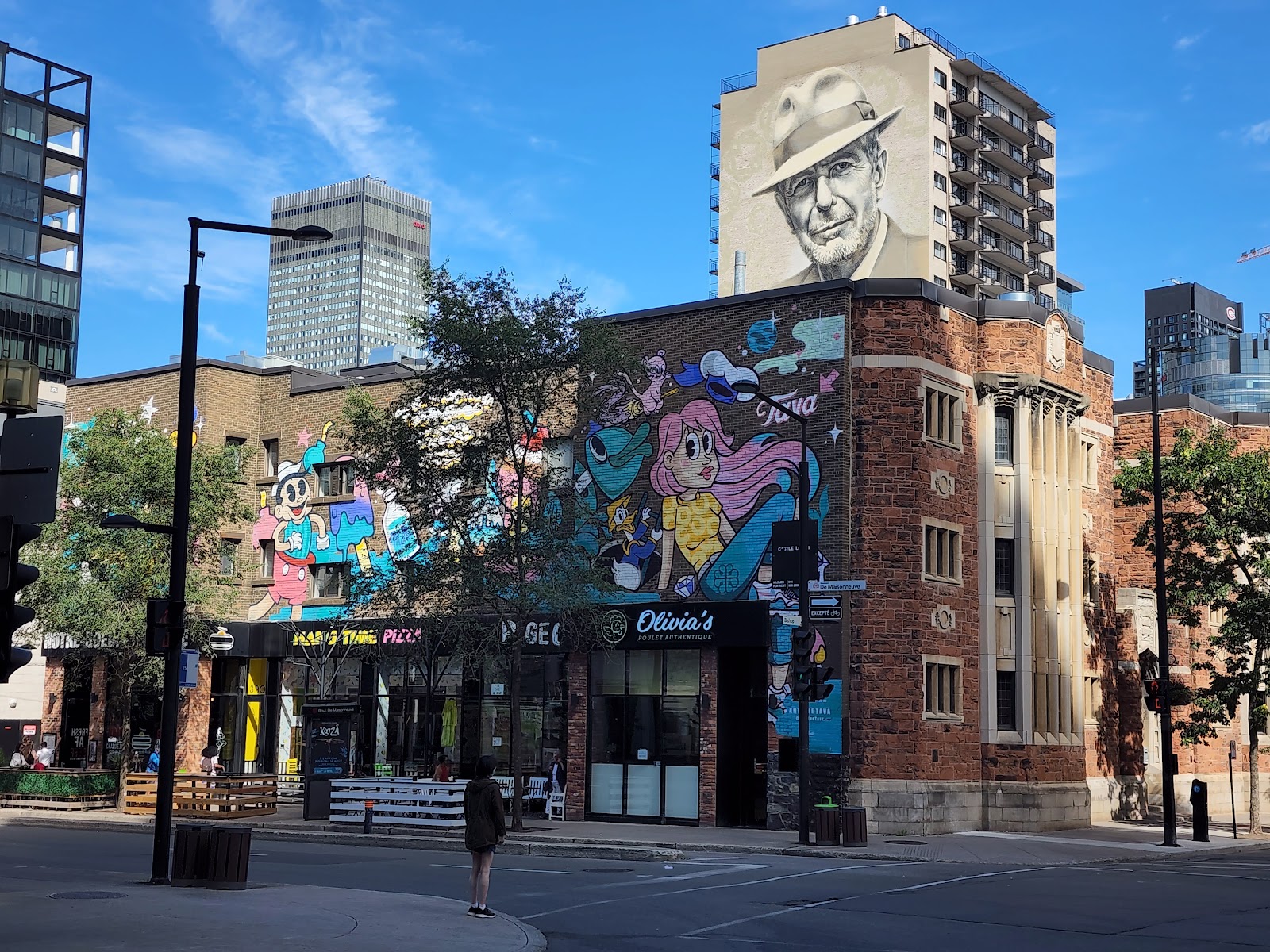
No guest at the shows I saw that day - just no way I was logging out of work on time for Topology of Sirens and I didn't get to The Diabetic (my story is that I was eating and lost track of time and in sticking to it) - so here's a photo of a spot a block away from where the festival takes place:

That Leonard Cohen mural pops even when you're looking down from Mount Royal, and the one mural above another feels like an abundance of riches to those of us from a city where there's not really much public art. Like, we got very excited about Elfland because a few eight-year-olds screwing around in a vacant lot was a lot for us. The MLK sculpture is going to just break Bostonians' brains.

I will say that Brit & Chips no longer being in that building made me sad, as it was my go-to if I had time between films for the past few years before the pandemic. I went to the original location by the Vieux-Porte after the festival was over, but it wasn't the same - mostly just beery breading, as opposed to the Orange Crush and sour cream & onion flavors I remember. I wound up hitting the fried chicken place instead, which is pretty good. Heck, it even had the Cotts Black Cherry soda that I didn't realize you could get without also buying a smoked-meat sandwich at Schwartz's.

(Shockingly low poutine and smoked-meat consumption this year - I think I had a poutine the day I arrived, and my stomach tightened up the next day, so I kind of avoided it afterward, and no smoked meat until I had some as part of a locally-inspired eggs benedict after the festival. No excuse there, other than the fancy/creative places for that seemed to have vanished from the Concordia area.)

Okay, that's probably enough of that. Another short-ish entry coming up, with Out in the Ring, Freaks Out, and the final DJ XL5 Zappin Party.


Happer's Comet

* * ¾ (out of four)
Seen 27 July 2022 in Salle J.A. De Sève (Fantasia Festival: Camera Lucida, ProRes)

The thing about a festival structured like Fantasia is that if it's all you're not going to be doing anything else while there, you can build your schedule without knowing that much about what you're seeing, and wind up at a movie that's basically ambient noises, more or less by accident. Happer's Comet is the sort of film where it's no surprise that director Tyler Taormina was also the sound designer, and while that's an intriguing thing to watch at times, it's not even as linear or conventional as the filmmaker's previous film Ham on Rye.

It is, as such things go, not bad. Taomina spends much of the early going jumping between tiny vignettes at seeming random, showing folks mostly alone in their homes and cars and occasionally on the streets walking their dog or the like. Later on, a number of people come out to roller skate through empty streets at night, so even though there isn't any dialogue, things start to feel tied together, or at least have the potential to be. In the meantime, moving lights intersect with sound in interesting ways (lots of trains in this town), small noises take on heightened importance, and people look to fill time . Nobody seems to go out of their way to not talk, in large part because they are often on their own.

Taormina occasionally feints in the direction of a couple incidents colliding, and at other points the film is built in such a way that a savvy viewer wonders if one shot is meant to be a reaction to another, or if they're unrelated and they should wonder if the juxtaposition is a comment on the brain looking for connections in an isolated time: The film was shot when people were the most hunkered down because of covid, and plays as a snapshot of that moment in a way that a film with more of a plot likely can't. It was a period of inaction, stress, and isolation, and a movie that spurs its characters to accomplish tasks during that time is chronicling the exception rather than the rule.

Even though it's a piece of barely-narrative art, one can't help but watch it as a movie, and with the story so minimal, one's eyes go to how it's presented, and it's good-looking for what it is with a cast made up of Taormina's family, friends, and neighbors, but I don't know that the craft is that exciting. Done well, sure, and sustaining it for an hour is something, but not exactly engrossing - a well-sustained chain of not-bad moments that eventually feel like they should be leading to something a bit more climactic than they do.

That sort of film leaves plenty of mental capacity free to wander, and maybe this one isn't quite so enrapturing that it can afford to do so in any case but a theater where one is afraid of disturbing others by leaving.

Hansan: Yongui Chulhyeon (Hansan: Rising Dragon)

* * * (out of four)
Seen 27 July 2022 in Auditorium des Diplõmés de la SGWU (Fantasia Festival, DCP)

This prequel to The Admiral: Roaring Currents (why it's not titled "The Admiral: Rising Dragon", since folks do recall and enjoy that movie, I can't guess) follows roughly the same pattern as its predecessor: A lot of names thrown up on screen, intrigue in the Japanese camp and strife in the Korean, and a fair amount of killing time before its time for the big naval battle in the end. The good news is that Kim Han-min and his collaborators have not lost many steps in the interim, and pay off the audience's patience with a rousing finale.

The film opens in 1592, five years or so before Roaring Currents. The Japanese military led by Wakizaka Yasuharu (Byun Yo-han) is advancing across the peninsula, catching Josean units by surprise and driving the king back to the fort at Pyongyang, though their eyes are on the larger prize of China. Their best hope is Admiral Yi Sun-shin (Park Hae-il), a tactical genius with ships fearsome enough that they are seen as dragons by the more superstitious of his foes, although in examining a ship heavily damaged in battle, Wakizaka believes he has spotted a weakness that can be exploited. One of the highest-ranking generals, Won Gyu (Son Hyeon-ju) advises retreat and concentration on defense, which means that Yi must be subtle with his plan to lure Wakizaka's ships through various straits to the waters near Hansan Island, where his mentor Eo Yeong-dam (Ahn Sung-ki), who has extensive knowledge of the terrain, might just be able to spring a trap, if all goes right.

The general outline of the film is so similar to its predecessor that arguably the main difference is the casting and circumstances of the main character. Where Roaring Currents had Song Kang-ho as an older Yi Sun-shin who had been imprisoned for a previous failure and was eager to prove his worth (or at least to die at sea rather than in jail); Park Hae-il plays Admiral Yi here, and while the situation is undeniably dire, desire to do one's duty is only so exciting. Park portrays Yi as poker-faced, undoubtedly on top of things but never tipping his hand to either his colleagues or the audience, to the point where it can be difficult to tell if his victories are brilliance or being in good position to take advantage of things breaking right. He only has a right hand who can get him to open up on occasion, so there's not much chance to find a fascinating personality at the center of the strategy.

It makes the Japanese side of the movie more fun to watch, oddly enough - Byun Yo-han's Wakizaka is theoretically running a parallel story, maneuvering to get his peers and subordinates in position to back his play while outfoxing Yi, but backstabbing and treachery is more dynamic on-screen than quiet politicking. On top of that, Byun gets to give a showier performance, and as the film marches toward the endgame, there are spies and double-agents, and even if you haven't seen Roaring Currents since its initial release, it's likely that the origin stories of a couple characters from that movie will click regardless.

Still, the movie does eventually reach the battle to which it has title cards counting down throughout, a ploy to lure the Japanese navy into open waters where Yi's "crane wing formation" can work, and that's fun stuff, from the tense fog-shrouded start to the coup de grace that had been foreshadowed throughout the film. In between, there's heavily armored ships just smashing through each other, soldiers shooting arrows at each other from the decks of moving ships, and, of course, the best thing an action movie can have: Wooden ships with cannons blowing the living hell out of each other at close range. Though done with few or no practical work compared to the previous movie, it still looks great - knowing how to stage something is arguably more important than the exact methods used to achieve it these days.

Like Roaring Currents before it, Rising Dragon is a slow build, but the release is a heck of a blast. Filmmaker KimHan-min is apparently already hard at work on a third movie to round out the trilogy. If it's got set-up to match its naval action; it will really be something, but even if it follows the pattern of the first two films, the series will end with a bang.

Inu-Oh

* * * ¾ (out of four)
Seen 26 July 2022 in Auditorium des Diplõmés de la SGWU (Fantasia Festival, DCP)
Seen 14 August 2022 in AMC Boston Common #18 (first-run, DCP)

When people talk about the new generation of anime filmmakers who could be seen as the heirs to the likes of Miyazaki, Otomo, and Takahata - folks whose works and names could become known beyond that intense fans of the medium and associated genres - the name of Masaaki Yuasa doesn't come up nearly as often as Makoto Shinkai or Mamoru Hosoda, though it probably should. It's understandable, in a strange sort of way: Not only are his films idiosyncratic cartoons compared to the others' more restrained styles, perhaps why they haven't often been given the sort of multiplex presentations in North America, but he's been so mind-bogglingly productive - four features and three television series released in the past five years - that it's harder to present the new Yuasa as an event. The thing is, though, the features in that run have been phenomenal, and Inu-Oh might just be his masterpiece. If it's not (it does perhaps try to do too much), it's at least got enough of a supply of jaw-dropping creativity to start a conversation.

It starts with a street musician beginning a tale in present-day Tokyo, but is soon jumping back 600 years, to when Noh Theater was just beginning to define itself as an art form, two shoguns were vying to be recognized as the true claimant to the throne, and the lost Imperial Regalia (aka the Heike Treasure) were said to be the key. Young Tomona, whose family has been diving for treasure in the local waters for generations, may have located the sword, but its magical powers cause a disaster when it breaks the surface, killing his father and blinding him. Elsewhere, a child is born into a family of sarugaka dancers with seemingly every deformity possible, apparently linked to his father (voice of Kenjiro Tsuda) donning another piece of the Regalia. Years later, Tomona (voice of Mirai Moriyama) has joined the biwa priests, nomadic musicians who recount the legends of Heike while playing the biwa, though someone has been killing priests singing new songs. The deformed child (voice of Avu-chan) has become a surprisingly agile dancer, given the differing lengths of his arms and legs, and the mask that covers his face. They encounter each other by chance and soon realize they have a mutual ability to communicate with spirits and begin a partnership to help them find peace by having their tales told.

Doing that means breaking free of the carefully delineated orthodoxy of their art forms, and when they do that, everything changes, suddenly becoming a rock opera as Tomona serves as the hype man for Inu-Oh (the name the other has chosen, as Tomona becomes Tomoichi when accepted into the biwa troupe and Tomoari when striking out on his own). The soundtrack suddenly becomes electric rather than strictly traditional, and the performances become a fifteenth-century pastiche of a modern arena rock show. It's the sort of thing that many animated features play as a joke or with a wink, an anachronistic take on something familiar (it's more or less a foundational part of the DreamWorks formula), but Yuasa plays it straight - it might not have literally been rock & roll, but the effect was the same: It's something disreputable compared to what's played for the shogun, with a direct connection to the audience who find themselves getting up and dancing along while also in awe at the pair's showmanship. The songs themselves are bangers, which may be a surprise considering that the subject matter is the people who fell in a twelfth-century battle, but there's also a thrill to it as their personae evolve, with Tomoari taking on a more feminine/nonbinary appearance while freeing these spirits changes Inu-Oh physically, evolving him from a beast that sleeps and eats with the dogs to something far more conventional, although his face remains twisted and covered - but even then, in a sign of what Noh will become, he is wearing different masks for different performances and different images.

The film gives itself so much over to performance in the center that it crowds the rest of the film out - the serial killer from the start is given little more thought, for instance, until it gets explained and tied in with the larger story later on. There are subplots and interesting bits of characterization that feel like they could have had more time, from the differences of opinion within the biwa troupe about whether Tomoari's new songs and styles are horrifying or exciting, and the hint of treachery in the court of Shogun Ashikaga (voice of Tasuku Emoto) that seems like there's a whole lot more going on, although, arguably, that's just Yuasa and screenwriter Akiko Nogi remaining focused on Tomona and Inu-Oh. The same could be said for how the film finishes after their climactic concert for the shogun and his wife, that the film is properly focused on the story of their rise, but it feels like there is a whole film's worth of stuff to do afterwards, about censorship and how the powerful enforce orthodoxy in both history and the performing arts and selling out and, in the final moments, how stories come full circle and are retold. It's not this film's story, but the viewer can feel the importance of the topics even as the film zooms through them at absurd speed.

It's a justifiable choice, though, and not one which sours how tremendously exhilarating the previous hour and a half has been. Yuasa's animation has always been full of caricature and distortion - the Science Saru house style is much looser than that of many animation studios - and though that's the case here, and as such it's impressive to see how convincing the early iterations of Inu-Oh are, because they're anatomically ridiculous but still need to come off as somehow real, a different sort of exaggeration than the rest of the stylized characters. The dancing is amazing, smooth and fluid even when it's built around Inu-oh's impossible proportions while feeling natural but not rotoscoped when he's more properly humanoid. The stylized depictions of how Tomona perceives the world are clever and immediately recognizable as a way to depict blindness in a visual medium, but Yuasa and company are able to dip in and out of them easily rather than setting up something pointed; on the other side, Shogun Ashikaga often seems to be drawn in a slightly different style, closer to traditional Japanese fine art than the cartooning, a more interesting choice than simply portraying him as rigid. Perhaps the only place where the animation falls a bit is a flying first-person shot, the sort of thing that requires a lot of digital assistance and doesn't quite match the traditional-style visuals it's flying through.

That's about a minute out of a 95-minute movie, though, with the other 98% thrilling, creative, and impeccably executed, with a second viewing during its theatrical run confirming that it's not just festival excitement about seeing the latest from a favorite creator. Inu-Oh is a terrific film - like few others most audiences have seen, but also seeming like it couldn't be made any other way.

Monday, November 15, 2021

Anita

How big a star was Anita Mui Yim-Fong in Hong Kong? There are three statues at the end of the Avenue of Stars in Tsim Sha Tsui. One is cartoon piglet McDull, for the kids. One is Bruce Lee. The other is this:
(Aside: Just looking through my photos from my trip to Hong Kong from March 2019, I am reminded that, one, it was an amazing experience, and two, it seems like forever ago between the news out of the SAR and spending so much of the past year and a half stuck in my apartment)

I'm not sure we saw that much of this Anita Mui in the biopic that bears her name which opened worldwide (including AMC Boston Common) this past weekend - aside from actress Louise Wong being a very conventionally pretty model compared to the woman occasionally described as "The Ugly Queen of Pop", this lady is defiant and in your face while the character in the movie is mostly a hard working performer and a good collaborator. I've got no doubt Anita Mui was that, too, but in that case there should have been some contrast between those personae. Instead, she's kind of reduced to a generic, if very successful, pop star, with the fact that she had songs like "Bad Girl" banned from the radio for being too sexy just a thing that happened.

That doesn't make it a bad movie, realy, but it does mean that the review winds up doing a really bad job of talking about the movie you've seen rather than the one you haven't; as you see below, there are a lot of places where I feel like Longmand Leung and company could have dug in and made a story about Anita Mui that brought out what made her special and how she was such a vital and important part of Hong Kong even if most people outside of the colony/region mostly knew her as Jackie Chan's co-star in Rumble in the Bronx. This really isn't the definitive Anita Mui story, even if it's probably the only one that can get made in Hong Kong today. It's a great-looking one that's solidly produced, though - it highlights why she's beloved beyond just being a pop star and its eerily familiar last act (the 2003 SARS epidemic was a major backdrop to the last year of her life) gives it one heck of an entry point for the younger generation to connect with it. It works for what it is.

Something that kind of shocked me was just how little with her in it that I had on my shelves - just Moon Warriors and Drunken Master II; I somehow don't even have Rumble in the Bronx! I'd meant to watch a couple films the night before just to get a feel for her rather than comparing Louise Wong's performance to a dim memory, but the options were pretty thin, even when you included US streaming services. I'll probably try and correct that with my next DDDHouse order, but it's slim pickings there (no The Heroic Trio, for instance). Hopefully Panorama or someone gets a few discs out the door to coincide with this hitting video in a few months, because I am ready for them.

Also, it was a pretty good crowd for a Cantonese-language film, which always seems to do less well than the Mandarin-language ones at Boston Common. Part of that may be that it's only getting one or two shows a day rather than the three or four a new release usually gets in its first week of release, but it was nice to see this with an audience that had some investment. It probably won't get more than a week there - the app doesn't even show screenings on Thursday the 18th - so if you want to catch this one, do it this week (although CMC does seem to get their releases to US streams fairly quickly).

Anita

* * ½ (out of four)
Seen 13 November 2021 in AMC Boston Common #7 (first-run, DCP)

Anita is a perfectly fine musician biography for someone who seemingly should have something a lot grander. Anita Mui was a huge star in Hong Kong - commercially successful at a level few if any have been since and envelope-pushing on top of that - and this movie could almost be about any pop star who died young. It's a glossy, enjoyable movie of that type, and seems to be going over well in its native territory, but outsiders won't necessarily get a sense of what a big deal she was.

After a brief glimpse at Mui preparing for her farewell concert, the film makes a stop in 1969, with 5-year-old Mui Yim-Fong and her big sister Oi-Fong singing at Hong Kong's Lai Chi Kok Amusement Park, before skipping forward to 1982, when the pair are already a veteran nightclub sister act, to the point where Yim-Fong develops calluses on her vocal chords. Oi-Fong (Fish Liew Chi-Yu) encourages Yim-Fong (Louise Wong Lo-Yiu) to join her in applying to a TV talent show whose winner will receive a recording contract, applying with the English names "Ann" and "Anita". Ann is rejected, but Anita eventually wins the deal, soon meeting a number of people who would be close friends and collaborators throughout her life: Label executive So Hau-Leung (Lam Ka-Tung), costumer Eddie Lau Pui-Kei (Louis Koo Tin-Lok), and fellow entertainer Leslie Cheung (Terrance Lau Chun-Him).

Anita Mui seldom had a down period after that, spending the rest of the 1980s firmly atop the Cantopop charts while also doing two or three movies a year, and continuing to release albums even after she stopped doing live concerts in the 1990s. That sort of success creates a bit of a dilemma for director Longmond Leung Lok-Man and co-writer Jack Ng Wai-Lun, especially when one considers that she apparently wasn't a songwriter (and if she is closely associated with any, the film does not give them any screen time). They wind up trying to build a story out of her personal life - her romance with Japanese pop star Godo Yuki (Ayumu Nakajima) is given some time, and an argument with a gangster while in a later relationship with gang-adjacent beau "Ben" (Yo Yang) leads to a self-imposed Thai exile - but they never find the hook that sets Anita apart from anyone else who wins a talent show and exploded to such a degree.

The frustrating thing is, looking at the movie and reading a little bit about her life suggests that there is actually a ton of great material that they chose not to use, for one reason or another: What if they took the comment that she never knew her father and thus the likes of Mr. So and Eddie became father figures, and crossed that with how she's been working since the age of four to support her family - does this help explain the burn-out that led her to leave live performance? You'd think from watching the movie that Ann left show business when she was rejected from the talent competition in 1982, but she had a modest music and film career of her own, and there could be a story there (her life also intersects and parallels that of fellow icon Leslie Cheung's). Heck, she arguably parallels Hong Kong itself, starting out poor and grimy and transmuting that into glamor before being one of the celebrities that stayed during the handover and never made a bid for success in Hollywood or Beijing. Bits of all these things come through, and one suspects that the heavy hands of both China and the entertainment industry inspire dancing around some subjects, but as with many biographies, trying to cover the entirety of even a relatively short life often means that none of the facets that made that life interesting get much time in the forefront

The film is handsomely mounted and fun to wallow in, at least; Longmond Leung teamed with Luk Kim-Ching to make a trio of slick thrillers before taking on this project, and Anita is even more polished. There's a gloss to even the disreputable spaces and a knack for capturing different facets of the city, a shininess makes it a fine nostalgia trip, paralleling Hong Kong's rise and indulging its local audience's fond memories of the time. Leung and his team seldom dawdle over any particular moment but don't particularly seem to rush. The occasional cut to actual footage of Anita's concerts and appearances emphasizes just what an impressive recreation this can be, even if it hints at a rawness and vitality the film can't always match.

That's not a dig at Louise Wong; the relative newcomer playing Anita isn't given a whole lot to do because of how stardom often seems to just happen to her, but when she gets a chance to show that there's something defiant about this woman - there's an annoyed look folks may recognize from Mui's comedic roles - she manages, but that doesn't happen nearly often enough. She and Fish Liew play well off each other as sisters, enough so to pique one's interest in the version of this story that focuses on their relationship; the same goes for Terrance Lau, who captures both the exuberance of young Leslie Cheung and the self-doubt that will eventually eat it alive. Louis Koo has a featured role as Eddie and he's a little more theatrical in his combination of playfulness and gravitas, not above making a meal of the sort of mentor role that's got to be big enough to inspire an all-time great.

As someone only a little familiar with Anita Mui - the sort that has seen her in the likes of Drunken Master II and The Heroic Trio and who has noticed the reverence with which other Hong Kong legends speak of her - I wanted more from this movie, for it to make a case for her greatness and show how she achieved it. Instead, it's a reminder, and a chance for folks who were there to relive it in sharp digital clarity rather than on grainy VHS, and from its apparent popularity in Hong Kong, it manages that fairly well.

Also on eFilmCritic

Saturday, May 08, 2021

IFFBoston 2021.01: Summer of Soul (...Or, When the Revolution Could Not Be Televised)

Thursday was opening night of Independent Film Festival Boston 2021, and since we couldn't be there in person, here's a little bit of IFFBoston Opening Night goodness:


We all miss this, and I hope to see a full set by Jon Bernhardt before the opening night of IFFBoston 2022.

Anyway, to continue the musical theme, Summer of Soul is a pretty darn fun movie, and while I don't know that there's a lot of time to see it even if you're reading it right as I post - it came online for 48 hours at 7pm Thursday and I don't know whether that's 48 hours to start or finish - it will be on Hulu come 2 July, and I wouldn't be shocked if Searchlight gave it a day-and-date or week-early release. Hopefully that means Disney+ Star outside the USA and a soundtrack album.

Summer of Soul (...Or, When the Revolution Could Not Be Televised)

* * * ¼ (out of four)
Seen 6 May 2021 in Jay's Living Room (Independent Film Festival Boston Fall Focus, AgileTicketing via Roku)

Summer of Soul isn't quite a concert film, but it's hard to blame director Ahmir-Khalib "Questlove" Thompson for never wanting to stop the music: The raw material is a treasure trove of great performances not seen in fifty years, and more often than not, they say just as much on their own as anybody talking about them later might. The trick, which Questlove, editor Joshua L. Pearson, and the rest of the crew pull off nicely, is to insert just enough present-day reminiscences to give a little bit of context without slowing the party down.

The party in question was the Harlem Cultural Festival, six concerts that took place in Mount Morris Park during the summer of 1969. The country in general and black community in particular was a powder keg, and the city of New York wanted something to defuse the nervous energy in Harlem. Enter producer and emcee Tony Lawrence, who aside from being a charismatic host on stage also had the knack for convincing agents and labels that they should send their stars because they were also negotiating with someone else, leading to a lineup that had everyone from Stevie Wonder to Mahalia Jackson to Nina Simone. The Black Panther Party would provide security, 300,000 people would attend, and it would all be filmed - but nobody at the time was interested in the rights to "Black Woodstock".

I don't doubt that Questlove could have gone through the film, found two hours worth of great performance, and let it be, making for a solid film - and if the producers can get a soundtrack album out, it will likely be a great one to listen to. That's close to what he does, rather than make the shows a climax in a film mostly focused on the challenges of putting on an event such as this, but they're interrupted with voiceover just enough to underscore the point that this is a movie about the event, rather than just a recording of it. He and his team will generally let a song play in its entirety, but the whole event is compacted to seem like a single event, although the various themes of the different concerts (which, from the occasional glimpses of the advertising, seem to be presented in roughly chronological fashion) allow the film to have rough chapters - pop, blues, gospel, Spanish Harlem, more direct African influences.

It is by nature an overview, but a useful one; it is easy for those of us who are outsiders to the Black community, and I suspect even for those who are part of it but mostly familiar with their favorite contemporary music, to see all of this as one thing evolving, but Questlove picks performances and occasional bits of interview material to show how this is sometimes the case - Mavis Staples talks about how she didn't realize that her father was playing blues riffs until they were touring - but also how even what was popular in one summer covered a lot of ground. Audiences may be surprised by some of this,especially the gospel section, where what is often presented as dignified and maybe a bit watered-down has more than a bit of the revival tent and spiritual possession to it, but it strikes a balance by showing that even in this one summer, fifty years ago, Black culture had already started to grow in many different directions from the same roots, doubling back and intermingling with other traditions.

You can see that just looking at what's on stage - and just in terms of being a fun movie to look at, the colorful backdrops hold up pretty well for being of the period and the original footage looks great, whether restored or preserved - and Questlove proves the have the knack for both choosing interesting interview subjects and getting them to chat until something interesting and conversational to come out. Early on, it's fun to watch Billy Davis Jr. and Marilyn McCoo start out delighted to see this footage even if they cringe at their old outfits but move on to talking about how they were perceived as a white-sounding band and thus were more proud to be asked to play in Harlem. Later, he'll talk to Jesse Jackson about the overlap between music, religion, and the civil rights movement, discuss the change in language from "Negro" to "Black" that was going on at the time, , and give audiences an opening to think about how Black Americans are not really of Africa but are often keen to explore those roots.

It is not, by any means, a deep dive into any of those subjects, but it's less shallow than it may seem - by grounding the film in music, Questlove is able to use a lot of musical techniques, where a quote or a reference can serve as powerful shorthand and a contrast between music and lyrics can hint at a middle ground without minimizing the extremes. It makes Summer of Soul a movie that manages to cover a lot of ground even within a small window of time and space.

Also at eFilmCritic

Wednesday, March 24, 2021

Rey & Rose: Chaos Walking & Raya and the Last Dragon

No idea why getting this written has taken so long - some combination of just not feeling writing at the moment, daylight savings throwing me off just enough to over-caffeinate, and going down crossword rabbit holes, I guess. Fortunately, it's not like the stuff in theaters is turning over much right now, and with the recent announcement that Disney has pushed a bunch of movies back again, that's not changing any time soon.

Which makes the fact that these two movies were released the same day even more peculiar! Is the first full week of March when schools outside of New England have spring break, compared to President's and Patriot's Day weeks? Did the studios in question both decide not to mess around with more places reopening that week? It's genuinely peculiar, and the local AMCs with two premium screens have been doing odd timeshares, tweaking it week to week, trying to guess how it's going to go with Raya available for purchase on Disney+ and Chaos not being very good. I almost wondered if Disney and Lionsgate coordinated in so that someone could low-key do double feature built around the actresses from the latest Star Wars trilogy without either undercutting the other.

At any rate, since I've found myself much more comfortable in the Imax room than the Dolby one during All Of This - maybe it's partly the way that the smaller number of larger seats looks on the AMC Stubs app, but the Dolby Room just feels small - so I bought my tickets in such a way as to see them both in the larger room, reserving the same seat for both shows. The order was good, since it meant the day started with the Cruella trailer - the one that makes me wonder why the movie wasn't nixed at every single stage of the process, from someone at Disney noting which characters to which they have rights to after the last pixel of visual effects was rendered - and built to Raya, which had me grinning in delight at every inventive moment. Heck, I may have cheered a little when Raya did the vovinam thing where a fighter jumps, gets legs around the opponent, and flips them over by twisting in midair, which has kind of been dropping my jaw since seeing Veronica Ngo do it in The Rebel.

My nieces may not like Raya as much as they do Frozen, which is unambiguously about sisters as opposed to two girls who could be best friends if they weren't so angry at something, but it sure feels like the sort of thing they could enjoy. I certainly dig it and hope that it comes out in 3D somewhere in the world, especially since I'll likely have access to the 4K version on Disney+ once it gets out of the pay tier.

Chaos Walking

* * (out of four)
Seen 7 March 2021 in AMC Boston Common #2 (first-run, Imax-branded digital)

I don't know that Lionsgate has been chasing "the next Hunger Games" that much harder than other studios; but since so much of a hypothetical LG+ service would be built on those series of young-adult adaptations, each obvious Part One that is never going to get a sequel looks like an even bigger misfire. So it is with Chaos Rising, which has enough interesting ideas and talent involved that one could see it evolving into something compelling but is not nearly good enough as a movie for one to want more.

Todd Hewitt (Tom Holland) is the youngest man in the Prentisstown colony on New World, which makes him the youngest person there; all the women were killed in an attack he's not old enough to remember. He appears to be something of an outcast because he has a hard time controlling his "Noise", a projection of the thoughts in his head that afflicts all males on the planet (both human and the native species). A scout vessel from the ship carrying the second wave of colonists doesn't expect this, and the crash leaves only one survivor, Viola (Daisy Ridley). One would think that the colonists from Mayor Prentiss (Mads Mikkelsen) to Preacher Aaron (David Oyelowo) would be thrilled at the prospect of their community dwindling and dying until only Todd is left, but they regard Viola with suspicion and hostility, leading her to flee. Todd's fathers (Demián Bichir & Kurt Sutter) say that there may be a radio that can reach Viola's ship at Farbranch - and it's news to Todd that Prentisstown isn't the only settlement.

Putting all that in a row, it's not hard to see why various producers spent a decade trying to make the movie after Patrick Ness's novel The Knife of Never Letting Go was published and then another couple trying to fix it up when what they shot in 2017 wasn't working: It's got adventure on a new planet on one side and a powerful idea that strikes right at the heart of what teenagers, especially young women, are discovering about the dangers of the world around them and how their parents have sugar-coated it. It winds up being too much for a mainstream two-hour movie meant to start a trilogy in a couple of ways: It's okay that there's not much time to explore how New World has a history and geography that stretches well beyond the horizon of Prentisstown; that can be saved for later films, although the planet's native life is too close by for that logic. Having only passing reference to the world Viola does the film no favors, especially when you combine it with how the filmmakers always skitter away from the most potentially obvious and hard-hitting idea around The Noise, that men are constantly projecting their desires while women must work around it and hold their reactions close. The story is inextricably tied up with men playing the oppressed even as the aggressors, but the people making the movie seemingly can't bring themselves to just say that, and as a result the film is all about Todd and how he feels about Viola but seldom casts its eyes in the other direction. Viola often just has a thing she has to do.

Even once you get past the filmmakers not seeming to have the courage to dive into their big ideas - and it's worth noting that saying "the filmmakers" should not necessarily be an indictment of credited director Doug Liman and screenwriters Ness and Christopher Ford because a movie like this has passed through a lot of uncredited hands working at the behest of producers and executives trying to create the version that will be the easiest sale - it's a bland film. New World seldom has a chance to establish itself as anything other than a random dead-ringer-for-Canadian-woods planet the team would visit on Stargate SG-1, and the CGI fauna just heightens that impression rather than making it feel more alien. The production designers have clearly spent some time imagining how the planet was colonized and how the advanced technology that got humans there exists in the middle of agrarian communities with little infrastructure to manufacture more, but the script does quite connect that to Todd and the others.

The film is also frustratingly scripted at a nuts-and-bolts level, though sometimes in a way that makes one wonder whether a lot of the nuances of The Noise would have been given some explanation in the books but were cut as boring exposition here. It's noteworthy that nobody aside from Todd seems to have the level of trouble controlling their Noise as he does, and his dials back when Liman et al need a scene with few distractions, to the point where even fairly passive viewers are going to think that the filmmakers are cheating a bit. When it's revealed that there are things he doesn't know about Prentisstown, it's not unreasonable to ask both how and why - not only is the whole point of the movie that this all-male community can't help but put what they're thinking out there, but what's the point of the secret and the chase that ensues? What's the Mayor's line of thinking? It would be okay for it to be kind of irrational - people hide things for dumb reasons all the time, and the dumbest secrets can be the most closely-guarded - but the pointlessness of it all should be part of the story, not an inconvenient issue with the plot.

In some ways, the film is extremely lucky to have Tom Holland and Daisy Ridley, though the film loses a fair amount by aging Todd and Viola to their late teens or early twenties rather than their early teens (as they were in the book) - Todd especially seems a little more off the further he is from feeling like an adolescent. Holland's not bad at all - truth be told, not many actors could sell the line "Spacegirl!" or all the variations on "ugh, stop thinking that!" as often as he does within two hours - and Ridley does good work giving Viola some personality despite not appearing to have as much on the page or all the assistance the male cast members get. As little as she gets, the rest of the cast gets less, despite being a very solid group.

Between the delays, people aging out, the pandemic, and the film just not being very good, the odds of this doing well enough for The Ask and the Answer to be adapted any time soon or with this group must be very low indeed. That's probably a good thing; between the pieces that probably make this a better book than movie and the specific decisions that didn't work, it seems like a fool's errand. The filmmakers and cast do hit on something that works often enough to make one wonder if they might do better with a second shot, but then again, there are enough of these series out there that the producers might as well start from scratch.

Also at eFilmCritic

"Us Again"

* * * ½ (out of four)
Seen 7 March 2021 in AMC Boston Common #2 (first-run, Imax-branded digital)

I was kind of surprised not to see a choreographer's name featured prominently in the credits for "Us Again"; the short has everybody dancing throughout basically every scene, and you'd think this would be a great high-profile gig and that Disney would want to splash such a name around. But, then, the movie isn't exactly about the dancing so much as it's a cheery way to make a story that could have just been talking about something entirely visual.

And it's great at that; though only seven minutes long including credits, it does so much - establishes how the not-quite-real world works, does nifty character animation for its senior citizen characters, and hits on two or three different ideas, from how decreased mobility can just be crushing for someone defined in large part by their physicality to how (literally) chasing one's youth can be tempting but futile. It's all tied together naturally but not so tight that a viewer feels they have to examine every frame or motion. It's terrifically easy to get caught up in what's going on, and while this isn't the sort of short where you don't realize filmmaker Zach Parrish is telling a story until he's done - the intent is always clear - it feels loose and unfettered as it makes its way to its end.

Which is more or less what one wants an animated short of this type to do. A lot of Disney's showcase shorts (for lack of a better term for the ones attached to features) do this, and fairly well, but this one seems just a notch better than usual.

Raya and the Last Dragon

* * * ¾ (out of four)
Seen 7 March 2021 in AMC Boston Common #2 (first-run, Imax-branded digital)

As Disney cranks out two or three live-action remakes of their animated per year, they will inevitably catch up to the point where they started this practice, and I wonder if that ever crossed the minds of those making Raya and the Last Dragon. It is, maybe not coincidentally, the sort of grand and fantastic adventure that only animation can manage right now - and genuinely terrific at being that - but where one can maybe see a slightly older-skewing version that surrounds actors with more photorealistic CGI coming in ten years. It won't be necessary or a likely upgrade, even if it is inevitable.

One would be surprised if the filmmakers weren't aware of the possibility, considering the wink with which Raya's opening narration notes that the lone swordswoman crossing a desolate land on a quest is a possible too-familiar setting. After a flashback to seven years earlier to see how the world as she knew it ended - we get back to the business of Raya (voice of Kelly Marie Tran) trying to find the last dragon in Kumandra, since the dragons were the ones who stopped the Druun when they first appeared hundreds of years ago, though at great cost. She does awaken Sisu (voice of Awkwafina), only to discover that said dragon is far less powerful and more down-to-earth than expected, and though she gains powers when exposed to fragments of the shattered Dragon Stone. Each is hidden within one of Kumandra's five city-states, all dangerous in this post-apocalyptic world, even without Raya's nemesis Namaari (voice of Gemma Chan) looking to settle a score.

Raya may talk about this as being standard adventure-story material, but it's not the sort that's typically been the fodder for kids' adventure movies, though it's nothing new to kids who have grown up on Adventure Time and the like. It's impressive how well the large creative team lays out a fair amount of lore across multiple eras without it taking up too much story time, especially since the film doesn't switch things up for songs the way that many of Disney's movies do. It's at times a little odd that the language often feels more Twenty-first Century than fantasy-world, but it keeps things moving smoothly.

It also means that the filmmakers are free to pack the movie with eye-popping visuals and impressive action, taking not just visual cues from Southeast Asia but also the action; when Raya, Namaari, and others have to fight, martial-arts enthusiasts will see bits of muay thai, silat, and vovinam, not exactly athletic in an animated feature but certainly giving the animators a chance to have people moving in fun and sometimes new ways. They also get a chance to do nifty things with the fantastic elements, from the whimsy of Raya's giant pillbug Tuk Tuk (who sometimes feels like both a sci-fi mutant and a cheerfully larger-than-life bit of fantasy) to the almost completely abstract Druun. It's especially fun to see what they do with Sisu's design when she gains the ability to shapeshift; both dragon and human forms have a messy look that matches Awkwafina's vocal performance well, but the latter fits while sort of looking off-model, not looking wrong but also not entirely blending in.

The fact that the Druun are inhuman forces of nature lets the filmmakers mostly dispense with conventional villains in a way that a lot of family-friendly movies try to do but can't quite manage. Raya and Namaari are fierce rivals in a way that can be more harsh than typical in part because the film doesn't have to back down and explain why someone isn't really bad, and it's impressive how the animators and voice actors Kelly Marie Tran & Gemma Chan echo each other in how both are confident and capable until they have to deal with each other, which brings a lot of tension to both voice and body language. The pairings of Raya with both Sisu and Namaari are good enough that it's clear that the fairly sizable supporting cast doesn't have nearly the same amount of attention lavished on them; and it's a lot of sidekicks when the movie needs more equals.

It's only a slight unbalance compared to the string of sheer fun and creative adventure that the bulk of the film represents. It's a big, grand, clever adventure with the sort of constant invention that animation does better than anything else right now. Maybe there will be another iteration (though it's kind of strange to start speculating on that already, even if that may be where Disney seems to be heading), but in the meantime, it's one of the most exciting and adventurous things that their feature division has done in a while.

Also at eFilmCritic

Tuesday, December 01, 2020

(More) Netflix Award Contenders: Ma Rainey's Black Bottom and Mank

I've been joking with friends about how I wouldn't be terribly shocked if Netflix was paying them to open so that they could tell various directors that, yes, your movie did open in the top 20 markets as per your contract. Look, here's a blog from a guy in Boston who saw it and quite liked it!

Surprisingly, there were decent-for-Sunday-in-a-pandemic audiences for both of these, like a half-dozen or so each, with more people in the smaller theater for Ma Rainey, which was kind of neat, as it is the better movie. It's an interesting comparison, though - both are showbiz stories, but Ma Rainey feels vibrant and alive even if it also sometimes seems rough and takes what feels like a couple wrong steps; Mank is sleek and well-produced and not really that interesting. The latter is very much a "he was a jerk who treated people around him poorly but man he could play guitar" sort of movie, while the former doesn't try to sugar-coat its characters' ego and selfishness but makes them interesting regardless.

I hope Ma Rainey gets some traction beyond being Chadwick Boseman's last film, because it kind of feels like it could get buried by the Netflix algorithm while Mank gets pushed hard, although I'd be curious how it works out from people with the service. I also find myself very glad that, though I saw it before both these movies, I will likely not have to see the trailer for The Prom again, because that looks like some ghastly "musical about how people who are into musicals are just the best!" garbage, even if the cast is mostly pretty good.

And, finally, I kind of cannot wait to be able to buy food and drink in a theater again. I walked to the Kendall and was pretty darn thirsty before the first movie, and then stupidly passed a couple of closer places by in order to just grab a soda between movies - which I didn't have time to drink. That can make for a long double feature!

Ma Rainey's Black Bottom

* * * ¼ (out of four)
Seen 29 November 2020 in Landmark Kendall Square #8 (first-run, DCP)

So many of Chadwick Boseman's obituaries mentioned his love for and involvement in the theater that it seems fitting and proper that this, rather than something from Marvel, will be his last work - if his time had to be cut this short, at least a lot of people will get to see him performing something that is likely not far removed from August Wilson's play. And while it's not always amazing, it's quite good, and that's fitting too: It highlights that his career and life was cut short, a look at what could have been.

Ma Rainey (Viola Davis) was known as the Mother of the Blues and a big star in Black America during the 1920s, when much of that population was moving north. In 1927, her tour was in Chicago, and her backing band included Levee (Chadwick Boseman), a talented and ambitious trumpet player who wants center stage for himself. Ma's manager Irvin (Jeremy Shamos) and record producer Mel Sturdyvant (Jonny Coyne) have set aside time to cut an album, and while pianist Toledo (Glynn Turman), bass player Slow Drag (Michael Potts), and trombone player and Ma's #2 Cutler (Colman Domingo) arrive on time, both Ma and Levee want to make an entrance, with Ma bringing girlfriend Dussie Mae (Taylour Paige) and nephew Sylvester (Dusan Brown). She wants Sylvester to record the introduction to her famous "Black Bottom" song, rejecting the new, more contemporary arrangement Levee has supplied.

Screenwriter Ruben Santiago-Hudson and director George C. Wolfe both have theatrical roots, but the opening is very much an example of what film can do without dialogue, both in how it sets the stage by showing the audience how the great migration from the rural South to the urban North was beginning to transform Black culture, reminding audiences that many of these people still had one foot in the previous status quo, and then laying out the friction between Ma and Levee with some clear storytelling disguised as a performance beat. It still works as a movie after that but you can see its stagebound origins: There's little action but a lot of talking back and forth as we wait for something to happen, with characters telling stories, explaining themselves, and building small things up to something bigger. It's not always quite as effective when the cast isn't in the same room, reacting to the audience, but Wolfe and the other filmmakers do a nice job of defining spaces, following the actors with the camera, and putting the audience in the middle of things rather than having them sitting back.

The patter and showmanship makes its two central performances more fun than they seemingly should be. Both Ma and Levee are towering displays of ego, the sort that performers need to both get onto the stage and build names for themselves, but which start to eat a person from within, and while that can be fascinating, a barrage of it can be a lot. Here, Viola Davis is at times almost grotesque as Ma, aided by gaudy gold teeth and makeup choices that simultaneously emphasize her as gaudy but also worn-down, but it only takes a little bit of talk to see what builds that. Ma has seen great success but whether because of her nature or because of the world she lives in, she seldom seems to actually enjoy it; she's too well aware that if she doesn't keep pushing everyone from the trumpet player to her white manager to anyone else is going to try and get a piece of what she's earned. Even the brief moments where she lets her guard down to talk about musical inspiration with Cutler are pessimistic; Davis makes sure that while the audience may understand, respect, and sympathize with Ma Rainey, she is difficult to like.

Boseman's Levee isn't quite as big a personality as Ma, but that's not for lack of trying on the character's part. He's right on the line of being too big for his britches and what he needs to be, the sort of guy we might be set up to like in another movie but who is just the right bit too much here. Boseman walks a fine line in finding the exact right amount of charisma - Levee has something, but not enough to fool people who know better, a little silly next to the journeyman musicians he spends most of his time with but not so much that one couldn't see him rising higher. Boseman goes back-and-forth with the talented supporting cast while Davis makes damn sure nobody ever steals a scene from Ma, and when the story pulls back some layers on Levee, Boseman digs into what's underneath but holds back the last little bit, as the idea is not to make the world revolve around him.

Wolfe and his team pick the pace up as recording actually starts, and though they've spent a lot of time on how the music business in the 1920s could be especially dirty, there's still a lot of delight in every facet of the music itself that doesn't quite become nostalgia, right down to lovingly examining the actual tools used to record onto vinyl. Branford Marsalis's score blends seamlessly into what appear to at least partially be original Ma Rainey recordings, and the filmmakers do nifty work in making the recording session satisfying even as tension is still mounting.

The film climaxes on a moment that is not quite out of nowhere but close enough that one wonders if the playwright August Wilson and/or screenwriter Ruben Santiago-Hudson were caught flat by how their inspirations didn't fit a single narrative and decided to roll with the chaos. There are worse storytelling sins than that, I guess, and it does let the filmmakers underline one of their main points in its final scenes. In doing so, it almost becomes too much a movie, concerned with what happens rather than hours people tell us about it, which is the essence of theater - and maybe the blues.

Also at EFilmCritic

Mank

* * ¾ (out of four)
Seen 29 November 2020 in Landmark Kendall Square #1 (first-run, DCP)

The thing about David Fincher's Mank - or, if not the thing, than a thing - is that it knows full well who the most interesting figure in this tale is, devoting the film's showiest, most theatrical scene to just why William Randolph Hearst was a fascinating character, and the only reason we have this film is that someone did make a movie about him, more or less, and someone later decided that the story behind the story might be worth telling, even if writer Herman "Mank" Mankiewicz is arguably the least interesting figure in the tale despite being the closest to the center of it.

Mank may not be particularly interesting, especially given the admiring presentation he gets in Jack Fincher's screenplay, but he's the sort of character that movie people love on-screen and off. He's always got a quip at the ready, he enjoys his work but he's able to laugh at the phoniness of the industry and scam his way through it. He's not only never in the wrong on the "important" things and everyone laughs and encourages his acting like a jerk, indulging his self-destructive behavior even if it was obviously going to put him in an early grave and makes his being played by someone 20-odd years his senior more believable than usual. I suspect that a great number of people in Hollywood would like to be Herman Mankiewicz, just famous and well-paid enough that they can do what they want without being under a great deal of pressure or subjected to the whims of the public, and Gary Oldman certainly seems to have a grand old time of it, pouring every ounce of charm he's got into the role and getting the chance to do the bit where he silently realizes a moment too late that his devil-may-care attitude has hurt somebody as the camera lingers.

Compare him to Marion Davies, where Amanda Seyfried dives into "dizzy screen blonde is actually smart and empathetic" and steals every scene so thoroughly that it feels completely natural that the most important part of the 1940-set scenes is how Marion will react to her analog in Mank's script (she, of course, says it's not a big deal because how could anyone truly be angry at Mank?), but every scene she's in suggests an interesting contradiction and complexity that just isn't there in the main character. Or look at the resonant material around the race to be California's governor, where the Finchers have their knives out on how the rich convince the poor to vote against their own interests and always have done, giving that material a lot of room to breathe before ultimately reducing its importance to inspiring Mank to write what would become Citizen Kane. That's the movie, not the cheerful alcoholic.

It mostly works despite all of this, because David Fincher is really good at making movies, something you can almost forget because they've become fewer and further between (six years since Gone Girl!). Arguably the only scene that doesn't have great rhythm is the one where Mank drunkenly invades a dinner party and one wants him to flail about until it's uncomfortable for everyone, the theatrical audience envying the partygoers who are visibly bailing (you just don't get that feeling on Netflix with the fast-forward button right there should you need it). It's exquisitely crafted, and both Fincher and cinematographer Erik Messerschmidt are great at shooting in black-and-white in a way that feels more like how things were shot at the time of the film than using it as a generic signal of the past.

They get a little too cute with that at times, from the opening credits that proudly proclaim that it was shot in High Dynamic Range with retro graphics to fake cigarette burns, not to mention all the cute little winks at non-linear story structure. It's not quite too self-indulgent - there's too much talent here - but it's the sort of thing that calls attention to itself as trying too hard to be clever when the rest of the movie around it isn't quite up to the level where that fits in.

Wednesday, September 23, 2020

Fantasia 2020.14 (and NYAFF 2020.01): Legally Declared Dead, A Witness Out of the Blue, I WeirDO, Ròm, Chasing Dream, and 12 Hour Shift

I thought I was done after "Day 12", but just as I was wrapping up (and getting to move onto the New York Asian Film Festival's online event) I got an email from Hong Kong with a screener link for closing night film Legally Declared Dead, and, hey, I get it - I didn't ask until almost the end of the festival, it's a 12-hour time difference, and Hong Kongers have other things to be worried about. And, hey, it was one of the entries in the NYAFF line-up that was geo-locked to New York, so it worked out.

As for NYAFF, that was an interesting situation. It overlapped with Fantasia (and I opted to start with the stuff that was in both slates), so I knew I was going to only get half of what I could from my pass, and even before everything got postponed and went virtual this year, I was kind of curious how it would change now that it was a separate entity from Subway Cinema, who were the guys I had a sense of. I don't know that it changed too much, in terms of what they selected, but I'm curious what it would have been like in Lincoln Center. Subway Cinema has a freewheeling personality, and I don't know what the new crew would be like. Maybe next year.

This year, they went virtual, and decided to do it via the Smart Cinema platform, which is mobile-only, so to watch it on my TV, I had to have it bounce from the cable modem/router to my phone, and then cast it to the Roku, which means bouncing it back to the router, which sent it to the Roku, and, I dunno, it seems to me like you could just have a Roku app (or even just something I could use on a laptop that I could connect to the receiver via HDMI), use ⅓ the bandwidth in the apartment, and maybe get better quality.

There were other issues with it as well - for whatever reason, the controls would keep popping up on my phone's screen and get streamed to the TV, which was irritating, and while the first thing I streamed, A Witness Out of the Blue, came through okay, I started getting some nasty buffering during I WeirdDO later that night. It got so brutally bad during Ròm that I couldn't really say it was like watching a movie, it was so chopped up, the 78-minute film taking at least 3 hours to watch.. It was better during Chasing Dream, but it wasn't until after watching Johnnie To's movie that I figured out to use the cache button on the app, let that get to 100%, and then start the movie. The app is basically built for the Chinese market with the "USA" version really aimed at expats and Chinese-American users, so it was pretty unintuitive for my basically monolingual self. I've got a coupon for another movie after my email to customer service, but I don't know that I'll use it. The selection isn't great and it makes the phone run hot and drain the battery.

Still, the movies in this first group were by and large pretty good; I'm hoping Chasing Dream gets some kind of Region A release, if not a 4K one, so that I can really see it properly; I'm loving Johnnie To's big, flashy period, even if I got to know his work through the gritty crime stuff. I figured that I was done with Fantasia at that point, but two weeks after the festival ended, I got an email saying I had a screener for 12 Hour Shift. It didn't say it was a response to my request, so for all I know Magnolia may just be shooting them out all over or the website that hosted it might be doing a "you reviewed Class Action Park, so…" thing. Dunno. I assume it got to me as part of Fantasia, but I don't really know. 2020's weird.

Legally Declared Dead

* * * (out of four)
Seen 4 September 2020 in Jay's Living Room (Fantasia Festival, internet)

Steve Yuen Kim-Wai's Legally Declared Dead is one of those thrillers that is chock-full of ridiculous things and occasionally looks like there Kwai could have put in more, if he'd felt like it, but he's got just enough sense to recognize where the point of diminishing returns is. It's a nutty movie, and probably a B-movie under most conditions, but it got to hit screens in Hong Kong and the genre festival circuit when neither China nor the West was releasing much of anything. It's more than enough fun for those circumstances and will probably hold up well enough afterward.

It starts by introducing Yip Wing-Shun (Carlos Chan Ka-Lok), a young salesman for an insurance brokerage who endeavors to be honest but frequently finds himself awkwardly explaining that he is only a middle-man. He's requested for an on-site meeting by Chu Chung-Tak (Anthony Wong Chau-Sang), who shows up gruff and barely talks to Wing-Shun, leading him through the rickety house in the New Territories until they come upon Chu's son hanging from the ceiling. It is obviously fishy as hell - in Hong Kong, insurance can pay out for a suicide after thirteen months, Chu has gambling debts, and it is just one week past that - but the investigating detective (Fire Lee Ka-Wing) can't prove anything. It gets under Wing-Shun's skin, in part because his brother committed suicide when they were the boy's age, so he sets out to make sure that Chu's wife Shum Chi-Ling (Karena Lam Ka-Yan) isn't the next victim. Girlfriend Man Wai-Yee (Kathy Yuen Ka-Yee), a psychology grad student, says this probably isn't healthy, but her thesis advisor Kam Ching-Sek (Kiu Kai-Chi) is eager to prove a point about the "criminal personality".

There's a twist or two coming up later, but Yuen sets it up in such a way that the main one is not only revealed fairly early, but Wing-Shun looks kind of dumb for missing . That's usually frustrating, but it works here because, without getting too heavy-handed about it, Yuen has a pretty reasonable idea of how regular people actually interact with crime - most criminals are pretty dumb, but most would-be amateur sleuths aren't as clever as they think, and the people for whom this is their job (whether insurance company, detective, or gangster) are punching a clock and know that it's not cost-effective to chase down every hunch. That there are no criminal masterminds or super-sleuths doesn't necessarily lead to arch, Coen-like absurdity, but it doesn't lead to a clever game of cat-and-mouse either - some people may be awful and some may care too much, but Yuen does a smart job of putting things in a place where one doesn't feel disappointed when a character doesn't do the smart or logical thing in a situation.

The fact of this often has the movie feeling like it's a bit upside-down. Wing-Shun is obviously the protagonist, but it's not surprising that Anthony Wong and Karena Lam get billed first; they're more established stars and they play more colorful characters. The fun thing about what Wong and Lam are up to is that, given their profile and the genre and the billing, the viewer is likely to be on the lookout for a late dropping of the mask, but Yuen has them around with no reason to pretend enough that the audience has to be ready to accept them at face value and see how much life gets breathed into the pair. This doesn't make Carlos Chan boring in comparison; he and Yuen nail how Yip Wing-Shun is earnest and righteous in his quest despite doggedly barking up the wrong tree to the point where it's almost funny, but the fact that he never actually crosses that line is what makes in poignant.

Yuen is at his best when he keeps things sharp - there's a sequence where Catherine Chow Ka-Yee appears as the woman who sold Chi-Ling and Chung-Tak their original insurance policy that sleekly shows her being somewhat amoral without making her a villain, and aside from being a nifty and useful scene on its own, it does a great job of defining Wing-Shun as not that sort of person, for better or worse. Things are less steady when Yuen goes for broader horror-movie villainy; there is often fun in the last stretch, but one can see a character ping-ponging between being clever on the one hand and too nutty or impulsive to succeed on the other several times a scene.

It leads to a capper that is as split as the rest of the movie - on one side, stark in how a character is portrayed as destroyed by the mess they wandered into, but on the other, making one want to rewind to see if a character last seen thirty seconds earlier lived, died, or had some sort of massive change of heart which is understandable if not necessarily warranted. But, then, how else should it end? Legally Declared Dead is a jumble of things that play as 75% "life is jumbled and messy" and 25% "this stretches belief", and maybe it just means that it fits these times.

Full review at eFilmCritic

Fan zui xian chang (A Witness Out of the Blue)

* * * ¼ (out of four)
Seen 5 September 2020 in Jay's Living Room (New York Asian Film Festival, Smart Cinema cast to Roku)

It is entirely fair to want more of the parrot in A Witness Out of the Blue; it's the hook in the opening scene and the focus of the opening credits, and probably what you'd bring up when describing the movie to someone else. The good news is that even if the movie doesn't have as many parrot-related shenanigans as one might hope, it's a nicely twisty little mystery that does a bit of everything, to the point where it's almost too much.

The crime is the murder of Homer Tsui (Deep Ng Ho-Hong), and though it should be open-and-shut for detective Larry Lam (Louis Cheung Kai-Chung) and his pattern Charmaine (Cherry Ngan Cheuk-Ling) - Tsui was part of a crew that robbed a jewelry shop three months earlier and ringleader Seang Wong (Louis Koo Tin-Lok) was seen leaving the room - the only actual witness to the crime is Tsui's parrot. Lam would investigate this, and according to his captain Yip Sau-Ching (Philip Keung Hiu-Man), that sort of thing is why Lam's colleagues nicknamed him "Garbage". Yip is laser-focused on Wong because they have a long history right up to one of Yip's undercovers being killed in the robbery. The thing is, Wong isn't particularly behaving like a guilty man but more like someone trying to solve the crime on his own, subletting a nearby room from half-blind Joy (Jessica Hester) and poking around, leading Lam to look at other suspects, from accomplices Clark Auyeung (Sam Lee Chan-Sam) and "Redhead" (Ling Man-Lung); to butcher Bull Yiu (Patrick Tam Yiu-Man), whose mother had a heart attack during the robbery, shop employee Sandy Yeung (Fiona Sit hoi-Kei), who sustained a spinal injury, and boyfriend Tony Ho (Andy On Chi-Kit), a guard at the shop; to the captain himself.

There's also a subplot about Lam being in hock to a loan shark (Evergreen Mak Cheung-Ching) because he's built a cat sanctuary on top of an apartment building, and then there are the three elderly flatmates with whom Joy shares her apartment. It's kind of a lot, and while a fair amount is not necessary, that's part and parcel of it being a mystery; something has to be explained away, something outside the main plot has to give a character an idea that connects the dots, and so on. There are times when the clutter gets to be just a bit much - a character exits off-screen in such a way that a viewer might wonder if he's meant to actually be dead, for instance, and for all that the parrot is a lot of fun, writer/director Andrew Fung Chih-Chiang doesn't find a way to keep him at the center.

What he does manage is to build something that is both a serious crime movie and a breezy mystery, often more tilted toward the former, a bit surprising considering that he has spent much of his career writing broad comedies with Stephen Chow. A large part of what makes the blend work is the way that each of the three leads pushes at the expected characterizations: None of them are actually playing their characters as funny, but they all seem to be pushing at the edge of where they're played straight: Louis Koo, in particular, plays Wong as almost too intense, such that it initially seems like he's an action-movie villain who has wandered into this mystery by accident, but the exaggerated gruffness isn't a put-on or quite a poke at the trope. Koo seems to be hitting a narrow target and doing it better than when he's trying to play it entirely straight. It's a neat contrast to Louis Cheung, whose Larry isn't exactly hapless but does tend to be sloppy and distracted, and when it comes time for cops-and-robbers stuff, he almost always gets outclassed. Meanwhile, Philip Keung is the mirror image of Louis Koo as Yip Sau-Ching - exaggeratedly intense, but not quite to the point of parody.

Knowing what he's got going on with these different genres means Fung can be clever about how he switches things around, with a couple of eyebrow-raising moments as things are suddenly more high-stakes than they appeared or being able to find a laugh in every moment when Lam confronts Wong or in Wong's awkward interplay with a new sidekick. He mostly avoids things getting shaky toward the end, when Lam's got to actually solve the case and the film's got to find a satisfying way for things to end with Wong, and he probably could have done a lot more with Cherry Ngan's Charmaine (and, really, all the women in the film).

A Witness Out of the Blue isn't quite the light mystery-comedy that it looks like, but it's good enough that this won't necessarily be a problem for very long. Yes, I would have liked more with the parrot (and maybe less with bugs), but there's a pretty decent movie here if you enjoy it for what it is rather than what it looks like.

Full review at eFilmCritic

Guai Tai (I WeirDO)

* * * ¼ (out of four)
Seen 6 September 2020 in Jay's Living Room (New York Asian Film Festival, Smart Cinema cast to Roku)

The screwy capitalization/punctuation of I WeirDO feels like it's something that should get under the skin of its main characters, both dealing with obsessive-compulsive disorder, and I wonder if the Chinese title ("Guai Tai") gets that across. I kind of hope not; this is a pretty good movie despite filmmaker Liao Ming-Yi's tendency to seemingly go for the gimmick on both ends, and that shouldn't be overwhelmed by the way it tries to get cute.

Not that the pair Liao introduces the audience to aren't cute already. Chen Po-Ching (Austin Lin Po-Hung), who has mysophobia as a main symptom of his OCD, only leaves his house once a month to do his shopping, see his doctor, etc. That routine is disrupted when his usual grocery store is closed for refurbishment, and when taking the train to the next-nearest one, he's surprised to see someone else in the same raincoat/mask/gloves/boots combo, who goes to the same supermarket and also loads up on cleaning products. She's Chen Ching (Nikki Hsieh Hsin-Ying) - no relation; Chen is just a fairly common name in Taiwan - and her symptoms are similar, but she also develops a rash when outdoors for too long and feels compelled to steal something every day. They understand and like each other, and it turns out they complement each other in ways beyond that; soon they're living and working together. What could ruin that?

That'd be telling, but it's a big enough shift that the movie's first trick can fall by the wayside just as it's starting to get tiresome: Though a fair number of features have been shot on phones (this one claims to be the first in Asia), few have done so with the phone held vertically as is initially the case here. It's a tricky thing to finagle - for all that it can highlight Po-Ching and Ching's lives as constricted, that frame is human-shaped enough that it is natural to fill the frame with an actor and as a result not see how they fit into their background, with the alternative a lot of empty space on an already constricted screen. Fortunately, it's composed well and this lasts just long enough to click in the viewer's mind as this film's normal, and that means that when Liao switches to something more conventional, the switch is jarring for a second but then settles into something that, on the one hand, is more comfortable for the audience to interpret, but on the other carries through as always being different from how the film started.

The overall mood of the film seems to change as well. The opening portion of the film is filled with bright, solid colors, the precise positioning and arrangement a by-product of their OCD but also pleasing to look at, with the film never downplaying that these two have genuine mental-health issues, but allowing them to have enough control over their lives to come off as eccentric, functional within their limits. Lin Po-Hung and Nikki Hsieh do a nice job of capturing how the two are socially maladroit while still giving the audience a sense of who they are beyond that fact. There's a certain obligatory practicality in how they pair up that the audience is meant to recognize, but they and Liao do nifty work in nudging them toward the point where their relief to find someone who understands them goes from something that might blind them to other issues to the basis for a solid relationship. When things change, the environments seem more ordinary. Not drab, exactly, but out of their control, which highlights the precarity of the cocoon they've built for themselves.

It ties into how the latter part of the movie seems to lose it way at times, both Lin and Hsieh are always believable in the moment, even as their characters' priorities shift, but the fact that Chen Ching in particular is so solitary means that that a lot of what's in her head comes out as narration. A lot of things that happen to push things forward occur off-screen, and though it's certainly not uncommon for people to not put in enough effort to make things work, there's a pretty long stretch where the audience can get impatient with these people not talking honestly even if it now being hard to communicate is the point. It wobbles a bit more at the very end, where Liao makes it fairly clear that things are being driven as much out of the characters' fears as their actual intentions, but in such a way that the audience and characters don't have time to work through that at all, so it can come off as a game.

That may be saying too much, but it's hard to talk about I WeirDO without talking about the whole thing, and that's in many ways a strength - it's made with purpose and the finale is a crucial part of the film. It's not always a complete success, but it is nevertheless a movie that makes a good impression and gets better as it lingers in one's mind afterward.

Full review at eFilmCritic

Ròm

N/A (out of four)
Seen 6 September 2020 in Jay's Living Room (New York Asian Film Festival, Smart Cinema cast to Roku)

I feel like I can't say a whole lot about Ròm, because while this isn't as much a movie driven by a relentless pace as I expected, the experience of watching it was just so elongated and stuttery that it's almost impossible for me to talk about it in terms of a movie that has any sort of momentum. Just a mess all around as an experience that kept it from feeling like a movie.

Hopefully I'll get the chance to watch it again, because Tran Anh Khoa is darn impressive as the title character, as is Nguyen Phan Anh Tu as his rival Phuc, both similar types of hardscrabble kids (though quite distinct), vacillating between friendly and fierce backstabbing rivalry. There are stories swirling around them that feel like they could really tie into big themes about how life in Ho Chi Minh City (or anywhere) is a gamble, sometimes with everything at risk, and how the individuals making these bets are risking everything with all the seemingly small, local concerns tied together behind the scenes. There's a lot going on and the tangled maze of the city becomes dizzying though it's not entirely impossible to find one's way through.

Like I said, I'm awful curious to see it properly.

Chihuo Quan Wang (Chasing Dream)

* * * ¾ (out of four)
Seen 7 September 2020 in Jay's Living Room (New York Asian Film Festival, Smart Cinema cast to Roku)

Johnnie To no longer cranks out movies at the same two-a-year clip that he maintained from the time he started directing features in the late 1980s until about 2012, but it doesn't feel right to say that he's slowed down - previous film Three was a nifty little thriller with a rocket-propelled finale, and Office was a star-studded 3D musical drama set in a stunning open set, both ambitious in their own ways. His latest has similar no-holding-back energy - it's likes someone decided Rocky and A Star Is Born needed to be mashed-up into a romantic comedy and To was the guy to make sure they fit absolutely everything in.

On the one hand, it's the story of Tiger (Jacky Heung Cho), an up-and-coming mixed-martial-artist tagged with a "gluttonous boxer" gimmick, but it starts with ring girl Cuckoo Du (Wang Keru) showing up late. Tiger doesn't mind - he recognizes her as the granddaughter of the owner of a noodle shop back in his hometown - but sponsor/manager Gao Qiang (Chen Bin) also recognizes her, as someone who owes his debt-collection business a lot of money. Tiger convinces Gao to let him deal with her, but soon he's getting yanked into her deal: She says her debt was run up by ex-boyfriend Qu Fengfeng (Ma Xiaohui), who also stole her songs and ditched her once he started to become a big pop idol. Now he's one of the hosts of talent-search show Perfect Diva, and Cuckoo fully intends to make it onto the show and rip him a new one even if she doesn't win.

There's usually a section in movies like this where the singer is refining her craft, done as a sort of montage, with time clearly passing over the course of five minutes or so. That's not the pace that To and his team of writers are looking to set, though, so instead this happens over the course of a day, as Cuckoo goes to her first audition, blows it spectacularly, gets some bad advice from Tiger about what went wrong and then cajoles him into driving him to the Perfect Diva audition happening in the next city, and again and again until it's got to be pushing midnight. It's brilliant in a lot of ways - it lets the audience actually see Cuckoo adapting, rather than just taking the progression for granted as an obligatory thing to be skipped over, it gets Cuckoo's timeline in sync with Tiger's, and it undercuts any sort of expectation one might have of earnest solemnity right away. Cuckoo starts out as hilariously terrible on stage, and Tiger is constantly wrong and ridiculous as he tries to encourage her, and yet, the cast and crew are able to sell that Cuckoo does, in fact, have the raw talent even if she lacks the instincts while Tiger quite clearly has a great big honest heart even if he has clearly already taken way too many blows to the head.

It's not entirely surprising that Cuckoo's quest becomes the thing that drives the movie after that, to the point where the film seems eager to jettison the fighting: For all that Tiger isn't that bright, he's not stupidly stubborn about continuing to fight after being told that he's probably two or three matches away from glaucoma, Parkinson's, and more; that hot pot restaurant he talked about opening after retirement starts to sound pretty good. Sure, there's a certain inevitability to how he'll eventually have a final climactic match - though Master Ma Qing (Shao Bing) looks down on MMA as a corruption of pure, beautiful boxing, Tiger respects him far too much to not come to his defense when he's in trouble - but for long stretches, Jacky Heung's main job is to make Tiger purely happy for the success Cuckoo is finding, and that joy carries the film for quite a while.

That characterization makes it easy to dismiss Jacky Heung's work as Tiger as one-note, and his simplicity is a big part of the character's appeal, but it's not as easy as it looks - not many people manage the combination of good intentions and the sort of chippy aggression you need to be this sort of fighter - but he gets to play against expectation a lot and make Tiger funny without being the butt of the jokes. Wang Keru is just as funny as Cuckoo (she gets to do physical comedy and dance well), and she gets to hold on to a great deal of anger and shame at being fooled without coming off as abrasive. They complement each other well enough that the story doesn't need to throw a bunch of conflict-creating obstacles in their way. There's fun group around them, too - Ma Xiaohui spends every couple of minutes he gets on screen as Fengfeng looking quietly panicked that Cuckoo will immediately destroy him somehow, and it is always hilarious, while Wu Yitong, a couple seats away as a fellow judge, always looks ready to help though too ethical to do more than give Cuckoo a platform. A running joke with Kelly Yu Wenwen as a contestant ready to sacrifice anything for rock is never not deadpan funny while still letting her be a worthy competitor.

And, on top of that, there's Johnnie To just generally being a terrific filmmaker that not enough people outside of Asia have heard of, and even those that have probably don't know that he's as good at romantic comedy as he is at action and crime. He has a good-as-expected crew working the fight scenes, but also has a great time having cinematographer Cheng Siu-Keung move the camera around the warehouse Tiger calls home, having a blast with all the scaffolding where solid walls and floors should be so that they can look through them or divide the screen without it seeming unnatural. Things move fast enough that one is aware of the speed but with such confidence and clarity that it never feels too fast.

It will probably be another year or two before To's next feature, although we should see his long-gestating Hong Kong anthology Septet soon, and while him no longer being able to keep up that pace (or having to) is a shame for those who want more, at least he's not short-changing us in the meantime, but using the resources that come with a Chinese co-production to stretch his limits more toward the grandiose.

Full review at eFilmCritic

12 Hour Shift

* * ½ (out of four)
Seen 17 September 2020 in Jay's Living Room (Fantasia Festival (?), internet)

As good as Angela Bettis and Chloe Farnworth in 12 Hour Shift, I'm mildly surprised that writer/director Brea Grant didn't keep either role for herself; it wouldn't be her first time on both sides of the camera and it certainly feels like the sort of part a filmmaker writes for herself. It's a great showcase but it might be nice if there were a little more around it - in trying to create an overwhelming situation, Grant doesn't give any particular thing much chance to be particularly stressful.

Bettis plays Mandy, a nurse at an Arkansas hospital in 1999, mostly good at her job but on probation for previous screw-ups. She's working a double, and it looks to be fairly quiet: Mr. Collins (Ted Ferguson) is in for his dialysis, and he's the most active - there's a woman in a coma whose daughter needs reassurance, a death-row inmate (David Arquette) who has attempted suicide, and an anonymous overdose whom Mandy appears to recognize. Of course, there's also Regina (Chloe Farnworth), a cousin-by-marriage tasked with delivering the organs that Mandy and Karen at the front desk (Nike Gamby-Turner) arrange, and Regina isn't that bright; she leaves a bag containing a kidney on the loading dock and a goon (Mick Foley) has been sent to make sure she goes back to the hospital rather than just running.

Mandy isn't at the center of absolutely everything, but Grant is pretty stingy about following anyone but her or Regina, and at times that's pretty useful: By not giving the viewer the completely omniscient point of view, Grant does a nice job of putting the audience in Mandy's headspace, not really knowing everything that's going on but familiar enough with most of the pieces that the audience is never too far ahead. The downside is that it doesn't give her much chance to let all the things happening around Mandy amount to much; characters and their stories show up for a scene or two but feel fairly disposable, just there for more mayhem at the finale, but not because circumstances put them on a collision course in a way that's exciting.

If one figures that the point is to create an environment where Mandy fits - shunted out of sight with disreputable things just part of the background noise - then all that bouncing around does its job. Bettis inhabits Mandy like she moved in a generation ago, playing her like someone whose work is a huge part of what keeps her hostility at bay. Mandy is not a woman who outwardly struggles with her worse impulses, and by and large doesn't particularly like people, but Bettis doesn't need to underline and boldface it, and makes the moments when Mandy gets pushed out of her usual range more interesting, both when her anger gets the better of her and when she betrays guilt or affection. Chloe Farnworth's Regina maybe winds up on both ends of those reactions, and her performance is a smart complement to Bettis's restraint, a thick layer of friendly stupidity that occasionally gives way to some ruthless survival instincts without the two ever seeming in conflict. There are moments when Bettis seems to be playing straight man to Farnworth's clown, but Farnworth and Grant have a nifty ability to find the point where Regina's tendency toward chaos is right on the line between cute and monstrous without one quite cloaking the other.

There's a nice group around them that doesn't get all that much to do and could probably benefit from Grant maybe letting the larger world around Mandy and Regina step forward a bit: Nikea Gamby-Turner plays Karen as the closest thing Mandy has to a friend and confidante at work, pepping up every scene she's in even as she's carefully written as a work friend rather than someone who Mandy is genuinely close to. Kit Williamson makes what is arguably the film's most darkly comic scene work by playing it light - and truth be told, I was kind of hoping Grant would dig in more into how is shows that most people will convince themselves there's a reasonable explanation to even the most horrific sights; she seems to be onto something there, but there's too much going on. Even guys like David Arquette and Mick Foley, who are often cast to bring a little more personality to characters who aren't on screen that much, can't make their sections of the story feel important enough to really put pressure on Mandy and Regina.

They don't need to, exactly; Bettis and Farnworth are strong enough to carry the movie and Grant ties things together well enough that the film never feels sloppy. If anything, it's so focused on its greatest strengths that it seldom has time to explore the side stories that give this sort of movie a little bit more color.

Full review at eFilmCritic