I always feel unsure as to whether or not I'm going to get Martin Luther King Day off. I don't think my employers try to minimize it, but since people don't travel for it, they don't let us go 2 hours early the day before the long weekend, it's not really something where you will end a meeting by saying "have a happy MLK Day", and I don't know that any traditions have developed around it (or at least, not ones that make sense for middle-class white folks like me). So I spend that Friday poking around the company intranet, seeing if there's some sort of announcement, aware that I could wind up working for half the day before realizing there weren't meetings rather than, say, taking in a couple of matinees.
(Oops, small scrapbooking error there!)
Anyway, I took that day off and did a sort of unintentional "fighting internet crime" double feature split across two AMC theaters - I Did It My Way at Causeway Street, because that's where it was playing, and The Beekeeper at Assembly Row because that was the next time it was playing in Imax and AMC doesn't advertise any one screen at Causeway street as being fancier than another. Screen #15 was the deluxe "WideScreen" back when it was an ArcLight, but doesn't get tagged as anything in particular now. And, yes, it's still screen #15 even though it's a 13-screen theater and I only count 11 in use looking at the site. I suspect the old screens #13 & #14 will eventually be opened as an Imax/Dolby/etc.room, but for now the numbering is screwy.
Tuesday night I rewatched EXIT ahead of writing up a Film Rolls post. Sometimes I'll do this because it's been months and I remember nothing about a movie; this time I remembered it as a ton of fun.
Wednesday night, the place in the Seaport was showing Blood Tea and Red String, which has been playing a lot of Alamo Drafthouse locations in recent weeks, which I'm hoping is a prelude to a Blu-ray release and maybe even Christiane Cegavske's new film Seed in the Sand being ready to hit the genre festival circuit in a couple months.
Friday night, headed to the Brattle for the only night The Unknown Country, which I really liked. I was intending to head back their the next night for Bottoms, but, well, sometimes you make decisions on what to watch based on not wanting to hang around Harvard Square in the cold for two hours when you finish shopping at 7:15pm (some folks can milk a meal for a couple hours; I feel weird about it when I'm on my own). So it was downtown to catch Time Still Turns the Pages, one of the few recent Chinese movies to open at Boston Common, right outside Chinatown, since the Causeway Street location re-opened.
Kind of a good crowd, to, especially considering how Mainland movies usually do much better here than ones from Hong Kong. I've got a bit of a theory on that - it's not so much the location so much that Mainland movies have tended to skew younger until recently, while a lot of HK stuff that gets distributed here still kind of leans on folks who were popular in the 1990s, but when you get something like this with a new voice coming out of the area, it lands pretty well. Might be worth watching to see how the next few ones do.
Sunday, it was back to Boston Common for The End We Start From, although its weird 5:05pm start time meant it didn't really play well with seeing another movie that day. I'm always kind of impressed by how multiplexes schedule things so people aren't likely to see two movies in a row, in a "that's kind of difficult with 19 screens" way more than a "good job!" way, likely because folks like me are probably only visiting the concession stand once even on a three-movie day, but it's kind of a bummer when the movie winds up a dud.
We'll see what Oscar announcements do to this and my Letterboxd account as they come out! Meanwhile, I'll be refreshing Fandango repeatedly to see where Alienoid 2 opens.
(Also, you may note that I've started putting some "available on Amazon text bits"; which are probably more useful on Film Rolls than this, but, hey, click through if the movie interests you, even if there's no longer images to break up the wall-o-text!)
The Beekeeper
* * ¾ (out of four)
Seen 15 January 2024 in AMC Assembly Row #1 (first-run, Imax Laser)
When this type of movie has one person who has done bigger and better things, say Jeremy Irons as a villain, it probably goes straight to VOD. Two (add David Ayer as director), it's a streaming premiere and maybe sneaks into theaters for a weekend. Script by Kurt Wimmer and Minnie Driver shows up, and maybe it's more interesting than it looks.
Not that much more interesting, sure, but it's a little better than it could be. Jason Statham (who, to my surprise, has never really had his releases dip down to VOD level for two movies in a row) bluntly telling a woman whose mother just committed suicide about how awful preying on the elderly is because nobody cares comes off as someone bad at human interaction rather than bad writing; and indeed highlights why Statham movies can be unusually fun: He's able to play "Adam Clay" as kind of a weirdo here without really making weirdo his thing. Everyone else is on the same page; it's not really an "action comedy", but you couldn't really drop the FBI agents played by Emmy Raver-Lampman and Bobby Naderi into a standard flick that's played earnest .
It lets the whole movie be a bit off-kilter without the audience realizing it's cock-eyed until they're into it. The bee metaphors are made very literal, and there's enough action-movie skill bouncing around the set that you can roll with a ridiculous level of escalation. Kind of a shame that the tagline on the trailer (funnier in its red-band alliterative form) didn't make it into the movie, though.
And so, this becomes a fun January diversion as a ridiculously overcapable avenger rips his way through easily disliked goons, impressively shooting around honest law enforcement types to take out the private security bastards, while supporting characters banter enough to support the silliness without making it a comedy. Statham hits a good spot between stoical and a guy with a weird sense of humor. The Boston-set pieces are likably authentic. It's the sort of movie monthly pass programs are made for, but also the sort where I wouldn't necessarily mind seeing them do two or three more, even if I'm not sure they could capture the same sort-of-off vibe again now that folks know it's coming.
Blood Tea and Red String
* * * (out of four)
Seen 17 January 2024 in Alamo Drafthouse Seaport #5 (first-run, DCP)
Available to stream/purchase digitally on Prime
I don't know that anything in this movie means much of anything - there's a fable about greed eventually destroying what gave the puppet the illusion of life (which perhaps plays a bit meta in a stop-motion film), but that's broad strokes as opposed to particularly direct symbolism - but there's a slow-motion life to it. Everything moves just enough to seem animated but not quite enough to be magical or make one wonder how Christiane Cegavski did that; the storyteller is very much present. And yet, something about the deliberate pace emphasizes that there is, in fact, some kind of logic to all the surreal and grotesque imagery and action, even if it's just beyond one's grasp, while the storytelling, with its creation, death, and abstraction, feels mythic. We understand why all this is happening even if the film has no words to explain anything.
Archived eFilmCritic review from 2006
The Unknown Country
* * * ½ (out of four)
Seen 19 January 2024 in the Brattle Theatre ((Some of) The Best of 2023, DCP)
Available to stream/purchase digitally on Prime and to purchase on Blu-ray on Amazon
Despite its title, The Unknown Country doesn't lean too hard into the idea of Lily Gladstone's Tana traveling straight down the center of the United States even though that can't exactly be unseen once you make the connection. It tells the stories of people in that oft-overlooked middle in little bits, letting them be small but varied, using a lot of folks who are presumably non-actors. It's not necessarily a unique approach - it happens often enough that I suspect filmmakers don't trust themselves to avoid being inauthentic or looking down on folks - but it mostly works The film will often spend a minute or so letting them narrate and showing their home life as Tana starts moving to the next stop.
An interesting thing that does is that it allows writer/director Morrisa Maltz to fade in on Tana's story rather than presenting the first couple of these things as detours. It's easy to take the first time we see Tana as her fleeing something as opposed to just getting an early start in a place/season where the sun takes a while to rise (though there's maybe something metaphorically accurate to the first impression), but it also sort of prepares the viewer for how where she goes is surprisingly upbeat but has some underlying tension. Lily Gladstone does some really nice work there, looking frazzled and worn down but able to bounce back a bit, revealing Tana in pieces but not as revelations; more as realizing you don't really know a person from first impressions.
I'm impressed by how the filmmakers avoid romanticizing the environment she travels through. There are wide shots of the land's beauty, but on the road, it's dark and empty, a Native woman has to be on her guard, and the air is filled with AM radio which amplifies the reasons why but is often unintelligible and fragmentary. Some family is a warm embrace, but even that's divided with grudges lurking just out of reach. Tana loves them, but you get why she and her grandmother before her find some relief when they get far away.
Throughout, there's great moments . A woman who has probably been waiting tables at the same dinner for 50 years tells customers passing through not to forget her, and it's a little sad but not as much as it could be. At the end, Tana recreates a picture of her grandmother that she's carried throughout the film, and a wide drone shot tells you that her life was bigger than that image could show, and maybe Tana's can be, too.
Ninsiu Yatgei (Time Still Turns the Pages)
* * * (out of four)
Seen 20 January 2024 in AMC Boston Common #9 (first-run, DCP)
Time Still Turns the Pages appears to have taken the old-fashioned art-house route to American theaters rather than arriving just a week or two later the way Chinese genre films often do (though that's still pretty quick compared to how long foreign dramas have historically taken), and I kind of wonder if that's why it played both Causeway Street, which is now tending to get the Chinese-language movies, and Boston Common, which is getting more art-house releases these days Indeed, it probably belongs more with the group of young filmmakers emerging in Hong Kong over the past ten years trying to make stories which aren't necessarily subversive but which are local and feel like they come from the artists' recent experiences, rather than looking to play on the mainland but placing anything dramatic in the past.
It does start some twenty-odd years ago, though with a fake-out where ten-year-old Eli Cheng (Sean Wong Tsz-Lok) initially seems to be jumping off a building, though there is plenty more roof on the other side of the half wall he leaps from, where he yells he will get accepted into Hong Kong University and become a great teacher. Not that he doesn't have motivation; father Chi-Hung (Ronald Cheng Chung-Kei) is abusive toward both wife Heidi (Rosa Maria Velasco) and Eli, angry he's not the prodigy his 8-year-old brother Alan (Curtis Ho Pak-Kim) is. In the present, Mr. Cheng (Lo Chin-Yip) is maybe not a great teacher, and his personal life is a mess - he still hasn't removed his wedding ring since the divorce - but he bends over backwards to help his students. When a janitor finds a note that looks like someone contemplating suicide, it shakes him to the core, and while the obvious writer is bullied student Vincent (Henick Chou), he asks another trusted student, Betheny, to see if she sees signs of this in any of her classmates.
For a while, it looks like Cheuk is going to be running these two stories in parallel with roughly equal weight, but that's not the actual play. Instead, what this movie does is to set up what seems like a mystery plot, more or less sideline it in order to concentrate on the backstory that one assumed was only going to be half the movie, but still have a surprise or two that one might not have expected. It's a smart way to use a hook but not necessarily be in service to it. It is, probably, more satisfying this way; the film is about Cheung not being free of his past more than cycles of abuse, and spending relatively little time on the student's issues implies a lot is happening off-screen, rather than just using them to motivate Cheung.
The movie itself is very earnest, perhaps more straightforward than someone looking for a certain type of drama may want, like director Cheuk saved all his nuance for a bit of misdirection and a couple interesting storytelling bits, but there isn't a lot of moral gray area on this sort of story, and the attempt to find some doors is victims a disservice. Abuse is abuse. Still, the telling of the story is often interesting; there's a nifty scene early on where Cheung imagines the note in each of his students' voices, and presents various pieces of the story in a way that makes one wonder how they can fit together until they do.
The cast is good, too. Lo Chin-Yip gives Cheuk a take on Cheung that suggests someone damaged enough to potentially fall apart without ever quite getting to the level of "should he be teaching", and Ronald Cheng is pretty terrific in essaying a very specific sort of monster, the sort that puffs himself up and lashes out at anyone who might undermine that supposed sophistication, maybe not even able to escape it at the end. A whole lot of the film rests on the tiny shoulders of Sean Wong, who gives the performance of a great kid who will keep trying even as it's breaking him despite his being just perceptive enough to see what's happening. The way Curtis Ho mirrors that as Alan is good, too, his head in his own thing, but feeling like Eli's brother.
I don't know that Time Still Turns the Pages is a life-changing movie, or one that gives us a look at the new wave of Hong Kong film, but it's a solid little indie drama with good performances from kids, and those are nice to see from anywhere.
The End We Start From
* * (out of four)
Seen 21 January 2024 in AMC Boston Common #4 (first-run, DCP)
Find something you love as much as the people making this movie love putting Jodie Comer's character in a difficult situation and then cutting to her not being in it. I know the arc of her growing from this pretty but kind of vacant-looking piece of fluff to determined mama bear wouldn't work as well if we saw her getting from a flooded house to a hospital in the first ten minutes, but instead it sets up a different pattern that no amount of with/without-makeup match shots in and out of flashbacks can make up for.
It doesn't feel like a particularly deliberate choice to emphasize what fits the film's thesis, though; mostly, it just seems like the filmmakers had a lot of ideas for scenes where the actors can do character stuff, maybe the ones that most stuck with them from Megan Hunter's novel, but there is neither interest nor resources to do the more active material that must come between those pieces. Comer, Katherine Waterston, and a few others are good in their scenes, but you can feel the void where the bits where we usually learn something about characters by what they do and how they do it are. Consider the whole thing with the "folks in the communes just want to pretend things are normal" thread: It's outright spoken before we ever get near them, and then once they do, there's no time where we see how those setting work and how Comer's character doesn't fit in because she's so worried about her husband; she's just "this is not for me" as soon as they arrive and it's time to go back to the mainland.
So much of it doesn't make any sense because it mostly works as an actors' showcase but there's not a lot of awareness or attention to what creates the situations these characters are in. It's a movie about internal climate refugees that has nothing to say about the climate crisis, even off-handedly. It's full of decisions that are immediately reversed because it needs to get to the next sequence and there's no clear path between them. The End We Start From is not quite so aggressively stupid as Leave the World Behind, but it feels emptier, a major catastrophe where people die played as a massive inconvenience.
Also, this is yet another movie where everything goes to hell and people have cars and boats with fuel in them six months later but nobody has found and made use of a bicycle as they walk across the country.
Showing posts with label stop-motion. Show all posts
Tuesday, January 23, 2024
Saturday, January 13, 2024
Fantasia International Film Festival 2023.11: "Innermost", Motherland, "Architect A", The Concierge, Tokyo Revengers 2 - Part 2, "The Influencer", and Late Night with the Devil.
Huh, did the Tokyo Revengers guys go home after part 2.1? I have no photos or notes from a Q&A. Weird!
I did get pictures of some guests from Japan, with The Concierge director Yoshimi Itazu and character designer Chie Morita between the hosts. Amazingly, their film showed up at the festival three months coming out in Japan, and I'm hoping it does pretty well. It's a cute little movie and everybody seems to have had a good time making it.
The makers of Late Night with the Devil didn't come from Australia, but the folks who made the short before it, "The Influencer", did, with director Lael Rogers and several members of the cast & crew.
It was a relatively short day for a weekend - usually there's something early - so I could use the morning to rest up. Next up: Hundreds of Beavers, What You Wish For, Kurayukaba, People Who Talk to Plushies Are Kind, and #Manhole.
"Innermost"
* * * ½ (out of four)
Seen 30 July 2023 in Salle J.A. De Sève (Fantasia Festival: Axis, digital)
Maing Caochong just mashes a whole bunch of my favorite things together in his short, being a stop-motion post-apocalyptic sci-fi martial-arts adventure, which is not necessarily a guarantee that I'll love something, but this is a ton of fun. Maing and his crew build a bunch of distinctive fighters with fun weapons and fighting styles. It feels like folks playing with their custom action-figures, throwing them all together and imagining a crazy story.
It's dialogue-free, which often has the odd effect of the story leaning heavily on familiar tropes so that a viewer will quickly recognize the shape of it, especially since the characters tend to be stoic even beyond fixed expressions, and it still can feel like one has missed something that's meant to give the film a little more weight than "cool!" on occasion. Mostly, it strikes a good balance between implying lore and putting too much weight on the story that really isn't why you're watching.
And the stuff you did come for is pretty spiffy, with neat choreography that uses the sci-fi stuff well, and the world-building is full of cool environments and kind of nasty body horror, as transplant organs are apparently both much-needed and hard to come by I'd love to see Maing do more in this vein.
Eommaui Ttang (Mother Land)
* * * (out of four)
Seen 30 July 2023 in Salle J.A. De Sève (Fantasia Festival: Axis, DCP)
A lot of Mother Land's story is familiar - indigenous people maintaining a traditional way of life despite encroachment, a quest to gain the favor of a creature of myth, an idiot tag-along kid brother. Add a cute animal and it ticks a lot of boxes. It does well by them, though, and it's the sort of animation where the filmmakers recognize how precious every second is and squeeze all they can out of each.
It follows a family of Yates, nomadic reindeer hunters of Siberia - father Tokchya (voice of Kang Gil-woo), mother Shoora (voice of Kim Yu-Eun), daughter Krisha (voice of Lee Yun-ji), son Kelyon, and grandmother/shaman (voice of Lee Yong-nyeo) - who find themselves imperiled when Shoora is injured after their tent collapses. Tokchya opts to make his way to the city to find medicine, while Krisha and her baby reindeer Seradeto disobey him to seek the "Master of the Forest", a legendary and all-powerful red bear. Kelyon inevitably tags along, but there are others looking for this beast: Soviet officer Vladimir (voice of Lee Gwan-mok) and Yates hunter Bazaq (voice of Song Cheol-ho) also seek the bear, with Vladimir feeling that this will help solidify the USSR's control of the area.
It's a simple-seeming story but writer/director Park Jae-beom tells it well, taking a child's point of view and presenting things in uncomplicated fashion without ever feeling like the story is being over-simplified. As much as Krisha's quest is in many ways as straightforward as possible ("follow Polaris") and the pieces are familiar, Park makes the hardships clear and presents the various points of view in such a way that young viewers can see what drives each character. Though often tending toward the spiritual, Park is restrained with his use of the supernatural for much of the film, and even when the story does become more fantastical, magic is presented as being both as fragile and powerful as nature when faced with humanity's very focused science and technology.
Park animates his film using stop-motion, and a thing I like about the medium is that style often comes about as a problem-solving necessity, emerging in different ways as various animators solve the problem of building these characters so they can emote and talk. Here, there's a big seam across the face, which on the one hand marks them as artificial but also suggests the cracking and weathering that even children will endure in the tundra, as well as some stoicism. I wonder if this crew would design their puppets differently for a different setting.
The film is generally out together well, with voice acting that mostly sounds like kids who are smart enough to know their world is dangerous but childishly brave regardless of that and adults with personality despite being quietly capable. The animation looks great, even things like an unstable swamp that, when you think about it, are likely tricky, while things like the smoke belched by Vladimir's armored truck seem especially unnatural. The empty tundra provides scale and it getting busier toward the end is enjoyably striking.
As is often the case with movies in this medium, Mother Land is in many ways something very familiar produced in a manner that makes it utterly unique. It's well worth checking out for fans of the medium and would probably do very well if someone like GKids picks it up and does a quality English dub.
"Architect A"
* * * ½ (out of four)
Seen 30 July 2023 in Auditorium des diplômés de la SGWU (Théâtre Hall) (Fantasia Festival: Axis, digital)
Lee Jonghoon plays with a bunch of really delightful concepts here - the home as the representation of one's life, building the new upon the remains of the old, ultimately being unable to abandon one's calling and how, ultimately, something like a house will inevitably be drawn from both the commissioner and the builder. At least, that's why I get out of this story about an architect who is called out of retirement to build a new house for an old lady who is finding her last home after a big, adventurous life, insisting upon the titular Architect A, though he is now working as a delivery man after the loss of his wife.
There's a nifty set of contrasts here, as Lee places in A in a fantastic world, where buildings are already representational of their purpose, which means that what is shown both as we dig into the characters' memories (in this world, an important part of planning construction) and when A finally builds the dream house must be truly spectacular, and it is, especially since Lee doesn't opt to change styles or depict an alternate environment as clearly digital. The characters, meanwhile, are nicely understated, designed to be part of their world in such a way as to treat it as normal without seeming blasé. A, especially, is impressively likable but sad, clearly less than he could be but not a walking dark cloud.
The film goes by at a comfortable pace, too, never seeming small nor rushed but never leaving the audience taking its visual wonders for granted even after 25 minutes, even as the filmmakers opts to ground things a bit. It's a careful balancing act that makes this vilm a real delight.
Hokkyoku Hyakkaten no Concierge San (The Concierge at Hokkyoku Department Store aka The Concierge)
* * * ¼ (out of four)
Seen 30 July 2023 in Auditorium des diplômés de la SGWU (Théâtre Hall) (Fantasia Festival: AXIS, DCP)
The Concierge is a a quickly-watched movie that can easily break down into even smaller segments, presumably ideal for a small child up for some cute anmals and gentle slapstick but maybe not up for a terribly complex story. It shouldn't frustrated adults too terribly much, though, although it is potentially one that kids will watch on loop, at which point all bets are off, though the first few times should strike parents as cute and plenty enjoyable.
It centers around the sort of old-fashioned department store that not only has everything, from casual clothing to top-class jewelry, with restaurants, cafés, and uniformed staff who can answer specialized questions or simply help one find the proper department in the sprawling maze. Akino (voice of Natsumi Kawaida), whom the audience meets on her first day of work, is one who does the latter, a young woman eager to help but easily intimidated and overwhelmed. Making Hokkyoku Department Store even stranger is that despite its mostly-human staff, it caters the extinct animals, which means Aiko must help a sea mink model find a gift for her down to earth father (and vice versa) without their seeing each other, or a Japanese fox nervous about proposing to his girlfriend, on top of the store having to occasionally accomodate customers from rodents to mammoths.
A adult or older child may ask how all this works - does this take place in some sort of afterlife limbo, or are we to presume that anthropomorphic creatures in funny-animal world die out at the same time they do on Earth (dark!). Indeed, there's a moment in the middle of The Concierge where one character basically points out that this whole situation is messed up, since these animals going extinct and the rise of department stores are linked to the same rise in consumerism, and then the whole movie basically shrugs and goes "anyway..." Weird, right?
Anyway... Once you get past that (and the kids for whom it's made probably won't worry too much about this, even with it explicitly brought up), It's a really charming little movie that does a nice job of taking what were probably one-off stories in the manga and building a narrative out of them, spending enough time on one thing or another to give the movie an enjoyably episodic feel rather than jumping back and forth, though things eventually come together in satisfying ways. It's also something that is deliberately open-ended enough that kids can continue imagining and making up new stories after the movie ends, whether about Akio, her human co-workers, the various animals she meets, or any of the other extinct creatures in the background or that they otherwise learn about.
It's also downright entertaining. The physical comedy is a delight, the characters are mostly very nice, with Mr. Elulu (voice of Takeo Otsuka), the kindly member of senior management who would rather ask Akino for a firm push with her foot so that he can slide where he was going on his stomach via thae waxed floors than make her feel bad about clumsily knocking him over (even if she does mistake him for a penguin). Visually, it will likely remind American audiences of Richard Scarry and other children's books more than much of the manga and anime that reaches these shores. It is incredibly fun to look at, with a whimsical score to boot.
I'm not sure how I would go about giving a copy of this to my three-year-old nephew, now that his family no longer has something that plays discs hooked to their television. I'd like to try, though - it's a genuine delight worth sharing.
Tokyo ribenjazu 2: Chi no Haroin hen - Kessen (Tokyo Revengers 2: Bloody Halloween - Decisive Battle)
* * ¾ (out of four)
Seen 30 July 2023 in Auditorium des diplômés de la SGWU (Théâtre Hall) (Fantasia Festival, DCP)
The funny thing about splitting the "Bloody Halloween" arc of the Tokyo Revengers manga into two 90-minute movies is that I can easily imagine them not necessarily being edited into one when they show up in American theaters for midweek Fathom Events-type screenings, but maybe being presented as a double feature. It probably plays well that way, too, as the first ended on the sort of cliffhanger that is a great spot for an intermission but doesn't play as the climax for what came before.
What came before is fairly convoluted - .after seeing the girl he'd somehow time-traveled back ten ten years to save killed in a car bomb, well-intentioned dork Takamichi (Takumi Kitamura) intends to prevent the gang of mostly-harmless brawlers he'd idolized from becoming the bona-fide criminal organization they are in the present. Unfortunately, a lot of the people who know what happened to cause this are dead, and Takomichi only remembers the events of the original timeline. So he returns to the past, only knowing that his idol Mikey (Ryo Yoshizawa) was killed in a massive rumble on Halloween, and that Mikey's best friend Baji (Kento Nagayama), who defected to another gang with the guilt-ridden Izaki, and Tetta Kisaki (Shotaro Mamiya), the leader of the present-day group.
I don't know that what anybody in this movie does makes any sense at all, but then, these guys all get hit in the head a lot.
Okay, that's not entirely true, but this really isn't complicated enough to be two movies, especially considering that the hero, who has traveled back in time to have an effect on the past, really doesn't wind up actually doing much of anything that would have a clear effect on the future, which could be an interesting story, with his small but well-intentioned actions at the margins having a big effect positive or negative, depending how important the fact that he's a dimwit who doesn't really know what's going on is, but screenwriter Izumi Takahashi and director Rsutomu Hanabusa don't particularly emphasize that. There's a fair story of loyalty and brotherhood here, but it's competing for time with the one that actually involves the nominal protagonist, and is still very reliant on dumb-guy logic.
Of course, this isn't really a time-travel story at heart so much as it's a street-fighting story, and the second half is anchored by the "Bloody Halloween" brawl that's been teased since the beginning, and it's kind of worth waiting two movies for: It's big, but also perfectly fitted to the junkyard environment where it takes place so that it's swarming with people but giving them room to move and make big swings; the piles of junk give them a little terrain to work with and corners to hide in, and the fact that it's a brawl means that the cast letting their characters' big, deranged, not-too-bright personalities fly feels more natural. Sure, these guys are going to be like this all the time anyway, but the testosterone overdose works better in this context.
It's just enough for the film to send the audience out on a high and set a jumping-off point for the next arc of the manga to be adapted. Maybe that will be the one where they do something with how Kisaki has to also be time-traveling, right, even though they don't even seem to be hinting at it. Anyway, it's fun enough, although I imagine that the various versions of this franchise must have inspired a whole ton of slash fan fiction which probably makes a lot more sense.
"The Influencer"
* * * (out of four)
Seen 30 July 2023 in Auditorium des diplômés de la SGWU (Théâtre Hall) (Fantasia Festival, DCP)
"The Influencer" is listed as "horror", because it technically does horror-movie things and likely feels like a horror movie on the page, but is so banter-y and good at zippy comedy in the first stretch that when it does take a turn for the violent and gross, it almost feels like a parody of movies that start comedic and jump genres. The horror material isn't bad, at all, so much as the start of the movie being good enough to resist the switch.
And that's kind of impressive, because the start is the sort of fast-paced, overlapping dialogue that I can find hard to parse, while the Instagram influencer material that kind of bounces off me because I have more or less curated my internet experience to avoid such things by chance but often still sense that the spoofs are too broad. It's got an entertaining, chatty dynamic that still plays these characters as shallow and awful in a familiar way that doesn't quite push one away, and the switch to horror is just off-putting that even when one doesn't really feel like the genre is doing a complete swerve, there's a good, uncertain sense of not knowing just where writer/director Lael Rogers is going with it.
It's often the case that one looks at a short that works this well and say one would like to see more, but truth be told, ten minutes is the right length and it would die going longer. Still, if director Lael Rogers wants to do something longer, I'm interested to see what it is.
Late Night with the Devil
* * * ½ (out of four)
Seen 30 July 2023 in Auditorium des diplômés de la SGWU (Théâtre Hall) (Fantasia Festival, DCP)
Late Night with the Devil is a minor miracle of a movie: A dead-on recreation of something kind of silly that starts out looking like high-concept parody but excels because nearly every character is not just very funny, but also fits into the horror-story and drama parts of the movie seamlessly. That's a thing that not a lot of horror-comedies manage, usually having one side undercut the other, and fitting it into note-perfect pastiche is almost showing off.
The film gives us Jack Delroy (David Dastmalchian) as a former disc jockey who in the 1970s became the host of UBC's "Night Owl", a late-night talk that for a white rivaled that of Johnny Carson, though he spiraled between questions about his involvement in a mysterious mens-only club ("The Grove") and the loss of his wife Madeleine (Georgina Haig) in 1976, and was facing cancellation a year later. For Halloween, he's doing a special live show, as he and sidekick Gus McConnell (Rhys Auteri) welcome illusionist and skeptic Carmichael Hunt (Ian Bliss), traveling medium Christou (Fayssal Bazzi), psychologist June Ross-Mitchell (Laura Gordon), and her ward, Lilly D'Abo (Ingrid Torelli), the sole survivor of her father's Church of Abraxas cult, said to have been possessed and the subject of June's book Conversations with the Devil. Putting them all on stage together should make for great television. But is Jack more motivated to save his show or contact his wife, and how much of what he's doing is real?
Brothers Cameron & Colin Cairnes play with that sense of reality, nesting the events a couple layers deep, as Late Night is presented as recovered footage of the fateful broadcast that has had some documentary material prepended and also shows the camera continuing to run during commercial breaks, with the whole thing playing like an exposé from the 1990s even as the main footage is a dead-on recreation of the mid-1970s. It's impressive just how straight they play it, though - for all that the guests map to common types from the era (or specific people) and the set features just the right sort of garish coloring, the film never points and laughs. It works in part because there were all these different sorts of fascination with the paranormal and occult at the time. The whole thing is kind of silly in retrospect, but was done sincerely.
The other thing that works is that David Dastmalchian is really terrific here, which isn't necessarily surprising - he's been a reliable presence giving genre films a little more than expected for a decade, but often in the sort of supporting role where that effort makes things smoother rather than standing out. Here, though, he's always got a camera pointed at him, and captures this really terrific spot where jack's intentions are believably muddled, more and more nervous about how what is going on may actually work once he's in it, the sort of antihero this genre thrives on but seldom offers its audience. He and Laura Gordon play off each other especially well; there's a spark of attraction there and also seemingly-complementary bits of ambition that develop friction as the broadcast goes on; they're genuinely interesting characters who come across as having more to them than what the story needs.
I don't necessarily love the finale completely, but that is probably down to my personal preferences for people being accused of possession over actual supernatural entities than any failure of execution. And the Cairnes brothers do execute very well, leaning into the period trappings to make what happens feel more real because one's brain is thinking in terms of what live television could do in 1977 rather than what a movie can do 45 years later, making the violence nasty and indiscriminate, and always linking the supernatural strongly enough to something in Jack's psyche that the audience can feel the connection to what's going on even if it could all be in his head.
It makes for a heck of a ride, and it's a rare horror movie that transcends its gimmick the way this one does without abandoning it.
It was a relatively short day for a weekend - usually there's something early - so I could use the morning to rest up. Next up: Hundreds of Beavers, What You Wish For, Kurayukaba, People Who Talk to Plushies Are Kind, and #Manhole.
"Innermost"
* * * ½ (out of four)
Seen 30 July 2023 in Salle J.A. De Sève (Fantasia Festival: Axis, digital)
Maing Caochong just mashes a whole bunch of my favorite things together in his short, being a stop-motion post-apocalyptic sci-fi martial-arts adventure, which is not necessarily a guarantee that I'll love something, but this is a ton of fun. Maing and his crew build a bunch of distinctive fighters with fun weapons and fighting styles. It feels like folks playing with their custom action-figures, throwing them all together and imagining a crazy story.
It's dialogue-free, which often has the odd effect of the story leaning heavily on familiar tropes so that a viewer will quickly recognize the shape of it, especially since the characters tend to be stoic even beyond fixed expressions, and it still can feel like one has missed something that's meant to give the film a little more weight than "cool!" on occasion. Mostly, it strikes a good balance between implying lore and putting too much weight on the story that really isn't why you're watching.
And the stuff you did come for is pretty spiffy, with neat choreography that uses the sci-fi stuff well, and the world-building is full of cool environments and kind of nasty body horror, as transplant organs are apparently both much-needed and hard to come by I'd love to see Maing do more in this vein.
Eommaui Ttang (Mother Land)
* * * (out of four)
Seen 30 July 2023 in Salle J.A. De Sève (Fantasia Festival: Axis, DCP)
A lot of Mother Land's story is familiar - indigenous people maintaining a traditional way of life despite encroachment, a quest to gain the favor of a creature of myth, an idiot tag-along kid brother. Add a cute animal and it ticks a lot of boxes. It does well by them, though, and it's the sort of animation where the filmmakers recognize how precious every second is and squeeze all they can out of each.
It follows a family of Yates, nomadic reindeer hunters of Siberia - father Tokchya (voice of Kang Gil-woo), mother Shoora (voice of Kim Yu-Eun), daughter Krisha (voice of Lee Yun-ji), son Kelyon, and grandmother/shaman (voice of Lee Yong-nyeo) - who find themselves imperiled when Shoora is injured after their tent collapses. Tokchya opts to make his way to the city to find medicine, while Krisha and her baby reindeer Seradeto disobey him to seek the "Master of the Forest", a legendary and all-powerful red bear. Kelyon inevitably tags along, but there are others looking for this beast: Soviet officer Vladimir (voice of Lee Gwan-mok) and Yates hunter Bazaq (voice of Song Cheol-ho) also seek the bear, with Vladimir feeling that this will help solidify the USSR's control of the area.
It's a simple-seeming story but writer/director Park Jae-beom tells it well, taking a child's point of view and presenting things in uncomplicated fashion without ever feeling like the story is being over-simplified. As much as Krisha's quest is in many ways as straightforward as possible ("follow Polaris") and the pieces are familiar, Park makes the hardships clear and presents the various points of view in such a way that young viewers can see what drives each character. Though often tending toward the spiritual, Park is restrained with his use of the supernatural for much of the film, and even when the story does become more fantastical, magic is presented as being both as fragile and powerful as nature when faced with humanity's very focused science and technology.
Park animates his film using stop-motion, and a thing I like about the medium is that style often comes about as a problem-solving necessity, emerging in different ways as various animators solve the problem of building these characters so they can emote and talk. Here, there's a big seam across the face, which on the one hand marks them as artificial but also suggests the cracking and weathering that even children will endure in the tundra, as well as some stoicism. I wonder if this crew would design their puppets differently for a different setting.
The film is generally out together well, with voice acting that mostly sounds like kids who are smart enough to know their world is dangerous but childishly brave regardless of that and adults with personality despite being quietly capable. The animation looks great, even things like an unstable swamp that, when you think about it, are likely tricky, while things like the smoke belched by Vladimir's armored truck seem especially unnatural. The empty tundra provides scale and it getting busier toward the end is enjoyably striking.
As is often the case with movies in this medium, Mother Land is in many ways something very familiar produced in a manner that makes it utterly unique. It's well worth checking out for fans of the medium and would probably do very well if someone like GKids picks it up and does a quality English dub.
"Architect A"
* * * ½ (out of four)
Seen 30 July 2023 in Auditorium des diplômés de la SGWU (Théâtre Hall) (Fantasia Festival: Axis, digital)
Lee Jonghoon plays with a bunch of really delightful concepts here - the home as the representation of one's life, building the new upon the remains of the old, ultimately being unable to abandon one's calling and how, ultimately, something like a house will inevitably be drawn from both the commissioner and the builder. At least, that's why I get out of this story about an architect who is called out of retirement to build a new house for an old lady who is finding her last home after a big, adventurous life, insisting upon the titular Architect A, though he is now working as a delivery man after the loss of his wife.
There's a nifty set of contrasts here, as Lee places in A in a fantastic world, where buildings are already representational of their purpose, which means that what is shown both as we dig into the characters' memories (in this world, an important part of planning construction) and when A finally builds the dream house must be truly spectacular, and it is, especially since Lee doesn't opt to change styles or depict an alternate environment as clearly digital. The characters, meanwhile, are nicely understated, designed to be part of their world in such a way as to treat it as normal without seeming blasé. A, especially, is impressively likable but sad, clearly less than he could be but not a walking dark cloud.
The film goes by at a comfortable pace, too, never seeming small nor rushed but never leaving the audience taking its visual wonders for granted even after 25 minutes, even as the filmmakers opts to ground things a bit. It's a careful balancing act that makes this vilm a real delight.
Hokkyoku Hyakkaten no Concierge San (The Concierge at Hokkyoku Department Store aka The Concierge)
* * * ¼ (out of four)
Seen 30 July 2023 in Auditorium des diplômés de la SGWU (Théâtre Hall) (Fantasia Festival: AXIS, DCP)
The Concierge is a a quickly-watched movie that can easily break down into even smaller segments, presumably ideal for a small child up for some cute anmals and gentle slapstick but maybe not up for a terribly complex story. It shouldn't frustrated adults too terribly much, though, although it is potentially one that kids will watch on loop, at which point all bets are off, though the first few times should strike parents as cute and plenty enjoyable.
It centers around the sort of old-fashioned department store that not only has everything, from casual clothing to top-class jewelry, with restaurants, cafés, and uniformed staff who can answer specialized questions or simply help one find the proper department in the sprawling maze. Akino (voice of Natsumi Kawaida), whom the audience meets on her first day of work, is one who does the latter, a young woman eager to help but easily intimidated and overwhelmed. Making Hokkyoku Department Store even stranger is that despite its mostly-human staff, it caters the extinct animals, which means Aiko must help a sea mink model find a gift for her down to earth father (and vice versa) without their seeing each other, or a Japanese fox nervous about proposing to his girlfriend, on top of the store having to occasionally accomodate customers from rodents to mammoths.
A adult or older child may ask how all this works - does this take place in some sort of afterlife limbo, or are we to presume that anthropomorphic creatures in funny-animal world die out at the same time they do on Earth (dark!). Indeed, there's a moment in the middle of The Concierge where one character basically points out that this whole situation is messed up, since these animals going extinct and the rise of department stores are linked to the same rise in consumerism, and then the whole movie basically shrugs and goes "anyway..." Weird, right?
Anyway... Once you get past that (and the kids for whom it's made probably won't worry too much about this, even with it explicitly brought up), It's a really charming little movie that does a nice job of taking what were probably one-off stories in the manga and building a narrative out of them, spending enough time on one thing or another to give the movie an enjoyably episodic feel rather than jumping back and forth, though things eventually come together in satisfying ways. It's also something that is deliberately open-ended enough that kids can continue imagining and making up new stories after the movie ends, whether about Akio, her human co-workers, the various animals she meets, or any of the other extinct creatures in the background or that they otherwise learn about.
It's also downright entertaining. The physical comedy is a delight, the characters are mostly very nice, with Mr. Elulu (voice of Takeo Otsuka), the kindly member of senior management who would rather ask Akino for a firm push with her foot so that he can slide where he was going on his stomach via thae waxed floors than make her feel bad about clumsily knocking him over (even if she does mistake him for a penguin). Visually, it will likely remind American audiences of Richard Scarry and other children's books more than much of the manga and anime that reaches these shores. It is incredibly fun to look at, with a whimsical score to boot.
I'm not sure how I would go about giving a copy of this to my three-year-old nephew, now that his family no longer has something that plays discs hooked to their television. I'd like to try, though - it's a genuine delight worth sharing.
Tokyo ribenjazu 2: Chi no Haroin hen - Kessen (Tokyo Revengers 2: Bloody Halloween - Decisive Battle)
* * ¾ (out of four)
Seen 30 July 2023 in Auditorium des diplômés de la SGWU (Théâtre Hall) (Fantasia Festival, DCP)
The funny thing about splitting the "Bloody Halloween" arc of the Tokyo Revengers manga into two 90-minute movies is that I can easily imagine them not necessarily being edited into one when they show up in American theaters for midweek Fathom Events-type screenings, but maybe being presented as a double feature. It probably plays well that way, too, as the first ended on the sort of cliffhanger that is a great spot for an intermission but doesn't play as the climax for what came before.
What came before is fairly convoluted - .after seeing the girl he'd somehow time-traveled back ten ten years to save killed in a car bomb, well-intentioned dork Takamichi (Takumi Kitamura) intends to prevent the gang of mostly-harmless brawlers he'd idolized from becoming the bona-fide criminal organization they are in the present. Unfortunately, a lot of the people who know what happened to cause this are dead, and Takomichi only remembers the events of the original timeline. So he returns to the past, only knowing that his idol Mikey (Ryo Yoshizawa) was killed in a massive rumble on Halloween, and that Mikey's best friend Baji (Kento Nagayama), who defected to another gang with the guilt-ridden Izaki, and Tetta Kisaki (Shotaro Mamiya), the leader of the present-day group.
I don't know that what anybody in this movie does makes any sense at all, but then, these guys all get hit in the head a lot.
Okay, that's not entirely true, but this really isn't complicated enough to be two movies, especially considering that the hero, who has traveled back in time to have an effect on the past, really doesn't wind up actually doing much of anything that would have a clear effect on the future, which could be an interesting story, with his small but well-intentioned actions at the margins having a big effect positive or negative, depending how important the fact that he's a dimwit who doesn't really know what's going on is, but screenwriter Izumi Takahashi and director Rsutomu Hanabusa don't particularly emphasize that. There's a fair story of loyalty and brotherhood here, but it's competing for time with the one that actually involves the nominal protagonist, and is still very reliant on dumb-guy logic.
Of course, this isn't really a time-travel story at heart so much as it's a street-fighting story, and the second half is anchored by the "Bloody Halloween" brawl that's been teased since the beginning, and it's kind of worth waiting two movies for: It's big, but also perfectly fitted to the junkyard environment where it takes place so that it's swarming with people but giving them room to move and make big swings; the piles of junk give them a little terrain to work with and corners to hide in, and the fact that it's a brawl means that the cast letting their characters' big, deranged, not-too-bright personalities fly feels more natural. Sure, these guys are going to be like this all the time anyway, but the testosterone overdose works better in this context.
It's just enough for the film to send the audience out on a high and set a jumping-off point for the next arc of the manga to be adapted. Maybe that will be the one where they do something with how Kisaki has to also be time-traveling, right, even though they don't even seem to be hinting at it. Anyway, it's fun enough, although I imagine that the various versions of this franchise must have inspired a whole ton of slash fan fiction which probably makes a lot more sense.
"The Influencer"
* * * (out of four)
Seen 30 July 2023 in Auditorium des diplômés de la SGWU (Théâtre Hall) (Fantasia Festival, DCP)
"The Influencer" is listed as "horror", because it technically does horror-movie things and likely feels like a horror movie on the page, but is so banter-y and good at zippy comedy in the first stretch that when it does take a turn for the violent and gross, it almost feels like a parody of movies that start comedic and jump genres. The horror material isn't bad, at all, so much as the start of the movie being good enough to resist the switch.
And that's kind of impressive, because the start is the sort of fast-paced, overlapping dialogue that I can find hard to parse, while the Instagram influencer material that kind of bounces off me because I have more or less curated my internet experience to avoid such things by chance but often still sense that the spoofs are too broad. It's got an entertaining, chatty dynamic that still plays these characters as shallow and awful in a familiar way that doesn't quite push one away, and the switch to horror is just off-putting that even when one doesn't really feel like the genre is doing a complete swerve, there's a good, uncertain sense of not knowing just where writer/director Lael Rogers is going with it.
It's often the case that one looks at a short that works this well and say one would like to see more, but truth be told, ten minutes is the right length and it would die going longer. Still, if director Lael Rogers wants to do something longer, I'm interested to see what it is.
Late Night with the Devil
* * * ½ (out of four)
Seen 30 July 2023 in Auditorium des diplômés de la SGWU (Théâtre Hall) (Fantasia Festival, DCP)
Late Night with the Devil is a minor miracle of a movie: A dead-on recreation of something kind of silly that starts out looking like high-concept parody but excels because nearly every character is not just very funny, but also fits into the horror-story and drama parts of the movie seamlessly. That's a thing that not a lot of horror-comedies manage, usually having one side undercut the other, and fitting it into note-perfect pastiche is almost showing off.
The film gives us Jack Delroy (David Dastmalchian) as a former disc jockey who in the 1970s became the host of UBC's "Night Owl", a late-night talk that for a white rivaled that of Johnny Carson, though he spiraled between questions about his involvement in a mysterious mens-only club ("The Grove") and the loss of his wife Madeleine (Georgina Haig) in 1976, and was facing cancellation a year later. For Halloween, he's doing a special live show, as he and sidekick Gus McConnell (Rhys Auteri) welcome illusionist and skeptic Carmichael Hunt (Ian Bliss), traveling medium Christou (Fayssal Bazzi), psychologist June Ross-Mitchell (Laura Gordon), and her ward, Lilly D'Abo (Ingrid Torelli), the sole survivor of her father's Church of Abraxas cult, said to have been possessed and the subject of June's book Conversations with the Devil. Putting them all on stage together should make for great television. But is Jack more motivated to save his show or contact his wife, and how much of what he's doing is real?
Brothers Cameron & Colin Cairnes play with that sense of reality, nesting the events a couple layers deep, as Late Night is presented as recovered footage of the fateful broadcast that has had some documentary material prepended and also shows the camera continuing to run during commercial breaks, with the whole thing playing like an exposé from the 1990s even as the main footage is a dead-on recreation of the mid-1970s. It's impressive just how straight they play it, though - for all that the guests map to common types from the era (or specific people) and the set features just the right sort of garish coloring, the film never points and laughs. It works in part because there were all these different sorts of fascination with the paranormal and occult at the time. The whole thing is kind of silly in retrospect, but was done sincerely.
The other thing that works is that David Dastmalchian is really terrific here, which isn't necessarily surprising - he's been a reliable presence giving genre films a little more than expected for a decade, but often in the sort of supporting role where that effort makes things smoother rather than standing out. Here, though, he's always got a camera pointed at him, and captures this really terrific spot where jack's intentions are believably muddled, more and more nervous about how what is going on may actually work once he's in it, the sort of antihero this genre thrives on but seldom offers its audience. He and Laura Gordon play off each other especially well; there's a spark of attraction there and also seemingly-complementary bits of ambition that develop friction as the broadcast goes on; they're genuinely interesting characters who come across as having more to them than what the story needs.
I don't necessarily love the finale completely, but that is probably down to my personal preferences for people being accused of possession over actual supernatural entities than any failure of execution. And the Cairnes brothers do execute very well, leaning into the period trappings to make what happens feel more real because one's brain is thinking in terms of what live television could do in 1977 rather than what a movie can do 45 years later, making the violence nasty and indiscriminate, and always linking the supernatural strongly enough to something in Jack's psyche that the audience can feel the connection to what's going on even if it could all be in his head.
It makes for a heck of a ride, and it's a rare horror movie that transcends its gimmick the way this one does without abandoning it.
Labels:
action,
animation,
anime,
Australia,
China,
comedy,
family,
Fantasia,
Fantasia 2023,
fantasy,
horror,
independent,
Japan,
Korea,
martial-arts,
shorts,
stop-motion
Sunday, September 17, 2023
The Inventor
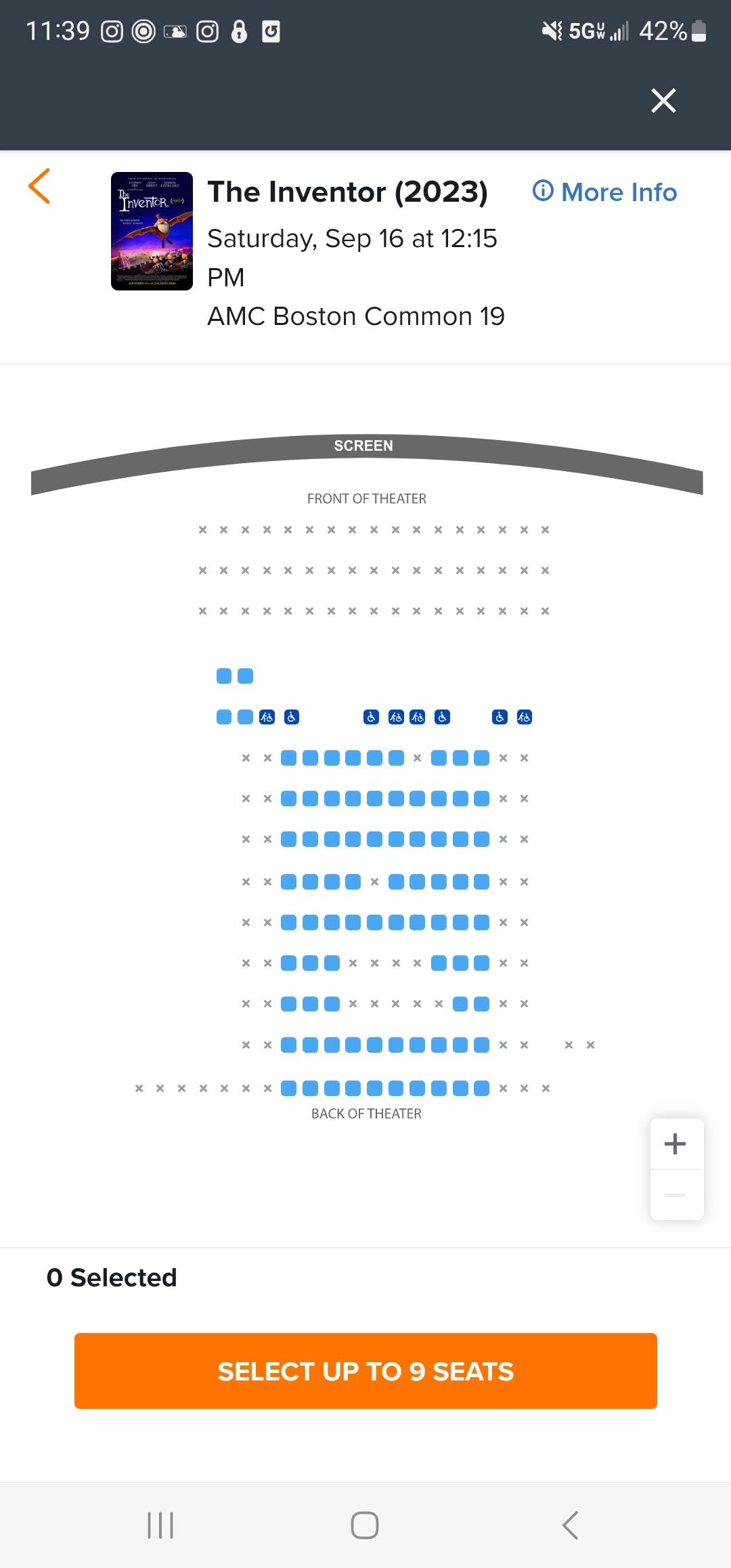
I feel like there were ticket-sale shenanigans going on for this movie but I can figure out why. Observe, if you will, what was blocked out as unavailable on Fandango shortly after I bought my ticket:
That "X" just behind the handicapped companion seats is me, though I'm normally in the last row of the front section. For some reason, that whole section, and the outer two seats on either side of the rear section was marked as sold, although, ahem:
… nobody in any of those spots. All four weekend shows had the same seats "sold".
I don't get why, though - does the streaming contract or the like get more lucrative if the movie gets a top-ten finish or makes more than a million at the box office, or some other metric, and the producers bought up all the seats most folks consider less desirable while still leaving plenty that folks would buy to try and hit that goal? That's my only guess. I suppose it's smarter than the Sound of Freedom folks who bought so many seats that people who legitimately wanted to see the movie couldn't (if they didn't know about where to get the pre-sold tickets), but, it's weird.
Aside from that, I was psyched to see it because I backed the Kickstarter for the animatic way back in 2020, which feels like something I should disclose in a review, although I only kicked in $10, which should get me a digital version of the movie at some point in the near-ish future, but didn't get me in the credits (that was a $100 perk), so it's not like I'm a producer who stands to make money on anybody seeing it. Truth be told, that's probably less than one typically spends on the hope that there's a good movie on the other end. Still, it's pretty cool to see something one contributed to on a big screen; I don't think that's happened for me aside from the Veronica Mars movie, and that was probably, at least in retrospect, more of a "this will probably happen anyway but let's get the money up from and see if that gets enough people feeling involved for a word-of-mouth campaign" situation than this.
Though I feel involved and am maybe trying to get this some word of mouth during it's one week of matinees in Boston. Hey, I'm not saying it's a bad thing, even if it's kind of cynical when a less independent production does it.
Also also: Even if it doesn't feature "Kickstarter Backer: Jason Seaver", this has one of the quirkier sets of end credits I can remember.
The Inventor
* * ¾ (out of four)
Seen 16 September 2023 in AMC Boston Common #5 (first-run, DCP)
The Inventor is not exactly the movie I imagined when I contributed to its Kickstarter several years ago, but what ever is? Even setting that aside, it's an odd duck, focusing on a period more than a story, built to be kid-friendly but featuring more grave-robbing than that may imply, but charming in its earnest educational intentions.
As it opens in 1516, Leonardo da Vinci (voice of Stephen Fry) is pursuing a number of different interests Rome, from art to optics to anatomy, with the Pope (voice of Matt Berry) less than enthused about the latter in particular, as da Vinci aims to find the seat of the soul. When he attempts to task Leonardo with creating weapons of war for a conflict with France, the artist instead counsels peace, and King Francis I (voice of Gauthier Battoue) is so taken with da Vinci's work that he becomes the Florentine's new patron . The King's sister, Princess Marguerite (voice of Daisy Ridley) is taken with Leonardo's idea for an "ideal city", but Francis is soon more focused on a grand exposition, featuring a powerful statue of himself, that will impress visiting monarchs Charles (voice of Max Baumgarten) and Henry (voice of Daniel Swan).
Visually, the film is quite a delight; it is primarily presented as stop-motion animation featuring smooth, clean designs, contrasted to the fiddly detail of Laika or the emphasized imperfection of Aardman; it does not exactly call to mind Leonardo's own work, which can frequently be seen as part of his thought balloons, but have an expressiveness to the characters and functionality to the environments that reflects him as both artist and engineer. The picture does deviate from stop-motion a bit more than expected, although the 2-D portion of the film is made in consultation with Tomm Moore and his Cartoon Saloon studio, and as such is charming in its own right. When the filmmakers have the chance to be clever and playful, they shine, such as how the Pope is presented as a giant who dominates a scene even when acting a fool, with spies who are literally shadows. Marguerite and her children work as a unit, occasionally shown in Fibonacci-inspired patterns.
It's something of a shame that the soundtrack does not often live up to the charming imagery. Stephen Fry makes a fine Leonardo, of course; his voice is full of intelligence, wonder, and wit, just hearing it almost automatically brings forth what one wants da Vinci to be, and it's almost unfair that Daisy Ridley, Marion Cotillard, and Gauthier Battoue can give fine performances as the French royal family but just aren't so obviously perfectly cast as Fry. The songs don't particularly do the intended job of amplifying their material, either; that they are meant to sound like something from 500 years ago rather than something anachronistic is an intriguing choice, but it means one sometimes has to strain for the lyrics and meaning rather than letting them carry one away; they often seem to be there because this sort of animated feature has songs, rather than because a song is the best, most powerful way to communicate the scene's idea.
There is an idea or two lurking in this film, with the delight of discovery and invention being foremost, but the film is perhaps at its most interesting when Leonardo explains to Marguerite that the world is divided between those who see, those who can be made to see, and those who cannot see, an unusual moment considering how he has mostly pressed on without a lot of reflection on the system around him, though he is quite aware of it. At times, this feels like it should naturally be the central idea animating the film, a bit of wisdom that the movie is not quite pointed enough in its critique of the powerful to fully embrace.
Which, I suppose, is probably a lot to expect of a mainly-charming little film that will likely be some kids' introduction to Da Vinci, if not so much something for the adult Animation Appreciator. It's cute and maybe a bit slight, but also a bit of a relief compared to how visibly hard many animated films work to astound.
I don't get why, though - does the streaming contract or the like get more lucrative if the movie gets a top-ten finish or makes more than a million at the box office, or some other metric, and the producers bought up all the seats most folks consider less desirable while still leaving plenty that folks would buy to try and hit that goal? That's my only guess. I suppose it's smarter than the Sound of Freedom folks who bought so many seats that people who legitimately wanted to see the movie couldn't (if they didn't know about where to get the pre-sold tickets), but, it's weird.
Aside from that, I was psyched to see it because I backed the Kickstarter for the animatic way back in 2020, which feels like something I should disclose in a review, although I only kicked in $10, which should get me a digital version of the movie at some point in the near-ish future, but didn't get me in the credits (that was a $100 perk), so it's not like I'm a producer who stands to make money on anybody seeing it. Truth be told, that's probably less than one typically spends on the hope that there's a good movie on the other end. Still, it's pretty cool to see something one contributed to on a big screen; I don't think that's happened for me aside from the Veronica Mars movie, and that was probably, at least in retrospect, more of a "this will probably happen anyway but let's get the money up from and see if that gets enough people feeling involved for a word-of-mouth campaign" situation than this.
Though I feel involved and am maybe trying to get this some word of mouth during it's one week of matinees in Boston. Hey, I'm not saying it's a bad thing, even if it's kind of cynical when a less independent production does it.
Also also: Even if it doesn't feature "Kickstarter Backer: Jason Seaver", this has one of the quirkier sets of end credits I can remember.
The Inventor
* * ¾ (out of four)
Seen 16 September 2023 in AMC Boston Common #5 (first-run, DCP)
The Inventor is not exactly the movie I imagined when I contributed to its Kickstarter several years ago, but what ever is? Even setting that aside, it's an odd duck, focusing on a period more than a story, built to be kid-friendly but featuring more grave-robbing than that may imply, but charming in its earnest educational intentions.
As it opens in 1516, Leonardo da Vinci (voice of Stephen Fry) is pursuing a number of different interests Rome, from art to optics to anatomy, with the Pope (voice of Matt Berry) less than enthused about the latter in particular, as da Vinci aims to find the seat of the soul. When he attempts to task Leonardo with creating weapons of war for a conflict with France, the artist instead counsels peace, and King Francis I (voice of Gauthier Battoue) is so taken with da Vinci's work that he becomes the Florentine's new patron . The King's sister, Princess Marguerite (voice of Daisy Ridley) is taken with Leonardo's idea for an "ideal city", but Francis is soon more focused on a grand exposition, featuring a powerful statue of himself, that will impress visiting monarchs Charles (voice of Max Baumgarten) and Henry (voice of Daniel Swan).
Visually, the film is quite a delight; it is primarily presented as stop-motion animation featuring smooth, clean designs, contrasted to the fiddly detail of Laika or the emphasized imperfection of Aardman; it does not exactly call to mind Leonardo's own work, which can frequently be seen as part of his thought balloons, but have an expressiveness to the characters and functionality to the environments that reflects him as both artist and engineer. The picture does deviate from stop-motion a bit more than expected, although the 2-D portion of the film is made in consultation with Tomm Moore and his Cartoon Saloon studio, and as such is charming in its own right. When the filmmakers have the chance to be clever and playful, they shine, such as how the Pope is presented as a giant who dominates a scene even when acting a fool, with spies who are literally shadows. Marguerite and her children work as a unit, occasionally shown in Fibonacci-inspired patterns.
It's something of a shame that the soundtrack does not often live up to the charming imagery. Stephen Fry makes a fine Leonardo, of course; his voice is full of intelligence, wonder, and wit, just hearing it almost automatically brings forth what one wants da Vinci to be, and it's almost unfair that Daisy Ridley, Marion Cotillard, and Gauthier Battoue can give fine performances as the French royal family but just aren't so obviously perfectly cast as Fry. The songs don't particularly do the intended job of amplifying their material, either; that they are meant to sound like something from 500 years ago rather than something anachronistic is an intriguing choice, but it means one sometimes has to strain for the lyrics and meaning rather than letting them carry one away; they often seem to be there because this sort of animated feature has songs, rather than because a song is the best, most powerful way to communicate the scene's idea.
There is an idea or two lurking in this film, with the delight of discovery and invention being foremost, but the film is perhaps at its most interesting when Leonardo explains to Marguerite that the world is divided between those who see, those who can be made to see, and those who cannot see, an unusual moment considering how he has mostly pressed on without a lot of reflection on the system around him, though he is quite aware of it. At times, this feels like it should naturally be the central idea animating the film, a bit of wisdom that the movie is not quite pointed enough in its critique of the powerful to fully embrace.
Which, I suppose, is probably a lot to expect of a mainly-charming little film that will likely be some kids' introduction to Da Vinci, if not so much something for the adult Animation Appreciator. It's cute and maybe a bit slight, but also a bit of a relief compared to how visibly hard many animated films work to astound.
Labels:
animation,
family,
France,
history,
horrible photography,
stop-motion,
UK,
USA
Subscribe to:
Posts (Atom)