I'm mildly surprised that the Schmidt family didn't make it to Montreal for Island of Lost Girls on Saturday morning. I imagine that Covid throws a wrench in that sort of thing, but I also suspect that if I'd somehow made a film with my family like this - I don't know that I'd quite call it backyard filmmaking because it's an awful big backyard - that got accepted into a major festival like Fantasia, a week in Montreal would absolutely be that year's summer vacation. I think of the Adams family with The Deeper You Dig three years ago - ike the Adamses, the Schmidts have been making movies as a hobby for a while, occasionally getting one into a festival even though it will almost certainly not get picked up for distribution or get much talked about aside from the dozens who see it in such situations. It isn't tagged with the "Fantasia Underground" label in the program, but it's underground as heck even if it's not the same tone and aesthetic as most stuff in that section. It might be a fun thing to have in the next BUFF, reaching out to family audiences.
Anyway, I would really have enjoyed the explanations of just how insane the making of this must have been, especially if they included a five-year-old shrugging off panicked questions from the audience by saying she is actually a much better swimmer than her character in the movie.
Tough-ish choice later in the day, as Heaven: To the Land of Happiness looks really good and has a heck of a cast and crew, but it might also quietly get a Blu-ray release or show up on Prime in the next few months, and the thing a block away at the Museum is kind of a tradition.
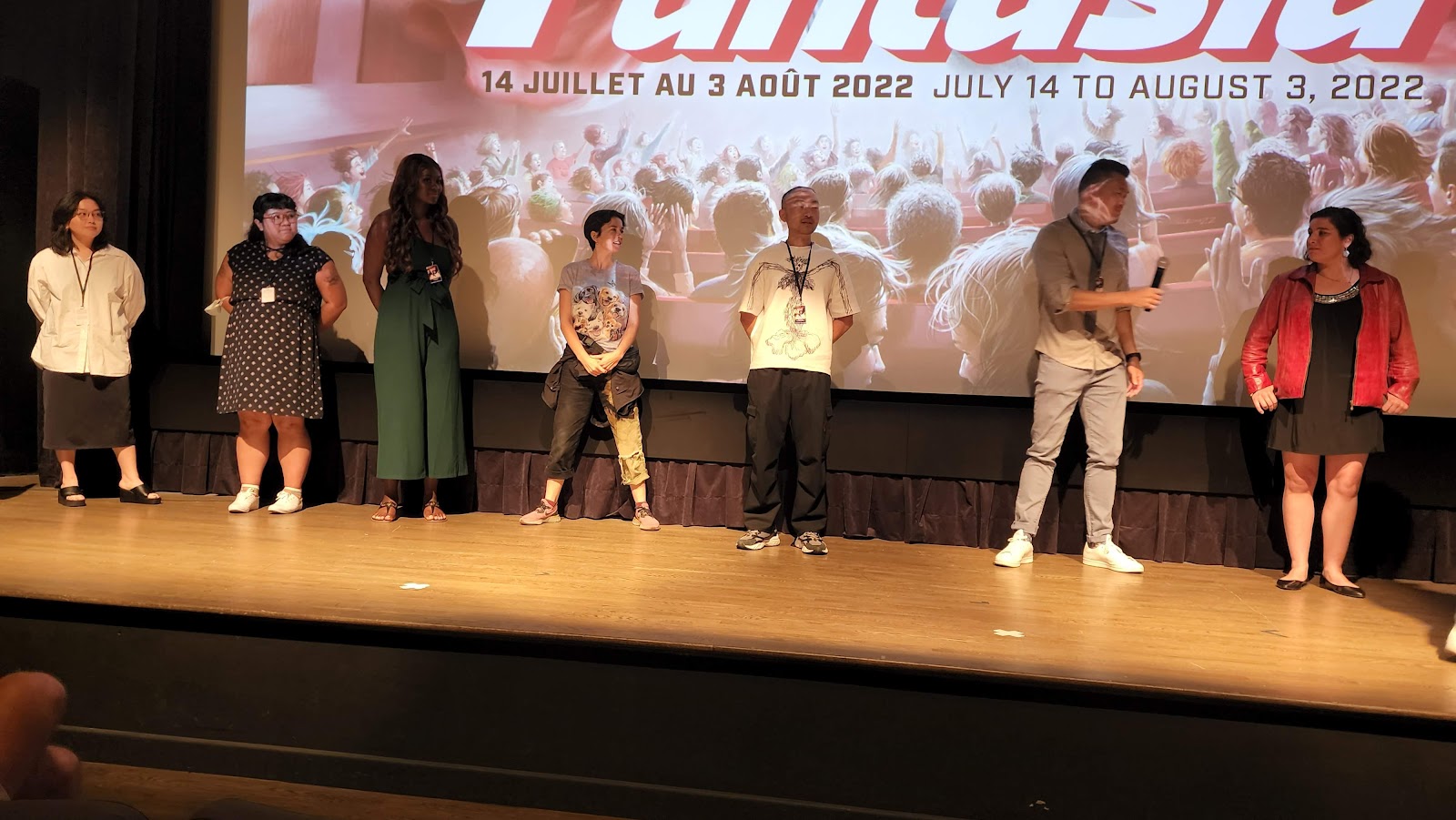
Hello, fifteen-film animation program, the thing that usually grinds these reviews to a halt even when work isn't busy! I love festival animation programs, because they often seem to be the purest expression of what people are imagining in the most concentrated forms. These things average six minutes or so and some are done by the time you've even got yourself prepared for what you're going to see.
Anyway, the guests, mostly directors, left to right: Grace An of "Baek-il", Karla Monterrosa of "Lo 100to", Omorose Osagie of "Glass Doll", Florentina Gonzalez" of "El After del Mudo", Shengwei Zhou of "Perfect City: The Mother", Sam Chou of "VRDLK: Family of Vurdulak", and "Deshabitada" producer Amanda Puga.
Many, but not all, were student films - An and Monterrosa both talked about drawing on something personal, while others wanted to make something that was far more a flight of fantasy. Chou said that he tried to make a very different film with each short, so apparently the rest aren't banter-y horror stories. Zhou mentioned that he actually really disliked doing "3D"/computer generated stuff, so it was apparently something satisfying to make that extra plastic.
After that, it was kind of an evening of avoiding things. I didn't really care about seeing the new Lena Dunham movie, Sharp Stick, so I went back to Hall for Sadako DX, even though I've never seen any Ring movie from any continent, and Dark Glasses was Dario & Asia Argento, whom I've never had any particular interest in (with the daughter kind of in the category of people whose work you don't really need to support if you don't have to), so I went with Missing, even though there was nothing else blocking its second screening.
Next up: Sunday, which may have wound up the longest day, with My Broken Mariko, One for the Road, Confession, Dobaaraa, and Seire.
Island of Lost Girls
Seen 30 July 2022 in Salle J.A. De Sève (Fantasia Festival, DCP)
Island of Lost Girls is quite possibly the most insane movie I'll see at Fantasia this year, because, for the life of me, I can't see how the Schmidt family makes this thing safely without much more and better CGI than seems likely for this sort of backyard production. It's like Open Water except with pre-teen girls and elephant seals at various points, and then it somehow gets crazier on land.
The three girls are sisters Avila, Autumn, and Scarlet, orphans in a foster home, with Avila a fairly responsible tween while her sisters are mischievous (autumn) and pure chaos (Scarlet), with the latter two seeming to torpedo an interview with prospective adopters when they show up late. They convince Avila to sneak out to the beach, but while there, Scarlet gets pulled out in a current. Avila swims out on a surfboard to get her, with Autumn along because she's scared to be left alone, but the current takes them, and hours later, they find themselves approaching an island with a sea cave. From what they can see, it seems to be sheer cliffs on all sides, and getting to the lighthouse at the top looks like it would be daunting for fully-grown adventurers.
This family has done this sort of thing before - The Incredible Adventure of Jojo (and His Annoying Little Sister Avila) played the festival in 2015 and there's at least one other short listed on IMDB - so they presumably know what they're doing with their tools and what the kids can handle. There are a couple scenes where one or the other of the girls appears doubled, but for the most part, it's clearly them on the surfboard floating in open water or in caves tight enough that many in the audience may find themselves tense at the very thought of what a sudden surge of water could do. The work of cinematographer Heatha McGrath is not often fancy but it doesn't have to be, although going from one shot to another can get shaky and the filmmakers have a tendency to lose track of whichever girls aren't on screen when they get separated.
But, presuming this family wasn't actually putting their daughters in incredible danger, you really have to respect some of the bigger set pieces. There is one involving a tractor, a cave, a cliff, two of the girls, a starfish, and a crab that is legitimately jaw-dropping in its scale even as it has something straight out of a cartoon gag in the middle of it. There are people making $200M movies who could do with studying the stakes, clarity, and sense of danger of that centerpiece. A number aren't quite to that scale but are still genuinely impressive for how they obviously aren't hugely elaborate set-ups and serve to remind just how dangerous situations that the makers of big action movies frequently feel need to goosed can be.
You don't give a movie like this a star rating, because it is clearly the work of amateurs who are going to look bad when graded on the same scale as professionals: The filmmakers are often unable to manage what seems like basic shot-to-shot continuity, for instance, while the young cast is often in that zone where they're not really performers and don't have good lines to recite, but feel enough like real kids who aren't polished in any way to be authentic. Similarly, I can't imagine putting this movie in a multiplex and selling tickets, but it's a kind of amazing thing to stumble upon by accident with no idea what one is in for.
Tōge saigo no samurai (The Pass: Last Days of the Samurai)
* * * (out of four)
Seen 30 July 2022 in Auditorium des Diplõmés de la SGWU (Fantasia Festival, DCP)
A samurai film from one of Akira Kurosawa's assistant directors with the great Tatsuya Nakadai in a supporting role is not a thing one passes up, even if it does unintentionally serve as a reflection of the old ways and legends fading into history in a way that is perhaps not ignominious, but quiet. As with their subjects, this film's makers do not fear the new but perhaps are not quite up to cementing their legacy in grand fashion.
The year is 1867, and as it opens, shogun Tokugawa (Masahiro Higashide), recognizing the coming external threats to Japan, opts to cede power to the Emperor to create a stronger nation, although his allies are not so fast to do so, leading to civil war. Between the two powers lies Nagaoka, a small prefecture led by Tadayuki Makino (Tatsuya Nakadai), containing the crucial Enoki Pass. Though both Makino and chief retainer Tsugunosuke Kawai (Koji Yakusho) favor imperial rule personal, their allegiances lead them to attempt neutrality, a stance that likely will not work out nearly as well for Nagaoka as it does for Switzerland, whom "Tsugi" sees as an aspirational model.
Indeed, it is perhaps unusual in that the build-up to the final battle is perhaps its most exciting part, a lengthy middle where one gets to watch star Koji Yakusho inhabit his noble samurai, bathe in the respect and loyalty he earns, and see that his warrior's soul does not crave battle the way some other such figures seem to. He exemplifies the best of the samurai, and without a lot of posturing or stiff rectitude - or a particularly obvious monster for contrast - makes one understand that the system could have survived and thrive if more were like him. It's a performance from Yakusho that can appear effortless, with Kawai often coming across as modern and superlatively reasonable, but it's also one where the audience can see him thinking and striving to present himself as more calm and assured than he perhaps is.
As Kawai prepares for the inevitable battle, writer/director Takashi Koizumi gives Yakusho and his cast-mates small episodes to play out - encouraging a samurai who is a talented draftsman to explore his art, a visit to the geisha that Tsugi perhaps doesn't realize is awkward for wife Suga (Takako Matsu), an attempt to reason with their former allies where patience and reasonability meet their limits. They are, by and large, quiet moments, with Kawai and those around him recognizing that they stand at a crucial point in history and pondering that without a lot of pretension. Tsugi and Suga have no children, which seems a shame, although fitting, if they see themselves as a last remnant of the old Japan. There are lots of nifty little performances her, with Takoko Matsu's Suga perhaps the most interesting - she is clearly still trying to puzzle her husband out in some ways, such that after decades, they do not necessarily understand the details of their own love for one another. This may wind up being Tatsuya Nakadai's last credit - the 89-year-old legend slowed down but never stopped working before Covid-19, but that might understandably have kept him off film sets - and it's a dignified farewell if so, projecting dignity even as Makino yields the making of decisions to his retainers.
The final battle is perhaps, deliberately anticlimactic: For all Tsugi's intelligence and honor, and willingness to invest in Western weapons like a Gatling Gun, he cannot overcome an opponent that outnumbers him by this much, and in 1867, a relatively random wound is going to sideline him badly. Koizumi marshals the familiar elements of the grand battle - the maps that make clear what the combatants will need to do when the camera finally arrives on scene, the tense where each soldier knows that their war can quite easily end with one shot or slash, the stoic commanders swelling with pride and admiration for their soldiers - and plays them out, but also drains much of the tension. There is not much suspense in this last stand; just the feeling that it had to be made.
The age of the samurai almost ends with a whimper here, although Tsugi has at least helped Japan be able to conceive of something else. Similarly, one can see Japan losing its last links to a defining age of cinema as Koizumi and Nakadai wind their careers down, even if what comes next is also inevitable and worth supporting.
"Piece of Solitude"
* * * (out of four)
Seen 30 July 2022 in Cinéma du Musée (Fantasia Festival: Axis: Circo Animato, digital)
An impressive, wordless memory piece with a man left alone in his book-filled home, seemingly only engaging the rest of the world with the newspaper and, specifically, the crossword, which may not be the greatest habit for someone in that position, as some clue winds up sending him back to memories of how he got there.
The main figure in this stop-motion tale is clay, mostly, but the dominant motif around him is paper - if you want to stretch, even the buckling bookshelves around him may be made of cardboard. It suggests a life closed off inside academic pursuits, perhaps ignoring other things around him until he was that isolated, able to form as needed into a flat, abstract world or a twisted Escher print. Books file information away, contained neatly until someone lets them out, but the crosswords, they contain words that intersect and connect one idea to another, knowledge to memory to experience until there's no way to avoid how, perhaps, he may have been a coward.
Yes, I am probably reading too much into the crossword analogy, but I love them and it's an extra way in to what could seem like a standard, familiar story about an old man with regrets.
"Histoire pour 2 Trompettes" ("A Story for Two Trumpets")
* * * ½ (out of four)
Seen 30 July 2022 in Cinéma du Musée (Fantasia Festival: Axis: Circo Animato, digital)
A delightful little film that fits a great deal of transformation and growing up into its five minutes, perhaps in part because, along with bouncy music by Chapelier Fou that pushes forward without seeming rushed, it feels like a lot of things that kids see or process as paths along the way - storybooks with a trail, board games, jigsaw puzzles, all things that a child will look at as things that lead from one thing to another, only the little girl at the center of it, breaking and making things along the way, is changing too.
Director Amandine Meyer apparently creates children's storybooks as well as short films, so it's not surprising that she knows the forms well enough to put them into motion and make them cross over, and knows when a kid watching it might enjoy a detour into some darkness. It's a neat little piece of work where growing up can sometimes be dangerous but still a magical journey.
"The Commute"
* * * ¼ (out of four)
Seen 30 July 2022 in Cinéma du Musée (Fantasia Festival: Axis: Circo Animato, digital)
Dang right I'm going to be fond of a movie that animates a transit map, especially since this one-minute flick is as much about the delight of transit maps as the travel itself, and how it's there whether they are apps on a phone or posters on a wall. I wouldn't be shocked if Toronto (or whichever city this represents) were to use this as a PSA on an animated billboard or the like; it's got that feel of whimsy without being a hard sell.
"Glass Doll"
* * * ½ (out of four)
Seen 30 July 2022 in Cinéma du Musée (Fantasia Festival: Axis: Circo Animato, digital)
Omorose Osagie builds a nifty little tale here, a combination of storybook fantasy and post-apocalyptic tale, as the titular doll looks after her friends but also tries to find the eye that will make her whole - but what if the price is too steep?
It's a nifty-looking take on its world, something that works as both a literal fantasy and a sort of translation of what being discarded and left behind would be like for toys, with the design feeling like it would fit right into a Cartoon Network lineup. Osagie keeps the story for her short impressively tight despite it being an elaborate creation - for all that it's full of nifty detail and has fun things hiding in every corner, there's nothing wasted in the telling of the story, a perfect little tragedy that gets where it's going without any sort of unnecessary detour.
"BREAK bug"
* * * ¼ (out of four)
Seen 30 July 2022 in Cinéma du Musée (Fantasia Festival: Axis: Circo Animato, digital)
I hope visual effects artist Mchael Ralla used motion capture to animate his dancing robots and insects in "BREAK bug", because the film is, in its way, about a big ol' robot effectively doing motion capture from that little grasshopper, and it would be fun if this were actually that meta.
At any rate, it's fast-paced, has a beat, and while I'm not going to say whether it choreographs its simultaneous dance and action so that it it inevitably leads to a double-splat, the fact that one can see just how well Ralla has laid everything out and made it work together is impressive work as both direction and doing visual effects.
"VRDLK: Family of Vurdulak"
* * * (out of four)
Seen 30 July 2022 in Cinéma du Musée (Fantasia Festival: Axis: Circo Animato, digital)
This is based on a Tolstoy story from 1839, which is somewhat amusing because it is built to feel very modern and quippy and irreverent, the kind of horror that is so fond of nervous laughter on the one hand and being so dismissive of the supernatural that it's meant to be a bigger shock on the other that it's hard to truly settle into its world. Sam Chou's thriller is fun, don't get me wrong, but somehow shifting into animation exacerbates that unwillingness to simply be horrific just a little more.
It is kind of a ball, though, with a slick Don Bluth quality to the animation that says yes, they have inevitably been influenced by Disney but want to do something a little more intense, with enough of Tod Browning's Dracula in the DNA to feel like it's coming from the same place but not entirety trying to be the same thing. He and screenwriter Ellery Vandooyeweert do the thing where two sorts of genres intersect very well, with this foppish hero suddenly landing in the middle of a horror story while the villagers who know this stuff are annoyed with this noble dilettante, but the point is not necessarily that either is wrong to be who they are and must adjust to survive; they connect and effect each other but neither is ever exactly pulled out of their own milieu.
That's a neat sort of trick, and there's something to it - these sophisticated, devil-may-care aristocrats exist in the same world as the poor, superstitious commoners, but not entirely - although they never let it totally dominate the way that it's going to take a lot of luck and hard work to survive until morning.
"Baek-il"
* * * ½ (out of four)
Seen 30 July 2022 in Cinéma du Musée (Fantasia Festival: Axis: Circo Animato, digital)
It's a genuine shock to go back into the program afterward and see that "Baek-il" is just two minutes long; for all that Grace An's twist on a piece of Korean folklore is snappily paced and doesn't particularly waste seconds as one watches it, there's enough going on that it feels broader and busier than that. She starts out with a passage stating that for these animals/spirits to become human, they must quarantine for 105 days - immediately connecting with something most in the audience will recall all too well - and then pops up "Day XX" enough times as Cat drives Bear up the wall in their isolation cave that it feels like it must go on longer. But, no, between her impressively sketched figures and great instincts for knowing when they should move and when they should stay still, she does a great job of underscoring just what a long freaking time that can be without actually making the audience wait it out to the point of being impatient themselves.
"Deshabitada"
* * * (out of four)
Seen 30 July 2022 in Cinéma du Musée (Fantasia Festival: Axis: Circo Animato, digital)
It initially feels like we're back in the same sort of space as "Piece of Solitude", albeit with a Chilean rather than Irani spin, but it turns out that the audience is in for a darker ride than that. This old woman's hunched figure implies guilt rather than just isolation, and filmmaker Camila Donoso leans on how concrete her sins are rather than making them complete abstractions. There are portions of this film where her deteriorating mind takes her to some seemingly fantastical dystopian settings, but more often than not, her memories are all too clear, playing on the banality of evil that pervaded Chile during the Pinochet years. What she did in her time was stark - and the clay-based animation is suitably gray and grotesque - but now that she's an old woman who cannot entirely function on her own, there's a real tension between what a functional society must do for everyone and what a just one may perhaps demand.
This is, I must admit, the sort of animated short one sees in a lot of programs that exist in part to demonstrate how animation can be used for weighty topics, to the point where it's become a bit of a genre unto itself. It's almost more interesting to look at it next to other similar films in the package and see how it handles the same sort of material as "Piece of Solitude" or others - in this case, impressively straightforward and unblinking, abstracted just enough to make the audience aware of just how deliberately distanced from reality these situations are, but just removed enough that the sort of visceral horror to be somewhat hit-or-miss.
"El After del Mundo" ("The World's After")
* * * ½ (out of four)
Seen 30 July 2022 in Cinéma du Musée (Fantasia Festival: Axis: Circo Animato, digital)
Co-writer/director Florentina Gonzalez offers up one of the more compelling intersections of the supernatural and the post-apocalyptic here, presenting its ghosts as hollow sets of clothing who are in some ways continuing what they did in life and in others freed from it. Fluor is still basically still acting like a gig-economy delivery cyclist, but also more or less going where she wants, chasing new music to put on her phone, while Carlix remains at this old marine park, diligently reassembling a whale's skeleton. They meet, seemingly get on, but what comes next?
Gonzalez gives herself and her ghosts time to play with that, poking at the edges of how this world where post-millennials are continuing on in a world that's already gone might work but also teasing out a sort of hope: The world is past gone, and these two women are more or less ghosts adrift without responsibilities or futures to work toward, but they still find things worth continuing to exist for, even without it ever being likely to lead to something being fixed or remembered. There's disaffection and cynicism, but also an understanding that they go on, and do so as well as they can.
The style of the film is nifty, looking like something from the 1980s that maybe started from rotoscoping but didn't have the budget for truly elaborate animation over that; any given frame can sometimes look simple and crude, but Gonzales makes the characters' body language expressive despite the empty space where both faces and other glimpses of skin should be. The way Fluor and Carlix are both wearing tops with long sleeves with prominent cuffs at the end is a really clever bit of design, giving the illusion of hands and fingers so the audience accepts them manipulating things without actually seeing the fine detail. The music is also quite good, and overall, it's just an impressively balanced tale of how, even when nothing can be done, the way one chooses to exist can still mean something.
"Whisper Down the Lane"
* * * (out of four)
Seen 30 July 2022 in Cinéma du Musée (Fantasia Festival: Axis: Circo Animato, digital)
I didn't entirely see Raghad Al Barqi's short film as a game of telephone at first; the red string connecting characters came across as something more abstract even though the title was right up front while many of the objects floating in the background were means of communication. It's obvious in retrospect, although in the moment, the very concept of connection seemed more powerful to me, not so much how ideas get distorted as they go along. Ah, well.
It resolves into an intriguing short anyways, filling the screen with carefully and realistically rendered human figures and cutouts of various photographs but using the fact that this is animation and semi-abstract art to scatter them, both creating significance in how they are arranged and inviting the audience to mentally put them in some sort of order. The line often connects not phones but coffee cups, which feels like both an homage to how "telephone" is often represented by cups or cans at the end of such strings and how gossip often spreads, idly and over refreshments rather than actively, for a specific purpose. There's intriguing color coding, as if a jump from primarily-red imagery to primarily-blue is implying it's crossed a line.
It's the sort of thing that might be nifty to see in a museum installation; at just five minutes, one could easily sit through it twice, maybe picking up a bit more meaning the second time around.
"Lo 100to"
* * * ¼ (out of four)
Seen 30 July 2022 in Cinéma de Musée (Fantasia Festival: Axis: Circo Animato, digital)
It was vaguely reassuring when director Karla Monterrosa mentioned during the Q&A that this was in many ways constructed out of the secondhand chaos she heard other people talk about vis-a-vis their group texts, saying she doesn't really have something like this. Like, I don't either, but I hear people talk about theirs on social media like it's just an expected part of the world today. How'd we miss it?
That aside, it's a fun little cartoon, using doodles and art to illustrate the connection her avatar feels with everybody else she's linked to this way, even if they are far away and only sending these compacted bits of language and the occasional picture. On the other hand, the story itself and the way it gets buried - she's trying to communicate a broken engagement here! - is a nifty illustration of how, for as effective as this is in many ways, it doesn't always have the weight one wants. There's just no way to push across the importance of something amid the talking over each other and potential flood of far smaller issues. Like a lot of social media, it's something that feels like it should have the capacity for big ideas but can't help but be consumed by trivia, and dwelling on it for more than a couple of minutes isn't going to do any good.
"Perfect City: The Mother"
* * ¾ (out of four)
Seen 30 July 2022 in Cinéma de Musée (Fantasia Festival: Axis: Circo Animato, digital)
There's some very neat stuff going on in here but the movie having a colon in the title doesn't do it a lot of favors; Shengwei Zhou has an interesting idea or three here and it's no problem that he's not exactly subtle getting them across, but it doesn't exactly feel as though playing in this sandbox more is going to reveal different nuances. It's a bit stretched as is; I don't know that I need more.
I like where his head's at, though, as a stop-motion forest spirit/creature, pregnant, starts taking in a liquid called "Perfect" - bright CGI yellow compared to the rest of the picture - and it eventually reshapes both. There's interesting stuff going on under the surface about parents striving to give their children advantages but as a result making both into something they don't quite recognize, rural people fed a steady diet of the city as aspirational that they get left behind. The visuals and how he uses them are nifty, from how the tree-creatures feel a bit monstrous to start but seem kind of comfortable once Zhou dives deep into the uncanny valley to make the more humanoid forms plastic and unnerving.
There's just a lot of it; this is very much the sort of movie where one can find themselves saying "yeah, I get it" halfway through and sitting around as it gets drawn out.
"The Principle of Sunrise"
* * * (out of four)
Seen 30 July 2022 in Cinéma de Musée (Fantasia Festival: Axis: Circo Animato, digital)
Every kid's first pet winds up more responsibility than expected, and that's what happens here, as a little girl takes an injured bluebird in and finds it growing to be more than she can handle, certainly within her home in the city, but returning it to nature is tricky, too.
Ye Song's movie has a nifty deadpan sense of humor and a blue color scheme that shows just how much this little creature means to its caretaker, on top of just being a cool-temperature look and emphasizing how much happens at night.
"New Moon"
* * * (out of four)
Seen 30 July 2022 in Cinéma de Musée (Fantasia Festival: Axis: Circo Animato, digital)
Shorts like "New Moon" that take a monologue developed for the stage and visualize it are odd things - if it's worth adapting, the animation has a great chance of being superfluous, quite possibly detracting from the experience because it substitutes one thing for all the personal associations and such that can exist in the viewer's mind. That I can't say that happened for me here, although I do find that I remember Colman Domingo's voice more than the images that go with it.
It's a nice monologue and short, though, the sort that spends some time getting comfortable with the idea that these characters may not have a lot financially but how this doesn't bother young Colman particularly much because there's a lot of warmth between him and his mother to give him a solid foundation. One can sense him eliding the parts that are hard and seeing animators Jeremie Balais & Jeff LeBars giving a little extra vibrancy to his world.
"The Cradle"
* * * (out of four)
Seen 30 July 2022 in Auditorium des Diplõmés de la SGWU (Fantasia Festival, digital)
This is a nifty, atmospheric little piece where I don't know that I necessarily got the program's description from it - yes, that could be what's happening in retrospect, although I maybe saw "weird shut-in spinster" more than "witch" - but it doesn't much matter. Massimo Meo spends a fair amount of the short running time making the audience aware of what's missing, from not showing this old woman's head to the empty cradles to the faceless dolls, and that sense of incompleteness builds up quickly over the film's short running time. Throw some spooky photography that injects a bit of twitchiness into an orderly routine and sounds from outside drawing closer, and you've got a short, solid creeper.
Sadako DX
* ¾ (out of four)
Seen 30 July 2022 in Auditorium des Diplõmés de la SGWU (Fantasia Festival, DCP)
So, this franchise was a big deal back in the day, huh? I get that, like The Grudge, this series has perhaps not gotten bigger with subsequent entries, but rather seen its budget and attached talent slide so that it will continue to make a profit even as ticket sales diminish, but still, this is bad enough that it's hard to see where the original appeal of The Ring was. As someone happening on this for the first time, I can sort of see how there might have been something to it, but it's a shadow of its former self if so.
As it opens, the news is reporting a wave of sudden, inexplicable deaths, and some are just putting together that it resembles the "Ringu" phenomenon of 25 years earlier. A Tokyo news program runs a panel discussion, featuring Ayaka Ichijo (Fuka Koshiba), a grad student who has tested for Japan's highest IQ at 200+, playing the skeptic and Kenshin (Hiroyuki Ikeuchi) arguing for musical explanations, and giving Ayaka a copy of the original tape of Sadako, which her kid sister Futaba (Yuki Yagi) digs out a VCR to watch. Elsewhere, a more social-media savvy young man, Oji Maeda (Kazuma Kawamura), is attempting to help someone who has seen the Sadako video survive, only to find it now kills in 24 hours rather than a week, and they all come together to try and figure out how to keep themselves, their loved ones, and maybe all of Japan alive, as a viral video can spread much quicker in the 2020s than the late 1990s.
Something in Ringu touched a chord in people the first time around, and one can see hints of it here, even if it also feel enough like the Ju-on movies (to the point of the haunting being described as a "grudge") that one wonders what was in the water back then. Unfortunately, so much of Sadako DX feels like the laziest take on half-decent ideas. It seems like there should be a solid foundation for picking the story back up at this time, with both bad information and an actual virus spreading as they are in the present day, but screenwriter Yuya Takahashi never gets much further than saying "this is like a virus, so maybe we should inoculate in the same way", which is an interesting idea but one the filmmakers can't commit to without random twists to sap it of its power. There's also some of It Follows in the film's depiction of Sadako which is apparently new, but it doesn't seem to add much, instead diluting a horror icon until she is practically not there.
All the characters are the most bland stereotypes of basic types, with Ayaka in some ways the most frustrating, because Fuka Koshiba seems like she's capable of more than this, but she's written and directed like Takahashi and director Hisashi Kimura have never actually met someone who is good at science or methodical in their problem solving and can't quite conceive of them as fully human rather than Mr. Spock. Kazuma Kawamura is a different set of self-aware ticks rather than a character, and it's hard to tell whether their anti-chemistry is a sort of choice - the filmmakers are playing this for much more comedy than is apparently typical of the series - or just two people who don't click on-screen. Hiroyuki Ikeuchi at least brings the sort of comfort veteran character actors tend to, but none of this group have interesting stories to plug Sadako into, and none are able to make the audience find them interesting without her.
Meanwhile, Sadako doesn't even look threatening, with the filmmakers going to the well of "this hallucination is just someone in an incongruous wig" so often that the monster becomes a joke. Beyond that, this is such a basic, direct-to-video-looking picture that it's all but impossible to imagine Hideo Nakata or Gore Verbinski ever touched this franchise. It's almost all shot in the most generic possible locations with seemingly no thought to how the lighting might give it some atmosphere. As a result, the scariest part of the movie is probably the original VHS footage (or Kimura's recreation thereof). It at least has some style 20 years later, and a hook the folks making this one can use, even if they've only got fragments of ideas for what to do beyond having teenagers ask what VHS is.
Not counting foreign remakes, this is the producers' second revival of the series (a "Sadako 3D" cycle came out in the mid-2010s), and it seems like the filmmakers make every mistake one can make in doing so: It's youth-oriented but connected to backstory from a film that came out 20+ years ago, too eager to make jokes to really commit to being scary, springing from ideas its makers seemingly don't have the vocabulary to express, and cheap-looking and amateurish on top of that. I suppose there could be Ring fans looking for another hit, no questions asked, but I'm not sure who else this is going to impress.
(Amusing credit note: Somewhere in the scroll at the end, either important enough that someone decided to subtitle it or written out in English to start, is someone who served as the "Supervisor on Series World View", and I've got no idea if this is somebody whose job is to wrangle the continuity of a 25-year-old series on its second wave of legacyquels or someone poring over the script to make sure that the dark comedy isn't too far out of line.)
Sagasu (Missing)
* * * (out of four)
Seen 30 July 2022 in Salle J.A. De Sève (Fantasia Festival, DCP)
Shinzo Katayama's Missing has a couple of distinct directions it could go after it hits its first climax, and they represent an interesting choice in how a writer handles deepening the story at this point - lay out a longer path for the sleuth to follow, which makes the whole thing more prone to collapse, or build out to the sides in a way that makes for deeper complexity but less intriguing mystery. There's no right or wrong way to go about it, although those entirely drawn in by the film's genre hook may wish the filmmakers had kept things relatively simple.
It begins by introducing the audience to Kaede Harada (Aoi Ito), a middle-schooler who has had to become even more self-sufficient since her mother's death as father Santoshi (Jiro Sato) has fallen apart; she's just had to pull him out of the drunk tank (again). Santoshi thinks he's figured out a way to get back on track, though; he believes he has spotted the fugitive "No Name" (Hiroya Shimizu) who has recently fled Tokyo, and is ready to turn him in for the reward. Instead, he disappears, but rather than disappear into the foster care system, Kaede is determined to find him, enlisting a boy who has a crush on her to assist.
If this were the entirety of the film, it would potentially be a pretty compelling one; Katayama and actress Aoi Ito' avoid any girl detective tropes while still making a compelling case that a smart, motivated teenager might be able to hunt down a serial killer, or at least get this far in doing so. Katayama and Ito do such a good job of keeping Kaede's eyes on her goal while avoiding the language of mysteries that she never comes across as someone with a gift who might take on other "cases" someday as opposed to a kid recklessly following a path to her father despite other adults seeing just as useless as he often was. The filmmakers create great tension in part because they don't follow certain beats; rather than dangerous narrow escapes that might show she's onto something, there's ominous implied danger that indicates she may be in over her head.
That's mostly the first half or so of the movie, before the perspective shifts and the story backtracks to change points of view, and it becomes a very different film, with Kaede mostly reduced to a side character who is maybe even less present than would make sense given what events the film is showing. It is, on its own, a kind of intriguing story, one that starts from the premise of "No Name" being the worst sort of human monster that the viewer can imagine and then expanding outward to consider how seemingly decent people can, for various reasons, get caught up in a network of actions and motivations that include a man compelled to kill. Katayama has worked some in the Korean film industry, most notably with Bong Joon-Ho, and the kind of darkness he explores is the sort that seems to pop more in Korean crime films than ones from Japan, these universal undercurrents that are present all over rather than twisted codes of honor or plain-spoken villainy. Perhaps the most memorable moment in this section of the film is when No Name encounters a suicidal potential victim and cannot himself conceive of someone wanting what he has to offer; even to him, this situation makes no sense.
Katayama and his team tell the tale in a fashion that is relentlessly grim but not gleefully so; No noirish signifiers or sleek surfaces for evil to hide behind; everyone seems to be hovering around having just enough to get by but not the time or motivation to keep it nice, either surrounded by a mess or a sparseness that is not exactly neat. There is something either tragic or rotten about how Santoshi's ping-pong center has gone out of business but he and Kaede still seem to access the building freely, like the building's owners can't even be bothered to properly evict them or change the locks until they have to (maybe they're hoping he gets back on his feet, but it doesn't seem like that sort of movie). There's a sort of rot here that manifests itself in all the linked stories - people shouldn't want to die, and a serial killer who can operate effectively enough to elude the police shouldn't be someone a 15-year-old girl can track down.
The question, then, is how well the flashbacks integrate with Kaede's mission, and while the filmmakers do eventually manage to integrate them, tying the various time frames together and eventually fitting Kaede into this world in a way that quietly and impressively raises eyebrows, it maybe takes a bit too long to fit together as it circles back to the start and reveals how all this connects. The opening is so strong and clear in its purpose even as it establishes the atmosphere that the rest of the film will work in that I suspect even those who enjoy its flavor of moral quagmire may wish that either No Name or Santoshi or any of the people they encounter as their paths cross were as interesting and immediately compelling as Kaede.
Complexity and moral ambiguity are interesting and often worth the extra work they may require, but sometimes the clear, simple piece in the middle of all that can't help but stand out.
Showing posts with label Iran. Show all posts
Sunday, August 28, 2022
Fantasia 2022.17: Island of Lost Girls, The Pass: Last Days of the Samurai, Circo Animato, "The Cradle", Sadako DX, and Missing
Sunday, August 23, 2020
Fantasia 2020.03: Monster Seafood Wars, Circo Animato, and Class Action Park
How is Fantasia 2020 different than all the others for me, aside from the obvious? Well, almost all of the screeners for movies playing these two days need to be requested from a third party other than the festival, but I'm not sure how many of the people involved were working the weekend(*), so this is one of the shortest Saturdays I've ever had at the fest and Sunday will likely be even shorter. On the other hand, it meant I could watch a shorts package and reviewing the whole thing did not put me behind by months, so there's that.
(*) Not at the festival; those guys are always running flat out for three weeks and there is no reason to believe that this year is any exception.
Anyway, it's looking like I might have some time to catch up on some of these, so we'll see how the rest of the week goes. I already had to circle around on a couple of the shorts, because I thought I'd put them on "Watch Later" so I could use the Roku, but no. Weird. There will be some things that don't match the schedule, but it works that way with the fest's in-person press screenings sometimes, too.
Anyway, enough about how the sausage is blogged, let's get back to the shorts - if you're in Canada, the "Circo Animato" package is exceptionally solid and the rest of us should hope some of these short films filter into other ways they can be seen. If I ran a theater, one of the things I would do is contact filmmakers of shorts like this directly and see if I could book them as before-movie feature, which is probably very difficult but would at least give my hypothetical theater something to stand out with. From this batch, I would definitely be talking to the makers of "The Weather Is Lovely" and "Wade", albeit to pair with very different films. I'm bummed that I'm missing out on the introductions and Q&As with the short packages this year, but everybody is going to have something to be proud of. Plus, I believe it's the first time I get to use "Croatia" as a tag on this blog (even if the short in question may be more Serbian than Croation)!
Last item on the day - a link was literally mailed to me as I was watching the shorts - is Class Action Park, which will apparently be on HBO Max at the end of the month. I gather that despite having both HBO and Cinemax in my cable package, I don't have that service, which is ridiculous and highlights why these massive companies should be naming their services after the movie studios rather than the TV brands, but at least it will be around for those who couldn't log in for this one. It's fun and horrifying!
Monster Seafood Wars
* * (out of four)
Seen 22 August 2020 in Jay's Living Room (Fantasia Festival, Vimeo via Roku)
Minoru Kawasaki has been making movies along the lines of Monster Seafood Wars for years if not decades, and though I've missed most of them, I get the impression that they've been just good enough and just profitable enough that he's been able to keep working and maybe upgrade his resources over that time. The movies haven't necessarily been good, per se, but they've apparently been consistent enough in quality and tone to get him a fanbase. This one's like that - not good, but he's got enough of a voice that it's kind of interesting.
It's a giant monster movie, with 50-meter tall sea creatures - an octopus, a squid, and eventually a crab - attacking the city and suspicion falling on Yuta Tanumu (Keisuke Ueda), who was bringing a basket with those three animals personally selected by his sushi-master father to the local shrine, as well as Setap-Z, the super-growth serum he helped to develop (at great expense) while at the Institute for Super Physical & Chemical Research. Japan quickly organizes a Seafood Monster Attack Team whose leader Hibiki (Ryo Kinomoto) recruits Yuta's childhood crush Nana Hoshiyama (Yoshina Ayano Christie) and ISPCR rival Hikoma (Yuya Asato), the latter of whom suggests they use bursts of rice vinegar to soften the molluscs up so they can be blasted with missiles.
The upshot of all this is that Takella the squid and Ikulla the octopus start dropping chunks of meat after that first battle which are incredibly delicious. It's a fun idea that pretty much everybody who has seen a giant monster movie has probably at least jokingly thought about, and it seems like like Kawasaki and co-writer Masakazu Migita have put a little thought into it (working, perhaps loosely, from a story by monster movie special effects legend Eiji Tsuburaya). Not a lot of thought, which is a shame; you can see the outlines of something cleverly satirical when you connect the offscreen marauding of giant monsters with meat only affordable for the wealthy - especially galling considering Yuta developed Steap-Z to help feed the hungry - but not only does it not really go anywhere, but the filmmakers just grind through the same exact bit what seems like ten times in a row, and it is dreadfully boring. I wouldn't be surprised if it was a little bit more fun for Japanese or J-phile audience who can spot cameos and parodies that others might miss, but if you're not getting that, it's a killer.
Full review at eFilmCritic
"Spinning Top"
* * * ½ (out of four)
Seen 22 August 2020 in Jay's Living Room (Fantasia Festival: Circo Animato, Vimeo via Roku)
Shiva Momtahen's "Spinning Top" is produced by Iran's Documentary and Experimental Film Center and has a pleasant preserving-stories vibe to it even though it having it narrated by a little kid strips it of the usual nostalgia and gives it more of a boy's adventure feel as its young hero goes searching for his lost toy, eventually digging through a well of memories to find it. It's a choice that almost starts to grate but doesn't quite reach that point, no matter how rapid or circular that voice-over work gets. Momtahen finds the line between imagination and metaphor and straddles it expertly, letting the audience enjoy both sides.
It's a delight to look at, too, as the narrating boy is mostly presented as an extremely cute figure with classic cartoon proportions and design, centered on screen and framed by gorgeous borders that regularly shift into new configurations and dazzle with their colorful designs. It puts the purity of a child's imagination in the middle of something mythic, while the occasional shifts and transformations into a shaded, three-dimensional style are both playful and a bit of a shift into something more real. It doesn't quite make this story half-remembered, but does put it into memory.
"Kkum"
* * * ½ (out of four)
Seen 23 August 2020 in Jay's Living Room (Fantasia Festival: Circo Animato, Vimeo)
Poking through credits, I see director Kim Kangmin worked on Dave Made a Maze, which kind of tracks; this is earnest and imaginative and built out of an unusual medium such that you never take the way it's made for granted but can still sink in and let Kim tell his story. It's a fascinating look - everything is made out of styrofoam and that gives it both the lightness of dreams and the solidity of reality. Everything here is surprisingly solid for being seemingly insubstantial.
Which is as it should be - it tells how the narrator's mother has constant dreams about her son and does a little digging into their interpretation but also how they spur her to action, whether in terms of prayer or something more concrete. Kim describes his mother's dreams as building a shield thousands of layers deep around him and it's a visual metaphor that works, especially as that shield is a silvery glow that matches the rest of the film's muted color scheme but also feels more solid even though it's a digital force field. Even as your eyes are examining the image, the idea is sinking in.
Plus, there are styrofoam insects getting splatted in a moment that is as delightfully goofy as it is sincere, and a brief but clever break in style around the birth of Kim's first child, as the world changes for him. It makes for a nifty short indeed.
"There Were Four of Us"
* * ¾ (out of four)
Seen 22 August 2020 in Jay's Living Room (Fantasia Festival: Circo Animato, Vimeo via Roku)
Cassie Shao's "There Were Four of Us" is the sort of abstracted animation where I find myself wanting a little more context, because it's striking and personal and creates a heck of a mood in seven minutes. I just can't quite grasp where some of it is coming from.
I like the look of it, though, with the aggressively garish colors and shifting styles, taking place in a world that seems apocalyptic but that may just be how the characters see it. It dips down into something that is more literally dreams and self-reflection at times, eventually charting a physical and mental course that takes the narrator and viewer back to the start.
I get the feeling that this is the sort of art that reveals more as you stare longer and come back to it. It's got a good enough hook to make that happen, but a festival animation block may not be the best way to get there.
"Thin Blue Variety Show"
* * * (out of four)
Seen 22 August 2020 in Jay's Living Room (Fantasia Festival: Circo Animato, Vimeo via Roku)
There was a nifty thing that went on during the early days of this year's BLM protests, as actors appalled with the way law enforcement was attacking protesters donated the residuals they'd received from playing cops, and I don't know how much it lasted beyond that, but Gretta Wilson's "Thin Blue Variety Show" comes from the same place of looking at how media reinforces acceptance of bad police behavior and always has. It's sharp and angry, almost too much so to be described as black comedy, because even though everything has the look of jokes and parody, there's not a moment that isn't dead serious and full of conviction.
Stop motion can be tricky and time-consuming, so Wilson only manages three or four minutes, but they're packed and full of cleverness as she represents these characters by their costumes, presenting them as faceless puppets while the generic "perp" mannequin they abuse is nothing but face with no limbs to fight back. She uses MAD Magazine type stand-ins, but it's pointed enough that one can't watch the short without wondering how much of this "copaganda" has made its way into one's own head, right down to the closing statistics that sure look like they could finish an episode of Law & Order
"Genius Loci"
* * * ½ (out of four)
Seen 22 August 2020 in Jay's Living Room (Fantasia Festival: Circo Animato, Vimeo via Roku)
Adrien Mérigeau puts a lot of characterization into "Genius Loci" in a relatively short bit of time - there is a lot going on with Reine (voice of Nadia Moussa), a young black woman who bristles at the close watch sister Mouna (voice of JIna Djemba) keeps on her, wanting to go out into the city, even as she finds it hostile to her and doesn't know exactly what she feels about white musician Rosie (voice of Georgia Cusack). Her body language, narration, and the way she sees the world sometimes tell different stories, but they all reinforce her as a fascinating character.
It's a lot, but sometimes life is a lot, and Mérigeau does some very nice work getting the audience inside Reine's head and doing the little-to-big changes that show just how things can run away from her. I like that sometimes it's not just a one-off issue but everything cumulatively that seems triggering for her, with memorable moments of her pausing, pulling back, and trying to get back on track, and how the world around her is beautiful but also kind of rough, both in how it's depicted and the actual conditions. It's an impressive case of the style representing the message without often getting too exaggerated.
"Reflexion"
* * ½ (out of four)
Seen 22 August 2020 in Jay's Living Room (Fantasia Festival: Circo Animato, Vimeo via Roku)
There must have been an incredibly fast turnaround on this one to have Alain Bidard's quarantine-inspired piece ready even for this delayed festival, and it almost feels retrofitted, like it started out as something else. For most of its running time, it feels like it's just a video chat about a pair of kids from different sides of the tracks in love with one afraid of how other people would act if they knew, with a bit of enforced isolation added to the end. It doesn't entirely feel like a last-minute twist, but certainly feels like it could have been.
It's an odd movie in other ways; the visual style with the exaggerated eyes contrasted with the hyper-detailed lip movements is a bit unnerving, right on the edge of the uncanny valley, and the whispered conversation takes a little strain to hear. It's an earnest but kind of mundane conversation realized with animation that can't do a lot to heighten it or focus on the most important points, the sort that feels like it might fare a lot better if Bidard just got a couple expressive young actors on Zoom and let them speak.
"Inside Blue"
* * * ¼ (out of four)
Seen 22 August 2020 in Jay's Living Room (Fantasia Festival: Circo Animato, Vimeo via Roku)
I love how quickly and wordlessly Chen Yi-Chien establishes the nervous pathology of "Inside Blue"'s main character, the need to have everything in its proper place that he brings tape to assign it even if it's not immediately obvious. It leads to a tormented but kind of funny bit of self-inflicted slapstick at times, even as the plaintive grunting on the soundtrack brings it just far enough into sympathetic rather than mocking territory.
I like the way Chen uses his digital tools as well; the style with any sort of anchored motion seeming too smoothing and the three-dimensionality being a bit exaggerated often comes across as fake or like the filmmakers just didn't have enough cycles to make it look more natural, but here it reads as hyper-awareness. I also love how nothing is allowed to be round and smooth, with every circular object rendered as an irregular pentagon or the like, not really sharp enough to be truly threatening but also not reassuring or comfortable. It reinforces how the world seemingly needs to be tamed even as both the audience and likely the character know that this is not the actual reality of things.
"Seoulsori"
* * * (out of four)
Seen 23 August 2020 in Jay's Living Room (Fantasia Festival: Circo Animato, Vimeo)
Kim Kyoung-bae's "Seoulsori" is the sort of three-minute short that feels like it must go a little longer for how much it does visually after initially seeming to be a bit still - Kim jumps from one image to another to the next without ever seeming to be jumping past anything. It's moving fast, but making each moment last just rough seconds that it lodges in the brain as something one was looking at for a while, enough that when elements return later it's got a little mental real estate. The upbeat but aggressive score by PEEJAY helps move it along too.
There's also something about how Kim goes hard against type that tickles a bit. It's a kid looking at a piece of art and being sucked in, but instead of amazement and awe he feels pure horror, and I find myself wondering why a bit - the piece he's looking at is fairly conventional, if a bit somber. Are the rest of the museum's displays pushing him into this, or is he just overpowered by the very idea that art can have this sort of effect on him that it frightens him? Maybe it's just kids sometimes being scared by things which seem totally innocuous to others, and filling the void with whatever they can imagine.
"The Weather Is Lovely"
* * * ¾ (out of four)
Seen 22 August 2020 in Jay's Living Room (Fantasia Festival: Circo Animato, Vimeo via Roku)
I wouldn't be shocked to see Lien Chun-Chien's "The Weather Is Lovely" showing up more post-Fantasia; it's a nifty adventure that's cheery and imaginative and has enough computing power thrown at it to compete with what American studios can do. Maybe it doesn't show up in the Oscar nominees, but it probably makes the "Highly Commended" section and is selected for various family-friendly short programs. It's mainstream in a good way and it's a shame that there's not much of a place for a general audience to become aware of things like this.
And it's charming as heck, as a curious meteorologist discovers a tool dropped by a cloud artist and is delighted, at least until it gets too much water and starts to spit out a massive waterspout. There's an opposites-attract thing going on that lets both of them still be really charming and pleasant, and feels a bit like an inverted Disney Princess set-up with the spunky lady scientist in the open and the guy from the magic cloud city nervously poking around.
There's little to no dialogue, but the characters are expressive, with Lien and co-writer Lee Pohan filling the screen with little details but not overwhelming it, and making the danger of the "villain" real but not entirely scary, finding a lot for both characters to do as well as a fun robot sidekick or two. I'd watch a series of this pair's adventures and want more.
"Peace & Love"
* * * (out of four)
Seen 22 August 2020 in Jay's Living Room (Fantasia Festival: Circo Animato, Vimeo via Roku)
Ah, the annual short film that is presented in French with no subtitles so I've got to figure out what's going on and how I feel about it just from the action.
I've kind of got no idea what was going on - a master and an apprentice are on a boat, they encounter another, there are some really aggressive fish, and a metamorphosis… Maybe the dialogue explains things, maybe it's just everybody saying "yeah, this is messed up". It's fun to watch, though, with everything extremely malleable and chaotic but with a lot of charm. It moves quickly and makes the chaos work for it, and you get an impression of the characters just from the way they hold themselves. Nice effects animation, too.
And on top of that, the last few seconds works as a punchline even for those of us who don't really know what the joke is, if only because it's an extremely well-timed gag.
"Florigami"
* * * ¼ (out of four)
Seen 22 August 2020 in Jay's Living Room (Fantasia Festival: Circo Animato, Vimeo via Roku)
"Florigami" is a straightforward but nifty little abstract bit of animation from director Iva Ćirić, the sort where you get what she's doing pretty quickly but marvel at both how nice it looks and how clearly it's presented. It features sprouts and vines trying to grow toward the sun, blocking and sometimes throttling each other, with one made to grab the audience's attention and seeming to have a little more agency even as the stronger vines block it. It's the sort of thing that looks like it just happened or was done algorithmically even though every frame was likely labored over.
A thing I dig about it is Ćirić finds a really nice spot where these plants feel just active enough that the audience can feel some sort of identification but, despite the bright white vine's buds which look kind of like eyestalks, they never get too anthropomorphized. Yeah, there's something we're supposed to get out of them and all, but they're still plants. It's a metaphor, not a fantasy.
"Wade"
* * * ¾ (out of four)
Seen 22 August 2020 in Jay's Living Room (Fantasia Festival: Circo Animato, Vimeo via Roku)
If the festival had a "short I would most like to see expanded to a feature" award, "Wade" would probably get my vote. Kalp Sanghvi and Upamanyu Bhattacharyya create a vision of a flooded Kolkata that not only impresses with its detail but pulses with anger, every corner not just showing the remnants of regular life but the sort of denial and xenophobia contributed to this mess in the first place. It picks up at a moment when people seem to be right on the edge of being able to handle their new normal but still finding things shifting.
It's a great-looking movie but seldom a pretty one; the tigers that move into the city are downright monstrous-looking and the pinholes the characters are given for eyes combine with characters' super-bronzed skin to suggest that the sun is pounding down even more than expected. It makes them feel like the walking dead even before the filmmakers really start loading up the hardships. They pile it on relentlessly but at a pace that creates tension more than frenzy, with plenty of genuine building horror.
I'm not saying it would be a fun feature, but it would be a memorable one with a strong point of view, even if it might be a hard sell.
"The Grave of St. Oran"
* * * ¼ (out of four)
Seen 22 August 2020 in Jay's Living Room (Fantasia Festival: Circo Animato, Vimeo via Roku)
Jim Batt's "The Grave of St. Oran" is adapted from a poem by Neil Gaiman with him providing narration, and it's an interesting little bit of history that I suspect Gaiman finds fascinating in part because there are unsettled pieces to it. Several times, he stops to say that maybe something else happened, or that history doesn't record that bit, but it doesn't really matter, because the totality of the story has a shape and is built around this bit they do know. It is the sort of thing that makes a story neither history nor myth but legend.
Batt embraces that, using a style that seems to come from the illustrations a contemporary monk might make for the story, limiting motion somewhat but not completely, repeating shots that suggest the two saints that landed on Iona were close friends. Though animated and set hundreds of years ago, these shots feel like photographs from a true-crime documentary, which fits, and also lets Batt slide all the easier into horror, both as Oran is buried alive and he begin to haunt the place. It's often a pretty simple visual, the sort that suggests there is something eerie about the place, if not a history of carnage.
"Eerie" seems to be what they're going for, if sometimes an arch and curious variation of it, and it generally works out fairly well.
Class Action Park
* * * ¼ (out of four)
Seen 22 August 2020 in Jay's Living Room (Fantasia Festival, internet)
New Jersey's infamous Action Park is the sort of thing that, decades later, defies belief - it seems like it almost has to be parody that is exaggerated a little too much. But, no, it was a real thing and the makers of the documentary seem almost as stunned as the audience, spending an hour and a half saying "can you believe this?" in shocked surprise and not having to do much else.
They do start by giving a little background, discussing how 1970s stockbroker Gene Mulvihill was looking for something new to do after being banned from Wall Street and purchased a pair of ski resorts in Vernon, New Jersey, but also wanted to make money off them in the summer, which led to building one of the country's first water parks, with mountain slides and go karts as well. As one might imagine, Mulvihill was not one who cared much for rules, so he pushed to make the tracks more thrilling (despite very few involved actually knowing much about engineering) and hired as few minimum-wage teenagers as he could possibly get away with - all while creating a fake off-shore insurance company and using it to launder money. Surprisingly, the place would stay open for twenty years.
There is probably a nifty movie - dramatic or documentary - to be made that focuses more on Mulvihill and maybe uses the dangerous rides and lax supervision as punctuation or subplots, but it's hard to blame directors Seth Porges and Chris Charles Scott III for going the other direction - there's much more footage to work with and it makes for eye-opening television. Much of it comes from the 1980s, so it's a combination of home movies and VHS footage, and they lean into it for the general look of the film - the animations have a crude and hand-drawn look rather than being sophisticated CGI renderings of how all the physics works, and even the captions that label the participants often look like something that may have come from the local news during that period. It's nostalgic for those who lived through the period, although not ostentatiously so. It's what they've got to work with and they run with it.
Full review at eFilmCritic
(*) Not at the festival; those guys are always running flat out for three weeks and there is no reason to believe that this year is any exception.
Anyway, it's looking like I might have some time to catch up on some of these, so we'll see how the rest of the week goes. I already had to circle around on a couple of the shorts, because I thought I'd put them on "Watch Later" so I could use the Roku, but no. Weird. There will be some things that don't match the schedule, but it works that way with the fest's in-person press screenings sometimes, too.
Anyway, enough about how the sausage is blogged, let's get back to the shorts - if you're in Canada, the "Circo Animato" package is exceptionally solid and the rest of us should hope some of these short films filter into other ways they can be seen. If I ran a theater, one of the things I would do is contact filmmakers of shorts like this directly and see if I could book them as before-movie feature, which is probably very difficult but would at least give my hypothetical theater something to stand out with. From this batch, I would definitely be talking to the makers of "The Weather Is Lovely" and "Wade", albeit to pair with very different films. I'm bummed that I'm missing out on the introductions and Q&As with the short packages this year, but everybody is going to have something to be proud of. Plus, I believe it's the first time I get to use "Croatia" as a tag on this blog (even if the short in question may be more Serbian than Croation)!
Last item on the day - a link was literally mailed to me as I was watching the shorts - is Class Action Park, which will apparently be on HBO Max at the end of the month. I gather that despite having both HBO and Cinemax in my cable package, I don't have that service, which is ridiculous and highlights why these massive companies should be naming their services after the movie studios rather than the TV brands, but at least it will be around for those who couldn't log in for this one. It's fun and horrifying!
Monster Seafood Wars
* * (out of four)
Seen 22 August 2020 in Jay's Living Room (Fantasia Festival, Vimeo via Roku)
Minoru Kawasaki has been making movies along the lines of Monster Seafood Wars for years if not decades, and though I've missed most of them, I get the impression that they've been just good enough and just profitable enough that he's been able to keep working and maybe upgrade his resources over that time. The movies haven't necessarily been good, per se, but they've apparently been consistent enough in quality and tone to get him a fanbase. This one's like that - not good, but he's got enough of a voice that it's kind of interesting.
It's a giant monster movie, with 50-meter tall sea creatures - an octopus, a squid, and eventually a crab - attacking the city and suspicion falling on Yuta Tanumu (Keisuke Ueda), who was bringing a basket with those three animals personally selected by his sushi-master father to the local shrine, as well as Setap-Z, the super-growth serum he helped to develop (at great expense) while at the Institute for Super Physical & Chemical Research. Japan quickly organizes a Seafood Monster Attack Team whose leader Hibiki (Ryo Kinomoto) recruits Yuta's childhood crush Nana Hoshiyama (Yoshina Ayano Christie) and ISPCR rival Hikoma (Yuya Asato), the latter of whom suggests they use bursts of rice vinegar to soften the molluscs up so they can be blasted with missiles.
The upshot of all this is that Takella the squid and Ikulla the octopus start dropping chunks of meat after that first battle which are incredibly delicious. It's a fun idea that pretty much everybody who has seen a giant monster movie has probably at least jokingly thought about, and it seems like like Kawasaki and co-writer Masakazu Migita have put a little thought into it (working, perhaps loosely, from a story by monster movie special effects legend Eiji Tsuburaya). Not a lot of thought, which is a shame; you can see the outlines of something cleverly satirical when you connect the offscreen marauding of giant monsters with meat only affordable for the wealthy - especially galling considering Yuta developed Steap-Z to help feed the hungry - but not only does it not really go anywhere, but the filmmakers just grind through the same exact bit what seems like ten times in a row, and it is dreadfully boring. I wouldn't be surprised if it was a little bit more fun for Japanese or J-phile audience who can spot cameos and parodies that others might miss, but if you're not getting that, it's a killer.
Full review at eFilmCritic
"Spinning Top"
* * * ½ (out of four)
Seen 22 August 2020 in Jay's Living Room (Fantasia Festival: Circo Animato, Vimeo via Roku)
Shiva Momtahen's "Spinning Top" is produced by Iran's Documentary and Experimental Film Center and has a pleasant preserving-stories vibe to it even though it having it narrated by a little kid strips it of the usual nostalgia and gives it more of a boy's adventure feel as its young hero goes searching for his lost toy, eventually digging through a well of memories to find it. It's a choice that almost starts to grate but doesn't quite reach that point, no matter how rapid or circular that voice-over work gets. Momtahen finds the line between imagination and metaphor and straddles it expertly, letting the audience enjoy both sides.
It's a delight to look at, too, as the narrating boy is mostly presented as an extremely cute figure with classic cartoon proportions and design, centered on screen and framed by gorgeous borders that regularly shift into new configurations and dazzle with their colorful designs. It puts the purity of a child's imagination in the middle of something mythic, while the occasional shifts and transformations into a shaded, three-dimensional style are both playful and a bit of a shift into something more real. It doesn't quite make this story half-remembered, but does put it into memory.
"Kkum"
* * * ½ (out of four)
Seen 23 August 2020 in Jay's Living Room (Fantasia Festival: Circo Animato, Vimeo)
Poking through credits, I see director Kim Kangmin worked on Dave Made a Maze, which kind of tracks; this is earnest and imaginative and built out of an unusual medium such that you never take the way it's made for granted but can still sink in and let Kim tell his story. It's a fascinating look - everything is made out of styrofoam and that gives it both the lightness of dreams and the solidity of reality. Everything here is surprisingly solid for being seemingly insubstantial.
Which is as it should be - it tells how the narrator's mother has constant dreams about her son and does a little digging into their interpretation but also how they spur her to action, whether in terms of prayer or something more concrete. Kim describes his mother's dreams as building a shield thousands of layers deep around him and it's a visual metaphor that works, especially as that shield is a silvery glow that matches the rest of the film's muted color scheme but also feels more solid even though it's a digital force field. Even as your eyes are examining the image, the idea is sinking in.
Plus, there are styrofoam insects getting splatted in a moment that is as delightfully goofy as it is sincere, and a brief but clever break in style around the birth of Kim's first child, as the world changes for him. It makes for a nifty short indeed.
"There Were Four of Us"
* * ¾ (out of four)
Seen 22 August 2020 in Jay's Living Room (Fantasia Festival: Circo Animato, Vimeo via Roku)
Cassie Shao's "There Were Four of Us" is the sort of abstracted animation where I find myself wanting a little more context, because it's striking and personal and creates a heck of a mood in seven minutes. I just can't quite grasp where some of it is coming from.
I like the look of it, though, with the aggressively garish colors and shifting styles, taking place in a world that seems apocalyptic but that may just be how the characters see it. It dips down into something that is more literally dreams and self-reflection at times, eventually charting a physical and mental course that takes the narrator and viewer back to the start.
I get the feeling that this is the sort of art that reveals more as you stare longer and come back to it. It's got a good enough hook to make that happen, but a festival animation block may not be the best way to get there.
"Thin Blue Variety Show"
* * * (out of four)
Seen 22 August 2020 in Jay's Living Room (Fantasia Festival: Circo Animato, Vimeo via Roku)
There was a nifty thing that went on during the early days of this year's BLM protests, as actors appalled with the way law enforcement was attacking protesters donated the residuals they'd received from playing cops, and I don't know how much it lasted beyond that, but Gretta Wilson's "Thin Blue Variety Show" comes from the same place of looking at how media reinforces acceptance of bad police behavior and always has. It's sharp and angry, almost too much so to be described as black comedy, because even though everything has the look of jokes and parody, there's not a moment that isn't dead serious and full of conviction.
Stop motion can be tricky and time-consuming, so Wilson only manages three or four minutes, but they're packed and full of cleverness as she represents these characters by their costumes, presenting them as faceless puppets while the generic "perp" mannequin they abuse is nothing but face with no limbs to fight back. She uses MAD Magazine type stand-ins, but it's pointed enough that one can't watch the short without wondering how much of this "copaganda" has made its way into one's own head, right down to the closing statistics that sure look like they could finish an episode of Law & Order
"Genius Loci"
* * * ½ (out of four)
Seen 22 August 2020 in Jay's Living Room (Fantasia Festival: Circo Animato, Vimeo via Roku)
Adrien Mérigeau puts a lot of characterization into "Genius Loci" in a relatively short bit of time - there is a lot going on with Reine (voice of Nadia Moussa), a young black woman who bristles at the close watch sister Mouna (voice of JIna Djemba) keeps on her, wanting to go out into the city, even as she finds it hostile to her and doesn't know exactly what she feels about white musician Rosie (voice of Georgia Cusack). Her body language, narration, and the way she sees the world sometimes tell different stories, but they all reinforce her as a fascinating character.
It's a lot, but sometimes life is a lot, and Mérigeau does some very nice work getting the audience inside Reine's head and doing the little-to-big changes that show just how things can run away from her. I like that sometimes it's not just a one-off issue but everything cumulatively that seems triggering for her, with memorable moments of her pausing, pulling back, and trying to get back on track, and how the world around her is beautiful but also kind of rough, both in how it's depicted and the actual conditions. It's an impressive case of the style representing the message without often getting too exaggerated.
"Reflexion"
* * ½ (out of four)
Seen 22 August 2020 in Jay's Living Room (Fantasia Festival: Circo Animato, Vimeo via Roku)
There must have been an incredibly fast turnaround on this one to have Alain Bidard's quarantine-inspired piece ready even for this delayed festival, and it almost feels retrofitted, like it started out as something else. For most of its running time, it feels like it's just a video chat about a pair of kids from different sides of the tracks in love with one afraid of how other people would act if they knew, with a bit of enforced isolation added to the end. It doesn't entirely feel like a last-minute twist, but certainly feels like it could have been.
It's an odd movie in other ways; the visual style with the exaggerated eyes contrasted with the hyper-detailed lip movements is a bit unnerving, right on the edge of the uncanny valley, and the whispered conversation takes a little strain to hear. It's an earnest but kind of mundane conversation realized with animation that can't do a lot to heighten it or focus on the most important points, the sort that feels like it might fare a lot better if Bidard just got a couple expressive young actors on Zoom and let them speak.
"Inside Blue"
* * * ¼ (out of four)
Seen 22 August 2020 in Jay's Living Room (Fantasia Festival: Circo Animato, Vimeo via Roku)
I love how quickly and wordlessly Chen Yi-Chien establishes the nervous pathology of "Inside Blue"'s main character, the need to have everything in its proper place that he brings tape to assign it even if it's not immediately obvious. It leads to a tormented but kind of funny bit of self-inflicted slapstick at times, even as the plaintive grunting on the soundtrack brings it just far enough into sympathetic rather than mocking territory.
I like the way Chen uses his digital tools as well; the style with any sort of anchored motion seeming too smoothing and the three-dimensionality being a bit exaggerated often comes across as fake or like the filmmakers just didn't have enough cycles to make it look more natural, but here it reads as hyper-awareness. I also love how nothing is allowed to be round and smooth, with every circular object rendered as an irregular pentagon or the like, not really sharp enough to be truly threatening but also not reassuring or comfortable. It reinforces how the world seemingly needs to be tamed even as both the audience and likely the character know that this is not the actual reality of things.
"Seoulsori"
* * * (out of four)
Seen 23 August 2020 in Jay's Living Room (Fantasia Festival: Circo Animato, Vimeo)
Kim Kyoung-bae's "Seoulsori" is the sort of three-minute short that feels like it must go a little longer for how much it does visually after initially seeming to be a bit still - Kim jumps from one image to another to the next without ever seeming to be jumping past anything. It's moving fast, but making each moment last just rough seconds that it lodges in the brain as something one was looking at for a while, enough that when elements return later it's got a little mental real estate. The upbeat but aggressive score by PEEJAY helps move it along too.
There's also something about how Kim goes hard against type that tickles a bit. It's a kid looking at a piece of art and being sucked in, but instead of amazement and awe he feels pure horror, and I find myself wondering why a bit - the piece he's looking at is fairly conventional, if a bit somber. Are the rest of the museum's displays pushing him into this, or is he just overpowered by the very idea that art can have this sort of effect on him that it frightens him? Maybe it's just kids sometimes being scared by things which seem totally innocuous to others, and filling the void with whatever they can imagine.
"The Weather Is Lovely"
* * * ¾ (out of four)
Seen 22 August 2020 in Jay's Living Room (Fantasia Festival: Circo Animato, Vimeo via Roku)
I wouldn't be shocked to see Lien Chun-Chien's "The Weather Is Lovely" showing up more post-Fantasia; it's a nifty adventure that's cheery and imaginative and has enough computing power thrown at it to compete with what American studios can do. Maybe it doesn't show up in the Oscar nominees, but it probably makes the "Highly Commended" section and is selected for various family-friendly short programs. It's mainstream in a good way and it's a shame that there's not much of a place for a general audience to become aware of things like this.
And it's charming as heck, as a curious meteorologist discovers a tool dropped by a cloud artist and is delighted, at least until it gets too much water and starts to spit out a massive waterspout. There's an opposites-attract thing going on that lets both of them still be really charming and pleasant, and feels a bit like an inverted Disney Princess set-up with the spunky lady scientist in the open and the guy from the magic cloud city nervously poking around.
There's little to no dialogue, but the characters are expressive, with Lien and co-writer Lee Pohan filling the screen with little details but not overwhelming it, and making the danger of the "villain" real but not entirely scary, finding a lot for both characters to do as well as a fun robot sidekick or two. I'd watch a series of this pair's adventures and want more.
"Peace & Love"
* * * (out of four)
Seen 22 August 2020 in Jay's Living Room (Fantasia Festival: Circo Animato, Vimeo via Roku)
Ah, the annual short film that is presented in French with no subtitles so I've got to figure out what's going on and how I feel about it just from the action.
I've kind of got no idea what was going on - a master and an apprentice are on a boat, they encounter another, there are some really aggressive fish, and a metamorphosis… Maybe the dialogue explains things, maybe it's just everybody saying "yeah, this is messed up". It's fun to watch, though, with everything extremely malleable and chaotic but with a lot of charm. It moves quickly and makes the chaos work for it, and you get an impression of the characters just from the way they hold themselves. Nice effects animation, too.
And on top of that, the last few seconds works as a punchline even for those of us who don't really know what the joke is, if only because it's an extremely well-timed gag.
"Florigami"
* * * ¼ (out of four)
Seen 22 August 2020 in Jay's Living Room (Fantasia Festival: Circo Animato, Vimeo via Roku)
"Florigami" is a straightforward but nifty little abstract bit of animation from director Iva Ćirić, the sort where you get what she's doing pretty quickly but marvel at both how nice it looks and how clearly it's presented. It features sprouts and vines trying to grow toward the sun, blocking and sometimes throttling each other, with one made to grab the audience's attention and seeming to have a little more agency even as the stronger vines block it. It's the sort of thing that looks like it just happened or was done algorithmically even though every frame was likely labored over.
A thing I dig about it is Ćirić finds a really nice spot where these plants feel just active enough that the audience can feel some sort of identification but, despite the bright white vine's buds which look kind of like eyestalks, they never get too anthropomorphized. Yeah, there's something we're supposed to get out of them and all, but they're still plants. It's a metaphor, not a fantasy.
"Wade"
* * * ¾ (out of four)
Seen 22 August 2020 in Jay's Living Room (Fantasia Festival: Circo Animato, Vimeo via Roku)
If the festival had a "short I would most like to see expanded to a feature" award, "Wade" would probably get my vote. Kalp Sanghvi and Upamanyu Bhattacharyya create a vision of a flooded Kolkata that not only impresses with its detail but pulses with anger, every corner not just showing the remnants of regular life but the sort of denial and xenophobia contributed to this mess in the first place. It picks up at a moment when people seem to be right on the edge of being able to handle their new normal but still finding things shifting.
It's a great-looking movie but seldom a pretty one; the tigers that move into the city are downright monstrous-looking and the pinholes the characters are given for eyes combine with characters' super-bronzed skin to suggest that the sun is pounding down even more than expected. It makes them feel like the walking dead even before the filmmakers really start loading up the hardships. They pile it on relentlessly but at a pace that creates tension more than frenzy, with plenty of genuine building horror.
I'm not saying it would be a fun feature, but it would be a memorable one with a strong point of view, even if it might be a hard sell.
"The Grave of St. Oran"
* * * ¼ (out of four)
Seen 22 August 2020 in Jay's Living Room (Fantasia Festival: Circo Animato, Vimeo via Roku)
Jim Batt's "The Grave of St. Oran" is adapted from a poem by Neil Gaiman with him providing narration, and it's an interesting little bit of history that I suspect Gaiman finds fascinating in part because there are unsettled pieces to it. Several times, he stops to say that maybe something else happened, or that history doesn't record that bit, but it doesn't really matter, because the totality of the story has a shape and is built around this bit they do know. It is the sort of thing that makes a story neither history nor myth but legend.
Batt embraces that, using a style that seems to come from the illustrations a contemporary monk might make for the story, limiting motion somewhat but not completely, repeating shots that suggest the two saints that landed on Iona were close friends. Though animated and set hundreds of years ago, these shots feel like photographs from a true-crime documentary, which fits, and also lets Batt slide all the easier into horror, both as Oran is buried alive and he begin to haunt the place. It's often a pretty simple visual, the sort that suggests there is something eerie about the place, if not a history of carnage.
"Eerie" seems to be what they're going for, if sometimes an arch and curious variation of it, and it generally works out fairly well.
Class Action Park
* * * ¼ (out of four)
Seen 22 August 2020 in Jay's Living Room (Fantasia Festival, internet)
New Jersey's infamous Action Park is the sort of thing that, decades later, defies belief - it seems like it almost has to be parody that is exaggerated a little too much. But, no, it was a real thing and the makers of the documentary seem almost as stunned as the audience, spending an hour and a half saying "can you believe this?" in shocked surprise and not having to do much else.
They do start by giving a little background, discussing how 1970s stockbroker Gene Mulvihill was looking for something new to do after being banned from Wall Street and purchased a pair of ski resorts in Vernon, New Jersey, but also wanted to make money off them in the summer, which led to building one of the country's first water parks, with mountain slides and go karts as well. As one might imagine, Mulvihill was not one who cared much for rules, so he pushed to make the tracks more thrilling (despite very few involved actually knowing much about engineering) and hired as few minimum-wage teenagers as he could possibly get away with - all while creating a fake off-shore insurance company and using it to launder money. Surprisingly, the place would stay open for twenty years.
There is probably a nifty movie - dramatic or documentary - to be made that focuses more on Mulvihill and maybe uses the dangerous rides and lax supervision as punctuation or subplots, but it's hard to blame directors Seth Porges and Chris Charles Scott III for going the other direction - there's much more footage to work with and it makes for eye-opening television. Much of it comes from the 1980s, so it's a combination of home movies and VHS footage, and they lean into it for the general look of the film - the animations have a crude and hand-drawn look rather than being sophisticated CGI renderings of how all the physics works, and even the captions that label the participants often look like something that may have come from the local news during that period. It's nostalgic for those who lived through the period, although not ostentatiously so. It's what they've got to work with and they run with it.
Full review at eFilmCritic
Wednesday, August 05, 2015
The Fantasia Daily 2015.20 (2 August 2015): Khalil Gibran's The Prophet, Outer Limits of Animation, Experimenter, Ninja the Monster, and They Look Like People
I think this is about where I start falling way behind every year, for a number of reasons from these short programs taking an undue amount of time to write up to just having written a relatively large number of words for twenty days straight along with seeing a bunch of movies and pumping my body through of more less-than-ideal foodstuffs than usual. I don't really feel burnt out on the festival, even if I won't mind going home, but at some point, the writing just slows down. I think there are also more early shows at this point, and with the tablet busted...

It's time for the annual "Jay tries to match people to names despite not catching much of the French in the introduction" game! Left to right, I believe we're talking to:
1. Annie Amaya, who directed "Office Paint" and introduced herself in English,
2. Maude D'Amboise-Courcelles, who directed "Noir Manhattan" and mentioned un detectif in her introduction,
3. Alvaro Marinho, perhaps
4. Gabrielle Le Blanc? I caught very little of what she said.
5. Max Woodward, who directed "A Free Lunch" and introduced himself in English.
6. Kelly Harpes?
The lesson, as always, is that I really need to bone up on my French before coming here next year, because I feel terrible wanting to give these talented local animators their due among all the other things looking for their due but only being able to do so halfway.

The next Q&A of the day had Ken Ochiai, director of Ninja the Monster and the terrific Uzumasa Limelight from a couple years ago, giving a remarkably candid Q&A. That doesn't mean it was all about "I know I made a movie that isn't very good and here's how things turned out that way", more that he got into details about the making of the movie that remind you that making things intended to be commercial, there are things not mentioned. I'm not sure how thrilled his producers would be at him describing how this was actually shot a couple years ago and two years were spent on the FX - because instead of hiring a special effects house, they farmed it out to students at a VFX school who would work for free, and were really starting from scratch, many having never touched the software they were using before. They did a fairly good job, and it's probably a more common practice than one might think, but it's kind of not cool.
He also mentioned that it was a project initiated by a new "Blue Line" imprint of Japan's Shokichu studio which was mostly focused producing films for international audiences, with the irony being that if you want to make a ninja or samurai film these days, that's probably the best way to do it, because Japanese audiences generally don't go for that in large numbers unless it's an adaptation of a popular manga (and before you tut-tut, Americans, how many big-budget westerns are we cranking out these days?). They started with little more than a title - and Ochiai, who spent 15 years when younger in Los Angeles and admits to feeling a little bit like a foreigner whether in North America or Japan, did argue the grammar and punctuation with the studio bosses - and shot for ten days around Kyoto. I kind of wonder if it was one of the studios that used to crank out samurai pictures like a factory mentioned in Uzumasa Limelight. Some fun low-budget independent filmmaking talk there - when asked about the locations, he said that in some cases, they would be shooting in the same bamboo forest just outside of Kyoto, but pointing the camera one direction for mountains and the other for water, making it look like they'd traveled farther.
He also talked about how, when he cast Dean Fujioka and Aoi Morikawa, they were rather less well-known, with Fujioka having mostly worked in Taiwan and Morikawa (I think) not yet having done The World of Kanako or Fatal Frame. Interestingly, while mentioning Fujioka's work, I don't think he brought up The Pinkertons, a Canadian mystery series set in post-Civil War Kansas City which is in part funded by Japanese broadcasters, a kind of genuine oddity which might have been applauded for being Canadian.

Last visitors of the day were actors MacLeod Andrews & Margaret Ying Drake and writer/director/many other things Perry Blackshear of They Look Like People, and yes, that's the best picture you're getting from this angle.
Another really fun one, both for their making movies with nothing stories (it was shot in the director's apartment, and they basically forced themselves to get something done by booking tickets before they had a script) and for how this was their first festival with a genre focus - the film has been good enough to more mainstream-oriented fests, so when they name-dropped Absentia during Q&As there, people would just sort of look at them blankly, while at Fantasia it was "oh, yeah, that played here in this room!" Well, they also got a good response at the Brattle in Boston (mentioning them by name) in part because IFFBoston teamed with BUFF for the presentation, so it was a bit more of a horror-loving audience.
SPOILERS!
I also really liked how, when asked about alternate endings, they talked about how when you're doing something like this, you've always got the "gotcha!" ending in mind or the nasty one, but that wasn't really what this movie was about, and how sticking that on may be exciting and kind of satisfying to the gorehounds who were potentially a big part of their audience, it wouldn't be what was best for the the story, which has to lead somewhere. I wish a lot of horror filmmakers would take that to heart.
!SRELIOPS
Well, this being late means that I'm skipping the "where I'll be" for Monday and Tuesday and just saying I'll hit A Christmas Horror Story at 7:30 and then likely try in vain to get into Attack on Titan with my pass afterward. Deathgasm, Assassination Classroom, and Cop Car are all good fun if you want one last bit of Fantasia yourself.
Khalil Gibran's The Prophet
* * * ½ (out of four)
Seen 2 August 2015 in the Theatre Hall Concordia (Fantasia International Film Festival: AXIS, DCP)
Khlail Gibran's The Prophet is a labor of love for producer Salma Hayek, and like a fair number of those projects, it's got some rough edges as the desire to realize a complicated project within a window of opportunity may have taken priority over waiting until it could be perfect. Or maybe not; the production may have been perfectly smooth, and some spots are certainly excellent enough to justify the enthusiasm for the film.
The main story is okay. It introduces a trouble-making little girl, Almitra, who has squawked to a seagull but not spoken to anybody else since her father died two years ago. When her mother Kamila (voice of Salma Hayek) is not trying to wrangle her, she's the housekeeper for Mustafa (voice of Liam Neeson), a poet and painter who has been under house arrest for seven years. On the day Almitra follows her mother to work, a man from the government comes to tell Mustafa he is being set free and returned to his home country - although Almitra hears different.
Don't get me wrong, this framing piece isn't bad; it's got a nice voice cast with Hayek, Neeson, Quvenzhané Wallis, John Krasinski, Frank Langella, Alfred Molina, and John Rhys-Davies. The Lion King's Roger Allers directs, and while he doesn't have the same resources he did with Disney, the mostly hand-drawn images move smoothly, the storytelling is clear, and the characters expressive. When he gets to take a flight of fancy, it's neat to see, as are the humorous moments when he can stretch his cartooning muscles. Sometimes I suspect that he has a hard time connecting the heavy and heady material with an intended young audience - this is the story of a man who is a political prisoner in part for publishing philosophy, and trying to present that in a way palatable to kids Almitra's age can leave it feeling like an introductory lecture to older viewers.
Full review on EFC.
"Aubade"
* * * ½ (out of four)
Seen 2 August 2015 in the J.A. de Seve Cinema (Fantasia International Film Festival: Outer Limits of Animation, HD)
Director Mauro Carraro credits a Mich Gerber concert as the inspiration for this short film of people emerging from a lake, a black sun casting shadows, and paper boats the size of barges, and Gerber's music on the score makes a gorgeous film even more memorable. The whole thing is arguably his introduction, and he gets something akin to a curtain call at the end.
Perhaps the most striking thing about this film, though, is what Carraro does with lighting. This film isn't quite built to look like conventional animation, but is still relatively flat, but the lighting is designed to glow, reflect off the water, and have shadows come from the sun rather than be dispelled by it. It seldom seems the primary purpose, but it's a big part of the impression the film makes.
"Be the Snow"
* * * ¼ (out of four)
Seen 2 August 2015 in the J.A. de Seve Cinema (Fantasia International Film Festival: Outer Limits of Animation, HD)
The description of this one involves a pillow running away from home and then getting homesick, and I don't know if I necessarily got that from the storytelling, more seeing it as the pillow going out to run errands initially then wondering what the skydiving was about. It doesn't really matter, I suppose - the jokes are pretty funny and cleverly animated regardless, and the combination between live-action and the animated pillow character is impressively seamless.
It's super-cute all around, although it shows just how tricky dialogue-free filmmaking can be, especially when you're also relying on FX shots that probably have to be rationed pretty tightly. Not that I'd want this short done any other way, especially since it's quite possible I missed a cue or two at the start. And, hey, any film with a credit for "...as blonde cheating cat" at least has that going for it
"Poussières d'étoiles"
* * * ½ (out of four)
Seen 2 August 2015 in the J.A. de Seve Cinema (Fantasia International Film Festival: Outer Limits of Animation, HD)
One minute long, but it has some impressive animation. Most impressively, it seems to tell a clear emotional story - a young person going through cancer treatment and being comforted by his teddy bear - without ever spelling it out. Director Gabrielle Le Blanc may be just out of school, but she may have a bright future with this as her calling card.
"Timber"
* * * ½ (out of four)
Seen 2 August 2015 in the J.A. de Seve Cinema (Fantasia International Film Festival: Outer Limits of Animation, HD)
"Timber" starts out feeling kind of clever, with anthropomorphic logs from sticks to stumps shivering in the midst of a forest that has been clear-cut, and the pairing we get initially - an enthusiastic young twig and a weathered trunk segment - immediately work as characters. The hint of fear they show when the campfire is first lit is a tease, but then things get crazy.
What comes after that is mean cartooning only partially ameliorated by the cute designs, working in large part because it does get at an underlying truth, that it can be far easier for the poor to turn on each other than the people actually responsible for their situation. It's an even sharper barb that the short started out with, making it even more memorable.
"A Free Lunch"
* * ¾ (out of four)
Seen 2 August 2015 in the J.A. de Seve Cinema (Fantasia International Film Festival: Outer Limits of Animation, HD)
One of two shorts in the program inspired by the same school assignment, and I think my perception of it may have been skewed by hearing as much, and that it was about a guy who finds an apple, though told via ink blots and sound effects. It works well enough, but I wonder if I would have found the apple munching just random sounds otherwise.
"Poussières d'étoiles"
* * * (out of four)
Seen 2 August 2015 in the J.A. de Seve Cinema (Fantasia International Film Festival: Outer Limits of Animation, HD)
Not a whole lot to say about this one. It's two minutes of multicolored grains that form images, and I dig it in the same way I really like the work of PES. There's also a context to it that kind of got buried for me in the middle of a 90-minute program
"Junk Girl"
* * * ¼ (out of four)
Seen 2 August 2015 in the J.A. de Seve Cinema (Fantasia International Film Festival: Outer Limits of Animation, HD)
Oh, no, now other people are explicitly making Tim Burton movies!
I kid; after all, I found myself liking this movie about a sad young woman "made of junk" who tries to scrape by in a presumably-Iranian city (the clothing matches, although the headlines in the paper are mostly Harry Potter gags) only to face disgust and occasionally violence. It's very nicely done, if a downer, with the expressiveness of the characters' faces seemingly much higher than is typical for stop-motion, or CGI made to resemble stop-motion.
"Late Night Live Jazz"
* * * ¼ (out of four)
Seen 2 August 2015 in the J.A. de Seve Cinema (Fantasia International Film Festival: Outer Limits of Animation, HD)
A very nifty little short by Mathias Menten from Belgium, which starts with a busker getting thrown off the Metro and seeming to have nowhere to go until he finds a card from "Le Club" among his change. Maybe he should have been suspicious upon seeing that this place was located in a scary-looking castle.
Menten's got a distinctive style for animation, and the thick blacks do a neat job of conveying the shadowy environment while still the audience to see plenty of what's going on. The jazzy soundtrack is pretty nice as well, and, hey, at least the cute vampire vocalist seems fond of our hero at the end!
"Last Dance on the Main"
* * * (out of four)
Seen 2 August 2015 in the J.A. de Seve Cinema (Fantasia International Film Festival: Outer Limits of Animation, HD)
Animated documentaries are odd things, and I'm certain that I didn't get as much out of this primarily French-language one as I might have some others, but I liked it. Rather than just rotoscoping talking heads, filmmaker Aristofanis Soulikias gives this picture a cool style that suggests the shabby-but-beloved neighborhood it focuses on - although also tying in with how, at the time Hydro Quebec wanted to demolish it for a new, modern building, it had remained an artistic haven but become more upscale.
It's a nifty little film; I'd like to see it with English subtitles at some point.
"Molinari Mouvement"
* * * (out of four)
Seen 2 August 2015 in the J.A. de Seve Cinema (Fantasia International Film Festival: Outer Limits of Animation, HD)
What you get when abstract animation is inspired by abstract art: Director Alvaro Marinho takes works of Guido Molinari and sets their shapes in motion, blending it with music to create a pleasing set of images. Admittedly, I'm artistically ignorant enough that I initially thought Marinho was playing with a test pattern, but it was still nifty to watch.
"Office Paint"
* * * (out of four)
Seen 2 August 2015 in the J.A. de Seve Cinema (Fantasia International Film Festival: Outer Limits of Animation, HD)
This is the other short film that came from the same assignment as "A Free Lunch", and I liked it a bit more. Not just because I didn't have an intended plot laid out, but because director Annie Amaya seemed to let the sounds guide the animation, creating something that feels like a new way to see something familiar.
"The Mortal Flame"
* * ¾ (out of four)
Seen 2 August 2015 in the J.A. de Seve Cinema (Fantasia International Film Festival: Outer Limits of Animation, HD)
A nifty little adventure in which a maquette that seems to start out just wandering around an artist's studio which then becomes a larger, stranger world. The adventure itself is not that memorable - it's another one where I can kind of see what it was going for after reading the description, but not necessarily at the time. I really liked the imagery, though, especially the typewriter revealed as the snow around it thawed.
"Noir Manhattan"
* * * ½ (out of four)
Seen 2 August 2015 in the J.A. de Seve Cinema (Fantasia International Film Festival: Outer Limits of Animation, HD)
A minute long and pretty much leading up to one joke, but I kind of love this one. Director Maude D'Amboise-Courcelles gives her short a style that's kind of film noir and kind of pin-up, depending on which of the two characters we're looking at, and I love the voice actor she found for the detective, even if I only understood bits and pieces of the untranslated French.
It hit the target, and did it well.
"Semi Sauf"
* * * ¼ (out of four)
Seen 2 August 2015 in the J.A. de Seve Cinema (Fantasia International Film Festival: Outer Limits of Animation, HD)
Another really short one, but it gets some weird but cool cartooning in quickly, as a Frankensteined frog-mouse escapes a lab, discovers a mouse-frog, and... Well, that would be telling.
Quick, adventurous, and darkly funny. I'd like to see director Kelly Harpes do more with this world and its characters, although I'm sure whatever comes next will be worth seeing.
"Deep Space"
* * * ½ (out of four)
Seen 2 August 2015 in the J.A. de Seve Cinema (Fantasia International Film Festival: Outer Limits of Animation, HD)
Seven minutes makes this one of the longer parts of the program, and it's also one of the most entertaining, although in pretty divergent ways. On the one hand, the art style is very cool and the music was funky in a way that complemented it perfectly. On the other hand, my notes for the film basically read "weird creatures fucking". Which, don't get me wrong, turns out to be very funny indeed, especially as the poor astronaut trying to find one form of intelligent life on this place so he can get home has to deal with a whole planet full of animals with one thing on their minds.
There were some in the audience who felt that this wore out its welcome, but seven minutes doesn't quite get it there (though the final bit is admittedly a bit tired). It's a very funny little picture, although obviously not for everyone.
"Missing One Player"
* * * ½ (out of four)
Seen 2 August 2015 in the J.A. de Seve Cinema (Fantasia International Film Festival: Outer Limits of Animation, HD)
The latest from Chinese animator Lei Lei ("Ray Lei" in the subtitles here) is a bit more story-oriented and less abstract than some of his previous shorts, although maybe just barely so. It's got an asteroid heading toward Earth, a panicking population that has many acting out, and three people who just want to play mahjongg but need a fourth.
Like his other shorts, this looks like very little else, put together from what look like cutouts from propaganda posters and sometimes limited in small movements but with great sweep on the larger scale. The music by Stars Lee is pretty great too, making for a short that seems to pack a lot into four minutes.
"Disconnector"
* * * ¼ (out of four)
Seen 2 August 2015 in the J.A. de Seve Cinema (Fantasia International Film Festival: Outer Limits of Animation, HD)
A very spiffy little thing by Faiyaz Jafri who did everything from music to animation, and while sometimes it's got the feel of a one-man show in that the animation is a little too smooth, it's a look that works for it: By resembling the too-slick look of dance games, it makes the link the the virtual reality harness feel more natural, making it much easier to get across how synthetic those experiences are, even if they do resemble the world outside.
It's fun to listen to, as well - the poppy music fits the story perfectly and makes the whole exciting, even if the ultimate message is that something real is certainly better.
"Oh Wal"
* * * ¼ (out of four)
Seen 2 August 2015 in the J.A. de Seve Cinema (Fantasia International Film Festival: Outer Limits of Animation, HD)
Oooo-kay. Notes on this one: "Cat riding in [fake] fish's mouth. Kills land whale w/ sushi kingdom".
It's certainly a trippy little short, though, kind of enhanced by looking like an "Itchy & Scratchy" cartoon from The Simpsons in spots. Only in spots, though, as this is very much its own thing that goes in its own weird, surreal directions. It is, sometimes, kind of weird for the sake of being weird, but it pulls the audience along with its strange internal logic and cute-but-violent world.
Experimenter
* * * (out of four)
Seen 2 August 2015 in Theatre Hall Concordia (Fantasia International Film Festival, DCP)
I really hope that this one opens in Boston soon, because I'd like to give it a second look. I came out of it with an odd sort of ambivalence, liking almost all of what it did but feeling like there should have been more heft, especially with all the unusual techniques writer/director Michael Almereyda was using to make sure the audience was paying a little more attention. That's kind of unfair, though - isn't one of the things that usually makes biopics kind of eye-rolling the attempt to make a person's individual life a symbol of something else?
Indeed, in some ways I think that Almereyda is explicitly trying to buck this trend with Experimenter, even as he does look to make a point: It spends a lot of time focusing on the work of Stanley Milgram, detailing experiments well beyond the (in)famous "teacher/learner" experiment and pointedly mentioning that he wished he could be remembered for the quality and results of his work rather than the vaguely uncomfortable feelings it inspired in people who had not actually read it. It's paradoxical - it's about trying to take the simple emotional reaction out of an assessment of someone's life and how people behave, but in doing so it lacks the sharpness to puncture those preconceptions.
Maybe it works once given a chance to roll over in my head and recognize that I'm doing something I don't really want to do in judging this on first impressions. I'd kind of like another chance, because it's a really nifty fourth-wall-breaking, stylish-but-understated movie otherwise.
Full review on EFC.
Ninja the Monster
* * ¾ (out of four)
Seen 2 August 2015 in Theatre Hall Concordia (Fantasia International Film Festival, HD)
Director Ken Ochiai was unusually candid in his Q&A after this film, and one of the things he mentioned was that Japanese movies like Ninja the Monster are made with more than an eye toward the foreign market, opening on maybe five screens back home and hoping to make more money on home video elsewhere, and one can feel it straining for accessibility and against budget.
It looks and feels very flat - not bad, per se, just a bit underpopulated in some areas and with Aoi Morikawa putting in performances that feels muted as the Princess and many of the others in the cast seeming to be very one-note without regard to what's going on with the other actors or elsewhere in the movie. The camera is pointed at beautiful things when they're outside, and the sets and costumes are fine, if kind of off-the-rack, but there's very little that's distinctive.
On the plus side, the monsters are pretty great when we get a look at them, although it limits the action to something more FX-based than the actual swordfights you might want from a movie featuring samurai and ninjas. On the other hand, Ochiai does a fine job of making a horror/monster movie, with some cool moments and interesting designs. It just can't help feeling like such a targeted product in some ways, rather than a movie someone wanted to make.
Full review on EFC.
"The Strange Lives of the Not So Destined"
* * ¾ (out of four)
Seen 2 August 2015 in the J.A. de Seve Cinema (Fantasia International Film Festival, HD)
I was caught up in "The Strange Lives of the Not So Destined" (which I don't think ever had such a memorable title on-screen) enough while watching it that it's a bit of a surprise that, writing three days later, I have a bit of trouble remembering what the thrust of it was. It gets some good humor and anguish out of a man (Adam Busch) who, on a lark, goes in to talk to a palm reader (Ashley Donigan) who knows everything, but what are we supposed to get out of it?
Understand, it's a kind of pleasant surprise that it doesn't lead to them pairing off, although their mindsets are too negative at the time for that to really be entertaining. It doesn't really get into what it must be like for her to know everything and see the Universe as completely deterministic, or him trying to fight his destiny, or maybe she's working with his disbelief to set him down a different path. Instead, things kind of seem to peter out without really saying anything.
They Look Like People
* * * ¾ (out of four)
Seen 2 August 2015 in the J.A. de Seve Cinema (Fantasia International Film Festival, DCP)
It feels a bit spoilery to say that They Look Like People is seldom the movie it's expected to be from the description, which talks about how Wyatt (MacLeod Andrews) can see that most of the people around him are being taken over by aliens or demons or the like and is torn about recruiting his friend Christian (Evan Dumouchel) to the cause of stopping them. They don't hide that it's a "he might be crazy" movie, but the truth is, if you'll pardon the grammatical sin, "might" is pretty much superfluous in that description.
The neat thing is, filmmaker Perry Blackshear doesn't really try to play into the possibility that genre film fans might be so used to how these things play out - ambiguously-to-"he's right!", or with obliviousness leading to tragedy - that going a different direction might be a shock. From the very start, it's pretty clear where things stand, and rather than being tragic, there's a great deal of hope to the film, because Wyatt doesn't want to be that way, even if Blackshear and MacLeod do a really fantastic job of presenting just how convincing his delusions are.
A large part of the success may be down to how, while it's Wyatt's delusions that drive the film, it often feels much more like a small ensemble piece. Evan Dumouchel's Christian has his own thing going on that could spin off into a movie itself, and Margaret Ying Drake is a lot of fun as his potential girlfriend (also his boss, promoted over him). They are an entertaining group as opposed to just "normal" people, and that both means that we're able to take occasional breaks from building his world and that he's got a good place to come back to, if it goes that way.
Full review on EFC.

It's time for the annual "Jay tries to match people to names despite not catching much of the French in the introduction" game! Left to right, I believe we're talking to:
1. Annie Amaya, who directed "Office Paint" and introduced herself in English,
2. Maude D'Amboise-Courcelles, who directed "Noir Manhattan" and mentioned un detectif in her introduction,
3. Alvaro Marinho, perhaps
4. Gabrielle Le Blanc? I caught very little of what she said.
5. Max Woodward, who directed "A Free Lunch" and introduced himself in English.
6. Kelly Harpes?
The lesson, as always, is that I really need to bone up on my French before coming here next year, because I feel terrible wanting to give these talented local animators their due among all the other things looking for their due but only being able to do so halfway.

The next Q&A of the day had Ken Ochiai, director of Ninja the Monster and the terrific Uzumasa Limelight from a couple years ago, giving a remarkably candid Q&A. That doesn't mean it was all about "I know I made a movie that isn't very good and here's how things turned out that way", more that he got into details about the making of the movie that remind you that making things intended to be commercial, there are things not mentioned. I'm not sure how thrilled his producers would be at him describing how this was actually shot a couple years ago and two years were spent on the FX - because instead of hiring a special effects house, they farmed it out to students at a VFX school who would work for free, and were really starting from scratch, many having never touched the software they were using before. They did a fairly good job, and it's probably a more common practice than one might think, but it's kind of not cool.
He also mentioned that it was a project initiated by a new "Blue Line" imprint of Japan's Shokichu studio which was mostly focused producing films for international audiences, with the irony being that if you want to make a ninja or samurai film these days, that's probably the best way to do it, because Japanese audiences generally don't go for that in large numbers unless it's an adaptation of a popular manga (and before you tut-tut, Americans, how many big-budget westerns are we cranking out these days?). They started with little more than a title - and Ochiai, who spent 15 years when younger in Los Angeles and admits to feeling a little bit like a foreigner whether in North America or Japan, did argue the grammar and punctuation with the studio bosses - and shot for ten days around Kyoto. I kind of wonder if it was one of the studios that used to crank out samurai pictures like a factory mentioned in Uzumasa Limelight. Some fun low-budget independent filmmaking talk there - when asked about the locations, he said that in some cases, they would be shooting in the same bamboo forest just outside of Kyoto, but pointing the camera one direction for mountains and the other for water, making it look like they'd traveled farther.
He also talked about how, when he cast Dean Fujioka and Aoi Morikawa, they were rather less well-known, with Fujioka having mostly worked in Taiwan and Morikawa (I think) not yet having done The World of Kanako or Fatal Frame. Interestingly, while mentioning Fujioka's work, I don't think he brought up The Pinkertons, a Canadian mystery series set in post-Civil War Kansas City which is in part funded by Japanese broadcasters, a kind of genuine oddity which might have been applauded for being Canadian.

Last visitors of the day were actors MacLeod Andrews & Margaret Ying Drake and writer/director/many other things Perry Blackshear of They Look Like People, and yes, that's the best picture you're getting from this angle.
Another really fun one, both for their making movies with nothing stories (it was shot in the director's apartment, and they basically forced themselves to get something done by booking tickets before they had a script) and for how this was their first festival with a genre focus - the film has been good enough to more mainstream-oriented fests, so when they name-dropped Absentia during Q&As there, people would just sort of look at them blankly, while at Fantasia it was "oh, yeah, that played here in this room!" Well, they also got a good response at the Brattle in Boston (mentioning them by name) in part because IFFBoston teamed with BUFF for the presentation, so it was a bit more of a horror-loving audience.
SPOILERS!
I also really liked how, when asked about alternate endings, they talked about how when you're doing something like this, you've always got the "gotcha!" ending in mind or the nasty one, but that wasn't really what this movie was about, and how sticking that on may be exciting and kind of satisfying to the gorehounds who were potentially a big part of their audience, it wouldn't be what was best for the the story, which has to lead somewhere. I wish a lot of horror filmmakers would take that to heart.
!SRELIOPS
Well, this being late means that I'm skipping the "where I'll be" for Monday and Tuesday and just saying I'll hit A Christmas Horror Story at 7:30 and then likely try in vain to get into Attack on Titan with my pass afterward. Deathgasm, Assassination Classroom, and Cop Car are all good fun if you want one last bit of Fantasia yourself.
Khalil Gibran's The Prophet
* * * ½ (out of four)
Seen 2 August 2015 in the Theatre Hall Concordia (Fantasia International Film Festival: AXIS, DCP)
Khlail Gibran's The Prophet is a labor of love for producer Salma Hayek, and like a fair number of those projects, it's got some rough edges as the desire to realize a complicated project within a window of opportunity may have taken priority over waiting until it could be perfect. Or maybe not; the production may have been perfectly smooth, and some spots are certainly excellent enough to justify the enthusiasm for the film.
The main story is okay. It introduces a trouble-making little girl, Almitra, who has squawked to a seagull but not spoken to anybody else since her father died two years ago. When her mother Kamila (voice of Salma Hayek) is not trying to wrangle her, she's the housekeeper for Mustafa (voice of Liam Neeson), a poet and painter who has been under house arrest for seven years. On the day Almitra follows her mother to work, a man from the government comes to tell Mustafa he is being set free and returned to his home country - although Almitra hears different.
Don't get me wrong, this framing piece isn't bad; it's got a nice voice cast with Hayek, Neeson, Quvenzhané Wallis, John Krasinski, Frank Langella, Alfred Molina, and John Rhys-Davies. The Lion King's Roger Allers directs, and while he doesn't have the same resources he did with Disney, the mostly hand-drawn images move smoothly, the storytelling is clear, and the characters expressive. When he gets to take a flight of fancy, it's neat to see, as are the humorous moments when he can stretch his cartooning muscles. Sometimes I suspect that he has a hard time connecting the heavy and heady material with an intended young audience - this is the story of a man who is a political prisoner in part for publishing philosophy, and trying to present that in a way palatable to kids Almitra's age can leave it feeling like an introductory lecture to older viewers.
Full review on EFC.
"Aubade"
* * * ½ (out of four)
Seen 2 August 2015 in the J.A. de Seve Cinema (Fantasia International Film Festival: Outer Limits of Animation, HD)
Director Mauro Carraro credits a Mich Gerber concert as the inspiration for this short film of people emerging from a lake, a black sun casting shadows, and paper boats the size of barges, and Gerber's music on the score makes a gorgeous film even more memorable. The whole thing is arguably his introduction, and he gets something akin to a curtain call at the end.
Perhaps the most striking thing about this film, though, is what Carraro does with lighting. This film isn't quite built to look like conventional animation, but is still relatively flat, but the lighting is designed to glow, reflect off the water, and have shadows come from the sun rather than be dispelled by it. It seldom seems the primary purpose, but it's a big part of the impression the film makes.
"Be the Snow"
* * * ¼ (out of four)
Seen 2 August 2015 in the J.A. de Seve Cinema (Fantasia International Film Festival: Outer Limits of Animation, HD)
The description of this one involves a pillow running away from home and then getting homesick, and I don't know if I necessarily got that from the storytelling, more seeing it as the pillow going out to run errands initially then wondering what the skydiving was about. It doesn't really matter, I suppose - the jokes are pretty funny and cleverly animated regardless, and the combination between live-action and the animated pillow character is impressively seamless.
It's super-cute all around, although it shows just how tricky dialogue-free filmmaking can be, especially when you're also relying on FX shots that probably have to be rationed pretty tightly. Not that I'd want this short done any other way, especially since it's quite possible I missed a cue or two at the start. And, hey, any film with a credit for "...as blonde cheating cat" at least has that going for it
"Poussières d'étoiles"
* * * ½ (out of four)
Seen 2 August 2015 in the J.A. de Seve Cinema (Fantasia International Film Festival: Outer Limits of Animation, HD)
One minute long, but it has some impressive animation. Most impressively, it seems to tell a clear emotional story - a young person going through cancer treatment and being comforted by his teddy bear - without ever spelling it out. Director Gabrielle Le Blanc may be just out of school, but she may have a bright future with this as her calling card.
"Timber"
* * * ½ (out of four)
Seen 2 August 2015 in the J.A. de Seve Cinema (Fantasia International Film Festival: Outer Limits of Animation, HD)
"Timber" starts out feeling kind of clever, with anthropomorphic logs from sticks to stumps shivering in the midst of a forest that has been clear-cut, and the pairing we get initially - an enthusiastic young twig and a weathered trunk segment - immediately work as characters. The hint of fear they show when the campfire is first lit is a tease, but then things get crazy.
What comes after that is mean cartooning only partially ameliorated by the cute designs, working in large part because it does get at an underlying truth, that it can be far easier for the poor to turn on each other than the people actually responsible for their situation. It's an even sharper barb that the short started out with, making it even more memorable.
"A Free Lunch"
* * ¾ (out of four)
Seen 2 August 2015 in the J.A. de Seve Cinema (Fantasia International Film Festival: Outer Limits of Animation, HD)
One of two shorts in the program inspired by the same school assignment, and I think my perception of it may have been skewed by hearing as much, and that it was about a guy who finds an apple, though told via ink blots and sound effects. It works well enough, but I wonder if I would have found the apple munching just random sounds otherwise.
"Poussières d'étoiles"
* * * (out of four)
Seen 2 August 2015 in the J.A. de Seve Cinema (Fantasia International Film Festival: Outer Limits of Animation, HD)
Not a whole lot to say about this one. It's two minutes of multicolored grains that form images, and I dig it in the same way I really like the work of PES. There's also a context to it that kind of got buried for me in the middle of a 90-minute program
"Junk Girl"
* * * ¼ (out of four)
Seen 2 August 2015 in the J.A. de Seve Cinema (Fantasia International Film Festival: Outer Limits of Animation, HD)
Oh, no, now other people are explicitly making Tim Burton movies!
I kid; after all, I found myself liking this movie about a sad young woman "made of junk" who tries to scrape by in a presumably-Iranian city (the clothing matches, although the headlines in the paper are mostly Harry Potter gags) only to face disgust and occasionally violence. It's very nicely done, if a downer, with the expressiveness of the characters' faces seemingly much higher than is typical for stop-motion, or CGI made to resemble stop-motion.
"Late Night Live Jazz"
* * * ¼ (out of four)
Seen 2 August 2015 in the J.A. de Seve Cinema (Fantasia International Film Festival: Outer Limits of Animation, HD)
A very nifty little short by Mathias Menten from Belgium, which starts with a busker getting thrown off the Metro and seeming to have nowhere to go until he finds a card from "Le Club" among his change. Maybe he should have been suspicious upon seeing that this place was located in a scary-looking castle.
Menten's got a distinctive style for animation, and the thick blacks do a neat job of conveying the shadowy environment while still the audience to see plenty of what's going on. The jazzy soundtrack is pretty nice as well, and, hey, at least the cute vampire vocalist seems fond of our hero at the end!
"Last Dance on the Main"
* * * (out of four)
Seen 2 August 2015 in the J.A. de Seve Cinema (Fantasia International Film Festival: Outer Limits of Animation, HD)
Animated documentaries are odd things, and I'm certain that I didn't get as much out of this primarily French-language one as I might have some others, but I liked it. Rather than just rotoscoping talking heads, filmmaker Aristofanis Soulikias gives this picture a cool style that suggests the shabby-but-beloved neighborhood it focuses on - although also tying in with how, at the time Hydro Quebec wanted to demolish it for a new, modern building, it had remained an artistic haven but become more upscale.
It's a nifty little film; I'd like to see it with English subtitles at some point.
"Molinari Mouvement"
* * * (out of four)
Seen 2 August 2015 in the J.A. de Seve Cinema (Fantasia International Film Festival: Outer Limits of Animation, HD)
What you get when abstract animation is inspired by abstract art: Director Alvaro Marinho takes works of Guido Molinari and sets their shapes in motion, blending it with music to create a pleasing set of images. Admittedly, I'm artistically ignorant enough that I initially thought Marinho was playing with a test pattern, but it was still nifty to watch.
"Office Paint"
* * * (out of four)
Seen 2 August 2015 in the J.A. de Seve Cinema (Fantasia International Film Festival: Outer Limits of Animation, HD)
This is the other short film that came from the same assignment as "A Free Lunch", and I liked it a bit more. Not just because I didn't have an intended plot laid out, but because director Annie Amaya seemed to let the sounds guide the animation, creating something that feels like a new way to see something familiar.
"The Mortal Flame"
* * ¾ (out of four)
Seen 2 August 2015 in the J.A. de Seve Cinema (Fantasia International Film Festival: Outer Limits of Animation, HD)
A nifty little adventure in which a maquette that seems to start out just wandering around an artist's studio which then becomes a larger, stranger world. The adventure itself is not that memorable - it's another one where I can kind of see what it was going for after reading the description, but not necessarily at the time. I really liked the imagery, though, especially the typewriter revealed as the snow around it thawed.
"Noir Manhattan"
* * * ½ (out of four)
Seen 2 August 2015 in the J.A. de Seve Cinema (Fantasia International Film Festival: Outer Limits of Animation, HD)
A minute long and pretty much leading up to one joke, but I kind of love this one. Director Maude D'Amboise-Courcelles gives her short a style that's kind of film noir and kind of pin-up, depending on which of the two characters we're looking at, and I love the voice actor she found for the detective, even if I only understood bits and pieces of the untranslated French.
It hit the target, and did it well.
"Semi Sauf"
* * * ¼ (out of four)
Seen 2 August 2015 in the J.A. de Seve Cinema (Fantasia International Film Festival: Outer Limits of Animation, HD)
Another really short one, but it gets some weird but cool cartooning in quickly, as a Frankensteined frog-mouse escapes a lab, discovers a mouse-frog, and... Well, that would be telling.
Quick, adventurous, and darkly funny. I'd like to see director Kelly Harpes do more with this world and its characters, although I'm sure whatever comes next will be worth seeing.
"Deep Space"
* * * ½ (out of four)
Seen 2 August 2015 in the J.A. de Seve Cinema (Fantasia International Film Festival: Outer Limits of Animation, HD)
Seven minutes makes this one of the longer parts of the program, and it's also one of the most entertaining, although in pretty divergent ways. On the one hand, the art style is very cool and the music was funky in a way that complemented it perfectly. On the other hand, my notes for the film basically read "weird creatures fucking". Which, don't get me wrong, turns out to be very funny indeed, especially as the poor astronaut trying to find one form of intelligent life on this place so he can get home has to deal with a whole planet full of animals with one thing on their minds.
There were some in the audience who felt that this wore out its welcome, but seven minutes doesn't quite get it there (though the final bit is admittedly a bit tired). It's a very funny little picture, although obviously not for everyone.
"Missing One Player"
* * * ½ (out of four)
Seen 2 August 2015 in the J.A. de Seve Cinema (Fantasia International Film Festival: Outer Limits of Animation, HD)
The latest from Chinese animator Lei Lei ("Ray Lei" in the subtitles here) is a bit more story-oriented and less abstract than some of his previous shorts, although maybe just barely so. It's got an asteroid heading toward Earth, a panicking population that has many acting out, and three people who just want to play mahjongg but need a fourth.
Like his other shorts, this looks like very little else, put together from what look like cutouts from propaganda posters and sometimes limited in small movements but with great sweep on the larger scale. The music by Stars Lee is pretty great too, making for a short that seems to pack a lot into four minutes.
"Disconnector"
* * * ¼ (out of four)
Seen 2 August 2015 in the J.A. de Seve Cinema (Fantasia International Film Festival: Outer Limits of Animation, HD)
A very spiffy little thing by Faiyaz Jafri who did everything from music to animation, and while sometimes it's got the feel of a one-man show in that the animation is a little too smooth, it's a look that works for it: By resembling the too-slick look of dance games, it makes the link the the virtual reality harness feel more natural, making it much easier to get across how synthetic those experiences are, even if they do resemble the world outside.
It's fun to listen to, as well - the poppy music fits the story perfectly and makes the whole exciting, even if the ultimate message is that something real is certainly better.
"Oh Wal"
* * * ¼ (out of four)
Seen 2 August 2015 in the J.A. de Seve Cinema (Fantasia International Film Festival: Outer Limits of Animation, HD)
Oooo-kay. Notes on this one: "Cat riding in [fake] fish's mouth. Kills land whale w/ sushi kingdom".
It's certainly a trippy little short, though, kind of enhanced by looking like an "Itchy & Scratchy" cartoon from The Simpsons in spots. Only in spots, though, as this is very much its own thing that goes in its own weird, surreal directions. It is, sometimes, kind of weird for the sake of being weird, but it pulls the audience along with its strange internal logic and cute-but-violent world.
Experimenter
* * * (out of four)
Seen 2 August 2015 in Theatre Hall Concordia (Fantasia International Film Festival, DCP)
I really hope that this one opens in Boston soon, because I'd like to give it a second look. I came out of it with an odd sort of ambivalence, liking almost all of what it did but feeling like there should have been more heft, especially with all the unusual techniques writer/director Michael Almereyda was using to make sure the audience was paying a little more attention. That's kind of unfair, though - isn't one of the things that usually makes biopics kind of eye-rolling the attempt to make a person's individual life a symbol of something else?
Indeed, in some ways I think that Almereyda is explicitly trying to buck this trend with Experimenter, even as he does look to make a point: It spends a lot of time focusing on the work of Stanley Milgram, detailing experiments well beyond the (in)famous "teacher/learner" experiment and pointedly mentioning that he wished he could be remembered for the quality and results of his work rather than the vaguely uncomfortable feelings it inspired in people who had not actually read it. It's paradoxical - it's about trying to take the simple emotional reaction out of an assessment of someone's life and how people behave, but in doing so it lacks the sharpness to puncture those preconceptions.
Maybe it works once given a chance to roll over in my head and recognize that I'm doing something I don't really want to do in judging this on first impressions. I'd kind of like another chance, because it's a really nifty fourth-wall-breaking, stylish-but-understated movie otherwise.
Full review on EFC.
Ninja the Monster
* * ¾ (out of four)
Seen 2 August 2015 in Theatre Hall Concordia (Fantasia International Film Festival, HD)
Director Ken Ochiai was unusually candid in his Q&A after this film, and one of the things he mentioned was that Japanese movies like Ninja the Monster are made with more than an eye toward the foreign market, opening on maybe five screens back home and hoping to make more money on home video elsewhere, and one can feel it straining for accessibility and against budget.
It looks and feels very flat - not bad, per se, just a bit underpopulated in some areas and with Aoi Morikawa putting in performances that feels muted as the Princess and many of the others in the cast seeming to be very one-note without regard to what's going on with the other actors or elsewhere in the movie. The camera is pointed at beautiful things when they're outside, and the sets and costumes are fine, if kind of off-the-rack, but there's very little that's distinctive.
On the plus side, the monsters are pretty great when we get a look at them, although it limits the action to something more FX-based than the actual swordfights you might want from a movie featuring samurai and ninjas. On the other hand, Ochiai does a fine job of making a horror/monster movie, with some cool moments and interesting designs. It just can't help feeling like such a targeted product in some ways, rather than a movie someone wanted to make.
Full review on EFC.
"The Strange Lives of the Not So Destined"
* * ¾ (out of four)
Seen 2 August 2015 in the J.A. de Seve Cinema (Fantasia International Film Festival, HD)
I was caught up in "The Strange Lives of the Not So Destined" (which I don't think ever had such a memorable title on-screen) enough while watching it that it's a bit of a surprise that, writing three days later, I have a bit of trouble remembering what the thrust of it was. It gets some good humor and anguish out of a man (Adam Busch) who, on a lark, goes in to talk to a palm reader (Ashley Donigan) who knows everything, but what are we supposed to get out of it?
Understand, it's a kind of pleasant surprise that it doesn't lead to them pairing off, although their mindsets are too negative at the time for that to really be entertaining. It doesn't really get into what it must be like for her to know everything and see the Universe as completely deterministic, or him trying to fight his destiny, or maybe she's working with his disbelief to set him down a different path. Instead, things kind of seem to peter out without really saying anything.
They Look Like People
* * * ¾ (out of four)
Seen 2 August 2015 in the J.A. de Seve Cinema (Fantasia International Film Festival, DCP)
It feels a bit spoilery to say that They Look Like People is seldom the movie it's expected to be from the description, which talks about how Wyatt (MacLeod Andrews) can see that most of the people around him are being taken over by aliens or demons or the like and is torn about recruiting his friend Christian (Evan Dumouchel) to the cause of stopping them. They don't hide that it's a "he might be crazy" movie, but the truth is, if you'll pardon the grammatical sin, "might" is pretty much superfluous in that description.
The neat thing is, filmmaker Perry Blackshear doesn't really try to play into the possibility that genre film fans might be so used to how these things play out - ambiguously-to-"he's right!", or with obliviousness leading to tragedy - that going a different direction might be a shock. From the very start, it's pretty clear where things stand, and rather than being tragic, there's a great deal of hope to the film, because Wyatt doesn't want to be that way, even if Blackshear and MacLeod do a really fantastic job of presenting just how convincing his delusions are.
A large part of the success may be down to how, while it's Wyatt's delusions that drive the film, it often feels much more like a small ensemble piece. Evan Dumouchel's Christian has his own thing going on that could spin off into a movie itself, and Margaret Ying Drake is a lot of fun as his potential girlfriend (also his boss, promoted over him). They are an entertaining group as opposed to just "normal" people, and that both means that we're able to take occasional breaks from building his world and that he's got a good place to come back to, if it goes that way.
Full review on EFC.
Subscribe to:
Posts (Atom)
