As usual, I'm running late on everything I want to write up for this blog and even Letterboxd over the past few weeks, so if you want to see Yadang in Boston, you're too late, though it looks like The Dumpling Queen is sticking around another week.
That said, I've got to respect AMC's trailer game on Yadang much more than usual. The AMC trailer block- 20 minutes long, including three ads for seeing a movie at AMC, a thing you're already doing - is justly kind of infamous, but I'd argue that there's some value in that, especially if folks are seeing a big movie, because advertising is kind of useless these days and this gives that audience an overview of what's coming out in the next few months that they'd like to see. Yadang, on the other hand, is the sort of genre movie that's probably only going to last one week, so what do they show for trailers? Three genre movies - Shadow Force, Watch the Skies, and Fight or Flight - that come out the next Friday, with "May 9th" clearly stated at the end. It's kind of the same thinking as the normal package, just targeted at those of us who will go to decent-looking little movies if we know they exist.
That said, I used just about every minute of the big block before The Dumpling Queen waiting for trains and snacks; even most of the Chinese-American audience that normally waits until the last second was in before me!
Yadang: The Snitch
* * ½ (out of four)
Seen 2 May 2025 in AMC Causeway Street #8 (first-run, laser DCP)
Where to stream it (when available)
If Yadang were a book, it would have three pages that were blank except for a roman numeral and maybe a subtitle and/or a year, or whatever the Korean equivalent of that would be. As a movie, the three distinct parts all run together, and the result is never quite the whiplash of shocking revelations or exciting twists. One can follow the story and enjoy the final caper, but maybe not be quite clear on how all that works.
The "snitch", in this case, is Lee Kang-su (Kang Ha-neul), although he's apparently more of a liaison between prosecutor Goo Gwan-hee (Yoo Hae-jin) and the sources he's developing than a mole in any particular criminal enterprise. It didn't start that way - Gwan-hee developed Kang-su as a source when the latter was used as a patsy and placed in a cell with a gangster that the former was prosecuting - but now the ambitious prosecutor's operations are bumping into cases the police are investigating, notably narcotics detective Oh Sang-jae (Park Hae-joon), who has gotten frightened actress Um Su-jin (Chae Won-bin) to lead him to Yoon Tae-su, a dealer in North Korean meth.
Maybe South Korean audiences with a bit more knowledge of their justice system (or at least the police-story tropes of it) will understand how Kang-su's whole deal works, because I can't see how this keeps him in nice suits and a Hummer-sized vehicle three years out of jail. Is there some loophole where prosecutors aren't allowed to speak to criminals directly but can fund consultants? Is it a pyramid scheme? Given that in one case the criminals are calling him to help broker a deal, he must be well-known in the underworld, and in that case, why haven't the gangs murdered him just on general principle? The basics of his character - guy who initially became amoral when let down by the system looking out for himself even though there's an honest man underneath - work but the details are iffy.
A lot of the movie is like that; many parts of the story that settle folks in their positions happen off-screen during time jumps so that a thing that was set up as really bad at first can be somewhat waved away fifteen minutes later. Bits of the election-centered story in the last act was set up earlier, but this high-stakes material seldom feels like an escalation or the culmination of what's come before. There's a lot going on, but emphasis seems to change out of convenience, rather than because the story is following a path.
It tends to work in the moment, at least, especially once it can play Kang Ha-neul's cocky snitch off Park Hae-joon's righteous cop more regularly, while Yoo Hae-jin does nice work scrubbing away the veneer of good intentions his prosecutor has over the course of the film. Director Hwang Byeng keeps things moving and shines particularly well when he gets to get into the con-artist capers of the finale. Sure, the audience can see how the last fifteen or twenty minutes are going to play out as soon as someone asks for a cigarette, but that's perhaps why the film might wind up re-watchable anyway - it's very enjoyable to sit, nodding, waiting for the penny that's already dropped to inevitably land on (mostly) bad people.
Shui Jiao Huang Hou (The Dumpling Queen)
* * ½ (out of four)
Seen 4 May 2025 in AMC Boston Common #13 (first-run, laser DCP)
Where to stream it (when available)
It is, in some ways, oddly satisfying to see that the things folks are decrying as if they are somewhat unique issues with Hollywood and its descent into irrelevance are present throughout the world. The "product origin story", for example, which has manifested in North America as movies about Air Jordans, Tetris, the Blackberry, and so on, is apparently also a thing in the People's Republic of China, with Wanchai Ferry Dumplings getting one expected to be a big enough hit that it gets a more or less day-and-date release around the world.
Of course, it's more presented as the biography of founder Zang Jianhe (Ma Li), at least at the start, when she is effectively a single mother of two girls, 5 and 9, living in Qingdao, about to take a trip to Hong Kong to reunite with her husband (Kenny Wong Tak-bun) and join him in Thailand. When she arrives, though, he and his mother (Nina Paw Hee-ching) inform her that he has a second wife there who has already given him a son, but that's allowed in Thailand, and Jianhe will be recognized as his concubine. Having some pride, she stays in Hong Kong, eventually winding up in a boarding house run by widow Hong Jie (Kara Wai/Hui Yinghong), and works two or three jobs until an injury has her laid up and she meets neighbor Tang "Uncle Dessert" Shuibo (Ben Yuen Fu-wah), who suggests she join him at Wanchai Ferry with her well-regarded dumplings. There's no permitting, so they're often chased away by police, including Brother Hua (Zhu Yawen), a handsome widower who soon takes an interest in Jianhe as more than just a vendor, though he intends to emigrate to Canada for his own daughters' education.
A lot of these stories have roughly the same shape - determined immigrant, disrespected as a person and a woman, tremendous work ethic, helpful friends and neighbors, seeing opportunity in idle comments, holding firm when large companies try to dictate terms - so it's often the details that matter. The issue that the filmmakers seem to face, presuming that this is relatively close to the true story, is that a lot of the colorful pieces of Jianhe's story aren't necessarily all that germane to founding her business; Hong Jie's boarding house is full of colorful characters who serve to show just how exceptionally dedicated Jianhe is or what a good decision she made leaving the husband who didn't respect her, but steadiness isn't necessarily as interesting to watch as activity or initiative. The other end of the film has a fair amount of fast-forwarding while montages show what sort of changes Hong Kong was undergoing during this time, with Jianhe having to make a new decision that shifts her business's arc from street food to supermarket shelves. It tells the story, but at a bit of a remove.
There are a lot of steady hands involved, though - Mainland star Ma Li has a good handle on playing Jianhe as self-respecting even if she's initially nervous about putting her girls in a bad position early on and more firm-but-nice later. I am kind of curious about how Hong Kongers feel about her portrayal of JIanhe as an assimilating immigrant, since her difficulty with Cantonese is a large part of the first half or so of the movie. Kara Wai and Ben Yuen turn in pleasant supporting performances as the neighbors who are Jianhe's most important early supporters; the second half of the film would, perhaps, be more interesting if it got into how their characters fell away as Jianhe's business grew and how her daughters took a more active role as they became adults. Director Andrew Lau Wai-Keung is a journeyman who seldom calls for anything flashy and manages to evoke a nostalgic view of 1970s/1980s Hong Kong without things becoming cloying.
Which isn't to say the movie is particularly subtle or clever; the soundtrack gets mawkish about ten minutes in and more or less stays there, with the songs chosen a mix of Mandarin, Cantonese, and English like they're trying to find the balance that makes the film an international hit. The film does not actually stop to display a cartoon light bulb over Jianhe's head whenever someone mentions something along the lines of freezing dumplings, but almost seems to do so. And there's a sort of odd vibe to the whole thing at times: It's a Mainland production with a Mainland star telling a Hong Kong story with a Hong Kong director and supporting cast which builds to signing a deal with an American company, and given current tensions between the U.S. and China, censors expecting a pro-China message, and how Hong Kong nostalgia usually manifests, it feels oddly muted.
Not bad, as these corporate biographies and standard immigrant stories go, though not exceptional.
Showing posts with label biography. Show all posts
Showing posts with label biography. Show all posts
Thursday, May 08, 2025


Wednesday, January 03, 2024
This Week in Tickets: 25 December 2023 - 31 December 2023 (Holiday Week!)
Merry Christmas, Happy New Year, and can you believe it, I got one of these written and posted every week, give or take a few trips out of town where I wasn't lugging the scanner or the big laptop!
(Note: The reader's checking the veracity of this statement would be personally hurtful to me.)
 I kid, but, once again, the state of the blog is sort of a slow acknowledgment that my Letterboxd account does a lot of what I started this blog to do, and it sometimes feels like it does so better, as my phone will buzz with a like a couple times a day, there are stats, and the indexing and searching is better.
But, as I said last year, I like revising what I put down on the ride home a bit, especially if more comes to mind, and I'm ever more cognizant of how what you put on someone else's site can go away in an instant. The visual is fun. Occasionally I'll apparently be the only person writing about an Asian movie in English and get hundreds rather than dozens of views.
So the plan next year is to accept that more people are going to read what I put down on Letterboxd than will here, not worry so much about expanding things into full 6-or-7-paragraph reviews (even for festival films), and use couple hours I might use on expanding a review to see more movies, making for more "Film Rolls" entries. Maybe start a "This Week" entry on Monday and update it as the week goes by, popping stuff out when I'm going long.
But that's the future! For the recent past, we start on Christmas, as I came back home from Maine early, since most of my gift-exchanging and such happened on Christmas Eve to accommodate my nieces' schedules. Not as early as I might have liked, since I failed to not that there would be no 11:45am train and wound up hanging around the station for a couple hours with all the other folks who didn't find out how reduced service would be. Still, got home in time to head down to the Somerville for Ferrari on screen #1.
The next day, I was surprised to see that, much as I'd been expecting Aquaman and the Lost Kingdom to sort of tank, I was surprised to see it losing showtimes already, including the Imax 3D one I'd planned on seeing at Boston Common, so I headed down to Assembly Row to see it there, and be kind of shocked that it's actually kind of good. Then I got home and decided to make some progress on unwatched discs, giving Who Framed Roger Rabbit? a rewatch.
Having taken the week off with the idea of watching a lot of movies, I wound up staying in on Wednesday because it was rainy and I didn't even want to walk to the subway station and then, well, there's an email list that sends you enough crosswords to wreck a whole day, every day. Thursday, I headed to Causeway Street for a double feature of Saltburn and Endless Journey, although the area was swarmed enough with Celtics fans that I couldn't find a place to sit down for dinner. And while I had waited a bit to see that Chinese movie, I grabbed a ticket for The Goldfinger right quick.
Saturday and Sunday were other dreary days, so I wrapped the year watching For a Few Dollars More, again on 4K.
So there's the last week of 2023. I'm anticipating a busy-ish start to 2024, but with something posted very-late-Sunday/very-early-Monday. And now, the actual reviews…
Ferrari
* * ½ (out of four)
Seen 25 December 2023 in Somerville Theatre #1 (first-run, laser DCP)
It's a sign of just how good Michael Mann and company are at the nuts & bolts of making a movie that even though Ferrari really kicks into high gear with the big race, it never actually feels like it's killing time or anything until then. Instead, it feels like a solid movie filling in all the various stakes up until the Big Race, when the FX and editing challenges seem to grab the filmmakers in a way that the biographical material maybe didn't, as they on the one hand are really into depicting how all this auto racing stuff works, especially after Enzo has had a big speech about what being an aggressive racer means, while also using it to heighten what's going on off the road, with dramatic turning points all over.
The whole thing moves well enough that there seems to be plenty of time for a third act that the movie just doesn't have.
I suppose that if we're going to have a movie that, as I like to say, doesn't so much end as stop, there are worse places to do that, and real life doesn't necessarily match the shape of a movie. That's not so much a problem - one can get too invested in recalling high school English class and saying "what was the theme of this story? how did Enzo Ferrari change over the course of the film?" and act like it's bad for not following instructions rather than seeing what sort of reaction it evokes - but it can make the movie and a viewer's reaction to it a bit harder to shape. The script by the late Troy Kennedy Martin (with Mann and others credited as contributing "additional screenplay material") can be quite scattered, spending a lot of time walking through details and subplots that ultimately don't matter a lot and hitting the audience with a deus ex machina toward the end that on the one hand is executed well but on the other feels like it should be in flux with what else is going on; had Fiat been mentioned before, to give us a sense of whether the phone call was a hole card Enzo was waiting to play or if working with them was eating crow? It certainly seems like this might have been a more formative experience to include than the silent-movie-era race that starts the film (though the style on that is delightful). Nobody ever seems to crack what's going to hook the audience, and a feature film doesn't have the room to examine everything.
Maybe the cast does, a little; Penélope Cruz suggests this whole offscreen life story for Laura as the woman who was passionate and fun until she had to continue being the responsible one even through devastating grief, while Adam Driver's Enzo is always more interesting than what he's doing on screen, possessed of a self-awareness that doesn't mitigate his ego and selfishness. You can see that there's a great movie about these two here - their scenes together crackle even beyond the melodrama - and even apart, Enzo and Laura are both at their most interesting when the absent other is seemingly looming over them, but it's almost like Mann couldn't stretch the story in such a way as to keep them at the center, or make Shailene Woodley's mistress interesting enough to cheat on Penélope Cruz with her. There's probably a neat movie about the daredevil racers to be unlocked as well.
Aquaman and the Lost Kingdom
* * * (out of four)
Seen 26 February 2023 in AMC Assembly Row #1 (first-run, 3D Imax Laser)
Ain't it always the way - Warner Brothers decides to scrap the generally-lackluster DC movie universe and start over, but they wind up sending it off with what may be the best flick in the franchise. Aquaman and the Lost Kingdom may not be for everyone, perhaps, but it's a big adventure where everyone knows what they're supposed to do and does it pretty competently.
Granted, you've got to love a fairly specific sort of big, pulpy adventure that can have freer reign in comics where the threshold for success is lower and the context is different than it would be for a mainstream movie that needs multiple millions for its audience. Going for the sort of hybrid adventure James Wan and company do means that there is something to make you grin in most frames, especially once they get to the villains' super-submarine that mashes up Captain Nemo, Fritz Lang's Metropolis, and Planet of the Vampires. Wan may tend to gravitate toward horror in most of his work, but he's in pure Saturday Serial mode here, keeping things grand but simple, throwing everything he can at the audience, but mostly keeping action clear (and fun in 3D), even during the inevitable CGI-overload finale.
It isn't deep, granted, by design; Jason Momoa plays Arthur as a straightforward scrapper and the movie doesn't aim to push him out of that comfort zone. The basic bits of the story reinforce each other nicely, at least, decent futility of vengeance/sibling rivalry/environmental/anti-xenophobic themes, and they smartly avoid mentioning other characters so one doesn't give much thought to how having the phone number of a guy who could fly over an island and find the secret base with his x-ray vision would be helpful. There are some snags - the King of Atlantis is shown spending a lot of time on dry land early on and comments about it don't go anywhere, they don't really sell the need to bring back Patrick Wilson's King Orm that well, and everybody involved works really hard to minimize Amber Heard's presence in the movie for off-the-screen reasons. It works okay for something intentionally simplified and reliant on tropes, but that sets a ceiling.
Still, in the end, this is a lot more fun than I remember the first Aquaman movie being. Wan et al really hit the sweet spot between superhero action and fantasy adventure where this particular character works best, even if Momoa's semi-comic performance can feel like they're sending up two genres which don't always mix or work in a world that's recognizably close to our own. Still, if you do look at colorfully-costumed men punching pirates before raiding a mad scientist's lair inside a volcano before fighting zombies in a lost Antarctic city and go "heck yeah comics!", this does a pretty good job of throwing all those types of pulp fiction together.
Who Framed Roger Rabbit?
* * * ¾ (out of four)
Seen 26 December 2023 in Jay's Living Room (off the shelf, 4K Blu-ray)
It's apparently been ten years since I last saw this - too long! - and while part of the intent was to check out how the new 4K disc looks (pretty good if not the sort of disc that hits you upside the head with how great it is), my main reaction this time is to note just what a solidly-constructed movie it is: It does exactly what it sets out to do at every step, somehow managing to obey the rules of cartoons and film noir simultaneously without giving itself the out of winking at the audience. Funny as heck and made with love for every genre involved.
And, boy, do the effects hold up - there are blessed few moments when the combination of practical work, traditional animation, and digital coloring doesn't look completely believable. There is something to the way Zemeckis puts it together that works wonders not so much because it's analog but because it's crafted. Zemeckis shoots with intention in a way that I feel that a lot of today's filmmakers who are less fascinated by the nuts and bolts of it don't, like he wants to build a perfect thing rather than subcontract it out.
What I wrote in 2013.
Saltburn
* * (out of four)
Seen 28 December 2023 in the AMC Causeway #10 (first-run, laser DCP)
There's a credit for a "maze designer" on this, which almost makes me wonder if the shape of the labyrinth in the titular estate has meaning, although I'm not watching it again to see if that's the case. For a movie with all this excess, it's quite dull, after all, like Emerald Fennell couldn't be bothered to make her characters interesting on top of grotesque.
(Which means there was probably not much thought given to the maze's significance, just that it looked properly like the sort of thing an aristocratic family would have.)
I can't even really say the movie's badness is all that frustrating, because you'd have to see a glimmer of something interesting to be frustrated. Apart from some tacky bits, this is a movie that never deviates from expectations, with the most half-hearted twists one can imagine, and no apparent desire on the part of the filmmakers to do something interesting with the situations it creates. Fennell's previous film, Promising Young Woman, at least seemed like it had an interesting idea, even if it wound up silly, but this is a filmmaker deciding to make a movie that started from a generic plot of someone insinuating himself into a rich family and trusting she could shock with the details, but they're never twisted enough. They're occasionally icky and gross, but seldom surprising or revealing.
Oh, and it actually shows people wearing masks when it would be appropriate, probably its most genuinely unusual choice.
Per qualche dollaro in più (For a Few Dollars More)
* * * ½ (out of four)
Seen 31 December 2023 in Jay's Living Room (off the shelf, 4K Blu-ray)
Considering that the plot is B-movie simple despite the film being half-again as long as that sort of thing traditionally runs, the pacing of For a Few Dollars More is really exquisite. Sergio Leone often goes quite a while without doing much more than demonstrating that Eastwood's Man With No Name and Van Cleef's Mortimer are exceptionally competent bounty killers, too good to ever be in any real peril, and that lack of risk could kill the movie. Instead, there's a genuinely fantastic combination of relaxed and efficient storytelling, with just enough gunfighting and surprisingly funny moments to keep things going. In terms of craft, the whole thing is gorgeously shot and features an unmistakable Ennio Morricone score that alternates between playfulness and high drama.
It is, perhaps, so simple that it starts to falter a bit toward the end, when we are reminded that there are like a dozen people in the gang, but none stand out once you get past Klaus Kinski's hunchback, and it would b e one thing if they were just cannon fodder, but Leone goes for a little intrigue at this point and the viewer is expected to have some interest in how they turn on each other, and are maybe wise to their hunters after all, and hasn't necessarily laid the groundwork. It's like Leone felt like he needed a big gang for the primary heist (or needed it to seem like he did) and to establish his villain as an alpha, but then has to clean house to get to that nice, clean, three person confrontation at the end.
It lands, though, a spaghetti western that gets the job done with a minimum of fuss.
(Note: The reader's checking the veracity of this statement would be personally hurtful to me.)
But, as I said last year, I like revising what I put down on the ride home a bit, especially if more comes to mind, and I'm ever more cognizant of how what you put on someone else's site can go away in an instant. The visual is fun. Occasionally I'll apparently be the only person writing about an Asian movie in English and get hundreds rather than dozens of views.
So the plan next year is to accept that more people are going to read what I put down on Letterboxd than will here, not worry so much about expanding things into full 6-or-7-paragraph reviews (even for festival films), and use couple hours I might use on expanding a review to see more movies, making for more "Film Rolls" entries. Maybe start a "This Week" entry on Monday and update it as the week goes by, popping stuff out when I'm going long.
But that's the future! For the recent past, we start on Christmas, as I came back home from Maine early, since most of my gift-exchanging and such happened on Christmas Eve to accommodate my nieces' schedules. Not as early as I might have liked, since I failed to not that there would be no 11:45am train and wound up hanging around the station for a couple hours with all the other folks who didn't find out how reduced service would be. Still, got home in time to head down to the Somerville for Ferrari on screen #1.
The next day, I was surprised to see that, much as I'd been expecting Aquaman and the Lost Kingdom to sort of tank, I was surprised to see it losing showtimes already, including the Imax 3D one I'd planned on seeing at Boston Common, so I headed down to Assembly Row to see it there, and be kind of shocked that it's actually kind of good. Then I got home and decided to make some progress on unwatched discs, giving Who Framed Roger Rabbit? a rewatch.
Having taken the week off with the idea of watching a lot of movies, I wound up staying in on Wednesday because it was rainy and I didn't even want to walk to the subway station and then, well, there's an email list that sends you enough crosswords to wreck a whole day, every day. Thursday, I headed to Causeway Street for a double feature of Saltburn and Endless Journey, although the area was swarmed enough with Celtics fans that I couldn't find a place to sit down for dinner. And while I had waited a bit to see that Chinese movie, I grabbed a ticket for The Goldfinger right quick.
Saturday and Sunday were other dreary days, so I wrapped the year watching For a Few Dollars More, again on 4K.
So there's the last week of 2023. I'm anticipating a busy-ish start to 2024, but with something posted very-late-Sunday/very-early-Monday. And now, the actual reviews…
Ferrari
* * ½ (out of four)
Seen 25 December 2023 in Somerville Theatre #1 (first-run, laser DCP)
It's a sign of just how good Michael Mann and company are at the nuts & bolts of making a movie that even though Ferrari really kicks into high gear with the big race, it never actually feels like it's killing time or anything until then. Instead, it feels like a solid movie filling in all the various stakes up until the Big Race, when the FX and editing challenges seem to grab the filmmakers in a way that the biographical material maybe didn't, as they on the one hand are really into depicting how all this auto racing stuff works, especially after Enzo has had a big speech about what being an aggressive racer means, while also using it to heighten what's going on off the road, with dramatic turning points all over.
The whole thing moves well enough that there seems to be plenty of time for a third act that the movie just doesn't have.
I suppose that if we're going to have a movie that, as I like to say, doesn't so much end as stop, there are worse places to do that, and real life doesn't necessarily match the shape of a movie. That's not so much a problem - one can get too invested in recalling high school English class and saying "what was the theme of this story? how did Enzo Ferrari change over the course of the film?" and act like it's bad for not following instructions rather than seeing what sort of reaction it evokes - but it can make the movie and a viewer's reaction to it a bit harder to shape. The script by the late Troy Kennedy Martin (with Mann and others credited as contributing "additional screenplay material") can be quite scattered, spending a lot of time walking through details and subplots that ultimately don't matter a lot and hitting the audience with a deus ex machina toward the end that on the one hand is executed well but on the other feels like it should be in flux with what else is going on; had Fiat been mentioned before, to give us a sense of whether the phone call was a hole card Enzo was waiting to play or if working with them was eating crow? It certainly seems like this might have been a more formative experience to include than the silent-movie-era race that starts the film (though the style on that is delightful). Nobody ever seems to crack what's going to hook the audience, and a feature film doesn't have the room to examine everything.
Maybe the cast does, a little; Penélope Cruz suggests this whole offscreen life story for Laura as the woman who was passionate and fun until she had to continue being the responsible one even through devastating grief, while Adam Driver's Enzo is always more interesting than what he's doing on screen, possessed of a self-awareness that doesn't mitigate his ego and selfishness. You can see that there's a great movie about these two here - their scenes together crackle even beyond the melodrama - and even apart, Enzo and Laura are both at their most interesting when the absent other is seemingly looming over them, but it's almost like Mann couldn't stretch the story in such a way as to keep them at the center, or make Shailene Woodley's mistress interesting enough to cheat on Penélope Cruz with her. There's probably a neat movie about the daredevil racers to be unlocked as well.
Aquaman and the Lost Kingdom
* * * (out of four)
Seen 26 February 2023 in AMC Assembly Row #1 (first-run, 3D Imax Laser)
Ain't it always the way - Warner Brothers decides to scrap the generally-lackluster DC movie universe and start over, but they wind up sending it off with what may be the best flick in the franchise. Aquaman and the Lost Kingdom may not be for everyone, perhaps, but it's a big adventure where everyone knows what they're supposed to do and does it pretty competently.
Granted, you've got to love a fairly specific sort of big, pulpy adventure that can have freer reign in comics where the threshold for success is lower and the context is different than it would be for a mainstream movie that needs multiple millions for its audience. Going for the sort of hybrid adventure James Wan and company do means that there is something to make you grin in most frames, especially once they get to the villains' super-submarine that mashes up Captain Nemo, Fritz Lang's Metropolis, and Planet of the Vampires. Wan may tend to gravitate toward horror in most of his work, but he's in pure Saturday Serial mode here, keeping things grand but simple, throwing everything he can at the audience, but mostly keeping action clear (and fun in 3D), even during the inevitable CGI-overload finale.
It isn't deep, granted, by design; Jason Momoa plays Arthur as a straightforward scrapper and the movie doesn't aim to push him out of that comfort zone. The basic bits of the story reinforce each other nicely, at least, decent futility of vengeance/sibling rivalry/environmental/anti-xenophobic themes, and they smartly avoid mentioning other characters so one doesn't give much thought to how having the phone number of a guy who could fly over an island and find the secret base with his x-ray vision would be helpful. There are some snags - the King of Atlantis is shown spending a lot of time on dry land early on and comments about it don't go anywhere, they don't really sell the need to bring back Patrick Wilson's King Orm that well, and everybody involved works really hard to minimize Amber Heard's presence in the movie for off-the-screen reasons. It works okay for something intentionally simplified and reliant on tropes, but that sets a ceiling.
Still, in the end, this is a lot more fun than I remember the first Aquaman movie being. Wan et al really hit the sweet spot between superhero action and fantasy adventure where this particular character works best, even if Momoa's semi-comic performance can feel like they're sending up two genres which don't always mix or work in a world that's recognizably close to our own. Still, if you do look at colorfully-costumed men punching pirates before raiding a mad scientist's lair inside a volcano before fighting zombies in a lost Antarctic city and go "heck yeah comics!", this does a pretty good job of throwing all those types of pulp fiction together.
Who Framed Roger Rabbit?
* * * ¾ (out of four)
Seen 26 December 2023 in Jay's Living Room (off the shelf, 4K Blu-ray)
It's apparently been ten years since I last saw this - too long! - and while part of the intent was to check out how the new 4K disc looks (pretty good if not the sort of disc that hits you upside the head with how great it is), my main reaction this time is to note just what a solidly-constructed movie it is: It does exactly what it sets out to do at every step, somehow managing to obey the rules of cartoons and film noir simultaneously without giving itself the out of winking at the audience. Funny as heck and made with love for every genre involved.
And, boy, do the effects hold up - there are blessed few moments when the combination of practical work, traditional animation, and digital coloring doesn't look completely believable. There is something to the way Zemeckis puts it together that works wonders not so much because it's analog but because it's crafted. Zemeckis shoots with intention in a way that I feel that a lot of today's filmmakers who are less fascinated by the nuts and bolts of it don't, like he wants to build a perfect thing rather than subcontract it out.
What I wrote in 2013.
Saltburn
* * (out of four)
Seen 28 December 2023 in the AMC Causeway #10 (first-run, laser DCP)
There's a credit for a "maze designer" on this, which almost makes me wonder if the shape of the labyrinth in the titular estate has meaning, although I'm not watching it again to see if that's the case. For a movie with all this excess, it's quite dull, after all, like Emerald Fennell couldn't be bothered to make her characters interesting on top of grotesque.
(Which means there was probably not much thought given to the maze's significance, just that it looked properly like the sort of thing an aristocratic family would have.)
I can't even really say the movie's badness is all that frustrating, because you'd have to see a glimmer of something interesting to be frustrated. Apart from some tacky bits, this is a movie that never deviates from expectations, with the most half-hearted twists one can imagine, and no apparent desire on the part of the filmmakers to do something interesting with the situations it creates. Fennell's previous film, Promising Young Woman, at least seemed like it had an interesting idea, even if it wound up silly, but this is a filmmaker deciding to make a movie that started from a generic plot of someone insinuating himself into a rich family and trusting she could shock with the details, but they're never twisted enough. They're occasionally icky and gross, but seldom surprising or revealing.
Oh, and it actually shows people wearing masks when it would be appropriate, probably its most genuinely unusual choice.
Per qualche dollaro in più (For a Few Dollars More)
* * * ½ (out of four)
Seen 31 December 2023 in Jay's Living Room (off the shelf, 4K Blu-ray)
Considering that the plot is B-movie simple despite the film being half-again as long as that sort of thing traditionally runs, the pacing of For a Few Dollars More is really exquisite. Sergio Leone often goes quite a while without doing much more than demonstrating that Eastwood's Man With No Name and Van Cleef's Mortimer are exceptionally competent bounty killers, too good to ever be in any real peril, and that lack of risk could kill the movie. Instead, there's a genuinely fantastic combination of relaxed and efficient storytelling, with just enough gunfighting and surprisingly funny moments to keep things going. In terms of craft, the whole thing is gorgeously shot and features an unmistakable Ennio Morricone score that alternates between playfulness and high drama.
It is, perhaps, so simple that it starts to falter a bit toward the end, when we are reminded that there are like a dozen people in the gang, but none stand out once you get past Klaus Kinski's hunchback, and it would b e one thing if they were just cannon fodder, but Leone goes for a little intrigue at this point and the viewer is expected to have some interest in how they turn on each other, and are maybe wise to their hunters after all, and hasn't necessarily laid the groundwork. It's like Leone felt like he needed a big gang for the primary heist (or needed it to seem like he did) and to establish his villain as an alpha, but then has to clean house to get to that nice, clean, three person confrontation at the end.
It lands, though, a spaghetti western that gets the job done with a minimum of fuss.
Wednesday, July 27, 2022
Fantasia 2022.07: Just Remembering, The Cow Who Sang a Song Into the Future, One and Four, Chun Tae-Il, and On the Line
Wednesday was a busy day but not one with a lot of guests, and also a relatively rare day where I stuck around De Sève into the evening, which is when Hong Jun-pyo made an appearance:
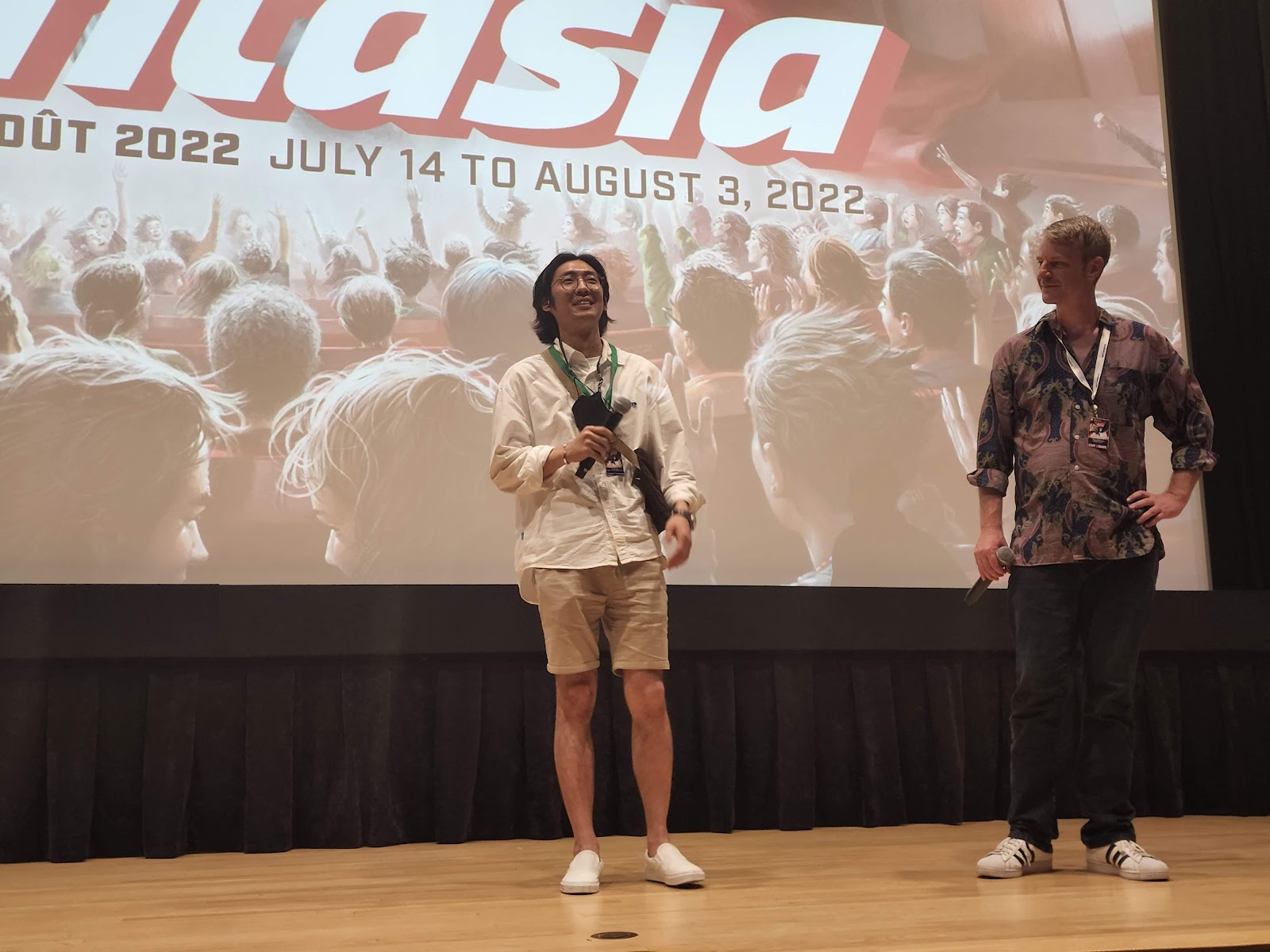 He was there to talk about his film Chun Tae-il: A Flame That Lives On (there are some other variations on the name, but that's what's on the schedule), an unusual project because you don't see many animated films, whether aimed at adults or younger viewers, about labor. Chun Tae-il was a seminal figure in such matters in South Korea, with Hong saying that the history of workers' rights in the country is basically seen as before him and after him. As you might expect, this isn't a corporate-funded feature, but something crowdfunded, as one can see from the extraordinarily long credits even if you don't read Korean, which must surely include everybody who made a 1-won donation.
The film itself was part of a special spotlight on Korean animation, and likely the only part I'll wind up seeing, as most of the others are short film packages playing a bit away from the core venues and sometimes in such a way that seeing them would take up two "slots". As animation programmer Rupert Bottenberg pointed out, there is a bunch of great work being done in shorts there, often as part of student projects, but once folks graduate, most animation houses there are doing work for Japanese and other foreign projects, with just the occasional home-grown feature being commissioned by studios. Occasionally one gets interesting enough to make it to the festival circuit - Beauty Water a couple years ago, for example - but it's fairly slim pickings.
Which is a shame. Chun Tae-il isn't necessarily a great movie so much as a noble one, but it's well-made enough to show there's talent there with visions beyond working for someone else.
Next up: Thursday and the start of week two, with All Jacked Up and Full of Worms, Detectives vs. Sleuths, Shin Ultraman, and Glorious.
Chotto omoidashita dake (Just Remembering)
* * * ¼ (out of four)
Seen 20 July 2022 in Salle J.A. De Sève (Fantasia Festival: Camera Lucida, DCP)
If you'd told me that Daigo Matsui and his cast had shot Just Remembering a bit at a time over the past six years and had to integrate covid when they got to the end (or beginning), if believe it; there's a genuine sense of time passing and things taking place at specific moments. That's not the case, apparently, it's "just" a story doled out in reverse order, one day at a time over seven years.
That day happens to be the birthday of Teruo Sako (Sosuke Ikematsu), who in 2021 works as a lighting technician at various stages around Seoul, on this particular night at the ballet. Elsewhere, taxi driver Yo Nobara (Sairi Ito) picks up a musician (Sekaikan Ozaki) who needs to make a pit stop mid-ride. Yo wanders into the theater and sees Teruo semi-awkwardly dancing on the stage after the show is over, and then it's 2020, when Teruo is working at a small rock club and Yo is on an awkward group date with friends after her shift. The guy she bumps into during a smoke break notes that her social-media avatar is a cat which she mentions is an artifact of her time living with her ex-boyfriend. It is, in fact, the same cat that Teruo feeds before going to work each day. And then it's 2019…
Clearly, the two used to be a couple, and the film will eventually get to the end, the good times, and how they meet. It's often all quite straightforward, with a deliberate lack of melodrama: Their relationship highs and lows believably ordinary, with no sense of destiny fulfilled or thwarted, even with major events tending to coincidentally happen on this day. This happens, and some other side story does or doesn't, but there's beauty and melancholy in it. In a way, Matsui's unconventional structure frees him from having to create an arc with conventional foreshadowing or tragic flaws. Things just happen, and there's not necessarily any grand lesson to be learned from it or code to crack, especially when viewed from outside.
Matsui and company have fun with that, though. There's an enjoyable playfulness with the recurring characters who often seem unstuck in time or something other than parallel. There's a man waiting for his wife to return outside Teruo's apartment, saying she's in the future; other characters will say they look familiar whether their encounters are in the past or the future. Jim Jarmusch's Night On Earth looms large in Teruo's apartment - a poster, a frequently-watched DVD where the audience often sees him viewing the Winona Ryder segment, both an indication of how he's probably sort of hung up on Yo years later and a wink at how this film inverts its one-night-in-parallel structure.
There are also a couple really nice performances by the leads - I love the little rasp that strengthens in Sairi Ito's voice as the film goes back in time, something Yo smoothed out as she matured but never lost. There are a lot of signifiers of how Yo seems to gain confidence and maturity over the course of her twenties even though her circumstances seemingly don't change that much, from the cars she drives to standing a little straighter. Teruo has more obvious changes in his life but Sosuke Ikematsu keeps him something closer to level - amiable and appealing and also foolishly stubborn in spots.
There are movies that play this sort of structural game with grander ambitions, but this one does well for being what it is and of its time.
La Vaca Que Cantó Una Canción Hacia El Futuro (The Cow Who Sang a Song Into the Future)
* * ¾ (out of four)
Seen 20 July 2022 in Salle J.A. De Sève (Fantasia Festival: Camera Lucida, DCP)
Movies like The Cow Who Sang a Song Into the Future can be either very easy or very difficult to love depending on the audience's general inclinations; their plan of attack involves going around the parts of the brain that reason, and some of us don't have minds that make that easy. This one's good enough to mostly work with a left-brained type like me, so I suspect it will hit even harder for those who think more symbolically.
It opens with a terrific sequence, music over nature leading the audience to a river, from which a barefoot woman in motorcycle leathers (Mia Maestro) emerges, unspeaking, and eventually heads into a local town, where a man collapses in shock seeing her through a window. That's Enrique (Alfredo Castro), and soon his daughter Cecilia (Leonor Varela) will be arriving with children "Tomas" (Enzo Ferrada) and Alma (Laura del Rio) to join brother Bernado (Marcial Tagle) to look after him as he recovers and help tend to the family dairy farm. The strange woman soon makes her way there, and longtime servant Felicia (María Velásquez) recognizes her as the mother Cecilia witnessed committing suicide decades ago, apparently no older or worse for the wear.
(Tomas is clearly transitioning socially, but if her chosen name is ever stated, I didn't catch it, so that's what I'll use here.)
Maybe there's some bit of Chilean folklore that makes this all seem, if not logical, then natural, but it's not stated, for better or worse. Personally, even when I wind up liking the pieces of something magic realist like this, I often find myself resenting the way it seems to substitute for story or agency. It can feel like a whole genre built on deus ex machina. Like, here, the opening return of the forty-years-gone Magdalena is so striking that it's hard not to be intrigued by just what's going on there, but she's seemingly literally just there to be a catalyst for her descendants rather than someone who has/had her own tumultuous life and issues. Those stories aren't bad at all, but that part of the movie is sort of spread out by the fantasy and the occasional annoying concessions made to it, like Felicia deciding Magdalena's family can't handle their return (even though Tomas and Alma already saw and recognized her) and doing a bit of awkward physical comedy to keep Cecilia from seeing her out a window.
It's a good group to watch, though - Leonor Varela doesn't exactly have a lot to do as Cecilia, really, but she inhabits this woman who is clearly quite capable in a high-stress job as a doctor and doesn't necessarily know how to fully relax and just let things happen around her family. Marcial Tagle sketches out a man who has been penned in by expectations of taking over the family business and not being able to be his own true self (the closet door appears to be open even if he can't step out, so to speak) without really having a full story to call his own. And Mia Maestro does nifty work presenting Magdalena as both some sort of nature-spawned entity and someone with a connection to these people, giving the impression that being simplified to a more primal existence allows her to more easily exist with them.
It's mesmerizing to look at and listen to, though. The unusual musical interludes are memorable and intriguing in the way that they seem to burrow into something about the land that exists outside humanity, or tries to. The apocalyptic-feeling collapse of the family business would be a great metaphor for the family as a whole, and still works well enough in the film. And, I've got to admit, the ability to make a character like "Cow 2222" somehow look disapproving and expressive is an impressive feat.
The Cow Who Sang… could hold together a little better for those of us who value such things, although I don't know how well it would retain its odd beauty if it did. Where it works, it dazzles.
One and Four
* * ¾ (out of four)
Seen 20 July 2022 in Salle J.A. De Sève (Fantasia Festival, DCP)
There certainly seems to be a solid-enough premise for a mystery or noir here, but the filmmakers seem to run into a dead end because, while everyone talks about stripping a genre down to its essentials, there is a limit to how far that can go. Filmmaker Jingme Trinley spends a lot of time near that limit, maybe on the wrong side of it, and it can make even a tight-seeming film start to drag.
The premise is good - Tibetan forest ranger Sangyue (Jinpa) wakes up hungover; he's not supposed to have alcohol at his isolated lookout, but everyone breaks that rule, he's had some bad personal news, and he can go weeks without seeing other people. But today, a man (Wang Zheng) shows up at his door, injured, saying he's a forest cop who has been chasing poacher Ma Chunya. Something about this guy strikes him wrong, but Sangyue is aware he's not at his best, and everything seems to check out.
How to make the situation uncertain enough with just the two of them? It's going to take someone else showing up, but that doesn't happen for a while, and in the meantime, the movie kind of spins its wheels, having the two sit around the station drinking, trying to get potatoes warm enough to eat, and tending wounds, then taking some time in the woods to track down the poacher (or play at doing so) and check out the car crash (one car empty, one dead cop in the passenger seat of the other), but until Sangyue's neighbor/supplier Kunbo (Kunde) arrives, and even more importantly the driver of the other car, there's not a lot of detective work Sangyue can do.
Still, playing it out can be enjoyable in some ways. The environment is appropriately chilly, the forest where humans are out of place can feel enjoyably surreal, and the moments of action are well-staged. The basic set-up of a confused rural villager playing off the more sophisticated guy from further east who nevertheless does not speak Tibetan is a good pairing. Jinpa and Wang Zheng make a good contrast, but there's a lot more blunt yelling than potential mind games.
And on top of that, it's not exactly a satisfying ending, with Trinley resolving a few things but maybe a little too fond of the idea of uncertainty and ambiguity to ruin it by saying too much one way or the other. Which is the problem with stripping things down to essentials - an idea is general and open to everything, but an actual story must be specific, or at least more specific than this movie gets.
Chun Tae-il (aka Chun Tae-il: A Flame That Lives On)
* * * (out of four)
Seen 20 July 2022 in Salle J.A. De Sève (Fantasia Festival: Axis Korean Animation Spotlight, DCP)
The festival introduction stated that part of the idea of this animated film was to expose the story to an audience that includes kids, and I am therefore once again impressed with how hard Korean film will go given half a chance. Who else is gonna make sure their kids know their labor history like this, even among independents?
Chung Tae-Il (voice of Jang Dong-yoon) and his family came from the country but would migrate to the city to work in the clothing industry as that work dried up - mother first, then Tae-il, and eventually the rest, all still children aside from the parents. Tae-il started as a sewer's helper, then was a sewer himself, but at 19 opted to apprentice as a tailor, which was less guaranteed money but the chance at more, and perhaps a necessary step to the family opening its own shop. That being more of a management position put the inequities on the floor into sharp relief - long hours, illness from inhaling lint, and so much child labor - that when he found out that there were actual unenforced laws on the books to prevent this, he jeopardized his position by documenting offenses and attempting to submit a report to the police, only to find the government more interested in building Korean industry than protecting the people working in it.
Hong Jun-pyo's take on Chun's life is a fairly family-friendly version of the story, presenting information in easily-digested chunks with some repetition for it to be clear, but generally not patronizing. There are likely a number of factors left out - no mention of how South Korea's government at the time was more a military dictatorship than a democracy, for instance - and the other organizers likely have a bigger impact than is shown, as the labor movement would go on without Chun. Violence is probably softened a fair amount (especially the climax!), but it results in clarity more than overload.
The visual and animation styles are pleasantly clean - cel-styled people whose features have generally not been exaggerated or overly stylized, digital backgrounds that allow for camera movement that have enough processor cycles allocated for detail if not a lot of wear and irregularity. The style emphasizes the more timeless aspects of the story and characters rather than grounding them in the specific period with fashions or references (though older folks may get a laugh out of the young labor organizers along if anybody knows university students to ask for tips when organizing a demonstration).
It is, all told, an oddly likable story considering how dead serious the subject matter is, but that's how one introduces big ideas to new people.
Boiseu (On The Line aka Voice)
* * ½ (out of four)
Seen 20 July 2022 in Auditorium des Diplõmés de la SGWU (Fantasia Festival, DCP)
I (semi-ironically) use that old saw about when you have a hammer, every problem looks like a nail quite often, but On the Line does frequently feel like the embodiment of it: A movie about infiltrating the voice-phishjng scheme that ruined one's life for revenge seems like it calls for capers and con-artistry, but these the folks making it are action guys, so they're going to use that hammer.
As it opens, Han Seo-joon (Byun Yo-han) is an ex-cop who found there was more money in construction, and it's going well; he's expecting a promotion from foreman to project manager on the next job. But then, disaster strikes - not just a worker potentially falling to his death, but a coordinated communications blackout, barrage of calls to folks like Seo-joon's wife Mi-yeon (Won Jin-a), and fraudulent insurance policies has both workers and company losing everything. With just the name of a fake lawyer and the help of Kkang-chil (Lee Joo-young), a hacker he busted in his old job, he tracks things to a compound in China run by "Director Chan" (Park Myoung-joon) and Mr. Kwak (Kim Mu-yeol). The Korean police are already investigating the operation and tell Han to back off but that's obviously not happening.
You can see what the best version of this movie would be right away, with Han assembling a team and attacking the operation from every direction, only to find Chan seems to have outplanned him, or so it seems. It's an episode of Leverage (which had a South Korean edition), but it's a working formula, and there are enough off-kilter elements to make it interesting here: There's the entire cult-like call center, the writer with the brilliant scripts, the on-site operations.
Instead, the whole thing often comes off kind of clumsily. Han is such an obvious plant on top of being a blunt object quick to hesitate to ruin someone else's life that it seems impossible these meticulous planners would let him rise nearly as quickly as he does based on one reference, and there's really no reason to have both Kwak and Chan except to kill time by having them fight, while the guy writing their scripts is some sort of blackmail victim. There's no intrigue inside the call center worth keeping up with, and Han sneaking away or busting through back rooms never feels like a great undercover operation.
On the other hand, Byun Yo-han is at least a guy who brings a fair amount of charisma to this blue-collar-at-heart guy who is nevertheless smart enough to take on the schemers, coming across as a sort of Korean Gerard Butler. He can throw down in a fun bull-in-a-china-shop way but isn't invincible and lets out righteous fury without seeming to be a prick about it. It's a shame the filmmakers didn't figure out how to pair him with Lee Joo-young more; her hyper-capable techie who isn't nearly as smooth as she thinks she is works as a great complement and she's a natural in ridiculous, dangerous situations. Kim Mu-yeol has some fun chewing scenery - again, in a better movie you might do without Chan and just run with how Kwak sort of spins the same web for his crew that he does for his victims.
Ultimately, this maybe wants to be a little too straightforward, with an ending that feels like a cop show's introduction, making sure the audience feels the righteous fury of the scammed for the scammers. The thing is, the movie never really convinces that this is a problem that can be punched, even if punching is what it's got.
The film itself was part of a special spotlight on Korean animation, and likely the only part I'll wind up seeing, as most of the others are short film packages playing a bit away from the core venues and sometimes in such a way that seeing them would take up two "slots". As animation programmer Rupert Bottenberg pointed out, there is a bunch of great work being done in shorts there, often as part of student projects, but once folks graduate, most animation houses there are doing work for Japanese and other foreign projects, with just the occasional home-grown feature being commissioned by studios. Occasionally one gets interesting enough to make it to the festival circuit - Beauty Water a couple years ago, for example - but it's fairly slim pickings.
Which is a shame. Chun Tae-il isn't necessarily a great movie so much as a noble one, but it's well-made enough to show there's talent there with visions beyond working for someone else.
Next up: Thursday and the start of week two, with All Jacked Up and Full of Worms, Detectives vs. Sleuths, Shin Ultraman, and Glorious.
Chotto omoidashita dake (Just Remembering)
* * * ¼ (out of four)
Seen 20 July 2022 in Salle J.A. De Sève (Fantasia Festival: Camera Lucida, DCP)
If you'd told me that Daigo Matsui and his cast had shot Just Remembering a bit at a time over the past six years and had to integrate covid when they got to the end (or beginning), if believe it; there's a genuine sense of time passing and things taking place at specific moments. That's not the case, apparently, it's "just" a story doled out in reverse order, one day at a time over seven years.
That day happens to be the birthday of Teruo Sako (Sosuke Ikematsu), who in 2021 works as a lighting technician at various stages around Seoul, on this particular night at the ballet. Elsewhere, taxi driver Yo Nobara (Sairi Ito) picks up a musician (Sekaikan Ozaki) who needs to make a pit stop mid-ride. Yo wanders into the theater and sees Teruo semi-awkwardly dancing on the stage after the show is over, and then it's 2020, when Teruo is working at a small rock club and Yo is on an awkward group date with friends after her shift. The guy she bumps into during a smoke break notes that her social-media avatar is a cat which she mentions is an artifact of her time living with her ex-boyfriend. It is, in fact, the same cat that Teruo feeds before going to work each day. And then it's 2019…
Clearly, the two used to be a couple, and the film will eventually get to the end, the good times, and how they meet. It's often all quite straightforward, with a deliberate lack of melodrama: Their relationship highs and lows believably ordinary, with no sense of destiny fulfilled or thwarted, even with major events tending to coincidentally happen on this day. This happens, and some other side story does or doesn't, but there's beauty and melancholy in it. In a way, Matsui's unconventional structure frees him from having to create an arc with conventional foreshadowing or tragic flaws. Things just happen, and there's not necessarily any grand lesson to be learned from it or code to crack, especially when viewed from outside.
Matsui and company have fun with that, though. There's an enjoyable playfulness with the recurring characters who often seem unstuck in time or something other than parallel. There's a man waiting for his wife to return outside Teruo's apartment, saying she's in the future; other characters will say they look familiar whether their encounters are in the past or the future. Jim Jarmusch's Night On Earth looms large in Teruo's apartment - a poster, a frequently-watched DVD where the audience often sees him viewing the Winona Ryder segment, both an indication of how he's probably sort of hung up on Yo years later and a wink at how this film inverts its one-night-in-parallel structure.
There are also a couple really nice performances by the leads - I love the little rasp that strengthens in Sairi Ito's voice as the film goes back in time, something Yo smoothed out as she matured but never lost. There are a lot of signifiers of how Yo seems to gain confidence and maturity over the course of her twenties even though her circumstances seemingly don't change that much, from the cars she drives to standing a little straighter. Teruo has more obvious changes in his life but Sosuke Ikematsu keeps him something closer to level - amiable and appealing and also foolishly stubborn in spots.
There are movies that play this sort of structural game with grander ambitions, but this one does well for being what it is and of its time.
La Vaca Que Cantó Una Canción Hacia El Futuro (The Cow Who Sang a Song Into the Future)
* * ¾ (out of four)
Seen 20 July 2022 in Salle J.A. De Sève (Fantasia Festival: Camera Lucida, DCP)
Movies like The Cow Who Sang a Song Into the Future can be either very easy or very difficult to love depending on the audience's general inclinations; their plan of attack involves going around the parts of the brain that reason, and some of us don't have minds that make that easy. This one's good enough to mostly work with a left-brained type like me, so I suspect it will hit even harder for those who think more symbolically.
It opens with a terrific sequence, music over nature leading the audience to a river, from which a barefoot woman in motorcycle leathers (Mia Maestro) emerges, unspeaking, and eventually heads into a local town, where a man collapses in shock seeing her through a window. That's Enrique (Alfredo Castro), and soon his daughter Cecilia (Leonor Varela) will be arriving with children "Tomas" (Enzo Ferrada) and Alma (Laura del Rio) to join brother Bernado (Marcial Tagle) to look after him as he recovers and help tend to the family dairy farm. The strange woman soon makes her way there, and longtime servant Felicia (María Velásquez) recognizes her as the mother Cecilia witnessed committing suicide decades ago, apparently no older or worse for the wear.
(Tomas is clearly transitioning socially, but if her chosen name is ever stated, I didn't catch it, so that's what I'll use here.)
Maybe there's some bit of Chilean folklore that makes this all seem, if not logical, then natural, but it's not stated, for better or worse. Personally, even when I wind up liking the pieces of something magic realist like this, I often find myself resenting the way it seems to substitute for story or agency. It can feel like a whole genre built on deus ex machina. Like, here, the opening return of the forty-years-gone Magdalena is so striking that it's hard not to be intrigued by just what's going on there, but she's seemingly literally just there to be a catalyst for her descendants rather than someone who has/had her own tumultuous life and issues. Those stories aren't bad at all, but that part of the movie is sort of spread out by the fantasy and the occasional annoying concessions made to it, like Felicia deciding Magdalena's family can't handle their return (even though Tomas and Alma already saw and recognized her) and doing a bit of awkward physical comedy to keep Cecilia from seeing her out a window.
It's a good group to watch, though - Leonor Varela doesn't exactly have a lot to do as Cecilia, really, but she inhabits this woman who is clearly quite capable in a high-stress job as a doctor and doesn't necessarily know how to fully relax and just let things happen around her family. Marcial Tagle sketches out a man who has been penned in by expectations of taking over the family business and not being able to be his own true self (the closet door appears to be open even if he can't step out, so to speak) without really having a full story to call his own. And Mia Maestro does nifty work presenting Magdalena as both some sort of nature-spawned entity and someone with a connection to these people, giving the impression that being simplified to a more primal existence allows her to more easily exist with them.
It's mesmerizing to look at and listen to, though. The unusual musical interludes are memorable and intriguing in the way that they seem to burrow into something about the land that exists outside humanity, or tries to. The apocalyptic-feeling collapse of the family business would be a great metaphor for the family as a whole, and still works well enough in the film. And, I've got to admit, the ability to make a character like "Cow 2222" somehow look disapproving and expressive is an impressive feat.
The Cow Who Sang… could hold together a little better for those of us who value such things, although I don't know how well it would retain its odd beauty if it did. Where it works, it dazzles.
One and Four
* * ¾ (out of four)
Seen 20 July 2022 in Salle J.A. De Sève (Fantasia Festival, DCP)
There certainly seems to be a solid-enough premise for a mystery or noir here, but the filmmakers seem to run into a dead end because, while everyone talks about stripping a genre down to its essentials, there is a limit to how far that can go. Filmmaker Jingme Trinley spends a lot of time near that limit, maybe on the wrong side of it, and it can make even a tight-seeming film start to drag.
The premise is good - Tibetan forest ranger Sangyue (Jinpa) wakes up hungover; he's not supposed to have alcohol at his isolated lookout, but everyone breaks that rule, he's had some bad personal news, and he can go weeks without seeing other people. But today, a man (Wang Zheng) shows up at his door, injured, saying he's a forest cop who has been chasing poacher Ma Chunya. Something about this guy strikes him wrong, but Sangyue is aware he's not at his best, and everything seems to check out.
How to make the situation uncertain enough with just the two of them? It's going to take someone else showing up, but that doesn't happen for a while, and in the meantime, the movie kind of spins its wheels, having the two sit around the station drinking, trying to get potatoes warm enough to eat, and tending wounds, then taking some time in the woods to track down the poacher (or play at doing so) and check out the car crash (one car empty, one dead cop in the passenger seat of the other), but until Sangyue's neighbor/supplier Kunbo (Kunde) arrives, and even more importantly the driver of the other car, there's not a lot of detective work Sangyue can do.
Still, playing it out can be enjoyable in some ways. The environment is appropriately chilly, the forest where humans are out of place can feel enjoyably surreal, and the moments of action are well-staged. The basic set-up of a confused rural villager playing off the more sophisticated guy from further east who nevertheless does not speak Tibetan is a good pairing. Jinpa and Wang Zheng make a good contrast, but there's a lot more blunt yelling than potential mind games.
And on top of that, it's not exactly a satisfying ending, with Trinley resolving a few things but maybe a little too fond of the idea of uncertainty and ambiguity to ruin it by saying too much one way or the other. Which is the problem with stripping things down to essentials - an idea is general and open to everything, but an actual story must be specific, or at least more specific than this movie gets.
Chun Tae-il (aka Chun Tae-il: A Flame That Lives On)
* * * (out of four)
Seen 20 July 2022 in Salle J.A. De Sève (Fantasia Festival: Axis Korean Animation Spotlight, DCP)
The festival introduction stated that part of the idea of this animated film was to expose the story to an audience that includes kids, and I am therefore once again impressed with how hard Korean film will go given half a chance. Who else is gonna make sure their kids know their labor history like this, even among independents?
Chung Tae-Il (voice of Jang Dong-yoon) and his family came from the country but would migrate to the city to work in the clothing industry as that work dried up - mother first, then Tae-il, and eventually the rest, all still children aside from the parents. Tae-il started as a sewer's helper, then was a sewer himself, but at 19 opted to apprentice as a tailor, which was less guaranteed money but the chance at more, and perhaps a necessary step to the family opening its own shop. That being more of a management position put the inequities on the floor into sharp relief - long hours, illness from inhaling lint, and so much child labor - that when he found out that there were actual unenforced laws on the books to prevent this, he jeopardized his position by documenting offenses and attempting to submit a report to the police, only to find the government more interested in building Korean industry than protecting the people working in it.
Hong Jun-pyo's take on Chun's life is a fairly family-friendly version of the story, presenting information in easily-digested chunks with some repetition for it to be clear, but generally not patronizing. There are likely a number of factors left out - no mention of how South Korea's government at the time was more a military dictatorship than a democracy, for instance - and the other organizers likely have a bigger impact than is shown, as the labor movement would go on without Chun. Violence is probably softened a fair amount (especially the climax!), but it results in clarity more than overload.
The visual and animation styles are pleasantly clean - cel-styled people whose features have generally not been exaggerated or overly stylized, digital backgrounds that allow for camera movement that have enough processor cycles allocated for detail if not a lot of wear and irregularity. The style emphasizes the more timeless aspects of the story and characters rather than grounding them in the specific period with fashions or references (though older folks may get a laugh out of the young labor organizers along if anybody knows university students to ask for tips when organizing a demonstration).
It is, all told, an oddly likable story considering how dead serious the subject matter is, but that's how one introduces big ideas to new people.
Boiseu (On The Line aka Voice)
* * ½ (out of four)
Seen 20 July 2022 in Auditorium des Diplõmés de la SGWU (Fantasia Festival, DCP)
I (semi-ironically) use that old saw about when you have a hammer, every problem looks like a nail quite often, but On the Line does frequently feel like the embodiment of it: A movie about infiltrating the voice-phishjng scheme that ruined one's life for revenge seems like it calls for capers and con-artistry, but these the folks making it are action guys, so they're going to use that hammer.
As it opens, Han Seo-joon (Byun Yo-han) is an ex-cop who found there was more money in construction, and it's going well; he's expecting a promotion from foreman to project manager on the next job. But then, disaster strikes - not just a worker potentially falling to his death, but a coordinated communications blackout, barrage of calls to folks like Seo-joon's wife Mi-yeon (Won Jin-a), and fraudulent insurance policies has both workers and company losing everything. With just the name of a fake lawyer and the help of Kkang-chil (Lee Joo-young), a hacker he busted in his old job, he tracks things to a compound in China run by "Director Chan" (Park Myoung-joon) and Mr. Kwak (Kim Mu-yeol). The Korean police are already investigating the operation and tell Han to back off but that's obviously not happening.
You can see what the best version of this movie would be right away, with Han assembling a team and attacking the operation from every direction, only to find Chan seems to have outplanned him, or so it seems. It's an episode of Leverage (which had a South Korean edition), but it's a working formula, and there are enough off-kilter elements to make it interesting here: There's the entire cult-like call center, the writer with the brilliant scripts, the on-site operations.
Instead, the whole thing often comes off kind of clumsily. Han is such an obvious plant on top of being a blunt object quick to hesitate to ruin someone else's life that it seems impossible these meticulous planners would let him rise nearly as quickly as he does based on one reference, and there's really no reason to have both Kwak and Chan except to kill time by having them fight, while the guy writing their scripts is some sort of blackmail victim. There's no intrigue inside the call center worth keeping up with, and Han sneaking away or busting through back rooms never feels like a great undercover operation.
On the other hand, Byun Yo-han is at least a guy who brings a fair amount of charisma to this blue-collar-at-heart guy who is nevertheless smart enough to take on the schemers, coming across as a sort of Korean Gerard Butler. He can throw down in a fun bull-in-a-china-shop way but isn't invincible and lets out righteous fury without seeming to be a prick about it. It's a shame the filmmakers didn't figure out how to pair him with Lee Joo-young more; her hyper-capable techie who isn't nearly as smooth as she thinks she is works as a great complement and she's a natural in ridiculous, dangerous situations. Kim Mu-yeol has some fun chewing scenery - again, in a better movie you might do without Chan and just run with how Kwak sort of spins the same web for his crew that he does for his victims.
Ultimately, this maybe wants to be a little too straightforward, with an ending that feels like a cop show's introduction, making sure the audience feels the righteous fury of the scammed for the scammers. The thing is, the movie never really convinces that this is a problem that can be punched, even if punching is what it's got.
Sunday, July 17, 2022
Fantasia 2022.03: Baby Assassins, The Fish Tale, Popran, "Facies", and The Elderly
Welp, that's not the first time I've found myself going to a different film than I figured on to start the day, but this may be the first time I didn't realize it until introductions started.
 Those introductions were Mitch welcoming The Elderly directors Raúl Cerezo and Fernando González Gómez (plus a translator whose name I didn't catch if it was offered), with Cerezo also serving as a producer for the pretty-darn-good short that preceded the feature.
I wish I liked their movie more. It looks nice (lots of talk about the cinematography being inspired by Goya's black paintings) and has a good cast, but it doesn't really hold together well enough to be scary. They built it well enough that one can see things in it that maybe weren't intended to be there - the filmmakers seemed to avoid answering a question or two in the Q&A because they maybe hadn't considered its premise while making the movie - but all in all, I think I'd have rather seen the Tibetan western.
Ah well. It's a new day, which means the International Science Fiction Short Film Showcase, The Girl from the Other Side, Next Door, and Moloch.
Beibî warukyûre (Baby Assassins)
* * ½ (out of four)
Seen 16 July 2022 in Auditorium des Diplõmés de la SGWU (Fantasia Festival, DCP)
Baby Assassins is a member of that class of Japanese genre films that aren't necessarily made more for export than their domestic market but can kind of feel that way for one reason or another with some prominent English and hitting on specific nerdy Japanese tropes. They wouldn't exist unless there was some fondness for it, though, enough that there's a market crank stuff like this out, even if this isn't exactly an example that's especially clever in what it comes up with.
It follows Mahiro (Saori Izawa) and Chisato (Akari Takaishi), two teenage assassins who, now that they've graduated high school, are expected to maintain a sort of normal life as cover, including sharing an apartment, holding down part-time jobs, that sort of thing. Elsewhere in Tokyo, a yakuza and his two kids are looking to expand their business, though it looks like someone has hired the agency which employs the girls, setting them on a collision course.
Things start out well enough with a sequence that seems to recognize the absurdity of the whole premise - Mahiro asking herself what kind of convenience store this is as she fights off some employees who are shockingly loyal to the manager she just offed - but said premise could use a lot of work. The organization behind the pair is more or less entirely off-screen, and there doesn't seem to be much thought as to why someone would go with flighty teenagers rather than seasoned, loyal yakuza killers other than there being an audience for cute girls with guns. It's a movie that could be full of fun details - the premise implies a bizzarro John Wick world - but seldom goes for that.
Most of the time, it's the sort of movie that seems to be following a checklist. There's a serviceable-enough plot, though it's a kind of casual thing to hang the tropes off. Some characteristics are fun, but they're not really connected to anything. The guy playing the yakuza father (Yasukaze Motomiya, I believe) sells the deadpan scenes where he's chastising his son in feminist terms before shifting to mad-dog mode, and Akari Takaishi captures how Chisato may be gregarious but is actually just as socially awkward as Mahiro, just in the opposite direction. It's a film of bits strung together, some better than others.
I wouldn't be shocked if it was built around giving Saori Izawa a few really good fights. She certainly seems to be the real deal when it's time to throw down, and both the opening brawl and the one-on-one at the climax are quality bits of action. She can move with purpose, sells the blow she's giving and receiving, and does plenty where it would be hard to double. Her future may be in more cranked-out VOD fodder like this, but she'll likely be a highlight when she shows up.
Sakana no Ko (The Fish Tale)
* * ¾ (out of four)
Seen 16 July 2022 in Auditorium des Diplõmés de la SGWU (Fantasia Festival, DCP)
The Fish Tale is an amiable movie that covers less ground than one might expect given its generous running time. There are some pretty noticeable gaps that writer/director Shûichi Okita needn't have made quite so obvious, and Meebo, the character in the center always seems to be doing less than must be the case. It's built to be charming, and mostly succeeds, but after a while one does notice what it's not showing as much as what it is.
After a brief bit in the present, the film flashes back to when "Meebo" was a young girl, fascinated by all manner of marine life to the point of obsession, spending hours in the aquarium, learning all the varieties of fish and drawing them on end, not even really eating anything else. Her mother indulges her to an extent that clearly causes issues in the family, and by the time she's in high school, her grades aren't good but everybody loves her manga-style "newsletters". She doesn't get into college, but still tries to find work in and around that area as an adult, eventually re-encountering folks she knew when younger who seem charmed by how she hasn't changed despite their own lives having ups and downs.
Interestingly, the movie opens with the quote suggesting that Meebo is either bi- or asexual, and the latter certainly seems more likely, but it's an odd thing to bring up if the film's only going to hint at it. The prelude ends in a cliffhanger that is never returned to, and the usual structure of facing challenges and being changed by them just isn't there. Meebo is who she is from roughly the age of six, and it's just a matter of the world recognizing her value.
Which is, on the one hand, kind of great - this being a fairly family-oriented movie, its eagerness to be sort of radically accepting, whether of a kid who is simply obsessed with fish, two male high school delinquents who apparently become a couple and open a restaurant together, or a single mom who was almost certainly knocked up by her married lover, is kind of wonderfully earnest. The filmmakers have a message, it's positive, and they're not creating exceptions.
On the other hand... Not a lot of consequence happens. Meebo loves fish and drawing, never really compromising that even though she doesn't ever develop the academic credentials or social instincts that she would seem to need. She's easy to root for, in part because the actress who plays her as a teen and adult, Non, seems to naturally exude the proper sort of geeky charm the part needs, but the audience knows she achieved her dreams without a lot of complicated entanglements or change. At least, not on screen, even though everyone else pointedly moves to different stages of life. It's a long movie to watch someone stay that static, no matter how likable and good-hearted she may be.
Popuran (Popran)
* * * (out of four)
Seen 16 July 2022 in Auditorium des Diplõmés de la SGWU (Fantasia Festival, DCP)
Shin'ichiro Ueda combines an obvious but earnest metaphor with slapstick absurdity in Popran, and does it well enough to make one wish more filmmakers were down for this sort of cheerful silliness. It may be a trifle, but it's one where everyone involved knows what they're doing and getting it done in a way that is both very silly and surprisingly sincere.
It opens with an interview that establishes both that Akira Tamagi (Yoji Minagawa) has built up a top online manga distribution company and that in doing so he left behind the girl he married when they were twenty and drove away his founding partner, at least before his highly capable assistant shoos the people interviewing him away. After a one-night stand with an aspiring artist, he wakes up to find that his penis has vanished, baffling doctors. He does find an underground support meeting, though, where he learns that not only is he not alone, but that the "Skyfish" that have been seen flitting around Japan are all male members that have abandoned their bodies, and if they aren't caught in six days, they'll die of malnutrition. And while catching an object that flies through the air at up to 200kph is difficult, the really hard part is that they seem attracted to the people and places their owners abandoned.
Straightforward? Yeah, but it's also weirdly sincere. The film may be saying something corny, but it means what it's saying, and it's not going to be misunderstood. It's generally positive in its outlook and has no shame in hitting expected notes if they feel true, but Ueda knows enough to throw a barb or two in there - a scene filled with necessary exposition tilts from sadness to despair in its final moments, and at least one segment of Tamagi's quest makes it clear that forgiveness is by no means automatic, especially given that he's doing this for selfish-if-understandable reasons. The broad slapstick leads, but the film is at least a little well-considered under the hood.
But it is delightfully goofy, with Minagawa gamely selling all of the indignities a detached high-speed penis that can still transmit pain can inflict, even if he can't quite sell Akira as being quite so awful as the premise requires. There's also a very enjoyable sort of comedic whiplash between how reluctant and deadpan the people chasing "Skyfish" are to discuss it and how completely the actual thing lacks subtlety. Ueda does enough to not actually show anything clearly that it would almost be better if he were winking at the camera in some sort of meta manner, it's so obvious where the lines they can't cross are, but he also doesn't exactly build the film around teasing Tamagi's unit (or lack thereof) with last-minute cutaways or Austin Powers gags.
This probably could go a lot harder (tee-hee) and get some even bigger laughs, but it's not really that movie. Ueda bets that more people will laugh at the idea than seeing the whole thing big as life on the silver screen, and it's probably not a bad wager.
"El Semblante" ("Facies")
* * * ¼ (out of four)
Seen 16 July 2022 in Auditorium des Diplõmés de la SGWU (Fantasia Festival, DCP)
"El Semblante" takes up the question that many have asked while walking through museums of medieval history - "what sicko even comes up with these devices?" - and posits a tragic backstory of an inventor of useful devices and charming automata forced to turn his mind toward instruments of torture by a representative of the Vatican who burned his wife as a witch and will come after daughter Elena (who has picked up where her mother left off in helping people with herbal remedies) if he doesn't comply.
The story itself is a mean little thing, as befits a tale of the Spanish Inquisition in 1692, with the sort of ending one can predict if not caught up in the story as it unfolds. The filmmakers aren't necessarily going for subtlety or new takes here - the imagery is familiar, though maybe a bit more rundown; this cruel priest is not in Rome, after all, but rural Spain and thus not as fancily robed - but they don't need to. They lay out the situation and follow it through. It may end on what seems to be a bit of a side note, although maybe it isn't; this priest's interest in "the true face of pain" seemed like an ugly quirk of a secondary character at the start, but these sickos do have a way of grabbing the spotlight.
Indeed, that's perhaps the most interesting nugget of truth in the movie, as Elena points out to her father that they are shunned more for his building these evil devices than anything her mother may have done, but the people who get off on pain and suffering manage to take and control through their willingness to inflict it, even if it is ultimately unpopular.
Viejos (The Elderly)
* * (out of four)
Seen 16 July 2022 in Auditorium des Diplõmés de la SGWU (Fantasia Festival, DCP)
There are several points in The Elderly when the screen will go blank for a graphic of the temperature, starting at 39.9 Celsius (about 94 Fahrenheit) and rising, but I don't think the audience ever sees anybody actually sweat in the movie. Now, sure, maybe it's just Spain and folks who live there handle the heat better than a cold-adapted New England type like me, and that would be a petty thing to ding a movie on anyway, but it feels like a prime example of how this movie is such a miss for me - the filmmakers know what causes anxiety and fear, but are content to go with the surface signifiers rather than craft something that has a horrifying logic underlying it.
It opens with an old woman, seemingly hearing voices, falling to her death, although the framing of the shot leaves plenty of room as to whether she jumped or husband Manuel (Zorion Eguileor) pushed her, though the police apparently find nothing suspicious. Still, his son Mario (Gustavo Salmerón) worries, and wants him to move in with them, although pregnant wife Lena (Irene Anula) is far less keen, while Mario's daughter from his first marriage, Naia (Paula Gallego), is both worried about her grandfather and reflexively against what Lena is for. And Lena's right to be worried - something's not right with Manuel, and that may extend to the rest of the city's older residents.
What might that be? The filmmakers sort of play coy here; there are cryptic notes on paper and on walls about hearing voices, references to "them", a slow and eerie old song that recurs on the soundtrack, and Manuel's odd sets of cobbled-together circuit boards, but what revelations there will be are saved for the end or close to it, to the point where I found myself grumbling about someone answering a question in a pointlessly cryptic way when they had no reason to hide information (and when most movies would start having the curtains pulled back), or intoning "I will kill you all tomorrow" because the film needed a little spike of tension. The filmmakers throw in a bunch of things that cause modern angst - the indignities of aging, the heat wave, Mario's unemployment - and imply they're a significant part of the story, although it never coheres. During the festival Q&A, directors Raúl Cerezo and Fernando González Gómez said that the film had been in the works for ten years (Cerezo, Rubén Sánchez Trigos, and Javier Trigales get the screenplay credits), and maybe that's part of the issue - so many hot issues of the day and different focuses that never cohere.
To a certain extent, they can get by without it; the core cast of Zorion Eguileor, Paula Gallego, Gustavo Salmerón, and Irene Anula are a fine group, with Eguileor doing an excellent job of capturing a combination of potentially-paranormal malevolence and piggish pride, such that one can't exactly spot where one ends and the other begins, with a fondness for his granddaughter that is not overstated. Gallego, who also appeared in the directors' previous feature, has the makings of a fine horror heroine if she wants to continue on that path, nicely able to make Naia appealing despite being aloof or angry much of the time before descending into very believable terror.
And the film looks terrific; there's a difference in atmosphere between the old apartment building the family lives in and the one Manuel came from that often seems to be subtle shadings, while his room in the new place takes on the same atmosphere. It's a dark but rich palette and everything is framed well without being showy, which means the potentially-apocalyptic climax both fits in and comes as a shock. A lot of horror films have trouble making the jump from one family's problems to something much bigger, and this one mostly connects on that big swing.
Still, that's kind of a leap from "stuff too vague and muddled to be really scary" to "stuff too vague and muddled to be really scary but with some good visual effects". The Elderly has the gloss of a top-tier horror movie, but never really decides on a heart.
I wish I liked their movie more. It looks nice (lots of talk about the cinematography being inspired by Goya's black paintings) and has a good cast, but it doesn't really hold together well enough to be scary. They built it well enough that one can see things in it that maybe weren't intended to be there - the filmmakers seemed to avoid answering a question or two in the Q&A because they maybe hadn't considered its premise while making the movie - but all in all, I think I'd have rather seen the Tibetan western.
Ah well. It's a new day, which means the International Science Fiction Short Film Showcase, The Girl from the Other Side, Next Door, and Moloch.
Beibî warukyûre (Baby Assassins)
* * ½ (out of four)
Seen 16 July 2022 in Auditorium des Diplõmés de la SGWU (Fantasia Festival, DCP)
Baby Assassins is a member of that class of Japanese genre films that aren't necessarily made more for export than their domestic market but can kind of feel that way for one reason or another with some prominent English and hitting on specific nerdy Japanese tropes. They wouldn't exist unless there was some fondness for it, though, enough that there's a market crank stuff like this out, even if this isn't exactly an example that's especially clever in what it comes up with.
It follows Mahiro (Saori Izawa) and Chisato (Akari Takaishi), two teenage assassins who, now that they've graduated high school, are expected to maintain a sort of normal life as cover, including sharing an apartment, holding down part-time jobs, that sort of thing. Elsewhere in Tokyo, a yakuza and his two kids are looking to expand their business, though it looks like someone has hired the agency which employs the girls, setting them on a collision course.
Things start out well enough with a sequence that seems to recognize the absurdity of the whole premise - Mahiro asking herself what kind of convenience store this is as she fights off some employees who are shockingly loyal to the manager she just offed - but said premise could use a lot of work. The organization behind the pair is more or less entirely off-screen, and there doesn't seem to be much thought as to why someone would go with flighty teenagers rather than seasoned, loyal yakuza killers other than there being an audience for cute girls with guns. It's a movie that could be full of fun details - the premise implies a bizzarro John Wick world - but seldom goes for that.
Most of the time, it's the sort of movie that seems to be following a checklist. There's a serviceable-enough plot, though it's a kind of casual thing to hang the tropes off. Some characteristics are fun, but they're not really connected to anything. The guy playing the yakuza father (Yasukaze Motomiya, I believe) sells the deadpan scenes where he's chastising his son in feminist terms before shifting to mad-dog mode, and Akari Takaishi captures how Chisato may be gregarious but is actually just as socially awkward as Mahiro, just in the opposite direction. It's a film of bits strung together, some better than others.
I wouldn't be shocked if it was built around giving Saori Izawa a few really good fights. She certainly seems to be the real deal when it's time to throw down, and both the opening brawl and the one-on-one at the climax are quality bits of action. She can move with purpose, sells the blow she's giving and receiving, and does plenty where it would be hard to double. Her future may be in more cranked-out VOD fodder like this, but she'll likely be a highlight when she shows up.
Sakana no Ko (The Fish Tale)
* * ¾ (out of four)
Seen 16 July 2022 in Auditorium des Diplõmés de la SGWU (Fantasia Festival, DCP)
The Fish Tale is an amiable movie that covers less ground than one might expect given its generous running time. There are some pretty noticeable gaps that writer/director Shûichi Okita needn't have made quite so obvious, and Meebo, the character in the center always seems to be doing less than must be the case. It's built to be charming, and mostly succeeds, but after a while one does notice what it's not showing as much as what it is.
After a brief bit in the present, the film flashes back to when "Meebo" was a young girl, fascinated by all manner of marine life to the point of obsession, spending hours in the aquarium, learning all the varieties of fish and drawing them on end, not even really eating anything else. Her mother indulges her to an extent that clearly causes issues in the family, and by the time she's in high school, her grades aren't good but everybody loves her manga-style "newsletters". She doesn't get into college, but still tries to find work in and around that area as an adult, eventually re-encountering folks she knew when younger who seem charmed by how she hasn't changed despite their own lives having ups and downs.
Interestingly, the movie opens with the quote suggesting that Meebo is either bi- or asexual, and the latter certainly seems more likely, but it's an odd thing to bring up if the film's only going to hint at it. The prelude ends in a cliffhanger that is never returned to, and the usual structure of facing challenges and being changed by them just isn't there. Meebo is who she is from roughly the age of six, and it's just a matter of the world recognizing her value.
Which is, on the one hand, kind of great - this being a fairly family-oriented movie, its eagerness to be sort of radically accepting, whether of a kid who is simply obsessed with fish, two male high school delinquents who apparently become a couple and open a restaurant together, or a single mom who was almost certainly knocked up by her married lover, is kind of wonderfully earnest. The filmmakers have a message, it's positive, and they're not creating exceptions.
On the other hand... Not a lot of consequence happens. Meebo loves fish and drawing, never really compromising that even though she doesn't ever develop the academic credentials or social instincts that she would seem to need. She's easy to root for, in part because the actress who plays her as a teen and adult, Non, seems to naturally exude the proper sort of geeky charm the part needs, but the audience knows she achieved her dreams without a lot of complicated entanglements or change. At least, not on screen, even though everyone else pointedly moves to different stages of life. It's a long movie to watch someone stay that static, no matter how likable and good-hearted she may be.
Popuran (Popran)
* * * (out of four)
Seen 16 July 2022 in Auditorium des Diplõmés de la SGWU (Fantasia Festival, DCP)
Shin'ichiro Ueda combines an obvious but earnest metaphor with slapstick absurdity in Popran, and does it well enough to make one wish more filmmakers were down for this sort of cheerful silliness. It may be a trifle, but it's one where everyone involved knows what they're doing and getting it done in a way that is both very silly and surprisingly sincere.
It opens with an interview that establishes both that Akira Tamagi (Yoji Minagawa) has built up a top online manga distribution company and that in doing so he left behind the girl he married when they were twenty and drove away his founding partner, at least before his highly capable assistant shoos the people interviewing him away. After a one-night stand with an aspiring artist, he wakes up to find that his penis has vanished, baffling doctors. He does find an underground support meeting, though, where he learns that not only is he not alone, but that the "Skyfish" that have been seen flitting around Japan are all male members that have abandoned their bodies, and if they aren't caught in six days, they'll die of malnutrition. And while catching an object that flies through the air at up to 200kph is difficult, the really hard part is that they seem attracted to the people and places their owners abandoned.
Straightforward? Yeah, but it's also weirdly sincere. The film may be saying something corny, but it means what it's saying, and it's not going to be misunderstood. It's generally positive in its outlook and has no shame in hitting expected notes if they feel true, but Ueda knows enough to throw a barb or two in there - a scene filled with necessary exposition tilts from sadness to despair in its final moments, and at least one segment of Tamagi's quest makes it clear that forgiveness is by no means automatic, especially given that he's doing this for selfish-if-understandable reasons. The broad slapstick leads, but the film is at least a little well-considered under the hood.
But it is delightfully goofy, with Minagawa gamely selling all of the indignities a detached high-speed penis that can still transmit pain can inflict, even if he can't quite sell Akira as being quite so awful as the premise requires. There's also a very enjoyable sort of comedic whiplash between how reluctant and deadpan the people chasing "Skyfish" are to discuss it and how completely the actual thing lacks subtlety. Ueda does enough to not actually show anything clearly that it would almost be better if he were winking at the camera in some sort of meta manner, it's so obvious where the lines they can't cross are, but he also doesn't exactly build the film around teasing Tamagi's unit (or lack thereof) with last-minute cutaways or Austin Powers gags.
This probably could go a lot harder (tee-hee) and get some even bigger laughs, but it's not really that movie. Ueda bets that more people will laugh at the idea than seeing the whole thing big as life on the silver screen, and it's probably not a bad wager.
"El Semblante" ("Facies")
* * * ¼ (out of four)
Seen 16 July 2022 in Auditorium des Diplõmés de la SGWU (Fantasia Festival, DCP)
"El Semblante" takes up the question that many have asked while walking through museums of medieval history - "what sicko even comes up with these devices?" - and posits a tragic backstory of an inventor of useful devices and charming automata forced to turn his mind toward instruments of torture by a representative of the Vatican who burned his wife as a witch and will come after daughter Elena (who has picked up where her mother left off in helping people with herbal remedies) if he doesn't comply.
The story itself is a mean little thing, as befits a tale of the Spanish Inquisition in 1692, with the sort of ending one can predict if not caught up in the story as it unfolds. The filmmakers aren't necessarily going for subtlety or new takes here - the imagery is familiar, though maybe a bit more rundown; this cruel priest is not in Rome, after all, but rural Spain and thus not as fancily robed - but they don't need to. They lay out the situation and follow it through. It may end on what seems to be a bit of a side note, although maybe it isn't; this priest's interest in "the true face of pain" seemed like an ugly quirk of a secondary character at the start, but these sickos do have a way of grabbing the spotlight.
Indeed, that's perhaps the most interesting nugget of truth in the movie, as Elena points out to her father that they are shunned more for his building these evil devices than anything her mother may have done, but the people who get off on pain and suffering manage to take and control through their willingness to inflict it, even if it is ultimately unpopular.
Viejos (The Elderly)
* * (out of four)
Seen 16 July 2022 in Auditorium des Diplõmés de la SGWU (Fantasia Festival, DCP)
There are several points in The Elderly when the screen will go blank for a graphic of the temperature, starting at 39.9 Celsius (about 94 Fahrenheit) and rising, but I don't think the audience ever sees anybody actually sweat in the movie. Now, sure, maybe it's just Spain and folks who live there handle the heat better than a cold-adapted New England type like me, and that would be a petty thing to ding a movie on anyway, but it feels like a prime example of how this movie is such a miss for me - the filmmakers know what causes anxiety and fear, but are content to go with the surface signifiers rather than craft something that has a horrifying logic underlying it.
It opens with an old woman, seemingly hearing voices, falling to her death, although the framing of the shot leaves plenty of room as to whether she jumped or husband Manuel (Zorion Eguileor) pushed her, though the police apparently find nothing suspicious. Still, his son Mario (Gustavo Salmerón) worries, and wants him to move in with them, although pregnant wife Lena (Irene Anula) is far less keen, while Mario's daughter from his first marriage, Naia (Paula Gallego), is both worried about her grandfather and reflexively against what Lena is for. And Lena's right to be worried - something's not right with Manuel, and that may extend to the rest of the city's older residents.
What might that be? The filmmakers sort of play coy here; there are cryptic notes on paper and on walls about hearing voices, references to "them", a slow and eerie old song that recurs on the soundtrack, and Manuel's odd sets of cobbled-together circuit boards, but what revelations there will be are saved for the end or close to it, to the point where I found myself grumbling about someone answering a question in a pointlessly cryptic way when they had no reason to hide information (and when most movies would start having the curtains pulled back), or intoning "I will kill you all tomorrow" because the film needed a little spike of tension. The filmmakers throw in a bunch of things that cause modern angst - the indignities of aging, the heat wave, Mario's unemployment - and imply they're a significant part of the story, although it never coheres. During the festival Q&A, directors Raúl Cerezo and Fernando González Gómez said that the film had been in the works for ten years (Cerezo, Rubén Sánchez Trigos, and Javier Trigales get the screenplay credits), and maybe that's part of the issue - so many hot issues of the day and different focuses that never cohere.
To a certain extent, they can get by without it; the core cast of Zorion Eguileor, Paula Gallego, Gustavo Salmerón, and Irene Anula are a fine group, with Eguileor doing an excellent job of capturing a combination of potentially-paranormal malevolence and piggish pride, such that one can't exactly spot where one ends and the other begins, with a fondness for his granddaughter that is not overstated. Gallego, who also appeared in the directors' previous feature, has the makings of a fine horror heroine if she wants to continue on that path, nicely able to make Naia appealing despite being aloof or angry much of the time before descending into very believable terror.
And the film looks terrific; there's a difference in atmosphere between the old apartment building the family lives in and the one Manuel came from that often seems to be subtle shadings, while his room in the new place takes on the same atmosphere. It's a dark but rich palette and everything is framed well without being showy, which means the potentially-apocalyptic climax both fits in and comes as a shock. A lot of horror films have trouble making the jump from one family's problems to something much bigger, and this one mostly connects on that big swing.
Still, that's kind of a leap from "stuff too vague and muddled to be really scary" to "stuff too vague and muddled to be really scary but with some good visual effects". The Elderly has the gloss of a top-tier horror movie, but never really decides on a heart.
Monday, November 15, 2021
Anita
How big a star was Anita Mui Yim-Fong in Hong Kong? There are three statues at the end of the Avenue of Stars in Tsim Sha Tsui. One is cartoon piglet McDull, for the kids. One is Bruce Lee. The other is this:
 (Aside: Just looking through my photos from my trip to Hong Kong from March 2019, I am reminded that, one, it was an amazing experience, and two, it seems like forever ago between the news out of the SAR and spending so much of the past year and a half stuck in my apartment)
I'm not sure we saw that much of this Anita Mui in the biopic that bears her name which opened worldwide (including AMC Boston Common) this past weekend - aside from actress Louise Wong being a very conventionally pretty model compared to the woman occasionally described as "The Ugly Queen of Pop", this lady is defiant and in your face while the character in the movie is mostly a hard working performer and a good collaborator. I've got no doubt Anita Mui was that, too, but in that case there should have been some contrast between those personae. Instead, she's kind of reduced to a generic, if very successful, pop star, with the fact that she had songs like "Bad Girl" banned from the radio for being too sexy just a thing that happened.
That doesn't make it a bad movie, realy, but it does mean that the review winds up doing a really bad job of talking about the movie you've seen rather than the one you haven't; as you see below, there are a lot of places where I feel like Longmand Leung and company could have dug in and made a story about Anita Mui that brought out what made her special and how she was such a vital and important part of Hong Kong even if most people outside of the colony/region mostly knew her as Jackie Chan's co-star in Rumble in the Bronx. This really isn't the definitive Anita Mui story, even if it's probably the only one that can get made in Hong Kong today. It's a great-looking one that's solidly produced, though - it highlights why she's beloved beyond just being a pop star and its eerily familiar last act (the 2003 SARS epidemic was a major backdrop to the last year of her life) gives it one heck of an entry point for the younger generation to connect with it. It works for what it is.
Something that kind of shocked me was just how little with her in it that I had on my shelves - just Moon Warriors and Drunken Master II; I somehow don't even have Rumble in the Bronx! I'd meant to watch a couple films the night before just to get a feel for her rather than comparing Louise Wong's performance to a dim memory, but the options were pretty thin, even when you included US streaming services. I'll probably try and correct that with my next DDDHouse order, but it's slim pickings there (no The Heroic Trio, for instance). Hopefully Panorama or someone gets a few discs out the door to coincide with this hitting video in a few months, because I am ready for them.
Also, it was a pretty good crowd for a Cantonese-language film, which always seems to do less well than the Mandarin-language ones at Boston Common. Part of that may be that it's only getting one or two shows a day rather than the three or four a new release usually gets in its first week of release, but it was nice to see this with an audience that had some investment. It probably won't get more than a week there - the app doesn't even show screenings on Thursday the 18th - so if you want to catch this one, do it this week (although CMC does seem to get their releases to US streams fairly quickly).
Anita
* * ½ (out of four)
Seen 13 November 2021 in AMC Boston Common #7 (first-run, DCP)
Anita is a perfectly fine musician biography for someone who seemingly should have something a lot grander. Anita Mui was a huge star in Hong Kong - commercially successful at a level few if any have been since and envelope-pushing on top of that - and this movie could almost be about any pop star who died young. It's a glossy, enjoyable movie of that type, and seems to be going over well in its native territory, but outsiders won't necessarily get a sense of what a big deal she was.
After a brief glimpse at Mui preparing for her farewell concert, the film makes a stop in 1969, with 5-year-old Mui Yim-Fong and her big sister Oi-Fong singing at Hong Kong's Lai Chi Kok Amusement Park, before skipping forward to 1982, when the pair are already a veteran nightclub sister act, to the point where Yim-Fong develops calluses on her vocal chords. Oi-Fong (Fish Liew Chi-Yu) encourages Yim-Fong (Louise Wong Lo-Yiu) to join her in applying to a TV talent show whose winner will receive a recording contract, applying with the English names "Ann" and "Anita". Ann is rejected, but Anita eventually wins the deal, soon meeting a number of people who would be close friends and collaborators throughout her life: Label executive So Hau-Leung (Lam Ka-Tung), costumer Eddie Lau Pui-Kei (Louis Koo Tin-Lok), and fellow entertainer Leslie Cheung (Terrance Lau Chun-Him).
Anita Mui seldom had a down period after that, spending the rest of the 1980s firmly atop the Cantopop charts while also doing two or three movies a year, and continuing to release albums even after she stopped doing live concerts in the 1990s. That sort of success creates a bit of a dilemma for director Longmond Leung Lok-Man and co-writer Jack Ng Wai-Lun, especially when one considers that she apparently wasn't a songwriter (and if she is closely associated with any, the film does not give them any screen time). They wind up trying to build a story out of her personal life - her romance with Japanese pop star Godo Yuki (Ayumu Nakajima) is given some time, and an argument with a gangster while in a later relationship with gang-adjacent beau "Ben" (Yo Yang) leads to a self-imposed Thai exile - but they never find the hook that sets Anita apart from anyone else who wins a talent show and exploded to such a degree.
The frustrating thing is, looking at the movie and reading a little bit about her life suggests that there is actually a ton of great material that they chose not to use, for one reason or another: What if they took the comment that she never knew her father and thus the likes of Mr. So and Eddie became father figures, and crossed that with how she's been working since the age of four to support her family - does this help explain the burn-out that led her to leave live performance? You'd think from watching the movie that Ann left show business when she was rejected from the talent competition in 1982, but she had a modest music and film career of her own, and there could be a story there (her life also intersects and parallels that of fellow icon Leslie Cheung's). Heck, she arguably parallels Hong Kong itself, starting out poor and grimy and transmuting that into glamor before being one of the celebrities that stayed during the handover and never made a bid for success in Hollywood or Beijing. Bits of all these things come through, and one suspects that the heavy hands of both China and the entertainment industry inspire dancing around some subjects, but as with many biographies, trying to cover the entirety of even a relatively short life often means that none of the facets that made that life interesting get much time in the forefront
The film is handsomely mounted and fun to wallow in, at least; Longmond Leung teamed with Luk Kim-Ching to make a trio of slick thrillers before taking on this project, and Anita is even more polished. There's a gloss to even the disreputable spaces and a knack for capturing different facets of the city, a shininess makes it a fine nostalgia trip, paralleling Hong Kong's rise and indulging its local audience's fond memories of the time. Leung and his team seldom dawdle over any particular moment but don't particularly seem to rush. The occasional cut to actual footage of Anita's concerts and appearances emphasizes just what an impressive recreation this can be, even if it hints at a rawness and vitality the film can't always match.
That's not a dig at Louise Wong; the relative newcomer playing Anita isn't given a whole lot to do because of how stardom often seems to just happen to her, but when she gets a chance to show that there's something defiant about this woman - there's an annoyed look folks may recognize from Mui's comedic roles - she manages, but that doesn't happen nearly often enough. She and Fish Liew play well off each other as sisters, enough so to pique one's interest in the version of this story that focuses on their relationship; the same goes for Terrance Lau, who captures both the exuberance of young Leslie Cheung and the self-doubt that will eventually eat it alive. Louis Koo has a featured role as Eddie and he's a little more theatrical in his combination of playfulness and gravitas, not above making a meal of the sort of mentor role that's got to be big enough to inspire an all-time great.
As someone only a little familiar with Anita Mui - the sort that has seen her in the likes of Drunken Master II and The Heroic Trio and who has noticed the reverence with which other Hong Kong legends speak of her - I wanted more from this movie, for it to make a case for her greatness and show how she achieved it. Instead, it's a reminder, and a chance for folks who were there to relive it in sharp digital clarity rather than on grainy VHS, and from its apparent popularity in Hong Kong, it manages that fairly well.
Also on eFilmCritic
I'm not sure we saw that much of this Anita Mui in the biopic that bears her name which opened worldwide (including AMC Boston Common) this past weekend - aside from actress Louise Wong being a very conventionally pretty model compared to the woman occasionally described as "The Ugly Queen of Pop", this lady is defiant and in your face while the character in the movie is mostly a hard working performer and a good collaborator. I've got no doubt Anita Mui was that, too, but in that case there should have been some contrast between those personae. Instead, she's kind of reduced to a generic, if very successful, pop star, with the fact that she had songs like "Bad Girl" banned from the radio for being too sexy just a thing that happened.
That doesn't make it a bad movie, realy, but it does mean that the review winds up doing a really bad job of talking about the movie you've seen rather than the one you haven't; as you see below, there are a lot of places where I feel like Longmand Leung and company could have dug in and made a story about Anita Mui that brought out what made her special and how she was such a vital and important part of Hong Kong even if most people outside of the colony/region mostly knew her as Jackie Chan's co-star in Rumble in the Bronx. This really isn't the definitive Anita Mui story, even if it's probably the only one that can get made in Hong Kong today. It's a great-looking one that's solidly produced, though - it highlights why she's beloved beyond just being a pop star and its eerily familiar last act (the 2003 SARS epidemic was a major backdrop to the last year of her life) gives it one heck of an entry point for the younger generation to connect with it. It works for what it is.
Something that kind of shocked me was just how little with her in it that I had on my shelves - just Moon Warriors and Drunken Master II; I somehow don't even have Rumble in the Bronx! I'd meant to watch a couple films the night before just to get a feel for her rather than comparing Louise Wong's performance to a dim memory, but the options were pretty thin, even when you included US streaming services. I'll probably try and correct that with my next DDDHouse order, but it's slim pickings there (no The Heroic Trio, for instance). Hopefully Panorama or someone gets a few discs out the door to coincide with this hitting video in a few months, because I am ready for them.
Also, it was a pretty good crowd for a Cantonese-language film, which always seems to do less well than the Mandarin-language ones at Boston Common. Part of that may be that it's only getting one or two shows a day rather than the three or four a new release usually gets in its first week of release, but it was nice to see this with an audience that had some investment. It probably won't get more than a week there - the app doesn't even show screenings on Thursday the 18th - so if you want to catch this one, do it this week (although CMC does seem to get their releases to US streams fairly quickly).
Anita
* * ½ (out of four)
Seen 13 November 2021 in AMC Boston Common #7 (first-run, DCP)
Anita is a perfectly fine musician biography for someone who seemingly should have something a lot grander. Anita Mui was a huge star in Hong Kong - commercially successful at a level few if any have been since and envelope-pushing on top of that - and this movie could almost be about any pop star who died young. It's a glossy, enjoyable movie of that type, and seems to be going over well in its native territory, but outsiders won't necessarily get a sense of what a big deal she was.
After a brief glimpse at Mui preparing for her farewell concert, the film makes a stop in 1969, with 5-year-old Mui Yim-Fong and her big sister Oi-Fong singing at Hong Kong's Lai Chi Kok Amusement Park, before skipping forward to 1982, when the pair are already a veteran nightclub sister act, to the point where Yim-Fong develops calluses on her vocal chords. Oi-Fong (Fish Liew Chi-Yu) encourages Yim-Fong (Louise Wong Lo-Yiu) to join her in applying to a TV talent show whose winner will receive a recording contract, applying with the English names "Ann" and "Anita". Ann is rejected, but Anita eventually wins the deal, soon meeting a number of people who would be close friends and collaborators throughout her life: Label executive So Hau-Leung (Lam Ka-Tung), costumer Eddie Lau Pui-Kei (Louis Koo Tin-Lok), and fellow entertainer Leslie Cheung (Terrance Lau Chun-Him).
Anita Mui seldom had a down period after that, spending the rest of the 1980s firmly atop the Cantopop charts while also doing two or three movies a year, and continuing to release albums even after she stopped doing live concerts in the 1990s. That sort of success creates a bit of a dilemma for director Longmond Leung Lok-Man and co-writer Jack Ng Wai-Lun, especially when one considers that she apparently wasn't a songwriter (and if she is closely associated with any, the film does not give them any screen time). They wind up trying to build a story out of her personal life - her romance with Japanese pop star Godo Yuki (Ayumu Nakajima) is given some time, and an argument with a gangster while in a later relationship with gang-adjacent beau "Ben" (Yo Yang) leads to a self-imposed Thai exile - but they never find the hook that sets Anita apart from anyone else who wins a talent show and exploded to such a degree.
The frustrating thing is, looking at the movie and reading a little bit about her life suggests that there is actually a ton of great material that they chose not to use, for one reason or another: What if they took the comment that she never knew her father and thus the likes of Mr. So and Eddie became father figures, and crossed that with how she's been working since the age of four to support her family - does this help explain the burn-out that led her to leave live performance? You'd think from watching the movie that Ann left show business when she was rejected from the talent competition in 1982, but she had a modest music and film career of her own, and there could be a story there (her life also intersects and parallels that of fellow icon Leslie Cheung's). Heck, she arguably parallels Hong Kong itself, starting out poor and grimy and transmuting that into glamor before being one of the celebrities that stayed during the handover and never made a bid for success in Hollywood or Beijing. Bits of all these things come through, and one suspects that the heavy hands of both China and the entertainment industry inspire dancing around some subjects, but as with many biographies, trying to cover the entirety of even a relatively short life often means that none of the facets that made that life interesting get much time in the forefront
The film is handsomely mounted and fun to wallow in, at least; Longmond Leung teamed with Luk Kim-Ching to make a trio of slick thrillers before taking on this project, and Anita is even more polished. There's a gloss to even the disreputable spaces and a knack for capturing different facets of the city, a shininess makes it a fine nostalgia trip, paralleling Hong Kong's rise and indulging its local audience's fond memories of the time. Leung and his team seldom dawdle over any particular moment but don't particularly seem to rush. The occasional cut to actual footage of Anita's concerts and appearances emphasizes just what an impressive recreation this can be, even if it hints at a rawness and vitality the film can't always match.
That's not a dig at Louise Wong; the relative newcomer playing Anita isn't given a whole lot to do because of how stardom often seems to just happen to her, but when she gets a chance to show that there's something defiant about this woman - there's an annoyed look folks may recognize from Mui's comedic roles - she manages, but that doesn't happen nearly often enough. She and Fish Liew play well off each other as sisters, enough so to pique one's interest in the version of this story that focuses on their relationship; the same goes for Terrance Lau, who captures both the exuberance of young Leslie Cheung and the self-doubt that will eventually eat it alive. Louis Koo has a featured role as Eddie and he's a little more theatrical in his combination of playfulness and gravitas, not above making a meal of the sort of mentor role that's got to be big enough to inspire an all-time great.
As someone only a little familiar with Anita Mui - the sort that has seen her in the likes of Drunken Master II and The Heroic Trio and who has noticed the reverence with which other Hong Kong legends speak of her - I wanted more from this movie, for it to make a case for her greatness and show how she achieved it. Instead, it's a reminder, and a chance for folks who were there to relive it in sharp digital clarity rather than on grainy VHS, and from its apparent popularity in Hong Kong, it manages that fairly well.
Also on eFilmCritic
Sunday, March 28, 2021
Charlatan
Even in the pre-Covid times, the Belmont World Film spring series could be an easy one to overlook - you've got to take the 73 bus to get to a theater that always feels like it might be about to shut down (except when a show is someplace else), it overlaps with other local film events, and it's easy to lose track of in the time between the main series and the January family film festival, even though there's often a sort of pop-up series or two in that time. In the current circumstances, you really have to be on the mailing list or checking back at their page every couple weeks, and although I feel like I've given my email address in the past, maybe I haven't or maybe it just hasn't stuck.
That's an explanation, not an excuse, since they do solid work in bringing interesting world cinema to the Boston area that will absolutely slip through the cracks otherwise. This one has a director whose name is worth remembering and has been picked up by Strand Releasing (as an aside, I love that Strand's animated logo hasn't changed in at least 30 years and has the feel of being from even earlier than that), but that doesn't mean much; a lot of us loved Agnieszka Holland's Spoor on the festival circuit four years ago and it just hit American (virtual) theaters last year.
That relatively small gap is interesting, though; they're her two most recent Eastern European films and both offer up older protagonists who have more interest in the natural world than most of those around them, an interesting connection given that Holland does a lot of work-for-hire in multiple languages between movies that necessarily get categorized as hers. It also makes me curious about a film I didn't know existed before digging for an Amazon link for this one - Julie Walking Home (aka The Healer) is English-language and has someone visiting Poland to find a faith healer, and I wonder whether Jan Mikolásek served as any sort of inspiration for that.
I don't know that this is necessarily a great film, but it's the sort where the way it maybe doesn't entirely work is interesting enough to give it a bit more consideration than just dismissing it, and it can lead to other things that are just as interesting. As I hit publish, there's about 24 hours to go to Belmont World Film's website (or jump straight to their Eventive page and buy it in order to watch it before the zoom discussion.
Šarlatán (Charlatan)
* * ¾ (out of four)
Seen 27 March 2021 in Jay's Living Room (Belmont World Film, Eventive via Roku)
There were a lot of stories like the one depicted in Charlatan happening during its 1950s Eastern European setting, and by now audiences have seen a lot of movies or read a lot of books about those tragedies, which presents the filmmakers with a tricky problem: How does one make a movie that both examines a man who is such a singular character and considers the one-size-fits-all machine that will inevitably destroy him? It's not an issue that the filmmakers necessarily must resolve - that history is under no obligation to provide a thematically satisfying resolution is part of its lesson - but it does make me wonder if maybe this should have been two movies, rather than one.
The film starts with the end already in sight; no sooner has Czechoslovakia's President Zápotocky died than the papers are starting to run stories attacking Jan Mikolásek (Ivan Trojan), mocking the "Oracle of Urine" whose clinic in Jenštejn is busy and apparently very effective. Mikolásek is not a doctor but an herbalist with an encyclopedic knowledge of plants' healing properties and an uncanny ability to diagnose someone's health issues by examining their urine - and though he has long been protected by patrons at every level from local officials on up to Zápotocky, his personal wealth, unorthodox methods, and long-term relationship with assistant Frantisek Palko (Juraj Loj) do not fit well in the conformist and communist nation, and the system may now finally be able to purge itself of him.
Jan Mikolásek emerges as an intriguing figure before the downfall story that frames the movie in large part because Ivan Trojan - and son Josef, who plays Jan during the flashbacks to his earlier life - capture the drive and arrogance of this sort of savior so well. The script by Marek Epstein occasionally ascribes almost supernatural abilities to Mikolásek, but though belief is an important part of his character, it doesn't make him close to perfectly selfless. His compulsion to heal is almost impossible to extract from his fascination with the means, and the elder Trojan has a particularly nice knack for finding the spot where Mikolásek's sense of entitlement is well below cartoonish villainy, instead the sort of thing that may or may not rub one the wrong way should they just meet him in passing without the rest of the story. He's an intriguing contrast to the mentor (Jaroslava Pokorná) who takes little pleasure from her good work, and there are interesting scenes where his knowledge of his limitations seems more unnerving than the ones where similar characters promise the moon.
That's half the film; on the other side, Mikolásek's belief that he is untouchable is important but the main thrust is how his fall comes not necessarily from his own hubris but from a stubborn form of progress that has no room for variation. Director Agnieszka Holland and the other filmmakers don't noticeably distinguish between the Nazis and the Communists, visually, though there is a bit of a grainy faux-film look to some of the earliest flashbacks, and there's never any invocation of particular ideology in justifying the government coming for Mikolásek; he's just different and his methods seem unscientific, and the system is better built for crushing that than accommodating it. The story with Jirí Cerný as Mikolásek's lawyer discovering the truth is built out of the same pieces as a thriller but plays out as futile.
The film pointedly doesn't check in with Frantisek much after the police raid Mikolásek's clinic, an odd choice considering that he often seems to be the point-of-view character in the scenes between his arrival and their arrest, and he's often making personal choices that eat at him in a way that the more self-certain Mikolásek often doesn't. Holland and her crew are too strong for the film to ever feel disjointed, so that even the stylistic flourishes that stand out (such as the bright yellow dandelions in the middle of the slate-gray prison that dominates that portion of the movie) always feel tied together. Parts of the film feel blunted, like the split focus prevents the filmmakers from digging deep into any one particular facet of the story.
It's at times unsatisfying, but there's a certain sort of truth to that; many lives were upended in this way, one at a time but in relentless, standardized fashion. Mikolásek's life story gets derailed and cut off, and while that leaves a movie at loose ends, it does give the feel of just how arbitrarily and efficiently an authoritarian system can snuff things out, and this movie does so without stopping to underline how that's the point of the exercise.
Also at eFilmCritic
That's an explanation, not an excuse, since they do solid work in bringing interesting world cinema to the Boston area that will absolutely slip through the cracks otherwise. This one has a director whose name is worth remembering and has been picked up by Strand Releasing (as an aside, I love that Strand's animated logo hasn't changed in at least 30 years and has the feel of being from even earlier than that), but that doesn't mean much; a lot of us loved Agnieszka Holland's Spoor on the festival circuit four years ago and it just hit American (virtual) theaters last year.
That relatively small gap is interesting, though; they're her two most recent Eastern European films and both offer up older protagonists who have more interest in the natural world than most of those around them, an interesting connection given that Holland does a lot of work-for-hire in multiple languages between movies that necessarily get categorized as hers. It also makes me curious about a film I didn't know existed before digging for an Amazon link for this one - Julie Walking Home (aka The Healer) is English-language and has someone visiting Poland to find a faith healer, and I wonder whether Jan Mikolásek served as any sort of inspiration for that.
I don't know that this is necessarily a great film, but it's the sort where the way it maybe doesn't entirely work is interesting enough to give it a bit more consideration than just dismissing it, and it can lead to other things that are just as interesting. As I hit publish, there's about 24 hours to go to Belmont World Film's website (or jump straight to their Eventive page and buy it in order to watch it before the zoom discussion.
Šarlatán (Charlatan)
* * ¾ (out of four)
Seen 27 March 2021 in Jay's Living Room (Belmont World Film, Eventive via Roku)
There were a lot of stories like the one depicted in Charlatan happening during its 1950s Eastern European setting, and by now audiences have seen a lot of movies or read a lot of books about those tragedies, which presents the filmmakers with a tricky problem: How does one make a movie that both examines a man who is such a singular character and considers the one-size-fits-all machine that will inevitably destroy him? It's not an issue that the filmmakers necessarily must resolve - that history is under no obligation to provide a thematically satisfying resolution is part of its lesson - but it does make me wonder if maybe this should have been two movies, rather than one.
The film starts with the end already in sight; no sooner has Czechoslovakia's President Zápotocky died than the papers are starting to run stories attacking Jan Mikolásek (Ivan Trojan), mocking the "Oracle of Urine" whose clinic in Jenštejn is busy and apparently very effective. Mikolásek is not a doctor but an herbalist with an encyclopedic knowledge of plants' healing properties and an uncanny ability to diagnose someone's health issues by examining their urine - and though he has long been protected by patrons at every level from local officials on up to Zápotocky, his personal wealth, unorthodox methods, and long-term relationship with assistant Frantisek Palko (Juraj Loj) do not fit well in the conformist and communist nation, and the system may now finally be able to purge itself of him.
Jan Mikolásek emerges as an intriguing figure before the downfall story that frames the movie in large part because Ivan Trojan - and son Josef, who plays Jan during the flashbacks to his earlier life - capture the drive and arrogance of this sort of savior so well. The script by Marek Epstein occasionally ascribes almost supernatural abilities to Mikolásek, but though belief is an important part of his character, it doesn't make him close to perfectly selfless. His compulsion to heal is almost impossible to extract from his fascination with the means, and the elder Trojan has a particularly nice knack for finding the spot where Mikolásek's sense of entitlement is well below cartoonish villainy, instead the sort of thing that may or may not rub one the wrong way should they just meet him in passing without the rest of the story. He's an intriguing contrast to the mentor (Jaroslava Pokorná) who takes little pleasure from her good work, and there are interesting scenes where his knowledge of his limitations seems more unnerving than the ones where similar characters promise the moon.
That's half the film; on the other side, Mikolásek's belief that he is untouchable is important but the main thrust is how his fall comes not necessarily from his own hubris but from a stubborn form of progress that has no room for variation. Director Agnieszka Holland and the other filmmakers don't noticeably distinguish between the Nazis and the Communists, visually, though there is a bit of a grainy faux-film look to some of the earliest flashbacks, and there's never any invocation of particular ideology in justifying the government coming for Mikolásek; he's just different and his methods seem unscientific, and the system is better built for crushing that than accommodating it. The story with Jirí Cerný as Mikolásek's lawyer discovering the truth is built out of the same pieces as a thriller but plays out as futile.
The film pointedly doesn't check in with Frantisek much after the police raid Mikolásek's clinic, an odd choice considering that he often seems to be the point-of-view character in the scenes between his arrival and their arrest, and he's often making personal choices that eat at him in a way that the more self-certain Mikolásek often doesn't. Holland and her crew are too strong for the film to ever feel disjointed, so that even the stylistic flourishes that stand out (such as the bright yellow dandelions in the middle of the slate-gray prison that dominates that portion of the movie) always feel tied together. Parts of the film feel blunted, like the split focus prevents the filmmakers from digging deep into any one particular facet of the story.
It's at times unsatisfying, but there's a certain sort of truth to that; many lives were upended in this way, one at a time but in relentless, standardized fashion. Mikolásek's life story gets derailed and cut off, and while that leaves a movie at loose ends, it does give the feel of just how arbitrarily and efficiently an authoritarian system can snuff things out, and this movie does so without stopping to underline how that's the point of the exercise.
Also at eFilmCritic
Thursday, October 15, 2020
Leap
Obligatory eerily-empty multiplex picture:
 The fact that all those mini-marquees just say "AMC Theatres" rather than the film playing and its showtime doesn't mean that they're empty; the place at Boston Common has just been doing that for the past year or so. It's kind of annoying, especially since the app doesn't have the big number on it the way a printed ticket stub does (seriously, movie ticketing apps: put the screen number and seat assignment in big, easy-to read characters), but it's not like it's ever kept me from finding my theater, so probably no big deal. I just kind of wonder why. Were so many people theater-hopping that management figured this would make it a little harder so they might as well?
Anyway, I was alone in theater #12, which probably means that the demand from Chinatown has tapered off and that's why it leaves town after tonight. Pretty good three-week run, though, especially since it seems like the Chinese equivalent of New Mutants - the movie that opened up a week before the really big entries to sort of prime the pump and maybe let theaters see if people would come back. Especially when you consider that it was probably also originally keyed to release right around the Olympics. You've got a couple hours to reserve a ticket, because who knows if this kinda-decent movie will make its way to US television screens anytime soon.
Duo Guan (Leap)
* * ¼ (out of four)
Seen 14 October 2020 in AMC Boston Common #12 (first-run, DCP)
Sports movies have the same problem as sports broadcasting in a lot of ways - particularly, in how both too much desire to make the results a reflection of one's chosen narrative and too much worship of the tough-love coach. Pair that up with a story meant to get the audience waving flags, and you can wind up with something deceptive and even damaging to young athletes looking for heroes. There are moments in Leap when the filmmakers seem very well aware of these shackles, even if they can't quite see their way from escaping them entirely. And it's not like they have to, because most sports stories worth telling have a great final stretch built-in.
This one opens at the 2008 Beijing Olympics, where two juggernauts in the sport of women's volleyball - the People's Republic of China and the United States - will face off, with there being a little extra excitement because Team USA coach Lang Ping (Gong Li), known as "The Iron Hammer", is a Chinese sports icon and longtime friends with China's coach Chen Zhonghe (Huang Bo). The two are longtime friends, going back to 1979, when Lang Ping (Lydia Bai Lang) was an 18-year-old newly-recruited to the national team - though coach Yuan Weimin (Wu Gang) won't let her actually practice with a ball until she builds up her strength - and Chen (Peng Yuchang) is a former player just brought on as a "hitting partner" to help mimic the play of specific opponents.
The first half of the film is an often-impressive-looking slog, as director Peter Chan Ho-Sun and writer Zhang Ji follow the patriotic sports story template almost to a fault, with the harsh coach, the unrefined athlete who needs to work harder than everyone else, the timely injury that gives that newcomer a chance to shine, and the opposite-sex supporting character whom one would probably surmise was a love interest if the movie ended with the 1981 World Cup. It's utterly predictable even if one doesn't know the outcome and even if Chan doesn't drench it in nationalist posturing as thoroughly as some might - there's a bit of a wink to how the propaganda posters that show up in the background influence the style where he could be unironically sincere about it. There's been enough money spent that the period details look great, both in terms of bright 1980s colors and how the Japanese team they face in the finals all seem to have nicer uniforms and hairstyles to highlight China's attempt to be taken seriously. It doesn't necessarily help that while Lang Ping's real-life daughter Lydia is a fine athlete in her own right, she's clearly a first-time actress and doesn't click as playing the same person as Gong Li in the same way that Peng Yuchang does in sharing the same role as Huang Bo.
A lot of the material that frustrates in the first half is improved immensely in the second, if not necessarily to the extent one might hope. Consider, for instance, how the fast-forward between 1981 and 2008 is kind of insane, spending absolutely zero time on why Lang Ping would choose to come to America in the late 1980s when it sure seems like that should be a major part of her story, along with how competing in that decade put so much wear on her body that it becomes something regularly mentioned later. The second half often feels like a reaction to the first in terms of how Lang is seemingly determined that the next generation of Chinese athletes has a different experience than she did - best exemplified by how, unless the subtitles deceive me, Lang Ping is the only character who gets a name in 1979, with the other players referred to by their uniform number by "coach" and "hitting partner", while everyone gets a little attention in 2013 - but between the time jump and lack of introspection in the first half, it seldom comes across as two parts of the same story. Instead, it often seems like the filmmakers simultaneously want to make a film about how to improve on a previous era's shortcomings but can't actually admit that that era had faults because, after all, it's still China. It's a tricky line that they don't quite manage to walk, even with Gong Li and Huang Bo on board and giving enough to their characters that one can easily pick up what they're not saying.
The thing is, sports are built to be involving, and when the filmmakers get what works, they can be so much fun that even when a movie is generally a mess, it's hard not to get into a hyped-up Big Game. Chan and Zhang are kind of clever in structuring the movie so that this one climaxes in the quarterfinal match of the 2016 Olympics, because that's where they played Brazil on their home turf, thus making the second half's finale parallel the match against Japan in Tokyo that ended the first. They also appear to have recruited a large portion of the actual 2016 teams to play themselves before recreating their game (and, presumably, other talented players beyond Lydia Bai for the first half), which means that there's no need for doubling or deceptive camera angles; the audience is just seeing the game played by world-class athletes, to the extent that when Chan and his editors sometimes get in the way, it's frustrating because the game they've done well to set up is engrossing on its own.
Overall, I do like the movie well enough when it's being pure sports, and admire the attempt by the filmmakers to honor Lang and her original teammates, especially when it pushes back against familiar toxic coach tropes. I feel like the filmmakers might have really had something had they concentrated on the later years and used flashbacks to inform that; the movie as it is winds up being bloated and a fair bit too timid, especially removed from its home audience.
Also at eFilmCritic

Anyway, I was alone in theater #12, which probably means that the demand from Chinatown has tapered off and that's why it leaves town after tonight. Pretty good three-week run, though, especially since it seems like the Chinese equivalent of New Mutants - the movie that opened up a week before the really big entries to sort of prime the pump and maybe let theaters see if people would come back. Especially when you consider that it was probably also originally keyed to release right around the Olympics. You've got a couple hours to reserve a ticket, because who knows if this kinda-decent movie will make its way to US television screens anytime soon.
Duo Guan (Leap)
* * ¼ (out of four)
Seen 14 October 2020 in AMC Boston Common #12 (first-run, DCP)
Sports movies have the same problem as sports broadcasting in a lot of ways - particularly, in how both too much desire to make the results a reflection of one's chosen narrative and too much worship of the tough-love coach. Pair that up with a story meant to get the audience waving flags, and you can wind up with something deceptive and even damaging to young athletes looking for heroes. There are moments in Leap when the filmmakers seem very well aware of these shackles, even if they can't quite see their way from escaping them entirely. And it's not like they have to, because most sports stories worth telling have a great final stretch built-in.
This one opens at the 2008 Beijing Olympics, where two juggernauts in the sport of women's volleyball - the People's Republic of China and the United States - will face off, with there being a little extra excitement because Team USA coach Lang Ping (Gong Li), known as "The Iron Hammer", is a Chinese sports icon and longtime friends with China's coach Chen Zhonghe (Huang Bo). The two are longtime friends, going back to 1979, when Lang Ping (Lydia Bai Lang) was an 18-year-old newly-recruited to the national team - though coach Yuan Weimin (Wu Gang) won't let her actually practice with a ball until she builds up her strength - and Chen (Peng Yuchang) is a former player just brought on as a "hitting partner" to help mimic the play of specific opponents.
The first half of the film is an often-impressive-looking slog, as director Peter Chan Ho-Sun and writer Zhang Ji follow the patriotic sports story template almost to a fault, with the harsh coach, the unrefined athlete who needs to work harder than everyone else, the timely injury that gives that newcomer a chance to shine, and the opposite-sex supporting character whom one would probably surmise was a love interest if the movie ended with the 1981 World Cup. It's utterly predictable even if one doesn't know the outcome and even if Chan doesn't drench it in nationalist posturing as thoroughly as some might - there's a bit of a wink to how the propaganda posters that show up in the background influence the style where he could be unironically sincere about it. There's been enough money spent that the period details look great, both in terms of bright 1980s colors and how the Japanese team they face in the finals all seem to have nicer uniforms and hairstyles to highlight China's attempt to be taken seriously. It doesn't necessarily help that while Lang Ping's real-life daughter Lydia is a fine athlete in her own right, she's clearly a first-time actress and doesn't click as playing the same person as Gong Li in the same way that Peng Yuchang does in sharing the same role as Huang Bo.
A lot of the material that frustrates in the first half is improved immensely in the second, if not necessarily to the extent one might hope. Consider, for instance, how the fast-forward between 1981 and 2008 is kind of insane, spending absolutely zero time on why Lang Ping would choose to come to America in the late 1980s when it sure seems like that should be a major part of her story, along with how competing in that decade put so much wear on her body that it becomes something regularly mentioned later. The second half often feels like a reaction to the first in terms of how Lang is seemingly determined that the next generation of Chinese athletes has a different experience than she did - best exemplified by how, unless the subtitles deceive me, Lang Ping is the only character who gets a name in 1979, with the other players referred to by their uniform number by "coach" and "hitting partner", while everyone gets a little attention in 2013 - but between the time jump and lack of introspection in the first half, it seldom comes across as two parts of the same story. Instead, it often seems like the filmmakers simultaneously want to make a film about how to improve on a previous era's shortcomings but can't actually admit that that era had faults because, after all, it's still China. It's a tricky line that they don't quite manage to walk, even with Gong Li and Huang Bo on board and giving enough to their characters that one can easily pick up what they're not saying.
The thing is, sports are built to be involving, and when the filmmakers get what works, they can be so much fun that even when a movie is generally a mess, it's hard not to get into a hyped-up Big Game. Chan and Zhang are kind of clever in structuring the movie so that this one climaxes in the quarterfinal match of the 2016 Olympics, because that's where they played Brazil on their home turf, thus making the second half's finale parallel the match against Japan in Tokyo that ended the first. They also appear to have recruited a large portion of the actual 2016 teams to play themselves before recreating their game (and, presumably, other talented players beyond Lydia Bai for the first half), which means that there's no need for doubling or deceptive camera angles; the audience is just seeing the game played by world-class athletes, to the extent that when Chan and his editors sometimes get in the way, it's frustrating because the game they've done well to set up is engrossing on its own.
Overall, I do like the movie well enough when it's being pure sports, and admire the attempt by the filmmakers to honor Lang and her original teammates, especially when it pushes back against familiar toxic coach tropes. I feel like the filmmakers might have really had something had they concentrated on the later years and used flashbacks to inform that; the movie as it is winds up being bloated and a fair bit too timid, especially removed from its home audience.
Also at eFilmCritic
Wednesday, July 22, 2020
Denise Ho: Becoming the Song
Looks like this is one week and out in the Coolidge's virtual room, so if you're reading this on 22/23 July 2020, watch it now, if you feel like it might be your thing. Like I say in the review, I don't know how much new material I actually learned from it - I didn't know much about Denise Ho, but I'd known some of the basics of the Hong Kong protests - but it does a nice job of sorting it out and putting it in place, which is valuable.
One thing I found kind of amusing is that the film more or less skips over the fact that, like her mentor and idol Anita Mui, Denise Ho has been an actor as well as a pop star, something not exactly unusual in Hong Kong, and after following some links through her IMDB entry and my own reviews, I saw that I'd liked her in Life Without Principle. I suspect that, like the rest of her entertainment career, she wound up shut out from even Hong Kong productions via companies' self-censorship. I absolutely see why you don't include that part of her career in an 85-minute movie, but I was amused, because I was just having an online conversation about how the line between "pop star" and "movie star" is much more porous in Asia than it is in the English-speaking world.
I probably give this a bit of extra credit because not only do I love Hong Kong and regret how, if I ever get to go back, it won't be the same, but apparently she spent her teen years in Montreal, where I should be right now. This is just a frustrating part of the 21st Century all around.
Denise Ho: Becoming the Song
* * * (out of four)
Seen 20 July 2020 in Jay's Living Room (Coolidge Corner Theatre Virtual Screening Room, Kino Marquee via Roku)
Those looking for an easy entry into just what's going on in Hong Kong right now could do a lot worse than starting with Denise Ho: Becoming the Song, in large part because filmmaker Sue Williams presents it as something inextricably intertwined with her subject, not just necessary background or something on which an ignorant audience must be educated.
Williams starts with news stories about Denise Ho Wan-Si (also known as "HOCC" to her fans) being banned in mainland China due to her support of the "umbrella movement" and the later protests against a broad extradition law in Hong Kong before both showing how she arrived in that position and how she works as both an activist and entertainer. It is, in large part, told from Ho's point of view - not only is she an active participant in the film, giving Williams a great deal of access, but very few of the other people interviewed talk much about her life, with even her brother mostly talking about their musical collaborations. Most of the other people interviewed discuss the greater forces around her.
It is a story that spans the globe while also being grounded in this area that is but a dot on a world map, and in that way makes her representative of Hong Kong itself. Williams uses that to push back into the 1980s, when Anita Mui Yim-Fong was becoming the region's biggest star by fusing Western-style pop and Cantonese lyrics into "canto-pop" right around the same time that Great Britain and China were codifying their plans to return Hong Kong. Ho's parents, teachers, were among the many that obtained foreign passports and emigrated (to Montreal), though she would return in search of a music career and mentorship from Mui. As her "disciple", Ho would spend a great deal of time after in Mui's early death following in her footsteps before carving out a persona more explicitly her own and building a Mandarin-language career in the mainland until her outspokenness destroyed that and self-censorship by Hong Kong and international businesses did the rest. It's a fine line between presenting Ho's experience as a typical parallel for what's going on in Hong Kong as a whole while still acknowledging that she's a rock star and her version of it is larger than life.
That said, a large part of what makes the film enjoyable is how pleasant a personality Ho is on-screen. Both her work protesting and managing a music career - whether in terms of creating or managing the nuts and bolts of a tour without a record-label support system - display a humility that doesn't seem performative or unnatural. She never pretends to be confused about why someone would make a movie about her and has clearly put some thought into everything she says and does, without seeming calculated. It's often a fine line to walk between being artistic and pragmatic, and it makes the film go down easy. Most of the other people interviewed, from fellow entertainer Anthony Wong Yiu-Ming to former government officials and academics, have a similar sense, very affable and passionate but firm rather than fiery.
Williams puts it together well, tending to show something for long enough for the audience to get the idea and then clarifying and filling in details rather than building up to a revelation or explaining something that was vague enough to leave the audience confused, making the information dumps entertaining but serious, accommodating those who are just learning about all of this while acknowledging that most watching probably have some sort of existing interest in the subject. She chooses good performance footage to get the emotion across to viewers who only speak English. What the subtitling crew does can seem a little cutesy - text made to look handwritten that appears in different areas of the screen - but it's readable and keeps one's eyes from settling at the bottom of the screen.
I don't expect Becoming the Song will be the sort of documentary that has a huge impact on many viewers; it's the sort of thing where one has to have some sort of prior interest to find it in the first place and it's built more to fill in gaps rather than shift perspectives. It's well put-together and goes down easy, with just enough meat to it that most watching it will come away knowing a little bit more, a bit better able to research further and understand what's going on as the situation keeps evolving.
Full review on EFilmCritic
One thing I found kind of amusing is that the film more or less skips over the fact that, like her mentor and idol Anita Mui, Denise Ho has been an actor as well as a pop star, something not exactly unusual in Hong Kong, and after following some links through her IMDB entry and my own reviews, I saw that I'd liked her in Life Without Principle. I suspect that, like the rest of her entertainment career, she wound up shut out from even Hong Kong productions via companies' self-censorship. I absolutely see why you don't include that part of her career in an 85-minute movie, but I was amused, because I was just having an online conversation about how the line between "pop star" and "movie star" is much more porous in Asia than it is in the English-speaking world.
I probably give this a bit of extra credit because not only do I love Hong Kong and regret how, if I ever get to go back, it won't be the same, but apparently she spent her teen years in Montreal, where I should be right now. This is just a frustrating part of the 21st Century all around.
Denise Ho: Becoming the Song
* * * (out of four)
Seen 20 July 2020 in Jay's Living Room (Coolidge Corner Theatre Virtual Screening Room, Kino Marquee via Roku)
Those looking for an easy entry into just what's going on in Hong Kong right now could do a lot worse than starting with Denise Ho: Becoming the Song, in large part because filmmaker Sue Williams presents it as something inextricably intertwined with her subject, not just necessary background or something on which an ignorant audience must be educated.
Williams starts with news stories about Denise Ho Wan-Si (also known as "HOCC" to her fans) being banned in mainland China due to her support of the "umbrella movement" and the later protests against a broad extradition law in Hong Kong before both showing how she arrived in that position and how she works as both an activist and entertainer. It is, in large part, told from Ho's point of view - not only is she an active participant in the film, giving Williams a great deal of access, but very few of the other people interviewed talk much about her life, with even her brother mostly talking about their musical collaborations. Most of the other people interviewed discuss the greater forces around her.
It is a story that spans the globe while also being grounded in this area that is but a dot on a world map, and in that way makes her representative of Hong Kong itself. Williams uses that to push back into the 1980s, when Anita Mui Yim-Fong was becoming the region's biggest star by fusing Western-style pop and Cantonese lyrics into "canto-pop" right around the same time that Great Britain and China were codifying their plans to return Hong Kong. Ho's parents, teachers, were among the many that obtained foreign passports and emigrated (to Montreal), though she would return in search of a music career and mentorship from Mui. As her "disciple", Ho would spend a great deal of time after in Mui's early death following in her footsteps before carving out a persona more explicitly her own and building a Mandarin-language career in the mainland until her outspokenness destroyed that and self-censorship by Hong Kong and international businesses did the rest. It's a fine line between presenting Ho's experience as a typical parallel for what's going on in Hong Kong as a whole while still acknowledging that she's a rock star and her version of it is larger than life.
That said, a large part of what makes the film enjoyable is how pleasant a personality Ho is on-screen. Both her work protesting and managing a music career - whether in terms of creating or managing the nuts and bolts of a tour without a record-label support system - display a humility that doesn't seem performative or unnatural. She never pretends to be confused about why someone would make a movie about her and has clearly put some thought into everything she says and does, without seeming calculated. It's often a fine line to walk between being artistic and pragmatic, and it makes the film go down easy. Most of the other people interviewed, from fellow entertainer Anthony Wong Yiu-Ming to former government officials and academics, have a similar sense, very affable and passionate but firm rather than fiery.
Williams puts it together well, tending to show something for long enough for the audience to get the idea and then clarifying and filling in details rather than building up to a revelation or explaining something that was vague enough to leave the audience confused, making the information dumps entertaining but serious, accommodating those who are just learning about all of this while acknowledging that most watching probably have some sort of existing interest in the subject. She chooses good performance footage to get the emotion across to viewers who only speak English. What the subtitling crew does can seem a little cutesy - text made to look handwritten that appears in different areas of the screen - but it's readable and keeps one's eyes from settling at the bottom of the screen.
I don't expect Becoming the Song will be the sort of documentary that has a huge impact on many viewers; it's the sort of thing where one has to have some sort of prior interest to find it in the first place and it's built more to fill in gaps rather than shift perspectives. It's well put-together and goes down easy, with just enough meat to it that most watching it will come away knowing a little bit more, a bit better able to research further and understand what's going on as the situation keeps evolving.
Full review on EFilmCritic
Thursday, February 27, 2020
This Week in Tickets: 17 February 2020 - 23 February 2020
Ah, I missed The Man Standing Next in last week's update. Big open space there that wasn't like me.

Well, not entirely unlike me, sometimes I have weeks where there's not a whole lot that excites me, I get held up at work, and then, for all that I've spent the past few weeks grumping about how the Red Sox have foolishly traded Mookie Betts and David Price, I wind up watching the first two spring training games from start to end.
In the middle, two documentaries. The Woman Who Loves Giraffes was one that only played Kendall Square for a week but was awfully charming. The next night, over to the Brattle for an even-more limited run of Tread with director Paul Solet on hand. It's in many ways the opposite, the story of a man who dives further and further into his anger compared to the woman who refused to let the unfair things that happened to her destroy her love for something.
Besides being documentaries, I almost thought they had another coincidental connection. During Giraffes, I smiled like a fool when Anne Dagg mentioned that the used car she purchased in South Africa was a Ford Prefect, and I don't think I've ever seen one before, proving Douglas Adams's point that giving a character in The Hitch-Hiker's Guide to the Galaxy that name flew right over the head of the Americans who discovered his work. It really is a dumpy little car. The next night, I briefly thought the name of the subject's girlfriend was Tricia McMillan, awfully close to the name of another character in Hitch-Hiker's Guide.
Apparently not; she's "Tricia McDonald". Close, though. Might be time to re-read the books, though.
So, that's it. Hope that non-anecdote made this page a little worth viewing. Hopefully more on my Letterboxd page soon!
Well, not entirely unlike me, sometimes I have weeks where there's not a whole lot that excites me, I get held up at work, and then, for all that I've spent the past few weeks grumping about how the Red Sox have foolishly traded Mookie Betts and David Price, I wind up watching the first two spring training games from start to end.
In the middle, two documentaries. The Woman Who Loves Giraffes was one that only played Kendall Square for a week but was awfully charming. The next night, over to the Brattle for an even-more limited run of Tread with director Paul Solet on hand. It's in many ways the opposite, the story of a man who dives further and further into his anger compared to the woman who refused to let the unfair things that happened to her destroy her love for something.
Besides being documentaries, I almost thought they had another coincidental connection. During Giraffes, I smiled like a fool when Anne Dagg mentioned that the used car she purchased in South Africa was a Ford Prefect, and I don't think I've ever seen one before, proving Douglas Adams's point that giving a character in The Hitch-Hiker's Guide to the Galaxy that name flew right over the head of the Americans who discovered his work. It really is a dumpy little car. The next night, I briefly thought the name of the subject's girlfriend was Tricia McMillan, awfully close to the name of another character in Hitch-Hiker's Guide.
Apparently not; she's "Tricia McDonald". Close, though. Might be time to re-read the books, though.
So, that's it. Hope that non-anecdote made this page a little worth viewing. Hopefully more on my Letterboxd page soon!
Subscribe to:
Posts (Atom)

