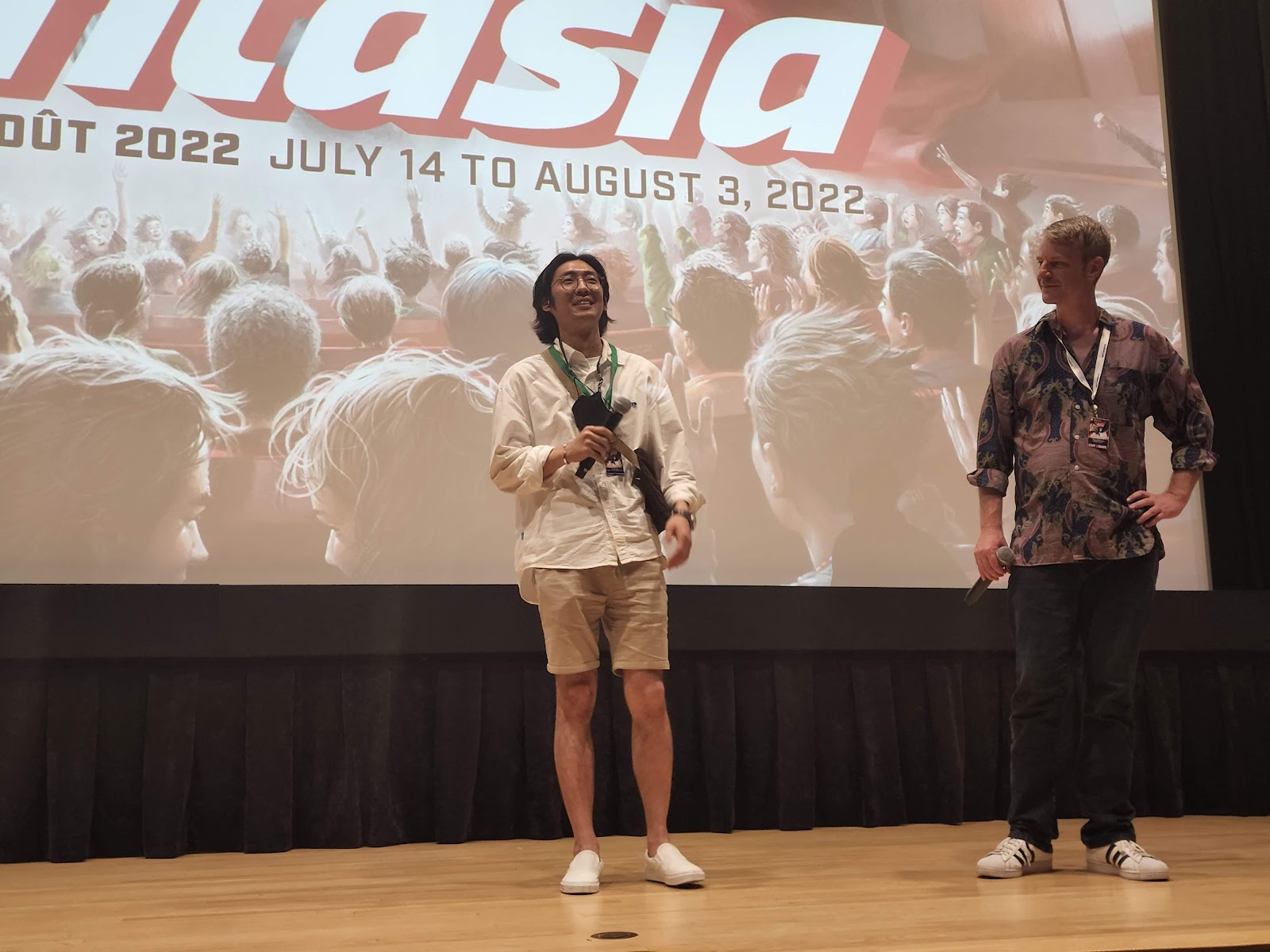
The film itself was part of a special spotlight on Korean animation, and likely the only part I'll wind up seeing, as most of the others are short film packages playing a bit away from the core venues and sometimes in such a way that seeing them would take up two "slots". As animation programmer Rupert Bottenberg pointed out, there is a bunch of great work being done in shorts there, often as part of student projects, but once folks graduate, most animation houses there are doing work for Japanese and other foreign projects, with just the occasional home-grown feature being commissioned by studios. Occasionally one gets interesting enough to make it to the festival circuit - Beauty Water a couple years ago, for example - but it's fairly slim pickings.
Which is a shame. Chun Tae-il isn't necessarily a great movie so much as a noble one, but it's well-made enough to show there's talent there with visions beyond working for someone else.
Next up: Thursday and the start of week two, with All Jacked Up and Full of Worms, Detectives vs. Sleuths, Shin Ultraman, and Glorious.
Chotto omoidashita dake (Just Remembering)
* * * ¼ (out of four)
Seen 20 July 2022 in Salle J.A. De Sève (Fantasia Festival: Camera Lucida, DCP)
If you'd told me that Daigo Matsui and his cast had shot Just Remembering a bit at a time over the past six years and had to integrate covid when they got to the end (or beginning), if believe it; there's a genuine sense of time passing and things taking place at specific moments. That's not the case, apparently, it's "just" a story doled out in reverse order, one day at a time over seven years.
That day happens to be the birthday of Teruo Sako (Sosuke Ikematsu), who in 2021 works as a lighting technician at various stages around Seoul, on this particular night at the ballet. Elsewhere, taxi driver Yo Nobara (Sairi Ito) picks up a musician (Sekaikan Ozaki) who needs to make a pit stop mid-ride. Yo wanders into the theater and sees Teruo semi-awkwardly dancing on the stage after the show is over, and then it's 2020, when Teruo is working at a small rock club and Yo is on an awkward group date with friends after her shift. The guy she bumps into during a smoke break notes that her social-media avatar is a cat which she mentions is an artifact of her time living with her ex-boyfriend. It is, in fact, the same cat that Teruo feeds before going to work each day. And then it's 2019…
Clearly, the two used to be a couple, and the film will eventually get to the end, the good times, and how they meet. It's often all quite straightforward, with a deliberate lack of melodrama: Their relationship highs and lows believably ordinary, with no sense of destiny fulfilled or thwarted, even with major events tending to coincidentally happen on this day. This happens, and some other side story does or doesn't, but there's beauty and melancholy in it. In a way, Matsui's unconventional structure frees him from having to create an arc with conventional foreshadowing or tragic flaws. Things just happen, and there's not necessarily any grand lesson to be learned from it or code to crack, especially when viewed from outside.
Matsui and company have fun with that, though. There's an enjoyable playfulness with the recurring characters who often seem unstuck in time or something other than parallel. There's a man waiting for his wife to return outside Teruo's apartment, saying she's in the future; other characters will say they look familiar whether their encounters are in the past or the future. Jim Jarmusch's Night On Earth looms large in Teruo's apartment - a poster, a frequently-watched DVD where the audience often sees him viewing the Winona Ryder segment, both an indication of how he's probably sort of hung up on Yo years later and a wink at how this film inverts its one-night-in-parallel structure.
There are also a couple really nice performances by the leads - I love the little rasp that strengthens in Sairi Ito's voice as the film goes back in time, something Yo smoothed out as she matured but never lost. There are a lot of signifiers of how Yo seems to gain confidence and maturity over the course of her twenties even though her circumstances seemingly don't change that much, from the cars she drives to standing a little straighter. Teruo has more obvious changes in his life but Sosuke Ikematsu keeps him something closer to level - amiable and appealing and also foolishly stubborn in spots.
There are movies that play this sort of structural game with grander ambitions, but this one does well for being what it is and of its time.
La Vaca Que Cantó Una Canción Hacia El Futuro (The Cow Who Sang a Song Into the Future)
* * ¾ (out of four)
Seen 20 July 2022 in Salle J.A. De Sève (Fantasia Festival: Camera Lucida, DCP)
Movies like The Cow Who Sang a Song Into the Future can be either very easy or very difficult to love depending on the audience's general inclinations; their plan of attack involves going around the parts of the brain that reason, and some of us don't have minds that make that easy. This one's good enough to mostly work with a left-brained type like me, so I suspect it will hit even harder for those who think more symbolically.
It opens with a terrific sequence, music over nature leading the audience to a river, from which a barefoot woman in motorcycle leathers (Mia Maestro) emerges, unspeaking, and eventually heads into a local town, where a man collapses in shock seeing her through a window. That's Enrique (Alfredo Castro), and soon his daughter Cecilia (Leonor Varela) will be arriving with children "Tomas" (Enzo Ferrada) and Alma (Laura del Rio) to join brother Bernado (Marcial Tagle) to look after him as he recovers and help tend to the family dairy farm. The strange woman soon makes her way there, and longtime servant Felicia (María Velásquez) recognizes her as the mother Cecilia witnessed committing suicide decades ago, apparently no older or worse for the wear.
(Tomas is clearly transitioning socially, but if her chosen name is ever stated, I didn't catch it, so that's what I'll use here.)
Maybe there's some bit of Chilean folklore that makes this all seem, if not logical, then natural, but it's not stated, for better or worse. Personally, even when I wind up liking the pieces of something magic realist like this, I often find myself resenting the way it seems to substitute for story or agency. It can feel like a whole genre built on deus ex machina. Like, here, the opening return of the forty-years-gone Magdalena is so striking that it's hard not to be intrigued by just what's going on there, but she's seemingly literally just there to be a catalyst for her descendants rather than someone who has/had her own tumultuous life and issues. Those stories aren't bad at all, but that part of the movie is sort of spread out by the fantasy and the occasional annoying concessions made to it, like Felicia deciding Magdalena's family can't handle their return (even though Tomas and Alma already saw and recognized her) and doing a bit of awkward physical comedy to keep Cecilia from seeing her out a window.
It's a good group to watch, though - Leonor Varela doesn't exactly have a lot to do as Cecilia, really, but she inhabits this woman who is clearly quite capable in a high-stress job as a doctor and doesn't necessarily know how to fully relax and just let things happen around her family. Marcial Tagle sketches out a man who has been penned in by expectations of taking over the family business and not being able to be his own true self (the closet door appears to be open even if he can't step out, so to speak) without really having a full story to call his own. And Mia Maestro does nifty work presenting Magdalena as both some sort of nature-spawned entity and someone with a connection to these people, giving the impression that being simplified to a more primal existence allows her to more easily exist with them.
It's mesmerizing to look at and listen to, though. The unusual musical interludes are memorable and intriguing in the way that they seem to burrow into something about the land that exists outside humanity, or tries to. The apocalyptic-feeling collapse of the family business would be a great metaphor for the family as a whole, and still works well enough in the film. And, I've got to admit, the ability to make a character like "Cow 2222" somehow look disapproving and expressive is an impressive feat.
The Cow Who Sang… could hold together a little better for those of us who value such things, although I don't know how well it would retain its odd beauty if it did. Where it works, it dazzles.
One and Four
* * ¾ (out of four)
Seen 20 July 2022 in Salle J.A. De Sève (Fantasia Festival, DCP)
There certainly seems to be a solid-enough premise for a mystery or noir here, but the filmmakers seem to run into a dead end because, while everyone talks about stripping a genre down to its essentials, there is a limit to how far that can go. Filmmaker Jingme Trinley spends a lot of time near that limit, maybe on the wrong side of it, and it can make even a tight-seeming film start to drag.
The premise is good - Tibetan forest ranger Sangyue (Jinpa) wakes up hungover; he's not supposed to have alcohol at his isolated lookout, but everyone breaks that rule, he's had some bad personal news, and he can go weeks without seeing other people. But today, a man (Wang Zheng) shows up at his door, injured, saying he's a forest cop who has been chasing poacher Ma Chunya. Something about this guy strikes him wrong, but Sangyue is aware he's not at his best, and everything seems to check out.
How to make the situation uncertain enough with just the two of them? It's going to take someone else showing up, but that doesn't happen for a while, and in the meantime, the movie kind of spins its wheels, having the two sit around the station drinking, trying to get potatoes warm enough to eat, and tending wounds, then taking some time in the woods to track down the poacher (or play at doing so) and check out the car crash (one car empty, one dead cop in the passenger seat of the other), but until Sangyue's neighbor/supplier Kunbo (Kunde) arrives, and even more importantly the driver of the other car, there's not a lot of detective work Sangyue can do.
Still, playing it out can be enjoyable in some ways. The environment is appropriately chilly, the forest where humans are out of place can feel enjoyably surreal, and the moments of action are well-staged. The basic set-up of a confused rural villager playing off the more sophisticated guy from further east who nevertheless does not speak Tibetan is a good pairing. Jinpa and Wang Zheng make a good contrast, but there's a lot more blunt yelling than potential mind games.
And on top of that, it's not exactly a satisfying ending, with Trinley resolving a few things but maybe a little too fond of the idea of uncertainty and ambiguity to ruin it by saying too much one way or the other. Which is the problem with stripping things down to essentials - an idea is general and open to everything, but an actual story must be specific, or at least more specific than this movie gets.
Chun Tae-il (aka Chun Tae-il: A Flame That Lives On)
* * * (out of four)
Seen 20 July 2022 in Salle J.A. De Sève (Fantasia Festival: Axis Korean Animation Spotlight, DCP)
The festival introduction stated that part of the idea of this animated film was to expose the story to an audience that includes kids, and I am therefore once again impressed with how hard Korean film will go given half a chance. Who else is gonna make sure their kids know their labor history like this, even among independents?
Chung Tae-Il (voice of Jang Dong-yoon) and his family came from the country but would migrate to the city to work in the clothing industry as that work dried up - mother first, then Tae-il, and eventually the rest, all still children aside from the parents. Tae-il started as a sewer's helper, then was a sewer himself, but at 19 opted to apprentice as a tailor, which was less guaranteed money but the chance at more, and perhaps a necessary step to the family opening its own shop. That being more of a management position put the inequities on the floor into sharp relief - long hours, illness from inhaling lint, and so much child labor - that when he found out that there were actual unenforced laws on the books to prevent this, he jeopardized his position by documenting offenses and attempting to submit a report to the police, only to find the government more interested in building Korean industry than protecting the people working in it.
Hong Jun-pyo's take on Chun's life is a fairly family-friendly version of the story, presenting information in easily-digested chunks with some repetition for it to be clear, but generally not patronizing. There are likely a number of factors left out - no mention of how South Korea's government at the time was more a military dictatorship than a democracy, for instance - and the other organizers likely have a bigger impact than is shown, as the labor movement would go on without Chun. Violence is probably softened a fair amount (especially the climax!), but it results in clarity more than overload.
The visual and animation styles are pleasantly clean - cel-styled people whose features have generally not been exaggerated or overly stylized, digital backgrounds that allow for camera movement that have enough processor cycles allocated for detail if not a lot of wear and irregularity. The style emphasizes the more timeless aspects of the story and characters rather than grounding them in the specific period with fashions or references (though older folks may get a laugh out of the young labor organizers along if anybody knows university students to ask for tips when organizing a demonstration).
It is, all told, an oddly likable story considering how dead serious the subject matter is, but that's how one introduces big ideas to new people.
Boiseu (On The Line aka Voice)
* * ½ (out of four)
Seen 20 July 2022 in Auditorium des Diplõmés de la SGWU (Fantasia Festival, DCP)
I (semi-ironically) use that old saw about when you have a hammer, every problem looks like a nail quite often, but On the Line does frequently feel like the embodiment of it: A movie about infiltrating the voice-phishjng scheme that ruined one's life for revenge seems like it calls for capers and con-artistry, but these the folks making it are action guys, so they're going to use that hammer.
As it opens, Han Seo-joon (Byun Yo-han) is an ex-cop who found there was more money in construction, and it's going well; he's expecting a promotion from foreman to project manager on the next job. But then, disaster strikes - not just a worker potentially falling to his death, but a coordinated communications blackout, barrage of calls to folks like Seo-joon's wife Mi-yeon (Won Jin-a), and fraudulent insurance policies has both workers and company losing everything. With just the name of a fake lawyer and the help of Kkang-chil (Lee Joo-young), a hacker he busted in his old job, he tracks things to a compound in China run by "Director Chan" (Park Myoung-joon) and Mr. Kwak (Kim Mu-yeol). The Korean police are already investigating the operation and tell Han to back off but that's obviously not happening.
You can see what the best version of this movie would be right away, with Han assembling a team and attacking the operation from every direction, only to find Chan seems to have outplanned him, or so it seems. It's an episode of Leverage (which had a South Korean edition), but it's a working formula, and there are enough off-kilter elements to make it interesting here: There's the entire cult-like call center, the writer with the brilliant scripts, the on-site operations.
Instead, the whole thing often comes off kind of clumsily. Han is such an obvious plant on top of being a blunt object quick to hesitate to ruin someone else's life that it seems impossible these meticulous planners would let him rise nearly as quickly as he does based on one reference, and there's really no reason to have both Kwak and Chan except to kill time by having them fight, while the guy writing their scripts is some sort of blackmail victim. There's no intrigue inside the call center worth keeping up with, and Han sneaking away or busting through back rooms never feels like a great undercover operation.
On the other hand, Byun Yo-han is at least a guy who brings a fair amount of charisma to this blue-collar-at-heart guy who is nevertheless smart enough to take on the schemers, coming across as a sort of Korean Gerard Butler. He can throw down in a fun bull-in-a-china-shop way but isn't invincible and lets out righteous fury without seeming to be a prick about it. It's a shame the filmmakers didn't figure out how to pair him with Lee Joo-young more; her hyper-capable techie who isn't nearly as smooth as she thinks she is works as a great complement and she's a natural in ridiculous, dangerous situations. Kim Mu-yeol has some fun chewing scenery - again, in a better movie you might do without Chan and just run with how Kwak sort of spins the same web for his crew that he does for his victims.
Ultimately, this maybe wants to be a little too straightforward, with an ending that feels like a cop show's introduction, making sure the audience feels the righteous fury of the scammed for the scammers. The thing is, the movie never really convinces that this is a problem that can be punched, even if punching is what it's got.


