As I mentioned in the most recent sparsely populated This Week in Tickets, I didn't get to see Breakup Buddies on Friday night despite the fact that a second screen was put on. And while the screen I did see it on Tuesday wasn't huge - maybe a 100-seat room - when you consider that my experience seeing these Chinese day-and-date releases has generally been "me and a half-dozen other people" even on Friday or Saturday, this thing where there are three times that many in the audience on a Tuesday night after that sold-out opening weekend is pleasing but confusing.
I recalled later on that China Lion was giving out free tickets for Friday's show on Facebook, and while it looked like only a few people took them up on it, maybe there were other promotions going on within the local Chinese community that I didn't know about, not being a part of it and all. It makes me wonder if, for whatever reason, Regal and/or their Fenway theater is more willing to grow this sort of release than AMC was - it's worth noting that there was a poster for their next release, The Golden Era, right outside the screen for this one, a simple enough thing that wasn't always done across town. They had an exclusive contract with AMC before (in the US), and I wonder if it was holding them back, especially in areas like Boston where AMC seems a bit skittish about booking foreign films.
Whatever the reason, I'm glad; I'm looking forward to The Golden Era and I see that someone (whether China Lion or AMC) is going to be distributing Johnnie To's Don't Go Breaking My Heart 2 day-and-date in the US next month. And that had better play here.
Anyway, here's the EFC review, and come back after reading it/maybe seeing the movie for a little about something I liked about its ending.
Xin Hua Lu Fang (Breakup Buddies)
* * * (out of four)
Seen 7 October 2014 in Regal Fenway #4 (first-run, DCP)
Director Ning Hao has received some attention over the last few months because the Chinese censor board finally allowed the release of No Man's Land, a movie from 2009 that he is reluctant to discuss, whether for political reasons or because he has been busy with other projects since. But while his latest, Breakup Buddies, is a much less controversial comedy - one which stands on its own well enough to get laughs from someone who buys a ticket based on the title with no idea that the film is in Mandarin - it's kind of amusing to see the main character also not wanting to be reminded of something from five years ago.
The man in question is Geng Hao (Huang Bo), who is reacting to his divorce in the time-honored, healthy manner of sawing everything he and his wife own in half. It's bad enough that his best friend Hao Yi (Xu Zheng) decides to get Geng Hao back on his feet by dragging him (and his dog Juice) along on a 3,000km road trip to deliver props to a film set with plans for one-night-stands - Hao Yi's specialty - along the way. While each encounter with a new woman is a new misadventure and Geng Hao is adamant that the road trip not pass through Dali, a song he recorded in his brief career as a singer has drawn a thirty-something woman ("Yolanda" Yuan Quan) with her own romantic woes to the vacation spot.
Breakup Buddies is an oddly-paced movie at times; Ning Hao takes a script credited to a dozen or so writers between the story and screenplay and lets each episode play out at a pace measured enough that the players can somewhat recognize the strangeness of the hole they've gotten themselves into this time even as they keep digging. It's somewhat questionably put together at times - there must be a deleted scenes that explains Hao Yi's gun, for instance - and a couple of swerves toward the end are kind of great despite the filmmakers seeming to stumble on where to go next before recovering. It's bumpy, but Ning and company do well in keeping a steady stream of chuckles coming without making things so broad that Geng Hao's honest heartbreak isn't out of place even if it doesn't overpower the funny stuff.
Full review at EFC.
SPOILERS!
It's not often a movie gets me to say "you got me" out loud, but when this one circles around to reveal that all the scenes with Yuan Quan take place in 2009 and that she was actually playing Geng Hao's ex-wife Kang Xiaoyu was a legitimately great surprise. They kept it going longer than expected, not just in that it lasts up until the almost the end of the movie, but the scene where the two characters meet plays pretty much like it could be 2014 right until they start writing on the wall and I realize, dang, that's even the same dog.
And while I kind of don't get Juice winding up with Geng Hao (he sure seemed like her dog) how well it worked really surprised and pleased me. It's a moment that feels like it could just be a gotcha, a twist that doesn't mean anything and just leaves the audience feeling empty - I've seen enough of those - I wound up liking that he wasn't going to be handed a new love on a silver platter, and also that it was suddenly very difficult to see Xiaoyu as the villain of the piece. She never really seemed mean on the phone, but going along with Geng Hao's perspective on events had sort of been the default way of looking at it. But now we like her, and not only does that mean maybe it wasn't her fault entirely, but that Geng Hao's attempts to erase her from his life is kind of horrible. The catharsis suddenly seems like too much.
That's a pretty darn impressive way to get those ambiguous feelings across rather than just have the actors spit them out; we feel them a lot more directly this way. And I think that's why I like Breakup Buddies a bit more than I might otherwise, given that it is kind of sloppy in places and not always hilarious. It manages a neat trick, and neat tricks are worth supporting.
!SRELIOPS
Showing posts with label spoilers. Show all posts
Showing posts with label spoilers. Show all posts
Thursday, October 09, 2014


Friday, June 06, 2014
The Signal
Am I allowed to post this right now? I'm half-joking, but studios and the publicity companies they hire can send some mixed messages. I'm pretty sure the email I got about a press screening asked that reviews be held, I think until May 28th, although director William Eubank made the usual request to tweet, post on Facebook, and get the word out. It always makes me wonder whether the same review posted on eFilmCritic, on this blog, on IMDB, as a Letterboxd entry, or inside a Facebook status would only be considered a breach on certain sites. It's happened before.
And, in this case, the request to spread the word did come straight from filmmaker William Eubank, seen here with the Brattle's Ned Hinkle:

A funny thing about independent filmmaking in general and genre work under that umbrella in particular is that filmmakers can be working their butts off to make something happen for years before popping into view again, especially as they're moving up the ladder, so William Eubank's name doesn't mean a whole lot to me until he mentions that his previous film was done with a band and called Love. At that point I have the "oh! That guy/movie!" reaction, remembering the evening I saw that as a pretty weird one because the band's fans took over Hall from the Fantasia regulars, and also that it was another good-looking movie that was a vague mess story-wise (although at the time I just shrugged my shoulders and said "musicians", because what more explanation do you need?). I think I remembered the story of him and his brother building the full-size space station set in their parents' expansive back yard before he mentioned it this time around, but I'm not sure.
This time around, the stories were about how they were sitting in the same facilities as Transcendence and how, as you might expect, the big studio movie got a lot more consideration than his indie. They were able to take some advantage of it, though - apparently Wally Pfister decided he loved the corridors The Signal was shooting, so they were able to get access to some higher-end equipment in trade.
I wish I liked this movie more, if only because between this, Transcendence, Under the Skin, and a few others, I seem to be talking about movie's dressing up as smart science fiction but ending up rather hollow far too much of late, even if there is the likes of Her, The Machine, The Congress, and hopefully Interstellar to compensate. That Eubank seems to be really good at some things makes what doesn't work more disappointing; maybe he's just a guy that needs someone else to write the script.
I've got a few points that involve discussing the whole movie (including the end), but I'll save that for after the EFC excerpt.
The Signal
* * (out of four)
Seen 14 May 2014 in the Brattle Theatre (preview, DCP)
Mystery is not enough. Don't misunderstand, it's terrific when a story gets one to lean closer, tantalized by what's going on, and creating that feeling is a matter of much more than leaving some details out while hinting that others connect in some way. Human beings tend to seen questions and answers as part of pairs, though, building all kinds of ways to get from one to the other, and that's a big part of where The Signal falls down, telling half a story very well but hoping as hard as it can that the audience isn't particularly interested in the rest.
It starts out with three MIT students driving cross-country; Haley (Olivia Cooke) will soon be starting grad school in Pasadena, which will make her relationship with Nic (Brenton Thwaites) even more difficult than the degenerative condition in his legs is already managing. Also along for the ride is Jonah (Beau Knapp), tracking a malicious hacker who got the guys into some trouble. The trail leads to a spot in the desert just a few hours out of their way, but when they get there... Well, things get weird, and the next thing Nic knows, he's waking up in the a windowless facility and a man in a hazmat suit (Laurence Fishburne) is asking him questions he can't answer.
Nested mysteries that aren't all answered at once aren't a bad thing, but co-writer and director William Eubank hits the restrictions of this formula pretty quickly, as Nic and Fishburne's Dr. Wallace Damon sit across from each other at a table, refusing to answer each other's questions out of what seems to be sheer stubbornness, rather than some reason that would make the standoff interesting rather than a stalling tactic. Things eventually start happening, and a lot of the time it gets fairly exciting in the moment, but it's frustrating when an explanation that fits is rendered moot by the need to have mysteries go another level deep, or for Eubank to supply more puzzle pieces and other distractions because the audience is about to figure out what they've got doesn't add up. And that's before just groaning at how revelations seem to come from figuring out word and number puzzles that only seem to exist to give information to prisoners who are supposed to remain in the dark (a firing offense in any massive conspiracy I run, although I'd write a nice letter of recommendation to GAMES Magazine) - or how a character comes out of a coma without explanation just as soon as it goes from convenient to inconvenient.
Full review at EFC
SPOILERS!
I say during the review that there's a bit of a visible arc for Nic, and it's an obvious enough one that I feel a bit dim for not exactly grabbing on to it before I was halfway through the review, but I think that is partially because the movie was content to let it play out in the background, and when push came to shove, valued socks over digging into it.
There are numerous flashback moments in the first act to Nic running by himself in the woods, and I suspect that the point is to show that his legs' current weakness is degenerative, which is why he goes for the "I release you" type of breakup with Haley, establishing a certain sort of lunkheaded nobility. It also contributes to the horrific nature of the second act: He's in a wheelchair, the use of his legs completely gone, more or less what he'd feared from the start.
Except... I don't think they pushed that enough in the beginning. What if we knew from the start that running wasn't just something he used to be able to do, but something that was really important to him. Replace the graduation tassel dangling from his mirror with a track-and-field trophy. Put in scenes where he doesn't recognize that he's almost as good with having as he is with running; really have his self-worth wrecked. That would just amplify the horror of being in the chair in the middle. The scene where he discovered his robotic legs is already terrific, but what if it had that little extra jolt of seeing a huge party of who he is typed away?
And then, after? That scene where he chases down the truck is nifty, but it's pretty utilitarian and could use an injection of "this guy loves to run and now he can run faster than he ever dreamed!" Especially if the filmmakers intended for this all to mean something, even something as small as having the capture not realize that they had given super-legs to someone who knew what to do with them. They could have built a story that was an allegory for someone holding progress back, or how sometimes you've got to start from scratch, or how getting what you want sometimes comes at too dear a price - especially if Haley and Jonah also got augmentations that matched their skills. It would be being awful close to Chronicle or any other alt-superhero story, I suppose, but folks do respond to those rather than just absorb them.
Instead, stuff just keeps happening in ways that bring the audience to a next action scene but don't really reveal a consistent world or motivations afterwards. It all builds to a last scene that is, in its way, pretty much the same as that of Dark City, but without having earned that level of strangeness or giving the audience and characters a moment to ponder and react. In some ways, it circles back around to what I said about mystery at the top: In Dark City, seeing the petri dish-shaped spaceship explicitly and by implication affirms that there is no Shell Beach, that the humans were part of an experiment, and now the time has come to rise up against their captors and make the world their own. In The Signal, it reaffirms that Nic doesn't know what's going on, that his friends died for nothing, and that any sort of answers or resolution will have to wait for a sequel that either won't happen or which, due to how genre cinema acquisitions usually work, will be made by someone else entirely.
Some folks like that sort of thing, but I'm a fan of endings and victories. That the route there comes via better characterization and tighter mythology is a bonus.
!SRELIOPS
And, in this case, the request to spread the word did come straight from filmmaker William Eubank, seen here with the Brattle's Ned Hinkle:
A funny thing about independent filmmaking in general and genre work under that umbrella in particular is that filmmakers can be working their butts off to make something happen for years before popping into view again, especially as they're moving up the ladder, so William Eubank's name doesn't mean a whole lot to me until he mentions that his previous film was done with a band and called Love. At that point I have the "oh! That guy/movie!" reaction, remembering the evening I saw that as a pretty weird one because the band's fans took over Hall from the Fantasia regulars, and also that it was another good-looking movie that was a vague mess story-wise (although at the time I just shrugged my shoulders and said "musicians", because what more explanation do you need?). I think I remembered the story of him and his brother building the full-size space station set in their parents' expansive back yard before he mentioned it this time around, but I'm not sure.
This time around, the stories were about how they were sitting in the same facilities as Transcendence and how, as you might expect, the big studio movie got a lot more consideration than his indie. They were able to take some advantage of it, though - apparently Wally Pfister decided he loved the corridors The Signal was shooting, so they were able to get access to some higher-end equipment in trade.
I wish I liked this movie more, if only because between this, Transcendence, Under the Skin, and a few others, I seem to be talking about movie's dressing up as smart science fiction but ending up rather hollow far too much of late, even if there is the likes of Her, The Machine, The Congress, and hopefully Interstellar to compensate. That Eubank seems to be really good at some things makes what doesn't work more disappointing; maybe he's just a guy that needs someone else to write the script.
I've got a few points that involve discussing the whole movie (including the end), but I'll save that for after the EFC excerpt.
The Signal
* * (out of four)
Seen 14 May 2014 in the Brattle Theatre (preview, DCP)
Mystery is not enough. Don't misunderstand, it's terrific when a story gets one to lean closer, tantalized by what's going on, and creating that feeling is a matter of much more than leaving some details out while hinting that others connect in some way. Human beings tend to seen questions and answers as part of pairs, though, building all kinds of ways to get from one to the other, and that's a big part of where The Signal falls down, telling half a story very well but hoping as hard as it can that the audience isn't particularly interested in the rest.
It starts out with three MIT students driving cross-country; Haley (Olivia Cooke) will soon be starting grad school in Pasadena, which will make her relationship with Nic (Brenton Thwaites) even more difficult than the degenerative condition in his legs is already managing. Also along for the ride is Jonah (Beau Knapp), tracking a malicious hacker who got the guys into some trouble. The trail leads to a spot in the desert just a few hours out of their way, but when they get there... Well, things get weird, and the next thing Nic knows, he's waking up in the a windowless facility and a man in a hazmat suit (Laurence Fishburne) is asking him questions he can't answer.
Nested mysteries that aren't all answered at once aren't a bad thing, but co-writer and director William Eubank hits the restrictions of this formula pretty quickly, as Nic and Fishburne's Dr. Wallace Damon sit across from each other at a table, refusing to answer each other's questions out of what seems to be sheer stubbornness, rather than some reason that would make the standoff interesting rather than a stalling tactic. Things eventually start happening, and a lot of the time it gets fairly exciting in the moment, but it's frustrating when an explanation that fits is rendered moot by the need to have mysteries go another level deep, or for Eubank to supply more puzzle pieces and other distractions because the audience is about to figure out what they've got doesn't add up. And that's before just groaning at how revelations seem to come from figuring out word and number puzzles that only seem to exist to give information to prisoners who are supposed to remain in the dark (a firing offense in any massive conspiracy I run, although I'd write a nice letter of recommendation to GAMES Magazine) - or how a character comes out of a coma without explanation just as soon as it goes from convenient to inconvenient.
Full review at EFC
SPOILERS!
I say during the review that there's a bit of a visible arc for Nic, and it's an obvious enough one that I feel a bit dim for not exactly grabbing on to it before I was halfway through the review, but I think that is partially because the movie was content to let it play out in the background, and when push came to shove, valued socks over digging into it.
There are numerous flashback moments in the first act to Nic running by himself in the woods, and I suspect that the point is to show that his legs' current weakness is degenerative, which is why he goes for the "I release you" type of breakup with Haley, establishing a certain sort of lunkheaded nobility. It also contributes to the horrific nature of the second act: He's in a wheelchair, the use of his legs completely gone, more or less what he'd feared from the start.
Except... I don't think they pushed that enough in the beginning. What if we knew from the start that running wasn't just something he used to be able to do, but something that was really important to him. Replace the graduation tassel dangling from his mirror with a track-and-field trophy. Put in scenes where he doesn't recognize that he's almost as good with having as he is with running; really have his self-worth wrecked. That would just amplify the horror of being in the chair in the middle. The scene where he discovered his robotic legs is already terrific, but what if it had that little extra jolt of seeing a huge party of who he is typed away?
And then, after? That scene where he chases down the truck is nifty, but it's pretty utilitarian and could use an injection of "this guy loves to run and now he can run faster than he ever dreamed!" Especially if the filmmakers intended for this all to mean something, even something as small as having the capture not realize that they had given super-legs to someone who knew what to do with them. They could have built a story that was an allegory for someone holding progress back, or how sometimes you've got to start from scratch, or how getting what you want sometimes comes at too dear a price - especially if Haley and Jonah also got augmentations that matched their skills. It would be being awful close to Chronicle or any other alt-superhero story, I suppose, but folks do respond to those rather than just absorb them.
Instead, stuff just keeps happening in ways that bring the audience to a next action scene but don't really reveal a consistent world or motivations afterwards. It all builds to a last scene that is, in its way, pretty much the same as that of Dark City, but without having earned that level of strangeness or giving the audience and characters a moment to ponder and react. In some ways, it circles back around to what I said about mystery at the top: In Dark City, seeing the petri dish-shaped spaceship explicitly and by implication affirms that there is no Shell Beach, that the humans were part of an experiment, and now the time has come to rise up against their captors and make the world their own. In The Signal, it reaffirms that Nic doesn't know what's going on, that his friends died for nothing, and that any sort of answers or resolution will have to wait for a sequel that either won't happen or which, due to how genre cinema acquisitions usually work, will be made by someone else entirely.
Some folks like that sort of thing, but I'm a fan of endings and victories. That the route there comes via better characterization and tighter mythology is a bonus.
!SRELIOPS
Wednesday, April 23, 2014
Oculus
I bumped into my friend Chris Hallock before this movie; he was there to host a screening in the Somerville Theatre's micro-cinema and also catch Klute afterward, but he was also really excited about this one, having binged on director Mike Flanagan's work in order to do an interview for Diabolique magazine. That meant he had already watched it twice before opening day (but not the short which inspired it) and wanted to hear what others made of it, especially since a few folks he though would dig it didn't care for it at all. I'm going to have to pick up a copy to read his piece, just to see if the trends I'm noticing in Flanagan's film's (mostly for the better) are deliberate or just me seeing things.
Of course, you've got to talk about the end for that, which (as usual) will be after the main review.
Oculus
* * * ½ (out of four)
Seen 11 April 2014 in Somerville Theatre #4 (first-run, DCP)
I likely won't actually have the time to sit down and plot out what the characters are doing to check and see if it all fits together when Oculus is released on video, but I'd kind of like to do so. While one does not really need an excuse to watch a fine horror movie again, there's something especially admirable about the ones which take pride in their intricate construction, especially when they are still able to provide legitimate jumps.
This one starts, more or less, with 21-year-old Tim Russell (Brenton Thwaites) being released from the mental institution where he has spent half of his life since the death of his father (Rory Cochrane). Back then, young Tim and his sister Kaylie (Garrett Ryan & Annalise Basso) said a haunted mirror was behind what happened to their father and mother (Katee Sackhofff), but Tim has put that delusion behind him and is anxious to see his sister again. As for Kaylie (Karen Gillan), she thinks Tim was released just in time - she has found the mirror and wants Tim to help her kill it.
The believer/skeptic pairing has been a part of stories about the paranormal for about as long as there has been science to suggest that the things that go bump on the night are products of our imaginations, but it's almost never as well-deployed as what director Mike Flanagan and co-writer Jeff Howard do here. Most of the time, one is set up to look foolish, and frustratingly for me, it's usually the man of science being taken down a peg for trying to approach a question rationally. And while something like that must inevitably happen here, it's built so that Kaylie and Tim are both, in their ways, highly rational, coming at the situation in ways that make perfect sense from their own experiences. That Flanagan & Howard opt to invert some of the usual tropes and have believer Kaylie be the tougher older sister of the presumably fragile skeptic Tim is a fun bonus.
Full review at EFC
SPOILERS!
I mentioned that I would have liked to see the setup used as a film noir rather than a horror movie when I saw Absentia at Fantasia a couple years ago, and while I might not necessarily go that far with Oculus, I couldn't help but notice that there's potentially a great movie about dealing with heritable mental illness hiding within it. Sometimes that disguise is barely there, but it makes me kind of curious about the shape of Flanagan's career going forward. For supernatural horror movies, both Absentia and Oculus have unusually well-developed and specific relationships between the core characters and monsters that only rarely step into the foreground. That could just be less-is-more storytelling, or it could be a hint that they aren't really what he wants to talk about, but jumps and mythology get the genre audience's attention, and it's only fair to give the viewer what they paid to see.
Similarly, I notice that both movies are built around characters recovering from an emotional trauma in their past, be it a husband who vanished into thin air or a horrific way to lose one parents. Lots of movies do this, of course - it's a quick way to make characters interesting - but there's a pattern here: Paperwork to put something in the past, a reunion with one's sister, and, generally the situation dragging the protagonists back, even if one just wants to move on and the other is just trying to be helpful. Recovery seems to be a central theme in Flanagan's film's, not just the hook needed to give the main character an arc because folks look down on your spooky story if it doesn't feature personal growth.
Heck, I'm arguably one of those people; it certainly plays into why I initially found the end of both movies kind of disappointing. What are horror stories about, after all, if not facing one's past and triumphing over it? That means I tend to find "one last scare" moments or characters not being able to literally slay their demons unsatisfying; its usually a last-minute swerve meant to be unpredictable rather than feeling like the summation of all that has happened. So I didn't like Tim "ironically" ending up right where he started, especially as I was still feeling a bit of "you can't kill Amy Pond!" anger. A little bit of thought later, and it thematically fits much better, especially when you consider that image of Kaylie quite literally stuck to the object of her obsession with an anchor: Her consuming mania didn't just drag her down, but him as well - by not leaving her behind he got pulled back to where he was. I still don't love the ending - I want the one where they are literally and figuratively able to see clearly, walk away from the house, and let the mechanisms they've constructed do their jobs - but I do see its merits.
!SRELIOPS
On the plus side, I loved that young Tim and Kaylie played with what looked like Atari Lynxes in the flashbacks. Aside from being a reminder that Atari existed, the units being connected in a way that Game Boys weren't at the time (and a Wi-Fi connection doesn't get the same point across as a cord) helps subtly reinforce that the siblings are connected as well. I suspect that there's a lot of little stuff like that going on that a second viewing will reveal, and I love that the filmmakers have taken that sort of care.
Of course, you've got to talk about the end for that, which (as usual) will be after the main review.
Oculus
* * * ½ (out of four)
Seen 11 April 2014 in Somerville Theatre #4 (first-run, DCP)
I likely won't actually have the time to sit down and plot out what the characters are doing to check and see if it all fits together when Oculus is released on video, but I'd kind of like to do so. While one does not really need an excuse to watch a fine horror movie again, there's something especially admirable about the ones which take pride in their intricate construction, especially when they are still able to provide legitimate jumps.
This one starts, more or less, with 21-year-old Tim Russell (Brenton Thwaites) being released from the mental institution where he has spent half of his life since the death of his father (Rory Cochrane). Back then, young Tim and his sister Kaylie (Garrett Ryan & Annalise Basso) said a haunted mirror was behind what happened to their father and mother (Katee Sackhofff), but Tim has put that delusion behind him and is anxious to see his sister again. As for Kaylie (Karen Gillan), she thinks Tim was released just in time - she has found the mirror and wants Tim to help her kill it.
The believer/skeptic pairing has been a part of stories about the paranormal for about as long as there has been science to suggest that the things that go bump on the night are products of our imaginations, but it's almost never as well-deployed as what director Mike Flanagan and co-writer Jeff Howard do here. Most of the time, one is set up to look foolish, and frustratingly for me, it's usually the man of science being taken down a peg for trying to approach a question rationally. And while something like that must inevitably happen here, it's built so that Kaylie and Tim are both, in their ways, highly rational, coming at the situation in ways that make perfect sense from their own experiences. That Flanagan & Howard opt to invert some of the usual tropes and have believer Kaylie be the tougher older sister of the presumably fragile skeptic Tim is a fun bonus.
Full review at EFC
SPOILERS!
I mentioned that I would have liked to see the setup used as a film noir rather than a horror movie when I saw Absentia at Fantasia a couple years ago, and while I might not necessarily go that far with Oculus, I couldn't help but notice that there's potentially a great movie about dealing with heritable mental illness hiding within it. Sometimes that disguise is barely there, but it makes me kind of curious about the shape of Flanagan's career going forward. For supernatural horror movies, both Absentia and Oculus have unusually well-developed and specific relationships between the core characters and monsters that only rarely step into the foreground. That could just be less-is-more storytelling, or it could be a hint that they aren't really what he wants to talk about, but jumps and mythology get the genre audience's attention, and it's only fair to give the viewer what they paid to see.
Similarly, I notice that both movies are built around characters recovering from an emotional trauma in their past, be it a husband who vanished into thin air or a horrific way to lose one parents. Lots of movies do this, of course - it's a quick way to make characters interesting - but there's a pattern here: Paperwork to put something in the past, a reunion with one's sister, and, generally the situation dragging the protagonists back, even if one just wants to move on and the other is just trying to be helpful. Recovery seems to be a central theme in Flanagan's film's, not just the hook needed to give the main character an arc because folks look down on your spooky story if it doesn't feature personal growth.
Heck, I'm arguably one of those people; it certainly plays into why I initially found the end of both movies kind of disappointing. What are horror stories about, after all, if not facing one's past and triumphing over it? That means I tend to find "one last scare" moments or characters not being able to literally slay their demons unsatisfying; its usually a last-minute swerve meant to be unpredictable rather than feeling like the summation of all that has happened. So I didn't like Tim "ironically" ending up right where he started, especially as I was still feeling a bit of "you can't kill Amy Pond!" anger. A little bit of thought later, and it thematically fits much better, especially when you consider that image of Kaylie quite literally stuck to the object of her obsession with an anchor: Her consuming mania didn't just drag her down, but him as well - by not leaving her behind he got pulled back to where he was. I still don't love the ending - I want the one where they are literally and figuratively able to see clearly, walk away from the house, and let the mechanisms they've constructed do their jobs - but I do see its merits.
!SRELIOPS
On the plus side, I loved that young Tim and Kaylie played with what looked like Atari Lynxes in the flashbacks. Aside from being a reminder that Atari existed, the units being connected in a way that Game Boys weren't at the time (and a Wi-Fi connection doesn't get the same point across as a cord) helps subtly reinforce that the siblings are connected as well. I suspect that there's a lot of little stuff like that going on that a second viewing will reveal, and I love that the filmmakers have taken that sort of care.
Tuesday, June 18, 2013
Shadow Dancer
So, there's this guy I see at the Kendall Square 'plex every few weeks, often winding up in the same theater I do because if you go to the movies often enough, you'll be seeing a lot of movies opening weekend, and so your paths will cross with the other frequent cinemagoers. We've had the same conversation a few times, involving him asking me if I see a lot of movies and how they play a lot of good movies here. It's a short conversation, because I'm not really a gregarious guy. Anyway, this time he wound up seated two seats away from me, with a big bag full of lunch, and he actually got a flashlight out while the movie was running to rummage around in it and brush his crumbs off and such. Poor form, guy, way worse than the seniors on my other side who had to fill every moment between previews (and a few quiet moments in the film) with talk.
Anyway, he buttonholed me afterward (he had a big old cane and needed someone to find the Diet Coke he dropped midway through the movie) and started asking questions. Not necessarily bad questions, although he didn't get to the ones that were really worth discussing. Since they tend to involve the end of the movie, I'm going to talk about them after the review.
Anyway, it's sort of a weird thing - as much as I go to the movies in the theater in large part to experience it with a crowd of strangers, I don't necessarily want to talk to them, and I'm sorry if I came across as brusque or rude to this guy. But, still - he had a flashlight!
Now, here's hoping that I don't wake up tomorrow and find a note from the EFC contributor who lives in Northern Ireland saying I don't know what the heck I'm talking about!
Shadow Dancer
* * * ½ (out of four)
Seen 15 June 2013 in Landmark Kendall Square #4 (first-run, DCP)
There's a twenty-year jump early in Shadow Dancer, from 1973 to 1993, and another twenty years between then and the present day, and there's something appealing about that sort of symmetry, especially with the reminders in the background that this was sort of a turning point in the area's history. What's left of the Provisional Irish Republican Army is pretty quiet these days (at least, not in America), and it makes me wonder if the events of this nifty little spy story feel closer to the past or the present.
What happened in 1973 certainly had an impact on Collette McVeigh; when we see her in 1993 (Andrea Riseborough), she's taking a trip to London, eventually dropping a satchel in the middle of the Underground. The cops are on to her, though, and she's offered a deal: Spy on the IRA cell that includes her brothers Gerry (Aidan Gillen) and Connor (Domhall Gleeson), and she an go back to living quietly with her mother (Brid Brennan) and son (Cathal Maguire). She reluctantly agrees, but she's attracted the attention of IRA ratcatcher Kevin Mulville (David Wilmot); meanwhile, her handler Mac (Clive Owen) discovers that his supervisor (Gillian Anderson) has not briefed him on the entire operation.
Shadow Dancer is a fairly short movie, but it's just big enough to have multiple angles, shifting its focus from chess match to questions of personal loyalty for both Collette and Mac and back again so that even though the two are intertwined, the audience can focus on one or the other in a given moment. It's a delicate balancing act, especially once the director James Marsh and writer Tom Bradby (who penned both the screenplay and the novel it was based upon) pull away from the walls tightening on Collette and move on to dropping some revelations and reversals on the audience. It's the sort of twisting that can leave some in the audience confused as the movie ends, but is still quite satisfying, especially as the actions of relatively minor characters seem more important in hindsight.
Full review on EFC
SPOILERS!
The movie does merit a little discussion of the details that may not be clear. I kind of think the questions this guy wanted answers to were more or less irrelevant, but there's something underneath that bugs me.
First question: Who actually killed Collette's brother in 1973, which arguably set her on the Republican path? My answer was "it doesn't matter", and it really doesn't - Collette thought it was the Brits, Mac showed her evidence that it was IRA friendly-fire to try and turn her, but who cares? Each fact did its job of motivating Collette, and while I don't know that MI-5 could have faked the evidence convincingly in 1993, it almost doesn't matter: In 1973, who actually fired the shot that killed Sean wasn't as important as the fat that a fight for which she blamed the British took him, and in 1993, the fact that Mac used it was crass.
Second question: Why did the PIRA kill Mac with the car bomb? Well, I don't figure they need any reason beyond him being MI-5, and when the PIRA knew where one of those guys was going to be, he got a bomb in his car. I suppose, technically, they might have been covering up some loose ends - he was the only one who could figure out that Collette was a double agent, thus leaving her out of danger - but it might just have been a crime of opportunity. Or, alternately, Collette feeding the PIRA where and when a British spy would be could be her price for not ending up with a bullet in the head like her mother.
I don't think the latter is the case - these guys don't seem like the types to consider her books balanced against Brendan's death just because she gave up one Brit. But if it's not, that means she was a double agent all along. I'm pretty sure that's what the idea of the film was, and in fact, they pretty much lay the possibility out right in the beginning with Mac describing how she might have deliberately not set the bomb's timer (or subconsciously not done so). Of course, he's just arrogant enough to think that's because she doesn't have it in her to be a killer or that she (like her mother presumably does) sees this as a way to hasten the end of the conflict, when, instead, she's trying to gain his trust in the hopes of shaking the real traitor loose.
And... I don't know if that makes a whole lot of sense. On the one hand, it seems like something of a high-risk move on the IRA's part; if it doesn't work, then Collette's in jail and for what? If she gets someone like Kate as her handler who can't be easily manipulated, they're similarly out of luck (although maybe they can eventually use Collette to send false information, so it's not a total loss). Plus, if you figure that this is ultimately Kevin Mulville's plan, he certainly seems to go through a lot of theater to pretend that he really thinks Collette is a traitor. Then again, I don't know if he ever does so when it's just the two of them.
It works, I guess, but I suppose I'd have to give it a second viewing to see if it really fits together, or whether important bits are just being played out for the cinema audience. That's always a tricky thing with stories that rely on this sort of misdirection, and while I think it's more likely than not everything holds together, that's more a 60% level of certainty than a 90% one.
!SRELIOPS
Anyway, he buttonholed me afterward (he had a big old cane and needed someone to find the Diet Coke he dropped midway through the movie) and started asking questions. Not necessarily bad questions, although he didn't get to the ones that were really worth discussing. Since they tend to involve the end of the movie, I'm going to talk about them after the review.
Anyway, it's sort of a weird thing - as much as I go to the movies in the theater in large part to experience it with a crowd of strangers, I don't necessarily want to talk to them, and I'm sorry if I came across as brusque or rude to this guy. But, still - he had a flashlight!
Now, here's hoping that I don't wake up tomorrow and find a note from the EFC contributor who lives in Northern Ireland saying I don't know what the heck I'm talking about!
Shadow Dancer
* * * ½ (out of four)
Seen 15 June 2013 in Landmark Kendall Square #4 (first-run, DCP)
There's a twenty-year jump early in Shadow Dancer, from 1973 to 1993, and another twenty years between then and the present day, and there's something appealing about that sort of symmetry, especially with the reminders in the background that this was sort of a turning point in the area's history. What's left of the Provisional Irish Republican Army is pretty quiet these days (at least, not in America), and it makes me wonder if the events of this nifty little spy story feel closer to the past or the present.
What happened in 1973 certainly had an impact on Collette McVeigh; when we see her in 1993 (Andrea Riseborough), she's taking a trip to London, eventually dropping a satchel in the middle of the Underground. The cops are on to her, though, and she's offered a deal: Spy on the IRA cell that includes her brothers Gerry (Aidan Gillen) and Connor (Domhall Gleeson), and she an go back to living quietly with her mother (Brid Brennan) and son (Cathal Maguire). She reluctantly agrees, but she's attracted the attention of IRA ratcatcher Kevin Mulville (David Wilmot); meanwhile, her handler Mac (Clive Owen) discovers that his supervisor (Gillian Anderson) has not briefed him on the entire operation.
Shadow Dancer is a fairly short movie, but it's just big enough to have multiple angles, shifting its focus from chess match to questions of personal loyalty for both Collette and Mac and back again so that even though the two are intertwined, the audience can focus on one or the other in a given moment. It's a delicate balancing act, especially once the director James Marsh and writer Tom Bradby (who penned both the screenplay and the novel it was based upon) pull away from the walls tightening on Collette and move on to dropping some revelations and reversals on the audience. It's the sort of twisting that can leave some in the audience confused as the movie ends, but is still quite satisfying, especially as the actions of relatively minor characters seem more important in hindsight.
Full review on EFC
SPOILERS!
The movie does merit a little discussion of the details that may not be clear. I kind of think the questions this guy wanted answers to were more or less irrelevant, but there's something underneath that bugs me.
First question: Who actually killed Collette's brother in 1973, which arguably set her on the Republican path? My answer was "it doesn't matter", and it really doesn't - Collette thought it was the Brits, Mac showed her evidence that it was IRA friendly-fire to try and turn her, but who cares? Each fact did its job of motivating Collette, and while I don't know that MI-5 could have faked the evidence convincingly in 1993, it almost doesn't matter: In 1973, who actually fired the shot that killed Sean wasn't as important as the fat that a fight for which she blamed the British took him, and in 1993, the fact that Mac used it was crass.
Second question: Why did the PIRA kill Mac with the car bomb? Well, I don't figure they need any reason beyond him being MI-5, and when the PIRA knew where one of those guys was going to be, he got a bomb in his car. I suppose, technically, they might have been covering up some loose ends - he was the only one who could figure out that Collette was a double agent, thus leaving her out of danger - but it might just have been a crime of opportunity. Or, alternately, Collette feeding the PIRA where and when a British spy would be could be her price for not ending up with a bullet in the head like her mother.
I don't think the latter is the case - these guys don't seem like the types to consider her books balanced against Brendan's death just because she gave up one Brit. But if it's not, that means she was a double agent all along. I'm pretty sure that's what the idea of the film was, and in fact, they pretty much lay the possibility out right in the beginning with Mac describing how she might have deliberately not set the bomb's timer (or subconsciously not done so). Of course, he's just arrogant enough to think that's because she doesn't have it in her to be a killer or that she (like her mother presumably does) sees this as a way to hasten the end of the conflict, when, instead, she's trying to gain his trust in the hopes of shaking the real traitor loose.
And... I don't know if that makes a whole lot of sense. On the one hand, it seems like something of a high-risk move on the IRA's part; if it doesn't work, then Collette's in jail and for what? If she gets someone like Kate as her handler who can't be easily manipulated, they're similarly out of luck (although maybe they can eventually use Collette to send false information, so it's not a total loss). Plus, if you figure that this is ultimately Kevin Mulville's plan, he certainly seems to go through a lot of theater to pretend that he really thinks Collette is a traitor. Then again, I don't know if he ever does so when it's just the two of them.
It works, I guess, but I suppose I'd have to give it a second viewing to see if it really fits together, or whether important bits are just being played out for the cinema audience. That's always a tricky thing with stories that rely on this sort of misdirection, and while I think it's more likely than not everything holds together, that's more a 60% level of certainty than a 90% one.
!SRELIOPS
Tuesday, April 24, 2012
This Week In Tickets: 16 April 2012 - 22 April 2012
Hey, rest of the country, why don't you have Patriot's Day like Maine and Massachusetts do? Sure, it's more of an elective holiday than one that everybody gets these days, but if you do take it, it's a day off when spring is just getting nice, an excuse for day baseball, and, when things fall just right, an extra day you can procrastinate on your tax returns. Plus, as you can see...
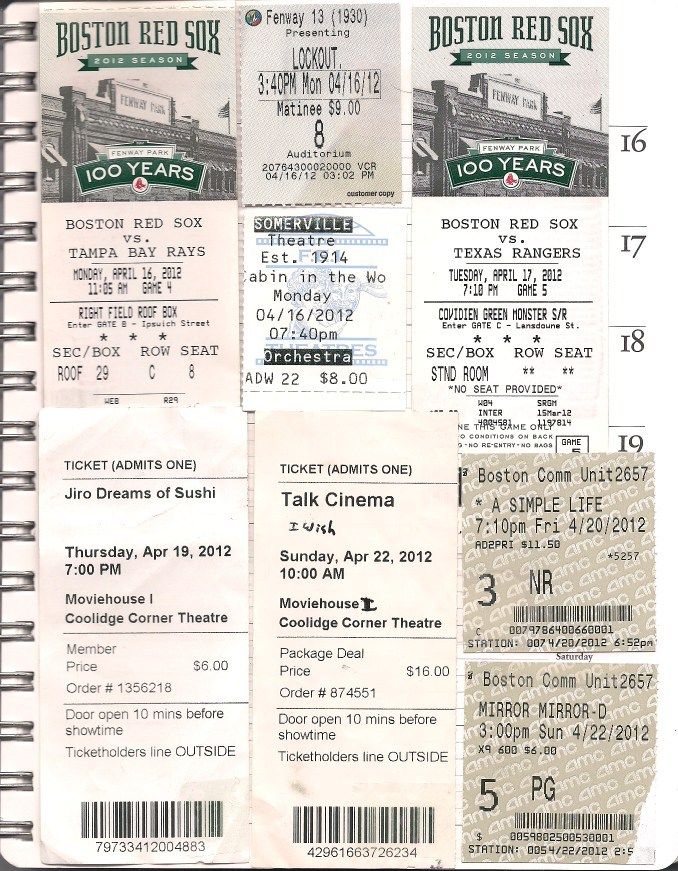
... it's as good a reason to hit up a weekday matinee as any. Heck, for me it's almost mandatory, as the direct route between Fenway Park and my house crosses that of the Boston Marathon, and I can tell you from personal experience that there's no crossing it on foot. On a day as hot as that one was, there is no good reason not to jump into the theater and wait it out for a couple of hours.
I wish I could say Patriot's Day was great from start to finish, but the Red Sox lost and Lockout was only so-so. Things improved quite a bit when I made it to Davis Square, though - a "King" at Boston Burger Company and scoring the big room and a decent crowd for a Monday to see The Cabin in the Woods on 35mm improves pretty much any day.
Tuesday's game - ugh. On the one hand, I got to hang out with my brothers on top of the Green Monster for a while, with Dan plenty excited about Private Stage, the local music show he's been trying to get off the ground practically ever since he started working for a TV station in Portland, Maine, and that's always good. On the other hand, it was an ugly loss (a prelude to the incredible ugliness to come on Saturday) and got kind of chilly by the end of the game.
Lockout
* * ½ (out of four)
Seen 16 April 2012 in Regal Fenway #8 (first-run, Sony Digital 4K)
Why, I wonder, does somebody make a movie this high-concept and goofy and give it a name as generic as "Lockout"? It begs for something self-awarely pulpy, like "Assault on Space Prison One!" (the exclamation point is crucial; without it, you're open to being called blandly descriptive, but with it, you're winking at the audience). Heck, even "Lock-Up" would be okay, because, get it, up, like in orbit? But, no, instead you've got "Lockout", reflecting what a kind of generic movie this is despite the makers' best intentions.
Don't get me wrong, it's fun - stars Guy Pearce and Maggie Grace are a quality odd couple, the type that get on each others' nerves because they're more alike than their different backgrounds would suggest. They banter well, and directors James Mather and Stephen St. Leger (who wrote the script with Luc Besson) use that without making a joke of the action. And while some may sniff at the action scene that opens the movie and its bargain-basement effects, I kind of dig it; it says that Mather & St. Leger have more crazy than money and aren't going to let them hold them back. They seem to know just how goofy "space prison" sounds.
But, boy, could this movie have used some better villains. The two brothers leading the riot on Maximum Security One might as well just be called Scottish Nutjob and Scottish Gangster, and the framing story is even more generic. None of the action scenes are staged in a particularly memorable manner, and forget having one make use of free fall or the threats of decompression or radiation, which sort of defeats the point of setting it in orbit.
Back when Escape from L.A. was coming out, John Carpenter talked about wanting to make that a trilogy with "Escape from Earth". I'm not sure latter-day Carpenter would have had something cooler than Lockout in him, but for all this one wants to remind of us Carpenter's Escapes with its loner sent into a high-concept prison to liberate the President's daughter, it needed to use its setting more and create some memorable characters.
The Cabin in the Woods
* * * ½ (out of four)
Seen 16 April 2012 in Somerville Theatre #1 (first-run, 35mm)
Well, that was a ton of good fun, with a very nice cast, a clever premise, and a few moments that put a big smile on my face for how absolutely right they are. I love the injection of guys like Richard Jenkins and Bradley Whitford into this riff on The Evil Dead; they're talented guys who wouldn't be near this movie unless it was more than it appeared to be. And I am very impressed how the movie eventually turns me around on a character I just hated at first sight.
It's good enough that I wish it were perfect, but it's got a few problems that are not exactly small. The main one is that, like a lot of horror movies with a comedic component, it undercuts its scares too much. The kills too quickly cut to a punchline, and while writers Drew Goddard and Joss Whedon initially do a good job of shifting the horror to a new target, it doesn't really stick.
Somewhat related is how (SPOILERS!) going meta makes the movie just a bit hollow. Everything in Cabin is about horror movies themselves, sort of making the point that they've become formulaic out of laziness, which is too bad, because we need scary stories as an outlet to keep the real monsters (Elder Gods/darkness of the human soul) chained up. It's a bit problematic, though; as much as the main thrust is about wanting more creativity and less been-there-seen-that, there is a strong stick-to-the-template message. And then there's the same issue I have with The Midnight Meat Train - I want the optimist/atheist ending, the one where the survivors give the monsters the middle finger and say that they might have been hot shit back when people were primitive with no understanding of the universe, but we're through sending you human sacrifices and if you try to breach our dimension again, we'll drop a nuke in yours. In short, we solve problems in the twenty-first century rather than appease monsters.
Sure, that's not really what the movie is about, but in some ways, the meta-commentary is subtle and contradictory enough that it's not hard to think of what Cabin says about people rather than its genre. (!SRELIOPS)
Mirror Mirror
* * ¾ (out of four)
Seen 22 April 2012 in AMC Boston Common #5 (first-run, Sony Digital 4K)
Well, that's what a Tarsem Singh Dhandwar family movie looks like. Just strange all around - having previously gone an average of five years between films, all of which were thematically dark and gritty, this pleasantly fluffy concoction comes just a few months after Immortals. While I knew Tarsem was doing one of the dueling Snow White movies coming out this year, up until very recently I would have bet on Snow White and the Huntsman Kristen Stewart, just based on the looks of them.
Still, Tarsem does all right here - like most of his movies, he embraces artificiality, whether in terms of elaborate and absurd costumes or not caring if a set looks like a set. The whole movie has a nifty storybook look, and when the script by Jason Keller and Melisa Wallack hits a snappy patch, he and the cast do pretty well by it. That's especially true of the seven actors playing the dwarves - it's almost like having the whole lot on-screen at once forces the filmmakers to pick up the pace a little, while the space Julia Roberts, Lily Collins, and Armie Hammer are given in their more spacious sets seems to isolate them timing-wise.
The kids in the theater seemed to dig it, though, and it is kind of their speed: Clever enough, but not requiring a whole lot from the audience.

... it's as good a reason to hit up a weekday matinee as any. Heck, for me it's almost mandatory, as the direct route between Fenway Park and my house crosses that of the Boston Marathon, and I can tell you from personal experience that there's no crossing it on foot. On a day as hot as that one was, there is no good reason not to jump into the theater and wait it out for a couple of hours.
I wish I could say Patriot's Day was great from start to finish, but the Red Sox lost and Lockout was only so-so. Things improved quite a bit when I made it to Davis Square, though - a "King" at Boston Burger Company and scoring the big room and a decent crowd for a Monday to see The Cabin in the Woods on 35mm improves pretty much any day.
Tuesday's game - ugh. On the one hand, I got to hang out with my brothers on top of the Green Monster for a while, with Dan plenty excited about Private Stage, the local music show he's been trying to get off the ground practically ever since he started working for a TV station in Portland, Maine, and that's always good. On the other hand, it was an ugly loss (a prelude to the incredible ugliness to come on Saturday) and got kind of chilly by the end of the game.
Lockout
* * ½ (out of four)
Seen 16 April 2012 in Regal Fenway #8 (first-run, Sony Digital 4K)
Why, I wonder, does somebody make a movie this high-concept and goofy and give it a name as generic as "Lockout"? It begs for something self-awarely pulpy, like "Assault on Space Prison One!" (the exclamation point is crucial; without it, you're open to being called blandly descriptive, but with it, you're winking at the audience). Heck, even "Lock-Up" would be okay, because, get it, up, like in orbit? But, no, instead you've got "Lockout", reflecting what a kind of generic movie this is despite the makers' best intentions.
Don't get me wrong, it's fun - stars Guy Pearce and Maggie Grace are a quality odd couple, the type that get on each others' nerves because they're more alike than their different backgrounds would suggest. They banter well, and directors James Mather and Stephen St. Leger (who wrote the script with Luc Besson) use that without making a joke of the action. And while some may sniff at the action scene that opens the movie and its bargain-basement effects, I kind of dig it; it says that Mather & St. Leger have more crazy than money and aren't going to let them hold them back. They seem to know just how goofy "space prison" sounds.
But, boy, could this movie have used some better villains. The two brothers leading the riot on Maximum Security One might as well just be called Scottish Nutjob and Scottish Gangster, and the framing story is even more generic. None of the action scenes are staged in a particularly memorable manner, and forget having one make use of free fall or the threats of decompression or radiation, which sort of defeats the point of setting it in orbit.
Back when Escape from L.A. was coming out, John Carpenter talked about wanting to make that a trilogy with "Escape from Earth". I'm not sure latter-day Carpenter would have had something cooler than Lockout in him, but for all this one wants to remind of us Carpenter's Escapes with its loner sent into a high-concept prison to liberate the President's daughter, it needed to use its setting more and create some memorable characters.
The Cabin in the Woods
* * * ½ (out of four)
Seen 16 April 2012 in Somerville Theatre #1 (first-run, 35mm)
Well, that was a ton of good fun, with a very nice cast, a clever premise, and a few moments that put a big smile on my face for how absolutely right they are. I love the injection of guys like Richard Jenkins and Bradley Whitford into this riff on The Evil Dead; they're talented guys who wouldn't be near this movie unless it was more than it appeared to be. And I am very impressed how the movie eventually turns me around on a character I just hated at first sight.
It's good enough that I wish it were perfect, but it's got a few problems that are not exactly small. The main one is that, like a lot of horror movies with a comedic component, it undercuts its scares too much. The kills too quickly cut to a punchline, and while writers Drew Goddard and Joss Whedon initially do a good job of shifting the horror to a new target, it doesn't really stick.
Somewhat related is how (SPOILERS!) going meta makes the movie just a bit hollow. Everything in Cabin is about horror movies themselves, sort of making the point that they've become formulaic out of laziness, which is too bad, because we need scary stories as an outlet to keep the real monsters (Elder Gods/darkness of the human soul) chained up. It's a bit problematic, though; as much as the main thrust is about wanting more creativity and less been-there-seen-that, there is a strong stick-to-the-template message. And then there's the same issue I have with The Midnight Meat Train - I want the optimist/atheist ending, the one where the survivors give the monsters the middle finger and say that they might have been hot shit back when people were primitive with no understanding of the universe, but we're through sending you human sacrifices and if you try to breach our dimension again, we'll drop a nuke in yours. In short, we solve problems in the twenty-first century rather than appease monsters.
Sure, that's not really what the movie is about, but in some ways, the meta-commentary is subtle and contradictory enough that it's not hard to think of what Cabin says about people rather than its genre. (!SRELIOPS)
Mirror Mirror
* * ¾ (out of four)
Seen 22 April 2012 in AMC Boston Common #5 (first-run, Sony Digital 4K)
Well, that's what a Tarsem Singh Dhandwar family movie looks like. Just strange all around - having previously gone an average of five years between films, all of which were thematically dark and gritty, this pleasantly fluffy concoction comes just a few months after Immortals. While I knew Tarsem was doing one of the dueling Snow White movies coming out this year, up until very recently I would have bet on Snow White and the Huntsman Kristen Stewart, just based on the looks of them.
Still, Tarsem does all right here - like most of his movies, he embraces artificiality, whether in terms of elaborate and absurd costumes or not caring if a set looks like a set. The whole movie has a nifty storybook look, and when the script by Jason Keller and Melisa Wallack hits a snappy patch, he and the cast do pretty well by it. That's especially true of the seven actors playing the dwarves - it's almost like having the whole lot on-screen at once forces the filmmakers to pick up the pace a little, while the space Julia Roberts, Lily Collins, and Armie Hammer are given in their more spacious sets seems to isolate them timing-wise.
The kids in the theater seemed to dig it, though, and it is kind of their speed: Clever enough, but not requiring a whole lot from the audience.
Thursday, December 30, 2010
Tron: Legacy, my dad, and unanswered questions
One might think that Tron would be a big deal for me - I was eight years old when it came out and as obsessed with computers as I now am with movies. This was a movie that was more or less made for elementary-school me, and you'd think that I'd be one of the fans who saw the twenty-eight-years later sequel come out and said "it's about time!"
Strangely, I'm not. I remember watching it on TV but not in a theater, and its details did not stick in my memory. Maybe I never saw it there - when you're eight years old and live in North Yarmouth, Maine, you see movies at your parents' pleasure. Still, you'd think that I would have seen the movie on its initial release, because I remember my dad liking it. And that's kind of a big deal - my parents, like most people, tended to see a couple movies in theaters every year and basically enjoy the evening out. Nowadays, Dad and his wife have a Netflix account that gets the standard amount of turnover, and he'll occasionally mention whatever the last movie he saw on it was. He's not a big movie fan.
But, I remember him talking about Tron. And when I was up in Maine for a couple days for Christmas, Tron Legacy was the movie he asked if I'd seen. I hadn't, but mentioned I would use this "floating holiday" to do so. Sorry I can't say it's a better movie.
(I'll have a few observations that reference the end of the movie after the eFilmCritic excerpt, two horizontal lines down.)
Also: I didn't realize that I was actually going to use the entire day to do it. But, the bus to Reading dropped me off at 1pm for a 2pm show (there was another one, but it would be very close to the start time even without padding for delays as one does the day after a blizzard). I thought an inbound bus was coming when the movie got out rather than an outbound one (the 136/137 routes make a circle, so it makes sense to take the outbound 137 and then stay on it as it becomes an inbound 136 to get back home), and wound up on the wrong side of the road as it passed me. So, to see a two hour movie at two in the afternoon, I left the house at 11:30am and got back at 7:30pm. Yeah, Jordan's has the best set-up for this kind of movie, but it didn't really turn out to be worth it in this case.
I will admit, though, that I initially thought it had some especially awesome surround sound and 3-D effects going on - right as Sam Flynn is breaking into Encom tower, there were flashing lights and alarms going off all over the place. Cool, until the movie stops and we're directed to exit to the parking lot. Then it's just cold (and, yes, I'm mentally tracking how likely it is that each minute we spend out there is a minute shrinking from my window between the end of the movie and when the bus arrives).
Tron: Legacy
* * (out of four)
Seen 28 December 2010 at Jordan's Furniture Reading (first-run)
Tron: Legacy would dearly like to be the Star Wars prequels. That's not the nasty insult from me that it might be from others - I liked the new Star Wars movies. It's trying to do the same thing - return to a world last seen a generation ago, pretty it up with new effects, and throw some philosophy in there (and, yes, sell a bunch of merchandise and keep the property going in other media long after it leaves theaters). It just doesn't do so nearly as well.
Twenty years ago, Kevin Flynn (Jeff Bridges) disappeared, leaving a young son and his company Encom behind. Now, Sam Flynn (Garrett Hedlund) is the majority shareholder of Encom, but is more likely to pirate its new operating system release before its launch than actually attend board meetings. The day after one such escapade, Kevin's old friend Alan Bradley (Bruce Boxleitner) mentions he's received a page from the old arcade, and when Sam goes to investigate, he's zapped into "The Grid" just as his father was back in 1982. Now, though, it's a dystopia which CLU, a program modeled on Flynn and designed to create a perfect world (played by a digitally de-aged Bridges), rules with an iron fist, and now he'd like to get out an impose order on our world. Fortunately, a "program" by the name of Quorra (Olivia Wilde) rescues Sam and reunites him with his father, and they must race CLU to the exit portal.
Tron Legacy aims to be a chapter in a sci-fi epic, and is perfectly watchable as the first chapter (it has to be - Disney has made the original Tron hard to find, fearing its dated effects and other weaknesses would hurt this movie's box office); it contains enough information to get the audience up to speed. Just enough, perhaps; there are some scenes where this viewer who hasn't seen the original in something like twenty years didn't know whether the movie was recapping or introducing new information, especially when not a lot was done with it in this movie - are these scenes something longtime fans expected to see, or set-up for sequels? Even with that attempt to build complexity, it's a rather thin world, glossy on the surface but lacking detail and heft.
Full review at EFC.
In case you missed it up top, I'm going to mention things you might not want to know before seeing the movie down here. Navigate away if you don't want any of that.
As I mentioned, it's been twenty-odd years since I've seen the original Tron - I would have purchased a DVD if any had been available in 2010, but Disney is apparently embarrassed of the movie it spent nine figures on a sequel to - so some of these questions are probably obvious to the big-time fans, but some things about it don't make a lot of sense. The impression of it that stuck in my mind was that it was sort of like The Wizard of Oz - what went on inside the grid may have meen real, it may not have, but it didn't really matter, at least not until you start making sequels. Then it's real.
With that in mind... What is "The Grid", anyway? Some sort of virtual-reality simulation? Unlikely, since we can't do that now, let alone run it on 1982-era computers (or, okay, 1989-era, as the Grid in the sequel is mentioned as being a new one). Has it been running for twenty years continuously? Who's been paying the power bill at Flynn's for that? If not, if it's some alternate dimension, that computer programs make some sort of impression on... Well, how sophisticated does a program have to be to do so? Does
I mean, when CLU is rallying the troops against the Flynns in the end, he talks about the tyranny of the users, and from their perspective, he's kind of right about that. So when Tron breaks his brainwashing/repurposing in the end, saying his duty is to protect the users, isn't that kind of like the creepy moment in Gone with the Wind when the slaves decide they were better off with their old masters?
What the heck are Sam, Kevin, and Quorra eating in their dinner scene? I mean, I know it's a pig, but do the programs have livestock? If so, what are they, lesser programs (maybe p-code or system utilities)? Does that go all the way down to plants and algae; is there an entire digital ecosystem in there? And do all programs need to eat, or is it just Users and Isos? Obviously they drink, because there needs to be a bar in which to have a fight, but that just seems silly, especially since when programs and isos are derezzed, there's not a bunch of blood and guts flying all over the place.
And finally, in terms of stuff about the set-up that just doesn't make sense to me, when Quorra exits the system in the end - just what sort of biology does she have in the physical world? After all, Sam appears to have a working simulation of a human circulatory system when he's on the grid - they can tell he's a user by the fact that he bleeds - so it stands to reason that Quorra is some sort of nano-constructed robot thing at the end.
Oh, and just in terms of "bad writing" - is James Frain's character supposed to be a traitor of some kind, with his toadying actually him trying to extract information to give to the resistence? That's what it seemed when he blurted something out before getting the failed-henchman bullet to the head, but if that's the case, they really needed to do better with that.
You may say all this is nitpicking, and you wouldn't necessarily be wrong, but I do tend to think that it goes to how, for all Tron: Legacy's style, it has a lack of imagination. It doesn't really get into what a virtual society would be like. It doesn't have much in the way of commentary on the Flynns' conflicting philosophies (you want a really interesting story, have Kevin still thinking in terms of late 1980s business and architecture models, unable to see that Sam's twenty-first century distributed, open-source thinking is the key to defeating CLU). The Grid is just a snazzy-looking environment to render action scenes on, and that seems like kind of a waste.
Strangely, I'm not. I remember watching it on TV but not in a theater, and its details did not stick in my memory. Maybe I never saw it there - when you're eight years old and live in North Yarmouth, Maine, you see movies at your parents' pleasure. Still, you'd think that I would have seen the movie on its initial release, because I remember my dad liking it. And that's kind of a big deal - my parents, like most people, tended to see a couple movies in theaters every year and basically enjoy the evening out. Nowadays, Dad and his wife have a Netflix account that gets the standard amount of turnover, and he'll occasionally mention whatever the last movie he saw on it was. He's not a big movie fan.
But, I remember him talking about Tron. And when I was up in Maine for a couple days for Christmas, Tron Legacy was the movie he asked if I'd seen. I hadn't, but mentioned I would use this "floating holiday" to do so. Sorry I can't say it's a better movie.
(I'll have a few observations that reference the end of the movie after the eFilmCritic excerpt, two horizontal lines down.)
Also: I didn't realize that I was actually going to use the entire day to do it. But, the bus to Reading dropped me off at 1pm for a 2pm show (there was another one, but it would be very close to the start time even without padding for delays as one does the day after a blizzard). I thought an inbound bus was coming when the movie got out rather than an outbound one (the 136/137 routes make a circle, so it makes sense to take the outbound 137 and then stay on it as it becomes an inbound 136 to get back home), and wound up on the wrong side of the road as it passed me. So, to see a two hour movie at two in the afternoon, I left the house at 11:30am and got back at 7:30pm. Yeah, Jordan's has the best set-up for this kind of movie, but it didn't really turn out to be worth it in this case.
I will admit, though, that I initially thought it had some especially awesome surround sound and 3-D effects going on - right as Sam Flynn is breaking into Encom tower, there were flashing lights and alarms going off all over the place. Cool, until the movie stops and we're directed to exit to the parking lot. Then it's just cold (and, yes, I'm mentally tracking how likely it is that each minute we spend out there is a minute shrinking from my window between the end of the movie and when the bus arrives).
Tron: Legacy
* * (out of four)
Seen 28 December 2010 at Jordan's Furniture Reading (first-run)
Tron: Legacy would dearly like to be the Star Wars prequels. That's not the nasty insult from me that it might be from others - I liked the new Star Wars movies. It's trying to do the same thing - return to a world last seen a generation ago, pretty it up with new effects, and throw some philosophy in there (and, yes, sell a bunch of merchandise and keep the property going in other media long after it leaves theaters). It just doesn't do so nearly as well.
Twenty years ago, Kevin Flynn (Jeff Bridges) disappeared, leaving a young son and his company Encom behind. Now, Sam Flynn (Garrett Hedlund) is the majority shareholder of Encom, but is more likely to pirate its new operating system release before its launch than actually attend board meetings. The day after one such escapade, Kevin's old friend Alan Bradley (Bruce Boxleitner) mentions he's received a page from the old arcade, and when Sam goes to investigate, he's zapped into "The Grid" just as his father was back in 1982. Now, though, it's a dystopia which CLU, a program modeled on Flynn and designed to create a perfect world (played by a digitally de-aged Bridges), rules with an iron fist, and now he'd like to get out an impose order on our world. Fortunately, a "program" by the name of Quorra (Olivia Wilde) rescues Sam and reunites him with his father, and they must race CLU to the exit portal.
Tron Legacy aims to be a chapter in a sci-fi epic, and is perfectly watchable as the first chapter (it has to be - Disney has made the original Tron hard to find, fearing its dated effects and other weaknesses would hurt this movie's box office); it contains enough information to get the audience up to speed. Just enough, perhaps; there are some scenes where this viewer who hasn't seen the original in something like twenty years didn't know whether the movie was recapping or introducing new information, especially when not a lot was done with it in this movie - are these scenes something longtime fans expected to see, or set-up for sequels? Even with that attempt to build complexity, it's a rather thin world, glossy on the surface but lacking detail and heft.
Full review at EFC.
In case you missed it up top, I'm going to mention things you might not want to know before seeing the movie down here. Navigate away if you don't want any of that.
As I mentioned, it's been twenty-odd years since I've seen the original Tron - I would have purchased a DVD if any had been available in 2010, but Disney is apparently embarrassed of the movie it spent nine figures on a sequel to - so some of these questions are probably obvious to the big-time fans, but some things about it don't make a lot of sense. The impression of it that stuck in my mind was that it was sort of like The Wizard of Oz - what went on inside the grid may have meen real, it may not have, but it didn't really matter, at least not until you start making sequels. Then it's real.
With that in mind... What is "The Grid", anyway? Some sort of virtual-reality simulation? Unlikely, since we can't do that now, let alone run it on 1982-era computers (or, okay, 1989-era, as the Grid in the sequel is mentioned as being a new one). Has it been running for twenty years continuously? Who's been paying the power bill at Flynn's for that? If not, if it's some alternate dimension, that computer programs make some sort of impression on... Well, how sophisticated does a program have to be to do so? Does
10 PRINT "HELLO"
20 GOTO 10
do it? Am I killing a bunch of people when I purge my hard drive?I mean, when CLU is rallying the troops against the Flynns in the end, he talks about the tyranny of the users, and from their perspective, he's kind of right about that. So when Tron breaks his brainwashing/repurposing in the end, saying his duty is to protect the users, isn't that kind of like the creepy moment in Gone with the Wind when the slaves decide they were better off with their old masters?
What the heck are Sam, Kevin, and Quorra eating in their dinner scene? I mean, I know it's a pig, but do the programs have livestock? If so, what are they, lesser programs (maybe p-code or system utilities)? Does that go all the way down to plants and algae; is there an entire digital ecosystem in there? And do all programs need to eat, or is it just Users and Isos? Obviously they drink, because there needs to be a bar in which to have a fight, but that just seems silly, especially since when programs and isos are derezzed, there's not a bunch of blood and guts flying all over the place.
And finally, in terms of stuff about the set-up that just doesn't make sense to me, when Quorra exits the system in the end - just what sort of biology does she have in the physical world? After all, Sam appears to have a working simulation of a human circulatory system when he's on the grid - they can tell he's a user by the fact that he bleeds - so it stands to reason that Quorra is some sort of nano-constructed robot thing at the end.
Oh, and just in terms of "bad writing" - is James Frain's character supposed to be a traitor of some kind, with his toadying actually him trying to extract information to give to the resistence? That's what it seemed when he blurted something out before getting the failed-henchman bullet to the head, but if that's the case, they really needed to do better with that.
You may say all this is nitpicking, and you wouldn't necessarily be wrong, but I do tend to think that it goes to how, for all Tron: Legacy's style, it has a lack of imagination. It doesn't really get into what a virtual society would be like. It doesn't have much in the way of commentary on the Flynns' conflicting philosophies (you want a really interesting story, have Kevin still thinking in terms of late 1980s business and architecture models, unable to see that Sam's twenty-first century distributed, open-source thinking is the key to defeating CLU). The Grid is just a snazzy-looking environment to render action scenes on, and that seems like kind of a waste.
Saturday, September 18, 2010
Fantasia 2010 Catch-up Part 05: Brass Knuckle Boys, Love in a Puff, Woochi, Symbol
Looking over my notes for these movies:
* I said Brass Knuckle Boys had "two hugely funny scenes" in the original capsule, which I kept for the new one (that's how you can write a semi-coherent review two months after the fact: keep notes and do a quick first draft/outline much closer to the date). I have no idea what the first was, and I hope I didn't spoil the second too much.
* Looking at the character names for Love in a Puff - who in hell names their kid "Eunuch", even as a "Western name" in a Cantonese-speaking region? Sure, it's an obscure enough word that maybe he doesn't get teased in grade school, but when someone does know it, the taunting will be vicious.
* When I looked at what I'd written, I said "I guess I'm going to have to punt Overheard". Then I look at my notes and stuff starts coming back to me. Then I start to write, and move on to Woochi.
* The confusion mentioned in the Woochi review? All genuine and present when I first saw it, and not a result of just getting around to writing it nearly two months after seeing it. Still darn funny and a good adventure, though.
* I wonder if Symbol will show up anywhere in the U.S. As much as I dig it, I also note that the really weird stuff from Japan - Survive Style 5+, Funky Forest, and this - can be a really hard sell. Still, I strongly suspect that when people ask me what I remember from this year's trip to Montreal around Thanksgiving or Christmas, the films I mention will be the screwy ones - Symbol and Rubber. And, for those of you who have seen Symbol, there will be a tiny bit of spoiler-ish discussion after the eFilmCritic review.
Anyway, with this, I official reach the end of Fantasia reviews done from memory. 65 in two and a half months isn't a bad count, with six more coming via screeners (2 for second views, 4 for being unable to fit into the schedule), a few reviewed when they arrived in Boston, and a total of 9 punted due to drowsiness/waiting too long/not being in final reviewable shape. Not my busiest year, but respectable, I think.
Of course, the screeners will have to wait - I finished Fantasia just in time to start on the Boston Film Festival, although that's a much more lightweight assignment.
Shonen merikensakku (Brass Knuckle Boys)
* * ½ (out of four)
Seen 21 July 2010 in Salle de Seve (Fantasia 2010)
Brass Knuckle Boys has two hugely funny scenes, including a flashback that is among the best rock 'n roll movie jokes I can remember. They're both in the beginning, though, and there's still the better part of two hours to go after the bit with the guitar-smashing. And while the movie still has plenty of amusing bits, that's a long time to go on after hitting the high point.
We start off with Kanna Kurita (Aoi Miyazaki), a perky young talent searcher for a record company who is really just absolutely no good at her job. She's got a positive attitude, though, so when she brings her latest YouTube find in to her boss Tokita (Yusuke Satamaria), she's all smiles and no hard feelings as she prepares for her inevitable firing, especially since what she's found is a punk band and they work for a pop label. The good news, though, is that Tokita used to be a punk rocker himself, back in the day, and these "Brass Knuckle Boys" ("Shonen Meriken Sakku", or SMS for short) remind him of the rock of his youth, and he dispatches Kanna to sign them. The bad news is that SMS is the rock of his youth - bass player Akio (Koichi Sato) is now a bartender in his mid-forties, and hasn't spoken to the guitar player, his brother Haruo (Yuichi Kimura), since the band broke up twenty-five years ago; Akio just posted some of their old videos for fun. But both drummer Young (Hiroki Miyake) and disabled, incomprehensible singer Jimmy (Tomorowo Taguchi) are up for a reunion tour, and after a few miscommunications and deceptions, that's what they've got, with Kanna stuck riding herd on them.
There are large parts of this premise that are comedy gold, and when writer/director Kankuro Kudo is satirizing musicians the music industry, the movie is fairly clever. I love the banter between Kanna and Tokita that opens the film, and the aforementioned flashback with the smashing guitars is just about the funniest thing I've seen in a long time; it's got a killer moment when the audience laughs because it knows that Kudo is about to do something horrible. Moments like Haruo wandering on stage, casting a disdainful look at the label's most popular act (a bland boy band that sings about playing video games) are pregnant with the possibility of the movie really letting people have it in fine style.
Full review at EFC.
Chi ming yu chun giu (Love in a Puff)
* * * ¼ (out of four)
Seen 21 July 2010 in Theatre Hall (Fantasia 2010)
Pang Ho-cheung made Love in a Puff during post-production for Dream Home, and though there are some certain stylistic ties - the groups huddled together for their cigarette breaks that are central to Love in a Puff show up in Dream Home, both start by telling us something about Hong Kong that serves as a major influence on the action, and both make a point of their timeframes while doing this or that to avoid being strictly linear - they wind up causing opposite reactions. This is the one that's romantic and charming.
Jimmy Cheung (Shawn Yue) is a young guy getting his start in advertising; Cherie Chu (Mirian Yeung Chin-wah) is a little bit older, selling cosmetics in a retail shop. They're both smokers, and Hong Kong's tough anti-tobacco laws cause people in the same area to congregate in small groups that have little in common but their addiction. Still, they hit it off, and while Jimmy is single (the humiliating story behind that is a popular one among their group, at least until Jimmy shows up), Cherie isn't, although her boyfriend Carl (Wong Tak-bun) will soon start to wonder what is up with the texts and calls from the new man on Cherie's contact list.
Love in a Puff takes place over the course of a week - an unusually specific week, mid-February of 2007, and in some ways, that feels awfully short; it requires that Jimmy and Cherie (and Carl) to go through a fair number of relationship stages in a relatively short period of time. Of course, that's part of what's clever about the movie - Pang shows how modern communications can accelerate romance and other relationships for good or ill, and how such things are now a part of modern life. There's a little thread about how Cherie considers changing her mobile phone provider to get more favorable rates on texting and calling Jimmy, and though a big deal isn't made of it, it's a nice little detail.
Full review at EFC.
Woochi
* * * (out of four)
Seen 22 July 2010 in Theatre Hall (Fantasia 2010)
At first, it seems hard to take an action/adventure story where one of the villains is a giant bunny rabbit seriously, even when you're talking about a movie as whimsical as Woochi. Sure, the giant rat goblin, that's one thing, but the rabbit?
The goblins first show up at the turn of the sixteenth century, looking for a magical pipe created by the Archgod. They are defeated and imprisoned by three lesser gods, and the pipe split in two to prevent any further danger - one half being given to sorceror Hwa-dam (Kim Yun-seok) and the other to another master (Baek Yun-shik) - but when he ends up murdered, suspicion falls on Jeon Woochi (Kang Dong-won), his mischief-making student who embarrasses the nobility into behaving justly along with his transformed-animal servant Chorangyi (Yu hae-jin), and he is magically locked in a tapestry. But 500 years later, the goblins are free, and the gods know that the only one who can fight them is Woochi. Of course, they're fully acclimated to the twenty-first century...
And, really, that's just the half of it. Writer-director Choi Dong-hun has stuffed a lot of story into this film's two and a quarter hours - that description doesn't mention the nobleman's widow (Lim Su-jeong) who seems to have gotten her wish to be reincarnated as a commoner, working as a personal assistant for a bossy actress (Yum Jung-ah), or the mythology, or the gods' plans to double-cross Woochi. It's pretty dense for a lightweight family adventure, and while I suspect that some of the mythology is information that any Korean schoolchild would know, there were other bits that weren't nearly so clear - heck, by the end, I wasn't sure what one character's deal was - reincarnation, amnesia, possession, just being too old to remember back five hundred years, or something else? And Choi certainly takes his time during the Joseon-era scenes - it goes much longer than that sort of prologue usually does.
Full review at EFC.
Shinboru (Symbol)
* * * ¾ (out of four)
Seen 22 July 2010 in Theatre Hall (Fantasia 2010)
It's been a while since I've seen a movie from Japan that is as thoroughly demented as Symbol, which means it's been a long time since I've seen any movie as crazy and trippy as this. Writer/director/star Hitoshi Matsumoto also did Big Man Japan, but from what I've read that's positively conventional compared to Symbol.
The film plays out in two separate locations. In Mexico, a poor but honest man who wrestles lucha libre as "Escargot Man" (Luis Accinelli) prepares for his next tag-team match, with his son (David Quintero) cheering him on, his daughter (Adriana Fricke) looking to find a life that suits her more than her current profession (nun), and his wife (Lilian Tapia) understanding but weary, especially with their son skipping school and being teased for having a lame luchador for a father. And then, well, elsewhere, a Japanese man in a bathrobe (Matsumoto) awakens in a white room that is completely featureless except for an outcropping that looks like a really funny-looking switch. Touching it causes the walls to sprout dozens more (and reveals to the audience that, yes, they are what they look like, which is odd, because I'd always imagined cherubs like the ones they're attached to to be more or less sexless). Pressing any of those causes something to come out of the walls. Can this man use these things to find a way out? And if he does, what's that got to do with the luchador?
In case this point has not been made clear enough, Symbol is downright peculiar. It is also gut-bustingly hilarious. The scenes inside the white room are an improbably but perfect alchemy of absurdity, surrealism, and slapstick. With no-one to talk to, Hatsumoto's character is soon engaging in every kind of silent comedy imaginable, from broad pratfalls to little bits of prop comedy to letting us just admire the confusion and frustration on his face as he simultaneously acclimates to and is driven mad by his imprisonment. Initially, Hatsumoto and co-writer Mitsuyoshi Takasu use the scenes in Mexico as buffers, allowing each little silent comedy routine to stand on its own without bleeding into or being directly compared to others, while also allowing the audience to be surprised anew by this type and level of strangeness. Of course, to be fair, there's something more than a little off-kilter about the Mexican scenes themselves.
Full review at EFC.
... So, back from reading about Symbol on eFilmCritic, and figure that this here is the forum in which to discuss what I think the film is about, or at least what I take away from it?
Anyway, though the film is loaded with obvious religious symbols (lots of angels of different varieties), my outlook on it is to look at it as being about science and technological advancement. In the first section, "The Education", Matsumoto learns about critical thinking and problem solving. Although he initially concerns himself with simple matters of survival, he eventually learns to use the elements in his environment as tools, and use them together in order to solve problems. In "The Implementation", he takes control of what is hidden behind the walls, the angels (now seraphim rather than cherubs) which represent not necessarily the supernatural, but the basic forces of the universe. In "The Future", he becomes literally godlike, taking on the appearance commonly used for depicting Christ, soaring into the air, causing chaos in the world on a whim, emerging into a scene straight out of Kubrick's 2001: A Space Odyssey.
This is the course of humanity's progress as a tool-using creature: We first needed to learn the very concept of not just tools, but how to think, how to correlate cause and effect, and how to build and use machines. The next step after that is to climb, trusting in what we as a species has learned before and building upon each discovery to move upward. Granted, using angel penises as handholds seems a little bizarre, but it makes a sort of symbolic sense - angels are agents of the divine, although the we as a species must overcome certain taboos and trepidation before making use of the natural forces and knowledge increasingly at our disposal. As we do so, we no longer need to touch them directly - we learn abstraction. Just as Matsumoto no longer needs to actually diddle angels directly to move forward - he levitates and waves in the direction of what he wants done - we are reaching a point where we individually don't need to directly understand our tools. Few reading this on a computer are likely several layers away from the actual work being done; most no longer understand basic (or BASIC) programming, much less the machine code used to build an operating system or the logic used in synchronizing a network, much less what goes on inside an integrated circuit. We are gods now, waving our hands and watching incredible things happen.
Of course, it's not without consequences. As Matsumoto ascends into godhood, he causes chaos in the normal world. Random, frightening things happen to the luchador, his family, and others around the world. Fine control is going to take a while, and this power may initially be available only to a privileged few. We can now have a massive effect on the world without truly understanding the power we wield, as any news story about global warming will tell us. Should we be able to do so? It doesn't matter; we will.
And the reward may be to start over again, on a larger scale; like the Starchild in 2001.
At least, that's what I see there. I imagine that someone less prone to taking religious/spiritual/superstitious symbols and applying them to a natural world may see it differently.
* I said Brass Knuckle Boys had "two hugely funny scenes" in the original capsule, which I kept for the new one (that's how you can write a semi-coherent review two months after the fact: keep notes and do a quick first draft/outline much closer to the date). I have no idea what the first was, and I hope I didn't spoil the second too much.
* Looking at the character names for Love in a Puff - who in hell names their kid "Eunuch", even as a "Western name" in a Cantonese-speaking region? Sure, it's an obscure enough word that maybe he doesn't get teased in grade school, but when someone does know it, the taunting will be vicious.
* When I looked at what I'd written, I said "I guess I'm going to have to punt Overheard". Then I look at my notes and stuff starts coming back to me. Then I start to write, and move on to Woochi.
* The confusion mentioned in the Woochi review? All genuine and present when I first saw it, and not a result of just getting around to writing it nearly two months after seeing it. Still darn funny and a good adventure, though.
* I wonder if Symbol will show up anywhere in the U.S. As much as I dig it, I also note that the really weird stuff from Japan - Survive Style 5+, Funky Forest, and this - can be a really hard sell. Still, I strongly suspect that when people ask me what I remember from this year's trip to Montreal around Thanksgiving or Christmas, the films I mention will be the screwy ones - Symbol and Rubber. And, for those of you who have seen Symbol, there will be a tiny bit of spoiler-ish discussion after the eFilmCritic review.
Anyway, with this, I official reach the end of Fantasia reviews done from memory. 65 in two and a half months isn't a bad count, with six more coming via screeners (2 for second views, 4 for being unable to fit into the schedule), a few reviewed when they arrived in Boston, and a total of 9 punted due to drowsiness/waiting too long/not being in final reviewable shape. Not my busiest year, but respectable, I think.
Of course, the screeners will have to wait - I finished Fantasia just in time to start on the Boston Film Festival, although that's a much more lightweight assignment.
Shonen merikensakku (Brass Knuckle Boys)
* * ½ (out of four)
Seen 21 July 2010 in Salle de Seve (Fantasia 2010)
Brass Knuckle Boys has two hugely funny scenes, including a flashback that is among the best rock 'n roll movie jokes I can remember. They're both in the beginning, though, and there's still the better part of two hours to go after the bit with the guitar-smashing. And while the movie still has plenty of amusing bits, that's a long time to go on after hitting the high point.
We start off with Kanna Kurita (Aoi Miyazaki), a perky young talent searcher for a record company who is really just absolutely no good at her job. She's got a positive attitude, though, so when she brings her latest YouTube find in to her boss Tokita (Yusuke Satamaria), she's all smiles and no hard feelings as she prepares for her inevitable firing, especially since what she's found is a punk band and they work for a pop label. The good news, though, is that Tokita used to be a punk rocker himself, back in the day, and these "Brass Knuckle Boys" ("Shonen Meriken Sakku", or SMS for short) remind him of the rock of his youth, and he dispatches Kanna to sign them. The bad news is that SMS is the rock of his youth - bass player Akio (Koichi Sato) is now a bartender in his mid-forties, and hasn't spoken to the guitar player, his brother Haruo (Yuichi Kimura), since the band broke up twenty-five years ago; Akio just posted some of their old videos for fun. But both drummer Young (Hiroki Miyake) and disabled, incomprehensible singer Jimmy (Tomorowo Taguchi) are up for a reunion tour, and after a few miscommunications and deceptions, that's what they've got, with Kanna stuck riding herd on them.
There are large parts of this premise that are comedy gold, and when writer/director Kankuro Kudo is satirizing musicians the music industry, the movie is fairly clever. I love the banter between Kanna and Tokita that opens the film, and the aforementioned flashback with the smashing guitars is just about the funniest thing I've seen in a long time; it's got a killer moment when the audience laughs because it knows that Kudo is about to do something horrible. Moments like Haruo wandering on stage, casting a disdainful look at the label's most popular act (a bland boy band that sings about playing video games) are pregnant with the possibility of the movie really letting people have it in fine style.
Full review at EFC.
Chi ming yu chun giu (Love in a Puff)
* * * ¼ (out of four)
Seen 21 July 2010 in Theatre Hall (Fantasia 2010)
Pang Ho-cheung made Love in a Puff during post-production for Dream Home, and though there are some certain stylistic ties - the groups huddled together for their cigarette breaks that are central to Love in a Puff show up in Dream Home, both start by telling us something about Hong Kong that serves as a major influence on the action, and both make a point of their timeframes while doing this or that to avoid being strictly linear - they wind up causing opposite reactions. This is the one that's romantic and charming.
Jimmy Cheung (Shawn Yue) is a young guy getting his start in advertising; Cherie Chu (Mirian Yeung Chin-wah) is a little bit older, selling cosmetics in a retail shop. They're both smokers, and Hong Kong's tough anti-tobacco laws cause people in the same area to congregate in small groups that have little in common but their addiction. Still, they hit it off, and while Jimmy is single (the humiliating story behind that is a popular one among their group, at least until Jimmy shows up), Cherie isn't, although her boyfriend Carl (Wong Tak-bun) will soon start to wonder what is up with the texts and calls from the new man on Cherie's contact list.
Love in a Puff takes place over the course of a week - an unusually specific week, mid-February of 2007, and in some ways, that feels awfully short; it requires that Jimmy and Cherie (and Carl) to go through a fair number of relationship stages in a relatively short period of time. Of course, that's part of what's clever about the movie - Pang shows how modern communications can accelerate romance and other relationships for good or ill, and how such things are now a part of modern life. There's a little thread about how Cherie considers changing her mobile phone provider to get more favorable rates on texting and calling Jimmy, and though a big deal isn't made of it, it's a nice little detail.
Full review at EFC.
Woochi
* * * (out of four)
Seen 22 July 2010 in Theatre Hall (Fantasia 2010)
At first, it seems hard to take an action/adventure story where one of the villains is a giant bunny rabbit seriously, even when you're talking about a movie as whimsical as Woochi. Sure, the giant rat goblin, that's one thing, but the rabbit?
The goblins first show up at the turn of the sixteenth century, looking for a magical pipe created by the Archgod. They are defeated and imprisoned by three lesser gods, and the pipe split in two to prevent any further danger - one half being given to sorceror Hwa-dam (Kim Yun-seok) and the other to another master (Baek Yun-shik) - but when he ends up murdered, suspicion falls on Jeon Woochi (Kang Dong-won), his mischief-making student who embarrasses the nobility into behaving justly along with his transformed-animal servant Chorangyi (Yu hae-jin), and he is magically locked in a tapestry. But 500 years later, the goblins are free, and the gods know that the only one who can fight them is Woochi. Of course, they're fully acclimated to the twenty-first century...
And, really, that's just the half of it. Writer-director Choi Dong-hun has stuffed a lot of story into this film's two and a quarter hours - that description doesn't mention the nobleman's widow (Lim Su-jeong) who seems to have gotten her wish to be reincarnated as a commoner, working as a personal assistant for a bossy actress (Yum Jung-ah), or the mythology, or the gods' plans to double-cross Woochi. It's pretty dense for a lightweight family adventure, and while I suspect that some of the mythology is information that any Korean schoolchild would know, there were other bits that weren't nearly so clear - heck, by the end, I wasn't sure what one character's deal was - reincarnation, amnesia, possession, just being too old to remember back five hundred years, or something else? And Choi certainly takes his time during the Joseon-era scenes - it goes much longer than that sort of prologue usually does.
Full review at EFC.
Shinboru (Symbol)
* * * ¾ (out of four)
Seen 22 July 2010 in Theatre Hall (Fantasia 2010)
It's been a while since I've seen a movie from Japan that is as thoroughly demented as Symbol, which means it's been a long time since I've seen any movie as crazy and trippy as this. Writer/director/star Hitoshi Matsumoto also did Big Man Japan, but from what I've read that's positively conventional compared to Symbol.
The film plays out in two separate locations. In Mexico, a poor but honest man who wrestles lucha libre as "Escargot Man" (Luis Accinelli) prepares for his next tag-team match, with his son (David Quintero) cheering him on, his daughter (Adriana Fricke) looking to find a life that suits her more than her current profession (nun), and his wife (Lilian Tapia) understanding but weary, especially with their son skipping school and being teased for having a lame luchador for a father. And then, well, elsewhere, a Japanese man in a bathrobe (Matsumoto) awakens in a white room that is completely featureless except for an outcropping that looks like a really funny-looking switch. Touching it causes the walls to sprout dozens more (and reveals to the audience that, yes, they are what they look like, which is odd, because I'd always imagined cherubs like the ones they're attached to to be more or less sexless). Pressing any of those causes something to come out of the walls. Can this man use these things to find a way out? And if he does, what's that got to do with the luchador?
In case this point has not been made clear enough, Symbol is downright peculiar. It is also gut-bustingly hilarious. The scenes inside the white room are an improbably but perfect alchemy of absurdity, surrealism, and slapstick. With no-one to talk to, Hatsumoto's character is soon engaging in every kind of silent comedy imaginable, from broad pratfalls to little bits of prop comedy to letting us just admire the confusion and frustration on his face as he simultaneously acclimates to and is driven mad by his imprisonment. Initially, Hatsumoto and co-writer Mitsuyoshi Takasu use the scenes in Mexico as buffers, allowing each little silent comedy routine to stand on its own without bleeding into or being directly compared to others, while also allowing the audience to be surprised anew by this type and level of strangeness. Of course, to be fair, there's something more than a little off-kilter about the Mexican scenes themselves.
Full review at EFC.
... So, back from reading about Symbol on eFilmCritic, and figure that this here is the forum in which to discuss what I think the film is about, or at least what I take away from it?
Anyway, though the film is loaded with obvious religious symbols (lots of angels of different varieties), my outlook on it is to look at it as being about science and technological advancement. In the first section, "The Education", Matsumoto learns about critical thinking and problem solving. Although he initially concerns himself with simple matters of survival, he eventually learns to use the elements in his environment as tools, and use them together in order to solve problems. In "The Implementation", he takes control of what is hidden behind the walls, the angels (now seraphim rather than cherubs) which represent not necessarily the supernatural, but the basic forces of the universe. In "The Future", he becomes literally godlike, taking on the appearance commonly used for depicting Christ, soaring into the air, causing chaos in the world on a whim, emerging into a scene straight out of Kubrick's 2001: A Space Odyssey.
This is the course of humanity's progress as a tool-using creature: We first needed to learn the very concept of not just tools, but how to think, how to correlate cause and effect, and how to build and use machines. The next step after that is to climb, trusting in what we as a species has learned before and building upon each discovery to move upward. Granted, using angel penises as handholds seems a little bizarre, but it makes a sort of symbolic sense - angels are agents of the divine, although the we as a species must overcome certain taboos and trepidation before making use of the natural forces and knowledge increasingly at our disposal. As we do so, we no longer need to touch them directly - we learn abstraction. Just as Matsumoto no longer needs to actually diddle angels directly to move forward - he levitates and waves in the direction of what he wants done - we are reaching a point where we individually don't need to directly understand our tools. Few reading this on a computer are likely several layers away from the actual work being done; most no longer understand basic (or BASIC) programming, much less the machine code used to build an operating system or the logic used in synchronizing a network, much less what goes on inside an integrated circuit. We are gods now, waving our hands and watching incredible things happen.
Of course, it's not without consequences. As Matsumoto ascends into godhood, he causes chaos in the normal world. Random, frightening things happen to the luchador, his family, and others around the world. Fine control is going to take a while, and this power may initially be available only to a privileged few. We can now have a massive effect on the world without truly understanding the power we wield, as any news story about global warming will tell us. Should we be able to do so? It doesn't matter; we will.
And the reward may be to start over again, on a larger scale; like the Starchild in 2001.
At least, that's what I see there. I imagine that someone less prone to taking religious/spiritual/superstitious symbols and applying them to a natural world may see it differently.
Sunday, March 07, 2010
Triangle
To mix things up a bit, my thoughts that don't quite fit in the eFilmCritic review. Not just because it's nice to do things a little differently every once in a while, or because it's rather apropos for this particular movie, but because a lot of what I want to say is a spoiler (more specifically, a spoiler-filled rant). If you haven't seen it, turn away after the "Also at eFilmCritic" part.
(Okay, one comment - my brother, father, et al, just got back from a Caribean cruise. This might have been a fun one to show them before they left)
Triangle
* * ¾ (out of four)
Seen 5 March 2010 in Jay's Living Room (Blu-ray)
This review will, at times, be vague, convoluted, and maybe even self-contradictory, but hopefully also intriguing. The primary reason for this is that I like to avoid giving too much away and Triangle goes for its big, not-mentioned-on-the-package surprise fairly early. Which, as clever folks have likely already deduced, is a secondary reason to write it that way - that combination of confusion and intrigue rather matches the experience of watching Triangle, so even if I don't tell you what it's about, I can maybe give you an idea of how it feels.
As the single mother of an autistic child (Joshua McIvor), every morning can be a struggle for Jess (Melissa George), even a Saturday when she's been invited to go sailing with Greg (Michael Dorman), a regular customer at the restaurant where she works as a waitress. It's not quite a romantic getaway, as four others are coming with: Victor (Liam Hemsworth), the nineteen-year-old kid Greg took in; Downey (Henry Nixon) and his wife Sally (Rachael Carpani), old friends of Greg; and Heather (Emma Lung), a friend Sally is trying to set Greg up with. Jess is worn out from dealing with her son, but things will soon get much worse - after a few ill omens, a storm capsizes Greg's boat, but their course intersects with Aeolus, a cruise ship from the 1930s that is curiously empty...
And we'll stop there, because what happens afterward deserves to be discovered as you watch the film. What I will say is that writer/director Christopher Smith is still making horror movies, but he isn't repeating himself; where Creep was an intense running of a gauntlet and Severance featured over-the-top gore and black comedy, Triangle aims to be a mindbender, tossing the audience clues as to what is going on between its thrills and kills, and then, once the trick has been revealed, daring the audience to keep track of all the pieces and spot any flaws in the construction. And, the majority of the time, it works; there's a thrill of recognition whenever Smith does something that explains an earlier scene. Sometimes he leans a bit hard on that explanation, making sure that everybody gets what happened, but other times he will throw things in that are almost but not quite red herrings - they're connected, but outside the immediate narrative.
Which may be a problem, depending on what kind of story you look at Triangle as being. Mindbender stories are at their best when they are meticulous, when you can take every action and every character, put them on a chart, and come up with a complex but tight pattern. Still, this is also a ghost ship/Bermuda Triangle movie, and that's a variety of horror that often works best when left unexplained - or at least, when the explanations are relatively vague and more about emotion than paranormal phenomena. So while certain logical inconsistencies drive me absolutely bonkers - Smith doesn't even try to explain some things beyond "it was set up that way earlier" - there is something perfectly right (and sadly wrong) about the way things feel at the end, and the dangling bits of the script only make it more so.
A lot of that rests on the shoulders of Melissa George. It's not spoiling any huge surprise to say she's the main character, the one we spend the most time following and the one where we have the most built-in interest in seeing her get off the ship. It's an odd performance, in some ways: In the early scenes, it can be extremely hard to connect with her; there's a dull unresponsiveness to Jess that is rather off-putting. Once the characters get on board the ship, though, Jess becomes a more active character, and George handles everything Smith throws at her. And that's a lot; she's in nearly every scene, with the story sending her from one emotional extreme to another. She handles most of it with aplomb, even doing a pretty good job of selling us some of the more nonsensical parts of the story. She handles herself well in the action scenes, too; she's necessarily doubled at some points, but very capable when nothing but a steady, medium shot will do.
That's not to give the rest of the cast short shrift, but it's pretty clear that this is George's movie from the start, and none of the rest are going to be given much chance to upstage her. One thing that is refreshing is that the cast are adults; only Liam Hemsworth's Victor really falls in the "barely old enough to drink" demographic. He is one of the ones I might have liked to see a bit more of; Hemsworth gives him a nice self-confident vibe.
Like the story, the production of the movie is kind of a mixed bag. As in his previous films, Smith displays a strong grasp of tone and pacing. He never goes for the inappropriate laugh that tempts other horror filmmakers, for instance. And he keeps the story moving at the right speed, supplying jolts of action when needed but giving the audience just enough time to mull over what's going on. The set of the Aeolus is impressively detailed - there's not a bit that doesn't feel realistic, even if he does manipulate it in a way to make certain scenes surreal. On the other hand, water still seems to be tough on CGI artists with a limited budget; some waves look really good, others not so much. Some splashes are just cringe-worthy.
I applaud Smith for his ambition with Triangle; he challenges himself and the audience with his story, and as much as it makes writing this review harder, I love that he kicks the audience's collective legs out from under them early rather than later (not a lot of filmmakers give themselves that sort of time to play with their cool idea). Writing this review, I see how some of the pieces fit together better than they seemed to at the time, and I'm all for movies making you think, but this one is as likely to lead to frustration as satisfaction afterward.
Also at eFilmCritic
Okay... Anyone reading on from here clearly doesn't care about having the movie spoiled for them, either because you've either already seen it or because you like those trailers that tell you the whole story or because you just don't care.
Anyway, the words I was desperately working to avoid above were "time travel"; Jess periodically seems to slip backward in time, so that she's already on board Aeolus when the wreck of the sailboat arrives, and she deduces that the cycle starts over whenever she kills the rest. That's kind of a leap; what sane person jumps to that conclusion (it may just be a fixed amount of time, for all she knows)? Of course, Jess isn't necessarily a reasonable person, as we see in the final reel.
(My friend Amanda recently mentioned that she likes time travel, though not science fiction in general; so do I recommend this movie to her, since telling her she'd like it ruins the surprise?)
The action on the boat is often curious as well. One thing I really kind of liked was the implication that we're only seeing the first (?) complete loop for Jess, but that others are happening later/earlier/simultaneously: The bloody-headed Jess, for instance, enters and exists without much explanation at all, and then there is the hole full of heart pendants and the deck full of Sally corpses. The latter raises a lot of questions about the mechanism, though; the implication, otherwise, is that everybody other than Jess is only going through this once, encountering multiple Jesses, or at least, Jess at multiple points upon her personal timeline. Otherwise, why doesn't the ship get even more crowded every time a new group boards?
Also, Smith hits us with two huge paradoxes: First, the keychain - when Jess finds it, why doesn't she have two afterward? Maybe she does, but if that's the case, shouldn't the characters notice that she has two and be freaked out? Or maybe she didn't have it before then, in which case, where did it come from? Given the car crash, it makes sense that she wouldn't have them to begin with, but if that's the case, then they more or less appear out of thin air - Jess has no keys, finds them, loops back, and then drops them for her earlier (?) self to find.
And then there's Jess herself. If survivor-Jess who kills rotten-mother-Jess at the end is also the same Jess who gets on the boat at the start... Where did she come from? The most reasonable explanation seems to be that she's a ghost, and even though ghosts (as opposed to ghost ships) aren't ever explicitly discussed, I like that as an explanation in some ways. It becomes a cool twist on the ghost caught in a loop, forever seeking revenge or redemption. The bloody-headed Jess then becomes a Jess from further down the timeline, implying that this is going to go on indefinitely - that ghosts, like people, can't break out of their patterns.
Which isn't a bad deal for a ghost story. The trouble is, I wasn't thinking ghosts until a full night of sleep and another movie later. But I may be overthinking things, or I may have missed something really obvious. What say you?
(Okay, one comment - my brother, father, et al, just got back from a Caribean cruise. This might have been a fun one to show them before they left)
Triangle
* * ¾ (out of four)
Seen 5 March 2010 in Jay's Living Room (Blu-ray)
This review will, at times, be vague, convoluted, and maybe even self-contradictory, but hopefully also intriguing. The primary reason for this is that I like to avoid giving too much away and Triangle goes for its big, not-mentioned-on-the-package surprise fairly early. Which, as clever folks have likely already deduced, is a secondary reason to write it that way - that combination of confusion and intrigue rather matches the experience of watching Triangle, so even if I don't tell you what it's about, I can maybe give you an idea of how it feels.
As the single mother of an autistic child (Joshua McIvor), every morning can be a struggle for Jess (Melissa George), even a Saturday when she's been invited to go sailing with Greg (Michael Dorman), a regular customer at the restaurant where she works as a waitress. It's not quite a romantic getaway, as four others are coming with: Victor (Liam Hemsworth), the nineteen-year-old kid Greg took in; Downey (Henry Nixon) and his wife Sally (Rachael Carpani), old friends of Greg; and Heather (Emma Lung), a friend Sally is trying to set Greg up with. Jess is worn out from dealing with her son, but things will soon get much worse - after a few ill omens, a storm capsizes Greg's boat, but their course intersects with Aeolus, a cruise ship from the 1930s that is curiously empty...
And we'll stop there, because what happens afterward deserves to be discovered as you watch the film. What I will say is that writer/director Christopher Smith is still making horror movies, but he isn't repeating himself; where Creep was an intense running of a gauntlet and Severance featured over-the-top gore and black comedy, Triangle aims to be a mindbender, tossing the audience clues as to what is going on between its thrills and kills, and then, once the trick has been revealed, daring the audience to keep track of all the pieces and spot any flaws in the construction. And, the majority of the time, it works; there's a thrill of recognition whenever Smith does something that explains an earlier scene. Sometimes he leans a bit hard on that explanation, making sure that everybody gets what happened, but other times he will throw things in that are almost but not quite red herrings - they're connected, but outside the immediate narrative.
Which may be a problem, depending on what kind of story you look at Triangle as being. Mindbender stories are at their best when they are meticulous, when you can take every action and every character, put them on a chart, and come up with a complex but tight pattern. Still, this is also a ghost ship/Bermuda Triangle movie, and that's a variety of horror that often works best when left unexplained - or at least, when the explanations are relatively vague and more about emotion than paranormal phenomena. So while certain logical inconsistencies drive me absolutely bonkers - Smith doesn't even try to explain some things beyond "it was set up that way earlier" - there is something perfectly right (and sadly wrong) about the way things feel at the end, and the dangling bits of the script only make it more so.
A lot of that rests on the shoulders of Melissa George. It's not spoiling any huge surprise to say she's the main character, the one we spend the most time following and the one where we have the most built-in interest in seeing her get off the ship. It's an odd performance, in some ways: In the early scenes, it can be extremely hard to connect with her; there's a dull unresponsiveness to Jess that is rather off-putting. Once the characters get on board the ship, though, Jess becomes a more active character, and George handles everything Smith throws at her. And that's a lot; she's in nearly every scene, with the story sending her from one emotional extreme to another. She handles most of it with aplomb, even doing a pretty good job of selling us some of the more nonsensical parts of the story. She handles herself well in the action scenes, too; she's necessarily doubled at some points, but very capable when nothing but a steady, medium shot will do.
That's not to give the rest of the cast short shrift, but it's pretty clear that this is George's movie from the start, and none of the rest are going to be given much chance to upstage her. One thing that is refreshing is that the cast are adults; only Liam Hemsworth's Victor really falls in the "barely old enough to drink" demographic. He is one of the ones I might have liked to see a bit more of; Hemsworth gives him a nice self-confident vibe.
Like the story, the production of the movie is kind of a mixed bag. As in his previous films, Smith displays a strong grasp of tone and pacing. He never goes for the inappropriate laugh that tempts other horror filmmakers, for instance. And he keeps the story moving at the right speed, supplying jolts of action when needed but giving the audience just enough time to mull over what's going on. The set of the Aeolus is impressively detailed - there's not a bit that doesn't feel realistic, even if he does manipulate it in a way to make certain scenes surreal. On the other hand, water still seems to be tough on CGI artists with a limited budget; some waves look really good, others not so much. Some splashes are just cringe-worthy.
I applaud Smith for his ambition with Triangle; he challenges himself and the audience with his story, and as much as it makes writing this review harder, I love that he kicks the audience's collective legs out from under them early rather than later (not a lot of filmmakers give themselves that sort of time to play with their cool idea). Writing this review, I see how some of the pieces fit together better than they seemed to at the time, and I'm all for movies making you think, but this one is as likely to lead to frustration as satisfaction afterward.
Also at eFilmCritic
Okay... Anyone reading on from here clearly doesn't care about having the movie spoiled for them, either because you've either already seen it or because you like those trailers that tell you the whole story or because you just don't care.
Anyway, the words I was desperately working to avoid above were "time travel"; Jess periodically seems to slip backward in time, so that she's already on board Aeolus when the wreck of the sailboat arrives, and she deduces that the cycle starts over whenever she kills the rest. That's kind of a leap; what sane person jumps to that conclusion (it may just be a fixed amount of time, for all she knows)? Of course, Jess isn't necessarily a reasonable person, as we see in the final reel.
(My friend Amanda recently mentioned that she likes time travel, though not science fiction in general; so do I recommend this movie to her, since telling her she'd like it ruins the surprise?)
The action on the boat is often curious as well. One thing I really kind of liked was the implication that we're only seeing the first (?) complete loop for Jess, but that others are happening later/earlier/simultaneously: The bloody-headed Jess, for instance, enters and exists without much explanation at all, and then there is the hole full of heart pendants and the deck full of Sally corpses. The latter raises a lot of questions about the mechanism, though; the implication, otherwise, is that everybody other than Jess is only going through this once, encountering multiple Jesses, or at least, Jess at multiple points upon her personal timeline. Otherwise, why doesn't the ship get even more crowded every time a new group boards?
Also, Smith hits us with two huge paradoxes: First, the keychain - when Jess finds it, why doesn't she have two afterward? Maybe she does, but if that's the case, shouldn't the characters notice that she has two and be freaked out? Or maybe she didn't have it before then, in which case, where did it come from? Given the car crash, it makes sense that she wouldn't have them to begin with, but if that's the case, then they more or less appear out of thin air - Jess has no keys, finds them, loops back, and then drops them for her earlier (?) self to find.
And then there's Jess herself. If survivor-Jess who kills rotten-mother-Jess at the end is also the same Jess who gets on the boat at the start... Where did she come from? The most reasonable explanation seems to be that she's a ghost, and even though ghosts (as opposed to ghost ships) aren't ever explicitly discussed, I like that as an explanation in some ways. It becomes a cool twist on the ghost caught in a loop, forever seeking revenge or redemption. The bloody-headed Jess then becomes a Jess from further down the timeline, implying that this is going to go on indefinitely - that ghosts, like people, can't break out of their patterns.
Which isn't a bad deal for a ghost story. The trouble is, I wasn't thinking ghosts until a full night of sleep and another movie later. But I may be overthinking things, or I may have missed something really obvious. What say you?
Subscribe to:
Posts (Atom)

