This has to be written now - not only will the next few days involve being hip deep in BUFF stuff so that there isn't any time to write about The Secret of Kells, but I strongly suspect that it will be tough to get into the right frame of mind for it, as well.
Still, I'm glad to see it open up for a couple weeks. It's a delightful little film, and I think that in an ideal world, this is what the Oscars and similar awards are for - calling attention to good to great films so that they have an opportunity to sell more tickets. Something like Kells kind of falls into the boutique-house/mainstream trap, in that the folks who go to boutique houses don't seek out family-friendly animated movies, and families probably skip past Landmark's listings in the paper. Heck, only two Chlotrudis people (including myself) came to this showing, which was the designated movie of the week. But it did attract some families with kids to Kendall Square, which is a bit of an unusual experience.
2009 was a ridiculously good year for animated films - there were enough to nominate five movies for the Oscars, and they were good enough that people didn't carp too hard over Ponyo, which is only the new Miyazaki, being snubbed (to tie in a little, I considered comparing Kells to Kiki's Delivery Service, in how growing up led to the main character no longer being able to converse with someone). Folk I trust say that there was a good case for Cloudy with a Chance of Meatballs, too.
Hopefully 2010 is nearly as good. I hear it's off to a good start with How to Train Your Dragon, although it'll be a week or so before I see that (I want gigantic IMAX, not digital, so I'll wait until after BUFF is over). In the meantime, see Kells during its likely brief release.
The Secret of Kells
* * * ¾ (out of four)
Seen 23 March 2010 at Landmark Kendall Square #5 (first-run)
Like many fans of animation, I have a certain ambivalence toward the "Best Animated Feature" category at the Academy Awards. I like the idea of a sorely underappreciated medium getting some recognition, though I also worry that it will mark them as second-tier, and some of the selections made have caused me to question the nominators. Still, nominating this somewhat under-the-radar film from Ireland probably got it a much larger release than it would have had otherwise, so in doing so, they've done something right and done something good.
In 9th Century Ireland, the village of Kells builds walls to protect itself from the Norsemen who sweep over the island like a merciless wave. The abbot's nephew, Brendan (voice of Evan McGuire), is less interested in defense than in helping the other monks, charged with transcribing knowledge. The finest scribe, they say, is Brother Aidan (voice of Mick Lally), who coincidentally arrives at Kells with warning that the Vikings will not be far behind. Still, he remains set on completing his book, and sees Brendan as a potentially exceptional apprentice. When Brendan ventures into the forest to find berries with which to make ink, he upsets his uncle Cellach (voice of Brendan Gleeson), but also meets Aisling (voice of Christen Mooney), a spirit who lives there.
An early shot tells us a great deal about both the film's inspirations and the visual style to come: We see the wall around the village as a perfect circle, as if viewed from directly above, but the central tower points to the top of the screen as if shot from the ground. This sort of inconsistent perspective is common in the illuminated manuscripts that the monks create, and while director Tomm Moore only uses the device sparingly, it gives the film both an extra bit of period detail and sense of the fantastic. It's a welcome break from the relative sameness of digitally animated movies, which are not necessarily always concerned about realism, but how things look in three dimensions.
Full review at eFilmCritic
Showing posts with label animation. Show all posts
Showing posts with label animation. Show all posts
Saturday, March 27, 2010


Monday, March 15, 2010
This Week In Tickets: 8 March 2010 to 14 March 2010
Plenty of good stuff coming up this week, well worth spanning eight days to mention:
* My friends would likely give me a hard time if I didn't start with The Chlotrudis Awards on Sunday night at The Brattle Theatre. It's a fun evening, honoring quality independent films, and Society President Michael Colford is probably going nuts even as we speak to meet the person who spoke the Donnie Darko line that has been in his email signature for years, special guest Beth Grant.
But, hey, that's just an awards ceremony, one I'm almost willing to punt if I can't find time to get to the ridiculous amount of other stuff playing in (potentially) short runs this week:
* Before the awards, the second half of the one-two punch Werner Herzog brought to last year's Toronto Film Festival opens at the Boston Museum of Fine Arts on Thursday. If My Son, My Son, What Have You Done? is even half as good as Bad Lieutenant: Port of Call New Orleans, it will be well worth figuring out the MFA's schedule to catch.
If you haven't gone to movies at the MFA before, I'm only half-joking about the "figuring out" bit. Even when a movie like My Son is having a "run", that means it's booked for 4-6 dates which are not necessarily in a row or at the same time. This one is playing five times, around The Films of Kim Longinotto and the start of The Boston Turkish Film Festival.
* Hubble 3-D opens at the Aquarium on Friday, playing 3 matinees daily while Avatar has the night shift. The Ultimate Wave: Tahiti 3D is also playing there, and that looks pretty cool. But gorgeous photography of Tahiti and James Cameron's cool sci-fi flick aside, is there anything cooler than documentary footage of spaceflight and crystal-clear images from the Hubble in genuine reels-of-film-that-require-a-forklift-to-move-with-single-frames-the-size-of-your-fist-projected-with-a-bulb-that-doubles-as-a-death-ray-onto-a-screen-the-size-of-a-medium-sized-office-building IMAX 3-D? Not for $12, there isn't.
* Circus Films at the Brattle! It's a small, weekend series, but there's some neat stuff, including an outfit called Cirkestra providing live accompaniment to a silent, The Unknown. That always gets me to the theaters.
* Kendall Square opens a few new movies, including The Secret of Kells, which looks like it thoroughly deserved its Oscar nomination from the gorgeous clips and previews. Also opening are The Girl with the Dragon Tattoo and Mother; the one-week-wonder is Neil Young: Trunk Show.
* The Coolidge has a 25th Anniversaryspecial screening run of Ran on Monday beginning Friday to celebrate the Kurosawa Centennial. They'll be running Rashomon later and the Brattle will be running a three week series.
* And, finally, even though I'll probably get another chance to remind the half-dozen or so people who read this blog about it next week, The Boston Underground Film Festival kicks of next Thursday, the 25th, with the local premiere of Sion Sono's Love Exposure, an amazing film that has too much awesome packed into its four hours to classify. It's funny, heartbreaking, and utterly bizarre by turns; I loved it when I saw it at Fantasia last summer.
Yes, I said four hours, which is one of the reasons I highly recommend seeing it at the Kendall on the 25th. If it played a regular run, or came out on video, it would be easy to say "four hours? not tonight!" at any given time; at a one-time festival screening, though, you make the time, because there aren't other alternatives. And you should, because in addition to being as long as two movies stuck together, it's got as much good stuff as two individual movies, maybe three.
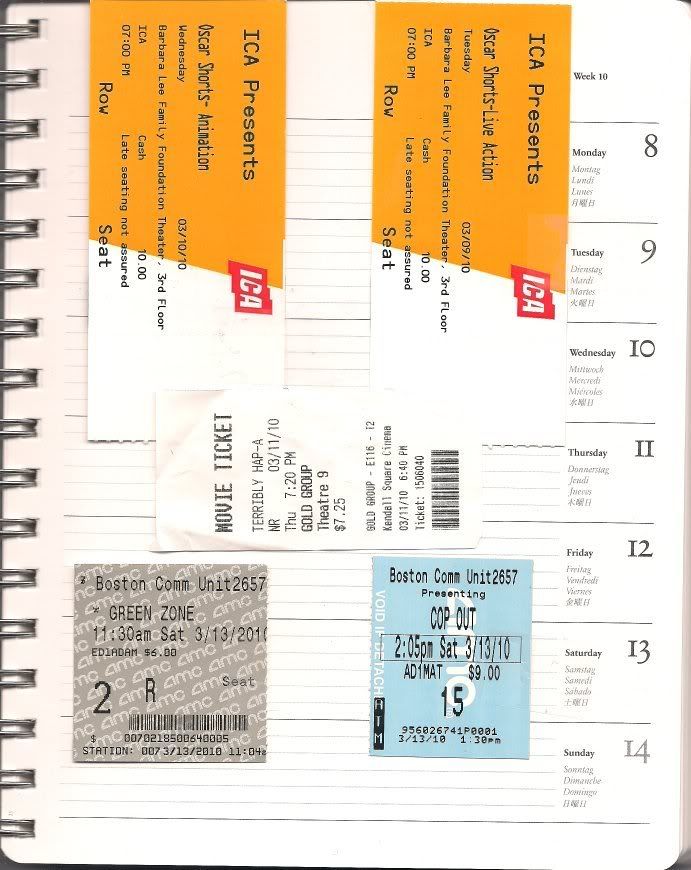
Stubless: Wonder Woman (2009), 13 March 2010.
It rained in the Boston area this weekend: An annoying drizzle when I left in the morning to catch Green Zone, and just enough to keep me in the theater for Cop Out when that ended. Looking at those ticket prices, I kind of wish I'd seen them in reverse order; Green Zone was easily worth more than Cop Out.
Then, Sunday... I was intending to go out and see something else, but a couple minutes buying a paper a block away convinced me that I didn't even want to walk as far as Central Square to catch the T. I spent the day bagging and tagging over a year's worth of comics that had piled up in the attic. Still a few left, and then there's the putting them into long boxes in the other corner of the attic (where another six to eight months's worth are also waiting. Curse my mania for alphabetical order.
I'm also beginning to strongly suspect that screener DVDs degrade over time. Every time I try to start going through my Fantasia/Fantastic Fest screeners to try and catch up, just starting gets more and more frustrating - the Blu-ray and HD DVD players won't touch them, then the laptop pops up a "No Disc in drive" message when I try to watch Spare, wouldn't send sound out to the SlingCatcher when I tried to watch The Chaser and its enormous watermark, and now doesn't even react to the presence of The Chaser in the DVD drive at all.
All that really means is I can maybe skip over some of my backlog stuff, and get started on the next phase that was to come after screeners: All the HD DVD/Blu-ray stuff I've purchased but never watched in any format (discs I have never watched despite having seen the movie are exempt). I opted to start from the end of the alphabet rather than the beginning for a simple reason: It was 10pm and Wonder Woman runs 74 minutes, while Alexander Revisited is three hours plus. Potentially unfortunately, that means that the next disc up is White Noise 2, purchased because I was assured it had nothing to do with White Noise and I like the cast. Still, you could clear the bar of that first movie by a lot and still be utter crap.
Oscar Shorts - Live Action
Seen 9 March 2010 at the ICA (Oscar Shorts)
The winner, which we knew going in, was "The New Tenants", a fairly deserving choice, although I do wonder about the politics: As much as it's officially from Denmark, it's in English and has appearances by familiar faces like Vincent d'Onofrio. To balance, thought, the film from Ireland is not in English, but Russian.
"Kavi" - * * * - Pretty good short about a kid in India whose entire family is enslaved. It kind of goes on for a bit, and kind of peters out, but it's well-done.
"The New Tenants" - * * * ¼ - The winner is quite funny, darkly so. Excellent deadpan sense of humor.
"Miracle Fish" - * * * - Nifty little story that goes into odd places. It ends kind of abruptly, but is intriguing throughout.
"The Door" - * * * ¼ - Neck and neck for the award with "The New Tenants", at least in my mind. It's a crushing story that follows Chernobyl villagers in the aftermath of the meltdown, brutal to watch at times.
"Instead of Abracadabra" - * * ¾ - Cute story with some funny bits, although it's not as good as it could be at points. The main character's a bit too dim to make it really work perfectly, though.
Oscar Shorts - Animated
Seen 10 March 2010 at the ICA (Oscar Shorts)
"Logorama" won the Oscar and it was my favorite of the program. As I mentioned last week, it's a pretty good year when a new Wallace & Gromit short is perhaps among the weakest entries.
"French Roast" - * * * - Funny little short, although it's a little strange visually; it takes a while to get used to how much of the action is rendered in a mirror that looks a lot like a window. That's a pretty impressive trick from a technical perspective, though.
"The Lady and the Reaper" - * * * ½ - I swear I saw something very similar to this a couple years ago, although I think that was much more somber and maybe hand-drawn. This is CGI and madcap, full of cartoonish slapstick about death fighting a heroic surgeon for the soul of an old woman who is at peace and ready to see her late husband again.
"A Matter of Loaf and Death" - * * * ½ - Yep, still funny.
"Granny O'Grimm's Sleeping Beauty" - * * * ¼ - The initial idea isn't quite so fantastic (a granny telling a disturbing and self-serving fairy tale to her grandchild, with a different form of animation within the story), but the punchline is perfect.
"Partly Cloudy" - * * * - I can't remember whether this was 3-D or not when I saw it with Up, but it's still a cute, very enjoyable little short. Pixar does great work.
"Runaway" - * * * - Nice-looking short out of Canada with kind of a nasty sense of humor despite its smoothness.
"The Kinematograph" - * * * - I dig the "early history of film" part, but there's something about the emotion of this one that leaves me kind of cold, like we're supposed to look down on the inventor even though the wife is concealing her illness. The implication is that he traded his love for his invention, and knowledge comes with a price that is often not worth it, and you're going to have to try a whole lot harder to convince me of that.
"Logorama" - * * * ¾ - You know what's cruel about this short? That a whole bunch of lawyers will keep it from ever being issued on video (although if it's available on iTunes (ptui!), I'd imagine at least some of that's been worked out), but it's the one you will most want to have available for freeze-framing to catch all the clever little bits of things that directors "H5" put in every corner of their world made up of corporate logos.
Green Zone
* * * (out of four)
Seen 13 March 2010 at AMC Boston Common #2 (first-run)
A lot of folks have been making the obvious comparison to the Bourne movies (Damon! Greengrass!), mainly because it is the easy comparison. I think that, in a lot of ways, Green Zone is better than his work on those, because while I found that globe-trotting action/adventure isn't really Greengrass's forte (my impression of those films will always be him taking what was clearly an impressively staged and executed car chase in The Bourne Supremacy and cutting it into incomprehensibility), he does damn good "you are here". There's a great boots-on-the-ground feeling to the movie, not just in how tense the action can get, but in how we instinctively understand an NCO like Miller's place in the world: He's the glue that holds the army together, although the likes of Miller are so well-trained that the likes of him actuallly questioning his orders is unheard of.
Cop Out
* * (out of four)
Seen 13 March 2010 at AMC Boston Common #15 (first-run)
So, let me understand this, MPAA (or Warner, or whoever is responsible) - it's okay to have the line "a couple of dicks" front and center in the movie, but having it as the title is crossing a line? How's that work?
That aside, Cop Out is interesting in what it says about Kevin Smith as a filmmaker. Not the moral judgment of "how can you stand having your name on this?" or the political implications of whether this is a gesture to make him seem more studio-friendly to people other than the Weinsteins, but how it lets us examine specific talents. All his previous films were as a writer/director, with the general impression being that he can write well enough to cover his weakness behind the camera. He didn't write Cop Out, though, and it indicates that while he can't spin gold from straw, he's built up enough skills to maybe make a mattress. It is a pretty dumb script, after all, but in many ways the execution isn't bad. The scenes and bits that don't work - and there are many don't call attention to themselves; they move smoothly on to the next bit.
Bruce Willis helps. You can't blame the guy for all the big-money action roles he's taken - if someone waved a check for twenty million dollars in my face, I'd have a hard time saying no, even if it wasn't the first time - but it is a crying shame that he doesn't do more comedy, because he's both a good straight man and wiseass. I'm not quite so sold on Tracy Morgan; I kind of get what he's going for here, and he's saddled with a particularly dumb subplot, but he kind of reminded me of the Nigel Bruce-model Watson here: Eccentric, kind of clueless, etc., is funny, but when a character comes off as so rock-stupid that it's impossible to picture his as a homicide cop with ten years on the job, that's a problem.
Wonder Woman (2009)
* * ¾ (out of four)
Seen 13 March 2010 in Jay's Living Room (Blu-ray)
A few idle questions to ponder when trying to evaluate the merits of last year's direct-to-video animated Wonder Woman:
* Would I enjoy it more if it were done in Japan, at roughly this level of quality? I've watched a fair bit of animated action/adventure out of Japan, and not always the big-budget theatrical releases, and liked much of it. The question is, does the language barrier help (making it harder to notice bad dialogue/voice acting), as well as the lack of familiarity with the source material? Through a lot of Wonder Woman's first half, I was thinking that this was rather flat, not really up to the standards one would hope for.
* Would this be acceptable story if this were a live action film? Probably not. It shows how unwieldy the character's origins are, especially how long it takes to get Diana born and off her island. It really locks things into the character's mythological origins, and a characterization that is much more simplistic and aggressive than the well-developed Diana we know from the comics.
* How involved was Gail Simone? She's the current writer of the Wonder Woman comic (at least through June), and though her run hasn't been as good as Greg Rucka's, she has emphasized the mythological warrior elements of the character. She's got a "screen story" credit on this, although I wonder if she contributed more directly to the second half. Certain bits, like "They're messing with Lincoln! No-one messes with Lincoln!", have her stamp on them.
I wish more did. There's potential here, and a really nice voice cast (Keri Russell as the title character; Nathan Fillion as Steve Trevor, the guy with the line about Lincoln; Rosario Dawson as Artemis). It's got pretty serious action for an American animated film. I just wish it had more of Rucka's ability to make all the elements of the character or Simone's wit and inventiveness.
* My friends would likely give me a hard time if I didn't start with The Chlotrudis Awards on Sunday night at The Brattle Theatre. It's a fun evening, honoring quality independent films, and Society President Michael Colford is probably going nuts even as we speak to meet the person who spoke the Donnie Darko line that has been in his email signature for years, special guest Beth Grant.
But, hey, that's just an awards ceremony, one I'm almost willing to punt if I can't find time to get to the ridiculous amount of other stuff playing in (potentially) short runs this week:
* Before the awards, the second half of the one-two punch Werner Herzog brought to last year's Toronto Film Festival opens at the Boston Museum of Fine Arts on Thursday. If My Son, My Son, What Have You Done? is even half as good as Bad Lieutenant: Port of Call New Orleans, it will be well worth figuring out the MFA's schedule to catch.
If you haven't gone to movies at the MFA before, I'm only half-joking about the "figuring out" bit. Even when a movie like My Son is having a "run", that means it's booked for 4-6 dates which are not necessarily in a row or at the same time. This one is playing five times, around The Films of Kim Longinotto and the start of The Boston Turkish Film Festival.
* Hubble 3-D opens at the Aquarium on Friday, playing 3 matinees daily while Avatar has the night shift. The Ultimate Wave: Tahiti 3D is also playing there, and that looks pretty cool. But gorgeous photography of Tahiti and James Cameron's cool sci-fi flick aside, is there anything cooler than documentary footage of spaceflight and crystal-clear images from the Hubble in genuine reels-of-film-that-require-a-forklift-to-move-with-single-frames-the-size-of-your-fist-projected-with-a-bulb-that-doubles-as-a-death-ray-onto-a-screen-the-size-of-a-medium-sized-office-building IMAX 3-D? Not for $12, there isn't.
* Circus Films at the Brattle! It's a small, weekend series, but there's some neat stuff, including an outfit called Cirkestra providing live accompaniment to a silent, The Unknown. That always gets me to the theaters.
* Kendall Square opens a few new movies, including The Secret of Kells, which looks like it thoroughly deserved its Oscar nomination from the gorgeous clips and previews. Also opening are The Girl with the Dragon Tattoo and Mother; the one-week-wonder is Neil Young: Trunk Show.
* The Coolidge has a 25th Anniversary
* And, finally, even though I'll probably get another chance to remind the half-dozen or so people who read this blog about it next week, The Boston Underground Film Festival kicks of next Thursday, the 25th, with the local premiere of Sion Sono's Love Exposure, an amazing film that has too much awesome packed into its four hours to classify. It's funny, heartbreaking, and utterly bizarre by turns; I loved it when I saw it at Fantasia last summer.
Yes, I said four hours, which is one of the reasons I highly recommend seeing it at the Kendall on the 25th. If it played a regular run, or came out on video, it would be easy to say "four hours? not tonight!" at any given time; at a one-time festival screening, though, you make the time, because there aren't other alternatives. And you should, because in addition to being as long as two movies stuck together, it's got as much good stuff as two individual movies, maybe three.

Stubless: Wonder Woman (2009), 13 March 2010.
It rained in the Boston area this weekend: An annoying drizzle when I left in the morning to catch Green Zone, and just enough to keep me in the theater for Cop Out when that ended. Looking at those ticket prices, I kind of wish I'd seen them in reverse order; Green Zone was easily worth more than Cop Out.
Then, Sunday... I was intending to go out and see something else, but a couple minutes buying a paper a block away convinced me that I didn't even want to walk as far as Central Square to catch the T. I spent the day bagging and tagging over a year's worth of comics that had piled up in the attic. Still a few left, and then there's the putting them into long boxes in the other corner of the attic (where another six to eight months's worth are also waiting. Curse my mania for alphabetical order.
I'm also beginning to strongly suspect that screener DVDs degrade over time. Every time I try to start going through my Fantasia/Fantastic Fest screeners to try and catch up, just starting gets more and more frustrating - the Blu-ray and HD DVD players won't touch them, then the laptop pops up a "No Disc in drive" message when I try to watch Spare, wouldn't send sound out to the SlingCatcher when I tried to watch The Chaser and its enormous watermark, and now doesn't even react to the presence of The Chaser in the DVD drive at all.
All that really means is I can maybe skip over some of my backlog stuff, and get started on the next phase that was to come after screeners: All the HD DVD/Blu-ray stuff I've purchased but never watched in any format (discs I have never watched despite having seen the movie are exempt). I opted to start from the end of the alphabet rather than the beginning for a simple reason: It was 10pm and Wonder Woman runs 74 minutes, while Alexander Revisited is three hours plus. Potentially unfortunately, that means that the next disc up is White Noise 2, purchased because I was assured it had nothing to do with White Noise and I like the cast. Still, you could clear the bar of that first movie by a lot and still be utter crap.
Oscar Shorts - Live Action
Seen 9 March 2010 at the ICA (Oscar Shorts)
The winner, which we knew going in, was "The New Tenants", a fairly deserving choice, although I do wonder about the politics: As much as it's officially from Denmark, it's in English and has appearances by familiar faces like Vincent d'Onofrio. To balance, thought, the film from Ireland is not in English, but Russian.
"Kavi" - * * * - Pretty good short about a kid in India whose entire family is enslaved. It kind of goes on for a bit, and kind of peters out, but it's well-done.
"The New Tenants" - * * * ¼ - The winner is quite funny, darkly so. Excellent deadpan sense of humor.
"Miracle Fish" - * * * - Nifty little story that goes into odd places. It ends kind of abruptly, but is intriguing throughout.
"The Door" - * * * ¼ - Neck and neck for the award with "The New Tenants", at least in my mind. It's a crushing story that follows Chernobyl villagers in the aftermath of the meltdown, brutal to watch at times.
"Instead of Abracadabra" - * * ¾ - Cute story with some funny bits, although it's not as good as it could be at points. The main character's a bit too dim to make it really work perfectly, though.
Oscar Shorts - Animated
Seen 10 March 2010 at the ICA (Oscar Shorts)
"Logorama" won the Oscar and it was my favorite of the program. As I mentioned last week, it's a pretty good year when a new Wallace & Gromit short is perhaps among the weakest entries.
"French Roast" - * * * - Funny little short, although it's a little strange visually; it takes a while to get used to how much of the action is rendered in a mirror that looks a lot like a window. That's a pretty impressive trick from a technical perspective, though.
"The Lady and the Reaper" - * * * ½ - I swear I saw something very similar to this a couple years ago, although I think that was much more somber and maybe hand-drawn. This is CGI and madcap, full of cartoonish slapstick about death fighting a heroic surgeon for the soul of an old woman who is at peace and ready to see her late husband again.
"A Matter of Loaf and Death" - * * * ½ - Yep, still funny.
"Granny O'Grimm's Sleeping Beauty" - * * * ¼ - The initial idea isn't quite so fantastic (a granny telling a disturbing and self-serving fairy tale to her grandchild, with a different form of animation within the story), but the punchline is perfect.
"Partly Cloudy" - * * * - I can't remember whether this was 3-D or not when I saw it with Up, but it's still a cute, very enjoyable little short. Pixar does great work.
"Runaway" - * * * - Nice-looking short out of Canada with kind of a nasty sense of humor despite its smoothness.
"The Kinematograph" - * * * - I dig the "early history of film" part, but there's something about the emotion of this one that leaves me kind of cold, like we're supposed to look down on the inventor even though the wife is concealing her illness. The implication is that he traded his love for his invention, and knowledge comes with a price that is often not worth it, and you're going to have to try a whole lot harder to convince me of that.
"Logorama" - * * * ¾ - You know what's cruel about this short? That a whole bunch of lawyers will keep it from ever being issued on video (although if it's available on iTunes (ptui!), I'd imagine at least some of that's been worked out), but it's the one you will most want to have available for freeze-framing to catch all the clever little bits of things that directors "H5" put in every corner of their world made up of corporate logos.
Green Zone
* * * (out of four)
Seen 13 March 2010 at AMC Boston Common #2 (first-run)
A lot of folks have been making the obvious comparison to the Bourne movies (Damon! Greengrass!), mainly because it is the easy comparison. I think that, in a lot of ways, Green Zone is better than his work on those, because while I found that globe-trotting action/adventure isn't really Greengrass's forte (my impression of those films will always be him taking what was clearly an impressively staged and executed car chase in The Bourne Supremacy and cutting it into incomprehensibility), he does damn good "you are here". There's a great boots-on-the-ground feeling to the movie, not just in how tense the action can get, but in how we instinctively understand an NCO like Miller's place in the world: He's the glue that holds the army together, although the likes of Miller are so well-trained that the likes of him actuallly questioning his orders is unheard of.
Cop Out
* * (out of four)
Seen 13 March 2010 at AMC Boston Common #15 (first-run)
So, let me understand this, MPAA (or Warner, or whoever is responsible) - it's okay to have the line "a couple of dicks" front and center in the movie, but having it as the title is crossing a line? How's that work?
That aside, Cop Out is interesting in what it says about Kevin Smith as a filmmaker. Not the moral judgment of "how can you stand having your name on this?" or the political implications of whether this is a gesture to make him seem more studio-friendly to people other than the Weinsteins, but how it lets us examine specific talents. All his previous films were as a writer/director, with the general impression being that he can write well enough to cover his weakness behind the camera. He didn't write Cop Out, though, and it indicates that while he can't spin gold from straw, he's built up enough skills to maybe make a mattress. It is a pretty dumb script, after all, but in many ways the execution isn't bad. The scenes and bits that don't work - and there are many don't call attention to themselves; they move smoothly on to the next bit.
Bruce Willis helps. You can't blame the guy for all the big-money action roles he's taken - if someone waved a check for twenty million dollars in my face, I'd have a hard time saying no, even if it wasn't the first time - but it is a crying shame that he doesn't do more comedy, because he's both a good straight man and wiseass. I'm not quite so sold on Tracy Morgan; I kind of get what he's going for here, and he's saddled with a particularly dumb subplot, but he kind of reminded me of the Nigel Bruce-model Watson here: Eccentric, kind of clueless, etc., is funny, but when a character comes off as so rock-stupid that it's impossible to picture his as a homicide cop with ten years on the job, that's a problem.
Wonder Woman (2009)
* * ¾ (out of four)
Seen 13 March 2010 in Jay's Living Room (Blu-ray)
A few idle questions to ponder when trying to evaluate the merits of last year's direct-to-video animated Wonder Woman:
* Would I enjoy it more if it were done in Japan, at roughly this level of quality? I've watched a fair bit of animated action/adventure out of Japan, and not always the big-budget theatrical releases, and liked much of it. The question is, does the language barrier help (making it harder to notice bad dialogue/voice acting), as well as the lack of familiarity with the source material? Through a lot of Wonder Woman's first half, I was thinking that this was rather flat, not really up to the standards one would hope for.
* Would this be acceptable story if this were a live action film? Probably not. It shows how unwieldy the character's origins are, especially how long it takes to get Diana born and off her island. It really locks things into the character's mythological origins, and a characterization that is much more simplistic and aggressive than the well-developed Diana we know from the comics.
* How involved was Gail Simone? She's the current writer of the Wonder Woman comic (at least through June), and though her run hasn't been as good as Greg Rucka's, she has emphasized the mythological warrior elements of the character. She's got a "screen story" credit on this, although I wonder if she contributed more directly to the second half. Certain bits, like "They're messing with Lincoln! No-one messes with Lincoln!", have her stamp on them.
I wish more did. There's potential here, and a really nice voice cast (Keri Russell as the title character; Nathan Fillion as Steve Trevor, the guy with the line about Lincoln; Rosario Dawson as Artemis). It's got pretty serious action for an American animated film. I just wish it had more of Rucka's ability to make all the elements of the character or Simone's wit and inventiveness.
Thursday, March 11, 2010
This Week In Tickets: 1 March 2010 to 7 March 2010
A whole lot of delay on this post for not a whole lot of content. A nasty cold hit me Sunday afternoon and lasted most of the week, making the Barking Dogs review harder to get done than it had any right to be, and then both times I tried to scan the page in before catching the bus in the morning, it would disappear in a computer crash sometime during the day.
Not a bunch to write about what's coming out this weekend, either:
* The Brattle opens what promises to be a good-looking new print of The Red Shoes for a week.
* John Ford at the Harvard Film Archive. From the look of the calendar, including how the winter-months series is described as "part 1", it looks like John Ford will be the theme for the archive at least through the end of the academic year.
* The tail ends of the "New Films from Spain" and "New Films from Quebec" series at the MFA
* Stuart Street reopens The Hurt Locker to capitalize on its Oscar wins, which is great - it's a terrific movie. It's enough to make one stop wondering, at least for a week or so, if "$10 second-run boutique house" is really a viable business model.
* A little film by Oscar Winner Kathryn Bigelow's ex, Terminator 2, plays midnights at the Coolidge as part of "March Metal Men". Next week is Robocop and I think it would be kind of funny if they finished up with Anvil!. Also continuing are Shutter Island and The Ghost Writer.
(I am conflicted as heck on The Ghost Writer. Trailers look good, excellent cast... But I do not want any of my money going to Roman Polanski.)
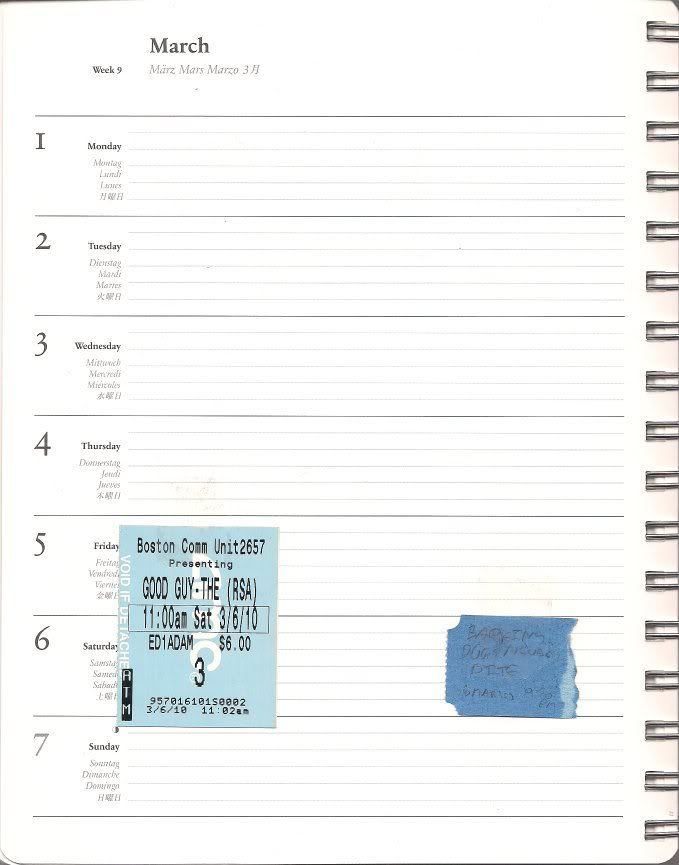
Stubless: Triangle, 5 March 2010; "A Matter of Loaf and Death", 7 March 2010.
Thin week. You know how sometimes at work, something huge comes up, and it's all hands on deck to make sure that gets done? That was the week before last. Last week was the week where I worked late to make up the time lost on the other thing.
"Wallace & Gromit in: A Matter of Loaf and Death"
* * * ½ (out of four)
Seen 7 March 2010 in Jay's Living Room (Blu-ray)
I may talk a little bit more about this when I get to the Oscar Shorts programs next week, but it is a darn good year for animation when you can legitimately argue that a new Wallace & Gromit short is the weakest nominee in its category. That's not anything against "Loaf and Death" - it's a quality half-hour of "Wallace & Gromit", though it suffers a bit of wear (as often seems to be the case, Wallace has gotten dumber and lazier over the course of the series), but it still brings a great deal of the funny: Slapstick, awful bread-related puns, and well-utilized movie references (Aliens in a kids' cartoon!). There's just enough suspense to keep adults involved and kids on the edge of their seat, and the quality of the animation is top-notch.
Not a bunch to write about what's coming out this weekend, either:
* The Brattle opens what promises to be a good-looking new print of The Red Shoes for a week.
* John Ford at the Harvard Film Archive. From the look of the calendar, including how the winter-months series is described as "part 1", it looks like John Ford will be the theme for the archive at least through the end of the academic year.
* The tail ends of the "New Films from Spain" and "New Films from Quebec" series at the MFA
* Stuart Street reopens The Hurt Locker to capitalize on its Oscar wins, which is great - it's a terrific movie. It's enough to make one stop wondering, at least for a week or so, if "$10 second-run boutique house" is really a viable business model.
* A little film by Oscar Winner Kathryn Bigelow's ex, Terminator 2, plays midnights at the Coolidge as part of "March Metal Men". Next week is Robocop and I think it would be kind of funny if they finished up with Anvil!. Also continuing are Shutter Island and The Ghost Writer.
(I am conflicted as heck on The Ghost Writer. Trailers look good, excellent cast... But I do not want any of my money going to Roman Polanski.)

Stubless: Triangle, 5 March 2010; "A Matter of Loaf and Death", 7 March 2010.
Thin week. You know how sometimes at work, something huge comes up, and it's all hands on deck to make sure that gets done? That was the week before last. Last week was the week where I worked late to make up the time lost on the other thing.
"Wallace & Gromit in: A Matter of Loaf and Death"
* * * ½ (out of four)
Seen 7 March 2010 in Jay's Living Room (Blu-ray)
I may talk a little bit more about this when I get to the Oscar Shorts programs next week, but it is a darn good year for animation when you can legitimately argue that a new Wallace & Gromit short is the weakest nominee in its category. That's not anything against "Loaf and Death" - it's a quality half-hour of "Wallace & Gromit", though it suffers a bit of wear (as often seems to be the case, Wallace has gotten dumber and lazier over the course of the series), but it still brings a great deal of the funny: Slapstick, awful bread-related puns, and well-utilized movie references (Aliens in a kids' cartoon!). There's just enough suspense to keep adults involved and kids on the edge of their seat, and the quality of the animation is top-notch.
Tuesday, March 02, 2010
This Week In Tickets: 21 February 2010 to 28 February 2010
Before getting to last week's tickets, a quick look at this upcoming weekend's:
* Not actually at the movies, but the Oscars are Sunday. I haven't sent my RSVP in for the Brattle's Oscar party, so I'll either just stay up late with pizza and a 2-liter bottle of Cherry Crush, fighting the urge to live-blog/tweet in a way that makes me look like one of those annoying, reflexively negative people. Or see what my brother and his fiancée are up to, which would entail either a second pizza and 2-liter or hanging around with a bunch of their friends and feeling old.
* Speaking of the Oscars, the Academy-nominated short films (animated and live-action) appear to be moving from the Coolidge to the ICA this weekend. I failed at seeing the animated ones a week and a half ago, so I'll probably hit the Friday night shows. I'm almost feeling lucky, because while the Coolidge's screening room is rather far from my favorite place to see a movie, the ICA's auditorium is easily one of the coolest in the Boston area.
* It will have to be Friday, as Saturday night is a rare chance to see Bong Joon-ho's first film, Barking Dogs Never Bite, at the Harvard Film Archive. It's the 9:30 show, with The Host at 7pm.
* As expected, the opening of Alice in Wonderland at the two Jordan's Furniture IMAX screens heralds Avatar moving over to the New England Aquarium on the 5th. If you live in Boston and weren't willing to take two or three different public transportation lines to see it in beautiful, full-sized IMAX 3-D, it's now a lot easier. As of right now, the Aquarium's IMAX site is only showing a schedule through the 18th, hopefully because they'll be picking up Hubble 3-D on the 19th.
Also worth noting: Unless the Aquarium raises prices, it will actually cost you $1.05 less to see it in genuine reels-of-film-that-require-a-forklift-to-move-with-single-frames-the-size-of-your-fist-projected-with-a-bulb-that-doubles-as-a-death-ray-onto-a-screen-the-size-of-a-medium-sized-office-building IMAX there than the digital 3-D at the nearby AMC Boston Common theater at the same time. It's better and cheaper!
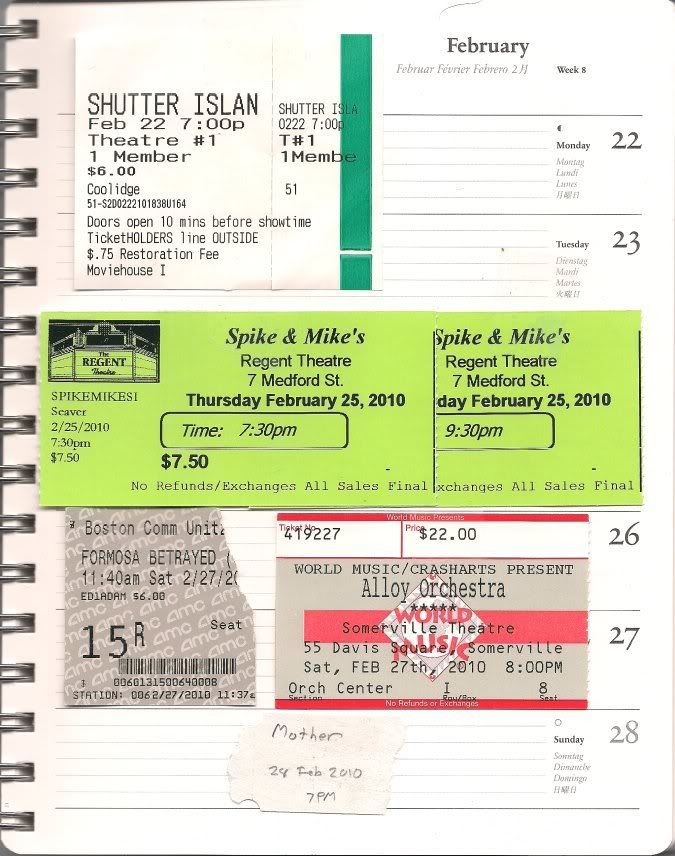
Not a lot of movie-going in terms of bulk, but they were mostly cool experiences: I'd never been to the Regent Theater before, and it's a pretty not-bad spot to see a movie, for a spot that is mostly a performance space. Seeing projected video wasn't ideal, but it was also a fairly laid-back experience. I don't think they checked my ticket once, but I suspect that's because the number of staff and patrons was small enough that night that they could keep an eye on us without manning checkpoints. Also, I don't think anyone would want to throw us out into the nasty wind and rain.
Both Formosa Betrayed and Mother were interesting/instructive screenings, from certain points of view. Mother was also good and sold out. Hopefully that indicates a good run ahead for Mother in Boston.
Shutter Island
* * * ½ (out of four)
Seen 21 February 2010 at the Coolidge Corner #1 (first-run)
By now everybody's read the bit from a Philly film critic who, unable to get to a screening of Shutter Island in time to make deadline, just printed gossip about how Leonardo DiCaprio was copping an attitude, going in the back way at a theater that Scorcese had rented for his cast and crew while Mark Ruffalo hung out and tipped big at the popcorn stand? That was at the Coolidge, so seeing the movie there was kind of cool.
The movie itself is pretty spiffy, too. As much as the trailers had hinted about this being a less contemplative, more pulpy Scorcese, the extent isn't quite clear until the movie starts up, hitting the ground running with a score that is as aggressive as anything Bernard Hermann ever came up with. Then it keeps going, building a story filled with fun twists and nifty performances for close to two hours.
It's a little longer than two hours, though, and during the last act, things tend to drag a bit. Just a little, although I do think that the editing and script could have been tightened up a bit, although that's a tough call: Ideally, in a thriller like Shutter Island, you want the audience and the characters on-screen to hit the climax at exactly the same point, and I can't imagine that very many people won't get there well ahead of DiCaprio's character, and then Scorcese spends a bit too long explaining and reacting to it. Fortunately, he and writer Laeta Kalogridis (working from a Dennis Lehane novel) do have a little something more up their sleeves, a second little body blow to hit the audience with after it seems like they've messed up by not ending the movie quickly after the big one.
(Minor rant that may be considered a spoiler: I guess Shutter Island can be forgiven for this because it was adapted from a novel, but the anagram thing is not a cool thing to use in a movie. Aside from doubting that many real people have done that sort of wordplay in a premeditated fashion, let alone subconsciously, how is it supposed to be a real hint if you don't know how the anagram is spelled? It's something you may catch in a book, but just after-the-fact trickery on film! No more spoilers)
Spike & Mike's Festival of Animation: The New Generation
* * * ½ (out of four)
Seen 24 February 2010 at the Regent Theatre (Special Presentation; video projection, maybe HD)
It's been years since I've seen a Spike & Mike show - as I mentioned last week, I thought that the Herzfeldt/Judge "Animation Show" was created in part as a reaction to their disappearance - but when I did, it was generally the "Classic" fest that I went to. Some of the shorts included may have been hanging around to be in the last Classic package - "Ghost of Stephen Foster" had a late-90s copyright on it, and I saw "Crab Revolution" and PES's "Western Spaghetti" some time ago - but there is a whole bunch of good stuff included in this package. I'll probably do another post running the whole show down in a day or two, but here's some worth mentioning:
* "Lapsus", directed by Juan Zaramella, a very clever combination of character animation and playing with abstract shapes.
* "Santa: The Fascist Year", directed by Bill Plympton. It's the new Bill Plympton, it's flat-out crazy, and just dementedly brilliant.
* "The Hidden Life of the Burrowing Owl", directed by Mike Roush, is gorgeous, dark, and funny, and combines cel-looking animation with real envrionments in a way that is smoother than I can recall seeing in the past.
* "For Sock's Sake", directed by Carlos Vegele, is a clever bit of stop-motion involving ambulatory clothing, that I loved for how Vegele managed to give his characters forms of articulation that reminded us of human characters but really was also unique.
* "A Town Called Panic: Cake", directed by Vincent Patar and Stephane Aubier, is maybe not quite as brilliant as the feature - it confirms my suspicion that Horse just sounds better in French - but is still hilarious.
* "Ghost of Stephen Foster", directed by Raymond Persi, is a music video for the Squirrel Nut Zippers. It was tough to catch the lyrics or how they related to the story (maybe that was just the theater), but visually, it's a dead-on homage to Bosko/Betty Boop-era animation.
* "Oktapadi", directed by Julien Bocabeille, was nominated for an Oscar last year and is a brilliant little CGI cartoon featuring an octopus trying to rescue its mate who has been purchased by a chef. I love the adventurous, upbeat note it ends on.
Spike & Mike's Festival of Animation: Sick & Twisted '09
* * ¾ (out of four)
Seen 24 February 2010 at the Regent Theatre (Special Presentation; video projection, maybe HD)
There wasn't nearly as much good stuff in this one, which turned out to be a replacement for the announced program, which was about one-quarter repeats from the New Generation package. This one, which I assume is last year's grouping, only repeats "Lapsus" and "Stillwaters". Though there is some pretty darn good stuff - I loved this video for The Willowz' "We Live on Your Street", for instance; there's something awesomely punk about destroying animation as you make it - let's face it, going for "sick & twisted" often means easy jokes. Anthropomorphized food doesn't like being eaten. Taking something cute and making it mean. Penises. Now, I'm not above finding any of those things funny, but when the show starts off with "Dupain" and "A Peach for Teach" back to back... It's hard not to react with "is that all you've got?"
The Man with the Movie Camera
* * * * (out of four)
Seen 27 February 2010 in Somerville Theater #1 (World Music/Crash Arts presents the Alloy Orchestra)
I reviewed this for EFC four years ago, and looking back on that review after seeing it again this past Saturday with the Alloy Orchestra accompanying it, I'm struck by a couple things:
* Don't pay attention to star-ratings. I disagree with nothing I wrote then, but I'm rating it higher today.
* I spend one out of the three "body" paragraphs in the review talking about a sequence in which Vertov and company build a theater in which to display the film. That sequence - not in the cut that the Alloy Orchestra accompanied. That's not unusual when dealing with silent films; there's all sorts of different cuts floating around of just about every silent. Maybe the HFA was just showing an unusually long cut.
It's an interesting difference, because one of the things I thought while watching it was that it is a fantastic way to learn about filmmaking; it shows you everything you need to know both by demonstration and example, so I always thought it was cool that it went all the way to the end.
Very cool seeing it with the Alloy Orchestra, though, despite the shorter cut. It was one of the most enjoyable scores I've heard them perform in a while, since Phantom of the Opera at least. Don't get me wrong, they've done several fine scores in the interim, but for the most part, they've been more restrained. Not quite conventional, but not as percussive. This, though, reminded me a lot of their score for The General, in a very good way; it really adds to the sense of speed and motion that this movie already has in abundance.
There's word going around that Alloy is going to be premiering a score for the new cut of Metropolis in San Francisco this April. Here's hoping that they play it for the local crowd sometime in the next few months. Or at Fantasia. But hopefully not in Boston while I'm in Montreal.
* Not actually at the movies, but the Oscars are Sunday. I haven't sent my RSVP in for the Brattle's Oscar party, so I'll either just stay up late with pizza and a 2-liter bottle of Cherry Crush, fighting the urge to live-blog/tweet in a way that makes me look like one of those annoying, reflexively negative people. Or see what my brother and his fiancée are up to, which would entail either a second pizza and 2-liter or hanging around with a bunch of their friends and feeling old.
* Speaking of the Oscars, the Academy-nominated short films (animated and live-action) appear to be moving from the Coolidge to the ICA this weekend. I failed at seeing the animated ones a week and a half ago, so I'll probably hit the Friday night shows. I'm almost feeling lucky, because while the Coolidge's screening room is rather far from my favorite place to see a movie, the ICA's auditorium is easily one of the coolest in the Boston area.
* It will have to be Friday, as Saturday night is a rare chance to see Bong Joon-ho's first film, Barking Dogs Never Bite, at the Harvard Film Archive. It's the 9:30 show, with The Host at 7pm.
* As expected, the opening of Alice in Wonderland at the two Jordan's Furniture IMAX screens heralds Avatar moving over to the New England Aquarium on the 5th. If you live in Boston and weren't willing to take two or three different public transportation lines to see it in beautiful, full-sized IMAX 3-D, it's now a lot easier. As of right now, the Aquarium's IMAX site is only showing a schedule through the 18th, hopefully because they'll be picking up Hubble 3-D on the 19th.
Also worth noting: Unless the Aquarium raises prices, it will actually cost you $1.05 less to see it in genuine reels-of-film-that-require-a-forklift-to-move-with-single-frames-the-size-of-your-fist-projected-with-a-bulb-that-doubles-as-a-death-ray-onto-a-screen-the-size-of-a-medium-sized-office-building IMAX there than the digital 3-D at the nearby AMC Boston Common theater at the same time. It's better and cheaper!

Not a lot of movie-going in terms of bulk, but they were mostly cool experiences: I'd never been to the Regent Theater before, and it's a pretty not-bad spot to see a movie, for a spot that is mostly a performance space. Seeing projected video wasn't ideal, but it was also a fairly laid-back experience. I don't think they checked my ticket once, but I suspect that's because the number of staff and patrons was small enough that night that they could keep an eye on us without manning checkpoints. Also, I don't think anyone would want to throw us out into the nasty wind and rain.
Both Formosa Betrayed and Mother were interesting/instructive screenings, from certain points of view. Mother was also good and sold out. Hopefully that indicates a good run ahead for Mother in Boston.
Shutter Island
* * * ½ (out of four)
Seen 21 February 2010 at the Coolidge Corner #1 (first-run)
By now everybody's read the bit from a Philly film critic who, unable to get to a screening of Shutter Island in time to make deadline, just printed gossip about how Leonardo DiCaprio was copping an attitude, going in the back way at a theater that Scorcese had rented for his cast and crew while Mark Ruffalo hung out and tipped big at the popcorn stand? That was at the Coolidge, so seeing the movie there was kind of cool.
The movie itself is pretty spiffy, too. As much as the trailers had hinted about this being a less contemplative, more pulpy Scorcese, the extent isn't quite clear until the movie starts up, hitting the ground running with a score that is as aggressive as anything Bernard Hermann ever came up with. Then it keeps going, building a story filled with fun twists and nifty performances for close to two hours.
It's a little longer than two hours, though, and during the last act, things tend to drag a bit. Just a little, although I do think that the editing and script could have been tightened up a bit, although that's a tough call: Ideally, in a thriller like Shutter Island, you want the audience and the characters on-screen to hit the climax at exactly the same point, and I can't imagine that very many people won't get there well ahead of DiCaprio's character, and then Scorcese spends a bit too long explaining and reacting to it. Fortunately, he and writer Laeta Kalogridis (working from a Dennis Lehane novel) do have a little something more up their sleeves, a second little body blow to hit the audience with after it seems like they've messed up by not ending the movie quickly after the big one.
(Minor rant that may be considered a spoiler: I guess Shutter Island can be forgiven for this because it was adapted from a novel, but the anagram thing is not a cool thing to use in a movie. Aside from doubting that many real people have done that sort of wordplay in a premeditated fashion, let alone subconsciously, how is it supposed to be a real hint if you don't know how the anagram is spelled? It's something you may catch in a book, but just after-the-fact trickery on film! No more spoilers)
Spike & Mike's Festival of Animation: The New Generation
* * * ½ (out of four)
Seen 24 February 2010 at the Regent Theatre (Special Presentation; video projection, maybe HD)
It's been years since I've seen a Spike & Mike show - as I mentioned last week, I thought that the Herzfeldt/Judge "Animation Show" was created in part as a reaction to their disappearance - but when I did, it was generally the "Classic" fest that I went to. Some of the shorts included may have been hanging around to be in the last Classic package - "Ghost of Stephen Foster" had a late-90s copyright on it, and I saw "Crab Revolution" and PES's "Western Spaghetti" some time ago - but there is a whole bunch of good stuff included in this package. I'll probably do another post running the whole show down in a day or two, but here's some worth mentioning:
* "Lapsus", directed by Juan Zaramella, a very clever combination of character animation and playing with abstract shapes.
* "Santa: The Fascist Year", directed by Bill Plympton. It's the new Bill Plympton, it's flat-out crazy, and just dementedly brilliant.
* "The Hidden Life of the Burrowing Owl", directed by Mike Roush, is gorgeous, dark, and funny, and combines cel-looking animation with real envrionments in a way that is smoother than I can recall seeing in the past.
* "For Sock's Sake", directed by Carlos Vegele, is a clever bit of stop-motion involving ambulatory clothing, that I loved for how Vegele managed to give his characters forms of articulation that reminded us of human characters but really was also unique.
* "A Town Called Panic: Cake", directed by Vincent Patar and Stephane Aubier, is maybe not quite as brilliant as the feature - it confirms my suspicion that Horse just sounds better in French - but is still hilarious.
* "Ghost of Stephen Foster", directed by Raymond Persi, is a music video for the Squirrel Nut Zippers. It was tough to catch the lyrics or how they related to the story (maybe that was just the theater), but visually, it's a dead-on homage to Bosko/Betty Boop-era animation.
* "Oktapadi", directed by Julien Bocabeille, was nominated for an Oscar last year and is a brilliant little CGI cartoon featuring an octopus trying to rescue its mate who has been purchased by a chef. I love the adventurous, upbeat note it ends on.
Spike & Mike's Festival of Animation: Sick & Twisted '09
* * ¾ (out of four)
Seen 24 February 2010 at the Regent Theatre (Special Presentation; video projection, maybe HD)
There wasn't nearly as much good stuff in this one, which turned out to be a replacement for the announced program, which was about one-quarter repeats from the New Generation package. This one, which I assume is last year's grouping, only repeats "Lapsus" and "Stillwaters". Though there is some pretty darn good stuff - I loved this video for The Willowz' "We Live on Your Street", for instance; there's something awesomely punk about destroying animation as you make it - let's face it, going for "sick & twisted" often means easy jokes. Anthropomorphized food doesn't like being eaten. Taking something cute and making it mean. Penises. Now, I'm not above finding any of those things funny, but when the show starts off with "Dupain" and "A Peach for Teach" back to back... It's hard not to react with "is that all you've got?"
The Man with the Movie Camera
* * * * (out of four)
Seen 27 February 2010 in Somerville Theater #1 (World Music/Crash Arts presents the Alloy Orchestra)
I reviewed this for EFC four years ago, and looking back on that review after seeing it again this past Saturday with the Alloy Orchestra accompanying it, I'm struck by a couple things:
* Don't pay attention to star-ratings. I disagree with nothing I wrote then, but I'm rating it higher today.
* I spend one out of the three "body" paragraphs in the review talking about a sequence in which Vertov and company build a theater in which to display the film. That sequence - not in the cut that the Alloy Orchestra accompanied. That's not unusual when dealing with silent films; there's all sorts of different cuts floating around of just about every silent. Maybe the HFA was just showing an unusually long cut.
It's an interesting difference, because one of the things I thought while watching it was that it is a fantastic way to learn about filmmaking; it shows you everything you need to know both by demonstration and example, so I always thought it was cool that it went all the way to the end.
Very cool seeing it with the Alloy Orchestra, though, despite the shorter cut. It was one of the most enjoyable scores I've heard them perform in a while, since Phantom of the Opera at least. Don't get me wrong, they've done several fine scores in the interim, but for the most part, they've been more restrained. Not quite conventional, but not as percussive. This, though, reminded me a lot of their score for The General, in a very good way; it really adds to the sense of speed and motion that this movie already has in abundance.
There's word going around that Alloy is going to be premiering a score for the new cut of Metropolis in San Francisco this April. Here's hoping that they play it for the local crowd sometime in the next few months. Or at Fantasia. But hopefully not in Boston while I'm in Montreal.
Thursday, February 18, 2010
Boston Sci-Fi Film Festival, Days 4-7: Short stuff
I'm going to whip through these fairly quickly, since it can be difficult to say a lot about short films without just giving them away, and because the combination of marathon-induced sleep deprivation and truly amazing computer problems (it's always a pleasure when the IT guys take a look at what your machine's doing and say "that's a new one!") has me running well behind where I want to be on writing things.
It's also a bit odd that I saw most of these shorts more than once, between the screening group meetings and the festival, and a second look can sometimes change maybe not what I think of a film, but the degree to which it is felt. This is particularly true of shorts: If a feature length film is being told a story, a short is almost like being told a joke (even the serious ones), and the impact can be greatly blunted if you know the punchline ahead of time.
Little Space Oddities
Seen 8 February 2010 in the Somerville Theater Digital Screening Room (DVD)
Extra-Terrestrial Extravaganza
Seen 9 February 2010 in the Somerville Theater Digital Screening Room (DVD)
Planetary Paranoia
Seen 10 February 2010 in the Somerville Theater Digital Screening Room (DVD)
Fanac Stuff
Seen 11 February 2010 in the Somerville Theater Digital Screening Room (DVD)
It's also a bit odd that I saw most of these shorts more than once, between the screening group meetings and the festival, and a second look can sometimes change maybe not what I think of a film, but the degree to which it is felt. This is particularly true of shorts: If a feature length film is being told a story, a short is almost like being told a joke (even the serious ones), and the impact can be greatly blunted if you know the punchline ahead of time.
Little Space Oddities
Seen 8 February 2010 in the Somerville Theater Digital Screening Room (DVD)
"Theosaurology" - * * ¾ (out of four)
A cute animated film from the Rhode Island School of Design that substitutes a great deal of enthusiasm for polish. It's madcap, although the way it integrates its animation into a book is pretty clever despite the apparent crudeness of the drawing.
"Empathy" - * * *
A familiar but fairly well-done Twilight Zone-type story with an ending you can likely guess very early on from the title, but it's mostly very well done. I think it also works as well as it does because in the places where, like a lot of short films, it's a little rough around the edges, that imperfection works: The overdone callousness of a drunk driver may be bad acting or it may be a trick of memory; the flat tone another character uses potentially shows a little more cruelty.
"The Package" - * * *
The gag is obvious, but built up to quite nicely. I do think that the short could have been improved a little with some sort of establishing shot that establishes the time period as the 1980s or 1990s, so that using VHS makes sense.
"Destination Day" - * * ¾
The opening hook, about how various cities have at one time or another announced "time traveler conventions" only to have nobody show up (suggesting that time travel is impossible), is neat, but the actual story, about a man traveling back in time to make things work with a girl he likes, doesn't work that well beyond a couple of jokes. It finishes on a visual gag that's clever, but doesn't quite fit into this particular story.
"Operation: Blast! - * * * ½
Just the cutest widdle stop-motion action thing ever, with tiny "Talibots" infiltrating an American house and soldier robots coming to stop them. Cartoony fun, with the robots having personality that comes out in body language and the subtitles to their beeping dialogue.
"VHS Reporter" - * *
My friend Tony once described something like this, and I've appropriated it: "There's quirky, and there's random. I'm fine with quirky, but can't stand random." (Actually, he was quoting a friend of his, but we'll stop there.) "VHS Reporter" is random, a bunch of odd behaviors stitched together with the punchline being why these guys are so weird, but it's not actually that funny or clever.
"Dimensional Meltdown" - * * * ½
I really liked this one, but it's got a few problems that I understand why some don't. Either the photography or the encoding is wonky, too dark at times, and it moves quickly enough, with relatively little exposition, that it's possible to miss what's actually going on: A man traveling to a parallel universe where his girlfriend was not lost tragically, to take the place of his local doppelganger, only to find he's not the only one with that idea. Still, I kind of love its fast pace and willingness to let the audience figure out what's going on compared the awkward telling-over-showing a lot of shorts with somewhat complicated ideas go for.
"Frank Dancoolo: Paranormal Drug Dealer" - * * ½
Here's the thing with "Frank Dancoolo": We had it in one of the screening deals, and my comments there were something along the lines of how you can see that there's a bunch of talent at work, but it's trying too hard, and it could be better if it didn't rely on the crutch of self-parody. I was apparently the only one who felt that way, though, and at the next meeting they pulled it out again, to watch as a "bonus"... And on a second view, I hated every second of it. I tend to think that camp is what people do when they can't actually manage wit, and that was all I could see on the second run-through.
On this, the third, I think I was better able to see it does well, but there's still a fair chunk in it that is pretty stupid. Fortunately, there's about as much that is pretty funny.
Extra-Terrestrial Extravaganza
Seen 9 February 2010 in the Somerville Theater Digital Screening Room (DVD)
"Perfect Companion" - * * ¾
A little on-the-nose at times - it never misses an opportunity to insert the title into the dialogue, for instance - but otherwise, a pretty good example of how it's tought to have everything in a relationship.
"Escape from Death Planet" - * * ¾
I wouldn't be shocked if this was mainly done as a visual effects highlight reel - a demo tape for the CGI industry. The technical stuff is pretty impressive for a short, although the acting is, well, not great, to the point of me thinking that most of the dialogue was ADRed (everyone wears mouth-obscuring helmets).
Also, I was kind of expecting a pull-back of some sort to show that the entire thing takes place inside a classic Atari Centipede arcade machine.
"Type A" - * * *
Relatively lax maintenance standards at a cryonic storage facility leads to zombie issues. The filmmakers do a nice job with sets and make-up, and there's a pretty nice cast, but I get the feeling that this is one that was originally written longer, and as they confronted their budget, wound up getting pared down to the point where audiences have to make some leaps to figure out how the story got from point A to point B.
"Mr. Bojagi" - * * ¼
Scores the biggest casting coup of all the shorts, with Brian Blessed as the title character, and his expansive personality fills the short to overflowing (although Hildegarde Neil is just as good as the old woman who visits his gift-exchange desk. The filmmakers have a nifty, if fuzzy, idea, but don't quite have a real story to go with it, and director Marco Van Belle isn't quite up to reigning Blessed in a bit when he needs it. Still, it's a spiffy-looking short and a nice cast.
"All Systems Go, Neil Armstrong" - * * ½
A music video that has some decent animation. Harmless, kind of forgettable.
"The Kirkie" - * * * ½
This is one of those fan-made productions that announces its geek cred by dropping a dozen references per minute. It veers perilously close at various points to both pandering and biting the hands that feeds it, but on the balance actually winds up as a solid little comedy. The filmmakers are smart enough to recognize that you can't just quote something and expect people to laugh, but there has to be an actual joke there.
"The Latest Thing" - * * *
Takes a pretty simple concept - brain firmware updates, and why our experience with this sort of thing on computers should make us wary of it. Jumps from joke to joke without messing around, and while not all of them work, enough do to make it worthwhile.
"Enigma" - * * * ¼
It's too bad there aren't anthology series left on TV, because at 42 minutes, "Enigma" is just the right length to slip into a one-hour time slot, and probably has better visual effects than the average episode of the Showtime/Sci-fi version of The Outer Limits. It wouldn't be a bad way to get it in front of a larger audience, either.
It's pretty good, if a bit schizophrenic. The framing sequences, set in a Pentagon-equivalent back on Earth, are more than a little stilted, but the scenes on board the spaceship transporting an alien prisoner are impressive as heck: Good fight choreography, plenty of effects, a ship that feels as built-out and real as Serenity, and good acting all around. It's an impressive achievement, and here's hoping the people involved get to jump to the next level soon.
Planetary Paranoia
Seen 10 February 2010 in the Somerville Theater Digital Screening Room (DVD)
"Sita" - * *
I won't lie to you - I only remember the tiniest scraps of this one. I do, however, remember thinking it was kind of full of itself even while watching it.
"Rats" - * * ¾
Post-apocalyptic world, people living in isolation, suddenly something breaks down. The movie is based on an Italian comic, and it does have that Eurocomic feel to it: Grimy and dirty, philosophical without seeming full of itself like, say, anime often does, almost eager to not worry about being friendly. It generally does all right, although the ending lacks a bit of pop, because it can't quite surmount how twist endings aren't surprising if a downer twist is so much the default as to be expected.
"1:03 AM" - * * * ½
I like this one quite a bit. It posits a pretty good spec-fic premise - "what if you could get a license to commit a crime, but only in a very narrow time frame?" - but is short and punchy enough that the audience doesn't have much chance to start wondering just how this becomes a possibility. It's acted well-enough and has bits of dark, dark comedy. And it pulls a nifty little trick at the ending that gives the audience a little bit to debate: I think the hesitation was deliberate, in order to show that he feels strongly enough to be charged with a crime, but it's absolutely up for debate.
"The Replicant" - * * *
Well-enough done bit about how the logistics and ethics behind uploading one's consciousness into immortal android bodies is going to have messy ethical and logistical complications. I did want a little more from it - does the replicant feel guilty at the end? What implications does either a positive or negative answer to that question have? Would the alternative have been tenable in any way? But I suspect that those are questions for a feature rather than a short.
"Die Schneider Krankheit" - * * * ¾
I liked this one quite a bit when I saw it at Fantasia last year (attached to Mutants), and I found it holds up. Something about the film being into German and then overdubbed into Spanish makes it even more sinister, and the production design and re-creation of 1950s propaganda/educational films feels dead-on. That way, it's able to get a creepy vibe out of something that might otherwise come across as silly, only coming across as something other than dead serious for moments at the end.
"Under God" - * * * ½
This one is a slick, highly polished speculative story about President Eisenhower inspecting UNIVAC and being initially dismissive. The actor playing the lead is a pretty convincing likeness, although the answer to the President's question (and a bit of what comes before) likely owes more to Colossus: The Forbin Project than the real (or projected) ability of computers in the 1950s.
Interestingly, at the test screening, one person came up with an alternate take to the ending - that Eisenhower was capitulating, rather than bolstering his beliefs. I was a little more intrigued by that idea the second time through, although his attitude on leaving the building doesn't really seem to suggest it to me.
"Afterglow" - * * * ¼
One thing I notice on writing all these reviews in reasonably consecutive order: Film-makers, especially when doing shorts, shouldn't use a framing sequence unless it really adds something. There's really not room in this ten-minute piece for a second environment and set of characters, and it pulls us away from what had been a solid, even haunting, story of just how an invasion by (presumably) shapeshifting aliens would mess us up.
"Oxygen" - * * *
This one kind of has the same story as "Rats", but I like it a bit better. There's a feeling of realism to its world, even in the little details. It's got a twist, one that's kind of obvious, but it doesn't try to spring it on the audience as a "gotcha" moment; it plays into the story organically. And it's got a really nice handle on human behavior - we get the sense that even though the main character has figured out what is going on, he's not ready to actually act on it until there's no choice in the matter.
"Lifeline" - * * * ¾
My reaction to this when seeing the test screening was something along the lines of "2001 in the style of Bill Plympton". It's pretty close to that visually, and I rather love it for having that sort of combination between mechanical detail and abstract trippiness. And as much as I hate to be the guy who says "the cool sci-fi stuff isn't as important as the emotional content", this one is bolstered by being metaphorically dead-on about the need to take risks in one's life.
"El ataque de los robots de nebulosa-5" ("Attack of the Nebula-5 Robots") - * * *
Not, in fact, terribly science-fictional, despite the name - there's a 90% chance that it's not about a kid with advance knowledge of a robot invasion, but a sad kid who hates the world and has built a delusion around it. Pretty good for that sort of thing, with a few excellent mean-but-funny moments.
Fanac Stuff
Seen 11 February 2010 in the Somerville Theater Digital Screening Room (DVD)
"Frank Dancoolo: Paranormal Drug Dealer" - * * ½
Enough already!!! And you say it's going to be in the marathon, too?
"Conlang" - * * *
This covers reasonably similar ground as "The Kirkie" - jokes taken from the at-times insular world of fandom, this time the subculture being folks who study and create synthetic languages. It's fun, and a neat sort of hook for a story that could be pretty generic - geeky guy getting pushed around and shy around the girl he likes. It works better than most because the languages are a great little metaphor for not being able to say what you want, and it's a vein of comic material that hasn't really been mined except as easy mocker. There's some of that here, but the mockery is pretty light, and the characters in the end are explicitly unapologetic for how they enjoy creating words and grammars.
"Famous Monster" - * * ¾
Confession time: Forrst J Ackerman and his Famous Monsters of Filmland magazine has a spot of honor on the list of people, places, and things that you might expect me to love, given all my other interests, but which I don't. Don't get me wrong, I recognize his contributions, and am grateful for them, but on an gut-reaction level, he really doesn't do a lot for me. Also on this list: Heinlein juveniles, Tron, Charlie Chaplin, the 1967 Impossible Dream Team, the history of the Boston Sci-Fi Film Festival, and Pulp Fiction.
So, I'm not going to love this documentary based on its subject matter alone, and it's the type of doc that is made by people who love the subject matter and likely expect the same sort of affection from the audience. It's not a bad documentary - it's a fairly good overview of Ackerman's life - but it's also the type where I wonder about how certain things are presented. When things go badly for Ackerman, for instance, it always seems to be things that happened to him, presented as if he were a passive bystander, rather than someone whose decisions might have led to the situation. That sort of thing.
If you're a fan of Ackerman and Famous Monsters, that's fine. And it's not a negative otherwise; I get the impression that he genuinely is a nice guy and, heck yes, I'd love to get a chance to sit down and chat with a sci-fi fan who met H.G. Wells sometime. "Famous Monster" is a pretty good proxy for that, and might be even better if you're already fond of the guy.
Tuesday, January 05, 2010
5 Centimeters per Second and the other films of Makoto Shinkai
As I mentioned a few days ago, I fully intend to start going through my backlog of unwatched movies, and the first one on the docket was 5 Centimeters per Second, which I found myself liking quite a bit, and more as I wrote up the review. Enough, in fact, that I was inspired to get out my other Shinkai discs and see how much I still loved them.
"Voices of a Distant Star", as I expected, is still kind of amazing. It is sort of amazing to see how Shinkai's rendering has gotten better, as he's gotten more resources and moved past "one guy on his Mac" status, but I remain a little bit in awe at the level of accomplishment for such humble beginnings, and I still love the hard sci-fi idea underneath it.
The Place Promised in Our Early Days, however, seemed to really grow in retrospect. I was surprised at how much better the animation was than "Voices", even though the upgrade wasn't that big, and on the second time through, I was able to see the story more clearly as I wasn't trying to process the alternate history so much. It's an ambitious work, and I do think I'd like the science fiction harder and more directly integrated into the story as it was with "Voices" - there's a lot of hand-waving and going with gut instincts, especially toward the end - but a pretty good one. One thing surprised me while looking at the extras on the disc was that there were some scenes animated that really looked like they could have added to the movie; I wonder if they were just done for the trailer. It kind of confuses me when I see extra scenes for an animated production; I always figured that most of the editing was done before filming, in the storyboard and animatic stages.
From just these three, it's pretty clear to see themes emerging in Shinkai's work: Friendships and romances dating back to junior high; distance and separation; communication; science. That's not a complaint; I like the naturalism in Miyazaki's work, for instance, and it does not seem to be leading to Shinkai telling the same story every time out. He does still seem to have trouble with endings; Place is the only one that really seems to come to a definitive conclusion, and all three of his films seem to jump a little toward the end, skipping over something that could be really useful.
Of course, the trouble right now is that all three of his films were distributed by AD Vision, which is more or less kaput. I won't miss them much (but let's not discuss the misquote on the cover of Synesthesia again...), but it means that digging up copies of these spiffy animated movies means renting and hoping for the best, at least until some other company picks up distribution and/or releases them again. Shinkai is working on a new film, so here's hoping it proves a good reason to re-release the whole collection.
In the meantime, 5 Centimeters per Second gives me a ready-made response as to why I buy movies when I might not watch them right away. Only available for four months!
Next up: Kenneth Branagh's adaptation of As You Like It.
Byôsoku 5 senchimêtoru (5 Centimeters per Second)
* * * ¾ (out of four)
Seen 1 January 2010 in Jay's Living Room (upconverted DVD)
I wish I'd watched and written about this movie when I actually purchased the DVD almost two years ago since, this is a great little movie that was only available on North American DVD for a lousy four months. My recommendation probably wouldn't have done much to keep it in print - I've got no delusions about my reviews having any great influence - but at least it would have been a lot easier for those who read this to act on it.
5 Centimeters per Second is the second feature-length film by Makoto Shinkai, though just barely, with a length of just over an hour. It's actually something of an anthology piece told as three connected shorter stories. In the first, "Cherry Blossoms", thirteen-year-old Takaki Tono (voice of Kenji Mizhuhashi), upon learning that his parents are moving again, makes a train trip to visit best friend Akari Shinohara (voice of Yoshimi Kondou), who herself moved away from Tokyo a year ago. The second, "Cosmonaut", is told from the perspective of Kanai Sumita (voice of Satomi Hanamura), a girl on the island of Tanegashima who has a crush on high-school senior Takaki. Then, in the final segment ("5 Centimeters per Second"), we catch up with Takaki and Akari as adults in their late twenties, with Akari engaged and Takaki finding no joy in either his work or three-year relationship.
Despite the title of the second segment and the occasional use of space-related images, this is a down-to-earth story, eschewing the science-fictional premises of Shinkai's previous films. It still covers much of the same emotional territory, though - especially early on in "Cherry Blossoms", where we only glimpse Akari through the letters she writes, it's hard not to think of Shinkai's short-film masterpiece "Voices of a Distant Star" - with a focus on trying to connect across distance, whether it be physical or emotional. Here, he uses it to tell stories of first love, and how they can be joyous and tragic, and how it can eithr strengthen a person or become an unapproachable ideal as he or she grows older.
The stories are rooted in things that are familiar, even mundane. Shinkai and his team did extensive location scouting for photo reference, so when his characters visit a place, the location is authentic down to small details. The opening story about Takaki traveling by train from Tokyo to Akari's home in Tochigi, only to have a snowstorm cause delays that he had not figured into his itinerary, is especially pitch-perfect; it captures the combination of frustration and absurdity in the situation exactly. "Cosmonaut" is a beautiful evocation of how overwhelming the emotions of adolescence can be, both in terms of attraction and having to make decisions about the direction of one's life. The last segment is a little weaker, story-wise, featuring a number of loose threads that don't seem to come together.
At least, not in a strict narrative sense. Indeed, for the finale, Shinkai creates a music video that is almost a tone poem. It uses a sentimental song from the 1990s as the background, cutting from scene to scene at a brisk pace, with what we see combining bits from the present day, clips from the previous segments, and new shots of both. It is almost impossible to process these scenes individually - they come and go too quickly - but Shinkai does the kind of editing that most quick-cutters can only dream of managing, so that the emotions of the film can roll over the audience like waves. The musical montage is often a trite, overused device, but Shinkai turns it into something exceptional with precise attention to every second.
That shouldn't be much of a surprise - that is what Makoto Shinkai does. As with all of his films, 5 Centimeters per Second is made by a relatively small team (especially in comparison to major-studio releases) with Shinkai wearing multiple hats (IMDB has him working ten jobs). He is thus able to exercise tight control, and he uses it to create a picture that is often understated in both visual design and score, but also to do awe-inspiring things when the movie calls for them. The closing montage is just one of the most obvious examples; there are many other moments in this film that are simply sublime, such as when he opts to reduce the detail in the animation to suggest silhouettes but retain color and light, the dazzling starscapes in Takaki's and Kanae's night sky, or the beautiful, inspiring, and revelatory scene of a rocket launch.
Though not full of science fiction scenarios in the way his previous films were, there's little doubt that 5 Centimeters per Second is fantastic. I eagerly await Shinkai's next work, and I certainly won't delay seeing it.
Also at HBS
"Voices of a Distant Star", as I expected, is still kind of amazing. It is sort of amazing to see how Shinkai's rendering has gotten better, as he's gotten more resources and moved past "one guy on his Mac" status, but I remain a little bit in awe at the level of accomplishment for such humble beginnings, and I still love the hard sci-fi idea underneath it.
The Place Promised in Our Early Days, however, seemed to really grow in retrospect. I was surprised at how much better the animation was than "Voices", even though the upgrade wasn't that big, and on the second time through, I was able to see the story more clearly as I wasn't trying to process the alternate history so much. It's an ambitious work, and I do think I'd like the science fiction harder and more directly integrated into the story as it was with "Voices" - there's a lot of hand-waving and going with gut instincts, especially toward the end - but a pretty good one. One thing surprised me while looking at the extras on the disc was that there were some scenes animated that really looked like they could have added to the movie; I wonder if they were just done for the trailer. It kind of confuses me when I see extra scenes for an animated production; I always figured that most of the editing was done before filming, in the storyboard and animatic stages.
From just these three, it's pretty clear to see themes emerging in Shinkai's work: Friendships and romances dating back to junior high; distance and separation; communication; science. That's not a complaint; I like the naturalism in Miyazaki's work, for instance, and it does not seem to be leading to Shinkai telling the same story every time out. He does still seem to have trouble with endings; Place is the only one that really seems to come to a definitive conclusion, and all three of his films seem to jump a little toward the end, skipping over something that could be really useful.
Of course, the trouble right now is that all three of his films were distributed by AD Vision, which is more or less kaput. I won't miss them much (but let's not discuss the misquote on the cover of Synesthesia again...), but it means that digging up copies of these spiffy animated movies means renting and hoping for the best, at least until some other company picks up distribution and/or releases them again. Shinkai is working on a new film, so here's hoping it proves a good reason to re-release the whole collection.
In the meantime, 5 Centimeters per Second gives me a ready-made response as to why I buy movies when I might not watch them right away. Only available for four months!
Next up: Kenneth Branagh's adaptation of As You Like It.
Byôsoku 5 senchimêtoru (5 Centimeters per Second)
* * * ¾ (out of four)
Seen 1 January 2010 in Jay's Living Room (upconverted DVD)
I wish I'd watched and written about this movie when I actually purchased the DVD almost two years ago since, this is a great little movie that was only available on North American DVD for a lousy four months. My recommendation probably wouldn't have done much to keep it in print - I've got no delusions about my reviews having any great influence - but at least it would have been a lot easier for those who read this to act on it.
5 Centimeters per Second is the second feature-length film by Makoto Shinkai, though just barely, with a length of just over an hour. It's actually something of an anthology piece told as three connected shorter stories. In the first, "Cherry Blossoms", thirteen-year-old Takaki Tono (voice of Kenji Mizhuhashi), upon learning that his parents are moving again, makes a train trip to visit best friend Akari Shinohara (voice of Yoshimi Kondou), who herself moved away from Tokyo a year ago. The second, "Cosmonaut", is told from the perspective of Kanai Sumita (voice of Satomi Hanamura), a girl on the island of Tanegashima who has a crush on high-school senior Takaki. Then, in the final segment ("5 Centimeters per Second"), we catch up with Takaki and Akari as adults in their late twenties, with Akari engaged and Takaki finding no joy in either his work or three-year relationship.
Despite the title of the second segment and the occasional use of space-related images, this is a down-to-earth story, eschewing the science-fictional premises of Shinkai's previous films. It still covers much of the same emotional territory, though - especially early on in "Cherry Blossoms", where we only glimpse Akari through the letters she writes, it's hard not to think of Shinkai's short-film masterpiece "Voices of a Distant Star" - with a focus on trying to connect across distance, whether it be physical or emotional. Here, he uses it to tell stories of first love, and how they can be joyous and tragic, and how it can eithr strengthen a person or become an unapproachable ideal as he or she grows older.
The stories are rooted in things that are familiar, even mundane. Shinkai and his team did extensive location scouting for photo reference, so when his characters visit a place, the location is authentic down to small details. The opening story about Takaki traveling by train from Tokyo to Akari's home in Tochigi, only to have a snowstorm cause delays that he had not figured into his itinerary, is especially pitch-perfect; it captures the combination of frustration and absurdity in the situation exactly. "Cosmonaut" is a beautiful evocation of how overwhelming the emotions of adolescence can be, both in terms of attraction and having to make decisions about the direction of one's life. The last segment is a little weaker, story-wise, featuring a number of loose threads that don't seem to come together.
At least, not in a strict narrative sense. Indeed, for the finale, Shinkai creates a music video that is almost a tone poem. It uses a sentimental song from the 1990s as the background, cutting from scene to scene at a brisk pace, with what we see combining bits from the present day, clips from the previous segments, and new shots of both. It is almost impossible to process these scenes individually - they come and go too quickly - but Shinkai does the kind of editing that most quick-cutters can only dream of managing, so that the emotions of the film can roll over the audience like waves. The musical montage is often a trite, overused device, but Shinkai turns it into something exceptional with precise attention to every second.
That shouldn't be much of a surprise - that is what Makoto Shinkai does. As with all of his films, 5 Centimeters per Second is made by a relatively small team (especially in comparison to major-studio releases) with Shinkai wearing multiple hats (IMDB has him working ten jobs). He is thus able to exercise tight control, and he uses it to create a picture that is often understated in both visual design and score, but also to do awe-inspiring things when the movie calls for them. The closing montage is just one of the most obvious examples; there are many other moments in this film that are simply sublime, such as when he opts to reduce the detail in the animation to suggest silhouettes but retain color and light, the dazzling starscapes in Takaki's and Kanae's night sky, or the beautiful, inspiring, and revelatory scene of a rocket launch.
Though not full of science fiction scenarios in the way his previous films were, there's little doubt that 5 Centimeters per Second is fantastic. I eagerly await Shinkai's next work, and I certainly won't delay seeing it.
Also at HBS
Tuesday, December 29, 2009
"A Hundred Years of Sherlock Holmes On-Screen", part three: The Jeremy Brett era
Jeremy Brett's first appearance as Sherlock Holmes came roughly twenty-five years ago, in an adaptation of Doyle's first short story featuring the character, "A Scandal in Bohemia" (the novel that introduced Holmes and Watson to us and each other, A Study in Scarlet, is not the greatest place to start). I don't know if the people at Granada initially realized that they were creating the definitive version of the character, or at least, the one all others would be measured against for the next generation.
They did, though, and not just because they caught me right around junior high when it's relatively easy to find something definitive. I didn't notice it at the time, because I was young and although I was a fast and retentive reader, I wasn't as great at absorbing meaning as I was detail. Like a lot of fanboys (especially now), I was most pleased by the way they held close to the original stories, but I didn't quite recognize how and why that was a good thing.
Re-watching the feature-length episodes as an adult (as well as one or two of the short stories; "The Blue Carbuncle" makes a fine present-wrapping on Christmas Eve!), especially after watching a whole metric ton of other Holmes movies, I saw the true genius of what Jeremy Brett, David Burke, Edward Hardwicke, and John Hawkesworth and his band of writers had done: They portrayed Holmes and Watson as complex, multifaceted characters without resorting to inventing things outside the canon. Brett said he would always argue to put more Doyle in (although, upon seeing how many young fans the program had, he begged the Doyle heirs' indulgence in allowing Holmes to beat his cocaine habit), and that served the series well: As mysteries, the stories were often unfair and based upon details that Doyle just made up, but Holmes became a world-wide sensation because of Doyle's words. Brett dug into those words to give us a man who only truly came alive when there was crime to solve, and even then had difficulty interacting with the world. That was what made Watson so indispensible; he was our measuring sick for Holmes's genius and a friend who was more like family; it probably goes without saying that Burke and later Hardwicke revitalized that character as well.
It also doesn't hurt that the productions were handsome, done up as well as a TV budget would allow. Doing it as a television show allowed them to spread things out a little, too - the dearstalker didn't have to show up unless it was appropriate, for instance; there was no need to cram the entirety of the Holmes mythos into a single story, which often makes other productions look goofy and cliche-ridden.
Also worth mentioning: The DVD set of the complete series from MPI is gorgeous. I picked it up when it came out a couple years ago, and it sat on my shelf as something that I was more interested being able to watch at any time than that I wanted to watch right then. This project led me to dig it out, and my eyes popped a little at The Sign of Four; I had seen the sticker that mentioned that these discs were remastered from the original negatives, but one just doesn't expect twenty-year-old television to look that nice. Seeing that the show was shot on film, I'm now kind of giddy at the (wholly unsubstantiated) thought of an HD transfer.
(The pretty image was especially nice considering that Without a Clue was actually a pan & scan transfer - and not from a movie released in the early days of DVD, but from a 2004 DVD release!)
I'm a little bummed that I didn't get a chance to revisit some of the other attempts to do Sherlock Holmes for American TV during this period. Somewhere in my basement, I have VHS copies of Charlton Heston in The Crucifer of Blood (fun fact: Jeremy Brett played Watson in the original stage play) and Edward Woodward in Hands of a Murderer. I never did see Kenneth Johnson's Sherlock Holmes Returns, which had him in the present, or the two Christopher Lee movies done around the same time.
The Great Mouse Detective
* * * ¾ (out of four)
Seen 13 December 2009 in Jay's Living Room (upcoverted DVD)
A new Sherlock Holmes movie just came out; a new animated film directed by John Musker & Ron Clements opened two weeks earlier. You'd think this would get The Great Mouse Detective a new home video release, as it's at the intersection of those two pop-culture phenomena, but it remains stubbornly out of print; Disney keeps their own schedule on these things. If you can find it at a local video store, though, it's well worth checking out.
It posits mice living in a miniature world beneath our own. In 1897, on the eve of the Queen's Diamond Jubilee, a mouse toymaker by the name of Flaversham (voice of Alan Young) is kidnapped by Fidget (voice of Candy Candido), a bat with a peg leg. He had daughter Olivia (voice of Susanne Pollatschek) hide; she goes searching for for private consulting detective Basil of Baker Street (voice of Barrie Ingham), but she instead finds Doctor David Q. Dawson (voice of Val Bettin), who brings her to Basil. Basil soon deduces that her father has been taken by Professor Rattigan (voice of Vincent Price), his arch-nemesis - but what sort of evil plan requires the assistance of a toymaker?
Why, a mad one, of course, but one of devilish ingenuity. It's the sort that even a reasonably smart kid could probably find the flaw in, but neither this child nor his or her parents will be too worried about it because Rattigan has the voice of Vincent Price, with the animators taking cues from his gestures as her recorded the part. Price is the only thing close to a big star in the cast, and he brings exactly what is needed here: A veneer of charm and respectability over viciousness; he's a rat pretending to be a mouse - indeed, deluding himself that that's the case - and while the ultimate revelation of that is given to the animators, Price's unique ability to meld creepiness and sophistication gives them a solid base to work from.
Full review at EFC
The Sign of Four (1987)
* * * (out of four)
Seen 14 December 2009 in Jay's Living Room (upcoverted DVD)
Early in the Granada Television version of The Sign of Four, Sherlock Holmes (Jeremy Brett) makes a familiar comment about how Watson (Edward Hardwicke) injects too much sensationalism and romance into his accounts of their cases. He may be pleased, then, with this rendering of one of his more famous adventures; it actually reduces the love-story sub-plot of Arthur Conan Doyle's original. The result indicates that Holmes and Watson both have a point about what makes for good literature.
The client who approaches 221B Baker Street in this case is one Miss Mary Morstan (Jenny Seagrove), who comes to Holmes and Watson with a peculiar tale. Ten years ago, her father disappeared just after his arrival in London to visit her while on a year's leave from service in India. Four years after that, she begins receiving exceptionally valuable pearls in the mail, once a year. Now, she has received a message, inviting her to a meeting where she will be repaid for a great wrong that was done her. The invitation allows her to bring two friends, and though she knows nobody in London, her employer has referred her to Holmes. The invitation leads her to Thaddeus Sholto (Ronald Lacey), a nervous little man who confirms her father's death, but no sooner is that mystery solved than another presents itself: Thaddeus's twin brother Bartholomew is found dead, the treasure for which their late father (Robin Hunter) killed Mary's (Terence Skelton) missing.
The Sign of Four is a difficult story to adapt, though it is justly one of the most popular stories in the Holmesian canon. It's a thrilling dime-novel adventure, with strange and grotesque murders, eccentric characters, and dashes of comedy that undercut neither our respect for the characters nor the gravity of the crimes. Still, the lengthy flashbacks that were relatively common in the novels of Doyle's day can seem unwieldy to a modern audience. When reviewing the 1932 version with Arthur Wontner (http://www.efilmcritic.com/review.php?movie=19997&reviewer=371), I complained that telling the story in chronological order reduced the impact of Holmes untangling it; watching this one, which like most of the adaptations Granada Television did in the 1980s and 1990s is quite faithful to the original text, I can't help but feel that it climaxes too early, with the last act too much given over to flashback. Today's viewers may also flinch at the broad and unflattering way foreigners are portrayed; developer John Hawkesworth preserves some of the time's xenophobia.
Full review at EFC
The Hound of the Baskervilles (1988)
* * * ¾ (out of four)
Seen 15 December 2009 in Jay's Living Room (upcoverted DVD)
When I first proposed this "100 Years of Sherlock Holmes On Screen" project, one of the components I figured on including was a feature titled "A Pack of Hounds", where we would directly compare as many of the various iterations of The Hound of the Baskervilles and see which stood out (indeed, the idea of multiple versions of the same story was the original inspiration). This wound up falling by the wayside - watching three versions of Hound in relatively short order is quite enough; no need to add at least two more and also write about them! Besides, given how well-regarded the Granada series of the late 1980s/early 1990s is, was there really any doubt that their version of the story would be the top dog?
Sir Charles Baskerville recently died of a hart attack brought on by sheer terror; his friend and physician Dr. Mortimer (Alastair Duncan), aware of the legend of a giant hound that has haunted the Baskervilles for over a century, worries that there is something more sinister afoot, and consults Sherlock Holmes (Jeremy Brett). It turns out that there is cause for concern; heir Sir Henry Baskerville (Kristoffer Tabori), newly arrived from America, has received a cryptic letter and had items stolen. Occupied in town, Holmes sends Watson (Edward Hardwicke) to guard the young Baskerville as he takes up residence in the family manor, and send daily reports. Henry soon takes a shine to Beryl Stapleton (Fiona Gillies), the sister of a local entomologist (James Faulkner). Not all is so benign, though - the Barrymores (Ronald Pickup and Rosemary McHale) seem terribly anxious to leave the family's employ, despite generations of service; an escaped murderer prowls the moor; and someone is intercepting Watson's letters to Baker Street.
Adapting The Hound of the Baskervilles means striking the right balance between horror and mystery, as well as working around the fact that Holmes is absent for a fair amount of time in the middle of the story. Screenwriter T.R. Bowen and director Brian Mills handle that adroitly, finding ways to cut away to Holmes during Watson's time at Baskerville Hall without undercutting the pleasure of his reappearance or giving away all of what he's been up to. And while it may initially seem that the filmmakers' hearts are not really into the horror elements of the story - there is no flashback to the origins of the myth, Watson's admonishment when a supernatural explanation is suggested ("We are men of science, Holmes") - they have some great scares up their sleeves, both with the Hound and escaped convict Selden (William Ilkley).
Full review at EFC
Without a Clue
* * * (out of four)
Seen 16 December 2009 in Jay's Living Room (upcoverted DVD)
The end credits of Without a Clue offer Arthur Conan Doyle, the creator of Sherlock Holmes and Doctor Watson, the filmmakers' apologies. It's a nice gesture, but unnecessary for three reasons: First, the man is long dead and past caring. Second, he was notoriously dismissive of Holmes and what others did with the character (when actor/playwright William Gillette worried that Doyle might have an issue with his having Holmes married, he responded that Gillette could kill him for all he cared). Most importantly, they've made a fairly entertaining comedy.
The common lore on Sherlock Holmes is that Doyle based him upon one of his teachers, a Dr. Joseph Bell, and then made Watson in his own image. Of course, in order to write Holmes, Doyle would have to have some skill with his methods (which he would, it is said, demonstrate from time to time). It's also well-documented that he resented his most famous creation, going so far as to kill him off in "The Finale Problem". Die-hard fans of Holmes play "The Grand Game" of treating Doyle's stories as if they had actually happened already, and the premise of Without a Clue is an extension of that, mapping Doyle's contentious relationship with his creation onto Watson.
So, as the film starts, Holmes and Watson are foiling a burglary, but Holmes is actually actor Reggie Kincaid (Michael Caine); Dr. Watson (Ben Kingsley) is the brains of the operation. Watson created Holmes when he was applying for a position at a conservative medical school who might not approve of his exploits as "the crime doctor", but after years he has grown weary of Holmes receiving all the credit - and that's before considering his impatience with Kincaid, a drunkard and buffoon. He resolves to dispose of Holmes, but finds that even Inspector Lestrade (Jeffrey Jones) will not take Watson alone seriously. So he brings Kincaid back for one last case - a man has disappeared with the plates used to print the five-pound note. Soon "Holmes" and Watson are protecting his beautiful daughter Leslie (Lysette Anthony), unaware that the true villain is Professor Moriarty (Paul Freeman).
Full review at EFC
The Master Blackmailer
* * ¾ (out of four)
Seen 17 December 2009 in Jay's Living Room (upcoverted DVD)
It has occasionally been said that it is better to build a movie up from a short story rather than to cut down a novel (at least, I've originally said this). You will, at least, get the complete story rather than potentially missing someone's favorite part. Of course, the issue then becomes whether what is added feels like an organic outgrowth of the story, or whether it is interesting enough to bother with. The Master Blackmailer does well enough on the first count, but has times when it struggles on the latter.
Charles Augustus Milverton (Robert Hardy) is the king of the blackmailers, though he maintains appearances as an art dealer. He's been at it for at least a dozen years, as a prologue shows. Now, in 1894, a dowager has hired Sherlock Holmes (Jeremy Brett) to track him down, with only the letters "CAM - Devil" scrawled in a book of poetry as a clue. At the same time, this shadowy figure is trying to extort over a thousand pounds from Col. John Dorking (David Mallinson) on the eve of his wedding to Lady Charlotte Miles (Sarah McVicar). Holmes and Watson (Edward Hardwicke) are too late to do anything about that case, but perhaps they can be of assistance to his next prospective victim, Lady Eva Blackwell (Serena Gordon).
Before writing this, I took the time to re-read the story upon which it was based, Sir Arthur Conan Doyles "The Adventure of Charles Augustus Milverton". It didn't take long; the story runs about a dozen pages in The Annotated Sherlock Holmes (that I am the sort of person who owns a copy of that tome should surprise no-one reading this series of reviews as it is posted). The original story covers basically the last act of The Master Blackmailer, although it's not immediately obvious. One of the reasons Doyle's stories were so memorable was that he would have Watson throw out offhand references to things that could be stories in their own right, and that's what screenwriter Jeremy Paul does here. The Dorking/Miles storyline, for instance, was just mentioned in passing, although Paul does a good job of weaving it into the rest of the story, along with the scenes of Holmes wooing Milverton's housemaid, Agatha (Sophie Thompson), for information.
Full review at EFC
The Last Vampyre
* * (out of four)
Seen 18 December 2009 in Jay's Living Room (upcoverted DVD)
Creating a long series of well-regarded, faithful adaptations must be a very mixed blessing. All artists enjoy good reviews, but writers, directors, and actors are all creative people, and it must be a somewhat strange thing to be praised on the basis of apparently not bringing anything new to a work, but merely transcribing it. That certainly seems to have been the case for the producers of Granada's series of Sherlock Holmes adaptations, as by the end they were experimenting with more freely adapting the stories - not always to good effect.
A country vicar (Maurice Denham) is referred to Sherlock Holmes (Jeremy Brett) by his solicitors, who are not sure how to handle his inquiries about vampirism in his parish. The parish is up in arms about one John St. Claire Stockton (Roy Marsden), believed to be a relation of noblemen burned out of their house under suspicion of being a vampire, and now that same suspicion has fallen on him. After all, he seems never to sleep, and two people have died shortly after coming into contact with him: A blacksmith, and the infant son of trader Rob Ferguson (Keith Barron) and his Peruvian wife Carlotta (Yolanda Vazquez). There's more going on in the Ferguson house, though, and a general state of unease is spreading through the town.
Doyle's "Adventure of the Sussex Vampire" is a straightforward case where Holmes quickly confirms that there is nothing supernatural going on, but rather an unfortunate case of familial jealousy. That story is all but lost here, as screenwriter Jeremy Paul plucks a few characters and lines of dialogue from the source material and mixes them with situations of his own invention, including a character in Stockton that did not exist in the original but is central to the goings-on here. The strictly rational outlook of the original is diminished, as well, with Holmes at one point seeing ghosts and at another seemingly mesmerized by Stockton across half of England, before they ever meet.
Full review at EFC
The Eligible Bachelor
* * * (out of four)
Seen 19 December 2009 in Jay's Living Room (upcoverted DVD)
'I made a science of instability, and I succeeded.'
That line comes near the end of The Eligible Bachelor, but it could sum up Jeremy Brett's run nicely: A portrayal of the detective as a man whose genius pushes him to the brink of insanity, though one which doesn't extend to caricature, even when the writers go a bit overboard.
The eligible bachelor of the title is Lord Robert St. Simon (Simon Williams), who is romancing a beautiful American heiress, Henrietta Doran (Paris Jefferson). Of course, a man such as Lord Robert is likely to have a few skeletons in his closet, one of them being actress Flora Miller (Joanna McCallum). Things are going well right up until the wedding, where "Hetty" starts acting agitated, and after which she disappears. Robert takes the case to Sherlock Holmes (Jeremy Brett), who is going to need even more assistance than usual from his friend Doctor Watson (Edward Hardwicke) on this one - a combination of between-case doldrums and disturbing dreams has him even more high-strung than even his normal standards.
The plot device of Holmes's strange dreams is an odd and controversial choice to make; as in The Last Vampyre, it pulls Holmes away from one of the things that makes him appealing: That although Holmes's abilities may appear supernatural, everything he does is comprehensible (even, dare we say, elementary) after they have been explained. Screenwriter T.R. Bowen does not completely break that rule here - Holmes never treats his dreams like visions, nor does he apply them to the case at hand; in fact, during Watson's summation at the end of the film, the implication is that the lack of an explanation annoys Holmes just as much as it may bother the audience. On a certain level, it seems as though these nightmares were created for the sole purpose of keeping Holmes visible in the first act, where the events that lead to Holmes being brought in play out, and to give Brett a bit of a meatier role.
Full review at EFC
They did, though, and not just because they caught me right around junior high when it's relatively easy to find something definitive. I didn't notice it at the time, because I was young and although I was a fast and retentive reader, I wasn't as great at absorbing meaning as I was detail. Like a lot of fanboys (especially now), I was most pleased by the way they held close to the original stories, but I didn't quite recognize how and why that was a good thing.
Re-watching the feature-length episodes as an adult (as well as one or two of the short stories; "The Blue Carbuncle" makes a fine present-wrapping on Christmas Eve!), especially after watching a whole metric ton of other Holmes movies, I saw the true genius of what Jeremy Brett, David Burke, Edward Hardwicke, and John Hawkesworth and his band of writers had done: They portrayed Holmes and Watson as complex, multifaceted characters without resorting to inventing things outside the canon. Brett said he would always argue to put more Doyle in (although, upon seeing how many young fans the program had, he begged the Doyle heirs' indulgence in allowing Holmes to beat his cocaine habit), and that served the series well: As mysteries, the stories were often unfair and based upon details that Doyle just made up, but Holmes became a world-wide sensation because of Doyle's words. Brett dug into those words to give us a man who only truly came alive when there was crime to solve, and even then had difficulty interacting with the world. That was what made Watson so indispensible; he was our measuring sick for Holmes's genius and a friend who was more like family; it probably goes without saying that Burke and later Hardwicke revitalized that character as well.
It also doesn't hurt that the productions were handsome, done up as well as a TV budget would allow. Doing it as a television show allowed them to spread things out a little, too - the dearstalker didn't have to show up unless it was appropriate, for instance; there was no need to cram the entirety of the Holmes mythos into a single story, which often makes other productions look goofy and cliche-ridden.
Also worth mentioning: The DVD set of the complete series from MPI is gorgeous. I picked it up when it came out a couple years ago, and it sat on my shelf as something that I was more interested being able to watch at any time than that I wanted to watch right then. This project led me to dig it out, and my eyes popped a little at The Sign of Four; I had seen the sticker that mentioned that these discs were remastered from the original negatives, but one just doesn't expect twenty-year-old television to look that nice. Seeing that the show was shot on film, I'm now kind of giddy at the (wholly unsubstantiated) thought of an HD transfer.
(The pretty image was especially nice considering that Without a Clue was actually a pan & scan transfer - and not from a movie released in the early days of DVD, but from a 2004 DVD release!)
I'm a little bummed that I didn't get a chance to revisit some of the other attempts to do Sherlock Holmes for American TV during this period. Somewhere in my basement, I have VHS copies of Charlton Heston in The Crucifer of Blood (fun fact: Jeremy Brett played Watson in the original stage play) and Edward Woodward in Hands of a Murderer. I never did see Kenneth Johnson's Sherlock Holmes Returns, which had him in the present, or the two Christopher Lee movies done around the same time.
The Great Mouse Detective
* * * ¾ (out of four)
Seen 13 December 2009 in Jay's Living Room (upcoverted DVD)
A new Sherlock Holmes movie just came out; a new animated film directed by John Musker & Ron Clements opened two weeks earlier. You'd think this would get The Great Mouse Detective a new home video release, as it's at the intersection of those two pop-culture phenomena, but it remains stubbornly out of print; Disney keeps their own schedule on these things. If you can find it at a local video store, though, it's well worth checking out.
It posits mice living in a miniature world beneath our own. In 1897, on the eve of the Queen's Diamond Jubilee, a mouse toymaker by the name of Flaversham (voice of Alan Young) is kidnapped by Fidget (voice of Candy Candido), a bat with a peg leg. He had daughter Olivia (voice of Susanne Pollatschek) hide; she goes searching for for private consulting detective Basil of Baker Street (voice of Barrie Ingham), but she instead finds Doctor David Q. Dawson (voice of Val Bettin), who brings her to Basil. Basil soon deduces that her father has been taken by Professor Rattigan (voice of Vincent Price), his arch-nemesis - but what sort of evil plan requires the assistance of a toymaker?
Why, a mad one, of course, but one of devilish ingenuity. It's the sort that even a reasonably smart kid could probably find the flaw in, but neither this child nor his or her parents will be too worried about it because Rattigan has the voice of Vincent Price, with the animators taking cues from his gestures as her recorded the part. Price is the only thing close to a big star in the cast, and he brings exactly what is needed here: A veneer of charm and respectability over viciousness; he's a rat pretending to be a mouse - indeed, deluding himself that that's the case - and while the ultimate revelation of that is given to the animators, Price's unique ability to meld creepiness and sophistication gives them a solid base to work from.
Full review at EFC
The Sign of Four (1987)
* * * (out of four)
Seen 14 December 2009 in Jay's Living Room (upcoverted DVD)
Early in the Granada Television version of The Sign of Four, Sherlock Holmes (Jeremy Brett) makes a familiar comment about how Watson (Edward Hardwicke) injects too much sensationalism and romance into his accounts of their cases. He may be pleased, then, with this rendering of one of his more famous adventures; it actually reduces the love-story sub-plot of Arthur Conan Doyle's original. The result indicates that Holmes and Watson both have a point about what makes for good literature.
The client who approaches 221B Baker Street in this case is one Miss Mary Morstan (Jenny Seagrove), who comes to Holmes and Watson with a peculiar tale. Ten years ago, her father disappeared just after his arrival in London to visit her while on a year's leave from service in India. Four years after that, she begins receiving exceptionally valuable pearls in the mail, once a year. Now, she has received a message, inviting her to a meeting where she will be repaid for a great wrong that was done her. The invitation allows her to bring two friends, and though she knows nobody in London, her employer has referred her to Holmes. The invitation leads her to Thaddeus Sholto (Ronald Lacey), a nervous little man who confirms her father's death, but no sooner is that mystery solved than another presents itself: Thaddeus's twin brother Bartholomew is found dead, the treasure for which their late father (Robin Hunter) killed Mary's (Terence Skelton) missing.
The Sign of Four is a difficult story to adapt, though it is justly one of the most popular stories in the Holmesian canon. It's a thrilling dime-novel adventure, with strange and grotesque murders, eccentric characters, and dashes of comedy that undercut neither our respect for the characters nor the gravity of the crimes. Still, the lengthy flashbacks that were relatively common in the novels of Doyle's day can seem unwieldy to a modern audience. When reviewing the 1932 version with Arthur Wontner (http://www.efilmcritic.com/review.php?movie=19997&reviewer=371), I complained that telling the story in chronological order reduced the impact of Holmes untangling it; watching this one, which like most of the adaptations Granada Television did in the 1980s and 1990s is quite faithful to the original text, I can't help but feel that it climaxes too early, with the last act too much given over to flashback. Today's viewers may also flinch at the broad and unflattering way foreigners are portrayed; developer John Hawkesworth preserves some of the time's xenophobia.
Full review at EFC
The Hound of the Baskervilles (1988)
* * * ¾ (out of four)
Seen 15 December 2009 in Jay's Living Room (upcoverted DVD)
When I first proposed this "100 Years of Sherlock Holmes On Screen" project, one of the components I figured on including was a feature titled "A Pack of Hounds", where we would directly compare as many of the various iterations of The Hound of the Baskervilles and see which stood out (indeed, the idea of multiple versions of the same story was the original inspiration). This wound up falling by the wayside - watching three versions of Hound in relatively short order is quite enough; no need to add at least two more and also write about them! Besides, given how well-regarded the Granada series of the late 1980s/early 1990s is, was there really any doubt that their version of the story would be the top dog?
Sir Charles Baskerville recently died of a hart attack brought on by sheer terror; his friend and physician Dr. Mortimer (Alastair Duncan), aware of the legend of a giant hound that has haunted the Baskervilles for over a century, worries that there is something more sinister afoot, and consults Sherlock Holmes (Jeremy Brett). It turns out that there is cause for concern; heir Sir Henry Baskerville (Kristoffer Tabori), newly arrived from America, has received a cryptic letter and had items stolen. Occupied in town, Holmes sends Watson (Edward Hardwicke) to guard the young Baskerville as he takes up residence in the family manor, and send daily reports. Henry soon takes a shine to Beryl Stapleton (Fiona Gillies), the sister of a local entomologist (James Faulkner). Not all is so benign, though - the Barrymores (Ronald Pickup and Rosemary McHale) seem terribly anxious to leave the family's employ, despite generations of service; an escaped murderer prowls the moor; and someone is intercepting Watson's letters to Baker Street.
Adapting The Hound of the Baskervilles means striking the right balance between horror and mystery, as well as working around the fact that Holmes is absent for a fair amount of time in the middle of the story. Screenwriter T.R. Bowen and director Brian Mills handle that adroitly, finding ways to cut away to Holmes during Watson's time at Baskerville Hall without undercutting the pleasure of his reappearance or giving away all of what he's been up to. And while it may initially seem that the filmmakers' hearts are not really into the horror elements of the story - there is no flashback to the origins of the myth, Watson's admonishment when a supernatural explanation is suggested ("We are men of science, Holmes") - they have some great scares up their sleeves, both with the Hound and escaped convict Selden (William Ilkley).
Full review at EFC
Without a Clue
* * * (out of four)
Seen 16 December 2009 in Jay's Living Room (upcoverted DVD)
The end credits of Without a Clue offer Arthur Conan Doyle, the creator of Sherlock Holmes and Doctor Watson, the filmmakers' apologies. It's a nice gesture, but unnecessary for three reasons: First, the man is long dead and past caring. Second, he was notoriously dismissive of Holmes and what others did with the character (when actor/playwright William Gillette worried that Doyle might have an issue with his having Holmes married, he responded that Gillette could kill him for all he cared). Most importantly, they've made a fairly entertaining comedy.
The common lore on Sherlock Holmes is that Doyle based him upon one of his teachers, a Dr. Joseph Bell, and then made Watson in his own image. Of course, in order to write Holmes, Doyle would have to have some skill with his methods (which he would, it is said, demonstrate from time to time). It's also well-documented that he resented his most famous creation, going so far as to kill him off in "The Finale Problem". Die-hard fans of Holmes play "The Grand Game" of treating Doyle's stories as if they had actually happened already, and the premise of Without a Clue is an extension of that, mapping Doyle's contentious relationship with his creation onto Watson.
So, as the film starts, Holmes and Watson are foiling a burglary, but Holmes is actually actor Reggie Kincaid (Michael Caine); Dr. Watson (Ben Kingsley) is the brains of the operation. Watson created Holmes when he was applying for a position at a conservative medical school who might not approve of his exploits as "the crime doctor", but after years he has grown weary of Holmes receiving all the credit - and that's before considering his impatience with Kincaid, a drunkard and buffoon. He resolves to dispose of Holmes, but finds that even Inspector Lestrade (Jeffrey Jones) will not take Watson alone seriously. So he brings Kincaid back for one last case - a man has disappeared with the plates used to print the five-pound note. Soon "Holmes" and Watson are protecting his beautiful daughter Leslie (Lysette Anthony), unaware that the true villain is Professor Moriarty (Paul Freeman).
Full review at EFC
The Master Blackmailer
* * ¾ (out of four)
Seen 17 December 2009 in Jay's Living Room (upcoverted DVD)
It has occasionally been said that it is better to build a movie up from a short story rather than to cut down a novel (at least, I've originally said this). You will, at least, get the complete story rather than potentially missing someone's favorite part. Of course, the issue then becomes whether what is added feels like an organic outgrowth of the story, or whether it is interesting enough to bother with. The Master Blackmailer does well enough on the first count, but has times when it struggles on the latter.
Charles Augustus Milverton (Robert Hardy) is the king of the blackmailers, though he maintains appearances as an art dealer. He's been at it for at least a dozen years, as a prologue shows. Now, in 1894, a dowager has hired Sherlock Holmes (Jeremy Brett) to track him down, with only the letters "CAM - Devil" scrawled in a book of poetry as a clue. At the same time, this shadowy figure is trying to extort over a thousand pounds from Col. John Dorking (David Mallinson) on the eve of his wedding to Lady Charlotte Miles (Sarah McVicar). Holmes and Watson (Edward Hardwicke) are too late to do anything about that case, but perhaps they can be of assistance to his next prospective victim, Lady Eva Blackwell (Serena Gordon).
Before writing this, I took the time to re-read the story upon which it was based, Sir Arthur Conan Doyles "The Adventure of Charles Augustus Milverton". It didn't take long; the story runs about a dozen pages in The Annotated Sherlock Holmes (that I am the sort of person who owns a copy of that tome should surprise no-one reading this series of reviews as it is posted). The original story covers basically the last act of The Master Blackmailer, although it's not immediately obvious. One of the reasons Doyle's stories were so memorable was that he would have Watson throw out offhand references to things that could be stories in their own right, and that's what screenwriter Jeremy Paul does here. The Dorking/Miles storyline, for instance, was just mentioned in passing, although Paul does a good job of weaving it into the rest of the story, along with the scenes of Holmes wooing Milverton's housemaid, Agatha (Sophie Thompson), for information.
Full review at EFC
The Last Vampyre
* * (out of four)
Seen 18 December 2009 in Jay's Living Room (upcoverted DVD)
Creating a long series of well-regarded, faithful adaptations must be a very mixed blessing. All artists enjoy good reviews, but writers, directors, and actors are all creative people, and it must be a somewhat strange thing to be praised on the basis of apparently not bringing anything new to a work, but merely transcribing it. That certainly seems to have been the case for the producers of Granada's series of Sherlock Holmes adaptations, as by the end they were experimenting with more freely adapting the stories - not always to good effect.
A country vicar (Maurice Denham) is referred to Sherlock Holmes (Jeremy Brett) by his solicitors, who are not sure how to handle his inquiries about vampirism in his parish. The parish is up in arms about one John St. Claire Stockton (Roy Marsden), believed to be a relation of noblemen burned out of their house under suspicion of being a vampire, and now that same suspicion has fallen on him. After all, he seems never to sleep, and two people have died shortly after coming into contact with him: A blacksmith, and the infant son of trader Rob Ferguson (Keith Barron) and his Peruvian wife Carlotta (Yolanda Vazquez). There's more going on in the Ferguson house, though, and a general state of unease is spreading through the town.
Doyle's "Adventure of the Sussex Vampire" is a straightforward case where Holmes quickly confirms that there is nothing supernatural going on, but rather an unfortunate case of familial jealousy. That story is all but lost here, as screenwriter Jeremy Paul plucks a few characters and lines of dialogue from the source material and mixes them with situations of his own invention, including a character in Stockton that did not exist in the original but is central to the goings-on here. The strictly rational outlook of the original is diminished, as well, with Holmes at one point seeing ghosts and at another seemingly mesmerized by Stockton across half of England, before they ever meet.
Full review at EFC
The Eligible Bachelor
* * * (out of four)
Seen 19 December 2009 in Jay's Living Room (upcoverted DVD)
'I made a science of instability, and I succeeded.'
That line comes near the end of The Eligible Bachelor, but it could sum up Jeremy Brett's run nicely: A portrayal of the detective as a man whose genius pushes him to the brink of insanity, though one which doesn't extend to caricature, even when the writers go a bit overboard.
The eligible bachelor of the title is Lord Robert St. Simon (Simon Williams), who is romancing a beautiful American heiress, Henrietta Doran (Paris Jefferson). Of course, a man such as Lord Robert is likely to have a few skeletons in his closet, one of them being actress Flora Miller (Joanna McCallum). Things are going well right up until the wedding, where "Hetty" starts acting agitated, and after which she disappears. Robert takes the case to Sherlock Holmes (Jeremy Brett), who is going to need even more assistance than usual from his friend Doctor Watson (Edward Hardwicke) on this one - a combination of between-case doldrums and disturbing dreams has him even more high-strung than even his normal standards.
The plot device of Holmes's strange dreams is an odd and controversial choice to make; as in The Last Vampyre, it pulls Holmes away from one of the things that makes him appealing: That although Holmes's abilities may appear supernatural, everything he does is comprehensible (even, dare we say, elementary) after they have been explained. Screenwriter T.R. Bowen does not completely break that rule here - Holmes never treats his dreams like visions, nor does he apply them to the case at hand; in fact, during Watson's summation at the end of the film, the implication is that the lack of an explanation annoys Holmes just as much as it may bother the audience. On a certain level, it seems as though these nightmares were created for the sole purpose of keeping Holmes visible in the first act, where the events that lead to Holmes being brought in play out, and to give Brett a bit of a meatier role.
Full review at EFC
Friday, December 18, 2009
This Week In Tickets: 7 December 2009 to 13 December 2009
Not a whole lot of chance to get out to the movies between cramming a new movie into the DVD player every night for the EFC Sherlock Holmes review series and waiting online for Red Sox tickets on Saturday. Then, Sunday morning, I headed out to the Red Sox Yard Sale, an incredible event where the people of New England pay the Red Sox money to rummage through piles of stuff they were just going to throw out. I saw a random woman's shoe in one of the bins. I walked away with a Fenway Park brick, a genuine cup holder ripped off the armrest of some seat (I have no idea what I will mount it on), and two framed newspaper pages.
Look at it this way, though:
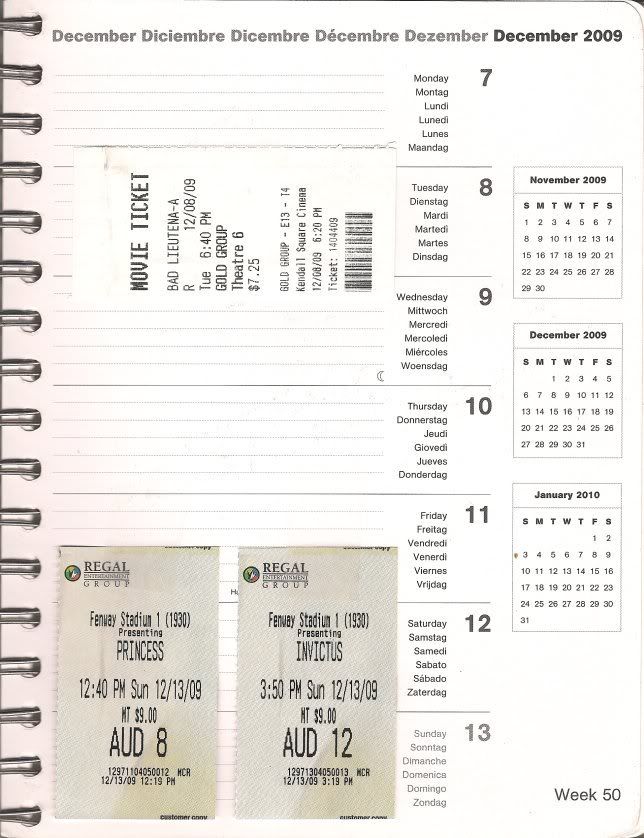
... one fewer movie seen and I would have had a great theme going: Two extremely different takes on New Orleans.
Bad Lieutenant: Port of Call New Orleans
* * * ¾ (out of four)
Seen 8 December 2009 in Landmark Kendall Square #6 (first-run)
When I first heard that Nicolas Cage was doing a movie for director Werner Herzog, my reaction was giddiness - my two favorite crazy people working together! Would their respective forms of insanity work in harmony or at cross-purposes? And they're going to do it in post-Katrina New Orleans? On a sequel/remake to an infamous movie that makes its director absolutely livid? This would, obviously, be either awesome or a train wreck.
It is awesome.
Like many of Herzog's great films, it is about a man, none too stable to begin with, who loses his mind. Cage's Terence McDonah is a New Orleans detective who, in rescuing a drowning man during Katrina, developed chronic back pain and quickly escalated from vicodin to harder drugs to treat it. It's not long before he's hallucinating and throwing caution to the wind, and we get that from both ends: Cage's increasingly unhinged performance, and Herzog's deranged imagery.
And they go with it. I especially loved how, during the last act, there's a moment when you start thinking, okay, drug-addicted cop, already got a screw loose, we're in fantasy territory... And instead, they go with it. Terence is crazy, sure, but the world in general is apparently just as nuts.
The Princess and the Frog
* * * ½ (out of four)
Seen 13 December 2009 in Regal Fenway #8 (first-run)
It's hard to believe it's only been five years or so since Disney's last traditionally animated feature. It seems like longer, I suspect, because I missed Brother Bear and Home on the Range, and the sci-fi adventures of Treasure Planet and Atlantis seem like different things. Still, it's great to see that specific look on-screen again, and with Musker and Clements in charge. They directed many of the best of the late-80s/90s boom period for Disney (The Great Mouse Detective, The Little Mermaid, Aladdin, Hercules), and they've returned in good form.
Maybe not quite perfect - I love Randy Newman and he contributes a nice soundtrack, but the first half has a lot of songs, sometimes one right on top of the other. But, then, it's New Orleans, a city where we can actually believe in the crowd bursting into a song & dance number, so it's OK.
The animation is a joy to watch, though - even if Disney is now farming it out rather than doing it in-house, it's smooth, hops styles on occasion without difficulty, and does things that digital might have issues with - stretchy characters, for instance. Of course, some things that seem like that - villain Facilier's shadowy minions, for instance - must have been created entirely during the coloring stage, which is digital.
Still, I thoroughly enjoyed it. It's great to see Musker and Clements back, and here's hoping that Disney puts them right back to work!
Invictus
* * * (out of four)
Seen 13 December 2009 in Regal Fenway #12 (first-run)
Perhaps the most amazing thing to happen in the past twenty years is a non-event: After apartheid, South Africa has failed to collapse into an unending mire of civil war despite the stark economic, ethnic, and cultural divisions, not to mention the bitter history. On the face of it, it should be even more of a mess than it is - and while crime is bad and there's still some ugly sentiment, they are not the mess that the former Yugoslavia is.
Clint Eastwood's Invictus doesn't really do much to demonstrate that it's due in any great measure to the South African rugby team's long-shot chase of the World Cup in 1995, when they were host nation. You could cut Matt Damon's team captain, and most of the sport-related scenes, without losing much. All of that together fails to match the first sequence when the black head of Nelson Mandela's security detail finds his request for more manpower filled with Afrikaaners who, months earlier, were probably throwing ANC members like him in jail. Following that group might have made for one hell of a movie.
Of course, to a certain extent it doesn't matter which group we follow because Morgan Freeman's Mandela is the story. Freeman's imitation is good - just short of uncanny - and as a result, it does still leave the man something of an enigma. In fact, maybe a bit more of one - though it's been easy to look at Mandela as little short of a saint, Invictus invites us to wonder how much of his actions are altruistic and how much were shrewd political calculation, made by a man with a handle on his own personal charisma. Either way, the man is impressive, a reminder that forgiveness and reconciliation can be powerful forces, even if they don't initially seem as satisfying as revenge.
Look at it this way, though:

... one fewer movie seen and I would have had a great theme going: Two extremely different takes on New Orleans.
Bad Lieutenant: Port of Call New Orleans
* * * ¾ (out of four)
Seen 8 December 2009 in Landmark Kendall Square #6 (first-run)
When I first heard that Nicolas Cage was doing a movie for director Werner Herzog, my reaction was giddiness - my two favorite crazy people working together! Would their respective forms of insanity work in harmony or at cross-purposes? And they're going to do it in post-Katrina New Orleans? On a sequel/remake to an infamous movie that makes its director absolutely livid? This would, obviously, be either awesome or a train wreck.
It is awesome.
Like many of Herzog's great films, it is about a man, none too stable to begin with, who loses his mind. Cage's Terence McDonah is a New Orleans detective who, in rescuing a drowning man during Katrina, developed chronic back pain and quickly escalated from vicodin to harder drugs to treat it. It's not long before he's hallucinating and throwing caution to the wind, and we get that from both ends: Cage's increasingly unhinged performance, and Herzog's deranged imagery.
And they go with it. I especially loved how, during the last act, there's a moment when you start thinking, okay, drug-addicted cop, already got a screw loose, we're in fantasy territory... And instead, they go with it. Terence is crazy, sure, but the world in general is apparently just as nuts.
The Princess and the Frog
* * * ½ (out of four)
Seen 13 December 2009 in Regal Fenway #8 (first-run)
It's hard to believe it's only been five years or so since Disney's last traditionally animated feature. It seems like longer, I suspect, because I missed Brother Bear and Home on the Range, and the sci-fi adventures of Treasure Planet and Atlantis seem like different things. Still, it's great to see that specific look on-screen again, and with Musker and Clements in charge. They directed many of the best of the late-80s/90s boom period for Disney (The Great Mouse Detective, The Little Mermaid, Aladdin, Hercules), and they've returned in good form.
Maybe not quite perfect - I love Randy Newman and he contributes a nice soundtrack, but the first half has a lot of songs, sometimes one right on top of the other. But, then, it's New Orleans, a city where we can actually believe in the crowd bursting into a song & dance number, so it's OK.
The animation is a joy to watch, though - even if Disney is now farming it out rather than doing it in-house, it's smooth, hops styles on occasion without difficulty, and does things that digital might have issues with - stretchy characters, for instance. Of course, some things that seem like that - villain Facilier's shadowy minions, for instance - must have been created entirely during the coloring stage, which is digital.
Still, I thoroughly enjoyed it. It's great to see Musker and Clements back, and here's hoping that Disney puts them right back to work!
Invictus
* * * (out of four)
Seen 13 December 2009 in Regal Fenway #12 (first-run)
Perhaps the most amazing thing to happen in the past twenty years is a non-event: After apartheid, South Africa has failed to collapse into an unending mire of civil war despite the stark economic, ethnic, and cultural divisions, not to mention the bitter history. On the face of it, it should be even more of a mess than it is - and while crime is bad and there's still some ugly sentiment, they are not the mess that the former Yugoslavia is.
Clint Eastwood's Invictus doesn't really do much to demonstrate that it's due in any great measure to the South African rugby team's long-shot chase of the World Cup in 1995, when they were host nation. You could cut Matt Damon's team captain, and most of the sport-related scenes, without losing much. All of that together fails to match the first sequence when the black head of Nelson Mandela's security detail finds his request for more manpower filled with Afrikaaners who, months earlier, were probably throwing ANC members like him in jail. Following that group might have made for one hell of a movie.
Of course, to a certain extent it doesn't matter which group we follow because Morgan Freeman's Mandela is the story. Freeman's imitation is good - just short of uncanny - and as a result, it does still leave the man something of an enigma. In fact, maybe a bit more of one - though it's been easy to look at Mandela as little short of a saint, Invictus invites us to wonder how much of his actions are altruistic and how much were shrewd political calculation, made by a man with a handle on his own personal charisma. Either way, the man is impressive, a reminder that forgiveness and reconciliation can be powerful forces, even if they don't initially seem as satisfying as revenge.
Monday, December 07, 2009
This Week In Tickets: 30 November 2009 to 6 December 2009
December is looking ridiculously busy - the watch-a-thon may be over, but I'm watching a ton of Sherlock Holmes for the eFilmCritic project: At some point about a week ago, when I got to the point where I needed to watch a movie and then write it up within 36 hours for the daily Holmes review to get posted at midnight, I thought, holy crap, that's a deadline. I hate deadlines. Why would I set myself up for a whole month of them? And that's before getting into what's going on at work, the Red Sox tickets going on sale on the 12th, the party for a cousin who has moved up to Maine, and Christmas shopping...
(Although I'm actually a bit ahead of where I usually am there; I found some neat stuff at Bazaar Bizarre. I'm not usually a craft faire sort of guy, but there were a couple guys there who did their thing with welding rather than knitting. So, if anybody asks, it was a Maker faire. The Boston one is over, but folks in Cleveland and San Francisco might want to check their local events out this weekend.)
I may have to take a day off work next week for opening day of Avatar. That counts as a floating holiday for me, right?
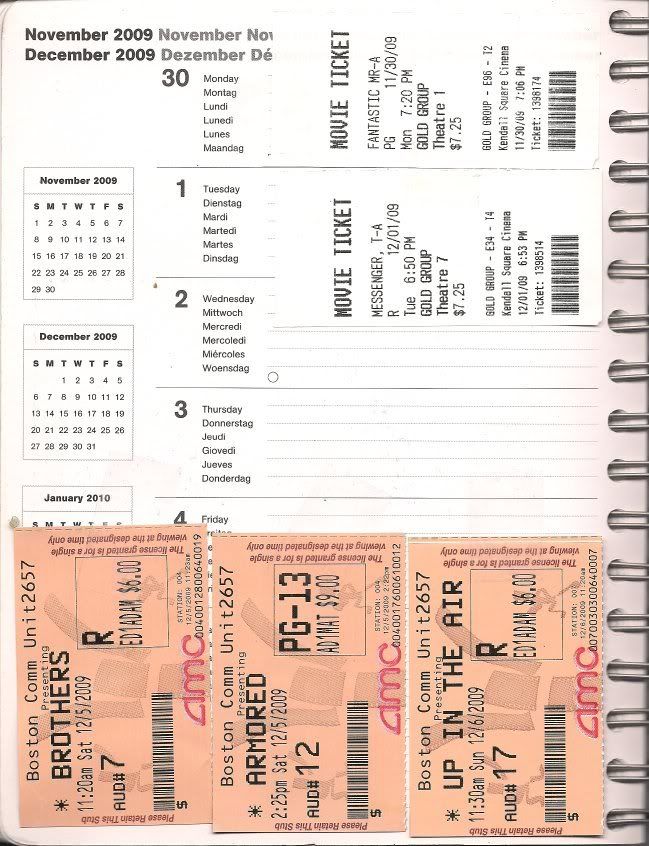
A reminder for those who might enjoy giving for the Holidays: Final tally for the 2009 Movie Watch-a-Thon is 5 at the Brattle, 25 elsewhere, and 2 screenings elsewhere which may or may not count. Donations go to this page.
Huh, weird sequence of (non-Sherlock) movies this week, unusually tied together even though I didn't really try to do so. It starts and ends with George Clooney doing good work for critical-darling directors, and in between has two stories about Middle East war widows/returnees. The old hand and rookie delivering bad news is central to both The Messenger and Up in the Air.
And then there's Armored, because sometimes it feels really good to knock some stuff around.
Fantastic Mr. Fox
* * * ½ (out of four)
Seen 30 November 2009 in Landmark Kendall Square #1 (first-run)
It's no secret that I've become disillusioned with Wes Anderson over the past few years. After finding Rushmore an exciting breath of fresh air, and giving a number of folks some of their best roles in The Royal Tennenbaums, there was something missing from The Life Aquatic that even some nifty visuals and Harry Selick creatures couldn't compensate for, and he followed that up with the terrible The Darjeeling Limited. There are two basic issues at work, I figure: One, a combination of success and hanging out with the Coppolas and Noah Baumbach has skewed his view of the world a bit; he's asking for sympathy for the woes of the privileged when the maker of Bottle Rocket and Rushmore might have told his later subjects to get over themselves.
Second, well, if Wes Anderson's father is still with us, could you go to Hollywood or Paris and give your son a hug? Maybe play a game of catch. He's crying for it, man!
Anderson's daddy issues are still front and center, but he, co-writer Baumbach, and animation director Mark Gustafson (who almost certainly will not get the level of credit he deserves) put together a duly whimsical adaptation of Roald Dahl's book, anchored by the note-perfect voice work of George Clooney as the title character. I'm not sure how much kids will like it - the humor is often dry and self-referential, and the Clooney fox's story is about settling down, though they may see themselves in the younger foxes. It is, overall, a fun movie, and even if one of the knocks on Anderson is that he often seems a bit too pleased with himself, he has made something to be proud of here.
The Messenger
* * * ½ (out of four)
Seen 1 December 2009 in Landmark Kendall Square #7 (first-run)
The Messenger has no problem with making the audience a little uncomfortable. What might, in another movie, have been a bittersweet romance between Ben Foster's Will Montgomery (a wounded soldier serving the end of his hitch informing next of kin of death overseas) and Samantha Morton's Olivia Pitterson (a widow and mother who takes the news with surprising calm), feels an awful lot like stalking at first, and even when it starts to feel a little "right", acknowledges that it's not really healthy. Foster is exceptional, a young military man trying his best to hold in pain and confusion, just on the line between someone you root for and someone you worry about.
And then you've got Woody Harrelson, really knocking his supporting role out of the park. His Captain Stone tries to approach a job that is corrosive to the soul with precisely controlled professionalism and it leads him to reach out in ways that are both abortive and desperate. It's pretty close to perfect, a great variation on Foster's performance without duplicating or stealing the show.
Like a lot of movies more built on character and performance than story, writer/director Oren Moverman has a little trouble figuring out how to end things, but it doesn't come close to tarnishing what Foster and Harrelson do.
Brothers
* * * ¼ (out of four)
Seen 5 December 2009 in AMC Boston Common #7 (first-run)
Another day, another movie about a young man returning from war, with another a great pair of performances, that stumbles a bit in the end. This time, it's Jake Gyllenhaal and Tobey Maguire as a pair of brothers, one a habitual screw-up just getting out of jail, the other a golden-boy soldier gone to war, presumed dead, and eventually returned.
For all the big drama and story comes in the latter half of the movie, what I loved most was the beginning: Maguire's Sam picks Gyllenhaal's Tom up from jail, and on the ride home, without any grand speeches or overtly dramatic performances, they sell us on getting brothers, how they can disagree with each other and even disapprove of their respective choices, but find that such considerations fall away almost instantly. Then there's a family dinner scene where their father (Sam Shepard) just keeps needling away at Tom, and the moment when Tom learns that Sam is dead, and...
Jake Gyllenhaal is just really amazing in this. Not to take anything away from Tobey Maguire, who gets a lot of the big melodrama, but when the story shifts in the second half, and becomes about him coming home damaged, it becomes a little more familiar. And while it is making a more concerted effort to stamp scenes into one's memory, it winds up not being nearly so memorable as when it's about Tommy stepping up in his brother's absence. It will be interesting to see who gets pushed as lead and supporting actors here, because while it's probably easier to make an argument that Brothers is about Sam, Gyllenhaal just owns the first half or so.
Also: Jim Sheridan should make scripts that feature two little girls a priority. Just as the Bolger sisters were a huge part of what made In America so good, it's tough to imagine Brothers being as grounded and real without Bailee Madison's Isabelle and Taylor Geare's Maggie.
Armored
* * * ½ (out of four)
Seen 5 December 2009 in AMC Boston Common #12 (first-run)
I'm going to have to take another look at Kontroll. I saw Nimrod Antal's debut feature at the Boston Film Festival, and vaguely remember loving the style if not the story. Since then, he's returned to America and made a couple of genre movies that are far better than they had any right to be: Vacancy was a taut little slasher-thriller that was incredibly bloody effective at twisting the screws, and now Armored takes what starts out seeming like a B-movie that should go direct to video and makes it, well, a B-movie that deserves its time in theaters.
It is a rough start; it's the sort of movie where you feel kind of grateful for people wearing their names on uniforms and a multicultural cast, so you can keep a bunch of basically similar characters straight. Motivations are spelled out plainly, Milo Ventimiglia's cop gets a scene for the express purpose of establishing him early enough that he's not anonymous later on. And then, the heist goes down and things go wrong, and suddenly things get interesting.
Again, I need to re-view Kontroll to see it this is a real pattern or signature, but I think what makes Antal so interesting as a director of thrillers is that he doesn't feel compelled to top himself as the movie goes along. In fact, he seems to choose scripts where his characters wind up in boxes inside of figurative boxes (cars within the subway system in Kontroll, a motel room in Vacancy, an armored car in an abandoned industrial space in Armored). Maybe he just knows that he's good at cranking up the tension. Whatever it is, it works - Armored consistently got me to lean a little closer to the screen, eager to see just what he was going to do next.
Up in the Air
* * * ½ (out of four)
Seen 6 December 2009 in AMC Boston Common #17 (first-run)
This is getting mentioned on a lot of year-end awards lists as the best movie of the year, to which I have to say - really? Don't get me wrong, it's a pretty darn good movie, and looking over what I saw this year, I guess there aren't a whole lot of conventional movies to upset it - I loved Up, The Brothers Bloom, Sugar, Moon, and a few others more, but they're hardly typical nominees. And I won't lie; there were several points during the movie when I thought to myself that I was watching something special. In total, though, it doesn't quite merit "special". Very good, yes, but I have to hope that the top tier is a little higher.
And, one other note: It's pretty depressing. Not just the bit about it being about people losing their jobs, but look at the progression of George Clooney's character: He's happy, content, and comfortable as the film starts. He loves something about his job that many others would find incredibly stressful, he does that job better than almost anybody else, and the fact that he's not on a track to marriage, a house, and 2.4 kids doesn't upset him. So, of course, everybody treats him like a freak whose happiness can't possibly be real. Then, after dangling something that makes a conventional life seem worthwhile, he's given a crotch-kick in the sort of twist that is such a huge cliché that you think the movie can't possibly be going there, but oh yes, it does. And now he's miserable with nothing to show for it.
Maybe the end isn't quite a total sour note, but it is kind of a bummer - not just for the character, or the testimony from the laid-off workers shown in the film that seems like pandering, but because it's the sort of "serious movie" play that bugs me: It's saying something utterly conventional, but needs to prove its supposed maturity and sophistication by undercutting its message. Sure, Hollywood endings in real life are few and far between, but don't avoid it just to avoid it; do so because you've got a better ending for the story you want to tell.
(Although I'm actually a bit ahead of where I usually am there; I found some neat stuff at Bazaar Bizarre. I'm not usually a craft faire sort of guy, but there were a couple guys there who did their thing with welding rather than knitting. So, if anybody asks, it was a Maker faire. The Boston one is over, but folks in Cleveland and San Francisco might want to check their local events out this weekend.)
I may have to take a day off work next week for opening day of Avatar. That counts as a floating holiday for me, right?

A reminder for those who might enjoy giving for the Holidays: Final tally for the 2009 Movie Watch-a-Thon is 5 at the Brattle, 25 elsewhere, and 2 screenings elsewhere which may or may not count. Donations go to this page.
Huh, weird sequence of (non-Sherlock) movies this week, unusually tied together even though I didn't really try to do so. It starts and ends with George Clooney doing good work for critical-darling directors, and in between has two stories about Middle East war widows/returnees. The old hand and rookie delivering bad news is central to both The Messenger and Up in the Air.
And then there's Armored, because sometimes it feels really good to knock some stuff around.
Fantastic Mr. Fox
* * * ½ (out of four)
Seen 30 November 2009 in Landmark Kendall Square #1 (first-run)
It's no secret that I've become disillusioned with Wes Anderson over the past few years. After finding Rushmore an exciting breath of fresh air, and giving a number of folks some of their best roles in The Royal Tennenbaums, there was something missing from The Life Aquatic that even some nifty visuals and Harry Selick creatures couldn't compensate for, and he followed that up with the terrible The Darjeeling Limited. There are two basic issues at work, I figure: One, a combination of success and hanging out with the Coppolas and Noah Baumbach has skewed his view of the world a bit; he's asking for sympathy for the woes of the privileged when the maker of Bottle Rocket and Rushmore might have told his later subjects to get over themselves.
Second, well, if Wes Anderson's father is still with us, could you go to Hollywood or Paris and give your son a hug? Maybe play a game of catch. He's crying for it, man!
Anderson's daddy issues are still front and center, but he, co-writer Baumbach, and animation director Mark Gustafson (who almost certainly will not get the level of credit he deserves) put together a duly whimsical adaptation of Roald Dahl's book, anchored by the note-perfect voice work of George Clooney as the title character. I'm not sure how much kids will like it - the humor is often dry and self-referential, and the Clooney fox's story is about settling down, though they may see themselves in the younger foxes. It is, overall, a fun movie, and even if one of the knocks on Anderson is that he often seems a bit too pleased with himself, he has made something to be proud of here.
The Messenger
* * * ½ (out of four)
Seen 1 December 2009 in Landmark Kendall Square #7 (first-run)
The Messenger has no problem with making the audience a little uncomfortable. What might, in another movie, have been a bittersweet romance between Ben Foster's Will Montgomery (a wounded soldier serving the end of his hitch informing next of kin of death overseas) and Samantha Morton's Olivia Pitterson (a widow and mother who takes the news with surprising calm), feels an awful lot like stalking at first, and even when it starts to feel a little "right", acknowledges that it's not really healthy. Foster is exceptional, a young military man trying his best to hold in pain and confusion, just on the line between someone you root for and someone you worry about.
And then you've got Woody Harrelson, really knocking his supporting role out of the park. His Captain Stone tries to approach a job that is corrosive to the soul with precisely controlled professionalism and it leads him to reach out in ways that are both abortive and desperate. It's pretty close to perfect, a great variation on Foster's performance without duplicating or stealing the show.
Like a lot of movies more built on character and performance than story, writer/director Oren Moverman has a little trouble figuring out how to end things, but it doesn't come close to tarnishing what Foster and Harrelson do.
Brothers
* * * ¼ (out of four)
Seen 5 December 2009 in AMC Boston Common #7 (first-run)
Another day, another movie about a young man returning from war, with another a great pair of performances, that stumbles a bit in the end. This time, it's Jake Gyllenhaal and Tobey Maguire as a pair of brothers, one a habitual screw-up just getting out of jail, the other a golden-boy soldier gone to war, presumed dead, and eventually returned.
For all the big drama and story comes in the latter half of the movie, what I loved most was the beginning: Maguire's Sam picks Gyllenhaal's Tom up from jail, and on the ride home, without any grand speeches or overtly dramatic performances, they sell us on getting brothers, how they can disagree with each other and even disapprove of their respective choices, but find that such considerations fall away almost instantly. Then there's a family dinner scene where their father (Sam Shepard) just keeps needling away at Tom, and the moment when Tom learns that Sam is dead, and...
Jake Gyllenhaal is just really amazing in this. Not to take anything away from Tobey Maguire, who gets a lot of the big melodrama, but when the story shifts in the second half, and becomes about him coming home damaged, it becomes a little more familiar. And while it is making a more concerted effort to stamp scenes into one's memory, it winds up not being nearly so memorable as when it's about Tommy stepping up in his brother's absence. It will be interesting to see who gets pushed as lead and supporting actors here, because while it's probably easier to make an argument that Brothers is about Sam, Gyllenhaal just owns the first half or so.
Also: Jim Sheridan should make scripts that feature two little girls a priority. Just as the Bolger sisters were a huge part of what made In America so good, it's tough to imagine Brothers being as grounded and real without Bailee Madison's Isabelle and Taylor Geare's Maggie.
Armored
* * * ½ (out of four)
Seen 5 December 2009 in AMC Boston Common #12 (first-run)
I'm going to have to take another look at Kontroll. I saw Nimrod Antal's debut feature at the Boston Film Festival, and vaguely remember loving the style if not the story. Since then, he's returned to America and made a couple of genre movies that are far better than they had any right to be: Vacancy was a taut little slasher-thriller that was incredibly bloody effective at twisting the screws, and now Armored takes what starts out seeming like a B-movie that should go direct to video and makes it, well, a B-movie that deserves its time in theaters.
It is a rough start; it's the sort of movie where you feel kind of grateful for people wearing their names on uniforms and a multicultural cast, so you can keep a bunch of basically similar characters straight. Motivations are spelled out plainly, Milo Ventimiglia's cop gets a scene for the express purpose of establishing him early enough that he's not anonymous later on. And then, the heist goes down and things go wrong, and suddenly things get interesting.
Again, I need to re-view Kontroll to see it this is a real pattern or signature, but I think what makes Antal so interesting as a director of thrillers is that he doesn't feel compelled to top himself as the movie goes along. In fact, he seems to choose scripts where his characters wind up in boxes inside of figurative boxes (cars within the subway system in Kontroll, a motel room in Vacancy, an armored car in an abandoned industrial space in Armored). Maybe he just knows that he's good at cranking up the tension. Whatever it is, it works - Armored consistently got me to lean a little closer to the screen, eager to see just what he was going to do next.
Up in the Air
* * * ½ (out of four)
Seen 6 December 2009 in AMC Boston Common #17 (first-run)
This is getting mentioned on a lot of year-end awards lists as the best movie of the year, to which I have to say - really? Don't get me wrong, it's a pretty darn good movie, and looking over what I saw this year, I guess there aren't a whole lot of conventional movies to upset it - I loved Up, The Brothers Bloom, Sugar, Moon, and a few others more, but they're hardly typical nominees. And I won't lie; there were several points during the movie when I thought to myself that I was watching something special. In total, though, it doesn't quite merit "special". Very good, yes, but I have to hope that the top tier is a little higher.
And, one other note: It's pretty depressing. Not just the bit about it being about people losing their jobs, but look at the progression of George Clooney's character: He's happy, content, and comfortable as the film starts. He loves something about his job that many others would find incredibly stressful, he does that job better than almost anybody else, and the fact that he's not on a track to marriage, a house, and 2.4 kids doesn't upset him. So, of course, everybody treats him like a freak whose happiness can't possibly be real. Then, after dangling something that makes a conventional life seem worthwhile, he's given a crotch-kick in the sort of twist that is such a huge cliché that you think the movie can't possibly be going there, but oh yes, it does. And now he's miserable with nothing to show for it.
Maybe the end isn't quite a total sour note, but it is kind of a bummer - not just for the character, or the testimony from the laid-off workers shown in the film that seems like pandering, but because it's the sort of "serious movie" play that bugs me: It's saying something utterly conventional, but needs to prove its supposed maturity and sophistication by undercutting its message. Sure, Hollywood endings in real life are few and far between, but don't avoid it just to avoid it; do so because you've got a better ending for the story you want to tell.
Subscribe to:
Posts (Atom)

