No clever commentary, other than wondering how Lonely Are the Brave isn't available on DVD. Sure, it's Universal and B&W, and they don't seem to be too keen on digging through their catalog for more obscure titles like that unless they can release the movies in some sort of three-pack. You'd think Kirk Douglas in a movie from the writer of Spartacus might have been worth a look, though.
Bad Day at Black Rock
* * * ¾ (out of four)
Seen 11 January 2009 at the Brattle Theatre (Brattle Selects)
Check out the cast on this movie: Spencer Tracy. Lee Marvin. Ernest Borgnine. Anne Francis. Robert Ryan. Walter Brennan. That's not quite a bloated epic cast, especially since a few of them were still on their way up. It catches the eye in retrospect, though, doesn't it? It's certainly worth checking out based on the cast alone, especially since the audience will get a tight little thriller for its trouble.
A few months after the end of World War II, John J. Macreedy (Spencer Tracy) gets off the train in Black Rock, Arizona, which causes something of a stir in the tiny town; no-one has done that in something like four years. He's looking for a Joe Komoko, which puts the residents even more on edge, and downright uncooperative. Reno Smith (Robert Ryan) seems to be the ringleader, giving Macreedy "friendly advice" to leave things alone, while Hector David (Lee Marvin) and Coley Trimble (Ernest Borgnine) are more overtly hostile. Doctor/vet/undertaker T.R. Veile (Walter Brennan) and layabout sheriff Tim Horn (Dean Jagger) are more sympathetic, but are pretty pointedly ignorant. Pretty young mechanic Liz Wirth (Anne Francis) doesn't get the memo before renting him a jeep, and his trip out to the Komoko homestead at Adobe Flats has the townspeople even more determined to figure out just who Macreedy is and why he's so interested in Komoko.
Black Rock upends a lot of genre expectations. It's structured as a mystery, it turns that form right on its head: The film couldn't be much more clear from the beginning on who committed which crime, so we spend a lot more time puzzling out the history and motivations of the sleuth than the suspects. The setting is a ramshackle western town, but the movie takes place smack in the middle of the 20th century. It's full of murky film noir morality and betrayals, but scenes occur in broad daylight. Sure, many westerns are technically crime films; it's still unusual to see the two blended in this way.
It works, though, because the writers have a pretty reliable engine with which to run the story: Secrets, by their nature, breed mistrust. Black Rock initially seems to be in a state of uncomfortable equilibrium, but Macreedy is throwing that off even before he specifically expresses interest in Komoko, and his very presence soon begins to fracture the town in addition to making him a target. What's really impressive is how the movie, despite a short running time (81 minutes!), finds the time to trouble the souls of most of its characters and see how each reacts individually.
Spencer Tracy is a pleasure as Macreedy, grumping his way through the movie with his left arm in a pocket the whole time to signify an amputated hand. It's emasculating for him to be looked at as a cripple, so he and he certainly has the air of a man who won't start any more trouble than he has to, but will by god finish it. Robert Ryan takes the opposite tack as Smith, appearing calm throughout, confident of the hold he has on his town. When he does lose his cool, it's a temporary thing, and the effect is to make him seem even colder afterward.
As good as they are, the colorful supporting cast is what really makes the film stand out. Smith's main henchmen, for instance, are played by Lee Marvin and Ernest Borgnine before they became stars in their own right. Marvin intimidates; he plays Hector as having something close to Smith's self-control but more willing to overtly throw his weight around. Borgnine is the film's loose cannon, laughing maniacally as he tries to get rid of Macreedy. John Ericson is good as the young and uncertain member of the crew, while Ann Francis is pure brass as his little sister. Dean Jagger is pitiable as the drunk of a sheriff, and Walter Brennan lively as the closest thing the town has to a conscience.
Director John Sturges doesn't waste a drop of any of these ingredients; he's got the town and audience on edge right from the very beginning, pushing the tension every second he gets. He stages three quality action scenes - Macreedy does all right for a guy with one hand - but the movie never seems like just the means to connect them.
Also at EFC, along with one other review.
Lonely Are the Brave
* * * ¾ (out of four)
Seen 11 January 2009 at the Brattle Theatre (Brattle Selects)
Lonely Are the Brave has a really fantastic opening: A cowboy breaking a horse on the open range, suitably weathered, taking a nap with his hat pulled down over his eyes. It could come out of any of a hundred westerns, except that when the cowboy removes his hat and looks up, there are jet contrails in the sky, indicating that it's the present (that is, the 1960s), rather than a century earlier.
That cowboy is John W. "Jack" Burns (Kirk Douglas), and he's been making his way to New Mexico, where old friend Paul Bondi (Michael Kane) is in jail for helping some illegal immigrants. Bondi's wife Jerry (Gena Rowlands) informs him that there's no visiting day before Bondi is to be sent upstate to prison, so Jack gets into a bar fight in order to be tossed in there with him. Bondi doesn't want any part of Jack's plan to help him escape - serving his two-year sentence beats the five tacked on for a jailbreak - but Jack doesn't figure he can handle the year he's facing for assaulting a police officer. He escapes, but that puts Sheriff Morey Johnson (Walter Matthau) on his trail, with all the modern technology available.
Kirk Douglas is wonderful in this role. Jack is bigger than life in a lot of ways, a personification of the old West (or at least, the romanticized version of it). He's affable, friendly with just about everyone; even when things come to blows, he'll fight with one hand behind his back if his opponent is a one-armed man or stoically take a beating. It's very easy to be in awe of Jack, and enjoy how he flummoxes the police by not carrying any sort of ID. Douglas reveals the downside of being a throwback slowly; we see him uncomfortable in Jerry's kitchen, and though there's no one scene where he or anyone comes out and says it, we see that underneath his Western ruggedness and charm, Jack is afraid of the modern world.
It makes us re-examine him as the film goes on, and maybe view some of his free-spiritedness as antisocial behavior, although it's hard to view him terribly negatively - he means no-one any harm and comes across as someone who couldn't be any other way even if he were to try. It makes the second half more interesting, because we're not only never quite sure which way the manhunt (and its flip side, Jack's dash to Mexico) will go. Is this the sort of movie that paints Jack as an anachronism that is ultimately no match for the modern world, or celebrates his indomitable spirit (either by him escaping or by him going out in a blaze of glory)? Will that come at a price? Director David Miller and screenwriter Dalton Trumbo don't tip their hands until very late in the game, so there's quite a bit of suspense attached to each move Jack makes.
It's not entirely Kirk Douglas's show; there's a nice cast of (then) up-and-coming actors supporting him. There's Gena Rowlands as the charming Jerry Bondi, and Michael Kane as her husband. There's early work by Carroll O'Connor (as a truck driver in a seemingly separate subplot) and George Kennedy (as a sadistic guard/deputy); both just what is needed from their smaller parts. And then there's Walter Matthau, a delight as the sheriff pursuing Jack. Matthau provides a bit of comic relief just from the annoyed looks he gives Johnson's deputy, but never plays up the comedy so much that we don't think of him as smart. He's a worthy and respectful adversary.
Miller ends the film with an image nearly as iconic as the first, with nary a false step in between. Aside from being the home of Douglas's own favorite roles, Lonely Are the Brave is a loving but clear-eyed eulogy for the Old West as well as a highly entertaining chase film.
Also at EFC.
Thursday, January 15, 2009


Monday, January 12, 2009
This Week In Tickets: 5 January 2009 to 11 January 2009
Not quite so hectic a week as I thought it might be; I'd pondered picking up the second Nagisa Oshima film at the Brattle at some point, as well as going to Showcase Cinemas Revere to see one or two from the After Dark HorrorFest. Alas, I opted to do that on Sunday, when buses and trains are sparse, and wound up arriving at Sullivan Station about five minutes after the 109 bus to Revere left. The next one wouldn't be for another hour, good to miss the start of the only movie playing in the series that I really wanted to see (The Broken), so I headed back home to hunker down against the cold. Still, an average of one-plus films a day isn't bad:
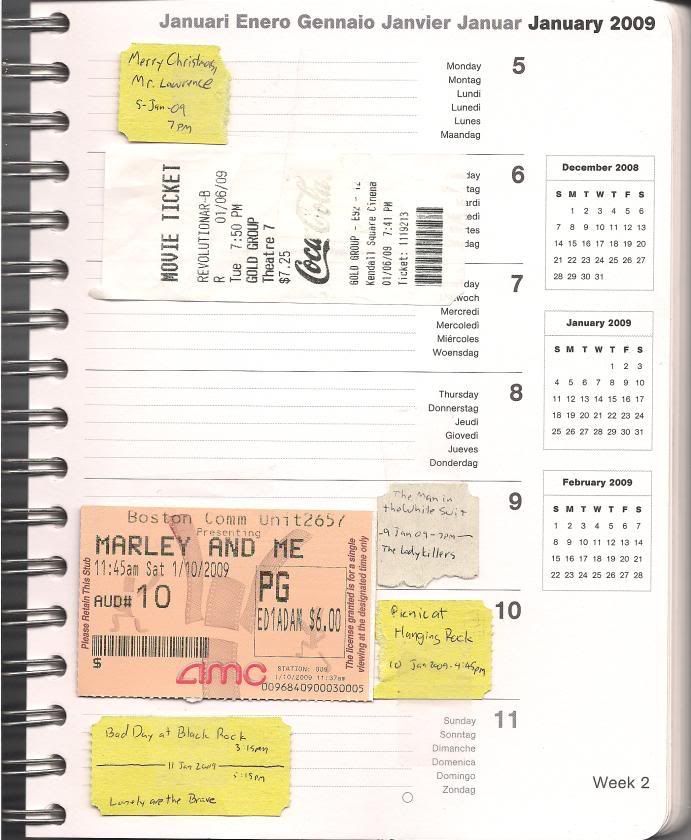
One of the unintentional juxtapositions here is Revolutionary Road and Marley and Me. I find myself grumbling about movies like Revolutionary Road a lot, but I am admittedly not always very quick to recognize when Hollywood does its opposite and does it fairly well. Marley and Me hits a number of the same themes as Revolutionary Road - particularly, dissatisfaction that one's life isn't what one planned it to be - but does a fine job of not presenting suburban life as a barely-hidden freak show populated by people who barely seem to tolerate each other, let alone ever loved one another. It's oddly reassuring to see that a movie family can actually get along and still be interesting and entertaining.
Granted, it helps to have a dog. The Wheelers might not have had all that trouble if they'd just gone and gotten a puppy.
Revolutionary Road
* * ¼ (out of four)
Seen 6 January 2009 at Landmark Theaters Kendall Square #7 (first-run)
There are some movies I have a hard time judging rationally, and the likes of Revolutionary Road are right up there. I enjoyed the life they mock as empty and stifling, and even though I know there can be unhappiness and disappointment there, the lifestyle itself isn't to blame. As much as my family probably figures I've assimilated into urban life and its associated attitudes, movies like this still get my traditional small-town back up.
That said, this movie is pretty decent at what it's trying to do, especially in the first half. Kate Winslet and Leonardo DiCaprio are great. But it's also got all the subtlety of a sledgehammer, frequently demonstrating exactly how little it actually has to say: There's a crazy guy (well-played by Michael Shannon) whose craziness includes the tendency to voice uncomfortable truths, for instance. The movie is basically over about halfway through, once DiCaprio's character makes a decision on taking a job offer versus Winslet's plan to move to Paris, but there's what seems like another forty-five minutes of playing out the string afterward. And then there's the ending, which is simplistically symbolic while clumsily forcing a dramatic resolution.
Marley & Me
* * * (out of four)
Seen 10 January 2009 at AMC Boston Common #10 (first-run)
One of my brothers has a yellow lab who is pretty much the exact opposite of this dog's in temperament; the best-behaved dog you'll ever meet (aside from stealing their other dog's toys). Not really important, other than to bring up the fact that my family tends to be dog people, and I loved how this movie really seemed to get how people relate to their dogs.
Otherwise, it's a nice little movie, and while that's often something people say to diminish a film, I don't mean it that way. I think movies like Marley & Me must be tremendously difficult to do well, because they tend to eschew drama. There are dramatic events in the lives of the characters, but they are by and large handled with grace, maturity, and good humor. In my experience, that's much more common and "realistic" than the other extreme, but it doesn't have the easy high points that would punctuate a film like, say, Revolutionary Road.
And if the end doesn't get to you - it ends as so many boy/man and his dog movies do - well, then, I'm sorry. You should have had a dog growing up; they're great.
Picnic at Hanging Rock
* * * ¼ (out of four)
Seen 10 January 2009 at the Brattle Theatre (Brattle Selects)
Picnic at Hanging Rock is an interesting case; a mystery that doesn't present a solution. Director Peter Weir makes its setting quite otherworldly and unnerving, whether it's a girls' school, an aristocrat's estate, or the forbidding location of Hanging Rock itself.
Though it doesn't share many of the usual trappings, it's one of the finest horror movies ever made. Where most films in that genre eventually offer rationales and release, Hanging Rock only offers eeriness and uncertainty. There are a couple of shocks, but those come from utterly understandable (and thus more disturbing) sources. The real fear here is that of the unknown.

One of the unintentional juxtapositions here is Revolutionary Road and Marley and Me. I find myself grumbling about movies like Revolutionary Road a lot, but I am admittedly not always very quick to recognize when Hollywood does its opposite and does it fairly well. Marley and Me hits a number of the same themes as Revolutionary Road - particularly, dissatisfaction that one's life isn't what one planned it to be - but does a fine job of not presenting suburban life as a barely-hidden freak show populated by people who barely seem to tolerate each other, let alone ever loved one another. It's oddly reassuring to see that a movie family can actually get along and still be interesting and entertaining.
Granted, it helps to have a dog. The Wheelers might not have had all that trouble if they'd just gone and gotten a puppy.
Revolutionary Road
* * ¼ (out of four)
Seen 6 January 2009 at Landmark Theaters Kendall Square #7 (first-run)
There are some movies I have a hard time judging rationally, and the likes of Revolutionary Road are right up there. I enjoyed the life they mock as empty and stifling, and even though I know there can be unhappiness and disappointment there, the lifestyle itself isn't to blame. As much as my family probably figures I've assimilated into urban life and its associated attitudes, movies like this still get my traditional small-town back up.
That said, this movie is pretty decent at what it's trying to do, especially in the first half. Kate Winslet and Leonardo DiCaprio are great. But it's also got all the subtlety of a sledgehammer, frequently demonstrating exactly how little it actually has to say: There's a crazy guy (well-played by Michael Shannon) whose craziness includes the tendency to voice uncomfortable truths, for instance. The movie is basically over about halfway through, once DiCaprio's character makes a decision on taking a job offer versus Winslet's plan to move to Paris, but there's what seems like another forty-five minutes of playing out the string afterward. And then there's the ending, which is simplistically symbolic while clumsily forcing a dramatic resolution.
Marley & Me
* * * (out of four)
Seen 10 January 2009 at AMC Boston Common #10 (first-run)
One of my brothers has a yellow lab who is pretty much the exact opposite of this dog's in temperament; the best-behaved dog you'll ever meet (aside from stealing their other dog's toys). Not really important, other than to bring up the fact that my family tends to be dog people, and I loved how this movie really seemed to get how people relate to their dogs.
Otherwise, it's a nice little movie, and while that's often something people say to diminish a film, I don't mean it that way. I think movies like Marley & Me must be tremendously difficult to do well, because they tend to eschew drama. There are dramatic events in the lives of the characters, but they are by and large handled with grace, maturity, and good humor. In my experience, that's much more common and "realistic" than the other extreme, but it doesn't have the easy high points that would punctuate a film like, say, Revolutionary Road.
And if the end doesn't get to you - it ends as so many boy/man and his dog movies do - well, then, I'm sorry. You should have had a dog growing up; they're great.
Picnic at Hanging Rock
* * * ¼ (out of four)
Seen 10 January 2009 at the Brattle Theatre (Brattle Selects)
Picnic at Hanging Rock is an interesting case; a mystery that doesn't present a solution. Director Peter Weir makes its setting quite otherworldly and unnerving, whether it's a girls' school, an aristocrat's estate, or the forbidding location of Hanging Rock itself.
Though it doesn't share many of the usual trappings, it's one of the finest horror movies ever made. Where most films in that genre eventually offer rationales and release, Hanging Rock only offers eeriness and uncertainty. There are a couple of shocks, but those come from utterly understandable (and thus more disturbing) sources. The real fear here is that of the unknown.
The films of Alexander Mackendrick: The Man in the White Suit and The Ladykillers
I couldn't get to many of the other films in the HFA's Mackendrick series, with plenty of good stuff at the Brattle scheduled for the same weekend. When all is said and done, though, I'm happy with the two I saw. The Man in the White Suit has become a favorite of mine, and I was happy to see the Ealing verison of The Ladykillers for the first time. Though I knew I had seen the remake, I wasn't sure whether or not I had seen the original; it turned out to be new to me and quite entertaining.
The Man in the White Suit
* * * ¾ (out of four)
Seen 9 January 2009 at the Harvard Film Archive (Alexander Mackendrick and the Anarchy of Innocence)
It's possible to miss what a wonderful film The Man in the White Suit is because it jumps between so many different things, and doesn't necessarily finish any of them. It is romantic here, political here, and the light science fiction of a Twilight Zone episode here. It is funny throughout, to be sure, but that comedy goes from quiet farce to cartoonish bombast to sharp satire. It's never unsatisfying, as it turns out, a perfectly balanced comedy.
When we first meet Sidney Stratton (Alec Guinness), he (despite having been at Cambridge) is a janitor in the textile factor of Michael Corland (Michael Gough), who is trying to get more established manufacturer Alan Birnley (Cecil Parker) to invest - and romancing his daughter Daphne (Joan Greenwood). It's Daphne who spots the odd apparatus that Sidney has set up in the corner of the R&D department, and the discovery that he has been using company funds to purchase heavy hydrogen gets him fired. He soon finds a job as a laborer in the Birnley factory, where the discovers a synthetic fiber that doesn't get dirty and doesn't rip. Birnley initially sees pound signs, but soon both his competitors and the unions are up in arms about the implications of an indestructible fabric.
I don't think I've seen The Man in the White Suit on many lists of great science fiction films, which is a shame. No, it doesn't necessarily feel like one, or use many of the trappings other than a number of scenes in laboratories, but it's more prescient and insightful than many of its peers. It's the rare example of a film that seems to have actually listened to its science adviser; the technobabble Sidney spews actually sounds pretty reasonable almost sixty years later - the long-chain molecules he describes aren't so different from the carbon nanotubes much of today's materials research focuses on - and the screenplay anticipates nit-pickers' questions. More important is how it focuses on the immediate reaction to such an innovation - specifically, how items which never need replacing will throw industries into panic from top to bottom.
Granted, few people who aren't me are going to give all tha tmuch thought to how an Ealing Comedy works as science fiction as opposed to as a comedy. Happily, it's excellent on that count, too - director Alexander Mackendrick and his co-writers (including Roger MacDougall, who wrote the original play) start slow, with chuckles coming from Sidney's attempts to do his experiments on the sly, even though his apparatus pumps out a distinctive (and catchy!) beat. Lots of comedy is mined from the tendencies of Sidney's early formulations to blow up, and Guinness does a fine job both running around in chase scenes and playing something of a wide-eyed innocent, though not a stereotypical absent-minded scientist.
There's plenty of other amusing folks in the cast. Michael Gough is mainly a straight man as Corland, but Ernest Thesiger makes a late entrance and wins just about every scene he's in as Sir John Kierlaw, the hilariously old and infirm but still fiery leader of the fabric-makers' coalition. Cecil Parker sells Birnley perfectly, kind of stuffy but also kind of in over his head, led by his greed but not defined by it. Henry Mollison makes every scene he's in as Sidney's assistant funnier, and Vida Hope is hilariously strident as the union member who befriends Stratton.
At first, I wasn't terribly impressed with Joan Greenwood as Daphne - she's got kind of a weird voice and initially just seems like the obligatory girl. They do interesting things with her character, though, and I don't just say that because it's a pretty girl who suddenly finds herself interested in science. The arc of the character is interesting, because it's probably more complete than Sidney's, but since the movie is not actually about her, done in the background. She gets a few very nice, understated scenes in the third act, and I found myself liking and appreciating that Daphne's growth amounts to more than switching one boyfriend for another.
And that's marvelous. The Man in the White Suit has belly-laughs aplenty, and could have just done the usual thing around them. Instead, it's just a little smarter than it has to be, and rewards even the picky audience members.
Also at HBS.
The Ladykillers
* * * ½ (out of four)
Seen 9 January 2009 at the Harvard Film Archive (Alexander Mackendrick and the Anarchy of Innocence)
The theme given for the Harvard Film Archive's retrospective of director Alexander Mackendrick's films is "The Anarchy of Innocence". It's a theme that runs through all his films, perhaps never more clearly than in his best-known work, Ealing Studios' The Ladykillers.
One is unlikely to find a more innocent person than Mrs. Wilberforce (Katie Johnson), a widow of some years who is currently busy apologizing to the local police superintendent (Jack Warner) for the previous day's report of an alien invasion. She's also advertising for a boarder, an offer that "Professor" Marcus (Alec Guinness) takes her up on. Any reasonable person can see that this man is not to be trusted, and his story that he and his friends are a string quartet. Those friends are Claude (Cecil Parker), Harry (Peter Sellers), One-Round (Danny Green), and Louis (Herbert Lom), and they're planning a payroll robbery. Their plan involves Mrs. Wilberforce's unwitting participation, and is, of course, vulnerable to the greed of its participants.
Katie Johnson is billed seventh, as "The Old Lady", which doesn't come close to indicating how crucial she is to every part of the film. She initially appears little more than someone worthy of pity, and we're never quite able to take her seriously throughout the film. And yet we never fear for her or find her to be in particular danger, because she does have that purity of heart that almost wills her to be safe. She's not given many lines that are funny in and of themselves, but she delivers them with dry perfection. As befits the lead in a Mackendrick movie, she has the sort of innocence that leaves a trail of destruction behind her, and though it's not always easy to believe in her obliviousness to it, Johnson sells us on that, as well as the moment when she does realize just what she's involved in.
The five crooks of the title are all amusing in their own way. Alec Guinness makes Marcus into a grotesquery, with a face filled with ugly teeth and hair and an oily, arrogant manner that immediately repulses everyone in the audience. It is, truth be told, the sort of outlandish character one might normally expect Peter Sellers to be playing, but Sellers is perhaps the least memorable of the crew, a somewhat jittery youngster. Cecil Parker is blustery and charming as the middle-aged veteran, while Herbert Lom tends to dominate scenes with his slick, hard-edged tough. It's Danny Green who steals the show, though, as the group's muscle, and though he basically hits on every familiar note as the big, dumb lummox sick of being called stupid, it's seldom been done so well.
Mackendrick and the other filmmakers place and keep us in a world that is slightly askew, filled with pictures that won't hang straight because the house itself has been crooked since the War. Marcus first appears as a menacing shadow, and his face seems to go to pieces along with his patience. The heist is a wonderfully timed bit of action, and the last act, where the crooks try to eliminate the old lady but find themselves stymied, is wonderfully nasty and a brilliant example of how to use a running gag to punctuate what's going on.
Nearly fifty years later, the Coen brothers would assemble a fine cast in their attempt to transplant the story to America, but they would be unable to capture the original's innocence and anarchy. It's Mackendrick's specialty, and seldom is it done to better effect.
Also at HBS, along with one other review.
The Man in the White Suit
* * * ¾ (out of four)
Seen 9 January 2009 at the Harvard Film Archive (Alexander Mackendrick and the Anarchy of Innocence)
It's possible to miss what a wonderful film The Man in the White Suit is because it jumps between so many different things, and doesn't necessarily finish any of them. It is romantic here, political here, and the light science fiction of a Twilight Zone episode here. It is funny throughout, to be sure, but that comedy goes from quiet farce to cartoonish bombast to sharp satire. It's never unsatisfying, as it turns out, a perfectly balanced comedy.
When we first meet Sidney Stratton (Alec Guinness), he (despite having been at Cambridge) is a janitor in the textile factor of Michael Corland (Michael Gough), who is trying to get more established manufacturer Alan Birnley (Cecil Parker) to invest - and romancing his daughter Daphne (Joan Greenwood). It's Daphne who spots the odd apparatus that Sidney has set up in the corner of the R&D department, and the discovery that he has been using company funds to purchase heavy hydrogen gets him fired. He soon finds a job as a laborer in the Birnley factory, where the discovers a synthetic fiber that doesn't get dirty and doesn't rip. Birnley initially sees pound signs, but soon both his competitors and the unions are up in arms about the implications of an indestructible fabric.
I don't think I've seen The Man in the White Suit on many lists of great science fiction films, which is a shame. No, it doesn't necessarily feel like one, or use many of the trappings other than a number of scenes in laboratories, but it's more prescient and insightful than many of its peers. It's the rare example of a film that seems to have actually listened to its science adviser; the technobabble Sidney spews actually sounds pretty reasonable almost sixty years later - the long-chain molecules he describes aren't so different from the carbon nanotubes much of today's materials research focuses on - and the screenplay anticipates nit-pickers' questions. More important is how it focuses on the immediate reaction to such an innovation - specifically, how items which never need replacing will throw industries into panic from top to bottom.
Granted, few people who aren't me are going to give all tha tmuch thought to how an Ealing Comedy works as science fiction as opposed to as a comedy. Happily, it's excellent on that count, too - director Alexander Mackendrick and his co-writers (including Roger MacDougall, who wrote the original play) start slow, with chuckles coming from Sidney's attempts to do his experiments on the sly, even though his apparatus pumps out a distinctive (and catchy!) beat. Lots of comedy is mined from the tendencies of Sidney's early formulations to blow up, and Guinness does a fine job both running around in chase scenes and playing something of a wide-eyed innocent, though not a stereotypical absent-minded scientist.
There's plenty of other amusing folks in the cast. Michael Gough is mainly a straight man as Corland, but Ernest Thesiger makes a late entrance and wins just about every scene he's in as Sir John Kierlaw, the hilariously old and infirm but still fiery leader of the fabric-makers' coalition. Cecil Parker sells Birnley perfectly, kind of stuffy but also kind of in over his head, led by his greed but not defined by it. Henry Mollison makes every scene he's in as Sidney's assistant funnier, and Vida Hope is hilariously strident as the union member who befriends Stratton.
At first, I wasn't terribly impressed with Joan Greenwood as Daphne - she's got kind of a weird voice and initially just seems like the obligatory girl. They do interesting things with her character, though, and I don't just say that because it's a pretty girl who suddenly finds herself interested in science. The arc of the character is interesting, because it's probably more complete than Sidney's, but since the movie is not actually about her, done in the background. She gets a few very nice, understated scenes in the third act, and I found myself liking and appreciating that Daphne's growth amounts to more than switching one boyfriend for another.
And that's marvelous. The Man in the White Suit has belly-laughs aplenty, and could have just done the usual thing around them. Instead, it's just a little smarter than it has to be, and rewards even the picky audience members.
Also at HBS.
The Ladykillers
* * * ½ (out of four)
Seen 9 January 2009 at the Harvard Film Archive (Alexander Mackendrick and the Anarchy of Innocence)
The theme given for the Harvard Film Archive's retrospective of director Alexander Mackendrick's films is "The Anarchy of Innocence". It's a theme that runs through all his films, perhaps never more clearly than in his best-known work, Ealing Studios' The Ladykillers.
One is unlikely to find a more innocent person than Mrs. Wilberforce (Katie Johnson), a widow of some years who is currently busy apologizing to the local police superintendent (Jack Warner) for the previous day's report of an alien invasion. She's also advertising for a boarder, an offer that "Professor" Marcus (Alec Guinness) takes her up on. Any reasonable person can see that this man is not to be trusted, and his story that he and his friends are a string quartet. Those friends are Claude (Cecil Parker), Harry (Peter Sellers), One-Round (Danny Green), and Louis (Herbert Lom), and they're planning a payroll robbery. Their plan involves Mrs. Wilberforce's unwitting participation, and is, of course, vulnerable to the greed of its participants.
Katie Johnson is billed seventh, as "The Old Lady", which doesn't come close to indicating how crucial she is to every part of the film. She initially appears little more than someone worthy of pity, and we're never quite able to take her seriously throughout the film. And yet we never fear for her or find her to be in particular danger, because she does have that purity of heart that almost wills her to be safe. She's not given many lines that are funny in and of themselves, but she delivers them with dry perfection. As befits the lead in a Mackendrick movie, she has the sort of innocence that leaves a trail of destruction behind her, and though it's not always easy to believe in her obliviousness to it, Johnson sells us on that, as well as the moment when she does realize just what she's involved in.
The five crooks of the title are all amusing in their own way. Alec Guinness makes Marcus into a grotesquery, with a face filled with ugly teeth and hair and an oily, arrogant manner that immediately repulses everyone in the audience. It is, truth be told, the sort of outlandish character one might normally expect Peter Sellers to be playing, but Sellers is perhaps the least memorable of the crew, a somewhat jittery youngster. Cecil Parker is blustery and charming as the middle-aged veteran, while Herbert Lom tends to dominate scenes with his slick, hard-edged tough. It's Danny Green who steals the show, though, as the group's muscle, and though he basically hits on every familiar note as the big, dumb lummox sick of being called stupid, it's seldom been done so well.
Mackendrick and the other filmmakers place and keep us in a world that is slightly askew, filled with pictures that won't hang straight because the house itself has been crooked since the War. Marcus first appears as a menacing shadow, and his face seems to go to pieces along with his patience. The heist is a wonderfully timed bit of action, and the last act, where the crooks try to eliminate the old lady but find themselves stymied, is wonderfully nasty and a brilliant example of how to use a running gag to punctuate what's going on.
Nearly fifty years later, the Coen brothers would assemble a fine cast in their attempt to transplant the story to America, but they would be unable to capture the original's innocence and anarchy. It's Mackendrick's specialty, and seldom is it done to better effect.
Also at HBS, along with one other review.
Friday, January 09, 2009
Merry Christmas, Mr. Lawrence
The Brattle was showing Merry Christmas, Mr. Lawrence as a not-quite double bill with another one of Nagisa Oshima's films, In the Realm of the Senses, in that they were playing back-to-back in the same theater but were separate admission. I will reluctantly admit to chickening out on that one, though: It was only running at 9:30pm, I hadn't yet had dinner on the Monday where I saw Mr. Lawrence, and other excuses come freely, but let's face it: I was mainly squeamish upon seeing the NC-17 rating, although in my defense, my quick attempts to find out what the film was actually about mainly led to comments like "it's porn, but good porn." Which isn't really helpful; I get that it's an adult film vs. an "adult film", but is it something that would interest me?
Merry Christmas Mr. Lawrence
* * * ½ (out of four)
Seen 5 January 2009 at The Brattle Theater (Special Engagement)
Merry Christmas Mr. Lawrence is a double dose of boutique film: On the one side, it gives us a story of would-be samurai confronting the limits of their code; on the other, a tragedy of the English gentry. Both are genres with an (often deserved) reputation for being overly formal, and while Nagisa Oshima does make a movie that is occasionally admirable when it could be engaging, he doesn't just deliver twice as much stuffiness in one package.
The would-be samurai are the Japanese army during World War II, specifically Captain Yonoi (Ryuichi Sakamoto), who administers a prisoner of war camp on Java in 1942. Recently captured Major Jack Celliers (David Bowie) is the scion of a wealthy English family. Yonoi convinces the military tribunal to spare Celliers's life, but finds that Celliers is not quite what he expects. While those two find their minds occupied by questions of honor, others at the camp - Sgt. Hara (Takeshi Kitano), commander of the guards; Group Captain Hicksley (Jack Thompson), the ranking prisoner; and Col. John Lawrence (Tom Conti), who lived in Japan before the war and speaks the language - worry about more practical concerns.
As with many war films, Merry Christmas Mr. Lawrence has an all-male cast, and it doesn't shrink from what that may imply: In one of the very first scenes, Hara yanks Lawrence out of bed to assist him in deal with a Korean guard found having intercourse with a Dutch prisoner. The film stops just short of specifying it to be rape, although it certainly suggests that shame and punishment are being unfairly visited upon the presumed victim. There are speeches about how war strengthens the bonds between men, but not in that way. For all it protests against any charges of homo-eroticism, it is, among other things, a story of the unrequited love at first sight one man has for another.
Even though we're given very little insight into Yonoi's thoughts, you can tell that's what's going on from how we see Celliers. All the other men in the camp, prisoners and guards alike, are tanned, of course, but Celliers is golden; it's little wonder Hicksley sees him as a threat to his position and Lawrence is so deferential despite his higher rank. The only times Celliers doesn't look otherworldly is in his own flashbacks, which are a fine pastiche of English manor dramas. Not all of the film's visual appeal is focused on him, of course - Oshima does not shy from relatively graphic depictions of how poorly nourished Allied prisoners were in a Japanese POW camp, and also frames shots in the camp with shots familiar from samurai dramas, even while also showing that the traditional design motifs are far from a perfect fit to the current situation.
The film is not just about Celliers and Yonoi, though, and the rest is in many ways more interesting. It consists in large part of Lawrence and Hara handling more practical matters, but as they go about doing so, they learn about each other, personally and culturally. Some of that is Lawrence explaining things to Hara, but it's more than that: We see Hara absorb that knowledge like a sponge, while Lawrence reacts to seeing Japanese military culture in visceral, immediate action, finding it quite different from what he learned before the war. It's quite a notable pair of performances: Conti is quietly impressive as the English soldier who is quietly but often humorously stoic in the face of war, as is Jack Thompson. Takeshi Kitano would later become one of the biggest and most respected names in Japanese cinema, and his youth and vitality took me off guard, since I only knew him from later, roles. He's got both the arrogance and ability to grow that define youth here, while his more recent films generally portray him as much more settled. It's only fitting that the film always comes back to these two, no matter what else is going on.
Bowie and Sakamoto are impressive, too, Sakamoto especially, since the film tells very little of his character's story but we are still able to see Yonoi as a multifaceted individual. Sakamoto also composes the film's striking score (he is a musician by trade). Oshima does occasionally let the story get away from him, as he will often decide to concentrate on an image or skip over details which don't necessarily have much to do with the ideas he is trying to express, even though their absense may frustrate the more story-focused viewers.
It does keep the purity of the themes, primarily the stated one about how war sharpens the bonds between men. We see how that's not always true, and how sometimes it is the most true when they are on opposite sides.
Also at HBS, along with one other review.
Merry Christmas Mr. Lawrence
* * * ½ (out of four)
Seen 5 January 2009 at The Brattle Theater (Special Engagement)
Merry Christmas Mr. Lawrence is a double dose of boutique film: On the one side, it gives us a story of would-be samurai confronting the limits of their code; on the other, a tragedy of the English gentry. Both are genres with an (often deserved) reputation for being overly formal, and while Nagisa Oshima does make a movie that is occasionally admirable when it could be engaging, he doesn't just deliver twice as much stuffiness in one package.
The would-be samurai are the Japanese army during World War II, specifically Captain Yonoi (Ryuichi Sakamoto), who administers a prisoner of war camp on Java in 1942. Recently captured Major Jack Celliers (David Bowie) is the scion of a wealthy English family. Yonoi convinces the military tribunal to spare Celliers's life, but finds that Celliers is not quite what he expects. While those two find their minds occupied by questions of honor, others at the camp - Sgt. Hara (Takeshi Kitano), commander of the guards; Group Captain Hicksley (Jack Thompson), the ranking prisoner; and Col. John Lawrence (Tom Conti), who lived in Japan before the war and speaks the language - worry about more practical concerns.
As with many war films, Merry Christmas Mr. Lawrence has an all-male cast, and it doesn't shrink from what that may imply: In one of the very first scenes, Hara yanks Lawrence out of bed to assist him in deal with a Korean guard found having intercourse with a Dutch prisoner. The film stops just short of specifying it to be rape, although it certainly suggests that shame and punishment are being unfairly visited upon the presumed victim. There are speeches about how war strengthens the bonds between men, but not in that way. For all it protests against any charges of homo-eroticism, it is, among other things, a story of the unrequited love at first sight one man has for another.
Even though we're given very little insight into Yonoi's thoughts, you can tell that's what's going on from how we see Celliers. All the other men in the camp, prisoners and guards alike, are tanned, of course, but Celliers is golden; it's little wonder Hicksley sees him as a threat to his position and Lawrence is so deferential despite his higher rank. The only times Celliers doesn't look otherworldly is in his own flashbacks, which are a fine pastiche of English manor dramas. Not all of the film's visual appeal is focused on him, of course - Oshima does not shy from relatively graphic depictions of how poorly nourished Allied prisoners were in a Japanese POW camp, and also frames shots in the camp with shots familiar from samurai dramas, even while also showing that the traditional design motifs are far from a perfect fit to the current situation.
The film is not just about Celliers and Yonoi, though, and the rest is in many ways more interesting. It consists in large part of Lawrence and Hara handling more practical matters, but as they go about doing so, they learn about each other, personally and culturally. Some of that is Lawrence explaining things to Hara, but it's more than that: We see Hara absorb that knowledge like a sponge, while Lawrence reacts to seeing Japanese military culture in visceral, immediate action, finding it quite different from what he learned before the war. It's quite a notable pair of performances: Conti is quietly impressive as the English soldier who is quietly but often humorously stoic in the face of war, as is Jack Thompson. Takeshi Kitano would later become one of the biggest and most respected names in Japanese cinema, and his youth and vitality took me off guard, since I only knew him from later, roles. He's got both the arrogance and ability to grow that define youth here, while his more recent films generally portray him as much more settled. It's only fitting that the film always comes back to these two, no matter what else is going on.
Bowie and Sakamoto are impressive, too, Sakamoto especially, since the film tells very little of his character's story but we are still able to see Yonoi as a multifaceted individual. Sakamoto also composes the film's striking score (he is a musician by trade). Oshima does occasionally let the story get away from him, as he will often decide to concentrate on an image or skip over details which don't necessarily have much to do with the ideas he is trying to express, even though their absense may frustrate the more story-focused viewers.
It does keep the purity of the themes, primarily the stated one about how war sharpens the bonds between men. We see how that's not always true, and how sometimes it is the most true when they are on opposite sides.
Also at HBS, along with one other review.
Monday, January 05, 2009
Valkyrie
Let's skip right to the review, eh?
Valkyrie
* * * ½ (out of four)
Seen 2 January 2009 at Regal Fenway 13 #10 (First-run)
Valkyrie is a thriller where the result is never in doubt except for the details - and even with those, it's made clear that there won't be much room for escape or leniency should the plot fail. This means the film has to work harder, not just in terms of building the tension, but giving us other things to think about.
We meet Colonel Claus von Stauffenberg (Tom Cruise) in 1943, when he is stationed in the African desert. As a professional soldier, he hates seeing his soldiers' lives thrown away on what he sees as inevitable defeat and the atrocities being committed in the name of his country - and that's before a bomber attack maims him, leaving him short an eye, a hand, and two fingers on the one that remains. On the Eastern Front, General Henning von Tresckow (Kenneth Branagh) attempts to kill a visiting Hitler (David Bamber) with a bomb which fails to go off. Sensing a kindred spirit, von Tresckow recruits von Stauffenberg into a conspiracy to bring the Nazis down, led by Ludwig Beck (Terence Stamp), Dr. Carl Goerdeler (Kevin McNally), and General Friedrich Olbricht (Bill Nighy). Col. von Stauffenberg soon conceives of an audacious plan to assassinate Hitler and then use the Nazis' own contingency plan - Operation Valkyrie - to seize power by framing the SS. There are complications, though - not the least of which is that only the commander of the Home Guard, Gen. Friedrich Fromm (Tom Wilkinson) can initiate Valkyrie, and he won't officially join the plot.
Though there are a lot of people involved and as many events, director Bryan Singer and writers Christopher McQuarrie and Nathan Alexander make the operation fairly easy to follow. The specifics of the military action is glossed over apart from what is necessary to give the audience a sense of scale, but we are given enough details to spot how the mechanism works: What must happen simultaneously, what must happen in sequence, and which of them are potential points of failure. And unlike many films built around a caper, Valkyrie doesn't pull the trick of saying that important events were withheld from the audience and the assumptions that they have been operating under for the past twenty minutes or so are false.
Unless, of course, you count the one that we all know from history class, but that's the point - we know it, but they don't, and that's what makes the last act so engrossing. The first half of the movie was somewhat thin, emotionally - we see soldiers torn between obeying their oaths and their consciences, but it's hard to feel much ambiguity ourselves because they're talking about killing Adolf Hitler. When the plan kicks off, on the other hand, we see that they've overreached, and exactly how things went wrong. As the characters become confident and emboldened, we become a little more skeptical. We see hubris where we once saw virtue.
That's when it becomes clear how well Tom Cruise is suited for the role, too. Col. von Stauffenberg is revealed as the sort of hot shot that Cruise built his career on. He'd been that way from the start, of course, but it's finally let loose there. It's the sort of thing Cruise is really good at playing, and he gives the rest of the movie a ton of momentum. There are even moments where we perhaps believe he'll pull it off, especially when his energy is compared to how physically unimpressive David Bamber makes Hitler - the one almost has to win out over the other, right?
Cruise isn't alone in stepping up; Bill Nighy tosses aside his doughy, dithering persona to become a fierce presence, while Tom Wilkinson grabs nearly every scene he's in. There's an exhilarating clash of idealism and pragmatism throughout, and that's before getting to the rest of the ridiculously good cast - Eddie Izzard, Carice van Houten, Thomas Kretschmann, and Jamie Parker just to start. The cast is good enough that one doesn't even miss Kenneth Branagh that much after his relatively early exit.
Singer opts not to have his anglophone cast affect German accents, and it's a direction that I wish more films would take. These characters, after all, are speaking their native language, so their words shouldn't sound unusual or "foreign". There are some other missteps - von stauffenberg seems to recruit people rather recklessly, for instance - but overall, Singer and company have done an impressive job making a quality thriller out of a story where we all know how it's going to end.
Also at HBS, along with two other reviews.
Valkyrie
* * * ½ (out of four)
Seen 2 January 2009 at Regal Fenway 13 #10 (First-run)
Valkyrie is a thriller where the result is never in doubt except for the details - and even with those, it's made clear that there won't be much room for escape or leniency should the plot fail. This means the film has to work harder, not just in terms of building the tension, but giving us other things to think about.
We meet Colonel Claus von Stauffenberg (Tom Cruise) in 1943, when he is stationed in the African desert. As a professional soldier, he hates seeing his soldiers' lives thrown away on what he sees as inevitable defeat and the atrocities being committed in the name of his country - and that's before a bomber attack maims him, leaving him short an eye, a hand, and two fingers on the one that remains. On the Eastern Front, General Henning von Tresckow (Kenneth Branagh) attempts to kill a visiting Hitler (David Bamber) with a bomb which fails to go off. Sensing a kindred spirit, von Tresckow recruits von Stauffenberg into a conspiracy to bring the Nazis down, led by Ludwig Beck (Terence Stamp), Dr. Carl Goerdeler (Kevin McNally), and General Friedrich Olbricht (Bill Nighy). Col. von Stauffenberg soon conceives of an audacious plan to assassinate Hitler and then use the Nazis' own contingency plan - Operation Valkyrie - to seize power by framing the SS. There are complications, though - not the least of which is that only the commander of the Home Guard, Gen. Friedrich Fromm (Tom Wilkinson) can initiate Valkyrie, and he won't officially join the plot.
Though there are a lot of people involved and as many events, director Bryan Singer and writers Christopher McQuarrie and Nathan Alexander make the operation fairly easy to follow. The specifics of the military action is glossed over apart from what is necessary to give the audience a sense of scale, but we are given enough details to spot how the mechanism works: What must happen simultaneously, what must happen in sequence, and which of them are potential points of failure. And unlike many films built around a caper, Valkyrie doesn't pull the trick of saying that important events were withheld from the audience and the assumptions that they have been operating under for the past twenty minutes or so are false.
Unless, of course, you count the one that we all know from history class, but that's the point - we know it, but they don't, and that's what makes the last act so engrossing. The first half of the movie was somewhat thin, emotionally - we see soldiers torn between obeying their oaths and their consciences, but it's hard to feel much ambiguity ourselves because they're talking about killing Adolf Hitler. When the plan kicks off, on the other hand, we see that they've overreached, and exactly how things went wrong. As the characters become confident and emboldened, we become a little more skeptical. We see hubris where we once saw virtue.
That's when it becomes clear how well Tom Cruise is suited for the role, too. Col. von Stauffenberg is revealed as the sort of hot shot that Cruise built his career on. He'd been that way from the start, of course, but it's finally let loose there. It's the sort of thing Cruise is really good at playing, and he gives the rest of the movie a ton of momentum. There are even moments where we perhaps believe he'll pull it off, especially when his energy is compared to how physically unimpressive David Bamber makes Hitler - the one almost has to win out over the other, right?
Cruise isn't alone in stepping up; Bill Nighy tosses aside his doughy, dithering persona to become a fierce presence, while Tom Wilkinson grabs nearly every scene he's in. There's an exhilarating clash of idealism and pragmatism throughout, and that's before getting to the rest of the ridiculously good cast - Eddie Izzard, Carice van Houten, Thomas Kretschmann, and Jamie Parker just to start. The cast is good enough that one doesn't even miss Kenneth Branagh that much after his relatively early exit.
Singer opts not to have his anglophone cast affect German accents, and it's a direction that I wish more films would take. These characters, after all, are speaking their native language, so their words shouldn't sound unusual or "foreign". There are some other missteps - von stauffenberg seems to recruit people rather recklessly, for instance - but overall, Singer and company have done an impressive job making a quality thriller out of a story where we all know how it's going to end.
Also at HBS, along with two other reviews.
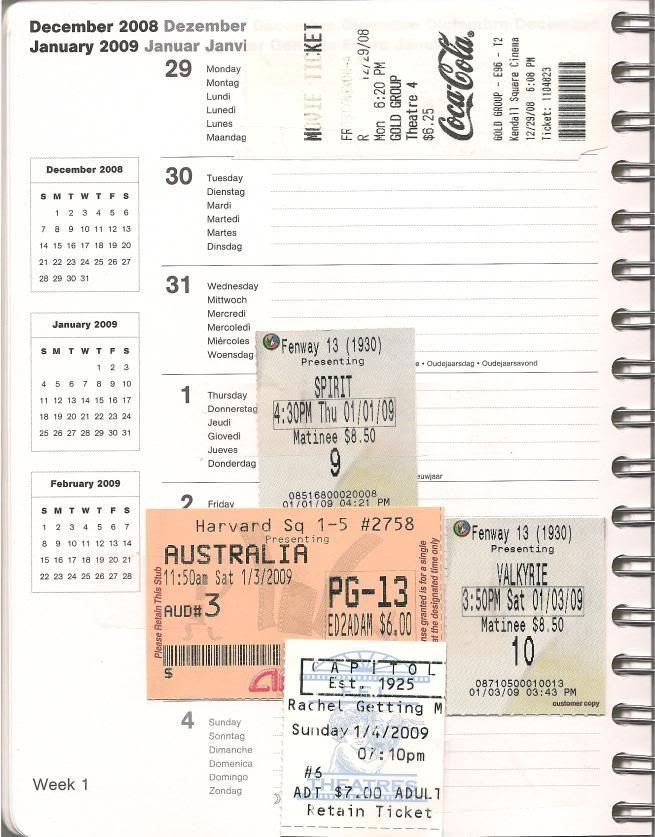
This Week In Tickets: 29 December 2008 to 4 January 2009
Welcome to a new feature of this blog, which will hopefully make it more useful for me, in terms of keeping track of what I watch, and you, if you are for some reason or another interested in this information. (Hi Mom, people from work!) So, without further ado, let's take a look at... This Week In Tickets!
On video: War, Inc.
(Note: I considered "This Week In Tickets to the Cinema and Home Video" for the potentially cooler acronym - T.W.I.T.C.H. Video - but I figured that might upset these good people.)
Anyway, I stole the idea of saving ones' tickets in a calendar from another Brattle regular. The calendar itself is the teNeus 2009Book Calendar of Bunny Suicides. I admit it's hard to be sure with numbers this low, but I'm almost certain the free advertising is worth more than anything you'd get from suing me.
General thoughts on this week's movies: Half of it is stuff that people looking to make a point one way or another might aruge is meant to resonate with current events. Certainly, that's obvious with War, Inc.; Cusack and company are making pretty much zero attempt to disguise the targets of their satire. It's certainly difficult not to think about the outgoing administration and their crimes when watching Frost/Nixon - they put the line about "when the president does it, it's not illegal" right in the trailer. Valkyrie is the biggest reach, but there might be something to it - Germans, ashamed of their leader, trying to restore pride in their country...
Frost/Nixon
* * * (out of four)
Seen 29 December 2008 at Landmark Kendall Square #4 (First-run)
A pretty enjoyable couple of hours - Frank Langella is simply fantastic here. At first, it just seems like an impersonation, but that becomes less the case as the movie goes on, and Langella gets at the heart of why Nixon has always been such a fascinating character.
There are some rough spots; I never really like cuts to "interview footage" of the actors in character. Also, in one of those spots, a character claims that what happened did so because David Frost "knew television", but there's never really a sense that Frost eventually prevails because of his mastery of the medium.
Australia
* * * (out of four)
Seen 2 January 2009 at AMC Harvard Square #3 (First-run)
Australia, at times, almost seems like Baz Luhrmann's attempt to make two movies, a conventional western and its war-movie sequel, and even a bit less than three hours time the pair don't quite get a full chance to breathe. I like the western, which is good, classic stuff - a proper English woman (she would be from "back East" in an American western) inherits her estranged husband's ranch, and falls in love with the handsome but rough around the edges cowboy she enlists to drive the cattle to Darwin, the only way to save the ranch. It's classic, iconic stuff, and gives the filmmakers a chance to shoot a lot of beautiful footage of the outback.
That would be enough of a movie on its own, but threaded through it is the setup for the second half, where they try and recover the "half-caste" boy who is like a son to them against the backdrop of Australia's entry into WWII. As worthy a story as this is (and a fascinating subject; see also Philip Noyce's Rabbit-Proof Fence), getting into it after we've had the finale of the first is awkward. The explanatory text in the beginning makes it seem like Luhrmann is trying to squeeze too much in, as it really won't come to the fore in earnest until later.
Both halves are actually pretty good, and I half-wonder if there will be a home video cut that maybe fleshes them out a bit more. This is the rare movie that I feel could be improved with an intermission.
War, Inc.
* * ¾ (out of four)
Seen 2 January 2009 in Jay's Living Room (Blu-ray)
Not really close to the thematic sequel to Grosse Pointe Blank that some are trying to paint it as, despite sharing John Cusack as a hitman and Joan Cusack and Dan Aykroyd in supporting roles. It's an angrier film, but also more cartoonish, and Cusack's co-writers this time around don't seem to be nearly as talented as D.V. DeVincentis and Steve Pink (who really seem to have disappeared since re-teaming with Cusack on High Fidelity, especially DeVincentis).
It's still kind of fun, especially if you like that kind of very broad comedy, but very uneven. It lurches between slapstick and stuff we're supposed to take seriously, not always finding an edge to its black comedy. It also feels a little cheap in places - a joke is used twice because, it seems, like the set was too expensive to build for just one use; the would-be Turaqistani hip-hoppers don't feel so much like middle easterners appropriating American pop culture so much as Americans weakly parodying it.
Rachel Getting Married
* * * (out of four)
Seen 3 January 2009 at The Captiol #6 (second-run)
I readily admit, I was sort of staying away from this one because, well, it looked a lot like Margot at the Wedding, and though I was pretty sure Noah Baumbach was nowhere near it, the whole "look how messed-up suburban people are despite their nice houses!" genre annoys me no end. Fortunately, Rachel is fortunate to have a trio of impressive performances from Anne Hathaway (Kym, the sister in rehab), Rosemarie DeWitt (the Rachel of the title), and Bill Irwin (Paul, the father trying to please both), some of the best of the year that may not get recognized because they aren't exactly showy.
I admit, there were bits I might like to cut - director Jonathan Demme makes absolutely sure we see Kym's need to make herself the center of attention, to the point where I was groaning and really hoping there would be more to this. To counter that, though, I was impressed with how enjoyable the actual wedding itself was - it's the kind of ritual that I'm not the hugest fan of in real life, but Demme and writer Jenny Lumet create a very enjoyable ceremony. I also really like the way Demme often makes us look for Kym in shots, even though she's the lead character.

On video: War, Inc.
(Note: I considered "This Week In Tickets to the Cinema and Home Video" for the potentially cooler acronym - T.W.I.T.C.H. Video - but I figured that might upset these good people.)
Anyway, I stole the idea of saving ones' tickets in a calendar from another Brattle regular. The calendar itself is the teNeus 2009
General thoughts on this week's movies: Half of it is stuff that people looking to make a point one way or another might aruge is meant to resonate with current events. Certainly, that's obvious with War, Inc.; Cusack and company are making pretty much zero attempt to disguise the targets of their satire. It's certainly difficult not to think about the outgoing administration and their crimes when watching Frost/Nixon - they put the line about "when the president does it, it's not illegal" right in the trailer. Valkyrie is the biggest reach, but there might be something to it - Germans, ashamed of their leader, trying to restore pride in their country...
Frost/Nixon
* * * (out of four)
Seen 29 December 2008 at Landmark Kendall Square #4 (First-run)
A pretty enjoyable couple of hours - Frank Langella is simply fantastic here. At first, it just seems like an impersonation, but that becomes less the case as the movie goes on, and Langella gets at the heart of why Nixon has always been such a fascinating character.
There are some rough spots; I never really like cuts to "interview footage" of the actors in character. Also, in one of those spots, a character claims that what happened did so because David Frost "knew television", but there's never really a sense that Frost eventually prevails because of his mastery of the medium.
Australia
* * * (out of four)
Seen 2 January 2009 at AMC Harvard Square #3 (First-run)
Australia, at times, almost seems like Baz Luhrmann's attempt to make two movies, a conventional western and its war-movie sequel, and even a bit less than three hours time the pair don't quite get a full chance to breathe. I like the western, which is good, classic stuff - a proper English woman (she would be from "back East" in an American western) inherits her estranged husband's ranch, and falls in love with the handsome but rough around the edges cowboy she enlists to drive the cattle to Darwin, the only way to save the ranch. It's classic, iconic stuff, and gives the filmmakers a chance to shoot a lot of beautiful footage of the outback.
That would be enough of a movie on its own, but threaded through it is the setup for the second half, where they try and recover the "half-caste" boy who is like a son to them against the backdrop of Australia's entry into WWII. As worthy a story as this is (and a fascinating subject; see also Philip Noyce's Rabbit-Proof Fence), getting into it after we've had the finale of the first is awkward. The explanatory text in the beginning makes it seem like Luhrmann is trying to squeeze too much in, as it really won't come to the fore in earnest until later.
Both halves are actually pretty good, and I half-wonder if there will be a home video cut that maybe fleshes them out a bit more. This is the rare movie that I feel could be improved with an intermission.
War, Inc.
* * ¾ (out of four)
Seen 2 January 2009 in Jay's Living Room (Blu-ray)
Not really close to the thematic sequel to Grosse Pointe Blank that some are trying to paint it as, despite sharing John Cusack as a hitman and Joan Cusack and Dan Aykroyd in supporting roles. It's an angrier film, but also more cartoonish, and Cusack's co-writers this time around don't seem to be nearly as talented as D.V. DeVincentis and Steve Pink (who really seem to have disappeared since re-teaming with Cusack on High Fidelity, especially DeVincentis).
It's still kind of fun, especially if you like that kind of very broad comedy, but very uneven. It lurches between slapstick and stuff we're supposed to take seriously, not always finding an edge to its black comedy. It also feels a little cheap in places - a joke is used twice because, it seems, like the set was too expensive to build for just one use; the would-be Turaqistani hip-hoppers don't feel so much like middle easterners appropriating American pop culture so much as Americans weakly parodying it.
Rachel Getting Married
* * * (out of four)
Seen 3 January 2009 at The Captiol #6 (second-run)
I readily admit, I was sort of staying away from this one because, well, it looked a lot like Margot at the Wedding, and though I was pretty sure Noah Baumbach was nowhere near it, the whole "look how messed-up suburban people are despite their nice houses!" genre annoys me no end. Fortunately, Rachel is fortunate to have a trio of impressive performances from Anne Hathaway (Kym, the sister in rehab), Rosemarie DeWitt (the Rachel of the title), and Bill Irwin (Paul, the father trying to please both), some of the best of the year that may not get recognized because they aren't exactly showy.
I admit, there were bits I might like to cut - director Jonathan Demme makes absolutely sure we see Kym's need to make herself the center of attention, to the point where I was groaning and really hoping there would be more to this. To counter that, though, I was impressed with how enjoyable the actual wedding itself was - it's the kind of ritual that I'm not the hugest fan of in real life, but Demme and writer Jenny Lumet create a very enjoyable ceremony. I also really like the way Demme often makes us look for Kym in shots, even though she's the lead character.
Saturday, January 03, 2009
Kinda entertaining crap: The Spirit
Stayed up late for new year's, slept in. By the time I felt like hauling myself out of the house and to the theater, it was The Spirit and stuff I'd already seen. Oddly, it's never the really good movie that starts at the convenient time.
The Spirit
* * (out of four)
Seen 1 January 2009 in Regal Fenway #9 (First-run)
When I first saw trailers for The Spirit, and compared them to what I've seen of the comics, I figured that the biggest potential problem with the movie would be that Will Eisner's creation (which had a fine revival by Darwyn Cooke a couple years ago) was somewhat whimsical despite its noir elements, and Frank Miller doesn't do whimsical. Upon seeing it, I stand corrected: Frank Miller does do whimsical, but his idea of what fits in that category is rather different than Eisner's - and, likely, that of most other people.
This doesn't make The Spirit a good movie, but it does have potential as a guilty pleasure. The Spirit is the gloriously bad product of a single lunatic, with Miller's fingerprints on every frame, and you could sprain some part of your brain trying to figure out which individual bits he's trying to play straight and where he's indulging in (self) parody. It hasn't been homogenized to make it less idiosyncratic or cut down to 88 minutes to squeeze an extra daily showing in. It's consistent enough and the story makes enough sense that someone whose sense of humor is in line Miller's can enjoy this quite a bit, and the rest of humanity may find themselves fascinated by the sheer insanity.
It starts off a bit odd, even for a superhero movie, as Central City's masked hero, The Spirit (Gabriel Macht), leaves his cats behind to answer a call from one of his policeman allies. After thwarting a mugger, he picks up the trail of arch-nemesis The Octopus (Samuel L. Jackson), who along with his cloned thugs (Louis Lombardi) and comely assistant Silken Floss (Scarlett Johansson) is trying to retrieve a mysterious crate. He's got competition, though, in the person of Sand Serif (Eva Medes) - a former girlfriend of the Spirit, back when he was young Denny Colt, and what she finds could hold the secret to The Spirit's and Octopus's unusual healing abilities.
Though Miller and Eisner respected each other's work as comic book artists, they had very different styles. Miller opts to shoot his film in a style similar to how he and Robert Rodriguez shot Sin City, an approximation of the way he draws. That wouldn't necessarily be a big deal if he were doing this as a comic; it's not unusual for an artist to bring his own style to a long-established character, but Miller's doesn't seem particularly suited to this one. Sometimes I thought he was deliberately trying to send up how wordy comics used to be, with panels filled with words and characters explaining themselves out loud even though there's no one besides the audience that needs to hear it. It's awkward and artificial, and Miller never gets it to work either as good exposition or entertaining parody.
There are occasional spots where things work, in large part due to the large, fun cast. Most of the time, they tend to choke on Miller's dialogue, but every once in a while they hit on something that works. Macht finds a naive charm in the moments when he doesn't have to be hard-boiled, and Jackson chews some good scenery (though the whole egg obsession never works). Lombardi and Johansson are goofy and deadpan, respectively, as Jackson's sidekicks. Sarah Paulson is sadly underused, while Miller goes for shameless exploitation with Eva Mendes and Paz Vega (though anyone who complains about shameless exploitation of Paz Vega just must not like the female form).
The Spirit isn't a good movie, but I have to admit, there were plenty of moments when I enjoyed its insanity. Not enough moments, and few of them are truly great, but that's why its upside is "guilty pleasure", rather than "genuinely good movie."
Also at HBS, along with three other reviews.
The Spirit
* * (out of four)
Seen 1 January 2009 in Regal Fenway #9 (First-run)
When I first saw trailers for The Spirit, and compared them to what I've seen of the comics, I figured that the biggest potential problem with the movie would be that Will Eisner's creation (which had a fine revival by Darwyn Cooke a couple years ago) was somewhat whimsical despite its noir elements, and Frank Miller doesn't do whimsical. Upon seeing it, I stand corrected: Frank Miller does do whimsical, but his idea of what fits in that category is rather different than Eisner's - and, likely, that of most other people.
This doesn't make The Spirit a good movie, but it does have potential as a guilty pleasure. The Spirit is the gloriously bad product of a single lunatic, with Miller's fingerprints on every frame, and you could sprain some part of your brain trying to figure out which individual bits he's trying to play straight and where he's indulging in (self) parody. It hasn't been homogenized to make it less idiosyncratic or cut down to 88 minutes to squeeze an extra daily showing in. It's consistent enough and the story makes enough sense that someone whose sense of humor is in line Miller's can enjoy this quite a bit, and the rest of humanity may find themselves fascinated by the sheer insanity.
It starts off a bit odd, even for a superhero movie, as Central City's masked hero, The Spirit (Gabriel Macht), leaves his cats behind to answer a call from one of his policeman allies. After thwarting a mugger, he picks up the trail of arch-nemesis The Octopus (Samuel L. Jackson), who along with his cloned thugs (Louis Lombardi) and comely assistant Silken Floss (Scarlett Johansson) is trying to retrieve a mysterious crate. He's got competition, though, in the person of Sand Serif (Eva Medes) - a former girlfriend of the Spirit, back when he was young Denny Colt, and what she finds could hold the secret to The Spirit's and Octopus's unusual healing abilities.
Though Miller and Eisner respected each other's work as comic book artists, they had very different styles. Miller opts to shoot his film in a style similar to how he and Robert Rodriguez shot Sin City, an approximation of the way he draws. That wouldn't necessarily be a big deal if he were doing this as a comic; it's not unusual for an artist to bring his own style to a long-established character, but Miller's doesn't seem particularly suited to this one. Sometimes I thought he was deliberately trying to send up how wordy comics used to be, with panels filled with words and characters explaining themselves out loud even though there's no one besides the audience that needs to hear it. It's awkward and artificial, and Miller never gets it to work either as good exposition or entertaining parody.
There are occasional spots where things work, in large part due to the large, fun cast. Most of the time, they tend to choke on Miller's dialogue, but every once in a while they hit on something that works. Macht finds a naive charm in the moments when he doesn't have to be hard-boiled, and Jackson chews some good scenery (though the whole egg obsession never works). Lombardi and Johansson are goofy and deadpan, respectively, as Jackson's sidekicks. Sarah Paulson is sadly underused, while Miller goes for shameless exploitation with Eva Mendes and Paz Vega (though anyone who complains about shameless exploitation of Paz Vega just must not like the female form).
The Spirit isn't a good movie, but I have to admit, there were plenty of moments when I enjoyed its insanity. Not enough moments, and few of them are truly great, but that's why its upside is "guilty pleasure", rather than "genuinely good movie."
Also at HBS, along with three other reviews.
Monday, December 29, 2008
Hooray for region-free: I'm a Cyborg, But That's Okay
I've read a few claims that region coding will be less restrictive for Blu-ray than it was for DVD. Certainly, we're already seeing signs of this, with Blu-ray having a mere three regions vs DVD's six, and apparently several studios are going region-free on catalog title and even new releases. I still worry about how long this is going to last - it might have been a response to HD DVD not bothering with region coding at all, and now that there's no need to compete with Toshiba, we'll see more things region-locked.
I hope not. It's probably different outside the United States, but here, region coding has the primary effect of annoying a company's best customers, either by making titles we want unavailable (or needing a hacked machine) or taunting us with better special editions oversees. Honestly, everyone wins if various people with rights to release a movie have to compete to release the best edition.
We almost missed out with I'm a Cyborg anyway; Tartan Films only acquired the United Kingdom rights and then filed for bankruptcy soon after announcing a Blu-ray edition. I figured that was it, until a crawl through Amazon's new releases turned up some of the other discs that were announced at the same time (Paranoid Park, Sky Blue) as import discs; a quick trawl through SendIt indicated that this one had been released, although it wasn't in stock, but could be had on order. Apparently, some either slipped out before Tartan went into receivership or the company that bought Tartan eventually put it out. All that was left was verifying that it wasn't Region B.
Worth noting: The Blu-ray looks amazing. It's easily Park Chan-wook's most colorful movie. Still, it's always kind of stunning to watch a Blu-ray or HD DVD when you haven't in a few weeks and notice that, no matter how good you thought upconversion is, or the HD signal from the cable company is... It can be that much better.
Anyway, here's hoping it shows up in the US sometime soon; maybe to cash in on Thirst, Park's upcoming sexy vampire movie.
Saibogujiman Kwenchana (I'm a Cyborg, But That's OK)
* * * (out of four)
Seen 28 December 2008 in Jay's Living Room (Blu-ray Disc, imported from the UK)
Even with the recent success of Bong Joon-ha's The Host and popularity of Kim Ji-woon's The Good, the Bad, and the Weird on the festival circuit, Park Chan-Wook is likely still the best-known Korean filmmaker outside his native country. Like any director who has found success within a certain genre, though, his ventures away from the familiar are regarded with suspicion, and as a result, his new movie - which is not a revenge story, but a decidedly off-kilter romance - is not getting much exposure at all on this side of the Pacific.
It's offbeat, in part, because most of it takes place in a mental institution. Cha Young-goon (Lim Su-jeong) was committed there after an apparent suicide attempt that came from delusion that she is a cyborg (which also contributes to her anorexia, as cyborgs don't have to heat). Once there, she meets a number of patients with issues of their own, but the one that she connects with the most is Park Il-sun (Rain), a thief who believes he can not only steal tangible things but parts of people's personalities - and that he's in danger of shrinking to the size of a dot and disappearing.
Though I'm a Cyborg has occasionally been described as a romantic comedy, it doesn't fit the usual template that well. The comedy is often pitch-black, as Young-goon fantasizes about fully recharging and slaughtering the "white 'uns" (the doctors and nurses who took her schizophrenic grandmother away), among other things. And while the romance is at times a little one-sided, it is also fairly uncomplicated; we're not given manufactured misunderstandings or plot devices that separate them. For all the peculiar things said and going on, it is a fairly straightforward love story.
That sort of movie needs a strong cast to make it work, and by that I don't mean the entertaining group of secondary characters (although they are quite enjoyable, too). Rain and Lim have tough roles; they've got to be not all there in a convincing way, but the movie wouldn't be half as enjoyable if the audience merely sympathized with or pitied them. Rain, a pop star in his first major acting role, is at times a little uneven as Il-sun. He's called upon to be more capable and self-aware than the rest of the patients, and it's sometimes a little difficult to get a handle on what his true personality is amid the conflicting purposes. It's not a bad performance; in fact, he's pretty good with dialog, though he doesn't always communicate well without speaking.
This is not a problem for Lim Su-jeong. She plays Young-goon a little broader than Rain plays Il-sun; we can always see the child-like belief in her fantasy world that allows reason to just fly past her. She's very earnest in acting out the rules of Young-goon's world, whether talking to vending machines or holding batteries to her tongue to recharge herself, but she avoids acting overtly robotic. Her behavior would almost be cute if she wasn't also unnerving: She doesn't blink very often, her eyebrows have been dyed to near-invisibility to make her face somewhat of a blank, and she genuinely looks as if she hasn't been eating to the point where it may be dangerous.
Making the female lead look unhealthy is just the start of what Park and his collaborators do to make this film memorable visually. There is some slick CGI in places (a late scene that references the nifty opening credits is actually pretty darn impressive), and some spots where the effects seem to be awkward or scaled back a little to keep the delusions from seducing the audience. Much of the film is shot in bright, almost overwhelming colors, with interesting camera work. It's perhaps Park's most beautiful movie.
Beautiful enough that it's a real shame few here will get to see it on the big screen. Or even the small one - as of right now, it has no U.S. distributor, two years after its Korean release. I hope it does; maybe the release of Park's more commercial next movie will grease the wheels.
Also at HBS, along with one other review.
I hope not. It's probably different outside the United States, but here, region coding has the primary effect of annoying a company's best customers, either by making titles we want unavailable (or needing a hacked machine) or taunting us with better special editions oversees. Honestly, everyone wins if various people with rights to release a movie have to compete to release the best edition.
We almost missed out with I'm a Cyborg anyway; Tartan Films only acquired the United Kingdom rights and then filed for bankruptcy soon after announcing a Blu-ray edition. I figured that was it, until a crawl through Amazon's new releases turned up some of the other discs that were announced at the same time (Paranoid Park, Sky Blue) as import discs; a quick trawl through SendIt indicated that this one had been released, although it wasn't in stock, but could be had on order. Apparently, some either slipped out before Tartan went into receivership or the company that bought Tartan eventually put it out. All that was left was verifying that it wasn't Region B.
Worth noting: The Blu-ray looks amazing. It's easily Park Chan-wook's most colorful movie. Still, it's always kind of stunning to watch a Blu-ray or HD DVD when you haven't in a few weeks and notice that, no matter how good you thought upconversion is, or the HD signal from the cable company is... It can be that much better.
Anyway, here's hoping it shows up in the US sometime soon; maybe to cash in on Thirst, Park's upcoming sexy vampire movie.
Saibogujiman Kwenchana (I'm a Cyborg, But That's OK)
* * * (out of four)
Seen 28 December 2008 in Jay's Living Room (Blu-ray Disc, imported from the UK)
Even with the recent success of Bong Joon-ha's The Host and popularity of Kim Ji-woon's The Good, the Bad, and the Weird on the festival circuit, Park Chan-Wook is likely still the best-known Korean filmmaker outside his native country. Like any director who has found success within a certain genre, though, his ventures away from the familiar are regarded with suspicion, and as a result, his new movie - which is not a revenge story, but a decidedly off-kilter romance - is not getting much exposure at all on this side of the Pacific.
It's offbeat, in part, because most of it takes place in a mental institution. Cha Young-goon (Lim Su-jeong) was committed there after an apparent suicide attempt that came from delusion that she is a cyborg (which also contributes to her anorexia, as cyborgs don't have to heat). Once there, she meets a number of patients with issues of their own, but the one that she connects with the most is Park Il-sun (Rain), a thief who believes he can not only steal tangible things but parts of people's personalities - and that he's in danger of shrinking to the size of a dot and disappearing.
Though I'm a Cyborg has occasionally been described as a romantic comedy, it doesn't fit the usual template that well. The comedy is often pitch-black, as Young-goon fantasizes about fully recharging and slaughtering the "white 'uns" (the doctors and nurses who took her schizophrenic grandmother away), among other things. And while the romance is at times a little one-sided, it is also fairly uncomplicated; we're not given manufactured misunderstandings or plot devices that separate them. For all the peculiar things said and going on, it is a fairly straightforward love story.
That sort of movie needs a strong cast to make it work, and by that I don't mean the entertaining group of secondary characters (although they are quite enjoyable, too). Rain and Lim have tough roles; they've got to be not all there in a convincing way, but the movie wouldn't be half as enjoyable if the audience merely sympathized with or pitied them. Rain, a pop star in his first major acting role, is at times a little uneven as Il-sun. He's called upon to be more capable and self-aware than the rest of the patients, and it's sometimes a little difficult to get a handle on what his true personality is amid the conflicting purposes. It's not a bad performance; in fact, he's pretty good with dialog, though he doesn't always communicate well without speaking.
This is not a problem for Lim Su-jeong. She plays Young-goon a little broader than Rain plays Il-sun; we can always see the child-like belief in her fantasy world that allows reason to just fly past her. She's very earnest in acting out the rules of Young-goon's world, whether talking to vending machines or holding batteries to her tongue to recharge herself, but she avoids acting overtly robotic. Her behavior would almost be cute if she wasn't also unnerving: She doesn't blink very often, her eyebrows have been dyed to near-invisibility to make her face somewhat of a blank, and she genuinely looks as if she hasn't been eating to the point where it may be dangerous.
Making the female lead look unhealthy is just the start of what Park and his collaborators do to make this film memorable visually. There is some slick CGI in places (a late scene that references the nifty opening credits is actually pretty darn impressive), and some spots where the effects seem to be awkward or scaled back a little to keep the delusions from seducing the audience. Much of the film is shot in bright, almost overwhelming colors, with interesting camera work. It's perhaps Park's most beautiful movie.
Beautiful enough that it's a real shame few here will get to see it on the big screen. Or even the small one - as of right now, it has no U.S. distributor, two years after its Korean release. I hope it does; maybe the release of Park's more commercial next movie will grease the wheels.
Also at HBS, along with one other review.
Sunday, December 28, 2008
Screener catch-up: Eye in the Sky
At some point, I'll probably do a big long list of everything I've got ticket stubs for this year; things have just gotten away from me lately. Before then, I made it one of my end-of-year goals to watch and review every screener I've been sent. Looking at the calendar, it might be wise to use it as a New Year's resolution instead.
I received two screeners from the Philadelphia Film Festival back in April; the other was Timecrimes, which I wound up seeing at Fantasia (after passing it up at the IFFB because I had a screener sitting on my coffee table). Suffice it to say that after this delay, I wouldn't be terribly shocked if they chose not to send me more next year.
Gun Chung (Eye in the Sky)
* * ¼ (out of four)
Seen 26 December 2008 in Jay's Living Room (letterboxed DVD screener from the Philadelphia Film Festival)
It would not take a whole lot of tinkering to transform Eye in the Sky into a pretty good pilot for a pretty good TV show. Even considering the glut of police procedurals on American TV, there isn't one that attacks crime from this particular angle, and it introduces the idea well. It is, however, not a TV series, but a film, one which doesn't quite live up to the promise of its opening and idea.
The opening act is a corker, as a gang of crooks converge on a jewelry store to execute a precisely timed robbery. One, Brother Shan (Tony Leung Ka-Fai), hangs back, watching for anything unexpected - like one of their number being followed. What we don't see until everything is completed is that we've actually been watching two things going down. The robbery is one; the other is Sergeant Wong Man Chin (Simon Yam) testing young Constable Ho Ka Po (Kate Tsui) to see if she's got the right stuff to join the Surveillance Unit. He concludes that she's green, but doesn't look like a cop, so she's given the job. The unit's next job, of course, is poring over all the local surveillance footage to try and locate the crooks, with the hope that finding even one will lead them to the rest.
Like many police procedurals, Eye in the Sky is at its best when it is, in fact, procedural. The opening robbery is more a smash-and-grab than a delicate heist, but there's still enough moving parts and to keep it interesting. The mechanics of police surveillance is the really interesting part for a process junkie, as the cops switch tails off and on and scan screens to find people who show up multiple times. It's the sort of thing that a lot of crime movies gloss over, substituting magical facial recognition software for the legwork and combination of high- and low-tech methods we see used.
Complete review at EFC.
I received two screeners from the Philadelphia Film Festival back in April; the other was Timecrimes, which I wound up seeing at Fantasia (after passing it up at the IFFB because I had a screener sitting on my coffee table). Suffice it to say that after this delay, I wouldn't be terribly shocked if they chose not to send me more next year.
Gun Chung (Eye in the Sky)
* * ¼ (out of four)
Seen 26 December 2008 in Jay's Living Room (letterboxed DVD screener from the Philadelphia Film Festival)
It would not take a whole lot of tinkering to transform Eye in the Sky into a pretty good pilot for a pretty good TV show. Even considering the glut of police procedurals on American TV, there isn't one that attacks crime from this particular angle, and it introduces the idea well. It is, however, not a TV series, but a film, one which doesn't quite live up to the promise of its opening and idea.
The opening act is a corker, as a gang of crooks converge on a jewelry store to execute a precisely timed robbery. One, Brother Shan (Tony Leung Ka-Fai), hangs back, watching for anything unexpected - like one of their number being followed. What we don't see until everything is completed is that we've actually been watching two things going down. The robbery is one; the other is Sergeant Wong Man Chin (Simon Yam) testing young Constable Ho Ka Po (Kate Tsui) to see if she's got the right stuff to join the Surveillance Unit. He concludes that she's green, but doesn't look like a cop, so she's given the job. The unit's next job, of course, is poring over all the local surveillance footage to try and locate the crooks, with the hope that finding even one will lead them to the rest.
Like many police procedurals, Eye in the Sky is at its best when it is, in fact, procedural. The opening robbery is more a smash-and-grab than a delicate heist, but there's still enough moving parts and to keep it interesting. The mechanics of police surveillance is the really interesting part for a process junkie, as the cops switch tails off and on and scan screens to find people who show up multiple times. It's the sort of thing that a lot of crime movies gloss over, substituting magical facial recognition software for the legwork and combination of high- and low-tech methods we see used.
Complete review at EFC.
Monday, November 03, 2008
Ashes of Time Redux
I honestly wonder how much my liking this version of Ashes of Time more than the original version is due to the actual merits of the two cuts and how much is due to the me of 2008 not being the me of 2005. Not that I'm that much different, but when I saw the original cut, I'd only seen two of Wong Kar-Wai's films before (if you don't count stuff he just wrote for money, like Haunted Cop Shop 2), and so didn't really know his aesthetic. I sort of thought he was just doing his big wuxia action movie, like Ang Lee and Zhang Yimou would later do.
I did like the movie much more this time around, though I'm now very curious to see what Eagle Shooting Heroes is like. It is, apparently, a spoof of the same novel that was adapted into Ashes of Time, shot at roughly the same time, on the same sets, with much of the same cast and crew (though, if the IMDB is to be believed, with several in different roles). No writer is credited on IMDB, but I seem to remember Wong Kar-Wai being referred to as responsible during one of the old Weekly Wednesday Ass-Kicking showings (which, for a time, substituted a Weekly Wednesday Wong Kar-Wai series).
Dung che sai duk redux (Ashes of TIme Redux)
* * * ¼ (out of four)
Seen 30 October 2008 at Landmark Kendall Square (first-run)
I saw and reviewed Ashes of Time three and a half years ago, when it played as part of a series of director Wong Kar-wai's films at the Brattle Theatre. I was not particularly impressed at the time, in part because I approached it as a wuxia film first and as a WKW mood piece second, and in part because there apparently hasn't been a decent print to be found for years. Watching Ashes of Time Redux isn't quite like seeing a whole new movie, but it was certainly a new and better experience. How much of that is due to the new cut, how much is due to the restoration, and how much is me approaching it with a different attitude is an open question.
The film takes place in and around a tavern run by Ouyang Feng (Leslie Cheung), a once-great warrior who now mainly connects swordsmen with those who have a use for them. As the film starts, it is springtime, time for the annual visit of Huang Yaoshi (Tony Lenug Ka Fai), and old friend who brings with him a gift - a bottle of magical wine that it is said can erase memories. Feng opts not to sip from it, but Huang does, leaving Feng to deal with Murong Yang and Murong Yin (Brigitte Lin), siblings at conflict over their past encounters with Feng. As the seasons pass, others come - a swordsman (Tony Leung Chiu Wai) who fears he will lose his sight before he sees the peach blossoms of his hometown again; Hong Qi (Jacky Cheung), a barefoot would-be hero; and a girl (Charlie Yeung) who wishes to avenge her brother's death but who has only a mule and some eggs to pay with. We also learn Feng's own sad story, which led him to isolate himself from the world this way - it is, of course, about a woman (Maggie Cheung).
Those looking for action will probably come away somewhat disappointed, even more so than I was when I saw the original 1994 cut. What we see is pretty good - it is choreographed by Sammo Hung, after all, with his trademark hard-hitting style. This isn't the lighter-than-air gliding of Crouching Tiger, Hidden Dragon, but close-in lethal swordplay, with plenty of blood spilled and limbs severed. We do see glimpses of more fantastical combat, where a swing of the sword can shatter mountains or cause explosions, but one of the primary big differences between the two versions - likely much of the reason why the 2008 "Redux" cut is seven minutes shorter - is that two early fight scenes are cut.
The film does not particularly suffer for their absence, but the greatest improvement to the flow of the movie is perhaps much simpler - Wong has added in chapter titles to indicate the passage of the seasons. Even though they don't always indicate a clean break between storylines, they (and the changing narrators) give the movie the feel of an anthology of individual but connected stories, rather than a single messy narrative with too many characters to keep track of entering and exiting. It's still all about Feng, but it is now presented in such a way that the movie guides us toward him, rather than away.
Leslie Cheung gives a performance worth being guided toward, showing (as he often does) a man locking his feelings away, indeed, mocking those who dare to feel. There's a knowing cruelty to Feng, with regret buried very deep underneath. The man hiding his broken heart is the sort of thing Cheung did very well, and it's complimented nicely by Maggie Cheung's brief but memorable appearance as the one who got away. The rest of the cast is similarly fine, most notably Brigitte Lin.
The restoration certainly makes a major difference in the look of the film. Christopher Doyle's cinematography is much more clear and sharp than it was in previous prints, with the desert looking vast and beautiful. Indeed, there's an argument to be made that the movie now looks too pretty - the colors are brighter and bolder than they were in the original release, a closer match to the expensive, glossy wuxia films that would appear after Ashes of Time's original release. It almost looks like digital video at times - not bad, but almost unnaturally sharp.
That's perhaps not a perfect match for the story, which is less the usual tale of honor and duty than a meditation of ephemerality of life and memory, and how love can slip away with time. For me, it tells the story better; at the very least, it looks better than it has in some time.
Also at HBS.
I did like the movie much more this time around, though I'm now very curious to see what Eagle Shooting Heroes is like. It is, apparently, a spoof of the same novel that was adapted into Ashes of Time, shot at roughly the same time, on the same sets, with much of the same cast and crew (though, if the IMDB is to be believed, with several in different roles). No writer is credited on IMDB, but I seem to remember Wong Kar-Wai being referred to as responsible during one of the old Weekly Wednesday Ass-Kicking showings (which, for a time, substituted a Weekly Wednesday Wong Kar-Wai series).
Dung che sai duk redux (Ashes of TIme Redux)
* * * ¼ (out of four)
Seen 30 October 2008 at Landmark Kendall Square (first-run)
I saw and reviewed Ashes of Time three and a half years ago, when it played as part of a series of director Wong Kar-wai's films at the Brattle Theatre. I was not particularly impressed at the time, in part because I approached it as a wuxia film first and as a WKW mood piece second, and in part because there apparently hasn't been a decent print to be found for years. Watching Ashes of Time Redux isn't quite like seeing a whole new movie, but it was certainly a new and better experience. How much of that is due to the new cut, how much is due to the restoration, and how much is me approaching it with a different attitude is an open question.
The film takes place in and around a tavern run by Ouyang Feng (Leslie Cheung), a once-great warrior who now mainly connects swordsmen with those who have a use for them. As the film starts, it is springtime, time for the annual visit of Huang Yaoshi (Tony Lenug Ka Fai), and old friend who brings with him a gift - a bottle of magical wine that it is said can erase memories. Feng opts not to sip from it, but Huang does, leaving Feng to deal with Murong Yang and Murong Yin (Brigitte Lin), siblings at conflict over their past encounters with Feng. As the seasons pass, others come - a swordsman (Tony Leung Chiu Wai) who fears he will lose his sight before he sees the peach blossoms of his hometown again; Hong Qi (Jacky Cheung), a barefoot would-be hero; and a girl (Charlie Yeung) who wishes to avenge her brother's death but who has only a mule and some eggs to pay with. We also learn Feng's own sad story, which led him to isolate himself from the world this way - it is, of course, about a woman (Maggie Cheung).
Those looking for action will probably come away somewhat disappointed, even more so than I was when I saw the original 1994 cut. What we see is pretty good - it is choreographed by Sammo Hung, after all, with his trademark hard-hitting style. This isn't the lighter-than-air gliding of Crouching Tiger, Hidden Dragon, but close-in lethal swordplay, with plenty of blood spilled and limbs severed. We do see glimpses of more fantastical combat, where a swing of the sword can shatter mountains or cause explosions, but one of the primary big differences between the two versions - likely much of the reason why the 2008 "Redux" cut is seven minutes shorter - is that two early fight scenes are cut.
The film does not particularly suffer for their absence, but the greatest improvement to the flow of the movie is perhaps much simpler - Wong has added in chapter titles to indicate the passage of the seasons. Even though they don't always indicate a clean break between storylines, they (and the changing narrators) give the movie the feel of an anthology of individual but connected stories, rather than a single messy narrative with too many characters to keep track of entering and exiting. It's still all about Feng, but it is now presented in such a way that the movie guides us toward him, rather than away.
Leslie Cheung gives a performance worth being guided toward, showing (as he often does) a man locking his feelings away, indeed, mocking those who dare to feel. There's a knowing cruelty to Feng, with regret buried very deep underneath. The man hiding his broken heart is the sort of thing Cheung did very well, and it's complimented nicely by Maggie Cheung's brief but memorable appearance as the one who got away. The rest of the cast is similarly fine, most notably Brigitte Lin.
The restoration certainly makes a major difference in the look of the film. Christopher Doyle's cinematography is much more clear and sharp than it was in previous prints, with the desert looking vast and beautiful. Indeed, there's an argument to be made that the movie now looks too pretty - the colors are brighter and bolder than they were in the original release, a closer match to the expensive, glossy wuxia films that would appear after Ashes of Time's original release. It almost looks like digital video at times - not bad, but almost unnaturally sharp.
That's perhaps not a perfect match for the story, which is less the usual tale of honor and duty than a meditation of ephemerality of life and memory, and how love can slip away with time. For me, it tells the story better; at the very least, it looks better than it has in some time.
Also at HBS.
Thursday, October 16, 2008
Movie Watch-a-Thon: Don't Go in the House, Rolling Thunder, Darker than Amber, Riot on Sunset Strip, Truck Turner
Watch-a-thon Tally: 5 Brattle Films, 5 other films.
I don't think I'm winning the Movie Watch-a-Thon contests this year. My current tally is the five movies at the Brattle listed below and five at other theaters, and the month is already halfway past. I've got no sponsors because I haven't felt good about asking people for money - everybody I know outside of work has been talking about not having any money, and the last month or two at work has seen enough emails asking for donations that people were openly grumbling when another one arrived, so I might want to lay low there.
That leaves you guys. I've looked at my hit counters - there are dozens of readers here. Anybody who would like to make a donation to help the Brattle Theatre, you can use this link (or click on the widgets on this post and the sidebar). A couple years ago, when the first Movie-Watch-a-Thon took place, I put an article up on eFilmCritic and Hollywood Bitchslap about why the Brattle matters even if you've never been close to Boston; not much has changed since then.
Anyway: Give generously if you can. If you've been writing me about advertising or link exchanges, this would be a really fine way to get me to actually consider it. And if you're in the area, stop by The Brattle; they've got Carole Lombard movies this coming weekend, and I'm certain we'll see Evil Dead 2 for Halloween.
Don't Go in the House
* ¾ (out of four)
Seen 3 October 2008 at The Brattle Theater (Return to the Grindhouse)
There are certain movies that home video just doesn't do justice, because even the best high-definition transfer and mastering can't quite capture the exquisite photography, or the way a larger-than-life image captures a larger-than-life performance, or how an entire audience finds itself in sync, jumping in fear or laughing at the same time. Then there's this one, which is best seen in a packed theater because it really doesn't get any better than the moment when the killer and a victim are standing outside the door and someone in the audience says "hey, don't go in the house."
The killer is Donny Kohler (Dan Grimaldi); he hears voices and is drawn to fire. His mother would burn him to punish him as a child, he currently works at the city incinerator, and when his mother dies, he decides to make one of their house's rooms into an oven, where he can roast girls with a flamethrower. After a few days of this, his co-worker and would-be buddy Bobby (Robert Osth) starts to wonder why he's not coming into work.
For all that one expects little from this sort of film, it consistently manages to deliver less. Forget wanting anything like good acting or an interesting story; Don't Go in the House is disappointing in terms of simple exploitation trashiness. It peaks much too early, with Donny's first kill; that scene combines nudity, chains, and fire effects that aren't bad for the period and budget at all. It's an effective torture porn moment, a generation before the term would be coined, but filmmaker Joseph Ellison doesn't have anywhere to go from there; Donny's a one-trick pony and mostly does that trick off-screen afterward.
Absent a parade of fire, blood, and skin, we're forced to try and enjoy the movie on the merits of such things as story, acting, and dialog, and that's just a disaster. People in this movie talk in a way that not only fails to stick in one's mind, but makes one worry that it might be realistic, with our own conversation being that bland. The acting has a lot of the same properties, with everybody tying so hard to act like ordinary people that they instead come across as half-hearted imitations.
There is, admittedly, a bit of mean-spirited fun to be had mocking a movie like this, especially when it devotes a long scene to outfitting Donny in now very dated fashions. That might be said to give the movie undue credit, though - this was a bad movie from the start, not one which has turned rotten with time.
Also at HBS, along with two other reviews.
Rolling Thunder
* * * (out of four)
Seen 5 October 2008 at The Brattle Theater (Return to the Grindhouse)
Given the people involved in Rolling Thunder, along with its generally decent quality and good reputation, it's kind of surprising that this movie has yet to get a DVD release, at least in the US. It was produced by Lawrence Gordon, with a screenplay by Paul Schrader. William Devane has worked steadily, and people like Tommy Lee Jones. Quentin Tarantino named his short-lived distribution label after it. And yet, the only easy option for seeing it is streaming via Netflix.
(Unless you're lucky enough to have a local theater that books oddball films every once in a while. In which case, make sure they get your support.)
In 1973, a group of American prisoners of war returned home to Texas from Vietnam. Major Charles Rane (William Devane) has been gone for seven years. The town tries to make him feel welcome back, gifting him with a new car and a silver dollar for every day he spent in captivity. At first, things are simply uncomfortable; his son doesn't recognize him and his wife Janet (Lisa Blake Richards) has grown close to divorced sheriff Cliff (Lawrason Driscoll) in that time away. That's before a group of thugs come over, wanting the money. They put him in the hospital and others in the grave, but probably don't give the proper amount of thought to how tough and determined someone who's survived more than half a decade of torture might be.
For a small movie likely marketed more for action than emotion, Rolling Thunder feels remarkably genuine. The Rane household doesn't devolve into a bunch of screaming matches, and for all that people are hurt and uncomfortable, there's not much blame thrown around - Janet and Cliff are never portrayed as bad people. The vets we see broken and haunted but functional, even if there is something angry and violent looking for a way to lash out not far under the surface. A character like Linda Forchet (Linda Haynes), the self-described "groupie" who attaches herself to Rane, is built up as someone who has an existence beyond falling in love with him.
Having a strong core of actors in the lead helps. Devane anchors the movie as Rane; there are a lot of earnest dramas about soldiers returning home from war that don't feature a performance as good as Devane's. He's a soldier through and through, so he's always tightly controlled, but he does a fine job of showing just how close to madness Rane's experience has left him. Tommy Lee Jones has a similar, though smaller, part - his Johnny Vohden outwardly seems a little less angry, but toward the end, there's often a look on his face that says he is really enjoying the chance to do some violence. Linda Haynes is quite good here, convincing us that her character has a history of her own. The script tells us that she's getting a little old for the cycle her personal life is in, but Haynes convinces us that Linda Forchet knows it. It's too bad she didn't have a longer career, and perhaps can be attributed in part to Twentieth Century Fox offloading Rolling Thunder onto a smaller company; if this got a studio push rather than just playing in drive-ins and grindhouses, then maybe she gets cast in a higher class of movie and doesn't leave Hollywood relatively young.
For all it does well, the movie isn't perfect. Subplots have a peculiar tendency to dead-end, sometimes literally. Other times it just feels like director John Flynn and editor Frank Keller were just relentless about clipping what they felt was non-essential, right through the very quick jump to the end credits. It almost feels like Schrader had a more ambitious film in mind, even though it mostly got boiled down to a revenge thriller.
Which isn't so bad; it's a good revenge thriller, with tough but vulnerable heroes and nasty villains. There's plenty of blood for those who want it, including a couple of examples of why one should not engage in a close-quarters fight with a trained soldier who has a prosthetic hook for a hand (one of which should make the male members of the audience involuntarily wince). The last action set-piece is especially well-done, with the extra layer of grit and grime that comes from taking place in a Mexican brothel.
It's a real shame Rolling Thunder is so tough to find as of this writing. It's mostly a bit of violent pulp, sure, but it's very well made violent pulp that aspires to be more. A lot of B-movies have ambitions to rise above their station; this one actually manages it on occasion.
Also at HBS.
Darker Than Amber
* * * ¾ (out of four)
Seen 7 October 2008 at The Brattle Theater (Return to the Grindhouse)
Darker than Amber has a place in cinematic history, though probably not the sort its producers intended. They likely thought they were starting a franchise of films based on John D. MacDonald's novels, from the way some actors were billed: A couple of minor, peripheral characters are highlighted, and the opening titles starts with the oddly-ordered "Travis McGee is Rod Taylor". Instead, it got an extremely limited release and is now notable as the film which inspired Bruce Lee to hire Robert Clouse to direct Enter the Dragon.
One can tell it deserves better right from the start, when a group of toughs drive a pretty but defiant girl to a bridge and throw her over. A weight drags her to the bottom, but not before snagging the fishing line of a couple men stationed underneath the bridge. The younger man dives in after her. He's Travis McGee, and his companion is Meyer (Theodore Bikel). They take her back to McGee's houseboat, where the girl (Suzy Kendall) initially gives her name as Jane Doe, although after a while she opens up a bit to tell them it's Evangeline. The men who tried to kill her are still out there, of course, and once they realize she's not dead, McGee's going to have his work cut out for him.
Travis McGee isn't quite a private detective - he describes his business to Vangie as "finding lost things", which could put him in the maritime salvage line - but he does come out of the classic Philip Marlowe knight-errant mold. He seems to have some money: He drives a classic Rolls Royce ("Miss Agnes") when on land, and never seems to lack resources in hunting Vangie's pursuers down, but he's not shy about bruising his knuckles, either. Rod Taylor is a nice fit for the part; he's weathered but still has a sort of youthful vitality to him. He spent much of his career as a character actor, and that carries over to his Travis McGee - Taylor captures the laid-back vibe of the character, giving him enough personality and charm that we believe he can be interesting in any situation, while not making McGee larger than life so that he would stick out in a bad way or push other characters off the screen.
And the rest of the cast does deserve watching. I suspect James Booth and Jane Russell would have had more to do if other Travis McGee stories were adapted - Booth plays Burk, the cranky old Scot whose skiff McGee and Meyer were using when Vangie dropped into their lives, while Russell's Alabama Tigress is a widow whose yacht has been hosting the same party for a year and a half - but they don't get much to do here. Theodore Bikel's Meyer is McGee's boatmate and best friend (and, frequently, bartender), perhaps even more laid back but still a good man to have on your side. William Smith is a bulked-up psychotic monster, all intensity and brute force to counter Rod Taylor's cool confidence.
The movie star here is Suzy Kendall, though - we get to see her spitting in Smith's face before we're gobsmacked with just how beautiful she is. She draws eyes to her like a magnet, and it's always worth it. There are some scenes where she's playing excited by the promise of adventure, but the bulk of it is her playing Vangie as something of a reluctant femme fatale. She manages to charm us, making her default state sexy and fun, even though we've seen what kind of mess she's been a part of.
The scene that best illustrates that - a quick flashback while Vangie evades McGee's questions - is as much a testament to director Robert Clouse's skill as hers (it's a great editing choice). Enter the Dragon would later pigeonhole him as a martial-arts director, and you can see the beginnings of that in the fight scenes: It's American-style fist-fights, but they look and feel like real fights, complete with bone-crunching action. That's not all he's got going for him - he's got good timing, knows how to make bad guys appear threatening even when they're just lurking around the edges of the screen, and always manages to give the audience something interesting to look at, even though he doesn't go for a particularly stylized look.
Darker Than Amber came and went quickly during its original release, and has seldom been seen since, which is a real shame - it's a very impressive crime movie. It's a pity it never saw the same sort of success as its source material.
Also at HBS.
Riot on Sunset Strip
* * ½ (out of four)
Seen 9 October 2008 at The Brattle Theater (Return to the Grindhouse)
It is perhaps fitting that Riot on Sunset Strip occasionally feels trapped between generations. This 1967 quickie - made to reference recent confrontations between Hollywood police and the local youth - is so earnestly trying its best to be fair that it sometimes doesn't seem to recognize just how little its parts fit together.
Consider its opening narration, something pulled out of a moralizing crime story of the forties and fifties. It introduces the teenagers and college kids who spend their evenings hanging out on the Sunset Strip - in booming, stentorian tones - as if they are some sort of alien culture, like subjects in an educational film of some sort. It's clearly speaking to the older people in the audience, but if that's the case, why feature so much music from bands like The Standells, The Chocolate Watchband, and The Enemies? To appeal to everyone, of course, but it serves to illustrate one of the central problems of the era - the constant tendency to approach the issues of the 1960s with a 1940s mindset which is so obviously out of place.
(Fun musical facts: The lead singer for The Chocolate Watchband was on-hand to introduce the film at its Cambridge, MA screening - because he teaches at Harvard these days. He mentioned that no-one on set thought much of The Enemies, who would soon disband and reform as Three Dog Night)
The movie itself can perhaps be described as affectionately alarmist. Meet Andy (Mimsy Farmer), the pretty good girl who moved to Los Angeles a week ago. When she and her friends get pulled in for a curfew violation, she opts to call a family friend she hasn't seen in four years rather than her drunk of a mother. Her father is Lt. Walt Lorimer (Aldo Ray), the officer who has the job of keeping the peace in that part of Los Angeles, trying to balance the college kids' pledges to police themselves with the older merchants who want a crackdown on the "longhairs" they see as a threat to their higher-end businesses. Father and daughter haven't seen each other in years, either, and aren't going to until a party that she attends turns ugly.
Riot on Sunset Strip is not particularly well-crafted in any facet, which is to be expected from something thrown together in a month and a half. The filmmakers seem to be earnest about the whole thing, which gives the movie the makings of a genuine camp classic. It veers wildly between points of view - it will present the kids as intelligent and reasonable in one reel and then have Andy's friend Liz-Ann absolutely inarticulate in the next - but its heart always seems to be in the right place. I'm not sure whether the script is all over the place or if it's the direction; writer Orville Hampton actually does a decent job of building a story that goes from point A to B to C smoothly, but much of the dialog involved clanks, and neither director nor Arthur Dreifuss nor the actors gets much out of the script. Even the best-known and most experienced, Aldo Ray, is just kind of there.
Except, that is, for Mimsy Farmer. I won't lie to you... This isn't great acting, but one extended sequence is in the top tier of on-screen hotness. Yes, you may feel a little guilty because this is after some ne'er-do-wells slipping some LSD into Andy's soda and it doesn't end well to say the least, but as hilariously over-the-top as her performance is, it drips more raw sex than many scenes where an actress actually undresses. Laurie Mock's manic, cackling, and high-as-a-kite Liz-Ann isn't far behind it, either.
Indeed, for all that Riot on Sunset Strip is often laughable when it's trying to say something intelligent and conciliatory about the late-1960s generation gap, it frequently manages to score big when it just goes for something visceral, whether that be "teen" sexuality or musical performances. It's no great movie, but it's got its pleasures, even if they are simple ones.
Also at HBS.
Truck Turner
* * * (out of four)
Seen 9 October 2008 at The Brattle Theater (Return to the Grindhouse)
I want to make this very clear: When I, at some future time, tell people that they've gotta see Truck Turner, I will be doing it because I really like Truck Turner. Not because I particularly like blaxploitation (most of what I've seen is pretty awful), but because this is a fun action movie. Granted, some of its exuberance is inappropriate at best coming out of my very white mouth, but I can dig the energy even if I can't duplicate it.
Mac "Truck" Turner (Isaac Hayes) was a pro football player until he blew out his knee; now he's a skip tracer; he and partner Jerry (Alan Weeks) mostly work for bail bondsman Nate Dinwiddle (Sam Laws). His girlfriend Annie (Annazette Chase) has just spent thirty days behind bars for shoplifting. It ain't a great life, but it's not a bad one, until Truck and Jerry go after pimp Gator Johnson (Paul Harris), and wid up taking him down rather than bringing him in. His woman Dorrinda (Nichelle Nichols) is furious, and puts a price on Truck's head. Most who would collect are no match for Truck, but king pimp Harvard Blue (Yaphet Kotto) might have what it takes.
Isaac Hayes was about as cool as a man could be, and Truck Turner frequently takes on his personality. Truck is no-nonsense when it comes to his work, but personable and always ready to crack a joke. Most of the time he's a big teddy bear, but he's quite capable of summoning a ton of power, so that there's no question of who's the baddest man in the room. He doesn't cry, but he's got a big heart. Truck is fun to watch because he doesn't vary too far from Hayes's own persona. And just in case you weren't sure this was Hayes's movie, he contributes a great, funky score, at least as good as his more famous work on Shaft.
Hayes alone would be a lot of fun, but the rest of the cast certainly manages to pull their own weight. Alan Weeks and Sam Laws are at their best when cutting it up with Hayes, and Anazette Chase is pretty good as Annie. She's the girlfriend, not there for much more, but Chase makes her seem like Annie's got a reason for existing outside of being threatened by the men after Truck. Scatman Crothers shows up. And Yaphet Kotto is fantastic as usual, making both a grand entrance and exit, giving Truck one heck of a worthy adversary.
And then there's Nichelle Nichols. I've seen her character of Dorrinda described as a "madam", but let's not be sexist about it: She's a full-on pimp. Those who only know Nichols from Star Trek (that is to say, everybody) will probably get a big kick out of her sleazing it up as the movie's villain. She goes as far over the top as anybody, and it's a gas. The funeral scene is a garish riot, although it's not long after that the movie starts displaying a real mean streak. Director Jonathan Kaplan handle that well - when it's time to get nasty, he lets you know playtime is over without making it seem like we've stumbled into another movie.
What's not to like? You've got Isaac Hayes being Isaac Hayes, Yaphet Kotto larger than life, and Lt. Uhura as a nasty mack. Even if it weren't a pretty darn enjoyable action movie, it's definite "you gotta see it" stuff.
Also at HBS, along with one other review.
I don't think I'm winning the Movie Watch-a-Thon contests this year. My current tally is the five movies at the Brattle listed below and five at other theaters, and the month is already halfway past. I've got no sponsors because I haven't felt good about asking people for money - everybody I know outside of work has been talking about not having any money, and the last month or two at work has seen enough emails asking for donations that people were openly grumbling when another one arrived, so I might want to lay low there.
That leaves you guys. I've looked at my hit counters - there are dozens of readers here. Anybody who would like to make a donation to help the Brattle Theatre, you can use this link (or click on the widgets on this post and the sidebar). A couple years ago, when the first Movie-Watch-a-Thon took place, I put an article up on eFilmCritic and Hollywood Bitchslap about why the Brattle matters even if you've never been close to Boston; not much has changed since then.
Anyway: Give generously if you can. If you've been writing me about advertising or link exchanges, this would be a really fine way to get me to actually consider it. And if you're in the area, stop by The Brattle; they've got Carole Lombard movies this coming weekend, and I'm certain we'll see Evil Dead 2 for Halloween.
Don't Go in the House
* ¾ (out of four)
Seen 3 October 2008 at The Brattle Theater (Return to the Grindhouse)
There are certain movies that home video just doesn't do justice, because even the best high-definition transfer and mastering can't quite capture the exquisite photography, or the way a larger-than-life image captures a larger-than-life performance, or how an entire audience finds itself in sync, jumping in fear or laughing at the same time. Then there's this one, which is best seen in a packed theater because it really doesn't get any better than the moment when the killer and a victim are standing outside the door and someone in the audience says "hey, don't go in the house."
The killer is Donny Kohler (Dan Grimaldi); he hears voices and is drawn to fire. His mother would burn him to punish him as a child, he currently works at the city incinerator, and when his mother dies, he decides to make one of their house's rooms into an oven, where he can roast girls with a flamethrower. After a few days of this, his co-worker and would-be buddy Bobby (Robert Osth) starts to wonder why he's not coming into work.
For all that one expects little from this sort of film, it consistently manages to deliver less. Forget wanting anything like good acting or an interesting story; Don't Go in the House is disappointing in terms of simple exploitation trashiness. It peaks much too early, with Donny's first kill; that scene combines nudity, chains, and fire effects that aren't bad for the period and budget at all. It's an effective torture porn moment, a generation before the term would be coined, but filmmaker Joseph Ellison doesn't have anywhere to go from there; Donny's a one-trick pony and mostly does that trick off-screen afterward.
Absent a parade of fire, blood, and skin, we're forced to try and enjoy the movie on the merits of such things as story, acting, and dialog, and that's just a disaster. People in this movie talk in a way that not only fails to stick in one's mind, but makes one worry that it might be realistic, with our own conversation being that bland. The acting has a lot of the same properties, with everybody tying so hard to act like ordinary people that they instead come across as half-hearted imitations.
There is, admittedly, a bit of mean-spirited fun to be had mocking a movie like this, especially when it devotes a long scene to outfitting Donny in now very dated fashions. That might be said to give the movie undue credit, though - this was a bad movie from the start, not one which has turned rotten with time.
Also at HBS, along with two other reviews.
Rolling Thunder
* * * (out of four)
Seen 5 October 2008 at The Brattle Theater (Return to the Grindhouse)
Given the people involved in Rolling Thunder, along with its generally decent quality and good reputation, it's kind of surprising that this movie has yet to get a DVD release, at least in the US. It was produced by Lawrence Gordon, with a screenplay by Paul Schrader. William Devane has worked steadily, and people like Tommy Lee Jones. Quentin Tarantino named his short-lived distribution label after it. And yet, the only easy option for seeing it is streaming via Netflix.
(Unless you're lucky enough to have a local theater that books oddball films every once in a while. In which case, make sure they get your support.)
In 1973, a group of American prisoners of war returned home to Texas from Vietnam. Major Charles Rane (William Devane) has been gone for seven years. The town tries to make him feel welcome back, gifting him with a new car and a silver dollar for every day he spent in captivity. At first, things are simply uncomfortable; his son doesn't recognize him and his wife Janet (Lisa Blake Richards) has grown close to divorced sheriff Cliff (Lawrason Driscoll) in that time away. That's before a group of thugs come over, wanting the money. They put him in the hospital and others in the grave, but probably don't give the proper amount of thought to how tough and determined someone who's survived more than half a decade of torture might be.
For a small movie likely marketed more for action than emotion, Rolling Thunder feels remarkably genuine. The Rane household doesn't devolve into a bunch of screaming matches, and for all that people are hurt and uncomfortable, there's not much blame thrown around - Janet and Cliff are never portrayed as bad people. The vets we see broken and haunted but functional, even if there is something angry and violent looking for a way to lash out not far under the surface. A character like Linda Forchet (Linda Haynes), the self-described "groupie" who attaches herself to Rane, is built up as someone who has an existence beyond falling in love with him.
Having a strong core of actors in the lead helps. Devane anchors the movie as Rane; there are a lot of earnest dramas about soldiers returning home from war that don't feature a performance as good as Devane's. He's a soldier through and through, so he's always tightly controlled, but he does a fine job of showing just how close to madness Rane's experience has left him. Tommy Lee Jones has a similar, though smaller, part - his Johnny Vohden outwardly seems a little less angry, but toward the end, there's often a look on his face that says he is really enjoying the chance to do some violence. Linda Haynes is quite good here, convincing us that her character has a history of her own. The script tells us that she's getting a little old for the cycle her personal life is in, but Haynes convinces us that Linda Forchet knows it. It's too bad she didn't have a longer career, and perhaps can be attributed in part to Twentieth Century Fox offloading Rolling Thunder onto a smaller company; if this got a studio push rather than just playing in drive-ins and grindhouses, then maybe she gets cast in a higher class of movie and doesn't leave Hollywood relatively young.
For all it does well, the movie isn't perfect. Subplots have a peculiar tendency to dead-end, sometimes literally. Other times it just feels like director John Flynn and editor Frank Keller were just relentless about clipping what they felt was non-essential, right through the very quick jump to the end credits. It almost feels like Schrader had a more ambitious film in mind, even though it mostly got boiled down to a revenge thriller.
Which isn't so bad; it's a good revenge thriller, with tough but vulnerable heroes and nasty villains. There's plenty of blood for those who want it, including a couple of examples of why one should not engage in a close-quarters fight with a trained soldier who has a prosthetic hook for a hand (one of which should make the male members of the audience involuntarily wince). The last action set-piece is especially well-done, with the extra layer of grit and grime that comes from taking place in a Mexican brothel.
It's a real shame Rolling Thunder is so tough to find as of this writing. It's mostly a bit of violent pulp, sure, but it's very well made violent pulp that aspires to be more. A lot of B-movies have ambitions to rise above their station; this one actually manages it on occasion.
Also at HBS.
Darker Than Amber
* * * ¾ (out of four)
Seen 7 October 2008 at The Brattle Theater (Return to the Grindhouse)
Darker than Amber has a place in cinematic history, though probably not the sort its producers intended. They likely thought they were starting a franchise of films based on John D. MacDonald's novels, from the way some actors were billed: A couple of minor, peripheral characters are highlighted, and the opening titles starts with the oddly-ordered "Travis McGee is Rod Taylor". Instead, it got an extremely limited release and is now notable as the film which inspired Bruce Lee to hire Robert Clouse to direct Enter the Dragon.
One can tell it deserves better right from the start, when a group of toughs drive a pretty but defiant girl to a bridge and throw her over. A weight drags her to the bottom, but not before snagging the fishing line of a couple men stationed underneath the bridge. The younger man dives in after her. He's Travis McGee, and his companion is Meyer (Theodore Bikel). They take her back to McGee's houseboat, where the girl (Suzy Kendall) initially gives her name as Jane Doe, although after a while she opens up a bit to tell them it's Evangeline. The men who tried to kill her are still out there, of course, and once they realize she's not dead, McGee's going to have his work cut out for him.
Travis McGee isn't quite a private detective - he describes his business to Vangie as "finding lost things", which could put him in the maritime salvage line - but he does come out of the classic Philip Marlowe knight-errant mold. He seems to have some money: He drives a classic Rolls Royce ("Miss Agnes") when on land, and never seems to lack resources in hunting Vangie's pursuers down, but he's not shy about bruising his knuckles, either. Rod Taylor is a nice fit for the part; he's weathered but still has a sort of youthful vitality to him. He spent much of his career as a character actor, and that carries over to his Travis McGee - Taylor captures the laid-back vibe of the character, giving him enough personality and charm that we believe he can be interesting in any situation, while not making McGee larger than life so that he would stick out in a bad way or push other characters off the screen.
And the rest of the cast does deserve watching. I suspect James Booth and Jane Russell would have had more to do if other Travis McGee stories were adapted - Booth plays Burk, the cranky old Scot whose skiff McGee and Meyer were using when Vangie dropped into their lives, while Russell's Alabama Tigress is a widow whose yacht has been hosting the same party for a year and a half - but they don't get much to do here. Theodore Bikel's Meyer is McGee's boatmate and best friend (and, frequently, bartender), perhaps even more laid back but still a good man to have on your side. William Smith is a bulked-up psychotic monster, all intensity and brute force to counter Rod Taylor's cool confidence.
The movie star here is Suzy Kendall, though - we get to see her spitting in Smith's face before we're gobsmacked with just how beautiful she is. She draws eyes to her like a magnet, and it's always worth it. There are some scenes where she's playing excited by the promise of adventure, but the bulk of it is her playing Vangie as something of a reluctant femme fatale. She manages to charm us, making her default state sexy and fun, even though we've seen what kind of mess she's been a part of.
The scene that best illustrates that - a quick flashback while Vangie evades McGee's questions - is as much a testament to director Robert Clouse's skill as hers (it's a great editing choice). Enter the Dragon would later pigeonhole him as a martial-arts director, and you can see the beginnings of that in the fight scenes: It's American-style fist-fights, but they look and feel like real fights, complete with bone-crunching action. That's not all he's got going for him - he's got good timing, knows how to make bad guys appear threatening even when they're just lurking around the edges of the screen, and always manages to give the audience something interesting to look at, even though he doesn't go for a particularly stylized look.
Darker Than Amber came and went quickly during its original release, and has seldom been seen since, which is a real shame - it's a very impressive crime movie. It's a pity it never saw the same sort of success as its source material.
Also at HBS.
Riot on Sunset Strip
* * ½ (out of four)
Seen 9 October 2008 at The Brattle Theater (Return to the Grindhouse)
It is perhaps fitting that Riot on Sunset Strip occasionally feels trapped between generations. This 1967 quickie - made to reference recent confrontations between Hollywood police and the local youth - is so earnestly trying its best to be fair that it sometimes doesn't seem to recognize just how little its parts fit together.
Consider its opening narration, something pulled out of a moralizing crime story of the forties and fifties. It introduces the teenagers and college kids who spend their evenings hanging out on the Sunset Strip - in booming, stentorian tones - as if they are some sort of alien culture, like subjects in an educational film of some sort. It's clearly speaking to the older people in the audience, but if that's the case, why feature so much music from bands like The Standells, The Chocolate Watchband, and The Enemies? To appeal to everyone, of course, but it serves to illustrate one of the central problems of the era - the constant tendency to approach the issues of the 1960s with a 1940s mindset which is so obviously out of place.
(Fun musical facts: The lead singer for The Chocolate Watchband was on-hand to introduce the film at its Cambridge, MA screening - because he teaches at Harvard these days. He mentioned that no-one on set thought much of The Enemies, who would soon disband and reform as Three Dog Night)
The movie itself can perhaps be described as affectionately alarmist. Meet Andy (Mimsy Farmer), the pretty good girl who moved to Los Angeles a week ago. When she and her friends get pulled in for a curfew violation, she opts to call a family friend she hasn't seen in four years rather than her drunk of a mother. Her father is Lt. Walt Lorimer (Aldo Ray), the officer who has the job of keeping the peace in that part of Los Angeles, trying to balance the college kids' pledges to police themselves with the older merchants who want a crackdown on the "longhairs" they see as a threat to their higher-end businesses. Father and daughter haven't seen each other in years, either, and aren't going to until a party that she attends turns ugly.
Riot on Sunset Strip is not particularly well-crafted in any facet, which is to be expected from something thrown together in a month and a half. The filmmakers seem to be earnest about the whole thing, which gives the movie the makings of a genuine camp classic. It veers wildly between points of view - it will present the kids as intelligent and reasonable in one reel and then have Andy's friend Liz-Ann absolutely inarticulate in the next - but its heart always seems to be in the right place. I'm not sure whether the script is all over the place or if it's the direction; writer Orville Hampton actually does a decent job of building a story that goes from point A to B to C smoothly, but much of the dialog involved clanks, and neither director nor Arthur Dreifuss nor the actors gets much out of the script. Even the best-known and most experienced, Aldo Ray, is just kind of there.
Except, that is, for Mimsy Farmer. I won't lie to you... This isn't great acting, but one extended sequence is in the top tier of on-screen hotness. Yes, you may feel a little guilty because this is after some ne'er-do-wells slipping some LSD into Andy's soda and it doesn't end well to say the least, but as hilariously over-the-top as her performance is, it drips more raw sex than many scenes where an actress actually undresses. Laurie Mock's manic, cackling, and high-as-a-kite Liz-Ann isn't far behind it, either.
Indeed, for all that Riot on Sunset Strip is often laughable when it's trying to say something intelligent and conciliatory about the late-1960s generation gap, it frequently manages to score big when it just goes for something visceral, whether that be "teen" sexuality or musical performances. It's no great movie, but it's got its pleasures, even if they are simple ones.
Also at HBS.
Truck Turner
* * * (out of four)
Seen 9 October 2008 at The Brattle Theater (Return to the Grindhouse)
I want to make this very clear: When I, at some future time, tell people that they've gotta see Truck Turner, I will be doing it because I really like Truck Turner. Not because I particularly like blaxploitation (most of what I've seen is pretty awful), but because this is a fun action movie. Granted, some of its exuberance is inappropriate at best coming out of my very white mouth, but I can dig the energy even if I can't duplicate it.
Mac "Truck" Turner (Isaac Hayes) was a pro football player until he blew out his knee; now he's a skip tracer; he and partner Jerry (Alan Weeks) mostly work for bail bondsman Nate Dinwiddle (Sam Laws). His girlfriend Annie (Annazette Chase) has just spent thirty days behind bars for shoplifting. It ain't a great life, but it's not a bad one, until Truck and Jerry go after pimp Gator Johnson (Paul Harris), and wid up taking him down rather than bringing him in. His woman Dorrinda (Nichelle Nichols) is furious, and puts a price on Truck's head. Most who would collect are no match for Truck, but king pimp Harvard Blue (Yaphet Kotto) might have what it takes.
Isaac Hayes was about as cool as a man could be, and Truck Turner frequently takes on his personality. Truck is no-nonsense when it comes to his work, but personable and always ready to crack a joke. Most of the time he's a big teddy bear, but he's quite capable of summoning a ton of power, so that there's no question of who's the baddest man in the room. He doesn't cry, but he's got a big heart. Truck is fun to watch because he doesn't vary too far from Hayes's own persona. And just in case you weren't sure this was Hayes's movie, he contributes a great, funky score, at least as good as his more famous work on Shaft.
Hayes alone would be a lot of fun, but the rest of the cast certainly manages to pull their own weight. Alan Weeks and Sam Laws are at their best when cutting it up with Hayes, and Anazette Chase is pretty good as Annie. She's the girlfriend, not there for much more, but Chase makes her seem like Annie's got a reason for existing outside of being threatened by the men after Truck. Scatman Crothers shows up. And Yaphet Kotto is fantastic as usual, making both a grand entrance and exit, giving Truck one heck of a worthy adversary.
And then there's Nichelle Nichols. I've seen her character of Dorrinda described as a "madam", but let's not be sexist about it: She's a full-on pimp. Those who only know Nichols from Star Trek (that is to say, everybody) will probably get a big kick out of her sleazing it up as the movie's villain. She goes as far over the top as anybody, and it's a gas. The funeral scene is a garish riot, although it's not long after that the movie starts displaying a real mean streak. Director Jonathan Kaplan handle that well - when it's time to get nasty, he lets you know playtime is over without making it seem like we've stumbled into another movie.
What's not to like? You've got Isaac Hayes being Isaac Hayes, Yaphet Kotto larger than life, and Lt. Uhura as a nasty mack. Even if it weren't a pretty darn enjoyable action movie, it's definite "you gotta see it" stuff.
Also at HBS, along with one other review.
Friday, October 03, 2008
Boston Film Festival: Appaloosa
I have to admit, I came pretty close to completely forgetting about the Boston Film Festival this year. That wasn't always the case; the BFF used to be a week and a weekend of going into work early so I could get out in time to make an afternoon show, running or taking the Green Line between Copley Square and Boston Common, and buying books of ten tickets even if I wasn't exactly what you'd call gainfully employed. Then it changed hands, they started scrambling to book anything (mostly locally-filmed mediocrity that the people running it knew from the Massachusetts Film Office), and the whole thing began to feel much more amateur hour.
This year, I actually liked the look of much of the lineup, but it seemed so low-profile - the Globe no longer puts it at the front of their Sunday movie section, for instance - that by the time I realized that it was that weekend, I had already bought tickets to see a ballgame in New York on Saturday, and then wound up working late for the rest of the festival.
For Appaloosa, they had Robert B. Parker, who wrote the original novel, as a guest, along with producer and screenwriter Robert Knott. I like Parker; he's got this thing going where he's self-deprecating, but winks while he does it to show that, in fact, he's got quite a bit of pride in his work. It could seem phony, but he was doing it next to the people of the Boston Film Festival, and even though Parker's persona is probably more of an act than theirs, they just feel more self-serving. They had the Q&A conducted by Joyce Kulhawik, a popular local TV-news personality who was recently dropped by her station, so it wound up feeling like a puffy entertainment piece; the questions were just as rote and uninteresting as the usual festival Q&A, but without the illusion of actual curiosity.
I probably mentioned it last year and the year before, but the staff just does not know how to work a room like the folks at the other festivals I attend. I think the key point is that they never seem to be talking about movies, as opposed to themselves. You go to Fantasia, and the people introducing the films and filmmakers will connect what you're about to see to other great pictures; the BFF people will say how hard they worked to put it together. Not that they don't at other festivals; it's just that where IFFB or Fantasia or a number of other festivals feel like they're about connecting audiences to movies and filmmakers, BFF gives off the impression that these folks want to be people who run a film festival. That's probably a totally unfair impression, but it's pretty inescapable.
Anyway, speaking of festivals, here's the last reviews of movies I saw at Fantasia: Gangster VIP, May 18th, From Within, Babysitter Wanted, Not Your Typical Bigfoot Movie, Seven Days, 4bia, Sasori, Tunnel Rats, Voice of a Murderer, and Pig Hunt. Still got a bunch of screeners from that and Fantastic Fest, but who knows how many of them I'll get to around the Brattle's Watch-a-thon. But that's the next post...
Appaloosa
* * * (out of four)
Seen 12 September 2008 at Landmark Kendall Square #2 (Boston Film Festival)
It strikes me that westerns, as a type of film, are in about the same place science fiction was a few decades ago: They don't fit on a studio's balance sheet very well (kind of expensive to do right, not enough of an audience to do often), so only one or two make their ways to the multiplexes each year. There, they have the unenviable task of satisfying the fan who has been waiting for this annual treat and justifying their existence to the moviegoer who sees it as a simplistic genre that people grow out of.
Appaloosa is a good western that, at least initially, is unfairly dragged down by the pressure placed upon every new western to be exceptional. As the film opens and gets moving, one might wonder "why this movie? What is it about Appaloosa that motivated producers to invest in the production?" It seems to be made of standard parts: The old marshal is killed by villainous rancher Randall Bragg (Jeremy Irons) and his men; the town of Appaloosa hires a pair of freelance peacekeepers to bring them to justice. New sheriff Virgil Cole (Ed Harris) and his deputy Everett Hitch (Viggo Mortensen) are certainly good with their guns, although they're uncomfortably authoritarian, enforcing the law because that pays better than breaking it - although that seems to change when widow Allison French (Renee Zellwegger) comes to town.
That's when some interesting things start happening. She gravitates toward Virgil, even though Everett has also shown interest. We see Virgil snap, seemingly out of nowhere, and how much he needs Everett around to keep him on an even keel. And then, when Bragg's trial does not put an end to things, we see what really makes Allison tick.
It is what goes on between Virgil, Everett, and Allison that forms the heart of the movie, and makes it a fine example of the western. Robert Parker, who wrote the original novel, described it as a love story between two heterosexual men, and though that description may earn some snickers, it's a fair one. Virgil and Everett are entangled by respect and loyalty rather than any kind of romantic or sexual attraction, but we see how well they function together, and how in some ways they need each other, with Everett able to rein Virgil in and Virgil supplying Everett with direction.
Then you bring Allison into the picture, and while on one level she is the woman who throws a monkey wrench into the men's unsworn brotherhood, she also embodies what I find to be the basic theme of the western: Civilized people in an environment that is, effectively, lawless. Allison keenly recognizes that she's in a world where might often makes right and a woman on her own doesn't have many options. The ones she chooses to exercise are not necessarily admirable - though they're not the obvious, simple ones you might initially suspect - but they're understandable and make her an interesting figure beyond how she affects the plot.
It's a nice performance by Renee Zellweger: She hits on a lot of familiar characteristics of women in westerns - the likable ones, the widows who probably belong someplace finer - and manages to make Allison somewhat sympathetic while still being manipulative. Ed Harris is playing a rather simpler character, and what he's doing doesn't look like much at first, just grunting out tough-guy dialog (though he does that very well indeed). It's not until Allison starts to get in Virgil's head that we see a whole lot in the way of nuance, and even then, the emphasis is on how Virgil is at heart a simple man, not made for this sort of confusion. Viggo Mortensen gets to do more from the beginning - Everett's our narrator, and though he isn't much more complicated than Virgil, he's smarter, and even though he doesn't say much, we can always see him assessing the situation.
With the main characters going on, the other actors seem almost underused: The likes of James Gammon and Timothy Spall are, quite frankly, overkill as the merchants who hire Virgil and Everett. It's a pleasure to see Lance Henriksen show up midway through, though, as a hired gun who may be Cole's equal but doesn't feel a particular need to brag about it; he's made for parts like this. Jeremy Irons is a villain whom I'd like to have seen as a more active participant - he makes a good chief thug and manages to seem even more sadistic when he steps away from simple violence.
In addition to starring, Ed Harris co-wrote on the screenplay and directs. He does a nice job of portraying how isolated the various outposts in the west were, and how a Randall Bragg or a Virgil Cole can become an autocrat within the borders of the United States. For all that the film is about the relationships between Virgil, Everett, and Allison, Harris gives us a few nice gunfights - mostly of the quick-draw variety, but a couple are more substantial.
This is clearly a labor of love for Ed Harris - heck, he even performs one of the songs over the end credits. He's one of the most dependably solid actors out there, so it's hardly any surprise that he does good work behind the camera as well.
Also at HBS, along with one other review.
This year, I actually liked the look of much of the lineup, but it seemed so low-profile - the Globe no longer puts it at the front of their Sunday movie section, for instance - that by the time I realized that it was that weekend, I had already bought tickets to see a ballgame in New York on Saturday, and then wound up working late for the rest of the festival.
For Appaloosa, they had Robert B. Parker, who wrote the original novel, as a guest, along with producer and screenwriter Robert Knott. I like Parker; he's got this thing going where he's self-deprecating, but winks while he does it to show that, in fact, he's got quite a bit of pride in his work. It could seem phony, but he was doing it next to the people of the Boston Film Festival, and even though Parker's persona is probably more of an act than theirs, they just feel more self-serving. They had the Q&A conducted by Joyce Kulhawik, a popular local TV-news personality who was recently dropped by her station, so it wound up feeling like a puffy entertainment piece; the questions were just as rote and uninteresting as the usual festival Q&A, but without the illusion of actual curiosity.
I probably mentioned it last year and the year before, but the staff just does not know how to work a room like the folks at the other festivals I attend. I think the key point is that they never seem to be talking about movies, as opposed to themselves. You go to Fantasia, and the people introducing the films and filmmakers will connect what you're about to see to other great pictures; the BFF people will say how hard they worked to put it together. Not that they don't at other festivals; it's just that where IFFB or Fantasia or a number of other festivals feel like they're about connecting audiences to movies and filmmakers, BFF gives off the impression that these folks want to be people who run a film festival. That's probably a totally unfair impression, but it's pretty inescapable.
Anyway, speaking of festivals, here's the last reviews of movies I saw at Fantasia: Gangster VIP, May 18th, From Within, Babysitter Wanted, Not Your Typical Bigfoot Movie, Seven Days, 4bia, Sasori, Tunnel Rats, Voice of a Murderer, and Pig Hunt. Still got a bunch of screeners from that and Fantastic Fest, but who knows how many of them I'll get to around the Brattle's Watch-a-thon. But that's the next post...
Appaloosa
* * * (out of four)
Seen 12 September 2008 at Landmark Kendall Square #2 (Boston Film Festival)
It strikes me that westerns, as a type of film, are in about the same place science fiction was a few decades ago: They don't fit on a studio's balance sheet very well (kind of expensive to do right, not enough of an audience to do often), so only one or two make their ways to the multiplexes each year. There, they have the unenviable task of satisfying the fan who has been waiting for this annual treat and justifying their existence to the moviegoer who sees it as a simplistic genre that people grow out of.
Appaloosa is a good western that, at least initially, is unfairly dragged down by the pressure placed upon every new western to be exceptional. As the film opens and gets moving, one might wonder "why this movie? What is it about Appaloosa that motivated producers to invest in the production?" It seems to be made of standard parts: The old marshal is killed by villainous rancher Randall Bragg (Jeremy Irons) and his men; the town of Appaloosa hires a pair of freelance peacekeepers to bring them to justice. New sheriff Virgil Cole (Ed Harris) and his deputy Everett Hitch (Viggo Mortensen) are certainly good with their guns, although they're uncomfortably authoritarian, enforcing the law because that pays better than breaking it - although that seems to change when widow Allison French (Renee Zellwegger) comes to town.
That's when some interesting things start happening. She gravitates toward Virgil, even though Everett has also shown interest. We see Virgil snap, seemingly out of nowhere, and how much he needs Everett around to keep him on an even keel. And then, when Bragg's trial does not put an end to things, we see what really makes Allison tick.
It is what goes on between Virgil, Everett, and Allison that forms the heart of the movie, and makes it a fine example of the western. Robert Parker, who wrote the original novel, described it as a love story between two heterosexual men, and though that description may earn some snickers, it's a fair one. Virgil and Everett are entangled by respect and loyalty rather than any kind of romantic or sexual attraction, but we see how well they function together, and how in some ways they need each other, with Everett able to rein Virgil in and Virgil supplying Everett with direction.
Then you bring Allison into the picture, and while on one level she is the woman who throws a monkey wrench into the men's unsworn brotherhood, she also embodies what I find to be the basic theme of the western: Civilized people in an environment that is, effectively, lawless. Allison keenly recognizes that she's in a world where might often makes right and a woman on her own doesn't have many options. The ones she chooses to exercise are not necessarily admirable - though they're not the obvious, simple ones you might initially suspect - but they're understandable and make her an interesting figure beyond how she affects the plot.
It's a nice performance by Renee Zellweger: She hits on a lot of familiar characteristics of women in westerns - the likable ones, the widows who probably belong someplace finer - and manages to make Allison somewhat sympathetic while still being manipulative. Ed Harris is playing a rather simpler character, and what he's doing doesn't look like much at first, just grunting out tough-guy dialog (though he does that very well indeed). It's not until Allison starts to get in Virgil's head that we see a whole lot in the way of nuance, and even then, the emphasis is on how Virgil is at heart a simple man, not made for this sort of confusion. Viggo Mortensen gets to do more from the beginning - Everett's our narrator, and though he isn't much more complicated than Virgil, he's smarter, and even though he doesn't say much, we can always see him assessing the situation.
With the main characters going on, the other actors seem almost underused: The likes of James Gammon and Timothy Spall are, quite frankly, overkill as the merchants who hire Virgil and Everett. It's a pleasure to see Lance Henriksen show up midway through, though, as a hired gun who may be Cole's equal but doesn't feel a particular need to brag about it; he's made for parts like this. Jeremy Irons is a villain whom I'd like to have seen as a more active participant - he makes a good chief thug and manages to seem even more sadistic when he steps away from simple violence.
In addition to starring, Ed Harris co-wrote on the screenplay and directs. He does a nice job of portraying how isolated the various outposts in the west were, and how a Randall Bragg or a Virgil Cole can become an autocrat within the borders of the United States. For all that the film is about the relationships between Virgil, Everett, and Allison, Harris gives us a few nice gunfights - mostly of the quick-draw variety, but a couple are more substantial.
This is clearly a labor of love for Ed Harris - heck, he even performs one of the songs over the end credits. He's one of the most dependably solid actors out there, so it's hardly any surprise that he does good work behind the camera as well.
Also at HBS, along with one other review.
Subscribe to:
Posts (Atom)

