Despite the relatively low scores below, I had a pretty good time at this year's Boston Sci-Fi Marathon. Believe it or not, this is actually a pretty good batch of new films for the 'thon. Finding good new movies isn't really what they do there - it's not Fantasia, or even the late, lamented Boston Fantastic Film Festival, as much as I often wish it was - but it's a fun place to see a bunch of movies.
The six movies below were seen on Sunday afternoon and evening; the stuff after midnight will come a bit later (I'm actually looking forward to writing about Killer Klowns and I Married a Monster From Outer Space!).
EDIT: Second half reviews!
Alien Trespass
* * ¾ (out of four)
Seen 15 February 2009 at Somerville Theatre #1 (SF/34)
If you go to enough genre-oriented film festivals or keep an eye out for would-be cult films, you will probably feel like you see a new movie like Alien Trespass every month or two - a fifties sci-fi pastiche that is described as either homage or parody. Most are awful. Alien Trespass is pretty decent, and probably as good as these things get.
After a mildly amusing bit of newsreel footage that tells us how one of the biggest-budget sci-fi films of the 1950s never got released (and was thought destroyed) because of a contract dispute between the studio head and star Merrick McCormack (the fictional actor who is a dead ringer for grandson Erik McCormack), we get to the film proper. An asteroid has crashed out in the desert, observed by astronomer Ted Lewis (McCormack) and his wife Lana (Jody Thompson). A dangerous alien Ghota has escaped, and the ship's pilot Urp takes over Ted's body to pursue it before it eats enough people to divide. He's assisted by local waitress Tammy (Jenni Baird); also in the mix are the three teenagers who saw the crash (Sarah Smyth, Andrew Dunbar, and Sage Brocklebank); the local cops (Dan Lauria, Robert Patrick, and Aaron Brooks), and a couple not-so-bright farmhands (Johnathan Young and Michael Roberds).
What separates Alien Trespass from the vast majority of retro-sci-fi is that it almost never goes for the cheap laugh of "look how bad this is/was!" (which often seems to be all the comedic inspiration these movies have). The alien is not top-of-the-line CGI, but instead looks like something that would have been impressive in 1957. After all, not every old sci-fi movie looks terrible; when people complain about CGi, after all, one of the typical arguments is that the old stuff still has more character. The Ghota visually owes much to the creatures from It Came From Outer Space (as does a good chunk of the plot), and if the filmmakers occasionally err on the side of making it unusually mobile and otherwise modern enough to seem a little threatening, I'm okay with that.
The other area where these movies often point and snicker is in the acting department, and while this movie does make its jabs at the sorts of clichés that inhabited those movies, it does so by letting its cast of solid character actors use their solid comic timing rather than having them pretend to be bad actors. Robert Patrick, in particular, wrings the maximum laughs from just about every line he's given, as does Dan Lauria as his boss. Eric McCormack is pretty funny as well, playing the differences between Ted and Urp much less broadly than many others might.
The film does get a few jabs at fifties pop culture in, but it's actually a lot more general and well-executed than it often is. The gigantic steaks that Ted puts on the grill is a detail other filmmakers might have missed, and the filmmakers actually go for something resembling subtlety when the time comes for the inevitable joke about how married couples arranged their bedrooms in 1950s movies and television. Director R.W. Goodwin and writers James Swift and Steven P. Fisher put a few good jokes in, including one that had the audience groan in a good, "should have seen that coming" way.
For as much as Alien Trespass is as good as this sort of movie gets, that's not the highest bar to set. It's slick, and competently done, but it's much harder to capture the soul than the surface. There are some good bits, sure, but what's between them just the work of a gifted mimic. The monster loose in the movie theater, for instance, just reminds one of other movies where that was a fun gag. There's a lot of filler, where the filmmakers are putting things in because the plot needs them or because the character type is expected, but it's uninspired, even bland at times.
Saying Alien Trespass is better than most movies like it isn't damning with faint praise. Its affection for 50s sci-fi seems much more sincere than most parody-homages, and while it could be a little sharper and more clever without losing that good feeling (OSS 117: Cairo, Nest of Spies is perhaps the best recent example of that), the feeling is still generally positive.
Also at EFC.
It Came From Outer Space
* * (out of four)
Seen 15 February 2009 at Somerville Theatre #1 (SF/34)
I reviewed this one a couple years ago when it played a 3-D festival at the Coolidge, and my opinion is more or less unchanged - it's technically fairly nicely done, although it's plain to see they reused certain shots in order to save some money. The 3-D is done well. Unfortunately, it's built upon an idiot plot that would infect many other high-minded movies - that the aliens are highly advanced, not only technologically superior to us, but morally more advanced... And they express this by doing numerous hostile and stupid things.
It was amusing to see just how much Alien Trespass borrowed from this movie by playing them back to back, although I don't know how intentional that was.
Chrysalis
* ¼ (out of four)
Seen 15 February 2009 at Somerville Theatre #1 (SF/34)
Some bad movies are interesting to watch as a sort of game - where, exactly, did things go wrong? After all, very few people set out to create a movie that stinks; it's just the unfortunate end result. Chrysalis is not one of those; things were too obviously doomed from the start, when filmmaker Tony Baez Milan decided to adapt a Ray Bradbury short story and decided that a movie whose main subject just sits there would be terribly engrossing.
It's one of those futures where the environment is wrecked and the consolidated nations of the world are engaged in a war of attrition. Dr. Hartley (John Klemantaski) is doing plant research in an underground bunker, assisted by McGuire (Corey Landis) and Smith (Glen Vaughan). Smith is close to cracking up when one day he collapses, and the others find a green growth on him. It eventually envelops him, becoming a hard shell, and Hartley reluctantly calls hospital colleague Rockwell (Darren Kendrick) and Rockwell's assistant Murphy (Danny Cameron) in. Mondragon (Larry Dirk), a gung-ho military type, also interjects himself as the scientists try to answer the question of what's going on with Smith and what should be done with him?
The large and obvious problem with this set-up is that it's not very conducive to things actually happening. The middle of the movie is what seems like an hour of people standing around Smith, re-iterating that they really don't know what's going on. Hartley becomes more paranoid and hostile, frightened of what will emerge from Smith's chrysalis. Rockwell becomes obsessed with the apparent healing properties of a fluid he has extracted from it. McGuire and Murphy stand around rather interchangeably, and Mondragon wanders off when he realizes that he really doesn't have anything to do. The scientists "debate", if by that you mean exchanging wild hypotheses based on the scant information they have. There's news footage of the outside world that is utterly irrelevant to the story in the bunker.
That's just one way the filmmakers try to stretch the story out, by the way - it has some of the slowest fade-outs and fade-ins I've ever seen. Of course, given the environment I saw it in, I was thankful for that, as the festival/marathon crowd would cheer with each fade out, only to make a collective groan of disappointment when the movie failed to end. You make your own fun in these situations.
There is, after all, precious little of it to be had elsewhere. Chrysalis isn't even entertainingly awful; the cast is bland but not generally inept. The make-up effects for the chrysalis actually look kind of good, and as cheap as everything looks, it's not the kind of cheap where you can see shoddy workmanship. The ending is terrible - it's not quite out of nowhere, but it's also not something that's been set up beyond the wild theorizing. The movie doesn't end the way it does because of any particular actions of the characters or any outside force that has any meaning to us.
So, even when something big happens, it feels like nothing has happened. You can get away with that in a short story (and I suspect that Bradbury's original story was very short indeed), but in an 85-minute film, it's a form of torture.
Also at EFC.
Logan's Run
* * ½ (out of four)
Seen 15 February 2009 at Somerville Theatre #1 (SF/34)
It's no surprise that there's a remake of Logan's Run being worked on; what's surprising is that it hasn't happened sooner. It's got the three things that make it prime remake material: A name people remember, a premise that seems like it might be worth another shot, and enough shortcomings that it could clearly be done better.
Logan 5 (Michael York) lives in a domed city where everything is taken care of by the machines that run it and no-one has to work. Well, few except those like Logan and his friend Francis 7 (Richard Jordan) who work as "Sandmen", hunting down those who refuse to die on their 30th birthday - the only way, we're told, for the city to sustain itself. Logan has just been given a new assignment - infiltrate the would-be runners to find their "Sanctuary", and destroy it. He starts with Jessica 6 (Jenny Agutter), who had expressed some misgivings about the way things work, but soon finds himself on the run from Francis, who hasn't been told about Logan's undercover assignment, and toward a destination that isn't what any of them believed it to be.
Logan's Run starts out pretty well - it's visually eye-popping, with a miniature city that actually looks active in the establishing shots (in large part from the moving elevated trains). It works well close-up, too; what we see of the city looks like the center of a large shopping mall or a luxury hotel lobby, though not so much that the audience is completely aware of it. We get a feeling of what this world is like, the state of innocence and grace that its inhabitants live in, even as we're shown that they don't have the same values as the audience. The "carousel" sequence is remarkable, both for how it is staged and how it shows us how completely right dying at 30 seems for the people in this world.
And then the story starts and things go straight to heck. The powers that be give Logan information that might affect his loyalty just as he's starting an undercover assignment, and one would really think they'd give instructions for Francis to make it look good rather than have him go off like a loose cannon and jeopardize that. The first encounter with the outside world is even more mind-bogglingly stupid, though after that it simply becomes tiresome. It turns out that all the film's clever ideas were back in the city, and what's left is simply having the characters come across as morons as they re-learn about the family unit and other twentieth-century ideas. The finale is also pretty ludicrous - sure, it's a tradition that things will fail catastrophically at the least provocation, but that doesn't make it a good idea.
It's not all bad - the cast is actually pretty nice. I'm not just talking about the fact that Jenny Agutter is in her prime and nobody in this city appears to wear underwear - she's more capable than a lot of other young women cast as eye candy in this sort of movie. Michael York is similarly good as Logan, at least to start; like Agutter, he's got the ability to project innocence without being stupid. It doesn't work quite so well once they're out, especially once York is called upon to sincerely orate. Peter Ustinov is sort of bizarre when he shows up later on, but that kind of works for this movie.
Maybe, when it comes right down to it, Logan's Run isn't as clever an idea as it seems - all the opportunities for satire and wit are in the supposedly utopian society of the beginning, and thus the really interesting bits are lost once Logan actually runs. Those pieces are worth a look, though, and maybe the next people to take a stab at this will figure out how to make the rest work.
Also at EFC, along with two other reviews.
Runaway
* * ¾ (out of four)
Seen 15 February 2009 at Somerville Theatre #1 (SF/34)
It's surprising, twenty-five years later, how well Runaway has aged. Not because it is anything close to prescient in its vision of the future, or because it is so well-executed technically that it stands ahead of its contemporaries. Instead, Michael Crichton's movie about cops chasing robots run amok holds up is because, despite its low-fi trappings, it manages to put together a world the audience can believe in.
Sgt. Jack Ramsay (Tom Selleck) is a Chicago Police Department officer assigned to handling robots. It's not glamorous work, more like animal control than anything else, but he's gotten to be the best in the department at it. He and new partner Karen Thompson (Cynthia Rhodes) are called in to deal with a malfunctioning domestic robot, and an extra chip inside leads them to Dr. Charles Luther (Gene Simmons) and Jackie Rogers (Kirstie Alley), who may have the answers behind a rash of robot-related incidents.
Michael Crichton writes and directs, and he makes the choice of not setting the film too far in the future (as seen from 1984). Cars, hairstyles, clothing, etc., are thus all from the mid-eighties, rather than anything particularly futuristic (which generally means, the current time period only more so!); Ramsay mentions that one of the older robots they corral is still running on an 8088-series processor (the kind the then-current IBM PCs used; the IBM PC AT with its 80286 chip had just been introduced). Give Chrichton credit for not having robotics technology make the immediate leap to self-aware androids, but the robots themselves do often look cobbled-together, not so much like a mass-produced product.
That's the big problem with Runaway: Even for 1984, it looks cheap. Crichton's got good ideas, but the execution is kind of shoddy, and not just in special effects. Crichton piles a cute kid, two potential love interests, guilt over a dead hostage, and crippling vertigo onto Ramsay. It's a bit much at times, even though it's seldom overwhelming.
Part of that's because Tom Selleck is good at selling it; it's surprising he never had much of a career outside of Magnum, P.I., because he does a fine job of making the unreal or potentially trite believable. Gene Simmons is suitably crazed as the villain. Cynthia Rhodes is likable enough as Selleck's partner, though Kirstie Alley is kind of annoying as the woman they recruit to help bring down Simmons.
Despite all its faults, Runaway holds together. It shouldn't; it should seem incredibly dated and tacky. Instead, it has a sort of understated charm.
Also at EFC.
Alien Raiders
* ¾ (out of four)
Seen 15 February 2009 at Somerville Theatre #1 (SF/34)
By now, people attending this event sort of expect the "premieres" to be nothing to write home about, and this year was no exception; though Alien Trespass was a notch above average, the other two were as bad as usual. What's interesting (at least, if one is of an analytical bent) is that these two movies were terrible in completely opposite ways: Where Chrysalis was austere and boring despite having more ideas than it knew what to do with, Alien Raiders is frantic, grimy, and more or less bereft of a single original thought.
Much of the action takes place in Hastings' Supermarket, located in the quiet Arizona town of Buck Lake. Around closing time, stockboy Benny (Jeffrey Licon) is flirting with cashier Whitney (Samantha Streets), whose stepfather Seth (Mathew St. Patrick) is the new chief of police. A few customers are still milling about when Aaron Ritter (Carlos Bernard) and his paramilitary team arrive, locking the place down because they believe that someone in the building has an alien slug wrapping itself around their cerebral cortex. One of the customers is an off-duty cop, who gets a few shots off, thus preventing Ritter from exterminating his alien quickly and quietly.
Alien Raiders is, believe it or not, even more generic than its name suggests. The main body of it is a standard hostage drama, with Ritter riding herd over a clashing team and Seth trying to get background on them while worrying about his stepdaughter. The other 25% of the movie is similarly familiar "the alien could be anyone!" paranoia. On paper, that sounds like a good combination, but it doesn't work that way. Ritter's team are too professional to be worried about their hostages; the hostages are too scared of Ritter to entertain the notion of a parasitic alien.
The standoff plotline is even more lifeless. Where most movies built on that line have some intrigue coming from the hostage-takers' plans, there's none of that here; heck, I'm not sure Ritter even has an exit strategy. Tension fails to materialize between Ritter's group and his hostages; sure, they try to escape, and there are tests to try and determine which may be aliens, but it's never the sort of situation where something we learn may become important later, and nobody ever does anything unexpected. In addition, Bernard and St. Patrick do not make compelling adversaries, both of their characters are too level-headed.
That doesn't mean that things don't happen. Plenty happens; the action is fast-paced, bloody, and what we see is handled competently enough. Much of the action happens in dark rooms, and we never get a really good look at how the humans are mutated after the aliens completely take them over. There's a needlessly gruesome method of detecting alien possession (a blood test wouldn't work just as well because...?). There's plenty of going on, but it's all stuff we've seen before, and done better.
That's Alien Raiders in a nutshell. It's filler, stuff cranked out so that the Sci-Fi channel can have new programming on Saturday nights or so that Blockbuster can rotate a new bit of sci-fi action onto the new-release shelves every few months. It doesn't hurt to watch it, but there's so much actually good stuff out there, why bother?
Also at EFC.
Sunday, February 22, 2009


Sunday, February 15, 2009
This Week In Tickets: 9 February 2009 to 15 February 2009
Getting this up a little early, since I'm going to the sci-fi marathon starting at noon. Looks like a pretty good one, with only Transformers as a major stinker and three premieres, though of direct-to-video features. (The ticket will probably show up on next week's TWIT, unless I decide to bail in the next hour or so).
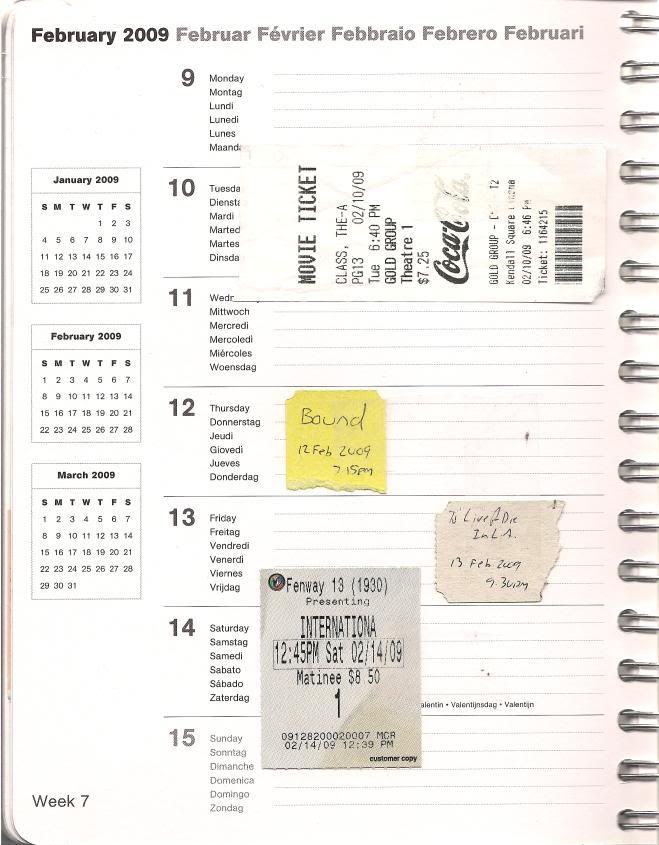
On Video: Hunting Grounds
Another quiet week. As we ramp up to the Oscars, there's not a whole lot of new stuff out that looks worth seeing. Hopefully that will improve soon.
Bound
* * * ½ (out of four)
Seen 12 February 2009 at the Brattle Theatre (Great Romances IV)
Back in '96, when I was working more hours at the now-shuttered Showcase Cinemas Downtown Worcester than I was studying computer science at Worcester Polytechnic Institute, Bound was one of the movies playing there, at least for a week or two. I must have been more dilligent about my studies than usual that week, because I remember being darn amused by "f___in' dark in here!" but not actually seeing the movie later. I'm not sure why it took me this long to catch up with it.
Happily, it holds up. Between the Matrix films and Speed Racer, it's sort of become a footnote in the Wachowskis' joint career, but it's a real blast to watch. I got the same impression from it that I got from Midnight Meat Train last summer - the movies aren't really similar in any way, other than the fact that the directors of each knew that this was their calling card, their make-or-break moment, and they were determined that every instant be one that potentially sticks in the audience's memory. Bound is lurid pulp, but wonderfully so, a hugely entertaining twist on film noir roles. I'm glad I finally saw it.
To Live and Die in L.A.
* * * (out of four)
Seen 13 February 2009 at the Harvard Film Archive (The Uncanny Cinema of William Friedkin)
Here's another one I never got around to - the Brattle had a William Friedkin series or double-feature a couple years ago, but the movie was scheduled for 10pm and they had print problems, so it had to be shown off DVD, which at the time looked pretty lousy there. I conked out sometime early.
It turns out to be a kind of nasty bit of work, a hard-R combination of action movie and police procedural, with Secret Service agent Richard Chance (William Petersen) obsessively chasing down master counterfeiter Rick Masters (Willem Dafoe). As one might expect, Friedkin throws one spectacular chase sequence in. He's great at getting the violence to jolt as well as titillate.
One thing that I always notice about these 70s/80s crime movies by the likes of Friedkin, Frankenheimer, and company is just how sparse they are. "Chance hunts down Masters" is pretty much the entire story, whereas later everything would get a lot more complicated: There'd be a half-dozen twists and turns, and as many progressively bigger action set pieces. Here, we spend a lot of time just watching Chance and Masters, even though they're not particularly complex characters or undergoing much in the way of personal transformation. It's an action movie that somehow becomes an actor's showcase.
The International
* * * (out of four)
Seen 14 February 2009 at Regal Fenway #1 (first-run)
As you can see from looking at the page of tickets, The International ran me $8.50 for a matinee. There's an action sequence in the middle that's worth $4 or $5 of that, a running gunfight through New York's Guggenheim Museum that is absolutely jaw-dropping, both for the amount of ordinance expended and how clealry director Tom Tykwer stages it - no obfuscating editing or bad shot selection here; you know exactly what's going on. It's a tour de force of action filmmaking, something you'd expect to see from Johnnie To or John Woo on their best days.
Does the rest of the movie make up the difference? I'm not quite sure. It's frequently very dry, with lots of talk about what the various agencies are investigating the bank for and jurisdictional infighting. But it's also got Armin Mueller-Stahl as the bank's military consultant, and while it seems like a bit of wasted casting at the start, it certainly isn't by the end, especially when he has a nice, long sit-down with Clive Owen's character to talk about ideals and how circumstances cause one to fall short of them.

On Video: Hunting Grounds
Another quiet week. As we ramp up to the Oscars, there's not a whole lot of new stuff out that looks worth seeing. Hopefully that will improve soon.
Bound
* * * ½ (out of four)
Seen 12 February 2009 at the Brattle Theatre (Great Romances IV)
Back in '96, when I was working more hours at the now-shuttered Showcase Cinemas Downtown Worcester than I was studying computer science at Worcester Polytechnic Institute, Bound was one of the movies playing there, at least for a week or two. I must have been more dilligent about my studies than usual that week, because I remember being darn amused by "f___in' dark in here!" but not actually seeing the movie later. I'm not sure why it took me this long to catch up with it.
Happily, it holds up. Between the Matrix films and Speed Racer, it's sort of become a footnote in the Wachowskis' joint career, but it's a real blast to watch. I got the same impression from it that I got from Midnight Meat Train last summer - the movies aren't really similar in any way, other than the fact that the directors of each knew that this was their calling card, their make-or-break moment, and they were determined that every instant be one that potentially sticks in the audience's memory. Bound is lurid pulp, but wonderfully so, a hugely entertaining twist on film noir roles. I'm glad I finally saw it.
To Live and Die in L.A.
* * * (out of four)
Seen 13 February 2009 at the Harvard Film Archive (The Uncanny Cinema of William Friedkin)
Here's another one I never got around to - the Brattle had a William Friedkin series or double-feature a couple years ago, but the movie was scheduled for 10pm and they had print problems, so it had to be shown off DVD, which at the time looked pretty lousy there. I conked out sometime early.
It turns out to be a kind of nasty bit of work, a hard-R combination of action movie and police procedural, with Secret Service agent Richard Chance (William Petersen) obsessively chasing down master counterfeiter Rick Masters (Willem Dafoe). As one might expect, Friedkin throws one spectacular chase sequence in. He's great at getting the violence to jolt as well as titillate.
One thing that I always notice about these 70s/80s crime movies by the likes of Friedkin, Frankenheimer, and company is just how sparse they are. "Chance hunts down Masters" is pretty much the entire story, whereas later everything would get a lot more complicated: There'd be a half-dozen twists and turns, and as many progressively bigger action set pieces. Here, we spend a lot of time just watching Chance and Masters, even though they're not particularly complex characters or undergoing much in the way of personal transformation. It's an action movie that somehow becomes an actor's showcase.
The International
* * * (out of four)
Seen 14 February 2009 at Regal Fenway #1 (first-run)
As you can see from looking at the page of tickets, The International ran me $8.50 for a matinee. There's an action sequence in the middle that's worth $4 or $5 of that, a running gunfight through New York's Guggenheim Museum that is absolutely jaw-dropping, both for the amount of ordinance expended and how clealry director Tom Tykwer stages it - no obfuscating editing or bad shot selection here; you know exactly what's going on. It's a tour de force of action filmmaking, something you'd expect to see from Johnnie To or John Woo on their best days.
Does the rest of the movie make up the difference? I'm not quite sure. It's frequently very dry, with lots of talk about what the various agencies are investigating the bank for and jurisdictional infighting. But it's also got Armin Mueller-Stahl as the bank's military consultant, and while it seems like a bit of wasted casting at the start, it certainly isn't by the end, especially when he has a nice, long sit-down with Clive Owen's character to talk about ideals and how circumstances cause one to fall short of them.
Thursday, February 12, 2009
The Class
Stupid work keeping me a half hour later than I wanted so I couldn't go to both The Class and the Charles Stross signing at Pandemonium. I nearly bailed on the film, to be honest, but with the sci-fi marathon coming up this weekend, I didn't know just how much opportunity I'd have.
Entre les Murs (The Class)
* * * ¾ (out of four)
Seen 10 January 2009 at Landmark Kendall Square #1 (first-run)
The Class does seem somewhat different from conventional teacher/student movies from the beginning, but it takes a while before the biggest reason why sinks in. Usually, the subject of a movie is exceptional in some way - that's why you make movies about them in particular. It's not until about midway through that the audience begins to realize what director Laurent Cantet is doing - not telling the story of a great teacher, or even an especially good one, but an average teacher.
That teacher is François Marin; he teaches French in a middle school that serves an ethnically diverse but not particularly prosperous section of Paris. He's been around long enough to be a class supervisor and not to feel the need to announce his service time when the faculty has their meet-and-greet at the start of the school year. Some of the students in the particular class that we follow have had him before; some are new. There's smart-aleck Esmerelda, who wants to be a cop when she grows up; Wey, a Chinese immigrant whose French is still a little rough; Khoumba, who has grown standoffish and angry over the summer; Louise, a class representative (along with Esmerelda); Soulemayne, a Malian boy who is disruptive when he does show up to class; and Carl, who transfers in after being expelled from another school. They are not especially gifted kids, but it's not a remedial class.
We follow Marin and his students over the course of a school year, from the first class to the last, with teacher meetings, parent/teacher conferences, and disciplinary hearings along the way. Cantet gives the film a documentary feel without ever specifically using documentary devices: There are no staged interviews or acknowledgment of the camera, no informational subtitles. There are cuts and close-ups within scenes that indicate multiple takes. On the other hand, it does have the "available footage" feel of a documentary; storylines dangle unresolved or happen off-screen. Amusing or instructive scenes that don't have much to do with anything else are thrown in. The plot develops late and is clearly subservient to giving us a look at this environment; much of the pleasure of The Class is, fittingly, that of learning something new rather than a story well-told.
Further blurring the line between narrative and documentary is the cast. M. Marin is played by François Bégaudeau, who worked on adapting the screenplay from his own book about his experiences as a teacher. As the credits scroll, one sees that the characters names match those of the actors; I would not be shocked if either the actual students from Bégaudeau's book were playing themselves, the cast was mainly amateurs instructed to just be themselves, or Cantet changed the character names to facilitate improvisation. Whatever the reason, the result is engrossing; we almost never see telltale signs of an actor performing. I suspect several cast member must be a ringers - Franck Keïta as Soulemayne, for instance, not just from the differing names but because they're too central to the last act to leave anything to chance - but it's almost impossible to tell with any certainty.
That Bégaudeau is playing, essentially, a version of himself makes the film's honesty somewhat surprising. It's not that the film neither indicts nor praises French public education - as with just about every story about teachers ever made, the system is shown as short of resources and having a hard time adapting to the day's youth. Though we're prepared early on to sympathize with M. Marin - he's contrasted against a less empathetic teacher and always argues benefit to the student over convenience to the faculty - it eventually becomes clear that he's pretty darn flawed: He can be confrontational and unwilling to admit that he's wrong. Most of the audience can likely pinpoint the exact moment when things get out of hand in the last act, and it can be laid squarely at his feet. Not solely - from that point forward, nobody comes out looking particularly righteous, and there's an extraneous bit of melodrama - but it's a shocking moment for the audience: Films about teachers have that mistake in the first act, not the last, and for a semi-autobiographical story, it's far from self-serving.
It doesn't make him into the villain of the piece, but the last act is a dash of cold water on what we're used to. It's a sobering thought, that even the dedicated teachers have blind spots and failures. Stories about those teachers and students probaby tell us more about the problems (and what works) with public schools than the inspirational ones.
Also at eFilmCritic.
Entre les Murs (The Class)
* * * ¾ (out of four)
Seen 10 January 2009 at Landmark Kendall Square #1 (first-run)
The Class does seem somewhat different from conventional teacher/student movies from the beginning, but it takes a while before the biggest reason why sinks in. Usually, the subject of a movie is exceptional in some way - that's why you make movies about them in particular. It's not until about midway through that the audience begins to realize what director Laurent Cantet is doing - not telling the story of a great teacher, or even an especially good one, but an average teacher.
That teacher is François Marin; he teaches French in a middle school that serves an ethnically diverse but not particularly prosperous section of Paris. He's been around long enough to be a class supervisor and not to feel the need to announce his service time when the faculty has their meet-and-greet at the start of the school year. Some of the students in the particular class that we follow have had him before; some are new. There's smart-aleck Esmerelda, who wants to be a cop when she grows up; Wey, a Chinese immigrant whose French is still a little rough; Khoumba, who has grown standoffish and angry over the summer; Louise, a class representative (along with Esmerelda); Soulemayne, a Malian boy who is disruptive when he does show up to class; and Carl, who transfers in after being expelled from another school. They are not especially gifted kids, but it's not a remedial class.
We follow Marin and his students over the course of a school year, from the first class to the last, with teacher meetings, parent/teacher conferences, and disciplinary hearings along the way. Cantet gives the film a documentary feel without ever specifically using documentary devices: There are no staged interviews or acknowledgment of the camera, no informational subtitles. There are cuts and close-ups within scenes that indicate multiple takes. On the other hand, it does have the "available footage" feel of a documentary; storylines dangle unresolved or happen off-screen. Amusing or instructive scenes that don't have much to do with anything else are thrown in. The plot develops late and is clearly subservient to giving us a look at this environment; much of the pleasure of The Class is, fittingly, that of learning something new rather than a story well-told.
Further blurring the line between narrative and documentary is the cast. M. Marin is played by François Bégaudeau, who worked on adapting the screenplay from his own book about his experiences as a teacher. As the credits scroll, one sees that the characters names match those of the actors; I would not be shocked if either the actual students from Bégaudeau's book were playing themselves, the cast was mainly amateurs instructed to just be themselves, or Cantet changed the character names to facilitate improvisation. Whatever the reason, the result is engrossing; we almost never see telltale signs of an actor performing. I suspect several cast member must be a ringers - Franck Keïta as Soulemayne, for instance, not just from the differing names but because they're too central to the last act to leave anything to chance - but it's almost impossible to tell with any certainty.
That Bégaudeau is playing, essentially, a version of himself makes the film's honesty somewhat surprising. It's not that the film neither indicts nor praises French public education - as with just about every story about teachers ever made, the system is shown as short of resources and having a hard time adapting to the day's youth. Though we're prepared early on to sympathize with M. Marin - he's contrasted against a less empathetic teacher and always argues benefit to the student over convenience to the faculty - it eventually becomes clear that he's pretty darn flawed: He can be confrontational and unwilling to admit that he's wrong. Most of the audience can likely pinpoint the exact moment when things get out of hand in the last act, and it can be laid squarely at his feet. Not solely - from that point forward, nobody comes out looking particularly righteous, and there's an extraneous bit of melodrama - but it's a shocking moment for the audience: Films about teachers have that mistake in the first act, not the last, and for a semi-autobiographical story, it's far from self-serving.
It doesn't make him into the villain of the piece, but the last act is a dash of cold water on what we're used to. It's a sobering thought, that even the dedicated teachers have blind spots and failures. Stories about those teachers and students probaby tell us more about the problems (and what works) with public schools than the inspirational ones.
Also at eFilmCritic.
Tuesday, February 10, 2009
Hunting Grounds
Last night's screener was going to be Flick, but neither the HD DVD player nor Blu-ray player would touch it, and no way was I going to hook one more item up to the already-terrifying jumble around my TV to see if some other device would read the disc (the DVR was already misbehaving, and that was enough). Getting Hunting Grounds to play cemented the HD DVD player as my primary DVD player for the time being - though letterboxed, the disc is non-anamorphic, so the Blu-ray player stretched and distorted it.
As much as Hunting Grounds isn't really a good movie, I wish I had gotten to see it at the festival. The filmmakers were local, so they would have been there, and I have little doubt that it would have been enhanced by a sold-out crowd screaming en français. I really wanted to see Midnight Meat Train with Kitamura in attendance, so that took priority (though I would have run across the street if I'd been shut out of that, as nearly happened).
I'm less excited by the idea floated in the Fantasia program that this is the first of a series - I'd like to see filmmaker Eric Bilodeau do more, but this isn't quite good enough for me to want more of this.
Hunting Grounds
* * (out of four)
Seen 9 February 2009 in Jay's Living Room (Fantasia Screener DVD)
Every once in a while, I'll get an email from a fan or filmmaker angry that I've given a tiny independent film a bad grade, saying that these movies shouldn't be judged by the same criteria as studio films. I say that of course they should - they're getting the same ticket price and the same hour and a half of my time. Still, even if I can't say that Eric Bilodeau and company have made a good movie by any objective standard, I like the effort they're making.
Hunting Grounds takes place a generation or so from now, when to help rebuild the environment, human habitation is confined to walled cities. Much human interaction is confined to a virtual reality system called the "Alternet", and while that's fine for some, Quebec City's Paul Austin (Patrice LeBlanc) yearns to hunt actual game from his family's cabin. He and girlfriend Lexa Monroe (Marie-Eve Lemire) have only met each other online, but friend Sebastien Mathieu (Luc Rivard) knows how to sneak out. Also in the party are tracker Simon Roy (Patrick Baby), who wants out even more than Paul, and Francine Hudon (Valerie Tremblay), who suddenly finds herself feeling acutely agoraphobic when confronted with the real world. Of course, what they don't know is that near Paul's cabin is a secret military installation, where Lt. Aria Palmer (Emilie Gilbert-Gagnon) is involved in one of those experiments for healing injured tissue that winds up reanimating the dead.
I admire Bilodeau's ambition. Many, many people have made zombie movies in their backyard, and that's hard enough. Eric Bilodeau, on the other hand, is going to take his twenty thousand Canadian dollars and not only is he going to do gore effects, but he's going to do some digital backlot shooting and a fair amount of digital effects. It's rough at times - very rough indeed - and sometimes I found myself thinking about the tradeoffs a lot: For instance, when someone shoots a pistol, the CGI muzzle flash and sparks look kind of fake compared to traditional blanks and squibs, but there can be little doubt that they are far safer and reduce the need for (expensive) stuntpeople and other experts on the set. That can be huge for a production this size. And even if some of the effects look like they were only rendered at standard video definition, the concepts are good: The floating holographic computer interfaces are well-realized, and the last act does give us a zombie running around with large bits missing that is only upright because it's wearing an exoskeleton. That's good stuff; there are films that expend a lot more resources executing lesser ideas less impressively.
It can be a real chore getting to the good stuff, though. Some of it seems to be concessions to what needs to be done to try and make any money off it: Many people will discount a film that is shorter than ninety minutes, so this one stretches to break the hour-and-a-half mark. It takes the hunting party thirty of the film's minutes to get out of the city; many scenes run in conversational circles, pile on extraneous exposition, and are otherwise redundant, but they fill time. I also strongly suspect that the cast and crew aren't doing themselves many favors by having the vast majority of the dialogue be in English, but I gather that's the reality of making independent films in Quebec: French doesn't export nearly as well as English, not even to the rest of Canada or to other Francophone countries, so unless you're sure you can break even at home, you shoot in English. It's pretty clear from the accents and stilted delivery that this is not the native language of most of the cast (especially compared to the scenes when the characters speak French), and it makes everyone look like worse actors than they likely are.
Commercial considerations aren't entirely to blame; Eric Bilodeau is credited with at least nine jobs on the film, and he's not great at every one of them. In particular, he could use the assistance of a good editor; Hunting Grounds doesn't build up much of a head of steam until late in the game, and then rushes the big confrontations without giving us the opportunity to get excited for them. Audio could also use some work; we'll occasionally get a gory visual without any corresponding disgusting sound. The way some excess characters are eliminated is pretty disappointing, and, hey, don't have zombies chase our heroes through a machine shop just loaded with power tools - including a conspicuously placed chainsaw - without a little more mayhem.
Still, as cheapo horror movies go, Hunting Grounds is just below-average, not terrible: Terrible movies don't get me shouting advice to the screen, after all. Bilodeau has done more with less than a lot of would-be filmmakers, and even if I'm not likely to re-watch this movie again, I find myself hoping that he gets a chance to step up to the next level.
Also at HBS.
As much as Hunting Grounds isn't really a good movie, I wish I had gotten to see it at the festival. The filmmakers were local, so they would have been there, and I have little doubt that it would have been enhanced by a sold-out crowd screaming en français. I really wanted to see Midnight Meat Train with Kitamura in attendance, so that took priority (though I would have run across the street if I'd been shut out of that, as nearly happened).
I'm less excited by the idea floated in the Fantasia program that this is the first of a series - I'd like to see filmmaker Eric Bilodeau do more, but this isn't quite good enough for me to want more of this.
Hunting Grounds
* * (out of four)
Seen 9 February 2009 in Jay's Living Room (Fantasia Screener DVD)
Every once in a while, I'll get an email from a fan or filmmaker angry that I've given a tiny independent film a bad grade, saying that these movies shouldn't be judged by the same criteria as studio films. I say that of course they should - they're getting the same ticket price and the same hour and a half of my time. Still, even if I can't say that Eric Bilodeau and company have made a good movie by any objective standard, I like the effort they're making.
Hunting Grounds takes place a generation or so from now, when to help rebuild the environment, human habitation is confined to walled cities. Much human interaction is confined to a virtual reality system called the "Alternet", and while that's fine for some, Quebec City's Paul Austin (Patrice LeBlanc) yearns to hunt actual game from his family's cabin. He and girlfriend Lexa Monroe (Marie-Eve Lemire) have only met each other online, but friend Sebastien Mathieu (Luc Rivard) knows how to sneak out. Also in the party are tracker Simon Roy (Patrick Baby), who wants out even more than Paul, and Francine Hudon (Valerie Tremblay), who suddenly finds herself feeling acutely agoraphobic when confronted with the real world. Of course, what they don't know is that near Paul's cabin is a secret military installation, where Lt. Aria Palmer (Emilie Gilbert-Gagnon) is involved in one of those experiments for healing injured tissue that winds up reanimating the dead.
I admire Bilodeau's ambition. Many, many people have made zombie movies in their backyard, and that's hard enough. Eric Bilodeau, on the other hand, is going to take his twenty thousand Canadian dollars and not only is he going to do gore effects, but he's going to do some digital backlot shooting and a fair amount of digital effects. It's rough at times - very rough indeed - and sometimes I found myself thinking about the tradeoffs a lot: For instance, when someone shoots a pistol, the CGI muzzle flash and sparks look kind of fake compared to traditional blanks and squibs, but there can be little doubt that they are far safer and reduce the need for (expensive) stuntpeople and other experts on the set. That can be huge for a production this size. And even if some of the effects look like they were only rendered at standard video definition, the concepts are good: The floating holographic computer interfaces are well-realized, and the last act does give us a zombie running around with large bits missing that is only upright because it's wearing an exoskeleton. That's good stuff; there are films that expend a lot more resources executing lesser ideas less impressively.
It can be a real chore getting to the good stuff, though. Some of it seems to be concessions to what needs to be done to try and make any money off it: Many people will discount a film that is shorter than ninety minutes, so this one stretches to break the hour-and-a-half mark. It takes the hunting party thirty of the film's minutes to get out of the city; many scenes run in conversational circles, pile on extraneous exposition, and are otherwise redundant, but they fill time. I also strongly suspect that the cast and crew aren't doing themselves many favors by having the vast majority of the dialogue be in English, but I gather that's the reality of making independent films in Quebec: French doesn't export nearly as well as English, not even to the rest of Canada or to other Francophone countries, so unless you're sure you can break even at home, you shoot in English. It's pretty clear from the accents and stilted delivery that this is not the native language of most of the cast (especially compared to the scenes when the characters speak French), and it makes everyone look like worse actors than they likely are.
Commercial considerations aren't entirely to blame; Eric Bilodeau is credited with at least nine jobs on the film, and he's not great at every one of them. In particular, he could use the assistance of a good editor; Hunting Grounds doesn't build up much of a head of steam until late in the game, and then rushes the big confrontations without giving us the opportunity to get excited for them. Audio could also use some work; we'll occasionally get a gory visual without any corresponding disgusting sound. The way some excess characters are eliminated is pretty disappointing, and, hey, don't have zombies chase our heroes through a machine shop just loaded with power tools - including a conspicuously placed chainsaw - without a little more mayhem.
Still, as cheapo horror movies go, Hunting Grounds is just below-average, not terrible: Terrible movies don't get me shouting advice to the screen, after all. Bilodeau has done more with less than a lot of would-be filmmakers, and even if I'm not likely to re-watch this movie again, I find myself hoping that he gets a chance to step up to the next level.
Also at HBS.
Monday, February 09, 2009
This Week In Tickets: 2 February 2009 to 8 February 2009
The weekend got a little busy, but not so much the week itself:
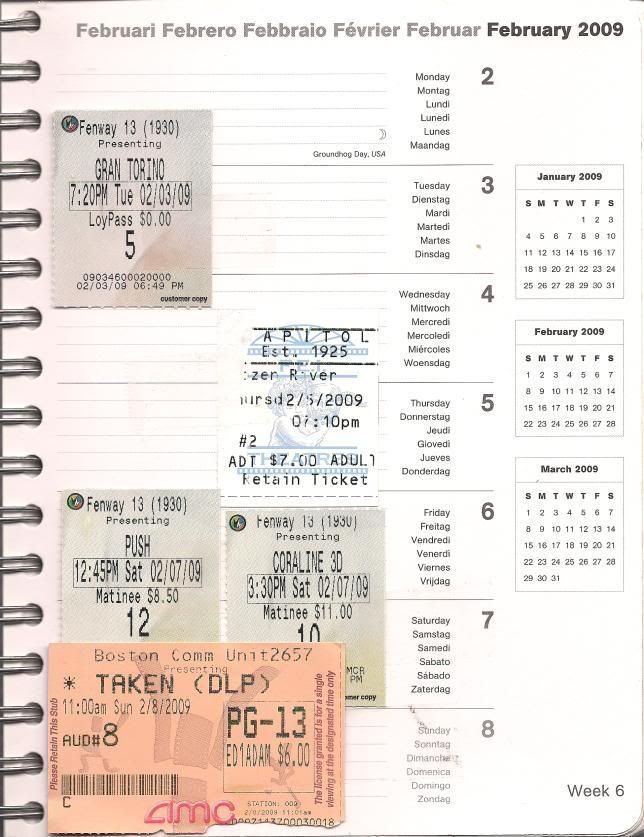
On Video: No Mercy for the Rude
I had a pass to see the preview of Push on Tuesday, but despite arriving at the theater an hour before the start time, didn't make it. There wasn't much else I hadn't seen playing at around 6:30 at Boston Common, so I wound up taking the T to Fenway to use up a pass before it expired Thursday. The express bus from Central Square, Waltham to Downtown Boston took $5.00 off my CharlieCard, and the green line from Boylston to Fenway station was $1.70, so it cost me $6.70 to see a free movie that night. Oddly, that's still not a bad deal for seeing a mid-week movie in this city; note that the second-run theater out in Arlington (the sort of place that I believe is still referred to as a "dollar theater" in other parts of the country) cost me $7.00 on Thursday night.
I saw Frozen River that night, which gets me pretty close to having seen all the major nominations for the Academy Awards - I'm missing Richard Jenkins in The Visitor and Robert Downey Jr. in Tropic Thunder (which I own on Blu-ray). It wouldn't be too much effort to find a copy of The Visitor on video (though I don't have memberships with any rental services right now), so I'll probably be good there. I don't know about the Chlotrudis Awards - I've seen a good chunk of those, but I've only seen one of the Buried Treasure nominees, and I just can't see myself making the effort to see four of the other five (especially when the arguments for one of the films advanced at the nominating meeting put me off wanting to see it). It's just no fun seeing movies out of a sense of obligation, after all.
Gran Torino
* * * (out of four)
Seen 3 February 2009 at Regal Fenway #5 (first-run)
I like Clint Eastwood, a lot, although most of what I've seen him in is the older, somewhat mellowed Clint. You know he's become a fine director, and his laid-back approach as a filmmaker has somewhat affected his on-screen persona - it's difficult not to see him as the wise old man these days. So considering Gran Torino is likely his swan song as an actor is kind of odd to me: As much as I know that much of his early work is the sort of tough guy who might age into this movie's Walt Kowalski, that's not how I picture him. I guess that speaks to Eastwood's exceptionally long career, in that as much as this is how he was perceived for a long time, he's been able to evolve into quite a bit more.
The movie itself isn't bad. Clint Eastwood is not hanging up his spurs on a masterpiece, and this likely won't be a role he's long-remembered for, but it's a solid, well-made picture.
Frozen River
* * * ¼ (out of four)
Seen 5 February 2009 at FEI Capitol #2 (second-run)
Another movie mainly getting attention for a notable performance, in this case Melissa Leo's Oscar-and-many-other-awards-nominated performance. Which is pretty good, but which I think may also be getting a little bit of notice for being one where the star lets herself look like hell. It's a nice performance, nothing wrong with it at all, but I didn't find Leo's Ray Eddy particularly captivating.
The story itself is, though. Writer/director Courtney Hunt has come up with a nifty and unique premise - human smuggling where Mohawk lands straddle the U.S./Canada border - and stuck a handful of interesting characters into it. I was most interested in Misty Upham as Lila, the Mohawk woman who involves Ray in her operation. She just as desperate as Ray, but there's something about the way she carries herself that makes her interesting. I've seen people like Ray before, but Lila seemed a much more original creation.
Taken
* * * ½ (out of four)
Seen 8 February 2009 at AMC Boston Common #8 (first run; digital projection)
Ah, Luc Besson, don't ever change. Even if you do stick with this decision to only direct new Arthur et les Minimoys films, keep writing and producing quality action movies, mentoring new directors like this film's Pierre Morel. Some may argue that they aren't great art, but they most assuredly are great entertainment.
Liam Neeson is this film's far-from-secret weapon, of course. He's not the martial arts star that many of Besson's other leading men have been, but the script is tailored to him: It takes great advantage of him being tall and imposing, and will often have him dispatch enemies with a single blow rather than a drawn out fight sequence; he's a guy who knows how to handle himself. It's no wonder, seeing this movie, that he was almost cast as James Bond twice (allegedly the first choice of the Broccoli's for GoldenEye and when Columbia tried to set up a competing Bond franchise by purchasing the sequel rights to Never Say Never Again); he embodies the fierce ruthlessness of that character.
The Besson and Neeson's performance were why I sat through this often-brutal action movie with a smile on my face: It's an example of something that is often done poorly, without care, being done well.

On Video: No Mercy for the Rude
I had a pass to see the preview of Push on Tuesday, but despite arriving at the theater an hour before the start time, didn't make it. There wasn't much else I hadn't seen playing at around 6:30 at Boston Common, so I wound up taking the T to Fenway to use up a pass before it expired Thursday. The express bus from Central Square, Waltham to Downtown Boston took $5.00 off my CharlieCard, and the green line from Boylston to Fenway station was $1.70, so it cost me $6.70 to see a free movie that night. Oddly, that's still not a bad deal for seeing a mid-week movie in this city; note that the second-run theater out in Arlington (the sort of place that I believe is still referred to as a "dollar theater" in other parts of the country) cost me $7.00 on Thursday night.
I saw Frozen River that night, which gets me pretty close to having seen all the major nominations for the Academy Awards - I'm missing Richard Jenkins in The Visitor and Robert Downey Jr. in Tropic Thunder (which I own on Blu-ray). It wouldn't be too much effort to find a copy of The Visitor on video (though I don't have memberships with any rental services right now), so I'll probably be good there. I don't know about the Chlotrudis Awards - I've seen a good chunk of those, but I've only seen one of the Buried Treasure nominees, and I just can't see myself making the effort to see four of the other five (especially when the arguments for one of the films advanced at the nominating meeting put me off wanting to see it). It's just no fun seeing movies out of a sense of obligation, after all.
Gran Torino
* * * (out of four)
Seen 3 February 2009 at Regal Fenway #5 (first-run)
I like Clint Eastwood, a lot, although most of what I've seen him in is the older, somewhat mellowed Clint. You know he's become a fine director, and his laid-back approach as a filmmaker has somewhat affected his on-screen persona - it's difficult not to see him as the wise old man these days. So considering Gran Torino is likely his swan song as an actor is kind of odd to me: As much as I know that much of his early work is the sort of tough guy who might age into this movie's Walt Kowalski, that's not how I picture him. I guess that speaks to Eastwood's exceptionally long career, in that as much as this is how he was perceived for a long time, he's been able to evolve into quite a bit more.
The movie itself isn't bad. Clint Eastwood is not hanging up his spurs on a masterpiece, and this likely won't be a role he's long-remembered for, but it's a solid, well-made picture.
Frozen River
* * * ¼ (out of four)
Seen 5 February 2009 at FEI Capitol #2 (second-run)
Another movie mainly getting attention for a notable performance, in this case Melissa Leo's Oscar-and-many-other-awards-nominated performance. Which is pretty good, but which I think may also be getting a little bit of notice for being one where the star lets herself look like hell. It's a nice performance, nothing wrong with it at all, but I didn't find Leo's Ray Eddy particularly captivating.
The story itself is, though. Writer/director Courtney Hunt has come up with a nifty and unique premise - human smuggling where Mohawk lands straddle the U.S./Canada border - and stuck a handful of interesting characters into it. I was most interested in Misty Upham as Lila, the Mohawk woman who involves Ray in her operation. She just as desperate as Ray, but there's something about the way she carries herself that makes her interesting. I've seen people like Ray before, but Lila seemed a much more original creation.
Taken
* * * ½ (out of four)
Seen 8 February 2009 at AMC Boston Common #8 (first run; digital projection)
Ah, Luc Besson, don't ever change. Even if you do stick with this decision to only direct new Arthur et les Minimoys films, keep writing and producing quality action movies, mentoring new directors like this film's Pierre Morel. Some may argue that they aren't great art, but they most assuredly are great entertainment.
Liam Neeson is this film's far-from-secret weapon, of course. He's not the martial arts star that many of Besson's other leading men have been, but the script is tailored to him: It takes great advantage of him being tall and imposing, and will often have him dispatch enemies with a single blow rather than a drawn out fight sequence; he's a guy who knows how to handle himself. It's no wonder, seeing this movie, that he was almost cast as James Bond twice (allegedly the first choice of the Broccoli's for GoldenEye and when Columbia tried to set up a competing Bond franchise by purchasing the sequel rights to Never Say Never Again); he embodies the fierce ruthlessness of that character.
The Besson and Neeson's performance were why I sat through this often-brutal action movie with a smile on my face: It's an example of something that is often done poorly, without care, being done well.
Sunday, February 08, 2009
Double Dose of Dakota: Push & Coraline
As much as young Ms. Fanning being in both movies I saw Saturday wound up being the theme of the day, I had honestly forgot that she was providing the title character's voice in Coraline, if indeed I ever chanced upon the information. I think it goes to show what her strengths as a child actress are. She's not really needed in Coraline, as most of the performance is in Selick's puppetry, while anyone who can sound like a little girl could arguably have done the voice. She winds up being the best thing about Push, though - oftentimes the way she stands or rolls her eyes in the background of a scene does a heck of a lot more to make her interesting than the silly crap the script calls upon her to say.
And, man, is there a lot of silly crap in the Push script. I suppose, if I want to be generous, I can thank it for being a piece of junk in that noticing just how much was unappealing about it sort of crystallized my feelings about what's not fun about superheroes in a variety of media right now. Push is kind of the logical endpoint of a number of trends that have been draining the fun out of what should be one of the most enjoyable genres in the world: As I mention in the review proper, superheroes used to put on colorful costumes and help people; now they just fight among themselves. You can see that in stories like Push, or Heroes, or what The 4400 became before it was cut short. Heck, I'll throw the likes of Harry Potter in, with its magical people sequestering themselves off from the regular world and having their little civil wars. Even in comics, this sort of infighting has been the backbone of the Marvel Universe for years - "House of M", "Civil War", "World War Hulk", "Secret Invasion", and now "Dark Reign" are all turf wars in one way or another; DC's doing the same with Superman and Batman this year, and their big events lately have been about defining and describing minutia of their mythology, not telling great stories of people with great power trying to make the world a better place against opposition.
Push
* ¼ (out of four)
Seen 7 February 2009 at Regal Fenway #12 (first-run)
Remember a time, not so long ago, when superheroes had ideals as lofty as their powers were amazing and their costumes were colorful, and fought for the greater good, rather than just turf wars among themselves? When those amazing powers were actually amazing and special, rather than so common as to be taken for granted? Those days seem far away watching Push, and even those who feel that that kind of superhero story is best left in the past will be hard-pressed to find much to like about this movie.
Oh, there's some. Johnnie To's Milky Way Image Company will probably be able to produce one or two really good crime films based on the money they made handling the Hong Kong production of this turd. Dakota Fanning and Chris Evans continue to demonstrate an uncanny ability to be very good despite being surrounded on all sides by an otherwise terrible movie. But that's just about it.
This particular terrible movie, after a couple scenes and an exposition dump to set up some of the backdrop, tells the story of Nick Gant (Evans), a young man (currently in Hong Kong) who can move things with his mind, although he's not very good at it. A pair of American "Division" agents working for Henry Carver (Djimon Hounsou), the man who killed Nick's father, pay him a visit to let him know he's being watched, and they're followed by Cassie Holmes (Fanning), a 13-year-old "watcher" who can see the future; both she and the agents are looking for Kira (Camilla Belle), an old girlfriend of Nick's who escaped from Division and can "push" thoughts into people's minds.
Push is a dreary affair, the sort of science fiction that has no room for wonder, relying on mythology to grab the audience's interest. It's not a particularly interesting mythology - for crying out loud, writer David Bourla doesn't even come up with catchy acronyms for the agencies chasing the powered people down! - and the script keeps one of the most important players off the screen for more or less the entire length of the movie (probably with the thought of having a free hand in casting the character in a sequel). None of the factions are given particularly compelling motivations, and even the protagonists fall into a kill-or-be-killed mindset fairly quickly.
Director Paul McGuigan's last film was the similarly convoluted and amoral Lucky Number Slevin, and he juggles the story well enough until the last act, when somewhere between Bourla's script and McGuigan's direction, the last act winds up making not a lot of sense - it sounds clever in concept, but falls apart with the application of a little logic. The action is quick-cut and confusing, and none of the superpowers have a particularly memorable visual associated with them.
The most memorable thing about Slevin was an enjoyably against-type performance by a cheerful Lucy Liu, and Push is similar, with Dakota Fanning as a cranky and sarcastic psychic; she also sells the one moment where these people actually seem like human beings. Chris Evans and Cliff Curtis are able enough in their parts, but Camilla Belle is pathetically flat as the character at the center of the action, while Djimon Hounsou and Ming-Na sleepwalk through their roles.
Push is probably more competent than most other films bad enough to earn a one-star rating, but it's ugly, right down to the last frame. It's just no fun, and doesn't offer any sort of originality or cleverness to make up for it.
Also at HBS with three other reviews.
Coraline
* * * ¾ (out of four)
Seen 7 February 2009 at Regal Fenway #10 (first-run, digital 3-D)
Coraline is a dark delight, although, honestly, more delightful than dark. Filmmaker Harry Selick has found a match for his sensibilities in author Neil Gaiman, and has made fantastic use of the opportunities that today's 3-D technology gives him.
Coraline Jones (voice of Dakota Fanning), we're told, is a young girl from Michigan whose parents (voices of Teri Hatcher and John Hodgman) have just uprooted her to Oklahoma, to live in an apartment house that is shared with a pair of retired actresses (voices of comedy duo Dawn French & Jennifer Saunders) below and a one-time circus person (voice of Ian McShane) above. The only other kid in the neighborhood is nerdy and annoying Wyborn "Wybie" Lovat (voice of Robert Bailey Jr.). The place his not entirely without interest; Wybie has found an old doll with a curious resemblance to Coraline, down to her blue hair and yellow boots, and there's a tiny painted-over door in the apartment that opens to a brick wall. Except, sometimes, it opens into a tunnel, and on the other side of that tunnel is a house just like Coraline's - except what is boring at home is magical there, and everyone has buttons for eyes. She can stay there forever - provided, of course, she lets her "other mother" sew those buttons on her face.
The lesson to be learned hear is obvious, of course: "Things that look too good to be true generally are". But what delights there are! Selick gives us several spiffy set pieces, and while some of the character designs are on the grotesque side, the ones we see the most are fantastic. I love just looking at Coraline, with her blue hair and big feet, and simple facial features that are nonetheless very expressive. What's most impressive is how flexible the design of Coraline's mother is - she goes from irritated mother to fantasy mom to monster with just a few alterations.
Selick's work as an animator is nearly flawless. His characters aren't just designed well, but have personality to their movements, enough that they can often communicate silently. Given the opportunity to shoot in three dimensions, he and director of photography Pete Kozachik make great use of the depth offered by the format. Most of the time the animation is very smooth, but sometimes it isn't, in a way that makes everything perhaps deliberately signals to the audience that this is a film mostly made of things people held in their hands, as opposed to existing entirely in the digital realm. I love the way the filmmakers warp space at times, from the tunnel that was made for 3-D viewing to how a fantasy world ends once it is explored too much.
The screenplay is well-balanced as well. Not having read the original novella, I don't know how much of that is Selick and how much is Gaiman's original work, but the film does a fine job of communicating its mythology without pounding upon the audience with the details. It's a little scary for young kids, to be sure, but kids like being scared in moderation, and the movie gives the audience moments to feel safe before plunging Coraline into the next scary situation. She's nicely balanced between being given enough help to not be Supergirl but also triumphing in large part by being brave and smart and good-hearted, even if adults will recognize some of how she acts as being things kids do to drive their parents nuts.
Dakota Fanning is fine as the voice of Coraline, although mostly as a somewhat generic little-girl voice (as good a young actress as she is, animation doesn't let her communicate with facial expressions and body language). Teri Hatcher is pretty great giving voice to Coraline's mother and other mother, giving the latter too-sweet tones that set off alarm bells in the audience but would be decidedly appealing to Coraline. Keith David is the other standout voice, not quite fitting the stereotype that the phrase "cool cat" brings to mind but being enough in the neighborhood so that it works.
All those parts are pretty great, but its the way Selick fits them all together that makes Coraline a great film, and one that certainly shouldn't be missed while it's still playing in 3-D at some locations.
Also at HBS along with four other reviews.
And, man, is there a lot of silly crap in the Push script. I suppose, if I want to be generous, I can thank it for being a piece of junk in that noticing just how much was unappealing about it sort of crystallized my feelings about what's not fun about superheroes in a variety of media right now. Push is kind of the logical endpoint of a number of trends that have been draining the fun out of what should be one of the most enjoyable genres in the world: As I mention in the review proper, superheroes used to put on colorful costumes and help people; now they just fight among themselves. You can see that in stories like Push, or Heroes, or what The 4400 became before it was cut short. Heck, I'll throw the likes of Harry Potter in, with its magical people sequestering themselves off from the regular world and having their little civil wars. Even in comics, this sort of infighting has been the backbone of the Marvel Universe for years - "House of M", "Civil War", "World War Hulk", "Secret Invasion", and now "Dark Reign" are all turf wars in one way or another; DC's doing the same with Superman and Batman this year, and their big events lately have been about defining and describing minutia of their mythology, not telling great stories of people with great power trying to make the world a better place against opposition.
Push
* ¼ (out of four)
Seen 7 February 2009 at Regal Fenway #12 (first-run)
Remember a time, not so long ago, when superheroes had ideals as lofty as their powers were amazing and their costumes were colorful, and fought for the greater good, rather than just turf wars among themselves? When those amazing powers were actually amazing and special, rather than so common as to be taken for granted? Those days seem far away watching Push, and even those who feel that that kind of superhero story is best left in the past will be hard-pressed to find much to like about this movie.
Oh, there's some. Johnnie To's Milky Way Image Company will probably be able to produce one or two really good crime films based on the money they made handling the Hong Kong production of this turd. Dakota Fanning and Chris Evans continue to demonstrate an uncanny ability to be very good despite being surrounded on all sides by an otherwise terrible movie. But that's just about it.
This particular terrible movie, after a couple scenes and an exposition dump to set up some of the backdrop, tells the story of Nick Gant (Evans), a young man (currently in Hong Kong) who can move things with his mind, although he's not very good at it. A pair of American "Division" agents working for Henry Carver (Djimon Hounsou), the man who killed Nick's father, pay him a visit to let him know he's being watched, and they're followed by Cassie Holmes (Fanning), a 13-year-old "watcher" who can see the future; both she and the agents are looking for Kira (Camilla Belle), an old girlfriend of Nick's who escaped from Division and can "push" thoughts into people's minds.
Push is a dreary affair, the sort of science fiction that has no room for wonder, relying on mythology to grab the audience's interest. It's not a particularly interesting mythology - for crying out loud, writer David Bourla doesn't even come up with catchy acronyms for the agencies chasing the powered people down! - and the script keeps one of the most important players off the screen for more or less the entire length of the movie (probably with the thought of having a free hand in casting the character in a sequel). None of the factions are given particularly compelling motivations, and even the protagonists fall into a kill-or-be-killed mindset fairly quickly.
Director Paul McGuigan's last film was the similarly convoluted and amoral Lucky Number Slevin, and he juggles the story well enough until the last act, when somewhere between Bourla's script and McGuigan's direction, the last act winds up making not a lot of sense - it sounds clever in concept, but falls apart with the application of a little logic. The action is quick-cut and confusing, and none of the superpowers have a particularly memorable visual associated with them.
The most memorable thing about Slevin was an enjoyably against-type performance by a cheerful Lucy Liu, and Push is similar, with Dakota Fanning as a cranky and sarcastic psychic; she also sells the one moment where these people actually seem like human beings. Chris Evans and Cliff Curtis are able enough in their parts, but Camilla Belle is pathetically flat as the character at the center of the action, while Djimon Hounsou and Ming-Na sleepwalk through their roles.
Push is probably more competent than most other films bad enough to earn a one-star rating, but it's ugly, right down to the last frame. It's just no fun, and doesn't offer any sort of originality or cleverness to make up for it.
Also at HBS with three other reviews.
Coraline
* * * ¾ (out of four)
Seen 7 February 2009 at Regal Fenway #10 (first-run, digital 3-D)
Coraline is a dark delight, although, honestly, more delightful than dark. Filmmaker Harry Selick has found a match for his sensibilities in author Neil Gaiman, and has made fantastic use of the opportunities that today's 3-D technology gives him.
Coraline Jones (voice of Dakota Fanning), we're told, is a young girl from Michigan whose parents (voices of Teri Hatcher and John Hodgman) have just uprooted her to Oklahoma, to live in an apartment house that is shared with a pair of retired actresses (voices of comedy duo Dawn French & Jennifer Saunders) below and a one-time circus person (voice of Ian McShane) above. The only other kid in the neighborhood is nerdy and annoying Wyborn "Wybie" Lovat (voice of Robert Bailey Jr.). The place his not entirely without interest; Wybie has found an old doll with a curious resemblance to Coraline, down to her blue hair and yellow boots, and there's a tiny painted-over door in the apartment that opens to a brick wall. Except, sometimes, it opens into a tunnel, and on the other side of that tunnel is a house just like Coraline's - except what is boring at home is magical there, and everyone has buttons for eyes. She can stay there forever - provided, of course, she lets her "other mother" sew those buttons on her face.
The lesson to be learned hear is obvious, of course: "Things that look too good to be true generally are". But what delights there are! Selick gives us several spiffy set pieces, and while some of the character designs are on the grotesque side, the ones we see the most are fantastic. I love just looking at Coraline, with her blue hair and big feet, and simple facial features that are nonetheless very expressive. What's most impressive is how flexible the design of Coraline's mother is - she goes from irritated mother to fantasy mom to monster with just a few alterations.
Selick's work as an animator is nearly flawless. His characters aren't just designed well, but have personality to their movements, enough that they can often communicate silently. Given the opportunity to shoot in three dimensions, he and director of photography Pete Kozachik make great use of the depth offered by the format. Most of the time the animation is very smooth, but sometimes it isn't, in a way that makes everything perhaps deliberately signals to the audience that this is a film mostly made of things people held in their hands, as opposed to existing entirely in the digital realm. I love the way the filmmakers warp space at times, from the tunnel that was made for 3-D viewing to how a fantasy world ends once it is explored too much.
The screenplay is well-balanced as well. Not having read the original novella, I don't know how much of that is Selick and how much is Gaiman's original work, but the film does a fine job of communicating its mythology without pounding upon the audience with the details. It's a little scary for young kids, to be sure, but kids like being scared in moderation, and the movie gives the audience moments to feel safe before plunging Coraline into the next scary situation. She's nicely balanced between being given enough help to not be Supergirl but also triumphing in large part by being brave and smart and good-hearted, even if adults will recognize some of how she acts as being things kids do to drive their parents nuts.
Dakota Fanning is fine as the voice of Coraline, although mostly as a somewhat generic little-girl voice (as good a young actress as she is, animation doesn't let her communicate with facial expressions and body language). Teri Hatcher is pretty great giving voice to Coraline's mother and other mother, giving the latter too-sweet tones that set off alarm bells in the audience but would be decidedly appealing to Coraline. Keith David is the other standout voice, not quite fitting the stereotype that the phrase "cool cat" brings to mind but being enough in the neighborhood so that it works.
All those parts are pretty great, but its the way Selick fits them all together that makes Coraline a great film, and one that certainly shouldn't be missed while it's still playing in 3-D at some locations.
Also at HBS along with four other reviews.
Saturday, February 07, 2009
No Mercy for the Rude
So, I've totally waited until now to start going through my Fantasia screeners because it's midway between Fantasia '08 and Fantasia '09.
Speaking of Fantasia, they've put something on their site stating that the festival will be running 16 July 2009 - 3 August 2009. On the one hand, it means I won't miss the Fourth this year, although if I do the whole thing this year, I'll have to unload a pair of Sox tickets (yeah, that'll be tough) and if I sublet an apartment again, it has to span the two months (again, rough).
Yeui-Eomneun Geotdeul (No Mercy for the Rude)
* * ¾ (out of four)
Seen 6 February 2009 in Jay's Living Room (Fantasia Screener DVD)
No Mercy for the Rude isn't exactly the movie its English-language title would imply. The name implies some sort of satire or that the rudeness is important, and that's not really where this movie's going. It's a much more conventional quirky hitman story, if that's not an oxymoron.
The hitman (Sin Ha-kyun), referred to only as "Killa", is a mute, saving up money for an operation to repair his abnormally short tongue. As such, he's something of a loner, his closest friend another assassin who used to be a ballet dancer (Killa dreams of being a bullfighter). That's about to change - a woman (Yun Ji-hye) who hangs around the same bar as he does has attached herself to him, and when he spots a homeless kid (Kang San) on the way back from a job, he takes the boy in. He's only a few jobs away from being able to pay for his surgery, but one botched job and a number of coincidences threaten to make things very difficult.
So, again, not a black comedy about killing rude or unpleasant people. In fact, the bit about only killing rude people is kind of throw-away, and not really involved in the plot at all until the last act, and not so much then (although, to be fair, "rude" may not be a perfect translation from Korean, either linguistically or culturally). Catchy title, though. That said, part of what makes No Mercy a fairly enjoyable example of the "not-so-bad hitman" genre is that it does have a nifty sense of humor. Killa may not be able to speak, but his narration has a nicely wry and sarcastic edge to it, and is cleverly self-referential in the beginning (and thankfully stops being so long before we'd get sick of it). The scenes with the hitmen are generally quite amusing: They're not cool, but they're not inept, and the comical interactions between them work. There's occasional meanness to the humor, but not to the extent it stops being funny. The flashback scenes are charming, too.
Those amusing bits do have a bit of an uphill battle against the main storylines, which aren't so much bad as they are either generic or nasty. Yun and Kang are good enough as the woman and kid who enter Killa's life, lively characters who earn their keep, but the relationships between the trio are kind of paint-by-numbers. The characters are each interesting, but they play familiar "guy meets girl/kid who like him no matter how he tries to push them away" beats. Writer/director Park Cheol-hie actually makes good use of coincidence to potentially kick story off early on, but piles too many other bits of happenstance on as the film moves to its conclusion, including having two storylines involving a mobster with a truly unpleasant sexual history intersect. Park also gets kind of sloppy toward the end, with Kang Sun's kid appearing and disappearing as is convenient.
The cast does what they can. Sin Ha-kyun has a nice split performance as Killa, hitting a good balance between the comic and the serious in his mute on-screen performance and emoting well enough without going over the top for his narration to be appreciated even through subtitles. Yun Ji-hie is good and dry in her funny scenes, although a bit overwrought in her dramatic ones. Kang San is a good kid actor, and the various assassins and gangsters are good, too.
No Mercy for the Rude is a nice-looking movie, and has plenty of little bits that make it memorable. It's also got a number of bits that are ordinary and others that are just too much. The good bits outnumber the bad ones, although they're not quite enough to live up to the promise of the title.
Also at HBS.
Speaking of Fantasia, they've put something on their site stating that the festival will be running 16 July 2009 - 3 August 2009. On the one hand, it means I won't miss the Fourth this year, although if I do the whole thing this year, I'll have to unload a pair of Sox tickets (yeah, that'll be tough) and if I sublet an apartment again, it has to span the two months (again, rough).
Yeui-Eomneun Geotdeul (No Mercy for the Rude)
* * ¾ (out of four)
Seen 6 February 2009 in Jay's Living Room (Fantasia Screener DVD)
No Mercy for the Rude isn't exactly the movie its English-language title would imply. The name implies some sort of satire or that the rudeness is important, and that's not really where this movie's going. It's a much more conventional quirky hitman story, if that's not an oxymoron.
The hitman (Sin Ha-kyun), referred to only as "Killa", is a mute, saving up money for an operation to repair his abnormally short tongue. As such, he's something of a loner, his closest friend another assassin who used to be a ballet dancer (Killa dreams of being a bullfighter). That's about to change - a woman (Yun Ji-hye) who hangs around the same bar as he does has attached herself to him, and when he spots a homeless kid (Kang San) on the way back from a job, he takes the boy in. He's only a few jobs away from being able to pay for his surgery, but one botched job and a number of coincidences threaten to make things very difficult.
So, again, not a black comedy about killing rude or unpleasant people. In fact, the bit about only killing rude people is kind of throw-away, and not really involved in the plot at all until the last act, and not so much then (although, to be fair, "rude" may not be a perfect translation from Korean, either linguistically or culturally). Catchy title, though. That said, part of what makes No Mercy a fairly enjoyable example of the "not-so-bad hitman" genre is that it does have a nifty sense of humor. Killa may not be able to speak, but his narration has a nicely wry and sarcastic edge to it, and is cleverly self-referential in the beginning (and thankfully stops being so long before we'd get sick of it). The scenes with the hitmen are generally quite amusing: They're not cool, but they're not inept, and the comical interactions between them work. There's occasional meanness to the humor, but not to the extent it stops being funny. The flashback scenes are charming, too.
Those amusing bits do have a bit of an uphill battle against the main storylines, which aren't so much bad as they are either generic or nasty. Yun and Kang are good enough as the woman and kid who enter Killa's life, lively characters who earn their keep, but the relationships between the trio are kind of paint-by-numbers. The characters are each interesting, but they play familiar "guy meets girl/kid who like him no matter how he tries to push them away" beats. Writer/director Park Cheol-hie actually makes good use of coincidence to potentially kick story off early on, but piles too many other bits of happenstance on as the film moves to its conclusion, including having two storylines involving a mobster with a truly unpleasant sexual history intersect. Park also gets kind of sloppy toward the end, with Kang Sun's kid appearing and disappearing as is convenient.
The cast does what they can. Sin Ha-kyun has a nice split performance as Killa, hitting a good balance between the comic and the serious in his mute on-screen performance and emoting well enough without going over the top for his narration to be appreciated even through subtitles. Yun Ji-hie is good and dry in her funny scenes, although a bit overwrought in her dramatic ones. Kang San is a good kid actor, and the various assassins and gangsters are good, too.
No Mercy for the Rude is a nice-looking movie, and has plenty of little bits that make it memorable. It's also got a number of bits that are ordinary and others that are just too much. The good bits outnumber the bad ones, although they're not quite enough to live up to the promise of the title.
Also at HBS.
Monday, February 02, 2009
This Week In Tickets: 26 January 2009 to 1 February 2009
An unusually sparse week, especially for me:
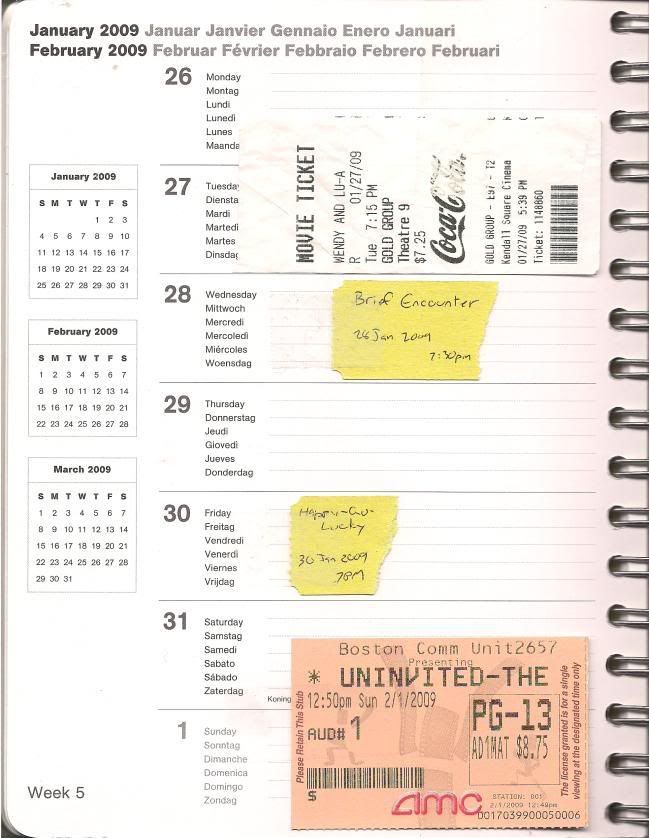
I really just found myself running at half-speed all week. Thursday was a particular killer; I wasn't nodding off at work, but I never felt alert. I got home at six and then just collapsed on the bed for almost two hours before remembering I'd said I would drop something off in Harvard Square. Got back, went to bed at around nine-thirty after downing some TheraFlu, which knocked me out for four hours and left me unable to sleep all night. That cost me the chance to see The Passionate Friends from the Brattle's David Lean series.
On the weekend, I fully intended to see Frozen River before heading to the Chlotrudis Nominating Meeting (as of now, the liveblogged nominations should still be near the top of the Mewsings Blog), but thought it was at 11:40 rather than 11:30. Then the meeting took the entire rest of the day.
Today... Today I just feel lazy; there's no way I should have arrived at Fenway too late for the 4pm show of Taken when The Uninvited got out at 2:45. Sure, I spent time buying some boots with a gift card my brother Travis and his wife Jen got me for Christmas and trying to find some 3-D glasses for tomorrow night's Chuck (they just don't exist in the Boston area, it seems!), but still...
Wendy and Lucy
* * * ½ (out of four)
Seen 27 January 2009 at Landmark Kendall Square #9 (first-run)
Everyone discussing Wendy and Lucy is going to bring up Michelle Williams and Kelly Reichardt, as well they should, but let's take a moment to talk about Larry Fessenden. He's produced two of Reichardt's features and had a cameo in each; the one in this movie is memorable. He's sort of taken the position Roger Corman used to have, producing and directing low-budget horror films and using some of the money they make on art-house projects like Wendy and Lucy. Fessenden makes, from what I gather, pretty good horror - I liked The Last Winter, I've heard very good things about Wendigo - so perhaps it's not surprising that he does this sort of thing.
It's a very nice little movie, with a very fine performance at the center by Michelle Williams. She's very matter-of-fact as she goes about looking for her dog and getting her car fixed, powerless but trying to make things happen anyway. The scenes she shares with Wally Dalton (playing a security guard) are little delights; they're people who don't have much but can't ask for anything from each other. What matters is that they are connected by the respect they show to each other, which is not exactly something either is used to receiving.
Brief Encounter
* * ½ (out of four)
Seen 28 January 2009 at The Brattle Theatre (Encounter David Lean)
Likely controversial for its time, as it shows an extra-marital affair without much in the way of judgment or justification - indeed, the home life of Laura Jesson (Celia Johnson) is depicted as fairly idyllic - it seems quaint now, if not a bit stiff from the narration it all but drowns in. A shame, really, as Johnson's performance is good enough that there hardly seems to be anything more that words can add, even if they are Noel Coward's words.
It is, otherwise, a fine enough movie, with Johnson and Trevor Howard quite enjoyable as the couple who has the bad luck to meet and fall in love after they are already married to other people. Pretty tame by today's standards, but not laughably so; Lean and his cast do a fine job of showing how tempting (and later wrenching) this situation is.
Happy-Go-Lucky
* * * ½ (out of four)
Seen 28 January 2009 at The Brattle Theatre (Encounter David Lean)
So how, exactly, is Sally Hawkins not up for an Academy Award for her performance here? There won't be many performances more memorable or more complete this year. It's just yet another example of how despair and misery seem more valued in art than optimism, which is a shame. Hawkins's Poppy is a wonderful character and just because she's frequently smiling doesn't mean she's a fool or easy to play - indeed, while the four performances I've seen frequently seem to have the actress locking her face and voice into a certain cast and then dramatically breaking out of it, Hawkins is reacting visibly to everything. Sometimes it may seem inappropriate, but it's always perfectly in keeping with her character, and by the end we can see that she's clearly not a one-note fool.
We also may wonder, why don't we see more Poppys, both on-screen and in real life? Although I imagine it must be exhausting to be as relentlessly positive as she is, what's to be gained by not trying in our own lives? And maybe it's evidence for just how great Hawkins's performance is that we do believe in Poppy, even though this sort of character appears seldom enough for us to be skeptical about her being for real.
The Uninvited
* * (out of four)
Seen 1 February 2009 at AMC Boston Commone #1 (first-run)
It had been some time since I'd seen A Tale of Two Sisters, so watching The Uninvited was like watching an episode of Law & Order that I recorded because I wasn't sure from the description whether or not it was a rerun I had seen or one I hadn't, though I realize it fits in the "had" category soon enough. When that happens, I find myself paying more attention to the audience around me than usual. Most of them, after all, haven't seen the Korean original, so while I'm not going to be surprised, I can at least enjoy theirs vicariously.
Not the case here. While I could feel the theater react around me during The Departed or The Grudge, this one just seemed to bore the rest of the people there. I can't say I blame them; as much as the Guard Brothers may turn out to be decent filmmakers given time (or in their comedic shorts), neither they nor the three people who worked on the screenplay are close to being in Two Sisters director Kim Ji-woon's league. This version streamlines and simplifies the story of the original, and completely does away with all the atmosphere. Kim's movie was based upon a Korean fairy tale (the original Korean name, "Changhwa, Hongryon" references it directly), and found a way to straddle the line between a contemporary setting and the semi-mythic world of folklore; this is just the blandest teen story imaginable. The scare moments are also just not nearly as good - legitimately disturbing sequences aren't even good jump moments here.
Disappointing in the extreme. Not that I expected much, but with such great source material, you'd think they could manage better than this!

I really just found myself running at half-speed all week. Thursday was a particular killer; I wasn't nodding off at work, but I never felt alert. I got home at six and then just collapsed on the bed for almost two hours before remembering I'd said I would drop something off in Harvard Square. Got back, went to bed at around nine-thirty after downing some TheraFlu, which knocked me out for four hours and left me unable to sleep all night. That cost me the chance to see The Passionate Friends from the Brattle's David Lean series.
On the weekend, I fully intended to see Frozen River before heading to the Chlotrudis Nominating Meeting (as of now, the liveblogged nominations should still be near the top of the Mewsings Blog), but thought it was at 11:40 rather than 11:30. Then the meeting took the entire rest of the day.
Today... Today I just feel lazy; there's no way I should have arrived at Fenway too late for the 4pm show of Taken when The Uninvited got out at 2:45. Sure, I spent time buying some boots with a gift card my brother Travis and his wife Jen got me for Christmas and trying to find some 3-D glasses for tomorrow night's Chuck (they just don't exist in the Boston area, it seems!), but still...
Wendy and Lucy
* * * ½ (out of four)
Seen 27 January 2009 at Landmark Kendall Square #9 (first-run)
Everyone discussing Wendy and Lucy is going to bring up Michelle Williams and Kelly Reichardt, as well they should, but let's take a moment to talk about Larry Fessenden. He's produced two of Reichardt's features and had a cameo in each; the one in this movie is memorable. He's sort of taken the position Roger Corman used to have, producing and directing low-budget horror films and using some of the money they make on art-house projects like Wendy and Lucy. Fessenden makes, from what I gather, pretty good horror - I liked The Last Winter, I've heard very good things about Wendigo - so perhaps it's not surprising that he does this sort of thing.
It's a very nice little movie, with a very fine performance at the center by Michelle Williams. She's very matter-of-fact as she goes about looking for her dog and getting her car fixed, powerless but trying to make things happen anyway. The scenes she shares with Wally Dalton (playing a security guard) are little delights; they're people who don't have much but can't ask for anything from each other. What matters is that they are connected by the respect they show to each other, which is not exactly something either is used to receiving.
Brief Encounter
* * ½ (out of four)
Seen 28 January 2009 at The Brattle Theatre (Encounter David Lean)
Likely controversial for its time, as it shows an extra-marital affair without much in the way of judgment or justification - indeed, the home life of Laura Jesson (Celia Johnson) is depicted as fairly idyllic - it seems quaint now, if not a bit stiff from the narration it all but drowns in. A shame, really, as Johnson's performance is good enough that there hardly seems to be anything more that words can add, even if they are Noel Coward's words.
It is, otherwise, a fine enough movie, with Johnson and Trevor Howard quite enjoyable as the couple who has the bad luck to meet and fall in love after they are already married to other people. Pretty tame by today's standards, but not laughably so; Lean and his cast do a fine job of showing how tempting (and later wrenching) this situation is.
Happy-Go-Lucky
* * * ½ (out of four)
Seen 28 January 2009 at The Brattle Theatre (Encounter David Lean)
So how, exactly, is Sally Hawkins not up for an Academy Award for her performance here? There won't be many performances more memorable or more complete this year. It's just yet another example of how despair and misery seem more valued in art than optimism, which is a shame. Hawkins's Poppy is a wonderful character and just because she's frequently smiling doesn't mean she's a fool or easy to play - indeed, while the four performances I've seen frequently seem to have the actress locking her face and voice into a certain cast and then dramatically breaking out of it, Hawkins is reacting visibly to everything. Sometimes it may seem inappropriate, but it's always perfectly in keeping with her character, and by the end we can see that she's clearly not a one-note fool.
We also may wonder, why don't we see more Poppys, both on-screen and in real life? Although I imagine it must be exhausting to be as relentlessly positive as she is, what's to be gained by not trying in our own lives? And maybe it's evidence for just how great Hawkins's performance is that we do believe in Poppy, even though this sort of character appears seldom enough for us to be skeptical about her being for real.
The Uninvited
* * (out of four)
Seen 1 February 2009 at AMC Boston Commone #1 (first-run)
It had been some time since I'd seen A Tale of Two Sisters, so watching The Uninvited was like watching an episode of Law & Order that I recorded because I wasn't sure from the description whether or not it was a rerun I had seen or one I hadn't, though I realize it fits in the "had" category soon enough. When that happens, I find myself paying more attention to the audience around me than usual. Most of them, after all, haven't seen the Korean original, so while I'm not going to be surprised, I can at least enjoy theirs vicariously.
Not the case here. While I could feel the theater react around me during The Departed or The Grudge, this one just seemed to bore the rest of the people there. I can't say I blame them; as much as the Guard Brothers may turn out to be decent filmmakers given time (or in their comedic shorts), neither they nor the three people who worked on the screenplay are close to being in Two Sisters director Kim Ji-woon's league. This version streamlines and simplifies the story of the original, and completely does away with all the atmosphere. Kim's movie was based upon a Korean fairy tale (the original Korean name, "Changhwa, Hongryon" references it directly), and found a way to straddle the line between a contemporary setting and the semi-mythic world of folklore; this is just the blandest teen story imaginable. The scare moments are also just not nearly as good - legitimately disturbing sequences aren't even good jump moments here.
Disappointing in the extreme. Not that I expected much, but with such great source material, you'd think they could manage better than this!
Tuesday, January 27, 2009
Chandni Chowk to China
I nearly had this review posted on EFC before noticing that there's a second "n" in "Chandni Chowk", which just makes it more fun/difficult to spell. I really hated being disappointed by this, because, as I mention in the review, I first heard of it at Fantasia this summer, as Gordon Liu did a Q&A after a screening of Disciples of the 36th Chamber. He mentioned that one of his next projects was an Indian movie where he would be playing the villain. There was an exchange that I guess you really had to be there to appreciate, as someone in the audience asks if he would have to wear a goatee as the villain, and Liu responds (through his translator) that he would be "a very handsome man!"
And he is. They put him in a nice suit and give him Oddjob's hat with which to slit a few throats, and he is outright stylin'. He is, honestly, too awesome for this movie - it's almost a bad thing, as he's two or three tiers above everyone else in awesomeness.
Well, maybe aside from Deepika Padukone, who is Aishwarya Rai-level gorgeous.
Chandni Chowk to China
* * (out of four)
Seen 24 January 2009 at FEI Capitol Theatre #6 (Bombay Cinema)
Even though I've seen more Bollywood movies than most people I know, I don't have a particular affinity for them; they've basically got to involve something I'm already interested in. Koi... Mil Gaya had spaceships; Krrish was its sequel and had superheroes. Chandni Chowk got on my radar when Gordon Liu mentioned during a festival appearance that his next project was playing the villain in an Indian movie. It's a pity that the movie doesn't deserve the Shaw Brothers legend.
We start out in a village near the great wall of China, where the villainous Hojo (Liu) is exploiting the villagers to get rich, and they yearn for the return of their legendary hero, Lieu Sheng. An oracle tells them that he has been reincarnated in India, in the person of Sidhu (Akshay Kumar), a cook who works in his father's Chandni Chowk food stall and is constantly trying to luck his way into a fortune. Local con artist Chopstick (Ranvir Shorey) misleads Sidhu as to why the Chinese want him, but crazy things start happening as soon as he arrives in China: He quickly crosses paths with Hojo's henchwoman Meow Meow (Deepika Padukone), a dead ringer for Indian infomercial star Sakhi (Padukone again), who is in China to pick up some product samples and memorialize who Police Inspector Chiang (Roger Yuan), who apparently perished at Hojo's hands along with Sakhi's twin sister Suzy when they were just babies.
Chandni Chowk to China has a number of problems, but the biggest is that would be much better off without its main character. Sidhu spends much of the movie as an annoying moron clowning around on the periphery of the Chiang/Sakhi/Suzy/Hojo story; when he does decide to get serious in the last act - you can tell, because he shaves off the ridiculous mustache and gets rugged-looking five o'clock shadow as he trains in martial arts - Sakhi immediately gets pushed to the side, doing little more than standing in the background watching Sidhu (whom she now inexplicably adores). Sidhu does have a story arc of his own, in learning that his father Dada (Mithun Chakraborty) is right when he says that success comes from hard work rather than luck or destiny, but it's just empty words until much too late in the game.
It doesn't help that sometimes the filmmakers seem to think the audience is as dumb as Sidhu. It throws in narration for things that need absolutely no explanation, and has flashbacks to things that happened five minutes earlier. If a filmmaker feels that the audience has that short an attention span, perhaps he or she should not be making two-and-a-half-hour movies. Chandni Chowk to China may also set some sort of record for how often an awkward-sounding title is repeated over the course of the movie, and that's even without considering that it's a much-repeated phrase in one of the musical numbers.
The musical numbers themselves are a mixed bag. Chandni Chowk is much like recent American musicals in that it often needs to supply a reason for the characters to be singing and dancing. In some ways, that makes even less sense - would Sidhu be a goony dancer inside his own dream sequence? They are impressively staged, though. The other choreographed sequences, the fight scenes, fare better; they're overseen by Ku Huan-chiu, who has that job on many of Jet Li's movies, and though there's some obvious wire work, many of the hand-to-hand fight scenes sell it very well, even if Kumar and Padukone aren't the veterans Liu and Yuan are.
I came to the movie for Gordon Liu, and he does not disappoint. The filmmakers don't try to make him sing, so he can just concentrate on being menacing and handing out beatdowns when one is necessary. This is the first I've seen of Akshay Kumar, and he's actually not bad when called upon to do physical comedy or when the character is called upon to be prickly in the obligatory "why are you making me do these repetitive menial tasks when I want to be trained in martial arts" scenes. He just seems to be far more annoying than intended when called upon to be whiny and pathetic. Deepika Padukone is a pleasant surprise in her dual role; while Sakhi often seems a stereotypical Bollywood female lead (absolutely gorgeous but perhaps too polished), Meow Meow lets her show off some tomboyish charm. Ranvir Shorey has kind of a nothing part, but Mithun Chakraborty is quite cool as the father figure who commands respect.
The thing that really gets me about Chadni Chowk to China is that there are some pretty enjoyable bits in it - Sakhi and the James Bond style gadgets she gets from her infomercial supplier, fun bits of mistaken identity, a nifty fight scene where Chiang and Sidhu fend off a good-sized mob, and anything with Gordon Liu. The last joke sends the audience out laughing. For those who have never seen a Bollywood film, it's a fun novelty, but it could have been much better.
Also at eFilmCritic, with two other reviews.
And he is. They put him in a nice suit and give him Oddjob's hat with which to slit a few throats, and he is outright stylin'. He is, honestly, too awesome for this movie - it's almost a bad thing, as he's two or three tiers above everyone else in awesomeness.
Well, maybe aside from Deepika Padukone, who is Aishwarya Rai-level gorgeous.
Chandni Chowk to China
* * (out of four)
Seen 24 January 2009 at FEI Capitol Theatre #6 (Bombay Cinema)
Even though I've seen more Bollywood movies than most people I know, I don't have a particular affinity for them; they've basically got to involve something I'm already interested in. Koi... Mil Gaya had spaceships; Krrish was its sequel and had superheroes. Chandni Chowk got on my radar when Gordon Liu mentioned during a festival appearance that his next project was playing the villain in an Indian movie. It's a pity that the movie doesn't deserve the Shaw Brothers legend.
We start out in a village near the great wall of China, where the villainous Hojo (Liu) is exploiting the villagers to get rich, and they yearn for the return of their legendary hero, Lieu Sheng. An oracle tells them that he has been reincarnated in India, in the person of Sidhu (Akshay Kumar), a cook who works in his father's Chandni Chowk food stall and is constantly trying to luck his way into a fortune. Local con artist Chopstick (Ranvir Shorey) misleads Sidhu as to why the Chinese want him, but crazy things start happening as soon as he arrives in China: He quickly crosses paths with Hojo's henchwoman Meow Meow (Deepika Padukone), a dead ringer for Indian infomercial star Sakhi (Padukone again), who is in China to pick up some product samples and memorialize who Police Inspector Chiang (Roger Yuan), who apparently perished at Hojo's hands along with Sakhi's twin sister Suzy when they were just babies.
Chandni Chowk to China has a number of problems, but the biggest is that would be much better off without its main character. Sidhu spends much of the movie as an annoying moron clowning around on the periphery of the Chiang/Sakhi/Suzy/Hojo story; when he does decide to get serious in the last act - you can tell, because he shaves off the ridiculous mustache and gets rugged-looking five o'clock shadow as he trains in martial arts - Sakhi immediately gets pushed to the side, doing little more than standing in the background watching Sidhu (whom she now inexplicably adores). Sidhu does have a story arc of his own, in learning that his father Dada (Mithun Chakraborty) is right when he says that success comes from hard work rather than luck or destiny, but it's just empty words until much too late in the game.
It doesn't help that sometimes the filmmakers seem to think the audience is as dumb as Sidhu. It throws in narration for things that need absolutely no explanation, and has flashbacks to things that happened five minutes earlier. If a filmmaker feels that the audience has that short an attention span, perhaps he or she should not be making two-and-a-half-hour movies. Chandni Chowk to China may also set some sort of record for how often an awkward-sounding title is repeated over the course of the movie, and that's even without considering that it's a much-repeated phrase in one of the musical numbers.
The musical numbers themselves are a mixed bag. Chandni Chowk is much like recent American musicals in that it often needs to supply a reason for the characters to be singing and dancing. In some ways, that makes even less sense - would Sidhu be a goony dancer inside his own dream sequence? They are impressively staged, though. The other choreographed sequences, the fight scenes, fare better; they're overseen by Ku Huan-chiu, who has that job on many of Jet Li's movies, and though there's some obvious wire work, many of the hand-to-hand fight scenes sell it very well, even if Kumar and Padukone aren't the veterans Liu and Yuan are.
I came to the movie for Gordon Liu, and he does not disappoint. The filmmakers don't try to make him sing, so he can just concentrate on being menacing and handing out beatdowns when one is necessary. This is the first I've seen of Akshay Kumar, and he's actually not bad when called upon to do physical comedy or when the character is called upon to be prickly in the obligatory "why are you making me do these repetitive menial tasks when I want to be trained in martial arts" scenes. He just seems to be far more annoying than intended when called upon to be whiny and pathetic. Deepika Padukone is a pleasant surprise in her dual role; while Sakhi often seems a stereotypical Bollywood female lead (absolutely gorgeous but perhaps too polished), Meow Meow lets her show off some tomboyish charm. Ranvir Shorey has kind of a nothing part, but Mithun Chakraborty is quite cool as the father figure who commands respect.
The thing that really gets me about Chadni Chowk to China is that there are some pretty enjoyable bits in it - Sakhi and the James Bond style gadgets she gets from her infomercial supplier, fun bits of mistaken identity, a nifty fight scene where Chiang and Sidhu fend off a good-sized mob, and anything with Gordon Liu. The last joke sends the audience out laughing. For those who have never seen a Bollywood film, it's a fun novelty, but it could have been much better.
Also at eFilmCritic, with two other reviews.
Monday, January 26, 2009
This Week In Tickets: 19 January 2009 to 25 January 2009
I kept myself busy seeing movies this week, even if I found scant time to write about them - I got the review of the first part of Che done fairly quickly, but then work was dense - full days of mind-numbing copy, paste, and test at work left me with precious little interest in doing much with the computer either on the way home or once I was there. I just finished that tonight, and will probably only do a write-up of Chandni Chowk to China from this week, despite there being few reviews online for the older Lean films.
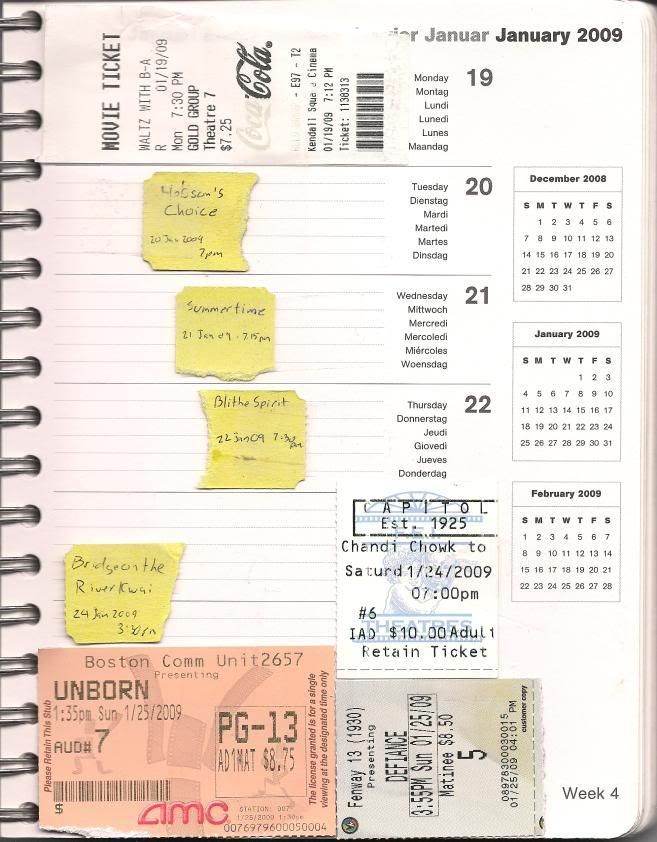
The Brattle's Lean series has been fun, although I've mostly steered clear of the epics to concentrate on the less-seen early British films. I vaguely recall seeing Lawrence of Arabia at the Coolidge when they had a 70mm print, and tend to think that only being able to vaguely recall what is generally considered an excellent film is something of an indictment of it.
I'm actually somewhat shocked that I got to see two films - two long films! - on Saturday: That was the day that June, July, and August Red Sox tickets went on sale, and my usual history with that is that I get two computers going at around 10am and then sit helplessly watching them until 7:30pm or so, a Saturday wasted. This time, I got tickets at around 11:30am. We live in a time of wonders.
Waltz With Bashir
* * ½ (out of four)
Seen 19 January 2009 at Landmark Kendall Square #7 (first-run)
Good intentions do not make a good movie. Waltz With Bashir is one of the best-intentioned movies you'll find, but despite attention-grabbing bookends, much of the film is inert, filled with rotoscoped talking heads who speak about their war experience in drones, including above flashbacks meant to help us experience the war and explain why the narrator cannot remember his part in it.
The big trouble with this film is the animation. It's not that animation is not an appropriate medium; it's that writer/director Ari Folman chooses a style that distances us from the people he's talking to but uses little of animation's ability to communicate in broad strokes. It tends to look artificial, and not the artificiality of memory.
Hobson's Choice
* * * ¼ (out of four)
Seen 20 January 2009 at The Brattle Theatre (Encounter David Lean)
One of David Lean's comedies from his earlier period, Hobson's Choice is a breezy and enjoyable tale of two ugly ducklings who bring out the best in each other. John Mills is a hangdog delight as ignorant bootmaker Willie Mossop, and Brenda De Banzie (who reminds me of a friend I really must email) as the severe daughter of the man who owns the shop Willie works in and decides to seek his hand in marriage, at first to spite her father: He has laughed at the idea of the thirty-year-old spinster getting married, and she sees opportunity to go into business for themselves, as Willie is the true talent behind the shop's reputation.
Charles Laughton plays the father with broad, drunken slapstick, but he's mainly a distraction from the fine performances by Mills and De Banzie, who give their characters confidence and genuine affection as the film goes on. For all the pratfalls and roundabout plots around them, their finding the whole of each other is the film's main delight.
Summertime
* * * (out of four)
Seen 21 January 2009 at The Brattle Theatre (Encounter David Lean)
Summertime is a small confection which offers different delights from Hobson's Choice - in this case, it's the beautiful photography of Venice which takes center stage, both Jack Hildyard's conventional cinematography and the moments where the scene shifts to what Katharine Hepburn's Jane Hudson sees through the viewfinder of her 8mm camera. It's a delightful example of how a tourist sees the city that we enjoy but don't miss once Jane puts down her camera and starts experiencing the city rather than just recording it.
Part of that is a romance with Rossano Brazzi's Renato de Rossi, a charming pairing of suave European man and uptight American woman. We know from the start that it is likely temporary (although, in a movie, it may not have to be) - Jane and Renato are still in the summers of their lives, but fall will be coming very soon, and this may be Jane's last chance to live like this.
Blithe Spirit
* * ¼ (out of four)
Seen 22 January 2009 at The Brattle Theatre (Encounter David Lean)
Ah, how this movie saddened me. There is such great potential here. Rex Harrison and Constance Cummings play a married couple that are each on their second marriage after the death of a spouse, only to find themselves haunted by the ghost of Harrison's character's first wife. There's thematic richness here that playwright Noel Coward may not have recognized before divorce and remarriage became relatively routine; who can't understand the idea of being haunted, literally or figuratively, by an ex who just would not go away? The movie also takes a twist midway through that could provide for some wonderfully black comedy.
It just doesn't come together, though - we spend much of the first act beating the joke about Harrison speaking someone only he can see and Cummings being insulted into the ground, and the second half dispenses with playing with the idea of an ex-wife who won't disappear like she should to spend time on the mechanics of exorcism. The jokes are all right, but the movie could be so much more.
One thing which is a delight is Margaret Rutherford as the medium whose first seance summons the ex-wife and who tries to exorcise her later. she's a character who is much more than just her purpose in the movie, and she does a fine job of neither playing the fool nor making the rest of the characters look foolish.
The Bridge on the River Kwai
* * * * (out of four)
Seen 24 January 2009 at The Brattle Theatre (Encounter David Lean)
Ah, what a joy this movie is. It starts slow, and I will admit to fidgeting somewhat as the initial battle of wills between Alec Guinness's Col. Nicholson and Sessue Hayakawa's Col. Saito played out - solitary confinement is not exciting cinema, and the rule Nicholson goes to the wall for (officers not having to do manual labor) seems ridiculously classist.
Then, though, the movie takes shape, and Lean handles his dual narrative tracks beautifully, as Nicholson uses the bridge as a way to build morale among the British prisoners, playing Saito for a fool from the moment he utters the line "if I were you, I should have to kill myself", while American prisoner Shears (William Holden) escapes and is dragooned into a mission back to the camp to destroy the bridge. Lean gives each half long sequences rather than choppily jumping back and forth, but never so long that we feel like the other is being slighted.
And then, in the last few minutes, he turns everything on its head. Guinness has probably never been better than he is in the film's last ten minutes, delivering a simple line ("What have I done?") with such understatement that it's devastating. We've allowed the movie to convince us of something that we thought was wrong in the beginning, and then in its final minutes we get the rug yanked out from under us.
The Unborn
* * (out of four)
Seen 25 January 2009 at AMC Boston Common #7 (first-run)
Unusually for a horror movie, The Unborn piles the stupid on early but finishes with some pretty nifty ideas. Sure, it's pretty easy to miss some of the stupid because writer/director Daivd S. Goyer is distracting you with Odette Yustman in all sorts of tight clothing (I mean, look at that poster!), but the film actually does a good job of pulling random jump moments into a story that involves Jewish mythology and the sort of Nazi mad occult scientists that you usually find in a Hellboy story, finishing up with a nifty cross-denominational exorcism.
A couple notes: (1) Unless the demons were cutting wires (which they weren't), why would flashlights still work when the electricity is mystically interfered with? Seriously, movie, the reason God invented candles was to make walking through deserted hallways creepy. (2) You let me down, youth of America. Normally I defend you against the people claiming teenagers have ruined the moviegoing experience, pointing out that seniors and others are just as bad, but you conformed to every negative stereotype imaginable at the 1:35pm screening on January 25th.
Defiance
* * * (out of four)
Seen 25 January 2009 at Regal Fenway #5 (first-run)
Defiance isn't bad. Nothing in it will particularly stick in my memory for long, despite striving for epic status. I liked most of the characters and performances - Liev Schreiber makes a fine action hero, and I didn't really see that coming - and the action is well-done. It's well-meaning and sincere and its only real sins are pushing the True Story angle too hard at the ends.
Well, that and the subtitle weirdness. Most of the actors are effecting Slavic accents, since the movie tells us its set in Byelorussia. I knew that former SSR is now known as "Belarus", but based on the name they show in the opening, I got the impression that they spoke Russian there, so when the movie would switch to subtitled Russian, it often seemed random. Since there's never any need for characters to not be understanding each other until Germans show up, it seemed unnecessary.

The Brattle's Lean series has been fun, although I've mostly steered clear of the epics to concentrate on the less-seen early British films. I vaguely recall seeing Lawrence of Arabia at the Coolidge when they had a 70mm print, and tend to think that only being able to vaguely recall what is generally considered an excellent film is something of an indictment of it.
I'm actually somewhat shocked that I got to see two films - two long films! - on Saturday: That was the day that June, July, and August Red Sox tickets went on sale, and my usual history with that is that I get two computers going at around 10am and then sit helplessly watching them until 7:30pm or so, a Saturday wasted. This time, I got tickets at around 11:30am. We live in a time of wonders.
Waltz With Bashir
* * ½ (out of four)
Seen 19 January 2009 at Landmark Kendall Square #7 (first-run)
Good intentions do not make a good movie. Waltz With Bashir is one of the best-intentioned movies you'll find, but despite attention-grabbing bookends, much of the film is inert, filled with rotoscoped talking heads who speak about their war experience in drones, including above flashbacks meant to help us experience the war and explain why the narrator cannot remember his part in it.
The big trouble with this film is the animation. It's not that animation is not an appropriate medium; it's that writer/director Ari Folman chooses a style that distances us from the people he's talking to but uses little of animation's ability to communicate in broad strokes. It tends to look artificial, and not the artificiality of memory.
Hobson's Choice
* * * ¼ (out of four)
Seen 20 January 2009 at The Brattle Theatre (Encounter David Lean)
One of David Lean's comedies from his earlier period, Hobson's Choice is a breezy and enjoyable tale of two ugly ducklings who bring out the best in each other. John Mills is a hangdog delight as ignorant bootmaker Willie Mossop, and Brenda De Banzie (who reminds me of a friend I really must email) as the severe daughter of the man who owns the shop Willie works in and decides to seek his hand in marriage, at first to spite her father: He has laughed at the idea of the thirty-year-old spinster getting married, and she sees opportunity to go into business for themselves, as Willie is the true talent behind the shop's reputation.
Charles Laughton plays the father with broad, drunken slapstick, but he's mainly a distraction from the fine performances by Mills and De Banzie, who give their characters confidence and genuine affection as the film goes on. For all the pratfalls and roundabout plots around them, their finding the whole of each other is the film's main delight.
Summertime
* * * (out of four)
Seen 21 January 2009 at The Brattle Theatre (Encounter David Lean)
Summertime is a small confection which offers different delights from Hobson's Choice - in this case, it's the beautiful photography of Venice which takes center stage, both Jack Hildyard's conventional cinematography and the moments where the scene shifts to what Katharine Hepburn's Jane Hudson sees through the viewfinder of her 8mm camera. It's a delightful example of how a tourist sees the city that we enjoy but don't miss once Jane puts down her camera and starts experiencing the city rather than just recording it.
Part of that is a romance with Rossano Brazzi's Renato de Rossi, a charming pairing of suave European man and uptight American woman. We know from the start that it is likely temporary (although, in a movie, it may not have to be) - Jane and Renato are still in the summers of their lives, but fall will be coming very soon, and this may be Jane's last chance to live like this.
Blithe Spirit
* * ¼ (out of four)
Seen 22 January 2009 at The Brattle Theatre (Encounter David Lean)
Ah, how this movie saddened me. There is such great potential here. Rex Harrison and Constance Cummings play a married couple that are each on their second marriage after the death of a spouse, only to find themselves haunted by the ghost of Harrison's character's first wife. There's thematic richness here that playwright Noel Coward may not have recognized before divorce and remarriage became relatively routine; who can't understand the idea of being haunted, literally or figuratively, by an ex who just would not go away? The movie also takes a twist midway through that could provide for some wonderfully black comedy.
It just doesn't come together, though - we spend much of the first act beating the joke about Harrison speaking someone only he can see and Cummings being insulted into the ground, and the second half dispenses with playing with the idea of an ex-wife who won't disappear like she should to spend time on the mechanics of exorcism. The jokes are all right, but the movie could be so much more.
One thing which is a delight is Margaret Rutherford as the medium whose first seance summons the ex-wife and who tries to exorcise her later. she's a character who is much more than just her purpose in the movie, and she does a fine job of neither playing the fool nor making the rest of the characters look foolish.
The Bridge on the River Kwai
* * * * (out of four)
Seen 24 January 2009 at The Brattle Theatre (Encounter David Lean)
Ah, what a joy this movie is. It starts slow, and I will admit to fidgeting somewhat as the initial battle of wills between Alec Guinness's Col. Nicholson and Sessue Hayakawa's Col. Saito played out - solitary confinement is not exciting cinema, and the rule Nicholson goes to the wall for (officers not having to do manual labor) seems ridiculously classist.
Then, though, the movie takes shape, and Lean handles his dual narrative tracks beautifully, as Nicholson uses the bridge as a way to build morale among the British prisoners, playing Saito for a fool from the moment he utters the line "if I were you, I should have to kill myself", while American prisoner Shears (William Holden) escapes and is dragooned into a mission back to the camp to destroy the bridge. Lean gives each half long sequences rather than choppily jumping back and forth, but never so long that we feel like the other is being slighted.
And then, in the last few minutes, he turns everything on its head. Guinness has probably never been better than he is in the film's last ten minutes, delivering a simple line ("What have I done?") with such understatement that it's devastating. We've allowed the movie to convince us of something that we thought was wrong in the beginning, and then in its final minutes we get the rug yanked out from under us.
The Unborn
* * (out of four)
Seen 25 January 2009 at AMC Boston Common #7 (first-run)
Unusually for a horror movie, The Unborn piles the stupid on early but finishes with some pretty nifty ideas. Sure, it's pretty easy to miss some of the stupid because writer/director Daivd S. Goyer is distracting you with Odette Yustman in all sorts of tight clothing (I mean, look at that poster!), but the film actually does a good job of pulling random jump moments into a story that involves Jewish mythology and the sort of Nazi mad occult scientists that you usually find in a Hellboy story, finishing up with a nifty cross-denominational exorcism.
A couple notes: (1) Unless the demons were cutting wires (which they weren't), why would flashlights still work when the electricity is mystically interfered with? Seriously, movie, the reason God invented candles was to make walking through deserted hallways creepy. (2) You let me down, youth of America. Normally I defend you against the people claiming teenagers have ruined the moviegoing experience, pointing out that seniors and others are just as bad, but you conformed to every negative stereotype imaginable at the 1:35pm screening on January 25th.
Defiance
* * * (out of four)
Seen 25 January 2009 at Regal Fenway #5 (first-run)
Defiance isn't bad. Nothing in it will particularly stick in my memory for long, despite striving for epic status. I liked most of the characters and performances - Liev Schreiber makes a fine action hero, and I didn't really see that coming - and the action is well-done. It's well-meaning and sincere and its only real sins are pushing the True Story angle too hard at the ends.
Well, that and the subtitle weirdness. Most of the actors are effecting Slavic accents, since the movie tells us its set in Byelorussia. I knew that former SSR is now known as "Belarus", but based on the name they show in the opening, I got the impression that they spoke Russian there, so when the movie would switch to subtitled Russian, it often seemed random. Since there's never any need for characters to not be understanding each other until Germans show up, it seemed unnecessary.
Che
I was originally going to create a combined version of these reviews to describe my feelings about the strengths and weaknesses of the combined films, but that seems kind of redundant. The main thing I noticed is that there is not very much discussion of the time between the Cuban Revolution and Che's ill-fated trip to Bolivia, aside from the framing sequence of the first movie, which covers his 1964 trip to address the UN in New York. I wonder about this; is it because the two books Soderbergh and company opted to film didn't cover that period? (Speaking of which, movies about a figure who is as much an arguably manufactured icon as Guevera might have done well to use sources other than his own autobiography.) Is it because it might have shown Che in a more obviously negative light? I wonder about it, because it really seemed to me that the key to the second movie is in that time period: Something made him decide to leave his family and turn his back on building and solidifying the nation he had helped to bring about in Cuba, and I wondered what it was: Failure, finding himself unsuited for the sort of job where things cannot be resolved with gunfire, power and personality clashes with the Castros? The movie doesn't give us much insight into it, which is too bad; knowing the forces that drove him to Bolivia might have enhanced the film.
Of course, I suspect the packed house that I saw the film with saw the film differently than I did; despite my living in what is often called the "People's Republic of Cambridge", my politics tend to be at the opposite side of the square (I don't think a libertarian society is what's needed now, but it is what we should work toward). Thus, the mostly-favorable biography probably played better to them.
One interesting fact I learned, well worth sitting next to a guy who really freaked out excessively over my sloshed soda (ding those tops up even a little and they just don't stay on when you try to pick the cup up) is that Guevera would only talk to leftist interviewers during the swing through New York that the first part depicts. That strikes me as a man trying hard to control the perception others have of him, as opposed to the humble and open man the movie seems to be pushing on us (at least on the surface).
Che Part One (The Argentine)
* * ½ (out of four)
Seen 18 January 2009 at Landmark Kendall Square (Roadshow Presentation)
At various times, Steven Soderbergh's ambitious Che Guevera project has been described as one very long picture and as two, and I'm not sure which is how it started and which is considered the definitive experience. To further muddy the waters, I saw Che as a single feature with an intermission, but it separates into two distinct (though connected) films in my mind. Part One is the weaker of the two, but it does set up themes that are important for the second.
The film opens (after a graphical lesson in Cuban geography) in 1964, with Ernesto "Che" Guevera (Benicio Del Toro) in New York to address the United Nations. The bulk of the time is spent in flashback, as we follow Guevera's first meetings with Fidel Castro (Demián Bichir) in Mexico. From there, they go to Cuba, where Guevera first serves as the rebel army's medic before being placed in charge of a new column which advances 150 on foot from the mountains in the southeast to the central part of the island. We're introduced to many other members of Castro's army, including Aelida (Catalina Sandino Morena), a messenger who would eventually become Guevera's wife.
Aficianodos of this segment of history and people with particular interest in Che Guevera will likely find this film intriguing, while the rest of us may find it very dry. The film probably doesn't spend as much time introducing us to various people - literally, often with the template of "I'm Che." "I'm Ramon." "How old are you?" "Twenty." - as I remember, but does so enough for the audience to notice the pattern. We can infer some purpose to it - noting that Guevera's stances on using teenagers and how his soldiers should be able to read and right weaken as time passes, maybe, although there's not much outward indication that the situation is becoming desperate. It comes across as Soderbergh and company wanting to touch upon as many figures from the Cuban Revolution as possible for completeness's sake. We are basically being told that these people are important historically, even though they don't obviously affect the film's narrative.
The film also has what feels like an overly-sympathetic view of its title character, at least at first glance. The film frequently takes great care to note that Che insists upon only engaging military targets, and the interview segments tend to present him at his very best, saying things like how love for the people is the most important trait for a revolutionary to have. Che's better qualities are so directly presented to us that it's very difficult to see his bad side, which must be inferred: There's a powerful ego to be seen in his advancing on the last offensive without waiting for the group his was supposed to meet, and how concerned he is about who will be allowed to speak from the podium and the floor. Perhaps the most telling scene is when he expresses relief that another physician has joined the cause, so he can shift his attention from saving lives to ending them. There are several moments like that in the film, but they must be hunted for, compared to the praise that is clear for all to see.
Benicio Del Toro mostly seems interested in playing the heroic Che, albeit in a fairly restrained manner. I will readily admit that I may be missing a lot in translation; his entire performance is in Spanish and there may be intonations I don't catch by concentrating on subtitles or the overlapping voice of Che's translator. Del Toro does get across the man's passion, and how uncomfortable he is during his trip to New York. The rest of the cast is good, although not a one of them manages to stand out as terribly memorable.
Soderbergh does manage to make a fairly impressive movie visually: For as much as this is the story of one man, the battle sequences are grand, filled with people and shot from interesting angles. The digital photography is is sharp and clear, capturing the lush colors of the jungle beautifully. Scenes in New York, by contrast, are shot in grainy 16mm monochrome; the contrasting style is an often-used idea, but one that works well enough.
Seen alone, Che Part One is likely a bit unsatisfying, perhaps needing the second part to bring the title character's faults into focus. Even with that second half, it still comes across as striking an imperfect balance, presenting the facts of the Cuban Revolution without much emotion and making the audience work at finding Che an interesting or complex figure.
Also at EFC.
Che Part Two (The Guerilla)
* * * (out of four)
Seen 18 January 2009 at Landmark Kendall Square (Roadshow Presentation)
As Part One did, Che Part Two opens with a geography lesson, this time showing us the landlocked nation of Bolivia. We're also given a text scroll telling us that Che Guevera suddenly disappeared from Cuba in the mid-1960s. This, and the sequence of Guevera disguising himself and making his way to Bolivia, isn't really necessary, but you've got to get from Point A to Point B somehow, especially since what comes after Point B is the more interesting part of the whole undertaking.
Guevera (Benicio Del Toro) arrives in Bolivia looking to accomplish there what he and the Castros did in Cuba, forging a group of ragtag group of rebels into a fighting force. It's complicated, though - he goes by the name Ramon in order to disguise the fact that a foreigner is leading their campaign, even though almost everybody knows who he really is. This includes President Rene Barrientos (Joaquim de Almeida), who is more than happy to have the Americans train his men to hunt Che down.
This movie is the story of Che's downfall, and, unlike Part One, it actually feels like a story. It's a rise and fall, but a steady one; we can see how the noose tightens around Che, and we've got room to speculate about whether it's mainly because of the force Barrientos throws at him or because Che is disconnected from the people he's fighting for. The pursuit provides a structure, and it is intriguing to watch things build and fall apart.
Del Toro still plays Che as something of an enigma, but he's a bit more of an intriguing enigma now. There is an aura about him, and we do wonder about his motivations - is this a man so possessed of revolutionary fervor that he feels the constant need to return to the front lines to lead the oppressed, or a thug who has found that he does not fit anywhere but the battlefield? Del Toro clearly leans toward the former, showing us Che gutting through powerful asthma, although he does perhaps overdo some of the better-known traits (aside from the asthma, odd attention is called to his pipe-smoking). During the Q&A following this screening, Del Toro mentioned that this second part was shot first, in roughly reverse-chronological order - I'm guessing so that he could bulk up and trim his beard during filming rather than vice versa, so perhaps the rough feel toward the end was just Del Toro getting a feel for the character.
The rest of the cast is good, as well; there are some more recognizable faces here - Franka Potente as the band's sole female member, de Almeida as the puffed up general trying to squash him. Unlike Part One, most of the supporting characters appear to have a part to play, rather than just showing up to have their names mentioned. I especially liked the old man pulled between Che's guerrillas and the army.
Although I felt that this second part was a superior film, and I felt that they were distinct films with their own stories and story arcs, part of what makes the second film strong is that we retain thoughts of the first; Che wouldn't quite be set up for this fall without the success and resultant arrogance we'd seen before. This film tells its story somewhat better, but no story of a life truly feels complete from just a single part.
Also at EFC.
Of course, I suspect the packed house that I saw the film with saw the film differently than I did; despite my living in what is often called the "People's Republic of Cambridge", my politics tend to be at the opposite side of the square (I don't think a libertarian society is what's needed now, but it is what we should work toward). Thus, the mostly-favorable biography probably played better to them.
One interesting fact I learned, well worth sitting next to a guy who really freaked out excessively over my sloshed soda (ding those tops up even a little and they just don't stay on when you try to pick the cup up) is that Guevera would only talk to leftist interviewers during the swing through New York that the first part depicts. That strikes me as a man trying hard to control the perception others have of him, as opposed to the humble and open man the movie seems to be pushing on us (at least on the surface).
Che Part One (The Argentine)
* * ½ (out of four)
Seen 18 January 2009 at Landmark Kendall Square (Roadshow Presentation)
At various times, Steven Soderbergh's ambitious Che Guevera project has been described as one very long picture and as two, and I'm not sure which is how it started and which is considered the definitive experience. To further muddy the waters, I saw Che as a single feature with an intermission, but it separates into two distinct (though connected) films in my mind. Part One is the weaker of the two, but it does set up themes that are important for the second.
The film opens (after a graphical lesson in Cuban geography) in 1964, with Ernesto "Che" Guevera (Benicio Del Toro) in New York to address the United Nations. The bulk of the time is spent in flashback, as we follow Guevera's first meetings with Fidel Castro (Demián Bichir) in Mexico. From there, they go to Cuba, where Guevera first serves as the rebel army's medic before being placed in charge of a new column which advances 150 on foot from the mountains in the southeast to the central part of the island. We're introduced to many other members of Castro's army, including Aelida (Catalina Sandino Morena), a messenger who would eventually become Guevera's wife.
Aficianodos of this segment of history and people with particular interest in Che Guevera will likely find this film intriguing, while the rest of us may find it very dry. The film probably doesn't spend as much time introducing us to various people - literally, often with the template of "I'm Che." "I'm Ramon." "How old are you?" "Twenty." - as I remember, but does so enough for the audience to notice the pattern. We can infer some purpose to it - noting that Guevera's stances on using teenagers and how his soldiers should be able to read and right weaken as time passes, maybe, although there's not much outward indication that the situation is becoming desperate. It comes across as Soderbergh and company wanting to touch upon as many figures from the Cuban Revolution as possible for completeness's sake. We are basically being told that these people are important historically, even though they don't obviously affect the film's narrative.
The film also has what feels like an overly-sympathetic view of its title character, at least at first glance. The film frequently takes great care to note that Che insists upon only engaging military targets, and the interview segments tend to present him at his very best, saying things like how love for the people is the most important trait for a revolutionary to have. Che's better qualities are so directly presented to us that it's very difficult to see his bad side, which must be inferred: There's a powerful ego to be seen in his advancing on the last offensive without waiting for the group his was supposed to meet, and how concerned he is about who will be allowed to speak from the podium and the floor. Perhaps the most telling scene is when he expresses relief that another physician has joined the cause, so he can shift his attention from saving lives to ending them. There are several moments like that in the film, but they must be hunted for, compared to the praise that is clear for all to see.
Benicio Del Toro mostly seems interested in playing the heroic Che, albeit in a fairly restrained manner. I will readily admit that I may be missing a lot in translation; his entire performance is in Spanish and there may be intonations I don't catch by concentrating on subtitles or the overlapping voice of Che's translator. Del Toro does get across the man's passion, and how uncomfortable he is during his trip to New York. The rest of the cast is good, although not a one of them manages to stand out as terribly memorable.
Soderbergh does manage to make a fairly impressive movie visually: For as much as this is the story of one man, the battle sequences are grand, filled with people and shot from interesting angles. The digital photography is is sharp and clear, capturing the lush colors of the jungle beautifully. Scenes in New York, by contrast, are shot in grainy 16mm monochrome; the contrasting style is an often-used idea, but one that works well enough.
Seen alone, Che Part One is likely a bit unsatisfying, perhaps needing the second part to bring the title character's faults into focus. Even with that second half, it still comes across as striking an imperfect balance, presenting the facts of the Cuban Revolution without much emotion and making the audience work at finding Che an interesting or complex figure.
Also at EFC.
Che Part Two (The Guerilla)
* * * (out of four)
Seen 18 January 2009 at Landmark Kendall Square (Roadshow Presentation)
As Part One did, Che Part Two opens with a geography lesson, this time showing us the landlocked nation of Bolivia. We're also given a text scroll telling us that Che Guevera suddenly disappeared from Cuba in the mid-1960s. This, and the sequence of Guevera disguising himself and making his way to Bolivia, isn't really necessary, but you've got to get from Point A to Point B somehow, especially since what comes after Point B is the more interesting part of the whole undertaking.
Guevera (Benicio Del Toro) arrives in Bolivia looking to accomplish there what he and the Castros did in Cuba, forging a group of ragtag group of rebels into a fighting force. It's complicated, though - he goes by the name Ramon in order to disguise the fact that a foreigner is leading their campaign, even though almost everybody knows who he really is. This includes President Rene Barrientos (Joaquim de Almeida), who is more than happy to have the Americans train his men to hunt Che down.
This movie is the story of Che's downfall, and, unlike Part One, it actually feels like a story. It's a rise and fall, but a steady one; we can see how the noose tightens around Che, and we've got room to speculate about whether it's mainly because of the force Barrientos throws at him or because Che is disconnected from the people he's fighting for. The pursuit provides a structure, and it is intriguing to watch things build and fall apart.
Del Toro still plays Che as something of an enigma, but he's a bit more of an intriguing enigma now. There is an aura about him, and we do wonder about his motivations - is this a man so possessed of revolutionary fervor that he feels the constant need to return to the front lines to lead the oppressed, or a thug who has found that he does not fit anywhere but the battlefield? Del Toro clearly leans toward the former, showing us Che gutting through powerful asthma, although he does perhaps overdo some of the better-known traits (aside from the asthma, odd attention is called to his pipe-smoking). During the Q&A following this screening, Del Toro mentioned that this second part was shot first, in roughly reverse-chronological order - I'm guessing so that he could bulk up and trim his beard during filming rather than vice versa, so perhaps the rough feel toward the end was just Del Toro getting a feel for the character.
The rest of the cast is good, as well; there are some more recognizable faces here - Franka Potente as the band's sole female member, de Almeida as the puffed up general trying to squash him. Unlike Part One, most of the supporting characters appear to have a part to play, rather than just showing up to have their names mentioned. I especially liked the old man pulled between Che's guerrillas and the army.
Although I felt that this second part was a superior film, and I felt that they were distinct films with their own stories and story arcs, part of what makes the second film strong is that we retain thoughts of the first; Che wouldn't quite be set up for this fall without the success and resultant arrogance we'd seen before. This film tells its story somewhat better, but no story of a life truly feels complete from just a single part.
Also at EFC.
Monday, January 19, 2009
This Week In Tickets: 12 January 2009 to 18 January 2009
Memo to self: Do not do a four-hour movie on Sunday night if you want this up by Monday morning (and intend to actually work on Monday)!
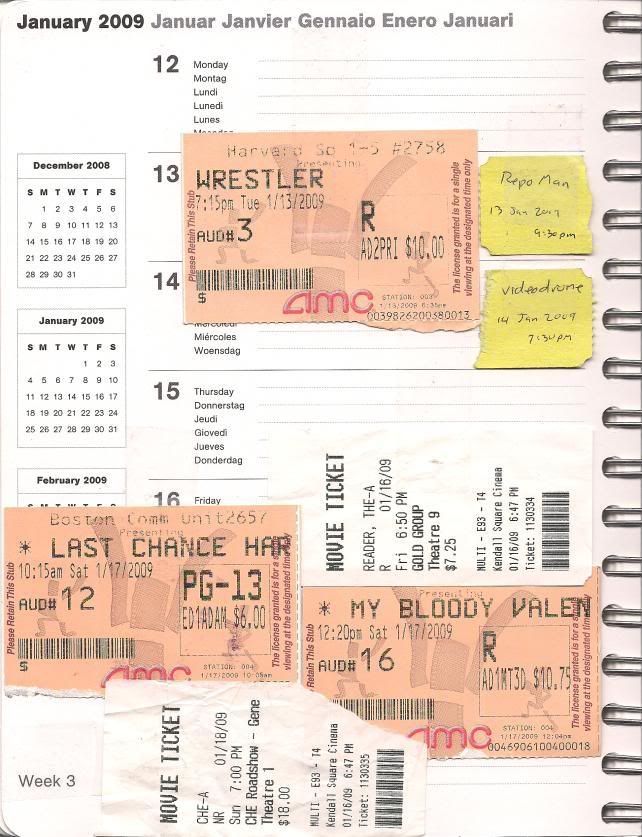
... To be fair, I probably wouldn't have done that if Benicio Del Toro wasn't appearing in person on the 18th and 19th. It was an interesting Q&A, although I don't think I was as enthused about the subject matter as the rest of the audience.
The Wrestler
* * * ½ (out of four)
Seen 13 January 2009 at AMC Harvard Square #3 (first-run)
Very nice work by Mickey Rourke and Marisa Tomei here as a pair of friends, possibly headed toward more, who are aging out of their less-than glamorous professions (pro wrestler and stripper). It's an obvious parallel, sure, but one the film never tries to make too explicit. Though most of the spotlight is going on Rourke, Tomei is just as good as the woman recognizing that she's nearing the end of the road (while Rourke's Randy has a hard time accepting it).
Despite being the director's most grounded-in-reality film yet, it definitely has the look and feel of a Darren Aranofsky film. He's got a way of getting the camera in uncomfortably close to his characters while still giving the audience a look at their world. Robert D. Siegel's script is also impressive, and Randy is a wonderful creation - a man who has hit the top and bottomed out, seemingly content in his new life but unable to let go.
Repo Man
* * ¾ (out of four)
Seen 13 January 2009 at the Brattle Theatre (The Brattle Selects)
Gonna be honest here: That was a long day at work, I was full of food (they really stuff you during the company meeting, to make amends for you being at the company meeting), and I'd already seen The Wrestler that evening. I didn't really stand a chance with Repo Man.
It's a fun little movie, and I'll likely enjoy it at the sci-fi marathon if I go this year. It's goofy, but sincerely so, in the way all the pre-fabricated cult movies of today don't quite capture. I'm not terribly fond of Emilio Estevez here, but I love Harry Dean Stanton in this; there's something wonderfully gruff and off-kilter about his performance. "A Repo Man is always intense", indeed.
Videodrome
* * * ¾ (out of four)
Seen 14 January 2009 at the Brattle Theatre (The Brattle Selects)
Man... The rest of the horror movie world just hasn't caught up with early John Carpenter at all, has it? The other horror movie I saw this week, My Bloody Valentine, is positively anemic compared to this, mere violence compared to the nightmarish ideas that Cronenberg comes up with and puts on the screen. He also bites the hand that feeds him far more eloquently than most, asking what sort of sickos want to see this sort of thing.
And, in a thing that pleases me irrationally, the main computer in the TV station's video room is an Atari 800 (and James Woods's character clearly has a 2600 hooked up to his TV at home). I love those old Atari machines.
The Reader
* * * (out of four)
Seen 16 January 2009 at Landmark Kendall Square #9 (First-run)
The Kate Winslet movie that people really should be seeing this winter. It's a wonderful meditation on sex, guilt, and shame, with a small but fascinating plot twist in the middle that makes it even more interesting. It gets more fascinating as it goes along, and I like how it handles its sex: The movie is somewhat titillating early on, but takes repsonsibility for it by the end - the older woman taking advantage of the teenage boy does long-lasting damage, but not in an overwrought, hammy way.

... To be fair, I probably wouldn't have done that if Benicio Del Toro wasn't appearing in person on the 18th and 19th. It was an interesting Q&A, although I don't think I was as enthused about the subject matter as the rest of the audience.
The Wrestler
* * * ½ (out of four)
Seen 13 January 2009 at AMC Harvard Square #3 (first-run)
Very nice work by Mickey Rourke and Marisa Tomei here as a pair of friends, possibly headed toward more, who are aging out of their less-than glamorous professions (pro wrestler and stripper). It's an obvious parallel, sure, but one the film never tries to make too explicit. Though most of the spotlight is going on Rourke, Tomei is just as good as the woman recognizing that she's nearing the end of the road (while Rourke's Randy has a hard time accepting it).
Despite being the director's most grounded-in-reality film yet, it definitely has the look and feel of a Darren Aranofsky film. He's got a way of getting the camera in uncomfortably close to his characters while still giving the audience a look at their world. Robert D. Siegel's script is also impressive, and Randy is a wonderful creation - a man who has hit the top and bottomed out, seemingly content in his new life but unable to let go.
Repo Man
* * ¾ (out of four)
Seen 13 January 2009 at the Brattle Theatre (The Brattle Selects)
Gonna be honest here: That was a long day at work, I was full of food (they really stuff you during the company meeting, to make amends for you being at the company meeting), and I'd already seen The Wrestler that evening. I didn't really stand a chance with Repo Man.
It's a fun little movie, and I'll likely enjoy it at the sci-fi marathon if I go this year. It's goofy, but sincerely so, in the way all the pre-fabricated cult movies of today don't quite capture. I'm not terribly fond of Emilio Estevez here, but I love Harry Dean Stanton in this; there's something wonderfully gruff and off-kilter about his performance. "A Repo Man is always intense", indeed.
Videodrome
* * * ¾ (out of four)
Seen 14 January 2009 at the Brattle Theatre (The Brattle Selects)
Man... The rest of the horror movie world just hasn't caught up with early John Carpenter at all, has it? The other horror movie I saw this week, My Bloody Valentine, is positively anemic compared to this, mere violence compared to the nightmarish ideas that Cronenberg comes up with and puts on the screen. He also bites the hand that feeds him far more eloquently than most, asking what sort of sickos want to see this sort of thing.
And, in a thing that pleases me irrationally, the main computer in the TV station's video room is an Atari 800 (and James Woods's character clearly has a 2600 hooked up to his TV at home). I love those old Atari machines.
The Reader
* * * (out of four)
Seen 16 January 2009 at Landmark Kendall Square #9 (First-run)
The Kate Winslet movie that people really should be seeing this winter. It's a wonderful meditation on sex, guilt, and shame, with a small but fascinating plot twist in the middle that makes it even more interesting. It gets more fascinating as it goes along, and I like how it handles its sex: The movie is somewhat titillating early on, but takes repsonsibility for it by the end - the older woman taking advantage of the teenage boy does long-lasting damage, but not in an overwrought, hammy way.
Last Chance Harvey and My Bloody Valentine
An odd double-feature, to be sure. The usual Saturday movie plan - or at least, the reasonable-weather Saturday movie plan - is to see something at the $6 show in Boston Common and then walk to Fenway to see something else. Saturday was just damn cold, though, and when I got out of Last Chance Harvey, it was a rare case of there being about a fifteen-minute turnaround before another movie I'd like to see. So, yeah, I grabbed onto that.
To no great surprise, Last Chance Harvey is a better movie than My Bloody Valentine. To be expected, but I was really hoping Valentine would at least be a good example of what it is. Instead, it's just a paint-by-numbers horror remake notable for its gimmick.
Which is too bad. I like 3-D, and would have been really happy to have a good 3-D blood & guts movie. Didn't happen, and I don't hold out a lot of hope for this summer's Piranha (if it even gets a chance to take theaters from Ice Age 3).
Last Chance Harvey
* * * (out of four)
Seen 17 January 2009 at AMC Fenway #12 (first-run)
Looking at the seven-year gap in Joel Hopkins's filmography makes me glad that, as much as I like movies, I'm not trying to make them. After all, Jump Tomorrow had to have been considered something of a success for a rookie filmmaker: It won awards at festivals, made it to theaters, and the people who saw it generally liked it, describing the filmmaker as one to watch. So why no follow up until now? I can't say. Maybe Hopkins had writer's block; maybe things kept almost happening but falling through; maybe studios just didn't see him as a good risk. I don't know if I could take years of that, though I'm glad Hopkins did.
Last Chance Harvey isn't complicated; it introduces us to Harvey Shine (Dustine Hoffman) and Kate Walker (Emma Thompson) quickly: Harvey writes music for advertising in New York, Kate conducts surveys in London. They have a couple of near-misses when Harvey comes to London for his daughter's wedding, finally meeting in an airport bar after Harvey (who had left the wedding early because he was afraid for his job) misses his flight. Harvey is charmed by Kate's forthrightness, which is something she's not sure how to react to.
Like the story, Harvey and Kate are straightforward, but interesting individuals. Harvey, for instance, spends the first act suffering various indignities, from an anti-theft device being stuck to his suit to losing his job to the gut-punch of daughter Susan (Liane Balaban) saying that he wants her stepfather Brian (James Brolin) to give her away. Even before Harvey acknowledges it, we suspect he brought some of what's happening upon himself, he can be prickly and distant. Hoffman doesn't allow that to define him, though; there's an embarrassment to his grumpiness that says, yes, he recognizes that he's not doing the best he could, but he can't not be frustrated. The neat thing that Hoffman captures is that Harvey does not have to be the top dog, and in fact doesn't particularly seem like he wants to be, but he has a hard time finding the spots to be assertive and the line between being gracious and being treated badly. He likes strong women - he wouldn't have been attracted to Kathy Baker's Jean otherwise and he's perfectly comfortable letting Thompson's Kate tower over him.
Emma Thompson is a pleasure as well. In some ways, Kate is interesting for what she is not: She's not used to a man pursuing her, but she is also not down on herself for being single in her forties - in short, a woman who is far less concerned about her marital status than the people around her are. She's quite the likable character, smart and funny if also a little cautious when it really matters. She's not quite perfect - there's impatience with her mother (Eileen Atkins) - but Thompson does a really fantastic job of showing Kate get swept off her feet while still being very much Harvey's equal. That certainly doesn't diminish toward the end when she has to explicitly show a little more vulnerability, either.
Of course, that section at the end comes in part because of a plot "twist" that made the audience groan a little. It's a problem that threatens to rear its head earlier in the movie - Harvey and Kate are one near-miss short from this being a movie about destiny rather than actual romance. The thing is, the movie really doesn't need that sort of obstacle or complication - Harvey even grumbles about it being a needless nuisance - as we've come to enjoy the pair reacting to each other enough that we don't really need outside stimulae at this point to move the story forward; we trust the characters. Hopkins tended to push a little hard at times in Jump Tomorrow, too, so it's something to work on.
On the other hand, just having the movie play out like Before Sunset with more mature characters might be considered playing by the book as well, albeit a somewhat less common one. Last Chance Harvey is never quite going to be that - adults do have other factors that interfere with their lives. Both Harvey and Kate have plenty of interesting but not distracting supporting characters to keep it from being entirely a two-person show.
That two-person show is where the movie becomes more than an interesting idea well-explored, though. Watching Dustin Hoffman and Emma Thompson discover each other is a bit magical. That's worth a few awkward moments; not enough filmmakers are willing and able to be this romantically optimistic.
Also at EFC, along with two other reviews.
My Bloody Valentine
* * (out of four)
Seen 17 January 2009 at AMC Fenway #16 in digital 3-D (first-run)
I am not, in general, a big fan of the lowered-standard argument in judging movies; setting the bar low and then clearing it is not actually impressive, even in horror movies. I made an exception for My Bloody Valentine, though - I was ready to judge it entirely based on how much fun it was to have bits of people flying off the screen at me. That still needs to be surrounded by basic competence, though, and sadly, My Bloody Valentine isn't even very good based upon those low expectations.
Ten years ago, we're told, a tunnel collapsed in the mining town of Harmony. Blame fell on Tom Hanniger (Jensen Ackles), the son of the mine's owner who forgot to bleed the pipes. There was only one survivor, Harry Warden (Richard John Walters), and he was found to have killed the other miners to save air. Coming out of his coma on Valentine's Day, Warden slaughtered a couple dozen before being shot by the sheriff.
Now, Tom (who has been out of town ever since) is back to finish the paperwork necessary to sell the mine. It's awkward for a number of reasons: The mine is the town's lifeblood, Tom's old girlfriend Sarah (Jaime King) is now married to the new sheriff, Axel (Kerr Smith) - though perhaps not happily, as Axel's girl on the side and Sarah's best friend Megan (Megan Boone) has just informed him that she is pregnant - and, of course, anniversaries of holiday killing sprees are the perfect excuse for a new killing spree, especially when no body was recovered and there's a group of survivors of the first spree - specifically, Tom, Sarah, Axel, and local tramp Irene (Betsy Rue) - who haven't been skewered by Warden's pickaxe.
Given the movie's initial "we're not trying to win Oscars here" goal - a 1980s style, hard-R slasher enhanced by the latest 3-D projection technology - it starts out on track. The effects used for the initial "ten years ago" section are cool, and the movie does not screw around with making the audience wait for what they paid to see - within minutes, blood is flying, the hospital is a charnel house, picks are sticking out of the screen with eyeballs on the end. There's a short break in the action to get us to the present, but the gore quickly starts up again, and I don't think we ever see Irene wearing more than high-heeled sandals in 2009, either.
Things are going good, and then the filmmakers make the fatal mistake of deciding that this thing needs a story. Worse than that, they decide that this story should be a mystery, with claims that Warden is definitively dead and the characters pointing fingers at each other. I'm all for horror movies having a little meat to their bones, but My Bloody Valentine is far too stupid to invite the audience to start paying attention to what people are saying and use their brains to figure out what's really going on. It's counter-productive; this is a movie that could happily get by running on adrenaline that regularly slows down to let the audience examine its weak spots.
Aside from being a bad mystery - it lies, seems to choose its solution at random, and the Valentine's Day angle... As wonderfully disgusting a visual as human hearts being ripped from chest and displayed in boxes of chocolates is, it never really makes much sense: Did Warden look at a calendar when he came out of a coma and decide that he needed a signature to his spree-killing? (What would he have done if he awoke a few days earlier or later?) Is it a useful bit of psychology later? (Not really) Anyway, aside from that, the movie just isn't put together well as a trashy slasher flick. Everybody covers up after the promising early nudity, and there's a limit to what can be done with a pickaxe as a murder weapon.
To be fair, the filmmakers do come up with some nifty ways to use the 3-D technology, and the gore is nicely done. The acting isn't that bad for a slasher film - nobody should quit their day jobs on TV, but the cast is hobbled by a story that just doesn't make any sense.
It's not a capital crime for a story like this not to make sense. Just don't give the audience time to notice the situation.
Also at EFC, along with two other reviews.
To no great surprise, Last Chance Harvey is a better movie than My Bloody Valentine. To be expected, but I was really hoping Valentine would at least be a good example of what it is. Instead, it's just a paint-by-numbers horror remake notable for its gimmick.
Which is too bad. I like 3-D, and would have been really happy to have a good 3-D blood & guts movie. Didn't happen, and I don't hold out a lot of hope for this summer's Piranha (if it even gets a chance to take theaters from Ice Age 3).
Last Chance Harvey
* * * (out of four)
Seen 17 January 2009 at AMC Fenway #12 (first-run)
Looking at the seven-year gap in Joel Hopkins's filmography makes me glad that, as much as I like movies, I'm not trying to make them. After all, Jump Tomorrow had to have been considered something of a success for a rookie filmmaker: It won awards at festivals, made it to theaters, and the people who saw it generally liked it, describing the filmmaker as one to watch. So why no follow up until now? I can't say. Maybe Hopkins had writer's block; maybe things kept almost happening but falling through; maybe studios just didn't see him as a good risk. I don't know if I could take years of that, though I'm glad Hopkins did.
Last Chance Harvey isn't complicated; it introduces us to Harvey Shine (Dustine Hoffman) and Kate Walker (Emma Thompson) quickly: Harvey writes music for advertising in New York, Kate conducts surveys in London. They have a couple of near-misses when Harvey comes to London for his daughter's wedding, finally meeting in an airport bar after Harvey (who had left the wedding early because he was afraid for his job) misses his flight. Harvey is charmed by Kate's forthrightness, which is something she's not sure how to react to.
Like the story, Harvey and Kate are straightforward, but interesting individuals. Harvey, for instance, spends the first act suffering various indignities, from an anti-theft device being stuck to his suit to losing his job to the gut-punch of daughter Susan (Liane Balaban) saying that he wants her stepfather Brian (James Brolin) to give her away. Even before Harvey acknowledges it, we suspect he brought some of what's happening upon himself, he can be prickly and distant. Hoffman doesn't allow that to define him, though; there's an embarrassment to his grumpiness that says, yes, he recognizes that he's not doing the best he could, but he can't not be frustrated. The neat thing that Hoffman captures is that Harvey does not have to be the top dog, and in fact doesn't particularly seem like he wants to be, but he has a hard time finding the spots to be assertive and the line between being gracious and being treated badly. He likes strong women - he wouldn't have been attracted to Kathy Baker's Jean otherwise and he's perfectly comfortable letting Thompson's Kate tower over him.
Emma Thompson is a pleasure as well. In some ways, Kate is interesting for what she is not: She's not used to a man pursuing her, but she is also not down on herself for being single in her forties - in short, a woman who is far less concerned about her marital status than the people around her are. She's quite the likable character, smart and funny if also a little cautious when it really matters. She's not quite perfect - there's impatience with her mother (Eileen Atkins) - but Thompson does a really fantastic job of showing Kate get swept off her feet while still being very much Harvey's equal. That certainly doesn't diminish toward the end when she has to explicitly show a little more vulnerability, either.
Of course, that section at the end comes in part because of a plot "twist" that made the audience groan a little. It's a problem that threatens to rear its head earlier in the movie - Harvey and Kate are one near-miss short from this being a movie about destiny rather than actual romance. The thing is, the movie really doesn't need that sort of obstacle or complication - Harvey even grumbles about it being a needless nuisance - as we've come to enjoy the pair reacting to each other enough that we don't really need outside stimulae at this point to move the story forward; we trust the characters. Hopkins tended to push a little hard at times in Jump Tomorrow, too, so it's something to work on.
On the other hand, just having the movie play out like Before Sunset with more mature characters might be considered playing by the book as well, albeit a somewhat less common one. Last Chance Harvey is never quite going to be that - adults do have other factors that interfere with their lives. Both Harvey and Kate have plenty of interesting but not distracting supporting characters to keep it from being entirely a two-person show.
That two-person show is where the movie becomes more than an interesting idea well-explored, though. Watching Dustin Hoffman and Emma Thompson discover each other is a bit magical. That's worth a few awkward moments; not enough filmmakers are willing and able to be this romantically optimistic.
Also at EFC, along with two other reviews.
My Bloody Valentine
* * (out of four)
Seen 17 January 2009 at AMC Fenway #16 in digital 3-D (first-run)
I am not, in general, a big fan of the lowered-standard argument in judging movies; setting the bar low and then clearing it is not actually impressive, even in horror movies. I made an exception for My Bloody Valentine, though - I was ready to judge it entirely based on how much fun it was to have bits of people flying off the screen at me. That still needs to be surrounded by basic competence, though, and sadly, My Bloody Valentine isn't even very good based upon those low expectations.
Ten years ago, we're told, a tunnel collapsed in the mining town of Harmony. Blame fell on Tom Hanniger (Jensen Ackles), the son of the mine's owner who forgot to bleed the pipes. There was only one survivor, Harry Warden (Richard John Walters), and he was found to have killed the other miners to save air. Coming out of his coma on Valentine's Day, Warden slaughtered a couple dozen before being shot by the sheriff.
Now, Tom (who has been out of town ever since) is back to finish the paperwork necessary to sell the mine. It's awkward for a number of reasons: The mine is the town's lifeblood, Tom's old girlfriend Sarah (Jaime King) is now married to the new sheriff, Axel (Kerr Smith) - though perhaps not happily, as Axel's girl on the side and Sarah's best friend Megan (Megan Boone) has just informed him that she is pregnant - and, of course, anniversaries of holiday killing sprees are the perfect excuse for a new killing spree, especially when no body was recovered and there's a group of survivors of the first spree - specifically, Tom, Sarah, Axel, and local tramp Irene (Betsy Rue) - who haven't been skewered by Warden's pickaxe.
Given the movie's initial "we're not trying to win Oscars here" goal - a 1980s style, hard-R slasher enhanced by the latest 3-D projection technology - it starts out on track. The effects used for the initial "ten years ago" section are cool, and the movie does not screw around with making the audience wait for what they paid to see - within minutes, blood is flying, the hospital is a charnel house, picks are sticking out of the screen with eyeballs on the end. There's a short break in the action to get us to the present, but the gore quickly starts up again, and I don't think we ever see Irene wearing more than high-heeled sandals in 2009, either.
Things are going good, and then the filmmakers make the fatal mistake of deciding that this thing needs a story. Worse than that, they decide that this story should be a mystery, with claims that Warden is definitively dead and the characters pointing fingers at each other. I'm all for horror movies having a little meat to their bones, but My Bloody Valentine is far too stupid to invite the audience to start paying attention to what people are saying and use their brains to figure out what's really going on. It's counter-productive; this is a movie that could happily get by running on adrenaline that regularly slows down to let the audience examine its weak spots.
Aside from being a bad mystery - it lies, seems to choose its solution at random, and the Valentine's Day angle... As wonderfully disgusting a visual as human hearts being ripped from chest and displayed in boxes of chocolates is, it never really makes much sense: Did Warden look at a calendar when he came out of a coma and decide that he needed a signature to his spree-killing? (What would he have done if he awoke a few days earlier or later?) Is it a useful bit of psychology later? (Not really) Anyway, aside from that, the movie just isn't put together well as a trashy slasher flick. Everybody covers up after the promising early nudity, and there's a limit to what can be done with a pickaxe as a murder weapon.
To be fair, the filmmakers do come up with some nifty ways to use the 3-D technology, and the gore is nicely done. The acting isn't that bad for a slasher film - nobody should quit their day jobs on TV, but the cast is hobbled by a story that just doesn't make any sense.
It's not a capital crime for a story like this not to make sense. Just don't give the audience time to notice the situation.
Also at EFC, along with two other reviews.
Subscribe to:
Posts (Atom)

