I wish I had shot/recorded the introduction and Q&A by the film's co-writer, Herbert Golder, when I saw it at the MFA on Saturday. I knew he would be doing one, sort of in the back of my head, but I was trying to fit three other movies into the day and, besides, I didn't realize that his contribution was not "writing a screenplay that was later acquired and re-written by Werner Herzog", but rather "working in the same room and accumulating a bunch of great Werner Herzog stories".
For instance:
* Werner Herzog has been trying to get giant chickens into his movies for years, ever since reading an article about forty-seven pound roosters. Specifically, he has a recurring dream about a giant rooster sitting on the largest tree stump in the world as a little person chases a miniature horse around it, trying to saddle it. This film is likely the closest he'll get, since (as is acknowledged in the film), giant roosters seemed to be an evolutionary/eugenic dead end. Ostriches are used instead.
* The genesis for the film came when Golder, a classics professor, was interviewing the inspiration for the main character while Herzog was taking meetings in L.A. for a big studio production that he knew would never get shot. They would meet afterward, and Golder said that this was the first, and likely last, time that his end of the conversation would ever be more interesting than Herzog's.
* They wrote it in a week at Herzog's cabin in Austria, with bon mots from Herzog along the lines of "you cannot stay for more than a week, but I will not let you leave until it is finished" and "if you are thinking, you are not writing." (paraphrased) The actual quotes are funnier, especially with Golder imitating Herzog's distinctive voice.
* The room with the piano and drum set in it was like that when they got to the house. The owners offered to move the instruments, but Herzog instantly fell in love with it, turning to Golder and saying "Herbert, write something". Naturally, that scene turns out to be indispensable.
Someday, I'm going to have to go to a festival that actually has Herzog in attendance, as those must be the most amazing Q&As of all time.
The film plays twice more at the MFA: Thursday 25 March 2010 at 5pm and Friday 26 March 2010 at 8:10pm. Golder will be taking questions after the Friday evening screening.
My Son, My Son, What Have Ye Done
* * * ¾ (out of four)
Seen 20 March 2010 at the Boston Museum of Art (Master Filmmaker)
The first two credits to appear on the screen in My Son, My Son, What Have Ye Done are "David Lynch Presents" and "A Film By Werner Herzog". If you recognize the names, you know that means there's weirdness ahead. Now, to be fair, Lynch didn't do anything but hook Herzog and company up with some money, but perhaps he did so in part because he saw some reflection of his own brand of madness in Herzog's.
It starts conventionally-but-oddly enough: Detectives Havenhurst (Willem Dafoe) and Vargas (Michael Peña) are driving around San Diego when they receive an 1144 call - 1144 meaning someone is extremely dead. It's an old woman, slain with a sword in her neighbor's house. The obvious suspect is her son Brad McCullum (Michael Shannon), and he's holed up in their house with two hostages. Soon his fiancee Ingrid (Chloe Sevigny) shows up, repeating the common refrain that Brad hasn't been the same since he got back from Peru, but the stories she and theater director Lee Meyers (Udo Kier) tell indicate "not the same" is severely understating the case.
Yes, Herzog (with co-writer Herbert Golder) is once again casting his eye on madness, but it's not the descent being chronicled here - though the scenes in Peru certainly result in him reaching a breaking point. This film is about the lines between eccentricity, treatable mental illness, and insanity. Much is told in flashback, sometimes prompted by questions asked of Ingrid, Lee, and the witnesses to Mrs. McCullum's murder, sometimes not; those scenes come together to form a vivid picture of a complete breakdown, albeit one where the audience can perhaps understand why the other characters might not see it coming.
Michael Shannon does a fine job with that. Brad seems harmless enough when we first see him, both in the present and the past, although never "normal". As things progress, though, Shannon does well in making us see how Brad's behavior is filled with giant warning signs in retrospect, but might be discounted at the time, because he's good at presenting Brad as off without overshadowing the other broadly played characters. One example of that is his great, nervous chemistry with Grace Zabriskie.
Zabriskie plays Brad's mother, and she does excellent work in capturing the sort of woman able to dominate through fragility; even after stripping away the flamingo motif Herzog and company have decorated her house with, there's something about her that's nearly as unnerving as her son. Chloe Sevigny is interesting as the other woman in Brad's life; she presents Ingrid as a woman of some intelligence who, perhaps, fell in love with Brad before things started going bad and now can't bring herself to admit he's not the same person. Brad Dourif steals a couple scenes as Brad's Uncle Ted, and I quite liked Dafoe and Peña as the responding detectives - though their job is basically to tie the flashbacks together, the actors make them memorable characters.
There's very little about My Son, My Son, What Have Ye Done that isn't memorable; Herzog and company find fascinating shots in the architecture of Calgary, sketch off-kilter and unnerving characters, and manage to make a good police film in between. It's not quite the full-on barrage of weirdness that one might expect (or fear) from a project with both Lynch's and Herzog's names, but it's a very fine example of both the barely-submerged strangeness of the former the towering madness of the latter.
Full review at eFilmCritic
Tuesday, March 23, 2010


Monday, March 22, 2010
Hubble 3-D
I guess I'm an astronomy nerd. Scott asked me whether I was one last night at the Chlotrudis awards after-party , when I mentioned that Hubble 3-D was one of the movies I'd seen this weekend. If I am, though, I'm a lapsed one. I don't visit NASA.gov or Space.com on a daily or even weekly basis, despite the fact that they offer at least one image daily that is a worthy screen saver
Look through my attic, though, and you'll find evidence of previous extreme astro-nerdiness: Recordings of the Moon missions on vinyl. A copy of Roy A. Gallant's National Geographic Picture Atlas of Our Universe that has completely fallen apart. Stuff like that.
I'm not sure why I stopped being so rabidly interested in this stuff. A certain amount is high school and college, expanding interests in some directions and focusing them in others. Some is the crushing, horrifying loss of two shuttles in my lifetime, which seemed to virtually shut down the space program for years at a time. Yes, this makes me a fair-weather fan, although I've remained eager to devour space exploration things that appear on my radar, and remain your go-to guy for when you need an argument as to why science fiction could use more science, and not less.
One of the reasons why I think this is encapsulated in something that I couldn't really fit into the EFC review: That the visual effects sequences are awe-inspiring, perhaps even more so because they come from what is possible and real. I loved Avatar, but my favorite bit of effects is one from the very start, where we see the ship that brings Sully to Pandora, and it's meticulously researched and reflective, and even that doesn't send the chills down my spine that the visuals in Hubble do. It's why science fiction is so much more exciting than fantasy; there's something you can potentially get your hands on someday, rather than just a shared delusion.
Oh, and the line? That the web of galaxies and clusters we see in the end was science literally showing us the shape and structure of the universe, and that this shape and structure is so grand that religious viewers will see it as evidence of the hand of a creator, while us more agnostic people will see... Well, I couldn't come up with something quite so majestic, and it didn't seem like an appropriate place to get into science-versus-superstition stuff, especially making the superstition sound cool.
(I also wanted to compare the feeling of that last scene to the last shot of 2001, just in how it creates the feeling of a larger universe too vast for our merely-human minds to comprehend, but couldn't quite make that work either.)
Anyway, I'm pretty sure I'll see this again while it's at the Aquarium. $9.95 isn't a bad price for a few moments of genuine awe.
Hubble 3-D
* * * ½ (out of four)
Seen 20 March 2010 at the New England Aquarium (first-run)
The Hubble Space Telescope did not make a great first impression; its launch in 1989 was quickly followed by the discovery that a warped mirror rendered it no more powerful than ground-based telescopes. This got a lot of publicity, far more than the later repairs and upgrades got, which is a terrible shame. As Hubble 3-D attempts to demonstrate, the Hubble's legacy should not be the manufacturing defect that the beginning of its life, but the steady stream of amazing images and data it has provided us with since.
Hubble 3-D spends some time tracking the instrument's history, from footage of it being assembled on the ground to its launch on the thirty-first space shuttle mission (STS-31) to the repair mission on STS-61 to the more recent debate on whether or not to allow it to expire as it reached the end of its operation lifespan. It's no spoiler to say that the decision was made to upgrade its sensors, and so the majority of the time we spend in Earth orbit is with the crew of the shuttle Discovery on STS-125, particularly commander Scott Altman and mission specialists Michael Good, Michael Massimino, and Megan McArthur.
The footage of the mission is impressive, as it can't help but be: No matter what issues one might have with 3-D when applied to regular feature films, I imagine that few would deny that it and the large IMAX screen are useful in this context, allowing the audience to experience the full range of movement possible in a free-fall environment in an immersive way that no other medium can. The clarity of the exterior shots when the astronauts are doing the repair work on Hubble is amazing, as well - large format film and no atmosphere does wonders. The only downside is that there's not much movement possible in the shuttle's bay, and the innards of Hubble are so densely packed that, while the narration describes the difficulties faced in the repair, it is often very difficult to see first-hand.
While that's a bit disappointing, the pictures we get as a result of those repairs and upgrades certainly are not. Much of it is technically computer-generated imagery, but that's necessary; the Hubble doesn't have an eyepiece that an IMAX camera could be fastened to. What it does have is sensors and stabilizers that allow it to take very high-resolution photographs, with enough parallax to make three-dimensional modeling possible. One of the most impressive demonstrations of this comes in a zoom into the Orion Nebula, a "stellar nursery" that provides an uncommonly clear view of hundreds of solar systems forming in gaseous cocoons which feature comet-tails because of the intense solar wind being produced by the central star. It ends with an image of one of these systems, a snapshot of what our own star system may have looked like five billion years ago, which is as beautiful as it is awe-inspiring.
The film could do with maybe packing a few more moments like that into its brief running time. There are moments which could be cut or re-used footage from director Toni Myers's Space Station 3-D or other NASA films, informative as a kid's first introduction to spaceflight but not exactly Hubble-specific. The earnest narration (provided by Leonardo DiCaprio) occasionally asks the question of whether there may be other life out there, but exoplanets are not among the images we're given (as powerful as it is, some things are still too small and too far away for great images).
Especially since what we can see is so amazing that there's no need to undercut it. Hubble finishes with a sequence that can legitimately be called awesome without devaluing the word, a glimpse into the furthest reaches of the Universe that reveals not just how tiny our world is in the grand scheme of things, but also a hint of that scheme itself. It's a humbling sight, the sort to make one exit the theater with shivers on an unseasonably warm day - a sensation worth treasuring and which ignites (or reignites) the curiosity of those who see it.
Also at eFilmCritic
Thursday, March 18, 2010
Prodigal Sons
You've got four hours before the movie closes out it's Boston run. It's not bad.
Prodigal Sons
* * * ¼ (out of four)
Seen 16 March 2010 in Landmark Kendall Square #7 (first-run)
At some point in Prodigal Sons, likely a different point for everybody, one has to wonder about the making of it. I don't mean that parts of this documentary feel staged - that's not the case - but it seems odd nobody ever seems to demand the camera be turned off during a family argument. When you consider that the filmmaker is also one of the main subjects, it's hard to imagine the camera not affecting the action, but if it does, nobody gives any sign of it.
Consider what seems to be the original thrust of the documentary, filmmaker Kim Reed returning to her home town of Helena, Montana, for the first time in years to attend her 20-year class reunion. This is a big deal because she was born Paul McKerrow, and had in fact been a football star as a teen, before leaving for San Francisco, transition, and New York. Everybody seems to be pretty cool with it, certainly far more accepting than Kim had feared. It feels good to watch, and we don't really have time to wonder if the folks Kim shows are on their best behavior for the cameras or the subset that was even willing to be on camera, because the focus soon begins to fall on Kim's brother Marc.
Marc was adopted when Kim's parents Carl and Loren McKerrow believed they could not have children, only to conceive Paul soon after. Held back a year in pre-school, Marc would wind up in the same class as Paul, creating a certain amount of tension between the two, and an automobile accident at the age of twenty-one left him with a cranial injury necessitating the removal of part of his brain. It's left him prone to mood swings and even violence. Soon after the reunion, he learns the identity of his biological mother just in time to go to her funeral. And as if his life was not already surreal enough, that mother was Rebecca Welles - daughter of Orson Welles and Rita Hayworth.
The contrast between Marc and Kim is at the heart of the film, and as much as a story about a post-op transgendered person returning home would have been interesting on its own, the revelations about Marc make for fascinating parallels. Every shot of their faces is an invitation to search for someone else (Paul in Kim's case, Orson in Marc's) that we might not have seen otherwise. Even when Ms. Reed doesn't spell things out - perhaps especially when she doesn't spell things out - there's an intriguing narrative to the opposite ways they deal with their identity crises, their envy of each other's DNA, and how each points at certain actions and says "that's not the real me".
Unfortunately, real life doesn't often give us the neat, perfectly parallel narratives that a fictional film would, especially where brain trauma is concerned, as the last third or so of Prodigal Sons demonstrates. Marc does some terrible things, and the last act of the movie becomes "how do we deal with him?" This is interesting in its own way, certainly - it is an extraordinarily raw look at how terrifying the loss of control can be - but it pushes the complexity of Marc and Kim backward. Now Kim is mostly the dutiful child, with Marc the problem sibling to be pitied as much as feared, because he can't help his brain chemistry. As a filmmaker, Reed tries to keep that thread alive, noting that in a strictly clinical sense, she would be considered just as mentally ill as her brother. But as visceral and personal as this is (too personal, perhaps; this is about where I can't help but wonder why one would tape this and then share the footage with the world), it's not quite the same sort of food for thought as the middle section of the film.
Is it a fatal weakness? Not at all; it's just life not working by a script. It does seem a little self-serving; we see Marc at his worst and Kim at her best, and it's only natural to wonder about that given that Kim Reed is the director, producer, and editor of the film, even though in those capacities she would easily be able to say that the final third is too powerful to leave on the cutting room floor. Still, the film is at its best in the middle, when Reed-the-filmmaker seems to allow a measure of doubt about the actions of Kim-the-subject, and that's the part that makes Prodigal Sons worth a look.
Also at eFilmCritic
Monday, March 15, 2010
This Week In Tickets: 8 March 2010 to 14 March 2010
Plenty of good stuff coming up this week, well worth spanning eight days to mention:
* My friends would likely give me a hard time if I didn't start with The Chlotrudis Awards on Sunday night at The Brattle Theatre. It's a fun evening, honoring quality independent films, and Society President Michael Colford is probably going nuts even as we speak to meet the person who spoke the Donnie Darko line that has been in his email signature for years, special guest Beth Grant.
But, hey, that's just an awards ceremony, one I'm almost willing to punt if I can't find time to get to the ridiculous amount of other stuff playing in (potentially) short runs this week:
* Before the awards, the second half of the one-two punch Werner Herzog brought to last year's Toronto Film Festival opens at the Boston Museum of Fine Arts on Thursday. If My Son, My Son, What Have You Done? is even half as good as Bad Lieutenant: Port of Call New Orleans, it will be well worth figuring out the MFA's schedule to catch.
If you haven't gone to movies at the MFA before, I'm only half-joking about the "figuring out" bit. Even when a movie like My Son is having a "run", that means it's booked for 4-6 dates which are not necessarily in a row or at the same time. This one is playing five times, around The Films of Kim Longinotto and the start of The Boston Turkish Film Festival.
* Hubble 3-D opens at the Aquarium on Friday, playing 3 matinees daily while Avatar has the night shift. The Ultimate Wave: Tahiti 3D is also playing there, and that looks pretty cool. But gorgeous photography of Tahiti and James Cameron's cool sci-fi flick aside, is there anything cooler than documentary footage of spaceflight and crystal-clear images from the Hubble in genuine reels-of-film-that-require-a-forklift-to-move-with-single-frames-the-size-of-your-fist-projected-with-a-bulb-that-doubles-as-a-death-ray-onto-a-screen-the-size-of-a-medium-sized-office-building IMAX 3-D? Not for $12, there isn't.
* Circus Films at the Brattle! It's a small, weekend series, but there's some neat stuff, including an outfit called Cirkestra providing live accompaniment to a silent, The Unknown. That always gets me to the theaters.
* Kendall Square opens a few new movies, including The Secret of Kells, which looks like it thoroughly deserved its Oscar nomination from the gorgeous clips and previews. Also opening are The Girl with the Dragon Tattoo and Mother; the one-week-wonder is Neil Young: Trunk Show.
* The Coolidge has a 25th Anniversaryspecial screening run of Ran on Monday beginning Friday to celebrate the Kurosawa Centennial. They'll be running Rashomon later and the Brattle will be running a three week series.
* And, finally, even though I'll probably get another chance to remind the half-dozen or so people who read this blog about it next week, The Boston Underground Film Festival kicks of next Thursday, the 25th, with the local premiere of Sion Sono's Love Exposure, an amazing film that has too much awesome packed into its four hours to classify. It's funny, heartbreaking, and utterly bizarre by turns; I loved it when I saw it at Fantasia last summer.
Yes, I said four hours, which is one of the reasons I highly recommend seeing it at the Kendall on the 25th. If it played a regular run, or came out on video, it would be easy to say "four hours? not tonight!" at any given time; at a one-time festival screening, though, you make the time, because there aren't other alternatives. And you should, because in addition to being as long as two movies stuck together, it's got as much good stuff as two individual movies, maybe three.
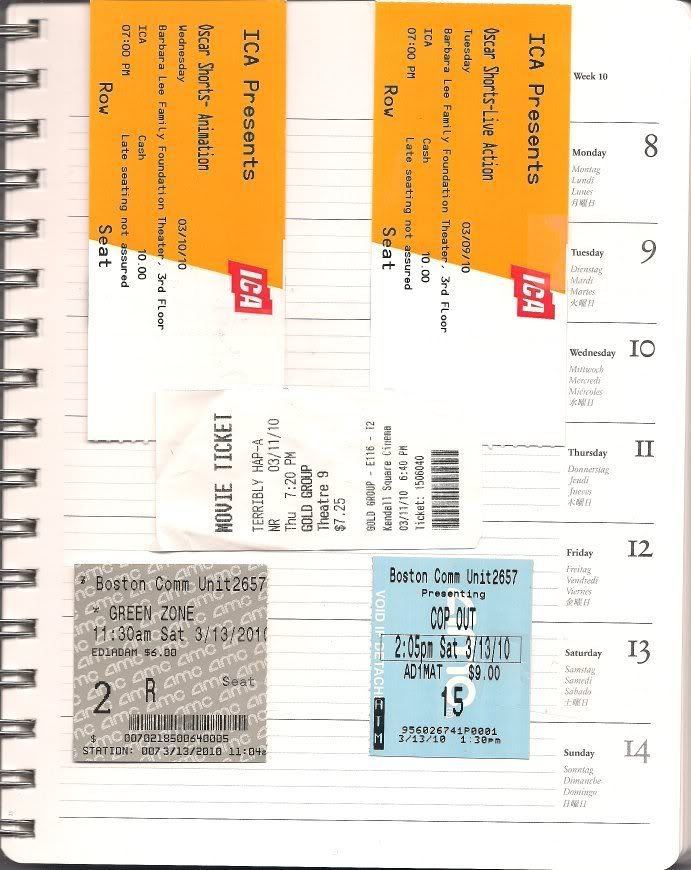
Stubless: Wonder Woman (2009), 13 March 2010.
It rained in the Boston area this weekend: An annoying drizzle when I left in the morning to catch Green Zone, and just enough to keep me in the theater for Cop Out when that ended. Looking at those ticket prices, I kind of wish I'd seen them in reverse order; Green Zone was easily worth more than Cop Out.
Then, Sunday... I was intending to go out and see something else, but a couple minutes buying a paper a block away convinced me that I didn't even want to walk as far as Central Square to catch the T. I spent the day bagging and tagging over a year's worth of comics that had piled up in the attic. Still a few left, and then there's the putting them into long boxes in the other corner of the attic (where another six to eight months's worth are also waiting. Curse my mania for alphabetical order.
I'm also beginning to strongly suspect that screener DVDs degrade over time. Every time I try to start going through my Fantasia/Fantastic Fest screeners to try and catch up, just starting gets more and more frustrating - the Blu-ray and HD DVD players won't touch them, then the laptop pops up a "No Disc in drive" message when I try to watch Spare, wouldn't send sound out to the SlingCatcher when I tried to watch The Chaser and its enormous watermark, and now doesn't even react to the presence of The Chaser in the DVD drive at all.
All that really means is I can maybe skip over some of my backlog stuff, and get started on the next phase that was to come after screeners: All the HD DVD/Blu-ray stuff I've purchased but never watched in any format (discs I have never watched despite having seen the movie are exempt). I opted to start from the end of the alphabet rather than the beginning for a simple reason: It was 10pm and Wonder Woman runs 74 minutes, while Alexander Revisited is three hours plus. Potentially unfortunately, that means that the next disc up is White Noise 2, purchased because I was assured it had nothing to do with White Noise and I like the cast. Still, you could clear the bar of that first movie by a lot and still be utter crap.
Oscar Shorts - Live Action
Seen 9 March 2010 at the ICA (Oscar Shorts)
The winner, which we knew going in, was "The New Tenants", a fairly deserving choice, although I do wonder about the politics: As much as it's officially from Denmark, it's in English and has appearances by familiar faces like Vincent d'Onofrio. To balance, thought, the film from Ireland is not in English, but Russian.
"Kavi" - * * * - Pretty good short about a kid in India whose entire family is enslaved. It kind of goes on for a bit, and kind of peters out, but it's well-done.
"The New Tenants" - * * * ¼ - The winner is quite funny, darkly so. Excellent deadpan sense of humor.
"Miracle Fish" - * * * - Nifty little story that goes into odd places. It ends kind of abruptly, but is intriguing throughout.
"The Door" - * * * ¼ - Neck and neck for the award with "The New Tenants", at least in my mind. It's a crushing story that follows Chernobyl villagers in the aftermath of the meltdown, brutal to watch at times.
"Instead of Abracadabra" - * * ¾ - Cute story with some funny bits, although it's not as good as it could be at points. The main character's a bit too dim to make it really work perfectly, though.
Oscar Shorts - Animated
Seen 10 March 2010 at the ICA (Oscar Shorts)
"Logorama" won the Oscar and it was my favorite of the program. As I mentioned last week, it's a pretty good year when a new Wallace & Gromit short is perhaps among the weakest entries.
"French Roast" - * * * - Funny little short, although it's a little strange visually; it takes a while to get used to how much of the action is rendered in a mirror that looks a lot like a window. That's a pretty impressive trick from a technical perspective, though.
"The Lady and the Reaper" - * * * ½ - I swear I saw something very similar to this a couple years ago, although I think that was much more somber and maybe hand-drawn. This is CGI and madcap, full of cartoonish slapstick about death fighting a heroic surgeon for the soul of an old woman who is at peace and ready to see her late husband again.
"A Matter of Loaf and Death" - * * * ½ - Yep, still funny.
"Granny O'Grimm's Sleeping Beauty" - * * * ¼ - The initial idea isn't quite so fantastic (a granny telling a disturbing and self-serving fairy tale to her grandchild, with a different form of animation within the story), but the punchline is perfect.
"Partly Cloudy" - * * * - I can't remember whether this was 3-D or not when I saw it with Up, but it's still a cute, very enjoyable little short. Pixar does great work.
"Runaway" - * * * - Nice-looking short out of Canada with kind of a nasty sense of humor despite its smoothness.
"The Kinematograph" - * * * - I dig the "early history of film" part, but there's something about the emotion of this one that leaves me kind of cold, like we're supposed to look down on the inventor even though the wife is concealing her illness. The implication is that he traded his love for his invention, and knowledge comes with a price that is often not worth it, and you're going to have to try a whole lot harder to convince me of that.
"Logorama" - * * * ¾ - You know what's cruel about this short? That a whole bunch of lawyers will keep it from ever being issued on video (although if it's available on iTunes (ptui!), I'd imagine at least some of that's been worked out), but it's the one you will most want to have available for freeze-framing to catch all the clever little bits of things that directors "H5" put in every corner of their world made up of corporate logos.
Green Zone
* * * (out of four)
Seen 13 March 2010 at AMC Boston Common #2 (first-run)
A lot of folks have been making the obvious comparison to the Bourne movies (Damon! Greengrass!), mainly because it is the easy comparison. I think that, in a lot of ways, Green Zone is better than his work on those, because while I found that globe-trotting action/adventure isn't really Greengrass's forte (my impression of those films will always be him taking what was clearly an impressively staged and executed car chase in The Bourne Supremacy and cutting it into incomprehensibility), he does damn good "you are here". There's a great boots-on-the-ground feeling to the movie, not just in how tense the action can get, but in how we instinctively understand an NCO like Miller's place in the world: He's the glue that holds the army together, although the likes of Miller are so well-trained that the likes of him actuallly questioning his orders is unheard of.
Cop Out
* * (out of four)
Seen 13 March 2010 at AMC Boston Common #15 (first-run)
So, let me understand this, MPAA (or Warner, or whoever is responsible) - it's okay to have the line "a couple of dicks" front and center in the movie, but having it as the title is crossing a line? How's that work?
That aside, Cop Out is interesting in what it says about Kevin Smith as a filmmaker. Not the moral judgment of "how can you stand having your name on this?" or the political implications of whether this is a gesture to make him seem more studio-friendly to people other than the Weinsteins, but how it lets us examine specific talents. All his previous films were as a writer/director, with the general impression being that he can write well enough to cover his weakness behind the camera. He didn't write Cop Out, though, and it indicates that while he can't spin gold from straw, he's built up enough skills to maybe make a mattress. It is a pretty dumb script, after all, but in many ways the execution isn't bad. The scenes and bits that don't work - and there are many don't call attention to themselves; they move smoothly on to the next bit.
Bruce Willis helps. You can't blame the guy for all the big-money action roles he's taken - if someone waved a check for twenty million dollars in my face, I'd have a hard time saying no, even if it wasn't the first time - but it is a crying shame that he doesn't do more comedy, because he's both a good straight man and wiseass. I'm not quite so sold on Tracy Morgan; I kind of get what he's going for here, and he's saddled with a particularly dumb subplot, but he kind of reminded me of the Nigel Bruce-model Watson here: Eccentric, kind of clueless, etc., is funny, but when a character comes off as so rock-stupid that it's impossible to picture his as a homicide cop with ten years on the job, that's a problem.
Wonder Woman (2009)
* * ¾ (out of four)
Seen 13 March 2010 in Jay's Living Room (Blu-ray)
A few idle questions to ponder when trying to evaluate the merits of last year's direct-to-video animated Wonder Woman:
* Would I enjoy it more if it were done in Japan, at roughly this level of quality? I've watched a fair bit of animated action/adventure out of Japan, and not always the big-budget theatrical releases, and liked much of it. The question is, does the language barrier help (making it harder to notice bad dialogue/voice acting), as well as the lack of familiarity with the source material? Through a lot of Wonder Woman's first half, I was thinking that this was rather flat, not really up to the standards one would hope for.
* Would this be acceptable story if this were a live action film? Probably not. It shows how unwieldy the character's origins are, especially how long it takes to get Diana born and off her island. It really locks things into the character's mythological origins, and a characterization that is much more simplistic and aggressive than the well-developed Diana we know from the comics.
* How involved was Gail Simone? She's the current writer of the Wonder Woman comic (at least through June), and though her run hasn't been as good as Greg Rucka's, she has emphasized the mythological warrior elements of the character. She's got a "screen story" credit on this, although I wonder if she contributed more directly to the second half. Certain bits, like "They're messing with Lincoln! No-one messes with Lincoln!", have her stamp on them.
I wish more did. There's potential here, and a really nice voice cast (Keri Russell as the title character; Nathan Fillion as Steve Trevor, the guy with the line about Lincoln; Rosario Dawson as Artemis). It's got pretty serious action for an American animated film. I just wish it had more of Rucka's ability to make all the elements of the character or Simone's wit and inventiveness.
* My friends would likely give me a hard time if I didn't start with The Chlotrudis Awards on Sunday night at The Brattle Theatre. It's a fun evening, honoring quality independent films, and Society President Michael Colford is probably going nuts even as we speak to meet the person who spoke the Donnie Darko line that has been in his email signature for years, special guest Beth Grant.
But, hey, that's just an awards ceremony, one I'm almost willing to punt if I can't find time to get to the ridiculous amount of other stuff playing in (potentially) short runs this week:
* Before the awards, the second half of the one-two punch Werner Herzog brought to last year's Toronto Film Festival opens at the Boston Museum of Fine Arts on Thursday. If My Son, My Son, What Have You Done? is even half as good as Bad Lieutenant: Port of Call New Orleans, it will be well worth figuring out the MFA's schedule to catch.
If you haven't gone to movies at the MFA before, I'm only half-joking about the "figuring out" bit. Even when a movie like My Son is having a "run", that means it's booked for 4-6 dates which are not necessarily in a row or at the same time. This one is playing five times, around The Films of Kim Longinotto and the start of The Boston Turkish Film Festival.
* Hubble 3-D opens at the Aquarium on Friday, playing 3 matinees daily while Avatar has the night shift. The Ultimate Wave: Tahiti 3D is also playing there, and that looks pretty cool. But gorgeous photography of Tahiti and James Cameron's cool sci-fi flick aside, is there anything cooler than documentary footage of spaceflight and crystal-clear images from the Hubble in genuine reels-of-film-that-require-a-forklift-to-move-with-single-frames-the-size-of-your-fist-projected-with-a-bulb-that-doubles-as-a-death-ray-onto-a-screen-the-size-of-a-medium-sized-office-building IMAX 3-D? Not for $12, there isn't.
* Circus Films at the Brattle! It's a small, weekend series, but there's some neat stuff, including an outfit called Cirkestra providing live accompaniment to a silent, The Unknown. That always gets me to the theaters.
* Kendall Square opens a few new movies, including The Secret of Kells, which looks like it thoroughly deserved its Oscar nomination from the gorgeous clips and previews. Also opening are The Girl with the Dragon Tattoo and Mother; the one-week-wonder is Neil Young: Trunk Show.
* The Coolidge has a 25th Anniversary
* And, finally, even though I'll probably get another chance to remind the half-dozen or so people who read this blog about it next week, The Boston Underground Film Festival kicks of next Thursday, the 25th, with the local premiere of Sion Sono's Love Exposure, an amazing film that has too much awesome packed into its four hours to classify. It's funny, heartbreaking, and utterly bizarre by turns; I loved it when I saw it at Fantasia last summer.
Yes, I said four hours, which is one of the reasons I highly recommend seeing it at the Kendall on the 25th. If it played a regular run, or came out on video, it would be easy to say "four hours? not tonight!" at any given time; at a one-time festival screening, though, you make the time, because there aren't other alternatives. And you should, because in addition to being as long as two movies stuck together, it's got as much good stuff as two individual movies, maybe three.

Stubless: Wonder Woman (2009), 13 March 2010.
It rained in the Boston area this weekend: An annoying drizzle when I left in the morning to catch Green Zone, and just enough to keep me in the theater for Cop Out when that ended. Looking at those ticket prices, I kind of wish I'd seen them in reverse order; Green Zone was easily worth more than Cop Out.
Then, Sunday... I was intending to go out and see something else, but a couple minutes buying a paper a block away convinced me that I didn't even want to walk as far as Central Square to catch the T. I spent the day bagging and tagging over a year's worth of comics that had piled up in the attic. Still a few left, and then there's the putting them into long boxes in the other corner of the attic (where another six to eight months's worth are also waiting. Curse my mania for alphabetical order.
I'm also beginning to strongly suspect that screener DVDs degrade over time. Every time I try to start going through my Fantasia/Fantastic Fest screeners to try and catch up, just starting gets more and more frustrating - the Blu-ray and HD DVD players won't touch them, then the laptop pops up a "No Disc in drive" message when I try to watch Spare, wouldn't send sound out to the SlingCatcher when I tried to watch The Chaser and its enormous watermark, and now doesn't even react to the presence of The Chaser in the DVD drive at all.
All that really means is I can maybe skip over some of my backlog stuff, and get started on the next phase that was to come after screeners: All the HD DVD/Blu-ray stuff I've purchased but never watched in any format (discs I have never watched despite having seen the movie are exempt). I opted to start from the end of the alphabet rather than the beginning for a simple reason: It was 10pm and Wonder Woman runs 74 minutes, while Alexander Revisited is three hours plus. Potentially unfortunately, that means that the next disc up is White Noise 2, purchased because I was assured it had nothing to do with White Noise and I like the cast. Still, you could clear the bar of that first movie by a lot and still be utter crap.
Oscar Shorts - Live Action
Seen 9 March 2010 at the ICA (Oscar Shorts)
The winner, which we knew going in, was "The New Tenants", a fairly deserving choice, although I do wonder about the politics: As much as it's officially from Denmark, it's in English and has appearances by familiar faces like Vincent d'Onofrio. To balance, thought, the film from Ireland is not in English, but Russian.
"Kavi" - * * * - Pretty good short about a kid in India whose entire family is enslaved. It kind of goes on for a bit, and kind of peters out, but it's well-done.
"The New Tenants" - * * * ¼ - The winner is quite funny, darkly so. Excellent deadpan sense of humor.
"Miracle Fish" - * * * - Nifty little story that goes into odd places. It ends kind of abruptly, but is intriguing throughout.
"The Door" - * * * ¼ - Neck and neck for the award with "The New Tenants", at least in my mind. It's a crushing story that follows Chernobyl villagers in the aftermath of the meltdown, brutal to watch at times.
"Instead of Abracadabra" - * * ¾ - Cute story with some funny bits, although it's not as good as it could be at points. The main character's a bit too dim to make it really work perfectly, though.
Oscar Shorts - Animated
Seen 10 March 2010 at the ICA (Oscar Shorts)
"Logorama" won the Oscar and it was my favorite of the program. As I mentioned last week, it's a pretty good year when a new Wallace & Gromit short is perhaps among the weakest entries.
"French Roast" - * * * - Funny little short, although it's a little strange visually; it takes a while to get used to how much of the action is rendered in a mirror that looks a lot like a window. That's a pretty impressive trick from a technical perspective, though.
"The Lady and the Reaper" - * * * ½ - I swear I saw something very similar to this a couple years ago, although I think that was much more somber and maybe hand-drawn. This is CGI and madcap, full of cartoonish slapstick about death fighting a heroic surgeon for the soul of an old woman who is at peace and ready to see her late husband again.
"A Matter of Loaf and Death" - * * * ½ - Yep, still funny.
"Granny O'Grimm's Sleeping Beauty" - * * * ¼ - The initial idea isn't quite so fantastic (a granny telling a disturbing and self-serving fairy tale to her grandchild, with a different form of animation within the story), but the punchline is perfect.
"Partly Cloudy" - * * * - I can't remember whether this was 3-D or not when I saw it with Up, but it's still a cute, very enjoyable little short. Pixar does great work.
"Runaway" - * * * - Nice-looking short out of Canada with kind of a nasty sense of humor despite its smoothness.
"The Kinematograph" - * * * - I dig the "early history of film" part, but there's something about the emotion of this one that leaves me kind of cold, like we're supposed to look down on the inventor even though the wife is concealing her illness. The implication is that he traded his love for his invention, and knowledge comes with a price that is often not worth it, and you're going to have to try a whole lot harder to convince me of that.
"Logorama" - * * * ¾ - You know what's cruel about this short? That a whole bunch of lawyers will keep it from ever being issued on video (although if it's available on iTunes (ptui!), I'd imagine at least some of that's been worked out), but it's the one you will most want to have available for freeze-framing to catch all the clever little bits of things that directors "H5" put in every corner of their world made up of corporate logos.
Green Zone
* * * (out of four)
Seen 13 March 2010 at AMC Boston Common #2 (first-run)
A lot of folks have been making the obvious comparison to the Bourne movies (Damon! Greengrass!), mainly because it is the easy comparison. I think that, in a lot of ways, Green Zone is better than his work on those, because while I found that globe-trotting action/adventure isn't really Greengrass's forte (my impression of those films will always be him taking what was clearly an impressively staged and executed car chase in The Bourne Supremacy and cutting it into incomprehensibility), he does damn good "you are here". There's a great boots-on-the-ground feeling to the movie, not just in how tense the action can get, but in how we instinctively understand an NCO like Miller's place in the world: He's the glue that holds the army together, although the likes of Miller are so well-trained that the likes of him actuallly questioning his orders is unheard of.
Cop Out
* * (out of four)
Seen 13 March 2010 at AMC Boston Common #15 (first-run)
So, let me understand this, MPAA (or Warner, or whoever is responsible) - it's okay to have the line "a couple of dicks" front and center in the movie, but having it as the title is crossing a line? How's that work?
That aside, Cop Out is interesting in what it says about Kevin Smith as a filmmaker. Not the moral judgment of "how can you stand having your name on this?" or the political implications of whether this is a gesture to make him seem more studio-friendly to people other than the Weinsteins, but how it lets us examine specific talents. All his previous films were as a writer/director, with the general impression being that he can write well enough to cover his weakness behind the camera. He didn't write Cop Out, though, and it indicates that while he can't spin gold from straw, he's built up enough skills to maybe make a mattress. It is a pretty dumb script, after all, but in many ways the execution isn't bad. The scenes and bits that don't work - and there are many don't call attention to themselves; they move smoothly on to the next bit.
Bruce Willis helps. You can't blame the guy for all the big-money action roles he's taken - if someone waved a check for twenty million dollars in my face, I'd have a hard time saying no, even if it wasn't the first time - but it is a crying shame that he doesn't do more comedy, because he's both a good straight man and wiseass. I'm not quite so sold on Tracy Morgan; I kind of get what he's going for here, and he's saddled with a particularly dumb subplot, but he kind of reminded me of the Nigel Bruce-model Watson here: Eccentric, kind of clueless, etc., is funny, but when a character comes off as so rock-stupid that it's impossible to picture his as a homicide cop with ten years on the job, that's a problem.
Wonder Woman (2009)
* * ¾ (out of four)
Seen 13 March 2010 in Jay's Living Room (Blu-ray)
A few idle questions to ponder when trying to evaluate the merits of last year's direct-to-video animated Wonder Woman:
* Would I enjoy it more if it were done in Japan, at roughly this level of quality? I've watched a fair bit of animated action/adventure out of Japan, and not always the big-budget theatrical releases, and liked much of it. The question is, does the language barrier help (making it harder to notice bad dialogue/voice acting), as well as the lack of familiarity with the source material? Through a lot of Wonder Woman's first half, I was thinking that this was rather flat, not really up to the standards one would hope for.
* Would this be acceptable story if this were a live action film? Probably not. It shows how unwieldy the character's origins are, especially how long it takes to get Diana born and off her island. It really locks things into the character's mythological origins, and a characterization that is much more simplistic and aggressive than the well-developed Diana we know from the comics.
* How involved was Gail Simone? She's the current writer of the Wonder Woman comic (at least through June), and though her run hasn't been as good as Greg Rucka's, she has emphasized the mythological warrior elements of the character. She's got a "screen story" credit on this, although I wonder if she contributed more directly to the second half. Certain bits, like "They're messing with Lincoln! No-one messes with Lincoln!", have her stamp on them.
I wish more did. There's potential here, and a really nice voice cast (Keri Russell as the title character; Nathan Fillion as Steve Trevor, the guy with the line about Lincoln; Rosario Dawson as Artemis). It's got pretty serious action for an American animated film. I just wish it had more of Rucka's ability to make all the elements of the character or Simone's wit and inventiveness.
Sunday, March 14, 2010
Terribly Happy
Terribly Happy is already out of Boston, sad to say, after one week plus one preview, which is too bad, because I liked it a lot. I now wish I'd seen it earlier so that I could do a little to spread the word on it - IFFB had a preview screening on the 4th, but I was at Spike & Mike that night. Shame, especially since it's being distributed by Oscilloscope, and they don't have quite the pervasive on-demand presence as IFC and Magnolia do.
They do have a very impressive line-up of films, though: I have yet to hear anything but rapturous praise for Dear Zachary, but just limiting to what I've seen of the 23 films they've listed: Wendy and Lucy is very good indeed, I quite liked Not Your Typical Bigfoot Movie, Unmistaken Child is my choice for 2009's best documentary, The Messenger has a fantastic supporting performance by Woody Harrelson, and Youssou N'Dour: I Bring What I Love is worth a look (it's also one of my more frequently-accessed reviews on eFilmCritic).
I'm also very tempted by their "Circle of Trust" subscription, which seems like a good deal so long as they keep up their high standards ($150 for 10 DVDs, delivered a week before street date). As alternate distribution programs go, it's interesting as it doesn't do much to get a movie to a broad audience, but certainly does seek to maximize their films' exposure to the core indie-film audience. I'm not sure that's the greatest plan, but I admit I am tempted to sign up, even though I suspect that not every DVD they send would be worth the money.
But, at least one of them will - Terribly Happy is really good:
Frygtelig lykkelig (Terribly Happy)
* * * * (out of four)
Seen 11 March 2010 in Landmark Kendall Square #9 (first-run)
I take note of odd credits when watching movies, and maybe any (hypothetical) readers from Denmark could fill me in on a couple from the end of Terribly Happy: Is it common for Danish films to credit the people who put the teaser and trailer together, or were this particular film's previews noteworthy, and if so, is it the same one Oscilloscope used to promote the film in North America? I'm just curious, because the small cinema wasn't exactly packed, and it's too bad people missed it.
Robert Hansen (Jakob Cedergren) is a cop from Copenhagen who has just been assigned to be the town of Skillard's new marshal. He describes it as a promotion, but it doesn't seem to be a strictly voluntary one: There's a daughter and an ex-wife who won't return his calls, and a bottle of pills he dumps down the toilet, even though Dr. Zerling (Lars Brygmann), "the local quack", says he's ready to refill the prescription. The locals don't particularly want him there, either; it's the sort of town that takes pride in taking care of its own problems, and nobody seems to worry about the occasional disappearances. That's not in Robert's nature, though, especially when he's confronted by the Buhls: Ingerlise (Lene Maria Christensen) is the first to greet him in town, but has telltale cuts and bruises from her boorish husband Jørgen (Kim Bodina). Everybody knows when that happens; it's when their daughter Dorthe (Mathilde Maack) pushes her dolls' carriage around at night.
Terribly Happy hooks the audience early on, not because it necessarily has a unique set-up or hugely compelling performance, but because it's ready and willing to point the audience in different directions. Our first glimpse of Ingerlise is just a friendly hello, but it's hard to miss the femme fatale vibe coming off her the second time. Jørgen, meanwhile, is introduced with a shot straight out of a western. So, we're thinking, where's Robert heading; is he going to be Ingerlise's patsy or the marshal who cleans up the dirty town? Or does director and co-writer Henrik Ruben Genz have another destination in mind? After all, Skillard is neither the naked city or the windy American West; it's a murky swamp town.
Genz (along with co-writer Dunja Gry Jensen, adapting a novel by Erling Jepsen) does find surprising directions to go even as it uses film noir and western conventions to point us down one path or the other. What's perhaps more impressive is how Genz does it, not doing too much to highlight the plot twists but quietly turning the screw all the same. Much of the second half of the film is pure suspense; without holding anything back, Genz does a great job of keeping us intently interested in what's going to happen next.
He couldn't do it without Jakob Cedergren. We know from very early on that Robert isn't exactly squeaky-clean, but it's not just his determination to play things by the book that keeps the audience in his corner even as his flaws become more manifest. We can see the guy trying to live by his better nature even as Skillard chips away at it, and as he sinks into a moral quagmire to match the local bogs, he doesn't necessarily elicit automatic sympathy, but he gets people to look over their shoulders on Robert's behalf.
The rest of the cast is good, too, especially Christensen and Bodina. Kim Bodina, especially, is impressive; in many ways he winds up doing what Cedergren does in reverse, scraping off bits of bad first impression without ever letting us lose track of just why we had such a poor opinion of the guy. Christensen, meanwhile, is making Ingerlise a seductress even though it's hard to believe it of her; there's just the right balance of concerned mom and hothouse flower in her portrayal to keep us guessing. Lars Brygmann, similarly, manages to make Zerleng seem both corrupt but also, potentially, another outsider who could be an ally.
And then there are all the small details that show how much effort has been put into every frame of the film - how appropriately small Dorthe seems the first time we see her without the red coat she wears throughout the film, or how Robert's footwear tracks his assimilation by Skillard. All of those things keep the story and setting tight, so that those of us who came to this film (no matter what preview drew us) would have a hard time turning away.
Also at eFilmCritic
Thursday, March 11, 2010
This Week In Tickets: 1 March 2010 to 7 March 2010
A whole lot of delay on this post for not a whole lot of content. A nasty cold hit me Sunday afternoon and lasted most of the week, making the Barking Dogs review harder to get done than it had any right to be, and then both times I tried to scan the page in before catching the bus in the morning, it would disappear in a computer crash sometime during the day.
Not a bunch to write about what's coming out this weekend, either:
* The Brattle opens what promises to be a good-looking new print of The Red Shoes for a week.
* John Ford at the Harvard Film Archive. From the look of the calendar, including how the winter-months series is described as "part 1", it looks like John Ford will be the theme for the archive at least through the end of the academic year.
* The tail ends of the "New Films from Spain" and "New Films from Quebec" series at the MFA
* Stuart Street reopens The Hurt Locker to capitalize on its Oscar wins, which is great - it's a terrific movie. It's enough to make one stop wondering, at least for a week or so, if "$10 second-run boutique house" is really a viable business model.
* A little film by Oscar Winner Kathryn Bigelow's ex, Terminator 2, plays midnights at the Coolidge as part of "March Metal Men". Next week is Robocop and I think it would be kind of funny if they finished up with Anvil!. Also continuing are Shutter Island and The Ghost Writer.
(I am conflicted as heck on The Ghost Writer. Trailers look good, excellent cast... But I do not want any of my money going to Roman Polanski.)
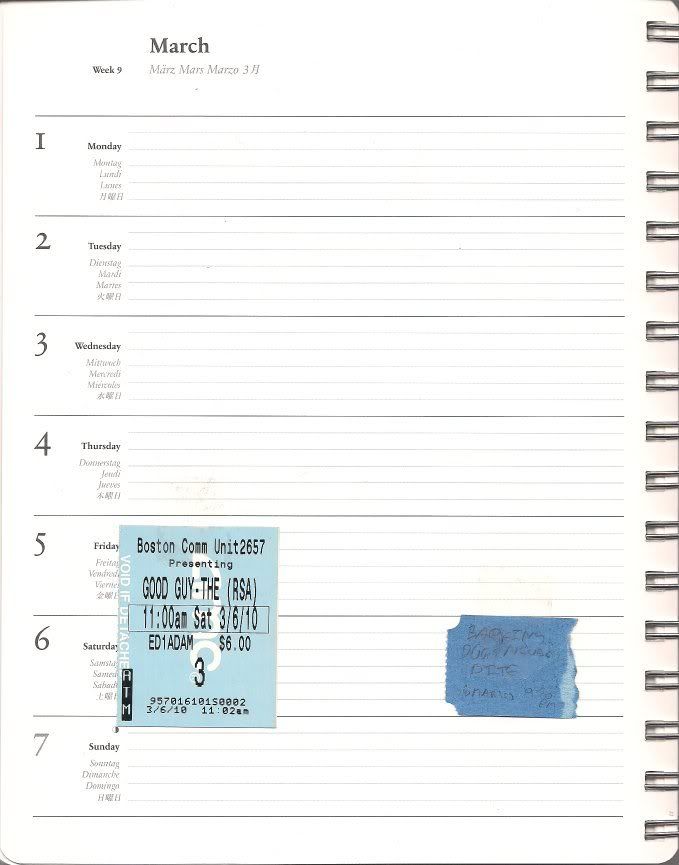
Stubless: Triangle, 5 March 2010; "A Matter of Loaf and Death", 7 March 2010.
Thin week. You know how sometimes at work, something huge comes up, and it's all hands on deck to make sure that gets done? That was the week before last. Last week was the week where I worked late to make up the time lost on the other thing.
"Wallace & Gromit in: A Matter of Loaf and Death"
* * * ½ (out of four)
Seen 7 March 2010 in Jay's Living Room (Blu-ray)
I may talk a little bit more about this when I get to the Oscar Shorts programs next week, but it is a darn good year for animation when you can legitimately argue that a new Wallace & Gromit short is the weakest nominee in its category. That's not anything against "Loaf and Death" - it's a quality half-hour of "Wallace & Gromit", though it suffers a bit of wear (as often seems to be the case, Wallace has gotten dumber and lazier over the course of the series), but it still brings a great deal of the funny: Slapstick, awful bread-related puns, and well-utilized movie references (Aliens in a kids' cartoon!). There's just enough suspense to keep adults involved and kids on the edge of their seat, and the quality of the animation is top-notch.
Not a bunch to write about what's coming out this weekend, either:
* The Brattle opens what promises to be a good-looking new print of The Red Shoes for a week.
* John Ford at the Harvard Film Archive. From the look of the calendar, including how the winter-months series is described as "part 1", it looks like John Ford will be the theme for the archive at least through the end of the academic year.
* The tail ends of the "New Films from Spain" and "New Films from Quebec" series at the MFA
* Stuart Street reopens The Hurt Locker to capitalize on its Oscar wins, which is great - it's a terrific movie. It's enough to make one stop wondering, at least for a week or so, if "$10 second-run boutique house" is really a viable business model.
* A little film by Oscar Winner Kathryn Bigelow's ex, Terminator 2, plays midnights at the Coolidge as part of "March Metal Men". Next week is Robocop and I think it would be kind of funny if they finished up with Anvil!. Also continuing are Shutter Island and The Ghost Writer.
(I am conflicted as heck on The Ghost Writer. Trailers look good, excellent cast... But I do not want any of my money going to Roman Polanski.)

Stubless: Triangle, 5 March 2010; "A Matter of Loaf and Death", 7 March 2010.
Thin week. You know how sometimes at work, something huge comes up, and it's all hands on deck to make sure that gets done? That was the week before last. Last week was the week where I worked late to make up the time lost on the other thing.
"Wallace & Gromit in: A Matter of Loaf and Death"
* * * ½ (out of four)
Seen 7 March 2010 in Jay's Living Room (Blu-ray)
I may talk a little bit more about this when I get to the Oscar Shorts programs next week, but it is a darn good year for animation when you can legitimately argue that a new Wallace & Gromit short is the weakest nominee in its category. That's not anything against "Loaf and Death" - it's a quality half-hour of "Wallace & Gromit", though it suffers a bit of wear (as often seems to be the case, Wallace has gotten dumber and lazier over the course of the series), but it still brings a great deal of the funny: Slapstick, awful bread-related puns, and well-utilized movie references (Aliens in a kids' cartoon!). There's just enough suspense to keep adults involved and kids on the edge of their seat, and the quality of the animation is top-notch.
Wednesday, March 10, 2010
Barking Dogs Never Bite
I'd say more, but I saw this late Saturday night and have been kind of under the weather since. I think I'll just pad this section out with links to my other reviews of Bong Joon-ho's movies on EFC:
Memories of Murder
The Host
Tokyo!
Mother
As of today, you can actually still purchase The Host on HD DVD at Amazon, for $31.50. The funny thing is, I seem to recall being unable to get a hold of it on HD DVD at the time (it's one of the few Blu-rays I have of films that came out on both formats). I wonder who they think is going to pay that.
Also, I found it interesting that when the filmmaker was at the Archive last week, he was referred to as "Director Bong". It's an interesting quirk of language that almost every profession is used as a title in Korean. Whether it's because there's a good chance that any group has more than one person with the same surname (thus making "Mr. Kim" less-than-specific), I don't know, but I'd kind of like it to catch on in other languages.
Barking Dogs Never Bite (Flandersui gae )
* * * (out of four)
Seen 6 March 2010 at the Harvard Film Archive (Bong Joon-ho: The Pleasures and Terrors of Genre)
Bong Joon-ho's new film, Mother, is dead serious from about fifteen minutes in, and I don't recall much levity in Memories of Murder. On the other hand, The Host was memorable for just how funny it was for a non-parody monster movie, so it's not much of a surprise that Bong's first feature was a comedy - or that its sense of humor is fairly twisted.
As the film opens, graduate student Yoon-ju (Lee Seong-jae) is on the phone to a colleague, worrying about his chances at the professorship that has just opened up; being considered seems to involve a great deal of late-night drinking with the department head (and maybe bribery). His pregnant wife Eun-sil (Kim Ho-jeong) has either reached the point of making constant demands, or was like that all along. And though the apartment doesn't allow them, some tiny dog just won't stop yapping. On the other side of the building, Hyun-nam (Bae Doo-na), a young girl working in the building's management office, is bored with her job, preferring to hang out with her friend Jang-mi (Go Soo-hee) at the convenience store - or help put up signs about lost dogs.
The movie opens with the disclaimer that no animals were harmed in the making of this film, and when you see that, you know some animals are going to get harmed on-screen. Given that this film is from South Korea, and dogs are mentioned in the title... Well, there's a certain segment of the audience that won't be able to watch it, no matter how little problem they may have with the painful slapstick and black comedy inflicted upon the film's two-legged cast. I don't say that to condemn Korea or dog-lovers, just to acknowledge that there's stuff in this movie that will be a deal-breaker for some people, and they probably shouldn't watch it, because they won't be able to focus on anything else.
Such as, for instance, the effortless way Bong depicts the crowded city and how it squeezes the life out of its residents. Much of the action takes place in and around a giant, brutalist apartment block, a giant slab built next to an idyllic green mountain that seems both near and unreachable when looking out Yoon-ju's and Hyun-nam's windows; in other shots, the building seems to blot the mountain out. Hyun-nam is terribly bored at her job, the the shop Jang-mi works in barely has the space to qualify as a closet. Yoon-ju and Eun-sil betray little excitement at their impending parenthood, and in the basement, a homeless man disappears under a pile of discarded clothes.
Kind of grim, but also darkly funny. The world at times seems to conspire against Yoon-ju in particular, although he's not alone in that predicament - consider the janitor who just wants to make a dog stew and eat it in peace. Things get stranger and more arbitrary as the film goes on, but the humor often comes not just from how the world can crap on people, but from how that person who is making your life miserable can also do something unexpectedly kind. There's also some broad slapstick (always, always, always look where you're going when running!) to go with the absurd situations.
This kind of comedy tends to need a very specific sort of performance from the star, and Lee Seong-jae hits it perfectly. He plays Yoon-ju as, by and large, a reasonable-seeming man, but there's also just enough laziness and petulance to him that the strange situations he finds him in don't exactly seem unfair - even if we don't see his particular offenses against Eun-sil or the world in general within the film, there's little doubt that they exist. Bae Doo-na, meanwhile, does a good job of capturing Hyun-nam's inexperience and naivete without making her seem starry-eyed; she's a little disgruntled without being cynical; there's still some dreamer to her. Kim Ho-jeong dances on the line between being harsh in a funny way and shrewish for most of the film, so that her final scenes are in-character but surprisingly sympathetic.
Though Barking Dogs Never Bite isn't the sort of twisted genre film Bong would go on to make his international reputation on, fans will find familiar things other than Bae Doo-na (who later played the aunt in The Host). The sense of menace, for instance, or the striking visuals. Two stand out in particular: Hyun-nam chases Yoon-ju across the building's outer walkways in a shot that is both exciting and reinforces how monolithic the apartment block is by its zooming out, and a cloud of gas appearing almost out of nowhere to envelop Yoon-ju, a surreal moment that makes the audience laugh not just for how funny it is, but for what it could be setting up.
Barking Dogs is different from Bong's later films, but it's funny and well-enough to be much more than a curiosity or footnote. It's an impressive debut, and hopefully one that will become better-known with the success of what he has done since.
Also at eFilmCritic
Sunday, March 07, 2010
The Good Guy
Since I've still got one more review I'd like to get up before/during the Oscars (and grocery shopping to do so that I'll have something to eat before/during the Oscars), let's just do some fun with IMDB. Where this comes from will soon be evident.
First, the poster for The Good Guy. I guess it's not bad as giant-head posters go, but it sure looks like this is about Alexis Bledel trying to choose between two men, and it's not, really - although one of its good points is that it splits its time relatively equally between those three characters, and the movie is about different things depending on the point of view.
And, inspired by one of the character names:
"Jason Seaver" at IMDB (Seriously, seven years?)
No character page for this movie's Daniel Seaver, but this one is actually my brother. This is just one letter away from his wife
Nothing for my brothers Travis or Matthew, but scroll down a bit here. This guy doesn't really look like our dad, though.
Enough silliness; on to the review!
The Good Guy
* * * (out of four)
Seen 6 March 2010 in AMC Boston Common #3 (first-run)
Tommy Fielding (Scott Porter) is a pretty good guy, especially considering he's a Wall Street trader. He doesn't overindulge; he isn't pressuring his girlfriend Beth (Alexis Bledel) to have sex even though it's been a couple months and his ex Christie (Jeane Fournier) is obviously still available. When one of his traders gets a better offer, he wishes him well and tells his boss Cash (Andrew McCarthy) that he'd like to promote tech whiz Daniel Seaver (Bryan Greenberg), because he's honest.
And, man, is Daniel honest. He comes to Wall Street after three years in the Air Force, but he's no cocky flyboy, but a former avionics engineer, which is his second go-to conversation topic after classic literature. He's likably awkward and shy, but that's something of a liability in dealing with clients. So Tommy takes it upon himself to get Daniel cleaned up and pulled out of his shell. The next time you go into a bookstore, Tommy says, talk to a girl while you stand in line. Naturally, that girl happens to be Beth.
By this point, the audience has maybe settled in enough to forget that the title is not in the plural form, but even if not, there's still a number of ways this can play out. Are we looking at an "I've created a monster" situation? Is Tommy only a good guy until he senses a threat, at which point the killer instinct makes itself known in order to smite Daniel? Even among the standards, there are a lot of ways to play this, and writer/director Julio DePietro deserves some credit for choosing the one that contains relatively little obvious melodrama, mostly just letting it play out by the characters remaining true to themselves.
Mostly. When DePietro does pull the camera back a little bit to show us what other things may be having an impact on the triangle, it initially feels like a bit of a cheat, and I'm not sure that DePietro hasn't lied to the audience on one point (more likely, he's been hair-splittingly selective with what he shows). As those sort of things go, though, I like the way he handles it; half a conversation that doesn't go quite as expected, and then re-evaluation, without flashbacks.
That everything works so well afterward says good things about the cast. None of them have particularly flashy parts, but they all inhabit them nicely, making a good ensemble. Porter and Greenberg, especially, do excellent work at finding middle ground in characters who are more often than not played as stereotypes: Porter makes Tommy a hard-charging banker without making him abrasive, while Greenberg manages to play up Daniel's initial awkwardness without ever making him look foolish (though still managing plenty of laughs). Alexis Bledel is her usual charming self as Lisa , although she's in constant danger of being upstaged by her friends, Anna Chlumsky (as the girl who seems like a perfect fit for Daniel) and Jessalyn Wanlim (as the more outspoken one). Plent of comic relief from Tommy's friends and co-workers, too - Aaron Yoo and Andrew Stewart-Jones aren't deep characters, but they are almost always good for a laugh.
And that's important; as much as The Good Guy could easily have been mean-spirited or cynical, given its setting and the types of characters who inhabit it, it instead manages to maintain a pleasant youthful optimism. Yes, DePietro is a little clumsy getting there; not just in what I mentioned before, but in how he not only name-drops Ford Maddox Ford's The Good Soldier as a potential entry for Beth's book club, but spells out just how it parallels the story rather baldly. It may not hold out much hope for its less noble characters, but it doesn't make them wholly repugnant. Most importantly, it believes in its good ones, even though pessimism is the more dramatic, though easier, way to go.
In that spirit, I'll bump it just enough of a fraction of a star to get it to round up. (And, yes, I have a brother named Daniel. Yes, that probably caused me to enjoy this movie the tiniest bit more than I would have otherwise.)
Also at eFilmCritic
Triangle
To mix things up a bit, my thoughts that don't quite fit in the eFilmCritic review. Not just because it's nice to do things a little differently every once in a while, or because it's rather apropos for this particular movie, but because a lot of what I want to say is a spoiler (more specifically, a spoiler-filled rant). If you haven't seen it, turn away after the "Also at eFilmCritic" part.
(Okay, one comment - my brother, father, et al, just got back from a Caribean cruise. This might have been a fun one to show them before they left)
Triangle
* * ¾ (out of four)
Seen 5 March 2010 in Jay's Living Room (Blu-ray)
This review will, at times, be vague, convoluted, and maybe even self-contradictory, but hopefully also intriguing. The primary reason for this is that I like to avoid giving too much away and Triangle goes for its big, not-mentioned-on-the-package surprise fairly early. Which, as clever folks have likely already deduced, is a secondary reason to write it that way - that combination of confusion and intrigue rather matches the experience of watching Triangle, so even if I don't tell you what it's about, I can maybe give you an idea of how it feels.
As the single mother of an autistic child (Joshua McIvor), every morning can be a struggle for Jess (Melissa George), even a Saturday when she's been invited to go sailing with Greg (Michael Dorman), a regular customer at the restaurant where she works as a waitress. It's not quite a romantic getaway, as four others are coming with: Victor (Liam Hemsworth), the nineteen-year-old kid Greg took in; Downey (Henry Nixon) and his wife Sally (Rachael Carpani), old friends of Greg; and Heather (Emma Lung), a friend Sally is trying to set Greg up with. Jess is worn out from dealing with her son, but things will soon get much worse - after a few ill omens, a storm capsizes Greg's boat, but their course intersects with Aeolus, a cruise ship from the 1930s that is curiously empty...
And we'll stop there, because what happens afterward deserves to be discovered as you watch the film. What I will say is that writer/director Christopher Smith is still making horror movies, but he isn't repeating himself; where Creep was an intense running of a gauntlet and Severance featured over-the-top gore and black comedy, Triangle aims to be a mindbender, tossing the audience clues as to what is going on between its thrills and kills, and then, once the trick has been revealed, daring the audience to keep track of all the pieces and spot any flaws in the construction. And, the majority of the time, it works; there's a thrill of recognition whenever Smith does something that explains an earlier scene. Sometimes he leans a bit hard on that explanation, making sure that everybody gets what happened, but other times he will throw things in that are almost but not quite red herrings - they're connected, but outside the immediate narrative.
Which may be a problem, depending on what kind of story you look at Triangle as being. Mindbender stories are at their best when they are meticulous, when you can take every action and every character, put them on a chart, and come up with a complex but tight pattern. Still, this is also a ghost ship/Bermuda Triangle movie, and that's a variety of horror that often works best when left unexplained - or at least, when the explanations are relatively vague and more about emotion than paranormal phenomena. So while certain logical inconsistencies drive me absolutely bonkers - Smith doesn't even try to explain some things beyond "it was set up that way earlier" - there is something perfectly right (and sadly wrong) about the way things feel at the end, and the dangling bits of the script only make it more so.
A lot of that rests on the shoulders of Melissa George. It's not spoiling any huge surprise to say she's the main character, the one we spend the most time following and the one where we have the most built-in interest in seeing her get off the ship. It's an odd performance, in some ways: In the early scenes, it can be extremely hard to connect with her; there's a dull unresponsiveness to Jess that is rather off-putting. Once the characters get on board the ship, though, Jess becomes a more active character, and George handles everything Smith throws at her. And that's a lot; she's in nearly every scene, with the story sending her from one emotional extreme to another. She handles most of it with aplomb, even doing a pretty good job of selling us some of the more nonsensical parts of the story. She handles herself well in the action scenes, too; she's necessarily doubled at some points, but very capable when nothing but a steady, medium shot will do.
That's not to give the rest of the cast short shrift, but it's pretty clear that this is George's movie from the start, and none of the rest are going to be given much chance to upstage her. One thing that is refreshing is that the cast are adults; only Liam Hemsworth's Victor really falls in the "barely old enough to drink" demographic. He is one of the ones I might have liked to see a bit more of; Hemsworth gives him a nice self-confident vibe.
Like the story, the production of the movie is kind of a mixed bag. As in his previous films, Smith displays a strong grasp of tone and pacing. He never goes for the inappropriate laugh that tempts other horror filmmakers, for instance. And he keeps the story moving at the right speed, supplying jolts of action when needed but giving the audience just enough time to mull over what's going on. The set of the Aeolus is impressively detailed - there's not a bit that doesn't feel realistic, even if he does manipulate it in a way to make certain scenes surreal. On the other hand, water still seems to be tough on CGI artists with a limited budget; some waves look really good, others not so much. Some splashes are just cringe-worthy.
I applaud Smith for his ambition with Triangle; he challenges himself and the audience with his story, and as much as it makes writing this review harder, I love that he kicks the audience's collective legs out from under them early rather than later (not a lot of filmmakers give themselves that sort of time to play with their cool idea). Writing this review, I see how some of the pieces fit together better than they seemed to at the time, and I'm all for movies making you think, but this one is as likely to lead to frustration as satisfaction afterward.
Also at eFilmCritic
Okay... Anyone reading on from here clearly doesn't care about having the movie spoiled for them, either because you've either already seen it or because you like those trailers that tell you the whole story or because you just don't care.
Anyway, the words I was desperately working to avoid above were "time travel"; Jess periodically seems to slip backward in time, so that she's already on board Aeolus when the wreck of the sailboat arrives, and she deduces that the cycle starts over whenever she kills the rest. That's kind of a leap; what sane person jumps to that conclusion (it may just be a fixed amount of time, for all she knows)? Of course, Jess isn't necessarily a reasonable person, as we see in the final reel.
(My friend Amanda recently mentioned that she likes time travel, though not science fiction in general; so do I recommend this movie to her, since telling her she'd like it ruins the surprise?)
The action on the boat is often curious as well. One thing I really kind of liked was the implication that we're only seeing the first (?) complete loop for Jess, but that others are happening later/earlier/simultaneously: The bloody-headed Jess, for instance, enters and exists without much explanation at all, and then there is the hole full of heart pendants and the deck full of Sally corpses. The latter raises a lot of questions about the mechanism, though; the implication, otherwise, is that everybody other than Jess is only going through this once, encountering multiple Jesses, or at least, Jess at multiple points upon her personal timeline. Otherwise, why doesn't the ship get even more crowded every time a new group boards?
Also, Smith hits us with two huge paradoxes: First, the keychain - when Jess finds it, why doesn't she have two afterward? Maybe she does, but if that's the case, shouldn't the characters notice that she has two and be freaked out? Or maybe she didn't have it before then, in which case, where did it come from? Given the car crash, it makes sense that she wouldn't have them to begin with, but if that's the case, then they more or less appear out of thin air - Jess has no keys, finds them, loops back, and then drops them for her earlier (?) self to find.
And then there's Jess herself. If survivor-Jess who kills rotten-mother-Jess at the end is also the same Jess who gets on the boat at the start... Where did she come from? The most reasonable explanation seems to be that she's a ghost, and even though ghosts (as opposed to ghost ships) aren't ever explicitly discussed, I like that as an explanation in some ways. It becomes a cool twist on the ghost caught in a loop, forever seeking revenge or redemption. The bloody-headed Jess then becomes a Jess from further down the timeline, implying that this is going to go on indefinitely - that ghosts, like people, can't break out of their patterns.
Which isn't a bad deal for a ghost story. The trouble is, I wasn't thinking ghosts until a full night of sleep and another movie later. But I may be overthinking things, or I may have missed something really obvious. What say you?
Tuesday, March 02, 2010
This Week In Tickets: 21 February 2010 to 28 February 2010
Before getting to last week's tickets, a quick look at this upcoming weekend's:
* Not actually at the movies, but the Oscars are Sunday. I haven't sent my RSVP in for the Brattle's Oscar party, so I'll either just stay up late with pizza and a 2-liter bottle of Cherry Crush, fighting the urge to live-blog/tweet in a way that makes me look like one of those annoying, reflexively negative people. Or see what my brother and his fiancée are up to, which would entail either a second pizza and 2-liter or hanging around with a bunch of their friends and feeling old.
* Speaking of the Oscars, the Academy-nominated short films (animated and live-action) appear to be moving from the Coolidge to the ICA this weekend. I failed at seeing the animated ones a week and a half ago, so I'll probably hit the Friday night shows. I'm almost feeling lucky, because while the Coolidge's screening room is rather far from my favorite place to see a movie, the ICA's auditorium is easily one of the coolest in the Boston area.
* It will have to be Friday, as Saturday night is a rare chance to see Bong Joon-ho's first film, Barking Dogs Never Bite, at the Harvard Film Archive. It's the 9:30 show, with The Host at 7pm.
* As expected, the opening of Alice in Wonderland at the two Jordan's Furniture IMAX screens heralds Avatar moving over to the New England Aquarium on the 5th. If you live in Boston and weren't willing to take two or three different public transportation lines to see it in beautiful, full-sized IMAX 3-D, it's now a lot easier. As of right now, the Aquarium's IMAX site is only showing a schedule through the 18th, hopefully because they'll be picking up Hubble 3-D on the 19th.
Also worth noting: Unless the Aquarium raises prices, it will actually cost you $1.05 less to see it in genuine reels-of-film-that-require-a-forklift-to-move-with-single-frames-the-size-of-your-fist-projected-with-a-bulb-that-doubles-as-a-death-ray-onto-a-screen-the-size-of-a-medium-sized-office-building IMAX there than the digital 3-D at the nearby AMC Boston Common theater at the same time. It's better and cheaper!
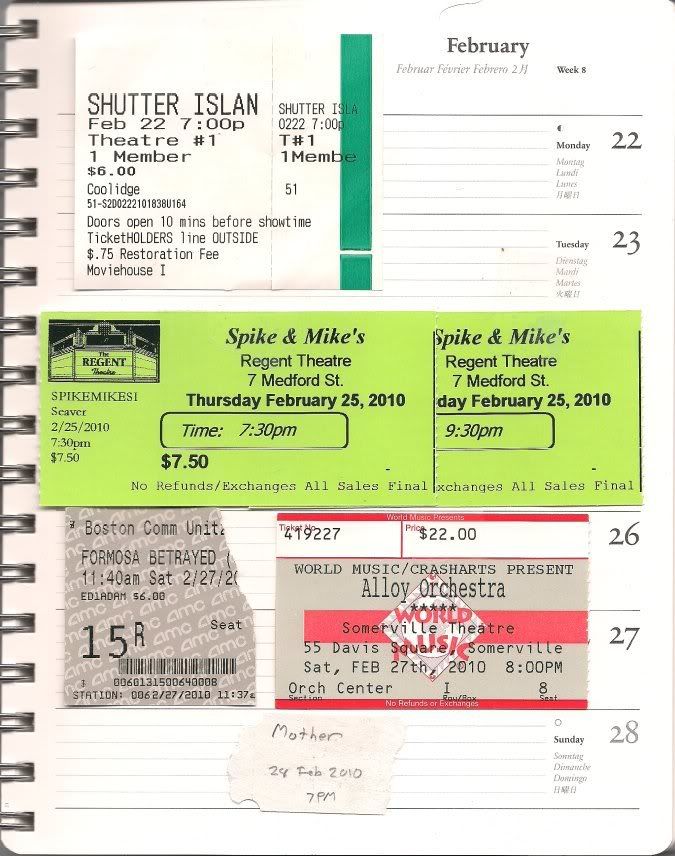
Not a lot of movie-going in terms of bulk, but they were mostly cool experiences: I'd never been to the Regent Theater before, and it's a pretty not-bad spot to see a movie, for a spot that is mostly a performance space. Seeing projected video wasn't ideal, but it was also a fairly laid-back experience. I don't think they checked my ticket once, but I suspect that's because the number of staff and patrons was small enough that night that they could keep an eye on us without manning checkpoints. Also, I don't think anyone would want to throw us out into the nasty wind and rain.
Both Formosa Betrayed and Mother were interesting/instructive screenings, from certain points of view. Mother was also good and sold out. Hopefully that indicates a good run ahead for Mother in Boston.
Shutter Island
* * * ½ (out of four)
Seen 21 February 2010 at the Coolidge Corner #1 (first-run)
By now everybody's read the bit from a Philly film critic who, unable to get to a screening of Shutter Island in time to make deadline, just printed gossip about how Leonardo DiCaprio was copping an attitude, going in the back way at a theater that Scorcese had rented for his cast and crew while Mark Ruffalo hung out and tipped big at the popcorn stand? That was at the Coolidge, so seeing the movie there was kind of cool.
The movie itself is pretty spiffy, too. As much as the trailers had hinted about this being a less contemplative, more pulpy Scorcese, the extent isn't quite clear until the movie starts up, hitting the ground running with a score that is as aggressive as anything Bernard Hermann ever came up with. Then it keeps going, building a story filled with fun twists and nifty performances for close to two hours.
It's a little longer than two hours, though, and during the last act, things tend to drag a bit. Just a little, although I do think that the editing and script could have been tightened up a bit, although that's a tough call: Ideally, in a thriller like Shutter Island, you want the audience and the characters on-screen to hit the climax at exactly the same point, and I can't imagine that very many people won't get there well ahead of DiCaprio's character, and then Scorcese spends a bit too long explaining and reacting to it. Fortunately, he and writer Laeta Kalogridis (working from a Dennis Lehane novel) do have a little something more up their sleeves, a second little body blow to hit the audience with after it seems like they've messed up by not ending the movie quickly after the big one.
(Minor rant that may be considered a spoiler: I guess Shutter Island can be forgiven for this because it was adapted from a novel, but the anagram thing is not a cool thing to use in a movie. Aside from doubting that many real people have done that sort of wordplay in a premeditated fashion, let alone subconsciously, how is it supposed to be a real hint if you don't know how the anagram is spelled? It's something you may catch in a book, but just after-the-fact trickery on film! No more spoilers)
Spike & Mike's Festival of Animation: The New Generation
* * * ½ (out of four)
Seen 24 February 2010 at the Regent Theatre (Special Presentation; video projection, maybe HD)
It's been years since I've seen a Spike & Mike show - as I mentioned last week, I thought that the Herzfeldt/Judge "Animation Show" was created in part as a reaction to their disappearance - but when I did, it was generally the "Classic" fest that I went to. Some of the shorts included may have been hanging around to be in the last Classic package - "Ghost of Stephen Foster" had a late-90s copyright on it, and I saw "Crab Revolution" and PES's "Western Spaghetti" some time ago - but there is a whole bunch of good stuff included in this package. I'll probably do another post running the whole show down in a day or two, but here's some worth mentioning:
* "Lapsus", directed by Juan Zaramella, a very clever combination of character animation and playing with abstract shapes.
* "Santa: The Fascist Year", directed by Bill Plympton. It's the new Bill Plympton, it's flat-out crazy, and just dementedly brilliant.
* "The Hidden Life of the Burrowing Owl", directed by Mike Roush, is gorgeous, dark, and funny, and combines cel-looking animation with real envrionments in a way that is smoother than I can recall seeing in the past.
* "For Sock's Sake", directed by Carlos Vegele, is a clever bit of stop-motion involving ambulatory clothing, that I loved for how Vegele managed to give his characters forms of articulation that reminded us of human characters but really was also unique.
* "A Town Called Panic: Cake", directed by Vincent Patar and Stephane Aubier, is maybe not quite as brilliant as the feature - it confirms my suspicion that Horse just sounds better in French - but is still hilarious.
* "Ghost of Stephen Foster", directed by Raymond Persi, is a music video for the Squirrel Nut Zippers. It was tough to catch the lyrics or how they related to the story (maybe that was just the theater), but visually, it's a dead-on homage to Bosko/Betty Boop-era animation.
* "Oktapadi", directed by Julien Bocabeille, was nominated for an Oscar last year and is a brilliant little CGI cartoon featuring an octopus trying to rescue its mate who has been purchased by a chef. I love the adventurous, upbeat note it ends on.
Spike & Mike's Festival of Animation: Sick & Twisted '09
* * ¾ (out of four)
Seen 24 February 2010 at the Regent Theatre (Special Presentation; video projection, maybe HD)
There wasn't nearly as much good stuff in this one, which turned out to be a replacement for the announced program, which was about one-quarter repeats from the New Generation package. This one, which I assume is last year's grouping, only repeats "Lapsus" and "Stillwaters". Though there is some pretty darn good stuff - I loved this video for The Willowz' "We Live on Your Street", for instance; there's something awesomely punk about destroying animation as you make it - let's face it, going for "sick & twisted" often means easy jokes. Anthropomorphized food doesn't like being eaten. Taking something cute and making it mean. Penises. Now, I'm not above finding any of those things funny, but when the show starts off with "Dupain" and "A Peach for Teach" back to back... It's hard not to react with "is that all you've got?"
The Man with the Movie Camera
* * * * (out of four)
Seen 27 February 2010 in Somerville Theater #1 (World Music/Crash Arts presents the Alloy Orchestra)
I reviewed this for EFC four years ago, and looking back on that review after seeing it again this past Saturday with the Alloy Orchestra accompanying it, I'm struck by a couple things:
* Don't pay attention to star-ratings. I disagree with nothing I wrote then, but I'm rating it higher today.
* I spend one out of the three "body" paragraphs in the review talking about a sequence in which Vertov and company build a theater in which to display the film. That sequence - not in the cut that the Alloy Orchestra accompanied. That's not unusual when dealing with silent films; there's all sorts of different cuts floating around of just about every silent. Maybe the HFA was just showing an unusually long cut.
It's an interesting difference, because one of the things I thought while watching it was that it is a fantastic way to learn about filmmaking; it shows you everything you need to know both by demonstration and example, so I always thought it was cool that it went all the way to the end.
Very cool seeing it with the Alloy Orchestra, though, despite the shorter cut. It was one of the most enjoyable scores I've heard them perform in a while, since Phantom of the Opera at least. Don't get me wrong, they've done several fine scores in the interim, but for the most part, they've been more restrained. Not quite conventional, but not as percussive. This, though, reminded me a lot of their score for The General, in a very good way; it really adds to the sense of speed and motion that this movie already has in abundance.
There's word going around that Alloy is going to be premiering a score for the new cut of Metropolis in San Francisco this April. Here's hoping that they play it for the local crowd sometime in the next few months. Or at Fantasia. But hopefully not in Boston while I'm in Montreal.
* Not actually at the movies, but the Oscars are Sunday. I haven't sent my RSVP in for the Brattle's Oscar party, so I'll either just stay up late with pizza and a 2-liter bottle of Cherry Crush, fighting the urge to live-blog/tweet in a way that makes me look like one of those annoying, reflexively negative people. Or see what my brother and his fiancée are up to, which would entail either a second pizza and 2-liter or hanging around with a bunch of their friends and feeling old.
* Speaking of the Oscars, the Academy-nominated short films (animated and live-action) appear to be moving from the Coolidge to the ICA this weekend. I failed at seeing the animated ones a week and a half ago, so I'll probably hit the Friday night shows. I'm almost feeling lucky, because while the Coolidge's screening room is rather far from my favorite place to see a movie, the ICA's auditorium is easily one of the coolest in the Boston area.
* It will have to be Friday, as Saturday night is a rare chance to see Bong Joon-ho's first film, Barking Dogs Never Bite, at the Harvard Film Archive. It's the 9:30 show, with The Host at 7pm.
* As expected, the opening of Alice in Wonderland at the two Jordan's Furniture IMAX screens heralds Avatar moving over to the New England Aquarium on the 5th. If you live in Boston and weren't willing to take two or three different public transportation lines to see it in beautiful, full-sized IMAX 3-D, it's now a lot easier. As of right now, the Aquarium's IMAX site is only showing a schedule through the 18th, hopefully because they'll be picking up Hubble 3-D on the 19th.
Also worth noting: Unless the Aquarium raises prices, it will actually cost you $1.05 less to see it in genuine reels-of-film-that-require-a-forklift-to-move-with-single-frames-the-size-of-your-fist-projected-with-a-bulb-that-doubles-as-a-death-ray-onto-a-screen-the-size-of-a-medium-sized-office-building IMAX there than the digital 3-D at the nearby AMC Boston Common theater at the same time. It's better and cheaper!

Not a lot of movie-going in terms of bulk, but they were mostly cool experiences: I'd never been to the Regent Theater before, and it's a pretty not-bad spot to see a movie, for a spot that is mostly a performance space. Seeing projected video wasn't ideal, but it was also a fairly laid-back experience. I don't think they checked my ticket once, but I suspect that's because the number of staff and patrons was small enough that night that they could keep an eye on us without manning checkpoints. Also, I don't think anyone would want to throw us out into the nasty wind and rain.
Both Formosa Betrayed and Mother were interesting/instructive screenings, from certain points of view. Mother was also good and sold out. Hopefully that indicates a good run ahead for Mother in Boston.
Shutter Island
* * * ½ (out of four)
Seen 21 February 2010 at the Coolidge Corner #1 (first-run)
By now everybody's read the bit from a Philly film critic who, unable to get to a screening of Shutter Island in time to make deadline, just printed gossip about how Leonardo DiCaprio was copping an attitude, going in the back way at a theater that Scorcese had rented for his cast and crew while Mark Ruffalo hung out and tipped big at the popcorn stand? That was at the Coolidge, so seeing the movie there was kind of cool.
The movie itself is pretty spiffy, too. As much as the trailers had hinted about this being a less contemplative, more pulpy Scorcese, the extent isn't quite clear until the movie starts up, hitting the ground running with a score that is as aggressive as anything Bernard Hermann ever came up with. Then it keeps going, building a story filled with fun twists and nifty performances for close to two hours.
It's a little longer than two hours, though, and during the last act, things tend to drag a bit. Just a little, although I do think that the editing and script could have been tightened up a bit, although that's a tough call: Ideally, in a thriller like Shutter Island, you want the audience and the characters on-screen to hit the climax at exactly the same point, and I can't imagine that very many people won't get there well ahead of DiCaprio's character, and then Scorcese spends a bit too long explaining and reacting to it. Fortunately, he and writer Laeta Kalogridis (working from a Dennis Lehane novel) do have a little something more up their sleeves, a second little body blow to hit the audience with after it seems like they've messed up by not ending the movie quickly after the big one.
(Minor rant that may be considered a spoiler: I guess Shutter Island can be forgiven for this because it was adapted from a novel, but the anagram thing is not a cool thing to use in a movie. Aside from doubting that many real people have done that sort of wordplay in a premeditated fashion, let alone subconsciously, how is it supposed to be a real hint if you don't know how the anagram is spelled? It's something you may catch in a book, but just after-the-fact trickery on film! No more spoilers)
Spike & Mike's Festival of Animation: The New Generation
* * * ½ (out of four)
Seen 24 February 2010 at the Regent Theatre (Special Presentation; video projection, maybe HD)
It's been years since I've seen a Spike & Mike show - as I mentioned last week, I thought that the Herzfeldt/Judge "Animation Show" was created in part as a reaction to their disappearance - but when I did, it was generally the "Classic" fest that I went to. Some of the shorts included may have been hanging around to be in the last Classic package - "Ghost of Stephen Foster" had a late-90s copyright on it, and I saw "Crab Revolution" and PES's "Western Spaghetti" some time ago - but there is a whole bunch of good stuff included in this package. I'll probably do another post running the whole show down in a day or two, but here's some worth mentioning:
* "Lapsus", directed by Juan Zaramella, a very clever combination of character animation and playing with abstract shapes.
* "Santa: The Fascist Year", directed by Bill Plympton. It's the new Bill Plympton, it's flat-out crazy, and just dementedly brilliant.
* "The Hidden Life of the Burrowing Owl", directed by Mike Roush, is gorgeous, dark, and funny, and combines cel-looking animation with real envrionments in a way that is smoother than I can recall seeing in the past.
* "For Sock's Sake", directed by Carlos Vegele, is a clever bit of stop-motion involving ambulatory clothing, that I loved for how Vegele managed to give his characters forms of articulation that reminded us of human characters but really was also unique.
* "A Town Called Panic: Cake", directed by Vincent Patar and Stephane Aubier, is maybe not quite as brilliant as the feature - it confirms my suspicion that Horse just sounds better in French - but is still hilarious.
* "Ghost of Stephen Foster", directed by Raymond Persi, is a music video for the Squirrel Nut Zippers. It was tough to catch the lyrics or how they related to the story (maybe that was just the theater), but visually, it's a dead-on homage to Bosko/Betty Boop-era animation.
* "Oktapadi", directed by Julien Bocabeille, was nominated for an Oscar last year and is a brilliant little CGI cartoon featuring an octopus trying to rescue its mate who has been purchased by a chef. I love the adventurous, upbeat note it ends on.
Spike & Mike's Festival of Animation: Sick & Twisted '09
* * ¾ (out of four)
Seen 24 February 2010 at the Regent Theatre (Special Presentation; video projection, maybe HD)
There wasn't nearly as much good stuff in this one, which turned out to be a replacement for the announced program, which was about one-quarter repeats from the New Generation package. This one, which I assume is last year's grouping, only repeats "Lapsus" and "Stillwaters". Though there is some pretty darn good stuff - I loved this video for The Willowz' "We Live on Your Street", for instance; there's something awesomely punk about destroying animation as you make it - let's face it, going for "sick & twisted" often means easy jokes. Anthropomorphized food doesn't like being eaten. Taking something cute and making it mean. Penises. Now, I'm not above finding any of those things funny, but when the show starts off with "Dupain" and "A Peach for Teach" back to back... It's hard not to react with "is that all you've got?"
The Man with the Movie Camera
* * * * (out of four)
Seen 27 February 2010 in Somerville Theater #1 (World Music/Crash Arts presents the Alloy Orchestra)
I reviewed this for EFC four years ago, and looking back on that review after seeing it again this past Saturday with the Alloy Orchestra accompanying it, I'm struck by a couple things:
* Don't pay attention to star-ratings. I disagree with nothing I wrote then, but I'm rating it higher today.
* I spend one out of the three "body" paragraphs in the review talking about a sequence in which Vertov and company build a theater in which to display the film. That sequence - not in the cut that the Alloy Orchestra accompanied. That's not unusual when dealing with silent films; there's all sorts of different cuts floating around of just about every silent. Maybe the HFA was just showing an unusually long cut.
It's an interesting difference, because one of the things I thought while watching it was that it is a fantastic way to learn about filmmaking; it shows you everything you need to know both by demonstration and example, so I always thought it was cool that it went all the way to the end.
Very cool seeing it with the Alloy Orchestra, though, despite the shorter cut. It was one of the most enjoyable scores I've heard them perform in a while, since Phantom of the Opera at least. Don't get me wrong, they've done several fine scores in the interim, but for the most part, they've been more restrained. Not quite conventional, but not as percussive. This, though, reminded me a lot of their score for The General, in a very good way; it really adds to the sense of speed and motion that this movie already has in abundance.
There's word going around that Alloy is going to be premiering a score for the new cut of Metropolis in San Francisco this April. Here's hoping that they play it for the local crowd sometime in the next few months. Or at Fantasia. But hopefully not in Boston while I'm in Montreal.
Mother
I was going to start this entry with a picture of Bong Joon-ho at the HFA, but as much as I love my current phone, apparently the camera is a little wanting when you try to take a picture of a guy wearing a black suit against a black background across the room in less than ideal lighting conditions (the big ol' head between me and him barely entered into it). It just re-enforces the idea that if I ever actually get a new dedicated digital camera, it will be one with decent optical zoom.
Sunday night was a cool evening at the Harvard Film Archive with Director Bong presenting his new film, Mother. It's kind of surprising to see that he's only done four features and parts of two anthologies; though I haven't yet seen his first, Barking Dogs Never Bite (it's hard to find in the US, but will be playing the HFA this coming Saturday, 6 March 2010), his second, Memories of Murder, was such an assured, taut thriller with plenty to say beyond a simple murder mystery, and he's maintained that level of quality since. In person, he gives the impression of being a genial, funny guy - the folks who spoke Korean tended to laugh at his jokes, and they survived translation. He was also very generous with his time, sticking around for an hour of Q&A after the end of the film, and a reception after that.
He was also what seemed unusually open, at least in my experience, in talking about the construction of the film. Sure, some funny stuff, like how although Kim Hye-ja is a revered actress in Japan, often considered the very image of a mother-figure, she struck him as kind of being psycho, which was part of the motivation behind the movie. He also broke down how water in the film frequently corresponded to sex, and what this meant for each of the characters. Maybe I'm just going to the wrong ones, but I seldom recall filmmakers being willing to do such detailed dissections of their films during the discussions; usually they're content to just nod at the people who spoke up to hear themselves talk or give vague, noncommittal answers.
I can't say much more without spoiling the film, and I don't want to do that. Mother officially opens in the U.S. on 12 March 2010, although it may be a week or three later in the Boston area (it's not on Landmark's list of films opening on 19 March). I recommend it, and Bong's other films.
Mother (Maedo)
* * * ¾ (out of four)
Seen 28 February 2010 at the Harvard Film Archive (Bong Joon-ho: The Pleasures and Terrors of Genre)
Bong Joon-ho's last film, The Host, was a great big special effects extravaganza that set the record for ticket sales in South Korea. In many cases, one would expect a director to try and top that in his next outing; instead, Bong stepped back and made another more intimate film about murder in a small town, one which will remind audiences of his Memories of Murder, both by its subject (a murder in a small town) and its quality (very good indeed).
Before the crime takes place, we meet the accused killer and the amateur detective. Yoon Do-Joon (Won Bin) is good-looking, but mentally handicapped; he can't remember things from one minute to the next. His mother Yoon Hye-ja (Kim Hye-ja) is extremely protective. When schoolgirl Moon Ah-jeong (Moon Hee-ra) is found beaten to death with a golf ball that Do-joon had been seen doodling on earlier near the body, local cop Je-mun (Yoon Je-moon) picks him up, and his partner quickly scares a confession out of the easily confused Do-joon. His mother isn't quite so convinced, and starts investigating on her own, starting with her son's friend Jin-tae (Jin Goo), who knew about the golf balls and was supposed to be with Do-joon on the night in question.
Kim Hye-ja is a veteran actress, though little known in the west, even by fans of Korean film, because most of her work has been in television. I gather that she has played a lot of mothers in that medium, but I'd be impressed if any of them are quite as memorable as this one. It takes just a few wordless moments to get a handle on her character: When we first see her, she's slicing herbs at work, but distractedly, always looking out the window at Do-joon, with affection but also a great deal of worry, and no small amount of weariness; she's had to be much more worried for much longer than most parents. The true brilliance of her performance, though, is not how immediately we recognize and understand the character; it's how, as Hye-ja grows more desperate and frantic and we learn more about her, we seldom have moments where we shout out "aha, this explains that!" Kim's performance is so perfectly formed that everything fits together without individual bits needing explanation, even as she gets more complicated.
And she does, even as the murder mystery deepens. Bong and his co-writer Park Eun-kyo build a story that splits time between Hye-ja's investigation and her relationship with her son without creating connections that feel coincidental. It's an impressive balancing act; character-oriented mysteries are some of the toughest things to write well. They do everything right, though - the solution to the mystery is built from clues hidden in plain sight, and the solving of it tells us interesting things about Hye-ja without it necessarily being an obvious parallel to the case. Both threads converge as the story moves to its conclusion without either diminishing in importance, creating a story that is both about Hye-ja specifically and makes a larger point about alienation and loneliness.
The movie's not just about Hye-ja, of course, although she's clearly the central character. Big praise must also go to Won Bin, as Do-joon is an extremely tricky character. He's slow, but can't be obviously simple from a glance, and "slow" can't be his entire personality. He's unhealthily dependent on Hye-ja, but also feels smothered by her; he can be funny but also angry. He's a character, not just a disability.
The rest are impressive, too. Jin Goo handles the part of Jin-tae with aplomb, playing a character who starts off as a sort of facilitator of comic relief, which morphs into something a bit more sinister. Yoon Je-moon is sympathetic as the small-town cop both a little in over his head but familiar with the Yoons. Moon Hee-ra and Lee Mi-do are also good as the high-school girls involved with the case - Moon as the victim, Lee as a possible lead.
It's a small cast, in what's a relatively small-scale story, especially relative to the monster hit that Bong had come off. But dismiss it at your peril; as mechanically meticulous as the construction of a special-effects piece like The Host is, so is everything about Mother, and it's engrossing for it.
Also at eFilmCritic
Monday, March 01, 2010
Formosa Betrayed
Let's hear it for clever niche marketing!
I'm dead serious here. I went to Formosa Betrayed figuring that it showing up at AMC Boston Common despite the lack of me having ever heard of it was something akin to The Echelon Conspiracy last year, with distributors managing to get lucky, scoring more screens than expected between Oscar nominees and dumping ground films wearing out their welcome and worthwhile releases starting up again in March.
Instead, it turned out to be a pretty canny piece of marketing: One of the most important and lamentable events in this history of modern Taiwan took place on 28 February 1947, so the release date is relevant. The Boston Common theater is also the closest in the city to Chinatown (by just a hair over Stuart Street), so the distributor managed to get their small film in front of the people in Boston who would be most interested, when they'd be the most interested. I suspect its national release followed the same pattern: I'd be shocked if its bookings in New York, San Francisco, etc., weren't in the theaters most accessible to the local Taiwanese population.
I kind of love this. I'm certainly not in that target audience, but I got to see it anyway (though I'd be happier about that if it were a better movie). Hollywood is good at a one-size-fits-all marketing push, but this sort of local, focused marketing can get some butts in seats, and give a few extra options for adventurous moviegoers.
Formosa Betrayed
* * ¼ (out of four)
Seen 27 February 2010 at AMC Boston Common #15 (first-run)
To a certain extent, you have to wonder who Formosa Betrayed is made for. The audience with whom I saw it was predominately Asian-American, and the canny marketers made sure to release it on a weekend when the subject matter would be on their minds. But it's clearly intended, in large part, as a means of educating us non-Taiwanese, and It's not exactly good enough to get folks into the theaters.
(I don't count. I see everything, and am especially drawn to things that show up in a multiplex despite having zero prior promotion.)
Chicago, 1983. College professor Henry Wen (Joseph Foronda) has been murdered, and upon discovering that that the crime has the characteristics of a gang from the victim's native Taiwan (aka the Republic of China), Detective Lisa Gilbert (Leslie Hope) calls the FBI for assistance. She's sent Special Agents Jake Kelly (James Van Der Beek) and Tom Braxton (John Heard), and though they soon identify the assassins, they escape back home to Taiwan. Jake follows, where he meets Susan Kane (Wendy Crewson), an American liaison (since Nixon recognized Communist China, the U.S. doesn't have an ambassador); Kuo (Tzi Ma), her R.O.C. opposite number; General Tse (Kenneth Tsang), a high-ranking security official; and Detective Lee (Adam Wang), who is actually in charge of the case, with Kelly only authorized to observe when he sees fit. Still, the professor's wife gave him a lead of his own to follow up, which brings him to Ming (Will Tiao), who claims that Wen was assassinated for his plans to publish a book speaking out against the repressive R.O.C. government.
Having the story told from Kelly's perspective has some pluses and minuses. The thing that the filmmakers most want us to come away with is a sense of how Chang Kai-shek and his mainland refugees repressed the native Taiwanese, from the February 28th purges to forcing the population to speak Mandarin rather than their own language. That's a story about Taiwan and its people, but it is kept somewhat at arm's length by having the main character be a white American. Yes, Kelly gives the filmmakers a chance to inform the audience directly; still, there's something vaguely frustrating about needing a device like this, whether because audiences won't see a movie with a Taiwanese cast or because producers assume they won't.
It doesn't help that Kelly is so transparently just a device to serve as a buffer between us and the actual story. It wouldn't be so bad if he had a discernible personality - Van Der Beek plays him as genial and honest, but not really individual - but for much of the movie, he doesn't really do anything. People pass him notes, he follows their directions, and once there, people tell him things. He also provides us with very earnest narration, just in case we weren't sure whether or not he was shocked and appalled. The movie stretches to get to feature-length around his story, killing time by having Kelly call back home to repeat things we already know, and jumping back and forth in time a bit so as to show a couple scenes twice and spread the action out a little.
Van Der Beek isn't awful, mind, just extremely generic. He's better than John Heard as his partner, for instance, who is kind of a lazy stereotype. Most of the other characters are at least well-acted; Tzi Ma, Kenneth Tsang, and Adam Wang fill their roles very well, never hitting any false notes. There's just not much to them. There's hints of a little more to other characters; Wendy Crewson handles her character's twin impulses to help and protect U.S. interests nicely, for instance. Leslie Hope's character isn't much more well-defined than Kelly, but there's a certain tension and determination to her that makes me wish she were the one to go to Taiwan. And then there's Will Tiao, who in addition to playing Ming produced and co-wrote the original story. Ideally, Ming would be the main character, but even while relegated to supporting work, Tiao does a fine job of making us understand what the stakes are for everyday Taiwanese life without just being a guy who gives lectures.
It's a shame that things don't come together a little better; there is a lot of good information presented that many Americans might not be aware of, and director Adam Kane and the six credited writers do a nice job of starting the action as a procedural and smoothly moving things into something on a larger scale. The action is staged well, and is not drawn out when that would be inappropriate. The story doesn't ever rely on otherwise intelligent people doing something stupid.
I don't regret seeing Formosa Betrayed, even if I think it might have been more involving with a Taiwanese cast or informative as a documentary. The reality, however, is that neither of those would likely have gotten even the tiny (but well-timed) release that this film got in theaters and will get on video.
Also at eFilmCritic
Subscribe to:
Posts (Atom)

