A quick detour from BUFF reviews, since it leaves the Boston area after Thursday, which is a bummer; it's a fun little movie that I wish I could have let people in on sooner.
Theoretically, I could have let people in on it a lot sooner, as it was playing Montreal when I was there for Fantasia back in 2011. Funny thing; for all that I read about Quebec having its own film industry and set of stars, it appears to be a fairly compact one - the subway walls, buses, and other public signage usually only seems to be advertising one at a time. Maybe it's a function of when I'm there - middle of the summer, with all the big Hollywood movies sucking up screens. Anyway, I've yet to catch a local movie there that wasn't playing the festival - no time, so I haven't even bothered to check whether any of the version français films playing have English subtitles.
Of course, part of the reason this is a bit late is a bit of idiocy on my part - I saw this after work Monday, then did my grocery shopping, got back to the house... and realized that I'd left my keys on my desk. So, instead of sitting down and getting some stuff off the DVR while writing, I'm finding the nearest hotel and crashing. An expensive lesson in not forgetting your keys or having a second set, there, although likely less expensive than forcing the door and having to explain to my landlord why there needs to be some work done. Probably could have taken a cab back to the office and crashed on a couch there or something (or even retrieved my keys and returned). Ah, well.
On to the movie itself. Amusing. I used to hear a movie like this described as "remake-ready", in that it doesn't have a particularly non-Hollywood ending or a plot that is overly dependent on where it's set. And, sure enough, it is getting an American remake, later this year in fact, also directed by Ken Scott.
I used to grumble about this sort of English-language remake, but I suppose this one isn't so bad an idea - I don't think the mainstream audience is as anti-subtitle as it's often portrayed as being, but for something this light, I don't know if you'd want to put barriers or effort between the movie and its audience. I am kind of worried about the specifics, though for somewhat opposite reasons. Vince Vaughn will be playing the lead, and he tends to have a very different sort of persona than the character Patrick Huard plays in this movie. I don't know if Vaughn can play the sort of sweet guy Huard does. Which is potentially okay; given the various possibilities inherent in the premise, I wouldn't mind Delivery Man being a different thing from Starbuck. However, if you've got the same guy in charge, I'm not sure how much he's going to change the focus. It can happen, but if Starbuck was a success and Delivery Man shares the same writer/director, I don't know how motivated he'll be to change things.
(It doesn't help, I don't think, that I am sick of seeing the preview for The Internship. I was after the first time, honestly, and by now...)
Starbuck
* * * (out of four)
Seen 1 April 2013 in Landmark Kendall Square #9 (first-run, DCP)
No matter how bound and determined a viewer is to just sit back and enjoy Starbuck for the light comedy that it is, there are going to be moments when he or she can't help but think it's maybe being a little too cute. It's good at cute, though, so it's got a fair shot at entertaining its audience, unless someone is bound and determined to be cynical.
It starts with David Wozniak (Patrick Huard), an amiable fellow who drives the delivery truck for his family's Montreal butcher shop and tends to run late at that. He's kind of a bigger screw-up than that, though - he has $80,000 in debts and finds out his girlfriend Valerie (Julie LeBreton) is pregnant when she says that she doesn't think he's father material. It turns out she's way off on that, at least on one count: About twenty-odd years ago, he donated quite a bit to a sperm bank, and due to some bad practices there, he now has 533 biological children, roughly a third of which have filed suit to reveal his identity.
This is, if you'll pardon the pun, actually a pretty fertile idea. What does a guy who has never really accomplished much do when confronted with dozens-to-hundreds of examples of his potential, good or bad? What sense of responsibility does he have to each one or the group as a whole? And for all that the average person hearing about this situation may instinctively recoil, what does it mean for young adults who more than likely grew up only children in single-family households?
Full review on eFilmCritic.
Thursday, April 04, 2013


Tuesday, April 02, 2013
Boston Underground Film Festival Day 02: Blue Dream, A Band Called Death, and Guilty of Romance
I worked from home this Thursday, since Blue Dream was only playing at 5:30pm and as those who have read a few dozen comments about my commute to the suburban hellscape of Burlington, Massachusetts will guess, that sort of start time doesn't work. Of course, by about halfway through the movie, it was pretty clear why this picture with a number of recognizable names was playing an hour that a lot of people couldn't make: It's worth skipping.
It wasn't a complete waste of time, though, if only because it led me to think a bit about sex and nudity in movies, especially when paired with Guilty of Romance. Not to complain about it - I'm not necessarily going to do that anyway, but grumping about adults-only content at the Underground Film Festival is a good indication that you might be in the wrong place - just to observe how differently Gregory Hatanaka and Sion Sono use it, especially since variants of "nice breasts!" made it into both reviews.
It's much closer to mere exploitation in Blue Dream - in that movie, girls get naked to show how high the male character is riding - he's surrounded by girls offering up the goods and getting into the kind of kinky situations that only the privileged have access to. At one point, I thought that this might have been a way to show how Harmon is climbing the ladder without the movie ever showing that he's particularly good at either writing or playing office politics- the offhanded admission that he's someone's nephew comes late in the movie and doesn't seem to explain how he's kept going after that guy's gone, and since there are a lot of female editor characters in the movie, maybe he's screwing his way to the top - but he doesn't stand out in those scenes and his partners don't seem unusually impressed. Mostly, it seems like a way to show off the body of the porn star(s) they hired - and to be fair, I liked what I saw of Kayden Kross in both uses of the term - rather than something which helps tell the story.
Which is cool and fine; after all, when Megumi Kagurazaka gets naked for the first time in Guilty of Romance, the first reaction is "hey, where have those been hiding?" The thing is, Sion Sono then takes that reaction and runs with it beyond the obvious; as she poses and touches herself in front of the mirror, the idea that she's been hiding the sexual part of herself away comes through pretty clearly. The scene is helping to tell the story while being enjoyable in its own right. It made for a better movie, I think, and that scene stuck in my mind more than any similar scene from Blue Dream.
In some ways, it's not a fair comparison - Guilty of Romance is about sexuality, so you'd kind of expect its skin to have more meaning than that of Blue Dream, which didn't seem to be about much of anything to my eyes. Still, Sono's movie was twenty minutes longer and never left me bored, something I can't really say about Hatakana's, and a large part of that was a director using what appeared on screen and how to further his story and ideas rather than just putting them in to spice things up.
Well, that wound up giving A Band Called Death short shrift. It shouldn't, because it's a pretty darn fun rock-doc, even if it doesn't break down the music that much.
Blue Dream
* ¼ (out of four)
Seen 28 March 2013 in the Brattle Theatre (Boston Underground Film Festival, digital)
I spent a lot of my time watching Blue Dream feeling like I didn't know what was going on. That wasn't strictly the case - I could certainly recognize what was happening in a given scene and could see the bigger story that Gregory Hatanaka and his co-writer Tony Young were trying to tell, but the maze between these levels is just a pain to navigate and mostly not worth the effort.
The film opens in 1999, with Robert Harmon (James Duval) starting at a Los Angeles weekly newspaper edited by Ted Sellers (Richard Riehle), while at the same time George Weber (Sal Landi) is starting a blog. Harmon begins an affair with his editor Amanda (Pollyanna McIntosh), and while he's interested in crime - fascinated by a map kept by intern Gena (Dominique Swain) - he's eventually made film critic. When the paper is purchased by a wealthy family whose patriarch Lassie (Walter Koenig) and the sons he puts in charge know nothing about the business, he begins a relationship with daughter Tara (Kayden Kross). Between all of that, he's swept up in booze, drugs, sex, the usual.
At least, that's what seems to be going on. The movie feels like Hatanaka had a sort of vague idea about the decline of print, alter egos, serial killers, and corporate America but rather than build a story out of them, he decided to instead haphazardly connect them with a chemically-induced daze on the part of the protagonist and enough sex and violence to at least preserve the appearance of some sort of momentum. It's a frantic mess that is presented with just enough skill that the excuse that the seeming randomness is a reflection of Harmon's head can't be immediately discounted - it's the sort of chaos that tries to play as a deliberate rejection of order as opposed to sloppiness.
Full review on eFilmCritic.
A Band Called Death
* * * ¼ (out of four)
Seen 28 March 2013 in the Brattle Theatre (Boston Underground Film Festival, digital)
You can say what you want about Detroit - that its main industry needs propping up, that its population is collapsing, that arson seems to be the most popular local activity - but you have to admit, hope does spring eternal: According to the movies, if you pick up a guitar and pour your very soul into making music, you might just be recognized thirty years or so down the line. Last year a documentary re-introduced Rodriguez; this time around, it's African-American proto-punk band Death.
The band formed in the early 1970s, the second group to include brothers Dannis (drums), Bobby (bass), and David (guitar) Hackney. Encouraged by their parents to have broad tastes in music, the boys were influenced just as much by groups like The Who and Alice Cooper as Motown. David, the oldest of the trio (eldest brother Earl didn't play in the band), was the driving force, and came up with the band's name as a spiritual signifier - and when he refused to change that name, a record deal became impossible. They got their master tapes back, put out a single with a mere 500-disc pressing. The brothers kept playing, even after a move to Burlington, Vermont, but went in very different directions from Death's punk-before-punk. And then...
It's the "and then..." part that makes this sort of documentary so much fun. Not that every development is positive - there's no getting around the fact that the interview footage is missing David, who died from lung cancer in 2000 and had moved back to Detroit well before then. But as long as there's something out there, and for all that earlier parts of the movie feature frustration and disappointment, the latter suggests that greatness will eventually make itself known. In the case of Death, it's not the international detective work of Searching for Sugar Man, but a network of record collectors and rock scholars still come into play, and the mechanics of the surviving Hackneys finding out are kind of delightful.
Full review on eFilmCritic.
Koi no tsumi (Guilty of Romance)
* * * ¼ (out of four)
Seen 28 March 2013 in the Brattle Theatre (Boston Underground Film Festival, digital, international cut)
I'm not quite sure what the rationale is for cutting a half hour out of Guilty of Romance for non-Japanese audiences; Sion Sono's fans have proven quite willing to sit through a long movie over the past few years (Love Exposure was four hours long with no good place to put an intermission) and his movies are singular enough that they're not going to break through to the mainstream. The audience that comes for an erotic thriller or a gruesome murder mystery will get something impressive but also something stranger.
Izumi (Megumi Kagurazaka) is the dutiful wife to best-selling author Yukio Kikuchi (Kanji Tsuda), who barely seems to regard her beyond noting that his slippers are turned around when he returns home. Bored, she takes a job at a supermarket, where Eri Doi (Chika Uchida) spots her and says she's model material. That escalates from lingerie shoots quickly, and a dalliance with Karou (Ryuju Kobayashi), a man she meets in the love-hotel distriict, leads her to Mitsuko Ozawa (Makoto Togashi), a university lecturer who moonlights as a prostitute. The question then becomes whose murder Detective Kazuko Yoshida (Miki Mizuno) is investigating, as the body parts the police found are of a woman in her late twenties or thirties, but don't include hands or a head.
Actually, it's not just those parts missing; a nasty autopsy scene confirms that this case has a heck of a sexual component even before we've met the initially-innocent Izumi. As much as those early scenes will certainly make an impression on the audience, the cop-show stuff isn't really that important in terms of having Yoshida solve a mystery or saying anything about crime and how likely it is that one can get away with it. It's a way for Sono to prepare the audience for when things get grotesque later on - he gets a sizable portion of the shock value out of the way early, so that the end of the film doesn't feel like an empty twist but the logical result of the themes he's playing with.
Full review on eFilmCritic.
Friday, March 29, 2013
Boston Underground Film Festival Opening Night: I Declare War
There's a part of me that wonders if it's right and proper for BUFF to be the relatively well-oiled machine that it is - shouldn't it be like it was the first years I went, screening things in random rooms of college campuses and community centers as much as theaters with distribution seeming extremely unlikely? That's what "underground" sounds like, but the festival grew from that, and while it later contracted from its peak of seven days on two screens, it had built the sort of reputation and network that led to it continuing to get high-quality material.
They've also got running things pretty much down pat - as much as it was a three-line process to get into I Declare War (pick up pass, pick up ticket/t-shirt, enter theater) and the Brattle's lobby is not large (I'm kind of glad I bypassed snacks), it was pretty painless. I didn't take much time to look over the merch table in the back, though I may come away with a DVD/BD or two later in the weekend. I did wind up spending a lot of that time in line between people who thought Stoker was terrible and Spring Breakers was brilliant, which is a lot of just-plain-wrong to be assaulted with, but otherwise, no trouble at all!
Anyway, got to my seat, waited for things to start the standard fifteen minutes late, as that's just how some film festivals worked, watched the movie, and got some Q&A:

Left to right: I Declare War producer Patrick Cameron, co-director Robert Wilson, producer Lewin Webb; "Worlds We Created" director Nicholas Santos; and BUFF's Nicole McControversy and Bryan McKay.
Surprisingly non-horrible photography! It was a pretty decent Q&A, too, not really becoming the audience explaining the movie to the filmmakers until pretty late in the game. The movie itself is straightforward enough that, for all that it's thematically fairly rich, there's not a whole lot to talk question the filmmakers about. They had some interesting stories about shooting a movie with kids and guns, among other things. Perhaps the most interesting topic was Mackenzie Munroe's character Jess, the only girl in the film - she's a character they seemed to intend as sympathetic, and I think she is more than not. A lot of audiences seem to hate her, though, including a lot of women. I can sort of see why - she winds up playing a different game than the boys, and using feminine wiles in a game of war seems kind of like cheating. In some ways, I don't really see her as much different from the others, trying to figure out more adult emotions and still pretty charmingly naive in some ways, and I wonder how it would play if she hadn't seem to show some disgust at the suggestion she use her special girly powers on the other team before going out and doing it for her own ends. I also think that a lot of folks really hate girls who mess with a friendship pretty viscerally.
Santos's short ran just before I Declare War, and was a pretty on-the-nose companion piece to it, enough so that I think I'll hold off writing about it until a post-festival "short stuff" roundup. Pretty neat, though, and good enough that I wouldn't mind seeing it fleshed out a bit.
After the Q&A, I went across the street to pick up the week's comics; the festival options were The Manson Family and a party, with neither really being my thing. I suspect I would have done the same even if I had a press pass; my general commitment to seeing a festival through when they're letting you in for free doesn't necessarily apply to anniversary screenings of movies I wouldn't have seen ten years ago, and I did have to work the next day!
I Declare War
* * * * (out of four)
Seen 27 March 2013 in the Brattle Theatre (Boston Underground Film Festival, digital)
I Declare War is a terrific little coming-of-age movie that's made all the better because there are no adults and no real crises in it; it's just kids evolving into something that's not quite the same as what they were. Well, not just that; the path is tremendously funny and imaginative, even if it may be a little eyebrow-raising for some who may have forgotten some of what being a kid was like.
These kids, for instance, play elaborate games of war in the woods during their free time. The rules are simple: Two generals choose teams, and then each secretly chooses a base in which to defend their flag. Get "shot" with a toy gun, and you're down for a toy count; get hit with a paint balloon grenade, and you're out, go home. P.K. (Gage Munroe) is the undisputed champion, having never lost a war; his team includes his best friend Kwon (Siam Yu), loudmouth Joker (Spencer Howes), altar boy Wesley (Andy Reid), and silent ninja Caleb (Kolton Stewart)... Plus Caleb's dog Shadow. The other side is led by Quinn (Aidan Gouveia) and includes hothead Skinner (Michael Friend), grumpy Sikorski (Dyson Fyke), his motor-mouthed buddy Frost (Alex Cardillo), and Jess (Mackenzie Munroe), the first girl to play, and that's in part because of the crush she's got on Quinn. Today, though, the game is going to change, when Skinner takes Kwon prisoner and stages a coup against his own general.
An adult watching these kids play in real life is probably just going to see what's happening on the surface, not quite understanding how to a kid, these games are deadly serious and able to take on a whole heightened reality in their imagination. So directors Jason Lapeyre and Robert Wilson will sometimes show them holding real weapons instead of toys, with squibs going off around them and the sounds of combat mixed into the soundtrack. It's a kid's idea of war, and that comes through - scenes of the kids shooting at each other, no matter how augmented, don't seem nearly as violent as when they throw rocks or kick each other.
Full review on eFilmCritic.
They've also got running things pretty much down pat - as much as it was a three-line process to get into I Declare War (pick up pass, pick up ticket/t-shirt, enter theater) and the Brattle's lobby is not large (I'm kind of glad I bypassed snacks), it was pretty painless. I didn't take much time to look over the merch table in the back, though I may come away with a DVD/BD or two later in the weekend. I did wind up spending a lot of that time in line between people who thought Stoker was terrible and Spring Breakers was brilliant, which is a lot of just-plain-wrong to be assaulted with, but otherwise, no trouble at all!
Anyway, got to my seat, waited for things to start the standard fifteen minutes late, as that's just how some film festivals worked, watched the movie, and got some Q&A:

Left to right: I Declare War producer Patrick Cameron, co-director Robert Wilson, producer Lewin Webb; "Worlds We Created" director Nicholas Santos; and BUFF's Nicole McControversy and Bryan McKay.
Surprisingly non-horrible photography! It was a pretty decent Q&A, too, not really becoming the audience explaining the movie to the filmmakers until pretty late in the game. The movie itself is straightforward enough that, for all that it's thematically fairly rich, there's not a whole lot to talk question the filmmakers about. They had some interesting stories about shooting a movie with kids and guns, among other things. Perhaps the most interesting topic was Mackenzie Munroe's character Jess, the only girl in the film - she's a character they seemed to intend as sympathetic, and I think she is more than not. A lot of audiences seem to hate her, though, including a lot of women. I can sort of see why - she winds up playing a different game than the boys, and using feminine wiles in a game of war seems kind of like cheating. In some ways, I don't really see her as much different from the others, trying to figure out more adult emotions and still pretty charmingly naive in some ways, and I wonder how it would play if she hadn't seem to show some disgust at the suggestion she use her special girly powers on the other team before going out and doing it for her own ends. I also think that a lot of folks really hate girls who mess with a friendship pretty viscerally.
Santos's short ran just before I Declare War, and was a pretty on-the-nose companion piece to it, enough so that I think I'll hold off writing about it until a post-festival "short stuff" roundup. Pretty neat, though, and good enough that I wouldn't mind seeing it fleshed out a bit.
After the Q&A, I went across the street to pick up the week's comics; the festival options were The Manson Family and a party, with neither really being my thing. I suspect I would have done the same even if I had a press pass; my general commitment to seeing a festival through when they're letting you in for free doesn't necessarily apply to anniversary screenings of movies I wouldn't have seen ten years ago, and I did have to work the next day!
I Declare War
* * * * (out of four)
Seen 27 March 2013 in the Brattle Theatre (Boston Underground Film Festival, digital)
I Declare War is a terrific little coming-of-age movie that's made all the better because there are no adults and no real crises in it; it's just kids evolving into something that's not quite the same as what they were. Well, not just that; the path is tremendously funny and imaginative, even if it may be a little eyebrow-raising for some who may have forgotten some of what being a kid was like.
These kids, for instance, play elaborate games of war in the woods during their free time. The rules are simple: Two generals choose teams, and then each secretly chooses a base in which to defend their flag. Get "shot" with a toy gun, and you're down for a toy count; get hit with a paint balloon grenade, and you're out, go home. P.K. (Gage Munroe) is the undisputed champion, having never lost a war; his team includes his best friend Kwon (Siam Yu), loudmouth Joker (Spencer Howes), altar boy Wesley (Andy Reid), and silent ninja Caleb (Kolton Stewart)... Plus Caleb's dog Shadow. The other side is led by Quinn (Aidan Gouveia) and includes hothead Skinner (Michael Friend), grumpy Sikorski (Dyson Fyke), his motor-mouthed buddy Frost (Alex Cardillo), and Jess (Mackenzie Munroe), the first girl to play, and that's in part because of the crush she's got on Quinn. Today, though, the game is going to change, when Skinner takes Kwon prisoner and stages a coup against his own general.
An adult watching these kids play in real life is probably just going to see what's happening on the surface, not quite understanding how to a kid, these games are deadly serious and able to take on a whole heightened reality in their imagination. So directors Jason Lapeyre and Robert Wilson will sometimes show them holding real weapons instead of toys, with squibs going off around them and the sounds of combat mixed into the soundtrack. It's a kid's idea of war, and that comes through - scenes of the kids shooting at each other, no matter how augmented, don't seem nearly as violent as when they throw rocks or kick each other.
Full review on eFilmCritic.
Thursday, March 28, 2013
Next Week in Tickets: Films playing Boston 28 March - 4 April 2013
In case you missed it because this one's coming close on its heels, this week's This Week in Tickets. I'll probably skip it next week as I try and catch up with stuff from...
My plans? Living at the Brattle for BUFF and Thale, then maybe fitting something else in between. Or not, because BASEBALL.
- The Boston Underground Film Festival! It kicked off Wednesday night and continues through to Sunday, with plenty of nifty and/or messed up features and shorts, including new stuff from Sion Sono & Kim Ki-duk, plus the highly-touted Cheap Thrills and Big-Ass Spider! as the closing film. The only thing I've sort-of seen is Mondomanila, which knocked me out at Fantasia last year and isn't necessarily something I'll be revisiting..
It's all at the Brattle, which has programming in a farily similar vein later in the week. For instance, Monday night is a Balagan show, "An Evening with Sami van Ingen", in which the Finnish experimental filmmaker will introduce and discuss his work, with the films presented on 16mm and 35mm. The theater will be closed for a couple of days to recover, and then Thursday they have a one-night-only premiere screening of Thale, in which a pair of Norwegian crime scene cleaners discover a huldra - a beautiful nymph with a tail, and have to figure out where she came from. - If you're reading this within a couple hours of me posting it, you may still have a chance to see Where Heaven Meets Hell as part of the UMass Boston Film Series. It's a documentary about sulfur mining in Indonesia, and director Sasha Friedlander will be on-hand to answer questions after the free screening. If that's too-short notice (I'll be better about that in the future!), there's another screening next Thursday, China Heavyweight, with Yung Chang on-hand to discuss his documentary about teenagers in rural China learning western boxing. Also free!
- The multiplexes are doing a little bit of Thursday opening as well, with G.I. Joe: Retaliation finally showing up after a 3D conversion, including filming new scenes to take advantage of the third dimension, and supposedly bulking up Channing Tatum's role now that folks like him. It's apparently a different bunch of Joes from the original cast, with Ray Park, Lee Byung-hun, and Jonathan Pryce being the main returnees joined by Dwayne Johnson, Bruce Willis, and Adrianne Palicki. It plays the Capitol, Boston Common, Fenway, and Fresh Pond in both 2D and 3D, and gets the RPX and Imax-branded 3D screens at Fenway, Boston Common, and Jordan's Furniture through Wednesday (when Jurassic Park's 3D reissue shows up). Fenway also seems to have a screening of surfing movie A Deeper Shade of Blue tonight (28 March), presented by Hawaiian Airlines.
Also getting early shows tonight but considered to be opening tomorrow are The Host, in which a pretty good screenwriter/director (Andrew Niccol) and a great young actress (Saoirse Ronan) attempt to make a watchable movie out of anovel by Twilight author Stephanie Meyer. Disclaimer: I haven't read any of the books or seen any of the movies, including this one about the alien "souls" taking over human bodies. It also plays the Capitol, Fenway, Boston Common, and Fresh Pond. Tyler Perry' Temptation opens at Boston Common, Fenway, and Fresh Pond; it involves a marriage counselor who finds herself attracted to another man herself. There's also a single screening of Tattoo Nation at Boston Common next Thursday (4 April), tracing the tattoo's trasition from scandalous rebellion to commonplace (it also plays The Regent Theatre). - Huh, I could have seen two of the movies opening at Kendall Square elsewhere last year: Starbuck was running in its native Montreal last August, and features Patrick Huard as a man who donated a lot of sperm to fertility clinics in his youth, and now finds out he has 533 biological children. The Sapphires was in the UK last December; it's an Australian movie about a girl group made of aboriginal women that performed for troops during the Vietnam war. And the one-week booking goes to Reality, an Italian film by Gommorrah director Matteo Garrone which follow a guy who is apparently charming enough until he tries to parlay that charm into a spot on the local version of Big Brother
- The Coolidge Corner Theatre picks up the fairly nice Ginger & Rosa, featuring Elle Fanning as a girl coming of age during the Cuban Missile Crisis; it (mostly) plays in the screening room, allowing On the Road to spend more time on the big screens. They've also got two midnight shows this Friday & Saturday: A 40th anniversary presentation of Bruce Lee in Enter the Dragon on 35mm, as well as 10 Things I Hate About You for those looking for a likable-enough modernization of The Taming of the Shrew for the 1990s.
Oh, and remember the Deconstructing Sgt. Pepper lecture scheduled for last February? That's been rescheduled for Wednesday the 3rd, with original tickets honored (or refunds available) for this multimedia presenation. - No more King Hu at the Harvard Film Archive (although the canceled screening may be rescheduled later this spring), making me sad. Lovers of avant-garde cinema should be happy, though, as Nathaniel Dorsky comes to town for a couple of presentations of his silent short films: "The Illuminations of Nathaniel Dorsky" on Friday evening and "Imagnining the Ineffable" on Saturday afternoon, no latecomers admitted. Different guests arrive on Sunday evening, with Libbie D. Cohn & J.P. Sniadecki present their documentary People's Park, a single-shot look at what people do in a park in Chengdu, China. Monday night's guest is Nicolas Pereda, who will present Greatest Hits, a compilation of movies he made that share many of the same cast members.
Between those guests, the archive present an introduction to Art Theatre Guild, a radical group of Japanese filmmakers from the 1960s and 1970s. Death By Hanging plays Saturday evening and Sunday afternoon and The Man Who Left His Will on Film plays Saturday night; the program will resume next weekend. - The MFA's film program continues what was going on last week - The 12 Annual Turkish Film Festival has various screenings on Friday, Saturday, Sunday, and Thursday; War Witch continues with single screenings tonight and on Friday, Saturday, Sunday, and Wednesday. That last night, it hands the screen over to High Tech, Low Life, which follows two citizen journalists in China as they try to establish that as an idea. Director Stephan Maing will discuss after the Wednesday night showing.
- ArtsEmerson's film program features movies made in Latin America this weekend, with La Nana playing Friday evening and Saturday afternoon, Joven y Alocada Friday night, Neighboring Sounds Saturday evening and Sunday afternoon, and Plan B Saturday night. La Nana and Plan B are screened from DVDs, the others from Blu-rays. The theme continues into the Bright Lights screenings, with Tuesday's Mejures Women: We Built the City of Medellin a collection of seven short documentaries about women in that city with a post-screening conference with the filmmakers in Columbia. Thursday's screening will feature director Jae Williams presenting two short films, "Listen" and"Harmony".
- The ICA will be screening Suticase of Love and Shame on Thursday evening with Q&A by director Jane Gillooly on Saturday evening; it will also play IFFBoston later next month.
- iMovieCafe brings Tamil comedy Kedi Billa Killa Di Ranga to Fresh Pond on friday, splitting the screen with Telugu action movie Swamy RaRa. No English subtitles.
My plans? Living at the Brattle for BUFF and Thale, then maybe fitting something else in between. Or not, because BASEBALL.
This Week In Tickets: 18 March 2013 - 24 March 2013
Looking at how late this one is running, and how many movies I'll be seeing at BUFF before Sunday's done, I think it's pretty safe to say that TWIT will be doing a festival skip week next week. But, as you can see, this one's late-ish because of a busy moviegoing week:
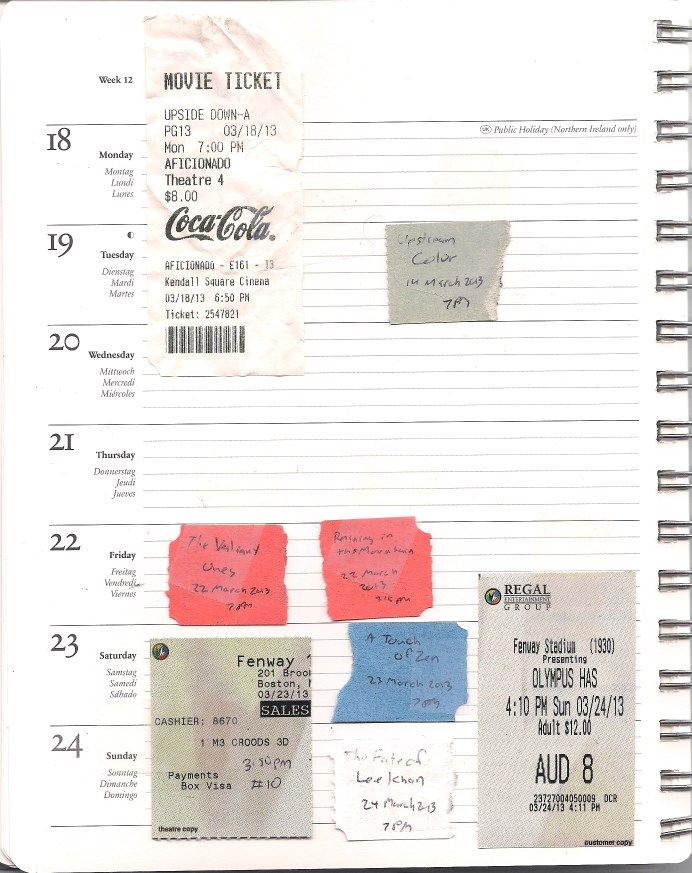
Heh, Upside Down and Upstream Color on consecutive nights. I don't think I actually noticed that until putting the tickets side-by-side like that.
I'd hoped to keep the streak of peculiar movies going with The ABCs of Death on Wednesday, but the clock in the comic shop is off by ten minutes and for a 26-shorts-in-just-over-two-hours anthology like that, that means walking in for "C", and for all I know, "A" and "B" are the coolest parts. Anybody have an opinion on whether the Blu-ray is worth ordering sight unseen? I'm tempted, as there are a lot of people involved that I really like.
The weekend was all about the second weekend of the HFA's King Hu series, with everything else having to work around it. I must say, that was a genuinely fun binge - eight or nine hours of high-quality martial arts in one weekend, leading to me appreciating King Hu, Hsu Feng, and what almost amounted to a repertory cast. I wasn't expecting to see some of Sammo Hung's early work as a fight choreographer, either (although seeing his character get referred to as "the fat one" in A Touch of Zen made me sigh a bit; he wasn't that big yet).
I did wind up cutting it fairly close on both weekend evenings because it's a bit of a toss-up as to whether the subway or the bus gets one from Fenway to Harvard Square faster (it basically comes down to how soon long before the next 47 bus), so I wound up doing a bit of rushing after seeing The Croods on Saturday and Olympus Has Fallen on Sunday. Worth the rush on the "after" end both nights, but for "before", well...
Olympus Has Fallen
* * (out of four)
Seen 24 March 2013 in Regal Fenway #8 (first-run, DCP)
I don't know that this is something I can really recommend; it is really just chock-full of stupid, starting from North Korea being able to get the amount of manpower necessary for this operation - that's a LOT of spies who have infiltrated the south or turned traitor there put in one group which just gets improbably bigger as the movie goes on. Then there's the "why are you letting it be known that someone's been rescued when you could make the terrorists waste resources by continuing to look for him?" thing, the terrible security on a system much more important than my email account, the way it pretty much photocopies a script of Die Hard but sucks a lot of the wit and personality out. It's a pretty dumb movie.
On the other hand, it knows what it is and embraces that. Not necessarily the "stupid" part, but it's the sort of action movie that wants to reach directly into a primal part of the audience's brain where killing your enemy feels good - there's a finality to it, a sense of solving a problem for good. It feels even better if their crimes are especially heinous, so if they can be some sort of foreign boogeyman, so much the better. Thus, lots of mayhem, national landmarks destroyed, and headshots. Lots and lots of headshots. It's the sort of movie where the audience cheers at a character fulfilling a promise to put a knife in a brain, and as much as it's fairly easy to step outside of oneself and say, hey, that's not good, it works on a gut level. Even most of the women in this movie get to be pretty badass - we expect it from Angela Bassett, of course, and Malana Lea mostly has to look the part as the North Korean hacker, but who here recognizes Melissa Leo not made up like poor white trash - while Robert Forster doesn't particularly impress as an actor but growls in exactly the way you'd expect the Army General in charge of the operation to. Gerald Butler maybe overdoes it a little, but there's Morgan Freeman to counter that.
So it's a movie awash with testosterone, but director Antoine Fuqua is just good enough at channeling it that it's hard to fault the filmmakers for giving the audience what they want, at least while you're watching it. Afterward, some of its attempts to be inspirational - national unity through violence and righteous anger! - are kind of disturbing, even if you were enjoying the headshots an hour earlier.
King Hu and the Art of Wuxia: The Valiant Ones, Raining in the Mountain, A Touch of Zen, and The Fate of Lee Khan
Like I said last week, this was a pretty great series that got my butt in a seat at the HFA for a good chunk of the weekend, and their program explains why. The difference is that this time, I actually had time to make everything I wanted to, although it was a fairly near thing on Saturday and Sunday: One day, I dallied at the comic shop and grabbing a snack before the three hour movie and wound up coming in mid-introduction; the other, I only had about a half hour to get to the HFA from Regal Fenway and was honestly quite lucky that I had about zero wait for the 47 and 1 buses.
Also sort-of lucky: When they had a last-minute problem with rights and couldn't get Legend of the Mountain for Sunday night, they substituted The Fate of Lee Khan, one of the ones I missed last week because of the Chlotrudis award ceremony, and one which I was quite glad to get the chance to see, because it was a blast. It was, as you might imagine, the most sparsely attended screening, as most of the audience for it probably went to the first screening when it was expected to be the only one. Naturally, once they had to cancel the screening, they were able to clear up the rights issues, and suggested that it might make it onto the schedule at a later date. If that's the case, then it appears I was lucky enough to only miss Come Drink With Me. A shame, but it's also the one that's readily available on video.
Another bonus: I wasn't really expecting this weekend to have as much Sammo Hung involvement as it did. I'd sort of thought of this period as before his time, but one of the things I remembered being mentioned when he appeared at the New York Asian Film Festival a couple years back was that he started a bit earlier than some of his famous Peking Opera School classmates and brought them into the film industry, so I shouldn't be surprised to see his name popping up on this movies from the first half of the 1970s. He choreographed the fights in The Valiant Ones and The Fate of Lee Khan and also appeared in A Touch of Zen and The Valiant Ones (although I wonder if the IMDB/HKMDB listings for the latter are incomplete - I was sure he played one of the fighters in that as opposed to the Japanese villain with the painted face). That was a really pleasant surprise, as he's a favorite and it's a nifty surprise to see him show up in those, even if he's one of those actors I tend to think of as springing into existence middle-aged, making "young Sammo" look strange to me.
Oh, and just for a bit of symmetry with last week's posting, here's a shot of the nifty poster hanging in the lobby this week:
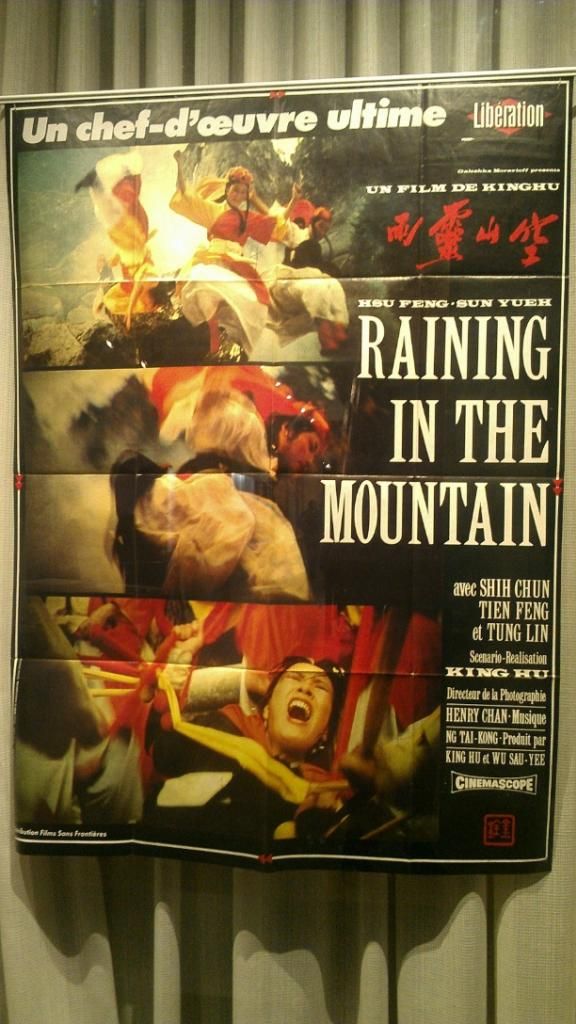
Not quite so helpful as last week's, although I was able to find the Hong Kong Movie Database instead, which does a pretty good job of filling in the blanks plain old IMDB leaves. Eventually, I'll hopefully find a good site like this for every country whose movies I watch.
Zhong lie tu (The Valiant Ones)
* * * ¾ (out of four)
Seen 22 March 2013 in the Harvard Film Archive (King Hu and the Art of Wuxia, 35mm)
It's stereotyping things a little - okay, a lot - to suggest that the audience that comes to a King Hu series as the Harvard Film Archive whose program talks about the effect these movies had on the Taiwanese film industry or how Hu's wuxia films were like Kurosawa's samurai films or Ford's westerns (superficially pulpy but thematically rich) can't love the same sort of things as the crowd for the late and lamented "Weekly Wednesday Ass-Kickings" series. But even if you reject that claim entirely, you've got to admit - any movie that has an audience in the HFA making swishing sounds during the swordfights is doing something right.
Attacks by Japanese pirates and native bandits along the coast of China during the reign of Ming emperor Chiang-chen (Zhao Lei) have become enough of an issue that even that decadent monarch decides something needs to be done, and the new governor he appoints for the province, Lin Mao-he (Wu Chia-hsiang) decides that General Chi Li-te (Ho Li-jen) will not be enough to solve the problem. He brings in Colonel Yu Ta-yu (Roy Chiao), who is not just a fine swordsman, but has equal reputations for being devious and cocky. He not only brings a group of soldiers, but a pair of secret weapons: Wu Chi-yuan (Bai Ying), the former bandit known as "The Whirlwind", and his wife Re-shi (Hsu Feng).
Yu Ta-yu has a fair number of men with him, and there's a seemingly endless number of bandits to deal with. That means we're in for a lot of fight scenes - the action's not quite non-stop, but the pauses in between are by and large about Yu plotting where he will next attempt to fight the pirates or attempting to defeat them with subterfuge. King Hu and company knew why people were going to buy tickets for this, and he gave the audience what it wanted. The action isn't just massive in quantity, though - with the action directed by then-up-and-coming fight choreographer Sammo Hung, who also has a role as one of the main villains, it's fast-paced and hard-hitting. There's so much action that one sequence, where the Wus fight a series of bandits in order to demonstrate their skills (including future star Yuen Biao among others), actually starts to seem like too much, with the audience well ready for some more plot by the time it's over.
Full review on eFilmCritic.
Kong shan ling yu (Raining in the Mountain)
* * * (out of four)
Seen 22 March 2013 in the Harvard Film Archive (King Hu and the Art of Wuxia, 35mm)
There's a special delight to be found in setting a heist caper in a place where everybody should be above that sort of criminal activity - well, more so than we all should. That's a big part of what makes Raining in the Mountain a lot of fun at its best moments, and why any swing back toward sincerity is something that must be handled carefully.
The goal of this particular band of thieves is a scroll written by the monk Tripitaki himself. It is stored at the Three Treasures Temple, whose abbot is retiring, and has asked Esquire Wen (Suen Yuet) to help him choose a successor. Coveting the scroll, Wen has two plans - firstly, the abbot's second disciple Hui Wan (Lu Chan) has agreed to give it to him if chosen, but the woman he introduces as his concubine is actually White Fox (Hsu Feng), a master thief. Wen isn't the only friend advising the abbot, though - General Wang Chi (Feng Tien) seems to have a similar deal with first disciple Hui Tung (Shih Jun), and his aide Chang Chen is a former policeman who once arrested White Fox. Then there's lay expert Wu Wai (Wu Chia-hsiang), who travels with an entourage of beautiful women, and convict Chiu Ming (Tung Lam), who has paid a special fine to enter the monastery and become a monk at just this time.
It doesn't exactly seem as though anybody in this place has made particularly great progress in freeing himself or herself from desire, does it? There's a vein of cheerfully wry cynicism running through the movie, especially at the start, as the monks sneak off to buy things from merchants and White Fox has trouble understanding exactly both why Wen wants this scroll so badly and how the temple's three treasures can be intangible qualities. The thief, it turns out, may be the most honest person there.
Full review on eFilmCritic.
Xia nu (A Touch of Zen, aka Swordswoman)
* * * ¾ (out of four)
Seen 23 March 2013 in the Harvard Film Archive (King Hu and the Art of Wuxia, 35mm)
A Touch of Zen is widely considered King Hu's masterpiece, finding respect at the Cannes Film Festival several years after a difficult production and underwhelming box office in its native Taiwan. Though not my favorite of the six films I saw in this series, its position as perhaps Hu's greatest is easy to understand; it's a legitimate epic despite the simple foundation it is built on, and scores a lot of points for succeeding in its ambitions.
It starts at Ching Lu Fort, where the run-down mansion of General Chun Luan is said to be haunted. Ku Shen-chai (Shih Jun) lives next door along with his mother (Cheung Bing-yuk); he makes a modest living doing portraiture and calligraphy in a nearby town. His latest customer, Ou-yang Nin (Tien Peng), seems to have a particular interest in anybody who came to town recently, and would likely be particularly curious about Yang Hui-ching (Hsu Feng), who has just moved into the abandoned mansion and is almost quite certainly more than meets the eye.
There are a great number of things that King Hu and company do well with A Touch of Zen, but perhaps the best is the creation of a constant air of intrigue. The story offers mysteries, certainly, but simply asking "what are the noises coming from the empty house" or "just why is Ou-yang so interested in Dr. Lu" is the easy part. The real trick is in making Shen-chai's curiosity infectious, so that as the movie follows his actions, the audience feels themselves put in his position, peeking around corners, following suspicious characters, and suddenly finding that nothing is as it seems. Hu does a nice job pulling back the curtain, too - even if a lot of the backstory turns out to be a reprise of Dragon Inn, it's got a new set of enjoyably pulpy details from "The Twenty-Four Crimes of Eunuch Wei" to bodyguards in disguise to monks who cross the screen with quiet but immense power.
Full review on eFilmCritic.
Ying chun ge zhi Fengbo (The Fate of Lee Khan)
* * * ¼ (out of four)
Seen 24 March 2013 in the Harvard Film Archive (King Hu and the Art of Wuxia, 35mm)
If ever two styles ever seemed to be a poor fit, it's the pressure-cooker thriller and the martial arts action movie: Fighters need room to move, after all, and fights tend to bring things between characters to a head rather than just move them along. Making action movies set in and around inns was sort of King Hu's thing, though, and he manages an impressive balance of intrigue and action in this one even while spending a lot of time in the same building.
It's 1366, and while the Mongols control much of China, there's an active resistance, though some of them are willing to turn traitor. One means to betray the rebels to Lee Khan (Tien Feng), Baron of Hunan. Since Lee Khan and his sister and most trusted ally Lee Wan (Hsu Feng) dislike staying in official residences, they decide to make their home base for this mission the Spring Inn - not knowing that proprietor "Wendy" Wan Hsiao (Li Li-hua) is with the rebels, and the four pretty young waitresses she's hired (Angela Mao Ying, Seung-goon Yin-ngai, Woo Gam & Helen Ma Hoi-lun) are also more than they seem. But what of the guests - a drunkard (Ngai Ping-ngo), a beggar (Han Ying-chieh), a pair of bandits (Ho Pak-kwong & Yi Fung), and a merchant (Bai Ying) - how many are spies, and for which side?
Hu doesn't exactly keep the audience in the dark about the various characters' allegiances; as his movies were seldom about the sudden revelation as opposed to the steady forward motion of a well-oiled machine. While there aren't necessarily a lot of chances for swordfights to break out in this movie, it often plays out like one - feints, parries, taking steps forward and back, finally ending as the combatants put all their strength into killing blows. It's a nice little dance, with the flow only occasionally interrupted toward the beginning as fights break out in the Spring Inn so that the audience can see what sort of skills the characters bring to that situation.
Full review on eFilmCritic.
Also sort-of lucky: When they had a last-minute problem with rights and couldn't get Legend of the Mountain for Sunday night, they substituted The Fate of Lee Khan, one of the ones I missed last week because of the Chlotrudis award ceremony, and one which I was quite glad to get the chance to see, because it was a blast. It was, as you might imagine, the most sparsely attended screening, as most of the audience for it probably went to the first screening when it was expected to be the only one. Naturally, once they had to cancel the screening, they were able to clear up the rights issues, and suggested that it might make it onto the schedule at a later date. If that's the case, then it appears I was lucky enough to only miss Come Drink With Me. A shame, but it's also the one that's readily available on video.
Another bonus: I wasn't really expecting this weekend to have as much Sammo Hung involvement as it did. I'd sort of thought of this period as before his time, but one of the things I remembered being mentioned when he appeared at the New York Asian Film Festival a couple years back was that he started a bit earlier than some of his famous Peking Opera School classmates and brought them into the film industry, so I shouldn't be surprised to see his name popping up on this movies from the first half of the 1970s. He choreographed the fights in The Valiant Ones and The Fate of Lee Khan and also appeared in A Touch of Zen and The Valiant Ones (although I wonder if the IMDB/HKMDB listings for the latter are incomplete - I was sure he played one of the fighters in that as opposed to the Japanese villain with the painted face). That was a really pleasant surprise, as he's a favorite and it's a nifty surprise to see him show up in those, even if he's one of those actors I tend to think of as springing into existence middle-aged, making "young Sammo" look strange to me.
Oh, and just for a bit of symmetry with last week's posting, here's a shot of the nifty poster hanging in the lobby this week:

Not quite so helpful as last week's, although I was able to find the Hong Kong Movie Database instead, which does a pretty good job of filling in the blanks plain old IMDB leaves. Eventually, I'll hopefully find a good site like this for every country whose movies I watch.
Zhong lie tu (The Valiant Ones)
* * * ¾ (out of four)
Seen 22 March 2013 in the Harvard Film Archive (King Hu and the Art of Wuxia, 35mm)
It's stereotyping things a little - okay, a lot - to suggest that the audience that comes to a King Hu series as the Harvard Film Archive whose program talks about the effect these movies had on the Taiwanese film industry or how Hu's wuxia films were like Kurosawa's samurai films or Ford's westerns (superficially pulpy but thematically rich) can't love the same sort of things as the crowd for the late and lamented "Weekly Wednesday Ass-Kickings" series. But even if you reject that claim entirely, you've got to admit - any movie that has an audience in the HFA making swishing sounds during the swordfights is doing something right.
Attacks by Japanese pirates and native bandits along the coast of China during the reign of Ming emperor Chiang-chen (Zhao Lei) have become enough of an issue that even that decadent monarch decides something needs to be done, and the new governor he appoints for the province, Lin Mao-he (Wu Chia-hsiang) decides that General Chi Li-te (Ho Li-jen) will not be enough to solve the problem. He brings in Colonel Yu Ta-yu (Roy Chiao), who is not just a fine swordsman, but has equal reputations for being devious and cocky. He not only brings a group of soldiers, but a pair of secret weapons: Wu Chi-yuan (Bai Ying), the former bandit known as "The Whirlwind", and his wife Re-shi (Hsu Feng).
Yu Ta-yu has a fair number of men with him, and there's a seemingly endless number of bandits to deal with. That means we're in for a lot of fight scenes - the action's not quite non-stop, but the pauses in between are by and large about Yu plotting where he will next attempt to fight the pirates or attempting to defeat them with subterfuge. King Hu and company knew why people were going to buy tickets for this, and he gave the audience what it wanted. The action isn't just massive in quantity, though - with the action directed by then-up-and-coming fight choreographer Sammo Hung, who also has a role as one of the main villains, it's fast-paced and hard-hitting. There's so much action that one sequence, where the Wus fight a series of bandits in order to demonstrate their skills (including future star Yuen Biao among others), actually starts to seem like too much, with the audience well ready for some more plot by the time it's over.
Full review on eFilmCritic.
Kong shan ling yu (Raining in the Mountain)
* * * (out of four)
Seen 22 March 2013 in the Harvard Film Archive (King Hu and the Art of Wuxia, 35mm)
There's a special delight to be found in setting a heist caper in a place where everybody should be above that sort of criminal activity - well, more so than we all should. That's a big part of what makes Raining in the Mountain a lot of fun at its best moments, and why any swing back toward sincerity is something that must be handled carefully.
The goal of this particular band of thieves is a scroll written by the monk Tripitaki himself. It is stored at the Three Treasures Temple, whose abbot is retiring, and has asked Esquire Wen (Suen Yuet) to help him choose a successor. Coveting the scroll, Wen has two plans - firstly, the abbot's second disciple Hui Wan (Lu Chan) has agreed to give it to him if chosen, but the woman he introduces as his concubine is actually White Fox (Hsu Feng), a master thief. Wen isn't the only friend advising the abbot, though - General Wang Chi (Feng Tien) seems to have a similar deal with first disciple Hui Tung (Shih Jun), and his aide Chang Chen is a former policeman who once arrested White Fox. Then there's lay expert Wu Wai (Wu Chia-hsiang), who travels with an entourage of beautiful women, and convict Chiu Ming (Tung Lam), who has paid a special fine to enter the monastery and become a monk at just this time.
It doesn't exactly seem as though anybody in this place has made particularly great progress in freeing himself or herself from desire, does it? There's a vein of cheerfully wry cynicism running through the movie, especially at the start, as the monks sneak off to buy things from merchants and White Fox has trouble understanding exactly both why Wen wants this scroll so badly and how the temple's three treasures can be intangible qualities. The thief, it turns out, may be the most honest person there.
Full review on eFilmCritic.
Xia nu (A Touch of Zen, aka Swordswoman)
* * * ¾ (out of four)
Seen 23 March 2013 in the Harvard Film Archive (King Hu and the Art of Wuxia, 35mm)
A Touch of Zen is widely considered King Hu's masterpiece, finding respect at the Cannes Film Festival several years after a difficult production and underwhelming box office in its native Taiwan. Though not my favorite of the six films I saw in this series, its position as perhaps Hu's greatest is easy to understand; it's a legitimate epic despite the simple foundation it is built on, and scores a lot of points for succeeding in its ambitions.
It starts at Ching Lu Fort, where the run-down mansion of General Chun Luan is said to be haunted. Ku Shen-chai (Shih Jun) lives next door along with his mother (Cheung Bing-yuk); he makes a modest living doing portraiture and calligraphy in a nearby town. His latest customer, Ou-yang Nin (Tien Peng), seems to have a particular interest in anybody who came to town recently, and would likely be particularly curious about Yang Hui-ching (Hsu Feng), who has just moved into the abandoned mansion and is almost quite certainly more than meets the eye.
There are a great number of things that King Hu and company do well with A Touch of Zen, but perhaps the best is the creation of a constant air of intrigue. The story offers mysteries, certainly, but simply asking "what are the noises coming from the empty house" or "just why is Ou-yang so interested in Dr. Lu" is the easy part. The real trick is in making Shen-chai's curiosity infectious, so that as the movie follows his actions, the audience feels themselves put in his position, peeking around corners, following suspicious characters, and suddenly finding that nothing is as it seems. Hu does a nice job pulling back the curtain, too - even if a lot of the backstory turns out to be a reprise of Dragon Inn, it's got a new set of enjoyably pulpy details from "The Twenty-Four Crimes of Eunuch Wei" to bodyguards in disguise to monks who cross the screen with quiet but immense power.
Full review on eFilmCritic.
Ying chun ge zhi Fengbo (The Fate of Lee Khan)
* * * ¼ (out of four)
Seen 24 March 2013 in the Harvard Film Archive (King Hu and the Art of Wuxia, 35mm)
If ever two styles ever seemed to be a poor fit, it's the pressure-cooker thriller and the martial arts action movie: Fighters need room to move, after all, and fights tend to bring things between characters to a head rather than just move them along. Making action movies set in and around inns was sort of King Hu's thing, though, and he manages an impressive balance of intrigue and action in this one even while spending a lot of time in the same building.
It's 1366, and while the Mongols control much of China, there's an active resistance, though some of them are willing to turn traitor. One means to betray the rebels to Lee Khan (Tien Feng), Baron of Hunan. Since Lee Khan and his sister and most trusted ally Lee Wan (Hsu Feng) dislike staying in official residences, they decide to make their home base for this mission the Spring Inn - not knowing that proprietor "Wendy" Wan Hsiao (Li Li-hua) is with the rebels, and the four pretty young waitresses she's hired (Angela Mao Ying, Seung-goon Yin-ngai, Woo Gam & Helen Ma Hoi-lun) are also more than they seem. But what of the guests - a drunkard (Ngai Ping-ngo), a beggar (Han Ying-chieh), a pair of bandits (Ho Pak-kwong & Yi Fung), and a merchant (Bai Ying) - how many are spies, and for which side?
Hu doesn't exactly keep the audience in the dark about the various characters' allegiances; as his movies were seldom about the sudden revelation as opposed to the steady forward motion of a well-oiled machine. While there aren't necessarily a lot of chances for swordfights to break out in this movie, it often plays out like one - feints, parries, taking steps forward and back, finally ending as the combatants put all their strength into killing blows. It's a nice little dance, with the flow only occasionally interrupted toward the beginning as fights break out in the Spring Inn so that the audience can see what sort of skills the characters bring to that situation.
Full review on eFilmCritic.
Monday, March 25, 2013
Upstream Color
This movie's going to be returning to the Brattle on 12 April 2013 for a ten-day run (and a few other cities in that timeframe), and will be available on video about a month later, and I recommend checking it out. That's an insanely quick turnaround from just showing at Sundance in January, and I'm not sure whether writer/director/producer Shane Carruth is doing it that way because he wants to get people in front of it before what's in the movie is common knowledge or because he's self-distributing and there's no point in having it not be earning money for him (or having interest rack up if he borrowed to finance it). The result's the same, though- there's a chance to see it while its festival praise is still in the audience's head, and that's cool and somewhat rare.
In between the festivals and the limited release, Carruth is doing a few "pop-up" screenings with Q&A, and the one in Cambridge was pretty good.
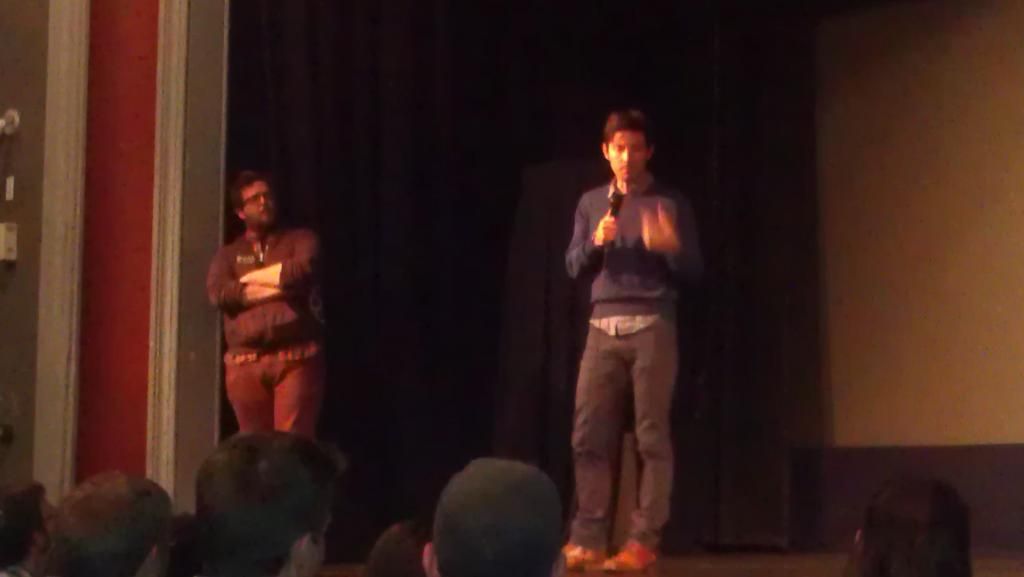
The Brattle's Ned Hinkle & Upstream Color's Shane Carruth
He's an affable guy on-stage, able to talk about the various pros and cons of making and distributing movies independently without complaint or agenda; no "poor me" or "this is the future and you'd better get on board" here. He was also quite willing to put what he was thinking about when making the movie out there rather than play coy or ask what the audience thinks something means, even while acknowledging that ideally we wouldn't be having that discussion now as opposed to have thing audience retire to a cafe and thrash it out amoung themselves (heck, even the cafe thing sounded neither snobby nor like a joke about the pretentious art-house types).
I've got a few thoughts for after seeing the movie, but I'll put them after the EFC excerpt.
One unrelated thought - how the heck is Primer more-or-less out of print right now? You can stream it on Amazon (at least), but DVDs are tough to come buy and I don't think there was ever a Blu-ray. I wonder if the rights have reverted back to Carruth (in which case, bravo on being prescient enough to not sell them nine years ago) or if it's just somewhat poor planning on whoever owns them.
Upstream Color
* * * ¾ (out of four)
Seen 19 March 2013 in the Brattle Theatre (preview, Blu-ray)
For all that the interconnectedness of today's world is wonderful in many ways, it can make it harder for something to truly take one by surprise - there's non-stop casting news, coverage, previews, and analysis of it commercial and artistic outlook to the point where a person can feel sick of a movie weeks before it opens in theaters. And yet, the same tools that enable that also mean that somebody with the talent to take on multiple jobs can make something that's kind of amazing even if it does take few enough resources that it barely shows up on the radar, meaning it's possible to go in not knowing what to expect. That's the case with Upstream Color, Shane Carruth's first film since Primer, his equally-but-differently-peculiar debut almost a decade ago.
Kris (Amy Seimetz) is a mess, working a job well below what she was once capable of and feeling angry and confused much of the time. Jeff (Carruth) falls for her anyway, feeling a strange connection beyond the usual; though outwardly more in-sync with the world around him, he's got issues of his own. As they pull together, they may eventually discover just what was going on with Kris during the first half-hour of the movie.
It's admittedly kind of unusual to skip over the beginning of a movie when giving the audience a taste of what it's about, but Upstream Color is an unusual movie in that it pushes its more fantastical elements early before coming to rest in a more conventional situation. The viewer gets a double-sized serving of disorientation, with much of the first act being the sort of strangeness that other films would plunge into only after establishing a familiar world and a main character to identify with. This makes for a weirdly inverted sort of movie, where the old "everything you know is wrong" trope less a chance to prove doubters wrong than a wound that it may not be possible to heal from.
Full review on eFilmCritic.
SPOILERS!
Not really a whole lot to say here; maybe a little more come mid-April when I've had a chance to see the movie again. I mostly want to acknowledge that the most amusing bit from the Q&A was about how they had to scrap a lot of effects shots from the movie which showed yellow stuff overpowering the blue contaminants in Kris's body despite their being some of the coolest things they made because this was threatening to become a movie about Kris's bloodstream. It's a rather unique thing for a filmmaker to have to say, as is using the phrase "pig-flower-worm life-cycle". I am the guy who is going to love that, though.
I do have to admit that I didn't exactly grasp one of the main things he described the film being about as science fiction until he started talking about it in the Q&A while watching the movie, that Kris's self had been disassembled and reassembled wrong, which is a shame, because I love that sort of reconfigured-identity thing. I didn't really see any mechanism in the movie where her brain was emptied and refilled; I mostly saw someone who had been submerged beneath the Thief's will and had the memories of that time blocked. When she and Jeff started sharing the same childhood memories, I took that as them being connected now (via a peculiar telepathic-pig neural network because this movie is very strange), rather than some of Jeff's memories actually having been implanted in her.
!SRELIOPS
All of that may go to the point Carruth was talking about, that we maybe really shouldn't have these Q&As right away, especially with someone so willing to answer questions - in other circumstances, I would have had this theory, talked with others, and maybe shared alternatives or had something I missed pointed out, leading to a refined theory. Instead, I feel like a bad, less-than-completely-attentive moviegoer right away, and there will be no figuring-things-out post that drives a whole bunch of folks to this site like there is for Triangle. Kind of a bummer, that, but I still got to see a pretty nifty movie, so things are still good.
In between the festivals and the limited release, Carruth is doing a few "pop-up" screenings with Q&A, and the one in Cambridge was pretty good.

The Brattle's Ned Hinkle & Upstream Color's Shane Carruth
He's an affable guy on-stage, able to talk about the various pros and cons of making and distributing movies independently without complaint or agenda; no "poor me" or "this is the future and you'd better get on board" here. He was also quite willing to put what he was thinking about when making the movie out there rather than play coy or ask what the audience thinks something means, even while acknowledging that ideally we wouldn't be having that discussion now as opposed to have thing audience retire to a cafe and thrash it out amoung themselves (heck, even the cafe thing sounded neither snobby nor like a joke about the pretentious art-house types).
I've got a few thoughts for after seeing the movie, but I'll put them after the EFC excerpt.
One unrelated thought - how the heck is Primer more-or-less out of print right now? You can stream it on Amazon (at least), but DVDs are tough to come buy and I don't think there was ever a Blu-ray. I wonder if the rights have reverted back to Carruth (in which case, bravo on being prescient enough to not sell them nine years ago) or if it's just somewhat poor planning on whoever owns them.
Upstream Color
* * * ¾ (out of four)
Seen 19 March 2013 in the Brattle Theatre (preview, Blu-ray)
For all that the interconnectedness of today's world is wonderful in many ways, it can make it harder for something to truly take one by surprise - there's non-stop casting news, coverage, previews, and analysis of it commercial and artistic outlook to the point where a person can feel sick of a movie weeks before it opens in theaters. And yet, the same tools that enable that also mean that somebody with the talent to take on multiple jobs can make something that's kind of amazing even if it does take few enough resources that it barely shows up on the radar, meaning it's possible to go in not knowing what to expect. That's the case with Upstream Color, Shane Carruth's first film since Primer, his equally-but-differently-peculiar debut almost a decade ago.
Kris (Amy Seimetz) is a mess, working a job well below what she was once capable of and feeling angry and confused much of the time. Jeff (Carruth) falls for her anyway, feeling a strange connection beyond the usual; though outwardly more in-sync with the world around him, he's got issues of his own. As they pull together, they may eventually discover just what was going on with Kris during the first half-hour of the movie.
It's admittedly kind of unusual to skip over the beginning of a movie when giving the audience a taste of what it's about, but Upstream Color is an unusual movie in that it pushes its more fantastical elements early before coming to rest in a more conventional situation. The viewer gets a double-sized serving of disorientation, with much of the first act being the sort of strangeness that other films would plunge into only after establishing a familiar world and a main character to identify with. This makes for a weirdly inverted sort of movie, where the old "everything you know is wrong" trope less a chance to prove doubters wrong than a wound that it may not be possible to heal from.
Full review on eFilmCritic.
SPOILERS!
Not really a whole lot to say here; maybe a little more come mid-April when I've had a chance to see the movie again. I mostly want to acknowledge that the most amusing bit from the Q&A was about how they had to scrap a lot of effects shots from the movie which showed yellow stuff overpowering the blue contaminants in Kris's body despite their being some of the coolest things they made because this was threatening to become a movie about Kris's bloodstream. It's a rather unique thing for a filmmaker to have to say, as is using the phrase "pig-flower-worm life-cycle". I am the guy who is going to love that, though.
I do have to admit that I didn't exactly grasp one of the main things he described the film being about as science fiction until he started talking about it in the Q&A while watching the movie, that Kris's self had been disassembled and reassembled wrong, which is a shame, because I love that sort of reconfigured-identity thing. I didn't really see any mechanism in the movie where her brain was emptied and refilled; I mostly saw someone who had been submerged beneath the Thief's will and had the memories of that time blocked. When she and Jeff started sharing the same childhood memories, I took that as them being connected now (via a peculiar telepathic-pig neural network because this movie is very strange), rather than some of Jeff's memories actually having been implanted in her.
!SRELIOPS
All of that may go to the point Carruth was talking about, that we maybe really shouldn't have these Q&As right away, especially with someone so willing to answer questions - in other circumstances, I would have had this theory, talked with others, and maybe shared alternatives or had something I missed pointed out, leading to a refined theory. Instead, I feel like a bad, less-than-completely-attentive moviegoer right away, and there will be no figuring-things-out post that drives a whole bunch of folks to this site like there is for Triangle. Kind of a bummer, that, but I still got to see a pretty nifty movie, so things are still good.
Sunday, March 24, 2013
The Croods
We really need some folks writing at EFC who have kids to watch these movies with. Don't get me wrong, I like them and like reviewing them, but as a single childless almost-forty-year-old, I've got no idea how it plays to kids in the audience. I like the one, but I don't know if my usual technique of disassembling how it works necessarily works out as helpful.
At any rate, it's the new DreamWorks Animation movie, although it's weird seeing the Fox logo come up before it - I'd forgotten they signed a distribution deal. Between the DreamWorks and Blue Sky movies, Fox is going to be putting three or four animated movies out per year, which seems like rather a lot - probably more than Disney, which still seems to be sticking with one Pixar and one Disney Feature Animation release (augmented by a couple of 3D re-releases or something like Frankenweenie). Given that there was also a trailer for Despicable Me 2 and a Cloudy with a Chance of Meatballs 2 featurette in the pre-show, I wonder if we're likely to see another glut like in the mid-to-late-nineties. In some way, the implosion has already happened, with Robert Zemeckis's motion-capture studio shut down, but DreamWorks keeps expanding to fill the gap.
At least DreamWorks's expansion doesn't seem to be at the expanse of quality - a lot of the last animation expansion resulted in fairly mediocre movies, but DreamWorks has quietly built a solid reputation. Part of it is leaning on brands that have become popular, like Shrek, Madagascar, Kung Fu Panda, and How to Train Your Dragon getting sequels and spin-offs, but if that many movies are taking off expansions, well, you're probably doing something right. It's not just doing marketable movies, either; yes, these movies do sell a lot of toys, but they haven't felt hollow or too obviously built on a template. That's perhaps more than can be said of Pixar of late - and even now, it's hard not to see DreamWorks and Pixar as rivals of a sort, ever since Antz and A Bug's Life came out within a couple months of each other - although I don't know if their public profile has gotten a boost to go with Pixar's hit.
One thing that DreamWorks has always focused on more than Disney & Pixar is the celebrity voicing, most noticeably promoting Shrek's voice cast a lot harder than was customary at the time but even way back with Antz, the notoriety of casting Woody Allen and Sylvester Stallone as best friends was a big thing. It's interesting, here, just how much some of the characters, particularly Nicolas Cage's Grug and Catherine Keener's Ugga, really seem to be modeled on their actors. They're not actual likenesses, or even distorted ones, but Grug certainly evokes Cage enough that it's hard to imagine someone else voicing him for a sequel/spin-off. Impressive, considering how much the character's design emphasizes him as homo sapiens neanderthalis.
As good as it is, I do find myself wondering about what could have been - this was originally conceived by John Cleese to be produced by Aardman, but wound up at DreamWorks when the deal between the two companies fell apart (back when DreamWorks was a studio that could distribute other productions). I suspect it would have been a CGI production over there, too, although maybe with Grug based on Ray Winstone or Robbie Coltrane rather than Cage. The strange thing is that there's no obvious role for Cleese here - would there have been a grandfather rather than a grandmother? - and I can't really recall him ever writing things that he didn't have a part in.
The Croods
* * * (out of four)
Seen 23 March 2013 in Regal Fenway #10 (first-run, RealD 3D)
Not that the kids in the audience will care that much, but I'd like to know just how much John Cleese material is left in The Croods. Probably very little, and I'd like to see what that movie would have been like. Probably still weird but enjoyable, just in a different way.
Natural selection hasn't been good to cave people, with the Crood family - father Grug (voice of Nicolas Cage), mother Ugga (voice of Catherine Keener), teenage daughter Eep (voice of Emma Stone), son Thunk (voice of Clark Duke), baby Sandy, and Ugga's mother Gran (voice of Cloris Leachman) - still hanging in there because Grug has them retreat to safety at the first sign of danger, much to Eep's chagrin. That changes when she sneaks out one night and meets a cute home sapiens sapiens, Guy (voice of Ryan Reynolds) who brings both fire and warning that the world is about to end.
Not our world, precisely - early shots show an Earth with Pangaea splitting into the familiar continents, but there wouldn't have been humans around then, so figure it's a wholly imaginary storybook world - one with a thoroughly amazing variety of flora and fauna, half impossible, mostly carnivorous, but all colorful and not just pretty but an ideal fit for the movie's world. They've got the exaggerated features of cartoons but also enough weight and balance to feel like genuine dangers when they need to. Take the sabertoothed tiger that follows and menaces them; his big head makes him adorable, but you wouldn't want to be between him and his dinner. The landscape itself is just as wild, and there are very few moments when there's not something on-screen worth gawking at a little.
Full review on eFilmCritic.
Friday, March 22, 2013
Next Week in Tickets: Films playing Boston 22 March - 28 March 2013
Another crazy busy week coming up... I'm going to be worn out at work, I can tell.
My plans? King Hu, BUFF, and whatever I can fit in between, probably Spring Breakers, Lore, Olympus Has Fallen, and/or The Croods.
- Why? Well, for one thing, it's the start of The Boston Underground Film Festival on Wednesday the 27th! BUFF is one of the area's most exciting festivals, running a full five days this year, and as usual, it's got a great mix of things that were hits at other festivals and things that are extremely unlikely to play other festivals. You won't like everything there, but that's half the point. Wednesday night things kick off with I Declare War, followed by a special anniversary screening of The Manson Family; Thursday offers Blue Dream, A Band Called Death, and Sion Sono's Guilty of Romance!
It's not the only festival that the Brattle hosts this week; Women, Action, & the Media (WAM!) has their Boston film Festival on Saturday and Sunday (the 23rd & 24th) - Documentary shorts, Incredible Lalita, and Bordering on Treason/Words of Witness Saturday evening with Circus Dreams and Experimental & Animated Shorts Sunday afternoon. Sort of, but not quite, related is a pair of Women In Comedy Festival shows of Maria Bamford on Friday.
That leaves a few holes in the schedule, with Willy Wonka and the Chocolate Factory running Saturday afternoon and Sunday evening. The Wizard of Oz was originally scheduled, but it looks like Warner's holding it back so as not to boost that other Oz movie (heck, it's out of print on video, although I seem to recall there's a big re-release coming for next year's 75th anniversary). Monday evening is the DocYard screening of Informant, with director Jamie Meltzer on-hand to answer questions about his movie about a onetime liberal hero whose information led to two arrests at the 2008 Republican National Convention. - The Coolidge Corner Theatre doesn't settle for opening things a week or two after other places this weekend, with two noteworthy first-run films opening. First is Spring Breakers (also playing Somerville, Kendall Square, Boston Common, and Fenway), where provocateur director Harmony Korine takes four teen stars with family-friendly reputations and throws them in with a drug dealer played by James Franco on one crazy Spring Break. It's on 35mm at Coolidge, probably digital everywhere else. They also get Walter Salles's adaptation of On the Road (as does Kendall Square), with Sam Riey and Garrett Hedlund as a road-tripping pair who encounter the likes of Kristen Stewart, Viggo Mortinson, Kirsten Dunst, Alice Braga, Amy Adams, and more. It plays screen 2 in the afternoons and moves to the video screening room in the evening so that Stoker can play on film.
What else? Well, Friday and Saturday midnight screenings of Weird Al Yankovic's UHF, featuring a pre-Kramer Michael Richards. Sunday Morning, Goethe-Institut has the latest film by Hans-Christian Schmid, Home for the Weekend. And Thursday night's francophone film is Toussaint Louvrture, a three-hour biography of the eighteenth-century Haitian slave known as "The Black Spartacus". - In addition to Spring Breakers and On the Road, Kendall Square has a couple other movies opening. Ginger & Rosa is a coming-of-age story from Sally Potter that's impressive in how well it sneaks up on you after seeming like maybe not much. Elle Fanning's great in it. There's also a one-week booking scheduled for The Silence, a German film that kicks off with an unsolved crime being meticulously recreated twenty-three years later.
- The multiplexes also open Spring Breakers, but they pick up three other movies too. The most screens go to The Croods, a new animated film from DreamWorks that features a family of cave-people forced to encounter the outside world as their home is destroyed; it plays the Arlington Capitol, Fresh Pond, Boston Common, and Fenway in both 3D and 2D. The next-most screens seem to be going to Olympus Has Fallen, a "Die Hard in the White House" thriller with Gerard Butler as the Secret Service agent left standing when terrorists capture the President (Aaron Eckhart) within his home. It plays Somerville, Fresh Pond, Fenway (including the RPX screen), and Boston Common.
Surprisingly, considering the sheer number of times the preview has played, Admission is playing single screens at the Capitol, Boston Common, Fenway, and Fresh Pond. It's the one with Tina Fey as a Princeton admissions officer who visits former classmate Paul Rudd and may find both romance and the son she gave up for adoption when she was younger. - More King Hu wuxia at the Harvard Film Archive! Four different movies to see this weekend - his last swordfighting movie The Valiant Ones (Friday evening and Sunday afternoon), intrigue in a monastery in Raining in the Mountain (Friday night), and second screenings of A Touch of Zen (Saturday evening) and The Fate of Lee Khan(Sunday evening, replacing Legend of the Mountain). On Monday night, there's An Evening with Robert Beavers, featuring the experimental filmmaker and several of his films. Be aware that the schedule says latecomers will not be admitted!
- At the MFA, the 12th Annual Turkish Film Festival which began on Thursday continues with two shows per day on Friday, Saturday, and Sunday. It will pick back up again next Friday, but before that, Canada's Oscar nominee for Best Foreign Language Film War Witch - about a girl pressed into duty as a soldier in Africa - has its first screening on Thursday the 28th, running at various times through April 3rd.
- ArtsEmerson's film program carries its women-in-film program over from last weekend, with Lisa Cholodenko's The Kids are All Right and Jessica Yu's In the Realms of the Unreal on Friday (Kids also plays Sunday afternoon), with two screenings of Ava Duvernay's Middle of Nowhere (preceded by Jordan Salvatoriello's "Graceland Girls" for the matinee) and one of Cholodenko's High Art on Saturday. All are on DVD or Blu-ray.
The Bright Lights programs are fairly strong this week, with Inside Lara Roxx playing Tuesday evening with director Mia Donovan on-hand for Q&A; it's an impressively open look at a former porn star who contracted HIV. On Thursday night, Emerson alumnus Drew Tobia presents a preview of See You Next Tuesday, a dark comedy about an unbalanced expectant single mother whose family may be even more messed up than she is. - the Somerville Theatre, in addition to their first-run shows, has special screenings of Denis Leary-produced documentary Burn, an impressive look at Detroit firefighters. Tickets are $15-20, going to charity.
- The Regent Theatre has a second screening of the West End production of Great Expectations on Thursday the 28th. Before that, they've got one of the dozen or so local screenings of documentary Girl Rising on Tuesday the 26th (if you can't make that , check Gathr; there are a couple dozen at various venues over the next month and a half), and a set of three short surfing movies by Charlotte Lagarde in a Focus on Surfing Women on Wednesday the 27th.
My plans? King Hu, BUFF, and whatever I can fit in between, probably Spring Breakers, Lore, Olympus Has Fallen, and/or The Croods.
Thursday, March 21, 2013
This Week In Tickets: 11 March 2013 - 17 March 2013
Chlotrudis Awards stuff dominating my movie-watching time, for good and ill.
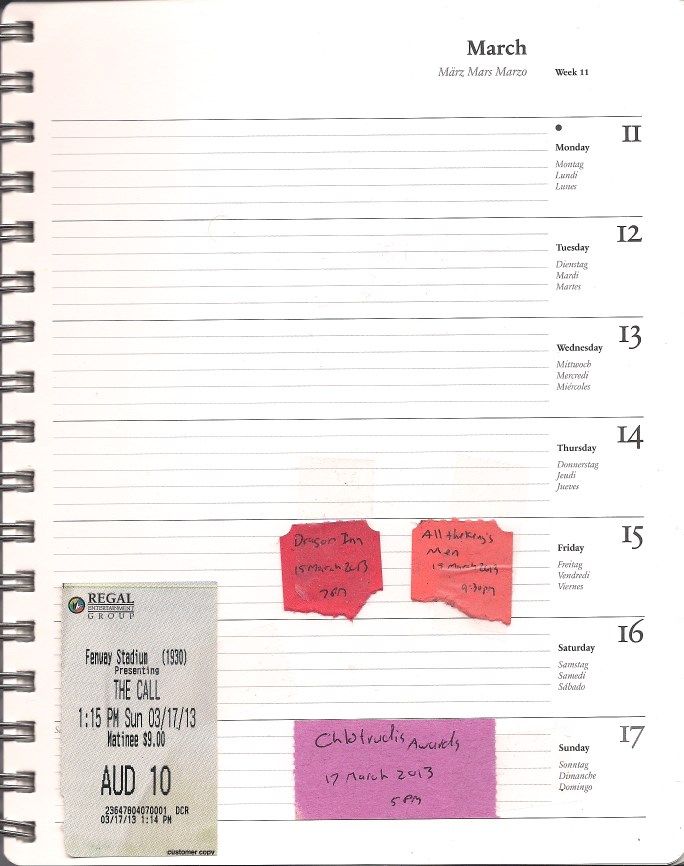
Stubless: The three movies I saw to vote on Chlotrudis's Buried Treasure Award (Beauty Is Embarrassing on Monday, Alps on Tuesday, Sound of Noise on Thursday, all in my living room); and Ginger & Rosa (Sunday at 10am in Coolidge Corner #2).
I think this may be the first year of voting in the Chlotrudis Awards when I've actually seen enough of the movies in the Buried Treasure category to actually vote in the category. I still missed Breathing, but five out of six movies that are, by their nature, difficult to see is not bad, especially when you're the only movie lover in North America without Netflix.
I didn't have quite the busy weekend I initially intended. The two King Hu pictures on Friday night were a start, but were also a lot at the end of the work week. Saturday wound up being a bit of a spring cleaning day, and I didn't feel like I'd make the end of A Touch of Zen, let alone The ABCs of Death - especially with a 10am screening of Ginger & Rosa, which wound up being pretty good, on Sunday morning. After that I went for The Call, trying two theaters before I could get MoviePass to work, and then just barely had time to grab some groceries and a much-needed shower before it was time for "the Trudies".
As usual, it was an amusing enough evening, eventually serving as a wake for the Boston Phoenix, which abruptly ceased publication a few days earlier. It's long been a friend to the organization and film in general, and it's tough to imagine the Dig completely filling the void it leaves.
A lot of the people presenting the awards were from the Phoenix, or other local organizations, and maybe it was because that paper closing means that its critics are, temporarily, just enthusiasts like us, but the thing about the Chlotrudis Awards presentation that has struck me as weird ever since I started attending really stood out: Why don't we, as members, give out our own awards? On one level, it doesn't really matter - folks are only rarely there to pick them up - but as much as it's cool to have guests there validating us as being worthy of the critics' and programmers' and officials' respect, the usual set-up where Chlotrudis members stand on stage, introduce someone else, who reads off the nominees and announces the winner kind of feels like we're stepping aside or making sure that someone with authority speaks for us. I think it would actually be much cooler if the members were standing side-by-side with the guests, rather than ceding the stage.
The awards themselves were a pretty reasonable lot. For a small group like this, just getting seen give a movie a lg up, especially since that lets people discuss it on various forums and boost visibility. So I wasn't surprised that The Perks of Being a Wallflower wound up getting a lot of awards; it got a push. And I can't complain about stuff getting a push, as the movie I nominated for Buried Treasure, A Simple Life wound up winning, despite only one or two of us having seen it before the nominating meeting in January. It gave me a weirdly personal stake in the evening's festivities, which I'm sure the folks who nominated the other films up for consideration must have shared. When that got announced as the last and biggest prize of the night, well, what could I thing but "Suck it, losers!"
I kid, especially since a lot of people at the after-party seemed to be implying that they voted strategically - apparently they saw this having momentum and, having liked it pretty well, voted for it perhaps over their first choice; based upon the number of people who did that, it seemed like Sound of Noise could easily have won. That's why you vote your conscience, folks.
The reception afterward was OK, although I found myself having to leave to get some lobby air after a while - aside from the usual difficulties in being able to hear in a crowded room, it was one of those evenings where something just seemed to assault my sense of smell. In this case, it was cucumbers - normally inoffensive enough, but had me recoiling in full get that away! mode.
It was cool to actually hear people talking about reading and looking forward to what I wrote, though. As much as I write in part because it's the best way for me to organize my thoughts on something, I do like knowing people read it, and looking at the page views on this and eFilmCritic often has me wonder how many are people actually reading and how many are spiders or other robots doing little but cataloging the web. A couple of folks mentioned (one or two actually enthusiastically) reading my reviews and, no joke, that felt really great.
King Hu and the Art of Wuxia: Dragon Inn and All the King's Men
This is one of those series that makes me think that I really should have a membership at the Harvard Film Archive. They have them every once in a while, and it's always a very pleasant surprise - you pick up the schedule, knowing that what's coming is a fairly deep dig into the more obscure corners of world cinema and visits by avant-garde short filmmakers who merge documentary techniques with actually scratching the 16mm film - if you've got somewhat more mainstream tastes, it's often a case of picking and choosing. And then, every once in a while, they'll do two weeks of something that interests you.
I jest about the obscurity of what the HFA shows, because I'm glad there is a place where this sort of deep dive happens - if you want to go more mainstream, the Brattle is right down the road. Because, after all, a series of eight wuxia films from forty years ago, even if it is what gets me excited to come down there is probably not going to move the needle for a lot of others.
Kind of a shame. I'll let the HFA's program do the talking about why King Hu is exciting and important, because they know a whole heck of a lot more about the subject than I do, but I can at least vouch for the prints I saw last Friday night - they were pretty fantastic; the print of Dragon Inn was brand new (as is the A Touch of Zen print that ran last Saturday and this coming Saturday), and I believe they mentioned All the King's Men was from Hu's personal collection, managed by UCLA, as were some other prints. In short, these look really excellent, and I'm looking forward to seeing four more this weekend.
As an aside, reviewing these can be frustrating - IMDB doesn't have a lot of names filled in, the Asian movie databases tend to focus on more recent works, and doing a general web search yielded a lot of works that had the same name both in English and Mandarin (apparently there was a popular and completely Chinese TV show called "Tian xia di yi" a decade or so ago). I couldn't even find any other reviews to scour for names like I could with Dragon Inn. In the end, I was glad I took this picture between films:
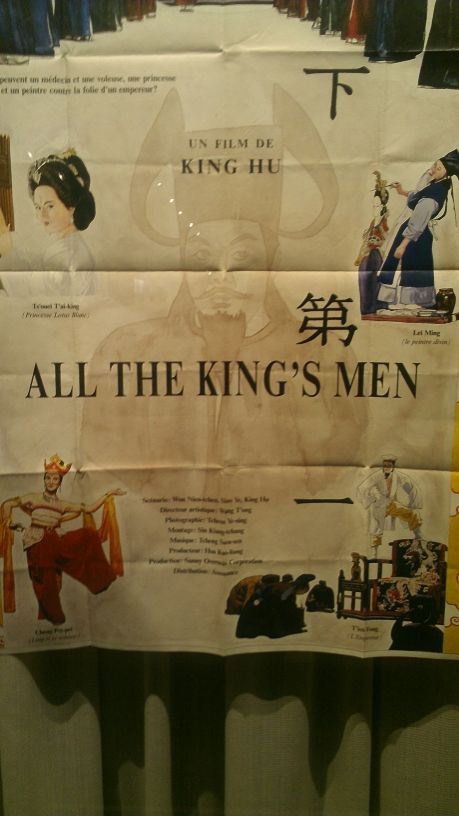
... Because that was the best way to link at least a couple noteworthy characters with the actors who played them.
Long men kezhan (Dragon Inn)
* * * ¾ (out of four)
Seen 15 March 2013 in the Harvard Film Archive (King Hu and the Art of Wuxia, 35mm)
1967's Dragon Inn (Long men kezhan in Mandarin, also known as "Dragon Gate Inn") is kind of a big deal. It's the first film that director King Hu did in Taiwan after leaving Shaw Brothers, in many ways jump-starting that country's film industry. It's been remade and referenced, and its DNA shows up in many movies beyond Hu's "inn films". And most importantly, it's a terrific wuxia film in it's own right.
Minister of Defense Wu Chien has just been executed, thanks in part to lies spread by eunuch Tsao Shao-chin (Bai Ying), who controls both the secretive Eastern Agency and Palace Guards. The Emperor has allowed Wu's family to live in exile, but Tsao figures this will just lead to revenge, and when the first attempt to assassinate them fails, he dispatches the agencies' top swordsmen, Pi Hsiao-tang (Miao Tien) and Mao Tsung-hsien (Han Ying-chieh) to Dragon Gate, when the Wus will cross into Mongolia. They commandeer the local inn, but others also arrive ahead of the Wus: Hsiao Shao-tzu (Shih Chun), a friend of innkeeper Wu Ning (Cho Kin) is first, and then travelers Mr. Chu (Hsieh Han) and Ms. Chu (Polly Shang-kuan) - and the more justice-minded new arrivals have considerable skills with the sword themselves.
That's a lot of information being dumped on the audience for a relatively simple story, especially for Westerners who don't know the sort of politics that went on in Ming Dynasty China, but King Hu lays things out quite clearly after the initial narration. Yes, there are a lot of characters running around and some things are not going to be obvious (Ms. Chu is dressed as a man and this apparently fools most of the characters), but there aren't as many betrayals and double-crosses as later entries in the genre would pile on as twists, and the sides line up as a pretty straightforward good-versus-evil fight rather than a load of competing factions.
Full review on eFilmCritic.
Tian xia di yi (All the King's Men)
* * * (out of four)
Seen 15 March 2013 in the Harvard Film Archive (King Hu and the Art of Wuxia, 35mm)
Palace intrigue in old China... A secret mission... A master thief. All the ingredients for a martial arts epic, except, well, no, that's not what this is at all. Period melodrama? Closer, but it's really more of a dry black comedy.
It's the 10th century BC, the emperor (Tien Feng) is not well, and the medicines he is receiving from con artist "Immortal Li" are in reality only making him worse. There is a man in a nearby kingdom, "Divine Physician" Chang Po-chao, whom it's said could cure his epilepsy, but the only way to bribe the head of the border guard is with a new work by painter Wei Yu-pi. He, meanwhile, wishes to be paid in jade, in fact with a specific piece, which requires a thief. But Ting Yu-yu, the best in the area, claims to be retired, though his daughter Li-ting (Cheng Pei-pei) seems enthusiastic. And for the sake of secrecy, the archivists originally sent to recruit Chang don't even know it's on behalf of the emperor!
There are other things going on as well, but All the King's Men ("Tian xia di yi" in Mandarin) is basically a slowly-rolling snowball of a comedy, picking up characters and entanglements until it's got enough momentum to crush anything in its path. It's not necessarily the type that announces itself as such, though; where a lot of movies of that ilk will pick up a broadly-played fool and a great deal of slapstick at some point, this one continues to work bureaucratic slight of hand almost right to the end. It's a comedy of manners that seldom goes for the really big laughs to punctuate its steady stream of little ones. It could probably use more outright farce, actually, but it's at least not so dialogue-dependent that those of us who don't speak the language are trying to squeeze the gags out of subtitles.
Full review on eFilmCritic.
I jest about the obscurity of what the HFA shows, because I'm glad there is a place where this sort of deep dive happens - if you want to go more mainstream, the Brattle is right down the road. Because, after all, a series of eight wuxia films from forty years ago, even if it is what gets me excited to come down there is probably not going to move the needle for a lot of others.
Kind of a shame. I'll let the HFA's program do the talking about why King Hu is exciting and important, because they know a whole heck of a lot more about the subject than I do, but I can at least vouch for the prints I saw last Friday night - they were pretty fantastic; the print of Dragon Inn was brand new (as is the A Touch of Zen print that ran last Saturday and this coming Saturday), and I believe they mentioned All the King's Men was from Hu's personal collection, managed by UCLA, as were some other prints. In short, these look really excellent, and I'm looking forward to seeing four more this weekend.
As an aside, reviewing these can be frustrating - IMDB doesn't have a lot of names filled in, the Asian movie databases tend to focus on more recent works, and doing a general web search yielded a lot of works that had the same name both in English and Mandarin (apparently there was a popular and completely Chinese TV show called "Tian xia di yi" a decade or so ago). I couldn't even find any other reviews to scour for names like I could with Dragon Inn. In the end, I was glad I took this picture between films:

... Because that was the best way to link at least a couple noteworthy characters with the actors who played them.
Long men kezhan (Dragon Inn)
* * * ¾ (out of four)
Seen 15 March 2013 in the Harvard Film Archive (King Hu and the Art of Wuxia, 35mm)
1967's Dragon Inn (Long men kezhan in Mandarin, also known as "Dragon Gate Inn") is kind of a big deal. It's the first film that director King Hu did in Taiwan after leaving Shaw Brothers, in many ways jump-starting that country's film industry. It's been remade and referenced, and its DNA shows up in many movies beyond Hu's "inn films". And most importantly, it's a terrific wuxia film in it's own right.
Minister of Defense Wu Chien has just been executed, thanks in part to lies spread by eunuch Tsao Shao-chin (Bai Ying), who controls both the secretive Eastern Agency and Palace Guards. The Emperor has allowed Wu's family to live in exile, but Tsao figures this will just lead to revenge, and when the first attempt to assassinate them fails, he dispatches the agencies' top swordsmen, Pi Hsiao-tang (Miao Tien) and Mao Tsung-hsien (Han Ying-chieh) to Dragon Gate, when the Wus will cross into Mongolia. They commandeer the local inn, but others also arrive ahead of the Wus: Hsiao Shao-tzu (Shih Chun), a friend of innkeeper Wu Ning (Cho Kin) is first, and then travelers Mr. Chu (Hsieh Han) and Ms. Chu (Polly Shang-kuan) - and the more justice-minded new arrivals have considerable skills with the sword themselves.
That's a lot of information being dumped on the audience for a relatively simple story, especially for Westerners who don't know the sort of politics that went on in Ming Dynasty China, but King Hu lays things out quite clearly after the initial narration. Yes, there are a lot of characters running around and some things are not going to be obvious (Ms. Chu is dressed as a man and this apparently fools most of the characters), but there aren't as many betrayals and double-crosses as later entries in the genre would pile on as twists, and the sides line up as a pretty straightforward good-versus-evil fight rather than a load of competing factions.
Full review on eFilmCritic.
Tian xia di yi (All the King's Men)
* * * (out of four)
Seen 15 March 2013 in the Harvard Film Archive (King Hu and the Art of Wuxia, 35mm)
Palace intrigue in old China... A secret mission... A master thief. All the ingredients for a martial arts epic, except, well, no, that's not what this is at all. Period melodrama? Closer, but it's really more of a dry black comedy.
It's the 10th century BC, the emperor (Tien Feng) is not well, and the medicines he is receiving from con artist "Immortal Li" are in reality only making him worse. There is a man in a nearby kingdom, "Divine Physician" Chang Po-chao, whom it's said could cure his epilepsy, but the only way to bribe the head of the border guard is with a new work by painter Wei Yu-pi. He, meanwhile, wishes to be paid in jade, in fact with a specific piece, which requires a thief. But Ting Yu-yu, the best in the area, claims to be retired, though his daughter Li-ting (Cheng Pei-pei) seems enthusiastic. And for the sake of secrecy, the archivists originally sent to recruit Chang don't even know it's on behalf of the emperor!
There are other things going on as well, but All the King's Men ("Tian xia di yi" in Mandarin) is basically a slowly-rolling snowball of a comedy, picking up characters and entanglements until it's got enough momentum to crush anything in its path. It's not necessarily the type that announces itself as such, though; where a lot of movies of that ilk will pick up a broadly-played fool and a great deal of slapstick at some point, this one continues to work bureaucratic slight of hand almost right to the end. It's a comedy of manners that seldom goes for the really big laughs to punctuate its steady stream of little ones. It could probably use more outright farce, actually, but it's at least not so dialogue-dependent that those of us who don't speak the language are trying to squeeze the gags out of subtitles.
Full review on eFilmCritic.
Tuesday, March 19, 2013
Coming and Going: Ginger & Rosa and Upside Down
I don't know if Ginger & Rosa will actually be sliding into the same screen at Kendall Square that Upside Down currently occupies, but that's the way they're rotating things at that theater this Friday. One movie where Timothy Spall serves as the cast's secret weapon out, one in.
Kind of wish I'd managed to get to Upside Down during the weekend; it's surprisingly fun even if it's bonkers. The funny thing is, nearly everybody I've heard from seems to have pretty much that reaction - it's ridiculous, but just look at it. I wonder if it's playing in 3D anywhere; the Blu-ray appears to have a 3D version, but I don't remember ever seeing that on a poster. It would have looked pretty impressive; there were a lot of shots that even in 2D seemed to be setting up multiple clear planes.
Thing I just realized: The Talk Cinema series that included Ginger & Rosa also had The Oranges last year, which went "father takes up with best friend's daughter" rather than "father takes up with daughter's best friend". That other movie seemed to find the pairing more sympathetic, which may have something to do with the girl being some five years older.
Anyway, both pretty good movies. Worth a look, either before they leave or when they arrive.
Ginger & Rosa
* * * ¼ (out of four)
Seen 17 March 2013 in Coolidge Corner Theatre #2 (Talk Cinema, Blu-ray)
Sally Potter has spent her career making movies that ranged from the experimental to the eccentric and back again, but Ginger & Rosa is not one of them; it's a coming-of-age story with settings and certain details reminiscent of her own formative years. Not exactly an uncommon thing, but it's not always done this well, and certainly not always so blessed in terms of the performance by its young lead actress.
The two title characters were born at the same moment during the final days of World War II - Ginger (Elle Fanning) to former painter Natalie (Christina Hendricks) and academic Roland (Alessandro Nivola); Rosa (Alice Englert) to working-class Anoushka (Jodhi May) and a man who leaves well before 1962, when the girls are sixteen or seventeen. Ginger is becoming quite aware and frightened of the possibility of nuclear annihilation even as her parents' marriage is falling apart, while Rosa's attention is mostly focused on boys, though she'll be looking to move on to men soon enough.
The Cold War era is maybe not uniquely suited to this sort of story - I'm sure that kids who reached their teens near the start of the millennium will have apt terrorism metaphors for their tortured adolescence. It can actually seem kind of quaint for the next generation, but in a way, that's what makes paralleling that sort of real-world event work; the world does not actually end, although there's no way for a teenager to know that. The potential for an apocalypse on a personal level, at least, is never in doubt.
Full review on eFilmCritic.
Upside Down
* * * (out of four)
Seen 18 March 2013 in Landmark Kendall Square #4 (first-run, DCP)
I admit, you can't honestly look at Juan Solanas's Upside Down and call the writing much other than a mess - there really isn't one thing in this movie that makes sense. But, on the other hand, I can't help but admire the fact that Solanas actually got enough people to give him money to put his elaborate, beyond-quirky fantasy on screen. Just look at this thing - it's so weird and beautiful as to be worth at least one big-screen viewing.
Adam (Jim Sturgess) and Eden (Kirsten Dunst) quite literally live on different worlds, although at their closest point these planets nearly touch, and each planet's gravity only affects its own matter. They met as kids when climbing to the top of mountains, but Adam thought Eden was killed when the border patrol caught them as teenagers. Ten years later, though, he finds out otherwise, and takes a job at Transworld Industries, whose massive skyscraper headquarters connects the two worlds, with the intent of seeing her again - with a little help from Bob (Timothy Spall), who has the cubicle on his ceiling.
I honestly tried not to be the left-brained guy who can't enjoy something because of bad science, so let me get this out of the way: That's not how gravity works! What about tidal forces? My brain hurts just thinking about how these planets rotate to have day and night without that building being shredded! And while I sort of get "inverse matter heats and burns when in contact for too long" in a metaphorical sense, does this not apply to air? We see characters drink upside-down cocktails, which is a nifty visual, until you think of what kind of choking hazard it must be, let alone the danger of one's insides catching on fire!
Thank you for putting up with that. I feel better having let it out.
Full review on eFilmCritic.
Monday, March 18, 2013
Why You Gotta Have Those Last Ten Minutes, The Call?
Yeah, I'm going to talk a bit about how The Call goes belly-up at the end, but that'll be down at the bottom.
So... It's weird that WWE Films has, in two consecutive weeks, given us two thrillers directed by noteworthy directors starring pretty good actresses (last week's entry being Dead Man Down, with Niels Arden Oplev re-uniting with Noomi Rapace)? I'm not complaining - The Call was pretty darn good, and Dead Man Down had its moments - but that doesn't necessarily seem to serve their brand. Someone says "WWE Films", and I think basic direct-to-video action movies starring their wrestling talent.
A week later, I couldn't tell you who Stu Bennett (the WWE's "Wade Barrett") played in Dead Man Down; I'm guessing he was one of the goons. Here, David Otunga is the obligatory WWE Superstar (are they still called that?), and I liked the guy for the moments he's on screen. He makes for one of the more interesting credits I've seen in a movie lately, that "WWE, the WWE logo, and David Otunga are trademarks of World Wrestling Entertainment". Dude, you were born with that name - why let Vince McMahon own it?
Anyway, I've got issues with the end of this one, so after the eFilmCritic excerpt, we'll get back to them.
The Call
* * ¾ (out of four)
Seen 17 March 2013 in Regal Fenway #10 (first-run, DCP)
The Call is a B-movie with A-movie talent, and it's a surprisingly good one for a longer time than one might expect (director Brad Anderson's obituary will probably feature some variation of that phrase). It's got an ending that strongly favors going for a visceral reaction over making sense, which was frustrating to me but which some may see as a positive.
Six months ago, Los Angeles 911 operator Jordan Turner (Halle Berry) took a call from a teenage girl in the middle of a home invasion, only to see it end as badly as it possibly can. Now, still shaken by the experience, she's training recruits rather than manning phones herself when kidnapping victim Casey Welson (Abigail Breslin) calls from the trunk of a car, but she winds up taking point in the efforts to track and rescue Casey, with her patrol-officer boyfriend (Morris Chestnut) in hot pursuit of the kidnapper (Michael Eklund).
For most of the movie, the plot isn't fancy or particularly elaborate - you've got Jordan in the 911 control center ("The Hive") and Casey in the trunk of a car, circumstances preventing the police from locating the cell phone she's using exactly, and both of them scared but having to use their wits to find a way out of the mess. Anderson and screenwriter Richard D'Ovidio keep things easy to follow without treating the audience like idiots - here's a reason why the kidnapper didn't take the phone Casey uses, this shot ensures you remember something else ten or fifteen minutes later. The plot doesn't twist so much as it see-saws, which is probably the right call.
Full review on eFilmCritic.
SPOILERS!
So, like I said in the EFC review, I kind of got the feeling that there was a studio note or reshoots involved, and if so, I suspect it wasn't really an unreasonable one: Get Halle Berry and Abigail Breslin on-screen together, and let them be the ones who actually take the villain out. There's a line early on from another 911 dispatcher about how the worst part of their job is not knowing how things end, and afterward I found myself wondering which is the best way to go back to that - by letting Chestnut's character rescue Casey and emphasizing the teamwork aspect, or letting Jordan actually close it out this time. I was kind of hoping for the former, if only because the cops on scene were being active. What they did is defensible, though.
What's not is how they go about it. This isn't a smart movie, per se, but it's one where everyone is pretty capable; even when Jordan or Casey does something that sets them back, it's a spur-of-the-moment reaction. At the end, though, we're asked to believe that the cops don't search the whole property, and then when Jordan finds the secret underground lair, the idea that she can't call this in seems pretty unlikely - after all, to get her to that point, there would have to be cell reception; apparently not at the bottom of a ten-foot hole, though, and Jordan couldn't climb back up the ladder and call her boyfriend.
Then, once down there, things get ugly. Now, there's been violence in the movie up until then, and some pretty nasty kills (poor Michael Imperioli, basically on the receiving end twice), but not a whole lot of blood and guts; Anderson lets us imagine the worst. In the lair, though, there's blonde scalps, cutting into a victim's head, implications of incest. I figured that what came before was "clean" thrills, not in a moralistic way, but just not messy - not pushing suffering.
(I also kind of want to see the beginning again, to see whether the wide shots of the first girl's body were scalped. I don't think she was - the blonde hair was what allowed us to identify the otherwise pixilated body. Plus, where the heck did the bad guy put the car?)
Plus, the very end left a bad taste in my mouth. I don't really like the idea that the heroines are just leaving the bad guy to die. It's believable, but I kind of like my heroes heroic, and it's an awfully quick shift to them being vicious and vengeful - even if they're just doing it so that he feels the same sort of fear that Casey did, that's really late to introduce that theme.
!SRELIOPS
Subscribe to:
Posts (Atom)

