The Brattle had a quick three-night "Peter and Alice" series, apparently tied into a Harvard Bookstore event that they hosted before this screening. I wish I'd managed to get to the other nights, as Tuesday was Hook and the P.J. Hogan version of Peter Pan (neither of which I've managed to see) and Thursday was the 1933 version of Alice in Wonderland and a 1983 film about Alice Liddel and Lewis Carroll that featured creatures out of Jim Henson's workshop. For a short series, it certainly seemed to have a lot to recommend it.
To be completely honest, I don't know if I'd ever seen any production of Peter Pan in its entirety. I think I've seen the Disney version at some point, although that may just have been clips combined with hearing the songs a lot in elementary school music class. It's a good story, although like many from its period, some bits are wincingly dated (I imagine modern productions don't use the term "Red Man" and clean up their dialogue a bit). I found myself very interested in seeing what other versions make of Peter at the end; in this one, there's a slight sense of Peter as a tragic figure, so afraid of what he'll become if he grows up that he'll dismiss the possibility of romance and watch all his friends leave him rather than chance it.
Another thing that strikes me: Certain elements of design of this tale have stayed remarkably consistent over time. Ernest Torrence's Captain Hook has the same basic design as the one in the Disney version, and is pretty close to Dustin Hoffman in Hook. Same mustache, hair, hat, really everything, and given that all the pirates have their own look within the movie, it's a bit curious that there's been so little variation in the look of the pirate captain between the different versions.
One amusing variation, though, is that apparently there were two versions of this movie made back in 1924 - one for the US audience, and one for the UK. In the US version screened, the Lost Boys raise the Stars & Stripes when they capture Hook's ship, while the UK version has them raising a Union Jack, with some differences in the dialogue as well. Some of it sounds a bit awkward - "like an American Gentleman" just doesn't sound as proper as "like an English Gentleman", for instance.
Also of note: This includes the "clap your hands to bring Tinker Bell back to life" bit - do other film versions do that? In 1924, the filmmakers likely weren't considering that this could be seen anywhere but in a theater, but Walt Disney would have had his eye on television when making his, and later filmmakers certainly would. That bit seems like it would be a bit weird for someone sitting in their living room - do you clap when there's no-one else around, or do you smirk like a snotty jerk when Tink gets back up without your help, thinking you've outsmarted someone?
One last thing - Jeff Rapsis was on hand to give the film a pretty nice musical score; Brattle Creative Director Ned Hinkle mentioned before the screening that he saw Peter Pan on the schedule without mention of accompaniment and called them up. I half-wonder if he'd knock on my door if I mentioned that I was planning to throw my Blu-ray of The General in the player later this week. I kid, but it was cool to see him doing his thing, as it looks like Somerville's not doing the silent horror program that had been talked about a month or two ago, though the Brattle is having "Silent Screams" the weekend before Halloween. There's actually a pretty nice run of silents in Boston right now - this, the Chaplin movies at the Paramount, "Silent Screams", the Moroder Metroplis at the Brattle and then the Alloy Orchestra at Somerville with the restored version a week later.
Peter Pan (1924)
* * * ½ (out of four)
Seen 12 October 2011 in the Brattle Theatre (Peter & Alice)
Peter Pan is one of an eclectic set of characters that arrived at about the same time as the movies (see also Sherlock Holmes, Dracula, and the Wizard of Oz), and during the hundred years that have passed since then the frequent adapters have wrestled with the question of whether they should be done in period style or made contemporary. Back in 1924, though, there was no question - you just filmed the play, and filmed it fairly well.
Indeed, screenwriter Willis Goldbeck and director Herbert Brenon don't vary from it much at all - Peter Pan (Betty Bronson) arrives at the Darling household, looking for his shadow (he had snagged it on the window the night before) and in doing so wakes eldest child Wendy (Mary Brian). She in turn wakes her brothers John (Jack Murphy) and Michael (Philippe De Lacy), and with some fairy dust courtesy of a reluctant Tinker Bell (Virginia Brown Faire) they fly off to Never Land. There they meet the Lost Boys, who adopt Wendy as their mother, but there is danger, as pirate Captain James Hook (Ernest Torrence) aims to get his revenge on Peter for the loss of his hand (though, hey, at least his name is fitting now!).
When first contacted about turning his play into a film, J.M. Barrie had dozens of ideas of what a movie version of the story could do that the stage play could not. Few (if any) wound up making the transition, although Brenon and company do wind up with some nifty effects shots that a live performance would lack: There are close-ups of Tinker Bell and other fairies, shots showing Hook's pirate ship in the water, and a few flying bits. Even the theatrical bits that maybe wouldn't make it into a movie today are well-done, with George Ali giving real character to his pantomime performances as Nana and the crocodile who ate Hook's hand. The costumes for those are nice as well - not perfectly realistic, but good enough for the already somewhat abstracted world of a silent film.
Full review at EFC.
Tuesday, October 18, 2011


Friday, October 14, 2011
CineCaché: Silent Souls
Man, you go from a free screening of an American movie from a major studio's boutique arm that has standees in the multiplexes to charging ten bucks for an independent Russian movie from a tiny distributor, and suddenly the crowd goes from a full house to about a dozen of us. A shame, because Silent Souls is pretty good.
As per usual with CineCaché reviews, this one contains some insights that I can't honestly claim are mine alone, because there is a nice discussion afterward and my mind is sort of like a sponge. The bit about the bridges is mine, though, and surprisingly, I actually came up with it while watching the movie. That's unusual for me, to be honest - I'm usually the guy who doesn't say a whole lot in the post-film discussion but figures something out with a bit of thought afterward.
This is probably an argument for just how accessible Silent Souls actually is; I'm generally not a big "symbols" guy. Or you could argue that if you keep showing me bridges, I'm eventually going to make the connection, and there are a lot of bridges in this movie: The second shot is a memorable pontoon bridge, a wall mural with little twinkling lights in the background of one scene has a bridge figure prominently in it, and then there are enough that I find myself counting them.
Ovsyanki (Silent Souls)
* * * ½ (out of four)
Seen 10 October 2011 in the Brattle Theatre (CineCaché)
Silent Souls is an art-house movie, more obviously filled with more symbol than story; it's deliberately oblique at times. In many cases, movies like that want more from their audiences than they're willing to give, but this one does a good job of laying out the knowledge needed to interpret it. It's worth the effort.
Aist (Igor Sergeev) is a 40-year-old resident in the town of Neya with more interest than some in his Merjan heritage, explaining to us how Merja was a Finnish region that Russia absorbed centuries ago. His people, he explains to us, are quiet and stoical, which explains why there is relatively little wailing when his friend and co-worker Miron (Yuriy Tsurilo) tells him that wife Tanya (Yuliya Aug) has died, and he would like Aist's help with the traditional Merjan funerary rites. This involves wrapping her and driving back to her home village so she can be cremated.
Screenwriter Denis Osokin and director Aleksei Fedorchenko don't play particularly coy here; when a road movie opens with a shot of two squawking birds in a cage, it's a pretty clear signal to the people in the audience that they should pay as much attention to background as the characters, because that's where a lot of information is going to be found, even if it is metaphorically encoded. It's also not long before we start getting a lot of narration that is likely lifted directly from Aist Sergeyev's short novel The Buntings, and while it can be bad form for a movie to lean too heavily on that, it's more tolerable than usual here, as Aist's words are less frequently telling the story than describing Merjan tradition. Some of that winds up just being memorable trivia (go ahead, try and forget what Merjans do on their wedding day), while other bits are information helpful in understanding what's going on visually.
Full review at EFC.
Thursday, October 13, 2011
Next Week in Tickets: Films playing Boston 14 October 2011 - 20 October 2011
Have I opened one of these with "it's 1980s remake weekend!" yet? It feels like I have, which means that there was another weekend in the last couple years with two noteworthy remakes opening, which is kind of nuts. I'm not as anti-remake as some - I like the idea of classic stories being reinterpreted for new generations in theory, but geez...
Plans? Well, I'm not trying to do the "see lots of horror in October!" thing, but I may opt to go nuts on Saturday with the second day of ShudderFest, The Dead, and maybe The Thing '11. Why not? Around there will probably be The Big Year, maybe Trespass and some catch-up - I sort of can't believe I haven't seen Moneyball yet, although it might be good to wait until baseball stuff doesn't feel like raw pain any more.
- The remakes are of Footloose and The Thing, and I don't know how good an idea either is. I mean, the first one is Footloose... It's not as if the original is a classic, but a dopey little movie that had a great soundtrack album (yes, I own it), and while director Craig Brewer has made a couple of pretty darn good movies in Hustle & Flow and Black Snake Moan, I'm not feeling this. The Thing v3.0 can go either way; nice cast, and making it a prequel as much as a remake isn't a bad idea, and remember, the "classic" it shouldn't touch is the second cinematic version of the story itself, after 1951's The Thing from Another World.
The sleeper this week could be The Big Year, which features Steve Martin, Jack Black, and Owen Wilson as rival bird-watchers. On the one hand, all three can be very, very funny; on the other, they can make some very bad choices. The cameo list is a mile long, so it shouldn't get bogged down too long, and the story seems to have a little bit of heft to it, which could play to Martin's strengths.
The "it's only opening in one theater, which can't be a good sign" entry is Trespass, which is apparently hitting OnDemand at the same time despite starring NIcolas Cage and Nicole Kidman as a couple fraying in a home-invasion thriller. Directed by Joel Schumacher, who worked with Cage and Kidman in 8mm and Batman Forever, respectively... Man, this is another bunch of real hit-and-miss people, isn't it? - Meanwhile, three movies open up at the Kendall. I sort of saw Blackthorn at Fantasia (fatigue knocked me out), and I found the "what if" story of Butch Cassidy living out his days in Bolivia (under the alias of the title) until deciding to return home and getting into one last adventure nicely shot but kind of dull. It might be worth a second look, though.
The other two films opening come from the UK. Toast tells the story of a young man (Freddie Highmore) who finds himself competing for his father's attention with his new stepmother (Helena Bonham Carter). The name comes from how, while both stepson and stepmother are fine cooks, the late mother could only prepare toast. The comedic memoir doesn't arrive with quite the acclaim of Weekend, whose description suggests a sort of gay Before Sunrise, in that it appears to be two would-be lovers spending a weekend talking and getting to know each other. It's getting a a lot of love, both on the festival circuit and with critics. - Meanwhile, the Coolidge opens The Women on the 6th Floor, which played the Boston French Film Festival earlier this year. It features Fabrice Luchini and Sandrine Kiberlain as a wealthy couple in 1960s Paris whose lives are turned upside down when they hire a maid (Natalie Verbeke) and get to know the other women in the servants' quarters (including Pedro Almodovar and Alex de la Iglesia favorite Carmen Maura).
The midnights this weekend include the local premiere of The Human Centipede II (Full Sequence), which also plays at 10pm in one of the screening rooms through at least Thursday (the 20th). The first one would pop up for midnights on a regular basis for a while, but I hear that this one is not only not a direct follow-up, but also pretty charmless. Other midnight options include Creepshow on both Friday and Saturday nights; it's another collaboration between Steven King and George Romero, this time an EC Comics-inspired anthology piece. And on Saturday (the 15th) only, co-director Howard Ford will introduce The Dead, a generically-named but interesting-looking zombie film that was shot on location in Western Africa. I'm guessing there aren't going to be a lot of chances to see this on the big screen.
There are other interesting one-offs playing there as well; Sunday morning has Goethe-Institut presenting Sasha, a German film about a gay immigrant teen struggling with the decision to come out. Monday night (the 17th) has the latest installment of Big Screen Classics, with Judgment at Nuremberg playing on the main screen in 35mm. And on Tuesday and Wednesday (the 18th & 19th), Guitober Rocks Brookline Music School plays in the screening room; it's a featurette-length documentary about local students and why they love the guitar. - The Brattle kicks off its Recent Raves series this weekend, and although the calendar doesn't officially include it -likely because it's too recent, technically still in first-run release - I'm counting Friday Night's screenings of Tucker & Dale vs. Evil in there. Other entries for the week include the jumbo-sized drama Mysteries of Lisbon (Saturday the 15th and Sunday the 16th), Errol Morris's Tabloid (Monday the 17th), Terrence Malick's The Tree of LIfe (Wednesday the 19th), and a double feature whose cleverness is hard to beat: Project Nim & Rise of the Planet of the Apes (Thursday the 20th).
In between, there are a couple of short packages. The Boston Bike FIlm Fest is about three hours of short films featuring bicycles and bicyclists on Saturday night (the 15th). $15 gets you in; there will be door prizes and BBQ from Redbones. On Tuesday (the 18th), Balagan sets up shop for the first entry in a biweekly series of "homegrown short films" - some on video, other on 16mm, and with an hour of Jesse Kaminsky DJing to kick things off at 7pm. - It's not listed on the Somerville Theatre's website, so that means it's probably in the digital screening room in the basement, but All Things Horror has a nifty little "Shudderfest" scheduled for this weekend. I can vouch for both movies being screened on Friday night (the 14th) - The Corridor is a nifty thriller about a strange, mind-altering corrior of light in Nova Scotia, while Absentia manages a lot of creeps out of very little in the way of effects, and would be an interesting drama even without it. Saturday's movies are new to me, with I Didn't Come Here to Die looking like "people go nuts in the woods" and Ashes is more in the rage-virus mold. All have shorts attached, and you can save money by buying passes for either double features or the entire event.
- The Hindi movie opening at Fresh Pond this week is Aazaan, an action movie about an Indian army officer investigating a high-tech terrorist plot that may involve his younger brother.
- ArtsEmerson has entries from three different series at the Paramount this weekend. The Katharine Hepburn movie is Bringing Up Baby (Friday & Saturday night, Sunday afternoon), a classic screwball comedy in which she clashes with Cary Grant and has a pet leopard; the Chaplin films are "A Dog's Life" and "Sunnyside", each about half an hour and thus making for a quick double feature Saturday afternoon. And they have their first "Crazie Cult Classics" screening with, appropriately enough, George Romero's original version of The Crazies. I'm a bit amused that they call it a "rare screening", because I've actually seen it twice in theaters not that long ago, which just shows how skewed perspective can be.
- The Harvard Film Archive has cinematographer Agnes Godard in town on Friday evening, introducing and discussing Claire Denis's 35 Shots of Run, which she shot beautifully. Saturday afternoon has a couple of special presentations - "Home Movie Day" in the classroom next to the theater, and the premiere of Josiah McElheny's "Island Universe" at 3pm. Then, much of the rest of the weekend will be the continuation of the Frederick Wiseman, Institution U.S.A. series - Essene and Meat Saturday night, Welfare on Sunday evening, and Law and Order on Monday. Sunday afternoon also has a special free preview screening of Martha Marcy May Marlene at 4:30pm, with tickets given out starting at 3:45.
- The Museum of Fine Arts will mostly be showing Savage Memory this week, with screenings on the 15th, 16th, 19th, and 20th (Saturday/Sunday/Wednesday/Thursday), while "Celebrating World Cinema" feature Valley of Strength also plays on the 16th. There are a couple of "events" screening as well - "Mother Nature's Child" has filmmaker Camilla Rockwell visit on Saturday (the 15th) to discuss her featurette about how kids need the outdoors, while Brent Green visits on Friday as part of the Fall Concert Series: Not only will he be showing his live-action/animated film Gravity Was Everywhere Back Then on that day, but he'll be on stage, providing live narration and music.
Plans? Well, I'm not trying to do the "see lots of horror in October!" thing, but I may opt to go nuts on Saturday with the second day of ShudderFest, The Dead, and maybe The Thing '11. Why not? Around there will probably be The Big Year, maybe Trespass and some catch-up - I sort of can't believe I haven't seen Moneyball yet, although it might be good to wait until baseball stuff doesn't feel like raw pain any more.
Wednesday, October 12, 2011
This Week In Tickets: 3 October 2011 to 9 October 2011
Since this was a relatively quiet week in which I wrote up a blog post for everything I saw, this is more or less a collection of pointers and excuses for there not being more:
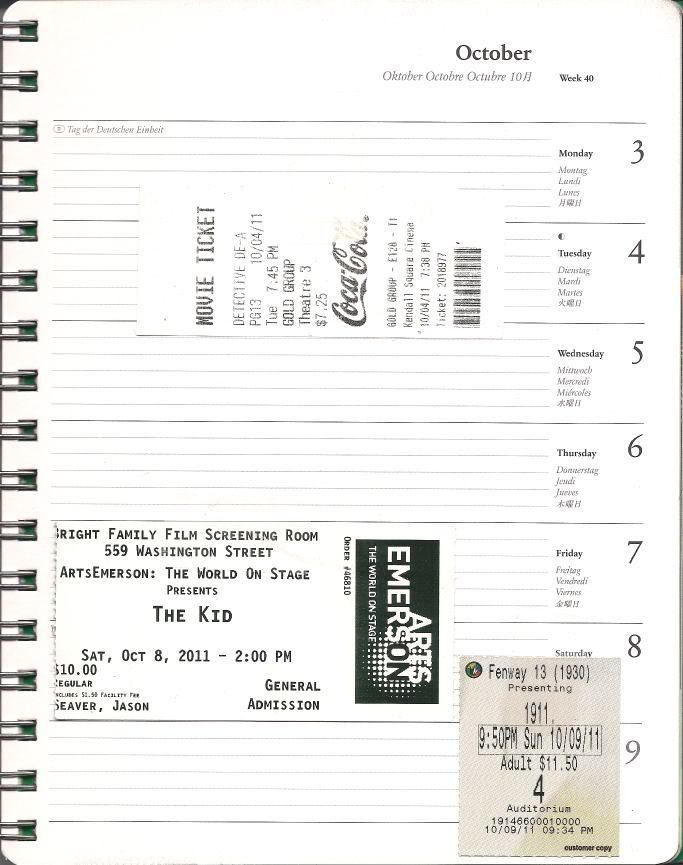
No ticket: Ocean Heaven (screener DVD in my living room on 7 October, about 7pm-ish)
Quiet week at the movies for a couple of reasons: First, Sunday was Dagny's Birthday (Observed), in which the Seaver clan heads to Maine and celebrates my niece stealing my birthday from me. It's cool; she's an energetic five-year-old and because of her, my age has frozen at the 32 years old I was when she was born (that's how it works, right?). Second, some jerk hacked my debit card number, and while my bank was quick to catch it, getting a new card sent took "3-5 business days", which meant doing what I could to stretch what cash was in my pocket out that length of time. It's the second time it's happened this year; clearly it's time to beef some security up.
So, you see what makes the cut when such things must be managed - Detective Dee, because I was meeting people and I loved it back at Fantasia; a classic Chaplin film I have (embarrassingly) never seen, and the new Jackie Chan movie, which I nearly passed over due to bad reviews (which, sadly, I had to add to), but which I wound up seeing out of curiosity and wanting to support this sort of [close to] day-and-date release. Naturally, it winds up being the most expensive ticket because I had to fit it around trips to the toy store and Maine, and the evening show was the only one that fit.
It's also another one of those really annoyingly nationalistic movies coming out of China (although I wonder how other countries see Hollywood films). This has become such a trend that there have actually been stories about Chinese studios preparing "international versions" which cut out some of the flag-waving. It's a bit odd that those are the ones getting quick American releases; even if marketed to the expatriate community, I wonder how much of that community is here because they want to be away from such things versus missing home.
Di Renjie (Detective Dee and the Mystery of the Phantom Flame)
* * * ¾ (out of four)
Seen 4 October 2011 in Landmark Kendall Square #4 (first-run)
Picking up on that "nationalist Chinese film" angle, I think Detective Dee either does pretty well in that regard or is depressingly accepting of totalitarianism. It never does the rah-rah stuff, but much like in Hero, where the rebellious character winds up accepting the need for an autocrat, there may be a hidden pro-state agenda here, at least if you're determined to find one: The title character was jailed for opposing the Empress-to-be, but acknowledges that the empire is better off under her stewardship upon his release to work for her. In the end, SPOILERS! Dee uncovers a plot by the Empress to eliminate dissidents, but decides that stopping this is less important than foiling her assassination, which would kill innocent people and could plunge the nation into chaos. Tsui Hark and company maybe aren't completely cool with this sort of thing, as they finish with Dee a fugitive who must literally do good in the shadows because of what he knows !SRELIOPS. On balance, it's better than I thought when I started this paragraph (this is basically how 24 ended), but it's hard not to think of these things when watching a Chinese movie these days, even one like Detective Dee which is more Hong Kong than Beijing.
Still, I wasn't thinking about it during the film that much, because Tsui Hark and the other filmmakers really are completely nuts. To give you an idea of how crazy and over-the-top this movie can be, the seventh-century kung fu robot marionettes showing up took me by surprise on this second viewing because there was so much other insanity to be found. The filmmakers really didn't do anything halfway, and good for them - if you're making a movie where it makes sense to have a character doing martial arts on talking deer, you are arguably failing your audience if this never happens.
So I'm glad I got a second chance to see it in theaters before its last day (if you're reading this in the Boston area before 7:45 on 13 October 2011, run to Cambridge! you can still catch it!); it's a ton of fun, and I like giving movies I saw on a press pass at festivals a bit of my money, voting with my pen AND my wallet, even if theater 4 in Kendall isn't quite the floor-to-ceiling screen of Theatre Hall in Concordia.
(For more on this movie, my festival report is here; the eFilmCritic review is there.)
(Yes, I realize now that I did actually pay to see this one at Fantasia because I didn't have time to pick up my press pass until Friday. The principle still holds!)
Charlie Chaplin: "A Day's Pleasure" and The Kid
Janus Films has been shuttling a collection of restored Charlie Chaplin films around the country for about a year and a half now, and ArtsEmerson's Paramount Theater is actually their second time landing in Boston (they were at the Museum of Fine Arts last summer). They'll be playing Saturdays through the end of October, generally pairing a short and a feature as they did last weekend (at least, until they get to the longer features). They are being shown on 35mm and generally look pretty good, and hopefully it's a forerunner to more Criterion Chaplin Blu-ray releases (right now, they have only released Modern Times and The Great Dictator on Blu-ray).
Parents are bringing kids, too, which is nifty. One thing I suspect (though finding a sample for a test is tricky) is that kids respond to Chaplin's Little Tramp more than they do the likes of Buster Keaton and Harold Lloyd. Personally, I like Keaton and Lloyd better, but their brand of silent comedy was kind of deadpan and technical - you have to figure out just how amazing their stunts are and laugh at their lack of reaction, and that takes a bit of context. Chaplin, meanwhile, isn't stoical at all; his movements are broad, his face is expressive, and the Tramp's costume says more about him than Keaton's straw hat or Lloyd's glasses. There's something about the tramp that even the youngest kids can immediately grab on to right away that the other two silent stars lack.
"A Day's Pleasure"
* * ¾ (out of four)
Seen 8 October 2011 in the Paramount Theater Bright Screening Room (Charlie Chaplin Revisited)
Indeed, when Chaplin isn't in his "Little Tramp" mode, he suffers a bit; "A Day's Pleasure" actually threw me because... Well, actually because I didn't realize there was going to be a short before the feature, and I was wondering how this set-up led to the images that everyone has seen from The Kid. It was still a bit underwhelming once I realized my mistake; Chaplin is playing a part which superficially looks like the Tramp (same mustache, similar but less-ragged coat), but is instead a sort of typical suburban family man rather than the distinct, individual character we associate with him.
In fact, Chaplin's trying to do the Harold Lloyd-style domestic comedy here, and it's not very surprising that he's neither as good at it as Lloyd is or as good as he is at his own thing. The title of "A Day's Pleasure" is ironic, of course, as "Father" endures a series of irritations in giving his family a day out, and Lloyd's mild surprise or Keaton's effortless ability to turn things around are a lot more entertaining than Chaplin's expressive crankiness.
The gags are okay, though - I think that Kenneth Branagh straight-up lifted a bit with a folding chair for Much Ado About Nothing from this, and while there are occasional flaws in the logic leading to the various slapstick bits, the execution is almost always exacting.
The Kid
* * * ½ (out of four)
Seen 8 October 2011 in the Paramount Theater Bright Screening Room (Charlie Chaplin Revisited)
Imagine, if you will, a screenwriter or producer making a pitch to a Hollywood executive for a heartwarming family movie about a man who unexpectedly becoming a father, raising the child in an unconventional way, and then facing losing that child due to a busybody who frowns upon their unusual home life. Wouldn't the world be a much better place if, in order to get his money, the pitcher was forced to explain how this improved upon what Charlie Chaplin did in this movie?
Without color.
Or sound.
Ninety years ago.
With a run time of less than one hour (and that kind of padded).
Of course, that basic story likely had a few whiskers on it by 1921, so we get into it fairly quickly: An unmarried woman (Edna Purviance) gives birth, and attempts to leave her baby with a wealthy family. She soon reconsiders, but the boy instead winds up in the care of a certain penniless tramp (Chaplin). Five years later, the kid (Jackie Coogan) is helping his dad out on a little grift, but when he falls ill, the doctor (Jules Hanft) looks at the state of the Tramp's apartment and calls the authorities.
Movies with this basic plot tend toward the mawkish and ridiculous these days, and most would probably be much better if they took a lesson from The Kid and didn't worry so much about the story arc and plot. The bulk of the Tramp's transformation occurs in the first ten minutes, as he tries to give someone else this responsibility before embracing it, while at the other end of the movie, Chaplin gives us the ending that feels right without expending a lot of effort on just how one realistically gets there. He certainly doesn't drag the audience into a courtroom for an impassioned plea. Sure, part of that is because it wouldn't work in a silent movie at all, but it's not like anybody likes those scenes in talkies, either. He knows what the audience wants, and finds economical ways of giving it to them.
Full review at EFC.
Tuesday, October 11, 2011
Jet Li and Jackie Chan not fighting: Ocean Heaven and 1911
Has Donnie Yen got a new romantic comedy that can be fit in this category? Yes, but it's not out yet, so we'll stick with these two action stars and their new, less physically intense movies.
There's no denying it; the big action heroes are getting older. Jet Li and Jason Statham were the younger guys in the cast of The Expendables, but Li has actually stopped doing certain kinds of martial arts in his movies because they're too intense for a guy his age, and he's not alone: As nice as it has been to see Yuen Biao popping up recently in Ip Man: The Legend Is Born and My Kingdom, he's not doing amazing acrobatic feats any more. Jackie Chan's skeleton must be held together with super glue by now, from all the injuries we've seen him take in his movies' outtakes.
With all that wear and tear on their bodies, it's not surprising to see these guys throwing in a few more movies where they spend a little less time getting beat up. The question is, are they up to that challenge? After all, their action flicks are often judged solely by what sort of physical displays they feature - I've certainly gotten email and comments after dinging a movie part of a star for lackluster acting, telling me that sort of thing doesn't matter. And on a certain level, the people saying that are right; they're paying their money to see Jackie Chan and Jet Li punch and kick things. But now, when the acting really does matter?
It turns out they're pretty good. This really shouldn't come as a shock; it's not like Ocean Heaven and 1911 are these guys' first roles where they've had to show more than their fists: Jet was quite good in Warlords, and Jackie has done movies with minimal fighting before - The Shinjuku Incident and (I think) Crime Story, with Little Big Soldier resting as much on him creating a character as throwing down. Plus, they've endured in the business for twenty-five to thirty-five years, and either making dozens of movies back to back teaches you a thing or two or you had a little something that all the other good-looking young guys who knew some kung fu didn't. Which happens to be the case doesn't matter at this point, the end result is that they've got the skills now that they need to call on them.
The movies that they're calling on them for are an interesting pair, though, in that both are propaganda pictures of a sort. Ocean Heaven actually has that word pop up in the end credits as part of one of the many companies and agencies involved with the movie, while 1911 is a more traditional "here is our glorious history in which our founding fathers are noble and pure" picture. Heck, the text scroll at the end of that one even includes a gratuitous bit of extolling the people in power, saying that while Sun Yat-sen had the right idea, it would be the Communist Party forty years later that would really get it right. I guess Ocean Heaven and its clear message of how love and effort can work wonders for the autistic is propaganda, too, but it seems much more palatable from here, especially since Jet Li's "Old Wang" is allowed to be imperfect and impatient at times, which is just not the case with anybody in 1911.
Oh, and apropos of nothing: Ocean Heaven contains the saddest piece of product placement I ever recall seeing. I don't mean the use of Qingdao's Ocean Park as the main setting, but I sort of wonder if McDonald's looked at the script and said "yes, use our mascot as a wholly unsatisfactory substitute for the girl you like" or whether it looked different on the page and just wound up playing out that way when the cameras rolled.
Haiyang tiantang (Ocean Heaven)
* * * ¼ (out of four)
Seen 7 October 2011 in Jay's Living Room (Fantasia Screener DVD)
Jet Li's accomplishments as an action star are well-known around the world, he's so good that his skill as an actor is often masked, if not considered entirely irrelevant. His good works are somewhat less well known, but he has made a point of sharing his good fortune. The latter two traits are what are on display in Ocean Heaven; not only did Li feel strongly enough about the movie's subject matter to take the job on for just a dollar, but he acquits himself quite well even though there's not a fight to be found.
Li plays Wang Xincheng, an electrician at a Qingdao aquarium. His autistic twenty-one-year-old son, Dafu (Wen Zhang), is with him all the time (he swims as well as the fish), and both Xincheng's neighbor Chai (Zhu Yuanyuan) and boss Tang (Dong Yong) are fond of the pair. Still, when "Old Wang" is diagnosed with late-stage liver cancer, his initial reaction is despair. And no wonder - teaching Dafu to be self-sufficient is a tremendous challenge, while it's proving almost impossible to find a care facility that will accept somebody Dafu's age.
Writer/director Xue Xiao Lu knows this territory; she has spent years working with autistic children, and her depiction of the Wangs' challenges have the ring of truth without sensationalizing things. There's an impressive lack of melodrama here; Xue doesn't feel the need to either inject some sort of obstructive bureaucratic villain into the proceedings or have the characters wring their hands or make teary speeches about their situation. Everybody is doing the best he or she can in a tricky situation, and Xue has a nice habit of cutting away from scenes a bit earlier than others might, letting the audience chew on the situation as the next scene as opposed to milking it.
Full review at EFC.
Xinhai geming (1911)
* ½ (out of four)
Seen 9 October 2011 in Regal Fenway #4 (first-run)
Jackie Chan's hundredth movie commemorates the hundredth anniversary of the revolution that brought down the Qing Dynasty, and both of these events seem to deserve something better for commemoration than this lifeless history lecture.
1911 and 1912, for those of us who didn't know, is when when a series of rebellions and battles ended the monarchy in China. The spiritual and intellectual leader of the revolution, Sun Yat-set (Winston Chao) did most of his work in exile, raising funds from overseas Chinese; more often than not, the commander on the ground was Huang Xing (Jackie Chan). Sun's Tongmenghui group may not win many battles initially, but the victories prove costly enough for Regent Long-yu (Joan Chen) and the Qing Dynasty that General Yuan Shikai (Sun Chun) sees an opportunity to be the last man standing.
1911, the film, seems like an odd choice for a near-simultaneous U.S. release, especially considering that distributor Well Go has generally marketed to a broader audience than the expatriates who would seem to be the ones most interested in this picture. If you don't speak Mandarin, your attention will frequently be divided between the text identifying each new historical figure that appears on screen and the subtitles for their dialog, and you should choose the dialog, because many of these characters will be in and out of the picture so quickly that their names are not really useful (another hint: "Sun Wen" and "Sun Yat-sen" are the same person, and we should be thankful that the subtitles do not also refer to him as "Sun Zhong-shan"). The movie is definitely made for those who are already somewhat familiar with the history, and like a lot of recent Chinese movies, it hits the nationalism pretty hard at times.
Full review at EFC.
Friday, October 07, 2011
Next Week in Tickets: Films playing Boston 7 October 2011 - 13 October 2011
It's a relatively quiet week, with the major releases interesting but not essential, although there is plenty else worth checking out, including one of the best from this year's IFFBoston.
My plans? Well, it could be a pretty thin weekend, as Sunday is a niece's birthday party and I should probably spend some time buying her toys. I'll probably catch 1911, some of the Peter & Alice flicks at the Brattle (and Silent Souls), but likely wont' fit much more in around them.
- The festival alumnus would be Littlerock, which will have a very short run in the Paramount Theater's screening room courtesy of ArtsEmerson. It follows a Japanese girl who winds up hanging around a California town even though she doesn't speak any English, and is a great little story about communication and possibilities, especially once the final scenes set in. It's only playing three shows - one on Friday and two on Saturday - so see it while you can.
The rest of the weekend on that screen is given to ongoing retrospectives of classic actors. Week two of the Katharine Hepburn program includes Sylvia Scarlett, another collaboration with George Cukor in which the title character must disguise herself as a boy; it plays Friday night and Sunday afternoon. Saturday afternoon kicks off a Charlie Chaplin retrospective, using Janus Films's restored prints. The Kid makes for a short matinee, easy to tuck in between trips to the multiplex. - The movies opening there have potential, too. The Ides of March features Ryan Gosling as a political strategist who comes to work for Presidential candidate George Clooney, apparently to discover that the man isn't quite so squeaky-clean as he appears. That's for grown-ups, whereas Real Steel looks to be for kids, featuring Hugh Jackman as a former boxer teaming up with the son he never knew to train fighting robots. If the phrase "boxing robots" sounds fun rather than silly, it's hitting most of the premium screens.
- With just a couple of new mainstream movies hitting screens, the multiplexes are digging a little deeper to fill screens. One movie being used for that is 1911, Jackie Chan's 100th movie. It just came out in China a couple of weeks ago, and features Chan as General Huang Xing, a trusted deputy of Sun Yat-sen (Winston Chao), as the Imperial government gives way to the Republic of China. Chan not only co-stars but directs. Fair warning; it appears this is much more of a historical drama than an action piece, so don't expect a lot of zany Jackie Chan fights. Also, it opens at Fenway (Well Go USA appears to be working with Regal), as opposed to the usual Boston Common.
There are two smaller films opening at AMC's Boston Common theater, too: The Way has Emilio Estevez writing, directing, and taking a small part as the son whose death brings his father (Martin Sheen) to the Pyrenees, inspiring him to complete the son's hike between France and Spain. They've also got Kenneth Lonergan's long-awaited follow-up to You Can Count on Me, Margaret, which actually shot in 2005 with a heck of an impressive cast (Anna Paquin, Jean Reno, Matt Damon, Mark Ruffalo, Matthew Broderick, Allison Janney), which was apparently an editing nightmare to the point where producers were suing each other over who is responsible for it not getting done. The end result runs about two and a half hours and focuses on a teenager trying to determine whether she was responsible for a fatal traffic accident. - The Kendall adds two movies from France this week. Mozart's Sister Features Marie Ferét in the title role (her father René writes and directs). It tells the tale of how "Nannerl" Mozart, five years her brother's elder, was also a musical prodigy but was held back by her sex and comparison with her famous brother.
There's also Love Crime, the final film by Alain Corneau, in which an executive (Kristin Scott Thomas) steals the ideas of her assistant (Ludivine Sagnier), only to discover that the mousy girl is more than she appears. Yes, I said "mousy" and "Ludivine Sagnier" in the same sentence; she's apparently playing against sex-kitten type here. - The Coolidge opens Tom Tykwer's latest, 3, though only in the digital screening room. It's apparently a simultaneously more completative and funnier Tykwer than usual, as he tells the tale of a husband and wife who, by coincidence, both fall in love with the same man. I believe it was the opening film of the Boston LGBT Film Festival this year and got good marks. My Afternoons with Margueritte opens on the other digital screen, while Midnight in Paris and The Debt move (back) to the bigger 35mm screens.
With Halloween coming, the midnight programming takes an even more decided turn toward horror, with Stephen King adaptations playing every weekend before the big marathon at the end of the month. This weekend's selection is The Dark Half, directed by George Romero and starring Timothy Hutton as a respected author who uses a pseudonym to write less serious books - an alter identity that seems to be coming to life. The other screen has Tucker & Dale vs. Evil on Saturday, and a special screening of Popcorn on Friday - special not just because it's a relatively-unseen film that takes place in a movie theater during a horror movie marathon, but because it's meant to raise money to produce special features on the upcoming home video release.
There are other special screenings there this week, too: The Attic Door plays in the screening room on Saturday afternoon (the 8th), with director Danny Daneau appearing in person to discuss his film about two children abandoned on the family farm in the 1800s. A selection of short films from the New York International Children's Festival plays on Sunday morning (the 9th) at 10:30am, suitable for kids as young as three. And on Tuesday evening (the 11th), directors Apostolos Paraskevas and Mathew Tucciarone will be on hand to introduce and discuss their hour-long documentary I Finally Did It that starts ott chronicling Paraskevas's work on a composition for a German Film Festival and expands from there. - The Brattle also has a guest in town this weekend, specifically Jimmy Tingle, who will not only be introducing and answering questions about his new featurette, Jimmy Tingle's American Dream on Friday, Saturday, and Sunday, but will follow that with some live comedy. Both the film and the stand-up feature the locally-based but nationally-recognized Tingle's observations on the state of the nation and its people.
On Monday night (the 10th), the Brattle and Chlotruis present the latest CineCaché screening, Silent Souls, a Russian film in which a widower asks his friend to assist him in bringing his wife's body to her ancestral region for a traditional cremation; as it must, this leads to sharing of memories and realizing that one's own memories don't tell the whole story. The film begins at eight and will be followed by discussion among any who wish to stick around.
The middle of next week is given over to a quick but nifty-looking Peter Pan & Alice in Wonderland series. Tuesday (the 11th) features two recent versions of Peter Pan, Stephen Spielberg's Hook and P.J. Hogan's 2003 adaptation which was well-liked but overlooked at the box office at the time; they play as a double feature. Wednesday (the 12th) has the first feature-length version, a 1924 silent with Betty Bronson in the title role, Anna May Wong as Tiger Lilly, and spiffy technical credits. Thursday (the 12th) is Alice's day, with a star-studded 1933 adaptation playing as a double feature with Dreamchild, a 1985 feature in which Alice Liddel, the inspiration for the character, looks back on Lewis Carroll (Ian Holm) with the wisdom of age - and the help of Jim Henson's Creature Workshop. - The Harvard Film Archive had originally planned to have Romanian documentary filmmaker Andrei Ujica as a guest this weekend, but his US visit has apparently been canceled. His three films - Out of the Present, The Autobiography of Nicolae Caeusescu, and Videograms of a Revolution - will still play Friday, Saturday, and Sunday as Andrei Ujica and the Montage of History; they will simply have to speak for themselves. On Monday, the HFA will show The Dreamlife of Angels in preparation for cinematographer Agnes Godard's visit on the 14th. The film itself is about the friendship between two struggling young women in Paris (and the rich man who may come between them).
- The MFA continues screening Curling and The City Dark at various times on Friday, Saturday, and Sunday, adding Israel's Valley of Strength on Sunday as part of the Celebrating World Cinema series. Mother Nature's Child, a short documentary about how spending less time outdoors may be harming today's children, plays Wednesday and Thursday (the 12th & 13th), with the director scheduled to visit for a third screening next Saturday (the 15th).
Director Jonathan Segal visits on Wednesday the 12th to introduce and discuss his film Norman, about a high school kid who gets caught up in a lie that he, like his father, has stomach cancer. Thursday the 13th also has directors in attendance - Zachary Stuart and Kelly Thomson will be there for the first screening of Savage Memory, a documentary looking at Bronislaw Malinowski, one of the fathers of modern anthropology, from the perspective of his great-grandson visiting the Pacific islands where his controversial ancestor did his most famous work. - The Arlington International Film Festival continues at the Regent Theatre through Sunday. As yet, it's not that big, but there are some interesting films there and $35 for a weekend pass isn't bad at all.
- The Hindi film opening at Fresh Pond is Rascals, a comedy featuring Ajay Devgan and Sanjay Dutt as rival con artists. Held over for a second week of late shows is Force, an action flick starring John Abraham as a no-nonsense cop whose efforts to clean up the city have led to one drug lord (Vidyut Jamwal) consolidating his power and now going after the police and their loved ones.
My plans? Well, it could be a pretty thin weekend, as Sunday is a niece's birthday party and I should probably spend some time buying her toys. I'll probably catch 1911, some of the Peter & Alice flicks at the Brattle (and Silent Souls), but likely wont' fit much more in around them.
Thursday, October 06, 2011
This Week In Tickets: 26 September 2011 to 2 October 2011
Ah, a busy weekend of seeing movies. The week was mostly consumed with watching the end of the Red Sox' kind-of-amazing collapse. Exhausting sports fandom, but I recovered enough to treat myself a little on my birthday weekend:
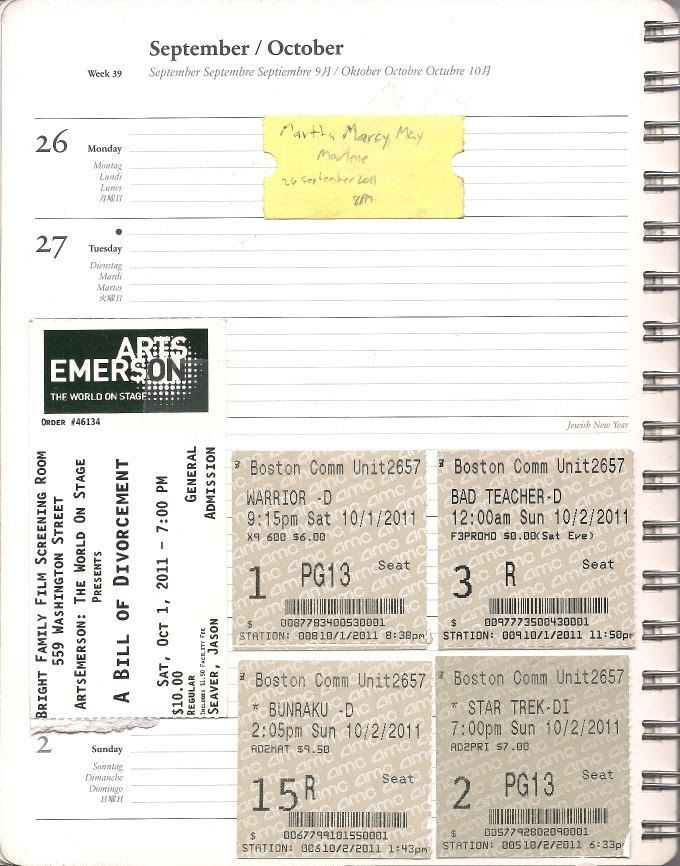
Let me tell you, I did not eat well those days - lots from the concession stand, and the snacks for the 2pm show on Sunday were too filling for me to have much room for anything other than a cupcake between movies (hey, birthday!). I did use the time between shows to head down to the Newbury Comics in Quincy Market and finally pick up a copy of Batman: Gates of Gotham #3 and Ultimate Comics X-Men #1 I'd been looking for. Good thing I read them while eating my snacks, because I forgot them in the theater. --sigh-- Second time I'd done so that day, although I remembered the paperback in Theater #15 relatively quickly, as opposed to the comics in screen #2.
Overall, pretty decent week(end) of movies, though.
Warrior
* * * (out of four)
Seen 1 October 2011 in AMC Boston Common #1 (first-run)
I heard a lot of good things about this one, and most of them were pretty accurate: There's a trio of impressive performances at the center, especially Nick Nolte as the recovering-alcoholic father of the two fighters who wind up vying for a five million dollar prize in a mixed martial arts tournament. The whole family is believably torn apart, and all three lead actors - Nolte, Tom Hardy (as the drifting ex-marine), and Joel Edgerton (as the high-school teacher and family man) all create believable characters, and co-writer/director Gavin O'Connor does a very nice job of not playing favorites as the story goes on. It's emotional, but enjoyably low-key.
This does become a bit of a problem once the movie actually gets to the tournament, though; we're inevitably heading toward a showdown between brothers, and it's honestly never as intriguing a proposition as it should be. O'Connor and company set the brothers' styles up as opposites - Hardy's Tommy is the brute-force, one-punch-knockout type, while Edgertron's Brendon uses leverage and submission holds as befits an aging physics teacher - and the plot doesn't paint either as a monster, which seems like it would make for a tense last act. But O'Connor is not great at using action as storytelling; the final fight should be the brothers' conflict in microcosm, but that never really happens, so when one brother finally wins, it's just the end of a fight, as opposed to the story's climax - a bit of a fizzle.
Warrior is pretty good, but I must say, Brawler, which played Fantasia this summer, is better, even if a bit more familiar.
Bad Teacher
* * ¾ (out of four)
Seen 1 October 2011 in AMC Boston Common #3 (midnight movies)
Weird release schedule on this - it had its usual run starting in late June, and then reappeared in September, mostly playing weekend midnights, either as a back-to-school thing or just as promotion for its video release. For this last weekend of midnights, Sony was giving tickets away, apparently with the thought that folks who saw it would like it enough to buy the Blu-ray a few days later.
Well, at the very least, it's worth a fair amount more than the nothing I paid to see it. As I expected from the trailers, how funny it is tends to be directly proportional to how awful the characters are. Well, within reason; Jason Segel's character is more snarky than outright mean, sort of establishing a middle ground between the self-centered witch Cameron Diaz plays, Lucy Punch's sanctimonious snot, and the clueless trust fund sub of Justin Timberlake. It's a great deal of fun to let one's meaner side out, and the movie seldom deviates from that.
Now, director Jake Kasdan and company seldom really manage the huge laughs, but it manages a pretty steady stream of medium-sized ones. Can't complain much about that.
Star Trek
* * * ¾ (out of four)
Seen 2 October 2011 in AMC Boston Common #2 (digital IMAX return engagement)
Hey, if IMAX and AMC want to have this playing in faux-IMAX on my birthday for only $7, I'm there.
After seeing it in theaters four times over the past couple of years - original love here - I still love it. It's a reboot that feels modern while respecting the original, and also does a very impressive job of letting the audience see right away that this is not their father's Star Trek. I kind of love the little dialogue the filmmakers have with fans in the middle, from Chekov's comments that Vulcan likely has only minutes to the explanation that this doesn't invalidate the Trek we love.
A Bill of Divorcement
I have a hard time talking about Katharine Hepburn movies without relating this story, so bear with me: I saw The Aviator with my brother Matt, and neither of us were really taken with it, though perhaps for different reasons (IIRC, I thought Scorcese was ill-equipped to understand the engineer part of Howard Hughes; he found the stylization annoying). This was part of the conversation we had on the way out:
That's a bit of an exaggeration, but Hepburn is unmistakably a distinctive personality on-screen, and it was interesting to see just how fully-formed that was in A Bill of Divorcement, her first movie. According to the introduction, that's just the way she was, brash and extraordinarily sure of herself, even when auditioning for her first film role; fortunately, George Cukor really liked that. It's an acting style and personality that makes for easy caricature or dismissal until you've seen just how much she can do with it, and although I'm not making flippant comments about her any more, I hope to get a better appreciation of Kate as ArtsEmerson's "Kate the Icon, Katharine the Iconoclast" series continues.
The series is looking like a good one; it started last weekend with this and Little Women and will run weekends through the rest of the year, showcasing her movies in roughly chronological order. A Bill of Divorcement was a special treat, as it was an archive print of a movie not readily available on video (at least in Region 1/A), which is kind of surprising: Not only is it Hepburn's first (and, as such, her first collaboration with George Cukor), but also features John Barrymore and Billie Burke (whose return to film after a decade-long absense in which the industry changed focus from silent shorts to talking features is an interesting story in and of itself). I'm not sure who owns this part of the Selznick library (Universal?), but it seems like prime material for at least a Warner Archive-style release.
Anyway, what's interesting to me is that it's one of the few times Hepburn has really seemed young to me; the image of her in my mind is the middle-aged spinster of The African Queen, and even in her 1930s romantic comedies, she seems to have needed a little time to accumulate her eccentricities. This is her as an ingenue, at least to start, and she proves to be pretty good at it.
As an aside, trying to figure out ages and times for this temporarily drove me a little batty - if it was taking place in 1932, Sydney (Hepuburn) was supposed to be about 20 years old, and she had never known her father because he was institutionalized right after returning from "the war" as shell-shocked... Well, World War I works, but it's kind of tight - say she's conceived/born in 1914, and he returns in 1917 or 1918, then she's about 18 and Hilary (Barrymore) spent about 14-15 years in hospital. Apparently, though, the play was first performed in 1921, so "the war" was probably the Boer War (1899-1902), making her about 20-ish but suggesting he was in the asylum for 18+ years, which seems a bit high.
Not that it really matters, but considering that at one point Margaret (Burke) mentions she was about Sydney's age when she married and it wasn't long after before Hilary went off to war, she can't be much older than 44 or so, and even though that's not much younger than the actress was herself, she certainly scans as older to me. Maybe that's a sign of the times - people live longer now and work to remain youthful longer - but it was a bit of a distraction, at least for a nitpicker like me.
Anyway, Sylvia Scarlett this weekend, although it looks like I'll miss it. Check out ArtsEmerson's "On Screen" schedule here to see when future films will be playing.
A Bill of Divorcement
* * * ½ (out of four)
Seen 1 October 2011 in the Paramount Theater Bright Screening Room (Kate the Icon, Katharine the Iconoclast)
Few performers get top billing in their first picture, and Katharine Hepburn is no exception; she's listed fourth in the credits for A Bill of Divorcement, below at least one co-star who has a much smaller role. She'd be a leading lady soon enough, though, and it's no surprise, as she more than holds her own with a veteran cast, which helps a movie that is in many ways dated remain quite dramatic and watchable today.
The film opens at a party on Christmas Eve, circa 1930, a week before Margaret Fairfield (Billie Burke) and Gray Meredith (Paul Cavanagh) are set to marry, now that Margaret's divorce is finally complete. That's about the same time that Kit Humphreys (David Manners) is set to leave England for Canada, bringing Margaret's daughter Sydney (Hepburn) with him if she accepts his marriage proposal. Except that things change on Christmas morning, as Sydney's father Hilary (John Barrymore) shows up, having left the sanitarium where he has been since before Syndney can remember. He's shaky, but lucid enough to strongly object to to Margaret's divorce and remarriage - and what comes out as a result shakes Sydney to the core.
This film was released in 1932, and a modern audience will have to make some allowances even beyond Sydney's father being named Hilary rather than vice versa. Mostly, that comes from the depiction of mental illness; not only has "post-traumatic stress disorder" not yet replaced "shell shock", but saying "there's madness in our blood!" is probably only considered a little melodramatic. Hilary's exile - with neither Margaret nor Sydney having visited for at least fifteen years - is treated far more cavalierly than Margaret's decision to divorce. One probably won't look at and think his or her great-grandparents were horrible people, but things were a bit different then.
Full review at EFC.
Matt: ... and just what the heck was Cate Blanchett doing?
Jay: Have you ever seen a Katharine Hepburn movie?
Matt: No.
Jay: They're like that. All of 'em.
That's a bit of an exaggeration, but Hepburn is unmistakably a distinctive personality on-screen, and it was interesting to see just how fully-formed that was in A Bill of Divorcement, her first movie. According to the introduction, that's just the way she was, brash and extraordinarily sure of herself, even when auditioning for her first film role; fortunately, George Cukor really liked that. It's an acting style and personality that makes for easy caricature or dismissal until you've seen just how much she can do with it, and although I'm not making flippant comments about her any more, I hope to get a better appreciation of Kate as ArtsEmerson's "Kate the Icon, Katharine the Iconoclast" series continues.
The series is looking like a good one; it started last weekend with this and Little Women and will run weekends through the rest of the year, showcasing her movies in roughly chronological order. A Bill of Divorcement was a special treat, as it was an archive print of a movie not readily available on video (at least in Region 1/A), which is kind of surprising: Not only is it Hepburn's first (and, as such, her first collaboration with George Cukor), but also features John Barrymore and Billie Burke (whose return to film after a decade-long absense in which the industry changed focus from silent shorts to talking features is an interesting story in and of itself). I'm not sure who owns this part of the Selznick library (Universal?), but it seems like prime material for at least a Warner Archive-style release.
Anyway, what's interesting to me is that it's one of the few times Hepburn has really seemed young to me; the image of her in my mind is the middle-aged spinster of The African Queen, and even in her 1930s romantic comedies, she seems to have needed a little time to accumulate her eccentricities. This is her as an ingenue, at least to start, and she proves to be pretty good at it.
As an aside, trying to figure out ages and times for this temporarily drove me a little batty - if it was taking place in 1932, Sydney (Hepuburn) was supposed to be about 20 years old, and she had never known her father because he was institutionalized right after returning from "the war" as shell-shocked... Well, World War I works, but it's kind of tight - say she's conceived/born in 1914, and he returns in 1917 or 1918, then she's about 18 and Hilary (Barrymore) spent about 14-15 years in hospital. Apparently, though, the play was first performed in 1921, so "the war" was probably the Boer War (1899-1902), making her about 20-ish but suggesting he was in the asylum for 18+ years, which seems a bit high.
Not that it really matters, but considering that at one point Margaret (Burke) mentions she was about Sydney's age when she married and it wasn't long after before Hilary went off to war, she can't be much older than 44 or so, and even though that's not much younger than the actress was herself, she certainly scans as older to me. Maybe that's a sign of the times - people live longer now and work to remain youthful longer - but it was a bit of a distraction, at least for a nitpicker like me.
Anyway, Sylvia Scarlett this weekend, although it looks like I'll miss it. Check out ArtsEmerson's "On Screen" schedule here to see when future films will be playing.
A Bill of Divorcement
* * * ½ (out of four)
Seen 1 October 2011 in the Paramount Theater Bright Screening Room (Kate the Icon, Katharine the Iconoclast)
Few performers get top billing in their first picture, and Katharine Hepburn is no exception; she's listed fourth in the credits for A Bill of Divorcement, below at least one co-star who has a much smaller role. She'd be a leading lady soon enough, though, and it's no surprise, as she more than holds her own with a veteran cast, which helps a movie that is in many ways dated remain quite dramatic and watchable today.
The film opens at a party on Christmas Eve, circa 1930, a week before Margaret Fairfield (Billie Burke) and Gray Meredith (Paul Cavanagh) are set to marry, now that Margaret's divorce is finally complete. That's about the same time that Kit Humphreys (David Manners) is set to leave England for Canada, bringing Margaret's daughter Sydney (Hepburn) with him if she accepts his marriage proposal. Except that things change on Christmas morning, as Sydney's father Hilary (John Barrymore) shows up, having left the sanitarium where he has been since before Syndney can remember. He's shaky, but lucid enough to strongly object to to Margaret's divorce and remarriage - and what comes out as a result shakes Sydney to the core.
This film was released in 1932, and a modern audience will have to make some allowances even beyond Sydney's father being named Hilary rather than vice versa. Mostly, that comes from the depiction of mental illness; not only has "post-traumatic stress disorder" not yet replaced "shell shock", but saying "there's madness in our blood!" is probably only considered a little melodramatic. Hilary's exile - with neither Margaret nor Sydney having visited for at least fifteen years - is treated far more cavalierly than Margaret's decision to divorce. One probably won't look at and think his or her great-grandparents were horrible people, but things were a bit different then.
Full review at EFC.
Wednesday, October 05, 2011
Bunraku
If I was going to see this, I kind of wish I'd been able to see it as the closing night film of the Boston Film Festival, just to see what sort of gushing introduction about how visionary and brilliant it was the people running that event gave it. Probably better I didn't, though - that sort of thing is funny to imagine, but raises my blood pressure when encountered in person.
Bunraku isn't visionary, of course; even though it's supposedly been sitting in the can for a while, it hardly predates the constructed/abstract environments of Sky Captain, Sin City, or 300. It's got some of the more interesting ones, and the integration is smoother than one might expect, too. In some ways, I think it would work a lot better as a comic book than a movie; you'd likely have to lose the puppet bits, but this sort of genre crossover happens all the time in that medium, and pretentious voice-over seems to go over better there (especially in manga). Or it could have been crowded off the page - if the ramblings were actually taking up space rather than just seemingly being placed alongside the visuals, Moshe might cut them down.
Anyway, this is a disappointment, but does have some things worth looking at. It'll be out of Boston on Friday (although out on video in November), so there's just a couple of days to see it on the big screen if you are so inclined.
Bunraku
* * (out of four)
Seen 2 October 2011 in AMC Boston Common #15 (first-run)
"Bunraku" is a form of Japanese puppetry that first appeared in the 17th century, and the opening scene has some nifty puppet work that becomes some nifty animation. The thing is, that opening also has an overabundance of narration and a tendency to wander around and away from the point. It makes for a frustrating combination of visual ambition and storytelling that is often a mess.
It's sort of a post-apocalyptic future, with guns outlawed but edged weapons apparently being okay. Thus, the man with the most power in this frontier town "east of the Atlantic" is Nicola the Woodcutter (Ron Perlman), who runs his frontier town with an iron fist and the assistance of nine numbered killers, with Killer 2 (Kevin McKidd) the most senior. Two wanderers are coming to town on the same train - one out of western movie (Josh Hartnett), the other (Gackt Camui) a samurai without a sword. Yoshi is coming to to retrieve a dragon medallion, while the other drifter is initially just looking for a card game, with a bartender (Woody Harrelson) giving them the lay of the land.
The basic underpinnings of Bunraku aren't complicated, for all the busy activity that writer/director Guy Moshe throws on screen: It's a wandering-warrior movie, the sort of thing you get when you remove the outer layer from western, samurai, post-apocalyptic sci-fi, kung fu, etc. Indeed, the opening narration makes it pretty explicit that the whole point of this flick is that those are all different ways to tell the same story. Why, then, does Moshe so often screw basic storytelling up so badly? We'll hear the voice of narrator Mike Patton go on and on about details that don't matter or pontificate on the universal nature of the story, but things like giving the audience some hint at why the characters do what they do are pushed back far too long and given too little weight when they are revealed. The flow of the movie is terribly choppy - even at nearly a full two hours, this sometimes feels like producers tried to gut every moment that wasn't an action scene or otherwise expensive - and often feels like Moshe wasn't up to the task he set himself. As an example, I half-suspect that he wanted all the characters to be complete nameless icons, but couldn't write all the dialog that way, so Yoshi winds up with a name but The Drifter doesn't, even though their roles are basically equivalent.
Full review at EFC.
Thursday, September 29, 2011
Next Week in Tickets: Films playing Boston 30 September 2011 - 6 October 2011
It's my birthday this weekend; let's see what the movies have for me!.
(And my niece, and my cousin, who both share the day with me. And Sting, Groucho Marx, Ghandi, and more. 2 October is a legitimately cool day to be born!)
My plans? Well, since the Red Sox have gone and made watching baseball less important this week, I'll have some extra time. I'm thinking 50/50, Moneyball, and Bunraku. Maybe A Bill of Divorcement. And probably Star Trek, because that is a lot of fun on the big, big screen, and it's been a while since I've seen it; I might have actually had to play my Blu-ray!
(And my niece, and my cousin, who both share the day with me. And Sting, Groucho Marx, Ghandi, and more. 2 October is a legitimately cool day to be born!)
- It actually looks like a potentially weekend; perhaps the surest bet is Joseph Gordon-Levitt and Seth Rogen in 50/50, in which the former is given that prognosis for surviving his cancer and chemotherapy. Doesn't necessarily sound funny, but Rogen and his co-writer based it on events they lived through (so, the folks who complain about Rogen always "playing himself" can at least point to a good reason), and early reports have it as honest and well-observed.
The more conventional comedy coming out this weekend is What's Your Number?, in which Anna Faris (for some reason or another) decides that one of her ex-boyfriends is her soulmate and tries to figure out which one; I'm guessing that the best pal played by Chris Evans is more likely. There's also a familiar-sounding horror/thriller type, Dream House, in which a family moves from the city to a small New England town only to find out their house was the site of a grisly murder. It's got a nice cast (Daniel Craig, Naomi Watts, Rachel Weisz), but, man, doesn't it sound an awful lot like Don't Be Afraid of the Dark from just a month ago, with a title that's easily confused with Hong Kong gross-out real-estate movie Dream Home? - Meanwhile, Boston Common is plugging a lot of different things in, apparently to kill time until Real Steel comes out next week. Specifically, the faux-IMAX screen is pushing Contagion down to one or two shows a day, filling the gaps in with hits from the last few years - Star Trek, Inception, and Fast Five. Each gets one show a day, with times alternating, so check before you go. The good news is that the returnees are only $7 each (though Contagion is still full price). They're also keeping the 3D-ified Lion King around for an extra week beyond the limited two week engagement, but it's done so crazy well that everyone is.
Not everyone is picking up Bunraku, a Sin City/The Warrior's Way-looking movie starring Josh Hartnett and Japanese singer Gackt along with the likes of Woody Harrelson, Demi Moore, and Ron Perlman. It's apparently based on a Japanese legend, but I'm still kind of surprised that they didn't rename it, since it's apparently heavily Westernized. It closed the Boston Film Festival last week, so take that as you will.
Also opening: Courageous, a movie about four police officers who are also fathers finding themselves growing apart from their sons and turning to God for help. It's distributed by Sony (albeit TriStar Pictures, which now seems to be mostly an acquisition label), but developed and produced by an Alabama church. Which is cool, but if that's not your thing... - Boston Common and Kendall Square both open Machine Gun Preacher, wihch has been doing a frighteningly hard sell on my inbox. It's the story about an ex-biker who goes to East Africa to do volunteer work and chooses to take action against the groups terrorizing the populace and recruiting child soldiers. It's got some nice people involved - Gerard Butler is in the title role, supported by Michelle Monaghan, Kathy Baker, and Michael Shannon, with generally pretty-good Marc Foster directing - but early word is that it's trying too hard.
Kendall Square also picks up The Black Power Mixtape 1967-1975 as the one-week booking, which combines a bunch of unused footage shot by a Swedish TV network during the time in question with new interviews into what is apparently an electric look at the Black Power movement during those years. - With Drive and The Debt sticking around in the main theaters at the Coolidge, the new releases are opening up in the smaller video rooms. The most fun is likely Tucker & Dale vs. Evil, a backwoods-slasher movie reimagined as door-slamming farce that absolutely deserves more than one show a day at 9:45 (plus a midnight on Friday and Saturday) on digital video. Instead, it shares a screen with Girlfriend, in which a man with Down Syndrome comes into some money and tries to reconnect with his high-school crush, now an unemployed single mother with an abusive boyfriend. Could be really good or really schmaltzy. Lead actor Evan Sneider will be in town for a Q&A after the 4:30pm show on Sunday (2 October).
The other digital screen is playing Restless, the new one by Gus Van Sant. It's about the romance between a terminal cancer patient and a dropout businessman whose best friend is the ghost of a kamikaze pilot - and I'm sure that Van Sant will put his stamp on it. Whether that's a good thing or a bad thing, I'll leave up to you.
The midnights for the week at least look fun - Friday night's (aside fromTucker & Dale) include the monthly screening of The Room and Deadbeat at Dawn, a 1988 exploitation film about an ex-gang-leader woh goes straight, has his girlfriend killed, and exacts revenge. The Boston Underground Film Festival guys are co-presenting it, and writer/director Jim Van Bebber will be there in person. Saturday night, J. Cannibal will be presenting his "Feast of Flesh XI", a multimedia presentation that includes music by metalcore group Acaro, sexy dancing by the Black Cat Burlesque, and a 35mm presentation of Demons, produced by Mario Bava and directed by Lamberto "not Mario" Bava. And while it doesn't run at midnight, the Science on Screen presentation on Monday (3 October) is the original Roger Corman Little Shop of Horrors (complete with very young Jack Nicholson). - If you couldn't get a ticket for Pearl Jam Twenty during its successful Brattle Theatre run, you've got one last chance; it has a final screening at 6:30pm on Friday, after which Matthew Barney's Cremaster Cycle returns. It's a six-and-a-half hour work, five parts presented in three programs (though they were originally produced out of order), all reputedly very strange and non-linear, and never to appear on home video. Its various bits run through Tuesday the 4th; on Wednesday the 5th, the Cambridge READS program presents a classic comedy double feature - Duck Soup and Dr. Strangelove.
- The Harvard Film Archive finishes up its "Risorgimento on Screen" program on Friday night with Luchino Visconti's The Leopard. On Monday night, they've got British "experimental filmmaker and radical ethnographer" Ben Rivers, who will introduce two of his recent short films, "Slow Action" and "Sack Barrow". And in between, there's the first three films from a two-month retrospective on 16mm documentarian Frederick Wiseman - Basic Training and High School on Saturday and Domestic Violence on Sunday.
- Saturday is also the start of a long Katharine Hepburn series "Kate the Iconoclast/Katharine the Icon", which will run through December. October covers 1932-1938, with matinee screenings of the 1933 Little Women on the 1st and 2nd, while Saturday night has two screenings of Hepburn's debut, A Bill of Divorcement, where George Cukor cast her opposite John Barrymore and Billie Burke as a bride-to-be who is surprised by the return of her unstable father (Barrymore). Before that, on Friday (30 September), film historian Eric Schaefer presents Herschell Gordon Lewis's Scum of the Earth!, which seems like a wonderfully hypocritical exploitation film about a young girl lured into the dirty-pictures business.
- The MFA kicks continues Celebrating World Cinema starting on Saturday, with The Hunter from Iran over the weekend and Curling from Quebec starting Wednesday the 5th. Sunday afternoon also has a series of selections from the Manhattan Short Film Festival, while Wednesday also begins a run of The City Dark, a highly-entertaining documentary about the expected (and unexpected) problems of light pollution. Thursday also features an evening screening of Benda Bilili, about a Congolese band made up entirely of musicians suffering from polio.
- The Omni theater at the Museum of Science switches its programming up with the new month - "Adrenaline Rush", "Coral Reef Adventure", and "Tornado Alley" have their last shows on Friday, with "Alaska: Spirit of the Wild", "Greece: Secrets of the Past", and "Ring of Fire" returning to take their place on Saturday.
- The Regent Theatre has live music Friday and Saturday, but next weekend will host the Arlington International Film Festival, which kicks off on Thursday night with We Still Live Here: Âs Nutayuneân, a pretty good documentary about the attempts to revive the Wampanoag language in Eastern Massachusetts. It will be followed by a panel discussion with director Anne Makepeace, subject Jessie Little Doe Baird, and MIT linguist Norvin Richards III.
My plans? Well, since the Red Sox have gone and made watching baseball less important this week, I'll have some extra time. I'm thinking 50/50, Moneyball, and Bunraku. Maybe A Bill of Divorcement. And probably Star Trek, because that is a lot of fun on the big, big screen, and it's been a while since I've seen it; I might have actually had to play my Blu-ray!
Martha Marcy May Marlene
It's a little fitting that a Red Sox game (even in rain delay) kept me from doing this right after the review was posted to EFC, it's a sort of payback for turning my back on the team for a couple of hours on Monday - they're going to take my attention right back for the night, then lose in spectacular fashion and give me an early start on missing baseball.
Anyway, Martha Marcy May Marlene was the first film in this fall's CineCaché program, co-presented by the Brattle and the Chlotrudis Society for Independent Film; it's the successor to the Sunday Eye Opener and alternates with the DocYard series. It looks like this program will be a pretty good one; they've already got a large chunk of the line-up set and it sounds mostly pretty good. This one was packed, in large part because it was free (which made paying for a series pass before the movie a bit odd), and unfortunately didn't offer much chance for discussion afterward, as the Brattle is doing all they can to pack Pearly Jam Twenty shows in .
I think I got most of what I want to say in the review, anyway. The movie's scheduled to open in about three weeks, and I think that the 21st of October is a semi-national roll-out (it's Fox Searchlight and theaters have been putting displays out, indicating a solid push). Well worth seeing.
Martha Marcy May Marlene
* * * * (out of four)
Seen 26 September 2011 in the Brattle Theatre (CineCaché)
There's maybe a little license taken with the shifting timelines of Martha Marcy May Marlene, in that it's a little convenient that the title character's relevant flashbacks and reactions are triggered in just such a ways as to make both stories fairly linear. But if that's the extent of issues one has with a movie that is excellent in just about every other area, then the filmmakers have done very well indeed; it's no exaggeration to say that Sean Durkin and company have made a gem.
Even though we're only given a brief, but telling, look at the farm in upstate New York where Martha (Elizabeth Olsen) has been living for the past two years at the beginning, she seems to walk away unusually easily, with the housemate sent to town after her not doing much at all to bring her back to Patrick (John Hawkes), the leader of this group. Instead, she's picked up by sister Lucy (Sarah Paulson), who brings Martha to the lake house that she and her husband Ted (Hugh Dancy) have rented for the summer. Right away, it's an uncomfortable fit, with Martha unwilling to talk while Lucy and Ted are slow to realize that her erratic behavior signifies that the bad breakup story she's given them is at the very least incomplete.
The supporting cast in this movie is kind of interesting, in how they tend to invert expectations somewhat. John Hawkes, for instance, never really goes big when one might expect the charismatic cult leader to do so; when he starts lecturing, he seems weak; he's at his most powerful when he's casual (his biggest alpha-male display comes playing guitar). On the other side of the movie, Hugh Dancy makes common sense and compassion seem sort of heartless, while Sarah Paulson does a very nice job of playing Lucy's guilt and shallowness side by side.
Full review at EFC.
Tuesday, September 27, 2011
This Week In Tickets: 19 September 2011 to 25 September 2011
I swear, this is not an "I want to get TWIT done quickly" reaction to falling so far behind before:
The company that I work for has been in the process of being acquired for the last what-seems-like-an-insanely-long-time, and last week there were folks from the new home office in Texas in town to get to know us. Which is nice, I guess, although I must admit to not really caring about the structure of the company beyond my manager in one direction, the other folks in my department in another, and the unit we pull data for in a third. So, yeah, this means extra meetings and a Wednesday-night "get-together" which was a cocktail hour and two-plus hours of eating food fancier than I usually go for. Sure, our table won the trivia contest, but... Well, some situations are more or less guaranteed to bring out the worst in me. Enforced socializing is one of them.
So, that means that there was no getting out early to get to potentially interesting stuff. It's kind of a shame, because there were actually a couple of movies I would have enjoyed seeing at the Boston Film Festival on Wednesday - pretty much the only day when the announced schedule had stuff that interested me. I would have been down for the last-minute closing night feature of Bunraku, but getting to a 6:45pm show in downtown Boston would have been tough enough if I'd caught the 5:08 bus out of Burlington, but of course a new problem reared its ugly head at 3pm and kept me late.
So no BFF for me, and I was surprisingly OK with that. My disgust from last year didn't really carry over; I just didn't have much interest in the schedule or feel much obligation to support the event even in a lean year. At least, I assume it was lean - I'd be interested to hear what it was like from anybody who was there. The line-up looked much less impressive than even last year, the website didn't talk up the parties and passes that usually seem to be the focus of the event, and the venue hadn't shown a movie since Jig played there for a week back in mid-June. That certainly seems like a recipe for a quiet festival.
Interestingly, I was having lunch with the Chlotrudis folks on Saturday, and apparently the idea of the smaller festivals pooling their resources to put together a major festival to rival Toronto and SXSW is kicking around. If this were to happen, I suspect that they'd want the Boston Film Festival name, but I suspect that getting hold of that would be difficult unless the event was in financial trouble. I wonder what the name would be worth in this scenario.
Anyway, after that lunch, I went back home and spent the rest of the weekend watching baseball, even though it was sort of torture. But, hey, there might not be much baseball left. So the only movie I wound up seeing this week was the midnight show at the Coolidge on Friday night (and I was probably pretty dumb to walk there in the rain). It had me kind of wiped out for the rest of the week, but at least it was a good one:
Balada triste de trompeta (Balada triste de trompeta)
* * * ¾ (out of four)
Seen 23 September 2011 in Coolidge Corner Theatre #2 (@fter Midnight Fresh Cuts)
Alex de la Iglesia's new movie certainly qualifies as a circus - it's filled with bright colors and daring displays that look joyful while also tempting the audience with sex and violence. This makes perfect sense; De la Iglesia's best work has always come in the form of polished chaos, so these particular big tops are a fine place for him to do his thing.
The first circus we encounter is in 1937, where a Happy Clown (Santiago Segura) is entertaining children as the occasional gunshot from the Spanish Civil War is heard in the background. The performance is interrupted as the Nationalist forces show up to draft every able-bodied man into the army, including the clown, who is thrown into battle while still wearing his costume. In the aftermath, he tells his son Javier that even though clowning is in his blood, he will likely never be able to play the happy clown; he's seen too much to be anything but the sad one. And, indeed, when we meet Javier (Carlos Areces) again in 1973, that's the job he's taken with a struggling circus, being the butt of the smiling clown's jokes. Of course, behind the scenes, happy clown Sergio (Antonio de la Torre) is an angry drunk, and Javier being attracted to his girl Natalia (Carolina Bang) doesn't help matters.
In other hands, The Last Circus might be a simple tragic love story, maybe avant-garde (the likes of Fellini certainly liked their circuses back in the day). But this is an Alex de la Iglesia movie through and through - his first without his usual co-writer, Jorge Guerricaechevarría - and it is just packed with his signature slick camerawork, bizarre characters, and pitch-black comedy. It's the sort of movie that scores big laughs throughout, although one may be reluctant to relate just exactly which gags got them; a lot of bits just don't work out of context. De la Iglesia's movies have always had a bit of an edge to them, but this one seems to have the cynicism much closer to its heart; there's a meanness to it that parallels the way circus audiences laugh at the Happy Clown tormenting the Sad Clown.
Full review at EFC.
Thursday, September 22, 2011
Next Week in Tickets: Films playing Boston 23 September 2011 - 29 September 2011
So, who would believe me if I said that I totally meant to take a long time getting This Week in Tickets up to date because the stuff at the top makes a really nice segue to the thing showing this week that I want to draw people's attention to? Nobody? You think I'm just behind?
Fine, you're right. But we might as well take advantage of it!
My plans? The Last Circus is actually the one I'm most excited to see, although I'd really like to get a second viewing of Detective Dee in. Moneyball will probably grab some time, and I intend to be at Martha Marcy May Marlene. And I'll probably catch The Killer Elite from among the other new openings. Anything else depends on just how much it rains and how much baseball disgusts me between now and the upcoming end of the regular season.
Fine, you're right. But we might as well take advantage of it!
- I refer, of course, to my not-quite-recent-any-more trip to Montreal for the Fantasia Festival, where one of the two films I saw opening night was Detective Dee and the Mystery of the Phantom Flame, which opens this week at Kendall Square and is awesome. Sure, it's a movie that caters directly to my personal tastes - it's about a kung fu-fighting 9th Century Sherlock Holmes type trying to unravel a series of mysterious spontaneous combustions, with a revitalized Tsui Hark directing and action choreography by Sammo Hung - but, seriously, a whole crowd of not-me people in Montreal loved it, and it was a huge hit at NYAFF a week or so earlier. It is a ton of fun.
The Kendall opens another two foreign films as well, both of which look fairly entertaining: My Afternoons with Marguerite features Gerard Depardieu as a nearly-illiterate middle-aged man who discovers that there is a difference between being intelligent and being educated when he happens upon a little old lady reading aloud. The (intended) one-week booking is for Happy, Happy, a Norwegian film about a woman who is relentlessly upbeat even in the face of her husband's indifference and the sort of neighbors that usually provoke envy. - One of the films they've got playing midnights this weekend at the Coolidge Corner Theatre is one that I'd hoped would show up at Fantasia but didn't; The Last Circus is the new one by Alex de la Iglesia - his first in years without his usual co-writer - which starts with a clown being drafted to fight the Spanish Civil War while still in costume and just gets weirder from there. I suspect you either love de la Iglesia or you don't, and I find him to be a guy who makes funny, exciting movies, so I'm thrilled to get a chance to see it on the big screen before it, too, quickly heads to video. The midnight screening for the other theater is Clueless, which I've heard is also pretty good. Otherwise, things stay pretty much the same there, the only addition being a program from the Manhattan Short Film Festival in the digital rooms; there will also be a live jazz performance on Monday.
(Note: At one point, the schedule included a screening of Kevin Smith's new movie Red State on Sunday, but it appears to have been dropped.) - The Brattle has a different sort of music on tap, with the Cameron Crowe-directed documentary Pearl Jam Twenty getting the bulk of screenings this week. Bands that were popular when I was in high school having twentieth-anniversary shows makes me feel old, but this was a big enough deal to sell a preview out a few days ago. Take heed and buy tickets early, as pre-sales have evidently been unusually high!
It doesn't have the theater completely to itself, though; at 6pm on Friday night, The Runway screens in association with the Irish Film Festival; it's a family film about a South American pilot who crashes in a small Irish town, with only one person in the village able to speak Spanish. It's family friendly, with free popcorn for the first fifty kids. On Monday, the CineCaché program returns with a free preview of Martha Marcy May Marlene, in which an escaped cult member must confront both her recent past and the events that drew her to the cult in the first place. Wednesday evening, there's a presentation of of "The Greenhorns", a short documentary about young American farmers, with director Severine von Tscharner Fleming present. Thursday, there's a Harvard Book Store talk at 6pm, so the last showings of Pearl Jam Twenty will be at 8:30pm and 11:00pm. - The stuff at the smaller theaters is the most attention-worthy stuff this weekend, but it's actually not a bad-looking week at the multiplex, either; even the lesser-looking stuff has interesting things about it. Abduction, for all that it looks like a watered down mash-up of The Bourne Identity and I Am Number Four, has some good people in its cast and John Singleton in the director's chair. The Killer Elite has a pretty ridiculous top three in the cast - Jason Statham, Clive Owen, and Robert De Niro - although we all know too well that the none of the three are particularly discriminating in the projects they choose these days. Dolphin Tale also has an impressive cast - Harry Connick Jr., Ashley Jdd, Morgan Freeman, Kris Kristofferson - and the aquatic setting often makes for impressive 3D. All of them are in solid "can go one way or the other" territory.
The surest bet looks to be Moneyball, which lost Steven Soderbergh as director but gained Bennett Miller (who did nice work with Capote) and has a script by Steven Zallian and Aaron Sorkin. The book's been on my shelf for a while without being read, but most everybody interested in baseball has heard plenty about it. The trailers look pretty exceptional, so here's hoping it lives up to them.
Boston Common also has Fordson: Faith, Fasting, Football opening; it's a documentary about a high-school football team in a Detroit suburb with a large Muslim population, whose big game coincides with the end of Ramadan. - John Malkovich is going to be at Emerson's Paramount Theater on Thursday and Friday (the 29th and 30th) for two performances of The Infernal Comedy: Confessions of a Serial Killer, so this weekend, they're running several of his films in the Bright Screening Room: The Killing Fields, A Talking Picture, Empire of the Sun, and Being John Malkovich. Saturday night, there will also be a "Radical Light" anthology, a set of short films spanning thirty-plus years that feature unusual storytelling techniques; Kathy Geritz of the Pacific Film Archive introduces it.
- Ms. Gertiz will also be introducing different "Radical Light" programs at the Harvard Film Archive on Monday (the 26th) and at MassArt on Wednesday (the 28th); the HFA screening caps their "American Punk" series. The main series running this weekend is Viva l'Italia! The Risorgimento on Screen, with Paisan and The Bandit of Tacca del Lupo on Friday and Little Ancient World Sunday afternoon. Director Matt Porterfield will be in town on Saturday to screen his new film Putty Hill; his previous film, Hamilton (also named after a Baltimore neighborhood), screens on Sunday evening.
- The Museum of Fine Arts kicks off a month-long series Celebrating World Cinema this Friday; films screening over the weekend include The Green, Miral, and The Lips, with Shadows and Faces and Lights Out joining the lineup on Wednesday. The Art on Film series also continues through the weekend, including screenings of Wild Style on Sunday in tandem with a lecture on Graffiti and Contemporary Art.
- One Hindi-language movie (with subtitles) at Fresh Pond this weekend, Mausam. It's a dramatic love story that takes place over a ten year period between 2000 and 2010, incorporating real-world events in the narrative.
- All Things Horror presentations generally take place once a month in the small screening room at the Somerville Theatre, but this weekend it appears to have moved up to one of the larger screens to present the Viscera Film Festival, which celebrates women in horror filmmaking. Both Friday and Sunday nights will include different programs of Viscera-selected short films; Friday night director Maude Michaud will introduce her documentary Bloody Breasts, while Sunday will feature a program of shorts by Izabel Grondin and Karen Lam's feature Stained.
- The Regent Theatre in Arlington has two film presentations this week: FIX: The Ministry Movie, a documentary about one of the best-known and loved industrial rock bands, plays Wednesday (28 September) at 8pm; "Reel Rock" is an adventure film tour whose latest installment plays Thursday (29 September) at the same time.
My plans? The Last Circus is actually the one I'm most excited to see, although I'd really like to get a second viewing of Detective Dee in. Moneyball will probably grab some time, and I intend to be at Martha Marcy May Marlene. And I'll probably catch The Killer Elite from among the other new openings. Anything else depends on just how much it rains and how much baseball disgusts me between now and the upcoming end of the regular season.
Subscribe to:
Posts (Atom)

