Wednesday, November 21, 2012

Next Week in Tickets: Films playing Boston 21 November 2012 - 29 November 2012

Holiday week, so two opening dates to keep track of - and some pretty interesting films.

  • With the long holiday week that involves kids being off from school, the multiplexes are filling with ways to entertain the whole family. Two of those come in the form of big 3D releases: Life of Pi comes from director Ang Lee and has certainly been pushing the beauty of the scenes were the title character is shipwrecked along with a Bengal Tiger, which makes for a very cramped lifeboat. It plays the Arlington Capitol, Fresh Pond, Fenway, and Boston Common (in both 3D and 2D at all locations) starting Wednesday. Those sites also open Rise of the Guardians on that day, also in both 3D and 2D (the Belmont Studio also opens it, I believe in 2D only); that one is the latest animated film from the busy folks at DreamWorks, in which Jack Frost is recruited by other guardians of childhood innocence (Santa, the Easter Bunny, the Sandman, the tooth fairy) to fight a nightmare creature. I hear it's much better than its description, though it would almost have to be.

    Wednesday is also when one can finally check out the long-delayed Red Dawn remake at Boston Common, Fenway, and Fresh Pond; this action/adventure which posits an invasion of the continental United States got hit by MGM's financial troubles and decision to change its Chinese villains to North Koreans, so it likely predates star Chris Hemsworth rising to fame as Thor. Wednesday is also when Silver Linings Playbook adds Fenway to its list of local screens alongside Boston Common.

    On Friday, Boston Common and Kendall Square each open Hitchcock, a star-studden depiction of the making of Psycho which features Anthony Hopkins in the title role, Helen Mirren as his wife Alma, and Scarlett Johansson as Janet Leigh. I've got to say, Hopkins as Hitchcock isn't doing it for me in the previews, but maybe the full length of a movie will help me get over it. (Also scheduled to expand to the Coolidge on 7 December).
  • Kendall Square, in addition to Hitchcock, gets two other movies: On Wednesday, the new movie is A Royal Affair with Alicia Vikander as the Queen of Denmark who fancies the handsome and ambitious court physician (Mads Mikkelsen) over the boorish King (Mikke Boe Foelsgaard). It's Denmark's official Oscar submission and Arcel's worth a look - he directed the entertaining Island of Lost Souls and wrote the screenplay for the Swedish Girl with the Dragon Tattoo (the best of the franchise).

    Two days later, the one-week revival booking of Tristana starts; this is Buñuel film from 1970 features Catherine Deneuve as a beautiful teenage orphan entrusted to a man (Fernando Rey) who seduces her only to find their relationship cause other problems.
  • The Brattle is still in Universal Pictures: Celebrating 100 Years mode and heading into the home stretch. Wednesday is a double feature of The Breakfast Club & Fast Times at Ridgmont High, while a new 35mm print of To Kill a Mockingbird runs on Thanksgiving and the Friday after; Friday also has John Carpenter's The Thing for the 10pm late show. The weekend is about comedy, with a Saturday George Roy Hill/Paul Newman double feature of The Sting (new 35mm print!) and Slap Shot on Saturday and a comedy marathon on Sunday, which has two from W.C. Fields (The Bank Dick and Never Give a Sucker an Even Break) and two from Abbot & Costello (Buck Privates and Abbot & Costello Meet Frankenstein). Tuesday is Apollo 13, Wednesday the 28th is mostly-silent early talkie Lonesome (presented digitally), and Thursday the 29th is a double feature of Do the Right Thing and Blue Collar.

    There's also a CineCache screening scheduled for Monday, but the film has not yet been announced.
  • ArtsEmerson is actually running a (mostly) Thanksgiving-themed series of "Holiday Homecomings" this weekend, with Pieces of April on Friday night, Home for the Holidays Friday evening & Saturday night, and Hannah and Her Sisters Saturday evening & Sunday afternoon. The not-strictly-Thanksgiving movie is The Incredibles, which plays Friday and Saturday afternoon. That one's on 35mm; the others are projected from DVD.
  • The Harvard Film Archive is dark Friday, but finishes up the weekend with three more screenings of Possession (once Saturday, twice Sunday) before welcoming Andrew Bujalski back on Monday to celebrate the tenth anniversary of Funny Ha Ha being filmed (it wasn't released until 2004) with a new 35mm print. Yes, folks, mumblecore is ten years old. There are also VES screenings on Tuesday and Wednesday.
  • the MFA finishes up its November calendar with more screenings of Tales of the Night on Friday, Saturday, Sunday, Wednesday, and Thursday (that's the 28th & 29th). Those days also have screenings of Orchestra of Exiles, the new documentary by Sound and Fury director Josh Aronson, a co-presentation with the recently-completed Boston Jewish Film Festival that recounts the tale of Bronislaw Huberman, a Polish violinist who rescued enough Jewish musicians from Nazi Germany to form one of the world's great orchestras. Aside from those bookings, there's also a screening of The Naked City on Tuesday afternoon (repeated on Saturday the 1st) that concludes their "New York City: A Muse for Modern Art" course.
  • Holiday weekends mean it's time for sing-along screenings at the Regent Theatre, and for the days after Thanksgiving that means Sing-Along Mary Poppins, where the 35mm print has lyrics printed on-screen so that the audience can join in. there are three shows Friday and two each on Saturday and Sunday, with costumes encouraged and props provided. On Wednesday, they've got another run of Hendrix 70: Live at Woodstock for those more into rock & roll.
  • The Somerville Theatre shuffles the pretty good A Late Quartet out after Thanksgiving, with The Perks of Being a Wallflower taking its place on the last screen on Friday. Their sister cinema, the Arlington Capitol, may be opening two new releases on Wednesday, but makes room for The Sessions on their smallest screen starting Friday.
  • The Coolidge just keeps on with Anna Karenina, Argo, A Late Quartet, and Gregory Crewdson: Brief Encounters; not even late shows for special engagements this weekend.

My plans? Thanksgiving in Maine (though low-key, with many family members in Florida or at in-laws'), Life of Pi, Hitchcock, A Royal Affair, and maybe the two at the Museum along with some Universal goodness.

Waiting for Lightning

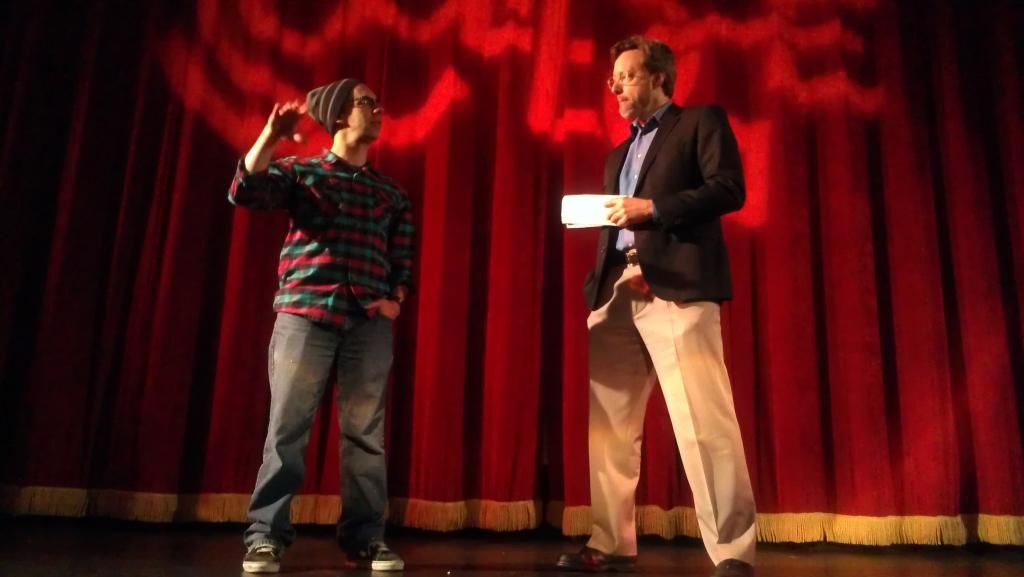
This edition of Talk Cinema was a little different, in that instead of the typical post-film discussion, we had a Q&A. Bring on the horrible photography!

Bret Anthony Johnston & Michael Phillips

That's Waiting for Lightning writer Bret Anthony Johnston & Chicago Tribune critic Michael Phillips, who I think is the first out-of-town critic I can remember hosting one of these sessions. It was a fortuitous but somewhat ad-hoc situation, too - until just a day or two before the screening, it was Silver Linings Playbook scheduled for this slot until, well, it was no longer a preview, opening at Boston Common on Friday. It worked out, because Johnston happens to teach creative writing at Harvard and was able to join us for a Q&A rather than go skateboard himself that morning.

The position of a writer on a documentary is interesting; he mentioned that he wrote a profile of the film's subject - skateboarder Danny Way - for a magazine some years earlier, and described the job in this case as coming in after photography was mostly done in order to help shape the thing by taking the hundreds of hours of interview transcripts and piecing it together to tell a story. That makes sense, although that would be a completely backwards way to make a fictional film.

One point he returned to a couple of times was that Way is apparently one of the most articulate people on the subject of pain he's ever spoken to. At first I thought he was talking about emotional pain, but he actually meant literal, physical pain. It's kind of easy to nod half-seriously about that, seeing some of the falls he takes on a skateboard in this movie, but Johnston described him as being able to converse like a doctor on that subject despite only getting through his freshman year of high school and otherwise speaking like a dropout. And that's kind of interesting, since it implies not just familiarity, but an instinctive understanding of a specialized subject. It's probably a big part of why he's been able to rise to the top of his field and innovate there; being able to recognize what one's body is capable of handling has probably kept him from being scared off or Darwin-ing himself out of the game.

Waiting for Lightning

* * ¾ (out of four)
Seen 18 November 2012 in Coolidge Corner Theatre #1 (Talk Cinema, digital)

Most extreme sports movies sell spectacle; if one has been booked for a night or two at a local theater before hitting the shelves at the local ski/surf/skate shop, you can usually bet on quality photography of impressive feats in nice locations. Waiting for Lightning is different; although it's got a heck of a stunt at its center, it is primarily a biography of the man who attempted it and what got him there.

That man is Danny Way, a skateboarding prodigy from Vista, CA, who excelled at an unusually young age, dropping out of school and turning pro when he was fifteen. While he mastered street skating after the skate parks where he grew up in started closing down, those were clearly his first love, and he recreated those experiences on a grand scale with "Megaramp". As the movie opens in 2005, he's planning a record-setting Megaramp stunt - jumping the Great Wall of China.

Even a large-scale stunt like the China jump is over relatively quickly, so director Jacob Rosenberg and writer Bret Anthony Johnston spend some time building up to it. Some of that time is spent on the literal building, and it might have been interesting to take a somewhat closer look at that if the footage were available; what we see of American designers working with a Chinese crew on a structure that must be built quickly but within precise specifications would be the basis of a nifty "how things work" documentary. This might especially be the case for non-skaters who only see the fearlessness involved as opposed to the physics of the ramp and the skill involved.

Full review at EFC.

Tuesday, November 20, 2012

Possession

This one looked neat at Fantasia this summer - it played as part of the series tied to Kier-La Janisse's book House of Psychotic Women, with its poster actually serving as the book's special-edition cover - but I believe the print was in French, and even if I had any practice, my language skills appear to stink. So, when I saw it was playing the Harvard Film Archive in something that, if you squint, looks kind of like a run as opposed to a screening (it played twice on the 17th, and will play once more on Saturday the 24th and twice on Sunday the 25th), I was kind of glad, even though I had no idea of just how strange the movie was.

And, brother, is this a weird one, even without trying to wrap my head around young, thin, unlined Sam Neill (as far as I'm concerned, Neill appeared fully formed with the release of Jurassic Park, much the way Helen Mirren didn't exist before Prime Suspect and my brain rejects images that claim otherwise). As I say in the review, I have no idea what the original US cut must have been like; it took 47 minutes out of a 127-minute movie, and aside from a few climactic scenes with action and gross-outs in them, I'm not sure how one decides which moments among the rest are important.

One thing I found myself particularly impressed by is how everything supernatural is at least consistent emotionally. A great many horror movies tend to throw a bunch of weird/gross things together but never hook them in; consider this year's movie named "Possession" (keeping it as The Dybbuk Box would have been so helpful), where there was weird stuff with moths coming out of people's mouths that was creepy, but didn't really mean anything. It's tough with horror movies; you want them to have mystery but not cheat, so having it all work emotionally if not logically is a good compromise.

Anyway, if you're in Boston next weekend, check it out at the HFA. It looks like the announced Blu-ray release is only in the UK as yet, so these screenings seem like the best chance to see in over here.

Possession (1981)

* * * ¾ (out of four)
Seen 17 November 2012 in the Harvard Film Archive (Special Engagement, 35mm)

Some movies like to let the audience settle in and develop a false sense of security before hitting them with the strange, figuring that will make it all the more shocking. This is not the game plan Andrzej Zulawski adhered to with Possession at all; this movie starts out with high intensity insanity and only cranks things up from there; it's a movie that keeps the audience in its seats as much via stunned disbelief as excellent quality.

Mark (Sam Neill) has just returned to West Berlin after a long foreign assignment, possibly in espionage from the way he's debriefed. Almost immediately, it's clear that his marriage to Anna (Isabelle Adjani) is disintegrating. He practically explodes when he learns that she's been having an affair with someone named Heinrich (Heinz Bennent); she is soon only briefly appearing in Mark's life to spend time with their son Bob (Michael Hogben). Strangely, Bob's schoolteacher Helen is a dead ringer for Anna, and despite Mark's suspicions, Anna is not spending the time she's gone with Heinrich.

This is not the sort of movie about a failing marriage where things appear placid on the outside only to be revealed as crumbling on closer examination; there's screaming from the get-go, the apartment is a disaster area, and both halves of the couple just up and vanish for extended periods of time. After establishing a situation so fraught with tension, Zulawski could step back; instead, he pushes the strangeness further, first into the realm of the eccentric and then into the horrific, and finally...

Full review at EFC.

Friday, November 16, 2012

Universal's 100th Anniversary: All Quiet on the Western Front

Two weeks since the start of this series, two weeks until I leave for vacation. Barring a lot of time spent writing in airports/on airplanes, my hope to treat this like a film festival and review everything looks fairly forlorn.

I am, at least, having quite the blast treating the series like a film festival, though. It's one where the program (originally created for the UCLA Film & Video Archive) lists dates in May & June and sometimes different movies, where the movies are ones with an established track record, and where work is as likely to be the cause of a missed screening as a conflict, but the important parts - a domination of what one sees and supper consisting of what you can get from the concession stand - are the same.

At any rate, there's still a couple more weeks of this stuff going on at the Brattle, with more modern stuff coming up soon. I'm going to try and hit a large chunk of it, and hope others do too.

All Quiet on the Western Front

* * * ¾ (out of four)
Seen 2 November 2012 in the Brattle Theatre (Universal's 100th Anniversary, 35mm)

Despite this movie being made in 1930, there isn't necessarily a whole lot to be added to it on the subject of the way war takes young men and destroys them. The later likes of Saving Private Ryan may make the violence more graphic, and other movies may home in on the specific details of different conflicts, but everything important is here, from the promise to young men of glory and honor to the difficulty of coming home afterward.

Life is fairly tranquil in a mid-sized German town until the news arrives: War! History will later all it World War I, but urged on by their teacher (Arnold Lucy), a group of high school classmates has no idea what they're getting into, especially after seeing their jovial reservist mailman (John Wray) reveal another side of himself as a harsh taskmaster in boot camp. Soon Paul (Lew Ayres), Kemmerich (Ben Alexander), Leer (Scott Kolk), Peter (Owen Davis Jr.), Behn (Walter Browne Rogers), and Albert (William Bakewell) are on the front lines, finding something very different than the glory the adults described, and hoping to learn quick from the likes of Kat (Louis Wolheim), the sort of sergeant who somehow finds food and supplies when the men are starving.

It's somewhat fascinating to me that this movie was made from the German point of view in 1930. If I recall my history correctly, American sentiment wasn't particularly against Germany at this point, but this was still a movie (and book before it) that took a sympathetic view of the soldiers that many in the audience had fought against. Of course, there are very few really thick - or even mild - accents to be found here, and those are mostly among the officer corps or other hawks who might be portrayed as the soldiers' worst enemies. It's an interesting set of choices, even if it mostly comes down to characters speaking their native languages tending to be being portrayed as speaking with neutral accents back then.

Full review at EFC.

Next Week in Tickets: Films playing Boston 16 November 2012 - 20 November 2012

Short week, what with Thanksgiving next week and a fair number of Wednesday openings. Short list of movies coming out and playing theaters, too.

  • Kendall Square has the most, actually. The main opening is Anna Karenina, a new adaptation of the Leo Tolstoy novel which has a nice cast - Keira Knightley in the title role, plus Jude Law, Kelly Macdonald, Matthew Macfadyen, and Aaron Taylor-Johnson - a script by Tom Stopard, and Joe Wright directing. He's had a pretty nice string from Pride & Prejudice to Hanna. It plays two screens there; it also plays single screens at Coolidge Corner and Boston Common.

    Kendall Square also opens two documentaries, and has guests coming in for each of them: Brooklyn Castle follows a chess team at a very poor junior high school who nonetheless excel, and yet still face the elimination of their extracurricular activities. On Friday at 7:05pm, Grandmaster Sam Shankland will introduce and presumably talk chess afterward. Chasing Ice, meanwhile, follows James Balog on the Extreme Ice Survey, tracking how glaciers are retreating. It's got a one-week booking scheduled, and for the first two nights (Friday & Saturday), EIS Field Co-ordinator Adam LeWinter will be at the 7pm and 9pm shows.
  • In addition to Anna Karenina on the main screen, The Coolidge also opens IFFBoston selection Gregory Crewdson: Brief Encounters, a documentary about a photographer in Western Massachusetts who spends weeks setting up single complex images.

    The midnight show this weekend is Robocop, a pretty darn excellent Paul Verhoven flick playing in 35mm on both Friday and Saturday night. Sunday morning, they've got a Talk Cinema preview of Silver Linings Playbook, which opens wide on Wednesday but also plays Boston Common as part of its limited run starting on Friday. On Monday, there's a "Sounds of Silents" screening of the 1924 version of Peter Pan; it's a nice version of the story, and for this show, Leslie McMichael will be accompanying it on the harp.
  • The Brattle has a sort-of-new-release, as Miami Connection makes its way to Boston after stops at various film festivals and a thorough push from the Drafthouse hype machine; hopefully this rediscovered 1987 action flick written and directed by star and 9th degree black belt Grandmaster Y.K. Kim is just as insane as it's cracked up to be. It plays midnight on Friday and Saturday nights and 9:30pm on Sunday. They're also offering a free preview screening of Hitchcock on Tuesday, with folks who come to the afternoon screening of Psycho getting first dibs on a seat for the Anthony Hopkins-starring biography.

    Neither of those are technically part of Universal Pictures: Celebrating 100 Years, although Hitchcock is naturally a major part of Universal's history. Two of his movies play as part of double features this week, and they're both great combos: The Birds and Steven Spielberg's Jaws play Friday and Saturday (both spiffy new prints), while Hitchcock's Saboteur doubles up with Stanley Donen's Charade on Monday (a delight which features Audrey Hepburn, Cary Grant, and Walter Matthau). In between, Sunday features a double bill of great crime movies: Burt Lancaster & Ava Gardner in Robert Siodmak's The Killers, and the reconstructed version of Orson Wells's Touch of Evil (a surprisingly vicous film for 1958).
  • The Boston Jewish Film Festival bounces between six different venues in three days from Saturday to Monday: Two shows at "Theatre 1" (formerly the Stuart Street Playhouse) on Saturday the 17th (the rush-line-only Koch and We Are Not Alone); three at the MFA (Let's Dance, Hitler's Children, and Hava Nagila (The Moive)) and two at West Newton (All In and Room 514 on Sunday the 18th; and one each at AMC Framingham (Life In Stills), the Arlington Capitol (Hava Nagila), and Hollywood Hits Danvers (Dorfman).
  • Aside from their BJFF screenings, the MFA continues Tales of the Night on Friday and Saturday. There's also more Flowers of the Steppe: A Festival of Kazakh Cinema, with guests present for Friday's Kelin and Saturday's Letters to an Angel, while that day's The Dash and Sunday's Seker will have to stand on their own
  • Belmont World Film's Family Film Festival actually plays the Belmont Studio this weekend after being at the MFA last week; it offers live magic shows with Friday night's documentaries and plenty of family-friendly local/US/world premieres Saturday and Sunday afternoons. They've got Looper scheduled for the rest of the week.
  • ArtsEmerson offers a weekend of Artists on Film: A Walk in to Sea: Danny Williams and the Warhol Factory on Friday and Saturday evenings, Walk the Line Friday night and Sunday afternoon, Together Saturday afternoon, and Before Night Falls Saturday evening. Walk the Line is 35mm; everything else is being shown from DVD.
  • Hey, cool - I was tempted by the retrospective screening of Possession at Fantasia this summer, only to see it only playing in French. The Harvard Film Archive has decided to have a little mini-run of the bloody cult classic with Isabelle Adjani and Sam Neill, though, playing it twice on Saturday the 18th and planning to have it back Thanksgiving weekend. They've got special guests on either side Ross McElwee and his son Adrian introduce the father's latest self-documentary Photographic Memory on Friday night, and Ichiro Kataoka will perform live interpretations of silent films on Sunday and Monday before taking part in a Q&A afterward. This sort of narration, or "benshi", was apparently a large part of how silent films were experienced in Japan. Sunday afternoon also features a screening in their Antonioni retrospective, Zabriskie Point.
  • You know it's Diwali when there are two screens given over to Indian films at Fresh Pond. Jab Tak Hai Jaan continues through Thanksgiving, but it's joined by Thuppakki. That one's a Tamil-language (but English-subtitled) action movie starring Vijay (I am informed that family names are uncommon in that part of India) as an army intelligence officer who infiltrates terror cells in Mumbai while his family attempts to arrange a marriage for him. There are, of course, also songs.
  • The Somerville Theatre is still down to four screens, it seems; one of them is being used to open A Late Quartet upon its exit from Kendall Square. Be quick in catching it; the site doesn't have it playing beyond Tuesday.
  • Okay, fine, I'll mention that The Twilight Saga: Breaking Dawn - Part 2 opens on a metric buttload of screens at the Arlington Capitol, Fresh Pond, Boston Common, and Fenway (including the RPX screen). By now, you know if you're seeing this final movie about vampires, werewolves, and their intense attraction to newborn babies or not. More importantly, Boston Common and Fenway both pick up Lincoln

Me? Not. I'll be catching Universal stuff, Miami Connection, Possession, maybe some benshi, and at least the docs and Kendall Square. Haven't seen Lincoln yet, either.

Thursday, November 15, 2012

This Week In Tickets: 5 November 2012 - 11 November 2012

I joke about living at the Brattle during programs like this, but this week shows just how true that can be. I've got it in the back of my head to treat the Universal Centennial program like a film festival and come back with full reviews, but I'm pretty sure there's just no way to get to everything I want to.
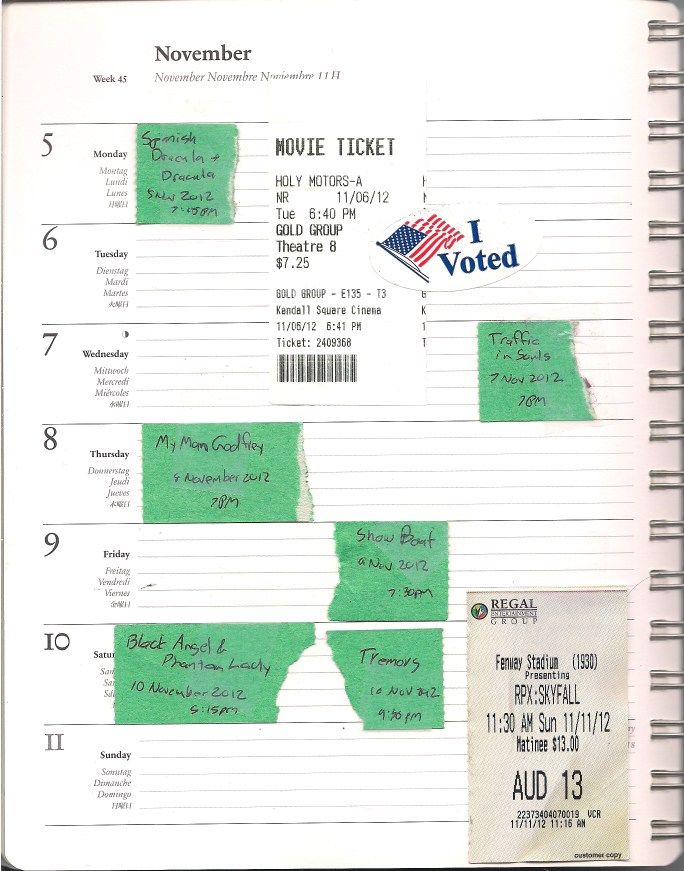
This Week in Tickets

The one time during the week I went anywhere else was on Tuesday, when I worked from home on purpose (it's usually a matter of missing my connection at Alewife) so that I could get to the polling places. Not that one vote in Massachusetts was going to affect the outcome of the Presidential election, but it also couldn't hurt. That it got me able to (just) make a 6:40pm screening of Holy Motors was gravy. Kind of lumpy gravy that isn't quite so hot as you'd like it to be, but worth a try, and I'm glad I saw it then because Kendall Square was cancelling a bunch of shows over the weekend to fit more screenings of Lincoln in. This sort of thing happened before digital, but I imagine copying a DCP from one computer to another is a heck of a lot easier than screwing around with interlinking projectors.

Around that, lots of Universal classics. I finally saw the Spanish Dracula, finding it decent but mostly a curiosity (although I like the Tod Browning/Bela Lugosi Dracula more than I love it). The Brattle had Universal's first feature, Traffic in Souls, coincide with their "Wordless Wednesday" series (it would have been a double feature, but one digital file/DVD was missing). Thursday was a double feature, but the scheduling meant I missed one - boo to a bunch of VHS found footage taking the 9pm slot so you had to be at the theater by five to see The Good Fairy! boo! - and almost considered giving My Man Godfrey a pass, but come on! Similar double-feature scheduling meant I only saw the James Whale Show Boaton Friday, but a double feature of similar films noir, Black Angel and Phantom Lady was no problem on Saturday, even if I did have to wait a bit to see Tremors afterward.

I actually feel bad for missing the Western double feature on Sunday, but I was kind of wiped out after hitting Skyfall and the grocery store and a couple more errands. I'd seen both of them before anyway, but still...

Dracula (1931, Spanish)

* * ¾ (out of four)
Seen 5 November 2012 in the Brattle Theatre (Universal Centennial, 35mm)

To a certain extent, the Spanish-language version of Dracula is almost better as a legend than an actual movie: Little-seen before being restored in the mid-nineties, one could pass around second-hard descriptions of a more gothic atmosphere coming from shooting at night or superior performances without actually confronting the reality - every lost or secret film is better in the imagining, or as a reward for tracking it down.

Most viewers will spot the biggest difference before the film starts running, though: The more familiar version starring Bela Lugosi and directed by Tod Browning runs a tight 75 minutes; this one is nearly a half hour longer, and while 104 minutes is not an unusual length for a modern film, consider that the two were made from the same screenplay (give or take a Spanish translation); the Spanish version is 40% longer than the English. And you can tell; seeing them as a double feature, the Browning version feels relatively tight, while George Melford's is much more relaxed, to put it mildly. It drags in the middle, and while Melford, co-director Enrique Tovar Avalos, and cinematographer George Robinson make a movie that arguably looks better than Browning's, one will be hard-pressed to find an extra minute in it that feels like it was left out of the other. The opening scene is fairly telling; it feels like it is following the script very literally, while Browning and his cast had chances to improvise and tighten things up.

I do suspect that the cast here is generally better than its English-language equivalent; Barry Norton's Juan Harker is less a block of wood than David Manners's John, for instance. The tragic exception, unfortunately, is Carlos Villarias as the title character. He actually bears a fairly striking resemblance to Bela Lugosi which is only accentuated by placing him in the same costume and doing the makeup the same way. And that's what he's up against: Despite the producers' initial reluctance to cast him, every choice in pre-production was made with Lugosi in mind - and the script was based upon a play in which Lugosi had excelled - and while there are signs of a potentially more active, virile count in Villarias's performance, it's hard to shake the impression that he's imitating Lugosi, even if the reality is that he has little choice in the matter.

And so, the Spanish-language Dracula has a hard time emerging from the shadow of its brother, though it might be impressive enough if seen on its own.

Dracula (1931, English)

* * * ¼ (out of four)
Seen 5 November 2012 in the Brattle Theatre (Universal Centennial, 35mm)

For all that the "Spanish Dracula" sometimes pales in comparison to this version, the classic version is not without its faults. The story is thin and sometimes unbalanced; the cast sometimes struggles to give their characters personalities rather than just fill needed spots in the story. Even cut much tighter than the Spanish version shot at the same time, getting from Renfield meeting the Count to Team Van Helsing actually fighting him seems to be a bit of a trudge.

On the other hand, it's got Bela Lugosi in his most iconic role, and that's something you can build a movie around. Like many roles of this type, actually seeing Lugosi in the part after years of imitations and parodies is, if not quite a revelation, a reminder that the performance became famous for being able to hook the audience, even if it was at times more theatrical than a modern audience is used to. Lugosi's Dracula is seductive, not for being overtly sexed-up, but for his absolute certainty that he can take what he wants, so that when Edward Van Sloan's Van Helsing gets something even resembling the upper hand on him, the reaction is so shocked as to be almost feral.

Van Sloan makes a valiant effort to compare with Lugosi, but it's almost a fool's errand. The only other actor who even comes close is Helen Chandler as Mina, who gets interesting once she starts to turn (even if it does mean a lot of "I'm so scared!" hand-wringing. Browning also makes a movie nearly as atmospheric as Melford, and the "almost" isn't a bad thing - he certainly seldom allows that atmosphere to mire him.

Like a lot of Universal Monster movies, Dracula comes across as more influential than perfect from eighty years later, but that influence shouldn't be taken lightly - so much of the modern horror genre (and the vampire genre in particular) takes its cues from this movie, and while it can seem old-hat today, it became that way by being hard to improve upon all at once.

Traffic in Souls

* * * (out of four)
Seen 7 November 2012 in the Brattle Theatre (Universal Centennial, digital)

You can't have a proper one-hundredth anniversary series without screening the studio's first feature, and Universal certainly seemed to set its pulp roots down early with Traffic in Souls, a 1913 potboiler that certainly looks remarkably quaint by today's standards but at least does the job it sets out to do.

It's not perfect by any means. The second half of the story runs on pure coincidence, as the heroine gets a job that puts her in a position to find out where her sister is AND her girlfriend is a cop AND her father is an inventor who has created just the thing they need. It's made up for, though, since those things don't actually solve the case but put the characters in position to do so, and the movie executes the crime/thriller parts afterward pretty darn well. It's a silent, but a fun crime movie.

And there's something about the way that it's definitely a product of it's time that is quaint but not cutesy: Despite the movie being about forced prostitution, the closest it comes to even approaching titillating or overtly sexual is in its opening minutes (which is pretty darn tame and innocent), and for the rest of the movie the whole subject is so taboo that the heroine loses her job because of what is presumed about her sister and the crime is never referred to by anything less oblique than "white slavery". The finale is "Crime Does Not Pay!" stuff that is pretty vicious retribution.

The audience for this sort of movie a hundred years ago, apparently, was not particularly forgiving.

My Man Godfrey

* * * ¾ (out of four)
Seen 8 November 2012 in the Brattle Theatre (Universal Centennial, 35mm)

The two stars of My Man Godfrey aren't quite polar opposites, but close enough to make one worry that the movie will be less "opposites attract" than trying to fit the proverbial square peg into a round hole. Carole Lombard, after all, was the prototypical dizzy thirties dame while this movie sees William Powell at his most classy and sophisticated, even when drunk or homeless. Fortunately, the movie is constructed brilliant, allowing them each to do their own thing, allowing for a clash when those respective things bump against each other but never giving the audience any reason to not love them for what they are.

The script by Morrie Ryskind & novelist Eric Hatch is darn clever in other ways, too: At least from seventy-five years down the road, it seems to strike an ideal balance between acknowledging the reality of the Great Depression while also offering the fantasy of escaping it. The rich may often be silly, but there are enough good people among them to keep the movie from being patronizing or a matter of class warfare. The impropriety of the central love story is acknowledged without a lot of hand-wringing and ultimately handled in a charmingly casual way.

Plus, you know, that cast. William Powell and Carole Lombard are really a perfect pair for a screwball comedy, a mismatched pair who manage the rare trick of bantering wonderfully despite having completely different voices. She boosts the slapstick and silliness (and remains lovable despite her character's silliness and selfishness), while he adroitly maneuvers around it. A whole raft of enjoyable supporting characters pop up just as long as needed, most entertainingly Eugene Pallette, who seems like an Edward G. Robinson prototype as the relatively sensible head of the screwy family that takes Godfrey in.

I love this movie. It reminds me of spiderweb, looking thin and flimsy but actually remarkably strong; despite the wispiness of the plot and how much empty space there seems to be, the end seems to be exactly what everyone, from the characters to the audience, deserves.

Show Boat (1936)

* * ¾ (out of four)
Seen 9 November 2012 in the Brattle Theatre (Universal Centennial, 35mm)

I've said before, I'm not really a musical guy - it's a genre that oftentimes has very little middle ground between brilliance and its opposite. This version of Show Boat manages to fall into that gap, although I like it more than I don't.

In a lot of ways, it's a weird movie (and, presumably, play) structurally: Though it's mostly the story of Irene Dunne's Magnolia "Nola" Hawks, it starts out with a pretty clear focus on Helen Morgan as Julie LaVerne, spending a lot of time with the woman who must be removed for Nola's story to start, and it's got what seems like an extended epilogue on the other end that follows Nola's daughter Kim's career on the stage. It's got some scale, and is probably better than a simple fast-forward, but it leaves the scale sort of in-between.

Plus, there's the seventy-five-years-later way of looking at its attitudes toward race. It's probably progressive for its day, with a pretty clear disdain for the anti-miscegenation laws that are used as a plot device and Nola having what seems like an honest love of "Negro music". It's just a shame that fondness is expressed via a blackface performance, the sort that makes one wonder just what the heck people were thinking a hundred years ago. The stereotyped speech of Paul Robeson and Hattie MacDaniel (plus, he's lazy and she's a big loud busybody) doesn't much help.

And yet, I still missed Robeson when his part in the movie was done; not only does he have a natural charisma and charm, but he's got the best couple of songs. He's also the character whose singing voice sounds the most like his speaking voice, and the disconnect for the rest of the cast is something that I found rather distracting. In my mind, the songs in a musical shouldn't be isolated performances, but a continuation of the characters expressing their emotions, so it should still sound like them.

Black Angel

* * * (out of four)
Seen 10 November 2012 in the Brattle Theatre (Universal Centennial, 35mm)

Black Angel is a fun little mystery that occupies a space between what we now call film noir and a more traditional mystery story, with Dan Duryea and June Vincent playing a couple thrown together by circumstance: Her husband has been convicted of killer his ex-wife, so the sweet young housewife teams up with the alcoholic songwriter to investigate a different suspect. It's the kind of story that could be played both a lot lighter or darker than it is and still make for an interesting movie, and it might be fun to see what different filmmakers would do with Cornell Woolrich's novel.

This middle ground is pretty good, although it might have been interesting if the focus wasn't quite so much on Duryea's Martin Blair compared to Vincent's Catherine Bennett. There's fun angles to play with her; such as how far she would go with the character she is playing on this quest fueled by devotion to her husband, or whether the life she is leading could prove seductive. On the other hand, one does kind of have to admire the restraint and devotion screenwriter Roy Chanslor and director Roy William Neill show by not going there much: This is a whodunit, and those storylines don't resolve murder mysteries.

Kind of a shame; Duryea and Vincent have great chemistry together, and it would be fun to see if she can play certain morally ambiguous notes as well as he did. It doesn't hurt that they have Peter Lorre as a prime suspect, and he plays an oily gangster-type so well, with enough more personality than is typical to be make his scenes more fun than expected.

Phantom Lady

* * * (out of four)
Seen 10 November 2012 in the Brattle Theatre (Universal Centennial, 35mm)

Phantom Lady is, in a way, a demonstration of just how hard a good mystery can be to construct: The opening sequence seems tremendously unlikely on its face, but that's what it takes for a murder to become a puzzle worth reading about, and the steps needed so that an amateur is the one to investigate and solve it... Well, it's unlikely.

But it's fun. It's fun in large part because director Robert Siodmak, working from a screenplay by Bernard Schoenfeld and a novel by Cornell Woolrich -- hey, wait a second; it's not wonder the plots of these two movies seems so similar, if the same author is cranking out the same sorts of stories under pseudonyms!

Anyway, Siodmak does a nice job of having Ella Raines not play plucky would-be sleuth Carol Richman as dopily love-struck throughout, but allows her to realize alongside the audience that you don't do this far for a good boss. It's a bit more nuance than is given to Franchot Tone as said boss's best friend who soon winds up working with her on her investigation - he gets a memorable entrance but he and Siodmak give him a bit too much of a twitch later on.

Still, I like the way the screenplay works; rather than playing it as a fair-play amateur detective story, it lets the twist happen as early as possible and has fun playing it out, and manages to do so without making its heroine look the fool.

Tremors

* * * ¾ (out of four)
Seen 10 November 2012 in the Brattle Theatre (Universal Centennial, 35mm)

The advertising for this movie's slot in the Universal series played it up as a guilty pleasure, which is fair, I suppose, but also does it a disservice. As much as director Ron Underwood and his co-writers S.S. Wilson & Brent Maddock go for the gag quite a bit and build their characters broadly, it's hard to find a single place where they made a bad decision when making this movie.

Sure, on the fifth viewing or so it becomes somewhat clear just how little screen time the "graboids" actually have, but that actually works in their favor as a reflection of just how well they have captured and in many ways improved upon the 1950s creature feature: The filmmakers are working with limited resources but deploying them well. What seems like the best innovation is how they twist the standard character types: The scientist is also the cute girl, and refreshingly not super-capable in every discipline; the heroic hired hands are kind of doofuses; the everyman characters get picked off fairly early, leaving the film to be populated by the eccentrics who would normally die just after being proven right. It's something Maddock & Wilson address more explicitly in later direct-to-video sequels and spinoffs, but part of what makes Tremors funny also makes it work: It's about the oddballs who have to do their own thing rather than the great masses of mainstream folks who can attack a problem with numbers.

Plus, Michael Gross seems to be having such a blast on his vacation from Family Ties. The bit where he looks back at his fortified compound and lists everything he's salted away to survive World War III only to follow it up with "...underground. God damn monsters." cracks me up every time.

Skyfall

* * * ¾ (out of four)
Seen 11 November 2012 in Regal Fenway #13 (first-run, RPX digital)

Do we need another full review of how terrific Skyfall is, re-introducing classic elements to the Bond franchise while maintaining the more "realistic" and hard-edged style that the Casino Royale reboot gave it, slavering absolutely earned praise on Roger Deakins's fantastic cinematography? No, probably not. The Brits got it a week or two before us and they've been flooding the internet with that sort of thing just as they absolutely should.

But, man, it's all true, and then some. Deakins, especially, has shot an absolutely gorgeous picture, albeit one that looks very digital, but it's more a style than a shortcoming here. Daniel Craig continues to give what is the definitive performance as Bond, letting the audience see how the secret agent lifestyle wears on a man, presenting the occasionally snappish Bond of Ian Fleming's novels more than the smooth, unflappable character of the movies. It's downright terrific to see Dame Judi Dench given something to sink her teeth into as M, and I hope future movies give us more of Naomie Harris as Eve, the getaway driver who just does not give one single damn about anyone else on the road.

The action is concentrated into sequences on either end, and both of those are pretty fantastic. The opening gambit is delightful in how it just piles one cliffhanging stunt after another on, making every bit of the chase bigger than the last and giving Craig (and his stunt doubles) the chance to make things look simultaneously hard and easy. It's also fun how the finale flips the typical Bond movie script, with 007 playing defense during the big final assault on the secret hideout.

By the end of the movie, it finally feels like all the "origin story" elements of the reboot are over, and that's good, because as much as I appreciate the renewed focus on the Bond of Fleming's novels, and as much as modern genre writing emphasizes making characters personally involved, it wouldn't be a terrible thing if James Bond was just the guy who MI-6 detailed at the first sign of a superterrorist building a space laser for a couple movies, rather than someone personally connected to every facet of the story. It can make the villain's motivation too small or the hero too little a man just doing his job or caught up in something bigger than he is.


Dracula Double Feature
Holy Motors
Traffic in Souls
My Man Godfrey
Show Boat
Black Angel & Phantom Lady
Tremors
Skyfall

Sunday, November 11, 2012

Holy Motors

Hype is a weird thing. I wouldn't say Holy Motors was particularly hyped in the mainstream, but the festival hive-mind effect seemed to be in overdrive for this one. I saw what seemed like an endless supply of "best of the festivals" and "it will change your lifes" at Fantastic Fest, but that's Fantastic Fest. You get a lot of like-minded people seeing the same movies, talking about them together afterwards, and while I don't think that necessarily changes anybody's mind, I suspect it strengthens and reinforces opinions: Those who like it, like it more, and insights and theories that each individually might not have come up with.

And that's cool; it's better to write from a position of more information than less, and there's nothing in the handbook that says a movie review should reflect first impressions only. Besides, given that I generally share the same tastes, I generally tend to find that sort of unanimity a good sign; I just wonder if the level of affection for it is heightened.

I wonder, because for all the enthusiasm displayed by people writing about it at festivals, this was one of the quietest theaters I can recall for a movie with this much weird and intentionally funny stuff, and it's not like it was an empty room. I don't know if it's just me projecting my feelings on the rest of the audience, but I think that the most excited the crowd got was the bit with the accordions; it just seems like a purely fun moment that doesn't get undercut.

Holy Motors

* * ¼ (out of four)
Seen 6 November 2012 in Landmark Kendall Square #8 (first-run, digital)

Holy Motors is the sort of film that will occasionally get its maker described as "drunk on cinema", just so utterly filled with passion for the medium and its possibilities as to be voluble and more capable of expressing emotion that mere rational thought. Of course, it's also the sort of state where a person stumbles around, throwing up on the people he passes and rambling on about things that just sound silly to the sober. At least he's got a designated driver.

That would be Céline (Edith Scob), who arrives early in the morning to pick up Monsieur Oscar (Denis Lavant) in a limousine and drive him to a series of "appointments". Oscar is an actor of sorts, and the car his mobile dressing room where he removes his wigs, dons prosthetic makeup, and transforms himself into a new person for each stop, only occasionally allowing the audience to see the man behind the blank when he interacts with Céline or other actors between gigs.

The main problem with Holy Motors is, as can often be the case with ambitious and unusual works, also the thing that makes it interesting: An ambitious conceit that allows it to leap between genres and styles while commenting on the nature of cinema itself. Writer/director Leos Carax has a nifty idea, an actor quite capable of handling his chimera of a role and the crew to make it work on-screen, but for as much power as both the idea itself and the individual bits may have, they seldom connect, or even come close enough to have a spark jump between them. The film only rarely produces delight, and when its goal appears to be satiric, that falls flat, too.

Full review on eFilmCritic

Friday, November 09, 2012

This Week In Tickets: 29 October 2012 - 4 November 2012

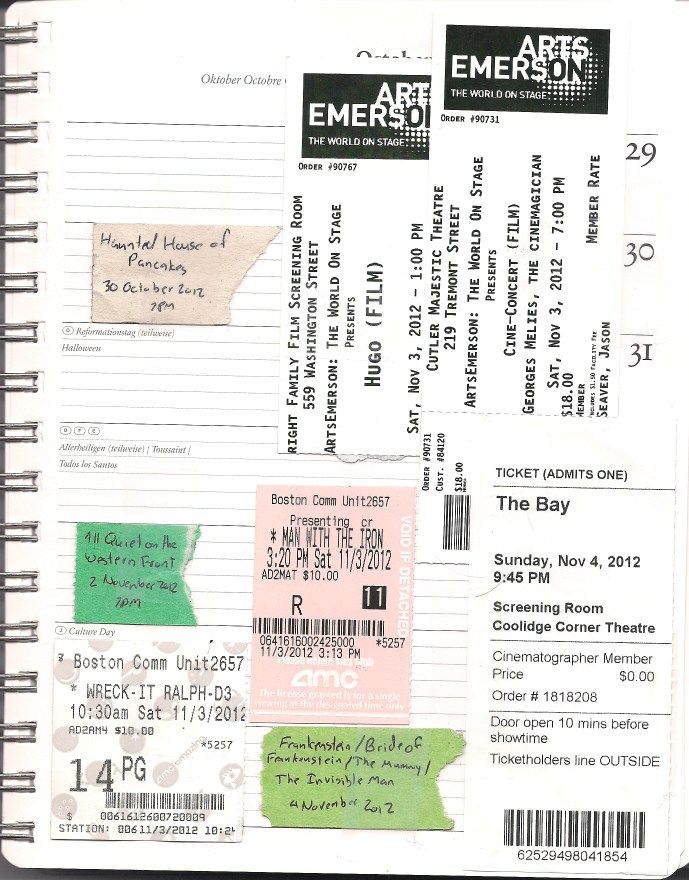
World series done, the Brattle starting a series I want to see a great deal of, a special presentation by Emerson, and a fairly intense week of new releases. Things just got busy at the cinema:

This Week in Tickets

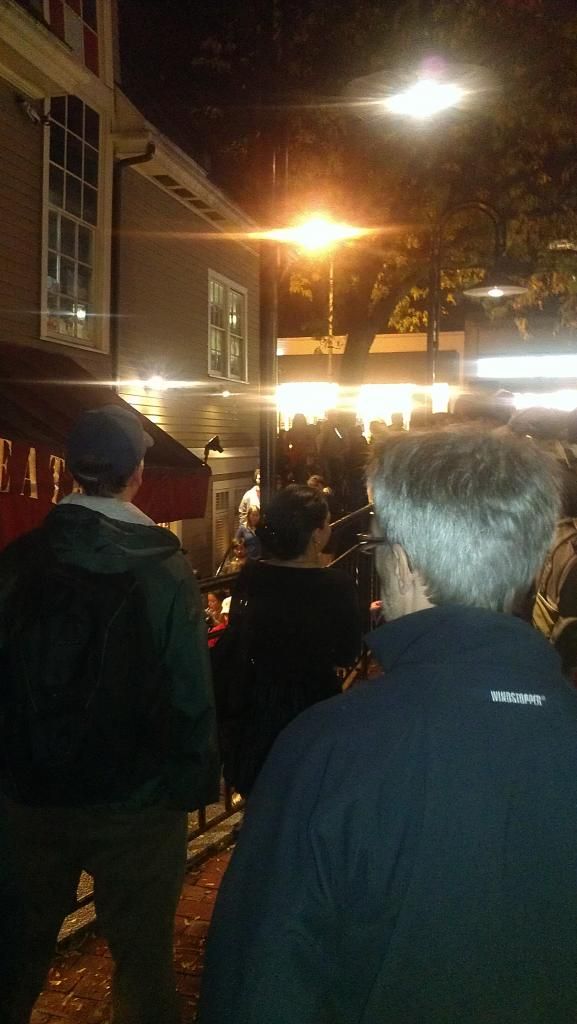
How busy? Well, let's break out some Horrible Photography!

Pancake Line

That's the line at the Brattle waiting to get into The Haunted House of Pancakes, presented by the International Pancake Film Festival. Now, I've got no idea if the IPFF is part of a culture of Boston-area pancake fandom that I was previously and sadly unaware of, if people just happened to see it on the Brattle schedule or entertainment listings and thought it sounded like good cheap fun, or if a program with a dozen shorts made by locals is going to fill a room just by having cast and crew show up, but it drew a nice crowd. Previous shows have mostly been in smaller venues (the host said this was their first time in an actual theater), so there was a lot of waiting in line - both to get in (because they didn't start selling tickets until the 7pm start time) and for the pancakes being cooked in the back of the auditorium. At least it made for a fun time.

I'd be back at the Brattle later in the week for the start of the Universal's 100th Anniversary celebration, with All Quiet on the Western Front on Friday and the Monster Marathon - Frankenstein, Bride of Frankenstein, The Mummy, and The Invisible Man - on Sunday. It bears mentioning that Universal is doing a great job with their centennial celebration: Bunches of new prints and box sets (I love my new Hitchcock Blu-ray set!), and a curated program done in partnership with the UCLA Film and Television Archive that is touring many cities, finding a natural home at the Brattle in the Boston area. Paramount, meanwhile, celebrated their 100th by re-releasing the usual catalog titles on video with new trade dress, clearing their theatrical release schedule, and licensing more or less their entire catalog to Warner Brothers.

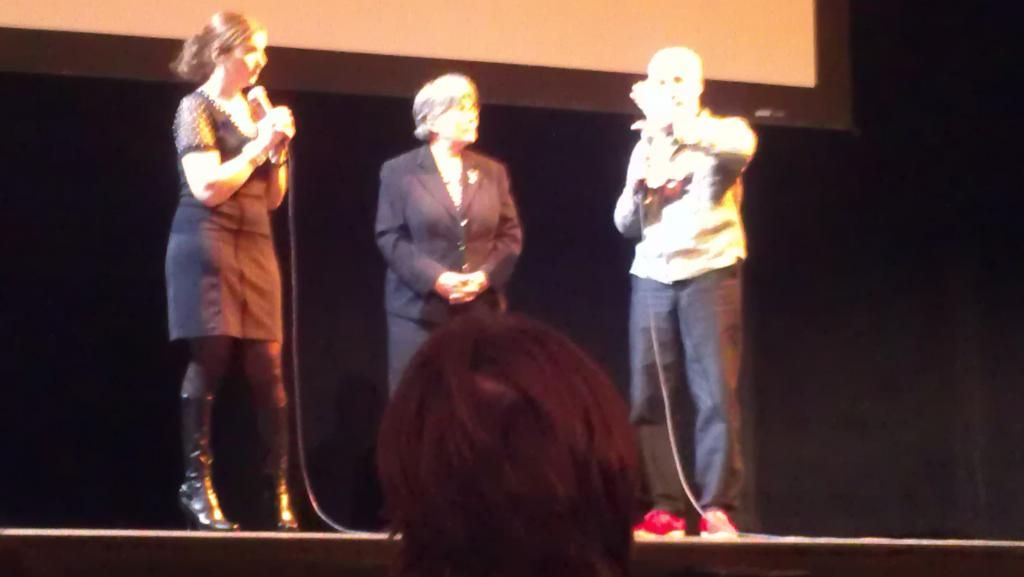
Saturday was a sort of back-and-forth day - on the train early to get to the cheap 3D show of Wreck-It Ralph at Boston Common, out the back and into the next theater over for Hugo in 35mm, back to Boston Common for The Man with the Iron Fists, kill some time and a sandwich at Potbelly's while scribbling reviews in a notebook (the movies I chose to see first this weekend because they had no reviews on EFC would, amusingly, have other reviews posted while I was writing mine), and then over to the Cutler for the Georges Méliès Ciné-Concert, which yielded some real no-exaggeration Horrible Photography:

Photobucket

There was a "no flash photography" rule in place, but even if there wasn't, I think this picture just wasn't happening. From left to right, that's translator Barbara Bouquegneau from the French Cultural Center, narrator Marie-Hélène Lehérissey (Méliès's great-granddaughter), and pianist Lawrence Lehérissey (her son and thus Méliès's great-great-grandson). It was a nifty little affair.

And, finally I finished the weekend off with a screening of The Bay in the Cooldige's screening room. It only played a week there, which is a shame; it's a nifty little movie that's more grounded than many of its found-footage brethren and uses its believability to great advantage.

"The Haunted House of Pancakes"

Seen 30 October 2012 in the Brattle Theatre (International Pancake Film Festival Presents, digital)

With all the pancakes and syrup being served in the back of the theater, I'm fairly surprised that the Brattle wasn't winning an award for All-Time Stickiest Move Theater Floor (Non-Porno Division). But that didn't happen, because people who go to the Brattle are generally cool.

To give star grades and critique the filmmaking of these shorts would not quite be a bit pointless; I'm guessing that the vast majority are one-offs made by folks who say that the IPFF exists and thought it might be worth a lark. There are some noteworthy entries, though - "Pirates of Pancake Island" by Shannon Daly, Jeanne Flanagan, Melitta King, and Bill Trudell of Somerville is a kind of adorable bit of Lego-based stop motion, and while "Jophaboia" by Adric Giles of Watertown is more amusing than most spoofs of artsy French films. Speaking entirely seriously, I like that Giles and company didn't process it to look like a scratched up piece of film, but allowed the shortcomings of low-end digital to come through rather than trying to imitate yesterday's aesthetics. Let your movie honestly represent its time, for better or worse! I also had a good chuckle or three at "The Fall of the House of Pancakes" from Somerville's Collective Fedora.

But let us never speak of Tim Stigliano's "Enough is Never Enough" again. I haven't yet had nightmares about a naked dude pouring batter on himself and cooking flapjacks while narrating the process in a dead-eyed trance, but I'm sure it's just a matter of time.

All Quiet on the Western Front

* * * * (out of four)
Seen 2 November 2012 in the Brattle Theatre (Universal Centennial, 35mm)

Despite this movie being made in 1930, there isn't necessarily a whole lot to be added to it on the subject of the way war takes young men and destroys them. The later likes of Saving Private Ryan may make the violence more graphic, and other movies may home in on the specific details of different conflicts, but everything important is here, from the promise to young men of glory and honor to the difficulty of coming home afterward.

It's somewhat fascinating to me that this movie was made from the German point of view, though. If I recall my history correct, American sentiment wasn't particularly against Germany at this point, but it was still a movie (and book before it) that took a sympathetic view of the soldiers that many in the audience had fought against. Did this make it easier to portray the institutions that used them up in a more positive light than shifting the story to America or England would have?

In terms of look and feel, it's a movie of its time, no question - actors were very much still trying to figure out what worked right in a talkie versus stage or silents - but much of the direction still holds up today. The opening shot in which a camera tracks through a window and the sound of a professor's lecture takes a while to assert itself is particularly impressive.

Hugo

* * * * (out of four)
Seen 3 November 2012 in the Paramount Theater Bright Screening Room (Celebrating Méliès, 35mm)

If one measures "favorite movie" by how many times one watches them, Hugo is certainly right up there for me among recent movies - I believe I saw it on consecutive weeks during its initial release, then again when it got an Oscar-nomination re-release. I haven't watched my Blu-ray of it yet, so this makes a mere four; it's also my first time seeing it in 2D or on film.

Predictably, the movie itself is still fantastic. At its heart, it's still a kid-friendly mystery with some amazing visuals and a great performance by Ben Kingsley, and its low-key but always moving forward pace is kind of masterful. I do think it loses just a little bit by not being in 3D - the opening sequence is clearly designed for that format, and the scene where Sacha Baron Cohen's station inspector is leaning into intimidate Hugo definitely loses something with him not actually impinging no the audience's personal space. Movies intended for 3D also seem to go with wider shots.

It's still pretty marvelous, and I'd still love it if Scorcese did a family-friendly project like this much more often.

Full review on eFilmCritic

"Méliès The Cinemagician"

Seen 3 November 2012 in the Cutler Majestic Theater (Celebrating Méliès, DVD+)

An interesting night, to say the least. Having seen Hugo fresh that afternoon, it was natural to compare the shorts shown with Scorcese's reproductions, leading me to come away impressed with his attention to detail. One thing I found somewhat surprising in the comparison was just how frantic Méliès's films were. Often running mere minutes or even seconds, they feature Méliès and his co-stars running all over the place, not stopping for dialogue of any kind (not even the silent type where there are no intertitles but the thoughts are clear), with a ton of special effects that make the image jumpy or otherwise busy. It's no wonder that Méliès tended to prefer showing them in this sort of "Ciné-Concert", with someone playing an instrument and a narrator telling the story that the film itself literally cannot slow down to explain. In their original run, Georges Méliès himself would perform this task; he later passed it down to his opera singer son André, who passed it on to his granddaughter, who performed in Boston.

It was, admittedly, a bit rough at times - I gather English is her third language after French and Spanish and she mentioned that it was only her second time doing this for an English-language audience (despite 30 years carrying the torch). Mostly, she narrated in French and sometimes added an English translation, and I know just enough French to get frustrated - I listen, catch the occasional word, and then find myself concentrating enough on trying to translate that I'm missing everything else. Even when an English translation came, it would be a bit out of sync in my head.

Still, there were some amazing bits of the program. "A Trip to the Moon" is always welcome, for instance, and "The Coronation of Edward VII" had a nifty story behind it: Méliès had wanted to film the actual coronation (England's first in 60-odd years after Victoria's long reign), but was denied. So he staged it himself, and because the coronation was delayed, his "recreation" appeared at roughly the same time as the actual event. The new king saw it and would mention to Méliès that he had been ill and thus they had had to rush and compact the program, so the other version was arguably "better".

In any event, a very nifty experience, and probably the most authentic way to see these early, pioneering works of cinema.

Frankenstein

* * * * (out of four)
Seen 4 November 2012 in the Brattle Theatre (Universal Centennial, 35mm)

Depending how much time I can find, I may go back and review the Universal movies I'm zipping over here, although I've already done so in the case of Frankenstein. So this might as well be quick.

It is, of course, fantastic, in large part because of Boris Karloff's legendary performance as the Monster. I must admit, that as a fan of the book, I find it a bit odd that that performance, the furthest possible from the intelligent creature of the novel, is the thing that resonates. I think that the reason this quite frankly massive change works is that film and text are different: In the book, Mary Shelley builds her case for the Monster being deserving of the rights of humanity intellectually; we see through his cunning and intellect that he is our equal. In the film, director James Whale and the writers do it emotionally; we feel his humanity. That's indicative of the different strengths of the two media, and how adapting the themes of the book meant changing a huge part of it.

Full review (from 2006) on eFilmCritic

The Bride of Frankenstein

* * * ¾ (out of four)
Seen 4 November 2012 in the Brattle Theatre (Universal Centennial, 35mm)

That star rating is a promotion over what I gave this when I last wrote it up five-plus years ago; I'd like to think I'm older and wiser now.

One thing I recognize in this one (and it's the reason I'd really like to write a full review) is that it's thematically much darker than even most horror movies. Frankenstein is, as the book's title puts it, about the Modern Prometheus but the theme made more accessible by grounding it in the Monster's human, wounded innocence. This one is about love making people better, but in order to get tot hat, it mines a deep vein of self-hatred. Both Henry and the monster despair about their own lack of worth throughout the movie and SPOILERS! (for an 80-year-old movie) when the Bride is animated and suddenly, instantly reacts to her own face in horror, it's a real emotional self-loathing and despair that few horror movies really go for. The film ends on perhaps the saddest, most pessimistic note it can ("We belong dead."), and while it plays in the story as a noble sacrifice, it's heart-breakingly tragic. !SRELIOPS

I'm half-convinced that this is why the Monster doesn't have dialogue in later Universal Frankenstein films - he's never going to say anything as good as that last line.

The Mummy

* * ¾ (out of four)
Seen 4 November 2012 in the Brattle Theatre (Universal Centennial, 35mm)

Go figure - the other time I saw this, it was also back-to-back with Bride of Frankenstein. It's improved a little in my estimation on a second viewing, but not by that much.

I do admire its scale - the filmmakers sell the theme of reincarnation much better than many, and I think it gets downright intelligent toward the end. What initially seems like a mess of "you've reincarnated so I have to kill you so you can live forever" actually becomes a strangely nuanced story of the reincarnated princess realizing that the immortal stasis her old lover Imhotep is proposing is another kind of death, that she's moved on and can't simply go back to what she was. It's not a perfect metaphor, but it works better than one might expect.

One amusing thing - I suspect that the film wound up unusually progressive in its attitudes toward archaeology (for the time) almost by accident: They needed to keep the action in Egypt, so the treasures are not shipped back to the British Museum as likely would have happened with such a find in the 1930s. While that seems eminently sensible today, it rubs characters the wrong way in the film. Kind of funny.

The Invisible Man

* * (out of four)
Seen 4 November 2012 in the Brattle Theatre (Universal Centennial, 35mm)

Something I wonder about with The Invisible Man: Is this basically the first time a big name that a name actor was hired to basically voice a character made out of special effects, maybe doing some motion capture? After all, it's not like Claude Rains's visage appears much in this movie at all, and there's not really enough done with body language that his stunt double couldn't have done most of the work.

As I mentioned on seeing it about three years ago, The Invisible Man is really not a good movie at all beyond some impressive-for-the-time visual effects. We never get a real glimpse of the non-monstrous form of the title character, and the story seldom becomes more than is required.

Plus, Una O'Connor as one of her shreiking harridan characters. Seriously, how does a homicidal invisible man not kill her character out of sheer annoyance at the start?


Haunted House of Pancakes
Hugo
Georges Mieles Cine-Concert
The Bay
All Quiet on the Western Front
Wreck-It Ralph
The Man with the Iron Fists
Universal Monster Marathon

Next Week in Tickets: Films playing Boston 9 November 2012 - 15 November 2012

Photobucket's down for maintenance, so "Next Week" goes up before "This Week" this week. This should go quickly, at least - the theaters have declared that you'll see James Bond or Abraham Lincoln and like it.

  • The new James Bond film, Skyfall, is the only movie opening at the multiplexes, but early word is that it earns that massive booking by being one of the very best in the long-running series, right up there with From Russia with Love and On Her Majesty's Secret Service, reintroducing some of the familiar, whimsical elements back to the series while still retaining the more modern feel of the post-Casino Royale Bond. Anyway, it's all over the place on a bunch of screens, including the Somerville Theatre (on the main screen over the weekend), the IMAX screens at Jordan's Furniture in Reading and Natick, Fresh Pond, Boston Common (including the Imax-branded screen), and Fenway (including the RPX screen).
  • Kendall Square is, for this week at least, the only place to see Lincoln, Steven Spielberg's portrait of the sixteenth President's last few months. By all indications, it is less a biography than a look at how Lincoln engineered the end of the Civil War and slavery, with Daniel Day-Lewis looking excellent in the title role.

    For the most part, they are able to keep most of their other films by splitting houses and cutting things down to one screen from two, so there's also room for a planned one-week booking of This Must Be the Place, with Sean Penn as a rock star who looks an awful lot like Ozzy Osborne returning to America for his father's funeral and taking up his late father's mission to find the Nazi war criminal who tormented him during WWII. Frances McDormand plays his wife. They've also got a one-night booking of The Doors: Live at the Bowl '68 on Monday, including a few songs that were not in the original release of this concert film.
  • It's still Universal's 100th Anniversary, at the Brattle, and that's a very good thing! the prints so far have been fantastic, and the line-up for the second week looks pretty good: An early-evening double feature of Chip Off the Old Block & James Whale's Show Boat on Friday, followed by a stand-along 10pm Late Show of The Last Starfighter; a noir double-feature of Black Angel & Phantom Lady on Saturday, with Tremors as the late show at 9:30pm; a western double feature of Winchester '73 and High Plains Drifter on Sunday; the silent Phantom of the Opera on Tuesday; a Rock Hudson double feature of Pillow Talk & Written on the Wind on Wednesday; and a sci-fi pairing of The Creature from the Black Lagoon (in old-fashioned anaglyph 3D) & The Incredible Shrinking Man on Thursday. Chip off the Old Block, Show Boat, and Pillow Talk are new prints, and all are slated to be 35mm.

    There are also a few other special events. The world premiere of Jonathan Carr's new short film, "Once Again", is Saturday at noon; it's a free screening with donations being collected for the Rich Cronin Hope Foundation for Leukemia. There will be other shorts and live music as well. The Annual Gala takes place on Sunday evening at the Charles Hotel across the street with dinner and a silent auction among other events (dress fancy). Monday night is a combined CineCaché/DocYard/Harvard/Emerson event, An Evening with Tony Buba, with the unique documentarian presenting his first feature (1988's Lightning Over Braddock) along with two earlier shorts, all of which are part of his continuing observation of his hometown of Braddock, PA.
  • The Coolidge pulls in a few films that opened at the Kendall last week: A Late Quartet, Holy Motors, and The House I Live In. Quartet splits time between the film and video rooms, while the other two are in the screening room and GoldScreen all week; check the site to see which is showing where when. I'll have a full review of Holy Motors up later; it's often impressive, but might be too self-aware for its own good.

    Absent from its traditional place at the Brattle for Halloween the past two years, Evil Dead II is the featured midnight movie this weekend, playing on the big screen on both Friday and Saturday night. Should be a party! Friday night also features a midnight screening of The Room because it's been about a month. They also go for a horror vibe with Monday's "Science on Screen" show, where the University of Chicago's Michael LaBarbera will introduce It Came from Beneath the Sea and then discusses why it's Ray Harryhausen-animated monster probably wouldn't fly in real life.
  • The Coolidge is also one of several venues screening programming as part of The Boston Jewish Film Festival from Saturday to Thursday, including screenings at the Somerville Theatre, Arlington Capitol, Cinema Salem, Framingham, Patriot Place, and others. There's actually relatively few shows at The MFA compared to previous years - an already sold-out show of Paris-Manhattan on Saturday and two screenings (Oma & Bella and Emma) on Sunday.

    They are playing host to another festival, with screenings from the Belmont World Film's Family Film Festival on Friday evening and through much of Saturday. There's also a final screening of High Ground Friday evening, while Wednesday marks the first screening of Tales of the Night, a French animated filmthe includes fairy tales from six different cultures that will hang around at various times through the end of the month. And there's one more series starting on Wednesday, as Flowers of the Steppe: A Festival of Kazakh Cinema kicks off with Letters to an Angel with a Q&A afterward.
  • Soldiers undergoing stress in the field and coming home is the theme at ArtsEmerson's film program this weekend. documentary Lioness plays Friday evening, with Hal Ashby's Coming Home running later that night. Best Years of Our Lives plays Saturday evening and Sunday afternoon, and The Hurt Locker plays later Sunday night. The Hurt Locker is 35mm; all the others are digital formats.
  • The Harvard Film Archive returns to its Michelangelo Antonioni series this weekend, with The Eclipse playing Friday evening and Sunday afternoon, with encore screenings of The Cry Friday night, Red Desert and Blow-Up Saturday night, and Chung Ko - China Sunday night. On Monday, they welcome Ute Aurand with a program of 16mm "Film Portraits" on Monday night.
  • The Regent Theatre in Arlington has three music-oriented shows this weekend, including the same Doors concert that the Kendall is showing on Monday. They also have an encore presentation of Led Zeppelin - Celebration Day on Wednesday and a Jimi Hendrix 70th Birthday double feature on Thursday (Jimi Hendrix Voodoo Child & Jimi Plays Berkley). If that's not enough Hendrix for you, the Regent is co-hosting a panel discussion on Tuesday the the Arlington High School Media Center and will have two live shows on Friday the 16th ("All Star Jam") and Saturday the 17th (the Ultrasonic Rock Orchestra) playing Jimi's music.
  • It's mostly unsubtitled stuff on the Indian screen at Fresh Pond this weekend, although subtitled Hindi takes over with Jab Tak Hai Jaan starting Tuesday the 13th and having the screen to itself through Thanksgiving. It's the final film of one of Bollywood's most respected directors, Yash Chopra, and features Shah Rukh Khan as a former soldier in London who must choose between his wife and his lover (Katrina Kaif & Anushka Sharma) It's apparently the season's big Diwali release and expected to be a big hit.
  • The Somerville Theatre appears to have one screen dark over the weekend, but has a couple of special bookings later in the week. On Monday, they have the CD Release party and documentary premiere for Brendan Burns' Timestamp, an experimental album improvised and recorded in the theater itself. On Wednesday and Thursday, they've got a ski movie, Warren Miller's Flow State. They also re-open Sleepwalk with Me for a second run, and to make room Looper and Cloud Atlas head up the Red Line to The Arlington Capitol. The Capitol is planning a Twilight Saga Marathon on Thursday; apparently the last of those things is opening next weekend (as does Fenway and Boston Common)

My plans? Still living at the Brattle, with brief trips elsewhere for Skyfall (maybe to Reading on Sunday?) and Linclon. I'll probably also take in It Came from Beneath the Sea at the Coolidge on Monday.

Tuesday, November 06, 2012

The Bay

It's been a while since I've been in the Coolidge's screening room; I generally go for film when I can, and I've had some bad experience there, when it wasn't yet using full HD and I literally would be better off waiting for the movie to come out on Blu-ray and watching it in my living room. Sunday night's screening looked better than I remembered from before, but it's still sort of a last resort: The screen is barely wider than the center aisle, so the room really doesn't have a sweet spot. Better than watching at home, but...

Anyway, it's interesting to see Barry Levinson doing this. Brian De Palma did a movie in this sort of style a few years ago, and I'm curious about how much of it is "want to" and "need to". As storied as these guys' careers have been, that doesn't necessarily count for a lot in the present day - it's kind of fascinating how household names like Bruce Willis and Samuel L. Jackson can have their movies go direct to video or VOD, and directors who haven't had a hit in a while are even more in that boat. Levinson, arguably, hasn't had a real hit since Sleepers fifteen years ago, so folks probably aren't lining up to finance big movies with his name on it. You take the gig you can get, although this does seem to be something he believes in (he's got a story credit), and it is worth noting that The Bay seems to have a more substantive story than many horror movies of its ilk. Maybe a veteran has to have something to say to do a movie like this, where a rookie just likes the hook.

The Bay

* * * ½ (out of four)
Seen 4 November 2012 in the Coolidge Corner Theatre Video Screening Room (first-run, digital)

First-person horror is generally a young filmmaker's game, a way to produce a movie with little in the way of resources where the cast being unknowns is a plus, maybe sneak into a genre film festival, get seen, and start working one's way up the ladder. That makes it a bit of a surprise to see seasoned veteran Barry Levinson dipping his toes into these waters, and he does it well enough that audiences might think twice about doing so literally after the movie.

The Bay doesn't label itself "A Barry Levinson Film" at the start, though; it presents itself as the work of Donna Thompson (Kether Donohue), a former communications student piecing together what happened in Claridge, Maryland on July 4th, 2009 from footage found on a WikiLeaks-inspired website and her own memories. She was an intern at a local TV station, doing video blogs for the website and puff pieces like interviewing Mayor Stockman (Frank Deal) about the Independence Day activities. It's not going to be a slow news day for long - soon enough people are developing strange blisters that ER doctor Jack Abrams (Stephen Kunken) is calling the CDC and the small sheriff's department is being overloaded with strange calls.

"Found footage horror" is the name often given to these sorts of movies, but Levinson and screenwriter Michael Wallach make their movie stand out in part by not trying to build a mystery around the source of the material: Donna lives through this, and The Bay looks and feels like her movie. Although mostly fairly linear, it jumps forward to her narration in 2012 and back to an earlier connected incident; the music is sometimes a little too much and Donna drops "he'll die later" in enough to make it a little less effective as ominous foreshadowing. But those apparent flaws are part of what makes it feel genuine, like the work of a talented but inexperienced young woman who is still extremely close to the material.

Full review at EFC.

Monday, November 05, 2012

New Releases: Wreck-It Ralph & The Man with the Iron Fists

Huzzah, MoviePass worked for The Man with the Iron Fists! Both the "one per day" and "no 3D" rules kept me from using it for Wreck-It Ralph, but that's OK, as this was a festival-full weekend and I had to squeeze what I wanted in while I could, and it's going to be that way through November.

Anyway, not a whole lot to say about The Man with the Iron Fists that isn't in the review other than that it's quite possible where I sat may have skewed my opinion. I like being toward the front in general, but by the time I got to the theater and got a snack (the first three movies of the day were stacked right on top of each other) I was looking at the front row if I wanted to be toward the center, so... front row it was. For something like Iron Fists, with a lot of fast-moving action that uses the entire wide screen, it's especially problematic. That may be a large chunk of why I thought the action direction was choppy while a lot of other people seemed to like it.

I must also say, I dug the credits. Great Shaw Brothers homaging on the one hand and blaxploitation style on the other.

Wreck-It Ralph was darn good, and the whole package was even better because it included the short film "Paperman" at the front. I'd actually heard a bit about it before, but forgot that it was going to be in front of Ralph (I was half-assuming another Toy Story short, though I gather then new one premiered online). It's really beautiful, using what feels like the same sort of CG models as Tangled to create something with a bit of the character of traditional cel-based animation, even if it is obviously CG and 3D. It does a great job of telling its story without words, just letting action, character expression, and music make the point. And it's sweet.

It was just what was needed after a pretty rough set of previews. There were trailers for a half-dozen animated/"family" films, and some were pretty rough: Dino Time and Escape from Planet Earth both look like they've got no business hitting the same theaters that play movies from the big studios, really; the animation is basic and characters look plastic less as a matter of style and more because there just isn't enough computing power to throw at it for textures or enough time to really get movement right. The Smurfs 2 looks like the studio has staked out a release date but don't have any idea what sort of movie it's making, and it ironically has the opposite problem as those other two - too much texture and dimension compared to Peyo's simple drawings (and the voice also seems totally wrong for someone who watched the cartoon when younger). Despicable Me 2, on the other hand, looks enjoyably absurd with its focus on the Minions, and The Croods at the very least looks interesting - the character animation looks like they got it as close to photorealistic as they could and then pulled back to what works. And the trailer for the 3D re-release of Monsters Inc. looks pretty good - you'd almost think it was built for that.

It's worth mentioning how relatively uninspiring the next batch of animated films looks because 2012 was actually crazy-good: We got Arietty, The Lorax, Pirates!, Madagascar 3, Brave, Ice Age 4, ParaNorman, Hotel Transylvania, Frankenweenie, Wreck-It Ralph, and the upcoming Rise of the Guardians. PLUS Chico & Rita and A Cat in Paris from last year's Oscar-qualifiers and three Disney 3D re-releases. That's a pretty nice selection of movies, and it doesn't count any of the pretty good ones I saw at Fantasia that may wind up on the Oscar list (Children Who Chase Lost Voices from Deep Below, Gyo, A Letter to Momo, The King of Pigs, Asura)

Here's hoping 2013 can try to keep up with 2012, although that's a really high bar.

Oh, one more thing about Wreck-It Ralph... Stay through the end credits. The bit at the very end isn't that great, but the 8-bit styled gags in the titles amused me as did some of the music.

Wreck-It Ralph

* * * ¾ (out of four)
Seen 3 November 2012 in AMC Boston Common #14 (first-run, Real-D)

Wreck-It Ralph might be said to be the next generation's Who Framed Roger Rabbit?, and that can be taken as a compliment or a dig depending on who says that how: The cynical will claim that the video games it references are inherently inferior to the Disney and Warner cartoons previous generations grew up on, and that it lacks a certain satiric edge; those who like it will point out how well it integrates original characters into a world filled with old favorites and mixes and matches them in clever ways. I lean toward the latter, even if I could see where the former are coming from.

Ralph (voice of John C. Reilly) is the bad guy in "Fix-It Felix Jr.", a game that's been in the local arcade for thirty years now. And when the characters from various games hang out together after the kids go home, he admits that it bothers him that no-one appreciates what he does. But when he's not invited to the machine's thirtieth anniversary party, he flips his lid, and enters first-person shooter "Hero's Duty" to try and win a medal of his own, though he eventually winds up in karting game "Sugar Rush", where glitchy outcast Vanellope von Sweetz (voice of Sarah Silverman) leads him on a merry chase. His absence from his own game leaves it declared out of order, though, and if he's not found by the next day, it will be unplugged, leaving the characters abandoned, so Felix (voice of Jack McBrayer) goes looking for him, teaming up with Sgt. Calhoun (voice of Jane Lynch) of "Duty", who fears a different kind of disaster.

At the very least, Wreck-It Ralph is going to be a fun movie to freeze-frame once it comes out on video, not just to see how many videogame in-jokes have been placed in the background but to see if an important clue to what kicks off the finale has been hiding in plain sight since early on. I sort of suspect it has, which means that the filmmakers' attention to detail isn't just about cramming all of their favorite game characters into the background. That is a lot of fun, though, especially since they dig into the 1980s games that might not have the highest profile (Q*Bert and Tapper, for instance) and have some fun with the more modern ones, too.

Full review at EFC.

The Man with the Iron Fists

* * * (out of four)
Seen 3 November 2012 in AMC Boston Common #11 (first-run, digital)

I'm going to guess that it's no coincidence that Gordon Liu and Pam Grier play important figures in the life of The Man with the Iron Fists's title character; his kung fu flicks and her blaxploitation movies provide a lot of DNA for this one. And while it retains a fair amount of their weaknesses, it captures a great deal of their pleasures, too.

The governor has a shipment of gold heading to the northern border and has hired the Lion Clan to protect it as it passes through Jungle Village. But leader Gold Lion (Chen Kuan Tai) has been betrayed by lieutenants Silver Lion (Byron Mann) and Bronze Lion (Cung Le), abetted by Poison Dagger (Daniel Wu). The local blacksmith (RZA) is selling weapons to everyone who will pay, aiming to buy out the contract of girlfriend Lady Silk (Jamie Chung) at the brother run by Madam Blossom (Lucy Liu). But all that gold makes an irresistible target, so warriors from Jack the Knife (Russell Crowe) to Brass Body (Dave Bautista) to the Gemini Killers (Andrew Lin & Grace Huang) to Gold Lion's son Zen Yi (Rick Yune) are all converging on Jungle Village.

Say this for the folks both behind and in front of the camera for this movie: They know exactly what film they want to make and generally nail it. That's trickier than it sounds; part of the characters of the movies that inspired this one is their imperfection and occasional broad comedy (intentional and otherwise), but recreating that too deliberately makes it easy to drift from loving homage to easy mockery. What writer/director/star RZA does is keep things loose until the fighting starts, never making fun of the genre into which he's inserted himself but well aware of its conventions. He has fun pushing already outsize things a little farther and letting his characters swagger.

Full review at EFC.