Friday, September 02, 2022

Next Week in Tickets: Films playing Boston 2 September 2022 - 8 September 2022

Labor Day weekend is even weirder than usual this year, with the two biggest entries re-releases, a "National Cinema Day" on Saturday where a lot of places will be charging $3, any movie, any screen, all day long, and not even a lot of unimpressive material being dumped in the hope that it will maybe get a boost by a holiday weekend.
  • Honk for Jesus, Save Your Soul is the widest new release, playing at Fresh Pond, Fenway, Kendall Square, South Bay, Assembly Row, and the Embassy; it stars Regina Hall and Sterling K. Brown as the leaders of a megachurch trying to rebuild themselves from nothing after a major scandal. There's also Gigi & Nate at Boston Common, featuring Charlie Rowe as a parapalegic man given a curious monkey as a helper animal.

    The bigger name releases are established hits: Jaws is releasing on Imax screens and in RealD (in what sounds like a surprisingly decent conversion). It's at Boston Common (Imax Xenon/Real 3D), South Bay (Imax Xenon), and Assembly Row (Imax Xenon). Sony also brings Spider-Man: No Way Home back with 15 minutes of deleted scenes and extras that were apparently not on the DVD/Blu-Ray/4K releases. It's at the Capitol, Fresh Pond, CinemasSalem, Boston Common (including Dolby CInema), Fenway, South Bay (Dolby Cinema), Assembly Row (Dolby Cinema), Arsenal Yards (CWX), and Chestnut Hill.

    Fenway, South Bay, and Arsenal Yards have 40th Anniversary screenings of Star Trek II: The Wrath of Khan on Sunday, Monday, and Thursday (no Arsenal Yards). There are Wednesday early screenings of Barbarian (Boston Common, Assembly Row) and After Ever Happy (Boston Common, Fenway, South Bay, Assembly Row, Arsenal Yards) before the regular Thursday previews
  • Landmark Theatres Kendall Square has the latest from François Ozon, Peter Von Kant, a remake of Rainer Werner Fassbinder's The Bitter Tears of Petra Von Kant that reimagines the title character as a gay filmmaker, creating new twists on its tale. The Kendall also opens Three Minutes: A Lengthening, with director Bianca Stigter taking a 3-minute home movie that is the only surviving record of the Jewish inhabitants of a Polish town and both teasing as much as she can from it and providing context.

    Kendall Square starts a new Retro Replay program - "Back to School" - on Tuesday with Animal House. Their website is currently not showing any showtimes for Wednesday and Thursday, although it's also not showing any announcement of the place being closed
  • The Brattle Theatre has a few weeks of straightforward bookings coming up, with Girl Picture playing all week; it's a Finnish film about two best friends who find their life heading in new directions when a third joins their circle. They also have late shows of Daisies, the Czech New Wave classic in a new restoration. They also have 35mm screenings of Modern Times from Saturday to Monday to celebrate Labor Day.
  • Apple Fresh Pond has a new slate of Indian movies for the weekend. Cobra screens in both Tamil and Telugu, featuring Vikram as a mathematical genius who has an alter ego as a master criminal. Ranga Ranga Vaibhavanga is a Telugu-language comedy about a pair from the same hometown who never got along but wind up stuck with each other through medical school. Another Telugu comedy, First Day First Show, has a college kid getting into weird misadventures as he tries to get tickets to see a movie with his crush. Malayalam comedy Palthu Janwar, meanwhile, has an animator having to take a job as a veterinary inspector to make ends meet. Tamil-language drama Natchathiram Nagargirathu has four young people trying to figure out life and love. Hindi-language mythological adventure Brahmastra Part One: Shiva, which apparently was originally scheduled for December 2016, opens at Boston Common on Thursday in Imax Xenon (apparently 2D, although the standee at the theater mentions Imax 3D) and at Fenway in both Hindi (2D/3D) and Telugu (2D).

    Boston Common has Chinese comedy Moon Man bouncing around the schedule, with the makers of Never Say Die playing with the idea of an astronaut marooned on the moon as a disaster wipes out life on Earth. Romance Almost Love also hangs around.

    Anime The House of the Lost on the Cape plays Boston Common on Wednesday, with both dubbed and subtitled screenings of this film about a teenager discovering peace and maybe kappas at a traditional Japanese beach home. Dragon Ball Super: Super Hero still plays Fresh Pond, Boston Common, Fenway, Kendall Square, South Bay (including Dolby Cinema), Assembly Row, Arsenal Yards (including CWX), Chestnut Hill, and CinemaSalem; though most places are dub-only now.
  • Did The Coolidge Corner Theatre have Mrs. Harris Goes to Paris when it first opened, or is this just picking up the Cute English Thing with more legs than you might expect when they've got some room on screens? I can't recall, but it's there/back, including a masked matinee on Sunday.

    The September After Midnite series is Midnight 101, kind of picking up where the Brattle left off, only actually at midnight, with a new restoration of Pink Flamingos playing Friday and a 35mm print of Repo Man on Saturday. Monday's Big Screen Classic is Office Space, and it's still Samurai Summer, with 35mm prints of Ran (on Tuesday) and A Fistful of Dollars (on Wednesday). Thursday's Cinema Jukebox show is Juice
  • The Harvard Film Archive kicks off their Fall season with a program of Early Abbas Kiarostami, with Where is the Friend's House? playing Friday evening and Sunday afternoon (with 2 shorts), First Graders on Sunday night (with two shorts). Monday also has "Learning to Be Human, the Open-Ended Educational Film", a program of (mostly) 16mm short films curated by Brittany Gravely.
  • The Somerville Theatre picks up the new 4K restoration of Apocalypse Now in its Final Cut on the main screen, with The Good Boss showing up downstairs.
  • The Lexington Venue refreshes their screens with Vengeance, Emily the Criminal, and The Good Boss playing through Monday.

    The West Newton Cinema brings The Bad Guys back for matinees in addition to Hallelujah: Leonard Cohen A Journey, A Song, Mrs. Harris Goes to Paris, Where the Crawdads Sing, Minions, Downton Abbey: A New Era, Everything Everywhere All at Once, and Marcel the Shell with Shoes On. No listings for Thursday.

    The Luna Theater has Bodies Bodies Bodies Friday and Saturday, the Sundance Institute Indigineous Shorts Tour Saturday afternoon and Thursday evening (with a less-themed Sundance Shorts program Saturday evening), Heathers on Sunday, and Weirdo Wednesday.

    Cinema Salem Friday-Monday line-up is Spider-Man No Way Home, Bodies Bodies Bodies, and Dragon Ball Super: Super Hero; they've also got Monty Python and the Holy Grail on Sunday evening.
  • Joe's Free Films has outdoor movies more or less shutting down with Labor Day, although Ghost plays Copley Square twice on Thursday to give folks a reason to hang around and maybe spread their Orange Line commute out.
  • For those still not ready to join random people in a room for two hours, theater rentals are available at Kendall Square, The Embassy, West Newton, the Capitol and Somerville, The Venue, CinemaSalem, and many of the multiplexes.
Am I pondering how I can use Saturday to catch up on a lot of stuff cheap? Mayyyybe. Definitely looking at seeing what the 3D conversion of Jaws looks like, and probably Moon Man among the new releases.

Thursday, September 01, 2022

Fantasia 2022.18: My Broken Mariko, One for the Road, Confession, Dobaaraa, and Seire.

You do not often get fourth chances to see a movie at a festival like Fantasia, but I got really lucky here - my first chance to see My Broken Mariko was opening night, and I probably would have caught it then if they hadn't opened the primary Opening Night. Its matinee encore was part of a bunch of staggered showtimes that overlapped both Baby Assassins and A Fish Tale (kind of uncool scheduling for folks who like the Japanese entries), so I said, ah, rats. It was, however, apparently received very well, and a press screening was announced for the morning of the 23rd and another screening for the 30th. Since the press screening would be at 9am, I opted for this one. It's not quite a record of time between first and final screening at this festival, but it's unusual and fortunate, because I liked it a lot.

And, for what it's worth, the folks who cut the trailer for the festival grabbed what is maybe it's most eye-widening moment from the movie, which is not always the case, and which also manages to be the moment from the trailer one is most likely to sit up and point like "that, right there!" during the movie. See if you can spot it.


After that, we had the funny case where I found myself looking at the schedule several times during the festival, kind of up in the air as to whether I wanted to see Hong Kong comedy Chili Laugh Story or One for the Road before looking the latter up and having my eyes open because it was from the director of Bad Genius - information I would forget by the time I was looking up "what should I do Sunday?" the next time.

Then came Confession, and you can tell the way the college-aged audience around the festival regularly turns over because of how the person introducing the film pointed out that it co-starred Kim Yun-jin from Lost to a wave of "uh, okay, I think I may have heard of that". I remember another thriller she starred in, either during a Lost hiatus or soon after the series ended where not only did she boost attendance, but the distributor was clearly hoping she'd help it open well in North America, spelling her name out in English, given name first, even if everyone else was listed in Korean.

Amusingly, where both Confession and Dobaaraa were concerned…

SPOILERS!

I basically got fooled twice in a row by mysteries that had true identities right out in plain sight. It made me wonder whether the way that it often seems there are maybe a half-dozen common family names in South Korea means you don't have to play cute with that sort of thing because people won't necessarily assume two people with the same family name are related. As to the Indian movie, I've got no idea whether that was a nickname Hindi-speaking people would have figured out belonged to someone or not.

!SRELIOPS

(Looks them up on IMDB)

Wow - both of those moves are remakes of films by Spanish filmmaker Oriol Paulo - Contratiempo for Confession and Durante la tormenta for Dobaaraa - so maybe it's no wonder they both pull the same sort of trick. He has, I believe, written and directed four features which have spawned at least seven or eight local versions between them, and that's brought down by the fact that one hasn't even been released in Spain yet. That's kind of crazy.

After that, Seire, because its second screening would have overlapped a different Korean thriller I wanted to see on closing night and, besides, I figured Quentin Dupieux's Incredible But True would play Boston. It has, of course, for one night at the French Film Festival when I was stuck logged in to work.

Next up: The last Monday of the fest, with The Protector, Convenience Story, and the super-fun Alienoid

My Broken Mariko (Mai burôkun Mariko)

* * * * (out of four)
Seen 31 July 2022 in Salle J.A. De Sève (Fantasia Festival, DCP)

My Broken Mariko is a solid, sympathetic story about a woman trying to come to terms with her best freind's suicide, and that's a harder target to hit than one might expect. It's a thing that could be too earnestly somber or too casual, but filmmaker Yuki Tanada instead comes from a place that could be horrifying but instead has a shred of optimism: Mariko may have been doomed from the start, but that doesn't make her friend's attempts to help, before or after Mariko's death, without value.

Tomoyo Shiino (Mei Nagano) hears about it on the news, reported as something between "what's wrong with the youth these days" and advice to avoid the area on your commute home. She immediately pulls out her phone and starts texting, hoping against hope that it's not her 26-year-old Mariko Ikegawa (Nao Honda), but getting no response. The coroner released the body to her father (Toshinori Omi) without even a proper funeral, and this stiffens her back, because Mariko's father abused and molested her. Maybe she originally only intends to say good-bye, but once she talks her way past Mariko's stepmother Kyoko (Yo Yoshida), Tomoyo grabs her friend's ashes and escapes through the window. She and Mariko had talked of visiting Hawaii in the past, but Tomoyo can't afford that, so she instead decides on another place they had been drawn by, Cape Marigaoka, which is still a long-enough ride from Tokyo for Tomyo to get herself into some trouble along the way.

The film is structured as a road trip, not wasting much time getting Tomoyo to that window before kicking things off and in earnest and putting her on just enough of a trek to have room for flashbacks but not so much as to feel completely lost in one time or another. It also handles the trope of the conversions with an imagined dead friend as well as it can be handled - it feels a bit like a cliche that never happens in real life but is good on film, yes, but then again, Mariko is there in most of those scenes, isn't she?

All of that works in large part because of its great central performance; Tomoyo is sharp and funny selling everyday bits of absurdity like how gross her backup shoes are (she left her good pair at the Ikegawas') but not self-centered, with both Tanada and star Mei Nagano able to show Tomoyo as grappling with her own doubts about her own worth as well, but maybe holding it in because Mariko has always been so much more desperate. When she is eventually paired with a guy (Masataka Kubota), there's chemistry but it's not sexual or romantic. Neither she nor the filmmakers ever lose track of what's foremost in her mind here, although it's impressive to see her own issues poke their way out of that determined shell over the course of the film until it's unmistakably clear that she's not just not alright on Mariko's behalf.

The heartbreaking thing, of course, is how she just couldn't do enough for her best friend even though she tried so hard, always there for Mariko even though there were clearly challenges in her own life and times she probably had to sacrifice because Mariko would talk about killing herself if Tomoyo ever got a boyfriend (but entered unhealthy relationships of her own). The young actresses do a terrific job of feeling like they could grow up into the characters Nagano and Nao Honda start playing as teenagers, establishing a bond that easily persists past the point when Honda leans into how Mariko can be a difficult friend to handle.

Tomoyo mourns over the course of this trip, and doesn't necessarily come to any pat answers, and certainly doesn't find the greater world changed much as a result. But that's the nature of losing people in this way, and the film brings the audience through how feelings of responsibility and guilt can overwhelm. It shows viewers the despair involved, but doesn't force the audience to surrender to it.

(And in a minor "just amuses me" thing, Shiino improvises a haiku! Like the only thing they taught us about Japanese culture when I was a kid, but I think it's the first time I've seen it come up in 25 years of watching Japanese movies.)

One for the Road

* * * ½ (out of four)
Seen 31 July 2022 in Auditorium des Diplõmés de la SGWU (Fantasia Festival, DCP)

One for the Road Co-writer/director Nattawut "Baz" Poonpiriya is likely best known for Bad Genius, a deliciously clever mash-up of a movie, and while this film is something else entirely, it has some of the same sorts of surprises. I raised my eyebrows thinking "that scene took a turn" at one point midway through this, and by the end I had to admire how they played that, because the back half of the film spends a whole lot of time inverting itself, and I couldn't say they hadn't warned me.

As it opens, "Boss" (Thanapob Leeratanakajorn) is living the good life in New York City, operating a tony-looking bar with specialty drinks, many of which he gives away, and bedding a number of the pretty young things who stop in. One night, he gets a surprise call from Bangkok, his friend Aood (Ice Natara) telling him that he is dying of cancer and he needs Boss's help in settling some things. Their bond is enough that Boss flies out there, only to find out that he needs someone to drive him to return some things to his ex-girlfriends: Alice (Ploi Horwang), the dancer who brought Aood back to Thailand from New York; Noona (Chutimon Cheungcharoensuking), an actress shooting a film in Samut Songkram; and Roong (Siraphan Wattanajinda), a now-married photographer who asks that they arrive while her husband is out of town. And while they're on the road, they may as well head to Boss's hometown, to see his sister Tak (Yayaying Rhatha Phongam) and Poum, Tak's husband's son. And maybe someone else.

It's a nifty flick on the way to its later upheaval, an almost cozy art-house road trip with classic (English-language) pop on mixtapes, courtesy of Aood's late father, a disc jockey fond of American music. There are some feel-good moments, some moments which undermine the whole idea of this being a feel-good movie, and some surprises. In a way, the director seems to be doing a sort of refresh on the indie crowd-pleaser in the way Bad Genius mashed together high school and heist pictures, almost funnier because Wong Kar-Wai is producing and you can see when the film is dipping into his particular sort of romanticism, before they spring a different sort of clockwork trap from Genius. It's seldom a comedy sending up its genre conventions - it is a frequently funny movie, and even an outrageous one, but one which doesn't undermine itself by winking at the audience too hard.

Along the way, the film offers up a nifty cast who prove impressively believable as they jump between different points of their lives, aided by makeup and wardrobe, certainly, but generally doing well to show that they've matured some in the gaps that the filmmakers leave but maybe have not become fully-realized adults yet. That's especially true of Ploi Horwang, Chutimon Cheungcharoensuking, and Siraphan Wattanajinda, who show up in relatively narrow windows but play well off Ice Natara's Aood, playing the inevitable breakups and sometimes less-than-fond reunions in a way that lets them remain sympathetic while leaving Aood as more complex, enough that the audience is ready for some of the less likable choices he makes. Natara does impressive work in never quite squandering the default sympathy someone dying of the same cancer that killed his father is given. I'm sure Poonpiriya, editor Chonlasit Upanigkit, and the rest of the team, but Natara gives them good raw material.

At a certain point, Poonpiriya cheekily has the cassette in the car's tape deck flip from A-for-Aood to B-for-Boss, and while that doesn't entirely put the film in Thanapob Leeratanakajorn's hands, it's a major shift, and Leeratanakajorn does quickly make a case for why the film has placed him at the center alongside Narata, with this final stop covering more of Boss's life and finding plenty of material that makes the playboy persona of present-day Boss more understandable even if there's a lot that denies him any sort of sympathy. Violette Wautier shows up for the last act as Prim, Boss's first love, and immediately becomes the film's MVP, selling a romance that begins with him as a teenager and her as a bartender and only gets a little more eyebrow-raising from there; she gets handed some of the clunkier bits of the suddenly more melodramatic dialogue and manages to make it work. She and Leeratanakajorn make for an interesting pairing in that Boss & Prim always seem very much drawn to each other but perfectly capable of self-destruction even a few years later when the expected difference in maturity isn't that vast. It's a fascinating mess and as in unravels, one can see how the bits with Aood's exes are, while important on their own, also a warm-up to trying to make this mess right.

On top of that, it's really delightfully put together, beautifully and occasionally whimsically shot with some knowingly over-sincere selections on the soundtrack. It's an interesting blend of Wong's cool romanticism and Poonpiriya's itchier impulses that are always ready to get the audience on their toes and knock things over, especially if there's a good joke to be had when the audience is expecting wistfulness. The last-act shift is handled a lot better than expected, not just for getting overheated, but for how it's a long flashback detour, but it sure pays off.

One for the Road isn't quite Bad Genius, but it's definitely what the folks who made that movie do when let loose on film-festival-ready indie dramas.

Jabaek (Confession)

* * ¾ (out of four)
Seen 31 July 2022 in Auditorium des Diplõmés de la SGWU (Fantasia Festival, DCP)

I'm not sure that either the locked-room mystery or the more twisty thriller elements of Confession are exactly the best of their type, or that the film necessarily does a good a job as it could at playing like it's going to be one when in fact it's the other as the filmmakers would like, but it plays fair enough to give thrills both when the audience gets surprised or when they get there ahead of the movie.

Yoo Min-Ho (So Ji-Sub) has just been released on bail because there were apparently some irregularities in the murder case against him, despite it being virtually impossible that anyone else could have killed co-worker and lover Kim Se-Hee ("Nana" Im Jin-Ah). As he holes up in a snowy country cabin, some new evidence has come to light, and since his primary attorney cannot make the trip, another one, Yang Shin-Ae (Kim Yunjin) is dispatched. It turns out there Min-ho and Se-Hee may have been the last people to see college student Han Sun-Jae before he disappeared, with father Young-Seok (Choi Kwang-Il) has been seeking an explanation obsessively for the past year. He'd have motive and possibly means to kill Se-Hee, but it's obviously a risky defense strategy - Shin-Ae can't be surprised in court, and Min-Ho almost certainly has something to hide.

As mysteries go, Confession is tightly focused, sometimes to its apparent detriment - when a married man is accused of murdering his lover, one expects his wife to be something more of a factor, but Min-ho's barely registers long enough to be given a name. Similarly, the IT company where Min-Ho is an executive has an exceptionally capable fixer on retainer, good enough at his job that the audience won't go wrong presuming that certain lines of enquiry are such dead ends that it's not worth following up and loyal enough for that not to become a factor. Writer-director Yoon Jong-seok (adapting Spanish film Invisible Guest) for the most part handles hand-waving that material away adroitly, and that's fine; what he will inevitably wind up concentrating on is fine-grained enough that one wants it to matter, rather than zooming out and saying it has all been red herrings.

And the details do matter, with Yoon and the rest jumping into a flashback and then cutting it short by having Shin-Ae point out that, actually, she lied about something to see if Min-Ho would integrate that lie into his story, and then starting it again. It's the sort of thing that must have been fun for the actors, running through various different permutations of the same story, trying to make each feel both like the real deal but also playing up what the various unreliable narrators say. The filmmakers put it together in fine form, not establishing A so convincingly that the audience will automatically reject B. It fits together like clockwork, even if it maybe runs out a bit at the end. K-pop star Nana is particularly impressive here, tweaking her performance to reflect just how much blame Min-Ho and Shin-Ae want to place on her at a given moment but never making her quite a malleable cipher. Choi Kwang-Il does something similar as Han Young-Seok, whose on-screen swings from friendly mechanic looking to help out someone stranded to scheming seeker of vengeance reflect both the natural reaction to his loss and the stories being told.

Most of the action is in the cabin, though, with the general snowy weather setting up a sense of isolation (though Yoon quietly establishes some specific geography for when it might be needed) and it being just the right combination of a rich person's retreat and having rustic elements; it's never a bad thing for the camera in an otherwise talky movie to be able to linger over Chekhov's Chainsaw for a moment One generally can't go too far wrong doing something like putting actors as good as So Ji-Sub and Kim Yunjin in a room and letting them go, especially when they're playing a sort of variation on how these scenes are usually about getting the upper hand;they're trying not to do so in quite so obvious a way.

I'm not sure this entirely translates into a great mystery or a nifty acting exercise, but it generally works out well enough that one should be able to enjoy it either way. With enough clues dropped in plain sight early enough and the story and cast of characters lean enough that one can sort of guess where holes will be filled, it has to, and at the very least, Yoon and his cast never drop the ball.

Dobaaraa

* * ¼ (out of four)
Seen 31 July 2022 in Auditorium des Diplõmés de la SGWU (Fantasia Festival, DCP)

A funny thing about movies that mess with time is that while a new angle tends to feel exciting, it can aso quickly become shorthand for a lot of less-inspired movies, even when they may not necessarily deserve it. It's probably not entirely fair to tag Dobaaraa as falling into the "movies like Frequency" category, even if that's how it starts out - it certainly becomes its own mess, if a somewhat interesting one.

In 1996, sci-fi-loving kid Anay (Aarian Sawant) witnesses his neighbor (Saswata Chatterjee) apparently killing his wife, but when he tries to report it to the police in the middle of a monsoon, he is hit by a bus. Twenty-five years later, nurse Antara Awasthi (Taapsee Pannu), her husband Vikas (Rahul Bhatt), and daughter Avanti (Myra Rajpul) move into Anay's house and hear the story from her friend Abhisheik (Sukant Goel), who was Anay's best friend back then. Finding Anay's old television and VHS camera, they hook it up and, with a similar storm raging, somehow Antara is able to make contact with Anay, warning him about the danger he's in. She saves his life, but when she awakens the next morning, everything has changed - she's living in a different apartment, working at the same hospital but apparently a neurosurgeon rather than a nurse, and she never married Vikas. That means Avanti was never born, something Antara wants desperately to fix. But how? Her story sounds insane, and even the detective called in to handle the woman who seems to have suddenly gone insane (Puvail Gulati) seems to be humoring her as he says he believes her.

Amusingly, this was the second film of the festival in a row where I wound up thinking "ugh, it was sitting right there in front of me! " and I kind of think that makes me unobservant rather than making the filmmakers clever. Heck, it was right there in the exact same way! In my defense, the revelation of this thing kept ust out of direct view hits in a manner that is weird and uncomfortable rather than as a shocking reversal or a piece that satisfactorily makes other pieces click together, technically solving the mystery but overshadowing it at the same time. It's not entirely surprising that the movie winds up messy - where Frequency used its plot device as a way to amplify an existing connection that can exist across time, Dobaaraa has these three or four pockets of characters who don't start out with strong connections, and playing what has happened to Anay in the intervening 25 years as a mystery keeps writer Nihit Bhave (adapting a Spanish film by Oriol Paulo) and director Anurag Kashyap keeping most of what might resonate with the audience back until the end.

For those not kicking themselves or terribly inclined to worry about how it all fits together until the revelations, it makes for an enjoyable enough time twisting mystery, although one that can frequently become very frustrating: It's pretty clear early on that there's no clear way to save both kids without some sort of plot device mumbo jumbo that amounts to crossing one's fingers and hoping the never-specified rules are what one wants them to be, and that feels like something that should weigh on the characters more. Similarly, there are a lot of moments where it sure feels like the characters should be smarter than this - Antara in particular is carefully established as smart and empathetic early on, but huge chunks of the film seem to rely on her not putting two and two together or suddenly deciding that it equals five after ten minutes or so of her acting like she knows it's four. That's on top of how, for a movie that is all about playing with time, the timeframe always feels off, with no urgency for how the duration of the storm in both time periods should represent a ticking clock, rather than something brought up when it's convenient.

None of that is exactly fatal, in large part because Taapsee Pannu makes Antara appealing despite all that; she's not exactly subtle about how she's confused about this whole new-timeline thing and not exactly interested if it has erased her daughter, but she does a nice job of picking up the whole idea that she's got some unfulfilled potential and pride despite the ways in which her life in both has very messy parts. (She has apparently been in a lot of movies that looked interesting but maybe not worth risking the local theater running them unsubtitled over the past few years; maybe I'll go anyway next time.) It's kind of a shame that the filmmakers don't exactly give her a good on-screen partner; there looks to be something possible with Sukant Goel's Abhisheik in the original timeline, but he's sidelined in the new one, and for as much as the filmmakers seemingly want something to spark between her and Paviail Gulati's Inspector Anand, it just never happens.

Pannu's appeal and a commitment to the sort of time-twisty plotting that makes one's head spin just enough means that the film never fully collapses. It also never takes off, and there's a lot of time for the audience to feel like what they're seeing could and should be better for what it has to work with.

Seire

* * * (out of four)
Seen 31 July 2022 in Salle J.A. De Sève (Fantasia Festival, digital)

Seire is the sort of horror movie that intrigues a foreigner such as myself but also maybe makes one wish for a tiny bit more cultural context, just to see how deeply embedded certain superstitions and traditions are - although, now that I think of it, maybe there's an interesting question to be examined here about what becomes a tradition and what becomes a superstition. That's not really this movie's thing, but it's maybe lurking just around the corner.

Being a new parent is stressful in the best of cases, and salesman Woo-jin (Seo Hyun-woo) not only doesn't seem to have been granted any parental leave, but wife Hae-mi (Shim Eun-woo) is as superstitious about observing seire, a set of rules meant to protect a newborn baby during the first three weeks of its life. It seems to be a bit unusual - Hae-mi's sister Hae-jin (Ko Eun-min), living next door and also pregnant, does not seem terribly concerned and is kind of annoyed at being considered an "outsider" during this period, although her husband Seong-tak (Ki Woo-kyum) mostly sees this as an eccentricity. Add to this the news that his college friend Se-yeong (Ryu Abel) has recently died, and things get more tense - Hae-mi doesn't want their son I-su exposed to any vibes that Woo-jin may back from the funeral. Also, Se-yeong was not just a "friend", but a longtime lover, and the fact that she has a twin, Ye-yeong, that Woo-jin never knew existed has him thrown even more.

Writer/director Park Kang does not explicitly state that Woo-jin left Se-yeong because he got Hae-mi pregnant, and that was a big factor in her downward spiral - or if he does, I missed it - but that would line a lot of offhand comments up and place what's going on in somewhat sharper relief: It is no longer just about Woo-jin being overwhelmed and Hae-mi seeming to go out of her way to make everything just a little harder, but how there is something toxic in the air, things pulling Woo-jin to the life he must leave behind and thus threatening the new life he is responsible for. It's sort of symbolically messy, but Woo-jin is meeting what seems like the reincarnation of his lover at her funeral, and how can that not be a mixed message?

And Ye-yeong does at times seem to be more than a twin, at least to Woo-jin, sometimes seeming to channel or even be possessed by her sister. Woo-jin is pretty clearly an unreliable narrator from the start, though, briefly seeming to see Se-yeong rather than Hae-mi, and whenever things threaten to get overtly supernatural, Park will throw in a reminder that Woo-jin may be imagining it, but that certainly doesn't make it any better, as it does mean he'll be putting his kid in danger. Park builds his biggest scare moments around things that are particular and relatable - nightmarish hospital visits, funerals, trying to raise a baby in a tight, cluttered apartment. The horror comes not from how a comfortable life can be disrupted, but from how close getting by can be to a nightmare, and how maybe something like Hae-mi's superstitions about seire come from that: It's a burden, but maybe every little bit helps, so why begrudge her that?

Seo Hyun-woo sits in the center as Woo-jin, and it's a nifty performance that I suspect will look even better on a second viewing. There's a big, clear base of "put-upon new dad" there, easily sympathetic, but scratch it and you can see that some of the exhaustion is disguised laziness or dismissal, just a little frustration under the frustration. There's no chemistry between him and Shim Eun-woo's Hae-mi, although it's often more indifference than hostility. Ryu Abel (aka Ryu Sun-young) is interesting as Ye-yeong; the audience never actually meets Se-yeong but still feels like her sister is intriguingly different; she also gives the audience a proper sense of how losing a twin is even more disorienting than losing other family while also hinting at a complex relationship between them. Park seems to have left a lot up to the audience's interpretation but given the cast specific backstories which they run with.

I'm curious how this plays for a lot of people - aside from not knowing just how common or central seire is to mainstream Koreans, I suspect it hits those who have had children differently as well. Even if those experiences are unknown, though, the film is impressively unnerving as the things one may not really believe in can still get under one's skin when things get stressful.

Sunday, August 28, 2022

Fantasia 2022.17: Island of Lost Girls, The Pass: Last Days of the Samurai, Circo Animato, "The Cradle", Sadako DX, and Missing

I'm mildly surprised that the Schmidt family didn't make it to Montreal for Island of Lost Girls on Saturday morning. I imagine that Covid throws a wrench in that sort of thing, but I also suspect that if I'd somehow made a film with my family like this - I don't know that I'd quite call it backyard filmmaking because it's an awful big backyard - that got accepted into a major festival like Fantasia, a week in Montreal would absolutely be that year's summer vacation. I think of the Adams family with The Deeper You Dig three years ago - ike the Adamses, the Schmidts have been making movies as a hobby for a while, occasionally getting one into a festival even though it will almost certainly not get picked up for distribution or get much talked about aside from the dozens who see it in such situations. It isn't tagged with the "Fantasia Underground" label in the program, but it's underground as heck even if it's not the same tone and aesthetic as most stuff in that section. It might be a fun thing to have in the next BUFF, reaching out to family audiences.

Anyway, I would really have enjoyed the explanations of just how insane the making of this must have been, especially if they included a five-year-old shrugging off panicked questions from the audience by saying she is actually a much better swimmer than her character in the movie.

Tough-ish choice later in the day, as Heaven: To the Land of Happiness looks really good and has a heck of a cast and crew, but it might also quietly get a Blu-ray release or show up on Prime in the next few months, and the thing a block away at the Museum is kind of a tradition.

Hello, fifteen-film animation program, the thing that usually grinds these reviews to a halt even when work isn't busy! I love festival animation programs, because they often seem to be the purest expression of what people are imagining in the most concentrated forms. These things average six minutes or so and some are done by the time you've even got yourself prepared for what you're going to see.

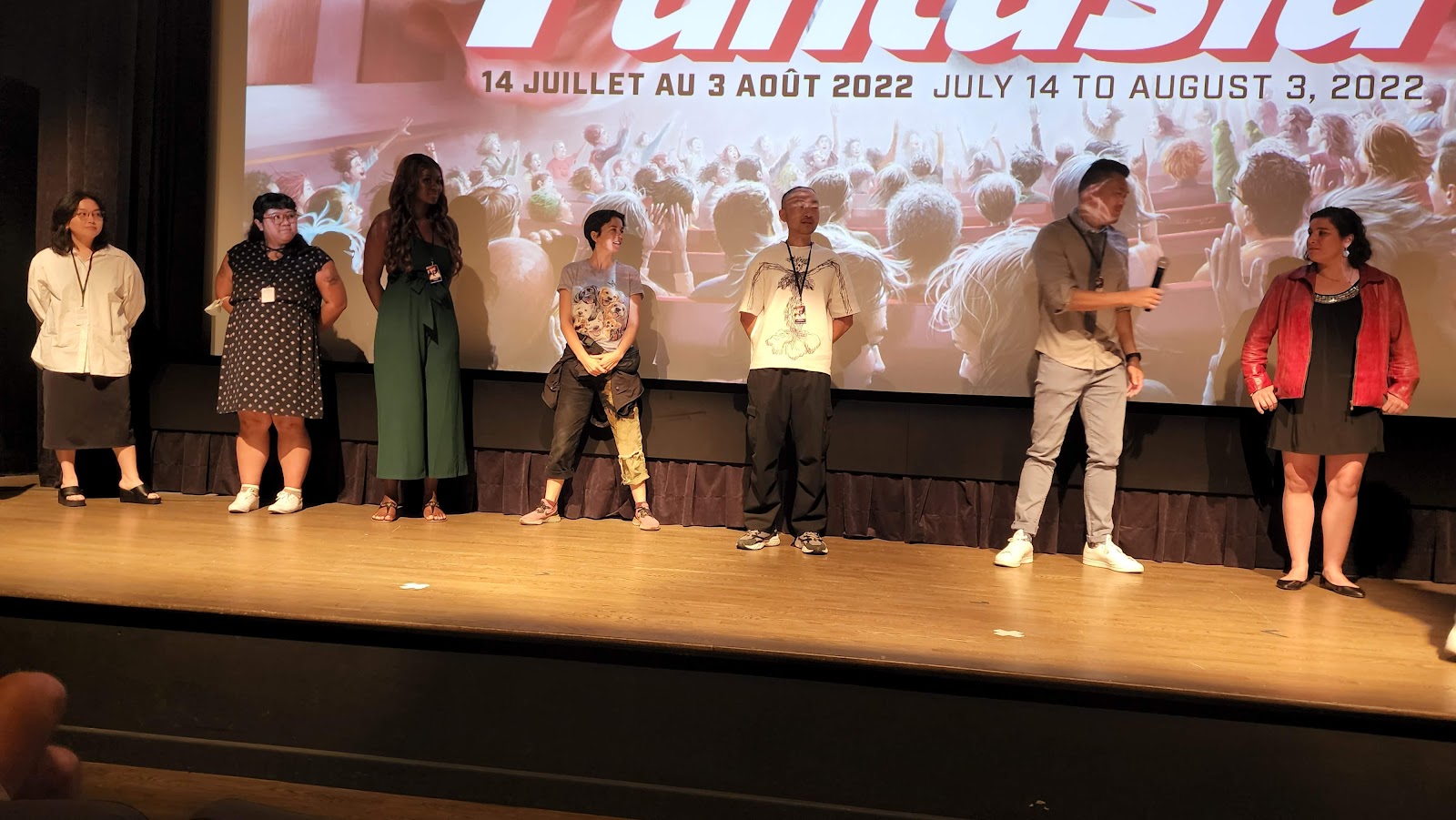
Anyway, the guests, mostly directors, left to right: Grace An of "Baek-il", Karla Monterrosa of "Lo 100to", Omorose Osagie of "Glass Doll", Florentina Gonzalez" of "El After del Mudo", Shengwei Zhou of "Perfect City: The Mother", Sam Chou of "VRDLK: Family of Vurdulak", and "Deshabitada" producer Amanda Puga.

Many, but not all, were student films - An and Monterrosa both talked about drawing on something personal, while others wanted to make something that was far more a flight of fantasy. Chou said that he tried to make a very different film with each short, so apparently the rest aren't banter-y horror stories. Zhou mentioned that he actually really disliked doing "3D"/computer generated stuff, so it was apparently something satisfying to make that extra plastic.

After that, it was kind of an evening of avoiding things. I didn't really care about seeing the new Lena Dunham movie, Sharp Stick, so I went back to Hall for Sadako DX, even though I've never seen any Ring movie from any continent, and Dark Glasses was Dario & Asia Argento, whom I've never had any particular interest in (with the daughter kind of in the category of people whose work you don't really need to support if you don't have to), so I went with Missing, even though there was nothing else blocking its second screening.

Next up: Sunday, which may have wound up the longest day, with My Broken Mariko, One for the Road, Confession, Dobaaraa, and Seire.

Island of Lost Girls

Seen 30 July 2022 in Salle J.A. De Sève (Fantasia Festival, DCP)

Island of Lost Girls is quite possibly the most insane movie I'll see at Fantasia this year, because, for the life of me, I can't see how the Schmidt family makes this thing safely without much more and better CGI than seems likely for this sort of backyard production. It's like Open Water except with pre-teen girls and elephant seals at various points, and then it somehow gets crazier on land.

The three girls are sisters Avila, Autumn, and Scarlet, orphans in a foster home, with Avila a fairly responsible tween while her sisters are mischievous (autumn) and pure chaos (Scarlet), with the latter two seeming to torpedo an interview with prospective adopters when they show up late. They convince Avila to sneak out to the beach, but while there, Scarlet gets pulled out in a current. Avila swims out on a surfboard to get her, with Autumn along because she's scared to be left alone, but the current takes them, and hours later, they find themselves approaching an island with a sea cave. From what they can see, it seems to be sheer cliffs on all sides, and getting to the lighthouse at the top looks like it would be daunting for fully-grown adventurers.

This family has done this sort of thing before - The Incredible Adventure of Jojo (and His Annoying Little Sister Avila) played the festival in 2015 and there's at least one other short listed on IMDB - so they presumably know what they're doing with their tools and what the kids can handle. There are a couple scenes where one or the other of the girls appears doubled, but for the most part, it's clearly them on the surfboard floating in open water or in caves tight enough that many in the audience may find themselves tense at the very thought of what a sudden surge of water could do. The work of cinematographer Heatha McGrath is not often fancy but it doesn't have to be, although going from one shot to another can get shaky and the filmmakers have a tendency to lose track of whichever girls aren't on screen when they get separated.

But, presuming this family wasn't actually putting their daughters in incredible danger, you really have to respect some of the bigger set pieces. There is one involving a tractor, a cave, a cliff, two of the girls, a starfish, and a crab that is legitimately jaw-dropping in its scale even as it has something straight out of a cartoon gag in the middle of it. There are people making $200M movies who could do with studying the stakes, clarity, and sense of danger of that centerpiece. A number aren't quite to that scale but are still genuinely impressive for how they obviously aren't hugely elaborate set-ups and serve to remind just how dangerous situations that the makers of big action movies frequently feel need to goosed can be.

You don't give a movie like this a star rating, because it is clearly the work of amateurs who are going to look bad when graded on the same scale as professionals: The filmmakers are often unable to manage what seems like basic shot-to-shot continuity, for instance, while the young cast is often in that zone where they're not really performers and don't have good lines to recite, but feel enough like real kids who aren't polished in any way to be authentic. Similarly, I can't imagine putting this movie in a multiplex and selling tickets, but it's a kind of amazing thing to stumble upon by accident with no idea what one is in for.

Tōge saigo no samurai (The Pass: Last Days of the Samurai)

* * * (out of four)
Seen 30 July 2022 in Auditorium des Diplõmés de la SGWU (Fantasia Festival, DCP)

A samurai film from one of Akira Kurosawa's assistant directors with the great Tatsuya Nakadai in a supporting role is not a thing one passes up, even if it does unintentionally serve as a reflection of the old ways and legends fading into history in a way that is perhaps not ignominious, but quiet. As with their subjects, this film's makers do not fear the new but perhaps are not quite up to cementing their legacy in grand fashion.

The year is 1867, and as it opens, shogun Tokugawa (Masahiro Higashide), recognizing the coming external threats to Japan, opts to cede power to the Emperor to create a stronger nation, although his allies are not so fast to do so, leading to civil war. Between the two powers lies Nagaoka, a small prefecture led by Tadayuki Makino (Tatsuya Nakadai), containing the crucial Enoki Pass. Though both Makino and chief retainer Tsugunosuke Kawai (Koji Yakusho) favor imperial rule personal, their allegiances lead them to attempt neutrality, a stance that likely will not work out nearly as well for Nagaoka as it does for Switzerland, whom "Tsugi" sees as an aspirational model.

Indeed, it is perhaps unusual in that the build-up to the final battle is perhaps its most exciting part, a lengthy middle where one gets to watch star Koji Yakusho inhabit his noble samurai, bathe in the respect and loyalty he earns, and see that his warrior's soul does not crave battle the way some other such figures seem to. He exemplifies the best of the samurai, and without a lot of posturing or stiff rectitude - or a particularly obvious monster for contrast - makes one understand that the system could have survived and thrive if more were like him. It's a performance from Yakusho that can appear effortless, with Kawai often coming across as modern and superlatively reasonable, but it's also one where the audience can see him thinking and striving to present himself as more calm and assured than he perhaps is.

As Kawai prepares for the inevitable battle, writer/director Takashi Koizumi gives Yakusho and his cast-mates small episodes to play out - encouraging a samurai who is a talented draftsman to explore his art, a visit to the geisha that Tsugi perhaps doesn't realize is awkward for wife Suga (Takako Matsu), an attempt to reason with their former allies where patience and reasonability meet their limits. They are, by and large, quiet moments, with Kawai and those around him recognizing that they stand at a crucial point in history and pondering that without a lot of pretension. Tsugi and Suga have no children, which seems a shame, although fitting, if they see themselves as a last remnant of the old Japan. There are lots of nifty little performances her, with Takoko Matsu's Suga perhaps the most interesting - she is clearly still trying to puzzle her husband out in some ways, such that after decades, they do not necessarily understand the details of their own love for one another. This may wind up being Tatsuya Nakadai's last credit - the 89-year-old legend slowed down but never stopped working before Covid-19, but that might understandably have kept him off film sets - and it's a dignified farewell if so, projecting dignity even as Makino yields the making of decisions to his retainers.

The final battle is perhaps, deliberately anticlimactic: For all Tsugi's intelligence and honor, and willingness to invest in Western weapons like a Gatling Gun, he cannot overcome an opponent that outnumbers him by this much, and in 1867, a relatively random wound is going to sideline him badly. Koizumi marshals the familiar elements of the grand battle - the maps that make clear what the combatants will need to do when the camera finally arrives on scene, the tense where each soldier knows that their war can quite easily end with one shot or slash, the stoic commanders swelling with pride and admiration for their soldiers - and plays them out, but also drains much of the tension. There is not much suspense in this last stand; just the feeling that it had to be made.

The age of the samurai almost ends with a whimper here, although Tsugi has at least helped Japan be able to conceive of something else. Similarly, one can see Japan losing its last links to a defining age of cinema as Koizumi and Nakadai wind their careers down, even if what comes next is also inevitable and worth supporting.

"Piece of Solitude"

* * * (out of four)
Seen 30 July 2022 in Cinéma du Musée (Fantasia Festival: Axis: Circo Animato, digital)

An impressive, wordless memory piece with a man left alone in his book-filled home, seemingly only engaging the rest of the world with the newspaper and, specifically, the crossword, which may not be the greatest habit for someone in that position, as some clue winds up sending him back to memories of how he got there.

The main figure in this stop-motion tale is clay, mostly, but the dominant motif around him is paper - if you want to stretch, even the buckling bookshelves around him may be made of cardboard. It suggests a life closed off inside academic pursuits, perhaps ignoring other things around him until he was that isolated, able to form as needed into a flat, abstract world or a twisted Escher print. Books file information away, contained neatly until someone lets them out, but the crosswords, they contain words that intersect and connect one idea to another, knowledge to memory to experience until there's no way to avoid how, perhaps, he may have been a coward.

Yes, I am probably reading too much into the crossword analogy, but I love them and it's an extra way in to what could seem like a standard, familiar story about an old man with regrets.

"Histoire pour 2 Trompettes" ("A Story for Two Trumpets")

* * * ½ (out of four)
Seen 30 July 2022 in Cinéma du Musée (Fantasia Festival: Axis: Circo Animato, digital)

A delightful little film that fits a great deal of transformation and growing up into its five minutes, perhaps in part because, along with bouncy music by Chapelier Fou that pushes forward without seeming rushed, it feels like a lot of things that kids see or process as paths along the way - storybooks with a trail, board games, jigsaw puzzles, all things that a child will look at as things that lead from one thing to another, only the little girl at the center of it, breaking and making things along the way, is changing too.

Director Amandine Meyer apparently creates children's storybooks as well as short films, so it's not surprising that she knows the forms well enough to put them into motion and make them cross over, and knows when a kid watching it might enjoy a detour into some darkness. It's a neat little piece of work where growing up can sometimes be dangerous but still a magical journey.

"The Commute"

* * * ¼ (out of four)
Seen 30 July 2022 in Cinéma du Musée (Fantasia Festival: Axis: Circo Animato, digital)

Dang right I'm going to be fond of a movie that animates a transit map, especially since this one-minute flick is as much about the delight of transit maps as the travel itself, and how it's there whether they are apps on a phone or posters on a wall. I wouldn't be shocked if Toronto (or whichever city this represents) were to use this as a PSA on an animated billboard or the like; it's got that feel of whimsy without being a hard sell.

"Glass Doll"

* * * ½ (out of four)
Seen 30 July 2022 in Cinéma du Musée (Fantasia Festival: Axis: Circo Animato, digital)

Omorose Osagie builds a nifty little tale here, a combination of storybook fantasy and post-apocalyptic tale, as the titular doll looks after her friends but also tries to find the eye that will make her whole - but what if the price is too steep?

It's a nifty-looking take on its world, something that works as both a literal fantasy and a sort of translation of what being discarded and left behind would be like for toys, with the design feeling like it would fit right into a Cartoon Network lineup. Osagie keeps the story for her short impressively tight despite it being an elaborate creation - for all that it's full of nifty detail and has fun things hiding in every corner, there's nothing wasted in the telling of the story, a perfect little tragedy that gets where it's going without any sort of unnecessary detour.

"BREAK bug"

* * * ¼ (out of four)
Seen 30 July 2022 in Cinéma du Musée (Fantasia Festival: Axis: Circo Animato, digital)

I hope visual effects artist Mchael Ralla used motion capture to animate his dancing robots and insects in "BREAK bug", because the film is, in its way, about a big ol' robot effectively doing motion capture from that little grasshopper, and it would be fun if this were actually that meta.

At any rate, it's fast-paced, has a beat, and while I'm not going to say whether it choreographs its simultaneous dance and action so that it it inevitably leads to a double-splat, the fact that one can see just how well Ralla has laid everything out and made it work together is impressive work as both direction and doing visual effects.

"VRDLK: Family of Vurdulak"

* * * (out of four)
Seen 30 July 2022 in Cinéma du Musée (Fantasia Festival: Axis: Circo Animato, digital)

This is based on a Tolstoy story from 1839, which is somewhat amusing because it is built to feel very modern and quippy and irreverent, the kind of horror that is so fond of nervous laughter on the one hand and being so dismissive of the supernatural that it's meant to be a bigger shock on the other that it's hard to truly settle into its world. Sam Chou's thriller is fun, don't get me wrong, but somehow shifting into animation exacerbates that unwillingness to simply be horrific just a little more.

It is kind of a ball, though, with a slick Don Bluth quality to the animation that says yes, they have inevitably been influenced by Disney but want to do something a little more intense, with enough of Tod Browning's Dracula in the DNA to feel like it's coming from the same place but not entirety trying to be the same thing. He and screenwriter Ellery Vandooyeweert do the thing where two sorts of genres intersect very well, with this foppish hero suddenly landing in the middle of a horror story while the villagers who know this stuff are annoyed with this noble dilettante, but the point is not necessarily that either is wrong to be who they are and must adjust to survive; they connect and effect each other but neither is ever exactly pulled out of their own milieu.

That's a neat sort of trick, and there's something to it - these sophisticated, devil-may-care aristocrats exist in the same world as the poor, superstitious commoners, but not entirely - although they never let it totally dominate the way that it's going to take a lot of luck and hard work to survive until morning.

"Baek-il"

* * * ½ (out of four)
Seen 30 July 2022 in Cinéma du Musée (Fantasia Festival: Axis: Circo Animato, digital)

It's a genuine shock to go back into the program afterward and see that "Baek-il" is just two minutes long; for all that Grace An's twist on a piece of Korean folklore is snappily paced and doesn't particularly waste seconds as one watches it, there's enough going on that it feels broader and busier than that. She starts out with a passage stating that for these animals/spirits to become human, they must quarantine for 105 days - immediately connecting with something most in the audience will recall all too well - and then pops up "Day XX" enough times as Cat drives Bear up the wall in their isolation cave that it feels like it must go on longer. But, no, between her impressively sketched figures and great instincts for knowing when they should move and when they should stay still, she does a great job of underscoring just what a long freaking time that can be without actually making the audience wait it out to the point of being impatient themselves.

"Deshabitada"

* * * (out of four)
Seen 30 July 2022 in Cinéma du Musée (Fantasia Festival: Axis: Circo Animato, digital)

It initially feels like we're back in the same sort of space as "Piece of Solitude", albeit with a Chilean rather than Irani spin, but it turns out that the audience is in for a darker ride than that. This old woman's hunched figure implies guilt rather than just isolation, and filmmaker Camila Donoso leans on how concrete her sins are rather than making them complete abstractions. There are portions of this film where her deteriorating mind takes her to some seemingly fantastical dystopian settings, but more often than not, her memories are all too clear, playing on the banality of evil that pervaded Chile during the Pinochet years. What she did in her time was stark - and the clay-based animation is suitably gray and grotesque - but now that she's an old woman who cannot entirely function on her own, there's a real tension between what a functional society must do for everyone and what a just one may perhaps demand.

This is, I must admit, the sort of animated short one sees in a lot of programs that exist in part to demonstrate how animation can be used for weighty topics, to the point where it's become a bit of a genre unto itself. It's almost more interesting to look at it next to other similar films in the package and see how it handles the same sort of material as "Piece of Solitude" or others - in this case, impressively straightforward and unblinking, abstracted just enough to make the audience aware of just how deliberately distanced from reality these situations are, but just removed enough that the sort of visceral horror to be somewhat hit-or-miss.

"El After del Mundo" ("The World's After")

* * * ½ (out of four)
Seen 30 July 2022 in Cinéma du Musée (Fantasia Festival: Axis: Circo Animato, digital)

Co-writer/director Florentina Gonzalez offers up one of the more compelling intersections of the supernatural and the post-apocalyptic here, presenting its ghosts as hollow sets of clothing who are in some ways continuing what they did in life and in others freed from it. Fluor is still basically still acting like a gig-economy delivery cyclist, but also more or less going where she wants, chasing new music to put on her phone, while Carlix remains at this old marine park, diligently reassembling a whale's skeleton. They meet, seemingly get on, but what comes next?

Gonzalez gives herself and her ghosts time to play with that, poking at the edges of how this world where post-millennials are continuing on in a world that's already gone might work but also teasing out a sort of hope: The world is past gone, and these two women are more or less ghosts adrift without responsibilities or futures to work toward, but they still find things worth continuing to exist for, even without it ever being likely to lead to something being fixed or remembered. There's disaffection and cynicism, but also an understanding that they go on, and do so as well as they can.

The style of the film is nifty, looking like something from the 1980s that maybe started from rotoscoping but didn't have the budget for truly elaborate animation over that; any given frame can sometimes look simple and crude, but Gonzales makes the characters' body language expressive despite the empty space where both faces and other glimpses of skin should be. The way Fluor and Carlix are both wearing tops with long sleeves with prominent cuffs at the end is a really clever bit of design, giving the illusion of hands and fingers so the audience accepts them manipulating things without actually seeing the fine detail. The music is also quite good, and overall, it's just an impressively balanced tale of how, even when nothing can be done, the way one chooses to exist can still mean something.

"Whisper Down the Lane"

* * * (out of four)
Seen 30 July 2022 in Cinéma du Musée (Fantasia Festival: Axis: Circo Animato, digital)

I didn't entirely see Raghad Al Barqi's short film as a game of telephone at first; the red string connecting characters came across as something more abstract even though the title was right up front while many of the objects floating in the background were means of communication. It's obvious in retrospect, although in the moment, the very concept of connection seemed more powerful to me, not so much how ideas get distorted as they go along. Ah, well.

It resolves into an intriguing short anyways, filling the screen with carefully and realistically rendered human figures and cutouts of various photographs but using the fact that this is animation and semi-abstract art to scatter them, both creating significance in how they are arranged and inviting the audience to mentally put them in some sort of order. The line often connects not phones but coffee cups, which feels like both an homage to how "telephone" is often represented by cups or cans at the end of such strings and how gossip often spreads, idly and over refreshments rather than actively, for a specific purpose. There's intriguing color coding, as if a jump from primarily-red imagery to primarily-blue is implying it's crossed a line.

It's the sort of thing that might be nifty to see in a museum installation; at just five minutes, one could easily sit through it twice, maybe picking up a bit more meaning the second time around.

"Lo 100to"

* * * ¼ (out of four)
Seen 30 July 2022 in Cinéma de Musée (Fantasia Festival: Axis: Circo Animato, digital)

It was vaguely reassuring when director Karla Monterrosa mentioned during the Q&A that this was in many ways constructed out of the secondhand chaos she heard other people talk about vis-a-vis their group texts, saying she doesn't really have something like this. Like, I don't either, but I hear people talk about theirs on social media like it's just an expected part of the world today. How'd we miss it?

That aside, it's a fun little cartoon, using doodles and art to illustrate the connection her avatar feels with everybody else she's linked to this way, even if they are far away and only sending these compacted bits of language and the occasional picture. On the other hand, the story itself and the way it gets buried - she's trying to communicate a broken engagement here! - is a nifty illustration of how, for as effective as this is in many ways, it doesn't always have the weight one wants. There's just no way to push across the importance of something amid the talking over each other and potential flood of far smaller issues. Like a lot of social media, it's something that feels like it should have the capacity for big ideas but can't help but be consumed by trivia, and dwelling on it for more than a couple of minutes isn't going to do any good.

"Perfect City: The Mother"

* * ¾ (out of four)
Seen 30 July 2022 in Cinéma de Musée (Fantasia Festival: Axis: Circo Animato, digital)

There's some very neat stuff going on in here but the movie having a colon in the title doesn't do it a lot of favors; Shengwei Zhou has an interesting idea or three here and it's no problem that he's not exactly subtle getting them across, but it doesn't exactly feel as though playing in this sandbox more is going to reveal different nuances. It's a bit stretched as is; I don't know that I need more.

I like where his head's at, though, as a stop-motion forest spirit/creature, pregnant, starts taking in a liquid called "Perfect" - bright CGI yellow compared to the rest of the picture - and it eventually reshapes both. There's interesting stuff going on under the surface about parents striving to give their children advantages but as a result making both into something they don't quite recognize, rural people fed a steady diet of the city as aspirational that they get left behind. The visuals and how he uses them are nifty, from how the tree-creatures feel a bit monstrous to start but seem kind of comfortable once Zhou dives deep into the uncanny valley to make the more humanoid forms plastic and unnerving.

There's just a lot of it; this is very much the sort of movie where one can find themselves saying "yeah, I get it" halfway through and sitting around as it gets drawn out.

"The Principle of Sunrise"

* * * (out of four)
Seen 30 July 2022 in Cinéma de Musée (Fantasia Festival: Axis: Circo Animato, digital)

Every kid's first pet winds up more responsibility than expected, and that's what happens here, as a little girl takes an injured bluebird in and finds it growing to be more than she can handle, certainly within her home in the city, but returning it to nature is tricky, too.

Ye Song's movie has a nifty deadpan sense of humor and a blue color scheme that shows just how much this little creature means to its caretaker, on top of just being a cool-temperature look and emphasizing how much happens at night.

"New Moon"

* * * (out of four)
Seen 30 July 2022 in Cinéma de Musée (Fantasia Festival: Axis: Circo Animato, digital)

Shorts like "New Moon" that take a monologue developed for the stage and visualize it are odd things - if it's worth adapting, the animation has a great chance of being superfluous, quite possibly detracting from the experience because it substitutes one thing for all the personal associations and such that can exist in the viewer's mind. That I can't say that happened for me here, although I do find that I remember Colman Domingo's voice more than the images that go with it.

It's a nice monologue and short, though, the sort that spends some time getting comfortable with the idea that these characters may not have a lot financially but how this doesn't bother young Colman particularly much because there's a lot of warmth between him and his mother to give him a solid foundation. One can sense him eliding the parts that are hard and seeing animators Jeremie Balais & Jeff LeBars giving a little extra vibrancy to his world.

"The Cradle"

* * * (out of four)
Seen 30 July 2022 in Auditorium des Diplõmés de la SGWU (Fantasia Festival, digital)

This is a nifty, atmospheric little piece where I don't know that I necessarily got the program's description from it - yes, that could be what's happening in retrospect, although I maybe saw "weird shut-in spinster" more than "witch" - but it doesn't much matter. Massimo Meo spends a fair amount of the short running time making the audience aware of what's missing, from not showing this old woman's head to the empty cradles to the faceless dolls, and that sense of incompleteness builds up quickly over the film's short running time. Throw some spooky photography that injects a bit of twitchiness into an orderly routine and sounds from outside drawing closer, and you've got a short, solid creeper.

Sadako DX

* ¾ (out of four)
Seen 30 July 2022 in Auditorium des Diplõmés de la SGWU (Fantasia Festival, DCP)

So, this franchise was a big deal back in the day, huh? I get that, like The Grudge, this series has perhaps not gotten bigger with subsequent entries, but rather seen its budget and attached talent slide so that it will continue to make a profit even as ticket sales diminish, but still, this is bad enough that it's hard to see where the original appeal of The Ring was. As someone happening on this for the first time, I can sort of see how there might have been something to it, but it's a shadow of its former self if so.

As it opens, the news is reporting a wave of sudden, inexplicable deaths, and some are just putting together that it resembles the "Ringu" phenomenon of 25 years earlier. A Tokyo news program runs a panel discussion, featuring Ayaka Ichijo (Fuka Koshiba), a grad student who has tested for Japan's highest IQ at 200+, playing the skeptic and Kenshin (Hiroyuki Ikeuchi) arguing for musical explanations, and giving Ayaka a copy of the original tape of Sadako, which her kid sister Futaba (Yuki Yagi) digs out a VCR to watch. Elsewhere, a more social-media savvy young man, Oji Maeda (Kazuma Kawamura), is attempting to help someone who has seen the Sadako video survive, only to find it now kills in 24 hours rather than a week, and they all come together to try and figure out how to keep themselves, their loved ones, and maybe all of Japan alive, as a viral video can spread much quicker in the 2020s than the late 1990s.

Something in Ringu touched a chord in people the first time around, and one can see hints of it here, even if it also feel enough like the Ju-on movies (to the point of the haunting being described as a "grudge") that one wonders what was in the water back then. Unfortunately, so much of Sadako DX feels like the laziest take on half-decent ideas. It seems like there should be a solid foundation for picking the story back up at this time, with both bad information and an actual virus spreading as they are in the present day, but screenwriter Yuya Takahashi never gets much further than saying "this is like a virus, so maybe we should inoculate in the same way", which is an interesting idea but one the filmmakers can't commit to without random twists to sap it of its power. There's also some of It Follows in the film's depiction of Sadako which is apparently new, but it doesn't seem to add much, instead diluting a horror icon until she is practically not there.

All the characters are the most bland stereotypes of basic types, with Ayaka in some ways the most frustrating, because Fuka Koshiba seems like she's capable of more than this, but she's written and directed like Takahashi and director Hisashi Kimura have never actually met someone who is good at science or methodical in their problem solving and can't quite conceive of them as fully human rather than Mr. Spock. Kazuma Kawamura is a different set of self-aware ticks rather than a character, and it's hard to tell whether their anti-chemistry is a sort of choice - the filmmakers are playing this for much more comedy than is apparently typical of the series - or just two people who don't click on-screen. Hiroyuki Ikeuchi at least brings the sort of comfort veteran character actors tend to, but none of this group have interesting stories to plug Sadako into, and none are able to make the audience find them interesting without her.

Meanwhile, Sadako doesn't even look threatening, with the filmmakers going to the well of "this hallucination is just someone in an incongruous wig" so often that the monster becomes a joke. Beyond that, this is such a basic, direct-to-video-looking picture that it's all but impossible to imagine Hideo Nakata or Gore Verbinski ever touched this franchise. It's almost all shot in the most generic possible locations with seemingly no thought to how the lighting might give it some atmosphere. As a result, the scariest part of the movie is probably the original VHS footage (or Kimura's recreation thereof). It at least has some style 20 years later, and a hook the folks making this one can use, even if they've only got fragments of ideas for what to do beyond having teenagers ask what VHS is.

Not counting foreign remakes, this is the producers' second revival of the series (a "Sadako 3D" cycle came out in the mid-2010s), and it seems like the filmmakers make every mistake one can make in doing so: It's youth-oriented but connected to backstory from a film that came out 20+ years ago, too eager to make jokes to really commit to being scary, springing from ideas its makers seemingly don't have the vocabulary to express, and cheap-looking and amateurish on top of that. I suppose there could be Ring fans looking for another hit, no questions asked, but I'm not sure who else this is going to impress.

(Amusing credit note: Somewhere in the scroll at the end, either important enough that someone decided to subtitle it or written out in English to start, is someone who served as the "Supervisor on Series World View", and I've got no idea if this is somebody whose job is to wrangle the continuity of a 25-year-old series on its second wave of legacyquels or someone poring over the script to make sure that the dark comedy isn't too far out of line.)

Sagasu (Missing)

* * * (out of four)
Seen 30 July 2022 in Salle J.A. De Sève (Fantasia Festival, DCP)

Shinzo Katayama's Missing has a couple of distinct directions it could go after it hits its first climax, and they represent an interesting choice in how a writer handles deepening the story at this point - lay out a longer path for the sleuth to follow, which makes the whole thing more prone to collapse, or build out to the sides in a way that makes for deeper complexity but less intriguing mystery. There's no right or wrong way to go about it, although those entirely drawn in by the film's genre hook may wish the filmmakers had kept things relatively simple.

It begins by introducing the audience to Kaede Harada (Aoi Ito), a middle-schooler who has had to become even more self-sufficient since her mother's death as father Santoshi (Jiro Sato) has fallen apart; she's just had to pull him out of the drunk tank (again). Santoshi thinks he's figured out a way to get back on track, though; he believes he has spotted the fugitive "No Name" (Hiroya Shimizu) who has recently fled Tokyo, and is ready to turn him in for the reward. Instead, he disappears, but rather than disappear into the foster care system, Kaede is determined to find him, enlisting a boy who has a crush on her to assist.

If this were the entirety of the film, it would potentially be a pretty compelling one; Katayama and actress Aoi Ito' avoid any girl detective tropes while still making a compelling case that a smart, motivated teenager might be able to hunt down a serial killer, or at least get this far in doing so. Katayama and Ito do such a good job of keeping Kaede's eyes on her goal while avoiding the language of mysteries that she never comes across as someone with a gift who might take on other "cases" someday as opposed to a kid recklessly following a path to her father despite other adults seeing just as useless as he often was. The filmmakers create great tension in part because they don't follow certain beats; rather than dangerous narrow escapes that might show she's onto something, there's ominous implied danger that indicates she may be in over her head.

That's mostly the first half or so of the movie, before the perspective shifts and the story backtracks to change points of view, and it becomes a very different film, with Kaede mostly reduced to a side character who is maybe even less present than would make sense given what events the film is showing. It is, on its own, a kind of intriguing story, one that starts from the premise of "No Name" being the worst sort of human monster that the viewer can imagine and then expanding outward to consider how seemingly decent people can, for various reasons, get caught up in a network of actions and motivations that include a man compelled to kill. Katayama has worked some in the Korean film industry, most notably with Bong Joon-Ho, and the kind of darkness he explores is the sort that seems to pop more in Korean crime films than ones from Japan, these universal undercurrents that are present all over rather than twisted codes of honor or plain-spoken villainy. Perhaps the most memorable moment in this section of the film is when No Name encounters a suicidal potential victim and cannot himself conceive of someone wanting what he has to offer; even to him, this situation makes no sense.

Katayama and his team tell the tale in a fashion that is relentlessly grim but not gleefully so; No noirish signifiers or sleek surfaces for evil to hide behind; everyone seems to be hovering around having just enough to get by but not the time or motivation to keep it nice, either surrounded by a mess or a sparseness that is not exactly neat. There is something either tragic or rotten about how Santoshi's ping-pong center has gone out of business but he and Kaede still seem to access the building freely, like the building's owners can't even be bothered to properly evict them or change the locks until they have to (maybe they're hoping he gets back on his feet, but it doesn't seem like that sort of movie). There's a sort of rot here that manifests itself in all the linked stories - people shouldn't want to die, and a serial killer who can operate effectively enough to elude the police shouldn't be someone a 15-year-old girl can track down.

The question, then, is how well the flashbacks integrate with Kaede's mission, and while the filmmakers do eventually manage to integrate them, tying the various time frames together and eventually fitting Kaede into this world in a way that quietly and impressively raises eyebrows, it maybe takes a bit too long to fit together as it circles back to the start and reveals how all this connects. The opening is so strong and clear in its purpose even as it establishes the atmosphere that the rest of the film will work in that I suspect even those who enjoy its flavor of moral quagmire may wish that either No Name or Santoshi or any of the people they encounter as their paths cross were as interesting and immediately compelling as Kaede.

Complexity and moral ambiguity are interesting and often worth the extra work they may require, but sometimes the clear, simple piece in the middle of all that can't help but stand out.

Friday, August 26, 2022

Next Week in Tickets: Films playing Boston 26 August 2022 - 1 September 2022

Weird but a potentially very fun weekend!
  • I'm a little worried that all the advertising for Three Thousand Years of Longing focuses on on the greatness of George Miller rather than how great this particular movie is, but, on the other hand, Miller directing Idris Elba as a genie found by Tilda Swinton's mousy widow, prepared to grant her wishes while regaling her with other tales, is certainly interesting if nothing else. It plays the Coolidge (including a Sunday Masked Matinee), Fresh Pond, Boston Common (including Dolby Cinema), Fenway, Kendall Square,South Bay, Assembly Row, the Embassy, and Chestnut Hill.

    The week's late-summer-why-not horror release is The Invitation, featuring Nathalie Emmanuel as a woman who finds more than she bargained for as her wedding approaches; it's at Fresh Pond, Boston Common, Fenway, South Bay, Assembly Row, and Arsenal Yards. Also opening is Breaking, starring John Boyega as a PTSD-afflicted vet who takes a bank hostage, with Michael K. Williams as the hostage negotiator and Nicole Beharie as one of the employees stuck within. It's at Boston Common, Fenway, South Bay, Assembly Row, and the Embassy.

    Rogue One: A Star Wars Story gets an Imax re-release ahead of Disney+'s Andor miniseries (a prequel to that prequel), playing at Jordan's, Boston Common, Assembly Row, and South Bay. Godzilla vs. Kong also returns to big screens, playing Boston Common, South Bay, and Assembly Row Friday night.
  • Korean blockbuster Alienoid opens at Boston Common, and it's a hoot, featuring aliens hiding their prisoners inside the brains of human beings for centuries, mystic martial arts in the 1480s, time travel in the first scene, humanoid extraterrestrial robots raising a daughter, an attempt to poison Earth's atmosphere in the present day, and honestly far too much craziness for just one summer movie. One of my favorites from Fantasia. Boston Common also gets Chinese romance, featuring Li Wenhan and Xu Ruohan as college students who have been dating for eight years.

    The month's Studio Ghibli Fest presentation is Only Yesterday, playing Boston Common, Fenway, Assembly Row, South Bay, and Arsenal Yards on Sunday (dubbed) and Monday (subtitled). Anime feature Dragon Ball Super: Super Hero hangs around at the Arlington Capitol, Fresh Pond, Boston Common, Fenway, Kendall Square, South Bay (including Dolby Cinema), Assembly Row, Arsenal Yards (including CWX), Chestnut Hill, and CinemaSalem; though most places are dub-only now.

    Boxing movie Liger, starring Vijay Deverakonda as the title character and featuring Mike Tyson, opened Wednesday in some spots and Friday in others, and plays this week at Fresh Pond (Hindi/Telugu), Boston Common (Hindi), and Arsenal Yards. Apple Fresh Pond also opens Malayalam-language thriller Theerppu and keeps Tamil-language comedy Thiruchitrambalam, Hindi comedy/drama Laal Singh Chaddha (also at Boston Common), and Karthikeya 2.

    Egyptian comedy-thriller Tasleem Ahaly, in which a couple finds themselves beset by a stalker, plays at Fenway.
  • The Good Boss opens at The Coolidge Corner Theatre and Kendall Square; a black comedy starring Javier Bardem as a family business's owner striving to earn an award as a good place to work despite there apparently being multiple issues.

    The weekend's midnight's include a 35mm print of Ti West's X on Friday and another of Tobe Hooper's The Texas Chainsaw Massacre 2 on Saturday. Saturday's "Stage & Screen" show is Once, tied to the Huntington's production of Sing Street. Samurai Summer shows include The Tale of Zatoichi on Tuesday and a 35mm print of Ghost Dog: The Way of the Samurai on Wednesday
  • Funny Pages opens at Landmark Theatres Kendall Square, with Kevin Kline's son Owen directing the story of a teenager played by Daniel Zolghadri who aims to be an underground cartoonist by rejecting his comfortable suburban life.

    IFFBoston alum The Territory also opens at the Kendall and Boston Common; it's a thrilling "how-much-danger-was-everybody-in" documentary about indiginious people in Brazil attempting to maintain control of their land as European-descended settlers attempt to stake claims with the government turning a blind eye to their aggressive tactics.

    The Kendall also closes out their Retro Replay Hitchcock month with Vertigo on Tuesday.
  • If Three Thousand Years of Longing is not enough George Miller for you, The Brattle Theatre offers The Mad Max Cycle this weekend, with Mad Max Friday & Saturday, Mad Max 2 on 35mm Friday & Saturday, Beyond Thunderdome on 35mm Saturday, and Fury Road on Sunday, with the original version in 35mm and "Black & Chrome" digitally later in the evening.

    The Judy Garland centennial wraps Monday & Tuesday with A Star Is Born on 35mm. IFFBoston presents rock doc Anonymous Club on Wednesday, and the Midnighter series ends Thursday with The Harder They Fall & Reefer Madness.
  • Memoria makes its fourth or fifth stop in the Boston are at The Harvard Film Archive, playing Friday to Sunday at 7pm. It is supposedly never playing the small screen here, although I gather discs are starting to show up for pre-order in other countries. Still, an intriguing and unusual experience.
  • IFFBoston opener Emily the Criminal comes full circle, landing at The Somerville Theatre for the week. Repertory material on the big screen includes a 35mm double feature of On Golden Pond & Stand By Me on Friday and Saturday, with a 35mm print of Friday the 13th as Saturday's Midnight Special. Midsommar plays Sunday and Monday, with second feature Season of the Witch (aka Hungry Wives) on Sunday. Nashville plays Tuesday and Wednesday.
  • The Lexington Venue has A Love Song, Top Gun: Maverick, and Mrs. Harris Goes to Paris from Friday to Sunday; they also partner with the Arlington International Film Festival for a program of short climate-related documentaries on Saturday afternoon.

    The West Newton Cinema appears to be back down to only being open weekends, playing Bodies Bodies Bodies, Hallelujah: Leonard Cohen A Journey, A Song, Mrs. Harris Goes to Paris, Where the Crawdads Sing, Minions, Downton Abbey: A New Era, Everything Everywhere All at Once, and Marcel the Shell with Shoes On through Sunday.

    The Luna Theater has Marcel the Shell with Shoes On Friday and Saturday, Fire of Love Saturday evening, Plan 9 from Outer Space on Sunday, a Weirdo Wednesday show, and, on Thursday, the first of several screenings of a touring group of shorts by/about indigenous people from the Sundance Institute.

    Cinema Salem Friday-Monday line-up is Beast, Bodies Bodies Bodies, Marcel the Shell with Shoes On, and Dragon Ball Super: Super Hero.
  • Hey, it's Films at the Gate weekend, with free subtitled Chinese-language movies at the Chinatown Gate, with martial-arts demonstrations beforehand and all the takeout in Chinatown as your concession stand! This year's features include Kung Fu Stuntmen: Never Say No on Friday, Ip Man 4 starring Boston's Own Donnie Yen on Saturday, and animated blockbuster Ne Zha on Sunday. Joe's Free Films has more; amusingly, it's also been announced that the city of Boston will be extending some of these programs because apparently they help stagger everybody trying to get on the Orange Line shuttles at the same time.
  • For those still not ready to join random people in a room for two hours, theater rentals are available at Kendall Square, The Embassy, West Newton, the Capitol and Somerville, The Venue, CinemaSalem, and many of the multiplexes.
Hitting Three Thousand Years of Longing and probably Rogue One and Emily the Criminal at the very least. I highly recommend TheTerritory and Alienoid, both jaw-dropping in very different ways.

Monday, August 22, 2022

Fantasia 2022.16: What's Up Connection, Whether the Weather Is Fine, and The Witch Part 2: The Other One.

I should have made some notes on just why things dragged out my mornings, because on this day it knocked out the first movie of the day (not that I was really that excited about an underground-fight-club movie), and then the second film of the day was something I'd already seen (Shari is pretty nifty), and then as it approached 5pm, I realized that What's Up Connection, which caught my eye on the schedule, would actually stretch past the start of the next movie in Hall, which I'd figured to see because the one in de Seve had a later show. Ah, well, might as well do three movies instead of two today rather than potentially five rather than four on another, especially because the schedule might be tight.

Amusingly, I hadn't really looked up what sort of movie I was into, figuring it was crazy Hong Kong/Japan action, and then saw Camera Lucida programmer Ariel Esteban Cayer get up and I realized it was a different sort of film. It wound up pretty decent, but it was a kind of weird intro; Camera Lucida can seem like one has wandered into a different festival from Fantasia's genre stuff, and the intro was talking about this whole movement and set of less-known filmmakers like we'd all been attending a series on this at the Harvard Film Archive or the like. Not bad, just odd, before getting to how Cayer is also one of the guys behind Kani, a new home video distributor for this sort of film (I've got one, Be Natural, and they did have cool stickers for this one).

The day eventually ended on The Witch: Part 2: The Other One, which is one of those cases where a film that had distribution but apparently doesn't hit Montreal during its spring run - does Well Go just not get along with the guys who book the Cineplex in the old Forum very well? Usually, it gives me a little flexibility; this time, since it didn't play Boston, it got locked in early. Surprisingly, it never occurred to me that it didn't play Boston not just because it's a sequel to something that had limited availability (this seldom stops Chinese movies, for instance, or Korean ones with Ma Dong-seok), but because it's maybe not exactly great.

No guests, again. After this, we head into the last weekend of the fest, with Island of Lost Girls, The Pass: Last Days of the Samurai, Circo Animato, Sadako DX, and Missing.

Tenamonya Connection (What's Up Connection)

* * ¾ (out of four)
Seen 29 July 2022 in Salle J.A. De Sève (Fantasia Festival: Fantasia Retro, DCP)

What's Up Connection is a genuinely mad little film that threw me for a couple reasons, the most important probably being that "character is most important!" is so often treated as holy writ in terms of making and discussing movies, and filmmaker Masashi Yamamoto seems barely interested in such things. Apparently he was more interested in the evils of capitalism, although maybe not as much as he was interested in just seeing what he could do in making a movie split between Japan and Hong Kong on a shoestring and embracing the chaos that ensues

It starts out following the Chi family, particularly Gau-Shul (Tse Wai-Kit), who is in his late teens or early twenties and has a house because in this part of Hong Kong, if you build a house, you claim the land, so his family has grabbed a strip. Each has, somehow, won a free vacation, and Gau-shul is looking forward to his trip to Japan with girlfriend Yu-Chan, only to have her dump him before he leaves. The company handling the tour on the other end is awful fly-by-night, with guide Yumi not speaking great Cantonese or English and just starting that day to boot. Soon enough, Gau-Shul gets his pocket picked, but even when they track down thief Akane, she's spent all his money. He does get back to Hong Kong, where he discovers that a multinational corporation has been buying up large chunks of the neighborhood with the intent to build a new World Trade Center, with Gau-Shul's mother in particular rallying to stop him.

For some reason, Yumi and Akane are along for the ride, perhaps because Yamamoto was making the film for a Japanese audience and didn't want to jettison his Japanese characters, and while it seems like the heart of the film could be why Yumi sticks around Chi Gau-Shul and helps out his family even though he's still sort of pining for Yu-Chan. She's probably got the best actor in the film playing her and she's just kind of hanging around most of the time because this isn't really a film where relationships matter in the way you'd expect for independent films of this scale.

(Note: As near as I can tell, few members of the cast other than Tse Wai-Kit have been credited in other features, and this Reiko Arai is probably not the same actress who was active from 1950 to 1974; hopefully the upcoming Blu-ray release will make this clearer!)

Instead, the director seemingly wants to say something about international capitalism and consumerism, but hasn't really thought much about any sort of thesis beyond generally being against it. If there's a specific satiric target, it's a bit unclear thirty years later, and there's something a bit unbalanced in how the big businesses are mostly sort of realistically bland while the Chis and their alloys are colorful and eventually resisting in ways that are larger than life. Those bits of the movie aren't on the same page, and while Yamamoto is trying a lot of different things in different areas, it leaves a lot of times when it's fair to ask where he's going with this.

And yet, I still found myself kind of delighted by the end, just by the sheer "sure, why the hell not?" improvisational feel of the movie. It's probably not completely made up on the spot, or even mostly so, but it sure as heck seems insanely random, from the point where it seemed completely impossible to shoot a street scene without everybody deciding to talk to the camera, leading to the film becoming a documentary about people living on the street in Osaka to just randomly switching in different actors (apparently the actress playing Akane wasn't available for part of the Hong Kong shoot) to the utter madness of the last act. Few films are actually made up as the creators go along, but I suspect that a lot of independent films find themselves boxed into corners logistically and opt to shoot and edit around what they can't do rather than plow through.

And, it's worth mentioning, the film is frequently very funny. There's a bit about how getting some pay-per-view porn in one of those infamous Japanese capsule hotels is probably not a great idea and some entertainingly goofy physical comedy. Yamamoto also seldom ends up getting stuck when he suddenly dials things up to eleven, quietly getting back where he can spring something else on the audience without appearing to reverse course.

I don't want to say this is less a story than a vibe because the vibe is all over the place, but it is impressive anarchy, the sort that another underground Japanese auteur, Seijun Suzuki, was known for. Film is generally too collaborative with resources too tight to feel this random without also being an obvious disaster, and that's something worth checking out.

Kun maupay man it panahon (Whether the Weather Is Fine)

* * ½ (out of four)
Seen 29 July 2022 in Salle J.A. De Sève (Fantasia Festival, DCP)

There's something potentially powerful about walking through a devastated landscape, pondering what the loss of all this means or potentially just trying to survive, but it kind of helps if the character at the center grabs one's interest early. It does, eventually, have something to say about what all this means for Miguel, but it takes a while to get there, maybe asking the audience to look for what happens rather than what does.

As it opens, 2013's Typhoon Haiyan has nearly leveled Talcoban City on the island of Leyte in the Philippines, and as the camera descends on Miguel (Daniel Padilla), sprawled out on a couch in a building whose roof has been blown off as if he'd slept through it. His girlfriend Andrea (Francinne Rifol) soon finds him, and with the word being that another storm is coming, they start out looking for his mother Norma (Charo Santos-Concio) and evacuation to Manila. Angela is by far the most intense of the group, drawing a gun and making a man slaughter stray chickens for them, while Norma insists on detouring to find out what happened to her ex-husband, who left her and Miguel for another woman years ago.

Like the horror movie where nobody seemed to sweat in 100° weather a couple weeks earlier, I found myself transfixed by how the protagonists never seemed to get particularly dirty walking through a coastal city destroyed by a hurricane for a few days. Extras did, but is this a situation where continuity would just have been too time-consuming? Not that continuity is exactly a major issue for "magic realist" tagged films, but it's an odd thing to note in the middle of a film where everyone around this trio are disheveled and look like they've been through something. It sort of brings into sharp relief how this sort of movie makes a natural tragedy into background for these characters' personal issues.

It would be one thing if there were something to hold on to here, but the three main folks all seemed to be going in different directions, and Miguel at the center is so frustratingly passive that Andrea has to hang it on him, and it's easy to feel like it's to no apparent end, that there's a big space in this movie where some sort of core should be. It's not entirely untrue - I spent a lot of time wondering why I should be interested in this configuration of characters. It took a bit of time for the theme of abandonment to truly sink in - it starts from having the very roof over Miguel's head torn away, and there's the sense that he needs Andrea to take him in hand because he's quite possibly not as important to his mother as her ex-husband, while anybody who can leave Talcoban is expected to. A disaster lays bare that some seemingly nice people will easily slip into robbing others at gunpoint, some will go to ground, and others will just flee. Miguel was probably aimless before Haiyan, but its aftermath leaves an even more open question of just what his center is.

This sort of interior question doesn't particularly manifest outwardly, unfortunately; Daniel Padilla and Francinne Rifol give the impression of the pair balancing each other out, and Charo Santos-Concio presents the older woman carrying sorrow well enough, but they never quite make one want to know more. It's still often a striking movie, though: That early drone shot where the audience first sees Miguel digs its way into one's head well, and the sequences after that, showing this part of Talcoban as one of those neighborhoods where buildings bleed into each other in in every direction, emphasizes what a free-for-all the aftermath is. There's a feeling of disconnection that never quite trips into "ethereal", even in moments that bleed into the fantastic.

Writing this review after-the-fact, I'd be interested in giving Whether another look if it came my way again; there's more there than made a conscious impression on me at the time. Still, I suspect it will play much better for Filippinos and other Pacific Islanders, for whom Haiyan's devastation is something that was experienced first-hand rather than just the idea of a disaster that upends one's life.

Manyeo 2: Lo go (The Witch: Part 2 - The Other One)

* * ¾ (out of four)
Seen 29 July 2022 in Auditorium des Diplõmés de la SGWU (Fantasia Festival, DCP)

When Park Hoon-jung's The Witch: Part 1 - The Subversion played Fantasia four years ago, it was electrifying, throwing a lot of genre tropes together so they became more fresh than expected, before giving it an extra jolt of South Korean intensity and willingness to push genre boundaries. The crowd was excited to see what came next, and but its sequel is less Part 2 than The Other One - it rearranges what The Subversion did, and Park can still bring the big action, but it winds up weighted down by its familiar pieces rather than free to create something new.

If it has been a while since you've seen the first movie, you'll be forgiven for thinking that this one perhaps picks up right where it left off (give or take a flashback prologue), in the rubble of the secret lab Koo Ja-Yoon obliterated in the finale. But, no, this is a different lab, although the group laying waste to it didn't check to see that one girl (Shin Shi-A, aka "Cynthia") was dead. She makes her way to a road, where some gangsters who have kidnapped Kyung-Hee (Park Eun-Bin) grab her as a potential witness, though she makes quick work of them even if she takes a bullet or two. Kyung-Hee brings her to a vet she knows who has also done this sort of thing, both surprised how quickly the mute girl heals, and then back to the farm she and brother Dae-Gil (Sung Yoo-Bin) inherited from their late father. This puts a big old target on their backs, as not only is gangster Yong-Du (Jin Goo) looking to take possession of this farm to build a resort, but at least three factions with enhanced operatives of their own seem to feel this one is too dangerous to let live. And that's without considering that no nobody has heard from Ja-Yoon in months.

It's the "three factions" thing that really bogs the movie down; I don't recall The Subversion as being quite that complicated, and even if it was, writer/director Park could really do with getting where everyone is coming from straight: Bilingual soldiers of fortune Jo-Hyun (Seo Eun-Su) and Tom (Justin John Harvey) appear to be working for some international quasi-governmental unit, snotty-guy-in-a-tailored-black-suit Jang (Lee Jong-Suk) has some connection with Dr. Baek (Jo Min-Soo) from the original project, and the leather-clad "Tow" group seem like psychotic escaped lab rats, but since this is an entirely new cast outside of a couple extended cameos, establishing some motivations is especially important if anyone is going to switch sides or maybe become uneasy allies. Park builds the film as if it's the amoral secret societies of the first that struck a chord with people, rather than a girl that the audience still liked even if she had been presenting a facade tearing through those groups to protect and/or avenge the people who had shown her kindness.

This film tries to recapture some of that, and while it sometimes feels clumsy - Dae-Gil literally looks up Ja-Yoon on YouTube to suggest they could maybe exploit his new friend's abilities similarly - the smaller-stakes material gives the audience something to hook into, whether it being Park Eun-Bin's Kyung-Hee in her gratitude working very hard to shrug off how unusual "ADP" is, the siblings' friction, or the simple fun of a girl who has probably been fed protein bars her entire life discovering actual food on the one hand and gangsters watching a petite teenager throw something she shouldn't be able to budge at them and figuring they didn't sign up for this science-fiction stuff and maybe should regroup several miles away on the other. It's tough to get a read on Shin Shi-A in her first role - she handles the detached genetically-engineered super-assassin and the excited kid well enough individually but doesn't quite link them - although she and Park Eun-Bin tend to play well off each other.

Still, the action tends to be what raises eyebrows in this series, and director Park stages some quality mayhem here. It's easy for superhero fights to seem weightless, especially when one is using this sort of slick black color scheme to make sure it's clear this is Very Serious, but the filmmakers from director to cast to stuntpeople to fight choreographers strike a good balance between the action being larger and faster than life bust still easy to follow. Folks hit inhumanly hard, bounce back up, and heal quickly, but there is still a feeling of danger even beyond the regular people caught in the middle, and the guidelines for what people can dish out and take feels consistent. A lot of the action takes place at night, but it seldom feels like Park is trying to hide his visual effects in the dark so much as controlling his light and shadow to give the film a certain look and feel. The finale's got some striking imagery, some hell-yeah moments, and enough of a mean streak where characters who won't necessarily be needed for a hypothetical Part 3 are concerned to keep the audience on its toes.

Will the audience still want a Part 3 after this? Probably, although maybe not quite so much as they wanted a Part 2 after the last one. The series is still quite capable of bringing the cool detachment and furious violence, but it's at a point where it needs to be about something rather than just the surface. This movie too often felt like the same good pieces in a new order, and the next should hopefully recapture the excitement of doing something that feels new in a familiar genre again.