Showing posts with label Colombia. Show all posts

Sunday, September 11, 2022

Fantasia 2022.20: "Boa", Yaya e Lennie - The Walking Liberty, What to Do with the Dead Kaiju?, and The Killer.

Hey, look who's back!

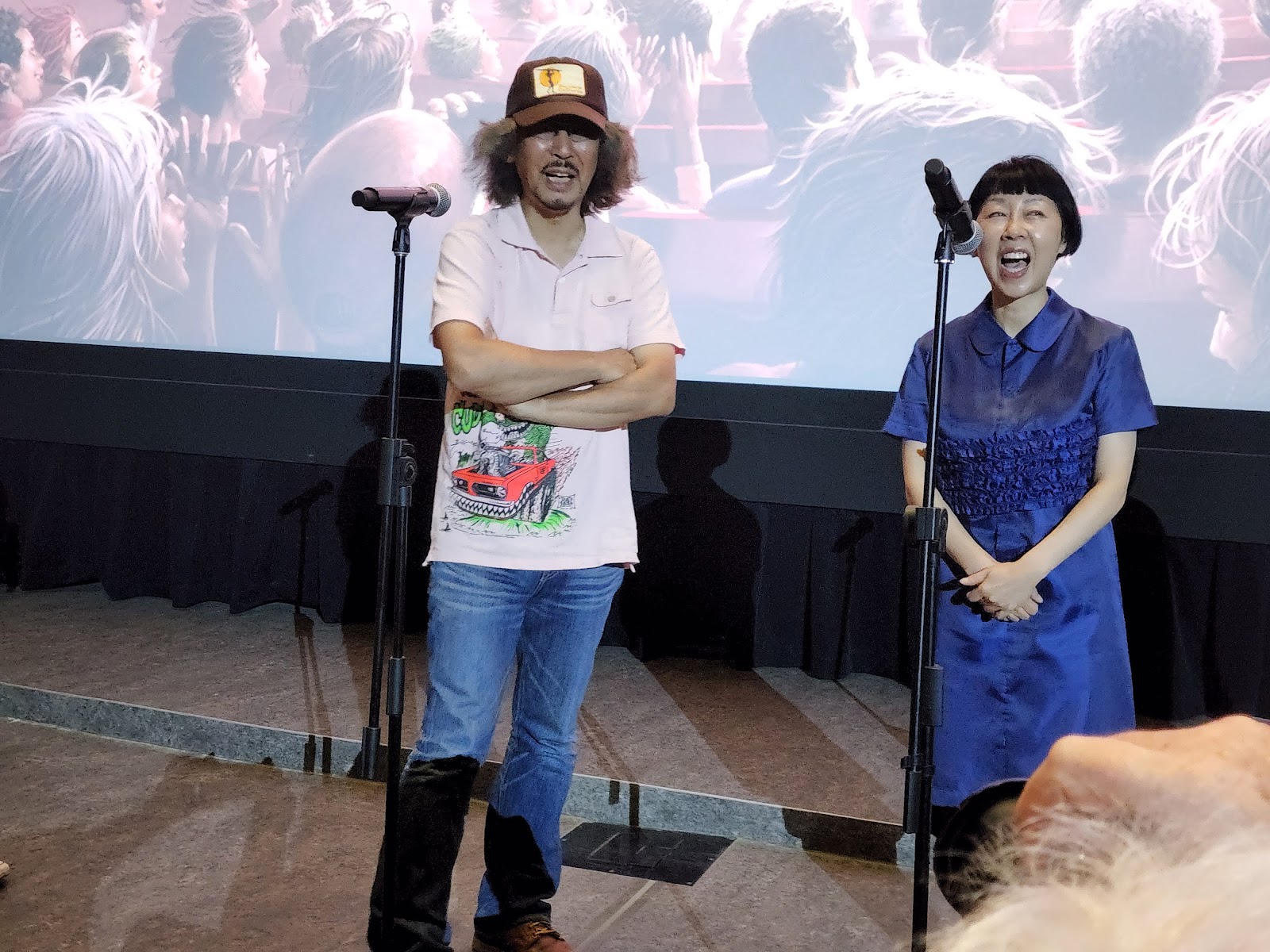
Writer/director Satoshi Miki cast his wife Eri Fuse in a much larger role for this than Convenience Story, and as a result she was a bigger participant in the Q&A, a reminder that she is also very funny and seems to be just as fond of kaiju movies as her husband, though they also seemed to greatly enjoy having a laugh at the genre's expense.

Which, surprisingly enough, was apparently not the case generally in Japan; he says they took a lot of flack from kaiju fans who apparently felt very strongly that you just don't do this with kaiju, and also hated the ending, as if they haven't loved movies that pulled something ridiculous out of their butts just a little earlier (and, though he didn't mention it in the Q&A, it's not like he didn't have the Prime Minister looking at a sticky note with "deus ex machina" on it at early on)!

I don't recall whether Shin Godzilla came up in the Q&A, but this movie plays as a more explicitly comedic take on some of the same things, although Miki talked about how apparently Japan is not exempt from the situation where satirists are having trouble keeping up with how feckless and absurd politicians can be. Mostly, though, everybody seemed to have a lot of fun with the movie and the Q&A, from promising that the next time he did something with kaiju, he would destroy Stade Olympique to talking about how this movie was done for Toei, but they would occasionally run their monster design past Toho to make sure they weren't infringing on Godzilla. Toho seemed surprisingly chill about it; I gather there's a lot more room for homage and fan fiction in Japanese culture, but also that it's probably good for Toho if general kaiju spoofs remind people of the King of the Monsters.

After that, it was time for The Killer, which sadly did not mean John Woo was back, but it did mean I got to see the Korean movie that opened in Boston the day I left for Montreal and would be gone by the time I got home.

And we're almost there - one last update, featuring Ring Wandering, Next Sohee, and Fragil.

"BOA"

* * * ¾ (out of four)
Seen 2 August 2022 in Salle J.A. De Sève (Fantasia Festival: Axis, digital)

This is a terrific little animated film from Colombia, which posits the boa as the king of the Amazonian jungle the way lions are often placed in that position in Africa - a fierce predator that makes all of the other animals quake as it slithers past, but when humans and their mechanized brand of violence arrive, it becomes the spirit of the place, seemingly having the strength of the whole valley - but will it be enough?

Filmmaker Nicolas Parra and his crew start from a recognition that their rain forest is beautiful in its way but it is also dangerous; every creature, human, and machine is all sharp angles that look like they can hurt you in some way, simple enough that they can stretch and twitch without any bits getting into the way. Bright colors make every frame striking, and Parra does a great job of raising the stakes continually without having to anthropomorphize the film with too-cute animals or abstracting humans as a force of nature. People are people and nature is nature, and the potential horror of the situation comes from that, not something else.

Yaya e Lennie: The Walking Liberty

* * ½ (out of four)
Seen 2 August 2022 in Salle J.A. De Sève (Fantasia Festival: Axis, ProRes)

Yaya e Lennie has a lot of impressive animation, but also so much yelling, just a constant stream of disagreeable dialogue delivered at high volume without saying much of anything. I guess I could probably shrug and just say "it's Italian and the stereotype has to come from somewhere", but there's a stretch or three where the title characters are so busy yelling that you can't really concentrate on what they're doing, especially if you're reading subtitles.

The two title characters are a saucy teenage girl (voice of Fabiola Balestriere) and a simple-minded mountain of a man (voice of Ciro Priello) traversing a river, presumably somewhere in Europe, back from a scavenging run and looking to stay in the overgrown home where Aunt Claire (voice of Lina Sastri) raised them for a bit. But while civilization has apparently fallen, it's trying to get back up again, with well-armed agents of "The Institution" collecting children like Yaya, hoping to indoctrinate the next generation. These two want no part of that, so they retreat further into the bush than they've been before, where they encounter people who have returned to life as nomadic hunters, absurd revolutionaries, and a pleasant-looking village whose people claim that the Institution generally leaves them be, though the son of the couple that takes them in has joined the Institution willingly. But what to do when a potentially-lethal injury requires treatment only the Institution can provide?

Though not apparently based upon one, Yaya e Lennie feels like the sort of European comic album where the characters and caption boxes keep a constant stream of narrative chatter up whether the story really needs it or not, and it's not hard to see the story playing it in that format, alternating between short episodes where the pair just short of hang out and the artists enjoy cartooning them in one of the more gorgeous post-apocalyptic environments one can exist in, sometimes stopping in settlements, sometimes staying ahead of the Institute, occasionally flashing back to their Aunt Claire, and occasionally showing something bigger even if these two have little actual effect on the story themselves. The film does all of them at one point or another, but it doesn't quite cohere. The pair are the main characters of Yaya's story, perhaps, but not any larger one, and the grander-scale stories they intersect with are often frustratingly undercooked, and not just because that's all these guys can see.

That sort of film can rise based on having a group of characters that the audience enjoys hanging out with, but as mentioned, it is very easy to so the main impression is just that Yaya doesn't think much of Lennie. The latter is too dim for banter, so even if this is a pair that loves each other, it always feels one-sided, the sort of thing that is kind of fun from side characters but gets tiresome in the center. On top of that, the filmmakers often find themselves recognizing that their wishes to just be free of the rest of the world are unsustainable but not really wrestling with it: It's nice until someone gets hurt, but they're still dependent on what civilization created, even if any organization bigger than their family either demands too much (like the Institution), is utterly ridiculous (the revolutionaries), or ultimately hypocritical (the village). There's apparently respect for the hunter-gatherer tribes, but it's the sort of respect that comes from not looking at them too closely.

On the other hand, there's the look of this movie; digital animation that feels painterly in its color and details rather than plastic. It allows the filmmakers to present a much lusher and greener end of the world than usual, a testament to the Earth eventually recovering from whatever damage humanity does to it if given a little time to breathe. The character designs have some cartoon to them even as they exist in a realistic world, often staged to downplay how Lennie is a giant until that's important so that he and Yaya can be presented as equal. There are very distinguishable differences between the different types of folks wandering this forest, and an ugliness to the "Institute" repaying humanity's mistakes that could look like grandeur from the right angle, at least to the characters in the movie.

The film is all over the map stitching this together, and I don't know that the high ideas it espouses or mocks actually apply to the given story. It's pretty enough to be interesting, but that may not be enough for a second look.

Daikaijû no atoshimatsu (What to Do With the Dead Kaiju?

* * * ¼ (out of four)
Seen 2 August 2022 in Auditorium des Diplõmés de la SGWU (Fantasia Festival, DCP)

What to Do With the Dead Kaiju? is the comedy sequel that most giant monster movies arguably need, in this case watching as the Japanese government flails at just how you dispose of a Godzilla-sized carcass. Everyone who has watched one of these movies has asked the questions, and the answers Satoshi Miki offers are entertainingly goofy.

More than a few giant monster movies have ended in the way this one begins, with news stories detailing how a blast of energy that apparently came together after all government efforts failed stopped the threat before it caused incalculable loss of life; Prime Minister Kan Nishiotachime (Toshiyuki Nishida) has even written "deus ex machina" as part of his notes. But that means that they now have an enormous corpse in the middle of a river. Thankfully, it's not radioactive, but the question is, do they try to haul it out to sea, build a tourist operation around it, or what? At first, it seems like a turf war between the Joint Security Force and the Environmental Ministry, and wouldn't you know, Arata Obinata (Ryosuke Yamada), the JSF officer running point on the ground, and Yukino Amane (Tao Tsuchiya), assistant to Minister Sayuri Renbutsu (Eri Fuse) are old friends, and more than that one. Yukino is now married to Masahiko Ame (Gaku Hamada), the PM's chief of staff. It looks like there's plenty of time to work this out, at least until one of those things nerds nitpick about rears its ugly head - the kaiju is decomposing, which generates heat, but its impenetrable skin is keeping that mostly inside, building up pressure that is starting to show on the surface as blisters. One of these things popping could be devastating to the surrounding countryside, but if the whole body explodes…

Miki has built a perfect sort of premise for this movie, right at the intersection of the things that are ridiculous to think about when watching a broad sci-fi fantasy and things that could be a real problem; you can't help but giggle at the idea even if it quickly becomes a fun mental exercise. It squeezes into the space between parody and action-comedy; there are moments when Miki is clearly spoofing specific shots and tropes, aiming at a hole in the genre, but for much of the movie, he's sort of playing it along the lines of Guardians of the Galaxy and other action-adventures with a sense of their own absurdity. There's a joke in almost every scene, but the characters are also solving fun problems that are crazy in the way real jobs are crazy. Around all that, there's a shift to political blame shifting and petty intrigue that probably feels familiar everywhere; he's probably exaggerated it some but maybe not as much as he could have.

There are moments when one might kind of wonder if the filmmakers are having a laugh at the coincidental personal drama that invests these movies (even the original Godzilla had a crucial scientist just happen to be the ex of another character's daughter), or if they're doing it because they do need an engine to run on. It's maybe the weakest part of the film, even though the cast is a bunch of entertaining good sports: Tao Tsuchiya and Ryosuke Yamada have immediate chemistry as Yukino and Arata, and are just as easy to like in their roles of "smart and capable aide who keeps the agency running" and "soldier who plugs away at a problem". Gaku Hamada makes for a fine weasel as Ame, even beyond growing the perfect mustache for the role, and if one is inclined to wonder how Yukino would up with him beyond looking for the exact opposite of Arata after he broke her heart, he at least gent to take a turn where he becomes sympathetically ridiculous.

That youthful core isn't given a lot that's particularly funny or interesting to do, just soap intrigue that never actually turns into much but keeps the film going despite it not having the budget to be two full hours of visual effects shots. One suspects that Miki is spoofing that part of the genre as well, seeing as he holds off on showing the monster just long enough for the audience to seriously consider that never showing the creature is part of the gag. Their mostly grounded performances mean that the older character actors get to have a ball as exaggeratedly petty politicians who almost all find themselves quickly embarrassed in the moments after they're supposed to look triumphant. He also builds room for a number of fun cameos for the likes of Joe Odagiri, Rinko Kikuchi, and more, with those pros taking broad characters and playing them for all they're worth, knowing that it won't start to grate before they exit the movie five or ten minutes later.

This sort of spoof isn't for everyone; according to Miki's Q&A, Japanese kaiju fans hated it. That's maybe not surprising; as even the movies and manga that laugh at genre tropes often play as more respectful and genial than Miki's tugging on loose ends (that's not entirely a Japanese thing, but it seems even more the case there), and you kind of either roll with the finale or you don't. Still, for those of us that enjoy extrapolating an absurd premise out to its even more ridiculous end, What to Do with The Dead Kaiju? answers its own question in very amusing form.

Jugeodo Doeneun Ai (The Killer '22, aka The Killer: A Girl Who Deserves to Die)

* * ¾ (out of four)
Seen 2 August 2022 in Auditorium des Diplõmés de la SGWU (Fantasia Festival, DCP)

There's a scene early on in The Man From Nowhere, another Korean movie about a man with a certain set of skills rescuing a girl from the people who have kidnapped her, where the title character disarms a knife-wielding gangster by using his wallet to grab the blade and the gangster's older, wiser partner has a look on his face that reads as "you know, we don't have to collect protection money from every shop on the street" and communicates as much to the others, who do not listen and pay the price for it. The Killer is the same basic plot but doesn't have the same sort of humanizing moments that would make it entertaining for more than the sheer violence of the impressively-staged action.

Bang Eui-kang (Jang Hyuk) lives a quiet, comfortable life these days, married to a good woman and looking after his real-estate holdings. When wife Hyeon-soo (Lee Chae-young) goes on vacation with a friend (Yoo Seo-jin), they ask him to look after the latter's stepdaughter Yoon-ji ("Anne" Lee Seo-young). Eui-kang would really rather not, but on the other hand, she's 17 rather than an elementary school kid, so he figures he'll more or less let her be - call me if you need anything and we'll tell them it went great when they get home. Of course, Yoon-ji and a friend get into trouble on the very first night, and that is when the underworld should get the hint that they'd be better off not upsetting her temporary guardian (the audience already knows as much from an opening flash-forward). They do not, of course, meaning Eui-kang has to kill his way up the food chain before she's trafficked out of Korea, with Detective Lee (Lee Seung-Joon) following the trail of bodies.

Well, one supposes that there are less violent ways of going about it, but the title of the film is "The Killer", and he's going to go with what he knows (at least it is in North America; in some markets it has "A Girl Who Deserves to Die" as a subtitle, which suggests that the original novel by that name is something a little less straightforward). Unlike a lot of films with this set-up, Eui-kang isn't particularly world-weary or beholden to a particular code; one gets the impression that he retired right at the moment when he had saved up enough to invest while he still had no record because it was good business more than anything else. As such, and with him being as good at his old job as he is, he spends most of his quest more irritated than anything else, a quiet week broken up by having to deal with first a kid and then these quite honestly tacky criminals. There's something darkly funny about it from a certain angle, but the punchline to a bunch of goons discovering what they're up against in the ten seconds before they die is more often cruel without being particularly satisfying. Director Choi Jae-hoon and screenwriter Nam Ji-woong seldom take a moment to step back and let the characters consider the absurdity of the situation or how obviously-not-worth-it this is for the boots on the ground.

On the other hand, this does let them build up wall-to-wall action, from the opening shots that tell the audience to stick around through the opening exposition because there will eventually be an ax fight to a pretty excellent oner of a hallway brawl, and more on either side. Choi and cinematographer Lee Yong-gab have a tendency to plunge the audience right in the middle of a fight or a seedy locale, making everything very much up-close-and-personal, while still getting enough on-screen to make it clear that Jang Hyuk can move a little bit, backing up Eui-kang's annoyed lack of bluster with action. He's good enough that it's believable that the bad guys need to swarm him with sheer numbers until he gets to some boss-level folks, adding maybe a bit of danger to the fights being technically impressive.

Even with all that, the film's got to eventually get to a stopping point, something that suggests Eui-kang will actually be done after he dispatches this underboss or a reason for these guys to keep at it after it's become clear that this guy will eventually put a bullet or something less refined through your skull, and that's where a lot of other decisions come to a head; the relentless action hasn't given Eui-kang and Yoon-ji much time to bond, nor has it instilled some sort of moral code in the assassin, or revealed the one that was there all along. The movie should have been building to a climax but only has the material for a final kill.

Which will probably be fine as it settles into its home on VOD and streaming menus, where a movie just needs to be something that the person choosing it wants at the moment done well - say, impressively-staged action - than work for an audience that has a broader range of desires to be satiated at once. The Killer delivers what its makers were going for, if not a whole lot else.

Thursday, October 10, 2019

These Weeks in Tickets: 23 September 2019 - 6 October 2019

My job pays me money that I spend on movies, but on occasion gets in the way of seeing them, as when they send me to some Dallas-area parking lot with a building in the middle for the better part of a week so that I can sit in on three hours or so of meetings.

This Week in Tickets

This Week in Tickets

Not that this is why I've got a blank page for the 23rd to 26th; sometimes there's just not enough to see, inconvenient times for what does look interesting, and maybe some rain to get in the way. Then there's a bunch of smaller stuff that looks like fun, and I actually make a relatively rare stop at the Capitol for The Day Shall Come on Friday, which is good but not quite what I had hoped for.

Saturday, I wound up doing a double feature of Buñuel in the Labyrinth of the Turtles & Monos on Saturday, which is not necessarily a completely strange pairing; both have Spanish-speaking leads and animals dying in unpleasant fashion. I liked Monos more, and am glad that I finally got to it after having missed it at IFFBoston.

Sunday's movie wound up being Abominable, with the time more or less selected around when it was playing in 3D, which has really thinned out in Boston despite the fact that if you've got AMC's A-List, it doesn't actually cost more. That's a bummer, because DreamWorks tends to use that tool well and this particular movie is a perfectly nice, charming family adventure; hopefully the nieces and their friends will dig it.

Then it was home it was to rest up for the next morning when I'd have to be up early to get to Logan to get to Dallas to get to Carrollton, which is not exactly a fun town, but apparently Agile development requires these big PI planning get-togethers. There was "mandatory fun" all three nights, because who doesn't enjoy spending another three hours with their co-workers after being in the office and meetings with them all day? Especially if it means spending your birthday at TopGolf, which combines being a loud bar with stepping out into 90-degree heat to drive golf balls despite really not knowing how to swing a golf club well? It's just fantastic!

Still, the saddest evening was probably "casino night", where some folks from a local casino set up some tables at work and there was so-so food and mocktails with the chips representing not money, but raffle tickets for prizes at the end of the night. I bailed on that to see The Clmbers, wihch was only playing Imax theaters for the exact period when I would be in Texas, and you want the big screen for a Tsui Hark-produced movie about a Chinese team trying to summit Everest. The movie itself wasn't great, but the theater has become a Dine-In location since I was last in Frisco, meaning they brought a milkshake to my seat.

After getting in late Thursday, I was stupidly the only person not telecommuting on Friday, and while that should have been license to bail early - work grabs extra hours the first few days of the week, you get the last off, right? - I wound up not figuring something out until mid-afternoon and staying late, and thus not lined-up well for anything on a weekend where the big opening wasn't something I cared for anyway. Then a lazy Saturday wound up with some plans switched, sending me to Fresh Pond for a double feature of Dilili in Paris & The Parts You Lose, neither of which is very good although Dilili at least has the excuse of a horrible English dub.

So I wound up not seeing the new Takashi Miike, FIrst Love, until Sunday, and it was (as expected) kind of a kick. I hope this means Well Go is going to be distributing more Japanese films on top of just Miike's stuff, since aside from a few art-house names who get some attention (and have recently done European movies), what mainstream-ish stuff makes it out of Japan is mostly what can play a night or two for the anime crowd, and we could use a bit more Miike in theaters here.

I was then going to go back to Fresh Pond for War, but my stomach and intestines were warning me against a 155-minute Indian movie, so it was home with a quick detour for groceries. Maybe it'll be on my Letterboxd page later this week.


The Day Shall Come
Buñuel in the Labyrinth of the Turtles
Monos
Abominable


The Climbers
The Parts You Lose
Dilili in Paris
First Love

Sunday, October 06, 2019

IFFBoston 2019.182: Monos with bonus Buñuel in the Labyrinth of the Turtles

I've mentioned a few times during my IFFBoston entries (almost done, five months later!) that there were a fair amount of decisions I tried to make on the basis of "will this thing get a theatrical release later?" that had me surprised at how many movies already had distributor logos in front of them. Monos was one that I I nervously pushed aside even though I wasn't exactly sure that it would play theaters despite having a kind-of-recongizable American name in the cast. Glad to see it made it, though it may only have a few days left in Boston.

Buñuel in the Labyrinth of the Turtles has already left; it was scheduled for a one-week run and I just didn't have a lot of time to write it up around work and other stuff this week. The idea of it is good, but it doesn't quite work out as a whole. More animated biographies in general would be nice, though.

In terms of being an unintentional double feature - they are both the sort of movie where you might wince at how animals are treated. Buñuel does not shy with how the title character worked hard to capture the way that animals die in ways just as horrific as people do in Las Hurdes, and there's a fair amount of time spent butchering a cow in amateurish fashion in Monos that may make you want to look away. Given that they're both short-ish films, it was kind of a lot by the end of the night.

Buñuel en el laberinto de las tortugas (Buñuel in the Labyrinth of the Turtles)

* * ¾ (out of four)
Seen 28 September 2019 in Landmark Kendall Square #9 (first-run, DCP)

There seems to have been an uptick in biographical graphic novels in recent years, and the idea of films taking the same sort of approach to biographies is tantalizing. Animation has the unique ability to recreate a subject's appearance and movement without seeming like an imitation, and is able to emphasize and exaggerate in ways that may seem phony in live-action. Filmmaker Salvador Simo Busom's film about Luis Buñuel getting one of his own movies made had the right idea, even if the actual picture can use some refinement.

It opens as Buñuel's second film, L'Age d'Or, is just about to open in Paris. Though many of his fellow filmmakers find it a surrealist masterpiece, others are more interested in how Dali was an influence, and it is reviled by mainstream audiences, to the point where it is impossible for Buñuel (voice of Jorge Usón) to find financing for another. An old friend from back home, Ramón Acín Aquilué (voice of Fernando Ramos), impulsively buys a lottery ticket and offers to finance and produce a film if he wins. When the ticket does pay off, they are off to Las Hurdes, a desperately poor region of Spain, to document the region with cinematographer Eli Lota (voice of Cyril Corral), who originally brought the project to Buñuel's attention, and Pierre Unik (voice of Luis Enrique de Tomás), an assistant director and camera operator who has worked on Buñuel's previous films. Ramón will soon find that there is a great deal of difference between admiring an audacious genius and managing one.

The conflict between Luis and Ramón will often drive the story, emphasizing that it is often a bad idea to go into business with a friend, and that the "suits" who are often decried as standing in an artist's way are often creative people themselves, doing their best to make sure that the project eventually winds up in some sort of complete form. It's a familiar-enough refrain that the specifics of this project become more interesting: There is something kind of fascinating about the idea of a surrealist trying to make a documentary, with Buñuel trying to mold the story and force the more outrageous elements to the fore even if it makes the film less of a true depiction of what would have happened the day he filmed it had he not been there, even as the reality is affecting him. Simo Busom, arguably doing the same thing himself, doesn't come down hard on either side but plays with the question.

Full review on EFilmCritic

Monos

* * * ¼ (out of four)
Seen 28 September 2019 in Landmark Kendall Square #4 (first-run, DCP)

There's a shot in this movie with a pig's head on a stake that seems so unconnected to the rest of the scene that it mostly makes me wonder if Lord of the Flies is also required reading in Colombian high schools and the sort of thing that needs to be referenced when you make a story about kids going feral without adult supervision in the middle of nowhere. It's an impressive take on that basic idea, reflecting a world that is more chaotic even if isolation is more difficult.

The kids in the movie are child soldiers, part of an Organization that has them on a mountaintop, given orders by a short, muscular Messenger (Wilson Salazar) to guard "prisoner of war" Doctor Sara Wilson (Julianne Nicholson) and a dairy cow that local farmers have "donated" to the cause. There are eight, led by Lobo (Julián Giraldo), the oldest of the crew: his girlfriend Lady (Karen Quintero), Dog (Paul Cubides), Boom Boom (Sneider Castro), Swede (Laura Castrillón), Bigfoot (Moisés Arias), nervous Rambo (Sofia Buenaventura), and Smurf (Deibi Rueda), the youngest. Messenger has drilled them, but they're teenagers with guns - things will go wrong, and they will not react well to that happening.

From the start, filmmaker Alejandro Landes is more obviously interested in striking images than meticulously-structured chains of events; he opens it with the kids blindfolded, playing a game of soccer where the ball is a bell, moving carefully and then darting after the thing when it moves. It's a wonderfully surreal scene that maybe doesn't directly foreshadow the rest of the film but establishes the kids as capable despite what they lack. It also gives the viewer a chance to look around the initial setting and see how removed it is from the normal world, something that will come into play a few times. He'll soon be contrasting the two teenage girls in the group offering to braid "La Doctora's" hair and the dungeon in which she's kept, with proof-of-life procedures often seeming confusing, like it's not clear to anyone what The Organization is trying to accomplish.

Full review on EFilmCritic

Saturday, July 06, 2019

Boston Underground Film Festival 2019.05: Assassinaut, A Lot Like Life, Canary, Happy Face, and The Unthinkable

Will not go crazy with the shorts like I did in the last BUFF post. Will not!

(Did)


First up, the crew from Assassinaut, who made what was often a very impressive little movie although they occasionally confessed to winging it or putting a bit in that maybe didn't make complete sense but which was cool. I kind of think the prologue and revisit at the end were like that - I apparently got a completely different impression than what they were going for, and didn't feel entirely set straight when it was done.

I also kind of got the impression that the filmmakers at times had a little more trouble with the on-again, off-again schedule that independent films can have, or at least more than they usually let you see - that raising money, shooting, raising money, shooting at a different location, raising money, doing effects, raising money, doing other post-production, raising money, submitting to festivals… there can be gaps in there where it's hard to get rolling again with the same enthusiasm one had before. Not many admit it, especially at a festival where one's excitement is at such a high level, but I suspect it happens with a lot more of these movies than people will admit.


Next up was the animation program, with (l-r) the festival host and filmmakers Ashley Gerst of "The Spirit Seam", Yasmin Mistry of "For a Better Life", Simon Allen of "Mother's Peak", Elena LaCourt of "Maintain Yourself", Santiago Castaño of "Morphosis", and Diedre Beck of "Night Train". As is often the case with this block, the introductions took place before the films, so there really wasn't much chance to talk about them.


Last guest of the festival was Alexandre Franchi of Happy Face. It's always a bit odd for me to see Montreal films at BUFF (though there's often one there), like I'm supposed to see them at that city's festival even if they fit this one better. A big topic for this conversation was casting, which was tricky - people who look like those in this movie often don't go into acting, so you get a mix of amateurs and professionals, and it's hard to ensure that there's no exploitation.

… so that's a wrap on BUFF, which means I've got a whole other festival to write up before heading to Montreal in, yikes, five days.

"The Obliteration of the Chickens"

* * * (out of four)
Seen 24 March 2019 at the Brattle Theatre (Boston Underground Film Festival, digital)

Izzy Lee's short goofing on/paying tribute to the inimitable Werner Herzog has at least one line that was good enough to write down, and a number of others that are pretty all right, and given that it is basically a few minutes of author Bracken McLeod doing stentorian oration over images of seemingly pointless minor chaos, that's a win. Not everyone's going to land, but she got me to laugh, and it was good.

I do wonder, a bit, if celebrating this aspect of Herzog in isolation does him a bit of a disservice. You take the seemingly-nihilistic quotations made in a manner that is too dry to be arch, and you lose the fact that this part of his personality is the complement to a powerful curiosity which otherwise animates his films. Izzy has some fun here with the things that get Herzog noticed, though perhaps not what makes people fans.

Assassinaut

* * ¾ (out of four)
Seen 24 March 2019 at the Brattle Theatre (Boston Underground Film Festival, DCP)

On a scale of Turbo Kid to Prospect, Drew Bolduc's Assassinaut probably lands closer to the latter; in terms of the amount of youthful exuberance on display (or relative lack thereof). It's a bit of sci-fi horror that is not messing around any more just because most of its characters are kids, but that also helps it feel a bit more thrilling and enjoyably homemade than the same movie with gorwn-ups might have been.

The first of the kids the audience meets is Sarah (Shannon Hutchinson), about 15, selected for a trip to space to meet the President of Earth, though her former-astronaut father (Jeffrey Alan Solomon) has his eyes much closer to the ground these days. There are three others - Tom (Johnathan Newport), a pre-teen who is already a cynical-enough know-it-all to see this as a publicity stunt but one that will look good on his transcripts; Brooke (Yael Haskal) the most openly enthusiastic; and pretty but shy Charlie (Jasmina Parent). The initial meeting goes well, but soon the station is under attack, and the kids are sent down to an unknown planet in an escape pod, with a gruff, wounded officer (Vito Trigo) needing their help as much as they need his. Plus, it seems that the terrorists from the station are not their only concern.

Parts of the film display extremely impressive genre fundamentals, and not just in terms of quality gore. The attack on the station, for instance, is a nifty little piece of work, giving the kids plenty to do while also not putting them immediately and improbably at the center of the action. The folks around them are doing what they should be doing, and even if they're not long for the film, they're fleshed out enough to be interesting. Bolduc spends a little time setting the stage in interesting ways, giving the audience the feel if not the full layout of the space and including touches that make this sort of violence seem inevitable. When the people in power are trying to go for JFK's "we will go to the Moon" speech and it comes out unnerving, there are going to be uprisings.

Full review on EFilmCritic

"Maintain Yourself"

* * * (out of four)
Seen 24 March 2019 at the Brattle Theatre (Boston Underground Film Festival: A Lot Like Life, digital)

Lots of respect to this bit of stop-motion, which packs a lot of grooming-related discomfort into four minutes. It's an impressive example of what this particular medium can allow director Elena LaCourt to do, as there's a sort of inherent distortion to the doll-sized figures and faces that can't venture too far from one expression. It makes what many do to conform to societal standards of beauty seem like a twisted misery, and if nothing else, that certainly makes this an effective short film.

"The Spirit Seam"

* * * ¼ (out of four)
Seen 24 March 2019 at the Brattle Theatre (Boston Underground Film Festival: A Lot Like Life, digital)

There's a nifty sort of folk-art look to Ashley Gerst's "The Spirit Seam", all her characters featuring beads for eyes and clothing that sometimes seems made from scraps, toys meant to be played with and worn out. It's a look that matches the setting, as Polliwog and her Pap-Paw live in an Appalachian company mining town, which itself can be a rough, eroding existence. That rears its head as Pap-Paw's health quickly fails, trigger both an end to innocence for Polliwog and the practical questions of how she'll get on now that the place where she lives has chewed up everyone she loves.

Even with that as the focus, there's still a great deal of the bucolic about "The Spirit Seam"; a hand-drawn map that connects reminds the viewer how such towns are both close and open, and there's sheer joy as Polliwog and Pap-Paw play together, the sort that's different for seniors and kids but complementary. It's deliberately a bit scrappy to keep one from romanticizing it too much, but serves to remind the audience that what happiness was found in these situations was real.

"Phototaxis"

* * * (out of four)
Seen 24 March 2019 at the Brattle Theatre (Boston Underground Film Festival: A Lot Like Life, digital)

To what extent is The Mothman a thing people know about? I ask because, as someone who can say he's heard the name but has no idea what its deal is, I suspect that Melissa Ferrari's sometimes difficult to classify film might play better with a little knowledge. It's perhaps not vital, but just knowing where all of this is in the cultural context, and the general details of it, might be useful in stitching together how she sees the urban legend and the narcotics addiction in the places it is best known intersecting. I don't have that.

Even without it, though, I liked her film; it balances the otherworldly and the sadly down to earth well and finds a common link in their sense of doom. It uses the sort of limited model-making that sets an atmosphere well and is all the spookier because the camera sometimes seems to be doing most of the moving. I don't necessarily know more about the Mothman or addiction because of it, but I've got a sense of how they can seem connectedly apocalyptic.

"For a Better Life"

* * * ½ (out of four)
Seen 24 March 2019 at the Brattle Theatre (Boston Underground Film Festival: A Lot Like Life, digital)

Yasmin Mistry's "For a Better Life" is a great example of how well the sometimes-strange combination of animation and documentary can be strikingly informative. Without the animation, it's a guy talking, maybe with his face hidden for anonymity, and the filmmaker trying to figure out a visual that matches. Realized like this, Mistry can fill in the blanks that her subject normally just assumes, and can sometimes tamp down the intrusiveness of the camera, letting him tell his story without invading his space as he tenses up or recoils.

His story is harrowing, a tale of human trafficking and abuse that is presented almost casually at times, not so as to be cynical but to keep focus on this person's survival and recovery rather than the natural anger toward those responsible. The animation is simple but effective, and doesn't make a show of transitions in the way that some animated films built around a piece of narration will. Mistry also does a nice job of being specific without positioning the characters and institutions involved as uniquely good or evil, and that's important. This is stuff that is best understood through experience but which needs to be seen as problems general enough to be tackled and solved.

"Night Train"

* * * (out of four)
Seen 24 March 2019 at the Brattle Theatre (Boston Underground Film Festival: A Lot Like Life, digital)

A nifty-looking film built around silhouettes and driving out to the railway crossing to watch the train go by. Not a whole lot of story there - Deirdre Beck's film is two minutes long, after all - but the atmosphere is terrific and the sense of adventure and seeing the train as a massive, powerful thing that cuts through everyday life but is taken for granted comes through.

"Mother's Peak"

* * ¾ (out of four)
Seen 24 March 2019 at the Brattle Theatre (Boston Underground Film Festival: A Lot Like Life, digital)

An atmospheric enough haunted-house tale, although in the middle of a group of much shorter films its fifteen-minute runtime can seem like a slow, noodly build. Not that filmmaker Simon Allen has any control over that; of course, and on its own the film isn't bad at all, capturing the right sort of small-town atmosphere around the spooky center with some pretty fair stop-motion animation to boot.

"Harls"

* * * ¼ (out of four)
Seen 24 March 2019 at the Brattle Theatre (Boston Underground Film Festival: A Lot Like Life, digital)

Kenzie Sutton goes for the slapstick in this two minutes, with his anthropomorphic duck on his 356th reincarnation and kind of burnt out on the whole thing. Of course, going to a support group for this is just asking to get killed and revived in rapid succession. The fun of it is that he'll keep coming back as different species, and the fun is in how Sutton manages to make the same personality come through despite the rapidly changing models.

"Lilly Goes Fishing"

* * * (out of four)
Seen 24 March 2019 at the Brattle Theatre (Boston Underground Film Festival: A Lot Like Life, digital)

A larger "The Bum Family" series is implied, and it's the sort of thing that I kind of think my younger nieces would go for until the points where its brightly-colored monster characters start kind of acting like monsters. It's not the sort of cartoon where cheery innocence crashes hard into black comedy, but you can see it from here.

It's fun, though, colorful and mostly friendly with Lilly and her friends cut out of paper and given hand-drawn expressions, stumbling through this thing they're not entirely suited for on the way to more than a few enjoyable gags. Big orange beast Lilly has got charm to spare and her simply-conceived friends add chuckles as amusing sidekicks.

"MORPHOSIS"

* * * ½ (out of four)
Seen 24 March 2019 at the Brattle Theatre (Boston Underground Film Festival: A Lot Like Life, digital)

It is not at all difficult to be impressed with something like "MORPHOSIS", which combines some fairly impressive animation with revolutionary zeal. It's not hiding anything, as it features frog slaves grinding food to paste for their corpulent leader who is apparently too lazy and weak to chew until someone rises up to fight the system. Filmmaker Santiago Castaño knows where he's going with this, presenting his villains as having little but numbers (which, obviously, is not insignificant) and always being pointed with what every single thing in the short is meant to represent.

The film is also impressively gorgeous work, from its mirror planet to the detailed setting which combine grandeur and a bunch of moving parts without bringing the two into visual conflict. The action is nicely done, just generally fun to watch and almost always hitting the right notes. A properly heroic score helps set the mood, and Castaño is focused enough not to make the action gross for gross-ness's sake.

"Wunderkammer"

N/A (out of four)
Seen 24 March 2019 at the Brattle Theatre (Boston Underground Film Festival: A Lot Like Life, digital)

And here, my memory fails me. Sorry, Jennifer Linton, because I love cabinets of curiosity and as such would love to talk about your film.

"The Switch"

* * * ¾ (out of four)
Seen 24 March 2019 at the Brattle Theatre (Boston Underground Film Festival: A Lot Like Life, digital)

"The Switch" is the sort of music video that makes me wonder, a bit, how these things get put together - I didn't hear anything particularly specific to the story that the video tells in the lyrics, so it makes me wonder if someone like director John Paul Grigsby is one of several people pitching for the video and then files away or discards the idea if the band doesn't like it. Has he had this idea for a story about a lighthouse-keeper having to choose whether or not to light the way for a refugee craft or not for a while and was lucky to find the opportunity to use it, or was it inspired by this song and would have vanished into the air if not used for it?

It doesn't matter, I suppose; the work itself is impressive. It sketches its story well in four minutes, looking at its main character with interest: The stop-motion figure looks charming, a friendly-seeming old man who nevertheless is trying to block out his view of the people on their way that are suffering. It's an uncomfortably frank admission that others suffer because of the weakness and discomfort of people who seem kind on first impression, and works well with the lyrics to convey the disappointing nature of this reality.

Kanarie (Canary)

* * * ½ (out of four)
Seen 24 March 2019 at the Brattle Theatre (Boston Underground Film Festival, DCP)

There's a line in Canary that doesn't so much save the movie as affirm that the filmmakers know exactly what they are doing, and while it may be a little bit on-the-nose, it's not necessarily a bad thing for characters in a coming-of-age film to have what they've earned spelled out, especially when the film seems ready to go in the opposite direction. This one's smarter than that, enough to impress and be worth one's attention no matter how far it may seem from one's own experience.

It takes place in South Africa, the middle of the 1980s, with Johan Niemand (Schalk Bezuidenhout) graduating high school and about to begin his compulsory military service. Johan is nobody's idea of a soldier - music is his thing, with Culture Club his current obsession - so it seems best for all involved that he gets chosen for the South African Defense Force's Church Choir and Concert Group, also known as The Canaries. He quickly makes two friends in Ludolf Otterman (Germandt Geldenhuys), a big, affable classical music buff who seems to have less business being in the military than Johan, and Wolfgang Müller (Hannes Otto), a handsome fellow whose tastes match Johan's. Of course, they can't act on their attraction too obviously; though the Canaries are where a place where gay men in the SADF can find sanctuary, Reverend Koch (Gérard Rudolf), one of the two chaplains in charge of the group, is very keen that they observe military discipline and project traditional moral rectitude, even if colleague Reverend Engelbrecht (Jacques Bessenger) seems a bit more understanding.

Apartheid as an official government policy has likely started to fade from memory a bit by now; there's a generation that has grown up after its fall, and there are times when Canary seems to fall victim to how the details can be forgotten. The long stretches where the audience doesn't see anyone with dark skin can sometimes feel like filmmaker Christiaan Olwagen is wearing blinders to make a movie that looks back at this period of South African history without showing the circumstances that largely defined it, although that may be the result of an outsider perspective. What he is doing is to show how the nation's culture of white supremacy even twists the culture of those who passively benefit from it: Talk of the Olympics has soldiers venting their indignation at their country being a pariah, while attempts to justify this order almost inevitably lead to religion (because this belief needs to seem to come from a higher authority) and homophobia (definitions of ideal people brook no deviation). Johan and his friends are in the crosshairs of the latter, and sometimes Olwagen has trouble when shifting focus between "it was bad for the gay community too" to "bigotry poisons society as a whole", though it's not really his fault that the story he's telling exists in the shadow of a much larger one.

Full review on EFilmCritic

Happy Face

* * ¾ (out of four)
Seen 24 March 2019 at the Brattle Theatre (Boston Underground Film Festival, DCP)

Happy Face is the odd movie where nothing that anybody does ever actually seems like a good idea, to a degree that goes beyond basic human fallibility, but the result still mostly works. It's the sort of movie where the makers' hearts are generally in the right place and which at least has the benefit of being something you don't see every day, and that can count for a lot.

It centers on a Montreal support group for people who, whether by birth or happenstance, have some sort of disfigurement - former police officer Jocko (E.R. Ruiz) was burned, but 75-year-old Otis (David Roche), otherwise-fashionable Maggie (Alison Midstokke), and shy Beckie (Cyndy Nicholsen) have lived with this most of their lives - led by Vanessa (Debbie Lynch-White), who feels she can relate because she's carrying some extra pounds. The latest member is "Augustin" who has a secret - his actual name is Stanislas and the 19-year-old is actually quite handsome, using tape and bandages to distort his appearance. This deception doesn't last long, but Stanislas (Robin L'Houmeau) says he is not mocking them, but is instead trying to build the skills to deal with his mother, whose cancer treatments have left her a shell of herself. Let him stay, and he'll be their link to a world they have difficulty approaching.

Does this really make sense? Kind of, but it takes a certain amount of self-awareness for it to work. The group chooses to welcome Stanislas in part because Vanessa doesn't want them to; she means well but can't help but be mildly patronizing in how she assumes she has the same sort of problem or that you can make a breakthrough by following directions. Actress Debbie Lynch-White and filmmaker Alexandre Franchi do well to resist validating any desire Vanessa has to be the hero of the story, letting her be testy at times or, while not phony, not quite as deeply invested as she thinks. She's never insincere, but there's a certain deliberate clarity to how she represents the way that well-intentioned people can approach those who are different.

Full review on EFilmCritic

"Diddie Wa Diddie"

* * * (out of four)
Seen 24 March 2019 at the Brattle Theatre (Boston Underground Film Festival, DCP)

The title tune is catchy as heck, which never hurts a short film, especially one like this which is in large part goofy nonsense.

Den blomstertid nu kommer (The Unthinkable)

* * ½ (out of four)
Seen 24 March 2019 at the Brattle Theatre (Boston Underground Film Festival, DCP)

The Unthinkable is better than a lot of movies that try to link massive calamity to personal melodrama, mostly because it lets them be separate things despite the significant overlap, but "better" in this context can be kind of a tricky thing: It's never as empty as the other genre movies it shares a basic shape with, but that also makes the moments when it uses the same sort of storytelling devices a little less forgivable. The filmmakers will occasionally do something that makes a viewer say they're supposed to be better than this, though the fact that they are most of the time makes up some.

The priorities are somewhat clear with an opening that focuses on young Alex and Anna, a pair of teens who are obviously fond of each other but going through some tumult: Alex's parents are breaking up in a loud, rancorous manner; Anna's are moving, having only settled in this small town with other family temporarily. Ten years later Alex (Christoffer Nordenrot) is a successful musician who has not returned home for years but will for his mother's funeral, while Anna (Lisa Henni) has resettled there. There's a mysterious explosion on the news as Alex hits the road, and soon enough Sweden is in a state of near-chaos, with more attacks focused on infrastructure. Anna's main concern is for her daughter while Alex's is for Anna, while his father Björn (Jesper Barkselius) - the sort of crank who always warned everyone that this could happen - may be the last line of defense as the only person on duty at the electric station while most of the town is at Midsommar festivities.

Anna also has a family member or two who would be conveniently important if this movie was just about the attack, which creates a bit of a small-world issue once things start coming together. It's not as problematic as it could be in terms of sheer overwhelming coincidence, but there is a bit of danger of becoming one of those movies where the massive calamity with all loss of life comes across as primarily a catalyst to show this small group of people what's really important rather than incidentally such. The filmmakers manage to walk that line fairly well - for instance, the threat is human rather than natural, so they're hard to see as some sort of higher power, but their motivation is disconnected enough to keep the focus on Alex, Anna, and the like. There are still some moments when the self-reflection gets a little heavy, but seldom to the point where the rest is diminished.

Full review on EFilmCritic