I was originally going to review Prince Achmed either on its own or alongside some of the other Weimar Germany films, but fate stepped in, inasmuch as there is anything to "fate" beyond "coincidences ascribed a higher purpose after the fact". I was going to return to the Harvard Film Archive the next night in order to watch the original 1952 version of The Narrow Margin, since the 1990 remake with Gene Hackman is a minor favorite of mine. When I got there, though, there was a note on the door stating that the film had proved unavailable, and they were showing the first two episodes of Godard's Histoires de Cinema. I didn't feel much like that, and instead of going directly home, I made a pit stop at Mr. Bartley's for a Mumbles Menino cheeseburger (7 oz. beef, cheddar, bacon, and a fried egg; as much as I've scratched my head about the egg when told that was how burgers were done in France, it is in fact delicious) and a "Cherry Bomb" frappe (vanilla ice cream, chocolate chip cookies, and, of course, cherries). Stuffed full of food, I headed back home just in time to see a UPS delivery guy walking away from my door and a package from Amazon there. The package contained, you got it, the 2 Blu-ray/2 DVD set of Fantasia and Fantasia 2000, and I opted to watch them then and there.
Maybe if I hadn't stopped for that burger, I would have got home, got busy doing or watching something else, and set the movies aside in my "too be watched, but not necessarily soon, because I've seen them before" pile. And by "pile", I mean "80% of my media shelving". But, that's not how it worked out, so, thanks, Bartley's, for being nearby and delicious.
It's a silly bit of narrative, but worth mentioning because watching Fantasia did trigger another memory. I don't remember many specific moviegoing experiences - that's why I've been keeping the scrapbook for the past couple years, for that tangible reminder - but my first time seeing Fantasia is one of them. It was probably during the 1982 re-release, when I would have been eight or nine (1977 is possible, but then I would only have been four, and my brother Dan just one, and I'm pretty sure he was there). Though it was probably playing in one of the Portland-area theaters, we went to see it at a theater in New Hampshire. Probably North Conway; my parents liked that town. Maybe this place. The point is, while the local theaters were all those unimpressive multiplexes, with about six screens and none of them, in retrospect, very good, this was a single-screen theater, with a silver screen that was so big I had to turn my head to see everything once the curtain had opened. And on that screen, well, wow; I'd never seen the like not just because I was eight and hadn't seen much, but because there's nothing else like Fantasia, and I can remember the "Rite of Spring" segment and its ambition blowing my little mind.
I was reminded of that when I hit that segment on the Blu-ray Tuesday night, mumbling that I had to get a new BD player so that I could jump to that scene whenever I wanted without it taking ten minutes to start up (to this day, I wonder why we're using Blu-ray instead of HD-DVD when the Toshiba HD-1 cost half as much and didn't suck like the Samsung BDP-1000). Again, it's probably a case of ascribing too much significance to something that seems to form a pattern after the fact, but that day may be part of why I love movies and great theaters so much. A large part comes from working in a theater in college (I could both see everything and notice a stark difference between the really good house and the less impressive ones), but one day when I was eight years old, a good movie being shown in a really good theater was worth a special trip. Today, well, I routinely take long bus rides so that I can see movies, whether for an hour and a half each way to see them on the IMAX screen in Reading or overnight at that other Fantasia, in Montreal. Maybe I would have anyway. But maybe not. So, thanks, Mom & Dad, for that trip to New Hampshire.
Anyway, reviews now, after one note about them: I always check to see whether there are existing reviews on eFilmCritic, just in case spending two hours writing rather than twenty minutes would just result in a duplication of effort. Though I always link to these reviews as EFC, when they recruited me, their primary brand was Hollywood Bitch-Slap. To this day, those sites both lead to slightly different front ends on the same data, but most everybody uses EFC rather than HBS when talking to festivals, publicists, etc., not just because it is less likely to offend, but because that's what the writing has evolved into. When you follow the links to my reviews of Fantasia and Fantasia 2000, check out the reviews that were there before. I'm not saying tha what I've written is objectively better, but it's certainly a sign that HBS/EFC used to have a very different focus.
Die Abenteuer des Prinzen Achmed (The Adventures of Prince Achmed)
* * * ¾ (out of four)
Seen 29 November 2010 at the Harvard Film Archive (Decadent Shadows: The Cinema of Weimar Germany)
Walt Disney's Snow White and the Seven Dwarfs is generally the movie people bring up when discussing the first feature-length animated film, but there were several others before that. The Adventures of Prince Achmed is the earliest surviving animated feature, but not nearly as well-known as Snow White, in part because it's German and silent and different-looking. Look past that, though, and you'll find a fun adventure movie as well as a piece of cinematic history.
An African sorcerer has designs on the city of the Caliph; he visits and shows his wonders off to the Caliph and his daughter, Dinarsade. He disposes of Dinarsade's brother Achmed by sticking him on a flying mechanical horse that rises in the air uncontrollably. Achmed gets control somewhere over the far-off island of Wak-Wak, where he romances the Princess Pari Bunu. But, the Sorcerer's influence is far-reaching, and Achmed will require the help of the Fire Mountain Witch and the legendary Aladdin to rescue the ladies and return home.
Director Lotte Reiniger (assisted by her husband, Carl Koch) had a very specific style, working not so much with drawn figures but with cut-outs. Thus, the characters appear almost exclusively as silhouettes, with facial expression much less a tool than body language. While describing the technique brings to mind static puppets moving only on crude pivots, Reiniger and Koch manage to create some amazing effects, not just creating rather detailed figures that move naturally, but by animating them so smoothly that the shapes on screen are often extraordinarily fluid (few people using this style of animation do so well with smoke and liquid eighty years later). Indeed, some of the effects appear to make use of something akin to the multiplane photography Disney would later pioneer, giving a feeling of depth to the world in which these flat creations live.
Like many silent films, Prince Achmed breaks neatly into its five acts, and there are times when it seems like it might have originally been conceived as a serial. This makes for an action-packed film that seems bigger than the sixty-five minutes it runs at 24 frames per second, since every segment is packed with enough story and action to survive on its own. The writing is not always perfect - when Achmed meets Aladdin, it suddenly seems like much more time must have passed during his adventures than we'd previously assumed, and the witch is powerful enough that the movie's title character winds up practically on the sidelines during some of the confrontations with the sorcerer.
Reiniger makes up for that in making her characters surprisingly expressive, considering the medium. Though this is a fairy tale retold, the personalities are clear and amusing, from the sorcerer's uncaring shrug when Achmed is carried away to Achmed clearly having a good time when his crash-landing on Wak-Wak lands him among the Princess's handmaidens. There's a bit of awestruck kid in Aladdin. Of course, there's also some caricaturing done for the African and Chinese characters that may not fly today, even considering the abstracted nature of silent cut-out animation.
The film was restored for its seventy-fifth anniversary in 2001, and that's the version that screened. It's a fantastic-looking print and restoration job, crystal-clear with what appear to be new intertitles and some of the best color tinting you're likely to see in a silent film; the sharp contrast between solid blacks and often clear backgrounds, as well as rotating the dyes frequently but logically, makes this one of the most colorful "black & white" movies one will see. This particular screening was accompanied by local composer Rob Humphreville on the piano, although most prints and DVDs feature a new version of Wolfgang Zeller's original score.
"The Adventures of Prince Achmed" would not be Lotte Reiniger's only animated last fairy tale; she worked independently throughout Europe for the next fifty years, mostly in the same style. For its minor flaws, it's an impressive achievement for a small group working outside the studio system in a medium still in its infancy - and one that's still entertaining, as well as impressive for its place in history.
Previously at EFC.
Fantasia
* * * * (out of four)
Seen 30 November 2010 in Jay's Living Room (Blu-ray Disc)
Fantasia is built to last. Certainly, in some aspects it occasionally appears dated, and one sequence has been digitally edited in its recent releases because societal attitudes have changed (for the better), but seventy years passing has not made the music less stirring or the animation less impressive. Walt Disney's ambitious project, though a commercial bust in the 1940s, has the combination of timeless content and exquisite craftsmanship that will keep it accessible, entertaining, and occasionally awe-inspiring for a long time to come.
Only two elements have not aged particularly well: First, one dark-skinned character, drawn in a caricatured style no longer considered acceptable, has been erased, although folks who don't know it's there may never miss it. Second, the introductions to the various pieces by Deems Taylor may come across as redundant and dry to a generation that absorbs information much more quickly than their grandparents, and varies from a stern lecture to a whimsical conversation with the film's soundtrack. And to be fair, that's not just being dated - these segments were cut from the film after its initial release, and added back in later.
The rest, though, is almost perfect. There are a couple of exercises in nearly-pure abstraction - the aforementioned "Soundtrack" bit and the Bach's "Toccata and Fugue in D Minor" - which, in addition to showing how "absolute music" can create images in our minds that don't necessarily have a story connected, also serve to ease the audience into the animation after the introduction and intermission. It's a canny device; no matter what one's prior knowledge of orchestral music is, these segments give an audience member the chance to appreciate it on its own, as opposed to as background, while still engaging the eyes.
Two other segments are more traditional musical segments. The second segment, "The Nutcracker Suite", is not quite so abstract as its predecessor, but dispenses with the well-known story from the Tchaikovsky's ballet. Instead, it uses different plants and animals as counterpoints to the song's different themes. It's a whimsical piece, with a number of fun characters dancing about, able to change from one thing to another quickly and smoothly. "Dance of the Hours', the second-to-last segment, could easily be removed from the film and play as one of Disney's "Silly Symphonies", but it's a delightful one, as unlikely creatures like hippos and alligators perform a ballet from Amilcare Ponchielli's oepra "La Gioconda". Disney was good at this sort of thing, and it's a funny, oddly beautiful cartoon.
After "The Nutcracker Suite" comes the segment that has had the most pop-culture impact of the group, Mickey Mouse in "The Sorcerer's Apprentice". It's one of the most memorable not just because it stars one of the most recognizable creations of the twentieth century, but because it is the segment that best tells a story: The lazy apprentice (Mickey) tries to use his teacher's magic without complete mastery and needs to be bailed out of the chaos he causes. It's beautifully animated, perfectly matched to Paul Dukas's music, with great matching between background and characters. Plus, it's one of the greatest Mickey Mouse cartoons ever, where his expressiveness and personality best come out, better than most shorts where he's given a voice.
The segment that closes out the film's first half is my personal favorite, "Rite of Spring". The animators tell the early life of planet Earth to Igor Stravinsky's work, and it's a gloriously grand scale work of animation, with volcanoes erupting as the music bursts forth, the process of evolution depicted with cuts across millions of years, and a haunting, ruined landscape following the extinction of the dinosaurs. Those dinosaurs are fantastic, imbued with size and heft that wouldn't seem possible for a medium mostly used for children's entertainment.
After the intermission and soundtrack bit, is the "Pastoral", where gods and other mythological creatures revel to a symphony by Beethoven. There's a lush, overt sensuality to it, especially when we first see the "centaurettes" bathing without initially being shown their lower halves. There's a a mischievous tone, even when Zeus starts throwing lightning bolts; the whole segment is a mixing of seemingly disparate tones - that delight in the physical is combined with the innocent cuteness of a baby pegasus learning to fly and the grandeur of Olympus.
The film's big finish is a mash-up of Modeste Moussorgsky's "A Night on Bald Mountain" and Franz Schubert's "Ave Maria", and it serves as a perfect climax - in "Bald Mountain", the animators get the rare opportunity to let loose with dark, horrific images, and they do so with gusto. The demons and monsters are more frightening than one might expect from animation - being unreal, they can seem to be pulled directly from the nightmares - with the imagery and music reinforcing each other perfectly. Then, rather than sending the audience out with those images the last things they remember, "Ave Maria" allows for a bit of a cool-down, with the animation becoming simpler and more abstract after the overwhelming visions that preceded it.
All of that ambition comes together by the work of a great many talented people; Leopold Stokowski is the most notable, orchestrating the compositions to better fit with the animation and conducting the Philadelphia Orcherstra to give the film a beautiful soundtrack. Ten different directors and countless animators produced the other half of the film, and what they did should not be discounted; it's not just amazingly smooth animation, but work that feels unified without relying on a house style. Even in 2010, it's technically impressive; what they do with lighting and shading is something that today's animators with digital tools refined for years for that exact purpose often struggle to replicate.
That's why, seventy years on, Fantasia is still a masterpiece without needing "for its era" tagged to it. The musical selections had, by and large, already stood the test of time before the film was made, pairing animation to them meant there would be no period-specific references, and it turns out that the highest-quality animation from the period still holds up. I suspect that decades from now, new generations of children will still be dropping their jaws in amazement and adults will still be astounded by how well the whole thing works.
Formerly at EFC.
Fantasia 2000
* * * ¾ (out of four)
Seen 30 November 2010 in Jay's Living Room (Blu-ray Disc)
Most know that Walt Disney originally intended to re-release Fantasia periodically with new segments added and old ones rotated out, a plan that never came to fruition because that movie was an expensive box-office dud that became beloved later in its life. And maybe that's for the best; sustaining that kind of excellence over time would have been difficult. Indeed, when Walt's nephew Roy E. Disney finally managed to revisit the project, the result was delightful, well worth the cost of an IMAX ticket when features playing in that format were unusual and a joy to re-watch, but not quite the audacious achievement of its predecessor.
Do not take that as faint praise - Fantasia 2000 is a wonderful movie. Made as Disney's traditional animation department sputtered toward its eventual shuttering, it demonstrated that the form still had life in it. It is, however, less challenging than the original Fantasia, more focused on storytelling than pure imagery. Where Fantasia is a concert of sights and sounds, Fantasia 2000 is an anthology film, where Deems Taylor's authoritative introductions replaced by celebrity bits where Angela Lansbury's class is a singular and welcome departure from the foolishness of some of the other hosts.
Only one piece is truly abstract, the geometrically-inspired accompaniment to Beethoven's "Symphony Number 5" that opens the film (and ends all too quickly). It's not the only very short piece, a spritely, silly version of Camille Saint-Saens's "Carnival of the Animals" sits in the middle of the film. Its dancing flamingos are funny and well drawn - and it forms an interesting contrast to the piece that follows it, a reprise of "The Sorcerer's Apprentice". It's instructive, in a way, a look at how even traditional cel-based animation has evolved over time, as the 60-year-old segment has a nuanced, comparatively dark look that pulls all the elements together, while the newer piece has bright, glossy coloring, simplified compared to the grainy classic piece.
Modern digital animation not quite being up to hand-drawn work is a criticism that could certainly be leveled at "Pines of Rome", the first major item on the program. Despite the apparently pastoral title of Ottorino Resphighi's piece, it's an often-dramatic bit of music, and the imagery - of whales who somehow learn to fly - does an amazing job of going from playful to majestic along with the music. At first glance, though, one can't help but notice that the whales themselves seem to be separately animated pieces grafted together, hand-drawn eyes stuck onto digitally rendered creatures. It's a very odd look, but one which works with the sound and the imagery - a freehand touch to something otherwise made to precise specifications - and while it initially seemed like a compromise, falling back on one technique where another failed, it's actually just how that piece is supposed to look.
The piece that follows, based on George Gershwin's "Rhapsody in Blue", is also going for a very specific style, that of Al Hirschfeld, famed Broadway caricaturist. It's the longest segment of the film, and takes place in the relatively modern period of the Great Depression. It's a fun piece that jumps around New York City with a host of memorable characters, sketching out stories quickly and charmingly. The filmmakers opt to embrace the title of the piece, allowing blues to dominate the color palette until it's time to cheer the characters up, when golds and other hues burst forth.
After that comes "The Steadfast Tin Soldier", another story being told to music (Dmitri Shostakovich's "Piano Concerto Number 2"), and it's possibly my favorite piece in the film. It's a simple story of toys coming to life at midnight and falling in love, only to be thwarted by a jack in the box - hopefully only temporarily, of course. It's got remarkably expressive characters for a computer-generated piece produced in the 1990s (that is, not long after Toy Story at all), especially the shy approach of the damaged tin soldier to the wooden ballerina that he thinks, because of her initial pose, only has one leg like he does.
Of course, it's neck-and-neck with a piece featuring another highly expressive character, Donald Duck, as he and tries to load pairs of animals onto Noah's Ark to Edward Elgar's "Pomp and Circumstance". Though Mickey is the face of the company, Donald is probably Disney's most-loved character, and the steady meter of the march provides the perfect structure for a more or less non-stop series of gags as the impatient mallard runs from nuisance to calamity to sadness as he believes he has lost Daisy in the flood. Although it's perhaps not the greatest Donald short the way "The Sorcerer's Apprentice" is Mickey's finest hour, it may be the best looking.
Those two are my favorite segments (I love toys and Disney Ducks on a personal, judgment-skewing level), but the best is probably the one that closes the film out, a piece set to Igor Stravinsky's "Firebird Suite". It's the one that most resembles the sweeping conceptual pieces of the original, telling a tale of birth, life, death, and renewal on a grand scale. It's gorgeously designed and animated, filled with images that alternately evoke rapture and terror, in a way that rises and falls with the music without one feeling like a response to another.
As such, it's the perfect way to end "Fantasia 2000", sending the audience out with a rush of the same sort of feeling that the original sustained. To be fair, conductor James Levine and the six directors of the new animated segments can't recapture the feeling of doing something completely new, as there had already been "Fantasia". They do manage to create something beautiful, though, well worth watching again and again.
Formerly at EFC.
Sunday, December 05, 2010


Thursday, December 02, 2010
Next Week in Tickets: Films playing Boston 3 December - 9 December
Do you like Korean cinema? I do, as anybody who has seen my Fantasia dispatches can attest. Here in Boston, there an unusual number of films from the Korean peninsula popping up at almost every moviegoing venue, covering nearly seventy years of cinematic history.
My plans for the week? Lots of Korean stuff - The Warrior's Way, Brand New Life at the MFA, The Housemaid at Emerson, and the colonial-era offerings at the HFA. Heck, I may break out some of my screeners left over from Fantasia just to keep in the swing. I'll be at the Brattle for I Love You Phillip Morris, and will probably try and fit some of the holdovers - White Material, Made in Dagenham, and The Social Network (honest!) in around them.
- Heck, the week's widest major release is Korean, more or less. The Warrior's Way has a Korean star (Jang Dong-gun) and writer/director (Lee Sngmoo), although it's most in English, shot in New Zealand, and set in the American west. It's a weird combination of what appears to be a first-time filmmaker and a decent cast that apparently sat on Rogue's shelf for a couple of years. Still, cowboys vs. ninjas (and, yes, I know ninjas are Japanese instead of Korean).
- Of course, that's not the only thing opening in theaters this week. Regal Fenway is actually going to have matinees of Waiting for Superman, which is showing pretty good staying power and multiplex penetration for a documentary. The biggest deal, though, is Black Swan, Darren Aranofsky's much-anticipated ballet thriller with Natalie Portman, Vincent Cassel, and Mila Kunis. It's on multiple screens at both AMC Boston Common and Landmark Kendall Square, but it is also scheduled to open at the Coolidge Corner Theater next week.
Also opening at Kendall Square is Marwencol, a deserving award-winner from this year's IFFBoston, and one of the most unusual artist documentaries you're likely to see. It's got the one-week warning on it, and that may stick, with three new films opening there next week, so go see it this weekend. It's excellent. - The Coolidge is waiting a week on Black Swan, but in the meantime, they've got some special events. The documentary Budrus, about a village literally being torn in half by the Israeli/Palestine barrier. It's playing in the video room, and filmmakers will be attending six screenings over the weekend. Two each on Friday and Saturday night, and another two on Sunday afternoon. Monday evening, there will be a Q&A with director Julia Bacha co-presented with the International Documentary Association.
The midnight movie this weekend is John Carpenter's The Thing. Sunday morning (5 December 2010), there are two special presentations - the German film My Words, My Lies - My Love and an Aardman Retrospective for the kids - Aardman being the guys who do "Wallace & Grommit", among other brilliant animations. Monday evening has "The Sounds of Silents" returning with the Murnau classic Sunrise, with an all-new score by students at Berklee College of Music's Department of Film Scoring. Members can get free admission, but buying advance tickets is advised. - Speaking of Murnau, and silents, the Harvard Film Archive continues their series on the films of Weimar Germany on Friday night with Murnau's The Last Laugh, followed by a 16mm print of Whither Germany? (separate admission). Saturday night is another silent, a long one, G.W. Pabst's The Joyless Street, which features an early performance by Greta Garbo.
Monday night is another special event, with director C.W. Winter presenting his "post-documentary", The Anchorage. Sunday night, on the other hand, is a pair of Korean films from 1941, among the earliest surviving films from the "colonial era". That's actually part of a larger colonial-era film program put on by Harvard's Korea Institute that runs from Sunday to Wednesday, although during the week many films will be in smaller venues and at difficult times. - The biggest Korean Film program going on is at the Museum of Fine Arts, which starts a New Korean Cinema program tonight (2 December 2010) with Like You Know It All. Unfortunately, it appears one of my favorite films from this year's Fantasia Festival was dropped from the program, but this weekend's screenings contain at least one film I can wholeheartedly recommend, Bong Joon-Ho's Mother. Also playing this weekend are selections from the Boston Turkish Film Festival Film Competition, what looks to be two separate programs.
- Had enough Korean cinema? Well, there's still one more to go - ArtsEmerson presents the original Hanyo (The Housemaid) at the Paramount Center on Saturday evening (4 December 2010). A recent remake has also been making the rounds of festivals, but this is the 1960 original, in crisply restored black and white.
Friday afternoon and evening, the Paramount Center hosts the opening of the Boston Latino International Film Festival with three films, Cooking up Dreams, Argeninian Soccer Club, and El Muro. The event actually bounces around three different locations - a Harvard facility, the Paramount, and the Zumix Firehouse Auditorium - with a full program available at the festival's website.
Sunday evening, Emerson presents a film by one of their own, Powwow Highway, directed by Video and Media Arts chair Jonathan Wacks. The writer, Jean Stawarz, is also part of the Emerson faculty and both will be on hand for a discussion after the film. - The Brattle Theater spends much of the weekend with the Bithar Human Rights & Sex Trafficking Film Forum 2010, an event that starts tonight and continues on through Sunday afternoon, presenting a series of short films, features, and speakers. More information is available at their website.
After that, the week is filled out with a series of fun events. Sunday Night is another "Hooked On Who" night featuring "The Triump of the Master", with Tom Baker's last turn as the Doctor ("Logopolis") at 7pm and David Tenant's swan song ("The End of Time") at 9:30. Monday is a CineCaché preview screening of I Love You Phillip Morris; tickets are free but first-come first serve (except to subscribers, who can RSVP ahead of time). Tuesday is a "Sugar & Cinema" special featuring Joanne Chung of the Flour Bakery signing books and serving desserts before a screening of Kings of Pastry. Wednesday and next Thursday are still as-yet-unannounced, although Thursday is on the schedule as "Celluloid Heroes: A Music & Film Festival". Keep an eye on the Brattle's website, Twitter, and Facebook for updates. - Multiple Indian movies in multiple are crowded into one screen at Fresh Pond, so you may want to check Aap Ka Manoranjan's website to see what is playing on what day if that's what you're in the mood for (especially since I'm only listing the ones with English subtitles). This week's big opening is Khelein Hum Jee Jaan Sey, a thriller set in the Indian Independence struggle of the 1930s. Another film with the same leading lady, Break Ke Baad, is playing late shows sporadically over the next week, though not every night.
- And finally, holy crap, the Stuart Street Playhouse is opening a first-run movie! The film, Nora's Will, is apparently a black comedy about a Mexican Jew who finds himself having to bury his ex-wife the day he finds out about her suicide. An odd-sounding duck, to be sure, but it's not often that Stuart Street has stuff that hasn't played elsewhere (although the film is also opening at their sister cinema in West Newton), so it may be worth supporting as a means of encouraging them.
My plans for the week? Lots of Korean stuff - The Warrior's Way, Brand New Life at the MFA, The Housemaid at Emerson, and the colonial-era offerings at the HFA. Heck, I may break out some of my screeners left over from Fantasia just to keep in the swing. I'll be at the Brattle for I Love You Phillip Morris, and will probably try and fit some of the holdovers - White Material, Made in Dagenham, and The Social Network (honest!) in around them.
Wednesday, December 01, 2010
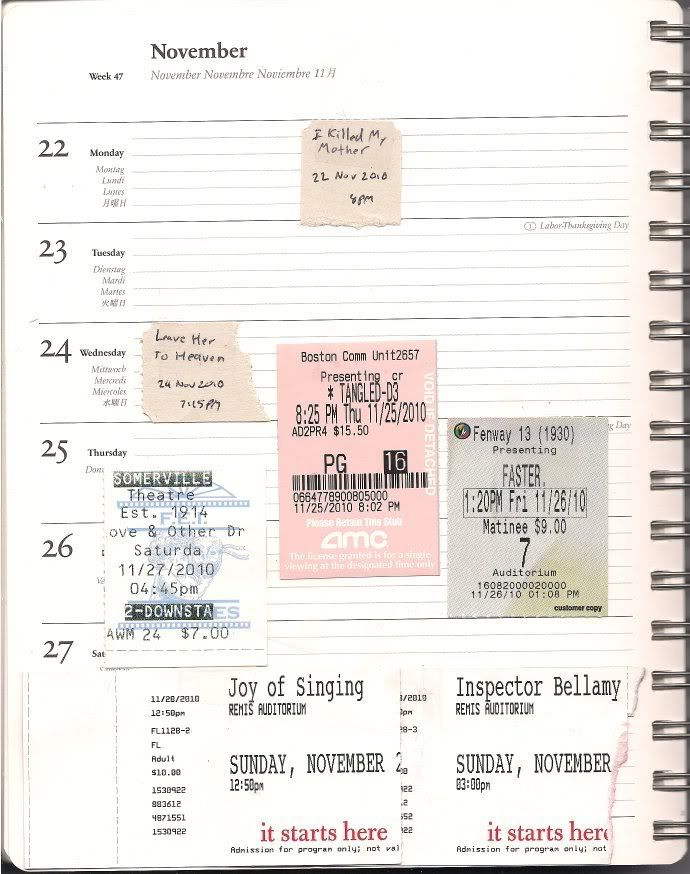
This Week In Tickets: 22 November 2010 to 28 November 2010
How does a person who likes movies spend a long holiday weekend?
... by boosting his blog's hit count and profile on eFilmCritic. It is a weird weekend when I'm the guy posting reviews of the major studio releases as I get to seeing them. Usually, one or the other of the folks who get to press screenings do them, and I just toss links out on the eFilmCritic Twitter account between very important things at work or when I get home. It's been fun to see my reviews at the top of the "most read" list on EFC with a little staying power - at least until Brian's reviews went up yesterday and we wound up splitting the people jumping to "eFilmCritic review of Tangled" as opposed to "Jay Seaver's review of Tangled on eFilmCritic".
Not that it's a competition, but I do enjoy looking at readership stats for this blog and eFilmCritic. Not even to gloat or whine about the total numbers, but to track trends and figure out what's most likely to get hits. I don't know that I'll ever change how I write based on these numbers - really, something involving not just actually getting paid, but enough money to make writing SQL code a part-time gig. Still, some things worth noting:
* I get a lot more hits on "Next Week In Tickets" than "This Week in Tickets". For November, my top 10 posts include three "Next Week" entries and no "This Week"s. That's cool, because the implication is that people find "Next Week" useful. It'd be kind of cool to hear that, every once in a while. Hopefully the "This Week" stuff doesn't come off as self-indulgent.
* Of the three new movie reviews I wrote over the weekend, the review of Tangled has shown pretty good staying power at EFC, not dipping too far in the daily counts even as the new review smell wears off - it's stayed ahead of Faster and Love and Other Drugs. On the blog, Faster has actually gotten half again as many hits, despite having less time to accumulate them, and Love and Other Drugs is right on its tail, and that was posted nearly three days later. Suspected rationale? In terms of the relative positions on the blog, Tangled doesn't mention in the title that I'll also be talking about the previews that played before the movie, and mentioning that either makes it a more enticing click or increases the number of hits it gets in a search (as in, some people are searching for "Faster Trailer", not a review of Faster). At EFC, where it's a more level playing field? I'm not sure, quite honestly.
* My most consistently popular reviews on EFC are Diary of a Nymphomaniac and Cummings Farm, though the latter only really spiked when it got a DVD release under the title "All American Orgy", with a terribly misleading cover photo (it makes the movie look like an American Pie sequel) to go with a relatively misleading title. It seems pretty likely that people who land on those reviews were searching for, shall we say, something else. Neither is actually porn - Diary is a European erotic drama distributed by IFC in the US, while Farm is a comedy that never actually gets as raunchy as its title implies - and indeed, kind of recoils in horror when it comes closest. But, that just counts hits, not people actually reading all the way through or finding the review useful. I was briefly kind of happy when they dropped in the past few days (with Diary actually dropping below numbers I can see for the first time in nearly ever), as I don't know if that's not exactly what I want to be known for, but they've rebounded, darn it.
* The most consistently popular review on the blog is Triangle, by a long shot. I suspect that's because it's one of the few where I spend some time talking about the end of the movie. That's interesting, and something I might try to do more, because it does sort of point up an area where online movie discussion is rather lacking - talking about the film as a whole. It's not just that everybody writing about movies wants to be Siskel & Ebert, or replace their local film critic, or join the lineup of some review site, so we default to writing reviews that emulate the form. I also think that in regular life, we have so little opportunity to talk about the end that we shy away from doing it even when we can.
Half my conversations about movies is people who haven't seen anything currently playing asking me what's good, so I shift into playing by the "review rules" then. People bring out the phrase "spoiler" when we get too deep into the film, and most folks would like others to first experience the film at least as cleanly as they did. When one person in the conversation hasn't seen the movie, everybody else clams up, and the internet is the ultimate multi-party chat; millions of people could see what you're writing, and few have seen the movie. But it's useful, every once in a while, to remember that it doesn't have to be that way. As long as you make a clear delineation between "for the people who haven't seen the movie" and "for the people who have", most people won't be upset, and that second group is under-served.
Seriously, if a review and discussion of a direct-to-video movie from March that I only found so-so gets three times as many hits and comments as anything else I've written nine months later... Well, I wish there were more movies I felt like going into the full film in-depth. The hits don't hurt, and you can get burned out of writing newspaper-style reviews after a while ago.
Okay, enough navel-gazing. Well, okay, maybe one more bit: I do with that I'd had a little more time to hit the 20th Century Fox retrospective that played the Brattle for about a week. I've seen most of it, but I wouldn't have minded seeing the familiar ones again, and the ones I hadn't seen looked interesting. Ah, well.
Oh, one other thing before getting to the bit of the Fox series I did see: Being quoted on a DVD is fun. Being quoted on the German release of a Serbian animated film makes you realize just how simultaneously big and small the world is these days (Image courtesy of Twitch's Kurt Halfyard).
Leave Her to Heaven
* * * (out of four)
Seen 24 November 2010 at the Brattle Theatre (20th Century Fox 75th Anniversary)
Leave Her to Heaven is a fairly enjoyable film from 1945, although when trying to pay tribute to a studio's entire history within a week, I'm a bit surprised that something that one could more comfortably hang the word "classic" on doesn't fill its slot. Leave Her to Heaven is interesting mainly in that it is able to straddle the lines between melodrama and film noir, although it's not always a comfortable overlap.
As the film opens, Richard Harland (Cornel Wilde) is returning to his isolated home in Maine, a broken man from his time in prison. His friend Glen Robie (Ray Collins) tells the story to the local who asks, saying it started when Richard came to visit him at his ranch in New Mexico years before. On the train, he met Ellen Bernet (Gene Tierney), a beauty who initially doesn't recognize him as the author of the book she's reading from the dust jacket. Both, it turns out, are going to the same place, and it's not long before they are falling in love and getting married, although both Ellen's mother (Mary Philips) and cousin/adopted sister Ruth (Jeanne Crain) express their concerns. It's not just that Ellen was already engaged to Russell Quinton (Vincent Price), an ambitious district attorney back east, but that she can be tightly wound and possessive. Returning to Maine with Richard's ailing brother Danny (Darryl Hickman) and longtime friend Leick (Chill Wills) was not how Ellen had planned it.
For contemporary moviegoers, Ellen is going to have a neon sign with the words "Daddy Issues - Stay Away!" hanging over her head from the start, though I suspect that it might not have been quite as much of a cliché sixty-odd years ago. In a way, those somewhat snicker-worthy scenes make the job that Ms. Tierney does all the more impressive; despite the ample warning that we're given that there's something potentially not right about her, Tierney is able to seduce the audience somewhat, if not so completely as Ellen does Richard. We're able to see love instead of just pathology, convince ourselves that maybe Richard is just what she needs, and when the darker elements of her personality come out, she makes them shocking but also believable and perhaps inevitable.
(Formerly at EFC)

... by boosting his blog's hit count and profile on eFilmCritic. It is a weird weekend when I'm the guy posting reviews of the major studio releases as I get to seeing them. Usually, one or the other of the folks who get to press screenings do them, and I just toss links out on the eFilmCritic Twitter account between very important things at work or when I get home. It's been fun to see my reviews at the top of the "most read" list on EFC with a little staying power - at least until Brian's reviews went up yesterday and we wound up splitting the people jumping to "eFilmCritic review of Tangled" as opposed to "Jay Seaver's review of Tangled on eFilmCritic".
Not that it's a competition, but I do enjoy looking at readership stats for this blog and eFilmCritic. Not even to gloat or whine about the total numbers, but to track trends and figure out what's most likely to get hits. I don't know that I'll ever change how I write based on these numbers - really, something involving not just actually getting paid, but enough money to make writing SQL code a part-time gig. Still, some things worth noting:
* I get a lot more hits on "Next Week In Tickets" than "This Week in Tickets". For November, my top 10 posts include three "Next Week" entries and no "This Week"s. That's cool, because the implication is that people find "Next Week" useful. It'd be kind of cool to hear that, every once in a while. Hopefully the "This Week" stuff doesn't come off as self-indulgent.
* Of the three new movie reviews I wrote over the weekend, the review of Tangled has shown pretty good staying power at EFC, not dipping too far in the daily counts even as the new review smell wears off - it's stayed ahead of Faster and Love and Other Drugs. On the blog, Faster has actually gotten half again as many hits, despite having less time to accumulate them, and Love and Other Drugs is right on its tail, and that was posted nearly three days later. Suspected rationale? In terms of the relative positions on the blog, Tangled doesn't mention in the title that I'll also be talking about the previews that played before the movie, and mentioning that either makes it a more enticing click or increases the number of hits it gets in a search (as in, some people are searching for "Faster Trailer", not a review of Faster). At EFC, where it's a more level playing field? I'm not sure, quite honestly.
* My most consistently popular reviews on EFC are Diary of a Nymphomaniac and Cummings Farm, though the latter only really spiked when it got a DVD release under the title "All American Orgy", with a terribly misleading cover photo (it makes the movie look like an American Pie sequel) to go with a relatively misleading title. It seems pretty likely that people who land on those reviews were searching for, shall we say, something else. Neither is actually porn - Diary is a European erotic drama distributed by IFC in the US, while Farm is a comedy that never actually gets as raunchy as its title implies - and indeed, kind of recoils in horror when it comes closest. But, that just counts hits, not people actually reading all the way through or finding the review useful. I was briefly kind of happy when they dropped in the past few days (with Diary actually dropping below numbers I can see for the first time in nearly ever), as I don't know if that's not exactly what I want to be known for, but they've rebounded, darn it.
* The most consistently popular review on the blog is Triangle, by a long shot. I suspect that's because it's one of the few where I spend some time talking about the end of the movie. That's interesting, and something I might try to do more, because it does sort of point up an area where online movie discussion is rather lacking - talking about the film as a whole. It's not just that everybody writing about movies wants to be Siskel & Ebert, or replace their local film critic, or join the lineup of some review site, so we default to writing reviews that emulate the form. I also think that in regular life, we have so little opportunity to talk about the end that we shy away from doing it even when we can.
Half my conversations about movies is people who haven't seen anything currently playing asking me what's good, so I shift into playing by the "review rules" then. People bring out the phrase "spoiler" when we get too deep into the film, and most folks would like others to first experience the film at least as cleanly as they did. When one person in the conversation hasn't seen the movie, everybody else clams up, and the internet is the ultimate multi-party chat; millions of people could see what you're writing, and few have seen the movie. But it's useful, every once in a while, to remember that it doesn't have to be that way. As long as you make a clear delineation between "for the people who haven't seen the movie" and "for the people who have", most people won't be upset, and that second group is under-served.
Seriously, if a review and discussion of a direct-to-video movie from March that I only found so-so gets three times as many hits and comments as anything else I've written nine months later... Well, I wish there were more movies I felt like going into the full film in-depth. The hits don't hurt, and you can get burned out of writing newspaper-style reviews after a while ago.
Okay, enough navel-gazing. Well, okay, maybe one more bit: I do with that I'd had a little more time to hit the 20th Century Fox retrospective that played the Brattle for about a week. I've seen most of it, but I wouldn't have minded seeing the familiar ones again, and the ones I hadn't seen looked interesting. Ah, well.
Oh, one other thing before getting to the bit of the Fox series I did see: Being quoted on a DVD is fun. Being quoted on the German release of a Serbian animated film makes you realize just how simultaneously big and small the world is these days (Image courtesy of Twitch's Kurt Halfyard).
Leave Her to Heaven
* * * (out of four)
Seen 24 November 2010 at the Brattle Theatre (20th Century Fox 75th Anniversary)
Leave Her to Heaven is a fairly enjoyable film from 1945, although when trying to pay tribute to a studio's entire history within a week, I'm a bit surprised that something that one could more comfortably hang the word "classic" on doesn't fill its slot. Leave Her to Heaven is interesting mainly in that it is able to straddle the lines between melodrama and film noir, although it's not always a comfortable overlap.
As the film opens, Richard Harland (Cornel Wilde) is returning to his isolated home in Maine, a broken man from his time in prison. His friend Glen Robie (Ray Collins) tells the story to the local who asks, saying it started when Richard came to visit him at his ranch in New Mexico years before. On the train, he met Ellen Bernet (Gene Tierney), a beauty who initially doesn't recognize him as the author of the book she's reading from the dust jacket. Both, it turns out, are going to the same place, and it's not long before they are falling in love and getting married, although both Ellen's mother (Mary Philips) and cousin/adopted sister Ruth (Jeanne Crain) express their concerns. It's not just that Ellen was already engaged to Russell Quinton (Vincent Price), an ambitious district attorney back east, but that she can be tightly wound and possessive. Returning to Maine with Richard's ailing brother Danny (Darryl Hickman) and longtime friend Leick (Chill Wills) was not how Ellen had planned it.
For contemporary moviegoers, Ellen is going to have a neon sign with the words "Daddy Issues - Stay Away!" hanging over her head from the start, though I suspect that it might not have been quite as much of a cliché sixty-odd years ago. In a way, those somewhat snicker-worthy scenes make the job that Ms. Tierney does all the more impressive; despite the ample warning that we're given that there's something potentially not right about her, Tierney is able to seduce the audience somewhat, if not so completely as Ellen does Richard. We're able to see love instead of just pathology, convince ourselves that maybe Richard is just what she needs, and when the darker elements of her personality come out, she makes them shocking but also believable and perhaps inevitable.
It's a credit to director John M. Stahl and screenwriter Jo Swerling (working from a novel by Ben Ames Williams) that the twists in the story still come across as shocking, too. The story and motivations are straightforward, but everything is a logical next step from what we've seen before. Stahl does a very good job of implying more horror when it comes to that, and though the basic shape of what happens is clear both from the introduction and from what we see just as the final act kicks off, there's just enough held back to keep us curious. Stahl and Swerling do a nice job of keeping the story intimate, focused on Ellen and Richard, but rotating his nice supporting cast in and out as need be. Jeanne Crain and Darryl Hickman are especially good as Ellen's and Richard's respective siblings, although a little bit of Chill Wills can go a long way.
And, unfortunately, so can the material with Vincent Price. He shows up for one scene early, and it's one of those fun early roles where he played east coast aristocracy rather than madmen. Unfortunately, later he is given a lot of screen time in one of the dumber court scenes one will see. Ignoring that he's a Massachusetts prosecutor trying crimes that took place in Maine, the sequence is a momentum-killing drag, in which the accusations are spelled out in excruciating detail despite the audience likely having already figured everything out, the defense attorney being passive to the point of ineptitude for no good reason, and the actually decent acting by the principals can only do so much.
That last act problems keep it from being a true classic, as opposed to just a pretty good old movie. It's good-looking, too - it won an Oscar for color cinematography. Overall, a nifty little thriller, with some unusually creepy undertones for the period.
Tuesday, November 30, 2010
New from France: The Joy of Singing, Inspector Bellamy
This post was originally going to be somewhat longer on both ends - I intended to see one or two other films in the MFA's series on Friday afternoon and Claire Denis's White Material tonight. Why have I not? Well, let me put it this way - I never get off the 47 bus as the right spot to see things at the museum. Never. On Friday, as usual, I missed the MFA stop, didn't realize I'd gone too far until the train pulled into Ruggles Station, and then got a bit turned around and ended up walking to Dudley Station. Sunday I at least managed to get off one stop too early, which was OK, since the schedule left me plenty of time.
Tonight, after seeing that Kendall Square was going to hold White Material over a week, I opted to go see The Narrow Margin as part of the VES screenings at the Harvard Film Archive instead... Only to get there and see a note taped to the door saying that it was unavailable, and they'd be playing the first two chapters of Godard's History of Cinema instead. Eh, no thank you. I stopped by Mr. Bartley's for a delicious burger as compensation (there's no line on summer weeknights for a seat!), and then walked home to find the UPS guy just leaving the Fantasia/Fantasia 2000 Blu-ray Discs on my doorstop. I'm no superstitious person, but I am willing to accept that as a message, and am watching three and a half hours of fantastic animation with amazing sound and picture instead.
Thing noticed while writing the review for Joy of Singing: I think the last time I used the word "airhead" was when reviewing The Girl on the Train. Do the French use this character type more than others? Speaking of which, I see Girl on the Train and Bellamyshare a writer. How odd, to never see anything by someone who has had a decades-long career and then see two in relatively rapid succession.
Le plaisir de chanter (The Joy of Singing)
* * * (out of four)
Seen 28 November 2010 at the Museum of Fine Arts's Remis Auditorium (New Films From France)
There are music and voice lessons in The Joy of Singing, but there's also sex. And spies. And screwball strangeness. It's a leftover stew of a movie, with filmmaker Ilan Duran Cohen apparently throwing in whatever bits of story caught his fancy and coming out with a droll, if occasionally bizarre, comedy.
Arms dealer Hans Muller has recently died, which is a problem for a great many people, as he was moving a shipment of uranium at the time. French Intelligence believes that a USB card with information on who purchased it may be in the hands of his widow, Constance (Jeanne Balibar), so they task a pair of agents to get close to her: Muriel (Marina Fois), thirty-five and starting to worry about her inability to conceive, and Philippe (Lorant Deutsch), her much younger partner and lover. The easiest way to get close appears to be the singing class she takes from opera singer Eve (Evelyne Kirschenbaum), but everyone else has the same idea: Anna (Caroline Ducey) is probably with Israeli or Russian intelligence, Xavier (Eytan Kirch) with another agency, and Julien (Julien Baumgartner) is a prostitute hired by Reza (Frederic Karakozian), a bear of an Iranian. They've got their work cut out for them, because while Constance seems to be an airhead fortunate to have married well and been widowed relatively young, her sister-in-law Noémie (Nathalie Richard) thinks it's an act and she murdered her husband.
If it's an act, it's an amusingly convincing one. We get a sense of this character and the movie's general sense of humor early on, when she's walking out of Eve's building and has her purse snatched. Instead of panic or terror, there's a confused look on her face that says "again?", and that's before we learn that, no, this is not the first time her bag has been stolen or her apartment searched. The film is one long, Gallic shrug at increasingly absurd situations, a laugh at how ineffectual the authorities are and how the ditzy Constance is seemingly able to just drift through, apparently unharmed and unaffected by the dead bodies and strange entanglements appearing in her wake.
Full review at EFC.
Bellamy (Inspector Bellamy)
* * * ¾ (out of four)
Seen 28 November 2010 at the Museum of Fine Arts's Remis Auditorium (New Films From France)
The opening scene of Claude Chabrol's final theatrical film gives a hint to why he was often compared to Alfred Hitchcock, though with a French sensibility: His camera threads its way through a graveyard until it finds corpse that is not there to be interred: It's burnt to a crisp, still in a sitting position, and clutching a steering wheel like nothing terrible has happened. The head is on the ground next to it. For all the gruesomeness of the image, it's a jaunty, whimsical moment, the sort of black comedy that was Hitch's trademark.
From there, things become rather more French. We see a man, Noel Gentil (Jacques Gamblin), lurking around the Nimes vacation home of Paul Bellamy (Gerard Depardieu). Paul's wife, Françoise (Marie Bunel), sends him away, but Paul, a Paris detective of some renown, cannot resist a mystery, especially when the alternative is spending time with half-brother Jacques Lebas (Clovis Cornillac). It turns out that Gentil is really Emile Leullet, the owner of the car, and with his insurance fraud discovered, he wants Bellamy to help him and his lover Nadia (Vahina Giocante) to find a way out of what he claims is not cold-blooded murder.
The story sounds ridiculous when described like that, and I suspect that there is no way to describe it where it would sound otherwise. Bellamy spends a good deal of time ferreting out information that should have been given to him up front, while the final pieces fall into place from somewhat conveniently. To the extent that Bellamy is a murder mystery, it is about determining degrees of culpability. Though Bellamy is not on official police business, he is still engaging in one of a detective's most important duties - trying to determine what a suspect is capable of, at that crucial moment, when there's no definitive evidence. Indeed, not being on official business is why Bellamy is able to spend so much time giving this thought.
Full review at EFC.
Monday, November 29, 2010
Love and Other Drugs (and, of course, previews)
Three mainstream movies this weekend, three different sets of previews. This one was short, as one of the Somerville Theatre's many charming qualities - such as evening tickets that cost less than the downtown theater's matinee price, full service ice cream, and hosting great film festivals - is not front-loading films too severely with a huge ad package, so the movie's running time actually provides a decent guideline for when you'll get out. So just two:
Source Code - I'm signed up just based on Duncan Jones directing science fiction again, as I am quite fond of Moon, to understate the case a bit. I like Jake Gyllenhaal. And I love Michelle Monaghan. Vera Farmiga and Jeffrey Wright are not exactly negatives. The preview looks just about as spiffy as I'd hope.
Still, I'm not sure why they called it "Source Code". That term has a specific meaning to us folks who program computers for fun and profit, and it's not what you guys seem to think it means!
Black Swan - I'm glad I live in a big-ish city, because it doesn't look like anything else is getting a wide release this Friday, and ComingSoon.net is only showing it as "limited" (but those limits include Boston). I almost feel like I know too much just from seeing the preview, although it doesn't seem to give that much away.
A couple notes: Because people have yelled "bias!" for much smaller omissions (and that's leaving out the accusations that aren't completely imaginary), I'll mention here that my day job involves me doing work for drug companies, albeit with at least two levels of intermediaries so that they don't have to deal with me directly - this, I suspect, is good for everybody involved. Plus, the medical data I work with doesn't tend to involve antidepressants or vasodilators. All I'm saying is that just because certain characters are specified as working for Lilly or Pfizer, I'm not going to look on them favorably because they hire my employers or unfavorably because they may or may not be among the folks whose requests drive me bananas.
... and, before getting to the review, it's kind of amusing that when I came out of the screening, I planned on spending a little more time on how eminently screen-cap-able the eventual Blu-ray will be for fans of Ms. Hathaway (and Mr. Gyllenhaal, to a lesser extent), which was kind of surprising considering the genre and presumed audience - honestly, if this underperforms, I wonder if it will be because people don't realize the teasing cuts of the trailer don't represent how much skin you get to see in the movie. But then I went to a couple of French films the next day, and The Joy of Singing made me reconsider what I consider an unusual amount of casual nudity is for a comedy.
Love and Other Drugs
* * * (out of four)
Seen 27 November 2010 at Somerville Theatre #2 (first-run)
Edward Zwick could have made an issue movie out of Love and Other Drugs; he and his co-writers have taken a story that focuses on one unsavory corner of the medical/pharmaceutical industry and elaborated on it so that it touches several others. Instead, he puts the focus on the love story, which is perfectly fine: It's akin to putting a few milligrams of medicine in a candy shell, and this turns out to be pretty good candy.
Jamie Randall (Jake Gyllenhaal) comes from a family of doctors, but while he washed out of college and is selling stereos as the movie starts - before getting fired due to his horndog antics - his brother Josh (Josh Gad) puts him onto another line of work, being Pfizer's point man for getting doctors to prescribe their drugs rather than those of the competition (or, perish the thought, generics). While making the rounds with Stan Knight (Hank Azaria), a doctor who influences a great deal of the region, he meets Maggie Murdock (Anne Hathaway), a pretty artist/waitress with early-onset Parkinson's Disease. She has no desire for commitment because she knows it will eventually end badly, and he's the type of slimeball that steals competing companies' samples when the doctors aren't looking. Perfect match, until they surprise each other by finding there's more than their respective libidos involved.
There's something kind of impressive about how Zwick and company split the difference between the currently-popular raunchy romantic comedy and the traditional model early on in the movie. It's not leeringly sleazy, but I suspect that a few eyebrows will be raised when the film doesn't have the same cuts as its green-band trailer. In some ways, maybe there should have been a little more of a creep factor to their meet-cute (Maggie disrobes in front of Jamie thinking he's a doctor, but is still open to hooking up later, and there's also implications that she's traded on her sexuality with more members of the medical and pharma community than just Jamie); then again, that's not necessarily something you want to have hanging over the couple as the movie goes on. At any rate, not being shy about the sex early on is certainly one way of making sure that the audience understands the initial basis for the relationship.
Full review at EFC.
Saturday, November 27, 2010
Faster (+ previews)
You may find this hard to believe, but an R-rated action/crime movie like Faster has a completely different set of previews attached to it than the PG-rated Disney animated comedy from the night before! So, let's run down what's being sold to action fans, just like for the kids:
Battle: Los Angeles - Fun fact: The guys who made Skyline also worked on this movie about aliens attacking Los Angeles. This one looks to easily be the bigger and better film, apparently with a tight focus on the grunts fighting the aliens as opposed to the leaders.
Cowboys & Aliens - The graphic novel it's "based on" was just okay (with "based on" being a loose term - the comic was created to drum up interest in the property as a film, and then sold at a loss so that it could be called a best-seller), but the trailer is looking like all kinds of fun. There's a ton of behind-the-scenes talent, Jon Favreau is pretty good at this sort of thing, and the cast of Daniel Craig, Harrison Ford, and Olivia Wilde is solid.
Speaking of Harrison Ford, one of the saddest things about how rare westerns are today is that Ford never really did them. This is a sci-fi western, and the last time Ford did something even remotely similar was over thirty years ago, in The Frisco Kid, a comedy where he played second fiddle to Gene Wilder. Someone need to cast him in a straight western, soon. Maybe Jon Carpenter - Ford and Carpenter doing a non-hybrid western together would kill two "movies that need to happen before the people involved are too old" birds with one stone.
True Grit - Wow, this looks good. As needless as remaking one of the films most closely associated with John Wayne is, the Coens do great work and Jeff Bridges looks absolutely fantastic in the preview.
Drive Angry - 3D makes some people completely irrational; follow Roger Ebert on Twitter and be amused by how every 3D movie not doing as well as it might have is conclusive evidence that the public has turned away from this gimmick and it's dooooooooooooooomed. And, yes, I do think that there has been some backlash, but what's actually happening seems to be moviegoers getting smarter about which movies they see in 3D and studios starting to make the distinction that certain movies are being made with it in mind. Drive Angry pushes the "Shot In 3D" big-time in the preview, but it looks like a fun movie regardless, with Nicolas Cage tearing into the insane premise (guy breaks out of hell to rescue his granddaughter), William Fitchner as the smooth demon pursuing him, and Amber Heard looking gorgeous. The director had fun with 3D in My Bloody Valentine, which while not really a good movie certainly made use of the technology well.
The Mechanic - Donald Sutherland is going to get knocked off early in this one, isn't he? --sigh-- Jason Statham will probably be worth watching - he generally is - but sometimes it feels like his agent should just throw out any scripts that don't have Guy Ritchie's or Luc Besson's return address (and be careful where Ritchie is concerned).
...And, after that, Faster started. The only thing really worth mentioning about it that's not in the review is that the opening credits indicate that divisions of three of the six major media empires were involved in making this thing: Viacom (CBS Films), Sony (Tri-Star Pictures), and Time Warner (Castle Rock). That's common in the rest of the world, but in Hollywood, does it really take that many investors to make a B-level action movie?
Faster
* * ¾ (out of four)
Seen 26 November 2010 at Regal Fenway #7 (first-run)
I wonder if Faster had a different name at some point, or evolved into something else from its original conception. With that title, and a character identified mainly as "Driver", you'd think it would be all about the high-speed chase. Instead, it's a terse, methodical movie, a flawed but intriguing opera of revenge.
A former getaway driver (Dwayne Johnson) is just being released from prison after ten years. He's stoically taken everything the other prisoners have dished out. Nobody meets him at the gate, so he starts walking. A car awaits him at a nearby junkyard, and the glove compartment contains a name, an address, and a revolver. Not caring who sees him, the driver puts a bullet in a telemarketer's head, then goes to get a list. A hungover cop (Billy Bob Thornton) a couple weeks away from retirement catches the case, and he and his partner (Carla Gugino) aren't the only ones on the driver's trail - a hit man (Oliver Jackson-Cohen) has been hired to take him out before he reaches the end of the list.
Faster seems like it should have been a race, with the Driver, the Cop, and the Killer speeding from one target to the next, ramming each other off the road and firing guns at each other's speeding cars. There's actually not a whole lot of vehicular action at all, and most of it takes place during a flashback to the heist that originally landed Driver in jail. What we see is fairly impressive stunt driving, and both Driver's '70s Chevelle and Killer's late-model Porsche are fine reflections of their personalities, but those going for non-stop action will be disappointed. There's only one real shootout, which comes early. Most of the kills are efficient.
Full review at EFC.
Friday, November 26, 2010
CineCaché #5: I Killed My Mother
Not much to say about this one other than what's in the review. Pretty decent, not great. I'll be interested to see what writer/director Xavier Dolan is capable of a few moves down the road, when he's not so much working with friends and has a chance to practice.
I was actually a little bit surprised by how much I liked it when all was said and done; this movie is one that the Chlotrudis folks have been playing up for a while, along with Dolan himself, and I discounted that opinion a bit. It's only natural - when a group of friends that includes a bunch of gay folks talks about how great the autobiographical film by the young gay filmmaker that they saw at Provincetown is.. Well, you know. To be fair, they probably apply a similar scaling factor to the hard science fiction or science documentaries I come back from Fantasia revved up about.
J'ai tué ma mère (I Killed Your Mother)
* * * (out of four)
Seen 22 November 2010 at the Brattle Theatre (CineCaché)
So, how important is liking a movie's main character to your enjoyment of the movie? That's a question worth asking yourself before sitting down to I Killed My Mother, because while it's not hard to find nice things to say about writer/director/star Xavier Dolan's first film even without mentioning his tender age, the character he wrote for himself is quite the obnoxious little bastard, and knowing that this film is semi-autobiographical may do more to hurt one's impression of the filmmaker than help one's impression of the film.
Hubert Minel (Xavier Dolan) is sixteen, gay, and fights with his mother Chantale (Anne Dorval) at the drop of a hat - and, honestly, the hat does not actually need to fall. Chantale and Hubert's father are long-divorced (Minel père just didn't see himself as the parenting type) and Chantale is, in Hubert's eyes, hopelessly bourgeois. His life really isn't so bad - he's a fairly talented artist who has a nice boyfriend in Antonin (François Arnaud) and an encouraging teacher in Julie (Suzanne Clément), and he thinks he's figured out a way to make things work - he should get an apartment of his own with the money his grandmother has left him in trust. The alternate housing arrangement she comes up with pleases him rather less.
Suffice it to say, Hubert has some growing up to do, and the folks around him don't always make it easy. Stepping back from the movie and looking at it as a whole, that progression of the character is handled rather well. Dolan isn't subtle with how he shows us that Hubert does, in fact, care for his mother despite conflicting feelings (the video diary entry is as close to the writer just handing character information to an audience as you can get, and having it be found is a clumsy plot device), but that fits with the character's tendency to be overdramatic. And we clearly see that said tendency comes from maman; neither she nor any of the supporting characters are an easy-to-emulate example of mature adulthood.
Full review at EFC.
Tangled
I wound up leaving Maine about an hour and a half earlier than I'd originally planned on Thanksgiving, which meant I got back into Boston at about eight o'clock. South Station is pretty close to the AMC Boston Common theater, and though we were into the part of the day where movie tickets are expensive, I opted to compound it by going for the 3-D ticket. I figure I'd wind up seeing one of they weekend's new releases past matinee time anyway, and since this one looks to be the best, why not have it be the one I want to see the most? The same 3-D surcharge applies to the $6 tickets as the $11.50 tickets, so I might as well give Tangled more of my money than Faster.
It is kind of funny, though, that just before this movie gets released, word comes out that Disney is canceling future fairy tale/"princess" movies - this, after changing the name of this one from "Rapunzel" as a knee-jerk reaction to The Princess & the Frog under-performing. It seems nuts to me - this is what Disney is known for, this movie is both really good and likely more easily marketable than P&F was, and considering the development time for an animated feature, it seems like making long-term decisions based on short-term data.
Anyway, good movie. And while I mention that the songs don't really stick with me in the review, at the time of this writing (very early Friday 26 November), Amazon's got a digital download of the soundtrack for $4, which is a ridiculously good deal. Click that merch button if it's still there.
Also, we got a good set of 3-D family-friendly previews, which might be fun to run down, even if I catch crap for this first one:
Yogi Bear - So help me, this preview makes me giggle, even if I kind of suspect that funny lady Anna Faris is going to be wasted in this. I strongly suspect that Justin Timberlake is going to be a riot as the voice of Boo Boo.
The Smurfs - This one, on the other hand... No, just no. Maybe something other than a teaser trailer will do something more for me, but putting the Smurfs in the modern world rather than their quasi-medieval setting just seems wrong.
Mars Needs Moms - Berke Breathed is getting paid for this, right? I mean, it doesn't look like a terrible movie, just not a good one, even before we get into the dead-eyed motion capture style.
Cars 2 - I actually liked Cars quite a bit, even though a lot of people dismiss it as one of Pixar's and Lasseter's weak link. My main concern with the sequel was doing it without the voice of Paul Newman, who just seemed like such a perfect fit for the material, but Michael Caine is kind of brilliant in the trailer.
Tangled
* * * * (out of four)
Seen 25 November 2010 at AMC Boston Common #16 (first-run, digital 3D)
Tangled is probably my favorite thing that the direct descendants of Disney's original feature animation group has done since Aladdin, in no small part because it's the first of their digitally-rendered features that embraces what worked during that 1990s run of success. From the Alan Menken score, to the fairy tale source, to the visual style, Disney has managed to put a slick new 3-dimensional paint job on the things that they've been hiding in the attic.
A fair amount of backstory leads into the film's present, but once there, the situation is like this: Princess Rapunzel (voice of Mandy Moore) was kidnapped as a baby by Mother Gothel (voice of Donna Murphy), who locked Rapunzel in a tower and raised the girl as her own daughter in order to have the use of her magical golden hair, which heals injuries and restores youth. Meanwhile, back at the castle, dashing thief Flynn Ryder (voice of Zachary Levi) and the Stabbington Brothers (voice of Ron Perlman) are fleeing with a stolen crown. Ryder stumbles upon Rapunzel's tower, and she makes a deal with him to guide her to the castle so that she can see the paper lanterns that fill the sky on her birthday every year in person.
There are a few ways that Tangled has a hard time equaling its cel-animated forebears. As comfortably familiar as Menken's score is, none of the songs by Menken and lyricist Glenn Slater are terribly likely to be remembered after the movie ends (they're fine, and it's nice that the film doesn't shrink from being a musical). Also, digitally-rendered animated films have had a hard time with human figures for the entire history of the medium, especially women. When not attempting photo-realistic motion capture, what happens is that stylized male characters are often bulked up and thus solid-looking, while the likes of Rapunzel and Gothel are slender, with thin necks and big heads (and in Rapunzel's case, very wide eyes), creating the impression of a mannequin that can be tough to shake.
Full review at EFC.
Wednesday, November 24, 2010
Next Week in Tickets: Films playing Boston 24 November - 2 December
It's Thanksgiving weekend, which means, in chronological order, (1) travel, (2) turkey, (3) pie, (4) more pie, (5) more travel, and (6) a couple extra day to see the mix of popcorn and award-hopeful fare that are being released into theaters this weekend.
(And, of course, seeing the family, although that's a bit of a fizzle this year, as a couple of my brothers are traveling to their spouses' folks this year. It's rough being the accommodating family!)
(Which is not to say that my in-laws are selfish or... Oh, there's no digging out of this, is there? Let's just get to the movies playing Boston this weekend!)
It's potentially a very busy week(end); the only new release I'm sure I'll hit is Tangled, although Faster and Love and Other Drugs are both likely-looking. Prince Achmed and The Narrow Margin are likely at the HFA, as are Leave Her to Heaven, All About Eve, and maybe a Little Murders/Big Trouble combo at the Brattle. Maybe Inspector Bellamy and Joy of Singing at the MFA, and the new releases at Kendall.
In short: A lot of good stuff playing this week, and it's a darn good thing we've got extra days to watch it!
(And, of course, seeing the family, although that's a bit of a fizzle this year, as a couple of my brothers are traveling to their spouses' folks this year. It's rough being the accommodating family!)
(Which is not to say that my in-laws are selfish or... Oh, there's no digging out of this, is there? Let's just get to the movies playing Boston this weekend!)
- Four fairly-wide openings this week, with Tangled looking to get the most screens, including some of the 3D ones. I'm looking forward to it, although it looks like it's gone through an absolutely ridiculous development and marketing process - the first concept art looked like gorgeous watercolors, but now the look seems a little more cartoony-CG; the name was changed from the more straightforward Rapunzel in an effort to appeal more to boys, and now there's talk that it's Disney's last princess/fairy tale movie for a while. Fortunately, it looks like fun in the Hercules or Emperor's New Groove mold, and every clip I've seen makes me think I'll really adore the Rapunzel character.
For those not willing to hit Disney animated features, there are a few movies being sold on more conventional star power. Faster and Love and Other Drugs both look pretty by the books, but, hey, I like Dwayne Johnson (and this is his first straight-action role since Doom) and Billy Bob Thornton for the former and Jake Gyllenhaal and Anne Hathaway in the latter. I'll probably see both at some point. There's no chance on Earth I'm seeing Burlesque, though. I'm not going to say Cher and Christina Aguillera can't make for an enjoyable viewing experience, just that I'm not going to bet $10 on it.
Not really an "opening", but 127 Hours expands to Boston Common and some of the suburbs. Nobody appears to be taking a chance on the utterly insane-looking version of The Nutcracker scheduled to be released today. I suspect that releasing a 3D family movie on the same day as Tangled is not what you'd call great counter-programming. - The Brattle opts to go with classics for the next week, starting with the first half of 20th Century Fox's 75th Anniversary Series. It kicks off tonight with Leave Her to Heaven, which is where I'll be tonight before the weekly trip to the comic shop, because Gene Tierney is lovely and Vincent Price in a normal supporting role is always cool. Check the full schedule for times; other highlights are Alien for Thanksgiving dinner, a Friday double feature of Gentlemen Prefer Blondes and All About Eve, Big Trouble in Little China Saturday night and Sunday afternoon, and a Sunday double feature of Butch Cassidy and Raising Arizona.
Special screenings take over Tuesday - Thursday, including a World AIDS Day show (Sex in an Epidemic) on Wednesday and Harvard' Archeology Department presenting Indiana Jones and the Temple of Doom on Tuesday and Wednesday. Note that this is a change from the printed calendar, apparently a decent print of Raiders of the Lost Ark is tough to come by. To be honest, though, this isn't really much of a downgrade. - Kendall Square staggers their openings this week. Made in Dagenham opens today, with Polly Walker as an unlikely labor leader in a 1960s London suburb. Spiffy supporting cast, too: Miranda Richardson, Bob Hoskins, Rosamund Pike, and Rupert Graves. Friday gives us the movie with the one-week warning, Claire Denis's White Material. The description on Landmark's site makes it look a lot more interesting than the preview I've seen before nearly every movie at Kendall over the past couple months (which gives off a "white people trying to stay in charge of Africa" vibe).
- It's an extremely quiet week at the Coolidge, with no midnight shows and 127 Hours and Fair Game continuing their runs. Waste Land moves to the digital room from Kendall Square, though it will also have a special "Green Screens" screening on Monday evening. There's also a preview screening of Budrus next Wednesday (1 December 2010; the film will open its regular run two days later), and a "Social Work In Progress" screening of Carried Away.
- The Regent theater in Arlington has a couple of film programs - Sing Along Mary Poppins runs Friday to Sunday, although only matinees on Saturday and Sunday, as there are comedy shows those nights. Those looking for something 180 degrees away from Mary Poppins will find it Wednesday night with Total Badass, a documentary by Austin filmmaker Bob Ray about local underground personality Chad Holt. Both will be there for the screening, and there will be door prizes.
- As you might expect from a venue that mainly exists to serve a student/faculty population, the Harvard Film Archive takes Thursday and Friday off (and ArtsEmerson's screening room has nothing all weekend), but kicks a Cinema of Weimar Germany program that will run through December off on Saturday with the first part of Dr. Mabuse, the Gambler, an early Fritz Lang triumph (the second part runs Sunday night). I'm not sure who is doing the musical accompaniment for that and Monday's The Adventures of Prince Achmed (the earliest surviving animated feature), but it's sure to be worth it; Mabuse is an operatic, silent epic which I loved when the HFA showed as part of a Lang series a few years ago. There will be more Lang later in the series, and the newly reconstructed Metropolis is out on Blu-ray. You want that.
The last free VES screening of the year is on Tuesday, and is, depending on whether you check the website or the printed calendar, the 1952 noir The Narrow Margin or its 1990 remake Narrow Margin (with Gene Hackman and J.T. Walsh). I'm a big fan of the latter, so I'm down for either. - The MFA kicked off a series of New Films from France this afternoon; it seems to mostly focus on comedy, crime, capers. The one I'm most looking forward to is Inspector Bellamy, which teams director Claude Chabrol and Gerard Depardieu; I'd recommend staying away from Heartbreaker.
Like the Brattle, the MFA is having a screening for World AIDS Day on the 1st; it's 2004 documentary short "Kids Living with Slim" ("Slim" being what many in Africa call HIV/AIDS). They'll also be starting a New Korean Cinema series next Thursday (2 December 2010) with Like You Know It All.
It's potentially a very busy week(end); the only new release I'm sure I'll hit is Tangled, although Faster and Love and Other Drugs are both likely-looking. Prince Achmed and The Narrow Margin are likely at the HFA, as are Leave Her to Heaven, All About Eve, and maybe a Little Murders/Big Trouble combo at the Brattle. Maybe Inspector Bellamy and Joy of Singing at the MFA, and the new releases at Kendall.
In short: A lot of good stuff playing this week, and it's a darn good thing we've got extra days to watch it!
This Week In Tickets: 15 November 2010 to 21 November 2010
I'm a bad indie film-lover. All sorts of documentaries playing, and what do I do?
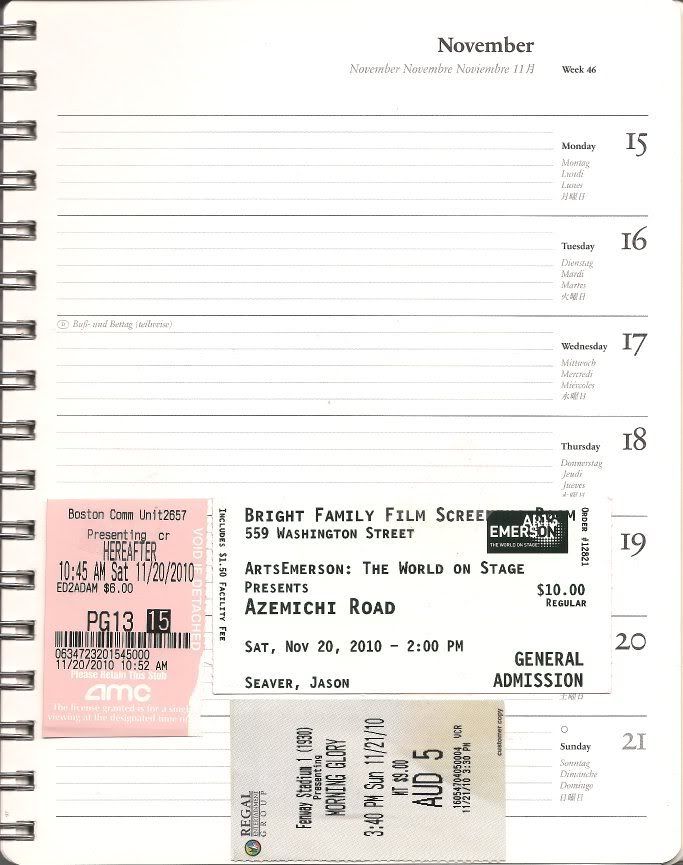
A fair number of days staying an extra half hour at work make it hard to get to stuff during the week, especially if the non-doc stuff one wants to see is in Arlington or Somerville for one more leg on the T.
It's worth noting that the 10:45am show of Hereafter was the only time it ran during the day for the past five days. Someday, when I get an eccentric millionaire to invest in an Alamo Drafthouse-type theater for me to run, I'll have to figure out the reasoning for scheduling like that. If you're going to be keeping a print around for another week, is that the best way to utilize it? If so, why? Do you figure Hereafter is going to appeal to seniors (or whoever else, aside from me, who is seeing movies at 10:45am)?
Hereafter
* * ¾ (out of four)
Seen 20 November 2010 at AMC Boston Common #15 (first-run)
I want to like this movie for the talent involved: Clint Eastwood directing from a script by Peter Morgan. Spielberg, Kathleen Kennedy, and Frank Marshall producing. Matt Damon and Cecile De France in leading roles, Bryce Dallas Howard in a supporting part. The easy way for me to dismiss it is to mention my general skepticism about paranormal activities, that I'm just not going to be able to go for a movie that takes them seriously.
And, I won't lie - such elements don't help. Even when Eastwood provides a thump and a visual effect as Damon's George Lonegan character touches someone's hand, I'm still going to process the rest of that scene as a cold read, or wait for the Sherlock Holmes explanation, and I always wind up a little disappointed when George says something that he couldn't have known or deduced; a man who can instinctively read people is much more interesting than a medium, especially when you consider that the movie avoids the big paradox inherent in this sort of spirituality: If the afterlife is so wonderful and peaceful, why should anyone want to live?
Put that aside (I know, it's a little late for that), though, and the individual characters and stories are quite good. All three threads are about people who have had close encounters with death and been changed by the experience, to the point of obsession, and each features a fine performance at the center. Eastwood gives the film a properly somber tone without things ever becoming leaden or depressing. The meat of the movie is quite good, and there's something reassuring about the way the film rotates between Marie, George, and Marcus in order, as opposed to trying to get clever with its editing.
It has issues on the ends, though. The tsunami that opens the film is well-realized, but it does look like a special effect, and there's something just a bit exploitative about using a disaster that devastates a city and region so that one European tourist will almost die. At the finish, all this mournful pondering is apparently in service of these three people eventually meeting at a book fair, which seems coincidental and small. Even considering that the film is about needing to connect with the living rather than the dead, both the physical and philosophical sprawl seem a bit much if the goal is to get a couple people into a restaurant for dinner.
Morning Glory
* * * (out of four)
Seen 21 November 2010 at Regal Fenway #5 (first-run)
Morning Glory is a movie filled with characters and actors I really, really like, but saddled with a script that isn't quite sure how to put them together. It seems to me that if you've got Harrison Ford and Diane Keaton as diametrically opposed news anchors, you maybe let them play off each other a little more, use their bickering as more than background gags, and maybe get them to meet in the middle. I don't think you'd even have to take much focus off of Rachel McAdams to do that; you could even play the anchors' relationship against her character's and Patrick Wilson's.
And, maybe, doing it that way would help balance the dynamic between Ford and McAdams, too. Ford's hard-news-loving former evening news anchor and reporter, whom she hires to add gravitas to the fourth-place morning news program, is given so little to do that fits his skills that it makes McAdams's young executive producer look a little foolish.
Just a little, though. McAdams is rather delightful in this movie, all full-speed-ahead enthusiasm and dedication, genuinely funny and self-deprecating. Her driven character keeps the movie from ever slowing down too much, and Ford makes a fine grumpy foil to her (a grumbling combination of idealism and ego). The movie is in a way aggressively light - Ford's character is kind of beaten down in the end, his desire to be informative and substantial broken down, even after we're shown the characters getting a rush from actually breaking news - but it's fairly funny. It's just too bad the pieces don't fit together a little better.
Tuesday, November 23, 2010
The Azemichi Road and the Paramount Center
I think there were about a half-dozen or so of us in the screening room for The Azemichi Road, which is a bit of a bummer; it's a pretty good movie and I would rather like ArtsEmerson's Saturday afternoon screening series to last at least long enough for my friends Gil & Amanda to be able to take their new daughter there in a few years. They love movies, and joked about how they were going to start having real concerns about the state of children's cinema starting this fall.
As far as I can tell, ArtsEmerson has the most ambitious program of family-friendly films of all the Boston area's independent and repertory cinemas: Most Saturdays at 2pm, they're running something you don't have to worry about bringing kids to, especially if they're old enough to be reading subtitles. The Coolidge has puppet shows and occasional film programs every few weeks, and the Brattle does fun stuff around the holidays (and is never more fun than when parents are showing their children the joy of silent pictures), but a well-curated program that shows kids that there can be more to movies than the stuff Hollywood makes for them is something that is good in the short and long-term.
If they're taking suggestions, I'd like to propose a couple from Japan: Mamoru Hosoda's and Satoko Okudera's Summer Wars, and Tetsuya Nakashima's Tatsuya and the Magic Book. Saw them both at Fantasia (different years), and would love to both see them again and show them to other people.
The Bright Family Screening Room is the second new room I've checked out in the past week, and I didn't see it under optimum conditions - this particular movie was widescreen and projected from DigiBeta media, and the low resolution was fairly evident in some shots. I've heard that the arrangement of the projection booth is such that film projection is sacrificed for digital, in that the 35mm projector is off-center. I can see where this would be a problem if the case, as while the room is wide enough to include a good-sized screen, it is not very deep; I counted 9 rows averaging 18 seats across, and the last couple are actually under the overhanging booth. If you can get seats in the center, you'll probably want to do so, as you're fairly close to the screen no matter what.
It's a nice-looking room for all that, in a very nice-looking building. Even when it was lying empty, the landlords kept The Paramount looking pretty good on the outside, and the restored lobby is nice-looking. It mostly serves the large main theater (which started out as a cinema, and for all I know could still be used as one), and has no concession stand - like the Harvard Film Archive, ICA, and Omnimax theater at the Science Museum, it's not that kind of place. I grabbed some peanuts from the vendor across the street, and I may have finished them before entering the theater. Less important is that the elevator is somewhat discrete, so you may not see it in the lobby, which I suppose could be an issue if you're not up to climbing to the fourth floor of the building.
The other thing to keep in mind when going there is that that screenings often take place at about the same time as theatrical productions and concerts (there are at least two separate stages in the center) - make sure you get there in time.
I'll be giving it a second look in a couple of weeks, when they play the original version of The Housemaid on 4 December. That's a 35mm print playing during the evening, so it will be a different view.
The Azemichi Road
* * * (out of four)
Seen 20 November 2010 at the Paramount Center, Bright Family Screening Room (special engagement)
I haven't seen enough from either locale to be considered an expert (I'd probably be kind of creepy if I had), but it seems that while American movies for and about teen/"tween" girls often tend to have a plot driven by a boy, while similar movies from Japan practically ignore them altogether, focusing much more completely on the relationships between the girls. This in and of itself isn't better or worse, or more or less accurate, but it works for The Azemichi Road; when it gets to the sappy bits near the end, it is all about these friendships and rivalries, without anyone being diminished.
Yuki Takano (Haruka Oba) has a hard time relating to the rest of the world; despite her prominent ears, she's severely hearing-impaired. One day, on a lonely visit to the city, an ad for the group Rip-Girls catches her eye; later, she spots a group of girls her own age practicing the same dance moves. One of the girls, Rena (Misaki Futenma), knows some sign language and invites her to join their dance crew, "Jumping Girls". It is, as one might expect, difficult for Yuki to catch up with the other girls, so she practices harder, and Rena works with her - which leads to jealousy from Miki and Noriko, both for how quickly Yuki moves to the front row as the Jumping Girls prepare for a competition and how much of Rena's attention she gets, and from the other girls at the school for the deaf, where she'd been considered a leader before she started spending all her time with hearing kids.
The Azemichi Road is not a complicated movie; it is made for a young audience and the goal is not exactly to impress audiences with its narrative complexity. It's a story about overcoming challenges and how the dynamics of friendship can be both rewarding and perilous. That's not exactly unmined territory, and there's sometimes a bit of a sense that the filmmakers don't want to push too hard: At the moment when Yuki is being treated the worst by the other members of Jumping Girls, the emotional speech comes out, and not just those conflicts, but the ones at school, more or less vanish from sight. Some of the issues aren't expanded on quite so much as they might be; for instance, Yuki doesn't tell her mother about her dancing, and it's an issue, but it's not clear why she wouldn't.
Full review at EFC.
As far as I can tell, ArtsEmerson has the most ambitious program of family-friendly films of all the Boston area's independent and repertory cinemas: Most Saturdays at 2pm, they're running something you don't have to worry about bringing kids to, especially if they're old enough to be reading subtitles. The Coolidge has puppet shows and occasional film programs every few weeks, and the Brattle does fun stuff around the holidays (and is never more fun than when parents are showing their children the joy of silent pictures), but a well-curated program that shows kids that there can be more to movies than the stuff Hollywood makes for them is something that is good in the short and long-term.
If they're taking suggestions, I'd like to propose a couple from Japan: Mamoru Hosoda's and Satoko Okudera's Summer Wars, and Tetsuya Nakashima's Tatsuya and the Magic Book. Saw them both at Fantasia (different years), and would love to both see them again and show them to other people.

The Bright Family Screening Room is the second new room I've checked out in the past week, and I didn't see it under optimum conditions - this particular movie was widescreen and projected from DigiBeta media, and the low resolution was fairly evident in some shots. I've heard that the arrangement of the projection booth is such that film projection is sacrificed for digital, in that the 35mm projector is off-center. I can see where this would be a problem if the case, as while the room is wide enough to include a good-sized screen, it is not very deep; I counted 9 rows averaging 18 seats across, and the last couple are actually under the overhanging booth. If you can get seats in the center, you'll probably want to do so, as you're fairly close to the screen no matter what.
It's a nice-looking room for all that, in a very nice-looking building. Even when it was lying empty, the landlords kept The Paramount looking pretty good on the outside, and the restored lobby is nice-looking. It mostly serves the large main theater (which started out as a cinema, and for all I know could still be used as one), and has no concession stand - like the Harvard Film Archive, ICA, and Omnimax theater at the Science Museum, it's not that kind of place. I grabbed some peanuts from the vendor across the street, and I may have finished them before entering the theater. Less important is that the elevator is somewhat discrete, so you may not see it in the lobby, which I suppose could be an issue if you're not up to climbing to the fourth floor of the building.
The other thing to keep in mind when going there is that that screenings often take place at about the same time as theatrical productions and concerts (there are at least two separate stages in the center) - make sure you get there in time.
I'll be giving it a second look in a couple of weeks, when they play the original version of The Housemaid on 4 December. That's a 35mm print playing during the evening, so it will be a different view.
The Azemichi Road
* * * (out of four)
Seen 20 November 2010 at the Paramount Center, Bright Family Screening Room (special engagement)
I haven't seen enough from either locale to be considered an expert (I'd probably be kind of creepy if I had), but it seems that while American movies for and about teen/"tween" girls often tend to have a plot driven by a boy, while similar movies from Japan practically ignore them altogether, focusing much more completely on the relationships between the girls. This in and of itself isn't better or worse, or more or less accurate, but it works for The Azemichi Road; when it gets to the sappy bits near the end, it is all about these friendships and rivalries, without anyone being diminished.
Yuki Takano (Haruka Oba) has a hard time relating to the rest of the world; despite her prominent ears, she's severely hearing-impaired. One day, on a lonely visit to the city, an ad for the group Rip-Girls catches her eye; later, she spots a group of girls her own age practicing the same dance moves. One of the girls, Rena (Misaki Futenma), knows some sign language and invites her to join their dance crew, "Jumping Girls". It is, as one might expect, difficult for Yuki to catch up with the other girls, so she practices harder, and Rena works with her - which leads to jealousy from Miki and Noriko, both for how quickly Yuki moves to the front row as the Jumping Girls prepare for a competition and how much of Rena's attention she gets, and from the other girls at the school for the deaf, where she'd been considered a leader before she started spending all her time with hearing kids.
The Azemichi Road is not a complicated movie; it is made for a young audience and the goal is not exactly to impress audiences with its narrative complexity. It's a story about overcoming challenges and how the dynamics of friendship can be both rewarding and perilous. That's not exactly unmined territory, and there's sometimes a bit of a sense that the filmmakers don't want to push too hard: At the moment when Yuki is being treated the worst by the other members of Jumping Girls, the emotional speech comes out, and not just those conflicts, but the ones at school, more or less vanish from sight. Some of the issues aren't expanded on quite so much as they might be; for instance, Yuki doesn't tell her mother about her dancing, and it's an issue, but it's not clear why she wouldn't.
Full review at EFC.
Friday, November 19, 2010
Next Week in Tickets: Films playing Boston 19 November - 23 November
With Thanksgiving coming next week, a lot of movies will open on Wednesday, so it's a short-ish column this week in anticipation of a longer one next week (also, both the Regent and the MFA seem to be taking this weekend off).
If I had to guess what I'll see over this period, it would be The Next Three Days, Azemichi Road, and the CineCaché selection,whatever it winds up being I Killed My Mother. (Potter can wait until Tron kicks it off the IMAX screens and it heads to the Aquarium, where Inception should just about be running its course by then.)
- And, besides, a certain film is sucking up a lot of screens. By now, you're either seeing Harry Potter and the Deathly Hallows Part 1, or you're not, and if you are, well, congratulations, it's going to be bloody ubiquitous. I'd advise getting your tickets early, as a bunch of shows are already sold out at Jordan's. If you're going with a group, the chart from yesterday's TWIT may help you balance cost, specs, and location when choosing a screen to see it on (note: during weekday afternoons, Fenway's RPX screen is three times the cost of the Somerville Theatre's main screen, a fact well worth remembering if you're bringing kids).
The boy wizard has the rest of the studios quaking in fear, so the only other wide opening is The Next Three Days. Paul Haggis remakes a French thriller with Russell Crowe, Elizabeth Banks, Liam Neeson and an interesting-looking cast. It's kind of got the look of something that's not exciting enough to be a great thriller but too pulpy to be a "serious" picture. - Fresh Pond doesn't get Harry Potter (to be fair, it is up the road in Arlington and at theaters one, three, and seven stops away on the Red Line), so they wind up picking up a new Hindi movie, Guzaarish, with Hrithik Roshan (who starred in Koi... Mil Gaya and Krrish) as a paralyzed man petitioning for the right to end his own life and Aishwarya Rai (who has just been ridiculously busy this year) as the nurse tending to him.
- The Brattle runs Strange Powers: Stephin Merritt & The Magnetic Fields, which played IFFBoston to good reviews earlier this year, Friday through Sunday. Looking at the description, I don't have much of a read on whether it's mainly for fans or a wider audience, but if you are a fan, you might want to check out the 7pm show on Friday (19 November 2010), wich will be introduced by Claudia Gonson, described on the Brattle's site as Merritt's "creative collaborator and the band's manager".
The Brattle and Chlotrudis have not yet announced what Monday's CineCaché screening is; check the theater's website, Twitter feed, and Facebook Page for updates. Or drop by and be surprised.
EDIT: It's I Killed My Mother, (very) young filmmaker Xavier Dolan's semi-autobiographical story of coming out as a teenager (and Canada's submission to the Foreign Language Film category for the Oscars in 2010). - Kendall Square clears out one set of documentaries to add a couple more. The official one-week warning is for Wasteland, which features Brooklyn artist Vik Muniz returning home to Brazil for a project involving the world's largest garbage dump. Not officially on the one-week schedule (but I wouldn't be shocked if it only lasted the five days until Wednesday) is Ahead of Time, a portrait of Ruth Gruber, 96 at the time of filming, who was not only a prodigy (PhD candidate at 20) but lived a life of adventure as a globetrotting journalist. The other opening is Today's Special, a comedy about a man who takes over his parents' Indian restaurant despite only being trained as a French chef; lessons about food being a metaphor for life, and it being better for it to be spicy and improvised rather than meticulously planned are surely on tap.
- No openings at the Coolidge this week (Vision moves from the Kendall to one of the digital rooms), but several special events. Friday and Saturday, there are midnight showings of "A New Generation of Spike and Mike"; this does appear to be the same program I saw, liked, and reviewed a few months ago. Saturday night also features an eight-hour burlesque marathon with 100 performances, from midnight to eight. But the best bet may be Monday night, when the Big Screen Classics series features Rear Window. What's better than Hitchcock, Stewart, and Grace Kelly on the big screen? Nothing.
- The Harvard Film Archive this weekend pays tribute to director Jerry Schatzberg. The man himself will be present Friday and Saturday night, respectively, to introduce The Panic in Needle Park (Al Pacino's first starring role!) and Scarecrow (Pacino again, along with Gene Hackman). The series continues another two days after, with screenings of Puzzle of a Downfall Child on Sunday and Reunion on Monday. The VES screenings for the week are Hitchcock's The Lady Vanishes on Tuesday and Werner Herzog's Grizzly Man on Wednesday.
- Emerson features four different films this weekend, without an apparent theme: "Wavelengths", excerpts from the Toronto International Film Festival's experimental shorts program, plays Friday night. Touki Bouki, a recently-restored 1973 film from Senegal, plays once Friday night and twice Saturday evening, part of a series of movies from the World Cinema Foundation. The family-friendly film Saturday afternoon is Azemichi Road, a recent Japanese coming-of-age film focused on tween girls. And Sunday night, they welcome screenwriter Jay Cocks, introducing and commenting on his 1978 French film, The Green Room.
If I had to guess what I'll see over this period, it would be The Next Three Days, Azemichi Road, and the CineCaché selection,
Subscribe to:
Posts (Atom)


