Sunday, February 19, 2012

Boston Sci-Fi Film Festival Daily, 2012.63 (15 February): Time of the Robots

Let's get straight to the Terrible Photography:

Photobucket
Time of the Robots director Erik Hammen and Garen Daly.

Not a whole lot to say about this movie that I didn't say in my review, and let's face it, I'm kind of surprised at how much I had to say there, considering that some of the things I'd usually include (such as acting, design, etc.) were kind of irrelevant, given how the movie is a mash-up.

I think I've got a slightly higher opinion of the movie's and Hammen's ambitions now than I did immediately after seeing it. In his Q&A, he mentioned that every character but the robots had some sort of physical transformation on-screen, but the way he talked about it, this theme sounded like something he put in there but which didn't have a particular meaning or purpose. In writing the review, I wonder if it's a sort of reflexive thing - just as the characters change over the course of the movie, he's reshaping art into something else. The robots just do what they're programmed to do, and maybe that's Hollywood, mechanically cranking out empty blockbuster after empty blockbuster...

Sure, maybe Hammen had that in mind all along... But in some ways, it seems more likely that I'm just making connections after the fact. Not that it matters; if I get that out of the movie, it doesn't much matter whether he put it in deliberately or not.

Time of the Robots

* * ¼ (out of four)
Seen 15 February 2012 in the Somerville Theatre Micro-Cinema (Boston Sci-Fi Film Festival, video)

My first reaction to Erik Hammen's Time of the Robots is that it's a bit like the story of the talking dog, where the important thing is not that the dog speaks eruditely, but that it talks at all. I think that gives this project too much credit, though - yes, Hammen has mashed various public domain feature films and serials together into a new silent movie, and that's impressive, but unless the whole is better than the sum of its parts, what's the point?

As the movie opens, aliens from the Phantom Planet have visited Earth, who send Fritz Fausten (Buster Crabbe) to serve as ambassador, along with his girlfriend Marta Gerhadt (Carol Hughes). A jealous princess, though, sends Fritz home bereaved, and his replacement, Doktor Mercury (Bela Lugosi) eventually returns home with the technology to build robots. But when these robots start going haywire, and Mercury refuses to co-operate with police, Fausten must called back into action. But what has really happened to Marta?

Hammen pulls together footage from over a dozen sources, most notably Flash Gordon Conquers the Universe, Radar Men from the Moon, The Phantom Creeps, and Tarzan the Fearless, and relies on public domain music as well, though he composes some of his own and of course writes the new dialogue himself. This is, by and large, decent source material - few of these movies are exactly award winners, but they're entertaining serial and B-movie fare that are fun to watch on their own. And even the ones that aren't good as wholes have a few gems within them to be excavated, and a movie made up of the various good bits has something going for it.

Saturday, February 18, 2012

Boston Sci-Fi Film Festival Daily, 2012.05 (14 February): Whatever Happened to Pete Blaggitt? and Zero One

What's this... A festival report where I don't have to use the "crap" tag? It's a little miracle!

Photobucket

Sorry about the Terrible Photography; even with the new phone, there's just so much you can do when the light doesn't co-operate. Anyway, that's Kareem Gray, a genial filmmaker out of Texas who wrote and directed Zero One, and did a pretty good job of it, considering that he likely didn't have much of a budget and he had some ambitions. He and festival director Garen Daly had a few tales to tell about some of the truly strange things that can go wrong in making a movie independently. Stuff that usually gets kept quiet, actually, but I can imagine it's the sort of frustration that's hard to muzzle.

I liked the guy, though. He still seems genuinely enthusiastic about making movies in general and this one in particular, even with these particular challenges. He was still talking about dreams and art in a way that sounded a little grandiose, but I've seen other filmmakers broken from the frustration, and this is better.

Whatever Happened to Pete Blaggitt?

* * (out of four)
Seen 14 February 2012 in the Somerville Theatre Micro-Cinema (Boston Sci-Fi Film Festival, video)

There's the potential in Whatever Happened to Pete Blaggit? for a movie which one can feel strongly about. It may be a black comedy, an earnest melodrama, or a twisty, off-kilter bit of science fiction. Unfortunately, writer/director Mark Jeavons doesn't seem to know which one of them he wants to make, so he tries to stick pieces of all of them in, but they don't fit together well. The most memorable bits, unfortunately, tend to be the least well-handled.

Peter Blagmore (Rob Leethem) inherited his father's wedding-video business, but from what the audience sees of him at work, he really shouldn't be part of a day people will remember forever. His brother Eugene (Andy Pandini) and their co-worker Clive (Adam Rickitt) are not a lot of help, and his behavior finally leads to his ex-wife Tracy (Gabrielle Amies) kicking him out of the house after they've been divorced for six years. It looks like Pete's hitting rock bottom, at least until a series encounters with gangsters, alien abductions, and dimensional portals in refrigerators make things take a turn for the weird.

Many of the elements in Pete Blaggit aren't bad, but it's difficult to overstate how much trouble Jeavons has combining them. The comedy is frequently on the sillly side, with Pete's hair, wardrobe, and video equipment a couple decades out of date, most characters played in the broadest way possible, and the special effects for the sci-fi elements meant to be deliberately campy. The filmmaker wants the characters to nuanced and tragic, though, so there will be frequent moments when the movie slows down, some color drains from the image, and voice-over narration will comment on the flashbacks to how these characters got to this place in their lives. Jeavons doesn't have the killer instinct to make it work, though - the revelations aren't blindsiding, suddenly making the audience reconsider what they think of the characters, and the flashbacks and narration are played too straight to work as self-aware satire of attempts to build up the characters in this sort of comedy. Some movies can work these contradictions to make the audience unsure what they should feel; this one makes it hard to feel anything.


Full review at EFC.

Zero One

* * ½ (out of four)
Seen 14 February 2012 in the Somerville Theatre Micro-Cinema (Boston Sci-Fi Film Festival, video)

Nerds are, like most of the rest of humanity, kind of hypocrites. This movie's main character probably tells anybody who ask him for computer advice not to open attachments from an unknown source, but you know what happens if this guy who knows better acts that sensibly? Three-minute movie, that's what happens.

The "attachment" in this case is a large file that network engineer Devon Owens (Jordan Spradley) found while poking around the internet. It unpacks an artificial intelligence whose alphanumeric designation is quickly abbreviated "Zero One". Devon and friend/co-worker Kyle Manning (Jeff Hoferer) put it on an isolated server and attempt to control what information it is fed as it attempts to learn, but AIs have a way of getting around firewalls. And when Devon meets Ingrid (Monica Peña) after having quit his job in part to spend more time working with 01... Well, just like AIs figure their way around firewalls, they tend to have trouble understanding human relationships.

As much as "two guys set up a computer program and talk to it" does not exactly sound like the most engrossing set-up for a movie, the first half or so of Zero One actually bounces along pretty well. In fact, it's not very long at all before one may forget that the film opened with a flash-forward that suggests the stakes will eventually get much higher than some overtaxed routers and awkward man-machine conversations. It turns out that the getting from one situation to the other is a bit clumsy, with danger suddenly appearing out of nowhere despite some awkward foreshadowing, a somewhat-forced lull, and then something else which finally brings to movie full-circle.

Full review at EFC.

Friday, February 17, 2012

Next Week in Tickets: Films playing Boston 17 February 2012 - 23 February 2012

Curse you, movie scheduling people, for stacking so much stuff I want to see on top of each other like this. Did you book all the good stuff for this week after I'd purchased by SF/37 pass and just laugh and laugh?

  • SF/37, aka the 37th Annual Boston Sci-Fi Film Festival wraps up this weekend with two more days of new science fiction films in the Somerville Theatre on Friday and Saturday, and then the big Marathon that starts at noon on Sunday and lets out twenty-four hours later. The festival films have been uneven, but there's been some good stuff, and a lot of appealing things in the 'thon too. Only bummer: My company's new ownership doesn't consider President's Day a holiday, so I have to dip into vacation time.


  • Look, I think we all know that I'd rather see stuff on 35mm film than digital, but if theaters are going to be switching over to digital projection, shouldn't that mean they can show a little flexibility in exhibiting things like The Secret World of Arrietty? I don't doubt that Disney has given it a very nice English-language soundtrack (even if the UK one looks nicer), but why not show the 9pm screenings in Japanese with English subtitles? Anyway, Hayao Miyazaki co-wrote the screenplay and Hiromasa Yonebayashi directs in his feature debut. It plays Coolidge Corner, Kendall Square, and Boston Common.

    Kendall Square's one-week booking opening this week is Declaration of War, a dramatic film written by and starring Jérémie Elkaïm & Valérie Donzelli (with Donzelli directing) that is based upon their own struggles dealing with the diagnosis of their very young son with a brain tumor. Looks great, but be warned - it's not only expected in town for one week, but it's sharing a screen with The Iron Lady and will thus only be playing at 4:10pm and 9:25pm. Plan accordingly! They also open up Rampart, in which woody Harrelson reunites with The Messenger director Oren Moverman, this time playing a corrupt cop in one of Los Angeles's more infamous precincts.


  • The more conventional multiplexes open up a couple of action-oriented pictures. Ghost Rider: Spirit of Vengeance has Nicolas Cage returning as Johnny Blaze, this time with the directors of Crank at the helm and no Eva Mendes or Sam Elliott; here's hoping that some of the off-kilter charm of the first movie survived (it wasn't exactly good, but Cage doesn't often do boring). It plays the Arlington Capitol, Fresh Pond, Fenway, and Boston Common in both flat and 3D shows (3D only at the Capitol); check times for which plays when.

    Best buddies who are also international spies compete for the affections of the same girl in This Means War. Sadly, the reviews are poisonous, which is a shame, because I was hoping for good things from McG, Chris Pine, Tom Hardy, and Reese Witherspoon. It plays the Capitol, Fresh Pond, Harvard Square, Boston Common, and Fenway.

    And if you're looking to do some Oscar catch-up, AMC's Boston Common theater has a four-film marathon starting at 11am - War Horse, Moneyball, The Tree of Life, and The Descendants. The other five films will play on the 25th.


  • The Coolidge cleans house this weekend, and in addition to picking up Arietty, will also be running The Artist, with the 7:20pm showing on Tuesday the 21st being an "Off the Couch" screening with post-film discussion by members of the Boston Psychoanalytic Society. They will also be adding two more sets of Oscar-Nominated Shorts to the digital rooms, as programs with 5 live-action shorts and 9 animated ones join the 4 documentaries already playing.

    At midnight on Friday and Saturday, they'll be showing the newest Troma flick, Father's Day, with the Z-movie studio's godfather, Lloyd Kaufman, on hand to introduce Friday's show and face interrogation afterward. Saturday night features prettier guests, with the Betsi Feathers Valentine Special burlesque show upstairs.

    Sunday morning, on the other hand, is the Goethe-Institut presentation of If Not Us, Who?, about rebellious youth in 1960s Germany. Monday night, there's a Science On Screen presentation of Crimes and Misdemeanors, with Northeastern University psychology professor David DeSteno on hand afterward to break the thinking of the characters in Woody Allen's movie down.


  • It's school vacation week so the Brattle is having their annual Bugs Bunny Film Festival, with 90 minutes of classic Looney Tunes projected from film. The "All Bugs Revue" plays Friday, Sunday, Tuesday, and Thursday, with "Chuck Jones Goes Looney" playing Saturday, Monday, and Wednesday.

    For those looking for a different form of absurdity, the DocYard presents Campaign on Monday evening; it presents an inside look at the city council campaign of a man running for city council under the Liberal Democratic Party banner, despite apparently having no qualifications for the job other than the machine's support.


  • The Harvard Film Archive and Korean Institute of Harvard welcome Park Kwang-su to their screening room. Park is a noteworthy member of the wave of Korean filmmakers that pushed against the country's censorship in the late eighties and early nineties to tell more political stories, and he'll be present for three screenings of his films - A Single Spark on Friday, Chilsu and Mansu on Saturday, and The Uprising on Sunday - and already on his way back home when Black Republic plays on Monday evening. In between, there will also be a screening of Robert Bresson's The Devil Probably on Sunday afternoon, closing out his retrospective.


  • ArtsEmerson has two guests this weekend, with Robert Todd presenting a selection of 16mm shorts on Friday at 6pm and Robert Drew presenting two documentary featurettes on JFK during crucial moments ("Primary" and "Crisis: Behind a Presidential Commitment") on Saturday at 7pm. There will also be two screenings of The Merry Widow, an Ernst Lubitsch-directed musical with Maurice Chevalier and Jeanette MacDonald that is not available on DVD (Friday at 8pm and Sunday at 2pm), and a new print of Stand By Me on Saturday at 2pm.


  • The Studio Ghibli series at the MFA wraps up this weekend with screenings of Pom Poko, Nausicaä of the Valley of the Wind, Porco Rosso, and My Neighbors the Yamadas. They also continue the "Exiled in Hollywood" series with Friday and Saturday screenings of Billy Wilder's A Foreign Affair, featuring Marlene Dietrick, Jean Arthur, and John Lund, and will start a new series, The Films of Derviş Zaim, on Thursday the 23rd with the Turkish director's recent Shadows and Faces.


  • The Regent Theatre in Arlington is actually showing a bunch of film this week: The second and final screening of RE: Generation Music Project is Friday at 10:30pm, and looks spiffy. They premiere a new sing-along feature, Joseph and the Amazing Technicolor Dreamcoat, from Friday to Sunday. And the Banff Mountain Film Festival World Tour runs Monday through Wednesday, with three different programs featuring mountain and adventure sports.


My plans? Finishing up SF/37, naturally, and then likely crashing Monday before trying to catch up with Arietty, Star Wars, Declaration of War, and maybe some Oscar Shorts later in the week.

Boston Sci-Fi Film Festival Daily, 2012.04 (13 February): The Book and The Last Push

All things considered, this was probably the best day of the festival so far - the bad movie was at least bad in a fascinating way, and the good one is almost certainly the best of the festival.

The Book is bad, in many different ways, but it's bad in a way that's at least sort of charming and authentic. One thing I didn't get to in my review is the music, which, like everything else, is the work of writer/director/etc. Richard Weiss. The tracks listed in the credits have (C)(P) 1979-1981 on them, meaning that they were apparently written during the time period where much of this movie's inspiration comes from.

They're terrible, of course, and as they played out during the end credits, someone walked to the next room, The Museum of Bad Art, and the people looking at the... things... in there were whispering as they discussed what was on the wall. The guy who'd been in The Book said you don't have to whisper in there, to which the others responded "but ...the music!" Yes, the soundtrack from The Book can be mistaken for background music ideally suited for the MOBA.

I did also have to appreciate the way the cast's names were spoken in the main titles, as opposed to appearing on screen. Fit the movie's message.

It was followed by The Last Push, which, yes, is a movie made just for me, as I love interplanetary-era stuff. Aside from being a good, well-made story, I appreciate that the folks involved seemed to sweat some details. I bet that if you measure the rotation period on the Life One and figure out its size, it would in fact be what is necessary to simulate Earth-normal gravity, because FX guys tend to be the sort of people who do that just from pride in their work when they can.

(And, hey, seeing people use good science for good storytelling is a fine antidote to all those English majors who tell me that I shouldn't be bothered by every establishing shot in Another Earth!)

The Book: They Came from Inner Space

* ¾ (out of four)
Seen 13 February 2012 in the Somerville Theatre Micro-Cinema (Boston Sci-Fi Film Festival, video)

As remarkably inept as The Book is, I was still willing to give it a recommendation of the "guilty pleasure" variety, almost entirely for its commitment to its retro-bizarre style. A man can only take so much, though, and writer/director/everything Richard Weiss eventually pushed his movie from funky kitsch to frustrating inanity. And yet,it's still kind of fascinating in its awfulness, a terrible movie that's more fun to talk about than many masterpieces.

200 years ago, in 2284, a book was written with the assistance of alien creatures from "inner space" that was unlike any other: Once someone started reading it, they could not stop until it was finished, and the words would purge all negative emotions from the reader - and, some would argue, free will. Tonight, as the eight planets align, a clandestine group meets underneath a utopian city to pass along the true story of The Book - how science-fiction author Alex Paris (Stan Weston), his wife Cleo (Marlene Ryan), and daughter Julie (Pamela Wycliffe) had a strange and horrifying encounter with these allegedly peaceful aliens.

The first thing a person notices about this movie is just how garish the production is - it's cheap-looking, the colors are blinding, the fashion is weird, every ordinary thing has been hand-made or modified in a strange fashion to appear futuristic, with nonsensical names and slang dropped into every line that makes the most straightforward conversations sound bizarre. And it is glorious! Say what you will about societies where a person's caste can be quickly deduced from how large and ornate their hat is, but the device gets the point across quickly. A lot of the design is just batty - if not for a gratuitous morphing effect toward the end, I would suspect that The Book was a lost relic of the 1970s, because why else would Alex write using a "futuristic" typewriter whose keys are unmarked blinking lights? It makes no sense, but a colorful future that has evolved in random ways is just fun to look at, and if Weiss was going for a 70s-sci-fi pastiche, he hit the bulls-eye.


Full review at EFC.

The Last Push

* * * ½ (out of four)
Seen 13 February 2012 in the Somerville Theatre Micro-Cinema (Boston Sci-Fi Film Festival, video)

The Last Push is a movie by space nuts but for a larger audience, and I very much hope that it will find one on the festival circuit. The filmmakers give themselves the opportunity to do a lot with a little, and then impress with a smooth, and occasionally exemplary, job on the follow-through.

Photographs from unmanned probes have discovered life underneath the ice of Jupiter's moon Europa, and NASA plans more robot missions, Walter Moffitt (Lance Henriksen) has opted to spend a large chunk of his personal fortune to send a manned mission to observe these whale-like creatures. the Life One has a two-person crew - cheerful Nathan Miller (James Madio) and taciturn Michael Forrest (Khary Payton) - who are expected to spend much of the fifteen-year mission in suspended animation. The ship is hit with a micrometeorite in interplanetary space, leaving Nathan dead, the capsule where the astronauts had been in suspended animation uninhabitable, and Michael with a lot of time on his hands.

The "one astronaut alone" set-up is a common one in independent science fiction (see Love and Moon for other recent examples), and for good reason: It lets the filmmakers keep a lid on the budget and gives an actor some potentially meaty material. The Last Push is more committed to this paradigm than most; filmmaker Eric Hayden doesn't use fantasies or flashbacks to get Michael out of the habitation module or to put anybody else inside it with him. It's a well-designed set, too, and not just because Hayden and cinematographer A.J. Raitano can get good shots despite the closeness of all four walls - it's clean, functional, and cramped enough that the prospect of three years in it is unappealing but large enough to give Khary Payton room to work.

Full review at EFC.

Tuesday, February 14, 2012

This Week In Tickets: 6 February 2012 - 12 February 2012

Festivals. They're at war with the weekly grind.

This Week In Tickets!

I was hoping to fit one or two more things in there, but work. The good news is that, at least when the MBTA eliminates the bus that connects Cambridge to Burlington this summer, it will be much easier for me to get to stuff that starts at 6:30pm after working from home.

(And if they do it in July, well, what will the company care if I'm remote from Cambridge or Montreal?)

Not a lot of variety this week even with a fair amount of volume - although I wasn't exactly trying to warm up for a week spent watching sci-fi films with a superhero flick and an anime classic with floating cities and sky pirates; it just happened that way. I may have to gorge on very grounded indies to counteract this next week.

Chronicle

* * * ½ (out of four)
Seen 6 February 2012 in the Somerville Theatre #2 (first-run, 35mm)

Still, if you're going to go the superhero route, it may as well be with Chronicle. I'm not sure why I had low expectations before starting to hear good things; I suspect it's mostly a matter of becoming numb to found-footage marketing. The films are often a bunch of fun, but the people selling them seem to feel the need to not "break character" and acknowledge that these aren't documentaries - except we know this, and thus it feels like I'm being lied to...

Whatever the reason for my reticence might have been, the end result is pretty darn great. Sure, it starts from some very basic pieces - a cool kid/aloof kid/troubled kid trio, a plot device that's almost ridiculously vague and unexplained, and one kid getting hit with two parental nightmares (one loving and dying, the other an angry alcoholic) - and there's not really a single step in the story that can't be predicted from the set-up. It's often the case that execution is more important than set-up, and the execution here is quite good - Dane De Haan, Michael B. Jordan, and Alex Russell hit these characters pretty much dead-center, and the filmmakers (director Josh Trank and scripter Max Landis) recognize the strength of the basic stories and don't mess them up.

Plus, they use the assembled-footage technique very well. At first, it's a way to center things around Dane DeHaan's Andrew and say something about his character, with the implication being that the special effects will be lo-fi and things will remain character-focused, but it eventually becomes clear that this isn't Paranormal Activity, but Cloverfield, except that Trank and his effects guys pay the promise of bigger things off even better: Seeing these flying scenes is the same sort of experience audiences at Richard Donner's Superman had 30-odd years ago: It's something that's been done before, but never this well. And the big action scene is fantastic: It's clear when the format would seem to give the director free reign to be confusing, and cut together in a really exceptional way.

Some have complained about the way Trank seems to abandon the faux-doc aesthetic in the last act, or "forgave" him because the end result is just a fantastic action sequence, but I think he and Landis should be getting more credit for it: They recognized a limit of the form, created onscreen ways to circumvent it: A fair amount of time is spent establishing that manipulating cameras almost instinctively was something Andrew did, and whatever in-story filmmaker is piecing footage together after the fact was established as having access to multiple video sources early on. That's smart and inventive, and I hope to see more like that from these guys' future projects.


Chronicle
Laputa: Castle in the Sky
Pig & The Millennium Bug
In The Renaissance & Folklore
Green Card, Please & Neander-Jin

Boston Sci-Fi Film Festival Daily, 2012.03 (12 February): "Green Card, Please" and Neander-Jin

Today's lesson: Crossing the street, ordering a burger at Boston Burger Company, having it cook, and eating it will not fill the entire two and a half hours between the end of one movie and the start of the next one you haven't seen, which is not a great situation when it's Really Cold Out and greater Boston shuts down early on Sunday.

And then, your reward for sticking around? Neander-Jin. Ugh.

(Saving grace: Ranch Burger at BBC. So, so good!)

"Green Card, Please"

Seen 12 February 2012 in the Somerville Theatre Micro-Cinema (Boston Sci-Fi Film Festival, video)

This turned out to be an interesting selection of shorts; none that I'd call out-and-out great, but each one managed to have something noteworthy:

"Geners" - This one, for instance, had some pretty darn impressive cinematography and choreography of the fight scenes. That's good, since fight scenes were pretty close to the entirety of the thing after a bit of exposition. Maybe a bit hollow, but very sharply done.

"Mistaken" - An interesting enough premise (rock star thinks the entire world is a simulation) with some nice execution by the two lead actors, but it's a little light in the plotting department: The ending turn seemed kind of obligatory, and there seemed to be a bit of a jump in the story where the characters start to accept things that I feel like I missed.

"Return" - This one got substituted for another in the program (I think to accomodate the director, who was apparently present but didn't make himself known), and it pretty much knocked me out. Nice to look at, but a lot of static imagery.

"Mobius" - Easily the most energetic of the shorts in this package, made by Pullitzer Prize-winning photographer Vincent LaForet as part of a Canon shorts program. Looks nice, moves well, and doesn't drag things out once the audience has figured out what is going on.

"Breakaway/Backdown" - A. Lot. Of. Talking. It's a little bit frustrating to watch a short film which is almost entirely descriptions of amazing things the audience doesn't get to see. The story's good, the ideas are good, even the acting is good, but at a certain point, I felt like I'd been filled in on the picture's world, and was ready to see the characters do something in it. The director was present, and talked about how the story had also been done as an audio play and on stage, and it seems like it might be much more suited for them.

Neander-Jin: The Return of the Neanderthal Man

* ¼ (out of four)
Seen 12 February 2012 in the Somerville Theatre Micro-Cinema (Boston Sci-Fi Film Festival, video)

It's one thing to watch a comedy that fails. It happens a lot, and for a number of reasons. This movie is something special, though - it's the sort of movie that makes one suspect that the people making it had heard of the ideas of comedy and storytelling, but had never seen them in effect. I'm sure that's not the case, but Neander-Jin is an object lesson in this funny movie stuff being a lot harder than it looks.

The name "Neanderthal Man" comes from the place where specimens were first found, the Neander valley near Dusseldorf in Germany. Fifty thousand years ago, one (Jon Chardiet) mystically disappeared, only to reappear in present-day Germany, where's he discovered by public-works employee Martin Arnold (Rick Zieff)... And political activist Barbara van Schmerling (Sarah Muehlhause)... And scheming would-be TV producer Marc Armagnac (Milton Welsh)...

Oh, never mind. It's not like the filmmakers care about the story, after all. The movie jumps from here to there to a third place without much in the way of rhyme or reason, often feeling like the script is being warped by some sort of gravitational time vortex that causes some characters to experience weeks in their subplot while others are doing something in a matter of hours. There's mention of some sort of global reality-TV contest, but director Florian Steinbiss and his co-writer Jeff Hixon don't spend any time on it; they've got a mind to say "reality TV is bad!" but can't be bothered to show it.

Full review at EFC.

Monday, February 13, 2012

Boston Sci-Fi Film Festival Daily, 2012.02 (11 February): In the Renaissance and Folklore

Saturday was Japanese class, T, two movies in Somerville. You know, wouldn't think it takes quite this long to get from Kenmore to Davis on the T, even with the transferring and having to take a shuttle bus north from Harvard. Makes for a bit of a long day, but it beats working.

Both filmmakers were on hand, but In the Renaissance's Damien Ober didn't stick around for questions afterward, even though there was a bit of time with Folklore scheduled to start a little late because the director's train was delayed. Probably for the best - there was polite applause at the end, but it was applauding the fact that the movie had ended, rather than the work done on it. Most of the comments I heard were rather less friendly than mine.

Eventually, Mr. Chenn showed up, and we got Folklore.

Photobucket
(Justin Calen Chenn and Garen Daly)

Most shocking thing about the Q&A: Answering the inevitable "how much did this cost" with an actual number! I suppose he might as well, as the micro-budget picture was funded via Kickstarter and people can look it up, but, man, you just get used to hearing "I probably shouldn't say because we're still looking to get distribution".

It was a friendly enough Q&A, with Chenn mentioning that a lot of both the cast and crew were people working on big studio films in lesser roles - soundtrack composer Sunna Wehrmeijer, for instance, has done technical work on the soundtracks of Prometheus and other movies multiple orders of magnitude more expensive than this. It got a little odd when we started talking about how to get more people to see this movie, with the audience offering a lot of answers of the "I don't really know but want to be helpful" variety.

Still, it's a pretty good movie; I wouldn't be shocked to see it turn up at Fantasia later this year (it has the "Sunday afternoon in de Seve" feel to it).

In the Renaissance

* (out of four)
Seen 11 February 2012 in the Somerville Theatre Micro-Cinema (Boston Sci-Fi Film Festival, video)

I must admit, it was kind of a relief to discover that I'd nodded off and so couldn't, in good conscience, give In the Renaissance a full review. It's pretty terrible, right across the board, but it's the sort of "locally made by earnest young amateurs" terrible where putting it in the eFilmCritic database next to big studio releases and devoting six paragraphs to telling people who will never encounter it why seems like the equivalent of picking on little kids.

Still, if Damien Ober and his compatriots are going to continue making movies, I hope they opt to start telling stories with a real beginning, middle, and end. Don't just include weird things for weirdness's sake. And please, don't draw things out with long establishing shots to try and get to feature length. You're not yet technically astute enough to pull that off, and the result is a real drag to sit through.

Folklore

* * * (out of four)
Seen 11 February 2012 in the Somerville Theatre Micro-Cinema (Boston Sci-Fi Film Festival, video)

Folklore is the sort of comedy that will, over the course fo the film, tell the audience about a hundred jokes in the hope that enough hit to make the whole thing worth it. It's got a hit rate of around 50%, which is pretty good, all things considered. The really good news is that the bits which might grate become funnier as the movie goes on, rather than the other way around.

Collins Jahn (Brad Roller) has been working for the Quartz Agency for a few months, and today he has a busy day ahead of him: Quartz's purpose is to monitor the various mystical, extraterrestrial, and scientifically augmented intelligences on Earth, and it's census time. Today's schedule of biennial interviews includes an android (Paris Benjamin), alien sisters (Sherill Turner and Rachel Rath), a vampire (Ruth Connell), a time traveler (Napoleon Ryan), a shape-shifter (Tracy A. Bjelland), a banshee (Elizabeth Knowelden), a Chinese god (Roy Ying), a werewolf (Larry Purtell), a were-unicorn (Maria Olsen), and angel (Angela Hay), an Icelandic troll (Garrett Liggett), and a water nymph (Paulie Rojas). Collins does have the assistance of camera tech Merle Eppis (Laura Waddell), but to be completely honest, she's probably the weirdest of them all.

Writer/director Justin Calen Chenn isn't going for anything very complicated in terms of plotting or mythology here; the dozen interviews are, by and large, individual sketches that stand on their own instead of adding up to a larger plot or even character arc for Jahn (although the impression he makes on the ladies is a recurring theme). Chenn does break the longer ones up and bounce back and forth over the course of the movie, and that's a pretty good idea: Not every bit is going to strike gold for everyone, and having the the interview with the alien Ipsitt sisters play out in its entirety early on could certainly burn out the goodwill of some in the audience, even if they're inclined to like the other segments.

Full review at EFC.

Boston Sci-Fi Film Festival Daily, 2012.01 (10 February): Pig and The Millennium Bug

So, where have I been for the past few days?

Photobucket

Not at Cruel Intentions, I'll tell you that.

I want the Boston Sci-Fi Film Festival to be great, but I get the sense that it's going to be a long climb to that. In terms of accommodations, we've spent the weekend in the micro-cinema after spending most of last year in theater #2 (the odd-numbered theaters in Somerville aren't great, but they're a step up). I also tend to think festival director Garen Daly is a little too forgiving in his choices. It's not just that the programming of this and the marathon shows a fondness for schlock and an excess of nostalgia that I don't share, but he's spent a great deal of his discussions at the festival as of this writing (after 3 days) praising the acting in various pictures. And, sure, stuff like the ineptitude in The Millennium Bug certainly demonstrates that even the decent work in Pig isn't as easy as it looks, but the latter is still not something to be amazed at. Sure, if you expect it to be terrible, it's an improvement, but I believe that the basic competence we're seeing in some of these should be the minimum we expect. As I've said before, today's audience was not raised on drive-ins and creature double features; I'd hope for higher standards.

That said, the festival still is fun, and the fact that I'm missing short programs and a couple of features this year because it's hard to fit everything on a nine-day schedule is a really good sign.

Pig

* * ¾ (out of four)
Seen 10 February 2012 in the Somerville Theatre Micro-Cinema (Boston Sci-Fi Film Festival, Blu-ray)

Pig could probably do with a name change before leaving the festival circuit. That won't make it a better movie, of course, but it deserves to sink or swim for the reasonably well-done (if not exactly remarkable) sci-fi mystery that it is rather than as something else.

The opening credits show us a man making some sort of recording, but the movie proper starts with that man (Rudolf Martin) hooded and with his hands bound in the Arizona desert. He's found by Isabel (Heather Ankeny), a young widow and single mother who lives far enough from town that she has to use a satellite phone to call the doctor (Steve Tom), who pronounces the man healthy despite his apparent total amnesia. The one clue to his identity is a slip of paper in his pocket that says "Manny Elder", and the nearest person with that name is in Los Angeles. So it's road trip time, but encounters with people claiming to be his old landlord (Keith Diamond) and a former girlfriend (Ines Dali) tell very different stories.

It may, perhaps, border on being a spoiler to say that Pig is a movie that has a gimmick in its narrative structure, although that might also fall under the category of "fair warning". As much as this set-up has potential for an interesting story told in an interesting way, writer/director Henry Barrial never quite seems to get a strong hold on it. A mystery needs to parcel out its clues and red herrings very carefully, for maximum impact, and there are long stretches in this movie where the audience may not feel that they are getting enough. Similarly, the fracturing of the narrative is under-used, not doing as much as it could to add intrigue to the situation.


Full review at EFC.

The Millennium Bug

* ½ (out of four)
Seen 10 February 2012 in the Somerville Theatre Micro-Cinema (Boston Sci-Fi Film Festival, video)

Certain audience members will cheer big when the "No CGI Films" logo comes up at the start of The Millennium Bug, and there's no denying that it's thoroughly old-school in its production (you sort of have to be old-school to do a "millennium bug" story eleven years after the fact). As much as the filmmakers do some decent work with their practical effects at times, the rest of the movie is terrible - and the bug's not that great, either.

It's the last day of 1999, and the Haskin family - father Byron (Jon Briddell), daughter Clarissa (Christine Haeberman), and new stepmother Joany (Jessica Simons) - is heading to a California ghost town to ride out the expected chaos to be caused by the Y2K bug. Of course, they don't expect their campsite to be set upon by Billa Crawford (John Charles Meyer) and other members of his inbred redneck clan, and neither group figures on the thing that cryptozoologist Roger Patterson (Ken MacFarlane) is investigating in the woods.

People often talk about how CGI looks less real than model work, but I suspect that much of that is confirmation bias. The practical work in movies like The Millennium Bug looks fake, too, just in different ways: Though the matte work is better than drive-in monster movies of which this film is a direct descendant, there's still the sense that the person screaming in the foreground isn't in the same reality as the giant insect behind her. Items may have weight but they are limited by the flexibility of human puppeteers. Everything is shot on a soundstage, and the way dark and fog are used to attempt to hide this is itself something a savvy viewer picks up on. The result is certainly capable-looking, with the gore and other make-up effects done fairly well too, but not quite to the level where the crew surprises the audience with what they can do.

Full review at EFC.

Saturday, February 11, 2012

Studio Ghibli on Film, Week Two: Laputa: Castle in the Sky

It looks like I won't get to any more of the Ghibli series unless I decided to head to the MFA for an English-language screening of The Cat Returns at 10:30am tomorrow morning (this is extremely unlikely), as I bought a pass for the Boston Sci-Fi Film Festival months ago and there's not really any repeat room in the schedule to fit both together.

One thing I pondered writing about with the last batch but didn't was how Hayao Miyazaki's often-overt environmental concerns clash with his clear love of flight, but since Laputa is rather explicitly at the intersection of those two recurring threads, I may as well get those disorganized thoughts down here.

Miyazaki has intimated that his next picture will be an anti-nuke piece, and while it's certainly difficult to fault anyone in Japan for being skeptical about nuclear power these days (saying the fault lies not in the technology but in corporations and regulatory agencies who didn't do their jobs is not convincing), I still find environmentalism and opposition to nuclear power to be opposites, especially in a place like Japan. They just don't have the geography for the more obviously "green" alternative energy sources like solar, hydroelectric, and wind power, and though one would think a country which loves its hot springs as much as Japan does would have done more with geothermal power, it's not as easy for them to tap into that source as it is for Iceland. I doubt Japanese environmentalists want more fossil fuel use, especially considering that they're already hit with China's pollution. As dangerous as it can be, nuclear is currently the best option for a country with such high per-capita energy use.

Flight, however, uses a lot of energy. Miyazaki's films often acknowledge this implicitly, although they also use somewhat less-than-honest work-arounds on occasion; you see a lot of airships alongside the planes, and he tends to set his stories in times before jets (and in alternate timelines to boot). In Kiki's Delivery Service, Kiki's ability to fly is powered by pure faith, and Tombo's under-construction plane is built to be pedal-powered. We don't really know what the fuel sources for the dragonflies and airships in Laputa are - the crystals that allow Sheeta to fall gently to earth or keep the title city in the air are basically magical, but the Goliath, Tiger Moth, and smaller craft tend to have lovingly crafted control systems and no fuel source at all.

I think, to a certain extent, Miyazaki has come to recognize and acknowledge this conflict. His most recent feature, Ponyo, featured the sea rather than the sky, and flight is a much darker thing in Howl's Moving Castle: Most of the planes we see are smoke-belching military vehicles, ugly in form and function. Even the magical methods of flight are costly; Howl's half-bird form takes a lot out of him, and other wizards forget how to be human after spending long enough like that. Even in fantasies, it seems, doing amazing things takes resources that are perhaps too precious to spend.

Tenkû no shiro Rapyuta (Laputa: Castle in the Sky)

* * * ¾ (out of four)
Seen 8 February 2012 in the Museum of Fine Arts Alfond Auditorium (Castles in the Sky, 35mm)

Castle in the Sky is the sort of adventure movie that just keeps giving: It starts out with a great big action sequence that amazes with its creativity and execution, and then keeps adding one more cool thing and then another without ever going overboard. And then over two hours have passed and the audience feels like the characters, who also get a whole lot more than they expected.

That opening scene has a family of air pirates attacking a flying dreadnought, hoping to steal a stone possessed by Sheeta (voice of Keiko Yokozawa), who is guarded by Muska (voice of Minori Terada) and his bodyguards. The girl momentarily escapes, only to fall off the side of the airship. We're then introduced to Pazu (voice of Mayumi Tanaka), an orphan boy about the same age who lives next to a mine and serves as an apprentice to its mechanic; his late father, he claims, took the only picture of the mythical floating city "Laputa". That night, he sees Sheeta fall from the sky, only to slow down and land relatively gently in his arms. The stone, it seems, has some sort of strange power, and it's no surprise that both Muska and pirate matriarch Dola (voice of Kotoe Hatsui) will stop at nothing to possess it.

There is just so much fun stuff in this movie. It has grand action high in the air and deep underground, and at every altitude in between. It's got cars that chase trains, secret tunnels, good friends who stand up for kids and eventually pull the whole town into the melee, impossible airships that feel real by the sheer amount of care poured into each on-screen detail, and firefights where a massive army is stunned by just how much one extraordinary opponent can do. Among Hayao Miyazaki's movies, it is probably the most like the popular image of anime in the West at the time when it first arrived: Young protagonists, evil villains with the look of businessmen about them, big guns, and heroes who scream their defiance.

Full review at EFC.

Friday, February 10, 2012

Next Week in Tickets: Films playing Boston 10 February 2012 - 16 February 2012

The 2012 festival gauntlet starts this weekend - by the time I finish writing about the Boston Science Fiction Film Festival, it will be time for the Boston Underground Film Festival; by the time I'm done with BUFF, it's time for Independent Film Festival Boston; when I've written all I can on IFFBoston, I hit New York for the Asian Film Festival; and even though I generally wash my hands of NYAFF on the way to Montreal, Fantasia

  • The Boston SF Film Festival drives me nuts at times; I probably want them to succeed more than anybody who doesn't have a financial stake in the festival, but they can frustrate me so with how many details they don't sweat when it really wouldn't be that hard to do things right. But I go every year, and this year's Festival portion of the festivities is easily their most ambitious and impressive-looking yet, with about fifteen new features and eight shorts programs playing at the Somerville Theatre from the 10th to 18th. It's smaller stuff, but that's plenty exciting to me, and I can't believe that the schedule is packed enough that I'll actually have to miss some for work and class this year, even with basically living at the theater.


  • Everything at the festival is 2D, but the 3D theaters will get a workout with a couple sci-fi programs of their own. Star Wars: Episode I - The Phantom Menace is the first of the annual 3D re-releases that will be coming out way until 2017, and though the movie itself is the weakest of the group, it's still full of eye-popping visuals that deserve a big screen, with more care taken to the 3D conversion than has often been the case. That opens in Arlington, Fresh Pond, Boston Common, Fenway, and Harvard Square. Journey 2: The Mysterious Island hits all those screens aside from Harvard Square; it's a week-looking sequel to that 3D Journey to the Center of the Earth that substitutes Dwayne Johnson for Brendan Fraser and reminds us that Michael Caine, having grown up knowing what it is to have no money, cannot turn down a paying gig.

    The picture looking to take advantage of Valentine's Day appears to be The Vow, which stars Channing Tatum and Rachel McAdams as a newlywed couple who must overcome the wife's amnesia to fall in love again. It plays Somerville, Fresh Pond, Boston Common, Fenway, and Harvard Square. Also playing those theaters, if you're looking for a thriller rather than a weepy, is Safe House, with Denzel Washington as a rogue spy and Ryan Reynolds the green desk jockey who winds up having to deal with him when things go crazy.


  • With the Oscar nominations in, the boutique houses are mostly letting people catch up with unseen nominees, and some of the toughest to see are the shorts. This week is a good time to get a line on them, as the three Oscar-Nominated Shorts programs will be playing in Cambridge and Brookline: Animation and Live-Action alternate times at Kendall Square (separate tickets required), while the Coolidge Corner theater has the Documentary shorts in their digital screening rooms.

    That means Madonna's W.E. is only opening at Boston Common. It leaps back and forth between the romance of Wallis Simpson and the King of England and a contemporary woman who is fascinated by the affair.


  • Better romantic options are likely to be found at the Brattle, which has their annual Great Romances repatory series this year, albeit without Casablanca, which Warner has pulled from distribution (boo!). Still, there's a pretty high-quality line-up: The Princess Bride on Friday and Saturday, a double feature of Gilda and To Have and Have Not on Sunday and Monday, Breakfast at Tiffany's pinch-hitting for Casablanca on Tuesday (the 14th), The Fly '86 on Wednesday, and In the Mood for Love wrapping things up on Thursday. On Friday night, there will also be a midnight screening of The Whitest Kids U Know: The Civil War on Drugs to coincide with their appearance at the Roxy.


  • The Oscar Documentary Shorts are the only full new booking at Coolidge Corner, but they've got several midnights this weekend: Moulin Rouge plays in the main auditorium, The Room upstairs (Friday only), and The Theatre Bizarre is back for another weekend in the screening room, with executive Daryl Tucker on hand for the Saturday night screening.

    No special films for Valentine's Day, but Mortified returns to the stage on Monday with all-new material for their Doomed Valentine's Day Show. Another stage show, Travelling Light, is beamed in from the National Theatre in London on Thursday.


  • More Ghibli at the Museum of Fine Arts this week, with Whisper of the Heart, The Cat Returns (in English on Sunday morning), The Ocean Waves,Princess Mononoke, and My Neighbors the Yamadas playing at various times between the 10th and 16th. The Swell Season finishes up its run with single shows on the 10th, 12th, and 15th (Friday/Sunday/Wednesday), while Objective, Burma! has single shows on the 10th and 11th as the week's "Exiled in Hollywood" selections. Saturday afternoon also features "BC, I Love You", and anthology featuring short films from ten Boston College alumni. It's free!


  • ArtsEmerson carries many of the shows from last weekend forward, but they do serve up a new "Gotta Dance" selection, with a restoration print of Rouben Mamoulian's Love Me Tonight playing Friday evening and Sunday afternoon. The rest of the weekend is filled with repeats of the Dreileben trilogy and Explorers on Saturday afternoon.


  • The Harvard Film Archive finishes up its Robert Bresson retrospective on Sunday evening with A Man Escaped, a movie that is no less exciting for the massive spoiler in the title. It's bookended by special guests - "David Gatten's Secret Histories", a series of films focusing on the nature of the written word, run Friday and Saturday nights and Sunday afternoon, with Mr. Gatten talking with the Archive's curators; Monday evening has Michael Almereyda in town to present his much-lauded documentary Paradise, along with a 1948 short by Helen Levitt, "In The Street". Even the free VES screenings are special - 2046 on Valentine's Day and Andre Ujica in person for a screening of The Autobiography of Nicolae Ceausescu on Wednesday.


  • The Regent Theatre in Arlington has two films this week: A second screening of I Am Bruce Lee on Wednesday the 15th, and a "Sound Cinema" show of RE:Generation Music Project on Thursday the 16th. There were actually ads for that in the multiplexes a few weeks ago, and it looks pretty neat: A group of big-name electronica producers/DJs get out of their mixing rooms and go work with influential rock, jazz, country, classical, and R&B musicians, each producing a new song while director Amir Bar-Lev documents the process.


  • The Bollywood film at Fresh Pond this week is Ek Main Aur Ekk Tu, which features Imran Khan and Kareena Kapoor as a mismatched couple who meet, drink, and impulsively marry one night in Vegas.


  • The Museum of Science shuffles their IMAX films around a bit, adding Dolphins to the roster on Monday.


My plans? Basically living at the Somerville Theatre for the festival.

Thursday, February 09, 2012

Previews: The Salt of Life and We Need to Talk About Kevin

Super Bowl Sunday for me started and ended with previews - We Need to Talk About Kevin has opened in some places, but not Boston, while The Salt of Life is apparently another month away from even limited release.

Both of them have their premises pretty much out there for anyone looking, although I tried to avoid them. In Kevin's case, it's kind of silly, especially since one of the main points in my review is that director Lynn Ramsay makes a concerted effort to avoid things that frame it as a suspense picture. But for Salt... Well, I just don't like the description that's being used for it, which focuses on Gianni being "invisible to women". That's there, to an extent, andin some ways I think Di Gregorio tried to make the movie about that, but, well...

Gianni e le donne (The Salt of Life)

* * ¾ (out of four)
Seen 5 February 2012 in Coolidge Corner Theatre #2 (Talk Cinema, 35mm)

The Salt of Life is the title given to this movie for it's American release; the actual title translates to "Gianni and the Women", which is kind of literal but less pretentious, which might have been preferable. "The Salt of Life" implies that some sort of wisdom or philosophy will be imparted, but in reality, the audience must settle for a few decent anecdotes.

Gianni (Ginni Di Gregorio) is about sixty, and having taken early retirement ten years ago, is relatively free to spend his days in Rome doing not much of anything. Often, this means tending to his spendthrift mother (Valeria De Franciscis). He and his wife (Elisabetta Piccolomini) sleep in separate beds, and though his daughter Teresa (Teresa Di Gregorio) still lives at home, he spends more time with her boyfriend Michi (Michelangelo Ciminale). After his friend and lawyer Alfonso (Alfonso Santagata) gets a look at Cristina (Kristina Cepraga), the pretty nurse Gianni's mother overpays and underutilizes, he tells Gianni that he really should be getting some of that on the side - even that old guy who hangs out at the café in a tracksuit has a mistress! - but truth be told, it barely occurs to Gianni to do more with his sexy and potentially-receptive neighbor Aylin (Aylin Prandi) than offer to walk her dog.

That, it seems, is Gianni's problem in a nutshell - he has no ambition whatsoever. Set aside the questionable aspects of married men looking for younger lovers; it's apparently part of the Italian culture and because guys like Gianni and Alfonso trying to score mistresses could be a pretty funny movie. Gianni's efforts in that direction are half-hearted, though, and while that could also be the basis of a good movie ("man discovers age and maturity suit him"), he's got to do something. Or even do nothing, if the apathy said something about him. Instead, he just sort of floats along, until co-writer/director/star Gianni Di Gregorio tries to show some sort of frustration at women ignoring him or taking him for granted at the end, but by that point such emotions seem out of character.

Full review at EFC.

We Need to Talk About Kevin

* * * ¾ (out of four)
Seen 5 February 2012 at the Harvard Film Archive (Lynn Ramsay, 35mm)

At no point during We Need to Talk About Kevin are the words of the title actually spoken, but it's not like it would have made a difference if they were. There's just nothing you can do about some situations - they play out in horrifying slow motion, and even when the endgame seems inevitable, most people have a hard time actually believing it. It's terrible, but in the skilled hands of director Lynn Ramsay and star Tilda Swinton, also engrossing.

Eva Khatchadourian (Tilda Swinton) was once a happy and successful travel writer/editor, but that was before Kevin. Now, in the wake of what her teen-age son (Ezra Miller) has done, she's a pariah in her small Connecticut town, doing filing at a storefront travel agency and hoping that having red paint thrown at her house is as bad as her day gets. What makes it worse is that this didn't entirely come out of the blue for Eva; Kevin has been a monster from the start, but has had his father Franklin (John C. Reilly) snowed, manipulating him practically since birth, only showing his true face to Eva. Inevitably, their opposing views of their son will make their marriage a slow-motion train wreck, one more casualty of Kevin.

Or is it in fact more complicated? Almost the entire film is seen from Eva's perspective, and while there is nothing that particularly hints that she is an unreliable narrator who changes details to make herself look less culpable (or more so, depending on her mood), what Ramsay shows us is designed to get the audience thinking in a way similar to Eva. Sure, some kids may just be born bad, but does that come from the same genes as give Eva her own short temper, and does that mean the townspeople are right to treat her like she's the monster? As psychotically difficult a child as Kevin was, and how he occasionally manipulated Eva into feeling direct guilt for specific actions, she does some things that a parent clearly shouldn't - if she'd done better, would things have been different? It's impossible to know, and Ramsay makes sure it can't be otherwise: She and co-writer Rory Kinnear (working from Lionel Shriver's novel) draw few lines between particular events in Kevin's childhood and the young man he becomes, with the most obvious being so far-fetched that it's as impossible to credit as it's meant to be.

Full review at EFC.

Tuesday, February 07, 2012

This Week In Tickets: 30 January 2012 - 5 February 2012

Well, the "always have it up on Monday" plan didn't really last for a month. In my defense, I actually spent a lot of time in theaters this week, with Wednesday the only real "day off":
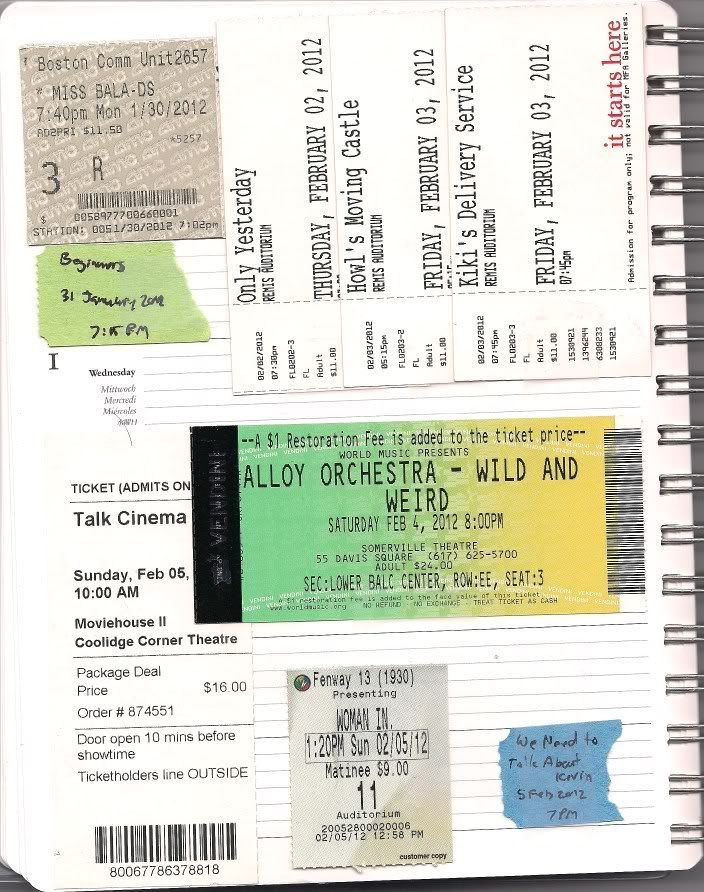
This Week In Tickets!

Friday, meanwhile, was a day off from work as IT reconfigured our computers for the new corporate overlords, and while for the most part, I'm not noticing much difference in working for a gigantic company versus the start-up it acquired, I might just decorate my laptop with stickers that accidentally cover the camera. I spent the day lolling around the house doing nothing, but it let me get to the MFA in time for a Miyazaki double feature.

And as you can see, I wasn't watching football Sunday night. Hey, it's not like I watched any of the Patriots' other 18 games this season, and Oscilloscope had been strangely quiet about opening We Need to Talk About Kevin in Boston. I suspect plans changed when it wasn't nominated for the expected Oscars (really, how does the Best Actress category not have either Kirsten Dunst or Tilda Swinton?), but it wasn't on the postcard they included in my latest Circle of Trust DVD, either. I hear it's been booked in West Newton, but the expected Cambridge playdates have yet to be announced.

Funny thing: This was the second time I've wound up watching a preview for a dark, dark movie at the HFA instead of the Super Bowl; the first being Irreversible. Since I arrived late and was in the front row, I don't know if Kevin had any walk-outs. It was eerily quiet when I got out, though - I could have walked back home in the middle of the street in perfect safety, just like the morning after a major snowstorm. But, hey, at least I saw a really good movie; I'm probably ahead of the folks who watched a crushing loss in that regard.

Beginners

* * * ¼ (out of four)
Seen 31 January 2012 in the Brattle Theatre [(Some of) The Best of 2011, 35mm]

Beginners is a cute, pleasant-enough little movie that will probably be seen as smothering Christopher Plummer's great performance, since that's what has been getting the bulk of the acclaim as people started making lists and filling in ballots to commemorate the change of one year to another. I think that might be a fair assessment - if the "Beginners" of the title are people just figuring out how to be in a relationship, despite their not exactly being kids any more, maybe we should see Plummer's Hal stumble with his new out-ness more, especially when what's going on with Hal's son Oliver (Ewan McGregor) and Anna (Mélanie Laurent), the equally relationship-challenged girl he meets is nice, but not quite superlative. There's also hints that this is the first time Hal and Oliver have ever been anything like close, but there's not a lot of beginners' mistakes there, either.

Still, there's not a bad performance from the main cast - McGregor and Laurent don't get to play parts as flashy as Plummer's, but they play their learning-how-not-to-be-lonely parts well. Pllummer is, of course, excellent, and while writer/director Mike Mills does tend to get a little cutesy with a gimmick in Oliver's narration a few times, he's also genuinely fantastic at how he abruptly moves back and forth in time, really making it clear that Oliver, for as hopeful as his present is and how hard he's trying, is very much stuck in the past at times.

The Alloy Orchestra: "Wild and Weird"

Seen 4 February 2012 in Somerville Theatre #1 (CrashArts)

The Alloy's annual visit to the Somerville Theatre wasn't quite a new soundtrack for a silent classic this year, but a concert where they accompanied ten short films, mostly from the early silent era, half of them over a hundred years old. They were projected from a video source, but almost all of them were kind of amazing in one way or another, as early filmmakers played with special effects, animation, and broad slapstick. There were a couple of variations on a theme - two takes on Windsor McCay's "Dreams of a Rarebit Fiend", only one of which by McCay himself; two with insect casts. Sometimes you have to catch yourself - at one point during "Red Spectre", I found myself thinking that it looked a bit rough before remembering that it was made in 1927 and the full color was actually amazing.

I am a little disappointed that I didn't get pictures, because this was the first time I've seen the Somerville's reconstructed orchestra pit in action. It changes the experience from the previous Alloy shows I've seen, where they're on stage next to the film and I find myself watching both - less makeshift, sure, but I did kind of find myself missing the band and their more unusual percussion being a visible part of the show.

Gianni e le donne (The Salt of Life)

* * ¾ (out of four)
Seen 5 February 2012 in Coolidge Corner Theatre #2 (Talk Cinema, 35mm)

The Salt of Life is the title given to this movie for it's American release; the actual title translates to "Gianni and the Woman", which is kind of literal but less pretentious, which might have been preferable. There's no great wisdom or philosophy to be found here, but a few smiles, as it's an amiable enough "late-life-crisis" movie.

It's one of those films that's "more a character piece", and this is one of the times that feels a bit like a cop-out. Character is best expressed via the character's action, and Gianni doesn't really do a lot; most of the time, he seems to be an unenthusiastic reflection of his friend Alfonso. It leads to a few funny moments, a few uncomfortable ones, and far too many moments that aren't really either. There either need to be more memorable moments or something stronger tying them together.

The Woman in Black

* * * ¼ (out of four)
Seen 5 February 2012 in Regal Fenway #11 (first-run, 4K digital)

A pretty darn solid ghost story. I think I enjoyed The Woman in Black much more than I expected, in part because it was going for a genre that seems hard to do authentically. The conventions of gothic horror movies were codified in film's infancy, and as the genre occasionally fell out of favor, the way movies were shot changed, and the basic culture became less familiar, there's a sense that later entries are trying to imitate the older ones, and it doesn't quite work; the cast and crew aren't as directly connected to the characters' world, and something about the look doesn't seem right. For example, during this one, I often found myself thinking that the background was too elaborate - the house should look like a flat matte painting, and the town should feel like it was built on a soundstage, with the camera and characters still lest it reveal that the scenery ends a foot past the edge of the frame.

But, judge this on what it is rather than an unfair (and sort of ridiculous) set of prejudices, and it works. The mythology makes a sort of spiritual sense, tragedy and fear loom over every inch of the story and setting, and director James Watkins times his scares well enough that the jumps punctuate stretches of actual nervousness. It's the sort of horror movie that wears its PG-13 rating as a badge of honor rather than an indication of compromise, and the cast does quite well when they are "doing" and "being" rather than just "establishing".

It's not perfect - through no fault of his own, Daniel Radcliffe is going to need a little more time to put Harry Potter behind him, especially for a role like this. Being young is fine, but his face needs to be more than glum; we need to see he's been shattered by tragedy. And like a lot of horror movies it doesn't quite stop at enough - it needs to bang the piano to punctuate something appearing, and any way you look at it, the last sequence is problematic. By and large, though, it works, creeping the audience out more than many of its more explicit counterparts.

We Need to Talk About Kevin

* * * ¾ (out of four)
Seen 5 February 2012 at the Harvard Film Archive (Lynn Ramsay, 35mm)

As chilling as everybody its reputation, with fine performances by the actors playing the title character at various ages and John C. Reilly as his father, as well as an absolutely fantastic one by Tilda Swinton as Eva. Co-writer/director Lynn Ramsay maintains an incredible level of focus, never once going for twists when crushing, horrible inevitability is an option. It is, after all, not about what happened as much as the reaction to it and build-up to it. It does a legitimately great job of playing on the audience's emotions - as much as the easy, and likely right, explanation is that Kevin was just born bad, it's hard not to get caught up in Eva's feelings of guilt that maybe she did something wrong. Or, perhaps, she's an unreliable narrator... The simple explanation is probably right, but the nuances make it fascinating.

If there's one fault, it's the occasional use of ironic music and sound choices, which might be clever in another movie, but this isn't really a pop-culture commentary picture. Still, that doesn't come close to undercutting the movie's effectiveness.

Friends and family with young kids: Don't see this movie for, like, twenty years.

Miss BalaBeginnersOnly YesterdayHowl's Moving CastleKiki's Delivery ServiceWild and WeirdThe Salt of LifeThe Woman in BlackWe Need to Talk about Kevin

Monday, February 06, 2012

Studio Ghibli on Film, Week One: Only Yesterday, Howl's Moving Castle, and Kiki's Delivery Service

A theatrical distribution deal for catalog titles is generally not a big deal, but the Studio Ghibli animated features are not just any catalog titles; they're a uniquely high-quality collection of animated films that are as evergreen as any collection of pictures that size. When Disney acquired the distribution rights a decade ago, it seemed like a good fit: Aside from having similar sensibilities, Disney has made a lot of money on exploiting their catalog.

The thing is, part of that milking has been keeping those animated features out of theaters, and large studios in general are not great about handling repertory features. A small outfit like GKIDS, who is now handling theatrical distribution of these pictures (while Disney keeps home video rights), can concentrate on keeping the prints in shape and circulating.

That's what they're doing right now - Boston is, as far as I can tell, the third stop on their rounds. I'm somewhat surprised that the Museum of Fine Arts is where they stopped, but I suspect that they'll return some other time, to the Paramount or the Brattle or Coolidge, but likely in a more limited program, probably limited to the more familiar titles. Which is fine; seeing Kiki's Delivery Service and Howl's Moving Castle on the big screen, and on film, is a huge pleasure. But so is seeing Only Yesterday, a movie that I basically knew existed by diving a couple layers deep into the IMDB after seeing another movie. That's exactly the thing Disney can't really handle (even without the fact that health-class topics are a big part of one segment, putting it halfway between the Disney and Touchstone brands).

Sadly, I'm only going to get about halfway through the series - the movie scheduling gods have decided to make it hard for me to get to many of the times as they conflict with work, the Boston Sci-Fi Film Festival, and my Japanese classes. Not that I regret spending time on any of them (well, maybe work, but it pays for the other stuff), but I can't help but look at two or three other screenings and wish things were working out differently.

Omohide poro poro (Only Yesterday)

* * * ½ (out of four)
Seen 2 February 2012 in Museum of Fine Arts Remis Auditorium (Castles in the Sky, 35mm)

Though Studio Ghibli is best known for the fantasies of Hayao Miyazaki, the more grounded creations of Isao Takahata are, in may ways, equally striking. Movies like Only Yesterday are a unique variation on the "nostalgia film" genre, and few do the combination of animation and realism better than Takahata.

In 1983, Taeko (voice of Miki Imai) is twenty-seven years old, has lived in Tokyo all her life, and recently turned down a marriage proposal. This seems bizarre to both her co-workers and her mother, as does her decision to spend her vacation working on her sister's in-laws' farm. But Taeko's always been a bit of an odd girl, as we can tell from her memories of 1966, when she (voice of Youko Honna) was ten years old, was good at writing but not so good at math, and envied her her classmates who got to go away for the summer.

Though made years later and released in its native Japan in 1991 (in America, it's been held up in limbo as part of Ghibli's Disney distribution deal), the 1983 segments still tend to seem like "the present", despite how Taeko uses the past tense in her narration. This is mostly because Takahata shifts his technique a bit between periods: 1983 fills the screen, with both the city where Taeko starts and the country rendered in such detailed clarity as to almost appear three-dimensional; 1966, meanwhile, has only slightly more stylized character designs, but has much less fully-realized envrionments. Colors are faded, and the backgrounds often don't reach the edge of the screen, leaving the action surrounded by white space. Taeko recalls her childhood better than most, but those moments aren't as strong in her mind as this vacation.


Full review on EFC.

Hauru no ugoku shiro (Howl's Moving Castle)

* * * ¾ (out of four)
Seen 3 February 2012 in Museum of Fine Arts Remis Auditorium (Castles in the Sky, 35mm)

When I reviewed this for EFC on its American release six and a half years ago, I mentioned being interested in seeing the English-language version. That's what I wound up with on Friday, quite unexpectedly - only two screenings in the series were announced as dubbed, and this wasn't one of them. It's a clear example of how even with a great voice cast and careful attention to lip-sync, seeing a movie like this just isn't quite right. As I've been learning in my Saturday afternoon Japanese language classes, that language and English have very different rhythms, with a typical Japanese sentence containing more syllables in more rapid succession.

In retrospect, maybe I was a little over-enthusiastic in my 2005 review, but even toning the hyperbole down... This is a really good movie, with more creativity and amazing things in any given five minute period than most fantasy films have in their entire running time. I suspect that it's going to need another couple close watches for me to really work out what's going on in every moment, especially with how Sophie changes age. But I also strongly suspect that it will be well worth it.

Full review on EFC.

Majo no takkyûbin (Kiki's Delivery Service)

* * * * (out of four)
Seen 3 February 2012 in Museum of Fine Arts Remis Auditorium (Castles in the Sky, 35mm)

To describe any one movie by Hayao Miyazaki as his best is incredibly difficult; there are arguments to be made for both the complexity and maturity of his later works and the simple joy of where he started out. Kiki's Delivery Service is a part of the former group, and certainly one of my favorites of his work, a sweet, funny, beautifully told coming-of-age story for any age.

Kiki (voice of Minami Takayama) has just celebrated her thirteenth birthday, and in witch families like hers that is the traditional time for a girl to set off for a new town, where she will spend a year living and training on her own. Kiki and her black cat Jiji (voice of Rei Sakuma) land in a pretty coastal town, where she puts her flying skills to use as a courier. Her first customer, Osono (voice of Keiko Toda), lets Kiki have a room above her bakery, and Kiki makes a number of other new friends: Ursula (also voiced by Takayama), an artist who lives in the woods; a sweet old lady (voice of Haruko Kato) and her maid Bertha (voice of Hiroko Saki); and Tombo (voice of Kappei Yamaguchi), a flight-crazy boy her own age who develops an instant crush on the new girl.

But adolescence is a tricky thing; as one grows older, takes on more adult responsibilities, and grapples with new feelings, one stops believing in magic. Kiki is a nice girl, and she's landed with a pretty nice foster family, but like all teenagers, her confidence gets eroded by little things, and she envies the girls who wear stylish outfits while she is stuck in her drab, traditional black dress. Miyazaki's plotting is elegant in this regard; each new delivery and task Kiki faces is calculated to make the audience proud of the character but also plants a little more doubt in her mind. It winds up as both a character arc that rings true and a metaphor for one's body going haywire.

Full review on EFC.

Friday, February 03, 2012

Next Week in Tickets: 3 February 2012 - 9 February 2012

It's a good thing I have an unexpected day off on Friday, because a deluge will start in earnest on the 10th (at least, for me). In the meantime, still a fair amount to see:

  • Okay, explain to me why Chronicle - a movie designed to look like low-resolution video - is playing at the proudly 35mm Somerville Theatre and old-school ghost story The Woman in Black isn't, more or less forcing me to see it in digital projection. The former is uses the found-footage aesthetic to present the story of a group of high-school kids that gain superpowers and are not quite so altruistic as superheroes tend to be, and looks like it could be fun. And yet, it may lose genre fans to the latter, who are likely to see The Woman in Black as the true return of the legendary Hammer Studios - it's the new Hammer's fourth movie, but only the second to get a major theatrical release, and while Let Me In was decent, it was relatively modern and American. The Woman in Black is the period British chills people associate with Hammer, and has a nifty cast: Daniel Radcliffe, Ciaran Hinds, and Janet McTeer.

    Also hitting up the multiplexes: Big Miracle, a pleasant-looking family movie about a family of whales who get trapped under the ice in the Arctic during the 1980s. John Krasinski plays the reporter on the story, Drew Barrymore his environmental activist girlfriend, and Stephen Root as the difficult governor of Alaska.


  • This week's opening at the Coolidge is The Innkeepers, a ghost story from Ti West that has been playing on demand for a few weeks but which I'm almost certain works much better in a crowded theater, which is how I saw it at Fantasia. It plays in the screening room at 9:50pm every day, and on the main screen Friday and Saturday at midnight.

    There are also two special presentations on Sunday morning. At 10am, there's a preview of The Salt of Life as part of the Talk Cinema series; at 10:30pm, the week's Kids' Show is Mary Poppins. The first is Gianni Di Gregorio's follow-up to Mid-August Lunch, with Di Gregorio as a retiree finding himself becoming invisible to the fair sex; the latter is, well, Mary Poppins.


  • Only one film opening at Kendall Square this week, a one-week booking of Charlotte Rampling: The Look, a "self-portrait through others" of the French actress which features both film clips and her conversations with other artists.


  • The Alloy Orchestra makes their annual trip to the Somerville Theatre on Saturday with "Wild and Weird", in which they accompany a set of early, and strange, short films. That and another concert will bump The Girl with the Dragon Tattoo for a couple of days, while the opening of Chronicle pushes Contraband to their sister theater in Arlington.


  • The Brattle wraps up (Some of) The Best of 2011 with some fun stuff: Drive on Friday, Rango on Saturday and Sunday afternoons, a Boston Society of Film Critics screening of Moneyball (with the writer present) Saturday night, Martha Marcy May Marlene on Sunday evening, and a rescheduled screening of The Interrupters at 5pm on Monday.

    Monday and Tuesday will also feature guests as part of regular screening programs. On Monday, The DocYard welcomes Mona Micoara with her film Our School, which chronicles four years on the attempt to integrate Romanian schools (in this case, kids from a Roma village going to a city school). On Tuesday, DJ Angel Sawyer spins some tunes before a set of short films about public land, with Robert Fenz there to discuss his contribution, "Crossings".

    And, finally, as part of a cross-promotion with the American Repatory Theatre's Wild Swans, Wednesday and Thursday will feature Modern China on Screen. The movie Wednesday night is Tian Zhuangzhuang's The Blue Kite, while thursday offers a double feature of Zhang Yimous To Live and Jia Zhangke's 24 City.


  • Robert Fenz will first be at the Harvard Film Archive on Friday night with a set of recent short films that play with sound and silence, including "Correspondence" and "The Sole of the Foot". Another filmmaker, Lynn Ramsay, was originally scheduled to visit on Sunday, but the special preview of We Need to Talk About Kevin she was to host will instead go on without her. Two of Ramsay's other films, Ratcatcher and Morvern Callar, will play Saturday evening; all three will be preceded by short films. The Robert Bresson series also continues, with L'Argent repeating on Sunday afternoon and Une Femme Douce playing on Monday evening.


  • The MFA continues their Studio Ghibli program, with Howl's Moving Castle, Kiki's Delivery Service, Only Yesterday, My Neighbor Totoro, Whisper of the Heart, and Laputa: Castle in the Sky playing at various times during the week. Most are in 35mm (and, if Only Yesterday is any indication, looking good), and all are subtitled except the screening of Totoro at 10:30am Saturday.

    Friday and Saturday also include the first film in the "Exiled In Hollywood: Outcast Artists in Southern California", which features movies created and, especially, scored by WWII emigres. The first entry is Reunion in France, directed by Jules Dassin with a soundtrack by Franz Waxman. Sunday features the ReelAbilities Boston Film Festival, featuring Shooting Beauty and Snow Cake. Wednesday and Thursday feature the first two screenings of The Swell Season, which features the stars and songwriters of Once going on tour and nearly ruining everything.


  • ArtsEmerson picks up the Dreileben trilogy that played the Harvard Film Archive a couple weeks ago, with Beats Being Dead and Don't Follow Me Around playing Friday and One Minute of Darkness on Sunday. In between, Saturday features a kid-friendly matinee of Joe Dante's Explorers and an evening double feature of rare musicals with African-American casts on archival prints as part of Gotta Dance!: 1929's Hearts In Dixie and 1938 "race film" Swing!.


  • The Regent Theatre in Arlington has one film this week, the documentary I Am Bruce Lee on Thursday the 9th, which features friend, collaborators, and fans of the famed martial artist and screen star.


My plans? I've already purchased tickets for the Alloy Orchestra on Saturday and Talk Cinema on Sunday, and I might feel like going for Ghibli on Friday and Wednesday. That doesn't leave a whole lot of time to fit Chronicle, The Woman in Black, or A Separation in, but I'm pretty sure I'll make an effort.

Thursday, February 02, 2012

Spanish-Language: Nostalgia for the Light and Miss Bala

Weak attempt at a theme post, seeing as these two movies really have very little to do with each other than both being in Spanish. I did see them on consecutive nights, though, so that's kind of a theme. But, as far as Latin American countries go, the current situations in Nostalgia's Chile and Miss Bala's Mexico are strikingly different: Chile appears to now be quite stable and relatively prosperous, although one likely gets a rather skewed view from Nostalgia: It mostly takes place in the pristine desert, with the main buildings seen a pristine astronomy. The Tijuana of Miss Bala, on the other hand, is chaotic, the sort of place where drug lords can move around with large weapons and only attract a little attention.

Both are pretty good movies, though. If you're reading this on the day it's posted, you may still have a chance to see Miss Bala in Boston; I was the only one in the theater for the 7:40pm show on Tuesday, and it deserves a little more than that.

Nostalgia de la luz (Nostalgia for the Light)

* * * ½ (out of four)
Seen 29 January 2012 in the Brattle Theatre [(Some of) The Best of 2011, 35mm]

I don't think it was Patricio Guzmán's plan to do a bait-and-switch with his documentary Nostalgia for the Light, but if it was, he executes an unusually smooth and effective one here: It's one thing to start with astronomy and end with mass murder, but pulling the two subjects together so well that the audience will thank you for switching things up is a really neat trick.

Chile's Atacama Desert, with its complete lack of humidity, is the best place in the world to observe the southern sky, and as a result astronomers from around the world have been building telescopes there for over a century. The still, dry air and lack of any sort of native life makes the area valuable to many others aside from those looking to the heavens, though: The drawings of Pre-Colombian natives are still clearly visible in many places, and the widows and orphans of those "disappeared" during the Pinochet regime hope that their loved ones' hidden remains have also been preserved.

Though the study of far-off stars and human atrocities may seem like completely different subjects, Guzmán links them by pointing out how all human observation is of the past. As astronomer Gaspar Galaz explains, the far-off galaxies he observes are seen as they were millions to billions of years in the past; the sun in the sky is that of eight minutes ago; the moon we see is that of one second ago; even what we feel when touching things has a small delay in reaching our brains. Archeologist Lautaro Núñez expands on this, pointing out how the drawings of ancient peoples may be easily accessible, but it is very difficult to learn about nineteenth-century Chile. Later, it is taken as a given information from mere decades ago has been actively suppressed. Though everybody in Atacama is looking to learn something different, they are all facing variations of the same limits.

Full review at EFC.

Miss Bala

* * * ½ (out of four)
Seen 30 January 2012 in AMC Boston Common #3 (first-run, digital)

Miss Bala was Mexico's submission for "best foreign language film" at the Academy Awards this year, but didn't quite make the cut. That's may be appropriate, depending on how you look at it - its either a thriller that's short one twist and thus settles for being merely very, very good or an excellent attempt to communicate the constant, unending tension of life in certain parts of Mexico. Either way, it's a movie well worth watching, and in many ways exceptional - it's a rare movie that can sustain tension as long and as well as this one.

Laura Guerrero (Stephanie Sigman) is twenty-three and lives with her father and little brother on the outskirts of Tijuana, and quite pretty, enough so that she is able to talk her way into the Miss Baja California contest despite being quite unprepared. Her friend Zusu makes it too, and parties with her gangster boyfriend to celebrate. Laura is trying to get her out of there when all hell breaks loose between rival gangs, and her attempts to find Zusu instead lead her to Lino Valdez (Noe Hernandez), a big name in the La Estrella crime syndicate with a favor to ask. Of course, Lino's in trouble too, so doing him favors probably just makes the peril less immediate.

Director Gerardo Naranjo and his co-writer Mauricio Katz do a number of things very well here, but one thing that is especially impressive is how, once they've started to bear down on Laura and the audience, they maintain a remarkably constant pressure. It's not so much that Naranjo (who also edits) never eases up - although that's rare - but the build-up is such a well-executed slow burn that the audience seldom feels the need for immediate cathartic release. That's good, because the closest thing to comic relief is when the story moves through the Miss Baja California pageant, which by that point seems surreally superficial compared to what Laura's been through. In fact, the filmmakers barely let up for exposition - Laura receives much more in the way of instructions than information, and since the audience is almost never privy to anything she can't see, we (like she) must piece things together from overheard news reports and first-hand experience.

Full review at EFC.