It may mark me as a bad person to have even thought of this, but you've got to admit there's some truth in it: Given that this movie is about two practically-feral little girls taken from the woods and placed in a suburban home, it's continually surprising whenever the family's dachshund pops up safe and sound after last being seen with the kids. Heck, every time a scene with the dog ended, I'd check my watch, thinking this was the moment when the kids kill that wiener dog and eat it.
Which isn't to say I was disappointed when "Hansel" showed up later - who the heck wants to see that happen to a cute dog? - as much as I was disappointed that the movie wasn't going in the direction of creepy kids rather than ghosts. After all, kids who might be damaged by horrible trauma is disturbing; ghosts aren't quite in the same ballpark, especially since movies like Mama tend to make the rules up as they go along.
I spent some time thinking about how I approach horror movies and tweeting it; it's something I started thinking about when reviewing Buddy Giovinazzo's A Night of Nightmares at Fantasia this summer, wondering off-hand whether it's better for horror movies to have a consistent mythology or to embrace randomness. I tend to favor the first; I'm a right-brained person and I tend to feel like suspense comes from knowing what the options are, or at least thinking you do until the writer comes up with something that fits but the audience hadn't considered, for the characters' good or ill. I understand, though, that sometimes sheer randomness and unfairness is much scarier, and besides, if you cared about the mechanics of it all, you'd be watching science fiction rather than supernatural horror, right?
I think the happy medium for telling a good horror tale comes down to making sure that everything is based on a solid emotion, and the supernatural elements are that physically manifesting. So randomness works if the movie is based upon the fear of the unknown, but that's not really what's going on here. I figure every paranormal thing in Mama should be the result of a twisted maternal instinct, and I think the movie mostly works when that's what's going on. It's when other stuff happens of necessity - possessions, attempting to lure kids off a cliff, etc. - that things seem off, and not in a scary way. In some ways, it becomes less scary because these particular situations don't have the emotional backing to it and the audience can see the writer's hand. A lot of the last act of Mama has the title entity doing things not because they're an extension of its central urge, but because they are things that happen in horror movies. Why does Mama touching Annabel and Lucas slow them down and apparently drain their life force? Just because. The movie needs them to be rendered mostly helpless, and people have seen and accepted this happening before, but it doesn't feel earned, because it's not a part of what this ghost is about.
At least, that's the way I see it. Of course, it may be a fool's errand to try and break what makes horror work like this, but I think that even when there aren't specific rules to the game, there are forces at play, and knowing how to use them makes a horror story more effective.
Mama
* * ½ (out of four)
Seen 20 January 2013 in AMC Boston Common #14 (first-run, digital)
Did I miss some sort of event where moths became a primal human fear? They've been popping up in horror movies more and more lately, apparently as something creepier than a nuisance, so I guess they must scare someone. Granted, moths aren't the only part of Mama's mythology and story that seem random, but at least a fair amount of the rest seems to come from somewhere. Not all of it, though, and that's what makes Mama less than it could be.
It starts when an unhinged man takes his very young daughters and heads out of town, only to... Well, anyway, five years later, just as the man's brother Lucas (Nikolaj Coster-Waldau) is running out of money to continue searching for his missing family, the now-eight-year-old Victoria (Megan Charpentier) and six-year-old Lilly (Isabelle Nélisse) are found, practically feral. This is not the sort of instant family Lucas's musician girlfriend Annabel (Jessica Chastain) was looking for, and the girls' aunt Jean (Jane Moffat) is seeking custody, but the scientist helping to re-acclimate them (Daniel Kash) offers them the use of a house if he can continue studying them - although he soon becomes convinced that the "Mama" whom Victoria says helped them survive might be more than an imaginary friend.
Andrés Muschietti directs and co-writes the script with Barbara Muschietti and Neil Cross, and while the main character arc he's basing the movie on isn't exactly original - Annabel is extremely pleased when a pregnancy test comes up negative at the start, so of course she'll have to assume responsibility for these kids! - it's something that speaks to enough people to work. Having up-and-comer Jessica Chastain (who, after Zero Dark Thirty, can probably be said to have up-and-arrived) is likely a huge help; she and Muschetti make Annabel unprepared and a little immature without making her ever come off as a terrible person. They even hit the right "unconventional, improvising single parent" notes without veering into sitcom territory.
Full review on eFilmCritic.
Tuesday, January 22, 2013


Sunday, January 20, 2013
This Week Month and a Half In Tickets: 19 November 2012 - 6 January 2013
Didn't I make a resolution about this not happening outside of festivals this year? But, hey, cut me some slack - there were holidays and vacations and catching up at work from those things involved!
19 November - 25 November
26 November - 2 December
3 December - 9 December
10 December - 16 December
17 December - 23 December
24 December - 30 December
31 December - 6 January
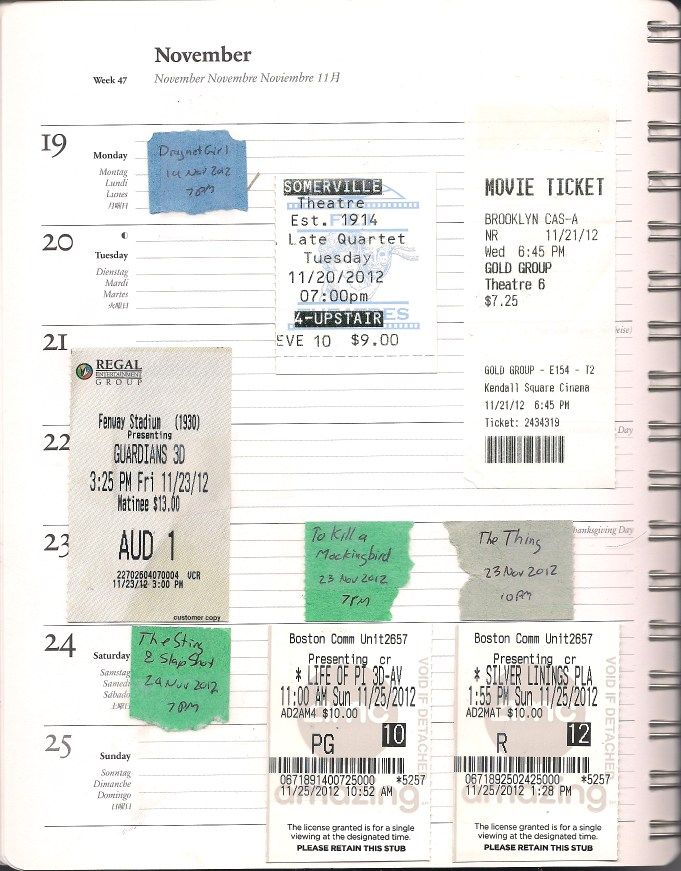
Busy, busy week - you'd hardly believe looking at the crowded nature of the page that I found time for a day-and-a-half trip to Maine for Thanksgiving. That was kind of weird, actually - all my brothers spent it at their in-laws, and while I got to see a couple of nieces for a while on Friday before they went down for a nap and I generally like most of my Dad's wife's family, it wasn't the same.
To Kill a Mockingbird
* * * * (out of four)
Seen 23 November 2012 in the Brattle Theatre (Universal Centennial, 35mm)
Somehow, I had managed to miss seeing this one ever before, which is a crying shame. It is, as everybody knows full well, awfully close to a perfect movie.
That is, I think, because it pulls off its extremes with a grace that is quite frankly amazing. It builds up such a pure sense of goodness around Atticus and Scout and any number of other characters before delivering a crushing but inevitable injustice. That's the standard pattern of innocence shattered, and yet it plays less as devastation and destruction of illusions than a hope and belief that the next generation can do better.
Plus, Gregory Peck. He plays the greatest movie dad ever, and it's a performance that could be pure corn in lesser hands, but is just perfectly admirable here. The rest of the cast is fantastic, too, especially Mary Badham as Scout, and Robert Duvall is always welcome, even if it's a small (but crucial) role like Boo Radley.
The Thing (1982)
* * * * (out of four)
Seen 23 November 2012 in the Brattle Theatre (Universal Centennial, 35mm)
Let me tell you: One gets a lot of false positives searching this blog for "The Thing" to see if I've written about it before. It turns out I have - briefly, when it played the Marathon two and a half years ago , and in more detail when I watched the HD-DVD three years before that. Yeah, I know, HD-DVD.
Anyway, the movie hasn't changed, and the prequel/remake has come and gone without any ill effects on this one. It's still thoroughly creepy, and the special effects have aged pretty well. They don't necessarily look more realistic than modern CGI, but the 1950s-styled-but-much-better-looking spaceship in the opening sets a tone when combined with the Ennio Morricone score, and the way that the practical effects must be built winds up implying that conservation of mass is still in effect, and the bounds make things more tense.
The Sting
* * * ½ (out of four)
Seen 24 November 2012 in the Brattle Theatre (Universal Centennial, 35mm)
It's not hard to love The Sting; its player-piano score, detailed Edith Head period costumes, precise explanatory titles, and basis of familiar tropes marks it as a throwback but not one intent on either mocking or deconstructing its genre or period. It's a 1930s con movie - nothing less, and nothing ostentatiously more.
Now, the score (Marvin Hamlisch and Billy Byers making good use of Scott Joplin compositions) isn't actually produced by player pianos, or wind-up devices of any sort, but it sort of has that mechanical feel at times, and while that can often be a bad thing, it works very well for this picture; it helps build the feel of a well-oiled machine whose workings the audience is invited to inspect. And yet, that's only half the movie; big chunks of the plot are cleverly improvised and the filmmakers demonstrate a fine knack for knowing just what to hold back to create surprises and twists without feeling like they're cheating the audience.
Plus, of course, Paul Newman & Robert Redford. It's one of those master & apprentice relationships where neither party seems to think too much of the other, likely because of how one is basically the other plus twenty-odd years, and they both turn on the charm in ways that make this pretty clear but not the point of the whole movie.
Slap Shot
* * * ½ (out of four)
Seen 24 November 2012 in the Brattle Theatre (Universal Centennial, 35mm)
Slap Shot shares both a director (George Roy Hill) and star (Paul Newman) with The Sting, but where The Sting was a well-oiled machine, this one is apparent anarchy. It's one crude joke after another, and the storylines that could serve as an overarching theme or something redemptive show very little interest in going that route. It goes for the joke at every opportunity.
Of course, it's smarter and better-put-together than that. You don't have to scratch it much, if at all, to see that underneath the story about appealing to the baser impulses of the audience is a look at the desperation of the working class in hard economic times. Moving it slightly to the side takes the edge off, so it's not depressing in the way movies about factories closing down are, while still getting the idea across - a candy coating on a bitter pill. And while it always goes for the joke, it does so with the right tone for the moment, rather than being one size fits all.
Silver Linings Playbook
* * * (out of four)
Seen 25 November 2012 in AMC Boston Common #12 (first-run, digital)
I'd forgotten that The Fighter was a David O. Russell film; someone else wrote the screenplay and it lacked the layer of absurdity alongside the drama that was a hallmark of the movies Russell did between 1994's Spanking the Monkey and 2004's I Heart Huckabees. Silver Linings Playbook is a lot closer to those movies, so it can, perhaps, be described as a nice return despite the existence of The Fighter.
Interestingly, it very pointedly lacks a stable center for the insanity to play against. Bradley Cooper and Jennifer Lawrence play characters with real mental health issues, and the way that's presented can sometimes be worrisome; their disorders manifest in ways that almost seem too entertaining. It's a thin line between feeling properly guilty when you laugh at their eccentric behavior and feeling the filmmakers are doing mental illness a disservice. Maybe Russell could have done better showing Cooper's Pat following his med schedule or otherwise recovering rather than just seeming to have a eureka moment when he figures the plot out.
I don't think you can say "that aside, this is a good movie", because that permeates the whole thing, but it does only make things shaky rather than knock them over. Cooper and Lawrence are both pretty fantastic, and there's a great supporting cast around them (including, yes, Chris Tucker). I kind of love that sports fandom plays more as a positive thing than an unhealthy obsession, and the way the movie embraces its Hollywood ending is quite nice indeed.
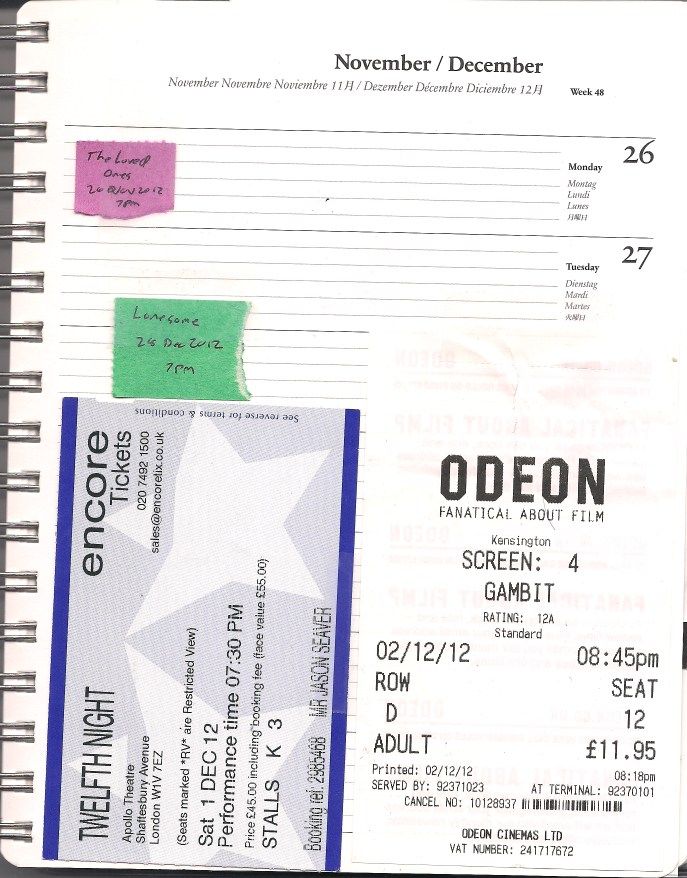
Stubless: London's Museum of Natural History (most of Sunday 2 December 2012).
Quite the short movie week, but for a good reason - as you can see from the gigantic tickets at the bottom of the page, I went on vacation in December. My flight to London left Friday night, with the idea being that I would stay up all night Thursday, fall fast asleep in my airplane seat at around 8:30pm, and then awaken when it touched down at about 7am, refreshed and ready to start the day.. This, it turns out, was not a good plan, even considering that I was at work until 10pm Thursday night because something Had To Be Done within a very short window.
I did see a few movies - the delayed CineCache screening of The Loved Ones and my last in the Universal series, Lonesome on this continent, and the remake of Gambit across the pond. Gambit wasn't my first choice that night - Google had me believing a certain cinema was nearby rather than far away, so I redirected myself to this one when I found it not there, and found myself amusingly confused by the horizontal posters, assigned seating, and lobby that operated more like a convenience store than a traditional concession stand.
The Loved Ones
* * * * (out of four)
Seen 26 November 2012 in the Brattle Theatre (CineCache, DVD)
Finally, this movie hits Boston. I saw it at the 2010 Fantasia Festival, saw Paramount sit on it until The Devil Inside was a surprise hit, only to have the "release" be "making it available via Tugg" (honest question - is Tugg useful for anyone outside Austin?), that be an edited version, and the home video release only be DVD rather than Blu-ray. Seriously, Paramount, this is a great movie and you punted most of the year? That a snowstorm wiped out CineCache & the Brattle's Halloween screening was just insult to injury.
Fortunately, it's still a pretty great movie. The promotion for this screening tagged it as a horror-comedy, which I think does it a great disservice - it's not jokey in the least, and the character that might otherwise be played as comic relief is there as much to tie saddest character in the movie to the action as make the audience laugh. Indeed, what I think is exceptional about The Loved Ones, even more than the inventive violence (which is not for the squeamish), is that for what seems like a mere slasher or torture-porn flick, it's as much concerned with getting how devastating a loss can be across as traditional thrills.
Full review at eFIlmCritic.
Lonesome
* * * (out of four)
Seen 28 November 2012 in the Brattle Theatre (Universal Centennial, digital)
Lonesome is a pleasant, interesting curiosity from the period when silent movies were awkwardly evolving into talkies, a simple thing about a man and a woman who live workaday lives, meet, get separated, and, well, anybody can probably guess how it ends. It's got occasional Harold Lloyd co-star Barbara Kent as the girl and likable Glenn Tyron as the guy, and there's enough spark between them that the I-know-we've-just-met-but-this-may-be-true-love urgency works.
At least, during the silent sequences. With sound starting to hit theaters, Universal added three or four scenes with sound, and only one really matters to the plot; the others just have Mary & Jim sitting in one spot, declaring how sad it is to be lonely and how much they love each other as much to the audience as each other. They're static and repetitive and kind of dull compared to the creative and active screen when the soundtrack is just used for underscore. Even the police station scene which at least has a purpose in the plot seems to go round and round in circles.
It's a cute movie, fun if you like silents and interesting for how the switch to sound had its bumps.
Twelfth Night
Not a movie, but a play, although a large part of what drew me to it was that it featured people I knew from film and television: Stephen Fry, most notably, but also Colin Hurley from Black Pond. Plus, I've loved Shakespeare since junior high, and though The Globe wasn't doing shows when I was there, this one had premiered there and was an "original practices" production - all-male cast, costumes and props made with period-authentic materials and techniques, seating on the stage and the musicians on a balcony above.
Sadly, I couldn't get any pictures aside from this one of the theater itself; a "no photography" rule was being enforced even before the play started, probably because the actors were having hair, makeup, and costuming done right on the stage, which was actually pretty cool (it was neat to see a company that was working together on two shows simultaneously joking and laughing with each other), but we really don't need photos of a bunch of middle-aged actors in their boxers flooding the internet. After the show, they hung out again, auctioning things off for an actors' charity.
The show itself was pretty good, although I wish I had seen it on a different date - I think I had had four or five hours of sleep in the previous fifty-five or so. Fortunately, I wasn't in those on-stage seats (how bad would the occasional dozing off only to jerk back awake seconds later look?). Mark Rylance gave an exceptionally funny performance as Olivia, floating around the stage like a dotty Dalek and being wonderfully obtuse.
The next day was spent in the Natural History Museum, not far from the apartment where I was staying. You know it's a good natural history/science museum when the first thing visible upon entry is a dinosaur skeleton, and the rest of the building lived up to that - a whole exposition on dinosaurs, rooms full of other fossils, gems, a look into a storage room full of things preserved upside down in jars, Charles Darwin's pet tortoise (taxidermied and lost in the plentiful archives for a hundred years or so). My camera gave out by the end of the day, which was a crying shame.
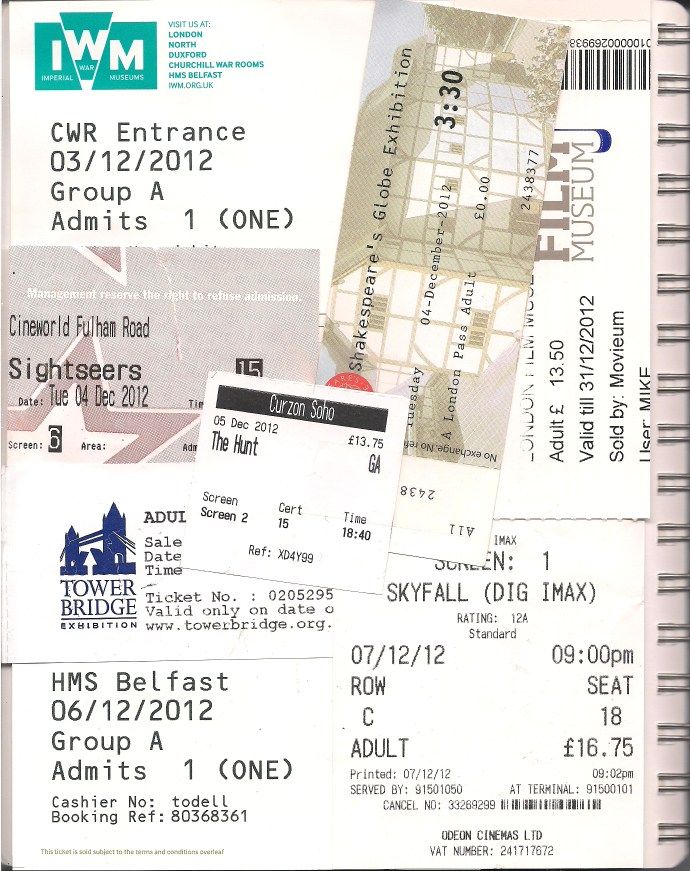
Stubless: A second visit to the Natural History Museum (Monday 3 December 2012). The London Eye (Tuesday 4 December 2012), The Sherlock Holmes Museum (Wednesday 5 December 2012), The London Zoo (Wednesday 5 December 2012), The Benjamin Franklin House (Thursday 6 December 2012), The Cartoon Museum (Friday 7 December 2012), The British Museum (Friday 7 December 2012), Thames Tour (Saturday 8 December 2012).
I suppose I could run down all the cool, touristy things I did in London (which was awesome), but I think I'll just point you at my page of photographs on Facebook and piece it together from there. Otherwise, it's just a lot of "I saw that! It was awesome!
I'll also point to the reviews for Sightseers, The Hunt, and Skyfall, which I saw while on vacation as well.
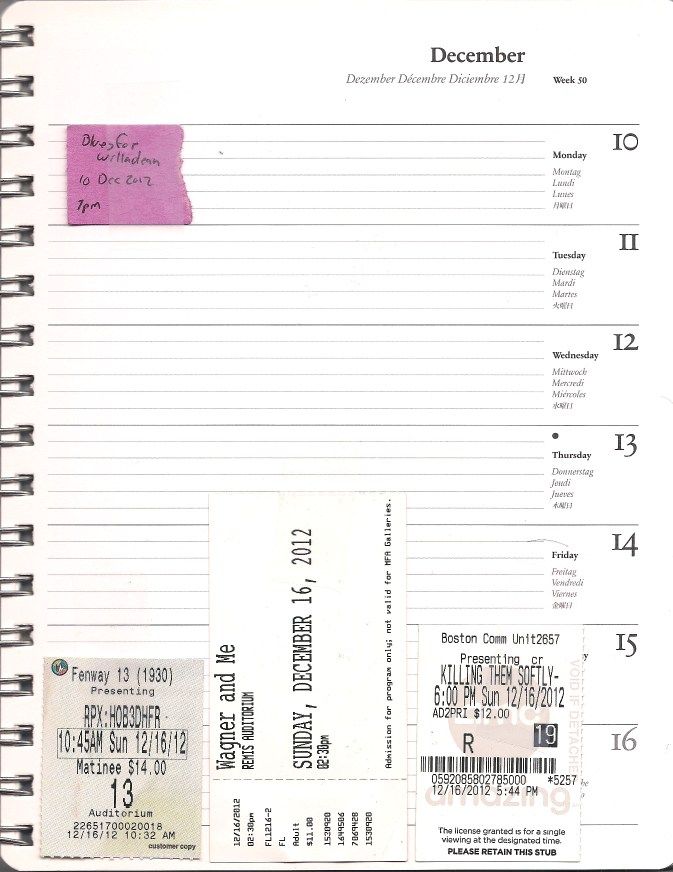
Stubless: The Fifth Element (15 December 2012, Coolidge Corner Theatre #1)
After spending a week abroad, there was work to do. I didn't to much about catching up, either - it gets kind of nice to head to the office, come back, sleep, and repeat after so relentlessly entertaining oneself for a week. The only real exception I made for that was the Chlotrudis/CineCache presentation of Blues for Willadean, and... Well, I didn't rush to give it its own review despite there not being one on EFC like I did for Wagner & Me
Blues for Willadean
* * (out of four)
Seen 10 December 2012 in the Brattle Theatre (CineCaché, video)
So, Chlotrudis folks, I know we've met her and she's nice and a decent character actress and it's kind of neat to spot her when she shows up in something, but can we agree that "featuring Beth Grant" is not a good reason to book a movie? Because while this probably wasn't worse than Sedona, it certainly wasn't good, and having to politely act like it was afterward because Ms. Grant came to present it was just awkward.
Admittedly, some of the reasons I didn't enjoy it were just part and parcel of what it is: A movie about spousal abuse set in a trailer park, featuring the sort of characters one stereotypically finds there. Not folks I'd typically look to hang around with, or a particularly uplifting story, so it's a question of execution, and I think playwright/screenwriter/director Del Shores does a lot of things that hurt it. I think the biggest problem is that he never finds a way to get the audience to a place where they really can respect the title character; the story seems to be coming at its story from a place of "even these people don't deserve this"; she's just pitiable and pathetic and surrounded by other trailer trash, given a bit of a boost because she's able to align herself better with tolerance toward blacks and gays later on. And while, yes, nobody, no matter how little one might think of them personally, deserves to be the victim of violence... That's a low bar to clear, isn't it?
And still, Shores need a crutch or two to get over it. There's a point where Willadean's violent husband (David Steen) comes home, sees her black neighbor (Octavia Butler) is visiting, and drops an n-bomb. And, yeah, I believe this is a thing that happens, but when race has pretty much been a non-issue up until that point, it just sucks all the air out of the room, and suddenly it's like we're supposed to hate J.D. for being racist (and disowning his gay son), as if domestic abuse wasn't enough! And then, of course, Chekhov's gun shows up, and after a whole movie of violence being bad and inexcusable... Well, you can guess how it goes.
It's no fun to say this isn't a very good movie, not just because it features a friend of the club: It has worthy subject matter and at least makes the attempt to show folks who are under-seen on the big screen. It just doesn't give them the treatment they truly deserve.
The Fifth Element
* * * ½ (out of four)
Seen 15 December 2012 in Coolidge Corner Theatre #1 (@fter Midnite, 35mm)
Something to remember when watching The Fifth Element: It came out two years before Star Wars: The Phantom Menace, and for as much heat as that movie and its follow-ups take, their virtual sets and human-scale CGI characters did produce a sea change in the standards for creating full science fiction and fantasy worlds on-screen. From the other side, something like The Fifth Element looks a little rubbery, a little incomplete, compared to the new standard, even though at the time, its world-building was best-in-class.
It still is, in a lot of ways - Luc Besson and company have designed the heck out of it, from Jean-Paul Gaultier's costumes to having Jean "Moebius" Giraud work on other aspects of the film's look. Besson really does capture the sexy, anarchic feel of a European bande-dessiné, if not quite to the absurd, violently insane level of Moebius's collaborations with Alejandro Jodorowsky. The story's flimsy, but it's enough to hang a lot of fun moments on. It keeps Bruce Willis from getting complacent, and while Milla Jovovich isn't doing much besides look pretty (and have people comment upon how pretty she looks) yet, they've got a fun supporting cast: Gary Oldman, Ian Holm, John Neville, Tiny Lister, and more, playing their parts just a little funnier than you might expect.
Yes, including Chris Tucker. This movie would be a lot less entertaining if Ruby Rhod were turned down even just a little bit.
The Hobbit: An Unexpected Journey
* * ¾ (out of four)
Seen 16 December 2012 in Regal Fenway #13 (first-run, 48fps RPX Real-D)
I've sort of been reserving my comments on this one; I decided to go see it in the high-frame-rate presentation for which director Peter Jackson shot it and the look of the film was so peculiar that I had a really hard time thinking of anything else. My impression wasn't so much of soaps or sports as much as it was the sort of film clip shot for educational use or as an introduction to a tourist attraction. Not necessarily bad - indeed, there are some 3D shots I don't think could be done nearly as well in any other format - but so different as to be very distracting!
(Also: I suspect that shooting in 3D means that Jackson and company were able to do much less forced-perspective, leading to many more shots that were obviously accomplished with doubles.)
The thing is, I'm not particularly keen on giving this another three hours of my time. As much as I liked the more kid-friendly vibe - appropriate given the source material - the whole thing just seemed too spread out, and I wonder if the very-late-in-the-game decision to make this three movies instead of two didn't mean placing an anti-climax at the finale. It's fun and I think the kids will enjoy it - the big action scene in the goblin cave is a blast - but I wonder if they'd enjoy it more if it didn't feel quite so random.
To be fair: I'm no particular fan of swords & sorcery, and my resentment at how much of Peter Jackson's career has been consumed by these midget movies is only amplified by the fact that when Martin Freeman and Benedict Cumberbatch are working on them, they're not making Sherlock, which is obviously much more important!
Killing Them Softly
* * (out of four)
Seen 16 December 2012 in AMC Boston Common #19 (first-run, digital)
Andrew Dominik and I just aren't going to work out, are we? I found his The Assassination of Jesse James by the Coward Robert Ford a slog, and while Killing Them Softly isn't nearly as bad, that's mainly due to there being less of it; it's still leaden and dragged down by metaphor that in and of itself isn't as clever as he thinks.
That metaphor, in this case, being a lot of radio and television clips with Presidential candidates Obama and McCain talking about the economy (the film is set in late 2008), meant as a parallel for how crooks robbing a poker game has resulted in a loss of confidence in the local underground economy, especially since the logical assumption is that it was once again perpetrated by the "banker" (Ray Liotta). It's not a bad idea, but the metaphor becomes intrusive without becoming particularly illuminating.
The main problem is much more basic, though: Killing Them Softly is boring. Moments of characters accomplishing something of consequence often happen off-screen, while precious run-time is wasted on James Gandolfini as a hitman too depressed to actually get around to shooting people, or Scoot McNairy and Ben Mendelsohn as the small time crooks who precipitated all of this just getting high. Richard Jenkins shows up to disarmingly deliver bureaucratic delays to Brad Pitt as the picture's "fixer", but he's just blandly professional.
You look at the story here, and there's no reason for it to be this dull, but I guess that's Andrew Dominik for you.
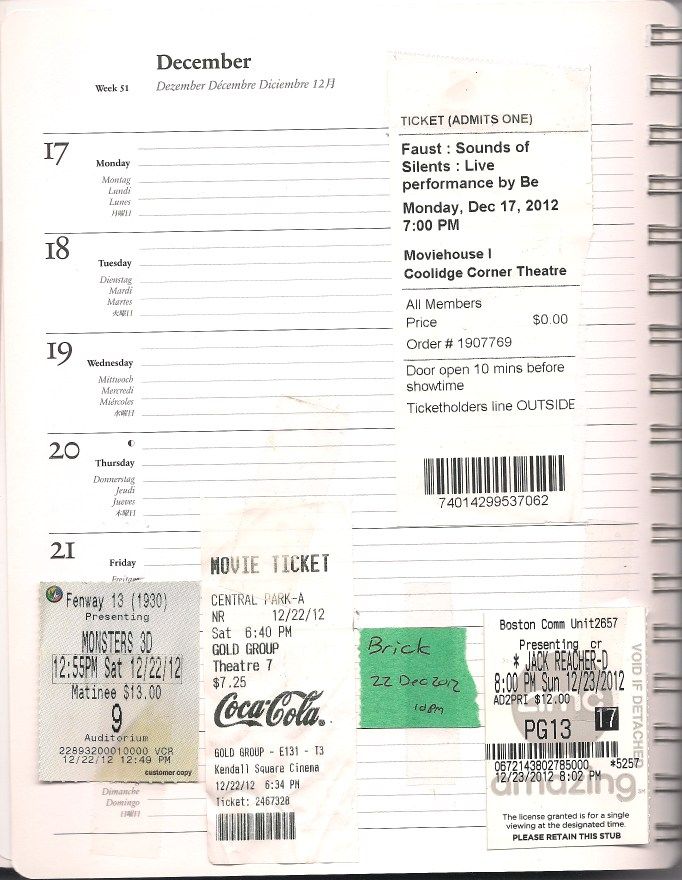
Monday - blah - spurt!, with some Christmas shopping in between. I wound up spending almost all of Sunday at the movies (with an EFC review of The Central Park Five to show for it). That Christmas shopping almost made me late on Monday, but, fortunately, Magic Beans is just steps away from the Coolidge.
Faust - Eine deutsche Volkssage (Faust)
* * * (out of four)
Seen 17 December 2012 in Coolidge Corner Theatre #1 (Sounds of Silents, digital)
I just barely got there in time for the show to start, so my seat kind of stank:
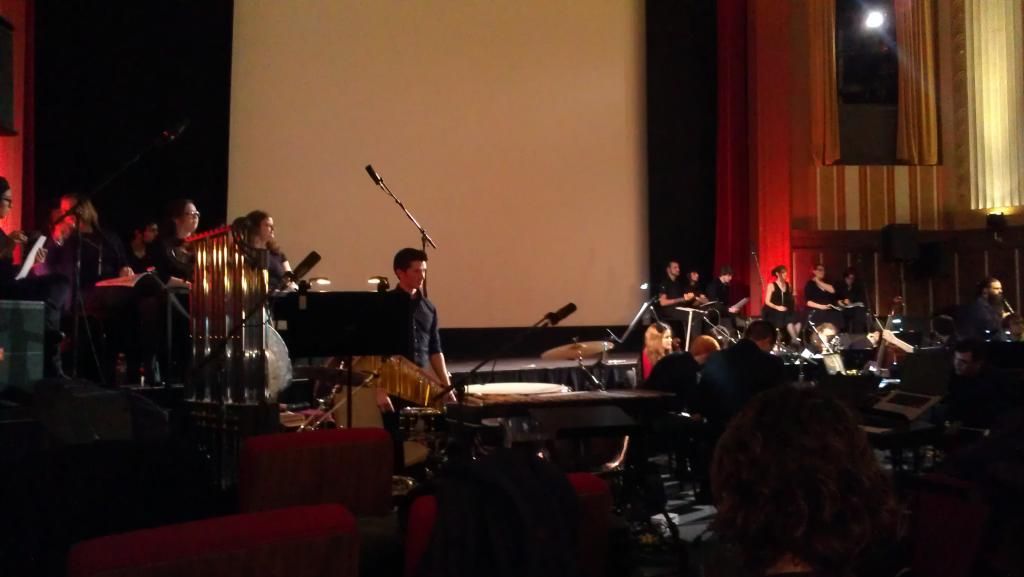
... but that's a heck of a set-up for a silent film. It's the Berklee Silent FIlm Orchestra and Video Game Music Choir, all set up to play a score written by their fellow students. Several different students scored different parts of the movie, but it came together pretty well.
The movie itself is kind of an odd duck to me; like a lot of stories with their roots in folklore, it's essentially using a grand concept to tell a story with a relatively small scale, and on top of that, it often doesn't seem nearly as horrific as what the director is going for. Faust occasionally seems a little self-centered when it comes to using the devil's gifts, but seldom really corrupt, and it seems to take Mephisto until late in the game to remember that he's the devil and playing fair is just not his thing.
Still, the movie's got F.W. Murnau behind the camera, and that guy was good. His telling of the tale is grand and operatic; he knew how to make a moment larger-than-life, giving us great scenes like Emil Jannings's devil looming over the village that wouldn't show up years later because it's not meant to be taken literally. His vision wasn't necessarily as grand as contemporary Fritz Lang's, but he had a great way at humanizing iconic figures that often makes Faust much more affecting than it might otherwise be.
Monsters Inc.
* * * ¾ (out of four)
Seen 22 December 2012 in Regal Fenway #9 (re-issue, Real-D 3D)
Because I bought some other Pixar movies on Blu-ray, Disney tossed me a "free" pass to see this one. I think the value maxed out at $8.50, though, leaving me wanting to know just exactly where that even gets a kid into a 3D matinee screening. Maybe it would have been enough at Arlington, but I'm not sure.
At any rate, it's been a while since I visited this one (I've come to accept that the massive shelves of DVDs and Blu-rays along my walls are insurance against wanting to see it right now rather than testament to watching it regularly), and it's nice to remember just how excellent it actually is. There's actually not a whole lot of plot to it, but the characters are nicely-designed and well-voiced, with Pete Docter and the whole Pixar crew doing a pretty amazing job of telling the story with jokes, even while doing a little bit of a heart-punch once John Goodman's Sully realizes just what he's been doing all his life. It's also got one of the great Pixar chase finales.
That finale also makes for a nice demonstration of why 3D post-conversion doesn't always stink; the whole job is pretty seamless, but having the vistas behind the opening doors actually be three-dimensional deepens the fantasy a bit, and the whole film is often set up in a way that makes 3D work nicely: Large but bounded environments, and action where movement in all three dimensions is important. It should be fairly interesting to see how well Monsters University does with that world in native 3D this summer.
Brick
* * * ¾ (out of four)
Seen 22 December 2012 in the Brattle Theatre (Focus Features 10th Birthday, 35mm)
I think Rian Johnson became my favorite contemporary filmmaker with this. I'd already seen and loved The Brothers Bloom and Looper, so I was behind the times seeing the debut, but it really solidified what I love about the guy: He crosses genres and references the classics as well as anybody, but even when it's as extremely stylized as it is here, the result feels very contemporary, not wallowing in nostalgia. And no matter how mcuh style is on display, the guy can tell a story.
That's a huge part of why Brick is so much fun. Yeah, the underlying gag of transposing film noir to high school is clever, and both Johnson and star Joseph Gordon-Levitt make it work well past the point when a gimmick could have gone stale by speaking fluent Raymond Chandler. The most important thing a movie like this can do, though, is make the audience want to know what's going to happen next, and this movie never loses sight of that. It's a really great crime story.
Those don't come around often enough, and the fact that Johnson tends to combine that with the sort of crazy ambition that could send a movie flying off the rails? Huge bonus. You might even say that it makes me very curious as to what he's going to do next.
Jack Reacher
* * ¼ (out of four)
Seen 23 December 2012 in AMC Boston Common #17 (first-run, 4K digital)
There's not much actively wrong with Jack Reacher so much as there is a great deal that's not as good as it could be, and it adds up to something kind of disappointing. Mostly, it seems to be a case of trying much too hard contrasted with folks who make it look easy.
Take Tom Cruise as the character. It doesn't really matter that he's not a match to how Lee Child envisioned the character physically at all so much as the way the message of the first half of the movie is "Jack Reacher is awesome", and not only do we get a bunch of testimonials to that effect, but the script puts him in positions which only seem to exist to show how awesome he is. We don't get a chance to appreciate it or be surprised by it, so it comes off as a little fake. Meanwhile, Werner Herzog shows up, spills his character's origin story in his Werner Herzog voice (I half suspect he's in this movie because some associate producer did a Herzog voice during auditions, leading the rest of the filmmakers to wonder if he'd be game), and maybe the character is a bit of a standard part, but he's hooked us. The same thing happens later with Robert Duvall; dude just shows up and we get him/want to see more right away.
The movie's more fun than it might otherwise be, though - screenwriter/director Christopher McQuarrie seems to know the material he's working with is male-fantasy pulp, and he's got a relaxed way of telling the story that doesn't quite wink at the audience but is well-enough aware of how this sort of movie works to walk around things he might otherwise stop through. He's got some skill with action, too - those scenes aren't quite dazzling here, but they're smooth enough. Like the rest of the movie, though, they're a little focused on showing us how cool Reacher is rather than harnessing and using that cool.
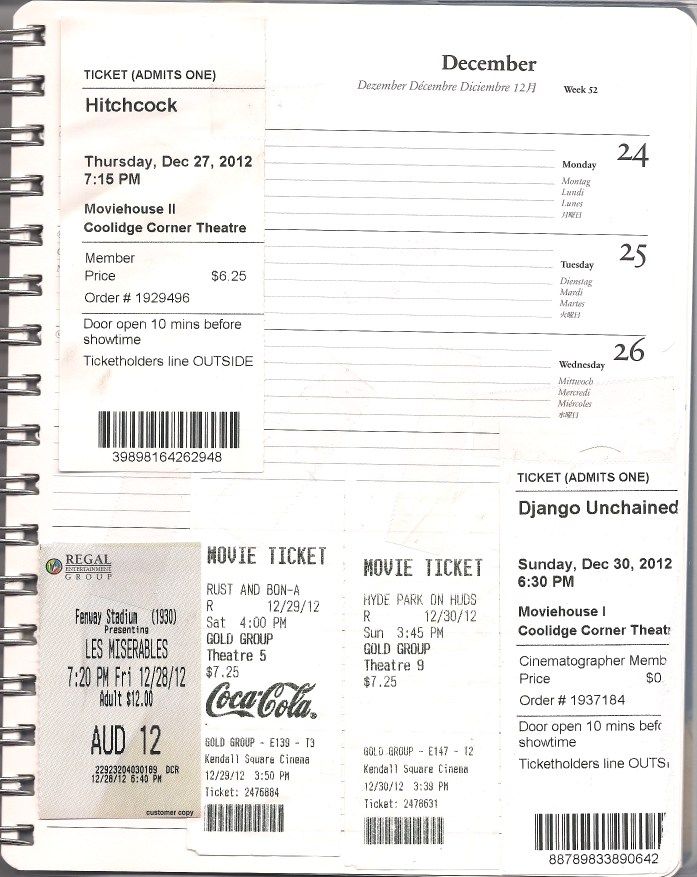
Merry Christmas! I wound up taking this week off from work because my company's new owners only allow one week of vacation to roll over, compared to the two that I'd been carrying for a few years. Monday was spent doing a bunch of last-minute Christmas shopping (culminating, as always, in a bunch of money spent at the chocolate shop, as few have ever complained about getting really good chocolate for Christmas), wrapping, and heading north with my brother and his wife. The 25th was spent at the houses of two other brothers and their awesome little girls, with everyone - aunts, uncles, parents, grandparents, etc. - meeting up at Travis's place.
Eventually, I got home and did a lot of nothing - well, unless making a dent in the pile of comics next to the bed counts as nothing. It kid of beat the movies I was seeing, though - there was a pretty blah stretch between Jack Reacher and Hyde Park on Hudson where everything seemed to be crafted well enough but lacking a certain spark that gives it a reason to exist. Django Unchained was a major corrective for that, but it was a bit of a bland week up until then.
Hitchcock
* * ¾ (out of four)
Seen 27 December 2012 in Coolidge Corner Theatre #2 (first-run, 35mm)
The trailers and other associated advertising for this made me cringe - Anthony Hopkinis impersonating Hitchcock just never seemed to strike me quite right, and I felt a kind of paralyzing fear that the filmmakers would, at some point, attempt to re-create the classic preview for Psycho where Hitch gives the audience a guided tour of the Bates Motel set.
That doesn't happen, fortunately, and one does sort of get used to Hopkins as Hitchcock, although at times it seems less a case of seeing Hitchcock instead of Hopkins as accepting that Anthony Hopkins is playing a Hitchcock-inspired character well. He leads an entertaining cast, most notably playing well off Helen Mirren as Hitchcock's wife and indispensable partner Alma Reville. At its best moments, Hitchcock taps into a great vein of energy where the very idea of Psycho is concerned: The idea of the bored master touching forbidden material on the one hand and making it commercial on the other. There's a great scene where Alfred asks Alma "what if someone really good made a horror movie?" that gets across just what a big deal it is.
The thing is, screenwriter John J. McLaughlin and director Sacha Gervasi seldom really sink their teeth into it; instead, there's some shallow recreation and an utterly standard (and, I gather, mostly-fictional) side-plot where Hitch worries about his wife being unfaithful. There's some amusing fourth-wall breaking at the beginning and end that references the unusual familiarity Hitchcock had with his audiences but doesn't persist through the very persistent middle, and the stuff with Ed Gein really doesn't go anywhere. Stars are stunt-cast as the stars of Psycho, but neither Scarlett Johansson nor Jessica Biel really gets to do anything, and James D'Arcy actually seems able to channel Anthony Perkins despite having nothing to do with it.
The movie's fun, and cute, and probably won't teach the film fans in the audience a whole lot, even if it does manage a few good laughs.
Les Misérables
* * ¼ (out of four)
Seen 28 December 2012 in Regal Fenway #12 (first-run, 4k Digital)
Here's a question I found myself asking a lot during this movie, and a lot of the other bland ones I saw around it: What is this thing about? What is the core idea and emotion that drives the story, that resonates with the audience even when the details don't quite work. What, to put it bluntly, is the point?
Les Misérables must have one; it's a story that has captivated audiences in multiple formats and languages for over a century, and the musical from which this film is adapted has a particularly rabid following - something must resonate! And yet, I can't really be sure what. It's not really a story about class, or obsession, guilt, sorrow, exploitation, or injustice. Hugh Jackman's Jean Valjean is the main character in that he's one of the two to appear in every segment of the story and makes most of the important decisions, but he's a cipher, a mostly-good man whom we only see at moments designed to remind us of that. And yet, his actions and motivations seem badly mismatched; tremendous operatic guilt that manifests as aiding one person.
Watching the film is a weird experience, too, even beyond all the singing. The pace never seems right; every section of this episodic movie feels strangely rushed despite the audience knowing they're in for a long sit, and it's never enough to really feel the weight of what's happening at that point in time - Anne Hathaway's character seems to go from losing her job to sinking into prostitution to dying of some horrible disease overnight, for instance. And there's no time to give context for why the heck they're removing her teeth or what the title cards say about the regime changes in France with every jump forward in time. Plus, for as much as shooting it with live singing does allow for some impressive performances (Jackman, Hathaway, and Samantha Barks especially), it seems to lock each monologue into a single take; director Tom Hooper can't go to a close-up or a reaction shot because the cut wouldn't work. As weird as it is to complain about a modern movie not being cut to bits, it almost makes the camera feel anchored, and the attempts to switch angles are clunky, giving us shots of someone's back.
Plus, there's a lot of things that just don't feel right. I half-think Russell Crowe should have played Javert, the cop who just can't let Jean's long-ago minor crimes pass, as more of a thorough villain; he comes off as just an honest man doing his job here when he really needs to be rigid and monstrous. Sacha Baron Cohen and Helena Bonham Carter feel like they belong in another movie entirely (one directed by Tim Burton, of course). And the whole last segment just seems to have its revolutionary politics wrong, with the happy ending being one character retreating from his principled stand to the bourgeoisie and another marrying him, while the girl who actually seemed nice and interested in him for more than infatuation at first sight dies.
Really, this story's a mess, and it doesn't all seem to be because of a flawed adaptation. I really wonder what I'm missing here.
De rouille et d'os (Rust and Bone)
* * ¼ (out of four)
Seen 29 December 2012 in Landmark Kendall Square #5 (first-run, 2k Digital)
Rust and Bone has a similar problem of not really seeming to have a strong center. About midway through, a metaphor does seem to arise of Stephanie (Marion Cotillard) being drawn to dangerous animals, whether they be the orcas at the water park where she's a trainer or Ali (Matthias Schoenaerts), the Belgian single dad and underground fighter she connects with after a horrific accident, but not really paying the danger proper respect. It's not really a great core, but it's kind of interesting.
And then the end just cops out. SPOILERS! Not right away, and it takes the "shocking" route to get there, but the last few minutes give Ali a seeming redemption that is really tacked-on, aiming to make up for his general selfishness through the rest of the movie with a single heroic action. I'm not sure whether the kid falling through the ice or Ali crying after rescuing him is the more cynical move. !SRELIOPS
The movie's got its issues getting there, too. As good as both Cotillard and Schoenaerts are, director Jacques Audiard and his co-writers put almost zero effort into their pairing making any sort of sense. There's also the occasional feeling that the filmmakers are forgetting about Ali's son Sam beyond establishing Ali as being, at best, somewhat neglectful. All in all, it's hard to shake the feeling that this movie started from several very good parts but never really had them come together, leaving too much of a void in the middle.
Hyde Park on Hudson
* * (out of four)
Seen 30 December 2012 in Landmark Kendall Square #9 (first-run, 2k Digital)
I've grown to kind of hate viewpoint characters - the outsiders meant to give audiences a "relatable" viewpoint into a story of larger-than-life individuals, especially when the latter are real-world figures. Sure, maybe they accomplish that goal, but they also tend, by their nature, to be generic figures who take valuable screen time from actual interesting individuals. In this case, there's not really a single moment when Laura Linney's narrator Daisy is the character we want to see more of.
To be fair, she's fine in the role; it's not her fault that director Roger Michell and writer Richard Nelson play things way too coy, being as circumspect with Daisy's affair with FDR (Bill Murray) as a person in the time would have, so that when it becomes a thing toward the end of the movie, the audience is thinking "wait, what? You said they were cousins! Ew!" They were distant cousins, which wasn't as much of an issue back then, but that's a bit of detail that a modern filmmaker can't exactly assume the audience knows. It's also not her fault that she is almost completely inconsequential to the bigger story of Anglo-American relations on the eve of World War II, as personified by the Roosevelts and England's King and Queen. She takes the role she's given and plays it well enough that you can sort of understand the filmmakers not wanting to leave it on the cutting room floor, even if that's where it belongs despite the movie being based on her life.
She's good, but the rest of the casting is kind of unfortunate. Samuel West and Olivia Colman draw extremely short straws, in that it's going to take some time before audiences can watch this movie and not want them to be Colin Firth and Helena Bonham Carter, who played the characters in The King's Speech. They do well, especially considering that they're highlighting the opposite side of the characters (Bertie and Elizabeth as royalty who have difficulty seeing Americans and commoners as equals versus basically being the same). Olivia Williams is fine as Eleanor Roosevelt. But Bill Murray... It's not an obviously terrible performance, but it's the sort of thing that may make a fan rethink some of the praise heaped upon him in the past decade or so. Is he really as good as we thought, or has he just been well-cast? Because here, it's impossible to see him as anything but "restrained Bill Murray", rather than a man who marshaled incredible charisma despite his infirmity.
There's an interesting movie here, but it's the one that's a sequel to The King's Speech rather than the underplayed affair. Pity nobody making the movie seemed to realize this.
Django Unchained
* * * ¾ (out of four)
Seen 30 December 2012 in the Coolidge Corner Theatre #1 (first-run, 35mm)
Say this for Quentin Tarantino: He's got no trouble finding the center of his movies, even when they're long, episodic yarns like... Well, like most of his movies. Here, there's no question: Django Unchained is about confronting slavery and the racism that allowed it (and its legacy) to fester - and doing so with all the metaphorical violence it deserves.
Sure, it may seem flip for Tarantino to use that as the background of a big, entertaining action-comedy, but it works because, even when he's mashing genres together and throwing out anachronisms, he's never doing it carelessly. Mockery is pointed; every moment of the often-comedic dialogue is polished precisely to say something about the person delivering it. The use of violence isn't quite so precise, but it's not scattershot, either: The revenge pieces are acts of action-movie fantasy, staged and stylized, but the racially motivated, real-world stuff is ugly and realistic.
I've got the feeling it's going to reward multiple viewings, too, to watch how Samuel Jackson's house slave Stephen speaks to different groups - practically minstrelry in front of a bunch of white people, more obviously intelligent but still somewhat subservient to his owner, and something else again when finally confronting Jami Foxx's Django alone. It's been a while since I've seen Gone with the Wind, but I wouldn't be surprised if Tarantino made the Candieland plantation house resemble Tara so that he could take pleasure in destroying it. And it will be fun to pay attention to Christoph Waltz as King Schultz - sure, he's pretty clearly a good man when he first appears, but he also puts Django in a less-than-equal position (he's liberal, but not necessarily sure the black guy is his equal); by the end, though, he can't even shake Candie's hand because he's so disgusted by the whole idea of racism and slavery... And it's a position he feels he can afford to take (or so he thinks), showing his distaste, unlike Django, who knows what careless words have consequences and thus takes the admonition to never break character to heart
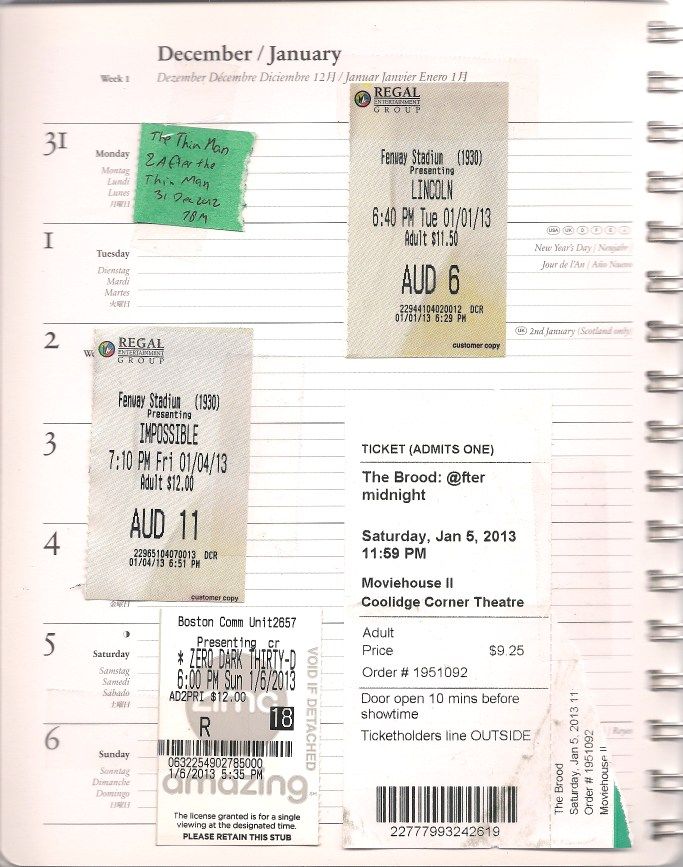
On the one hand, the Brattle's New Year's Eve Thin Man double feature got in between seeing Tarantino's and Spielberg's anti-slavery movies as the last and first movies of the year, but, on the other hand... Never pass up The Thin Man on the big screen. Ever. After that, a couple nights of movies about recent news-worthy events (The Impossible and Zero Dark Thirty), some classic Cronenberg, and a quiet period during which I can finish up writing up this thing.
The Thin Man
* * * * (out of four)
Seen 31 December 2012 in the Brattle Theatre (New Year's Eve with Nick & Nora, 35mm)
Somehow, I've never written a full review of this movie - heck, I can't even find a capsule-sized thing on this blog, which kind of astonishes me, because I know I've seen it a few times in the last decade and love it. But, no.
It's a bit difficult to write about, I guess, because it's basically perfect, an ideal fusion of screwball comedy and murder mystery with a great, bantering pair in William Powell & Myrna Loy. It's hard to think of a movie that has ever been better at getting laughs while taking the central homicide fairly seriously. In some ways, it's almost a spoof, with Powell's Nick Charles mentioning that his plan is to get all the suspects in a room and see what happens, which even this early in the life of the cozy mystery has become sort of a cliché.
One thing that always kind of amazes me about this movie is that its light-hearted, cozy-ness seems so antithetical to Dashiell Hammett's other work. He's the guy who was really moving pulp toward noir in the page of Black Mask (although "noir" would require translation to film and rediscovery by the French before it would have that name), and not really a funny guy; he didn't even tend to go in for Raymond Chandler's bitter wit. It's been a while since I've read The Thin Man itself, and maybe I should; I recall it being lighter than The Maltese Falcoln and certainly Red Harvest, if not quite as aggressively funny as this. But it's not a bad adaptation; the whole story is kept and the jokes just seem like director W.S. Van Dyke and his screenwriters teasing out what will work best on-screen.
After the Thin Man
* * * ½ (out of four)
Seen 31 December 2012 in the Brattle Theatre (New Year's Eve with Nick & Nora, digital)
Hammett's darker tendencies make me wonder about his story credit on After the Thin Man, which pushes the comedy just a little harder. Did he whip something up that the returning screenwriters fleshed out, or is this just a courtesy credit? It doesn't much matter; this is one of those rare, happy sequels that give the audience a little more of what they liked from the first without feeling like repetition or bloating up.
I do kind of wonder just where Nick Charles was supposed to have been a detective, though - in The Thin Man, they were visiting New York and wound up drawing in all of his unsavory (but friendly!) old acquaintances; here, they're back at Nora's home in California and the same thing happens! Then again, I don't know if he's ever specifically said to be an ex-cop; maybe he was an unusually successful and well-traveled Pinkerton man.
It's also fun to see James Stewart show up in an early role here - he's just starting to break out enough to be the first-billed after William Powell & Myrna Loy, but he's not yet playing "Jimmy Stewart" yet. It's an interesting "not-yet-a-movie-star" performance, making the end of this movie possible, if a bit surprising.
Lincoln
* * * ¾ (out of four)
Seen 1 January 2013 in Regal Fenway #6 (first-run, digital)
Why must movies have such generic titles? Lincoln is based in large part on Doris Goodwin's Team of Rivals, and is very focused on a specific time and story instead of the full sweep of Abraham Lincoln's life; why not reflect its actual story rather than make it sound like a generic biography?
I ask this because I found it was the parts that were least personal but most specific and procedural that most fascinated me. There's a scene where Daniel Day-Lewis's Lincoln walks the Cabinet (and thus the audience) through the paradoxical logic behind the legality of the Civil War and Emancipation Proclamation, and it's something I vaguely remember from high school history classes - teachers mentioned that Lincoln suspended habeus corpus and assumed quite a few wartime powers, but it seldom had the impact of that scene, which does an impressive job of making the specifics both clear and confusing. That's what the whole movie does, taking what seems like the driest parts of history and making all the tiny moving parts fascinating both individually and in the aggregate. It lets Day-Lewis show the parts of Lincoln that are actually somewhat morally questionable while still getting across just why he was so charismatic and able to make the ascent into legend.
Day-Lewis is fantastic, of course, with his tendency to disappear inside a role a perfect complement to Spielberg's attention to detail. It's an amazing part and presentation of a character, in that it feels improvised, but not on the actors' and filmmakers' parts, but that of the characters. Lincoln will tell stories in a way that might seem indulgent if not played exactly right - but they are, of course; everyone's too good. That extends to a quite frankly ridiculous cast, from Day-Lewis all the way down - there's a Kevin Kline credited as "wounded soldier", and it's not that one (although why the heck hasn't he worked with Spielberg yet?), but you wouldn't be surprised, would you? Tommy Lee Jones gets the showiest, most entertaining supporting part, and despite the amusement of Jones playing the Yankeest Yankee in the movie, it's a part that seems tailor-made for him. A lot of parts work that way, notably David Strathairn demonstrating that he makes every movie better as William Seward, but little parts like Bruce McGill as Edwin Stanton work that way too. And then there's James Spader, disappearing inside his political mercenary for a character that is hilarious even though he has to be taken seriously.
Could it have ended five or ten minutes earlier? Absolutely; it's got two epilogues that it doesn't really need. But they aren't nearly gratuitous enough to detract from the excellent two and a haf hours that come before.
The Brood
* * * ¼ (out of four)
Seen 5 January 2013 in the Coolidge Corner Theatre #2 (@fter midnite, 35mm)
Watching The Brood, I found myself wondering if all these early Cronenberg body-horror movies all took place in a single shared universe. It came to me during the autopsy scene, where the coroner seems rather calm about the fact that he's doing an autopsy on some sort of biologically impossible homonculus. I picture an assistant freaking out while he shrugs, saying that, hey, last year in Montreal some girl drained people of their life force by hugging them.
Friends at the screening shrugged it off as "hey, it's Canada."
In a way, I think that's part of what makes Cronenberg movies so chilling - there's a bizarre logic to their paranormal elements that makes them forcing their way into reality seem believable, even if the characters can't see the metaphorical strength behind them. This movie, apparently, was based upon Cronenberg's own divorce and custody battle, and despite the chilly nature there does seem to be a little more anger, maybe a little more guilt to it than usual. It's got impressive gross-out moments, and some darn good suspense, but if it didn't have the underpinnings it does - fear of quack psychiatry, a family history of dysfunction that spans generations - it wouldn't be nearly as powerful.
19 November - 25 November
26 November - 2 December
3 December - 9 December
10 December - 16 December
17 December - 23 December
24 December - 30 December
31 December - 6 January
Busy, busy week - you'd hardly believe looking at the crowded nature of the page that I found time for a day-and-a-half trip to Maine for Thanksgiving. That was kind of weird, actually - all my brothers spent it at their in-laws, and while I got to see a couple of nieces for a while on Friday before they went down for a nap and I generally like most of my Dad's wife's family, it wasn't the same.
To Kill a Mockingbird
* * * * (out of four)
Seen 23 November 2012 in the Brattle Theatre (Universal Centennial, 35mm)
Somehow, I had managed to miss seeing this one ever before, which is a crying shame. It is, as everybody knows full well, awfully close to a perfect movie.
That is, I think, because it pulls off its extremes with a grace that is quite frankly amazing. It builds up such a pure sense of goodness around Atticus and Scout and any number of other characters before delivering a crushing but inevitable injustice. That's the standard pattern of innocence shattered, and yet it plays less as devastation and destruction of illusions than a hope and belief that the next generation can do better.
Plus, Gregory Peck. He plays the greatest movie dad ever, and it's a performance that could be pure corn in lesser hands, but is just perfectly admirable here. The rest of the cast is fantastic, too, especially Mary Badham as Scout, and Robert Duvall is always welcome, even if it's a small (but crucial) role like Boo Radley.
The Thing (1982)
* * * * (out of four)
Seen 23 November 2012 in the Brattle Theatre (Universal Centennial, 35mm)
Let me tell you: One gets a lot of false positives searching this blog for "The Thing" to see if I've written about it before. It turns out I have - briefly, when it played the Marathon two and a half years ago , and in more detail when I watched the HD-DVD three years before that. Yeah, I know, HD-DVD.
Anyway, the movie hasn't changed, and the prequel/remake has come and gone without any ill effects on this one. It's still thoroughly creepy, and the special effects have aged pretty well. They don't necessarily look more realistic than modern CGI, but the 1950s-styled-but-much-better-looking spaceship in the opening sets a tone when combined with the Ennio Morricone score, and the way that the practical effects must be built winds up implying that conservation of mass is still in effect, and the bounds make things more tense.
The Sting
* * * ½ (out of four)
Seen 24 November 2012 in the Brattle Theatre (Universal Centennial, 35mm)
It's not hard to love The Sting; its player-piano score, detailed Edith Head period costumes, precise explanatory titles, and basis of familiar tropes marks it as a throwback but not one intent on either mocking or deconstructing its genre or period. It's a 1930s con movie - nothing less, and nothing ostentatiously more.
Now, the score (Marvin Hamlisch and Billy Byers making good use of Scott Joplin compositions) isn't actually produced by player pianos, or wind-up devices of any sort, but it sort of has that mechanical feel at times, and while that can often be a bad thing, it works very well for this picture; it helps build the feel of a well-oiled machine whose workings the audience is invited to inspect. And yet, that's only half the movie; big chunks of the plot are cleverly improvised and the filmmakers demonstrate a fine knack for knowing just what to hold back to create surprises and twists without feeling like they're cheating the audience.
Plus, of course, Paul Newman & Robert Redford. It's one of those master & apprentice relationships where neither party seems to think too much of the other, likely because of how one is basically the other plus twenty-odd years, and they both turn on the charm in ways that make this pretty clear but not the point of the whole movie.
Slap Shot
* * * ½ (out of four)
Seen 24 November 2012 in the Brattle Theatre (Universal Centennial, 35mm)
Slap Shot shares both a director (George Roy Hill) and star (Paul Newman) with The Sting, but where The Sting was a well-oiled machine, this one is apparent anarchy. It's one crude joke after another, and the storylines that could serve as an overarching theme or something redemptive show very little interest in going that route. It goes for the joke at every opportunity.
Of course, it's smarter and better-put-together than that. You don't have to scratch it much, if at all, to see that underneath the story about appealing to the baser impulses of the audience is a look at the desperation of the working class in hard economic times. Moving it slightly to the side takes the edge off, so it's not depressing in the way movies about factories closing down are, while still getting the idea across - a candy coating on a bitter pill. And while it always goes for the joke, it does so with the right tone for the moment, rather than being one size fits all.
Silver Linings Playbook
* * * (out of four)
Seen 25 November 2012 in AMC Boston Common #12 (first-run, digital)
I'd forgotten that The Fighter was a David O. Russell film; someone else wrote the screenplay and it lacked the layer of absurdity alongside the drama that was a hallmark of the movies Russell did between 1994's Spanking the Monkey and 2004's I Heart Huckabees. Silver Linings Playbook is a lot closer to those movies, so it can, perhaps, be described as a nice return despite the existence of The Fighter.
Interestingly, it very pointedly lacks a stable center for the insanity to play against. Bradley Cooper and Jennifer Lawrence play characters with real mental health issues, and the way that's presented can sometimes be worrisome; their disorders manifest in ways that almost seem too entertaining. It's a thin line between feeling properly guilty when you laugh at their eccentric behavior and feeling the filmmakers are doing mental illness a disservice. Maybe Russell could have done better showing Cooper's Pat following his med schedule or otherwise recovering rather than just seeming to have a eureka moment when he figures the plot out.
I don't think you can say "that aside, this is a good movie", because that permeates the whole thing, but it does only make things shaky rather than knock them over. Cooper and Lawrence are both pretty fantastic, and there's a great supporting cast around them (including, yes, Chris Tucker). I kind of love that sports fandom plays more as a positive thing than an unhealthy obsession, and the way the movie embraces its Hollywood ending is quite nice indeed.
Stubless: London's Museum of Natural History (most of Sunday 2 December 2012).
Quite the short movie week, but for a good reason - as you can see from the gigantic tickets at the bottom of the page, I went on vacation in December. My flight to London left Friday night, with the idea being that I would stay up all night Thursday, fall fast asleep in my airplane seat at around 8:30pm, and then awaken when it touched down at about 7am, refreshed and ready to start the day.. This, it turns out, was not a good plan, even considering that I was at work until 10pm Thursday night because something Had To Be Done within a very short window.
I did see a few movies - the delayed CineCache screening of The Loved Ones and my last in the Universal series, Lonesome on this continent, and the remake of Gambit across the pond. Gambit wasn't my first choice that night - Google had me believing a certain cinema was nearby rather than far away, so I redirected myself to this one when I found it not there, and found myself amusingly confused by the horizontal posters, assigned seating, and lobby that operated more like a convenience store than a traditional concession stand.
The Loved Ones
* * * * (out of four)
Seen 26 November 2012 in the Brattle Theatre (CineCache, DVD)
Finally, this movie hits Boston. I saw it at the 2010 Fantasia Festival, saw Paramount sit on it until The Devil Inside was a surprise hit, only to have the "release" be "making it available via Tugg" (honest question - is Tugg useful for anyone outside Austin?), that be an edited version, and the home video release only be DVD rather than Blu-ray. Seriously, Paramount, this is a great movie and you punted most of the year? That a snowstorm wiped out CineCache & the Brattle's Halloween screening was just insult to injury.
Fortunately, it's still a pretty great movie. The promotion for this screening tagged it as a horror-comedy, which I think does it a great disservice - it's not jokey in the least, and the character that might otherwise be played as comic relief is there as much to tie saddest character in the movie to the action as make the audience laugh. Indeed, what I think is exceptional about The Loved Ones, even more than the inventive violence (which is not for the squeamish), is that for what seems like a mere slasher or torture-porn flick, it's as much concerned with getting how devastating a loss can be across as traditional thrills.
Full review at eFIlmCritic.
Lonesome
* * * (out of four)
Seen 28 November 2012 in the Brattle Theatre (Universal Centennial, digital)
Lonesome is a pleasant, interesting curiosity from the period when silent movies were awkwardly evolving into talkies, a simple thing about a man and a woman who live workaday lives, meet, get separated, and, well, anybody can probably guess how it ends. It's got occasional Harold Lloyd co-star Barbara Kent as the girl and likable Glenn Tyron as the guy, and there's enough spark between them that the I-know-we've-just-met-but-this-may-be-true-love urgency works.
At least, during the silent sequences. With sound starting to hit theaters, Universal added three or four scenes with sound, and only one really matters to the plot; the others just have Mary & Jim sitting in one spot, declaring how sad it is to be lonely and how much they love each other as much to the audience as each other. They're static and repetitive and kind of dull compared to the creative and active screen when the soundtrack is just used for underscore. Even the police station scene which at least has a purpose in the plot seems to go round and round in circles.
It's a cute movie, fun if you like silents and interesting for how the switch to sound had its bumps.
Twelfth Night
Not a movie, but a play, although a large part of what drew me to it was that it featured people I knew from film and television: Stephen Fry, most notably, but also Colin Hurley from Black Pond. Plus, I've loved Shakespeare since junior high, and though The Globe wasn't doing shows when I was there, this one had premiered there and was an "original practices" production - all-male cast, costumes and props made with period-authentic materials and techniques, seating on the stage and the musicians on a balcony above.
Sadly, I couldn't get any pictures aside from this one of the theater itself; a "no photography" rule was being enforced even before the play started, probably because the actors were having hair, makeup, and costuming done right on the stage, which was actually pretty cool (it was neat to see a company that was working together on two shows simultaneously joking and laughing with each other), but we really don't need photos of a bunch of middle-aged actors in their boxers flooding the internet. After the show, they hung out again, auctioning things off for an actors' charity.
The show itself was pretty good, although I wish I had seen it on a different date - I think I had had four or five hours of sleep in the previous fifty-five or so. Fortunately, I wasn't in those on-stage seats (how bad would the occasional dozing off only to jerk back awake seconds later look?). Mark Rylance gave an exceptionally funny performance as Olivia, floating around the stage like a dotty Dalek and being wonderfully obtuse.
The next day was spent in the Natural History Museum, not far from the apartment where I was staying. You know it's a good natural history/science museum when the first thing visible upon entry is a dinosaur skeleton, and the rest of the building lived up to that - a whole exposition on dinosaurs, rooms full of other fossils, gems, a look into a storage room full of things preserved upside down in jars, Charles Darwin's pet tortoise (taxidermied and lost in the plentiful archives for a hundred years or so). My camera gave out by the end of the day, which was a crying shame.
Stubless: A second visit to the Natural History Museum (Monday 3 December 2012). The London Eye (Tuesday 4 December 2012), The Sherlock Holmes Museum (Wednesday 5 December 2012), The London Zoo (Wednesday 5 December 2012), The Benjamin Franklin House (Thursday 6 December 2012), The Cartoon Museum (Friday 7 December 2012), The British Museum (Friday 7 December 2012), Thames Tour (Saturday 8 December 2012).
I suppose I could run down all the cool, touristy things I did in London (which was awesome), but I think I'll just point you at my page of photographs on Facebook and piece it together from there. Otherwise, it's just a lot of "I saw that! It was awesome!
I'll also point to the reviews for Sightseers, The Hunt, and Skyfall, which I saw while on vacation as well.
Stubless: The Fifth Element (15 December 2012, Coolidge Corner Theatre #1)
After spending a week abroad, there was work to do. I didn't to much about catching up, either - it gets kind of nice to head to the office, come back, sleep, and repeat after so relentlessly entertaining oneself for a week. The only real exception I made for that was the Chlotrudis/CineCache presentation of Blues for Willadean, and... Well, I didn't rush to give it its own review despite there not being one on EFC like I did for Wagner & Me
Blues for Willadean
* * (out of four)
Seen 10 December 2012 in the Brattle Theatre (CineCaché, video)
So, Chlotrudis folks, I know we've met her and she's nice and a decent character actress and it's kind of neat to spot her when she shows up in something, but can we agree that "featuring Beth Grant" is not a good reason to book a movie? Because while this probably wasn't worse than Sedona, it certainly wasn't good, and having to politely act like it was afterward because Ms. Grant came to present it was just awkward.
Admittedly, some of the reasons I didn't enjoy it were just part and parcel of what it is: A movie about spousal abuse set in a trailer park, featuring the sort of characters one stereotypically finds there. Not folks I'd typically look to hang around with, or a particularly uplifting story, so it's a question of execution, and I think playwright/screenwriter/director Del Shores does a lot of things that hurt it. I think the biggest problem is that he never finds a way to get the audience to a place where they really can respect the title character; the story seems to be coming at its story from a place of "even these people don't deserve this"; she's just pitiable and pathetic and surrounded by other trailer trash, given a bit of a boost because she's able to align herself better with tolerance toward blacks and gays later on. And while, yes, nobody, no matter how little one might think of them personally, deserves to be the victim of violence... That's a low bar to clear, isn't it?
And still, Shores need a crutch or two to get over it. There's a point where Willadean's violent husband (David Steen) comes home, sees her black neighbor (Octavia Butler) is visiting, and drops an n-bomb. And, yeah, I believe this is a thing that happens, but when race has pretty much been a non-issue up until that point, it just sucks all the air out of the room, and suddenly it's like we're supposed to hate J.D. for being racist (and disowning his gay son), as if domestic abuse wasn't enough! And then, of course, Chekhov's gun shows up, and after a whole movie of violence being bad and inexcusable... Well, you can guess how it goes.
It's no fun to say this isn't a very good movie, not just because it features a friend of the club: It has worthy subject matter and at least makes the attempt to show folks who are under-seen on the big screen. It just doesn't give them the treatment they truly deserve.
The Fifth Element
* * * ½ (out of four)
Seen 15 December 2012 in Coolidge Corner Theatre #1 (@fter Midnite, 35mm)
Something to remember when watching The Fifth Element: It came out two years before Star Wars: The Phantom Menace, and for as much heat as that movie and its follow-ups take, their virtual sets and human-scale CGI characters did produce a sea change in the standards for creating full science fiction and fantasy worlds on-screen. From the other side, something like The Fifth Element looks a little rubbery, a little incomplete, compared to the new standard, even though at the time, its world-building was best-in-class.
It still is, in a lot of ways - Luc Besson and company have designed the heck out of it, from Jean-Paul Gaultier's costumes to having Jean "Moebius" Giraud work on other aspects of the film's look. Besson really does capture the sexy, anarchic feel of a European bande-dessiné, if not quite to the absurd, violently insane level of Moebius's collaborations with Alejandro Jodorowsky. The story's flimsy, but it's enough to hang a lot of fun moments on. It keeps Bruce Willis from getting complacent, and while Milla Jovovich isn't doing much besides look pretty (and have people comment upon how pretty she looks) yet, they've got a fun supporting cast: Gary Oldman, Ian Holm, John Neville, Tiny Lister, and more, playing their parts just a little funnier than you might expect.
Yes, including Chris Tucker. This movie would be a lot less entertaining if Ruby Rhod were turned down even just a little bit.
The Hobbit: An Unexpected Journey
* * ¾ (out of four)
Seen 16 December 2012 in Regal Fenway #13 (first-run, 48fps RPX Real-D)
I've sort of been reserving my comments on this one; I decided to go see it in the high-frame-rate presentation for which director Peter Jackson shot it and the look of the film was so peculiar that I had a really hard time thinking of anything else. My impression wasn't so much of soaps or sports as much as it was the sort of film clip shot for educational use or as an introduction to a tourist attraction. Not necessarily bad - indeed, there are some 3D shots I don't think could be done nearly as well in any other format - but so different as to be very distracting!
(Also: I suspect that shooting in 3D means that Jackson and company were able to do much less forced-perspective, leading to many more shots that were obviously accomplished with doubles.)
The thing is, I'm not particularly keen on giving this another three hours of my time. As much as I liked the more kid-friendly vibe - appropriate given the source material - the whole thing just seemed too spread out, and I wonder if the very-late-in-the-game decision to make this three movies instead of two didn't mean placing an anti-climax at the finale. It's fun and I think the kids will enjoy it - the big action scene in the goblin cave is a blast - but I wonder if they'd enjoy it more if it didn't feel quite so random.
To be fair: I'm no particular fan of swords & sorcery, and my resentment at how much of Peter Jackson's career has been consumed by these midget movies is only amplified by the fact that when Martin Freeman and Benedict Cumberbatch are working on them, they're not making Sherlock, which is obviously much more important!
Killing Them Softly
* * (out of four)
Seen 16 December 2012 in AMC Boston Common #19 (first-run, digital)
Andrew Dominik and I just aren't going to work out, are we? I found his The Assassination of Jesse James by the Coward Robert Ford a slog, and while Killing Them Softly isn't nearly as bad, that's mainly due to there being less of it; it's still leaden and dragged down by metaphor that in and of itself isn't as clever as he thinks.
That metaphor, in this case, being a lot of radio and television clips with Presidential candidates Obama and McCain talking about the economy (the film is set in late 2008), meant as a parallel for how crooks robbing a poker game has resulted in a loss of confidence in the local underground economy, especially since the logical assumption is that it was once again perpetrated by the "banker" (Ray Liotta). It's not a bad idea, but the metaphor becomes intrusive without becoming particularly illuminating.
The main problem is much more basic, though: Killing Them Softly is boring. Moments of characters accomplishing something of consequence often happen off-screen, while precious run-time is wasted on James Gandolfini as a hitman too depressed to actually get around to shooting people, or Scoot McNairy and Ben Mendelsohn as the small time crooks who precipitated all of this just getting high. Richard Jenkins shows up to disarmingly deliver bureaucratic delays to Brad Pitt as the picture's "fixer", but he's just blandly professional.
You look at the story here, and there's no reason for it to be this dull, but I guess that's Andrew Dominik for you.
Monday - blah - spurt!, with some Christmas shopping in between. I wound up spending almost all of Sunday at the movies (with an EFC review of The Central Park Five to show for it). That Christmas shopping almost made me late on Monday, but, fortunately, Magic Beans is just steps away from the Coolidge.
Faust - Eine deutsche Volkssage (Faust)
* * * (out of four)
Seen 17 December 2012 in Coolidge Corner Theatre #1 (Sounds of Silents, digital)
I just barely got there in time for the show to start, so my seat kind of stank:

... but that's a heck of a set-up for a silent film. It's the Berklee Silent FIlm Orchestra and Video Game Music Choir, all set up to play a score written by their fellow students. Several different students scored different parts of the movie, but it came together pretty well.
The movie itself is kind of an odd duck to me; like a lot of stories with their roots in folklore, it's essentially using a grand concept to tell a story with a relatively small scale, and on top of that, it often doesn't seem nearly as horrific as what the director is going for. Faust occasionally seems a little self-centered when it comes to using the devil's gifts, but seldom really corrupt, and it seems to take Mephisto until late in the game to remember that he's the devil and playing fair is just not his thing.
Still, the movie's got F.W. Murnau behind the camera, and that guy was good. His telling of the tale is grand and operatic; he knew how to make a moment larger-than-life, giving us great scenes like Emil Jannings's devil looming over the village that wouldn't show up years later because it's not meant to be taken literally. His vision wasn't necessarily as grand as contemporary Fritz Lang's, but he had a great way at humanizing iconic figures that often makes Faust much more affecting than it might otherwise be.
Monsters Inc.
* * * ¾ (out of four)
Seen 22 December 2012 in Regal Fenway #9 (re-issue, Real-D 3D)
Because I bought some other Pixar movies on Blu-ray, Disney tossed me a "free" pass to see this one. I think the value maxed out at $8.50, though, leaving me wanting to know just exactly where that even gets a kid into a 3D matinee screening. Maybe it would have been enough at Arlington, but I'm not sure.
At any rate, it's been a while since I visited this one (I've come to accept that the massive shelves of DVDs and Blu-rays along my walls are insurance against wanting to see it right now rather than testament to watching it regularly), and it's nice to remember just how excellent it actually is. There's actually not a whole lot of plot to it, but the characters are nicely-designed and well-voiced, with Pete Docter and the whole Pixar crew doing a pretty amazing job of telling the story with jokes, even while doing a little bit of a heart-punch once John Goodman's Sully realizes just what he's been doing all his life. It's also got one of the great Pixar chase finales.
That finale also makes for a nice demonstration of why 3D post-conversion doesn't always stink; the whole job is pretty seamless, but having the vistas behind the opening doors actually be three-dimensional deepens the fantasy a bit, and the whole film is often set up in a way that makes 3D work nicely: Large but bounded environments, and action where movement in all three dimensions is important. It should be fairly interesting to see how well Monsters University does with that world in native 3D this summer.
Brick
* * * ¾ (out of four)
Seen 22 December 2012 in the Brattle Theatre (Focus Features 10th Birthday, 35mm)
I think Rian Johnson became my favorite contemporary filmmaker with this. I'd already seen and loved The Brothers Bloom and Looper, so I was behind the times seeing the debut, but it really solidified what I love about the guy: He crosses genres and references the classics as well as anybody, but even when it's as extremely stylized as it is here, the result feels very contemporary, not wallowing in nostalgia. And no matter how mcuh style is on display, the guy can tell a story.
That's a huge part of why Brick is so much fun. Yeah, the underlying gag of transposing film noir to high school is clever, and both Johnson and star Joseph Gordon-Levitt make it work well past the point when a gimmick could have gone stale by speaking fluent Raymond Chandler. The most important thing a movie like this can do, though, is make the audience want to know what's going to happen next, and this movie never loses sight of that. It's a really great crime story.
Those don't come around often enough, and the fact that Johnson tends to combine that with the sort of crazy ambition that could send a movie flying off the rails? Huge bonus. You might even say that it makes me very curious as to what he's going to do next.
Jack Reacher
* * ¼ (out of four)
Seen 23 December 2012 in AMC Boston Common #17 (first-run, 4K digital)
There's not much actively wrong with Jack Reacher so much as there is a great deal that's not as good as it could be, and it adds up to something kind of disappointing. Mostly, it seems to be a case of trying much too hard contrasted with folks who make it look easy.
Take Tom Cruise as the character. It doesn't really matter that he's not a match to how Lee Child envisioned the character physically at all so much as the way the message of the first half of the movie is "Jack Reacher is awesome", and not only do we get a bunch of testimonials to that effect, but the script puts him in positions which only seem to exist to show how awesome he is. We don't get a chance to appreciate it or be surprised by it, so it comes off as a little fake. Meanwhile, Werner Herzog shows up, spills his character's origin story in his Werner Herzog voice (I half suspect he's in this movie because some associate producer did a Herzog voice during auditions, leading the rest of the filmmakers to wonder if he'd be game), and maybe the character is a bit of a standard part, but he's hooked us. The same thing happens later with Robert Duvall; dude just shows up and we get him/want to see more right away.
The movie's more fun than it might otherwise be, though - screenwriter/director Christopher McQuarrie seems to know the material he's working with is male-fantasy pulp, and he's got a relaxed way of telling the story that doesn't quite wink at the audience but is well-enough aware of how this sort of movie works to walk around things he might otherwise stop through. He's got some skill with action, too - those scenes aren't quite dazzling here, but they're smooth enough. Like the rest of the movie, though, they're a little focused on showing us how cool Reacher is rather than harnessing and using that cool.
Merry Christmas! I wound up taking this week off from work because my company's new owners only allow one week of vacation to roll over, compared to the two that I'd been carrying for a few years. Monday was spent doing a bunch of last-minute Christmas shopping (culminating, as always, in a bunch of money spent at the chocolate shop, as few have ever complained about getting really good chocolate for Christmas), wrapping, and heading north with my brother and his wife. The 25th was spent at the houses of two other brothers and their awesome little girls, with everyone - aunts, uncles, parents, grandparents, etc. - meeting up at Travis's place.
Eventually, I got home and did a lot of nothing - well, unless making a dent in the pile of comics next to the bed counts as nothing. It kid of beat the movies I was seeing, though - there was a pretty blah stretch between Jack Reacher and Hyde Park on Hudson where everything seemed to be crafted well enough but lacking a certain spark that gives it a reason to exist. Django Unchained was a major corrective for that, but it was a bit of a bland week up until then.
Hitchcock
* * ¾ (out of four)
Seen 27 December 2012 in Coolidge Corner Theatre #2 (first-run, 35mm)
The trailers and other associated advertising for this made me cringe - Anthony Hopkinis impersonating Hitchcock just never seemed to strike me quite right, and I felt a kind of paralyzing fear that the filmmakers would, at some point, attempt to re-create the classic preview for Psycho where Hitch gives the audience a guided tour of the Bates Motel set.
That doesn't happen, fortunately, and one does sort of get used to Hopkins as Hitchcock, although at times it seems less a case of seeing Hitchcock instead of Hopkins as accepting that Anthony Hopkins is playing a Hitchcock-inspired character well. He leads an entertaining cast, most notably playing well off Helen Mirren as Hitchcock's wife and indispensable partner Alma Reville. At its best moments, Hitchcock taps into a great vein of energy where the very idea of Psycho is concerned: The idea of the bored master touching forbidden material on the one hand and making it commercial on the other. There's a great scene where Alfred asks Alma "what if someone really good made a horror movie?" that gets across just what a big deal it is.
The thing is, screenwriter John J. McLaughlin and director Sacha Gervasi seldom really sink their teeth into it; instead, there's some shallow recreation and an utterly standard (and, I gather, mostly-fictional) side-plot where Hitch worries about his wife being unfaithful. There's some amusing fourth-wall breaking at the beginning and end that references the unusual familiarity Hitchcock had with his audiences but doesn't persist through the very persistent middle, and the stuff with Ed Gein really doesn't go anywhere. Stars are stunt-cast as the stars of Psycho, but neither Scarlett Johansson nor Jessica Biel really gets to do anything, and James D'Arcy actually seems able to channel Anthony Perkins despite having nothing to do with it.
The movie's fun, and cute, and probably won't teach the film fans in the audience a whole lot, even if it does manage a few good laughs.
Les Misérables
* * ¼ (out of four)
Seen 28 December 2012 in Regal Fenway #12 (first-run, 4k Digital)
Here's a question I found myself asking a lot during this movie, and a lot of the other bland ones I saw around it: What is this thing about? What is the core idea and emotion that drives the story, that resonates with the audience even when the details don't quite work. What, to put it bluntly, is the point?
Les Misérables must have one; it's a story that has captivated audiences in multiple formats and languages for over a century, and the musical from which this film is adapted has a particularly rabid following - something must resonate! And yet, I can't really be sure what. It's not really a story about class, or obsession, guilt, sorrow, exploitation, or injustice. Hugh Jackman's Jean Valjean is the main character in that he's one of the two to appear in every segment of the story and makes most of the important decisions, but he's a cipher, a mostly-good man whom we only see at moments designed to remind us of that. And yet, his actions and motivations seem badly mismatched; tremendous operatic guilt that manifests as aiding one person.
Watching the film is a weird experience, too, even beyond all the singing. The pace never seems right; every section of this episodic movie feels strangely rushed despite the audience knowing they're in for a long sit, and it's never enough to really feel the weight of what's happening at that point in time - Anne Hathaway's character seems to go from losing her job to sinking into prostitution to dying of some horrible disease overnight, for instance. And there's no time to give context for why the heck they're removing her teeth or what the title cards say about the regime changes in France with every jump forward in time. Plus, for as much as shooting it with live singing does allow for some impressive performances (Jackman, Hathaway, and Samantha Barks especially), it seems to lock each monologue into a single take; director Tom Hooper can't go to a close-up or a reaction shot because the cut wouldn't work. As weird as it is to complain about a modern movie not being cut to bits, it almost makes the camera feel anchored, and the attempts to switch angles are clunky, giving us shots of someone's back.
Plus, there's a lot of things that just don't feel right. I half-think Russell Crowe should have played Javert, the cop who just can't let Jean's long-ago minor crimes pass, as more of a thorough villain; he comes off as just an honest man doing his job here when he really needs to be rigid and monstrous. Sacha Baron Cohen and Helena Bonham Carter feel like they belong in another movie entirely (one directed by Tim Burton, of course). And the whole last segment just seems to have its revolutionary politics wrong, with the happy ending being one character retreating from his principled stand to the bourgeoisie and another marrying him, while the girl who actually seemed nice and interested in him for more than infatuation at first sight dies.
Really, this story's a mess, and it doesn't all seem to be because of a flawed adaptation. I really wonder what I'm missing here.
De rouille et d'os (Rust and Bone)
* * ¼ (out of four)
Seen 29 December 2012 in Landmark Kendall Square #5 (first-run, 2k Digital)
Rust and Bone has a similar problem of not really seeming to have a strong center. About midway through, a metaphor does seem to arise of Stephanie (Marion Cotillard) being drawn to dangerous animals, whether they be the orcas at the water park where she's a trainer or Ali (Matthias Schoenaerts), the Belgian single dad and underground fighter she connects with after a horrific accident, but not really paying the danger proper respect. It's not really a great core, but it's kind of interesting.
And then the end just cops out. SPOILERS! Not right away, and it takes the "shocking" route to get there, but the last few minutes give Ali a seeming redemption that is really tacked-on, aiming to make up for his general selfishness through the rest of the movie with a single heroic action. I'm not sure whether the kid falling through the ice or Ali crying after rescuing him is the more cynical move. !SRELIOPS
The movie's got its issues getting there, too. As good as both Cotillard and Schoenaerts are, director Jacques Audiard and his co-writers put almost zero effort into their pairing making any sort of sense. There's also the occasional feeling that the filmmakers are forgetting about Ali's son Sam beyond establishing Ali as being, at best, somewhat neglectful. All in all, it's hard to shake the feeling that this movie started from several very good parts but never really had them come together, leaving too much of a void in the middle.
Hyde Park on Hudson
* * (out of four)
Seen 30 December 2012 in Landmark Kendall Square #9 (first-run, 2k Digital)
I've grown to kind of hate viewpoint characters - the outsiders meant to give audiences a "relatable" viewpoint into a story of larger-than-life individuals, especially when the latter are real-world figures. Sure, maybe they accomplish that goal, but they also tend, by their nature, to be generic figures who take valuable screen time from actual interesting individuals. In this case, there's not really a single moment when Laura Linney's narrator Daisy is the character we want to see more of.
To be fair, she's fine in the role; it's not her fault that director Roger Michell and writer Richard Nelson play things way too coy, being as circumspect with Daisy's affair with FDR (Bill Murray) as a person in the time would have, so that when it becomes a thing toward the end of the movie, the audience is thinking "wait, what? You said they were cousins! Ew!" They were distant cousins, which wasn't as much of an issue back then, but that's a bit of detail that a modern filmmaker can't exactly assume the audience knows. It's also not her fault that she is almost completely inconsequential to the bigger story of Anglo-American relations on the eve of World War II, as personified by the Roosevelts and England's King and Queen. She takes the role she's given and plays it well enough that you can sort of understand the filmmakers not wanting to leave it on the cutting room floor, even if that's where it belongs despite the movie being based on her life.
She's good, but the rest of the casting is kind of unfortunate. Samuel West and Olivia Colman draw extremely short straws, in that it's going to take some time before audiences can watch this movie and not want them to be Colin Firth and Helena Bonham Carter, who played the characters in The King's Speech. They do well, especially considering that they're highlighting the opposite side of the characters (Bertie and Elizabeth as royalty who have difficulty seeing Americans and commoners as equals versus basically being the same). Olivia Williams is fine as Eleanor Roosevelt. But Bill Murray... It's not an obviously terrible performance, but it's the sort of thing that may make a fan rethink some of the praise heaped upon him in the past decade or so. Is he really as good as we thought, or has he just been well-cast? Because here, it's impossible to see him as anything but "restrained Bill Murray", rather than a man who marshaled incredible charisma despite his infirmity.
There's an interesting movie here, but it's the one that's a sequel to The King's Speech rather than the underplayed affair. Pity nobody making the movie seemed to realize this.
Django Unchained
* * * ¾ (out of four)
Seen 30 December 2012 in the Coolidge Corner Theatre #1 (first-run, 35mm)
Say this for Quentin Tarantino: He's got no trouble finding the center of his movies, even when they're long, episodic yarns like... Well, like most of his movies. Here, there's no question: Django Unchained is about confronting slavery and the racism that allowed it (and its legacy) to fester - and doing so with all the metaphorical violence it deserves.
Sure, it may seem flip for Tarantino to use that as the background of a big, entertaining action-comedy, but it works because, even when he's mashing genres together and throwing out anachronisms, he's never doing it carelessly. Mockery is pointed; every moment of the often-comedic dialogue is polished precisely to say something about the person delivering it. The use of violence isn't quite so precise, but it's not scattershot, either: The revenge pieces are acts of action-movie fantasy, staged and stylized, but the racially motivated, real-world stuff is ugly and realistic.
I've got the feeling it's going to reward multiple viewings, too, to watch how Samuel Jackson's house slave Stephen speaks to different groups - practically minstrelry in front of a bunch of white people, more obviously intelligent but still somewhat subservient to his owner, and something else again when finally confronting Jami Foxx's Django alone. It's been a while since I've seen Gone with the Wind, but I wouldn't be surprised if Tarantino made the Candieland plantation house resemble Tara so that he could take pleasure in destroying it. And it will be fun to pay attention to Christoph Waltz as King Schultz - sure, he's pretty clearly a good man when he first appears, but he also puts Django in a less-than-equal position (he's liberal, but not necessarily sure the black guy is his equal); by the end, though, he can't even shake Candie's hand because he's so disgusted by the whole idea of racism and slavery... And it's a position he feels he can afford to take (or so he thinks), showing his distaste, unlike Django, who knows what careless words have consequences and thus takes the admonition to never break character to heart
On the one hand, the Brattle's New Year's Eve Thin Man double feature got in between seeing Tarantino's and Spielberg's anti-slavery movies as the last and first movies of the year, but, on the other hand... Never pass up The Thin Man on the big screen. Ever. After that, a couple nights of movies about recent news-worthy events (The Impossible and Zero Dark Thirty), some classic Cronenberg, and a quiet period during which I can finish up writing up this thing.
The Thin Man
* * * * (out of four)
Seen 31 December 2012 in the Brattle Theatre (New Year's Eve with Nick & Nora, 35mm)
Somehow, I've never written a full review of this movie - heck, I can't even find a capsule-sized thing on this blog, which kind of astonishes me, because I know I've seen it a few times in the last decade and love it. But, no.
It's a bit difficult to write about, I guess, because it's basically perfect, an ideal fusion of screwball comedy and murder mystery with a great, bantering pair in William Powell & Myrna Loy. It's hard to think of a movie that has ever been better at getting laughs while taking the central homicide fairly seriously. In some ways, it's almost a spoof, with Powell's Nick Charles mentioning that his plan is to get all the suspects in a room and see what happens, which even this early in the life of the cozy mystery has become sort of a cliché.
One thing that always kind of amazes me about this movie is that its light-hearted, cozy-ness seems so antithetical to Dashiell Hammett's other work. He's the guy who was really moving pulp toward noir in the page of Black Mask (although "noir" would require translation to film and rediscovery by the French before it would have that name), and not really a funny guy; he didn't even tend to go in for Raymond Chandler's bitter wit. It's been a while since I've read The Thin Man itself, and maybe I should; I recall it being lighter than The Maltese Falcoln and certainly Red Harvest, if not quite as aggressively funny as this. But it's not a bad adaptation; the whole story is kept and the jokes just seem like director W.S. Van Dyke and his screenwriters teasing out what will work best on-screen.
After the Thin Man
* * * ½ (out of four)
Seen 31 December 2012 in the Brattle Theatre (New Year's Eve with Nick & Nora, digital)
Hammett's darker tendencies make me wonder about his story credit on After the Thin Man, which pushes the comedy just a little harder. Did he whip something up that the returning screenwriters fleshed out, or is this just a courtesy credit? It doesn't much matter; this is one of those rare, happy sequels that give the audience a little more of what they liked from the first without feeling like repetition or bloating up.
I do kind of wonder just where Nick Charles was supposed to have been a detective, though - in The Thin Man, they were visiting New York and wound up drawing in all of his unsavory (but friendly!) old acquaintances; here, they're back at Nora's home in California and the same thing happens! Then again, I don't know if he's ever specifically said to be an ex-cop; maybe he was an unusually successful and well-traveled Pinkerton man.
It's also fun to see James Stewart show up in an early role here - he's just starting to break out enough to be the first-billed after William Powell & Myrna Loy, but he's not yet playing "Jimmy Stewart" yet. It's an interesting "not-yet-a-movie-star" performance, making the end of this movie possible, if a bit surprising.
Lincoln
* * * ¾ (out of four)
Seen 1 January 2013 in Regal Fenway #6 (first-run, digital)
Why must movies have such generic titles? Lincoln is based in large part on Doris Goodwin's Team of Rivals, and is very focused on a specific time and story instead of the full sweep of Abraham Lincoln's life; why not reflect its actual story rather than make it sound like a generic biography?
I ask this because I found it was the parts that were least personal but most specific and procedural that most fascinated me. There's a scene where Daniel Day-Lewis's Lincoln walks the Cabinet (and thus the audience) through the paradoxical logic behind the legality of the Civil War and Emancipation Proclamation, and it's something I vaguely remember from high school history classes - teachers mentioned that Lincoln suspended habeus corpus and assumed quite a few wartime powers, but it seldom had the impact of that scene, which does an impressive job of making the specifics both clear and confusing. That's what the whole movie does, taking what seems like the driest parts of history and making all the tiny moving parts fascinating both individually and in the aggregate. It lets Day-Lewis show the parts of Lincoln that are actually somewhat morally questionable while still getting across just why he was so charismatic and able to make the ascent into legend.
Day-Lewis is fantastic, of course, with his tendency to disappear inside a role a perfect complement to Spielberg's attention to detail. It's an amazing part and presentation of a character, in that it feels improvised, but not on the actors' and filmmakers' parts, but that of the characters. Lincoln will tell stories in a way that might seem indulgent if not played exactly right - but they are, of course; everyone's too good. That extends to a quite frankly ridiculous cast, from Day-Lewis all the way down - there's a Kevin Kline credited as "wounded soldier", and it's not that one (although why the heck hasn't he worked with Spielberg yet?), but you wouldn't be surprised, would you? Tommy Lee Jones gets the showiest, most entertaining supporting part, and despite the amusement of Jones playing the Yankeest Yankee in the movie, it's a part that seems tailor-made for him. A lot of parts work that way, notably David Strathairn demonstrating that he makes every movie better as William Seward, but little parts like Bruce McGill as Edwin Stanton work that way too. And then there's James Spader, disappearing inside his political mercenary for a character that is hilarious even though he has to be taken seriously.
Could it have ended five or ten minutes earlier? Absolutely; it's got two epilogues that it doesn't really need. But they aren't nearly gratuitous enough to detract from the excellent two and a haf hours that come before.
The Brood
* * * ¼ (out of four)
Seen 5 January 2013 in the Coolidge Corner Theatre #2 (@fter midnite, 35mm)
Watching The Brood, I found myself wondering if all these early Cronenberg body-horror movies all took place in a single shared universe. It came to me during the autopsy scene, where the coroner seems rather calm about the fact that he's doing an autopsy on some sort of biologically impossible homonculus. I picture an assistant freaking out while he shrugs, saying that, hey, last year in Montreal some girl drained people of their life force by hugging them.
Friends at the screening shrugged it off as "hey, it's Canada."
In a way, I think that's part of what makes Cronenberg movies so chilling - there's a bizarre logic to their paranormal elements that makes them forcing their way into reality seem believable, even if the characters can't see the metaphorical strength behind them. This movie, apparently, was based upon Cronenberg's own divorce and custody battle, and despite the chilly nature there does seem to be a little more anger, maybe a little more guilt to it than usual. It's got impressive gross-out moments, and some darn good suspense, but if it didn't have the underpinnings it does - fear of quack psychiatry, a family history of dysfunction that spans generations - it wouldn't be nearly as powerful.
Thursday, January 17, 2013
Next Week in Tickets: Films playing Boston 18 January 2012 - 24 January 2013
Hey, folks, there's a new Kim Ji-woon out this weekend, and you don't even have to speak Korean or read subtitles this time! How awesome is that.
My plans? The Last Stand, Mama, the Talk Cinema Screening and maybe Beasts of the Southern Wild, plus a couple of Chlotrudis-nomination things.
- Potentially very awesome. The Last Stand isn't just Kim's first English-language feature (and if the name doesn't mean anything to you, it means you really need to watch The Good The Bad The Weird, A Bittersweet Life, I Saw the Devil and/or the original A Tale of Two Sisters), but Arnold Schwarzeneggar's first lead role since Terminator 3 ten years ago, with Eduardo Noriega as the villain heading for Arnold's border town at high speed and a supporting cast that includes Forest Whitaker, Peter Stormare, Johnny Knoxville, and Luis Guzman. It's got some good early notices and plays at the Somerville Theatre, Fresh Pond, Boston Common, and Fenway.
Also looking to have some potential is Mama, a thriller from producer Guillermo del Toro and director Andres Muschietti featuring Jessica Chastain and Nikolaj Coster-Waldau as a couple who adopt a pair of children who have been living alone in the woods from a very young age. It pays Boston Common, Fenway, and Fresh Pond. The tea leaves don't quite look quite so favorable for Broken City, which has a good director in Allen Hughes and a nice cast in Mark Wahlberg, Russell Crowe, and Catherine Zeta-Jones as an ex-cop, the mayor, and his wife in a tangle of sex, lies, and power. It plays the Arlington Capitol, Fresh Pond, Boston Common, and Fenway. - If you like to see everything nominated for the Oscars, the Coolidge Corner Theatre can hook you up with Amour in 35mm. It's from Michael Haneke, so it's almost certain to be emotionally brutal even before you find out it's the story of an elderly couple (Jean-Louis Trintignant and Emmanuelle Riva) whose lives become much harder when the wife suffers a stroke. Isabelle Huppert plays their daughter. They've also got a selection of 2012 Sundance Short Films playing in the screening room in anticipation of their upcoming Sundance USA screening.
The Friday & Saturday night midnight movie, The Bird with the Crystal Plumage, isn't just famed Italian filmmaker Dario Argento's first movie as writer & director, but also considered the first of the blood "giallo" genre. The latest entry in the Talk Cinema preview series may be as significant (probably not), although the film in question still has not been announced. - Kendall Square also picks up Amour on two screens, though they're all-digital now. They also give those of us who missed Beasts of the Southern Wild when it played this summer a chance to see it again after it racked up four nominations, including one for its very young star.
- The Brattle has a few changes to its schedule this week. It's still all Dead of Winter: Satan on Screen, but there have been some substitutions. Legend still plays Friday, but Bell Book and Candle replaces Heaven Can Wait as part of a double feature with Damn Yankees (playing digitally) on Saturday, with Prince of Darkness as the late show. Sunday is still The Devil's Eye and The Canterbury Tales, while The Witches of Eastwick replaces Bedazzled as part of a double feature with Deconstructing Harry on Monday. There are double features Tuesday and Wednesday - a digital presentation of Toby Dammit & The Imaginarium of Doctor Parnassus and the silent pair of Faust (digital) & Witchcraft Through the Ages, respectively - and Rosemary's Baby on Thursday.
- The Harvard Film Archive continues its screenings from last week: Michael Roemer's Nothing But a Man plays Friday night, and Sunday afternoon. Hong Sang-soo's The Day He Arrives runs Friday and Monday evenings. They also begin a retrospective, As if Our Eyes Were in Our Hands – The Films of Susumu Hani, with A Full Life Saturday evening,Bad Boys Saturday night, and a pair of featurettes ("Children in the Classroom" and "Children Who Draw") Sunday evening.
- ArtsEmerson re-starts film screenings this weekend with a series of films apparently tying in to Martin Luther King Jr. Day with primarily African-American casts. Friday's pictures are Freedom Riders at 6pm and Talk to Me at 9pm. Saturday has Akeelah and the Bee at 1pm, Can We Talk at 6pm (followed by a discussion with the people involved in the Boston Busing/Desegregation Project it covers), and Do the Right Thing at 9pm. Medicine for Melancholy plays Sunday at 1pm. The first few are presented on 35mm, while Can We Talk is DVD, Do the Right Thing is Blu-ray, and Medicine for Melancholy on digibeta.
- The MFA finishes up the Films of Pierre Étaix Friday night before starting in with the Boston Festival of Films from Iran on Saturday, including Rhino Season on Saturday and Sunday and One. Two. One. on Sunday; the series continues next weekend.
- The Regent Theatre has three different film screenings this week: Exit Elena plays Friday night; it's from local filmmaker Nathan Silver (who will be present for a Q&A afterward) and follows a live-in-assistant coping with a messed-up family. Saturday night's movie, Cowboy Spirit, will also have the director (William F. Miller) on-hand; his movie features rich Manley as a modern cowboy who must make a cross-country ride to save a young girl's life. And on Tuesday the 22nd, they show The Mulberry Tree, a story about a prison worker and a convict dying of AIDS that features Joe Morton.
My plans? The Last Stand, Mama, the Talk Cinema Screening and maybe Beasts of the Southern Wild, plus a couple of Chlotrudis-nomination things.
Sunday, January 13, 2013
Recent History Portrayed Well: The Impossible and Zero Dark Thirty
This wasn't planned to be a two-movie post; I was just going to write up Zero Dark Thirty, which didn't have any other reviews on eFilmCritic, and get back to the massive TWIT backlog, but something about The Impossible stuck in my head.
It is, basically, that the movie does an unusually good job of not playing the card where the protagonists are assumed to deserve survival more than everyone else. That's probably a horribly unfair way to put it, in that I doubt that the average filmmaker is trying to say that the other characters (and, in the cases of these movies, real-life people) are less worthy. More likely, they're just trying to personalize the stakes for the audience - make the story something relatable to the audience member who maybe doesn't grasp the disaster but does understand not wanting to leave things badly with a loved one, or praying, or wondering why something didn't happen to them, as well. The "these guys are more important" thing is a side-effect.
It shows up a little in Zero Dark Thirty, and is one of those more Hollywood moments that kind of surprised me - Jessica Chastain's Maya actually says that she feels as if she survived so that she could be the one to track down UBL. It works in part because that's not just arrogance on the writer's part, but Maya's - she does have the sort of focus for that to seem like a believable attitude, and it's not presented as particularly modest, the way it might in a movie with a more faith-based bent; at least, admitting that this is a self-centered attitude rather than the false modesty of accepting the generosity of a higher force makes it more palatable to this viewer.
Beyond that, there's something very enjoyable about how both stand back and endeavor to show what happened rather than trying to get the audience to feel some particular way about it. It's okay to be conflicted about the actions in Zero Dark Thirty or to simply observe what happened to the family in The Impossible without finding a message there. Just as I like documentaries that impart knowledge more than those which try to convince me of a point of view, I like this kind of "based on a true story" more than what we typically get: It just puts the audience in a spot, rather than trying to say how we should feel about it.
The Impossible
* * * ½ (out of four)
Seen 4 January 2013 in Regal Fenway #11 (first-run, 4K digital)
It's easy to be cynical about certain aspects of The Impossible, and I share the reservations of anybody frustrated at this particular story from the 26 December 2004 tsunami being the one to get the highest-profile big-screen treatment. But once the decision has been made to tell this story, there is almost no reason to quibble with the execution; it's exceptionally well-made and avoids the most ubiquitous pitfall of its genre quite nicely indeed.
An English family living in Japan - father Henry (Ewan McGregor), mother Maria (Naomi Watts), and sons Lucas (Tom Holland), Thomas (Samuel Joslin), and Simon (Oaklee Pendergast) arrive in Thailand on Christmas Eve to spend the holidays at a resort. Henry is worried about his job security; Maria thinks it may be time to return home and for her to return to the workforce (she's a doctor) in any event. Those problems, of course, will be dwarfed by what happens on Boxing Day, when a wall of water slams into the resort along with the rest of the coast. The next thing she realizes, she's floating in the middle of a flood, with only oldest son Lucas anywhere to be seen.
The flood itself is an amazing sequence of horrifying spectacle, both in the special-effects shots of watery death rapidly approaching and the aftermath. The initial scenes with Maria and Lucas are extraordinary, exactly what one wants from this sort of movie: Exciting pieces of action, sure, but also packed full of information and characterization - seeing how they swim toward each other desperately and trust each other completely, without hesitation is quite the demonstration of how a picture is worth a thousand words.
Full review on eFilmCritic.
Zero Dark Thirty
* * * ¾ (out of four)
Seen 6 January 2013 in AMC Boston Common #18 (first-run, 4K digital)
There are times in Zero Dark Thirty where the audience might stop and think that the moment is kind of Hollywood compared to the stark, nonsense-free material that surrounds it. For some, that may be just what this nuts-and-bolts movie needs, and those looking for just the facts likely won't find that it makes the movie less than riveting.
The story picks up two years after the attack that destroyed the World Trade Center. CIA analyst Maya (Jessica Chastain) has just been assigned to the US Embassy in Pakistan, though she also spends a fair amount of time across the border in Afghanistan, observing and assisting another agent, Dan (Jason Clarke), as he interrogates captured Al Qaida prisoners. That produces very little actionable intelligence until Maya gets him to mention a high-level courier, and she doggedly follows that lead as far as it will take her.
It's no spoiler to say that Maya's work will eventually lead to a midnight raid on a fortress-like residence in Pakistan, or that said operation is a success; that is recent, widely-reported history. So, what do director Kathryn Bigelow and writer Mark Boal (who previously collaborated on The Hurt Locker) have for the audience? Details. Here is how quick thinking allows an investigator to turn a terrorist attack to her advantage; here is how a modern electronic dragnet lets the CIA find a needle in a haystack. Boal & Bigelow don't spend a lot of time explaining how things work or foreshadowing when things go violently wrong, and only rarely does it seem like they've altered or emphasized events to fit a conventional narrative; they're telling how something happened, rather than fitting history to a familiar character arc.
Full review on eFilmCritic.
It is, basically, that the movie does an unusually good job of not playing the card where the protagonists are assumed to deserve survival more than everyone else. That's probably a horribly unfair way to put it, in that I doubt that the average filmmaker is trying to say that the other characters (and, in the cases of these movies, real-life people) are less worthy. More likely, they're just trying to personalize the stakes for the audience - make the story something relatable to the audience member who maybe doesn't grasp the disaster but does understand not wanting to leave things badly with a loved one, or praying, or wondering why something didn't happen to them, as well. The "these guys are more important" thing is a side-effect.
It shows up a little in Zero Dark Thirty, and is one of those more Hollywood moments that kind of surprised me - Jessica Chastain's Maya actually says that she feels as if she survived so that she could be the one to track down UBL. It works in part because that's not just arrogance on the writer's part, but Maya's - she does have the sort of focus for that to seem like a believable attitude, and it's not presented as particularly modest, the way it might in a movie with a more faith-based bent; at least, admitting that this is a self-centered attitude rather than the false modesty of accepting the generosity of a higher force makes it more palatable to this viewer.
Beyond that, there's something very enjoyable about how both stand back and endeavor to show what happened rather than trying to get the audience to feel some particular way about it. It's okay to be conflicted about the actions in Zero Dark Thirty or to simply observe what happened to the family in The Impossible without finding a message there. Just as I like documentaries that impart knowledge more than those which try to convince me of a point of view, I like this kind of "based on a true story" more than what we typically get: It just puts the audience in a spot, rather than trying to say how we should feel about it.
The Impossible
* * * ½ (out of four)
Seen 4 January 2013 in Regal Fenway #11 (first-run, 4K digital)
It's easy to be cynical about certain aspects of The Impossible, and I share the reservations of anybody frustrated at this particular story from the 26 December 2004 tsunami being the one to get the highest-profile big-screen treatment. But once the decision has been made to tell this story, there is almost no reason to quibble with the execution; it's exceptionally well-made and avoids the most ubiquitous pitfall of its genre quite nicely indeed.
An English family living in Japan - father Henry (Ewan McGregor), mother Maria (Naomi Watts), and sons Lucas (Tom Holland), Thomas (Samuel Joslin), and Simon (Oaklee Pendergast) arrive in Thailand on Christmas Eve to spend the holidays at a resort. Henry is worried about his job security; Maria thinks it may be time to return home and for her to return to the workforce (she's a doctor) in any event. Those problems, of course, will be dwarfed by what happens on Boxing Day, when a wall of water slams into the resort along with the rest of the coast. The next thing she realizes, she's floating in the middle of a flood, with only oldest son Lucas anywhere to be seen.
The flood itself is an amazing sequence of horrifying spectacle, both in the special-effects shots of watery death rapidly approaching and the aftermath. The initial scenes with Maria and Lucas are extraordinary, exactly what one wants from this sort of movie: Exciting pieces of action, sure, but also packed full of information and characterization - seeing how they swim toward each other desperately and trust each other completely, without hesitation is quite the demonstration of how a picture is worth a thousand words.
Full review on eFilmCritic.
Zero Dark Thirty
* * * ¾ (out of four)
Seen 6 January 2013 in AMC Boston Common #18 (first-run, 4K digital)
There are times in Zero Dark Thirty where the audience might stop and think that the moment is kind of Hollywood compared to the stark, nonsense-free material that surrounds it. For some, that may be just what this nuts-and-bolts movie needs, and those looking for just the facts likely won't find that it makes the movie less than riveting.
The story picks up two years after the attack that destroyed the World Trade Center. CIA analyst Maya (Jessica Chastain) has just been assigned to the US Embassy in Pakistan, though she also spends a fair amount of time across the border in Afghanistan, observing and assisting another agent, Dan (Jason Clarke), as he interrogates captured Al Qaida prisoners. That produces very little actionable intelligence until Maya gets him to mention a high-level courier, and she doggedly follows that lead as far as it will take her.
It's no spoiler to say that Maya's work will eventually lead to a midnight raid on a fortress-like residence in Pakistan, or that said operation is a success; that is recent, widely-reported history. So, what do director Kathryn Bigelow and writer Mark Boal (who previously collaborated on The Hurt Locker) have for the audience? Details. Here is how quick thinking allows an investigator to turn a terrorist attack to her advantage; here is how a modern electronic dragnet lets the CIA find a needle in a haystack. Boal & Bigelow don't spend a lot of time explaining how things work or foreshadowing when things go violently wrong, and only rarely does it seem like they've altered or emphasized events to fit a conventional narrative; they're telling how something happened, rather than fitting history to a familiar character arc.
Full review on eFilmCritic.
Friday, January 11, 2013
Next Week in Tickets: Films playing Boston 11 January 2012 - 17 January 2013
This week must be a pain in the neck if your job is to program a movie theater. Oscar nominations announced on Thursday, shows turning over on Friday, audiences are going to want to see some of those that aren't playing, but interest in others will drop, and then there's material that's being dumped...
My plans? Well, I didn't get to Promised Land last week, and haven't seen Barbara yet, and, uh... Universal Soldier? Yeah, why not walk into the foruth entry of a series cold?
It may be time to actually work my way through all those DVDs & Blu-rays I've been acquiring and not watching, I think.
- The week's biggest release, perhaps, is actually the expansion of Zero Dark Thirty, which picks up screens at the Somerville Theatre and Fresh Pond as well as the Fenway and Boston Common multiplexes. It's pretty great.
The buzz isn't nearly so good on the other wide releases. Gangster Squad was delayed from last year not so much for that, but a shooting in a movie theater that would have been considered especially bad timing after what happened on The Dark Knight Rises's opening night. Interestingly, clips of that scene were still in trailers I saw in the UK last month, but I presume the scene has been excised. Sean Penn plays gangster Mickey Cohen; Ryan Gosling, Josh Brolin, Robert Patrick, Anthony Mackie, and Michael Pena play cops; Emma Stone is The Girl. It plays Somerville, Fresh Pond, Boston Common, and Fenway. Also opening is A Haunted House, Marlon Wayans's return to horror movie parody (he did the first couple Scary Movies), with Essence Atkins and Cedric the Entertainer along for Paranormal Activity-derived spoofs. I swear this thing had a less-generic title when I saw trailers for it before, but I can't find any record of that. It plays Fenway, Boston Common, and Fresh Pond. - The Somerville Theatre opens Fairhaven, which played there as part of IFFBoston last year and is getting what is almost certainly a one-week run this week. It's a nice little movie shot a little way up the coast; I liked it. To make room, some movies get pushed over to The Arlington Capitol - This Is 40, Not Fade Away, and Life of Pi (which, amusingly, just moved from the Capitol to the Somerville a few weeks ago).
- The Brattle re-opens Paul Thomas Anderson's The Master on Friday, it runs through Thursday on 35mm. They may have expected it to get more than the acting nominations it managed (the 65mm photography really was gorgeous, for instance), but it certainly deserves recognition for those. Note that the screening times bounce around a bit from day to day (and it doesn't play Monday), so check them before you go.
It shares the screen with a few other movies. There's a digitally-projected late show of Universal Soldier: Day of Reckoning, the fourth entry in the series which brings back Jean-Claude Van Damme and Dolph Lundgren but stars Scott Adkins (a pretty good screen fighter, actually) and is said to be both insane and surprisingly good for a series that spent time in direct-to-video purgatory. Saturday afternoon has an encore double feature of Madoka Magica: The Movie (which is actually a double feature of two that were themselves edited from a TV series), which sold out Thursday night.
Monday night, meanwhile, is a DocYard screening of Betting the Farm, a documentary on a group of Maine dairy farmers who attempt to start their own company when they lose their contract with a larger corporation. It's co-presented by Unity College and one of the film's two directors, Jason Mann, will be there for a post-screening Q&A. - The Harvard Film Archive has a couple of multi-date bookings, which is unusual. The older one is Michael Roemer's Nothing But a Man, an independently-produced 1964 feature unusual at the time for having a primarily black cast; it's a romance between a working-class man and a minister's daughter. It plays Friday evening, Saturday night, and Monday evening. It shares the screen with Two by Hong Sang-soo - Hong's much-lauded The Day He Arrives (about a filmmaker returning to his old neighborhood to visit friends) plays Friday night and Saturday afternoon, and his previous film, In Another Country (featuring French actress Isabelle Huppert) plays Saturday evening and Sunday afternoon/evening. Both will return next weekend, as well.
- The Coolidge, like Kendall Square, mostly keeps things the same; the only daily addition to their schedule is Searching for Sugar Man in the Goldscreen. The special screenings include Friday and Saturday midnights of Dune on 35mm, and seeing the trailer last week reminded me that, good lord, David Lynch did direct Kyle MacLachlan, Sting, Sean Young, Patrick Stewart, and an eight-year-old Alicia Witt in a version of Frank Herbert's classic novel that apparently felt the source material wasn't strange enough.
On Sunday morning, the Goethe-Institut German film series returns with Das Wochende (The Weekend), with Sebastian Koch as a former terrorist who, upon his unexpectedly early release from prison, gathers old friends, family, and comrades for a weekend at an old country house, creating instant tension. - The MFA spends the bulk of its week presenting The Films of Pierre Étaix, Étaix being a French filmmaker who made a series of film that, much like contemporary Jacques Tati, were greatly inspired by absurd silent comedy. The program includes The Great Love, The Suitor, Yoyo, As Long as You're Healthy, and his documentary Land of Milk and Honey. There are also screenings of Indelible Lalita, following the life of an Indian woman who loses her skin color.
- The Regent Theatre has an encore screening of fame documentary $ellebrity on Thursday the 17th.
- iMovieCafe opens Seethamma Vakitlo Sirimalle Chettu at Fresh Pond, although I can't find much information on what it's actually about (I swear, Indian movie marketing seems entirely star-based; they have the most generic poster art imaginable). Anyway, it's in unsubtitled Telugu, so unless you speak that language, you may not gt much out of it.
My plans? Well, I didn't get to Promised Land last week, and haven't seen Barbara yet, and, uh... Universal Soldier? Yeah, why not walk into the foruth entry of a series cold?
It may be time to actually work my way through all those DVDs & Blu-rays I've been acquiring and not watching, I think.
Friday, January 04, 2013
Next Week in Tickets: Films playing Boston 4 January 2012 - 10 January 2013
Happy new year! I think January is the most schizophrenic time of the year, movie-wise: It's half Oscar contenders that are finally expanding from their qualifying LA/NYC runs, half things that aren't very good being released when they won't cannibalize the studios' other mainstream pictures with greater potential.
My plans? Zero Dark Thirty, The Impossible, The Brood, Promised Land, and maybe Do the Right Thing.
- The awards hopefuls start out with Zero Dark Thirty, which reunites Kathryn Bigelow with her The Hurt Locker screenwriter Mark Boal for a systematic take on the ten-year hunt for Osama Bin Laden. It plays multiple screens at Boston Common and Fenway (including the RPX screen). Those theaters and Kendall Square each have The Impossible on one screen, with Ewan McGregor and Naomi Watts as a family of tourists in Thailand when the tsunami hit in 2004.
On the other end of the spectrum is Texas Chainsaw 3D, which IMDB lists as a remake (Just ten years after the last one) but the synopsis reads like a sequel. Whatever it is, they're in Texas, there's a guy named Leatherface, and he's cutting folks up. In 3D at Boston Common, Fenway, and Fresh Pond (which also has it in 2D). - The Brattle opens a reissue of Volker Schlöndorff's The Tin Drum, a fantasy about a child born with an adult intellect in 1924 who refuses to age physically after turning three. It's a classic which won both the Palme d'Or and Foreign Language Oscar upon its 1979 release; this version has twenty minutes restored. It plays from Friday to Tuesday, digitally projected.
On Wednesday, there's a special screening of Being Flynn at 8pm, Paul Weitz's adaptation of Nick Flynn's memoir Another Bullshit Night in Suck City; Flynn will have a 6pm reading separate from the film, and will also do a Q&A afterward. The Thursday night screening of a Madoka Magica double feature, the film version of a popular anime series, is sold out, but a second screening has been scheduled for Saturday the 12th. - The Coolidge picks up a couple movies that opened elsewhere a week or two ago - Promised Land (mostly) in Theatre #2 and The Central Park Five on the GoldScreen.
They do begin stepping the special programs up again in the new year. The Friday and Saturday midnight shows continue, this week with David Cronenberg's The Brood, with anger manifesting itself physically. Monday night is a "Stage & Screen" presentation of Do the Right Thing, tied to Oren Jacoby's production of The Invisible Man, with Jacoby, cast members De'Lon Grant & Joy Jones, and moderator Phillip Martin. - The MFA started their January calendar earlier in the week with a rotation of three documentaries that will run over the weekend and into midweek: Hitler's Children, an Israeli documentary about the children and grandchildren of the Nazis' inner circle; Bestiaire, a Quebecois look at the animals in a zoo; and Bel Borba Aqui, which profiles Brazillian artist Bel Borba. All three play Friday, Saturday, Sunday, and Wednesday; Indelible Lalita steps in for Bestiaire on Thursday, with both the director and subject of this documentary about a woman who has lost her skin color (and thus a piece of her identity) during her travels from India to Europe to Quebec on hand for a Q&A and reception.
- The Regent Theatre has two film events this week. On Friday night local production company Kai Mitchell Pictures presents their new satire Corporate! at 7pm; those who arrive early (5:30pm) can see a double feature including their featurette "The Dinner Party". On Thursday the 10th, they have the first of two screenings of $ELLEBRITY, a documentary on the corporate fame machine (the second will be on the 17th).
- iMovieCafe still has Dabangg 2 at Fresh Pond all day from Friday through Monday and on Tuesday afternoon; Telugu- and Tamil-language movies show for the rest of the week.
- The Somerville Theatre will get Zero Dark Thirty next week; this week, it picks up Not Fade Away (which is cut down to a single 10:35pm showing per day at Boston Common) and starts presenting the evening screening of Life of Pi in 3D; Jack Reacher and Skyfall move to The Arlington Capitol.
- The Harvard Film Archive has their annual Members' Weekend; if you're a member, you probably know what's playing!
My plans? Zero Dark Thirty, The Impossible, The Brood, Promised Land, and maybe Do the Right Thing.
Subscribe to:
Posts (Atom)

