It looks like I won't get to any more of the Ghibli series unless I decided to head to the MFA for an English-language screening of The Cat Returns at 10:30am tomorrow morning (this is extremely unlikely), as I bought a pass for the Boston Sci-Fi Film Festival months ago and there's not really any repeat room in the schedule to fit both together.
One thing I pondered writing about with the last batch but didn't was how Hayao Miyazaki's often-overt environmental concerns clash with his clear love of flight, but since Laputa is rather explicitly at the intersection of those two recurring threads, I may as well get those disorganized thoughts down here.
Miyazaki has intimated that his next picture will be an anti-nuke piece, and while it's certainly difficult to fault anyone in Japan for being skeptical about nuclear power these days (saying the fault lies not in the technology but in corporations and regulatory agencies who didn't do their jobs is not convincing), I still find environmentalism and opposition to nuclear power to be opposites, especially in a place like Japan. They just don't have the geography for the more obviously "green" alternative energy sources like solar, hydroelectric, and wind power, and though one would think a country which loves its hot springs as much as Japan does would have done more with geothermal power, it's not as easy for them to tap into that source as it is for Iceland. I doubt Japanese environmentalists want more fossil fuel use, especially considering that they're already hit with China's pollution. As dangerous as it can be, nuclear is currently the best option for a country with such high per-capita energy use.
Flight, however, uses a lot of energy. Miyazaki's films often acknowledge this implicitly, although they also use somewhat less-than-honest work-arounds on occasion; you see a lot of airships alongside the planes, and he tends to set his stories in times before jets (and in alternate timelines to boot). In Kiki's Delivery Service, Kiki's ability to fly is powered by pure faith, and Tombo's under-construction plane is built to be pedal-powered. We don't really know what the fuel sources for the dragonflies and airships in Laputa are - the crystals that allow Sheeta to fall gently to earth or keep the title city in the air are basically magical, but the Goliath, Tiger Moth, and smaller craft tend to have lovingly crafted control systems and no fuel source at all.
I think, to a certain extent, Miyazaki has come to recognize and acknowledge this conflict. His most recent feature, Ponyo, featured the sea rather than the sky, and flight is a much darker thing in Howl's Moving Castle: Most of the planes we see are smoke-belching military vehicles, ugly in form and function. Even the magical methods of flight are costly; Howl's half-bird form takes a lot out of him, and other wizards forget how to be human after spending long enough like that. Even in fantasies, it seems, doing amazing things takes resources that are perhaps too precious to spend.
Tenkû no shiro Rapyuta (Laputa: Castle in the Sky)
* * * ¾ (out of four)
Seen 8 February 2012 in the Museum of Fine Arts Alfond Auditorium (Castles in the Sky, 35mm)
Castle in the Sky is the sort of adventure movie that just keeps giving: It starts out with a great big action sequence that amazes with its creativity and execution, and then keeps adding one more cool thing and then another without ever going overboard. And then over two hours have passed and the audience feels like the characters, who also get a whole lot more than they expected.
That opening scene has a family of air pirates attacking a flying dreadnought, hoping to steal a stone possessed by Sheeta (voice of Keiko Yokozawa), who is guarded by Muska (voice of Minori Terada) and his bodyguards. The girl momentarily escapes, only to fall off the side of the airship. We're then introduced to Pazu (voice of Mayumi Tanaka), an orphan boy about the same age who lives next to a mine and serves as an apprentice to its mechanic; his late father, he claims, took the only picture of the mythical floating city "Laputa". That night, he sees Sheeta fall from the sky, only to slow down and land relatively gently in his arms. The stone, it seems, has some sort of strange power, and it's no surprise that both Muska and pirate matriarch Dola (voice of Kotoe Hatsui) will stop at nothing to possess it.
There is just so much fun stuff in this movie. It has grand action high in the air and deep underground, and at every altitude in between. It's got cars that chase trains, secret tunnels, good friends who stand up for kids and eventually pull the whole town into the melee, impossible airships that feel real by the sheer amount of care poured into each on-screen detail, and firefights where a massive army is stunned by just how much one extraordinary opponent can do. Among Hayao Miyazaki's movies, it is probably the most like the popular image of anime in the West at the time when it first arrived: Young protagonists, evil villains with the look of businessmen about them, big guns, and heroes who scream their defiance.
Full review at EFC.
Saturday, February 11, 2012


Friday, February 10, 2012
Next Week in Tickets: Films playing Boston 10 February 2012 - 16 February 2012
The 2012 festival gauntlet starts this weekend - by the time I finish writing about the Boston Science Fiction Film Festival, it will be time for the Boston Underground Film Festival; by the time I'm done with BUFF, it's time for Independent Film Festival Boston; when I've written all I can on IFFBoston, I hit New York for the Asian Film Festival; and even though I generally wash my hands of NYAFF on the way to Montreal, Fantasia
My plans? Basically living at the Somerville Theatre for the festival.
- The Boston SF Film Festival drives me nuts at times; I probably want them to succeed more than anybody who doesn't have a financial stake in the festival, but they can frustrate me so with how many details they don't sweat when it really wouldn't be that hard to do things right. But I go every year, and this year's Festival portion of the festivities is easily their most ambitious and impressive-looking yet, with about fifteen new features and eight shorts programs playing at the Somerville Theatre from the 10th to 18th. It's smaller stuff, but that's plenty exciting to me, and I can't believe that the schedule is packed enough that I'll actually have to miss some for work and class this year, even with basically living at the theater.
- Everything at the festival is 2D, but the 3D theaters will get a workout with a couple sci-fi programs of their own. Star Wars: Episode I - The Phantom Menace is the first of the annual 3D re-releases that will be coming out way until 2017, and though the movie itself is the weakest of the group, it's still full of eye-popping visuals that deserve a big screen, with more care taken to the 3D conversion than has often been the case. That opens in Arlington, Fresh Pond, Boston Common, Fenway, and Harvard Square. Journey 2: The Mysterious Island hits all those screens aside from Harvard Square; it's a week-looking sequel to that 3D Journey to the Center of the Earth that substitutes Dwayne Johnson for Brendan Fraser and reminds us that Michael Caine, having grown up knowing what it is to have no money, cannot turn down a paying gig.
The picture looking to take advantage of Valentine's Day appears to be The Vow, which stars Channing Tatum and Rachel McAdams as a newlywed couple who must overcome the wife's amnesia to fall in love again. It plays Somerville, Fresh Pond, Boston Common, Fenway, and Harvard Square. Also playing those theaters, if you're looking for a thriller rather than a weepy, is Safe House, with Denzel Washington as a rogue spy and Ryan Reynolds the green desk jockey who winds up having to deal with him when things go crazy. - With the Oscar nominations in, the boutique houses are mostly letting people catch up with unseen nominees, and some of the toughest to see are the shorts. This week is a good time to get a line on them, as the three Oscar-Nominated Shorts programs will be playing in Cambridge and Brookline: Animation and Live-Action alternate times at Kendall Square (separate tickets required), while the Coolidge Corner theater has the Documentary shorts in their digital screening rooms.
That means Madonna's W.E. is only opening at Boston Common. It leaps back and forth between the romance of Wallis Simpson and the King of England and a contemporary woman who is fascinated by the affair. - Better romantic options are likely to be found at the Brattle, which has their annual Great Romances repatory series this year, albeit without Casablanca, which Warner has pulled from distribution (boo!). Still, there's a pretty high-quality line-up: The Princess Bride on Friday and Saturday, a double feature of Gilda and To Have and Have Not on Sunday and Monday, Breakfast at Tiffany's pinch-hitting for Casablanca on Tuesday (the 14th), The Fly '86 on Wednesday, and In the Mood for Love wrapping things up on Thursday. On Friday night, there will also be a midnight screening of The Whitest Kids U Know: The Civil War on Drugs to coincide with their appearance at the Roxy.
- The Oscar Documentary Shorts are the only full new booking at Coolidge Corner, but they've got several midnights this weekend: Moulin Rouge plays in the main auditorium, The Room upstairs (Friday only), and The Theatre Bizarre is back for another weekend in the screening room, with executive Daryl Tucker on hand for the Saturday night screening.
No special films for Valentine's Day, but Mortified returns to the stage on Monday with all-new material for their Doomed Valentine's Day Show. Another stage show, Travelling Light, is beamed in from the National Theatre in London on Thursday. - More Ghibli at the Museum of Fine Arts this week, with Whisper of the Heart, The Cat Returns (in English on Sunday morning), The Ocean Waves,Princess Mononoke, and My Neighbors the Yamadas playing at various times between the 10th and 16th. The Swell Season finishes up its run with single shows on the 10th, 12th, and 15th (Friday/Sunday/Wednesday), while Objective, Burma! has single shows on the 10th and 11th as the week's "Exiled in Hollywood" selections. Saturday afternoon also features "BC, I Love You", and anthology featuring short films from ten Boston College alumni. It's free!
- ArtsEmerson carries many of the shows from last weekend forward, but they do serve up a new "Gotta Dance" selection, with a restoration print of Rouben Mamoulian's Love Me Tonight playing Friday evening and Sunday afternoon. The rest of the weekend is filled with repeats of the Dreileben trilogy and Explorers on Saturday afternoon.
- The Harvard Film Archive finishes up its Robert Bresson retrospective on Sunday evening with A Man Escaped, a movie that is no less exciting for the massive spoiler in the title. It's bookended by special guests - "David Gatten's Secret Histories", a series of films focusing on the nature of the written word, run Friday and Saturday nights and Sunday afternoon, with Mr. Gatten talking with the Archive's curators; Monday evening has Michael Almereyda in town to present his much-lauded documentary Paradise, along with a 1948 short by Helen Levitt, "In The Street". Even the free VES screenings are special - 2046 on Valentine's Day and Andre Ujica in person for a screening of The Autobiography of Nicolae Ceausescu on Wednesday.
- The Regent Theatre in Arlington has two films this week: A second screening of I Am Bruce Lee on Wednesday the 15th, and a "Sound Cinema" show of RE:Generation Music Project on Thursday the 16th. There were actually ads for that in the multiplexes a few weeks ago, and it looks pretty neat: A group of big-name electronica producers/DJs get out of their mixing rooms and go work with influential rock, jazz, country, classical, and R&B musicians, each producing a new song while director Amir Bar-Lev documents the process.
- The Bollywood film at Fresh Pond this week is Ek Main Aur Ekk Tu, which features Imran Khan and Kareena Kapoor as a mismatched couple who meet, drink, and impulsively marry one night in Vegas.
- The Museum of Science shuffles their IMAX films around a bit, adding Dolphins to the roster on Monday.
My plans? Basically living at the Somerville Theatre for the festival.
Thursday, February 09, 2012
Previews: The Salt of Life and We Need to Talk About Kevin
Super Bowl Sunday for me started and ended with previews - We Need to Talk About Kevin has opened in some places, but not Boston, while The Salt of Life is apparently another month away from even limited release.
Both of them have their premises pretty much out there for anyone looking, although I tried to avoid them. In Kevin's case, it's kind of silly, especially since one of the main points in my review is that director Lynn Ramsay makes a concerted effort to avoid things that frame it as a suspense picture. But for Salt... Well, I just don't like the description that's being used for it, which focuses on Gianni being "invisible to women". That's there, to an extent, andin some ways I think Di Gregorio tried to make the movie about that, but, well...
Gianni e le donne (The Salt of Life)
* * ¾ (out of four)
Seen 5 February 2012 in Coolidge Corner Theatre #2 (Talk Cinema, 35mm)
The Salt of Life is the title given to this movie for it's American release; the actual title translates to "Gianni and the Women", which is kind of literal but less pretentious, which might have been preferable. "The Salt of Life" implies that some sort of wisdom or philosophy will be imparted, but in reality, the audience must settle for a few decent anecdotes.
Gianni (Ginni Di Gregorio) is about sixty, and having taken early retirement ten years ago, is relatively free to spend his days in Rome doing not much of anything. Often, this means tending to his spendthrift mother (Valeria De Franciscis). He and his wife (Elisabetta Piccolomini) sleep in separate beds, and though his daughter Teresa (Teresa Di Gregorio) still lives at home, he spends more time with her boyfriend Michi (Michelangelo Ciminale). After his friend and lawyer Alfonso (Alfonso Santagata) gets a look at Cristina (Kristina Cepraga), the pretty nurse Gianni's mother overpays and underutilizes, he tells Gianni that he really should be getting some of that on the side - even that old guy who hangs out at the café in a tracksuit has a mistress! - but truth be told, it barely occurs to Gianni to do more with his sexy and potentially-receptive neighbor Aylin (Aylin Prandi) than offer to walk her dog.
That, it seems, is Gianni's problem in a nutshell - he has no ambition whatsoever. Set aside the questionable aspects of married men looking for younger lovers; it's apparently part of the Italian culture and because guys like Gianni and Alfonso trying to score mistresses could be a pretty funny movie. Gianni's efforts in that direction are half-hearted, though, and while that could also be the basis of a good movie ("man discovers age and maturity suit him"), he's got to do something. Or even do nothing, if the apathy said something about him. Instead, he just sort of floats along, until co-writer/director/star Gianni Di Gregorio tries to show some sort of frustration at women ignoring him or taking him for granted at the end, but by that point such emotions seem out of character.
Full review at EFC.
We Need to Talk About Kevin
* * * ¾ (out of four)
Seen 5 February 2012 at the Harvard Film Archive (Lynn Ramsay, 35mm)
At no point during We Need to Talk About Kevin are the words of the title actually spoken, but it's not like it would have made a difference if they were. There's just nothing you can do about some situations - they play out in horrifying slow motion, and even when the endgame seems inevitable, most people have a hard time actually believing it. It's terrible, but in the skilled hands of director Lynn Ramsay and star Tilda Swinton, also engrossing.
Eva Khatchadourian (Tilda Swinton) was once a happy and successful travel writer/editor, but that was before Kevin. Now, in the wake of what her teen-age son (Ezra Miller) has done, she's a pariah in her small Connecticut town, doing filing at a storefront travel agency and hoping that having red paint thrown at her house is as bad as her day gets. What makes it worse is that this didn't entirely come out of the blue for Eva; Kevin has been a monster from the start, but has had his father Franklin (John C. Reilly) snowed, manipulating him practically since birth, only showing his true face to Eva. Inevitably, their opposing views of their son will make their marriage a slow-motion train wreck, one more casualty of Kevin.
Or is it in fact more complicated? Almost the entire film is seen from Eva's perspective, and while there is nothing that particularly hints that she is an unreliable narrator who changes details to make herself look less culpable (or more so, depending on her mood), what Ramsay shows us is designed to get the audience thinking in a way similar to Eva. Sure, some kids may just be born bad, but does that come from the same genes as give Eva her own short temper, and does that mean the townspeople are right to treat her like she's the monster? As psychotically difficult a child as Kevin was, and how he occasionally manipulated Eva into feeling direct guilt for specific actions, she does some things that a parent clearly shouldn't - if she'd done better, would things have been different? It's impossible to know, and Ramsay makes sure it can't be otherwise: She and co-writer Rory Kinnear (working from Lionel Shriver's novel) draw few lines between particular events in Kevin's childhood and the young man he becomes, with the most obvious being so far-fetched that it's as impossible to credit as it's meant to be.
Full review at EFC.
Both of them have their premises pretty much out there for anyone looking, although I tried to avoid them. In Kevin's case, it's kind of silly, especially since one of the main points in my review is that director Lynn Ramsay makes a concerted effort to avoid things that frame it as a suspense picture. But for Salt... Well, I just don't like the description that's being used for it, which focuses on Gianni being "invisible to women". That's there, to an extent, andin some ways I think Di Gregorio tried to make the movie about that, but, well...
Gianni e le donne (The Salt of Life)
* * ¾ (out of four)
Seen 5 February 2012 in Coolidge Corner Theatre #2 (Talk Cinema, 35mm)
The Salt of Life is the title given to this movie for it's American release; the actual title translates to "Gianni and the Women", which is kind of literal but less pretentious, which might have been preferable. "The Salt of Life" implies that some sort of wisdom or philosophy will be imparted, but in reality, the audience must settle for a few decent anecdotes.
Gianni (Ginni Di Gregorio) is about sixty, and having taken early retirement ten years ago, is relatively free to spend his days in Rome doing not much of anything. Often, this means tending to his spendthrift mother (Valeria De Franciscis). He and his wife (Elisabetta Piccolomini) sleep in separate beds, and though his daughter Teresa (Teresa Di Gregorio) still lives at home, he spends more time with her boyfriend Michi (Michelangelo Ciminale). After his friend and lawyer Alfonso (Alfonso Santagata) gets a look at Cristina (Kristina Cepraga), the pretty nurse Gianni's mother overpays and underutilizes, he tells Gianni that he really should be getting some of that on the side - even that old guy who hangs out at the café in a tracksuit has a mistress! - but truth be told, it barely occurs to Gianni to do more with his sexy and potentially-receptive neighbor Aylin (Aylin Prandi) than offer to walk her dog.
That, it seems, is Gianni's problem in a nutshell - he has no ambition whatsoever. Set aside the questionable aspects of married men looking for younger lovers; it's apparently part of the Italian culture and because guys like Gianni and Alfonso trying to score mistresses could be a pretty funny movie. Gianni's efforts in that direction are half-hearted, though, and while that could also be the basis of a good movie ("man discovers age and maturity suit him"), he's got to do something. Or even do nothing, if the apathy said something about him. Instead, he just sort of floats along, until co-writer/director/star Gianni Di Gregorio tries to show some sort of frustration at women ignoring him or taking him for granted at the end, but by that point such emotions seem out of character.
Full review at EFC.
We Need to Talk About Kevin
* * * ¾ (out of four)
Seen 5 February 2012 at the Harvard Film Archive (Lynn Ramsay, 35mm)
At no point during We Need to Talk About Kevin are the words of the title actually spoken, but it's not like it would have made a difference if they were. There's just nothing you can do about some situations - they play out in horrifying slow motion, and even when the endgame seems inevitable, most people have a hard time actually believing it. It's terrible, but in the skilled hands of director Lynn Ramsay and star Tilda Swinton, also engrossing.
Eva Khatchadourian (Tilda Swinton) was once a happy and successful travel writer/editor, but that was before Kevin. Now, in the wake of what her teen-age son (Ezra Miller) has done, she's a pariah in her small Connecticut town, doing filing at a storefront travel agency and hoping that having red paint thrown at her house is as bad as her day gets. What makes it worse is that this didn't entirely come out of the blue for Eva; Kevin has been a monster from the start, but has had his father Franklin (John C. Reilly) snowed, manipulating him practically since birth, only showing his true face to Eva. Inevitably, their opposing views of their son will make their marriage a slow-motion train wreck, one more casualty of Kevin.
Or is it in fact more complicated? Almost the entire film is seen from Eva's perspective, and while there is nothing that particularly hints that she is an unreliable narrator who changes details to make herself look less culpable (or more so, depending on her mood), what Ramsay shows us is designed to get the audience thinking in a way similar to Eva. Sure, some kids may just be born bad, but does that come from the same genes as give Eva her own short temper, and does that mean the townspeople are right to treat her like she's the monster? As psychotically difficult a child as Kevin was, and how he occasionally manipulated Eva into feeling direct guilt for specific actions, she does some things that a parent clearly shouldn't - if she'd done better, would things have been different? It's impossible to know, and Ramsay makes sure it can't be otherwise: She and co-writer Rory Kinnear (working from Lionel Shriver's novel) draw few lines between particular events in Kevin's childhood and the young man he becomes, with the most obvious being so far-fetched that it's as impossible to credit as it's meant to be.
Full review at EFC.
Tuesday, February 07, 2012
This Week In Tickets: 30 January 2012 - 5 February 2012
Well, the "always have it up on Monday" plan didn't really last for a month. In my defense, I actually spent a lot of time in theaters this week, with Wednesday the only real "day off":
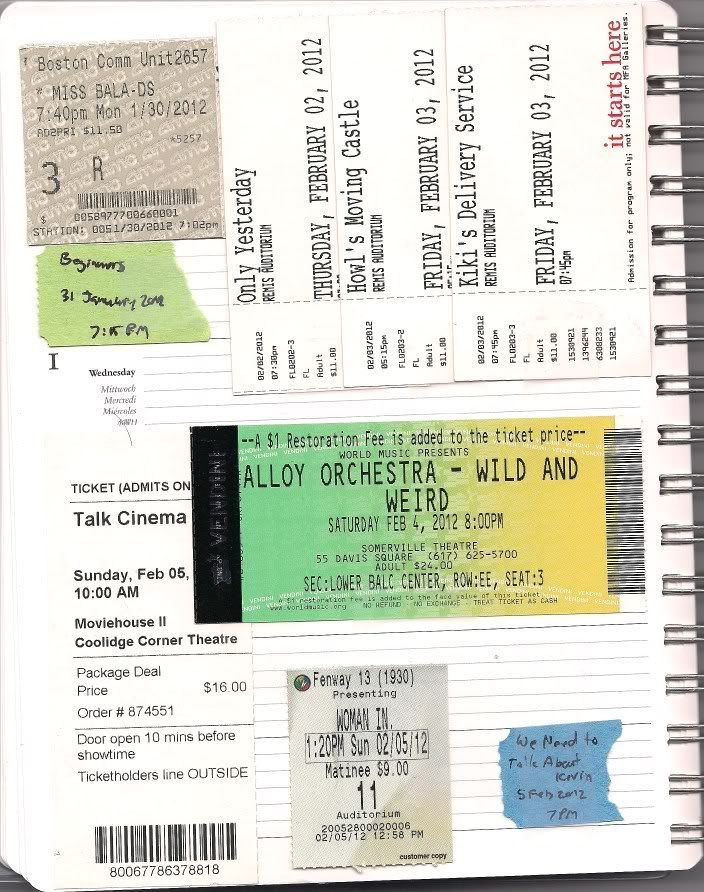
Friday, meanwhile, was a day off from work as IT reconfigured our computers for the new corporate overlords, and while for the most part, I'm not noticing much difference in working for a gigantic company versus the start-up it acquired, I might just decorate my laptop with stickers that accidentally cover the camera. I spent the day lolling around the house doing nothing, but it let me get to the MFA in time for a Miyazaki double feature.
And as you can see, I wasn't watching football Sunday night. Hey, it's not like I watched any of the Patriots' other 18 games this season, and Oscilloscope had been strangely quiet about opening We Need to Talk About Kevin in Boston. I suspect plans changed when it wasn't nominated for the expected Oscars (really, how does the Best Actress category not have either Kirsten Dunst or Tilda Swinton?), but it wasn't on the postcard they included in my latest Circle of Trust DVD, either. I hear it's been booked in West Newton, but the expected Cambridge playdates have yet to be announced.
Funny thing: This was the second time I've wound up watching a preview for a dark, dark movie at the HFA instead of the Super Bowl; the first being Irreversible. Since I arrived late and was in the front row, I don't know if Kevin had any walk-outs. It was eerily quiet when I got out, though - I could have walked back home in the middle of the street in perfect safety, just like the morning after a major snowstorm. But, hey, at least I saw a really good movie; I'm probably ahead of the folks who watched a crushing loss in that regard.
Beginners
* * * ¼ (out of four)
Seen 31 January 2012 in the Brattle Theatre [(Some of) The Best of 2011, 35mm]
Beginners is a cute, pleasant-enough little movie that will probably be seen as smothering Christopher Plummer's great performance, since that's what has been getting the bulk of the acclaim as people started making lists and filling in ballots to commemorate the change of one year to another. I think that might be a fair assessment - if the "Beginners" of the title are people just figuring out how to be in a relationship, despite their not exactly being kids any more, maybe we should see Plummer's Hal stumble with his new out-ness more, especially when what's going on with Hal's son Oliver (Ewan McGregor) and Anna (Mélanie Laurent), the equally relationship-challenged girl he meets is nice, but not quite superlative. There's also hints that this is the first time Hal and Oliver have ever been anything like close, but there's not a lot of beginners' mistakes there, either.
Still, there's not a bad performance from the main cast - McGregor and Laurent don't get to play parts as flashy as Plummer's, but they play their learning-how-not-to-be-lonely parts well. Pllummer is, of course, excellent, and while writer/director Mike Mills does tend to get a little cutesy with a gimmick in Oliver's narration a few times, he's also genuinely fantastic at how he abruptly moves back and forth in time, really making it clear that Oliver, for as hopeful as his present is and how hard he's trying, is very much stuck in the past at times.
The Alloy Orchestra: "Wild and Weird"
Seen 4 February 2012 in Somerville Theatre #1 (CrashArts)
The Alloy's annual visit to the Somerville Theatre wasn't quite a new soundtrack for a silent classic this year, but a concert where they accompanied ten short films, mostly from the early silent era, half of them over a hundred years old. They were projected from a video source, but almost all of them were kind of amazing in one way or another, as early filmmakers played with special effects, animation, and broad slapstick. There were a couple of variations on a theme - two takes on Windsor McCay's "Dreams of a Rarebit Fiend", only one of which by McCay himself; two with insect casts. Sometimes you have to catch yourself - at one point during "Red Spectre", I found myself thinking that it looked a bit rough before remembering that it was made in 1927 and the full color was actually amazing.
I am a little disappointed that I didn't get pictures, because this was the first time I've seen the Somerville's reconstructed orchestra pit in action. It changes the experience from the previous Alloy shows I've seen, where they're on stage next to the film and I find myself watching both - less makeshift, sure, but I did kind of find myself missing the band and their more unusual percussion being a visible part of the show.
Gianni e le donne (The Salt of Life)
* * ¾ (out of four)
Seen 5 February 2012 in Coolidge Corner Theatre #2 (Talk Cinema, 35mm)
The Salt of Life is the title given to this movie for it's American release; the actual title translates to "Gianni and the Woman", which is kind of literal but less pretentious, which might have been preferable. There's no great wisdom or philosophy to be found here, but a few smiles, as it's an amiable enough "late-life-crisis" movie.
It's one of those films that's "more a character piece", and this is one of the times that feels a bit like a cop-out. Character is best expressed via the character's action, and Gianni doesn't really do a lot; most of the time, he seems to be an unenthusiastic reflection of his friend Alfonso. It leads to a few funny moments, a few uncomfortable ones, and far too many moments that aren't really either. There either need to be more memorable moments or something stronger tying them together.
The Woman in Black
* * * ¼ (out of four)
Seen 5 February 2012 in Regal Fenway #11 (first-run, 4K digital)
A pretty darn solid ghost story. I think I enjoyed The Woman in Black much more than I expected, in part because it was going for a genre that seems hard to do authentically. The conventions of gothic horror movies were codified in film's infancy, and as the genre occasionally fell out of favor, the way movies were shot changed, and the basic culture became less familiar, there's a sense that later entries are trying to imitate the older ones, and it doesn't quite work; the cast and crew aren't as directly connected to the characters' world, and something about the look doesn't seem right. For example, during this one, I often found myself thinking that the background was too elaborate - the house should look like a flat matte painting, and the town should feel like it was built on a soundstage, with the camera and characters still lest it reveal that the scenery ends a foot past the edge of the frame.
But, judge this on what it is rather than an unfair (and sort of ridiculous) set of prejudices, and it works. The mythology makes a sort of spiritual sense, tragedy and fear loom over every inch of the story and setting, and director James Watkins times his scares well enough that the jumps punctuate stretches of actual nervousness. It's the sort of horror movie that wears its PG-13 rating as a badge of honor rather than an indication of compromise, and the cast does quite well when they are "doing" and "being" rather than just "establishing".
It's not perfect - through no fault of his own, Daniel Radcliffe is going to need a little more time to put Harry Potter behind him, especially for a role like this. Being young is fine, but his face needs to be more than glum; we need to see he's been shattered by tragedy. And like a lot of horror movies it doesn't quite stop at enough - it needs to bang the piano to punctuate something appearing, and any way you look at it, the last sequence is problematic. By and large, though, it works, creeping the audience out more than many of its more explicit counterparts.
We Need to Talk About Kevin
* * * ¾ (out of four)
Seen 5 February 2012 at the Harvard Film Archive (Lynn Ramsay, 35mm)
As chilling as everybody its reputation, with fine performances by the actors playing the title character at various ages and John C. Reilly as his father, as well as an absolutely fantastic one by Tilda Swinton as Eva. Co-writer/director Lynn Ramsay maintains an incredible level of focus, never once going for twists when crushing, horrible inevitability is an option. It is, after all, not about what happened as much as the reaction to it and build-up to it. It does a legitimately great job of playing on the audience's emotions - as much as the easy, and likely right, explanation is that Kevin was just born bad, it's hard not to get caught up in Eva's feelings of guilt that maybe she did something wrong. Or, perhaps, she's an unreliable narrator... The simple explanation is probably right, but the nuances make it fascinating.
If there's one fault, it's the occasional use of ironic music and sound choices, which might be clever in another movie, but this isn't really a pop-culture commentary picture. Still, that doesn't come close to undercutting the movie's effectiveness.
Friends and family with young kids: Don't see this movie for, like, twenty years.

Friday, meanwhile, was a day off from work as IT reconfigured our computers for the new corporate overlords, and while for the most part, I'm not noticing much difference in working for a gigantic company versus the start-up it acquired, I might just decorate my laptop with stickers that accidentally cover the camera. I spent the day lolling around the house doing nothing, but it let me get to the MFA in time for a Miyazaki double feature.
And as you can see, I wasn't watching football Sunday night. Hey, it's not like I watched any of the Patriots' other 18 games this season, and Oscilloscope had been strangely quiet about opening We Need to Talk About Kevin in Boston. I suspect plans changed when it wasn't nominated for the expected Oscars (really, how does the Best Actress category not have either Kirsten Dunst or Tilda Swinton?), but it wasn't on the postcard they included in my latest Circle of Trust DVD, either. I hear it's been booked in West Newton, but the expected Cambridge playdates have yet to be announced.
Funny thing: This was the second time I've wound up watching a preview for a dark, dark movie at the HFA instead of the Super Bowl; the first being Irreversible. Since I arrived late and was in the front row, I don't know if Kevin had any walk-outs. It was eerily quiet when I got out, though - I could have walked back home in the middle of the street in perfect safety, just like the morning after a major snowstorm. But, hey, at least I saw a really good movie; I'm probably ahead of the folks who watched a crushing loss in that regard.
Beginners
* * * ¼ (out of four)
Seen 31 January 2012 in the Brattle Theatre [(Some of) The Best of 2011, 35mm]
Beginners is a cute, pleasant-enough little movie that will probably be seen as smothering Christopher Plummer's great performance, since that's what has been getting the bulk of the acclaim as people started making lists and filling in ballots to commemorate the change of one year to another. I think that might be a fair assessment - if the "Beginners" of the title are people just figuring out how to be in a relationship, despite their not exactly being kids any more, maybe we should see Plummer's Hal stumble with his new out-ness more, especially when what's going on with Hal's son Oliver (Ewan McGregor) and Anna (Mélanie Laurent), the equally relationship-challenged girl he meets is nice, but not quite superlative. There's also hints that this is the first time Hal and Oliver have ever been anything like close, but there's not a lot of beginners' mistakes there, either.
Still, there's not a bad performance from the main cast - McGregor and Laurent don't get to play parts as flashy as Plummer's, but they play their learning-how-not-to-be-lonely parts well. Pllummer is, of course, excellent, and while writer/director Mike Mills does tend to get a little cutesy with a gimmick in Oliver's narration a few times, he's also genuinely fantastic at how he abruptly moves back and forth in time, really making it clear that Oliver, for as hopeful as his present is and how hard he's trying, is very much stuck in the past at times.
The Alloy Orchestra: "Wild and Weird"
Seen 4 February 2012 in Somerville Theatre #1 (CrashArts)
The Alloy's annual visit to the Somerville Theatre wasn't quite a new soundtrack for a silent classic this year, but a concert where they accompanied ten short films, mostly from the early silent era, half of them over a hundred years old. They were projected from a video source, but almost all of them were kind of amazing in one way or another, as early filmmakers played with special effects, animation, and broad slapstick. There were a couple of variations on a theme - two takes on Windsor McCay's "Dreams of a Rarebit Fiend", only one of which by McCay himself; two with insect casts. Sometimes you have to catch yourself - at one point during "Red Spectre", I found myself thinking that it looked a bit rough before remembering that it was made in 1927 and the full color was actually amazing.
I am a little disappointed that I didn't get pictures, because this was the first time I've seen the Somerville's reconstructed orchestra pit in action. It changes the experience from the previous Alloy shows I've seen, where they're on stage next to the film and I find myself watching both - less makeshift, sure, but I did kind of find myself missing the band and their more unusual percussion being a visible part of the show.
Gianni e le donne (The Salt of Life)
* * ¾ (out of four)
Seen 5 February 2012 in Coolidge Corner Theatre #2 (Talk Cinema, 35mm)
The Salt of Life is the title given to this movie for it's American release; the actual title translates to "Gianni and the Woman", which is kind of literal but less pretentious, which might have been preferable. There's no great wisdom or philosophy to be found here, but a few smiles, as it's an amiable enough "late-life-crisis" movie.
It's one of those films that's "more a character piece", and this is one of the times that feels a bit like a cop-out. Character is best expressed via the character's action, and Gianni doesn't really do a lot; most of the time, he seems to be an unenthusiastic reflection of his friend Alfonso. It leads to a few funny moments, a few uncomfortable ones, and far too many moments that aren't really either. There either need to be more memorable moments or something stronger tying them together.
The Woman in Black
* * * ¼ (out of four)
Seen 5 February 2012 in Regal Fenway #11 (first-run, 4K digital)
A pretty darn solid ghost story. I think I enjoyed The Woman in Black much more than I expected, in part because it was going for a genre that seems hard to do authentically. The conventions of gothic horror movies were codified in film's infancy, and as the genre occasionally fell out of favor, the way movies were shot changed, and the basic culture became less familiar, there's a sense that later entries are trying to imitate the older ones, and it doesn't quite work; the cast and crew aren't as directly connected to the characters' world, and something about the look doesn't seem right. For example, during this one, I often found myself thinking that the background was too elaborate - the house should look like a flat matte painting, and the town should feel like it was built on a soundstage, with the camera and characters still lest it reveal that the scenery ends a foot past the edge of the frame.
But, judge this on what it is rather than an unfair (and sort of ridiculous) set of prejudices, and it works. The mythology makes a sort of spiritual sense, tragedy and fear loom over every inch of the story and setting, and director James Watkins times his scares well enough that the jumps punctuate stretches of actual nervousness. It's the sort of horror movie that wears its PG-13 rating as a badge of honor rather than an indication of compromise, and the cast does quite well when they are "doing" and "being" rather than just "establishing".
It's not perfect - through no fault of his own, Daniel Radcliffe is going to need a little more time to put Harry Potter behind him, especially for a role like this. Being young is fine, but his face needs to be more than glum; we need to see he's been shattered by tragedy. And like a lot of horror movies it doesn't quite stop at enough - it needs to bang the piano to punctuate something appearing, and any way you look at it, the last sequence is problematic. By and large, though, it works, creeping the audience out more than many of its more explicit counterparts.
We Need to Talk About Kevin
* * * ¾ (out of four)
Seen 5 February 2012 at the Harvard Film Archive (Lynn Ramsay, 35mm)
As chilling as everybody its reputation, with fine performances by the actors playing the title character at various ages and John C. Reilly as his father, as well as an absolutely fantastic one by Tilda Swinton as Eva. Co-writer/director Lynn Ramsay maintains an incredible level of focus, never once going for twists when crushing, horrible inevitability is an option. It is, after all, not about what happened as much as the reaction to it and build-up to it. It does a legitimately great job of playing on the audience's emotions - as much as the easy, and likely right, explanation is that Kevin was just born bad, it's hard not to get caught up in Eva's feelings of guilt that maybe she did something wrong. Or, perhaps, she's an unreliable narrator... The simple explanation is probably right, but the nuances make it fascinating.
If there's one fault, it's the occasional use of ironic music and sound choices, which might be clever in another movie, but this isn't really a pop-culture commentary picture. Still, that doesn't come close to undercutting the movie's effectiveness.
Friends and family with young kids: Don't see this movie for, like, twenty years.
Monday, February 06, 2012
Studio Ghibli on Film, Week One: Only Yesterday, Howl's Moving Castle, and Kiki's Delivery Service
A theatrical distribution deal for catalog titles is generally not a big deal, but the Studio Ghibli animated features are not just any catalog titles; they're a uniquely high-quality collection of animated films that are as evergreen as any collection of pictures that size. When Disney acquired the distribution rights a decade ago, it seemed like a good fit: Aside from having similar sensibilities, Disney has made a lot of money on exploiting their catalog.
The thing is, part of that milking has been keeping those animated features out of theaters, and large studios in general are not great about handling repertory features. A small outfit like GKIDS, who is now handling theatrical distribution of these pictures (while Disney keeps home video rights), can concentrate on keeping the prints in shape and circulating.
That's what they're doing right now - Boston is, as far as I can tell, the third stop on their rounds. I'm somewhat surprised that the Museum of Fine Arts is where they stopped, but I suspect that they'll return some other time, to the Paramount or the Brattle or Coolidge, but likely in a more limited program, probably limited to the more familiar titles. Which is fine; seeing Kiki's Delivery Service and Howl's Moving Castle on the big screen, and on film, is a huge pleasure. But so is seeing Only Yesterday, a movie that I basically knew existed by diving a couple layers deep into the IMDB after seeing another movie. That's exactly the thing Disney can't really handle (even without the fact that health-class topics are a big part of one segment, putting it halfway between the Disney and Touchstone brands).
Sadly, I'm only going to get about halfway through the series - the movie scheduling gods have decided to make it hard for me to get to many of the times as they conflict with work, the Boston Sci-Fi Film Festival, and my Japanese classes. Not that I regret spending time on any of them (well, maybe work, but it pays for the other stuff), but I can't help but look at two or three other screenings and wish things were working out differently.
Omohide poro poro (Only Yesterday)
* * * ½ (out of four)
Seen 2 February 2012 in Museum of Fine Arts Remis Auditorium (Castles in the Sky, 35mm)
Though Studio Ghibli is best known for the fantasies of Hayao Miyazaki, the more grounded creations of Isao Takahata are, in may ways, equally striking. Movies like Only Yesterday are a unique variation on the "nostalgia film" genre, and few do the combination of animation and realism better than Takahata.
In 1983, Taeko (voice of Miki Imai) is twenty-seven years old, has lived in Tokyo all her life, and recently turned down a marriage proposal. This seems bizarre to both her co-workers and her mother, as does her decision to spend her vacation working on her sister's in-laws' farm. But Taeko's always been a bit of an odd girl, as we can tell from her memories of 1966, when she (voice of Youko Honna) was ten years old, was good at writing but not so good at math, and envied her her classmates who got to go away for the summer.
Though made years later and released in its native Japan in 1991 (in America, it's been held up in limbo as part of Ghibli's Disney distribution deal), the 1983 segments still tend to seem like "the present", despite how Taeko uses the past tense in her narration. This is mostly because Takahata shifts his technique a bit between periods: 1983 fills the screen, with both the city where Taeko starts and the country rendered in such detailed clarity as to almost appear three-dimensional; 1966, meanwhile, has only slightly more stylized character designs, but has much less fully-realized envrionments. Colors are faded, and the backgrounds often don't reach the edge of the screen, leaving the action surrounded by white space. Taeko recalls her childhood better than most, but those moments aren't as strong in her mind as this vacation.
Full review on EFC.
Hauru no ugoku shiro (Howl's Moving Castle)
* * * ¾ (out of four)
Seen 3 February 2012 in Museum of Fine Arts Remis Auditorium (Castles in the Sky, 35mm)
When I reviewed this for EFC on its American release six and a half years ago, I mentioned being interested in seeing the English-language version. That's what I wound up with on Friday, quite unexpectedly - only two screenings in the series were announced as dubbed, and this wasn't one of them. It's a clear example of how even with a great voice cast and careful attention to lip-sync, seeing a movie like this just isn't quite right. As I've been learning in my Saturday afternoon Japanese language classes, that language and English have very different rhythms, with a typical Japanese sentence containing more syllables in more rapid succession.
In retrospect, maybe I was a little over-enthusiastic in my 2005 review, but even toning the hyperbole down... This is a really good movie, with more creativity and amazing things in any given five minute period than most fantasy films have in their entire running time. I suspect that it's going to need another couple close watches for me to really work out what's going on in every moment, especially with how Sophie changes age. But I also strongly suspect that it will be well worth it.
Full review on EFC.
Majo no takkyûbin (Kiki's Delivery Service)
* * * * (out of four)
Seen 3 February 2012 in Museum of Fine Arts Remis Auditorium (Castles in the Sky, 35mm)
To describe any one movie by Hayao Miyazaki as his best is incredibly difficult; there are arguments to be made for both the complexity and maturity of his later works and the simple joy of where he started out. Kiki's Delivery Service is a part of the former group, and certainly one of my favorites of his work, a sweet, funny, beautifully told coming-of-age story for any age.
Kiki (voice of Minami Takayama) has just celebrated her thirteenth birthday, and in witch families like hers that is the traditional time for a girl to set off for a new town, where she will spend a year living and training on her own. Kiki and her black cat Jiji (voice of Rei Sakuma) land in a pretty coastal town, where she puts her flying skills to use as a courier. Her first customer, Osono (voice of Keiko Toda), lets Kiki have a room above her bakery, and Kiki makes a number of other new friends: Ursula (also voiced by Takayama), an artist who lives in the woods; a sweet old lady (voice of Haruko Kato) and her maid Bertha (voice of Hiroko Saki); and Tombo (voice of Kappei Yamaguchi), a flight-crazy boy her own age who develops an instant crush on the new girl.
But adolescence is a tricky thing; as one grows older, takes on more adult responsibilities, and grapples with new feelings, one stops believing in magic. Kiki is a nice girl, and she's landed with a pretty nice foster family, but like all teenagers, her confidence gets eroded by little things, and she envies the girls who wear stylish outfits while she is stuck in her drab, traditional black dress. Miyazaki's plotting is elegant in this regard; each new delivery and task Kiki faces is calculated to make the audience proud of the character but also plants a little more doubt in her mind. It winds up as both a character arc that rings true and a metaphor for one's body going haywire.
Full review on EFC.
The thing is, part of that milking has been keeping those animated features out of theaters, and large studios in general are not great about handling repertory features. A small outfit like GKIDS, who is now handling theatrical distribution of these pictures (while Disney keeps home video rights), can concentrate on keeping the prints in shape and circulating.
That's what they're doing right now - Boston is, as far as I can tell, the third stop on their rounds. I'm somewhat surprised that the Museum of Fine Arts is where they stopped, but I suspect that they'll return some other time, to the Paramount or the Brattle or Coolidge, but likely in a more limited program, probably limited to the more familiar titles. Which is fine; seeing Kiki's Delivery Service and Howl's Moving Castle on the big screen, and on film, is a huge pleasure. But so is seeing Only Yesterday, a movie that I basically knew existed by diving a couple layers deep into the IMDB after seeing another movie. That's exactly the thing Disney can't really handle (even without the fact that health-class topics are a big part of one segment, putting it halfway between the Disney and Touchstone brands).
Sadly, I'm only going to get about halfway through the series - the movie scheduling gods have decided to make it hard for me to get to many of the times as they conflict with work, the Boston Sci-Fi Film Festival, and my Japanese classes. Not that I regret spending time on any of them (well, maybe work, but it pays for the other stuff), but I can't help but look at two or three other screenings and wish things were working out differently.
Omohide poro poro (Only Yesterday)
* * * ½ (out of four)
Seen 2 February 2012 in Museum of Fine Arts Remis Auditorium (Castles in the Sky, 35mm)
Though Studio Ghibli is best known for the fantasies of Hayao Miyazaki, the more grounded creations of Isao Takahata are, in may ways, equally striking. Movies like Only Yesterday are a unique variation on the "nostalgia film" genre, and few do the combination of animation and realism better than Takahata.
In 1983, Taeko (voice of Miki Imai) is twenty-seven years old, has lived in Tokyo all her life, and recently turned down a marriage proposal. This seems bizarre to both her co-workers and her mother, as does her decision to spend her vacation working on her sister's in-laws' farm. But Taeko's always been a bit of an odd girl, as we can tell from her memories of 1966, when she (voice of Youko Honna) was ten years old, was good at writing but not so good at math, and envied her her classmates who got to go away for the summer.
Though made years later and released in its native Japan in 1991 (in America, it's been held up in limbo as part of Ghibli's Disney distribution deal), the 1983 segments still tend to seem like "the present", despite how Taeko uses the past tense in her narration. This is mostly because Takahata shifts his technique a bit between periods: 1983 fills the screen, with both the city where Taeko starts and the country rendered in such detailed clarity as to almost appear three-dimensional; 1966, meanwhile, has only slightly more stylized character designs, but has much less fully-realized envrionments. Colors are faded, and the backgrounds often don't reach the edge of the screen, leaving the action surrounded by white space. Taeko recalls her childhood better than most, but those moments aren't as strong in her mind as this vacation.
Full review on EFC.
Hauru no ugoku shiro (Howl's Moving Castle)
* * * ¾ (out of four)
Seen 3 February 2012 in Museum of Fine Arts Remis Auditorium (Castles in the Sky, 35mm)
When I reviewed this for EFC on its American release six and a half years ago, I mentioned being interested in seeing the English-language version. That's what I wound up with on Friday, quite unexpectedly - only two screenings in the series were announced as dubbed, and this wasn't one of them. It's a clear example of how even with a great voice cast and careful attention to lip-sync, seeing a movie like this just isn't quite right. As I've been learning in my Saturday afternoon Japanese language classes, that language and English have very different rhythms, with a typical Japanese sentence containing more syllables in more rapid succession.
In retrospect, maybe I was a little over-enthusiastic in my 2005 review, but even toning the hyperbole down... This is a really good movie, with more creativity and amazing things in any given five minute period than most fantasy films have in their entire running time. I suspect that it's going to need another couple close watches for me to really work out what's going on in every moment, especially with how Sophie changes age. But I also strongly suspect that it will be well worth it.
Full review on EFC.
Majo no takkyûbin (Kiki's Delivery Service)
* * * * (out of four)
Seen 3 February 2012 in Museum of Fine Arts Remis Auditorium (Castles in the Sky, 35mm)
To describe any one movie by Hayao Miyazaki as his best is incredibly difficult; there are arguments to be made for both the complexity and maturity of his later works and the simple joy of where he started out. Kiki's Delivery Service is a part of the former group, and certainly one of my favorites of his work, a sweet, funny, beautifully told coming-of-age story for any age.
Kiki (voice of Minami Takayama) has just celebrated her thirteenth birthday, and in witch families like hers that is the traditional time for a girl to set off for a new town, where she will spend a year living and training on her own. Kiki and her black cat Jiji (voice of Rei Sakuma) land in a pretty coastal town, where she puts her flying skills to use as a courier. Her first customer, Osono (voice of Keiko Toda), lets Kiki have a room above her bakery, and Kiki makes a number of other new friends: Ursula (also voiced by Takayama), an artist who lives in the woods; a sweet old lady (voice of Haruko Kato) and her maid Bertha (voice of Hiroko Saki); and Tombo (voice of Kappei Yamaguchi), a flight-crazy boy her own age who develops an instant crush on the new girl.
But adolescence is a tricky thing; as one grows older, takes on more adult responsibilities, and grapples with new feelings, one stops believing in magic. Kiki is a nice girl, and she's landed with a pretty nice foster family, but like all teenagers, her confidence gets eroded by little things, and she envies the girls who wear stylish outfits while she is stuck in her drab, traditional black dress. Miyazaki's plotting is elegant in this regard; each new delivery and task Kiki faces is calculated to make the audience proud of the character but also plants a little more doubt in her mind. It winds up as both a character arc that rings true and a metaphor for one's body going haywire.
Full review on EFC.
Friday, February 03, 2012
Next Week in Tickets: 3 February 2012 - 9 February 2012
It's a good thing I have an unexpected day off on Friday, because a deluge will start in earnest on the 10th (at least, for me). In the meantime, still a fair amount to see:
My plans? I've already purchased tickets for the Alloy Orchestra on Saturday and Talk Cinema on Sunday, and I might feel like going for Ghibli on Friday and Wednesday. That doesn't leave a whole lot of time to fit Chronicle, The Woman in Black, or A Separation in, but I'm pretty sure I'll make an effort.
- Okay, explain to me why Chronicle - a movie designed to look like low-resolution video - is playing at the proudly 35mm Somerville Theatre and old-school ghost story The Woman in Black isn't, more or less forcing me to see it in digital projection. The former is uses the found-footage aesthetic to present the story of a group of high-school kids that gain superpowers and are not quite so altruistic as superheroes tend to be, and looks like it could be fun. And yet, it may lose genre fans to the latter, who are likely to see The Woman in Black as the true return of the legendary Hammer Studios - it's the new Hammer's fourth movie, but only the second to get a major theatrical release, and while Let Me In was decent, it was relatively modern and American. The Woman in Black is the period British chills people associate with Hammer, and has a nifty cast: Daniel Radcliffe, Ciaran Hinds, and Janet McTeer.
Also hitting up the multiplexes: Big Miracle, a pleasant-looking family movie about a family of whales who get trapped under the ice in the Arctic during the 1980s. John Krasinski plays the reporter on the story, Drew Barrymore his environmental activist girlfriend, and Stephen Root as the difficult governor of Alaska. - This week's opening at the Coolidge is The Innkeepers, a ghost story from Ti West that has been playing on demand for a few weeks but which I'm almost certain works much better in a crowded theater, which is how I saw it at Fantasia. It plays in the screening room at 9:50pm every day, and on the main screen Friday and Saturday at midnight.
There are also two special presentations on Sunday morning. At 10am, there's a preview of The Salt of Life as part of the Talk Cinema series; at 10:30pm, the week's Kids' Show is Mary Poppins. The first is Gianni Di Gregorio's follow-up to Mid-August Lunch, with Di Gregorio as a retiree finding himself becoming invisible to the fair sex; the latter is, well, Mary Poppins. - Only one film opening at Kendall Square this week, a one-week booking of Charlotte Rampling: The Look, a "self-portrait through others" of the French actress which features both film clips and her conversations with other artists.
- The Alloy Orchestra makes their annual trip to the Somerville Theatre on Saturday with "Wild and Weird", in which they accompany a set of early, and strange, short films. That and another concert will bump The Girl with the Dragon Tattoo for a couple of days, while the opening of Chronicle pushes Contraband to their sister theater in Arlington.
- The Brattle wraps up (Some of) The Best of 2011 with some fun stuff: Drive on Friday, Rango on Saturday and Sunday afternoons, a Boston Society of Film Critics screening of Moneyball (with the writer present) Saturday night, Martha Marcy May Marlene on Sunday evening, and a rescheduled screening of The Interrupters at 5pm on Monday.
Monday and Tuesday will also feature guests as part of regular screening programs. On Monday, The DocYard welcomes Mona Micoara with her film Our School, which chronicles four years on the attempt to integrate Romanian schools (in this case, kids from a Roma village going to a city school). On Tuesday, DJ Angel Sawyer spins some tunes before a set of short films about public land, with Robert Fenz there to discuss his contribution, "Crossings".
And, finally, as part of a cross-promotion with the American Repatory Theatre's Wild Swans, Wednesday and Thursday will feature Modern China on Screen. The movie Wednesday night is Tian Zhuangzhuang's The Blue Kite, while thursday offers a double feature of Zhang Yimous To Live and Jia Zhangke's 24 City. - Robert Fenz will first be at the Harvard Film Archive on Friday night with a set of recent short films that play with sound and silence, including "Correspondence" and "The Sole of the Foot". Another filmmaker, Lynn Ramsay, was originally scheduled to visit on Sunday, but the special preview of We Need to Talk About Kevin she was to host will instead go on without her. Two of Ramsay's other films, Ratcatcher and Morvern Callar, will play Saturday evening; all three will be preceded by short films. The Robert Bresson series also continues, with L'Argent repeating on Sunday afternoon and Une Femme Douce playing on Monday evening.
- The MFA continues their Studio Ghibli program, with Howl's Moving Castle, Kiki's Delivery Service, Only Yesterday, My Neighbor Totoro, Whisper of the Heart, and Laputa: Castle in the Sky playing at various times during the week. Most are in 35mm (and, if Only Yesterday is any indication, looking good), and all are subtitled except the screening of Totoro at 10:30am Saturday.
Friday and Saturday also include the first film in the "Exiled In Hollywood: Outcast Artists in Southern California", which features movies created and, especially, scored by WWII emigres. The first entry is Reunion in France, directed by Jules Dassin with a soundtrack by Franz Waxman. Sunday features the ReelAbilities Boston Film Festival, featuring Shooting Beauty and Snow Cake. Wednesday and Thursday feature the first two screenings of The Swell Season, which features the stars and songwriters of Once going on tour and nearly ruining everything. - ArtsEmerson picks up the Dreileben trilogy that played the Harvard Film Archive a couple weeks ago, with Beats Being Dead and Don't Follow Me Around playing Friday and One Minute of Darkness on Sunday. In between, Saturday features a kid-friendly matinee of Joe Dante's Explorers and an evening double feature of rare musicals with African-American casts on archival prints as part of Gotta Dance!: 1929's Hearts In Dixie and 1938 "race film" Swing!.
- The Regent Theatre in Arlington has one film this week, the documentary I Am Bruce Lee on Thursday the 9th, which features friend, collaborators, and fans of the famed martial artist and screen star.
My plans? I've already purchased tickets for the Alloy Orchestra on Saturday and Talk Cinema on Sunday, and I might feel like going for Ghibli on Friday and Wednesday. That doesn't leave a whole lot of time to fit Chronicle, The Woman in Black, or A Separation in, but I'm pretty sure I'll make an effort.
Thursday, February 02, 2012
Spanish-Language: Nostalgia for the Light and Miss Bala
Weak attempt at a theme post, seeing as these two movies really have very little to do with each other than both being in Spanish. I did see them on consecutive nights, though, so that's kind of a theme. But, as far as Latin American countries go, the current situations in Nostalgia's Chile and Miss Bala's Mexico are strikingly different: Chile appears to now be quite stable and relatively prosperous, although one likely gets a rather skewed view from Nostalgia: It mostly takes place in the pristine desert, with the main buildings seen a pristine astronomy. The Tijuana of Miss Bala, on the other hand, is chaotic, the sort of place where drug lords can move around with large weapons and only attract a little attention.
Both are pretty good movies, though. If you're reading this on the day it's posted, you may still have a chance to see Miss Bala in Boston; I was the only one in the theater for the 7:40pm show on Tuesday, and it deserves a little more than that.
Nostalgia de la luz (Nostalgia for the Light)
* * * ½ (out of four)
Seen 29 January 2012 in the Brattle Theatre [(Some of) The Best of 2011, 35mm]
I don't think it was Patricio Guzmán's plan to do a bait-and-switch with his documentary Nostalgia for the Light, but if it was, he executes an unusually smooth and effective one here: It's one thing to start with astronomy and end with mass murder, but pulling the two subjects together so well that the audience will thank you for switching things up is a really neat trick.
Chile's Atacama Desert, with its complete lack of humidity, is the best place in the world to observe the southern sky, and as a result astronomers from around the world have been building telescopes there for over a century. The still, dry air and lack of any sort of native life makes the area valuable to many others aside from those looking to the heavens, though: The drawings of Pre-Colombian natives are still clearly visible in many places, and the widows and orphans of those "disappeared" during the Pinochet regime hope that their loved ones' hidden remains have also been preserved.
Though the study of far-off stars and human atrocities may seem like completely different subjects, Guzmán links them by pointing out how all human observation is of the past. As astronomer Gaspar Galaz explains, the far-off galaxies he observes are seen as they were millions to billions of years in the past; the sun in the sky is that of eight minutes ago; the moon we see is that of one second ago; even what we feel when touching things has a small delay in reaching our brains. Archeologist Lautaro Núñez expands on this, pointing out how the drawings of ancient peoples may be easily accessible, but it is very difficult to learn about nineteenth-century Chile. Later, it is taken as a given information from mere decades ago has been actively suppressed. Though everybody in Atacama is looking to learn something different, they are all facing variations of the same limits.
Full review at EFC.
Miss Bala
* * * ½ (out of four)
Seen 30 January 2012 in AMC Boston Common #3 (first-run, digital)
Miss Bala was Mexico's submission for "best foreign language film" at the Academy Awards this year, but didn't quite make the cut. That's may be appropriate, depending on how you look at it - its either a thriller that's short one twist and thus settles for being merely very, very good or an excellent attempt to communicate the constant, unending tension of life in certain parts of Mexico. Either way, it's a movie well worth watching, and in many ways exceptional - it's a rare movie that can sustain tension as long and as well as this one.
Laura Guerrero (Stephanie Sigman) is twenty-three and lives with her father and little brother on the outskirts of Tijuana, and quite pretty, enough so that she is able to talk her way into the Miss Baja California contest despite being quite unprepared. Her friend Zusu makes it too, and parties with her gangster boyfriend to celebrate. Laura is trying to get her out of there when all hell breaks loose between rival gangs, and her attempts to find Zusu instead lead her to Lino Valdez (Noe Hernandez), a big name in the La Estrella crime syndicate with a favor to ask. Of course, Lino's in trouble too, so doing him favors probably just makes the peril less immediate.
Director Gerardo Naranjo and his co-writer Mauricio Katz do a number of things very well here, but one thing that is especially impressive is how, once they've started to bear down on Laura and the audience, they maintain a remarkably constant pressure. It's not so much that Naranjo (who also edits) never eases up - although that's rare - but the build-up is such a well-executed slow burn that the audience seldom feels the need for immediate cathartic release. That's good, because the closest thing to comic relief is when the story moves through the Miss Baja California pageant, which by that point seems surreally superficial compared to what Laura's been through. In fact, the filmmakers barely let up for exposition - Laura receives much more in the way of instructions than information, and since the audience is almost never privy to anything she can't see, we (like she) must piece things together from overheard news reports and first-hand experience.
Full review at EFC.
Both are pretty good movies, though. If you're reading this on the day it's posted, you may still have a chance to see Miss Bala in Boston; I was the only one in the theater for the 7:40pm show on Tuesday, and it deserves a little more than that.
Nostalgia de la luz (Nostalgia for the Light)
* * * ½ (out of four)
Seen 29 January 2012 in the Brattle Theatre [(Some of) The Best of 2011, 35mm]
I don't think it was Patricio Guzmán's plan to do a bait-and-switch with his documentary Nostalgia for the Light, but if it was, he executes an unusually smooth and effective one here: It's one thing to start with astronomy and end with mass murder, but pulling the two subjects together so well that the audience will thank you for switching things up is a really neat trick.
Chile's Atacama Desert, with its complete lack of humidity, is the best place in the world to observe the southern sky, and as a result astronomers from around the world have been building telescopes there for over a century. The still, dry air and lack of any sort of native life makes the area valuable to many others aside from those looking to the heavens, though: The drawings of Pre-Colombian natives are still clearly visible in many places, and the widows and orphans of those "disappeared" during the Pinochet regime hope that their loved ones' hidden remains have also been preserved.
Though the study of far-off stars and human atrocities may seem like completely different subjects, Guzmán links them by pointing out how all human observation is of the past. As astronomer Gaspar Galaz explains, the far-off galaxies he observes are seen as they were millions to billions of years in the past; the sun in the sky is that of eight minutes ago; the moon we see is that of one second ago; even what we feel when touching things has a small delay in reaching our brains. Archeologist Lautaro Núñez expands on this, pointing out how the drawings of ancient peoples may be easily accessible, but it is very difficult to learn about nineteenth-century Chile. Later, it is taken as a given information from mere decades ago has been actively suppressed. Though everybody in Atacama is looking to learn something different, they are all facing variations of the same limits.
Full review at EFC.
Miss Bala
* * * ½ (out of four)
Seen 30 January 2012 in AMC Boston Common #3 (first-run, digital)
Miss Bala was Mexico's submission for "best foreign language film" at the Academy Awards this year, but didn't quite make the cut. That's may be appropriate, depending on how you look at it - its either a thriller that's short one twist and thus settles for being merely very, very good or an excellent attempt to communicate the constant, unending tension of life in certain parts of Mexico. Either way, it's a movie well worth watching, and in many ways exceptional - it's a rare movie that can sustain tension as long and as well as this one.
Laura Guerrero (Stephanie Sigman) is twenty-three and lives with her father and little brother on the outskirts of Tijuana, and quite pretty, enough so that she is able to talk her way into the Miss Baja California contest despite being quite unprepared. Her friend Zusu makes it too, and parties with her gangster boyfriend to celebrate. Laura is trying to get her out of there when all hell breaks loose between rival gangs, and her attempts to find Zusu instead lead her to Lino Valdez (Noe Hernandez), a big name in the La Estrella crime syndicate with a favor to ask. Of course, Lino's in trouble too, so doing him favors probably just makes the peril less immediate.
Director Gerardo Naranjo and his co-writer Mauricio Katz do a number of things very well here, but one thing that is especially impressive is how, once they've started to bear down on Laura and the audience, they maintain a remarkably constant pressure. It's not so much that Naranjo (who also edits) never eases up - although that's rare - but the build-up is such a well-executed slow burn that the audience seldom feels the need for immediate cathartic release. That's good, because the closest thing to comic relief is when the story moves through the Miss Baja California pageant, which by that point seems surreally superficial compared to what Laura's been through. In fact, the filmmakers barely let up for exposition - Laura receives much more in the way of instructions than information, and since the audience is almost never privy to anything she can't see, we (like she) must piece things together from overheard news reports and first-hand experience.
Full review at EFC.
Tuesday, January 31, 2012
Sundance USA Boston 2012: Celeste and Jesse Forever
Last year, I don't think I heard much (if anything) about My Idiot Brother before catching it at Sundance USA, and it wound up being a fairly pleasant surprise. I may have oversold it a little, but it was a legitimately charming comedy with a nice cast that should have made a little more noise when it was released in August as Our Idiot Brother.
This year, it almost seemed as if the programmers were trying to go for a repeat of that - the movie showing at the Coolidge this year even starred one of Brother's cast members, Rashida Jones, and looked like it could have been funny. It was also picked up for distribution before hitting Brookline, and will likely also be released in August. Unfortunately, I was hearing bad things about it once it started screening in Park City and those warnings turned out to be right. Heck of a bummer, buying a $15 ticket weeks ahead of time and hearing that.
Anyway, I think this is the first festival-type screening since getting my new phone! Let's see how it helps with the Terrible Photography:
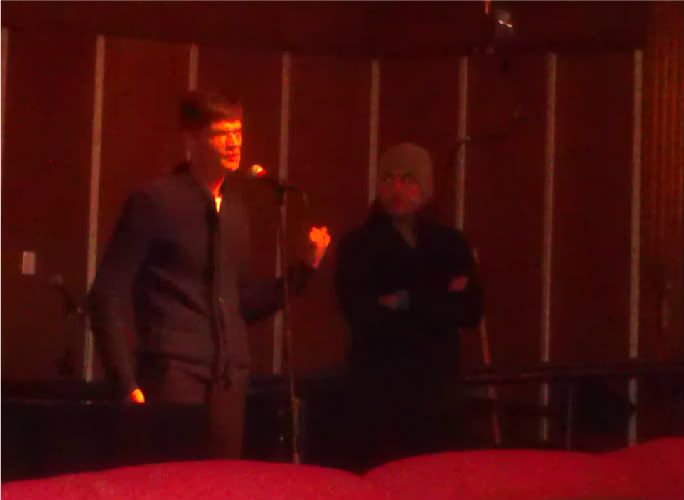
Dudes, c'mon, these people paid good money; dress up a little!
Well, not great, but the Coolidge isn't a great environment for this; it looks dark when you're just sitting there, and they always do Q&As off to the side as opposed to on the stage, under the lights.
Kind of fitting, though, considering how dark the picture was. They mentioned it before and after the film; I'm guessing that the Coolidge had to rent a DCP rig for the evening and there wasn't time to get everything to 100% in time for the screening. It wouldn't have made the movie any better, but it's an expensive ticket for that to happen at, which makes a lot of otherwise good organizations look kind of rinky-dink. And I'm guessing it wouldn't have happened with 35mm!
Celeste and Jesse Forever
* ¾ (out of four)
Seen 26 January 2012 in Coolidge Corner Theatre #1 (Sundance USA)
"I don't like the main character" isn't really a great reason to dislike a movie - there are plenty of disreputable protagonists who are nevertheless intriguing - but in real life, it's not a lot of fun to hang around people who complain despite being the authors of their own misery. That's what Celeste and Jesse Forever too often feels like; it wants to be a relationship comedy with some depth, but it seldom has much beyond the superficial.
Celeste (Rashida Jones) and Jesse (Andy Samberg) have been best friends and lovers for half their lives, and can be almost nauseatingly cute together. It kind of freaks their engaged friends Beth (Ari Graynor) and Tucker (Eric Christian Olsen) out, as this is not, in their minds, the way a couple in the middle of a divorce should be acting. And despite the sources of friction that still show up occasionally, they remain best friends, even if they do seem like they should inevitably be pulled back toward each other. At least, it seems that way until Celeste returns from a tour to promote her new book; the two weeks apart have changed the landscape considerably.
Jesse is an artist who, toward the start of the movie, is more interested in catching some waves than finishing some work for Celeste's public relations firm, while Celeste is a "trend analyst"; the title of her book, "Shitegeist", gives some idea of how reflexively cynical she can be. And while they may not be horrible people, there's not much to them that's actively interesting - they're introduced to us with comedic shtick and the first personality traits of either that make a strong impression are negative. They're hollow shells who make what impression they do manage by having decent actors playing them, and that's the title characters - the supporting cast frequently doesn't even get a chance to rise to the level of "superficial".
Full review at EFC.
This year, it almost seemed as if the programmers were trying to go for a repeat of that - the movie showing at the Coolidge this year even starred one of Brother's cast members, Rashida Jones, and looked like it could have been funny. It was also picked up for distribution before hitting Brookline, and will likely also be released in August. Unfortunately, I was hearing bad things about it once it started screening in Park City and those warnings turned out to be right. Heck of a bummer, buying a $15 ticket weeks ahead of time and hearing that.
Anyway, I think this is the first festival-type screening since getting my new phone! Let's see how it helps with the Terrible Photography:

Dudes, c'mon, these people paid good money; dress up a little!
Well, not great, but the Coolidge isn't a great environment for this; it looks dark when you're just sitting there, and they always do Q&As off to the side as opposed to on the stage, under the lights.
Kind of fitting, though, considering how dark the picture was. They mentioned it before and after the film; I'm guessing that the Coolidge had to rent a DCP rig for the evening and there wasn't time to get everything to 100% in time for the screening. It wouldn't have made the movie any better, but it's an expensive ticket for that to happen at, which makes a lot of otherwise good organizations look kind of rinky-dink. And I'm guessing it wouldn't have happened with 35mm!
Celeste and Jesse Forever
* ¾ (out of four)
Seen 26 January 2012 in Coolidge Corner Theatre #1 (Sundance USA)
"I don't like the main character" isn't really a great reason to dislike a movie - there are plenty of disreputable protagonists who are nevertheless intriguing - but in real life, it's not a lot of fun to hang around people who complain despite being the authors of their own misery. That's what Celeste and Jesse Forever too often feels like; it wants to be a relationship comedy with some depth, but it seldom has much beyond the superficial.
Celeste (Rashida Jones) and Jesse (Andy Samberg) have been best friends and lovers for half their lives, and can be almost nauseatingly cute together. It kind of freaks their engaged friends Beth (Ari Graynor) and Tucker (Eric Christian Olsen) out, as this is not, in their minds, the way a couple in the middle of a divorce should be acting. And despite the sources of friction that still show up occasionally, they remain best friends, even if they do seem like they should inevitably be pulled back toward each other. At least, it seems that way until Celeste returns from a tour to promote her new book; the two weeks apart have changed the landscape considerably.
Jesse is an artist who, toward the start of the movie, is more interested in catching some waves than finishing some work for Celeste's public relations firm, while Celeste is a "trend analyst"; the title of her book, "Shitegeist", gives some idea of how reflexively cynical she can be. And while they may not be horrible people, there's not much to them that's actively interesting - they're introduced to us with comedic shtick and the first personality traits of either that make a strong impression are negative. They're hollow shells who make what impression they do manage by having decent actors playing them, and that's the title characters - the supporting cast frequently doesn't even get a chance to rise to the level of "superficial".
Full review at EFC.
Monday, January 30, 2012
This Week In Tickets: 23 January 2012 to 29 January 2012
I swear, tickets at the Coolidge keep getting bigger. I think they know about this blog and are jockeying for real estate on the screen.
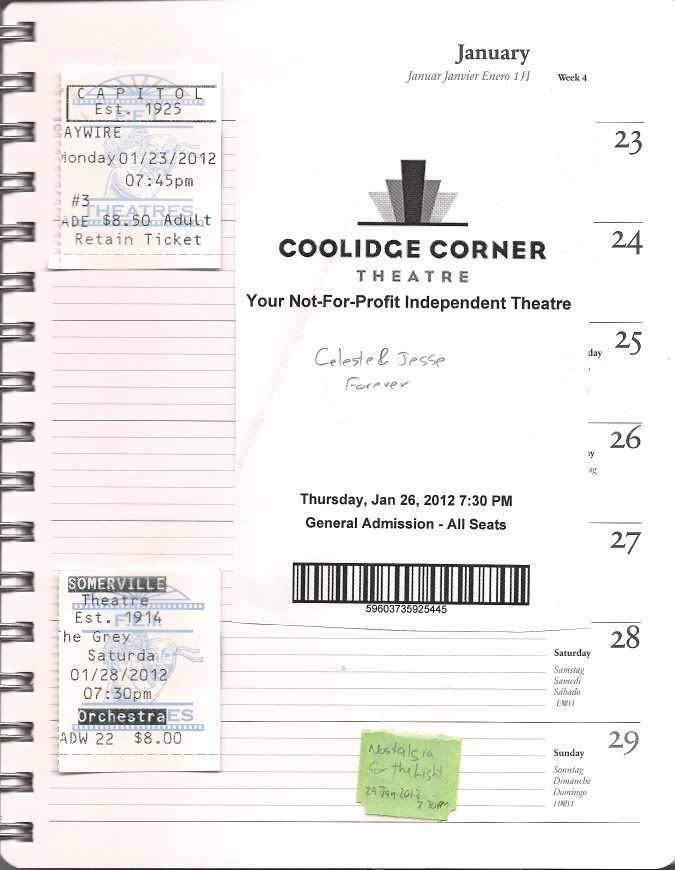
OK, that's because I pre-ordered a ticket for Celeste and Jesse Forever and thus printed it out at home. Meanwhile, I half-suspect that the Brattle just gives out ticket stubs because it would feel weird to go to a movie and not have your ticket ripped.
Well, that and litter-based advertising. Not that the good people who run movie theaters would say they want you to just toss things away, but people seeing those brightly-colored bits of paper with the theater's name on it on the sidewalk or the floor of the bus can't hurt.
Haywire
* * * ¾ (out of four)
Seen 23 January 2012 in Arlington Capitol #3 (first-run, 35mm)
One might think, based on the casting of a mixed-martial arts fighter in the lead role, that Haywire would be a non-stop action showcase, one more piece of evidence that director Steven Soderbergh can make any genre his own. That it's not the sort of melee-based movie that one would normally see out of Hong Kong or Thailand is initially a bit disappointing, at least until the viewer realizes that it's Soderbergh doing what he does best - with additional ass-kicking.
We start with private security operative Mallory Kane (Gina Carano) sitting in a diner in upstate New York, waiting for a contact who finally comes in the form of her colleague Aaron (Channing Tatum). He, naturally, is planning to double-cross her, but she's ready, escaping with young hostage Scott (Michael Angarano). It's not the typical hostage/captor relationship, though, as she spills every detail about her mission in Barcelona with Aaron at the behest of State Department officials Coblenz (Michael Douglas) and Rodrigo (Antonio Banderas), how her employer and former lover Kenneth (Ewan McGregor) pulled her in to one more mission in Dublin with Paul (Michael Fassbender), and how that led to her stealing his car and having him patch up her arm while she tries to make her way to her father (Bill Paxton).
Soderbergh has made a lot of movies in his career, from tiny indies to big studio productions, and across all genres, but the thread that has run through most of them in one for or another - and been particularly prominent in some of his recent work - is the idea of a sort of observational drama. Haywire, like Contagion, The Girlfriend Experience, and some of his other films, has him standing back and matching his characters' cool professionalism rather than poking at them to figure out what makes them tick emotionally. It can make for dry-seeming movies unless you find process as fascinating as Soderbergh seems to, but the attentive viewer will surely be rewarded. For Haywire, that means showing the audience what may seem inconsequential details like Coblenz and Kenneth negotiating the contract for the Barcelona job, or the agents doing the sort of set-up that would be quick-cut flashbacks in other action movies. One has to watch closely and give special attention to looks that linger for a second extra or twitches at the corner of the mouth.
Full review at EFC.
Celeste and Jesse Forever
* * (out of four)
Seen 26 January 2012 in Coolidge Corner Theatre #3 (Sundance USA, digital)
This will get its own entry in a day or two, but let's just say that, despite being a game effort, it's not very good. The main character is difficult to like and has the frustrating tendency to lag well behind where the audience expects her to be in her development, and she's surrounded by characters who really seem to exist when and for what purpose the plot needs them to exist. This includes Andy Samberg's Jesse, which is especially frustrating, because we hear him talk about problems in his new relationship but never see them. As played-out as those storylines would likely be, they've got to be more interesting than Celeste's self-pity.
The Grey
* * * ¾ (out of four)
Seen 28 January 2012 in Somerville Theater #1 (first-run, 35mm)
About a year ago, the AMC and Regal cinema chains announced that they were forming their own distributor, both to keep a little more money from ticket sales and to supply themselves with the sort of movies that they felt the studios were ignoring - middle-budget productions aimed at an adult audience. From the looks of The Grey, Open Road is delivering the goods; it's a tight wilderness thriller whose aspirations to be somewhat more actually do elevate it.
A big part of the reason why is that John Ottway may just be the best role Liam Neeson has ever had, Oskar Schindler included. It's a part that requires the comingling of incredible confidence and despair, because it's a real man's role: The type that requires outword stoicism or brusqueness to attempt to cover for how the man feels too much. Neeson's great at that, both as Ottway does all he can to keep his fellow plane-crash survivors alive and at the moments when there's nobody to present a front to and he's overwhelmed.
He's got a strong script to work with from Joe Carnahan and Ian Mackenzie Jeffers, with Carnahan delivering a tightfinal film. He never forgets that this is an adventure film as well as a character study, and keeps the moments between life-threatening danger short and to the point. He also knows how to get maximum impact from his action scenes: Where a lot of directors having people cross a rope over a gap would do the vertigo-inducing shots on the first person to cross and then have the others make it without incident, he reverses the order, never allowing us to take for granted how dangerous it is.
Be warned: The Grey is not the "Liam Neeson punching wolves" movie that the preview implies, but "Liam Neeson facing death with manly resolve is just as good. Also, despite the fact that the movie is produced by two theater chains rushing headlong into digital projection (I think all of the AMCs or Regals in the Boston area are 100% digital), it looks really great on 35mm film; see it that way if you can.
Nostalgia de la Luz (Nostalgia for the Light)
* * * ½ (out of four)
Seen 29 January 2012 in the Brattle Theatre [(Some of) The Best of 2011, 35mm]
This one will also get its own write-up sometime in the next week, as it's a good film that doesn't have a review at eFilmCritic. In the meantime, it's a good movie that wanders a bit, although that tendency is its greatest strength as much as it's a weakness.
Writer/director/editor/narrator Patricio Guzmán is more known for his political documentaries, so the telescopes in Chile's Atacama desert may seem like an odd starting point for him, but we soon see that the same zero-humidity conditions that make Atacama ideal for stargazing also preserve other types of history (any space enthusiast will remind you that what one sees through a telescope is the universe as it once appeared, not how it is at this moment): Drawings made by pre-Columbian natives are remarkably clear, and old widows can still search for the mummified remains of political prisoners from the Pinochet dictatorship. It turns out to be a masterful way to pull disparate subjects together, and Guzmán's film seems much more focused than other broadly philosophical pictures of its ilk.
Still, it does run on a little bit. The streamlined interview structure of the first half falls aside as he speaks to many survivors of the Pinochet years who basically say the same thing, a metaphor involving calcium doesn't quite gain traction, and everything after the film's most striking image (what seems to be another picture of the moon becomes a skull as the camera pans down) is maybe gilding the lily. Ultimately, though, Guzmán does what he set out to do, making a documentary that can draw an audience interested in one subject in to a film about another.

OK, that's because I pre-ordered a ticket for Celeste and Jesse Forever and thus printed it out at home. Meanwhile, I half-suspect that the Brattle just gives out ticket stubs because it would feel weird to go to a movie and not have your ticket ripped.
Well, that and litter-based advertising. Not that the good people who run movie theaters would say they want you to just toss things away, but people seeing those brightly-colored bits of paper with the theater's name on it on the sidewalk or the floor of the bus can't hurt.
Haywire
* * * ¾ (out of four)
Seen 23 January 2012 in Arlington Capitol #3 (first-run, 35mm)
One might think, based on the casting of a mixed-martial arts fighter in the lead role, that Haywire would be a non-stop action showcase, one more piece of evidence that director Steven Soderbergh can make any genre his own. That it's not the sort of melee-based movie that one would normally see out of Hong Kong or Thailand is initially a bit disappointing, at least until the viewer realizes that it's Soderbergh doing what he does best - with additional ass-kicking.
We start with private security operative Mallory Kane (Gina Carano) sitting in a diner in upstate New York, waiting for a contact who finally comes in the form of her colleague Aaron (Channing Tatum). He, naturally, is planning to double-cross her, but she's ready, escaping with young hostage Scott (Michael Angarano). It's not the typical hostage/captor relationship, though, as she spills every detail about her mission in Barcelona with Aaron at the behest of State Department officials Coblenz (Michael Douglas) and Rodrigo (Antonio Banderas), how her employer and former lover Kenneth (Ewan McGregor) pulled her in to one more mission in Dublin with Paul (Michael Fassbender), and how that led to her stealing his car and having him patch up her arm while she tries to make her way to her father (Bill Paxton).
Soderbergh has made a lot of movies in his career, from tiny indies to big studio productions, and across all genres, but the thread that has run through most of them in one for or another - and been particularly prominent in some of his recent work - is the idea of a sort of observational drama. Haywire, like Contagion, The Girlfriend Experience, and some of his other films, has him standing back and matching his characters' cool professionalism rather than poking at them to figure out what makes them tick emotionally. It can make for dry-seeming movies unless you find process as fascinating as Soderbergh seems to, but the attentive viewer will surely be rewarded. For Haywire, that means showing the audience what may seem inconsequential details like Coblenz and Kenneth negotiating the contract for the Barcelona job, or the agents doing the sort of set-up that would be quick-cut flashbacks in other action movies. One has to watch closely and give special attention to looks that linger for a second extra or twitches at the corner of the mouth.
Full review at EFC.
Celeste and Jesse Forever
* * (out of four)
Seen 26 January 2012 in Coolidge Corner Theatre #3 (Sundance USA, digital)
This will get its own entry in a day or two, but let's just say that, despite being a game effort, it's not very good. The main character is difficult to like and has the frustrating tendency to lag well behind where the audience expects her to be in her development, and she's surrounded by characters who really seem to exist when and for what purpose the plot needs them to exist. This includes Andy Samberg's Jesse, which is especially frustrating, because we hear him talk about problems in his new relationship but never see them. As played-out as those storylines would likely be, they've got to be more interesting than Celeste's self-pity.
The Grey
* * * ¾ (out of four)
Seen 28 January 2012 in Somerville Theater #1 (first-run, 35mm)
About a year ago, the AMC and Regal cinema chains announced that they were forming their own distributor, both to keep a little more money from ticket sales and to supply themselves with the sort of movies that they felt the studios were ignoring - middle-budget productions aimed at an adult audience. From the looks of The Grey, Open Road is delivering the goods; it's a tight wilderness thriller whose aspirations to be somewhat more actually do elevate it.
A big part of the reason why is that John Ottway may just be the best role Liam Neeson has ever had, Oskar Schindler included. It's a part that requires the comingling of incredible confidence and despair, because it's a real man's role: The type that requires outword stoicism or brusqueness to attempt to cover for how the man feels too much. Neeson's great at that, both as Ottway does all he can to keep his fellow plane-crash survivors alive and at the moments when there's nobody to present a front to and he's overwhelmed.
He's got a strong script to work with from Joe Carnahan and Ian Mackenzie Jeffers, with Carnahan delivering a tightfinal film. He never forgets that this is an adventure film as well as a character study, and keeps the moments between life-threatening danger short and to the point. He also knows how to get maximum impact from his action scenes: Where a lot of directors having people cross a rope over a gap would do the vertigo-inducing shots on the first person to cross and then have the others make it without incident, he reverses the order, never allowing us to take for granted how dangerous it is.
Be warned: The Grey is not the "Liam Neeson punching wolves" movie that the preview implies, but "Liam Neeson facing death with manly resolve is just as good. Also, despite the fact that the movie is produced by two theater chains rushing headlong into digital projection (I think all of the AMCs or Regals in the Boston area are 100% digital), it looks really great on 35mm film; see it that way if you can.
Nostalgia de la Luz (Nostalgia for the Light)
* * * ½ (out of four)
Seen 29 January 2012 in the Brattle Theatre [(Some of) The Best of 2011, 35mm]
This one will also get its own write-up sometime in the next week, as it's a good film that doesn't have a review at eFilmCritic. In the meantime, it's a good movie that wanders a bit, although that tendency is its greatest strength as much as it's a weakness.
Writer/director/editor/narrator Patricio Guzmán is more known for his political documentaries, so the telescopes in Chile's Atacama desert may seem like an odd starting point for him, but we soon see that the same zero-humidity conditions that make Atacama ideal for stargazing also preserve other types of history (any space enthusiast will remind you that what one sees through a telescope is the universe as it once appeared, not how it is at this moment): Drawings made by pre-Columbian natives are remarkably clear, and old widows can still search for the mummified remains of political prisoners from the Pinochet dictatorship. It turns out to be a masterful way to pull disparate subjects together, and Guzmán's film seems much more focused than other broadly philosophical pictures of its ilk.
Still, it does run on a little bit. The streamlined interview structure of the first half falls aside as he speaks to many survivors of the Pinochet years who basically say the same thing, a metaphor involving calcium doesn't quite gain traction, and everything after the film's most striking image (what seems to be another picture of the moon becomes a skull as the camera pans down) is maybe gilding the lily. Ultimately, though, Guzmán does what he set out to do, making a documentary that can draw an audience interested in one subject in to a film about another.
Friday, January 27, 2012
Next Week in Tickets: Films playing Boston 27 January 2012 - 2 February 2012
Huh, I haven't done an Oscar Nominations Reaction Entry in six years. I guess I've been better at handling things I can't control.
My plans? Well, I've heard fantastic things about The Grey and A Separation, so I'll likely be hitting those. Some Ghibli, definitely (language practice! It's educational!). And both One for the Money and Man on a Ledge look like they could be at least entertaining. Well, here's hoping, at least.
- The nominations have led to a little stuff popping back up at theaters - The Descendants and Hugo return to Fenway. A few other things that received nominations show up in town for the first time: Albert Nobbs, which features Glenn Close as the title character, a woman who disguises herself as a man works as a butler in a small Irish hotel in the 19th Century for so long that it's become her whole identity. It plays at Kendall Square, Coolidge Corner, and Boston Common. Kendall Square alone gets A Separation, which is not only considered the front-runner for the Foreign Language Film award, but snagged a screenplay nomination for a story of an Iranian woman who sues for divorce, a precarious prospect in the best of times.
- The big release at mainstream theaters is The Grey, which apparently is even better than the previews which make it look like a tense story of wilderness survival would indicate. Supposedly star Liam Neeson and writer/director Joe Carnahan are 2012's first award contenders, enough to make people wonder why it wasn't released a month earlier. At any rate, it's a pretty auspicious debut from Open Road, the distributor formed by AMC and Regal theaters to fill the gaps in what the studios are providing. In addition to those two chains' screens in Harvard Square, Fenway, and Boston Common, it's also appearing at Somerville and Fresh Pond.
There's less fanfare for Man on a Ledge and One for the Money. The former (playing at the Capitol, Fresh Pond, Harvard Square, Fenway, and Boston Common) is a thriller featuring Sam Worthington and Elizabeth Banks as the title character and the shrink sent to talk him down, not knowing that he's serving as a diversion for a massive heist. The latter (at the Capitol, Fresh Pond, Fenway, and Boston Common) stars Katherine Heigl as the star of Janet Evanovich's Stephanie Plum novels about an unlikely bounty hunter. - There's some one-offs at various theaters too: Kendall Square's one-week booking is Crazy Horse, Frederick Wiseman's documentary of the namesake Paris burlesque house. The trailer promotes it as being from the director of La Danse, although I'm guessing that that movie didn't have quite so much nudity as the preview shows.
Boston Common, meanwhile, gets Miss Bala, Mexico's submission for the Academy Awards. It didn't get shortlisted, but it's received good buzz. It features Stephanie Sigman as a would-be beauty queen who finds that it's a more dangerous, corrupt business than she might have thought. - Are we still on awards? If so, the Brattle's (Some of) The Best of 2011 series provides both opportunities to catch up on nominees and looks at things that maybe should have been nominated. You can catch Le Havre on Friday, World on a Wire on Saturday (with late shows of Attack the Block both days), a documentary double feature of Nostalgia for the Light and Cave of Forgotten Dreams on Sunday, The Interrupters on Monday, a double feature of Beginners and Weekend on Tuesday, the original Japanese cut of 13 Assassins on Wednesday, and a double feature of Bill Cunningham New York and Midnnight in Paris on Thursday.
- Over at the Coolidge, in addition to opening Albert Nobbs, they've got a couple of Friday and Saturday midnights of things I saw at Fantasia last summer but didn't write up full reviews for. The Theatre Bizarre is an anthology film with work by seven directors. Some of the segments, like Buddy Giovinazzo's "I Love You", are darn good; others... Well, less so, as is the way with anthologies. Local director David Gregory (who did "Sweets") will be on hand Saturday night to introduce and withstand interrogation (IIRC, much of the questions for his segment may consist of variations on "what the hell, man? what...the...hell?"). That's upstairs; the midnight show is Battle Royale, the classic satire featuring Takeshi Kitano and a pre-Kill Bill Chiaki Kuriyama. It was mostly a cult sensation in the US because it never had official distribution here, and this theatrical release is in anticipation of it finally hitting DVD and Blu-ray in March (right along the time The Hunger Games shows up in theaters). It's a genuine classic, well worth seeing on the big screen.
Other special programs show up during the week: The Goethe-Institute German film on Sunday morning is Stopped on Track, about a man who finds out he has a terminal illness; on a far less serious note, Monday's Science On Screen program is Bill & Ted's Excellent Adventure, which includes discussion by MIT's professor Edward Farhi on the theory of time travel. - The MFA closes out their January calendar with the end of their Boston Festival of Films From Iran; the films running Friday, Saturday, and Sunday are all 2011 releases, showing what's going on there now. There's also one last show of the dubbed Fullmetal Alchemist: The Sacred Star of Milos on Saturday morning.
And speaking of animated films from Japan, they kick of the February schedule on Wednesday with the first few screenings of Castles in the Sky: Miyazaki, Takahata, and the Masters of Studio Ghibli. This touring program is the chance to see some absolutely fantastic films on the big screen in their original language and mostly in 35mm. On Wednesday (1 February), they will be running two of Hayao Miyazaki's more recent features, Howl's Moving Castle and Spirited Away; the next day features Spirited Away, Miyazaki's Kiki's Delivery Service, and Isao Takahata's Only Yesterday. - ArtsEmerson has a set of nifty programs upstairs at the Paramount Theater this weekend, including a visit from one of their own academics. On Friday night, Asian Cinema scholar Shujen Wang will introduce and discuss When Love Comes, the latest by Taiwanese filmmaker Chang Tso-chi, which focuses on multiple generations of family living together and running a restaurant. They will also have two more entries in their Gotta Dance! series on the American musical, and their rarities: Sunnyside Up comes from 1929 and Delicious is from 1931, very early in the development of the form, and while some of the songs may be familiar, most of the cast has since faded into obscurity. Neither of the two is available on DVD, and Sunnyside Up is a new 35mm print.
- It's a very French weekend at the Harvard Film Archive. They continue their series of The Complete Robert Bresson with Mouchette and L'Argent on Friday night, The Trial of Joan of Arc on Sunday afternoon, Four Nights of a Dreamer on Sunday evening, and Au Hasard Balthazar on Monday. Famed cinematographer and director Claire Denis will introduce Four Nights of a Dreamer on Sunday (she appears as an extra); on Saturday, she will introduce and discuss her own film White Material, as well as a featurette she recently shot, "To The Devil".
- After a few weeks without Hindi-language (or English-subtitled) movies, Fresh Pond gets Agneepath, featuring Hrithik Roshan as an exile returning to claim his home village from the gangsters who have overrun it.
My plans? Well, I've heard fantastic things about The Grey and A Separation, so I'll likely be hitting those. Some Ghibli, definitely (language practice! It's educational!). And both One for the Money and Man on a Ledge look like they could be at least entertaining. Well, here's hoping, at least.
Thursday, January 26, 2012
Pariah
This was going to be paired with something else: At first, Red Tails for both having predominately-black casts or A Dangerous Method, which I saw on the same night. But I really said all I had for them in the TWIT entry(*). Then I figured a "first love" pairing with Young Goethe in Love, but my work schedule made that one tough to catch during its one-week booking (and its not going to happen tonight, as the Sundance USA show at the Coolidge and attendant Q&A will likely run long enough that catching the last show will be impossible. That's a shame, really - I wasn't really interested until I saw it was from the same director as North Face, which I liked quite a bit.
(*) Well, not all I had to say, but all I had to say without appearing foolish or ignorant, which is always nice to avoid.
Pariah
* * * ¾ (out of four)
Seen 19 January 2012 in Landmark Kendall Square #7 (first-run, 35mm)
Films about contemporary youth are tricky things; as much as many filmmakers would like to make a great one, it's a rare thing for a filmmaker to be both close enough in age to the teenage characters of a story like this to have a clear view inside their heads and have honed their skills enough to tell the story this well. So the word done by Dee Rees here is even more impressive; she's managed to make a pretty fantastic film despite not being much older than her main character.
That character is Alike "Lee" Freeman (Adpero Oduye), a seventeen-year-old girl from Brooklyn with good grades, an interest in poetry, and a family that has its frictions but is more intact than many. The latest and largest source of that friction is Laura (Pernell Walker), a dropout that Alike has been spending a lot of time with; she likes other girls and from what they do when hanging out together, it looks like Alike is starting to lean in that direction. Alike's father Arthur (Charles Parnell) avoids the issue, but mother Audrey (Kim Wayans) decides to lay down the law, banning Laura from the house and insisting Alike walk to and from school with Bina (Aasha Davis), a nice young lady from their church.
The obvious place to start when talking about this movie is Adpero Oduye, who is close to perfect as Alike. Part of it is her look; she's just androgynous enough in appearance to potentially register as a boy in the low-lit opening scenes where she's wearing bulky, shapeless clothes, signalling early on that this isn't a phase, but that she isn't like most girls. A larger part, though, is the attitude she brings to the character; Alike can be a sullen, combative teen, but there's a large part of her that is not truly cynical yet. She's smart both inside and outside the classroom, and her self-awareness makes the character more interesting; we can see that she recognizes the sort of isolation she's heading for.
Full review at EFC.
(*) Well, not all I had to say, but all I had to say without appearing foolish or ignorant, which is always nice to avoid.
Pariah
* * * ¾ (out of four)
Seen 19 January 2012 in Landmark Kendall Square #7 (first-run, 35mm)
Films about contemporary youth are tricky things; as much as many filmmakers would like to make a great one, it's a rare thing for a filmmaker to be both close enough in age to the teenage characters of a story like this to have a clear view inside their heads and have honed their skills enough to tell the story this well. So the word done by Dee Rees here is even more impressive; she's managed to make a pretty fantastic film despite not being much older than her main character.
That character is Alike "Lee" Freeman (Adpero Oduye), a seventeen-year-old girl from Brooklyn with good grades, an interest in poetry, and a family that has its frictions but is more intact than many. The latest and largest source of that friction is Laura (Pernell Walker), a dropout that Alike has been spending a lot of time with; she likes other girls and from what they do when hanging out together, it looks like Alike is starting to lean in that direction. Alike's father Arthur (Charles Parnell) avoids the issue, but mother Audrey (Kim Wayans) decides to lay down the law, banning Laura from the house and insisting Alike walk to and from school with Bina (Aasha Davis), a nice young lady from their church.
The obvious place to start when talking about this movie is Adpero Oduye, who is close to perfect as Alike. Part of it is her look; she's just androgynous enough in appearance to potentially register as a boy in the low-lit opening scenes where she's wearing bulky, shapeless clothes, signalling early on that this isn't a phase, but that she isn't like most girls. A larger part, though, is the attitude she brings to the character; Alike can be a sullen, combative teen, but there's a large part of her that is not truly cynical yet. She's smart both inside and outside the classroom, and her self-awareness makes the character more interesting; we can see that she recognizes the sort of isolation she's heading for.
Full review at EFC.
Tuesday, January 24, 2012
New from China: The Viral Factor and The Flowers of War
Hey, it's been a while since we've seen China Lion open a film in Boston - Love in Space and My Kingdom back in September. Nobody manned up to get 3D Sex & Zen Extreme Ecstacy, and Magic to Win only played a few cities (5 screens instead of the usual 20-ish). It looks like we're going to miss All's Well Ends Well 2012, which is a shame. I don't know that it looks like a particularly good movie, but it seems weird to me that even when movies with Donnie Yen get U.S. distribution, they seem to take the long way around getting to Boston (where he spent some of his teen years and where his family still lives).
Especially considering that based on the usual terrible sample size of one screening, The Viral Factor did pretty well - the best attendence I've seen at one of their opening weekends since If You Are the One 2, and no walkouts - which I've found is not a given with Chinese movies. The Flowers of War had pretty decent attendence as well, even across the river in Harvard Square, although it's apparently not going to make it to a second week (so, see it in the next couple of days if you're inclined). It would be cool if this gave them some momentum.
The Viral Factor
* * ½ (out of four)
Seen 20 January 2012 in AMC Boston Common #3 (first-run, digital)
The Viral Factor aims to be a throwback to the pre-Hollywood films of John Woo, combining stylish action with even grander melodrama. And while director Dante Lam likely has more in common with today's John Woo than the one who made A Better Tomorrow, it's fun to see that type of movie again. It's a sort of action weepy, a bit more enjoyable than it deserves to be.
We open with an international task force including Sean Wang (Andy Tien), "Jon" Man Fei (Jay Chou), and his ex-girlfriend "Ice" (Bing Bai) smuggling a scientist who has bred a new strain of smallpox out of Jordan. This, of course, doesn't go well, with Jon losing one friend due to the other's betrayal. He has one of those ticking time bombs of a brain injury himself, but when his ailing mother informs him that there is news of his father and that he has a brother she never told him about, he immediately sets off for Malaysia. On the plane, he meets Dr. Rachel Kan (Lin Peng), who recommends a neurologist she knows, and once there, he not only reunites with father Man Tin (Liu Kai-chi) and niece "Champ" (Crystal Lee), but finds out that his brother Yeung (Nicholas Tse) is a criminal. Who, it turns out, is being hired by corrupt cop Russell (Philip Keung) and the people who took the biologist - and are having him create a new supervirus.
Almost all action movies try to connect with the audience emotionally by adding a subplot that makes things personal or has the hero dealing with something in his relationships or family. The Viral Factor takes this to an extreme, with the bioterrorists' plot not exactly being relegated a nuisance that interrupts Jon's attempts to bring his family together before it's too late, but still mainly pulling him in because despite being just-arrived in one of the most densely populated cities in Asia, Jon just happens to be connected to Rachel and Yeung for reasons entirely separate from the people who lodged a bullet in his head. The movie barely even tries to get any emotion out of the plot with global stakes until it threatens the Man family directly, although that's not unusual - millions could die in a global pandemic, but threaten the hero's family... It's a set of terrible clichés, but this movie owns them, to a certain extent, by focusing on what would logically be side-stories so closely. There's a Greek tragedy not far beneath the bullets and explosions, and the Man brothers coming face to face with everything in their lives up to this point.
Full review at EFC.
Jin líng shí san chai (The Flowers of War)
* * ¾ (out of four)
Seen 22 January 2012 in AMC Harvard Square #2 (first-run, digital)
It sort of makes sense when Hollywood makes a movie about something that happened outside the borders of America and Europe but makes a white guy the protagonist - silly, but understandable. When a Chinese filmmaker decides that his Chinese movie about the Rape of Nanking should star Christian Bale - that's kind of weird. But then, a lot of things about The Flowers of War seem ill-conceived, and Zhang Yimou's ability to occasionally make it work only makes it more problematic.
As the movie opens in 1937, the Chinese capital of Nanking is falling to the Japanese in an invasion and occupation just as ugly as its name implies. While the Chinese army crumbles, several parties are converging on a Catholic Church that they hope will offer sanctuary: The late abbot's teenage adopted son, George Chen (Huang Tianyuan), has about a dozen girls from its convent school who were unable to get on the last boat out; a group including Meng Shujuan (Zhang Xinyi), the girl who believed her father would get them out, that was separated in the confusion; Major Li (Tong Dawei), an excellent sharpshooter who carries the only other surviving member of the unit, a boy too young to be much more than a mascot; and John Miller (Bale), an American mortician sent to handle the abbot's funeral arrangements. They'll soon be joined by a dozen ladies from a local brothel, whose elegant de facto leader, Yu Mo (Ni Ni), learned English when she attended a convent school in her youth. It soon becomes very clear that the church and Miller's white face can only offer so much sanctuary - and the guards posted around the gate by Colonel Hasegawa (Atsuro Watabe) are not exactly for the girls' safety.
The opening minutes of The Flowers of War are a breathtaking series of horrors, as Zhang Yimou combines his penchant for striking visuals with increasingly desperate and tragic situations. It temporarily strands the audience in the surreal environment of the world at war, and if the whole movie was like that, it would be an impressive achievement: two hours of randomness, shell-shock, and almost casual atrocity. Of course, that would be difficult to sustain and even more difficult to sell, so things settle down a little, and then the prostitutes show up.
Full review at EFC.
Especially considering that based on the usual terrible sample size of one screening, The Viral Factor did pretty well - the best attendence I've seen at one of their opening weekends since If You Are the One 2, and no walkouts - which I've found is not a given with Chinese movies. The Flowers of War had pretty decent attendence as well, even across the river in Harvard Square, although it's apparently not going to make it to a second week (so, see it in the next couple of days if you're inclined). It would be cool if this gave them some momentum.
The Viral Factor
* * ½ (out of four)
Seen 20 January 2012 in AMC Boston Common #3 (first-run, digital)
The Viral Factor aims to be a throwback to the pre-Hollywood films of John Woo, combining stylish action with even grander melodrama. And while director Dante Lam likely has more in common with today's John Woo than the one who made A Better Tomorrow, it's fun to see that type of movie again. It's a sort of action weepy, a bit more enjoyable than it deserves to be.
We open with an international task force including Sean Wang (Andy Tien), "Jon" Man Fei (Jay Chou), and his ex-girlfriend "Ice" (Bing Bai) smuggling a scientist who has bred a new strain of smallpox out of Jordan. This, of course, doesn't go well, with Jon losing one friend due to the other's betrayal. He has one of those ticking time bombs of a brain injury himself, but when his ailing mother informs him that there is news of his father and that he has a brother she never told him about, he immediately sets off for Malaysia. On the plane, he meets Dr. Rachel Kan (Lin Peng), who recommends a neurologist she knows, and once there, he not only reunites with father Man Tin (Liu Kai-chi) and niece "Champ" (Crystal Lee), but finds out that his brother Yeung (Nicholas Tse) is a criminal. Who, it turns out, is being hired by corrupt cop Russell (Philip Keung) and the people who took the biologist - and are having him create a new supervirus.
Almost all action movies try to connect with the audience emotionally by adding a subplot that makes things personal or has the hero dealing with something in his relationships or family. The Viral Factor takes this to an extreme, with the bioterrorists' plot not exactly being relegated a nuisance that interrupts Jon's attempts to bring his family together before it's too late, but still mainly pulling him in because despite being just-arrived in one of the most densely populated cities in Asia, Jon just happens to be connected to Rachel and Yeung for reasons entirely separate from the people who lodged a bullet in his head. The movie barely even tries to get any emotion out of the plot with global stakes until it threatens the Man family directly, although that's not unusual - millions could die in a global pandemic, but threaten the hero's family... It's a set of terrible clichés, but this movie owns them, to a certain extent, by focusing on what would logically be side-stories so closely. There's a Greek tragedy not far beneath the bullets and explosions, and the Man brothers coming face to face with everything in their lives up to this point.
Full review at EFC.
Jin líng shí san chai (The Flowers of War)
* * ¾ (out of four)
Seen 22 January 2012 in AMC Harvard Square #2 (first-run, digital)
It sort of makes sense when Hollywood makes a movie about something that happened outside the borders of America and Europe but makes a white guy the protagonist - silly, but understandable. When a Chinese filmmaker decides that his Chinese movie about the Rape of Nanking should star Christian Bale - that's kind of weird. But then, a lot of things about The Flowers of War seem ill-conceived, and Zhang Yimou's ability to occasionally make it work only makes it more problematic.
As the movie opens in 1937, the Chinese capital of Nanking is falling to the Japanese in an invasion and occupation just as ugly as its name implies. While the Chinese army crumbles, several parties are converging on a Catholic Church that they hope will offer sanctuary: The late abbot's teenage adopted son, George Chen (Huang Tianyuan), has about a dozen girls from its convent school who were unable to get on the last boat out; a group including Meng Shujuan (Zhang Xinyi), the girl who believed her father would get them out, that was separated in the confusion; Major Li (Tong Dawei), an excellent sharpshooter who carries the only other surviving member of the unit, a boy too young to be much more than a mascot; and John Miller (Bale), an American mortician sent to handle the abbot's funeral arrangements. They'll soon be joined by a dozen ladies from a local brothel, whose elegant de facto leader, Yu Mo (Ni Ni), learned English when she attended a convent school in her youth. It soon becomes very clear that the church and Miller's white face can only offer so much sanctuary - and the guards posted around the gate by Colonel Hasegawa (Atsuro Watabe) are not exactly for the girls' safety.
The opening minutes of The Flowers of War are a breathtaking series of horrors, as Zhang Yimou combines his penchant for striking visuals with increasingly desperate and tragic situations. It temporarily strands the audience in the surreal environment of the world at war, and if the whole movie was like that, it would be an impressive achievement: two hours of randomness, shell-shock, and almost casual atrocity. Of course, that would be difficult to sustain and even more difficult to sell, so things settle down a little, and then the prostitutes show up.
Full review at EFC.
Monday, January 23, 2012
This Week In Tickets: 16 January 2012 to 22 January 2012
Busy at work all week, but do not take the lack of tickets on Saturday for fear of a little snow. Hardy New Englander here.
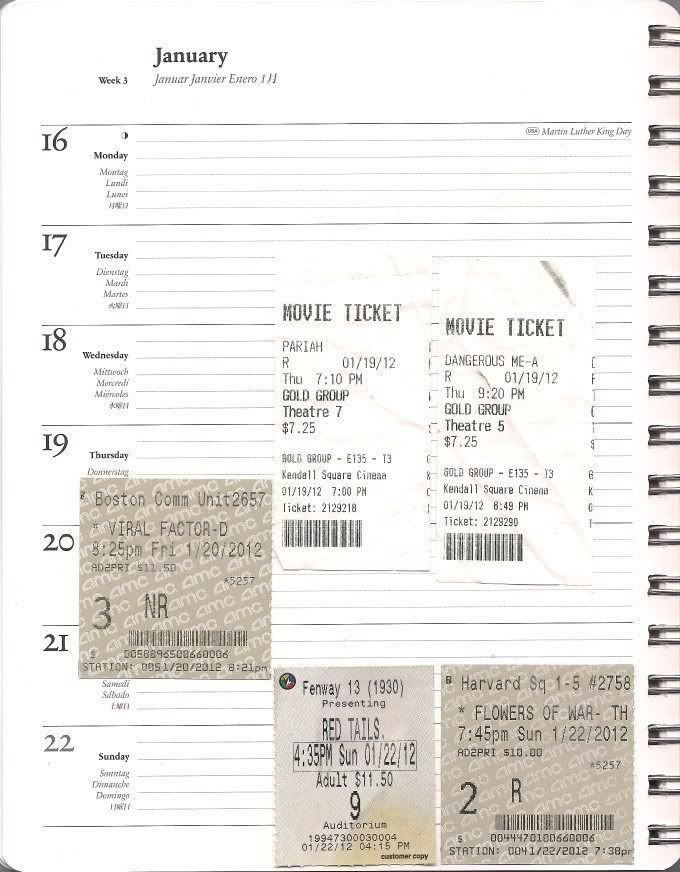
The snow did have a little effect on my Saturday, as there were only two of us at Japanese class instead of the usual five, and I'm guessing it kept a few people from the Chlotrudis Awards nominating meeting, leading to it running short and being practically over by the time I got there. One of my best classes, though - more one-on-one time, less trying to pick voices out in a crowded room.
Main noteworthy effect - I could at least pick out that some of the Japanese dialogue in The Flowers of War was in the past tense (verbs ending in "-mashita"!) and in the form of a question (sentences ending in "-ka"!). My goal of being able to understand random words in dialogue by NYAFF/Fantasia is seeming possible!
Oh, and what's with moving the switchover from matinee pricing to evening prices from 6pm to 4pm, Regal? Not. Cool.
Pariah
* * * ¾ (out of four)
Seen 19 January 2012 in Landmark Kendall Square #7 (first-run, 35mm)
This is an extremely strong feature debut from Dee Rees; it's a rare thing for a filmmaker to be both close enough in age to the teenage characters of a story like this to have a clear view inside their heads and have the skill to tell the story this well. Rees may never make another movie this good, but I hope she gets the chance.
A lot of praise will (and should) also go out to Adepero Oduye, who stars as Alike "Lee" Freeman, a smart girl trying to figure out just what being gay means to how she fits in her family; it's the sort of performance that has to be precisely measured and never feels even a bit off. There's not a weak link in the rest of the cast, either; I particularly liked Charles Parnell as the father (with problems of his own) who seems to know about his daughter but doesn't quite let himself know.
I think what I like most, though, is the way Alike's first relationships are handled. It deserves a little elaboration, but Rees does an exceptional job of establishing that while Alike shouldn't be identified by her sexual orientation, it is a big deal. I'll probably write this up a little more later, and hope to expand on that, because I think it's part of what makes the movie ring true for everyone even if it is a story about ethnic and sexual minorities.
A Dangerous Method
* * * ¼ (out of four)
Seen 19 January 2012 in Landmark Kendall Square #5 (first-run, 35mm)
It struck me, when I saw the trailer for this one, that there may be a fair amount of people who just know David Cronenberg from his recent, mainstream work like A History of Violence and Eastern Promises, as opposed to his early kinky horror work. It's kind of neat that fans of both might see something familiar in A Dangerous Method, even as it seems a departure for the man.
It is, however, not without its problems. It may presume more knowledge of Sigmund Freud (Viggo Mortensen) and Carl Jung (Michael Fassbender) than some in the audience possess, and while Cronenberg and company do a fine job in keeping a movie that is often nothing but pointed conversations moving, it can be a bit fatiguing at times, especially when the script seems to cover the same ground two or three times.
Still, Michael Fassbender and Keira Knightley are rather fantastic as Jung and patient-turned-colleague Sabina Spielrein. Knightley's work is especially impressive, as her lurching, out-of-control tics are a huge contrast to the precisely controlled affect of the rest of the cast (especially the icy-but-delicate Sarah Gadon as Jung's wife), but it comes off more as a fine mind struggling with an unruly brain than an actress out of step with the rest of the cast.
The Viral Factor
* * ¾ (out of four)
Seen 20 January 2012 in AMC Boston Common #3 (first-run, digital)
This one got an eFilmCritic review over the weekend; it's a fairly enjoyable action movie that would like to be the sort of operatic action movie that John Woo made back in the late eighties and early nineties, but Dante Lam isn't John Woo and Jay Chou isn't exactly Chow Yun-fat. Still, I appreciate it making the effort, as well as Lam's enthusiasm for smashing cars up.
A couple of funny things - it seems like I've been hearing Dante Lam's name as one of the current wave of Hong Kong action directors for a long time, but this is the first movie of his I've seen, and there's not a whole lot of other stuff in his filmography that really screams for my attention. The exposition toward the beginning was a bit odd for a couple of reasons - one, it's a case of somebody telling other characters things they would already know because they're really talking to the audience; and two, the actor doing so (Andy Tien), has such a good accent in English that he must be fluent, but he repeats the script's awkward grammar precisely. And, I admit, it's a little weird to see Sammo Hung's son Sammy in the movie as a generically good-looking guy; I initially thought Philip Keung was the younger Hung, just because he sort of looks like Sammo.
Full review at EFC.
Red Tails
* * (out of four)
Seen 22 January 2012 in Regal Fenway #9 (first-run, digital)
To see Red Tails is to wish, almost immediately, that it was a better movie. From the very first lines of dialogue, uttered in the middle of a pretty spectacular looking aeiral battle (as charmingly retro opening titles appear on screen), it's very clear that for all the good intentions behind this movie, a great many things are going to fall short.
It's almost impossible to describe just how much of a mess the script is. There are bits where the dialogue is so simplified that it seems to come out of a children's book, but writers John Ridley and Aaron MacGruder don't seem to have any particular idea of what's important and what's not. There's a subplot about David Oyelowo's "Lightning" being a hot head who goes looking for confrontations with racists that comes straight out of nowhere, and another about his wingman "Easy" (Nate Parker) having a drinking problem that has no structure to it whatsoever. There's a POW camp story that could be its own movie but comes and goes randomly here. Director Anthony Hemingway doesn't seem to have the heart to cut a single second of the spiffy effects footage that George Lucas has paid for, even when it serves no purpose or when a little editing could punch an action scene up.
And yet, given the lines they've got to work with, I like Oyelowo and Parker a lot. They're not complicated characters, but the actors are charismatic. And Terrence Howard - his first scene with Gerald MacRaney is two guys doing the sort of beats they hit best, and he makes the entire cast around him better. And when it comes time to get into the air, Lucas's money is spent well - the flying scenes are gorgeous.
It's frustrating bordering on tragic, really, that this project Lucas spent nearly twenty-five years working on isn't what it should be.
Jin líng shí san chai (The Flowers of War)
* * ¾ (out of four)
Seen 22 January 2012 in AMC Harvard Square #2 (first-run, digital)
Here's one I'm hoping to figure out while writing a longer review on the bus ride home, because it veers all over the place. On the one hand, the opening sequence is absolutely stunning, the sort of thing that makes one wish it was the entire movie. But it soon gets into areas that seem completely and utterly misguided, including scenes between Christian Bale and Ni Ni that are occasionally played for thoroughly inappropriate laughs. And then there will be a moment where that seems to work - it's people trying to remain true to themselves and sane in the middle of circumstances so horrific as to defy imagination.
What Zhang Yimou is striving for seems to be a Chinese Schindler's List, a presentation of the Rape of Nanking that is both as harrowing and as digestible for a mainstream audience as Steven Spielberg's take on the Holocaust. It's not that; the story is often repellant not for what is presented but for how cavalierly the material is treated. Zhang is too talented, though, to make a movie that can be completely dismissed. I can't say I enjoyed The Flowers of War; it's not that kind of movie. I did find myself impressed more often than I wondered what Zhang and company were thinking, though, and that's got to count for something.

The snow did have a little effect on my Saturday, as there were only two of us at Japanese class instead of the usual five, and I'm guessing it kept a few people from the Chlotrudis Awards nominating meeting, leading to it running short and being practically over by the time I got there. One of my best classes, though - more one-on-one time, less trying to pick voices out in a crowded room.
Main noteworthy effect - I could at least pick out that some of the Japanese dialogue in The Flowers of War was in the past tense (verbs ending in "-mashita"!) and in the form of a question (sentences ending in "-ka"!). My goal of being able to understand random words in dialogue by NYAFF/Fantasia is seeming possible!
Oh, and what's with moving the switchover from matinee pricing to evening prices from 6pm to 4pm, Regal? Not. Cool.
Pariah
* * * ¾ (out of four)
Seen 19 January 2012 in Landmark Kendall Square #7 (first-run, 35mm)
This is an extremely strong feature debut from Dee Rees; it's a rare thing for a filmmaker to be both close enough in age to the teenage characters of a story like this to have a clear view inside their heads and have the skill to tell the story this well. Rees may never make another movie this good, but I hope she gets the chance.
A lot of praise will (and should) also go out to Adepero Oduye, who stars as Alike "Lee" Freeman, a smart girl trying to figure out just what being gay means to how she fits in her family; it's the sort of performance that has to be precisely measured and never feels even a bit off. There's not a weak link in the rest of the cast, either; I particularly liked Charles Parnell as the father (with problems of his own) who seems to know about his daughter but doesn't quite let himself know.
I think what I like most, though, is the way Alike's first relationships are handled. It deserves a little elaboration, but Rees does an exceptional job of establishing that while Alike shouldn't be identified by her sexual orientation, it is a big deal. I'll probably write this up a little more later, and hope to expand on that, because I think it's part of what makes the movie ring true for everyone even if it is a story about ethnic and sexual minorities.
A Dangerous Method
* * * ¼ (out of four)
Seen 19 January 2012 in Landmark Kendall Square #5 (first-run, 35mm)
It struck me, when I saw the trailer for this one, that there may be a fair amount of people who just know David Cronenberg from his recent, mainstream work like A History of Violence and Eastern Promises, as opposed to his early kinky horror work. It's kind of neat that fans of both might see something familiar in A Dangerous Method, even as it seems a departure for the man.
It is, however, not without its problems. It may presume more knowledge of Sigmund Freud (Viggo Mortensen) and Carl Jung (Michael Fassbender) than some in the audience possess, and while Cronenberg and company do a fine job in keeping a movie that is often nothing but pointed conversations moving, it can be a bit fatiguing at times, especially when the script seems to cover the same ground two or three times.
Still, Michael Fassbender and Keira Knightley are rather fantastic as Jung and patient-turned-colleague Sabina Spielrein. Knightley's work is especially impressive, as her lurching, out-of-control tics are a huge contrast to the precisely controlled affect of the rest of the cast (especially the icy-but-delicate Sarah Gadon as Jung's wife), but it comes off more as a fine mind struggling with an unruly brain than an actress out of step with the rest of the cast.
The Viral Factor
* * ¾ (out of four)
Seen 20 January 2012 in AMC Boston Common #3 (first-run, digital)
This one got an eFilmCritic review over the weekend; it's a fairly enjoyable action movie that would like to be the sort of operatic action movie that John Woo made back in the late eighties and early nineties, but Dante Lam isn't John Woo and Jay Chou isn't exactly Chow Yun-fat. Still, I appreciate it making the effort, as well as Lam's enthusiasm for smashing cars up.
A couple of funny things - it seems like I've been hearing Dante Lam's name as one of the current wave of Hong Kong action directors for a long time, but this is the first movie of his I've seen, and there's not a whole lot of other stuff in his filmography that really screams for my attention. The exposition toward the beginning was a bit odd for a couple of reasons - one, it's a case of somebody telling other characters things they would already know because they're really talking to the audience; and two, the actor doing so (Andy Tien), has such a good accent in English that he must be fluent, but he repeats the script's awkward grammar precisely. And, I admit, it's a little weird to see Sammo Hung's son Sammy in the movie as a generically good-looking guy; I initially thought Philip Keung was the younger Hung, just because he sort of looks like Sammo.
Full review at EFC.
Red Tails
* * (out of four)
Seen 22 January 2012 in Regal Fenway #9 (first-run, digital)
To see Red Tails is to wish, almost immediately, that it was a better movie. From the very first lines of dialogue, uttered in the middle of a pretty spectacular looking aeiral battle (as charmingly retro opening titles appear on screen), it's very clear that for all the good intentions behind this movie, a great many things are going to fall short.
It's almost impossible to describe just how much of a mess the script is. There are bits where the dialogue is so simplified that it seems to come out of a children's book, but writers John Ridley and Aaron MacGruder don't seem to have any particular idea of what's important and what's not. There's a subplot about David Oyelowo's "Lightning" being a hot head who goes looking for confrontations with racists that comes straight out of nowhere, and another about his wingman "Easy" (Nate Parker) having a drinking problem that has no structure to it whatsoever. There's a POW camp story that could be its own movie but comes and goes randomly here. Director Anthony Hemingway doesn't seem to have the heart to cut a single second of the spiffy effects footage that George Lucas has paid for, even when it serves no purpose or when a little editing could punch an action scene up.
And yet, given the lines they've got to work with, I like Oyelowo and Parker a lot. They're not complicated characters, but the actors are charismatic. And Terrence Howard - his first scene with Gerald MacRaney is two guys doing the sort of beats they hit best, and he makes the entire cast around him better. And when it comes time to get into the air, Lucas's money is spent well - the flying scenes are gorgeous.
It's frustrating bordering on tragic, really, that this project Lucas spent nearly twenty-five years working on isn't what it should be.
Jin líng shí san chai (The Flowers of War)
* * ¾ (out of four)
Seen 22 January 2012 in AMC Harvard Square #2 (first-run, digital)
Here's one I'm hoping to figure out while writing a longer review on the bus ride home, because it veers all over the place. On the one hand, the opening sequence is absolutely stunning, the sort of thing that makes one wish it was the entire movie. But it soon gets into areas that seem completely and utterly misguided, including scenes between Christian Bale and Ni Ni that are occasionally played for thoroughly inappropriate laughs. And then there will be a moment where that seems to work - it's people trying to remain true to themselves and sane in the middle of circumstances so horrific as to defy imagination.
What Zhang Yimou is striving for seems to be a Chinese Schindler's List, a presentation of the Rape of Nanking that is both as harrowing and as digestible for a mainstream audience as Steven Spielberg's take on the Holocaust. It's not that; the story is often repellant not for what is presented but for how cavalierly the material is treated. Zhang is too talented, though, to make a movie that can be completely dismissed. I can't say I enjoyed The Flowers of War; it's not that kind of movie. I did find myself impressed more often than I wondered what Zhang and company were thinking, though, and that's got to count for something.
Subscribe to:
Posts (Atom)

