A very animated Saturday, as my "grew up in the 1980s and that's when you watched cartoons" brain says should be the case. Sure, Demigod is technically puppetry, but you get the idea.
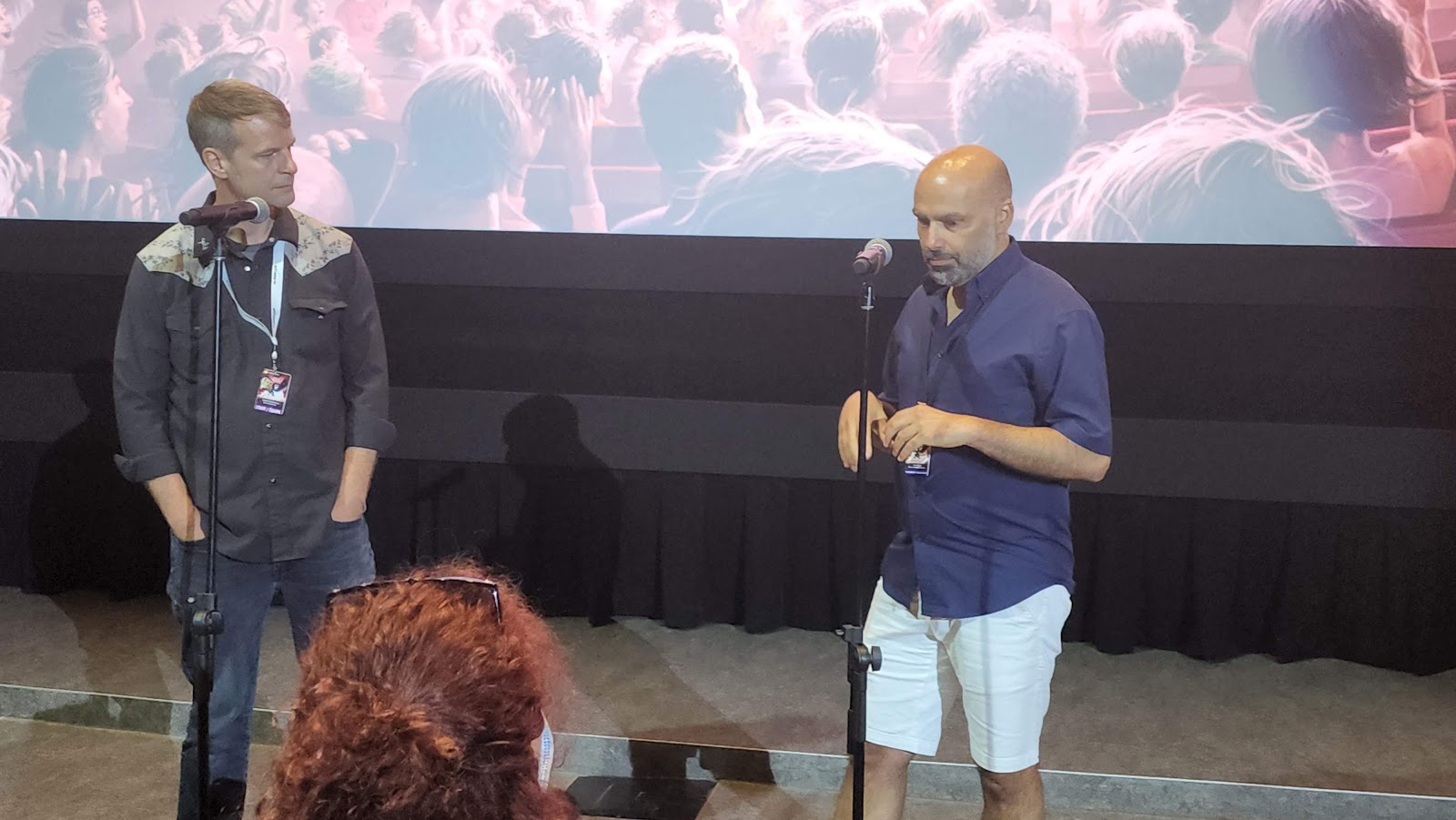
Just the one guest, My Grandfather's Demons director Nuno Beato, who made a nifty stop-motion film that was still in progress right down to the wire - they finished just in time to premiere at the Annecy Festival in June, which is still not a whole lot of buffer to be ready for this festival a month later! Stop-motion is meticulous work, and I imagine that there's really no way to get ahead but many to fall behind, especially when you're occasionally merging with CGI. One thing that I found amusing at a couple shows this year is how animators tend to call digital animation "3D", even when they're not rendering for two eyes and the film won't be exhibited that way. It's especially odd when they talk about mixing "3D" with stop-motion, as it's the latter that has real, three-dimensional physical objects involved.
Not that I can criticize; we certainly use some dumb nomenclature in my day job, and I certainly got Agile twitches from some early scenes of this movie.
Beato also did a little setup on the red carpet area with Rosa afterward, which seemed like an obvious thing to get a picture of with the new digital 3D camera:
Not sure exactly how great that looks - I don't think it's really built for up-close, and this isn't really the sport where I screw around with cropping it to make it look better yet. It looks good on the camera/viewer (and presumably will when I get it onto the 3D TV), but the anaglyph has a bit of a ghost and the attempt at a wigglegram was a disaster. Still - 3D picture of a 3D model!
After that, there was a strange miracle - films at all three venues all starting at 7pm! I'd initially penciled in Punta Sinistra, but didn't really know what was going on when I got to the Museum. It was a "Fantastique Week-end" show highlighting local works, and aside from the set-up at this venue being sort of non-intuitive (it's a space the festival really has to adapt to), everyone was naturally speaking French, so I got intimidated, especially as I've wound up in shows like that which looked anglophone-friendly but weren't. I turned around, walked back to Hall, and got in line for Deadstream.
Which was surprisingly good - it's got the look and feel of something that will be awful but winds up working better than it has any right to. Maybe not quite one of my favorites, but a pleasant surprise the way One Cut of the Dead wound up being, although I wonder some of the same things I did for that one - it's a movie that is arguably more at home on a TV or streaming site than theaters, but which has a deliberately rough beginning, the sort of thing where you may jump to something else if it's easy, you haven't got the cost of a ticket to justify, and you're not worried about the awkwardness of climbing over other people to leave.
So that was Saturday. Sunday the 24th will include Opal, Tang and Me, Anime Supremacy!, Vesper, and Legions.
"Deiji Meets Girl"
* * * ¼ (out of four)
Seen 23 July 2022 in Auditorium des Diplõmés de la SGWU (Fantasia Festival: Axis: Anime no Bento, digital)
Though presented as a short, its original format as 90-second minisodes (do folks still say "minisodes", or did that never take off?) is clear from the way breaks are preserved and there's the occasional rewind. It also places art from what I presume is the original manga at the breaks, highlighting how the animation doesn't quite look the same; it's a thicker line with the coloring making up for some of the detail.
It's also a fun little show, sort of boiling a lot of manga/young-adult stuff down to its essentials, with Maise Higa (voice of Kiyono Yasuno) bored at having to work in the family hotel during her summer vacation, alternately annoyed by and intrigued by the crush-worthy guy her own age staying there alone, and navigating a series of supernatural transformations to the hotel and community that only the two of them seem to be aware of. Director Ushio Tazawa does nice work, capturing people and personalities with good cartooning and smartly compressing the story so that the tropes of the genre can serve as a bit of a shortcut but not so much to make it otherwise impenetrable, and also tending to start episodes in media res to both get to the good stuff in a short time and save the big animation moments for the climaxes, both for the mini-arc and the series as a whole. The characters are likable, and the show is peppered with little jokes and bits of oddness that doesn't make each bit reliant on a big swing connecting.
It might be fun to see this built out a bit, maybe connecting the pieces more smoothly, but it's about the right length, even if that length is a single standard TV episode. It's a small story with big images.
"A Girl Meets a Boy and a Robot"
* * * (out of four)
Seen 23 July 2022 in Auditorium des Diplõmés de la SGWU (Fantasia Festival: Axis: Anime no Bento, digital)
This one, on the other hand, feels like it could do with being fleshed out a little bit - it's down at about 20 minutes on the basis of a couple of "oh, now I remember everything" moments, and has the simple focus it has at the start because two characters have amnesia. It's a bit like a video game - the girl wants to collect rocks, proceed to a goal, and avoid automated war machines, and the motivation doesn't matter. It's all you need for a game, but a little why feels nice when you don't need to worry about the player clashing with the motivation.
It looks terrific, though, with Shin'ichiro Watanabe building a post-apocalyptic world that feels right - automated things still being kept up automatically but primarily-human spaces falling into ruin. The middle-eastern character design of the girl is a good fit for the desert wasteland, and the robot is a Swiss Army Knife with a fun personality that doesn't ever become too much of a deus ex machina. The Crystal of Time thing is kind of a messy thing to include in what otherwise plays as post-apocalyptic science fiction, and makes the later bits a little fuzzy, but it gives Watanabe a chance to create some scope.
"Summer Ghost"
* * * ½ (out of four)
Seen 23 July 2022 in Auditorium des Diplõmés de la SGWU (Fantasia Festival: Axis: Anime no Bento, digital)
I don't know if this clocks in at 40 minutes with the express idea of being as fleshed-out as it can be but still eligible for awards as a short, but it could deserve some consideration for that; it's a nifty inversion of the "kids hubristically summon a ghost and suffer the consequences" story where the ghost is friendly and the kids are mostly humble and trying to help. It's a casual one, though, not winking at the audience or faking out that Ayane may be a more malevolent force.
Director Loundraw and screenwriter Hirotaka Adachi do good work keeping four characters' individual stories going and feeling consequential in that length, intertwining them but also emphasizing that they are each kid's individual challenges to face, while also sort of musing on what it means to be a ghost. The filmmakers have a good grasp of how the mundane interfaces with the fantastic, making them feel like part of the same world but also noting that the jump from one to the other is still exhilarating.
Mostly, it winds up being a nice tale of friendship, how it's worth it even if it will necessarily be temporary or requires effort to maintain. Most of us won't be piercing the veil of death in order to meet new people or keep up with those who have left, even if it can take a lot of effort.
Demigod: The Legend Begins
* * * (out of four)
Seen 23 July 2022 in Auditorium des Diplõmés de la SGWU (Fantasia Festival, DCP)
Like a lot of grand martial-arts fantasies, Demigod can be kind of tough sledding at points as it dumps a whole bunch of exposition and mythology on its audience, seeing up a whole world for its wuxia masters to battle over. The difference, of course, is that this particular movie is staged with puppets - the chosen medium of the Huang clan for generations - making the whole thing even more surreal.
It opens with Su Hua-Jen (voice of Huang Wen-Tze) scaling one of five impossibly vertical peaks, getting in the middle of a battle between gigantic elemental creatures, and being scolded by his Master, before returning to Earth. There, he reconnects with friend Yu Huan, a monk like him but the son of a noble house. Jen is also a physician who uses his acupuncture skill to pay his tab at the bookstore, and he is recruited by Huan's father for a tricky cure. It gets him pulled in the middle of a long-time power struggle with Yu senior's cousin Chang-Bo, framed for murder and broken out by warrior princess Yu Xin, discovering both a massive earthly conspiracy and a grand destiny while on the run.
You can, I suppose, talk about the story separate from the medium, which is just going to make it sound kind of tiresome at first, with reluctant hero Jen vague almost to the point of being undefined plus the sort of castle intrigue where so much information is pushed on the viewer that they may never quite know the players well enough to sort the plots out, especially as outsiders. There's some nifty action in between, but it's kind of killing time. The puppets' static faces and sometimes delicate motions limit what writer/director Chris Huang Wen-Chang and his family/collaborators can do to liven up the exposition.
Eventually everything is set up and then the big, crazy, operatic stuff starts in earnest, and it's an insane delight. These puppets that look like porcelain dolls are fighting with mad slashes of swords and powerful magic, with heads and limbs cut off and blood flying everywhere, and the Huangs have been at this long enough to have a sense of the line where it would start to look like a joke that they can avoid crossing it. There are creatures and intricately crafted environments that are all solid and at the same scale when they interact, impossible magical fighting techniques executed by filmmakers taking this as seriously as any blockbuster, and, yes, battles where both hero and villain are into it, playing for the balconies even though their lips don't move.
It's glorious madness that seemingly promises eight sequels in the end credits with a completely straight face, and why not? They're an institution in Taiwan, and aside from Pili's own catalog, there's nothing like it except maybe The Dark Crystal and the likes of Thunderbirds. Enjoy it if you can find it, as Taiwanese films don't seem to cross the Pacific as often as those from the other Chinas, let alone crazy puppet martial arts epics.
"Aurora - A rua que queria ser rio" ("Aurora - The Street That Wanted to Be a River")
* * * (out of four)
Seen 23 July 2022 in Auditorium des Diplõmés de la SGWU (Fantasia Festival: Axis, digital)
Radhi Meron switches up her animation style with each new era chronicled in "Aurora", and while that's not an uncommon practice, it's not one that always works here; some are just too crude in comparison to others to reflect what she's getting at with the narration and the general idea behind it, or at least to take it seriously.
Which is a shame, because, in telling the history of this particular street, Meron points out that it preceded the city and even humanity being there, that the river performed the same purpose of being both a way to move and a place together for as long as it existed, and the street built over and around it is the city. The narration by Priscila Paes in character as the river/street, is wonderful, even if one is reading the subtitles because of not understanding Portuguese. It's ecstatic even when sad or angry, the voice of something that is defined by its connections and cannot help but delight in everything it is part of and linked to, claiming it as her own even when pining for simpler times or to have a main street's class and cachet.
I admit that, as a committed city-dweller, there's a part of me that loves this for positioning the city as something natural and fundamental to how humanity is part of the world. But I also love the way Meron tells it, from the lush visuals and the infectiousness of the voice.
My Grandfather's Demons
* * * ¼ (out of four)
Seen 22 July 2022 in Auditorium des Diplõmés de la SGWU (Fantasia Festival: Axis, DCP)
The festival showed My Grandfather's Demons with a short before it, and the viewer who hasn't read up on it or (presumably) seen a preview will be forgiven for thinking that there may be one attached during its theatrical run or a second during the festival; the style it opens with is far from the one that's going to sell a ticket. Once the digital animation that opens the movie is done, the movie gets to the pretty-darn-good stop-motion and a second track which is perhaps more interesting than the one it starts on.
It starts in an office in the near future, with Rosa (voice of Victoria Guerra) being awarded for her hard work and success with meaningless icons next to her name and even more work to do. News of the death of the grandfather Marcelino (voice of António Durães) who raised her is what causes her to snap, quitting her job and driving out to the country to spend a few weeks getting the old place - which now sits on more land, as her grandfather has bought out many neighbors - in order. She soon discovers that while she remembered that time with just the two of them as idyllic, the locals hated him, and by extension her, claiming he diverted all the water for himself. An eager-to-please neighbor boy, Chico (voice of Martim Carvalho Balsa), and his kind mother Laura (Ana Sofia Martins) are at least nice to her, the the baker's nephew Hugo (João Tempera) remember her fondly from their childhood, but his uncle is particularly sore. Rosa resolves to fix things by locating the missing water, but the only clues seem to be hidden among the various masks and statues the old man carved representing the townsfolk as demons.
As much as the audience sympathizes with Rosa, it's clear early on that she has inherited at least a bad temper from her grandfather, who is himself arguably the story's offscreen villain, even if it's hard for Rosa to see him that way. Victoria Guerra's vocal performance is quite nice, carrying a touch of self-pity and a fair chunk of anger at points but she connects that to the stress she came in with, managing to let some of that go without losing too much edge, while António Durães puts regret into Marcelino's voice-overs while also making him sound too proud and mean to have acted on it. Chico and Laura provide nice optimistic balance, with round shapes and upbeat voice work that gives Rosa something to aspire to, although not overdone. The film has to have the subtlety to let Rosa and Marcelino be hard to like at times, even though working with these figurines limits certain sorts of acting.
It's interesting that My Grandfather's Demons sort of avoids big wow moments with its animation, right from the moment when it switches from the digital animation of the city -, but show some fine design work in the way that it illustrates and heightens white-collar burnout - to the country's stop-motion; it's a simple switch rather than a dramatic, self-aware moment. It's all very nice-looking, with fine cartooning, but never really overpowers. For all that the film has strong fantasy elements, it's very important to ground what's going on in something real, even when that's not always easy to watch.
It's still wonderful animation, though, contrasting the colorful city (which is bright and poppy in the way that TV ads are) with the more tactile stop-motion of the country as much as possible without really clubbing the audience too much with "city bad!", particularly in how director Nuno Beato and company sometimes seem to lean into how the audience knows this is all miniatures, making the place look smaller and quainter, with the movements of the people who live there having resistance and friction. It's clever in how this allows the demon sculptures to come to life but also really gives something solid to the hands-on, tactile problems Rosa must solve in order to make amends.
So don't be too fooled by its opening sleekness - My Grandfather's Demons is a worthy addition to the ranks of stop-motion features, a charmer that benefits from feeling like a thing you can pick up and touch.
"Hairsucker"
* * * (out of four)
Seen 23 July 2022 in Auditorium des Diplõmés de la SGWU (Fantasia Festival, digital)
I've got to admit, that as gross as the spectacle of a nasty little thing sneaking into the bathroom to eat hair out of the shower drain is, it's got to kind of sound kind of great to someone with long hair who occasionally has issues with the plumbing so long as it only goes that far. It doesn't of course, and the results are able to make the audience feel enjoyably squeamish but stop just short of complete revulsion.
It's four minutes of pretty much perfectly measured horror-comedy. Not a lot of analysis you can do on that, but that's some impressive setting of a target and hitting it.
Deadstream
* * * ¼ (out of four)
Seen 22 July 2022 in Auditorium des Diplõmés de la SGWU (Fantasia Festival, digital)
You'd never guess from how obnoxious its protagonist comes off and how overly familiar its premise is, especially at the start, but Deadstream is a hoot, delivering more than a few decent scares while still getting laughs as a horror comedy. It's fast-moving and smarter than it looks, genuinely satisfying by the time it's done.
It's presented as the livestream of Shawn Ruddy (Joseph Winter), who had been making a fair living out of streams where he confronts his fears, often to disastrous results, but is just coming off a stretch of being demonetized after an episode that was considered wildly insensitive. For his first show back, he intends to spend a night in "Death Manor", built by a Mormon pioneer as a home for his spinster poet daughter Mildred, who committed suicide and whose curse has apparently claimed many other lives in the century or so since. Shawn is scared very easily, but his audience notes that not a lot seems to be happening, at least not until superfan Chrissy (Melanie Stone) shows up wanting to join him.
The opening is wince-inducing and obnoxious enough that I was reminded, a bit, how badly I was cringing during the first stretch of One Cut of the Dead a few Fantasias ago, and how that did some drastic expectation-lowering before the second and third acts turned its gimmicks on its head. Similarly, this movie really flounders for a while, as Joseph Winter's Shawn is a very broadly-sketched and played twerp, the sort that us folks who don't particularly pay attention to streams and YouTube as a medium will either presume to be perfectly representative of idiot millennials/zoomers or will find too ridiculous to be real. He doesn't really get much smarter or more likable as the film goes on, maybe dialing it back a little as the character starts reacting more than performing, but mostly the movie adapts to the character, making it work better as a whole.
Filmmakers Vanessa & Joseph Winter lean a bit too hard on too-easy jokes and kind of rote jumps until Chrissy shows up and changes the dynamic, injecting a more likable dorkiness without completely changing the vibe. Melanie Stone isn't quite a secret weapon here but she brings a bunch of energy and charm while still working as a sidekick initially. Once she's there, the movie's got specific places to go and chemistry to exploit, and that makes a huge difference.
It's still going for easy social media jokes and jump scares at that point, but there's some enjoyably gross effects and all the gags (however you choose to use the term) start feeling like a quality relay, one leading to another rather than just setting something well worn out and waiting for applause. The handoff between comedy and horror works a lot better at that speed, maybe in part because it's all been set up well and everyone is ready for the payoff. Indeed, they do the set-up stuff smartly; this may be the first livestreamed haunted house of several I've seen where the use of multiple cameras and information from the internet feels like a logical setup. And when they get to the climactic revelation, it not only snaps the plot together, but gives the movie something of a funny theme instead of "just" a bunch of jokes strung together.
As with One Cut, I do wonder a bit if the deliberately-off-putting start will make people navigate away at home even though it may be more suited for that environment that a theater where a viewer is more committed (Shawn is annoying enough that I was with the on-screen commentators posting #TeamChrissy to the end). Nevertheless, folks that stick it out will probably be pleasantly surprised how well the choice turns out for them.
Kappei
* * ½ (out of four)
Seen 22 July 2022 in Auditorium des Diplõmés de la SGWU (Fantasia Festival, ProRes)
I've got four or five volumes of the recent English-language editions of First of the North Star on my shelf that I haven't gotten around to reading, and I suspect that I'd like Kappei more if I had read them as they came out. The film (itself a manga adaptation) is a Japanese spoof of a specific strain of weird Japanese pop culture, and while chunks of it work well enough without the background, I suspect it plays a lot better when the targets are clearer and the subversions more obvious.
Back before the turn of the millennium, the predictions of French cleric Nostradamus were a big fad, especially the claims of the impending end of the world in a grand disaster. As 1999 approached, martial arts master Shihan (Arata Furuta) trained a group of children on an island off the coast of Japan to be "Doomsday Warriors" who would protect the helpless people left standing in a post-apocalyptic hellscape afterward. This never comes to pass, so in 2022 he disbands the gang, and Kappei (Hideaki Ito) makes his way to modern Tokyo, his head still full of desires to protect the innocent and fears that his classmates may have turned to evil. When he rescues college student Keita Iruma (Daigo Nishihata) from a group of bullies, Keita helps him get settled, but there are many things about the outside world Shihan-sensei hasn't prepared him for. Most notable: Women, especially college girls as cute as Keita's classmate Haru Yamase (Moka Kamishiraishi), who still pines for her high-school senpai and also attracts the attention of a number of other Doomsday Warriors.
Give screenwriter Yuichi Tokunaga and director Takashi Hirano credit: They've got a sense of how creepy these guys' presumptuous competition for Haru is and how it's enabled by the likes of Keita, who does not have the excuse of growing up brainwashed on an all-male island for some incel-adjacent attitudes (though I suppose some Japanese women might raise an eyebrow and say "oh really?" to that), and this would be a much less enjoyable movie if they didn't. They often don't appear quite sure how hard they want to go in on this as the core of the film, though - it takes up a lot of screen time and a late sequence brings it into some relief, but there's a sense that this should be just one facet of Kappei being a big-hearted, naive hunk of beefcake in a world he's unprepared for.
The trouble is, the film doesn't necessarily have much else in the way of story. The original manga doesn't seem too long to compress into a feature, but it maybe has too many characters - does the movie really need four Doomsday Warriors running around? - and that leaves relatively little room for the odd-couple bits with Kappei and Keita that initially look like they could form the movie's spine, or jokes about Kappei adapting to the outside world. It's kind of a fun subversion that the initial obvious action-comedy plot of Kappei having to fight his misguided brothers never actually appears, but a crush that audiences may have misgivings about doesn't exactly fill the hole.
On the other hand, there's no arguing that Hideaki Ito gives less than his all as the title character, bulking up so he can cram himself into a costume that amounts to a denim vest and matching booty shorts, deploying his best blank stare at Tokyo's insanities, and delivering his lines in what could be described as a deadpan roar. Kappei is ridiculous, but Ito plays him as serious and sometimes incongruously intimidated by the world around him. It's a big, delicious comic performance that could seem an ill match for Moka Kamishiraishi's sweet, somewhat unlucky-in-love Haru, but she does a nice job of not being made small by the larger-than-life men around her, whie Daigo Nishihata does a good straight man and mostly downplays things that could make Keita less likable. Arata Furuta makes Shihan a delightfully absurd sort of cult leader, domineering and brash but making the shifts that come from his knowing things his students don't right every time, while Yusuke Onuki, Koji Yamamoto, and Yukiyoshi Ozawa all have amusing takes on different sorts of Doomsday Warrior that spring from the same soil as Kappei.
It's an amusing premise with a great central performance, enough to get a bunch of laughs even among those not terribly familiar with this breed of stoic manga muscle man with inner turmoil, although I suspect it plays even better for those more in on the joke.
Showing posts with label Brazil. Show all posts
Tuesday, August 02, 2022
Fantasia 2022.10: Anime no Bento, Demigod: The Legend Begins, "Aurora", My Grandfather's Demons, "Hairsucker", Deadstream, and Kappei
Thursday, July 14, 2022
BUFF 2022.05: "Inbetween Days", Neptune Frost, Medusa, and Hatching
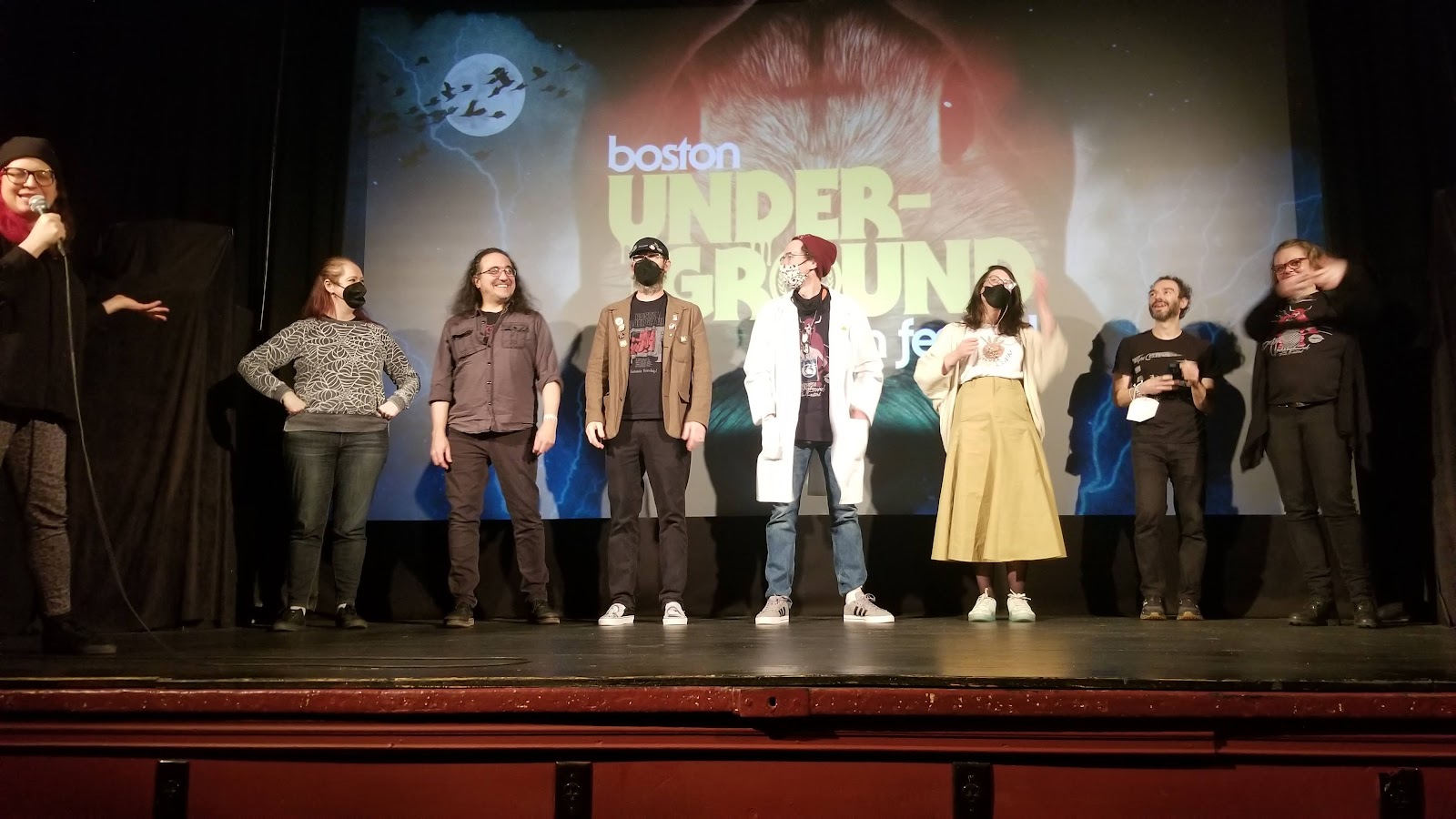
Meet the team running things!
Once again, because this is the tightest-scheduled festival you will ever see and (presumably) because of covid concerns, there was no Q&A in the theater for the animation package, but if you've got questions, they put one online, and it's almost an hour long, so I imagine there's lots of good stuff in there.
I'll probably rush through this a bit, just because it's been three months and I'm trying to get this out before another festival swamps it. It should be noted that the feature component of the day was strong as heck; even if the three movies weren't always my exact thing, they were nifty genre movies with specific points of view, the sort that leave you excited to learn a little bit more about the situations that birthed them or which give you a chance to see something familiar from a somewhat different angle. Which is a big reason why I love genre film festivals - they often seem like an even more direct look at how different cultures are thinking of topics than the "classier" fests.
"Fulcrum"
* * * ½ (out of four)
Seen 27 March 2022 in the Brattle Theatre (BUFF 2022: Inbetween Days, digital)
"Fulcrum" is one of those animated shorts that starts out as a loose sort of narrative only to see that subverted to the joy of playing with shapes fairly quickly, but to its credit, seldom entirely loses the plot - or at least, you can at least generally find the characters filmmaker Timothy David Orme started with somewhere in the rapidly-filling screen. It's not just a case of something being a jumping-off point.
The end result is impressive; Orme duplicates and spirals out in recognizable Fibonacci sequences and other forms of mathematical precision but avoids the feel of cutting and pasting, with transitions that feel like they're exploiting the leverage of the film's title. Nine minutes isn't a huge running time for an animated short, but it's enough time for others following this general pattern to get lost, which doesn't happen here.
"In the Water's Wake"
* * * (out of four)
Seen 27 March 2022 in the Brattle Theatre (BUFF 2022: Inbetween Days, digital)
A short that feels like it could be the beginning of something, although if it were, filmmaker Sarah Kennedy would likely have to draw things out more if she were looking to tell an entire story as opposed to snippets of it. What is here is a nifty little piece, though; good-looking and trippy in its explorations of a beach town that may only exist in the castaway hero's mind.
"Johnny Crow"
* * * ½ (out of four)
Seen 27 March 2022 in the Brattle Theatre (BUFF 2022: Inbetween Days, digital)
Jesse Gouchey and Xstine Cook appear to have done something a little like this before, in terms of style, but it's a good one - live-action backgrounds in kind of run-down areas, mostly devoid of people, but the street art coming to life in response to the narration. It makes the moments when imagery breaks free even more powerful, and underlines the setting in interesting ways, a culture trying to thrive despite having to exist among that of its invaders.
It bolsters the story about a native man trying to find stability as he's in and out of prison, worrying about what his absence means for his family. There's a frustrating familiarity to it, but the filmmakers seem aware of this, balancing their frustration and anger without succumbing to resignation.
"PORT"
* * * (out of four)
Seen 27 March 2022 in the Brattle Theatre (BUFF 2022: Inbetween Days, digital)
Not a whole lot to say - it's two minutes and mostly has a neat look - but it's enough to say that I'd like to see what else director Andrew Lehman can do.
"Hakkori"
* * * ½ (out of four)
Seen 27 March 2022 in the Brattle Theatre (BUFF 2022: Inbetween Days, digital)
I had the weirdest feeling while watching "Hakkori", pretty sure I'd seen it as part of a shorts package with either Fantasia or Nightstream last year, but every once in a while having a reaction like "well, I'd have remembered that. The fact that most film buffs I know can apparently identify every movie they've ever seen from a single frame in one of those puzzle games is utterly foreign to me.
I was probably not entirely experiencing this again for the first time, but it's a fun one to do that with, following some cute yokai as they take the offerings from the local humans and frolic, bring it back to the boss, and the like. It's cute, drawn in a traditional cel-based style, or something that resembles it, the creatures inserted into live-action backgrounds that have a hint of the artificial to them because one isn't often looking at them from this close. The characters are wonderfully designed, getting a lot of emotion out of minimal features and expression, moving naturally but not in an overly-rotoscoped manner.
What strikes me most on this viewing where I am maybe a bit less in full "look at that!" mode is the way filmmakers Aya Yamasaki and Jason Brown approach nature and the yokai - one and the same, really - allowing them to be sort of alien and amoral, devouring each other, merging, splitting, executing these processes which are too chaotic to inevitably lead to renewal but tend to do so, letting the audience identify with the main guys they follow and be nervous that the world doesn't necessarily work by the terms humans will try to impose on it. It's a lesson that doesn't exactly feel like the point of the film even if it is a large part of what it's saying.
"Pottero"
* * * (out of four)
Seen 27 March 2022 in the Brattle Theatre (BUFF 2022: Inbetween Days, digital)
This one's a nifty little short that also has creatures who are not quite the personification of something more basic but which aren't entirely something else. Here, Lindsey Martin tells the story of a woman who encounters a monster from her backwoods town said to kill all that encounter it, escapes, tries to make something of herself, but cannot entirely escape the gravity of home, and must confront it.
It's simple, and told with animation that is not exactly pretty as it is in some cases, but Martin's got an eye for using ugliness with purpose, and is able to crank up tension even as he is sometimes able to treat a situation casually or dismissively. It's a reminder that people in simple or rough situations aren't stupid or lacking self-awareness, even though even the people from that sort of place can fall into the traps of believing in monsters and dismissing those who do simultaneously.
"Posted No Hunting"
* * * (out of four)
Seen 27 March 2022 in the Brattle Theatre (BUFF 2022: Inbetween Days, digital)
Stop-motion found-footage horror? Sure, why not? Director Alisa Stern and co-writer Scott Ampleford get right into it here, establishing an immediately creepy vibe with how the night-vision look makes models that should be cute something else even before things start to go seriously wrong and they're called on to contribute some annoyed and panicked voice acting.
A lot of folks doing live-action features would like to be able to do what they manage with three minutes and figures that look like they should be silly more than scary.
"Everybody Goes to the Hospital"
* * * ½ (out of four)
Seen 27 March 2022 in the Brattle Theatre (BUFF 2022: Inbetween Days, digital)
This one's a nightmare that will likely feel all too familiar - waiting what may be too long to take an ailing child to the hospital, where Little Mata is as confused as she is sick and the parents feel powerless. It probably plays for everyone.
Filmmaker Tiffany Kimmel does things that maybe other directors wouldn't. She never makes this hospital seem overly large and out of proportion to Little Mata; the world seems out of scale to kids anyway and this is not a special property of this time. Indeed, there's a sort of quiet acceptance and even trust in Lucia Hadley Wheeler's narration as the title character, like she's trembling but has been raised to listen and keep out of the adults' way. It can still seem an alien place, though, with exterior shots often depicting it as up in the air, with nothing nearby other than the winding road leading to it, like it exists outside the world Mata knows.
Visually, it's kind of a familiar sort of movie, characters not exactly stiff but having limited joints and papier-mache heads whose expressions are animated sparingly. It's the sort where the animators will often hold most of the image still so that they can zoom into a little hand movement or the like, boosting its import. It's a known technique but it works because one still tends to expect exaggeration with this medium, and that sort of focus becomes doubly effective.
"The Bum Family: Lilly goes to the Dogs"
* * * (out of four)
Seen 27 March 2022 in the Brattle Theatre (BUFF 2022: Inbetween Days, digital)
I must admit, I haven't exactly loved previous "Bum Family" shorts that have popped up in the BUFF comedy and animation packages - they've had the randomness of something a little kid was making up as they went along, but not necessarily the wild creativity, and they've juggled too many characters who are mostly interesting for their odd designs.
This one winds up working fairly well, though, probably in part because it by and large strips the group down to just Lilly and her pet Fluffle and lets them be chaos agents in a place that can probably use a little chaos like a dog show, with Lilly getting down on all fours and taking Fluffle's place while she leads a revolution among the dogs. It's a pair of absurdities that the filmmakers commit to utterly even as it gets more ridiculous by the second and makes one question where the whole thing started. It's madness, but madness that seems to know its target.
"Argus"
* * * ¼ (out of four)
Seen 27 March 2022 in the Brattle Theatre (BUFF 2022: Inbetween Days, digital)
An impressively well-executed bit of dystopia, as one can have a difficult time telling whether something literally reality-warping is going on to the employee who comes in to do a menial, senseless task or whether it's just the sort of distorting job that creates such a feeling that this all could be a flight of fancy or a science-fictional premise that is inherently madness-inducing if real.
It's impressively executed, a nift combination of shabby and futuristic, nicely blurring the line between existential and science-fictional horror.
"O, What Rice! O, What Beans!"
* * ½ (out of four)
Seen 27 March 2022 in the Brattle Theatre (BUFF 2022: Inbetween Days, digital)
Not really my thing, I've got to admit, as much as I like rice and beans myself. It's a rough thing to say about a short where the production appears to mostly be a one-man show, but its idiosyncratic style often works against it. The joke is that the main character is obsessive over something kind of bland and unexciting, and that mania being incongruous is where the comedy comes from, but if the whole world is weird and kind of grotesque, it doesn't work nearly as well, and neither does the gross-out humor.
"Pancake Panic!"
* * * ½ (out of four)
Seen 27 March 2022 in the Brattle Theatre (BUFF 2022: Inbetween Days, digital)
I've got enough notes for "Pancake Panic!" in my festival notebook to make some features blush; it's as tightly-plotted and cleverly-assembled a story as you'll find anywhere, and it's not exactly something with an elaborate look or even ten minutes long. Filmmaker David Filmore leans on deadpan humor so that the brutal slapstick can surprise, and pulls together seemingly random threads in really impressive fashion.
Neptune Frost
* * * ½ (out of four)
Seen 27 March 2022 in the Brattle Theatre (BUFF 2022, DCP)
Afrofuturism of this variety does not give a shit about whether my white North American self understands it, and that's kind of great. Even though there are a lot of Americans involved with this production, including writer/co-director Saul Williams, it feels like it comes from a different tradition with different assumed lines between reality and fantasy, let alone different genres, and no particular interest to explain things that a non-Rwandan audience might not get.
In a sense, that spark of discovery, whether it be an outsider learning a new culture or that culture seeing itself in a way they seldom had before, is the film's draw. The science fiction and adventure of it is kind of fuzzy and familiar - a government-corporate alliance oppressing the poor to exploit a vital resource and chosen ones rising to inspire a revolt, with "hacking" as a sort of magic. But what a spark, with a charismatic cast who all seem to have something defiant not far from the surface, computer and surveillance centers that opt for feeling like an art installation over a sleek but boring realism, a semi-magical sex change that manages to feel both like a trans person finding her true self and a man shedding his old life and ultimately feels like an act of evolution, and a willingness to dip into poetry and music when emotion charges the characters, but without it feeling like a not-literal representation.
At times, Neptune Frost seems to be trying to evolve new language, frantically trying to marry African culture to the technological world powered by its resources, and if it sometimes seems to be grasping, that's fine, because the discovery is exciting. It's a movie where I'm genuinely excited to dive into the eventual Blu-ray to see what I find on a second and third pass now that my mind is a little more attuned to whatever wavelength Williams and co-director/cinematographer Anisia Uzeyman were on.
Medusa
* * * (out of four)
Seen 27 March 2022 in the Brattle Theatre (BUFF 2022, DCP)
The politics of other countries can get flattened when you only hear of them occasionally, and such it has been for Brazil where I'm concerned (and I suspect for many other Americans) - it's easy to associate the whole country with what its leaders are doing as opposed to getting down into the guts of what people are dealing with. It's different all over, but a lot of the forces are the same, just interacting a bit differently.
So this film presents Michele (Lara Tremouroux) and Mariana (Mariana Oliveira), two best friends in their twenties who have been part of an evangelical church for some time, and often serve as the pretty faces it presents to the world. That cheery facade hides nightly acts of violence against sinners and, worse, those who would leave the church. One of these raids gets them in over their heads, with Mariana winding up scarred, and while she's supposed to be mentoring a new, mousy member of the group, she becomes obsessed with a woman who escaped the cult only to possibly wind up burned worse afterward, taking a job as a nurse at the coma center where she suspects this woman is a patient.
There's a lot going on - satire of the hypocritically pious chasing power and using the sex appeal to pull others in despite a fair amount of talk about virginal purity, a mystery, romance and jockeying for position. Amid all of that, I suspect that most viewers will respond to Mariana's honest, well-earned growth; there's intelligence and empathy to her which actress Mariana Oliveira seems to enjoy teasing out, and something hopeful about how someone can seem to slide out of a group like this as easily as they can slide in. It's all the better because few of these young characters seem cheaply brainwashed or knowingly hypocritical - "evangelical influencer" is a goofy character description but makes sense when you meet her. The neon lighting and pulsing beat of the soundtrack is a terrific set of choices, too; the characters' youth and wiring to be regular young women is never far off and never treated as weird or paradoxical.
It's an energetic romp through the heads of young evangelicals that initially benefits big time from treating them as complicated young adults and thus going in directions that will be unexpected given their usual portrayal. The finale is, admittedly, kind of all over the place, right on the border of doing the worst thing a movie with people shouting about demons despite being otherwise grounded can do. It earns its way there, though, offering more to chew on than just plot contrivances.
Pahanhautoja (Hatching)
* * * (out of four)
Seen 27 March 2022 in the Brattle Theatre (BUFF 2022, DCP)
Director Hanna Bergholm and co-writer Ilja Rautsi seem to have ideas for two fine horror movies with enough overlapping material that it probably made sense to combine the two, and if that's the case, they do so well enough that it would be hard to disentangle them. The two halves don't quite mesh, though - what starts out as a story about a kid who tries to protect a monster from her ingratiating but harsh mother but loses control when it tries too hard to protect her is a great, darkly funny scary story for kids, but where it ends seems to be heading in the other direction.
This works in large part because the young actress at the center, Siiri Solalinna, is great at playing a kid who is terrified of her own emotions, and Hatching is at its absolute best when it plays into that. In those moments, it's creating a constant relatable knot in the belly, not just because everyone who has been Tinja's age recognizes the feeling, but because of how those emotions are well worth being scared of, especially when directed at those Tinja knows meant no harm and don't deserve the horrible things her monster will do to them. It's the sort of thing that can drive a girl mad.
When the movie gets away from that in the last act... Well, there's an argument that it still makes sense, that dark sides are like this, but it still sort of "just" becomes a monster hunt and takes the most generic horror-movie way out, down to the last-minute twist that, whoops, the story has no time to deal with!
That said, there's a lot of other good stuff in here, darkly funny bits executed with tremendous precision, easy mommy-blogger jokes that get sharper as the movie goes on (you can feel the filmmakers honing their knives), and a cruel irony in how both of this family's kids physically resemble one parent but are much more like the other inside, even if those parents are blind to it. Bergholm has her eyes on the goal and a lot of good bits that fit into it, and still makes a cutting, smart, funny monster movie.
Once again, because this is the tightest-scheduled festival you will ever see and (presumably) because of covid concerns, there was no Q&A in the theater for the animation package, but if you've got questions, they put one online, and it's almost an hour long, so I imagine there's lots of good stuff in there.
I'll probably rush through this a bit, just because it's been three months and I'm trying to get this out before another festival swamps it. It should be noted that the feature component of the day was strong as heck; even if the three movies weren't always my exact thing, they were nifty genre movies with specific points of view, the sort that leave you excited to learn a little bit more about the situations that birthed them or which give you a chance to see something familiar from a somewhat different angle. Which is a big reason why I love genre film festivals - they often seem like an even more direct look at how different cultures are thinking of topics than the "classier" fests.
"Fulcrum"
* * * ½ (out of four)
Seen 27 March 2022 in the Brattle Theatre (BUFF 2022: Inbetween Days, digital)
"Fulcrum" is one of those animated shorts that starts out as a loose sort of narrative only to see that subverted to the joy of playing with shapes fairly quickly, but to its credit, seldom entirely loses the plot - or at least, you can at least generally find the characters filmmaker Timothy David Orme started with somewhere in the rapidly-filling screen. It's not just a case of something being a jumping-off point.
The end result is impressive; Orme duplicates and spirals out in recognizable Fibonacci sequences and other forms of mathematical precision but avoids the feel of cutting and pasting, with transitions that feel like they're exploiting the leverage of the film's title. Nine minutes isn't a huge running time for an animated short, but it's enough time for others following this general pattern to get lost, which doesn't happen here.
"In the Water's Wake"
* * * (out of four)
Seen 27 March 2022 in the Brattle Theatre (BUFF 2022: Inbetween Days, digital)
A short that feels like it could be the beginning of something, although if it were, filmmaker Sarah Kennedy would likely have to draw things out more if she were looking to tell an entire story as opposed to snippets of it. What is here is a nifty little piece, though; good-looking and trippy in its explorations of a beach town that may only exist in the castaway hero's mind.
"Johnny Crow"
* * * ½ (out of four)
Seen 27 March 2022 in the Brattle Theatre (BUFF 2022: Inbetween Days, digital)
Jesse Gouchey and Xstine Cook appear to have done something a little like this before, in terms of style, but it's a good one - live-action backgrounds in kind of run-down areas, mostly devoid of people, but the street art coming to life in response to the narration. It makes the moments when imagery breaks free even more powerful, and underlines the setting in interesting ways, a culture trying to thrive despite having to exist among that of its invaders.
It bolsters the story about a native man trying to find stability as he's in and out of prison, worrying about what his absence means for his family. There's a frustrating familiarity to it, but the filmmakers seem aware of this, balancing their frustration and anger without succumbing to resignation.
"PORT"
* * * (out of four)
Seen 27 March 2022 in the Brattle Theatre (BUFF 2022: Inbetween Days, digital)
Not a whole lot to say - it's two minutes and mostly has a neat look - but it's enough to say that I'd like to see what else director Andrew Lehman can do.
"Hakkori"
* * * ½ (out of four)
Seen 27 March 2022 in the Brattle Theatre (BUFF 2022: Inbetween Days, digital)
I had the weirdest feeling while watching "Hakkori", pretty sure I'd seen it as part of a shorts package with either Fantasia or Nightstream last year, but every once in a while having a reaction like "well, I'd have remembered that. The fact that most film buffs I know can apparently identify every movie they've ever seen from a single frame in one of those puzzle games is utterly foreign to me.
I was probably not entirely experiencing this again for the first time, but it's a fun one to do that with, following some cute yokai as they take the offerings from the local humans and frolic, bring it back to the boss, and the like. It's cute, drawn in a traditional cel-based style, or something that resembles it, the creatures inserted into live-action backgrounds that have a hint of the artificial to them because one isn't often looking at them from this close. The characters are wonderfully designed, getting a lot of emotion out of minimal features and expression, moving naturally but not in an overly-rotoscoped manner.
What strikes me most on this viewing where I am maybe a bit less in full "look at that!" mode is the way filmmakers Aya Yamasaki and Jason Brown approach nature and the yokai - one and the same, really - allowing them to be sort of alien and amoral, devouring each other, merging, splitting, executing these processes which are too chaotic to inevitably lead to renewal but tend to do so, letting the audience identify with the main guys they follow and be nervous that the world doesn't necessarily work by the terms humans will try to impose on it. It's a lesson that doesn't exactly feel like the point of the film even if it is a large part of what it's saying.
"Pottero"
* * * (out of four)
Seen 27 March 2022 in the Brattle Theatre (BUFF 2022: Inbetween Days, digital)
This one's a nifty little short that also has creatures who are not quite the personification of something more basic but which aren't entirely something else. Here, Lindsey Martin tells the story of a woman who encounters a monster from her backwoods town said to kill all that encounter it, escapes, tries to make something of herself, but cannot entirely escape the gravity of home, and must confront it.
It's simple, and told with animation that is not exactly pretty as it is in some cases, but Martin's got an eye for using ugliness with purpose, and is able to crank up tension even as he is sometimes able to treat a situation casually or dismissively. It's a reminder that people in simple or rough situations aren't stupid or lacking self-awareness, even though even the people from that sort of place can fall into the traps of believing in monsters and dismissing those who do simultaneously.
"Posted No Hunting"
* * * (out of four)
Seen 27 March 2022 in the Brattle Theatre (BUFF 2022: Inbetween Days, digital)
Stop-motion found-footage horror? Sure, why not? Director Alisa Stern and co-writer Scott Ampleford get right into it here, establishing an immediately creepy vibe with how the night-vision look makes models that should be cute something else even before things start to go seriously wrong and they're called on to contribute some annoyed and panicked voice acting.
A lot of folks doing live-action features would like to be able to do what they manage with three minutes and figures that look like they should be silly more than scary.
"Everybody Goes to the Hospital"
* * * ½ (out of four)
Seen 27 March 2022 in the Brattle Theatre (BUFF 2022: Inbetween Days, digital)
This one's a nightmare that will likely feel all too familiar - waiting what may be too long to take an ailing child to the hospital, where Little Mata is as confused as she is sick and the parents feel powerless. It probably plays for everyone.
Filmmaker Tiffany Kimmel does things that maybe other directors wouldn't. She never makes this hospital seem overly large and out of proportion to Little Mata; the world seems out of scale to kids anyway and this is not a special property of this time. Indeed, there's a sort of quiet acceptance and even trust in Lucia Hadley Wheeler's narration as the title character, like she's trembling but has been raised to listen and keep out of the adults' way. It can still seem an alien place, though, with exterior shots often depicting it as up in the air, with nothing nearby other than the winding road leading to it, like it exists outside the world Mata knows.
Visually, it's kind of a familiar sort of movie, characters not exactly stiff but having limited joints and papier-mache heads whose expressions are animated sparingly. It's the sort where the animators will often hold most of the image still so that they can zoom into a little hand movement or the like, boosting its import. It's a known technique but it works because one still tends to expect exaggeration with this medium, and that sort of focus becomes doubly effective.
"The Bum Family: Lilly goes to the Dogs"
* * * (out of four)
Seen 27 March 2022 in the Brattle Theatre (BUFF 2022: Inbetween Days, digital)
I must admit, I haven't exactly loved previous "Bum Family" shorts that have popped up in the BUFF comedy and animation packages - they've had the randomness of something a little kid was making up as they went along, but not necessarily the wild creativity, and they've juggled too many characters who are mostly interesting for their odd designs.
This one winds up working fairly well, though, probably in part because it by and large strips the group down to just Lilly and her pet Fluffle and lets them be chaos agents in a place that can probably use a little chaos like a dog show, with Lilly getting down on all fours and taking Fluffle's place while she leads a revolution among the dogs. It's a pair of absurdities that the filmmakers commit to utterly even as it gets more ridiculous by the second and makes one question where the whole thing started. It's madness, but madness that seems to know its target.
"Argus"
* * * ¼ (out of four)
Seen 27 March 2022 in the Brattle Theatre (BUFF 2022: Inbetween Days, digital)
An impressively well-executed bit of dystopia, as one can have a difficult time telling whether something literally reality-warping is going on to the employee who comes in to do a menial, senseless task or whether it's just the sort of distorting job that creates such a feeling that this all could be a flight of fancy or a science-fictional premise that is inherently madness-inducing if real.
It's impressively executed, a nift combination of shabby and futuristic, nicely blurring the line between existential and science-fictional horror.
"O, What Rice! O, What Beans!"
* * ½ (out of four)
Seen 27 March 2022 in the Brattle Theatre (BUFF 2022: Inbetween Days, digital)
Not really my thing, I've got to admit, as much as I like rice and beans myself. It's a rough thing to say about a short where the production appears to mostly be a one-man show, but its idiosyncratic style often works against it. The joke is that the main character is obsessive over something kind of bland and unexciting, and that mania being incongruous is where the comedy comes from, but if the whole world is weird and kind of grotesque, it doesn't work nearly as well, and neither does the gross-out humor.
"Pancake Panic!"
* * * ½ (out of four)
Seen 27 March 2022 in the Brattle Theatre (BUFF 2022: Inbetween Days, digital)
I've got enough notes for "Pancake Panic!" in my festival notebook to make some features blush; it's as tightly-plotted and cleverly-assembled a story as you'll find anywhere, and it's not exactly something with an elaborate look or even ten minutes long. Filmmaker David Filmore leans on deadpan humor so that the brutal slapstick can surprise, and pulls together seemingly random threads in really impressive fashion.
Neptune Frost
* * * ½ (out of four)
Seen 27 March 2022 in the Brattle Theatre (BUFF 2022, DCP)
Afrofuturism of this variety does not give a shit about whether my white North American self understands it, and that's kind of great. Even though there are a lot of Americans involved with this production, including writer/co-director Saul Williams, it feels like it comes from a different tradition with different assumed lines between reality and fantasy, let alone different genres, and no particular interest to explain things that a non-Rwandan audience might not get.
In a sense, that spark of discovery, whether it be an outsider learning a new culture or that culture seeing itself in a way they seldom had before, is the film's draw. The science fiction and adventure of it is kind of fuzzy and familiar - a government-corporate alliance oppressing the poor to exploit a vital resource and chosen ones rising to inspire a revolt, with "hacking" as a sort of magic. But what a spark, with a charismatic cast who all seem to have something defiant not far from the surface, computer and surveillance centers that opt for feeling like an art installation over a sleek but boring realism, a semi-magical sex change that manages to feel both like a trans person finding her true self and a man shedding his old life and ultimately feels like an act of evolution, and a willingness to dip into poetry and music when emotion charges the characters, but without it feeling like a not-literal representation.
At times, Neptune Frost seems to be trying to evolve new language, frantically trying to marry African culture to the technological world powered by its resources, and if it sometimes seems to be grasping, that's fine, because the discovery is exciting. It's a movie where I'm genuinely excited to dive into the eventual Blu-ray to see what I find on a second and third pass now that my mind is a little more attuned to whatever wavelength Williams and co-director/cinematographer Anisia Uzeyman were on.
Medusa
* * * (out of four)
Seen 27 March 2022 in the Brattle Theatre (BUFF 2022, DCP)
The politics of other countries can get flattened when you only hear of them occasionally, and such it has been for Brazil where I'm concerned (and I suspect for many other Americans) - it's easy to associate the whole country with what its leaders are doing as opposed to getting down into the guts of what people are dealing with. It's different all over, but a lot of the forces are the same, just interacting a bit differently.
So this film presents Michele (Lara Tremouroux) and Mariana (Mariana Oliveira), two best friends in their twenties who have been part of an evangelical church for some time, and often serve as the pretty faces it presents to the world. That cheery facade hides nightly acts of violence against sinners and, worse, those who would leave the church. One of these raids gets them in over their heads, with Mariana winding up scarred, and while she's supposed to be mentoring a new, mousy member of the group, she becomes obsessed with a woman who escaped the cult only to possibly wind up burned worse afterward, taking a job as a nurse at the coma center where she suspects this woman is a patient.
There's a lot going on - satire of the hypocritically pious chasing power and using the sex appeal to pull others in despite a fair amount of talk about virginal purity, a mystery, romance and jockeying for position. Amid all of that, I suspect that most viewers will respond to Mariana's honest, well-earned growth; there's intelligence and empathy to her which actress Mariana Oliveira seems to enjoy teasing out, and something hopeful about how someone can seem to slide out of a group like this as easily as they can slide in. It's all the better because few of these young characters seem cheaply brainwashed or knowingly hypocritical - "evangelical influencer" is a goofy character description but makes sense when you meet her. The neon lighting and pulsing beat of the soundtrack is a terrific set of choices, too; the characters' youth and wiring to be regular young women is never far off and never treated as weird or paradoxical.
It's an energetic romp through the heads of young evangelicals that initially benefits big time from treating them as complicated young adults and thus going in directions that will be unexpected given their usual portrayal. The finale is, admittedly, kind of all over the place, right on the border of doing the worst thing a movie with people shouting about demons despite being otherwise grounded can do. It earns its way there, though, offering more to chew on than just plot contrivances.
Pahanhautoja (Hatching)
* * * (out of four)
Seen 27 March 2022 in the Brattle Theatre (BUFF 2022, DCP)
Director Hanna Bergholm and co-writer Ilja Rautsi seem to have ideas for two fine horror movies with enough overlapping material that it probably made sense to combine the two, and if that's the case, they do so well enough that it would be hard to disentangle them. The two halves don't quite mesh, though - what starts out as a story about a kid who tries to protect a monster from her ingratiating but harsh mother but loses control when it tries too hard to protect her is a great, darkly funny scary story for kids, but where it ends seems to be heading in the other direction.
This works in large part because the young actress at the center, Siiri Solalinna, is great at playing a kid who is terrified of her own emotions, and Hatching is at its absolute best when it plays into that. In those moments, it's creating a constant relatable knot in the belly, not just because everyone who has been Tinja's age recognizes the feeling, but because of how those emotions are well worth being scared of, especially when directed at those Tinja knows meant no harm and don't deserve the horrible things her monster will do to them. It's the sort of thing that can drive a girl mad.
When the movie gets away from that in the last act... Well, there's an argument that it still makes sense, that dark sides are like this, but it still sort of "just" becomes a monster hunt and takes the most generic horror-movie way out, down to the last-minute twist that, whoops, the story has no time to deal with!
That said, there's a lot of other good stuff in here, darkly funny bits executed with tremendous precision, easy mommy-blogger jokes that get sharper as the movie goes on (you can feel the filmmakers honing their knives), and a cruel irony in how both of this family's kids physically resemble one parent but are much more like the other inside, even if those parents are blind to it. Bergholm has her eyes on the goal and a lot of good bits that fit into it, and still makes a cutting, smart, funny monster movie.
Friday, May 08, 2020
This Week in (Virtual) Tickets: 27 April 2020 - 3 May 2020
I've got to find something to do to make these pages a little more interesting, just for myself looking at them. Maybe screenshot the theaters' virtual cinema pages or cut up the little advertising cards in some of the discs.
I kept a little busier this week, kicking things off on Monday with Pahokee from the Somerville's virtual screening room. It's the sort of documentary that may have you a little fidgety during the film but is pretty good stuff once you settle in and let it turn over a bit. It's a 2019 IFFBoston selection that I watched during the week we should have been at the 2020 edition, and the specific sort of film that makes one miss festivals like that.
On Wednesday, I hit up the Brattle's selections for Dona Flor and Her Two Husbands, which sticks a fun idea for a supernatural sex comedy at the end of a lot of stuff that's not that entertaining, especially 40 years later. That makes it kind of an interesting double-feature with A Father… A Son… Once Upon a Time in Hollywood from the Coolidge's Lee Grant series, though: You kind of have to wrestle with what constitutes an acceptable sort of scoundrel now versus decades earlier to watch both.
I received a new Blu-ray in the mail during the week, and part of getting stuff off the too-watch shelf means not letting other things get there, so I did a double feature of Shatter & Call of Heroes (for two bits of Hong Kong action), and while the first not being a great Hammer/Shaw collaboration was a bit of a bummer, the second being more fun that I anticipated was a great surprise.
No more movies until Saturday, when I was back in the Brattle's virtual screening room for Deerskin, the latest from Quentin Dupieux and probably his most grounded, in that you can sort of track what's making its weirdo do weird things from real things rather than just being an artifact of being in a world slightly off-kilter. I also hit the grocery story to try and get good pizza-making stuff for my new pizza oven (it actually arrived in February, but who is setting a pizza oven up in the tiny backyard then?). Sunday afternoon, I discovered that I apparently can't start a fire in a metal container designed to hold burning wood chips that were marketed for the sole purpose of being set on fire, which is probably good for safety but leaves me with a lot stuff to make pizza in the fridge. Dejected, I went back in to watch the L.A. 3-D Space 3-D Movie Fest (and Ape). Some of that was rough, technically, but interesting, and, circling back around to missing festivals, it was surprisingly exciting to have to be at something other than a work call at a certain time.
Mostly quiet since then, but hoping for activity on my Letterboxd page this weekend.
A Father… A Son… Once Upon a Time in Hollywood
* * ¾ (out of four)
Seen 29 April 2020 in Jay's Living Room (20th Century Woman: The Documentary Films of Lee Grant, Coolidge Corner Theatre Virtual Screening Room/internet)
Lee Grant's documentary from 2005 gets misty toward the end, figuring the end is likely near for 88-year-old Kirk Douglas, unaware that he's got another 15 years in him. Those are some hardy genes, especially considering how well Michael has aged in the meantime.
I can't recall any specific instance of Grant working with either Douglas as an actress, although I suspect it happened at some point. There's clearly enough familiarity there to get very relaxed interviews, and while one probably does have to be wary of whether documentaries about performers contain performance, there's a lot of enjoyable back and forth between the pair. I suspect that Kirk still not entirely being over Michael casting Jack Nicholson when producing One Flew Over the Cuckoo's Nest had become a bit they go through on a regular basis, but even if it is, there's something genuine to it. I similarly wonder about them mentioning Lonely Are the Brave and Falling Down as respective favorite roles - it makes sense, as they're both striking movies with meeting parts, but they rhyme so well that it's almost too good, right?
There's also a bit of an issue in how to give the pair equal weight. For as much as both talk about how in many ways Michael might have had a harder time of it, trying to live up to how people saw Kirk, he almost comes across as too nice, too thoroughly adapted to his time and place to give half the movie a spark at points while the father can't help but hold on to some problematic aspects of his personality. The allegations that he assaulted a co-star were not well-known at the time of filming (though someone in Grant's position might well have been aware), but listening to him talk about women, it sounds uncomfortably plausible even as he seems to be quite a decent man in other respects. Even without that context readily available, it gives the audience something to unpack even in a doc that wears its fondness for its subjects on its sleeve.
I kept a little busier this week, kicking things off on Monday with Pahokee from the Somerville's virtual screening room. It's the sort of documentary that may have you a little fidgety during the film but is pretty good stuff once you settle in and let it turn over a bit. It's a 2019 IFFBoston selection that I watched during the week we should have been at the 2020 edition, and the specific sort of film that makes one miss festivals like that.
On Wednesday, I hit up the Brattle's selections for Dona Flor and Her Two Husbands, which sticks a fun idea for a supernatural sex comedy at the end of a lot of stuff that's not that entertaining, especially 40 years later. That makes it kind of an interesting double-feature with A Father… A Son… Once Upon a Time in Hollywood from the Coolidge's Lee Grant series, though: You kind of have to wrestle with what constitutes an acceptable sort of scoundrel now versus decades earlier to watch both.
I received a new Blu-ray in the mail during the week, and part of getting stuff off the too-watch shelf means not letting other things get there, so I did a double feature of Shatter & Call of Heroes (for two bits of Hong Kong action), and while the first not being a great Hammer/Shaw collaboration was a bit of a bummer, the second being more fun that I anticipated was a great surprise.
No more movies until Saturday, when I was back in the Brattle's virtual screening room for Deerskin, the latest from Quentin Dupieux and probably his most grounded, in that you can sort of track what's making its weirdo do weird things from real things rather than just being an artifact of being in a world slightly off-kilter. I also hit the grocery story to try and get good pizza-making stuff for my new pizza oven (it actually arrived in February, but who is setting a pizza oven up in the tiny backyard then?). Sunday afternoon, I discovered that I apparently can't start a fire in a metal container designed to hold burning wood chips that were marketed for the sole purpose of being set on fire, which is probably good for safety but leaves me with a lot stuff to make pizza in the fridge. Dejected, I went back in to watch the L.A. 3-D Space 3-D Movie Fest (and Ape). Some of that was rough, technically, but interesting, and, circling back around to missing festivals, it was surprisingly exciting to have to be at something other than a work call at a certain time.
Mostly quiet since then, but hoping for activity on my Letterboxd page this weekend.
A Father… A Son… Once Upon a Time in Hollywood
* * ¾ (out of four)
Seen 29 April 2020 in Jay's Living Room (20th Century Woman: The Documentary Films of Lee Grant, Coolidge Corner Theatre Virtual Screening Room/internet)
Lee Grant's documentary from 2005 gets misty toward the end, figuring the end is likely near for 88-year-old Kirk Douglas, unaware that he's got another 15 years in him. Those are some hardy genes, especially considering how well Michael has aged in the meantime.
I can't recall any specific instance of Grant working with either Douglas as an actress, although I suspect it happened at some point. There's clearly enough familiarity there to get very relaxed interviews, and while one probably does have to be wary of whether documentaries about performers contain performance, there's a lot of enjoyable back and forth between the pair. I suspect that Kirk still not entirely being over Michael casting Jack Nicholson when producing One Flew Over the Cuckoo's Nest had become a bit they go through on a regular basis, but even if it is, there's something genuine to it. I similarly wonder about them mentioning Lonely Are the Brave and Falling Down as respective favorite roles - it makes sense, as they're both striking movies with meeting parts, but they rhyme so well that it's almost too good, right?
There's also a bit of an issue in how to give the pair equal weight. For as much as both talk about how in many ways Michael might have had a harder time of it, trying to live up to how people saw Kirk, he almost comes across as too nice, too thoroughly adapted to his time and place to give half the movie a spark at points while the father can't help but hold on to some problematic aspects of his personality. The allegations that he assaulted a co-star were not well-known at the time of filming (though someone in Grant's position might well have been aware), but listening to him talk about women, it sounds uncomfortably plausible even as he seems to be quite a decent man in other respects. Even without that context readily available, it gives the audience something to unpack even in a doc that wears its fondness for its subjects on its sleeve.
Labels:
3D,
action,
Brattle,
Brazil,
comedy,
Coolidge Corner,
documentary,
drama,
France,
Hong Kong,
martial-arts,
shorts,
Somerville,
This Week In Tickets,
TWIT 2020,
USA,
virtual screening room
Thursday, April 30, 2020
Dona Flor and Her Two Husbands
Last day for this in the Brattle's virtual screening room, although I wouldn't be surprised if West Newton or someone else picked it up, even if nobody still has Bacurau to let you do a Sonia Braga double-feature. I'm not sure how the negotiations for regional exclusivity and the like work in this weird new situation. We'll see! Maybe it will be on regular Film Movement Plus come Friday, and they'll probably be happy to sell you a disc of some sort later this year.
Not yet, though. Still, one of the first things that popped up doing an Amazon search for a link is Kim Ki-Duk's 3-Iron, and… huh. I kind of see that, but I am also kind of terrified of what sort of AI algorithm is going on for Amazon to make the recommendation. Is it something as relatively simple as "seeing" that the posters for both have a woman in bed between two men, or is there a lot more data being correlated?
It's also nice to see that the new restoration still has a distinctive film-like look to it, giving the movie a warm but rough appearance that digital restorations, or even digital presentations of older films, don't necessarily have. It wasn't quite like actually being at the Brattle and seeing film projected, but it certainly looks more like it than a lot of the other movies of similar vintage that I've watched on Blu-ray in recent months. It's a pleasant surprise if you didn't realize that was an itch you wanted to scratch.
Dona Flor e Seus Dois Maridos (Dona Flor and Her Two Husbands)
* * ¾ (out of four)
Seen 29 April 2020 in Jay's Living Room (Brattle Theatre Virtual Screening Room, Film Movement Plus via Roku)
The recently restored and re-released Dona Flor and Her Two Husbands is billed as a sex comedy, but it really doesn't get into that material until fairly late in its second half, and the forty-odd years since its original release have not been kind to its first half. It's just good enough and interesting enough that viewers will spend time figuring out how to make it work for them, maybe coming to a different conclusion in the twenty-first century than they would have at the time.
It kicks off with Valdomiro "Vadinho" Santos Guimarães (José Wilker), the first of the two husbands, dropping dead of some sort of heart attack or stroke during Carnival in 1943, right in the middle of getting in the face of some lady dancing her way down the streets of Bahia. They've been married for seven years, and Vadinho was ducking out to the casinos and the brothels right on their wedding night, and during which time he's not contributed much aside from good sex. Afterward, a friend sets Flor (Sonia Braga) up with sweet middle-aged pharmacist Dr. Teodoro Madureira (Mauro Mendonça), and he's nice, but when Vadinho's naked ghost returns, it's clear that she's been missing something.
That's awful close to the whole movie, and while getting to the midway point before introducing Teodoro may be how Jorge Amado's original novel is structured for all I know, it is an awful lot of Vadinho being just an unrepentant piece of garbage to get through before the audience gets to see Flor weighing him against Teodoro. It's not time that is completely wasted; director Bruno Barreto uses it to establish Flor as a sensible and respectable young woman who likes the sex enough to stick with Vadinho despite his less admirable qualities, even if a good middle-class woman can't just say that, and it probably doesn't hurt to take some time to establish Vadinho as pretty gifted in that area. The amount of it is aggravating, though, perhaps more so 43 years after its initial release, when the line between which men are lovable ne'er-do-wells and which ones are abusive parasites has likely shifted somewhat. One may not necessarily judge Flor too harshly for her choices, but Barreto may be presenting Vadinho as more entertaining than he now appears.
So what to make of his return? Oddly, that part works well enough that one might like to trade a bit of the living Vadniho for more time with his ghost. There are entire movies to be made around Flor struggling with the fact that she still wants her old husband in bed even as her new one is a better man and closer to what society says she is supposed to want, both reflective and farcical, but Barreto seems to short-change the film here, with detours into the ghost helping his friend in the casino and Teodoro seldom doing more than passing through scenes with Flor and Vadinho. Those moments are funny, and Sonia Braga does nice work in letting the guilt Flor feels for still wanting Vadinho pass across her face, but a film with this premise isn't necessarily the time to be subtle about Flor deciding what to retain and what to jettison from her first marriage.
Braga is generally quite impressive enough in the movie that served as her international breakthrough; it's easy to initially read Flor as a "good girl" with a secret, shameful sexuality, but she never actually seems to be switching faces: The way she doesn't shrink from what she gets out of her relationship lines right up with how she calmly talks about making good food. She's sensual and even if she doesn't flaunt it or giggle about it like the other women in the film, she knows herself. José Wilker gives what's often a genuinely funny performance as Vadinho, a confidence that is just larger enough than his present circumstances to make for a good gag. He's got a genuinely nasty vibe in Vadinho's worst moments, too, bringing just enough of that out in the last act when he knows that even if he can't actually hit Flor, she's all but powerless to do anything about his unwanted presence.
And for all the film's faults, it's still kind of remarkable to see that Barreto was something like twenty-one when he made it. It may be wrong-headedly confident in certain ways, but it does have the nice quality of looking better on a closer examination even if it originally rubs one the wrong way. Dona Flor and Her Two Husbands is an interesting thing to rediscover with its new restoration, undoubtedly a bit dated but still worth chewing on a bit.
Also on EFilmCritic
Not yet, though. Still, one of the first things that popped up doing an Amazon search for a link is Kim Ki-Duk's 3-Iron, and… huh. I kind of see that, but I am also kind of terrified of what sort of AI algorithm is going on for Amazon to make the recommendation. Is it something as relatively simple as "seeing" that the posters for both have a woman in bed between two men, or is there a lot more data being correlated?
It's also nice to see that the new restoration still has a distinctive film-like look to it, giving the movie a warm but rough appearance that digital restorations, or even digital presentations of older films, don't necessarily have. It wasn't quite like actually being at the Brattle and seeing film projected, but it certainly looks more like it than a lot of the other movies of similar vintage that I've watched on Blu-ray in recent months. It's a pleasant surprise if you didn't realize that was an itch you wanted to scratch.
Dona Flor e Seus Dois Maridos (Dona Flor and Her Two Husbands)
* * ¾ (out of four)
Seen 29 April 2020 in Jay's Living Room (Brattle Theatre Virtual Screening Room, Film Movement Plus via Roku)
The recently restored and re-released Dona Flor and Her Two Husbands is billed as a sex comedy, but it really doesn't get into that material until fairly late in its second half, and the forty-odd years since its original release have not been kind to its first half. It's just good enough and interesting enough that viewers will spend time figuring out how to make it work for them, maybe coming to a different conclusion in the twenty-first century than they would have at the time.
It kicks off with Valdomiro "Vadinho" Santos Guimarães (José Wilker), the first of the two husbands, dropping dead of some sort of heart attack or stroke during Carnival in 1943, right in the middle of getting in the face of some lady dancing her way down the streets of Bahia. They've been married for seven years, and Vadinho was ducking out to the casinos and the brothels right on their wedding night, and during which time he's not contributed much aside from good sex. Afterward, a friend sets Flor (Sonia Braga) up with sweet middle-aged pharmacist Dr. Teodoro Madureira (Mauro Mendonça), and he's nice, but when Vadinho's naked ghost returns, it's clear that she's been missing something.
That's awful close to the whole movie, and while getting to the midway point before introducing Teodoro may be how Jorge Amado's original novel is structured for all I know, it is an awful lot of Vadinho being just an unrepentant piece of garbage to get through before the audience gets to see Flor weighing him against Teodoro. It's not time that is completely wasted; director Bruno Barreto uses it to establish Flor as a sensible and respectable young woman who likes the sex enough to stick with Vadinho despite his less admirable qualities, even if a good middle-class woman can't just say that, and it probably doesn't hurt to take some time to establish Vadinho as pretty gifted in that area. The amount of it is aggravating, though, perhaps more so 43 years after its initial release, when the line between which men are lovable ne'er-do-wells and which ones are abusive parasites has likely shifted somewhat. One may not necessarily judge Flor too harshly for her choices, but Barreto may be presenting Vadinho as more entertaining than he now appears.
So what to make of his return? Oddly, that part works well enough that one might like to trade a bit of the living Vadniho for more time with his ghost. There are entire movies to be made around Flor struggling with the fact that she still wants her old husband in bed even as her new one is a better man and closer to what society says she is supposed to want, both reflective and farcical, but Barreto seems to short-change the film here, with detours into the ghost helping his friend in the casino and Teodoro seldom doing more than passing through scenes with Flor and Vadinho. Those moments are funny, and Sonia Braga does nice work in letting the guilt Flor feels for still wanting Vadinho pass across her face, but a film with this premise isn't necessarily the time to be subtle about Flor deciding what to retain and what to jettison from her first marriage.
Braga is generally quite impressive enough in the movie that served as her international breakthrough; it's easy to initially read Flor as a "good girl" with a secret, shameful sexuality, but she never actually seems to be switching faces: The way she doesn't shrink from what she gets out of her relationship lines right up with how she calmly talks about making good food. She's sensual and even if she doesn't flaunt it or giggle about it like the other women in the film, she knows herself. José Wilker gives what's often a genuinely funny performance as Vadinho, a confidence that is just larger enough than his present circumstances to make for a good gag. He's got a genuinely nasty vibe in Vadinho's worst moments, too, bringing just enough of that out in the last act when he knows that even if he can't actually hit Flor, she's all but powerless to do anything about his unwanted presence.
And for all the film's faults, it's still kind of remarkable to see that Barreto was something like twenty-one when he made it. It may be wrong-headedly confident in certain ways, but it does have the nice quality of looking better on a closer examination even if it originally rubs one the wrong way. Dona Flor and Her Two Husbands is an interesting thing to rediscover with its new restoration, undoubtedly a bit dated but still worth chewing on a bit.
Also on EFilmCritic
Tuesday, April 21, 2020
Fantasia 2019 Catch-up, Part 4: Dance with Me, Ode to Nothing, Fly Me to the Saitama, L'Intervention, A Good Woman Is Hard to Find, Black Magic for White Boys, The Father's Shadow, and Door Lock
Yeah, I'm looking at the dates I saw these movies and the dates I've posted full reviews on eFilmCritic and just kind of sighing. Insert the usual comments about how I need to commit to cranking through things faster, not working my day job during the festival, cutting down my caffeine intake to a point where I'm focused and alert but not jittery.
(Or we could talk about how I apparently take great notes and do good first drafts in the middle of a five-movie-a-day festival!)
I am kind of shocked that of the eight movies in this update, only one has actually become available to watch in the United States over the intervening nine months, at least from my searching on Prime Video and JustWatch (which seems like it could include some more services but I probably the best index of availability we have). It doesn't seem like too long ago that turnaround on what I saw at Fantasia was incredibly fast, and not just because some selections were effectively word-of-mouth screenings before the imminent DVD release! There were a lot more labels that could get material onto store shelves if not theaters, and I wonder to what extent VOD and streaming has changed the game in unexpected ways. When IFC Midnight buys the US distribution rights to something from Spain or Brazil, and instead of manufacturing a disc they can sell for $20 starts looking at rentals… Well, when I pay $7 to rent something on Amazon, what's left between what Amazon takes and what they send back to Canal+ or whoever? It feels like the margins on importing films are really thin these days, unless you're Amazon or Netflix, and then I wouldn't be shocked if foreign studios are uncomfortable locking themselves into that sort of exclusivity with no per-purchase money. And since the theaters with those big comfy chairs and almost an hour between screenings to include 20 minutes of trailers, 20 minute advertising package, and 10 minutes for cleaning just have fewer seat-times for everything, crowding smaller stuff out, and now things don't have the legitimacy of a theatrical release. The exception is Chinese and Indian films, but they're day-and-date so the festival circuit doesn't mean much.
What genre labels we do have these days seem more focused on getting older material out, which is great - Arrow, Shout!, Kino, Vinegar Syndrome, and the like are doing fantastic, necessary work. It just feels genuinely odd to me that some of the movies I saw last July which seem pretty appealing to people unafraid of subtitles (and were released in their home countries earlier), like Dance with Me and Door Lock, are probably going to hang around in limbo for a little longer and then maybe appear after you've scrolled down a search for a while with little fanfare because what festival hype they got is two years disconnected from a scattered release. Even now, when we've got all the time in the world to catch up on stuff, it's hard to know what to catch up on.
(sighs)
Anyway, you can (as of this writing) watch L'Intervention (though you may need to search for "15 Minutes of War"), and A Good Woman Is Hard to Find was scheduled for a May theatrical release, and who knows, maybe the distributor will make it available for indie theaters' virtual screening rooms. And it's looking even more vital to get to film festivals more when we've got film festivals again, because that seems to be the only way some of these movies will have a chance to snap their fingers in front of our faces and tell us they exist.
Dance With Me
* * * (out of four)
Seen 21 July 2019 in Auditorium des Diplomes de la SGWU (Fantasia International Film Festival, DCP)
Movie and stage musicals are grandly and gloriously unreal in a way that little else in popular culture manages to be, and people can't handle it; almost every one made these days builds in some excuse for the songs rather than giving the audience credit for understanding that they are not what's literally happening. Dance With Me is no exception, but it does that well enough to make one want to see what filmmaker Shinobu Yaguchi and star Ayaka Miyohsi could do without making excuses, since they've clearly got the right screwball instincts and the film is ultimately about loving this sort of material whether it's realistic or not.
Miyoshi plays Shizuka Suzuki, a sensible office worker who does her sister a favor by looking after niece Nana while she's in the city for a day, agreeing just a little too hard when Nana disparages having to do a song for the school talent show. They stumble upon once-famous hypnotist Martin Ueda (Akira Takarada) at an amusement park, and the hokum he does to get Nana over her stage fright instead lodges in Shizuka's head, so that the next day, any music she hears, from her workout mix to a co-worker's ringtone, has her singing and dancing along like a character in a musical. Ueda has already skipped town, but the out-of-work actress who had been working as his assistant (Yuu Yashiro), decides to help her track him down - not only was she a part of this, but Ueda didn't pay her. Or the yakuza. Along the way, they pick up a hitchhiking street musician (Chay) and hire a cheap private detective, but the odds that they find Ueda before Shizuka has to be back to work on Monday are looking slim.
The thing that mostly makes Dance With Me work is the thing that basically gives the game away; there are large chunks that the audience will not believe unless, at some point, the movie's heroine learned how to do all the singing and dancing, even if the trail of destruction she leaves as the result of her compulsion to make any song she hears into a musical number suggests that maybe she didn't, and once you've put that in her backstory, there's little doubt what she has to confront. Like a lot of meta-musicals, it's often conveying how characters bursting into song is great for conveying big emotions rather than just doing that, but Shizuka's story is eventually her own. How this will end is never in doubt, and is just a matter of making the path leading there crooked.
Full review on EFilmCritic
Oda sa wala (Ode to Nothing)
* * * ½ (out of four)
Seen 22 July 2019 in Salle J.A. DeSève (Fantasia International Film Festival: Camera Lucida, DCP)
Films like Ode to Nothing aren't quite a genre unto themselves, but after a while one can be a bit jaded: It's sad, with a fanciful but eccentrically morbid premise, the sort of thing that's a bit transgressive and daring, but which is clearly meant to be taken seriously. They get made on a regular basis because there's something to it, and when someone has as keen an eye for where she's going with the idea as Dwein Baltazar does with this one.
She begins by introducing the audience to Sonya (Marietta "Pokwang" Subong), who runs a small funeral home, presumably passed down from her father Rudy (Joonee Gamboa), who mostly sits in the apartment above in silence, waiting for Sonya to prepare dinner, while she deals with people who want to haggle past the last minute. They're behind in rent and loan-shark landlord Theodor (Dido de la Paz) when a Jane Doe is dropped on their doorstep, and as time drags on, she starts to find the corpse more friendly company that her father, though she has her eye on handsome street vendor Elmer (Anthony Falcon).
It's kind of hard to grasp the level of loneliness on display in Ode to Nothing at first. It's right out front from the start, and it is fairly clear that this is what the film will be about from the start, but Sonya must sink deep into a genuinely frightening desperation before the full extent of how it's eating at her becomes completely clear, and that's when the filmmakers know that they can push the film somewhere else. They often choose not to, sinking further into despair, but the possibility was there. The audience still knows that a line has been crossed, that the characters have reached the next crossroads, but the fact that things clearly could change at these points but don't every time just emphasizes how difficult it can be to get out of such a hole.
Full review on EFilmCritic
Tonde Saitama (Fly Me to the Saitama)
* * * ¼ (out of four)
Seen 22 July 2019 in Auditorium des Diplomes de la SGWU (Fantasia International Film Festival, DCP)
This may not be the most shojo movie possible, assuming I'm not being my manga categories mixed up, but even if I am, it's right up there in terms of just being absurdly, specifically Japanese, and regionally so at that. It shouldn't travel at all, even to a festival audience of people who love Japanese pop culture, and yet it got the biggest laughs of any film there, because for all that the jokes are specific, the spirit is not, and the way they're told is something anyone can laugh at.
The Saitama is a Tokyo suburb, described as the bits that were left over when Tokyo and Yokohama separated, and apparently not well-regarded by its neighbors. Teenage Manami Sugawara (Haruka Shimazaki) is embarrassed to be from there, something of great consternation to father Yoshiumi (Brother Tom) and mother Maki (Kumiko Aso) as they take a road trip. Frustrated, Yoshiumi turns on a radio drama, set in a heightened Tokyo where Class President Momomi Hakuhodo (Fumi Nikaido), a stiletto-heeled monster from the very best family, rules her high school with an iron fist with the Saitamese basically servants living in hovels, though she is as immediately smitten with new transfer student Rei Asami (Gackt) as anyone - "you can still smell the America on him!" What she doesn't know is that before he went abroad, he lived in the Saitama, and has been sent to infiltrate high society and destroy it from within.
Though I can't recall ever seeing any of the manga Mineo Maya specifically, original series Tonde Saitama was published in a girls' manga magazine and director Hideki Takeuchi is clearly channeling the general style, with its elaborate hair and fashion, lean and androgynously handsome men, and generally exaggerated visuals represented and amplified on-screen. It's a somewhat garish style that often works better on the page than screen, but this is a story that lets the filmmakers lean into it; between the contrast with the modern simplicity of the car and the satirical intent, it's no leap for the style to be self-parodying. After a while, becoming more ridiculous is a big part of how Takeuchi and screenwriter Yuichi Tokunaga keep it light rather than mean.
Full review on EFilmCritic
L'Intervention (15 Minutes of War)
* * * (out of four)
Seen 22 July 2019 in Salle J.A. DeSève (Fantasia International Film Festival, digital)
From the subtitles, the English title for this film is "15 Minutes of War", which naturally leads to the question of what's going to happen for the other 80. The answer is a lot of simple competence, making for a very French take on the sort of military action film that, in American hands, often seems to be more likely to overflow with testosterone even when trying to be modest and self-deprecating. The differences are sometimes subtle and the end result is about the same, but it's still a good result.
It takes place in 1976; at the time, Djibouti was France's last colony, not necessarily a status that the people there and in neighboring nations were too fond of. In February, three terrorists - Barkhard (Kevin Layne), Morad (Andre Pierre), and Ilyans (Adbeladim Mazouzi) - hijack a bus containing 31 students and teacher Jane Andersen (Olga Kurylenko) and drive it to the Somali border. They wind up in a no-man's-land between the two, and while France dispatches a team of elite soldiers led by André Gerval (Alban Lenoir), the terrain is built for a stalemate and a move in the wrong direction could cause an even bigger international incident.
If you know the genre, you know the drill, but it's pretty pleasant, at least as military action movies go. This film is procedural, spending a fair amount of time on working out tactics, with the GIGN unit arguing with other groups on the scene and command back home in Paris, just in a somewhat less shouty manner. Meanwhile, having a teacher in the middle of the hostage situation gives the filmmakers plenty of chances to check in and make sure that the audience knows what the stakes are, and Olga Kurylenko slides into that role nicely, catching the way a character taking a job in this place necessarily has an adventurous side without being fearless and playing off everybody from the child actors to Kevin Layne's domineering mission leader well. Alban Lenoir, Michaël Abiteboul, Ben Cura, and that crew know the level of mission-focused confidence that stops short of cruelty that one wants the soldiers to show.
Full review on EFilmCritic
A Good Woman Is Hard to Find
* * * ¼ (out of four)
Seen 23 July 2019 in Salle J.A. DeSève (Fantasia International Film Festival, DCP)
A Good Woman Is Hard to Find starts as one sort of crime movie and evolves into another, and truth be told, it's the first half that seems to have the greater potential at first. Of course, a lot of the best genre movies are built around hidden potential both in the characters and story, and that's what makes this one sing - the right casting and some willingness to crank up the pressure can do wonders for even the most threadbare thriller plots, and this one's got some really good work from top to bottom.
The potential good woman in question is Sarah Collins (Sarah Bolger), recently widowed without much of a safety net; after a flash-forward, she's introduced carefully doing math in a Belfast supermarket as she shops for herself and her two children. Ben (Rudy Doherty) is six years old and hasn't spoken since his father was killed, and Lucy (Macie McCauley) is four. As if they haven't had enough trauma, their car is stolen and the guy who did so, Tito (Andrew Simpson), eventually decides to lay low at Sarah's house, since the very randomness of choosing their car means local crime boss Leo Miller (Edward Hogg) won't be know where to find the guy who stole his drugs. It is, naturally, a terrible plan for all involved.
The nifty casting turns out to be Sarah Bolger, who invests this young working-class widow with plenty of nerve when appropriate, a hard-earned variety that's convincing enough that the film has no need to open with or flash back to the events that put the family in its current position - the audience can see exactly how much she loved her late husband even if he wasn't perfect in the way she tenses up in every scene with her mother and in how she seems defiant in her survival. The script seldom makes her overconfident or timid, and she's got the right mix of courage and fear at all times, someone who knows her capability but recognizes real danger. Bolger always seems to recognize that she's in a crime movie even when being placed in relatively ordinary situations, always looking over her shoulder or otherwise paying extra attention.
Full review on EFilmCritic
Black Magic for White Boys
* * * (out of four)
Seen 23 July 2019 in Salle J.A. DeSève (Fantasia International Film Festival: Fantasia Underground, DCP)
I'm not particularly curious to see the previous iteration(s) of Black Magic for White Boys, which got a fairly thorough retooling between its initial screening at Tribeca and when it played Fantasia two years later, including a time when it was retooled as a mini-series. I'm not sure whether or not to be surprised that this work still left it with obvious gaps and issues; it's a messy process but one that could have filled in all the gaps. It's still frequently funny in a charmingly homemade way; its seemingly effect-less effects and unrefined characters have the nice effect of Onur Tukel's film just laying what it wants out there.
It revolves around a small theater in Brooklyn, where "Larry the Magnificent" (Ronald Guttman) puts on an unimpressive magic show with the aid of assistants Lucy (Eva Dorrepaal) and Dean (Colin Buckingham), with a new intern in Alina (Deni Juhos) just brought in. Landlord Jamie (Jamie Block) is about to put them out of business with a 30% rent increase, but Larry has an ace in the hole - a line on real magic, the ability to make things disappear, although things apparently went wrong when he used it last - though, apparently, in a different way than his "freelance work" for Jamie. Meanwhile, Jamie's friend Oscar (Onur Tukel), who has been cheerfully living off a trust fund, is freaking out that girlfriend Chase (Charlie LaRose) is pregnant, while "pharmacist" Fred (Franck Raharinosy) is dispensing pills with nigh-magical effects to many members of the group.
This is the sort of quirky New York-based indie that can seem insular whether one is inside its particular bubble or not, since even such cockeyed enough versions of the fringe theater and arriviste worlds can still seem like a movie-length private joke, and writer/director/co-star Onur Tukel has been relatively prolific even if his films have been relatively small blips outside the festival circuit. Making that sort of movie puts a filmmaker in touch with a potentially pretty decent cast, even if Ronald Guttman is probably the only one whom most viewers will immediately think they've seen somewhere before. They are, by and large, playing people who are not quite so odd as to be interesting if one met them randomly but who can can drop a line that's selfish or oblivious or some combination of both so that it lands the right way as to give one a sense of who they are and have it not be completely awful, even when they have more or less accepted that they are kind of awful.
Full review on EFilmCritic
A Sombra do Pai (The Father's Shadow)
* * * ½ (out of four)
Seen 23 July 2019 in Salle J.A. DeSève (Fantasia International Film Festival, DCP)
The Father's Shadow is the second film from Gabriela Amaral as writer/director and it's more or less what one would hope for in a second feature: It's got the style and intensity that makes it a piece with Friendly Beast but a story that is not any sort of repetition and the confidence to try something more emotionally ambitious. That "has she made anything else/oh I liked that/and this is even better" hit is one of the best parts of going to festivals or immersing oneself in less-heralded films long-term.
It's the story of Dalva (Nina Medeiros), a quiet ten-year-old girl in a small town whose mother has recently passed away and whose father Jorge (Julio Machado) is crumbling. Aunt Cristina (Luciana Paes) has been attempting to fill the gap, but her fiancé Elton (Rafael Raposo) is moving to the city and wants her to come along. Before leaving, she teaches Dalva some traditional magic, but it's not always of practical use as she tries to raise herself and look after her father.
It's immediately obvious that this film is going to live and die by how well the audience can connect with Dalva. That's no slight on the work Julio Macado and Luciana Paes do as the rest of her family - they impress - but it's clear right away that their jobs are to establish the child's environment as much as tell their own story. Happily, the young actress in this movie, Nina Medeiros, is genuinely amazing, and even if it's just a matter of casting the girl who could best give the movie what it needs most of the time - a skinny body seemingly about to collapse under the weight on the family stress put upon her hiding eyes that indicate almost frightening intensity - getting the right amount and focus in any given scene is no small thing. She's great and delivers exactly what the movie needs at every moment even when silent. It's a tense little performance that convinces the audience that anything is possible for Dalva, from collapse to genuine sorcery.
Full review on EFilmCritic
Door Lock
* * * (out of four)
Seen 23 July 2019 in Auditorium des Diplomes de la SGWU (Fantasia International Film Festival, digital)
It seems as though nifty movie ideas get passed around the world and redone for local audiences more than they used to, well beyond how folks used to complain that it was mainly Americans who didn't want to deal with subtitles. I think that I have seen the movie which inspired this film (Sleep Tight), but it's not like the case of another Korean remake of a Spanish thriller a couple years ago when I realized that I knew what's going to happen next about ten minutes in. It certainly feels like its own movie, and a thriller that doesn't mess around much to boot.
Door Lock opens with a bit of CCTV footage from outside an apartment very much like the one occupied by Jo Gyeung-min (Kong Hyo-Jin), a loan officer who is very on-edge about her personal safety - aside from seeming dizzy and dull in the morning, she notes her electronic lock behaving erratically, and eyes fellow passengers on the subway and a package delivered to bank where she works with suspicion. She's got reason to be worried, but only co-worker Oh Hyo-Ju (Kim Ye-Won) believes her without reservation, and in this sort of situation, it's not necessarily any easier to trust Detective Lee (Kim Sung-Oh) or okay-seeming supervisor Kim Sung-Ho (Lee Chun-Hee) than combative customer Kim Ki-Jung (Jo Bok-Rae) or custodian Han Dong-Hoon (Lee Ga-Sub).
Full review on EFilmCritic
(Or we could talk about how I apparently take great notes and do good first drafts in the middle of a five-movie-a-day festival!)
I am kind of shocked that of the eight movies in this update, only one has actually become available to watch in the United States over the intervening nine months, at least from my searching on Prime Video and JustWatch (which seems like it could include some more services but I probably the best index of availability we have). It doesn't seem like too long ago that turnaround on what I saw at Fantasia was incredibly fast, and not just because some selections were effectively word-of-mouth screenings before the imminent DVD release! There were a lot more labels that could get material onto store shelves if not theaters, and I wonder to what extent VOD and streaming has changed the game in unexpected ways. When IFC Midnight buys the US distribution rights to something from Spain or Brazil, and instead of manufacturing a disc they can sell for $20 starts looking at rentals… Well, when I pay $7 to rent something on Amazon, what's left between what Amazon takes and what they send back to Canal+ or whoever? It feels like the margins on importing films are really thin these days, unless you're Amazon or Netflix, and then I wouldn't be shocked if foreign studios are uncomfortable locking themselves into that sort of exclusivity with no per-purchase money. And since the theaters with those big comfy chairs and almost an hour between screenings to include 20 minutes of trailers, 20 minute advertising package, and 10 minutes for cleaning just have fewer seat-times for everything, crowding smaller stuff out, and now things don't have the legitimacy of a theatrical release. The exception is Chinese and Indian films, but they're day-and-date so the festival circuit doesn't mean much.
What genre labels we do have these days seem more focused on getting older material out, which is great - Arrow, Shout!, Kino, Vinegar Syndrome, and the like are doing fantastic, necessary work. It just feels genuinely odd to me that some of the movies I saw last July which seem pretty appealing to people unafraid of subtitles (and were released in their home countries earlier), like Dance with Me and Door Lock, are probably going to hang around in limbo for a little longer and then maybe appear after you've scrolled down a search for a while with little fanfare because what festival hype they got is two years disconnected from a scattered release. Even now, when we've got all the time in the world to catch up on stuff, it's hard to know what to catch up on.
(sighs)
Anyway, you can (as of this writing) watch L'Intervention (though you may need to search for "15 Minutes of War"), and A Good Woman Is Hard to Find was scheduled for a May theatrical release, and who knows, maybe the distributor will make it available for indie theaters' virtual screening rooms. And it's looking even more vital to get to film festivals more when we've got film festivals again, because that seems to be the only way some of these movies will have a chance to snap their fingers in front of our faces and tell us they exist.
Dance With Me
* * * (out of four)
Seen 21 July 2019 in Auditorium des Diplomes de la SGWU (Fantasia International Film Festival, DCP)
Movie and stage musicals are grandly and gloriously unreal in a way that little else in popular culture manages to be, and people can't handle it; almost every one made these days builds in some excuse for the songs rather than giving the audience credit for understanding that they are not what's literally happening. Dance With Me is no exception, but it does that well enough to make one want to see what filmmaker Shinobu Yaguchi and star Ayaka Miyohsi could do without making excuses, since they've clearly got the right screwball instincts and the film is ultimately about loving this sort of material whether it's realistic or not.
Miyoshi plays Shizuka Suzuki, a sensible office worker who does her sister a favor by looking after niece Nana while she's in the city for a day, agreeing just a little too hard when Nana disparages having to do a song for the school talent show. They stumble upon once-famous hypnotist Martin Ueda (Akira Takarada) at an amusement park, and the hokum he does to get Nana over her stage fright instead lodges in Shizuka's head, so that the next day, any music she hears, from her workout mix to a co-worker's ringtone, has her singing and dancing along like a character in a musical. Ueda has already skipped town, but the out-of-work actress who had been working as his assistant (Yuu Yashiro), decides to help her track him down - not only was she a part of this, but Ueda didn't pay her. Or the yakuza. Along the way, they pick up a hitchhiking street musician (Chay) and hire a cheap private detective, but the odds that they find Ueda before Shizuka has to be back to work on Monday are looking slim.
The thing that mostly makes Dance With Me work is the thing that basically gives the game away; there are large chunks that the audience will not believe unless, at some point, the movie's heroine learned how to do all the singing and dancing, even if the trail of destruction she leaves as the result of her compulsion to make any song she hears into a musical number suggests that maybe she didn't, and once you've put that in her backstory, there's little doubt what she has to confront. Like a lot of meta-musicals, it's often conveying how characters bursting into song is great for conveying big emotions rather than just doing that, but Shizuka's story is eventually her own. How this will end is never in doubt, and is just a matter of making the path leading there crooked.
Full review on EFilmCritic
Oda sa wala (Ode to Nothing)
* * * ½ (out of four)
Seen 22 July 2019 in Salle J.A. DeSève (Fantasia International Film Festival: Camera Lucida, DCP)
Films like Ode to Nothing aren't quite a genre unto themselves, but after a while one can be a bit jaded: It's sad, with a fanciful but eccentrically morbid premise, the sort of thing that's a bit transgressive and daring, but which is clearly meant to be taken seriously. They get made on a regular basis because there's something to it, and when someone has as keen an eye for where she's going with the idea as Dwein Baltazar does with this one.
She begins by introducing the audience to Sonya (Marietta "Pokwang" Subong), who runs a small funeral home, presumably passed down from her father Rudy (Joonee Gamboa), who mostly sits in the apartment above in silence, waiting for Sonya to prepare dinner, while she deals with people who want to haggle past the last minute. They're behind in rent and loan-shark landlord Theodor (Dido de la Paz) when a Jane Doe is dropped on their doorstep, and as time drags on, she starts to find the corpse more friendly company that her father, though she has her eye on handsome street vendor Elmer (Anthony Falcon).
It's kind of hard to grasp the level of loneliness on display in Ode to Nothing at first. It's right out front from the start, and it is fairly clear that this is what the film will be about from the start, but Sonya must sink deep into a genuinely frightening desperation before the full extent of how it's eating at her becomes completely clear, and that's when the filmmakers know that they can push the film somewhere else. They often choose not to, sinking further into despair, but the possibility was there. The audience still knows that a line has been crossed, that the characters have reached the next crossroads, but the fact that things clearly could change at these points but don't every time just emphasizes how difficult it can be to get out of such a hole.
Full review on EFilmCritic
Tonde Saitama (Fly Me to the Saitama)
* * * ¼ (out of four)
Seen 22 July 2019 in Auditorium des Diplomes de la SGWU (Fantasia International Film Festival, DCP)
This may not be the most shojo movie possible, assuming I'm not being my manga categories mixed up, but even if I am, it's right up there in terms of just being absurdly, specifically Japanese, and regionally so at that. It shouldn't travel at all, even to a festival audience of people who love Japanese pop culture, and yet it got the biggest laughs of any film there, because for all that the jokes are specific, the spirit is not, and the way they're told is something anyone can laugh at.
The Saitama is a Tokyo suburb, described as the bits that were left over when Tokyo and Yokohama separated, and apparently not well-regarded by its neighbors. Teenage Manami Sugawara (Haruka Shimazaki) is embarrassed to be from there, something of great consternation to father Yoshiumi (Brother Tom) and mother Maki (Kumiko Aso) as they take a road trip. Frustrated, Yoshiumi turns on a radio drama, set in a heightened Tokyo where Class President Momomi Hakuhodo (Fumi Nikaido), a stiletto-heeled monster from the very best family, rules her high school with an iron fist with the Saitamese basically servants living in hovels, though she is as immediately smitten with new transfer student Rei Asami (Gackt) as anyone - "you can still smell the America on him!" What she doesn't know is that before he went abroad, he lived in the Saitama, and has been sent to infiltrate high society and destroy it from within.
Though I can't recall ever seeing any of the manga Mineo Maya specifically, original series Tonde Saitama was published in a girls' manga magazine and director Hideki Takeuchi is clearly channeling the general style, with its elaborate hair and fashion, lean and androgynously handsome men, and generally exaggerated visuals represented and amplified on-screen. It's a somewhat garish style that often works better on the page than screen, but this is a story that lets the filmmakers lean into it; between the contrast with the modern simplicity of the car and the satirical intent, it's no leap for the style to be self-parodying. After a while, becoming more ridiculous is a big part of how Takeuchi and screenwriter Yuichi Tokunaga keep it light rather than mean.
Full review on EFilmCritic
L'Intervention (15 Minutes of War)
* * * (out of four)
Seen 22 July 2019 in Salle J.A. DeSève (Fantasia International Film Festival, digital)
From the subtitles, the English title for this film is "15 Minutes of War", which naturally leads to the question of what's going to happen for the other 80. The answer is a lot of simple competence, making for a very French take on the sort of military action film that, in American hands, often seems to be more likely to overflow with testosterone even when trying to be modest and self-deprecating. The differences are sometimes subtle and the end result is about the same, but it's still a good result.
It takes place in 1976; at the time, Djibouti was France's last colony, not necessarily a status that the people there and in neighboring nations were too fond of. In February, three terrorists - Barkhard (Kevin Layne), Morad (Andre Pierre), and Ilyans (Adbeladim Mazouzi) - hijack a bus containing 31 students and teacher Jane Andersen (Olga Kurylenko) and drive it to the Somali border. They wind up in a no-man's-land between the two, and while France dispatches a team of elite soldiers led by André Gerval (Alban Lenoir), the terrain is built for a stalemate and a move in the wrong direction could cause an even bigger international incident.
If you know the genre, you know the drill, but it's pretty pleasant, at least as military action movies go. This film is procedural, spending a fair amount of time on working out tactics, with the GIGN unit arguing with other groups on the scene and command back home in Paris, just in a somewhat less shouty manner. Meanwhile, having a teacher in the middle of the hostage situation gives the filmmakers plenty of chances to check in and make sure that the audience knows what the stakes are, and Olga Kurylenko slides into that role nicely, catching the way a character taking a job in this place necessarily has an adventurous side without being fearless and playing off everybody from the child actors to Kevin Layne's domineering mission leader well. Alban Lenoir, Michaël Abiteboul, Ben Cura, and that crew know the level of mission-focused confidence that stops short of cruelty that one wants the soldiers to show.
Full review on EFilmCritic
A Good Woman Is Hard to Find
* * * ¼ (out of four)
Seen 23 July 2019 in Salle J.A. DeSève (Fantasia International Film Festival, DCP)
A Good Woman Is Hard to Find starts as one sort of crime movie and evolves into another, and truth be told, it's the first half that seems to have the greater potential at first. Of course, a lot of the best genre movies are built around hidden potential both in the characters and story, and that's what makes this one sing - the right casting and some willingness to crank up the pressure can do wonders for even the most threadbare thriller plots, and this one's got some really good work from top to bottom.
The potential good woman in question is Sarah Collins (Sarah Bolger), recently widowed without much of a safety net; after a flash-forward, she's introduced carefully doing math in a Belfast supermarket as she shops for herself and her two children. Ben (Rudy Doherty) is six years old and hasn't spoken since his father was killed, and Lucy (Macie McCauley) is four. As if they haven't had enough trauma, their car is stolen and the guy who did so, Tito (Andrew Simpson), eventually decides to lay low at Sarah's house, since the very randomness of choosing their car means local crime boss Leo Miller (Edward Hogg) won't be know where to find the guy who stole his drugs. It is, naturally, a terrible plan for all involved.
The nifty casting turns out to be Sarah Bolger, who invests this young working-class widow with plenty of nerve when appropriate, a hard-earned variety that's convincing enough that the film has no need to open with or flash back to the events that put the family in its current position - the audience can see exactly how much she loved her late husband even if he wasn't perfect in the way she tenses up in every scene with her mother and in how she seems defiant in her survival. The script seldom makes her overconfident or timid, and she's got the right mix of courage and fear at all times, someone who knows her capability but recognizes real danger. Bolger always seems to recognize that she's in a crime movie even when being placed in relatively ordinary situations, always looking over her shoulder or otherwise paying extra attention.
Full review on EFilmCritic
Black Magic for White Boys
* * * (out of four)
Seen 23 July 2019 in Salle J.A. DeSève (Fantasia International Film Festival: Fantasia Underground, DCP)
I'm not particularly curious to see the previous iteration(s) of Black Magic for White Boys, which got a fairly thorough retooling between its initial screening at Tribeca and when it played Fantasia two years later, including a time when it was retooled as a mini-series. I'm not sure whether or not to be surprised that this work still left it with obvious gaps and issues; it's a messy process but one that could have filled in all the gaps. It's still frequently funny in a charmingly homemade way; its seemingly effect-less effects and unrefined characters have the nice effect of Onur Tukel's film just laying what it wants out there.
It revolves around a small theater in Brooklyn, where "Larry the Magnificent" (Ronald Guttman) puts on an unimpressive magic show with the aid of assistants Lucy (Eva Dorrepaal) and Dean (Colin Buckingham), with a new intern in Alina (Deni Juhos) just brought in. Landlord Jamie (Jamie Block) is about to put them out of business with a 30% rent increase, but Larry has an ace in the hole - a line on real magic, the ability to make things disappear, although things apparently went wrong when he used it last - though, apparently, in a different way than his "freelance work" for Jamie. Meanwhile, Jamie's friend Oscar (Onur Tukel), who has been cheerfully living off a trust fund, is freaking out that girlfriend Chase (Charlie LaRose) is pregnant, while "pharmacist" Fred (Franck Raharinosy) is dispensing pills with nigh-magical effects to many members of the group.
This is the sort of quirky New York-based indie that can seem insular whether one is inside its particular bubble or not, since even such cockeyed enough versions of the fringe theater and arriviste worlds can still seem like a movie-length private joke, and writer/director/co-star Onur Tukel has been relatively prolific even if his films have been relatively small blips outside the festival circuit. Making that sort of movie puts a filmmaker in touch with a potentially pretty decent cast, even if Ronald Guttman is probably the only one whom most viewers will immediately think they've seen somewhere before. They are, by and large, playing people who are not quite so odd as to be interesting if one met them randomly but who can can drop a line that's selfish or oblivious or some combination of both so that it lands the right way as to give one a sense of who they are and have it not be completely awful, even when they have more or less accepted that they are kind of awful.
Full review on EFilmCritic
A Sombra do Pai (The Father's Shadow)
* * * ½ (out of four)
Seen 23 July 2019 in Salle J.A. DeSève (Fantasia International Film Festival, DCP)
The Father's Shadow is the second film from Gabriela Amaral as writer/director and it's more or less what one would hope for in a second feature: It's got the style and intensity that makes it a piece with Friendly Beast but a story that is not any sort of repetition and the confidence to try something more emotionally ambitious. That "has she made anything else/oh I liked that/and this is even better" hit is one of the best parts of going to festivals or immersing oneself in less-heralded films long-term.
It's the story of Dalva (Nina Medeiros), a quiet ten-year-old girl in a small town whose mother has recently passed away and whose father Jorge (Julio Machado) is crumbling. Aunt Cristina (Luciana Paes) has been attempting to fill the gap, but her fiancé Elton (Rafael Raposo) is moving to the city and wants her to come along. Before leaving, she teaches Dalva some traditional magic, but it's not always of practical use as she tries to raise herself and look after her father.
It's immediately obvious that this film is going to live and die by how well the audience can connect with Dalva. That's no slight on the work Julio Macado and Luciana Paes do as the rest of her family - they impress - but it's clear right away that their jobs are to establish the child's environment as much as tell their own story. Happily, the young actress in this movie, Nina Medeiros, is genuinely amazing, and even if it's just a matter of casting the girl who could best give the movie what it needs most of the time - a skinny body seemingly about to collapse under the weight on the family stress put upon her hiding eyes that indicate almost frightening intensity - getting the right amount and focus in any given scene is no small thing. She's great and delivers exactly what the movie needs at every moment even when silent. It's a tense little performance that convinces the audience that anything is possible for Dalva, from collapse to genuine sorcery.
Full review on EFilmCritic
Door Lock
* * * (out of four)
Seen 23 July 2019 in Auditorium des Diplomes de la SGWU (Fantasia International Film Festival, digital)
It seems as though nifty movie ideas get passed around the world and redone for local audiences more than they used to, well beyond how folks used to complain that it was mainly Americans who didn't want to deal with subtitles. I think that I have seen the movie which inspired this film (Sleep Tight), but it's not like the case of another Korean remake of a Spanish thriller a couple years ago when I realized that I knew what's going to happen next about ten minutes in. It certainly feels like its own movie, and a thriller that doesn't mess around much to boot.
Door Lock opens with a bit of CCTV footage from outside an apartment very much like the one occupied by Jo Gyeung-min (Kong Hyo-Jin), a loan officer who is very on-edge about her personal safety - aside from seeming dizzy and dull in the morning, she notes her electronic lock behaving erratically, and eyes fellow passengers on the subway and a package delivered to bank where she works with suspicion. She's got reason to be worried, but only co-worker Oh Hyo-Ju (Kim Ye-Won) believes her without reservation, and in this sort of situation, it's not necessarily any easier to trust Detective Lee (Kim Sung-Oh) or okay-seeming supervisor Kim Sung-Ho (Lee Chun-Hee) than combative customer Kim Ki-Jung (Jo Bok-Rae) or custodian Han Dong-Hoon (Lee Ga-Sub).
Full review on EFilmCritic
Thursday, April 02, 2020
This Week Month in Tickets: 2 March 2020 - 29 March 2020
It's been an unusual month, to say the least.
It starts normal enough, heading into the Somerville Theatre for Portrait of a Lady on Fire because I'd dilly-dallied a bit in seeing in and figured it might not be around when I got back (foreshadowing!). If you need another reminder of just how long March has been, this was also a day or two after star Adèle Haenel walked out of the Césars after seeing Polanski get an award.
The next day was the Massachusetts primary, and I voted early but didn't get the result I'd like, and then I spent the next couple days packing, getting laundry done, stocking up on comics and reading material before getting on the first of a couple planes and flying to New Zealand for vacation. Thing I didn't know when I got to the airport - you need a visa to travel to New Zealand from the United States, which the travel guide I bought a couple months earlier said was not the case! Fortunately, you can do this online more or less instantly, and then it's fly to LAX and then lose Friday while flying over the Pacific Ocean and across the international date line, to get to Auckland and learn how seriously they take biosecurity there. No outside food allowed in, and you'd better declare anything made of wood, because it might have insect eggs and island nations with fragile native life do not cotton to invasive species.

The only stop I really had the energy for that first day was the Maritime Museum, which includes (among many other nifty things) the "Black Magic", the boat with which the Kiwis won the America's Cup. I remember the Cup used to be kind of a big thing back in the 1980s - it would be reported on the national news, highlights would play after the late local news, people could name the captains, and so on. For yachting! Three or four channels on the TV, and they had room for yachting! I'd see America's Cup souvenir stores around the country a couple times on this trip, and I'm not sure whether it's weird that we ever cared about it or that we stopped or that other people didn't.

The big stop on Sunday was the Auckland War Memorial Museum, which I was delighted to see was not even primarily a military museum; apparently the veterans being honored for their service in World War I wanted something that did more than just elevate soldiering, so it became the site of the Auckland Museum, full of natural history and the like. It's also downright beautiful, located at the very center of one of Auckland's many extinct volcanoes with space around it that similar institutions don't have in other cities I've visited. It's near the really delightful Wintergarden and some really lovely parks as well.

Monday was the first of a couple day trips in a row, this one toward the south where the Hobbiton Movie Set can be found, and for as much as I joked with people about how I'm not a huge fan but knew that if I went to New Zealand without visiting this set I'd never hear the end of it, it's really a charming tourist attraction. It's a tour, so that people don't try to mess with things too much, but one that highlights just how much craft went into these movies and how fortunate Jackson was to find everything he needed in one place.

Next up was Te Puia, a site with a bunch of geysers and mudholes and other nifty geothermal things as well as a Maori cultural center that I unfortunately didn't get to see enough of because I spent so much time on the geology, and my heart genuinely sunk a bit when I realized, oh, there's just enough time to get back to the bus now. It's funny how quickly you can get used to the smell of sulphur.

Last stop of the day was the Waitomo Glowworm Caves, which don't allow photography inside because flashes and lights mess with the creatures in question, but it's a great set of caves (always look up) with an amazing finale as you pass through the crazy, semi-cannibalistic ecosystem in question.
Fun: One of the people on the tour was from Waltham, and came over on the same set of flights as I did. Small world, eh?

The next day was another tour, and not quite as much fun - it was longer on the bus, the driver wouldn't stop talking even when there was just more trees and I just wanted to read my book, and then when we got to the Bay of Islands, we were scheduled too tightly to look around much on our own, let alone get food not supplied by the tour company (which I never picked up, because I not going to go out of my way to grab a bag lunch with a chicken salad sandwich even if there's also a soda and a cookie in there). Also, the first stop for me, the Waitangi Treaty Grounds, felt like the tour was pitched toward kids even though my 46-year-old self was the youngest person in the group, although that may just be how Maori speak, with heavy emphasis and storytelling flair. Taika Waititi is the only real exposure a lot of us have to the Maori outside of New Zealand, and you see a little bit of that in his work, but it's kind of filtered.
One thing I came out of this trip fascinated with is how the country's formative document - their Declaration of Independence or Magna Carta - is a treaty between the British and the native people. On the one hand, colonialism is kind of baked right into the country, but on the other, it certainly seems to put those native people in a much better position, even a couple hundred years later, than those in other countries.

Next up, a cruise around the Bay of Islands where I learned that you apparently get sunburned much worse in the Southern Hemisphere than you do north of the equator, particularly here, as there's some very thin ozone above Australia & New Zealand. Fun!
I didn't get many great pictures of the orcas we saw, but, still, we saw them breaching, and that's apparently rare enough that the crew of the boat who take this trip every day all came up on deck to take pictures and gawk, so that was cool.
(I was hungry enough when I got back to the hotel to hit both a steakhouse which is so no-nonsense that you basically point to a slice of meat and say "that, medium rare" and an ice cream place that is fantastically elaborate.)

I planned to take the ferry to one of the islands near Auckland with cool caves the next day, but they are very limited, so I wound up going to Devonport, which has a fair amount of cool things to see, like North Head, an extinct volcano on which defensive encampments were built, and while a lot of the tunnels were still closed off, it was still basically walking around a secret base inside a volcano, which can't help make you feel a little like James Bond

I flew to Wellington on Wednesday, and was kind of regretting that I only gave myself 24 hours there when I saw people surfing right next to the airport. It took a bit of doing to get to my AirBNB - sometimes you just can't data for your phone at first in a new city, so my plans to use public transportation were clobbered - and then heading to the downtown area was another adventure, as Google Maps said "walk this short distance and then take this bus for 45 minutes", not really indicating well that said short distance on the map was all uphill and all switchbacks, and then the bus route went through a lot of one-lane/two-way streets and hugged cliff faces and was, let us say, exciting.
At the end, though was Te Papa, the national museum, which included an exhibit on Gallipoli that featured some amazing work from the nearby WETA workshop and genuine World War I 3-D photography which is just, like, pandering to me directly.

After that, I decided to try out the cable car, because as in San Francisco and Hong Kong, when a city incorporates roller coasters into their public transit, you've got to try that out. Not nearly as hair-raising as the earlier bus ride by a long shot, and it was late enough in the day that the only things open at the top were a nice botanical garden, but it genuinely seems to be used as regular transit (unlike SF) and the light shows in the tunnels were cool.

Not many photos allowed inside the WETA cave, which is a fun visit though you're not going to see a lot of actual work going on, though there are some neat demonstrations. If you've got an AirBNB next to that spot, though, it's a good thing to visit in the before-eleven-AM hours before you have to leave your accomodations and head to the harbor so that you can take a ferry across the Cook Strait, mainly so that you can say you took the ferry across the Cook Strait.
It's not necessarily the best idea; I apparently took the less reliable one, so it got delayed by about an hour, and then instead of just giving you your luggage at the dock, you've got to get on shuttle buses to the line's office in Picton, but the transportation to Blenheim, the other large city in Marlborough, is back by where you disembarked, so you get back on the shuttle buses, by which time the last train has left and the app which seems to show a bus has actually sold you a ticket from Blenheim to Picton, and there really aren't any taxis around, so you wind up getting the customer service people at the other other ferry line to call you an accessibility shuttle… Basically, these two cities really have only two big attractions between them other than the wineries, and since the season for that is close to over, the infrastructure that supports tourists pretty much shuts down.

On the other hand, that one tourist attraction in Blenheim, the Omaka Aviation Heritage Center, is kind of awesome if you like old planes. See that ca. 1940 Boeing Stearman? I got to fly in that for ten minutes, and it was amazing. The braver folks (with a bit more money) could fly in a MiG that does aerobatics, which I heard as much as saw later in the day, and which might be quite a thing.
Fair warning, if you're doing this as close to the off-season as I was without cars - it was a pleasant 4.4km walk from my rental, which is not something I do every day, and there was precious little to do in town afterward. I wound up looking for the nearest movie theater and seeing Bloodshot there, both because it was getting "things are closed but it's not early enough to sleep" late and because I've been reading dispatches from home about people being told to stay home and theaters closing, so I figured, might as well!
Sunday is when things started to get kind of surreal - there weren't any direct flights from Marlborough to Christchurch, so I had to go to the Blenheim airport (where I just printed my boarding pass, dropped off my luggage, and was waved onto the tarmac like in pre-9/11 times), fly back to Wellington, wait to transfer, and then fly across the strait again and further south.

One of the neat things about Christchurch is that one of the most interesting attractions there is actually connected to the airport, the International Antarctic Center. That's where many scientists and service employees leave for McMurdo and other bases, and the place is fun - you can ride in the tractors they use there, look at rescued penguins, and experience a room that drops to freezing temperatures with eighteen-degree wind chill, which is apparently a novelty to Kiwi kids. I opted not to enter what is basically a "walk to the subway station" simulator.

The art installation above is not actually part of the "Quake City" museum, but it's a striking first glimpse for me of how the 2011 earthquake has left its mark on the city even almost ten years later. It's been rebuilt but you still see scars and public art reflecting it all over. It's a thing that makes visiting this city at this time a little more specific than the typical visit. Ten years ago, it was very different; ten years from now, there's a good chance that the quake will be less visible and the cathedral will be repaired. Hopefully not too much, though, because it's a very charming city.

I capped Monday off in the Canterbury Museum, which has moa skeletons and is generally a terrific picture of the area's history, from the modern to an area replicating a turn-of-the-20th-century street to Maori displays all the way back to mock-ups of what the giant penguins and parrots ("Squawkzilla!") who used to live there would have looked like. Seriously, I think a 1.5m parrot would have wrecked me.
It was a strange last couple days of vacation, though - I started to see signs that things were being called off locally as I arrived in Christchurch, the social-media postings and news from home got much more aligned in focusing on Covid-19 and self-isolation, and maybe crowds were becoming a bit more sparse even as the newspapers I saw in restaurants were just starting to mention cases showing up on the South Island. You start to wonder whether you're being irresponsible going out rather than just staying in your rental and wondering just what you'll do if you can't get home, because even though you feel fine and NZ is in much better shape than the USA is, there are not-bright people in important positions back home. By the time I got to the Christchurch airport on Tuesday morning, there are announcements of mandatory 14-day isolation for everyone entering the country.
Tuesday is a long day - I left the rental at 7:30am New Zealand time, flew to Auckland, then to LAX, where the immigration and transfer process is 75 minutes in sometimes very crowded conditions, then to Reagan/Washington, and then finally to Logan, with the airports becoming progressively more deserted and with many of the vendors and spots to eat shut down despite it being what are normally peak hours. There are a dozen or so people on a plane meant to carry 125, and the flight attendant mentions that they'll probably keep flying because of cargo contracts and mentions something that I'm going to have to write a heist script around. Eventually, after 30 hours, I get home at 10:30pm and it's still Tuesday. I haven't slept, deliberately, so I drop.
I'm mostly able to get up at the regular time on Wednesday, and though we're meant to work from home, I left all of my work stuff at the office. Quiet and not quiet enough. The theaters are closed, which is good, because I am weak and would have justified going to see Onward in 3D because, hey, nobody likes to sit up front with me anyway.
After that, there was a week of getting un-jet-lagged, getting caught up on Picard and the contents of my DVR, and so on, before the Coolidge started its virtual screening room, where over the next few days I'd catch Fantastic Fungi, The Whistlers, and Bacurau, the latter preceded by "The Haunted Swordsman", which would have been part of the Boston Underground Film Festival, except, well, cancelled.
More stuff coming on my Letterboxd page, although who knows when there will be more things taped to the scrapbook? The next few months are going to be weird.
Portrait de la jeune fille en feu (Portrait of a Lady on Fire)
* * * ¾ (out of four)
Seen 2 March 2020 in Somerville Theatre #3 (first-run, DCP)
I don't know that I really responded that much to the romance in this film, but I do remember the jolt toward the end when we see a man for the first time in a couple of hours and it feels like a trespass, a violation of the world that the women involved have built for themselves. There's a level on which the return of the Countess from her trip would trigger the same thing - Marianne, Heloise, and Sophie had seemingly lived without class barriers and hierarchy during their absence, and this would force them into rigid roles again - and it makes one wonder just how entwined the two are. The sadness to this picture is maybe not so much that the relationship must end, but that the world that allowed it to flourish must disappear as well.
Before that, though, it's beautiful, people circling each other warily but never uncertainly, with director Céline Sciamma and her crew staging each scene with beauty but not ostentatiously so. Noémie Merlant and Adèle Haenel are both genuinely terrific and they've got Luàna Bajrami and Valeria Golino to provide counters, grounded in their world in different ways.
It's not quite the sort of melodrama I'm completely able to get wrapped up in, but I suspect that anybody a single quantum more romantic than I will be all in.
It starts normal enough, heading into the Somerville Theatre for Portrait of a Lady on Fire because I'd dilly-dallied a bit in seeing in and figured it might not be around when I got back (foreshadowing!). If you need another reminder of just how long March has been, this was also a day or two after star Adèle Haenel walked out of the Césars after seeing Polanski get an award.
The next day was the Massachusetts primary, and I voted early but didn't get the result I'd like, and then I spent the next couple days packing, getting laundry done, stocking up on comics and reading material before getting on the first of a couple planes and flying to New Zealand for vacation. Thing I didn't know when I got to the airport - you need a visa to travel to New Zealand from the United States, which the travel guide I bought a couple months earlier said was not the case! Fortunately, you can do this online more or less instantly, and then it's fly to LAX and then lose Friday while flying over the Pacific Ocean and across the international date line, to get to Auckland and learn how seriously they take biosecurity there. No outside food allowed in, and you'd better declare anything made of wood, because it might have insect eggs and island nations with fragile native life do not cotton to invasive species.

The only stop I really had the energy for that first day was the Maritime Museum, which includes (among many other nifty things) the "Black Magic", the boat with which the Kiwis won the America's Cup. I remember the Cup used to be kind of a big thing back in the 1980s - it would be reported on the national news, highlights would play after the late local news, people could name the captains, and so on. For yachting! Three or four channels on the TV, and they had room for yachting! I'd see America's Cup souvenir stores around the country a couple times on this trip, and I'm not sure whether it's weird that we ever cared about it or that we stopped or that other people didn't.

The big stop on Sunday was the Auckland War Memorial Museum, which I was delighted to see was not even primarily a military museum; apparently the veterans being honored for their service in World War I wanted something that did more than just elevate soldiering, so it became the site of the Auckland Museum, full of natural history and the like. It's also downright beautiful, located at the very center of one of Auckland's many extinct volcanoes with space around it that similar institutions don't have in other cities I've visited. It's near the really delightful Wintergarden and some really lovely parks as well.

Monday was the first of a couple day trips in a row, this one toward the south where the Hobbiton Movie Set can be found, and for as much as I joked with people about how I'm not a huge fan but knew that if I went to New Zealand without visiting this set I'd never hear the end of it, it's really a charming tourist attraction. It's a tour, so that people don't try to mess with things too much, but one that highlights just how much craft went into these movies and how fortunate Jackson was to find everything he needed in one place.

Next up was Te Puia, a site with a bunch of geysers and mudholes and other nifty geothermal things as well as a Maori cultural center that I unfortunately didn't get to see enough of because I spent so much time on the geology, and my heart genuinely sunk a bit when I realized, oh, there's just enough time to get back to the bus now. It's funny how quickly you can get used to the smell of sulphur.

Last stop of the day was the Waitomo Glowworm Caves, which don't allow photography inside because flashes and lights mess with the creatures in question, but it's a great set of caves (always look up) with an amazing finale as you pass through the crazy, semi-cannibalistic ecosystem in question.
Fun: One of the people on the tour was from Waltham, and came over on the same set of flights as I did. Small world, eh?

The next day was another tour, and not quite as much fun - it was longer on the bus, the driver wouldn't stop talking even when there was just more trees and I just wanted to read my book, and then when we got to the Bay of Islands, we were scheduled too tightly to look around much on our own, let alone get food not supplied by the tour company (which I never picked up, because I not going to go out of my way to grab a bag lunch with a chicken salad sandwich even if there's also a soda and a cookie in there). Also, the first stop for me, the Waitangi Treaty Grounds, felt like the tour was pitched toward kids even though my 46-year-old self was the youngest person in the group, although that may just be how Maori speak, with heavy emphasis and storytelling flair. Taika Waititi is the only real exposure a lot of us have to the Maori outside of New Zealand, and you see a little bit of that in his work, but it's kind of filtered.
One thing I came out of this trip fascinated with is how the country's formative document - their Declaration of Independence or Magna Carta - is a treaty between the British and the native people. On the one hand, colonialism is kind of baked right into the country, but on the other, it certainly seems to put those native people in a much better position, even a couple hundred years later, than those in other countries.

Next up, a cruise around the Bay of Islands where I learned that you apparently get sunburned much worse in the Southern Hemisphere than you do north of the equator, particularly here, as there's some very thin ozone above Australia & New Zealand. Fun!
I didn't get many great pictures of the orcas we saw, but, still, we saw them breaching, and that's apparently rare enough that the crew of the boat who take this trip every day all came up on deck to take pictures and gawk, so that was cool.
(I was hungry enough when I got back to the hotel to hit both a steakhouse which is so no-nonsense that you basically point to a slice of meat and say "that, medium rare" and an ice cream place that is fantastically elaborate.)

I planned to take the ferry to one of the islands near Auckland with cool caves the next day, but they are very limited, so I wound up going to Devonport, which has a fair amount of cool things to see, like North Head, an extinct volcano on which defensive encampments were built, and while a lot of the tunnels were still closed off, it was still basically walking around a secret base inside a volcano, which can't help make you feel a little like James Bond

I flew to Wellington on Wednesday, and was kind of regretting that I only gave myself 24 hours there when I saw people surfing right next to the airport. It took a bit of doing to get to my AirBNB - sometimes you just can't data for your phone at first in a new city, so my plans to use public transportation were clobbered - and then heading to the downtown area was another adventure, as Google Maps said "walk this short distance and then take this bus for 45 minutes", not really indicating well that said short distance on the map was all uphill and all switchbacks, and then the bus route went through a lot of one-lane/two-way streets and hugged cliff faces and was, let us say, exciting.
At the end, though was Te Papa, the national museum, which included an exhibit on Gallipoli that featured some amazing work from the nearby WETA workshop and genuine World War I 3-D photography which is just, like, pandering to me directly.

After that, I decided to try out the cable car, because as in San Francisco and Hong Kong, when a city incorporates roller coasters into their public transit, you've got to try that out. Not nearly as hair-raising as the earlier bus ride by a long shot, and it was late enough in the day that the only things open at the top were a nice botanical garden, but it genuinely seems to be used as regular transit (unlike SF) and the light shows in the tunnels were cool.

Not many photos allowed inside the WETA cave, which is a fun visit though you're not going to see a lot of actual work going on, though there are some neat demonstrations. If you've got an AirBNB next to that spot, though, it's a good thing to visit in the before-eleven-AM hours before you have to leave your accomodations and head to the harbor so that you can take a ferry across the Cook Strait, mainly so that you can say you took the ferry across the Cook Strait.
It's not necessarily the best idea; I apparently took the less reliable one, so it got delayed by about an hour, and then instead of just giving you your luggage at the dock, you've got to get on shuttle buses to the line's office in Picton, but the transportation to Blenheim, the other large city in Marlborough, is back by where you disembarked, so you get back on the shuttle buses, by which time the last train has left and the app which seems to show a bus has actually sold you a ticket from Blenheim to Picton, and there really aren't any taxis around, so you wind up getting the customer service people at the other other ferry line to call you an accessibility shuttle… Basically, these two cities really have only two big attractions between them other than the wineries, and since the season for that is close to over, the infrastructure that supports tourists pretty much shuts down.

On the other hand, that one tourist attraction in Blenheim, the Omaka Aviation Heritage Center, is kind of awesome if you like old planes. See that ca. 1940 Boeing Stearman? I got to fly in that for ten minutes, and it was amazing. The braver folks (with a bit more money) could fly in a MiG that does aerobatics, which I heard as much as saw later in the day, and which might be quite a thing.
Fair warning, if you're doing this as close to the off-season as I was without cars - it was a pleasant 4.4km walk from my rental, which is not something I do every day, and there was precious little to do in town afterward. I wound up looking for the nearest movie theater and seeing Bloodshot there, both because it was getting "things are closed but it's not early enough to sleep" late and because I've been reading dispatches from home about people being told to stay home and theaters closing, so I figured, might as well!
Sunday is when things started to get kind of surreal - there weren't any direct flights from Marlborough to Christchurch, so I had to go to the Blenheim airport (where I just printed my boarding pass, dropped off my luggage, and was waved onto the tarmac like in pre-9/11 times), fly back to Wellington, wait to transfer, and then fly across the strait again and further south.

One of the neat things about Christchurch is that one of the most interesting attractions there is actually connected to the airport, the International Antarctic Center. That's where many scientists and service employees leave for McMurdo and other bases, and the place is fun - you can ride in the tractors they use there, look at rescued penguins, and experience a room that drops to freezing temperatures with eighteen-degree wind chill, which is apparently a novelty to Kiwi kids. I opted not to enter what is basically a "walk to the subway station" simulator.

The art installation above is not actually part of the "Quake City" museum, but it's a striking first glimpse for me of how the 2011 earthquake has left its mark on the city even almost ten years later. It's been rebuilt but you still see scars and public art reflecting it all over. It's a thing that makes visiting this city at this time a little more specific than the typical visit. Ten years ago, it was very different; ten years from now, there's a good chance that the quake will be less visible and the cathedral will be repaired. Hopefully not too much, though, because it's a very charming city.

I capped Monday off in the Canterbury Museum, which has moa skeletons and is generally a terrific picture of the area's history, from the modern to an area replicating a turn-of-the-20th-century street to Maori displays all the way back to mock-ups of what the giant penguins and parrots ("Squawkzilla!") who used to live there would have looked like. Seriously, I think a 1.5m parrot would have wrecked me.
It was a strange last couple days of vacation, though - I started to see signs that things were being called off locally as I arrived in Christchurch, the social-media postings and news from home got much more aligned in focusing on Covid-19 and self-isolation, and maybe crowds were becoming a bit more sparse even as the newspapers I saw in restaurants were just starting to mention cases showing up on the South Island. You start to wonder whether you're being irresponsible going out rather than just staying in your rental and wondering just what you'll do if you can't get home, because even though you feel fine and NZ is in much better shape than the USA is, there are not-bright people in important positions back home. By the time I got to the Christchurch airport on Tuesday morning, there are announcements of mandatory 14-day isolation for everyone entering the country.
Tuesday is a long day - I left the rental at 7:30am New Zealand time, flew to Auckland, then to LAX, where the immigration and transfer process is 75 minutes in sometimes very crowded conditions, then to Reagan/Washington, and then finally to Logan, with the airports becoming progressively more deserted and with many of the vendors and spots to eat shut down despite it being what are normally peak hours. There are a dozen or so people on a plane meant to carry 125, and the flight attendant mentions that they'll probably keep flying because of cargo contracts and mentions something that I'm going to have to write a heist script around. Eventually, after 30 hours, I get home at 10:30pm and it's still Tuesday. I haven't slept, deliberately, so I drop.
I'm mostly able to get up at the regular time on Wednesday, and though we're meant to work from home, I left all of my work stuff at the office. Quiet and not quiet enough. The theaters are closed, which is good, because I am weak and would have justified going to see Onward in 3D because, hey, nobody likes to sit up front with me anyway.
After that, there was a week of getting un-jet-lagged, getting caught up on Picard and the contents of my DVR, and so on, before the Coolidge started its virtual screening room, where over the next few days I'd catch Fantastic Fungi, The Whistlers, and Bacurau, the latter preceded by "The Haunted Swordsman", which would have been part of the Boston Underground Film Festival, except, well, cancelled.
More stuff coming on my Letterboxd page, although who knows when there will be more things taped to the scrapbook? The next few months are going to be weird.
Portrait de la jeune fille en feu (Portrait of a Lady on Fire)
* * * ¾ (out of four)
Seen 2 March 2020 in Somerville Theatre #3 (first-run, DCP)
I don't know that I really responded that much to the romance in this film, but I do remember the jolt toward the end when we see a man for the first time in a couple of hours and it feels like a trespass, a violation of the world that the women involved have built for themselves. There's a level on which the return of the Countess from her trip would trigger the same thing - Marianne, Heloise, and Sophie had seemingly lived without class barriers and hierarchy during their absence, and this would force them into rigid roles again - and it makes one wonder just how entwined the two are. The sadness to this picture is maybe not so much that the relationship must end, but that the world that allowed it to flourish must disappear as well.
Before that, though, it's beautiful, people circling each other warily but never uncertainly, with director Céline Sciamma and her crew staging each scene with beauty but not ostentatiously so. Noémie Merlant and Adèle Haenel are both genuinely terrific and they've got Luàna Bajrami and Valeria Golino to provide counters, grounded in their world in different ways.
It's not quite the sort of melodrama I'm completely able to get wrapped up in, but I suspect that anybody a single quantum more romantic than I will be all in.
Labels:
action,
Brazil,
documentary,
drama,
France,
horrible photography,
New Zealand,
Romania,
samurai,
sci-fi,
shorts,
superhero,
thriller,
USA,
vacation
Subscribe to:
Posts (Atom)