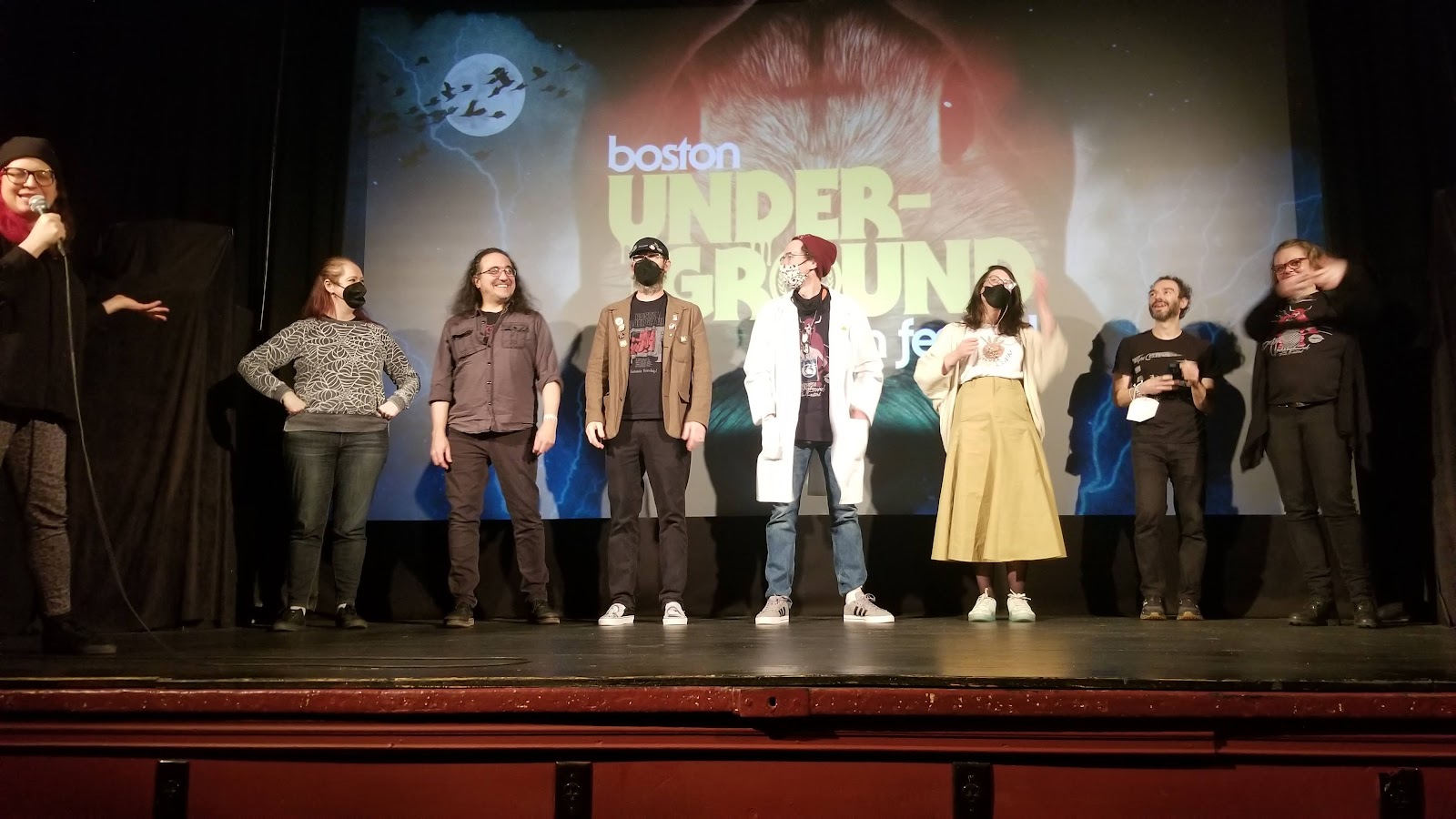
Meet the team running things!
Once again, because this is the tightest-scheduled festival you will ever see and (presumably) because of covid concerns, there was no Q&A in the theater for the animation package, but if you've got questions, they put one online, and it's almost an hour long, so I imagine there's lots of good stuff in there.
I'll probably rush through this a bit, just because it's been three months and I'm trying to get this out before another festival swamps it. It should be noted that the feature component of the day was strong as heck; even if the three movies weren't always my exact thing, they were nifty genre movies with specific points of view, the sort that leave you excited to learn a little bit more about the situations that birthed them or which give you a chance to see something familiar from a somewhat different angle. Which is a big reason why I love genre film festivals - they often seem like an even more direct look at how different cultures are thinking of topics than the "classier" fests.
"Fulcrum"
* * * ½ (out of four)
Seen 27 March 2022 in the Brattle Theatre (BUFF 2022: Inbetween Days, digital)
"Fulcrum" is one of those animated shorts that starts out as a loose sort of narrative only to see that subverted to the joy of playing with shapes fairly quickly, but to its credit, seldom entirely loses the plot - or at least, you can at least generally find the characters filmmaker Timothy David Orme started with somewhere in the rapidly-filling screen. It's not just a case of something being a jumping-off point.
The end result is impressive; Orme duplicates and spirals out in recognizable Fibonacci sequences and other forms of mathematical precision but avoids the feel of cutting and pasting, with transitions that feel like they're exploiting the leverage of the film's title. Nine minutes isn't a huge running time for an animated short, but it's enough time for others following this general pattern to get lost, which doesn't happen here.
"In the Water's Wake"
* * * (out of four)
Seen 27 March 2022 in the Brattle Theatre (BUFF 2022: Inbetween Days, digital)
A short that feels like it could be the beginning of something, although if it were, filmmaker Sarah Kennedy would likely have to draw things out more if she were looking to tell an entire story as opposed to snippets of it. What is here is a nifty little piece, though; good-looking and trippy in its explorations of a beach town that may only exist in the castaway hero's mind.
"Johnny Crow"
* * * ½ (out of four)
Seen 27 March 2022 in the Brattle Theatre (BUFF 2022: Inbetween Days, digital)
Jesse Gouchey and Xstine Cook appear to have done something a little like this before, in terms of style, but it's a good one - live-action backgrounds in kind of run-down areas, mostly devoid of people, but the street art coming to life in response to the narration. It makes the moments when imagery breaks free even more powerful, and underlines the setting in interesting ways, a culture trying to thrive despite having to exist among that of its invaders.
It bolsters the story about a native man trying to find stability as he's in and out of prison, worrying about what his absence means for his family. There's a frustrating familiarity to it, but the filmmakers seem aware of this, balancing their frustration and anger without succumbing to resignation.
"PORT"
* * * (out of four)
Seen 27 March 2022 in the Brattle Theatre (BUFF 2022: Inbetween Days, digital)
Not a whole lot to say - it's two minutes and mostly has a neat look - but it's enough to say that I'd like to see what else director Andrew Lehman can do.
"Hakkori"
* * * ½ (out of four)
Seen 27 March 2022 in the Brattle Theatre (BUFF 2022: Inbetween Days, digital)
I had the weirdest feeling while watching "Hakkori", pretty sure I'd seen it as part of a shorts package with either Fantasia or Nightstream last year, but every once in a while having a reaction like "well, I'd have remembered that. The fact that most film buffs I know can apparently identify every movie they've ever seen from a single frame in one of those puzzle games is utterly foreign to me.
I was probably not entirely experiencing this again for the first time, but it's a fun one to do that with, following some cute yokai as they take the offerings from the local humans and frolic, bring it back to the boss, and the like. It's cute, drawn in a traditional cel-based style, or something that resembles it, the creatures inserted into live-action backgrounds that have a hint of the artificial to them because one isn't often looking at them from this close. The characters are wonderfully designed, getting a lot of emotion out of minimal features and expression, moving naturally but not in an overly-rotoscoped manner.
What strikes me most on this viewing where I am maybe a bit less in full "look at that!" mode is the way filmmakers Aya Yamasaki and Jason Brown approach nature and the yokai - one and the same, really - allowing them to be sort of alien and amoral, devouring each other, merging, splitting, executing these processes which are too chaotic to inevitably lead to renewal but tend to do so, letting the audience identify with the main guys they follow and be nervous that the world doesn't necessarily work by the terms humans will try to impose on it. It's a lesson that doesn't exactly feel like the point of the film even if it is a large part of what it's saying.
"Pottero"
* * * (out of four)
Seen 27 March 2022 in the Brattle Theatre (BUFF 2022: Inbetween Days, digital)
This one's a nifty little short that also has creatures who are not quite the personification of something more basic but which aren't entirely something else. Here, Lindsey Martin tells the story of a woman who encounters a monster from her backwoods town said to kill all that encounter it, escapes, tries to make something of herself, but cannot entirely escape the gravity of home, and must confront it.
It's simple, and told with animation that is not exactly pretty as it is in some cases, but Martin's got an eye for using ugliness with purpose, and is able to crank up tension even as he is sometimes able to treat a situation casually or dismissively. It's a reminder that people in simple or rough situations aren't stupid or lacking self-awareness, even though even the people from that sort of place can fall into the traps of believing in monsters and dismissing those who do simultaneously.
"Posted No Hunting"
* * * (out of four)
Seen 27 March 2022 in the Brattle Theatre (BUFF 2022: Inbetween Days, digital)
Stop-motion found-footage horror? Sure, why not? Director Alisa Stern and co-writer Scott Ampleford get right into it here, establishing an immediately creepy vibe with how the night-vision look makes models that should be cute something else even before things start to go seriously wrong and they're called on to contribute some annoyed and panicked voice acting.
A lot of folks doing live-action features would like to be able to do what they manage with three minutes and figures that look like they should be silly more than scary.
"Everybody Goes to the Hospital"
* * * ½ (out of four)
Seen 27 March 2022 in the Brattle Theatre (BUFF 2022: Inbetween Days, digital)
This one's a nightmare that will likely feel all too familiar - waiting what may be too long to take an ailing child to the hospital, where Little Mata is as confused as she is sick and the parents feel powerless. It probably plays for everyone.
Filmmaker Tiffany Kimmel does things that maybe other directors wouldn't. She never makes this hospital seem overly large and out of proportion to Little Mata; the world seems out of scale to kids anyway and this is not a special property of this time. Indeed, there's a sort of quiet acceptance and even trust in Lucia Hadley Wheeler's narration as the title character, like she's trembling but has been raised to listen and keep out of the adults' way. It can still seem an alien place, though, with exterior shots often depicting it as up in the air, with nothing nearby other than the winding road leading to it, like it exists outside the world Mata knows.
Visually, it's kind of a familiar sort of movie, characters not exactly stiff but having limited joints and papier-mache heads whose expressions are animated sparingly. It's the sort where the animators will often hold most of the image still so that they can zoom into a little hand movement or the like, boosting its import. It's a known technique but it works because one still tends to expect exaggeration with this medium, and that sort of focus becomes doubly effective.
"The Bum Family: Lilly goes to the Dogs"
* * * (out of four)
Seen 27 March 2022 in the Brattle Theatre (BUFF 2022: Inbetween Days, digital)
I must admit, I haven't exactly loved previous "Bum Family" shorts that have popped up in the BUFF comedy and animation packages - they've had the randomness of something a little kid was making up as they went along, but not necessarily the wild creativity, and they've juggled too many characters who are mostly interesting for their odd designs.
This one winds up working fairly well, though, probably in part because it by and large strips the group down to just Lilly and her pet Fluffle and lets them be chaos agents in a place that can probably use a little chaos like a dog show, with Lilly getting down on all fours and taking Fluffle's place while she leads a revolution among the dogs. It's a pair of absurdities that the filmmakers commit to utterly even as it gets more ridiculous by the second and makes one question where the whole thing started. It's madness, but madness that seems to know its target.
"Argus"
* * * ¼ (out of four)
Seen 27 March 2022 in the Brattle Theatre (BUFF 2022: Inbetween Days, digital)
An impressively well-executed bit of dystopia, as one can have a difficult time telling whether something literally reality-warping is going on to the employee who comes in to do a menial, senseless task or whether it's just the sort of distorting job that creates such a feeling that this all could be a flight of fancy or a science-fictional premise that is inherently madness-inducing if real.
It's impressively executed, a nift combination of shabby and futuristic, nicely blurring the line between existential and science-fictional horror.
"O, What Rice! O, What Beans!"
* * ½ (out of four)
Seen 27 March 2022 in the Brattle Theatre (BUFF 2022: Inbetween Days, digital)
Not really my thing, I've got to admit, as much as I like rice and beans myself. It's a rough thing to say about a short where the production appears to mostly be a one-man show, but its idiosyncratic style often works against it. The joke is that the main character is obsessive over something kind of bland and unexciting, and that mania being incongruous is where the comedy comes from, but if the whole world is weird and kind of grotesque, it doesn't work nearly as well, and neither does the gross-out humor.
"Pancake Panic!"
* * * ½ (out of four)
Seen 27 March 2022 in the Brattle Theatre (BUFF 2022: Inbetween Days, digital)
I've got enough notes for "Pancake Panic!" in my festival notebook to make some features blush; it's as tightly-plotted and cleverly-assembled a story as you'll find anywhere, and it's not exactly something with an elaborate look or even ten minutes long. Filmmaker David Filmore leans on deadpan humor so that the brutal slapstick can surprise, and pulls together seemingly random threads in really impressive fashion.
Neptune Frost
* * * ½ (out of four)
Seen 27 March 2022 in the Brattle Theatre (BUFF 2022, DCP)
Afrofuturism of this variety does not give a shit about whether my white North American self understands it, and that's kind of great. Even though there are a lot of Americans involved with this production, including writer/co-director Saul Williams, it feels like it comes from a different tradition with different assumed lines between reality and fantasy, let alone different genres, and no particular interest to explain things that a non-Rwandan audience might not get.
In a sense, that spark of discovery, whether it be an outsider learning a new culture or that culture seeing itself in a way they seldom had before, is the film's draw. The science fiction and adventure of it is kind of fuzzy and familiar - a government-corporate alliance oppressing the poor to exploit a vital resource and chosen ones rising to inspire a revolt, with "hacking" as a sort of magic. But what a spark, with a charismatic cast who all seem to have something defiant not far from the surface, computer and surveillance centers that opt for feeling like an art installation over a sleek but boring realism, a semi-magical sex change that manages to feel both like a trans person finding her true self and a man shedding his old life and ultimately feels like an act of evolution, and a willingness to dip into poetry and music when emotion charges the characters, but without it feeling like a not-literal representation.
At times, Neptune Frost seems to be trying to evolve new language, frantically trying to marry African culture to the technological world powered by its resources, and if it sometimes seems to be grasping, that's fine, because the discovery is exciting. It's a movie where I'm genuinely excited to dive into the eventual Blu-ray to see what I find on a second and third pass now that my mind is a little more attuned to whatever wavelength Williams and co-director/cinematographer Anisia Uzeyman were on.
Medusa
* * * (out of four)
Seen 27 March 2022 in the Brattle Theatre (BUFF 2022, DCP)
The politics of other countries can get flattened when you only hear of them occasionally, and such it has been for Brazil where I'm concerned (and I suspect for many other Americans) - it's easy to associate the whole country with what its leaders are doing as opposed to getting down into the guts of what people are dealing with. It's different all over, but a lot of the forces are the same, just interacting a bit differently.
So this film presents Michele (Lara Tremouroux) and Mariana (Mariana Oliveira), two best friends in their twenties who have been part of an evangelical church for some time, and often serve as the pretty faces it presents to the world. That cheery facade hides nightly acts of violence against sinners and, worse, those who would leave the church. One of these raids gets them in over their heads, with Mariana winding up scarred, and while she's supposed to be mentoring a new, mousy member of the group, she becomes obsessed with a woman who escaped the cult only to possibly wind up burned worse afterward, taking a job as a nurse at the coma center where she suspects this woman is a patient.
There's a lot going on - satire of the hypocritically pious chasing power and using the sex appeal to pull others in despite a fair amount of talk about virginal purity, a mystery, romance and jockeying for position. Amid all of that, I suspect that most viewers will respond to Mariana's honest, well-earned growth; there's intelligence and empathy to her which actress Mariana Oliveira seems to enjoy teasing out, and something hopeful about how someone can seem to slide out of a group like this as easily as they can slide in. It's all the better because few of these young characters seem cheaply brainwashed or knowingly hypocritical - "evangelical influencer" is a goofy character description but makes sense when you meet her. The neon lighting and pulsing beat of the soundtrack is a terrific set of choices, too; the characters' youth and wiring to be regular young women is never far off and never treated as weird or paradoxical.
It's an energetic romp through the heads of young evangelicals that initially benefits big time from treating them as complicated young adults and thus going in directions that will be unexpected given their usual portrayal. The finale is, admittedly, kind of all over the place, right on the border of doing the worst thing a movie with people shouting about demons despite being otherwise grounded can do. It earns its way there, though, offering more to chew on than just plot contrivances.
Pahanhautoja (Hatching)
* * * (out of four)
Seen 27 March 2022 in the Brattle Theatre (BUFF 2022, DCP)
Director Hanna Bergholm and co-writer Ilja Rautsi seem to have ideas for two fine horror movies with enough overlapping material that it probably made sense to combine the two, and if that's the case, they do so well enough that it would be hard to disentangle them. The two halves don't quite mesh, though - what starts out as a story about a kid who tries to protect a monster from her ingratiating but harsh mother but loses control when it tries too hard to protect her is a great, darkly funny scary story for kids, but where it ends seems to be heading in the other direction.
This works in large part because the young actress at the center, Siiri Solalinna, is great at playing a kid who is terrified of her own emotions, and Hatching is at its absolute best when it plays into that. In those moments, it's creating a constant relatable knot in the belly, not just because everyone who has been Tinja's age recognizes the feeling, but because of how those emotions are well worth being scared of, especially when directed at those Tinja knows meant no harm and don't deserve the horrible things her monster will do to them. It's the sort of thing that can drive a girl mad.
When the movie gets away from that in the last act... Well, there's an argument that it still makes sense, that dark sides are like this, but it still sort of "just" becomes a monster hunt and takes the most generic horror-movie way out, down to the last-minute twist that, whoops, the story has no time to deal with!
That said, there's a lot of other good stuff in here, darkly funny bits executed with tremendous precision, easy mommy-blogger jokes that get sharper as the movie goes on (you can feel the filmmakers honing their knives), and a cruel irony in how both of this family's kids physically resemble one parent but are much more like the other inside, even if those parents are blind to it. Bergholm has her eyes on the goal and a lot of good bits that fit into it, and still makes a cutting, smart, funny monster movie.
Showing posts with label Finland. Show all posts
Thursday, July 14, 2022
BUFF 2022.05: "Inbetween Days", Neptune Frost, Medusa, and Hatching
Monday, April 18, 2022
Not Exactly Oneself: Everything Everywhere All At Once and Dual
I've totally been holding onto that review of Everything Everywhere All at Once so that I could pair it with another movie as opposed to being lazy and distractible for the past two weeks.
(Looks back and forth)
Not buying it, huh?
Anyway, it's kind of fun when a theme appears in one's viewing, in this case favorite actresses working with intriguing indie filmmakers to make movies where they get to have multiple takes on the same characters, although Daniels and Riley Stearns go about it in completely different ways: Everything Everywhere is as busy as its name implies, while Dual sands down everything that could really come across as a fun hook. In this case, it's hard to argue with how Daniels wears their hearts on their sleeves, keeping up a frantic pace for a crazy amount of time but giving the audience a lot of time to feel things even though they aren't shaking and demanding they feel this. Stearns makes a movie that begs to be examined and dissected, and while I found more going on than I was feeling while I watched it, I don't know that there is really that much there. It's got a layer or two, but only a layer or two.
It's kind of notable how they're sort of taking opposite release paths. Everything Everywhere is doing the sort of expansion one doesn't necessarily see that much any more - a couple screens in NYC/LA, some larger markets including Boston later - with the directors doing a lot of in-person shows with college kids and film-lovers that will talk it up if they like it - and then medium and wide releases following. Dual, meanwhile, got booked on one screen in the area tightly enough that I suspect it might be a four-wall (it's possible AMC figures there's just no audience for matinees, even on the weekend, but it's kind of odd), and its distributor is probably seeing this as an extremely brief stop before video. I'm mildly surprised RLJE hasn't announced an early-June release yet, but I guess it's gauche to do so before the first week is through, even if the window is down to 45 days.
Anyway - check out Everything Everywhere All at Once on the big screen if it opens nearby, preferably on the biggest one you can with people feeling emotions on every side. You're probably not going to have that for Dual, although you may find it interesting, even if it's not particularly intense.
Everything Everywhere All At Once
* * * ¾ (out of four)
Seen 30 March 2022 in AMC Boston Common #2 (preview, Imax Xenon)
In their most notable previous collaboration, "Daniels" (the team of Dan Kwan and Daniel Scheinert) produced Swiss Army Man, a film with the memorable selling point of "Daniel Radcliffe as a farting corpse" (but with the film also surprisingly affecting), which would seem to be a tough one to top; most would go for something played straighter. They not only do not do this, but they make absurdity a fundamental part of how Everything Everywhere All at Once works, while also giving a great cast much more to do than get the audience from one crazy scene to the next.
It's built around Michelle Yeoh's Evelyn Wang, who owns a laundromat with husband Waymond (Ke Huy Quan). Her father (James Hong) has recently arrived from China, too ill to live alone anymore, and Evelyn Gong Gong that daughter Joy (Stephanie Hsu) is dating a really nice girl (Tallie Medel). First, though, she's got to get through an IRS audit - at least, until things take a strange detour along the way when Waymond is seemingly possessed by his counterpart from another universe, telling Evelyn that she's the only person who can stop "Jobu Tupaki", a threat that has already ravaged other universes and is building something that endangers all of existence. To do that, Evelyn will have to "verse-jump", connecting with versions of herself that went down different paths and as such have different skill sets to access.
One does this, apparently, by doing something improbable, and that gives the Daniels the chance to not just stage kung fu action that is at once whimsical and impressively choreographed, but to make its every appearance feel unpredictable so that it never feels like a set piece that is most impressive for its technical skill. Once this movie hits its stride, it is just maximally weird, including what is one of the most bizarrely funny bits I've seen in a movie theater in some time. The movie keeps building to new ways of being ridiculous even when that seems impossible, though it finds spots to slow down and let the audience catch their collective breath even while another part of the brain is figuring out what this all means.
It works in part because it is also incredibly sincere while still being irreverent enough that this sincerity isn't used as a club (well, maybe it is toward the end) and because it is deft enough to build itself on a foundation of Michelle Yeoh being terrific at anything that might be thrown at her by giving her a heroine who is often a screw-up without making that cheaply endearing. There's some sly use of her movie-star power here, because the audience who knows her being ready to see her claim her due power and be awesome helps build anticipation, but the whole thing would fall apart if being human and fallible both on top of and underneath that gives the movie a target and helps the film with its musings about the scale of everything.
Her star power also lets the rest of the cast kind of sneak up on the viewer, even when they shouldn't. James Hong, for instance, has seemingly been playing cantankerous old Chinese men since he was young, but it's a delight to see him play with those tropes and suddenly take charge of a scene without making it any less Yeoh's. Ke Huy Quan, meanwhile, has not been on screen nearly as much as one might like since a couple memorable roles as a kid, but he also reinvents himself from scene to scene while still finding common ground. Same goes for Stephanie Hsu, who in some ways has the trickiest roll, in that Joy's multiple iterations have to seem incredibly far apart even though the crux of it is that it's the same person underneath.
That's the nut of it, really - that what's pushing all versions of all these characters is kind of the sameI and relatively universal, even if a lot of the details are specific to Chinese families. Small, bizarre details can send them off into wildly different directions but much of it's the same. That said, a big part of what impresses is that the Daniels don't just take their grand sci-fi premise and use it to explode a tight circle's concern to giant-screen size, but allow themselves and the audience to stand in awe of how mindbogglingly incomprehensible and indifferent the universe can be while still finding value in the chaos.
It's a special movie for that, able to grasp at the grandiose without making the mundane feel inconsequential. It's sentimental as movies come, but doesn't have to minimize anything to make the pieces one can grasp important.
Dual
* * (out of four)
Seen 14 April 2022 in AMC Boston Common #12 (first-run, DCP)
Considering how much I've enjoyed writer/director Riley Stearns's previous movies and like Karen Gillan, I found Dual tremendously disappointing. This movie takes an intriguing premise and does nothing with it so aggressively that one can't even find it clever any more. The bland numbness of it all is obviously part of the design, but ultimately to no particular end.
In it, a woman named Sarah (Gillan) suddenly finds herself taking ill, and it's not good news - she's got a rare condition that will kill her painlessly relatively soon. Fortunately, she lives in a world where "The Facility" can clone someone in such a situation, and this new copy will be like a sponge, learning all she can and ready to step in without a hitch so that her boyfriend (Beulah Koale) and mother (Maija Paunio) will be able to continue on without their lives being upended. The thing is, Sarah's Copy isn't exact - she's got a different eye color, soon develops different tastes, and over the coming months, becomes so close to boyfriend Peter that they're kind of getting impatient for her to die. But the disease goes into an unlikely remission, and while most clones are blithely deactivated under these circumstances, Sarah's Copy wants to live, and the law gives her the option to challenge Sarah to a fight to the death - which makes Sarah as ready to fight for anything as she's ever been, even if she can only afford an inexpensive instructor (Aaron Paul) to train her.
Stearns and his crew create a world that in some ways evokes Repo Man in its aggressively generic, un-slick aesthetics - nothing has a brand name, and while a lot of the technology is fairly modern - smartphones and DVD players and the like - there's a sort of IBM PC-style design to what we see on the screens, monochrome images with 8x8 character sets. The characters all speak in simple declarative sentences, with anything that may be a witty rejoinder or sly self-knowledge carefully removed from the script, and though there's a stray reference to California early, the characters have a mishmash of flat accents and mismatched ethnicities. It's canny in a certain way; it establishes a world where one seldom exactly questions the idea of people being replaceable so much as whether replacing Sarah is really necessary.
One can sort of see the thinking behind a lot of these choices, but even when one sees what Stearns is going for, that's all they are, choices that don't always land or intrigue. When the whole film is so determinedly flat and the metaphor is so clear, it's natural to want there to be more: Some sort of world-building, a storyline that has Sarah questioning the world around her, some sharper satire or intrigue or a chance for Gillan to really play with how Sarah is seemingly already dead inside before her guts start to rot versus Sarah's Copy being fresh and curious. Stearns seems too locked into playing up the dreary emptiness of the world he's skewering to create that sort of excitement, as if afraid that too many corners where one can see potential will undercut the rest.
So one has to treasure the moments where he does get aggressive - there are a couple of scenes where the decent black comedy pulls out an unexpected knife, like the Facility's recruitment video or a small child telling a horrific story. There are also the scenes where Gillan gets to show a little emotion and one wants more, because she absolutely connects when Sarah is shaken out of her stupor. There's a chemistry between her and Aaron Paul that intrigues in part because it's there despite how stunted they are - it's not entirely unlike the folks in The Art of Self-Defense, in some ways, except that there's deliberately less to this group.
It's a worthy effort, but the deadpan just doesn't work most of the time, whether because there's nothing for it to play off or some other reason, and the end is too carefully but obviously constructed to knock anyone for a loop. Stearns has been making a career out of these stories of people disconnected from the world, and it's for the most part been intriguing stuff, but this particular film is just too detached for its own good.
(Looks back and forth)
Not buying it, huh?
Anyway, it's kind of fun when a theme appears in one's viewing, in this case favorite actresses working with intriguing indie filmmakers to make movies where they get to have multiple takes on the same characters, although Daniels and Riley Stearns go about it in completely different ways: Everything Everywhere is as busy as its name implies, while Dual sands down everything that could really come across as a fun hook. In this case, it's hard to argue with how Daniels wears their hearts on their sleeves, keeping up a frantic pace for a crazy amount of time but giving the audience a lot of time to feel things even though they aren't shaking and demanding they feel this. Stearns makes a movie that begs to be examined and dissected, and while I found more going on than I was feeling while I watched it, I don't know that there is really that much there. It's got a layer or two, but only a layer or two.
It's kind of notable how they're sort of taking opposite release paths. Everything Everywhere is doing the sort of expansion one doesn't necessarily see that much any more - a couple screens in NYC/LA, some larger markets including Boston later - with the directors doing a lot of in-person shows with college kids and film-lovers that will talk it up if they like it - and then medium and wide releases following. Dual, meanwhile, got booked on one screen in the area tightly enough that I suspect it might be a four-wall (it's possible AMC figures there's just no audience for matinees, even on the weekend, but it's kind of odd), and its distributor is probably seeing this as an extremely brief stop before video. I'm mildly surprised RLJE hasn't announced an early-June release yet, but I guess it's gauche to do so before the first week is through, even if the window is down to 45 days.
Anyway - check out Everything Everywhere All at Once on the big screen if it opens nearby, preferably on the biggest one you can with people feeling emotions on every side. You're probably not going to have that for Dual, although you may find it interesting, even if it's not particularly intense.
Everything Everywhere All At Once
* * * ¾ (out of four)
Seen 30 March 2022 in AMC Boston Common #2 (preview, Imax Xenon)
In their most notable previous collaboration, "Daniels" (the team of Dan Kwan and Daniel Scheinert) produced Swiss Army Man, a film with the memorable selling point of "Daniel Radcliffe as a farting corpse" (but with the film also surprisingly affecting), which would seem to be a tough one to top; most would go for something played straighter. They not only do not do this, but they make absurdity a fundamental part of how Everything Everywhere All at Once works, while also giving a great cast much more to do than get the audience from one crazy scene to the next.
It's built around Michelle Yeoh's Evelyn Wang, who owns a laundromat with husband Waymond (Ke Huy Quan). Her father (James Hong) has recently arrived from China, too ill to live alone anymore, and Evelyn Gong Gong that daughter Joy (Stephanie Hsu) is dating a really nice girl (Tallie Medel). First, though, she's got to get through an IRS audit - at least, until things take a strange detour along the way when Waymond is seemingly possessed by his counterpart from another universe, telling Evelyn that she's the only person who can stop "Jobu Tupaki", a threat that has already ravaged other universes and is building something that endangers all of existence. To do that, Evelyn will have to "verse-jump", connecting with versions of herself that went down different paths and as such have different skill sets to access.
One does this, apparently, by doing something improbable, and that gives the Daniels the chance to not just stage kung fu action that is at once whimsical and impressively choreographed, but to make its every appearance feel unpredictable so that it never feels like a set piece that is most impressive for its technical skill. Once this movie hits its stride, it is just maximally weird, including what is one of the most bizarrely funny bits I've seen in a movie theater in some time. The movie keeps building to new ways of being ridiculous even when that seems impossible, though it finds spots to slow down and let the audience catch their collective breath even while another part of the brain is figuring out what this all means.
It works in part because it is also incredibly sincere while still being irreverent enough that this sincerity isn't used as a club (well, maybe it is toward the end) and because it is deft enough to build itself on a foundation of Michelle Yeoh being terrific at anything that might be thrown at her by giving her a heroine who is often a screw-up without making that cheaply endearing. There's some sly use of her movie-star power here, because the audience who knows her being ready to see her claim her due power and be awesome helps build anticipation, but the whole thing would fall apart if being human and fallible both on top of and underneath that gives the movie a target and helps the film with its musings about the scale of everything.
Her star power also lets the rest of the cast kind of sneak up on the viewer, even when they shouldn't. James Hong, for instance, has seemingly been playing cantankerous old Chinese men since he was young, but it's a delight to see him play with those tropes and suddenly take charge of a scene without making it any less Yeoh's. Ke Huy Quan, meanwhile, has not been on screen nearly as much as one might like since a couple memorable roles as a kid, but he also reinvents himself from scene to scene while still finding common ground. Same goes for Stephanie Hsu, who in some ways has the trickiest roll, in that Joy's multiple iterations have to seem incredibly far apart even though the crux of it is that it's the same person underneath.
That's the nut of it, really - that what's pushing all versions of all these characters is kind of the sameI and relatively universal, even if a lot of the details are specific to Chinese families. Small, bizarre details can send them off into wildly different directions but much of it's the same. That said, a big part of what impresses is that the Daniels don't just take their grand sci-fi premise and use it to explode a tight circle's concern to giant-screen size, but allow themselves and the audience to stand in awe of how mindbogglingly incomprehensible and indifferent the universe can be while still finding value in the chaos.
It's a special movie for that, able to grasp at the grandiose without making the mundane feel inconsequential. It's sentimental as movies come, but doesn't have to minimize anything to make the pieces one can grasp important.
Dual
* * (out of four)
Seen 14 April 2022 in AMC Boston Common #12 (first-run, DCP)
Considering how much I've enjoyed writer/director Riley Stearns's previous movies and like Karen Gillan, I found Dual tremendously disappointing. This movie takes an intriguing premise and does nothing with it so aggressively that one can't even find it clever any more. The bland numbness of it all is obviously part of the design, but ultimately to no particular end.
In it, a woman named Sarah (Gillan) suddenly finds herself taking ill, and it's not good news - she's got a rare condition that will kill her painlessly relatively soon. Fortunately, she lives in a world where "The Facility" can clone someone in such a situation, and this new copy will be like a sponge, learning all she can and ready to step in without a hitch so that her boyfriend (Beulah Koale) and mother (Maija Paunio) will be able to continue on without their lives being upended. The thing is, Sarah's Copy isn't exact - she's got a different eye color, soon develops different tastes, and over the coming months, becomes so close to boyfriend Peter that they're kind of getting impatient for her to die. But the disease goes into an unlikely remission, and while most clones are blithely deactivated under these circumstances, Sarah's Copy wants to live, and the law gives her the option to challenge Sarah to a fight to the death - which makes Sarah as ready to fight for anything as she's ever been, even if she can only afford an inexpensive instructor (Aaron Paul) to train her.
Stearns and his crew create a world that in some ways evokes Repo Man in its aggressively generic, un-slick aesthetics - nothing has a brand name, and while a lot of the technology is fairly modern - smartphones and DVD players and the like - there's a sort of IBM PC-style design to what we see on the screens, monochrome images with 8x8 character sets. The characters all speak in simple declarative sentences, with anything that may be a witty rejoinder or sly self-knowledge carefully removed from the script, and though there's a stray reference to California early, the characters have a mishmash of flat accents and mismatched ethnicities. It's canny in a certain way; it establishes a world where one seldom exactly questions the idea of people being replaceable so much as whether replacing Sarah is really necessary.
One can sort of see the thinking behind a lot of these choices, but even when one sees what Stearns is going for, that's all they are, choices that don't always land or intrigue. When the whole film is so determinedly flat and the metaphor is so clear, it's natural to want there to be more: Some sort of world-building, a storyline that has Sarah questioning the world around her, some sharper satire or intrigue or a chance for Gillan to really play with how Sarah is seemingly already dead inside before her guts start to rot versus Sarah's Copy being fresh and curious. Stearns seems too locked into playing up the dreary emptiness of the world he's skewering to create that sort of excitement, as if afraid that too many corners where one can see potential will undercut the rest.
So one has to treasure the moments where he does get aggressive - there are a couple of scenes where the decent black comedy pulls out an unexpected knife, like the Facility's recruitment video or a small child telling a horrific story. There are also the scenes where Gillan gets to show a little emotion and one wants more, because she absolutely connects when Sarah is shaken out of her stupor. There's a chemistry between her and Aaron Paul that intrigues in part because it's there despite how stunted they are - it's not entirely unlike the folks in The Art of Self-Defense, in some ways, except that there's deliberately less to this group.
It's a worthy effort, but the deadpan just doesn't work most of the time, whether because there's nothing for it to play off or some other reason, and the end is too carefully but obviously constructed to knock anyone for a loop. Stearns has been making a career out of these stories of people disconnected from the world, and it's for the most part been intriguing stuff, but this particular film is just too detached for its own good.
Friday, July 26, 2019
Fantasia 2019.11: Cencoroll Connect, Boxer's Omen, Purity of Vengeance, Dance with Me, and Satanic Panic
Not a whole lot of guests in the movies I went to on Sunday, but as the halfway mark, it's another good chance to do some counting: 35 features, 26 shorts, 9 attached and 17 as part of two programs. That actually gets my feature pace down a bit, to 70 features, but that's probably just reasonable rather than the stupidly busy pace I often set.

Writer/director Shinobu Yaguchi was on-hand for Dance with Me, which is pretty darn charming, although, as a musical celebrating musicals while also commenting on their goofiness, I feel like it could have gone a bit further. He a good-sized build-up, as some of his previous films had been big hits at the festival in previous years, but I think the only one I've actually seen was Happy Flight, which was one of the odder screenings I went to, as the airline featured in the film rented out the Coolidge, showed the movie for free, and pitched their product, which was not really what I'd been expecting.
It was a fun screening, though, both for how he opened up with a statement that described his film as "... like I think you say in English, 'batshit crazy'" and for how some of the questioning showed how narrow and skewed our fandom can render our view of pop culture. One of the songs had apparently been used in an anime, and the questioner wanted to know what sort of influence that was, and Mr. Yaguchi just had absolutely no idea what he was talking about, as these were all pop songs from the 1970s and early 1980s. The anime was probably trying to tap into the same vein of nostalgia, but Yaguchi's experience of Japanese pop culture is obviously very different from the twentysomething who attends this festival
So, that was Sunday. It's now Friday, and I'll be hitting Night God, Human Lost, and Koko-di Koko-da, maybe with Jessica Forever in there, but it's much less tight on Tuesday, and based on the amount of caffeine I've already had to down to get through the morning, I'm guessing I won't be up for Decoder at midnight. Tone-Deaf is a bunch of fun
Cencoroll Connect ("Cencoroll" & "Cencoroll 2")
* * * (out of four)
Seen 21 July 2019 in Salle J.A. DeSève (Fantasia International Film Festival: AXIS, digital)
There's a shift in the animation style somewhere in the middle of this film, but that's natural; there's ten years between the releases of "Cencoroll" and "Cencoroll 2", and you can't help but see the spot where they are fused into a short feature. The thing is, it becomes a bit more of a different sort of amine at that point, introducing more characters who have clear purpose and sense of urgency, piling more action on, losing a bit of what made the opening feel unique even if it isn't necessarily anything completely new.
The fun of that first act was the apparent reluctance to be a sci-fi action amine; hero Tetsu may be bonded to a giant shapeshifting creature, but he doesn't really have any interest in fighting others, or satisfying some girl's curiosity, or investigating where the likes of Cenco come from. Even villain Shuu seems to be more or less attacking because it's as good a time as any, and the fights have a sort of slow ramp-up until they're suddenly quite lethal. It's a good fit for the muted color scheme and simple, amorphous designs, an impressive bit of work in creating a certain sort of mood and not overloading the audience.
There's still a lot of that going on in the second half, but now there's a secret agency, titanic "kites", connections between characters, and more action. It's not a bad example of this sort of amine, even if it's no longer quite the slacker version of it, but the brighter, more solid colors jar a bit and the action becomes a bit much. It almost seems to be holding a moment, extending the transition between the seemingly simple, laid-back "Cencoroll" started as and the blockbuster that the entire saga will become a little too long, and never fully arriving at that final destination; even the tease during the credits just suggests a bit more rather than a big, climactic shift. Maybe it will all fit together when and if the filmmakers can do part 3.
Full review on EFilmCritic
Mo (The Boxer's Omen)
* * * (out of four)
Seen 21 July 2019 in Salle J.A. DeSève (Fantasia International Film Festival: Fantasia Retro, 35mm)
I think I've seen this whacko bit of Hong Kong horror before, but probably as part of a late show where it couldn't fully lodge in my head. Which is kind of incredible, because this thing is the sort of insane that one would seemingly not forget.
It is, after all, full of weird sequences that leave the viewers' mouths open in pure shock (or covered to keep from puking), and on top of that, seem like they're just not going to end. A thing where the vengeance-seeking students set about creating some sort of female martial-arts golem involves just an immense amount of crocodile guts even before they start shoving gross things in their mouths, masticating it, and then spitting it out so that the next guy can add some ingredients and do the same, and it just goes on and on and on, like the filmmakers knew it needed to drag it out forever for at least one person in the audience to hurl sympathetically. And that's at least got a sort of pure authenticity to it, compared to the other stretches of mystic battles where Shaw Brothers surely spent dozens of dollars on effects.
That's all kind of fun, for certain definitions of fun, but it can be a little frustrating to see just how little the filmmakers care about anything else, from the bits of sport and triad stories glued into the start to get things going to how explanations and transitions are mere obligations to be wedged in as necessary. It's not really a good movie even though it is able to draw a visceral reaction, but by the time is over, there's no denying that it has done that and (in this case) done so in the middle of a festival of movies that have had 35 years to figure out how to do it better. I am, at the very least, reasonably sure I will not forget whether or not I've seen it again.
Review from 2014
Journal 64 (aka The Purity of Vengeance)
* * * (out of four)
Seen 21 July 2019 in Auditorium des Diplomes de la SGWU (Fantasia International Film Festival, DCP)
"Department Q" has, as a series, reached the point where it's got to deal with characters staying in the same place rather than having some sort of shift in their job or life - and where a character is compelled to mention that they really didn't have this many perverse cold cases before the department existed. It's not quite a breaking point, but it's a spot where I suspect everyone involved is thinking about how to avoid inertia even if not much actually gets reconfigured.
And it does okay. This case touches on an uglier bit of Danish history that can't be entirely consigned to the past (don't they all), and the filmmakers do a nice job of rolling it around, letting the audience struggle with how the pieces never seem to fit until the brilliant but temperamental detective sees the twist that's obvious in retrospect. This time around, the more personal narrative revolves around Carl's partner Assad (a first-billed Fares Fares), who is given a rare chance to move up while confronting the issues with being an Arab in Copenhagen more directly. It's nicely and sympathetically laid out (down to the way emphasis is placed in the phrase "non-ethnic Danes" to make it sound reluctant and avoid positioning Assad and his friends as outsiders), and seems more genuinely repulsed by the violence against women inherent in its story than usual.
It is, as with the others, a quality production, knowing how to squeeze every cent out of its budget without being too slick all over or slacking on the seedy and cramped corners. The snowy background of the present stays constant even as the flashbacks track the seasons, plunging young Nete from a hopeful summer to the darkest winter.
I must admit, I kept forgetting why I had this movie circled on my schedule before checking and realizing that it was the new Department Q movie, which is how it goes with this series, I guess. It's almost always worth diving in, but I won't exactly be eagerly anticipating the next until it's in front of me.
Full review on EFilmCritic
Dance With Me
* * * (out of four)
Seen 21 July 2019 in Auditorium des Diplomes de la SGWU (Fantasia International Film Festival, DCP)
The thing that mostly makes Dance With Me work is the thing that basically goes the game away; there are large chunks that the audience will not believe unless, at some point, the movie's heroine learned how to do all the singing and dancing, even if the trail of destruction she leaves as the result of her compulsion to make any song she hears into a musical number suggests that maybe she didn't, and once you've put that in her backstory, there's little doubt what she has to confront. How this will end is never in doubt, and is just a matter of making the path leading there crooked.
Fortunately, the first leg of the path is tremendously funny, with the first couple of songs utterly fantastic and Ayaka Miyoshi's pitch-perfect reaction to her character's predicament able to keep the laughs coming. Once she hits the road, it's a little rougher; there are fewer opportunities for big numbers, and the buddy-comedy thing that gets in the way is bumpy. I feel like I missed a scene that sets up her private investigator also being her rival, and another character's final appearance is especially random - the audience liked her, but maybe not that much, and she seems to be tidying up bits that don't really need it.
But, wow, is lead actress Miyoshi great. It's not just that she's cute as heck and can sing and dance, but she's terrific at finding the yin and yang of her character, where she can put herself above her friends' superficiality while still crushing on the same handsome executive given the chance, or finding terror in her actions feeling out of control even as she truly loves what her hypnotized brain is giving her permission to indulge in. There's another movie, perhaps, where maybe she comes to grips with the idea of being stuck like this, and the resolution doesn't completely fall on the casual whims of the hypnotist that put her in this situation (although Akira Takarada is a smooth charmer in the part).
Full review on EFilmCritic
"Helsinki Mansplaining Massacre"
* * ¾ (out of four)
Seen 21 July 2019 in Auditorium des Diplomes de la SGWU (Fantasia International Film Festival, digital)
As much as I appreciate the sentiment here, there's something a wee bit more ham-handed to this short than it needs to be, like writer/director Ilja Rautsi (a guy, for those of us who don't know Finnish names that well) is able to recognize the blatant sexism well enough but maybe not the more insidious bits that chip away at a woman, though that's obviously not exactly for me to say either.
There's no denying that eventual shutting bros up with a shotgun is cathartic as heck, though, or that Anna Paavilainen is ever less than a complete kick as Essi, the horror-loving lady who has been pushed far enough and knows how you blast your way out of the horror movie she's found herself in quite well, thank you. The gore is plentiful and enthusiastic, and it's undeniable that the film's heart is in the right place, which is all over the wall behind these lunatics.
Satanic Panic
* * * (out of four)
Seen 21 July 2019 in Auditorium des Diplomes de la SGWU (Fantasia International Film Festival, DCP)
Satanic Panic is horror comedy for people who know the genre and can poke fun without being entirely flip about it - it doesn't work if everybody involved is taking it for granted, but does when the right people are.
Indeed, it's at its best when it becomes a sort of buddy comedy between an innocent who is nevertheless nobody's fool and a girl who knows the score but is, maybe, not as corrupt as she thinks. Seeing it evolve into that is probably the movie's best surprise: Genuine friendship isn't exactly what movies like this are usually made of, but it happens almost before the viewer is aware of what's going on, and the pairing of Hayley Griffith and Jordan Ladd becomes a surprisingly solid core.
That gives the movie a lot of room for crazy, absurdist slapstick, and a whole crew of actors dive into the chance to indulge in their cultists' gleeful lack of morality. A lot are the sort of character actors one almost recognizes, seeming to have a blast pushing their personae just a bit further than usual, all the way up to Rebecca Romijn clearly having a blast suffering no fools, with a special guest appearance by Jerry O'Connell, who makes his suburban satanist the final evolution of the guy who never thought he could or should be held accountable. It's great fun and it sneaks a little bit of sting in there as well, though not enough to kill the mood.
Full review on eFilmCritic

Writer/director Shinobu Yaguchi was on-hand for Dance with Me, which is pretty darn charming, although, as a musical celebrating musicals while also commenting on their goofiness, I feel like it could have gone a bit further. He a good-sized build-up, as some of his previous films had been big hits at the festival in previous years, but I think the only one I've actually seen was Happy Flight, which was one of the odder screenings I went to, as the airline featured in the film rented out the Coolidge, showed the movie for free, and pitched their product, which was not really what I'd been expecting.
It was a fun screening, though, both for how he opened up with a statement that described his film as "... like I think you say in English, 'batshit crazy'" and for how some of the questioning showed how narrow and skewed our fandom can render our view of pop culture. One of the songs had apparently been used in an anime, and the questioner wanted to know what sort of influence that was, and Mr. Yaguchi just had absolutely no idea what he was talking about, as these were all pop songs from the 1970s and early 1980s. The anime was probably trying to tap into the same vein of nostalgia, but Yaguchi's experience of Japanese pop culture is obviously very different from the twentysomething who attends this festival
So, that was Sunday. It's now Friday, and I'll be hitting Night God, Human Lost, and Koko-di Koko-da, maybe with Jessica Forever in there, but it's much less tight on Tuesday, and based on the amount of caffeine I've already had to down to get through the morning, I'm guessing I won't be up for Decoder at midnight. Tone-Deaf is a bunch of fun
Cencoroll Connect ("Cencoroll" & "Cencoroll 2")
* * * (out of four)
Seen 21 July 2019 in Salle J.A. DeSève (Fantasia International Film Festival: AXIS, digital)
There's a shift in the animation style somewhere in the middle of this film, but that's natural; there's ten years between the releases of "Cencoroll" and "Cencoroll 2", and you can't help but see the spot where they are fused into a short feature. The thing is, it becomes a bit more of a different sort of amine at that point, introducing more characters who have clear purpose and sense of urgency, piling more action on, losing a bit of what made the opening feel unique even if it isn't necessarily anything completely new.
The fun of that first act was the apparent reluctance to be a sci-fi action amine; hero Tetsu may be bonded to a giant shapeshifting creature, but he doesn't really have any interest in fighting others, or satisfying some girl's curiosity, or investigating where the likes of Cenco come from. Even villain Shuu seems to be more or less attacking because it's as good a time as any, and the fights have a sort of slow ramp-up until they're suddenly quite lethal. It's a good fit for the muted color scheme and simple, amorphous designs, an impressive bit of work in creating a certain sort of mood and not overloading the audience.
There's still a lot of that going on in the second half, but now there's a secret agency, titanic "kites", connections between characters, and more action. It's not a bad example of this sort of amine, even if it's no longer quite the slacker version of it, but the brighter, more solid colors jar a bit and the action becomes a bit much. It almost seems to be holding a moment, extending the transition between the seemingly simple, laid-back "Cencoroll" started as and the blockbuster that the entire saga will become a little too long, and never fully arriving at that final destination; even the tease during the credits just suggests a bit more rather than a big, climactic shift. Maybe it will all fit together when and if the filmmakers can do part 3.
Full review on EFilmCritic
Mo (The Boxer's Omen)
* * * (out of four)
Seen 21 July 2019 in Salle J.A. DeSève (Fantasia International Film Festival: Fantasia Retro, 35mm)
I think I've seen this whacko bit of Hong Kong horror before, but probably as part of a late show where it couldn't fully lodge in my head. Which is kind of incredible, because this thing is the sort of insane that one would seemingly not forget.
It is, after all, full of weird sequences that leave the viewers' mouths open in pure shock (or covered to keep from puking), and on top of that, seem like they're just not going to end. A thing where the vengeance-seeking students set about creating some sort of female martial-arts golem involves just an immense amount of crocodile guts even before they start shoving gross things in their mouths, masticating it, and then spitting it out so that the next guy can add some ingredients and do the same, and it just goes on and on and on, like the filmmakers knew it needed to drag it out forever for at least one person in the audience to hurl sympathetically. And that's at least got a sort of pure authenticity to it, compared to the other stretches of mystic battles where Shaw Brothers surely spent dozens of dollars on effects.
That's all kind of fun, for certain definitions of fun, but it can be a little frustrating to see just how little the filmmakers care about anything else, from the bits of sport and triad stories glued into the start to get things going to how explanations and transitions are mere obligations to be wedged in as necessary. It's not really a good movie even though it is able to draw a visceral reaction, but by the time is over, there's no denying that it has done that and (in this case) done so in the middle of a festival of movies that have had 35 years to figure out how to do it better. I am, at the very least, reasonably sure I will not forget whether or not I've seen it again.
Review from 2014
Journal 64 (aka The Purity of Vengeance)
* * * (out of four)
Seen 21 July 2019 in Auditorium des Diplomes de la SGWU (Fantasia International Film Festival, DCP)
"Department Q" has, as a series, reached the point where it's got to deal with characters staying in the same place rather than having some sort of shift in their job or life - and where a character is compelled to mention that they really didn't have this many perverse cold cases before the department existed. It's not quite a breaking point, but it's a spot where I suspect everyone involved is thinking about how to avoid inertia even if not much actually gets reconfigured.
And it does okay. This case touches on an uglier bit of Danish history that can't be entirely consigned to the past (don't they all), and the filmmakers do a nice job of rolling it around, letting the audience struggle with how the pieces never seem to fit until the brilliant but temperamental detective sees the twist that's obvious in retrospect. This time around, the more personal narrative revolves around Carl's partner Assad (a first-billed Fares Fares), who is given a rare chance to move up while confronting the issues with being an Arab in Copenhagen more directly. It's nicely and sympathetically laid out (down to the way emphasis is placed in the phrase "non-ethnic Danes" to make it sound reluctant and avoid positioning Assad and his friends as outsiders), and seems more genuinely repulsed by the violence against women inherent in its story than usual.
It is, as with the others, a quality production, knowing how to squeeze every cent out of its budget without being too slick all over or slacking on the seedy and cramped corners. The snowy background of the present stays constant even as the flashbacks track the seasons, plunging young Nete from a hopeful summer to the darkest winter.
I must admit, I kept forgetting why I had this movie circled on my schedule before checking and realizing that it was the new Department Q movie, which is how it goes with this series, I guess. It's almost always worth diving in, but I won't exactly be eagerly anticipating the next until it's in front of me.
Full review on EFilmCritic
Dance With Me
* * * (out of four)
Seen 21 July 2019 in Auditorium des Diplomes de la SGWU (Fantasia International Film Festival, DCP)
The thing that mostly makes Dance With Me work is the thing that basically goes the game away; there are large chunks that the audience will not believe unless, at some point, the movie's heroine learned how to do all the singing and dancing, even if the trail of destruction she leaves as the result of her compulsion to make any song she hears into a musical number suggests that maybe she didn't, and once you've put that in her backstory, there's little doubt what she has to confront. How this will end is never in doubt, and is just a matter of making the path leading there crooked.
Fortunately, the first leg of the path is tremendously funny, with the first couple of songs utterly fantastic and Ayaka Miyoshi's pitch-perfect reaction to her character's predicament able to keep the laughs coming. Once she hits the road, it's a little rougher; there are fewer opportunities for big numbers, and the buddy-comedy thing that gets in the way is bumpy. I feel like I missed a scene that sets up her private investigator also being her rival, and another character's final appearance is especially random - the audience liked her, but maybe not that much, and she seems to be tidying up bits that don't really need it.
But, wow, is lead actress Miyoshi great. It's not just that she's cute as heck and can sing and dance, but she's terrific at finding the yin and yang of her character, where she can put herself above her friends' superficiality while still crushing on the same handsome executive given the chance, or finding terror in her actions feeling out of control even as she truly loves what her hypnotized brain is giving her permission to indulge in. There's another movie, perhaps, where maybe she comes to grips with the idea of being stuck like this, and the resolution doesn't completely fall on the casual whims of the hypnotist that put her in this situation (although Akira Takarada is a smooth charmer in the part).
Full review on EFilmCritic
"Helsinki Mansplaining Massacre"
* * ¾ (out of four)
Seen 21 July 2019 in Auditorium des Diplomes de la SGWU (Fantasia International Film Festival, digital)
As much as I appreciate the sentiment here, there's something a wee bit more ham-handed to this short than it needs to be, like writer/director Ilja Rautsi (a guy, for those of us who don't know Finnish names that well) is able to recognize the blatant sexism well enough but maybe not the more insidious bits that chip away at a woman, though that's obviously not exactly for me to say either.
There's no denying that eventual shutting bros up with a shotgun is cathartic as heck, though, or that Anna Paavilainen is ever less than a complete kick as Essi, the horror-loving lady who has been pushed far enough and knows how you blast your way out of the horror movie she's found herself in quite well, thank you. The gore is plentiful and enthusiastic, and it's undeniable that the film's heart is in the right place, which is all over the wall behind these lunatics.
Satanic Panic
* * * (out of four)
Seen 21 July 2019 in Auditorium des Diplomes de la SGWU (Fantasia International Film Festival, DCP)
Satanic Panic is horror comedy for people who know the genre and can poke fun without being entirely flip about it - it doesn't work if everybody involved is taking it for granted, but does when the right people are.
Indeed, it's at its best when it becomes a sort of buddy comedy between an innocent who is nevertheless nobody's fool and a girl who knows the score but is, maybe, not as corrupt as she thinks. Seeing it evolve into that is probably the movie's best surprise: Genuine friendship isn't exactly what movies like this are usually made of, but it happens almost before the viewer is aware of what's going on, and the pairing of Hayley Griffith and Jordan Ladd becomes a surprisingly solid core.
That gives the movie a lot of room for crazy, absurdist slapstick, and a whole crew of actors dive into the chance to indulge in their cultists' gleeful lack of morality. A lot are the sort of character actors one almost recognizes, seeming to have a blast pushing their personae just a bit further than usual, all the way up to Rebecca Romijn clearly having a blast suffering no fools, with a special guest appearance by Jerry O'Connell, who makes his suburban satanist the final evolution of the guy who never thought he could or should be held accountable. It's great fun and it sneaks a little bit of sting in there as well, though not enough to kill the mood.
Full review on eFilmCritic
Friday, October 05, 2018
Fantasia 2018 Catchup 01: Madeline's Madeline, Hanagatami, Unity of Heores, True Fiction, Buffalo Boys, Destiny: The Tale of Kamakura, Cold Skin, Relaxer, and Heavy Trip
Okay, this is taking longer than expected, but, to be fair, there is a lot of other stuff coming out that needs/wants writing up. Maybe I'll pick up speed writing while watching baseball and as it gets cooler out, but I really wasn't expecting to have 30-odd Fantasia movies left at the start of October.
On the other hand, I do sometimes wonder as I write these how much other people writing about film would like the luxury of being able to file their reviews without deadlines, with just a first draft and notes to go on. It's hard, sure, but it also makes you focus on what about the film is actually memorable. Plus, first impressions are important and true, but I found myself more impressed with some of the movies I didn't much like - Madeline's Madeline, Hanagatami, and Relaxer upon further reflection. I don't actually like any of the three now, understand, but it was easier to break down what was interesting about them, worth taking away.
I did like Heavy Trip, though, a lot, and am glad to see it's playing the Coolidge this weekend, although with two midnight shows in the screening room, not a lot of people will see it. Sell them out if you can, maybe it'll get another chance next week.
Madeline's Madeline
* * ½ (out of four)
Seen 1 August 2018 in Salle J.A. DeSève (Fantasia International Film Festival: Camera Lucida, DCP)
Well, that's me done with Josephine Decker. I don't want to be. There are some terrific performances to be found in this movie, a pretty decent core story, and moments that feel like something approaching self-awareness. As with her previous work, I can see great talent and potential there. I want to say nice things. And the thing of it is, if I hadn't come into this movie with a chip on my shoulder about certain things from her previous films, I'd probably be a lot more impressed, although it's not like the things that put that chip there wouldn't still be big negatives.
Things start with 16-year-old Madeline (Helena Howard) doing an exercise in an experimental theater program. She likes theater more than school, and it seems to be a good outlet for the things that had previously found her in psychiatric care. It's a situation that leads to her mother Regina (Miranda July) being rather high-strung, afraid of a relapse but worried about her daughter being swallowed by something she doesn't understand. Madeline, then, naturally gravitates toward Evangeline (Molly Parker), the troupe's leader who becomes fascinated by Madeline's story, moving a version of it closer to the center of the play that she's developing.
You can understand that; Madeline is a fascinating character given impressive life by Helena Howard. She has different faces for Madeline to present to her peers, her family, and her theater friends, but she connects them all with a desire to belong that both can have her shine dazzlingly bright when she sees a chance to connect and strongly suggests how dark her thoughts can get without actually showing her at her worst. She never shies from how Madeline is very much an adolescent, with both her impulsive and calculated actions showing a certain immaturity, so that even when she realizes something crucial and changes direction, it still feels like something where the consequences aren't completely considered; it's the actions of someone who is very bright but also troubled and who, even when she's figuring things out and focused, is still raw and clearly inexperienced. There can be a tendency to elevate the performances of young people that demonstrate maturity, but Howard's ability to show complexity without sacrificing Madeline being a teenager is something to watch for.
Full review at EFC.
Hanagatami
* * ¾ (out of four)
Seen 14 July 2018 in Salle J.A. DeSève (Fantasia International Film Festival, DCP)
When Hanagatami starts making the next phases of its rounds - the film societies and art-house tours before the small specialty label gives it a home video or streaming release - take note of its length, and fortify yourself properly. As much as there is plenty striking in this intended farewell work by the director of House, and plenty to discuss, it is very much the sort of film that had festival-goers who saw it nodding to each afterward and agreeing that, whatever else it was, it was definitely 159 minutes long.
It follows the adventures of teenager Toshihiko Sakakiyama (Shunsuke Kubozuka) in a Japanese coastal town during the 1930s, before the United States had entered the war and it was mostly a somewhat distant concern. He has just arrived from Amsterdam, where his parents remain, and only really knows Mina Ema (Honoka Yahagi), a sickly girl whom it has been assumed he would marry since they were young. At school, he is making new acquaintances - class clown Aso (Tokio Emoto), monk-like Kira (Keishi Nagatsuka), and ready-to-enlist Ukai (Shinnosuke Mitsushima) - and it turns out that Mina's friends AKine (Hirona Yamazaki) and Chitose (Mugi Kadowaki) know the boys as well. And, indeed, there may be other darker forces in this quiet town besides the fact that most adult men are away at war.
Hanagatami is every bit as gorgeous as you might expect from Nobuhiko Obayashi, the director of not just House but a number of less-obviously insane but painterly productions he has made since - most notably, Bound for the Fields, the Mountains, and the Seacoast, another WWII-set nostalgia piece. There's not a shot in this picture that isn't exquisite, and he's long proven himself quite adept at using both location and obviously-constructed rooms to create settings that feel simultaneously genuine and dreamlike. He's careful, here, not to drown the viewer in fond nostalgia, but rather to hint at how Toshihiko and Mina see the world from a bit of an remove. There is no special innocence or clarity here, but there is beauty as well as horror, even if there is more of the latter than initially expected.
Full review at EFC.
Unity of Heores
* * ¾ (out of four)
Seen 14 July 2018 in Auditorium des Diplômés de la SGWU (Fantasia International Film Festival, digital)
That Unity of Heroes was made for a Chinese streaming service is no big surprise when you watch it; it's a movie that feels like it was put together by an algorithm, looks just good enough for a high-definition screen but maybe not a full-size cinema, and is a revival (of sorts) of something with a loyal fanbase. As with many American internet productions, it's familiar enough to be comfortable most of the time with a few scenes that nevertheless make it worth the time.
Vincent Zhao Wenzhou returns to the role of Wong Fei-hung, the legendary 19th Century martial-arts master he played in Once Upon a Time in China IV & V as well as a follow-up TV show from the same producers, but this is not an official sequel, and probably legally can't be. But it should be familiar enough - Wong is respected enough to not seek confrontation with newly arrived kung fu master Wu (Michael Tong Man-lung), which leaves the latter feeling a bit slighted. Other recent arrivals include Miss Mo Shijun (Wei Ni), a young in-law of Wong's who has been in Europe long enough to be out of place, and Duke Vlad, who has opened a new, Western-style hospital in town - but what is going on underneath?
The material is nothing that fans of the genre aren't familiar with, in many cases close enough to previous Wong Fei-hung movies to make this feel like a remake. It's clumsier, at times - the filmmakers can't quite make Master Wu work as Wong's peer the way that the best rival teachers do when these movies are working, and a mainland production today is going to have a different take on the increasing Western influence on China at the time than a 1990s Hong Kong production (a sharper anti-colonial attitude is not a bad thing, although it does often result in Mo being played more as a fool than a foil). The filmmakers also tend to promise more of a tall tale than they deliver: This was the second movie in a row at the festival that felt like it could have been much improved by the vampires that were clearly hinted at (the Evil White Guy is even named "Vlad"), and you don't establish exploding heads early to not have them at the climax.
Full review at EFC.
Sal-in-so-seol (True Fiction)
* * * (out of four)
Seen 14 July 2018 in Auditorium des Diplômés de la SGWU (Fantasia International Film Festival, DCP)
The hardest part of writing this sort of thriller must be hitting the point where you feel like there's enough, the point where paying attention has been rewarded but where the audience has not yet said "screw this latest reversal, it doesn't matter, because none of what we've been told matters!" True Fiction unfortunately blows way past that second point in its last act, although by then it's established strength enough that it can avoid losing some.
It starts with Lee Kyung-suk (Oh Man-seok), an unassuming-looking guy who has been tapped by the local political machine as the next mayor of Daechung, an he certainly seems to fit the part: Young, telegenic, a loyal party member, married to novelist Yeom Ji-eun (Jo Eun-ji), who just happens to be the daughter of Senator Yeom Jung-gil (Kim Hak-cheol). It's Jung-gil who tasks him with transporting some money to the senator's lake house, which should be easy enough, except that he decides to make it a sort of working vacation by taking mistress Lee Ji-young (Lee Na-ra) along in his wife's car, and being distracted enough to hit a dog on the way. The dog, it turns out, belongs to Kim Soon-tae (Ji Hyun-woo), who introduces himself as the property's caretaker, demanding restitution on top of making it more difficult to carry out Kyung-suk's original job.
The first half of the movie is delightful, a rapid-fire series of selfish decisions blowing up combined with the delight of someone having got one over on people who really deserve a comeuppance. It's just as fun as it is suspenseful, serving up a satisfying slow burn that promises an enjoyable explosion. The soundtrack is playful, the audience feels like things are on their level, and what happens next could be anything for human reasons; you can see people trying to figure out how to get up on the other guy. Writer/director Kim Jin-mook gets a constant string of laughs, and if you maybe sneer a bit while giggling, it's okay Kyung-suk deserves it.
Full review at EFC.
Buffalo Boys
* * * (out of four)
Seen 14 July 2018 in Auditorium des Diplômés de la SGWU (Fantasia International Film Festival: Action!, DCP)
Buffalo Boys is as loud and action-packed as you would hope for an Indonesian western to be considering just how enjoyably bone-crunching the country's bigger recent action movies have turned out. It goes big on the martial arts, gunfighting, and melodrama, and while it doesn't quite build itself into an all-time great of the genre, it's close to exactly what you would expect from that particular fusion.
It opens in the American west, circa 1860, where it turns out that at least a few of the "Chinese" fellows building the railroad actually hail from Java, and a spot of trouble involving a fight on a train has Arana (Tio Pakusadewo) thinking that maybe it's time he takes his nephews back to the land they haven't seen since they were children, their parents killed while fighting against the Dutch invaders. The man responsible, Van Trach (Reinout Bussemaker), is still there and running things, so brothers Jamar (Ario Bayu) and Suwo (Yoshi Sudarso) revenge on their mind, although they get a little distracted along the way, making their way to a village from which Van Trach is extorting tribute - which, naturally, include meeting a couple young ladies, pragmatic Sri (Mikha Tambayong) and rebellious Kiona (Pevita Eileen Pearce) - and learning there is more at stake than just their vengeance.
There are, admittedly, times when it could probably do to move it along; the story is simple enough that even with that prologue in California, some flashbacks, and the occasional side trip, director Mike Wiluan and co-writer Raymond Lee still have to pad it out a bit. Even taking that into account, once the brothers arrive in town, they seem to spend a lot of time waiting for an opportunity to get near Van Trach to present itself rather than really doing anything. There's a mean, cutthroat period before the final big action sequence that seems to be killing time rather than moving the story along.
Full review at EFC.
Destiny: Kamakura Monogatari (Destiny: The Tale of Kamakura)
* * ¾ (out of four)
Seen 15 July 2018 in Auditorium des Diplômés de la SGWU (Fantasia International Film Festival, digital)
Destiny: The Tale of Kamakura is a cute fantasy romance that does a pretty nice job of building a magical world around its laid-back setting, but which is maybe too slight for its finale. The filmmakers never quite build up the connection between its husband and wife enough to convince us that the revealed scale and the big, epic confrontation at the end is justified. Then again, maybe asking for justification is snobby - an elaborate fantasy doesn't need earth-shattering stakes to be a big deal for those involved.
That would be writer Masakazu Isshiki (Masato Sakai) and his new wife Akiko (Mitsuki Takahata), who have come to Masakazu's home in Kamakura after a whirlwind romance in Tokyo, Akiko not having been informed that the border with the spirit world is thin to non-existent in this quaint town, so the first water imp she sees causes her to freak out. Soon she has made friends with Kin (Tamao Nakamura), who has been working for the Isshiki for decades, as well as a friendly grim reaper (Sakura Ando), although it takes a while to learn what products humans should not buy from the Night Bazaar. Masakazu, it turns out, is something of an expert on local folklore, consulting with the police when crime appears to have a supernatural element and researching the work of mysterious fantasy author Istuhiro Kataki. These connections may come in handy when a few less-friendly supernatural entities take an interest in Akiko.
Though the ultimate thrust of the plot is right there in the title, writer/director Takashi Yamazaki does not exactly push ahead with a singular focus, instead opting for an approach that likely comes from Ryohei Saigan's original manga, an episodic structure where smaller adventures have some useful bit of lore buried in them that will prove useful later. The main issue is that the most important ingredient, the True Perfect Love between the Isshikis that will inspire a unauthorized trip to the afterlife and which makes all the other romantic subplots resonate all the more, is kind of taken for granted. The audience never sees the love at first sight and courtship that brings Akiko to Kamakura, and much of the first half of the movie has Masakazu treating Akiko as something less than an equal, with unexplained rules about which rooms in the house she must not enter and the like. They're likable people, but this is the sort of movie and town that is filled with likable people, and this couple has a hard time becoming indivisible rather than individually nice.
Full review at EFC.
Cold Skin
* * * (out of four)
Seen 15 July 2018 in Auditorium des Diplômés de la SGWU (Fantasia International Film Festival, DCP)
Cold Skin is maybe not quite as clever as it could be, but it's a nicely chilly/claustrophobic piece that holds up with two or three characters at a time - although its horror does involve a horde or ten. It's got a more literary feel than many horror movies, and the literature is that of a different era to boot. It does not always live up to its ambitions, but the attempt is usually interesting.
That era would be the early twentieth century, 1914, when a scientist named Friend (David Oakes) has accepted a post as "weather observer" on an Antarctic island, with months of recording the winds and tides and no company but the keeper of the lighthouse. That man, Gruner (Ray Stevenson), does not seem particularly friendly; he has not only decided not to greet his new neighbor but has made his tower a fortress. Why soon becomes clear, as an army of amphibious humanoids overruns Friend's station, forcing him into the lighthouse and an uneasy coexistence with Gruner. Which is to say, Gruner and Aneris (Aura Garrido), one of the creatures whom Gruner has captured, dressed in clothes, and treated as, well, a bit more than a pet.
But let us not use the euphemisms that Friend might have, should this story have been told in true Victorian fashion as entries in his diary - Gruner is having sex with that merwoman, even though he refuses to say that she is more than an animal. It allows the filmmakers (and, presumably, original novelist Albert Sánchez Piñol) to mash a number of high-minded themes together with traditional romantic structures in interesting ways, as the audience's growing belief that Aneris is, in fact, a thinking creature allows the hint of a love triangle to form, and although Friend is clearly preferable in that arrangement than Gruner, it also brings in all the baggage of colonial powers expanding into areas they see as populated by "savages" - the Gruners are clear in their desire to exploit or exterminate, sure, but the Friends can be at best patronizing, their professed love a chance to demonstrate their professed nobility and open-mindedness, which can certainly disappear when the natives decide they want no invaders on their island.
Full review at EFC.
Relaxer
* ¾ (out of four)
Seen 16 July 2018 in Salle J.A. DeSève (Fantasia International Film Festival, DCP)
There is, I suppose, a good movie to be made about someone so dedicated to not being labeled a quitter that he just doesn't get off the couch until he has completed some sort of challenge, no matter how isolated it ultimately makes him, but this isn't it. It's just nasty and gross, never finding enough of its poor slob's ingenuity or enough pathos to make watching him interesting.
It starts in 1999, with Abbie (Joshua Burge) being bullied into a variation on the "drink a whole lot of milk" challenge by his brother Cam (David Dastmalchian) while playing Nintendo; it ends about the way you'd think. Cam soon has another challenge for him: Finish Pac-Man, through the allegedly-impossible level 256, on the Nintendo Entertainment System. No leaving the couch until he's done! There's money on the line, and Abbie doesn't have much else going on, so he calls a friend (Andre Hyland) to bring him some orange soda and the magazine which should give him all the tips and tricks he needs, but otherwise, he's mostly oblivious to the rest of the world.
And… That's pretty much it. The film continues on with various episodes as Abbie has the occasional visitor or faces new challenges in trying to get by, and there's an interesting sort of absurdity in play - the situation becomes desperate and disgusting, though not to quite the extent that it logically should be given the amount of time said to pass. Some of these bits have the nugget of a good sketch of sorts inside them, and it's probably better that writer/director Joel Potrykus is more inclined to see there is nowhere left for a scene to go and just fade out before starting the next one than he is to keep milking it, but there's not much that's truly inspired. Though individual bits have an underground comix sort of feel to them - dialogue either absent or profane as Potrykus pounds away at making sure every moment is gross and nasty - the movie is built to drag: Even if Abbie realizes this whole thing is stupid, he doesn't have the will to break out of it.
Full review at EFC.
Hevi reissu (Heavy Trip)
* * * ¾ (out of four)
Seen 30 July 2018 in Salle J.A. DeSève (Fantasia International Film Festival, DCP)
Though the "trip" part of the movie only includes a fiercely funny last act, that's no disappointment; this Finnish heavy-metal comedy is pretty much a delight throughout, mostly because our never feels like its characters being both big metalheads and lovable dorks is any sort of conflict that has to be resolved. The filmmakers are well aware that some parts of this type of music (and almost any hobby) are kind of ridiculous even if very serious, but doesn't disrespect it for that.
Turo Moilanen (Johannes Holopainen) and his friends have been playing metal together for ten years, but have never actually gone so far as to actually book a gig and play for anyone else. An orderly at a retirement/rest home by day, his bandmates are Lotvonen (Samuli Jaskio), the guitar player whose father's slaughterhouse provides a fitting, sound-proof practice area; Pasi (Max Ovaska), a librarian and bass player with a perfect memory searching for an original sound; and Jynkky (Antti Heikkinen), the drummer who throws himself so completely into whatever he sets his mind to that he's had to have his heart restarted twice. They're practicing when the organizer of a Norwegian music festival stops in to buy some reindeer meat, giving them his card, and when Mila (Minka Kuustonen) at the flower shop misinterprets this as the boys having landed a spot at the festival, Turo kind of rolls with it, especially since Jouni (Ville Tiihonen) - a used car salesman whose easy-listening band makes him a minor celebrity in town - is also around at the time.
The lie spins out of control, but the filmmakers are smart about this - though it's exposed a little later than perhaps it should be, it also doesn't last so long that the audience ever starts to turn on Turo. Part of it is that Jouni is the type of guy who can get under your skin without being truly evil, while Turo's impulse to impress Mila is initially more subconscious than deliberate, and the lack of ill intent helps a lot. On top of that, there's no denying that it motivates these guys to actually do something rather than be timid. It's the sort of storytelling that looks kind of cliched and not just effortless in a bad way but is actually just smart enough to keep things moving and let the filmmakers hang a lot of funny bits on the framework.
Full review at EFC.
On the other hand, I do sometimes wonder as I write these how much other people writing about film would like the luxury of being able to file their reviews without deadlines, with just a first draft and notes to go on. It's hard, sure, but it also makes you focus on what about the film is actually memorable. Plus, first impressions are important and true, but I found myself more impressed with some of the movies I didn't much like - Madeline's Madeline, Hanagatami, and Relaxer upon further reflection. I don't actually like any of the three now, understand, but it was easier to break down what was interesting about them, worth taking away.
I did like Heavy Trip, though, a lot, and am glad to see it's playing the Coolidge this weekend, although with two midnight shows in the screening room, not a lot of people will see it. Sell them out if you can, maybe it'll get another chance next week.
Madeline's Madeline
* * ½ (out of four)
Seen 1 August 2018 in Salle J.A. DeSève (Fantasia International Film Festival: Camera Lucida, DCP)
Well, that's me done with Josephine Decker. I don't want to be. There are some terrific performances to be found in this movie, a pretty decent core story, and moments that feel like something approaching self-awareness. As with her previous work, I can see great talent and potential there. I want to say nice things. And the thing of it is, if I hadn't come into this movie with a chip on my shoulder about certain things from her previous films, I'd probably be a lot more impressed, although it's not like the things that put that chip there wouldn't still be big negatives.
Things start with 16-year-old Madeline (Helena Howard) doing an exercise in an experimental theater program. She likes theater more than school, and it seems to be a good outlet for the things that had previously found her in psychiatric care. It's a situation that leads to her mother Regina (Miranda July) being rather high-strung, afraid of a relapse but worried about her daughter being swallowed by something she doesn't understand. Madeline, then, naturally gravitates toward Evangeline (Molly Parker), the troupe's leader who becomes fascinated by Madeline's story, moving a version of it closer to the center of the play that she's developing.
You can understand that; Madeline is a fascinating character given impressive life by Helena Howard. She has different faces for Madeline to present to her peers, her family, and her theater friends, but she connects them all with a desire to belong that both can have her shine dazzlingly bright when she sees a chance to connect and strongly suggests how dark her thoughts can get without actually showing her at her worst. She never shies from how Madeline is very much an adolescent, with both her impulsive and calculated actions showing a certain immaturity, so that even when she realizes something crucial and changes direction, it still feels like something where the consequences aren't completely considered; it's the actions of someone who is very bright but also troubled and who, even when she's figuring things out and focused, is still raw and clearly inexperienced. There can be a tendency to elevate the performances of young people that demonstrate maturity, but Howard's ability to show complexity without sacrificing Madeline being a teenager is something to watch for.
Full review at EFC.
Hanagatami
* * ¾ (out of four)
Seen 14 July 2018 in Salle J.A. DeSève (Fantasia International Film Festival, DCP)
When Hanagatami starts making the next phases of its rounds - the film societies and art-house tours before the small specialty label gives it a home video or streaming release - take note of its length, and fortify yourself properly. As much as there is plenty striking in this intended farewell work by the director of House, and plenty to discuss, it is very much the sort of film that had festival-goers who saw it nodding to each afterward and agreeing that, whatever else it was, it was definitely 159 minutes long.
It follows the adventures of teenager Toshihiko Sakakiyama (Shunsuke Kubozuka) in a Japanese coastal town during the 1930s, before the United States had entered the war and it was mostly a somewhat distant concern. He has just arrived from Amsterdam, where his parents remain, and only really knows Mina Ema (Honoka Yahagi), a sickly girl whom it has been assumed he would marry since they were young. At school, he is making new acquaintances - class clown Aso (Tokio Emoto), monk-like Kira (Keishi Nagatsuka), and ready-to-enlist Ukai (Shinnosuke Mitsushima) - and it turns out that Mina's friends AKine (Hirona Yamazaki) and Chitose (Mugi Kadowaki) know the boys as well. And, indeed, there may be other darker forces in this quiet town besides the fact that most adult men are away at war.
Hanagatami is every bit as gorgeous as you might expect from Nobuhiko Obayashi, the director of not just House but a number of less-obviously insane but painterly productions he has made since - most notably, Bound for the Fields, the Mountains, and the Seacoast, another WWII-set nostalgia piece. There's not a shot in this picture that isn't exquisite, and he's long proven himself quite adept at using both location and obviously-constructed rooms to create settings that feel simultaneously genuine and dreamlike. He's careful, here, not to drown the viewer in fond nostalgia, but rather to hint at how Toshihiko and Mina see the world from a bit of an remove. There is no special innocence or clarity here, but there is beauty as well as horror, even if there is more of the latter than initially expected.
Full review at EFC.
Unity of Heores
* * ¾ (out of four)
Seen 14 July 2018 in Auditorium des Diplômés de la SGWU (Fantasia International Film Festival, digital)
That Unity of Heroes was made for a Chinese streaming service is no big surprise when you watch it; it's a movie that feels like it was put together by an algorithm, looks just good enough for a high-definition screen but maybe not a full-size cinema, and is a revival (of sorts) of something with a loyal fanbase. As with many American internet productions, it's familiar enough to be comfortable most of the time with a few scenes that nevertheless make it worth the time.
Vincent Zhao Wenzhou returns to the role of Wong Fei-hung, the legendary 19th Century martial-arts master he played in Once Upon a Time in China IV & V as well as a follow-up TV show from the same producers, but this is not an official sequel, and probably legally can't be. But it should be familiar enough - Wong is respected enough to not seek confrontation with newly arrived kung fu master Wu (Michael Tong Man-lung), which leaves the latter feeling a bit slighted. Other recent arrivals include Miss Mo Shijun (Wei Ni), a young in-law of Wong's who has been in Europe long enough to be out of place, and Duke Vlad, who has opened a new, Western-style hospital in town - but what is going on underneath?
The material is nothing that fans of the genre aren't familiar with, in many cases close enough to previous Wong Fei-hung movies to make this feel like a remake. It's clumsier, at times - the filmmakers can't quite make Master Wu work as Wong's peer the way that the best rival teachers do when these movies are working, and a mainland production today is going to have a different take on the increasing Western influence on China at the time than a 1990s Hong Kong production (a sharper anti-colonial attitude is not a bad thing, although it does often result in Mo being played more as a fool than a foil). The filmmakers also tend to promise more of a tall tale than they deliver: This was the second movie in a row at the festival that felt like it could have been much improved by the vampires that were clearly hinted at (the Evil White Guy is even named "Vlad"), and you don't establish exploding heads early to not have them at the climax.
Full review at EFC.
Sal-in-so-seol (True Fiction)
* * * (out of four)
Seen 14 July 2018 in Auditorium des Diplômés de la SGWU (Fantasia International Film Festival, DCP)
The hardest part of writing this sort of thriller must be hitting the point where you feel like there's enough, the point where paying attention has been rewarded but where the audience has not yet said "screw this latest reversal, it doesn't matter, because none of what we've been told matters!" True Fiction unfortunately blows way past that second point in its last act, although by then it's established strength enough that it can avoid losing some.
It starts with Lee Kyung-suk (Oh Man-seok), an unassuming-looking guy who has been tapped by the local political machine as the next mayor of Daechung, an he certainly seems to fit the part: Young, telegenic, a loyal party member, married to novelist Yeom Ji-eun (Jo Eun-ji), who just happens to be the daughter of Senator Yeom Jung-gil (Kim Hak-cheol). It's Jung-gil who tasks him with transporting some money to the senator's lake house, which should be easy enough, except that he decides to make it a sort of working vacation by taking mistress Lee Ji-young (Lee Na-ra) along in his wife's car, and being distracted enough to hit a dog on the way. The dog, it turns out, belongs to Kim Soon-tae (Ji Hyun-woo), who introduces himself as the property's caretaker, demanding restitution on top of making it more difficult to carry out Kyung-suk's original job.
The first half of the movie is delightful, a rapid-fire series of selfish decisions blowing up combined with the delight of someone having got one over on people who really deserve a comeuppance. It's just as fun as it is suspenseful, serving up a satisfying slow burn that promises an enjoyable explosion. The soundtrack is playful, the audience feels like things are on their level, and what happens next could be anything for human reasons; you can see people trying to figure out how to get up on the other guy. Writer/director Kim Jin-mook gets a constant string of laughs, and if you maybe sneer a bit while giggling, it's okay Kyung-suk deserves it.
Full review at EFC.
Buffalo Boys
* * * (out of four)
Seen 14 July 2018 in Auditorium des Diplômés de la SGWU (Fantasia International Film Festival: Action!, DCP)
Buffalo Boys is as loud and action-packed as you would hope for an Indonesian western to be considering just how enjoyably bone-crunching the country's bigger recent action movies have turned out. It goes big on the martial arts, gunfighting, and melodrama, and while it doesn't quite build itself into an all-time great of the genre, it's close to exactly what you would expect from that particular fusion.
It opens in the American west, circa 1860, where it turns out that at least a few of the "Chinese" fellows building the railroad actually hail from Java, and a spot of trouble involving a fight on a train has Arana (Tio Pakusadewo) thinking that maybe it's time he takes his nephews back to the land they haven't seen since they were children, their parents killed while fighting against the Dutch invaders. The man responsible, Van Trach (Reinout Bussemaker), is still there and running things, so brothers Jamar (Ario Bayu) and Suwo (Yoshi Sudarso) revenge on their mind, although they get a little distracted along the way, making their way to a village from which Van Trach is extorting tribute - which, naturally, include meeting a couple young ladies, pragmatic Sri (Mikha Tambayong) and rebellious Kiona (Pevita Eileen Pearce) - and learning there is more at stake than just their vengeance.
There are, admittedly, times when it could probably do to move it along; the story is simple enough that even with that prologue in California, some flashbacks, and the occasional side trip, director Mike Wiluan and co-writer Raymond Lee still have to pad it out a bit. Even taking that into account, once the brothers arrive in town, they seem to spend a lot of time waiting for an opportunity to get near Van Trach to present itself rather than really doing anything. There's a mean, cutthroat period before the final big action sequence that seems to be killing time rather than moving the story along.
Full review at EFC.
Destiny: Kamakura Monogatari (Destiny: The Tale of Kamakura)
* * ¾ (out of four)
Seen 15 July 2018 in Auditorium des Diplômés de la SGWU (Fantasia International Film Festival, digital)
Destiny: The Tale of Kamakura is a cute fantasy romance that does a pretty nice job of building a magical world around its laid-back setting, but which is maybe too slight for its finale. The filmmakers never quite build up the connection between its husband and wife enough to convince us that the revealed scale and the big, epic confrontation at the end is justified. Then again, maybe asking for justification is snobby - an elaborate fantasy doesn't need earth-shattering stakes to be a big deal for those involved.
That would be writer Masakazu Isshiki (Masato Sakai) and his new wife Akiko (Mitsuki Takahata), who have come to Masakazu's home in Kamakura after a whirlwind romance in Tokyo, Akiko not having been informed that the border with the spirit world is thin to non-existent in this quaint town, so the first water imp she sees causes her to freak out. Soon she has made friends with Kin (Tamao Nakamura), who has been working for the Isshiki for decades, as well as a friendly grim reaper (Sakura Ando), although it takes a while to learn what products humans should not buy from the Night Bazaar. Masakazu, it turns out, is something of an expert on local folklore, consulting with the police when crime appears to have a supernatural element and researching the work of mysterious fantasy author Istuhiro Kataki. These connections may come in handy when a few less-friendly supernatural entities take an interest in Akiko.
Though the ultimate thrust of the plot is right there in the title, writer/director Takashi Yamazaki does not exactly push ahead with a singular focus, instead opting for an approach that likely comes from Ryohei Saigan's original manga, an episodic structure where smaller adventures have some useful bit of lore buried in them that will prove useful later. The main issue is that the most important ingredient, the True Perfect Love between the Isshikis that will inspire a unauthorized trip to the afterlife and which makes all the other romantic subplots resonate all the more, is kind of taken for granted. The audience never sees the love at first sight and courtship that brings Akiko to Kamakura, and much of the first half of the movie has Masakazu treating Akiko as something less than an equal, with unexplained rules about which rooms in the house she must not enter and the like. They're likable people, but this is the sort of movie and town that is filled with likable people, and this couple has a hard time becoming indivisible rather than individually nice.
Full review at EFC.
Cold Skin
* * * (out of four)
Seen 15 July 2018 in Auditorium des Diplômés de la SGWU (Fantasia International Film Festival, DCP)
Cold Skin is maybe not quite as clever as it could be, but it's a nicely chilly/claustrophobic piece that holds up with two or three characters at a time - although its horror does involve a horde or ten. It's got a more literary feel than many horror movies, and the literature is that of a different era to boot. It does not always live up to its ambitions, but the attempt is usually interesting.
That era would be the early twentieth century, 1914, when a scientist named Friend (David Oakes) has accepted a post as "weather observer" on an Antarctic island, with months of recording the winds and tides and no company but the keeper of the lighthouse. That man, Gruner (Ray Stevenson), does not seem particularly friendly; he has not only decided not to greet his new neighbor but has made his tower a fortress. Why soon becomes clear, as an army of amphibious humanoids overruns Friend's station, forcing him into the lighthouse and an uneasy coexistence with Gruner. Which is to say, Gruner and Aneris (Aura Garrido), one of the creatures whom Gruner has captured, dressed in clothes, and treated as, well, a bit more than a pet.
But let us not use the euphemisms that Friend might have, should this story have been told in true Victorian fashion as entries in his diary - Gruner is having sex with that merwoman, even though he refuses to say that she is more than an animal. It allows the filmmakers (and, presumably, original novelist Albert Sánchez Piñol) to mash a number of high-minded themes together with traditional romantic structures in interesting ways, as the audience's growing belief that Aneris is, in fact, a thinking creature allows the hint of a love triangle to form, and although Friend is clearly preferable in that arrangement than Gruner, it also brings in all the baggage of colonial powers expanding into areas they see as populated by "savages" - the Gruners are clear in their desire to exploit or exterminate, sure, but the Friends can be at best patronizing, their professed love a chance to demonstrate their professed nobility and open-mindedness, which can certainly disappear when the natives decide they want no invaders on their island.
Full review at EFC.
Relaxer
* ¾ (out of four)
Seen 16 July 2018 in Salle J.A. DeSève (Fantasia International Film Festival, DCP)
There is, I suppose, a good movie to be made about someone so dedicated to not being labeled a quitter that he just doesn't get off the couch until he has completed some sort of challenge, no matter how isolated it ultimately makes him, but this isn't it. It's just nasty and gross, never finding enough of its poor slob's ingenuity or enough pathos to make watching him interesting.
It starts in 1999, with Abbie (Joshua Burge) being bullied into a variation on the "drink a whole lot of milk" challenge by his brother Cam (David Dastmalchian) while playing Nintendo; it ends about the way you'd think. Cam soon has another challenge for him: Finish Pac-Man, through the allegedly-impossible level 256, on the Nintendo Entertainment System. No leaving the couch until he's done! There's money on the line, and Abbie doesn't have much else going on, so he calls a friend (Andre Hyland) to bring him some orange soda and the magazine which should give him all the tips and tricks he needs, but otherwise, he's mostly oblivious to the rest of the world.
And… That's pretty much it. The film continues on with various episodes as Abbie has the occasional visitor or faces new challenges in trying to get by, and there's an interesting sort of absurdity in play - the situation becomes desperate and disgusting, though not to quite the extent that it logically should be given the amount of time said to pass. Some of these bits have the nugget of a good sketch of sorts inside them, and it's probably better that writer/director Joel Potrykus is more inclined to see there is nowhere left for a scene to go and just fade out before starting the next one than he is to keep milking it, but there's not much that's truly inspired. Though individual bits have an underground comix sort of feel to them - dialogue either absent or profane as Potrykus pounds away at making sure every moment is gross and nasty - the movie is built to drag: Even if Abbie realizes this whole thing is stupid, he doesn't have the will to break out of it.
Full review at EFC.
Hevi reissu (Heavy Trip)
* * * ¾ (out of four)
Seen 30 July 2018 in Salle J.A. DeSève (Fantasia International Film Festival, DCP)
Though the "trip" part of the movie only includes a fiercely funny last act, that's no disappointment; this Finnish heavy-metal comedy is pretty much a delight throughout, mostly because our never feels like its characters being both big metalheads and lovable dorks is any sort of conflict that has to be resolved. The filmmakers are well aware that some parts of this type of music (and almost any hobby) are kind of ridiculous even if very serious, but doesn't disrespect it for that.
Turo Moilanen (Johannes Holopainen) and his friends have been playing metal together for ten years, but have never actually gone so far as to actually book a gig and play for anyone else. An orderly at a retirement/rest home by day, his bandmates are Lotvonen (Samuli Jaskio), the guitar player whose father's slaughterhouse provides a fitting, sound-proof practice area; Pasi (Max Ovaska), a librarian and bass player with a perfect memory searching for an original sound; and Jynkky (Antti Heikkinen), the drummer who throws himself so completely into whatever he sets his mind to that he's had to have his heart restarted twice. They're practicing when the organizer of a Norwegian music festival stops in to buy some reindeer meat, giving them his card, and when Mila (Minka Kuustonen) at the flower shop misinterprets this as the boys having landed a spot at the festival, Turo kind of rolls with it, especially since Jouni (Ville Tiihonen) - a used car salesman whose easy-listening band makes him a minor celebrity in town - is also around at the time.
The lie spins out of control, but the filmmakers are smart about this - though it's exposed a little later than perhaps it should be, it also doesn't last so long that the audience ever starts to turn on Turo. Part of it is that Jouni is the type of guy who can get under your skin without being truly evil, while Turo's impulse to impress Mila is initially more subconscious than deliberate, and the lack of ill intent helps a lot. On top of that, there's no denying that it motivates these guys to actually do something rather than be timid. It's the sort of storytelling that looks kind of cliched and not just effortless in a bad way but is actually just smart enough to keep things moving and let the filmmakers hang a lot of funny bits on the framework.
Full review at EFC.
Tuesday, July 31, 2018
Fantasia 2018.19: Number 37, Cinderella the Cat, Heavy Trip, and Tokyo Vampire Hotel
Going to have to circle back around for Sunday, because it was shorts day, and there's twenty of those things which probably take a half-hour each to write up even if they only lasted five minutes. Remember that the next time you say critics are paid to watch movies - they're paid to write about them. Or not paid but given press passes, as the case may be here.
No guests - the last week of the festival really slows down on that count before a few people on the last couple days. It's almost kind of relaxing - just hanging out, watching good movies - at least to the extent that a film festival can be.
Will today be the same? We'll see - I'm at The Brink, River's Edge, Arizona, and trying to get into what is sure to be a huge crowd for Monteral Dead End. Amiko is pretty darn good, and I wouldn't be opposed to trying to stay awake through a non-midnight screening of Rokuroku, even if it is a big mess.
Nommer 37 (Number 37)
* * ¾ (out of four)
Seen 30 July 2018 in Salle J.A. DeSève (Fantasia International Film Festival, DCP)
Basically an uncredited remake of Rear Window set in an unsavory Cape Town neighborhood, but that's not exactly a bad place to start if the goal is to make a decent thriller, and Number 37 is that. It's not as inventive as the things that inspired it, and there's really not a beat that you can't predict once the basics have been put into place.
It goes through those motions well, though, and its James Stewart and Grace Kelly substitutes, Irshaad Ally and Monique Rockman, are well-chosen for this particular production. It's got one really nice villain in Danny Ross's loan shark, and once the finale gets where it's been going, it is undeniably satisfying.
Gatta Cenerentola (Cinderella the Cat)
* * ¾ (out of four)
Seen 30 July 2018 in Salle J.A. DeSève (Fantasia International Film Festival: Axis, digital)
This modern/futuristic retelling of Cinderella has a bunch of wonderfully loopy pieces to it, from a yacht seemingly designed to be a ghost ship, a tragic wicked stepmother, a transvestite stepsister, glass slippers used to smuggle cocaine, and a spunky take on the title character who is anything but passive in the last few minutes. That it never really seems to go off the rails is at least partially a product of its Italian DNA: It's got songs that are equal parts cheery and mournful, casual sexiness, a certain fatalism and loyalty where the characters' hometown is concerned.
Of course, it still is Cinderella, which means that Mia doesn't actually do much until the end - indeed, she's a fairly minor part of the story for much of the movie. And though the motion-captured animation is probably wise not to attempt too much detail, it does tend to feel a bit stiff at times (visually, a proper DCP would probably be a huge help as well). And given how adult some of the movie is, I'm not sure who it's for - its too much this for some, not enough that for others, in practically every facet.
I'll probably watch it again given a chance, though - the thrilling promise of the opening and the moments when it shines make up for its failings.
"Backstore"
* * * (out of four)
Seen 30 July 2018 in Salle J.A. DeSève (Fantasia International Film Festival, digital)
A cute little short that kind of just messes around for ten minutes as a mall Santa and the "star fairy" working with him take a ten-minute break, planning to get it on in the back room, but kind of getting derailed by Christmas-y puns, foreplay, and the logistical difficulties imposed by their costumes get in the way. There's really not much to it other than hanging out, but there doesn't really need to be; the two main cast members are likable and able to hit some pretty specific beats when need be. They and filmmaker Valérie Leclair make them pretty believably two people you might catch working at the mall, not secretly brilliant folks slumming it.
It's got a decent enough end, although I think the goal is more to just get the audience out without things getting too sappy. Which isn't a bad way to go about it at all.
Hevi reissu (Heavy Trip)
* * * ¾ (out of four)
Seen 30 July 2018 in Salle J.A. DeSève (Fantasia International Film Festival, DCP)
Though the "trip" part of the movie only includes a fiercely funny last act, that's no disappointment; this Finnish heavy-metal comedy is pretty much a delight throughout, mostly because our never feels like its characters being both big metalheads and lovable dorks is any sort of conflict that has to be resolved. It's well aware that some parts of this type of music are kind of ridiculous even if very serious, but doesn't disrespect that.
It's also filled with funny people, playing deadpan with enthusiasm, straight-faced when called for and full of joy otherwise. It's got big, ridiculous slapstick, body fluid jokes that make sense and involve giving a damn, and never sells or what makes one le a character for a cheap laugh.
And, again, that last act is some concentrated funny. It's utterly ridiculous in a bigger way than the rest of the film, but it earns that and executes perfectly. Sometimes, it seems, being metal as heck means rolling with the insanity that comes your way.
Full review at EFC.
Tokyo Vampire Hotel (film version)
* ¾ (out of four)
Seen 30 July 2018 in Auditorium des Diplômés de la SGWU (Fantasia International Film Festival, digital)
So, maybe this thing has saved me a little time, because how do you commit to six hours of this mess, even if it is basically free on Prime? And you have, in fact, been waiting impatiently for Amazon to bring it over from Japan for the better part of a year. I mean, there's still a non-trivial chance that I will go for the full version, because this thing cut down to half that size is just such an obvious editing disaster that you kind of have to see what Sion Sono doing a TV series with this premise is like.
Still, there's a lot about Tokyo Vampire Hotel that is just generally Not Good. The character dumped in what counts for the protagonist slot, Manami (Ami Tomite), is abused so constantly that it's hard to really care beyond wanting her to just stop crying, and the potentially interesting anti-heroes of K (Kaho) and Nao (Ami Fukuda, I think) feel like side characters whose history is a distraction here. Maybe as an ensemble, they work a whole lot better.
As a film, Tokyo Vampire Hotel becomes a loud, obnoxious thing that gets into the exaggerated violence too early and never has a point to its vampire mythology other than "vampires are cool". But they're really not, and complicated mythology of warring families may make for a good RPG but it makes them hollow, not meaning anything. The one time this seems kind of interesting is when a Rumanian vampire sucking the blood of a woman on an underground ferris wheel makes one recoil because Sono has set it up to feel an awful lot like a rape, and beyond the disgust, there's potentially a metaphor to that, but the movie just doesn't have time for it at all. Sono may also be aging past the point where him doing stuff that is primarily about girls this young dressed sexy is kind of creepy - they definitely get a lot more weird outfits than their less-numerous male counterparts.
I'll probably want the show, because I like Sono for the most part and I'm weak. But it's way on the backburner now.
No guests - the last week of the festival really slows down on that count before a few people on the last couple days. It's almost kind of relaxing - just hanging out, watching good movies - at least to the extent that a film festival can be.
Will today be the same? We'll see - I'm at The Brink, River's Edge, Arizona, and trying to get into what is sure to be a huge crowd for Monteral Dead End. Amiko is pretty darn good, and I wouldn't be opposed to trying to stay awake through a non-midnight screening of Rokuroku, even if it is a big mess.
Nommer 37 (Number 37)
* * ¾ (out of four)
Seen 30 July 2018 in Salle J.A. DeSève (Fantasia International Film Festival, DCP)
Basically an uncredited remake of Rear Window set in an unsavory Cape Town neighborhood, but that's not exactly a bad place to start if the goal is to make a decent thriller, and Number 37 is that. It's not as inventive as the things that inspired it, and there's really not a beat that you can't predict once the basics have been put into place.
It goes through those motions well, though, and its James Stewart and Grace Kelly substitutes, Irshaad Ally and Monique Rockman, are well-chosen for this particular production. It's got one really nice villain in Danny Ross's loan shark, and once the finale gets where it's been going, it is undeniably satisfying.
Gatta Cenerentola (Cinderella the Cat)
* * ¾ (out of four)
Seen 30 July 2018 in Salle J.A. DeSève (Fantasia International Film Festival: Axis, digital)
This modern/futuristic retelling of Cinderella has a bunch of wonderfully loopy pieces to it, from a yacht seemingly designed to be a ghost ship, a tragic wicked stepmother, a transvestite stepsister, glass slippers used to smuggle cocaine, and a spunky take on the title character who is anything but passive in the last few minutes. That it never really seems to go off the rails is at least partially a product of its Italian DNA: It's got songs that are equal parts cheery and mournful, casual sexiness, a certain fatalism and loyalty where the characters' hometown is concerned.
Of course, it still is Cinderella, which means that Mia doesn't actually do much until the end - indeed, she's a fairly minor part of the story for much of the movie. And though the motion-captured animation is probably wise not to attempt too much detail, it does tend to feel a bit stiff at times (visually, a proper DCP would probably be a huge help as well). And given how adult some of the movie is, I'm not sure who it's for - its too much this for some, not enough that for others, in practically every facet.
I'll probably watch it again given a chance, though - the thrilling promise of the opening and the moments when it shines make up for its failings.
"Backstore"
* * * (out of four)
Seen 30 July 2018 in Salle J.A. DeSève (Fantasia International Film Festival, digital)
A cute little short that kind of just messes around for ten minutes as a mall Santa and the "star fairy" working with him take a ten-minute break, planning to get it on in the back room, but kind of getting derailed by Christmas-y puns, foreplay, and the logistical difficulties imposed by their costumes get in the way. There's really not much to it other than hanging out, but there doesn't really need to be; the two main cast members are likable and able to hit some pretty specific beats when need be. They and filmmaker Valérie Leclair make them pretty believably two people you might catch working at the mall, not secretly brilliant folks slumming it.
It's got a decent enough end, although I think the goal is more to just get the audience out without things getting too sappy. Which isn't a bad way to go about it at all.
Hevi reissu (Heavy Trip)
* * * ¾ (out of four)
Seen 30 July 2018 in Salle J.A. DeSève (Fantasia International Film Festival, DCP)
Though the "trip" part of the movie only includes a fiercely funny last act, that's no disappointment; this Finnish heavy-metal comedy is pretty much a delight throughout, mostly because our never feels like its characters being both big metalheads and lovable dorks is any sort of conflict that has to be resolved. It's well aware that some parts of this type of music are kind of ridiculous even if very serious, but doesn't disrespect that.
It's also filled with funny people, playing deadpan with enthusiasm, straight-faced when called for and full of joy otherwise. It's got big, ridiculous slapstick, body fluid jokes that make sense and involve giving a damn, and never sells or what makes one le a character for a cheap laugh.
And, again, that last act is some concentrated funny. It's utterly ridiculous in a bigger way than the rest of the film, but it earns that and executes perfectly. Sometimes, it seems, being metal as heck means rolling with the insanity that comes your way.
Full review at EFC.
Tokyo Vampire Hotel (film version)
* ¾ (out of four)
Seen 30 July 2018 in Auditorium des Diplômés de la SGWU (Fantasia International Film Festival, digital)
So, maybe this thing has saved me a little time, because how do you commit to six hours of this mess, even if it is basically free on Prime? And you have, in fact, been waiting impatiently for Amazon to bring it over from Japan for the better part of a year. I mean, there's still a non-trivial chance that I will go for the full version, because this thing cut down to half that size is just such an obvious editing disaster that you kind of have to see what Sion Sono doing a TV series with this premise is like.
Still, there's a lot about Tokyo Vampire Hotel that is just generally Not Good. The character dumped in what counts for the protagonist slot, Manami (Ami Tomite), is abused so constantly that it's hard to really care beyond wanting her to just stop crying, and the potentially interesting anti-heroes of K (Kaho) and Nao (Ami Fukuda, I think) feel like side characters whose history is a distraction here. Maybe as an ensemble, they work a whole lot better.
As a film, Tokyo Vampire Hotel becomes a loud, obnoxious thing that gets into the exaggerated violence too early and never has a point to its vampire mythology other than "vampires are cool". But they're really not, and complicated mythology of warring families may make for a good RPG but it makes them hollow, not meaning anything. The one time this seems kind of interesting is when a Rumanian vampire sucking the blood of a woman on an underground ferris wheel makes one recoil because Sono has set it up to feel an awful lot like a rape, and beyond the disgust, there's potentially a metaphor to that, but the movie just doesn't have time for it at all. Sono may also be aging past the point where him doing stuff that is primarily about girls this young dressed sexy is kind of creepy - they definitely get a lot more weird outfits than their less-numerous male counterparts.
I'll probably want the show, because I like Sono for the most part and I'm weak. But it's way on the backburner now.
Friday, September 01, 2017
Fantasia 2017.05: Tom of Finland, The Honor Farm, The Senior Class, Shock Wave, and Free and Easy
Dang, into September before having an entry for all 21 days of Fantasia. Now to go back and review the other … (flips through pages in movie notebook) … forty-one movies I didn't have time to fully write up on the first pass. Kee-rap!
So, it's been a while, but this was one of those days where you end up in De Seve because the early shows are things that I wanted to see but couldn't make earlier (Tom of Finland, The Honor Farm, and The Senior Class), and then, because I'd seen The Little Hours at IFFBoston, and wasn't interested in Small Gauge Trauma, there were basically two paths for the rest of the day - Shock Wave and Free and Easy in De Seve and Have a Nice Day and Radius across the street. As much as Radius looked neat, Free and Easy looked very good, and I couldn't see it on the second showing without missing Cold Hell, so there's that decision made. Makes a couple days later work a bit better, too, as Shock Wave had an earlier show than Have a Nice Day.
Kind of surprised to have a guest:

That's The Senior Class director Hong Deok-pyo in the center, giving a brief Q&A after his film. It's been a while, so what I most remember is that one of the questions was about how someone had a hard time seeing the lead character as sympathetic, and he said you weren't really supposed to, but I think that he seemed a little half-hearted, and it's a sign of what I thought was the film's greatest weakness, that as much as it's about showing a thing as bad, it's also the sort of movie that you can see actual monsters watching it and being "yeah, put that b---- in her place".
And now, feel free to jump back a month or so on the timeline for Day 6, with Liberation Day, Wu Kong, and Punk Fu Zombie. If I were posting this on the morning of the 18th of July, I would be recommending Animals and saying your mileage may vary on Bitch
Touko (Tom of Finland)
* * * ¼ (out of four)
Seen 17 July 2017 in Salle J.A. De Sève (Fantasia International FIlm Festival 2017, DCP)
There's delightful release toward the end of Tom of Finland, as the title character visits California and discovers a world where things may not be perfect, but he doesn't have to hide that he likes men, and muscles, and leather. It's a moment of wonder that gets across just how much the audience, like Touko, has grown so used to the limits placed on him that they seem invisible until they're gone, and by getting in a spot to communicate that moment of joy, the filmmakers have perhaps done the best thing that biographers can by letting the audience understand their subject for a second, on top of just knowing the facts.
Touko Laaksonen's life might not look that unusual from the outside - he fought in the war with the USSR, moved in with his sister Kaija (Jessica Grabowsky) afterward, would have liked to be a fine artist but took a job doing advertising work at the same firm where she worked, was well-liked but never married. He was gay, though, in a time where this was a crime, although you could find a community if you knew where to look. In the war, it was a park in the middle of the city, where he would have trysts with Heiki Alijoki (Taisto Oksanen), his superior officer, and Veli "Nipa" Nakimen (Lauri Tilkanen), an aspiring dancer. Touko (Pekka Strang) would encounter both again after the war - Heiki, now in the diplomatic service, when Touko gets into trouble for selling homoerotic cartoons in Berlin; Veli when Kaija doesn't realize her new boyfriend is in the closet. Years later, when he buys a little smut under the counter, he's surprised to learn that the drawings stolen in Berlin have been circulating ever since, and he actually has a cult following in America.
Laaksonen may not be a big enough name that the audience can be expected to come in knowing the details of his life, but there's a general slope toward personal and societal acceptance over the latter half of the Twentieth Century that the film can coast on a bit, from a time of police raids and absolute terror of being outed, to winks and nods, to overt acknowledgment. This framework is more conventional than it could be - though the film jumps back and forth in time, the filmmakers aren't doing this to hide something as much as skip relatively uneventful periods; given that he's known for his art, it wouldn't be surprising to see it come to life and tell the story, but his famous "Kake" character only pops up in a few moments rather than being given a life beyond Touko's imagination. It's fitting, perhaps - Touko is presented as a genial fellow whose deviations from societal norms are less rebellious than eccentric, and watching the film reflects both that solid reliability and playfulness.
Full review on EFC.
The Honor Farm
* * * ½ (out of four)
Seen 17 July 2017 in Salle J.A. De Sève (Fantasia International FIlm Festival 2017: Camera Lucida, DCP)
Well, heck, how do you say anything about why you like this movie without spoiling it? You can tie yourself up in knots talking about the fact that it surprises while trying to scrupulously avoid what sort of expectations it defies, or wondering if this bit happens too late in the movie to mention to someone who hasn't seen it but feeling you can't recommend it without pointing out how great that is - and it's kind of too peculiar to just say "trust me". But that's the sort of movie that one can really go for if it hits you just right.
It's easy to talk about what a traditional but entertaining horror hook it has, starting with two sweet girls with lousy prom dates - Lucy (Olivia Grace Applegate), the narrator, sees her boyfriend Jake (Will Brittain) get drunk and stupid right away, while her friend Annie (Katie Folger) brought a pretty much random guy (Samuel Davis) because her boyfriend just ghosted her. They wind up tagging along with another group after - gothy Laila (Dora Madison Burge), handsome JD (Louis Hunter), Jesse with the drugs (Michael Eric Reid), Zoe (Christina Christina Parrish) & Shanti (Josephine McAdam) with the promise of mushrooms and a seance at a haunted location outside of town - an honor farm once worked by prisoners whose barracks were once part of an asylum. It's spooky as heck, and soon they discover they're not the only ones there.
Things get weird, eventually, but never so weird that the audience loses track of how these are regular high-school seniors, with vague things to figure out, not really a part of what they find. And, even though we don't necessity know a whole lot about them, we like them, and don't need a whole lot of extra crisis to care about them in the moment. Writer/director Karen Skloss co-wrote the movie with her teenage daughter, and between them they shape it into something that favors present-day authenticity over nostalgia but never crawls down a rabbit hole of dense slang or kids who talk like middle-aged screenwriters.
Full review on EFC.
"Lovescream"
* * * (out of four)
Seen 17 July 2017 in Salle J.A. De Sève (Fantasia International FIlm Festival 2017: Axis, DCP)
"Lovescream" is about how eating ice cream on a hot day is better than just about everything else and I simply will not hear other interpretations. They are wrong.
Getting there means five or six minutes of animation that is pretty darn charming as a young wanders from her bed through beautiful environments that are both detailed and abstracted. The same goes for her and the sprite she encounters; despite a simple design with bold, thick lines, the characters are expressive and able to communicate. It makes for a pretty, charming little movie.
Jol-up-ban (The Senior Class)
* * ¾ (out of four)
Seen 17 July 2017 in Salle J.A. De Sève (Fantasia International FIlm Festival 2017: Axis, DCP)
Yeon Sang-ho made the jump to live-action films with Train to Busan last year, but that doesn't mean he's left animation entirely behind: The animation studio where he produced The Fake and The King of Pigs is still a going concern, and he contributes the script for The Senior Class, which exhibits the same brutal cynicism and reflection of societal ugliness as the films he directed. It's not quite so strong a work; Yeon and director Hong Deok-pyo don't quite pull their punches, but they often don't have the right target.
Shin Joo-hee (voice of Kang Jin-ah) is the star pupil in a Seoul college's visual arts department, and on top of being talented and ambitious, looking to study in Paris after graduation, she's beautiful, if a bit difficult to approach. She certainly seems to be out of the league of Choi Jung-woo (voice of Lee Joo-seung), a less-praised but studious classmate with his sights on making comics on the web. Jung-woo's friend Baek Dong-hwa (voice of Jeong Yeong-gi) earns a bit of extra money as a courier, but he also like to drink, and one night he foists a delivery to the Vovo "spa" off on Jung-woo, who is surprised to run into Joo-hee there, earning money for Europe under the name "Su-im". It's a secret that could bring Joo-hee and Jung-woo closer, but it's also the sort that inevitably gets out.
Hong's film doesn't quite embrace visual ugliness the way that Yeon's animated work generally has; few characters have scowling, pinched faces as the default, but the general feel of the film will be familiar to those who have seen other films from Yeon's Studio DADAshow, with the characters simply drawn (rapidly losing detail the further they are from the center of a scene's action) and moving a bit stiffly, as if their joints aren't quite so flexible as they should be. It's a slight limitation to the animation that heightens the emotion on display in a scene because it favors bolder movements unencumbered by background elements that may run counter to the main thing the filmmaker is trying to get across in the scene.
Full review on EFC.
Caak daan jyun ga (Shock Wave)
* * (out of four)
Seen 17 July 2017 in Salle J.A. De Sève (Fantasia International FIlm Festival 2017, DCP)
They don't crank out quality genre films quite the way that they used to in Hong Kong, but that's a relative thing; Shock Wave writer/director Herman Yau Lai-to and star Andy Lau Tak-wah are still good for two or three movies a year, and it's not uncommon for them to look as sleek and polished as this mad-bomber thriller. Unfortunately, it takes more than good production values to stand out as an action film these days, and Shock Wave barely even lights a fuse.
Lau plays J.S. Cheung, the best in the HKPD Explosive Ordinance Disposal unit, though he went undercover a year or two back, infiltrating a bank-robbing crew led by Peng Hong (Jiang Wu), an operation that ended with much of the gang behind bars but Peng still on the loose. Now, he's comfortably back in uniform, mostly settled down with schoolteacher Carmen Li (Song Jia), though not married. It's the perfect time for Peng to reappear with a new crew, calling himself "Blast" and setting bombs all around the city. The first few are just to get the city's attention for the main event - bombs which could collapse the Cross-Harbour Tunnel, not only killing the thousands trapped inside but potentially bankrupting the region. Blast wants a king's ransom and the release of his brother Biao (Leo Wang Zi-yi), but it may just be a ploy, as he is apparently bankrolled by Yim Kwok-wing (Liu Kai-chi), a director of the company that operates the much more expensive Western Harbour Crossing Tunnel.
That's an enjoyably-specific enough detail that I'm inclined to wonder if some other moments that seem weak or unsuspenseful play better for the locals who don't need to have certain elements explained - though I'm certain that there's a bus full of Chinese tourists trapped in the tunnel as much so that the tour guide can tell them and the mainland audience things like how the WHC is known as "Tycoons' Tunnel" as to provide confused older people who can be put in danger. That's actually a relatively efficient use of minor characters compared to the rest of what Yau and co-writer Erica Lee Man build; the film is peppered with "guest star" minor characters and subplots that are seldom of enough sustained importance to play into the climax. It's like they're trying to build tension with a lot of little things, but the math in action thrillers doesn't always work that way.
Full review on EFC.
Free and Easy
* * ¾ (out of four)
Seen 17 July 2017 in Salle J.A. De Sève (Fantasia International FIlm Festival 2017: Camera Lucida, DCP)
Not a lot of movies like Free and Easy seem to make their way out of China; the popular entertainments that get day-and-date releases are often gushing tributes to Chinese prosperity, and the less poppy things tend to be historical. This one is something different from the start, a comedy of the absurd that is hard to categorize as a crime movie because there's nothing in this nearly-abandoned former factory town to take. It's a striking set of initial images, a town that has not yet fallen into complete disrepair but only has people show up on occasion, a maze with so many of the buildings connected. It's not a place that needs help; it's one that has already busted.
Writer/director Geng Jun populates it with oddballs, from a soap salesman who is robbing a kid handing out flyers even before it turns out that his homemade soaps are infused with chloroform, or something else that knocks those who give them a sniff unconscious to a monk who seems to be running scams as much as dispensing enlightenment. There's not a combination of them that isn't fun, and they can deadpan off each other without seeming like duplicates. Some are even downright mournful.
That dedication to playing things utterly straight and sparse population can result in a movie so quietly grinding to a halt that the audience doesn't quite notice until they're fidgeting, wondering if they've had a micro-nap and missed something, until the end comes and there's the nagging sensation that there should be a little more to this. It's not a comedy that builds its quiet absurdity into an impressive climax, or one which leaves the audience feeling that it is revealing a tragedy or greater truth. It probably does, but it may just be a bit too arch to actually get much juice out of seemingly-dry material.
So, it's been a while, but this was one of those days where you end up in De Seve because the early shows are things that I wanted to see but couldn't make earlier (Tom of Finland, The Honor Farm, and The Senior Class), and then, because I'd seen The Little Hours at IFFBoston, and wasn't interested in Small Gauge Trauma, there were basically two paths for the rest of the day - Shock Wave and Free and Easy in De Seve and Have a Nice Day and Radius across the street. As much as Radius looked neat, Free and Easy looked very good, and I couldn't see it on the second showing without missing Cold Hell, so there's that decision made. Makes a couple days later work a bit better, too, as Shock Wave had an earlier show than Have a Nice Day.
Kind of surprised to have a guest:

That's The Senior Class director Hong Deok-pyo in the center, giving a brief Q&A after his film. It's been a while, so what I most remember is that one of the questions was about how someone had a hard time seeing the lead character as sympathetic, and he said you weren't really supposed to, but I think that he seemed a little half-hearted, and it's a sign of what I thought was the film's greatest weakness, that as much as it's about showing a thing as bad, it's also the sort of movie that you can see actual monsters watching it and being "yeah, put that b---- in her place".
And now, feel free to jump back a month or so on the timeline for Day 6, with Liberation Day, Wu Kong, and Punk Fu Zombie. If I were posting this on the morning of the 18th of July, I would be recommending Animals and saying your mileage may vary on Bitch
Touko (Tom of Finland)
* * * ¼ (out of four)
Seen 17 July 2017 in Salle J.A. De Sève (Fantasia International FIlm Festival 2017, DCP)
There's delightful release toward the end of Tom of Finland, as the title character visits California and discovers a world where things may not be perfect, but he doesn't have to hide that he likes men, and muscles, and leather. It's a moment of wonder that gets across just how much the audience, like Touko, has grown so used to the limits placed on him that they seem invisible until they're gone, and by getting in a spot to communicate that moment of joy, the filmmakers have perhaps done the best thing that biographers can by letting the audience understand their subject for a second, on top of just knowing the facts.
Touko Laaksonen's life might not look that unusual from the outside - he fought in the war with the USSR, moved in with his sister Kaija (Jessica Grabowsky) afterward, would have liked to be a fine artist but took a job doing advertising work at the same firm where she worked, was well-liked but never married. He was gay, though, in a time where this was a crime, although you could find a community if you knew where to look. In the war, it was a park in the middle of the city, where he would have trysts with Heiki Alijoki (Taisto Oksanen), his superior officer, and Veli "Nipa" Nakimen (Lauri Tilkanen), an aspiring dancer. Touko (Pekka Strang) would encounter both again after the war - Heiki, now in the diplomatic service, when Touko gets into trouble for selling homoerotic cartoons in Berlin; Veli when Kaija doesn't realize her new boyfriend is in the closet. Years later, when he buys a little smut under the counter, he's surprised to learn that the drawings stolen in Berlin have been circulating ever since, and he actually has a cult following in America.
Laaksonen may not be a big enough name that the audience can be expected to come in knowing the details of his life, but there's a general slope toward personal and societal acceptance over the latter half of the Twentieth Century that the film can coast on a bit, from a time of police raids and absolute terror of being outed, to winks and nods, to overt acknowledgment. This framework is more conventional than it could be - though the film jumps back and forth in time, the filmmakers aren't doing this to hide something as much as skip relatively uneventful periods; given that he's known for his art, it wouldn't be surprising to see it come to life and tell the story, but his famous "Kake" character only pops up in a few moments rather than being given a life beyond Touko's imagination. It's fitting, perhaps - Touko is presented as a genial fellow whose deviations from societal norms are less rebellious than eccentric, and watching the film reflects both that solid reliability and playfulness.
Full review on EFC.
The Honor Farm
* * * ½ (out of four)
Seen 17 July 2017 in Salle J.A. De Sève (Fantasia International FIlm Festival 2017: Camera Lucida, DCP)
Well, heck, how do you say anything about why you like this movie without spoiling it? You can tie yourself up in knots talking about the fact that it surprises while trying to scrupulously avoid what sort of expectations it defies, or wondering if this bit happens too late in the movie to mention to someone who hasn't seen it but feeling you can't recommend it without pointing out how great that is - and it's kind of too peculiar to just say "trust me". But that's the sort of movie that one can really go for if it hits you just right.
It's easy to talk about what a traditional but entertaining horror hook it has, starting with two sweet girls with lousy prom dates - Lucy (Olivia Grace Applegate), the narrator, sees her boyfriend Jake (Will Brittain) get drunk and stupid right away, while her friend Annie (Katie Folger) brought a pretty much random guy (Samuel Davis) because her boyfriend just ghosted her. They wind up tagging along with another group after - gothy Laila (Dora Madison Burge), handsome JD (Louis Hunter), Jesse with the drugs (Michael Eric Reid), Zoe (Christina Christina Parrish) & Shanti (Josephine McAdam) with the promise of mushrooms and a seance at a haunted location outside of town - an honor farm once worked by prisoners whose barracks were once part of an asylum. It's spooky as heck, and soon they discover they're not the only ones there.
Things get weird, eventually, but never so weird that the audience loses track of how these are regular high-school seniors, with vague things to figure out, not really a part of what they find. And, even though we don't necessity know a whole lot about them, we like them, and don't need a whole lot of extra crisis to care about them in the moment. Writer/director Karen Skloss co-wrote the movie with her teenage daughter, and between them they shape it into something that favors present-day authenticity over nostalgia but never crawls down a rabbit hole of dense slang or kids who talk like middle-aged screenwriters.
Full review on EFC.
"Lovescream"
* * * (out of four)
Seen 17 July 2017 in Salle J.A. De Sève (Fantasia International FIlm Festival 2017: Axis, DCP)
"Lovescream" is about how eating ice cream on a hot day is better than just about everything else and I simply will not hear other interpretations. They are wrong.
Getting there means five or six minutes of animation that is pretty darn charming as a young wanders from her bed through beautiful environments that are both detailed and abstracted. The same goes for her and the sprite she encounters; despite a simple design with bold, thick lines, the characters are expressive and able to communicate. It makes for a pretty, charming little movie.
Jol-up-ban (The Senior Class)
* * ¾ (out of four)
Seen 17 July 2017 in Salle J.A. De Sève (Fantasia International FIlm Festival 2017: Axis, DCP)
Yeon Sang-ho made the jump to live-action films with Train to Busan last year, but that doesn't mean he's left animation entirely behind: The animation studio where he produced The Fake and The King of Pigs is still a going concern, and he contributes the script for The Senior Class, which exhibits the same brutal cynicism and reflection of societal ugliness as the films he directed. It's not quite so strong a work; Yeon and director Hong Deok-pyo don't quite pull their punches, but they often don't have the right target.
Shin Joo-hee (voice of Kang Jin-ah) is the star pupil in a Seoul college's visual arts department, and on top of being talented and ambitious, looking to study in Paris after graduation, she's beautiful, if a bit difficult to approach. She certainly seems to be out of the league of Choi Jung-woo (voice of Lee Joo-seung), a less-praised but studious classmate with his sights on making comics on the web. Jung-woo's friend Baek Dong-hwa (voice of Jeong Yeong-gi) earns a bit of extra money as a courier, but he also like to drink, and one night he foists a delivery to the Vovo "spa" off on Jung-woo, who is surprised to run into Joo-hee there, earning money for Europe under the name "Su-im". It's a secret that could bring Joo-hee and Jung-woo closer, but it's also the sort that inevitably gets out.
Hong's film doesn't quite embrace visual ugliness the way that Yeon's animated work generally has; few characters have scowling, pinched faces as the default, but the general feel of the film will be familiar to those who have seen other films from Yeon's Studio DADAshow, with the characters simply drawn (rapidly losing detail the further they are from the center of a scene's action) and moving a bit stiffly, as if their joints aren't quite so flexible as they should be. It's a slight limitation to the animation that heightens the emotion on display in a scene because it favors bolder movements unencumbered by background elements that may run counter to the main thing the filmmaker is trying to get across in the scene.
Full review on EFC.
Caak daan jyun ga (Shock Wave)
* * (out of four)
Seen 17 July 2017 in Salle J.A. De Sève (Fantasia International FIlm Festival 2017, DCP)
They don't crank out quality genre films quite the way that they used to in Hong Kong, but that's a relative thing; Shock Wave writer/director Herman Yau Lai-to and star Andy Lau Tak-wah are still good for two or three movies a year, and it's not uncommon for them to look as sleek and polished as this mad-bomber thriller. Unfortunately, it takes more than good production values to stand out as an action film these days, and Shock Wave barely even lights a fuse.
Lau plays J.S. Cheung, the best in the HKPD Explosive Ordinance Disposal unit, though he went undercover a year or two back, infiltrating a bank-robbing crew led by Peng Hong (Jiang Wu), an operation that ended with much of the gang behind bars but Peng still on the loose. Now, he's comfortably back in uniform, mostly settled down with schoolteacher Carmen Li (Song Jia), though not married. It's the perfect time for Peng to reappear with a new crew, calling himself "Blast" and setting bombs all around the city. The first few are just to get the city's attention for the main event - bombs which could collapse the Cross-Harbour Tunnel, not only killing the thousands trapped inside but potentially bankrupting the region. Blast wants a king's ransom and the release of his brother Biao (Leo Wang Zi-yi), but it may just be a ploy, as he is apparently bankrolled by Yim Kwok-wing (Liu Kai-chi), a director of the company that operates the much more expensive Western Harbour Crossing Tunnel.
That's an enjoyably-specific enough detail that I'm inclined to wonder if some other moments that seem weak or unsuspenseful play better for the locals who don't need to have certain elements explained - though I'm certain that there's a bus full of Chinese tourists trapped in the tunnel as much so that the tour guide can tell them and the mainland audience things like how the WHC is known as "Tycoons' Tunnel" as to provide confused older people who can be put in danger. That's actually a relatively efficient use of minor characters compared to the rest of what Yau and co-writer Erica Lee Man build; the film is peppered with "guest star" minor characters and subplots that are seldom of enough sustained importance to play into the climax. It's like they're trying to build tension with a lot of little things, but the math in action thrillers doesn't always work that way.
Full review on EFC.
Free and Easy
* * ¾ (out of four)
Seen 17 July 2017 in Salle J.A. De Sève (Fantasia International FIlm Festival 2017: Camera Lucida, DCP)
Not a lot of movies like Free and Easy seem to make their way out of China; the popular entertainments that get day-and-date releases are often gushing tributes to Chinese prosperity, and the less poppy things tend to be historical. This one is something different from the start, a comedy of the absurd that is hard to categorize as a crime movie because there's nothing in this nearly-abandoned former factory town to take. It's a striking set of initial images, a town that has not yet fallen into complete disrepair but only has people show up on occasion, a maze with so many of the buildings connected. It's not a place that needs help; it's one that has already busted.
Writer/director Geng Jun populates it with oddballs, from a soap salesman who is robbing a kid handing out flyers even before it turns out that his homemade soaps are infused with chloroform, or something else that knocks those who give them a sniff unconscious to a monk who seems to be running scams as much as dispensing enlightenment. There's not a combination of them that isn't fun, and they can deadpan off each other without seeming like duplicates. Some are even downright mournful.
That dedication to playing things utterly straight and sparse population can result in a movie so quietly grinding to a halt that the audience doesn't quite notice until they're fidgeting, wondering if they've had a micro-nap and missed something, until the end comes and there's the nagging sensation that there should be a little more to this. It's not a comedy that builds its quiet absurdity into an impressive climax, or one which leaves the audience feeling that it is revealing a tragedy or greater truth. It probably does, but it may just be a bit too arch to actually get much juice out of seemingly-dry material.
Subscribe to:
Posts (Atom)
