A fun thing about Letterboxd (follow me!) is that I was able to see a few other people I know decided that last week was a good time to dig into that new 4K box set of the Indiana Jones movies that Paramount put out last month. There is, of course, never a bad time to watch them and the issues Paramount had getting enough discs pressed meant that some folks might just be getting them now, as my pre-order originally slated for mid-June got pushed out a month before winding up just a week or so late, but maybe it was just rainy enough up and down the East Coast without enough other things going on that folks said, yeah, I can commit to this for a few evenings.
As an aside, I'm trying to not read too much into the delays of this box set, the 4K Scott Pilgrim disc, and likely a few others beyond there still being a pandemic out there and that doing a number on manufacturing and transport, but I'm nevertheless hoping that places are being caught a little bit flat-footed by the demand for physical media going up, especially with people noting that Blu-ray looks better than most 4K streaming services and 4K discs looking almost theatrical at times. I've been reading stories about vinyl manufacturing not being able to scale up to the recent demand, and I'm hoping that the situation with Blu-ray discs and 4K discs might be similar, if less drastic.
The set itself looks fantastic, by the way, although I can't voice for the Raiders disc yet, as Paramount gave that one a 40th Anniversary theatrical re-release that maybe served as a reminder to order this box set and I went for that even though it meant going out in 95-degree-Fahrenheit weather. The joke about how I keep buying that one on disc but don't know why because someone will put it on the big screen still holds, apparently. I'm not invested in this sort of thing enough to see if Temple of Doom and Kingdom of the Crystal Skull are the sort of upgrades over the previous editions some people are raving about, but they do feel a bit different, like the lighting is a bit more subtly sinister than it was before. On the flip side, either my Last Crusade disc is defective or there's something up with my player (a Sony UBP-X800), because it consistently froze right around the halfway mark, almost surgically removing the motorcycle chase. I power-cycled, jumped straight to the chapter, hit fast-forward/rewind… Nothing. Just lost those three minutes. I gather almost every player has layer-change issues, but this one was a real bummer.
As for the movies themselves, there are folks who will argue against the premise that the four Indiana Jones movies are, collectively and individually, good, partly because people get weird about Steven Spielberg and George Lucas in general, and partly because a lot of folks have little room between "great" and "awful", which combined with how Raiders of the Lost Ark is an all-time classic skews expectations for the sequels. People want different things from sequels anyway - more of the thing they liked, finding something else you can do with the same pieces, an explicit continuation of the story that builds on prior events - and what's kind of fascinating about this franchise is that they've done a little bit of each, especially when you include The Young Indiana Jones Chronicles. Even if you figure that the folks involved executed the plan well each time (which is about where I fall), there's a lot of room for people who loved Raiders to just not like the plan.
I must admit, of the other movies, I found that Last Crusade went down easiest for being the most like Raiders, I found myself more intrigued by Temple of Doom and Crystal Skull, for how they took Indy to different places and poked around the history of the sort of pulp/adventure fiction that inspired the character. There's a part of me that would be interested in them pushing against it a bit - both the Thuggee Cult and ancient astronauts are things that should probably be approached with a lot more care and skepticism even if there are fun stories to be built around them - but it's genuinely nifty how everybody involved takes a character who was designed for a fairly specific milieu and figures out how he fits into others, and also finds ways to give him history and future without destroying everything behind him the way so many others tend to.
Watching these made me a lot more enthusiastic for what James Mangold is doing with the new (and almost certainly final) movie shooting now. I'd kind of checked out, seeing as George Lucas and Steven Spielberg were only going to have arms'-length involvement at most and how Harrison Ford is celebrating his 79th birthday on its set today, but if it takes Indy to a new place and era, and gives Ford a chance to wrestle with a man of action nearing his end (something director James Mangold has done before in Logan), there could be something there. My only worry is that the very fact that so much is different right down to a new director will lead Disney/Lucasfilm to be too cautious about going off-template.
In the meantime, we've got these four, they look great, and they're all pretty darn good.
Raiders of the Lost Ark
* * * * (out of four)
Seen 6 June 2021 in AMC Boston Common #10 (Fan Favorites, DCP)
Do I really have more to say about this movie that I didn't say eight years ago and multiple times since (and, heck, probably before)? Probably not. If it's not quite perfect in its construction, then the parts that are flawless are also the ones that help move one past missteps. The cast is terrific. Everybody involved seems to get what sort of a throwback it is but, unlike what would often be done in later years, doesn't necessarily need to underline it. I loved Ronald Lacey's Toht long before I had any idea that he was doing a bit of a Peter Lorre riff, and now appreciate how that's not the whole joke.
There are things you can nitpick about this movie, and the whole series, but part of the reasons why it goes well beyond "working anyway" is that the films play as being as nimble and improvisational as their lead character; they'll run into something that should stop things dead, but quickly work out a way around it or shake it off and move onto the next thing. Big action/adventure movies can't actually be like that, of course, but it helps when you've got Steven Spielberg at the helm and he's so good at seeing all the things that need to work together that it doesn't get weighted down.
Indiana Jones and the Temple of Doom
* * * (out of four)
Seen 7 July 2021 in Jay's Living Room (off the shelf, 4K Blu-ray)
It's been a while since I've seen this one, although not quite such a length of time that the way it has not aged well on a pretty fundamental level takes me aback. Although... yeesh, has this not aged well.
That's the thing about this sort of pulp, though - it's tremendously fun, and part of it is the simplicity of its constructs and the purity of the emotion that comes from encountering something lurid and strange, but there's not much room left to feel that innocently, if there ever was. The imagery still works, though, as Indiana and his friends dive into a seemingly insane world.
But, man, that last half hour or so. The set-up doesn't always make sense physically, but Spielberg makes each little bit sing and moves from one to the next with smoothness and confidence that gives a viewer just enough time to breathe without the opportunity to look away. The climax sings after an opening that's not quite all it could be and a middle more reliant on gross-out bits.
Which isn't to say the rest of the movie's without merit. I think it's actually got my favorite characterization of Indiana Jones in some ways, with more James Bond in him than the other movies, with Ford playing a sly adventurer whose amorality is closer to the surface than it would be "later" (after Raiders). We see "Professor Jones" as a part of him he's able to weaponize as opposed to just a secret identity or the safe place he returns between adventures. It's a side of Indy that would have been fun to see more in the other films, the dark side he often as to explicitly overcome and also a reminder that he's smart and resourceful rather than just well-read and light on his feet.
Indiana Jones and the Last Crusade
* * * ½ (out of four)
Seen 8 July 2021 in Jay's Living Room (off the shelf, 4K Blu-ray)
Last Crusade is a bit of an over-correction toward what people liked about Raiders of the Lost Ark after the flawed Temple of Doom, bringing back a lot of familiar faces and style while also kind of full of shortcuts to get from one bit of fun stuff to the next, though occasionally teasing a couple of ideas that never quite get fleshed out, in part because they're contradictory. Watching Indy smash through the Venice catacombs like a bull in a china shop, just desecrating the heck out of bodies among other things, it feels like there could be more of a contrast with Henry Sr. and Marcus Brody as academics who, if they do go into the field, are setting up careful grids and excavating with toothbrushes. There's a part of me that really wants the theme of #5 to be Indy reckoning with how his treasure hunting has probably set actual archaeology back, because it feels like the sort of thing both creators and fans become more aware of as time goes by, with a smart franchise integrating that growth into the work.
Nevertheless, there's good reason for going back to basics - Raiders is near-perfect and the reasons why aren't exactly hard to get a handle on. Crusade takes that, shuffles it into new arrangements, and layers a story about Indy's contentious relationship with his father onto it that makes him more relatable even without being ordinary.
It pays off, too; I'm not necessarily sure that either Harrison Ford or Sean Connery have ever been as purely entertaining as they are in this movie, partly because they rarely seemed to have equals to play off once they achieved a certain status. They're enough fun to render almost everyone else unnecessary, although it's generally a nifty cast, from Alison Doody channeling period bombshell traits that I appreciate more now than I did back when I first saw it to Robert Eddison's grail knight who has something like two scenes in which he suggests his long time alone has made him a bit peculiar without undercutting the basic honor and dignity of what he represents.
Plus, obviously, Spielberg chases, which may just be the best things in cinema. Having read that the director was a big video game fan, I wonder a bit how much that bit on the train was him having fun with platformers while other pieces had the feel of the then-popular point-and-click adventures. There's also a nifty balance between the freewheeling and the grand throughout as Indy solves this problem he can get his hands on even though it's part of something bigger. For all that folks remember Indy's "Nazis; I hate these guys" and how Spielberg probably couldn't do cartoonish Nazis again post-Schindler's List, Henry's utter disgust at collaborators feels much more pointed than one might think. Henry telling a Nazi that goose-stepping morons should try reading books instead of burning them is pithy; the way he lights into Elsa as she cries while watching those books burn is harsh, nastily undercutting where a lot of movies would try to make this character looks conflicted or painted in a shade of gray. Henry's not having it.
It would be great if the film had a little more to say toward the end about some of its themes and wasn't so seemingly built to shut off the possibility of dealing with the Grail in the world, but the muddle is kind of appropriate - both Joneses are drawn to the past while having trouble dealing with the present, the tactile relics easier to deal with than intangible feelings, and that's a part of them that can't be resolved completely, even if they're in a better place afterward.
Indiana Jones and the Kingdom of the Crystal Skull
* * * ½ (out of four)
Seen 11 July 2021 in Jay's Living Room (off the shelf, 4K Blu-ray)
As much as I liked Crystal Skull when it first came out, I wondered how much of it was just "holy crap, new Indiana Jones!" at the time, even as I loved the idea of how it was moving Indy from 1930s swashbuckling adventures to paranoid 1950s sci-fi (with nods to the wartime/Cold War adventures they skipped), something I hope tracks to the new one. Happily, I still find myself quite fond of it. The film is flawed, but flawed in the same way the others are, from Indy maybe not being quite so active as a critic's instincts say he's supposed to be to how the ancient astronaut stuff doesn't sit quite right these days with more talk about how it's often been a way for Europeans to deny the capability of other cultures historically. We just got older and wiser, and a film series not keeping up in some areas can be disappointing, plus or minus digital backlot being a little easier to spot than matte paintings.
Anyway, I still kind of love this one. There's a part of me that wonders if David Koepp just writes "Spielberg Chase" in some scripts and then lets the master take over or if he gives Spielberg more to work with than others (they also collaborated on Jurassic Park and its brilliant set pieces), but there are two or three very nice bits like that in here, and you can't go far wrong with Steven Spielberg doing chase scenes. It's nifty how the film both circles back around to Raiders to bring back Karen Allen but also serves as an interesting reflection of Last Crusade, with Indy both becoming his father by being more at home at the school and striving to be better when he finds he's now the elder.
And say what you will about what happens right before it - I love the twisted audacity of "nuking the fridge" and how Indy doing something kids were specifically advised not to goes right along with razing the plastic nostalgia Spielberg is mocked as loving too much - but that shot of Indiana Jones in front of a mushroom cloud is fantastic, a brilliant take on how pulp adventure changed in the Fifties. I'd forgotten the extent to which one of the last scenes in South America is a reflection of it, almost literally, with Indy on the other side of the screen as another cataclysm takes place around another defining image of Twentieth Century mythology and adventure. Tradition says he doesn't belong there, but he's an icon, so he fits, even if the world is moving on from hidden cities and ancient artifacts.
What I wrote 13 years ago
Showing posts with label Indiana Jones. Show all posts
Showing posts with label Indiana Jones. Show all posts
Tuesday, July 13, 2021


Thursday, December 05, 2013
The Brattle's Centennial Celebrations: The Blue Dahlia; The Glass Key; It's a Mad, Mad, Mad, Mad World; and Raiders of the Lost Ark
I would have seen one or two more, but White Christmas didn't draw me in for the Danny Kaye double feature quite the way The Court Jester would have. Although, maybe I'm mis-remembering, but hasn't the Brattle had to cancel The Court Jester before because it couldn't get a print (or, now, a DCP)? Maybe I just missed it last time, but if not... C'mon, Paramount, what's wrong with you?
Kaye probably deserved a series of his own, but the others included in the tribute - Blue Dahlia & Glass Key star Alan Ladd, Mad, Mad, Mad, Mad World director Stanley Kramer, and Raiders cinematographer Douglas Slocombe - could probably say that too. At the very least, we got to see some pretty nice copies of some good movies. The Ladd ones were on crisp black-and-white 35mm, It's a Mad, Mad, Mad, Mad World was a good DCP, and I think Raiders was 35mm - it was advertised as such about half the time, but I never saw any of the telltale signs, like reel changes and the like.
My preferred theory for that is that the guys at the Brattle have show Raiders enough times that they don't actually need any prompting for when to do the changeovers. And, hey, they didn't correct Nick Frost when he tweeted that he'd just seen the movie in 35mm at the Brattle, apparently at the same show I went to.
The Blue Dahlia
* * * ¼ (out of four)
Seen 27 November 2013 at the Brattle Theatre (Centennial Celebrations, 35mm)
There are a lot of names that can lead a person to check out The Blue Dahlia: while it was recently screened at the Brattle as part of a tribute to Alan Ladd, it's also a highlight for Veronica Lake and character actor William Bendix. Oh, and it's written by Raymond Chandler. That may not quite be a dream team, but director George Marshall certainly gets an enjoyable film noir out of it.
Johnny Morrison (Ladd), Buzz Wanchek (Bendix), and George Copeland (Hugh Beaumont) are returning home to Los Angeles from the war in the Pacific, honorably discharged; while George and the addled Buzz are looking for an apartment, Johnny aims to reunite with his wife Helen (Doris Dowling). Maybe he shouldn't have surprised her; he finds a party in full swing, with the guests including apparent lover Eddie Harwood (Howard Da Silva). He stomps out and starts hitchhiking to nowhere, coincidentally picked up by Eddie's spurned wife Joyce (Lake). The stink Johnny kicked up on the way out looks awful bad when Helen is found dead the next morning.
Writer Raymond Chandler is best known for his Philip Marlowe stories, most famously adapted to film with Humphrey Bogart playing the detective in The Big Sleep. That story is famously convoluted, and Chandler's plot for this movie is similar to it and his other novels, with sudden zigzags somehow adding up to a mystery story that may not quite be the fair-play puzzle of an Agatha Christie, but which reaches an end all the more satisfying because we like the put-upon hero. Johnny Morrison isn't really the Marlowe type, which is sort of a pity - there are few greater joys than reading the words Chandler puts in Marlowe's mouth - but there's honor to him, and even if the patter isn't as snappy as in Chandler's most famous works, there are still some great exchanges between the characters, Johnny and Joyce especially.
Ladd & Lake do their best work in some of their first scenes together, pondering the idea of becoming different people and unknowingly finding kindred spirits. They're a good-looking pair, well-able to get across the fact that, while Helen and Eddie have hurt them, some part of each recognized that their marriages were built on sand. Lake plays the cool one, while Ladd has a bit more fire to him, even when focused on finding his wife's killer.
They're good, but the supporting cast is what really makes the movie sing. Howard Da Silva's Eddie is in with gangsters, and we know that from his second scene, but he's surprisingly charming in a way that's not false or seemingly purposeful from his first. There's a similar charm to Will Wright as "Dad" Newell, a blackmailing hotel detective who is the sort of fun "extra" character that makes Chandler's convolutions worth it. William Bendix is the opposite as Buzz, abrasive and hostile from the word go (and he probably wouldn't refer to jazz as "monkey music" if the script were shot today), but the steel in his skull has left the character permanently confused, and Bendix does a fantastic job of bringing the horror of that situation forth.
It all comes together under the sure hands of George Marshall. He was a journeyman as opposed to a master, the kind of director who doesn't mess anything up but maybe doesn't quite push it into the canon of essential noir. Even without that distinction, the film still has a half-dozen things going for it, and most movies should be so fortunate.
(Formerly at EFC)
The Glass Key
* * ¾ (out of four)
Seen 27 November 2013 at the Brattle Theatre (Centennial Celebrations, 35mm)
The Glass Key is the sort of murder mystery where the fact that a man is dead comes across as an inconvenience and romantic attraction is often asserted as much as felt. On the other hand, it's also a movie with as much stuff happening as you can fit into 85 minutes without it feeling like too much, and never being dull counts for a lot.
We open with Paul Madvig (Brian Donlevy), who runs the political machine in a medium-sized New Jersey city and is expected to play kingmaker in the upcoming gubernatorial election. Surprisingly, he throws his support behind Ralph Henry (Moroni Olsen), a reform candidate - mostly because his daughter Janet (Veronica Lake) turned his head. While Madvig makes nice with the beautiful people, his right hand man Ed Beaumont (Alan Ladd) deals with the less savory elements, like the gambling debts of Janet's brother Taylor (Richard Denning), whom Opal "Snip" Madvig (Bonita Granville), Paul's sister, has more than a bit of a thing for. When the dead body turns up, Madvig's old and new enemies are looking to pin it on him, and Ed's efforts to get him off the hook aren't helped by how little his boss seems to be bothered by the turn of events.
Madvig has a lot of enemies, to the point where it's difficult to keep track of them - there's a businessman who likely expected Madvig's support, a gangster, and a reporter, with the district attorney's involvement inevitable as well. It's a murder mystery that has no shortage of suspects so long as the term is described as "characters who are not the detective" (with Ed taking that role), especially if you take it as a given that framing Madvig may be all the motive someone needs. The trouble is, not many of them are really interesting enough for the audience to really invest in that story, even when it does connect to the good stuff.
What is the good stuff? Mainly, how class works as a dynamic in the story. The glass key of the title comes from Ed telling Paul that the Henry clan may say they've given him the keys to the kingdom, but that key will shatter if he turns it too hard, and that hangs over almost every interaction in the movie: Madvig may wield considerable influence, but his working-class roots show, and there's no chance that Janet will actually marry him once he's no longer useful. Madvig may be in denial about this, but Ed is hyper-aware, and there's a similar undercurrent to the other Madvig/Henry pairing, that Taylor may be a screw-up, but he'll only be allowed to fall so far, and Snip may only be allowed to climb so high.
The cast does a nice job with this, though it's not quite the arrangement the opening credits promise. Brian Donlevy may be first-billed, but Madvig is actually something of a supporting character, one who is always acting himself. Still, Donlevy makes him an interesting one, allowing the practiced artifice and overpowering infatuation to run into each other so that the audience is never quite sure where one ends and the other begins.
Still, it's Alan Ladd and Veronica Lake who sit at the center of the movie, and while it takes a long time for the attraction that characters talk about to really manifest, they're quite good individually. Ladd plays Ed Beaumont as a smart guy perhaps too committed to the chip on his shoulder to really succeed, although capable of great charm and sarcastic wit when pushed. Lake brings grace and refinement to Janet, but keeps in-character when she has to show a flash of passion because someone has hurt her brother or because Ed is just so frustrating. There are a couple of other nice performances in there, too, with Bonita Granville doing what's needed to make the audience believe that Opal will run to her brother's enemies because they at least seem to care about what matters, while William Bendix takes a character that could just be Thug #2 and making him one of the film's most memorable.
The thing is, for as much fun as it is to watch Ladd and Bendix abuse each other verbally and physically, that dynamic in particular has done more than its bit by the end, and for all that the various reversals, escapes, and arguments keep things moving, director Stuart Heisler and screenwriter Jonathan Latimer eventually wear themselves out. The finale is one of those mystery-movie last acts where everybody gets accused of committing the murder, to the point where it feels a bit artificial. It's not necessarily surprising that things turn out this way; Latimer is adapting a Dashiell Hammett novel, and Hammett tended to be more interested in corrupt men and institutions more than the crimes that corruption lead to. To be fair, this stretching mostly leads to the viewer noticing it's stretched rather than actual watch-glancing.
Ladd, Lake, and Bendix would reunite a few years later to tackle a script by another pulp master (The Blue Dahlia by Raymond Chandler) and make a somewhat better movie. This one's no slouch, though - whether filling out a double feature or a box set, it's a quick, often-clever movie tha certainly earns its keep.
(Formerly at EFC)
It's a Mad, Mad, Mad, Mad World
* * * ¾ (out of four)
Seen 30 November 2013 at the Brattle Theatre (Centennial Celebrations, 2K DCP)
Depending on which cut you see, It's a Mad, Mad, Mad, Mad World can run from two and a half hours to over three; the digital restoration that recently played the Brattle Theatre was the 154 minutes of its original 35mm release. That's a downright extravagant length for a film whose ambitions really don't go much farther than making the audience laugh a bit, but it is committed to that single, modest goal, and it never stops trying to make it happen, even when other films would have called it a day.
It starts tragically, as a car driven by elderly crook Smiler Grogan (Jimmy Durante) goes sailing off a winding California mountain road. The men in four other vehicles stop to see if there's anything to be done, but there isn't; before he goes, though, Smiler tells his would-be rescuers about $350,000 buried under a "big W" in Santa Rosita. They initially plan to go together, but arguing over how to split the windfall and basic greed soon make it a race. Buddies Ding Bell (Mickey Rooney) & Benjy Benjamin (Buddy Hackett) and married couple Mellville & Monica Crump (Sid Caesar & Edie Adams) take to the air, while a fender-bender has truck driver Lennie Pike (Jonathan Winters) and nervous J. Russell Finch (Milton Berle) - traveling with his wife Emeline (Dorothy Provine) and her pushy mother (Ethel Merman) searching for new ground transport. The former hooks up with Otto Meyer (Phil Silvers), who quickly ditches him to go after the money himself; the latter meet English horticulture enthusiast J. Algernon Hawthorne (Terry-Thomas), with the plan of having Emeline's brother Sylvester (Dick Shawn), a lifeguard in Santa Rosita, stake the place out first. In the meantime, the detective who has been working the Grogan case for years, Captain T. G. Culpepper (Spencer Tracy), is discretely keeping an eye on the lot of them.
That's a lot of names for a story that is not exactly complex, and there are many more passing through, from "Rochester" Anderson to The Three Stooges. Keeping them all occupied is one of the most impressive juggling acts in movie history, as writers William & Tania Rose come up with enough scenarios and obstacles to keep every member of the large ensemble busy while director Stanley Kramer allows them to play out at a natural pace, never cutting away from one group before its bit hits a punchline just to check in on someone else but also not ever letting it feel like characters are gone for too long or losing track of what each is doing. Editors Gene Fowler Jr., Robert C. Jones, and Frederic Knudtson are likely a big help as well; while the end result isn't perfectly smooth sailing - there are moments, when the movie jumps back to the police station and someone brings their neighbor up to date on what's going on, including the scene just prior, when I wonder if Kramer didn't necessarily trust his ability to keep things clear.
For all the skill Kramer et al show in keeping things moving, they're generally telling very basic jokes, from the moment when Smiler Grogan literally kicks the bucket to the last scene, when they pull out maybe the hoariest old chestnut that exists, a gag beloved by small children but obviously unsophisticated by adult standards. But that's when the movie has an overt wink at the audience, saying, sure, these are gags you've seen before, but the simple things work: Everyone laughs at an obnoxious person falling on his or her ass, especially if you don't get so caught up in yourself as to forget that the world is, in fact, kind of mad.
That said - if you're going to go with elemental jokes, it certainly doesn't hurt to fill the cast with folks who have the sort of split-second comic timing and carefully-honed comfort with their persona to make something the audience has heard a million times before hit the funny bone just right. Thus, Milton Berle, Sid Caesar, Johnathan Winters, Mickey Rooney, Buddy Hackett, Ethel Merman, and Phil Silvers. Fifty years later, Winters is probably the only one among them that a random sample of the population whose popularity has endured, while the idea that someone as milquetoast as Berle was a superstar can seem downright perplexing to a younger audience, but they know how to handle this material, and their fine-tuned execution should work for even relatively jaded audience members. It's kind of unfortunate that Merman is the only woman in the cast who really gets to be funny - and from doing an often-groan-worthy battle-axe mother-in-law character - but nobody has a joke he or she can't handle. That includes Spencer Tracy, the main actor in the cast, who does a fine slow burn and shares a nice moment with Dorothy Provine toward the end.
A lot of the comedy is physical, and it's some impressive slapstick, both in execution and scope. Kramer's got a great big Super-Panavision frame to play with, so when his characters stumble over something or destroy a building, it's bigger than anything they could do on the stage or the television of the time, or even the silent films that clearly inspired them. It gets cartoonish toward the end, but it's fine over-the-top slapstick. Kramer does a fine job with the other visuals, too - the movie doesn't have a lot of high-speed chases, but the automotive and aerial action is actually very impressive, especially for the time.
It's a Mad, Mad, Mad, Mad World is a comedy classic, although it's not the innovative gigantic-guffaws, I-can't-believe-they-went-there variety that makes the label unequivocal. But it tells jokes incredibly well, and keeps on doing so until well past when other movies would have ended and making it work. That it can get those laughs without offense without seeming timid just makes it more impressive.
(Formerly at EFC)
Raiders of the Lost Ark
* * * * (out of four)
Seen 1 December 2013 at the Brattle Theatre (Centennial Celebrations, 35mm)
Look, I'm not saying I can't find new ways to say I love Raiders of the Lost Ark each time it plays in Boston and I go get a ticket, I just don't have time right now. So here's a link to the last time I saw it in 35mm (or just the eFilmCritic review).
The noon show wasn't the most packed, and the clear print wasn't quite the greatest I've seen, but still... When I got out of the theater, there were little kids excited about what they'd just watched. So, yes, it still holds up. Like there was any doubt.
Kaye probably deserved a series of his own, but the others included in the tribute - Blue Dahlia & Glass Key star Alan Ladd, Mad, Mad, Mad, Mad World director Stanley Kramer, and Raiders cinematographer Douglas Slocombe - could probably say that too. At the very least, we got to see some pretty nice copies of some good movies. The Ladd ones were on crisp black-and-white 35mm, It's a Mad, Mad, Mad, Mad World was a good DCP, and I think Raiders was 35mm - it was advertised as such about half the time, but I never saw any of the telltale signs, like reel changes and the like.
My preferred theory for that is that the guys at the Brattle have show Raiders enough times that they don't actually need any prompting for when to do the changeovers. And, hey, they didn't correct Nick Frost when he tweeted that he'd just seen the movie in 35mm at the Brattle, apparently at the same show I went to.
The Blue Dahlia
* * * ¼ (out of four)
Seen 27 November 2013 at the Brattle Theatre (Centennial Celebrations, 35mm)
There are a lot of names that can lead a person to check out The Blue Dahlia: while it was recently screened at the Brattle as part of a tribute to Alan Ladd, it's also a highlight for Veronica Lake and character actor William Bendix. Oh, and it's written by Raymond Chandler. That may not quite be a dream team, but director George Marshall certainly gets an enjoyable film noir out of it.
Johnny Morrison (Ladd), Buzz Wanchek (Bendix), and George Copeland (Hugh Beaumont) are returning home to Los Angeles from the war in the Pacific, honorably discharged; while George and the addled Buzz are looking for an apartment, Johnny aims to reunite with his wife Helen (Doris Dowling). Maybe he shouldn't have surprised her; he finds a party in full swing, with the guests including apparent lover Eddie Harwood (Howard Da Silva). He stomps out and starts hitchhiking to nowhere, coincidentally picked up by Eddie's spurned wife Joyce (Lake). The stink Johnny kicked up on the way out looks awful bad when Helen is found dead the next morning.
Writer Raymond Chandler is best known for his Philip Marlowe stories, most famously adapted to film with Humphrey Bogart playing the detective in The Big Sleep. That story is famously convoluted, and Chandler's plot for this movie is similar to it and his other novels, with sudden zigzags somehow adding up to a mystery story that may not quite be the fair-play puzzle of an Agatha Christie, but which reaches an end all the more satisfying because we like the put-upon hero. Johnny Morrison isn't really the Marlowe type, which is sort of a pity - there are few greater joys than reading the words Chandler puts in Marlowe's mouth - but there's honor to him, and even if the patter isn't as snappy as in Chandler's most famous works, there are still some great exchanges between the characters, Johnny and Joyce especially.
Ladd & Lake do their best work in some of their first scenes together, pondering the idea of becoming different people and unknowingly finding kindred spirits. They're a good-looking pair, well-able to get across the fact that, while Helen and Eddie have hurt them, some part of each recognized that their marriages were built on sand. Lake plays the cool one, while Ladd has a bit more fire to him, even when focused on finding his wife's killer.
They're good, but the supporting cast is what really makes the movie sing. Howard Da Silva's Eddie is in with gangsters, and we know that from his second scene, but he's surprisingly charming in a way that's not false or seemingly purposeful from his first. There's a similar charm to Will Wright as "Dad" Newell, a blackmailing hotel detective who is the sort of fun "extra" character that makes Chandler's convolutions worth it. William Bendix is the opposite as Buzz, abrasive and hostile from the word go (and he probably wouldn't refer to jazz as "monkey music" if the script were shot today), but the steel in his skull has left the character permanently confused, and Bendix does a fantastic job of bringing the horror of that situation forth.
It all comes together under the sure hands of George Marshall. He was a journeyman as opposed to a master, the kind of director who doesn't mess anything up but maybe doesn't quite push it into the canon of essential noir. Even without that distinction, the film still has a half-dozen things going for it, and most movies should be so fortunate.
(Formerly at EFC)
The Glass Key
* * ¾ (out of four)
Seen 27 November 2013 at the Brattle Theatre (Centennial Celebrations, 35mm)
The Glass Key is the sort of murder mystery where the fact that a man is dead comes across as an inconvenience and romantic attraction is often asserted as much as felt. On the other hand, it's also a movie with as much stuff happening as you can fit into 85 minutes without it feeling like too much, and never being dull counts for a lot.
We open with Paul Madvig (Brian Donlevy), who runs the political machine in a medium-sized New Jersey city and is expected to play kingmaker in the upcoming gubernatorial election. Surprisingly, he throws his support behind Ralph Henry (Moroni Olsen), a reform candidate - mostly because his daughter Janet (Veronica Lake) turned his head. While Madvig makes nice with the beautiful people, his right hand man Ed Beaumont (Alan Ladd) deals with the less savory elements, like the gambling debts of Janet's brother Taylor (Richard Denning), whom Opal "Snip" Madvig (Bonita Granville), Paul's sister, has more than a bit of a thing for. When the dead body turns up, Madvig's old and new enemies are looking to pin it on him, and Ed's efforts to get him off the hook aren't helped by how little his boss seems to be bothered by the turn of events.
Madvig has a lot of enemies, to the point where it's difficult to keep track of them - there's a businessman who likely expected Madvig's support, a gangster, and a reporter, with the district attorney's involvement inevitable as well. It's a murder mystery that has no shortage of suspects so long as the term is described as "characters who are not the detective" (with Ed taking that role), especially if you take it as a given that framing Madvig may be all the motive someone needs. The trouble is, not many of them are really interesting enough for the audience to really invest in that story, even when it does connect to the good stuff.
What is the good stuff? Mainly, how class works as a dynamic in the story. The glass key of the title comes from Ed telling Paul that the Henry clan may say they've given him the keys to the kingdom, but that key will shatter if he turns it too hard, and that hangs over almost every interaction in the movie: Madvig may wield considerable influence, but his working-class roots show, and there's no chance that Janet will actually marry him once he's no longer useful. Madvig may be in denial about this, but Ed is hyper-aware, and there's a similar undercurrent to the other Madvig/Henry pairing, that Taylor may be a screw-up, but he'll only be allowed to fall so far, and Snip may only be allowed to climb so high.
The cast does a nice job with this, though it's not quite the arrangement the opening credits promise. Brian Donlevy may be first-billed, but Madvig is actually something of a supporting character, one who is always acting himself. Still, Donlevy makes him an interesting one, allowing the practiced artifice and overpowering infatuation to run into each other so that the audience is never quite sure where one ends and the other begins.
Still, it's Alan Ladd and Veronica Lake who sit at the center of the movie, and while it takes a long time for the attraction that characters talk about to really manifest, they're quite good individually. Ladd plays Ed Beaumont as a smart guy perhaps too committed to the chip on his shoulder to really succeed, although capable of great charm and sarcastic wit when pushed. Lake brings grace and refinement to Janet, but keeps in-character when she has to show a flash of passion because someone has hurt her brother or because Ed is just so frustrating. There are a couple of other nice performances in there, too, with Bonita Granville doing what's needed to make the audience believe that Opal will run to her brother's enemies because they at least seem to care about what matters, while William Bendix takes a character that could just be Thug #2 and making him one of the film's most memorable.
The thing is, for as much fun as it is to watch Ladd and Bendix abuse each other verbally and physically, that dynamic in particular has done more than its bit by the end, and for all that the various reversals, escapes, and arguments keep things moving, director Stuart Heisler and screenwriter Jonathan Latimer eventually wear themselves out. The finale is one of those mystery-movie last acts where everybody gets accused of committing the murder, to the point where it feels a bit artificial. It's not necessarily surprising that things turn out this way; Latimer is adapting a Dashiell Hammett novel, and Hammett tended to be more interested in corrupt men and institutions more than the crimes that corruption lead to. To be fair, this stretching mostly leads to the viewer noticing it's stretched rather than actual watch-glancing.
Ladd, Lake, and Bendix would reunite a few years later to tackle a script by another pulp master (The Blue Dahlia by Raymond Chandler) and make a somewhat better movie. This one's no slouch, though - whether filling out a double feature or a box set, it's a quick, often-clever movie tha certainly earns its keep.
(Formerly at EFC)
It's a Mad, Mad, Mad, Mad World
* * * ¾ (out of four)
Seen 30 November 2013 at the Brattle Theatre (Centennial Celebrations, 2K DCP)
Depending on which cut you see, It's a Mad, Mad, Mad, Mad World can run from two and a half hours to over three; the digital restoration that recently played the Brattle Theatre was the 154 minutes of its original 35mm release. That's a downright extravagant length for a film whose ambitions really don't go much farther than making the audience laugh a bit, but it is committed to that single, modest goal, and it never stops trying to make it happen, even when other films would have called it a day.
It starts tragically, as a car driven by elderly crook Smiler Grogan (Jimmy Durante) goes sailing off a winding California mountain road. The men in four other vehicles stop to see if there's anything to be done, but there isn't; before he goes, though, Smiler tells his would-be rescuers about $350,000 buried under a "big W" in Santa Rosita. They initially plan to go together, but arguing over how to split the windfall and basic greed soon make it a race. Buddies Ding Bell (Mickey Rooney) & Benjy Benjamin (Buddy Hackett) and married couple Mellville & Monica Crump (Sid Caesar & Edie Adams) take to the air, while a fender-bender has truck driver Lennie Pike (Jonathan Winters) and nervous J. Russell Finch (Milton Berle) - traveling with his wife Emeline (Dorothy Provine) and her pushy mother (Ethel Merman) searching for new ground transport. The former hooks up with Otto Meyer (Phil Silvers), who quickly ditches him to go after the money himself; the latter meet English horticulture enthusiast J. Algernon Hawthorne (Terry-Thomas), with the plan of having Emeline's brother Sylvester (Dick Shawn), a lifeguard in Santa Rosita, stake the place out first. In the meantime, the detective who has been working the Grogan case for years, Captain T. G. Culpepper (Spencer Tracy), is discretely keeping an eye on the lot of them.
That's a lot of names for a story that is not exactly complex, and there are many more passing through, from "Rochester" Anderson to The Three Stooges. Keeping them all occupied is one of the most impressive juggling acts in movie history, as writers William & Tania Rose come up with enough scenarios and obstacles to keep every member of the large ensemble busy while director Stanley Kramer allows them to play out at a natural pace, never cutting away from one group before its bit hits a punchline just to check in on someone else but also not ever letting it feel like characters are gone for too long or losing track of what each is doing. Editors Gene Fowler Jr., Robert C. Jones, and Frederic Knudtson are likely a big help as well; while the end result isn't perfectly smooth sailing - there are moments, when the movie jumps back to the police station and someone brings their neighbor up to date on what's going on, including the scene just prior, when I wonder if Kramer didn't necessarily trust his ability to keep things clear.
For all the skill Kramer et al show in keeping things moving, they're generally telling very basic jokes, from the moment when Smiler Grogan literally kicks the bucket to the last scene, when they pull out maybe the hoariest old chestnut that exists, a gag beloved by small children but obviously unsophisticated by adult standards. But that's when the movie has an overt wink at the audience, saying, sure, these are gags you've seen before, but the simple things work: Everyone laughs at an obnoxious person falling on his or her ass, especially if you don't get so caught up in yourself as to forget that the world is, in fact, kind of mad.
That said - if you're going to go with elemental jokes, it certainly doesn't hurt to fill the cast with folks who have the sort of split-second comic timing and carefully-honed comfort with their persona to make something the audience has heard a million times before hit the funny bone just right. Thus, Milton Berle, Sid Caesar, Johnathan Winters, Mickey Rooney, Buddy Hackett, Ethel Merman, and Phil Silvers. Fifty years later, Winters is probably the only one among them that a random sample of the population whose popularity has endured, while the idea that someone as milquetoast as Berle was a superstar can seem downright perplexing to a younger audience, but they know how to handle this material, and their fine-tuned execution should work for even relatively jaded audience members. It's kind of unfortunate that Merman is the only woman in the cast who really gets to be funny - and from doing an often-groan-worthy battle-axe mother-in-law character - but nobody has a joke he or she can't handle. That includes Spencer Tracy, the main actor in the cast, who does a fine slow burn and shares a nice moment with Dorothy Provine toward the end.
A lot of the comedy is physical, and it's some impressive slapstick, both in execution and scope. Kramer's got a great big Super-Panavision frame to play with, so when his characters stumble over something or destroy a building, it's bigger than anything they could do on the stage or the television of the time, or even the silent films that clearly inspired them. It gets cartoonish toward the end, but it's fine over-the-top slapstick. Kramer does a fine job with the other visuals, too - the movie doesn't have a lot of high-speed chases, but the automotive and aerial action is actually very impressive, especially for the time.
It's a Mad, Mad, Mad, Mad World is a comedy classic, although it's not the innovative gigantic-guffaws, I-can't-believe-they-went-there variety that makes the label unequivocal. But it tells jokes incredibly well, and keeps on doing so until well past when other movies would have ended and making it work. That it can get those laughs without offense without seeming timid just makes it more impressive.
(Formerly at EFC)
Raiders of the Lost Ark
* * * * (out of four)
Seen 1 December 2013 at the Brattle Theatre (Centennial Celebrations, 35mm)
Look, I'm not saying I can't find new ways to say I love Raiders of the Lost Ark each time it plays in Boston and I go get a ticket, I just don't have time right now. So here's a link to the last time I saw it in 35mm (or just the eFilmCritic review).
The noon show wasn't the most packed, and the clear print wasn't quite the greatest I've seen, but still... When I got out of the theater, there were little kids excited about what they'd just watched. So, yes, it still holds up. Like there was any doubt.
Thursday, November 01, 2012
This Week In Tickets: 22 October 2012 - 28 October 2012
Feeling well and getting out!
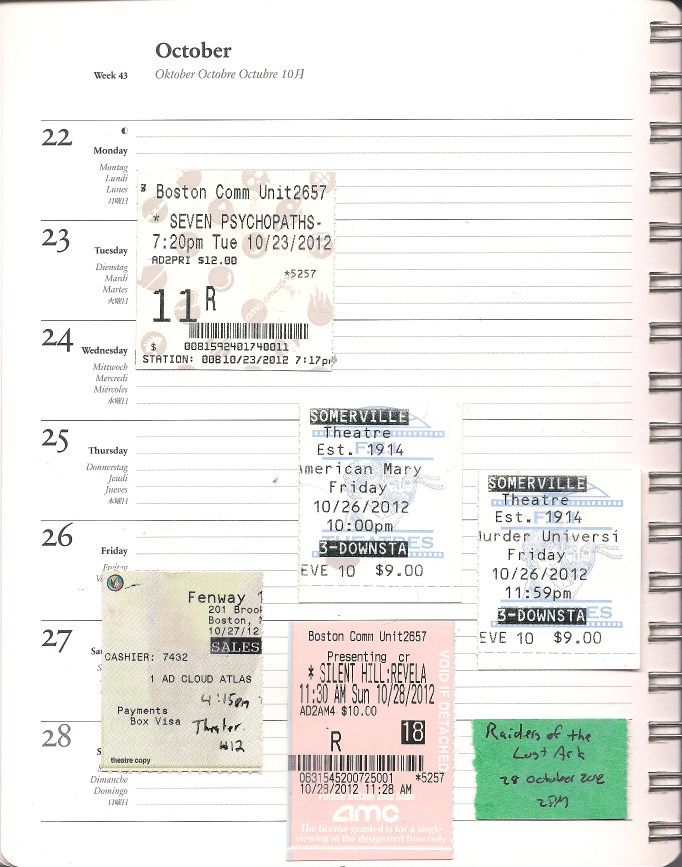
MoviePass finally got my card to me, although it was still a frustrating week of not actually getting to use it properly: The browser on my phone wasn't allowing location data to be sent on Tuesday, so (already being at the theater) I wound up shelling out for Seven Psychopaths. Wednesday I discovered that it apparently doesn't acknowledge the existence of Landmark Kendall Square at all, and then Saturday, when I finally thought everything was working, it didn't work on Cloud Atlas at all. Turns out that because my first card never arrived and I had them send me a new one, their system and my pocket had different card numbers. Hopefully that's cleared up, but Sunday's issue was that the system no longer includes 3D and IMAX movies, even if the ticket for Silent Hill: Revelation actually cost less than the one for Cloud Atlas.
Frustrating. I'm hoping to try it out for real in the coming days, but this new, easier, more flexible system tripping me up is kind of funny.
In between those incidents, there was ShudderFest at the Somerville Theatre on Friday night, featuring American Mary and Murder University, which wound up being a fun (if late) night. The former was pretty darn good while the latter was pretty darn acceptable.
And, finally, there's no better way to wash the ick of a pretty bad horror movie off than seeing Raiders of the Lost Ark in 35mm.
Seven Psychopaths
* * (out of four)
Seen 23 October 2012 in AMC Boston Common #11 (first-run, digital)
I was expecting much better things out of this one based on the talent involved, particularly considering just how well Martin McDonagh and Colin Farrell worked together on In Bruges. Instead, things wind up pretty bland and inert: Even when what should be exciting things are happening, McDonagh and company seem determined to talk things to death.
The big trouble is that this movie is much too self-referential and roman-a-clef-y; it's Irish screenwriter Martin McDonagh writing a movie about an Irish guy named Martin agonizing over a screenplay. A large chunk of the film seems to be exposing the fallacy of "write what you know" - if you knew cool stuff, you'd be off doing cool things and not writing screenplays - and then the last act has characters continually talking about how cinematic final showdowns work and how this place is perfect. That can certainly be clever in some situations, but in this one they wind up mostly setting a bar they can't clear either in terms of pure action or having a really clever satiric take on it.
It's not all bad, obviously - not by a long shot. When McDonagh sets things up so that two people are in a room and just acting with each other, there are some great moments. The best is probably between Woody Harrelson and Christopher Walken in a hospital waiting room just after something big happens; the promise of the title suddenly seems much more real. Walken, in particular, is good throughout the movie, but really steps it up there; a number of the other memorable scenes feature him, too.
Unfortunately, there just aren't nearly enough of them to even knit into an "uneven but good more often than not" movie, just the occasional incongruously well-done bit in a generally disappointing couple of hours.
Raiders of the Lost Ark
* * * * (out of four)
Seen 28 October 2012 in the Brattle Theatre (special engagement, 35mm)
When Raiders of the Lost Ark is playing on the big screen in your area, you go and see it.
I admit that I have occasionally not obeyed this imperitive, but I do try, even when it's been less than two months since I saw it in digital "Imax" (a booking that was apparently successful enough that the movie hung around in regular digital projection for a week or two afterward). I get a fair number of opportunities; both the Brattle and the Coolidge seem happy to show the movie once a year or thereabouts, so it's possible that I'll never have to actually use the Blu-ray in the new box set.
I've got to say, though, this was perhaps the best I've ever seen it. The Brattle folks had raved on Twitter about just how amazing the new 35mm print looked, and while I was initially a bit skeptical - the first reel did look a bit scratched - I was soon a believer; it looked better than what I'd seen at Boston Common in September. That may be influenced in part by the placebo effect/confirmation bias - I expect 35mm to look better than digital, so I tend to see it that way. Or maybe it came from seating; I was close enough to the front at the Common to need my peripheral vision, while the front row at the Brattle still has a fair amount of stage between the viewer and the screen. As much as Raiders is a big-screen adventure, it's not quite built for Imax-type viewing.
At any rate, this new print looked stunningly good, and I'm guessing that the restoration (which almost certainly took place inside a computer) was done at a fairly high resolution - even on a modern film print, I can usually spot jaggies in the titles, but they were pretty smooth here. And since the movie was just as good as it was two months ago (nigh-perfect), the fact that there are new prints that look this good floating around means that the opening imperative holds doubly true now:
When Raiders of the Lost Ark is playing on the big screen in your area, you go and see it!
(Eagerly awaits Dave's corrections on the technical stuff)
MoviePass finally got my card to me, although it was still a frustrating week of not actually getting to use it properly: The browser on my phone wasn't allowing location data to be sent on Tuesday, so (already being at the theater) I wound up shelling out for Seven Psychopaths. Wednesday I discovered that it apparently doesn't acknowledge the existence of Landmark Kendall Square at all, and then Saturday, when I finally thought everything was working, it didn't work on Cloud Atlas at all. Turns out that because my first card never arrived and I had them send me a new one, their system and my pocket had different card numbers. Hopefully that's cleared up, but Sunday's issue was that the system no longer includes 3D and IMAX movies, even if the ticket for Silent Hill: Revelation actually cost less than the one for Cloud Atlas.
Frustrating. I'm hoping to try it out for real in the coming days, but this new, easier, more flexible system tripping me up is kind of funny.
In between those incidents, there was ShudderFest at the Somerville Theatre on Friday night, featuring American Mary and Murder University, which wound up being a fun (if late) night. The former was pretty darn good while the latter was pretty darn acceptable.
And, finally, there's no better way to wash the ick of a pretty bad horror movie off than seeing Raiders of the Lost Ark in 35mm.
Seven Psychopaths
* * (out of four)
Seen 23 October 2012 in AMC Boston Common #11 (first-run, digital)
I was expecting much better things out of this one based on the talent involved, particularly considering just how well Martin McDonagh and Colin Farrell worked together on In Bruges. Instead, things wind up pretty bland and inert: Even when what should be exciting things are happening, McDonagh and company seem determined to talk things to death.
The big trouble is that this movie is much too self-referential and roman-a-clef-y; it's Irish screenwriter Martin McDonagh writing a movie about an Irish guy named Martin agonizing over a screenplay. A large chunk of the film seems to be exposing the fallacy of "write what you know" - if you knew cool stuff, you'd be off doing cool things and not writing screenplays - and then the last act has characters continually talking about how cinematic final showdowns work and how this place is perfect. That can certainly be clever in some situations, but in this one they wind up mostly setting a bar they can't clear either in terms of pure action or having a really clever satiric take on it.
It's not all bad, obviously - not by a long shot. When McDonagh sets things up so that two people are in a room and just acting with each other, there are some great moments. The best is probably between Woody Harrelson and Christopher Walken in a hospital waiting room just after something big happens; the promise of the title suddenly seems much more real. Walken, in particular, is good throughout the movie, but really steps it up there; a number of the other memorable scenes feature him, too.
Unfortunately, there just aren't nearly enough of them to even knit into an "uneven but good more often than not" movie, just the occasional incongruously well-done bit in a generally disappointing couple of hours.
Raiders of the Lost Ark
* * * * (out of four)
Seen 28 October 2012 in the Brattle Theatre (special engagement, 35mm)
When Raiders of the Lost Ark is playing on the big screen in your area, you go and see it.
I admit that I have occasionally not obeyed this imperitive, but I do try, even when it's been less than two months since I saw it in digital "Imax" (a booking that was apparently successful enough that the movie hung around in regular digital projection for a week or two afterward). I get a fair number of opportunities; both the Brattle and the Coolidge seem happy to show the movie once a year or thereabouts, so it's possible that I'll never have to actually use the Blu-ray in the new box set.
I've got to say, though, this was perhaps the best I've ever seen it. The Brattle folks had raved on Twitter about just how amazing the new 35mm print looked, and while I was initially a bit skeptical - the first reel did look a bit scratched - I was soon a believer; it looked better than what I'd seen at Boston Common in September. That may be influenced in part by the placebo effect/confirmation bias - I expect 35mm to look better than digital, so I tend to see it that way. Or maybe it came from seating; I was close enough to the front at the Common to need my peripheral vision, while the front row at the Brattle still has a fair amount of stage between the viewer and the screen. As much as Raiders is a big-screen adventure, it's not quite built for Imax-type viewing.
At any rate, this new print looked stunningly good, and I'm guessing that the restoration (which almost certainly took place inside a computer) was done at a fairly high resolution - even on a modern film print, I can usually spot jaggies in the titles, but they were pretty smooth here. And since the movie was just as good as it was two months ago (nigh-perfect), the fact that there are new prints that look this good floating around means that the opening imperative holds doubly true now:
When Raiders of the Lost Ark is playing on the big screen in your area, you go and see it!
(Eagerly awaits Dave's corrections on the technical stuff)
Thursday, September 06, 2012
Next Week in Tickets: Films playing Boston 7 September 2012 - 13 September 2012
Weird slate of releases this week. Not necessarily bad, just weird, like the studios aren't going to start releasing quality movies until after the Toronto Film Festival (which started on the 6th) and are just filling space. Seeing new stuff looks like kind of a crapshoot, with one major exception.
- Of course, that exception isn't exactly new - to promote the soon-to-be-released Blu-ray edition of the movie and its follow-ups, Paramount and Lucasfilm are giving Raiders of the Lost Ark a one-week release on Imax screens. None of the film-based ones around here have picked it up, but it runs at Boston Common from the 7th to the 13th. If you can't catch it then or bristle at the cost of a premium ticket, AMC will be running a marathon of all four movies for $25 on the 15th, and the Brattle will have a new 35mm print starting October 26th. Whatever the format, the restoration is said to be amazing.
Aside from that, the most prominent release this weekend is The Words, which features Bradley Cooper as a would-be author who passes a stolen manuscript off as his own and features a nifty supporting cast - Jeremy Irons, Zoe Saldana, Olivia Wilde, John Hanna, Dennis Quaid, JK Simmons, and more. It plays the Arlington Capitol, Fresh Pond, Boston Common, and Fenway. There's a similarly impressive amount of star power to The Cold Light of Day - Bruce Willis & Sigourney Weaver - although they seem to be playing second fiddle to Henry Cavill, next year's Superman. He plays a trader whose family is kidnapped and who must track down a mysterious briefcase to save them. It plays Fenway, Boston Common, and Fresh Pond.
Meanwhile, Branded (aka "The Mad Cow" on IMDB) gets an oddly-wide release for what looks to be another Darkest Hour. Not that the plot's the same (this looks more corporate-conspiracy), just that it seems like a Russian movie shot in English with a few American actors in hopes of increasing international sales. It plays Fenway and Boston Common. Boston Common alone gets Bachelorette, with Kirsten Dunst, Isla Fisher, and Lizzy Caplan as girls who get roped into be bridesmaids for a girl they used to torment in high school (Rebel Wilson). - The Coolidge, meanwhile, opens [REC]3: Genesis, the latest installment in the Spanish horror series, this one featuring Paco Plaza directing solo, ditching the found footage conceit, and taking place at a wedding... You know, I kind of think this is just Plaza wanting to do a zombies-at-a-wedding movie and leveraging the "[REC]" brand. And, wait, it's not actually "opening", but just playing midnights Friday and Saturday, and the actual opening is IFFBoston opener Sleepwalk with Me? Hey, I've seen (and liked!) the movie with the NPR comedian starting to sleepwalk when his relationship starts to get serious; bring on the zombies.
Among other special presentations is Seven, which kicks off the new "Science on Screen" series with a presentation by forensic psychiatrist Thomas Gutheil, MD; it runs in the big theater at 7pm on Monday. There's also a special presentation in the screening room on Wednesday of Little House in the Big House, a documentary about four inmates at a Vermont women's prison who learn a trade by working on a team to build a complete single-family house on the prison grounds. - At Kendall Square, it's come to this: Samsara, a documentary shot on 70mm film by the makers of Baraka, must advertise that the Kendall Square screening is being shown on 35mm. It should, at least, look gorgeous, as the filmmakers traveled the world to get breathtaking images to sew together with music and little (if any) narration.
On the other end of the class continuum, they also open The Inbetweeners, a movie that that follows the raunchy British TV series' characters (as opposed to the new American version on MTV) on a vacation to Crete, where attempts at getting laid ensue. - The Brattle is being used for the Boston Comedy Arts Festival on Friday and Saturday, but film returns on Sunday to wrap up the Studio Ghibli series, with a double feature of Spirited Away & Howl's Moving Castle on Sunday, Castle in the Sky on Monday, My Neighbors the Yamadas on Tuesday, a double feature of Pom Poko and Porco Rosso on Wednesday, and Nausicaä of the Valley of the Wind on Thursday. Note that only the evening screenings of Spirited Away and Nausicaä are in Japanese with English subtitles; the rest are dubbed into English.
- The Harvard Film Archive jumps from Paramount classics to Raj Kapoor and the Golden Age of Indian Cinema, which features the films made by India's most noteworthy early filmmaker with presentations from 1948 to 1973: Shree 420 (Friday), Awaara (Saturday), Aag (Sunday afternoon), Boot Polish (Sunday evening), and Bobby (Monday). Note that all of these movies are long ones, as is often the case with Indian cinema, with the shortest running 138 minutes.
- The MFA continues its rotation of films about conceptual artists that began on the 5th: Marina Abramovic: The Artist is Present, Kumaré, and Free Radicals: A History of Independent Film all play over the weekend, with Marina Abramovic and Kumaré continuing into next week's cycle, when they will add Planet of Snail, a Korean drama about a blind and deaf man who communicates with his wife entirely via touch. The screening on Wednesday the 12th will be audio described for the blind in the audience; the one on the 13th will not.
- Huh, check it out: The Somerville Theatre is keeping Oslo, August 31st around for a second week after the Kendall passed on it entirely, and picking Compliance up for a second run. Good job, smaller films!
- These events aren't this week, but an early heads-up might be worth a note: All Things Horror and the Somerville Theatre will host The Etheria FIlm Festival on Saturday the 15th, featuring a line-up of science fiction and fantasy films directed by women. The Brattle's Watch-a-thon(s) will take place on October 6th & 7th; start raising funds now if you want free admission!
Subscribe to:
Posts (Atom)

