A tough day to match in terms of quality and quantity, this one - even the somewhat slow start with A Holy Place was a pretty good movie, and I found myself pretty darn enthusiastic about all the rest.
I'm really hoping that a good chunk of these movies get general releases. A Holy Place is from 1990, so even a video release is unlikely. Into Eternity will likely stay on the festival circuit for a while, and might only hit the U.S. on video-on-demand and maybe play something like the Brattle's Eye-Opener series, if that returns this fall.
Black Death will probably get the same sort of release that Valhalla Rising and Centurion are - the PPV before a limited theatrical release. Shame, as they're fun movies and not exactly obscure, but that's the way it is; audiences don't necessarily stray very far from comfort zones these days. Similarly, The Loved Ones will probably end up on the IFC Midnight schedule; everyone's speaking English and it's not like the Australian accents are terribly thick, but it's a weird movie, and though it's about teenagers, there is likely no way to cut it down to a PG-13 rating without also getting the running time down to about an hour - it's short and gross.
Oddly, I think Little Big Soldier might have the best chance to get a "regular" theatrical release. Jackie Chan's still a recognizable name, it's a movie that the critics can get behind, and it's got Jackie doing Jackie Chan things. Unfortunately, I doubt that any distributor is going to be clever enough to put it out in January, when it might mostly face cometition from crap and relatively stodgy awards contenders, but I'd really like to see this get some theatrical play. It's a good reminder of why we love Jackie Chan.
Sveto mesto (A Holy Place)
* * * (out of four)
Seen 26 July 2010 in Salle de Seve (Fantasia 2010: Subversive Serbia)
I've been coming to Fantasia for five or six years now, and I believe that this is the third time that some take on Nikolai Gogol's "Viy" has played. This one is from 1990, part of the "Subversive Serbia" program, but feels like it comes from an earlier era, a creepy period piece dripping with atmosphere.
Thomas (Dragan Jovanovic) is a theology student, though not a particularly observant one. On the way back from a town fair, he sees a carriage that neither of his two companions do. Things get stranger when the old woman who lets him sleep in his barn enters and tries to force herself upon him - which becomes a great deal more appealing when she seems to transform into the beautiful girl in the carriage. Upon returning to the seminary, the abbot tells him he has an assignment: Landlord Zupanski (Aleksandar Bercek) is insisting that Thomas, specifically, come to his estate to pray for his daughter's health, per her wishes. When Thomas arrives, though, Katarina (Branka Pujic) has already passed... And guess where Thomas has seen that face before!
Though A Holy Place is an old-school horror story that takes place in a more repressed time, writer/director Djordje Kadijevic is not shy about drawing the direct line between sex and the occult goings-on that surround Thomas and Katarina. It's a powerful force here, one that literally warps reality and drives men mad, and Kadijevic does a fine job of presenting the dichotomy of the sex drive as being something that is both natural and something that must be mastered lest it destroy everything.
Full review at eFilmCritic
Into Eternity
* * * * (out of four)
Seen 26 July 2010 in Salle de Seve (Fantasia 2010: Documentaries from the Edge)
Often, documentaries will be rated on the perceived importance of their subjects, as opposed to the actual quality of the film. Into Eternity is a rare example of a documentary that not only covers a vital (yet often overlooked) topic, but does so in a way that is informative and even-handed, as well as presented in an interesting way.
The topic in question is the permanent storage of nuclear waste. The waste from fission reactors is generally stored in pools of water above ground, and imperfect solution, as these facilities require constant monitoring and, while the technology is sufficient for the foreseeable future, when dealing with material that will be dangerously radioactive for a hundred thousand years, one must also consider the unforeseeable future. This film takes a look inside Finland's plans for the long term, a cavern being excavated half a kilometer into the bedrock of the Eurajoki region. The facility was started in the twentieth century and is projected to be finished, filled, and sealed at the turn of the twenty-second. It is called "Onkalo", Finnish for "hiding place".
Writer/director/host Michael Madsen (not, let us note, the American actor) does not spend a great deal of time debating the pros and cons of nuclear power itself, beyond pointing out that though there are dangers, today's civilization presumes the availability of abundant energy. Even if another fission reactor was never built, and the existing ones were shut down, there would still be hundreds of thousands of tons of spent fuel rods that (barring a new model of reactor that can use them as fuel) must be quarantined. Building something like Onkalo is presented as a practical necessity.
Full review at eFilmCritic
Black Death
* * * ¾ (out of four)
Seen 26 July 2010 in Theatre Hall (Fantasia 2010: Between Death and the Devil)
Director Christopher Smith is clever in presenting Black Death to us. We all know that the bubonic plague was spread by ticks nesting on rats, and the opening scenes will often have the vermin skittering across the screen. He doesn't use them to show his characters up, though, so their tendencies to offer supernatural explanations can't quite be discredited, which adds a bit of uncertainty to an already lean and mean film.
After all, in 1357, everybody wondered what had sent the pestilence, the main argument being as to whether it was the work of God or the Devil. Whatever the cause, even the monasteries are no longer safe, leading novice Osmund (Eddie Redmayne) to send Averill (Kimberley Nixon), the girl he loves, back to the woods near their home to be safe. He'll soon follow, as a guide for Ulric (Sean Bean). The Bishop has heard that a village near there is plague-free, perhaps as a result of necromancy and dark magic, and has dispatched Ulric and his team to investigate. They battle through plague and bandits to get there, and find that it is plague-free - and that town leaders Hob (Tim McInnerny) and Langiva (Carice van Houten) have little use for the Church.
Black Death doesn't quite have an A-list cast, but it's one where just about everybody involved is perfect for the task at hand. If you need a guy to look imposing while swinging a big sword, every movement a testament to his righteousness, you really want Sean Bean. He looks much more natural in a beard and chain mail than he has in his recent, more contemporary roles, and that's what you want from Ulric: This is a man who feels he has been called to his violent work by God, and should walk through a room, forest, or swamp like he owns the place. His band is comprised of similarly dangerous men (including an excellent Andy Nyman as more or less the exact opposite of the nebbish he played in Smith's Severance), and they've got to be ferocious in their own right but also not quite up to his fierce standard. Of course, there's room for an older, more philosophical second-in-command, and John Lynch fills that part very nicely.
Full review at eFilmCritic
Da bing xiao jiang (Little Big Soldier)
* * * ¾ (out of four)
Seen 26 July 2010 in Theatre Hall (Fantasia 2010)
Jackie Chan's been in the movie business a while, and the last decade or so has certainly looked like the inevitable decline phase of a man who became a star based in large part on his physical gifts succumbing to the passage of time. He's been alternating often painful Hollywood projects with Hong Kong pictures that were merely considered mediocre, and even for longtime fans, a new Jackie Chan picture was nothing to get excited about. Lately, however, he looks primed for a comeback - he's gotten good reviews for his parts in The Shinjuku Incident and The Karate Kid, and his latest movie is a delight.
In it, it's the 2nd century BC, the height of China's "Warring Kingdoms" period. The two specific warring kingdoms are Liang and Wei, and the battle of Mount Phoenix is particularly fierce; it ends with only two left alive: One, a middle-aged peasant foot soldier for Liang (Chan), played dead for the entire battle; the other, a younger Wei general (Wang Lee-hom), is fierce but injured. Thus, the grunt captures the general, planning to take him back to Liang for the award of five acres of good farmland. It will not, of course, be that simple; the general is naturally trying his best to escape, and has enemies of his own withing the Wei hierarchy, including his immediate pursuers, Prince Wen (Yoo Sung-jun) and General Wu (Yu Rong-guang). Plus, they're an easy target for bandits and barbarians across the countryside.
Little Big Soldier has been a pet project of Chan's for years, long enough that when he originally conceived it (he wrote the screenplay with director Ding Sheng), he would have been playing the young general. It's hard to imagine that now, and not just because Chan was already middle-aged when he made his big splash in America with Rumble in the Bronx. Jackie Chan's screen personality has often been that of a man who gets caught up in something but rises to the occasion, and that's a much closer match to the peasant than the general. Just looking at this film, though, even someone who had never seen a Jackie Chan movie before will have to smile at just how well he slides into the role. His character is a little world-weary but mostly optimistic, a gregarious fellow whose homespun and chatty nature should not be taken as a sign of weakness or stupidity; being friendly does not preclude him being clever or resourceful, or having depths to his personality that need to be teased out.
Full review at eFilmCritic
The Loved Ones
* * * ¾ (out of four)
Seen 26 July 2010 in Theatre Hall (Fantasia 2010)
What sort of movie is The Loved Ones? It's the sort of movie where, when a carpet is lifted from the floor to reveal hinges, we in the audience are given a bit of time to ponder just what sort of poisonous Australian animals might be in that pit, waiting to feed - and then realize that, really, based upon what we've seen of the movie so far, we both should have guessed and not underestimated how truly messed up filmmaker Sean Byrne's imagination was.
Things have not been going well for Brent Mitchell (Xavier Samuel); his father died in an automobile accident while Brent was driving six months ago, which has weighed on him and his mother ever since. But, it's the end of the school year, time for the dance, and not only has Brent's buddy Sac (Richard Wilson) gotten sexy Mia (Jessica McNamee) for his date, he's going with Holly (Victoria Thaine). Lola (Robin McLeavy) has asked him, too, and while Brent let her down easy... Well, to coin a phrase, whatever Lola wants, Lola gets. Especially since she's willing to settle for a little party in her home, and her doting father Eric (John Brumpton) is just as much a psychopath as she is.
And, holy crap, are they nuts. While I'm certain that their dynamic has shown up in horror movies before, Robin McLeavy is especially noteworthy as Lola. She initially comes off as an average girl, as opposed to a bombshell stuck behind a bad haircut and glasses, and when we see her alone initially, she seems like a normal teenage girl that's a little shy and has her fantasies. As the movie goes on, of course, she's revealed to be more and more of a lunatic, and I like the way she doesn't just turn it on full-blast when Brent regains consciousness in Lola's house; she initially seems to be just kind of spoiled, but soon starts joining in, and by the time the movie's over, she's playing it big, one of the most enthusiastic, indestructible, and entertaining horror villainesses in a long time. Brumpton, meanwhile, is just plain low-key creepy as the father; combining the dad indulging his little princess with a guy who may well have been a serial killer well before Lola came around. Part of the fun of watching them together is that it's never quite clear who was insane first.
Full review at eFilmCritic
Thursday, August 05, 2010


Monday, August 02, 2010
71 - Into the Fire
I've mentioned it before, but I really love when one of the mainstream theaters (basically, the ones owned by Regal and AMC) plays something absolutely out of left field. When the FEI and Entertainment places in the northern suburbs do, it's not totally unexpected; they either know their neighborhood or think it might do better than a mid-range studio flick at getting people to come to their theater specifically. After all, it's quicker for me to get to Arlington Center/Davis Square/Fresh Pond than it is to Boston Common, but I almost never actually do so unless they're showing something I can't see in the more plush theaters.
But when the big boys do? That's either something they have a great deal of confidence in, a blatant act of holding a spot open until a big movie or two opens the next week, or perhaps something akin to a rental. 71 - Into the Fire looks to be a combination of the last two - looking to clean out underperforming movies but not wanting to fill all those screens with Charlie St. Cloud, Dinner for Schmucks, and Cats & Dogs, and I suspect Taewoon spread a little money around to get the movie on screens in areas with decent-sized Korean communities on roughly the anniversary of the depicted battle. It worked okay five months ago with Formosa Betrayed - which pulled in enough of the local Taiwanese community to last a second week - so why not?
Well, based upon the Sunday matinee crowd, because this particular event isn't quite so well-remembered as the backdrop of Formosa Betrayed, or because Korean-Americans have an easier time seeing Korean films (not necessarily in theaters, but Korean DVDs and Blu-rays are pretty easy to come by). Or maybe whoever was handling distribution in the US - Taewoon themselves, apparently; there was no vanity card for an American distributor at either the start or end of the film - did a half-hearted job of promoting the film. I had to add it to the eFilmCritic listings, and I never saw a trailer or poster, although, to be fair, I'd been out of town for the better part of a month and any street advertising would have been in Korean neighborhoods. Heck, it was playing in NYC as well, and I don't think it showed up on the Subway Cinema News blog/mailing list. If Grady Hendrix and company don't know your Asian movie is playing, you have flown way the hell under the radar.
Thus, an audience consisting of me and three Korean-Americans, all part of the same group, as they were sitting right next to each other.
I am kind of surprised to see that it's playing without CJ Entertainment being involved; they seem to be not only the biggest Korean movie studio, but the most aggressive internationally. It seems like their logo has been at the front of every Korean movie I've seen in the past few years, whether in theaters or at festivals. This year at Fantasia, it seemed pretty clear that they had branched out into co-producing movies for other local markets - I saw their logo on Chinese and Japanese films - and while the festival was running, they opened a theater in Los Angeles showing Korean films. There's been talk for years about them stepping up to distribute their own films in the US, either by creating a network like the one Bollywood has or establishing a "CJ USA" subsidiary.
I hope they do continue to make efforts at making inroads in America; they produce a lot of pretty decent movies, based on what I see at Fantasia, and I'd like to see more of them on the big screen in the Boston area. Castaway on the Moon, A Frozen Flower, and The Neighbor Zombie, to name three I saw in July, deserve a screen for a week more than the likes of Dragon Wars and 71... But, then, why should Korean imports be any different than the rest of the films playing theaters?
Pohwasogeuro (71 - Into the Fire)
* * ¼ (out of four)
Seen 1 August 2010 at AMC Boston Common #1 (First-run)
The opening moments of 71 - Into the Fire are a recitation of the origins of the Korean War so close to the one which opened a film I saw a week ago (A Little Pond) that I briefly thought that it was that film, being distributed in America under a different name. It covers a different incident, though, and winds up a rather conventional war movie, though it doesn't dishonor its subjects.
That opening text tells us that a desperately outnumbered South Korean army accepted many teen-aged volunteers, so-called "student soldiers". The first we meet, Oh Jang-beom (Choi Seung-hyeon) is serving as a runner in a battle at the start of August 1950, terrified enough that he is unable to even properly load his weapon properly as an officer is bayoneted in front of him. Still, when his unit's commander, Captain Kang Seok-dae (Kim Seung-woo) is dispatched to the Nakdong River, he chooses to leave Jang-beom in charge of the garrison at Pohang, along with two other veteran student soldiers and 68 just off the bus. It should just be guard duty, but there are two issues - gang members Koo Gap-jo (Kwon Sang-woo) and Poong-chun (Kim Yoon-seong) especially don't take well to Jang-beom's authority, and North Korean commander Park Moo-rang (Cha Seung-won) has opted not to procede straight to Nakdong, but capture Pohang along the way.
As the opening titles make sure to remind the audience, 71 is based upon a true story, one that arguably sounds even more impressive than what's presented here (the closing titles describe an 11-hour standoff, while the battle on film seems to be much less drawn-out). Its American release appears to be roughly timed to the sixtieth anniversary of the battle (11 August 1950), and testimonials from what I assume are real-life student soldiers appear during the credits (that section of the print was unsubtitled) It is, as one might expect, a very conventional war film, aside from the youth of its protagonists: Respectful of the military, placing those who fought and died on a pedestal, although modern enough to recognize that the ROK army had to do its share of things it wouldn't be proud of.
Full review at eFilmCritic
But when the big boys do? That's either something they have a great deal of confidence in, a blatant act of holding a spot open until a big movie or two opens the next week, or perhaps something akin to a rental. 71 - Into the Fire looks to be a combination of the last two - looking to clean out underperforming movies but not wanting to fill all those screens with Charlie St. Cloud, Dinner for Schmucks, and Cats & Dogs, and I suspect Taewoon spread a little money around to get the movie on screens in areas with decent-sized Korean communities on roughly the anniversary of the depicted battle. It worked okay five months ago with Formosa Betrayed - which pulled in enough of the local Taiwanese community to last a second week - so why not?
Well, based upon the Sunday matinee crowd, because this particular event isn't quite so well-remembered as the backdrop of Formosa Betrayed, or because Korean-Americans have an easier time seeing Korean films (not necessarily in theaters, but Korean DVDs and Blu-rays are pretty easy to come by). Or maybe whoever was handling distribution in the US - Taewoon themselves, apparently; there was no vanity card for an American distributor at either the start or end of the film - did a half-hearted job of promoting the film. I had to add it to the eFilmCritic listings, and I never saw a trailer or poster, although, to be fair, I'd been out of town for the better part of a month and any street advertising would have been in Korean neighborhoods. Heck, it was playing in NYC as well, and I don't think it showed up on the Subway Cinema News blog/mailing list. If Grady Hendrix and company don't know your Asian movie is playing, you have flown way the hell under the radar.
Thus, an audience consisting of me and three Korean-Americans, all part of the same group, as they were sitting right next to each other.
I am kind of surprised to see that it's playing without CJ Entertainment being involved; they seem to be not only the biggest Korean movie studio, but the most aggressive internationally. It seems like their logo has been at the front of every Korean movie I've seen in the past few years, whether in theaters or at festivals. This year at Fantasia, it seemed pretty clear that they had branched out into co-producing movies for other local markets - I saw their logo on Chinese and Japanese films - and while the festival was running, they opened a theater in Los Angeles showing Korean films. There's been talk for years about them stepping up to distribute their own films in the US, either by creating a network like the one Bollywood has or establishing a "CJ USA" subsidiary.
I hope they do continue to make efforts at making inroads in America; they produce a lot of pretty decent movies, based on what I see at Fantasia, and I'd like to see more of them on the big screen in the Boston area. Castaway on the Moon, A Frozen Flower, and The Neighbor Zombie, to name three I saw in July, deserve a screen for a week more than the likes of Dragon Wars and 71... But, then, why should Korean imports be any different than the rest of the films playing theaters?
Pohwasogeuro (71 - Into the Fire)
* * ¼ (out of four)
Seen 1 August 2010 at AMC Boston Common #1 (First-run)
The opening moments of 71 - Into the Fire are a recitation of the origins of the Korean War so close to the one which opened a film I saw a week ago (A Little Pond) that I briefly thought that it was that film, being distributed in America under a different name. It covers a different incident, though, and winds up a rather conventional war movie, though it doesn't dishonor its subjects.
That opening text tells us that a desperately outnumbered South Korean army accepted many teen-aged volunteers, so-called "student soldiers". The first we meet, Oh Jang-beom (Choi Seung-hyeon) is serving as a runner in a battle at the start of August 1950, terrified enough that he is unable to even properly load his weapon properly as an officer is bayoneted in front of him. Still, when his unit's commander, Captain Kang Seok-dae (Kim Seung-woo) is dispatched to the Nakdong River, he chooses to leave Jang-beom in charge of the garrison at Pohang, along with two other veteran student soldiers and 68 just off the bus. It should just be guard duty, but there are two issues - gang members Koo Gap-jo (Kwon Sang-woo) and Poong-chun (Kim Yoon-seong) especially don't take well to Jang-beom's authority, and North Korean commander Park Moo-rang (Cha Seung-won) has opted not to procede straight to Nakdong, but capture Pohang along the way.
As the opening titles make sure to remind the audience, 71 is based upon a true story, one that arguably sounds even more impressive than what's presented here (the closing titles describe an 11-hour standoff, while the battle on film seems to be much less drawn-out). Its American release appears to be roughly timed to the sixtieth anniversary of the battle (11 August 1950), and testimonials from what I assume are real-life student soldiers appear during the credits (that section of the print was unsubtitled) It is, as one might expect, a very conventional war film, aside from the youth of its protagonists: Respectful of the military, placing those who fought and died on a pedestal, although modern enough to recognize that the ROK army had to do its share of things it wouldn't be proud of.
Full review at eFilmCritic
Saturday, July 31, 2010
Fantasia Daily for 25 July: Summer Wars, Rinco's Restaurant, Vampires, Deliver Us from Evil, A Little Pond
Another long day at the festival, where the first movie starts at 11:30am and the last finishes at 11pm. Watching movies for eleven hours (with bits of standing in line between) doesn't seem like it's tiring, but as I've said before, it's using one specific part of your brain all day, and can be wearying.
And now some photos, for those who can't get enough "filmmakers with movie screen behind them and mikes in front of them" action!
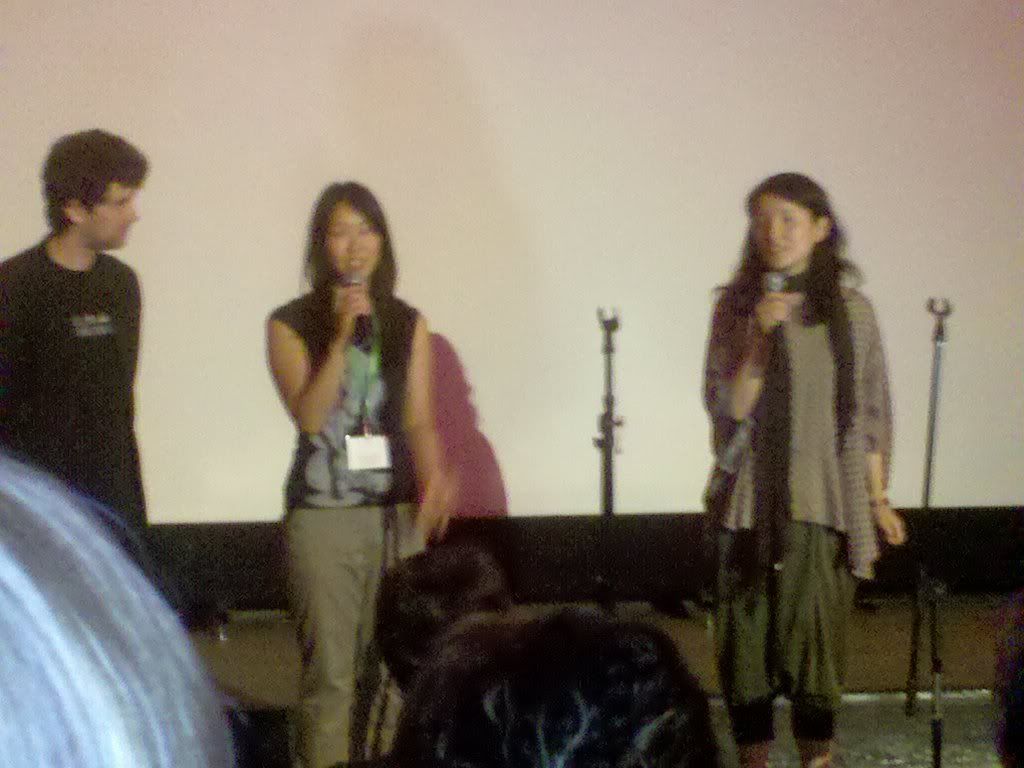
Left to right, we have festival director Pierre Corebeil (I think; it might be Simon Lapierre; I even after five years, I haven't learned all the names yet and have a hard time pulling them out of a barrage of French), a translator, and Rinco's Restaurant director Mai Tominaga.
I felt vaguely guilty that I munched on a box of Timbits throughout Ms. Tominaga's movie about a woman who makes delicious food. Normally, I'm one to advocate donuts and donut holes as movie snacks (they are quiet and tasty), but that's the sort of movie that asks that you raise your standards, you know? And though I'll probably get a bunch of Canadians coming after me for this, they were only Timbits, which aren't bad but aren't Munchkins.
(I had a slice of fast-food pizza for dinner, too. Multiple food movies this year, and I really didn't do much for myself in terms of dining out!)
By the way, the translator did a fine job. I think this is a new person handling the Japanese-translation duties (a good chunk of the staff probably turns over every few years as college kids graduate) - she didn't give the withering "why would you ask such a stupid question?" look after the questions that waste everybody's time during Q&A. Or maybe she's just learned to hide her disdain better.
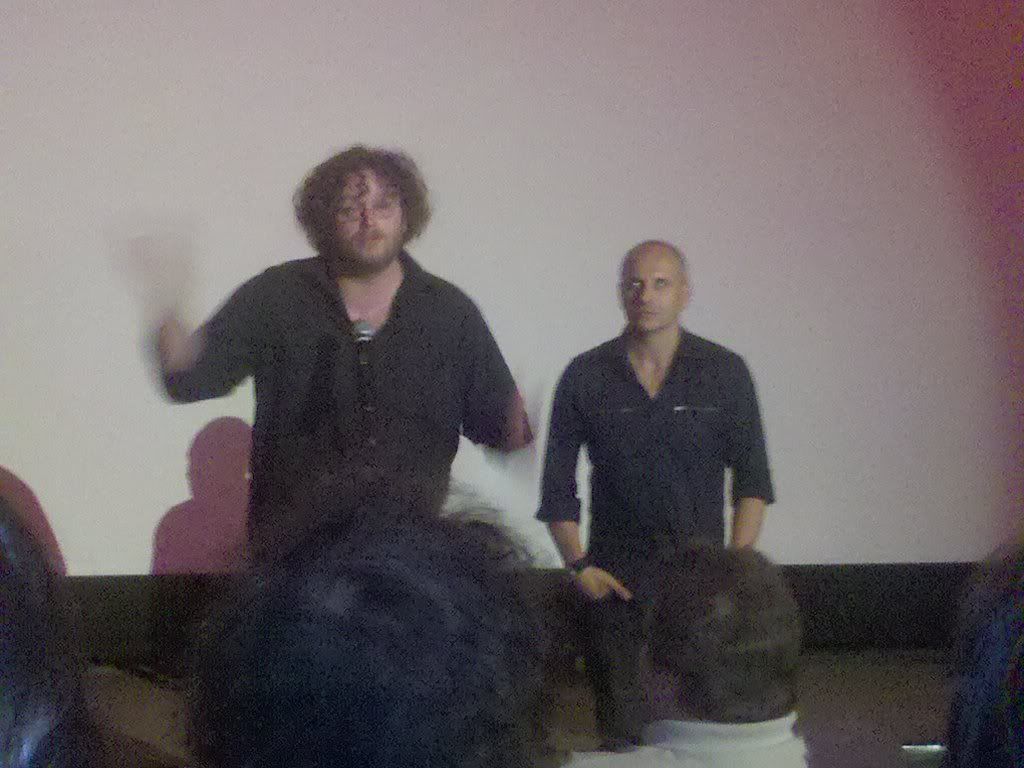
Left to right, Vampires director Vincent Lannoo and star Carlo Ferrante. M. Lannoo is not a dual amputee, by the way; my Droid's camera just isn't that great with motion. Sadly, I didn't get a chance to stick around for much of what was likely an entertaining Q&A, as Deliver Us From Evil was scheduled to start very soon and the first question and answer clinched that my terrible French was not going to be up to the task.
Not that I'm complaining; despite my only being able to understand fleeting bits when people talk slowly and use simple tenses (has it really been twenty years since I stopped taking French in high school?), I always find it kind of cool when the intros and stuff are in French, especially when it's something surreal, like a Japanese movie with English subtitles being introduced by a guy speaking French. You don't have to try and make my monolingual self feel at home; I like the reminder that I'm surrounded by a different culture.
But, yeah, I'm not always going to stick around and be confused. Sorry.
Samâ wôzu (Summer Wars)
* * * (out of four)
Seen 25 July 2010 in Theatre Hall (Fantasia 2010)
Mamoru Hosoda perhaps didn't make a huge name for himself with The Girl Who Leapt Through Time, but he made a very good animated film that told a fantastical science fiction story that was also very emotionally grounded. For his follow-up, he does something much the same, albeit on a larger scale.
Kenji Koiso (voice of Ryunosuke Kamiki) is a high-school math wihz, although his summer job is much more mundane, doing online troubleshooting for "OZ", a global virtual community (imagine Facebook as the interface to the entire internet). It's boring work, so when college-bound classmate Natsuki (voice of Nanami Sakuraba) offers him a chance to do something else for a couple weeks, he jumps at it: Come with her to a family reunion in Ueda coinciding with the 90th birthday of her great-grandmother Sakae Jinnouchi (voice of Sumiko Fuji), help set up and ride herd on the dozens of relatives, pretend to be the boyfriend she told Sakae about... Oh, did I not mention that last part back in Tokyo or on the train? Sorry. Anyway, Kenji soon has bigger concerns - a math puzzle he received in an email turns out the key to defeating OZ's supposedly-impregnable security, making Kenji a wanted man, although the Japanese authorities are much more concerned with the infrastructure collapses they soon face, as OZ accounts can serve as authentication to a number of official systems.
I wouldn't be surprised if the screenplay for Summer Wars has been kicking around for a while; while the timeframe is sometimes implied to be the 2010s, other things place the year at around 1998, and OZ does often seem like a very twentieth-century vision of the internet's future, in that it's anthropomorphic, complete with cute avatars navigating three-dimensional virtual space that functions as a very direct analog to the physical world, including avatar battles. Though bits of the underlying concept may have relevance (Facebook and Google have become so ubiquitous and integrated as to be a real security weakness), folks will likely find it a somewhat dated version of the future. Of course, to a certain extent, functionality takes a back seat to looking cool, and the great animators at Madhouse are certainly deliver on that account, giving a virtual world that hangs in white space like something astronomical, with avatars and outposts in orbit. It's a clearly CGI element in a generally cel-based movie, but one that looks like it might exist on the screens of that world.
Full review at eFilmCritic
Shokudo Katatsumuri (Rinco's Restaurant)
* * * (out of four)
Seen 25 July 2010 in Theatre Hall (Fantasia 2010)
So, here's my question: If you lived in this tiny Japanese village, what sort of evidence would you need to declare that Rinco's cooking has magical wish-granting powers? After all, in the sort of small town where everybody knows everybody else's business, coming to that conclusion would almost certainly require positing that she spent her whole life eating take-out.
Of course, it's been a while since they've seen Rinco (Kou Shibasaki); she ran away from home as a teenager, unable to bear the taunting that came from being the fatherless daughter of Ruri (Kimiko Yo), who has extended her party-girl lifestyle well into middle age. She wound up with her grandmother, who taught her to cook, and that's where Rinco found her calling; she mastered every cuisine she could, and had save almost enough to open a restaurant with her boyfriend when he left her and took everything. So devastated that she lost the power of speech, she made her way back home to find her mother more eccentric than ever - she dotes on her pet pig Hermes to an uncomfortable extent. She does open that restaurant, though; she and her childhood friend Yuma (Brother Tom) clean up a tiny shed on Ruri's property. It's off the beaten path, and only has one table, but Yuma swears that the carefully prepared dishes grant the diner his heart's desire.
As with most food movies, the pleasures of Rinco's Restaurant are sensual. Dish after mouth-watering dish is prepared, served, and consumed, and director Mai Tominaga makes certain that the audience is aware of the intimacy of the setting; this food, or at least the image of it, is a treat for them directly, just as much as it has been lovingly and individually prepared for the character. Ruri's house gives the impression of free-spirited chaos but is actually very tidy, with a cute little sty for Hermes. And though the mountains for which Bosom Village are named are mostly a goofy visual joke, they do make for some nice scenery.
Full review at eFilmCritic
Vampires
* * * ¼ (out of four)
Seen 25 July 2010 in Theatre Hall (Fantasia 2010)
It's not that you can't make a scary, surprising vampire movie any more - my last two trips to this festival delivered Let the Right One In and Thirst, so it can be done. It's just hard; the bloodsuckers have grown so familiar that it's easy to slip into what movies like Vincent Lannoo's Vampires do, treating monsters like something commonplace and trying to be clever with the details.
Georges (Carlo Ferrante) is the head of a vampire family living in Belgium. He's got a regal air, even if his wife Bertha (Vera van Dooren) doesn't quite charm the television crew doing a documentary on them quite so much. They keep a relatively low profile, mostly feeding on a former prostitute they call "The Meat" and a pen of illegal immigrants in the backyard, with the local police helping with procurement and disposal. It's not a completely tranquil household - "son" Samson (Pierre Lognay) has been sneaking off with the local head vampire's girl, and "daughter" Grace (Fleur Lise Hevet) wishes she were human. And then there are "the neighbors", two vampires that they graciously allow to live in their basement because the vampire code says that vampires must children in order to rate a house of their own (Elizabeth and Bienvenu have their own individual self-control issues with kids).
Vampires straddles the line between parody and satire, spending most of its time on the broad, somewhat silly side of the line. It's still often mean-spirited humor - the opening bits about why a film crew might be unwilling to take on this assignment are as bloody as they are exercises in perfect set-up and delivery. A lot of it is relatively simple jokes, though they work - there's a visit to the funeral home to pick out new coffins; Georges finding himself just unable to understand his daughter, wearing all that pink and dyeing her hair blonde; a move to Montreal find Belgian Samson unable to understand a word that his Québeçoise girlfriend is saying; that sort of thing. A fair amount of fun is had mocking the sometimes torturous rules that vampires live by, both socially and biologically (is the way they are shown to mediate disputes here really that much more illogical than having to be invited into a room?).
Full review at eFilmCritic
Fri os fra det onde (Deliver Us from Evil)
* * * ¾ (out of four)
Seen 25 July 2010 in Salle de Seve (Fantasia 2010)
Ole Bornedal was never really away from filmmaking, but time spent trying to work Hollywood and then working Danish theater kept his film output very sparse in the ten years leading up to 2007. Since then, though, he's been back with a vengeance, each new movie better than the last, with the latest a thriller that is both narratively intriguing and laser-focused.
We start with brothers. Johannes (Lasse Rimmer) was a big-city lawyer who, with his wife Pernille (Lene Nystrøm), moved back to the small town - and family home - where he grew up a few years ago. Lars (Jens Andersen) is his exact opposite, an unkempt drunk of a truck driver with a foul mouth and a violent temper, although he realizes he needs to change, especially upon learning his girlfriend Scarlett (Pernille Vallentin) is pregnant. But just as he's about to turn over that new leaf, he runs over an old woman just out of town. Now, he's not stupid - he quickly finds a way to throw the blame on Alain (Bojan Navojec), a Bosnian refugee helping Johannes work on the family home. What Lars doesn't figure on is Ingvar (Mogens Pedersen), the dead woman's husband, who is as admired by all about town as he is completely dependent upon his wife for his mental stability.
Bornedal knows where he wants Deliver Us from Evil to go, and he is ruthlessly efficient in getting it there. Narration quickly supplies us with information about the characters and town, plots that were set up separately intertwine quickly but in a manner that doesn't smack of coincidence. Brief moments of comic relief plant a seed in the audience's head that the potential for ugly behavior lies within even the most gentle of souls. There is no time spent on hand-wringing: Characters are decisive, moving us inevitably toward confrontation.
Full review at eFilmCritic
Jageun yeonmot (A Little Pond)
* * * ½ (out of four)
Seen 25 July 2010 in Salle de Seve (Fantasia 2010)
A Little Pond's goal is to educate its audience about the Nogunri massacre of 1950, and it succeeds: It presents a reconstruction of that shameful incident in the best detail that the filmmakers could extrapolate. It is almost not necessarily to say any more about it; writer/director Lee Sang-woo aims to depict this thing and does so, well enough that he does not squander the horror inherent in the facts.
The movie spends a little time building to its incident. In July of 1950, the Korean War was just starting, and the North was pushing south. A soldier visits the house of Mr. Moon (Moon Seong-geun), though it is not the middle-aged man with the young new wife that they are interested in, but his son-in-law (Lee Dong-kyu), who was originally from the north. Elsewhere, Moon's second daughter Hyun-i (Kim Ji-hyun) is taking her shift at the village school, supervising the chorus which is practicing for a regional competition. It is a tense atmosphere, but not yet one that is critical. The tension moves up a notch when American and ROK soldiers order the town evacuated, as a battle there is imminent. Many head for a nearby hill, where they had often holed up during the Japanese invasion. However, things change quickly in battle, and the American troops have orders to shoot anyone crossing the front line, which places many of the villagers in the line of fire, taking cover under a bridge, hoping for things to stop.
The facts in the Nogunri case are disputed; the best-known account was published fifty years after the actual incident, but almost as soon as it led President Clinton to issue an official apology, it was found to be based in part on fraudulent accounts. Everybody agrees that civilian refugees were killed; nobody agrees on the number (cited as anything from 5 to 400) or whether the U.S. Army attempted to cover it up. I would be interested to learn how much research Director Lee did in preparing this film; much of it is told from the perspective of the village's children, who sixty years later would be the best primary sources.
Full review at eFilmCritic
And now some photos, for those who can't get enough "filmmakers with movie screen behind them and mikes in front of them" action!

Left to right, we have festival director Pierre Corebeil (I think; it might be Simon Lapierre; I even after five years, I haven't learned all the names yet and have a hard time pulling them out of a barrage of French), a translator, and Rinco's Restaurant director Mai Tominaga.
I felt vaguely guilty that I munched on a box of Timbits throughout Ms. Tominaga's movie about a woman who makes delicious food. Normally, I'm one to advocate donuts and donut holes as movie snacks (they are quiet and tasty), but that's the sort of movie that asks that you raise your standards, you know? And though I'll probably get a bunch of Canadians coming after me for this, they were only Timbits, which aren't bad but aren't Munchkins.
(I had a slice of fast-food pizza for dinner, too. Multiple food movies this year, and I really didn't do much for myself in terms of dining out!)
By the way, the translator did a fine job. I think this is a new person handling the Japanese-translation duties (a good chunk of the staff probably turns over every few years as college kids graduate) - she didn't give the withering "why would you ask such a stupid question?" look after the questions that waste everybody's time during Q&A. Or maybe she's just learned to hide her disdain better.

Left to right, Vampires director Vincent Lannoo and star Carlo Ferrante. M. Lannoo is not a dual amputee, by the way; my Droid's camera just isn't that great with motion. Sadly, I didn't get a chance to stick around for much of what was likely an entertaining Q&A, as Deliver Us From Evil was scheduled to start very soon and the first question and answer clinched that my terrible French was not going to be up to the task.
Not that I'm complaining; despite my only being able to understand fleeting bits when people talk slowly and use simple tenses (has it really been twenty years since I stopped taking French in high school?), I always find it kind of cool when the intros and stuff are in French, especially when it's something surreal, like a Japanese movie with English subtitles being introduced by a guy speaking French. You don't have to try and make my monolingual self feel at home; I like the reminder that I'm surrounded by a different culture.
But, yeah, I'm not always going to stick around and be confused. Sorry.
Samâ wôzu (Summer Wars)
* * * (out of four)
Seen 25 July 2010 in Theatre Hall (Fantasia 2010)
Mamoru Hosoda perhaps didn't make a huge name for himself with The Girl Who Leapt Through Time, but he made a very good animated film that told a fantastical science fiction story that was also very emotionally grounded. For his follow-up, he does something much the same, albeit on a larger scale.
Kenji Koiso (voice of Ryunosuke Kamiki) is a high-school math wihz, although his summer job is much more mundane, doing online troubleshooting for "OZ", a global virtual community (imagine Facebook as the interface to the entire internet). It's boring work, so when college-bound classmate Natsuki (voice of Nanami Sakuraba) offers him a chance to do something else for a couple weeks, he jumps at it: Come with her to a family reunion in Ueda coinciding with the 90th birthday of her great-grandmother Sakae Jinnouchi (voice of Sumiko Fuji), help set up and ride herd on the dozens of relatives, pretend to be the boyfriend she told Sakae about... Oh, did I not mention that last part back in Tokyo or on the train? Sorry. Anyway, Kenji soon has bigger concerns - a math puzzle he received in an email turns out the key to defeating OZ's supposedly-impregnable security, making Kenji a wanted man, although the Japanese authorities are much more concerned with the infrastructure collapses they soon face, as OZ accounts can serve as authentication to a number of official systems.
I wouldn't be surprised if the screenplay for Summer Wars has been kicking around for a while; while the timeframe is sometimes implied to be the 2010s, other things place the year at around 1998, and OZ does often seem like a very twentieth-century vision of the internet's future, in that it's anthropomorphic, complete with cute avatars navigating three-dimensional virtual space that functions as a very direct analog to the physical world, including avatar battles. Though bits of the underlying concept may have relevance (Facebook and Google have become so ubiquitous and integrated as to be a real security weakness), folks will likely find it a somewhat dated version of the future. Of course, to a certain extent, functionality takes a back seat to looking cool, and the great animators at Madhouse are certainly deliver on that account, giving a virtual world that hangs in white space like something astronomical, with avatars and outposts in orbit. It's a clearly CGI element in a generally cel-based movie, but one that looks like it might exist on the screens of that world.
Full review at eFilmCritic
Shokudo Katatsumuri (Rinco's Restaurant)
* * * (out of four)
Seen 25 July 2010 in Theatre Hall (Fantasia 2010)
So, here's my question: If you lived in this tiny Japanese village, what sort of evidence would you need to declare that Rinco's cooking has magical wish-granting powers? After all, in the sort of small town where everybody knows everybody else's business, coming to that conclusion would almost certainly require positing that she spent her whole life eating take-out.
Of course, it's been a while since they've seen Rinco (Kou Shibasaki); she ran away from home as a teenager, unable to bear the taunting that came from being the fatherless daughter of Ruri (Kimiko Yo), who has extended her party-girl lifestyle well into middle age. She wound up with her grandmother, who taught her to cook, and that's where Rinco found her calling; she mastered every cuisine she could, and had save almost enough to open a restaurant with her boyfriend when he left her and took everything. So devastated that she lost the power of speech, she made her way back home to find her mother more eccentric than ever - she dotes on her pet pig Hermes to an uncomfortable extent. She does open that restaurant, though; she and her childhood friend Yuma (Brother Tom) clean up a tiny shed on Ruri's property. It's off the beaten path, and only has one table, but Yuma swears that the carefully prepared dishes grant the diner his heart's desire.
As with most food movies, the pleasures of Rinco's Restaurant are sensual. Dish after mouth-watering dish is prepared, served, and consumed, and director Mai Tominaga makes certain that the audience is aware of the intimacy of the setting; this food, or at least the image of it, is a treat for them directly, just as much as it has been lovingly and individually prepared for the character. Ruri's house gives the impression of free-spirited chaos but is actually very tidy, with a cute little sty for Hermes. And though the mountains for which Bosom Village are named are mostly a goofy visual joke, they do make for some nice scenery.
Full review at eFilmCritic
Vampires
* * * ¼ (out of four)
Seen 25 July 2010 in Theatre Hall (Fantasia 2010)
It's not that you can't make a scary, surprising vampire movie any more - my last two trips to this festival delivered Let the Right One In and Thirst, so it can be done. It's just hard; the bloodsuckers have grown so familiar that it's easy to slip into what movies like Vincent Lannoo's Vampires do, treating monsters like something commonplace and trying to be clever with the details.
Georges (Carlo Ferrante) is the head of a vampire family living in Belgium. He's got a regal air, even if his wife Bertha (Vera van Dooren) doesn't quite charm the television crew doing a documentary on them quite so much. They keep a relatively low profile, mostly feeding on a former prostitute they call "The Meat" and a pen of illegal immigrants in the backyard, with the local police helping with procurement and disposal. It's not a completely tranquil household - "son" Samson (Pierre Lognay) has been sneaking off with the local head vampire's girl, and "daughter" Grace (Fleur Lise Hevet) wishes she were human. And then there are "the neighbors", two vampires that they graciously allow to live in their basement because the vampire code says that vampires must children in order to rate a house of their own (Elizabeth and Bienvenu have their own individual self-control issues with kids).
Vampires straddles the line between parody and satire, spending most of its time on the broad, somewhat silly side of the line. It's still often mean-spirited humor - the opening bits about why a film crew might be unwilling to take on this assignment are as bloody as they are exercises in perfect set-up and delivery. A lot of it is relatively simple jokes, though they work - there's a visit to the funeral home to pick out new coffins; Georges finding himself just unable to understand his daughter, wearing all that pink and dyeing her hair blonde; a move to Montreal find Belgian Samson unable to understand a word that his Québeçoise girlfriend is saying; that sort of thing. A fair amount of fun is had mocking the sometimes torturous rules that vampires live by, both socially and biologically (is the way they are shown to mediate disputes here really that much more illogical than having to be invited into a room?).
Full review at eFilmCritic
Fri os fra det onde (Deliver Us from Evil)
* * * ¾ (out of four)
Seen 25 July 2010 in Salle de Seve (Fantasia 2010)
Ole Bornedal was never really away from filmmaking, but time spent trying to work Hollywood and then working Danish theater kept his film output very sparse in the ten years leading up to 2007. Since then, though, he's been back with a vengeance, each new movie better than the last, with the latest a thriller that is both narratively intriguing and laser-focused.
We start with brothers. Johannes (Lasse Rimmer) was a big-city lawyer who, with his wife Pernille (Lene Nystrøm), moved back to the small town - and family home - where he grew up a few years ago. Lars (Jens Andersen) is his exact opposite, an unkempt drunk of a truck driver with a foul mouth and a violent temper, although he realizes he needs to change, especially upon learning his girlfriend Scarlett (Pernille Vallentin) is pregnant. But just as he's about to turn over that new leaf, he runs over an old woman just out of town. Now, he's not stupid - he quickly finds a way to throw the blame on Alain (Bojan Navojec), a Bosnian refugee helping Johannes work on the family home. What Lars doesn't figure on is Ingvar (Mogens Pedersen), the dead woman's husband, who is as admired by all about town as he is completely dependent upon his wife for his mental stability.
Bornedal knows where he wants Deliver Us from Evil to go, and he is ruthlessly efficient in getting it there. Narration quickly supplies us with information about the characters and town, plots that were set up separately intertwine quickly but in a manner that doesn't smack of coincidence. Brief moments of comic relief plant a seed in the audience's head that the potential for ugly behavior lies within even the most gentle of souls. There is no time spent on hand-wringing: Characters are decisive, moving us inevitably toward confrontation.
Full review at eFilmCritic
Jageun yeonmot (A Little Pond)
* * * ½ (out of four)
Seen 25 July 2010 in Salle de Seve (Fantasia 2010)
A Little Pond's goal is to educate its audience about the Nogunri massacre of 1950, and it succeeds: It presents a reconstruction of that shameful incident in the best detail that the filmmakers could extrapolate. It is almost not necessarily to say any more about it; writer/director Lee Sang-woo aims to depict this thing and does so, well enough that he does not squander the horror inherent in the facts.
The movie spends a little time building to its incident. In July of 1950, the Korean War was just starting, and the North was pushing south. A soldier visits the house of Mr. Moon (Moon Seong-geun), though it is not the middle-aged man with the young new wife that they are interested in, but his son-in-law (Lee Dong-kyu), who was originally from the north. Elsewhere, Moon's second daughter Hyun-i (Kim Ji-hyun) is taking her shift at the village school, supervising the chorus which is practicing for a regional competition. It is a tense atmosphere, but not yet one that is critical. The tension moves up a notch when American and ROK soldiers order the town evacuated, as a battle there is imminent. Many head for a nearby hill, where they had often holed up during the Japanese invasion. However, things change quickly in battle, and the American troops have orders to shoot anyone crossing the front line, which places many of the villagers in the line of fire, taking cover under a bridge, hoping for things to stop.
The facts in the Nogunri case are disputed; the best-known account was published fifty years after the actual incident, but almost as soon as it led President Clinton to issue an official apology, it was found to be based in part on fraudulent accounts. Everybody agrees that civilian refugees were killed; nobody agrees on the number (cited as anything from 5 to 400) or whether the U.S. Army attempted to cover it up. I would be interested to learn how much research Director Lee did in preparing this film; much of it is told from the perspective of the village's children, who sixty years later would be the best primary sources.
Full review at eFilmCritic
Friday, July 30, 2010
Next Week in Tickets: Films playing Boston 30 July - 5 August
Back from Montreal, and though I am kind of movied out, just sitting at home, watching baseball, and catching up on my Fantasia reviews isn't going to be an option: It seems like I have to see Inception in order to understand half my Twitter feed, the Brattle's got a number of things that won't be hanging around, and so on.
- The Brattle opens Valhalla Rising for four days (although it only plays 10pm on Monday, because of DocYard and noir screenings). It's part of a weird cluster of Middle Ages-set movies coming out now, arriving at about the same time as Neil Marshall's Centurion (which I missed at Fantasia) and Christopher Smith's Black Death (which is pretty darn good). This one is directed by Nicholas Winding Refn and features a mute, one-eyed Viking confronting the spread of Christianity.
The rest of the Brattle's programming is old-school vertical-calendar style: The DocYard presents Speaking in Tongues, a documentary on bilingual education on Monday evening. Tuesday is noir-day, with Born to Kill (also playing a Monday matinee) and the not-on-video Johnny Angel. Thursday is Best of the Aughts, featuring Wong Kar-wai's In The Mood for Love and Sofia Coppola's Lost in Translation. Note that the double feature of George Washington and Wendy and Lucy seems to be off on Wednesday, replaced by a "TBA". A preview of some sort? - The one-week warning at Kendall Square is for Great Directors, a documentary about, well, pretty darn good filmmakers. Also opening is another documentary, Countdown to Zero
- The Coolidge is all hold-overs this week, but it's a pretty strong group: The Kids Are All Right and The Girl Who Played with Fire on film; Winter's Bone, Joan Rivers: A Piece of Work, and Phyllis and Harold on video.
The specials are midnight screenings of 28 Days Later on Friday and Saturday to close out their "The End Is [Pretty F---ing] Nigh" series and Psycho on the big screen Monday for the 50th anniversary. - The Harvard Film Archive has five films by Nicholas Ray as part of a series from Friday - Monday; in continues next weekend. The Museum of Fine Arts has a mix of films, including screenings for The Roxbury Film Festival, which also has screenings of other films by and about people of color around town.
- Mainstream openings are Dinner for Schmucks, Charlie St. Cloud, and Cats & Dogs 2. All look OK, none of them will make me particularly sad if I miss them because they come and go as quick as Predators did (seriously, I was only gone three weeks!).
This week's completely random opening at a mainstream theater is something called 71: Into the Fire or Pohwasogeuro at AMC Boston Common. It looks like a South Korean war film that only opened in its native land a month and a half ago, and is apparently not part of CJ Entertainment's plans to conquer the world. It's got low rankings on IMDB and I've never heard anything about in on Twitch or Subway Cinema. As a result, I'm curious.
Wednesday, July 28, 2010
Fantasia Daily for 24 July: King of Thorn, Suck, Sophie's Revenge, Sawako Decides, The Last Exorcism
A long, but pretty fruitful Saturday at Fantasia; not one bad movie seen, and things ended on a pretty good note. There was a large and enthusiastic turnout for Suck, which aside from being fun & Canadian had some scenes set in Montreal, and that's always going to get a big rise from the crowd (more on that "tomorrow"). It also had a pretty good line-up of guests who did an entertaining Q&A:
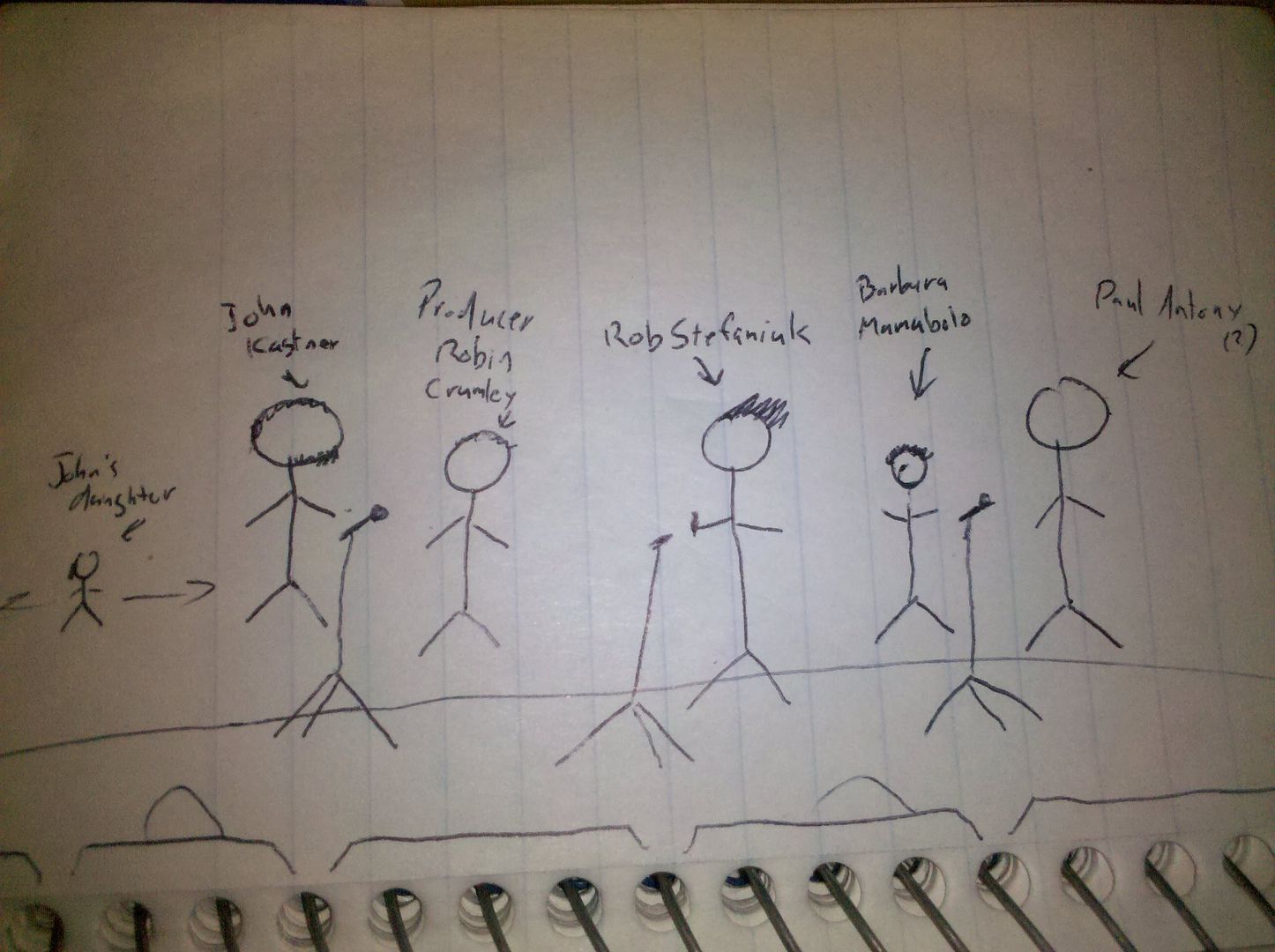
Yeah, sorry about the lack of a photo. Ironically, the distributor of both Suck and The Last Exorcism maybe missed out on folks putting pictures up from the Suck screening because they opted to ban cameras and cell phones from The Last Exorcism. As a result, I left mine at the apartment at the start of the day (the signs that sprouted up a couple days earlier didn't mention any place for safekeeping), and so this is the documentation you'll have to be satisfied with.
As you might imagine, this didn't go over well with the Fantasia crowd; it was a real nuisance getting in - in an act of real chutzpah, Alliance not only wanted to take people's cameras away, but have us sign a release that they could film our reactions (favorite comment: "are you filming this reaction? It's anger!"). The studio representative got booed when she got called up on stage, which she took without making a big deal of it.
It really is a silly thing to do, though - does Alliance really think that they have to be more worried about piracy of The Last Exorcism than, say, Scott Pilgrim? Do they really think that the people who will be satisfied with watching this movie on a torrent that was taken via a cell-phone camera were going to be paying for a ticket or a DVD anyway? Those are people with no standards, and you can't worry about them.
It threw an even bigger wrench into the festival than the fire alarms a week earlier, actually - I flat-up missed the midnight If a Tree Falls because of how late this movie ran. So, distributors, don't do this nonsense in the future. It annoys your best customers and does almost nothing to stop piracy.
Ibara no O (King of Thorn)
* * * (out of four)
Seen 24 July 2010 in Theatre Hall (Fantasia 2010)
King of Thorn is the sort of anime that, whatever else you might say about it, doesn't cheat the audience. It offers up top-notch animation and uses it to create a story that is both grand-scale and strange, with big, bloody action and bizarre ideas that are just a stepping stone to crazier things. It threatens to become too much, honestly, but it's never dull.
The time is the near future, and the world is beset by a new pandemic: ACIS (Acquired Cellular Induration Syndrome), which in its terminal stages causes the body to harden into a brittle, stone-like material, earning it the nickname "Medusa". Venus Gate, a company headed by shady expatriate Russian industrialist Ivan Vega, has built a cryonics facility in Scotland that can potentially hold 160 infected people for up to a hundred years, awaiting a cure. Among those chosen by lottery is nervous Japanese school girl Kasumi, escorted by her more confident twin sister Shikazu. Something goes terribly wrong after the group are frozen, though, and when Kasumi comes out of suspension, the chamber is filled with large, thorny vines and strange monsters. Soon it's down to Kasumi and a small group of allies - a prisoner, a nurse, a kid, a cop, and an elderly senator - to find a way out and solve the mystery of what happened.
There's no missing that King of Thorn (Ibara no O in the original Japanese) is a science-fiction/horror take on "Sleeping Beauty"; even if the gigantic mutant briars overgrowing a castle whose occupants were to sleep for up to a hundred years aren't a sufficient hint, the film makes a fair number of more direct references, to the point where one may be tempted to yell "I get it, already!" That is, for better or worse, what the movie is like; it has a hard time with the concept of "enough". If one underwater chase is good, two are better; a couple instances of a recurring bit like the Marco Owen character wanting to be called by his first rather than last name isn't as good as three or four; one crazy last-act plot twist being revealed just means it's time for the next one. I'm pretty sure that even the 9-year-old boy has a secret agenda. It's almost a brute-force approach to storytelling, and a little clumsy at times, but there's certainly never a dull moment.
Full review at eFilmCritic
Suck
* * * (out of four)
Seen 24 July 2010 in Theatre Hall (Fantasia 2010)
Okay, let's get it out of the way. Suck... doesn't. It's actually kind of a blast, diving into rock & roll and vampire tropes head-first and building an entertaining horror-comedy out of them, which should appeal to fans of either genre.
Joey Winner (writer/director Rob Stefaniuk) and his eponymous band aren't going very far; his manager Jeff (Dave Foley) is apathetic to the point of saying that if he were in Joey's place, he'd fire his manager. There's tension between Joey's current girlfriend (Nicole de Boer) and his ex Jenny (Jessica Paré), who also happens to be the band's bass player. Something happens in Montreal, though - Jenny leaves the show with a creepy guy (Dimitri Coats), and comes back pale, uncomfortable in the sun, and needing to drink human blood. Fortunately for the band, vampires have supernatural charisma that gives Jenny inhuman stage presence; unfortunately, Jenny attracts the attention of a determined vampire hunter (Malcolm McDowell).
There are a lot of glib horror comedies out there, especially involving vampires; they've become too familiar and unlike more animalistic supernatural villains, it's too easy to make being a vampire seem just like being human but with cool superpowers. Suck absolutely has this going on, but since the world of rock & roll can be strange and amoral as is, it's not such a strange leap to get to feeding on blood. It can parallel just about any form of (self-)destruction and debauchery that shows up in a musician biopic, and works as a good metaphor for how fame changes people, too.
Full review at eFilmCritic
Sophie's Revenge (Fei Chang Wan Mei)
* * ¾ (out of four)
Seen 24 July 2010 in Theatre Hall (Fantasia 2010)
Take heart, people of the world; the west and the east aren't necessarily so different after all. Sure, we may not see eye-to-eye on a lot of things, but if both cultures churn out romantic comedies where the heroine is able to attract the guy of her dreams despite being dishonest, manipulative, clingy, and more than a bit nuts, surely there's room for understanding on bigger issues!
Take Sophie (Zhang Ziyi). A rising star as a comic book artist, she until recently was engaged to the hunky surgeon who removed her appendix, Jeff (So Ji-sub). Unfortunately, in a repeat of their early romance, Jeff is now with a more recent patient, movie star Joanna (Fan Bingbing). Sophie is devastated, especially since her wedding is only a few short months away. But a plan (and a potential story for her new graphic novel) comes to her - she will win Jeff back from Joanna, then leave him at the alter, breaking his heart as he broke hers. As an accomplice, she recruits not just her friends Lily (Yao Chen) and Lucy (Ruby Lin), but Gordon (Peter Ho), who has the same problem shaking Charlotte that Sophie has with Jeff.
Oh, Sophie, Sophie, Sophie, you lovable utter lunatic! If you were a man, there's no doubt that we would consider what you are doing stalking, and instead of us laughing at your endearing clumsiness, we'd be hoping you get hauled off to jail! But you have been wronged, you do tend to trip over your own feet, you're played by pretty Zhang Ziyi in a non-stop array of colorful outfits, and your apartment (which magically goes from being messy in a way that is either tomboyish or indicative of great depression to perfectly art-directed in a scene cut) has an elegant and unused wedding dress right in the middle! What use is logic and the general definition of acceptable human behavior against that?
Full review at eFilmCritic
Kawa no soko kara konnichi wa (Sawako Decides)
* * * ½ (out of four)
Seen 24 July 2010 in Salle de Seve (Fantasia 2010)
A frustrating aspect of seeing foreign films at festivals is that they tend to be very directer-oriented, so if it's a performance that catches one's eye, the most likely situation for seeing that actor again is if he/she and the director become regular collaborators. Sometimes you get lucky, though; after Hikari Mitsushima bowled audiences over in Love Exposure last year, it made a lot of sense to play her in the title role of Sawako Decides, a decision that works out pretty well for all involved.
Sawako, 23, has been in Tokyo for five years, and is also on her fifth job - a tea lady at a toy company - and fifth boyfriend, Kenichi Arai (Masashi Endo), a junior executive at said company. He's divorced, spends his evenings knitting, and has a four-year-old daughter, Kayoko (Kira Aihara), but Sawako figure's she's no catch either. It can't be helped, as she says to every misfortune and embarrassment that comes her way. And those are about to pile up - Kenichi is fired, and her uncle Nobuo (Ryo Iwamatsu) has been calling her to come home, as her father Tadao (Kotaro Shiga) is dying and she's the only heir to the family's fresh water clam-packing business. She doesn't really want to - Sawako didn't leave under good circumstances - but Kenichi thinks it would be a good idea, so she goes along.
Sawako can be a kind of a downer of a character, especially early on. She's not self-confident, she's not assertive, and the impression she gives more often than not is that she doesn't really want to be there, wherever "there" is. She drinks a lot of beer, enough for other characters to occasionally comment on it. It takes a bit of time, in fact, to realize that Sawako is not a fundamentally negative character; she's just pragmatic. "It can't be helped" is never an excuse to give up, but it takes a while for it to really become an acknowledgment that she's got to try a little harder than others maybe might have to. Mitsushima's performance is a fine transformation from self-doubt to self-determination, one that doesn't advertise its turning points, even in retrospect, but which is appealing throughout. Matsushima has a way of perking up when something engages Sawako without suddenly making the character cheerful, and her flat statements can slap someone in the face with reality without them seeming mean. She never cracks a big smile (and only gets one really angry rant), but we get to know her well enough to see the joy and accomplishment in smaller reactions.
Full review at eFilmCritic
The Last Exorcism
* * * ¾ (out of four)
Seen 24 July 2010 in Theatre Hall (Fantasia 2010)
I've got an issue with The Last Exorcism, but it's about as minor as one can be: It may be borne almost entirely out of my personal beliefs and one that only becomes an issue in the final minutes. Up until then, it's a cracking good faux documentary that manages the nifty trick of continually tightening the screws without overselling itself.
The film is presented to us as a documentary following Cotton Marcus (Patrick Fabian), a middle-aged Baton Rouge preacher. He's been preaching since he was a child, but he had a crisis of faith when his son was born deaf and he found himself trusting the doctors much more than the Lord. Like his father before him, he performed exorcisms, but recent news stories have made him decide to not only stop that practice, but expose it as a dangerous fraud. To do so, he and documentary filmmaker Iris (Iris Bahr) will answer one of his letters requesting help, filming the entire process. He chooses the case of Nell Sweetzer (Ashley Bell), whose father Louis (Louis Herthum) is attributing all manner of nasty things to a demon in her body. Cotton does his thing, but when Nell shows up at his hotel room that night in a strange delirium, he realizes that his work is far from done.
The hook for The Last Exorcism is presenting exorcists as little better than con artists at their best, and it's a good one. Typically, films involving exorcisms require the audience to at some point take the mythology of devils and demons as a given, but this one starts from a place of skepticism and spends most of its running time there. Co-writers Huck Botko and Andrew Gurland recognize that as soon as they reveal that Nell really is possessed by a demon, the gig is up, and the ambiguities that have been fueling not just the story, but the characterization, up until that point will be swept aside. Besides, they've got much worse things to fill the audience's head with than mere fallen angels.
Full review at eFilmCritic

Yeah, sorry about the lack of a photo. Ironically, the distributor of both Suck and The Last Exorcism maybe missed out on folks putting pictures up from the Suck screening because they opted to ban cameras and cell phones from The Last Exorcism. As a result, I left mine at the apartment at the start of the day (the signs that sprouted up a couple days earlier didn't mention any place for safekeeping), and so this is the documentation you'll have to be satisfied with.
As you might imagine, this didn't go over well with the Fantasia crowd; it was a real nuisance getting in - in an act of real chutzpah, Alliance not only wanted to take people's cameras away, but have us sign a release that they could film our reactions (favorite comment: "are you filming this reaction? It's anger!"). The studio representative got booed when she got called up on stage, which she took without making a big deal of it.
It really is a silly thing to do, though - does Alliance really think that they have to be more worried about piracy of The Last Exorcism than, say, Scott Pilgrim? Do they really think that the people who will be satisfied with watching this movie on a torrent that was taken via a cell-phone camera were going to be paying for a ticket or a DVD anyway? Those are people with no standards, and you can't worry about them.
It threw an even bigger wrench into the festival than the fire alarms a week earlier, actually - I flat-up missed the midnight If a Tree Falls because of how late this movie ran. So, distributors, don't do this nonsense in the future. It annoys your best customers and does almost nothing to stop piracy.
Ibara no O (King of Thorn)
* * * (out of four)
Seen 24 July 2010 in Theatre Hall (Fantasia 2010)
King of Thorn is the sort of anime that, whatever else you might say about it, doesn't cheat the audience. It offers up top-notch animation and uses it to create a story that is both grand-scale and strange, with big, bloody action and bizarre ideas that are just a stepping stone to crazier things. It threatens to become too much, honestly, but it's never dull.
The time is the near future, and the world is beset by a new pandemic: ACIS (Acquired Cellular Induration Syndrome), which in its terminal stages causes the body to harden into a brittle, stone-like material, earning it the nickname "Medusa". Venus Gate, a company headed by shady expatriate Russian industrialist Ivan Vega, has built a cryonics facility in Scotland that can potentially hold 160 infected people for up to a hundred years, awaiting a cure. Among those chosen by lottery is nervous Japanese school girl Kasumi, escorted by her more confident twin sister Shikazu. Something goes terribly wrong after the group are frozen, though, and when Kasumi comes out of suspension, the chamber is filled with large, thorny vines and strange monsters. Soon it's down to Kasumi and a small group of allies - a prisoner, a nurse, a kid, a cop, and an elderly senator - to find a way out and solve the mystery of what happened.
There's no missing that King of Thorn (Ibara no O in the original Japanese) is a science-fiction/horror take on "Sleeping Beauty"; even if the gigantic mutant briars overgrowing a castle whose occupants were to sleep for up to a hundred years aren't a sufficient hint, the film makes a fair number of more direct references, to the point where one may be tempted to yell "I get it, already!" That is, for better or worse, what the movie is like; it has a hard time with the concept of "enough". If one underwater chase is good, two are better; a couple instances of a recurring bit like the Marco Owen character wanting to be called by his first rather than last name isn't as good as three or four; one crazy last-act plot twist being revealed just means it's time for the next one. I'm pretty sure that even the 9-year-old boy has a secret agenda. It's almost a brute-force approach to storytelling, and a little clumsy at times, but there's certainly never a dull moment.
Full review at eFilmCritic
Suck
* * * (out of four)
Seen 24 July 2010 in Theatre Hall (Fantasia 2010)
Okay, let's get it out of the way. Suck... doesn't. It's actually kind of a blast, diving into rock & roll and vampire tropes head-first and building an entertaining horror-comedy out of them, which should appeal to fans of either genre.
Joey Winner (writer/director Rob Stefaniuk) and his eponymous band aren't going very far; his manager Jeff (Dave Foley) is apathetic to the point of saying that if he were in Joey's place, he'd fire his manager. There's tension between Joey's current girlfriend (Nicole de Boer) and his ex Jenny (Jessica Paré), who also happens to be the band's bass player. Something happens in Montreal, though - Jenny leaves the show with a creepy guy (Dimitri Coats), and comes back pale, uncomfortable in the sun, and needing to drink human blood. Fortunately for the band, vampires have supernatural charisma that gives Jenny inhuman stage presence; unfortunately, Jenny attracts the attention of a determined vampire hunter (Malcolm McDowell).
There are a lot of glib horror comedies out there, especially involving vampires; they've become too familiar and unlike more animalistic supernatural villains, it's too easy to make being a vampire seem just like being human but with cool superpowers. Suck absolutely has this going on, but since the world of rock & roll can be strange and amoral as is, it's not such a strange leap to get to feeding on blood. It can parallel just about any form of (self-)destruction and debauchery that shows up in a musician biopic, and works as a good metaphor for how fame changes people, too.
Full review at eFilmCritic
Sophie's Revenge (Fei Chang Wan Mei)
* * ¾ (out of four)
Seen 24 July 2010 in Theatre Hall (Fantasia 2010)
Take heart, people of the world; the west and the east aren't necessarily so different after all. Sure, we may not see eye-to-eye on a lot of things, but if both cultures churn out romantic comedies where the heroine is able to attract the guy of her dreams despite being dishonest, manipulative, clingy, and more than a bit nuts, surely there's room for understanding on bigger issues!
Take Sophie (Zhang Ziyi). A rising star as a comic book artist, she until recently was engaged to the hunky surgeon who removed her appendix, Jeff (So Ji-sub). Unfortunately, in a repeat of their early romance, Jeff is now with a more recent patient, movie star Joanna (Fan Bingbing). Sophie is devastated, especially since her wedding is only a few short months away. But a plan (and a potential story for her new graphic novel) comes to her - she will win Jeff back from Joanna, then leave him at the alter, breaking his heart as he broke hers. As an accomplice, she recruits not just her friends Lily (Yao Chen) and Lucy (Ruby Lin), but Gordon (Peter Ho), who has the same problem shaking Charlotte that Sophie has with Jeff.
Oh, Sophie, Sophie, Sophie, you lovable utter lunatic! If you were a man, there's no doubt that we would consider what you are doing stalking, and instead of us laughing at your endearing clumsiness, we'd be hoping you get hauled off to jail! But you have been wronged, you do tend to trip over your own feet, you're played by pretty Zhang Ziyi in a non-stop array of colorful outfits, and your apartment (which magically goes from being messy in a way that is either tomboyish or indicative of great depression to perfectly art-directed in a scene cut) has an elegant and unused wedding dress right in the middle! What use is logic and the general definition of acceptable human behavior against that?
Full review at eFilmCritic
Kawa no soko kara konnichi wa (Sawako Decides)
* * * ½ (out of four)
Seen 24 July 2010 in Salle de Seve (Fantasia 2010)
A frustrating aspect of seeing foreign films at festivals is that they tend to be very directer-oriented, so if it's a performance that catches one's eye, the most likely situation for seeing that actor again is if he/she and the director become regular collaborators. Sometimes you get lucky, though; after Hikari Mitsushima bowled audiences over in Love Exposure last year, it made a lot of sense to play her in the title role of Sawako Decides, a decision that works out pretty well for all involved.
Sawako, 23, has been in Tokyo for five years, and is also on her fifth job - a tea lady at a toy company - and fifth boyfriend, Kenichi Arai (Masashi Endo), a junior executive at said company. He's divorced, spends his evenings knitting, and has a four-year-old daughter, Kayoko (Kira Aihara), but Sawako figure's she's no catch either. It can't be helped, as she says to every misfortune and embarrassment that comes her way. And those are about to pile up - Kenichi is fired, and her uncle Nobuo (Ryo Iwamatsu) has been calling her to come home, as her father Tadao (Kotaro Shiga) is dying and she's the only heir to the family's fresh water clam-packing business. She doesn't really want to - Sawako didn't leave under good circumstances - but Kenichi thinks it would be a good idea, so she goes along.
Sawako can be a kind of a downer of a character, especially early on. She's not self-confident, she's not assertive, and the impression she gives more often than not is that she doesn't really want to be there, wherever "there" is. She drinks a lot of beer, enough for other characters to occasionally comment on it. It takes a bit of time, in fact, to realize that Sawako is not a fundamentally negative character; she's just pragmatic. "It can't be helped" is never an excuse to give up, but it takes a while for it to really become an acknowledgment that she's got to try a little harder than others maybe might have to. Mitsushima's performance is a fine transformation from self-doubt to self-determination, one that doesn't advertise its turning points, even in retrospect, but which is appealing throughout. Matsushima has a way of perking up when something engages Sawako without suddenly making the character cheerful, and her flat statements can slap someone in the face with reality without them seeming mean. She never cracks a big smile (and only gets one really angry rant), but we get to know her well enough to see the joy and accomplishment in smaller reactions.
Full review at eFilmCritic
The Last Exorcism
* * * ¾ (out of four)
Seen 24 July 2010 in Theatre Hall (Fantasia 2010)
I've got an issue with The Last Exorcism, but it's about as minor as one can be: It may be borne almost entirely out of my personal beliefs and one that only becomes an issue in the final minutes. Up until then, it's a cracking good faux documentary that manages the nifty trick of continually tightening the screws without overselling itself.
The film is presented to us as a documentary following Cotton Marcus (Patrick Fabian), a middle-aged Baton Rouge preacher. He's been preaching since he was a child, but he had a crisis of faith when his son was born deaf and he found himself trusting the doctors much more than the Lord. Like his father before him, he performed exorcisms, but recent news stories have made him decide to not only stop that practice, but expose it as a dangerous fraud. To do so, he and documentary filmmaker Iris (Iris Bahr) will answer one of his letters requesting help, filming the entire process. He chooses the case of Nell Sweetzer (Ashley Bell), whose father Louis (Louis Herthum) is attributing all manner of nasty things to a demon in her body. Cotton does his thing, but when Nell shows up at his hotel room that night in a strange delirium, he realizes that his work is far from done.
The hook for The Last Exorcism is presenting exorcists as little better than con artists at their best, and it's a good one. Typically, films involving exorcisms require the audience to at some point take the mythology of devils and demons as a given, but this one starts from a place of skepticism and spends most of its running time there. Co-writers Huck Botko and Andrew Gurland recognize that as soon as they reveal that Nell really is possessed by a demon, the gig is up, and the ambiguities that have been fueling not just the story, but the characterization, up until that point will be swept aside. Besides, they've got much worse things to fill the audience's head with than mere fallen angels.
Full review at eFilmCritic
Monday, July 26, 2010
Fantasia Daily for 23 July: High School, Fatso
Okay, it looks like I kind of spent Friday making not-so-great choices. I led off the day heading out for the Dragon Boats I had seen advertised on St. Catherine Street. I don't know what I was expecting; a Chinese variant on Viking longboats or something. Instead, I saw this:

Which I don't mean to mock at all; it was cool to see the Olympic basin and all, but the races went quick and there seemed to be a real delay between heats. I left, spent a while walking around the islands, and then took the water taxi across the river to the Old Port where I made the annual visit to Pointe-à-Callière, which is always very cool.
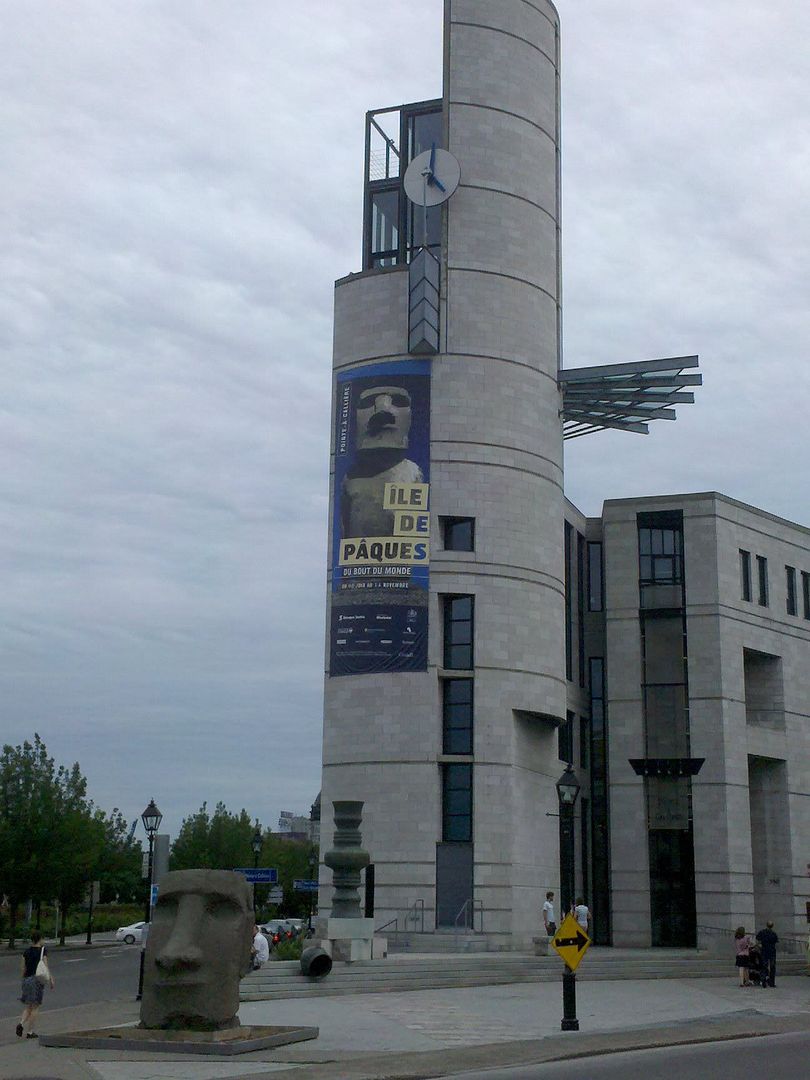
This year, as you can see, the temporary exhibit was on Rapa Nui. The statue out front is a reproduction - Chile no longer allows actual statues to travel, although a smaller one on load from another museum could be found inside. The history is really fascinating, as the island's isolation allowed it to develop in radically different ways that other Oceanic cultures, and it serves as an example of how environmental changes can trigger cultural ones.
"Supper", as it was, came at Les Glaceurs, an ice cream and cupcake place near the cathedral. A chocolate cupcake with coconut on the icing and a raspberry glacé isn't much of a meal, but I wasn't that hungry.
That was a good choice. The evening's movies, maybe not so much. I chose High School over What is Not Romance? because I was more in the mood for some comedy than what looked like kind of an animated downer; Fatso because I could move Black Death to its second screening when it was announced. Neither of them are really bad, but it was an unusually bland evening at the festival.
High School
* * ¼ (out of four)
Seen 23 July 2010 in Theatre Hall (Fantasia 2010)
Marijuana's got little to no appeal to me in real life, and I don't find most stoner characters very funny, either. So High School has a little work to do with me from the start. It does okay as a teenage buddy comedy, but seldom much better than that.
Henry Burke (Matt Bush) is a brilliant student, well on his way to being valedictorian with a full ride scholarship to MIT. On one of the last days of his senior year, he accidentally hits Dean Gordon's (Michael Chiklis) car while swerving to avoid Travis Breaux (Sean Marquette). They both wind up in detention, and afterward awkwardly reminisce about how they used to be best friends. Travis gives Henry a joint, which Henry doesn't much like even before a mandatory drug test leading to immediate expulsion for positive returns is announced. They soon realize that the only way they can keep this from ending in disaster is if the entire school fails the test. Fortunately, Travis comes up with a plan; unfortunately, it's insane and involves stealing hyper-refined THC from a dealer who goes by "Psycho Ed" (Adrien Brody).
Although the plot of the movie is the attempt to get the entire school to test positive, what it's about is rekindling the friendship between Henry and Travis, and the movie is uneven there in a lot of ways. They go from getting along to at each other's throats and back again in the blink of an eye, and it tends to feel very random. There are prominent bits about Henry discovering his need to loosen up, but not nearly so much about Travis maturing and setting goals for himself.
Full review at eFilmCritic
Fatso
* * ½ (out of four)
Seen 23 July 2010 in Salle de Seve (Fantasia 2010)
Norway's Fatso goes for the comedy of discomfort far more than an American version of the same story would, and as a result, maybe it makes sense in that case that it ends with only the wispiest sense of resolution. It makes for a bit of a frustrating total experience, because the characters earn more, but writer/director Arild Fröhlich is sticking to his guns: Happiness doesn't come easy.
Rino (Nils Jørgen Kaalstad) knows this. Overweight, schlumpy, and painfully shy, he spends his days in his late grandmother's apartment translating technical manuals from German to Norwegian, his only friend a gypsy-cab driver by the name of Fillippo (Kyrre Hellum), and his only outlets the comics he draws featuring himself as a sex-obsessed rhinoceros, porn, and masturbation. That may change soon; Rino's father has rented the second bedroom out to Malin (Josefin Ljungman), a gorgeous 20-year-old girl from Sweden who is looking to live a more quiet life.
In some ways, it's unfortunate that the movie (and novel from which the movie was adapted) is called "Fatso", because in many ways Malin is more interesting than Rino. That's not even particularly because Ljungman is more photogenic than the way Kaalstad appears during most of the film; she's got an uncanny knack to reveal massive sadness and despair when without smearing her makeup or otherwise downplaying her beauty, even if we'd just seen her seemingly cheerful moments before. Of course, part of this likely comes because we only see into her life obliquely, when Malin mentions it to Rino or when he ends up with a front-row seat for her relationship meeting with disaster. Telling the pair's stories in a more balanced way might lessen the impact of it.
Full review at eFilmCriticF

Which I don't mean to mock at all; it was cool to see the Olympic basin and all, but the races went quick and there seemed to be a real delay between heats. I left, spent a while walking around the islands, and then took the water taxi across the river to the Old Port where I made the annual visit to Pointe-à-Callière, which is always very cool.

This year, as you can see, the temporary exhibit was on Rapa Nui. The statue out front is a reproduction - Chile no longer allows actual statues to travel, although a smaller one on load from another museum could be found inside. The history is really fascinating, as the island's isolation allowed it to develop in radically different ways that other Oceanic cultures, and it serves as an example of how environmental changes can trigger cultural ones.
"Supper", as it was, came at Les Glaceurs, an ice cream and cupcake place near the cathedral. A chocolate cupcake with coconut on the icing and a raspberry glacé isn't much of a meal, but I wasn't that hungry.
That was a good choice. The evening's movies, maybe not so much. I chose High School over What is Not Romance? because I was more in the mood for some comedy than what looked like kind of an animated downer; Fatso because I could move Black Death to its second screening when it was announced. Neither of them are really bad, but it was an unusually bland evening at the festival.
High School
* * ¼ (out of four)
Seen 23 July 2010 in Theatre Hall (Fantasia 2010)
Marijuana's got little to no appeal to me in real life, and I don't find most stoner characters very funny, either. So High School has a little work to do with me from the start. It does okay as a teenage buddy comedy, but seldom much better than that.
Henry Burke (Matt Bush) is a brilliant student, well on his way to being valedictorian with a full ride scholarship to MIT. On one of the last days of his senior year, he accidentally hits Dean Gordon's (Michael Chiklis) car while swerving to avoid Travis Breaux (Sean Marquette). They both wind up in detention, and afterward awkwardly reminisce about how they used to be best friends. Travis gives Henry a joint, which Henry doesn't much like even before a mandatory drug test leading to immediate expulsion for positive returns is announced. They soon realize that the only way they can keep this from ending in disaster is if the entire school fails the test. Fortunately, Travis comes up with a plan; unfortunately, it's insane and involves stealing hyper-refined THC from a dealer who goes by "Psycho Ed" (Adrien Brody).
Although the plot of the movie is the attempt to get the entire school to test positive, what it's about is rekindling the friendship between Henry and Travis, and the movie is uneven there in a lot of ways. They go from getting along to at each other's throats and back again in the blink of an eye, and it tends to feel very random. There are prominent bits about Henry discovering his need to loosen up, but not nearly so much about Travis maturing and setting goals for himself.
Full review at eFilmCritic
Fatso
* * ½ (out of four)
Seen 23 July 2010 in Salle de Seve (Fantasia 2010)
Norway's Fatso goes for the comedy of discomfort far more than an American version of the same story would, and as a result, maybe it makes sense in that case that it ends with only the wispiest sense of resolution. It makes for a bit of a frustrating total experience, because the characters earn more, but writer/director Arild Fröhlich is sticking to his guns: Happiness doesn't come easy.
Rino (Nils Jørgen Kaalstad) knows this. Overweight, schlumpy, and painfully shy, he spends his days in his late grandmother's apartment translating technical manuals from German to Norwegian, his only friend a gypsy-cab driver by the name of Fillippo (Kyrre Hellum), and his only outlets the comics he draws featuring himself as a sex-obsessed rhinoceros, porn, and masturbation. That may change soon; Rino's father has rented the second bedroom out to Malin (Josefin Ljungman), a gorgeous 20-year-old girl from Sweden who is looking to live a more quiet life.
In some ways, it's unfortunate that the movie (and novel from which the movie was adapted) is called "Fatso", because in many ways Malin is more interesting than Rino. That's not even particularly because Ljungman is more photogenic than the way Kaalstad appears during most of the film; she's got an uncanny knack to reveal massive sadness and despair when without smearing her makeup or otherwise downplaying her beauty, even if we'd just seen her seemingly cheerful moments before. Of course, part of this likely comes because we only see into her life obliquely, when Malin mentions it to Rino or when he ends up with a front-row seat for her relationship meeting with disaster. Telling the pair's stories in a more balanced way might lessen the impact of it.
Full review at eFilmCriticF
Sunday, July 25, 2010
Fantasia Daily for 22 July: Neverlost, [REC] 2, Doghouse, Woochi, Symbol
I felt a little bad about bolting on the Neverlost Q&A to get to [REC] 2, but the movie ran longer than expected and almost everything in de Seve seems to be starting a few minutes late this year. That meant I wound up of in a corner, which wasn't really so bad, although I would be back in the center section, fourth-seat-from-the-left in the fifth row for the rest of the day.
Also: First Cocktail Hawaii breakfast of the trip, despite it marking the start of my third and final week in Montreal. This vacation has just flown by.
Neverlost
* * ¼ (out of four)
Seen 22 July 2010 in Salle de Seve (Fantasia 2010)
I can't give this a genuine review, as we were told after the film that it was a work in progress, and it wouldn't be right. In particular, the director mentioned that they were trying to decide on an ending, although both the one in the film and the one they mentioned as an alternate seemed to be about the same tone - down, and not in a way that seems particularly tragic, at least not in a grand way.
Otherwise, okay movie. Your standard "in one world when awake, in another when dreaming (at least when I've taken some screwy drugs)" story, although dressed up a little at the start with some direct addressing of the camera and medical babble. Decent cast, with an especially nice performance by Ryan Barrett as the man bouncing between two worlds.
[REC] 2
* * * (out of four)
Seen 22 July 2010 in Theatre Hall (Fantasia 2010)
First-person horror has prove tricky to make sequels to, which surely must drive the studios nuts. The found-footage nature generally means all the characters are dead, which means the main element to carry over is the camera gimmick, and every original way to apply that went into the first film. Well, unless you are Jaume Balagueró and Paco Plaza, who prove to have a trick or two up their sleeves.
[REC] 2 picks up exactly where the first left off (you know, the final scene that wound up in the trailer of the American remake), as a team of Barcelona SWAT police - Chief (Oscar Zafra), Larra (Ariel Casas), Martos (Alejandro Casaseca), and camera tech Rosso (Pablo Rosso) prepare to escort Ministry of Health agent Dr. Owen (Jonathan Mellor) into the hot zone. Soon, though, it's clear that Owen knows much more about what's in that building than he should, including the contents of the room from which the plague spread. Meanwhile, the quarantine isn't proving as effective as one might hope - a firefighter (Juli Fàbregas), the father of one of the residents trapped inside (Pep Molina), and three teenagers (Andrea Ros, Alex Batllori, and Pau Poch), with a camera of their own, have snuck in.
[REC] actually set itself up for a continuation a lot better than most horror movies. It spent its last act establishing a clever rationale for its zombie-like creatures, which [REC] 2 picks up on without skipping a beat. It's a much more interesting backstory than is the norm for the genre, giving the characters motivation other than just survival. Admittedly, the segment with the kids does seem a little disposable, there to jack up the body count and separate a few events, but it does do those things, keeping the movie on the right rhythm.
Full review at eFilmCritic
Doghouse
* * (out of four)
Seen 22 July 2010 in Theatre Hall (Fantasia 2010)
Horror movies often get a bad reputation, but they bear watching because, among other reasons, every once in a while one comes along that uses the violence and grotesquery in the service of some clever satire. Doghouse is not one of those movies. It is, if anything, anti-clever, playing to ugly stereotypes and hoping that the superficial pleasures of gore and broad comedy can make up for its ugliness.
Vince (Stephen Graham) is just getting divorced, and is down in the dumps about it. Fortunately, his best mates are there for him! Womanizer Neil (Danny Dyer), gay Graham (Emil Marwa), glib Mikey (Noel Clarke), henpecked Patrick (Keith-Lee Castle), geeky Matt (Lee Ingleby) and chronically late Banksy (Neil Maskell) are taking him on a road trip to Moodly, a tiny village nestled in the woods where women outnumber men four to one. It's oddly deserted when they get there, though, and they soon find why - some sort of bioweapon has been released, turning all the village's women into raving cannibals. Aside from Sgt. Gavin Wright (Terry Stone), the army man they run into, the guys are the only meal in town - and their tour bus driver Ruth (Christina Cole) has just contracted the bug.
The film name-checks Sam Raimi's Evil Dead films several times early on, in scenes located in Matt's comics shop (whether that's the doing of writer Dan Schaffer or director Jake West, I don't know), and on a pure "splatstick" level, Doghouse actually does okay. The make-up for the zombie ladies is very well-done. Though the vast majority of the characters are jerks of one sort or another, they are often funny jerks, with impeccable comic timing on their banter. The broad physical comedy is gross, naturally, but also often fairly funny in its cartoonish way. There are plenty of laughs to be had, and not all are of the gross-out variety.
Full review at eFilmCritic
Woochi
* * * (out of four)
Seen 22 July 2010 in Theatre Hall (Fantasia 2010)
At first, it seems hard to take an action/adventure story where one of the villains is a giant bunny rabbit seriously, even when you're talking about a movie as whimsical as Woochi. Sure, the giant rat goblin, that's one thing, but the rabbit?
Fortunately, you're not supposed to take Woochi that seriously; it's a zippy fantasy adventure movie that throws monsters, men out of time, magicians, and all manner of other things together, and I'm not sure the writer/director was really sure how it all worked. Just what was In-kyeong's deal in the end, anyway? Reincarnation? Amnesia? Possession? It's also an odd split between the present and the past, with a flashback to 500 years ago that runs long enough to make the audience forget that much of the action is going to happen in the present.
It's fun, though, never slowing down enough to test the audience's patience despite being a jumbo-sized movie and always having an amusing bit to toss off.
Shinboru (Symbol)
* * * ¾ (out of four)
Seen 22 July 2010 in Theatre Hall (Fantasia 2010)
It's been a while since I've seen a movie from Japan that is as thoroughly demented as Symbol, which means it's been a long itme since I've seen any movie as crazy and trippy as this. Writer/director/star Hitoshi Matsumoto also did Big Man Japan, but from what I've read that's positively conventional compared to Symbol.
I mean, the thread about luchador "Escargot Man" preparing for his big tag-team match is kind of wacky, but half of the time is spent with Matsumoto in a blank white room filled with little switches that cause various things to appear. It's thoroughly surreal comedy, but also hilarious, and often such high-energy slapstick that the audience will cheer as he works out the solution to his problem of getting out of the room.
A crazy, but very funny movie. Only in Japan.
Also: First Cocktail Hawaii breakfast of the trip, despite it marking the start of my third and final week in Montreal. This vacation has just flown by.
Neverlost
* * ¼ (out of four)
Seen 22 July 2010 in Salle de Seve (Fantasia 2010)
I can't give this a genuine review, as we were told after the film that it was a work in progress, and it wouldn't be right. In particular, the director mentioned that they were trying to decide on an ending, although both the one in the film and the one they mentioned as an alternate seemed to be about the same tone - down, and not in a way that seems particularly tragic, at least not in a grand way.
Otherwise, okay movie. Your standard "in one world when awake, in another when dreaming (at least when I've taken some screwy drugs)" story, although dressed up a little at the start with some direct addressing of the camera and medical babble. Decent cast, with an especially nice performance by Ryan Barrett as the man bouncing between two worlds.
[REC] 2
* * * (out of four)
Seen 22 July 2010 in Theatre Hall (Fantasia 2010)
First-person horror has prove tricky to make sequels to, which surely must drive the studios nuts. The found-footage nature generally means all the characters are dead, which means the main element to carry over is the camera gimmick, and every original way to apply that went into the first film. Well, unless you are Jaume Balagueró and Paco Plaza, who prove to have a trick or two up their sleeves.
[REC] 2 picks up exactly where the first left off (you know, the final scene that wound up in the trailer of the American remake), as a team of Barcelona SWAT police - Chief (Oscar Zafra), Larra (Ariel Casas), Martos (Alejandro Casaseca), and camera tech Rosso (Pablo Rosso) prepare to escort Ministry of Health agent Dr. Owen (Jonathan Mellor) into the hot zone. Soon, though, it's clear that Owen knows much more about what's in that building than he should, including the contents of the room from which the plague spread. Meanwhile, the quarantine isn't proving as effective as one might hope - a firefighter (Juli Fàbregas), the father of one of the residents trapped inside (Pep Molina), and three teenagers (Andrea Ros, Alex Batllori, and Pau Poch), with a camera of their own, have snuck in.
[REC] actually set itself up for a continuation a lot better than most horror movies. It spent its last act establishing a clever rationale for its zombie-like creatures, which [REC] 2 picks up on without skipping a beat. It's a much more interesting backstory than is the norm for the genre, giving the characters motivation other than just survival. Admittedly, the segment with the kids does seem a little disposable, there to jack up the body count and separate a few events, but it does do those things, keeping the movie on the right rhythm.
Full review at eFilmCritic
Doghouse
* * (out of four)
Seen 22 July 2010 in Theatre Hall (Fantasia 2010)
Horror movies often get a bad reputation, but they bear watching because, among other reasons, every once in a while one comes along that uses the violence and grotesquery in the service of some clever satire. Doghouse is not one of those movies. It is, if anything, anti-clever, playing to ugly stereotypes and hoping that the superficial pleasures of gore and broad comedy can make up for its ugliness.
Vince (Stephen Graham) is just getting divorced, and is down in the dumps about it. Fortunately, his best mates are there for him! Womanizer Neil (Danny Dyer), gay Graham (Emil Marwa), glib Mikey (Noel Clarke), henpecked Patrick (Keith-Lee Castle), geeky Matt (Lee Ingleby) and chronically late Banksy (Neil Maskell) are taking him on a road trip to Moodly, a tiny village nestled in the woods where women outnumber men four to one. It's oddly deserted when they get there, though, and they soon find why - some sort of bioweapon has been released, turning all the village's women into raving cannibals. Aside from Sgt. Gavin Wright (Terry Stone), the army man they run into, the guys are the only meal in town - and their tour bus driver Ruth (Christina Cole) has just contracted the bug.
The film name-checks Sam Raimi's Evil Dead films several times early on, in scenes located in Matt's comics shop (whether that's the doing of writer Dan Schaffer or director Jake West, I don't know), and on a pure "splatstick" level, Doghouse actually does okay. The make-up for the zombie ladies is very well-done. Though the vast majority of the characters are jerks of one sort or another, they are often funny jerks, with impeccable comic timing on their banter. The broad physical comedy is gross, naturally, but also often fairly funny in its cartoonish way. There are plenty of laughs to be had, and not all are of the gross-out variety.
Full review at eFilmCritic
Woochi
* * * (out of four)
Seen 22 July 2010 in Theatre Hall (Fantasia 2010)
At first, it seems hard to take an action/adventure story where one of the villains is a giant bunny rabbit seriously, even when you're talking about a movie as whimsical as Woochi. Sure, the giant rat goblin, that's one thing, but the rabbit?
Fortunately, you're not supposed to take Woochi that seriously; it's a zippy fantasy adventure movie that throws monsters, men out of time, magicians, and all manner of other things together, and I'm not sure the writer/director was really sure how it all worked. Just what was In-kyeong's deal in the end, anyway? Reincarnation? Amnesia? Possession? It's also an odd split between the present and the past, with a flashback to 500 years ago that runs long enough to make the audience forget that much of the action is going to happen in the present.
It's fun, though, never slowing down enough to test the audience's patience despite being a jumbo-sized movie and always having an amusing bit to toss off.
Shinboru (Symbol)
* * * ¾ (out of four)
Seen 22 July 2010 in Theatre Hall (Fantasia 2010)
It's been a while since I've seen a movie from Japan that is as thoroughly demented as Symbol, which means it's been a long itme since I've seen any movie as crazy and trippy as this. Writer/director/star Hitoshi Matsumoto also did Big Man Japan, but from what I've read that's positively conventional compared to Symbol.
I mean, the thread about luchador "Escargot Man" preparing for his big tag-team match is kind of wacky, but half of the time is spent with Matsumoto in a blank white room filled with little switches that cause various things to appear. It's thoroughly surreal comedy, but also hilarious, and often such high-energy slapstick that the audience will cheer as he works out the solution to his problem of getting out of the room.
A crazy, but very funny movie. Only in Japan.
Saturday, July 24, 2010
Fantasia Daily for 21 July: Blades of Blood, Brass Knuckle Boys, Love in a Puff, Overheard
Not much to say. Saw some movies, gotta leave to see more now.
Goo-reu-meul Beo-eo-nan Dal-cheo-reom (Blades of Blood)
* * ¾ (out of four)
Seen 21 July 2010 in Theatre Hall (Fantasia 2010)
Just who and what is Lee Joon-ik's Blades of Blood (aka Like the Moon Escaping from the Clouds) about? It takes the form of a movie about an "avenging the slain family" movie, but smothers that story under a thick pillow of political intrigue that is frequently more interesting but does not amount to much in the end.
See, Korea is poised to come apart at the seams. Japan sees it as a road through which to invade China, the King's advisers in the East and West cabinets reflexively oppose each other, and even the popular Great Alliance movement is having a crisis of leadership, with the aggressive Lee Mong-hak (Cha Seung-won) taking control when a more moderate leader dies. One of his first targets is prominent Western noble Han Shin-kyun (Song Yeong-chang). Only a few members of Han's family survive the bloodbath, but one is a son, Han Kyun-ju (Baek Seong-hyeon), who had been ostracized as a bastard by his brothers for being born of a concubine. Kyun-ju tries to avenge his father's death, but is no match for Mong-hak. Fortunately, blind swordsman and doctor Hwang Jeong-hak (Hwang Jeong-min) is nearby, and he nurses Kyun-ju back to health and allows him to join him on the road to confront Mong-hak.
Here's the trouble: The Kyun-ju story just isn't that interesting. There's moments when it could be, most of them opposite Baek-ji (Han Ji-hye), Mong-hak's concubine who winds up joinging him and Hwang on their journey. They strike up a friedship, and she challenges him on how he limits himself by allowing others to define him. But when all is said and done, he doesn't seem to mature that much and his story doesn't have any particular hook to it. It's just a guy being taken on by an odd mentor. Baek Seong-hyeon is actually quite good in the role, but the story doesn't give him anything great to do.
Full review at eFilmCritic.
Shonen merikensakku (Brass Knuckle Boys)
* * ½ (out of four)
Seen 21 July 2010 in Salle de Seve (Fantasia 2010)
Brass Knuckle Boys has two hugely funny scenes, including a flashback that is among the best rock 'n roll movie jokes I can remember. They're both in the beginning, though, and afterward, the movie grinds on for two hours being funny only in brief spurts, and the story becomes very arbitrary - the characters change how they're acting and do strange things for no apparent reason.
It's unfortunate, because the basic idea - record company accidentally signs punk band based on a video from 1983, straitlaced young girl must ride herd on them - is pretty good, and there's some genuine comedic talent on display. But the filmmakers seldom manage to capitalize on that potential.
Chi ming yu chun giu (Love in a Puff)
* * * ¼ (out of four)
Seen 21 July 2010 in Theatre Hall (Fantasia 2010)
A cute little romance, shot handheld on the streets of Hong Kong as two people who meet during their smoke breaks hit it off, get cold feet, and get back together over the course of a week. It's got a pair of nice leads in Shawn Yue and Miriam Yeung Chin-wah, a nice indie-film vibe, and enough good jokes and true-seeming moments to work very well.
Qie ting feng yun (Overheard)
* * ¾ (out of four)
Seen 21 July 2010 in Salle de Seve (Fantasia 2010)
Not a bad crime thriller at all, I guess, but one expects more from the makers of Infernal Affairs, especially since this does have a pretty decent opening that sets up some interesting conflicts. Some of that becomes soap, though, and it is awfully hard to make insider trading a visually dramatic activity. The ending epilogue, as well, goes on long enough to sap the film of its energy and has a bit of a screwy ending.
I may wind up rating it higher when I have the time to really spend time thinking/writing about it, though. It is a pretty smart thriller, with a very nice cast and slick shooting. It may just have been a victim of late-night doldrums for me.
Goo-reu-meul Beo-eo-nan Dal-cheo-reom (Blades of Blood)
* * ¾ (out of four)
Seen 21 July 2010 in Theatre Hall (Fantasia 2010)
Just who and what is Lee Joon-ik's Blades of Blood (aka Like the Moon Escaping from the Clouds) about? It takes the form of a movie about an "avenging the slain family" movie, but smothers that story under a thick pillow of political intrigue that is frequently more interesting but does not amount to much in the end.
See, Korea is poised to come apart at the seams. Japan sees it as a road through which to invade China, the King's advisers in the East and West cabinets reflexively oppose each other, and even the popular Great Alliance movement is having a crisis of leadership, with the aggressive Lee Mong-hak (Cha Seung-won) taking control when a more moderate leader dies. One of his first targets is prominent Western noble Han Shin-kyun (Song Yeong-chang). Only a few members of Han's family survive the bloodbath, but one is a son, Han Kyun-ju (Baek Seong-hyeon), who had been ostracized as a bastard by his brothers for being born of a concubine. Kyun-ju tries to avenge his father's death, but is no match for Mong-hak. Fortunately, blind swordsman and doctor Hwang Jeong-hak (Hwang Jeong-min) is nearby, and he nurses Kyun-ju back to health and allows him to join him on the road to confront Mong-hak.
Here's the trouble: The Kyun-ju story just isn't that interesting. There's moments when it could be, most of them opposite Baek-ji (Han Ji-hye), Mong-hak's concubine who winds up joinging him and Hwang on their journey. They strike up a friedship, and she challenges him on how he limits himself by allowing others to define him. But when all is said and done, he doesn't seem to mature that much and his story doesn't have any particular hook to it. It's just a guy being taken on by an odd mentor. Baek Seong-hyeon is actually quite good in the role, but the story doesn't give him anything great to do.
Full review at eFilmCritic.
Shonen merikensakku (Brass Knuckle Boys)
* * ½ (out of four)
Seen 21 July 2010 in Salle de Seve (Fantasia 2010)
Brass Knuckle Boys has two hugely funny scenes, including a flashback that is among the best rock 'n roll movie jokes I can remember. They're both in the beginning, though, and afterward, the movie grinds on for two hours being funny only in brief spurts, and the story becomes very arbitrary - the characters change how they're acting and do strange things for no apparent reason.
It's unfortunate, because the basic idea - record company accidentally signs punk band based on a video from 1983, straitlaced young girl must ride herd on them - is pretty good, and there's some genuine comedic talent on display. But the filmmakers seldom manage to capitalize on that potential.
Chi ming yu chun giu (Love in a Puff)
* * * ¼ (out of four)
Seen 21 July 2010 in Theatre Hall (Fantasia 2010)
A cute little romance, shot handheld on the streets of Hong Kong as two people who meet during their smoke breaks hit it off, get cold feet, and get back together over the course of a week. It's got a pair of nice leads in Shawn Yue and Miriam Yeung Chin-wah, a nice indie-film vibe, and enough good jokes and true-seeming moments to work very well.
Qie ting feng yun (Overheard)
* * ¾ (out of four)
Seen 21 July 2010 in Salle de Seve (Fantasia 2010)
Not a bad crime thriller at all, I guess, but one expects more from the makers of Infernal Affairs, especially since this does have a pretty decent opening that sets up some interesting conflicts. Some of that becomes soap, though, and it is awfully hard to make insider trading a visually dramatic activity. The ending epilogue, as well, goes on long enough to sap the film of its energy and has a bit of a screwy ending.
I may wind up rating it higher when I have the time to really spend time thinking/writing about it, though. It is a pretty smart thriller, with a very nice cast and slick shooting. It may just have been a victim of late-night doldrums for me.
Friday, July 23, 2010
Fantasia Daily for 20 July: Raging Phoenix, La Meute, 1
Seeing that the first movie I really wanted to see was at 5:20, I thought today would be a good day to finally get to the Railway museum, but no dice; I dawdled too long in the morning to make the train/bus combo. I'm going to try for next Tuesday, my 2nd-to-last day here.
Instead, I had a day on Mont-Royal. It's a hot sweaty walk to get to the top, but always worth it.
One funny thing about the festival being in Montreal for this American: The program talks about how La Meute has an unusual star in Emilie Dequennes, whom it describes as a "darling of auteur cinema". I'm sure that more French films play in Montreal, so that's how she's seen, but I imagine that most American genre audiences remember her best from Brotherhood of the Wolf, even if that was years ago.
Deu suay doo (Raging Phoenix)
* * * (out of four)
Seen 20 July 2010 in Theatre Hall (Fantasia 2010)
I suppose that technically "Raging Phoenix" is a perfectly reasonable title for this movie - the protagonist does rise from a low point reborn and pissed off - but let's be honest, this is not a perfectly reasonable movie, and as such deserves a title that lets the audience in on just what sort of madness they're in for.
Deu ("JeeJa" Yanin Vismistananda) doesn't seem too out of the ordinary when we first meet her. She's a drummer in a band that kicks her out after she jumps into the audience to go after her ex. She's done a nice job of getting hammered when someone kidnaps her, but she escapes, only to find a whole gang chasing her. She's rescued by Sanim (Kazu Tang), whose "Mayraiyuth" fighting style is a combination of muay thai, drunken boxing, and b-boy dancing. It turns out he and his three comrades have each had a loved one kidnapped or killed by this Jaguar gang. Deu throws in, insisting they teach her how to fight.
And then things get kind of nuts. Understand, by "nuts", I mean they escalate past the "fighting guys on razor-sharp pogo sticks with drunken breakdancing" (did I mention the razor-sharp pogos? I meant to!). In fact, the reason for the Jaguars kidnapping these girls is potentially a wholly different insane Thai martial arts movie. And I kind of wish it had been something separate, because for as much impressive action as the last half has to follow up on a loopy plot, it's no longer to a techno beat with that super-distinctive style. It's "just" big fight scenes.
Full review at eFilmCritic.
La Meute (The Pack)
* * ½ (out of four)
Seen 20 July 2010 in Theatre Hall (Fantasia 2010)
Torture porn is a horror fad whose moment has more or less passed, right? Sure, the Saw movies still come out like clockwork, but that's more a franchise of its own than an example of a trend now. I ask because while the new French thriller La Meute (The Pack) doesn't fall entirely under that category, it does have long stretches where it substitutes mere suffering for suspense.
At first, it looks like that may come at the expense of a group of bikers that annoy Charlotte (Émilie Dequenne) on her cross-country drive. Though she thinks she loses them, they show back up when she and Max (Benjamin Biolay) stop at a roadside diner. The diner's owner, "La Spack" (Yolande Moreau), and the local sheriff, Chinaski (Philippe Nahon), run them off, but soon Max apparently goes to the bathroom and doesn't return. Now, it's not like Charlotte is particularly attached to him, but she's curious - though what she finds when coming back the next night will make her wish she'd just kept driving.
Give writer/director Franck Richard credit - he zeroes in on his mood and only very briefly does he ever waver. The back roads he sets the story on are grimy and dusty, with worn-down cars stopping at worn-down diners, and there's a scent of hostility coming from nearly every member of the cast, with the rest initially looking kind of laughable. It's a place where a person can just disappear. Cinematographer Laurent Bares fills the screen with browns during the day and deep, inky blacks that can swallow a man whole at night.
Full review at eFilmCritic.
1
* * * (out of four)
Seen 20 July 2010 in Salle de Seve (Fantasia 2010)
In just a few minutes, I'm going to write an email to the Fantasia press office asking for screeners of movies I've missed or which I think need a second look, and 1 will be at the top of the list. And not for alphabetical order, either; of all the 10pm movies I had a little trouble getting through, this was the one that most intrigued me throughout.
The premise is intriguing - all the books in an upscale bookstore are mysteriously replaced with a volume labeled "1", which contains information on what every person on earth was doing during a given minute - and there's a nifty Twilight Zone vibe to it, especially once we hear about a "reality enforcement" institute. But, wow, is it a tough one to get through at 10pm; there's a lot of sonorous narration and it seems to lose the plot about midway through. But that just may be me; I look forward to making a second try.
Instead, I had a day on Mont-Royal. It's a hot sweaty walk to get to the top, but always worth it.
One funny thing about the festival being in Montreal for this American: The program talks about how La Meute has an unusual star in Emilie Dequennes, whom it describes as a "darling of auteur cinema". I'm sure that more French films play in Montreal, so that's how she's seen, but I imagine that most American genre audiences remember her best from Brotherhood of the Wolf, even if that was years ago.
Deu suay doo (Raging Phoenix)
* * * (out of four)
Seen 20 July 2010 in Theatre Hall (Fantasia 2010)
I suppose that technically "Raging Phoenix" is a perfectly reasonable title for this movie - the protagonist does rise from a low point reborn and pissed off - but let's be honest, this is not a perfectly reasonable movie, and as such deserves a title that lets the audience in on just what sort of madness they're in for.
Deu ("JeeJa" Yanin Vismistananda) doesn't seem too out of the ordinary when we first meet her. She's a drummer in a band that kicks her out after she jumps into the audience to go after her ex. She's done a nice job of getting hammered when someone kidnaps her, but she escapes, only to find a whole gang chasing her. She's rescued by Sanim (Kazu Tang), whose "Mayraiyuth" fighting style is a combination of muay thai, drunken boxing, and b-boy dancing. It turns out he and his three comrades have each had a loved one kidnapped or killed by this Jaguar gang. Deu throws in, insisting they teach her how to fight.
And then things get kind of nuts. Understand, by "nuts", I mean they escalate past the "fighting guys on razor-sharp pogo sticks with drunken breakdancing" (did I mention the razor-sharp pogos? I meant to!). In fact, the reason for the Jaguars kidnapping these girls is potentially a wholly different insane Thai martial arts movie. And I kind of wish it had been something separate, because for as much impressive action as the last half has to follow up on a loopy plot, it's no longer to a techno beat with that super-distinctive style. It's "just" big fight scenes.
Full review at eFilmCritic.
La Meute (The Pack)
* * ½ (out of four)
Seen 20 July 2010 in Theatre Hall (Fantasia 2010)
Torture porn is a horror fad whose moment has more or less passed, right? Sure, the Saw movies still come out like clockwork, but that's more a franchise of its own than an example of a trend now. I ask because while the new French thriller La Meute (The Pack) doesn't fall entirely under that category, it does have long stretches where it substitutes mere suffering for suspense.
At first, it looks like that may come at the expense of a group of bikers that annoy Charlotte (Émilie Dequenne) on her cross-country drive. Though she thinks she loses them, they show back up when she and Max (Benjamin Biolay) stop at a roadside diner. The diner's owner, "La Spack" (Yolande Moreau), and the local sheriff, Chinaski (Philippe Nahon), run them off, but soon Max apparently goes to the bathroom and doesn't return. Now, it's not like Charlotte is particularly attached to him, but she's curious - though what she finds when coming back the next night will make her wish she'd just kept driving.
Give writer/director Franck Richard credit - he zeroes in on his mood and only very briefly does he ever waver. The back roads he sets the story on are grimy and dusty, with worn-down cars stopping at worn-down diners, and there's a scent of hostility coming from nearly every member of the cast, with the rest initially looking kind of laughable. It's a place where a person can just disappear. Cinematographer Laurent Bares fills the screen with browns during the day and deep, inky blacks that can swallow a man whole at night.
Full review at eFilmCritic.
1
* * * (out of four)
Seen 20 July 2010 in Salle de Seve (Fantasia 2010)
In just a few minutes, I'm going to write an email to the Fantasia press office asking for screeners of movies I've missed or which I think need a second look, and 1 will be at the top of the list. And not for alphabetical order, either; of all the 10pm movies I had a little trouble getting through, this was the one that most intrigued me throughout.
The premise is intriguing - all the books in an upscale bookstore are mysteriously replaced with a volume labeled "1", which contains information on what every person on earth was doing during a given minute - and there's a nifty Twilight Zone vibe to it, especially once we hear about a "reality enforcement" institute. But, wow, is it a tough one to get through at 10pm; there's a lot of sonorous narration and it seems to lose the plot about midway through. But that just may be me; I look forward to making a second try.
Thursday, July 22, 2010
Fantasia Daily for 19 July: Castaway on the Moon, Written By
Monday was my last day working in the office, and was really unusually quiet; I was expecting a lot of "wait! you can't go until you've done this! and checked this! and these people need to know that if you're going to be really and truly away for a week and a half!", but that didn't happen. I still got a little tense waiting for the other shoe to drop, though.
(And many thanks to the fine folks at Intrinsiq-Tendler who let me camp out in their office for seven days; it's a lot easier to carve three weeks out of the year if you can get some work done during part of it in an environment conducive to getting work done.)
I did dawdle a little on the way out, perhaps in a subconscious effort to not make it back in time to give Eve's Necklace a second chance. I decided not to, because let's face it, this is vacation and fun and I don't want to to make it feel like an obligation. Sure, I'll be asking for some second-chance screeners, but do I really need to see the mannequin movie twice to be sure it's a gimmick film? No, probably not really.
After that? Well, I could have made it to A Serbian Film, but did I really want to? Sure, it's highly buzzed-about and the folks who have seen it tend to praise it even while wishing they could unburn some of its images from their brains, but... Well, see above about obligations. Besides, if I didn't do some laundry within the next few days, I'd be out of stuff, so that seemed like a good time to get it done.
Kimssi pyoryugi (Castaway on the Moon)
* * * * (out of four)
Seen 19 July 2010 in Theatre Hall (Fantasia 2010)
Somehow, I got the idea into my head that Castaway on the Moon was going to be a serious film, all allegory for isolation within the city and breaking its hero down to find out who he is without defining him by his relationships to other people. Which it is. It is also well aware that its plot is as potentially funny as it is clever, and goes for the laughs, too.
Mr. Kim (Jung Jae-young) is in bad shape. His girlfriend has left him, and he somehow owes hundreds of thousands of dollars on a $75k, supposedly interest-free loan. Once he has established the situation as hopeless, he throws himself into the Han river. Things still aren't going his way, though, as he washes up on shore. But not of the city; of Bam Island, a tiny piece of land in the middle of the river with an unscalable bridge support and no other connection to land. He can't swim, so he finds himself in the odd situation of being a Robinson Crusoe surrounded by one of Asia's largest cities, as nobody can see him. Well, one person can - Ms. Kim (Jung Rye-won), a young shut-in in a nearby high-rise, has accidentally caught a glimpse of him via her camera's telephoto lens, and has become fascinated.
Kim is the most common surname in South Korea, shared by roughly a third of the population, so it would be no great surprise for two random people to have that name. Obviously, in a film, that choice is not random, especially since the characters' given names are spoken aloud maybe once apiece and they are listed as "Male Kim" and "Female Kim" in the credits. The two are meant to be analogs for each other, creating tiny nations of one within Seoul and shunning outside contact. It's done in extreme ways but they could be anyone who has, one way or another, been hurt sufficiently to run away from the world.
Full review at eFilmCritic.
Joi sun ho (Written By)
* * * ¾ (out of four)
Seen 19 July 2010 in Salle de Seve (Fantasia 2010)
Last year, I saw Wai Ka-fai as a guest at another film festival, and as one might expect, most of the questions in the extended Q&A were about his collaborations with Johnnie To. Written By didn't play until later in that festival, after I'd gone home, which is a shame - it's a film I would have really liked to hear him talk about.
A family is involved in a horrific car accident; it leaves father Tony (Lau Ching-wan) dead and daughter Melody blinded. Despite that, they survive; mother Mandy (Kelly Lin) returns to school for her graduate degree, and ten years later, Melody (Mia Yam) is a promising young writer. But a pall still hangs over the family, so Melody proposes an odd form of therapy: She will write a novel, in which--
A family is involved in a horrific car accident; father Tony (Lau Ching-wan) is the only survivor, and he's been blinded. Though his Filipino housemaid Maria (Yeung Shuk-man) helps him handle day-to-day activities, he has become reclusive and withdrawn. He decides on an odd form of therapy: He will write a novel, in which--
Wai and co-writer Au Kin-yee don't quite create the ouroboros of a screenplay you might imagine from that description; that would be, in a way, too straightforward and confining. Instead, they create a layered story about dealing with grief and survivor's guilt which effectively shows how the departed can still linger in the minds of those who love them. It also allows the film to go off on some pretty wild flights of fantasy, and even get away with things happening in the plotline that might otherwise seem to be a little much. By the end of the movie, things have gotten very strange indeed, but the emotion of it is so grounded that it almost seems to be the logical extension of what has happened before.
Full review at eFilmCritic.
(And many thanks to the fine folks at Intrinsiq-Tendler who let me camp out in their office for seven days; it's a lot easier to carve three weeks out of the year if you can get some work done during part of it in an environment conducive to getting work done.)
I did dawdle a little on the way out, perhaps in a subconscious effort to not make it back in time to give Eve's Necklace a second chance. I decided not to, because let's face it, this is vacation and fun and I don't want to to make it feel like an obligation. Sure, I'll be asking for some second-chance screeners, but do I really need to see the mannequin movie twice to be sure it's a gimmick film? No, probably not really.
After that? Well, I could have made it to A Serbian Film, but did I really want to? Sure, it's highly buzzed-about and the folks who have seen it tend to praise it even while wishing they could unburn some of its images from their brains, but... Well, see above about obligations. Besides, if I didn't do some laundry within the next few days, I'd be out of stuff, so that seemed like a good time to get it done.
Kimssi pyoryugi (Castaway on the Moon)
* * * * (out of four)
Seen 19 July 2010 in Theatre Hall (Fantasia 2010)
Somehow, I got the idea into my head that Castaway on the Moon was going to be a serious film, all allegory for isolation within the city and breaking its hero down to find out who he is without defining him by his relationships to other people. Which it is. It is also well aware that its plot is as potentially funny as it is clever, and goes for the laughs, too.
Mr. Kim (Jung Jae-young) is in bad shape. His girlfriend has left him, and he somehow owes hundreds of thousands of dollars on a $75k, supposedly interest-free loan. Once he has established the situation as hopeless, he throws himself into the Han river. Things still aren't going his way, though, as he washes up on shore. But not of the city; of Bam Island, a tiny piece of land in the middle of the river with an unscalable bridge support and no other connection to land. He can't swim, so he finds himself in the odd situation of being a Robinson Crusoe surrounded by one of Asia's largest cities, as nobody can see him. Well, one person can - Ms. Kim (Jung Rye-won), a young shut-in in a nearby high-rise, has accidentally caught a glimpse of him via her camera's telephoto lens, and has become fascinated.
Kim is the most common surname in South Korea, shared by roughly a third of the population, so it would be no great surprise for two random people to have that name. Obviously, in a film, that choice is not random, especially since the characters' given names are spoken aloud maybe once apiece and they are listed as "Male Kim" and "Female Kim" in the credits. The two are meant to be analogs for each other, creating tiny nations of one within Seoul and shunning outside contact. It's done in extreme ways but they could be anyone who has, one way or another, been hurt sufficiently to run away from the world.
Full review at eFilmCritic.
Joi sun ho (Written By)
* * * ¾ (out of four)
Seen 19 July 2010 in Salle de Seve (Fantasia 2010)
Last year, I saw Wai Ka-fai as a guest at another film festival, and as one might expect, most of the questions in the extended Q&A were about his collaborations with Johnnie To. Written By didn't play until later in that festival, after I'd gone home, which is a shame - it's a film I would have really liked to hear him talk about.
A family is involved in a horrific car accident; it leaves father Tony (Lau Ching-wan) dead and daughter Melody blinded. Despite that, they survive; mother Mandy (Kelly Lin) returns to school for her graduate degree, and ten years later, Melody (Mia Yam) is a promising young writer. But a pall still hangs over the family, so Melody proposes an odd form of therapy: She will write a novel, in which--
A family is involved in a horrific car accident; father Tony (Lau Ching-wan) is the only survivor, and he's been blinded. Though his Filipino housemaid Maria (Yeung Shuk-man) helps him handle day-to-day activities, he has become reclusive and withdrawn. He decides on an odd form of therapy: He will write a novel, in which--
Wai and co-writer Au Kin-yee don't quite create the ouroboros of a screenplay you might imagine from that description; that would be, in a way, too straightforward and confining. Instead, they create a layered story about dealing with grief and survivor's guilt which effectively shows how the departed can still linger in the minds of those who love them. It also allows the film to go off on some pretty wild flights of fantasy, and even get away with things happening in the plotline that might otherwise seem to be a little much. By the end of the movie, things have gotten very strange indeed, but the emotion of it is so grounded that it almost seems to be the logical extension of what has happened before.
Full review at eFilmCritic.
Wednesday, July 21, 2010
Fantasia Daily for 18 July: Frankenstein Unlimited, Black Lightning, The Neighbor Zombie, Accident, The Executioner
Late night Saturday, early-ish start Sunday, not much else to say about the day, other than that some fun was had with zombie makeup for The Neighbor Zombie - the director was also the film's make-up artist, so several of the hosts of the screening were doing it as members of the undead, which is always fun.
Frankenstein Unlimited
* * ½ (out of four)
Seen 18 July 2010 in Salle de Seve (Fantasia 2010)
I saw two anthology-style movies this day; the second, The Neighbor Zombie, was much more successful for me. This one is much more a true anthology, and as such winds up being rather uneven - of the six segments, I enjoyed two ("Victor" and "Flesh for Kung Fu"), disliked two ("Dark Lotus" and "Reflections") and had mixed reactions to another two ("Occam's Razor" and "Mr. Fluffenstein"). Overall, I guess this nets out as a draw, worth seeing, but not something I'm very enthusiastic about.
Chernaya Molniya (Black Lightning)
* * * (out of four)
Seen 18 July 2010 in Theatre Hall (Fantasia 2010)
It may have improved in the two weeks since I headed north for this film festival, but the summer movie line-up for 2010 could be described as uninspiring. It's enough to make me wonder why Universal hasn't found a way to put Black Lightning on the schedule. sure, a subtitled family-friendly adventure film is a tough sell, but it's a fun movie that gets the job done.
Dmitry (Grigoriy Dobrygin) is a bright college student studying business who feels a little outclassed by his wealthier classmates, especially after his friend Maxim (Ivan Zhidkov) seems to be dating pretty new student Nastya (Ekaterina Vilkova) before he can even talk to her. His father (Sergey Garmash) tries to help, getting him a used car for his birthday. It's a Volga DAZ-11, and while it's okay for getting a job delivering flowers, "Dima" is not going to admit that he owns a Soviet-era crapbox to his friends. What he doesn't realize is that this Soviet-era crapbox was salvaged from a secret underground lab, it has a prototype nano-fuel converter... and can fly! Diamond-obsessed billionaire Viktor Kuptsov (Viktor Verzhbitskiy) has been searching for that converter for years, and there's no way he'll let some kid use it to bypass Moscow traffic when it could help him drill for diamonds, even if that would crack the city's very foundations, muwahahahaha!
Okay, I got a little carried away there, but not much. Black Lightning is such a throwback to old-school superhero stories that one almost expects to see Stan Lee in the credits somewhere (and maybe he should be anyway - I think Maxim not being Viktor's son is all that separate's this movie's basic story from Spider-Man). All of the classic elements are there - a defining tragedy, secret identity issues, a grandiose villain who eventually must match the hero's gear, and a final confrontation at a landmark. They're present because they work; as familiar - and at times almost silly - as the elements are, it feels good to watch someone overcome their selfishness to do right, and the characters don't come across as parodies.
Full review at eFilmCritic.
I-oot-jib Jom-bi (The Neighbor Zombie)
* * * ¼ (out of four)
Seen 18 July 2010 in Theatre Hall (Fantasia 2010)
Zombie movies have the potential to be a dime a dozen, and not just because they can be made on a shoestring budget, as this South Korean anthology film is. What makes it stand out from the crowd? Well, technically, being Korean; it may not be the first of the sub-genre to come from there as was claimed, but it's a rare example. More interestingly, the anthology format allows the film's four directors to tell a set of smaller stories that have a larger scope.
After some opening narration that sets the scene, we get two stories from Oh Young-doo. The first, "Crack", is unfortunately the film's worst entry; I think it's aiming for gory slapstick, but it just winds up being nearly incomprehensible. Things improve a great deal with "Runaway", in which a girl (Ha Eun-jeong) hiding her infected boyfriend (Bae Yong-geun) in her apartment confronts how untenable such a situation can be - sure, the infected can somewhat keep it together as long as they remain calm and resist the craving for human flesh, but that's awful hard when every normal person is trying to kill you. This one is also played as broad comedy, but that turns out to be a shrewd was to establish the film's ground rules - primarily that the outbreak did not lead to instant barbarity, at either the individual or societal level. It's a bit uneven, but the soft sell is much more elegant that and exposition dump, and it's a sign of good things to come.
Hong Young-Guen is up next with "Mother, I Love You", a much darker take on similar ideas. Here, Jeong-ah (Lim Jeong-seon) is also sheltering an infected person, her mother (Kim Yeo-jin-i), who is pretty much all the way gone. It's going all right, until a government inspector (No Jae-hwan) discovers what's up. It's a grim little story about what people will stoop to in order to protect those that they love, with a few moments that are not for the squeamish.
Full review at eFilmCritic.
Yi ngoi (Accident)
* * * ½ (out of four)
Seen 18 July 2010 in Theatre Hall (Fantasia 2010)
Crime movies are filled with hitmen, to the extent that, if these numbers existed in the real world, it would be a shock if any potential murder victim lived more than a couple of days and nobody could make a career out of it; the economics just wouldn't work out. Or, perhaps, the setup in this nifty movie is more common than it would seem.
The assassin, Ho Kwok-fai (Louis Koo), is never under suspicion because his hits look like accidents. Even if his team's elaborate set-ups were to come under suspicion, he is insulated from the clients, and his own team only knows him as "Brain"; he never calls them anything but "Uncle" (Fung Shui-fan), "Fatty" (Lam Suet), and "Woman" (Michelle Ye). We see one plan go off without a hitch, and then a second one which must wait for conditions to be perfect. And while the target is eliminated, something goes wrong, and the team winds up down a member. It looks like an accident - but Brain knows better.
While Accident is built like a duel between killers with a knack for going undetected - Brain quickly comes to focus on insurance investigator Chan Fong-chow (Richie Ren) as his rival - it also offers up an excellent story of obsession and paranoia. Brain is so used to maintaining complete control over a situation that to not have such control is completely intolerable, especially since he still bears the psychic scars of one accident he did not cause. It's a man becoming more and more obsessed with controlling the world around him, even though that means jettisoning much of his humanity.
Full review at eFilmCritic.
Jibhaengja (The Executioner)
* * ½ (out of four)
Seen 18 July 2010 in Salle de Seve (Fantasia 2010)
The Executioner starts out pretty well, as many prison movies do; the culture shock of a young kid being thrown into the world of prison, whether as an inmate or, in this case, as a guard, is pretty tough to screw up if you've got a competent cast and crew, which this movie for the most part has. It's very compelling, especially in the early going, as rookie guard Oh Jae-hyung discovers what a scary place his new workplace can be, even for those supposedly in control, and veteran officer Bae Jong-ho makes it his task to toughen him up.
As the story becomes more about the death penalty, though, it gets a little weaker. There's an awkward juxtaposition of capital punishment and abortion that actually takes away from how the way the job changes Oh puts a wedge between him and his girlfriend (though how awkward it is in South Korea, I'm not sure; do the anti-abortion crowds tend to politically align with the pro-execution people there, and vice versa, as they do in the US?); I never really got comfortable with the subplot about the warden and death-row inmate who have become friends over the years. In many ways, the later scenes tended to remind me what a much better movie Vacation was.
I suspect that a little more familiarity with current Korean politics and life might tip the scales a bit for me, but this is otherwise a movie that isn't quite so good as I would hope for it to be.
Frankenstein Unlimited
* * ½ (out of four)
Seen 18 July 2010 in Salle de Seve (Fantasia 2010)
I saw two anthology-style movies this day; the second, The Neighbor Zombie, was much more successful for me. This one is much more a true anthology, and as such winds up being rather uneven - of the six segments, I enjoyed two ("Victor" and "Flesh for Kung Fu"), disliked two ("Dark Lotus" and "Reflections") and had mixed reactions to another two ("Occam's Razor" and "Mr. Fluffenstein"). Overall, I guess this nets out as a draw, worth seeing, but not something I'm very enthusiastic about.
Chernaya Molniya (Black Lightning)
* * * (out of four)
Seen 18 July 2010 in Theatre Hall (Fantasia 2010)
It may have improved in the two weeks since I headed north for this film festival, but the summer movie line-up for 2010 could be described as uninspiring. It's enough to make me wonder why Universal hasn't found a way to put Black Lightning on the schedule. sure, a subtitled family-friendly adventure film is a tough sell, but it's a fun movie that gets the job done.
Dmitry (Grigoriy Dobrygin) is a bright college student studying business who feels a little outclassed by his wealthier classmates, especially after his friend Maxim (Ivan Zhidkov) seems to be dating pretty new student Nastya (Ekaterina Vilkova) before he can even talk to her. His father (Sergey Garmash) tries to help, getting him a used car for his birthday. It's a Volga DAZ-11, and while it's okay for getting a job delivering flowers, "Dima" is not going to admit that he owns a Soviet-era crapbox to his friends. What he doesn't realize is that this Soviet-era crapbox was salvaged from a secret underground lab, it has a prototype nano-fuel converter... and can fly! Diamond-obsessed billionaire Viktor Kuptsov (Viktor Verzhbitskiy) has been searching for that converter for years, and there's no way he'll let some kid use it to bypass Moscow traffic when it could help him drill for diamonds, even if that would crack the city's very foundations, muwahahahaha!
Okay, I got a little carried away there, but not much. Black Lightning is such a throwback to old-school superhero stories that one almost expects to see Stan Lee in the credits somewhere (and maybe he should be anyway - I think Maxim not being Viktor's son is all that separate's this movie's basic story from Spider-Man). All of the classic elements are there - a defining tragedy, secret identity issues, a grandiose villain who eventually must match the hero's gear, and a final confrontation at a landmark. They're present because they work; as familiar - and at times almost silly - as the elements are, it feels good to watch someone overcome their selfishness to do right, and the characters don't come across as parodies.
Full review at eFilmCritic.
I-oot-jib Jom-bi (The Neighbor Zombie)
* * * ¼ (out of four)
Seen 18 July 2010 in Theatre Hall (Fantasia 2010)
Zombie movies have the potential to be a dime a dozen, and not just because they can be made on a shoestring budget, as this South Korean anthology film is. What makes it stand out from the crowd? Well, technically, being Korean; it may not be the first of the sub-genre to come from there as was claimed, but it's a rare example. More interestingly, the anthology format allows the film's four directors to tell a set of smaller stories that have a larger scope.
After some opening narration that sets the scene, we get two stories from Oh Young-doo. The first, "Crack", is unfortunately the film's worst entry; I think it's aiming for gory slapstick, but it just winds up being nearly incomprehensible. Things improve a great deal with "Runaway", in which a girl (Ha Eun-jeong) hiding her infected boyfriend (Bae Yong-geun) in her apartment confronts how untenable such a situation can be - sure, the infected can somewhat keep it together as long as they remain calm and resist the craving for human flesh, but that's awful hard when every normal person is trying to kill you. This one is also played as broad comedy, but that turns out to be a shrewd was to establish the film's ground rules - primarily that the outbreak did not lead to instant barbarity, at either the individual or societal level. It's a bit uneven, but the soft sell is much more elegant that and exposition dump, and it's a sign of good things to come.
Hong Young-Guen is up next with "Mother, I Love You", a much darker take on similar ideas. Here, Jeong-ah (Lim Jeong-seon) is also sheltering an infected person, her mother (Kim Yeo-jin-i), who is pretty much all the way gone. It's going all right, until a government inspector (No Jae-hwan) discovers what's up. It's a grim little story about what people will stoop to in order to protect those that they love, with a few moments that are not for the squeamish.
Full review at eFilmCritic.
Yi ngoi (Accident)
* * * ½ (out of four)
Seen 18 July 2010 in Theatre Hall (Fantasia 2010)
Crime movies are filled with hitmen, to the extent that, if these numbers existed in the real world, it would be a shock if any potential murder victim lived more than a couple of days and nobody could make a career out of it; the economics just wouldn't work out. Or, perhaps, the setup in this nifty movie is more common than it would seem.
The assassin, Ho Kwok-fai (Louis Koo), is never under suspicion because his hits look like accidents. Even if his team's elaborate set-ups were to come under suspicion, he is insulated from the clients, and his own team only knows him as "Brain"; he never calls them anything but "Uncle" (Fung Shui-fan), "Fatty" (Lam Suet), and "Woman" (Michelle Ye). We see one plan go off without a hitch, and then a second one which must wait for conditions to be perfect. And while the target is eliminated, something goes wrong, and the team winds up down a member. It looks like an accident - but Brain knows better.
While Accident is built like a duel between killers with a knack for going undetected - Brain quickly comes to focus on insurance investigator Chan Fong-chow (Richie Ren) as his rival - it also offers up an excellent story of obsession and paranoia. Brain is so used to maintaining complete control over a situation that to not have such control is completely intolerable, especially since he still bears the psychic scars of one accident he did not cause. It's a man becoming more and more obsessed with controlling the world around him, even though that means jettisoning much of his humanity.
Full review at eFilmCritic.
Jibhaengja (The Executioner)
* * ½ (out of four)
Seen 18 July 2010 in Salle de Seve (Fantasia 2010)
The Executioner starts out pretty well, as many prison movies do; the culture shock of a young kid being thrown into the world of prison, whether as an inmate or, in this case, as a guard, is pretty tough to screw up if you've got a competent cast and crew, which this movie for the most part has. It's very compelling, especially in the early going, as rookie guard Oh Jae-hyung discovers what a scary place his new workplace can be, even for those supposedly in control, and veteran officer Bae Jong-ho makes it his task to toughen him up.
As the story becomes more about the death penalty, though, it gets a little weaker. There's an awkward juxtaposition of capital punishment and abortion that actually takes away from how the way the job changes Oh puts a wedge between him and his girlfriend (though how awkward it is in South Korea, I'm not sure; do the anti-abortion crowds tend to politically align with the pro-execution people there, and vice versa, as they do in the US?); I never really got comfortable with the subplot about the warden and death-row inmate who have become friends over the years. In many ways, the later scenes tended to remind me what a much better movie Vacation was.
I suspect that a little more familiarity with current Korean politics and life might tip the scales a bit for me, but this is otherwise a movie that isn't quite so good as I would hope for it to be.
Subscribe to:
Posts (Atom)

