Monday, June 27, 2011
Noir Nights at the Paramount Center
Their "Noir Nights" series doesn't quite bring ArtsEmerson's first year of operation to a close, but I'll hopefully be out of town when they pop up again for another weekend "mini-festival" in July, so it's a good enough place for me to look back. I'm not certain if it can be called a complete success, but I've been fairly impressed. The Bright Screening Room is a small but enjoyable place to see a film, although one caveat applies: While it's generally good advice to sit a little bit closer to the back when a movie is projected digitally than from film, that's doubly true here; my first experience with The Azemichi Road was tremendously disappointing because of this. It's a relatively short, wide room, so it's easy to get off-center fast if you like sitting close to the front.
This particular series was pretty great, though. Five of the six films advertised are not available on home video in the U.S. (Beyond a Reasonable Doubt got a Warner Archives release in May; Amazon's got an entry in their streaming store for Alias Nick Beal, but it is apparently not available right now), but all were presented on excellent-looking prints, whether archival or restoration. Admittedly, the reason why these movies aren't available on video is that they're not quite essentials; they are, in general, competently made but flawed in some way that kept them from becoming classics. Most are still worth watching - even the one stinker of the batch, Beyond a Reasonable Doubt, is Fritz Lang directing Joan Fontaine, so it's at least interesting as part of a catalog - but they aren't things you need to have on your shelf.
It's nice to see them cleaned up and looking so nice, though. It was even a perfectly rainy, miserable evening for the opening night screening of Cry of the City (bad enough that I begged co-workers for a ride into town rather than wait for the bus). After all, clear skies don't make for proper noir.
Cry of the City
* * * (out of four)
Seen 9 June 2011 in the Paramount Theater's Bright Screening Room (Noir Nights)
Cry of the City offers up traditional heroes and anti-heroes, making for a decent if unremarkable film noir, and if that's all it had, it's current unavailability on home video would just be unfortunate. Its last act is pretty clever, though - director Robert Siodmak and his fellow filmmakers know how to use a sledgehammer with finesse.
Marty Rome (Richard Conte) is going to the chair; he killed a cop in his latest robbery. Lt. Candella (Victor Mature) grew up in the same Italian-American neighborhood and is watching him like a hawk, and with good reason - corrupt attorney W.A. Niles (Berry Kroeger) wants him to take the fall for one of his clients, and though Rome initially says no dice, he thinks again when he escapes from prison and sees in the payoff the possibility of starting a new life with his sweet girlfriend Teena (Debra Paget). Thing turn sideways on him, though, and even though his little brother Tony (Tommy Cook) and old flame Brenda (Shelley Winters) will help him out, he's got to move faster than some crooks a lot meaner than him, the relentless pursuit of Candella and the police, and the bullet wound he sustained during that last robbery.
Siodmak and screenwriter Richard Murphy start the movie where they do for a reason - rather than being engaged in a shoot-out, Marty is being rushed through the hospital, preyed upon by an opportunistic lawyer; it's not hard to muster up a little sympathy for him then, especially once we see the angelic Teena at his bedside. Conte milks that initial good impression for all it's worth, but he also needs it, because he plays Marty like a shark, a carnivore always moving forward. He's got an easy charm and charisma, but there's always a sneer ready to come out when he thinks he's got the best of someone.
Mature, meanwhile, has an idealist to play, the sort of guy who has pulled himself up by his own bootstraps, and he captures the best and worst of this sort of man. He believes in the system, almost desperately, and he projects that air of a good and honest man who wants to help everybody he encounters. But, even when the script isn't having him say so explicitly, it's clear that he holds the rest of the world to his own high standard, and there's a little impatience when the rest of the world doesn't quite follow suit.
That's what makes the movie a fair amount of fun as the noose tightens around Rome - it's clearly a movie made under the auspices of the Hays Code, so the final outcome may be a bit of a foregone conclusion, but Siodmak and Murphy subvert a bit - justice may eventually be served, but it's a harsh and unforgiving justice. It's an unblinking Crime Does Not Pay flick that does an impressive job of simultaneously pointing out that a life of crime has consequences not just for the criminal, but those around him while simultaneously making the audience wonder if unbending adherence to the letter of the law is necessarily true justice.
It happens in little moments, and that's a big part of what makes Cry of the City impressive. Yes, it's got a solid core in the contrast between Candella and Rome, but the story has enough twists to keep it interesting and some fun supporting characters, especially Hope Emerson as the crook Rome tries to blackmail toward the end. She's a massive, intimidating figure with a dry and confident delivery who makes a great foil for Rome; it's almost a shame that the movie didn't get to her sooner.
It's enough good bits to push the film into the category of solidly above average - maybe not the greatest film in Siodmak's filmography (he did some great crime flicks), but quite far from the worst.
Originally at EFC (possibly dead link).
So Evil My Love
* * * (out of four)
Seen 10 June 2011 in the Paramount Theater's Bright Screening Room (Noir Nights)
Ray Milland had several distinct phases to his career, and as the title may suggest, So Evil My Love comes toward the start of his villain years. It's a role that suits him, and while this particular heel is not quite so well-remembered as his turn in Hitchcock's Dial M for Murder, the film is an enjoyably pulpy bit of gaslight crime.
The film opens with Olivia Harwood (Ann Todd) returning home to London via steamship, a widow who's missionary husband died of malaria in Jamaica. Some on the ship are suffering from the malady as well, including Mark Bellis (Milland), an artist ahead of his time who supplants his meager sales with crime. Though Olivia initially denies the attraction, she agrees to ask her school friend Susan (Geraldine Fitzgerald) for money when Mark is tapped out, his eyes really light up when he learns about some indiscreet letters Susan had written Olivia which the latter had saved - the sort Susan's domineering husband Henry (Raymond Huntley) would rather not come out.
These sorts of plans seldom come off without a hitch, of course, and writers Ronald Millar and Leonard Spigelgass (working from a novel by Joseph Shearing) throw all manner of obstacles in Olivia's and Mark's way. Indeed, one can look at the way Mark Bellis's schemes go sideways over the course of the movie and wind up wondering if maybe he wouldn't be better off getting into the forgery game like his partner-in-crime Jarvis (Leo G. Carroll) suggests, even if respect for the work is apparently the one scruple he has. So Evil My Love doesn't play like a bumbling-criminal movie, though - director Lewis Allen and the writers always make sure that one plan leads into another. Maybe Bellis doesn't plan it this way, but he's ready to seize new opportunities as they come.
Some of those plots may be sketchy, but it's forgivable because the cast and crew make being villains seem like a lot of fun. Of course, there's bad and there's bad - Henry is a controlling, domineering creep, the quintessential "worse guy" that the audience wouldn't particularly mind seeing get taken to the cleaners, while at the other end of the spectrum, Olivia is being carried along by infatuation and a lifetime of repressed propriety. Bellis, meanwhile, seems like more of a romantic scoundrel than Henry, but is just as selfish as anybody; the question, obviously, is whether Mark will influence Olivia more than she does him. Well, and how badly things will turn out for poor, trusting Susan. Sure, a likely answer is spelled out right in the first scene, where Olivia initially turns away from helping nurse the sick on board the ship but soon gives in to her better nature, but the filmmakers do such a fine job of dragging her into the muck that the film ending the same way is no foregone conclusion.
Nobody seems to have more fun being evil than Milland, who attacks the role with a sort of ruthless glee. He does a nice job of letting the audience see both faces at once - the affectionate, seductive one meant for his victims or would-be-accomplices and the one sneering at them for being a sucker; it's also fun to see him somewhat annoyed that he might be starting to have genuine affection for Olivia. Ann Todd is also impressive as Olivia; she does a nice switch from naive to calculating that simultaneously makes her seem both more lost and potentially not completely beyond stepping away from the abyss. The rest of the cast is good, too, from Raymond Huntley and Geraldine Fitzgerald as opposites no longer attracting to Moira Lister as the model Bellis is seeing on the side.
Almost all of them are doing wrong in some way at some time, and they're pretty good at it. So Evil My Love is sometimes as melodramatic as its title, but more often than not it's the right sort of crime.
Originally at EFC (possible dead link).
Alias Nick Beal
* * ¾ (out of four)
Seen 10 June 2011 in the Paramount Theater's Bright Screening Room (Noir Nights)
At one point in Alias Nick Beal, a man actually says "I'd sell my soul", followed moments later by the entrance of the demonic title character; all that's missing is the thunderclap. Sure, there were sixty fewer years of general snarkiness and tired screenplays when the movie was released, but it's a good bet that moments like that had whiskers on them even back then.
The frustrated man in that example is Joseph Foster (Thomas Mitchell), an honest district attorney trying to put a gangster away for good; the man who walks through the door is Nicholas Beal (Ray Milland), who would seem to be to slick and prosperous to meet people in a dockside bar. That's where he does his business, though, not just to offer Foster his chance at some incriminating ledgers but to recruit Donna Allen (Audrey Totter), a lady of the night that he dresses up as an heiress. After all, this conviction wll make Foster the front-runner in the upcoming governor's race, and if Beal's going to have a man inside the governor's mansion, it can't hurt to have a woman inside Foster's campaign.
Ray Milland is billed first, being in the title role and all, but the movie is really about third-billed Mitchell's character (Totter is listed second). Sight-unseen, that probably says more about the relative popularity of the three main cast members at the time: Milland was a star, Totter a familiar-enough face who never quite broke through to the A-list, and Mitchell a reliable character actor. That about describes their performances, too. Milland steals what scenes aren't straight-up handed to him with his slick demeanor; there's an assured but impersonal sense of malice to Nick. He doesn't lose his temper, but occasionally sets it aside when a little intimidation may wind up useful. Audrey Totter was a professional bad girl, and she's got all the tricks down for Donna - a brassy sense of self-reliance, even when she's taking Nick's largesse; enjoying her taste of the good life but still letting her coarser nature peek through; and realizing that she may not be the greatest person in the world, but that she's working with a monster. And Thomas Mitchell doesn't make a mis-step as Foster; he keeps the saintly attorney grounded at the start and manages the descent into corruption quite believably.
None of those performances is really a problem, per se, but their prominence relative to each other and the way this movie is set up highlights something true in many cases, but especially here: The devil is actually superfluous in most "deal with the devil" stories, and with Nick Beal seldom-if-ever doing anything overtly supernatural, it's possible that there's a much more interesting story in Foster sinking into the muck without unconventional help. Despite the smaller stakes in the grand scheme of things, Nick's involvement with Donna potentially seems like a bigger deal. The end result is that the movie is structured around a main story whose protagonist is solid but slightly less than compelling, with a good supporting character in Donna underused and an entertaining title character who doesn't really get interesting until the last scene.
That's the one where the supernatural elements get their most interesting workout (they are often awkwardly used and half-dismissed), although director John Farrow and writer Jonathan Latimer (working from a story by Mindret Lord) do a good job of using it to build atmosphere at various points - Nick is threatening not because he can make things happen by snapping his fingers, but because he can seemingly be anywhere and know everything. It's a shame that Latimer's script splits itself a bit too evenly between being a supernatural thriller and a tale of corruption, because if they'd laid a stronger focus on one or the other, the end result might have been quite something. Farrow turns in a slick job in the director's chair, marshalling good work from the entire cast and crew to create a movie that often impresses despite the weak story.
Sometimes, a movie just has to decide what it's going to be and commit to it. Farrow and company do as fine a job as they can working both sides of the street, leading to a movie that is well-executed but never as gripping as it could be.
Originally at EFC (possibly dead link).
Tight Spot
* * ¼ (out of four)
Seen 11 June 2011 in the Paramount Theater's Bright Screening Room (Noir Nights)
I'm going to go out on a limb and say that most people, when one or the other is mentioned, don't really associate Ginger Rogers and film noir. Surprisingly, Tight Spot doesn't show them as terribly incompatible, but even if Rogers does play a better tough dame than one might expect, she's doing it in the middle of a thoroughly mediocre story that leads to a groan-worthy last scene.
Sherry Conley (Rogers) used to be a model, but she sports a prison jumpsuit these days, at least until she's called to the warden's office and then spirited off to a hotel by matron Mrs. Willoughby (Katherine Anderson) and detective Vince Striker (Brian Keith). There, she meets with district attorney Lloyd Hallett (Edward G. Robinson), who asks her about a trip she took on a man's yacht some years ago. Her testimony could be the key to revoking the citizenship of mobster Benjamin Costain (Lorne Greene), but Sherry's no dummy - even without having seen the first scene of the movie, she knows how guys like Costain deal with potential witnesses, and while she doesn't mind ordering some room service, she'd like to go back to her nice, safe cell.
And for a while, that's how things stand - Sherry, Vince, and Mrs. Willoughby in a hotel suite, with Hallett occasionally showing up to implore Sherry to consider her civic duty while Sherry shoots back with questions about what the law has ever done for her. There's a false alarm or two in regards to Sherry's safety, some painful comic relief in the form of a telethon playing on TV, and some token "opposites attract" banter between Sherry and Vince that would play a lot better if the two did more than just look nice and bark at each other. Things pick up in the last act, when things of real consequence start happening, but before that, there's a lot of time when the most tension comes from just what dish Sherry will indulge in for supper.
This could be a recipe for a terribly dull movie, but this one has a pretty good cast who either came from or would go on to better things, and they manage to elevate the experience a bit. Ginger Rogers, for instance, plays to the balconies, but does so in a way that fits the character. Both Ginger and Sherry are somewhat past their glamor-girl heydays, and Rogers plays Sherry as maybe half-aware of this - pushy and sarcastic, just smart enough to know how to use her assets (whether they be her figure or her knowledge) and not particularly coy about doing so. Brian Keith gives Vince a somewhat similar working-class appeal, the sort of cop who could have been a crook if circumstances had been just a little different, and still has that unrefined air. Edward G. Robinson, of course, was one of the most enjoyable character actors of his era, and he manages to pull off being gruff and no-nonsense while also having a bit of ingratiating charm. Lorne Greene is a suave, ruthless villain. And though she was in almost nothing else, Katherine Anderson is a bright spot here as the matron who doesn't mind spending a weekend in a nice hotel, reading pulp novels.
The filmmakers' fondness for that pulp style is both the film's greatest strength and weakness. After a talky first half, the second half winds up being a lot of fun, with gunfights, tough-guy (and -girl) dialogue, and clashes of wills between the good and the selfish. It's pure crime melodrama, right up until the last line, which is as goofy as they come, but would playing it completely straight have been the right call by this point?
Probably not. Nothing was going to make this a great movie, but a better cast than it deserves certainly make it a fairly entertaining one.
Originally at EFC (possibly dead link).
Beyond a Reasonable Doubt
* ¾ (out of four)
Seen 11 June 2011 in the Paramount Theater's Bright Screening Room (Noir Nights)
Beyond a Reasonable Doubt was Fritz Lang's last American movie, and while I doubt that it, individually, was what soured him on Hollywood enough to send him back to Europe, it's not the triumphant note a master should leave on, but a ludicrous thing that trades away its chance to make a point for an absurd plot.
The film opens with a man being brought to the electric chair, a sight that makes quite the impression on writer Tom Garrett (Dana Andrews). He was sent to witness the event by his former employer, newspaper editor Austin Spencer (Sidney Blackmer), who has been using his editorial page to crusade against the death penalty, especially when applied on the basis of circumstantial evidence. He hatches a plan, which could form the basis of Garrett's next book: Frame Garrett for an unsolved murder, and then, after sentencing, reveal how they did it. It's the big city, so one naturally turns up - a burlesque dancer found strangled at the side of the road - and they put their plan in motion. Of course, they keep Tom's fiancée - and Austin's daughter - Susan (Joan Fontaine) in the dark about it so that her reactions will be genuine. How could such a plan fail?
Well, obviously, in any number of ways, since it's idiotic. Even ignoring some of the dated elements of the script, such as how Austin thinks the courts should rely more on eyewitness testimony (which has since been found to be far less reliable than the circumstantial evidence railed against), it is only able to succeed because apparently this city's police force doesn't secure its crime scenes at all and doesn't do any real detective work until the apparent perpetrator has made the absurd claim that he framed himself after his case has been sent to the jury. It's a stupid premise with plot holes that one could drive a truck through - and that's before taking into consideration just how convenient it is that the cop investigating the case is Susan's ex-boyfriend.
Then the movie gets to its last-act twists, which undermine everything that has gone before so systematically that it must be writer Doughlas Morrow's plan. If so, it's a plan without a worthy goal. The first twist is merely obvious and dependent on some easily-preventable terrible planning (if I'm Garrett, I certainly want a hell of a lot more redundancy built into the "present evidence that I'm not really guilty" part of the caper than there turns out to be), but it's sort of necessary. Lang and Morrow keep piling switch-ups on, though, until the movie is no longer about anything - what had started out as taking a stand against capital punishment drifts toward becoming a tale of hubris, and even that ultimately devolves into a fairly standard murder mystery. By the time the end arrives, it's hard for the audience to feel anything; the passion and the thrills have given way to explanations.
The cast is somewhat muted to modern ears - everybody has crisp diction and says exactly what they mean to get across, smothering personality just a bit. Dana Andrews, in particular, has something of a weird performance - Tom Garrett is a bit of a cipher; his best moments are actually when he plays at slumming to plant the idea of himself as a suspect in the heads of the victim's co-workers. Fontaine is charming enough as Susan - elegant, perhaps a bit class-conscious but not enough for the audience to hold it against her. She hits all the right beats but isn't given enough to see what makes Susan click with Tom. Or Arthur Franz's Detective Hale, for that matter. Nothing wrong with his performance, but no spark. It's also a bit of a shame that Sidney Blackmer and Philip Bourneuf don't get more scenes together - they sell the newspaper publisher and district attorney as friendly enemies immediately, each giving their characters the right balance of intelligence and imperfection.
Lang stitches things together ably enough, although his best moment comes early, in the execution scene that shows about as much as one might expect from a 1956 studio picture but is shot and edited so well that it makes a far stronger impression. He and his crew put the film together meticulously, there's an early cut that seems much more clever toward the end, and director of photography William Snyder makes good use of his widescreen black & white canvas.
In many ways, this film is hoisted by its own petard - clear storytelling, in this case, lays a bad script's faults bare. A filmmaker whose nature is to distract might have made Beyond a Reasonable Doubt busy enough to keep the audience from thinking about it too much until the movie was over, but that's not Lang, and so the film is an obvious mess from the start.
Originally at EFC (possibly dead link).
The Dark Mirror
* * * (out of four)
Seen 12 June 2011 in the Paramount Theater's Bright Screening Room (Noir Nights)
For a movie whose entire plot is driven by deliberately created ambiguity, The Dark Mirror springs an unusually small number of surprises on the audience without fair warning. It's maybe not quite the thriller it could be because of that, instead opting to flesh out some of the bits thrillers leave out or negate in order to get one more shock. It's an approach that works surprisingly well, even if the style does seem a little dated sixty-five years later.
A doctor has been murdered in his own home, but a some good detective work by Lt. Stevenson (Thomas Mitchell) quickly identifies the likely perpetrator - his girlfriend Teresa Collins (Olivia de Havilland), who works at the newsstand in the man's office building. Two eyewitnesses identify her, but several other eyewitnesses place her at a Central Park concert around the estimated time of death. Stevenson is baffled, at least until he stops by Teresa's apartment and meets her sister Ruth - more specifically, her identical twin sister. The pair refuse to clear up just which of them was actually at the concert, leaving the police without a case. Not wanting to believe there is a such thing as a perfect murder, Stevenson asks Scott Elliott (Lew Ayres), a colleague of the murdered man who has published several papers on the psychology of twins, to talk with the Collins sisters and see if finding the answer is possible, even if it can't be used in court.
Playing twins is a tough gig, and when you consider just how dated performances from this era can seem to modern eyes used to a more naturalistic, less theatrical style, the quality of Olivia de Havilland's performances becomes all the more remarkable. Though the filmmakers helpfully tag the two characters (with letter broaches and necklaces that say "Terry" and "Ruth"), the audience is able to tell the two apart with relatively ease quickly enough. There's a cool confidence to Terry and a sweetness to Ruth that's reflected in their body language, but de Havilland doesn't exaggerate these traits; the ladies are similar enough in manner that one could easily see people being confused despite their individuality.
Director Robert Siodmak faces an unusual technical challenge in getting both twins on-screen at once, but he and the other filmmakers do a very impressive job given the technology of the time. The girls' apartment is designed with vertical stripes in the wallpaper so that seam lines from splicing two halves of the film together disappear, for example, and the editing cuts between those scenes and ones using a double smoothly enough that the audience gets the impression of Terry and Ruth interacting rather than just standing on opposite sides of a room. Sometimes there isn't a particularly good angle to be found, and scenes look unnatural because the audience expects to see both faces; other times Siodmak is able to get a nifty effect from the limitations imposed on him, like a scene where one twin in silhouette appears to be the other's dark shadow.
The performance of de Havilland (as well as Ayres and Mitchell) and fine work of Siodmak and crew do a fine job of elevating the story. It's not a bad story by any means; screenwriter Nunnally Johnson (working from an original story by Vladiir Pozner) avoids falling into the traps many other writers might: The crime itself is kept simple, with the focus kept on these two girls rather than a mess of subplots and supporting characters. Even the romance with Dr. Elliott is much less about him than them. The ultimate unraveling of things may seem rather simplistic to a modern audience, though - like the ungainly monologue at the end of Psycho, Elliott's explanation takes the complex and evolving science of psychology and attempts to simplify it enough to fit into a pulp thriller. Olivia de Havilland also tends to let fly with her performance as the movie approaches the finale, although at that point in this sort of movie, subtlety isn't exactly necessary or wanted.
This is a crime story, after all, even if it does lean more toward the psychological than usual. It's a fun one, too, as might be expected from the team of Siodmak and de Havilland.
Originally at EFC (possibly dead link).


Friday, June 24, 2011
Next Week in Tickets: Films playing Boston 24 June 2011 - 28 June 2011
I'm not the world's biggest defender of 3D, although I seem to like it more than 90% of the critics and film enthusiasts I know. I do like it, but let's face it - very few people outside of James Cameron like it as much as its detractors hate it. Guys I generally like and admire, such as Roger Ebert and Scott Weinberg, allow their disdain for the technique to overwhelm their discussion to a painful degree; you can expect the first paragraph of any review of a 3D movie or the bulk of their first tweet to be along the lines of "3D is evil see it in 2D". They pick up and repetitively retweet anything that suggests 3D Is Fading Away Like The Fad It Is with glee, even when the same data might also point to other conclusions.
(Honestly, I think that the theaters and studios shot themselves in the foot when they bumped the 3D premium up from $3 to $4 or $5. Three bucks seems fair, but kicking it up an extra dollar or two per person just comes across as gouging.)
That said - there is some actual evidence this week that there's some 3D fatigue going on; check out how the Capitol Theatre in Arlington is programming Cars 2 - one screen, alternating 3D and 2D showings. That's a little worrisome, as switching out the lenses between showtimes is often impossible, and the 2D screenings often suffer for it
Surprisingly, the only deluxe screens it will be opening on in the Boston area are IMAX screens at the furniture stores in Reading and Natick - the digital IMAX screen at Boston Common is keeping Super 8 and the RPX screen at Fenway is sticking with Green Lantern. Both are probably holding their screen open for Transformers 3, which opens Wednesday (which means "Next Week" will be a couple days early next week, too).
And that is close to it. I will be attempting to get out to Reading to see Cars 2 on the big IMAX screen, maybe doing the Bad Teacher/Rubber double feature if there is such a thing, and otherwise playing catch-up.
(Honestly, I think that the theaters and studios shot themselves in the foot when they bumped the 3D premium up from $3 to $4 or $5. Three bucks seems fair, but kicking it up an extra dollar or two per person just comes across as gouging.)
That said - there is some actual evidence this week that there's some 3D fatigue going on; check out how the Capitol Theatre in Arlington is programming Cars 2 - one screen, alternating 3D and 2D showings. That's a little worrisome, as switching out the lenses between showtimes is often impossible, and the 2D screenings often suffer for it
Surprisingly, the only deluxe screens it will be opening on in the Boston area are IMAX screens at the furniture stores in Reading and Natick - the digital IMAX screen at Boston Common is keeping Super 8 and the RPX screen at Fenway is sticking with Green Lantern. Both are probably holding their screen open for Transformers 3, which opens Wednesday (which means "Next Week" will be a couple days early next week, too).
- As mentioned, Cars 2 is opening in IMAX 3D at the furniture stores, digital 3D at most other venues, and generally one 2D screen for every two 3D screens (so most theaters haven't given up on 3D as a cash cow). It's a weird state of affairs when the new Pixar movie and the new Transformers movie seem like a match - vehicles with personalities in a movie that seems more driven by merchandising than creativity. Still, I'm hopeful - Pixar gets the benefit of the doubt until proven otherwise, and Michael Caine as a James Bond car may prove an adequate replacement for Paul Newman. Plus, Disney is almost certain to attach the Muppets trailer!
Also opening in the multiplexes: Bad Teacher, with Cameron Diaz as the title character. Not getting good reviews, I'm afraid, which is too bad; the previews made me laugh and it looks like the filmmakers understand that the premise of an indifferent teacher has to be tasteless in order to work. Hopefully it works better than expected. - Hey, check it out - that Conan O'Brien Can't Stop review that got embargoed a couple months ago can go live! It's a fairly entertaining documentary about O'Brien's "Legally Prohibited From Being Funny on Television" tour that closed IFFBoston this year. Bigger fans of Conan than me will probably enjoy it even more than I did. It's in the screening room at the Coolidge, as well as at Kendall Square.
Conan closed IFFBoston; the movie that opened the Boston Underground Film Festival, Hobo with a Shotgun, plays the Coolidge midnight on Friday (the 24th), as well as next weekend. It's plenty fun, and since BUFF is co-presenting, there will probably be fun events around it. Saturday night's midnight show is Serenity, part of the annual "Can't Stop the Serenity" fundraiser, raising money for Equality Now; they will also be collecting non-perishable items for the New England Food Bank.
And, finally, on Monday night (27 June), there's a restored print of La Dolce Vita. Not a particular favorite of mine, but it's supposedly a gorgeous print, and the Coolidge is a place to see it. - As mentioned, Conan O'Brien Can't Stop is also playing at Kendall Square, one of four documentaries opening there this week, two with tentative one-week bookings. The other expected short-timer is Pianomania, a documentary about Steinway & Sons Master Tuner Stefan Knüpfer, who is charged with matching and calibrating instruments with some of the world's greatest pianists.
There's a more open-ended booking for Buck, which I missed at IFFBostson but heard great things about. This one follows Buck Brannaman, a cowboy who knows horses better than just about anybody and eschews traditional "breaking" for a kinder, more humane way of interacting with these animals, in part because of his own abusive childhood.
And, finally, there is The Last Mountain, which covers a West Virginia community's attempts to stop "mountain top removal", a strip-mining technique linked to health problems and environmental devastation. Filmmaker Bill Haney is local, and will be at the theater in person for the 7:10pm show on Friday 24 June to introduce the movie and answer questions. - The Aap Ka Manoranjan folks are actually opening three movies in different languages on their screen at Fresh Pond, but only Double Dhamaal has English subtitles, so we'll focus on that. It's apparently a sequel to the 2007 comedy Dhamaal, and looks to be on the zany side - something with a bunch of disguises and slacker comedy - with a third Dhamaal movie allegedly already in the works.
If Chinese is more your speed, The Beginning of the Great Revival opens at Boston Common. When it first appeared on China Lion's website, it was called The Founding of a Party, and all reports have it as a complete propaganda piece made by the Chinese Communist Party for its own glorification. It is, however, notable for its amaing cast, including Liu Ye - recently seen in A Beautiful Life and City of LIfe and Death - as the young Mao Zedong, along with nearly every other big name in the Chinese film industry. A very strange choice to have a near day-and-date opening in America, making me almost suspect that it's a contractual obligation of sorts (the promotion has been very quiet as well). - There's greatness at the Brattle, as a restored print of The African Queen plays afternoons and evenings through Thursday. It is Humphrey Bogart and Katharine Hepburn, it is wonderful, and as it only very recently became available on home video, it hasn't been seen nearly as much as it should. The 9:30pm slot, at least until Wednesday, is IFFBoston Audience Award Winner 13 Assassins, Takashi Miike's take on the classic samurai film. It is fantastic in an entirely different way.
- A similar line-up will be making appearances on the Somerville Theatre's big screen: The cult classic is Rubber, playing Friday and Saturday at midnight. It is fantastic, and midnight showings with an enthusiastic crowd is its natural environment. The Somerville Theatre website indicates a special live pre-show on Saturday, and if previous weeks are any indication, you can see it as a double feature with the 10pm Bad Teacher (note: do not pitch a fit with the good people there if I'm mistaken on this; I'm just going by what they've done previously). There will also be midnight showings of Super 8 and The Hangover Part II.
The more conventional classic film is Double Indemnity, which plays Sunday morning at 11am and Monday evening at 5pm and 8pm. If last week's screening of Captains Courageous is something to go by, there may be classic cartoons or other short subjects before the movie. - The Harvard Film Archive has classics of a different sort as they finish their Luis Buñuel retrospective. Last weekend focused on the extremes of his career; this one covers what is arguably his peak, from 1962 to 1974: Friday night is The Exterminating Angel at 7pm and The Discreet Charm of the Bourgeosie at 9pm; Saturday features Belle de Jour at 7pm and Phantom of Liberty at 9:15pm; Sunday's 7pm show is Diary of a Chambermaid; and Monday has a repeat of Tristana at the same time. After that, they take off for a summer break, returning in late July.
- Art on Film begins its last week at the MFA, with scattered screenings of Cameraman: The Life and Times of Jack Cardiff and a screening of big Shoes: Walking and Talking the Blues on Thursday (29 June). The weekend also includes the last dates for Armadillo and Queen of the Sun: What Are the Bees Telling Us?.
And that is close to it. I will be attempting to get out to Reading to see Cars 2 on the big IMAX screen, maybe doing the Bad Teacher/Rubber double feature if there is such a thing, and otherwise playing catch-up.
Thursday, June 23, 2011
Conan O'Brien Can't Stop
Hey, remember how I mentioned being embargoed on Conan O'Brien Can't Stop a couple weeks-plus ago? Well, according to EFC, it's the movie's release date somewhere, so be free, review, be free!
...
Oh, you want more? Okay, funny group of odd connections here: While director Rodman Flender mostly does TV work, he's done a few features and documentaries before, including Let Them Eat Rock, a fun documentary on Cambridge novelty act The Upper Crust that was a huge success at the Boston Underground Film Festival five years ago. A fair amount of that film involved the band doing a spot on Late Night with Conan O'Brien. In my original review, I got a couple of the band members mixed up, only to be corrected in the eFilmCritic/Hollywood Bitchslap comments by Nancy Campbell, whom I can only assume is the same person I regularly say hi to at the Coolidge and serves as Managing Director of IFFBoston.
Small world, eh?
Oddly, Let Them Eat Rock never seems to have found distribution, which is a shame; it's a fun movie. Maybe it could be included in the deluxe edition of the Can't Stop DVD/Blu-ray.
Conan O'Brien Can't Stop
* * * (out of four)
Seen 4 May 2011 in the Coolidge Corner Theatre #1 (IFFBoston 2011)
People reading this in the future, or other countries, or who just have a more sensible relationship to pop culture may find this hard to believe, but for a good chunk of 2009 and 2010, a lot of people spent time obsessing over who should make jokes about the events of the day and lob softball questions at celebrities promoting new movies and albums on NBC at 11:35pm, even those not connected with the network. It was a whole thing. That's the background for Conan O'Brien Can't Stop, an entertaining documentary about a performer who needs a stage in more ways than one.
As mentioned, Conan O'Brien was the host of The Tonight Show until NBC opted to return Jay Leno to the job. He would soon find a new job, but a non-compete clause in his old contract would keep him off television until the fall of 2010. In between, he embarked on his "Legally Prohibited From Being Funny on Television" tour, a hugely successful comedy tour that was in many ways O'Brien's first real direct interaction with a live audience, despite his long tenure hosting late night talk shows.
Conan O'Brien is a funny guy, and since he's putting on a comedy show, he surrounds himself with other funny people. We see plenty of that in both the performance clips and the behind-the-scenes footage - there probably isn't a five-minute period without at least a small laugh. What we also see, though, is that comedy often comes from angry places and can often be a job that requires putting on a false face. O'Brien lets director Rodman Flender show us the man warts and all, giving us a close look at how much baggage he's carrying around from his long, public, losing battle with his former employers and how going on a tour around North America with very little down-time is perhaps not the best way to deal with it.
Full review at EFC.
Tuesday, June 21, 2011
Mia and the Migoo
I always feel pretty weird seeing movies at the Museum of Fine Arts. Not so much because they have sub-par facilities - both the Remis and Alfond Auditoria are nice places, actually - but because you have to walk through the museum to get from the Huntington Avenue entrance to the screening rooms. So there's all this fine art on both sides, and because I'm usually arriving at the MFA with just minutes to spare (if that), I'm rushing past it, feeling like a boor who ignores great works in order to see some lesser art forms. Which I'm not, even if I were one to consider cinema a lower art form - the museum programs interesting, often challenging films. But then, on the way out, I feel like I'm sort of stealing if I do linger on the way to the exit - I bought a ticket to the films, after all, not the exhibits.
On top of that, there were just three of us at the Mia and the Migoo screening, and I was likely the youngest there at 37. Thus, I've really got no idea how kids would react to this movie. I think they'd enjoy it, but we adults who don't have them around all the time can be pretty poor judges of that.
Mia and the Migoo
* * ¾ (out of four)
Seen 19 June 2011 in the Museum of Fine Arts Alfond Auditorium (special engagement)
Mia and the Migoo isn't a new film; it played the festival circuit and various markets two and a half years ago, including the New York International Children's Film Festival. Apparently Matthew Modine saw it at one of those festivals, because when it popped up at that same festival two years later, his name was on it as a producer and he was doing a couple of the voices. That's the version that's popping up in some American theaters now, and that makes sense: It's mainly for young children, and even those old enough to read subtitles easily might not want to be distracted from the beautiful animation.
A construction site somewhere in South America suffers a series of strange accidents - or what would be accidents, if not for the giant footprints found nearby. The latest has trapped Pedro (voice of Jesse Corti) under a landslide. On the other side of the country, his daughter Mia (voice of Amanda Misquez) wakes up with a start, gathers her late mother's good-luck charms, and sets out on foot to find him, even though everybody warns her that the mountains and forests are populated by monsters. On the other side of the world, news of this disaster can't come at a worse time. The developer behind the project, Jekhilde (voice of John Di Maggio), is trying to raise money from new investors, and is stuck bringing his son Aldrin (voice of Vincent Agnello) along, what with the boy's mother at an Antarctic research station and his grandmother off with her new boyfriend.
Computers have become the predominate tool among those creating animated features today, but Jacques-Rémy Girerd appears to be an exception to the rule, at least where Mia and the Migoo is concerned. Though there are digital artists mentioned in the credits, the bulk of movie is created by hand, and the results are remarkable to behold: Mia's world is a painting, lush in color and detail but with visible brush strokes; it's never unreal but doesn't endeavor to be photo-realistic the way many other animated films do. The characters, meanwhile, are charmingly illustrated, with red cheeks on the children and a rounded solidity to all. The effect is akin to a children's book come to life, although the motion is more natural than most attempts to actually adapt those books.
Full review at EFC.
Friday, June 17, 2011
Next Week in Tickets: Films playing Boston 17 June 2011 -23 June 2011
Here's something that bears watching beyond just "next week": iPic Theaters Looking at Borders Site in Downtown Crossing, reported by Boston Restaurant Talk. Weird place to hear about new cinemas, and iPic's website certainly suggests an upscale place (the Herald story suggests it will easily be the priciest theater, with tickets running up to $29!). Still, I've been hoping for an Alamo/Keystone-style restaurant/cinema for a while.
Kind of a bummer that it comes at the expense of the Downtown Crossing Borders. Sure, nobody really laments the closing of a franchise place the same way that they would a locally-owned place - heck, my shopping there of late has been "use email coupons to get ridiculous deals", which gives them the cash infusion they're looking for but probably doesn't help with profitability in the long term - but it means that there will be no mainstream bookstore left in the Downtown Crossing area once it closes. Plenty of used and antiquarian spots, and I suspect (hope!) that the Borders in the Cambridgeside Galleria and the Barnes & Noble in the Prudential Center aren't going anywhere, but no downtown big bookstore.
My plans? I'd love to say I have the willpower to avoid Green Lantern (see what I did there?), I'll probably do an early (and thus cheaper!) 3D screening at some point, probably Sunday. As I mentioned, Jig gets my support, and around them... Hmm. I've got some free tickets to use at AMC, the Aquarium, and the Museum of Science, so maybe I'll play some catch-up there.
Kind of a bummer that it comes at the expense of the Downtown Crossing Borders. Sure, nobody really laments the closing of a franchise place the same way that they would a locally-owned place - heck, my shopping there of late has been "use email coupons to get ridiculous deals", which gives them the cash infusion they're looking for but probably doesn't help with profitability in the long term - but it means that there will be no mainstream bookstore left in the Downtown Crossing area once it closes. Plenty of used and antiquarian spots, and I suspect (hope!) that the Borders in the Cambridgeside Galleria and the Barnes & Noble in the Prudential Center aren't going anywhere, but no downtown big bookstore.
- Speaking of downtown theaters and places I'd rather not close, there are signs of life at the Stuart Street Playhouse this week! It's been pretty much closed up in the month and a half since its IFFBoston night, which is a shame, as it's a nice facility whose economics were tricky. The last time I walked by, there were no posters in the windows and the marquee just talked about it being available for rental, so I suspect that Jig booked the theater rather than vice-versa. It's a documentary about the an international Irish dancing competition in Glasgow, focusing on several groups of young women who have been competing with each other for years, fly-on-the-wall style. It looks exuberant, and Patrick Doyle's doing the soundtrack, so that's at least going to be pretty good.
I'm not saying to go see this and buy a large popcorn even if you have as little interest in the subject matter as I do. But I'll be there at some point, even if only to try and prove Stuart Street can be a viable place for independent movies not opening elsewhere in Boston. - Across the river, in the usual place for independent movies (Kendall Square), things get a little bit closer to back to normal, with the Malick and Allen films dropping down to a reasonable number of screens to make room for some new arrivals that had brief appearances in the Boston area earlier in the year. The single-week booking is for Bride Flight, which played the Coolidge as part of the Talk Cinema series. It's about three Dutch girls who emigrate to New Zealand looking for a better life after World War II, although I'm guessing that not all of them will wind up living happy, uneventful lives with the fiancés awaiting them.
The Trip and Submarine both played IFFBoston; of the two English films, I've only seen Submarine, a nifty-looking but often-grating coming-of-age story, while The Trip was a difficult cut. It features Steve Coogan on a restaurant-reviewing road trip with Rob Brydon, and as these are very funny guys, improvised hilarity likely ensues. - Another IFFBoston alum opens at the Brattle: Stake Land is a pretty darn good post-vampire-apocalypse road movie directed by Jim Mickle, starring Connor Paolo as a teenager traveling with the man who rescued him (Nick Damici) when vampires killed his family. Mickle's a rising star in the horror genre (or at least, he should be), and though it's probably not fair to compare this to the inexplicably-popular Zombieland (they do very similar things in different ways), I can't help but think that this one does it right.
That plays evenings (and 11:30pm late shows on Friday and Saturday nights); for weekend matinees, there's some John Huston classics. Treasure of the Sierra Madre plays Saturday and Sunday (18-19 June) at 12:30pm, while Sunday afternoon also features a double feature of The Maltese Falcon and The Asphalt Jungle.
On Monday evening, the DocYard presents The Kids Grow Up with director Doug Block at the theater. It's an autobiographical tale, as Block films the last year before his daughter Lucy goes to college. He'd previously garnered a great deal of praise for documenting his relationship with his parents in 51 Birch Street, so this can be seen as a sort of bookend. - AMC changes things up a bit, booking The Art of Getting Byat Harvard Square rather than Boston Common. It's a Sundance veteran (I believe it played there under the title "Homework") about a kid who is a talented artist but just does enough in school and life to, how should I say this, get by. It's got an impressive cast - the suddenly grown-up Freddie Highmore as the boy, Emma Roberts as his crush object, Rita Wilson and Sam Robards as his parents, Michael Angarano as a mentor - although it sounds sort of generic-quirky.
They get that in lieu of what's opening in the bigger theaters, Green Lantern and Mr. Popper's Penguins. Both are getting poisonous reviews, which saddens me, because there should be potential there. I remember Mr. Popper's Penguins being a charming children's book, and as much as I like Jim Carrey, I don't think zany is what this story needs. Similarly, I like Ryan Reynolds, and I think Green Lantern is one of the great comic book concepts (space cop has a ring that can make anything he can imagine), but it's one that has often struggled to find a personality in the comics, and the movie looks pretty thin on that account. Here's hoping that the effects which look kind of hokey in the previews look good in 3D. - They were shooting a movie at the Somerville Theatre last Tuesday; here's hoping that winds up playing there. Of course, what with Ted being directed by Seth MacFarlane, it will likely be a bunch of unwatchable non-sequiters. For now, they've got the usual assortment of first-run material, including Super 8 looking great in the main theater. They're also using that spiffy 500+ person room for their summer programs - Kick-Ass is the midnight movie on Friday and Saturday, while Captains Courageous plays Sunday (the 19th) at 11am and Monday (the 20th) at 5pm and 8pm. That one looks pretty good, a 1937 Victor Fleming adaptation of a Rudyard Kipling story about a spoiled boy (Freddie Bartholomew) who falls off a luxury yacht and is rescued by a fishing boat whose crew includes Spencer Tracy and Lionel Barrymore. Good old-fashioned adventure, and since the people at the Somerville are maniacs about obtaining quality 35mm prints and projecting them properly, it should look incredible.
- The Coolidge is also mostly staying the course with their current bookings (they do pick up City of Life and Death for the tiny GoldScreen room), although they too have some nifty event bookings. Friday and Saturday night at 11:59, for instance, they are running Friday the 13th Part 3 in 3D. Probably anaglyph, as I don't think any other sort of prints of this movie exist, but, hey, it's Jason Vorhees coming right at you. Sunday (the 19th) at 11am, they have the finale Goethe-Institut German film of the season, The Man Who Jumped Cars, about an escaped mental patient walking across Germany who inspires those he meets to shake up their humdrum lives. And on Monday, the Big Screen Classic is Fiddler on the Roof, celebrating its 40th anniversary in its full 35mm, three-hour glory.
- Art on Film keeps chugging on at the MFA; this week's selections include Women Art Revlution, Chihuly in the Light of Jerusalem (tying in with their ongoing Dale Chihuly exhibit), and First Face: The Buck Starts Here. Also playing scattered times are hand-painted animated film Mia and the Migoo, with two new documentaries enter the rotation on Wednesday (the 22nd): Armadillo (which I believe played the DocYard earlier this year) is a documentary from the Netherlands about soldiers on their first dangerous mission in Afghanistan, while Queen of the Sun: What Are the Bees Telling Us? investigates Colony Collapse Disorder, although the description seems to indicate that there's more philosophy than hard science.
- The Harvard Film Archive begins a retrospective of Luis Buñuel this weekend. The aptly titled Buñuel - The Beginning and the End includes both his first film ("Un Chien Andalou", co-directed with Salvadore Dali and screening with L'Age d'Or at 7pm on Friday the 17th) and his last (That Obscure Object of Desire, screening Saturday the 18th at 9pm). Several other films widely regarded as classics play this weekend - Tristana Friday at 9pm, Viridiana Saturday at 7pm, a pairing of "Land Without Bread" and "Simon of the Desert" on Sunday the 19th at 7pm, and The Milky Way on Monday the 20th at 7pm. The series will resume again on the 24th and continue through the 27th before the Archive shuts down for its summer vacation.
- The Regent Theatre in Arlington will play host to the Adventure Film Festival on Tuesday the 21st and Wednesday the 22nd. Each day features a different program of short films celebrating "outdoor adventure and environmental activism"
- And, finally, I believe "Rescue" is a new release at the Museum of Science's Mugar Omni Theater this weekend. It's an IMAX presentation that follows emergency response teams from around the world who are summoned to Haiti after last year's massive earthquake. That likely makes for an exciting double feature with "Tornado Alley" (or triple feature with the 9pm-only "Adrenaline Rush: The Science of Risk").
My plans? I'd love to say I have the willpower to avoid Green Lantern (see what I did there?), I'll probably do an early (and thus cheaper!) 3D screening at some point, probably Sunday. As I mentioned, Jig gets my support, and around them... Hmm. I've got some free tickets to use at AMC, the Aquarium, and the Museum of Science, so maybe I'll play some catch-up there.
Monday, June 13, 2011
Yellowbrickroad
Huh; sometime between when I saw Rammbock and when I saw Yellowbrickroad, AMC's "Bloody-Disgusting.com Selects" became "Night Terrors". It got posters and standees hung up around the Boston Common theater as well, which I don't remember seeing for Rammbock. Interestingly, AMC's website shows it as "B-D.com Selects Night Terrors", although the signage in the theater didn't have any mention of the website.
The shift is interesting, and I'm curious as to the reasons behind it. Was the name Bloody-Disgusting off-putting to some would-be audience members, making its inclusion in the title counter-productive (though somewhat recognized as an authority by those familiar with the site, the name means little to others)? Or was it just considered inaccurate? After all, while Rammbock had some zombie gore, Yellowbrickroad only really has one gross-out moment, and the movie doesn't really wallow in it. Cold Fish, next month, is going to earn the Bloody-Disgusting label, though.
Anyway, it's interesting to see what seems like a bigger push for Yellowbrickroad. Of the initial three movies, it's the English-language one, and the one that is a conventional length (Rammbock is German and short; Cold Fish is Japanese and long). I'm kind of surprised that it wasn't the first in the series, to be honest, especially since this really seems like an audition, with nothing on the schedule beyond July right now. This one at least got more people into the theater, and I'm hoping it gets good word-of-mouth - beyond liking the idea for the series, I dig this movie on an individual basis. It's kind of a mess, but it gave me chills, and that's hard to do. Kept me fairly awake and alert after very little sleep the previous night (hey, the Red Sox start a rain-delayed game you think you're going to miss at 10:30pm, you accept the favor and enjoy the seventh inning stomping of the Yankees, no matter how late it gets), a full day at work, and two films noir down the street earlier in the evening. That's an uphill battle, and I strongly suspect this movie could have done the job even without the big ol' Coke Zero.
That said, I don't mind that I'll probably be able to avoid the late, late night next month - I saw (and dug) Cold Fish at BUFF, and will happily purchase a Blu-ray (or DVD, if that's all they'll offer me) rather than stay up until roughly 3:30am watching the movie and then walking home. Everyone else should do that, though, because it's pretty great Sion Sono stuff.
YellowBrickRoad
* * * ¼ (out of four)
Seen 10 June 2011 in AMC Boston Common #15 (Night Terrors)
Yellowbrickroad is a movie constructed out of every tangentially-related spooky idea that its makers could graft onto the setting, and that grab-bag approach can be a dangerous way to put a movie together, even one where the usual rules may not apply. The demand for rigor can go out the window if a movie can at least give the audience goosebumps, though, and this one does regularly succeed at lowering the temperature of the room.
In 1940, the film posits, the residents of Friar, New Hampshire, all left their homes and walked into the woods. Most were never seen again, others were found brutally killed, and the one survivor was driven insane. In the present day, Teddy Barnes (Michael Laurino) gets hold of the government's records on this with the intent of putting together a book on the subject. He'll photograph, while his wife and co-author Melissa (Anessa Ramsey) will be the field leader. Also along are their friend Walter Myrick (Alex Draper), a psychologist studying the group's reactions; Cy Banbridge (Sam Elmore) from the Forestry Service; Daryl (Clark Freeman) and Erin Luger (Cassidy Freeman), sibling cartographers; Jill the intern (Tara Giordano); and Liv McCann (Laura Heisler), the one local interested in helping. As they go deeper into the woods, things start to get weird - Jill's GPS becomes extremely unreliable, Daryl finds an old-fashioned but new-looking hat, and the sound of seventy-year-old music seems to be coming from the end of the trail.
If the trail even has an end, of course. The woods can seem disorienting and impossible to escape in real life; in a movie that allows for the supernatural, well, everybody knows the drill by now. To their credit, filmmakers Jesse Holland and Andy Mitton don't push that angle early - the GPS which alternately puts them in Guam, South American, and Australia may just be busted, and having a pair of mapmakers along both pushes it off and means that when it does appear, the characters are extraordinarily screwed. In the meantime, the audience isn't stuck being told that the characters are lost when they can't visually tell one bit of woods from another.
Full review at EFC.
Thursday, June 09, 2011
Next Week in Tickets: Films playing Boston 10 June 2011 -16 June 2011
Thursday was weird, hot enough to set your clothes on fire and rainy enough to put them out. It looks like this weekend will mostly be going with the rain, but both of those are valid reasons to spend the afternoon in climate-controlled theaters. It does sort of effect what movies to see and where, though - is it worth making the hike to Reading if it means standing in the rain to catch a bus?
My plans: Well, I've already bought a bunch of tickets for the noir shows at Emerson, so that's what I'll be doing for Friday, Saturday, and Sunday evenings. Already being downtown, that will give me good reason to hit up Yellowbrickroad Friday at midnight and some IMAX stuff at the Aquarium and Science Museum at other points. As mentioned before, Super 8 gets fit in somewhere, the only question being where and when. And then... catch-up and maybe a preview at some point.
- I may wind up doing that, weather permitting; it's been a while since I've hit a movie up on the genuine IMAX screen at the furniture store, and there's something delightfully perverse about seeing a movie by the name of Super 8 blown up to gigantic size. I'm down for it anyway - even if his main talent is surrounding himself with good people, J.J. Abrams has earned a lot of goodwill with Mission: Impossible 3, Star Trek, Alias, and Fringe, and the idea of him doing an Spielberg-style boys' adventure with the man himself looking over his shoulder is an appealing one.
The other thing opening on a bunch of screens is Judy Moody and the NOT Bummer Summer. It's based on a series of kids' chapter books, and beyond that and Heather Graham being in it, I know about zero, but that's okay, because it's not really for me, is it? Still, considering it opens against Super 8, there's something telling about that - although Super 8 and the movies that inspired it are about kids and mainly targeted toward young boys, they're for everybody, whereas this seems very targeted. - Those are the big openings; the big expansion is Tree Of Life, which picks up a couple screens at Boston Common and one at the Coolidge after being exclusively at Kendall Square for a week. Also playing the Coolidge on Friday and Saturday are midnight showings of Wet Hot American Summer, which will be preceded by roasted marshmallows in the parking lot and an on-stage talent show. The other special events this week aren't movies: Sunday morning (12 June) features a "Europe's Grand Operas" presentation of The Magic Flute, and Cuban folk musician Carlos Varela will be doing a show on Thursday (16 June)
- Kendall Square continues to open things on multiple screens, this week giving two to Beginners, a decent-looking movie with Ewan McGregor as a man shocked when his elderly father (played by Christopher Plummer) comes out to him. Plummer looks like he's going to be fantastic in this role. Another unconventional parent is the subject of the one-week booking, The First Beautiful Thing, in which a middle-aged teacher returns home to deal with his dying, eccentric mother.
- ArtsEmerson is not doing movies every weekend during the summer break, but they've got an excellent Noir Nights program going on this weekend with a half-dozen classic crime films not available on DVD. Friday night's program is a Ray Milland double feature with Victorian "gaslight" noir So Evil My Love at 7pm and Faust story Alias Nick Beal at 9pm; Saturday night is a "Hand of Justice" double feature that features Edward G. Robinson, Ginger Rogers, and Brian Keith in Phil Karlson's Tight Spot at 7pm and Dana Andrews and Joan Fontaine in Fritz Lang's Beyond a Reasonable Doubt at 9pm; Reasonable Doubt repeats Sunday at 5:30pm with Olivia de Haviland (x2!) in Robert Siodmak's The Dark Mirror at 7:15pm. I missed Dark Mirror on Thursday, but did see Cry of the City, and if it's a fair representation, the prints are gorgeous.
- The Brattle is kind of like a regular theater this week, with an all-week booking of Nostalgia for the Light, in which Chilean documentarian Patricio Guzmán looks at two quests for knowledge in the Atacama desert: Astronomers who use the spectacularly clear skies to study the stars, and widows searching for "disappeared" political prisoners whose remains may be mummified at the base of the mountains.
For something a little more fantastical, there are "Hooked on Who" screenings of Doctor Who episodes at 9:30pm all weekend - Tom Baker in "Terror of the Zygons" on Friday, David Tennant in "The Hand of Fear" and "School Reunion" on Saturday, and Matt Smith in "The Eleventh Hour" and "The Doctor's Wife" on Sunday. - Harvard Film Archive continues their The Radical Visions of Jerzy Skolimowski program this weekend with five more films from the Polish New Wave director, although his visit to Cambridge has apparently been cancelled. With Q&A time no longer necessary, the HFA has added two free screenings: Roman Polanski's Knife in the Water runs Saturday at 9pm, and (presumably) Skolimowski's version of Torrents of Spring runs Sunday at 9pm.
- Art on Film continues to continue at the MFA this week, with more screenings of Art Safari, The Woodmans, and First Face: The Buck Starts Here scattered through the weekend and Wednesday (the 15th). New movies enter the rotation then - Women Art Revolution on Wednesday and the amazing-looking hand-painting-animated Mia and the Migoo on Thursday.
- The second-run shuffle this week basically involves two movies - Jane Eyre and Win Win moving from the Somerville Theatre to the Arlington Capitol. Which I guess makes them third-run.
- Warning for Bollywood fans: Ready will be hanging around for a couple shows daily at Fresh Pond during the weekend, but will only be playing 4:30pm matinees Monday-Thursday as Telegu-language film Bhadrinath takes many prime showtimes.
My plans: Well, I've already bought a bunch of tickets for the noir shows at Emerson, so that's what I'll be doing for Friday, Saturday, and Sunday evenings. Already being downtown, that will give me good reason to hit up Yellowbrickroad Friday at midnight and some IMAX stuff at the Aquarium and Science Museum at other points. As mentioned before, Super 8 gets fit in somewhere, the only question being where and when. And then... catch-up and maybe a preview at some point.
Tuesday, June 07, 2011
Somerville Silents: "One Week", "The Scarecrow", and Our Hospitality
Sunday was a good day - got up, went to North Station to meet my mom and her husband who were down from Maine for the day, had brunch with them, my brother Matt, and his wife Morgan, saw the Red Sox win a game against the A's despite the fact that John Lackey came off the DL to pitch the game, had really good fish & chips for supper, and then got Mom & Bill to their train in time to catch mine to Davis Square for this program.
So, I probably can't say this set of films was the highlight of my day, but it was certainly a highlight. It's part of the Somerville theater's summer repatory and classic program, a three-pronged attack which includes Sunday morning/Monday evening classics, Friday/Saturday midnights, and a monthly silent film program on Sunday nights. All are playing on their main screen, all in 35mm (at least - there are hints that some may be 70mm).
Let me just say - if all the prints look as nice as the ones we saw Sunday night, it's going to be pretty nice. These are 90-year-old movies, and the prints seemed to be at least second-generation from the copyright notices (maybe newer - the intertitles had a digital look to them), but they looked as good as anything playing at the Somerville, and they are right up in the top tier of presentation in the Boston area. It wasn't a great turnout, but a good one, and I do hope that even more show up for Seven Chances (with "Neighbors" and "The Goat") on 10 July.
Especially the girl behind me who enjoyed it, but admitted she was mostly a big Harold Lloyd fan. Call me. That's the sort of thing that makes me develop a crush more or less instantly.
One bit of terrible photography before getting to the reviews:
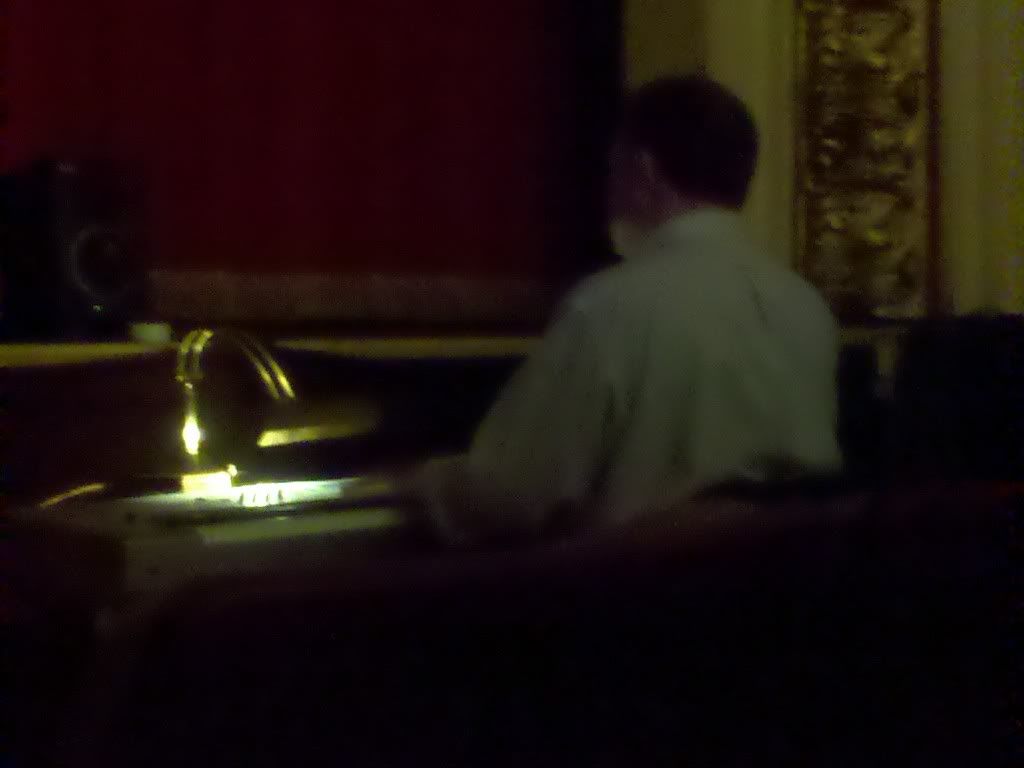
Jeff Rapsis at the keyboard, warming up for the big show. He was really impressive tonight - his music for the prologue to Our Hospitality was especially terrific, and I'm sure my musical brothers will tell me that playing to fast-paced movies for two hours straight (no break between films), at least partly improvising, is difficult, and he did an excellent job.
"One Week"
* * * ¾ (out of four)
Seen 5 June 2011 in Somerville Theatre #1 (Somerville Summer Silents)
As frantic and nutty as silent comedy features are, the shorts are oftentime even more so. "One Week", for instance, starts as a goofy little concept - a new groom (Keaton) and his bride (Sybil Seely) attempt to build their house from a kit with her old suitor (Joe Roberts) lurking about making trouble. In just twenty minutes, it becomes an increasingly elaborate series of set pieces as the house gets screwier and screwier.
Keaton and co-writer/co-director Edward F. Cline keep the jokes coming, and for a twenty-minute comedy short, the kit-house is a remarkably intricate construction, with some jumbo-sized slapstick in the latter half of the movie. They also have a little bit of fun with a bathtub scene, breaking the fourth wall with a wink and a smirk.
"The Scarecrow"
* * * ¼ (out of four)
Seen 5 June 2011 in Somerville Theatre #1 (Somerville Summer Silents)
More or less the same cast and crew are together again for "The Scarecrow"; this time, Keaton and Roberts are farmhands living in a different elaborate house (this one complete and multi-functional) competing for the affection of the farmer's daughter (Seely), though neither really has the approval of her father (Joe Keaton). It's a bit of a thin story; indeed, much of it comes down to "Buster Keaton gets chased by a dog".
Not that there are very many people that you would rather see spend ten minutes getting chased by a dog, especially when you consider that this is Fatty Arbuckle's dog and quite a talented one, running, jumping, and climbing to keep up with Buster. Many of the other gags in the movie are based on the Rube Goldberg contraptions built into the farmhands' bunker - not quite as elaborate as the house of "One Week" in some ways, but still quite amusing in their ingenuity.
Much of the rest is knockabout humor, sort of akin to the Three Stooges. You don't really see this sort of "smacking-each-other-around" comedy that much these days, and that's probably a good thing, all told, but there's a sort of pure, rapid-fire, "nobody really gets hurt" innocence to it that absolutely works in this sort of unreal context.
Our Hospitality
* * * ½ (out of four)
Seen 5 June 2011 in Somerville Theatre #1 (Somerville Summer Silents)
Consider this: There is roughly as much distance between the present day (the 2010s) and the time when Buster Keaton's Our Hospitality was made (the 1920s) as there is between when it was made and when it was set (the 1830s). Strange, right? It gives a little extra kick to some of the jokes, too. And while a little perspective doesn't hurt, you do not need this in the front of your mind to enjoy the movie: This early Buster Keaton feature is highly entertaining even without that sort of context.
In the early 1800s, blood feuds weren't uncommon, and the one between the Canfields and McKays got particularly ugly one night in 1810, leaving the widow McKay to flee north with her baby to live with her sister. Twenty years later, son Willie (Buster Keaton) gets a letter telling him he has inherited the McKay estate, and he hops a train to claim it - with his loyal dog following - the feud something his urban mind doesn't take seriously. But old Joseph Canfield (Joe Roberts) hasn't forgotten, and has passed it down to his sons (Ralph Bushman & Craig Ward). Naturally, the nice girl Willie meets on the train (Natalie Talmadge), who invites him to dinner, turns out to be Canfield's daughter. It's a good thing that the Canfields' code of honor won't let them kill Willie while he's enjoying their hospitality. After dinner, though, all bets are off.
Our Hospitality is among Keaton's first feature-length comedies, and it shows some growing pains. The train trip between Jersey City and Rockfield at times seems to be shown in real time, with beats and gags that we see more than once but which don't necessarily benefit from the repetition. In some ways, time has hurt it - some of the gags are visual things that would work well in later cartoons, the weird, elastic worlds of 1930s animation that themselves look odd and dated now - but even then, it was a longish sequence that doesn't really involve or tell us anything about Willie. Like many silent comedies, it seems quite modular - the various segments likely break quite cleanly on reel marks, so that if the projectionist had any trouble with the switchovers, the flow of the movie wouldn't be broken.
That's a good thing, because comedy is, in large part, timing, and Our Hospitality has really phenomenal comic timing. A scene of an oblivious Willie walking down a street with one of the Canfield boys, who keeps trying to find a pistol with which to shoot his companion, is one part absurdity and one part rhythm, making what could be a single, weak piece of black comedy funny for a good stretch. And in some ways, Buster Keaton gives a clinic on doing a lot with a little - the middle of the movie relies on Willie's reactions to finding out that the Canfields are gunning for him, and considering that Keaton was often called "The Great Stone Face" for face for his permanent deadpan expression, that he pulls it off kind of makes one wonder how he does it.
The other things he's known for, of course, are slapstick and daring stuntwork, and the movie frequently has him in his element there, with plenty of perfectly pulled off physical comedy (watch for Keaton's father as the conductor of the train, performing some trademark high kicks), along with a final act chase that involves horses, trains, ropes, and a raging river. It's one thing on top of another, with Keaton and co-director Jack Blystone expertly balancing laughs and thrills. Forget that it's 1923 and therefore all the stunts and effects are done in-camera (including one, used in the final cut, where Keaton nearly got swept away by the current); it would be an exciting, well-made sequence even with digital wire removal and the like.
This comedy earns a thrilling finale; the story by Jean Havez, Clyde Bruckman, and Joseph Mitchell balances wit and danger, with a prologue that sets suitably high stakes. For this screening, the atmosphere of that first act was greatly enhanced by pianist Jeff Rapsis, but the basic materials are there for it to work with a different score or even perhaps when truly silent. Most of the jokes translate pretty well to the twenty-first century; there are surprisingly few moments likely to feel more anachronistic than they did in 1923.
Indeed, it's kind of amazing how well Keaton's movie holds up; slapstick and death-defying action apparently never go out of style, especially when you're this good at it.
(Formerly at EFC)
So, I probably can't say this set of films was the highlight of my day, but it was certainly a highlight. It's part of the Somerville theater's summer repatory and classic program, a three-pronged attack which includes Sunday morning/Monday evening classics, Friday/Saturday midnights, and a monthly silent film program on Sunday nights. All are playing on their main screen, all in 35mm (at least - there are hints that some may be 70mm).
Let me just say - if all the prints look as nice as the ones we saw Sunday night, it's going to be pretty nice. These are 90-year-old movies, and the prints seemed to be at least second-generation from the copyright notices (maybe newer - the intertitles had a digital look to them), but they looked as good as anything playing at the Somerville, and they are right up in the top tier of presentation in the Boston area. It wasn't a great turnout, but a good one, and I do hope that even more show up for Seven Chances (with "Neighbors" and "The Goat") on 10 July.
Especially the girl behind me who enjoyed it, but admitted she was mostly a big Harold Lloyd fan. Call me. That's the sort of thing that makes me develop a crush more or less instantly.
One bit of terrible photography before getting to the reviews:

Jeff Rapsis at the keyboard, warming up for the big show. He was really impressive tonight - his music for the prologue to Our Hospitality was especially terrific, and I'm sure my musical brothers will tell me that playing to fast-paced movies for two hours straight (no break between films), at least partly improvising, is difficult, and he did an excellent job.
"One Week"
* * * ¾ (out of four)
Seen 5 June 2011 in Somerville Theatre #1 (Somerville Summer Silents)
As frantic and nutty as silent comedy features are, the shorts are oftentime even more so. "One Week", for instance, starts as a goofy little concept - a new groom (Keaton) and his bride (Sybil Seely) attempt to build their house from a kit with her old suitor (Joe Roberts) lurking about making trouble. In just twenty minutes, it becomes an increasingly elaborate series of set pieces as the house gets screwier and screwier.
Keaton and co-writer/co-director Edward F. Cline keep the jokes coming, and for a twenty-minute comedy short, the kit-house is a remarkably intricate construction, with some jumbo-sized slapstick in the latter half of the movie. They also have a little bit of fun with a bathtub scene, breaking the fourth wall with a wink and a smirk.
"The Scarecrow"
* * * ¼ (out of four)
Seen 5 June 2011 in Somerville Theatre #1 (Somerville Summer Silents)
More or less the same cast and crew are together again for "The Scarecrow"; this time, Keaton and Roberts are farmhands living in a different elaborate house (this one complete and multi-functional) competing for the affection of the farmer's daughter (Seely), though neither really has the approval of her father (Joe Keaton). It's a bit of a thin story; indeed, much of it comes down to "Buster Keaton gets chased by a dog".
Not that there are very many people that you would rather see spend ten minutes getting chased by a dog, especially when you consider that this is Fatty Arbuckle's dog and quite a talented one, running, jumping, and climbing to keep up with Buster. Many of the other gags in the movie are based on the Rube Goldberg contraptions built into the farmhands' bunker - not quite as elaborate as the house of "One Week" in some ways, but still quite amusing in their ingenuity.
Much of the rest is knockabout humor, sort of akin to the Three Stooges. You don't really see this sort of "smacking-each-other-around" comedy that much these days, and that's probably a good thing, all told, but there's a sort of pure, rapid-fire, "nobody really gets hurt" innocence to it that absolutely works in this sort of unreal context.
Our Hospitality
* * * ½ (out of four)
Seen 5 June 2011 in Somerville Theatre #1 (Somerville Summer Silents)
Consider this: There is roughly as much distance between the present day (the 2010s) and the time when Buster Keaton's Our Hospitality was made (the 1920s) as there is between when it was made and when it was set (the 1830s). Strange, right? It gives a little extra kick to some of the jokes, too. And while a little perspective doesn't hurt, you do not need this in the front of your mind to enjoy the movie: This early Buster Keaton feature is highly entertaining even without that sort of context.
In the early 1800s, blood feuds weren't uncommon, and the one between the Canfields and McKays got particularly ugly one night in 1810, leaving the widow McKay to flee north with her baby to live with her sister. Twenty years later, son Willie (Buster Keaton) gets a letter telling him he has inherited the McKay estate, and he hops a train to claim it - with his loyal dog following - the feud something his urban mind doesn't take seriously. But old Joseph Canfield (Joe Roberts) hasn't forgotten, and has passed it down to his sons (Ralph Bushman & Craig Ward). Naturally, the nice girl Willie meets on the train (Natalie Talmadge), who invites him to dinner, turns out to be Canfield's daughter. It's a good thing that the Canfields' code of honor won't let them kill Willie while he's enjoying their hospitality. After dinner, though, all bets are off.
Our Hospitality is among Keaton's first feature-length comedies, and it shows some growing pains. The train trip between Jersey City and Rockfield at times seems to be shown in real time, with beats and gags that we see more than once but which don't necessarily benefit from the repetition. In some ways, time has hurt it - some of the gags are visual things that would work well in later cartoons, the weird, elastic worlds of 1930s animation that themselves look odd and dated now - but even then, it was a longish sequence that doesn't really involve or tell us anything about Willie. Like many silent comedies, it seems quite modular - the various segments likely break quite cleanly on reel marks, so that if the projectionist had any trouble with the switchovers, the flow of the movie wouldn't be broken.
That's a good thing, because comedy is, in large part, timing, and Our Hospitality has really phenomenal comic timing. A scene of an oblivious Willie walking down a street with one of the Canfield boys, who keeps trying to find a pistol with which to shoot his companion, is one part absurdity and one part rhythm, making what could be a single, weak piece of black comedy funny for a good stretch. And in some ways, Buster Keaton gives a clinic on doing a lot with a little - the middle of the movie relies on Willie's reactions to finding out that the Canfields are gunning for him, and considering that Keaton was often called "The Great Stone Face" for face for his permanent deadpan expression, that he pulls it off kind of makes one wonder how he does it.
The other things he's known for, of course, are slapstick and daring stuntwork, and the movie frequently has him in his element there, with plenty of perfectly pulled off physical comedy (watch for Keaton's father as the conductor of the train, performing some trademark high kicks), along with a final act chase that involves horses, trains, ropes, and a raging river. It's one thing on top of another, with Keaton and co-director Jack Blystone expertly balancing laughs and thrills. Forget that it's 1923 and therefore all the stunts and effects are done in-camera (including one, used in the final cut, where Keaton nearly got swept away by the current); it would be an exciting, well-made sequence even with digital wire removal and the like.
This comedy earns a thrilling finale; the story by Jean Havez, Clyde Bruckman, and Joseph Mitchell balances wit and danger, with a prologue that sets suitably high stakes. For this screening, the atmosphere of that first act was greatly enhanced by pianist Jeff Rapsis, but the basic materials are there for it to work with a different score or even perhaps when truly silent. Most of the jokes translate pretty well to the twenty-first century; there are surprisingly few moments likely to feel more anachronistic than they did in 1923.
Indeed, it's kind of amazing how well Keaton's movie holds up; slapstick and death-defying action apparently never go out of style, especially when you're this good at it.
(Formerly at EFC)
Monday, June 06, 2011
IFFBoston 2011 Closing Night/Wrap-up: Conan O'Brien Can't Stop (except when reviews are embargoed)
Embargoes are a weird fact of life for the film-critic community - you see a movie early, but with the agreement that the review you write about it will be held to the day of release. For most traditional - that is to say, print - outlets, this isn't a big deal; opening weekend is when the article is most relevant for their readership. The same holds true for online outlets, though to a lesser extent; we're more easily searchable, so it's whether we get more hits for "new & relevant" than for "new" and "relevant" separately is a question best answered on a case-by-case basis.
Films being embargoed at festivals, though, is a really weird thing. Films that already have distribution play festivals to get word-of-mouth, so why try and keep that buried, especially for a film like Conan O'Brien Can't Stop, which is pretty decent? It's also a willing, insidious corruption of the press - it makes critics act a bit more like part of the distributor's publicity plan, rather than outside observers.
It also, in some ways, puts the critics, the ones who can be your best advocates - enthusiastic SQL programmers aside - at a disadvantage. I was asked to hold my review because I attended on a press pass, but by next year, it's not impossible that eFilmCritic will either cease to exist (unlikely) or the festival's standards for who they credential will rise (certainly possible). When that happens, I'll buy my own pass and then post the same sort of thing here and/or on EFC as I did before, only I won't know I'm not supposed to. I'm not exactly sure why I should be treated differently in those cases, much less effectively be trusted more as an unquestioned amateur.
(You may think this unlikely, but it's actually happened - a couple years ago, when attending the Boston Film Festival on my own dime, I saw a movie called Motherhood and wrote a review of it. This got my editor at EFC an email, asking why I was breaking embargo. He wrote back, saying basically that the screening was open to the public, so trying to keep wraps on it was pretty silly, and besides, you weren't complaining about Variety already having run a review, were you?)
As silly as this is, I'm going along with it, because I don't want to be the one that keeps other EFC guys from getting credentials or IFFBoston from being able to book movies. This does leave me without a review to run here, though, so I'll have to do something else, other than whine about not being able to run a review. So, let's bring on some graphs!
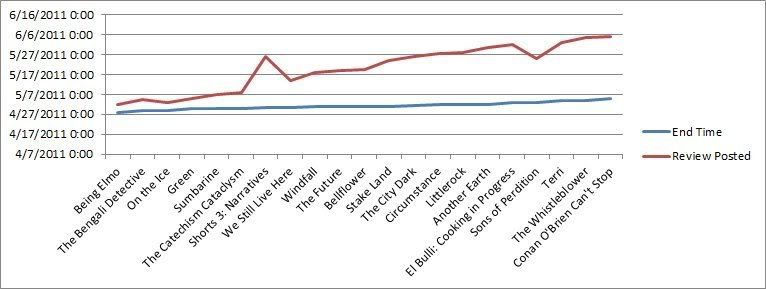
There's not a whole lot to be gleaned from this graph, other than that I do, by and large, crank out reviews at a pretty steady clip, although it's obviously not quite the rate at which I see movies. Even with that in mind, though, I'm pretty ashamed at how wide the gap between the two lines gets, almost 32 days long at The Whistleblower. That's pretty bad practice; it's not close to fresh in my head. I think I did all right when you look at the reviews, for the most part; I didn't find myself punting things as is occasionally the case with Fantasia.
There are a couple of odd blips there. The one around "Shorts 3: Narratives" comes from the shorts program being the first thing I saw that day but the last thing published, as it had to wait for the blog post to be done as there really isn't a place for it on eFilmCritic. Even if its publication date were set to when I actually finished writing it, the higher slope around We Still Live Here comes from me trying to strike while the iron was hot on some things that would likely have limited runs: Cave of Forgotten Dreams, Rammbock, Queen to Play, and True Legend. There's another sharp upslope between Bellflower and Stake Land, as I write up Legend of the Fist and A Beautiful Life. The zig-zag at Sons of Perdition is me bumping it up in line to have something on EFC, at least, in time for its opening in Boston.

If you're going to max out your pass, certain parts of this are a given: 4.76% at the Coolidge, 9.52% at Stuart Street, at least 23.8% at the various Somerville rooms. The rest is just a matter of how much the Brattle takes up and how the Somerville stuff is distributed.
I am, tongue-in-cheek, a little disappointed that I spent something like a quarter of the festival in the even numbered rooms in Somerville. I like many things about that theater, but when the eccentric millionaire gives me the cash to build my own, I'll be doing my best to avoid many of the things that make the even numbered rooms, uh, "memorable". They've got center aisles, the rows are very close together, and in an attempt to squeeze as many people as possible in, the front rows are very close to the screen (that's also where the main wheelchair spaces are). If you've got a pass, you're getting in early, so getting the best seats (near the center) means people are going to be climbing over you for the next twenty minutes - many getting in, putting their stuff down, going out, and getting a beer.
It is kind of amusing that I wound up with tickets for all five screens, despite the fact that only four were being used for the festival at any given time. I'll be the ushers and projectionists got sick of hauling that Water for Elephants print around.

I think I did pretty well with my time, though - as you can see, a good two-thirds of the movies I saw rated three stars or higher. I, personally, tend to consider movies 2.5 stars (out of four) and up worth seeing - I'm easy that way - so all and all, this looks like a pretty successful week (and month).
Films being embargoed at festivals, though, is a really weird thing. Films that already have distribution play festivals to get word-of-mouth, so why try and keep that buried, especially for a film like Conan O'Brien Can't Stop, which is pretty decent? It's also a willing, insidious corruption of the press - it makes critics act a bit more like part of the distributor's publicity plan, rather than outside observers.
It also, in some ways, puts the critics, the ones who can be your best advocates - enthusiastic SQL programmers aside - at a disadvantage. I was asked to hold my review because I attended on a press pass, but by next year, it's not impossible that eFilmCritic will either cease to exist (unlikely) or the festival's standards for who they credential will rise (certainly possible). When that happens, I'll buy my own pass and then post the same sort of thing here and/or on EFC as I did before, only I won't know I'm not supposed to. I'm not exactly sure why I should be treated differently in those cases, much less effectively be trusted more as an unquestioned amateur.
(You may think this unlikely, but it's actually happened - a couple years ago, when attending the Boston Film Festival on my own dime, I saw a movie called Motherhood and wrote a review of it. This got my editor at EFC an email, asking why I was breaking embargo. He wrote back, saying basically that the screening was open to the public, so trying to keep wraps on it was pretty silly, and besides, you weren't complaining about Variety already having run a review, were you?)
As silly as this is, I'm going along with it, because I don't want to be the one that keeps other EFC guys from getting credentials or IFFBoston from being able to book movies. This does leave me without a review to run here, though, so I'll have to do something else, other than whine about not being able to run a review. So, let's bring on some graphs!

There's not a whole lot to be gleaned from this graph, other than that I do, by and large, crank out reviews at a pretty steady clip, although it's obviously not quite the rate at which I see movies. Even with that in mind, though, I'm pretty ashamed at how wide the gap between the two lines gets, almost 32 days long at The Whistleblower. That's pretty bad practice; it's not close to fresh in my head. I think I did all right when you look at the reviews, for the most part; I didn't find myself punting things as is occasionally the case with Fantasia.
There are a couple of odd blips there. The one around "Shorts 3: Narratives" comes from the shorts program being the first thing I saw that day but the last thing published, as it had to wait for the blog post to be done as there really isn't a place for it on eFilmCritic. Even if its publication date were set to when I actually finished writing it, the higher slope around We Still Live Here comes from me trying to strike while the iron was hot on some things that would likely have limited runs: Cave of Forgotten Dreams, Rammbock, Queen to Play, and True Legend. There's another sharp upslope between Bellflower and Stake Land, as I write up Legend of the Fist and A Beautiful Life. The zig-zag at Sons of Perdition is me bumping it up in line to have something on EFC, at least, in time for its opening in Boston.

If you're going to max out your pass, certain parts of this are a given: 4.76% at the Coolidge, 9.52% at Stuart Street, at least 23.8% at the various Somerville rooms. The rest is just a matter of how much the Brattle takes up and how the Somerville stuff is distributed.
I am, tongue-in-cheek, a little disappointed that I spent something like a quarter of the festival in the even numbered rooms in Somerville. I like many things about that theater, but when the eccentric millionaire gives me the cash to build my own, I'll be doing my best to avoid many of the things that make the even numbered rooms, uh, "memorable". They've got center aisles, the rows are very close together, and in an attempt to squeeze as many people as possible in, the front rows are very close to the screen (that's also where the main wheelchair spaces are). If you've got a pass, you're getting in early, so getting the best seats (near the center) means people are going to be climbing over you for the next twenty minutes - many getting in, putting their stuff down, going out, and getting a beer.
It is kind of amusing that I wound up with tickets for all five screens, despite the fact that only four were being used for the festival at any given time. I'll be the ushers and projectionists got sick of hauling that Water for Elephants print around.

I think I did pretty well with my time, though - as you can see, a good two-thirds of the movies I saw rated three stars or higher. I, personally, tend to consider movies 2.5 stars (out of four) and up worth seeing - I'm easy that way - so all and all, this looks like a pretty successful week (and month).
Saturday, June 04, 2011
IFFBoston 2011 Day #7: Terri and The Whistleblower
The second-to-last day of the festival was a bit of a change-up from the past couple years, where the night would be spent at the Institute of Contemporary Art watching films about art and artists. That wasn't the case this year, with the venue moving a couple stops up the river to the Stuart Street Playhouse for a couple of higher-profile narratives.
Not a bad night. Both movies were good enough to recommend, though not exceptional. Both directors appeared for a Q&A, and it's always nice to see something at the Stuart Street Playhouse - it's a great facility and the people there are quite nice.
I'm a bit worried about the Playhouse, quite frankly - a couple days after this, they had a preview showing for Jumping the Broom, and then after that, they just seemed to vanish from sight. Not necessarily in terms of there being a hole at the bottom of the Radisson or anything, but their website has been saying "check back later" for the past month and there's been no listings in the paper. Given their hidden location (underneath a hotel; at least on foot, you've got to navigate some tricky traffic to get there), reducing visibility that way isn't going to do them any good.
Hopefully they haven't shut down; I'll be down there at some point in the next couple of days, so I may take a look. If they have shut down, it's a weird way to do it, especially since the festival staff was talking the theater up like it would be showing movies this summer.
The environment elevates my photography from terrible to merely poor, though:
Azazel Jacobs doing Q&A for his film Terri. If you've got the name Azazel, you sort of have to have hair like that.
Larysa Kondracki doing the same. As you might expect, this was as much about the subject and the differences between the film and real life as the movie itself.
Terri
* * ¾ (out of four)
Seen 3 May 2011 in the Stuart Street Playhouse (IFFBoston 2011)
Earlier in this festival (and on many other occasions), I saw a movie about an eccentric kid growing up, and it was kind of annoying; even if inspired by actual people, the characters seemed like adult screenwriters. So it's something of a relief to say that Terri, for all its oddball tendencies, does have the ring of truth about it. It's not an all-time great coming-of-age movie, but it's at least populated by recognizable human beings.
Terri (Jacob Wysocki) is kind of isolated from the other kids; not only is he overweight, but he lives way off the main road with his uncle James (Creed Bratton), and Uncle James is getting to the point where his memory (among other things) has a pretty wide gap between the good days and bad days. When he shows up late for school wearing his pajama top for a shirt, he's sent to the principal's office, and Mr. Fitzgerald (John C. Reilly) decides to take a personal interest in him, meeting up with him once a week, like he does with some other kids such as Chad (Bridger Zadina). And while Terri's not in any particular trouble, he does manage to sort of be around it, when his staring leads to a kid with the charming nickname of "Dirty Zach" (Justin Prentice) being caught fingering his girlfriend Heather (Olivia Crocicchia) in home ec class.
Though Terri and the other characters can be kind of unusual at times, it's never a particularly forced oddity. These kids (and educators) are distinct individuals with their own particular issues and quirks, but should at least feel like familiar types from one's own school days. Director Azazel Jacobs, screenwriter Patrick Dewitt, and the cast manage the tricky balance between the familiar and the unique here, with the only real exception being Mr. Fitzgerald - even by the standards of dedicated and unorthodox film educators, he's a bit on the odd side.
Full review at EFC.
The Whistleblower
* * ¾ (out of four)
Seen 3 May 2011 in the Stuart Street Playhouse (IFFBoston 2011)
The Whistleblower has a good cast and a topic that provokes a strong emotional reaction, and when a project starts with that, making a memorable film can often come down to not screwing up. Co-writer/director Larysa Kondracki doesn't screw up; she makes a movie that's a notch or two above average, and the "based on a true story" factor doesn't hurt it at all.
It's 1999, and two women on different sides of the world have no idea they're on intersecting paths. Kathryn Bolkovac (Rachel Weisz) is a police officer in Nebraska, very good at her job but frustrated because she's having a hard time finding a department to transfer to near Atlanta, where her ex-husband is moving with her daughter. The lead she gets - working for a UN contracter to assist local law enforcement in Bosnia-Herzegovina - is a few thousand miles in the wrong direction, but the pay is good enough to give her a cushion when her hitch is up. Raya (Roxana Condurache) is a recent high-school graduate in Eastern Europe, whose friend Irka (Rayisa Kondracki) has lined up a chance to go west, working as waitresses and au pairs. Kathryn thrives - after helping the locals with their first successful domestic violence prosecution, UN Mission official Madeleine Rees (Vanessa Redgrave) gets her a post handling "gender issues". Raya and Irka, on the other hand, wind up in a situation where they need Kathryn's help badly, which is made more difficult because both the local police force and the contractors are thoroughly corrupt.
The cast won't necessarily bowl audiences over, but it may raise eyebrows. Rachel Wesiz, for instance, seldom disappoints, and she doesn't here. It's a precisely-pitched performance; there's never any doubt that she is very good at her job or that she is passionate about helping the women she finds in Bosnia, but she's not one-note or overly intense about it. She lets the audience see something developing with fellow "adviser" Jan (Nikolaj Lie Kaas) without gushy moments and similarly builds the increasing stress she's under.
Full review at EFC.
Not a bad night. Both movies were good enough to recommend, though not exceptional. Both directors appeared for a Q&A, and it's always nice to see something at the Stuart Street Playhouse - it's a great facility and the people there are quite nice.
I'm a bit worried about the Playhouse, quite frankly - a couple days after this, they had a preview showing for Jumping the Broom, and then after that, they just seemed to vanish from sight. Not necessarily in terms of there being a hole at the bottom of the Radisson or anything, but their website has been saying "check back later" for the past month and there's been no listings in the paper. Given their hidden location (underneath a hotel; at least on foot, you've got to navigate some tricky traffic to get there), reducing visibility that way isn't going to do them any good.
Hopefully they haven't shut down; I'll be down there at some point in the next couple of days, so I may take a look. If they have shut down, it's a weird way to do it, especially since the festival staff was talking the theater up like it would be showing movies this summer.
The environment elevates my photography from terrible to merely poor, though:

Azazel Jacobs doing Q&A for his film Terri. If you've got the name Azazel, you sort of have to have hair like that.

Larysa Kondracki doing the same. As you might expect, this was as much about the subject and the differences between the film and real life as the movie itself.
Terri
* * ¾ (out of four)
Seen 3 May 2011 in the Stuart Street Playhouse (IFFBoston 2011)
Earlier in this festival (and on many other occasions), I saw a movie about an eccentric kid growing up, and it was kind of annoying; even if inspired by actual people, the characters seemed like adult screenwriters. So it's something of a relief to say that Terri, for all its oddball tendencies, does have the ring of truth about it. It's not an all-time great coming-of-age movie, but it's at least populated by recognizable human beings.
Terri (Jacob Wysocki) is kind of isolated from the other kids; not only is he overweight, but he lives way off the main road with his uncle James (Creed Bratton), and Uncle James is getting to the point where his memory (among other things) has a pretty wide gap between the good days and bad days. When he shows up late for school wearing his pajama top for a shirt, he's sent to the principal's office, and Mr. Fitzgerald (John C. Reilly) decides to take a personal interest in him, meeting up with him once a week, like he does with some other kids such as Chad (Bridger Zadina). And while Terri's not in any particular trouble, he does manage to sort of be around it, when his staring leads to a kid with the charming nickname of "Dirty Zach" (Justin Prentice) being caught fingering his girlfriend Heather (Olivia Crocicchia) in home ec class.
Though Terri and the other characters can be kind of unusual at times, it's never a particularly forced oddity. These kids (and educators) are distinct individuals with their own particular issues and quirks, but should at least feel like familiar types from one's own school days. Director Azazel Jacobs, screenwriter Patrick Dewitt, and the cast manage the tricky balance between the familiar and the unique here, with the only real exception being Mr. Fitzgerald - even by the standards of dedicated and unorthodox film educators, he's a bit on the odd side.
Full review at EFC.
The Whistleblower
* * ¾ (out of four)
Seen 3 May 2011 in the Stuart Street Playhouse (IFFBoston 2011)
The Whistleblower has a good cast and a topic that provokes a strong emotional reaction, and when a project starts with that, making a memorable film can often come down to not screwing up. Co-writer/director Larysa Kondracki doesn't screw up; she makes a movie that's a notch or two above average, and the "based on a true story" factor doesn't hurt it at all.
It's 1999, and two women on different sides of the world have no idea they're on intersecting paths. Kathryn Bolkovac (Rachel Weisz) is a police officer in Nebraska, very good at her job but frustrated because she's having a hard time finding a department to transfer to near Atlanta, where her ex-husband is moving with her daughter. The lead she gets - working for a UN contracter to assist local law enforcement in Bosnia-Herzegovina - is a few thousand miles in the wrong direction, but the pay is good enough to give her a cushion when her hitch is up. Raya (Roxana Condurache) is a recent high-school graduate in Eastern Europe, whose friend Irka (Rayisa Kondracki) has lined up a chance to go west, working as waitresses and au pairs. Kathryn thrives - after helping the locals with their first successful domestic violence prosecution, UN Mission official Madeleine Rees (Vanessa Redgrave) gets her a post handling "gender issues". Raya and Irka, on the other hand, wind up in a situation where they need Kathryn's help badly, which is made more difficult because both the local police force and the contractors are thoroughly corrupt.
The cast won't necessarily bowl audiences over, but it may raise eyebrows. Rachel Wesiz, for instance, seldom disappoints, and she doesn't here. It's a precisely-pitched performance; there's never any doubt that she is very good at her job or that she is passionate about helping the women she finds in Bosnia, but she's not one-note or overly intense about it. She lets the audience see something developing with fellow "adviser" Jan (Nikolaj Lie Kaas) without gushy moments and similarly builds the increasing stress she's under.
Full review at EFC.
Thursday, June 02, 2011
Next Week in Tickets: Films playing Boston 3 June 2011 - 9 June 2011
You know, I expect options to contract at the multiplexes during the summer as programmers with screens to burn try to schedule things so that their films with broad appeal are playing within a half hour or so no matter what time you get to the theater, and in many cases these days have them playing in multiple formats (not so much the case with this weekend's single big opener). When it happens at the indie theaters, though, that's pretty stifling.
My plans? I'm guessing X-Men on one end and film noir on the other, with Yellowbrickroad and City of Life and Death in between. I'd love to do the Back to the Future trilogy on Sunday, but I have baseball tickets in the afternoon and will likely hit up Our Hospitality in the evening (Keaton I haven't seen!). Jurassic Park? We'll see.
And, of course, all the usual "I'm going to see Bridesmaids and Incedines and Midnight in Paris this week! Honest!"
- If you've seen everything playing at the mainstream multiplex already, your new option there is X-Men: First Class. And, given a little thought, it doesn't seem like a bad option; Stan Lee and Jack Kirby created these characters in the 1960s with the Cold War, Atomic Age, and Civil Rights Movement as obvious inspirations, so the idea of doing a period piece that places them back in that period has a certain appeal. Matthew Vaughn directs, which is interesting because he was attached to X-Men 3 at one point but has done two other comic-book movies (I liked Stardust, didn't see Kick-Ass).
X-Men is not actuallly the only new option at the megaplexes; the second entry in the Bloody-Disgusting.com Selects series, Yellowbrickroad, opened up Wednesday night, replacing Rammbock on the schedule. From the previews, it looks like it might be pretty good, and an easier sell: A small town in New Hampshire has vanished, and now some grad-student types are foolishly investigating why. Unlike Rammbock, it's in English and it's feature-length, and hopefully the projection won't be screwed up this time. Remember, while these movies run a month on the calendar, their showtimes are extremely limited: In Boston, Yellowbrickroad is only running at AMC Boston Common, and only on Wednesdays (10pm) and Fridays (11:59pm). - Now, as I said, you expect this sort of thing from the multiplexes, but I kind of have to scratch my head at the way Tree of Life is opening at Kendall Square, which is to say that it's occupying four screens. While they will be the only place to see Terrence Malick's new movie in the Boston area for a week or so, Malick can be sort of an acquired taste; are they really expecting to sell enough tickets and popcorn for this to be a good idea, especially when three screens are already dedicated to Woody Allen's Midnight in Paris (minus a 1pm show for The Princess of Montepensier).
That leaves barely enough screens to continue Incendies and open the picture tagged with the one-week warning, City of Life and Death. It's original name - Nanjing! Nanjing! - spells the subject out pretty clearly; it's a dramatization of 1937's Nanking Massacre (aka the Rape of Nanking), one of the most horrific incidents during the Sino-Japanese War. - Over at the Coolidge, Louder than a Bomb opens in the video rooms. Co-directed by the son of the late Gene Siskel, it's a documentary that follows four high-school poetry teams as they prepare and compete in the world's largest youth slam. It should be an interesting combination of youth interest, competition, and performance. The other co-director, Greg Jacobs, will be present for the Friday and Saturday shows - Q&A for the 7:10pm screenings, introduction only at 9:30pm.
The one-offs this week start with The Burning, kicking off a month of midnight slasher movies with one of the genre's most notorious and well-regarded. It runs Friday (3 June) and Saturday (4 June) at 11:59pm. There are two other midnights this weekend; Friday night Impossibly Funky editor Mike White will introduce Black Shampoo, a truly bizarre-looking blaxploitation flick, while Saturday is the monthly screening of The Room. Tuesday night has a "Deaf and Hard of Hearing" screening of What's Bugging Seth, a comedy from a few years back about a deaf man who starts a pest-control business; presumably it will be captioned. - The Brattle continues with Amblin Adventures this week: A double feature of Jaws & Poltergeist on Friday, matinees of Young Sherlock Holmes on Saturday and Sunday, late-is-night showings of Gremlins on Monday (10pm) and Tuesday (9:30pm), and a double feature of The Goonies and E.T. on Wednesday. Oh, and during the weekend, there are triple features - all three Jurassic Park movies on Saturday (5pm), and all three Back to the Future movies on Sunday (4:45pm). $20 gets you into all three ($18 for students/seniors/kids/members).
There are only late-night shows on Monday and Tuesday because of a couple special features; Monday is a special DocYard presentation of To Be Heard, a documentary about three South Bronx teenagers who try to change their life with poetry (and yes, it absolutely is weird that this plays Boston the same week as Louder than a Bomb). Directors Amy Sultan, Edwin Martinez, and Deborah Shaffer will be there in person, along with two of the subjects, Karina Sanchez and Pearl Quick. Tuesday night is another doc, Ingredients, this one about the local food movement. It will be followed by a panel discussion and proceeds benefit Farm Aid. - Hey, it's been a while since the last English-subtitled Bollywood film showed up at Fresh Pond, hasn't it? That changes this week, as Ready opens. In India, it's apparently the biggest opening every with huge advance bookings, and that seems to apply to its US release as well - it's the only film playing on the Indian screen at the theater all week. It looks like a pretty classic-style family-friendly Bollywood romantic comedy musical, with a boy (Salman Khan), a girl (Asin), romance, scheming uncles, big production numbers, you name it.
- The subject of the retrospective won't be in town until next week, but the Harvard Film Archive kicks off The Radical Visions of Jerzy Skolimowski on Friday, with six films from the Polish New Wave director - three from the 1960s start of his career in Poland, two made elsewhere in Europe in the late 1960s and 1970s, and one from his recent return to filmmaking
- Art on Film continues at the MFA this week, with more screenings of Hey, Boo: Harper Lee and "To Kill a Mockingbird" and Secret Museums through Sunday the 5th; the weekend also includes Guest of Cindy Sherman. The series continues on Wednesday (the 8th) with Art Safari and The Woodmans starting scattered screenings, and First Face: The Buck Starts Here joining them on the 9th.
- ArtsEmerson's screening program appears to be mostly dark this weekend (and through most of the summer), but heads up: Noir Nights, a very cool film noir program, starts Thursday (9 June) with two Robert Siodmak movies not available on DVD - Olivia de Haviland as twins in The Dark Mirror and Victor Mature & Robert Conte in Cry of the City. The series will continue through Sunday the 12th.
- The Somerville Theater starts their summer midnights on Friday, with National Lampoon's Animal House playing at midnight the 3rd and 4th. It plays on their big screen in 35mm, and while general admission is $10, you can get in free with your ticket to The Hangover Part II from that day. On Sunday night, they start their silent film series with Buster Keaton's Our Hospitality (all three features on the schedule are Keaton, actually). $12 ($8 for seniors) gets you a seat and includes two short films featuring Keaton, 1920's "One Week" and "The Scarecrow", all in 35mm with Jeff Rapsis performing live accompaniment. Friday night is the last one booked for Inventory, a locally-produced but very uneven slacker comedy that has its moments,
My plans? I'm guessing X-Men on one end and film noir on the other, with Yellowbrickroad and City of Life and Death in between. I'd love to do the Back to the Future trilogy on Sunday, but I have baseball tickets in the afternoon and will likely hit up Our Hospitality in the evening (Keaton I haven't seen!). Jurassic Park? We'll see.
And, of course, all the usual "I'm going to see Bridesmaids and Incedines and Midnight in Paris this week! Honest!"
Tuesday, May 31, 2011
IFFBoston 2011 Day #6: El Bulli: Cooking In Progress and Sons of Perdition
First, and most important: If you're reading this in Boston on or before 2 June 2011, Sons of Perdition is still playing at the Kendall Square Cinema, and is pretty darn good. It was only booked for a week, so it would probably not have survived the ridiculous way they've booked Tree of Life this weekend anyway (and boy, is that a rant for this week's Next Week...).
No Q&A for it there, of course, which is a shame; Tyler Measom gave a thoroughly charming one to cap off the festival's run in the Somerville Theatre (thanks to his bright shirt, you can almost make him out in the obligatory Horrible Photography™). I found myself impressed by the even, accepting tone he maintained throughout the conversation, considering the subject matter of his and his wife's film, I would have been pretty much 100% pure anger. I'm not a big fan of superstition to begin with, so I can't really say that there's a special place in Hell for the people who manipulate their followers like this, but it ticks me off - both for it's a crappy thing to do and how it never seems to lead to people questioning their own religious beliefs.
That was the second half of the night; the first was what was possibly the surprise hit of the festival; El Bulli: Cooking in Progress got upgraded from one of Somerville's smaller theaters to their main screen, and while it didn't sell out, it got fairly crowded. No filmmakers in attendance, so it was on Brian to mention during the intro that they always hope to book something that strikes a chord with audiences, and this one exceeded all expectations in terms of ticket sales.
Maybe they set their expectations a little low; Adrià was a visiting lecturer at Harvard last fall, giving the project even more local interest even if cooking programs weren't popular. Plus, there's a science angle, which was a big part of what got my attention (for all I grumbled about all the performer-related docs, I grabbed a seat at any science-related one I could find, although there were never two or three of those running at once). It's a lot of reasons for people to be interested in the movie, and it seemed to bring them all out.
Just one horrible picture today:
Tyler Measom, from fairly close up, so I got an unusually decent shot.
(And, man, is it a said thing that dropping Warren Jeffs's name into Amazon brings up multiple books about his cult.)
El Bulli: Cooking in Progress
* * * ½ (out of four)
Seen 2 May 2011 in Somerville Theatre #1 (IFFBoston 2011)
El Bulli: Cooking in Progress has a strange start for a documentary about a famous chef and his equally famous restaurant: The kitchen is disassembled and packed away. This is not, however, a precursor to a jump back in time to tell us a story of failure; it's a fittingly unusual beginning to an examination of Ferran Adrià's unusual process.
Yes, Adrià's El Bulli restaurant did close in October of 2008, but that's a regular occurrence, as he and his staff retreat to their Barcelona test kitchen to begin development of the next year's menu. Though the words are never mentioned in the film, Adria is one of the main practitioners of molecular gastronomy (though he prefers the term "deconstructivist"), a form of cooking that embraces technology and scientific procedures. Adrià and his assistants will spend the next months painstakingly researching and quantifying the tastes and textures that come from preparing different foods in different ways, developing a menu theme that coalesces into the "Year of Water" when the restaurant re-opens in June of 2009.
There's an old joke among scientists that the scientific method is best defined as "make the grad students do all the work". The various assistants and sous-chefs we meet are likely a bit higher up the totem pole than that, but the principle holds: For much of the film, we are not watching Ferran Adrià, but his staff - Oriol Castro, Eduard Xatruch, Eugeni de Diego et al. They're the ones who do the repetitive but crucial work of iterating through various combinations of ingredients, equipment, and parameters in order to discover the best ones to present to Ferran, and are often the ones who find a new dish, whether by happenstance (mistakenly using carbonated water when flat was originally called for) or trial and error. In some ways, though, this is more instructive - with Adrià off-site or just off-screen, we see pecking orders on the one hand and comradeship on the other. Some on the staff are relatively new, so there is talk of "what Ferran will think".
Full review at EFC.
Sons of Perdition
* * * ½ (out of four)
Seen 2 May 2011 in Somerville Theatre #4 (IFFBoston 2011)
Most of the time, when the modern westerner encounters or hears of polygamy, it's an individual case, and thus he or she thinks about the individual psychology involved. Make it more commonplace, though, and a numbers issue emerges: A potential surplus of young men. In a polygamist community in the American southwest, this excess is cast out (or at least, men who leave are not pursued nearly as much as women), considered "sons of perdition", and the film of the same name is a fascinating look at these exiles' struggles.
The exiles come from the town of Colorado City, Arizona, a town populated by Fundamentalist Latter Day Saints, a Mormon splinter group under the leader ship of Warren Jeffs. Jeffs - called "The Prophet" - is a second generation cult leader who controls the town absolutely. When girls reach child-bearing age, they are given to the men Jeffs selects; fall out of favor, and your wives and children may be distributed to someone else (and, since you'll no longer need such a big house, you'll likely be ordered to move, as well). Extra boys who are not among the chosen elite are either dropped outside town or allowed to run. Many end up in St. George, Utah. The filmmakers spend most of their time with three: 17-year-old Sam, his 15-year-old cousin Bruce, and 17-year old Joe.
Generally speaking, documentaries come in two main flavors - fly-on-the-wall and interview/archive-driven. Directors Tyler Measom and Jennilyn Merten mostly favor the former, following the boys around as they experience and try to find a place in the outside world. There are basic bits of information to fill the audience in on, though, and it's delivered in a couple of interesting ways. We get an idea of what sort of indoctrination the members of the FLDS receive by listening to clips of Jeffs, and it's remarkably, unnervingly seductive - the delivery is clear and simple with consistent logic that almost makes sense from a certain starting position; it does a good job of short-circuiting any contempt the audience might feel for the majority of the FLDSers. Outside of that, the information seldom seems spoon-fed; only a former FLDS social worker really seems to be a straightforward interview. The rest come from the boys and the people they meet, the information seeming to come out as asides as the subjects go about their business.
Full review at EFC.
No Q&A for it there, of course, which is a shame; Tyler Measom gave a thoroughly charming one to cap off the festival's run in the Somerville Theatre (thanks to his bright shirt, you can almost make him out in the obligatory Horrible Photography™). I found myself impressed by the even, accepting tone he maintained throughout the conversation, considering the subject matter of his and his wife's film, I would have been pretty much 100% pure anger. I'm not a big fan of superstition to begin with, so I can't really say that there's a special place in Hell for the people who manipulate their followers like this, but it ticks me off - both for it's a crappy thing to do and how it never seems to lead to people questioning their own religious beliefs.
That was the second half of the night; the first was what was possibly the surprise hit of the festival; El Bulli: Cooking in Progress got upgraded from one of Somerville's smaller theaters to their main screen, and while it didn't sell out, it got fairly crowded. No filmmakers in attendance, so it was on Brian to mention during the intro that they always hope to book something that strikes a chord with audiences, and this one exceeded all expectations in terms of ticket sales.
Maybe they set their expectations a little low; Adrià was a visiting lecturer at Harvard last fall, giving the project even more local interest even if cooking programs weren't popular. Plus, there's a science angle, which was a big part of what got my attention (for all I grumbled about all the performer-related docs, I grabbed a seat at any science-related one I could find, although there were never two or three of those running at once). It's a lot of reasons for people to be interested in the movie, and it seemed to bring them all out.
Just one horrible picture today:

Tyler Measom, from fairly close up, so I got an unusually decent shot.
(And, man, is it a said thing that dropping Warren Jeffs's name into Amazon brings up multiple books about his cult.)
El Bulli: Cooking in Progress
* * * ½ (out of four)
Seen 2 May 2011 in Somerville Theatre #1 (IFFBoston 2011)
El Bulli: Cooking in Progress has a strange start for a documentary about a famous chef and his equally famous restaurant: The kitchen is disassembled and packed away. This is not, however, a precursor to a jump back in time to tell us a story of failure; it's a fittingly unusual beginning to an examination of Ferran Adrià's unusual process.
Yes, Adrià's El Bulli restaurant did close in October of 2008, but that's a regular occurrence, as he and his staff retreat to their Barcelona test kitchen to begin development of the next year's menu. Though the words are never mentioned in the film, Adria is one of the main practitioners of molecular gastronomy (though he prefers the term "deconstructivist"), a form of cooking that embraces technology and scientific procedures. Adrià and his assistants will spend the next months painstakingly researching and quantifying the tastes and textures that come from preparing different foods in different ways, developing a menu theme that coalesces into the "Year of Water" when the restaurant re-opens in June of 2009.
There's an old joke among scientists that the scientific method is best defined as "make the grad students do all the work". The various assistants and sous-chefs we meet are likely a bit higher up the totem pole than that, but the principle holds: For much of the film, we are not watching Ferran Adrià, but his staff - Oriol Castro, Eduard Xatruch, Eugeni de Diego et al. They're the ones who do the repetitive but crucial work of iterating through various combinations of ingredients, equipment, and parameters in order to discover the best ones to present to Ferran, and are often the ones who find a new dish, whether by happenstance (mistakenly using carbonated water when flat was originally called for) or trial and error. In some ways, though, this is more instructive - with Adrià off-site or just off-screen, we see pecking orders on the one hand and comradeship on the other. Some on the staff are relatively new, so there is talk of "what Ferran will think".
Full review at EFC.
Sons of Perdition
* * * ½ (out of four)
Seen 2 May 2011 in Somerville Theatre #4 (IFFBoston 2011)
Most of the time, when the modern westerner encounters or hears of polygamy, it's an individual case, and thus he or she thinks about the individual psychology involved. Make it more commonplace, though, and a numbers issue emerges: A potential surplus of young men. In a polygamist community in the American southwest, this excess is cast out (or at least, men who leave are not pursued nearly as much as women), considered "sons of perdition", and the film of the same name is a fascinating look at these exiles' struggles.
The exiles come from the town of Colorado City, Arizona, a town populated by Fundamentalist Latter Day Saints, a Mormon splinter group under the leader ship of Warren Jeffs. Jeffs - called "The Prophet" - is a second generation cult leader who controls the town absolutely. When girls reach child-bearing age, they are given to the men Jeffs selects; fall out of favor, and your wives and children may be distributed to someone else (and, since you'll no longer need such a big house, you'll likely be ordered to move, as well). Extra boys who are not among the chosen elite are either dropped outside town or allowed to run. Many end up in St. George, Utah. The filmmakers spend most of their time with three: 17-year-old Sam, his 15-year-old cousin Bruce, and 17-year old Joe.
Generally speaking, documentaries come in two main flavors - fly-on-the-wall and interview/archive-driven. Directors Tyler Measom and Jennilyn Merten mostly favor the former, following the boys around as they experience and try to find a place in the outside world. There are basic bits of information to fill the audience in on, though, and it's delivered in a couple of interesting ways. We get an idea of what sort of indoctrination the members of the FLDS receive by listening to clips of Jeffs, and it's remarkably, unnervingly seductive - the delivery is clear and simple with consistent logic that almost makes sense from a certain starting position; it does a good job of short-circuiting any contempt the audience might feel for the majority of the FLDSers. Outside of that, the information seldom seems spoon-fed; only a former FLDS social worker really seems to be a straightforward interview. The rest come from the boys and the people they meet, the information seeming to come out as asides as the subjects go about their business.
Full review at EFC.
Subscribe to:
Posts (Atom)

