Sunday, January 20, 2013

This Week Month and a Half In Tickets: 19 November 2012 - 6 January 2013

Didn't I make a resolution about this not happening outside of festivals this year? But, hey, cut me some slack - there were holidays and vacations and catching up at work from those things involved!

19 November - 25 November
26 November - 2 December
3 December - 9 December
10 December - 16 December
17 December - 23 December
24 December - 30 December
31 December - 6 January
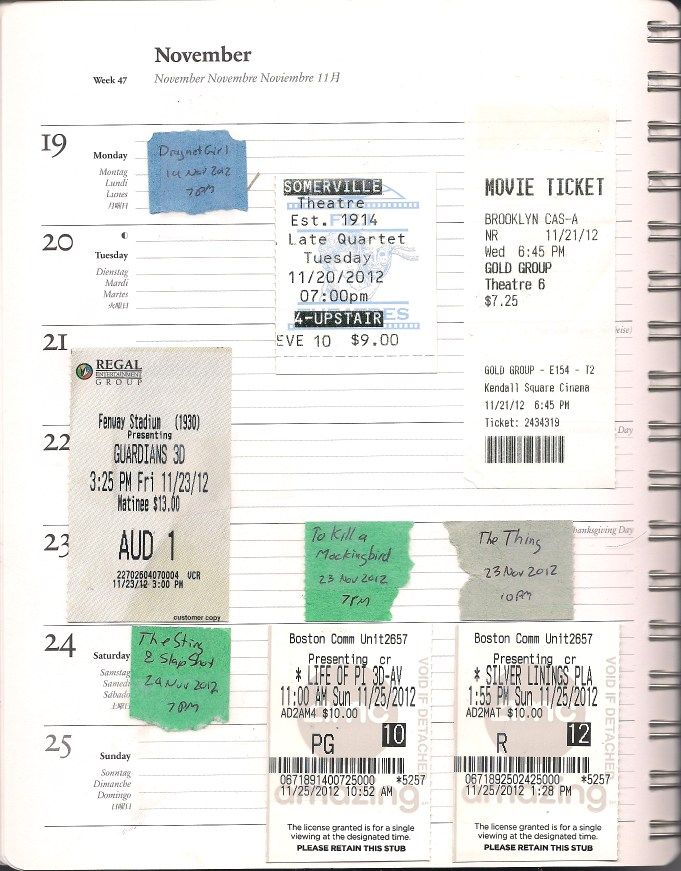

This Week in Tickets

Busy, busy week - you'd hardly believe looking at the crowded nature of the page that I found time for a day-and-a-half trip to Maine for Thanksgiving. That was kind of weird, actually - all my brothers spent it at their in-laws, and while I got to see a couple of nieces for a while on Friday before they went down for a nap and I generally like most of my Dad's wife's family, it wasn't the same.

To Kill a Mockingbird

* * * * (out of four)
Seen 23 November 2012 in the Brattle Theatre (Universal Centennial, 35mm)

Somehow, I had managed to miss seeing this one ever before, which is a crying shame. It is, as everybody knows full well, awfully close to a perfect movie.

That is, I think, because it pulls off its extremes with a grace that is quite frankly amazing. It builds up such a pure sense of goodness around Atticus and Scout and any number of other characters before delivering a crushing but inevitable injustice. That's the standard pattern of innocence shattered, and yet it plays less as devastation and destruction of illusions than a hope and belief that the next generation can do better.

Plus, Gregory Peck. He plays the greatest movie dad ever, and it's a performance that could be pure corn in lesser hands, but is just perfectly admirable here. The rest of the cast is fantastic, too, especially Mary Badham as Scout, and Robert Duvall is always welcome, even if it's a small (but crucial) role like Boo Radley.

The Thing (1982)

* * * * (out of four)
Seen 23 November 2012 in the Brattle Theatre (Universal Centennial, 35mm)

Let me tell you: One gets a lot of false positives searching this blog for "The Thing" to see if I've written about it before. It turns out I have - briefly, when it played the Marathon two and a half years ago , and in more detail when I watched the HD-DVD three years before that. Yeah, I know, HD-DVD.

Anyway, the movie hasn't changed, and the prequel/remake has come and gone without any ill effects on this one. It's still thoroughly creepy, and the special effects have aged pretty well. They don't necessarily look more realistic than modern CGI, but the 1950s-styled-but-much-better-looking spaceship in the opening sets a tone when combined with the Ennio Morricone score, and the way that the practical effects must be built winds up implying that conservation of mass is still in effect, and the bounds make things more tense.

The Sting

* * * ½ (out of four)
Seen 24 November 2012 in the Brattle Theatre (Universal Centennial, 35mm)

It's not hard to love The Sting; its player-piano score, detailed Edith Head period costumes, precise explanatory titles, and basis of familiar tropes marks it as a throwback but not one intent on either mocking or deconstructing its genre or period. It's a 1930s con movie - nothing less, and nothing ostentatiously more.

Now, the score (Marvin Hamlisch and Billy Byers making good use of Scott Joplin compositions) isn't actually produced by player pianos, or wind-up devices of any sort, but it sort of has that mechanical feel at times, and while that can often be a bad thing, it works very well for this picture; it helps build the feel of a well-oiled machine whose workings the audience is invited to inspect. And yet, that's only half the movie; big chunks of the plot are cleverly improvised and the filmmakers demonstrate a fine knack for knowing just what to hold back to create surprises and twists without feeling like they're cheating the audience.

Plus, of course, Paul Newman & Robert Redford. It's one of those master & apprentice relationships where neither party seems to think too much of the other, likely because of how one is basically the other plus twenty-odd years, and they both turn on the charm in ways that make this pretty clear but not the point of the whole movie.

Slap Shot

* * * ½ (out of four)
Seen 24 November 2012 in the Brattle Theatre (Universal Centennial, 35mm)

Slap Shot shares both a director (George Roy Hill) and star (Paul Newman) with The Sting, but where The Sting was a well-oiled machine, this one is apparent anarchy. It's one crude joke after another, and the storylines that could serve as an overarching theme or something redemptive show very little interest in going that route. It goes for the joke at every opportunity.

Of course, it's smarter and better-put-together than that. You don't have to scratch it much, if at all, to see that underneath the story about appealing to the baser impulses of the audience is a look at the desperation of the working class in hard economic times. Moving it slightly to the side takes the edge off, so it's not depressing in the way movies about factories closing down are, while still getting the idea across - a candy coating on a bitter pill. And while it always goes for the joke, it does so with the right tone for the moment, rather than being one size fits all.

Silver Linings Playbook

* * * (out of four)
Seen 25 November 2012 in AMC Boston Common #12 (first-run, digital)

I'd forgotten that The Fighter was a David O. Russell film; someone else wrote the screenplay and it lacked the layer of absurdity alongside the drama that was a hallmark of the movies Russell did between 1994's Spanking the Monkey and 2004's I Heart Huckabees. Silver Linings Playbook is a lot closer to those movies, so it can, perhaps, be described as a nice return despite the existence of The Fighter.

Interestingly, it very pointedly lacks a stable center for the insanity to play against. Bradley Cooper and Jennifer Lawrence play characters with real mental health issues, and the way that's presented can sometimes be worrisome; their disorders manifest in ways that almost seem too entertaining. It's a thin line between feeling properly guilty when you laugh at their eccentric behavior and feeling the filmmakers are doing mental illness a disservice. Maybe Russell could have done better showing Cooper's Pat following his med schedule or otherwise recovering rather than just seeming to have a eureka moment when he figures the plot out.

I don't think you can say "that aside, this is a good movie", because that permeates the whole thing, but it does only make things shaky rather than knock them over. Cooper and Lawrence are both pretty fantastic, and there's a great supporting cast around them (including, yes, Chris Tucker). I kind of love that sports fandom plays more as a positive thing than an unhealthy obsession, and the way the movie embraces its Hollywood ending is quite nice indeed.
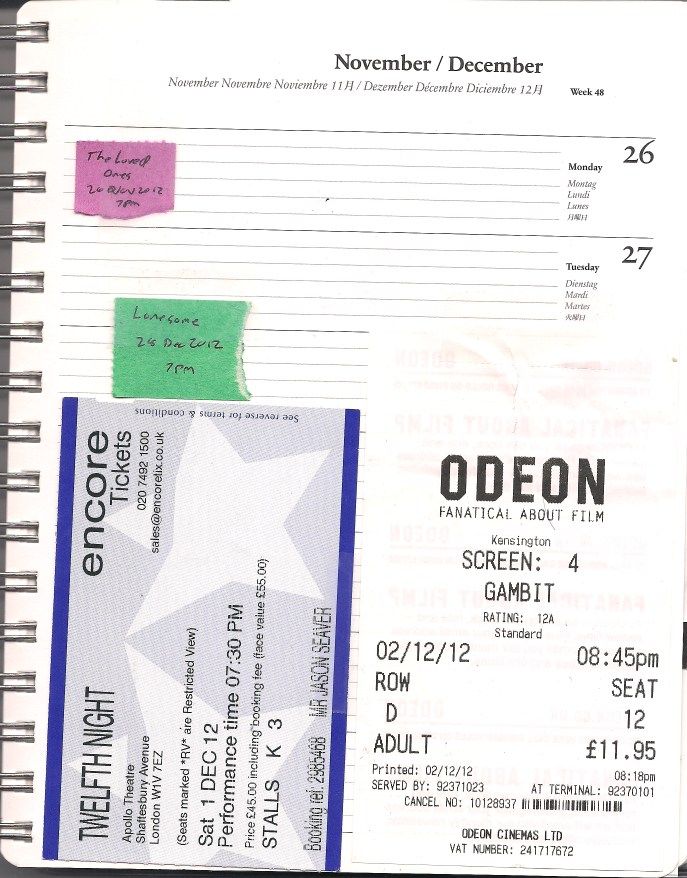
This Week in Tickets

Stubless: London's Museum of Natural History (most of Sunday 2 December 2012).

Quite the short movie week, but for a good reason - as you can see from the gigantic tickets at the bottom of the page, I went on vacation in December. My flight to London left Friday night, with the idea being that I would stay up all night Thursday, fall fast asleep in my airplane seat at around 8:30pm, and then awaken when it touched down at about 7am, refreshed and ready to start the day.. This, it turns out, was not a good plan, even considering that I was at work until 10pm Thursday night because something Had To Be Done within a very short window.

I did see a few movies - the delayed CineCache screening of The Loved Ones and my last in the Universal series, Lonesome on this continent, and the remake of Gambit across the pond. Gambit wasn't my first choice that night - Google had me believing a certain cinema was nearby rather than far away, so I redirected myself to this one when I found it not there, and found myself amusingly confused by the horizontal posters, assigned seating, and lobby that operated more like a convenience store than a traditional concession stand.

The Loved Ones

* * * * (out of four)
Seen 26 November 2012 in the Brattle Theatre (CineCache, DVD)

Finally, this movie hits Boston. I saw it at the 2010 Fantasia Festival, saw Paramount sit on it until The Devil Inside was a surprise hit, only to have the "release" be "making it available via Tugg" (honest question - is Tugg useful for anyone outside Austin?), that be an edited version, and the home video release only be DVD rather than Blu-ray. Seriously, Paramount, this is a great movie and you punted most of the year? That a snowstorm wiped out CineCache & the Brattle's Halloween screening was just insult to injury.

Fortunately, it's still a pretty great movie. The promotion for this screening tagged it as a horror-comedy, which I think does it a great disservice - it's not jokey in the least, and the character that might otherwise be played as comic relief is there as much to tie saddest character in the movie to the action as make the audience laugh. Indeed, what I think is exceptional about The Loved Ones, even more than the inventive violence (which is not for the squeamish), is that for what seems like a mere slasher or torture-porn flick, it's as much concerned with getting how devastating a loss can be across as traditional thrills.

Full review at eFIlmCritic.

Lonesome

* * * (out of four)
Seen 28 November 2012 in the Brattle Theatre (Universal Centennial, digital)

Lonesome is a pleasant, interesting curiosity from the period when silent movies were awkwardly evolving into talkies, a simple thing about a man and a woman who live workaday lives, meet, get separated, and, well, anybody can probably guess how it ends. It's got occasional Harold Lloyd co-star Barbara Kent as the girl and likable Glenn Tyron as the guy, and there's enough spark between them that the I-know-we've-just-met-but-this-may-be-true-love urgency works.

At least, during the silent sequences. With sound starting to hit theaters, Universal added three or four scenes with sound, and only one really matters to the plot; the others just have Mary & Jim sitting in one spot, declaring how sad it is to be lonely and how much they love each other as much to the audience as each other. They're static and repetitive and kind of dull compared to the creative and active screen when the soundtrack is just used for underscore. Even the police station scene which at least has a purpose in the plot seems to go round and round in circles.

It's a cute movie, fun if you like silents and interesting for how the switch to sound had its bumps.

Twelfth Night

Not a movie, but a play, although a large part of what drew me to it was that it featured people I knew from film and television: Stephen Fry, most notably, but also Colin Hurley from Black Pond. Plus, I've loved Shakespeare since junior high, and though The Globe wasn't doing shows when I was there, this one had premiered there and was an "original practices" production - all-male cast, costumes and props made with period-authentic materials and techniques, seating on the stage and the musicians on a balcony above.

Sadly, I couldn't get any pictures aside from this one of the theater itself; a "no photography" rule was being enforced even before the play started, probably because the actors were having hair, makeup, and costuming done right on the stage, which was actually pretty cool (it was neat to see a company that was working together on two shows simultaneously joking and laughing with each other), but we really don't need photos of a bunch of middle-aged actors in their boxers flooding the internet. After the show, they hung out again, auctioning things off for an actors' charity.

The show itself was pretty good, although I wish I had seen it on a different date - I think I had had four or five hours of sleep in the previous fifty-five or so. Fortunately, I wasn't in those on-stage seats (how bad would the occasional dozing off only to jerk back awake seconds later look?). Mark Rylance gave an exceptionally funny performance as Olivia, floating around the stage like a dotty Dalek and being wonderfully obtuse.

The next day was spent in the Natural History Museum, not far from the apartment where I was staying. You know it's a good natural history/science museum when the first thing visible upon entry is a dinosaur skeleton, and the rest of the building lived up to that - a whole exposition on dinosaurs, rooms full of other fossils, gems, a look into a storage room full of things preserved upside down in jars, Charles Darwin's pet tortoise (taxidermied and lost in the plentiful archives for a hundred years or so). My camera gave out by the end of the day, which was a crying shame.
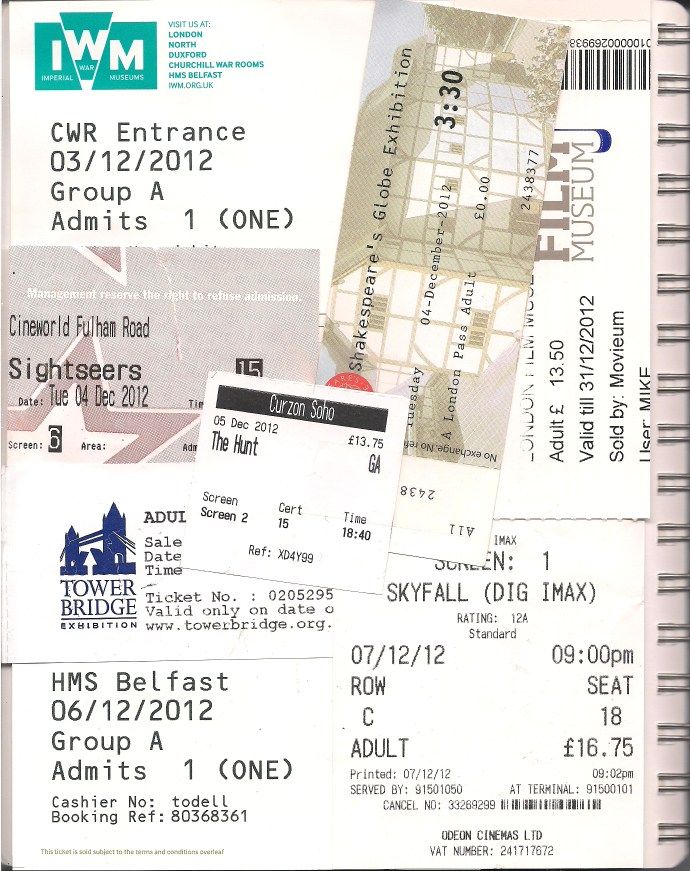
This Week in Tickets

Stubless: A second visit to the Natural History Museum (Monday 3 December 2012). The London Eye (Tuesday 4 December 2012), The Sherlock Holmes Museum (Wednesday 5 December 2012), The London Zoo (Wednesday 5 December 2012), The Benjamin Franklin House (Thursday 6 December 2012), The Cartoon Museum (Friday 7 December 2012), The British Museum (Friday 7 December 2012), Thames Tour (Saturday 8 December 2012).

I suppose I could run down all the cool, touristy things I did in London (which was awesome), but I think I'll just point you at my page of photographs on Facebook and piece it together from there. Otherwise, it's just a lot of "I saw that! It was awesome!

I'll also point to the reviews for Sightseers, The Hunt, and Skyfall, which I saw while on vacation as well.
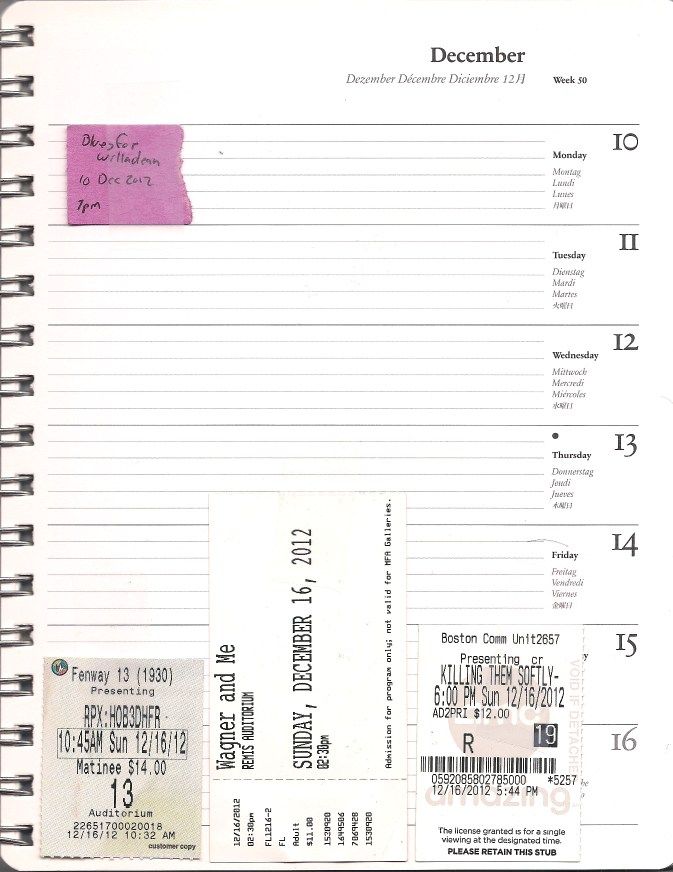
This Week in Tickets

Stubless: The Fifth Element (15 December 2012, Coolidge Corner Theatre #1)

After spending a week abroad, there was work to do. I didn't to much about catching up, either - it gets kind of nice to head to the office, come back, sleep, and repeat after so relentlessly entertaining oneself for a week. The only real exception I made for that was the Chlotrudis/CineCache presentation of Blues for Willadean, and... Well, I didn't rush to give it its own review despite there not being one on EFC like I did for Wagner & Me

Blues for Willadean

* * (out of four)
Seen 10 December 2012 in the Brattle Theatre (CineCaché, video)

So, Chlotrudis folks, I know we've met her and she's nice and a decent character actress and it's kind of neat to spot her when she shows up in something, but can we agree that "featuring Beth Grant" is not a good reason to book a movie? Because while this probably wasn't worse than Sedona, it certainly wasn't good, and having to politely act like it was afterward because Ms. Grant came to present it was just awkward.

Admittedly, some of the reasons I didn't enjoy it were just part and parcel of what it is: A movie about spousal abuse set in a trailer park, featuring the sort of characters one stereotypically finds there. Not folks I'd typically look to hang around with, or a particularly uplifting story, so it's a question of execution, and I think playwright/screenwriter/director Del Shores does a lot of things that hurt it. I think the biggest problem is that he never finds a way to get the audience to a place where they really can respect the title character; the story seems to be coming at its story from a place of "even these people don't deserve this"; she's just pitiable and pathetic and surrounded by other trailer trash, given a bit of a boost because she's able to align herself better with tolerance toward blacks and gays later on. And while, yes, nobody, no matter how little one might think of them personally, deserves to be the victim of violence... That's a low bar to clear, isn't it?

And still, Shores need a crutch or two to get over it. There's a point where Willadean's violent husband (David Steen) comes home, sees her black neighbor (Octavia Butler) is visiting, and drops an n-bomb. And, yeah, I believe this is a thing that happens, but when race has pretty much been a non-issue up until that point, it just sucks all the air out of the room, and suddenly it's like we're supposed to hate J.D. for being racist (and disowning his gay son), as if domestic abuse wasn't enough! And then, of course, Chekhov's gun shows up, and after a whole movie of violence being bad and inexcusable... Well, you can guess how it goes.

It's no fun to say this isn't a very good movie, not just because it features a friend of the club: It has worthy subject matter and at least makes the attempt to show folks who are under-seen on the big screen. It just doesn't give them the treatment they truly deserve.

The Fifth Element

* * * ½ (out of four)
Seen 15 December 2012 in Coolidge Corner Theatre #1 (@fter Midnite, 35mm)

Something to remember when watching The Fifth Element: It came out two years before Star Wars: The Phantom Menace, and for as much heat as that movie and its follow-ups take, their virtual sets and human-scale CGI characters did produce a sea change in the standards for creating full science fiction and fantasy worlds on-screen. From the other side, something like The Fifth Element looks a little rubbery, a little incomplete, compared to the new standard, even though at the time, its world-building was best-in-class.

It still is, in a lot of ways - Luc Besson and company have designed the heck out of it, from Jean-Paul Gaultier's costumes to having Jean "Moebius" Giraud work on other aspects of the film's look. Besson really does capture the sexy, anarchic feel of a European bande-dessiné, if not quite to the absurd, violently insane level of Moebius's collaborations with Alejandro Jodorowsky. The story's flimsy, but it's enough to hang a lot of fun moments on. It keeps Bruce Willis from getting complacent, and while Milla Jovovich isn't doing much besides look pretty (and have people comment upon how pretty she looks) yet, they've got a fun supporting cast: Gary Oldman, Ian Holm, John Neville, Tiny Lister, and more, playing their parts just a little funnier than you might expect.

Yes, including Chris Tucker. This movie would be a lot less entertaining if Ruby Rhod were turned down even just a little bit.

The Hobbit: An Unexpected Journey

* * ¾ (out of four)
Seen 16 December 2012 in Regal Fenway #13 (first-run, 48fps RPX Real-D)

I've sort of been reserving my comments on this one; I decided to go see it in the high-frame-rate presentation for which director Peter Jackson shot it and the look of the film was so peculiar that I had a really hard time thinking of anything else. My impression wasn't so much of soaps or sports as much as it was the sort of film clip shot for educational use or as an introduction to a tourist attraction. Not necessarily bad - indeed, there are some 3D shots I don't think could be done nearly as well in any other format - but so different as to be very distracting!

(Also: I suspect that shooting in 3D means that Jackson and company were able to do much less forced-perspective, leading to many more shots that were obviously accomplished with doubles.)

The thing is, I'm not particularly keen on giving this another three hours of my time. As much as I liked the more kid-friendly vibe - appropriate given the source material - the whole thing just seemed too spread out, and I wonder if the very-late-in-the-game decision to make this three movies instead of two didn't mean placing an anti-climax at the finale. It's fun and I think the kids will enjoy it - the big action scene in the goblin cave is a blast - but I wonder if they'd enjoy it more if it didn't feel quite so random.

To be fair: I'm no particular fan of swords & sorcery, and my resentment at how much of Peter Jackson's career has been consumed by these midget movies is only amplified by the fact that when Martin Freeman and Benedict Cumberbatch are working on them, they're not making Sherlock, which is obviously much more important!

Killing Them Softly

* * (out of four)
Seen 16 December 2012 in AMC Boston Common #19 (first-run, digital)

Andrew Dominik and I just aren't going to work out, are we? I found his The Assassination of Jesse James by the Coward Robert Ford a slog, and while Killing Them Softly isn't nearly as bad, that's mainly due to there being less of it; it's still leaden and dragged down by metaphor that in and of itself isn't as clever as he thinks.

That metaphor, in this case, being a lot of radio and television clips with Presidential candidates Obama and McCain talking about the economy (the film is set in late 2008), meant as a parallel for how crooks robbing a poker game has resulted in a loss of confidence in the local underground economy, especially since the logical assumption is that it was once again perpetrated by the "banker" (Ray Liotta). It's not a bad idea, but the metaphor becomes intrusive without becoming particularly illuminating.

The main problem is much more basic, though: Killing Them Softly is boring. Moments of characters accomplishing something of consequence often happen off-screen, while precious run-time is wasted on James Gandolfini as a hitman too depressed to actually get around to shooting people, or Scoot McNairy and Ben Mendelsohn as the small time crooks who precipitated all of this just getting high. Richard Jenkins shows up to disarmingly deliver bureaucratic delays to Brad Pitt as the picture's "fixer", but he's just blandly professional.

You look at the story here, and there's no reason for it to be this dull, but I guess that's Andrew Dominik for you.
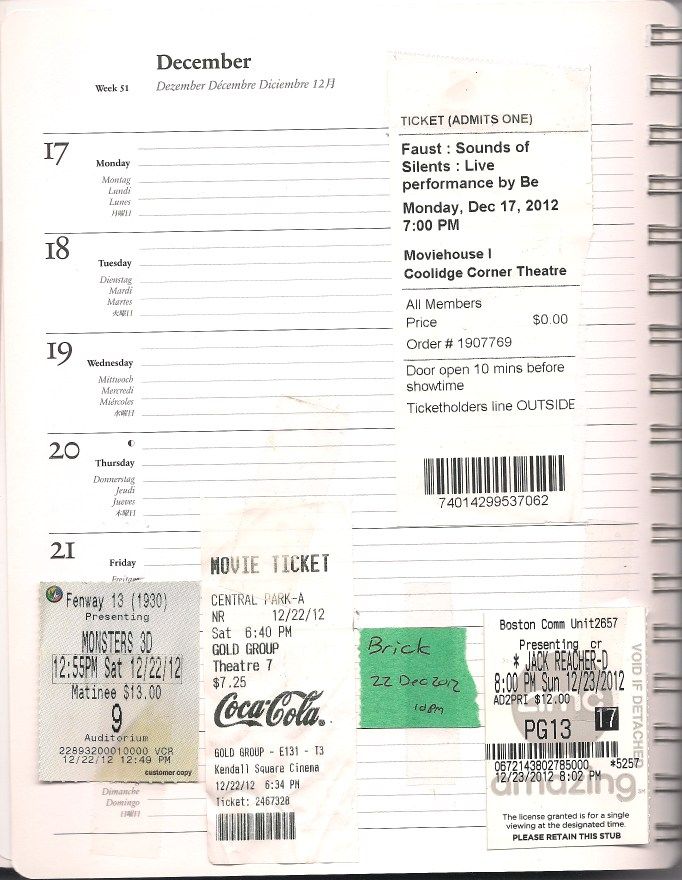
This Week in Tickets

Monday - blah - spurt!, with some Christmas shopping in between. I wound up spending almost all of Sunday at the movies (with an EFC review of The Central Park Five to show for it). That Christmas shopping almost made me late on Monday, but, fortunately, Magic Beans is just steps away from the Coolidge.

Faust - Eine deutsche Volkssage (Faust)

* * * (out of four)
Seen 17 December 2012 in Coolidge Corner Theatre #1 (Sounds of Silents, digital)

I just barely got there in time for the show to start, so my seat kind of stank:

"Silent" Film photo IMAG0289_zps1fcd4d4c.jpg

... but that's a heck of a set-up for a silent film. It's the Berklee Silent FIlm Orchestra and Video Game Music Choir, all set up to play a score written by their fellow students. Several different students scored different parts of the movie, but it came together pretty well.

The movie itself is kind of an odd duck to me; like a lot of stories with their roots in folklore, it's essentially using a grand concept to tell a story with a relatively small scale, and on top of that, it often doesn't seem nearly as horrific as what the director is going for. Faust occasionally seems a little self-centered when it comes to using the devil's gifts, but seldom really corrupt, and it seems to take Mephisto until late in the game to remember that he's the devil and playing fair is just not his thing.

Still, the movie's got F.W. Murnau behind the camera, and that guy was good. His telling of the tale is grand and operatic; he knew how to make a moment larger-than-life, giving us great scenes like Emil Jannings's devil looming over the village that wouldn't show up years later because it's not meant to be taken literally. His vision wasn't necessarily as grand as contemporary Fritz Lang's, but he had a great way at humanizing iconic figures that often makes Faust much more affecting than it might otherwise be.

Monsters Inc.

* * * ¾ (out of four)
Seen 22 December 2012 in Regal Fenway #9 (re-issue, Real-D 3D)

Because I bought some other Pixar movies on Blu-ray, Disney tossed me a "free" pass to see this one. I think the value maxed out at $8.50, though, leaving me wanting to know just exactly where that even gets a kid into a 3D matinee screening. Maybe it would have been enough at Arlington, but I'm not sure.

At any rate, it's been a while since I visited this one (I've come to accept that the massive shelves of DVDs and Blu-rays along my walls are insurance against wanting to see it right now rather than testament to watching it regularly), and it's nice to remember just how excellent it actually is. There's actually not a whole lot of plot to it, but the characters are nicely-designed and well-voiced, with Pete Docter and the whole Pixar crew doing a pretty amazing job of telling the story with jokes, even while doing a little bit of a heart-punch once John Goodman's Sully realizes just what he's been doing all his life. It's also got one of the great Pixar chase finales.

That finale also makes for a nice demonstration of why 3D post-conversion doesn't always stink; the whole job is pretty seamless, but having the vistas behind the opening doors actually be three-dimensional deepens the fantasy a bit, and the whole film is often set up in a way that makes 3D work nicely: Large but bounded environments, and action where movement in all three dimensions is important. It should be fairly interesting to see how well Monsters University does with that world in native 3D this summer.

Brick

* * * ¾ (out of four)
Seen 22 December 2012 in the Brattle Theatre (Focus Features 10th Birthday, 35mm)

I think Rian Johnson became my favorite contemporary filmmaker with this. I'd already seen and loved The Brothers Bloom and Looper, so I was behind the times seeing the debut, but it really solidified what I love about the guy: He crosses genres and references the classics as well as anybody, but even when it's as extremely stylized as it is here, the result feels very contemporary, not wallowing in nostalgia. And no matter how mcuh style is on display, the guy can tell a story.

That's a huge part of why Brick is so much fun. Yeah, the underlying gag of transposing film noir to high school is clever, and both Johnson and star Joseph Gordon-Levitt make it work well past the point when a gimmick could have gone stale by speaking fluent Raymond Chandler. The most important thing a movie like this can do, though, is make the audience want to know what's going to happen next, and this movie never loses sight of that. It's a really great crime story.

Those don't come around often enough, and the fact that Johnson tends to combine that with the sort of crazy ambition that could send a movie flying off the rails? Huge bonus. You might even say that it makes me very curious as to what he's going to do next.

Jack Reacher

* * ¼ (out of four)
Seen 23 December 2012 in AMC Boston Common #17 (first-run, 4K digital)

There's not much actively wrong with Jack Reacher so much as there is a great deal that's not as good as it could be, and it adds up to something kind of disappointing. Mostly, it seems to be a case of trying much too hard contrasted with folks who make it look easy.

Take Tom Cruise as the character. It doesn't really matter that he's not a match to how Lee Child envisioned the character physically at all so much as the way the message of the first half of the movie is "Jack Reacher is awesome", and not only do we get a bunch of testimonials to that effect, but the script puts him in positions which only seem to exist to show how awesome he is. We don't get a chance to appreciate it or be surprised by it, so it comes off as a little fake. Meanwhile, Werner Herzog shows up, spills his character's origin story in his Werner Herzog voice (I half suspect he's in this movie because some associate producer did a Herzog voice during auditions, leading the rest of the filmmakers to wonder if he'd be game), and maybe the character is a bit of a standard part, but he's hooked us. The same thing happens later with Robert Duvall; dude just shows up and we get him/want to see more right away.

The movie's more fun than it might otherwise be, though - screenwriter/director Christopher McQuarrie seems to know the material he's working with is male-fantasy pulp, and he's got a relaxed way of telling the story that doesn't quite wink at the audience but is well-enough aware of how this sort of movie works to walk around things he might otherwise stop through. He's got some skill with action, too - those scenes aren't quite dazzling here, but they're smooth enough. Like the rest of the movie, though, they're a little focused on showing us how cool Reacher is rather than harnessing and using that cool.
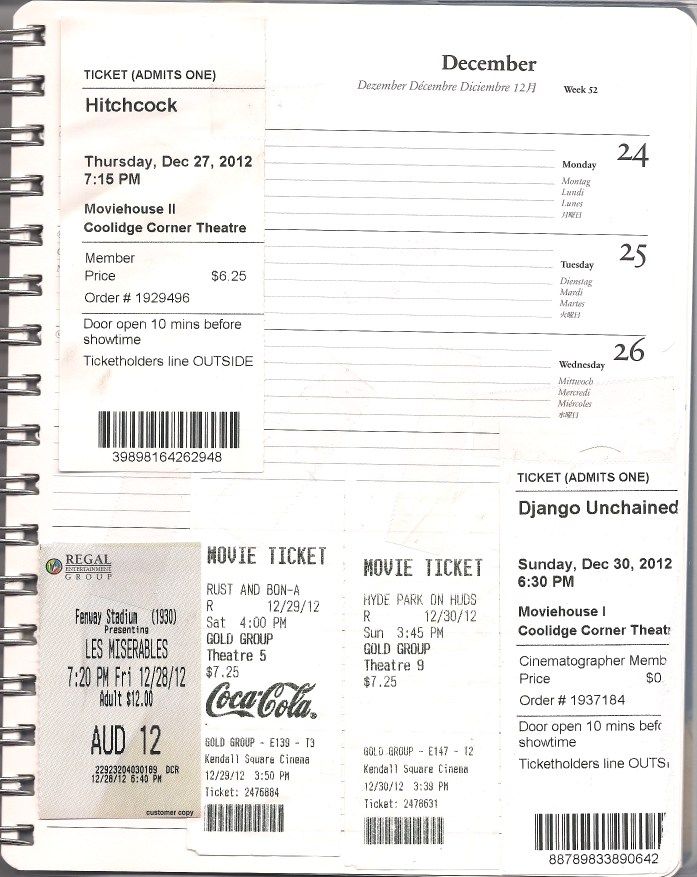
This Week in Tickets

Merry Christmas! I wound up taking this week off from work because my company's new owners only allow one week of vacation to roll over, compared to the two that I'd been carrying for a few years. Monday was spent doing a bunch of last-minute Christmas shopping (culminating, as always, in a bunch of money spent at the chocolate shop, as few have ever complained about getting really good chocolate for Christmas), wrapping, and heading north with my brother and his wife. The 25th was spent at the houses of two other brothers and their awesome little girls, with everyone - aunts, uncles, parents, grandparents, etc. - meeting up at Travis's place.

Eventually, I got home and did a lot of nothing - well, unless making a dent in the pile of comics next to the bed counts as nothing. It kid of beat the movies I was seeing, though - there was a pretty blah stretch between Jack Reacher and Hyde Park on Hudson where everything seemed to be crafted well enough but lacking a certain spark that gives it a reason to exist. Django Unchained was a major corrective for that, but it was a bit of a bland week up until then.

Hitchcock

* * ¾ (out of four)
Seen 27 December 2012 in Coolidge Corner Theatre #2 (first-run, 35mm)

The trailers and other associated advertising for this made me cringe - Anthony Hopkinis impersonating Hitchcock just never seemed to strike me quite right, and I felt a kind of paralyzing fear that the filmmakers would, at some point, attempt to re-create the classic preview for Psycho where Hitch gives the audience a guided tour of the Bates Motel set.

That doesn't happen, fortunately, and one does sort of get used to Hopkins as Hitchcock, although at times it seems less a case of seeing Hitchcock instead of Hopkins as accepting that Anthony Hopkins is playing a Hitchcock-inspired character well. He leads an entertaining cast, most notably playing well off Helen Mirren as Hitchcock's wife and indispensable partner Alma Reville. At its best moments, Hitchcock taps into a great vein of energy where the very idea of Psycho is concerned: The idea of the bored master touching forbidden material on the one hand and making it commercial on the other. There's a great scene where Alfred asks Alma "what if someone really good made a horror movie?" that gets across just what a big deal it is.

The thing is, screenwriter John J. McLaughlin and director Sacha Gervasi seldom really sink their teeth into it; instead, there's some shallow recreation and an utterly standard (and, I gather, mostly-fictional) side-plot where Hitch worries about his wife being unfaithful. There's some amusing fourth-wall breaking at the beginning and end that references the unusual familiarity Hitchcock had with his audiences but doesn't persist through the very persistent middle, and the stuff with Ed Gein really doesn't go anywhere. Stars are stunt-cast as the stars of Psycho, but neither Scarlett Johansson nor Jessica Biel really gets to do anything, and James D'Arcy actually seems able to channel Anthony Perkins despite having nothing to do with it.

The movie's fun, and cute, and probably won't teach the film fans in the audience a whole lot, even if it does manage a few good laughs.

Les Misérables

* * ¼ (out of four)
Seen 28 December 2012 in Regal Fenway #12 (first-run, 4k Digital)

Here's a question I found myself asking a lot during this movie, and a lot of the other bland ones I saw around it: What is this thing about? What is the core idea and emotion that drives the story, that resonates with the audience even when the details don't quite work. What, to put it bluntly, is the point?

Les Misérables must have one; it's a story that has captivated audiences in multiple formats and languages for over a century, and the musical from which this film is adapted has a particularly rabid following - something must resonate! And yet, I can't really be sure what. It's not really a story about class, or obsession, guilt, sorrow, exploitation, or injustice. Hugh Jackman's Jean Valjean is the main character in that he's one of the two to appear in every segment of the story and makes most of the important decisions, but he's a cipher, a mostly-good man whom we only see at moments designed to remind us of that. And yet, his actions and motivations seem badly mismatched; tremendous operatic guilt that manifests as aiding one person.

Watching the film is a weird experience, too, even beyond all the singing. The pace never seems right; every section of this episodic movie feels strangely rushed despite the audience knowing they're in for a long sit, and it's never enough to really feel the weight of what's happening at that point in time - Anne Hathaway's character seems to go from losing her job to sinking into prostitution to dying of some horrible disease overnight, for instance. And there's no time to give context for why the heck they're removing her teeth or what the title cards say about the regime changes in France with every jump forward in time. Plus, for as much as shooting it with live singing does allow for some impressive performances (Jackman, Hathaway, and Samantha Barks especially), it seems to lock each monologue into a single take; director Tom Hooper can't go to a close-up or a reaction shot because the cut wouldn't work. As weird as it is to complain about a modern movie not being cut to bits, it almost makes the camera feel anchored, and the attempts to switch angles are clunky, giving us shots of someone's back.

Plus, there's a lot of things that just don't feel right. I half-think Russell Crowe should have played Javert, the cop who just can't let Jean's long-ago minor crimes pass, as more of a thorough villain; he comes off as just an honest man doing his job here when he really needs to be rigid and monstrous. Sacha Baron Cohen and Helena Bonham Carter feel like they belong in another movie entirely (one directed by Tim Burton, of course). And the whole last segment just seems to have its revolutionary politics wrong, with the happy ending being one character retreating from his principled stand to the bourgeoisie and another marrying him, while the girl who actually seemed nice and interested in him for more than infatuation at first sight dies.

Really, this story's a mess, and it doesn't all seem to be because of a flawed adaptation. I really wonder what I'm missing here.

De rouille et d'os (Rust and Bone)

* * ¼ (out of four)
Seen 29 December 2012 in Landmark Kendall Square #5 (first-run, 2k Digital)

Rust and Bone has a similar problem of not really seeming to have a strong center. About midway through, a metaphor does seem to arise of Stephanie (Marion Cotillard) being drawn to dangerous animals, whether they be the orcas at the water park where she's a trainer or Ali (Matthias Schoenaerts), the Belgian single dad and underground fighter she connects with after a horrific accident, but not really paying the danger proper respect. It's not really a great core, but it's kind of interesting.

And then the end just cops out. SPOILERS! Not right away, and it takes the "shocking" route to get there, but the last few minutes give Ali a seeming redemption that is really tacked-on, aiming to make up for his general selfishness through the rest of the movie with a single heroic action. I'm not sure whether the kid falling through the ice or Ali crying after rescuing him is the more cynical move. !SRELIOPS

The movie's got its issues getting there, too. As good as both Cotillard and Schoenaerts are, director Jacques Audiard and his co-writers put almost zero effort into their pairing making any sort of sense. There's also the occasional feeling that the filmmakers are forgetting about Ali's son Sam beyond establishing Ali as being, at best, somewhat neglectful. All in all, it's hard to shake the feeling that this movie started from several very good parts but never really had them come together, leaving too much of a void in the middle.

Hyde Park on Hudson

* * (out of four)
Seen 30 December 2012 in Landmark Kendall Square #9 (first-run, 2k Digital)

I've grown to kind of hate viewpoint characters - the outsiders meant to give audiences a "relatable" viewpoint into a story of larger-than-life individuals, especially when the latter are real-world figures. Sure, maybe they accomplish that goal, but they also tend, by their nature, to be generic figures who take valuable screen time from actual interesting individuals. In this case, there's not really a single moment when Laura Linney's narrator Daisy is the character we want to see more of.

To be fair, she's fine in the role; it's not her fault that director Roger Michell and writer Richard Nelson play things way too coy, being as circumspect with Daisy's affair with FDR (Bill Murray) as a person in the time would have, so that when it becomes a thing toward the end of the movie, the audience is thinking "wait, what? You said they were cousins! Ew!" They were distant cousins, which wasn't as much of an issue back then, but that's a bit of detail that a modern filmmaker can't exactly assume the audience knows. It's also not her fault that she is almost completely inconsequential to the bigger story of Anglo-American relations on the eve of World War II, as personified by the Roosevelts and England's King and Queen. She takes the role she's given and plays it well enough that you can sort of understand the filmmakers not wanting to leave it on the cutting room floor, even if that's where it belongs despite the movie being based on her life.

She's good, but the rest of the casting is kind of unfortunate. Samuel West and Olivia Colman draw extremely short straws, in that it's going to take some time before audiences can watch this movie and not want them to be Colin Firth and Helena Bonham Carter, who played the characters in The King's Speech. They do well, especially considering that they're highlighting the opposite side of the characters (Bertie and Elizabeth as royalty who have difficulty seeing Americans and commoners as equals versus basically being the same). Olivia Williams is fine as Eleanor Roosevelt. But Bill Murray... It's not an obviously terrible performance, but it's the sort of thing that may make a fan rethink some of the praise heaped upon him in the past decade or so. Is he really as good as we thought, or has he just been well-cast? Because here, it's impossible to see him as anything but "restrained Bill Murray", rather than a man who marshaled incredible charisma despite his infirmity.

There's an interesting movie here, but it's the one that's a sequel to The King's Speech rather than the underplayed affair. Pity nobody making the movie seemed to realize this.

Django Unchained

* * * ¾ (out of four)
Seen 30 December 2012 in the Coolidge Corner Theatre #1 (first-run, 35mm)

Say this for Quentin Tarantino: He's got no trouble finding the center of his movies, even when they're long, episodic yarns like... Well, like most of his movies. Here, there's no question: Django Unchained is about confronting slavery and the racism that allowed it (and its legacy) to fester - and doing so with all the metaphorical violence it deserves.

Sure, it may seem flip for Tarantino to use that as the background of a big, entertaining action-comedy, but it works because, even when he's mashing genres together and throwing out anachronisms, he's never doing it carelessly. Mockery is pointed; every moment of the often-comedic dialogue is polished precisely to say something about the person delivering it. The use of violence isn't quite so precise, but it's not scattershot, either: The revenge pieces are acts of action-movie fantasy, staged and stylized, but the racially motivated, real-world stuff is ugly and realistic.

I've got the feeling it's going to reward multiple viewings, too, to watch how Samuel Jackson's house slave Stephen speaks to different groups - practically minstrelry in front of a bunch of white people, more obviously intelligent but still somewhat subservient to his owner, and something else again when finally confronting Jami Foxx's Django alone. It's been a while since I've seen Gone with the Wind, but I wouldn't be surprised if Tarantino made the Candieland plantation house resemble Tara so that he could take pleasure in destroying it. And it will be fun to pay attention to Christoph Waltz as King Schultz - sure, he's pretty clearly a good man when he first appears, but he also puts Django in a less-than-equal position (he's liberal, but not necessarily sure the black guy is his equal); by the end, though, he can't even shake Candie's hand because he's so disgusted by the whole idea of racism and slavery... And it's a position he feels he can afford to take (or so he thinks), showing his distaste, unlike Django, who knows what careless words have consequences and thus takes the admonition to never break character to heart
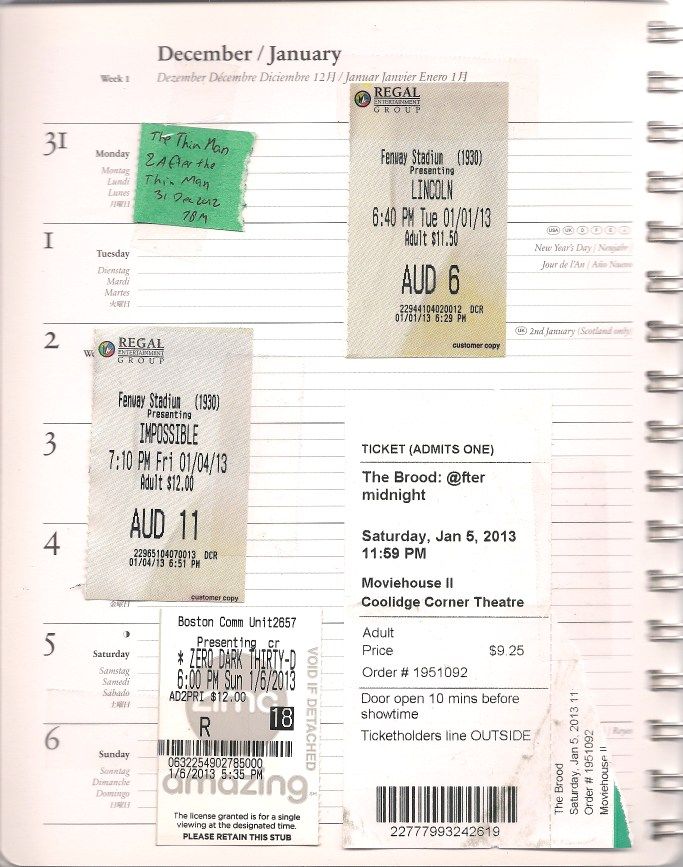
This Week in Tickets

On the one hand, the Brattle's New Year's Eve Thin Man double feature got in between seeing Tarantino's and Spielberg's anti-slavery movies as the last and first movies of the year, but, on the other hand... Never pass up The Thin Man on the big screen. Ever. After that, a couple nights of movies about recent news-worthy events (The Impossible and Zero Dark Thirty), some classic Cronenberg, and a quiet period during which I can finish up writing up this thing.

The Thin Man

* * * * (out of four)
Seen 31 December 2012 in the Brattle Theatre (New Year's Eve with Nick & Nora, 35mm)

Somehow, I've never written a full review of this movie - heck, I can't even find a capsule-sized thing on this blog, which kind of astonishes me, because I know I've seen it a few times in the last decade and love it. But, no.

It's a bit difficult to write about, I guess, because it's basically perfect, an ideal fusion of screwball comedy and murder mystery with a great, bantering pair in William Powell & Myrna Loy. It's hard to think of a movie that has ever been better at getting laughs while taking the central homicide fairly seriously. In some ways, it's almost a spoof, with Powell's Nick Charles mentioning that his plan is to get all the suspects in a room and see what happens, which even this early in the life of the cozy mystery has become sort of a cliché.

One thing that always kind of amazes me about this movie is that its light-hearted, cozy-ness seems so antithetical to Dashiell Hammett's other work. He's the guy who was really moving pulp toward noir in the page of Black Mask (although "noir" would require translation to film and rediscovery by the French before it would have that name), and not really a funny guy; he didn't even tend to go in for Raymond Chandler's bitter wit. It's been a while since I've read The Thin Man itself, and maybe I should; I recall it being lighter than The Maltese Falcoln and certainly Red Harvest, if not quite as aggressively funny as this. But it's not a bad adaptation; the whole story is kept and the jokes just seem like director W.S. Van Dyke and his screenwriters teasing out what will work best on-screen.

After the Thin Man

* * * ½ (out of four)
Seen 31 December 2012 in the Brattle Theatre (New Year's Eve with Nick & Nora, digital)

Hammett's darker tendencies make me wonder about his story credit on After the Thin Man, which pushes the comedy just a little harder. Did he whip something up that the returning screenwriters fleshed out, or is this just a courtesy credit? It doesn't much matter; this is one of those rare, happy sequels that give the audience a little more of what they liked from the first without feeling like repetition or bloating up.

I do kind of wonder just where Nick Charles was supposed to have been a detective, though - in The Thin Man, they were visiting New York and wound up drawing in all of his unsavory (but friendly!) old acquaintances; here, they're back at Nora's home in California and the same thing happens! Then again, I don't know if he's ever specifically said to be an ex-cop; maybe he was an unusually successful and well-traveled Pinkerton man.

It's also fun to see James Stewart show up in an early role here - he's just starting to break out enough to be the first-billed after William Powell & Myrna Loy, but he's not yet playing "Jimmy Stewart" yet. It's an interesting "not-yet-a-movie-star" performance, making the end of this movie possible, if a bit surprising.

Lincoln

* * * ¾ (out of four)
Seen 1 January 2013 in Regal Fenway #6 (first-run, digital)

Why must movies have such generic titles? Lincoln is based in large part on Doris Goodwin's Team of Rivals, and is very focused on a specific time and story instead of the full sweep of Abraham Lincoln's life; why not reflect its actual story rather than make it sound like a generic biography?

I ask this because I found it was the parts that were least personal but most specific and procedural that most fascinated me. There's a scene where Daniel Day-Lewis's Lincoln walks the Cabinet (and thus the audience) through the paradoxical logic behind the legality of the Civil War and Emancipation Proclamation, and it's something I vaguely remember from high school history classes - teachers mentioned that Lincoln suspended habeus corpus and assumed quite a few wartime powers, but it seldom had the impact of that scene, which does an impressive job of making the specifics both clear and confusing. That's what the whole movie does, taking what seems like the driest parts of history and making all the tiny moving parts fascinating both individually and in the aggregate. It lets Day-Lewis show the parts of Lincoln that are actually somewhat morally questionable while still getting across just why he was so charismatic and able to make the ascent into legend.

Day-Lewis is fantastic, of course, with his tendency to disappear inside a role a perfect complement to Spielberg's attention to detail. It's an amazing part and presentation of a character, in that it feels improvised, but not on the actors' and filmmakers' parts, but that of the characters. Lincoln will tell stories in a way that might seem indulgent if not played exactly right - but they are, of course; everyone's too good. That extends to a quite frankly ridiculous cast, from Day-Lewis all the way down - there's a Kevin Kline credited as "wounded soldier", and it's not that one (although why the heck hasn't he worked with Spielberg yet?), but you wouldn't be surprised, would you? Tommy Lee Jones gets the showiest, most entertaining supporting part, and despite the amusement of Jones playing the Yankeest Yankee in the movie, it's a part that seems tailor-made for him. A lot of parts work that way, notably David Strathairn demonstrating that he makes every movie better as William Seward, but little parts like Bruce McGill as Edwin Stanton work that way too. And then there's James Spader, disappearing inside his political mercenary for a character that is hilarious even though he has to be taken seriously.

Could it have ended five or ten minutes earlier? Absolutely; it's got two epilogues that it doesn't really need. But they aren't nearly gratuitous enough to detract from the excellent two and a haf hours that come before.

The Brood

* * * ¼ (out of four)
Seen 5 January 2013 in the Coolidge Corner Theatre #2 (@fter midnite, 35mm)

Watching The Brood, I found myself wondering if all these early Cronenberg body-horror movies all took place in a single shared universe. It came to me during the autopsy scene, where the coroner seems rather calm about the fact that he's doing an autopsy on some sort of biologically impossible homonculus. I picture an assistant freaking out while he shrugs, saying that, hey, last year in Montreal some girl drained people of their life force by hugging them.

Friends at the screening shrugged it off as "hey, it's Canada."

In a way, I think that's part of what makes Cronenberg movies so chilling - there's a bizarre logic to their paranormal elements that makes them forcing their way into reality seem believable, even if the characters can't see the metaphorical strength behind them. This movie, apparently, was based upon Cronenberg's own divorce and custody battle, and despite the chilly nature there does seem to be a little more anger, maybe a little more guilt to it than usual. It's got impressive gross-out moments, and some darn good suspense, but if it didn't have the underpinnings it does - fear of quack psychiatry, a family history of dysfunction that spans generations - it wouldn't be nearly as powerful.

Dragnet GirlA Late QuartetBrooklyn CastleRise of the GuardiansTo Kill a MockingbirdThe ThingThe Sting & Slap ShotLife of PiSilver Linings Playbook

The Loved OnesLonesomeTwelfth NightGambit

Churchill War RoomsShakespeare's GlobeLondon Film MuseumSightseersThe HuntTower Bridge ExhibitionSkyfallHMS Belfast

Blues for WilladeanThe Hobbit: An Unexpected JourneyWagner & MeKilling Them Softly

FaustMonsters Inc. 3DThe Central Park FiveBrickJack Reacher

HitchcockLes Miserables
Rust and BoneHyde Park on HudsonDjango Unchained


The Thin Man & After the Thin ManLincolnThe ImpossibleZero Dark ThirtyThe Brood

Thursday, January 17, 2013

Next Week in Tickets: Films playing Boston 18 January 2012 - 24 January 2013

Hey, folks, there's a new Kim Ji-woon out this weekend, and you don't even have to speak Korean or read subtitles this time! How awesome is that.

  • Potentially very awesome. The Last Stand isn't just Kim's first English-language feature (and if the name doesn't mean anything to you, it means you really need to watch The Good The Bad The Weird, A Bittersweet Life, I Saw the Devil and/or the original A Tale of Two Sisters), but Arnold Schwarzeneggar's first lead role since Terminator 3 ten years ago, with Eduardo Noriega as the villain heading for Arnold's border town at high speed and a supporting cast that includes Forest Whitaker, Peter Stormare, Johnny Knoxville, and Luis Guzman. It's got some good early notices and plays at the Somerville Theatre, Fresh Pond, Boston Common, and Fenway.

    Also looking to have some potential is Mama, a thriller from producer Guillermo del Toro and director Andres Muschietti featuring Jessica Chastain and Nikolaj Coster-Waldau as a couple who adopt a pair of children who have been living alone in the woods from a very young age. It pays Boston Common, Fenway, and Fresh Pond. The tea leaves don't quite look quite so favorable for Broken City, which has a good director in Allen Hughes and a nice cast in Mark Wahlberg, Russell Crowe, and Catherine Zeta-Jones as an ex-cop, the mayor, and his wife in a tangle of sex, lies, and power. It plays the Arlington Capitol, Fresh Pond, Boston Common, and Fenway.
  • If you like to see everything nominated for the Oscars, the Coolidge Corner Theatre can hook you up with Amour in 35mm. It's from Michael Haneke, so it's almost certain to be emotionally brutal even before you find out it's the story of an elderly couple (Jean-Louis Trintignant and Emmanuelle Riva) whose lives become much harder when the wife suffers a stroke. Isabelle Huppert plays their daughter. They've also got a selection of 2012 Sundance Short Films playing in the screening room in anticipation of their upcoming Sundance USA screening.

    The Friday & Saturday night midnight movie, The Bird with the Crystal Plumage, isn't just famed Italian filmmaker Dario Argento's first movie as writer & director, but also considered the first of the blood "giallo" genre. The latest entry in the Talk Cinema preview series may be as significant (probably not), although the film in question still has not been announced.
  • Kendall Square also picks up Amour on two screens, though they're all-digital now. They also give those of us who missed Beasts of the Southern Wild when it played this summer a chance to see it again after it racked up four nominations, including one for its very young star.
  • The Brattle has a few changes to its schedule this week. It's still all Dead of Winter: Satan on Screen, but there have been some substitutions. Legend still plays Friday, but Bell Book and Candle replaces Heaven Can Wait as part of a double feature with Damn Yankees (playing digitally) on Saturday, with Prince of Darkness as the late show. Sunday is still The Devil's Eye and The Canterbury Tales, while The Witches of Eastwick replaces Bedazzled as part of a double feature with Deconstructing Harry on Monday. There are double features Tuesday and Wednesday - a digital presentation of Toby Dammit & The Imaginarium of Doctor Parnassus and the silent pair of Faust (digital) & Witchcraft Through the Ages, respectively - and Rosemary's Baby on Thursday.
  • The Harvard Film Archive continues its screenings from last week: Michael Roemer's Nothing But a Man plays Friday night, and Sunday afternoon. Hong Sang-soo's The Day He Arrives runs Friday and Monday evenings. They also begin a retrospective, As if Our Eyes Were in Our Hands – The Films of Susumu Hani, with A Full Life Saturday evening,Bad Boys Saturday night, and a pair of featurettes ("Children in the Classroom" and "Children Who Draw") Sunday evening.
  • ArtsEmerson re-starts film screenings this weekend with a series of films apparently tying in to Martin Luther King Jr. Day with primarily African-American casts. Friday's pictures are Freedom Riders at 6pm and Talk to Me at 9pm. Saturday has Akeelah and the Bee at 1pm, Can We Talk at 6pm (followed by a discussion with the people involved in the Boston Busing/Desegregation Project it covers), and Do the Right Thing at 9pm. Medicine for Melancholy plays Sunday at 1pm. The first few are presented on 35mm, while Can We Talk is DVD, Do the Right Thing is Blu-ray, and Medicine for Melancholy on digibeta.
  • The MFA finishes up the Films of Pierre Étaix Friday night before starting in with the Boston Festival of Films from Iran on Saturday, including Rhino Season on Saturday and Sunday and One. Two. One. on Sunday; the series continues next weekend.
  • The Regent Theatre has three different film screenings this week: Exit Elena plays Friday night; it's from local filmmaker Nathan Silver (who will be present for a Q&A afterward) and follows a live-in-assistant coping with a messed-up family. Saturday night's movie, Cowboy Spirit, will also have the director (William F. Miller) on-hand; his movie features rich Manley as a modern cowboy who must make a cross-country ride to save a young girl's life. And on Tuesday the 22nd, they show The Mulberry Tree, a story about a prison worker and a convict dying of AIDS that features Joe Morton.


My plans? The Last Stand, Mama, the Talk Cinema Screening and maybe Beasts of the Southern Wild, plus a couple of Chlotrudis-nomination things.

Sunday, January 13, 2013

Recent History Portrayed Well: The Impossible and Zero Dark Thirty

This wasn't planned to be a two-movie post; I was just going to write up Zero Dark Thirty, which didn't have any other reviews on eFilmCritic, and get back to the massive TWIT backlog, but something about The Impossible stuck in my head.

It is, basically, that the movie does an unusually good job of not playing the card where the protagonists are assumed to deserve survival more than everyone else. That's probably a horribly unfair way to put it, in that I doubt that the average filmmaker is trying to say that the other characters (and, in the cases of these movies, real-life people) are less worthy. More likely, they're just trying to personalize the stakes for the audience - make the story something relatable to the audience member who maybe doesn't grasp the disaster but does understand not wanting to leave things badly with a loved one, or praying, or wondering why something didn't happen to them, as well. The "these guys are more important" thing is a side-effect.

It shows up a little in Zero Dark Thirty, and is one of those more Hollywood moments that kind of surprised me - Jessica Chastain's Maya actually says that she feels as if she survived so that she could be the one to track down UBL. It works in part because that's not just arrogance on the writer's part, but Maya's - she does have the sort of focus for that to seem like a believable attitude, and it's not presented as particularly modest, the way it might in a movie with a more faith-based bent; at least, admitting that this is a self-centered attitude rather than the false modesty of accepting the generosity of a higher force makes it more palatable to this viewer.

Beyond that, there's something very enjoyable about how both stand back and endeavor to show what happened rather than trying to get the audience to feel some particular way about it. It's okay to be conflicted about the actions in Zero Dark Thirty or to simply observe what happened to the family in The Impossible without finding a message there. Just as I like documentaries that impart knowledge more than those which try to convince me of a point of view, I like this kind of "based on a true story" more than what we typically get: It just puts the audience in a spot, rather than trying to say how we should feel about it.

The Impossible

* * * ½ (out of four)
Seen 4 January 2013 in Regal Fenway #11 (first-run, 4K digital)

It's easy to be cynical about certain aspects of The Impossible, and I share the reservations of anybody frustrated at this particular story from the 26 December 2004 tsunami being the one to get the highest-profile big-screen treatment. But once the decision has been made to tell this story, there is almost no reason to quibble with the execution; it's exceptionally well-made and avoids the most ubiquitous pitfall of its genre quite nicely indeed.

An English family living in Japan - father Henry (Ewan McGregor), mother Maria (Naomi Watts), and sons Lucas (Tom Holland), Thomas (Samuel Joslin), and Simon (Oaklee Pendergast) arrive in Thailand on Christmas Eve to spend the holidays at a resort. Henry is worried about his job security; Maria thinks it may be time to return home and for her to return to the workforce (she's a doctor) in any event. Those problems, of course, will be dwarfed by what happens on Boxing Day, when a wall of water slams into the resort along with the rest of the coast. The next thing she realizes, she's floating in the middle of a flood, with only oldest son Lucas anywhere to be seen.

The flood itself is an amazing sequence of horrifying spectacle, both in the special-effects shots of watery death rapidly approaching and the aftermath. The initial scenes with Maria and Lucas are extraordinary, exactly what one wants from this sort of movie: Exciting pieces of action, sure, but also packed full of information and characterization - seeing how they swim toward each other desperately and trust each other completely, without hesitation is quite the demonstration of how a picture is worth a thousand words.

Full review on eFilmCritic.

Zero Dark Thirty

* * * ¾ (out of four)
Seen 6 January 2013 in AMC Boston Common #18 (first-run, 4K digital)

There are times in Zero Dark Thirty where the audience might stop and think that the moment is kind of Hollywood compared to the stark, nonsense-free material that surrounds it. For some, that may be just what this nuts-and-bolts movie needs, and those looking for just the facts likely won't find that it makes the movie less than riveting.

The story picks up two years after the attack that destroyed the World Trade Center. CIA analyst Maya (Jessica Chastain) has just been assigned to the US Embassy in Pakistan, though she also spends a fair amount of time across the border in Afghanistan, observing and assisting another agent, Dan (Jason Clarke), as he interrogates captured Al Qaida prisoners. That produces very little actionable intelligence until Maya gets him to mention a high-level courier, and she doggedly follows that lead as far as it will take her.

It's no spoiler to say that Maya's work will eventually lead to a midnight raid on a fortress-like residence in Pakistan, or that said operation is a success; that is recent, widely-reported history. So, what do director Kathryn Bigelow and writer Mark Boal (who previously collaborated on The Hurt Locker) have for the audience? Details. Here is how quick thinking allows an investigator to turn a terrorist attack to her advantage; here is how a modern electronic dragnet lets the CIA find a needle in a haystack. Boal & Bigelow don't spend a lot of time explaining how things work or foreshadowing when things go violently wrong, and only rarely does it seem like they've altered or emphasized events to fit a conventional narrative; they're telling how something happened, rather than fitting history to a familiar character arc.

Full review on eFilmCritic.

Friday, January 11, 2013

Next Week in Tickets: Films playing Boston 11 January 2012 - 17 January 2013

This week must be a pain in the neck if your job is to program a movie theater. Oscar nominations announced on Thursday, shows turning over on Friday, audiences are going to want to see some of those that aren't playing, but interest in others will drop, and then there's material that's being dumped...

  • The week's biggest release, perhaps, is actually the expansion of Zero Dark Thirty, which picks up screens at the Somerville Theatre and Fresh Pond as well as the Fenway and Boston Common multiplexes. It's pretty great.

    The buzz isn't nearly so good on the other wide releases. Gangster Squad was delayed from last year not so much for that, but a shooting in a movie theater that would have been considered especially bad timing after what happened on The Dark Knight Rises's opening night. Interestingly, clips of that scene were still in trailers I saw in the UK last month, but I presume the scene has been excised. Sean Penn plays gangster Mickey Cohen; Ryan Gosling, Josh Brolin, Robert Patrick, Anthony Mackie, and Michael Pena play cops; Emma Stone is The Girl. It plays Somerville, Fresh Pond, Boston Common, and Fenway. Also opening is A Haunted House, Marlon Wayans's return to horror movie parody (he did the first couple Scary Movies), with Essence Atkins and Cedric the Entertainer along for Paranormal Activity-derived spoofs. I swear this thing had a less-generic title when I saw trailers for it before, but I can't find any record of that. It plays Fenway, Boston Common, and Fresh Pond.
  • The Somerville Theatre opens Fairhaven, which played there as part of IFFBoston last year and is getting what is almost certainly a one-week run this week. It's a nice little movie shot a little way up the coast; I liked it. To make room, some movies get pushed over to The Arlington Capitol - This Is 40, Not Fade Away, and Life of Pi (which, amusingly, just moved from the Capitol to the Somerville a few weeks ago).
  • The Brattle re-opens Paul Thomas Anderson's The Master on Friday, it runs through Thursday on 35mm. They may have expected it to get more than the acting nominations it managed (the 65mm photography really was gorgeous, for instance), but it certainly deserves recognition for those. Note that the screening times bounce around a bit from day to day (and it doesn't play Monday), so check them before you go.

    It shares the screen with a few other movies. There's a digitally-projected late show of Universal Soldier: Day of Reckoning, the fourth entry in the series which brings back Jean-Claude Van Damme and Dolph Lundgren but stars Scott Adkins (a pretty good screen fighter, actually) and is said to be both insane and surprisingly good for a series that spent time in direct-to-video purgatory. Saturday afternoon has an encore double feature of Madoka Magica: The Movie (which is actually a double feature of two that were themselves edited from a TV series), which sold out Thursday night.

    Monday night, meanwhile, is a DocYard screening of Betting the Farm, a documentary on a group of Maine dairy farmers who attempt to start their own company when they lose their contract with a larger corporation. It's co-presented by Unity College and one of the film's two directors, Jason Mann, will be there for a post-screening Q&A.
  • The Harvard Film Archive has a couple of multi-date bookings, which is unusual. The older one is Michael Roemer's Nothing But a Man, an independently-produced 1964 feature unusual at the time for having a primarily black cast; it's a romance between a working-class man and a minister's daughter. It plays Friday evening, Saturday night, and Monday evening. It shares the screen with Two by Hong Sang-soo - Hong's much-lauded The Day He Arrives (about a filmmaker returning to his old neighborhood to visit friends) plays Friday night and Saturday afternoon, and his previous film, In Another Country (featuring French actress Isabelle Huppert) plays Saturday evening and Sunday afternoon/evening. Both will return next weekend, as well.
  • The Coolidge, like Kendall Square, mostly keeps things the same; the only daily addition to their schedule is Searching for Sugar Man in the Goldscreen. The special screenings include Friday and Saturday midnights of Dune on 35mm, and seeing the trailer last week reminded me that, good lord, David Lynch did direct Kyle MacLachlan, Sting, Sean Young, Patrick Stewart, and an eight-year-old Alicia Witt in a version of Frank Herbert's classic novel that apparently felt the source material wasn't strange enough.

    On Sunday morning, the Goethe-Institut German film series returns with Das Wochende (The Weekend), with Sebastian Koch as a former terrorist who, upon his unexpectedly early release from prison, gathers old friends, family, and comrades for a weekend at an old country house, creating instant tension.
  • The MFA spends the bulk of its week presenting The Films of Pierre Étaix, Étaix being a French filmmaker who made a series of film that, much like contemporary Jacques Tati, were greatly inspired by absurd silent comedy. The program includes The Great Love, The Suitor, Yoyo, As Long as You're Healthy, and his documentary Land of Milk and Honey. There are also screenings of Indelible Lalita, following the life of an Indian woman who loses her skin color.
  • The Regent Theatre has an encore screening of fame documentary $ellebrity on Thursday the 17th.
  • iMovieCafe opens Seethamma Vakitlo Sirimalle Chettu at Fresh Pond, although I can't find much information on what it's actually about (I swear, Indian movie marketing seems entirely star-based; they have the most generic poster art imaginable). Anyway, it's in unsubtitled Telugu, so unless you speak that language, you may not gt much out of it.


My plans? Well, I didn't get to Promised Land last week, and haven't seen Barbara yet, and, uh... Universal Soldier? Yeah, why not walk into the foruth entry of a series cold?

It may be time to actually work my way through all those DVDs & Blu-rays I've been acquiring and not watching, I think.

Friday, January 04, 2013

Next Week in Tickets: Films playing Boston 4 January 2012 - 10 January 2013

Happy new year! I think January is the most schizophrenic time of the year, movie-wise: It's half Oscar contenders that are finally expanding from their qualifying LA/NYC runs, half things that aren't very good being released when they won't cannibalize the studios' other mainstream pictures with greater potential.

  • The awards hopefuls start out with Zero Dark Thirty, which reunites Kathryn Bigelow with her The Hurt Locker screenwriter Mark Boal for a systematic take on the ten-year hunt for Osama Bin Laden. It plays multiple screens at Boston Common and Fenway (including the RPX screen). Those theaters and Kendall Square each have The Impossible on one screen, with Ewan McGregor and Naomi Watts as a family of tourists in Thailand when the tsunami hit in 2004.

    On the other end of the spectrum is Texas Chainsaw 3D, which IMDB lists as a remake (Just ten years after the last one) but the synopsis reads like a sequel. Whatever it is, they're in Texas, there's a guy named Leatherface, and he's cutting folks up. In 3D at Boston Common, Fenway, and Fresh Pond (which also has it in 2D).
  • The Brattle opens a reissue of Volker Schlöndorff's The Tin Drum, a fantasy about a child born with an adult intellect in 1924 who refuses to age physically after turning three. It's a classic which won both the Palme d'Or and Foreign Language Oscar upon its 1979 release; this version has twenty minutes restored. It plays from Friday to Tuesday, digitally projected.

    On Wednesday, there's a special screening of Being Flynn at 8pm, Paul Weitz's adaptation of Nick Flynn's memoir Another Bullshit Night in Suck City; Flynn will have a 6pm reading separate from the film, and will also do a Q&A afterward. The Thursday night screening of a Madoka Magica double feature, the film version of a popular anime series, is sold out, but a second screening has been scheduled for Saturday the 12th.
  • The Coolidge picks up a couple movies that opened elsewhere a week or two ago - Promised Land (mostly) in Theatre #2 and The Central Park Five on the GoldScreen.

    They do begin stepping the special programs up again in the new year. The Friday and Saturday midnight shows continue, this week with David Cronenberg's The Brood, with anger manifesting itself physically. Monday night is a "Stage & Screen" presentation of Do the Right Thing, tied to Oren Jacoby's production of The Invisible Man, with Jacoby, cast members De'Lon Grant & Joy Jones, and moderator Phillip Martin.
  • The MFA started their January calendar earlier in the week with a rotation of three documentaries that will run over the weekend and into midweek: Hitler's Children, an Israeli documentary about the children and grandchildren of the Nazis' inner circle; Bestiaire, a Quebecois look at the animals in a zoo; and Bel Borba Aqui, which profiles Brazillian artist Bel Borba. All three play Friday, Saturday, Sunday, and Wednesday; Indelible Lalita steps in for Bestiaire on Thursday, with both the director and subject of this documentary about a woman who has lost her skin color (and thus a piece of her identity) during her travels from India to Europe to Quebec on hand for a Q&A and reception.
  • The Regent Theatre
  • has two film events this week. On Friday night local production company Kai Mitchell Pictures presents their new satire Corporate! at 7pm; those who arrive early (5:30pm) can see a double feature including their featurette "The Dinner Party". On Thursday the 10th, they have the first of two screenings of $ELLEBRITY, a documentary on the corporate fame machine (the second will be on the 17th).

  • iMovieCafe still has Dabangg 2 at Fresh Pond all day from Friday through Monday and on Tuesday afternoon; Telugu- and Tamil-language movies show for the rest of the week.
  • The Somerville Theatre will get Zero Dark Thirty next week; this week, it picks up Not Fade Away (which is cut down to a single 10:35pm showing per day at Boston Common) and starts presenting the evening screening of Life of Pi in 3D; Jack Reacher and Skyfall move to The Arlington Capitol.
  • The Harvard Film Archive has their annual Members' Weekend; if you're a member, you probably know what's playing!


My plans? Zero Dark Thirty, The Impossible, The Brood, Promised Land, and maybe Do the Right Thing.

Thursday, December 27, 2012

Next Week in Tickets: Films playing Boston 28 December 2012 - 3 January 2013

The big openings for this weekend were on the 25th, so while there's some catching up to do, there's not a lot of turnover.

  • The most visible opening is Promised Land, where Matt Damon re-teams with Good Will Hunting director Gus Van Sant but has a new writing partner and co-star in John Krasinski. Damon plays a corporate rep looking to buy drilling rights in a small town forced to confront the ethics of the situation. It plays one screen at Boston Common and two at Kendall Square, and will likely be expanding over the next few weeks.

    Boston Common also picks up Not Fade Away, noteworthy for being Sopranos mastermind David Chase's first foray into film since a low-budget 1972 vampire movie. It's a 1960s coming-of-age story about Jersey kids in a rock & roll band.
  • The Brattle finishes 2012 off with the rest of the Gene Kelly Centennial Tribute, which features double features through Sunday: 1948's The Three Musketeers & The Pirate on Friday, Summer Stock & Cover Girl on Saturday (with a 9:30pm late show of Xanadu, his last film), and An Amerian In Paris & Invitation to the Dance on Sunday.

    Other classics ring in the new year. The 31st has a double feature of The Thin Man and its first sequel, After the Thin Man (the latter shown digitally), and if there's a better way to end the moviegoing year than Nick & Nora & Asta, I don't know it. Plus, it's free to First Night buttonholders. On Tuesday the 1st, they have the annual Marx Brothers Marathon, this year including Animal Crackers, Horse Feathers, Room Service, and A Night at the Opera. All 35mm, $20 for a marathon ticket ($15 for members). The week finishes off with The Hurt Locker on Wednesday and Thursday, anticipating the upcoming release of director Kathryn Bigelow's Zero Dark Thirty.
  • The Coolidge continues the same schedule from Christmas - Django Unchained in house #1, Hitchcock and Anna Karenina in house #2, Barbara in the screening room, and A Royal Affair in the MiniMax. They do keep Christmas around with Friday and Saturday midnights of Bad Santa. They also close early on New Year's Eve, with no shows after 9pm.
  • The MFA wraps the December schedule with the end of their series of The Films of Juliette Binoche, with various screenings of Summer Hours, Flight of the Red Balloon, The Lovers on the Bridge, between Friday and Sunday. On Monday, they've got a 45 -minute First Night Short Films Program running during the morning and afternoon, most notably including "Gumdrop", a short co-directed by Kerry Conran, last seen directing Sky Captain and the World of Tomorrow way too long ago. Thus far, they haven't put their January film schedule online.
  • The Regent Theatre finishes up their Christmas week Sing-Along screenings of The Sound of Music, with three shows on Friday and one Saturday matinee.
  • The iMovieCafe screen at Fresh Pond continues Dabangg 2, with one or two screenings of Yamudiki Mogudu for those who speak Telugu.
  • Somerville Theatre is back up to five screens with The Slutracker done (aside from one New Year's Eve show), picking up Life of Pi from Arlington.


My plans? Catch-up, plus The Thin Man.

Wednesday, December 26, 2012

The Central Park Five

Not much to say about the circumstances around seeing this film or the lead-up. Maybe I shouldn't have seen three movies on a day when I really needed to finish my Christmas shopping? Eh, it got done.

I suppose it's worth mentioning that I haven't done much research into how complete/accurate the film is. While I doubt that there are any factual errors, the extremely focused nature of the narrative leaves ample space for things to be left out, and anybody who wants to learn about the case should likely supplant this with other resources.

The Central Park Five

* * * ¾ (out of four)
Seen 22 December 2012 in Landmark Kendall Square #5 (first-run, 2K digital)

The Central Park Five states the reason for its existence plainly toward the end: To in some small way close the gap between how loudly its subjects' guilt was proclaimed twenty-odd years ago and the attention paid to their being declared innocent after serving seven to thirteen years in jail. It's a worthy goal, and while getting the film in front of all the people who followed the news back then is likely impossible, those that do see it will certainly absorb its recounting of events.

When a woman jogging in New York's Central Park was raped and beaten into a coma in April 1989, it made the national news and became a cause célèbre in the local press. The police connected it with other violent incidents going on in the park at around the same time, and within two days, they had confessions from five shockingly young suspects - 14-year-olds Antron McCray, Raymond Santana, Kevin Richardson & Yusef Salaam and 16-year-old Korey Wise. That all were black or hispanic while the victim was white inflamed the situation further, and the district attorney had little trouble getting convictions a year later. A seeming triumph for the criminal justice system that New York badly needed - except that the five were innocent, their confessions coerced in marathon sessions without parents or lawyers.

The story touches upon a number of hot-button issues, either directly or as a tangent - race relations, capital punishment, what opportunities prisoners should have, and just why proper police procedure is so important. What the filmmakers can focus on is limited by access - none of the involved police officers nor any current city official chose to participate - but in some ways, this helps put the situation in context better than having a former NYPD detective tell the camera about the pressure they were under to close the case or how he regrets the assumptions he made back then. This is the world that the Five were living in, and how it got that way or how it evolved since then is irrelevant to their story.

Full review on eFilmCritic.

Friday, December 21, 2012

Wagner & Me

Fair warning/disclaimer: I missed the first minute or three of Wagner & Me as the bus from Fenway kept slipping while I waited for it (it seemed to be 3 minutes away for fifteen minutes). Hate when that happens, but I kept waiting because this was the MFA's last screening. Maybe if I hadn't stayed through all of The Hobbit's many credits, waiting for a preview that never came, I would have caught the previous one.

I came to this as a fan of Stephen Fry as opposed to having much particular interest in Richard Wagner. The composer does make for an interesting topic, although I can't say that I'm going to be rushing out to purchase great big Ring Cycle box sets as a result. That isn't exactly the purpose of the film, anyway - as much as Fry SPOILERS! ultimately says that he will continue enjoying Wagner because the music is good, !SRELIOPS it's not a movie about convincing. Though Fry and director Patrick McGrady do a fine job in explaining what Wagner did well, it comes down to "I heard it and liked it".

Truth be told, I like that; too many documentaries often seem like preaching to the choir while too few are simply informative. As much as documentaries with a strong point of view and mission behind them (especially if they are anti-authoritarian enough to be considered "brave") seem to get more critical acclaim, I tend to come to documentaries more via curiosity than passion, and therefore tend to favor the ones that put facts before me over those that arrange said facts in a pointed way.

On a completely different note, this isn't the only thing I saw in the last few weeks because of Fry's participation; on the first night of my London vacation, I saw him tread the boards in an "original practices" production of Twelfth Night. That was a lot of fun, although I must say that my first night in the city, not having slept that much on the plane (after staying up too long in an attempt to avoid jet lag by sleeping on the plane), did not have me in a particularly alert frame of mind for it. I do remember Fry giving a great performance, though, as did Mark Rylance (I was also pleased to recognize an actor from Black Pond). Just, man, how great would it have been completely rested?


Wagner & Me

* * ¾ (out of four)
Seen 16 December 2012 in the Museum of Fine Arts Remis Auditorium (special engagement, digital)

Wagner & Me is probably only going to be terribly educational for those like myself whose musical knowledge is relatively shallow - the folks who sing "kill the wab-bit!" to ourselves when a certain bit of Richard Wagner's most famous piece shows up on the soundtrack. Fortunately, it is nicely informative for that audience, and even for those in the audience who know everything he's saying, it's an hour and a half of Stephen Fry expounding on an enthusiasm, and that's always a pleasant time.

Mister Fry is, among many other things, a lover of Wagner's music, and he is quite excited to come to Wagner's hometown of Bayreuth and the theater that the composer built there for the express purpose of showing his "musical dramas". The theater now hosts an annual music festival centered around Wagner's Ring Cycle, with a seven-year waiting list for tickets. And yet, Fry tells us, he is ambivalent about supporting it; being Jewish, it is hard for him to overlook just how strongly the music is associated with the Nazis (he was a favorite of Hitler and the Wagner family supported the Nazis well before not doing so was suicide), and the anti-Semitism in the man's own writings.

Fry and filmmaker Patrick McGrady investigating Wagner's life and music and trying to reconcile those feelings gives them a reason to crisscross Europe while using Bayreuth as a home base, making stops in Nuremberg, Switzerland, and St. Petersburg to visit the important scenes of Wagner's life and afterlife where music is performed and scholars are interviewed. It is, generally, a good overview; McGrady never seems to be glossing over any portion of his subject's story, and while the examples of Wagner's work are often briefer than they perhaps must be (even when he doesn't have to try and deliver the essence of a four-hour opera in five minutes), he and Fry do a fair job of explaining things that may seem rather opaque to non-musicians.

The strength and weakness of that framework is Fry himself. Stephen Fry is a man of varied and voluble enthusiasms, and each visit to a new location brings forth the giddy joy of a teenage girl with a backstage pass for her favorite band. It's sometimes a bit distracting, but much more often it's infectious, especially since he manages the neat trick of combining an appreciation for high art with an utter lack of snobbery. This unabashed love for the music makes it hard to see him actually wrestle with the decision; aside from one interesting scene where he seems to be asking a cellist who survived the Holocaust permission to enjoy Wagner's music, the topic of anti-Semitism occasionally seems to come up in interviews out of obligation more than as a matter of real difficulty. The decision he ultimately makes is seldom in doubt.

It would be easy for that aspect of Wagner to overwhelm the entire production, which would miss the point that he is more than just a few ugly magazine articles and a truly repugnant fan. Wagner & Me is a basic primer fit for a BBC or PBS afternoon slot, though far more charming than most.

Next Week in Tickets: Films playing Boston 21 December 2012 - 27 December 2012

Another week with two Dates When Movies Open: The Friday before Christmas and Christmas itself. Combined with things having opened this past Wednesday, and theaters' increasing willingness and ability to put popular films on more screens at the last minute, check listings before heading out.

  • On Friday the 21st, the multiplexes are opening a pair of fairly big-name movies. Jack Reacher has Tom Cruise playing the hero of Lee Child's novels (it's based upon One Shot), with Rosamund Pike as the damsel in distress and Werner Herzog as a villain. Herzog doesn't direct - Christopher MacQuarrie does - but he always makes things better. Robert Duvall's in there somewhere, too. It plays Somerville, Fresh Pond, Fenway, and Boston Common. The same theaters also pick up This Is 40, Judd Apatow's spin-off of Knocked Up which focuses on the couple played by Paul Rudd and Leslie Mann, who apparently are having a hard time getting along as they approach the big four-oh. Between that and the massive number of screens playing The Hobbit (and Monsters Inc. & The Guilt Trip having opened Wednesday, there's barely any room for Cirque du Soleil: Worlds Away, which is playing two 3D shows a day at Boston Common and Fenway. The troupe did an IMAX film a few years back that looked nice, and the preview for this offers more prettiness.

    Interestingly, Worlds Away seems to pick up more showtimes on Christmas, despite several other movies opening. The less impressive is almost certainly Parental Guidance, which posits that Marisa Tomei is the result of Billy Crystal's and Bette Midler's genes mixing, which I find suspicious. They play grandparents coming to help watch the kids and befuddled by new-age parenting. Crystal gets hit in the crotch a lot, it seems. It plays the Arlington Capitol, Fresh Pond, Boston Common, and Fenway. Also on those screens is Les Miserables, featuring a pretty terrific cast of Anne Hathaway, Hugh Jackman, Russell Crowe, Amanda Seyfried, and more, doing their own singing for Tom Hooper's adaptation of the musical play based on Victor Hugo's novel.
  • The other really big Christmas opening is the new one by Quentin Tarantino, Django Unchained. It's got Jamie Foxx and Christoph Waltz as nineteenth-century bounty hunters whose search for Django's wife leads them to a plantation owned by Leonardo DiCaprio. I'm hearing Samuel L. Jackson is especially great in this. It opens at The Coolidge (where to go if you want to see it in 35mm as QT intended), Kendall Square, Boston Common, and Fenway.

    The Coolidge has a busy week all around, finally getting Hitchcock on its big screen on Friday and German Oscar submission Barbara, about a doctor hoping to cross from East to West Germany in 1980 who is instead reassigned to a rural town, opens that day in the screening room. They also welcome the Mayan Apocalypse with midnight screenings of Armageddon (you only show Michael Bay there if the world is going to end!). They also do a little shuffling on Christmas Day, replacing Chasing Ice on the GoldScreen with A Royal Affair.
  • While Kendall Square's big opener is Django, they also pick up something noteworthy on Friday: Rust and Bone, which features Marion Cotillard as a whale trainer and Matthias Schoenaerts (who was fantastic in Bullhead) as a bouncer. An unlikely match, but a horrific injury brings them closer together.
  • The Brattle switches things up for the holiday, as well. They spend the weekend finishing up the Focus Features Tenth Birthday party, with Milk and Shaun of the Dead on Friday (separate features), a double feature of Jane Eyre and Atonement on Saturday, with Brick as a separate late show, and separate features of Monsoon Wedding and Coraline on Sunday (Coraline is 2D, but should still look fantastic).

    They're closed to do their holiday shopping on Christmas Eve, but Christmas brings their Gene Kelly Centennial Tribute, with Singin' in the Rain on the 25th, a double feature of On the Town and Anchors Aweigh on Wednesday, and another twin bill (Brigadoon and It's Always Fair Weather) on Thursday. The series will run through Sunday the 30th.
  • The Harvard Film Archive is more or less dark, with the exception of the 4th Annual Vintage Christmas Show, a two-hour grab bag that includes a feature, some shorts, and a George Kuchar video diary. It's a free all-ages show at 2pm on Sunday (the 23rd).
  • The MFA wraps up its December calendar with an extension of what it has been showing: Cheerful Weather for the Wedding has shows Friday, Saturday, and Sunday, as do The Films of Juliette Binoche, which include Certified Copy, Code Unknown,Damage, and the 1992 Wuthering Heights over the weekend and Chocolat and The English Patient after the holidays.
  • It's a holiday, so the Regent Theatre in Arlington is breaking out a sing-along print. For Christmas vacation, it's The Sound of Music, with on-screen lyrics, costume contests, and goody bags. One matinee and one evening show each on Wednesday the 26th and Thursday the 27th, with shows continuing through the 29th
  • Almost certainly the most fun title to say this weekend is Dabangg 2, a Bollywood action movie which has Salman Khan returning as a top cop and Sonakshi Sinha as his wife, and villains new and old to deal with (and being Bollywood, there are songs and comedy mixed in). It plays Fresh Pond via iMovieCafe starting on the 21st, although it does share the screen with a couple of unsubtitled Telegu-language films between Saturday and Tuesday.
  • The Somerville Theatre has a bit of second-run action starting Christmas Day, when they pick upSilver Linings Playbook. They also have a few things coming up that folks should consider buying tickets for early - the Boston Science Fiction Film Festival & Marathon from February 8th through 18th, something called "Faith Soloway's Lesbian Cinema Schlock Treatment" on February 14th, and the Alloy Orchestra accompanying a series of Buster Keaton shorts on February 23rd. The Coolidge also has a show that may sell out very early, the annual Sundance USA screening. This year it's on January 31st and has Liz W. Garcia in town to present her movie The Lifeguard


My plans include Django Unchained in 35mm, Jack Reacher, Rust & Bone, Brick, and all the stuff I've been meaning to catch up on for the better part of a month. Of course, it all depends on how much time is spent trying to Christmas shop before the holiday and how long I spend in Maine afterward.

Wednesday, December 19, 2012

Kataoka Ichiro, Benshi: Shoes, "A Dog's Life", and Dragnet Girl

I don't, as a rule, get hugely excited about the special events on the Harvard Film Archive's schedule; they often play to a specialized audience. Sometimes, though, that specialized audience is me - I love silent movies and am probably closer to being one of those sad nerds who act like they have some sort of affinity for/knowledge of Japanese culture from manga and movies than I'd care to admit.

I freely admit, though, that I'd never heard of benshi before. They are a uniquely Japanese part of cinema, performers who would stand at the front of the cinema to add narration and voice dialogue during the silent era. They were a fairly powerful guild in their time, able to delay the introduction of synchronized sound to Japanese theaters by a number of years - for example, Dragnet Girl was released in 1933, well after the talkies had taken over elsewhere. They were occasionally even considered threatening to the government: After all, you could monitor the content of a film, but keeping an eye on what every benshi says at every screening is something else again!

There were many benshi at the medium's height - male, female, young, old, sometimes entire families performing together. Eventually, sound came to eiga the way it came to cinema around the world, and the time of the benshi was over. Except - not quite. Shunsui Matsuda, who had been a child benshi during the silent era continued after World War II, touring the country and in the process building a formidable collection of silent film prints as he did so. He also took on students, who would later do the same, which brings us to Kataoka Ichiro:

Benshi Tadaoka Ichiro

Imagine the lights brought down and a movie playing over his right shoulder.

He did the actual narration in Japanese, naturally, and there wasn't any sort of simultaneous translation aside from the films' intertitles. Unfortunately, all I've retained from a whole bunch of Saturdays at the Boston Language Institute was the ability to point to myself and say "Jason desu", so I didn't get the full experience, but it was a nifty way to see the movie nonetheless - having tone of voice connected to the image added a little texture, and although Kataoka-san was fairly restrained with dramas, he added a bit of energy to comedy.

Kataoka-san seemed a friendly guy, happy to discuss his unusual occupation after the films. He mentioned that being a benshi wasn't quite a hobby that he only gets to do on special occasions, as roughly three silent movies screen each week in Tokyo, generally with accompaniment. That's a fair number, although I suspect the number drops off precipitously once you leave the bigger cities. Still, probably more than most cities, even places like Boston where such screenings are relatively popular.

One other thing that came up that maybe didn't perk the ears of the HFA's audience quite as much as mine was that he and other benshi also do voice-over work for animation. It's natural, but it reminded me of how anime fans used to grumble both about the terrible English dubs on Stateside releases - occasionally done by the distributor's office staff - and how American animated films were often sold on celebrity voices as opposed to voice actors who knew this job well and were famous in their own right as voice actors. The general conclusion, of course, was generally something like anime is better and Japan has more respect for animation as a medium (late twentieth-century anime fans could be intense). I now wonder if this was a bit of a missing piece that anime fans didn't much consider - animation is more popular and broadly used in Japan, true, but celebrity "voice actors" actually predates animation, and even if there was enough of a gap between the decline of silents and the premiere of Astro Boy that few benshi seem likely to have transitioned directly to the new medium, this kind of work was almost certainly already respected by those in show business, rather than being a side job or anonymous like it was elsewhere.

The movie choices were interesting, too. Shoes was made by a company called Bluebird that made features for Universal in the studio's early days, and while Bluebird and their movies became relatively obscure in the USA, they were apparently quite popular and well-remembered in Japan. In a bit of a coincidence, the opening text crawl of Shoes positions it as a thematic follow-up to another Bluebird film directed by Lois Weber, Where Are My Children?, originally scheduled to play at the Brattle as part of their Universal Centennial program.

Shoes being roughly an hour long, it was originally expected to play alongside a short movie from Japan, but that was apparently unavailable as well, so Charlie Chaplin's "A Dog's Life" was substituted. No complaints about that here - it's a fun little movie which allowed Tadaoka-san to show another side to his performance, really giving everybody distinctive speech patters despite the movie being silent. And considering how hand-wringingly dour Shoes is, "A Dog's Life" almost seems like a more optimistic but barbed response, with laughs at the girl who sings about misery.

As for Dragnet Girl, well, I should probably watch more Ozu so that I have something to say about this movie from his early career. It was interesting as being the only thing in the program made with the knowledge that there would be a benshi on stage at the front of the director's mind, and there were times in the last act when Ozu seemed to be trying to assert control, with intertitles restating the relationships between characters and the plot almost word-for-word at times in the end, lest a narrator try and put his own spin on things, which apparently happened.

It was an educational experience, to say the least. Even without that, though, it's a pretty neat way to see movies, if only as a novelty, worth giving a try even if your Japanese is worse than mine.

Percussionist Damon Krukowski

(Just a bonus bit of horrible photography, showing percussionist Damon Krukowski next to his rig Dragnet Girl. I missed getting a shot of Robert Humphreville, who accompanied Kataoka-san on the piano for Shoes and "A Dog's Life". Impressed by his schedule, though - that 7pm movie was apparently only the fourth of his five bookings on a Sunday!)

Shoes

* * ½ (out of four)
Seen 18 November 2012 in the Harvard Film Archive (Tadaoka Ichiro: Benshi, 35mm)

It's funny what strikes you when watching films from a hundred years ago and thinking of the society of the same time. For instance, Shoes posits that spending all one's time reading evidently was the mark of a useless layabout. The books are not even particularly described as junk or pulp; it's just that someone spends his time reading! It makes sense - it's not like there's TV or even that much radio in 1916 - but it dates this movie something fierce, as does some of its Puritan hand-wringing.

In Shoes, the shiftless bibliophile is the supposed head of the Meyer family (Harry Griffith), a father who avoids looking for work and spends what little money daughter Eva (Mary MacLaren) brings in to the family on novels. Eva, who is the sole person supporting the poor family wants a new pair of shoes, and it's gone well beyond just vanity - what she wears is so close to falling apart that one strongly suspects that she won't be able to keep the job much longer if they frown on working barefoot; it seems like a reasonable investment for the family, really. But there's always some reason to put it off and they take her for granted, unlike the lascivious cabaret performer (William V. Mong) who spots Eva coming out of the department store one day.

The main problem with the movie is that for "a film in five acts", it feels like it could be compacted to a short with little damage; the characters just don't do very much other than restate their poverty and the father's laziness again and again. Director Lois Weber actually does a fairly impressive job of not making this drag, breaking it up with a fantasy sequence and making just enough use of the repetition to get across how Eva can't seem to make progress. The movie runs just under one hour, and though it could potentially be stretched at half that, it only skirts the borders of trying the audience's patience.

Like a number of other films directed by Weber and produced by Bluebird Photoplays - an early division of Universal that also made Where Are My Children? - Shoes is highly moralistic and leaves no doubt of what sort of reaction it aims to produce in its audience. From the earnestness of the opening titles to a finale meant to fill the audience with the same horror and shame as the characters, it makes for a strange time capsule.

The presentation is often as much of its time as the fervor, with the narrative intertitles a match for the broad acting. Harry Griffith and William V. Mong, especially, give the sort of big, theatrical performances that zero in on what's important about their characters unpretentiously enough to be enjoyable as more than just camp. Mattie Witting (as Eva's mother) and Mary MacLaren don't play quite so much to the balconies, but get across their characters' dire straits without making the women just walking misery. The shooting is nice, if static.

Because of all this, few if any today are going to watch Shoes as the sort of parable and piece of popular entertainment it was made to be a hundred years ago. It's still interesting, though, and probably goes down better than many of its contemporaries.

Full review on eFilmCritic.

"A Dog's Life"

* * * ½ (out of four)
Seen 18 November 2012 in the Harvard Film Archive (Tadaoka Ichiro: Benshi, 35mm)

You really haven't seen a Chaplin film until you've seen it with a Japanese guy narrating and performing dialogue for the characters. With the fast-talking way Kataoka-san rattled off what he imagined the Tramp saying, it was almost like a Popeye cartoon at times.

Even without that, it's still a very funny movie, with Chaplin's Little Tramp befriending Scraps, "a thoroughbred mongrel" as they try to scavenge enough to survive on the street and eventually win the love of a woman whose singing at the Green Lantern club is so sad as to reduce all the revelers to tears. There's a bunch of quality slapstick and pathos that never really gets sappy... What more could one want from a Chaplin movie?

Hijosen no Onna (Dragnet Girl)

* * * (out of four)
Seen 19 November 2012 in the Harvard Film Archive (Tadaoka Ichiro: Benshi, 35mm)

I haven't seen nearly as many films by revered Japanese director Yasujiro Ozu as I probably should if I want to consider myself a well-rounded lover of world and classic cinema. Heck, this may be it, and it's probably more representative of him as a craftsman than an auteur. It's an enjoyable example, though, perhaps especially if seen in its original, narrated format.

It's a fairly familiar sort of youth-at-risk story: Hiroshi (Koji Mitsui) is a kid who could potentially be a great boxer, but it's hard to muster the dedication necessary when crime seems to be treating former champion Joji (Joji Oka) better than boxing ever did. Hiroshi's sister Kazuko (Sumiko Mizukubo) is concerned, but of course her brother is hearing none of it.She's pretty and pure enough to get Hiroshi's attention, to the annoyance of his girlfriend Tokiko (Kinuyo Tanaka), whose job as an office girl means dealing with attention from the owner's son (Koji Kaga). but may lead to criminal opportunity.

It's easy to think of the Westernization of Japan as a post-WWII phenomenon, but one only has to give this movie from 1933 a look to see it was going on earlier. But for the ethnicity of the cast, it feels like it could easily have come out of Hollywood; not only does everybody spend most of the film in Western attire, but Joji and Hiroshi practice boxing rather than karate or judo, and there's not a yakuza trope to be found among the crooks, either. Kazuko is the only one who spends a notable portion of the movie in traditional dress, for that matter. The story is the same on both sides of the Pacific, and Ozu and company tell it well.

There's probably something to just how western it seems which a westerner watching it almost eighty years later doesn't quite grasp except in the most vague sense. A formulaic story about the perils of easy money and falling in with the wrong crowd gains another layer warning about about breaking with tradition, although Ozu and co-writer Tadao Ikeda opt not to hammer this home (at least, these subtitles don't do that). It's actually a fairly entertaining movie to watch - Ozu and cinematographer Hideo Shigehara find interesting angles and move the camera in a fairly lively manner at times, and things move at a good pace despite not having the action of a typical crime story until fairly late in the game.

The acting style also seems surprisingly modern compared to other movies of its era, compared to the theatricality of silents and early talkies. The cast is good all around - Tanaka would go on to have a long and noteworthy career - giving the sort of performances that don't necessarily seem silent in one's memory. That may be in part due to seeing it not just with a live score, but narration and dialogue delivered by benshi Kataoka Ichiro. Live narration with silent films was the norm in Japan at the time - the guild actually managed to delay talking pictures in Japan for several years - and it allows Ozu to rely less on intertitles than other cultures' silent directors, and helps things flow more smoothly. The flip side is that benshi were independent, occasionally putting their own spin on a movie's story, and the repetitive dialogue in the last act's intertitles almost seems like an attempt to force the narrator to stay on the right track.

It's a relatively minor disruption to an enjoyable movie. It's almost certainly not among Ozu's best, given his reputation, but it's the sort of better-than-expected genre work that certainly can herald great work down the road.

Full review on eFilmCritic (dead link).

Friday, December 14, 2012

Next Week in Tickets: Films playing Boston 14 December 2012 - 20 December 2012

I've done charts in these posts before, but the options for the movie opening this weekend are quite frankly mind-boggling.

  • That movie, of course, is The Hobbit: An Unexpected Journey, Peter Jackson's return to the world of Middle-Earth for the story that started it all. It is mind-bogglingly expanded - this nearly-three-hour movie is the first of a trilogy, despite The Hobbit being shorter than any of the other Lord of the Rings novels. Still, Martin Freeman, Ian McKellan, Benedict Cumberbatch, and Andy Serkis is a nice cast; the more kid-friendly tone appeals; and it's an interesting tech demo for being shot at 48fps rather than the usual 24. There are, accordingly, a lot of different formats at various prices at different sites.


    TheaterFormatMorningAfternoonEvening
    Jordan's IMAXDigital Imax 24fps$11.50$11.50$11.50
    Arlington CapitolDigital(?) 2D 24fpsN/A$6.00$9.00
    Arlington CapitolDigital 3D 24fpsN/A$9.00$12.00
    Fresh Pond35mm(?) 2D 24fpsN/A$6.75$9.25
    Fresh PondDigital 3D 24fpsN/A$9.00$12.00
    AMC Boston CommonDigital 2D 24fps$6.00$10.00$12.00
    AMC Boston CommonDigital 3D 24fpsN/A$14.00$16.00
    AMC Boston CommonDigital 3D 48fps$10.00$14.00$16.00
    AMC Boston CommonDigital Imax 24fps$12.00$16.00$18.00
    Regal FenwayDigital 2D 24fps$9.00$9.00$12.00
    Regal FenwayDigital 3D 24fps$13.00$13.00$16.00
    Regal FenwayDigital 3D 48fps$13.00$13.00$16.00
    Regal FenwayRPX Digital 3D 48fps$14.00$14.00$17.00


    (Note that Arlington isn't specifying digital or 35mm for their 2D shows, so I'm assuming digital; Fresh Pond does say 35mm on their website. The digital Imax screenings at Jordan's and likely Boston Common will also have a 9-minute prologue to Star Trek Into Darkness playing before the main feature.)

    Some of these showtimes may only be good until Tuesday, as both the 3D re-release of Monsters, Inc. and Seth Rogen & Barbra Streisand in Guilt Trip will be looking to get a jump on Christmas by opening on Wednesday the 19th.
  • That's not quite all that's paying; Kendall Square and Boston Common both pick up Hyde Park on Hudson, which has Bill Murray playing Franklin Delano Roosevelt, hosting the King and Queen of England as World War II approaches, with Laura Linney as his neighbor. That opens on two screens at Kendall Square; The Central Park Five, a documentary about a terrible miscarriage of justice in 1989, gets one and a single-week booking at that. There will be special guests at two screenings - directors Ken Burns and Sarah Burns at the 6:35pm show on Friday, with Sarah Burns joined by third director David McMahon and subject Raymond Santana at the corresponding Saturday show.
  • The Coolidge picks up a pair of movies second-run: The Sessions splitting a film screen with Argo, and Chasing Ice in the GoldScreen. The special engagements are noteworthy, too, starting with the midnights: The Fifth Element plays Friday and Saturday night in theater #1, part of the end-of-the-world series. Meanwhile, Friday night features the 2012 Everything Is Terrible! Holiday Special in the upstairs theater.

    On Monday night, the Sounds of Silents program returns with the Berklee Silent Film Orchestra (along with the school's Video Game Music Choir) presenting a new score for F.W. Murnau's Faust
  • The Brattle has their annual twin Christmas programs this weekend. Matinees and evenings, that means It's a Wonderful Life, Frank Capra's classic with James Stewart and Donna Reed. Later at night, there's the Alt X-Mas shows, with Gremlins (projected digitally) Friday night, the director's cut of Brazil on Saturday, and The City of Lost Children on Sunday.

    Starting Monday, it's studio anniversary time again, with the Focus Features Tenth Birthday series. Interesting coming so soon after the Universal series, as I believe the studios were connected at one point. On Monday, they've got Moonrise Kingdom; The Pianist plays Tuesday; a Bill Murray double feature of Lost in Translation & Broken Flowers on Wednesday; and two by François Ozon with Ludivine Sagnier, Swimming Pool & 8 Women, on Thursday.
  • The The Harvard Film Archive has their last regular show of the year on Friday, Identification of a Woman. It's a straggler from the Michelangelo Antonioni series that ran earlier, with Tomás Milián as a film director confronted by two women.
  • The MFA continues with Stephen Fry's discussion of Wagner and Me through Sunday, with another film from the UK, period comedy Cheerful Wedding for the Wedding, playing alongside it and also returning on Wednesday and Thursday. Those two days also mark the start of a new series, The Films of Juliette Binoche, with Blue and Certified Copy on Wednesday and Code Unknown joining Blue on Thursday.
  • The Somerville Theatre is running a screen short through December as the "Slutcracker" Burlesque takes over the main stage, and they've got one other family-inappropriate holiday screening this week, with The Onion AV Club presenting a "New Cult Canon" screening of Bad Santa on Tuesday the 18th.
  • And, finally, the Regent Theatre has a couple of off-beat events. Friday night has Jimmy Tingle back in town, doing his "Live on Stage & Screen" show with his movie Jimmy Tingle's American Dream once more; this one is a benefit for the American Red Cross. Then, on Sunday afternoon and Wednesday evening, there's the two-part Christmas in Acidland, with each half featuring Christmas-themed television oddities that demonstrate just how much strange holiday material has been produced over the years.

Plans? Well, still haven't seen Lincoln, Hitchcock, or Killing Them Softly. I'll probably try to catch The Central Park Five and Hyde Park on Hudson. And, yeah, the first of the new midget movies, if only as an interesting tech demo.

Thursday, December 13, 2012

British (and Danish!) movies in British Cinemas: Sightseers, The Hunt, and Skyfall

When I went to London for vacation, I sort of had it in the back of my mind that I'd like to see Skyfall while I was there - James Bond in his home territory, so to speak - but didn't actually have plans more more. Sure, I'd look to see what was playing there that wasn't likely to hit the US for a while/at all. I wound up staking out four movies - Gambit, The Hunt, Great Expectations, and Sightseers. Great Expectations didn't happen, but Sightseers was quite the pleasant surprise - having liked both of Ben Wheatley's previous films, being able to see this one well before its first US screenings at Sundance was a nice bonus.

I was also (pleasantly) surprised to see just how wide an opening it got in London, and what a push it seemed to be given: There were posters at every tube stop, while the Curzon Soho was filled with promotion for the movie. Sure, it's a home-grown picture, and I've really got no idea what the major distributors in the UK are and how well they usually do getting movies on screens, but... Well, it's a weird movie, even by dark-british-humour standards.

I also tend to get the impression that the screen churn in the UK is pretty fierce - Great Expectations seemed to lose a lot of showtimes between its 30 November opening date and when I left on 9 December. It seems due, at least in part, to the lack of multiplexes; the nearby site with the most screens seemed to be the Cineworld where I saw Sightseers, a six-plex. It seemed like a lot of places would open the same movie, and then attrition would happen based on how things performed in that neighborhood (heck, The Hunt was playing all over the place, although that seemed to be a deal between its distributor and the Curzon chain). Movies would open up with single off-peak showtimes in some places.

The theaters themselves were pretty nice, though. I certainly wouldn't mind if a place like the Curzon Soho opened somewhere in Cambridge; though the admission price was steep (£14.50 for an evening show, or $23.20 assuming a 1.6 exchange rate) - stupidly, I didn't realize I could use the London Pass there until a couple days later - the snack bar was moderately priced good stuff, and the bar/café/lounge areas were quite the nice places to wait. They offer memberships, too.

The BFI IMAX is apparently the UK's largest screen, and it's impressively big, maybe a little larger than the New England Aquarium's IMAX screen. I was running too late to really scope the amenities out, but it had a bar/café that was packed right up until it was time for the show to start, and though run by Odeon, it wasn't quite so self-service as the place where I saw Gambit. Like that theater, there was assigned seating, and they put me right next to a couple despite the whole row being open two minutes before showtime. I spent the movie in C17 rather than C18; hope they didn't mind.

More fun with concessions: They don't put ice in your soda unless you specifically ask for it, and the cheese dip used for nachos at the BFI IMAX was creamy and roughly seventy-four times as good as the hyper-processed yellow stuff American theaters use. American theaters: Get your act together on this! Also, you are offered a choice between "Salty" and "Sweet" when ordering your popcorn, and I mildly regret not trying the latter at some point, because what is that? Just popcorn with sugar on it?

Anyway, it turned out to be a fun and busy moviegoing week considering that you'd think I would have other new and different things to do.

Sightseers

* * * ¾ (out of four)
Seen 4 December 2012 in Cineworld Fullham Road #6 (first-run, digital)

Ben Wheatley's previous two films weren't everyone's cup of tea, and he hasn't exactly gone conventional with Sightseers. It's quite often as funny as it is twisted (or, perhaps, vice versa), overflowing with strange, messy, disturbing romantic comedy.

Tina (Alice Lowe) and Chris (Steve Oram) are going on holiday after being together for a few months, despite the protestations of Tina's mother Carol (Eileen Davis). Odd, considering the pair are in their mid-thirties, but it comes as no surprise that neither has dated much; they've got that way about them. As much as Tina's the one who has seldom left her mother's side, Chris's outsized reaction to someone at the tram museum littering is the first hint that their caravan trip through minor tourist sites in the English countryside is going to be far out of the ordinary.

(Note for my fellow Americans: "caravan" is British for "camper" or "trailer".)

The term "dark comedy" covers a lot of ground, and Sightseers manages to walk most of it. It's one thing for the audience to laugh at something that is objectively horrible because the joke has been set up so well, and the movie does that often and well (often setting it up as the opposite of a joke). That's impressive, but perhaps the niftier trick is how Wheatley and co-writer/co-stars Lowe & Oram twist things so that the audience winds up seeing the road-trip/romantic comedy movie from a decidedly skewed perspective. The weird focus is funny, but not in a snarky, laugh-at-the-form sort of way. The filmmakers are very careful not to drift into parody or cool amorality.

Full review at EFC.

Jagten (The Hunt)

* * * ¾ (out of four)
Seen 5 December 2012 in Curzon Soho #2 (first-run, digital)

One of the main characters in The Hunt (Jagten) is about five years old, and there are times when Thomas Vinterberg's movie almost seems aimed at her, explaining in clear detail why she should never tell a lie. It's not for pre-schoolers, of course; it's a grown-up movie about grown-up things. Vinterberg simply chooses to show how caprice and hysteria can ruin a good man's life rather than engage in it.

Lucas (Mads Mikkelsen) is, almost unquestionably, a good man; only his ex-wife bears him any ill will. Formerly a teacher at a now-closed school, he works at a day-care center where the kids all love him. One is Klara (Annika Wedderkopp), the daughter of his best friend Theo (Thomas Bo Larsen). In fact, Klara starts to get a little too attached, and when Lucas attempts to establish proper boundaries, Klara tells one of the other teachers that Lucas exposed himself to her.

Vinterberg and co-writer Tobias Lindhom don't quite tell the story in a completely straight line - the point-of-view switches between Lucas and Klara during the first half with an occasional detour to Nadja (Alexandra Rapaport), Lucas's coworker and potential girlfriend, and a fair amount of the second half puts Lucas's son Marcus (Lasse Fogelstrøm) front-and-center - but there's often a somewhat procedural feel to the movie. It's a "victim procedural" more than a "police procedural", with cops, lawyers, and other officials only rarely drifting through the scene, but a large part of what makes the movie an interesting watch is seeing how this sort of investigation works and where it goes wrong. It's like watching dominoes fall in slow motion as questions meant to bring out the truth sometimes seem to have the worst possible effect of planting misinformation in characters' minds.

Full review at EFC.

Skyfall

* * * ¾ (out of four)
Seen 7 December 2012 in the BFI IMAX Theatre (first-run, digital Imax)

As I said seeing it a month ago, Skyfall is pretty terrific, a gorgeous action/adventure movie bookended by a pair of especially fantastic action sequences. The script is maybe not quite so great on second blush - a friend wants to know why Bond didn't hit the deck if he could hear M and Eve on the radio in the beginnning, but, hey, melee going on. SPOILERS! I'm more interested in why the heck Q plugged Silva's laptop into the network rather than not only disconnect it from everything but work on it in the tightest Faraday cage he could find.

That sort of thing is kind of the heart of the movie's problem - nobody in it is really good at his or her job. Bond goes to interrogate someone - dead before he can ask a question. The girl dies quickly. M - dead. Family estate and beautiful car - blown up. Spies' covers blown. I guess Kincaid did OK, but... !SRELIOPS

It's still a frequently thrilling adventure that's well more than I expected from Sam Mendes, and I like that it attacks the lack of sentimentality required of this sort of espionage head-on.

One last thing: By the time I saw this, I'd gotten just familiar enough with the Underground to laugh at how the train that Silva crashed apparently had no passengers despite it being the middle of the day and to notice, when the two got out of the tube afterward, that Silva exited via Embankment while Bond came up out of Westminster, and unless a lot more time passed than the movie implied, he actually should have beaten Silva to Parliament.

(Yes, I am nitpicking public transportation in this movie. I must admit, though, that I'm impressed that the producers actually used nearby stations)

Thursday, December 06, 2012

Next Week in Tickets: Films playing Boston 7 December 2012 - 13 December 2012

So, uh, thanks for not opening much in the way of new movies in Boston while I'm overseas, American distributors. I'll just pick up where I left off on Sunday, then.

  • I saw a preview for Playing for Keeps in a London cinema, and you know what? A lot more soccer than the one I saw back in America. Funny how that works, eh (just like how the "Playbook" in "Silver Linings Playbook" is almost invisible in UK posters, presumably to hide the American football fandom)? It's got Gerard Butler as a divorced former soccer star sort of marooned in America so he'll be close to his son, with all the local soccer moms lusting for him. It's at Boston Common, Fenway, and Fresh Pond.

    And... That's close to it. Boston Common has evening shows of The Art of Flight 3D, which has snowboarder Travis Rice and friends snowboarding in 3D (and, you know, for spectacle, that's probably not the worst way to spend money). The multiplexes also bring back End of Watch, which seems kind of random. Weekend late shows at Boston Common, a full screen at Fenway.
  • It's pretty quiet at Kendall Square, too, as they stick with likely award front-runners. Well, mostly - the single new release there, Deadfall, is a thriller featuring Eric Bana and Olivia Wilde as criminal siblings who go separate ways after a heist-gone-wrong. Not a bad supporting cast, either (Kris Kristofferson, Sissy Spacek). It's booked for one week, while Bill W. is just there for one night - Tuesday the 11th. It's a documentary about William G. Wilson, the co-founder of Alcoholics Anonymous.
  • The Brattle has two new indies booked Friday to Sunday. My Worst Nightmare is a French romantic comedy featuring Isabelle Huppert as an uptight gallery owner and Benôit Poelvoorde as the obnoxious working-class father of her son's best friend. Sparks will fly! It plays afternoons and evenings, with the 9:45pm shift taken by The Comedy, which features Tim Heidecker as "an aging hipster with a wealthy, dying father who aimlessly wanders Brooklyn looking for some kind of connection with life". Apparently not rally a comedy. There's more independent cinema on Monday night, as actress Beth Grant stops by to introduce CineCache selection Blues for Willadean, where she plays an abused housewife looking for "liberation", and take questions afterward.

    For the rest of the week, it's Cinemapocalypse 2012, as the Brattle celebrates the Mayans' "prophesied" end of the world with 2012 on Tuesday, 12 Monkeys on Wednesday, and Children of Men on Thursday.
  • The Coolidge has their own "end of the world" series on Friday, with Zach Snyder's 2004 remake of Dawn of the Dead kicking things off Friday and Saturday at midnight; more apocalyptic movies will follow all month long. Friday will also have the monthly midnight showing of The Room, which should not be confused with The Flat, which opens in the GoldScreen for the week.

    There's Christmas fun to be had Saturday morning with the Kids' Show, as The Muppet Christmas Carol plays Saturday at 10:30am. Michael Caine is Scrooge, Kermit is Cratchit, and Gonzo is Charles Dickens! There's movies Sunday morning, too, with Dustin Hoffman's directorial debut Quartet (about hijinks at a musicians' retirement home) the Talk Cinema selection at 10am and Barbara (about an East German surgeon exiled to a small village when she attempts to move west in the 1980s) is the Goethe-Institut selection at 11am. There's more special program on Monday at 7pm, as physicist Peter Fisher talks Tesla and wireless power before a Science on Screen presentation of The Prestige. They also appear to have a preview of Gus Van Sant's new film with Matt Damon, John Krasinski, and Frances McDormand, Promised Land, a relatively conventional-looking environmental drama.
  • It's a short weekend at The Harvard Film Archive, with just the touring retrospective Jan Švankmajer, Conspirator of Pleasure on the schedule. It includes a collection of shorts (Saturday 7pm), Conspirators of Pleasure (Saturday 9pm), Alice (Sunday 5pm), and Little Otik (Sunday 7pm).
  • The MFA finishes its run of Neighboring Sounds, with the Brazillian film showing once per day on Friday, Saturday, and Sunday at various times; on Wednesday, they switch it up for Wagner and Me, with Stephen Fry exploring his fondness for the German composer's music, despite its association with Nazism. It will be running once a day until the 16th.
  • Bollywood action-comedy-musical Khiladi 786 opens at Fresh Pond with Akshay Kumar in a story that, if I read the synopsis right, involves a matchmaker arranging a marriage between a gangster's daughter and a cop, only to find out that the cop and his family are con-men. It shares the screen with held-over thriller Talaash.


My plans? Well, who knows? Sunday will probably involve trying to avoid falling asleep as I have five extra hours inserted into my day, so maybe something that involves explosions (checks schedule, notes it is really explosion-deficient). I've got Lincoln, Hitchcock, and plenty more to try and catch up on, and will probably try to make Blues for Willadean on Monday, depending how much has piled up on my desk after a week away from the office.

Monday, December 03, 2012

British movies in British Cinemas: Gambit (2012)

Going to the movies in London isn't quite an alien experience, but it's more different than I might have expected.

Photobucket

Even the posters outside are shaped differently! Crazy, huh? I have to remember to take a look at a Silver Linings Playbook poster when I get home, though, to see if the "Playbook" part has been de-emphasized even more outside the US, because you probably don't want to bring the football stuff up (what the characters are obsessed with is less important than that they're obsessed, but still...).

Anyway, the first difference comes at the box office, where they ask you where you want to sit. Part of that is asking if you want a premium ticket - I said no, as the more comfortable chairs don't make up for being in the back of the house - but part of that is just that the seats are assigned. It seems strange, but given that seats at most sorts of entertainment are assigned, you can go the other way and say that general admission makes little sense. I do sort of wonder, however, if the people at the box office attempt the "checkerboard" pattern that generally forms in American theaters when attendence isn't expected to be high - after all, nobody wants someone sitting directly next to or in front of them if that's not absolutely necessary.

Inside was when it got kind of strange for me, though, as pretty much the entire concession process is potentially self-serve. There's popcorn and soda behind the concession stand, but those same things are also free-standing, along with the pick & mix candies, bagged candies, Doritos, bottled drinks, and other snacks. There's also a section for bar drinks and a door to the adjacent café, although I'm guessing you need a premium ticket to have those delivered to your seat. I admit to being a little flummoxed by that, which is kind of hilarious - going to a movie and getting snacks is something I've done literally thousands of times and here I am, staring stupidly.

Anyway, once that was sorted, it was into the theater (where I probably could have chosen to sit anywhere but D-12 if I chose), and what seemed like a pretty strong barrage of ads before the previews. Not totally unusual, but most chains in the US have moved the ad package to before the printed start time. The movie itself, as you can see from the review, wasn't that great, but it also wasn't my first choice (but that's a story for when I do get to that movie).

Gambit (2012)

* ½ (out of four)
Seen 2 December 2012 in Odeon Kensington #4 (first-run, digital)

It's a horrible thing when a caper movie doesn't come off. The great ones are casual and precise in a way that seems to come as much from alchemy as chemistry, and when that doesn't happen, it seems as though all the necessary ingredients are there but just don't come together at all.

Harry Deane (Colin Firth) has a plan - an expert on impressionist art working for the Shabandar Media Group and responsible for curating its egotistic head's art collection in particular, he has concocted a backstory by which he can sell Lionel Shabandar (Alan Rickman) a Monet forged by his friend Wingate (Tom Courtenay). Convincing Shabandar of the picture's provenance will involve American cowgirl PJ Puznowski (Cameron Diaz), who is naturally unpredictable, but another hitch is added to the mix when Shabandar plans to replace Harry with a new curator in the form of Martin Zaidenweber (Stanley Tucci).

The screenplay for this version of Gambit is by Joel & Ethan Coen, and there's a recognizable oddball sensibility to it; it is full of people who are not nearly as smart as they think they are. And yet, there seems to be a great deal missing that no amount of style is going to make up for. For instance, a great sting; even without having seen the 1966 original, what passes for a twist is utterly predictable. The plot holes on the way there are fairly huge, too; while the lack of high-tech art authentication may be excused by the characters being eccentric, a single security camera would have foiled the plot twice (including in one astonishingly pointless, runtime-padding sequence), and "yeah, but there wasn't one" isn't really a valid excuse here - the audience has pointedly been alerted to the possibility, so the plan needs to take it into account or be found wanting.

Full review at EFC.