Merry Christmas, readers.
I don't have much time to spend on this today - I've still got brothers and parents to Christmas-shop for and right around four hours to do it and wrap them before another brother arrives to bring me to Maine (because it's not cold enough for me in Boston, I've got to head north).
Still, a tight schedule seems fitting. That's how it arrived in theaters, with Oscilloscope Labs purchasing the movie at September's Fantastic Fest and then getting it turned around for a December release, trying to fit a horror movie into boutique houses' tight awards-season slates. It was originally scheduled to open up last weekend, but wound up being pushed five days to the 22nd, leaving Bostonians not a lot of time to see it pre-Christmas, and I'm not sure what sort of shelf-life it has beyond that. Landmark's schedule doesn't show anything else opening in Kendall Square until 7 January, but I wouldn't be surprised if there's not some schedule reshuffling before then, maybe knocking this down to one show a day at 9:30pm.
It's a good movie, and if you think there's even the slightest chance you'll enjoy a Finnish demonic Santa movie, see it while you can. Heck, even if you don't, I imagine there will be something rather satisfying about it if Christmas leaves you feeling run-down.
Rare Exports
* * * ½ (out of four)
Seen 23 December 2010 at Landmark Kendall Square #4 (first-run)
Rare Exports appears to be the third go-round that Finnish director Jalmari Helander and his brother Juuso have had with this basic idea, with the previous iterations apparently being punchline-driven shorts. This one, on the other hand, is a horror movie that puts its Christmas theme out front-and-center. And, maybe surprisingly, it's a good one, taking a potentially jokey concept and getting legitimate thrills.
It's December, and an American company is doing excavation work in the Korvatunturi mountains just on the Russian side of the Russo-Finnish border. Whatever they're doing, it's having an effect - something has decimated the local reindeer population, which the small village on the Finnish side depends upon. Pietari (Onni Tommila), a kid who sneaked into the drill site with his friend Juuso (Ilmari Järvenpää), thinks he knows what's up - the Americans have found the tomb of Santa Claus, who before Coca-Cola got hold of him was a monster who punished bad children until the Sami people trapped him in the ice and buried the ice under a mountain. Ridiculous, except that any number of crazy things are happening on Christmas Eve, and Pietari's father Rauno (Jorma Tommila) has caught a gaunt, feral, old man (Peeter Jakobi) in his wolf trap. Rauno, Juuso's father Aimo (Tommi Korpela), and their friend Piiparinen (Rauno Juvonen) think they can ransom this find off for the value of the reindeer, but...
The Helanders' version of Santa Claus owes as much to the Krampus as Sinterklaas or Saint Nicholas, and they do a pretty fantastic job of building their mythology. Aside from amalgamating Santa and his beastly sidekick, they do a nice job of positing more sinister explanations for various other Christmas traditions, from gingerbread to strings of lights, and they do it without having to come out and say "this is why people really do this thing". It's smooth and all the more clever for it. Some bits are delightfully morbid, black comedy so dark that one might forget to laugh.
Full review at EFC.
Friday, December 24, 2010


Thursday, December 23, 2010
CineCaché #7: Applause
If you're reading this because you're a fan of independent film in the Boston area, there's a good chance you've met Chlotrudis Society for Independnet Film president Michael Colford. He's the guy who stands up to introduce films Chlotrudis introduces at festivals, and is otherwise gregarious and enthusiastic. And, like all of us, he has favorites.
They're usually actor/writer/director-types from Canada, but somehow Paprika Steen got on his list. I'm not sure exactly what did it; part of it was that she was scheduled to be the guest of honor at the society's awards ceremony in March '09; she wound up not being able to make it because of illness. That was the one where I missed the ceremony but made it to the party because I went to SXSW and that's how the air travel worked; as soon as I got there, I had a video camera shoved in my face and was asked if I wanted to record a message to Paprika. As I'm very tired, I mumble something about how it's not like we're friends.
Anyway, every time Ms. Steen has had a movie come anywhere close to North America, Boston independent film fans have heard about it ("Yes, Michael, we almost met her once; it was almost very exciting..."). I look forward to the next month and a half of excited emails every time she's named on a best-of list and nearly-subtle campaigning for her when we prepare our own awards.
But, he's just one of the guys who attended the screening on Monday, as well as the discussion afterward. I feel a little bad about not crediting the folks there within the review when I review a movie in the CineCaché series (or the Eye-Opener before it); aside from just the information I didn't know beforehand (for instance, that the production of "Who's Afraid of Virgina Woolf" was not something the filmmakers did), I'm really not sure how much of the analysis was second-hand.
One thing that was mentioned was that Steen and her representation have literally been using Applause as a calling card, trying to get her some English-language work. As cover letters for one's c.v. go, it beats the heck out of mine, although it's maybe not what I would use to get comedy work. I am a little surprised that other folks were surprised about that being her goal; some of the Dogme 95 films she was in were pretty funny, and her biggest video release in the States is probably The Substitute is a stitch (and also family-friendly; that this kids' movie got rated R in the U.S. and thus marketed like a horror film).
Sure, a lot of her work that made it over to the U.S., especially to play theaters, is dramatic, but that's the self-selecting nature of foreign films - the award contenders show up in boutique theaters much more often than the stuff made to sell popcorn, and Ms. Steen has probably sold a whole bunch of popcorn that Americans just aren't aware of.
(And, if you're going to come to a foreign country and work in a foreign language, it's likely going to be for the stuff that pays well - you can do dramas that earn you respect back home, but international hits get made in Hollywood)
Applaus (Applause)
* * * ¼ (out of four)
Seen 20 December 2010 at the Brattle Theatre (CineCaché)
Applause is a fairly good movie wrapped around a superlative performance. Its American release is a calling card for star Paprika Steen, a familiar face to fans of Danish film who is not nearly so well known in the States. By the time the film finishes, audiences will certainly be familiar with every inch of that face, and few will have many doubts about the talent behind it.
The film opens on Thea Barfoed (Steen) performing on stage, playing Martha in Edward Albee's "Who's Afraid of Virginia Woolf?". It is, perhaps, not the greatest role for a recovering alcoholic, though it may be the one that comes most naturally. She's good in the role, maybe brilliant, although temperamental backstage, berating her young dresser (Malou Leth Reymann). Away from the theater, she's more than a bit of a mess - just out of rehab, with little to do but sit around the apartment not drinking all day. She would like more time with her children (Otto Leonardo Steen Rieks and Noel Koch-Søfeldt), but there are very good reasons why her ex-husband Christian (Michael Falch) and his wife Maiken (Sara-Marie Maltha) have full custody.
Director Martin Zandvliet knows that this movie is resting on Paprika Steen's performance, and he spends the bulk of the movie squarely focusing on it. It's not just that Steen is in every scene (she is), but that most of those scenes are framed to put her in the direct center of the widescreen frame, often in close-up. The action is not going to happen in the corners, and it's not even so much about how the rest of the world reacts to her - the audience is supposed to pay attention to Steen's Thea; she's the whole reason that the movie exists.
Full review at EFC.
Next Week in Tickets: Films playing Boston 22 December - 30 December
Yeah, it's late - this is usually a thing done during lunch hour, which just wasn't available today. Anyway, pay close attention, as there are three separate dates that movies open this week - Wednesday the 22nd, Friday the 24th, and Saturday, Christmas Day, the 25th.
New Releases
Specials and Repatory
Opening wider and moving around
My plans are, obviously, at the whim of travel and finishing Christmas shopping. Ideally, it will be Rare Exports tonight (Thursday), and then maybe a matinee of If You Are the One on Friday, so I can get a review up before it closes. Sunday night will almost certainly be True Grit, and Tuesday is likely going to be the trip to Reading for Tron Legacy that I couldn't make this week, with The King's Speech at the Coolidge also in the mix.
New Releases
- Not much time left before Christmas, but still a couple of days to check out Rare Exports: A Christmas Tale at Landmark Kendall Square. This Finnish horror flick posits that Santa has been frozen in ice for centuries... And good for us that he has been! But now, some fools have let him loose, and all hell is going to break loose. There's no one-week-warning, but it's a seasonal horror movie, so I'd be surprised to see it hit the new year. It opened Wednesday.
Also opening Wednesday were All Good Things, a murder mystery with a nice cast but unimpressive reviews, and Somewhere, Sofia Coppola's new one. On Saturday, Rabbit Hole opens. My friend Scott Weinberg absolutely loved this one at Toronto, and it looks like Nicole Kidman is could get some well-deserved awards for it. - At the multiplexes on Wednesday, Little Fockers and True Grit opened up. Funny thing: I really liked Meet the Parents, but had no desire to see the first sequel, let alone this thing. True Grit, though, I can't wait to see - Jeff Bridges appears to be taking John Wayne's signature role and owning it, and the Coen Brothers seldom fail.
On Saturday, we get Gulliver's Travels. We deserve better than that, people! Speaking of "better than that", Rabbit Hole also opens at the Boston Common theater. - On Wednesday, Tees Maar Khan opened at Fresh Pond. It's sharing its screen with a Telegu-language film Sunday and Monday, and a Tamil film tonight (Thursday) and Tuesday-Thursday, but it's definitely the main attraction. I'm not sure what to make of it; Farah Khan had tremendous success with Om Shanti Om, but I have to admit, when I saw the preview during the intermission of Action Replayy, I wasn't sure whether it was a real movie or a gag. It's real, though, and looks like it could be a fun, silly heist flick.
On Friday, If You Are the One 2 opens at Boston Common. This Chinese film isn't hitting America quite so fast as the Bollywood productions - it opened in its native land last week - but made it here stealthily enough that it doesn't even have an IMDB entry yet. I haven't seen the first, but both are Feng Xiaogang films (Aftershock played here earlier this year), so I'll certainly check it out. - Also on Friday, the Stuart Street Playhouse opens Race to Nowhere. It had a preview screening at the Regent back in October, and is a documentary about parents and schools pushing kids too hard. It plays one matinee daily.
- On Wednesday, the Coolidge opened The Legend of Pale Male in the screening room, a documentary about a man who spots a rare bird in New York City and follows it for the better part of twenty years. It looks beautiful.
Specials and Repatory
- The Brattle has one night of Guy & Madeline left tonight. Then they close for shopping on Christmas Eve, but open back on on Saturday with the second half of the 20th Century Fox 75th Anniversary series. It's good stuff, too - the first three days are a double feature of Edward Scissorhands and The Grapes of Wrath; Tuesday is Hitchcock's Lifeboat and '47 film noir Kiss of Death. There's more crime on Wednesday, with The Boston Strangler and The French Connection. Then on Thursday, two cult movies - one a great David Fincher black comedy (Fight Club), the other incredibly overrated (Office Space)
- The college-affiliated film programs are closed for Winter break, but the MFA is still open, with more of Isabelle Huppert and Great Directors and The Films of Lou Ye
- The Regent Theater has special sing-along prints of The Sound of Music starting on Saturday and running through Thursday. It's one or two shows a day and the times can be as early as 10:30am and as late as 7pm, so check their website.
Opening wider and moving around
- The King's Speech remains at the Kendall Square. On Saturday, it expands to the Coolidge, Regal Fenway, and AMC Boston Common.
- Love and Other Drugs, opens up at the Stuart Street on Friday. The Social Network returns to the Somerville Theatre on Saturday.
My plans are, obviously, at the whim of travel and finishing Christmas shopping. Ideally, it will be Rare Exports tonight (Thursday), and then maybe a matinee of If You Are the One on Friday, so I can get a review up before it closes. Sunday night will almost certainly be True Grit, and Tuesday is likely going to be the trip to Reading for Tron Legacy that I couldn't make this week, with The King's Speech at the Coolidge also in the mix.
This Week In Tickets: 13 December 2010 to 20 December 2010
Christmas is coming! Time spent shopping is time not spent in movies:
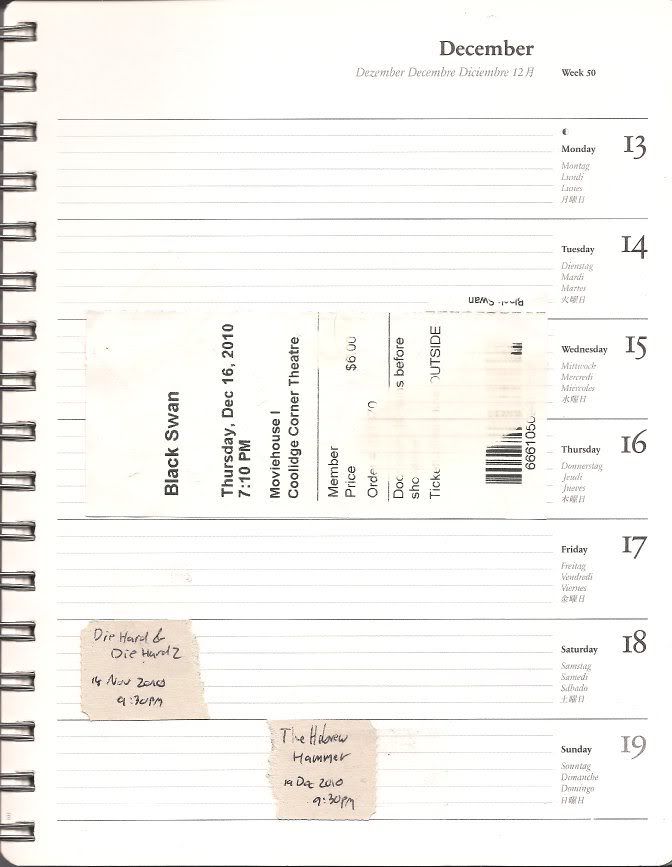
Stubless: The Tempest on 14 December 2010 at the Brattle Theatre, 7:30pm.
While running around Boston looking for gifts for my family, I found a chocolate bar that has bits of bacon in it. It is currently staring at me from the the other side of the kitchen, creating a mixture of desire and fear.
Anyway, not much time to write tonight; the early openings for movies this week means "Next Week in Tickets" is already late.
Black Swan
* * * ½ (out of four)
Seen 16 December 2010 at the Coolidge Corner Theatre #1 (first-run)
There's a moment in Black Swan where director Darren Aronofsky and his writers appear to tip their hands too much, and the audience may find themselves thinking that they've seen this sort of unreliable-narrator trick before, and doing it in so obvious a manner makes this example less than brilliant - and, of course, if it's a red herring, then the audience can rightfully complain about being jerked around a bit. Fortunately, the movie is not really about playing head games with its audience as much as its main character.
Natalie Portman is great in that part, fortunately. Some of that comes from being willing to succumb to the same sort of eating disorder as Christian Bale and then be made up unflatteringly after that, so that we can see that her Nina and the other ballerinas push themselves to absurd physical extremes in order to compete in a world that demands both tremendous athleticism and a dainty appearance that runs counter to it. Portman does a great job of presenting Nina as being right on the verge of cracking up and aware of it, trying to hold the inevitable breakdown back. It's a performance that doesn't quite work if the rest of the cast isn't just as good, but fortunately, they're covered there as well.
Black Swan is somewhat unusual in that as much as Portman and company get us to feel for Nina, and even root for her, it also has us hoping that she'll back down just as much as we hope she'll triumph.
Die Hard
* * * * (out of four)
Seen 18 December 2010 at the Brattle Theatre (Alt-Xmas)
Nigh-perfect, and I suspect all but impossible to repeat - the sequels and knock-offs all feel the need to raise the stakes, but the stakes are all perfectly balanced here. The writers are throwing all their ingenuity into the action set-pieces and, by dint of getting there first, are able to put a comic zing into moments without it seeming over-cutesy. It's got Bruce Willis, young and hungry, not yet having settled into a niche and thus making John McClane into a bona fide character.
And, because of its own success, it feels like a transitional piece. The style occasionally feels primitive; there's only one layer of polish on it. Director John McTiernan and company are willing to be simple in some spots, but not stupid, and though certain 1980s clichés stand out, they don't seem hackneyed. McTiernan also feels no pressure to do anything but a slow build during the movie's first act - no need to show you he means business, no establishing what the characters are capable of until stuff is actually on the line. We spend the entire first act watching McClane get diminished and look out of place. When Alan Rickman shows up as one of the greatest screen villains ever, it's not a mismatch just on numbers; Hans Gruber is clearly more prepared, smarter, and calmer than McClane. He's a legitimate underdog.
Then we get the action, and it's great, 1980s "we're not worried about a PG-13" stuff that understands its improbability and actually looks dangerous. Huge explosions are devastating, bullet wounds really do slow people down... It's a perfect balance between the real danger of the 1970s and the action spectacle that would follow it.
Die Hard 2
* * * (out of four)
Seen 18 December 2010 at the Brattle Theatre (Alt-Xmas)
Die Hard 2, on the other hand, doesn't hold up nearly as well. I suspect, if I were to watch all four in a row, this would be the weakest of the series, in part because it's trying so hard to emulate the first, but Renny Harlin just doesn't seem to get the vibe right. Here, McClane's cocky; he quips, rather than nervously runs his mouth. There's not a villain to rival Hans Gruber here - heck, William Sadler's Colonel Stuart really isn't even cool enough to qualify for henchman duty in the first film. The writers rehash a lot of the surface elements from the first, but not the heart of it - in the first, there were bona fide interesting relationships between John and Hans, Holly, and Al; there's nothing like that here.
Still, it's enjoyable enough, because Harlin can direct action. He gets one moment that will be on his resumé forever (the grenades in the cockpit), and that's certainly what everybody will remember. Less noted is that for 1990, the hand-to-hand looks darn good. Sure, the likes of Chuck Norris, Jean-Claude Van Damme, and Steven Seagal were hanging around at the time, but this sort of martial arts wasn't common in big action movies like this; when the hero and villain got within grappling range, the one-punch ending was much more common.
As good as Harlin is at that, the stuff around it could use serious work; it's the sort of movie where scenes seem to be built around looking cool in the trailer.
The Hebrew Hammer
* * ¾ (out of four)
Seen 19 December 2010 at the Brattle Theatre (Alt-Xmas)
Ah, Jewish jokes and Blaxpoitation spoofery. I won't deny that you're an amusing combo, but I have to say, you'd be a little funnier if the guys who wrote you took the next step, and populated their movie with characters who were a little funnier that stereotypes.
In other words, The Hebrew Hammer isn't nearly the hilarious movie that Black Dynamite is, despite working a lot of the same territory. It's a shame, because Judy Greer and Adam Goldberg are quite funny, and there are moments when having Goldberg's "Certified Circumsized Dick" walking around like a guy caught halfway between Orthodox Jew and The Mack is just brilliant. But there are a lot of jokes done at half effort that aren't funny, and I think making it this kind of Christmas movie was a mistake. The opening titles say that it's for all the Jews who had it up to here with the Gentiles, and it might have worked better if it ran with that rather than have the Hammer not just save Hanukkah and Kwanzaa, but Christmas as well. Make it about just how friggin' annoying Gentiles are during December, and I imagine even those Gentiles might get a laugh.
Wednesday, December 22, 2010
The Tempest, and why it should have been marketed like Twilight
The thing on the right actually exists and has just reminded me that I need to get my Atari gear working again because Tempest 2000 was flat-out awesome.
Not a lot to say about this than I quite like it and wish I had been able to get to writing this earlier, maybe raising visibility a smidge before it opened in Boston on Friday, as I see it's already having its showtimes at Kendall Square hacked down to one show at 3:40pm tomorrow, probably down to nothing on Christmas. Which is a terrible shame, as it's always nice to see Shakespeare presented as fun and exciting, as opposed to something which you study in high school, groan about, and then ignore for the rest of your adult life.
Putting it that way, though, I kind of wonder if Miramax/Touchstone might have gotten a bigger audience if they'd marketed it toward that high school audience. Not just because, sadly, people forget Shakespeare after they graduate, but because (as I mention in the review below), the beating heart of The Tempest is a teen romance, played out breathlessly against a background of sorcerers and monsters. And the boy that Miranda falls head over heels for is actually kind of pretty, rather than being a dashing, rugged prince.
Sadly, my Photoshop-fu is weak, but if Lionsgate can come up with posters for Near Dark that make it look like Twilight, I wonder why it never occurred to Disney to do so for The Tempest. Sure, once the teens and tweens bought tickets, they'd be hit with Shakespearean dialogue and a whole heck of a lot more Helen Mirren than they were anticipating, but the former is not necessarily a bad thing - the florid prose may click with that audience better than most, and Helen Mirren is really fantastic as a character who is equal part villain and sacrificing mother. Besides, at that point, you've got their money, and they may just come out of it loving it, talking up Felicity Jones, Reeve Carney, and maybe Russell Brand's excellent comic relief.
Instead, the poster plays up the trippiness - which is very cool, don't get me wrong - and makes it look like an art film. It's not dishonest at all (well, except for the flames - I don't recall anything burning), but that's going to sell the movie to a limited audience: Those of us who already like Shakespeare, don't mind that Taymor has changed the sex of one of the main characters, and want to see what her crazy visual style brings to the movie. And while I'm happily a member of that group, it's pretty narrow.
Every time a Shakespeare film comes out, I feel the need to remind people that, remember, this was not highbrow entertainment in its day - it was for everyone. A whole thread of this movie is even broad slapstick. And I suspect that if Shakespeare were working now, he'd be doing a lot of very mainstream, fantastical, stuff - it's worth remembering that The Tempest, like the other Shakespeare plays that don't have direct antecedents, is full of magic and fantasy and required visual effects on stage and now on screen. Now is probably the best possible time to do a film of this particular play, because there's an audience for this kind of story. The funny thing is, as much as Taymor's made an arty, honestly kind of nutty, film, it's one that maybe could have been marketed to a wide audience if Disney had just recognized what that audience was.
The Tempest
* * * ¾ (out of four)
Seen 14 December 2010 at the Brattle Theatre (sneak preview)
As The Tempest opens in cinemas after a certain amount of delay (the Walt Disney Company spent much of the past year or so trying to figure out what to do with Miramax Pictures, holding it in limbo), director Julie Taymor is regularly in the news for another long-delayed project, the Broadway production Spider-Man: Turn Back the Dark. Both are fantasies of one sort or another, both can be considered somewhat unusual takes on the source material. And without having seen the stage musical, I can only speak for The Tempest, but it at least displays Taymor's penchant for ambitious, visually dazzling productions in full, mad force.
Off the shores of a strange island, a ship is pummelled by the sea. It carries the royal families of Venice and Naples, but their high rank will do them no good when they wash up on shore in three groups: Neapolitan Prince Ferdinand (Reeve Carney) washes ashore alone; his father, King Alonso (David Strathairn) arrives in the company of his adviser Gonzalo (Tom Conti), brother Sebastian (Alan Cumming), and the Duke of Venice, Antonio (Chris Cooper); elsewhere, Alonso's clown Trinculo (Russel Brand) and butler Stephano (Alfred Molina) encounter Caliban (Djimon Hounsou), a strange half-human hybrid who is tamed by wine. He is not the island's only inhabitant; there is Prospera (Helen Mirren), the sorceress and deposed Duchess of Venice, her fifteen-year-old daughter Miranda (Felicity Jones), and their magical, spritely familiar, Ariel (Ben Whishaw).
Those familiar with the play will immediately note the different spin that Taymor put on Shakespeare's original story, that of changing Duke Prospero, the sorcerer, into Duchess Prospera, the sorceress. It's done remarkably smoothly, in that the changed lines in an early scene where Prospera explains her origins do not sound markably different from the unaltered monologue which surrounds it. Later scenes where Prospera refers to her brother-in-law Antonio as simply "brother" do sound a bit odd to modern ears, although no more so than Shakespeare's language often does. Implementation aside, it does change the way we look at the character a bit - Taymor works in comments that accusations of witchcraft were more dangerous for women than men, for instance. The most important change, though, is in how it perhaps refocuses the relationship between Prospera and her daughter. After all, Prospera knows what it is to be a teenage girl in a way a Prospero does not.
Full review at EFC.
Friday, December 17, 2010
Next Week in Tickets: Films playing Boston 17 December - 21 December
With Christmas just a week away, I not only need to get serious about my shopping, but the studios are starting to put their vacation movies out, both the fluffy stuff and the awards contenders. It's a lot of fun, but just like vacations, it turns out that dates, locations, and prices need a little research - some movies are being shown in a bunch of different formats, others may have started in just one place but are moving around.
And while making holiday plans, don't forget the actual holiday-themed activities at many theaters - many not saccharine at all, but in fact a lot of fun.
(Also: "Next Week in Tickets" will show up on Wednesday next week, so consider these bookings only good through Tuesday)
Opening wider and moving around
Let's go to the grid
Specials, holiday and otherwise
My plans for the weekend? Well, Christmas shopping, mainly - I've done close to nothing except for the perennials (family members know what those are), so I figure to be hitting Games People Play, Stellabella, and other local shops pretty hard. Around that, I want to see the Brattle's Christmas movies (I'm not sure, but I may have never seen Die Hard on film) and some of the HFA's silents. If I can get the shopping done, I'll probably head north a bit for cheap flicks at Arlington and Fresh Pond, checking out The Social Network, How Do You Know, and (perhaps!) Yogi Bear.
Monday, I'll be at Applause or I will never, ever, hear the end of it from Chlotrudis's Michael Colford. I'm using a floating holiday Tuesday because I need to by the end of the year, so Crossword Puzzle Day will be celebrated by heading to the Furniture store to see Tron.
And while making holiday plans, don't forget the actual holiday-themed activities at many theaters - many not saccharine at all, but in fact a lot of fun.
(Also: "Next Week in Tickets" will show up on Wednesday next week, so consider these bookings only good through Tuesday)
Opening wider and moving around
- Black Swan remains at the Coolidge, Boston Common, and Kendall Square theaters, but also gets a screen at Regal's Fenway theater.
- The Fighter, exclusively at Boston Common last week, also opens up at Fenway and AMC's Harvard Square theater.
- I Love You Phillip Morris sticks around Kendall Square and Boston Common (though it's now sharing a screen with another movie there), and also opens at the Coolidge.
- The Coolidge also puts the pretty terrific Marwencol in its main digital room; it is no longer playing at Kendall Square.
- Stuart Street lets you do a "good recent movies set in Boston" double feature with The Social Network and The Town; Belmont's Studio Cinema pairs The Town with Unstoppable (note that neither are actual double features; those are just the movies splitting a single screen
Let's go to the grid
- Apparently, that can serve as a bit of a pun for Tron Legacy; I can't say how good/bad a pun it is, because I was in elementary school the last time I saw Tron and Disney actually appears to be hiding the movie which spawned its enormous sequel - no Blu-ray, the DVD is out of production, theaters apparently can't even book prints. Hopefully it's a case of "the new one is going to be so incredible we don't want the old one's cutting-edge-for-1982 effects to give people the wrong idea" rather than "if people knew what we'd bet Christmas on, they'd think we're nuts". Whatever it is, the previews make it look like it will look and sound incredible, and since "look and sound incredible" can cost extra these days, it's worth taking a hard look at where it's playing, in what formats, and what the premiums are:
Screen Price (before noon) Price (afternoon) Price (evening) Somerville Theatre, 35mm (one screen) N/A (Mon-Fri) $5.00 $8.00 (Sat-Sun) $7.00 Arlington Capitol, Digital 3-D (two screens) N/A (Mon-Fri) $9.00 $11.50 (Sat-Sun) $10.00 AMC Harvard Square, digital 3-D (two screens) $9.00 $11.00 $13.00 AMC Boston Common, digital 3-D (one screen) $10.00 $13.50 $15.50 AMC Boston Common, IMAX Digital 3-D (one screen) $12.00 $15.50 $17.50 Regal Fenway, digital 3-D (one screen) N/A $13.00 $15.50 Regal Fenway, RPX 3-D (one screen) N/A $16.00 $16.00 Jordan's Furniture Reading, IMAX 3-D (one screen) $11.50 $11.50 $11.50
All prices for adult; knock a buck or two off for kids. It looks like Somerville is the only place to go if you can't take 3-D; the upside is, it's also the least expensive. In relative terms, the RPX screen doesn't look like a terrible deal here; at night, it's actually only a fifty-cent upsell on the standard screen, and it is definitely worth that. - There aren't quite so many options for Yogi Bear, whose kind-of-amusing trailer makes me wonder why it's been the subject of so much on-line hate. The marketing has either been clever or inept, depending on whether you think Warner was involved with the "Alternate Ending" or whether "good things come in bears" was deliberate innuendo or not. I may check it out, and kids may like it (assuming they've already seen Tangled; if not, bring them to that!). As it's in 3-D in some places but not others, it gets a chart, too:
Screen Price (before noon) Price (afternoon) Price (evening) Entertainment Cinemas Fresh Pond, 35mm (one screen) N/A $6.75 $9.25 Entertainment Cinemas Fresh Pond, Digital 3-D (one screen) N/A $9.00 $12.00 AMC Boston Common, digital 3-D (one screen) $10.00 $13.50 $15.50 Regal Fenway, digital 3-D (one screen) N/A $13.00 $15.50
Again, just one choice for seeing the movie in 35mm if 3-D gives you problems. A shame it's at Fresh Pond; though Entertainment Cinemas runs it fairly well, with pretty good prices, the actual configuration of the screens is often not good - there are a few long, skinny rooms with center aisles and the screens too high on the wall. I suspect that the 3-D rooms are the best-configured ones, though. - The other big openings don't have so many arcane options as to need a grid, thankfully. James L. Brooks's latest, How Do You Know is getting tepid reviews, which is a real bummer, as Brooks with Paul Rudd, Reese Witherspoon, Owen Wilson, and Jack Nicholson should be a pretty good time. It opens at Boston Common, Fenway, Harvard Square, Somerville, and Arlington. On the other hand, The King's Speech is expected to be a big awards contender, especially for Colin Firth, as King George VI, who must battle a stammer and self-confidence issues on his unexpected ascension to the throne. It opens on two screens each at Boston Common and Kendall Square, and is expected to expand to at least the Coolidge on Christmas Day.
- In addition to The King's Speech, Kendall Square also opens Julie Taymor's The Tempest. I saw a preview on Tuesday (review forthcoming), and I like it a lot. There's a fair amount of heart under Taymor's visual insanity. They also open Bhutto, a documentary about Benazir Bhutto, the first woman to lead a predominately-Muslim nation. As you might expect, she lived an eventful, controversial life. Director Duane Baughman will be at tonight's screenings (17 December 2010) in person to introduce the film and perhaps answer questions after.
Specials, holiday and otherwise
- In addiction to opening I Love You Phillip Morris and Marwencol, the Coolidge Corner Theater gets into the holiday spirit with midnight showings of Gremlins tonight and tomorrow.
- Not wanting the Coolidge to have all the off-beat Christmas fun, the Brattle is having non-quite-so-late Alt-Xmas shows at 9:30pm all weekend. Tonight, Jeunet & Cano's City of Lost Children plays; Saturday night is a Die Hard Double Feature (original at 9:30, Die Hard 2 at midnight); and on Sunday, The Hebrew Hammer closes things out. Those looking for a more traditional Christmas celebration can come to the Cambridge Chorus's "Open Sing" of Handel's Messiah, Sunday at 1:30pm.
The main feature this week is Guy & Madeline on a Park Bench, which I saw a few weeks ago as part of the CineCaché series and... did not like. An ambitious project for a first-time filmmaker, to be sure - a musical shot on film in and around Boston - but it's kind of a mopey-postgrad movie. On the other hand, it does give the Brattle and excuse to run a matinee musical double-feature on Saturday, both featuring Louis Armstrong: Cabin in the Sky and High Society.
Speaking of CineCaché, Monday night is the penultimate entry in this fall's series, and it features Paprika Steen in Applause. Critics and distributors are hoping to push Ms. Steen for Oscar consideration as Best Actress, and that alone makes it worth a look. - ArtsEmerson is also into the Christmas spirit this weekend, with Preston Sturges's Christmas in July playing Friday and Saturday night. It alternates screenings with Douglas Sirk's All that Heaven Allows, which also plays Sunday night. Saturday afternoon's kid-friendly program is "Totally Tall Tales", an international collection of short films curated by the Children's Film Festival Seattle
- The Harvard Film Archive has one more week of films from Weimar Germany, with silents at 7pm on Friday, Saturday, and Sunday nights and controversial (for the early 1930s) talkies at 9pm on Friday and Saturday. Note that there's a schedule change from the printed program, with The Street showing Saturday at 7pm instead of New Year's Eve
- The bulk of the program at the MFA is Isabelle Huppert and Great Directors; many films in this will be wroth a look, because she has worked with some fantastic directors - there's Godard, Chabrol, and Haneke on tap, and Huppert is frequently mesmerizing. They kind of crowd the other program, The Films of Lou Ye, out - there's Spring Fever showing this afternoon and Suzhou River showing Saturday morning - which is a shame, because I remember loving Purple Butterfly and wish I had time to see more of these.
My plans for the weekend? Well, Christmas shopping, mainly - I've done close to nothing except for the perennials (family members know what those are), so I figure to be hitting Games People Play, Stellabella, and other local shops pretty hard. Around that, I want to see the Brattle's Christmas movies (I'm not sure, but I may have never seen Die Hard on film) and some of the HFA's silents. If I can get the shopping done, I'll probably head north a bit for cheap flicks at Arlington and Fresh Pond, checking out The Social Network, How Do You Know, and (perhaps!) Yogi Bear.
Monday, I'll be at Applause or I will never, ever, hear the end of it from Chlotrudis's Michael Colford. I'm using a floating holiday Tuesday because I need to by the end of the year, so Crossword Puzzle Day will be celebrated by heading to the Furniture store to see Tron.
This Week In Tickets: 6 December 2010 to 12 December 2010
On, the surface, this week's calendar of tickets doesn't look like very much...
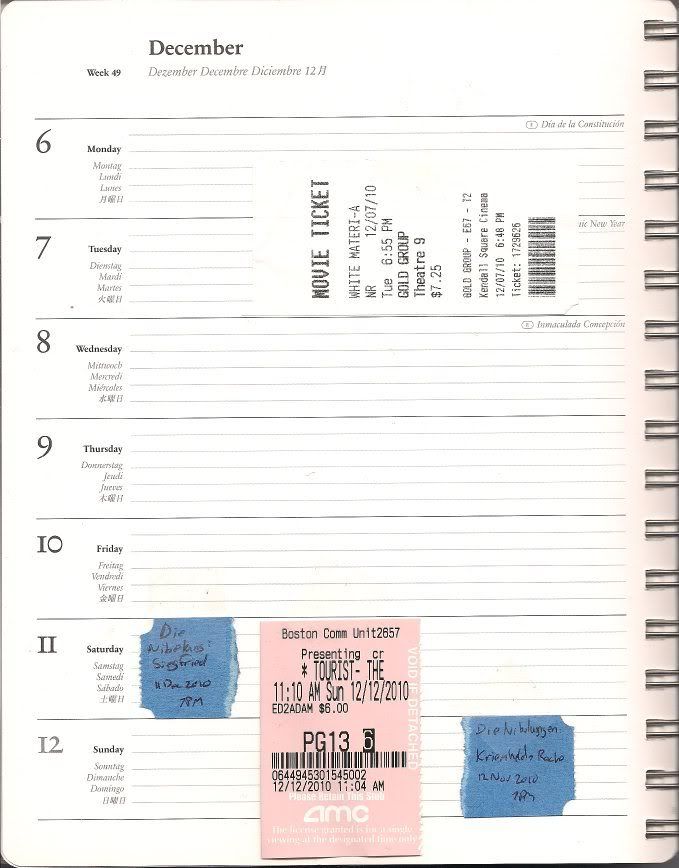
Stubless: I Love You Philip Morris on 6 December 2010 at the Brattle Theatre, 8pm.
... but that review of the Die Nibelungen movies has shot up the charts on my Blogger stats page crazy fast in the hours since it's been posted. One night, and it is already halfway to getting the number of hits as the Triangle review, the most popular since those stats started appearing in June. This leads me to one of the following two conclusions:
(1) There is an untapped market for silent movie reviews on the web, especially less reverent ones that suggest things would have been better if Fritz Lang had directed a big-budget Conan picture upon arriving in America, rather than a bunch of great film noirs.
(2) That somebody's computer was closing and restarting Firefox a lot yesterday afternoon and evening.
Sadly for me, the latter seems more likely, especially since 99% of the hits yesterday afternoon and evening were from Firefox on an "Other Unix" system in the United States. So, tell me - was it you?
-- sigh -- Well, it was an exciting distraction at work for a couple hours. And now, allow me to make a forced segue and say that Claire Denis's new one is exciting, but no mere distraction:
White Material
* * * ¾ (out of four)
Seen 7 December 2010 at Landmark Kendall Square #9 (first-run)
White Material is a pretty good movie with a pretty uninspiring trailer, at least in the United States. I don't really blame the distributor for this; Claire Denis makes films which favor character and setting over plot, but that doesn't get butts in seats unless you already know her work. So, they try to cobble together a story, and it winds up looking like a movie about how white plantation owners are the ones who suffer during African unrest. That's just one facet of what is, in fact, an intriguing bit of work.
The movie opens in an interesting way, with two different scenes of Maria Vial (Isabelle Huppert) returning to the Vial Café plantation. In the first, she's sneaking around the landscape before finding a van; in the second, she seems carefree, riding her motorcycle. In both, it's made clear that this African country is in the process of exploding, but Maria refuses to leave the coffee plantation so close to the harvest. In some ways, the situation inside the gates is as volatile as outside: Maria basically runs the business with father-in-law Henri Vial (Michel Subor) ill; she does not hold back her disappointment about her son Manuel (Nicolas Duvauchelle) being a layabout. She's actually fairly fond of José (Daniel Tchangang), the son of her husband André (Christophe Lambert) and Lucie (Adèle Ado), the housekeeper. Maria seems to have no clue just how close the danger is, either in terms of Le Boxeur (Isaach De Bankolé), a wounded nearby rebel leader, or or a pair of child soldiers stealing supplies.
White Material could be a simple observation, but Denis and her collaborators paint a surprisingly complex and engrossing picture. The parallel openings inform us that we are going to be bouncing around the timeline a little, informing us that this is more likely to be a film about hubris than perseverance; hitchhiking-Maria almost certainly comes after motorcycle-Maria, but by seeing her trying to sneak home first, much of the admiration we may have for her desire to stick it out is stillborn. And while Denis doesn't fill her film with plot twists, she does fake the audience out once or twice. She's not looking for "gotcha!" moments, just making sure that the logical left side of one's brain doesn't wander while she feeds the emotional right.
Full review on EFC.
The Tourist, the trailers, and the tail-end
I got a mostly-new set of trailers in front of The Tourist, so let's run them down. Also, after the relatively spoiler-free review written for EFC, I'll go through the problems I had with the movie's plot that I didn't feel right including in the review.
The Lincoln Lawyer - It is nice to see Matthew McConaughey is something that appears to have even a little bit of substance in it again. As charming as his laid-back persona is, it's an easy one to just coast with, so it's nice to see him in this slick-looking movie with a darn good cast attached.
The Eagle - A son of a Roman soldier whose legion was lost in Caledonia attempts to track him down with a Pictish slave. Man, is he going to be disappointed when he finds out that his father's not dead, but has instead been shacked up with Imogen Poots.
The Adjustment Bureau - Matt Damon and Emily Blunt in a sci-fi-ish thing. Originally supposed to come out back in September, but apparently moved to March so there wouldn't be too much of Damon in theaters this fall between it, Hereafter, and True Grit. Possibly also moved so that they could arrange to pay Alex Proyas for ripping off Dark City, only doing it with what appears to be less style.
Battle: Los Angeles - I find it kind of amusing that the guys who made Skyline all appear to have worked effects on this. I think it will be a lot better than that film, but somehow the trailer doesn't really wow me.
Just Go With It - I don't want to spoil the movie, but can it possibly end in any way other than Adam Sandler's character figuring out that Jennifer Aniston's is the one he really loves, with a side order of Brooklyn Decker's being revealed to be a secret bitch? Also, doesn't the whole movie hinge on Sandler's character being too stupid to say "oh, yeah, I found that on the floor of my office and said I'd bring it back to the owner tomorrow"?
(Also, is Nicole Kidman really in this movie? If so, why, and why isn't she mentioned in the trailer?)
and...
Gantz (Part One) - I'm actually kind of excited about this, not just because I enjoy the heck out of the manga and the adaptation features Kenichi Matsuyama from the Death Note movies and the director did the animated Haruka on Obliivon Island (a strange warm-up for this hyper-violent piece), but because the distribution model is kind of exciting, in that these special premiere screenings are happening at the same time in America and Japan. Not waiting for cool movies is exciting, even if they are dubbed in English.
(Not sure why it's dubbed, though - the primary audience for this screening is people who buy comics that they have to read right-to-left for authenticity; I suspect over half of the people buying tickets would prefer subtitles and the other half wouldn't mind)
And now, onto the main feature...
The Tourist
* * ½ (out of four)
Seen 12 December 2010 at AMC Boston Common #6 (first-run)
Looking at the cast and crew of The Tourist, its eventual ranking as a so-so caper flick is a bit of a surprise, not just because there's plenty of fine talent involved, but because for a good chunk of its runtime, it's surprisingly good: That talent had been doing different sorts of work or underwhelming recently. Things peter out, though, and the filmmakers don't figure out the right note to end on.
As we open, the French police are doing their regular surveillance on Elise Clifton-Ward (Angelina Jolie), an elegant Englishwoman in Paris. Cushy duty, as she's quite easy on the eyes and varies her routine not a whit. Today, though, she receives a note from the watcher's real target, her on-the-lam mob accountant boyfriend, said to have a new face. She's to take the train to Venice, find someone who matches his height and build, and make her pursuers think it's him. She chooses Frank Tupelo (Johnny Depp), a friendly but doofy American tourist. Scotland Yard Inspector John Acheson (Paul Bettany) discovers the deception, but one of his subordinates leaks the information to Reginald Shaw (Steven Berkoff), who sets his sights on Frank and Elise and doesn't notice the other guy with a similar height and build (Rufus Sewell) who is hanging around.
Frorian Henckel von Donnersmarck directs and also wrote the script (also credited to Chrisopher McQuarrie and Julian Fellowes, and adapted from Jerome Salle's film Anthony Zimmer), and while that mouthful of a name may not immediately leap to mind, it should - he directed The Lives of Others, which won the Oscar for foreign language film and absolutely deserved it. As things start, he's playing with surveillance again, and that part of the movie is as snappy as expected. Then Frank shows up, and the movie takes on a more comic tone. Von Donnersmarck doesn't exactly slip here, but things necessarily become a little more disjointed than they were; even brief stops to drop a surprise, let a punchline breathe, or allow the audience recover after an action beat make things a little less smooth than the slick chess game that opens the movie.
Full review at EFC.
Normally, I'd be giving The Tourist a bit of a thumbs-up for not doing the whole worn-out "flashes showing every hidden clue a second time to spell out just how it all fits together" thing. All too often, it treats the audience like idiots. However, I strongly suspect that there were no clues to point to Frank actually being Alexander, the mob money guy he's supposed to be a decoy for - that we're supposed to be satisfied that there was no reason that it would not be true.
Except... There are two ways this could work, and either way, it seems like a pretty crappy plan. Mostly because it's unnecessary - if nobody knows about his new face, why not just go to Venice, pick up the money, and get into contact with Elise after the fact? Nobody gets shot at in that version of the plan. The downside is that it involves Shaw still being alive and free to chase him down, but if Frank/Alexander is smart enough to steal the money and come up with a master plan to get Shaw and the police to follow him in such a way that he gets out with the money, he's got to be smart enough to have a blackmail cache he could drop on Scotland Yard's and Interpol's doorsteps.
But let's look at what he did. Say Elise is not in on the plan. In that case, Frank/Alexander's plan is reliant on (a) her choosing to sit with him on the train, (b) Acheson being able to reconstruct the burnt note, (c) the police force having a leak in it that will inform Shaw where he is going, (d) his Frank persona being charming enough that she follows him to make sure he doesn't get into too much trouble, (e) him being able to extricate her from any trouble she gets into despite his being an accountant as opposed to a secret agent, (f) the police taking care of his Shaw problem, but not locking the scene down enough that his decoy will allow him to escape. That is a plan with a lot of potential points of failure, where "potential point of failure" is equal to "opportunity to get shot".
(Although, I must say, casting Rufus Sewell is a good decoy for the audience. Not so huge a star that using him this little will tick the audience off, but well-known enough that we figure there's going to be more to him than we see.)
The alternative is that Elise is in on the plan. This means that either this plan was concocted long ago, or Frank/Alexander had some secure way of communicating with her that renders everything else theater. (c) and (f) are still major issues with this plan, and it also requires Acheson to be very, very predictable. In both cases, Chief Inspector Jones not immediately locking Elise up seems to be a fairly big stroke of luck. So, even if Elise is in on the plan, it's still a whole lot riskier than it need be.
And then there's the question of how satisfying a movie it winds up being. Aside from Shaw and his gang being eliminated being a little out of the spirit of the typical caper movie - it basically graduates Alexander from thief (and one willing to pay his taxes!) to killer, if only by proxy - it leaves the characters without an arc. Instead of seeing Frank stepping up, shedding his timidity, it's just Alexander following through a plan. Instead of Elise falling for a good and honest man, she's going through the motions as well, if she's in on the plan. If she's not... Well, that's kind of scuzzy, isn't it? She's falling for a guy who doesn't really exist only to find out that he's her old boyfriend who has been lying to her - and she's apparently okay with that. It makes Frank/Alexander a pretty complete tool, as well.
That's why, with a little thought, this movie's plot pretty much falls apart for me. Either it's a story about a hollow con - in which case all the romance stuff is poor misdirection - or it's a romance with an ugly end. And no matter what, the plot involves getting yourself and your girlfriend shot at.
Thursday, December 16, 2010
Die Nibelungen and a Fritz Lang fantasy
A few years ago, the Harvard Film Archive had a Fritz Lang-specific program which covered his entire career, which meant that unlike the current Weimar Germany series running there, it included a fair amount of his Hollywood work. It is, by and large, pretty good, but I wonder how constricting it must have seemed to Lang. In the 1920s, he was arguably the world's greatest genre filmmaker, and most ambitious - though his "Spider" film series was truncated halfway through its planned four films, he did The Weary Death, the five-hour (but thrilling!) Mr. Mabuse: The Gambler, this two-part feature, Metropolis, Spies, and The Woman in the Moon. After that? His first talkie, a little crime movie you may have heard of, M. After a pair of Mabuse sequels, he fled the Nazis to France and then Hollywood, where he would make a number of fine crime films, but a return to grand spectacle would have to wait until he returned to now-West Germany in the late 1950s, where he would remake a pair of his old scripts for a two-part adventure in India and resume the Dr. Mabuse series.
Spectacle often gets a bad rap, and when the talkies came, Lang's sort of spectacle soon seemed to die out. There was King Kong, the Universal Monsters, and The Wizard of Oz, but aside from that, the thirties and forties would become a quiet period for science fiction and fantasy, despite this often being considered the Golden Age of Science Fiction in print. There was a war coming and then a war on, and Lang's own works likely scared many producers away (Metropolis is just now being pieced together because it was torn to shreds as a bomb back during its initial release). It's as though the move to sound and color removed a level of abstraction that people needed to believe in these flights of fancy, the genres became the domain of pulps and comics exclusively, and the general enthusiasm wouldn't return until the space race.
It's fun to imagine an alternate Hollywood, though, where the studios hire Lang and give him the money to maybe not make an American remake of Metropolis, but maybe adapt that "Lensman" thing that E.E. Doc Smith was doing for Astounding, or those Conan stories that Robert Howard did for Weird Tales. Or maybe instead of doing a serial of that Batman character we just licensed from National Comics, you could do a feature...
That, of course, didn't happen - and while Lang more likely would have developed something original with wife Thea von Harbou, those properties are just to illustrate what sort of genre work was kicking around American popular culture at the time, had American studios opted to play to some of Lang's strengths and gamble on a new sort of blockbuster as opposed to putting Lang on a series of crime movies. These were often quite good, as might be expected - the guy did do M, after all. And for all I know, that sort of more realistic, contained story is what he wanted to do at that point in his life and career; I imagine being forced to flee your homeland can change your priorities.
But, seriously, watch Die Nibelungen and then imagine Fritz Lang getting the budget usually lavished on an MGM musical to direct, say, Dick Powell or Errol Flynn as Bruce Wayne (original inspiration Conrad Veidt could have played the Joker). Sure, Conan might have been a tough sell in Hayes Code-era Hollywood, but I suspect Lang on a science fiction movie would more likely have pushed effects work forward than looked silly. As a fan of Lang's ambitious silent fantasies, it's a shame it didn't turn out this way.
No review of silent movies would be complete without talking about the accompaniment. It's part of what makes seeing silents in the theater exciting and unusual; given how important the soundtrack is to a film, it makes these experiences individual, as much attending a concert as a movie. Last summer, I saw Metropolis twice within the space of a few weeks, and it wasn't just the facilities that changed, but hearing an original score versus the traditional, familiar one.
It's especially the case with something like the HFA's screenings of Die Nibelungen, where Donald Sosin was performing an improvised score. In some cases, the synthesizer made sounds that just wouldn't have been heard eighty-five years ago; in others, plans changed on the fly. In the introduction, Sosin talked about how he would be avoiding Wagner and instead working something a little more like German folk music; instead, the film carried him toward a more bombastic score.
That's why the music isn't mentioned in the reviews below; though there is an original score, I can't comment on it, and anybody who sees this film will hear a different soundtrack than I did. In a sense, they will be seeing a different movie than I did, as a certain part of their brain will be engaged in a different way than mine was.
That's also the case because, as with the previous weekend's Korean films, the prints had no English subtitles; instead, translations of the German intertitles were read to us. For the most part, our narrator didn't fall too far behind, but choose your seat carefully when you go to a screening like that - depending on where you sit, the music can drown out the narration. Sitting one or two rows closer to the front on Sunday than I did on Saturday seemed to make a real difference, forcing me to try and read German at some points.
Die Nibelungen: Siegfried
* * * ½ (out of four)
Seen 11 December 2010 at the Harvard Film Archive (Decadent Shadows: The Cinema of Weimar Germany)
Fritz Lang's Die Nibelungen films have a sometimes tricky reputation; many see them as tapping into the same sort of German nationalism that later would lead to the rise of Hitler. Lang denied this; he hated Wagner's ring cycle being used as a score and would later flee to Hollywood. Whatever his intended message was, it still opens with a handsome German prince forging a sword.
That prince is Siegfried (Paul Richter), son of Siegmund, and the limping master blacksmith looks at the sword and say she can teach him no more. Before returning home, though, Siegfried is inspired to travel to Castle Worms in Burgandy, on the other side of the Nibelung lands. There's a dragon to be slain along the way, and legend has it that bathing in a dragon's blood will make the slayer invulnerable. At the castle, he meets King Gunther (Theodor Loos) and his sister Kriemhild (Margarete Schön), whose hand he is promised if he helps Gunther woo Brunhild (Hanna Ralph), the queen of Iceland, a proud warrior women who can only be won by besting her in athletic feats that Siegfried can accomplish but Gunther cannot.
I'm not familiar enough with German mythology and folklore to say what liberties Lang and Thea von Harbou (his wife and co-writer) took when crafting this version of the tale, but it has the feeling of "mythology" as opposed to "fantasy". The film is divided into seven "songs", with the introductory intertitles describing the contents of the next act; though there's suspense, laying the events out there emphasizes the heroic or tragic nature of the protagonists. Their capabilities are mythic and superhuman - at one point, Siegfried extinguishes the fires blocking their path via pure awesomeness - as, of course, are their flaws.
Full review at EFC.
Die Nibelungen: Kriemhilds Rache (Kriemhild's Revenge)
* * * ½ (out of four)
Seen 12 December 2010 at the Harvard Film Archive (Decadent Shadows: The Cinema of Weimar Germany)
The epic movie - and epic movie series - is by no means a modern invention. For a good portion of his German career, that's what director Fritz Lang specialized in - Metropolis, Spies, Woman in the Moon, the five-hour Dr. Mabuse, The Gambler (for which he directed three sequels), and his epic two-part 1924 adaptation of Die Nibelungen. This second part is a surprise, as it focuses on a perhaps the least interesting character from Die Nibelungen: Siegfried, but creates an impressive spectacle regardless.
(Note: This review will discuss the end of the first film, so go elsewhere if you don't want it revealed.)
Full review at EFC.
Tuesday, December 14, 2010
CineCaché #6: I Love You Phillip Morris
I would like to open this belated review by saying "see, Ivy, Boston Common does show movies like this!" Because I'm classy.
I Love You Phillip Morris drew a good-sized crowd for last week's CineCaché screening, in part because it had another co-presenter, the Boston LGBT Film Festival, which led to an interestingly skewed take on the movie and discussion afterward. A few folks in the audience had very specific nits to pick - that one particular scene seemed too positive on "barebacking", or that the film was light on how Steven and Phillip falling in love is, shall we say, not exactly representative of the experience most gay men have in prison.
However, another person complained that it made gay people look bad, and I don't think that's really a valid complaint. Part of what I think is kind of remarkable about this movie existing at all is that it's a movie about gay people where their sexuality is a secondary consideration. It would not be that difficult to create a version with Stephanie or Phyllis in one of the two lead roles, although it would not be trivial, either. Even without that consideration, though, the people making the movie clearly looked at it as a mainstream production. Playing Steven Russell isn't Jim Carrey stretching, it's him doing what he does best.
I Love You Phillip Morris
* * * (out of four)
Seen 6 December 2010 at the Brattle Theatre (CineCaché)
I Love You Phillip Morris opens with a playful variant on the standard disclaimer, something along the lines of "This all happened. It really did!" It's the sort of movie that might get dismissed as ridiculous or improbable otherwise, although it's arguably not really necessary - it works just fine as an crazy love story, albeit with the emphasis on the crazy.
Steven Russell (Jim Carrey) was living a pleasant life in a Georgia beach community - he was a respected member of the local police department with a sweet wife (Leslie Mann) and daughter - until a brush with death makes him decide to stop lying. Sorry, dear, I'm not actually working late those nights I'm out past midnight; I'm sleeping with men. The trouble with coming out is that the gay lifestyle he imagines is pretty expensive, and his con artistry gets him sent to prison. Still, he's soon got the place wired, and it lets him meet Phillip (Eewan McGregor), and love blooms in that improbably place. They stick together when they get out, but Steven almost can't help himself, leading to a series of scams, sentences, and escapes.
Every once in a while, an actor gets a role that is uniquely suited to him, not necessarily because of physical resemblance or passion for the topic, but because the audience never loses sight of who is playing the character. Despite having a rough few years, Jim Carrey is still a movie star, and the fact that we know his shtick actually makes him more effective in a part like this. Carrey does broad comedy, hamming it up when other actors might dial it back, and because of that, Steven's often-ridiculous behavior and success gets past our objections. Because the end results are zany and always seem about to career out of control, it's easy to forget that they don't - each eye-roll and elongated syllable is chosen for maximum humorous impact, and that sort of control goes into the more dramatic moments, too - Carrey can take a moment, pull back, and show a certain amount of love and hurt behind the zaniness and lying.
Full review at EFC.
Friday, December 10, 2010
Next Week in Tickets: Films playing Boston 10 December - 16 December
Getting a late start, because... Well, last week was full of watching movies and this week was short on opportunities to write. Honestly, this blog is going to go completely downhill when my employer moves to new offices in January and I just never have the straight door-to-door bus ride that gives me an hour of distraction-free writing time each day..
My plans? Well, I've got time blocked out this weekend for other things ("Christmas at Fenway" Saturday; another craft fair thing on Sunday), but I'll probably try to fit Die Nibelungen in Saturday and Sunday night. I'll probably go for the cheap show of The Tourist Sunday morning, a Coolidge Screening of Black Swan tonight or Monday evening, and The Tempest on Tuesday, unless it fills up before I can get there (I'll know this blog has arrived, locally at least, when I try to get into a preview showing and am turned away because too many people read about it here). Normally, I'd say I'll try to fit a screening of The Social Network in somewhere, but that's become a running joke by now and, besides, that's not leaving Boston until at least a month after the Oscars.
- Movie opening patterns get weird around awards season. Take The Fighter, for instance: AMC is opening it on three screens in their Boston Common location, but it's not opening anywhere else in the greater Boston area this week. Maybe next Friday. Also opening at Boston Common is I Love You Phillip Morris, an entertaining crazy-love story featuring Jim Carrey and Ewan MacGregor that has sat on the shelf for a year or two because those two playing a gay couple apparently makes it radioactive.
The stuff showing up everywhere will likely have fans, but I'm not feeling them. I skipped the second Narnia movie, read the books in elementary school, and don't cotton much to the religious undertones, so I'll be giving The Chronicles of Narnia: The Voyage of the Dawn Treader a miss. If you do go, the general consensus is that director didn't have 3D in mind when shooting the film, so it may make more sense to save the $3-5/ticket. The trailers for The Tourist are doing pretty much nothing for me - Angelina Jolie's accent seems ridiculous and Johnny Depp continues to be an annoying parody of himself - but, damn, it's from the maker of The Lives of Others, which is genuinely fantastic, with Christopher McQuarrie and Julian Fellowes collaborating with him on the screenplay. And a cast that includes Paul Bettany, Timothy Dalton, and Rufus Sewell. If Depp ruins this for me I may go from being disappointed in him to outright disdain. - In further. "weird opening patterns", Black Swan makes its way to the Coolidge after opening at Boston Common and Kendall Square last week; I'll be going there because I like to buy local at Christmas. They've got a few special treats to make it worth the wait - tonight (10 December) and tomorrow, the 7:10pm shows will be preceded by short performances of holiday songs by the Brookline Chorus, and Tuesday night's 7pm show is an "Off The Couch" screening with post-film analysis by Dr, Michele Baker of the Boston Psychoanalytic Society.
Another noteworthy guest his week is Dr. Dennis Hong, a roboticist who will introduce and discuss The Day The Earth Stood Still on Monday (13 December) night. Sunday morning, as journalist Laura Blum moderates the post-film discussion of Blue Valentine as part of the "Talk Cinema" preview series. Plus, there are midnight shows of Elf tonight and tomorrow, and The Room Saturday at midnight. And if you, like me, missed Made in Dagenham in theaters, that's playing in one of the little digital rooms. - I Love You Phillip Morris also opens at Kendall Square, along with Queen of the Lot, a screwball-looking comedy about an actress trying to get her big break despite an ankle bracelet. It's directed by Henry Jaglom, whose name sounds vaguely familiar despite his filmography leaving me blank. The one-week warning is on Tiny Furniture, which I saw at IFFBoston this year and found pretty bland.
- I'm kind of down on the show anchoring the Brattle's weekend, too. Do It Again played IFFBoston as well, but I'd already seen it at an Eye-Opener screening (I avoided talking about it about a year ago). Maybe it has changed significantly since I saw it, but I kind of doubt it has changed enough - the rough cut I saw was pretty painful, an almost textbook example of how a filmmaker can take an interesting subject (the poor relationship between the brothers who formed half of The Kinks) and completely derail it by making himself the star. His talking to random celebrities and musicians and having them play a Kinks song with him is painfully awkward, although it does suggest that Sting is almost unnaturally good at handling such things.
Other musical films will be playing alongside it, including "Kinks Party", a two hour package of clips and performances by said band. Saturday and Sunday at 5:30 is The Knack... and How to Get It, a Richard Lester comedy from 1965. The buried treasure may be Who Is Harry Nilsson (And Why Is Everybody Talkin' About Him)?, playing one time, Saturday at 9:30pm, a new documentary about the brilliant singer/songwriter.
Other special features are the annual holiday screenings of It's a Wonderful Life (Saturday and Sunday at 12:30pm, Monday at 8pm), a Tuesday preview of Julie Taymor's take on William Shakespeare's The Tempest, with the unusual casting of Helen Mirren as "Prospera", and Wednesday screenings of Helvetica to celebrate local design magazine GLIMPSE's special typography issue. - Believe it or not, Casablanca is screening at somewhere other than the Brattle! It plays the Somerville Theatre at 9pm, with Boston Globe "Love Letters" columnist Meredith Goldsteain and film critic Wesley Morris talking their favorite love stories and giving out prizes. Also playing the Somerville Theatre, at least on weekends, is Christmas burlesque show The Slutcracker.
- The MFA finishes up their "New Korean Films" series with some films I've seen at festivals over the past couple years: Kim Ki-duk's Dream plays Saturday Morning; I found it weird, sometimes in a good way, but other times not at NYAFF last year. Breathless plays Saturday at 5pm; it was one of the best things I saw at Fantasia 2009. And Sunday afternoon's Rough Cut, seen at the same festival, is right up there with it. Pity about Castaway on the Moon disappearing from the schedule, though.
Also running this weekend is the Reel Access series, spotlighting fictional films and documentaries about people living with disabilities. Two new series start on Wednesday, The Films of Lou Ye and Isabelle Huppert and Great Directors - The Harvard Film Archive continues their Decadent Shadows: The Films of Weimar Germany series this weekend, with a 1930 talkie Friday night and silents Saturday, Sunday, and Monday. I'm particularly looking forward to the two-part screening of Fritz Lang's Die Nibelungen.
- ArtsEmerson only appears to have one movie screening this weekend, a Sunday night presentation of Let Each One Go Where He May with director Ben Russell in person to introduce and discuss his documentary of two Surinamese brothers recreating their ancestors' escape from slavery.
- Once again, the single screen of Indian films at Fresh Pond seems to be stuffed to bursting. Break Ke Baad has a matinee Saturday and an evening show Sunday; Guzaarish has evening shows tonight, an early show on Saturday and Sunday, and afternoon shows Monday through Thursday; new release No Problem bounces around the schedule a bit; and unsubtitled Telegu-language films pop up here and there. There doesn't seem to be a lot of information on No Problem; it appears to be a screwball caper comedy of some sort.
My plans? Well, I've got time blocked out this weekend for other things ("Christmas at Fenway" Saturday; another craft fair thing on Sunday), but I'll probably try to fit Die Nibelungen in Saturday and Sunday night. I'll probably go for the cheap show of The Tourist Sunday morning, a Coolidge Screening of Black Swan tonight or Monday evening, and The Tempest on Tuesday, unless it fills up before I can get there (I'll know this blog has arrived, locally at least, when I try to get into a preview showing and am turned away because too many people read about it here). Normally, I'd say I'll try to fit a screening of The Social Network in somewhere, but that's become a running joke by now and, besides, that's not leaving Boston until at least a month after the Oscars.
This Week In Tickets: 29 November 2010 to 5 December 2010
Wow, this is up quick after the last post. It's almost like I didn't have to write anything at all for it!
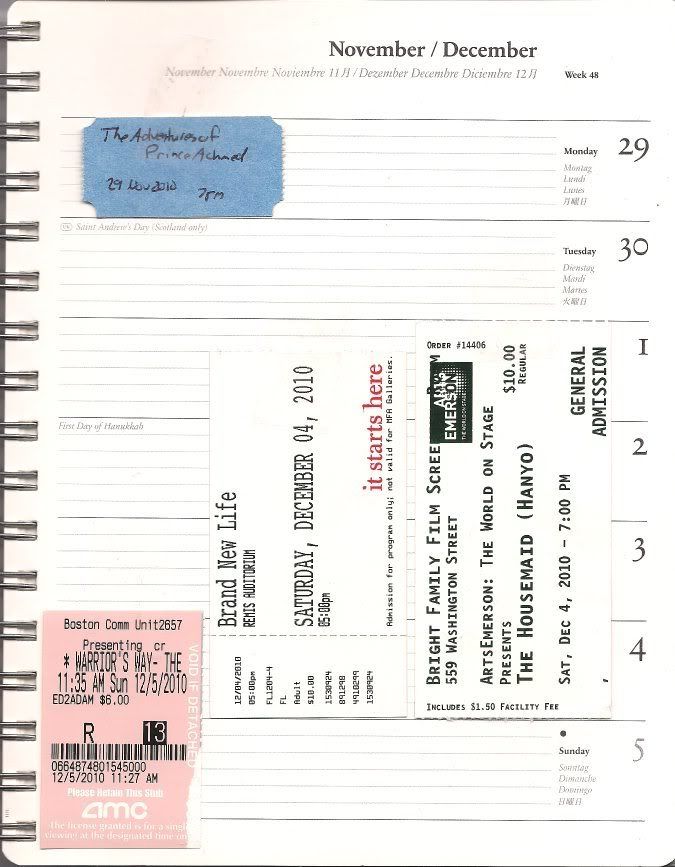
Stubless: Fantasia & Fantasia 2000 on 30 November 2010 in my living room, 8pm and Homeless Angels & Spring on Korean Peninsula on 5 December 2010 at the Harvard Film Archive, 7pm.
Shockingly little to say this week - the linked reviews more or less say it all. Although my brother Dan confirms that the Fantasia story I relate in the "Animation" entry did take place in 1982, as he remembers it too, with our next-youngest-brother Travis the baby at the time. You know, 1982 is a long time ago, to the extent that Dan now has two daughters, just a little younger than he and Travis were back then.
One thing that came to me when reflecting on that bit, though, is that if this is a formative movie-watching experience for me, it separates me a bit from a lot of the other mega-movie-fans I talk to online, especially genre fans, in that their stories are often about catching movies on late-night TV (the older ones), or VHS, or the ones that were in heavy rotation on HBO/Cinemax. I sometimes do think I'm a little more insistent on film, and seeing things in the theater than they are, and don't have quite the attachment to certain movies (I've never seen Road House, for instance).
So... That's that. A relatively late "Next Week" coming up!
Korean Film Weekend: Brand New Life, The Housemaid, The Warrior's Way, Homeless Angels, Spring on Korean Peninsula
This took a little more time to write up than I'd hoped; it was five movies that didn't have any reviews on EFC and which were seen in a short time (with other stuff, like doing some Christmas shopping at Bizarre Bazaar, taking up writing time). Plus work.
It was an interesting weekend of Korean movies, though; even without the coincidence of The Warrior's Way, three different venues were playing Korean films last weekend - the Museum of Fine Arts, ArtsEmerson's Paramount Center, and at the Harvard Film Archive. I half-wonder if it was a co-ordinated effort, especially considering that they wound up running on different schedules - you could see the Korean films at the MFA and then travel downtown or to Harvard Square for the other programs during the weekend. I don't think they do this very often; this is the first time I've really noticed in a year or so of doing weekly previews.
The progression and connection between the films are interesting to note. Both Homeless Angels and A Brand New Life take place in orphanages, although the perception has changed greatly between 1941 and 1975/2009 (depending on whether you want to go by when a film is set or released) - in the early movie, these are maybe not wonderful places, but good for kids; now, it's psychologically crushing. Of course, it's also worth noting that the farm in Homeless Angels was more group home than orphanage; there didn't seem to be any attempts to place the kids with other families.
Korea's prosperity relationship with the rest of the world is also reflected: The two 1941 films are clearly the product of a colonial/occupation period; the prints are subtitled in Japanese and there's some pretty blatant propaganda content. Native Koreans aren't doing so hot, and there seems to be a lot of pressure to either identify as Japanese (upper-class people speak that language when doing business, something which lingered for a while; it was referenced in the 1970s-set The President's Last Bang) or look to the West, specifically Germany. The Housemaid shows the country getting on its feet after the wars but still having growing pains. And while I unfortunately couldn't make time for another film or two from the MFA's program, which would likely have shown slick work from an economically strong South Korea, both A Brand New Life and The Warrior's Way are international productions - the credits for the former are split between Korean and French, while IMDB lists the latter's country of origin as New Zealand, despite its Korean director and star.
One last thing: Is creating a subtitle stream that will run in sync with projected film more difficult than one would otherwise think? Every time I've seen repertory houses get a print with no English subtitles (generally because there just aren't that many prints in existence), it looks like they just use a PowerPoint presentation which must be paged through manually which is not ideal. The two films at the HFA used this system, and there were some glitches, especially during Spring on the Korean Peninsula, where the subs would occasionally go backwards, or show up before or after the characters were speaking, making it pretty difficult to assign lines to characters at times. It strikes me that it's got to be pretty close to trivial, functionally, to automate the process, but nobody seems to do so.
Jibeopneun cheonsa (Angels of the Streets/Homeless Angels)
* * ½ (out of four)
Seen 5 December 2010 at the Harvard FIlm Archive (Discovering Korean Cinema)
One of the few surviving films from Korea's colonial period, Homeless Angels is very much a work of its time. Released in 1941, it feels like a Hollywood issue movie, and if that's not earnest enough, an extra layer of Japanese propaganda is piled onto the end. By the standards of that time and place, it's fairly well-done, but it's more interesting as anthropology than entertainment today.
In early-1940s Soeul, homelessness is endemic, especially in the Jon-ro area. Teenage girl Myung-ja (Kim Shin-jae) walks the street selling flowers with little brother Yong-gil (Lee Wook-ha) in tow. The Fagin of the area is a guy named Kwon, who wants to start using Myung-ja in less appealing jobs. Yong-gil runs, meeting up with a teacher by the name of Bang Seong-bin (Kim Il-hae), who tends to take in runaways in off the street. He's taken in so many in - to the chagrin of his wife Maria (Moon Ye-bong) - that he eventually has to start his own orphanage on Hyang Rin Won, a farm owned by his brother in law Dr. Ahn (Jin Hoon) - who, despondent over the death of his wife, frequently drinks at the bar where Myung-ja sells flowers.
Homeless Angels is as earnest a movie as you'll ever see; it's filled with a great deal of can-do attitude, teary reformations, and heartfelt pledges to be good citizens of the Empire of Japan. For most of the running time, it doesn't feel like obvious propaganda; it instead feels like a simplistic but upbeat story of a good man helping his neighbors. Director Choi In-kyu actually does well by the outline of a story that Japanese writer Motosada Nishiki has provided for him; the atmosphere of Jon-ro is suitably seedy and he doesn't over-sanitize life at Hyang Rin Won - at least to modern eyes, the empty barn where the boys get put up looks kind of unappealing; there's still a bit of classism to Bang's charitable impulses. It's a marked contrast to when the time later comes for contrition and praise. That doesn't feel insincere, just given a hard push.
Full review at EFC.
Bando-ui bom (Spring of Korean Peninsula)
* * * (out of four)
Seen 5 December 2010 at the Harvard FIlm Archive (Discovering Korean Cinema)
One of the potentially head-spinning things about watching modern Indian films is the way people casually slip between languages - English-speakers like myself will be reading the subtitles but not really listening while the characters are speaking Hindi, only to realize we've missed a sentence because a character has switched to un-subtitled English without stopping. Something similar happens in Spring of Korean Peninsula - characters will move from Korean to Japanese and back again within the same scene, with the subtitles switching between vertical kanji on the side for Japanese audiences to horizontal Korean text at the bottom for that language's speakers. It's a bit confusing, but also instructive for a movie about making movies: There were two masters that had to be served.
We start with a film-within-a-film, a version of the classic tale "Chunhyang". However, Soeul is not Hollywood, and the production is in trouble - star Anna (Baek Lan) is looking for another job, the director is about to be evicted from his home, the money that writer/producer Young-il (Kim Il-hae) is counting on from winning a writing contest is slow in coming, and Young-il's boss at the record company, Mr. Han, is not extending any more credit. Things may be looking up for Young-il personally, though - Jung-hee (Kim So-young), the sister of a friend, has just arrived from Pyongyang, and is hoping to learn about the movie and music business.
Though chunks of Spring of Korean Peninsula take place on a movie set, it's not the sort of backstage drama that comes across as oblique or confusing to those outside the business. Technical details are sparse; the focus is much more on how making a movie ties a great many people's fates together, and in a situation like early-40s Korea, there's no studio support net (the newly formed Bando studio is Japanese-controlled, which has its own issues). Of course, in some ways, it's not so different from the entertainment industry in any place and time; part of the reason Anna is looking for new work is that Mr. Han has pushed her aside now that Jung-hee has come along.
Full review at EFC.
Hanyo (1960, The Housemaid)
* * * ½ (out of four)
Seen 4 December 2010 in the Bright Screening Room, Paramount Center (Special Engagement)
The bookends to the Kim Ki-young's original 1960 version of The Housemaid may just elevate a sharp but frantic melodrama to the classic status it enjoys. What happens between is a bit of a messy movie, but what surrounds it does clever things with those events in a way that, honestly, should have been stolen more in the fifty years since.
Poor Kim Dong-sik (Kim Jin-kyu); he's just too handsome for his own good. Girls who work at a Seoul factory (and live in its dormitory) flock to his after-hours music classes for that reason, although he's far too straight-laced and in committed to his wife (Ju Jeung-ryu) and children to stray. When he receives a love-note from Kwak Sun-yeong, he reports it to the supervisor, resulting in the girl being suspended and quitting in shame. Ah, but Sun-yeong was put up to it by her roommate Cho Kyung-hee (Um Aing-ran), clearing the competition away. Kyung-hee starts to take piano lessons from Dong-sik, quietly reveling in how their hands touch, and when Dong-sik mentions that their new two-story house could use a housemaid, Kyung-hee recommends a girl from the factory (Lee Eun-shim) - who, naturally, also falls in love with Dong-sik, and who is not just the factory's bad girl, but may also be completely nuts.
Recent Korean cinema has gained an international reputation, in part because even when the genre trappings are familiar, filmmakers often jump in unexpected directions. That's certainly the case with The Housemaid, especially with its heated last act, which takes a sudden detour from the path it seemed to be following, playing out the final confrontations between the Kims and the dueling femmes fatale in a way that might have worked better if it had followed the standard film noir/erotic thriller conventions. It's not a bad ending - Kim Ki-young manages to keep the energy and suspense level high because the audience really doesn't know what's going to happen next - it's just that shock sometimes isn't quite so exhilarating a sensation as seeing the plot threads that Kim seems to have spent the past ninety minutes or so laying down come to a head.
Full review at EFC.
Yeo-haeng-ja (Un Vie Tout Neuve, A Brand New Life)
* * * ¾ (out of four)
Seen 4 December 2010 at the Museum of Fine Arts Remis Auditorium (New Korean Cinema)
Though many cultures approach cinema differently, there are certain things that are constants. One of them is that if you open a film with a montage of a a happy child, something is going to happen to make the unsuspecting kid very sad, very soon. A Brand New Life does not disappoint; Ounie Lecomte's semi-autobiographical story will certainly make some folks cry with its quiet, honest depiction of a good kid who suffers all the more for seeing what's going on.
Lee Jinhee (Kim Sae-ron) is having a nice day as the movie opens. Her father (Sol Kyung-gu) is buying her new clothes, taking her out to eat, and you've never seen a face so happy as when Jin-hee rides on the back of his bike. The next day, they go to a bakery to pick out a cake - choosing the most delicious-looking cake is serious business for an eight-year-old girl - but they don't go home with it. Instead, they bring it an orphanage, and only Mr. Lee will be leaving that day. The new girl is not a model resident; she frustrates Bomo (Park Myeong-shin), the woman who handles day-to-day operations, and demands to director Koo (Oh Man-seok) that she be allowed to call her father. Initially refusing to speak, she quietly observes what's going on around her - that the oldest girl there, limping Yeshin (Ko Ah-sung), has a crush on a local boy (Mun Hack-jin), and that Sookhee (Park Do-yeon) has just had her first period. Despite or because both are rather hostile to their caretakers, Jinhee and Sookhee become best friends.
Although there are hints that Jin-hee's life isn't completely rosy as the film opens, even beyond the obvious - the song she sings for her father is a sad, prescient one, and the floor they sleep on doesn't look particularly clean or comfortable - there's no doubt from the start that this is not a happy place, despite the efforts of staff. It's dusty, with brambles rather than flowers; there are two fences, one inside the other; and our first glimpse of the children there has loitering on top of and around the main building like a pack of coyotes. It's a very precisely created environment, the sort that tells us that every action Lecomte took in making this film is with purpose. It may not always be immediately clear what purpose - that the audience does not see Mr. Lee's face in the opening segment may hint that the film is going to be shot from Jinhee's perspective down near the floor, but when we do get a shot, there's another possibility, that her biological father has faded from memory except for that one moment. Those few seconds are all the information about how Jinhee's father truly thought about her that she or the audience is going to get.
Full review at EFC.
The Warrior's Way
* * (out of four)
Seen 5 December 2010 at AMC Boston Common #13 (first-run)
You know, a movie about a Chinese Swordsman fleeing to a tiny town in the Old West that is inhabited primarily by circus people should be one whole heck of a lot more entertaining than this. These sorts of mashups can be a lot of fun, but this one too often feels like it's being done by a 12-year-old who jumps from one totally badass thing to the next, not realizing that he's bitten off more than he can chew.
Yang (Jang Dong-gun) is "the greatest assassin in the world... ever!". His clan, the Sad Flutes, has been at war with another for decades. He has just eradicated the last of them, except for a baby, and despite all the blood he's spilled, that is apparently a line he cannot cross. Knowing that the clan's leader (Ti Lung) will hunt him and the baby down, he flees across the ocean to America, where an old friend has set up. When he gets to the town of Lode, though, he finds that "Smiley" has passed on. Pretty tomboy Lynn (Kate Bosworth) help set him and baby April up in Smiley's old laundry business, while trying to get him to teach her to fight. As much as he wants to lay down his sword, Lynn and the rest of the town may need his help when the bandit who killed Lynne's family (Danny Huston) comes back to town.
Often, with movies like The Warrior's Way, attempts to critique it get a "stop taking things so seriously" response, and in some ways that's fair. That "Ever!" actually pops up in a caption, the film features a highly-expressive comic-relief baby, there are plenty of oddball supporting characters - Tony Cox and Geoffrey Rush both show up as part of the group building a ferris wheel in Lode so that they can take the "traveling" out of their traveling circus, and that means that there are going to be clowns and mimes running around - in full costume, for some reason. The action is over-the-top, and there's a wink to the narration and unreality to the digitally-added scenery that should effectively nip any complaints about it being unrealistic in the bud.
Full review at EFC.
Subscribe to:
Posts (Atom)

